EP1564894A1 - Verfahren und Vorrichtung zur Sequenzschätzung - Google Patents
Verfahren und Vorrichtung zur Sequenzschätzung Download PDFInfo
- Publication number
- EP1564894A1 EP1564894A1 EP04290424A EP04290424A EP1564894A1 EP 1564894 A1 EP1564894 A1 EP 1564894A1 EP 04290424 A EP04290424 A EP 04290424A EP 04290424 A EP04290424 A EP 04290424A EP 1564894 A1 EP1564894 A1 EP 1564894A1
- Authority
- EP
- European Patent Office
- Prior art keywords
- sequence
- digital data
- determining
- correlation energy
- candidate
- Prior art date
- Legal status (The legal status is an assumption and is not a legal conclusion. Google has not performed a legal analysis and makes no representation as to the accuracy of the status listed.)
- Granted
Links
- 238000000034 method Methods 0.000 title claims abstract description 29
- 238000012545 processing Methods 0.000 claims description 9
- 230000001413 cellular effect Effects 0.000 claims description 4
- 238000013507 mapping Methods 0.000 description 5
- 238000012937 correction Methods 0.000 description 4
- 230000005540 biological transmission Effects 0.000 description 3
- 238000004891 communication Methods 0.000 description 3
- 230000010363 phase shift Effects 0.000 description 2
- 238000007476 Maximum Likelihood Methods 0.000 description 1
- 239000000872 buffer Substances 0.000 description 1
- 230000011664 signaling Effects 0.000 description 1
Images



Classifications
-
- H—ELECTRICITY
- H03—ELECTRONIC CIRCUITRY
- H03M—CODING; DECODING; CODE CONVERSION IN GENERAL
- H03M13/00—Coding, decoding or code conversion, for error detection or error correction; Coding theory basic assumptions; Coding bounds; Error probability evaluation methods; Channel models; Simulation or testing of codes
- H03M13/37—Decoding methods or techniques, not specific to the particular type of coding provided for in groups H03M13/03 - H03M13/35
- H03M13/45—Soft decoding, i.e. using symbol reliability information
- H03M13/451—Soft decoding, i.e. using symbol reliability information using a set of candidate code words, e.g. ordered statistics decoding [OSD]
-
- H—ELECTRICITY
- H03—ELECTRONIC CIRCUITRY
- H03M—CODING; DECODING; CODE CONVERSION IN GENERAL
- H03M13/00—Coding, decoding or code conversion, for error detection or error correction; Coding theory basic assumptions; Coding bounds; Error probability evaluation methods; Channel models; Simulation or testing of codes
- H03M13/03—Error detection or forward error correction by redundancy in data representation, i.e. code words containing more digits than the source words
- H03M13/23—Error detection or forward error correction by redundancy in data representation, i.e. code words containing more digits than the source words using convolutional codes, e.g. unit memory codes
-
- H—ELECTRICITY
- H03—ELECTRONIC CIRCUITRY
- H03M—CODING; DECODING; CODE CONVERSION IN GENERAL
- H03M13/00—Coding, decoding or code conversion, for error detection or error correction; Coding theory basic assumptions; Coding bounds; Error probability evaluation methods; Channel models; Simulation or testing of codes
- H03M13/03—Error detection or forward error correction by redundancy in data representation, i.e. code words containing more digits than the source words
- H03M13/05—Error detection or forward error correction by redundancy in data representation, i.e. code words containing more digits than the source words using block codes, i.e. a predetermined number of check bits joined to a predetermined number of information bits
- H03M13/13—Linear codes
-
- H—ELECTRICITY
- H03—ELECTRONIC CIRCUITRY
- H03M—CODING; DECODING; CODE CONVERSION IN GENERAL
- H03M13/00—Coding, decoding or code conversion, for error detection or error correction; Coding theory basic assumptions; Coding bounds; Error probability evaluation methods; Channel models; Simulation or testing of codes
- H03M13/37—Decoding methods or techniques, not specific to the particular type of coding provided for in groups H03M13/03 - H03M13/35
- H03M13/39—Sequence estimation, i.e. using statistical methods for the reconstruction of the original codes
- H03M13/3944—Sequence estimation, i.e. using statistical methods for the reconstruction of the original codes for block codes, especially trellis or lattice decoding thereof
Definitions
- the invention relates to estimating a sequence of bits corresponding to a received sequence of symbols.
- An application of the invention is directed to the field of wireless communication systems, and more particularly to the 3GPP systems.
- Physical control layer contains information necessary to configure physical channel parameters at the receiving end of a wireless communication system.
- control information needs to be decoded prior to the processing of the actual data samples composed of payload information provided by higher layers.
- Control bits are either transmitted prior to the payload or in parallel.
- the configuration, or reconfiguration of the receiver needs to be accomplished as fast as possible. Therefore, a latency constraint decoding and configuration problem has to be solved, where only a few bits, or control bits, are to be decoded as fast as possible.
- Forward error correction codes comprises linear block codes and convolutional codes.
- a modulation scheme with advantageous distance properties among the different signal constellation points should be chosen.
- Simple modulation schemes such as BPSK (binary phase-shift keying) or QPSK (quaternary phase-shift keying) are ideal candidates for reliable transmission due to high SNR (signal-to-noise ratio) of adjacent symbols.
- the invention proposes a solution capable of reducing the reference sequence space used.
- the invention proposes a method for estimating a sequence of N bits corresponding to a received sequence of M digital data.
- the method comprises the steps of :
- the memory size is thus reduced, as well as the number of computations.
- the amount by which the search space can be reduced depends on the properties of the forward error correction codes.
- said determining step a) comprises :
- the threshold is the maximum of all the calculated first correlation energies.
- the threshold determining step comprises :
- said determining step a) comprises :
- Said making up step b) may comprise, for each candidate sequence, reading a predetermined set of stored possible M-M RS remaining reference digital data, to obtain a complete candidate sequence of M digital data.
- Said making up step b) may also comprise, for each candidate sequence, generating a set of possible M-M RS remaining reference digital data, to obtain a complete candidate sequence of M digital data.
- said determining step c) comprises :
- a system for estimating a sequence of N bits corresponding to a received sequence of M digital data comprises :
- said first determining means comprise :
- the second calculating means are adapted for calculating said threshold as being the maximum of all the calculated first correlation energies.
- the second calculating means are adapted for :
- said first determining means comprise :
- said making up means comprise a memory for storing predetermined possible M-M RS remaining reference digital data, and reading means for reading, for each candidate sequence, said stored predetermined possible M-M RS remaining reference digital data, to obtain a complete candidate sequence of M digital data.
- said making up means comprise generating means for generating, for each candidate sequence, a set of possible M-M RS remaining reference digital data, to obtain a complete candidate sequence of M digital data.
- said second determining means comprise:
- a receiving apparatus in particular a cellular mobile phone, is also proposed.
- the receiving apparatus incorporates a system as above defined.
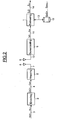
- figure 1 illustrates a system according to an aspect of the invention, which is incorporated in the reception chain of a cellular mobile phone TP, although the invention is not limited to this particular application.
- the interleaved signal is received by the antenna ANT and processed by the radio frequency stage RF of the receiver.
- the signal is converted into the digital domain by an A/D converter.
- the converted signal is transmitted to a digital process stage DPS which comprises a system 1 according to the invention, and processes the digital base band signal.
- the system 1 especially estimates a sequence of N bits x and 0 x and 1 ..x and N-1 corresponding to a received sequence of M digital data or "soft bits" r 0 r 1 ...r M-1 .
- An encoding module 2 receives a sequence x 0 x 1 ...x N-1 of N bits by an input 3.
- the mapping module 5 outputs a corresponding mapped sequence of P symbols to the air by an antenna 6, where P equals to M divided by the number of encoded bits mapped to one constellation point, connected to the mapping module by a connection 7.
- a symbol is composed with a plurality of bits depending on the type of modulation used.
- an antenna 8 receives the mapped sequence and transmits it to a demodulating module 9 by a connection 10 which outputs a corresponding sequence r 0 r 1 ...r M-1 of M digital data or "soft bits", by a connection 11, to the estimating system 1.
- a digital data or "soft bit” corresponds to a binary information encoded on several hard bits depending on the required precision. The value of each digital data or "soft bit” varies theoretically from - ⁇ to + ⁇ .
- a memory 12 contains a predetermined reduced reference sequence space comprising 2 N RS reduced reference sequences of M RS reference digital data (s 0 s 1 ...s M RS -1 ), M RS and N RS being predetermined and M RS being inferior to M and 2 N RS being inferior or equal to 2 N , which reflects well the case of a convolutional encoder.
- the reduced reference sequences of M RS reference digital data are encoded with values of 1 and -1, or with values 0 and 1, according to the embodiment.
- the memory 12 is connected to the estimating system 1 by a connection 13.
- the estimating module 1 outputs a sequence x and 0 x and 1 ...x and N-1 of N bits by an output 14, the sequence x and 0 x and 1 ...x and N-1 corresponding to a received sequence r 0 r 1 ...r M-1 of M digital data, and so is an estimation of the initial sequence x 0 x 1 ...x N-1 of N bits.
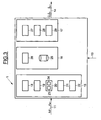
- Figure 3 illustrates a detailed embodiment of the estimating system of the figure 2.
- the estimating system 1 comprises first determining means 15 for determining candidate sequences of M RS digital data from said reduced reference sequence space of 2 N RS reduced reference sequences of M RS reference digital data (s 0 s 1 ...s M RS -1 ).
- the estimating system 1 also comprises making up means 16 for making up each candidate sequence with remaining reference digital data to obtain at least one complete candidate sequence of M digital data.
- the estimating system 1 further comprises second determining means 17 for determining the sequence of N bits (x and 0 x and 1 ...x and N-1 ) from all the complete candidate sequences.
- the first determining means 15 comprise first calculating means 18 for calculating for each reduced reference sequence a first correlation energy from said reduced reference sequence and the M RS first digital data of the received sequence r 0 r 1 ...r M RS -1 .
- the correlation energy of two sequences of k digital data is the sum of the products of the signed amplitudes of couples of digital data having the same rank. The same notation is used for a digital data and its energy.
- the first calculating means 18 calculate sequence a first correlation energy from a reduced reference sequence and the M RS first digital data of the received sequence r 0 r 1 ...r M RS -1 with the expression :
- the first determining means 15 also comprise second calculating means 19 for determining a threshold from the maximum of all the calculated first correlation energies, and processing means 20 for determining said candidate sequences, taking into account said threshold.
- the first determining means 15 further comprise third calculating means 21 for calculating the maximum possible correlation energy E M-M RS / max,end from the remaining M-M RS digital data of the received sequence r 0 r 1 ...r M-1 .
- This maximum possible correlation energy E M-M RS / max,end is calculated, when a BPSK modulation is used with the relation :
- the first determining means 15 also comprise adding means 22 for adding, for each reduced reference sequence, its first correlation energy to the calculated maximum possible correlation energy E M-M RS / max,end, to obtain a second correlation energy.
- the processing means 20 comprise comparing means 23 for comparing each second correlation energy with said threshold, and first selecting means 24 for selecting as candidate the reduced sequences having their second correlation energy superior to said threshold.
- the making up means 16 comprise a memory 25 for storing predetermined possible M-M RS remaining reference digital data, and reading means 26 for reading, for each candidate sequence, the stored predetermined possible M-M RS remaining reference digital data, to obtain a complete candidate sequence of M digital data. This is for a use of a block code.
- the second determining means 17 comprise fourth calculating means 27 for calculating, for each complete candidate sequence, a complete correlation energy from said complete candidate sequence and the received sequence r 0 r 1 ...r M-1 .
- the second determining means 17 also comprise second selecting means 28 for selecting a complete candidate sequence having the highest correlation energy, and demapping means 29 for determining the corresponding sequence of N bits x and 0 x and 1 ...x and N-1 from said selected complete candidate. This demapping is for example done with a look-up table.
- the making up means 16 may comprise generating means for generating, for each candidate sequence, a set of possible M-M RS remaining reference digital data, to obtain a complete candidate sequence of M digital data, instead of the memory 25 and the reading means 26.
- generating means for generating, for each candidate sequence, a set of possible M-M RS remaining reference digital data, to obtain a complete candidate sequence of M digital data instead of the memory 25 and the reading means 26.
- a method according to an aspect of the invention comprises a step 31 of determining candidate sequences of M RS digital data from a reduced reference sequence space comprising 2 N RS reduced reference sequences of M RS reference digital data s 0 s 1 ...s M RS -1 by the first determining means 15.
- the making up means 16 make up each candidate sequence with remaining reference digital data to obtain at least one complete candidate sequence of M digital data.
- the second determining means 17 determine the sequence of N bits (x and 0 x and 1 ...x and N-1 ) from all the complete candidate sequences.
- M 18
- M RS 12
- r 0 -2
- r 1 1
- r 2 -2
- r 3 -4
- r 4 7
- r 5 -3
- r 6 -2
- r 7 -1
- r 8 -2
- r 9 5
- r 10 4
- r 11 -3
- r 12 -3
- r 13 -1
- r 14 2
- r 15 5
- r 16 7
- r 17 -3.
- a calculate of a first correlation energy from said reduced reference sequence and the M RS first digital data of the received sequence r 0 r 1 ...r M RS -1 is done by the calculating means 18.
- the first correlation energy corresponding to said reduced reference sequence is: This calculate is made for each reduced reference sequence of the reduced reference sequence space. In this example, the calculate is made for four other reduced reference sequences, with results represented.
- the respective first correlation energies are 25, 2, 18, and 6.
- the third calculating means 21 calculates the maximum possible correlation energy E M-M RS / max,end, represented on the figure 6, from the remaining M-M RS digital data of the received sequence r 0 r 1 ...r M-1 , with the relation: which in this example is:
- the comparing means 23 compare each second correlation energy with said threshold, and first selecting means 24 select as candidate the reduced sequences having their second correlation energy superior to said threshold.
- making up means 16 complete the candidate sequences, like above described, to obtain complete candidate sequences of M digital data.
- a candidate sequence can be completed in several complete candidate sequences.
- This complete correlation energy is equal to the first correlation energy added with the correlation energy or the corresponding end of sequences. So the first correlation energy of candidates sequence can be stored to simplify calculating of complete correlation energies.
- the second selecting means 28 select a complete candidate sequence having the highest correlation energy, and the demapping means 29 determine the corresponding sequence of x and 0 x and 1 ...x and N-1 N bits from the selected complete candidate sequence.
- This case is similar to the precedent case illustrated by the figure 6, but the determining of the threshold is different.
- an optimal method for a convolutional code is to calculate the correlation energy E M-M RS / end from the 2 N-N RS remaining M - M RS digital data for each possible remaining M-M RS digital data generated, and choose the maximum correlation energy.
- computation is more complex, but on the other hand, less candidate sequences are selected, which in turn reduces the overall complexity.
- the determining of the threshold is longer, but candidates sequences are less numerous, so the rest of the method is more quick.
- the invention allows an optimal decoding algorithm, with a decrease of memory size used and computations made.
Landscapes
- Physics & Mathematics (AREA)
- Probability & Statistics with Applications (AREA)
- Engineering & Computer Science (AREA)
- Theoretical Computer Science (AREA)
- Error Detection And Correction (AREA)
- Mobile Radio Communication Systems (AREA)
Priority Applications (3)
| Application Number | Priority Date | Filing Date | Title |
|---|---|---|---|
| EP04290424A EP1564894B1 (de) | 2004-02-17 | 2004-02-17 | Verfahren und Vorrichtung zur Sequenzschätzung |
| DE602004030991T DE602004030991D1 (de) | 2004-02-17 | 2004-02-17 | Verfahren und Vorrichtung zur Sequenzschätzung |
| US11/057,600 US7457377B2 (en) | 2004-02-17 | 2005-02-14 | Device for estimating a sequence of N bits corresponding to a received sequence of M digital data and associated methods |
Applications Claiming Priority (1)
| Application Number | Priority Date | Filing Date | Title |
|---|---|---|---|
| EP04290424A EP1564894B1 (de) | 2004-02-17 | 2004-02-17 | Verfahren und Vorrichtung zur Sequenzschätzung |
Publications (2)
| Publication Number | Publication Date |
|---|---|
| EP1564894A1 true EP1564894A1 (de) | 2005-08-17 |
| EP1564894B1 EP1564894B1 (de) | 2011-01-12 |
Family
ID=34684790
Family Applications (1)
| Application Number | Title | Priority Date | Filing Date |
|---|---|---|---|
| EP04290424A Expired - Lifetime EP1564894B1 (de) | 2004-02-17 | 2004-02-17 | Verfahren und Vorrichtung zur Sequenzschätzung |
Country Status (3)
| Country | Link |
|---|---|
| US (1) | US7457377B2 (de) |
| EP (1) | EP1564894B1 (de) |
| DE (1) | DE602004030991D1 (de) |
Cited By (1)
| Publication number | Priority date | Publication date | Assignee | Title |
|---|---|---|---|---|
| WO2007127129A3 (en) * | 2006-04-27 | 2008-01-24 | Lucent Technologies Inc | Method of using a shared control channel in wireless communications |
Families Citing this family (8)
| Publication number | Priority date | Publication date | Assignee | Title |
|---|---|---|---|---|
| KR101056365B1 (ko) * | 2004-02-28 | 2011-08-11 | 삼성전자주식회사 | 비트 다운 스케일링 방법 및 장치, 지피에스 동기포착방법및 지피에스 수신장치 |
| PT2793439T (pt) | 2005-08-05 | 2019-01-17 | Panasonic Corp | Sistema para transmitir e receber dados modulados |
| US7978777B2 (en) | 2007-06-05 | 2011-07-12 | Constellation Designs, Inc. | Methodology and method and apparatus for signaling with capacity optimized constellations |
| US9191148B2 (en) | 2007-06-05 | 2015-11-17 | Constellation Designs, Inc. | Methods and apparatuses for signaling with geometric constellations in a Raleigh fading channel |
| US8265175B2 (en) | 2007-06-05 | 2012-09-11 | Constellation Designs, Inc. | Methods and apparatuses for signaling with geometric constellations |
| GB0821615D0 (en) * | 2008-11-26 | 2008-12-31 | Cambridge Silicon Radio Ltd | Signal reception |
| US12289192B2 (en) | 2008-12-30 | 2025-04-29 | Constellation Designs, LLC | Systems and methods for receiving data transmitted using non-uniform QAM 256 constellations |
| US12425885B2 (en) | 2010-07-08 | 2025-09-23 | Constellation Designs, LLC | Systems and methods for receiving data transmitted using non-uniform QAM 256 constellations via fading channels |
Citations (1)
| Publication number | Priority date | Publication date | Assignee | Title |
|---|---|---|---|---|
| US4933956A (en) * | 1983-04-14 | 1990-06-12 | Codex Corporation | Simplified decoding of lattices and codes |
Family Cites Families (3)
| Publication number | Priority date | Publication date | Assignee | Title |
|---|---|---|---|---|
| US5621769A (en) * | 1992-06-08 | 1997-04-15 | Novatel Communications Ltd. | Adaptive-sequence-estimation apparatus employing diversity combining/selection |
| US5694437A (en) * | 1995-10-10 | 1997-12-02 | Motorola, Inc. | Device and method for data signal detection in the presence of distortion and interference in communication systems |
| US6347125B1 (en) * | 1999-01-11 | 2002-02-12 | Ericsson Inc. | Reduced complexity demodulator for multi-bit symbols |
-
2004
- 2004-02-17 EP EP04290424A patent/EP1564894B1/de not_active Expired - Lifetime
- 2004-02-17 DE DE602004030991T patent/DE602004030991D1/de not_active Expired - Lifetime
-
2005
- 2005-02-14 US US11/057,600 patent/US7457377B2/en active Active
Patent Citations (1)
| Publication number | Priority date | Publication date | Assignee | Title |
|---|---|---|---|---|
| US4933956A (en) * | 1983-04-14 | 1990-06-12 | Codex Corporation | Simplified decoding of lattices and codes |
Non-Patent Citations (4)
| Title |
|---|
| KOKKONEN M ET AL: "Soft-decision decoding of binary linear block codes using t-algorithm", PROC. OF THE INTERNATIONAL SYMPOSIUM ON PERSONAL, INDOOR AND MOBILE RADIO COMMUNICATIONS 1997. HELSINKI, FINLAND, 1 September 1997 (1997-09-01), pages 1181 - 1185, XP010247633, ISBN: 0-7803-3871-5 * |
| LEE W-T ET AL: "A SINGLE-CHIP VITERBI DECODER FOR A BINARY CONVOLUTIONAL CODE USINGAN ADAPTIVE ALGORITHM", IEEE TRANSACTIONS ON CONSUMER ELECTRONICS, IEEE INC. NEW YORK, US, vol. 41, no. 1, 1 February 1995 (1995-02-01), pages 150 - 159, XP000529220, ISSN: 0098-3063 * |
| SIMMONS S J: "BREADTH-FIRST TRELLIS DECODING WITH ADAPTIVE EFFORT", IEEE TRANSACTIONS ON COMMUNICATIONS, IEEE INC. NEW YORK, US, vol. 38, no. 1, 1990, pages 3 - 12, XP000102576, ISSN: 0090-6778 * |
| YUNGHSIANG S HAN ET AL: "EFFICIENT PRIORITY-FIRST SEARCH MAXIMUM-LIKELIHOOD SOFT-DECISION DECODING OF LINEAR BLOCK CODES", IEEE TRANSACTIONS ON INFORMATION THEORY, IEEE INC. NEW YORK, US, vol. 39, no. 5, 1 September 1993 (1993-09-01), pages 1514 - 1523, XP000417580, ISSN: 0018-9448 * |
Cited By (1)
| Publication number | Priority date | Publication date | Assignee | Title |
|---|---|---|---|---|
| WO2007127129A3 (en) * | 2006-04-27 | 2008-01-24 | Lucent Technologies Inc | Method of using a shared control channel in wireless communications |
Also Published As
| Publication number | Publication date |
|---|---|
| EP1564894B1 (de) | 2011-01-12 |
| US7457377B2 (en) | 2008-11-25 |
| US20050180531A1 (en) | 2005-08-18 |
| DE602004030991D1 (de) | 2011-02-24 |
Similar Documents
| Publication | Publication Date | Title |
|---|---|---|
| ES2291737T3 (es) | Metodo y sistema para calcular la tasa de error de los bits de una señal recibida. | |
| US6567938B2 (en) | Convolution decoding terminated by an error detection block code with distributed parity bits | |
| CN101958764B (zh) | 发送装置、信号生成装置及发送方法 | |
| US8358709B2 (en) | Method and apparatus for transmitting and receiving convolutionally coded data | |
| US7983363B2 (en) | Receiver for the geosynchronous (GEO) satellite reverse link using tail-biting code | |
| US7817753B2 (en) | Reception quality estimating apparatus, wireless communication system, and reception quality estimating method | |
| KR20010029541A (ko) | 복수의 코딩 버스트내에 배치된 crc 비트에 의해 종료 상태가결정되는 컨벌루셔널 디코딩 | |
| KR20020018643A (ko) | 고속 map 디코딩을 위한 방법 및 시스템 | |
| WO2002087088A2 (en) | Methods and apparatus of signal demodulation combining with different modulations and coding for wireless communications | |
| KR100889302B1 (ko) | 다중 안테나 시스템에서 부분 반복 검출 및 복호 수신 장치및 방법 | |
| WO2000016512A1 (en) | Rate detection in radio communication systems | |
| WO2000033504A1 (en) | Noise characterization in a wireless communication system | |
| EP1564894A1 (de) | Verfahren und Vorrichtung zur Sequenzschätzung | |
| JP3558965B2 (ja) | 受信装置及び送信装置並びにこれらを用いた基地局装置及び通信端末装置 | |
| US8331470B2 (en) | Communication system | |
| US7434148B2 (en) | Track buffer in a parallel decoder | |
| WO2003017500A1 (en) | Coded modulation scheme for a wireless communication system and methods thereof | |
| AU1978000A (en) | Method and system for fast maximum a posteriori decoding | |
| US7020223B2 (en) | Viterbi decoder and method using sequential two-way add-compare-select operations | |
| JP3576653B2 (ja) | 符号化変調装置 | |
| US7797618B2 (en) | Parallel decoder for ultrawide bandwidth receiver | |
| US7458008B2 (en) | Decision voting in a parallel decoder | |
| JP5001196B2 (ja) | 受信装置および通信システム | |
| JP4226165B2 (ja) | 復号装置及び復号方法 | |
| WO2004019498A1 (en) | Convolutional decoder and method for decoding demodulated values |
Legal Events
| Date | Code | Title | Description |
|---|---|---|---|
| PUAI | Public reference made under article 153(3) epc to a published international application that has entered the european phase |
Free format text: ORIGINAL CODE: 0009012 |
|
| AK | Designated contracting states |
Kind code of ref document: A1 Designated state(s): AT BE BG CH CY CZ DE DK EE ES FI FR GB GR HU IE IT LI LU MC NL PT RO SE SI SK TR |
|
| AX | Request for extension of the european patent |
Extension state: AL LT LV MK |
|
| 17P | Request for examination filed |
Effective date: 20060120 |
|
| AKX | Designation fees paid |
Designated state(s): DE FR GB IT |
|
| GRAP | Despatch of communication of intention to grant a patent |
Free format text: ORIGINAL CODE: EPIDOSNIGR1 |
|
| GRAS | Grant fee paid |
Free format text: ORIGINAL CODE: EPIDOSNIGR3 |
|
| GRAA | (expected) grant |
Free format text: ORIGINAL CODE: 0009210 |
|
| AK | Designated contracting states |
Kind code of ref document: B1 Designated state(s): DE FR GB IT |
|
| REG | Reference to a national code |
Ref country code: GB Ref legal event code: FG4D |
|
| REF | Corresponds to: |
Ref document number: 602004030991 Country of ref document: DE Date of ref document: 20110224 Kind code of ref document: P |
|
| REG | Reference to a national code |
Ref country code: DE Ref legal event code: R096 Ref document number: 602004030991 Country of ref document: DE Effective date: 20110224 |
|
| PLBE | No opposition filed within time limit |
Free format text: ORIGINAL CODE: 0009261 |
|
| STAA | Information on the status of an ep patent application or granted ep patent |
Free format text: STATUS: NO OPPOSITION FILED WITHIN TIME LIMIT |
|
| 26N | No opposition filed |
Effective date: 20111013 |
|
| REG | Reference to a national code |
Ref country code: DE Ref legal event code: R097 Ref document number: 602004030991 Country of ref document: DE Effective date: 20111013 |
|
| PGFP | Annual fee paid to national office [announced via postgrant information from national office to epo] |
Ref country code: FR Payment date: 20130408 Year of fee payment: 10 |
|
| PGFP | Annual fee paid to national office [announced via postgrant information from national office to epo] |
Ref country code: DE Payment date: 20140122 Year of fee payment: 11 |
|
| PGFP | Annual fee paid to national office [announced via postgrant information from national office to epo] |
Ref country code: IT Payment date: 20140129 Year of fee payment: 11 |
|
| PGFP | Annual fee paid to national office [announced via postgrant information from national office to epo] |
Ref country code: GB Payment date: 20140127 Year of fee payment: 11 |
|
| REG | Reference to a national code |
Ref country code: FR Ref legal event code: ST Effective date: 20141031 |
|
| PG25 | Lapsed in a contracting state [announced via postgrant information from national office to epo] |
Ref country code: FR Free format text: LAPSE BECAUSE OF NON-PAYMENT OF DUE FEES Effective date: 20140228 |
|
| REG | Reference to a national code |
Ref country code: DE Ref legal event code: R119 Ref document number: 602004030991 Country of ref document: DE |
|
| GBPC | Gb: european patent ceased through non-payment of renewal fee |
Effective date: 20150217 |
|
| PG25 | Lapsed in a contracting state [announced via postgrant information from national office to epo] |
Ref country code: IT Free format text: LAPSE BECAUSE OF NON-PAYMENT OF DUE FEES Effective date: 20150217 |
|
| PG25 | Lapsed in a contracting state [announced via postgrant information from national office to epo] |
Ref country code: DE Free format text: LAPSE BECAUSE OF NON-PAYMENT OF DUE FEES Effective date: 20150901 Ref country code: GB Free format text: LAPSE BECAUSE OF NON-PAYMENT OF DUE FEES Effective date: 20150217 |