EP1564307A1 - Aluminium alloy extruded product for heat exchangers and method of manufacturing the same - Google Patents
Aluminium alloy extruded product for heat exchangers and method of manufacturing the same Download PDFInfo
- Publication number
- EP1564307A1 EP1564307A1 EP05002814A EP05002814A EP1564307A1 EP 1564307 A1 EP1564307 A1 EP 1564307A1 EP 05002814 A EP05002814 A EP 05002814A EP 05002814 A EP05002814 A EP 05002814A EP 1564307 A1 EP1564307 A1 EP 1564307A1
- Authority
- EP
- European Patent Office
- Prior art keywords
- aluminium alloy
- extruded product
- less
- content
- heat exchangers
- Prior art date
- Legal status (The legal status is an assumption and is not a legal conclusion. Google has not performed a legal analysis and makes no representation as to the accuracy of the status listed.)
- Granted
Links
Images
Classifications
-
- C—CHEMISTRY; METALLURGY
- C22—METALLURGY; FERROUS OR NON-FERROUS ALLOYS; TREATMENT OF ALLOYS OR NON-FERROUS METALS
- C22C—ALLOYS
- C22C21/00—Alloys based on aluminium
-
- C—CHEMISTRY; METALLURGY
- C22—METALLURGY; FERROUS OR NON-FERROUS ALLOYS; TREATMENT OF ALLOYS OR NON-FERROUS METALS
- C22F—CHANGING THE PHYSICAL STRUCTURE OF NON-FERROUS METALS AND NON-FERROUS ALLOYS
- C22F1/00—Changing the physical structure of non-ferrous metals or alloys by heat treatment or by hot or cold working
- C22F1/04—Changing the physical structure of non-ferrous metals or alloys by heat treatment or by hot or cold working of aluminium or alloys based thereon
-
- F—MECHANICAL ENGINEERING; LIGHTING; HEATING; WEAPONS; BLASTING
- F28—HEAT EXCHANGE IN GENERAL
- F28F—DETAILS OF HEAT-EXCHANGE AND HEAT-TRANSFER APPARATUS, OF GENERAL APPLICATION
- F28F21/00—Constructions of heat-exchange apparatus characterised by the selection of particular materials
- F28F21/08—Constructions of heat-exchange apparatus characterised by the selection of particular materials of metal
- F28F21/081—Heat exchange elements made from metals or metal alloys
- F28F21/084—Heat exchange elements made from metals or metal alloys from aluminium or aluminium alloys
-
- F—MECHANICAL ENGINEERING; LIGHTING; HEATING; WEAPONS; BLASTING
- F28—HEAT EXCHANGE IN GENERAL
- F28F—DETAILS OF HEAT-EXCHANGE AND HEAT-TRANSFER APPARATUS, OF GENERAL APPLICATION
- F28F2255/00—Heat exchanger elements made of materials having special features or resulting from particular manufacturing processes
- F28F2255/16—Heat exchanger elements made of materials having special features or resulting from particular manufacturing processes extruded
Definitions
- the present invention relates to an aluminium alloy extruded product for heat exchangers and a method of manufacturing the same.
- an aluminium alloy extruded flat multi-cavity tube including a plurality of hollow sections partitioned by a plurality of partitions has been used as a working fluid passage material.
- a fluorine-containing compound (fluorocarbon (flon)) has been used as the refrigerant for heat exchangers.
- fluorocarbon (flon) fluorocarbon (flon)
- carbon dioxide as an alternative refrigerant has been studied in order to deal with global warming.
- carbon dioxide since the working pressure is increased in comparison with a conventional fluorocarbon refrigerant, it is necessary to increase the strength of each member of the heat exchanger. Therefore, a material exhibiting high strength after assembling and brazing the heat exchanger has been demanded as the working fluid passage material.
- Addition of an alloy element such as Si, Fe, Cu, Mn, or Mg is effective to obtain a high-strength aluminium alloy material.
- Mg is included in the material, when performing inert gas atmosphere brazing using a fluoride-type flux, which is mainly used as the brazing method when assembling an aluminium alloy heat exchanger, Mg in the material reacts with the fluoride-type flux to reduce the degree of activity of the flux, whereby brazeability is decreased.
- Cu is included in the material, since the operating temperature of the carbon dioxide refrigerant cycle is as high as about 150°C, intergranular corrosion sensitivity is increased.
- Mn-containing compounds precipitate to a larger extent in the end section than the head section of a billet during extrusion of one billet.
- the end section of the preceding billet in which the Mn-containing compounds precipitate to a larger extent forms a deposition section at the joint, and the head section of the subsequent billet in which the Mn-containing compounds precipitate to a smaller extent forms a section other than the deposition section.
- an aluminium alloy extruded product for automotive heat exchangers As a method of manufacturing an aluminium alloy extruded product for automotive heat exchangers, a method of applying an aluminium alloy which contains 0.3 to 1.2% of Mn and 0.1 to 1.1% of Si, has a ratio of Mn content to Si content (Mn% /Si%) of 1.1 to 4.5, and optionally contains 0.1 to 0.6% of Cu, with the balance being Al and unavoidable impurities, and homogenizing the ingot in two stages consisting of heating at 530 to 600°C for 3 to 15 hours and heating at 450 to 550°C for 0.1 to 2 hours in order to improve extrudability has been proposed (see Japanese Patent Application Laid-open No. 11-335764). It is confirmed that extrudability is improved to some extent by using this method. However, since extrudability is not necessarily sufficient when extruding a thin flat multi-cavity tube as shown in FIG. 1, room for further improvement still remains in order to reliably obtain a high
- the above-mentioned methods aim at decreasing the deformation resistance by reducing the amount of solute elements dissolved in the matrix by performing a high-temperature homogenization treatment and a low-temperature homogenization treatment.
- the present inventors have conducted tests and studies based on the above-mentioned methods in order to further improve extrudability.
- the present inventors have found that the amount of solute elements dissolved in the matrix is decreased by performing a low-temperature homogenization treatment for a long period of time due to progress of precipitation of solute elements and that an improved critical extrusion rate can be reliably obtained by determining the limit of a decrease in the amount of solute elements in the matrix by the electric conductivity of an ingot and extruding an ingot having an electric conductivity of a specific value or more.
- the present invention has been achieved as a result of additional tests and studies on the relationship between the alloy composition and the ingot homogenization treatment condition based on the above findings in order to obtain an aluminium alloy extruded product which exhibits improved extrudability and has strength, intergranular corrosion resistance, and brazeability sufficient for a working fluid passage material for automotive heat exchangers.
- An objective of the present invention is to provide a high-strength aluminium alloy extruded product for heat exchangers which excels in extrudability, allows a thin flat multi-cavity tube to be extruded at a high critical extrusion rate, and excels in intergranular corrosion resistance at a high temperature, and a method of manufacturing the same.
- an aluminium alloy extruded product for heat exchangers comprises an aluminium alloy comprising 0.2 to 1.8% (mass%; hereinafter the same) of Mn and 0.1 to 1.2% of Si, having a ratio of Mn content to Si content (Mn% / Si%) of 0.7 to 2.5, and having a content of Cu as an impurity of 0.05 % or less, with the balance being Al and impurities, the aluminium alloy extruded product having an electric conductivity of 50% IACS or more and an average particle size of intermetallic compounds precipitating in a matrix of 1 ⁇ m or less.
- the aluminium alloy may further comprise 0.4% or less (excluding 0%; hereinafter the same) of Mg.
- the aluminium alloy may further comprise 1.2% or less of Fe.
- the aluminium alloy may further comprise 0.06 to 0.30% of Ti.
- the aluminium alloy has an Si content of 0.4 to 1.2% and a total content of Mn and Si of 1.2% or more.
- This aluminium alloy extruded product for heat exchangers may have a tensile strength of 110 MPa or more after being subjected to heating at a temperature of 600°C for three minutes and cooling at an average cooling rate of 150°C/min.
- a method of manufacturing the above aluminium alloy extruded product comprises: subjecting an ingot of an aluminium alloy having the above composition to a first-stage homogenization treatment which includes heating the ingot at a temperature of 550 to 650°C for two hours or more and a second-stage homogenization treatment which includes heating the ingot at a temperature of 400 to 500°C for three hours or more to adjust the electric conductivity of the ingot to 50% IACS or more and the average particle size of the intermetallic compounds precipitating in the matrix to 1 ⁇ m or less; and hot-extruding the resulting ingot.
- a high-strength aluminium alloy extruded product for heat exchangers which excels in extrudability, allows a thin flat multi-cavity tube to be extruded at a high critical extrusion rate, and excels in intergranular corrosion resistance at a high temperature, and a method of manufacturing the same can be provided.
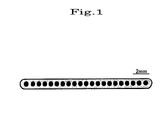
- FIG. 1 is a cross-sectional view of an aluminium alloy extruded flat multi-cavity tube as an example of an extruded product according to the present invention.
- Mn is dissolved in the matrix during heating for brazing in a heat exchanger assembly step to improve the strength.
- the Mn content is preferably 0.2 to 1.8%. If the Mn content is less than 0.2%, the effect is insufficient. If the Mn content exceeds 1.8%, a decrease in extrudability becomes significant rather than the strength improvement effect.
- the Mn content is still more preferably 0.8 to 1.8%.
- Si is dissolved in the matrix during heating for brazing in the heat exchanger assembly step to improve the strength.
- the Si content is preferably 0.1 to 1.2%. If the Si content is less than 0.1%, the effect is insufficient. If the Si content exceeds 1.2%, a decrease in extrudability becomes significant rather than the strength improvement effect.
- the Si content is still more preferably 0.4 to 1.2%. Further excellent extrudability and strength properties can be obtained by adjusting the Si content to 0.4 to 1.2% and adjusting the total content of Mn and Si to 1.2% or more.
- Extrudability is further improved by adjusting the ratio of Mn content to Si content (Mn% / Si%) to 0.7 to 2.5 within the above Mn and Si content range.
- Cu is dissolved during brazing to improve the strength.
- the Cu content is limited to 0.05% or less in order to prevent occurrence of intergranular corrosion during use as an automotive heat exchanger under a severe environment and to prevent a decrease in extrudability. If the Cu content exceeds 0.05%, since the operating temperature is as high as about 150°C during use in a carbon dioxide refrigerant cycle, precipitation of Al-Mn compounds or the like significantly occurs at the grain boundaries, whereby intergranular corrosion tends to occur. Moreover, extrudability is decreased.
- Mg contributes to improvement of the strength without causing a problem in inert gas atmosphere brazing using a fluoride-type flux, if the Mg content is in the range of 0.4% or less. If the Mg content exceeds 0.4%, Mg reacts with the fluoride-type flux based on potassium fluoroaluminate during brazing using the fluoride-type flux to form compounds such as MgF 2 and KMgF 3 , whereby brazeability is decreased due to a decrease in the degree of activity of the flux.
- the Fe content is preferably 1.2% or less. If the Fe content exceeds 1.2%, large amounts of Al-Fe compounds and Al-Fe-Si compounds are formed during casting, whereby extrudability is hindered. Moreover, the Al-Fe compounds and the Al-Fe-Si compounds function as a cathode during use as an automotive heat exchanger, whereby self-corrosion resistance is decreased.
- Ti forms a high-concentration region and a low-concentration region in the alloy. These regions are alternately distributed in layers in the thickness direction of the material. Since the low-concentration region is preferentially corroded in comparison with the high-concentration region, the corrosion form becomes layered. This prevents progress of corrosion in the thickness direction, whereby pitting corrosion resistance and intergranular corrosion resistance are improved.
- the Ti content is preferably 0.06 to 0.30%. If the Ti content is less than 0.06%, the effect is insufficient. If the Ti content exceeds 0.30%, extrudability is impaired due to formation of coarse compounds during casting, whereby a sound extruded product cannot be obtained.
- the Ti content is still more preferably 0.10 to 0.25%.
- the effect of the present invention is not affected even if less than 0.06% of Ti and 0.1% or less of B are included in the aluminium alloy extruded product of the present invention.
- the total content of the impurities such as Cr, Zn, and Zr can be 0.25% or less.
- the aluminium alloy extruded product of the present invention may be obtained by dissolving an aluminium alloy having the above-described composition, casting the dissolved aluminium alloy by semicontinuous casting or the like, subjecting the resulting ingot (extrusion billet) to a first-stage homogenization treatment at a temperature of 550 to 650°C for two hours or more and a second-stage homogenization treatment at a temperature of 400 to 500°C for three hours or more to adjust the electric conductivity of the ingot to 50% IACS or more, and hot-extruding the resulting ingot.
- the first-stage homogenization treatment a coarse crystallized product formed during casting and solidification is decomposed, granulated, or redissolved. If the treatment temperature is less than 550°C, the effect is insufficient. The effect is increased as the treatment temperature is increased. However, if the treatment temperature exceeds 650°C, the ingot may melt.
- the first-stage homogenization treatment temperature is preferably 580 to 620°C. Since the reaction progresses as the treatment time is increased, the treatment time is preferably set to 10 hours or more. However, since the effect is developed to a maximum when the treatment time exceeds 24 hours, a further effect cannot be expected even if the treatment is performed for more than 24 hours. Therefore, such a long treatment is disadvantageous from the economical point of view.
- the treatment time is still more preferably 10 to 24 hours.
- the first-stage homogenization treatment a coarse crystallized product formed during casting and solidification is decomposed, granulated, or redissolved as described above.
- the first-stage homogenization treatment also promotes dissolving of the solute elements Mn and Si in the matrix. However, if the amount solute elements dissolved in the matrix is increased, the motion speed of a dislocation in the matrix is decreased, whereby the deformation resistance is increased. Therefore, if the ingot is hot-extruded after subjecting the ingot only to the high-temperature first-stage homogenization treatment, extrudability is decreased.
- Mn and Si dissolved in the matrix precipitate by performing the low-temperature second-stage homogenization treatment after the high-temperature first-stage homogenization treatment, whereby the amount of solute Mn and Si dissolved in the matrix can be decreased.
- This enables the deformation resistance to be decreased during the subsequent hot extrusion, whereby extrudability can be increased.
- the treatment temperature is less than 400°C, the effect is insufficient. If the treatment temperature exceeds 500°C, precipitation occurs to only a small extent, whereby the effect becomes insufficient. Since the reaction progresses as the treatment time is increased, the treatment time must be three hours or more. The treatment time is preferably five hours or more.
- the treatment time is still more preferably 5 to 15 hours.
- the amount of the solute elements dissolved in the matrix is decreased by subjecting the ingot to the first-stage and second-stage homogenization treatments, whereby extrudability is increased.
- the electric conductivity is the index for the amount of the solute elements dissolved in the matrix.
- the electric conductivity is decreased as the amount of the solute elements dissolved in the matrix is increased, and the electric conductivity is increased as the amount of the solute elements dissolved in the matrix is decreased due to progress of precipitation.
- the limit of the amount of the solute elements dissolved in the matrix at which excellent extrudability is obtained it is preferable to specify the electric conductivity of the ingot at 50% IACS or more.
- An electric conductivity of 50% IACS or more can be reliably obtained by adjusting the combination of the high-temperature first-stage homogenization treatment condition and the low-temperature second-stage homogenization treatment condition, in particular, by including the low-temperature homogenization treatment for a long period of time, whereby extrudability can be reliably improved.
- the first-stage homogenization treatment and the second-stage homogenization treatment are continuously performed.
- the first-stage homogenization treatment and the second-stage homogenization treatment may not necessarily be continuously performed.
- the ingot exrusion billet
- the second-stage homogenization treatment may then be performed.
- the electric conductivity of the ingot is adjusted to 50% IACS or more
- the solute elements are redissolved to only a small extent during the hot extrusion
- the electric conductivity of 50% IACS or more is maintained after the hot extrusion.
- the aluminium alloy extruded product obtained by the hot extrusion is assembled to a heat exchanger and joined by brazing.
- the electric conductivity after brazing becomes less than 50% IACS.
- the operating temperature is as high as about 150°C
- creep strength is required for each member.
- Mn and Si which have been precipitated by the two stages of homogenization treatment are redissolved in the matrix after heating for brazing, these elements hinder the motion of a dislocation in the matrix, whereby the creep resistance is improved.
- solute elements are redissolved to only a small extent during the hot extrusion when the electric conductivity of the ingot is adjusted to 50% IACS or more, it suffices to adjust the average particle size of compounds which precipitate by the two stages of homogenization treatment to 1 ⁇ m or less in order to adjust the average particle size of compounds which have been precipitated in the matrix of the hot-extruded product to 1 ⁇ m or less.
- Precipitation of such minute intermetallic compounds may be obtained by adjusting the combination of the first-stage homogenization treatment condition and the second-stage homogenization treatment condition and adjusting the cooling rate after the homogenization treatment.
- the aluminium alloy extruded product manufactured as described above achieves high strength with a tensile strength of 110 MPa or more after treatment equivalent to heating for brazing consisting of heating at a temperature of 600°C for three minutes and cooling at an average cooling rate of 150°C/min.
- An aluminium alloy having a composition shown in Table 1 was cast into an extrusion billet.
- the resulting billet was subjected to a first-stage homogenization treatment and a second-stage homogenization treatment under conditions shown in Table 2, and hot-extruded into a flat multi-cavity tube having a cross-sectional shape as shown in FIG. 1.
- the resulting extruded product was used as a specimen, and subjected to evaluation of the critical extrusion rate, tensile strength, brazeability, and intergranular corrosion sensitivity according to the following methods.
- Table 3 shows electric conductivity after the homogenization treatment, electric conductivity after extrusion, electric conductivity after brazing, average particle size(equivalent circular average diameter) of intermetallic compounds after the homogenization treatment, and average particle size of intermetallic compounds after extrusion.
- Table 4 shows evaluation results for brazeability, critical extrusion rate, tensile strength, and intergranular corrosion sensitivity. In Tables 1 to 3, values outside the condition of the present invention are underlined.
- the critical extrusion rate was evaluated as a ratio to the critical extrusion rate (165 m/min) of a conventional alloy (specimen No. 15, alloy L) in which Mn and Cu were added to pure aluminium in small amounts (critical extrusion rate of the conventional alloy was 1.0).
- a specimen with a critical extrusion rate of 0.9 to 1.0 was evaluated as "Excellent”, a specimen with a critical extrusion rate of 0.8 or more, but less than 0.9 was evaluated as "Good”, a specimen with a critical extrusion rate of 0.7 or more, but less than 0.8 was evaluated as "Fair”, and a specimen with a critical extrusion rate of less than 0.7 was evaluated as "Bad".
- the specimen was subjected to a heat treatment at 600°C for three minutes in a nitrogen atmosphere and was cooled at an average cooling rate of 150°C/min to obtain a tensile test specimen.
- the tensile test specimen was subjected to a tensile test.
- a fluoride-type flux based on potassium fluoroaluminate was applied to the surface of the specimen in an amount of 10 g/m 2 .
- the specimen was assembled with a brazing fin and heated at 600°C for three minutes, and joinability was observed with the naked eye.
- a specimen in which a fillet was sound and sufficient junction was obtained was evaluated as "Good”, and a specimen in which formation of a fillet was not sound was evaluated as "Bad”.
- the specimen was heated at 150°C for 120 hours and immersed in a solution obtained by adding 10 ml/l of HCl to 30 g/l of a NaCl aqueous solution for 24 hours as a simulation for use at 150°C. Then, cross-sectional observation was performed to investigate the presence or absence of intergranular corrosion. A specimen in which intergranular corrosion did not occur was evaluated as "Good”, and a specimen in which intergranular corrosion occurred was evaluated as "Bad".
- Alloy Composition (mass%) Si Fe Cu Mn Mg Ti Mn/Si Invention A 0.6 0.2 0.00 1.2 - - 2 B 0.5 0.2 0.00 1.0 0.1 - 2 C 0.4 0.2 0.00 0.3 0.2 - 0.75 D 0.4 0.9 0.00 0.8 0.1 - 2 E 0.8 0.9 0.00 0.8 - - 1 F 0.4 0.2 0.00 1.0 0.15 - 2.5 G 0.5 1.0 0.00 1.0 0.1 0.15 2 Comparison Comparison H 1.5 0.2 0.00 1.9 - 1.3 I 0.05 0.2 0.00 0.1 - - 2 J 0.6 0.2 0.3 1.2 - - 2 K 0.6 0.2 0.00 1.2 0.6 - 2 L 0.6 1.3 0.00 1.2 - - 2 M 0.05 0.2 0.4 0.1 - - 2 Specimen Alloy Homogenization treatment First stage (temperature (°C) ⁇ time (h)) Second stage (temperature (°C) ⁇ time (h)) 1 A
- the specimens No. 1 to No. 7 according to the condition of the present invention exhibited a high critical extrusion rate, an excellent tensile strength of 110 MPa or more after heating for brazing, excellent brazeability, and excellent intergranular corrosion resistance.
- the specimen No. 8 exhibited inferior extrudability due to high Si and Mn content
- the specimen No. 9 exhibited inferior strength due to low Si and Mn content
- the specimen No. 10 exhibited inferior intergranular corrosion resistance due to inclusion of Cu
- the specimen No. 11 exhibited inferior brazeability due to high Mg content
- the specimen No. 12 exhibited inferior extrudability and intergranular corrosion resistance due to high Fe content.
- the specimen No. 13 exhibited inferior extrudability due to low first-stage homogenization treatment temperature
- the specimen No. 14 exhibited inferior extrudability due to high second-stage homogenization treatment temperature
- the specimen No. 15 exhibited inferior extrudability due to short second-stage homogenization treatment time.
Landscapes
- Chemical & Material Sciences (AREA)
- Engineering & Computer Science (AREA)
- Mechanical Engineering (AREA)
- Physics & Mathematics (AREA)
- Thermal Sciences (AREA)
- Materials Engineering (AREA)
- Metallurgy (AREA)
- Organic Chemistry (AREA)
- General Engineering & Computer Science (AREA)
- Crystallography & Structural Chemistry (AREA)
- Extrusion Of Metal (AREA)
Abstract
Description
- The present invention relates to an aluminium alloy extruded product for heat exchangers and a method of manufacturing the same.
- In automotive aluminium alloy heat exchangers such as evaporators and condensers, an aluminium alloy extruded flat multi-cavity tube including a plurality of hollow sections partitioned by a plurality of partitions has been used as a working fluid passage material.
- In recent years, the weight of a heat exchanger provided in an automobile has been reduced in order to reduce the weight of the automobile, taking global environmental problems into consideration. Therefore, a further reduction in the thickness of the aluminium alloy material for heat exchangers has been demanded. In the case of the aluminium alloy flat multi-cavity tube used as the working fluid passage material, since the cross-sectional area is reduced accompanying a reduction in the thickness, the extrusion ratio (cross-sectional area of extrusion container /cross-sectional area of extruded product) is increased to several hundred to several thousand during the manufacture. Therefore, a material having a further improved extrudability has been demanded.
- A fluorine-containing compound (fluorocarbon (flon)) has been used as the refrigerant for heat exchangers. However, use of carbon dioxide as an alternative refrigerant has been studied in order to deal with global warming. In the case of using carbon dioxide as the refrigerant, since the working pressure is increased in comparison with a conventional fluorocarbon refrigerant, it is necessary to increase the strength of each member of the heat exchanger. Therefore, a material exhibiting high strength after assembling and brazing the heat exchanger has been demanded as the working fluid passage material.
- Addition of an alloy element such as Si, Fe, Cu, Mn, or Mg is effective to obtain a high-strength aluminium alloy material. However, if Mg is included in the material, when performing inert gas atmosphere brazing using a fluoride-type flux, which is mainly used as the brazing method when assembling an aluminium alloy heat exchanger, Mg in the material reacts with the fluoride-type flux to reduce the degree of activity of the flux, whereby brazeability is decreased. If Cu is included in the material, since the operating temperature of the carbon dioxide refrigerant cycle is as high as about 150°C, intergranular corrosion sensitivity is increased.
- Therefore, attempts have been made to improve the strength by adding Si, Fe, or Mn to a pure Al material. However, when Mn and Si are added at a high concentration, Mn and Si dissolved in the aluminium matrix increase the deformation resistance, whereby extrudability is significantly decreased in comparison with a pure Al material when the extrusion ratio reaches several hundred to several thousand as in the case of the extruded flat multi-cavity tube. Extrudability is evaluated by using, as indices, the ram pressure required for extrusion and the maximum extrusion rate (critical extrusion rate) at which the flat multi-cavity tube can be extruded without causing a deficiency at the partition of the hollow section of the flat multi-cavity tube. When Mn and Si are added at a high concentration, the ram pressure is increased in comparison with a pure Al material, whereby the die easily breaks or wears. Moreover, since the critical extrusion rate is decreased, productivity becomes poor.
- A method of improving extrudability of an Al-Mn alloy for a photosensitive drum used for a copying machine or the like by reducing the deformation resistance by making the distribution of Mn uniform and causing Mn to coarsely precipitate to reduce the amount of dissolved Mn by performing two stages of homogenization treatment has been proposed (see Japanese Patent Application Laid-open No. 10-72651). However, even if this material is applied as the fluid passage material for automotive heat exchangers, since Mn is caused to coarsely precipitate, the precipitated Mn is redissolved to only a small extent. Therefore, an increase in the strength of the fluid passage material due to redissolution of Mn after assembly and brazing cannot be expected.
- In the case of manufacturing a piping aluminium alloy tube for automotive heat exchangers such as automotive air conditioners by a porthole extrusion method using an Al-Mn alloy, Mn-containing compounds precipitate to a larger extent in the end section than the head section of a billet during extrusion of one billet. When continuously forming a joint by attaching the subsequent billet to the preceding billet, the end section of the preceding billet in which the Mn-containing compounds precipitate to a larger extent forms a deposition section at the joint, and the head section of the subsequent billet in which the Mn-containing compounds precipitate to a smaller extent forms a section other than the deposition section. This causes the difference in the precipitation state of the Mn-containing compounds between the deposition section and the section other than the deposition section, whereby the deposition section at a lower potential is preferentially corroded under a corrosive environment. To deal with this problem, a method of preventing the deposition section from being preferentially corroded by causing Mn-containing compounds to coarsely precipitate in the ingot matrix by subjecting an Al-Mn alloy having a specific composition to two stages of homogenization treatment to reduce the difference in the amount of dissolved Mn between the head section and the end section of the extruded billet to eliminate the difference in the precipitation state of the Mn-containing compounds between the deposition section and the section other than the deposition section has been proposed (see Japanese Patent Application Laid-open No. 11-172388). However, since this method also causes Mn to coarsely precipitate, the precipitated Mn is redissolved to only a small extent. Therefore, an increase in the strength of the fluid passage material due to redissolution of Mn after assembly and brazing cannot be expected.
- As a method of manufacturing an aluminium alloy extruded product for automotive heat exchangers, a method of applying an aluminium alloy which contains 0.3 to 1.2% of Mn and 0.1 to 1.1% of Si, has a ratio of Mn content to Si content (Mn% /Si%) of 1.1 to 4.5, and optionally contains 0.1 to 0.6% of Cu, with the balance being Al and unavoidable impurities, and homogenizing the ingot in two stages consisting of heating at 530 to 600°C for 3 to 15 hours and heating at 450 to 550°C for 0.1 to 2 hours in order to improve extrudability has been proposed (see Japanese Patent Application Laid-open No. 11-335764). It is confirmed that extrudability is improved to some extent by using this method. However, since extrudability is not necessarily sufficient when extruding a thin flat multi-cavity tube as shown in FIG. 1, room for further improvement still remains in order to reliably obtain a high critical extrusion rate.
- The above-mentioned methods aim at decreasing the deformation resistance by reducing the amount of solute elements dissolved in the matrix by performing a high-temperature homogenization treatment and a low-temperature homogenization treatment. The present inventors have conducted tests and studies based on the above-mentioned methods in order to further improve extrudability. As a result, the present inventors have found that the amount of solute elements dissolved in the matrix is decreased by performing a low-temperature homogenization treatment for a long period of time due to progress of precipitation of solute elements and that an improved critical extrusion rate can be reliably obtained by determining the limit of a decrease in the amount of solute elements in the matrix by the electric conductivity of an ingot and extruding an ingot having an electric conductivity of a specific value or more.
- The present invention has been achieved as a result of additional tests and studies on the relationship between the alloy composition and the ingot homogenization treatment condition based on the above findings in order to obtain an aluminium alloy extruded product which exhibits improved extrudability and has strength, intergranular corrosion resistance, and brazeability sufficient for a working fluid passage material for automotive heat exchangers. An objective of the present invention is to provide a high-strength aluminium alloy extruded product for heat exchangers which excels in extrudability, allows a thin flat multi-cavity tube to be extruded at a high critical extrusion rate, and excels in intergranular corrosion resistance at a high temperature, and a method of manufacturing the same.
- In order to achieve the above objective, an aluminium alloy extruded product for heat exchangers according to the present invention comprises an aluminium alloy comprising 0.2 to 1.8% (mass%; hereinafter the same) of Mn and 0.1 to 1.2% of Si, having a ratio of Mn content to Si content (Mn% / Si%) of 0.7 to 2.5, and having a content of Cu as an impurity of 0.05 % or less, with the balance being Al and impurities, the aluminium alloy extruded product having an electric conductivity of 50% IACS or more and an average particle size of intermetallic compounds precipitating in a matrix of 1 µm or less.
- In this aluminium alloy extruded product for heat exchangers, the aluminium alloy may further comprise 0.4% or less (excluding 0%; hereinafter the same) of Mg.
- In this aluminium alloy extruded product for heat exchangers, the aluminium alloy may further comprise 1.2% or less of Fe.
- In this aluminium alloy extruded product for heat exchangers, the aluminium alloy may further comprise 0.06 to 0.30% of Ti.
- In this aluminium alloy extruded product for heat exchangers, the aluminium alloy has an Si content of 0.4 to 1.2% and a total content of Mn and Si of 1.2% or more.
- This aluminium alloy extruded product for heat exchangers may have a tensile strength of 110 MPa or more after being subjected to heating at a temperature of 600°C for three minutes and cooling at an average cooling rate of 150°C/min.
- A method of manufacturing the above aluminium alloy extruded product comprises: subjecting an ingot of an aluminium alloy having the above composition to a first-stage homogenization treatment which includes heating the ingot at a temperature of 550 to 650°C for two hours or more and a second-stage homogenization treatment which includes heating the ingot at a temperature of 400 to 500°C for three hours or more to adjust the electric conductivity of the ingot to 50% IACS or more and the average particle size of the intermetallic compounds precipitating in the matrix to 1 µm or less; and hot-extruding the resulting ingot.
- According to the present invention, a high-strength aluminium alloy extruded product for heat exchangers which excels in extrudability, allows a thin flat multi-cavity tube to be extruded at a high critical extrusion rate, and excels in intergranular corrosion resistance at a high temperature, and a method of manufacturing the same can be provided.
- Other objects, features, and advantages of the invention will hereinafter become more readily apparent from the following description.
- FIG. 1 is a cross-sectional view of an aluminium alloy extruded flat multi-cavity tube as an example of an extruded product according to the present invention.
- The meanings and the reasons for limitation of the alloy components of the aluminium alloy of the present invention are described below. Mn is dissolved in the matrix during heating for brazing in a heat exchanger assembly step to improve the strength. The Mn content is preferably 0.2 to 1.8%. If the Mn content is less than 0.2%, the effect is insufficient. If the Mn content exceeds 1.8%, a decrease in extrudability becomes significant rather than the strength improvement effect. The Mn content is still more preferably 0.8 to 1.8%.
- Si is dissolved in the matrix during heating for brazing in the heat exchanger assembly step to improve the strength. The Si content is preferably 0.1 to 1.2%. If the Si content is less than 0.1%, the effect is insufficient. If the Si content exceeds 1.2%, a decrease in extrudability becomes significant rather than the strength improvement effect. The Si content is still more preferably 0.4 to 1.2%. Further excellent extrudability and strength properties can be obtained by adjusting the Si content to 0.4 to 1.2% and adjusting the total content of Mn and Si to 1.2% or more.
- Extrudability is further improved by adjusting the ratio of Mn content to Si content (Mn% / Si%) to 0.7 to 2.5 within the above Mn and Si content range.
- Cu is dissolved during brazing to improve the strength. The Cu content is limited to 0.05% or less in order to prevent occurrence of intergranular corrosion during use as an automotive heat exchanger under a severe environment and to prevent a decrease in extrudability. If the Cu content exceeds 0.05%, since the operating temperature is as high as about 150°C during use in a carbon dioxide refrigerant cycle, precipitation of Al-Mn compounds or the like significantly occurs at the grain boundaries, whereby intergranular corrosion tends to occur. Moreover, extrudability is decreased.
- Mg contributes to improvement of the strength without causing a problem in inert gas atmosphere brazing using a fluoride-type flux, if the Mg content is in the range of 0.4% or less. If the Mg content exceeds 0.4%, Mg reacts with the fluoride-type flux based on potassium fluoroaluminate during brazing using the fluoride-type flux to form compounds such as MgF2 and KMgF3, whereby brazeability is decreased due to a decrease in the degree of activity of the flux.
- Fe increases the strength. The Fe content is preferably 1.2% or less. If the Fe content exceeds 1.2%, large amounts of Al-Fe compounds and Al-Fe-Si compounds are formed during casting, whereby extrudability is hindered. Moreover, the Al-Fe compounds and the Al-Fe-Si compounds function as a cathode during use as an automotive heat exchanger, whereby self-corrosion resistance is decreased.
- Ti forms a high-concentration region and a low-concentration region in the alloy. These regions are alternately distributed in layers in the thickness direction of the material. Since the low-concentration region is preferentially corroded in comparison with the high-concentration region, the corrosion form becomes layered. This prevents progress of corrosion in the thickness direction, whereby pitting corrosion resistance and intergranular corrosion resistance are improved. The Ti content is preferably 0.06 to 0.30%. If the Ti content is less than 0.06%, the effect is insufficient. If the Ti content exceeds 0.30%, extrudability is impaired due to formation of coarse compounds during casting, whereby a sound extruded product cannot be obtained. The Ti content is still more preferably 0.10 to 0.25%. The effect of the present invention is not affected even if less than 0.06% of Ti and 0.1% or less of B are included in the aluminium alloy extruded product of the present invention. The total content of the impurities such as Cr, Zn, and Zr can be 0.25% or less.
- The aluminium alloy extruded product of the present invention may be obtained by dissolving an aluminium alloy having the above-described composition, casting the dissolved aluminium alloy by semicontinuous casting or the like, subjecting the resulting ingot (extrusion billet) to a first-stage homogenization treatment at a temperature of 550 to 650°C for two hours or more and a second-stage homogenization treatment at a temperature of 400 to 500°C for three hours or more to adjust the electric conductivity of the ingot to 50% IACS or more, and hot-extruding the resulting ingot.
- In the first-stage homogenization treatment, a coarse crystallized product formed during casting and solidification is decomposed, granulated, or redissolved. If the treatment temperature is less than 550°C, the effect is insufficient. The effect is increased as the treatment temperature is increased. However, if the treatment temperature exceeds 650°C, the ingot may melt. The first-stage homogenization treatment temperature is preferably 580 to 620°C. Since the reaction progresses as the treatment time is increased, the treatment time is preferably set to 10 hours or more. However, since the effect is developed to a maximum when the treatment time exceeds 24 hours, a further effect cannot be expected even if the treatment is performed for more than 24 hours. Therefore, such a long treatment is disadvantageous from the economical point of view. The treatment time is still more preferably 10 to 24 hours.
- In the first-stage homogenization treatment, a coarse crystallized product formed during casting and solidification is decomposed, granulated, or redissolved as described above. The first-stage homogenization treatment also promotes dissolving of the solute elements Mn and Si in the matrix. However, if the amount solute elements dissolved in the matrix is increased, the motion speed of a dislocation in the matrix is decreased, whereby the deformation resistance is increased. Therefore, if the ingot is hot-extruded after subjecting the ingot only to the high-temperature first-stage homogenization treatment, extrudability is decreased.
- Mn and Si dissolved in the matrix precipitate by performing the low-temperature second-stage homogenization treatment after the high-temperature first-stage homogenization treatment, whereby the amount of solute Mn and Si dissolved in the matrix can be decreased. This enables the deformation resistance to be decreased during the subsequent hot extrusion, whereby extrudability can be increased. If the treatment temperature is less than 400°C, the effect is insufficient. If the treatment temperature exceeds 500°C, precipitation occurs to only a small extent, whereby the effect becomes insufficient. Since the reaction progresses as the treatment time is increased, the treatment time must be three hours or more. The treatment time is preferably five hours or more. However, since the effect is developed to a maximum when the treatment time exceeds 24 hours, a further effect cannot be expected even if the treatment is performed for more than 24 hours. Therefore, such a long treatment is disadvantageous from the economical point of view. The treatment time is still more preferably 5 to 15 hours.
- The amount of the solute elements dissolved in the matrix is decreased by subjecting the ingot to the first-stage and second-stage homogenization treatments, whereby extrudability is increased. The electric conductivity is the index for the amount of the solute elements dissolved in the matrix. The electric conductivity is decreased as the amount of the solute elements dissolved in the matrix is increased, and the electric conductivity is increased as the amount of the solute elements dissolved in the matrix is decreased due to progress of precipitation. As the limit of the amount of the solute elements dissolved in the matrix at which excellent extrudability is obtained, it is preferable to specify the electric conductivity of the ingot at 50% IACS or more. An electric conductivity of 50% IACS or more can be reliably obtained by adjusting the combination of the high-temperature first-stage homogenization treatment condition and the low-temperature second-stage homogenization treatment condition, in particular, by including the low-temperature homogenization treatment for a long period of time, whereby extrudability can be reliably improved.
- In general, the first-stage homogenization treatment and the second-stage homogenization treatment are continuously performed. However, the first-stage homogenization treatment and the second-stage homogenization treatment may not necessarily be continuously performed. For example, the ingot (extrusion billet) may be cooled to room temperature after the first-stage homogenization treatment, and the second-stage homogenization treatment may then be performed.
- In the case where the electric conductivity of the ingot is adjusted to 50% IACS or more, since the solute elements are redissolved to only a small extent during the hot extrusion, the electric conductivity of 50% IACS or more is maintained after the hot extrusion. The aluminium alloy extruded product obtained by the hot extrusion is assembled to a heat exchanger and joined by brazing. In this case, since Mn and Si which have been precipitated by the two stages of homogenization treatment are redissolved in the matrix, the electric conductivity after brazing becomes less than 50% IACS.
- When using the carbon dioxide refrigerant cycle for an automotive heat exchanger, since the operating temperature is as high as about 150°C, creep strength is required for each member. In the present invention, since Mn and Si which have been precipitated by the two stages of homogenization treatment are redissolved in the matrix after heating for brazing, these elements hinder the motion of a dislocation in the matrix, whereby the creep resistance is improved. In the present invention, it is preferable to adjust the average particle size of intermetallic compounds such as Al-Mn compounds and Al-Mn-Si compounds which have been precipitated in the matrix of the hot-extruded product to as small as 1 µm or less in order to promote redissolution.
- As described above, since the solute elements are redissolved to only a small extent during the hot extrusion when the electric conductivity of the ingot is adjusted to 50% IACS or more, it suffices to adjust the average particle size of compounds which precipitate by the two stages of homogenization treatment to 1 µm or less in order to adjust the average particle size of compounds which have been precipitated in the matrix of the hot-extruded product to 1 µm or less. Precipitation of such minute intermetallic compounds may be obtained by adjusting the combination of the first-stage homogenization treatment condition and the second-stage homogenization treatment condition and adjusting the cooling rate after the homogenization treatment.
- The aluminium alloy extruded product manufactured as described above achieves high strength with a tensile strength of 110 MPa or more after treatment equivalent to heating for brazing consisting of heating at a temperature of 600°C for three minutes and cooling at an average cooling rate of 150°C/min.
- The present invention is described below by comparison between examples and comparative examples. However, the following examples merely demonstrate one embodiment of the present invention, and the present invention is not limited to the following examples.
- An aluminium alloy having a composition shown in Table 1 was cast into an extrusion billet. The resulting billet was subjected to a first-stage homogenization treatment and a second-stage homogenization treatment under conditions shown in Table 2, and hot-extruded into a flat multi-cavity tube having a cross-sectional shape as shown in FIG. 1. The resulting extruded product was used as a specimen, and subjected to evaluation of the critical extrusion rate, tensile strength, brazeability, and intergranular corrosion sensitivity according to the following methods. Table 3 shows electric conductivity after the homogenization treatment, electric conductivity after extrusion, electric conductivity after brazing, average particle size(equivalent circular average diameter) of intermetallic compounds after the homogenization treatment, and average particle size of intermetallic compounds after extrusion. Table 4 shows evaluation results for brazeability, critical extrusion rate, tensile strength, and intergranular corrosion sensitivity. In Tables 1 to 3, values outside the condition of the present invention are underlined.
- The critical extrusion rate was evaluated as a ratio to the critical extrusion rate (165 m/min) of a conventional alloy (specimen No. 15, alloy L) in which Mn and Cu were added to pure aluminium in small amounts (critical extrusion rate of the conventional alloy was 1.0). A specimen with a critical extrusion rate of 0.9 to 1.0 was evaluated as "Excellent", a specimen with a critical extrusion rate of 0.8 or more, but less than 0.9 was evaluated as "Good", a specimen with a critical extrusion rate of 0.7 or more, but less than 0.8 was evaluated as "Fair", and a specimen with a critical extrusion rate of less than 0.7 was evaluated as "Bad".
- As a simulation for brazing, the specimen was subjected to a heat treatment at 600°C for three minutes in a nitrogen atmosphere and was cooled at an average cooling rate of 150°C/min to obtain a tensile test specimen. The tensile test specimen was subjected to a tensile test.
- A fluoride-type flux based on potassium fluoroaluminate was applied to the surface of the specimen in an amount of 10 g/m2. The specimen was assembled with a brazing fin and heated at 600°C for three minutes, and joinability was observed with the naked eye. A specimen in which a fillet was sound and sufficient junction was obtained was evaluated as "Good", and a specimen in which formation of a fillet was not sound was evaluated as "Bad".
- After heating for brazing for the brazeability test, the specimen was heated at 150°C for 120 hours and immersed in a solution obtained by adding 10 ml/l of HCl to 30 g/l of a NaCl aqueous solution for 24 hours as a simulation for use at 150°C. Then, cross-sectional observation was performed to investigate the presence or absence of intergranular corrosion. A specimen in which intergranular corrosion did not occur was evaluated as "Good", and a specimen in which intergranular corrosion occurred was evaluated as "Bad".
Alloy Composition (mass%) Si Fe Cu Mn Mg Ti Mn/Si Invention A 0.6 0.2 0.00 1.2 - - 2 B 0.5 0.2 0.00 1.0 0.1 - 2 C 0.4 0.2 0.00 0.3 0.2 - 0.75 D 0.4 0.9 0.00 0.8 0.1 - 2 E 0.8 0.9 0.00 0.8 - - 1 F 0.4 0.2 0.00 1.0 0.15 - 2.5 G 0.5 1.0 0.00 1.0 0.1 0.15 2 Comparison Comparison H 1.5 0.2 0.00 1.9 - - 1.3 I 0.05 0.2 0.00 0.1 - - 2 J 0.6 0.2 0.3 1.2 - - 2 K 0.6 0.2 0.00 1.2 0.6 - 2 L 0.6 1.3 0.00 1.2 - - 2 M 0.05 0.2 0.4 0.1 - - 2 Specimen Alloy Homogenization treatment First stage (temperature (°C) × time (h)) Second stage (temperature (°C) × time (h)) 1 A 600 × 15 450 × 10 2 B 600 × 15 450 × 10 3 C 600 × 15 450 × 10 4 D 600 × 15 450 × 10 5 E 600 × 15 450 × 10 6 F 600 × 15 450 × 10 7 G 600 × 15 450 × 10 8 H 600 × 15 450 × 10 9 I 600 × 15 450 × 10 10 J 600 × 15 450 × 10 11 K 600 × 15 450 × 10 12 L 600 × 15 450 × 10 13 A 530 × 15 450 × 10 14 A 600 × 15 530 × 10 15 A 600 × 15 450 × 1 16 M 600 × 15 450 × 10 Specimen Alloy Electric conductivity (% IACS) Average particle size of intermetallic compounds (µm) After homogenization treatment After extrusion After brazing After homogenization treatment After extrusion 1 A 54.6 52.5 46.5 0.42 0.49 2 B 53.9 51.2 45.9 0.42 0.49 3 C 50.9 51.6 49.0 0.41 0.47 4 D 50.7 50.3 48.4 0.50 0.55 5 E 54.0 52.4 49.7 0.50 0.56 6 F 53.8 51.8 49.8 0.52 0.58 7 G 53.5 51.0 44.5 0.55 0.61 8 H 49.1 47.0 45.8 0.60 0.65 9 I 53.3 53.0 52.9 0.41 0.50 10 J 53.1 49.5 45.2 0.44 0.51 11 K 46.0 48.8 45.1 0.44 0.50 12 L 49.7 49.1 48.1 0.60 0.66 13 A 47.6 48.8 46.4 1.05 1.10 14 A 43.8 46.0 44.3 1.03 1.05 15 A 44.1 47.5 45.0 1.11 1.15 16 M 52.0 51.3 52.0 0.43 0.49 Specimen Alloy Critical extrusion ratio Brazeability Tensile strength Intergranular corrosion sensitivity 1 A Excellent (1.0) Good 114 Good 2 B Excellent (0.95) Good 120 Good 3 C Good (0.85) Good 110 Good 4 D Excellent (1.0) Good 113 Good 5 E Good (0.85) Good 117 Good 6 F Excellent (0.9) Good 110 Good 7 G Excellent (0.95) Good 126 Good 8 H Bad (0.4) Good 145 Good 9 I Excellent (1.0) Good 68 Good 10 J Fair (0.7) Good 122 Bad 11 K Bad (0.6) Bad 168 Good 12 L Fair (0.75) Good 125 Bad 13 A Fair (0.75) Good 114 Good 14 A Fair (0.7) Good 114 Good 15 A Fair (0.7) Good 115 Good 16 M Excellent (1.0) Good 72 Bad - As shown in Table 4, the specimens No. 1 to No. 7 according to the condition of the present invention exhibited a high critical extrusion rate, an excellent tensile strength of 110 MPa or more after heating for brazing, excellent brazeability, and excellent intergranular corrosion resistance.
- On the other hand, the specimen No. 8 exhibited inferior extrudability due to high Si and Mn content, and the specimen No. 9 exhibited inferior strength due to low Si and Mn content. The specimen No. 10 exhibited inferior intergranular corrosion resistance due to inclusion of Cu, and the specimen No. 11 exhibited inferior brazeability due to high Mg content. The specimen No. 12 exhibited inferior extrudability and intergranular corrosion resistance due to high Fe content.
- The specimen No. 13 exhibited inferior extrudability due to low first-stage homogenization treatment temperature, the specimen No. 14 exhibited inferior extrudability due to high second-stage homogenization treatment temperature, and the specimen No. 15 exhibited inferior extrudability due to short second-stage homogenization treatment time. The specimen No. 16, which is a conventional alloy containing Cu, exhibited inferior intergranular corrosion resistance.
- Obviously, numerous modifications and variations of the present invention are possible in light of the above teachings. It is therefore to be understood that, within the scope of the appended claims, the invention may be practiced otherwise than as specifically described herein.
Claims (7)
- An aluminium alloy extruded product for heat exchangers, which comprises an aluminium alloy comprising 0.2 to 1.8% (mass%; hereinafter the same) of Mn and 0.1 to 1.2% of Si, having a ratio of Mn content to Si content (Mn% / Si%) of 0.7 to 2.5, and having a content of Cu as an impurity of 0.05 % or less, with the balance being Al and impurities, the aluminium alloy extruded product having an electric conductivity of 50% IACS or more and an average particle size of intermetallic compounds precipitating in a matrix of 1 µm or less.
- The aluminium alloy extruded product for heat exchangers according to claim 1, wherein the aluminium alloy further comprises 0.4% or less (excluding 0%; hereinafter the same) of Mg.
- The aluminium alloy extruded product for heat exchangers according to claim 1 or 2, wherein the aluminium alloy further comprises 1.2% or less of Fe.
- The aluminium alloy extruded product for heat exchangers according to any of claims 1 to 3, wherein the aluminium alloy further comprises 0.06 to 0.30% of Ti.
- The aluminium alloy extruded product for heat exchangers according to any of claims 1 to 4, wherein the aluminium alloy has an Si content of 0.4 to 1.2% and a total content of Mn and Si of 1.2% or more.
- The aluminium alloy extruded product for heat exchangers according to any of claims 1 to 5, the aluminium alloy extruded product having a tensile strength of 110 MPa or more after being subjected to heating at a temperature of 600°C for three minutes and cooling at an average cooling rate of 150°C/min.
- A method of manufacturing the aluminium alloy extruded product according to any of claims 1 to 6, the method comprising: subjecting an ingot of an aluminium alloy having the above composition to a first-stage homogenization treatment which includes heating the ingot at a temperature of 550 to 650°C for two hours or more and a second-stage homogenization treatment which includes heating the ingot at a temperature of 400 to 500°C for three hours or more to adjust the electric conductivity of the ingot to 50% IACS or more and the average particle size of the intermetallic compounds precipitating in the matrix to 1 µm or less; and hot-extruding the resulting ingot.
Applications Claiming Priority (4)
| Application Number | Priority Date | Filing Date | Title |
|---|---|---|---|
| JP2004036443 | 2004-02-13 | ||
| JP2004036443 | 2004-02-13 | ||
| JP2005029977 | 2005-02-07 | ||
| JP2005029977A JP4563204B2 (en) | 2004-02-13 | 2005-02-07 | Aluminum alloy extruded material for heat exchanger and method for producing the same |
Publications (2)
| Publication Number | Publication Date |
|---|---|
| EP1564307A1 true EP1564307A1 (en) | 2005-08-17 |
| EP1564307B1 EP1564307B1 (en) | 2006-04-19 |
Family
ID=34703372
Family Applications (1)
| Application Number | Title | Priority Date | Filing Date |
|---|---|---|---|
| EP05002814A Expired - Lifetime EP1564307B1 (en) | 2004-02-13 | 2005-02-10 | Aluminium alloy extruded product for heat exchangers and method of manufacturing the same |
Country Status (5)
| Country | Link |
|---|---|
| US (1) | US7767042B2 (en) |
| EP (1) | EP1564307B1 (en) |
| JP (1) | JP4563204B2 (en) |
| CN (1) | CN100469926C (en) |
| DE (1) | DE602005000004T2 (en) |
Cited By (8)
| Publication number | Priority date | Publication date | Assignee | Title |
|---|---|---|---|---|
| EP1746174A1 (en) * | 2005-07-22 | 2007-01-24 | Denso Corporation | Aluminium alloy extruded product, method of manufacturing the same, heat exchanger multi-port tube, and method of manufacturing heat exchanger including the multi-port tube |
| CN102615139A (en) * | 2012-04-01 | 2012-08-01 | 江苏格林威尔金属材料科技有限公司 | Continuous extrusion process of circular aluminum alloy pipe |
| EP2514555A1 (en) | 2011-04-21 | 2012-10-24 | Aleris Aluminum Koblenz GmbH | Extruded aluminium alloy tube product |
| WO2013159233A1 (en) * | 2012-04-27 | 2013-10-31 | Rio Tinto Alcan International Limited | Aluminum alloy having an excellent combination of strength, extrudability and corrosion resistance |
| CN104294091A (en) * | 2014-09-15 | 2015-01-21 | 安徽欣意电缆有限公司 | Al-Fe-Cu-Zr series aluminum alloy for cables for coal mines and aluminum alloy cable |
| CN104294096A (en) * | 2014-09-15 | 2015-01-21 | 安徽亚南电缆厂 | Al-Fe-Cu-Mg-Cr series aluminum alloy for cables for coal mines and aluminum alloy cable |
| WO2016205593A1 (en) * | 2015-06-18 | 2016-12-22 | Brazeway, Inc. | Corrosion-resistant aluminum alloy for heat exchanger |
| US10669616B2 (en) | 2012-09-21 | 2020-06-02 | Rio Tinto Alcan International Limited | Aluminum alloy composition and method |
Families Citing this family (31)
| Publication number | Priority date | Publication date | Assignee | Title |
|---|---|---|---|---|
| JP4702797B2 (en) * | 2006-02-20 | 2011-06-15 | 住友軽金属工業株式会社 | Manufacturing method of aluminum alloy clad material excellent in surface bondability by brazing of sacrificial anode material surface |
| JP5057448B2 (en) * | 2007-09-12 | 2012-10-24 | 住友軽金属工業株式会社 | Aluminum alloy sheet for battery case cover |
| JP4646998B2 (en) * | 2008-08-11 | 2011-03-09 | 住友電気工業株式会社 | Aluminum alloy wire |
| JP5614829B2 (en) * | 2009-06-24 | 2014-10-29 | 株式会社Uacj | Aluminum alloy heat exchanger |
| JP5610714B2 (en) | 2009-06-24 | 2014-10-22 | 株式会社Uacj | Aluminum alloy heat exchanger |
| WO2010150723A1 (en) | 2009-06-25 | 2010-12-29 | 日本電気株式会社 | Variable resistance element and method for manufacturing same |
| RU2012124033A (en) * | 2009-11-09 | 2013-12-20 | Энердел, Инк. | CONSTRUCTION AND THERMAL CONTROLLING ELEMENT |
| JP5750237B2 (en) | 2010-05-25 | 2015-07-15 | 株式会社Uacj | Method for producing aluminum alloy heat exchanger |
| ES2664475T3 (en) * | 2010-12-22 | 2018-04-19 | Novelis, Inc. | Solar energy absorption unit and solar energy device that contains it |
| JP5906113B2 (en) | 2012-03-27 | 2016-04-20 | 三菱アルミニウム株式会社 | Extruded heat transfer tube for heat exchanger, heat exchanger, and method for producing extruded heat transfer tube for heat exchanger |
| US10309001B2 (en) | 2012-04-05 | 2019-06-04 | Nippon Light Metal Company, Ltd. | Aluminum alloy for microporous hollow material which has excellent extrudability and grain boundary corrosion resistance, and method for producing same |
| JP5828825B2 (en) * | 2012-10-03 | 2015-12-09 | 株式会社神戸製鋼所 | Aluminum alloy fin material for heat exchanger and manufacturing method of heat exchanger |
| CN103352144B (en) * | 2013-07-02 | 2016-01-20 | 安徽天祥空调科技有限公司 | High thermal conduction air conditioner heat radiator aluminium alloy and manufacture method thereof |
| US10557188B2 (en) * | 2014-03-19 | 2020-02-11 | Rio Tinto Alcan International Limited | Aluminum alloy composition and method |
| EP3176273B1 (en) | 2014-07-30 | 2018-12-19 | UACJ Corporation | Aluminium alloy brazing sheet |
| DE102014014393A1 (en) | 2014-10-02 | 2016-04-07 | E E T Energie-Effizienz Technologie GmbH | heat exchangers |
| WO2016093017A1 (en) | 2014-12-11 | 2016-06-16 | 株式会社Uacj | Brazing method |
| JP2016222958A (en) * | 2015-05-28 | 2016-12-28 | 株式会社神戸製鋼所 | High strength aluminum alloy sheet |
| CN105200270B (en) * | 2015-09-21 | 2017-05-24 | 聊城万合工业制造有限公司 | Aluminum alloy, flat micro-channel aluminum tubes, manufacturing method of flat micro-channel aluminum tubes and heat exchanger |
| JP6186455B2 (en) | 2016-01-14 | 2017-08-23 | 株式会社Uacj | Heat exchanger and manufacturing method thereof |
| JP6312968B1 (en) | 2016-11-29 | 2018-04-18 | 株式会社Uacj | Brazing sheet and method for producing the same |
| JP7053281B2 (en) | 2017-03-30 | 2022-04-12 | 株式会社Uacj | Aluminum alloy clad material and its manufacturing method |
| JP6916715B2 (en) | 2017-11-08 | 2021-08-11 | 株式会社Uacj | Brazing sheet and its manufacturing method |
| JP7291714B2 (en) | 2018-09-11 | 2023-06-15 | 株式会社Uacj | Brazing sheet manufacturing method |
| JP7591872B2 (en) | 2020-04-08 | 2024-11-29 | 株式会社Uacj | Manufacturing method of brazing sheet |
| JP7521943B2 (en) * | 2020-06-11 | 2024-07-24 | 株式会社Uacj | Aluminum alloy extruded multi-hole tube for heat exchanger and its manufacturing method |
| JP7521942B2 (en) * | 2020-06-11 | 2024-07-24 | 株式会社Uacj | Aluminum alloy extruded multi-hole tube for heat exchanger and its manufacturing method |
| JP7624300B2 (en) | 2020-09-25 | 2025-01-30 | 株式会社Uacj | Manufacturing method of brazing sheet |
| CN114592147B (en) * | 2022-03-10 | 2023-01-31 | 广东凤铝铝业有限公司 | A kind of aluminum alloy profile and preparation method thereof |
| CN114790528B (en) * | 2022-05-27 | 2023-11-28 | 广东齐力澳美高新材料股份有限公司 | AlZnMgCu alloy with low Zr, low deformation resistance and high strength |
| JP2025092954A (en) * | 2023-12-11 | 2025-06-23 | 株式会社レゾナック | Aluminum alloy material for cold working, Manufacturing method of aluminum alloy material for cold working, Aluminum alloy material for hot working, Manufacturing method of aluminum alloy material for hot working |
Citations (4)
| Publication number | Priority date | Publication date | Assignee | Title |
|---|---|---|---|---|
| EP0302623A1 (en) * | 1987-07-20 | 1989-02-08 | Norsk Hydro A/S | Improvements in and relating to the preparation of alloys for extrusion |
| JPH1072651A (en) * | 1996-08-29 | 1998-03-17 | Showa Alum Corp | Method for producing wrought Al-Mn alloy |
| JPH11172388A (en) * | 1997-12-08 | 1999-06-29 | Furukawa Electric Co Ltd:The | Aluminum alloy extruded tubing for air conditioner piping and method for producing the same |
| JPH11335764A (en) * | 1998-05-25 | 1999-12-07 | Mitsubishi Alum Co Ltd | High-strength extruded aluminum alloy for heat exchanger having excellent extrudability and method for producing extruded high-strength aluminum alloy for heat exchanger |
Family Cites Families (10)
| Publication number | Priority date | Publication date | Assignee | Title |
|---|---|---|---|---|
| GB9523795D0 (en) * | 1995-11-21 | 1996-01-24 | Alcan Int Ltd | Heat exchanger |
| JPH09302434A (en) * | 1996-05-10 | 1997-11-25 | Sumitomo Light Metal Ind Ltd | Aluminum alloy material for brazing having excellent pitting resistance and method for producing the same |
| JPH10265881A (en) * | 1997-03-25 | 1998-10-06 | Furukawa Electric Co Ltd:The | Composite pipe for inner tube of oil cooler, method of manufacturing the same, and double-pipe oil cooler and integrated heat exchanger using this pipe |
| US5976278A (en) * | 1997-10-03 | 1999-11-02 | Reynolds Metals Company | Corrosion resistant, drawable and bendable aluminum alloy, process of making aluminum alloy article and article |
| JP2000212666A (en) * | 1999-01-25 | 2000-08-02 | Mitsubishi Alum Co Ltd | High-strength aluminum alloy extruded tube with excellent corrosion resistance for heat exchangers |
| US6908520B2 (en) * | 1999-05-28 | 2005-06-21 | The Furukawa Electric Co., Ltd. | Aluminum alloy hollow material, aluminum alloy extruded pipe material for air conditioner piping and process for producing the same |
| JP4577634B2 (en) * | 2000-09-07 | 2010-11-10 | 三菱アルミニウム株式会社 | Aluminum alloy extruded tube with brazing filler metal for heat exchanger |
| JP4837188B2 (en) * | 2000-10-02 | 2011-12-14 | 株式会社デンソー | Aluminum alloy material for piping with excellent corrosion resistance and workability |
| FR2819525B1 (en) * | 2001-01-12 | 2003-02-28 | Pechiney Rhenalu | LAMINATED OR ALUMINUM AL-Mn ALLOY PRODUCTS WITH IMPROVED CORROSION RESISTANCE |
| JP3756141B2 (en) * | 2002-10-02 | 2006-03-15 | 株式会社デンソー | Aluminum alloy pipe material for automobile piping excellent in corrosion resistance and workability and manufacturing method thereof |
-
2005
- 2005-02-07 JP JP2005029977A patent/JP4563204B2/en not_active Expired - Lifetime
- 2005-02-07 CN CNB200510008213XA patent/CN100469926C/en not_active Expired - Lifetime
- 2005-02-09 US US11/054,334 patent/US7767042B2/en not_active Expired - Fee Related
- 2005-02-10 EP EP05002814A patent/EP1564307B1/en not_active Expired - Lifetime
- 2005-02-10 DE DE602005000004T patent/DE602005000004T2/en not_active Expired - Lifetime
Patent Citations (4)
| Publication number | Priority date | Publication date | Assignee | Title |
|---|---|---|---|---|
| EP0302623A1 (en) * | 1987-07-20 | 1989-02-08 | Norsk Hydro A/S | Improvements in and relating to the preparation of alloys for extrusion |
| JPH1072651A (en) * | 1996-08-29 | 1998-03-17 | Showa Alum Corp | Method for producing wrought Al-Mn alloy |
| JPH11172388A (en) * | 1997-12-08 | 1999-06-29 | Furukawa Electric Co Ltd:The | Aluminum alloy extruded tubing for air conditioner piping and method for producing the same |
| JPH11335764A (en) * | 1998-05-25 | 1999-12-07 | Mitsubishi Alum Co Ltd | High-strength extruded aluminum alloy for heat exchanger having excellent extrudability and method for producing extruded high-strength aluminum alloy for heat exchanger |
Non-Patent Citations (3)
| Title |
|---|
| PATENT ABSTRACTS OF JAPAN vol. 1998, no. 08 30 June 1998 (1998-06-30) * |
| PATENT ABSTRACTS OF JAPAN vol. 1999, no. 11 30 September 1999 (1999-09-30) * |
| PATENT ABSTRACTS OF JAPAN vol. 2000, no. 03 30 March 2000 (2000-03-30) * |
Cited By (13)
| Publication number | Priority date | Publication date | Assignee | Title |
|---|---|---|---|---|
| EP1746174A1 (en) * | 2005-07-22 | 2007-01-24 | Denso Corporation | Aluminium alloy extruded product, method of manufacturing the same, heat exchanger multi-port tube, and method of manufacturing heat exchanger including the multi-port tube |
| EP2514555A1 (en) | 2011-04-21 | 2012-10-24 | Aleris Aluminum Koblenz GmbH | Extruded aluminium alloy tube product |
| WO2012143233A2 (en) | 2011-04-21 | 2012-10-26 | Aleris Aluminum Koblenz Gmbh | Extruded aluminium alloy tube product |
| WO2012143232A1 (en) | 2011-04-21 | 2012-10-26 | Aleris Aluminum Koblenz Gmbh | Extruded 3xxx-series aluminium alloy tube product |
| EP3081326A1 (en) | 2011-04-21 | 2016-10-19 | Aleris Rolled Products Germany GmbH | Extruded aluminium alloy tube product |
| CN102615139A (en) * | 2012-04-01 | 2012-08-01 | 江苏格林威尔金属材料科技有限公司 | Continuous extrusion process of circular aluminum alloy pipe |
| US10000828B2 (en) | 2012-04-27 | 2018-06-19 | Rio Tinto Alcan International Limited | Aluminum alloy having an excellent combination of strength, extrudability and corrosion resistance |
| WO2013159233A1 (en) * | 2012-04-27 | 2013-10-31 | Rio Tinto Alcan International Limited | Aluminum alloy having an excellent combination of strength, extrudability and corrosion resistance |
| US10669616B2 (en) | 2012-09-21 | 2020-06-02 | Rio Tinto Alcan International Limited | Aluminum alloy composition and method |
| CN104294091A (en) * | 2014-09-15 | 2015-01-21 | 安徽欣意电缆有限公司 | Al-Fe-Cu-Zr series aluminum alloy for cables for coal mines and aluminum alloy cable |
| CN104294096B (en) * | 2014-09-15 | 2017-09-08 | 安徽亚南电缆厂 | Coal mine cable Al Fe Cu Mg Cr line aluminium alloys and aluminium alloy cable |
| CN104294096A (en) * | 2014-09-15 | 2015-01-21 | 安徽亚南电缆厂 | Al-Fe-Cu-Mg-Cr series aluminum alloy for cables for coal mines and aluminum alloy cable |
| WO2016205593A1 (en) * | 2015-06-18 | 2016-12-22 | Brazeway, Inc. | Corrosion-resistant aluminum alloy for heat exchanger |
Also Published As
| Publication number | Publication date |
|---|---|
| DE602005000004T2 (en) | 2006-11-23 |
| CN100469926C (en) | 2009-03-18 |
| CN1654693A (en) | 2005-08-17 |
| US20050189047A1 (en) | 2005-09-01 |
| US7767042B2 (en) | 2010-08-03 |
| EP1564307B1 (en) | 2006-04-19 |
| JP4563204B2 (en) | 2010-10-13 |
| DE602005000004D1 (en) | 2006-05-24 |
| JP2005256166A (en) | 2005-09-22 |
Similar Documents
| Publication | Publication Date | Title |
|---|---|---|
| US7767042B2 (en) | Aluminum alloy extruded product for heat exchangers and method of manufacturing the same | |
| EP1746174B1 (en) | Aluminium alloy extruded product, method of manufacturing the same, heat exchanger multi-port tube, and method of manufacturing heat exchanger including the multi-port tube | |
| JP4955418B2 (en) | Aluminum alloy extrusions used in natural refrigerant heat exchangers | |
| CN105814219B (en) | Aluminum alloy cladding material and its manufacturing method, and heat exchanger using the aluminum alloy cladding material and its manufacturing method | |
| US11136652B2 (en) | Aluminum alloy material and method for producing the same, and aluminum alloy clad material and method for producing the same | |
| EP3018223B1 (en) | Brazing sheet for heat exchanger, and method for manufacturing said sheet | |
| JPH04127961A (en) | Aluminum alloy clad material for drawn cup type heat exchanger core plate | |
| CN105745343A (en) | Aluminium-alloy clad material and production method therefor, and heat exchanger using said aluminium-alloy clad material and production method therefor | |
| JP7555339B2 (en) | Aluminum alloys for heat exchanger fins | |
| EP1892308B1 (en) | Aluminium piping material for automobile heat exchanger | |
| JPWO2015141193A1 (en) | Aluminum alloy clad material and method for producing the same, heat exchanger using the aluminum alloy clad material, and method for producing the same | |
| WO2000073529A1 (en) | Aluminum alloy hollow material, aluminum alloy extruded pipe material for air conditioning piping and method of manufacturing it | |
| HK1211061A1 (en) | Aluminum alloy composition and method | |
| EP3449026A1 (en) | Corrosion resistant alloy for extruded and brazed products | |
| US6638377B2 (en) | Aluminum alloy piping material for automotive piping excelling in corrosion resistance and workability | |
| EP1721998B1 (en) | Aluminium alloy extruded tube material for heat exchanger using natural refrigerant | |
| US12454741B2 (en) | Aluminum alloy extruded multi-hole tube for heat exchanger and method for manufacturing the same | |
| JP2008111143A (en) | Aluminum alloy brazing sheet and manufacturing method therefor | |
| JP7521943B2 (en) | Aluminum alloy extruded multi-hole tube for heat exchanger and its manufacturing method | |
| JPH04154930A (en) | Aluminum alloy fin material for heat exchanger |
Legal Events
| Date | Code | Title | Description |
|---|---|---|---|
| PUAI | Public reference made under article 153(3) epc to a published international application that has entered the european phase |
Free format text: ORIGINAL CODE: 0009012 |
|
| AK | Designated contracting states |
Kind code of ref document: A1 Designated state(s): AT BE BG CH CY CZ DE DK EE ES FI FR GB GR HU IE IS IT LI LT LU MC NL PL PT RO SE SI SK TR |
|
| AX | Request for extension of the european patent |
Extension state: AL BA HR LV MK YU |
|
| GRAP | Despatch of communication of intention to grant a patent |
Free format text: ORIGINAL CODE: EPIDOSNIGR1 |
|
| 17P | Request for examination filed |
Effective date: 20050907 |
|
| GRAS | Grant fee paid |
Free format text: ORIGINAL CODE: EPIDOSNIGR3 |
|
| GRAA | (expected) grant |
Free format text: ORIGINAL CODE: 0009210 |
|
| AK | Designated contracting states |
Kind code of ref document: B1 Designated state(s): CZ DE GB |
|
| REG | Reference to a national code |
Ref country code: GB Ref legal event code: FG4D |
|
| AKX | Designation fees paid |
Designated state(s): CZ DE GB |
|
| REF | Corresponds to: |
Ref document number: 602005000004 Country of ref document: DE Date of ref document: 20060524 Kind code of ref document: P |
|
| PLBE | No opposition filed within time limit |
Free format text: ORIGINAL CODE: 0009261 |
|
| STAA | Information on the status of an ep patent application or granted ep patent |
Free format text: STATUS: NO OPPOSITION FILED WITHIN TIME LIMIT |
|
| 26N | No opposition filed |
Effective date: 20070122 |
|
| REG | Reference to a national code |
Ref country code: DE Ref legal event code: R082 Ref document number: 602005000004 Country of ref document: DE Representative=s name: FLACCUS MUELLER-WOLFF, DE |
|
| REG | Reference to a national code |
Ref country code: DE Ref legal event code: R081 Ref document number: 602005000004 Country of ref document: DE Owner name: DENSO CORPORATION, KARIYA-CITY, JP Free format text: FORMER OWNERS: DENSO CORPORATION, KARIYA-CITY, AICHI-PREF., JP; SUMITOMO LIGHT METAL INDUSTRIES, LTD., TOKIO/TOKYO, JP Ref country code: DE Ref legal event code: R081 Ref document number: 602005000004 Country of ref document: DE Owner name: UACJ EXTRUSION CORPORATION, JP Free format text: FORMER OWNERS: DENSO CORPORATION, KARIYA-CITY, AICHI-PREF., JP; SUMITOMO LIGHT METAL INDUSTRIES, LTD., TOKIO/TOKYO, JP Ref country code: DE Ref legal event code: R082 Ref document number: 602005000004 Country of ref document: DE Representative=s name: FLACCUS MUELLER-WOLFF, DE Ref country code: DE Ref legal event code: R081 Ref document number: 602005000004 Country of ref document: DE Owner name: UACJ CORPORATION, JP Free format text: FORMER OWNERS: DENSO CORPORATION, KARIYA-CITY, AICHI-PREF., JP; SUMITOMO LIGHT METAL INDUSTRIES, LTD., TOKIO/TOKYO, JP |
|
| REG | Reference to a national code |
Ref country code: DE Ref legal event code: R082 Ref document number: 602005000004 Country of ref document: DE Representative=s name: FLACCUS MUELLER-WOLFF, DE Ref country code: DE Ref legal event code: R081 Ref document number: 602005000004 Country of ref document: DE Owner name: UACJ EXTRUSION CORPORATION, JP Free format text: FORMER OWNERS: DENSO CORPORATION, KARIYA-CITY, AICHI-PREF., JP; UACJ EXTRUSION CORPORATION, TOKYO, JP Ref country code: DE Ref legal event code: R081 Ref document number: 602005000004 Country of ref document: DE Owner name: UACJ CORPORATION, JP Free format text: FORMER OWNERS: DENSO CORPORATION, KARIYA-CITY, AICHI-PREF., JP; UACJ EXTRUSION CORPORATION, TOKYO, JP Ref country code: DE Ref legal event code: R081 Ref document number: 602005000004 Country of ref document: DE Owner name: DENSO CORPORATION, KARIYA-CITY, JP Free format text: FORMER OWNERS: DENSO CORPORATION, KARIYA-CITY, AICHI-PREF., JP; UACJ EXTRUSION CORPORATION, TOKYO, JP |
|
| REG | Reference to a national code |
Ref country code: GB Ref legal event code: 732E Free format text: REGISTERED BETWEEN 20200924 AND 20200930 |
|
| PGFP | Annual fee paid to national office [announced via postgrant information from national office to epo] |
Ref country code: GB Payment date: 20210203 Year of fee payment: 17 |
|
| GBPC | Gb: european patent ceased through non-payment of renewal fee |
Effective date: 20220210 |
|
| PG25 | Lapsed in a contracting state [announced via postgrant information from national office to epo] |
Ref country code: GB Free format text: LAPSE BECAUSE OF NON-PAYMENT OF DUE FEES Effective date: 20220210 |
|
| P01 | Opt-out of the competence of the unified patent court (upc) registered |
Effective date: 20230816 |
|
| PGFP | Annual fee paid to national office [announced via postgrant information from national office to epo] |
Ref country code: DE Payment date: 20231228 Year of fee payment: 20 Ref country code: CZ Payment date: 20240118 Year of fee payment: 20 |
|
| REG | Reference to a national code |
Ref country code: DE Ref legal event code: R071 Ref document number: 602005000004 Country of ref document: DE |
|
| PG25 | Lapsed in a contracting state [announced via postgrant information from national office to epo] |
Ref country code: CZ Free format text: LAPSE BECAUSE OF EXPIRATION OF PROTECTION Effective date: 20250210 |