EP1564207A1 - Method for producing vicinal dithiol - Google Patents

Method for producing vicinal dithiol Download PDF

Info

Publication number
EP1564207A1
EP1564207A1 EP05101082A EP05101082A EP1564207A1 EP 1564207 A1 EP1564207 A1 EP 1564207A1 EP 05101082 A EP05101082 A EP 05101082A EP 05101082 A EP05101082 A EP 05101082A EP 1564207 A1 EP1564207 A1 EP 1564207A1
Authority
EP
European Patent Office
Prior art keywords
bis
acid
reaction
epithiopropylthio
thiocarboxylic
Prior art date
Legal status (The legal status is an assumption and is not a legal conclusion. Google has not performed a legal analysis and makes no representation as to the accuracy of the status listed.)
Granted
Application number
EP05101082A
Other languages
German (de)
French (fr)
Other versions
EP1564207B1 (en
Inventor
Mitsuteru Kondo
Motoharu Takeuchi
Masahiro Johno
Kenji Ishii
Current Assignee (The listed assignees may be inaccurate. Google has not performed a legal analysis and makes no representation or warranty as to the accuracy of the list.)
Mitsubishi Gas Chemical Co Inc
Original Assignee
Mitsubishi Gas Chemical Co Inc
Priority date (The priority date is an assumption and is not a legal conclusion. Google has not performed a legal analysis and makes no representation as to the accuracy of the date listed.)
Filing date
Publication date
Application filed by Mitsubishi Gas Chemical Co Inc filed Critical Mitsubishi Gas Chemical Co Inc
Publication of EP1564207A1 publication Critical patent/EP1564207A1/en
Application granted granted Critical
Publication of EP1564207B1 publication Critical patent/EP1564207B1/en
Anticipated expiration legal-status Critical
Expired - Lifetime legal-status Critical Current

Links

Classifications

    • CCHEMISTRY; METALLURGY
    • C07ORGANIC CHEMISTRY
    • C07CACYCLIC OR CARBOCYCLIC COMPOUNDS
    • C07C327/00Thiocarboxylic acids
    • C07C327/20Esters of monothiocarboxylic acids
    • C07C327/22Esters of monothiocarboxylic acids having carbon atoms of esterified thiocarboxyl groups bound to hydrogen atoms or to acyclic carbon atoms
    • CCHEMISTRY; METALLURGY
    • C07ORGANIC CHEMISTRY
    • C07CACYCLIC OR CARBOCYCLIC COMPOUNDS
    • C07C319/00Preparation of thiols, sulfides, hydropolysulfides or polysulfides
    • C07C319/14Preparation of thiols, sulfides, hydropolysulfides or polysulfides of sulfides
    • C07C319/20Preparation of thiols, sulfides, hydropolysulfides or polysulfides of sulfides by reactions not involving the formation of sulfide groups

Definitions

  • the present invention relates to a method for producing a vicinal dithiol which is useful for the production of optical materials such as plastic lenses, prisms, fiber optics, information recording media, filters and adhesives for optical devices.
  • Cured materials produced by the polymerization of an episulfide compound added with a sulfur-containing compound such as thiol compounds are widely used at present in the applications for spectacle plastic lenses because of their good balance between the refractive index and Abbe's number.
  • the vicinal dithiol above all, has a high sulfur content and is extremely suitable for such applications because of the ability of increasing the refractive index of cured materials and the ability of increasing the crosslinking density of resultant polymers.
  • a vicinal diol or a vicinal dihalide is reacted with thiourea.
  • the proposed reactions involve side reactions such as polymerization, rearrangement, etc. and the vicinal dithiol is produced in low yields.
  • a compound having a thiirane ring is reacted with hydrogen sulfide or an alkali metal hydrogen sulfide.
  • these proposed methods also involve undesirable polymerization, etc. and give the vicinal dithiol only in low yields.
  • the reaction of ethylene sulfide and hydrogen sulfide at room temperature provides ethanedithiol in 49% yield (E.
  • An object of the present invention is to develop a method for producing a vicinal dithiol in high yields.
  • the inventors have found that the vicinal dithiol is produced in high yields by the reaction of an episulfide compound having at least one thiirane ring in its molecule and a thiocarboxylic S-acid such as thioacetic S-acid.
  • the present invention has been accomplished on the basis of this finding.
  • the invention provides a method for producing a vicinal dithiol comprising a step of reacting an episulfide compound having at least one thiirane ring in its molecule and a thiocarboxylic S-acid.
  • the starting episulfide compound usable in the invention is not structurally limited as long as it has at least one thiirane ring in its molecule.
  • the starting episulfide compound may have another functional group.
  • the number of the thiirane ring is also not specifically limited.
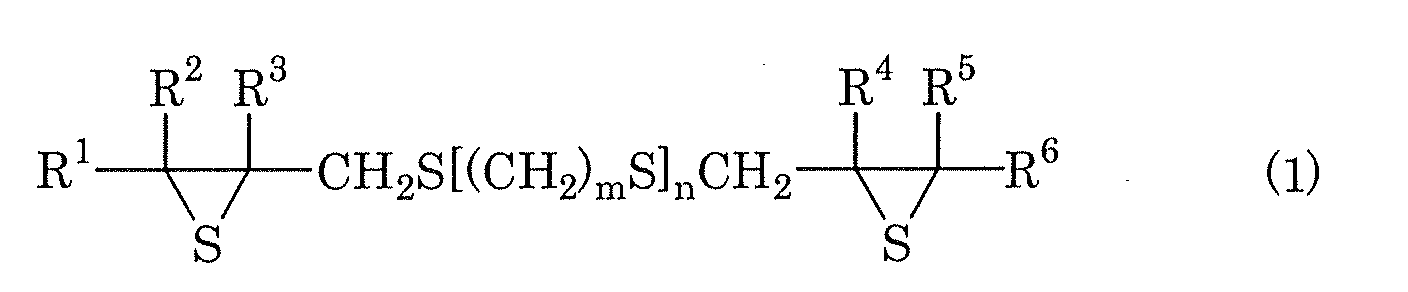
  • the episulfide compound represented by the following formula 1 is preferred as the starting raw material: wherein R 1 to R 6 are each independently hydrogen or C 1 -C 10 hydrocarbon group, m is an integer from 0 to 6, and n is an integer from 0 to 4.
  • episulfide compounds include ethylene sulfide, propylene sulfide, cyclohexene sulfide, styrene sulfide, thioglycidol, thioglycidyl acetate, thioglycidyl propionate, thioglycidyl benzoate, 1,1-bis(epithioethyl)methane, 1-(epithioethyl)-1-( ⁇ -epithiopropyl)methane, 1,1-bis( ⁇ -epithiopropyl)methane, 1-(epithioethyl)-1-( ⁇ -epithiopropyl)ethane, 1,2-bis( ⁇ -epithiopropyl)ethane, 1-(epithioethyl)-3-( ⁇ -epithiopropyl)butane, 1,3-bis( ⁇ -epith,
  • the episulfide compound having at least one thiirane ring in its molecule usable in the invention is not specifically limited to examples recited above, and the above compounds may be used alone or in combination of two or more.
  • the method of the invention comprises a first step of reacting the episulfide compound and the thiocarboxylic S-acid represented by the following formula 2: wherein R 7 is a hydrocarbon group having 1 to 7 carbon atoms, in the presence of a base to produce a thiocarboxylic S-ester; a second step of hydrolyzing the thiocarboxylic S-ester in the presence of a base to produce a mercaptide; and a third step of converting the mercaptide into the vicinal dithiol in the presence of an acid.
  • Example of the production scheme is shown below.
  • R 1 , R 2 , R 3 and R 7 are as defined above.
  • the thiirane ring of the episulfide compound is opened in the presence of the base to produce the thiocarboxylic S-ester.
  • the thiocarboxylic S-acid of the formula 2 include thioacetic S-acid, thiopropionic S-acid, thiobutyric S-acid, thiobenzoic S-acid, etc., with thioacetic S-acid being particularly preferred.
  • the thiocarboxylic S-acid is used in an amount so as to regulate the ratio of the total molar number of the mercaptocarbonyl groups in the thiocarboxylic S-acid to the total molar number of thiirane rings in the episulfide compound within the range of preferably 0.1 to 10, more preferably 0.5 to 5, and still more preferably 0.9 to 2.
  • the base is selected from the group consisting of ammonia, amines, phosphines, metal alcoholates, metal hydrides, metal hydroxides, metal carbonates and metal sulfides.
  • the amount of the base to be used is preferably 0.0001 to 1 mol, more preferably 0.001 to 0.3 mol, and still more preferably 0.001 to 0.1 mol per one mole of the episulfide compound.
  • the base usable in the first step is not specifically limited to the examples recited above, and the above bases may be used alone or in combination of two or more.
  • the above bases may be used alone or in combination of two or more.
  • relatively preferred are metal hydroxides, with sodium hydroxide and potassium hydroxide being more preferred.
  • the solvent for use in the first step is preferably a polar organic solvent having a high dissolving power to thiocarboxylic S-acid and base, and alcohols are more preferably used.
  • the amount of the solvent to be used is selected so that the ratio, (weight of episulfide compound)/(total weight of solvent and episulfide compound), is preferably 0.05 to 0.5, more preferably 0.1 to 0.4, and still more preferably 0.2 to 0.3.
  • the solvent examples include, but not limited thereto, methanol, ethanol, n-propanol, isopropanol, n-butanol, isobutanol, see-butanol, tert-butanol, n-amyl alcohol, active amyl alcohol, isoamyl alcohol, sec-amyl alcohol, 3-pentanol, tert-amyl alcohol, fusel oil, n-hexanol, methylamyl alcohol, 2-ethylbutanol, n-heptanol, 2-heptanol, 3-heptanol, n-octanol, 2-octanol, 2-ethylhexanol, 3,5,5-trimethylhexanol, nonanol, n-decanol, undecanol, n-dodecanol, trimethylnonyl alcohol, tetradecanol, heptadecanol
  • the reaction temperature of the first step is selected depending on the kinds of solvent, base, etc. to be used, and preferably 20 to 100°C, more preferably 30 to 80°C, and still more preferably 40 to 60°C.
  • the reaction of the first step is carried out, for example, by adding dropwise the episulfide compound directly or in a solution thereof into a uniform solution of the thiocarboxylic S-acid, base and solvent under stirring. It is preferred to complete the dropwise addition preferably within one minute to six hours, more preferably within 5 min to 3 h, and still more preferably 15 min to 2 h. After the dropwise addition, it is preferred to continue the stirring of the reaction liquid mixture preferably for 10 min to 24 h, more preferably for 30 min to 20 h, and still more preferably for 1 to 12 h to allow the reaction to further proceed.
  • the reaction product liquid of the first step is subjected to the next reaction of the second step generally without separation, purification, etc.
  • the thiocarboxylic S-ester from the first step is hydrolyzed in the presence of the base to produce the mercaptide.
  • the base for use in the second step is preferably selected from those described above with respect to the first step.
  • the base for the second step and the base for the first step may be different types, but preferably the same type in view of production efficiency.
  • the reaction temperature of the second step largely influences the by-production of oligomers, etc.
  • the by-production of oligomers, etc. can be prevented by carrying out the reaction at low temperatures, but the reaction time is prolonged. Therefore, it is not preferred for the production efficiency to unduly reduce the reaction temperature.
  • the reaction time of the second step greatly depends on the reaction temperature.
  • the reaction temperature is preferably -20 to 40°C, more preferably -10 to 30°C, and still more preferably 0 to 20°C. It is also preferred for the second step to carry out the reaction in an atmosphere having an oxygen concentration of 5% by volume or less.
  • the base is added dropwise to the reaction product liquid from the first step directly or in a solution (preferably 20% by weight to a saturated concentration, or a saturated concentration if the saturated concentration is lower than 20% by weight) preferably over one minute to six hours, more preferably 10 min to 3 h, and still more preferably 30 min to 2 h under stirring.
  • a solution preferably 20% by weight to a saturated concentration, or a saturated concentration if the saturated concentration is lower than 20% by weight
  • it is preferred to continue the stirring of the reaction liquid preferably for 10 min to 24 h, more preferably for 30 min to 20 h, and still more preferably for 1 to 12 h to allow the reaction to further proceed.
  • the reaction product liquid of the second step is subjected to the next reaction of the third step generally without separation, purification, etc.
  • the reaction product liquid from the second step is neutralized and acidified to convert the mercaptide into the vicinal dithiol.
  • the reaction temperature of the third step largely influences the by-production of oligomers, etc.
  • the by-production of oligomers, etc. can be prevented by carrying out the reaction at low temperatures, but the reaction time is prolonged. Therefore, it is not preferred for the production efficiency to unduly reduce the reaction temperature.
  • the reaction temperature is preferably -20 to 40°C, more preferably -10 to 30°C, and still more preferably 0 to 20°C.
  • the third step is performed preferably in an inert gas atmosphere.
  • the acid for use in the third step is not particularly limited as long as it neutralizes the bases used in the first step and the second step, and selected from known organic acids and inorganic acids.
  • the acid may be added directly or after diluted. Examples of the acids are shown below.
  • the acid usable in the invention is not specifically limited to examples recited above, and the above acids may be used alone or in combination of two or more. Of the above acids, preferred are hydrochloric acid, sulfuric acid, nitric acid, boric acid and phosphoric acid.
  • the acid may be added directly, but preferably added in the form of solution with an acid concentration of preferably 5% by weight to a saturated concentration, or a saturated concentration if the saturated concentration is less than 5% by weight.
  • the acid or its solution is added dropwise to the reaction product liquid from the second step under stirring preferably over one minute to six hours, more preferably 10 min to 3 h, and still more preferably 30 min to 2 h to adjust the pH preferably to 1 to 7.
  • it is preferred to continue the stirring of the reaction liquid preferably for one minute to three hours, more preferably for 2 min to 2 h, and still more preferably for 5 minutes to one hour to allow the reaction to further proceed.
  • the resultant vicinal dithiol is separated from the reaction product liquid by known methods such as solvent extraction, washing, removal of solvent by distillation, etc.
  • the extraction solvent include ether solvents, aromatic hydrocarbon solvents, aliphatic hydrocarbon solvents and halogenated hydrocarbon solvents.
  • the extraction solvent may be added to the reaction product liquid prior to the addition of acid.
  • the extraction solvent usable in the invention is not specifically limited to the examples recited above, and the above solvents may be used alone or in combination of two or more.
  • the above solvents may be used alone or in combination of two or more.
  • relatively preferred are aromatic hydrocarbon solvents, with toluene being more preferred.
  • the oxygen present in the reaction system from the first step through the third step is likely to cause the by-production of oligomers, etc. thereby to reduce the purity of the vicinal dithiol.
  • the vicinal dithiol with an acceptable purity can be obtained even by the reaction in air
  • the reaction of each step is carried out in an atmosphere having an oxygen concentration of preferably 5% by volume or less, more preferably 3% by volume or less, and still more preferably 1% by volume or less.

Landscapes

  • Chemical & Material Sciences (AREA)
  • Organic Chemistry (AREA)
  • Chemical Kinetics & Catalysis (AREA)
  • Polymers With Sulfur, Phosphorus Or Metals In The Main Chain (AREA)
  • Organic Low-Molecular-Weight Compounds And Preparation Thereof (AREA)

Abstract

A vicinal dithiol is produced by the reaction of an episulfide compound having at least one thiirane ring in its molecule and a thiocarboxylic S-acid.

Description

BACKGROUND OF THE INVENTION 1. Field of the Invention
The present invention relates to a method for producing a vicinal dithiol which is useful for the production of optical materials such as plastic lenses, prisms, fiber optics, information recording media, filters and adhesives for optical devices.
2. Description of the Prior Art
Cured materials produced by the polymerization of an episulfide compound added with a sulfur-containing compound such as thiol compounds are widely used at present in the applications for spectacle plastic lenses because of their good balance between the refractive index and Abbe's number. The vicinal dithiol, above all, has a high sulfur content and is extremely suitable for such applications because of the ability of increasing the refractive index of cured materials and the ability of increasing the crosslinking density of resultant polymers.
In many of the proposed methods of producing the vicinal dithiol, a vicinal diol or a vicinal dihalide is reacted with thiourea. However, the proposed reactions involve side reactions such as polymerization, rearrangement, etc. and the vicinal dithiol is produced in low yields. In other proposed methods, a compound having a thiirane ring is reacted with hydrogen sulfide or an alkali metal hydrogen sulfide. However, these proposed methods also involve undesirable polymerization, etc. and give the vicinal dithiol only in low yields. For example, the reaction of ethylene sulfide and hydrogen sulfide at room temperature provides ethanedithiol in 49% yield (E. M. J. Meade, et al., J. Chem. Soc., 1894 (1948)). The reaction of cyclohexene sulfide and potassium hydrogen sulfide provides cyclohexanedithiol in 38% yield (C. C. J. Culvenor, et al., J. Chem. Soc., 282 (1949)).
SUMMARY OF THE INVENTION
An object of the present invention is to develop a method for producing a vicinal dithiol in high yields.
As a result of extensive research, the inventors have found that the vicinal dithiol is produced in high yields by the reaction of an episulfide compound having at least one thiirane ring in its molecule and a thiocarboxylic S-acid such as thioacetic S-acid. The present invention has been accomplished on the basis of this finding.
Thus, the invention provides a method for producing a vicinal dithiol comprising a step of reacting an episulfide compound having at least one thiirane ring in its molecule and a thiocarboxylic S-acid.
DETAILED DESCRIPTION OF THE INVENTION
The starting episulfide compound usable in the invention is not structurally limited as long as it has at least one thiirane ring in its molecule. In addition to the thiirane ring, the starting episulfide compound may have another functional group. The number of the thiirane ring is also not specifically limited.
In view of the crosslinking ability of resultant vicinal dithiol and the refractive index of cured materials which are to be produced by the addition of the vicinal dithiol, the episulfide compound represented by the following formula 1 is preferred as the starting raw material:
Figure 00020001
wherein R1 to R6 are each independently hydrogen or C1-C10 hydrocarbon group, m is an integer from 0 to 6, and n is an integer from 0 to 4.
Examples of the episulfide compounds include ethylene sulfide, propylene sulfide, cyclohexene sulfide, styrene sulfide, thioglycidol, thioglycidyl acetate, thioglycidyl propionate, thioglycidyl benzoate, 1,1-bis(epithioethyl)methane, 1-(epithioethyl)-1-(β-epithiopropyl)methane, 1,1-bis(β-epithiopropyl)methane, 1-(epithioethyl)-1-(β-epithiopropyl)ethane, 1,2-bis(β-epithiopropyl)ethane, 1-(epithioethyl)-3-(β-epithiopropyl)butane, 1,3-bis(β-epithiopropyl)propane, 1-(epithioethyl)-4-(β-epithiopropyl)pentane, 1,4-bis(β-epithiopropyl)butane, 1-(epithioethyl)-5-(β-epithiopropyl)hexane, 1-(epithioethyl)-2-(γ-epithiobutylthio)ethane, 1-(epithioethyl)-2-[2-(γ-epithiobutylthio)ethylthio]ethane, tetrakis(β-epithiopropyl)methane, 1,1,1-tris(β-epithiopropyl)propane, 1,3-bis(β-epithiopropyl)-1-(β-epithiopropyl)-2-thiapropane, 1,5-bis(β-epithiopropyl)-2,4-bis(β-epithiopropyl)-3-thiapentane, 1,3- or 1,4-bis(epithioethyl)cyclohexane, 1,3- or 1,4-bis(β-epithiopropyl)cyclohexane, bis[4-(epithioethyl)cyclohexyl] methane, bis[4-(β-epithiopropyl)cyclohexyl]methane, 2,2-bis[4-(epithioethyl)cyclohexyl]propane, 2,2-bis[4-(β-epithiopropyl)cyclohexyl]propane, bis[4-(β-epithiopropyl)cyclohexyl] sulfide, bis[4-(epithioethyl)cyclohexyl] sulfide, 2,5-bis(epithioethyl)-1,4-dithiane, 2,5-bis(β-epithiopropyl)-1,4-dithiane, 4-epithioethyl-1,2-cyclohexene sulfide, 4-epoxy-1,2-cyclohexene sulfide, methyl thioglycidyl ether, ethyl thioglycidyl ether, propyl thioglycidyl ether, butyl thioglycidyl ether, bis(β-epithiopropyl) ether, bis(β-epithiopropyloxy)methane, 1,2-bis(β-epithiopropyloxy)ethane, 1,3-bis(β-epithiopropyloxy)propane, 1,2-bis(β-epithiopropyloxy)propane, 1-(β-epithiopropyloxy)-2-(β-epithiopropyloxymethyl)propane, 1,4-bis(β-epithiopropyloxy)butane, 1,3-bis(β-epithiopropyloxy)butane, 1-(β-epithlopropyloxy)-3-(β-epithiopropyloxymethyl)butane, 1,5-bis(β-epithiopropyloxy)pentane, 1-(β-epithiopropyloxy)-4-(β-epithiopropyloxymethyl)pentane, 1,6-bis(β-epithiopropyloxy)hexane, 1-(β-epithiopropyloxy)-5-(β-epithiopropyloxymethyl)hexane, 1-(β-epithiopropyloxy)-2-[(2-β-epithiopropyloxyethyl)oxy]ethane, 1-(β-epithiopropyloxy)-2-[[2-(2-β-epithiopropyloxyethyl)oxyethyl]oxy]ethane, bis(5,6-epithio-3-oxahexyl) selenide, bis(5,6-epithio-3-oxahexyl) telluride, tetrakis(β-epithiopropyloxymethyl)methane, 1,1,1-tris(β-epithiopropyloxymethyl)propane, 1,5-bis(β-epithiopropyloxy)-2-(β-epithiopropyloxymethyl)-3-thiapentane, 1,5-bis(β-epithiopropyloxy)-2,4-bis(β-epithiopropyloxymethyl)-3-thiapentane, 1-(β-epithiopropyloxy)-2,2-bis(β-epithiopropyloxymethyl)-4-thiahexane, 1,5,6-tris(β-epithiopropyloxy)-4-(β-epithiopropyloxymethyl)-3-thiahexane, 1,8-bis(β-epithiopropyloxy)-4-(β-epithiopropyloxymethyl)-3,6-dithiaoctane, 1,8-bis(β-epithiopropyloxy)-4,5-bis(β-epithiopropyloxymethyl)-3,6-dithiaoctane, 1,8-bis(β-epithiopropyloxy)-4,4-bis(β-epithiopropyloxymethyl)-3,6-dithiaoctane, 1,8-bis(β-epithiopropyloxy)-2,4,5-tris(β-epithiopropyloxymethyl)-3,6-dithiaoctane, 1,8-bis(β-epithiopropyloxy)-2,5-bis(β-epithlopropyloxymethyl)-3,6-dithiaoctane, 1,9-bis(β-epithiopropyloxy)-5-(β-epithiopropyloxymethyl)-5-[(2-β-epithiopropyloxyethyl)oxymethyl]-3,7-dithianonane, 1,10-bis(β-epithiopropyloxy)-5,6-bis[(2-β-epithiopropyloxyethyl)oxy]-3,6,9-trithiadecane, 1,11-bis(β-epithiopropyloxy)-4,8-bis(β-epithiopropyloxymethyl)-3,6,9-trithiaundecane, 1,11-bis(β-epithiopropyloxy)-5,7-bis(β-epithiopropyloxymethyl)-3,6,9-trithiaundecane, 1,11-bis(β-epithiopropyloxy)-5,'7-[(2-β-epithiopropyloxyethyl)oxymethyl]-3,6,9-trithiaundecane, 1,11-bis(β-epithiopropyloxy)-4,7-bis(β-epithiopropyloxymethyl)-3,6,9-trithiaundecane, 1,3-or 1,4-bis(β-epithiopropyloxy)cyclohexane, 1,3- or 1,4-bis(β-epithiopropyloxymethyl)cyclohexane, bis[4-(β-epithiopropyloxy)cyclohexyl]methane, 2,2-bis[4-(β-epithiopropyloxy)cyclohexyl]propane, bis[4-(β-epithiopropyloxy)cyclohexyl] sulfide, 2,5-bis(β-epithiopropyloxymethyl)-1,4-dithiane, 2,5-bis(β-epithiopropyloxyethyloxymethyl)-1,4-dithiane, 1,3- or 1,4-bis(β-epithiopropyloxy)benzene, 1,3- or 1,4-bis(β-epithiopropyloxymethyl)benzene, bis[4-(β-epithiopropyl)phenyl]methane, 2,2-bis[4-(β-epithiopropylthio)phenyl]propane, bis[4-(β-epithiopropylthio)phenyl] sulfide, bis[4-(β-epithiopropylthio)phenyl] sulfone, 4,4'-bis(β-epithiopropylthio)biphenyl, bis(β-epithiopropyl) sulfide, bis(β-epithiopropyl) disulfide, bis(β-epithiopzopyl) trisulfide, bis(β-epithiopropylthio)methane, 1,2-bis(β-epithiopropylthio)ethane, 1,3-bis(β-epithiopropylthio)propane, 1,2-bis(β-epithiopropylthio)propane, 1-(β-epithiopropylthio)-2-(β-epithiopropylthiomethyl)propane, 1,4-bis(β-epithiopropylthio)butane, 1,3-bis(β-epithiopropylthio)butane, 1-(β-epithiopropylthio)-3-(β-epithiopropylthiomethyl)butane, 1,5-bis(β-epithiopropylthio)pentane, 1-(β-epithiopropylthio)-4-(β-epithiopropylthiomethyl)pentane, 1,6-bis(β-epithiopropylthio)hexane, 1-(β-epithiopropylthio)-5-(β-epithiopropylthiomethyl)hexane, 1-(β-epithiopropylthio)-2-[(2-β-epithiopropylthioethyl)thio]ethane, 1-(β-epithiopropylthio)-2-[[2-(2-β-epithiopropylthioethyl)thioethyl]thio]ethane, tetrakis(β-epithiopropylthiomethyl)methane, 1,1,1-tris(β-epithiopropylthiomethyl)propane, 1,5-bis(β-epithiopropylthio)-2-(β-epithiopropylthiomethyl)-3-thiapentane, 1,5-bis(β-epithiopropylthio)-2,4-bis(β-epithiopropylthiomethyl)-3-thiapentane, 1-(β-epithiopropylthio)-2,2-bis(β-epithiopropylthiomethyl)-4-thiahexane, 1,5,6-tris(β-epithiopropylthio)-4-(β-epithiopropylthiomethyl)-3-thiahexane, 1,8-bis(β-epithiopropylthio)-4-(β-epithiopropylthiomethyl)-3,6-dithiaoctane, 1,8-bis(β-epithiopropylthio)-4,5-bis(β-epithiopropylthiomethyl)-3,6-dithiaoctane, 1,8-bis(β-epithiopropylthio)-4,4-bis(β-epithiopropylthiomethyl)-3,6-dithiaoctane, 1,8-bis(β-epithiopropylthio)-2,4,5-tris(β-epithiopropylthiomethyl)-3,6-dithiaoctane, 1,8-bis(β-epithiopropylthio)-2,5-bis(β-epithiopropylthiomethyl)-3,6-dithiaoctane, 1,9-bis(β-epithiopropylthio)-5-(β-epithiopropylthiomethyl)-5-[(2-β-epithiopropylthioethyl)thiomethyl]-3,7-dithianonane, 1,10-bis(β-epithiopropylthio)-5,6-bis[(2-β-epithiopropylthioethyl)thio]-3,6,9-trithiadecane, 1,11-bis(β-epithiopropylthio)-4,8-bis(β-epithiopropylthiomethyl)-3,6,9-trithiaundecane, 1,11-bis(β-epithiopropylthio)-5,7-bis(β-epithiopropylthiomethyl)-3,6,9-trithiaundecane, 1,11-bis(β-epithiopropylthio)-5,7-[(2-β-epithiopropylthioethyl)thiomethyl]-3,6,9-trithiaundecane, 1,11-bis(β-epithiopropylthio)-4,7-bis(β-epithiopropylthiomethyl)-3,6,9-trithiaundecane, 1,3- or 1,4-bis(β-epithiopropylthio)benzene, 1,3- or 1,4-bis(β-epithiopropylthiomethyl)benzene, bis[4-(β-epithiopropylthio)phenyl]methane, 2,2-bis[4-(β-epithiopropylthio)phenyl]propane, bis[4-(β-epithiopropylthio)phenyl] sulfide, bis[4-(β-epithiopropylthio)phenyl] sulfone, 4,4'-bis(β-epithiopropylthio)biphenyl, bis(β-epithiopropyl) selenide, bis(β-epithiopropyl) diselenide, bis(β-epithiopropyl) triselenide, bis(β-epithiopropylseleno)methane, bis(β-epithiopropyl) telluride, bis(β-epithiopropyl) ditelluride, bis(β-epithiopropyl) tritelluride, bis(β-epithiopropyltelluro)methane, 1,2-bis(β-epithiopropyltelluro)ethane, vinylphenyl thioglycidyl ether, vinylbenzyl thioglycidyl ether, thioglycidyl methacrylate, thioglycidyl acrylate, allyl thioglycidyl ether, and compounds derived from the preceding episulfide compounds by substituting methyl group for at least one hydrogen of the epithio group, with bis(β-epithiopropyl) sulfide and bis(β-epithiopropyl) disulfide being preferred.
The episulfide compound having at least one thiirane ring in its molecule usable in the invention is not specifically limited to examples recited above, and the above compounds may be used alone or in combination of two or more.
The method of the invention comprises a first step of reacting the episulfide compound and the thiocarboxylic S-acid represented by the following formula 2:
Figure 00060001
wherein R7 is a hydrocarbon group having 1 to 7 carbon atoms,
in the presence of a base to produce a thiocarboxylic S-ester; a second step of hydrolyzing the thiocarboxylic S-ester in the presence of a base to produce a mercaptide; and a third step of converting the mercaptide into the vicinal dithiol in the presence of an acid. Example of the production scheme is shown below.
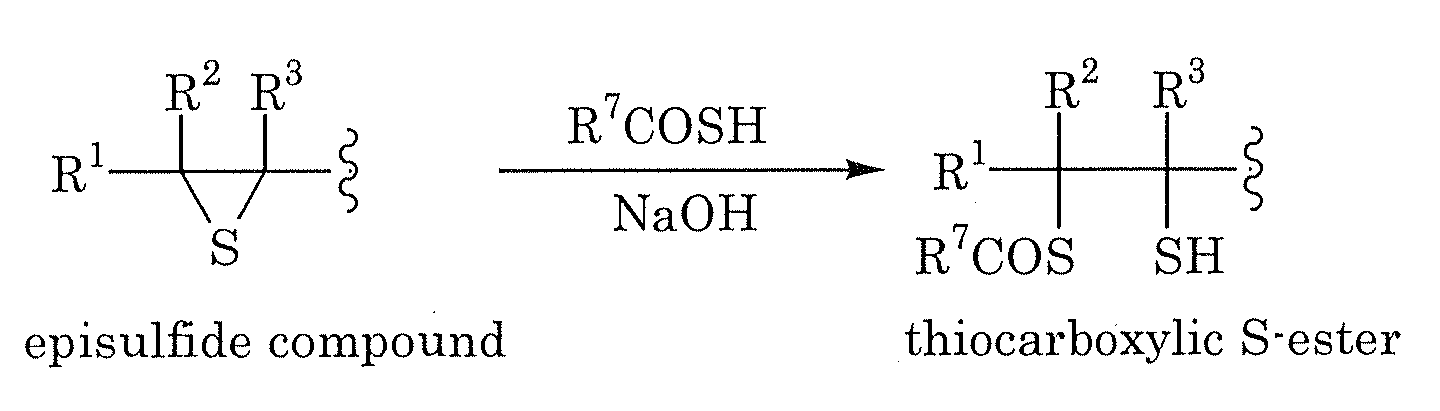
First Step
Figure 00070001
Second Step
Figure 00070002
Third Step
Figure 00070003
wherein R1, R2, R3 and R7 are as defined above.
In the first step, the thiirane ring of the episulfide compound is opened in the presence of the base to produce the thiocarboxylic S-ester. Examples of the thiocarboxylic S-acid of the formula 2 include thioacetic S-acid, thiopropionic S-acid, thiobutyric S-acid, thiobenzoic S-acid, etc., with thioacetic S-acid being particularly preferred. The thiocarboxylic S-acid is used in an amount so as to regulate the ratio of the total molar number of the mercaptocarbonyl groups in the thiocarboxylic S-acid to the total molar number of thiirane rings in the episulfide compound within the range of preferably 0.1 to 10, more preferably 0.5 to 5, and still more preferably 0.9 to 2.
The base is selected from the group consisting of ammonia, amines, phosphines, metal alcoholates, metal hydrides, metal hydroxides, metal carbonates and metal sulfides. The amount of the base to be used is preferably 0.0001 to 1 mol, more preferably 0.001 to 0.3 mol, and still more preferably 0.001 to 0.1 mol per one mole of the episulfide compound.
Examples of the base are shown below.
  • (1) Ammonia
  • (2) Amines:
  • primary amines such as ethylamine, n-propylamine, see-propylamine, n-butylamine, sec-butylamine, isobutylamine, tert-butylamine, pentylamine, hexylamine, heptylamine, octylamine, decylamine, laurylamine, myristylamine, 1,2-dimethylhexylamine, 3-pentylamine, 2-ethylhexylamine, allylamine, aminoethanol, 1-aminopropanol, 2-aminopropanol, aminobutanol, aminopentanol, aminohexanol, 3-ethoxypropylamine, 3-propoxypropylamine, 3-isopropoxypropylamine, 3-butoxypropylamine, 3-isobutoxypropylamine, 3-(2-ethylhexyloxy)propylamine, aminocyclopentane, aminocyclohexane, aminonorbornene, aminomethylcyclohexane, aminobenzene, benzylamine, phenetylamine, α-phenylethylamine, naphthylamine and furfurylamine;
  • primary polyamines such as ethylenediamine, 1,2-diaminopropane, 1,3-diaminopropane, 1,2-diaminobutane, 1,3-diaminobutane, 1,4-diaminobutane, 1,5-diaminopentane, 1,6-diaminohexane, 1,7-diaminoheptane, 1,8-diaminooctane, dimethylaminopropylamine, diethylaminopropylamine, bis(3-aminopropyl) ether, 1,2-bis(3-aminopropoxy)ethane, 1,3-bis(3-aminopropoxy)-2,2'-dimethylpropane, aminoethylethanolamine, 1,2-, 1,3- or 1,4-diaminocyclohexane, 1,3- or 1,4-bis(aminomethyl)cyclohexane, 1,3- or 1,4-bis(aminoethyl)cyclohexane, 1,3- or 1,4-bis(aminopropyl)cyclohexane, hydrogenated 4,4'-diaminodiphenylmethane, 2- or 4-aminopiperidine, 2- or 4-aminomethylpiperidine, 2- or 4-aminoethylpiperidine, N-(aminoethyl)piperidine, N-(aminopropyl)piperidine, N-(aminoethyl)morpholine, N-(aminopropyl)morpholine, isophoronediamine, menthanediamine, 1,4-bis(aminopropyl)piperadine, o-, m- or p-phenylenediamine, 2,4- or 2,6-tolylenediamine, 2,4-toluenediamine, m-aminobenzylamine, 4-chloro-o-phenylenediamine, tetrachloro-o-xylylenediamine, 4-methoxy-6-methyl-m-phenylenediamine, m- or p-xylylenediamine, 1,5- or 2,6-naphthalenediamine, benzidine, 4,4'-bis(o-toluidine), dianisidine, 4,4'-diaminodiphenylmethane, 2,2-(4,4'-diaminodiphenyl)propane, 4,4'-diaminodiphenyl ether, 4-,4'-thiodianiline, 4,4'-diaminodiphenyl sulfone, 4,4'-diaminoditolyl sulfone, methylenebis(o-chloroaniline), 3,9-bis(3-aminopropyl)-2,4,8,10-tetraoxaspiro[5.5]undecane, diethylenetriamine, iminobis(propylamine), methyliminobis(propylamine), bis(hexamethylene)triamine, triethylenetetramine, tetraethylenepentamine, pentaethylenehexamine, N-(aminoethyl)piperadine, N-(aminopropyl)piperadine, 1,4-bis(aminoethyl)piperadine, 1,4-bis(aminopropyl)piperadine, 2,6-diaminopyridine and bis(3,4-diaminophenyl) sulfone;
  • secondary amines such as diethylamine, dipropylamine, di-n-butylamine, di-sec-butylamine, diisobutylamine, di-n-pentylamine, di-3-pentylamine, dihexylamine, dioctylamine, di(2-ethylhexyl)amine, methylhexylamine, diallylamine, pyrrolidine, piperidine, 2-, 3- or 4-picoline, 2,4-, 2,6- or 3,5-lupetidine, diphenylamine, N-methylaniline, N-ethylaniline, dibenzylamine, methylbenzylamine, dinaphthylamine, pyrrol, indoline, indole and morpholine;
  • secondary polyamines such as N,N'-dimethylethylenediamine, N,N'-dimethyl-1,2-diaminopropane, N,N'-dimethyl-1,3-diaminopropane, N,N'-dimethyl-1,2-diaminobutane, N,N'-dimethyl-1,3-diaminobutane, N,N'-dimethyl-1,4-diaminobutane, N,N'-dimethyl-1,5-diaminopentane, N,N'-dimethyl-1,6-diaminohexane, N,N'-dimethyl-1,7-diaminoheptane, N,N'-diethylethylenediamine, N,N'-diethyl-1,2-diaminopropane, N,N'-diethyl-1,3-diaminopropane, N,N'-diethyl-1,2-diaminobutane, N,N'-diethyl-1,3-diaminobutane, N,N'-diethyl-1,4-diaminobutane, N,N'-diethyl-1,6-diaminohexane, piperadine, 2-methylpiperadine, 2,5- or 2,6-dimethylpiperadine, homopiperadine, 1,1-di(4-piperidyl)methane, 1,2-di(4-piperidyl)ethane, 1,3-di(4-piperidyl)propane, 1,4-di(4-piperidyl)butane and tetramethylguanidine;
  • tertiary amines such as trimethylamine, triethylamine, tri-n-propylamine, triisopropylamine, tri(1,2-dimethylpropyl)amine, tri(3-methoxypropyl)amine, tri-n-butylamine, triisobutylamine, tri-sec-butylamine, tri-n-pentylamine, tri-3-pentylamine, tri-n-hexylamine, tri-n-octylamine, tri(2-ethylhexyl)amine, tridodecylamine, trilaurylamine, dicyclohexylethylamine, cyclohexyldiethylamine, tricyclohexylamine, N,N-dimethylhexylamine, N-methyldihexylamine, N,N-dimethylcyclohexylamine, N-methyldicyclohexylamine, N,N-diethylethanolamine, N,N-dimethylethanolamine, N-ethyldiethanolamine, triethanolamine, tribenzylamine, N,N-dimethylbenzylamine, diethylbenzylamine, triphenylamine, N,N-dimethylamino-p-cresol, N,N-dimethylaminomethylphenol, 2-(N,N-dimethylaminomethyl)phenol, N,N-dimethylaniline, N,N-diethylaniline, pyridine, quinoline, N-methylmorpholine, N-methylpiperidine and 2-(2-dimethylaminoethoxy)-4-methyl-1,3,2-dioxabornane;
  • tertiary polyamines such as tetramethylethylenediamine, pyrazine, N,N'-dimethylpiperadine, N,N'-bis(2-hydroxypropyl)piperadine, hexamethylenetetramine, N,N,N',N'-tetramethyl-1,3-butaneamine, 2-dimethylamino-2-hydroxypropane, diethyaminoethanol, N,N,N-tris(3-dimethylaminopropyl)amine, 2,4,6-tris(N,N,-dimethylaminomethyl)phenol and heptamethylisobiguanide;
  • imidazole compounds such as imidazole, N-methylimidazole, 2-methylimidazole, 4-methylimidazole, N-ethylimidazole, 2-ethylimidazole, 4-ethylimidazole, N-butylimidazole, 2-butylimidazole, N-undecylimidazole, 2-undecylimidazole, N-phenylimidazole, 2-phenylimidazole, N-benzylimidazole, 2-benzylimidazole, 1-benzyl-2-methylimidazole, N-(2'-cyanoethyl)-2-methylimidazole, N-(2'-cycanoethyl)-2-undecylimidazole, N-(2'-cyanoethyl)-2-phenylimidazole, 3,3-bis(2-ethyl-4-methylimidazolyl)methane, 2-mercaptoimidazole, 2-mercapto-N-methylimidazole, 2-mercaptobenzimidazole, 3-mercapto-4-methyl-1,2,4-triazole, 5-mercapto-1-methyl-tetrazole, 2,5-dimercapto-1,3,4-thiadiazole, addition products of alkylimidazoles and isocyanuric acid and condensation products of alkylimidazoles and formaldehyde; and
  • amidines such as 1,8-diazabicyclo[5.4.0]undecene-7, 1,5-diazabicyclo[4.3.0]nonene-5, 6-dibutylamino-1,8-diazabicyclo[5.4.0]undecene-7.
  • (3) Phosphines:
  • trimethylphosphine, triethylphosphine, triisopropylphosphine, tri-n-butylphosphine, tri-n-hexylphosphine, tri-n-octylphosphine, tricyclohexylphosphine, triphenylphosphine, tribenzylphosphine, tris(2-methylphenyl)phosphine, tris(3-methylphenyl)phosphine, tris(4-methylphenyl)phosphine, tris(diethylamino)phosphine, tris(4-methylphenyl)phosphine, dimethylphenylphosphine, diethylphenylphosphine, dicyclohexylphenylphosphine, ethyldiphenylphosphine, diphenylcyclohexylphosphine and chlorodiphenylphosphine
  • (4) Metal alcoholates:
  • lithium methoxide, sodium methoxide, potassium methoxide, magnesium methoxide, calcium methoxide, sodium ethoxide, potassium ethoxide, sodium t-butoxide, and potassium t-butoxide.
  • (5) Metal hydrides:
  • lithium hydride, sodium hydride, potassium hydride, magnesium hydride, calcium hydride, sodium borohydride and lithium aluminum hydride.
  • (6) Metal hydroxides:
  • lithium hydroxide, sodium hydroxide, potassium hydroxide, magnesium hydroxide, calcium hydroxide, barium hydroxide and aluminum hydroxide.
  • (7) Metal carbonates:
  • lithium carbonate, sodium carbonate, sodium hydrogencarbonate, potassium carbonate, potassium hydrogencarbonate, magnesium carbonate, calcium carbonate, barium carbonate, aluminum carbonate, cadmium carbonate, nickel carbonate, copper carbonate, strontium carbonate, cobalt carbonate and manganese carbonate.
  • (8) Metal sulfides:
  • sodium sulfide, sodium hydrogensulfide, potassium sulfide, potassium hydrogensulfide, zinc sulfide, mercury sulfide and iron sulfide.
  • The base usable in the first step is not specifically limited to the examples recited above, and the above bases may be used alone or in combination of two or more. Among the exemplified bases, relatively preferred are metal hydroxides, with sodium hydroxide and potassium hydroxide being more preferred.
    The solvent for use in the first step is preferably a polar organic solvent having a high dissolving power to thiocarboxylic S-acid and base, and alcohols are more preferably used. The amount of the solvent to be used is selected so that the ratio, (weight of episulfide compound)/(total weight of solvent and episulfide compound), is preferably 0.05 to 0.5, more preferably 0.1 to 0.4, and still more preferably 0.2 to 0.3.
    Examples of the solvent include, but not limited thereto, methanol, ethanol, n-propanol, isopropanol, n-butanol, isobutanol, see-butanol, tert-butanol, n-amyl alcohol, active amyl alcohol, isoamyl alcohol, sec-amyl alcohol, 3-pentanol, tert-amyl alcohol, fusel oil, n-hexanol, methylamyl alcohol, 2-ethylbutanol, n-heptanol, 2-heptanol, 3-heptanol, n-octanol, 2-octanol, 2-ethylhexanol, 3,5,5-trimethylhexanol, nonanol, n-decanol, undecanol, n-dodecanol, trimethylnonyl alcohol, tetradecanol, heptadecanol, ethylene glycol, diethylene glycol, triethylene glycol, tetraethylene glycol, polyethylene glycol, propylene glycol, dipropylene glycol, polypropylene glycol, hexylene glycol, octylene glycol, glycerol, trimethylolpropane, and 1,2,6-hexanetriol, with methanol and ethanol being preferred. The solvents may be used alone or in combination of two or more.
    The reaction temperature of the first step is selected depending on the kinds of solvent, base, etc. to be used, and preferably 20 to 100°C, more preferably 30 to 80°C, and still more preferably 40 to 60°C.
    The reaction of the first step is carried out, for example, by adding dropwise the episulfide compound directly or in a solution thereof into a uniform solution of the thiocarboxylic S-acid, base and solvent under stirring. It is preferred to complete the dropwise addition preferably within one minute to six hours, more preferably within 5 min to 3 h, and still more preferably 15 min to 2 h. After the dropwise addition, it is preferred to continue the stirring of the reaction liquid mixture preferably for 10 min to 24 h, more preferably for 30 min to 20 h, and still more preferably for 1 to 12 h to allow the reaction to further proceed. As described below, it is preferred to reduce the oxygen concentration of the reaction atmosphere to 5% by volume or less, for example, by introducing an inert gas such as nitrogen gas. After the reaction, the reaction product liquid of the first step is subjected to the next reaction of the second step generally without separation, purification, etc.
    In the second step, the thiocarboxylic S-ester from the first step is hydrolyzed in the presence of the base to produce the mercaptide. The base for use in the second step is preferably selected from those described above with respect to the first step. The base for use in the second step is added in an amount so as to regulate the ratio of the total effective amount represented by the following formula: total effective amount = V × M wherein V is the valency of the base and M is the total molar number of the base used in the first step and the base to be added in the second step,
    to the total molar number of mercaptocarbonyl groups in the thiocarboxylic S-acid used in the first step within the range of preferably 0.1 to 10, more preferably 0.5 to 5, and still more preferably 0.9 to 3. The base for the second step and the base for the first step may be different types, but preferably the same type in view of production efficiency.
    The reaction temperature of the second step largely influences the by-production of oligomers, etc. The by-production of oligomers, etc. can be prevented by carrying out the reaction at low temperatures, but the reaction time is prolonged. Therefore, it is not preferred for the production efficiency to unduly reduce the reaction temperature. Particularly, the reaction time of the second step greatly depends on the reaction temperature. To prevent the by-production of oligomers, etc. and to complete the reaction within a short period of time, the reaction temperature is preferably -20 to 40°C, more preferably -10 to 30°C, and still more preferably 0 to 20°C. It is also preferred for the second step to carry out the reaction in an atmosphere having an oxygen concentration of 5% by volume or less.
    In the second step, the base is added dropwise to the reaction product liquid from the first step directly or in a solution (preferably 20% by weight to a saturated concentration, or a saturated concentration if the saturated concentration is lower than 20% by weight) preferably over one minute to six hours, more preferably 10 min to 3 h, and still more preferably 30 min to 2 h under stirring. After the dropwise addition, it is preferred to continue the stirring of the reaction liquid preferably for 10 min to 24 h, more preferably for 30 min to 20 h, and still more preferably for 1 to 12 h to allow the reaction to further proceed. The reaction product liquid of the second step is subjected to the next reaction of the third step generally without separation, purification, etc.
    In the third step, the reaction product liquid from the second step is neutralized and acidified to convert the mercaptide into the vicinal dithiol. The reaction temperature of the third step largely influences the by-production of oligomers, etc. The by-production of oligomers, etc. can be prevented by carrying out the reaction at low temperatures, but the reaction time is prolonged. Therefore, it is not preferred for the production efficiency to unduly reduce the reaction temperature. To prevent the by-production of oligomers, etc. and to complete the reaction within a short period of time, the reaction temperature is preferably -20 to 40°C, more preferably -10 to 30°C, and still more preferably 0 to 20°C. Like the first step and the second step, the third step is performed preferably in an inert gas atmosphere.
    The acid for use in the third step is not particularly limited as long as it neutralizes the bases used in the first step and the second step, and selected from known organic acids and inorganic acids. The acid may be added directly or after diluted. Examples of the acids are shown below.
  • (1) Organic Acids:
  • carboxylic acids such as formic acid, acetic acid, propionic acid, butyric acid, valeric acid, caproic acid, caprylic acid, naphthenic acid, methyl mercaptopropionate, oxalic acid, malonic acid, succinic acid, glutaric acid, adipic acid, maleic acid, cyclohexanecarboxylic acid, benzoic acid, phenylacetic acid, o-toluic acid, m-toluic acid, p-toluic acid, salicylic acid, 2-methoxybenzoic acid, 3-methoxybenzoic acid, benzoylbenzoic acid, phthalic acid, isophthalic acid, terephthalic acid, benzilic acid, α-naphthalenecarboxylic acid, β-naphthalenecarboxylic acid, thiodipropionic acid, dithiodipropionic acetic acid, peracetic acid, thioacetic acid, tartaric acid, maleic anhydride, benzoic anhydride, phthalic anhydride, trimellitic anhydride, and pyromellitic anhydride;
  • phosphoric mono and diesters such as mono- or dimethyl phosphate, mono- or diethyl phosphate, mono- or diisobutyl phosphate, mono- or dibutyl phosphate, and mono- or dilauryl phosphate;
  • phosphorous mono or diesters such as mono- or dimethyl phosphite, mono- or diethyl phosphite, mono- or diisobutyl phosphite, mono- or dibutyl phosphite, and mono- or dilauryl phosphite;
  • organic thiophosphorus compounds such as dialkyl phosphrodithioates including dimethyl phosphrodithioate;
  • phenols such as phenol, catechol, tert-butylcatechol, 2,6-di-tert-butylcresol, 2,6-di-tert-butylethylphenol, resorcinol, hydroquinone, phloroglucinol, pyrogallol, cresol, ethylphenol, butylphenol, nonylphenol, hydroxyphenylacetic acid, hydroxyphenylpropionic acid, hydroxyphenylacetic amide, methyl hydroxyphenylacetate, hydroxyphenethyl alcohol, hydroxyphenethylamine, hydroxybenzaldehyde, phenylphenol, bisphenol A, 2,2'-methylene-bis(4-methyl-6-tert-butylphenol), bisphenol F, bisphenol S, α-naphthol, β-naphthol, aminophenol, chlorophenol, and 2,4,6-trichlorophenol;
  • sulfonic acids such as methanesulfonic acid, ethanesulfonic acid, butanesulfonic acid, dodecanesulfonic acid, benzenesulfonic acid, o-toluenesulfonic acid, m-toluenesulfonic acid, p-toluenesulfonic acid, ethylbenzenesulfonic acid, butylbenzenesulfonic acid, dodecylbenzenesulfonic acid, p-phenolsulfonic acid, o-cresolsulfonic acid, metanilic acid, sulfanilic acid, 4B acid, diaminostilbenesulfonic acid, biphenylsulfonic acid, α-naphthalenesulfonic acid, β-naphthalene sulfonic acid, peri acid, Laurent acid, and phenyl-J acid; and
  • sulfinic acids such as bennzenesulfinic acid and toluenesulfonic acid.
  • (2) Inorganic Acids:
  • nitric acid, hydrochloric acid, perchloric acid, hypochlorous acid, chlorine dioxide, hydrofluoric acid, sulfuric acid, fuming sulfuric acid, boric acid, arsenic acid, aresenous acid, pyroarsenic acid, phosphoric acid, phosphorous acid, hypophosphorous acid, phosphorus oxychloride, phosphorus oxybromide, phosphorus sulfide, phosphorus trichloride, phosphorus tribromide, phosphorus pentachloride, hydrocyanic acid, chromic acid, nitric anhydride, sulfuric anhydride, boron oxide, arsenic pentoxide, phosphorus pentoxide, chromic anhydride, sulfuryl chloride, silica gel, and silica-alumina.
  • The acid usable in the invention is not specifically limited to examples recited above, and the above acids may be used alone or in combination of two or more. Of the above acids, preferred are hydrochloric acid, sulfuric acid, nitric acid, boric acid and phosphoric acid. The acid may be added directly, but preferably added in the form of solution with an acid concentration of preferably 5% by weight to a saturated concentration, or a saturated concentration if the saturated concentration is less than 5% by weight. The acid is used in an amount so as to regulate the ratio of the total effective amount represented by the following formula: total effective amount = Va × Ma wherein Va is the valency of the acid and Ma is the total molar number of the acid,
    to the total effective amount of the base used in the first step and the base added in the second step as defined by the formula 1 within the range of preferably 0.1 to 10, more preferably 0.5 to 5, and still more preferably 0.9 to 3.
    In the third step, the acid or its solution is added dropwise to the reaction product liquid from the second step under stirring preferably over one minute to six hours, more preferably 10 min to 3 h, and still more preferably 30 min to 2 h to adjust the pH preferably to 1 to 7. After the dropwise addition, it is preferred to continue the stirring of the reaction liquid preferably for one minute to three hours, more preferably for 2 min to 2 h, and still more preferably for 5 minutes to one hour to allow the reaction to further proceed.
    After the reaction, the resultant vicinal dithiol is separated from the reaction product liquid by known methods such as solvent extraction, washing, removal of solvent by distillation, etc. Examples of the extraction solvent include ether solvents, aromatic hydrocarbon solvents, aliphatic hydrocarbon solvents and halogenated hydrocarbon solvents. The extraction solvent may be added to the reaction product liquid prior to the addition of acid.
    Examples of the extraction solvents are listed below.
  • (1) Ether solvents:
  • ethyl ether, dichloroethyl ether, isopropyl ether, n-butyl ether, isoamyl ether, n-hexyl ether, methyl phenyl ether, ethyl phenyl ether, n-butyl phenyl ether, and amyl phenyl ether.
  • (2) Aromatic hydrocarbon solvents:
  • benzene, toluene and xylene.
  • (3) Aliphatic hydrocarbon solvents:
  • heptane, pentane, octane, nonane and decane.
  • (4) Halogenated hydrocarbon solvents:
  • methyl chloride, ethylene chloride, chloroform, carbon tetrachloride, ethyl chloride, 1,1,1-trichloroethane, and chlorobenzene.
  • The extraction solvent usable in the invention is not specifically limited to the examples recited above, and the above solvents may be used alone or in combination of two or more. Among the exemplified solvents, relatively preferred are aromatic hydrocarbon solvents, with toluene being more preferred.
    The oxygen present in the reaction system from the first step through the third step is likely to cause the by-production of oligomers, etc. thereby to reduce the purity of the vicinal dithiol. Although the vicinal dithiol with an acceptable purity can be obtained even by the reaction in air, the reaction of each step is carried out in an atmosphere having an oxygen concentration of preferably 5% by volume or less, more preferably 3% by volume or less, and still more preferably 1% by volume or less.
    The invention is described in more detail by reference to the following examples. However, it should be noted that the scope of the invention is not limited thereto.
    The purity of the compound was measured by GPC under the following conditions:
  • column: Shodex GPC K-801,
  • temperature: 35°C,
  • mobile phase: chloroform, and
  • detector: RID.
  • EXAMPLE 1 First Step
    Into a flask equipped with a stirrer, a thermometer, a condenser, a dropping funnel and a nitrogen inlet, were charged 180 g of methanol, 0.290 g (6.74 mmol) of solid sodium hydroxide (content: 93%) and 61.5 g (808 mmol) of thioacetic acid. By blowing nitrogen gas into the flask, the contents were stirred to prepare a uniform solution and the oxygen concentration of the system was simultaneously reduced to 1% by volume or less. After raising the temperature of the solution to 50°C, 60.0 g (336 mmol) of bis(β-epithiopropyl) sulfide was added dropwise while maintaining the temperature at 50°C. After the dropwise addition, the reaction was allowed to further proceed at 50°C for 4 h.
    Second Step
    After the reaction of the first step, the temperature of the solution was lowered to 10°C. Then, 84.1 g (841 mmol) of a 40% aqueous solution of sodium hydroxide was added dropwise while maintaining the temperature at 10°C. After the dropwise addition, the reaction was allowed to proceed at 10°C for additional 9 h.
    Third Step
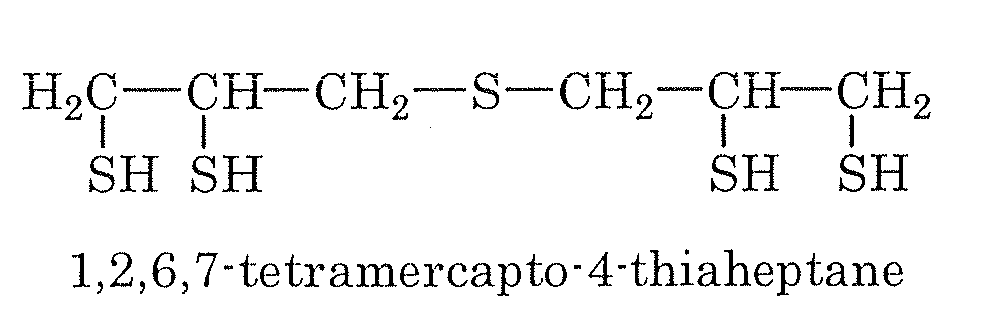
    After the reaction of the second step, 180 g of toluene was added. Then, the solution was neutralized and acidified by adding dropwise 270.5 g (890 mmol) of a 12% hydrochloric acid while maintaining the temperature at 10°C. The separated toluene layer was washed with 120 g of a 1% aqueous solution of sodium hydrogencarbonate and then washed twice with 120 g of water. By distilling off the toluene, 78 g of 1,2,6,7-tetramercapto-4-thiaheptane was obtained as a pale yellow liquid (94% crude yield and 94% purity).
    Figure 00200001
    EXAMPLE 2
    The reactions were carried out in the same manner as in Example 1 except for changing sodium hydroxide (6.74 mmol) used in the first step to sodium methoxide (6.74 mmol). The results are shown in Table 1.
    EXAMPLE 3
    The reactions were carried out in the same manner as in Example 1 except for changing the reaction temperatures of the second step and the third step from 10°C to 30°C. The results are shown in Table 1.
    EXAMPLE 4
    The reactions were carried out in the same manner as in Example 1 except for omitting the blowing of nitrogen gas. The results are shown in Table 1.
    Oxygen concentration
    (%)
    Base of first step Reaction temperature of second and third steps (°C) Reaction time of second step (h) Crude yield
    (%)
    Purity
    (%)
    Examples
    1 < 1 NaOH 10 9 94 94
    2 < 1 CH3ONa 10 9 94 94
    3 < 1 NaOH 30 4 94 85
    4 20 NaOH 10 9 93 80
    By the method of the invention including the reaction of an episulfide compound having at least one thiirane ring in its molecule and a thiocarboxylic S-acid, it has become possible to produce the vicinal dithiol in high yields. By carrying out the reactions of the second step and the third step at relatively low temperatures and by carrying out the overall process in low oxygen atmospheres, the production efficiency is effectively enhanced.

    Claims (7)

    1. A method for producing a vicinal dithiol comprising a step of reacting an episulfide compound having at least one thiirane ring in its molecule with a thiocarboxylic S-acid.
    2. The method according to Claim 1, wherein the episulfide compound is represented by the following formula 1:
      Figure 00220001
      wherein R1 to R6 are each independently hydrogen or C1-C10 hydrocarbon group, m is an integer from 0 to 6, and n is an integer from 0 to 4.
    3. The method according to Claim 1 or 2, wherein the thiocarboxylic S-acid is represented by the following formula 2:
      Figure 00220002
      wherein R7 is hydrocarbon group having 1 to 7 carbon atoms.
    4. The method according to any one of Claims 1 to 3, comprising a first step of reacting the episulfide compound and the thiocarboxylic S-acid in the presence of a base to produce a thiocarboxylic S-ester; a second step of hydrolyzing the thiocarboxylic S-ester in the presence of a base to produce a mercaptide; and a third step of converting the mercaptide into the vicinal dithiol in the presence of an acid.
    5. The method according to Claim 4, wherein the bases for use in the first step and the second step are at least one compound selected from the group consisting of ammonia, amines, phosphines, metal alcoholates, metal hydrides, metal hydroxides, metal carbonates and metal sulfides.
    6. The method according to Claim 4 or 5, wherein the second step and the third step are conducted at -20 to 40°C.
    7. The method according to any one of Claims 4 to 6, wherein each reaction of the first step through the third step is conducted in an atmosphere having an oxygen concentration of 5% by volume or less.
    EP05101082A 2004-02-17 2005-02-14 Method for producing vicinal dithiol Expired - Lifetime EP1564207B1 (en)

    Applications Claiming Priority (2)

    Application Number Priority Date Filing Date Title
    JP2004040619 2004-02-17
    JP2004040619 2004-02-17

    Publications (2)

    Publication Number Publication Date
    EP1564207A1 true EP1564207A1 (en) 2005-08-17
    EP1564207B1 EP1564207B1 (en) 2010-06-02

    Family

    ID=34698001

    Family Applications (1)

    Application Number Title Priority Date Filing Date
    EP05101082A Expired - Lifetime EP1564207B1 (en) 2004-02-17 2005-02-14 Method for producing vicinal dithiol

    Country Status (3)

    Country Link
    US (1) US7183441B2 (en)
    EP (1) EP1564207B1 (en)
    DE (1) DE602005021566D1 (en)

    Cited By (1)

    * Cited by examiner, † Cited by third party
    Publication number Priority date Publication date Assignee Title
    WO2012112015A3 (en) * 2011-02-19 2012-11-01 주식회사 케이오씨솔루션 Polythiol compound chain-extended through ring-opening, preparation method therefor, and resin composition for urethane optical material using same

    Families Citing this family (3)

    * Cited by examiner, † Cited by third party
    Publication number Priority date Publication date Assignee Title
    KR101821467B1 (en) * 2006-09-19 2018-01-23 미츠비시 가스 가가쿠 가부시키가이샤 Resin composition for optical material and optical material using the same
    JP5668296B2 (en) * 2010-02-25 2015-02-12 三菱瓦斯化学株式会社 Method for producing episulfide compound
    CN104610222A (en) 2011-04-21 2015-05-13 旭化成化学株式会社 Process for preparing episulfide compounds

    Citations (2)

    * Cited by examiner, † Cited by third party
    Publication number Priority date Publication date Assignee Title
    US20030195270A1 (en) 2002-02-07 2003-10-16 Kenji Ishii Enic compounds, sulfur-containing polyenic compound, sulfur-containing polythiol compound, high refractive index photocurable composition and cured product thereof
    JP2004107278A (en) * 2002-09-19 2004-04-08 Mitsubishi Gas Chem Co Inc Production method of vicinal dithiol

    Family Cites Families (2)

    * Cited by examiner, † Cited by third party
    Publication number Priority date Publication date Assignee Title
    US3369040A (en) * 1962-10-19 1968-02-13 Shell Oil Co Polymercaptans and their preparation from epithio compounds
    FR2642753B1 (en) * 1989-02-08 1991-04-19 Elf Aquitaine SYNTHESIS OF VICINAL ALKANEDITHIOLS

    Patent Citations (2)

    * Cited by examiner, † Cited by third party
    Publication number Priority date Publication date Assignee Title
    US20030195270A1 (en) 2002-02-07 2003-10-16 Kenji Ishii Enic compounds, sulfur-containing polyenic compound, sulfur-containing polythiol compound, high refractive index photocurable composition and cured product thereof
    JP2004107278A (en) * 2002-09-19 2004-04-08 Mitsubishi Gas Chem Co Inc Production method of vicinal dithiol

    Non-Patent Citations (1)

    * Cited by examiner, † Cited by third party
    Title
    DATABASE WPI Section Ch Week 200441, Derwent World Patents Index; Class A41, AN 2004-433442, XP002331198 *

    Cited By (1)

    * Cited by examiner, † Cited by third party
    Publication number Priority date Publication date Assignee Title
    WO2012112015A3 (en) * 2011-02-19 2012-11-01 주식회사 케이오씨솔루션 Polythiol compound chain-extended through ring-opening, preparation method therefor, and resin composition for urethane optical material using same

    Also Published As

    Publication number Publication date
    US20050187413A1 (en) 2005-08-25
    EP1564207B1 (en) 2010-06-02
    DE602005021566D1 (en) 2010-07-15
    US7183441B2 (en) 2007-02-27

    Similar Documents

    Publication Publication Date Title
    EP0785194B1 (en) Episulfide compound
    EP0761665B1 (en) Episulfide group containing alkyl sulfide compounds
    JP3864998B2 (en) Novel branched alkyl sulfide type episulfide compounds
    EP1046931B1 (en) Composition for optical materials
    EP1270645B1 (en) Resin for optical material
    EP1378535B1 (en) Polymerization regulators and compositions for resin
    US7301705B2 (en) Alicyclic compound for optical material
    JP2004137481A (en) Optical material manufacturing method
    EP0978513B1 (en) Ether compound and cured resin using the same
    JP2000186087A (en) Method for producing episulfide compound
    JP4573148B2 (en) Composition for optical materials
    JP2003048883A (en) Method for producing episulfide compound
    US7183441B2 (en) Method for producing vicinal dithiol
    JP5387518B2 (en) Composition for optical materials
    JP4788154B2 (en) Production method of vicinal dithiol
    JP4250936B2 (en) Method for producing bis (vicinal dithiol)
    JP4920126B2 (en) Method for treating compound having epithio structure
    US6180753B1 (en) Process for treating a compound having epithio structures for disposal
    JP5028718B2 (en) Compounds for optical materials
    JP2004107403A (en) Episulfide compound
    JP2003064146A (en) Treatment method for resin composition
    JP2004059664A (en) High purity sulfur-containing compounds

    Legal Events

    Date Code Title Description
    PUAI Public reference made under article 153(3) epc to a published international application that has entered the european phase

    Free format text: ORIGINAL CODE: 0009012

    AK Designated contracting states

    Kind code of ref document: A1

    Designated state(s): AT BE BG CH CY CZ DE DK EE ES FI FR GB GR HU IE IS IT LI LT LU MC NL PL PT RO SE SI SK TR

    AX Request for extension of the european patent

    Extension state: AL BA HR LV MK YU

    17P Request for examination filed

    Effective date: 20060117

    AKX Designation fees paid

    Designated state(s): DE FR GB

    17Q First examination report despatched

    Effective date: 20071227

    GRAP Despatch of communication of intention to grant a patent

    Free format text: ORIGINAL CODE: EPIDOSNIGR1

    RIN1 Information on inventor provided before grant (corrected)

    Inventor name: TAKEUCHI, MOTOHARU

    Inventor name: ISHII, KENJI

    Inventor name: KONDO, MITSUTERU

    Inventor name: JOHNO, MASAHIRO

    GRAS Grant fee paid

    Free format text: ORIGINAL CODE: EPIDOSNIGR3

    GRAA (expected) grant

    Free format text: ORIGINAL CODE: 0009210

    AK Designated contracting states

    Kind code of ref document: B1

    Designated state(s): DE FR GB

    REG Reference to a national code

    Ref country code: GB

    Ref legal event code: FG4D

    REF Corresponds to:

    Ref document number: 602005021566

    Country of ref document: DE

    Date of ref document: 20100715

    Kind code of ref document: P

    REG Reference to a national code

    Ref country code: DE

    Ref legal event code: R096

    Ref document number: 602005021566

    Country of ref document: DE

    Effective date: 20100715

    PLBE No opposition filed within time limit

    Free format text: ORIGINAL CODE: 0009261

    STAA Information on the status of an ep patent application or granted ep patent

    Free format text: STATUS: NO OPPOSITION FILED WITHIN TIME LIMIT

    26N No opposition filed

    Effective date: 20110303

    REG Reference to a national code

    Ref country code: DE

    Ref legal event code: R097

    Ref document number: 602005021566

    Country of ref document: DE

    Effective date: 20110302

    Ref country code: DE

    Ref legal event code: R097

    Ref document number: 602005021566

    Country of ref document: DE

    Effective date: 20110303

    REG Reference to a national code

    Ref country code: FR

    Ref legal event code: PLFP

    Year of fee payment: 12

    REG Reference to a national code

    Ref country code: FR

    Ref legal event code: PLFP

    Year of fee payment: 13

    REG Reference to a national code

    Ref country code: FR

    Ref legal event code: PLFP

    Year of fee payment: 14

    P01 Opt-out of the competence of the unified patent court (upc) registered

    Effective date: 20230515

    PGFP Annual fee paid to national office [announced via postgrant information from national office to epo]

    Ref country code: DE

    Payment date: 20231228

    Year of fee payment: 20

    Ref country code: GB

    Payment date: 20240108

    Year of fee payment: 20

    PGFP Annual fee paid to national office [announced via postgrant information from national office to epo]

    Ref country code: FR

    Payment date: 20240103

    Year of fee payment: 20

    REG Reference to a national code

    Ref country code: DE

    Ref legal event code: R071

    Ref document number: 602005021566

    Country of ref document: DE

    REG Reference to a national code

    Ref country code: GB

    Ref legal event code: PE20

    Expiry date: 20250213

    PG25 Lapsed in a contracting state [announced via postgrant information from national office to epo]

    Ref country code: GB

    Free format text: LAPSE BECAUSE OF EXPIRATION OF PROTECTION

    Effective date: 20250213