EP1562409A2 - Hydrophilic treatment and wiring pattern formation including It - Google Patents
Hydrophilic treatment and wiring pattern formation including It Download PDFInfo
- Publication number
- EP1562409A2 EP1562409A2 EP05250620A EP05250620A EP1562409A2 EP 1562409 A2 EP1562409 A2 EP 1562409A2 EP 05250620 A EP05250620 A EP 05250620A EP 05250620 A EP05250620 A EP 05250620A EP 1562409 A2 EP1562409 A2 EP 1562409A2
- Authority
- EP
- European Patent Office
- Prior art keywords
- plasma treatment
- molded article
- hydrophilic
- treatment
- mask layer
- Prior art date
- Legal status (The legal status is an assumption and is not a legal conclusion. Google has not performed a legal analysis and makes no representation as to the accuracy of the status listed.)
- Withdrawn
Links
Images

Classifications
-
- H—ELECTRICITY
- H05—ELECTRIC TECHNIQUES NOT OTHERWISE PROVIDED FOR
- H05K—PRINTED CIRCUITS; CASINGS OR CONSTRUCTIONAL DETAILS OF ELECTRIC APPARATUS; MANUFACTURE OF ASSEMBLAGES OF ELECTRICAL COMPONENTS
- H05K3/00—Apparatus or processes for manufacturing printed circuits
- H05K3/10—Apparatus or processes for manufacturing printed circuits in which conductive material is applied to the insulating support in such a manner as to form the desired conductive pattern
- H05K3/108—Apparatus or processes for manufacturing printed circuits in which conductive material is applied to the insulating support in such a manner as to form the desired conductive pattern by semi-additive methods; masks therefor
-
- H—ELECTRICITY
- H05—ELECTRIC TECHNIQUES NOT OTHERWISE PROVIDED FOR
- H05K—PRINTED CIRCUITS; CASINGS OR CONSTRUCTIONAL DETAILS OF ELECTRIC APPARATUS; MANUFACTURE OF ASSEMBLAGES OF ELECTRICAL COMPONENTS
- H05K2203/00—Indexing scheme relating to apparatus or processes for manufacturing printed circuits covered by H05K3/00
- H05K2203/09—Treatments involving charged particles
- H05K2203/095—Plasma, e.g. for treating a substrate to improve adhesion with a conductor or for cleaning holes
-
- H—ELECTRICITY
- H05—ELECTRIC TECHNIQUES NOT OTHERWISE PROVIDED FOR
- H05K—PRINTED CIRCUITS; CASINGS OR CONSTRUCTIONAL DETAILS OF ELECTRIC APPARATUS; MANUFACTURE OF ASSEMBLAGES OF ELECTRICAL COMPONENTS
- H05K2203/00—Indexing scheme relating to apparatus or processes for manufacturing printed circuits covered by H05K3/00
- H05K2203/09—Treatments involving charged particles
- H05K2203/095—Plasma, e.g. for treating a substrate to improve adhesion with a conductor or for cleaning holes
- H05K2203/097—Corona discharge
Definitions
- the present invention relates to a hydrophilic treatment method and to a wiring pattern forming method which includes such a hydrophilic treatment.
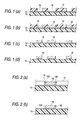
- a mask layer 14 made of a resin is formed on a metallic film 12, which is formed on the entire surface of one side of a resin substrate 10. Subsequently, patterning is performed on the mask layer 14. Thus, groove portions 16, 16, ... from which the metallic film 12 is exposed, are formed in a bottom surface according to a wiring pattern to be formed.
- wiring patterns 18, 18, ... are formed by filling each of the groove portions 16, 16, ... with metal through electrolytic plating using the metallic film 12 as an electric power supplying layer.
- the wiring patterns 18, 18, ... having desired shapes are formed on the resin substrate 10 by removing the mask layer 14 to thereby remove the exposed metallic film 12.
- the electrolytic plating using the metallic film 12 may cause air bubbles to adhere to the inner side surface of each of the groove portions 16, 16, ..., which is formed by the mask layer 14, when filled with metal.
- the groove portions 16 are filled with metal in a state in which bubbles 100, 100, ... adhere thereto, as illustrated in FIG. 2(a).
- the wiring patterns 18 are finally formed so that holes 102, 102, ... are formed therein, as illustrated in FIG. 2(b).
- the finer the wiring patterns 18 become the larger the proportion of the holes 102, 102, ..., which are formed due to the adhesion of the bubbles 100, 100, ..., to the wiring patterns 100, 100, ... becomes.
- the strength of the wires reduces. Consequently, there is a fear of breaking the wire due to stress applied to the wiring pattern 18 in the subsequent step. Even when the wire is not broken, the values of electric characteristics, such as impedance, of the wiring patterns 18 become different from preset values thereof.
- Such a stain can be removed therefrom by dipping the resin substrate 10 into a weakly alkaline solution or an alcoholic solution and by performing a degreasing treatment thereon.
- this degreasing treatment promotes the peeling-off of the mask layer 14.
- Patent Document 1 JP-A-2000-127407 (Second Embodiment) which is hereinafter referred as Patent Document 1.
- each of the groove portions 16, which is caused by the patterning or the like of the mask layer 14 can be removed by performing a plasma treatment on the resin substrate 10 to be electrolytic-plated, as proposed in the Patent Document 1. Further, an adhesion force acting between the mask layer 14 and the metallic film 12 can be enhanced when the electrolytic plating is performed.
- this enhancement of the wettability of the surface with the electrolytic plating solution can be regarded as equivalent to that of the wettability thereof with water, because most of the electrolytic plating solution is constituted by water.
- the metallic film 12 is formed on the entire surface of one side of the resin substrate 10 shown in FIG. 1(a) by performing electroless plating.
- the metallic film 12 is formed by the electroless plating, it is necessary to enhance the wettability of the resin substrate 10 with an electroless plating solution by dipping the resin substrate 10 into a weakly alkaline solution or an alcoholic solution and by performing a degreasing treatment thereon.
- the problems to be solved by the invention are to provide a hydrophilic treatment method, which is enabled to impart sufficient wettability for water to a molded article made of a resin substantially without using a solution, and also to provide a wiring pattern forming method enabled to impart sufficient wettability for water to a resin substrate provided with groove portions, which are formed according to wiring patterns to be formed on a resin mask layer, in at least a surface of one side thereof by performing a plasma treatment substantially without using a solution.
- the present inventor made a study so as to solve the problems. Consequently, the present inventor has found that the wettability for water can be enhanced by performing an atmospheric pressure plasma treatment on a resin substrate, onto which water is sprayed, as compared with a resin substrate, on which a plasma treatment is performed in a dry condition without spraying water.
- a hydrophilic treatment method adapted so that a plasma treatment is performed on a molded article made of a resin, and that when hydrophilicity is imparted to the molded article, the plasma treatment is performed in an atmosphere containing a hydrophilic gas that has a hydrophilic group.
- a film-like or plate-like molded article is used as the molded article.
- the plasma treatment is performed on at least a surface of one side of the film-like or plate-like molded article. Consequently, sufficient wettability can be imparted to at least a surface of one side of the film-like or plate-like molded article.
- a wiring pattern forming method that comprises forming a mask layer made of a resin on a metallic film formed on the entirety of a surface of one side of a resin substrate, subsequently performing patterning on the mask layer to thereby form groove portions each having a bottom surface, from which the metallic film is exposed, according to a wiring pattern to be formed, subsequently performing a plasma treatment on the surface of one side of the resin substrate, in which the groove portions are formed, in an atmosphere containing a hydrophilic gas that has a hydrophilic group, and subsequently performing electrolytic plating using the metallic film as the power supplying layer so that the groove portions are filled with metal to thereby form a wiring pattern.
- the plasma treatment is performed on the molded article or the resin substrate, on which the corona discharge treatment is preliminarily performed.
- the wettability of the molded article or the resin substrate with water can be enhanced.
- Corona discharge treatment equipment can be simplified by performing this corona discharge treatment under atmospheric pressure.
- the plasma treatment is performed in an atmosphere containing gases of one or more kinds of compounds selected from water, an alcohol, and organic matters each having a carboxylic group.
- a hydrophilic gas of a compound having a hydrophilic group can easily be made to be contained in the atmosphere, in which a plasma treatment is performed, by performing a plasma treatment on the molded article or the resin substrate, to which liquid containing one or more kinds of compounds selected from water, an alcohol, and organic matters each having a carboxylic group are made to adhere.
- plasma treatment equipment can be simplified by performing a plasma treatment under atmospheric pressure.
- the wettability of the molded article with water can be enhanced, as compared with the related-art case where the plasma treatment is performed on the molded article in a dry condition. Consequently, the wettability of the molded article with the electroless plating solution can be enhanced substantially without using a solution. Additionally, the treatment of the solution used for degreasing, and so forth can be omitted.
- sufficient wettability for water can be imparted to the resin substrate, which is provided with the groove portions, which are formed in at least a surface of one side thereof according to the wiring pattern to be formed on the mask layer made of a resin, without using the solution for peeling off the mask layer, as compared with the related-art case where the plasma treatment is performed on the molded article in the dry condition. Consequently, when a fine wiring pattern is formed by performing electrolytic plating, the electrolytic plating can be prevented from proceeding in a state in which bubbles adhere thereto.
- the hydrophilic gas of a compound having a hydrophilic group, which is ionized or radicalized is bonded by a hydrogen bond to a molecular chain of the resin constituting the molded article or the resin substrate thereby to make the surface of the molded article or the resin substrate hydrophilic.
- the removal of contaminant adhering to the surface of the molded article or the resin substrate is achieved by the plasma treatment. Consequently, the wettability of the surface of the molded article or the resin substrate with water can be enhanced.
- the hydrophilic group ionized or radicalized by the plasma reaches the mask layer constituting the inner side surface of each of the groove portions formed on a surface of one side of the resin substrate to thereby enhance the hydrophilicity of this inner side surface thereof. Consequently, the wettability thereof for water can be enhanced.
- a film or plate made of a hydrophobic resin or a hydrophilic resin may be used as the molded article made of such a resin.
- the hydrophilic resin is a resin having a hydrophilic group in a molecular chain thereof.
- a polyamide resin and a polyimide resin correspond thereto.
- the molded article is made of such a hydrophilic resin, the wettability of the molded article for an electrolytic plating solution or an electroless plating solution is insufficient. Thus, the improvement of the molded article is needed.
- gaseous compounds including groups, such as "-OH”, “-COOH”, and “-CO-”, can appropriately be used as the hydrophilic gas having a hydrophilic group.
- a gaseous compound can be used singly.
- two or more kinds of such gaseous compounds can be used by being mixed with one another.
- a gaseous hydrophilic compound may be injected together with another gas into an atmosphere, in which a plasma treatment is performed.
- a plasma treatment can be also performed in the atmosphere, which contains a hydrophilic gas having a hydrophilic group, by performing a plasma treatment on a molded article to which liquid containing a hydrophilic compound is made to adhere.
- Water, an alcohol, and organic matters each having a carboxylic group, which are liquid at room temperature and easily gasified by a plasma treatment, can preferably be used as the hydrophilic compound.
- An acetic acid may preferably be used as the organic matter having a carboxylic group.
- a plasma treatment performed under reduced pressure which is used by the method disclosed in the Patent Document 1
- an atmospheric pressure plasma treatment which is a plasma treatment performed under atmospheric pressure, may preferably be employed.
- FIG. 3 shows an exemplary, non-limiting example of an atmospheric pressure plasma treatment apparatus for performing such an atmospheric pressure plasma treatment.
- the flow rate of a carrier gas supplied from a carrier gas cylinder 20 and that of a reaction gas supplied from a reaction gas cylinder 22 are adjusted by valves 25a and 25b so that the flow rates measured by flowmeters 24a and 24b are equal to predetermined rates, respectively.
- the carrier gas and the reaction gas are mixed by a mixer 26.
- the mixed gas is supplied into a reactor 30 that is connected to a high-frequency power supply 28.
- the carrier gas and the reaction gas supplied into the reactor 30 are plasmatized therein and then jetted therefrom as a plasma jet 32. Subsequently, the plasma jet 32 is emitted toward a molded article 36 made of a resin, which is put on a conveyer belt that moves in the direction of an arrow.
- the setting of an atmosphere, in which such a plasma jet 32 is jetted toward the molded article 36, to be an atmosphere, which contains a hydrophilic gas of a compound having a carboxylic group, can be achieved by emitting the plasma jet 32 to the molded article 36 and also spraying gases of one or more kinds of compounds selected from water, an alcohol, and organic matters, such as an acetic acid, each having a carboxylic group.
- the molded article 36 to which liquid containing one or more kinds of compounds selected from water, an alcohol, and organic matters, such as an acetic acid, having a carboxylic group is made by being sprayed thereon in such a way as to adhere, for a plasma treatment.
- the liquid adhering to the molded article 36 can be gasified by the plasma jet 32 thereby to provide a hydrophilic atmosphere around the molded article 36.
- a nitrogen gas or a helium gas can be employed as the carrier gas used in the atmospheric pressure treatment apparatus shown in FIG. 3.
- the wettability of the molded article 36 with water can be enhanced by preliminarily performing a corona discharge treatment on the molded article 36 on which a plasma treatment is performed.
- a plasma treatment can be performed by simultaneously moving the molded article put on the conveyer belt 34.
- a film-like or plate-like molded article is put thereon as the molded article 36, and the plasma treatment can continuously performed on the surface of the one side thereof.
- the corona discharge treatment equipment can be simplified by performing a corona discharge treatment under atmospheric pressure.
- a uniformly plated layer can be formed on the surface of the molded article 36 by dipping the molded article 36 into an electroless plating solution and then performing electroless plating thereon.
- the state, in which the wettability of the molded article 36 with water is enhanced disappears in a day or so in a case where the plasma-treated molded article 36 is left untouched in the air.
- the plasma-treated molded article 36 is wrapped with aluminum foil. This is because the duration of the state, in which the wettability of the surface of the molded article 36 with water is enhanced, can be long, as compared with the case in which the article 36 is left untouched in the air.
- the aforementioned plasma treatment for making the surface of the molded article hydrophilic can preferably be performed on a wiring board used in a semiconductor apparatus.
- the plasma treatment for making a surface of one side of the resin substrate 10 hydrophilic can preferably be employed as a pretreatment to be performed for performing electrolytic plating on the surface of the one side of the resin substrate 10 by using the metallic film 12 as the power supplying layer in a state, in which the groove portions 16, 16, ... are formed according to the wiring pattern to be formed, by performing patterning on the mask layer 14, which is made of a resin and formed on the metallic film 12 covering the entire surface of the one side of the resin substrate 10, as illustrated in FIG. 1 (a), so that the metallic film 12 is exposed from the bottom surface of each of the groove portions 16, 16, ... .
- the atmospheric pressure plasma treatment apparatus shown in FIG. 3 performs a plasma treatment on the surface of the one side of the resin substrate 10 to thereby degrease the surface of the one side thereof.
- the wettability of the inner side surface of each of the groove portions 16, 16, ... which is constituted by the mask layer 14, can be enhanced by performing a plasma treatment in the atmosphere containing a hydrophilic gas of a compound having a hydrophilic group.
- a plasma treatment in the atmosphere containing a hydrophilic gas of a compound having a hydrophilic group.
- the plasma jet 32 is jetted onto the surface of one side of the resin substrate 10, to which the liquid containing one or more kinds of compounds selected fromwater, an alcohol, and organic matters, such as an acetic acid, each having a carboxylic group.
- the electrolytic plating using the metallic film 12 as the power supplying layer is quickly performed so as to form the wiring patterns 18, 18, ... as shown in FIG. 1(b). This is because the effect of enhancing the wettability of the molded article 36 with water disappears in a day or so in a case where the resin substrate 10 is left untouched in the air.
- the rate, at which the effect of enhancement of the wettability of the resin substrate 10 with water disappears, can be reduced by wrapping up the plasma-treated resin substrate 10 with aluminum foil.
- a corona discharge treatment with output power of 200 W was performed on the surface of one side of a 50- ⁇ m-thick polyimide film under atmospheric pressure. This corona discharge treatment was performed twice on the surface of the one side of the polyimide film by adjusting the movement speed of a conveyer, on which the polyimide film was put, to 2 m/min.
- the wettability of the surface of the one side of the polyimide film was measured by a drop method. A contact angle was 35.2°.
- a contact angle on the surface of the one side of the polyimide film was 65.8°.
- the drop method was used for measuring the contact angle ⁇ of a waterdrop 42 dropped onto the surface 40 of the polyimide film, as illustrated in FIG. 4.
- a plasma treatment was performed similarly to the first example, except that a plasma treatment was performed on the surface of the one side of the polyimide film in a dry condition without spraying a 5% ethanol aqueous solution.
- the contact angle ⁇ on the surface of the one side of the polyimide film was 38.8°, which was larger than the contact angle ⁇ on the surface of the one side of the polyimide film in the first example after the plasma treatment was performed.
- the wettability of the surface of the one side of the polyimide film with water can be enhanced by performing a plasma treatment on the surface of the one side of the polyimide film on which a 5% ethanol aqueous solution was sprayed, as compared with the case where a plasma treatment was performed thereon in a dry condition.
- a plasma treatment was performed similar to the first example, except that a corona discharge was not performed in the similar constitution to that of the first example.
- a contact angle ⁇ on the surface of the one side of the polyimide film was 59.4° after the plasma treatment.
- a plasma treatment was performed similarly to the first example, except that the plasma treatment was performed on the surface of the one side of the polyimide film in the dry condition without spraying a 5% ethanol aqueous solution, in the similar constitution to that of the first example.
- a contact angle ⁇ on the surface of the one side of the polyimide film was 65.7° after the plasma treatment. This contact angle was larger than the contact angle ⁇ on the surface of the one side of the polyimide film, on which a 5% ethanol aqueous solution was sprayed and a plasma treatment was performed.
- the wettability of the surface of one of the polyimide film with water can be enhanced by spraying a 5% ethanol aqueous solution thereon and performing a plasma treatment thereon in the dry condition, as compared with the case where a plasma treatment was performed on the film which was in the dry condition.
- a plasma treatment was performed similarly to the first example, except that a plasma treatment was performed with output power of 150 W in the similar constitution to that of the first example, that a helium gas was used as the carrier gas, and that the concentration of an oxygen gas serving as a reaction gas was set at 123 ppm (vol.).
- a contact angle ⁇ on the surface of the one side of the polyimide film was 24.5° after the plasma treatment.
- a plasma treatment was performed similarly to the third example, except that a plasma treatment was performed on an polyimide film, on which a corona discharge operation was not performed, in the similar constitution to that of the third example.
- a contact angle ⁇ on the surface of the one side of the polyimide film was 28.7° after the plasma treatment.
- a plasma treatment was performed similarly to the third example, except that a plasma treatment was performed on the surface of one side of the polyimide film, on which a corona discharge was not performed, in the dry condition without spraying a 5% ethanol aqueous solution in the similar constitution to that of the third example.
- a contact angle ⁇ on the surface of the one side of the polyimide film was 35.3° after the plasma treatment. This contact angle was larger than the contact angle ⁇ on the surface of the one side of the polyimide film, on which a 5% ethanol aqueous solution was sprayed and a plasma treatment was performed.
- the wettability of the surface of one of the polyimide film with water can be enhanced by spraying a 5% ethanol aqueous solution thereon and performing a plasma treatment thereon in the dry condition, as compared with the case where a plasma treatment was performed on the film which was in the dry condition.
- a 50- ⁇ m-thick polyimide film was used as the resin substrate 10.
- a mask layer 14 constituted by a plating resist was formed on a copper film 12, which served as the metallic film was formed on the entire surface of one side of the resin substrate 10 by electroless plating. Then, patterning was performed on the mask layer 14 to thereby form groove portions 16, 16, ... , from the bottom surface of which the metallic film 12 was exposed, according to the wiring pattern to be formed.
- the interval between the groove portions 16, 16, ... was 10 ⁇ m.
- a corona discharge treatment with output power of 200 W was performed on the surface of the one side of such a resin substrate 10 under atmospheric pressure. This corona discharge treatment was performed twice thereon by simultaneously adjusting the movement speed of a conveyer, on which the resin substrate 10 was put, to 2 m/min.
- wiring patterns 18, 18, ... having desired shapes were formed in the surface of the one side of the corona-discharge-treated resin substrate 10 by performing electrolytic plating using a copper film 12 as the power supplying layer so that each of the groove portions 16, 16, ... was filled with copper.
- a wiring board in which the wiring patterns 18, 18, ... having desired shapes were formed on the resin substrate 10, was obtained by removing the copper film 12, which was exposed by removing the mask layer 14.
Landscapes
- Engineering & Computer Science (AREA)
- Manufacturing & Machinery (AREA)
- Microelectronics & Electronic Packaging (AREA)
- Manufacturing Of Printed Wiring (AREA)
- Treatments Of Macromolecular Shaped Articles (AREA)
- Chemically Coating (AREA)
- Electroplating Methods And Accessories (AREA)
- Other Surface Treatments For Metallic Materials (AREA)
- Formation Of Insulating Films (AREA)
Abstract
Description
Claims (8)
- A hydrophilic treatment method, comprising the step of
performing a plasma treatment on a molded article made of a resin, wherein the plasma treatment is performed in an atmosphere containing a hydrophilic gas that has a hydrophilic group to impart hydrophilicity to said molded article. - A hydrophilic treatment method according to claim 1, wherein a film-like or plate-like molded article is used as the molded article, and wherein the plasma treatment is performed on at least a surface of one side of the film-like or plate-like molded article.
- A wiring pattern forming method comprising:forming a mask layer (14) made of a resin on a metallic film (12) formed on the entirety of a surface of one side of a resin substrate (10);subsequently performing patterning on said mask layer (14) to thereby form groove portions (16) each having a bottom surface, at which said metallic film (12) is exposed, according to a wiring pattern to be formed;said subsequent hydrophilic treatment method including performing a plasma treatment on a surface of said mask layer (14), in which said groove portions (16) are formed, in an atmosphere containing a hydrophilic gas that has a hydrophilic group to impart hydrophilicity to it; and,subsequently performing electrolytic plating using said metallic film (12) as an electric power supplying layer so that said groove portions (16) are filled with metal to thereby form a wiring pattern.
- A method according to any preceding claim, further comprising:performing a corona discharge treatment on said molded article or said surface of said mask layer (14) prior to the plasma treatment.
- A method according to claim 4, wherein the corona discharge treatment is performed under atmospheric pressure.
- A method according to any one of the preceding claims, wherein the plasma treatment is performed in an atmosphere containing gases of one or more kinds of compounds selected from water, an alcohol, and organic matters each having a carboxylic group.
- A method according to any one of claims 1 to 6, wherein the plasma treatment is performed on said molded article or said surface of said mask layer (14), to which liquid containing one or more kinds of compounds selected from water, an alcohol, and organic matters each having a carboxylic group are made to adhere.
- A method according to any one of the preceding claims, wherein the plasma treatment is performed under atmospheric pressure.
Applications Claiming Priority (2)
| Application Number | Priority Date | Filing Date | Title |
|---|---|---|---|
| JP2004030110A JP2005223167A (en) | 2004-02-06 | 2004-02-06 | Hydrophilic treatment method and wiring pattern formation method |
| JP2004030110 | 2004-02-06 |
Publications (2)
| Publication Number | Publication Date |
|---|---|
| EP1562409A2 true EP1562409A2 (en) | 2005-08-10 |
| EP1562409A3 EP1562409A3 (en) | 2006-05-03 |
Family
ID=34675543
Family Applications (1)
| Application Number | Title | Priority Date | Filing Date |
|---|---|---|---|
| EP05250620A Withdrawn EP1562409A3 (en) | 2004-02-06 | 2005-02-04 | Hydrophilic treatment and wiring pattern formation including It |
Country Status (4)
| Country | Link |
|---|---|
| US (1) | US8007649B2 (en) |
| EP (1) | EP1562409A3 (en) |
| JP (1) | JP2005223167A (en) |
| CN (1) | CN1652667A (en) |
Families Citing this family (12)
| Publication number | Priority date | Publication date | Assignee | Title |
|---|---|---|---|---|
| US7838195B2 (en) * | 2006-06-08 | 2010-11-23 | E. I. Du Pont De Nemours And Company | Planar test substrate for non-contact printing |
| JP5070767B2 (en) * | 2006-08-28 | 2012-11-14 | トヨタ自動車株式会社 | Plating process and fine pitch wiring board manufacturing method |
| US8663751B2 (en) * | 2007-09-19 | 2014-03-04 | Vlaamse Instelling Voor Technologisch Onderzoek N.V. (Vito) | Method for stable hydrophilicity enhancement of a substrate by atmospheric pressure plasma disposition |
| US8309376B2 (en) | 2007-10-26 | 2012-11-13 | E I Du Pont De Nemours And Company | Process and materials for making contained layers and devices made with same |
| CN101472406B (en) * | 2007-12-25 | 2012-08-15 | 日本特殊陶业株式会社 | Method for manufacturing wiring substrate |
| KR101253648B1 (en) * | 2012-02-28 | 2013-04-11 | 신풍섬유(주) | Textile treating method for having one sided water repellent by air plasma glowing |
| KR101161301B1 (en) | 2012-05-21 | 2012-07-04 | 한국기계연구원 | Fabrication method of flexible substrate having buried metal electrode using plasma, and the flexible substrate thereby |
| ITVR20130176A1 (en) * | 2013-07-25 | 2015-01-26 | Sacmi Imola Sc | PLANT FOR THE PRODUCTION AND PRINTING OF CONFORMED BODIES |
| CN108337813A (en) * | 2018-01-08 | 2018-07-27 | 南京邮电大学 | A kind of method of high-precision ink jet printing flexible circuit |
| WO2020026399A1 (en) * | 2018-08-02 | 2020-02-06 | 株式会社Fuji | Oil removal method, bonding method, assembly device, and atmospheric-pressure plasma device |
| EP4174217A4 (en) * | 2020-06-30 | 2023-11-01 | FUJIFILM Corporation | Metal formed product manufacturing method |
| US12537229B2 (en) | 2021-02-19 | 2026-01-27 | Lg Energy Solution, Ltd. | Riveting structure of electrode terminal, and cylindrical battery cell, battery pack and vehicle including the same |
Family Cites Families (28)
| Publication number | Priority date | Publication date | Assignee | Title |
|---|---|---|---|---|
| JPS587654B2 (en) * | 1978-11-30 | 1983-02-10 | 信越化学工業株式会社 | Surface treatment method for vinyl chloride resin molded products |
| DE3705482A1 (en) * | 1987-02-20 | 1988-09-01 | Hoechst Ag | METHOD AND ARRANGEMENT FOR THE SURFACE PRE-TREATMENT OF PLASTIC BY MEANS OF AN ELECTRIC CORONA DISCHARGE |
| JPH0721072B2 (en) * | 1988-10-31 | 1995-03-08 | 東京電線工業株式会社 | Surface modification method for polyolefin resin |
| GB8909685D0 (en) * | 1989-04-27 | 1989-06-14 | British Petroleum Co Plc | Method for reducing fouling |
| JP3063769B2 (en) * | 1990-07-17 | 2000-07-12 | イーシー化学株式会社 | Atmospheric pressure plasma surface treatment method |
| JP2967133B2 (en) | 1990-07-25 | 1999-10-25 | イーシー化学株式会社 | Powder surface treatment method |
| US5316739A (en) * | 1991-08-20 | 1994-05-31 | Bridgestone Corporation | Method and apparatus for surface treatment |
| US5344462A (en) * | 1992-04-06 | 1994-09-06 | Plasma Plus | Gas plasma treatment for modification of surface wetting properties |
| JP3286816B2 (en) * | 1992-12-24 | 2002-05-27 | イーシー化学株式会社 | Atmospheric pressure glow discharge plasma treatment method |
| US5419968A (en) * | 1993-02-16 | 1995-05-30 | Gunze Limited | Surface-hydrophilized fluororesin moldings and method of producing same |
| JP3393444B2 (en) | 1993-04-05 | 2003-04-07 | 株式会社ダイオー | Atmospheric pressure glow discharge plasma treatment method |
| JP3700177B2 (en) | 1993-12-24 | 2005-09-28 | セイコーエプソン株式会社 | Atmospheric pressure plasma surface treatment equipment |
| JPH07207449A (en) | 1994-01-24 | 1995-08-08 | Sekisui Chem Co Ltd | Method for manufacturing laminated body |
| EP0801809A2 (en) * | 1995-06-19 | 1997-10-22 | The University Of Tennessee Research Corporation | Discharge methods and electrodes for generating plasmas at one atmosphere of pressure, and materials treated therewith |
| US5858472A (en) * | 1995-09-25 | 1999-01-12 | Nippon Paint Co., Ltd. | Method of improving the electrical conductivity of a molding article of resin, method of coating a molding article of resin, and coating composition |
| US5662758A (en) * | 1996-01-10 | 1997-09-02 | The Procter & Gamble Company | Composite material releasably sealable to a target surface when pressed thereagainst and method of making |
| JPH11158671A (en) | 1997-11-28 | 1999-06-15 | Mitsubishi Shindoh Co Ltd | Corona discharge degreasing metal substrate |
| JP2000080184A (en) | 1998-06-26 | 2000-03-21 | Dainippon Printing Co Ltd | Method and apparatus for multi-stage surface modification of film sheet |
| JP2000127407A (en) | 1998-10-27 | 2000-05-09 | Canon Inc | INK JET PRINT HEAD AND INK JET PRINTING APPARATUS USING THE SAME |
| JP2000133933A (en) | 1998-10-27 | 2000-05-12 | Ibiden Co Ltd | Manufacture of printed wiring board |
| JP2001319992A (en) * | 2000-02-28 | 2001-11-16 | Shinko Electric Ind Co Ltd | Wiring board, semiconductor device, and manufacturing method thereof |
| JP4370668B2 (en) | 2000-03-29 | 2009-11-25 | Jsr株式会社 | Positive-type radiation-sensitive resin composition for plating model production and method for producing plating model |
| JP2002076573A (en) | 2000-09-04 | 2002-03-15 | Toshiba Chem Corp | Printed board and manufacturing method therefor |
| KR20020071437A (en) * | 2001-03-06 | 2002-09-12 | 유승균 | Plating method of metal film on the surface of polymer |
| JP3508740B2 (en) | 2001-05-30 | 2004-03-22 | 関西日本電気株式会社 | Method for manufacturing semiconductor device |
| JP2003045871A (en) | 2001-07-26 | 2003-02-14 | Shinko Electric Ind Co Ltd | Wiring pattern forming method |
| JP4656783B2 (en) | 2001-09-18 | 2011-03-23 | 積水化学工業株式会社 | Method for hydrophilic treatment of polyimide substrate |
| JP4089198B2 (en) | 2001-10-05 | 2008-05-28 | 凸版印刷株式会社 | Manufacturing method of substrate for semiconductor device |
-
2004
- 2004-02-06 JP JP2004030110A patent/JP2005223167A/en active Pending
-
2005
- 2005-02-03 US US11/049,774 patent/US8007649B2/en not_active Expired - Fee Related
- 2005-02-04 EP EP05250620A patent/EP1562409A3/en not_active Withdrawn
- 2005-02-06 CN CN200510007284.8A patent/CN1652667A/en active Pending
Also Published As
| Publication number | Publication date |
|---|---|
| US8007649B2 (en) | 2011-08-30 |
| JP2005223167A (en) | 2005-08-18 |
| US20050173251A1 (en) | 2005-08-11 |
| CN1652667A (en) | 2005-08-10 |
| EP1562409A3 (en) | 2006-05-03 |
Similar Documents
| Publication | Publication Date | Title |
|---|---|---|
| US8007649B2 (en) | Hydrophilic treatment method and wiring pattern forming method | |
| JP5360963B2 (en) | Catalyst-free metallization method on dielectric substrate surface and dielectric substrate with metal film | |
| US20180332711A1 (en) | Method for creating patterned coatings on a molded article, and device for carrying out said method | |
| TWI805550B (en) | Manufacturing method of printed wiring board | |
| TW200934325A (en) | Method for forming circuit | |
| CN105121700A (en) | Process for producing three-dimensional conductive pattern structure, and material for three-dimensional molding for use therein | |
| KR20020081042A (en) | Method and apparatus for fabricating printed circuit board using atmospheric pressure capillary discharge plasma shower | |
| JP5984622B2 (en) | Flushing device | |
| US20050214448A1 (en) | Compositions containing heterocyclic nitrogen compounds and glycols for texturing resinous material and desmearing and removing resinous meterial | |
| US20070131243A1 (en) | Method for cleaning surface of resin layer | |
| EP2007931B1 (en) | Polyimide substrate and method of manufacturing printed wiring board using the same | |
| TW200501231A (en) | Method and apparatus for etching a substrate | |
| EP1083245A2 (en) | Fluid delivery systems for electronic device manufacture | |
| US8500949B2 (en) | Apparatus and method for wet processing substrate | |
| JP2003008179A (en) | Printed circuit and flexible wiring patterning method | |
| JP4291353B2 (en) | A method for forming a metal layer directly on the surface of a non-conductive substrate, particularly a polyimide surface | |
| CN101572993A (en) | Method for forming conducting wire on insulated heat-conducting metal substrate in a vacuum sputtering way | |
| KR101081588B1 (en) | Plating layer forming method and circuit board manufacturing method using the same | |
| KR100988541B1 (en) | Surface treatment method of wiring board and manufacturing method of electric device | |
| CN101572997A (en) | Method for forming conducting wire on insulated heat-conducting metal substrate in a vacuum sputtering way | |
| CN119491212B (en) | Processing method for fluid surface treatment PCB | |
| JP2008101258A (en) | Laminated substrate manufacturing method and laminated substrate manufacturing apparatus | |
| KR20190009112A (en) | Pretreatment method for FPCB via hole copper plating | |
| JPH08288621A (en) | Formation of parts for three-dimensional circuit and parts for three-dimensional circuit | |
| KR100763348B1 (en) | Substrate Pretreatment Method |
Legal Events
| Date | Code | Title | Description |
|---|---|---|---|
| PUAI | Public reference made under article 153(3) epc to a published international application that has entered the european phase |
Free format text: ORIGINAL CODE: 0009012 |
|
| AK | Designated contracting states |
Kind code of ref document: A2 Designated state(s): AT BE BG CH CY CZ DE DK EE ES FI FR GB GR HU IE IS IT LI LT LU MC NL PL PT RO SE SI SK TR |
|
| AX | Request for extension of the european patent |
Extension state: AL BA HR LV MK YU |
|
| PUAL | Search report despatched |
Free format text: ORIGINAL CODE: 0009013 |
|
| AK | Designated contracting states |
Kind code of ref document: A3 Designated state(s): AT BE BG CH CY CZ DE DK EE ES FI FR GB GR HU IE IS IT LI LT LU MC NL PL PT RO SE SI SK TR |
|
| AX | Request for extension of the european patent |
Extension state: AL BA HR LV MK YU |
|
| 17P | Request for examination filed |
Effective date: 20061024 |
|
| AKX | Designation fees paid |
Designated state(s): FR GB |
|
| REG | Reference to a national code |
Ref country code: DE Ref legal event code: 8566 |
|
| 17Q | First examination report despatched |
Effective date: 20100217 |
|
| STAA | Information on the status of an ep patent application or granted ep patent |
Free format text: STATUS: THE APPLICATION IS DEEMED TO BE WITHDRAWN |
|
| 18D | Application deemed to be withdrawn |
Effective date: 20100629 |