EP1562203A1 - R-t-b sintered magnet and process for producing the same - Google Patents
R-t-b sintered magnet and process for producing the same Download PDFInfo
- Publication number
- EP1562203A1 EP1562203A1 EP04719123A EP04719123A EP1562203A1 EP 1562203 A1 EP1562203 A1 EP 1562203A1 EP 04719123 A EP04719123 A EP 04719123A EP 04719123 A EP04719123 A EP 04719123A EP 1562203 A1 EP1562203 A1 EP 1562203A1
- Authority
- EP
- European Patent Office
- Prior art keywords
- mass
- sintered magnet
- magnet
- concentration
- alloy
- Prior art date
- Legal status (The legal status is an assumption and is not a legal conclusion. Google has not performed a legal analysis and makes no representation as to the accuracy of the status listed.)
- Withdrawn
Links
Images


Classifications
-
- H—ELECTRICITY
- H01—ELECTRIC ELEMENTS
- H01F—MAGNETS; INDUCTANCES; TRANSFORMERS; SELECTION OF MATERIALS FOR THEIR MAGNETIC PROPERTIES
- H01F1/00—Magnets or magnetic bodies characterised by the magnetic materials therefor; Selection of materials for their magnetic properties
- H01F1/01—Magnets or magnetic bodies characterised by the magnetic materials therefor; Selection of materials for their magnetic properties of inorganic materials
- H01F1/03—Magnets or magnetic bodies characterised by the magnetic materials therefor; Selection of materials for their magnetic properties of inorganic materials characterised by their coercivity
- H01F1/032—Magnets or magnetic bodies characterised by the magnetic materials therefor; Selection of materials for their magnetic properties of inorganic materials characterised by their coercivity of hard-magnetic materials
- H01F1/04—Magnets or magnetic bodies characterised by the magnetic materials therefor; Selection of materials for their magnetic properties of inorganic materials characterised by their coercivity of hard-magnetic materials metals or alloys
- H01F1/047—Alloys characterised by their composition
- H01F1/053—Alloys characterised by their composition containing rare earth metals
- H01F1/055—Alloys characterised by their composition containing rare earth metals and magnetic transition metals, e.g. SmCo5
- H01F1/057—Alloys characterised by their composition containing rare earth metals and magnetic transition metals, e.g. SmCo5 and IIIa elements, e.g. Nd2Fe14B
- H01F1/0571—Alloys characterised by their composition containing rare earth metals and magnetic transition metals, e.g. SmCo5 and IIIa elements, e.g. Nd2Fe14B in the form of particles, e.g. rapid quenched powders or ribbon flakes
- H01F1/0575—Alloys characterised by their composition containing rare earth metals and magnetic transition metals, e.g. SmCo5 and IIIa elements, e.g. Nd2Fe14B in the form of particles, e.g. rapid quenched powders or ribbon flakes pressed, sintered or bonded together
- H01F1/0577—Alloys characterised by their composition containing rare earth metals and magnetic transition metals, e.g. SmCo5 and IIIa elements, e.g. Nd2Fe14B in the form of particles, e.g. rapid quenched powders or ribbon flakes pressed, sintered or bonded together sintered
-
- C—CHEMISTRY; METALLURGY
- C22—METALLURGY; FERROUS OR NON-FERROUS ALLOYS; TREATMENT OF ALLOYS OR NON-FERROUS METALS
- C22C—ALLOYS
- C22C33/00—Making ferrous alloys
- C22C33/02—Making ferrous alloys by powder metallurgy
- C22C33/0257—Making ferrous alloys by powder metallurgy characterised by the range of the alloying elements
- C22C33/0278—Making ferrous alloys by powder metallurgy characterised by the range of the alloying elements with at least one alloying element having a minimum content above 5%
-
- C—CHEMISTRY; METALLURGY
- C22—METALLURGY; FERROUS OR NON-FERROUS ALLOYS; TREATMENT OF ALLOYS OR NON-FERROUS METALS
- C22C—ALLOYS
- C22C38/00—Ferrous alloys, e.g. steel alloys
- C22C38/002—Ferrous alloys, e.g. steel alloys containing In, Mg, or other elements not provided for in one single group C22C38/001 - C22C38/60
-
- C—CHEMISTRY; METALLURGY
- C22—METALLURGY; FERROUS OR NON-FERROUS ALLOYS; TREATMENT OF ALLOYS OR NON-FERROUS METALS
- C22C—ALLOYS
- C22C38/00—Ferrous alloys, e.g. steel alloys
- C22C38/005—Ferrous alloys, e.g. steel alloys containing rare earths, i.e. Sc, Y, Lanthanides
-
- C—CHEMISTRY; METALLURGY
- C22—METALLURGY; FERROUS OR NON-FERROUS ALLOYS; TREATMENT OF ALLOYS OR NON-FERROUS METALS
- C22C—ALLOYS
- C22C38/00—Ferrous alloys, e.g. steel alloys
- C22C38/08—Ferrous alloys, e.g. steel alloys containing nickel
-
- C—CHEMISTRY; METALLURGY
- C22—METALLURGY; FERROUS OR NON-FERROUS ALLOYS; TREATMENT OF ALLOYS OR NON-FERROUS METALS
- C22C—ALLOYS
- C22C38/00—Ferrous alloys, e.g. steel alloys
- C22C38/16—Ferrous alloys, e.g. steel alloys containing copper
-
- H—ELECTRICITY
- H01—ELECTRIC ELEMENTS
- H01F—MAGNETS; INDUCTANCES; TRANSFORMERS; SELECTION OF MATERIALS FOR THEIR MAGNETIC PROPERTIES
- H01F41/00—Apparatus or processes specially adapted for manufacturing or assembling magnets, inductances or transformers; Apparatus or processes specially adapted for manufacturing materials characterised by their magnetic properties
- H01F41/02—Apparatus or processes specially adapted for manufacturing or assembling magnets, inductances or transformers; Apparatus or processes specially adapted for manufacturing materials characterised by their magnetic properties for manufacturing cores, coils, or magnets
- H01F41/0253—Apparatus or processes specially adapted for manufacturing or assembling magnets, inductances or transformers; Apparatus or processes specially adapted for manufacturing materials characterised by their magnetic properties for manufacturing cores, coils, or magnets for manufacturing permanent magnets
- H01F41/0266—Moulding; Pressing
-
- B—PERFORMING OPERATIONS; TRANSPORTING
- B22—CASTING; POWDER METALLURGY
- B22F—WORKING METALLIC POWDER; MANUFACTURE OF ARTICLES FROM METALLIC POWDER; MAKING METALLIC POWDER; APPARATUS OR DEVICES SPECIALLY ADAPTED FOR METALLIC POWDER
- B22F3/00—Manufacture of workpieces or articles from metallic powder characterised by the manner of compacting or sintering; Apparatus specially adapted therefor ; Presses and furnaces
- B22F3/24—After-treatment of workpieces or articles
- B22F2003/248—Thermal after-treatment
-
- B—PERFORMING OPERATIONS; TRANSPORTING
- B22—CASTING; POWDER METALLURGY
- B22F—WORKING METALLIC POWDER; MANUFACTURE OF ARTICLES FROM METALLIC POWDER; MAKING METALLIC POWDER; APPARATUS OR DEVICES SPECIALLY ADAPTED FOR METALLIC POWDER
- B22F9/00—Making metallic powder or suspensions thereof
- B22F9/02—Making metallic powder or suspensions thereof using physical processes
- B22F9/04—Making metallic powder or suspensions thereof using physical processes starting from solid material, e.g. by crushing, grinding or milling
- B22F2009/048—Making metallic powder or suspensions thereof using physical processes starting from solid material, e.g. by crushing, grinding or milling by pulverising a quenched ribbon
-
- B—PERFORMING OPERATIONS; TRANSPORTING
- B22—CASTING; POWDER METALLURGY
- B22F—WORKING METALLIC POWDER; MANUFACTURE OF ARTICLES FROM METALLIC POWDER; MAKING METALLIC POWDER; APPARATUS OR DEVICES SPECIALLY ADAPTED FOR METALLIC POWDER
- B22F2998/00—Supplementary information concerning processes or compositions relating to powder metallurgy
- B22F2998/10—Processes characterised by the sequence of their steps
-
- C—CHEMISTRY; METALLURGY
- C21—METALLURGY OF IRON
- C21D—MODIFYING THE PHYSICAL STRUCTURE OF FERROUS METALS; GENERAL DEVICES FOR HEAT TREATMENT OF FERROUS OR NON-FERROUS METALS OR ALLOYS; MAKING METAL MALLEABLE, e.g. BY DECARBURISATION OR TEMPERING
- C21D6/00—Heat treatment of ferrous alloys
Definitions
- the present invention relates to an R-T-B based sintered magnet and a method for producing the same.
- An R-T-B based permanent magnet one of outstanding high-performance permanent magnets, has such excellent magnetic properties as to have found a variety of applications including various motors, actuators and so forth.
- the R-T-B based permanent magnet needs to realize improved magnetic properties and increased corrosion resistance with the costs cut down.
- factors determining its remanence include the percentage of its main phase contained and the degree of magnetic alignment.
- the composition of the R-T-B based permanent magnet may be controlled as close to the stoichiometry of an R 2 T 14 B compound as possible. Actually, however, it is difficult to decrease B among other things. From the standpoint of productivity, if the B concentration were lower than the stoichiometric value, a soft magnetic R 2 Fe 17 phase would be nucleated in the grain boundary phase, which contributes to the coercivity of the magnet, and therefore, the coercivity would decrease significantly. For that reason, the target value of the B concentration needs to be set slightly higher than the stoichiometric value.
- Ga is added to an R-T-B based sintered magnet or an R-T-B based bonded magnet (e.g., an anisotropic bonded magnet produced by an HDDR process, in particular). Ga is added in order to increase the coercivity as to a sintered magnet and to increase the coercivity and maintain anisotropy in a re-crystallization process as to a bonded magnet.
- Japanese Patent Publication No. 2577373 discloses that high coercivity is achieved by adding 0.2 mass% to 13 mass% of Ga to an R-T-B based sintered magnet.
- Japanese Patent Publication No. 2751109 discloses that high coercivity is achieved by adding not only 0.087 mass% to 14.4 mass% of Ga but also at least one of Nb, W, V, Ta and Mo.
- the conventional techniques disclosed in these documents were developed for the purpose of increasing the coercivity by adding a relatively large amount of Ga.
- Japanese Patent Publication No. 3255344 discloses that 0.01 mass% to 0.5 mass% of Ga is added with the O (oxygen) concentration defined within the range of 0.3 mass% to 0.7 mass%. In a specific example thereof, however, at least 0.09 mass% of Ga is added.
- Japanese Patent Publication No. 2966342 discloses that 0.01 mass% to 0.5 mass% of Ga is added with the O (oxygen) concentration defined to be at most 0.25 mass%. In a specific example thereof, however, at least 0.08 mass% of Ga is added, when the B concentration is 1.05 mass%.
- Japanese Patent Publications Nos. 3298221 and 3298219 disclose that 0.9 mass% to 1.3 mass% of B and 0.02 mass% to 0.5 mass% of Ga are both added. However, according to this technique, V must be added. Also, these publications describe no examples in which the concentration of B is less than 1.0 mass%.
- Japanese Patent Publication No. 3296507 cites various additive elements, including Ga, to be added at 7 at% or less. According to this technique, however, the magnet must include not just an Nd-rich phase but also a B-rich phase as well as its essential constituent phases.
- Japanese Patent Publication No. 3080275 discloses that 0.05 mass% to 1 mass% of Ga is added. But Nb must be included as one of its essential elements.
- Japanese Patent Publication No. 2904571 discloses a method for producing a sintered magnet by a so-called "HDDR process” and also discloses that 0 at% to 4 at% of Ga is added. However, Ga does not work in the sintered magnet so effectively as in the HDDR process including a hydrogenation reaction.
- Japanese Patent Application Laid-Open Publication No. 2002-38245 discloses an invention relating to a two-alloy method in which two alloy materials with mutually different compositions are used as a mixture, and describes that 0.01 mass% to 0.5 mass% of Ga and Al are added in combination to at least one of the two alloys.
- this publication discloses only an example in which 0.1 mass% of Ga is added.
- an object of the present invention is to provide an R-T-B based sintered magnet that has had its remanence B r increased by decreasing the percentage of a B-rich phase (R 1.1 Fe 4 B 4 ) and increasing its main phase percentage instead.
- An R-T-B based sintered magnet according to the present invention has a composition comprising: 27.0 mass% to 32.0 mass% of R, which is at least one of Nd, Pr, Dy and Tb and which always includes either Nd or Pr; 63.0 mass% to 72.5 mass% of T, which always includes Fe and up to 50% of which is replaceable with Co; 0.01 mass% to 0.08 mass% of Ga; and 0.85 mass% to 0.98 mass% of B.
- the R-T-B based sintered magnet further includes at most 2.0 mass% of M, which is at least one element selected from the group consisting of Al, Si, Ti, V, Cr, Mn, Ni, Cu, Zn, Zr, Nb, Mo, In, Sn, Hf, Ta and W.
- M is at least one element selected from the group consisting of Al, Si, Ti, V, Cr, Mn, Ni, Cu, Zn, Zr, Nb, Mo, In, Sn, Hf, Ta and W.
- the R-T-B based sintered magnet includes a main phase with a tetragonal R 2 T 14 B type crystal structure, which accounts for at least 90% of the overall volume of the magnet, and substantially no R 1.1 Fe 4 B 4 phases.
- the R-T-B based sintered magnet has an oxygen concentration of at most 0.5 mass%, a nitrogen concentration of at most 0.2 mass%, and a hydrogen concentration of at most 0.01 mass%.
- An R-T-B based sintered magnet producing method includes the steps of: preparing a powder of an alloy that has a composition including 27.0 mass% to 32.0 mass% of R (which is at least one of Nd, Pr, Dy and Tb and which always includes either Nd or Pr), 63.0 mass% to 72.5 mass% of T (which always includes Fe and up to 50% of which is replaceable with Co), 0.01 mass% to 0.08 mass% of Ga and 0.85 mass% to 0.98 mass% of B; compacting and sintering the alloy powder, thereby making a sintered magnet; and subjecting the sintered magnet to a heat treatment at a temperature of 400 °C to 600 °C.
- the step of preparing the alloy powder includes the steps of: preparing a melt of the alloy; rapidly cooling and solidifying the melt of the alloy by a strip casting process, thereby making a rapidly solidified alloy; and pulverizing the rapidly solidified alloy.
- the present inventors discovered that by adding as extremely small an amount as 0.01 mass% to 0.08 mass% of Ga, the nucleation of a B-rich phase (Nd 1.1 Fe 4 B 4 ) in the grain boundary phase could be minimized with the B concentration set equal to 0.85 mass% to 0.98 mass%, which was lower than the conventional one, and yet the production of a soft magnetic R 2 Fe 17 phase could also be reduced significantly.
- the present inventors acquired the basic idea of our invention in this discovery.
- the nucleation of the B-rich phase in the grain boundary phase and the nucleation of the soft magnetic R 2 Fe 17 phase are minimized by adding a very small amount of Ga. Accordingly, even if the B concentration is relatively low, excellent magnet performance is realized without decreasing the coercivity. These effects achieved by adding a very small amount of Ga were totally unknown in the prior art. In the prior art documents mentioned above, Ga is added to increase the coercivity as far as the B concentration exceeds 1.0 mass%. However, nobody but the present inventors has ever noticed that the decrease in coercivity, which used to occur when the B concentration was 0.98 mass% or less, can be minimized by adding a very small amount of Ga.
- the coercivity will not vary easily and there is no need to add B excessively anymore.
- the main phase percentage increases and the remanence B r increases, too.
- the presence of a B-rich phase affects the corrosion resistance negatively.
- there are substantially no B-rich phases and the corrosion resistance improves, too.
- the performance of the magnet is improvable significantly with the amount of expensive Ga used cut down.
- an alloy is prepared so as to have a composition including: 27.0 mass% to 32.0 mass% of R, which is at least one of Nd, Pr, Dy and Tb and which always includes either Nd or Pr; 63.0 mass% to 72.5 mass% of T, which always includes Fe and up to 50% of which is replaceable with Co; 0.01 mass% to 0.08 mass% of Ga; and 0.85 mass% to 0.98 mass% of B.
- the material is melted so as to have this composition and the melt is cooled and solidified, thereby making this alloy.
- the alloy may be made by a known generally used method. Among various methods of making an alloy, a strip casting process can be used more effectively than any other method. According to a strip casting process, cast flakes with a thickness of about 0.1 mm to about 5 mm, for example, can be obtained. The cast flakes thus obtained have an extremely fine columnar texture in which R-rich phases are dispersed finely and in which an R 2 T 14 B phase as a main phase has a minor-axis size of 0.1 ⁇ m to 50 ⁇ m and a major-axis size of 5 ⁇ m to approximately the thickness of the flakes themselves. Thanks to the presence of such a columnar texture, high magnetic properties are realized. Optionally, a centrifugal casting process may be adopted instead of the strip casting process. Also, an alloy with the above composition may be made by performing a reduction-diffusion process directly instead of the melting/alloying process step.
- the resultant alloy is pulverized by a known method to a mean particle size of 1 ⁇ m to 10 ⁇ m.
- Such an alloy powder is preferably obtained by performing two types of pulverization processes, namely, a coarse pulverization process and a fine pulverization process.
- the coarse pulverization may be done by a hydrogen absorption and pulverization process or a mechanical grinding process using a disk mill, for example.
- the fine pulverization may be done by a mechanical grinding process using a jet mill, a ball mill or an attritor, for example.
- the finely pulverized powder obtained by the pulverization processes described above is compacted into any of various shapes by a known compacting technique.
- the compaction is normally carried out by compressing the powder under a magnetic field.
- the powder may be compacted under an isostatic pressure or within a rubber mold.
- a liquid lubricant such as a fatty acid ester or a solid lubricant such as zinc stearate is preferably added to the powder yet to be finely pulverized and/or the finely pulverized powder.
- the lubricant is preferably added in 0.01 to 5 parts by weight with respect to the powder of 100 parts by weight.
- the green compact may be sintered by a known method.
- the sintering process is preferably carried out at a temperature of 1,000 °C to 1,180 °C for approximately one to six hours.
- the sintered compact is subjected to a predetermined heat treatment. As a result of this heat treatment, even more significant effects are achieved according to the present invention by adding a very small amount of Ga and reducing the amount of B.
- the heat treatment is preferably carried out at a temperature of 400 °C to 600 °C for approximately one to eight hours.
- R is an essential element for a rare-earth sintered magnet and may be at least one element selected from the group consisting of Nd, Pr, Dy and Tb. However, R preferably always includes either Nd or Pr. More preferably, R is a combination of multiple rare-earth elements such as Nd-Dy, Nd-Tb, Nd-Pr-Dy or Nd-Pr-Tb.
- R may further include Ce, La or any other rare-earth element in a small amount, not just the elements mentioned above, and may also include a mishmetal or didymium.
- R does not have to be a pure element but may include some impurities, which are inevitably contained during the manufacturing process, as long as such R is readily available from an industrial point of view.
- the content of R is defined herein to be 27.0 mass% to 32.0 mass%. This is because if the R content were less than 27.0 mass%, then high magnetic properties (high coercivity among other things) could not be achieved. However, if the R content exceeded 32.0 mass%, then the remanence would decrease.
- T always includes Fe, up to 50% of which is replaceable with Co, and may further include small amounts of other transition metal elements in addition to Fe and/or Co.
- Co is effective in improving temperature characteristics and corrosion resistance, in particular.
- a combination of at most 10 mass% of Co and Fe as the balance is usually adopted.
- the content of T is defined herein to be 63.0 mass% to 72.5 mass%. This is because the remanence would decrease if the T content were less than 63.0 mass% but because the coercivity would decrease if the T content exceeded 72.5 mass%.
- Ga is an essential element according to the present invention.
- Ga is added relatively profusely (e.g., to 0.08 mass% or more) mainly for the purpose of increasing the coercivity.
- the mole fraction of B is reduced extremely close to that defined by the stoichiometry by adding Ga in a very small amount. Even so, the coercivity will not decrease, which is an effect that has never been expected by anybody in the art.
- the content of Ga is defined to be 0.01 mass% to 0.08 mass%. The reason is that if the Ga content were less than 0.01 mass%, then the effects described above would not be achieved and it would be difficult to do management by analysis. However, if the Ga content exceeded 0.08 mass%, then the remanence B r would drop as will be described later, which is not beneficial.
- any other element e.g., an element M to be described later, may be added for a different purpose (e.g., in order to further increase the coercivity).
- B is also an essential element and its content can be reduced to the range of 0.85 mass% to 0.98 mass%, which is very close to that defined by the stoichiometry as described above, by adding Ga.
- the B concentration is defined so as to fall within the range of 0.85 mass% to 0.98 mass%.
- a more preferable B concentration range is from 0.90 mass% through 0.96 mass%.
- a portion of B is replaceable with C. It is known that the corrosion resistance of a magnet can be increased by making such a substitution. In the magnet of the present invention, B may also be partially replaced with C but the C substitution would decrease the coercivity and is not preferred. In a normal method for producing a sintered magnet, C, contained in the magnet, does not substitute for B in the main phase but is present as a rare-earth carbide or any other impurity on the grain boundary, thus deteriorating the magnetic properties.
- An element M may be added in order to increase the coercivity.
- the element M is at least one element selected from the group consisting of Al, Si, Ti, V, Cr, Mn, Ni, Cu, Zn, Zr, Nb, Mo, In, Sn, Hf, Ta and W.
- M is preferably added to at most 2.0 mass%. This is because the remanence would decrease if the M content exceeded 2.0 mass%.
- a main phase with a tetragonal R 2 T 14 B type crystal structure accounts for 90% or more of the overall volume of the resultant sintered magnet and substantially no R 1.1 Fe 4 B 4 phase is included in its constituent phases.
- the sintered magnet thus obtained preferably includes at most 0.5 mass% of oxygen, at most 0.2 mass% of nitrogen and at most 0.01 mass% of hydrogen.
- the main phase percentage and the remanence B r can be both increased.
- Respective elements of a composition including 31.0 mass% of Nd, 1.0 mass% of Co, 0.02 mass% of Ga, 0.93 to 1.02 mass% of B, 0.2 mass% of Al, 0.1 mass% of Cu and Fe as the balance, were melted and then solidified by a strip casting process. In this manner, alloys with mutually different B concentrations were obtained. Then, each of those alloys was pulverized by a hydrogen decrepitation process with hydrogen pressurized, kept within a vacuum at 600 °C (i.e., 873 K) for one hour, and then cooled, thereby obtaining a material coarse powder.
- this material coarse powder was finely pulverized with a gas flow pulverizer PJM (produced by Nippon Pneumatic Mfg. Co., Ltd.) within a nitrogen gas atmosphere.
- the resultant fine powder had an FSSS particle size of 3.0 ⁇ 0.1 ⁇ m.
- This fine powder was compacted under a magnetic field of 0.8 MA/m at a pressure of 196 MPa.
- the resultant compact had dimensions of 15 mm ⁇ 20 mm ⁇ 20 mm.
- no lubricant or binder was used at all, and a transverse magnetic field press, in which the magnetic field applying direction and pressing direction were perpendicular to each other, was used.
- this compact was sintered in a vacuum sintering furnace by keeping the compact at 800 °C (i.e., 1,073 K) for one hour and then at 1,040 °C (i.e., 1,313 K) for two hours.
- the in-furnace atmosphere had its Ar partial pressure kept at 300 Pa by introducing an argon (Ar) gas thereto and evacuating the furnace simultaneously.
- the sintered body was cooled by raising the in-furnace pressure to the atmospheric pressure again with the Ar gas supplied and then letting the sintered body dissipate the heat by itself with the Ar gas still supplied thereto.
- the sintered body thus obtained was machined, the magnet performance thereof was evaluated with a BH tracer, thermally treated at 500 °C (773 K) for one hour within an Ar atmosphere, and then machined again and its magnet performance was evaluated with the BH tracer one more time.
- each sample was thermally treated at 350 °C (623 K) for one hour, thereby demagnetizing it with the heat. Then, the sample was pulverized with a steel mortar within a nitrogen atmosphere to obtain a sample to be analyzed, which was subjected to a component analysis using ICP, a carbon-nitrogen-oxygen analysis with a gas analyzer and a hydrogen analysis with TDS. All of the following composition data was obtained by analyzing the sintered magnet itself. The density was measured by an Archimedean method.
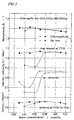
- FIG. 1 is a graph showing the B concentration dependence of the magnet performance. This graph provides data about an example in which 0.02 mass% of Ga was added and a comparative example in which no Ga was added.
- the open circles ⁇ plot the results of measurements of the non-heat-treated sintered body (i.e., as-sintered), while the solid circles ⁇ plot the results of measurements of the heat-treated sintered body.
- every sample included 0.36 to 0.40 mass% of oxygen, 0.004 to 0.015 mass% of nitrogen, 0.04 to 0.05 mass% of carbon and at most 0.002 mass% of hydrogen.
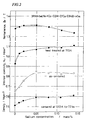
- FIG. 2 is a graph showing how the magnet performance and density changed if the R content and B content were fixed at 31 mass% and 0.94 mass%, respectively, and if the Ga content was changed.
- the B concentration of 0.94 mass% was defined within the composition range in which significant effects were achieved by adding Ga.
- the samples were prepared by the same method as that adopted for the first specific example described above.
- the coercivity H cJ increased with the addition of Ga.
- the coercivity H cJ could be increased more efficiently even when a very small amount (0.01 mass%) of Ga was added.
- the remanence B r reached its peak when the Ga concentration was around 0.04 mass%. Particularly, once the Ga concentration exceeded 0.08 mass%, the sintered density increased but the remanence B r decreased to less than that of the sintered body with no Ga as shown in FIG. 2 .
- the Ga concentration needs to be defined to be 0.08 mass% or less. If the Ga concentration exceeded 0.08 mass% as in the prior art, then the coercivity B r would decrease, which is not beneficial.
- every sample included 0.38 to 0.44 mass% of oxygen, 0.004 to 0.012 mass% of nitrogen, 0.03 to 0.05 mass% of carbon and at most 0.002 mass% of hydrogen.
- FIG. 3 shows the metallographic structure of a sintered magnet with a composition 31 Nd-bal. Fe-1 Co-0.2 Al-0.1 Cu-0.02 Ga-0.93 B.
- the photo on the left-hand side shows a backscattered electron image
- the photo on the right-hand side shows a characteristic X-ray image of B. It can be seen that no cluster point of B was detected, and substantially no B-rich phase was present, according to this composition.
- FIG. 4 shows the metallographic structure of a sintered magnet with a composition 31 Nd-bal. Fe-1 Co-0.2 Al-0.1 Cu-0.02 Ga-1.01 B.
- the photo on the left-hand side shows a backscattered electron image, while the photo on the right-hand side shows a characteristic X-ray image of B.
- cluster points of B were observed. That is to say, in a composition including an excessive amount of B, even if Ga was added, a B-rich phase was produced.
- FIG. 5 shows the metallographic structure of a sintered magnet with a composition 31 Nd-bal. Fe-1 Co-0.2 Al-0.1 Cu-0.94 B. No Ga was added to the sintered magnet shown in FIG. 5 , of which the coercivity was as low as those shown by the curves in FIG. 1 .
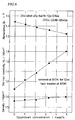
- FIG. 6 shows how the magnetic properties depended on the substitution percentage of Dy. As can be seen from FIG. 6 , even if the B concentration was as low as 0.93 mass%, high coercivity was still achieved by adding Ga.
- the materials of respective elements were melted and cast such that the resultant sintered magnet had a composition including 31.0 mass% of Nd, 1.0 mass% of Co, 0.04 mass% of Ga, 0.2 mass% of Al, 0.1 mass% of Cu, 0.93 to 1.01 mass% of B and Fe as the balance.
- those materials were melted and cast by a strip casting process and by an ingot casting process.
- the resultant alloys had different B contents, which varied within the range of 0.93 mass% to 1.01 mass%.
- the open circles ⁇ represent data about the strip-cast alloy while the open squares ⁇ represent data about the ingot cast alloy.
- every sample included 0.38 to 0.41 mass% of oxygen, 0.012 to 0.020 mass% of nitrogen, 0.04 to 0.06 mass% of carbon and at most 0.002 mass% of hydrogen.
- a high-coercivity sintered magnet including substantially no B-rich phases (R 1.1 Fe 4 B 4 ), can still be provided with the production of a soft magnetic phase minimized. Since B is designated as one of controlled substances according to the PRTR law, it is very beneficial in itself to be able to cut down the use of B.
- the coercivity hardly changes (i.e., decreases) with the B concentration.
- the control reference level of the B concentration can be relaxed and a sintered magnet of quality can be provided with good reproducibility.
- Ga required in the present invention is an expensive metal
- the effects of the present invention described above are achieved by adding an extremely small amount of Ga compared with the conventional technique.
- the overall cost never increases.
- the B-rich phase can be eliminated, the amount of R required can also be reduced, thus cutting down the cost for this reason also.
- the corrosion resistance increases as described above.
Landscapes
- Chemical & Material Sciences (AREA)
- Engineering & Computer Science (AREA)
- Materials Engineering (AREA)
- Mechanical Engineering (AREA)
- Metallurgy (AREA)
- Organic Chemistry (AREA)
- Power Engineering (AREA)
- Crystallography & Structural Chemistry (AREA)
- Inorganic Chemistry (AREA)
- Manufacturing & Machinery (AREA)
- Hard Magnetic Materials (AREA)
- Manufacture Of Metal Powder And Suspensions Thereof (AREA)
- Powder Metallurgy (AREA)
Abstract
Description
Claims (6)
- An R-T-B based sintered magnet having a composition comprising:27.0 mass% to 32.0 mass% of R, which is at least one of Nd, Pr, Dy and Tb and which always includes either Nd or Pr;63.0 mass% to 72.5 mass% of T, which always includes Fe and up to 50% of which is replaceable with Co;0.01 mass% to 0.08 mass% of Ga; and0.85 mass% to 0.98 mass% of B.
- The R-T-B based sintered magnet of claim 1, further comprising at most 2.0 mass% of M, which is at least one element selected from the group consisting of Al, Si, Ti, V, Cr, Mn, Ni, Cu, Zn, Zr, Nb, Mo, In, Sn, Hf, Ta and W.
- The R-T-B based sintered magnet of claim 1 or 2, comprising a main phase with a tetragonal R2T14B type crystal structure, which accounts for at least 90% of the overall volume of the magnet, and including substantially no R1.1Fe4B4 phases.
- The R-T-B based sintered magnet of claim 1 or 2, having an oxygen concentration of at most 0.5 mass%, a nitrogen concentration of at most 0.2 mass%, and a hydrogen concentration of at most 0.01 mass%.
- A method for producing an R-T-B based sintered magnet, the method comprising the steps of:preparing a powder of an alloy that has a composition comprising 27.0 mass% to 32.0 mass% of R (which is at least one of Nd, Pr, Dy and Tb and which always includes either Nd or Pr), 63.0 mass% to 72.5 mass% of T (which always includes Fe and up to 50% of which is replaceable with Co), 0.01 mass% to 0.08 mass% of Ga and 0.85 mass% to 0.98 mass% of B;compacting and sintering the alloy powder, thereby making a sintered magnet; andsubjecting the sintered magnet to a heat treatment at a temperature of 400 °C to 600 °C.
- The method of claim 5, wherein the step of preparing the alloy powder includes the steps of:preparing a melt of the alloy;rapidly cooling and solidifying the melt of the alloy by a strip casting process, thereby making a rapidly solidified alloy; andpulverizing the rapidly solidified alloy.
Applications Claiming Priority (3)
| Application Number | Priority Date | Filing Date | Title |
|---|---|---|---|
| JP2003065900 | 2003-03-12 | ||
| JP2003065900 | 2003-03-12 | ||
| PCT/JP2004/003150 WO2004081954A1 (en) | 2003-03-12 | 2004-03-10 | R-t-b sintered magnet and process for producing the same |
Publications (2)
| Publication Number | Publication Date |
|---|---|
| EP1562203A1 true EP1562203A1 (en) | 2005-08-10 |
| EP1562203A4 EP1562203A4 (en) | 2009-08-05 |
Family
ID=32984520
Family Applications (1)
| Application Number | Title | Priority Date | Filing Date |
|---|---|---|---|
| EP04719123A Withdrawn EP1562203A4 (en) | 2003-03-12 | 2004-03-10 | R-T-B FRITTE MAGNET AND PROCESS FOR PRODUCING SAME |
Country Status (5)
| Country | Link |
|---|---|
| US (1) | US20050268989A1 (en) |
| EP (1) | EP1562203A4 (en) |
| JP (1) | JP4470884B2 (en) |
| CN (1) | CN100550219C (en) |
| WO (1) | WO2004081954A1 (en) |
Cited By (4)
| Publication number | Priority date | Publication date | Assignee | Title |
|---|---|---|---|---|
| WO2007045320A1 (en) * | 2005-10-21 | 2007-04-26 | Vacuumschmelze Gmbh & Co. Kg | Powders for rare earth magnets, rare earth magnets and methods for manufacturing the same |
| US10672545B2 (en) | 2016-12-06 | 2020-06-02 | Tdk Corporation | R-T-B based permanent magnet |
| US10672544B2 (en) | 2016-12-06 | 2020-06-02 | Tdk Corporation | R-T-B based permanent magnet |
| EP4372768A1 (en) * | 2022-11-16 | 2024-05-22 | Shin-Etsu Chemical Co., Ltd. | R-t-b sintered magnet |
Families Citing this family (31)
| Publication number | Priority date | Publication date | Assignee | Title |
|---|---|---|---|---|
| WO2005015580A1 (en) * | 2003-08-12 | 2005-02-17 | Neomax Co., Ltd. | R-t-b sintered magnet and rare earth alloy |
| JP4260087B2 (en) * | 2004-09-27 | 2009-04-30 | 日立金属株式会社 | Rare earth sintered magnet and manufacturing method thereof |
| JP4706900B2 (en) * | 2005-02-17 | 2011-06-22 | Tdk株式会社 | Rare earth permanent magnet manufacturing method |
| JP4671024B2 (en) * | 2005-03-18 | 2011-04-13 | Tdk株式会社 | Manufacturing method of rare earth sintered magnet |
| US20070137733A1 (en) * | 2005-12-21 | 2007-06-21 | Shengzhi Dong | Mixed rare-earth based high-coercivity permanent magnet |
| JP5572673B2 (en) * | 2011-07-08 | 2014-08-13 | 昭和電工株式会社 | R-T-B system rare earth sintered magnet alloy, R-T-B system rare earth sintered magnet alloy manufacturing method, R-T-B system rare earth sintered magnet alloy material, R-T-B system rare earth Sintered magnet, method for producing RTB-based rare earth sintered magnet, and motor |
| CN102436892B (en) * | 2011-12-15 | 2016-02-24 | 钢铁研究总院 | A kind of low neodymium, without heavy rare earth high performance magnet and preparation method |
| JP5742813B2 (en) * | 2012-01-26 | 2015-07-01 | トヨタ自動車株式会社 | Rare earth magnet manufacturing method |
| US10497497B2 (en) | 2012-02-02 | 2019-12-03 | Santoku Corporation | R-T-B—Ga-based magnet material alloy and method of producing the same |
| WO2013114892A1 (en) * | 2012-02-02 | 2013-08-08 | 中電レアアース株式会社 | R-T-B-Ga-BASED MAGNET MATERIAL ALLOY AND METHOD FOR PRODUCING SAME |
| US9997284B2 (en) | 2012-06-22 | 2018-06-12 | Tdk Corporation | Sintered magnet |
| JP5790617B2 (en) | 2012-10-18 | 2015-10-07 | トヨタ自動車株式会社 | Rare earth magnet manufacturing method |
| JP2014086529A (en) * | 2012-10-23 | 2014-05-12 | Toyota Motor Corp | Rare-earth sintered magnet and manufacturing method therefor |
| CN109300640B (en) | 2013-06-05 | 2021-03-09 | 丰田自动车株式会社 | Rare earth magnet and method for producing same |
| AU2014281646A1 (en) | 2013-06-17 | 2016-02-11 | Urban Mining Technology Company, Llc | Magnet recycling to create Nd-Fe-B magnets with improved or restored magnetic performance |
| CN104674115A (en) * | 2013-11-27 | 2015-06-03 | 厦门钨业股份有限公司 | Low-B rare earth magnet |
| JP6003920B2 (en) | 2014-02-12 | 2016-10-05 | トヨタ自動車株式会社 | Rare earth magnet manufacturing method |
| CN103924158B (en) * | 2014-04-29 | 2016-05-11 | 广州天兹新材料科技有限公司 | The preparation method of the aluminium base soft magnetic materials of a kind of iron |
| CN105296888A (en) * | 2014-08-04 | 2016-02-03 | 丁义存 | Memory composite TiNaB alloy and manufacturing method thereof |
| US9336932B1 (en) | 2014-08-15 | 2016-05-10 | Urban Mining Company | Grain boundary engineering |
| CN105469973B (en) * | 2014-12-19 | 2017-07-18 | 北京中科三环高技术股份有限公司 | A kind of preparation method of R T B permanent magnets |
| CN105033204B (en) * | 2015-06-30 | 2017-08-08 | 厦门钨业股份有限公司 | A kind of quick cooling alloy piece for sintered magnet |
| CN105730876B (en) * | 2016-04-20 | 2018-06-01 | 青岛海信电器股份有限公司 | TV packaging case |
| US10892076B2 (en) | 2016-12-28 | 2021-01-12 | Toyota Jidosha Kabushiki Kaisha | Rare earth magnet and method of producing the same |
| JP7110662B2 (en) | 2018-03-28 | 2022-08-02 | Tdk株式会社 | R-T-B system sintered magnet |
| US11721479B2 (en) * | 2019-08-29 | 2023-08-08 | Toyota Jidosha Kabushiki Kaisha | Rare earth magnets |
| US20220406495A1 (en) | 2019-11-11 | 2022-12-22 | Shin-Etsu Chemical Co., Ltd. | R-fe-b sintered magnet |
| WO2021095633A1 (en) | 2019-11-11 | 2021-05-20 | 信越化学工業株式会社 | R-fe-b-based sintered magnet |
| CN114746962A (en) * | 2019-11-27 | 2022-07-12 | Tdk株式会社 | R-T-B based permanent magnet |
| JP7318624B2 (en) * | 2020-10-30 | 2023-08-01 | トヨタ自動車株式会社 | Rare earth magnet and manufacturing method thereof |
| CN116479266B (en) * | 2023-03-21 | 2026-04-10 | 北京工业大学 | A method for separating the main product and byproduct of a calcium thermal reduction diffusion reaction |
Family Cites Families (16)
| Publication number | Priority date | Publication date | Assignee | Title |
|---|---|---|---|---|
| DE3786426T2 (en) * | 1986-06-12 | 1993-12-09 | Toshiba Kawasaki Kk | Permanent magnet and permanent magnet alloy. |
| US5223047A (en) * | 1986-07-23 | 1993-06-29 | Hitachi Metals, Ltd. | Permanent magnet with good thermal stability |
| JP2898463B2 (en) * | 1992-03-19 | 1999-06-02 | 住友特殊金属株式会社 | Method for producing raw material powder for R-Fe-B-based permanent magnet |
| US5472525A (en) * | 1993-01-29 | 1995-12-05 | Hitachi Metals, Ltd. | Nd-Fe-B system permanent magnet |
| US5858123A (en) * | 1995-07-12 | 1999-01-12 | Hitachi Metals, Ltd. | Rare earth permanent magnet and method for producing the same |
| JPH10289813A (en) * | 1997-04-16 | 1998-10-27 | Hitachi Metals Ltd | Rare earth magnet |
| JP3846835B2 (en) * | 1998-10-14 | 2006-11-15 | 株式会社Neomax | R-T-B sintered permanent magnet |
| DE69911138T2 (en) * | 1998-10-14 | 2004-07-22 | Hitachi Metals, Ltd. | Sintered R-T-B permanent magnet |
| JP2001297907A (en) * | 2000-04-14 | 2001-10-26 | Hitachi Metals Ltd | RTB based sintered magnet, ring magnet and voice coil motor |
| US6746545B2 (en) * | 2000-05-31 | 2004-06-08 | Shin-Etsu Chemical Co., Ltd. | Preparation of rare earth permanent magnets |
| US6527874B2 (en) * | 2000-07-10 | 2003-03-04 | Sumitomo Special Metals Co., Ltd. | Rare earth magnet and method for making same |
| JP2002038245A (en) * | 2000-07-27 | 2002-02-06 | Hitachi Metals Ltd | Alloy powder for rare earth permanent magnet and method for producing rare earth permanent magnet |
| JP4371188B2 (en) * | 2000-08-22 | 2009-11-25 | 信越化学工業株式会社 | High specific electric resistance rare earth magnet and method for manufacturing the same |
| JP2002285276A (en) * | 2001-03-26 | 2002-10-03 | Hitachi Metals Ltd | RTBC based sintered magnet and method of manufacturing the same |
| US7014718B2 (en) * | 2001-09-03 | 2006-03-21 | Showa Denko K.K. | Rare earth magnet alloy ingot, manufacturing method for the same, R-T-B type magnet alloy ingot, R-T-B type magnet, R-T-B type bonded magnet, R-T-B type exchange spring magnet alloy ingot, R-T-B type exchange spring magnet, and R-T-B type exchange spring bonded magnet |
| JP3997413B2 (en) * | 2002-11-14 | 2007-10-24 | 信越化学工業株式会社 | R-Fe-B sintered magnet and method for producing the same |
-
2004
- 2004-03-10 US US10/527,797 patent/US20050268989A1/en not_active Abandoned
- 2004-03-10 WO PCT/JP2004/003150 patent/WO2004081954A1/en not_active Ceased
- 2004-03-10 CN CNB2004800015514A patent/CN100550219C/en not_active Expired - Lifetime
- 2004-03-10 EP EP04719123A patent/EP1562203A4/en not_active Withdrawn
- 2004-03-10 JP JP2005503551A patent/JP4470884B2/en not_active Expired - Lifetime
Cited By (7)
| Publication number | Priority date | Publication date | Assignee | Title |
|---|---|---|---|---|
| WO2007045320A1 (en) * | 2005-10-21 | 2007-04-26 | Vacuumschmelze Gmbh & Co. Kg | Powders for rare earth magnets, rare earth magnets and methods for manufacturing the same |
| GB2443187A (en) * | 2005-10-21 | 2008-04-30 | Vacuumschmelze Gmbh & Co Kg | Powders for rare earth magnets, rare earth magnets and methods for manufacturing the same |
| GB2443187B (en) * | 2005-10-21 | 2012-01-04 | Vacuumschmelze Gmbh & Co Kg | Powders for rare earth magnets, rare earth magnets and methods for manufacturing the same |
| US8361242B2 (en) | 2005-10-21 | 2013-01-29 | Vacuumschmeize GmbH & Co. KG | Powders for rare earth magnets, rare earth magnets and methods for manufacturing the same |
| US10672545B2 (en) | 2016-12-06 | 2020-06-02 | Tdk Corporation | R-T-B based permanent magnet |
| US10672544B2 (en) | 2016-12-06 | 2020-06-02 | Tdk Corporation | R-T-B based permanent magnet |
| EP4372768A1 (en) * | 2022-11-16 | 2024-05-22 | Shin-Etsu Chemical Co., Ltd. | R-t-b sintered magnet |
Also Published As
| Publication number | Publication date |
|---|---|
| CN100550219C (en) | 2009-10-14 |
| JP4470884B2 (en) | 2010-06-02 |
| WO2004081954A1 (en) | 2004-09-23 |
| CN1717755A (en) | 2006-01-04 |
| US20050268989A1 (en) | 2005-12-08 |
| JPWO2004081954A1 (en) | 2006-06-15 |
| EP1562203A4 (en) | 2009-08-05 |
Similar Documents
| Publication | Publication Date | Title |
|---|---|---|
| US20050268989A1 (en) | R-t-b sintered magnet and process for producing the same | |
| EP2388350B1 (en) | Method for producing r-t-b sintered magnet | |
| EP1705668B1 (en) | Functionally graded rare earth permanent magnet | |
| EP1705671B1 (en) | Rare earth permanent magnet | |
| EP3076406B1 (en) | Making method of a r-fe-b sintered magnet | |
| US7488394B2 (en) | Rare earth permanent magnet | |
| US10242780B2 (en) | Rare earth based permanent magnet | |
| JP3997413B2 (en) | R-Fe-B sintered magnet and method for producing the same | |
| EP1662516B1 (en) | R-t-b sintered magnet and rare earth alloy | |
| EP1645648B1 (en) | A rare earth alloy sintered compact | |
| US6527874B2 (en) | Rare earth magnet and method for making same | |
| EP1780736B1 (en) | R-T-B type alloy, production method of R-T-B type alloy flake, fine powder for R-T-B type rare earth permanent magnet, and R-T-B type rare earth permanent magnet | |
| US8182618B2 (en) | Rare earth sintered magnet and method for producing same | |
| EP0362805B1 (en) | Permanent magnet and method for producing the same | |
| EP1632299B1 (en) | Method for producing rare earth based alloy powder and method for producing rare earth based sintered magnet | |
| US20070240790A1 (en) | Rare-earth sintered magnet and method for producing the same | |
| US10256017B2 (en) | Rare earth based permanent magnet | |
| CN114730652B (en) | R-Fe-B sintered magnet |
Legal Events
| Date | Code | Title | Description |
|---|---|---|---|
| PUAI | Public reference made under article 153(3) epc to a published international application that has entered the european phase |
Free format text: ORIGINAL CODE: 0009012 |
|
| 17P | Request for examination filed |
Effective date: 20050303 |
|
| AK | Designated contracting states |
Kind code of ref document: A1 Designated state(s): AT BE BG CH CY CZ DE DK EE ES FI FR GB GR HU IE IT LI LU MC NL PL PT RO SE SI SK TR |
|
| AX | Request for extension of the european patent |
Extension state: AL LT LV MK |
|
| DAX | Request for extension of the european patent (deleted) | ||
| RBV | Designated contracting states (corrected) |
Designated state(s): DE FR NL |
|
| RAP1 | Party data changed (applicant data changed or rights of an application transferred) |
Owner name: HITACHI METALS, LTD. |
|
| A4 | Supplementary search report drawn up and despatched |
Effective date: 20090706 |
|
| RIC1 | Information provided on ipc code assigned before grant |
Ipc: C21D 6/00 20060101ALI20090630BHEP Ipc: C22C 38/00 20060101ALI20090630BHEP Ipc: C22C 33/02 20060101ALI20090630BHEP Ipc: H01F 1/08 20060101ALI20090630BHEP Ipc: H01F 1/04 20060101ALI20090630BHEP Ipc: H01F 1/057 20060101AFI20090630BHEP |
|
| 17Q | First examination report despatched |
Effective date: 20100812 |
|
| STAA | Information on the status of an ep patent application or granted ep patent |
Free format text: STATUS: THE APPLICATION IS DEEMED TO BE WITHDRAWN |
|
| 18D | Application deemed to be withdrawn |
Effective date: 20141202 |