EP1561540A1 - Flexible membrane for a polishing head and CMP apparatus having the same - Google Patents
Flexible membrane for a polishing head and CMP apparatus having the same Download PDFInfo
- Publication number
- EP1561540A1 EP1561540A1 EP05002236A EP05002236A EP1561540A1 EP 1561540 A1 EP1561540 A1 EP 1561540A1 EP 05002236 A EP05002236 A EP 05002236A EP 05002236 A EP05002236 A EP 05002236A EP 1561540 A1 EP1561540 A1 EP 1561540A1
- Authority
- EP
- European Patent Office
- Prior art keywords
- pneumatic pressure
- flexible membrane
- face
- substrate
- introducing
- Prior art date
- Legal status (The legal status is an assumption and is not a legal conclusion. Google has not performed a legal analysis and makes no representation as to the accuracy of the status listed.)
- Granted
Links
Images


Classifications
-
- B—PERFORMING OPERATIONS; TRANSPORTING
- B62—LAND VEHICLES FOR TRAVELLING OTHERWISE THAN ON RAILS
- B62D—MOTOR VEHICLES; TRAILERS
- B62D1/00—Steering controls, i.e. means for initiating a change of direction of the vehicle
- B62D1/02—Steering controls, i.e. means for initiating a change of direction of the vehicle vehicle-mounted
- B62D1/04—Hand wheels
- B62D1/043—Hand wheels with a device allowing single-hand operation of the steering wheel
-
- B—PERFORMING OPERATIONS; TRANSPORTING
- B24—GRINDING; POLISHING
- B24B—MACHINES, DEVICES, OR PROCESSES FOR GRINDING OR POLISHING; DRESSING OR CONDITIONING OF ABRADING SURFACES; FEEDING OF GRINDING, POLISHING, OR LAPPING AGENTS
- B24B37/00—Lapping machines or devices; Accessories
- B24B37/27—Work carriers
- B24B37/30—Work carriers for single side lapping of plane surfaces
-
- B—PERFORMING OPERATIONS; TRANSPORTING
- B60—VEHICLES IN GENERAL
- B60Y—INDEXING SCHEME RELATING TO ASPECTS CROSS-CUTTING VEHICLE TECHNOLOGY
- B60Y2410/00—Constructional features of vehicle sub-units
- B60Y2410/12—Production or manufacturing of vehicle parts
- B60Y2410/125—Bounded parts
-
- Y—GENERAL TAGGING OF NEW TECHNOLOGICAL DEVELOPMENTS; GENERAL TAGGING OF CROSS-SECTIONAL TECHNOLOGIES SPANNING OVER SEVERAL SECTIONS OF THE IPC; TECHNICAL SUBJECTS COVERED BY FORMER USPC CROSS-REFERENCE ART COLLECTIONS [XRACs] AND DIGESTS
- Y10—TECHNICAL SUBJECTS COVERED BY FORMER USPC
- Y10T—TECHNICAL SUBJECTS COVERED BY FORMER US CLASSIFICATION
- Y10T279/00—Chucks or sockets
- Y10T279/11—Vacuum
Definitions
- the invention relates to a flexible membrane for a polishing head and a chemical mechanical polishing (CMP) apparatus having the same.
- CMP chemical mechanical polishing
- CMP chemical mechanical polishing
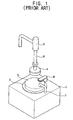
- FIG. 1 shows a CMP apparatus disclosed in this Publication.
- the CMP apparatus includes a platen 2 disposed on a station 1.
- a motor (not shown) disposed in the station 1 rotates the platen 2.
- a polishing pad 3 for polishing a substrate is attached to a surface of the platen 2.
- a slurry line 7 for providing slurry to a surface of the polishing pad 3 is mounted on the station 1.
- a pad conditioner 8 for removing foreign substances from the polishing pad 3 is installed on the station 1.
- a polishing head 4 for compressing the substrate on the polishing pad 3 is disposed over the platen 2.
- the polishing head 4 is connected to a motor 5 via a shaft 6.
- the polishing head 4 is rotated in a direction opposite that of a rotational direction of the platen 2.
- the polishing head 4 holds the substrate with a vacuum provided thereto and places the substrate on the polishing pad 3.
- the polishing head 4 compresses the substrate with a pneumatic pressure provided thereto to closely adhere the substrate to the polishing pad 3.
- a vacuum line (not shown) for providing the vacuum to the polishing head 4 is connected to the polishing head 4.
- a pneumatic pressure line (not shown) for providing the pneumatic pressure to the polishing head 4 is connected to the polishing head 4.
- the polishing head 4 includes a carrier (not shown) connected to the vacuum line and the pneumatic pressure line, a supporter (not shown) disposed in the carrier, a flexible membrane (not shown) for holding the substrate with the vacuum, and a retainer ring for preventing the substrate held on the flexible membrane from being detached.
- the flexible membrane includes a compressing plate having a circular shape.
- a sidewall is formed on an edge portion of the compressing plate.
- a partition wall for defining a region to which the vacuum is applied is formed on a central portion of the compressing plate.
- the surface of the substrate held on the flexible membrane is compressed and polished on the polishing pad, the surface of the substrate is polished to a uniform thickness.
- a uniform pressure is applied from the flexible membrane to the entire substrate.
- the flexible membrane is divided into a vacuum region and a pressure region, the pressure is not always uniformly applied to the whole substrate. Therefore, when a layer on the substrate is polished, the polishing speeds between the vacuum and pressure regions of the layer are different.
- the non-uniform polishing speeds cause the substrate to be non-uniformly polished.
- the surface of the substrate may not be planarized giving the substrate an uneven surface.
- the central portion of the substrate is typically thinned which is also known as dishing. As a result, it may be difficult to form additional layers on the uneven surface of the substrate.
- the invention solves this problem by providing a flexible membrane having the features of claim 1 and a CMP apparatus having the features of claim 12.
- Advantageous embodiments of the invention are given in the subclaims, the wording of which is herewith incorporated into the description by reference to avoid unnecessary text repetition.
- a flexible membrane for a polishing head in accordance with one aspect of the invention includes a compressing plate having a first face and a second face opposite to the first face.
- the first face of the compressing plate holds a substrate with a vacuum provided thereto and compresses the substrate on a polishing pad.
- the second face of the compressing plate is combined with a supporter of the polishing head.
- the second face and the supporter define a space to which the vacuum for holding the substrate and a first pneumatic pressure for compressing the substrate are applied.
- a dividing member combined with the supporter is formed on the second face. The dividing member divides the space into at least two regions.
- a first pneumatic pressure-introducing portion is formed at the dividing member.
- a second pneumatic pressure is provided to the compressing plate through the first pneumatic pressure-introducing portion.
- a flexible membrane for a polishing head in accordance with another aspect of the invention includes a compressing plate having a first face and a second face opposite to the first face.
- the first face of the compressing plate holds a substrate with a vacuum provided thereto and compresses the substrate on a polishing pad.
- a sidewall is formed on an edge portion of the second face.
- the sidewall is combined with a supporter of the polishing head.
- the sidewall and the supporter define a space.
- a dividing member is formed on the second face. The dividing member divides the space into main pressure regions to which main pneumatic pressures different from each other are provided.
- Auxiliary pressure region-forming members combined with the supporter are formed on the dividing member and the sidewall.
- auxiliary pressure region-forming members and the supporter define auxiliary pressure regions to which an auxiliary pneumatic pressure is provided.
- Pneumatic pressure-introducing portions are formed at the partition wall and the sidewall.
- the auxiliary pneumatic pressure is provided to the compressing plate through the pneumatic pressure-introducing portions.
- a chemical mechanical polishing (CMP) apparatus in accordance with still another aspect of the invention includes a platen having a pad for polishing a substrate, a flexible membrane for holding and compressing the substrate, and a polishing head having a supporter for supporting the flexible membrane.
- the flexible membrane includes a compressing plate having a first face and a second face opposite to the first face.
- the first face of the compressing plate holds the substrate with a vacuum provided thereto and compresses the substrate on the polishing pad.
- the second face of the compressing plate is combined with the supporter.
- the second face and the supporter define a space to which the vacuum for holding the substrate and a first pneumatic pressure for compressing the substrate are applied.
- a dividing member combined with the supporter is formed on the second face. The dividing member divides the space into at least two regions.
- a first pneumatic pressure-introducing portion is formed at the dividing member.
- a second pneumatic pressure is provided to the compressing plate through the first pneumatic pressure-introducing portion.
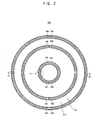
- a flexible membrane 100 shown there includes a compressing plate 110, first and second partition walls 120 and 130 formed on the compressing plate 110, a sidewall 140 formed on the compressing plate 110, and slots 125, 135 and 145 formed on the first and second partition walls 120 and 130 and the sidewall 140.
- the first and second partition walls 120 and 130 correspond to a dividing member.
- each of the slots 125, 135 and 145 correspond to a pneumatic pressure-introducing portion for introducing a pneumatic pressure.
- the flexible membrane 100 is combined with a supporter (not shown) of a polishing head (not shown).
- the flexible membrane 100 holds a substrate with a vacuum VP provided thereto.
- Examples of the flexible membrane 100 include a rubber such as an ethylene propylene rubber, a neoprene rubber, a nitrile rubber, etc.
- the compressing plate 110 has a circular shape.
- the shape of the compressing plate 110 may vary in accordance with an object to be polished.
- the compressing plate 110 may have the circular shape.
- the compressing plate 110 may have a rectangular shape.
- the compressing plate 110 has a first face 111, and a second face 112 opposite to the first face 111.
- the first face 111 is oriented in a downward direction where a polishing pad (not shown) is disposed.
- the second face 112 is oriented in an upward direction.
- the substrate is held onto the first face 111 by the vacuum VP.
- the vacuum VP for holding the substrate and the pneumatic pressure for closely adhering the substrate to the polishing pad are selectively provided to the second face 112.
- the sidewall 140 is formed on an edge portion of the second face 112.
- the sidewall 140 has an annular shape.
- the sidewall 140 is combined with the supporter.
- the sidewall 140 and the supporter define an isolated space over the second face 112.
- the dividing member includes the first and second partition walls 120 and 130 having a height substantially identical to that of the sidewall 140 and also having an annular shape.
- the first partition wall 120 is disposed on a central portion of the second face 112.
- the first partition wall 120 is combined with the supporter to define a vacuum region MZ1 into which the vacuum VP and a first main pneumatic pressure MP1 are selectively introduced.
- the second partition wall 130 is disposed between the first partition wall 120 and the sidewall 140.
- the first and second partition walls 120 and 130 and the sidewall 140 are disposed in concentric circles.
- the first and second partition walls 120 and 130 and the sidewall 140 are disposed in concentric rectangles. Even if the compressing plate 110 has the rectangular shape, the first and second partition walls 120 and 130 and the sidewall 140 may still be disposed in concentric circles.
- the second partition wall 130 is combined with the supporter to divide a space between the first partition wall 120 and the sidewall 140 into two spaces.
- the space between the first and second partition walls 120 and 130 is defined as a main pressure region MZ2 to which a second main pneumatic pressure MP2 for compressing the substrate is applied.
- the space between the second partition wall 130 and the sidewall 140 is defined as a peripheral pressure region MZ3 to which a third main pneumatic pressure MP3 for compressing the substrate is applied. That is, the substrate is held onto the first face 111 of the compressing plate 110 by the vacuum VP provided to the vacuum region MZ1. In addition, the substrate is adhered to the polishing pad by the first, second and third main pneumatic pressures MP1, MP2 and MP3 provided to the vacuum region MZ1, the main pressure region MZ2 and the peripheral pressure region MZ3, respectively.
- the first, second and third pneumatic pressure-introducing portions are formed at the first and second partition walls 120 and 130 and the sidewall 140, respectively.
- the first pneumatic pressure-introducing portion includes the first slot 125 formed at the first partition wall 120
- the second pneumatic pressure-introducing portion includes the second slot 135 formed at the second partition wall 130
- the third pneumatic pressure-introducing portion includes the third slot 145 formed at the sidewall 140.
- the first, second and third slots 125, 135 and 145 are formed from surfaces of the first and second partition walls 120 and 130 and the sidewall 140 to the second face of the compressing plate 110.
- the first, second and third slots 125, 135 and 145 extend in a direction in accordance with a longitudinal direction of the first and second partition walls 120 and 130 and the sidewall 140.
- the first, second and third slots 125, 135 and 145 have annular shapes, respectively. Therefore, the first, second and third slots 125, 135 and 145 are disposed in concentric circles substantially similar to those of the first and second partition walls 120 and 130 and the sidewall 140.
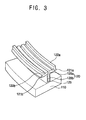
- the first slot 125 divides the first partition wall 120 into a first inner wall 120a and a first outer wall 120b.
- the second slot 135 divides the second partition wall 130 into a second inner wall 130a and a second outer wall 130b.
- the third slot 145 divides the sidewall 140 into an inner sidewall 140a and an outer sidewall 140b.
- First, second and third auxiliary region-forming members are formed at the first and second partition walls 120 and 130 and the sidewall 140, respectively.
- the first, second and third auxiliary region-forming members define first, second and third auxiliary pressure regions AZ1, AZ2 and AZ3, respectively.
- the first auxiliary pressure region-forming member includes a first partition plate formed on the first partition wall 120 to define the first auxiliary pressure region AZ1
- the second auxiliary pressure region-forming member includes a second partition plate formed on the second partition wall 130 to define the second auxiliary pressure region AZ2
- the third auxiliary pressure region-forming member includes a third partition plate formed on the sidewall 140 to define the third auxiliary pressure region AZ3.
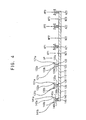
- the first, second and third partition plates include first, second and third inner extending portions 121 a, 131 a and 141 a horizontally extending from upper inner ends of the first and second partition walls 120 and 130 and the sidewall 140, respectively, first, second and third outer extending portions 121b, 131b and 141b horizontally extending from upper outer ends of the first and second partition walls 120 and 130 and the sidewall 140, respectively, first, second and third inner fencing portions 122a, 132a and 142a upwardly extending from ends of the first, second and third extending portions 121a, 131a and 141a, respectively, and first, second and third outer fencing portions 122b, 132b and 142b upwardly extending from ends of the first, second and third outer extending portions 121b, 131b and 141b, respectively.
- surfaces of the first, second and third inner extending portions 121a, 131a and 141a and surfaces of the first, second and third outer extending portions 121b, 131b and 141b are lower than those of the first and second partition walls 120 and 130 and the sidewall 140 so that step differences between the surfaces of the extending portions 121a, 121b, 131a, 131b, 141 a, 141b and the surfaces of the walls 120, 130 and 140 are formed.
- first inner and outer fencing portions 122a and 122b are combined with the supporter to form a space surrounded by the first partition plate, the supporter and the surface of the first partition wall 120.
- This space is defined as the first auxiliary pressure region AZ1 to which the first auxiliary pneumatic pressure AP1 is applied.
- the first, second and third slots 125, 135 and 145 are formed from the surfaces of the first and second partition walls 120 and 130 and the sidewall 140 to the compressing plate 110.
- the first, second and third slots 125, 135 and 145 are in communication with the first, second and third auxiliary pressure regions AZ1, AZ2 and AZ3, respectively.
- the first, second and third auxiliary pressure regions AZ1, AZ2 and AZ3 have spaces expanded by volumes of the first, second and third slots 125, 135 and 145, respectively.
- Each of the first, second and third slots 125, 135 and 145 has a depth substantially identical to each of heights of the first and second partition walls 120 and 130 and the sidewall 140.
- the first, second and third auxiliary pneumatic pressures AP1, AP2 and AP3 are directly provided to the second face 112 of the compressing plate 110 through the first, second and third slots 125, 135 and 145, respectively.
- the first, second and third auxiliary pneumatic pressures AP1, AP2 and AP3 provided to the compressing plate 110 through the first, second and third auxiliary pressure regions AZ1, AZ2 and AZ3, respectively, are substantially identical to the first, second and third main pneumatic pressures MP1, MP2 and MP3 providing the compressing plate 110 through the vacuum region MZ1, the main pressure region MZ2 and the peripheral pressure region MZ3, respectively. Therefore, a uniform pressure is provided to the second face 112 of the compressing plate 110 so that the first face 111 of the compressing plate 110 uniformly adheres to the substrate on the polishing pad.
- upper widths of the first, second and third slots 125, 135 and 145 are substantially identical to lower widths of the first, second and third slots 125, 135 and 145, respectively.
- the first, second and third slots 125, 135 and 135 may have shapes that have gradually widening widths from an upper position to a lower position.
- the first, second and third slots 125, 135 and 145 may have dual structures that have, for example, a lower width wider than an upper width.
- the CMP apparatus 600 includes a platen 660 and a polishing head 610 disposed over the platen 660.
- a polishing pad 680 on which a substrate S is closely adhered is attached to a surface of the platen 660.
- the platen 660 is connected to a first motor 670 via a shaft 690.
- a slurry line 685 for providing slurry to a surface of the polishing pad 680 is disposed adjacent to the surface of the polishing pad 680.
- the polishing head 610 includes a second motor 640, a supporter 620 connected to the second motor 640 via a shaft 645, the flexible membrane 100 supported by the supporter 620 for holding the substrate S, and a retainer ring 650 for preventing the substrate S held by the flexible membrane 100 from being detached.
- the flexible membrane 100 has the pneumatic pressure-introducing portions corresponding to the slots 125, 135 and 145.
- the flexible membrane 100 is supported on a lower face of the supporter 620.
- the substrate S is held onto a lower face of the flexible membrane 100 and is closely adhered to the surface of the polishing pad 680.
- the retainer ring 650 is mounted on an edge portion of the lower face of the supporter 620 to prevent the detachment of the substrate S from the flexible membrane 100 in a polishing operation.
- the supporter 620 has a structure that includes a space for receiving the flexible membrane 100 therein. Further, the supporter 620 includes first and second partition wall-supporting portions 621 and 622 for supporting the first and second partition walls 120 and 130 of the flexible membrane 100, and a sidewall-supporting portion 623 for supporting the sidewall 140 of the flexible membrane 100.
- the vacuum region MZ1 is defined by the first partition wall 120, the first partition wall-supporting portion 621, the lower face of the supporter 620 and the surface of the compressing plate 110.
- the main pressure region MZ2 is defined by the first and second partition walls 120 and 130, the first and second partition wall-supporting portions 621 and 622, the lower face of the supporter 620 and the surface of the compressing plate 110.
- the peripheral pressure region MZ3 is defined by the second partition wall 130, the sidewall 140, the second partition wall-supporting portion 622, the sidewall-supporting portion 623, the lower face of the supporter 620 and the surface of the compressing plate 110.
- the first auxiliary pressure region AZ1 is defined by the surface of the first partition wall 120, the first partition plate and the lower face of the supporter 620.
- the second auxiliary pressure region AZ2 is defined by the surface of the second partition wall 130, the second partition plate and the lower face of the supporter 620.
- the third auxiliary pressure region AZ3 is defined by the surface of the sidewall 140, the third partition plate and the lower face of the supporter 620.
- a first passageway 630 for providing the pneumatic pressures MP1, MP2, MP3, AP1, AP2 and AP3 to the regions MZ1, MZ2, MZ3, AZ1, AZ2 and AZ3, respectively, is formed through the supporter 620.
- the first passageway 630 diverges into first, second and third main passageways 631, 632 and 633 for providing the first, second and third main pneumatic pressures MP1, MP2 and MP3 to the vacuum region MZ1, the main pressure region MZ2 and the peripheral pressure region MZ3, respectively, and first, second and third auxiliary passageways 634, 635 and 636 for providing the first, second and third auxiliary pneumatic pressures AP1, AP2 and AP3 to the auxiliary pressure regions AZ1, AZ2 and AZ3, respectively.
- a second passageway 630a for providing the vacuum VP for holding the substrate S onto the vacuum region MZ1 is formed through the supporter 620.
- the substrate S is adhered to the lower face of the compressing plate 110 by the vacuum VP that is provided to the vacuum region MZ1 through the second passageway 630a.
- the pneumatic pressures MP1, MP2, MP3, AP1, AP2 and AP3 are provided to the regions MZ1, MZ2, MZ3, AZ1, AZ2 and AZ3 through the first passageway 630.
- the first, second and third main pneumatic pressures MP1, MP2 and MP3 are directly provided to the surface of the compressing plate 110 through the first, second and third main passageways 631, 632 and 633.
- the first, second and third auxiliary pneumatic pressures AP1, AP2 and AP3 are directly provided to the surface of the compressing plate 110 through the first, second and third auxiliary passageways 634, 635, and 636.
- the substrate S is uniformly adhered to the polishing pad 680 by the main and auxiliary pneumatic pressures MP1, MP2, MP3, AP1, AP2 and AP3.
- the slurry is then provided to the surface of the polishing pad 680 from the slurry line 685.
- the first motor 670 rotates the polishing pad 680 in a first direction, for example, in a clockwise direction.
- the second motor 640 rotates the polishing head 610 in a second direction opposite to the first direction, for example, in a counterclockwise direction.
- the substrate S is rotated and simultaneously compressed on the polishing pad 680, thereby polishing the surface of the substrate S to a uniform thickness.
- polishing characteristics of a flexible membrane having a size of about 200mm without pneumatic pressure-introducing portions and the flexible membrane 100 of FIG. 2 were compared to each other.
- a flexible membrane 1000 without the pneumatic pressure-introducing portions shown in FIG. 6 was manufactured.
- the flexible membrane 1000 had a size and a configuration substantially identical to that of the flexible membrane 100 except that the flexible membrane 1000 did not have the pneumatic pressure-introducing portions.
- the flexible membrane 1000 and the flexible membrane 100 were employed in the CMP apparatus 600 of FIG. 5.
- an oxide layer having a thickness of about 6,000 ⁇ was formed on a semiconductor substrate having a size of about 200mm.
- a tantalum layer having a thickness of about 250 ⁇ was formed on the oxide layer.
- a seed layer including copper and having a thickness of about 1,500 ⁇ was formed on the tantalum layer.
- a copper layer having a thickness of about 14,000 ⁇ was then formed on the seed layer using an electroplating method. Two semiconductor substrates having the above structure were then prepared.
- Pneumatic pressures for polishing were applied to the flexible membranes 100 and 1000, respectively, and were measured.
- the measured pneumatic pressures are shown in following Table 1.
- the first main pneumatic pressure MP1 provided to the vacuum region MZ1 is 2.8 psi
- the second main pneumatic pressure MP2 provided to the main pressure region MZ2 is 2.45 psi
- the third main pneumatic pressure MP3 provided to the peripheral pressure region MZ3 is 2.6 psi.
- the first auxiliary pneumatic pressure AP1 provided to the first auxiliary pressure region AZ1 is 4.0 psi
- the second auxiliary pneumatic pressure AP2 provided to the second auxiliary pressure region AZ2 is 3.5 psi
- the third auxiliary pneumatic pressure AP3 provided to the third auxiliary pressure region is 2.0 psi.
- the auxiliary pneumatic pressures AP1, AP2 and AP3 in the auxiliary pressure regions AZ1, AZ2 and AZ3 in the flexible membrane 1000 were very different from each other.
- the first main pneumatic pressure MP1 provided to the vacuum region MZ1 is 2.4 psi
- the second main pneumatic pressure MP2 provided to the main pressure region MZ2 is 2.23 psi
- the third main pneumatic pressure MP3 provided to the peripheral pressure region MZ3 is 2.3 psi.
- first auxiliary pneumatic pressure AP1 provided to the first auxiliary pressure region AZ1 is 2.0 psi
- the second auxiliary pneumatic pressure AP2 provided to the second auxiliary pressure region AZ2 is 1.8 psi
- third auxiliary pneumatic pressure AP3 provided to the third auxiliary pressure region is 1.0 psi.
- auxiliary pneumatic pressures AP1, AP2 and AP3 in the auxiliary pressure regions AZ1, AZ2 and AZ3 were lower than the main pneumatic pressures MP1, MP2 and MP3 in the vacuum region MZ1, the main pressure region MZ2 and the peripheral pressure region MZ3, respectively, in the flexible membrane 100.
- Polishing processes were also performed on the two semiconductor substrates using the CMP apparatuses having the flexible membranes 100 and 1000.
- an abrasive-free slurry was used as an abrasive.
- a rotational speed of the polishing head was about 23 rpm and a rotational speed of the platen was about 600 rpm.
- the polishing processes were performed for about 90 seconds.
- FIG. 7A is a graph showing polishing speeds at positions of a semiconductor substrate when a copper layer on the semiconductor substrate is polished using the flexible membrane 1000 of FIG. 6.
- FIG. 7B is a graph showing polishing speeds at positions of a semiconductor substrate when a copper layer on the semiconductor substrate is polished using the flexible membrane 100 of FIG. 2.
- a horizontal axis represents positions of the substrate and a vertical axis represents a polishing speed.
- a polishing speed with respect to portions of the substrate, which correspond to the vacuum region MZ1, the main pneumatic pressure region MZ2 and the peripheral pneumatic pressure region MZ3, was about 8,000 ⁇ /min.
- a polishing speed with respect to portions of the substrate, which correspond to the first and second auxiliary pressure regions AZ1 and AZ2, was about 6,000 ⁇ /min.
- the polishing speeds between the main pressure regions MZ1, MZ2 and MZ3 and the auxiliary pressure regions AZ1, AZ2 and AZ3 were very different from each other. This was due to the measured pneumatic pressures. For example, the pneumatic pressures in the auxiliary pressure regions AZ1, AZ2 and AZ3 were considerably different from those in the vacuum region MZ1, the main pressure region MZ2 and the peripheral pressure region MZ3. In addition, the pneumatic pressures in the auxiliary pressure regions AZ1, AZ2 and AZ3 were different from each other. As a result, the flexible membrane 1000 does not always uniformly compress the substrate on the polishing pad.
- polishing speeds were about 9,500 ⁇ /min to about 10,000 ⁇ /min in all the regions except the third auxiliary pressure region AZ3 in which a polishing speed was no less than about 11,000 ⁇ /min.
- auxiliary pneumatic pressures applied to the auxiliary pressure regions AZ1, AZ2 and AZ3 were substantially similar to each other and were also little different from the main pneumatic pressures applied to the main pressure regions MZ1, MZ2 and MZ3. Therefore, the flexible membrane 100 in accordance with the present invention uniformly compresses the substrate on the polishing pad so that the CMP apparatus having the flexile membrane 100 can polish the substrate to a uniform thickness.
- a fluorine doped silicate glass (FSG) having a thickness of about 3,000 ⁇ was deposited on a semiconductor substrate.
- a polishing process was performed on the substrate using the flexible membrane 100 for about 90 seconds.
- a silica-based slurry was used as an abrasive.
- a rotational speed of the polishing head was about 23 rpm and a rotational speed of the platen was about 300 rpm.
- FIG. 8 is a graph showing polishing speeds at positions of a semiconductor substrate when an FSG layer on the semiconductor substrate is polished using the flexible membrane 100.
- line 1' represents a desired target polishing speed and line 2' represents an actual polishing speed.
- the actual polishing speed was substantially identical or similar to the target polishing speed.
- the actual polishing speeds at certain positions of the substrate were substantially similar to each other.
- the CMP apparatus having the flexible membrane 100 polished the substrate to a uniform thickness.
- the flexible membrane 100 closely adhered the substrate to the polishing pad.
- the pneumatic pressure-introducing portions are formed at the dividing member and the sidewall so that the pneumatic pressure is directly provided to the portions of the compressing plates under the dividing member and the sidewall.
- the compressing plate closely adheres the substrate to the polishing pad.
- the substrate may be polished to a uniform thickness.
Landscapes
- Engineering & Computer Science (AREA)
- Mechanical Engineering (AREA)
- Chemical & Material Sciences (AREA)
- Combustion & Propulsion (AREA)
- Transportation (AREA)
- Mechanical Treatment Of Semiconductor (AREA)
- Finish Polishing, Edge Sharpening, And Grinding By Specific Grinding Devices (AREA)
Abstract
Description
- The invention relates to a flexible membrane for a polishing head and a chemical mechanical polishing (CMP) apparatus having the same. This application claims priority from Korean Patent Application No. 2004-8267, filed on February 9, 2004, the contents of which are herein incorporated by reference in its entirety for all purposes.
- As recent semiconductor devices have become highly integrated, the wiring therein has become multi-layered. Thus, a step difference between surfaces of unit cells that are stacked on a semiconductor substrate has gradually increased. To reduce the step difference between the surfaces of the unit cells, a chemical mechanical polishing (CMP) method is often used to polish a surface of the substrate such as by using a polishing pad with slurry applied to the surface of the substrate.
- A CMP apparatus for performing the CMP method is disclosed in Laid Open Publication KR 2002-0040529. FIG. 1 shows a CMP apparatus disclosed in this Publication.
- Referring to FIG. 1, the CMP apparatus includes a
platen 2 disposed on astation 1. A motor (not shown) disposed in thestation 1 rotates theplaten 2. Apolishing pad 3 for polishing a substrate is attached to a surface of theplaten 2. Aslurry line 7 for providing slurry to a surface of thepolishing pad 3 is mounted on thestation 1. In addition, a pad conditioner 8 for removing foreign substances from thepolishing pad 3 is installed on thestation 1. - A
polishing head 4 for compressing the substrate on thepolishing pad 3 is disposed over theplaten 2. The polishinghead 4 is connected to a motor 5 via ashaft 6. The polishinghead 4 is rotated in a direction opposite that of a rotational direction of theplaten 2. The polishinghead 4 holds the substrate with a vacuum provided thereto and places the substrate on thepolishing pad 3. In addition, thepolishing head 4 compresses the substrate with a pneumatic pressure provided thereto to closely adhere the substrate to thepolishing pad 3. Thus, a vacuum line (not shown) for providing the vacuum to thepolishing head 4 is connected to thepolishing head 4. In addition, a pneumatic pressure line (not shown) for providing the pneumatic pressure to the polishinghead 4 is connected to thepolishing head 4. - The
polishing head 4 includes a carrier (not shown) connected to the vacuum line and the pneumatic pressure line, a supporter (not shown) disposed in the carrier, a flexible membrane (not shown) for holding the substrate with the vacuum, and a retainer ring for preventing the substrate held on the flexible membrane from being detached. - The flexible membrane includes a compressing plate having a circular shape. A sidewall is formed on an edge portion of the compressing plate. A partition wall for defining a region to which the vacuum is applied is formed on a central portion of the compressing plate.
- When a surface of the substrate held on the flexible membrane is compressed and polished on the polishing pad, the surface of the substrate is polished to a uniform thickness. To uniformly polish the surface of the substrate, a uniform pressure is applied from the flexible membrane to the entire substrate.
- However, because the flexible membrane is divided into a vacuum region and a pressure region, the pressure is not always uniformly applied to the whole substrate. Therefore, when a layer on the substrate is polished, the polishing speeds between the vacuum and pressure regions of the layer are different.
- The non-uniform polishing speeds cause the substrate to be non-uniformly polished. Thus, the surface of the substrate may not be planarized giving the substrate an uneven surface. For example, the central portion of the substrate is typically thinned which is also known as dishing. As a result, it may be difficult to form additional layers on the uneven surface of the substrate.
- It is the technical problem underlying the invention to provide a flexible membrane for use with a polishing head that is capable of at least partly avoiding the inconveniences of the prior art mentioned above and which in particular is able to quite uniformly compress a substrate, and to provide a CMP apparatus having the flexible membrane.
- The invention solves this problem by providing a flexible membrane having the features of
claim 1 and a CMP apparatus having the features of claim 12. Advantageous embodiments of the invention are given in the subclaims, the wording of which is herewith incorporated into the description by reference to avoid unnecessary text repetition. - A flexible membrane for a polishing head in accordance with one aspect of the invention includes a compressing plate having a first face and a second face opposite to the first face. The first face of the compressing plate holds a substrate with a vacuum provided thereto and compresses the substrate on a polishing pad. The second face of the compressing plate is combined with a supporter of the polishing head. The second face and the supporter define a space to which the vacuum for holding the substrate and a first pneumatic pressure for compressing the substrate are applied. A dividing member combined with the supporter is formed on the second face. The dividing member divides the space into at least two regions. A first pneumatic pressure-introducing portion is formed at the dividing member. A second pneumatic pressure is provided to the compressing plate through the first pneumatic pressure-introducing portion.
- A flexible membrane for a polishing head in accordance with another aspect of the invention includes a compressing plate having a first face and a second face opposite to the first face. The first face of the compressing plate holds a substrate with a vacuum provided thereto and compresses the substrate on a polishing pad. A sidewall is formed on an edge portion of the second face. The sidewall is combined with a supporter of the polishing head. The sidewall and the supporter define a space. A dividing member is formed on the second face. The dividing member divides the space into main pressure regions to which main pneumatic pressures different from each other are provided. Auxiliary pressure region-forming members combined with the supporter are formed on the dividing member and the sidewall. The auxiliary pressure region-forming members and the supporter define auxiliary pressure regions to which an auxiliary pneumatic pressure is provided. Pneumatic pressure-introducing portions are formed at the partition wall and the sidewall. The auxiliary pneumatic pressure is provided to the compressing plate through the pneumatic pressure-introducing portions.
- A chemical mechanical polishing (CMP) apparatus in accordance with still another aspect of the invention includes a platen having a pad for polishing a substrate, a flexible membrane for holding and compressing the substrate, and a polishing head having a supporter for supporting the flexible membrane. The flexible membrane includes a compressing plate having a first face and a second face opposite to the first face. The first face of the compressing plate holds the substrate with a vacuum provided thereto and compresses the substrate on the polishing pad. The second face of the compressing plate is combined with the supporter. The second face and the supporter define a space to which the vacuum for holding the substrate and a first pneumatic pressure for compressing the substrate are applied. A dividing member combined with the supporter is formed on the second face. The dividing member divides the space into at least two regions. A first pneumatic pressure-introducing portion is formed at the dividing member. A second pneumatic pressure is provided to the compressing plate through the first pneumatic pressure-introducing portion.
- Advantageous embodiments of the invention are described in detail below and illustrated in the attached drawings, which also show comparative prior art embodiments explained for ease of understanding of the invention. In the drawings:
- FIG. 1 is a perspective view illustrating a conventional chemical mechanical polishing (CMP) apparatus;
- FIG. 2 is a plan view illustrating a flexible membrane in accordance with a preferred embodiment of the invention;
- FIG. 3 is an enlarged perspective view of portion III of FIG. 2;
- FIG. 4 is a cross sectional view along line IV-IV' of FIG. 2;
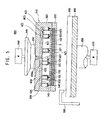
- FIG. 5 is a cross sectional view illustrating a CMP apparatus having the flexible membrane of FIG. 2 in accordance with a preferred embodiment of the present invention;
- FIG. 6 is a cross sectional view illustrating a conventional flexible membrane corresponding to the flexible membrane of FIG. 2;
- FIG. 7A is a graph showing polishing speeds at local regions of a semiconductor substrate when a copper layer on the semiconductor substrate is polished using the flexible membrane of FIG. 6;
- FIG. 7B is a graph showing polishing speeds at local regions of a semiconductor substrate when a copper layer on the semiconductor substrate is polished using the flexible membrane of FIG. 2; and
- FIG. 8 is a graph showing polishing speeds at local regions of a semiconductor substrate when an oxide layer on the semiconductor substrate is polished using the flexible membrane of FIG. 2.
-
- Referring to FIGS. 2 through 4, a
flexible membrane 100 shown there includes a compressingplate 110, first andsecond partition walls plate 110, asidewall 140 formed on the compressingplate 110, andslots second partition walls sidewall 140. The first andsecond partition walls slots flexible membrane 100 is combined with a supporter (not shown) of a polishing head (not shown). Theflexible membrane 100 holds a substrate with a vacuum VP provided thereto. Examples of theflexible membrane 100 include a rubber such as an ethylene propylene rubber, a neoprene rubber, a nitrile rubber, etc. - The compressing
plate 110 has a circular shape. However, the shape of the compressingplate 110 may vary in accordance with an object to be polished. Thus, when the object is a wafer having a circular shape, the compressingplate 110 has the circular shape. On the contrary, when the object is a rectangular glass used, for example, in a liquid crystal display (LCD) device, the compressingplate 110 may have a rectangular shape. - The compressing
plate 110 has afirst face 111, and asecond face 112 opposite to thefirst face 111. Thefirst face 111 is oriented in a downward direction where a polishing pad (not shown) is disposed. Thesecond face 112 is oriented in an upward direction. The substrate is held onto thefirst face 111 by the vacuum VP. The vacuum VP for holding the substrate and the pneumatic pressure for closely adhering the substrate to the polishing pad are selectively provided to thesecond face 112. - The
sidewall 140 is formed on an edge portion of thesecond face 112. Thus, thesidewall 140 has an annular shape. Thesidewall 140 is combined with the supporter. Thesidewall 140 and the supporter define an isolated space over thesecond face 112. - The dividing member includes the first and
second partition walls sidewall 140 and also having an annular shape. Thefirst partition wall 120 is disposed on a central portion of thesecond face 112. Thefirst partition wall 120 is combined with the supporter to define a vacuum region MZ1 into which the vacuum VP and a first main pneumatic pressure MP1 are selectively introduced. - The
second partition wall 130 is disposed between thefirst partition wall 120 and thesidewall 140. Thus, the first andsecond partition walls sidewall 140 are disposed in concentric circles. Alternatively, when the compressingplate 110 has a rectangular shape, the first andsecond partition walls sidewall 140 are disposed in concentric rectangles. Even if the compressingplate 110 has the rectangular shape, the first andsecond partition walls sidewall 140 may still be disposed in concentric circles. Thesecond partition wall 130 is combined with the supporter to divide a space between thefirst partition wall 120 and thesidewall 140 into two spaces. - The space between the first and
second partition walls second partition wall 130 and thesidewall 140 is defined as a peripheral pressure region MZ3 to which a third main pneumatic pressure MP3 for compressing the substrate is applied. That is, the substrate is held onto thefirst face 111 of the compressingplate 110 by the vacuum VP provided to the vacuum region MZ1. In addition, the substrate is adhered to the polishing pad by the first, second and third main pneumatic pressures MP1, MP2 and MP3 provided to the vacuum region MZ1, the main pressure region MZ2 and the peripheral pressure region MZ3, respectively. - To provide first, second and third auxiliary pressures AP1, AP2 and AP3 through the first and
second partition walls sidewall 140 to the compressingplate 110, respectively, the first, second and third pneumatic pressure-introducing portions are formed at the first andsecond partition walls sidewall 140, respectively. The first pneumatic pressure-introducing portion includes thefirst slot 125 formed at thefirst partition wall 120, the second pneumatic pressure-introducing portion includes thesecond slot 135 formed at thesecond partition wall 130, and the third pneumatic pressure-introducing portion includes thethird slot 145 formed at thesidewall 140. The first, second andthird slots second partition walls sidewall 140 to the second face of the compressingplate 110. The first, second andthird slots second partition walls sidewall 140. - The first, second and
third slots third slots second partition walls sidewall 140. Thefirst slot 125 divides thefirst partition wall 120 into a firstinner wall 120a and a firstouter wall 120b. Thesecond slot 135 divides thesecond partition wall 130 into a secondinner wall 130a and a secondouter wall 130b. In addition, thethird slot 145 divides thesidewall 140 into aninner sidewall 140a and anouter sidewall 140b. - First, second and third auxiliary region-forming members are formed at the first and
second partition walls sidewall 140, respectively. The first, second and third auxiliary region-forming members define first, second and third auxiliary pressure regions AZ1, AZ2 and AZ3, respectively. The first auxiliary pressure region-forming member includes a first partition plate formed on thefirst partition wall 120 to define the first auxiliary pressure region AZ1, the second auxiliary pressure region-forming member includes a second partition plate formed on thesecond partition wall 130 to define the second auxiliary pressure region AZ2, and the third auxiliary pressure region-forming member includes a third partition plate formed on thesidewall 140 to define the third auxiliary pressure region AZ3. - The first, second and third partition plates include first, second and third inner extending
portions second partition walls sidewall 140, respectively, first, second and third outer extendingportions second partition walls sidewall 140, respectively, first, second and thirdinner fencing portions portions outer fencing portions portions portions portions second partition walls sidewall 140 so that step differences between the surfaces of the extendingportions walls - Upper ends of the first inner and
outer fencing portions first partition wall 120. This space is defined as the first auxiliary pressure region AZ1 to which the first auxiliary pneumatic pressure AP1 is applied. - Upper ends of the second inner and
outer fencing portions second partition wall 130. This space is defined as the second auxiliary pressure region AZ2 to which the second auxiliary pneumatic pressure AP2 is applied. - Upper ends of the third inner and
outer fencing portions sidewall 140. This space is defined as the third auxiliary pressure region AZ3 to which the third auxiliary pneumatic pressure AP3 is applied. - The first, second and
third slots second partition walls sidewall 140 to the compressingplate 110. Thus, the first, second andthird slots third slots - Each of the first, second and
third slots second partition walls sidewall 140. The first, second and third auxiliary pneumatic pressures AP1, AP2 and AP3 are directly provided to thesecond face 112 of the compressingplate 110 through the first, second andthird slots plate 110 through the first, second and third auxiliary pressure regions AZ1, AZ2 and AZ3, respectively, are substantially identical to the first, second and third main pneumatic pressures MP1, MP2 and MP3 providing the compressingplate 110 through the vacuum region MZ1, the main pressure region MZ2 and the peripheral pressure region MZ3, respectively. Therefore, a uniform pressure is provided to thesecond face 112 of the compressingplate 110 so that thefirst face 111 of the compressingplate 110 uniformly adheres to the substrate on the polishing pad. - As shown in FIGS. 2 through 4, upper widths of the first, second and
third slots third slots plate 110 exposed through the first, second andthird slots third slots third slots - Referring to FIG. 5, showing a
CMP 600 apparatus having theflexible membrane 100 of FIG. 2 in accordance with a preferred embodiment of the invention, theCMP apparatus 600 includes aplaten 660 and a polishinghead 610 disposed over theplaten 660. Apolishing pad 680 on which a substrate S is closely adhered is attached to a surface of theplaten 660. Theplaten 660 is connected to afirst motor 670 via ashaft 690. Aslurry line 685 for providing slurry to a surface of thepolishing pad 680 is disposed adjacent to the surface of thepolishing pad 680. - The polishing
head 610 includes asecond motor 640, asupporter 620 connected to thesecond motor 640 via ashaft 645, theflexible membrane 100 supported by thesupporter 620 for holding the substrate S, and aretainer ring 650 for preventing the substrate S held by theflexible membrane 100 from being detached. - As described above with reference to FIGS. 2 through 4, the
flexible membrane 100 has the pneumatic pressure-introducing portions corresponding to theslots flexible membrane 100, further illustrations of theflexible membrane 100 and other elements in FIGS. 2 through 4 are omitted. Theflexible membrane 100 is supported on a lower face of thesupporter 620. The substrate S is held onto a lower face of theflexible membrane 100 and is closely adhered to the surface of thepolishing pad 680. - The
retainer ring 650 is mounted on an edge portion of the lower face of thesupporter 620 to prevent the detachment of the substrate S from theflexible membrane 100 in a polishing operation. - The
supporter 620 has a structure that includes a space for receiving theflexible membrane 100 therein. Further, thesupporter 620 includes first and second partition wall-supportingportions second partition walls flexible membrane 100, and a sidewall-supportingportion 623 for supporting thesidewall 140 of theflexible membrane 100. - The vacuum region MZ1 is defined by the
first partition wall 120, the first partition wall-supportingportion 621, the lower face of thesupporter 620 and the surface of the compressingplate 110. The main pressure region MZ2 is defined by the first andsecond partition walls portions supporter 620 and the surface of the compressingplate 110. In addition, the peripheral pressure region MZ3 is defined by thesecond partition wall 130, thesidewall 140, the second partition wall-supportingportion 622, the sidewall-supportingportion 623, the lower face of thesupporter 620 and the surface of the compressingplate 110. - The first auxiliary pressure region AZ1 is defined by the surface of the
first partition wall 120, the first partition plate and the lower face of thesupporter 620. The second auxiliary pressure region AZ2 is defined by the surface of thesecond partition wall 130, the second partition plate and the lower face of thesupporter 620. In addition, the third auxiliary pressure region AZ3 is defined by the surface of thesidewall 140, the third partition plate and the lower face of thesupporter 620. - A
first passageway 630 for providing the pneumatic pressures MP1, MP2, MP3, AP1, AP2 and AP3 to the regions MZ1, MZ2, MZ3, AZ1, AZ2 and AZ3, respectively, is formed through thesupporter 620. Thefirst passageway 630 diverges into first, second and thirdmain passageways auxiliary passageways - A
second passageway 630a for providing the vacuum VP for holding the substrate S onto the vacuum region MZ1 is formed through thesupporter 620. The substrate S is adhered to the lower face of the compressingplate 110 by the vacuum VP that is provided to the vacuum region MZ1 through thesecond passageway 630a. - The pneumatic pressures MP1, MP2, MP3, AP1, AP2 and AP3 are provided to the regions MZ1, MZ2, MZ3, AZ1, AZ2 and AZ3 through the
first passageway 630. In particular, the first, second and third main pneumatic pressures MP1, MP2 and MP3 are directly provided to the surface of the compressingplate 110 through the first, second and thirdmain passageways plate 110 through the first, second and thirdauxiliary passageways - The substrate S is uniformly adhered to the
polishing pad 680 by the main and auxiliary pneumatic pressures MP1, MP2, MP3, AP1, AP2 and AP3. The slurry is then provided to the surface of thepolishing pad 680 from theslurry line 685. Thefirst motor 670 rotates thepolishing pad 680 in a first direction, for example, in a clockwise direction. In addition, thesecond motor 640 rotates the polishinghead 610 in a second direction opposite to the first direction, for example, in a counterclockwise direction. Thus, the substrate S is rotated and simultaneously compressed on thepolishing pad 680, thereby polishing the surface of the substrate S to a uniform thickness. - In an experiment, polishing characteristics of a flexible membrane having a size of about 200mm without pneumatic pressure-introducing portions and the
flexible membrane 100 of FIG. 2 were compared to each other. - To compare the polishing characteristics between the flexible membranes, a
flexible membrane 1000 without the pneumatic pressure-introducing portions shown in FIG. 6 was manufactured. Theflexible membrane 1000 had a size and a configuration substantially identical to that of theflexible membrane 100 except that theflexible membrane 1000 did not have the pneumatic pressure-introducing portions. Theflexible membrane 1000 and theflexible membrane 100 were employed in theCMP apparatus 600 of FIG. 5. - In order to form a layer to be polished, an oxide layer having a thickness of about 6,000Å was formed on a semiconductor substrate having a size of about 200mm. A tantalum layer having a thickness of about 250Å was formed on the oxide layer. A seed layer including copper and having a thickness of about 1,500Å was formed on the tantalum layer. A copper layer having a thickness of about 14,000Å was then formed on the seed layer using an electroplating method. Two semiconductor substrates having the above structure were then prepared.
- Pneumatic pressures for polishing were applied to the
flexible membranes Region MZ1 MZ2 MZ3 AZ1 AZ2 AZ3 Pneumatic pressure
(psi)Flexible membrane
10002.8 2.45 2.6 4.0 3.5 2.0 Flexible membrane
1002.4 2.23 2.3 2.0 1.8 1.0 - As shown in Table 1, in the
flexible membrane 1000 the first main pneumatic pressure MP1 provided to the vacuum region MZ1 is 2.8 psi, the second main pneumatic pressure MP2 provided to the main pressure region MZ2 is 2.45 psi, and the third main pneumatic pressure MP3 provided to the peripheral pressure region MZ3 is 2.6 psi. In addition, the first auxiliary pneumatic pressure AP1 provided to the first auxiliary pressure region AZ1 is 4.0 psi, the second auxiliary pneumatic pressure AP2 provided to the second auxiliary pressure region AZ2 is 3.5 psi, and the third auxiliary pneumatic pressure AP3 provided to the third auxiliary pressure region is 2.0 psi. - According to the above measurements, it can be observed that the auxiliary pneumatic pressures AP1, AP2 and AP3 in the auxiliary pressure regions AZ1, AZ2 and AZ3 in the
flexible membrane 1000 were very different from each other. On the contrary, as shown in Table 1, in theflexible membrane 100 the first main pneumatic pressure MP1 provided to the vacuum region MZ1 is 2.4 psi, the second main pneumatic pressure MP2 provided to the main pressure region MZ2 is 2.23 psi, and the third main pneumatic pressure MP3 provided to the peripheral pressure region MZ3 is 2.3 psi. In addition, the first auxiliary pneumatic pressure AP1 provided to the first auxiliary pressure region AZ1 is 2.0 psi, the second auxiliary pneumatic pressure AP2 provided to the second auxiliary pressure region AZ2 is 1.8 psi, and the third auxiliary pneumatic pressure AP3 provided to the third auxiliary pressure region is 1.0 psi. - Thus, according to the above measurements, it can be observed that the auxiliary pneumatic pressures AP1, AP2 and AP3 in the auxiliary pressure regions AZ1, AZ2 and AZ3 were lower than the main pneumatic pressures MP1, MP2 and MP3 in the vacuum region MZ1, the main pressure region MZ2 and the peripheral pressure region MZ3, respectively, in the
flexible membrane 100. - Polishing processes were also performed on the two semiconductor substrates using the CMP apparatuses having the
flexible membranes - FIG. 7A is a graph showing polishing speeds at positions of a semiconductor substrate when a copper layer on the semiconductor substrate is polished using the
flexible membrane 1000 of FIG. 6. FIG. 7B is a graph showing polishing speeds at positions of a semiconductor substrate when a copper layer on the semiconductor substrate is polished using theflexible membrane 100 of FIG. 2. In FIGS. 7A and 7B, a horizontal axis represents positions of the substrate and a vertical axis represents a polishing speed. - As shown in FIG. 7A, a polishing speed with respect to portions of the substrate, which correspond to the vacuum region MZ1, the main pneumatic pressure region MZ2 and the peripheral pneumatic pressure region MZ3, was about 8,000Å/min. A polishing speed with respect to portions of the substrate, which correspond to the first and second auxiliary pressure regions AZ1 and AZ2, was about 6,000Å/min. A polishing speed with respect to a portion of the substrate, which corresponds to the third auxiliary pressure region, was about 11,000Å/min.
- The polishing speeds between the main pressure regions MZ1, MZ2 and MZ3 and the auxiliary pressure regions AZ1, AZ2 and AZ3 were very different from each other. This was due to the measured pneumatic pressures. For example, the pneumatic pressures in the auxiliary pressure regions AZ1, AZ2 and AZ3 were considerably different from those in the vacuum region MZ1, the main pressure region MZ2 and the peripheral pressure region MZ3. In addition, the pneumatic pressures in the auxiliary pressure regions AZ1, AZ2 and AZ3 were different from each other. As a result, the
flexible membrane 1000 does not always uniformly compress the substrate on the polishing pad. - On the contrary, as shown in FIG. 7B, polishing speeds were about 9,500Å/min to about 10,000Å/min in all the regions except the third auxiliary pressure region AZ3 in which a polishing speed was no less than about 11,000Å/min.
- The auxiliary pneumatic pressures applied to the auxiliary pressure regions AZ1, AZ2 and AZ3 were substantially similar to each other and were also little different from the main pneumatic pressures applied to the main pressure regions MZ1, MZ2 and MZ3. Therefore, the
flexible membrane 100 in accordance with the present invention uniformly compresses the substrate on the polishing pad so that the CMP apparatus having theflexile membrane 100 can polish the substrate to a uniform thickness. - In another experiment regarding polishing characteristics of the
flexible membrane 100, a fluorine doped silicate glass (FSG) having a thickness of about 3,000Å was deposited on a semiconductor substrate. - A polishing process was performed on the substrate using the
flexible membrane 100 for about 90 seconds. In this polishing process, a silica-based slurry was used as an abrasive. A rotational speed of the polishing head was about 23 rpm and a rotational speed of the platen was about 300 rpm. - FIG. 8 is a graph showing polishing speeds at positions of a semiconductor substrate when an FSG layer on the semiconductor substrate is polished using the
flexible membrane 100. In FIG. 8, line 1' represents a desired target polishing speed and line 2' represents an actual polishing speed. - As shown in FIG. 8, when the substrate was polished using the CMP apparatus having the
flexible membrane 100, the actual polishing speed was substantially identical or similar to the target polishing speed. In addition, the actual polishing speeds at certain positions of the substrate were substantially similar to each other. - Thus, the CMP apparatus having the
flexible membrane 100 polished the substrate to a uniform thickness. As a result, theflexible membrane 100 closely adhered the substrate to the polishing pad. - According to a preferred embodiment of invention, the pneumatic pressure-introducing portions are formed at the dividing member and the sidewall so that the pneumatic pressure is directly provided to the portions of the compressing plates under the dividing member and the sidewall. Thus, because the uniform pneumatic pressure is applied to the compressing plate, the compressing plate closely adheres the substrate to the polishing pad. As a result, the substrate may be polished to a uniform thickness.
- Having described preferred embodiments of the invention, it is noted that modifications and variations can be made by persons of ordinary skill in the art in light of the above teachings. It is therefore to be understood that various changes, substitutions and alterations may be made herein without departing from the scope and the spirit of the invention as outlined by the appended claims.
Claims (12)
- A flexible membrane for a polishing head, comprising
a compressing plate (110) having a first face (111) for holding and compressing a substrate and a second face (112) opposite to the first face, and
a dividing member (120) formed on the second face to divide the second face into at least two regions (MZ1, MZ2) for introducing a first pneumatic pressure (MP1) to at least one of these two regions of the second face for compressing the substrate,
characterized in that
the dividing member (120) includes a first pneumatic pressure-introducing portion (125) for introducing a second pneumatic pressure (AP1) onto the second face (112). - The flexible membrane of claim 1, wherein the dividing member comprises:a first partition wall (120) disposed on a central portion of the second face, the first partition wall defining a vacuum region (MZ1) for selectively applying a vacuum (VP) for holding the substrate or applying the first pneumatic pressure as a first main pneumatic pressure for compressing the substrate; anda second partition wall (130) disposed on a portion of the second face outside the first partition wall, the second partition wall defining a main pressure region (MZ2) into which a second main pneumatic pressure is introduced.
- The flexible membrane of claim 1 or 2, further comprising:a sidewall (140) disposed on an edge portion of the second face.
- The flexible membrane of any of claims 1 to 3, wherein the second pneumatic pressure is substantially equal to or is less than the first pneumatic pressure.
- The flexible membrane of any of claims 2 to 4, wherein
the first partition wall has the first pneumatic pressure-introducing portion for introducing a first auxiliary pneumatic pressure (AP1) as the second pneumatic pressure onto the second face; and/or
the second partition wall has a second pneumatic pressure-introducing portion (135) for introducing a second auxiliary pneumatic pressure (AP2) onto the second face; and/or
the sidewall defines a peripheral pressure region (MZ3) with the second partition wall for introducing a third main pneumatic pressure (MP3). - The flexible membrane of any of claims 1 to 5, wherein the dividing member or any of the first and second partition walls comprises:an inner wall (120a);an outer wall (120b) facing the inner wall, the inner and outer walls defining the first and/or second pneumatic pressure-introducing portion;an inner extending portion (121a) horizontally extending from an upper end of the inner wall to a central portion of the compressing plate;an outer extending portion (121b) horizontally extending from an upper end of the outer wall to an edge portion of the compressing plate;an inner fencing portion (122a) upwardly extending from an end of the inner extending portion; andan outer fencing portion (122b) upwardly extending from an end of the outer extending portion.
- The flexible membrane of any of claims 3 to 6, further comprising a third pneumatic pressure-introducing portion (145) for introducing a third auxiliary pneumatic pressure (AP3) onto the edge portion of the second face formed at the sidewall.
- The flexible membrane of any of claims 1 to 7, wherein the first and/or the second and/or the third pneumatic pressure-introducing portion comprises a slot formed at a surface portion of the dividing member and/or the partition walls and/or the sidewall.
- The flexible membrane of claim 8, wherein the slot is arranged in a direction in accordance with a longitudinal direction of the dividing member and/or the partition walls and/or the sidewall and/or wherein the slot has a depth substantially identical to a height of the dividing member and/or the partition walls and/or the sidewall.
- The flexible membrane of any of claims 6 to 9, wherein the second auxiliary pneumatic pressure is less that the second main pneumatic pressure.
- The flexible membrane of any of claims 1 to 10, wherein the compressing plate and/or the dividing member comprises one of an ethylene propylene rubber, a neoprene rubber and a nitrile rubber.
- A chemical mechanical polishing (CMP) apparatus comprising:characterized in thata platen (660) having a pad (680) for polishing a substrate; anda polishing head (610) disposed over the platen, the polishing head including a flexible membrane (100) for holding and compressing the substrate on the polishing pad and a supporter (620) for supporting the flexible membrane,
the flexible membrane is one according to any of claims 1 to 11.
Applications Claiming Priority (2)
| Application Number | Priority Date | Filing Date | Title |
|---|---|---|---|
| KR1020040008267A KR100586018B1 (en) | 2004-02-09 | 2004-02-09 | Flexible membrane for polishing head and polishing device comprising same |
| KR2004008267 | 2004-02-09 |
Publications (2)
| Publication Number | Publication Date |
|---|---|
| EP1561540A1 true EP1561540A1 (en) | 2005-08-10 |
| EP1561540B1 EP1561540B1 (en) | 2008-04-09 |
Family
ID=34676019
Family Applications (1)
| Application Number | Title | Priority Date | Filing Date |
|---|---|---|---|
| EP05002236A Expired - Lifetime EP1561540B1 (en) | 2004-02-09 | 2005-02-03 | Flexible membrane for a polishing head and CMP apparatus having the same |
Country Status (6)
| Country | Link |
|---|---|
| US (1) | US7166019B2 (en) |
| EP (1) | EP1561540B1 (en) |
| JP (1) | JP4384993B2 (en) |
| KR (1) | KR100586018B1 (en) |
| DE (1) | DE602005005864T2 (en) |
| DK (1) | DK1561540T3 (en) |
Families Citing this family (16)
| Publication number | Priority date | Publication date | Assignee | Title |
|---|---|---|---|---|
| US20080033465A1 (en) * | 2006-08-01 | 2008-02-07 | Baxano, Inc. | Multi-Wire Tissue Cutter |
| US8454413B2 (en) | 2005-12-29 | 2013-06-04 | Applied Materials, Inc. | Multi-chamber carrier head with a textured membrane |
| KR100725923B1 (en) * | 2006-06-08 | 2007-06-11 | 황석환 | Membrane for polishing head |
| CN103252711B (en) * | 2008-03-25 | 2016-06-29 | 应用材料公司 | The carrier head thin film of improvement |
| US8475231B2 (en) | 2008-12-12 | 2013-07-02 | Applied Materials, Inc. | Carrier head membrane |
| US10160093B2 (en) * | 2008-12-12 | 2018-12-25 | Applied Materials, Inc. | Carrier head membrane roughness to control polishing rate |
| US9862070B2 (en) | 2011-11-16 | 2018-01-09 | Applied Materials, Inc. | Systems and methods for substrate polishing end point detection using improved friction measurement |
| US10532441B2 (en) * | 2012-11-30 | 2020-01-14 | Applied Materials, Inc. | Three-zone carrier head and flexible membrane |
| KR101629161B1 (en) * | 2013-04-18 | 2016-06-21 | 주식회사 케이씨텍 | Carrier head of chemical mechanical apparatus and membrane used therein |
| KR102238750B1 (en) | 2013-08-10 | 2021-04-08 | 어플라이드 머티어리얼스, 인코포레이티드 | A method of polishing a new or a refurbished electrostatic chuck |
| US10328549B2 (en) * | 2013-12-11 | 2019-06-25 | Taiwan Semiconductor Manufacturing Co., Ltd. | Polishing head, chemical-mechanical polishing system and method for polishing substrate |
| TWI658899B (en) | 2014-03-31 | 2019-05-11 | Ebara Corporation | Grinding device and grinding method |
| KR101587780B1 (en) * | 2014-10-24 | 2016-01-25 | 주식회사 케이씨텍 | Membrane of carrier head of chemical mechanical apparatus and membrane used therein |
| US11325223B2 (en) * | 2019-08-23 | 2022-05-10 | Applied Materials, Inc. | Carrier head with segmented substrate chuck |
| SG10202008012WA (en) * | 2019-08-29 | 2021-03-30 | Ebara Corp | Elastic membrane and substrate holding apparatus |
| JP2025049801A (en) | 2023-09-22 | 2025-04-04 | 株式会社荏原製作所 | Elastic membrane, polishing head, and polishing method |
Citations (5)
| Publication number | Priority date | Publication date | Assignee | Title |
|---|---|---|---|---|
| WO2002007931A2 (en) * | 2000-07-25 | 2002-01-31 | Applied Materials, Inc. | Multi-chamber carrier head with a flexible membrane |
| US6361420B1 (en) * | 1998-11-25 | 2002-03-26 | Applied Materials, Inc. | Method of chemical mechanical polishing with edge control |
| US20020039879A1 (en) * | 2000-07-11 | 2002-04-04 | Zuniga Steven M. | Carrier head with flexible membranes to provide controllable pressure and loading area |
| US20020111122A1 (en) * | 2000-03-31 | 2002-08-15 | Korovin Nikolay N. | Work piece carrier with adjustable pressure zones and barriers and a method of planarizing a work piece |
| US6447379B1 (en) * | 2000-03-31 | 2002-09-10 | Speedfam-Ipec Corporation | Carrier including a multi-volume diaphragm for polishing a semiconductor wafer and a method therefor |
Family Cites Families (12)
| Publication number | Priority date | Publication date | Assignee | Title |
|---|---|---|---|---|
| US6036587A (en) * | 1996-10-10 | 2000-03-14 | Applied Materials, Inc. | Carrier head with layer of conformable material for a chemical mechanical polishing system |
| US5851140A (en) * | 1997-02-13 | 1998-12-22 | Integrated Process Equipment Corp. | Semiconductor wafer polishing apparatus with a flexible carrier plate |
| US5957751A (en) * | 1997-05-23 | 1999-09-28 | Applied Materials, Inc. | Carrier head with a substrate detection mechanism for a chemical mechanical polishing system |
| EP0881039B1 (en) * | 1997-05-28 | 2003-04-16 | Tokyo Seimitsu Co.,Ltd. | Wafer polishing apparatus with retainer ring |
| US5916015A (en) * | 1997-07-25 | 1999-06-29 | Speedfam Corporation | Wafer carrier for semiconductor wafer polishing machine |
| JP2000084836A (en) * | 1998-09-08 | 2000-03-28 | Speedfam-Ipec Co Ltd | Carrier and polishing equipment |
| US6277014B1 (en) * | 1998-10-09 | 2001-08-21 | Applied Materials, Inc. | Carrier head with a flexible membrane for chemical mechanical polishing |
| US6176764B1 (en) * | 1999-03-10 | 2001-01-23 | Micron Technology, Inc. | Polishing chucks, semiconductor wafer polishing chucks, abrading methods, polishing methods, simiconductor wafer polishing methods, and methods of forming polishing chucks |
| JP3085948B1 (en) * | 1999-05-10 | 2000-09-11 | 株式会社東京精密 | Wafer polishing equipment |
| US6050882A (en) * | 1999-06-10 | 2000-04-18 | Applied Materials, Inc. | Carrier head to apply pressure to and retain a substrate |
| KR100423909B1 (en) | 2000-11-23 | 2004-03-24 | 삼성전자주식회사 | Polishing head of a chemical mechanical polishing machine and polishing method using the polishing head |
| KR100437456B1 (en) | 2001-05-31 | 2004-06-23 | 삼성전자주식회사 | Polishing head of a chemical mechanical polishing machine and polishing method using the polishing head |
-
2004
- 2004-02-09 KR KR1020040008267A patent/KR100586018B1/en not_active Expired - Fee Related
-
2005
- 2005-01-27 US US11/044,373 patent/US7166019B2/en not_active Expired - Fee Related
- 2005-01-27 JP JP2005020222A patent/JP4384993B2/en not_active Expired - Fee Related
- 2005-02-03 DK DK05002236T patent/DK1561540T3/en active
- 2005-02-03 DE DE602005005864T patent/DE602005005864T2/en not_active Expired - Lifetime
- 2005-02-03 EP EP05002236A patent/EP1561540B1/en not_active Expired - Lifetime
Patent Citations (5)
| Publication number | Priority date | Publication date | Assignee | Title |
|---|---|---|---|---|
| US6361420B1 (en) * | 1998-11-25 | 2002-03-26 | Applied Materials, Inc. | Method of chemical mechanical polishing with edge control |
| US20020111122A1 (en) * | 2000-03-31 | 2002-08-15 | Korovin Nikolay N. | Work piece carrier with adjustable pressure zones and barriers and a method of planarizing a work piece |
| US6447379B1 (en) * | 2000-03-31 | 2002-09-10 | Speedfam-Ipec Corporation | Carrier including a multi-volume diaphragm for polishing a semiconductor wafer and a method therefor |
| US20020039879A1 (en) * | 2000-07-11 | 2002-04-04 | Zuniga Steven M. | Carrier head with flexible membranes to provide controllable pressure and loading area |
| WO2002007931A2 (en) * | 2000-07-25 | 2002-01-31 | Applied Materials, Inc. | Multi-chamber carrier head with a flexible membrane |
Also Published As
| Publication number | Publication date |
|---|---|
| US20050176354A1 (en) | 2005-08-11 |
| DE602005005864T2 (en) | 2009-06-04 |
| EP1561540B1 (en) | 2008-04-09 |
| JP4384993B2 (en) | 2009-12-16 |
| JP2005223322A (en) | 2005-08-18 |
| KR20050080246A (en) | 2005-08-12 |
| DE602005005864D1 (en) | 2008-05-21 |
| DK1561540T3 (en) | 2008-08-04 |
| US7166019B2 (en) | 2007-01-23 |
| KR100586018B1 (en) | 2006-06-01 |
Similar Documents
| Publication | Publication Date | Title |
|---|---|---|
| EP1561540A1 (en) | Flexible membrane for a polishing head and CMP apparatus having the same | |
| US6962521B2 (en) | Edge polished wafer, polishing cloth for edge polishing, and apparatus and method for edge polishing | |
| EP0845328A2 (en) | Polishing pad and apparatus for polishing a semiconductor wafer | |
| JP4212776B2 (en) | Chemical mechanical polishing head | |
| TWI279898B (en) | Multiple zone carrier head with flexible membrane | |
| KR101410358B1 (en) | Membrane of a chemical mechanical polishing apparatus and polishing head of a chemical mechanical polishing apparatus | |
| KR100727485B1 (en) | Polishing pads and methods for manufacturing the same, and chemical mechanical polishing apparatus and method | |
| KR20050116072A (en) | Polishing head used in chemical mechanical polishing apparatus and polishing method | |
| TWI839430B (en) | Polishing system with platen for substrate edge control | |
| US6213852B1 (en) | Polishing apparatus and method of manufacturing a semiconductor device using the same | |
| EP1195798B1 (en) | Method for producing semiconductor wafer | |
| KR100437456B1 (en) | Polishing head of a chemical mechanical polishing machine and polishing method using the polishing head | |
| JP2009148892A (en) | Polishing pad and polishing device | |
| US20030077986A1 (en) | Front-reference carrier on orbital solid platen | |
| KR102057833B1 (en) | Membrane in carrier head for chemical mechanical polishing apparatus | |
| US6767428B1 (en) | Method and apparatus for chemical mechanical planarization | |
| US20040259480A1 (en) | [polishing pad and process of chemical mechanical use thereof] | |
| KR20160131185A (en) | Carrier for substrate and chemical mechanical polishing apparatus having the same | |
| JP2007035917A (en) | Polishing pad, silicon wafer and polishing machine | |
| US20240227122A9 (en) | Chemical mechanical polishing device and polishing method | |
| KR20220108500A (en) | Retainer ring and substrate polishing appratus comprising the same | |
| KR20220026783A (en) | Retainer ring | |
| KR20220062814A (en) | Retainer ring and substrate polishing appratus comprising the same | |
| KR20050014074A (en) | slurry for chemical mechanical polishing and polishing method using the same | |
| KR20060019002A (en) | Chemical mechanical polishing apparatus |
Legal Events
| Date | Code | Title | Description |
|---|---|---|---|
| PUAI | Public reference made under article 153(3) epc to a published international application that has entered the european phase |
Free format text: ORIGINAL CODE: 0009012 |
|
| AK | Designated contracting states |
Kind code of ref document: A1 Designated state(s): AT BE BG CH CY CZ DE DK EE ES FI FR GB GR HU IE IS IT LI LT LU MC NL PL PT RO SE SI SK TR |
|
| AX | Request for extension of the european patent |
Extension state: AL BA HR LV MK YU |
|
| 17P | Request for examination filed |
Effective date: 20051229 |
|
| AKX | Designation fees paid |
Designated state(s): DE DK FR GB IT |
|
| 17Q | First examination report despatched |
Effective date: 20060720 |
|
| 17Q | First examination report despatched |
Effective date: 20060720 |
|
| GRAP | Despatch of communication of intention to grant a patent |
Free format text: ORIGINAL CODE: EPIDOSNIGR1 |
|
| GRAS | Grant fee paid |
Free format text: ORIGINAL CODE: EPIDOSNIGR3 |
|
| GRAA | (expected) grant |
Free format text: ORIGINAL CODE: 0009210 |
|
| AK | Designated contracting states |
Kind code of ref document: B1 Designated state(s): DE DK FR GB IT |
|
| REG | Reference to a national code |
Ref country code: GB Ref legal event code: FG4D |
|
| REF | Corresponds to: |
Ref document number: 602005005864 Country of ref document: DE Date of ref document: 20080521 Kind code of ref document: P |
|
| REG | Reference to a national code |
Ref country code: DK Ref legal event code: T3 |
|
| ET | Fr: translation filed | ||
| PLBE | No opposition filed within time limit |
Free format text: ORIGINAL CODE: 0009261 |
|
| STAA | Information on the status of an ep patent application or granted ep patent |
Free format text: STATUS: NO OPPOSITION FILED WITHIN TIME LIMIT |
|
| 26N | No opposition filed |
Effective date: 20090112 |
|
| PGFP | Annual fee paid to national office [announced via postgrant information from national office to epo] |
Ref country code: DE Payment date: 20140122 Year of fee payment: 10 Ref country code: DK Payment date: 20140121 Year of fee payment: 10 |
|
| PGFP | Annual fee paid to national office [announced via postgrant information from national office to epo] |
Ref country code: IT Payment date: 20140127 Year of fee payment: 10 Ref country code: FR Payment date: 20140221 Year of fee payment: 10 |
|
| PGFP | Annual fee paid to national office [announced via postgrant information from national office to epo] |
Ref country code: GB Payment date: 20140127 Year of fee payment: 10 |
|
| REG | Reference to a national code |
Ref country code: DE Ref legal event code: R119 Ref document number: 602005005864 Country of ref document: DE |
|
| REG | Reference to a national code |
Ref country code: DK Ref legal event code: EBP Effective date: 20150228 |
|
| GBPC | Gb: european patent ceased through non-payment of renewal fee |
Effective date: 20150203 |
|
| REG | Reference to a national code |
Ref country code: FR Ref legal event code: ST Effective date: 20151030 |
|
| PG25 | Lapsed in a contracting state [announced via postgrant information from national office to epo] |
Ref country code: IT Free format text: LAPSE BECAUSE OF NON-PAYMENT OF DUE FEES Effective date: 20150203 |
|
| PG25 | Lapsed in a contracting state [announced via postgrant information from national office to epo] |
Ref country code: DK Free format text: LAPSE BECAUSE OF NON-PAYMENT OF DUE FEES Effective date: 20150228 Ref country code: DE Free format text: LAPSE BECAUSE OF NON-PAYMENT OF DUE FEES Effective date: 20150901 Ref country code: GB Free format text: LAPSE BECAUSE OF NON-PAYMENT OF DUE FEES Effective date: 20150203 |
|
| PG25 | Lapsed in a contracting state [announced via postgrant information from national office to epo] |
Ref country code: FR Free format text: LAPSE BECAUSE OF NON-PAYMENT OF DUE FEES Effective date: 20150302 |