EP1560372B1 - Verfahren und Vorrichtung zur automatischen Erkennung der Bitrate von CAN-Bus-Netzwerk - Google Patents
Verfahren und Vorrichtung zur automatischen Erkennung der Bitrate von CAN-Bus-Netzwerk Download PDFInfo
- Publication number
- EP1560372B1 EP1560372B1 EP05364003A EP05364003A EP1560372B1 EP 1560372 B1 EP1560372 B1 EP 1560372B1 EP 05364003 A EP05364003 A EP 05364003A EP 05364003 A EP05364003 A EP 05364003A EP 1560372 B1 EP1560372 B1 EP 1560372B1
- Authority
- EP
- European Patent Office
- Prior art keywords
- signal
- bit
- network
- microcontroller
- throughput
- Prior art date
- Legal status (The legal status is an assumption and is not a legal conclusion. Google has not performed a legal analysis and makes no representation as to the accuracy of the status listed.)
- Expired - Lifetime
Links
- 238000000034 method Methods 0.000 title claims description 39
- 230000007704 transition Effects 0.000 claims description 58
- 230000006978 adaptation Effects 0.000 claims description 19
- 238000001514 detection method Methods 0.000 claims description 17
- 230000008569 process Effects 0.000 claims description 11
- 230000000903 blocking effect Effects 0.000 claims description 8
- 230000005540 biological transmission Effects 0.000 description 15
- 238000004364 calculation method Methods 0.000 description 14
- 101100519969 Arabidopsis thaliana PHS2 gene Proteins 0.000 description 10
- 101100524751 Arabidopsis thaliana PYRR gene Proteins 0.000 description 10
- 101150101545 PHS1 gene Proteins 0.000 description 10
- 230000009849 deactivation Effects 0.000 description 9
- 238000010586 diagram Methods 0.000 description 8
- 235000021183 entrée Nutrition 0.000 description 6
- 239000011159 matrix material Substances 0.000 description 6
- 230000000630 rising effect Effects 0.000 description 5
- 230000008859 change Effects 0.000 description 4
- 241001080024 Telles Species 0.000 description 3
- 238000004891 communication Methods 0.000 description 3
- 230000004044 response Effects 0.000 description 3
- 238000012795 verification Methods 0.000 description 3
- 241001644893 Entandrophragma utile Species 0.000 description 2
- 240000008042 Zea mays Species 0.000 description 2
- 238000005259 measurement Methods 0.000 description 2
- 230000007246 mechanism Effects 0.000 description 2
- 238000012545 processing Methods 0.000 description 2
- 238000005070 sampling Methods 0.000 description 2
- 238000010200 validation analysis Methods 0.000 description 2
- 101100043434 Oryza sativa subsp. japonica SERR gene Proteins 0.000 description 1
- 102100038277 Prostaglandin G/H synthase 1 Human genes 0.000 description 1
- 108050003243 Prostaglandin G/H synthase 1 Proteins 0.000 description 1
- 230000004913 activation Effects 0.000 description 1
- 238000004378 air conditioning Methods 0.000 description 1
- 230000001627 detrimental effect Effects 0.000 description 1
- 230000011664 signaling Effects 0.000 description 1
- 239000000725 suspension Substances 0.000 description 1
- 238000012360 testing method Methods 0.000 description 1
Images


Classifications
-
- H—ELECTRICITY
- H04—ELECTRIC COMMUNICATION TECHNIQUE
- H04L—TRANSMISSION OF DIGITAL INFORMATION, e.g. TELEGRAPHIC COMMUNICATION
- H04L12/00—Data switching networks
- H04L12/28—Data switching networks characterised by path configuration, e.g. LAN [Local Area Networks] or WAN [Wide Area Networks]
- H04L12/40—Bus networks
- H04L12/407—Bus networks with decentralised control
- H04L12/413—Bus networks with decentralised control with random access, e.g. carrier-sense multiple-access with collision detection [CSMA-CD]
- H04L12/4135—Bus networks with decentralised control with random access, e.g. carrier-sense multiple-access with collision detection [CSMA-CD] using bit-wise arbitration
-
- H—ELECTRICITY
- H04—ELECTRIC COMMUNICATION TECHNIQUE
- H04L—TRANSMISSION OF DIGITAL INFORMATION, e.g. TELEGRAPHIC COMMUNICATION
- H04L41/00—Arrangements for maintenance, administration or management of data switching networks, e.g. of packet switching networks
- H04L41/08—Configuration management of networks or network elements
- H04L41/0803—Configuration setting
- H04L41/0813—Configuration setting characterised by the conditions triggering a change of settings
- H04L41/082—Configuration setting characterised by the conditions triggering a change of settings the condition being updates or upgrades of network functionality
-
- H—ELECTRICITY
- H04—ELECTRIC COMMUNICATION TECHNIQUE
- H04L—TRANSMISSION OF DIGITAL INFORMATION, e.g. TELEGRAPHIC COMMUNICATION
- H04L41/00—Arrangements for maintenance, administration or management of data switching networks, e.g. of packet switching networks
- H04L41/08—Configuration management of networks or network elements
- H04L41/0866—Checking the configuration
- H04L41/0869—Validating the configuration within one network element
-
- H—ELECTRICITY
- H04—ELECTRIC COMMUNICATION TECHNIQUE
- H04L—TRANSMISSION OF DIGITAL INFORMATION, e.g. TELEGRAPHIC COMMUNICATION
- H04L12/00—Data switching networks
- H04L12/28—Data switching networks characterised by path configuration, e.g. LAN [Local Area Networks] or WAN [Wide Area Networks]
- H04L12/40—Bus networks
- H04L2012/40208—Bus networks characterized by the use of a particular bus standard
- H04L2012/40215—Controller Area Network CAN
-
- H—ELECTRICITY
- H04—ELECTRIC COMMUNICATION TECHNIQUE
- H04L—TRANSMISSION OF DIGITAL INFORMATION, e.g. TELEGRAPHIC COMMUNICATION
- H04L12/00—Data switching networks
- H04L12/28—Data switching networks characterised by path configuration, e.g. LAN [Local Area Networks] or WAN [Wide Area Networks]
- H04L12/40—Bus networks
- H04L2012/40267—Bus for use in transportation systems
- H04L2012/40273—Bus for use in transportation systems the transportation system being a vehicle
Definitions
- the field of the invention is that of communication networks.
- the invention relates to a method of automatic detection, by a device connected to a network, the flow rate of this network and configuration of the device at the detected rate.
- the invention also relates to the device implementing this method.
- the invention applies in particular, but not exclusively, in the case where the network is CAN bus type.
- a CAN bus (“Controller Area Network”) is a serial bus for connecting a plurality of devices, called “control units” and each comprising a CAN microcontroller. This type of bus is today mainly used in the field of industry and in the automotive field.
- CAN buses typically, in a car, two CAN buses are used.
- Each CAN bus implements a protocol of the same name (CAN protocol) which is a serial communication protocol that supports real-time systems with a high level of reliability in a limited and severe environment such as a factory, a workshop, a car.
- CAN protocol covers two of the seven layers of the ISO OSI Open Systems Interconnection Model, namely the physical layer (layer 1) and the data link layer (layer 2).
- layer 1 the physical layer
- layer 2 the data link layer
- the data link layer of the CAN protocol is such that each control unit can send and receive data.
- the data is conveyed on the bus in the form of packets (also called asynchronous frames or messages) of defined format but of variable and limited length. As soon as the bus is free, any control unit connected to the bus can issue a new packet.
- An interrupt mechanism for higher priority packets is provided, as well as a conflict arbitration mechanism resulting from the simultaneous transmission of multiple packets on the bus when it is free.
- the procedure is as follows.
- the developer of the application executed by the microcontroller CAN must know the clock frequency of the microcontroller CAN (for example 12 MHz). It also assumes that the network throughput takes one of a limited number of values (usually three values). For example, it assumes that network throughput is 100, 250, or 500 kb / s. For each of the three assumed values of the network throughput, it determines a priori, and from the knowledge of the clock frequency of the microcontroller CAN, a flow configuration for the microcontroller CAN.
- the application loads a first rate configuration associated with a first assumed value of the network rate; if the application receives error messages, it loads a second rate configuration associated with a second assumed value of the network rate; and so on so as to test (if necessary) the different predetermined flow configurations.
- US 6438462 B1 discloses a method according to the preamble of claim 1.
- a disadvantage of the aforementioned known technique is that it can not be implemented in situations where the clock frequency of the CAN microcontroller is unknown.
- Another disadvantage of the aforementioned known technique is that it does not work if no assumptions about the network throughput are correct.
- the invention particularly aims to overcome these disadvantages of the state of the art.
- one of the objectives of the present invention is to provide a method and a device for automatically detecting the flow of a network and configuration at the detected bit rate, not requiring knowledge of the clock frequency of the device, or assumptions about network throughput.
- the invention also aims to provide such a method and device not disturbing the network.
- Another object of the invention is to provide such a method and device that are simple to implement and inexpensive.
- the general principle of the invention is therefore to switch to a listening mode, allowing not to disturb the network, to perform a calculation of the bit length L bit (sometimes also called "TimeBit" in the following description ) based on an analysis of the transitions presented by the signal transmitted on the network.
- the invention therefore requires neither knowledge of the clock frequency of the device, nor hypothesis on the network speed.
- the network is a CAN bus
- the device comprises a CAN microcontroller completed with respect to a conventional CAN microcontroller so as to implement the method according to the invention of automatic flow detection. network and configuration at the detected rate.
- step (d4) a predetermined correspondence table is used, associating with each value of the number n a set of values for the synchronization segment length SYNC , PRS length L of the propagation segment and the lengths L PHS1 and L PHS2 of the first and second phase segments.
- said at least one rate adaptation condition of step (g) is the correct reception (Rx OK) of a message from the network.
- the sending of the acknowledgment field (ACK) allows the other device that sent the message to be informed that its message has been transmitted over the network and therefore not to issue an error message.
- This feature of the invention is particularly interesting in the case where only the device of the invention is able to send an acknowledgment field (ACK) to the other device.
- the network is a CAN bus
- the device comprises a CAN microcontroller completed with respect to a conventional CAN microcontroller and itself comprising said means for automatically detecting the network throughput. and configuration at the detected rate.
- the means for switching from the normal mode to the listening mode comprise means for generating a mode selection signal (Autobaud), taking the value "0" or “1” depending on whether the device is to operate in normal or listening mode respectively.
- the completed CAN microcontroller comprises a conventional CAN microcontroller modified to include itself said means for automatic detection of the network flow rate and configuration at the detected rate, except for said message blocking means transmitted.
- the sent message blocking means comprise means for producing the logical function "OR” between the mode selection signal and the transmission signal (TxDC ') of the modified conventional microcontroller CAN, the output signal of the means implementation of the logic function "OR” constituting the transmission signal (TxDC) of the microcontroller CAN completed.
- the completed microcontroller CAN further comprises means for temporarily switching from the listening mode to the normal mode, so as to send an acknowledgment field (ACK) to the network.
- ACK acknowledgment field
- the means for temporarily switching from the listening mode to the normal mode comprise means for generating a signal (EnAckB) for temporary deactivation of the mode selection signal, taking the value "0" or "1” according to that the mode selection signal (Autobaud) must be temporarily disabled or not.
- EnAckB a signal for temporary deactivation of the mode selection signal
- the invention therefore relates to a method and a device for automatically detecting the flow of a network and configuring the detected flow rate.
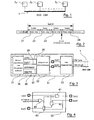
- a CAN bus 1 is a serial bus for connecting a plurality of devices 2 1 , 2 2 ... 2 n , called “control units” and comprising each a microcontroller CAN.
- CAN protocol is a serial communication protocol implemented by a CAN bus.
- ISO 11898 is a serial communication protocol implemented by a CAN bus.
- a device connected to the CAN bus and which detects an error condition has the task of signaling it, by transmitting an error message.
- Each bit has a length L BIT (also called “nominal time t BIT ”) and is defined by a structure composed of four distinct segments 21 to 24.
- Each of these four segments is composed of a whole number of unit of time (or TQ, for "Time Quanta” in English).
- the length L BIT of a bit can be expressed either in number of time units TQ or in number of periods T H of the clock of the device:
- the number n is such that: 8 ⁇ n ⁇ 25.
- the first segment is a timing segment 21 ("synchronization segment") whose length L SYNC is set to a time unit TQ.
- the second segment 22 is a propagation segment ("propagation segment"). Its role is to compensate for the physical delay induced by the CAN bus. Its length L PRS is programmable between one and eight TQ time units.
- the third and fourth segments 23, 24 are phase segments used to position a sample point. Their lengths L PHS1 and L PHS2 are also programmable.
- the device 2 1 comprises a conventional CAN microcontroller 31 and a CAN transceiver circuit 33 ("CAN transceiver").
- the latter 33 is specific to the physical layer of the CAN protocol, and is designed to provide the interface between the conventional CAN microcontroller 31 (which works at the logic level) and the CAN bus 1 (which works at the physical level).
- the conventional CAN microcontroller 31 emits a signal 35 (hereinafter referred to as the TxDC 'transmission signal) and receives another signal 36 (hereafter referred to as the RxDC' reception signal).
- the device 2 1 is further modified in that it further comprises an electronic adaptation block 32, interfaced between the modified conventional microcontroller CAN 31 and the transmitter / receiver circuit CAN 33.
- the modified conventional CAN microcontroller 31 and the electronic adaptation block 32 together form a completed CAN microcontroller 34, specific to the present invention.
- the electronic adaptation block 32 receives the transmission signal TxDC 'and the two control signals 37 (Autobaud) and 38 (EnAckB) transmitted by the modified conventional microcontroller CAN 3, and transmits the signal receiving signal RxDC 'received by the modified conventional microcontroller CAN 3.
- the electronic adaptation block 32 transmits the TxDC transmission signal of the completed CAN microcontroller 4, and receives the reception signal RxDC' of the microcontroller CAN completed 4.
- EnAckB the signal 38 of temporary deactivation of the mode selection signal.
- It comprises means for blocking messages transmitted by the modified conventional microcontroller CAN 31 and means for looping the output on the input of the modified conventional microcontroller CAN 31.
- the mode selection signal 37 (Autobaud) takes the value “0" if the device 2 1 is to operate in the normal mode, or "1" for operation in the listening mode.
- a first AND gate 44 carries out the logic function "AND” between the mode selection signal 37 (Autobaud) and the temporary deactivation signal 38 (EnAckB). The latter is active in state “0". Thus, when the temporary deactivation signal 38 (EnAckB) is equal to "1", the output of the first AND gate 44 is equal to the mode selection signal 37 (Autobaud). On the other hand, when the temporary deactivation signal 38 (EnAckB) is equal to "0", the output of the first AND gate 44 is forced to "0", which amounts to deactivating the mode selection signal 37 (Autobaud). .
- the message blocking means transmitted comprises an OR gate 41, performing the logic function "OR" between the output signal of the first AND gate 44 (ie the mode selection signal 37 (Autobaud), except if it is deactivated) and the transmission signal (TxDC ') of the modified conventional microcontroller CAN 31.
- the output signal of the OR gate 41 constitutes the transmission signal (TxDC) of the completed microcontroller CAN 34.
- the transmission signal (TxDC ') of the modified conventional microcontroller CAN 31 coincides with the transmission signal (TxDC). of the completed microcontroller CAN 34, and the device 2 1 can therefore transmit messages on the CAN bus.
- the transmission signal (TxDC) ) of the completed microcontroller CAN 34 is always "1", which corresponds to a state of rest of the device (since "1" is the recessive state of the CAN bus) and therefore no message is transmitted by the device 2, on the CAN bus.
- the reception signal (RxDC ') of the modified conventional microcontroller CAN 31 coincides with the reception signal (RxDC) of the microcontroller CAN completed 34, and the device 2 1 therefore only receives messages from the CAN bus.
- the reception signal (RxDC ' ) of the modified conventional microcontroller 31 is a combination (function of the second AND gate 42) of the transmission signal (TxDC ') of the modified conventional microcontroller CAN 31 and the reception signal (RxDC) of the completed microcontroller CAN 34.
- "1" is the recessive state of CAN bus, this can receive both messages from the CAN bus messages sent by the modified conventional microcontroller CAN 31.
- first and a second transitions 61, 62 of the reception signal RxDC delimit a first level 66 (dominant in the illustrated example).
- the second transition 62 and a third transition 63 of the reception signal RxDC delimit a second level 67 (recessive in the illustrated example).
- the third transition 63 and a fourth transition 64 of the reception signal RxDC delimit a third level 68 (dominant in the illustrated example). And so on, with alternating dominant and recessive levels.
- the reception signal RxDC is sampled by the device clock, of period T H.
- the duration of each of the dominant and recessive levels is evaluated using two counters.
- the number of dominant samples included in each dominant level is saved by a first counter, called the dominant counter C1.
- the number of recessive samples included in each recessive level is saved by a second counter, called the recessive counter C2.
- the start / stop order of the counters C1 and C2 is always given by the transitions.
- a downward transition (“faling edge" in English) (case of the first and third transitions referenced 61 and 63) starts the dominant counter C1 and stops the recessive counter C2.
- a rising edge (case of the second and fourth transitions referenced 62 and 64) starts the recessive counter C2 and stops the dominant counter C1.
- a counter C1 or C2 stopped is reset a clock period after stopping.
- each level dominant or recessive, includes an integer number of bits.
- m is the number of clock periods T H included in the length of a bit L BIT .
- the first matrix above is completely symmetrical, so we can reduce by half the cases of analysis by proceeding to a scheduling coefficients a and b.
- the tolerance of the oscillator that generates the clock of the device may have a detrimental effect on the decision algorithm of the value of m according to equations (1) to (4) above. Indeed, if G is close to 2P, there is a major risk of using a bad equation for the calculation of m. For this reason, a tolerance of the oscillator which does not exceed the value of P / k is taken into account, with k a predetermined integer greater than or equal to 4, and preferably equal to 8. Thus, a tolerance is accepted which is much larger than specified in the CAN protocol.
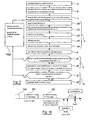
- step (d0) for updating two history registers containing the aforementioned numbers P and G is now presented in relation to FIG . It will be recalled that these numbers P and G are used in the step (d1) of obtaining the number m (FIG.
- the numbers P and G take the value FFFF by default.
- step 73 If the first falling edge has been detected, proceed to step 73 in which the first rising edge (second transition) of the received signal RxDC is expected.
- step 74 we wait for the next falling edge (third transition) of the received signal RxDC and in which we deactivates (by setting it to "0") a variable "EnCompare” triggering the calculation of the number m (see algorithm described below in relation with FIG. 9).
- FIG. 8 illustrates an example of a signal received RxDC (signal transmitted over the network), with its transitions, and the values of the numbers P and G obtained by executing the algorithm of FIG. 7, described in detail above.
- step 91 the activation (by setting to 1) of the variable "EnCompare” triggering the calculation of the number m is awaited (see algorithm described above in connection with FIG. 7). Furthermore, in this initial step 91, a "ConfigureCan” variable triggering the calculation of the BRP scalar (see algorithm described below with reference to FIG. 10) is deactivated (by setting it to "0").
- step 96 corresponding to a fourth intermediate state (comparison 4).
- m min (2P-G, G-P).
- one activates (setting it to 1) the variable "ConfigureCan” triggering the calculation of the BRP scalar. Then, we return to the initial stage 91.
- FIG. 10 shows a block diagram of an exemplary circuit implementing the step (d2) for obtaining the maximum value BRP MAX of the BRP scalar (FIG.
- the circuit comprises a multiplier 101, a counter 102, a comparator 103 and a storage register 104.
- the multiplier 101 receives on its two inputs the number 25 (that is to say n MAX ) and the output of the counter 102.
- the comparator 103 receives on its first input (A) the output of the multiplier 101 and on its second input (B) the number m previously calculated (by the execution of the algorithm described above in relation with FIG. 9).
- the comparator output is "0" if its first input is less than its second input (A ⁇ B) and "1" otherwise (A ⁇ B).
- the storage register 104 is connected to the output of the counter 102.
- the counter 102 is controlled by a value "0" of the output of the comparator 103, while the storage register 104 is controlled by a value "1" of this same output of the comparator 103.
- this circuit starts to increment from 0. As long as the condition "25 x counter ⁇ m" is satisfied (A ⁇ B), then the output of the comparator 103 is incremented by 1. As soon as the condition "25 x counter ⁇ m" is satisfied (A ⁇ B), then the current value of the counter is transferred into the storage register 104. This value is the maximum value BRP MAX of the BRP scalar.
- FIG. 11 shows a block diagram of an exemplary circuit implementing step (d3) for obtaining the number n (FIG. This circuit is activated when the maximum value BRP MAX of the BRP scalar has been obtained (see algorithm and circuit described above in connection with FIG. 10).
- the circuit of FIG. 11 is very close to that of FIG. 10. It comprises a multiplier 111, a counter 112, a comparator 113 and a storage register 114.
- the multiplier 111 receives on its two inputs the number BRP MAX and the output of the counter 112.
- the comparator 113 receives on its first input (A) the output of the multiplier 111 and on its second input (B) the number m previously calculated (by the execution of the algorithm described above in relation to Figure 9).
- the comparator output is "0" if its first input is less than its second input (A ⁇ B) and "1" otherwise (A ⁇ B).
- the storage register 114 is connected to the output of the counter 112.
- the counter 112 is controlled by a value "0" of the output of the comparator 113, while the storage register 114 is controlled by a value "1" of this same output of the comparator 113.
- this circuit starts to increment from 7 (because n can not be less than 8). As long as the condition "BRP MAX x counter ⁇ m" is verified (A ⁇ B), then the output of the comparator 113 is incremented by 1. As soon as the condition "BRP MAX x meter ⁇ m" is satisfied (A ⁇ B ), then the current value of the counter is transferred into the storage register 114. This value is the value of the number n.
- FIG. 12 illustrates an example of a correspondence table used during the step (d4) (FIG. 5) of obtaining, as a function of the number n obtained in step (d3), values (expressed in number of time unit TQ) for the SYNC length L of the synchronization segment, the PRS length L of the propagation segment and the PHS1 and L PHS2 lengths L of the first and second phase segments.
- the modified conventional CAN microcontroller 31 comprises a CPU (central processing unit) 131 communicating with a CAN controller 133 via a set of registers 132.
- the application executed by the CPU 131 can write to certain registers (configuration registers, register defining the structure of a bit (TimeBit) 137, register for the mode selection signal (Autobaud) 138, etc.).
- the CAN controller can also write to certain registers, called status registers. These status registers inform the application executed by the CPU the state of a message (frame) received. A correctly received message results in the writing of a RxOK bit. An erroneous message results in the writing of a bit that describes the type of error (SERR tamping error, BERR bit error, AERR acknowledgment error, etc.).
- the CAN controller 133 comprises a conventional module (hereinafter CanBasic module) 134, coding / decoding of the signal received from the CAN bus, and a module 135 (FIG. hereinafter called Autobaud module) specific to the present invention and implementing the algorithms described above.
- CanBasic module a module 134
- Autobaud module a module 135 specific to the present invention and implementing the algorithms described above.
- the method according to the invention of detection and automatic configuration of flow is implemented in hardware (hardware).
- control registers 136 specific to the CanBasic module 134 are not described here because they are not the subject of the present invention.
- the register defining the structure of a bit (hereinafter called TimeBit register) 137 is absolutely necessary to be able to communicate on the CAN bus. Indeed, it is he who saves the configuration of a bit, that is to say the values of the SYNC length L SYNC of the synchronization segment, the length L PRS of the propagation segment and the lengths L PHS1 and L PHS2 of the first and second phase segments.
- the application executed by the CPU 131 has only the right to read the contents of the TimeBit register 137.
- the Autobaud module 135 sends control signals for writing to the TimeBit register 137.
- the WrTimeBit signal is generated so that the length values L SYNC , L PRS , L PHS1 and L PHS2 are written in the TimeBit 137.
- the CanBasic 134 module will use these values to communicate on the CAN bus and if these values are good, the CanBasic module 134 will generate the status flag RxOK to confirm that the receipt of the message went well.
- a register (hereinafter called Autobaud register) 138 is necessary for the mode selection signal (Autobaud). Initially, the application executed by the CPU 131 must write "1" in this register (generation of a control signal WrCPU and a data signal DATA equal to "1", see fig.14), for start the Autobaud module 135 and therefore the different algorithms specific to the invention (see description above). Then, in the case of the aforementioned hardware solution, the application no longer acts on the Autobaud register 138 and the Autobaud module 135 which supports its management.
- the Autobaud module 135 finds a flow configuration (writing the values of the lengths L SYNC , L PRS , L PHS1 and L PHS2 in the TimeBit register 137), the module CanBasic 134 takes this configuration into account and decodes the signal received RxDC '. The CanBasic module 134 generates the status flag RxOK, when a message has been correctly received.
- the Autobaud register 138 can also be reset to "0" by a "SystemReset” status flag indicating a start of the device.
- the reset terminal "0" (Rst) of the Autobaud register 138 is attacked with the output signal of an OR gate 141 whose inputs receive the state flag RxOK and the state flag SystemReset.
- the SystemReset status flag has not been shown in FIG.
- FIG. 15 illustrates a variant embodiment of the value change of the Autobaud register 138, in the case where a part or the totality of the invention is implemented in a software (software) way, by the application executed by the CPU 131 .
- the device During reception of a first message (first frame) 161, the device obtains and validates a new bit rate configuration (determination of the values for the parameters defining the bit length L BIT ).
- the device While receiving a second message (second frame) 162, the device confirms that the new rate pattern is correct.
- the CanBasic module 134 (FIG. 13) calculates a value of the CRC verification field (according to rules known to those skilled in the art) and compares it with the value of the CRC field received by the device. In case of equality, it activates the temporary deactivation signal EnAckB (by setting it to "0"), so that the device sends an acknowledgment field (ACK) of the second message 162.
- the CanBasic 134 module generates the RxOK state flag, which will cause the Autobaud mode selection signal to be inactivated (change to "0"), that is to say the end of the execution of the method according to the invention.
- the total execution time is less than the duration of two messages (sum of the remaining time of the first message 161 and the total duration of the second message 162).
- the total execution time is equal to the maximum of the duration of three messages (sum of the duration of the previous message 160, the first message 161 and the second message 162).
Landscapes
- Engineering & Computer Science (AREA)
- Computer Networks & Wireless Communication (AREA)
- Signal Processing (AREA)
- Small-Scale Networks (AREA)
- Data Exchanges In Wide-Area Networks (AREA)
Claims (14)
- Verfahren zum automatischen Erfassen des Durchsatzes eines Netzwerkes und zum Konfigurieren mit dem erfassten Durchsatz mittels einer mit dem Netzwerk verbundenen Vorrichtung, wobei das Netzwerk ein Signal sendet, über das Meldungen befördert werden, welche Bits der Länge LBIT und der dominierenden oder rezessiven Art aufweisen, dadurch gekennzeichnet, dass es diese aufeinander folgenden Schritte aufweist:(a) die Vorrichtung geht in einen Hörmodus über, in dem sie die Meldungen aus dem Netz empfangen, jedoch selbst keine Meldungen über das Netz senden kann;(b) die Vorrichtung erzielt ein Triplett aufeinander folgender Übergänge in dem über das Netz gesendeten Signal, wobei dieses Triplett eine erste und eine zweite Ebene des Signals abgrenzt, wobei die eine dominant und die andere rezessiv ist;(c) die Vorrichtung erfasst die Zeitdauer einer jeden der ersten und zweiten Ebenen, ausgedrückt als Periodenzahl TH einer Taktgeberuhr der Vorrichtung;(d) als Funktion der gemessenen Zeitdauern der Ebenen des Signals erzielt die Vorrichtung eine neue Durchsatzkonfiguration durch Bestimmung der Werte für alle Parameter, welche die Bitlänge LBIT definieren;(e) die Vorrichtung validiert die neue Durchsatzkonfiguration;(g) wenn die Vorrichtung das tatsächliche Eintreffen mindestens einer Anpassungsbedingung feststellt, dann geht sie in einen Normalmodus über; ansonsten erzielt sie einen nachfolgenden Übergang des Signals, der mit dem letzten vorhergehenden Übergang eine neue Ebene des Signals abgrenzt, ausgedrückt in Zahl der Perioden TH der Taktgeberuhr der Vorrichtung und wiederholt die Schritte (d) bis (g),wobei die neue Signalebene berücksichtigt wird.
- Verfahren nach Anspruch 1, dadurch gekennzeichnet, dass das Netzwerk einen Bus des Typs CAN darstellt und dass die Vorrichtung einen CAN-Mikrocontroller umfasst, der im Verhältnis zu einem klassischen CAN-Mikrocontroller vervollständigt ist, so dass das Verfahren der automatischen Erfassung des Netzdurchsatzes und der automatischen Konfiguration beim erfassten Durchsatz zum Einsatz kommt.
- Verfahren nach Anspruch 2, wobei die Bitlänge LBIT definiert wird durch:- einen derartigen Skalar BRP, dass TQ = BRP * TH, wobei TQ eine Zeiteinheit und TH die Periode der Taktgeberuhr der Vorrichtung darstellt;- in Zahl von Zeiteinheiten TQ ausgedrückte Längen: Länge LSYNC eines Synchronisationssegmentes, Länge LPRS eines Ausbreitungssegmentes, welches das Ausgleichen einer physischen Verzögerung auf dem CAN-Bus anstrebt, Längen LPHS1 und LPHS2 des ersten und zweiten Phasensegmentes, welches das Positionieren eines Abtastungspunktes ermöglicht,dadurch gekennzeichnet, dass der Schritt (d) selbst die folgenden Schritte aufweist:(d0) die Vorrichtung aktualisiert zwei Historienregister in solcher Weise, dass:- nach der ersten Wiederholung des Schrittes (d) die Register jeweils das Minimum P und das Maximum G der Zeitdauern der ersten und zweiten Ebenen enthalten;- nach jeder nachfolgenden Wiederholung des Schrittes (d) werden die Register nach der folgenden Beziehung aktualisiert: wenn G < X, dann nimmt G den Wert X an, ansonsten nimmt P den Wert X an, wobei X die Zeitdauer der besagten neuen Signalebene darstellt;(d1)als Funktion des Inhaltes P und G der besagten Historienregister erzielt die Vorrichtung eine Zahl m, die das Ausdrücken der Bitlänge LBIT als Funktion der Periode TH der Taktgeberuhr der Vorrichtung ermöglicht: LBIT = m * TH;(d2) als Funktion der vorher erzielten Zahl m erzielt die Vorrichtung einen Maximalwert BRPMAX des Skalars BRP, wobei folgendes gilt:(i)
 (ii)
(ii) (iii) n ≤ nMAX, wobei nMAX eine vorgegebene Maximalzahl der Zeiteinheit TQ darstellt, welche die Bitlänge LBIT umfassen kann;(d3) als Funktion der vorher erzielten Zahl m und des Maximalwertes BRPMAX erzielt die Vorrichtung einen Wert der Zahl n derart, dass n = m / BRPMAX;(d4) als Funktion der vorher erzielten Zahl n erzielt die Vorrichtung Werte für die Länge LSYNC des Synchronisationssegmentes, die Länge LPRS des Fortpflanzungssegmentes und der Längen LPHS1 und LPHS2 der ersten und zweiten Phasensegmente.
 - Verfahren nach Anspruch 3, dadurch gekennzeichnet, dass im Schritt (d1) der Wert der Zahl m durch die nachfolgenden Beziehungen gegeben ist:- m = min (2P - G, G - P), wenn P < G < 2P,- m = min (G - 2P, P), wenn 2P < G < 6P,- m = P/2, wenn G = 2P,- m wird in den anderen Fällen nicht berechnet.
- Verfahren nach Anspruch 4, dadurch gekennzeichnet, dass im Schritt (d1) die Bedingungen für die Anwendung der Beziehungen, welche den Wert der Zahl m ergeben, folgendermaßen geändert werden:- m = min (2P - G, G - P), wenn P + P/k < G ≤ 2(P - P/k),- m = min (G - 2P, P), wenn 2(P + P/k) < G < 6(P - P/k),- m = P/2, wenn 2(P - P/k) < G ≤ 2(P + P/k),- m wird in den anderen Fällen nicht berechnet,wobei k eine vorgegebene ganze Zahl größer oder gleich 4 und bevorzugterweise gleich 8 ist.
- Verfahren nach einem der Ansprüche 3 bis 5, dadurch gekennzeichnet, dass man beim Schritt (d4) eine vorgegebene Entsprechungstabelle anwendet, welche jedem Wert der Zahl n einen Satz von Werten für die Länge LSYNC des Synchronisationssegmentes, für die Länge LPRS des Ausbreitungssegmentes und für die Längen LPHS1 und LPHS2 der ersten und zweiten Phasensegmente zuordnet.
- Verfahren nach einem der Ansprüche 1 bis 6, dadurch gekennzeichnet, dass die besagte mindestens eine Bedingung zur Anpassung des Durchsatzes im Schritt (g) der korrekte Empfang (Rx OK) einer aus dem Netz kommenden Meldung ist.
- Verfahren nach einem der Ansprüche 1 bis 7, dadurch gekennzeichnet, dass vor dem Schritt (g), der folgende Schritt kommt:(f) wenn die Vorrichtung den guten Empfang des nützlichen Teils einer aus dem Netz kommenden Meldung erfasst, so geht sie vorübergehend in den Normalmodus über, um ein Bestätigungsfeld (ACK) über das Netz zu senden, und kehrt dann in den Hörmodus zurück; ansonsten erzielt sie einen nachfolgenden Übergang des Signals, der mit dem letzten vorhergehenden Übergang eine neue Signalebene abgrenzt, sie misst die Länge der neuen Ebene, die in der Periodenzahl TH der Taktgeberuhr der Vorrichtung ausgedrückt wird und wiederholt dann die Schritte (d) bis (g), wobei die neue Signalebene berücksichtigt wird.
- Vorrichtung zum Anschließen an ein Netzwerk, dadurch gekennzeichnet, dass sie Mittel zum automatischen Erfassen des Durchsatzes des Netzwerkes und zum Konfigurieren beim erfassten Durchsatz umfasst, wobei das Netz ein Signal sendet, über welches Meldungen befördert werden, die Bits der Länge LBIT dominanter oder rezessiver Art aufweisen, dadurch gekennzeichnet, dass sie folgendes umfasst:- Mittel zum Wechseln aus einem Normalmodus in einen Hörmodus, in dem Mittel zum Blockieren von Meldungen aktiviert werden, welche von der Vorrichtung zum Netz gesendet werden, wobei die Vorrichtung weiterhin vom Netz kommende Meldungen empfängt;- Mittel zum Erzielen eines Tripletts aufeinander folgender Übergänge in dem über das Netz gesendeten Signal, wobei dieses Triplett eine erste und eine zweite Signalebene abgrenzt, wobei die eine dominant und die andere rezessiv ist;- Mittel zum Messen der Zeitdauer einer jeden der ersten und zweiten Signalebenen, ausgedrückt als Periodenzahl TH einer Taktgeberuhr der Vorrichtung;- Mittel zum Erzielen einer neuen Durchsatzkonfiguration durch Bestimmung der Werte von Parametern, welche die Bitlänge LBIT als Funktion der gemessenen Zeitdauern der Signalebenen definieren;- Mittel zum Validieren der neuen Durchsatzkonfiguration;- Mittel zum Erfassen der Tatsache, dass mindestens eine Bedingung der Durchsatzanpassung erfüllt ist;- Mittel zum Wechseln aus dem Hörmodus in den Normalmodus, die im Falle der positiven Erfassung durch die Erfassungsmittel aktiviert werden;- Mittel zum Erzielen eines nachfolgenden Signalübergangs, wobei dieser Übergang zusammen mit dem letzten vorhergehenden Übergang eine neue Signalebene abgrenzt sowie Mittel zum Messen der Zeitdauer der neuen Ebene, ausgedrückt nach der Periodenzahl TH der Taktgeberuhr der Vorrichtung, wobei diese Mittel mit den Mitteln zum Erzielen der Validierung einer neuen Durchsatzkonfiguration und den Mitteln zum Erfassen der Tatsache, dass mindestens eine Bedingung der Durchsatzanpassung erfüllt ist, im Falle der negativen Erfassung durch die Erfassungsmittel aktiviert werden, damit die neue Signalebene berücksichtigt wird.
- Vorrichtung nach Anspruch 9, dadurch gekennzeichnet, dass das Netz ein CAN-Bus darstellt und dass die Vorrichtung einen CAN-Mikrokontroller aufweist, der im Verhältnis zu einem klassischen CAN-Mikrocontroller vervollständigt ist und selbst die Mittel zur automatischen Erfassung des Durchsatzes des Netzwerkes und zur automatischen Konfiguration beim erfassten Durchsatz aufweist.
- Vorrichtung nach Anspruch 10, dadurch gekennzeichnet, dass die Mittel zum Wechseln von dem Normalmodus in den Hörmodus Mittel zum Erzeugen eines Signals zur Modusauswahl (Autobaud) umfassen, welches den Wert "0" oder "1" annimmt, je nachdem ob die Vorrichtung im Normalmodus bzw. im Abhörmodus arbeiten soll und dass der vervollständigte CAN-Mikrocontroller einen klassischen CAN-Mikrocontroller aufweist, der so geändert ist, dass er selbst die Mittel zur automatischen Erfassung des Netzdurchsatzes und zur automatischen Konfiguration beim erfassten Durchsatz aufweist, mit Ausnahme der besagten Mittel zum Blockieren von gesendeten Meldungen und dass die Mittel zum Blockieren der gesendeten Meldungen Mittel zum Realisieren der logischen "ODER" Funktion zwischen dem Signal zur Modusauswahl und dem Sendesignal (TxDC') des klassischen geänderten CAN-Mikrocontroller aufweisen, wobei das Ausgangssignal der Mittel zum Realisieren der "ODER" Funktion das Sendesignal (TxDC) des vervollständigten CAN-Mikrocontrollers bildet.
- Vorrichtung nach Anspruch 11, dadurch gekennzeichnet, dass der vervollständigte CAN-Mikrocontroller ferner Mittel zum Rückkoppeln des Ausgangs an den Eingang des klassischen geänderten CAN-Mikrocontrollers aufweist, die folgendes umfassen:- Mittel zum Realisieren der logischen "UND" Funktion zwischen dem Sendesignal (TxDC') des klassischen geänderten CAN-Mikrocontrollers und dem Empfangssignal (RxDC) des vervollständigten CAN-Mikrocontrollers;- Mittel zum Multiplexen, die an einen ersten Eingang das Ausgangssignal der Mittel zum Realisieren der logischen "UND"-Funktion und an einem zweiten Eingang das Empfangssignal (RxDC) des vervollständigten CAN-Mirkocontrollers empfangen,wobei das Ausgangssignal der Mittel zum Multiplexen das Empfangssignal (RxDC') des klassischen geänderten CAN-Mikrocontrollers darstellt, wobei die Mittel zum Multiplexen derart vom Modusauswahlsignal gesteuert werden, dass der erste oder der zweite Eingang gewählt wird, je nachdem ob das Modusauswahlsignal den Wert "1" bzw. "0" annimmt.
- Vorrichtung nach einem der Ansprüche 9 bis 12, dadurch gekennzeichnet, dass der vervollständigte CAN-Mikrocontroller ferner Mittel zum vorübergehendem Wechseln aus dem Hörmodus in den Normalmodus aufweist, um ein Bestätigungsfeld (ACK) über das Netz zu senden.
- Vorrichtung nach Anspruch 13 und nach einem der Ansprüche 11 oder 12, dadurch gekennzeichnet, dass die Mittel zum vorübergehenden Wechseln aus dem Hörmodus in den Normalmodus Mittel zum Erzeugen eines Signals (EnAckB) zum vorübergehenden Deaktivieren des Modussauswahlsignals aufweisen, das den Wert "0" oder "1" annimmt, je nachdem ob das Modusauswahlsignal (Autobaud) vorübergehend deaktiviert werden muss oder nicht.
Applications Claiming Priority (2)
| Application Number | Priority Date | Filing Date | Title |
|---|---|---|---|
| FR0400521A FR2865333B1 (fr) | 2004-01-20 | 2004-01-20 | Procede de detection automatique du debit d'un reseau, notamment de type bus can, et de configuration au debit detecte par analyse de transitions, dispositif correspondant |
| FR0400521 | 2004-01-20 |
Publications (2)
| Publication Number | Publication Date |
|---|---|
| EP1560372A1 EP1560372A1 (de) | 2005-08-03 |
| EP1560372B1 true EP1560372B1 (de) | 2006-11-29 |
Family
ID=34639782
Family Applications (1)
| Application Number | Title | Priority Date | Filing Date |
|---|---|---|---|
| EP05364003A Expired - Lifetime EP1560372B1 (de) | 2004-01-20 | 2005-01-13 | Verfahren und Vorrichtung zur automatischen Erkennung der Bitrate von CAN-Bus-Netzwerk |
Country Status (5)
| Country | Link |
|---|---|
| US (1) | US7411913B2 (de) |
| EP (1) | EP1560372B1 (de) |
| DE (1) | DE602005000282T2 (de) |
| ES (1) | ES2277326T3 (de) |
| FR (1) | FR2865333B1 (de) |
Families Citing this family (10)
| Publication number | Priority date | Publication date | Assignee | Title |
|---|---|---|---|---|
| SE533636C2 (sv) * | 2004-10-25 | 2010-11-16 | Xinshu Man L L C | Anordning vid bussförbindelse i CAN-system |
| EP2339790A1 (de) * | 2009-12-28 | 2011-06-29 | Nxp B.V. | Definition von Aufweck-Busnachrichten für Teilnetzwerke |
| DE102012009480A1 (de) * | 2012-05-12 | 2013-11-14 | Wabco Gmbh | Verfahren und Steuereinheit zur automatischen Erkennung einer Baudrate |
| CA2888742C (en) | 2013-09-23 | 2015-09-15 | Jason G. Tatge | Farming data collection and exchange system |
| US10838906B1 (en) * | 2019-07-11 | 2020-11-17 | Nxp B.V. | Communication between transceiver and microcontroller |
| EP4080832B1 (de) * | 2021-04-23 | 2024-11-13 | Nxp B.V. | Zusätzliche kommunikation in standardisierter pinbelegung einer bidirektionalen schnittstelle zwischen einer ersten und einer zweiten kommunikationsvorrichtung |
| CN113259216B (zh) * | 2021-06-29 | 2021-09-10 | 微企(天津)信息技术有限公司 | 一种can总线信号解析方法及系统 |
| CN114422293B (zh) * | 2022-02-21 | 2023-03-31 | 重庆长安汽车股份有限公司 | 一种can总线通信质量优化方法和存储介质 |
| CN117335570B (zh) * | 2023-10-09 | 2024-06-21 | 国网河南省电力公司濮阳供电公司 | 一种弹性配电网全景信息可视化监测系统及方法 |
| CN119030824B (zh) * | 2024-10-23 | 2025-01-03 | 长沙硕博电子科技股份有限公司 | 一种车载can网络波特率自适应调整方法、系统、设备以及介质 |
Family Cites Families (5)
| Publication number | Priority date | Publication date | Assignee | Title |
|---|---|---|---|---|
| US5574848A (en) * | 1993-08-24 | 1996-11-12 | National Semiconductor Corporation | Can interface selecting one of two distinct fault recovery method after counting a predetermined number of recessive bits or good can frames |
| EP0878078A2 (de) * | 1996-01-29 | 1998-11-18 | Lecroy Corporation | Paketnetz-überwachungsvorrichting |
| DE19611942C2 (de) * | 1996-03-26 | 2003-02-20 | Daimler Chrysler Ag | Halbleiterschaltkreis für ein elektronisches Steuergerät |
| DE19611944C2 (de) * | 1996-03-26 | 2003-03-27 | Daimler Chrysler Ag | Integrierter Schaltkreis zur Kopplung eines mikrokontrollierten Steuergerätes an einen Zweidraht-Bus |
| FR2859853B1 (fr) * | 2003-09-17 | 2005-12-16 | Atmel Nantes Sa | Procede de detection automatique du debit d'un reseau, notamment de type bus can, et de configuration au debit detecte, dispositif correspondant |
-
2004
- 2004-01-20 FR FR0400521A patent/FR2865333B1/fr not_active Expired - Fee Related
-
2005
- 2005-01-13 EP EP05364003A patent/EP1560372B1/de not_active Expired - Lifetime
- 2005-01-13 ES ES05364003T patent/ES2277326T3/es not_active Expired - Lifetime
- 2005-01-13 DE DE602005000282T patent/DE602005000282T2/de not_active Expired - Lifetime
- 2005-01-19 US US11/039,175 patent/US7411913B2/en not_active Expired - Fee Related
Also Published As
| Publication number | Publication date |
|---|---|
| US20050180442A1 (en) | 2005-08-18 |
| FR2865333A1 (fr) | 2005-07-22 |
| FR2865333B1 (fr) | 2006-04-28 |
| DE602005000282T2 (de) | 2007-06-21 |
| US7411913B2 (en) | 2008-08-12 |
| EP1560372A1 (de) | 2005-08-03 |
| ES2277326T3 (es) | 2007-07-01 |
| DE602005000282D1 (de) | 2007-01-11 |
Similar Documents
| Publication | Publication Date | Title |
|---|---|---|
| KR100920389B1 (ko) | 수신기에서의 프레임 동기를 향상시키는 프레임 구조 | |
| US6959014B2 (en) | Method and apparatus for operating a communication bus | |
| JP3160350B2 (ja) | 通信網制御方法 | |
| FR2579342A1 (fr) | Reseau local de transmission de donnees et procede d'affectation automatique d'adresses a des dispositifs de traitement de donnees de ce reseau | |
| EP3599743B1 (de) | Verfahren und vorrichtung zur kommunikation von datenrahmen auf einem multi-master-bus | |
| EP1560372A1 (de) | Verfahren und Vorrichtung zur automatischen Erkennung der Bitrate von CAN-Bus-Netzwerk | |
| EP1172961A1 (de) | Kommunikationssystem, Empfänger und Verfahren zur Schätzung der vom Kanal verursachten Fehler | |
| EP1517474B1 (de) | Verfahren und korrespondierende Vorrichtung zur automatischen Erkennung der Bitrate eines Netzwerks, insbesondere vom Typ CAN (Controller Area Network), und zur Konfiguration des Netzwerks bei der erkannten Bitrate | |
| EP1304836B1 (de) | Deterministisches Feldbus und Verwaltungsverfahren dafür | |
| FR3125343A1 (fr) | Installation d’émission/réception et procédé de détection de manipulation du système de Bus d’un système Bus série | |
| EP0341166A1 (de) | Verfahren und Vorrichtung zur asynchronen Übertragung von Datenpaketen | |
| FR2809900A1 (fr) | Procede et systeme de transmission de donnees bi-mode, emetteur et recepteur correspondant | |
| US12432087B2 (en) | Delay module for a controller area network (CAN), a CAN device, and a method for the delay module | |
| EP0380378B1 (de) | Verfahren und Vorrichtung für hierarchischen Zugriff zu einem Nachrichtenübertragungsnetz | |
| FR2679723A1 (fr) | Procede de transmission de donnees numeriques emises sous forme de trames de signaux differentiels. | |
| EP4576682B1 (de) | Verfahren zur überwachung eines halb-duplex-ethernet-netzwerks und zugehöriges halb-duplex-ethernet-netzwerk | |
| FR3125660A1 (fr) | Procédé , équipement , programme de communication, dispositif embarqué ay ant ces équipements | |
| EP1716670B1 (de) | Gateway und datenübertragungssystem für das diagnostische netzwerk eines kraftfahrzeugs | |
| FR3093198A1 (fr) | Transmission de données liées sur bus I2C | |
| JP3217397B2 (ja) | 通信制御装置のデータ送信方法 | |
| EP4395244A1 (de) | Kommunikationsnetzwerk sowie verfahren und vorrichtung zur identifizierung eines damit verbundenen knotens | |
| CN120344970A (zh) | 用于识别对总线系统的未经允许的物理访问的方法和计算单元 | |
| CN121816724A (zh) | 车辆控制系统、车辆控制装置及通信线的劣化检测方法 | |
| FR3116170A1 (fr) | Protocole hybride pour un réseau interne à un véhicule | |
| EP2372959B1 (de) | Method and network for data packet transmission between at least two electronic devices. |
Legal Events
| Date | Code | Title | Description |
|---|---|---|---|
| PUAI | Public reference made under article 153(3) epc to a published international application that has entered the european phase |
Free format text: ORIGINAL CODE: 0009012 |
|
| AK | Designated contracting states |
Kind code of ref document: A1 Designated state(s): AT BE BG CH CY CZ DE DK EE ES FI FR GB GR HU IE IS IT LI LT LU MC NL PL PT RO SE SI SK TR |
|
| AX | Request for extension of the european patent |
Extension state: AL BA HR LV MK YU |
|
| 17P | Request for examination filed |
Effective date: 20051109 |
|
| GRAP | Despatch of communication of intention to grant a patent |
Free format text: ORIGINAL CODE: EPIDOSNIGR1 |
|
| AKX | Designation fees paid |
Designated state(s): DE ES GB IT NL |
|
| GRAS | Grant fee paid |
Free format text: ORIGINAL CODE: EPIDOSNIGR3 |
|
| GRAA | (expected) grant |
Free format text: ORIGINAL CODE: 0009210 |
|
| AK | Designated contracting states |
Kind code of ref document: B1 Designated state(s): DE ES GB IT NL |
|
| REG | Reference to a national code |
Ref country code: GB Ref legal event code: FG4D Free format text: NOT ENGLISH |
|
| REF | Corresponds to: |
Ref document number: 602005000282 Country of ref document: DE Date of ref document: 20070111 Kind code of ref document: P |
|
| GBT | Gb: translation of ep patent filed (gb section 77(6)(a)/1977) |
Effective date: 20070124 |
|
| REG | Reference to a national code |
Ref country code: ES Ref legal event code: FG2A Ref document number: 2277326 Country of ref document: ES Kind code of ref document: T3 |
|
| PLBE | No opposition filed within time limit |
Free format text: ORIGINAL CODE: 0009261 |
|
| STAA | Information on the status of an ep patent application or granted ep patent |
Free format text: STATUS: NO OPPOSITION FILED WITHIN TIME LIMIT |
|
| 26N | No opposition filed |
Effective date: 20070830 |
|
| PGFP | Annual fee paid to national office [announced via postgrant information from national office to epo] |
Ref country code: ES Payment date: 20090122 Year of fee payment: 5 |
|
| PGFP | Annual fee paid to national office [announced via postgrant information from national office to epo] |
Ref country code: NL Payment date: 20090120 Year of fee payment: 5 |
|
| PGFP | Annual fee paid to national office [announced via postgrant information from national office to epo] |
Ref country code: GB Payment date: 20090121 Year of fee payment: 5 |
|
| PGFP | Annual fee paid to national office [announced via postgrant information from national office to epo] |
Ref country code: IT Payment date: 20090116 Year of fee payment: 5 |
|
| REG | Reference to a national code |
Ref country code: NL Ref legal event code: V1 Effective date: 20100801 |
|
| GBPC | Gb: european patent ceased through non-payment of renewal fee |
Effective date: 20100113 |
|
| PG25 | Lapsed in a contracting state [announced via postgrant information from national office to epo] |
Ref country code: NL Free format text: LAPSE BECAUSE OF NON-PAYMENT OF DUE FEES Effective date: 20100801 |
|
| PG25 | Lapsed in a contracting state [announced via postgrant information from national office to epo] |
Ref country code: GB Free format text: LAPSE BECAUSE OF NON-PAYMENT OF DUE FEES Effective date: 20100113 |
|
| REG | Reference to a national code |
Ref country code: ES Ref legal event code: FD2A Effective date: 20110223 |
|
| PG25 | Lapsed in a contracting state [announced via postgrant information from national office to epo] |
Ref country code: IT Free format text: LAPSE BECAUSE OF NON-PAYMENT OF DUE FEES Effective date: 20100113 |
|
| PG25 | Lapsed in a contracting state [announced via postgrant information from national office to epo] |
Ref country code: ES Free format text: LAPSE BECAUSE OF NON-PAYMENT OF DUE FEES Effective date: 20110222 |
|
| PG25 | Lapsed in a contracting state [announced via postgrant information from national office to epo] |
Ref country code: ES Free format text: LAPSE BECAUSE OF NON-PAYMENT OF DUE FEES Effective date: 20100114 |
|
| REG | Reference to a national code |
Ref country code: DE Ref legal event code: R082 Ref document number: 602005000282 Country of ref document: DE Representative=s name: GRUENECKER, KINKELDEY, STOCKMAIR & SCHWANHAEUS, DE |
|
| REG | Reference to a national code |
Ref country code: DE Ref legal event code: R081 Ref document number: 602005000282 Country of ref document: DE Owner name: ATMEL CORPORATION, SAN JOSE, US Free format text: FORMER OWNER: ATMEL NANTES SA, NANTES, FR Effective date: 20131023 Ref country code: DE Ref legal event code: R082 Ref document number: 602005000282 Country of ref document: DE Representative=s name: GRUENECKER PATENT- UND RECHTSANWAELTE PARTG MB, DE Effective date: 20131023 Ref country code: DE Ref legal event code: R082 Ref document number: 602005000282 Country of ref document: DE Representative=s name: GRUENECKER, KINKELDEY, STOCKMAIR & SCHWANHAEUS, DE Effective date: 20131023 Ref country code: DE Ref legal event code: R081 Ref document number: 602005000282 Country of ref document: DE Owner name: ATMEL CORPORATION, US Free format text: FORMER OWNER: ATMEL NANTES SA, NANTES, FR Effective date: 20131023 |
|
| PGFP | Annual fee paid to national office [announced via postgrant information from national office to epo] |
Ref country code: DE Payment date: 20181218 Year of fee payment: 15 |
|
| REG | Reference to a national code |
Ref country code: DE Ref legal event code: R119 Ref document number: 602005000282 Country of ref document: DE |
|
| PG25 | Lapsed in a contracting state [announced via postgrant information from national office to epo] |
Ref country code: DE Free format text: LAPSE BECAUSE OF NON-PAYMENT OF DUE FEES Effective date: 20200801 |