EP1555803A2 - Verfahren zur Bilddatenverarbeitung, Bilddruckvorrichtungen, und prozessorbenutzbare Medien - Google Patents
Verfahren zur Bilddatenverarbeitung, Bilddruckvorrichtungen, und prozessorbenutzbare Medien Download PDFInfo
- Publication number
- EP1555803A2 EP1555803A2 EP05250147A EP05250147A EP1555803A2 EP 1555803 A2 EP1555803 A2 EP 1555803A2 EP 05250147 A EP05250147 A EP 05250147A EP 05250147 A EP05250147 A EP 05250147A EP 1555803 A2 EP1555803 A2 EP 1555803A2
- Authority
- EP
- European Patent Office
- Prior art keywords
- image data
- subsets
- processing
- pixels
- overlapping region
- Prior art date
- Legal status (The legal status is an assumption and is not a legal conclusion. Google has not performed a legal analysis and makes no representation as to the accuracy of the status listed.)
- Withdrawn
Links
Images



Classifications
-
- H—ELECTRICITY
- H04—ELECTRIC COMMUNICATION TECHNIQUE
- H04N—PICTORIAL COMMUNICATION, e.g. TELEVISION
- H04N1/00—Scanning, transmission or reproduction of documents or the like, e.g. facsimile transmission; Details thereof
- H04N1/40—Picture signal circuits
- H04N1/40025—Circuits exciting or modulating particular heads for reproducing continuous tone value scales
- H04N1/40037—Circuits exciting or modulating particular heads for reproducing continuous tone value scales the reproducing element being a laser
-
- H—ELECTRICITY
- H04—ELECTRIC COMMUNICATION TECHNIQUE
- H04N—PICTORIAL COMMUNICATION, e.g. TELEVISION
- H04N1/00—Scanning, transmission or reproduction of documents or the like, e.g. facsimile transmission; Details thereof
- H04N1/40—Picture signal circuits
- H04N1/405—Halftoning, i.e. converting the picture signal of a continuous-tone original into a corresponding signal showing only two levels
- H04N1/4051—Halftoning, i.e. converting the picture signal of a continuous-tone original into a corresponding signal showing only two levels producing a dispersed dots halftone pattern, the dots having substantially the same size
- H04N1/4052—Halftoning, i.e. converting the picture signal of a continuous-tone original into a corresponding signal showing only two levels producing a dispersed dots halftone pattern, the dots having substantially the same size by error diffusion, i.e. transferring the binarising error to neighbouring dot decisions
Definitions
- Computer systems including personal computers, workstations, handheld devices, etc. have been utilized in an increasing number of applications at home, the workplace, educational environments, entertainment environments, etc.
- Peripheral devices of increased capabilities and performance have been developed and continually improved upon to extend the functionality and applications of computer systems.
- imaging devices such as printers, have experienced significant advancements including refined imaging, faster processing, and color reproduction.
- Error diffusion is a halftoning algorithm which may be used, for example, in digital printing.
- the error diffusion halftoning algorithm renders different tone levels by adaptively modulating local dot density.
- the algorithm may implement random dot placement substantially free of Moire artifacts when rendering images having strong periodic components while also achieving relatively high spatial resolution. Accordingly, the error diffusion algorithm may be used to render scanned images which may often have relatively strong embedded periodic screen frequencies.
- Error diffusion processing utilizes a relatively significant computational load during processing operations.
- error diffusion processing may compute and diffuse filtered pixel errors to neighboring pixels in addition to thresholding operations often implemented in screening algorithms.
- the significant computational load may be a drawback for use in high speed imaging applications.
- At least some aspects of the disclosure provide improved apparatus and methods for processing image data.
- Fig. 1 is an isometric view of an exemplary image forming device.
- Fig. 2 is a functional block diagram illustrating components of an exemplary hard imaging device.
- Fig. 3 is an illustrative representation of exemplary image processing.
- Fig. 4 is an illustrative representation of an overlapping region of image data according to one embodiment.
- Fig. 5 is an illustrative representation of an exemplary boundary stitching implementation according to one embodiment.
- Fig. 6 is a graphical representation of a weighting function according to one embodiment.
- Fig. 7A is an illustrative representation of an exemplary modified DBS screen stitching matrix according to one embodiment.
- Fig. 7B is an illustrative representation of an exemplary binary midtone pattern stitching matrix according to one embodiment.
- Fig. 8 is an illustrative representation of an exemplary application of error diffusion image processing according to one embodiment.
- At least some embodiments described herein are directed towards improving processing speeds of image data.
- some embodiments described herein are arranged in hard imaging device configurations.
- Other implementations wherein processing of image data is desired are possible.
- One embodiment of the disclosure provides a plurality of processing circuits configured to process respective subsets or portions of image data of an image in parallel.
- the processing circuits operate to implement halftone processing using error diffusion. Exemplary aspects of image processing including halftone processing using error diffusion are described in an article entitled "Memory Efficient Error Diffusion," Chang et al., IEEE Transactions of Image Processing, Vol. 12, Issue 11, November 2003, and a U.S. Patent Application having serial no. 10/054,652, entitled “A System For Improving the Speed of Data Processing,” having docket no. 10016350-1, filed January 18, 2002, publication no. 2003/0137698, and assigned to the assignee hereof. Other aspects are described below.
- Hard imaging device 10 is configured to generate color hard images upon output media 12, such as sheets of paper, transparencies, envelopes, etc.
- Hard imaging device 10 may comprise a printer, copier, multiple function peripheral or printer (MFP), facsimile machine, or any other device configured to generate hard images including color images.
- Device 10 may be configured as a color inkjet printer or electrophotographic printer in exemplary embodiments. At least some aspects of the disclosure may be used in high speed embodiments to increase imaging speeds of the device 10. Other embodiments of hard imaging device 10 are possible.
- hard imaging device 10 may include a communications interface 20, processing circuitry 22, storage circuitry 24, and an image engine 26 in one embodiment.
- processing circuitry 22 comprises a plurality of processors 28 configured to implement image data processing operations.
- processors 28 comprise digital signal processors (DSPs) individually arranged to perform error diffusion halftone processing.
- DSPs digital signal processors
- Processors 28 may independently process respective subsets of image data for an image in one embodiment. Additional details regarding exemplary operations of processors 28 are described below. Other configurations of device 10 are possible including more, less and/or alternative components or component arrangements.
- Communications interface 20 is configured to provide connectivity of hard imaging device 10 with respect to external devices (not shown), such as host computing systems, servers, etc.
- Communications interface 20 may be embodied as a parallel port, network interface card (NIC), or any other configuration to implement external communications of device 10.
- NIC network interface card
- Processing circuitry 22 may comprise circuitry configured to implement desired programming in one embodiment.
- processors 28 of processing circuitry 22 may be implemented as digital signal processors (DSP).
- DSP digital signal processors
- Other arrangements of processing circuitry 22 and/or processors 28 are possible including structures configured to execute executable instructions including, for example, software and/or firmware instructions.
- Other exemplary embodiments of processing circuitry 22 and/or processors 28 may include or comprise microprocessors (available from Intel Corporation or Advanced Micro Devices) hardware logic, PGA, FPGA, ASIC, and/or other structures. These examples of processing circuitry 22 and/or processors 28 are for illustration and other configurations are possible.
- Storage circuitry 24 is configured to store electronic data (e.g., image data), programming such as executable instructions (e.g., software and/or firmware usable to configure processing circuitry 22 to implement image processing operations), or other digital information and may include processor-usable media.
- Processor-usable media includes any article of manufacture which can contain, store, or maintain programming, data and/or digital information for use by or in connection with an instruction execution system including processing circuitry in the exemplary embodiment.
- exemplary processor-usable media may include any one of physical media such as electronic, magnetic, optical, electromagnetic, infrared or semiconductor media.
- processor-usable media include, but are not limited to, a portable magnetic computer diskette, such as a floppy diskette, zip disk, hard drive, random access memory, read only memory, flash memory, cache memory, and/or other configurations capable of storing programming, data, or other digital information.
- a portable magnetic computer diskette such as a floppy diskette, zip disk, hard drive, random access memory, read only memory, flash memory, cache memory, and/or other configurations capable of storing programming, data, or other digital information.
- Image engine 26 is configured to generate images responsive to processed image data.
- image engine 26 comprises a print engine configured to render color images upon output media 12.
- Other embodiments are possible.
- Image 30 may comprise a digital photograph in one embodiment, and digital image data for the photograph may be stored in appropriate memory or other storage circuitry external or internal of device 10. Other images 30 comprising digital data are possible.
- hard imaging device 10 implements halftone processing of the image data.
- hard imaging device 10 may provide error diffusion halftone processing in one arrangement.
- One embodiment of hard imaging device 10 includes processing circuitry 22 comprising a plurality of processors 28 as described above. Utilization of plural processors 28 may improve the processing speed of the image data enabling hard imaging device 10 to form hard images in less time.
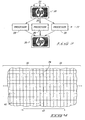
- processors 28 are configured to access different respective subsets of the image data corresponding to regions or subsets 32 of image 30 to be processed.
- Subsets 32 are defined to comprise stripes of equal area in the depicted example, however, other configurations of subsets 32 may be defined or utilized.
- One or more boundaries 34 may separate or divide adjacent ones of subsets 32.
- Processors 28 access different respective subsets of the image data corresponding to the subsets 32 of the image.
- the image data may comprise grayscale data (e.g., 8 bit values) for a plurality of pixels of subsets 32 in one embodiment.
- Processors 28 may be programmed to process (e.g., halftone process) the image data of respective subsets 32 in parallel.
- Processors 28 may implement error diffusion halftone processing of the respective image data in the described exemplary implementation.
- individual processors 28 may also process at least some image data of another subset 32 during the processing of image data 32 of a respective desired subset in at least one embodiment.
- Processed (e.g., halftoned) and outputted image data of the respective subsets 32 may be outputted for formation of a halftoned output image 38 comprising a composite image of the respective processed subsets 32.
- the outputted image data may be applied to image engine 26 for the formation of image 38 comprising a hard image upon media 12.
- the outputted image data may be spliced or merged to create the output image 38 in the illustrated exemplary embodiment.
- processors 28 operate independently to process image data of the respective subsets 32 without knowledge of processing of image data of other subsets 32 by other processors 28.
- Exemplary independent processing includes processing without synchronization or communication between processors 28.
- the independent processing of image data may be beneficial in at least one embodiment inasmuch as the processing of the image data and implementations of processors 28 may be simplified.
- artifacts may be introduced by independent processing of image data of subsets 32 by respective processors 28 for the generation of output image 38. Exemplary processing by processors 28 is described below to reduce or minimize artifacts or errors resulting from independent processing of the image data by processors 28 according to one embodiment.
- Image data for a plurality of pixels 40 is shown adjacent boundary 34 separating subsets 32 of the exemplary embodiment.
- An overlapping region 42 is also shown about boundary 34 in the depicted embodiment. In the depicted example, the overlapping region 42 is shown extending six pixels to the left and the right of boundary 34. Other configurations of overlapping region 42 are possible.
- individual processors 28 process image data of a respective subset 32 as well as at least some image data of another subset 32.
- the overlapping region 42 corresponds to or includes the additionally processed image data of a subset adjacent to the image data of the respective subset being processed.
- the same processor 28 also processes image data of the middle subset 32 of image 30 residing within the overlapping region 42.
- the middle processor 28 also processes image data of the left subset 32 residing within the overlapping region 42 according to one embodiment.
- the left and right borders of overlapping region 42 may defined as "-L" and "L,” respectively, corresponding to a distance of the borders from boundary 34.
- Exemplary processing of image data by processors 28 comprises comparing individual pixel values of the image data with a respective threshold to determine whether the pixel is a binary 1 or a binary 0 for the processed (e.g., halftoned) image data in one embodiment.
- thresholds may be modulated prior to the comparison to reduce the presence of artifacts and/or for other reasons.
- thresholds corresponding to pixels 40 of the overlapping region 42 may be modulated to reduce the presence of artifacts resulting from independent processing of the image data by processors 28.
- thresholds within or outside of the overlapping region 42 may be further modulated for other reasons.
- a plurality of threshold modulation schemes may be used in one embodiment (i.e., one modulation scheme for thresholds of pixels 40 within the overlapping region 42 (e.g., T(i, j) + ⁇ T(i, j) in the examples below) and another modulation scheme for thresholds of pixels 40 outside of the overlapping region 42 (e.g., T(i, j) in the examples below).
- a common threshold modulation scheme of the thresholds within the overlapping region 42 may be used (e.g., ⁇ T(i, j).
- a common modulation pattern may be used to modulate the thresholds of pixels 40 of the overlapping region 42 for the ⁇ T(i, j) modulation and the modulated thresholds may be used by a plurality of processors 28 to reduce artifacts resulting from the independent processing of the image data of the respective subsets 32 by respective processors 28.
- the modulation provides, for individual pixels 40 of the overlapping region 42, the same common threshold used by the respective plural independent processors 28 for processing image data of the respective different subsets 32.
- the resultant calculated modulated thresholds of pixels 40 within overlapping region 42 result from usage of the common modulation pattern by the respective independent processors 28 for the ⁇ T(i, j) modulation.
- An absolute indexing scheme may be used in one embodiment within the overlapping region 42 enabling plural respective processors 28 to achieve the common thresholds.
- the common modulation pattern may be calculated by a predetermined halftone texture in one embodiment.
- An exemplary halftone texture is a binary pattern, such as a stitching matrix, examples of which are described below.
- different levels of threshold modulation within the overlapping region 42 may be implemented. For example, pixels located closer to a boundary 34 may be threshold modulated to a greater degree than pixels relatively spaced farther from the boundary. Put another way, the threshold modulation may be attenuated to lesser degree (if at all) for pixels located adjacent to boundary 34 compared with pixels spaced increased distances with respect to boundary 34.
- An exemplary position dependent weighting (f(j)) is described further below. The weighting f(j) may be combined with the stitching matrix p(i, j) to provide a common modulation pattern for ⁇ Tk(i, j) also described below in one embodiment.
- the processed image data is spliced to produce composite halftoned image 38.
- Some processed image data may be discarded during the composition of the subsets 32.
- the image data within the overlapping region 42 from the adjacent subset 32 may be discarded inasmuch as the processed data may be used from the adjacent subset 32 itself and corresponding to the discarded pixels.
- FIG. 5 further details regarding exemplary image data processing by individual processors 28 to reduce artifacts is shown in accordance with one embodiment. Further, a plurality of exemplary formulae are presented for implementing exemplary image data processing described herein.
- the image data may be separated into k subsets corresponding to subsets of the image and comprising vertical stripes in one embodiment as described above.
- the stripes may be equal in width in one embodiment.
- Other subset geometries or configurations are possible.
- the provided image data may comprise input gray scale image data which is denoted as g(i, j) where 0 ⁇ i ⁇ M and 0 ⁇ j ⁇ N for a M x N raster of data in one embodiment.
- N may be assumed to be an integer multiple of K so each stripe is of width N/K.
- a given one of processors 28 may be referred to as k and which processes halftone output pixels for columns j in the range of k(N/K) ⁇ j ⁇ (k+1)(N/K).
- the binary output for processor k may be denoted as b k (i, j).
- the output b k (i, j) of individual processors 28 may be spliced together to form a single binary image b(i, j) using eqn. 1 which also operates to discard some image data as described above.
- b ( i,j ) b ⁇ jk / N ⁇ (i,j) where ⁇ denotes the floor function.
- individual processors 28 process a subset of image data which is enlarged on both sides of the subset by W/2 pixels (i.e., for interior subsets) where W is an even number corresponding to a width of the overlapping region 42.
- Subsets of image data processed by adjacent processors 28 overlap along a region that is W pixels wide corresponding to the overlapping region 42. Accordingly, a k th processor 28 actually processes pixels with column index j in the range of k(N/K) - W/2 ⁇ j ⁇ (k+1)(N/K) + W/2.
- Fig. 5 illustrates an exemplary scheme for enabling splicing operations of eqn. 1 with reduced artifacts along boundary 34 of the spliced subsets 32.
- Error diffusion may be applied to g(i, j) with an additional threshold modulation term ⁇ Tk(i, j) applied within overlapping regions 42 represented by reference 50.
- An error diffusion algorithm is applied for columns j in a range k (N/K) - W/2 ⁇ j ⁇ (k + 1 )(N/K) + W/2 using a mathematic recursion provided by eqns.
- T k ( i , j ) p ( i mod M , j mod M )[ f ( j - k ( N / K )- W /2) + f ( j -( k +1)( N / K )- W /2)]
- p ( i , j ) is an M x M stitching matrix
- f(j) is a position dependent weighting.
- Fig. 6 illustrates an exemplary form of the function.
- Stitching matrix p(i,j) specifies a desired predetermined halftone texture pattern imposed by appropriate threshold modulation in the overlapping region 42 and may function similar to a threshold screen in order dot dithering in one embodiment.
- a dispersed-dot screen may be used to produce a halftone texture pattern similar to error diffusion.
- This exemplary screen matrix may be designed by mimicking the spectrum of the error diffusion pattern. Since boundary artifacts are usually most visible in a midtone area, a second choice for p(i, j) is to select a binary pattern in a midtone area produced by error diffusion itself in one example.
- Figs. 7A-7B two examples of the stitching matrix are shown.
- Fig. 7A illustrates a modified DBS screen while Fig. 7B illustrates a binary midtone pattern from error diffusion.
- exemplary boundary stitching aspects described herein were implemented with a fast low bit-rate AM/FM halftoning algorithm designed for an electrophotographic multifunction printer (MFP) application.
- the AM/FM halftoning algorithm is a class of hybrid halftoning algorithms which simultaneously modulate dot size and dot density for individual gray levels to achieve high quality digital printing.
- Pixels 60 may be initially grouped into pairs. Arrows 62 illustrate scan direction and arrows 64 illustrate positions to diffuse error. There may be one pixel offset for alternative rows and dot firing is enforced along a diagonal grid in one example.
- Four filter weights are tone-dependent and trained with a method described in "Tone dependent error diffusion," P. Li and J.P. Allebach, IEEE Trans. On Image Processing, Vol. 13, No. 1, January 2004, and in "Tone dependent error diffusion," P. Li and J.P. Allebach, Proceedings of SPIE, Vol. 4663, pps. 310-321, December 2001, the teachings of which are incorporated herein by reference.
- Threshold value T(i, j) may be fixed to 127 and a two-row serpentine scan order may be used to process individual pixels 60.
- An exemplary hard imaging device used in the experiments was a LaserJet 9000 available from The Hewlett-Packard Company and having a 2-bit/pixel pulse width modulation capability. Additional details regarding exemplary AM/FM halftoning are described in "AM/FM Halftoning: A Method For Digital Halftoning Through Simultaneous Modulation of Dot Size Placement," Z. He and C.A. Bouman, Proc. Of SPIE Conf. on Color Imaging: Device Independent Color, Color Hardcopy, and Applications, vol. 4663, 2002, pp. 322-334.
- p(i, j) was set to the modified version of the DBS screen shown in Fig. 7A and as described in "FM Screen Design Using DBS Algorithm," J.P. Allebach and Q. Lin, Proc. Of IEEE Int's Conf. on Image Proc., vol. II, Sept. 1996, Lausanne, Switzerland, pp. 549-552.
- the power spectrum of the tone-dependent error diffusion mimics that of the halftone pattern produced by the DBS algorithm. Therefore, the DBS screen should produce a halftone pattern similar to error diffusion.
- An original DBS screen size of 16 x 16 was selected.
- An element specification of the exemplary screen is provided in Table A.
- a 16 x 32 midtone binary pattern from a ramp produced by error diffusion was selected to be the stitching matrix p(i, j) and as shown in Fig. 7B.
- the element of the binary pattern is either 0 or 255 in the example.
- the DC component of the matrix p(i, j) was removed to avoid a potential sharpening effect at a boundary between the overlapping and nonoverlapping zones.
- a value of alpha in the weighting function f(x) may be determined empirically by inspecting a visual quality of the actual printouts. From the experiments, it was found that an alpha of 0.2 produced the best visual quality for stitching with the modified DBS screen, and an alpha of 0.13 produces the best visual quality for stitching with a binary midtone pattern.
- At least some aspects of the disclosure present exemplary image processing techniques for parallel implementation of error diffusion processing. Further, with utilization of parallel independent processors greatly increases the speed of halftoning processing (e.g., by a factor of four if four processors are utilized). By creating overlapping regions across adjacent subsets and enforcing a binary pattern using threshold modulation within an overlapping zone according to one embodiment, boundary artifacts (e.g., dot clusters and holes across boundary areas) are effectively reduced. More specifically, pixel error can not be diffused across subset boundaries so "blue noise" characteristics of the halftone texture are destroyed near the subset boundaries. The resultant artifacts without the exemplary processing described herein may be most visible near midtone areas and somewhat less visible in shadow areas. In highlight areas the dots are sparse so artifacts are less visible.
- boundary artifacts e.g., dot clusters and holes across boundary areas
- an overlapping region may be created for adjacent subsets of image data.
- a predetermined halftone texture may be imposed by appropriate threshold modulation in the overlapping region.
- a stitching matrix may be multiplied by a position-dependent weighting function to form appropriate threshold modulation within the overlapping region.
- the threshold modulation is applied to error diffusion to stitch the halftone texture along a boundary area across adjacent subsets providing smooth halftone texture transition across the boundary in a merged composite halftoned image. Boundary artifacts of parallel implantation of error diffusion processing are reduced providing benefits, for example, in high speed printing with relatively minor increases in computational load.
Landscapes
- Engineering & Computer Science (AREA)
- Multimedia (AREA)
- Signal Processing (AREA)
- Physics & Mathematics (AREA)
- Optics & Photonics (AREA)
- Image Processing (AREA)
- Facsimile Image Signal Circuits (AREA)
Applications Claiming Priority (2)
| Application Number | Priority Date | Filing Date | Title |
|---|---|---|---|
| US758840 | 2004-01-16 | ||
| US10/758,840 US7450270B2 (en) | 2004-01-16 | 2004-01-16 | Image data processing methods, hard imaging devices, and articles of manufacture |
Publications (2)
| Publication Number | Publication Date |
|---|---|
| EP1555803A2 true EP1555803A2 (de) | 2005-07-20 |
| EP1555803A3 EP1555803A3 (de) | 2006-03-01 |
Family
ID=34620707
Family Applications (1)
| Application Number | Title | Priority Date | Filing Date |
|---|---|---|---|
| EP05250147A Withdrawn EP1555803A3 (de) | 2004-01-16 | 2005-01-13 | Verfahren zur Bilddatenverarbeitung, Bilddruckvorrichtungen, und prozessorbenutzbare Medien |
Country Status (2)
| Country | Link |
|---|---|
| US (1) | US7450270B2 (de) |
| EP (1) | EP1555803A3 (de) |
Cited By (1)
| Publication number | Priority date | Publication date | Assignee | Title |
|---|---|---|---|---|
| US8169667B2 (en) | 2009-02-28 | 2012-05-01 | Hewlett-Packard Development Company, L.P. | Performing halftoning by plurality of halftoning mechanisms |
Families Citing this family (7)
| Publication number | Priority date | Publication date | Assignee | Title |
|---|---|---|---|---|
| US20050248780A1 (en) * | 2004-05-05 | 2005-11-10 | Piatt Michael J | Digital printing highlights and image processing workflow |
| TWI258693B (en) * | 2005-02-01 | 2006-07-21 | Sunplus Technology Co Ltd | System and method of processing an error diffusion halftone image |
| US7719718B2 (en) | 2007-03-13 | 2010-05-18 | Xerox Corporation | Threshold modification for limit cycle removal in vector error diffusion |
| US8085433B2 (en) * | 2007-06-29 | 2011-12-27 | Xerox Corporation | Variable/personalized colorization printing using tone reproduction curves |
| KR101191899B1 (ko) * | 2007-07-24 | 2012-10-17 | 삼성전자주식회사 | 하프토닝 이미지 보정 장치 및 방법 그리고 그를 이용한화상형성장치 |
| CN109509146B (zh) * | 2017-09-15 | 2023-03-24 | 腾讯科技(深圳)有限公司 | 图像拼接方法及装置、存储介质 |
| CN113298695B (zh) * | 2021-06-25 | 2024-04-26 | 北京爱芯科技有限公司 | 一种图像处理组件和芯片、图像处理方法和存储介质 |
Family Cites Families (38)
| Publication number | Priority date | Publication date | Assignee | Title |
|---|---|---|---|---|
| US4958236A (en) | 1987-06-11 | 1990-09-18 | Canon Kabushiki Kaisha | Image processing method and apparatus therefor |
| US5111302A (en) | 1988-12-02 | 1992-05-05 | Hewlett-Packard Company | Method and system for enhancing the quality of both color and black and white images produced by ink jet and electrophotographic printers |
| US5012257A (en) | 1990-03-16 | 1991-04-30 | Hewlett-Packard Company | Ink jet color graphics printing |
| US5473446A (en) | 1992-05-04 | 1995-12-05 | Hewlett-Packard Company | Color digital halftoning using black and secondary color replacement and color vector dithering |
| US5377024A (en) | 1992-05-04 | 1994-12-27 | Hewlett-Packard | Apparatus for forming color images using a hue-plus-gray color model |
| US5657137A (en) | 1992-05-04 | 1997-08-12 | Hewlett-Packard Company | Color digital halftoning using black and secondary color replacement |
| US5271070A (en) | 1992-11-06 | 1993-12-14 | Xerox Corporation | Multi-dimensional error diffusion technique |
| US5553165A (en) | 1993-01-11 | 1996-09-03 | Canon, Inc. | Parallel error diffusion method and apparatus |
| US5519791A (en) | 1993-01-11 | 1996-05-21 | Canon, Inc. | Block parallel error diffusion method and apparatus |
| NL9300684A (nl) | 1993-04-22 | 1994-11-16 | Oce Nederland Bv | Werkwijze voor het halftonen van gedigitaliseerde grijswaardebeelden en beeldbewerkingsinrichting geschikt voor het uitvoeren van een dergelijke werkwijze. |
| US5701135A (en) | 1993-05-25 | 1997-12-23 | Canon Kabushiki Kaisha | Display control method and apparatus |
| US5402245A (en) | 1994-01-27 | 1995-03-28 | Hewlett-Packard Company | Bi-level digital color printer system exhibiting improved undercolor removal and error diffusion procedures |
| US5710827A (en) | 1994-09-19 | 1998-01-20 | Hewlett-Packard Company | Halftone dither cell with integrated preferred color matching |
| CA2169902A1 (en) | 1995-03-16 | 1996-09-17 | Allan Chiwan Cheung | Combined color halftoning |
| US5982990A (en) | 1995-07-20 | 1999-11-09 | Hewlett-Packard Company | Method and apparatus for converting color space |
| AUPN741396A0 (en) | 1996-01-05 | 1996-01-25 | Canon Aptex Inc | Geometrically reducing mask error diffusion |
| US5930010A (en) | 1996-01-31 | 1999-07-27 | Lexmark International, Inc. | Method and apparatus for color halftoning using different halftoning techniques for halftoning different dot planes |
| US5812744A (en) | 1996-04-30 | 1998-09-22 | Hewlett Packard Company | Joint design of dither matrices for a set of colorants |
| US5737453A (en) | 1996-05-17 | 1998-04-07 | Canon Information Systems, Inc. | Enhanced error-diffusion method for color or black-and-white reproduction |
| US5787206A (en) | 1996-05-30 | 1998-07-28 | Xerox Corporation | Method and system for processing image information using expanded dynamic screening and error diffusion |
| US6476934B1 (en) | 1997-01-02 | 2002-11-05 | Canon Kabushiki Kaisha | Geometrically reducing influence halftoning |
| US5809217A (en) | 1997-01-10 | 1998-09-15 | Hewlett-Packard Company | Method and apparatus for deriving additional gray levels in a multi-gray level halftone image |
| US5898505A (en) | 1997-01-24 | 1999-04-27 | Hewlett-Packard Company | Resolution enhancement procedure and apparatus for a color laser printer |
| US5974228A (en) | 1997-01-28 | 1999-10-26 | Hewlett-Packard Company | Image rendition by plural-row error diffusion, for faster operation and smaller integrated circuits |
| US5892851A (en) | 1997-05-23 | 1999-04-06 | Hewlett-Packard Company | Parallelized error diffusion |
| US5949964A (en) | 1997-06-17 | 1999-09-07 | Hewlett-Packard Company | Method and apparatus for halftoning of images in a printer |
| US5949965A (en) | 1997-06-23 | 1999-09-07 | Hewlett-Packard Company | Correlating cyan and magenta planes for error diffusion halftoning |
| US5991512A (en) | 1997-07-31 | 1999-11-23 | Hewlett-Packard Company | Ink relocation for color halftones |
| US6081344A (en) | 1997-10-30 | 2000-06-27 | Hewlett-Packard Company | Device state error diffusion technique for halftoning |
| US6057933A (en) | 1997-10-30 | 2000-05-02 | Hewlett-Packard Company | Table based fast error diffusion halftoning technique |
| US6307978B1 (en) | 1998-06-03 | 2001-10-23 | Wellesley College | System and method for parallel error diffusion dithering |
| US6356362B1 (en) | 1998-11-02 | 2002-03-12 | Canon Kabushiki Kaisha | Halftoning by enhanced error diffusion |
| JP2000175034A (ja) | 1998-12-04 | 2000-06-23 | Ricoh Co Ltd | 画像処理装置 |
| US6464332B1 (en) * | 2000-05-23 | 2002-10-15 | Silverbrook Research Pty Ltd. | Method and apparatus for the compensation for time varying nozzle misalignment in a drop on demand printhead |
| AUPR234700A0 (en) | 2000-12-29 | 2001-01-25 | Canon Kabushiki Kaisha | Error diffusion using next scanline error impulse response |
| US6547370B2 (en) | 2001-03-14 | 2003-04-15 | Xerox Corporation | Method of printing including stitching and interpolating |
| US7355747B2 (en) | 2002-01-18 | 2008-04-08 | Hewlett-Packard Development Company, L.P. | System for improving the speed of data processing |
| GB2387817A (en) | 2002-04-27 | 2003-10-29 | Hewlett Packard Co | Page wide array inkjet printer having halftone controller and multiple printheads, each printing different image strips. |
-
2004
- 2004-01-16 US US10/758,840 patent/US7450270B2/en not_active Expired - Fee Related
-
2005
- 2005-01-13 EP EP05250147A patent/EP1555803A3/de not_active Withdrawn
Non-Patent Citations (1)
| Title |
|---|
| NIRANJAN DAMERA-VENKATA ET AL: "Adaptive Threshold Modulation forError Diffusion Halftoning", IEEE TRANSACTIONS ON IMAGE PROCESSING, IEEE SERVICE CENTER, PISCATAWAY, NJ, US, vol. 10, no. 1, 1 January 2001 (2001-01-01), XP011025727, ISSN: 1057-7149 * |
Cited By (1)
| Publication number | Priority date | Publication date | Assignee | Title |
|---|---|---|---|---|
| US8169667B2 (en) | 2009-02-28 | 2012-05-01 | Hewlett-Packard Development Company, L.P. | Performing halftoning by plurality of halftoning mechanisms |
Also Published As
| Publication number | Publication date |
|---|---|
| US20050157348A1 (en) | 2005-07-21 |
| EP1555803A3 (de) | 2006-03-01 |
| US7450270B2 (en) | 2008-11-11 |
Similar Documents
| Publication | Publication Date | Title |
|---|---|---|
| CA2140410C (en) | Hybrid quantization method for color document reproduction | |
| JP2000333010A (ja) | 階調依存型誤差拡散ハーフトーン化方法 | |
| Lee et al. | Inkjet printer model-based halftoning | |
| EP1366618B1 (de) | Verfahren und system zur fehlerdiffusion bei teilhalbtonpunkten | |
| EP2107790A2 (de) | Bildverarbeitungsvorrichtung und Verfahren dafür | |
| US7450270B2 (en) | Image data processing methods, hard imaging devices, and articles of manufacture | |
| US8482792B2 (en) | Image forming apparatus and control method thereof | |
| US5740279A (en) | Cluster dot halftoning system | |
| Lau et al. | Blue-noise halftoning for hexagonal grids | |
| US9152897B1 (en) | Printing an image on a substrate | |
| US7719722B2 (en) | System and method of halftoning for multi-pass rendering | |
| JP3187352B2 (ja) | 画像の画素のグレイ値信号をハーフトーン化する方法及び画像を再生する画像再生装置 | |
| US7518754B2 (en) | Apparatus and method for error diffusion with dither | |
| US6697169B1 (en) | Enhanced error diffusion using a correlated chromatic noise pattern | |
| US5838462A (en) | Hybrid imaging system | |
| EP0682438B1 (de) | Mehrstufige Halbtonrasterung mit Verwendung einer zufallerzeugten Bayer-Matrix | |
| He et al. | Boundary stitching algorithm for parallel implementation of error diffusion | |
| JP2004266802A (ja) | コンピュータ・トゥ・プレートインクジェットシステムのためのサブドット位相変調 | |
| Lin et al. | Multilevel screen design using direct binary search | |
| Huang et al. | An adaptive halftone algorithm for composite documents | |
| JP5522997B2 (ja) | 画像処理装置、画像形成装置、画像処理方法、及びプログラム | |
| US7088473B2 (en) | System and method for effectively implementing a dither matrix for an electronic printer device | |
| Zhuge et al. | A new hybrid multitoning based on the direct binary search | |
| Lin | Electronic imaging system improvements via novel hardware architecture and halftoning algorithms | |
| Goyal et al. | Cost function analysis for stochastic clustered-dot halftoning based on direct binary search |
Legal Events
| Date | Code | Title | Description |
|---|---|---|---|
| PUAI | Public reference made under article 153(3) epc to a published international application that has entered the european phase |
Free format text: ORIGINAL CODE: 0009012 |
|
| AK | Designated contracting states |
Kind code of ref document: A2 Designated state(s): AT BE BG CH CY CZ DE DK EE ES FI FR GB GR HU IE IS IT LI LT LU MC NL PL PT RO SE SI SK TR |
|
| AX | Request for extension of the european patent |
Extension state: AL BA HR LV MK YU |
|
| PUAL | Search report despatched |
Free format text: ORIGINAL CODE: 0009013 |
|
| AK | Designated contracting states |
Kind code of ref document: A3 Designated state(s): AT BE BG CH CY CZ DE DK EE ES FI FR GB GR HU IE IS IT LI LT LU MC NL PL PT RO SE SI SK TR |
|
| AX | Request for extension of the european patent |
Extension state: AL BA HR LV MK YU |
|
| 17P | Request for examination filed |
Effective date: 20060814 |
|
| AKX | Designation fees paid |
Designated state(s): DE FR GB |
|
| 17Q | First examination report despatched |
Effective date: 20131107 |
|
| STAA | Information on the status of an ep patent application or granted ep patent |
Free format text: STATUS: THE APPLICATION IS DEEMED TO BE WITHDRAWN |
|
| 18D | Application deemed to be withdrawn |
Effective date: 20140318 |