EP1555267B1 - 2,3-DIHYDRO-6-NITROIMIDAZO[2,1-b]OXAZOLES - Google Patents
2,3-DIHYDRO-6-NITROIMIDAZO[2,1-b]OXAZOLES Download PDFInfo
- Publication number
- EP1555267B1 EP1555267B1 EP03754085A EP03754085A EP1555267B1 EP 1555267 B1 EP1555267 B1 EP 1555267B1 EP 03754085 A EP03754085 A EP 03754085A EP 03754085 A EP03754085 A EP 03754085A EP 1555267 B1 EP1555267 B1 EP 1555267B1
- Authority
- EP
- European Patent Office
- Prior art keywords
- group
- substituted
- halogen
- unsubstituted
- phenyl
- Prior art date
- Legal status (The legal status is an assumption and is not a legal conclusion. Google has not performed a legal analysis and makes no representation as to the accuracy of the status listed.)
- Expired - Lifetime
Links
- 0 CC1(*)Oc2nc([N+]([O-])=O)c[n]2C1 Chemical compound CC1(*)Oc2nc([N+]([O-])=O)c[n]2C1 0.000 description 14
- MSEPMADKICXEQA-UHFFFAOYSA-N CCC(CC1)=NN1c(cc1)ccc1Cl Chemical compound CCC(CC1)=NN1c(cc1)ccc1Cl MSEPMADKICXEQA-UHFFFAOYSA-N 0.000 description 1
- VSMFCRVAKOPRLU-UHFFFAOYSA-N CCC([N-]c(cc1)ccc1Cl)=[N-] Chemical compound CCC([N-]c(cc1)ccc1Cl)=[N-] VSMFCRVAKOPRLU-UHFFFAOYSA-N 0.000 description 1
- GAPVPKLFCMYSDB-UHFFFAOYSA-N CCC1=CSC2C=CC(Cl)=CC12 Chemical compound CCC1=CSC2C=CC(Cl)=CC12 GAPVPKLFCMYSDB-UHFFFAOYSA-N 0.000 description 1
- PTSGIMXZOZMTMK-UHFFFAOYSA-N CCc(cc1CC2)ccc1NC2=O Chemical compound CCc(cc1CC2)ccc1NC2=O PTSGIMXZOZMTMK-UHFFFAOYSA-N 0.000 description 1
- IYENWMZAQXVOAP-UHFFFAOYSA-N CCc1c[o]c(-c(cc2)ccc2Cl)n1 Chemical compound CCc1c[o]c(-c(cc2)ccc2Cl)n1 IYENWMZAQXVOAP-UHFFFAOYSA-N 0.000 description 1
- RQAUNDUOMUZLAI-UHFFFAOYSA-N CCc1ccc(-c(cc2)ccc2Cl)[o]1 Chemical compound CCc1ccc(-c(cc2)ccc2Cl)[o]1 RQAUNDUOMUZLAI-UHFFFAOYSA-N 0.000 description 1
- QVMCRMQUFCQCNB-UHFFFAOYSA-N Cc1c[s]c([N+]([O-])=O)c1 Chemical compound Cc1c[s]c([N+]([O-])=O)c1 QVMCRMQUFCQCNB-UHFFFAOYSA-N 0.000 description 1
- CWOZCXSEIZXWHS-UHFFFAOYSA-N Cc1cc(cc(cc2)OC(F)(F)F)c2[o]1 Chemical compound Cc1cc(cc(cc2)OC(F)(F)F)c2[o]1 CWOZCXSEIZXWHS-UHFFFAOYSA-N 0.000 description 1
- ZCOXEOUUGUGXBN-UHFFFAOYSA-N Cc1ccc(-c(cc(C(F)(F)F)cc2)c2Cl)[o]1 Chemical compound Cc1ccc(-c(cc(C(F)(F)F)cc2)c2Cl)[o]1 ZCOXEOUUGUGXBN-UHFFFAOYSA-N 0.000 description 1
Classifications
-
- C—CHEMISTRY; METALLURGY
- C07—ORGANIC CHEMISTRY
- C07D—HETEROCYCLIC COMPOUNDS
- C07D498/00—Heterocyclic compounds containing in the condensed system at least one hetero ring having nitrogen and oxygen atoms as the only ring hetero atoms
- C07D498/02—Heterocyclic compounds containing in the condensed system at least one hetero ring having nitrogen and oxygen atoms as the only ring hetero atoms in which the condensed system contains two hetero rings
- C07D498/04—Ortho-condensed systems
-
- A—HUMAN NECESSITIES
- A61—MEDICAL OR VETERINARY SCIENCE; HYGIENE
- A61P—SPECIFIC THERAPEUTIC ACTIVITY OF CHEMICAL COMPOUNDS OR MEDICINAL PREPARATIONS
- A61P11/00—Drugs for disorders of the respiratory system
-
- A—HUMAN NECESSITIES
- A61—MEDICAL OR VETERINARY SCIENCE; HYGIENE
- A61P—SPECIFIC THERAPEUTIC ACTIVITY OF CHEMICAL COMPOUNDS OR MEDICINAL PREPARATIONS
- A61P31/00—Antiinfectives, i.e. antibiotics, antiseptics, chemotherapeutics
-
- A—HUMAN NECESSITIES
- A61—MEDICAL OR VETERINARY SCIENCE; HYGIENE
- A61P—SPECIFIC THERAPEUTIC ACTIVITY OF CHEMICAL COMPOUNDS OR MEDICINAL PREPARATIONS
- A61P31/00—Antiinfectives, i.e. antibiotics, antiseptics, chemotherapeutics
- A61P31/04—Antibacterial agents
-
- A—HUMAN NECESSITIES
- A61—MEDICAL OR VETERINARY SCIENCE; HYGIENE
- A61P—SPECIFIC THERAPEUTIC ACTIVITY OF CHEMICAL COMPOUNDS OR MEDICINAL PREPARATIONS
- A61P31/00—Antiinfectives, i.e. antibiotics, antiseptics, chemotherapeutics
- A61P31/04—Antibacterial agents
- A61P31/06—Antibacterial agents for tuberculosis
-
- C—CHEMISTRY; METALLURGY
- C07—ORGANIC CHEMISTRY
- C07D—HETEROCYCLIC COMPOUNDS
- C07D498/00—Heterocyclic compounds containing in the condensed system at least one hetero ring having nitrogen and oxygen atoms as the only ring hetero atoms
- C07D498/12—Heterocyclic compounds containing in the condensed system at least one hetero ring having nitrogen and oxygen atoms as the only ring hetero atoms in which the condensed system contains three hetero rings
- C07D498/20—Spiro-condensed systems
-
- C—CHEMISTRY; METALLURGY
- C07—ORGANIC CHEMISTRY
- C07F—ACYCLIC, CARBOCYCLIC OR HETEROCYCLIC COMPOUNDS CONTAINING ELEMENTS OTHER THAN CARBON, HYDROGEN, HALOGEN, OXYGEN, NITROGEN, SULFUR, SELENIUM OR TELLURIUM
- C07F7/00—Compounds containing elements of Groups 4 or 14 of the Periodic Table
- C07F7/02—Silicon compounds
- C07F7/08—Compounds having one or more C—Si linkages
- C07F7/0803—Compounds with Si-C or Si-Si linkages
- C07F7/081—Compounds with Si-C or Si-Si linkages comprising at least one atom selected from the elements N, O, halogen, S, Se or Te
- C07F7/0812—Compounds with Si-C or Si-Si linkages comprising at least one atom selected from the elements N, O, halogen, S, Se or Te comprising a heterocyclic ring
Definitions
- the present invention relates to a 2,3-dihydroimidazo[2,1-b]oxazole compound.
- human Mycobacterium tuberculosis From among acid-fast bacteria, human Mycobacterium tuberculosis has been widely known. It is said that the one-third of the human population is infected with this bacterium. In addition to the human Mycobacterium tuberculosis , Mycobacterium africanum and Mycobacterium bovis have also been known to belong to the Mycobacterium tuberoculosis group. These bacteria are known as Mycobacteria having a strong pathogenicity to humans.
- treatment is carried out using three agents, rifampicin, isoniazid, and ethambutol (or streptomycin) that are regarded as first-line agents, or using four agents such as the above three agents and pyrazinamide.
- rifampicin causes hepatopathy, flu syndrome, drug allergy, and its concomitant administration with other drugs is contraindicated due to P450-associated enzyme induction; that isoniazid causes peripheral nervous system disorder and induces serious hepatopathy when used in combination with rifampicin; that ethambutol brings on failure of eyesight due to optic nerve disorder; that streptomycin brings on diminution of the hearing faculty due to the 8th cranial nerve disorder; and that pyrazinamide causes adverse reactions such a hepatopathy, gouty attack associated with increase of uric acid level, vomiting ( A Clinician's Guide To Tuberculosis, Michael D.
- hepatotoxicity which is induced by rifampicin, isoniazid, and ethambutol out of the 5 agents used in combination for the aforementioned first-line treatment, is known as an adverse reaction that is developed most frequently.
- Mycobacterium tuberculosis resistant to antitubercular agents, multi-drug-resistant Mycobacterium tuberculosis , and the like have been increasing, and the presence of these types of Mycobacterium tuberculosis makes the treatment more difficult.
- tuberculosis the major cause of death of AIDS patients is tuberculosis. It has been reported that the number of humans suffering from both tuberculosis and HIV reaches 10,700,000 at the time of year 1997 (Global Alliance for TB drug development). Moreover, it is considered that the mixed infection of tuberculosis and HIV has an at least 30 times higher risk of developing tuberculosis than the ordinary circumstances.
- the profiles of the desired antitubercular agent is as follows: (1) an agent, which is effective even for multi-drug-resistant Mycobacterium tuberculosis , (2) an agent enabling a short-term chemotherapy, (3) an agent with fewer adverse reactions, (4) an agent showing an efficacy to latent infecting Mycobacterium tuberculosis (i.e., latent Mycobacterium tuberculosis) , and (5) an orally administrable agent.
- bacteria known to have a pathogenicity to humans include offending bacteria of recently increasing MAC infection (Mycobacterium avium-intracellulare complex infection) such as Mycobacterium avium and Mycobacterium intracellulare , and atypical acid-fast bacteria such as Mycobacterium kansasii , Mycobacterium marinum , Mycobacterium simiae, Mycobacterium scrofulaceum , Mycobacterium szulgai, Mycobacterium xenopi , Mycobacterium malmoense , Mycobacterium haemophilum , Mycobacterium ulcerans , Mycobacterium shimoidei , Mycobacterium fortuitum , Mycobacterium chelonae , Mycobacterium smegmatis , and Mycobacterium aurum .
- Mycobacterium avium-intracellulare complex infection such as Mycobacterium avium and Mycobacterium intracellulare
- antitubercular agents such as rifampicin, isoniazid, ethambutol, streptomycin and kanamycin, a newquinolone agent that is a therapeutic agent for common bacterial infections, macrolide antibiotics, aminoglycoside antibiotics, and tetracycline antibiotics are used in combination.
- the compound described in the above publication differs from the compound of the present invention in terms of the basic skeleton, and it is considered to be a compound nonsimilar to the inventive compound.
- the compound CGI-17341 has a bactericidal action to Mycobacterium tuberculosis (H37Rv strain) and multi-drug-resistant Mycobacterium tuberculosis , but it does not have the activity to atypical acid-fast bacteria, M . avium , M . intracellulare , and M . fortuitum when it is used at 250 ⁇ g/ml or less.
- the present inventors have succeeded in synthesizing a novel 2,3-dihydroimidazo[2,1-b]oxazole compound, which has an excellent bactericidal action to Mycobacterium tuberculosis, multi-drug-resistant Mycobacterium tuberculosis, and atypical acid-fast bacteria.
- the present invention have completed based on such findings.
- the present invention provides a 2,3-dihydro-6-nitroimidazo[2,1-b]oxazole compound represented by the following general formula (1), optically active form thereof, or pharmaceutically acceptable salt thereof: wherein R 1 represents a C1-6 alkyl group, n represents an integer of 0 to 6, and R 2 represents a phenoxy group represented by the following general formula (E): wherein X represents a halogen atom or amino substituted C1-6 alkyl group which may have a C1-6 alkyl group as a substituent, m represents an integer of 0 to 3, and R 11 represents:
- the present invention provides 2,3-dihydro-6-nitroimidazo[2,1-b]oxazole compound, optically active form thereof, or pharmaceutically acceptable salt thereof according to the above general formula (1), wherein R 11 represents any one of (E1) to (E3).
- the present invention provides 2,3-dihydro-6-nitroimidazo[2,1-b]oxazole compound, optically active form thereof, or pharmaceutically acceptable salt thereof according to the above general formula (1), wherein R 11 represents (E4).
- the present invnetion provides 2,3-dihydro-6-nitroimidazo[2,1-b]oxazole compound, optically active form thereof, or pharmaceutically acceptable salt thereof according to the above general formula (1), wherein R 2 represents a group represented by general formula (E) and R 11 represents any one of (E5) to (E9).
- the present invention provides 2,3-dihydro-6-nitroimidazo[2,1-b]oxazole compound, optically active form thereof, or pharmaceutically acceptable salt thereof according to the above general formula (1), wherein R 11 represents (E10).
- the present invention provides 2,3-dihydro-6-nitroimidazo[2,1-b]oxazole compound, optically active form thereof, or pharmaceutically acceptable salt thereof according to the above general formula (1), wherein R 11 represents (E11).
- the present invention provides 2,3-dihydro-6-nitroimidazo[2,1-b]oxazole compound, optically active form thereof, or pharmaceutically acceptable salt thereof according to the above general formula (1), wherein R 11 represents (E12).
- the present invention provides 2,3-dihydro-6-nitroimidazo[2,1-b]oxazole compound, optically active form thereof, or pharmaceutically acceptable salt thereof according to the above general formula, wherein R 11 represents (E13).
- the present invention provides 2,3-dihydro-6-nitroimidazo[2,1-b]oxazole compound, optically active form thereof, or pharmaceutically acceptable salt thereof according to the above general formula (1), wherein R 11 represents any one of (E14) to (E17) and (E19) to (E22).
- the present invention provides 2,3-dihydro-6-nitroimidazo[2,1-b]oxazole compound, optically active form thereof, or pharmaceutically acceptable salt thereof according to the above general formula (1), wherein R 11 represents (E18).
- the present invention provides 2,3-dihydro-6-nitroimidazo[2,1-b]oxazole compound, optically active form thereof, or pharmaceutically acceptable salt thereof according to the above general formula (1), wherein R 11 represents (E10), and o is 0.
- the present invention provides 2,3-dihydro-6-nitroimidazo[2,1-b]oxazole compound, optically active form thereof, or pharmaceutically acceptable salt thereof according to the above general formula (1), wherein R 11 represents (E10), o is 1, and W represents a group -CO-.
- the present invention provides 2,3-dihydro-6-nitroimidazo[2,1-b]oxazole compound, optically active form thereof, or pharmaceutically acceptable salt thereof according to the above general formula (1), wherein R 11 represents (E10), o is 1, and W represents a C1-6 alkylene group.
- the present invention provides 2,3-dihydro-6-nitroimidazo[2,1-b]oxazole compound, optically active form thereof, or pharmaceutically acceptable salt thereof according to the above general formula (1), wherein R 11 represents (E10), and R 14 is any one of (Eaa1) to (Eaa2) and (Eaa4) to (Eaa27).
- the present invention provides 2,3-dihydro-6-nitroimidazo[2,1-b]oxazole compound, optically active form thereof, or pharmaceutically acceptable salt thereof according to the above general formula (1), wherein R 11 represents (E10), and R 14 is (Eaa3).
- the present invention provides 2,3-dihydro-6-nitroimidazo[2,1-b]oxazole compound, optically active form thereof, or pharmaceutically acceptable salt thereof according to the above general formula (1), wherein R 11 represents (E11), and o is 0.
- the present invention provides 2,3-dihydro-6-nitroimidazo[2,1-b]oxazole compound, optically active form thereof, or pharmaceutically acceptable salt thereof according to the above general formula (1), wherein R 11 represents (E11), and o is 1.
- the present invention provides a pharmaceutical composition which is an antitubercular agent comprising, as an active ingredient, the 2,3-dihydro-6-nitroimidazo[2,1-b]oxazole compound, optically active form thereof, or pharmacologically acceptable salt thereof represented by general formula (1).
- the present invention provides a pharmaceutical composition which is an antitubercular agent comprising, as an active ingredient, at least one compound selected from the 2,3-dihydro-6-nitroimidazo-[2,1-b]oxazole compounds that are preferred compound listed above.
- the present invention provides a method for producing a compound represented by the following general formula (1a): wherein R 1 , R 2 and n are defined as the same as in claim 1, said production method comprising: the reaction of a 4-nitroimidazole compound represented by the following general formula (2): wherein X 1 represents a halogen atom or nitro group, with an epoxy compound represented by the following general formula (3a): wherein R 1 , R 2 and n are defined as the same as in claim 1, so as to obtain a compound represented by the following general formula (4a): wherein R 1 , R 2 and n are defined as the same as in claim 1, and X 1 represents a halogen atom or nitro group; and the following ring closure of the obtained compound represented by the above general formula (4a).
- each group represented by R 1 , R 2 , R 3 or the like is specifically as follows:
- a C1-6 alkyl group is a straight or branched alkyl group containing 1 to 6 carbon atoms, examples of which include a methyl group, ethyl group, n-propyl group, isopropyl group, n-butyl group, isobutyl group, tert-butyl group, sec-butyl group, n-pentyl group, neopentyl group, n-hexyl group, isohexyl group, 3-methylpentyl group or the like.
- a C1-6 alkylene group is a straight or branched alkylene group containing 1 to 6 carbon atoms, examples of which include a methylene group, ethylene group, trimethylene group, 2-methyltrimethylene group, 2,2-dimethyltrimethylene group, 1-methyltrimethylene group, methylmethylene group, ethylmethylene group, tetramethylene group, pentamethylene group, hexamethylene group or the like.
- a C1-6 alkoxy group is a group containing a C1-6 alkyl group, as defined above, and an oxygen atom, examples of which include a methoxy group, ethoxy group, n-propoxy group, isopropoxy group, n-butoxy group, isobutoxy group, tert-butoxy group, sec-butoxy group, n-pentoxy group, neopentoxy group, n-hexyloxy group, isohexyloxy group, 3-methylpentoxy group or the like.
- a C1-6 alkoxy-C1-6 alkyl group is a group containing a C1-6 alkyl group and C1-6 alkoxy group described above, examples of which include a methoxymethyl group, 2-methoxyethyl group, 3-methoxypropyl group, 4-methoxybutyl group, 5-methoxypentyl group, 6-methoxyhexyl group, ethoxymethyl group, 2-ethoxyethyl group, 3-ethoxypropyl group, 2-isopropoxyethyl group, tert-butoxymethyl group, 2-(tert-butoxy)ethyl group, 3-(tert-butoxy)propyl group, 6-(tert-butoxy)hexyl group, 4-(tert-butoxy)butyl group or the like.
- a halogen-substituted or unsubstituted C1-6 alkyl group is a straight or branched alkyl group containing 1 to 6 carbon atoms, as defined above, and optionally substituted by 1 to 7 halogen atoms, examples of which include a methyl group, ethyl group, n-propyl group, isopropyl group, n-butyl group, isobutyl group, tert-butyl group, sec-butyl group, n-pentyl group, neopentyl group, n-hexyl group, isohexyl group, 3-methylpentyl group, fluoromethyl group, difluoromethyl group, trifluoromethyl group, chloromethyl group, dichloromethyl group, trichloromethyl group, bromomethyl group, dibromomethyl group, dichlorofluoromethyl group, 2,2,2-trifluoroethyl group, pentafluoroethy
- a halogen-substituted or unsubstituted C1-6 alkoxy group is a C1-6 alkoxy group, as defined above, and an alkoxy group substituted by 1 to 7 halogen atoms, examples of which include a methoxy group, ethoxy group, n-propoxy group, isopropoxy group, n-butoxy group, isobutoxy group, tert-butoxy group, sec-butoxy group, n-pentoxy group, neopentoxy group, n-hexyloxy group, isohexyloxy group, 3-methylpentoxy group, fluoromethoxy group, difluoromethoxy group, trifluoromethoxy group, chloromethoxy group, dichloromethoxy group, trichloromethoxy group, bromomethoxy group, dibromomethoxy group, dichloro-fluoromethoxy group, 2,2,2-trifluoroethoxy group, pentafluoroethoxy group, 2-chloroe
- Examples of a biphenylyl C1-6 alkyl group include the phenyl C1-6 alkyl group (which may be substituted on the phenyl ring by 1 to 3 groups selected from a group consisting of a phenyl C1-6 alkoxy group, a halogen-substituted or unsubstituted C1-6 alkyl group, a halogen-substituted or unsubstituted C1-6 alkoxy group and a phenoxy group which may have at least one halogen-substituted or unsubstituted C1-6 alkoxy group as a substituent on the phenyl ring), for example, a 2-biphenylylmethyl group, 2-(2-biphenylyl)ethyl group, 3-(2-biphenylyl)propyl group, 4-(2-biphenylyl)butyl group, 5-(2-biphenylyl)-pentyl group, 6-(2-biphenylyl)he
- a phenyl C2-6 alkenyl group is a group containing a phenyl group and an alkenyl group having 2 to 6 carbon atoms and 1 to 3 double bonds. These groups may be either in trans or cis form and both forms are included as a matter of course.
- a 3-phenyl-2-propenyl group (trivial name: cinnamyl group), 4-phenyl-2-butenyl group, 4-phenyl-3-butenyl group, 5-phenyl-4-pentenyl group, 5-phenyl-3-pentenyl group, 6-phenyl-5-hexenyl group, 6-phenyl-4-hexenyl group, 6-phenyl-3-hexenyl group, 4-phenyl-1,3-butadienyl group, 6-phenyl-1,3,5-hexatrienyl group or the like.
- a C1-6 alkylsulfonyl group is a group containing an alkyl group containing 1 to 6 carbon atoms and a sulfonyl group, examples of which include a methanesulfonyl group, ethanesulfonyl group, propane-sulfonyl group, butanesulfonyl group, pentanesulfonyl group, hexanesulfonyl group or the like.
- Examples of a benzene sulfonyl group which may be substituted by a C1-6 alkyl group include a benzenesulfonyl group which may be substituted by 1 to 3 C1-6 alkyl groups, for example, a benzene sulfonyl group, o-toluenesulfonyl group, m-toluenesulfonyl group, p-toluenesulfonyl group, 2-ethylbenzenesulfonyl group, 3-ethylbenzenesulfonyl group, 4-ethylbenzenesulfonyl group, 2-propylbenzenesulfonyl group, 3-propylbenzenesulfonyl group, 4-propylbenzenesulfonyl group, 2,3-dimethylbenzenesulfonyl group, 2,4-dimethylbenzenesulfonyl group, 2,
- a C1-6 alkanoyl group is a group derived from an aliphatic carboxylic acid containing 1 to 6 carbon atoms, examples of which include a formyl group, acetyl group, propionyl group, butyryl group, pentanoyl group, hexanoyl group or the like.
- a C1-6 alkoxycarbonyl group is a group containing a C1-6 alkoxy group, as defined above, and a carbonyl group, examples of which include a methoxycarbonyl group, ethoxycarbonyl group, propoxycarbonyl group, isoproxycarbonyl group, n-butoxycarbonyl group, isobutoxycarbonyl group, tert-butoxycarbonyl group, sec-butoxycarbonyl group, n-pentoxycarbonyl group, neopentoxycarbonyl group, n-hexyloxycarbonyl group, isohexyloxycarbonyl group, 3-methylpentoxycarbonyl group or the like.
- a phenyl C1-6 alkoxycarbonyl group (which may be substituted on the phenyl ring by at least one group selected from a group consisting of a phenyl C1-6 alkoxy group, a halogen-substituted or unsubstituted C1-6 alkyl group, and a halogen-substituted or unsubstituted C1-6 alkoxy group) is a group containing a phenyl C1-6 alkoxy group which may be substituted on the phenyl ring, as defined above, by 1 to 3 groups selected from a group consisting of a phenyl C1-6 alkoxy group, a halogen-substituted or unsubstituted C1-6 alkyl group, and a halogen-substituted or unsubstituted C1-6 alkoxy group and a carbonyl group, examples of which include a benzyloxycarbonyl group, 1-phenylethoxycarbonyl group, 2-phen
- Examples of a phenyl C1-6 alkyl group (which may be substituted on the phenyl ring by at least one group selected from a group consisting of a phenyl C1-6 alkoxy group, halogen-substituted or unsubstituted C1-6 alkyl group and halogen-substituted or unsubstituted C1-6 alkoxy group) include a phenyl C1-6 alkyl group (which may be substituted on the phenyl ring by 1 to 3 groups selected from a group consisting of a phenyl C1-6 alkoxy group, halogen-substituted or unsubstituted C1-6 alkyl group and halogen-substituted or unsubstituted C1-6 alkoxy group), for example, a benzyl group, 1-phenethyl group, 2-phenethyl group, 3-phenylpropyl group, 2-phenylpropyl group, 4-phenylbutyl group, 5-
- a biphenylyl C1-6 alkoxycarbonyl group includes, for example, a 2-biphenylylmethoxycarbonyl group, 2-(2-biphenylyl)ethoxycarbonyl group, 3-(2-biphenylyl)propoxycarbonyl group, 4-(2-biphenylyl)-butoxycarbonyl group, 5-(2-biphenylyl)pentoxycarbonyl group, 6-(2-biphenylyl)hexyloxycarbonyl group, 3-biphenylylmethoxycarbonyl group, 2-(3-biphenylyl)-ethoxycarbonyl group, 3-(3-biphenylyl)propoxycarbonyl group, 4-(3-biphenylyl)butoxycarbonyl group, 5-(3-biphenylyl)pentoxycarbonyl group, 6-(3-biphenylyl)-hexyloxycarbonyl group, 4-biphenylylmethoxycarbonyl group
- Examples of a benzoxazolyl C1-6 alkyl group (which may be substituted on the benzoxazole ring by at least one oxo group as a substituent) include, for example, a benzoxazol-2-ylmethyl group, benzoxazol-4-ylmethyl group, benzoxazol-5-ylmethyl group, benzoxazol-6-ylmethyl group, benzoxazol-7-ylmethyl group, 2-(benzoxazol-4-yl)ethyl group, 1-(benzoxazol-5-yl)ethyl group, 3-(benzoxazol-6-yl)propyl group, 4-(benzoxazol-7-yl)butyl group, 5-(benzoxazol-2-yl)pentyl group, 6-(benzoxazol-4-yl)hexyl group, 2-methyl-3-(benzoxazol-5-yl)propyl group, 1,1-dimethyl-2-(benzoxazol-2
- a benzoxazolyl group includes, for example, a benzoxazol-2-yl group, benzoxazol-4-yl group, benzoxazol-5-yl group, benzoxazol-6-yl group, benzoxazol-7-yl group or the like.
- Examples of an oxazolyl C1-6 alkyl group (which may be substituted on the oxazole ring by at least one group selected from a group consisting of a phenyl group and a C1-6 alkyl group as a substituent) include an oxazolyl C1-6 alkyl group (which may be substituted on the oxazole ring by 1 to 3 groups selected from a group consisting of a phenyl group and a C1-6 alkyl group as a substituent), for example, an oxazol-2-ylmethyl group, oxazol-4-ylmethyl group, oxazol-5-ylmethyl group, 2-(oxazol-2-yl)ethyl group, 1-(oxazol-4-yl)ethyl group, 3-(oxazol-5-yl)propyl group, 4-(oxazol-2-yl)butyl group, 5-(oxazol-4-yl)pentyl group, 6-(
- Examples of a tetrazolyl group (which may be substituted on the tetrazole ring by a phenyl group which may have C1-6 alkyl group(s) or halogen atom(s) as a substituent) include a tetrazolyl group (which may be substituted on the tetrazole ring by a phenyl group which may have 1 to 3 C1-6 alkyl groups or halogen atoms as substituent(s)), for example, a 5-(1H)-tetrazolyl group, 1-methyl-5-(1H)-tetrazolyl group, 1-ethyl-5-(1H)-tetrazolyl group, 1-n-propyl-5-(1H)-tetrazolyl group, 1-isopropyl-5-(1H)-tetrazolyl group, 1-n-butyl-5-(1H)-tetrazolyl group, 1-(2-methylpropyl)-5-(
- a C1-8 alkyl group is a straight or branched alkyl group containing 1 to 8 carbon atoms, examples of which include a methyl group, ethyl group, n-propyl group, isopropyl group, n-butyl group, isobutyl group, tert-butyl group, sec-group, n-pentyl group, neopentyl group, n-hexyl group, isohexyl group, 3-methylpentyl group, n-heptyl group, 6-methylheptyl group, n-octyl group, 3,5-dimethylhexyl group or the like.
- Examples of a C1-6 alkyl group substituted by halogen atom(s) include a C1-6 alkyl group substituted by 1 to 7 halogens, for example, a fluoromethyl group, difluoromethyl group, trifluoromethyl group, chloromethyl group, dichloromethyl group, trichloromethyl group, bromomethyl group, dibromomethyl group, dichlorofluoromethyl group, 2,2,2-trifluoroethyl group, pentafluoroethyl group, 2-chloroethyl group, 3,3,3-trifluoropropyl group, heptafluoropropyl group, heptafluoroisopropyl group, 3-chloropropyl group, 2-chloropropyl group, 3-bromopropyl group, 4,4,4-trifluorobutyl group, 4,4,4,3,3-pentafluorobutyl group, 4-chlorobutyl group, 4-bromobutyl group
- a C1-6 alkoxycarbonyl-C1-6 alkyl group is a C1-6 alkyl group defined above substituted by the C1-6 alkoxycarbonyl group defined above, examples of which include a methoxycarbonylmethyl group, ethoxycarbonylmethyl group, propoxycarbonylmethyl group, isopropoxy-carbonylmethyl group, n-butoxycarbonylmethyl group, tert-butoxycarbonylmethyl group, pentoxycarbonylmethyl group, n-hexyloxycarbonylmethyl group, 2-(methoxycarbonyl)ethyl group, 2-(ethoxycarbonyl)ethyl group, 2-(1-propoxycarbonyl)ethyl group, 2-(isopropoxycarbonyl)-ethyl group, 2-(n-butoxycarbonyl)ethyl group, 2-(tert-butoxycarbonyl)ethyl group, 2-(2-pentoxycarbonyl)ethyl group, 2-(n-hexyloxy
- a C3-8 cycloalkyl group is a 3-membered, 4-membered, 5-membered, 6-membered, 7-membered or 8-membered cyclic alkyl group containing 3 to 8 carbon atoms, examples of which include a cyclopropyl group, cyclobutyl group, cyclopentyl group, cyclohexyl group, cycloheptyl group, cyclooctyl group, 3,4-dimethylcyclopentyl group, 3,3-dimethylcyclohexyl group or the like.
- a phenyl C1-6 alkyl group (which may be substituted on the phenyl ring by at least one group selected from a group consisting of a halogen atom, a halogen-substituted or unsubstituted C1-6 alkyl group or a halogen-substituted or unsubstituted C1-6 alkoxy group) is a phenyl C1-6 alkyl group unsubstituted or substituted on the phenyl ring by 1 to 5 groups, preferably 1 to 3 groups selected from a group consisting of a halogen atom, a halogen-substituted or unsubstituted C1-6 alkyl group and a halogen-substituted or unsubstituted C1-6 alkoxy group, examples of which include a benzyl group, 1-phenethyl group, 2-phenethyl group, 3-phenylpropyl group, 2-phenylpropyl group, 4-phenyl
- a phenyl group (which may be substituted on the phenyl ring by 1 to 3 groups selected from a group consisting of halogen atom(s), a C1-6 alkyl group substituted or unsubstituted with halogen atom(s), halogen-substituted or unsubstituted C1-6 alkoxy group, C1-6 alkanoyl group, carboxyl group, C1-6 alkoxycarbonyl group, phenyl C1-6 alkoxycarbonyl group, carbamoyl group, C1-6 alkylcarbamoyl group, aminosulfonyl group and morpholino group) includes, for example, a phenyl group, 2-fluorophenyl group, 3-fluorophenyl group, 4-fluorophenyl group, 2-chlorophenyl group, 3-chlorophenyl group, 4-chlorophenyl group, 2-bromophenyl group, 3-bromophenyl group, 4-bromopheny
- a C1-6 alkyl carbamoyl group is a group in which one or two hydrogens on the carbamoyl(-CONH 2 ) group are substituted by the C1-6 alkyl group defined above, examples of which include an N-methylcarbamoyl group, N, N-dimethylcarbamoyl group, N-ethylcarbamoyl group, N-n-propylcarbamoyl group, N-isopropylcarbamoyl group, N-n-butylcarbamoyl group, N-tert-butylcarbamoyl group, N-n-pentylcarbamoyl group, N-n-hexylcarbamoyl group, N-methyl-N-ethylcarbamoyl group, N-methyl-N-n-propylcarbamoyl group, N-methyl-N-isopropylcarbamoyl group, N-methyl-N-n-
- a phenyl group (which may be substituted on the phenyl ring by at least one group selected from a group consisting of a halogen atom, a halogen-substituted or unsubstituted C1-6 alkyl group and halogen-substituted or unsubstituted C1-6 alkoxy group) is a phenyl group unsubstituted or substituted by 1 to 5, preferably 1 to 3 substituents selected from a group consisting of halogen(s), a halogen-substituted or unsubstituted C1-6 alkyl group and a halogen-substituted or unsubstituted C1-6 alkoxy group as defined above, examples of which include a phenyl group, 2-fluorophenyl group, 3-fluorophenyl group, 4-fluorophenyl group, 2-chlorophenyl group, 3-chlorophenyl group, 4-chlorophenyl group, 2-brom
- a phenyl C1-6 alkoxycarbonyl group (which may be substituted on the phenyl ring by at least one group selected from a group consisting of halogen atom(s), a halogen-substituted or a unsubstituted C1-6 alkyl group and a halogen-substituted or unsubstituted C1-6 alkoxy group) is a group containing a phenyl C1-6 alkoxy group which may be substituted by 1 to 5, preferably 1 to 3 groups selected from a group consisting of halogen(s), a halogen-substituted or unsubstituted C1-6 alkyl group and halogen-substituted or unsubstituted C1-6 alkoxy group defined above and a carbonyl group, examples of which include a benzyloxycarbonyl group, 2-phenylethoxycarbonyl group, 3-phenylpropoxycarbonyl group, 2-phenylpropoxycarbonyl group,
- a phenyl C3-6 alkenyloxycarbonyl group (which may be substituted on the phenyl ring by at least one halogen-substituted or unsubstituted C1-6 alkyl group) is a group containing a phenyl group unsubstituted or substituted by 1 to 3 groups selected from a group consisting of C1-6 alkyl groups substituted or unsubstituted with halogen(s), an alkenyloxy group having 1 to 3 double bonds comprising 3 to 6 carbons and a carbonyl group. These groups can be a trans-form and cis-form, and both forms are included as a matter of course.
- the examples include a 3-phenyl-2-propenyloxycarbonyl group (trivial name: cinnamyloxycarbonyl group), 4-phenyl-2-butenyloxycarbonyl group, 4-phenyl-3-butenyloxycarbonyl group, 5-phenyl-2-pentenyloxycarbonyl group, 5-phenyl-4-pentenyloxy-carbonyl group, 5-phenyl-3-pentenyloxycarbonyl group, 6-phenyl-5-hexenyloxycarbonyl group, 6-phenyl-4-hexenyloxycarbonyl group, 6-phenyl-3-hexenyloxycarbonyl group, 6-phenyl-3-hexenyloxycarbonyl group, 4-phenyl-1,3-butadienyloxycarbonyl group, 6-phenyl-1,3,5-, hexatrienyloxycarbonyl group, 3-(2-methylphenyl)-2-propenyloxycarbonyl group, 3-(3-
- a phenyl C1-6 alkylidene-substituted amino group (which may be substituted by at least one halogen-substituted or unsubstituted C1-6 alkyl group as a substituent) is a C1-6 alkylidene-substituted amino group substituted by a phenyl group which may be substituted by 1 to 3 halogen-substituted or unsubstituted C1-6 alkyl groups, examples of which include a benzylidene amino group, 2-phenylethylidene amino group, 3-phenylpropylidene amino group, 4-phenylbutylidene amino group, 5-phenylpentylidene amino group, 6-phenylhexylidene amino group, 2-methylbenzylidene amino group, 2-trifluoromethylbenzylidene amino group, 3-methylbenzylidene amino group, 3-trifluoromethylbenzylidene amino group, 4-methylbenzylidene amino group, 4-
- a phenoxy group (which may be substituted on the phenyl ring by at least one halogen-substituted or unsubstituted C1-6 alkyl group) is a phenoxy group unsubstituted or substituted by 1 to 3 C1-6 alkyl groups substituted or unsubstituted with halogen(s) as defined above, examples of which include a phenoxy group, 2-methylphenoxy group, 3-methylphenoxy group, 4-methylphenoxy group, 2-ethylphenoxy group, 3-ethylphenoxy group, 4-ethylphenoxy group, 4-n-propylphenoxy group, 4-tert-butylphenoxy group, 4-n-butylphenoxy group, 2-trifluoromethylphenoxy group, 3-trifluoromethylphenoxy group, 4-trifluoromethylphenoxy group, 2-pentafluoroethylphenoxy group, 3-pentafluoroethylphenoxy group, 2,3-dimethylphenoxy group, 3,4,5-trimethyl
- a phenylamino group (which may be substituted on the phenyl ring by at least one halogen-substituted or unsubstituted C1-6 alkyl group) is a phenylamino group unsubstituted (another name: anilino group) or a phenylamino group substituted by 1 to 3 C1-6 alkyl groups substituted or unsubstituted with halogen(s) defined above, examples of which include a phenylamino group, 2-methylphenylamino group, 3-methylphenylamino group, 4-methylphenylamino group, 2-ethylphenylamino group, 3-ethylphenylamino group, 4-ethylphenylamino group, 4-propylphenylamino group, 4-tert-butylphenylamino group, 4-butylphenylamino group, 2-trifluoromethylphenylamino group, 3-trifluoromethylphenylamino
- An indolinyl group which may be substituted by at least one halogen atom is an indolinyl group unsubstituted or substituted by 1 to 3 fluorine, chlorine, bromine or iodine atoms at 2, 3, 4, 5, 6 or 7 position, examples of which include a 1-indolinyl group, 2-fluoro-1-indolinyl group, 3-bromo-1-indolinyl group, 4,5-dichloro-1-indolinyl group, 4-fluoro-1-indolinyl group, 4,5,6-trifluoro-1-indolinyl group, 5-fluoro-1-indolinyl group, 6-fluoro-1-indolinyl group, 7-fluoro-1-indolinyl group, 4-chloro-1-indolinyl group, 5-chloro-1-indolinyl group, 6-chloro-1-indolinyl group, 7-chloro-1-indolinyl group, 4-bromo-1
- An isoindolinyl group which may be substituted by at least one halogen atom is the indolinyl group unsubstituted or substituted by 1 to 3 fluorine, chlorine, bromine or iodine atoms at 1, 3, 4, 5, 6 or 7 position, examples of which include a 2-isoindolinyl group, 1-fluoro-2-isoindolinyl group, 3-bromo-2-isoindolinyl group, 4,5-dichloro-2-isoindolinyl group, 4,5,6-trifluoro-2-isoindolinyl group, 4-fluoro-2-isoindolinyl group, 5-fluoro-2-isoindolinyl group, 6-fluoro-2-isoindolinyl group, 7-fluoro-2-isoindolinyl group, 4-chloro-2-isoindolinyl group, 5-chloro-2-isoindolinyl group, 6-chloro-2-iso
- a 1,2,3,4-tetrahydroquinolyl group which may be substituted by at least one halogen atom is a 1,2,3,4-tetrahydroquinolyl group unsubstituted or substituted by 1 to 3 fluorine, chlorine, bromine or iodine atoms at 2, 3, 4, 5, 6, 7 or 8 position, examples of which include a 1,2,3,4-tetrahydro-1-quinolyl group, 5-fluoro-1,2,3,4-tetrahydro-1-quinolyl group, 2-bromo-1,2,3,4-tetrahydro-1-quinolyl group, 3-iodo-1,2,3,4-tetrahydro-1-quinolyl group, 4-chloro-1,2,3,4-tetrahydro-1-quinolyl group, 3,4-dichloro-1,2,3,4-tetrahydro-1-quinolyl group, 4,5,6-trichloro-1,2,3,4-tetrahydro-1-quinolyl group, 6-fluor
- a 1,2,3,4-tetrahydroisoquinolyl group which may be substituted by at least one halogen atom is a 1,2,3,4-tetrahydroisoquinolyl group unsubstituted or substituted by 1 to 3 fluorine, chlorine, bromine or iodine atoms at 1, 3, 4, 5, 6, 7 or 8 position, examples of which include a 1,2,3,4-tetrahydro-2-isoquinolyl group, 1-bromo-1,2,3,4-tetrahydro-2-isoquinolyl group, 3-iodo-1,2,3,4-tetrahydro-2-isoquinolyl group, 4-chloro-1,2,3,4-tetrahydro-2-isoquinolyl group, 3,4-dichloro-1,2,3,4-tetrahydro-2-isoquinolyl group, 4,5,6-trichloro-1,2,3,4-tetrahydro-2-isoquinolyl group, 5-fluoro-1,2,3,4
- a phenyl C1-6 alkyl group (which may be substituted on the phenyl ring by at least one group selected from a group consisting of halogen atom(s), a halogen-substituted or unsubstituted C1-6 alkyl group or a halogen-substituted, unsubstituted C1-6 alkoxy group and a phenoxy group (which may be substituted on the phenyl ring by at least one group selected from a group consisting of halogen atom(s), a halogen-substituted or unsubstituted C1-6 alkyl group and a halogen-substituted or unsubstituted C1-6 alkoxy group as a substituent), and also, the C1-6 alkyl moiety is substituted by a C1-6 alkoxyimino group) is a group containing an unsubstituted phenyl group or a phenyl group substituted by 1 to 5 groups,
- a benzoyl group (which may be substituted on the phenyl ring by at least one group selected from a group consisting of a halogen atom, a halogen-substituted or unsubstituted C1-6 alkyl group and a halogen-substituted or unsubstituted C1-6 alkoxy group) include the benzoyl group (which may be substituted on the phenyl ring by 1 to 5, preferably 1 to 3 groups selected from a group consisting of halogen atom(s), a halogen-substituted or unsubstituted C1-6 alkyl group and a halogen-substituted or unsubstituted C1-6 alkoxy group), for example, benzoyl group, 2-fluorobenzoyl group, 3-fluorobenzoyl group, 4-fluorobenzoyl group, 2,3-difluorobenzoyl group, 2,3,9,5,6-pentafluorobenzoyl group
- Examples of a pyridyl group include a pyridyl group (which may be substituted on the pyridine ring by at least one halogen atom as a substituent) include a pyridyl group (which may be substituted on the pyridine ring by 1 to 3 halogen atoms as a substituent), for example, 2-pyridyl group, 3-pyridyl group, 4-pyridyl group, a 2-chloropyridin-3-yl group, 2-chloropyridin-4-yl group, 2-chloropyridin-5-yl group, 5-chloropyridin-2-yl group, 4-chloropyridin-2-yl group, 3-chloropyridin-2-yl group, 2-fluoropyridin-3-yl group, 2-fluoropyridin-4-yl group, 2-fluoropyridin-5-yl group, 5-fluoropyridin-2-yl group, 4-fluoropyridin
- a phenoxy C1-6 alkyl group (which may be substituted on the phenyl ring by at least one group selected from a group consisting of halogen atom(s), a halogen-substituted or unsubstituted C1-6 alkyl group and a halogen-substituted or unsubstituted C1-6 alkoxy group) is a group containing a phenoxy group unsubstituted or substituted by 1 to 5, preferably 1 to 3 groups selected from a group consisting of a halogen-substituted or unsubstituted C1-6 alkyl group and a halogen-substituted or unsubstituted C1-6 alkoxy group defined above and a C1-6 alkyl group, examples of which include a phenoxymethyl group, 2-phenoxyethyl group, 3-phenoxypropyl group, 4-phenoxybutyl group, 5-phenoxypentyl group, 6-phenoxyhexyl group, 4-fluoroph
- a benzoyl C1-6 alkyl group (which may be substituted on the phenyl ring by at least one group selected from a group consisting of a halogen atom, a halogen-substituted or unsubstituted C1-6 alkyl group and a halogen-substituted or unsubstituted C1-6 alkoxy group) includes a benzoyl C1-6 alkyl group (which may be substituted on the phenyl ring by 1 to 5, preferably 1 to 3 groups selected from a group consisting of a halogen atom, a halogen-substituted or unsubstituted C1-6 alkyl group and a halogen-substituted or unsubstituted C1-6 alkoxy group), for example, a benzoylmethyl group, 2-benzoylethyl group, 1-benzoylethyl group, 3-benzoylpropyl group, 4-benzoylbutyl group, 5-benzo
- a phenoxy group (which may be substituted on the phenyl ring by at least one group selected from a group consisting of a halogen atom; halogen-substituted or unsubstituted C1-6 alkyl group; halogen-substituted or unsubstituted C1-6 alkoxy group; C1-4 alkylenedioxy group; C1-6 alkoxycarbonyl group; cyano group; C2-6 alkenyl group; nitro group; phenyl group; an amino group which may have a group selected from a group consisting of a phenyl group, C1-6 alkyl group, carbamoyl group and C1-6 alkanoyl group as a substituent; C1-6 alkyl group substituted by a C1-6 alkanoyl group; hydroxyl group; C1-6 alkyl group substituted by a C1-6 alkoxycarbonyl group; phenyl C1-6 alkyl group; C1-6 alkanoyl group; C1-6 alkyl
- Examples of a phenyl group (which may be substituted on the phenyl ring by at least one group selected from a group consisting of a phenoxy group (which may be substituted on the phenyl ring by at least one group selected from a group consisting of a halogen atom, halogen-substituted or unsubstituted C1-6 alkyl group and halogen-substituted or unsubstituted C1-6 alkoxy group as a substituent), halogen atom, halogen-substituted or unsubstituted C1-6 alkyl group and halogen-substituted or unsubstituted C1-6 alkoxy group) include a phenyl group (which may be substituted on the phenyl ring by 1 to 5, preferably 1 to 3 groups selected from a group consisting of a phenoxy group (which may be substituted on the phenyl ring by 1 to 5, preferably 1 to 3 groups selected from a
- a C3-8 cycloalkyl-C1-6 alkoxy group is a group containing a cyclic alkyl group having 3 to 8 carbon atoms and an alkoxy group having 1 to 6 carbon atoms, examples of which include a cyclopropylmethoxy group, 2-cyclopropylethoxy group, 3-cyclopropylpropoxy group, 4-cyclopropylbutoxy group, 5-cyclopropyl-pentyloxy group, 6-cyclopropylhexyloxy group, cyclobutylmethoxy group, 2-cyclobutylethoxy group, 3-cyclobutylpropoxy group, 4-cyclobutylbutoxy group, 5-cyclobutylpentyloxy group, 6-cyclobutylhexyloxy group, cyclopentylmethoxy group, 2-cyclopentylethoxy group, 3-cyclopentylpropoxy group, 4-cyclopentylbutoxy group, 5-cyclopentylpentyloxy group, 6-cyclobut
- a phenylcarbamoyl group (which may be substituted on the phenyl ring by at least one group selected from a group consisting of a halogen atom, a halogen-substituted or unsubstituted C1-6 alkyl group and a halogen-substituted or unsubstituted C1-6 alkoxy group) is a group containing aniline, N-C1-6 alkylaniline or N-phenyl C1-6 alkylaniline which may be substituted on the phenyl ring by 1 to 5, preferably 1 to 3 groups selected from a group consisting of a halogen, a halogen-substituted or unsubstituted C1-6 alkyl group and a halogen-substituted or unsubstituted C1-6 alkoxy group, and a carbonyl group, examples of which include a phenylcarbamoyl group, 2-fluorophenylcarbamoyl
- Examples of a naphthyloxy group (which may be substituted on the naphthalene ring by at least one C1-6 alkyl group as a substituent) include a naphthyloxy group (which may be substituted on the naphthalene ring by 1 to 3 C1-6 alkyl groups as a substituent), for example, a 1-naphthyloxy group, 2-naphthyloxy group, 2-methyl-1-naphthyloxy group, 3-methyl-1-naphthyloxy group, 4-methyl-1-naphthyloxy group, 5-methyl-1-naphthyloxy group, 6-methyl-1-naphthyloxy group, 7-methyl-1-naphthyloxy group, 8-methyl-1-naphthyloxy group, 1-methyl-2-naphthyloxy group, 5-methyl-2-naphthyloxy group, 4-ethyl-1-naphthyl
- Examples of a 2,3-dihydrobenzofuryloxy group (which may be substituted on the 2,3-dihydrobenzofuran ring by at least one selected from a group consisting of a C1-6 alkyl group and an oxo group) include a 2,3-dihydrobenzofuryloxy group (which may be substituted on the 2,3- dihydrobenzofuran ring by 1 to 3 groups selected from a group consisting of a C1-6 alkyl group and an oxo group), for example, a 2,3-dihydrobenzofuran-3-yloxy group, 2,3-dihydrobenzofuran-4-yloxy group, 2,3-dihydrobenzofuran-5-yloxy group, 2,3-dihydrobenzofuran-6-yloxy group, 2,3-dihydrobenzofuran-7-yloxy group, 2-oxo-2,3-dihydrobenzofuran-3-yloxy group, 2-oxo-2
- Examples of a benzothiazolyloxy group include a benzothiazolyloxy group (which may be substituted on the benzothiazole ring by at least one C1-6 alkyl group) include a benzothiazolyloxy group (which may be substituted on the benzothiazole ring by 1 to 3 C1-6 alkyl groups), for example, a 2-benzothiazolyloxy group, 4-benzothiazolyloxy group, 5-benzothiazolyloxy group, 6-benzothiazolyloxy group, 7-benzothiazolyloxy group, 2-methyl-5-benzothiazolyloxy group, 4-methyl-5-benzothiazolyloxy group, 6-methyl-5-benzothiazolyloxy group, 7-methyl-5-benzothiazolyloxy group, 4-ethyl-2-benzothiazolyloxy group, 5-ethyl-2-benzothiazolyloxy group, 6-ethyl-4-benzothiazolyloxy group, 7-ethyl-6-benzothi
- Examples of a 1,2,3,4-tetrahydronaphthyloxy group (which may be substituted on the 1,2,3,4-tetrahydronaphthalene ring by at least one oxo group as a substituent) include a 1,2,3,4-tetrahydro-1-naphthyloxy group, 1,2,3,4-tetrahydro-2-naphthyloxy group, 1,2,3,4-tetrahydro-6-naphthyloxy group, 1,2,3,4-tetrahydro-5-naphthyloxy group, 1,2,3,4-tetrahydro-1-oxo-5-naphthyloxy group, 1,2,3,4-tetrahydro-2-oxo-3-naphthyloxy group, 1,2,3,4-tetrahydro-1-oxo-6-naphthyloxy group, 1,2,3,4-tetrahydro-3-oxo-5-naph
- Examples of a 1,3-benzoxathiolanyloxy group (which may be substituted on the 1,3-benzoxathiolane ring by at least one oxo group as a substituent) include a 1,3-benzoxathiolane-4-yloxy group, 1,3-benzoxathiolane-5-yloxy group, 1,3-benzoxathiolane-6-yloxy group, 1,3-benzoxathiolane-7-yloxy group, 2-oxo-1,3-benzoxathiolane-5-yloxy group, 2-oxo-1,3-benzoxathiolane-6-yloxy group, 2-oxo-1,3-benzoxathiolane-7-yloxy group or the like.
- Examples of an isoquinolyloxy group include an isoquinoline-1-yloxy group, isoquinoline-3-yloxy group, isoquinoline-4-yloxy group, isoquinoline-5-yloxy group, isoquinoline-6-yloxy group, isoquinoline-7-yloxy group, isoquinoline-8-yloxy group or the like.
- Examples of a pyridyloxy group include 2-pyridyloxy group, 3-pyridyloxy group or 4-pyridyloxy group.
- Examples of a quinolyloxy group (which may be substituted on the quinoline ring by at least one C1-6 alkyl group as a substituent) include a quinolyloxy group (which may be substituted on the quinoline ring by 1 to 3 C1-6 alkyl groups as a substituent), for example, a 2-quinolyloxy group, 3-quinolyloxy group, 4-quinolyloxy group, 5-quinolyloxy group, 6-quinolyloxy group, 7-quinolyloxy group, 8-quinolyloxy group, 3-methyl-2-quinolyloxy group, 4-methyl-2-quinolyloxy group, 5-methyl-2-quinolyloxy group, 6-methyl-2-quinolyloxy group, 7-methyl-2-quinolyloxy group, 2-methyl-3-quinolyloxy group, 4-methyl-3-quinolyloxy group, 5-methyl-3-quinolyloxy group, 6-methyl-3-quinolyloxy group, 7-methyl-3-quinolyloxy group, 8-methyl-3-quinolyloxy group, 2-methyl-4-quinolyloxy
- Examples of a dibenzofuryloxy group include a 1-dibenzofuryloxy group, 2-dibenzofuryloxy group, 3-dibenzofuryloxy group, 4-dibenzofuryloxy group, 5-dibenzofuryloxy group, 6-dibenzofuryloxy group, 7-dibenzofuryloxy group, 8-dibenzofuryloxy group or 9-dibenzofuryloxy group.
- Examples of a 2H-chromenyloxy group (which may be substituted on the 2H-chromene ring by at least one oxo group as a substituent) include a 4-(2H)chromenyloxy group, 5-(2H)chromenyloxy group, 6-(2H)chromenyloxy group, 7-(2H)chromenyloxy group, 8-(2H)chromenyloxy group, 2-oxo-4-(2H)chromenyloxy group, 2-oxo-5-(2H)chromenyloxy group, 2-oxo-6-(2H)chromenyloxy group, 2-oxo-7-(2H)chromenyloxy group, 2-oxo-8-(2H)chromenyloxy group or the like.
- Examples of a benzisoxazolyloxy group include a 3-benzisoxazolyloxy group, 4-benzisoxazolyloxy group, 5-benzisoxazolyloxy group, 6-benzisoxazolyloxy group, 7-benzisoxazolyloxy group or the like.
- Examples of a quinoxalyloxy group include a 2-quinoxalyloxy group, 5-quinoxalyloxy group, 6-quinoxalyloxy group or the like.
- Examples of a 2,3-dihydro-1H-indenyloxy group (which may be substituted on the 2,3-dihydro-1H-indene ring by at least one oxo group as a substituent) include a 2,3-dihydro-1H-inden-1-yloxy group, 2,3-dihydro-1H-inden-2-yloxy group, 2,3-dihydro-1H-inden-3-yloxy group, 2,3-dihydro-1H-inden-4-yloxy group, 2,3-dihydro-1H-inden-5-yloxy group, 2,3-dihydro-1H-inden-6-yloxy group, 2,3-dihydro-1H-inden-7-yloxy group, 2,3-dihydro-1-oxo-1H-inden-2-yloxy group, 2,3-dihydro-1-oxo-1H-inden-3-yloxy group, 2,3-dihydro-1-oxo
- benzofurazanyloxy group examples include, for example, a 4-benzofurazanyloxy group, 5-benzofurazanyloxy group or the like.
- a phenyl C2-6 alkenyl group (which may be substituted on the phenyl ring by at least one group selected from a group consisting of a halogen atom, a halogen-substituted or unsubstituted C1-6 alkyl group and a halogen-substituted or unsubstituted C1-6 alkoxy group) is a group containing a phenyl group unsubstituted or substituted by 1 to 5, preferably 1 to 3 groups selected from a group consisting of a halogen atom, a halogen-substituted or unsubstituted C1-6 alkyl group and a halogen-substituted or unsubstituted C1-6 alkoxy group, and an alkenyl group containing 2 to 6 carbon atoms and having at least one double bond.
- phenyl C2-6 alkenyl groups include, for example, a 3-(2-fluorophenyl)-2-propenyl group, 3-(3-fluorophenyl)-2-propenyl group, 3-(4-fluorophenyl)-2-propenyl group, 3-(2,3-difluorophenyl)-2-propenyl group, 3-(2,3,4,5,6-pentafluorophenyl)-2-propenyl group, 3-(2,4-difluorophenyl)-2-propenyl group, 3-(3,4-difluorophenyl)-2-propenyl group, 3-(3,5-difluorophenyl)-2-propenyl group, 3-(2-chlorophenyl)-2-propenyl group, 3-(3-chlorophenyl)-2-propenyl group, 3-(4-
- Examples of a C1-6 alkyl group include a methyl group, ethyl group, n-propyl group, n-butyl group, n-pentyl group, n-hexyl group, morpholinomethyl group, 2-morpholinoethyl group, 3-morpholinopropyl group, 4-morpholinobutyl group, 5-morpholinopentyl group, 6-morpholinohexyl group, benzoylmethyl group, 2-benzoylethyl group, 1-benzoylethyl group, 3-benzoyl-propyl group, 4-benzoylbutyl group, 5-benzoylpentyl group, 6-benzoylhexyl group, carbamoylmethyl group, 2-carbamoylethyl group,
- Examples of a C2-6 alkenyl group includes a vinyl group, 2-propenyl group, 3-butenyl group, 2-butenyl group, 4-pentenyl group, 3-pentenyl group, 5-hexenyl group, 4-hexenyl group, 3-hexenyl group or the like.
- a phenyl group (which may be substituted on the phenyl ring with at least one group selected from a group consisting of a halogen atom, cyano group, halogen-substituted or unsubstituted C1-6 alkyl group and halogen-substituted or unsubstituted C1-6 alkoxy group), include a phenyl group unsubstituted or substituted by 1 to 5, preferably 1 to 3 substituents selected from a group consisting of a halogen atom, cyano group, halogen-substituted or unsubstituted C1-6 alkyl group and halogen-substituted or unsubstituted C1-6 alkoxy group, as defined above, examples of which include a phenyl group, 2-fluorophenyl group, 3-fluorophenyl group, 4-fluorophenyl group, 2-chlorophenyl group, 3-chlorophenyl group, 4-chlorophen
- a phenyl C2-6 alkanoyl group (which may be substituted on the phenyl ring by at least one group selected from a group consisting of a halogen atom, halogen-substituted or unsubstituted C1-6 alkyl group and halogen-substituted or unsubstituted C1-6 alkoxy group) includes a phenyl C2-6 alkanoyl group (which may be substituted on the phenyl ring by 1 to 5, preferably 1 to 3 groups selected from a group consisting of a halogen atom, halogen-substituted or unsubstituted C1-6 alkyl group and halogen-substituted or unsubstituted C1-6 alkoxy group), for example, a phenylacetyl group, 3-phenylpropionyl group, 4-phenylbutyryl group, 5-phenylpentanoyl group, 6-phenylhexanoyl group,
- a C1-20 alkoxycarbonyl group (which may be substituted on the alkoxy group by at least one group selected from a group consisting of a halogen atom, amino group which may have a C1-6 alkyl group as a substituent and C1-6 alkoxy group substituted by the C1-6 alkoxy group) is a group containing an alkoxy group having 1 to 20 carbon atoms which may have 1 to 7 groups selected from a group consisting of a halogen atom, amino group which may have the C1-6 alkyl group and C1-6 alkoxy group substituted by the C1-6 alkoxy group as a substituent and a carbonyl group, examples of which include a methoxycarbonyl group, ethoxycarbonyl group, n-propoxycarbonyl group, n-butoxycarbonyl group, n-pentyloxycarbonyl group, n-hexyloxycarbonyl group, n-heptyloxycarbonyl group, n-octyl
- a phenyl C3-6 alkenyloxycarbonyl group (which may be substituted on the phenyl ring by at least one group selected from a group consisting of a halogen atom, halogen-substituted or unsubstituted C1-6 alkyl group and halogen-substituted or unsubstituted C1-6 alkoxy group) is a group containing a phenyl group unsubstituted or substituted by 1 to 5, preferably 1 to 3 groups selected from a group consisting of a halogen atom, a halogen C1-6 alkyl group and a halogen-substituted or unsubstituted C1-6 alkoxy group, an alkenyloxy group having 3 to 6 carbon atoms and 1 to 3 double bonds, and a carbonyl group.
- a phenoxycarbonyl group (which may be substituted on the phenyl ring by at least one group selected from a group consisting of a halogen atom, halogen-substituted or unsubstituted C1-6 alkyl group and halogen-substituted or unsubstituted C1-6 alkoxy group) includes, a phenoxycarbonyl group (which may be substituted on the phenyl ring by 1 to 5, preferably 1 to 3 groups selected from a group consisting of a halogen atom, halogen-substituted or unsubstituted C1-6 alkyl group and halogen-substituted or unsubstituted C1-6 alkoxy group), for example, a phenoxycarbonyl group, 2-fluorophenoxycarbonyl group, 3-fluorophenoxycarbonyl group, 2,3,4,5,6-pentafluorophenoxycarbonyl group, 4-fluorophenoxycarbonyl group, 2-chlor
- a phenyl C1-6 alkylcarbamoyl group (which may be substituted on the phenyl ring by at least one group selected from a group consisting of a halogen atom, halogen-substituted or unsubstituted C1-6 alkyl group and halogen-substituted or unsubstituted C1-6 alkoxy group) includes a phenyl C1-6 alkylcarbamoyl group (which may be substituted on the phenyl ring by 1 to 5, preferably 1 to 3 groups selected from a group consisting of a halogen atom, halogen-substituted or unsubstituted C1-6 alkyl group and halogen-substituted or unsubstituted C1-6 alkoxy group), for example, a benzylcarbamoyl group, 2-phenethylcarbamoyl group, 3-phenylpropylcarbamoyl group, 2-phenylprop
- a benzofuryl-substituted C1-6 alkoxycarbonyl group which may be substituted on the benzofuran ring by at least one halogen atom includes a benzofuryl-substituted C1-6 alkoxycarbonyl group which may be substituted on the benzofuran ring by 1 to 3 halogen atoms, for example, a 2-benzofurylmethoxycarbonyl group, 1-(2-benzofuryl)ethoxycarbonyl group, 2-(4-benzofuryl)ethoxycarbonyl group, 3-(5-benzofuryl)-propoxycarbonyl group, 4-(6-benzofuryl)butoxycarbonyl group, 5-(7-benzofuryl)pentyloxycarbonyl group, 6-(2-benzofuryl)hexyloxycarbonyl group, 4-fluoro-2-benzofurylmethoxycarbonyl group, 5-fluoro-2-benzofurylmethoxycarbonyl group, 6-fluoro-2-benz
- a benzothienyl C1-6 alkoxycarbonyl group (which may be substituted on the benzothiophene ring by at least one group selected from a group consisting of a halogen atom and halogen-substituted or unsubstituted C1-6 alkoxy group as a substituent) includes a benzothienyl C1-6 alkoxycarbonyl group (which may be substituted on the benzothiophene ring by 1 to 3 groups selected from a group consisting of a halogen atom and halogen-substituted or unsubstituted C1-6 alkoxy group as a substituent), for example, a 2-benzothienylmethoxycarbonyl group, 3-benzothienylmethoxycarbonyl group, 4-benzothienylmethoxycarbonyl group, 5-benzothienylmethoxycarbonyl group, 6-benzothienylmethoxycarbonyl group, 7-benzothienylmeth
- Examples of a naphthyl-substituted C1-6 alkoxycarbonyl group include a 1-naphthylmethoxycarbonyl group, 2-naphthylmethoxycarbonyl group, 2-(1-naphthyl)ethoxycarbonyl group, 2-(2-naphthyl)ethoxycarbonyl group, 3-(1-naphthyl)propoxycarbonyl group, 3-(2-naphthyl)propoxycarbonyl group, 4-(1-naphthyl)-butoxycarbonyl group, 4-(2-naphthyl)butoxycarbonyl group, 5-(1-naphthyl)pentoxycarbonyl group, 5-(2-naphthyl)pentoxycarbonyl group, 6-(1-naphthyl)hexyloxycarbonyl group, 6-(2-naphthyl)hexyloxycarbonyl group
- a pyridyl-substituted C1-6 alkoxycarbonyl group (which may be substituted on the pyridine ring by at least one halogen atom as a substituent) includes a pyridyl-substituted C1-6 alkoxycarbonyl group (which may be substituted on the pyridine ring by 1 to 3 halogen atoms as a substituent), for example, a 2-pyridylmethoxycarbonyl group, 3-pyridylmethoxycarbonyl group, 4-pyridylmethoxycarbonyl group, 2-(2-pyridyl)ethoxycarbonyl group, 2-(3-pyridyl)ethoxycarbonyl group, 2-(4-pyridyl)ethoxycarbonyl group, 3-(2-pyridyl)propoxycarbonyl group, 3-(3-pyridyl)propoxycarbonyl group, 3-(4-pyridyl)propoxycarbonyl group, 4-
- a furyl-substituted C1-6 alkoxycarbonyl group (which may be substituted on the furan ring by at least one nitro group as a substituent) includes a furyl-substituted C1-6 alkoxycarbonyl group (which may be substituted on the furan ring by 1 to 3 nitro groups as a substituent), for example, a 2-furylmethoxycarbonyl group, 3-furylmethoxycarbonyl group, 2-(2-furyl)ethoxycarbonyl group, 3-(2-furyl)propoxycarbonyl group, 3-(3-furyl)propoxycarbonyl group, 4-(2-furyl)butoxycarbonyl group, 4-(3-furyl)butoxycarbonyl group, 5-(2-furyl)pentyloxycarbonyl group, 5-(3-furyl)pentyloxycarbonyl group, 6-(2-furyl)hexyloxycarbonyl group, 6-(3-furyl)hexyl
- a thienyl-substituted C1-6 alkoxycarbonyl group (which may be substituted on the thiophene ring by at least one halogen atom as a substituent) includes a thienyl-substituted C1-6 alkoxycarbonyl group (which may be substituted on the thiophene ring by 1 to 3 halogen atoms as a substituent), for example, a 2-thienylmethoxycarbonyl group, 3-thienylmethoxycarbonyl group, 2-(2-thienyl)ethoxycarbonyl group, 3-(2-thienyl)propoxycarbonyl group, 3-(3-thienyl)propoxycarbonyl group, 4-(2-thienyl)butoxycarbonyl group, 4-(3-thienyl)butoxycarbonyl group, 5-(2-thienyl)-pentyloxycarbonyl group, 5-(3-thienyl)pentyloxycarbonyl group, 6-(
- a thiazolyl-substituted C1-6 alkoxycarbonyl group (which may be substituted on the thiazole ring by at least one group selected from a group consisting of a C1-6 alkyl group and a phenyl group (which may be substituted on the phenyl ring by a halogen-substituted or unsubstituted C1-6 alkyl group)) includes a thiazolyl-substituted C1-6 alkoxycarbonyl group (which may be substituted on the thiazole ring by 1 to 2 groups selected from a group consisting of a C1-6 alkyl group and a phenyl group (which may be substituted on the phenyl ring by 1 to 5, preferably 1 to 3 halogen-substituted or unsubstituted C1-6 alkyl groups)), for example, a 2-thiazolylmethoxycarbonyl group, 2-(2-thiazolyl)ethoxycarbonyl group, 3-(
- a tetrazolyl-substituted C1-6 alkoxycarbonyl group (which may be substituted on the tetrazole ring by at least one group selected from a group consisting of a C1-6 alkyl group and a phenyl group which may have at least one halogen atom as a substituent on the phenyl ring as a substituent) includes a tetrazolyl-substituted C1-6 alkoxycarbonyl group (which may be substituted on the tetrazole ring by a group selected from a group consisting of a C1-6 alkyl group and a phenyl group which may have 1 to 5, preferably 1 to 3 halogen atoms as a substituent on the phenyl ring, as a substituent), for example, a 5-(1H)-tetrazolyl-methoxycarbonyl group, 2-(5-(1H)-tetrazolyl)ethoxycarbonyl group,
- Examples of a 2,3-dihydro-1H-indenyloxy-carbonyl group include a 2,3-dihydro-1H-inden-1-yloxycarbonyl group, 2,3-dihydro-1H-inden-2-yloxycarbonyl group or the like.
- Examples of an adamantane-substituted C1-6 alkoxycarbonyl group include an adamantane-1-ylmethoxycarbonyl group, 2-(adamantane-1-yl)ethoxycarbonyl group, 3-(adamantane-1-yl)propoxycarbonyl group, 4-(adamantane-1-yl)butoxycarbonyl group, 5-(adamantane-1-yl)pentyloxycarbonyl group, 6-(adamantane-1-yl)hexyloxycarbonyl group or the like.
- Examples of a phenyl C3-6 alkynyloxycarbonyl group include a 2-phenylethynyloxycarbonyl group, 3-phenyl-2-propynyloxycarbonyl group, 4-phenyl-3-butyne-1-yloxycarbonyl group, 4-phenyl-3-butyne-2-yloxycarbonyl group, 5-phenyl-4-pentyne-1-yloxycarbonyl group, 6-phenyl-5-hexyne-1-yloxycarbonyl group or the like.
- Examples of a phenylthio C1-6 alkoxycarbonyl group include a phenylthiomethoxycarbonyl group, 2-phenylthioethoxycarbonyl group, 1-phenylthioethoxy-carbonyl group, 3-(phenylthio)propoxycarbonyl group, 4-(phenylthio)butoxycarbonyl group, 5-(phenylthio)-pentyloxycarbonyl group, 6-(phenylthio)hexyloxycarbonyl group or the like.
- Examples of a phenyl C1-6 alkoxy-substituted C1-6 alkoxycarbonyl group include a benzyloxymethoxycarbonyl group, 2-benzyloxyethoxycarbonyl group, 3-(benzyloxy)propoxycarbonyl group, 4-(benzyloxy)butoxycarbonyl group, 5-(benzyloxy)pentyloxycarbonyl group, 6-(benzyloxy)hexyloxycarbonyl group, 2-phenylethoxy-methoxycarbonyl group, 2-phenylethoxyethoxycarbonyl group, 3-(2-phenylethoxy)propoxycarbonyl group, 4-(2-phenylethoxy)butoxycarbonyl group, 5-(2-phenylethoxy)-pentyloxycarbonyl group, 6-(2-phenylethoxy)hexyloxycarbonyl group, 3-phenylpropoxymethoxycarbonyl group, 3-phenylpropoxyethoxycarbonyl group, 3-(3-phenyl
- Examples of a C2-6 alkenyloxycarbonyl group include a vinyl oxycarbonyl group, 2-propenyloxy-carbonyl group (trivial name: allyloxycarbonyl group), 2-butene-1-yloxycarbonyl group, 3-butene-1-yloxycarbonyl group, 4-pentene-1-yloxycarbonyl group, 3-pentene-1-yloxycarbonyl group, 5-hexene-1-yloxy-carbonyl group, 4-hexene-1-yloxycarbonyl group, 3-hexene-1-yloxycarbonyl group or the like.
- Examples of a C2-6 alkynyloxycarbonyl group include an acetyleneoxycarbonyl group, 2-propynyloxy-carbonyl group, 2-butyne-1-yloxycarbonyl group, 3-butyne-1-yloxycarbonyl group, 4-pentyne-1-yloxycarbonyl group, 3-pentyne-1-yloxycarbonyl group, 5-hexyne-1-yloxycarbonyl group, 4-hexyne-1-yloxycarbonyl group, 3-hexyne-1-yloxycarbonyl group or the like.
- Examples of a C3-8 cycloalkyl-substituted C1-6 alkoxycarbonyl group include a cyclopropylmethoxycarbonyl group, cyclobutylmethoxycarbonyl group, cyclopentylmethoxycarbonyl group, cyclohexylmethoxy-carbonyl group, cycloheptylmethoxycarbonyl group, cyclooctylmethoxycarbonyl group, 2-cyclopropylethoxy-carbonyl group, 2-cyclobutylethoxycarbonyl group, 2-cyclopentylethoxycarbonyl group, 2-cyclohexylethoxy-carbonyl group, 2-cycloheptylethoxycarbonyl group, 3-cyclopropylpropoxycarbonyl group, 3-cyclobutylpropoxy-carbonyl group, 3-cyclopentylpropoxycarbonyl group, 3-cyclohexylpropoxycarbonyl group, 3-cycloheptylpropoxy-carbon
- Examples of a benzoyl-substituted C1-6 alkoxycarbonyl group include a benzoylmethoxycarbonyl group, 2-benzoylethoxycarbonyl group, 1-benzoylethoxycarbonyl group, 3-(benzoyl)propoxycarbonyl group, 4-(benzoyl)butoxycarbonyl group, 5-(benzoyl)pentyloxycarbonyl group, 6-(benzoyl)hexyloxycarbonyl group or the like.
- Examples of a phenoxy group (which may be substituted on the phenyl ring by at least one group selected from a group consisting of a halogen atom, halogen-substituted or unsubstituted C1-6 alkyl group and halogen-substituted or unsubstituted C1-6 alkoxy group) include a phenoxy group (which may be substituted on the phenyl ring by 1 to 5, preferably 1 to 3 groups selected from a group consisting of a halogen atom, halogen-substituted or unsubstituted C1-6 alkyl group and halogen-substituted or unsubstituted C1-6 alkoxy group), for example, a phenoxy group, 2-fluorophenoxy group, 3-fluorophenoxy group, 4-fluorophenoxy group, 2-chlorophenoxy group, 3-chlorophenoxy group, 4-chlorophenoxy group, 2-bromophenoxy group, 3-bromophenoxy
- Examples of an 8-azabicyclo[3,2,1]octyl group (which may be substituted on the 8-azabicyclo[3,2,1]-octane ring by at least one phenoxy group (which may be substituted on the phenyl ring by at least one group selected from a group consisting of a halogen atom, halogen-substituted or unsubstituted C1-6 alkyl group and halogen-substituted or unsubstituted C1-6 alkoxy group)) include an 8-azabicyclo[3,2,1]octyl group (which may be substituted on the 8-azabicyclo[3,2,1]-octane ring by at least one phenoxy group (which may be substituted on the phenyl ring by 1 to 5, preferably 1 to 3 groups selected from a group consisting of a halogen atom, halogen-substituted or unsubstituted C1-6 alkyl group and
- Examples of a group represented by a pyridyl group include a pyridyl group (which may be substituted on the pyridine ring by at least one halogen-substituted or unsubstituted C1-6 alkyl group as a substituent) include a pyridyl group (which may be substituted on the pyridine ring by 1 to 3 halogen-substituted or unsubstituted C1-6 alkyl groups as a substituent), for example, a pyridin-3-yl group, pyridin-2-yl group, pyridin-4-yl group, 4-trifluoromethylpyridin-2-yl group, 4-trifluoromethyl-pyridin-3-yl group, 5-trifluoromethylpyridin-2-yl group, 5-trifluoromethylpyridin-3-yl group, 2-trifluoromethylpyridin-3-yl group, 2,4-dimethylpyridin-3-yl group, 3,4,5
- R 41 and R 48 may form a 5-membered to 7-membered saturated heterocycle by bonding to each other through or not through other hetero atoms together with the adjacent nitrogen atom.
- the heterocycle may be substituted by at least one phenyl group (which may be substituted on the phenyl ring by at least one group selected from a group consisting of a halogen atom, halogen-substituted or unsubstituted C1-6 alkyl group or halogen-substituted or unsubstituted C1-6 alkoxy group) as a substituent) and include the heterocycle (which may be substituted on the heterocycle by 1 to 3 phenyl groups (which may be substituted on the phenyl ring by 1 to 5, preferably 1 to 3 groups selected from a group consisting of a halogen atom, halogen-substituted or unsubstituted C1-6 alkyl group or halogen-substituted or unsubstituted C
- Examples of an amino-substituted C2-6 alkenyl group (which may be substituted on the amino group by at least one group selected from a group consisting of a C1-6 alkyl group and a phenyl group (which may be substituted on the phenyl ring by at least one group selected from a group consisting of a halogen atom, halogen-substituted or unsubstituted C1-6 alkyl group and halogen-substituted or unsubstituted C1-6 alkoxy group)) include an amino-substituted C2-6 alkenyl group (which may be substituted on the amino group by 1 to 2 groups selected from a group consisting of a C1-6 alkyl group and a phenyl group (which may be substituted on the phenyl ring by 1 to 5, preferably 1 to 3 groups selected from a group consisting of a halogen atom, halogen-substituted or unsubstituted C1-6 al
- Examples of an oxazolidinyl group (which may be substituted on the oxazolidine ring by at least one oxo group as a substituent) include an oxazolidin-4-yl group, oxazolidin-5-yl group, 2-oxazolidin-4-yl group, 2-oxo-oxazolidin-5-yl group or the like.
- Examples of a phenyl C1-6 alkyl group (which may be substituted on the phenyl ring by at least one group selected from a group consisting of a phenoxy group (which may be substituted on the phenyl ring by at least one group selected from a group consisting of a halogen atom, halogen-substituted or unsubstituted C1-6 alkyl group and halogen-substituted or unsubstituted C1-6 alkoxy group); halogen atom; halogen-substituted or unsubstituted C1-6 alkyl group; halogen-substituted or unsubstituted C1-6 alkoxy group; amino group which may have at least one group selected from a group consisting of a C1-6 alkyl group and a phenyl C1-6 alkyl group (which may be substituted on the phenyl ring by at least one group selected from a group consisting of a halogen atom;
- Examples of an amino C1-6 alkyl group (which may be substituted on the amino group by at least one group selected from a group consisting of C1-6 alkyl group, C1-6 alkoxycarbonyl group and phenyl group which may be substituted on the phenyl ring by at least one group selected from a group consisting of a halogen atom or a halogen-substituted or unsubstituted C1-6 alkyl group) include an amino C1-6 alkyl group (which may be substituted on the amino group by 1 to 2 groups selected from a group consisting of C1-6 alkyl groups, C1-6 alkoxycarbonyl group and phenyl groups which may be substituted on the phenyl group by 1 to 5, preferably 1 to 3 groups selected from a group consisting of a halogen atom or a halogen-substituted or unsubstituted C1-6 alkyl group), for example, an aminomethyl group, 2-aminoethyl group, 1-aminoe
- a phenyl C1-6 alkoxycarbonyl group (which may be substituted on the phenyl ring by at least one group selected from a group consisting of a halogen atom, halogen-substituted or unsubstituted C1-6 alkyl group and halogen-substituted or unsubstituted C1-6 alkoxy group) includes a phenyl C1-6 alkoxycarbonyl group (which may be substituted on the phenyl ring by 1 to 5, preferably 1 to 3 groups selected from a group consisting of a halogen atom, a halogen-substituted or unsubstituted C1-6 alkyl group and halogen-substituted or unsubstituted C1-6 alkoxy group), for example, a benzyloxycarbonyl group, 1-phenethyloxycarbonyl group, 2-phenethyloxycarbonyl group, 3-phenylpropoxycarbonyl group, 2-phenylprop
- a phenyl C1-6 alkoxycarbonyl group (which may be substituted on the phenyl ring by at least one group selected from a group consisting of a halogen atom, cyano group, halogen-substituted or unsubstituted C1-6 alkyl group and halogen-substituted or unsubstituted C1-6 alkoxy group) includes a phenyl C1-6 alkoxycarbonyl group (which may be substituted on the phenyl ring by 1 to 5, preferably 1 to 3 groups selected from a group consisting of a halogen atom, cyano group, halogen-substituted or unsubstituted C1-6 alkyl group and halogen-substituted or unsubstituted C1-6 alkoxy group), for example, a benzyloxycarbonyl group, phenylethoxycarbonyl group, 3-phenylpropoxycarbonyl group, 2-phenylpropoxycarbonyl group
- a phenyl C1-6 alkyl group (which may be substituted on the phenyl ring by at least one group selected from a group consisting of a halogen atom and a halogen-substituted or unsubstituted C1-6 alkyl group) is a phenyl C1-6 alkyl group unsubstituted or substituted on the phenyl ring by 1 to 5, preferably 1 to 3 groups selected from a group consisting of a halogen atom and a halogen-substituted or unsubstituted C1-6 alkyl group, examples of which include a benzyl group, 1-phenethyl group, 2-phenethyl group, 3-phenylpropyl group, 2-phenylpropyl group, 4-phenylbutyl group, 5-phenylpentyl group, 4-phenylpentyl group, 6-phenylhexyl group, 2-fluorobenzyl group, 3-fluorobenzyl group
- a piperidinyl C1-6 alkyl group (which may be substituted on the piperidine ring by at least one phenoxy group (which may have at least one halogen-substituted or unsubstituted C1-6 alkyl group on the phenyl ring as a substituent) as a substituent) includes a piperidinyl C1-6 alkyl group (which may be substituted on the piperidine ring by at least one phenoxy group (which may have 1 to 5, preferably 1 to 3 halogen-substituted or unsubstituted C1-6 alkyl groups on the phenyl ring as a substituent) as a substituent), for example, piperidin-1-ylmethyl group, piperidin-2-ylethyl group, piperidin-3-ylpropyl group, piperidin-4-ylbutyl group, piperidin-1-ylpentyl group, piperidin-2-yl-n-hexyl group, 4-phenoxypiperid
- a phenyl group (which may be substituted on the phenyl ring by at least one group selected from a group consisting of a halogen atom; a halogen-substituted or unsubstituted C1-6 alkyl group; a halogen-substituted or unsubstituted C1-6 alkoxy group; an amino group which may have a group selected from a group consisting of a C1-6 alkyl group and a phenyl C1-6 alkyl group (which may be substituted on the phenyl ring by at least one group selected from a group consisting of a halogen atom, halogen-substituted or unsubstituted C1-6 alkyl group and halogen-substituted or unsubstituted C1-6 alkoxy group) as a substituent; a phenoxy group (which may be substituted on the phenyl ring by at least one group selected from a group consisting of a halogen
- Examples of a biphenylyl C1-6 alkoxy group include 1,1'-biphenyl-4-ylmethoxy group, 2-(1,1'-biphenyl-4-yl)ethoxy group, 3-(1,1'-biphenyl-4-yl)propoxy group, 4-(1,1'-biphenyl-4-yl)butoxy group, 5-(1,1'-biphenyl-4-yl)pentyloxy group, 6-(1,1'-biphenyl-4-yl)hexyloxy group or the like.
- a phenyl C3-6 alkenyloxy group which may be substituted on the phenyl ring by at least one halogen atom includes a phenyl C3-6 alkenyloxy group which may be substituted on the phenyl ring by 1 to 5, preferably 1 to 3 halogen atoms, for example, a 3-phenyl-2-propenyloxy group (trivial name: cinnamyloxy group), 4-phenyl-2-butenyloxy group, 4-phenyl-3-butenyloxy group, 3-(2-fluorophenyl)-2-propenyloxy group, 3-(3-fluorophenyl)-2-propenyloxy group, 3-(4-fluorophenyl)-2-propenyloxy group, 3-(2,3-difluorophenyl)-2-propenyloxy group, 3-(2,4-difluorophenyl)-2-propenyloxy group, 3-(3,4-difluoropheny
- a phenoxy group (which may be substituted on the phenyl ring by at least one group selected from a group consisting of a halogen atom, cyano group, halogen-substituted or unsubstituted C1-6 alkyl group and halogen-substituted or unsubstituted C1-6 alkoxy group) includes a phenoxy group (which may be substituted on the phenyl ring by 1 to 5, preferably 1 to 3 groups selected from a group consisting of a halogen atom, cyano group, halogen-substituted or unsubstituted C1-6 alkyl group and halogen-substituted or unsubstituted C1-6 alkoxy group), for example, a phenoxy group, 2-fluorophenoxy group, 3-fluorophenoxy group, 4-fluorophenoxy group, 2-chlorophenoxy group, 3-chlorophenoxy group, 4-chlorophenoxy group, 2-bromophenoxy group
- a phenyl C1-6 alkoxycarbonyl group (which may be substituted on the phenyl ring by at least one halogen-substituted or unsubstituted C1-6 alkoxy group) includes a phenyl C1-6 alkoxycarbonyl group (which may be substituted on the phenyl ring by 1 to 3 halogen-substituted or unsubstituted C1-6 alkoxy groups), for example, a benzyloxycarbonyl group, phenylethoxyoxycarbonyl group, 3-phenylpropoxycarbonyl group, 2-phenylpropoxycarbonyl group, 4-phenylbutoxycarbonyl group, 5-phenylpentoxycarbonyl group, 4-phenylpentoxycarbonyl group, 6-phenylhexyloxycarbonyl group, 2-methoxybenzyloxycarbonyl group, 2,4-dimethoxybenzyloxycarbonyl group, 2,4,6-trimethoxybenzyloxycarbonyl
- a phenyl C1-6 alkylcarbamoyl group which may be substituted on the phenyl ring by at least one halogen atom includes a phenyl C1-6 alkylcarbamoyl group which may be substituted on the phenyl ring by 1 to 5 halogen atoms, for example, a benzylcarbamoyl group, 2-phenethylcarbamoyl group, 3-phenylpropylcarbamoyl group, 2-phenylpropylcarbamoyl group, 4-phenylbutylcarbamoyl group, 5-phenylpentylcarbamoyl group, 4-phenylpentylcarbamoyl group, 6-phenylhexyl-carbamoyl group, 2-fluorobenzylcarbamoyl group, 3-fluorobenzylcarbamoyl group, 2,4,6-trichlorobenzylcarbamoyl
- a phenylthio group (which may be substituted on the phenyl ring by at least one halogen-substituted or unsubstituted C1-6 alkoxy group) includes a phenylthio group (which may be substituted on the phenyl ring by 1 to 3 halogen-substituted or unsubstituted C1-6 alkoxy groups), for example, a phenylthio group, 2-methoxyphenylthio group, 3-methoxyphenylthio group, 4-methoxyphenylthio group, 2,4-dimethoxy-phenylthio group, 2,4,6-trimethoxyphenylthio group, 3,5-ditrifluoromethoxyphenylthio group, 2-trifluoromethoxyphenylthio group, 3-trifluoromethoxyphenylthio group, 4-trifluoromethoxyphenylthio group, 4-ethoxyphenylthio group, 4-pentafluoroe
- a phenylsulfoxide group (which may be substituted on the phenyl ring by at least one halogen-substituted or unsubstituted C1-6 alkoxy group) includes a phenylsulfoxide group (which may be substituted on the phenyl ring by 1 to 3 halogen-substituted or unsubstituted C1-6 alkoxy groups), for example, a phenylsulfoxide group, 2-methoxyphenylsulfoxide group, 3-methoxyphenylsulfoxide group, 4-methoxyphenylsulfoxide group, 2,4-dimethoxyphenyl-sulfoxide group, 2,4,6-trimethoxyphenylsulfoxide group, 3,5-ditrifluoromethoxyphenylsulfoxide group, 2-trifluoromethoxyphenylsulfoxide group, 3-trifluoro-methoxyphenylsulfoxide group, 4-trifluoromethoxypheny
- a pyridyl C1-6 alkoxy group includes, for example, 2-pyridylmethoxy group, 3-pyridylmethoxy group, 4-pyridylmethoxy group, 2-(2-pyridyl)ethoxy group, 2-(3-pyridyl)ethoxy group, 2-(4-pyridyl)ethoxy group, 3-(2-pyridyl)propoxy group, 3-(3-pyridyl)propoxy group, 3-(4-pyridyl)propoxy group, 4-(2-pyridyl)butoxy group, 4-(3-pyridyl)butoxy group, 4-(4-pyridyl)butoxy group, 5-(2-pyridyl)pentyloxy group, 5-(3-pyridyl)-pentyloxy group, 5-(4-pyridyl)pentyloxy group, 6-(2-pyridyl)hexyoxy group, 6-(3-pyridyl)he
- a phenyl C2-6 alkanoyl group which may be substituted on the phenyl ring by at least one halogen atom includes a phenyl C2-6 alkanoyl group which may be substituted on the phenyl ring by 1 to 5 halogen atoms, for example, a phenylacetyl group, 3-phenylpropionyl group, 4-phenylbutyryl group, 5-phenylpentanoyl group, 6-phenylhexanoyl group, 2-fluorophenylacetyl group, 3-fluorophenylacetyl group, 4-fluorophenylacetyl group, 2-chlorophenylacetyl group, 3-chlorophenylacetyl group, 4-chlorophenylacetyl group, 2-bromophenylacetyl group, 3-bromophenylacetyl group, 4-bromophenylacetyl group, 2,3-dichlorophenylacetyl
- a phenylcarbamoyl group (which may be substituted on the phenyl ring by at least one halogen-substituted or unsubstituted C1-6 alkyl group) includes a phenylcarbamoyl group (which may be substituted on the phenyl ring by 1 to 3 halogen-substituted or unsubstituted C1-6 alkyl groups) wherein the amino moiety of the carbamoyl group may be substituted further by a C1-6 alkyl group or a phenyl C1-6 alkyl group, for example, a phenylcarbamoyl group, 2-methylphenylcarbamoyl group, 3-methylphenylcarbamoyl group, 4-methylphenylcarbamoyl group, 3,4-dimethyl-phenylcarbamoyl group, 2,4,6-trimethylphenylcarbamoyl group, 4-n-propylphenylcarbamo
- a piperidinyloxycarbonyl group (which may be substituted on the piperidine ring by at least one phenyl group (which may be substituted on the phenyl ring by at least one halogen-substituted or unsubstituted C1-6 alkyl group) as a substituent) includes a piperidinyloxycarbonyl group (which may be substituted on the piperidine ring by 1 to 3 phenyl groups (which may be substituted on the phenyl ring by 1 to 3 halogen-substituted or unsubstituted C1-6 alkyl groups) as a substituent), for example, piperidin-1-yloxy-carbonyl group, piperidin-2-yloxycarbonyl group, piperidin-3-yloxycarbonyl group, piperidin-4-yloxycarbonyl group, 1-phenylpiperidin-4-yloxycarbonyl group, 1,2-diphenylpiperidin-4-yloxycarbonyl group,
- a 5-membered to 6-membered saturated heterocycle formed by bonding R 24 and R 25 to each other through the adjacent nitrogen atom is a heterocycle by bonding R 24 and R 25 to each other through or not through a nitrogen atom, oxygen atom or sulfur atom together with the adjacent nitrogen atom, examples of which include a pyrrolidinyl group, piperazyl group, piperidyl group, morpholino group, thiomorpholino group or the like.
- a C3-8 cycloalkyl-C1-6 alkyl group includes, for example, a cyclopropylmethyl group, 2-cyclo-propyethyl group, 3-cyclopropylpropyl group, 4-cyclopropylbutyl group, 4-cyclopropylpentyl group, 6-cyclopropylhexyl group, cyclobutylmethyl group, 2-cyclobutylethyl group, 3-cyclobutylpropyl group, 4-cyclobutylbutyl group, 4-cyclobutylpentyl group, 6-cyclobutylhexyl group, cyclopentylmethyl group, 2-cyclopentylethyl group, 3-cyclopentylpropyl group, 4-cyclopentylbutyl group, 4-cyclopentylpentyl group, 6-cyclopentylhexyl group, cyclohexylmethyl group, 2-cyclohexylethyl group, 3-cyclopentylpropyl
- a phenyl C1-6 alkyl group (which may be substituted on the phenyl ring by 1 to 3 groups selected from a group consisting of a halogen atom; cyano group; halogen-substituted or unsubstituted C1-6 alkyl group; C3-8 cycloalkyl group; halogen-substituted or unsubstituted C1-6 alkoxy group; amino group which may have a C1-6 alkyl group as a substituent; C1-6 alkoxycarbonyl group; phenoxy group; phenyl C1-6 alkyl group; phenyl C2-6 alkenyl group; pyridyl group; imidazolyl group; and piperizynyl group) includes, for example, a benzyl group, 1-phenethyl group, 2-phenethyl group, 3-phenylpropyl group, 2-phenylpropyl group, 4-phenylbutyl group, 5-phenylpentyl
- a biphenylyl C1-6 alkyl group (which may be substituted on the phenyl ring by at least one group selected from a group consisting of a halogen atom, a halogen-substituted or unsubstituted C1-6 alkyl group, a halogen-substituted or unsubstituted C1-6 alkoxy group and an amino group which may have a C1-6 alkyl group as a substituent) includes a biphenylyl C1-6 alkyl group (which may be substituted on the phenyl ring by 1 to 5, preferably 1 to 3 groups selected from a group consisting of a halogen atom, a halogen-substituted or unsubstituted C1-6 alkyl group, a halogen-substituted or unsubstituted C1- alkoxy group and an amino group which may have 1 to 2 C1-6 alkyl groups as a substituent), for example, a 2-biphenyly
- a naphthyl C1-6 alkyl group includes, for example, 1-naphthylmethyl group, 2-naphthylmethyl group, 2-(1-naphthyl)ethyl group, 1-(2-naphthyl)ethyl group, 3-(1-naphthyl)propyl group, 3-(2-naphthyl)propyl group, 4-(1-naphthyl)butyl group, 4-(2-naphthyl)butyl group, 5-(1-naphthyl)pentyl group, 5-(2-naphthyl)pentyl group, 6-(1-naphthyl)hexyl group, 6-(2-naphthyl)hexyl group or the like.
- a phenyl group (which may be substituted on the phenyl ring by at least one group selected from a group consisting of a halogen atom; cyano group; amino group which may have a C1-6 alkyl group as a substituent; halogen-substituted or unsubstituted C1-6 alkyl group; halogen-substituted or unsubstituted C1-6 alkoxy group; C1-6 alkoxycarbonyl group; carboxyl group; phenoxy group (which may be substituted on the phenyl ring by at least one group selected from a group consisting of a halogen atom, halogen-substituted or unsubstituted C1-6 alkyl group and halogen-substituted or unsubstituted C1-6 alkoxy group); amino C1-6 alkyl group (which may have on the amino group at least one group selected from a group consisting of a phenyl group (which may be substituted on the
- a biphenylyl group (which may be substituted on the phenyl ring by at least one halogen-substituted or unsubstituted C1-6 alkyl group) includes a biphenylyl group (which may be substituted on the phenyl ring by 1 to 3 halogen-substituted or unsubstituted C1-6 alkyl group), for example, a 2-biphenylyl group, 3-biphenylyl group, 4-biphenylyl group, 2'-methyl-2-biphenylyl group, 2'-methyl-3-biphenylyl group, 2'-methyl-4-biphenylyl group, 3'-methyl-2-biphenylyl group, 3'-methyl-3-biphenylyl group, 3'-methyl-4-biphenylyl group, 4'-methyl-2-biphenylyl group, 4'-methyl-3-biphenylyl group, 4'-methyl-4-biphenylyl
- An amino group substituted by a C1-6 alkoxycarbonyl group includes an amino group which is substituted by a C1-6 alkoxycarbonyl group and may have a C1-6 alkyl group as another substituent on the amino group, for example, a methoxycarbonylamino group, ethoxycarbonylamino group, n-propoxycarbonylamino group, isopropoxycarbonylamino group, tert-butoxycarbonylamino group, n-pentoxycarbonylamino group, n-hexyloxycarbonylamino group, N-methyl-N-methoxycarbonylamino group, N-ethoxycarbonyl-N-methylamino group, N-methyl-N-(n-propoxycarbonyl)amino group, N-methyl-N-(isopropoxycarbonyl)amino group, N-(tert-butoxycarbonyl)-N-methylamino group, N-methyl-N-(n-pentoxycarbon
- a phenylamino group (which may be substituted on the phenyl ring by at least one group selected from a group consisting of a halogen atom and a halogen-substituted or unsubstituted C1-6 alkyl group) includes an amino group having 1 to 2 phenyl groups (which may be substituted on the phenyl ring by 1 to 5, preferably 1 to 3 groups selected from a group consisting of a halogen atom and a halogen-substituted or unsubstituted C1-6 alkyl group), for example, a phenylamino group, 2-methylphenylamino group, 3-methylphenylamino group, 4-methylphenylamino group, 2-ethylphenylamino group, 3-ethylphenylamino group, 4-ethylphenylamino group, 4-propylphenylamino group, 4-tert-butylphenylamino group, 4-butylphenyla
- a benzoyl C1-6 alkyl group (which may be substituted on the phenyl ring by at least one halogen atom as a substituent) includes a benzoyl C1-6 alkyl group (which may have 1 to 5 halogen atoms as a substituent on the phenyl ring), for example, a benzoylmethyl group, 2-fluorobenzoylmethyl group, 3-fluorobenzoylmethyl group, 4-fluorobenzoylmethyl group, 2-chlorobenzoylmethyl group, (2,3-dichlorobenzoyl)-methyl group, (2,4,6-trichlorobenzoyl)methyl group, (2,3,4,5,6-pentafluorobenzoyl)methyl group, 3-chlorobenzoylmethyl group, 4-chlorobenzoylmethyl group, 2-bromobenzoylmethyl group, 3-bromobenzoylmethyl group, 4-bromobenzoylmethyl group, 2-benzoylethyl group, 2-(
- a phenylcarbamoyl C1-6 alkyl group (which may be substituted on the phenyl ring by at least one of halogen-substituted or unsubstituted C1-6 alkyl groups) includes a phenylcarbamoyl C1-6 alkyl group (which may be substituted on the phenyl ring by 1 to 3 groups of halogen-substituted or unsubstituted C1-6 alkyl groups), for example, a phenylcarbamoylmethyl group, 2-methylphenylcarbamoylmethyl group, 3-methylphenylcarbamoylmethyl group, 4-methylphenylcarbamoylmethyl group, 2,3-dimethylphenylcarbamoylmethyl group, 2,4-dimethylphenylcarbamoylmethyl group, 2,6-dimethylphenylcarbamoylmethyl group, 2,4,6-trimethylphenyl-carbamoylmethyl group,
- a thiazolyl C1-6 alkyl group (which may be substituted on the thiazole ring by at least one group selected from a group consisting of a halogen-substituted or unsubstituted phenyl group and a C1-6 alkyl group) includes a thiazolyl C1-6 alkyl group (which may be substituted on the thiazole ring by 1 to 2 groups selected from a group consisting of a halogen-substituted or unsubstituted phenyl group and a C1-6 alkyl group), for example, 4-thiazolylmethyl group, 5-thiazolylmethyl group, 2-methyl-4-thiazolylmethyl group, 2-methyl-5-thiazolylmethyl group, 2,5-dimethyl-4-thiazolylmethyl group, 2,4-dimethyl-5-thiazolylmethyl group, 2-methyl-5-phenyl-4-thiazolylmethyl group, 2-methyl-4-phenyl-5-thiazolylmethyl group, 2-phenyl-4
- An oxazolyl C1-6 alkyl group (which may be substituted on the oxazole ring by at least one group selected from a group consisting of a halogen-substituted or unsubstituted phenyl group and a C1-6 alkyl group) includes an oxazolyl C1-6 alkyl group (which may be substituted on the oxazole ring by 1 to 2 groups selected from a group consisting of a halogen-substituted or unsubstituted phenyl group and a C1-6 alkyl group), for example, a 4-oxazolylmethyl group, 5-oxazolylmethyl group, 2-methyl-4-oxazolylmethyl group, 2-methyl-5-oxazolylmethyl group, 2,5-dimethyl-4-oxazolylmethyl group, 2,5-diphenyl-4-oxazolylmethyl group, 2,4-dimethyl-5-oxazolylmethyl group, 2-methyl-5-phenyl-4-
- Examples of an indolyl C1-6 alkyl group include an indolin-1-ylmethyl group, indolin-2-ylmethyl group, indolin-3-ylmethyl group, indolin-4-ylmethyl group, indolin-5-ylmethyl group, indolin-6-ylmethyl group, indolin-7-ylmethyl group, 2-(indolin-3-yl)ethyl group, 3-(indolin-3-yl)propyl group, 4-(indolin-3-yl)butyl group, 5-(indolin-3-yl)pentyl group, 6-(indolin-3-yl)hexyl group, 2-(indolin-4-yl)ethyl group, 3-(indolin-4-yl)propyl group, 4-(indolin-4-yl)butyl group, 5-(indolin-4-yl)pentyl group, 6-(indolin-4-yl)hexyl group, 2-(indolin-5-yl)eth
- a furyl C1-6 alkyl group (which may be substituted on the furan ring by at least one halogen-substituted or unsubstituted phenyl group) includes a furyl C1-6 alkyl group (which may be substituted on the furan ring by 1 to 3 halogen-substituted or unsubstituted phenyl groups), for example, a 2-furylmethyl group, 1-(3-furyl)ethyl group, 2-(2-furyl)ethyl group, 3-(3-furyl)propyl group, 4-(3-furyl)butyl group, 5-(2-furyl)pentyl group, 6-(2-furyl)hexyl group, 2-methyl-3-(3-furyl)propyl group, 1,1-dimethyl-2-(2-furyl)ethyl group, 3,4-diphenyl-2-furylmethyl group, 3,4,5-triphenyl-2-furylmethyl group, 5-
- An imidazolyl C1-6 alkyl group (which may be substituted on the imidazole ring by a phenyl group) includes an imidazolyl C1-6 alkyl group (which may be substituted on the imidazole ring by 1 to 2 phenyl groups), for example, a 4-imidazolylmethyl group, 2-(4-imidazolyl)ethyl group, 3-(2-imidazolyl)propyl group, 4-(1-imidazolyl)butyl group, 5-(5-imidazolyl)pentyl group, 6-(4-imidazolyl)hexyl group, 2,5-diphenyl-1-imidazolylmethyl group, 2-phenyl-4-imidazolylmethyl group, 2-(2-phenyl-4-imidazolyl)ethyl group, 3-(2-phenyl-4-imidazolyl)propyl group, 4-(2-phenyl-5-imidazolyl)butyl group, 5-(
- Examples of a quinolyl C1-6 alkyl group include a 4-quinolylmethyl group, 2-(4-quinolyl)ethyl group, 3-(4-quinolyl)propyl group, 4-(4-quinolyl)butyl group, 5-(4-quinolyl)pentyl group, 6-(4-quinolyl)hexyl group, 5-quinolylmethyl group, 2-(5-quinolyl)ethyl group, 3-(5-quinolyl)propyl group, 4-(5-quinolyl)butyl group, 5-(5-quinolyl)pentyl group, 6-(5-quinolyl)hexyl group, 6-quinolylmethyl group, 2-(6-quinolyl)ethyl group, 3-(6-quinolyl)propyl group, 4-(6-quinolyl)butyl group, 5-(6-quinolyl)pentyl group, 6-(6-quinolyl)hexyl group, 7-quinolylmethyl group, 2-(7-
- Examples of a tetrazolyl group (which may be substituted on the tetrazole ring by a phenyl group) include a 5-(1H)-tetrazolyl group and a 1-phenyl-5-(1H)-tetrazolyl group.
- Examples of a pyrimidyl group which may be substituted by a phenyl group include a 2-pyrimidyl group, 3-pyrimidyl group, 4-pyrimidyl group, 4-phenyl-2-pyrimidyl group, 2-phenyl-4-pyrimidyl group, 4,6-diphenyl-2-pyrimidyl group or the like.
- benzoxazolyl group examples include a 2-benzoxazolyl group, 4-benzoxazolyl group, 5-benzoxazolyl group, 6-benzoxazolyl group, 7-benzoxazolyl group or the like.
- benzothiazolyl group examples include a benzothiazol-2-yl group, benzothiazol-4-yl group, benzothiazol-5-yl group, benzothiazol-6-yl group, benzothiazol-7-yl group or the like.
- a phenoxy C2-6 alkanoyl group which may be substituted on the phenyl ring by a halogen atom includes a phenoxy C2-6 alkanoyl group which may be substituted on the phenyl ring by 1 to 5 halogen atoms, for example, a phenoxyacetyl group, 3-phenoxypropionyl group, 4-phenoxybutyryl group, 5-phenoxypentanoyl group, 6-phenoxyhexanoyl group, 4-(4-chlorophenoxy)-butyryl group, 5-(4-chlorophenoxy)pentanoyl group, 6-(4-chlorophenoxy)hexanoyl group, 2-fluorophenoxyacetyl group, 3-fluorophenoxyacetyl group, 4-fluorophenoxyacetyl group, 2-chlorophenoxyacetyl group, 3-chlorophenoxyacetyl group, 4-chlorophenoxyacetyl group, 2-chloroph
- a phenylthio C2-6 alkanoyl group which may be substituted by a halogen atom is a group containing 1 to 5 halogen-substituted or unsubstituted phenylthio groups and a C1-6 alkanoyl group, examples of which include a phenylthioacetyl group, 3-phenylthiopropionyl group, 4-phenylthiobutyryl group, 5-phenylthiopentanoyl group, 6-phenylthiohexanoyl group, 4-(4-chlorophenyl)-thiobutyryl group, 5-(4-chlorophenyl)thiopentanoyl group, 6-(4-chlorophenyl)thiohexanoyl group, 2-fluorophenylthioacetyl group, 3-fluorophenylthioacetyl group, 4-fluorophenylthioacetyl group, 2-chlorophenylthi
- a benzoyl group (which may be substituted on the phenyl ring by at least one group selected from a group consisting of a halogen atom, halogen-substituted or unsubstituted C1-6 alkyl group, halogen-substituted or unsubstituted C1-6 alkoxy group and amino group which may have a C1-6 alkyl group as a substituent) include a benzoyl group (which may be substituted on the phenyl ring by 1 to 5, preferably 1 to 3 groups selected from a group consisting of a halogen atom, halogen-substituted or unsubstituted C1-6 alkyl group, halogen-substituted or unsubstituted C1-6 alkoxy group and amino group which may have 1 to 2 C1-6 alkyl groups as a substituent), for example, a benzoyl group, 2-fluorobenzoyl group, 3-fluorobenzoyl group, 4-fluorobenzo
- biphenylylcaronyl group examples include a 2-biphenylylcaronyl group, 3-biphenylylcaronyl group, 4-biphenylylcaronyl group or the like.
- Examples of a pyridylcarbonyl group include a 2-pyridylcarbonyl group, 3-pyridylcarbonyl group, 4-pyridylcarbonyl group or the like.
- Examples of a phenyl C2-6 alkenyloxycarbonyl group which may be substituted on the phenyl ring by a halogen atom include a phenyl C2-6 alkenyloxycarbonyl group which may be substituted on the phenyl ring by 1 to 5 halogen atoms, for example, a 3-phenyl-2-propenylcarbonyl group (trivial name: cinnamoyl group), 4-phenyl-2-butenylcarbonyl group, 4-phenyl-3-butenyl-carbonyl group, 5-phenyl-2-pentenylcarbonyl group, 5-phenyl-4-pentenylcarbonyl group, 5-phenyl-3-pentenyl-carbonyl group, 6-phenyl-5-hexenylcarbonyl group, 6-phenyl-4-pentenylcarbonyl group, 6-phenyl-3-hexenyl-carbonyl group, 4-phenyl-1,3-butadie
- a phenyl C1-6 alkylsulfonyl group which may be substituted on the phenyl ring by halogen atoms is a group containing a phenyl C1-6 alkyl group which may be substituted on the phenyl ring by 1 to 5 halogen atoms, as defined above, and a sulfonyl group, examples of which include a benzylsulfonyl group, phenethylsulfonyl group, 3-phenylpropylsulfonyl group, 4-phenylbutyl-sulfonyl group, 5-phenylpentylsulfonyl group, 6-phenylhexylsulfonyl group, 2-fluorobenzylsulfonyl group, 3-fluorobenzylsulfonyl group, 4-fluorobenzylsulfonyl group, 2-chlorobenzylsulfonyl group, 3-chloro
- a halogen-substituted or unsubstituted C1-8 alkyl group include a C1-8 alkyl group unsubstituted or substituted by 1-7 halogen atoms, for example, a methyl group, ethyl group, n-propyl group, isopropyl group, n-butyl group, isobutyl group, tert-butyl group, sec-group, n-pentyl group, neopentyl group, 3-methylpentyl group, n-hexyl group, isohexyl group, 1,3,5-trimethyl-hexyl group, n-heptyl group, 6-methylheptyl group, 1-methylheptyl group, n-octyl group, fluoromethyl group, difluoromethyl group, trifluoromethyl group, chloromethyl group, dichloromethyl group, trichloromethyl group, bromomethyl group, dibromomethyl group
- An amino-C1-6 alkyl group which may have a C1-6 alkyl group include an amino-C1-6 alkyl group which may have 1 to 2 C1-6 alkyl groups, for example, an aminomethyl group, 2-aminoethyl group, 1-aminoethyl group, 3-aminopropyl group, 4-aminobutyl group, 5-aminopentyl group, 6-aminohexyl group, 2-methyl-3-aminopropyl group, 1,1-dimethyl-2-aminoethyl group, ethylaminomethyl group, 1-(propylamino)ethyl group, 2-(methylamino)ethyl group, 3-(isopropylamino)propyl group, 4-(n-butylamino)butyl group, 5-(n-pentylamino)-pentyl group, 6-(n-hexylamino)hexyl group, dimethylaminomethyl group, (N-methyl-N-
- a phenyl C1-6 alkyl group (which may be substituted on the phenyl ring by 1 to 5 groups selected from a group consisting of a halogen atom, halogen-substituted or unsubstituted C1-6 alkyl group, halogen-substituted or unsubstituted C1-6 alkoxy group, halogen-substituted or unsubstituted C1-6 alkylthio group, phenyl C1-6 alkoxy group, hydroxy group, C1-6 alkylsulfinyl group, C1-6 alkyl sulfonyl group, C1-6 alkyl sulfonyloxy group, cyano group, C1-6 alkanoyl group, benzoyl group, phenyl C1-6 alkyl group (which may have a C1-6 alkoxy group on the alkyl moiety), amino group, nitro group, carbamoyl group, C1-6 alkanoylamino group, C1-6 alky
- Example of a benzhydryl group (which may be substituted on the benzene ring by at least one group selected from a group consisting of a halogen atom, trifluoromethyl group and trifluoromethoxy group) include a benzhydryl group, 4,4'-dichlorobenzhydryl group, 4,4'-difluorobenzhydryl group, 4,4'-ditrifluoromethylbenzhydryl group, 4,4'-ditrifluoro-methoxybenzhydryl group or the like.
- a phenyl C2-6 alkynyl group (which may have at least one halogen-substituted or unsubstituted C1-6 alkyl group as a substituent on the phenyl ring) includes a phenyl C2-6 alkynyl group (which may have 1 to 3 halogen-substituted or unsubstituted C1-6 alkyl groups as a substituent on the phenyl ring), for example, 2-phenylethynyl group, 3-phenyl-2-propynyl group, 4-phenyl-3-butynyl group, 4-phenyl-2-butynyl group, 5-phenyl-4-pentynyl group, 6-phenyl-5-hexynyl group, 2-methylphenyl-2-propynyl group, 3-methylphenyl-3-butynyl group, 4-methylphenyl-2-butynyl group, 2,4-dimethylphenyl-4-pentyn
- a phenyl C2-6 alkynyl group (which may have at least one halogen-substituted or unsubstituted C1-6 alkyl group as a substituent on the phenyl ring) includes a phenyl C2-6 alkynyl group (which may have 1 to 3 halogen-substituted or unsubstituted C1-6 alkyl groups as a substituent on the phenyl ring), for example, 2-phenylethynyl group, 3-phenyl-2-propynyl group, 4-phenyl-3-butynyl group, 4-phenyl-2-butynyl group, 5-phenyl-4-pentynyl group, 6-phenyl-5-hexynyl group, 2-methylphenyl-2-propynyl group, 3-methylphenyl-3-butynyl group, 4-methylphenyl-2-butynyl group, 2,4-dimethylphenyl-4-pentyn
- Examples of a pyridyl C1-6 alkyl group include a 2-pyridylmethyl group, 2-(3-pyridyl)ethyl group, 1-(4-pyridyl)ethyl group, 3-(2-pyridyl)propyl group, 4-(3-pyridyl)butyl group, 5-(4-pyridyl)pentyl group, 6-(2-pyridyl)hexyl group, 2-methyl-3-(3-pyridyl)propyl group, 1,1-dimethyl-2-(2-pyridyl)ethyl group or the like.
- a piperidino C1-6 alkyl group (which may be substituted on the piperidine ring by at least one phenoxy group which may have at least one halogen-substituted or unsubstituted alkyl group as a substituent on the phenyl ring) includes a piperidino C1-6 alkyl group (which may be substituted on the piperidine ring by a phenoxy group which may have 1 to 3 halogen-substituted or unsubstituted alkyl groups as a substituent on the phenyl ring), for example, piperidin-1-ylmethyl group, 2-(piperidin-2-yl)ethyl group, 3-(piperidin-3-yl)propyl group, 4-(piperidin-4-yl)butyl group, 5-(piperidin-1-yl)pentyl group, 6-(piperidin-1-yl)hexyl group, 4-(4-trifluoromethylphenoxy)piperidin-1-y
- An amino C1-6 alkyl group which may have as a substituent at least one group selected from a group consisting of a C1-6 alkyl group and a phenyl group which may have a halogen-substituted or unsubstituted a C1-6 alkoxy group as a substituent on the phenyl ring includes an amino C1-6 alkyl group which may have as a substituent 1 to 2 groups selected from a group consisting of a C1-6 alkyl group and a phenyl group which may have 1 to 3 halogen-substituted or unsubstituted C1-6 alkoky groups as a substituent on the phenyl ring, for example, an aminomethyl group, 2-aminoethyl group, 2-aminopropyl group, 3-aminopropyl group, 3-aminobutyl group, 4-aminobutyl group, 5-aminopentyl group, 6-aminohexyl group, 2-methylaminoeth
- a 1,2,3,6-tetrahydropyridyl C1-6 alkyl group (which may be substituted on the 1,2,3,6-tetrahydropyridine ring by at least one phenyl group which may have at least one halogen-substituted or unsubstituted C1-6 alkoxy group as a substituent on the phenyl ring) includes a 1,2,3,6-tetrahydropyridyl C1-6 alkyl group (which may be substituted on the 1,2,3,6-tetrahydropyridine ring by 1 to 3 phenyl groups which may have 1 to 3 halogen-substituted or unsubstituted C1-6 alkoxy group as a substituent on the phenyl ring), for example, (1,2,3,6-tetrahydropyridin-1-yl)methyl group, 1-(1,2,3,6-tetrahydropyridin-2-yl)ethyl group, 2-(1,2,3,6-tetrahydr
- Examples of a fluorenyl C1-6 alkyl group include a 1-fluorenylmethyl group, 2-fluorenylmethyl group, 3-fluorenylmethyl group, 4-fluorenylmethyl group, 9-fluorenylmethyl group, 2-(1-fluorenyl)ethyl group, 2-(2-fluorenyl)ethyl group, 2-(3-fluorenyl)ethyl group, 2-(4-fluorenyl)ethyl group, 2-(9-fluorenyl)ethyl group, 3-(1-fluorenyl)propyl group, 3-(2-fluorenyl)-propyl group, 3-(3-fluorenyl)propyl group, 3-(4-fluorenyl)propyl group, 3-(9-fluorenyl)propyl group, 4-(1-fluorenyl)butyl group, 4-(2-fluorenyl)butyl group, 5-(1-fluoren
- a furyl C1-6 alkyl group (which may be substituted on the furan ring by a halogen-substituted or unsubstituted phenyl group) includes a furyl C1-6 alkyl group (which may be substituted on the furan ring by a phenyl group unsubstituted or substituted by 1 to 5 halogen atom, for example, a 2-furylmethyl group, 3-furylmethyl group, 2-(2-furyl)ethyl group, 1-(3-furyl)ethyl group, 3-(2-furyl)propyl group, 3-(3-furyl)propyl group, 4-(2-furyl)butyl group, 4-(3-furyl)butyl group, 5-(2-furyl)pentyl group, 5-(3-furyl)pentyl group, 6-(2-furyl)hexyl group, 6-(3-furyl)hexyl group, 4-phenyl-2-fury
- Examples of a thienyl-substituted C1-6 alkyl group include a 2-thienylmethyl group, 3-thienylmethyl group, 2-(2-thienyl)ethyl group, 1-(3-thienyl)ethyl group, 4-(2-thienyl)butyl group, 4-(3-thienyl)butyl group, 5-(2-thienyl)pentyl group, 5-(3-thienyl)pentyl group, 6-(2-thienyl)hexyl group, 6-(3-thienyl)hexyl group or the like.
- An oxazolyl C1-6 alkyl group (which may be substituted on the oxazole ring by a halogen atom or a halogen-substituted or unsubstituted phenyl group) includes an oxazolyl C1-6 alkyl group (which may be substituted on the oxazole ring by a halogen atom or 1 to 2 phenyl groups which may be substituted on the phenyl ring by 1 to 5 halogen atoms), for example, a 2-oxazolylmethyl group, 4-oxazolylmethyl group, 5-oxazolylmethyl group, 2-(2-oxazolyl)ethyl group, 1-(4-oxazolyl)ethyl group, 3-(2-oxazolyl)propyl group, 4-(2-oxazolyl)butyl group, 5-(2-oxazolyl)pentyl group, 6-(2-oxazolyl)hexyl group, 2-(
- An oxadiazolyl C1-6 alkyl group (which may be substituted on the oxadiazol ring by a halogen-substituted or unsubstituted phenyl group) includes an oxadiazolyl C1-6 alkyl group (which may be substituted on the oxadiazol ring by a phenyl group unsubstituted or substituted by 1 to 5 halogen atoms), for example, a 5-oxadiazolylmethyl group, 2-(5-oxadiazolyl)ethyl group, 1-(2-oxadiazolyl)ethyl group, 3-(5-oxadiazolyl)-propyl group, 4-(2-oxadiazolyl)butyl group, 5-(5-oxadiazolyl)pentyl group, 6-(2-oxadiazolyl)hexyl group, 2-methyl-3-(2-oxadiazolyl)propyl group, 1,1-dimethyl-2-(5-
- a pyrazolyl C1-6 alkyl group (which may be substituted on the pyrazole ring by a halogen-substituted or unsubstituted phenyl group) includes a pyrazolyl C1-6 alkyl group (which may be substituted on the pyrazole ring by 1 to 3 phenyl groups unsubstituted or substituted by 1 to 5 halogen atoms), for example, a 3-pyrazolylmethyl group, 2-(4-pyrazolyl)ethyl group, 1-(5-pyrazolyl)ethyl group, 3-(3-pyrazolyl)propyl group, 4-(4-pyrazolyl)butyl group, 5-(1-pyrazolyl)pentyl group, 6-(5-pyrazolyl)hexyl group, 2-methyl-3-(1-pyrazolyl)propyl group, 1,1-dimethyl-2-(3-pyrazolyl)-ethyl group, 1-(1-phen
- a benzothienyl C1-6 alkyl group (which may be substituted on the benzothiophene ring by at least one group selected from a group consisting of a halogen atom and a halogen-substituted or unsubstituted C1-6 alkoxy group) includes a benzothienyl C1-6 alkyl group (which may be substituted on the benzothiophene ring by 1 to 3 groups selected from a group of a halogen atom and a halogen-substituted or unsubstituted C1-6 alkoxy group), for example, a 2-benzothienylmethyl group, 2-(3-benzothienyl)ethyl group, 1-(4-benzothienyl)ethyl group, 3-(5-benzothienyl)propyl group, 4-(6-benzothienyl)butyl group, 5-(7-benzothienyl)pentyl group, 6-(2-benzothi
- a thienyl C1-6 alkyl group which may be substituted on the thiophene ring by a halogen atom includes a thienyl C1-6 alkyl group (which may be substituted on the thiophene ring by 1 to 3 halogen atoms, for example, a 2-thienylmethyl group, 2-(3-thienyl)ethyl group, 1-(2-thienyl)ethyl group, 3-(2-thienyl)propyl group, 4-(3-thienyl)butyl group, 5-(2-thienyl)pentyl group, 6-(2-thienyl)hexyl group, 2-methyl-3-(3-thienyl)propyl group, 1,1-dimethyl-2-(2-thienyl)ethyl group, 3-fluoro-2-thienylmethyl group, 4-fluoro-2-thienylmethyl group, 3,4-difluoro-2-thienylmethyl group, 3,4,5
- Examples of a benzothiazolyl C1-6 alkyl group include a benzothiazol-2-ylmethyl group, benzothiazol-4-ylmethyl group, benzothiazol-5-ylmethyl group, benzothiazol-6-ylmethyl group, benzothiazol-7-ylmethyl group, 2-(benzothiazol-4-yl)ethyl group, (benzothiazol-5-yl)methyl group, 2-(benzothiazol-6-yl)ethyl group, 2-(benzothiazol-7-yl)ethyl group, 3-(benzothiazol-4-yl)propyl group, 3-(benzothiazol-5-yl)propyl group, 3-(benzothiazol-6-yl)propyl group, 3-(benzothiazol-7-yl)propyl group, 4-(benzothiazol-2-yl)butyl group, 4-(benzothiazol-4-yl)butyl group, 4-(benzothi
- a benzofuryl C1-6 alkyl group which may be substituted on the benzofuran ring by a halogen atom as a substituent includes a benzofuryl C1-6 alkyl group which may be substituted on the benzofuran ring by 1 to 3 halogen atoms as a substituent, for example, a 2-benzofurylmethyl group, 2-(3-benzofuryl)ethyl group, 1-(4-benzofuryl)ethyl group, 3-(5-benzofuryl)propyl group, 4-(6-benzofuryl)butyl group, 5-(7-benzofuryl)-pentyl group, 6-(2-benzofuryl)hexyl group, 2-methyl-3-(3-benzofuryl)propyl group, 1,1-dimethyl-2-(2-benzofuryl)ethyl group, 4-fluoro-2-benzofurylmethyl group, 5-fluoro-2-benzofurylmethyl group, 6-fluoro-2-benzof
- An indolinyl C1-6 alkyl group (which may be substituted on the indoline ring by at least one group selected from a group consisting of a C1-6 alkyl group and an oxo group) includes an indolinyl C1-6 alkyl group (which may be substituted on the indoline ring by 1 to 5 groups selected from a group consisting of a C1-6 alkyl group and an oxo group), for example, a 2-indolinylmethyl group, 2-(3-indolinyl)ethyl group, 1-(4-indolinyl)ethyl group, 3-(5-indolinyl)propyl group, 4-(6-indolinyl)butyl group, 5-(7-indolinyl)pentyl group, 6-(1-indolinyl)hexyl group, 2-methyl-3-(3-indolinyl)propyl group, 1,1-dimethyl-2-(2-indolinyl)-
- a benzoxazolyl C1-6 alkyl group (which may be substituted on the benzoxazole ring by at least one group selected from a group consisting of a halogen atom, C1-6 alkyl group and oxo group) includes benzoxazoyl C1-6 alkyl group (which may be substituted on the benzoxazole ring by 1 to 3 groups selected from a group consisting of a halogen atom, C1-6 alkyl group and oxo group), for example, a benzoxazol-2-ylmethyl group, benzoxazol-4-ylmethyl group, benzoxazol-5-ylmethyl group, benzoxazol-6-ylmethyl group, benzoxazol-7-ylmethyl group, 2-(benzoxazol-2-yl)ethyl group, 1-(benzoxazol-4-yl)ethyl group, 3-(benzoxazol-5-yl)propyl group, 4-(benzoxazol-6-yl)
- Examples of a chromenyl C1-6 alkyl group include 2-chromenylmethyl group, 3-chromenylmethyl group, 4-chromenylmethyl group, 5-chromenylmethyl group, 6-chromenylmethyl group, 7-chromenylmethyl group, 8-chromenylmethyl group, 2-(2-chromenyl)ethyl group, 1-(3-chromenyl)ethyl group, 3-(4-chromenyl)-propyl group, 4-(5-chromenyl)butyl group, 5-(6-chromenyl)pentyl group, 6-(7-chromenyl)hexyl group, 2-methyl-3-(8-chromenyl)propyl group, 1,1-dimethyl-2-(6-chromenyl)ethyl group or the like.
- Examples of a 1,2,3,4-tetrahydroquinolyl C1-6 alkyl group (which may be substituted on the quinoline ring by at least one group selected from a group consisting of a C1-6 alkyl group and an oxo group) includes a 1,2,3,4-tetrahydroquinolyl C1-6 alkyl group (which may be substituted on the quinoline ring by 1 to 3 groups selected from a group consisting of a C1-6 alkyl group and an oxo group), for example, a (1,2,3,4-tetrahydro-6-quinolyl)methyl group, 2-(1,2,3,4-tetrahydro-2-quinolyl)ethyl group, 1-(1,2,3,4-tetrahydro-1-quinolyl)ethyl group, 3-(1,2,3,4-tetrahydro-3-quinolyl)propyl group, 4-(1,2,3,4-tetrahydro-4-quinolyl)butyl group, 5-(1,2,3,4
- a thiazolyl C1-6 alkyl group (which may be substituted on the thiazole ring by at least one group selected from a group consisting of a halogen atom, a halogen-substituted or unsubstituted phenyl group and a C1-6 alkyl group) includes a thiazolyl C1-6 alkyl group (which may be substituted on the thiazole ring by 1 to 2 groups selected from a group consisting of a halogen atom, 1 to 5 halogen-substituted or unsubstituted phenyl group and a C1-6 alkyl group), for example, a 2-thiazolylmethyl group, 4-thiazolylmethyl group, 5-thiazolylmethyl group, 2-(2-thiazolyl)ethyl group, 1-(4-thiazolyl)ethyl group, 3-(5-thiazolyl)propyl group, 4-(2-thiazolyl)butyl group, 5-(4-thiazo
- a tetrazolyl C1-6 alkyl group (which may be substituted on the tetrazole ring by a group selected from a group consisting of a halogen-substituted or unsubstituted phenyl group and a C1-6 alkyl group) includes a tetrazolyl C1-6 alkyl group (which may be substituted on the tetrazole ring by a group selected from a group consisting of a phenyl group unsubstituted or substituted by 1 to 5 halogen atoms and a C1-6 alkyl group), for example, a 5-(1H)-tetrazolylmethyl group, 2-(5-(1H)-tetrazolyl)ethyl group, 1-(5-(1H)-tetrazolyl)ethyl group, 3-(5-(1H)-tetrazolyl)propyl group, 4-(5-(1H)-tetrazoly
- a piperidine ring or a 1,2,3,6-tetrahydropyridine ring which is formed by combining R 32 and R 33 together with the adjacent nitrogen atom through the other carbon atom (the piperidine ring or a 1,2,3,6-tetrahydropyridine ring may have a phenyl group as a substituent, and the phenyl group may have at least one substituent selected from a group consisting of a halogen atom and a halogen-substituted or unsubstituted C1-6 alkyl group as a substituent) include a piperidine ring and a 1,2,3,6-tetrahydropyridine ring which may be substituted a phenyl group on the ring which may be substituted by 1 to 5, preferably 1 to 3 groups selected from a group consisting of a halogen atom and a halogen-substituted or unsubstituted C1-6 alkyl group as a substituent, for example, a pipe
- Examples of a C3-8 cycloalkenyl group include a cyclopropenyl group, cyclobutenyl group, cyclopentenyl group, cyclohexenyl group, cycloheptenyl group, cyclooctenyl group or the like.
- a phenyl group (which may be substituted on the phenyl ring by 1 to 5 groups selected from a group consisting of a halogen atom, halogen-substituted or unsubstituted C1-6 alkyl group, halogen-substituted or unsubstituted C1-6 alkoxy group, C1-4 alkylenedioxy group, C1-6 alkylsulfonyl group, halogen-substituted or unsubstituted C1-6 alkylthio group, nitro group and amino group which may have a C1-6 alkanoyl group as a substituent) includes a phenyl group (which may be substituted on the phenyl ring by 1 to 5, preferably 1 to 3 groups selected from a group consisting of a halogen atom, halogen-substituted or unsubstituted C1-6 alkyl group, halogen-substituted or unsubstituted C1-6 alkoxy group,
- a benzofuryl group (which may be substituted on the benzofuran ring by at least one group selected from a group consisting of a halogen atom, a halogen-substituted or unsubstituted C1-6 alkyl group and a halogen-substituted or unsubstituted C1-6 alkoxy group) includes a benzofuryl group (which may be substituted on the benzofuran ring by 1 to 3 groups selected from a group consisting of a halogen atom, a halogen-substituted or unsubstituted C1-6 alkyl group and a halogen-substituted or unsubstituted C1-6 alkoxy group), for example, an unsubstituted 2-benzofuryl group, 4-fluoro-2-benzofuryl group, 5-fluoro-2-benzofuryl group, 6-fluoro-2-benzofuryl group, 7-fluoro-2-benzofuryl group, 4-ch
- a furyl group (which may be substituted on the furan ring by a phenyl group which may have a halogen atom as a substituent) includes a furyl group (which may be substituted on the furan ring by 1 to 3 phenyl groups which may have 1 to 5 halogen atoms as a substituent), for example, a 2-furyl group, 3,5-diphenyl-2-furyl group, 2,4,5-triphenyl-3-furyl group, 5-(4-chlorophenyl)-2-furyl group, 4-(4-fluorophenyl)-2-furyl group, 4-(2,3,4,5,6-pentafluorophenyl)-2-furyl group, 3-(4-bromophenyl)-2-furyl group, 3-furyl group, 5-(2,4-dichlorophenyl)-3-furyl group, 4-(2,4,6-trichlorophenyl)-3-furyl group, 3-(4-i
- a phenyl group (which may be substituted on the phenyl ring by at least one group selected from a group consisting of a halogen atom; halogen-substituted or unsubstituted C1-6 alkyl group; C3-8 cycloalkoxy group; hydroxyl group; halogen-substituted or unsubstituted C1-8 alkoxy group; C3-8 cycloalkoxy group; C1-4 alkylenedioxy group; cyano group; nitro group; phenyl C2-6 alkenyl group; C2-6 alkanoyloxy group; amino group having a C1-6 alkanoyl group as a substituent; C1-6 alkylsulfonylamino group; phenyl C1-6 alkoxy group; phenoxy group; amino group having at least one C1-6 alkyl group as a substituent; amino group which may have at least one phenyl group as a substituent; amino C1-6 alkoxy group which may
- a naphthyl group which may be substituted on the naphthalne ring by a group selected from a group consisting of a halogen atom, a halogen-substituted or unsubstituted C1-6 alkoxy group and an amino group which may have a C1-6 alkyl group as a substituent includes a naphthyl group which may be substituted on the naphthalne ring by 1 to 3 groups selected from a group consisting of a halogen atom, a halogen-substituted or unsubstituted C1-6 alkoxy group and an amino group which may have 1 to 2 C1-6 alkyl groups as a substituent, for example, a 1-naphthylmethyl group, 2-(2-naphthyl)ethyl group, 1-(3-naphthyl)ethyl group, 3-(4-naphthyl)propyl group, 4-(5-naphth
- a biphenylyl group (which may be substituted on the biphenylyl ring by at least one group selected from a group consisting of a halogen atom, a halogen-substituted or unsubstituted C1-9 alkyl group and a halogen-substituted or unsubstituted C1-6 alkoxy group) includes a biphenylyl group (which may be substituted on the biphenylyl ring by 1 to 5, preferably 1 to 3 groups selected from a group consisting of a halogen atom, a halogen-substituted or unsubstituted C1-9 alkyl group and a halogen-substituted or unsubstituted C1-6 alkoxy group), for example, a 3-biphenylyl group, 4-biphenylyl group, 2'-fluoro-3-biphenylyl group, 3'-fluoro-3-biphenylyl group, 4'-flu
- a benzothienyl group (which may be substituted on the benzothiophene ring by at least one group selected from a group of a halogen atom, a halogen-substituted or unsubstituted C1-6 alkyl group and a halogen-substituted or unsubstituted C1-6 alkoxy group) includes a benzothienyl group (which may be substituted on the benzothiophene ring by 1 to 3 groups selected from a group of a halogen atom, a halogen-substituted or unsubstituted C1-6 alkyl group and a halogen-substituted or unsubstituted C1-6 alkoxy group), for example, a 2-benzothienyl group, 3-benzothienyl group, 3-methyl-2-benzothienyl group, 2-methyl-3-benzothienyl group, 4-fluoro-2-benzothienyl group, 5-fluoro-2
- a pyridyl group (which may be substituted on the pyridine ring by at least one group selected from a group consisting of a halogen atom, halogen-substituted or unsubstituted C1-6 alkyl group, phenyl group (which may be substituted on the phenyl ring by at least one group selected from a group consisting of a halogen atom, halogen-substituted or unsubstituted C1-6 alkyl group and halogen-substituted or unsubstituted C1-6 alkoxy group), furyl group and thienyl group) includes a pyridyl group (which may be substituted on the pyridine ring by 1 to 3 groups selected from a group consisting of a halogen atom, halogen-substituted or unsubstituted C1-6 alkyl group, phenyl group (which may be substituted on the phenyl ring by 1 to 5, preferably
- a furyl group (which may be substituted on the furan ring by 1 to 3 groups selected from a group consisting of a C1-6 alkyl group, nitro group and phenyl group (which may be substituted on the phenyl ring by at least one group selected from a group consisting of a halogen atom, a halogen-substituted or unsubstituted C1-6 alkyl group, a halogen-substituted or unsubstitued C1-6 alkoxy group and a nitro group)) includes a furyl group (which may be substituted on the furan ring by 1 to 3 groups selected from a group consisting of a C1-6 alkyl group, nitro group and phenyl group (which may be substituted on the phenyl ring by 1 to 5, preferably 1 to 3 groups selected from a group consisting of a halogen atom, a halogen-substituted or unsubstituted C1-6 alkyl group,
- a benzothiazole group (which may have on the benzothiazole ring at least one phenyl group which may have a C1-6 alkoxy group as a substituent on the phenyl ring) includes a benzothiazole group (which may have on the benzothiazole ring 1 to 3 phenyl groups which may have 1 to 3 C1-6 alkoxy groups as a substituent on the phenyl ring), for example, a benzothiazol-2-yl group, benzothiazol-4-yl group, benzothiazol-5-yl group, benzothiazol-6-yl group, benzothiazol-7-yl group, 2-phenylbenzothiazol-4-yl group, 2,5-diphenylbenzo-thiazol-4-yl group, 4,5,6-triphenylbenzothiazol-2-yl group, 2-phenylbenzothiazol-5-yl group, 2-phenylbenzo-thiazol-6-yl group,
- a thienyl group (which may have on the thiophene ring at least one group selected from a group consisting of a halogen atom, nitro group, C1-6 alkyl group, pyrazolyl group which may be substituted on the pyrazole ring by at least one halogen-substituted or unsubstituted C1-6 alkyl group as a substituent and thienyl group which may have a halogen atom on the thiophene ring) includes a thienyl group (which may have on the thiophene ring 1 to 3 groups selected from a group consisting of a halogen atom, nitro group, C1-6 alkyl group, pyrazolyl group which may be substituted on the pyrazole ring by 1 to 3 halogen-substituted or unsubstituted C1-6 alkyl groups as a substituent and thienyl group which may have 1 to 3 halogen atoms on the thi
- An indolyl group (which may be substituted on the indole ring by at least one group selected from a group consisting of a phenylsulfonyl group which may have a C1-6 alkyl group as a substituent, phenyl C1-6 alkyl group, C1-6 alkoxycarbonyl group and phenyl group) includes an indolyl group (which may be substituted on the indole ring by 1 to 3 groups selected from a group consisting of a phenylsulfonyl group which may have 1 to 3 C1-6 alkyl groups as a substituent, phenyl C1-6 alkyl group, C1-6 alkoxycarbonyl group and phenyl group), for example, an indol-1-yl, indol-2-yl, indol-3-yl, indol-4-yl, indol-5-yl, indol-6-yl, indol-7-yl, 1-(benz
- a pyrrolyl group (which may be substituted on the pyrrole ring by at least one group selected from a group consisting of a phenyl group which may be substituted by at least one halogen-substituted or unsubstituted C1-6 alkyl group and C1-6 alkyl group) includes a pyrrolyl group (which may be substituted on the pyrrole ring by 1 to 3 groups selected from a group consisting of a phenyl group which may be substituted by 1 to 3 halogen-substituted or unsubstituted C1-6 alkyl groups and C1-6 alkyl group), for example, a 2-pyrrolyl group, 1-methyl-2-pyrrolyl group, 1-ethyl-2-pyrrolyl group, 1-n-propyl-2-pyrrolyl group, 1-n-butyl-2-pyrrolyl group, 1-n-pentyl-2-pyrrolyl group, 1-n-hexyl-2-pyrrolyl group
- a coumaryl group includes a 4-coumaryl group, 5-coumaryl group, 6-coumaryl group, 7-coumaryl group or 8-coumaryl group.
- Examples of a benzimidazolyl group (which may be substituted on the benzimidazole ring by at least one thienyl group as a substituent) include a 2-benzimidazolyl group, 4-benzimidazolyl group, 5-benzimidazolyl group, 6-benzimidazolyl group, 2-(2-thienyl)-4-benzimidazolyl group, 2-(2-thienyl)-5-benzimidazolyl group, 2-(2-thienyl)-6-benzimidazolyl group, 2-(2-thienyl)-7-benzimidazolyl group, 2-(3-thienyl)-4-benzimidazolyl group, 2-(3-thienyl)-5-benzimidazolyl group, 2-(3-thienyl)-6-benzimidazolyl group, 2-(3-thienyl)-7-benzimidazolyl group or the like.
- An oxazolyl group (which may be substituted on the oxazole ring by at least one phenyl group, as a substituent, which may have a halogen atom) includes an oxazolyl group (which may be substituted on the oxazole ring by 1 to 2 phenyl groups, as a substituent, which may have 1 to 5 halogen atoms), for example, a 2-oxazolyl group, 4-oxazolyl group, 5-oxazolyl group, 2-phenyl-4-oxazolyl group, 2-(4-fluorophenyl)-4-oxazolyl group, 2,4-di(4-chlorophenyl)-5-oxazolyl group, 2-(4-chlorophenyl)-4-oxazolyl group, 2-(4-bromophenyl)-4-oxazolyl group, 2-(4-iodophenyl)-4-oxazolyl group, 2-(4-
- a thiazolyl group (which may be substituted on the thiazole ring by at least one phenyl group which may be substituted by at least one group selected from a group consisting of a halogen atom, nitro group and phenyl group) includes a thiazolyl group (which may be substituted on the thiazole ring by 1 to 2 phenyl groups which may be substituted by 1 to 5, preferably 1 to 3 groups selected from a group consisting of a halogen atom, nitro group and phenyl group), for example, a 2-thiazolyl group, 4-thiazolyl group, 5-thiazolyl group, 2-phenyl-4-thiazolyl group, 2-phenyl-5-thiazolyl group, 2,4-diphenyl-5-thiazolyl group, 2,5-diphenyl-4-thiazolyl group, 2-(4-chlorophenyl)-4-thiazolyl group, 2-(4-fluorophenyl)-5-thiazoly
- Examples of a quinolyl group include 2-quinolyl group, 3-quinolyl group, 4-quinolyl group, 5-quinolyl group, 6-quinolyl group, 7-quinolyl group or 8-quinolyl group.
- imidazo[2,1-b]thiazolyl group examples include such as a 6-imidazo[2,1-b]thiazolyl group, 5-imidazo[2,1-b]thiazolyl group, 3-imidazo[2,1-b]thiazolyl group and 2-imidazo[2,1-b]thiazolyl group or the like.
- Examples of an imidazo[2,1-a]pyridyl group include a 2-imidazo[2,1-a]pyridyl group, 3-imidazo[2,1-a]pyridyl group, 5-imidazo[2,1-a]pyridyl group, 6-imidazo[2,1-a]pyridyl group, 7-imidazo[2,1-a]pyridyl group or the like.
- a chromanyl group (which may be substituted on the chroman ring by at least one C1-6 alkyl group) includes a chromanyl group (which may be substituted on the chroman ring by 1 to 3 C1-6 alkyl groups), for example, a 2-methyl-5-chromanyl group, 2,2-dimethyl-5-chromanyl group, 2-methyl-6-chromanyl group, 2-ethyl-6-chromanyl group, 2-n-propyl-6-chromanyl group, 2-n-butyl-6-chromanyl group, 2-n-pentyl-6-chromanyl group, 2-n-hexyl-6-chromanyl group, 2,2-dimethyl-6-chromanyl group, 2,2-diethyl-6-chromanyl group, 2-methyl-7-chromanyl group, 2,2-dimethyl-7-chromanyl group, 2,2,4-trimethyl-6-chromanyl group, 2-methyl-8-chromanyl group, 2,2-dimethyl-8-
- Examples of a 2,3-dihydrobenzofuryl group include a 2,3-dihydro-4-benzofuryl group, 2,3-dihydro-5-benzofuryl group, 2,3-dihydro-6-benzofuryl group, 2,3-dihydro-7-benzofuryl group or the like.
- An amino-substituted C1-6 alkyl group (which may have at least one group selected from a group consisting of a phenyl group (which may be substituted on the phenyl ring by at least one group selected from a group consisting of a halogen atom, halogen-substituted or unsubstituted C1-6 alkyl group and halogen-substituted or unsubstituted C1-6 alkoxy group) and C1-6 alkyl group as a substituent) includes an amino-substituted C1-6 alkyl group (which may have 1 to 2 groups selected from a group consisting of a phenyl group (which may be substituted on the phenyl ring by 1 to 5, preferably 1 to 3 groups selected from a group consisting of a halogen atom, halogen-substituted or unsubstituted C1-6 alkyl group and halogen-substituted or unsubstituted C1-6 alkoxy group
- Examples of a 1,4-dioxaazaspiro[4,5]decyl group (which may be substituted on the 1,4-dioxa-azaspiro[4,5]decane ring by at least one oxo group as a substituent) include a 1,4-dioxa-8-azaspiro[4,5]dec-8-yl group, 7-oxo-1,4-dioxa-8-azaspiro[4,5]dec-8-yl group, 6-oxo-1,4-dioxa-8-azaspiro[4,5]dec-8-yl group or the like.
- a homopiperazinyl group (which may be substituted on the homopiperazine ring by at least one group selected from a group consisting of a C1-6 alkoxycarbonyl group, phenyl C1-6 alkoxycarbonyl group and phenyl-substituted or unsubstituted phenyl group) includes a homopiperazinyl group (which may be substituted on the homopiperazine ring by 1 to 3 groups selected from a group consisting of a C1-6 alkoxycarbonyl group, phenyl C1-6 alkoxycarbonyl group and phenyl-substituted or unsubstituted phenyl group), for example, a 1-homopiperazinyl group, 2-homopiperazinyl group, 3-homopiperazinyl group, 4-homopiperazinyl group, 5-homopiperazinyl group, 6-homopiperazinyl group, 7-homopiperazinyl group, 4-methoxycarbonyl-1
- a piperazinyl group (which may be substituted on the piperazine ring by at least one group selected from a group consisting of an oxo group, C1-6 alkyl group and phenyl C1-6 alkyl group (which may be substituted on the phenyl ring by at least one halogen-substituted or unsubstitued C1-6 alkyl group)) includes a piperazinyl group (which may be substituted on the piperazine ring by 1 to 3 groups selected from a group consisting of an oxo group, C1-6 alkyl group and phenyl C1-6 alkyl group (which may be substituted on the phenyl ring by 1 to 3 halogen-substituted or unsubstitued C1-6 alkyl groups)), for example, a piperazin-1-yl group, piperazin-2-yl group, piperazin-3-yl group, piperazin-4-yl group, 1-methyl-piperazin-4-yl group
- Examples of a piperidyl group (which may be substituted on the piperidine ring by at least one oxo group as a substituent) includes a 1-piperidyl group, 2-piperidyl group, 3-piperidyl group, 4-piperidyl group, 2-oxo-1-piperidyl group, 3-oxo-1-piperidyl group, 4-oxo-1-piperidyl group or the like.
- a pyrrolidinyl group (which may be substituted on the pyrrolidine ring by at least one phenoxy C1-6 alkyl group which may have a halogen-substituted or unsubstitued C1-6 alkoxy group as a substituent) includes a pyrrolidinyl group (which may be substituted on the pyrrolidine ring by 1 to 3 phenoxy C1-6 alkyl groups which may have 1 to 3 halogen-substituted or unsubstitued C1-6 alkoxy groups as a substituent), for example, a pyrrolidin-1-yl group, pyrrolidin-2-yl group, pyrrolidin-3-yl group, 2-phenoxymethyl-pyrrolidin-1-yl group, 3-phenoxymethylpyrrolidin-1-yl group, 2-(2,4-dimethoxyphenoxymethyl)pyrrolidin-1-yl group, 2-(2,4,6-trimethoxyphenoxymethyl)pyrrolidin-1-y
- Examples of an isoindolinyl group include a 2-isoindolinyl group, 1-isoindolinyl group, 3-isoindolinyl group, 4-isoindolinyl group, 5-isoindolinyl group, 6-isoindolinyl group or the like.
- Examples of an oxazolidinyl group (which may be substituted on the oxazolidine ring by at least one oxo group as a substituent) include a 2-oxazolidinyl group, 3-oxazolidinyl group, 4-oxazolidinyl group, 5-oxazolidinyl group, 2-oxo-3-oxazolidinyl group or the like.
- a benzo-1,3-oxazolidinyl group (which may be substituted on the benzo-1,3-oxazolidine ring by at least one group selected from a group consisting of an oxo group, halogen atom and phenyl group as a substituent) includes a benzo-1,3-oxazolidinyl group (which may be substituted on the benzo-1,3-oxazolidine ring by 1 to 3 groups selected from a group consisting of an oxo group, halogen atom and phenyl group as a substituent), for example, a benzo-1,3-oxazolidin-2-yl group, benzo-1,3-oxazolidin-3-yl group, benzo-1,3-oxazolidin-4-yl group, benzo-1,3-oxazolidin-5-yl group, benzo-1,3-oxazolidin-6-yl group, benzo-1,3-oxazolidin-7-yl group
- An imidazolidinyl group (which may be substituted on the imidazolidine ring by at least one group selected from a group consisting of an oxo group, phenyl C1-6 alkyl group (which may be substituted on the phenyl ring by 1 to 3 groups selected from a group consisting of a halogen atom and C1-6 alkoxy group) and phenyl group) includes an imidazolidinyl group (which may be substituted on the imidazolidine ring by 1 to 3 groups selected from a group consisting of an oxo group, phenyl C1-6 alkyl group (which may be substituted on the phenyl ring by 1 to 3 groups selected from a group consisting of a halogen atom and a C1-6 alkoxy group) and phenyl group), for example, an imidazolidin-1-yl group, imidazolidin-2-yl group, imidazolidin-3-yl group, imidazolidin-4-y
- a benzimidazolidinyl group (which may be substituted on the benzimidazolidine ring by at least one group selected from a group consisting of an oxo group, halogen atom, halogen-substituted or unsubstituted C1-6 alkyl group, amino group which may have .
- a phthalimide group includes, for example, a phthalimid-2-yl group or the like.
- An indolinyl group (which may be substituted by at least one group selected from a group consisting of a C1-6 alkyl group, halogen atom and oxo group as a substituent on the indoline ring) includes an indolinyl group (which may have 1 to 3 groups selected from a group consisting of a C1-6 alkyl group, halogen atom and oxo group as a substituent on the indoline ring), for example, an indolinin-1-yl group, indolinin-2-yl group, indolinin-3-yl group, indolinin-4-yl group, indolinin-5-yl group, indolinin-6-yl group, indolinin-7-yl group, 3-methyl-indolin-1-yl group, 3,8-dibromoindolin-1-yl group, 2-oxoindolin-1-yl group (another name: oxyindol-1-yl group), 3-methyl-2-ox
- An example of a 2,3-dihydrobenzisothiazolyl group (which may have at least one oxo group as a substituent on the 2,3-dihydrobenzisothiazole ring) includes a 3-benzisothiazolydinon-1,1-dioxide-2-yl group or the like.
- Examples of a 1H-2,4-benzoxazinyl group (which may have at least one oxo group as a substituent on the 1H-2,4-benzoxazine ring) include a 1H-2,4-benzoxazin-3(4H)-on-4-yl group, 1H-2,4-benzoxazin-1,3(4H)-dion-4-yl group or the like.
- a phenoxy C1-6 alkyl group which may have a halogen atom as a substituent on the phenyl ring includes a phenoxy C1-6 alkyl group which may have 1 to 5 halogen atoms, for example, a phenoxymethyl group, 2-fluorophenoxymethyl group, 3-fluorophenoxymethyl group, 3,4-difluorophenoxymethyl group, 3,5-difluorophenoxymethyl group, 2,3,4,5,6-pentafluorophenoxymethyl group, 2-chlorophenoxymethyl group, 3-chlorophenoxymethyl group, 4-chlorophenoxymethyl group, 3,4-dichlorophenoxymethyl group, 3,5-dichlorophenoxymethyl group, 2-phenoxyethy group, 1-phenoxyethy group, 3-phenoxypropyl group, 4-phenoxybutyl group, 5-phenoxypentyl group, 6-phenoxy group, 2-(2,4,6-chlorophenoxy)ethyl group, 3-(4-iodophenoxy)
- a phenyl C2-6 alkenyl group which may have a halogen atom as a substituent on the phenyl ring includes a phenyl C2-6 alkenyl group which has 1 to 2 double bonds and may have 1 to 5 halogen atoms as a substituent on the phenyl ring, for example, a 3-phenyl-2-propenyl group (trivial name: cinnamyl group), 4-phenyl-2-butenyl group, 4-phenyl-3-butenyl group, 4-phenyl-1,3-butadienyl group, 5-phenyl-1,3,5-hexatrienyl group, 3-(2-fluorophenyl)-2-propenyl group, 3-(3-fluorophenyl)-2-propenyl group, 3-(4-fluorophenyl)-2-propenyl group, 3-(2,3-difluorophenyl)-2-propenyl group, 3-(2,3,4,5
- a phenyl group which may be substituted on the phenyl ring by at least one group selected from a group consisting of a halogen atom, halogen-substituted or unsubstituted C1-6 alkyl group, halogen-substituted or unsubstituted C1-6 alkoxy group and phenyl group as a substituent includes a phenyl group which may be substituted on the phenyl ring by 1 to 5, preferably 1 to 3 groups selected from a group consisting of a halogen atom, halogen-substituted or unsubstituted C1-6 alkyl group, halogen-substituted or unsubstituted C1-6 alkoxy group and phenyl group as a substituent, for example, a phenyl group, 2-fluorophenyl group, 3-fluorophenyl group, 4-fluorophenyl group, 2-chlorophenyl group, 3-chlorophenyl
- a 1,3-thiazolidinyl group (which may be substituted on the 1,3-thiazolidine ring by at least one group selected from a group consisting of an oxo group and phenyl C1-6 alkylidene group which may have a halogen-substituted or unsubstituted C1-6 alkyl group on the phenyl group as a substituent) includes a 1,3-thiazolidinyl (which may be substituted on the 1,3-thiazolidine ring by 1 to 3 groups selected from a group consisting of an oxo group and phenyl C1-6 alkylidene group which may 1 to 3 halogen-substituted or unsubstituted C1-6 alkyl groups as a substituent on the phenyl group), for example, a 1,3-thiazolidine-2-yl group, 1,3-thiazolidine-3-yl group, 1,3-thiazolidine-4-yl group, 1,3-thiazolidine-5-
- a halogen-substituted or unsubstituted phenyl group includes a phenyl group which may be substituted by 1 to 5 halogen atoms, for example, a phenyl group, 2-fluorophenyl group, 3-fluorophenyl group, 4-fluorophenyl group, 2-chlorophenyl group, 3-chlorophenyl group, 4-chlorophenyl group, 2-bromophenyl group, 3-bromophenyl group, 4-bromophenyl group, 2-iodophenyl group, 3-iodophenyl group, 4-iodophenyl group, 2,3-difluorophenyl group, 3, 4-difluorophenyl group, 3,5-difluorophenyl group, 2,4-difluorophenyl group, 2,6-difluorophenyl group, 2,3-dichlorophenyl group, 3,4-dichlorophenyl group
- a phenyl C1-6 alkyl group which may have a phenyl group as a substituent on the phenyl ring includes a phenyl C1-6 alkyl group which may have 1 to 3 phenyl groups as a substituent on the phenyl ring, for example, a benzyl group, 2-phenylethyl group, 1-phenylethyl group, 3-phenylpropyl group, 4-phenylbutyl group, 5-phenylpentyl group, 6-phenylhexyl group, 2-methyl-3-phenylpropyl group, 1,1-dimethyl 2-phenylethyl group, 3-phenylbenzyl group, 2-phenylbenzyl group, 4-phenylbenzyl group, 2,4-diphenylbenzyl group, 2,4,6-triphenylbenzyl group or the like.
- a phenyl group (which may be substituted on the phenyl ring by at least one group selected from a group consisting of a halogen atom, halogen-substituted or unsubstituted C1-6 alkyl group and halogen-substituted or unsubstituted C1-6 alkoxy group, amino group (which may be substituted on the amino group by at least one group selected from a group consisting of a C1-6 alkyl group and phenyl group (which may be substituted on the phenyl ring by at least one group selected from a group consisting of a halogen atom, halogen-substituted or unsubstituted C1-6 alkyl group and halogen-substituted or unsubstituted C1-6 alkoxy group), phenoxy group (which may be substituted on the phenyl ring by at least one group selected from a group consisting of a halogen atom, halogen-substitute
- a piperazinyl C1-6 alkyl group (which may be substituted on the piperazine ring by at least one group selected from a group consisting of a C1-6 alkoxycarbonyl group and phenyl C1-6 alkoxycarbonyl group which may be substituted on the phenyl ring by 1 to 3 groups selected from a group consisting of a halogen atom, halogen-substituted or unsubstituted C1-6 alkyl group or halogen-substituted or unsubstituted C1-6 alkoxy group and phenyl group) includes a piperazinyl C1-6 alkyl group (which may be substituted on the piperazin ring by 1 to 3 groups selected from a group consisting of a C1-6 alkoxycarbonyl group and a phenyl C1-6 alkoxycarbonyl group which may be substituted on the phenyl ring by 1 to 3 groups selected from a group consisting of a halogen atom, halogen-
- a piperazinylcarbonyl C1-6 alkyl group (which may be substituted on the piperazine ring by at least one group selected from a group consisting of a C1-6 alkoxycarbonyl group, phenyl C1-6 alkoxycarbonyl group which may have a halogen-substituted or unsubstituted C1-6 alkyl group as a substituent on the phenyl ring and phenyl C1-6 alkyl group which may have at least one group selected from a group consisting of a halogen-substituted or unsubstituted C1-6 alkyl group and phenyl group as a substituent on the phenyl ring) includes a piperazinylcarbonyl C1-6 alkyl group (which may be substituted on the piperazine ring by 1 to 3 groups selected from a group consisting of a C1-6 alkoxycarbonyl group, phenyl C1-6 alkoxycarbonyl group which may have 1 to 3 groups halogen
- a phenylcarbamoyl C1-6 alkyl group which may have at least one halogen-substituted or unsubstituted C1-6 alkyl group as a substituent on the phenyl ring includes a phenylcarbamoyl C1-6 alkyl group which may have 1 to 3 halogen-substituted or unsubstituted C1-6 alkyl groups as a substituent on the phenyl ring, for example, a 4-methylphenylcarbamoylmethyl group, 2,4-dimethylphenylcarbamoylmethyl group, 2,4,6-trimethyl-phenylcarbamoylmethyl group, 3-ethylphenylcarbamoyl-methyl group, 2-n-propylphenylcarbamoylmethyl group, 4-n-butylphenylcarbamoylmethyl group, 4-n-pentylphenyl-carbamoylmethyl group, 4-n-hex
- Examples of a benzoxazolyl C1-6 alkyl group (which may have at least one oxo group as a substituent on the benzoxazole ring) include a benzoxazol-2-ylmethyl group, benzoxazol-4-ylmethyl group, benzoxazol-5-ylmethyl group, benzoxazol-6-ylmethyl group, benzoxazol-7-ylmethyl group, 2-(benzoxazol-2-yl)ethyl group, 1-(benzoxazol-4-yl)ethyl group, 3-(benzoxazol-5-yl)propyl group, 4-(benzoxazol-6-yl)butyl group, 5-(benzoxazol-7-yl)pentyl group, 6-(benzoxazol-2-yl)hexyl group, 2-methyl-3-(benzoxazol-4-yl)propyl group, 1,1-dimethyl-2-(benzoxazol-5-yl)ethy
- a phenylthiocarbamoyl group which may be substituted on the phenyl ring by at least one halogen atom as a substituent includes a phenylthiocarbamoyl group which may be substituted on the phenyl ring by 1 to 5 halogen atoms as a substituent, for example, a phenylthiocarbamoyl group, 4-fluorophenylthiocarbamoyl group, 4-chlorophenylthiocarbamoyl group, 4-bromophenylthiocarbamoyl group, 3,4-dichlorophenylthio-carbamoyl group, 3,4,6-trichlorophenylthiocarbamoyl group, 2,3,4,5,6-pentafluorophenylthiocarbamoyl group or the like.
- Examples of a C1-8 alkoxycarbonyl group include a methoxycarbonyl group, ethoxycarbonyl group, n-propoxycarbonyl group, n-pentyloxycarbonyl group, n-hexyloxycarbonyl group, n-heptyloxycarbonyl group, n-octyloxycarbonyl group or the like.
- a phenyl C1-6 alkoxycarbonyl group (which may be substituted on the phenyl ring by at least one group selected from a group consisting of a halogen atom, C1-6 alkoxycarbonyl group, amino group which may have a C1-6 alkoxycarbonyl group as a substituent, halogen-substituted or unsubstituted C1-6 alkyl group, halogen-substituted or unsubstituted C1-6 alkoxy group, nitro group and C1-6 alkylthio group) includes a phenyl C1-6 alkoxycarbonyl group (which may be substituted on the phenyl ring by 1 to 5, preferably 1 to 3 groups selected from a group consisting of a halogen atom, C1-6 alkoxycarbonyl group, amino group which may have a C1-6 alkoxycarbonyl group as a substituent, halogen-substituted or unsubstituted C1-6 alkyl group, halogen
- a benzhydryloxycarbonyl group (which may be substituted on the phenyl ring by at least one halogen atom) includes a benzhydryloxycarbonyl group (which may be substituted on the phenyl ring by 1 to 4 halogen atoms), for example, a benzhydryloxycarbonyl group, 3-fluorobenzhydryloxycarbonyl group, 4-fluorobenz-hydryloxycarbonyl group, 3,3'-difluorobenzhydryloxycarbonyl group, 3,4'-difluorobenzhydryloxycarbonyl group, 4,4'-difluorobenzhydryloxycarbonyl group, 3,4,4'-trifluorobenzhydryloxycarbonyl group, 3,3',4,4'-tetrafluorobenzhydryloxycarbonyl group, 2,2',4,4'-tetrafluorobenzhydryloxycarbonyl group, 3,3',5,5'-tetraflu
- Examples of a phenyl-substituted or unsubstituted phenyl C1-6 alkoxycarbonyl group include a benzyloxycarbonyl group, 1-phenylethoxycarbonyl group, 2-phenylethoxycarbonyl group, 3-phenylethoxycarbonyl group, 2-phenylpropoxycarbonyl group, 4-phenylbutoxycarbonyl group, 5-phenylpentoxycarbonyl group, 4-phenylpentoxycarbonyl group, 6-phenylhexyloxycarbonyl group, 2-biphenylylmethoxycarbonyl group, 2-(2-biphenylyl)ethoxycarbonyl group, 3-(2-biphenylyl)-propoxycarbonyl group, 4-(2-biphenylyl)butoxycarbonyl group, 5-(2-biphenylyl)pentoxycarbonyl group, 6-(2-biphenylyl)hexyloxycarbonyl group, 3-biphenylylme
- Examples of a pyridyl C1-6 alkoxycarbonyl group include a 2-pyridylmethoxycarbonyl group, 3-pyridylmethoxycarbonyl group, 4-pyridylmethoxycarbonyl group, 2-(2-pyridyl)ethoxycarbonyl group, 2-(3-pyridyl)ethoxycarbonyl group, 2-(4-pyridyl)ethoxycarbonyl group, 3-(2-pyridyl)propoxycarbonyl group, 3-(3-pyridyl)propoxycarbonyl group, 3-(4-pyridyl)propoxycarbonyl group, 4-(2-pyridyl)butoxycarbonyl group, 4-(3-pyridyl)butoxycarbonyl group, 4-(4-pyridyl)butoxycarbonyl group, 5-(2-pyridyl)pentyloxycarbonyl group, 5-(3-pyridyl)pentyloxycarbonyl
- Examples of a C1-6 alkoxy-substituted C1-6 alkoxycarbonyl group include a methoxymethoxycarbonyl group, methoxyethoxycarbonyl group, 1-ethoxyethoxycarbonyl group, n-propoxymethoxycarbonyl group, n-butoxymethoxycarbonyl group, n-pentyloxymethoxycarbonyl group, n-hexyloxymethoxycarbonyl group, 1-methoxyethoxycarbonyl group, 2-ethoxyethoxycarbonyl group, 2-n-propoxyethoxycarbonyl group, n-butoxymethoxycarbonyl group, n-pentyloxymethoxycarbonyl group, n-hexyloxymethoxycarbonyl group, 3-methoxypropoxycarbonyl group, 4-methoxybutoxycarbonyl group, 5-methoxypentyloxy-carbonyl group, 6-methoxyhexyloxycarbonyl group or the like
- a piperazinyl C1-6 alkoxycarbonyl group (which may be substituted on the piperazin ring by at least one group selected from a group consisting of a C1-6 alkoxycarbonyl group and phenyl C1-6 alkoxycarbonyl group which may have as a substitutent at least one halogen atom on the phenyl ring, as a substitutent) includes a piperazinyl C1-6 alkoxycarbonyl group (which may be substituted on the piperazin ring by 1 to 3 groups selected from a group consisting of a C1-6 alkoxycarbonyl group and phenyl C1-6 alkoxycarbonyl group which may have as a substitutent 1 to 5 halogen atom on the phenyl ring, as a substitutent), for example, a (1-piperazinyl)methoxycarbonyl group, 2-(2-piperazinyl)ethoxycarbonyl group, 1-(3-piperazinyl)ethoxycarbonyl
- a phenoxycarbonyl group (which may be substituted on the phenyl ring by at least one group selected from a group consisting of a C1-6 alkyl group and C1-6 alkoxy group) includes a phenoxycarbonyl group (which may be substituted on the phenyl ring by 1 to 3 groups selected from a group consisting of a C1-6 alkyl group and a C1-6 alkoxy group), for example, a phenoxycarbonyl group, 2-methylphenoxycarbonyl group, 3-methylphenoxycarbonyl group, 4-methylphenoxycarbonyl group, 2-ethylphenoxycarbonyl group, 3-ethylphenoxycarbonyl group, 4-ethylphenoxycarbonyl group, 4-propylphenoxycarbonyl group, 4-tert-butylphenoxycarbonyl group, 4-butylphenoxycarbonyl group, 2,3-dimethylphenoxycarbonyl group, 3,4,5-trimethylphenoxycarbonyl group, 4-pentylphenoxycarbonyl group
- a benzoyl group (which may be substituted on the phenyl ring by at least one halogen-substituted or unsubstituted C1-6 alkyl group) includes a benzoyl group (which may be substituted on the phenyl ring by 1 to 3 halogen-substituted or unsubstituted C1-6 alkyl groups), for example, a benzoyl group, 2-methylbenzoyl group, 3-methylbenzoyl group, 4-methylbenzoyl group, 2-ethylbenzoyl group, 3-ethylbenzoyl group, 4-ethylbenzoyl group, 4-n-propylbenzoyl group, 4-tert-butylbenzoyl group, 4-n-pentylbenzoyl group, 4-n-hexylbenzoyl group, 2,3-dimethylbenzoyl group, 3,4-dimethylbenzoyl group, 2,4,6-trimethylbenzoyl group, 2-triflu
- a phenyl C2-6 alkanoyl group (which may be substituted on the phenyl ring by at least one halogen-substituted or unsubstituted C1-6 alkyl group) includes a phenyl C2-6 alkanoyl group (which may be substituted on the phenyl ring by 1 to 3 halogen-substituted or unsubstituted C1-6 alkyl groups), for example, a phenylacetyl group, 3-phenylpropionyl group, 4-phenylbutyryl group, 5-phenylpentanoyl group, 6-phenylhexanoyl group, 2-methylphenylacetyl group, 3-methylphenylacetyl group, 4-methylphenylacetyl group, 2-trifluoromethylphenylacetyl group, 3-trifluoromethylphenylacetyl group, 4-trifluoromethylphenylacetyl group, 3-(2,4-dimethylphenyl)pro
- Examples of a phenoxy C2-6 alkanoyl group (which may be substituted on the phenyl ring by 1 to 3 halogen atoms) include a phenoxyacetyl group, 3-phenoxypropionyl group, 4-phenoxypropionyl group, 5-phenoxypropionyl group, 6-phenoxypropionyl group, 4-(4-chlorophenoxy)butyryl group, 5-(4-chlorophenoxy)-pentanoyl group, 6-(4-chlorophenoxy)hexanoyl group, 2-fluorophenoxyacetyl group, 3-fluorophenoxyacetyl group, 4-fluorophenoxyacetyl group, 2-chlorophenoxyacetyl group, 3-chlorophenoxyacetyl group, 4-chlorophenoxyacetyl group, 4-bromophenoxyacetyl group, 2,3-difluorophenoxyacetyl group, 2-fluoro-4-chlorophenoxyacet
- a piperazinyl C2-6 alkanoyl group (which may be substituted on the piperazin ring by at least one group selected from a group consisting of a C1-6 alkanoyl group; phenyl C1-6 alkyl group which may have on the phenyl ring at least one group, as a substitutent, selected from a group consisting of a halogen atom, halogen-substituted or unsubstituted C1-6 alkyl group and halogen-substituted or unsubstituted C1-6 alkoxy group; phenyl C1-6 alkoxycarbonyl group which may have on the phenyl ring at least one group, as a substitutent, selected from a group consisting of a halogen atom, halogen-substituted or unsubstituted C1-6 alkyl group and a halogen-substituted or unsubstituted C1-6 alkoxy group; phenylcarbam
- a phenylcarbamoyl group (which may be substituted on the phenyl ring by 1 to 3 groups selected from a group consisting of a halogen atom, amino group which may have a C1-6 alkyl group as a substitutent, carboxyl group, C1-6 alkoxycarbonyl group, halogen-substituted or unsubstituted C1-6 alkyl group, halogen-substituted or unsubstituted C1-6 alkoxy group, piperazinyl group which may have a C1-6 alkyl group as a substituent on the piperazin ring and morpholino group) includes a phenylcarbamoyl group (which may be substituted on the phenyl ring by 1 to 3 groups selected from a group consisting of a halogen atom, amino group which may have 1 to 2 C1-6 alkyl groups as a substitutent, carboxyl group, C1-6 alkoxycarbonyl group, halogen-sub
- a phenyl C1-6 alkylcarbamoyl group (which may be substituted on the phenyl ring by at least one group selected from a group consisting of a halogen-substituted or unsubstituted C1-6 alkyl group and halogen-substituted or unsubstituted C1-6 alkoxy group) includes a phenyl C1-6 alkylcarbamoyl group (which may be substituted on the phenyl ring by 1 to 3 groups selected from a group consisting of a halogen-substituted or unsubstituted C1-6 alkyl group and halogen-substituted or unsubstituted C1-6 alkoxy group), for example, a benzylcarbamoyl group, 1-phenylethylcarbamoyl group, 2-phenylethylcarbamoyl group, 3-phenylpropylcarbamoyl group, 4-phenylbuty
- a piperazinylcarbonyl group (which may be substituted on the piperazine ring by at least one group selected from a group consisting of a C1-6 alkoxycarbonyl group, phenyl C1-6 alkoxycarbonyl group which may have at least one halogen-substituted or unsubstituted C1-6 alkyl group on the phenyl ring and phenyl C1-6 alkyl group which may have at least one halogen-substituted or unsubstituted C1-6 alkyl group on the phenyl ring) includes a piperazinylcarbonyl group (which may be substituted on the piperazine ring by 1 to 3 groups selected from a group consisting of a C1-6 alkoxycarbonyl group, phenyl C1-6 alkoxycarbonyl group which may have 1 to 3 halogen-substituted or unsubstituted C1-6 alkyl groups on the phenyl ring and phenyl C1-6 alkyl
- a phenyl C1-6 alkoxy group (the phenyl group may have at least one group selected from a group consisting of a halogen atom, halogen-substituted or unsubstituted C1-6 alkyl group and halogen-substituted or unsubstituted C1-6 alkoxyl group, as a substituent on the phenyl ring) is a phenyl C1-6 alkoxy group which may be substituted by 1 to 5, preferably 1 to 3 groups selected from a group consisting of a halogen atom, halogen-substituted or unsubstituted C1-6 alkyl group and halogen-substituted or unsubstituted C1-6 alkoxyl group, as defined above, examples of which include a benzyloxy group, 2-phenylethoxy group, 3-phenylpropoxy group, 2-phenylpropoxy group, 4-phenylbutoxy group, 5-phenylpentoxy group, 4-phenyl
- a C3-8 cycloalkyl-C1-6 alkyl group is a group consisting of a cyclic alkyl group having 3 to 8 carbon atoms and an alkyl group having 1 to 6 carbon atoms, examples of which include a cyclopropylmethyl group, 2-cyclopropylethyl group, 3-cyclopropylpropyl group, 4-cyclopropylbutyl group, 5-cyclopropylpentyl group, 6-cyclopropylhexyl group, cyclobutylmethyl group, 2-cyclobutylethyl group, 3-cyclobutylpropyl group, 4-cyclobutylbutyl group, 5-cyclobutylpentyl group, 6-cyclobutylhexyl group, cyclopentylmethyl group, 2-cyclopentylethyl group, 3-cyclopentylpropyl group, 4-cyclopentylbutyl group, 5-cyclopentylpentyl group, 6-cyclopentyl
- R 1 , R 2 and n are the same as above, and X 1 represents a halogen atom or nitro group.
- the compound of the present invention represented by general formula (1a) is produced by reacting a 4-nitroimidazole compound represented by general formula (2) with an epoxy compound represented by general formula (3a) in the presence or absence of a basic compound to obtain a compound represented by general formula (4a), and then subjecting the obtained compound to a ring closure reaction.
- the molar ratio of the compound of general formula (2) to the compound of general formula (3a) may be generally between 1 : 0.5 and 1 : 5, and preferably between 1 : 0.5 and 1 : 3.
- Known compounds can be widely used as a basic compound herein.
- Examples of such a basic compound include inorganic basic compounds such as a metal hydride, metal alcoholate, hydroxide, carbonate or hydrogencarbonate, and organic basic compounds such as acetate.
- a metal hydride examples include sodium hydride and potassium hydride.
- a metal alcoholate examples include sodium methoxide, sodium ethoxide and potassium tert-butoxide.
- Specific examples of a hydroxide include sodium hydroxide and potassium hydroxide.
- Specific examples of a carbonate include sodium carbonate and potassium carbonate.
- Specific examples of a hydrogencarbonate include sodium hydrogencarbonate and potassium hydrogencarbonate.
- sodium amide and the like may also be included in the inorganic basic compounds.
- acetate examples include sodium acetate and potassium acetate.
- organic basic compounds include triethylamine, trimethylamine, diisopropylethylamine, pyridine, dimethylaniline, 1-methyl-pyrrolidine, N-methylmorpholine, 1,5-diazabicyclo-[4.3.0]nonene-5(DBN), 1,8-diazabicyclo[5.4.0]undecene-7(DBU), and 1,4-diazabicyclo[2.2.2]octane(DABCO).
- the molar ratio of the above basic compound to the compound of general formula (2) may be generally between 0.1 : 1 and 2 : 1, preferably between 0.1 : 1 and 1 : 1, and more preferably between 0.1 : 1 and 0.5 : 1.
- reaction of the compound of general formula (2) with the compound of general formula (3a) is generally carried out in an appropriate solvent.
- Common solvents can be widely used as the above solvent, as long as it does not inhibit the reaction.
- aprotic polar solvents such as dimethylformamide (DMF), dimethylsulfoxide (DMSO) or acetonitrile, ketone solvents such as acetone or methylethylketone, hydrocarbon solvents such as benzene, toluene, xylene, tetralin or liquid paraffin, alcohol solvents such as methanol, ethanol, isopropanol, n-butanol or tert-butanol, ether solvents such as tetrahydrofuran (THF), dioxane, dipropyl ether, diethyl ether or diglyme, ester solvents such as ethyl acetate or methyl acetate, and mixed solvents thereof. Water may be contained in these solvents.
- aprotic polar solvents such as dimethylformamide (DMF), dimethylsulfoxide (DM
- the reaction of the compound of general formula (2) with the compound of general formula (3a) is carried out, for example, as follows:
- the compound of general formula (2) is dissolved in a reaction solvent, and while stirring, a basic compound is added to the mixture cooled on ice or at up to room temperature (30°C). Thereafter, the mixture is stirred at room temperature to 80°C for 30 minutes to 1 hour, and the compound of general formula (3a) is then added thereto. Thereafter, the mixture is further stirred generally at room temperature to 100°C, and preferably 50°C to 80°C, generally for 30 minutes to 60 hours, and preferably for 1 to 50 hours.
- the compound (2) used as a starting material is known.
- the compound (3a) includes a novel compound, and a method for producing the compound will be explained later.
- reaction mixture is, for example, cooled, and then its crude reaction product is separated therefrom by an isolation operation such as filtration, concentration or extraction. Thereafter, a compound of general formula (4a) can be isolated and purified from the reaction mixture by a common purification operation such as column chromatography or recrystallization.
- the compound of the present invention represented by general formula (1a) is produced by subjecting the compound represented by general formula (4a) to a ring closure reaction.
- the ring closure reaction is carried out by dissolving the above obtained compound represented by general formula (4a) in a reaction solvent and then adding a basic compound thereto followed by stirring.
- reaction solvent and a basic compound there can be used the same reaction solvent and the same basic compound as used in the above reaction of the compound of general formula (2) with the compound of general formula (3a).
- the molar ratio of the basic compound to the compound of general formula (4a) is generally equal to 1 : 1 or higher, preferably between 1 : 1 and 5 : 1, and more preferably between 1 : 1 and 2 : 1.
- the reaction temperature for the ring closure reaction is generally 0°C to 150°C, preferably room temperature to 120°C, and more preferably 50°C to 100°C.
- the reaction time is generally 30 minutes to 48 hours, preferably 1 to 24 hours, and more preferably 1 to 12 hours.
- reaction mixture is, for example, cooled, and then its crude reaction product is separated therefrom by an isolation operation such as filtration, concentration or extraction. Thereafter, the compound of general formula (1a) can be isolated and purified from the reaction mixture by a common purification operation such as column chromatography or recrystallization.
- the reaction mixture can be directly subjected to the following ring closure reaction without isolating the compound of general formula (4a) generated as a result of the reaction of the compound of general formula (2) with the compound of general formula (3a).
- the compound of general formula (2) is reacted with the compound of general formula (3a) at room temperature to 80°C, and thereafter, a basic compound is added to the obtained reaction mixture followed by stirring at 50°C to 100°C.
- the obtained reaction mixture is concentrated, and the residue is dissolved in a high boiling solvent. Thereafter, a basic compound is added to the obtained solution followed by stirring at 50°C to 100°C, so as to produce a compound of interest represented by general formula (1a).
- a basic compound is used at a molar ratio of the basic compound to the compound (2) that is between 0.9 : 1 and 2 : 1.
- the stirring is carried out at 50°C to 100°C, so that the reaction of the compound of general formula (2) with the compound of general formula (3a) is carried out in a single process to produce a compound of interest represented by general formula (1a).
- the reaction to lead the compound (E-1) into the compound (E-2) can be carried out by the hydrolysis of the compound (E-1).
- This hydrolysis reaction can be carried out in an appropriate solvent or without solvent in the presence of acid or a basic compound.
- the used solvent may include water, lower alcohols such as methanol, ethanol, isopropanol or tert-butanol, ketones such as acetone or methylethylketone, ethers such as diethyl ether, dioxane, tetrahydrofuran, monoglyme or diglyme, fatty acids such as acetic acid or formic acid, esters such as methyl acetate or ethyl acetate, halogenated hydrocarbons such as chloroform, dichloromethane, dichloroethane or carbon tetrachloride, dimethyl sulfoxide, N,N-dimethylformamide, hexamethylphosphoric acid triamide, and mixed solvents thereof.
- Examples of acid may include inorganic acids such as hydrochloric acid, sulfuric acid or hydrobromic acid, and organic acids including formic acid, acetic acid, trifluoroacetic acid or sulfonic acids such as p-toluenesulfonic acid.
- Examples of a basic compound may include carbonates such as sodium carbonate, potassium carbonate, sodium hydrogencarbonate or potassium hydrogencarbonate, and metal hydroxides such as sodium hydroxide, potassium hydroxide, calcium hydroxide or lithium hydroxide. This reaction is carried out generally at 0°C to 200°C, and preferably at 0°C to 150°C, generally for 10 minutes to 30 hours.
- the molar ratio of acid or basic compound to the compound (E-1) may be at least equal to 1 : 1, and preferably between 1 : 1 and 10 : 1. However, acid may also be used a much higher amount as a reaction solvent.
- the reaction may further be carried out in an appropriate solvent in the presence of a basic compound, generally at 0°C to 100°C, and preferably at room temperature to 70°C, approximately for 1 to 30 minutes, so as to complete the reaction.
- a basic compound there can be used the solvent and basic compound as follows.
- Examples of such a basic compound include: organic bases such as triethylamine, trimethylamine, pyridine, dimethylaniline, N-ethyldiisopropylamine, dimethylaminopyridine, N-methylmorpholine, 1,5-diazabicyclo[4.3.0]nonene-5 (DBN), 1,8-diazabicyclo[5.4.0]undecene-7 (DBU) or 1,4-diazabicyclo[2.2.2]octane (DABCO); inorganic bases including carbonates such as sodium carbonate, potassium carbonate, sodium hydrogencarbonate or potassium hydrogencarbonate, metal hydroxides such as sodium hydroxide, potassium hydroxide or calcium hydroxide, potassium hydride, sodium hydride, potassium, sodium, sodium amide, and metal alcoholates such as sodium methylate or sodium ethylate.
- organic bases such as triethylamine, trimethylamine, pyridine, dimethylaniline, N-ethyldiisopropy
- examples of a solvent include halogenated hydrocarbons such as chloroform, dichloromethane, dichloroethane or carbon tetrachloride, aromatic hydrocarbons such as benzene, toluene or xylene, ethers such as diethyl ether, diisopropyl ether, tetrahydrofuran or dimethoxyethane, esters such as methyl acetate, ethyl acetate or isopropyl acetate, alcohols such as methanol, ethanol, isopropanol, propanol, butanol, 3-methoxy-1-butanol, ethyl cellosolve or methyl cellosolve, acetonitrile, pyridine, acetone, water, aprotic polar solvents such as N,N-dimethylacetamide, N,N-dimethylformamide, dimethylsulfoxide or hexamethylphosphoric acid triamide, and mixed
- reaction of the compound (E-2) with the compound (13) is carried out without solvent or in an appropriate solvent, in the presence of a reducing agent.
- Examples of a solvent used herein may include water, lower alcohols such as methanol, ethanol, isopropanol butanol, tert-butanol or ethylene glycol, acetonitrile, fatty acids such as formic acid, acetic acid or trifluoroacetic acid, ethers such as diethyl ether, tetrahydrofuran, dioxane, monoglyme or diglyme, aromatic hydrocarbons such as benzene, toluene or xylene, halogenated hydrocarbons such as dichloromethane, dichloroethane, chloroform or carbon tetrachloride, and mixed solvents thereof.
- lower alcohols such as methanol, ethanol, isopropanol butanol, tert-butanol or ethylene glycol
- acetonitrile such as formic acid, acetic acid or trifluoroacetic acid
- ethers such as diethyl ether
- Examples of a reducing agent include formic acid, fatty acid alkali metal salts such as sodium formate or sodium acetate, and metal hydride reducing agents such as sodium borohydride, sodium cyanoborohydride, sodium triacetyloxy borohydride, lithium aluminum hydride or a mixture thereof, and catalytic hydrogenation reducing agents such as palladium-black, palladium-carbon, platinum oxide, platinum black or Raney nickel.
- metal hydride reducing agents such as sodium borohydride, sodium cyanoborohydride, sodium triacetyloxy borohydride, lithium aluminum hydride or a mixture thereof
- catalytic hydrogenation reducing agents such as palladium-black, palladium-carbon, platinum oxide, platinum black or Raney nickel.
- the reaction temperature is generally room temperature to 200°C, and preferably 50°C to 150°C.
- the reaction is carried out for 10 minutes to 10 hours. It may be preferable to use a much higher amount of formic acid to the compound (E-2).
- the reaction temperature is generally -80°C to 100°C, and preferably -80°C to 70°C.
- the reaction is carried out for 30 minutes to 100 hours.
- the hydrogenation reducing agent is used to the compound (E-2) at a molar ratio of generally between 1 : 1 and 20 : 1, and preferably between 1 : 1 and 6 : 1.
- ethers such as diethyl ether, tetrahydrofuran, dioxane, monoglyme or diglyme, or aromatic hydrocarbons such as benzene, toluene or xylene.
- amines such as trimethylamine, triethylamine, N-ethyldiisopropylamine may also be added for the reaction.
- molecular sieves such as molecular sieves 3A (MS-3A) or molecular sieves 4A (MS-4A) may also be added.
- the reaction is carried out in hydrogen atmosphere, generally at normal atmospheric pressure to 20 atmospheric pressure, preferably at normal atmospheric pressure to 10 atmospheric pressure, in the presence of a hydrogen provider such as formic acid, ammonium formate, cyclohexene or hydrated hydrazine, at a temperature of generally -30°C to 100°C, and preferably 0°C to 60°C.
- a hydrogen provider such as formic acid, ammonium formate, cyclohexene or hydrated hydrazine
- the reaction is generally carried out for 1 to 12 hours.
- Generally 0.1 to 40% by weight, and preferably 1 to 20% by weight of the catalytic hydrogenation reducing agent is used to the compound (E-2).
- the compound (13) is used to the compound (E-2) at a molar ratio of generally at least equal to 1 : 1, and preferably equal to 1 : 1 or much higher.
- R 1 , X, n, m, W and o are the same as above
- R 14b represents a C1-C6 alkoxycarbonyl group
- R 14Aa is a hydrogen atom, a C1-C6 alkoxy group, a hydroxyl group or a phenyl group (phenyl group may have halogen atoms on the phenyl ring).
- reaction to lead the compound (Eaa 6-1) into the compound (Eaa 5-1) can be carried out under the same conditions for the reaction to lead the compound (E-1) into the compound (E-2) represented by the above reaction scheme 16.
- the reaction to lead the compound (Ea-1) into the compound (Ea-2) can be carried out under the same conditions for the reaction to lead the compound (E-1) into the compound (E-2) represented by the above reaction scheme 16.
- reaction of the compound (Ea-2) with the compound (17) can be carried out under the same conditions for the reaction of the compound (Fd-1) with the compound (15) represented by the above reaction scheme 18.
- the reaction of the compound (Ea-2) with the compound (18) is carried out by reacting the compound (Ea-2) with carboxylic acid of the compound (18) by a common amide bond formation reaction.
- Conditions for a known amide bond formation reaction can be easily applied herein.
- Examples of such an amide bond formation reaction include (a) mixed acid anhydride method, that is, a method of reacting carboxylic acid (18) with alkyl haloformate to obtain a mixed acid anhydride and reacting the mixed acid anhydride with amine (Ea-2), (b) active ester method, that is, a method of converting carboxylic acid (18) into active ester such as phenyl, p-nitrophenyl ester, N-hydroxy succinic acid imide ester or 1-hydroxybenzotriazole ester, or into active amide such as benzoxazoline-2-thione, and then reacting this with amine (Ea-2), (c) carbodiimide method, that is, a method of carrying out the condensation reaction of carboxylic acid (18) with amine (Ea-2) in the presence of an activator such as dicyclohexylcarbodiimide, 1-(3-dimethylaminopropyl)-3-ethylcarbodiimide (WSC)
- the mixed acid anhydride used in (a) mixed acid anhydride method as described above is obtained by a common Schotten-Baumann reaction.
- the mixed acid anhydride is reacted with amine (Ea-2) generally without subjecting to isolation, so as to produce the compound of the present invention represented by general formula (Ea-4).
- the above Schotten-Baumann reaction is carried out in the presence of a basic compound.
- Compounds that are commonly used for the Schotten-Baumann reaction can be used herein as basic compounds.
- Examples of such a basic compound include: organic bases such as triethylamine, trimethylamine, pyridine, dimethylaniline, N-ethyldiisopropylamine, dimethylaminopyridine, N-methylmorpholine, 1,5-diazabicyclo[4.3.0]nonene-5 (DBN), 1,8-diazabicyclo[5.4.0]undecene-7 (DBU) or 1,4-diazabicyclo[2.2.2]octane (DABCO); inorganic bases including carbonates such as sodium carbonate, potassium carbonate, sodium hydrogencarbonate or potassium hydrogencarbonate, metal hydroxides such as sodium hydroxide, potassium hydroxide or calcium hydroxide, potassium hydride, sodium hydride, potassium, sodium, sodium amide, and metal alcoholates such as sodium methylate or sodium ethylate.
- organic bases such as triethylamine, trimethylamine, pyridine, dimethylaniline, N-ethyldiisopropy
- the reaction is carried out generally at -20°C to 100°C, and preferably at 0°C to 50°C.
- the reaction time is generally 5 minutes to 10 hours, and preferably 5 minutes to 2 hours.
- the reaction of the obtained mixed acid anhydride with amine (Ea-2) is carried out generally at -20°C to 150°C, and preferably at 10°C to 50°C.
- the reaction time is generally 5 minutes to 10 hours, and preferably 5 minutes to 5 hours.
- the mixed acid anhydride method is generally carried out in a solvent. Any solvent that is commonly used for the mixed acid anhydride method can be used herein.
- a solvent examples include halogenated hydrocarbons such as chloroform, dichloromethane, dichloroethane or carbon tetrachloride, aromatic hydrocarbons such as benzene, toluene or xylene, ethers such as diethyl ether, diisopropyl ether, tetrahydrofuran or dimethoxyethane, esters such as methyl acetate, ethyl acetate or isopropyl acetate, aprotic polar solvents such as N,N-dimethylacetamide, N,N-dimethylformamide, dimethylsulfoxide or hexamethylphosphoric acid triamide, and mixed solvents thereof.
- halogenated hydrocarbons such as chloroform, dichloromethane, dichloroethane or carbon tetrachloride
- aromatic hydrocarbons such as benzene, toluene or xylene
- ethers such as diethyl
- alkyl haloformate used for the mixed acid anhydride method examples include methyl chloroformate, methyl bromoformate, ethyl chloroformate, ethyl bromoformate, and isobutyl chloroformate.
- the molar ratio among carboxylic acid (18), alkyl haloformate and amine (Ea-2) may be generally equal to 1 : 1.
- Each of alkyl haloformate and carboxylic acid (18) can also be used to amine (Ea-2) within the molar range between 1 : 1 and 1.5 : 1.
- the above method (c) involving the condensation reaction in the presence of the above activator can be carried out in an appropriate solvent in the presence or absence of a basic compound.
- a solvent and a basic compound used herein any solvent used in the reaction of carboxylic acid halide with amine (Ea-2) described as above in (d) other methods can be used.
- the molar ratio of the activator to the compound (Ea-2) may be at least equal to 1 : 1, and preferably between 1 : 1 and 5 : 1.
- WSC is used as an activator
- the reaction advantageously proceeds if 1-hydroxybenzotriazole is added into the reaction system.
- the reaction is carried out generally at -20°C to 180°C, and preferably at 0°C to 150°C.
- the reaction time is generally 5 minutes to 90 hours.
- the reaction is carried out in the presence of a basic compound in an appropriate solvent.
- a basic compound in an appropriate solvent.
- the used solvent may include alcohols such as methanol, ethanol, isopropanol, propanol, butanol, 3-methoxy-1-butanol, ethyl cellosolve or methyl cellosolve, acetonitrile, pyridine, acetone, water, as well as solvents used for the above mixed acid anhydride method.
- the molar ratio of amine (Ea-2) to carboxylic acid halide is not particularly limited, but it may be appropriately selected from a wide range.
- the molar ratio of these compounds may be generally at least equal to 1 : 1, and preferably between 1 : 1 and 1 : 5.
- the reaction is carried out generally at -20°C to 180°C, and preferably at 0°C to 150°C.
- the reaction time is generally 5 minutes to 50 hours.
- the amide bond formation reaction represented by the above reaction scheme-19 can also be carried out by reacting carboxylic acid (18) with amine (Ea-2) in the presence of a phosphorus condensing agent such as diphenylphosphinic chloride, phenyl-N-phenyl phosphoramide chloridate, diethyl chlorophosphate, diethyl cyanophosphate, azide diphenyl phosphate, or bis(2-oxo-3-oxazolidinyl)phophinic chloride.
- a phosphorus condensing agent such as diphenylphosphinic chloride, phenyl-N-phenyl phosphoramide chloridate, diethyl chlorophosphate, diethyl cyanophosphate, azide diphenyl phosphate, or bis(2-oxo-3-oxazolidinyl)phophinic chloride.
- This reaction is carried out in the presence of a solvent and a basic compound that are used for the above method of reacting carboxylic acid halide with amine (Ea-2), generally at -20°C to 150°C, and preferably at 0°C to 100°C.
- the reaction time is generally 5 minutes to 30 hours.
- Each of the condensing agent and the carboxylic acid (18) is used to amine (Ea-2) at a molar ratio of at least equal to 1 : 1, and preferably between 1 : 1 and 2 : 1.
- reaction of the compound (Ea-2) with the compound (19) can be carried out under the same conditions for the reaction of the compound (E-2) with the compound (13) represented by the above reaction scheme 16.
- R 1 , n, X, R 47 , R 48 and m are the same as above.
- reaction of the compound (27) with the compound (E18-1) can be carried out in an appropriate inert solvent in the presence or absence of a basic compound.
- Examples of the used basic compound may include inorganic basic compounds such as sodium hydroxide, potassium hydroxide, calcium hydroxide, sodium carbonate or potassium carbonate, fatty acid alkali metal salts such as sodium acetate, and organic bases such as piperidine, triethylamine, trimethylamine, pyridine, dimethylaniline, N-ethyldiisopropylamine, dimethylaminopyridine, N-methylmorpholine, 1,5-diazabicyclo[4.3.0]nonene-5 (DBN), 1,8-diazabicyclo-[5.4.0]undecene-7 (DBU) or 1,4-diazabicyclo[2.2.2]-octane (DABCO).
- inorganic basic compounds such as sodium hydroxide, potassium hydroxide, calcium hydroxide, sodium carbonate or potassium carbonate, fatty acid alkali metal salts such as sodium acetate
- organic bases such as piperidine, triethylamine, trimethylamine, pyr
- any inert solvent can be used herein, as long as it does not affect the reaction.
- a solvent include water, aromatic hydrocarbons such as benzene, toluene or xylene, ethers such as diethyl ether, tetrahydrofuran, dioxane, monoglyme or diglyme, halogenated hydrocarbons such as dichloromethane, dichloroethane, chloroform or carbon tetrachloride, lower alcohols such as methanol, ethanol, isopropanol, butanol, tert-butanol or ethylene glycol, fatty acids such as acetic acid, esters such as ethyl acetate or methyl acetate, ketones such as acetone or methylethylketone, acetonitrile, pyridine, dimethylsulfoxide, N,N-dimethylformamide, hexamethylphosphoric acid triamide, and mixed solvents thereof.
- the molar ratio of the compound (27) to the compound (E18-1) may be generally at least equal to 1 : 1, and preferably between 1 : 1 and 5 : 1.
- the reaction temperature is generally room temperature to 200°C, and preferably room temperature to 150°C.
- the reaction time is generally 5 minutes to 30 hours.
- reaction of the compound (E18-3) with the compound (28) can be carried out under the same conditions for the reaction of the compound (Fd-1) with the compound (15) represented by the above reaction scheme 18.
- reaction of the compound (E18-3) with the compound (29) can be carried out under the same conditions for the reaction of the compound (E-2) with the compound (13) represented by the above reaction scheme 16.
- reaction to lead the compound (Eaa 17-6) into the compound (Eaa 17-7) can be carried out under the same conditions for the reaction to lead the compound (E-1) into the compound (E-2) represented by the above reaction scheme 16.
- reaction of the compound (Eaa 4-1) with the compound (31) can be carried out in an appropriate solvent in the presence of a condensing agent.
- a solvent examples include halogenated hydrocarbons such as chloroform, dichloromethane, dichloroethane or carbon tetrachloride, aromatic hydrocarbons such as benzene, toluene or xylene, ethers such as diethyl ether, diisopropyl ether, tetrahydrofuran or dimethoxyethane, esters such as methyl acetate, ethyl acetate or isopropyl acetate, alcohols such as methanol, ethanol, isopropanol, propanol, butanol, 3-methoxy-1-butanol, ethyl cellosolve or methyl cellosolve, acetonitrile, pyridine, acetone, water, aprotic polar solvents such as N,N-dimethylacetamide, N,N-dimethylformamide, dimethylsulfoxide or he
- Examples of the condensing agent used herein may include azocarboxylates such as diethyl azodicarboxylate or tert-butyl azodicarboxylate, and phosphorus compound mixtures such as triphenylphosphine or triphenylphosphine polymer supported.
- This reaction is carried out generally at 0°C to 200°C, and preferably at 0°C to 150°C. The reaction is generally carried out for 1 to 10 hours.
- the molar ratio of the condensing agent to the compound (Eaa 4-1) may be at least equal to 1 : 1, and preferably between 1 : 1 and 3 : 1.
- the molar ratio of the compound (31) to the compound (Eaa 4-1) may be at least equal to 1 : 1, and preferably between 1 : 1 and 2 : 1.
- the reaction to lead the compound (E14-1) into the compound (E14-2) can be carried out under the same conditions for the reaction to lead the compound (E-1) into the compound (E-2) represented by the above reaction scheme 16.
- reaction of the compound (E14-2) with the compound (34) can be carried out under the same conditions for the reaction of the compound (Fd-1) with the compound (15) represented by the above reaction scheme 18.
- reaction of the compound (E14-2) with the compound (33) can be carried out under the same conditions for the reaction of the compound (E-2) with the compound (13) represented by the above reaction scheme 16.
- the reaction of the compound (E14-2) with the compound (32) can be carried out in an appropriate solvent in the presence of a condensing agent.
- a condensing agent Any solvent can be used herein, which is used in the method of the reactions of the compound (Eaa 4-1) with the compound (31) represented by the above reaction scheme 24.
- N,N'-carbonyldiimidazole is an example of the condensing agent used herein.
- Each of the compound (32) and the condensing agent is used to the compound (E14-2) at a molar ratio of at least equal to 1 : 1, and preferably between 1 : 1 and 2 : 1. This reaction is carried out generally at 0°C to 150°C, and preferably at 0°C to 100°C, approximately for 1 to 30 hours.
- the compound of the present invention includes a pharmaceutically acceptable salt.
- a pharmaceutically acceptable salt examples include inorganic salts such as hydrochloride, hydrobromide, nitrate, sulfate or phosphate, and organic salts such as methanesulfonate, p-toluenesufonate, acetate, citrate, tartrate, maleate, fumarate, malate or lactate.
- the above medical preparation is obtained by preparing the compound of the present invention in the form of a common medical preparation. It is prepared using commonly used diluents or excipients such as a filler, expander, binder, wetting agent, disintegrator, surfactant or lubricant.
- diluents or excipients such as a filler, expander, binder, wetting agent, disintegrator, surfactant or lubricant.
- Such a medical preparation can be selected from among various forms, depending on therapeutic purposes.
- Typical examples of a preparation form include a tablet, pill, powder, liquid, suspension, emulsion, granule, capsule, suppository, and injection (liquid, suspension, etc.)
- Known carriers can be widely used in making the medical preparation in a tablet form.
- a carrier include excipients such as lactose, sucrose, sodium chloride, glucose, urea, starch, calcium carbonate, kaoline or crystalline cellulose; binders such as water, ethanol, propanol, simple syrup, glucose solution, starch solution, gelatin solution, carboxymethylcellulose, shellac, methylcellulose, potassium phosphate or polyvinylpyrrolidone; disintegrators such as dry starch, sodium alginate, agar powder, laminaran powder, sodium hydrogencarbonate, calcium carbonate, polyoxyethylene sorbitan fatty acid esters, sodium lauryl sulfate, monoglyceride stearate, starch or lactose; disintegration controllers such as sucrose, stearin, cacao butter or hydrogenated oil; absorption enhancers such as quaternary ammonium base or sodium lauryl sulfate, humectants such as
- Such tablets can be prepared as tablets with common tablet coating, such as a sugar coated tablet, gelatin coated tablet, enteric coated tablet, film coated tablet, double coated tablet, or multi-coated tablet.
- common tablet coating such as a sugar coated tablet, gelatin coated tablet, enteric coated tablet, film coated tablet, double coated tablet, or multi-coated tablet.
- Known carriers can be widely used in making the medical preparation in a pill form.
- examples of such a carrier include excipients such as glucose, lactose, starch, cacao butter, hydrogenated vegetable oil, kaoline or talc, binders such as gum arabic powder, tragacanth powder, gelatin or ethanol, and disintegrators such as laminaran or agar.
- Known carriers can be widely used in making the medical preparation in a suppository form.
- examples of such a carrier include polyethylene glycol, cacao butter, higher alcohol, higher alcohol esters, gelatin, and semisynthetic glyceride.
- the medical preparation is prepared as an injection such as a liquid, emulsion or suspension
- these solutions are preferably sterilized and prepared to be isotonic to blood.
- Known diluents can be widely used in making the medical preparation in such a liquid, emulsion or suspension form. Examples of such a diluent include water, ethanol, propylene glycol, ethoxylated isostearyl alcohol, polyoxylated isostearyl alcohol, and polyoxyethylene sorbitan fatty acid esters.
- a certain amount of common salts, glucose or glycerin that is sufficient to prepare an isotonic solution may be added to the medical preparation.
- a common solubilizing agent, buffer, soothing agent or the like may also be added to the medical preparation.
- a coloring agent, preservative, perfume, flavor, sweetening agent or other pharmaceuticals may also be added thereto, if necessary.
- the amount of the compound of the present invention contained in the medical preparation is not particularly limited, but it can be appropriately selected from a wide range. Generally, 1 to 70% by weight of the compound of the present invention is preferably contained in the medical preparation.
- the method of administering the medical preparation of the present invention is not particularly limited. It is administered depending on various preparation forms, patients' age, sex, conditions of disease, or other conditions.
- the medical preparation adopts a tablet, pill, liquid, suspension, emulsion, granule or capsule form, it is administered orally.
- it can be administered intravenously, singly or in combination with a common auxiliary fluid such as glucose or amino acid.
- a common auxiliary fluid such as glucose or amino acid.
- it can be singly administered intramuscularly, intradermally, subcutaneously or intraperitoneally.
- a suppository it can be administered intrarectally.
- the dose of the above medical preparation may be appropriately selected depending on usage, patients' age, sex, level of disease, or other conditions. Generally 0.01 to 100 mg, preferably 0.1 to 50 mg per kg of body weight of the medical preparation is administered once or divided into several times per day.
- the dose smaller than the above range may be sufficient in some cases, or the dose greater than the above range may be required in other cases.
- the compound of the present invention has a specific effect against Mycobacterium tuberculosis such as acid-fast bacteria (Mycobacterium, atypical acid-fast bacteria).
- Mycobacterium atypical acid-fast bacteria
- the compound of the present invention has an excellent effect against multi-drug-resistant Mycobacterium tuberculosis.
- the compound of the present invention has an antimicrobial action against anaerobic bacteria.
- the compound of the present invention does not only show the above described activities in vitro, but it also expresses the above activities in oral administration.
- the compound of the present invention does not induce diarrhea, which is induced by known antimicrobial agents having a wide spectrum for common bacteria such as Gram-positive bacteria or Gram-negative bacteria. In addition, it has lesser adverse reactions than existing agents. Accordingly, it can be a medical preparation, which can be administered for a long time.
- the compound of the present invention can be distributed well in the tissues of the lung, the main organ that is infected by acid-fast bacteria, and it has properties such as sustained efficacy or excellent safety. Accordingly, a high therapeutic effect can be expected from the compound.
- the compound of the present invention When compared with existing antitubercular agents, the compound of the present invention shows a strong bactericidal action even towards cytozoic bacteria such as Mycobacterium tuberculosis present in a human macrophage. Accordingly, it enables a reduction of reoccurrence rate of tuberculosis and the realization of a short-term chemotherapy. It is therefore expected that the compound of the present invention will also be used as a main preventive agent administered for a mixed infection by HIV and tuberculosis, which is considered to be a serious problem.
- a film coating agent containing 10 g of TC-5 (trade name, hydroxypropyl methylcellulose, manufactured by Shin-Etsu Chemical Co., Ltd.), 3 g of polyethylene glycol-6000, 40 g of castor oil and an appropriate amount of ethanol was used to coat the obtained tablets, producing a film-coated tablet having the composition described above.
- Tetra-n-butylammonium fluoride (1M) THF solution (10.6 ml, 10.2 mmol) was added to a mixture of 4-[4-(tert-butyldimethylsiloxy)piperidin-1-yl]benzonitrile (2.8 g, 8.85 mmol) prepared in Reference Example 28 in THF (30 ml) while cooling in an ice-bath, and the mixture was stirred at room temperature for 16 hours. The reaction mixture was concentrated under reduced pressure. Water was added to the residue, and the mixture was extracted with ethyl acetate twice. The extract was washed with water and brine, and dried over magnesium sulfate. After filtration, the filtrate was concentrated under reduced pressure.
- Lithium aluminum hydride (1.58 g, 41.64 mmol) was suspended in THF (30 ml), to which a solution of ethyl 1-(4-trifluoromethylphenyl)piperidine-4-carboxylate prepared in Reference Example 30 (3.18 g, 10.41 mmol) in THF (10 ml) was added dropwise therein while cooling in an ice-bath under a nitrogen atmosphere. The mixture was stirred for 30 minutes. Water and 10% sodium hydroxide aqueous solution were added to the reaction mixture, which was filtered through Celite. The filtrate was extracted with ethyl acetate twice. The extract was washed with water and brine, and dried over magnesium sulfate.
- n-Butyl lithium (1.53 M) hexane solution (6.5 ml, 9.98 mmol) was added dropwise to a solution of 1-ethyl-5-methyl-1H-tetrazole (0.80 g, 7.13 mmol) in THF (15 ml) while stirring at -70°C, and the mixture was further stirred for 1.5 hours.
- a solution of 3-chloro-2-methyl-l-propene (0.77 ml, 7.84 mmol) in THF (5 ml) was added to the mixture, and the resulting mixture was stirred for 2 hours.
- Triethylamine (3.52 ml, 25.28 mmol) and 1,1'-carbonyldiimidazole (4.84 g, 29.87 mmol) were added to a solution of 4-trifluoromethoxybenzoic hydrazide (5.06 g, 22.98 mmol) in THF (150 ml) while cooling in an ice-bath and the mixture was stirred at room temperature for 2 hours. The reaction mixture was concentrated under reduced pressure, to which water was added.
- Lithium aluminum hydride (0.558 g, 14. 7 mmol) was suspended in THF (10 ml), to which a solution of 1-(2-nitrovinyl)-4-trifluoromethylbenzene (1.596 g, 7.35 mmol) prepared in Reference Example 118 in THF (10 ml) was added dropwise while cooling in an ice-bath, and the mixture was heated under reflux for 2 hours. Methanol was slowly added to the mixture until it no longer foamed. Water (0.6 ml), 15% sodium hydroxide aqueous solution (0.6 ml) and water (1.8 ml) were added in this order, and the insoluble substances were removed by filtration.
- Triphenyl-(4-trifluoromethoxybenzyl)-phosphonium bromide (2.0 g, 3.87 mmol) was dissolved in DMSO (20 ml), to which sodium hydride (168 mg, 4.2 mmol) was added, and the mixture was stirred for 30 minutes.
- Tert-butyl 4-oxopiperidine-1-carboxylate 700 mg, 3.51 mmol was added to the mixture, and the resulting mixture was stirred at 60°C for 2 hours.
- Triphenyl-(4-trifluoromethoxybenzyl) phosphonium bromide (21.6 g, 41.75 mmol) was dissolved in DMSO (110 ml), to which sodium hydride (1.82 g, 45.52 mmol) was added, and the mixture was stirred for 30 minutes.
- 1-Benzyl-4-piperidone (7.18 g, 37.96 mmol) was added to the mixture, and the resulting mixture was stirred at 60°C for 2 hours.
- the reaction mixture was poured into ice water, and extracted with ethyl acetate. The extract was washed with brine, dried over magnesium sulfate, and then filtered. The filtrate was concentrated under reduced pressure.
- N,O-dimethylhydroxylamine hydrochloride (12 g, 0.12 mol) was dissolved in acetone (200 ml)-water (20 ml), to which potassium carbonate (34.12 g, 246. 9 mmol) was added, and the mixture was stirred while cooling in an ice-bath.
- a solution of the previously prepared acid chloride compound in acetone (120 ml) was added dropwise to this mixture, which was stirred at room temperature for 2 hours.
- the reaction mixture was concentrated under reduced pressure, to which water was added, and the mixture was extracted with methylene chloride. The extract was washed with brine, dried over magnesium sulfate, and then filtered.
- N- ⁇ 2-[4-(4-trifluoromethylphenyl)piperazin-1-yl]ethyl ⁇ phthalimide (4 g, 9.92 mmol) prepared in Reference Example 153 was suspended in ethanol (30 ml), to which hydrazine monohydrate (0.53 ml, 10.91 mmol) was added, and the mixture was heated under reflux for 5 hours. The reaction mixture was allowed to return to room temperature, and the resulting precipitates were collected by filtration.
- N-[2-(4-trifluoromethylphenoxy)ethyl]-formamide (2.02 g, 8.66 mmol) prepared in Reference Example 160 was dissolved in THF (20 ml). Borane-THF complex (1 M) THF solution (21.7 ml, 21.7 mmol) was added dropwise to this solution while cooling in an ice-bath, and the mixture was stirred overnight. The reaction mixture was cooled, to which water and 6N hydrochloric acid were added, and the mixture was stirred for 20 minutes. The reaction mixture was neutralized with a sodium hydroxide aqueous solution, and the mixture extracted with methylene chloride. The extract was dried over magnesium sulfate, and then filtered. The filtrate was concentrated under reduced pressure.
- Trifluoroacetic acid (8 ml) was added to a solution of tert-butyl 4-(4-chlorobenzyl)piperazine-1-carboxylate (2.50 g, 8.05 mmol) prepared in Reference Example 178 in methylene chloride (16 ml), and the mixture was stirred at room temperature for 5 hours. The reaction mixture was concentrated under reduced pressure. Sodium hydroxide aqueous solution was added to the residue, and the mixture was extracted with methylene chloride. The extract was dried over sodium sulfate, and then filtered. The filtrate was concentrated under reduced pressure to afford 1-(4-chlorobenzyl)piperazine (1.70 g, quantitative) as a colorless oil.
Landscapes
- Chemical & Material Sciences (AREA)
- Organic Chemistry (AREA)
- Health & Medical Sciences (AREA)
- Pharmacology & Pharmacy (AREA)
- Animal Behavior & Ethology (AREA)
- Chemical Kinetics & Catalysis (AREA)
- General Chemical & Material Sciences (AREA)
- Medicinal Chemistry (AREA)
- Nuclear Medicine, Radiotherapy & Molecular Imaging (AREA)
- Veterinary Medicine (AREA)
- Public Health (AREA)
- Life Sciences & Earth Sciences (AREA)
- General Health & Medical Sciences (AREA)
- Oncology (AREA)
- Communicable Diseases (AREA)
- Pulmonology (AREA)
- Engineering & Computer Science (AREA)
- Bioinformatics & Cheminformatics (AREA)
- Pharmaceuticals Containing Other Organic And Inorganic Compounds (AREA)
- Plural Heterocyclic Compounds (AREA)
- Nitrogen And Oxygen Or Sulfur-Condensed Heterocyclic Ring Systems (AREA)
- Heterocyclic Carbon Compounds Containing A Hetero Ring Having Nitrogen And Oxygen As The Only Ring Hetero Atoms (AREA)
Description
- The present invention relates to a 2,3-dihydroimidazo[2,1-b]oxazole compound.
- From among acid-fast bacteria, human Mycobacterium tuberculosis has been widely known. It is said that the one-third of the human population is infected with this bacterium. In addition to the human Mycobacterium tuberculosis, Mycobacterium africanum and Mycobacterium bovis have also been known to belong to the Mycobacterium tuberoculosis group. These bacteria are known as Mycobacteria having a strong pathogenicity to humans.
- Against these tuberculoses, treatment is carried out using three agents, rifampicin, isoniazid, and ethambutol (or streptomycin) that are regarded as first-line agents, or using four agents such as the above three agents and pyrazinamide.
- However, since the treatment of tuberculosis requires extremely long-term administration of agents, it might result in poor compliance, and the treatment often ends in failure.
- Moreover, in respect of the above agents, it has been reported that: rifampicin causes hepatopathy, flu syndrome, drug allergy, and its concomitant administration with other drugs is contraindicated due to P450-associated enzyme induction; that isoniazid causes peripheral nervous system disorder and induces serious hepatopathy when used in combination with rifampicin; that ethambutol brings on failure of eyesight due to optic nerve disorder; that streptomycin brings on diminution of the hearing faculty due to the 8th cranial nerve disorder; and that pyrazinamide causes adverse reactions such a hepatopathy, gouty attack associated with increase of uric acid level, vomiting (A Clinician's Guide To Tuberculosis, Michael D. Iseman 2000 by Lippincott Williams & Wilkins, printed in the USA, ISBN 0-7817-1749-3, Tuberculosis, 2nd edition, Fumiyuki Kuze and Takahide Izumi, Igaku-Shoin Ltd., 1992).
- Actually, it has been reported that cases where the standard chemotherapy could not be carried out due to the adverse reactions to these agents made up 70% (approximately 23%, 52 cases) of the total cases where administration of the agents was discontinued (the total 228 hospitalized patients who were subject to the research) (Kekkaku, Vol. 74, 77-82, 1999).
- In particular, hepatotoxicity, which is induced by rifampicin, isoniazid, and ethambutol out of the 5 agents used in combination for the aforementioned first-line treatment, is known as an adverse reaction that is developed most frequently. At the same time, Mycobacterium tuberculosis resistant to antitubercular agents, multi-drug-resistant Mycobacterium tuberculosis, and the like have been increasing, and the presence of these types of Mycobacterium tuberculosis makes the treatment more difficult.
- According to the investigation made by WHO (1996 to 1999), the proportion of Mycobacterium tuberculosis that is resistant to any of the existing antitubercular agents to the total types of Mycobacterium tuberculosis that have been isolated over the world reaches 19%, and it has been published that the proportion of multi-drug-resistant Mycobacterium tuberculosis is 5.1%. The number of carriers infected with such multi-drug-resistant Mycobacterium tuberculosis is estimated to be 60,000,000, and concerns are still rising that multi-drug-resistant Mycobacterium tuberculosis will increase in the future (April 2001 as a supplement to the journal Tuberculosis, the "Scientific Blueprint for TB Drug Development.")
- In addition, the major cause of death of AIDS patients is tuberculosis. It has been reported that the number of humans suffering from both tuberculosis and HIV reaches 10,700,000 at the time of year 1997 (Global Alliance for TB drug development). Moreover, it is considered that the mixed infection of tuberculosis and HIV has an at least 30 times higher risk of developing tuberculosis than the ordinary circumstances.
- Taking into consideration the aforementioned current situation, the profiles of the desired antitubercular agent is as follows: (1) an agent, which is effective even for multi-drug-resistant Mycobacterium tuberculosis, (2) an agent enabling a short-term chemotherapy, (3) an agent with fewer adverse reactions, (4) an agent showing an efficacy to latent infecting Mycobacterium tuberculosis (i.e., latent Mycobacterium tuberculosis), and (5) an orally administrable agent.
- Examples of bacteria known to have a pathogenicity to humans include offending bacteria of recently increasing MAC infection (Mycobacterium avium-intracellulare complex infection) such as Mycobacterium avium and Mycobacterium intracellulare, and atypical acid-fast bacteria such as Mycobacterium kansasii, Mycobacterium marinum, Mycobacterium simiae, Mycobacterium scrofulaceum, Mycobacterium szulgai, Mycobacterium xenopi, Mycobacterium malmoense, Mycobacterium haemophilum, Mycobacterium ulcerans, Mycobacterium shimoidei, Mycobacterium fortuitum, Mycobacterium chelonae, Mycobacterium smegmatis, and Mycobacterium aurum.
- Nowadays, there are few therapeutic agents effective for these atypical acid-fast bacterial infections. Under the presence circumstances, antitubercular agents such as rifampicin, isoniazid, ethambutol, streptomycin and kanamycin, a newquinolone agent that is a therapeutic agent for common bacterial infections, macrolide antibiotics, aminoglycoside antibiotics, and tetracycline antibiotics are used in combination.
- However, when compared with the treatment of common bacterial infections, the treatment of atypical acid-fast bacterial infections requires a long-term administration of agents, and there have been reported cases where the infection is changed to an intractable one, finally leading to death. To break the aforementioned current situation, the development of an agent having a stronger efficacy is desired.
- For example, National Publication of International Patent Application No.
11-508270 WO97/01562 - However, the compound described in the above publication differs from the compound of the present invention in terms of the basic skeleton, and it is considered to be a compound nonsimilar to the inventive compound.
- Kuppsuwamy Nagarajan et al. have reported on European Journal of Medicinal Chemistry, 1989, Vol. 24, pp.631-633 that compounds represented by the following general formula (I):

- However, the above publication describes that only the 4 types of compounds out of the above compounds are effective when they are orally administered. It also describes that the compound having the highest activity, that is, the compound (CGI-17341) represented by the above general formula (I) wherein R1 represents a hydrogen atom and - (CH2)nR2 represents ethyl, was found to have mutagenicity, and that accordingly, the development of these series of compounds as agents were abandoned.
- In addition, Dilip R. Astekar et al. have reported on Antimicrobial Agents and Chemotherapy, Feb. 1993, pp. 183-186 about the antimicrobial profile of the above compound CGI-17341. According to the report, the compound CGI-17341 has a bactericidal action to Mycobacterium tuberculosis (H37Rv strain) and multi-drug-resistant Mycobacterium tuberculosis, but it does not have the activity to atypical acid-fast bacteria, M. avium, M. intracellulare, and M. fortuitum when it is used at 250 µg/ml or less.
- The present invention is defined in the appended claims. Subject-matters which are not encompassed by the scope of the claims do not form part of the present invention.
- It is an object of the present invention to provide a compound having an excellent bactericidal action to Mycobacterium tuberculosis and multi-drug-resistant Mycobacterium tuberculosis.
- It is another object of the present invention to provide a compound having an excellent bactericidal action to atypical acid-fast bacteria.
- As a result of intensive studies, the present inventors have succeeded in synthesizing a novel 2,3-dihydroimidazo[2,1-b]oxazole compound, which has an excellent bactericidal action to Mycobacterium tuberculosis, multi-drug-resistant Mycobacterium tuberculosis, and atypical acid-fast bacteria. The present invention have completed based on such findings.
- The present invention provides a 2,3-dihydro-6-nitroimidazo[2,1-b]oxazole compound represented by the following general formula (1), optically active form thereof, or pharmaceutically acceptable salt thereof:


- E1) hydrogen atom;
- E2) halogen-substituted or unsubstituted C1-6 alkyl group;
- E3) halogen-substituted or unsubstituted C1-6 alkoxy group;
- E4) a group represented by the following general formula (Ea):
- (W) o-NR12R13 (Ea)
wherein W represents a group -CO- or a C1-6 alkylene group, o represents an integer of 0 or 1, and R12 and R13 each identically or differently represent any one of:- (Ea1) hydrogen atom;
- (Ea2) C1-6 alkyl group;
- (Ea3) C1-6 alkanoyl group;
- (Ea4) C1-6 alkoxycarbonyl group;
- (Ea5) phenyl C1-6 alkyl group (which may be substituted on the phenyl ring by at least one group selected from the group consisting of a halogen atom, a halogen-substituted or unsubstituted C1-6 alkyl group, a halogen-substituted or unsubstituted C1-6 alkoxy group, and a phenoxy group (which may be substituted on the phenyl ring by at least one group selected from the group consisting of a halogen atom, a halogen-substituted or unsubstituted C1-6 alkyl group, and a halogen-substituted or unsubstituted C1-6 alkoxy group as a substituent), and the alkyl portion may be substituted by a C1-6 alkoxyimino group);
- (Ea6) phenyl group (which may be substituted on the phenyl ring by at least one group selected from the group consisting of a halogen atom, a halogen-substituted or unsubstituted C1-6 alkyl group, and a halogen-substituted or unsubstituted C1-6 alkoxy group);
- (Ea7) benzoyl group (which may be substituted on the phenyl ring by at least one group selected from a group consisting of a halogen atom, a halogen-substituted or unsubstituted C1-6 alkyl group, and a halogen-substituted or unsubstituted C1-6 alkoxy group);
- (Ea8) pyridyl group (which may be substituted on the pyridine ring by at least one halogen atom as a substituent);
- (Ea9) phenyl C1-6 alkyl group (which may be substituted on the phenyl ring by at least one group selected from the group consisting of a halogen atom, a halogen-substituted or unsubstituted C1-6 alkyl group, and a halogen-substituted or unsubstituted C1-6 alkoxy group);
- (Ea10 phenoxy C1-6 alkyl group (which may be substituted on the phenyl ring by at least one group selected from the group consisting of a halogen atom, a halogen-substituted or unsubstituted C1-6 alkyl group, and a halogen-substituted or unsubstituted C1-6 alkoxy group); and
- (Ea11) benzoyl C1-6 alkyl group (which may be substituted on the phenyl ring by at least one group selected from the group consisting of a halogen atom, a halogen-substituted or unsubstituted C1-6 alkyl group, and a halogen-substituted or unsubstituted C1-6 alkoxy group),
- E5) imidazolyl group;
- E6) triazolyl group;
- E7) morpholino group;
- E8) thiomorpholino group;
- E9) s-oxide thiomorpholino group;
- E10) piperidyl group represented by the following general formula (Eaa):

- (Eaa1) hydrogen atom;
- (Eaa2) C1-6 alkoxycarbonyl group;
- (Eaa3) phenoxy group (which may be substituted on the phenyl ring by at least one group selected from the group consisting of a halogen atom; a halogen-substituted or unsubstituted C1-6 alkyl group; a halogen-substituted or unsubstituted C1-6 alkoxy group; a C1-4 alkylenedioxy group; a C1-6 alkoxycarbonyl group; a cyano group; a C2-6 alkenyl group; a nitro group; a phenyl group; an amino group which may have, as a substituent, a group selected from the group consisting of a phenyl group, a C1-6 alkyl group, a carbamoyl group and a C1-6 alkanoyl group; a C1-6 alkanoyl-substituted C1-6 alkyl group; a hydroxyl group; a C1-6 alkoxycarbonyl-substituted C1-6 alkyl group; a phenyl C1-6 alkyl group; a C1-6 alkanoyl group; a C1-6 alkylthio group; a 1,2,4-triazolyl group; an isoxazolyl group; an imidazolyl group; a benzothiazolyl group; a 2H-benzotriazolyl group; a pyrrolyl group; a benzoxazolyl group; a piperazinyl group (which may be substituted on the piperazine ring by at least one group selected from the group consisting of a C1-6 alkoxycarbonyl group and a phenyl C1-6 alkyl group (which may be substituted on the phenyl ring by at least one group selected from the group consisting of a halogen atom, a halogen-substituted or unsubstituted C1-6 alkyl group, and a halogen-substituted or unsubstituted C1-6 alkoxy group) as a substituent); a piperidinyl group (which may be substituted on the piperidine ring by at least one group selected from the group consisting of an amino group (which may be substituted on the amino group by at least one group selected from the group consisting of a C1-6 alkyl group and a phenyl group (which may be substituted on the phenyl ring by at least one group selected from the group consisting of a halogen atom, a halogen-substituted or unsubstituted C1-6 alkyl group, and a halogen-substituted or unsubstituted C1-6 alkoxy group) as a substituent); and a carbamoyl group));
- (Eaa4) hydroxyl group;
- (Eaa5) carboxy group;
- (Eaa6) phenyl group (which may be substituted on the phenyl ring by at least one group selected from the group consisting of a phenoxy group (which may be substituted on the phenyl ring by at least one group selected from the group consisting of a halogen atom, a halogen-substituted or unsubstituted C1-6 alkyl group, and a halogen-substituted or unsubstituted C1-6 alkoxy group as a substituent), a halogen atom, a halogen-substituted or unsubstituted C1-6 alkyl group, and a halogen-substituted or unsubstituted C1-6 alkoxy group as a substituent);
- (Eaa7) C1-6 alkoxy group;
- (Eaa8) C3-8 cycloalkyl-C1-6 alkoxy group;
- (Eaa9) phenylcarbamoyl group (which may be substituted on the phenyl ring by at least one group selected from the group consisting of a halogen atom, a halogen-substituted or unsubstituted C1-6 alkyl group, and a halogen-substituted or unsubstituted C1-6 alkoxy group);
- (Eaa10) tetrahydropyranyloxy group;
- (Eaa11) 1,3-dioxolanyl group;
- (Eaa12) oxo group;
- (Eaa13) naphthyloxy group (which may be substituted on the naphthalene ring by at least one C1-6 alkyl group as a substituent);
- (Eaa14) 2,3-dihydrobenzofuryloxy group (which may be substituted on the 2,3-dihydrobenzofuran ring by at least one group selected from the group consisting of a C1-6 alkyl group and an oxo group);
- (Eaa15) benzothiazolyloxy group (which may be substituted on the benzothiazole ring by at least one C1-6 alkyl group);
- (Eaa16) 1,2,3,4-tetrahydronaphthyloxy group (which may be substituted on the 1,2,3,4-tetrahydronaphthalene ring by at least one oxo group as a substituent);
- (Eaa17) 1,3-benzoxathiolanyloxy group (which may be substituted on the 1,3-benzoxathiolan ring by at least one oxo group as a substituent);
- (Eaa18) isoquinolyloxy group;
- (Eaal9) pyridyloxy group;
- (Eaa20) quinolyloxy group (which may be substituted on the quinoline ring by at least one C1-6 alkyl group as a substituent);
- (Eaa21) dibenzofuryloxy group;
- (Eaa22) 2H-chromenyloxy group (which may be substituted on the 2H-chromen ring by at least one oxo group as a substituent);
- (Eaa23) benzisoxazolyloxy group;
- (Eaa24) quinoxalyloxy group;
- (Eaa25) 2,3-dihydro-1H-indenyloxy group (which may be substituted on the 2,3-dihydro-1H-indene ring by at least one oxo group as a substituent);
- (Eaa26) benzofurazanyloxy group; or
- (Eaa27) phenyl C2-6 alkenyl group (which may be substituted on the phenyl ring by at least one group selected from a group consisting of a halogen atom, a halogen-substituted or unsubstituted C1-6 alkyl group, and a halogen-substituted or unsubstituted C1-6 alkoxy group),
- E11) a group represented by the following general formula (Eab):

- (Eab1) hydrogen atom;
- (Eab2) C1-6 alkyl group (wherein the alkyl group may be substituted by a morpholino group, benzoyl group, carbamoyl group which may have a C1-6 alkyl group as a substituent, or cyano group);
- (Eab3) C3-8 cycloalkyl group;
- (Eab4) phenyl C1-6 alkyl group (which may be substituted on the phenyl ring by at least one group selected from the group consisting of a halogen atom, a cyano group, a phenyl group, a nitro group, a C1-6 alkylthio group, a C1-6 alkylsulfonyl group, a phenyl C1-6 alkoxy group, a C2-6 alkanoyloxy group, a halogen-substituted or unsubstituted C1-6 alkyl group, a halogen-substituted or unsubstituted C1-6 alkoxy group, and a 1,2,3-thiadiazolyl group);
- (Eab5) C2-6 alkenyl group;
- (Eab6) phenyl group (which may be substituted on the phenyl ring by at least one group selected from the group consisting of a halogen atom, a cyano group, a halogen-substituted or unsubstituted C1-6 alkyl group, and a halogen-substituted or unsubstituted C1-6 alkoxy group);
- (Eab7) C1-6 alkanoyl group;
- (Eab8) phenyl C2-6 alkanoyl group (which may be substituted on the phenyl ring by at least one group selected from the group consisting of a halogen atom, a halogen-substituted or unsubstituted C1-6 alkyl group, and a halogen-substituted or unsubstituted C1-6 alkoxy group);
- (Eab9) benzoyl group (which may be substituted on the benzene ring by at least one group selected from the group consisting of a halogen atom, a halogen-substituted or unsubstituted C1-6 alkyl group, and a halogen-substituted or unsubstituted C1-6 alkoxy group);
- (Eab10) C1-20 alkoxycarbonyl group (which may be substituted on the alkoxy group by at least one group selected from the group consisting of a halogen atom, an amino group which may have a C1-6 alkyl group as a substituent, and a C1-6 alkoxy-substituted C1-6 alkoxy group);
- (Eab11) phenyl C1-6 alkoxycarbonyl group (which may be substituted on the phenyl ring by at least one group selected from the group consisting of a halogen atom, a halogen-substituted or unsubstituted C1-6 alkyl group, a halogen-substituted or unsubstituted C1-6 alkoxy group, a nitro group, a halogen-substituted or unsubstituted C1-6 alkylthio group, an amino group which may have a C1-6 alkanoyl group, a phenyl C1-6 alkoxy group, a C1-6 alkoxycarbonyl group, and a 1,2,3-thiadiazolyl group);
- (Eab12) a phenyl C3-6 alkenyloxycarbonyl group (which may be substituted on the phenyl ring by at least one group selected from the group consisting of a halogen atom, a halogen-substituted or unsubstituted C1-6 alkyl group, and a halogen-substituted or unsubstituted C1-6 alkoxy group);
- (Eab13) phenoxycarbonyl group (which may be substituted on the phenyl ring by at least one group selected from the group consisting of a halogen atom, a halogen-substituted or unsubstituted C1-6 alkyl group, and a halogen-substituted or unsubstituted C1-6 alkoxy group);
- (Eab14) phenyl C1-6 alkylcarbamoyl group (which may be substituted on the phenyl ring by at least one group selected from the group consisting of a halogen atom, a halogen-substituted or unsubstituted C1-6 alkyl group, and a halogen-substituted or unsubstituted C1-6 alkoxy group);
- (Eab15) phenylcarbamoyl group (which may be substituted on the phenyl ring by at least one group selected from the group consisting of a halogen atom, a halogen-substituted or unsubstituted C1-6 alkyl group, and a halogen-substituted or unsubstituted C1-6 alkoxy group);
- (Eab16) benzofuryl-substituted C1-6 alkoxycarbonyl group which may be substituted by at least one halogen atom on the benzofuran ring;
- (Eab17) benzothienyl C1-6 alkoxycarbonyl group (which may be substituted on the benzothiophene ring by at least one group selected from the group consisting of a halogen atom and a halogen-substituted or unsubstituted C1-6 alkoxy group as a substituent);
- (Eab18) naphthyl-substituted C1-6 alkoxycarbonyl group;
- (Eab19) pyridyl-substituted C1-6 alkoxycarbonyl group (which may be substituted on the pyridine ring by at least one halogen atom as a substituent);
- (Eab20) furyl-substituted C1-6 alkoxycarbonyl group (which may be substituted on the furan ring by at least one nitro group as a substituent);
- (Eab21) thienyl-substituted C1-6 alkoxycarbonyl group (which may have at least one halogen atom as a substituent on the thiophene ring);
- (Eab22) thiazolyl-substituted C1-6 alkoxycarbonyl group (which may be substituted on the thiazole ring by at least one group selected from the group consisting of a C1-6 alkyl group and a phenyl group (which may be substituted on the phenyl ring by at least one halogen-substituted or unsubstituted C1-6 alkyl group));
- (Eab23) tetrazolyl-substituted C1-6 alkoxycarbonyl group (which may be substituted on the tetrazole ring by at least one group selected from the group consisting of a C1-6 alkyl group and a phenyl group (which may have at least one halogen atom as a substituent on the phenyl ring) as a substituent);
- (Eab24) 2,3-dihydro-1H-indenyloxycarbonyl group;
- (Eab25) adamantane-substituted C1-6 alkoxycarbonyl group;
- (Eab26) phenyl C3-6 alkynyloxycarbonyl group;
- (Eab27) phenylthio C1-6 alkoxycarbonyl group;
- (Eab28) phenyl C1-6 alkoxy-substituted C1-6 alkoxycarbonyl group;
- (Eab29) C2-6 alkenyloxycarbonyl group;
- (Eab30) C2-6 alkynyloxycarbonyl group;
- (Eab31) C3-8 cycloalkyl-substituted C1-6 alkoxycarbonyl group; or
- (Eab32) benzoyl-substituted C1-6 alkoxycarbonyl group,
- E12) a group represented by the following general formula (Eb):

- E13) a group represented by the following general formula (Ec):

- (Ec1) phenyl C1-6 alkyl group (which may be substituted on the phenyl ring by at least one group selected from the group consisting of a halogen atom, a halogen-substituted or unsubstituted C1-6 alkyl group, and a halogen-substituted or unsubstitued C1-6 alkoxy group);
- (Ec2) C1-6 alkoxycarbonyl group; or
- (Ec3) phenyl C1-6 alkoxycarbonyl group (which may be substituted on the phenyl ring by at least one group selected from the group consisting of a halogen atom, a halogen-substituted or unsubstituted C1-6 alkyl group, and a halogen-substituted or unsubstituted C1-6 alkoxy group),
- E14) pyridyl group;
- E15) a group represented by the following general formula (Ee):

- E16) phenoxy group (which may be substituted on the phenyl ring by at least one group selected from the group consisting of a halogen atom, a halogen-substituted or unsubstituted C1-6 alkyl group, and a halogen-substituted or unsubstituted C1-6 alkoxy group);
- E17) benzoyl group (which may be substituted on the phenyl ring by at least one group selected from the group consisting of a halogen atom, a halogen-substituted or unsubstituted C1-6 alkyl group, and a halogen-substituted or unsubstituted C1-6 alkoxy group);
- E18) 8-azabicyclo[3,2,1]octyl group (which may be substituted on the 8-azabicyclo[3,2,1]octane ring by at least one phenoxy group (which may be substituted on the phenyl ring by at least one group selected from the group consisting of a halogen atom, a halogen-substituted or unsubstituted C1-6 alkyl group, and a halogen-substituted or unsubstituted C1-6 alkoxy group) as a substituent);
- E19) a group represented by the following general formula (Ef):
-CH=N-NR47R48 (Ef)
wherein R47 and R48 each identically or differently represent any one of a hydrogen atom, a C1-6 alkyl group, a phenyl group (which may be substituted on the phenyl ring by at least one group selected from the group consisting of a halogen atom, a halogen-substituted or unsubstituted C1-6 alkyl group, and a halogen-substituted or unsubstituted C1-6 alkoxy group), or a pyridyl group (which may be substituted on the pyridine ring by at least one halogen-substituted or unsubstituted C1-6 alkyl group as a substituent); and further, R47 and R48 may bind to each other together with nitrogen atoms adjacent thereto directly or through other hetero atoms, so as to form a 5-7 membered saturated heterocyclic ring, which may be substituted on the heterocyclic ring by at least one phenyl group (which may be substituted on the phenyl ring by at least one group selected from the group consisting of a halogen atom, a halogen-substituted or unsubstituted C1-6 alkyl group, and a halogen-substituted or unsubstituted C1-6 alkoxy group) as a substituent; - E20) phenyl C1-6 alkoxy group (which may be substituted on the phenyl ring by at least one group selected from the group consisting of a halogen atom, a halogen-substituted or unsubstituted C1-6 alkyl group, and a halogen-substituted or unsubstituted C1-6 alkoxy group);
- E21) amino substituted C2-6 alkenyl group (which may be substituted on the amino group by at least one group selected from the group consisting of a C1-6 alkyl group and a phenyl group (which may be substituted on the phenyl ring by at least one group selected from the group consisting of a halogen atom, a halogen-substituted or unsubstituted C1-6 alkyl group, and a halogen-substituted or unsubstituted C1-6 alkoxy group)); or
- E22) oxazolidinyl group (which may be substituted on the oxazolidine ring by at least one oxo group as a substituent).
- The present invention provides 2,3-dihydro-6-nitroimidazo[2,1-b]oxazole compound, optically active form thereof, or pharmaceutically acceptable salt thereof according to the above general formula (1), wherein R11 represents any one of (E1) to (E3).
- The present invention provides 2,3-dihydro-6-nitroimidazo[2,1-b]oxazole compound, optically active form thereof, or pharmaceutically acceptable salt thereof according to the above general formula (1), wherein R11 represents (E4).
- The present invnetion provides 2,3-dihydro-6-nitroimidazo[2,1-b]oxazole compound, optically active form thereof, or pharmaceutically acceptable salt thereof according to the above general formula (1), wherein R2 represents a group represented by general formula (E) and R11 represents any one of (E5) to (E9).
- The present invention provides 2,3-dihydro-6-nitroimidazo[2,1-b]oxazole compound, optically active form thereof, or pharmaceutically acceptable salt thereof according to the above general formula (1), wherein R11 represents (E10).
- The present invention provides 2,3-dihydro-6-nitroimidazo[2,1-b]oxazole compound, optically active form thereof, or pharmaceutically acceptable salt thereof according to the above general formula (1), wherein R11 represents (E11).
- The present invention provides 2,3-dihydro-6-nitroimidazo[2,1-b]oxazole compound, optically active form thereof, or pharmaceutically acceptable salt thereof according to the above general formula (1), wherein R11 represents (E12).
- The present invention provides 2,3-dihydro-6-nitroimidazo[2,1-b]oxazole compound, optically active form thereof, or pharmaceutically acceptable salt thereof according to the above general formula, wherein R11 represents (E13).
- The present invention provides 2,3-dihydro-6-nitroimidazo[2,1-b]oxazole compound, optically active form thereof, or pharmaceutically acceptable salt thereof according to the above general formula (1), wherein R11 represents any one of (E14) to (E17) and (E19) to (E22).
- The present invention provides 2,3-dihydro-6-nitroimidazo[2,1-b]oxazole compound, optically active form thereof, or pharmaceutically acceptable salt thereof according to the above general formula (1), wherein R11 represents (E18).
- The present invention provides 2,3-dihydro-6-nitroimidazo[2,1-b]oxazole compound, optically active form thereof, or pharmaceutically acceptable salt thereof according to the above general formula (1), wherein R11 represents (E10), and o is 0.
- The present invention provides 2,3-dihydro-6-nitroimidazo[2,1-b]oxazole compound, optically active form thereof, or pharmaceutically acceptable salt thereof according to the above general formula (1), wherein R11 represents (E10), o is 1, and W represents a group -CO-.
- The present invention provides 2,3-dihydro-6-nitroimidazo[2,1-b]oxazole compound, optically active form thereof, or pharmaceutically acceptable salt thereof according to the above general formula (1), wherein R11 represents (E10), o is 1, and W represents a C1-6 alkylene group.
- The present invention provides 2,3-dihydro-6-nitroimidazo[2,1-b]oxazole compound, optically active form thereof, or pharmaceutically acceptable salt thereof according to the above general formula (1), wherein R11 represents (E10), and R14 is any one of (Eaa1) to (Eaa2) and (Eaa4) to (Eaa27).
- The present invention provides 2,3-dihydro-6-nitroimidazo[2,1-b]oxazole compound, optically active form thereof, or pharmaceutically acceptable salt thereof according to the above general formula (1), wherein R11 represents (E10), and R14 is (Eaa3).
- The present invention provides 2,3-dihydro-6-nitroimidazo[2,1-b]oxazole compound, optically active form thereof, or pharmaceutically acceptable salt thereof according to the above general formula (1), wherein R11 represents (E11), and o is 0.
- The present invention provides 2,3-dihydro-6-nitroimidazo[2,1-b]oxazole compound, optically active form thereof, or pharmaceutically acceptable salt thereof according to the above general formula (1), wherein R11 represents (E11), and o is 1.
- In the compounds represented by general formula (1) of the present invention, particularly preferred are as follows:
- 2-methyl-6-nitro-2-{4-[4-(4-trifluoromethoxyphenoxy)-piperidin-1-yl]phenoxymethyl}-2,3-dihydroimidazo[2,1-b]oxazole,
- (S)-2-methyl-6-nitro-2-{4-[4-(4-trifluoromethoxyphenoxy)piperidin-1-yl]phenoxymethyl}-2,3-dihydroimidazo[2,1-b]oxazole,
- (R)-2-methyl-6-nitro-2-{4-[4-(4-trifluoromethoxyphenoxy)piperidin-1-yl]phenoxymethyl}-2,3-dihydroimidazo[2,1-b]oxazole,
- 2-methyl-6-nitro-2-{4-[3-(4-trifluoromethoxyphenoxy)-8-azabicyclo[3.2.1]octan-8-yl]phenoxymethyl}-2,3-dihydroimidazo[2,1-b]oxazole,
- (S)-2-methyl-6-nitro-2-{4-[3-(4-trifluoromethoxyphenoxy)-8-azabicyclo[3.2.1]octan-8-yl]phenoxymethyl}-2,3-dihydroimidazo[2,1-b]oxazole,
- (R)-2-methyl-6-nitro-2-{4-[3-(4-trifluoromethoxyphenoxy)-8-azabicyclo[3.2.1]octan-8-yl]phenoxymethyl}-2,3-dihydroimidazo[2,1-b]oxazole,
- (R)-2-methyl-6-nitro-2-{4-[3-(9-trifluoromethoxyphenoxy)-8-azabicyclo[3.2.1]octan-8-yl]phenoxymethyl}-2,3-dihydroimidazo[2,1-b]oxazole 4-toluene sulfonate,
- 2-methyl-6-nitro-2-{4-[4-(9-trifluoromethylbenzyl)-piperazin-1-yl]phenoxymethyl}-2,3-dihydroimidazo[2,1-b]oxazole,
- (S)-2-methyl-6-nitro-2-{4-[4-(4-trifluoromethylbenzyl)piperazin-1-yl]phenoxymethyl}-2,3-dihydroimidazo[2,1-b]oxazole,
- (R)-2-methyl-6-nitro-2-{4-[4-(4-trifluoromethylbenzyl)piperazin-1-yl]phenoxymethyl}-2,3-dihydroimidazo[2,1-b]oxazole,
- 2-methyl-6-nitro-2-{4-[4-(4-trifluoromethoxybenzyl)-piperazin-1-yl]phenoxymethyl}-2,3-dihydroimidazo[2,1-b]oxazole,
- (S)-2-methyl-6-nitro-2-{4-[9-(4-trifluoromethoxybenzyl)piperazin-1-yl]phenoxymethyl}-2,3-dihydro-imidazo[2,1-b]oxazole,
- (R)-2-methyl-6-nitro-2-{4-[4-(4-trifluoromethoxybenzyl)piperazin-1-yl]phenoxymethyl}-2,3-dihydro-imidazo[2,1-b]oxazole,
- 2-methyl-6-nitro-2-{4-[4-(4-trifluoromethylphenyl)-piperazin-1-yl]phenoxymethyl}-2,3-dihydroimidazo[2,1-b]oxazole,
- (S)-2-methyl-6-nitro-2-{4-[4-(4-trifluoromethylphenyl)-piperazin-1-yl]phenoxymethyl}-2,3-dihydroimidazo[2,1-b]oxazole,
- (R)-2-methyl-6-nitro-2-{4-[4-(4-trifluoromethylphenyl)-piperazin-1-yl]phenoxymethyl}-2,3-dihydroimidazo[2,1-b]oxazole,
- 2-methyl-6-nitro-2-{4-[4-(4-chlorobenzyl)piperazin-1-yl]phenoxymethyl}-2,3-dihydroimidazo[2,1-b]oxazole,
- (S)-2-methyl-6-nitro-2-{4-[4-(4-chlorobenzyl)piperazin-1-yl]phenoxymethyl}-2,3-dihydroimidazo[2,1-b]oxazole,
- (R)-2-methyl-6-nitro-2-{4-[4-(4-chlorobenzyl)piperazin-1-yl]phenoxymethyl}-2,3-dihydroimidazo[2,1-b]oxazole,
- 2-methyl-6-nitro-2-{4-[4-(4-chlorophenyl)piperazin-1-yl]phenoxymethyl}-2,3-dihydroimidazo[2,1-b]oxazole,
- (S)-2-methyl-6-nitro-2-{4-[4-(4-chlorophenyl)piperazin-1-yl]phenoxymethyl}-2,3-dihydroimidazo[2,1-b]oxazole,
- (R)-2-methyl-6-nitro-2-{4-[4-(4-chlorophenyl)piperazin-1-yl]phenoxymethyl}-2,3-dihydroimidazo[2,1-b]oxazole,
- 2-methyl-6-nitro-2-{4-[4-(4-trifluoromethoxybenzyloxycarbonyl)piperazin-1-yl]phenoxymethyl}-2,3-dihydroimidazo[2,1-b]oxazole,
- (S)-2-methyl-6-nitro-2-{4-[4-(4-trifluoromethoxybenzyloxycarbonyl)piperazin-1-yl]phenoxymethyl}-2,3-dihydroimidazo[2,1-b]oxazole,
- (R)-2-methyl-6-nitro-2-{4-[4-(4-trifluoromethoxybenzyloxycarbonyl)piperazin-1-yl]phenoxymethyl}-2,3-dihydroimidazo[2,1-b]oxazole,
- 2-methyl-6-nitro-2-{4-[4-(3,4-dichlorobenzyloxycarbonyl)piperazin-1-yl]phenoxymethyl}-2,3-dihydroimidazo[2,1-b]oxazole,
- (S)-2-methyl-6-nitro-2-{4-[4-(3,4-dichlorobenzyloxycarbonyl)piperazin-1-yl]phenoxymethyl}-2,3-dihydroimidazo[2,1-b]oxazole,
- (R)-2-methyl-6-nitro-2-{4-[4-(3,4-dichlorobenzyloxycarbonyl)piperazin-1-yl]phenoxymethyl}-2,3-dihydroimidazo[2,1-b]oxazole,
- 2-methyl-6-nitro-2-(4-[4-(4-chlorophenoxy)piperidin-1-yl]phenoxymethyl}-2,3-dihydroimidazo[2,1-b]oxazole,
- (S)-2-methyl-6-nitro-2-{4-[4-(4-chlorophenoxy)-piperidin-1-yl]phenoxvmethyl}-2,3-dihydroimidazo[2,1-b]oxazole,
- (R)-2-methyl-6-nitro-2-{4-[4-(4-chlorophenoxy)-piperidin-1-yl]phenoxymethyl}-2,3-dihydroimidazo[2,1-b]oxazole,
- 2-methyl-6-nitro-2-{4-[4-(4-trifluoromethylphenoxy)-piperidin-1-yl]phenoxymethyl}-2,3-dihydroimidazo[2,1-b]oxazole,
- (S)-2-methyl-6-nitro-2-{4-[4-(4-trifluoromethylphenoxy)piperidin-1-yl]phenoxymethyl}-2,3-dihydroimidazo[2,1-b]oxazole,
- (R)-2-methyl-6-nitro-2-{4-[4-(4-trifluoromethyl-phenoxy)piperidin-1-yl]phenoxymethyl}-2,3-dihydroimidazo[2,1-b]oxazole,
- 2-methyl-6-nitro-2-{4-[1-(4-chlorobenzyl)piperidin-4-yl]phenoxymethyl}-2,3-dihydroimidazo[2,1-b]oxazole,
- (S)-2-methyl-6-nitro-2-{4-[1-(4-chlorobenzyl)piperidin-4-yl]phenoxymethyl}-2,3-dihydroimidazo[2,1-b]oxazole, or
- (R)-2-methyl-6-nitro-2-{4-[1-(4-chlorobenzyl)piperidin-4-yl]phenoxymethyl}-2,3-dihydroimidazo[2,1-b]oxazole.
- The present invention provides a pharmaceutical composition which is an antitubercular agent comprising, as an active ingredient, the 2,3-dihydro-6-nitroimidazo[2,1-b]oxazole compound, optically active form thereof, or pharmacologically acceptable salt thereof represented by general formula (1).
- In particular, the present invention provides a pharmaceutical composition which is an antitubercular agent comprising, as an active ingredient, at least one compound selected from the 2,3-dihydro-6-nitroimidazo-[2,1-b]oxazole compounds that are preferred compound listed above.
- The present invention provides a method for producing a compound represented by the following general formula (1a):

said production method comprising: the reaction of a 4-nitroimidazole compound represented by the following general formula (2):


- In this specification, each group represented by R1, R2, R3 or the like is specifically as follows:
- Examples of halogen atoms are, for example, fluorine atom, chlorine atom, bromine atom and iodine atom.
- A C1-6 alkyl group is a straight or branched alkyl group containing 1 to 6 carbon atoms, examples of which include a methyl group, ethyl group, n-propyl group, isopropyl group, n-butyl group, isobutyl group, tert-butyl group, sec-butyl group, n-pentyl group, neopentyl group, n-hexyl group, isohexyl group, 3-methylpentyl group or the like.
- A C1-6 alkylene group is a straight or branched alkylene group containing 1 to 6 carbon atoms, examples of which include a methylene group, ethylene group, trimethylene group, 2-methyltrimethylene group, 2,2-dimethyltrimethylene group, 1-methyltrimethylene group, methylmethylene group, ethylmethylene group, tetramethylene group, pentamethylene group, hexamethylene group or the like.
- A C1-6 alkoxy group is a group containing a C1-6 alkyl group, as defined above, and an oxygen atom, examples of which include a methoxy group, ethoxy group, n-propoxy group, isopropoxy group, n-butoxy group, isobutoxy group, tert-butoxy group, sec-butoxy group, n-pentoxy group, neopentoxy group, n-hexyloxy group, isohexyloxy group, 3-methylpentoxy group or the like.
- A C1-6 alkoxy-C1-6 alkyl group is a group containing a C1-6 alkyl group and C1-6 alkoxy group described above, examples of which include a methoxymethyl group, 2-methoxyethyl group, 3-methoxypropyl group, 4-methoxybutyl group, 5-methoxypentyl group, 6-methoxyhexyl group, ethoxymethyl group, 2-ethoxyethyl group, 3-ethoxypropyl group, 2-isopropoxyethyl group, tert-butoxymethyl group, 2-(tert-butoxy)ethyl group, 3-(tert-butoxy)propyl group, 6-(tert-butoxy)hexyl group, 4-(tert-butoxy)butyl group or the like.
- A halogen-substituted or unsubstituted C1-6 alkyl group is a straight or branched alkyl group containing 1 to 6 carbon atoms, as defined above, and optionally substituted by 1 to 7 halogen atoms, examples of which include a methyl group, ethyl group, n-propyl group, isopropyl group, n-butyl group, isobutyl group, tert-butyl group, sec-butyl group, n-pentyl group, neopentyl group, n-hexyl group, isohexyl group, 3-methylpentyl group, fluoromethyl group, difluoromethyl group, trifluoromethyl group, chloromethyl group, dichloromethyl group, trichloromethyl group, bromomethyl group, dibromomethyl group, dichlorofluoromethyl group, 2,2,2-trifluoroethyl group, pentafluoroethyl group, 2-chloroethyl group, 3,3,3-trifluoropropyl group, heptafluoropropyl group, heptafluoroisopropyl group, 3-chloropropyl group, 2-chloropropyl group, 3-bromopropyl group, 4,4,4-trifluorobutyl group, 4,4,4,3,3-pentafluorobutyl group, 4-chlorobutyl group, 4-bromobutyl group, 2-chlorobutyl group, 5,5,5-trifluoropentyl group, 5-chloropentyl group, 6,6,6-trifluorohexyl group, 6-chlorohexyl group or the like.
- A halogen-substituted or unsubstituted C1-6 alkoxy group is a C1-6 alkoxy group, as defined above, and an alkoxy group substituted by 1 to 7 halogen atoms, examples of which include a methoxy group, ethoxy group, n-propoxy group, isopropoxy group, n-butoxy group, isobutoxy group, tert-butoxy group, sec-butoxy group, n-pentoxy group, neopentoxy group, n-hexyloxy group, isohexyloxy group, 3-methylpentoxy group, fluoromethoxy group, difluoromethoxy group, trifluoromethoxy group, chloromethoxy group, dichloromethoxy group, trichloromethoxy group, bromomethoxy group, dibromomethoxy group, dichloro-fluoromethoxy group, 2,2,2-trifluoroethoxy group, pentafluoroethoxy group, 2-chloroethoxy group, 3,3,3-trifluoropropoxy group, heptafluoropropoxy group, heptafluoroisopropoxy group, 3-chloropropoxy group, 2-chloropropoxy group, 3-bromopropoxy group, 4,4,4-trifluorobutoxy group, 4,4,4,3,3-pentafluorobutoxy group, 4-chlorobutoxy group, 4-bromobutoxy group, 2-chlorobutoxy group, 5,5,5-trifluoropentoxy group, 5-chloropentoxy group, 6,6,6-trifluorohexyloxy group, 6-chlorohexyloxy group or the like.
- Examples of a phenyl C1-6 alkyl group (which may be substituted on the phenyl ring by at least one group selected from a group consisting of a phenyl C1-6 alkoxy group; a halogen-substituted or unsubstituted C1-6 alkyl group; a halogen-substituted or unsubstituted C1-6 alkoxy group; and phenoxy group which may have at least one halogen-substituted or unsubstituted C1-6 alkoxy group as a substituent on the phenyl ring) include a phenyl C1-6 alkyl group (which may be substituted on the phenyl ring by 1 to 3 groups selected from a group consisting of a phenyl C1-6 alkoxy group, a halogen-substituted or unsubstituted C1-6 alkyl group, a halogen-substituted or unsubstituted C1-6 alkoxy group, and a phenoxy group which may have 1 to 3 a halogen-substituted or unsubstituted C1-6 alkoxy groups as a substituent on the phenyl ring), for example, a benzyl group, 1-phenethyl group, 2-phenethyl group, 3-phenylpropyl group, 2-phenylpropyl group, 4-phenylbutyl group, 5-phenylpentyl group, 4-phenylpentyl group, 6-phenylhexyl group, 2-benzyloxybenzyl group, 3-benzyloxybenzyl group, 4-benzyloxybenzyl group, 2,4-dibenzyloxybenzyl group, 2,4,6-tribenzyloxybenzyl group, 2-(2-phenethyloxy)benzyl group, 3-(2-phenethyloxy)benzyl group, 4-(2-phenethyloxy)benzyl group, 2-(3-phenylpropoxy)benzyl group, 3-(3-phenylpropoxy)benzyl group, 4-(3-phenylpropoxy)benzyl group, 2-(4-phenylbutoxy)benzyl group, 3-(4-phenylbutoxy)benzyl group, 4-(4-phenylbutoxy)benzyl group, 2-(5-phenylpentyloxy)benzyl group, 3-(5-phenylpentyloxy)-benzyl group, 4-(5-phenylpentyloxy)benzyl group, 2-(6-phenylhexyloxy)benzyl group, 3-(6-phenylhexyloxy)benzyl group, 4-(6-phenylhexyloxy)benzyl group, 2-methybenzyl group, 2,3-dimethybenzyl group, 3,4-dimethybenzyl group, 3,5-dimethybenzyl group, 2,6-dimethybenzyl group, 2,4-dimethybenzyl group, 2,5-dimethybenzyl group, 2,4,6-trimethybenzyl group, 3,5-ditrifluoromethylbenzyl group, 2,4,6-trifluoromethylbenzyl group, 2-trifluoromethylbenzyl group, 3-trifluoromethylbenzyl group, 4-trifluoromethylbenzyl group, 2-trifluoromethoxybenzyl group, 3-trifluoromethoxybenzyl group, 4-trifluoromethoxybenzyl group, 3-methoxybenzyl group, 2,3-dimethoxybenzyl group, 3,4-dimethoxybenzyl group, 3,5-dimethoxybenzyl group, 2,6-dimethoxybenzyl group, 2,4-dimethoxybenzyl group, 2,5-dimethoxybenzyl group, 2,4,6-trimethoxybenzyl group, 2,6-ditrifluoromethoxybenzyl group, 2,3,4-trifluoromethoxybenzyl group, 1-(4-benzyloxyphenyl)ethyl group, 1-(3-benzyloxyphenyl)ethyl group, 1-(2-benzyloxyphenyl)ethyl group, 1-(2-trifluoromethylphenyl)ethyl group, 1-(3-trifluoromethylphenyl)ethyl group, 1-(4-trifluoromethylphenyl)-ethyl group, 1-(2-trifluoromethoxyphenyl)ethyl group, 1-(3-trifluoromethoxyphenyl)ethyl group, 1-(4-trifluoromethoxyphenyl)ethyl group, 2-(4-benzyloxyphenyl)ethyl group, 2-(3-benzyloxyphenyl)ethyl group, 2-(2-benzyloxyphenyl)ethyl group, 2-(2-trifluoromethylphenyl)ethyl group, 2-(3-trifluoromethylphenyl)ethyl group, 2-(4-trifluoromethylphenyl)ethyl group, 2-(2-trifluoromethoxyphenyl)ethyl group, 2-(3-trifluoromethoxyphenyl)ethyl group, 2-(4-trifluoromethoxyphenyl)ethyl group, 3-(4-benzyloxyphenyl)propyl group, 3-(3-benzyloxyphenyl)propyl group, 3-(2-benzyloxyphenyl)propyl group, 3-(2-trifluoromethylphenyl)propyl group, 3-(3-trifluoromethylphenyl)propyl group, 3-(4-trifluoromethylphenyl)propyl group, 3-(2-trifluoromethoxyphenyl)propyl group, 3-(3-trifluoromethoxyphenyl)propyl group, 3-(4-trifluoromethoxyphenyl)propyl group, 4-(3-trifluoromethylphenyl)butyl group, 5-(4-trifluoromethylphenyl)pentyl group, 4-(4-trifluoromethylphenyl)pentyl group, 4-(4-trifluoromethoxyphenyl)pentyl group, 6-(3-trifluoromethylphenyl)hexyl group, 6-(4-trifluoromethylphenyl)hexyl group, 6-(4-trifluoromethoxyphenyl)hexyl group, 2-phenoxybenzyl group, 3-phenoxybenzyl group, 4-phenoxybenzyl group, 2,5-diphenoxybenzyl group, 2,4,6-triphenoxybenzyl group, 1-(4-phenoxyphenyl)ethyl group, 1-(3-phenoxyphenyl)ethyl group, 1-(2-phenoxyphenyl)ethyl group, 3-(4-phenoxyphenyl)propyl group, 3-(3-phenoxyphenyl)propyl group, 3-(2-phenoxyphenyl)propyl group, 2-(4-trifluoromethoxyphenoxy)benzyl group, 3-(4-trifluoromethoxyphenoxy)benzyl group, 4-(4-trifluoromethoxyphenoxy)benzyl group, 1-(4-(4-trifluoromethoxyphenoxy)phenyl)ethyl group, 1-(3-(4-trifluoromethoxyphenoxy)phenyl)ethyl group, 1-(2-(4-trifluoromethoxyphenoxy)phenyl)ethyl group, 3-(4-(4-trifluoromethoxyphenoxy)phenyl)propyl group, 3-(3-(4-trifluoromethoxyphenoxy)phenyl)propyl group, 3-(2-(4-trifluoromethoxyphenoxy)phenyl)propyl group, 2-trifluoromethyl-3-trifluoromethoxybenzyl group, 2-benzyloxy-3-trifluoromethoxybenzyl group, 3-phenoxy-4-trifluoromethylbenzyl group or the like.
- Examples of a biphenylyl C1-6 alkyl group include the phenyl C1-6 alkyl group (which may be substituted on the phenyl ring by 1 to 3 groups selected from a group consisting of a phenyl C1-6 alkoxy group, a halogen-substituted or unsubstituted C1-6 alkyl group, a halogen-substituted or unsubstituted C1-6 alkoxy group and a phenoxy group which may have at least one halogen-substituted or unsubstituted C1-6 alkoxy group as a substituent on the phenyl ring), for example, a 2-biphenylylmethyl group, 2-(2-biphenylyl)ethyl group, 3-(2-biphenylyl)propyl group, 4-(2-biphenylyl)butyl group, 5-(2-biphenylyl)-pentyl group, 6-(2-biphenylyl)hexyl group, 3-biphenylylmethyl group, 2-(3-biphenylyl)ethyl group, 3-(3-biphenylyl)propyl group, 4-(3-biphenylyl)butyl group, 5-(3-biphenylyl)pentyl group, 6-(3-biphenylyl)-hexyl group, 4-biphenylylmethyl group, 2-(4-biphenylyl)ethyl group, 3-(4-biphenylyl)propyl group, 4-(4-biphenylyl)butyl group, 5-(4-biphenylyl)pentyl group, 6-(4-biphenylyl)hexyl group or the like.
- A phenyl C2-6 alkenyl group is a group containing a phenyl group and an alkenyl group having 2 to 6 carbon atoms and 1 to 3 double bonds. These groups may be either in trans or cis form and both forms are included as a matter of course. For example, included is a 3-phenyl-2-propenyl group (trivial name: cinnamyl group), 4-phenyl-2-butenyl group, 4-phenyl-3-butenyl group, 5-phenyl-4-pentenyl group, 5-phenyl-3-pentenyl group, 6-phenyl-5-hexenyl group, 6-phenyl-4-hexenyl group, 6-phenyl-3-hexenyl group, 4-phenyl-1,3-butadienyl group, 6-phenyl-1,3,5-hexatrienyl group or the like.
- A C1-6 alkylsulfonyl group is a group containing an alkyl group containing 1 to 6 carbon atoms and a sulfonyl group, examples of which include a methanesulfonyl group, ethanesulfonyl group, propane-sulfonyl group, butanesulfonyl group, pentanesulfonyl group, hexanesulfonyl group or the like.
- Examples of a benzene sulfonyl group which may be substituted by a C1-6 alkyl group include a benzenesulfonyl group which may be substituted by 1 to 3 C1-6 alkyl groups, for example, a benzene sulfonyl group, o-toluenesulfonyl group, m-toluenesulfonyl group, p-toluenesulfonyl group, 2-ethylbenzenesulfonyl group, 3-ethylbenzenesulfonyl group, 4-ethylbenzenesulfonyl group, 2-propylbenzenesulfonyl group, 3-propylbenzenesulfonyl group, 4-propylbenzenesulfonyl group, 2,3-dimethylbenzenesulfonyl group, 2,4-dimethylbenzenesulfonyl group, 2,4,6-trimethylbenzene-sulfonyl group or the like.
- A C1-6 alkanoyl group is a group derived from an aliphatic carboxylic acid containing 1 to 6 carbon atoms, examples of which include a formyl group, acetyl group, propionyl group, butyryl group, pentanoyl group, hexanoyl group or the like.
- A C1-6 alkoxycarbonyl group is a group containing a C1-6 alkoxy group, as defined above, and a carbonyl group, examples of which include a methoxycarbonyl group, ethoxycarbonyl group, propoxycarbonyl group, isoproxycarbonyl group, n-butoxycarbonyl group, isobutoxycarbonyl group, tert-butoxycarbonyl group, sec-butoxycarbonyl group, n-pentoxycarbonyl group, neopentoxycarbonyl group, n-hexyloxycarbonyl group, isohexyloxycarbonyl group, 3-methylpentoxycarbonyl group or the like.
- A phenyl C1-6 alkoxycarbonyl group (which may be substituted on the phenyl ring by at least one group selected from a group consisting of a phenyl C1-6 alkoxy group, a halogen-substituted or unsubstituted C1-6 alkyl group, and a halogen-substituted or unsubstituted C1-6 alkoxy group) is a group containing a phenyl C1-6 alkoxy group which may be substituted on the phenyl ring, as defined above, by 1 to 3 groups selected from a group consisting of a phenyl C1-6 alkoxy group, a halogen-substituted or unsubstituted C1-6 alkyl group, and a halogen-substituted or unsubstituted C1-6 alkoxy group and a carbonyl group, examples of which include a benzyloxycarbonyl group, 1-phenylethoxycarbonyl group, 2-phenylethoxycarbonyl group, 3-phenylpropoxycarbonyl group, 2-phenylpropoxycarbonyl group, 4-phenylbutoxycarbonyl group, 5-phenylpentoxycarbonyl group, 4-phenylpentoxycarbonyl group, 6-phenylhexyloxycarbonyl group, 2-benzyloxybenzyloxycarbonyl group, 3-benzyloxybenzyloxycarbonyl group, 4-benzyloxybenzyloxycarbonyl group, 2,4-dibenzyloxybenzyloxycarbonyl group, 3,4,5-benzyloxybenzyloxycarbonyl group, 2-trifluoromethylbenzyloxycarbonyl group, 2-methybenzyloxycarbonyl group, 3-methybenzyloxycarbonyl group, 4-methybenzyloxycarbonyl group, 2,6-dimethybenzyloxycarbonyl group, 2,4,6-trimethybenzyloxycarbonyl group, 2,3-ditrifluoromethylbenzyloxycarbonyl group, 2,4,6-tri(trifluoromethyl)benzyloxycarbonyl group, 2-methoxybenzyloxycarbonyl group, 3-methoxybenzyloxycarbonyl group, 4-methoxybenzyloxycarbonyl group, 2,4-dimethoxybenzyloxycarbonyl group, 3,4,5-trimethoxybenzyloxycarbonyl group, 2,5-ditrifluoromethoxybenzyloxycarbonyl group, 2,4,6-tri(trifluoromethoxy)benzyloxycarbonyl group, 3-trifluoromethylbenzyloxycarbonyl group, 4-trifluoromethylbenzyloxycarbonyl group, 2-trifluoromethoxybenzyloxycarbonyl group, 3-trifluoromethoxybenzyloxycarbonyl group, 4-trifluoromethoxybenzyloxycarbonyl group, 2-(2-trifluoromethylphenyl)ethoxycarbonyl group, 2-(3-trifluoromethylphenyl)ethoxycarbonyl group, 2-(4-trifluoromethylphenyl)ethoxycarbonyl group, 2-(2-trifluoromethoxyphenyl)ethoxycarbonyl group, 2-(3-trifluoromethoxyphenyl)ethoxycarbonyl group, 2-(4-trifluoromethoxyphenyl)ethoxycarbonyl group, 3-(4-benzyloxyphenyl)propoxycarbonyl group, 3-(3-benzyloxyphenyl)propoxycarbonyl group, 3-(2-benzyloxyphenyl)propoxycarbonyl group, 3-(2-trifluoromethylphenyl)propoxycarbonyl group, 3-(3-trifluoromethylphenyl)propoxycarbonyl group, 3-(4-trifluoromethylphenyl)propoxycarbonyl group, 3-(2-trifluoromethoxyphenyl)propoxycarbonyl group, 3-(3-trifluoromethoxyphenyl)propoxycarbonyl group, 3-(4-trifluoromethoxyphenyl)propoxycarbonyl group, 4-(3-benzyloxyphenyl)butoxycarbonyl group, 4-(4-benzyloxyphenyl)butoxycarbonyl group, 4-(3-trifluoromethylphenyl)butoxycarbonyl group, 4-(4-trifluoromethylphenyl)butoxycarbonyl group, 5-(3-benzyloxyphenyl)pentoxycarbonyl group, 5-(4-benzyloxyphenyl)pentoxycarbonyl group, 5-(4-trifluoromethylphenyl)pentoxycarbonyl group, 4-(4-trifluoromethylphenyl)pentoxycarbonyl group, 4-(4-trifluoromethoxyphenyl)pentoxycarbonyl group, 6-(3-benzyloxyphenyl)hexyloxycarbonyl group, 6-(4-benzyloxyphenyl)hexyloxycarbonyl group, 6-[3-(2-phenethyloxy)phenyl]hexyloxycarbonyl group, 6-[4-(2-phenethyloxy)phenyl]hexyloxycarbonyl group, 6-[3-(3-phenylpropoxy)phenyl]hexyloxycarbonyl group, 6-[4-(4-phenylbutoxy)phenyl]hexyloxycarbonyl group, 6-[4-(5-phenylpentyloxy)phenyl]hexyloxycarbonyl group, 6-[4-(6-phenylhexyloxy)phenyl]hexyloxycarbonyl group, 6-(3-trifluoromethylphenyl)hexyloxycarbonyl group, 6-(4-trifluoromethylphenyl)hexyloxycarbonyl group, 6-(4-trifluoromethoxyphenyl)hexyloxycarbonyl group, 2-trifluoromethyl-4-benzyloxybenzyloxycarbonyl group, 3-trifluoromethoxy-5-benzyloxybenzyloxycarbonyl group, 2-trifluoromethyl-3-trifluoromethoxybenzyloxycarbonyl group or the like.
- Examples of a phenyl C1-6 alkyl group (which may be substituted on the phenyl ring by at least one group selected from a group consisting of a phenyl C1-6 alkoxy group, halogen-substituted or unsubstituted C1-6 alkyl group and halogen-substituted or unsubstituted C1-6 alkoxy group) include a phenyl C1-6 alkyl group (which may be substituted on the phenyl ring by 1 to 3 groups selected from a group consisting of a phenyl C1-6 alkoxy group, halogen-substituted or unsubstituted C1-6 alkyl group and halogen-substituted or unsubstituted C1-6 alkoxy group), for example, a benzyl group, 1-phenethyl group, 2-phenethyl group, 3-phenylpropyl group, 2-phenylpropyl group, 4-phenylbutyl group, 5-phenylpentyl group, 4-phenylpentyl group, 6-phenylhexyl group, 2-benzyloxybenzyl group, 3-benzyloxybenzyl group, 4-benzyloxybenzyl group, 2,4-dibenzyloxybenzyl group, 2,4,6-tribenzyloxybenzyl group, 2-(2-phenethyloxy)benzyl group, 3-(2-phenethyloxy)benzyl group, 4-(2-phenethyloxy)benzyl group, 2-(3-phenylpropoxy)benzyl group, 3-(3-phenylpropoxy)benzyl group, 4-(3-phenylpropoxy)benzyl group, 2-(4-phenylbutoxy)benzyl group, 3-(4-phenylbutoxy)benzyl group, 4-(4-phenylbutoxy)benzyl group, 2-(5-phenylpentyloxy)benzyl group, 3-(5-phenylpentyloxy)benzyl group, 4-(5-phenylpentyloxy)-benzyl group, 2-(6-phenylhexyloxy)benzyl group, 3-(6-phenylhexyloxy)benzyl group, 4-(6-phenylhexyloxy)benzyl group, 2-methybenzyl group, 2,3-dimethybenzyl group, 3,4-dimethybenzyl group, 3; 5-dimethybenzyl group, 2,6-dimethybenzyl group, 2,4-dimethybenzyl group, 2,5-dimethybenzyl group, 2,4,6-trimethybenzyl group, 3,5-ditrifluoromethylbenzyl group, 2,4,6-trifluoromethylbenzyl group, 2-trifluoromethylbenzyl group, 3-trifluoromethylbenzyl group, 4-trifluoromethylbenzyl group, 2-trifluoromethoxybenzyl group, 3-trifluoromethoxybenzyl group, 4-trifluoromethoxybenzyl group, 3-methoxybenzyl group, 2,3-dimethoxybenzyl group, 3,4-dimethoxybenzyl group, 3,5-dimethoxybenzyl group, 2,6-dimethoxybenzyl group, 2,4-dimethoxybenzyl group, 2,5-dimethoxybenzyl group, 2,4,6-trimethoxybenzyl group, 2,6-ditrifluoromethoxybenzyl group, 2,3,4-trifluoromethoxybenzyl group, 1-(4-benzyloxyphenyl)ethyl group, 1-(3-benzyloxyphenyl)ethyl group, 1-(2-benzyloxyphenyl)ethyl group, 1-(2-trifluoromethylphenyl)ethyl group, 1-(3-trifluoromethylphenyl)ethyl group, 1-(4-trifluoromethylphenyl)ethyl group, 1-(2-trifluoromethoxyphenyl)ethyl group, 1-(3-trifluoromethoxyphenyl)ethyl group, 1-(4-trifluoromethoxyphenyl)ethyl group, 2-(4-benzyloxyphenyl)ethyl group, 2-(3-benzyloxyphenyl)ethyl group, 2-(2-benzyloxyphenyl)ethyl group, 2-(2-trifluoromethylphenyl)ethyl group, 2-(3-trifluoromethylphenyl)ethyl group, 2-(4-trifluoromethylphenyl)ethyl group, 2-(2-trifluoromethoxyphenyl)ethyl group, 2-(3-trifluoromethoxyphenyl)ethyl group, 2-(4-trifluoromethoxyphenyl)ethyl group, 3-(4-benzyloxyphenyl)propyl group, 3-(3-benzyloxyphenyl)-propyl group, 3-(2-benzyloxyphenyl)propyl group, 3-(2-trifluoromethylphenyl)propyl group, 3-(3-trifluoromethylphenyl)propyl group, 3-(4-trifluoromethylphenyl)propyl group, 3-(2-trifluoromethylphenyl)propyl group, 3-(3-trifluoromethoxyphenyl)propyl group, 3-(4-trifluoromethoxyphenyl)propyl group, 4-(3-trifluoromethylphenyl)butyl group, 5-(4-trifluoromethylphenyl)pentyl group, 4-(4-trifluoromethylphenyl)pentyl group, 4-(4-trifluoromethoxyphenyl)pentyl group, 6-(3-trifluoromethylphenyl)hexyl group, 6-(4-trifluoromethylphenyl)hexyl group, 6-(4-trifluoromethoxyphenyl)hexyl group, 2-trifluoromethyl-3-trifluoromethoxybenzyl group, 2-benzyloxy-3-trifluoromethoxybenzyl group, 3-phenoxy-4-trifluoromethylbenzyl group or the like.
- A biphenylyl C1-6 alkoxycarbonyl group includes, for example, a 2-biphenylylmethoxycarbonyl group, 2-(2-biphenylyl)ethoxycarbonyl group, 3-(2-biphenylyl)propoxycarbonyl group, 4-(2-biphenylyl)-butoxycarbonyl group, 5-(2-biphenylyl)pentoxycarbonyl group, 6-(2-biphenylyl)hexyloxycarbonyl group, 3-biphenylylmethoxycarbonyl group, 2-(3-biphenylyl)-ethoxycarbonyl group, 3-(3-biphenylyl)propoxycarbonyl group, 4-(3-biphenylyl)butoxycarbonyl group, 5-(3-biphenylyl)pentoxycarbonyl group, 6-(3-biphenylyl)-hexyloxycarbonyl group, 4-biphenylylmethoxycarbonyl group, 2-(4-biphenylyl)ethoxycarbonyl group, 3-(4-biphenylyl)propoxycarbonyl group, 4-(4-biphenylyl)-butoxycarbonyl group, 5-(4-biphenylyl)pentoxycarbonyl group, 6-(4-biphenylyl)hexyloxycarbonyl group or the like.
- Examples of a benzoxazolyl C1-6 alkyl group (which may be substituted on the benzoxazole ring by at least one oxo group as a substituent) include, for example, a benzoxazol-2-ylmethyl group, benzoxazol-4-ylmethyl group, benzoxazol-5-ylmethyl group, benzoxazol-6-ylmethyl group, benzoxazol-7-ylmethyl group, 2-(benzoxazol-4-yl)ethyl group, 1-(benzoxazol-5-yl)ethyl group, 3-(benzoxazol-6-yl)propyl group, 4-(benzoxazol-7-yl)butyl group, 5-(benzoxazol-2-yl)pentyl group, 6-(benzoxazol-4-yl)hexyl group, 2-methyl-3-(benzoxazol-5-yl)propyl group, 1,1-dimethyl-2-(benzoxazol-2-yl)ethyl group, (2,3-dihydro-2-oxo-benzoxazol-3-yl)methyl group, (2,3-dihydro-2-oxo-benzoxazol-4-yl)methyl group, (2,3-dihydro-2-oxo-benzoxazol-5-yl)methyl group, (2,3-dihydro-2-oxo-benzoxazol-6-yl)methyl group, (2,3-dihydro-2-oxo-benzoxazol-7-yl)methyl group, 2-(benzoxazol-6-yl)ethyl group, 2-(benzoxazol-7-yl)ethyl group, 2-(2,3-dihydro-2-oxo-benzoxazol-3-yl)ethyl group, 2-(2,3-dihydro-2-oxo-benzoxazol-4-yl)ethyl group, 2-(2,3-dihydro-2-oxo-benzoxazol-5-yl)ethyl group, 2-(2,3-dihydro-2-oxo-benzoxazol-6-yl)ethyl group, 2-(2,3-dihydro-2-oxo-benzoxazol-7-yl)ethyl group, 3-(benzoxazol-2-yl)propyl group, 3-(benzoxazol-4-yl)propyl group, 3-(benzoxazol-5-yl)propyl group, 3-(benzoxazol-7-yl)propyl group, 3-(2,3-dihydro-2-oxo-benzoxazol-3-yl)propyl group, 3-(2,3-dihydro-2-oxo-benzoxazol-4-yl)propyl group, 3-(2,3-dihydro-2-oxo-benzoxazol-5-yl)propyl group, 3-(2,3-dihydro-2-oxo-benzoxazol-6-yl)propyl group, 3-(2,3-dihydro-2-oxo-benzoxazol-7-yl)propyl group, 4-(benzoxazol-2-yl)butyl group, 4-(benzoxazol-4-yl)butyl group, 4-(benzoxazol-5-yl)butyl group, 4-(benzoxazol-6-yl)butyl group, 4-(2,3-dihydro-2-oxo-benzoxazol-3-yl)butyl group, 4-(2,3-dihydro-2-oxo-benzoxazol-4-yl)butyl group, 4-(2,3-dihydro-2-oxo-benzoxazol-5-yl)butyl group, 4-(2,3-dihydro-2-oxo-benzoxazol-6-yl)butyl group, 4-(2,3-dihydro-2-oxo-benzoxazol-7-yl)butyl group, 5-(benzoxazol-4-yl)pentyl group, 5-(benzoxazol-5-yl)pentyl group, 5-(benzoxazol-6-yl)pentyl group, 5-(benzoxazol-7-yl)pentyl group, 5-(2,3-dihydro-2-oxo-benzoxazol-3-yl)pentyl group, 5-(2,3-dihydro-2-oxo-benzoxazol-4-yl)pentyl group, 5-(2,3-dihydro-2-oxo-benzoxazol-5-yl)pentyl group, 5-(2,3-dihydro-2-oxo-benzoxazol-6-yl)pentyl group, 5-(2,3-dihydro-2-oxo-benzoxazol-7-yl)pentyl group, 6-(benzoxazol-2-yl)hexyl group, 6-(benzoxazol-5-yl)hexyl group, 6-(benzoxazol-6-yl)hexyl group, 6-(benzoxazol-7-yl)hexyl group, 6-(2,3-dihydro-2-oxo-benzoxazol-3-yl)hexyl group, 6-(2,3-dihydro-2-oxo-benzoxazol-4-yl)hexyl group, 6-(2,3-dihydro-2-oxo-benzoxazol-5-yl)hexyl group, 6-(2,3-dihydro-2-oxo-benzoxazol-6-yl)hexyl group, 6-(2,3-dihydro-2-oxo-benzoxazol-7-yl)hexyl group or the like.
- A benzoxazolyl group includes, for example, a benzoxazol-2-yl group, benzoxazol-4-yl group, benzoxazol-5-yl group, benzoxazol-6-yl group, benzoxazol-7-yl group or the like.
- Examples of an oxazolyl C1-6 alkyl group (which may be substituted on the oxazole ring by at least one group selected from a group consisting of a phenyl group and a C1-6 alkyl group as a substituent) include an oxazolyl C1-6 alkyl group (which may be substituted on the oxazole ring by 1 to 3 groups selected from a group consisting of a phenyl group and a C1-6 alkyl group as a substituent), for example, an oxazol-2-ylmethyl group, oxazol-4-ylmethyl group, oxazol-5-ylmethyl group, 2-(oxazol-2-yl)ethyl group, 1-(oxazol-4-yl)ethyl group, 3-(oxazol-5-yl)propyl group, 4-(oxazol-2-yl)butyl group, 5-(oxazol-4-yl)pentyl group, 6-(oxazol-5-yl)hexyl group, 2-methyl-3-(oxazol-2-yl)propyl group, 1,1-dimethyl-2-(oxazol-5-yl)ethyl group, (4-methyloxazol-2-yl)methyl group, (5-methyloxazol-2-yl)methyl group, (4-ethyloxazol-2-yl)methyl group, (5-ethyloxazol-2-yl)methyl group, (4-n-propyloxazol-2-yl)methyl group, (5-n-propyloxazol-2-yl)methyl group, (4-n-butyloxazol-2-yl)methyl group, (5-n-butyloxazol-2-yl)methyl group, (4-n-pentyloxazol-2-yl)methyl group, (5-n-pentyloxazol-2-yl)methyl group, (4-n-hexyloxazol-2-yl)methyl group, (5-n-hexyloxazol-2-yl)methyl group, 2-(oxazol-4-yl)ethyl group, 2-(oxazol-5-yl)ethyl group, 2-(4-methyloxazol-2-yl)ethyl group, 2-(5-methyloxazol-2-yl)ethyl group, 2-(4-ethyloxazol-2-yl)ethyl group, 2-(5-ethyloxazol-2-yl)ethyl group, 2-(4-n-propyloxazol-2-yl)ethyl group, 2-(5-n-propyloxazol-2-yl)ethyl group, 2-(4-n-butyloxazol-2-yl)ethyl group, 2-(5-n-butyloxazol-2-yl)ethyl group, 2-(4-n-pentyloxazol-2-yl)ethyl group, 2-(5-n-pentyloxazol-2-yl)ethyl group, 2-(4-n-hexyloxazol-2-yl)ethyl group, 2-(5-n-hexyloxazol-2-yl)ethyl group, 3-(oxazol-2-yl)propyl group, 3-(oxazol-4-yl)propyl group, 3-(4-methyloxazol-2-yl)propyl group, 3-(5-methyloxazol-2-yl)propyl group, 3-(4-ethyloxazol-2-yl)propyl group, 3-(5-ethyloxazol-2-yl)propyl group, 3-(4-n-propyloxazol-2-yl)propyl group, 3-(5-n-propyloxazol-2-yl)propyl group, 3-(4-n-butyloxazol-2-yl)propyl group, 3-(5-n-butyloxazol-2-yl)propyl group, 3-(4-n-pentyloxazol-2-yl)propyl group, 3-(5-n-pentyloxazol-2-yl)propyl group, 3-(4-n-hexyloxazol-2-yl)propyl group, 3-(5-n-hexyloxazol-2-yl)propyl group, 4-(oxazol-4-yl)butyl group, 4-(oxazol-5-yl)butyl group, 4-(4-methyloxazol-2-yl)butyl group, 4-(5-methyloxazol-2-yl)butyl group, 4-(4-ethyloxazol-2-yl)butyl group, 4-(5-ethyloxazol-2-yl)butyl group, 4-(4-n-propyloxazol-2-yl)butyl group, 4-(5-n-propyloxazol-2-yl)butyl group, 4-(4-n-butyloxazol-2-yl)butyl group, 4-(5-n-butyloxazol-2-yl)butyl group, 4-(4-n-pentyloxazol-2-yl)butyl group, 4-(5-n-pentyloxazol-2-yl)butyl group, 4-(4-n-hexyloxazol-2-yl)butyl group, 4-(5-n-hexyloxazol-2-yl)butyl group, 5-(oxazol-2-yl)pentyl group, 5-(oxazol-5-yl)pentyl group, 6-(oxazol-2-yl)hexyl group, 6-(oxazol-4-yl)hexyl group, (5-phenyloxazol-2-yl)methyl group, (2-phenyloxazol-4-yl)methyl group, (2-phenyloxazol-5-yl)methyl group, 2-(5-phenyloxazol-2-yl)ethyl group, 2-(2-phenyloxazol-4-yl)ethyl group, 2-(2-phenyloxazol-5-yl)ethyl group, 3-(5-phenyloxazol-2-yl)propyl group, 3-(2-phenyloxazol-4-yl)propyl group, 3-(2-phenyloxazol-5-yl)propyl group, 9-(5-phenyloxazol-2-yl)butyl group, 4-(2-phenyloxazol-4-yl)butyl group, 4-(2-phenyloxazol-5-yl)butyl group, 5-(5-phenyloxazol-2-yl)pentyl group, 5-(2-phenyloxazol-4-yl)pentyl group, 5-(2-phenyloxazol-5-yl)pentyl group, (2-phenyl-4-methyloxazol-5-yl)methyl group, (2,4-dimethyloxazol-5-yl)methyl group, (2,5-diphenyloxazol-4-yl)methyl group or the like.
- Examples of a tetrazolyl group (which may be substituted on the tetrazole ring by a phenyl group which may have C1-6 alkyl group(s) or halogen atom(s) as a substituent) include a tetrazolyl group (which may be substituted on the tetrazole ring by a phenyl group which may have 1 to 3 C1-6 alkyl groups or halogen atoms as substituent(s)), for example, a 5-(1H)-tetrazolyl group, 1-methyl-5-(1H)-tetrazolyl group, 1-ethyl-5-(1H)-tetrazolyl group, 1-n-propyl-5-(1H)-tetrazolyl group, 1-isopropyl-5-(1H)-tetrazolyl group, 1-n-butyl-5-(1H)-tetrazolyl group, 1-(2-methylpropyl)-5-(1H)-tetrazolyl group, 1-n-pentyl-5-(1H)-tetrazolyl group, 1-n-hexyl-5-(1H)-tetrazolyl group, 1-phenyl-5-(1H)-tetrazolyl group, 1-(4-chlorophenyl)-5-(1H)-tetrazolyl group, 1-(4-fluorophenyl)-5-(1H)-tetrazolyl group, 1-(4-bromophenyl)-5-(1H)-tetrazolyl group, 1-(3,4-difluorophenyl)-5-(1H)-tetrazolyl group, 1-(3,4-dichlorophenyl)-5-(1H)-tetrazolyl group, 1-(3,4,5-trichlorophenyl)-5-(1H)-tetrazolyl group or the like.
- A C1-8 alkyl group is a straight or branched alkyl group containing 1 to 8 carbon atoms, examples of which include a methyl group, ethyl group, n-propyl group, isopropyl group, n-butyl group, isobutyl group, tert-butyl group, sec-group, n-pentyl group, neopentyl group, n-hexyl group, isohexyl group, 3-methylpentyl group, n-heptyl group, 6-methylheptyl group, n-octyl group, 3,5-dimethylhexyl group or the like.
- Examples of a C1-6 alkyl group substituted by halogen atom(s) include a C1-6 alkyl group substituted by 1 to 7 halogens, for example, a fluoromethyl group, difluoromethyl group, trifluoromethyl group, chloromethyl group, dichloromethyl group, trichloromethyl group, bromomethyl group, dibromomethyl group, dichlorofluoromethyl group, 2,2,2-trifluoroethyl group, pentafluoroethyl group, 2-chloroethyl group, 3,3,3-trifluoropropyl group, heptafluoropropyl group, heptafluoroisopropyl group, 3-chloropropyl group, 2-chloropropyl group, 3-bromopropyl group, 4,4,4-trifluorobutyl group, 4,4,4,3,3-pentafluorobutyl group, 4-chlorobutyl group, 4-bromobutyl group, 2-chlorobutyl group, 5,5,5-trifluoropentyl group, 5-chloropentyl group, 6,6,6-trifluorohexyl group, 6-chlorohexyl group or the like.
- A C1-6 alkoxycarbonyl-C1-6 alkyl group is a C1-6 alkyl group defined above substituted by the C1-6 alkoxycarbonyl group defined above, examples of which include a methoxycarbonylmethyl group, ethoxycarbonylmethyl group, propoxycarbonylmethyl group, isopropoxy-carbonylmethyl group, n-butoxycarbonylmethyl group, tert-butoxycarbonylmethyl group, pentoxycarbonylmethyl group, n-hexyloxycarbonylmethyl group, 2-(methoxycarbonyl)ethyl group, 2-(ethoxycarbonyl)ethyl group, 2-(1-propoxycarbonyl)ethyl group, 2-(isopropoxycarbonyl)-ethyl group, 2-(n-butoxycarbonyl)ethyl group, 2-(tert-butoxycarbonyl)ethyl group, 2-(2-pentoxycarbonyl)ethyl group, 2-(n-hexyloxycarbonyl)ethyl group, 3-(methoxycarbonyl)propyl group, 3-(ethoxycarbonyl)propyl group, 3-(1-propoxycarbonyl)propyl group, 3-(isopropoxycarbonyl)propyl group, 3-(n-butoxycarbonyl)propyl group, 3-(tert-butoxycarbonyl)propyl group, 3-(3-pentoxycarbonyl)propyl group, 3-(n-hexyloxycarbonyl)-propyl group, 4-(methoxycarbonyl)butyl group, 4-(ethoxycarbonyl)butyl group, 4-(1-propoxycarbonyl)butyl group, 4-(isopropoxycarbonyl)butyl group, 4-(n-butoxycarbonyl)butyl group, 4-(tert-butoxycarbonyl)-butyl group, 5-(methoxycarbonyl)pentyl group, 5-(ethoxycarbonyl)pentyl group, 5-(propoxycarbonyl)pentyl group, 5-(isopropoxycarbonyl)pentyl group, 5-(n-butoxycarbonyl)pentyl group, 5-(tert-butoxycarbonyl)-pentyl group, 6-(methoxycarbonyl)hexyl group, 6-(ethoxycarbonyl)hexyl group, 6-(propoxycarbonyl)hexyl group, 6-(isopropoxycarbonyl)hexyl group, 6-(n-butoxycarbonyl)hexyl group, 6-(tert-butoxycarbonyl)-hexyl group or the like.
- A C3-8 cycloalkyl group is a 3-membered, 4-membered, 5-membered, 6-membered, 7-membered or 8-membered cyclic alkyl group containing 3 to 8 carbon atoms, examples of which include a cyclopropyl group, cyclobutyl group, cyclopentyl group, cyclohexyl group, cycloheptyl group, cyclooctyl group, 3,4-dimethylcyclopentyl group, 3,3-dimethylcyclohexyl group or the like.
- A phenyl C1-6 alkyl group (which may be substituted on the phenyl ring by at least one group selected from a group consisting of a halogen atom, a halogen-substituted or unsubstituted C1-6 alkyl group or a halogen-substituted or unsubstituted C1-6 alkoxy group) is a phenyl C1-6 alkyl group unsubstituted or substituted on the phenyl ring by 1 to 5 groups, preferably 1 to 3 groups selected from a group consisting of a halogen atom, a halogen-substituted or unsubstituted C1-6 alkyl group and a halogen-substituted or unsubstituted C1-6 alkoxy group, examples of which include a benzyl group, 1-phenethyl group, 2-phenethyl group, 3-phenylpropyl group, 2-phenylpropyl group, 4-phenylbutyl group, 5-phenylpentyl group, 4-phenylpentyl group, 6-phenylhexyl group, 2-fluorobenzyl group, 3-fluorobenzyl group, 4-fluorobenzyl group, 2-chlorobenzyl group, 3-chlorobenzyl group, 4-chlorobenzyl group, 2-bromobenzyl group, 3-bromobenzyl group, 4-bromobenzyl group, 2-iodobenzyl group, 3-iodobenzyl group, 4-iodobenzyl group, 2,3-difluorobenzyl group, 3,4-difluorobenzyl group, 3,5-difluorobenzyl group, 2,4-difluorobenzyl group, 2,6-difluorobenzyl group, 2,3-dichlorobenzyl group, 3,4-dichlorobenzyl group, 3,5-dichlorobenzyl group, 2,4-dichlorobenzyl group, 2,6-dichlorobenzyl group, 2-fluoro-4-bromobenzyl group, 4-chloro-3-fluorobenzyl group, 2,3,4-trichlorobenzyl group, 3,4,5-trifluorobenzyl group, 2,4,6-trichlorobenzyl group, 4-isopropylbenzyl group, 4-n-butylbenzyl group, 4-methylbenzyl group, 2-methylbenzyl group, 3-methylbenzyl group, 2,4-dimethylbenzyl group, 2,3-dimethylbenzyl group, 2,6-dimethylbenzyl group, 3,5-dimethylbenzyl group, 2,5-dimethylbenzyl group, 2,4,6-trimethylbenzyl group, 3,5-ditrifluoromethylbenzyl group, 2,3,4,5,6-pentafluorobenzyl group, 4-isopropoxybenzyl group, 4-n-butoxybenzyl group, 4-methoxybenzyl group, 2-methoxybenzyl group, 3-methoxybenzyl group, 2,4-dimethoxybenzyl group, 2,3-dimethoxybenzyl group, 2,6-dimethoxybenzyl group, 3,5-dimethoxybenzyl group, 2,5-dimethoxybenzyl group, 2,4,6-trimethoxybenzyl group, 3,5-ditrifluoromethoxybenzyl group, 2-isopropoxybenzyl group, 3-chloro-4-methoxybenzyl group, 2-chloro-4-trifluoromethoxybenzyl group, 3-methyl-4-fluorobenzyl group, 4-bromo-3-trifluoromethylbenzyl group, 2-trifluoromethylbenzyl group, 3-trifluoromethylbenzyl group, 4-trifluoromethylbenzyl group, 2-pentafluoroethylbenzyl group, 3-pentafluoroethylbenzyl group, 4-pentafluoroethylbenzyl group, 2-trifluoromethoxybenzyl group, 3-trifluoromethoxybenzyl group, 4-trifluoromethoxybenzyl group, 2-pentafluoroethoxybenzyl group, 3-pentafluoroethoxybenzyl group, 4-pentafluoroethoxybenzyl group, 2-(2-trifluoromethylphenyl)ethyl group, 2-(3-trifluoromethylphenyl)ethyl group, 2-(4-trifluoromethylphenyl)-ethyl group, 2-(2-trifluoromethoxyphenyl)ethyl group, 3-(trifluoromethoxyphenyl)ethyl group, 2-(4-trifluoromethoxyphenyl)ethyl group, 2-(2-pentafluoroethoxyphenyl)ethyl group, 2-(3-pentafluoroethoxyphenyl)ethyl group, 2-(4-pentafluoroethoxyphenyl)ethyl group, 3-(2-trifluoromethylphenyl)propyl group, 3-(3-trifluoromethylphenyl)propyl group, 3-(4-trifluoromethylphenyl)-propyl group, 3-(2-trifluoromethoxyphenyl)propyl group, 3-(3-trifluoromethoxyphenyl)propyl group, 3-(4-trifluoromethoxyphenyl)propyl group, 3-(3-pentafluoroethoxyphenyl)propyl group, 3-(4-pentafluoroethoxyphenyl)propyl group, 4-(3-pentafluoroethoxyphenyl)butyl group, 5-(4-trifluoromethylphenyl)pentyl group, 4-(4-trifluoromethylphenyl)pentyl group, 4-(4-trifluoromethoxyphenyl)pentyl group, 6-(3-trifluoromethylphenyl)hexyl group, 6-(4-trifluoromethylphenyl)hexyl group, 6-(4-trifluoromethoxyphenyl)hexyl group or the like.
- A phenyl group (which may be substituted on the phenyl ring by 1 to 3 groups selected from a group consisting of halogen atom(s), a C1-6 alkyl group substituted or unsubstituted with halogen atom(s), halogen-substituted or unsubstituted C1-6 alkoxy group, C1-6 alkanoyl group, carboxyl group, C1-6 alkoxycarbonyl group, phenyl C1-6 alkoxycarbonyl group, carbamoyl group, C1-6 alkylcarbamoyl group, aminosulfonyl group and morpholino group) includes, for example, a phenyl group, 2-fluorophenyl group, 3-fluorophenyl group, 4-fluorophenyl group, 2-chlorophenyl group, 3-chlorophenyl group, 4-chlorophenyl group, 2-bromophenyl group, 3-bromophenyl group, 4-bromophenyl group, 2-iodophenyl group, 3-iodophenyl group, 4-iodophenyl group, 2,3-difluorophenyl group, 3,4-difluorophenyl group, 3,5-difluorophenyl group, 2,4-difluorophenyl group, 2,6-difluorophenyl group, 2,3-dichlorophenyl group, 3,4-dichlorophenyl group, 3,5-dichlorophenyl group, 2,4-dichlorophenyl group, 2,6-dichlorophenyl group, 3,4,5-trifluorophenyl group, 3,4,5-trichlorophenyl group, 2,4,6-trifluorophenyl group, 2,4,6-trichlorophenyl group, 2-fluoro-4-bromophenyl group, 4-chloro-3-fluorophenyl group, 2,3,4-trichlorophenyl group, 4-isopropylphenyl group, 4-n-butylphenyl group, 2,4-dimethylphenyl group, 2,3-dimethylphenyl group, 2,6-dimethylphenyl group, 3,5-dimethylphenyl group, 2,5-dimethylphenyl group, 2,4,6-trimethylphenyl group, 3,5-ditrifluoromethylphenyl group, 4-n-butoxyphenyl group, 2,4-dimethoxyphenyl group, 2,3-dimethoxyphenyl group, 2,6-dimethoxyphenyl group, 3,5-dimethoxyphenyl group, 2,5-dimethoxyphenyl group, 3,5-ditrifluoromethoxyphenyl group, 3-chloro-4-methoxyphenyl group, 2-chloro-4-trifluoromethoxyphenyl group, 3-methyl-4-fluorophenyl group, 4-bromo-3-trifluoromethylphenyl group, 2-methylphenyl group, 3-methylphenyl group, 4-methylphenyl group, 2-trifluoromethylphenyl group, 3-trifluoromethylphenyl group, 4-trifluoromethylphenyl group, 2-pentafluoroethylphenyl group, 3-pentafluoroethylphenyl group, 4-pentafluoroethylphenyl group, 2-isopropylphenyl group, 3-isopropylphenyl group, 2-tert-butylphenyl group, 3-tert-butylphenyl group, 4-tert-butylphenyl group, 2-sec-butylphenyl group, 3-sec-butylphenyl group, 4-sec-butylphenyl group, 2-n-heptafluoropropylphenyl group, 3-n-heptafluoropropylphenyl group, 4-n-heptafluoropropylphenyl group, 4-n-pentylphenyl group, 4-n-hexylphenyl group, 2-methoxyphenyl group, 3-methoxyphenyl group, 4-methoxyphenyl group, 2,3-dimethoxyphenyl group, 3-fluoro-2-methoxyphenyl group, 2-fluoro-3-methoxyphenyl group, 2-chloro-4-methoxyphenyl group, 2,3,4-trimethoxyphenyl group, 3,4,5-trimethoxyphenyl group, 2,4,6-trimethoxyphenyl group, 2-trifluoromethoxyphenyl group, 3-trifluoromethoxyphenyl group, 4-trifluoromethoxyphenyl group, 2-pentafluoroethoxyphenyl group, 3-pentafluoroethoxyphenyl group, 4-pentafluoroethoxyphenyl group, 2-isopropoxyphenyl group, 3-isopropoxyphenyl group, 4-isopropoxyphenyl group, 2-tert-butoxyphenyl group, 3-tert-butoxyphenyl group, 4-tert-butoxyphenyl group, 2-sec-butoxyphenyl group, 3-sec-butoxyphenyl group, 4-sec-butoxyphenyl group, 2-n-heptafluoropropoxyphenyl group, 3-n-heptafluoropropoxyphenyl group, 4-n-heptafluoropropoxyphenyl group, 4-pentoxyphenyl group, 4-hexyloxyphenyl group, 2-formylphenyl group, 3-formylphenyl group, 4-formylphenyl group, 2-acetylphenyl group, 3-acetylphenyl group, 4-acetylphenyl group, 2-propionylphenyl group, 3-propionylphenyl group, 4-propionylphenyl group, 2-butyrylphenyl group, 3-butyrylphenyl group, 4-butyrylphenyl group, 2-pentanoylphenyl group, 3-pentanoylphenyl group, 4-pentanoylphenyl group, 2-hexanoylphenyl group, 3-hexanoylphenyl group, 4-hexanoylphenyl group, 2-methoxycarbonylphenyl group, 3-methoxycarbonylphenyl group, 4-methoxycarbonylphenyl group, 2-ethoxycarbonylphenyl group, 3-ethoxycarbonylphenyl group, 4-ethoxycarbonylphenyl group, 2-propoxycarbonylphenyl group, 3-propoxycarbonylphenyl group, 4-propoxycarbonylphenyl group, 2-butoxycarbonylphenyl group, 3-butoxycarbonylphenyl group, 4-butoxycarbonylphenyl group, 2-tert-butoxycarbonylphenyl group, 3-tert-butoxycarbonylphenyl group, 4-tert-butoxycarbonylphenyl group, 2-pentoxycarbonylphenyl group, 3-pentoxycarbonylphenyl group, 4-pentoxycarbonylphenyl group, 2-hexyloxycarbonylphenyl group, 3-hexyloxycarbonylphenyl group, 4-hexyloxycarbonylphenyl group, 2-benzyloxycarbonylphenyl group, 3-benzyloxycarbonylphenyl group, 4-benzyloxycarbonylphenyl group, 2-carboxylphenyl group, 3-carboxylphenyl group, 4-carboxylphenyl group, 2-aminosulfonylphenyl group, 3-aminosulfonylphenyl group, 4-aminosulfonylphenyl group, 2-carbamoylphenyl group, 3-carbamoylphenyl group, 4-carbamoylphenyl group, 2-methylcarbamoylphenyl group, 3-methylcarbamoylphenyl group, 4-methylcarbamoylphenyl group, 2-ethylcarbamoylphenyl group, 3-ethylcarbamoylphenyl group, 4-ethylcarbamoylphenyl group, 2-dimethylcarbamoylphenyl group, 3-dimethylcarbamoylphenyl group, 4-dimethylcarbamoylphenyl group, 2-diethylcarbamoylphenyl group, 3-diethylcarbamoylphenyl group, 4-diethylcarbamoylphenyl group, 4-morpholinophenyl group, 3-morpholinophenyl group, 4-morpholinophenyl group or the like.
- A C1-6 alkyl carbamoyl group is a group in which one or two hydrogens on the carbamoyl(-CONH2) group are substituted by the C1-6 alkyl group defined above, examples of which include an N-methylcarbamoyl group, N, N-dimethylcarbamoyl group, N-ethylcarbamoyl group, N-n-propylcarbamoyl group, N-isopropylcarbamoyl group, N-n-butylcarbamoyl group, N-tert-butylcarbamoyl group, N-n-pentylcarbamoyl group, N-n-hexylcarbamoyl group, N-methyl-N-ethylcarbamoyl group, N-methyl-N-n-propylcarbamoyl group, N-methyl-N-isopropylcarbamoyl group, N-methyl-N-n-butylcarbamoyl group, N-methyl-N-tert-butylcarbamoyl group, N-methyl-N-n-pentylcarbamoyl group, N-methyl-N-n-hexylcarbamoyl group, N-ethyl-N-isopropylcarbamoyl group, N-ethyl-N-tert-butylcarbamoyl group, N-propyl-N-tert-butylcarbamoyl group, N-isopropyl-N-tert-butylcarbamoyl group or the like.
- A phenyl group (which may be substituted on the phenyl ring by at least one group selected from a group consisting of a halogen atom, a halogen-substituted or unsubstituted C1-6 alkyl group and halogen-substituted or unsubstituted C1-6 alkoxy group) is a phenyl group unsubstituted or substituted by 1 to 5, preferably 1 to 3 substituents selected from a group consisting of halogen(s), a halogen-substituted or unsubstituted C1-6 alkyl group and a halogen-substituted or unsubstituted C1-6 alkoxy group as defined above, examples of which include a phenyl group, 2-fluorophenyl group, 3-fluorophenyl group, 4-fluorophenyl group, 2-chlorophenyl group, 3-chlorophenyl group, 4-chlorophenyl group, 2-bromophenyl group, 3-bromophenyl group, 4-bromophenyl group, 2-iodophenyl group, 3-iodophenyl group, 4-iodophenyl group, 2,3-difluorophenyl group, 3,4-difluorophenyl group, 3,5-difluorophenyl group, 2,4-difluorophenyl group, 2,6-difluorophenyl group, 2,3-dichlorophenyl group, 3,4-dichlorophenyl group, 3,5-dichlorophenyl group, 2,4-dichlorophenyl group, 2,6-dichlorophenyl group, 3,4,5-trifluorophenyl group, 3,4,5-trichlorophenyl group, 2,4,6-trifluorophenyl group, 2,4,6-trichlorophenyl group, 2-fluoro-4-bromophenyl group, 4-chloro-3-fluorophenyl group, 2,3,4-, trichlorophenyl group, 2,3,4-trifluorophenyl group, 2,3,4,5,6-pentafluorophenyl group, 2,4,6-trimethylphenyl group, 4-n-butylphenyl group, 2,4-dimethylphenyl group, 2,3-dimethylphenyl group, 2,6-dimethylphenyl group, 3,5-dimethylphenyl group, 2,5-dimethylphenyl group, 3,5-ditrifluoromethylphenyl group, 4-n-butoxyphenyl group, 2,4-dimethoxyphenyl group, 2,3-dimethoxyphenyl group, 2,6-dimethoxyphenyl group, 3,5-dimethoxyphenyl group, 2,5-dimethoxyphenyl group, 2,4,6-trimethoxyphenyl group, 3,5-ditrifluoromethoxyphenyl group, 3-chloro-4-methoxyphenyl group, 2-chloro-4-trifluoromethoxyphenyl group, 3-methyl-4-fluorophenyl group, 4-bromo-3-trifluoromethylphenyl group, 2-methylphenyl group, 3-methylphenyl group, 4-methylphenyl group, 2-methyl-3-chlorophenyl group, 3-methyl-4-chlorophenyl group, 2-chloro-4-methylphenyl group, 2-methyl-3-fluorophenyl group, 2-trifluoromethylphenyl group, 3-trifluoromethylphenyl group, 4-trifluoromethylphenyl group, 2-pentafluoroethylphenyl group, 3-pentafluoroethylphenyl group, 4-pentafluoroethylphenyl group, 2-isopropylphenyl group, 3-isopropylphenyl group, 4-isopropylphenyl group, 2-tert-butylphenyl group, 3-tert-butylphenyl group, 4-tert-butylphenyl group, 2-sec-butylphenyl group, 3-sec-butylphenyl group, 4-sec-butylphenyl group, 2-n-heptafluoropropylphenyl group, 3-n-heptafluoropropylphenyl group, 4-n-heptafluoropropylphenyl group, 4-pentylphenyl group, 4-hexylphenyl group, 2-methoxyphenyl group, 3-methoxyphenyl group, 4-methoxyphenyl group, 3-chloro-2-methoxyphenyl group, 2-fluoro-3-methoxyphenyl group, 2-fluoro-4-methoxyphenyl group, 3,4-dimethoxyphenyl group, 2-trifluoromethoxyphenyl group, 3-trifluoromethoxyphenyl group, 4-trifluoromethoxyphenyl group, 3-fluoro-2-trifluoromethoxyphenyl group, 2-fluoro-3-trifluoromethoxyphenyl group, 3-fluoro-4-trifluoromethoxyphenyl group, 3-chloro-2-trifluoromethoxyphenyl group, 2-chloro-3-trifluoromethoxyphenyl group, 3-chloro-4-trifluoromethoxyphenyl group, 2-pentafluoroethoxyphenyl group, 3-pentafluoroethoxyphenyl group, 4-pentafluoroethoxyphenyl group, 3-chloro-2-pentafluoroethoxyphenyl group, 2-chloro-3-pentafluoroethoxyphenyl group, 3-chloro-4-pentafluoroethoxyphenyl group, 2-isopropoxyphenyl group, 3-isopropoxyphenyl group, 4-isopropoxyphenyl group, 2-tert-butoxyphenyl group, 3-tert-butoxyphenyl group, 4-tert-butoxyphenyl group, 2-sec-butoxyphenyl group, 3-sec-butoxyphenyl group, 4-sec-butoxyphenyl group, 2-n-heptafluoropropoxyphenyl group, 3-n-heptafluoropropoxyphenyl group, 4-n-heptafluoropropoxyphenyl group, 4-n-pentoxyphenyl group, 4-n-hexyloxyphenyl group or the like.
- A phenyl C1-6 alkoxycarbonyl group (which may be substituted on the phenyl ring by at least one group selected from a group consisting of halogen atom(s), a halogen-substituted or a unsubstituted C1-6 alkyl group and a halogen-substituted or unsubstituted C1-6 alkoxy group) is a group containing a phenyl C1-6 alkoxy group which may be substituted by 1 to 5, preferably 1 to 3 groups selected from a group consisting of halogen(s), a halogen-substituted or unsubstituted C1-6 alkyl group and halogen-substituted or unsubstituted C1-6 alkoxy group defined above and a carbonyl group, examples of which include a benzyloxycarbonyl group, 2-phenylethoxycarbonyl group, 3-phenylpropoxycarbonyl group, 2-phenylpropoxycarbonyl group, 4-phenylbutoxycarbonyl group, 5-phenylpentoxycarbonyl group, 4-phenylpentoxycarbonyl group, 6-phenylhexyloxycarbonyl group, 2-fluorobenzyloxycarbonyl group, 3-fluorobenzyloxycarbonyl group, 4-fluorobenzyloxycarbonyl group, 2-(2-fluorophenyl)ethoxycarbonyl group, 2-(3-fluorophenyl)ethoxycarbonyl group, 2-(4-fluorophenyl)ethoxycarbonyl group, 2-chlorobenzyloxycarbonyl group, 3-chlorobenzyloxycarbonyl group, 4-chlorobenzyloxycarbonyl group, 2-fluoro-4-bromobenzyloxycarbonyl group, 4-chloro-3-fluorobenzyloxycarbonyl group, 2,3,4-trichlorobenzyloxycarbonyl group, 3,4,5-trifluorobenzyloxycarbonyl group, 2,3,4,5,6-pentafluorobenzyloxycarbonyl group, 2,4,6-trichlorobenzyloxycarbonyl group, 4-isopropoxybenzyloxycarbonyl group, 4-n-butylbenzyloxy-carbonyl group, 4-methybenzyloxycarbonyl group, 2-methybenzyloxycarbonyl group, 3-methybenzyloxycarbonyl group, 2,4-dimethybenzyloxycarbonyl group, 2,3-dimethybenzyloxycarbonyl group, 2,6-dimethybenzyloxycarbonyl group, 3,5-dimethybenzyloxycarbonyl group, 2,5-dimethybenzyloxycarbonyl group, 2,4,6-trimethybenzyloxycarbonyl group, 3,5-ditrifluoromethylbenzyloxycarbonyl group, 4-isopropoxybenzyloxycarbonyl group, 4-n-butoxybenzyloxycarbonyl group, 4-methoxybenzyloxycarbonyl group, 2-methoxybenzyloxycarbonyl group, 3-methoxybenzyloxycarbonyl group, 2,4-dimethoxybenzyloxycarbonyl group, 2,3-dimethoxybenzyloxycarbonyl group, 2,6-dimethoxybenzyloxycarbonyl group, 3,5-dimethoxybenzyloxycarbonyl group, 2,5-dimethoxybenzyloxycarbonyl group, 2,4,6-trimethoxybenzyloxycarbonyl group, 3,5-ditrifluoromethoxybenzyloxycarbonyl group, 2-isopropoxybenzyloxycarbonyl group, 3-chloro-4-methoxybenzyloxycarbonyl group, 2-chloro-4-trifluoromethoxybenzyloxycarbonyl group, 3-methyl-4-fluorobenzyloxycarbonyl group, 4-bromo-3-trifluoromethylbenzyloxycarbonyl group, 2-(2-chlorophenyl)ethyloxycarbonyl group, 2-(3-chlorophenyl)ethoxycarbonyl group, 2-(4-chlorophenyl)-ethoxycarbonyl group, 2-trifluoromethylbenzyloxycarbonyl group, 3-trifluoromethylbenzyloxycarbonyl group, 4-trifluoromethylbenzyloxycarbonyl group, 2-trifluoromethoxybenzyloxycarbonyl group, 3-trifluoromethoxybenzyloxycarbonyl group, 4-trifluoromethoxybenzyloxycarbonyl group, 2-(2-trifluoromethylphenyl)ethoxycarbonyl group, 2-(3-trifluoromethylphenyl)ethoxycarbonyl group, 2-(4-trifluoromethylphenyl)ethoxycarbonyl group, 2-(2-trifluoromethoxyphenyl)ethoxycarbonyl group, 2-(3-trifluoromethoxyphenyl)ethoxycarbonyl group, 2-(4-trifluoromethoxyphenyl)ethoxycarbonyl group, 3-(2-trifluoromethylphenyl)propoxycarbonyl group, 3-(3-trifluoromethylphenyl)propoxycarbonyl group, 3-(4-trifluoromethylphenyl)propoxycarbonyl group, 3-(2-trifluoromethylphenyl)propoxycarbonyl group, 3-(3-trifluoromethoxyphenyl)propoxycarbonyl group, 3-(4-trifluoromethoxyphenyl)propoxycarbonyl group, 4-(3-trifluoromethylphenyl)butoxycarbonyl group, 5-(4-trifluoromethylphenyl)pentoxycarbonyl group, 4-(4-trifluoromethylphenyl)pentoxycarbonyl group, 4-(4-trifluoromethoxyphenyl)pentoxycarbonyl group, 6-(3-trifluoromethylphenyl)hexyloxycarbonyl group, 6-(4-trifluoromethylphenyl)hexyloxycarbonyl group, 6-(4-trifluoromethoxyphenyl)hexyloxycarbonyl group or the like.
- A phenyl C3-6 alkenyloxycarbonyl group (which may be substituted on the phenyl ring by at least one halogen-substituted or unsubstituted C1-6 alkyl group) is a group containing a phenyl group unsubstituted or substituted by 1 to 3 groups selected from a group consisting of C1-6 alkyl groups substituted or unsubstituted with halogen(s), an alkenyloxy group having 1 to 3 double bonds comprising 3 to 6 carbons and a carbonyl group. These groups can be a trans-form and cis-form, and both forms are included as a matter of course. The examples include a 3-phenyl-2-propenyloxycarbonyl group (trivial name: cinnamyloxycarbonyl group), 4-phenyl-2-butenyloxycarbonyl group, 4-phenyl-3-butenyloxycarbonyl group, 5-phenyl-2-pentenyloxycarbonyl group, 5-phenyl-4-pentenyloxy-carbonyl group, 5-phenyl-3-pentenyloxycarbonyl group, 6-phenyl-5-hexenyloxycarbonyl group, 6-phenyl-4-hexenyloxycarbonyl group, 6-phenyl-3-hexenyloxycarbonyl group, 6-phenyl-3-hexenyloxycarbonyl group, 4-phenyl-1,3-butadienyloxycarbonyl group, 6-phenyl-1,3,5-, hexatrienyloxycarbonyl group, 3-(2-methylphenyl)-2-propenyloxycarbonyl group, 3-(3-methylphenyl)-2-propenyloxycarbonyl group, 3-(4-methylphenyl)-2-propenyloxycarbonyl group, 3-(2-trifluoromethylphenyl)-2-propenyloxycarbonyl group, 3-(3-trifluoromethylphenyl)-2-propenyloxycarbonyl group, 3-(4-trifluoromethylphenyl)-2-propenyloxycarbonyl group, 4-(2-trifluoromethylphenyl)-3-butenyloxycarbonyl group, 4-(3-trifluoromethylphenyl)-3-butenyloxycarbonyl group, 4-(4-trifluoromethylphenyl)-3-butenyloxycarbonyl group, 3-(3,5-ditrifluoromethylphenyl)-2-propenyloxycarbonyl group, 3-[2,4,6-tri(trifluoromethyl)phenyl]-2-propenyloxycarbonyl group, 3-(2,4-dimethylphenyl)-2-propenyloxycarbonyl group or the like.
- A phenyl C1-6 alkylidene-substituted amino group (which may be substituted by at least one halogen-substituted or unsubstituted C1-6 alkyl group as a substituent) is a C1-6 alkylidene-substituted amino group substituted by a phenyl group which may be substituted by 1 to 3 halogen-substituted or unsubstituted C1-6 alkyl groups, examples of which include a benzylidene amino group, 2-phenylethylidene amino group, 3-phenylpropylidene amino group, 4-phenylbutylidene amino group, 5-phenylpentylidene amino group, 6-phenylhexylidene amino group, 2-methylbenzylidene amino group, 2-trifluoromethylbenzylidene amino group, 3-methylbenzylidene amino group, 3-trifluoromethylbenzylidene amino group, 4-methylbenzylidene amino group, 4-trifluoromethylbenzylidene amino group, 3,4-dimethylbenzylidene amino group, 3,4,5-trimethylbenzylidene amino group, 3,5-ditrifluoromethylbenzylidene amino group or the like.
- A phenoxy group (which may be substituted on the phenyl ring by at least one halogen-substituted or unsubstituted C1-6 alkyl group) is a phenoxy group unsubstituted or substituted by 1 to 3 C1-6 alkyl groups substituted or unsubstituted with halogen(s) as defined above, examples of which include a phenoxy group, 2-methylphenoxy group, 3-methylphenoxy group, 4-methylphenoxy group, 2-ethylphenoxy group, 3-ethylphenoxy group, 4-ethylphenoxy group, 4-n-propylphenoxy group, 4-tert-butylphenoxy group, 4-n-butylphenoxy group, 2-trifluoromethylphenoxy group, 3-trifluoromethylphenoxy group, 4-trifluoromethylphenoxy group, 2-pentafluoroethylphenoxy group, 3-pentafluoroethylphenoxy group, 2,3-dimethylphenoxy group, 3,4,5-trimethylphenoxy group, 4-n-pentylphenoxy group, 4-n-hexylphenoxy group, 3,5-ditrifluoromethylphenoxy group or the like.
- A phenylamino group (which may be substituted on the phenyl ring by at least one halogen-substituted or unsubstituted C1-6 alkyl group) is a phenylamino group unsubstituted (another name: anilino group) or a phenylamino group substituted by 1 to 3 C1-6 alkyl groups substituted or unsubstituted with halogen(s) defined above, examples of which include a phenylamino group, 2-methylphenylamino group, 3-methylphenylamino group, 4-methylphenylamino group, 2-ethylphenylamino group, 3-ethylphenylamino group, 4-ethylphenylamino group, 4-propylphenylamino group, 4-tert-butylphenylamino group, 4-butylphenylamino group, 2-trifluoromethylphenylamino group, 3-trifluoromethylphenylamino group, 4-trifluoromethylphenylamino group, 2-pentafluoroethylphenylamino group, 3-pentafluoroethylphenylamino group, 2,3-dimethylphenylamino group, 3,4,5-trimethylphenylamino group, 4-n-pentylphenylamino group, 4-n-hexylphenylamino group, 3,5-ditrifluoro-methylphenylamino group or the like.
- An indolinyl group which may be substituted by at least one halogen atom is an indolinyl group unsubstituted or substituted by 1 to 3 fluorine, chlorine, bromine or iodine atoms at 2, 3, 4, 5, 6 or 7 position, examples of which include a 1-indolinyl group, 2-fluoro-1-indolinyl group, 3-bromo-1-indolinyl group, 4,5-dichloro-1-indolinyl group, 4-fluoro-1-indolinyl group, 4,5,6-trifluoro-1-indolinyl group, 5-fluoro-1-indolinyl group, 6-fluoro-1-indolinyl group, 7-fluoro-1-indolinyl group, 4-chloro-1-indolinyl group, 5-chloro-1-indolinyl group, 6-chloro-1-indolinyl group, 7-chloro-1-indolinyl group, 4-bromo-1-indolinyl group, 5-bromo-1-indolinyl group, 6-bromo-1-indolinyl group, 7-bromo-1-indolinyl group, 4-iodo-1-indolinyl group, 5-iodo-1-indolinyl group, 6-iodo-1-indolinyl group, 7-iodo-1-indolinyl group or the like.
- An isoindolinyl group which may be substituted by at least one halogen atom is the indolinyl group unsubstituted or substituted by 1 to 3 fluorine, chlorine, bromine or iodine atoms at 1, 3, 4, 5, 6 or 7 position, examples of which include a 2-isoindolinyl group, 1-fluoro-2-isoindolinyl group, 3-bromo-2-isoindolinyl group, 4,5-dichloro-2-isoindolinyl group, 4,5,6-trifluoro-2-isoindolinyl group, 4-fluoro-2-isoindolinyl group, 5-fluoro-2-isoindolinyl group, 6-fluoro-2-isoindolinyl group, 7-fluoro-2-isoindolinyl group, 4-chloro-2-isoindolinyl group, 5-chloro-2-isoindolinyl group, 6-chloro-2-isoindolinyl group, 7-chloro-2-isoindolinyl group, 4-bromo-2-isoindolinyl group, 5-bromo-2-isoindolinyl group, 6-bromo-2-isoindolinyl group, 7-bromo-2-isoindolinyl group, 4-iodo-2-isoindolinyl group, 5-iodo-2-isoindolinyl group, 6-iodo-2-isoindolinyl group, 7-iodo-2-isoindolinyl group or the like.
- A 1,2,3,4-tetrahydroquinolyl group which may be substituted by at least one halogen atom is a 1,2,3,4-tetrahydroquinolyl group unsubstituted or substituted by 1 to 3 fluorine, chlorine, bromine or iodine atoms at 2, 3, 4, 5, 6, 7 or 8 position, examples of which include a 1,2,3,4-tetrahydro-1-quinolyl group, 5-fluoro-1,2,3,4-tetrahydro-1-quinolyl group, 2-bromo-1,2,3,4-tetrahydro-1-quinolyl group, 3-iodo-1,2,3,4-tetrahydro-1-quinolyl group, 4-chloro-1,2,3,4-tetrahydro-1-quinolyl group, 3,4-dichloro-1,2,3,4-tetrahydro-1-quinolyl group, 4,5,6-trichloro-1,2,3,4-tetrahydro-1-quinolyl group, 6-fluoro-1,2,3,4-tetrahydro-1-quinolyl group, 7-fluoro-1,2,3,4-tetrahydro-1-quinolyl group, 8-fluoro-1,2,3,4-tetrahydro-1-quinolyl group, 5-chloro-1,2,3,4-tetrahydro-1-quinolyl group, 6-chloro-1,2,3,4-tetrahydro-1-quinolyl group, 7-chloro-1,2,3,4-tetrahydro-1-quinolyl group, 8-chloro-1,2,3,4-tetrahydro-1-quinolyl group, 5-bromo-1,2,3,4-tetrahydro-1-quinolyl group, 6-bromo-1,2,3,4-tetrahydro-1-quinolyl group, 7-bromo-1,2,3,4-tetrahydro-1-quinolyl group, 8-bromo-1,2,3,4-tetrahydro-1-quinolyl group, 5-iodo-1,2,3,4-tetrahydro-1-quinolyl group, 6-iodo-1,2,3,4-tetrahydro-1-quinolyl group, 7-iodo-1,2,3,4-tetrahydro-1-quinolyl group, 8-iodo-1,2,3,4-tetrahydro-1-quinolyl group or the like.
- A 1,2,3,4-tetrahydroisoquinolyl group which may be substituted by at least one halogen atom is a 1,2,3,4-tetrahydroisoquinolyl group unsubstituted or substituted by 1 to 3 fluorine, chlorine, bromine or iodine atoms at 1, 3, 4, 5, 6, 7 or 8 position, examples of which include a 1,2,3,4-tetrahydro-2-isoquinolyl group, 1-bromo-1,2,3,4-tetrahydro-2-isoquinolyl group, 3-iodo-1,2,3,4-tetrahydro-2-isoquinolyl group, 4-chloro-1,2,3,4-tetrahydro-2-isoquinolyl group, 3,4-dichloro-1,2,3,4-tetrahydro-2-isoquinolyl group, 4,5,6-trichloro-1,2,3,4-tetrahydro-2-isoquinolyl group, 5-fluoro-1,2,3,4-tetrahydro-2-isoquinolyl group, 6-fluoro-1,2,3,4-tetrahydro-2-isoquinolyl group, 7-fluoro-1,2,3,4-tetrahydro-2-isoquinolyl group, 8-fluoro-1,2,3,4-tetrahydro-2-isoquinolyl group, 5-chloro-1,2,3,4-tetrahydro-2-isoquinolyl group, 6-chloro-1,2,3,4-tetrahydro-2-isoquinolyl group, 7-chloro-1,2,3,4-tetrahydro-2-isoquinolyl group, 8-chloro-1,2,3,4-tetrahydro-2-isoquinolyl group, 5-bromo-1,2,3,4-tetrahydro-2-isoquinolyl group, 6-bromo-1,2,3,4-tetrahydro-2-isoquinolyl group, 7-bromo-1,2,3,4-tetrahydro-2-isoquinolyl group, 8-bromo-1,2,3,4-tetrahydro-2-isoquinolyl group, 5-iodo-1,2,3,4-tetrahydro-2-isoquinolyl group, 6-iodo-1,2,3,4-tetrahydro-2-isoquinolyl group, 7-iodo-1,2,3,4-tetrahydro-2-isoquinolyl group, 8-iodo-1,2,3,4-tetrahydro-2-isoquinolyl group, or the like.
- A phenyl C1-6 alkyl group (which may be substituted on the phenyl ring by at least one group selected from a group consisting of halogen atom(s), a halogen-substituted or unsubstituted C1-6 alkyl group or a halogen-substituted, unsubstituted C1-6 alkoxy group and a phenoxy group (which may be substituted on the phenyl ring by at least one group selected from a group consisting of halogen atom(s), a halogen-substituted or unsubstituted C1-6 alkyl group and a halogen-substituted or unsubstituted C1-6 alkoxy group as a substituent), and also, the C1-6 alkyl moiety is substituted by a C1-6 alkoxyimino group) is a group containing an unsubstituted phenyl group or a phenyl group substituted by 1 to 5 groups, preferably 1 to 3 groups selected from a group consisting of a halogen atom, a C1-6 alkyl group substituted or unsubstituted with halogen(s), a halogen-substituted or unsubstituted C1-6 alkoxy group and a phenoxy group (which may be substituted on the phenyl ring by 1 to 3 groups selected from a group consisting of a halogen atom, a halogen-substituted or unsubstituted C1-6 alkyl group or a halogen-substituted or unsubstituted C1-6 alkoxy group as a substituent) and containing an alkyl group of 1 to 6 carbons, examples of which include a benzyl group, 1-phenethyl group, 2-phenethyl group, 3-phenylpropyl group, 2-phenylpropyl group, 4-phenylbutyl group, 5-phenylpentyl group, 4-phenylpentyl group, 6-phenylhexyl group, 2-fluorobenzyl group, 3-fluorobenzyl group, 4-fluorobenzyl group, 2-chlorobenzyl group, 3-chlorobenzyl group, 4-chlorobenzyl group, 2-bromobenzyl group, 3-bromobenzyl group, 4-bromobenzyl group, 2-iodobenzyl group, 3-iodobenzyl group, 4-iodobenzyl group, 2,3-difluorobenzyl group, 3,4-difluorobenzyl group, 3,5-difluorobenzyl group, 2,4-difluorobenzyl group, 2,6-difluorobenzyl group, 2,3-dichlorobenzyl group, 3,4-dichlorobenzyl group, 3,5-dichlorobenzyl group, 2,4-dichlorobenzyl group, 2,6-dichlorobenzyl group, 2-fluoro-4-bromobenzyl group, 4-chloro-3-fluorobenzyl group, 2,3,4-trichlorobenzyl group, 3,4,5-trifluorobenzyl group, 2,3,4,5,6-pentafluorobenzyl group, 2,4,6-trichlotobenzyl group, 4-isopropylbenzyl group, 4-n-butylbenzyl group, 4-methylbenzyl group, 2-methylbenzyl group, 3-methylbenzyl group, 2,4-dimethylbenzyl group, 2,3-dimethylbenzyl group, 2,6-dimethylbenzyl group, 3,5-dimethylbenzyl group, 2,5-dimethylbenzyl group, 2,4,6-trimethylbenzyl group, 3,5-ditrifluoromethylbenzyl group, 4-isopropoxybenzyl group, 4-n-butoxybenzyl group, 4-methoxybenzyl group, 2-methoxybenzyl group, 3-methoxybenzyl group, 2,4-dimethoxybenzyl group, 2,3-dimethoxybenzyl group, 2,6-dimethoxybenzyl group, 3,5-dimethoxybenzyl group, 2,5-dimethoxybenzyl group, 2,4,6-trimethoxybenzyl group, 3,5-ditrifluoromethoxybenzyl group, 2-isopropoxybenzyl group, 3-chloro-4-methoxybenzyl group, 2-chloro-4-trifluoromethoxybenzyl group, 3-methyl-4-fluorobenzyl group, 4-bromo-3-trifluoromethylbenzyl group, 2-trifluoromethylbenzyl group, 3-trifluoromethylbenzyl group, 4-trifluoromethylbenzyl group, 2-pentafluoroethylbenzyl group, 3-pentafluoroethylbenzyl group, 4-pentafluoroethylbenzyl group, 2-trifluoromethoxybenzyl group, 3-trifluoromethoxybenzyl group, 4-trifluoromethoxybenzyl group, 2-pentafluoroethoxybenzyl group, 3-pentafluoroethoxybenzyl group, 4-pentafluoroethoxybenzyl group, 2-(2-trifluoromethylphenyl)ethyl group, 2-(3-trifluoromethylphenyl)ethyl group, 2-(4-trifluoromethylphenyl)ethyl group, 2-(2-trifluoromethoxyphenyl)ethyl group, 2-(3-trifluoromethoxyphenyl)ethyl group, 2-(4-trifluoromethoxyphenyl)ethyl group, 2-(2-pentafluoroethoxyphenyl)ethyl group, 2-(3-pentafluoroethoxyphenyl)ethyl group, 2-(4-pentafluoroethoxyphenyl)ethyl group, 3-(2-trifluoromethylphenyl)-propyl group, 3-(3-trifluoromethylphenyl)propyl group, 3-(4-trifluoromethylphenyl)propyl group, 3-(2-trifluoromethoxyphenyl)propyl group, 3-(3-trifluoromethoxyphenyl)propyl group, 3-(4-trifluoromethoxyphenyl)propyl group, 3-(3-pentafluoroethoxyphenyl)-propyl group, 3-(4-pentafluoroethoxyphenyl)propyl group, 4-(3-pentafluoroethoxyphenyl)butyl group, 5-(4-trifluoromethylphenyl)pentyl group, 4-(4-trifluoromethylphenyl)pentyl group, 4-(4-trifluoromethoxyphenyl)pentyl group, 6-(3-trifluoromethylphenyl)hexyl group, 6-(4-trifluoromethylphenyl)hexyl group, 6-(4-trifluoromethoxyphenyl)hexyl group, (4-pentafluoroethoxyphenyl)propyl group, 4-(3-pentafluoroethoxyphenyl)butyl group, 5-(4-trifluoromethylphenyl)pentyl group, 4-(4-trifluoromethylphenyl)pentyl group, 4-(4-trifluoromethoxyphenyl)pentyl group, 6-(3-trifluoromethylphenyl)hexyl group, 6-(4-trifluoromethylphenyl)-hexyl group, 6-(4-trifluoromethoxyphenyl)hexyl group, 3-phenoxybenzyl group, 4-phenoxybenzyl group, 2-(4-phenoxyphenyl)ethyl group, 3-(4-phenoxyphenyl)propyl group, 2-(4-phenoxyphenyl)propyl group, 4-(4-phenoxyphenyl)butyl group, 5-(4-phenoxyphenyl)pentyl group, 4-(4-phenoxyphenyl)pentyl group, 6-(4-phenoxyphenyl)hexyl group, 2-phenoxybenzyl group, 2-(3-phenoxyphenyl)ethyl group, 3-(2-phenoxyphenyl)propyl group, 2-(2-phenoxyphenyl)propyl group, 4-(3-phenoxyphenyl)butyl group, 5-(2-phenoxyphenyl)pentyl group, 4-(3-phenoxyphenyl)pentyl group, 6-(3-phenoxyphenyl)hexyl group, 4-(2-chlorophenoxy)benzyl group, 4-(3-chlorophenoxy)benzyl group, 4-(4-chlorophenoxy)benzyl group, 4-(2-trifluoromethylphenoxy)benzyl group, 4-(3-trifluoromethylphenoxy)benzyl group, 4-(4-trifluoromethylphenoxy)benzyl group, 4-(2-trifluoromethoxyphenoxy)-benzyl group, 4-(3-trifluoromethoxyphenoxy)benzyl group, 4-(4-trifluoromethoxyphenoxy)benzyl group, 2-[4-(4-chlorophenoxy)phenyl]ethyl group, 2-[4-(4-trifluoromethylphenoxy)phenyl]ethyl group, 3-[4-(4-chlorophenoxy)phenyl]propyl group, 3-[4-(4-trifluoromethylphenoxy)phenyl]propyl group, 3-[4-(4-trifluoromethoxyphenoxy)phenyl]propyl group, 2-[4-(4-chlorophenoxy)phenyl]propyl group, 4-[4-(4-chlorophenoxy)phenyl]butyl group, 4-[4-(4-trifluoromethylphenoxy)phenyl]butyl group, 4-[4-(4-trifluoromethoxyphenoxy)phenyl]butyl group, 5-[4-(4-chlorophenoxy)-phenyl]pentyl group, 4-[4-(4-chlorophenoxy)phenyl]-pentyl group, 6-[4-(4-chlorophenoxy)phenyl)hexyl group, 6-[4-(4-trifluoromethylphenoxy)phenyl]hexyl group, 6-[4-(4-trifluoromethoxyphenoxy)phenyl]hexyl group, (2-fluoro-4-bromophenoxy)benzyl group, (4-chloro-3-fluorophenoxy)benzyl group, (2,3,4-trichlorophenoxy)-benzyl group, (3,4,5-trifluorophenoxy)benzyl group, (2,4,6-trichlorophenoxy)benzyl group, (4-isopropylphenoxy)benzyl group, (4-n-butylphenoxy)benzyl group, (4-methylphenoxy)benzyl group, (2-methylphenoxy)benzyl group, (3-methylphenoxy)benzyl group, (2,4-dimethylphenoxy)benzyl group, (2,3-dimethylphenoxy)benzyl group, (2,6-dimethylphenoxy)benzyl group, (3,5-dimethylphenoxy)benzyl group, (2,5-dimethylphenoxy)-benzyl group, (2,4,6-trimethylphenoxy)benzyl group, (3,5-ditrifluoromethylphenoxy)benzyl group, (4-isopropoxyphenoxy)benzyl group, (4-n-butoxyphenoxy)-benzyl group, (4-methoxyphenoxy)benzyl group, (2-methoxyphenoxy)benzyl group, (3-methoxyphenoxy)benzyl group, (2,4-dimethoxyphenoxy)benzyl group, (2,3-dimethoxyphenoxy)benzyl group, (2,6-dimethoxyphenoxy)benzyl group, (3,5-dimethoxyphenoxy)benzyl group, (2,5-dimethoxyphenoxy)benzyl group, (2,4,6-trimethoxyphenoxy)benzyl group, (3,5-ditrifluoromethoxyphenoxy)benzyl group, (2-isopropoxyphenoxy)-benzyl group, (3-chloro-4-methoxyphenoxy)benzyl group, (2-chloro-4-trifluoromethoxyphenoxy)benzyl group, (3-methyl-4-fluorophenoxy)benzyl group, (4-bromo-3-trifluoromethylphenoxy)benzyl or the like.
- A benzoyl group (which may be substituted on the phenyl ring by at least one group selected from a group consisting of a halogen atom, a halogen-substituted or unsubstituted C1-6 alkyl group and a halogen-substituted or unsubstituted C1-6 alkoxy group) include the benzoyl group (which may be substituted on the phenyl ring by 1 to 5, preferably 1 to 3 groups selected from a group consisting of halogen atom(s), a halogen-substituted or unsubstituted C1-6 alkyl group and a halogen-substituted or unsubstituted C1-6 alkoxy group), for example, benzoyl group, 2-fluorobenzoyl group, 3-fluorobenzoyl group, 4-fluorobenzoyl group, 2,3-difluorobenzoyl group, 2,3,9,5,6-pentafluorobenzoyl group, 3,4-difluorobenzoyl group, 2-chlorobenzoyl group, 3-chlorobenzoyl group, 4-chlorobenzoyl group, 2,3-dichlorobenzoyl group, 3,4-dichlorobenzoyl group, 2-bromobenzoyl group, 3-bromobenzoyl group, 4-bromobenzoyl group, 2,3-dibromobenzoyl group, 3,4-dibromobenzoyl group, 2-fluoro-4-bromobenzoyl group, 4-chloro-3-fluorobenzoyl group, 2,3,4-trifluorobenzoyl group, 2,4,6-trichlorobenzoyl group, 4-isopropylbenzoyl group, 4-n-butylbenzoyl group, 2,4-dimethylbenzoyl group, 2,3-dimethylbenzoyl group, 2,6-dimethylbenzoyl group, 3,5-dimethylbenzoyl group, 2,5-dimethylbenzoyl group, 2,4,6-trimethylbenzoyl group, 3,5-ditrifluoromethylbenzoyl group, 4-n-butoxybenzoyl group, 2,4-dimethoxybenzoyl group, 2,3-dimethoxybenzoyl group, 2,6-dimethoxybenzoyl group, 3,5-dimethoxybenzoyl group, 2,5-dimethoxybenzoyl group, 3,5-ditrifluoromethoxy-benzoyl group, 3-chloro-4-methoxybenzoyl group, 2-chloro-4-trifluoromethoxybenzoyl group, 3-methyl-4-fluorobenzoyl group, 4-bromo-3-trifluoromethylbenzoyl group, 2-methylbenzoyl group, 3-methylbenzoyl group, 4-methylbenzoyl group, 3,4-dimethylbenzoyl group, 2-iodobenzoyl group, 3-iodobenzoyl group, 4-iodobenzoyl group, 2-trifluoromethylbenzoyl group, 3-trifluoromethylbenzoyl group, 4-trifluoromethylbenzoyl group, 2,3-ditrifluoromethylbenzoyl group, 3,4-ditrifluoromethylbenzoyl group, 2-methoxybenzoyl group, 3-methoxybenzoyl group, 4-methoxybenzoyl group, 2-trifluoromethoxybenzoyl group, 3-trifluoromethoxybenzoyl group, 4-trifluoromethoxybenzoyl group or the like.
- Examples of a pyridyl group (which may be substituted on the pyridine ring by at least one halogen atom as a substituent) include a pyridyl group (which may be substituted on the pyridine ring by 1 to 3 halogen atoms as a substituent), for example, 2-pyridyl group, 3-pyridyl group, 4-pyridyl group, a 2-chloropyridin-3-yl group, 2-chloropyridin-4-yl group, 2-chloropyridin-5-yl group, 5-chloropyridin-2-yl group, 4-chloropyridin-2-yl group, 3-chloropyridin-2-yl group, 2-fluoropyridin-3-yl group, 2-fluoropyridin-4-yl group, 2-fluoropyridin-5-yl group, 5-fluoropyridin-2-yl group, 4-fluoropyridin-2-yl group, 3-fluoropyridin-2-yl group, 2-bromopyridin-3-yl group, 2-bromopyridin-4-yl group, 2-bromopyridin-5-yl group, 5-bromopyridin-2-yl group, 4-bromopyridin-2-yl group, 3-bromopyridin-2-yl group, 2-bromo-4-chloropyridin-4-yl group, 2,6-dichloro-pyridin-4-yl group, 2,4,6-trichloropyridin-3-yl group or the like.
- A phenoxy C1-6 alkyl group (which may be substituted on the phenyl ring by at least one group selected from a group consisting of halogen atom(s), a halogen-substituted or unsubstituted C1-6 alkyl group and a halogen-substituted or unsubstituted C1-6 alkoxy group) is a group containing a phenoxy group unsubstituted or substituted by 1 to 5, preferably 1 to 3 groups selected from a group consisting of a halogen-substituted or unsubstituted C1-6 alkyl group and a halogen-substituted or unsubstituted C1-6 alkoxy group defined above and a C1-6 alkyl group, examples of which include a phenoxymethyl group, 2-phenoxyethyl group, 3-phenoxypropyl group, 4-phenoxybutyl group, 5-phenoxypentyl group, 6-phenoxyhexyl group, 4-fluorophenoxymethyl group, 2-fluoro-4-bromophenoxymethyl group, 4-chloro-3-fluorophenoxymethyl group, 2,3,4-trichlorophenoxymethyl group, 3,4,5-trichlorophenoxymethyl group, 2,4,6-trichlorophenoxymethyl group, 4-isopropylphenoxymethyl group, 4-n-butylphenoxymethyl group, 4-methylphenoxymethyl group, 2-methylphenoxymethyl group, 3-methylphenoxymethyl group, 2,4-dimethylphenoxymethyl group, 2,3-dimethylphenoxymethyl group, 2,6-dimethylphenoxymethyl group, 3,5-dimethylphenoxymethyl group, 2,5-dimethylphenoxymethyl group, 2,4,6-trimethylphenoxymethyl group, 3,5-ditrifluoromethyl-phenoxymethyl group, 2,3,4,5,6-pentafluorophenoxymethyl group, 4-isopropoxyphenoxymethyl group, 4-n-butoxyphenoxymethyl group, 4-methoxyphenoxymethyl group, 2-methoxyphenoxymethyl group, 3-methoxyphenoxymethyl group, 2,4-dimethoxyphenoxymethyl group, 2,3-dimethoxyphenoxymethyl group, 2,6-dimethoxyphenoxymethyl group, 3,5-dimethoxyphenoxymethyl group, 2,5-dimethoxyphenoxymethyl group, 2,4,6-trimethoxyphenoxy-methyl group, 3,5-ditrifluoromethoxyphenoxymethyl group, 2-isopropoxyphenoxymethyl group, 3-chloro-4-methoxyphenoxymethyl group, 2-chloro-4-trifluoro-methoxyphenoxymethyl group, 3-methyl-4-fluorophenoxymethyl group, 4-bromo-3-trifluoromethylphenoxymethyl group, 2-(4-fluorophenoxy)ethyl group, 3-(4-fluorophenoxy)propyl group, 4-(4-fluorophenoxy)butyl group, 5-(4-fluorophenoxy)pentyl group, 6-(4-fluorophenoxy)hexyl group, 4-chlorophenoxymethyl group, 2-(4-chlorophenoxy)ethyl group, 3-(4-chlorophenoxy)-propyl group, 4-(4-chlorophenoxy)butyl group, 5-(4-chlorophenoxy)pentyl group, 6-(4-chlorophenoxy)hexyl group, 4-methylphenoxymethyl group, 2-(4-methylphenoxy)ethyl group, 3-(4-methylphenoxy)propyl group, 4-(4-methylphenoxy)butyl group, 5-(4-methylphenoxy)-pentyl group, 6-(4-methylphenoxy)hexyl group, 4-trifluoromethylphenoxymethyl group, 2-(4-trifluoromethylphenoxy)ethyl group, 3-(4-trifluoromethylphenoxy)propyl group, 4-(4-trifluoromethylphenoxy)butyl group, 5-(4-trifluoromethylphenoxy)pentyl group, 6-(4-trifluoromethylphenoxy)hexyl group, 4-trifluoromethoxy-phenoxymethyl group, 2-(4-trifluoromethoxyphenoxy)ethyl group, 3-(4-trifluoromethoxyphenoxy)propyl group, 4-(4-trifluoromethoxyphenoxy)butyl group, 5-(4-trifluoromethoxyphenoxy)pentyl group, 6-(4-trifluoromethoxyphenoxy)hexyl group, 2-(4-methoxyphenoxy)ethyl group, 3-(4-methoxyphenoxy)propyl group, 4-(4-methoxyphenoxy)butyl group, 5-(4-methoxyphenoxy)pentyl group, 6-(4-methoxyphenoxy)hexyl group or the like.
- A benzoyl C1-6 alkyl group (which may be substituted on the phenyl ring by at least one group selected from a group consisting of a halogen atom, a halogen-substituted or unsubstituted C1-6 alkyl group and a halogen-substituted or unsubstituted C1-6 alkoxy group) includes a benzoyl C1-6 alkyl group (which may be substituted on the phenyl ring by 1 to 5, preferably 1 to 3 groups selected from a group consisting of a halogen atom, a halogen-substituted or unsubstituted C1-6 alkyl group and a halogen-substituted or unsubstituted C1-6 alkoxy group), for example, a benzoylmethyl group, 2-benzoylethyl group, 1-benzoylethyl group, 3-benzoylpropyl group, 4-benzoylbutyl group, 5-benzoylpentyl group, 6-benzoylhexyl group, 2-methyl-3-benzoylpropyl group, 1,1-dimethyl-2-benzoylethyl group, 2-fluorobenzoylmethyl group, 3-fluorobenzoylmethyl group, 4-fluorobenzoylmethyl group, 2-chlorobenzoylmethyl group, 3-chlorobenzoylmethyl group, 4-chlorobenzoylmethyl group, 2-bromobenzoylmethyl group, 3-bromobenzoylmethyl group, 4-bromobenzoylmethyl group, 2-fluoro-4-bromobenzoylmethyl group, 4-chloro-3-fluorobenzoylmethyl group, 2,3,4-trichlorobenzoylmethyl group, 2,4,6-trichlorobenzoylmethyl group, 4-isopropyl-benzoylmethyl group, 4-n-butylbenzoylmethyl group, 2,4-dimethylbenzoylmethyl group, 2,3-dimethylbenzoylmethyl group, 2,6-dimethylbenzoylmethyl group, 3,5-dimethylbenzoylmethyl group, 2,5-dimethylbenzoylmethyl group, 2,4,6-trimethylbenzoylmethyl group, 3,5-ditrifluoro-methylbenzoylmethyl group, 2,3,4,5,6-pentafluoro-benzoylmethyl group, 4-n-butoxybenzoylmethyl group, 2,4-dimethoxybenzoylmethyl group, 2,3-dimethoxybenzoylmethyl group, 2,6-dimethoxybenzoylmethyl group, 3,5-dimethoxybenzoylmethyl group, 2,5-dimethoxybenzoylmethyl group, 3,5-ditrifluoromethoxybenzoylmethyl group, 3-chloro-4-methoxybenzoylmethyl group, 2-chloro-4-trifluoromethoxybenzoylmethyl group, 3-methyl-4-fluorobenzoylmethyl group, 4-bromo-3-trifluoromethylbenzoylmethyl group, 2-trifluoromethylbenzoylmethyl group, 3-trifluoromethylbenzoylmethyl group, 4-trifluoromethylbenzoylmethyl group, 2-trifluoromethoxybenzoylmethyl group, 3-trifluoromethoxybenzoylmethyl group, 4-trifluoromethoxybenzoylmethyl group, 2-(2-fluorobenzoyl)ethyl group, 2-(3-fluorobenzoyl)ethyl group, 2-(4-fluorobenzoyl)ethyl group, 2-(2-chlorobenzoyl)ethyl group, 2-(3-chlorobenzoyl)ethyl group, 2-(4-chlorobenzoyl)ethyl group, 2-(2-bromobenzoyl)ethyl group, 2-(3-bromobenzoyl)ethyl group, 2-(4-bromobenzoyl)ethyl group, 2-(2-trifluoromethylbenzoyl)ethyl group, 2-(3-trifluoromethylbenzoyl)ethyl group, 2-(4-trifluoromethylbenzoyl)ethyl group, 2-(2-trifluoromethoxybenzoyl)ethyl group, 2-(3-trifluoromethoxybenzoyl)ethyl group, 2-(4-trifluoromethoxybenzoyl)ethyl group, 3-(2-chlorobenzoyl)propyl group, 3-(3-chlorobenzoyl)propyl group, 3-(4-chlorobenzoyl)propyl group, 3-(2-trifluoromethylbenzoyl)propyl group, 3-(3-trifluoromethylbenzoyl)propyl group, 3-(4-trifluoromethylbenzoyl)propyl group, 3-(2-trifluoromethoxybenzoyl)-propyl group, 3-(3-trifluoromethoxybenzoyl)propyl group, 3-(4-trifluoromethoxybenzoyl)propyl group, 4-(2-chlorobenzoyl)butyl group, 4-(3-chlorobenzoyl)butyl group, 4-(4-chlorobenzoyl)butyl group, 4-(2-trifluoromethylbenzoyl)butyl group, 4-(3-trifluoromethylbenzoyl)butyl group, 4-(4-trifluoromethylbenzoyl)butyl group, 4-(2-trifluoromethoxybenzoyl)butyl group, 4-(3-trifluoromethoxybenzoyl)butyl group, 4-(4-trifluoromethoxybenzoyl)butyl group, 5-(2-chlorobenzoyl)pentyl group, 5-(3-chlorobenzoyl)pentyl group, 5-(4-chlorobenzoyl)pentyl group, 5-(2-trifluoromethylbenzoyl)pentyl group, 5-(3-trifluoromethylbenzoyl)-pentyl group, 5-(4-trifluoromethylbenzoyl)pentyl group, 5-(2-trifluoromethoxylbenzoyl)pentyl group, 5-(3-trifluoromethoxybenzoyl)pentyl group, 5-(4-trifluoromethoxybenzoyl)pentyl group, 6-(2-chlorobenzoyl)hexyl group, 6-(3-chlorobenzoyl)hexyl group, 6-(4-chlorobenzoyl)hexyl group, 6-(2-trifluoromethylbenzoyl)hexyl group, 6-(3-trifluoromethylbenzoyl)hexyl group, 6-(4-trifluoromethylbenzoyl)hexyl group, 6-(2-trifluoromethoxybenzoyl)hexyl group, 6-(3-trifluoromethoxybenzoyl)hexyl group, 6-(4-trifluoromethoxybenzoyl)hexyl group or the like.
- A phenoxy group (which may be substituted on the phenyl ring by at least one group selected from a group consisting of a halogen atom; halogen-substituted or unsubstituted C1-6 alkyl group; halogen-substituted or unsubstituted C1-6 alkoxy group; C1-4 alkylenedioxy group; C1-6 alkoxycarbonyl group; cyano group; C2-6 alkenyl group; nitro group; phenyl group; an amino group which may have a group selected from a group consisting of a phenyl group, C1-6 alkyl group, carbamoyl group and C1-6 alkanoyl group as a substituent; C1-6 alkyl group substituted by a C1-6 alkanoyl group; hydroxyl group; C1-6 alkyl group substituted by a C1-6 alkoxycarbonyl group; phenyl C1-6 alkyl group; C1-6 alkanoyl group; C1-6 alkylthio group; 1,2,4-triazolyl group; isoxazolyl group; imidazolyl group; benzothiazolyl group; 2H-benzotriazolyl group; pyrolyl group; benzoxazolyl group; piperazinyl group (which may be substituted on the piperazin ring by at least one group selected from a group consisting of a C1-6 alkoxycarbonyl group and a phenyl C1-6 alkyl group (which may be substituted on the phenyl ring by at least one group selected from a group consisting of a halogen atom, a halogen-substituted or unsubstituted C1-6 alkyl group and a halogen-substituted or unsubstituted C1-6 alkoxy group) as a substituent); piperidyl group (which may be substituted on the piperidine ring by at least one amino group (which may be substituted on the amino group by at least one group selected from a group consisting of a C1-6 alkyl and phenyl group (which may be substituted on the phenyl ring with at least one group from a group consisting of a halogen atom, a halogen-substituted or unsubstituted C1-6 alkyl group and a halogen-substituted or unsubstituted C1-6 alkoxy group) as a substituent); and carbamoyl group)) includes a phenoxy group (which may be substituted on the phenyl ring by 1 to 5, preferably 1 to 3 groups selected from a group consisting of a halogen atom; a halogen-substituted or unsubstituted C1-6 alkyl group; halogen-substituted or unsubstituted C1-6 alkoxy group; C1-4 alkylenedioxy group; C1-6 alkoxycarbonyl group; cyano group; C2-6 alkenyl group; nitro group; phenyl group; an amino group which may have 1 to 2 groups selected from a group consisting of phenyl group, C1-6 alkyl group, carbamoyl group and C1-6 alkanoyl group as a substituent; C1-6 alkyl group substituted by a C1-6 alkanoyl group; hydroxyl group; C1-6 alkyl group substituted by a C1-6 alkoxycarbonyl group; phenyl C1-6 alkyl group; C1-6 alkanoyl group; C1-6 alkylthio group; 1,2,4-triazolyl group; isoxazolyl group; imidazolyl group; benzothiazolyl group; 2H-benzotriazolyl group; pyrolyl group; benzoxazolyl group; piperazinyl group (which may be substituted on the piperazin ring by 1 to 3 groups selected from a group consisting of a C1-6 alkoxycarbonyl group and phenyl C1-6 alkyl group (which may be substituted on the phenyl ring by 1 to 5, preferably 1 to 3 groups selected from a group consisting of a halogen atom, halogen-substituted or unsubstituted C1-6 alkyl group and halogen-substituted or unsubstituted C1-6 alkoxy group) as a substituent); piperidyl group (which may be substituted on the piperidine ring by 1 to 3 groups selected from a group consisting of an amino group (which may be substituted on the amino group by 1 to 5, preferably 1 to 3 groups selected from a group consisting of a C1-6 alkyl and phenyl group (which may be substituted on the phenyl ring by 1 to 5, preferably 1 to 3 groups from a group consisting of a halogen atom, halogen-substituted or unsubstituted C1-6 alkyl group and halogen-substituted or unsubstituted C1-6 alkoxy group) as a substituent) and carbamoyl group), for example, a phenoxy group, 2-fluorophenoxy group, 3-fluorophenoxy group, 4-fluorophenoxy group, 2-chlorophenoxy group, 3-chlorophenoxy group, 4-chlorophenoxy group, 2-bromophenoxy group, 3-bromophenoxy group, 4-bromophenoxy group, 2-iodophenoxy group, 3-iodophenoxy group, 4-iodophenoxy group, 2,3-difluorophenoxy group, 3,4-difluorophenoxy group, 3,5-difluorophenoxy group, 2,4-difluorophenoxy group, 2,6-difluorophenoxy group, 2,3-dichlorophenoxy group, 3,4-dichlorophenoxy group, 3,5-dichlorophenoxy group, 2,4-dichlorophenoxy group, 2,6-dichlorophenoxy group, 2,3,4-trifluorophenoxy group, 3,4,5-trifluorophenoxy group, 3,4,5-trichlorophenoxy group, 2,4,6-trifluorophenoxy group, 2,3,4,5,6-pentafluorophenoxy group, 2,4,6-trichlorophenoxy group, 2-fluoro-4-chlorophenoxy group, 2-fluoro-4-bromophenoxy group, 3-fluoro-4-chlorophenoxy group, 2-methylphenoxy group, 3-methylphenoxy group, 4-methylphenoxy group, 2,6-dimethylphenoxy group, 2,4,6-trimethylphenoxy group, 2-methyl-3-chlorophenoxy group, 3-methyl-4-chlorophenoxy group, 2-chloro-4-methylphenoxy group, 2-methyl-3-fluorophenoxy group, 2-trifluoromethylphenoxy group, 3-trifluoromethylphenoxy group, 4-trifluoromethylphenoxy group, 3,5-di(trifluoromethyl)phenoxy group, 3,4-di(trifluoromethyl)phenoxy group, 2,4-di(trifluoromethyl)phenoxy group, 2-pentafluoroethylphenoxy group, 3-pentafluoroethylphenoxy group, 4-pentafluoroethyl phenoxy group, 2-isopropylphenoxy group, 3-isopropylphenoxy group, 4-isopropylphenoxy group, 2-tert-butylphenoxy group, 3-tert-butylphenoxy group, 4-tert-butylphenoxy group, 2-sec-butylphenoxy group, 3-sec-butylphenoxy group, 4-sec-butylphenoxy group, 4-n-butylphenoxy group, 4-n-pentylphenoxy group, 4-n-hexylphenoxy group, 2-n-heptafluoropropylphenoxy group, 3-n-heptafluoropropylphenoxy group, 4-n-heptafluoropropylphenoxy group, 4-pentylphenoxy group, 4-hexylphenoxy group, 2-methoxyphenoxy group, 3-methoxyphenoxy group, 4-methoxyphenoxy group, 2-methoxy-3-chlorophenoxy group, 2-fluoro-3-methoxyphenoxy group, 2-fluoro-4-methoxyphenoxy group, 2-fluoro-4-bromophenoxy group, 2,4-dimethylphenoxy group, 2,3-dimethylphenoxy group, 3,5-dimethylphenoxy group, 2,5-dimethylphenoxy group, 4-isopropoxyphenoxy group, 4-n-butoxyphenoxy group, 2,4-dimethoxyphenoxy group, 2,3-dimethoxyphenoxy group, 3,5-dimethoxyphenoxy group, 2,5-dimethoxyphenoxy group, 2,4,6-trimethoxyphenoxy group, 3,5-ditrifluoromethoxyphenoxy group, 2-isopropoxyphenoxy group, 3-chloro-4-methoxyphenoxy group, 2-chloro-4-trifluoromethoxyphenoxy group, 3-methyl-4-fluorophenoxy group, 4-bromo-3-trifluoromethylphenoxy group, 2,6-dimethoxyphenoxy group, 2-trifluoromethoxyphenoxy group, 3-trifluoromethoxyphenoxy group, 4-trifluoromethoxyphenoxy group, 2,3-di(trifluoromethoxy)phenoxy group, 3,5-di(trifluoromethoxy)phenoxy group, 2,4-di(trifluoromethoxy)phenoxy group, 2-pentafluoroethoxyphenoxy group, 3-pentafluoroethoxyphenoxy group, 4-pentafluoroethoxyphenoxy group, 3-isopropoxyphenoxy group, 2-tert-butoxyphenoxy group, 3-tert-butoxyphenoxy group, 4-tert-butoxyphenoxy group, 2-sec-butoxyphenoxy group, 3-sec-butoxyphenoxy group, 4-sec-butoxyphenoxy group, 4-n-hexyloxyphenoxy group, 2-n-heptafluoropropoxyphenoxy group, 3-n-heptafluoropropoxyphenoxy group, 4-n-heptafluoropropoxyphenoxy group, 2,3-methylenedioxyphenoxy group, 3,4-methylenedioxyphenoxy group, 2,3-ethylenedioxyphenoxy group, 3,4-ethylenedioxyphenoxy group, 2-methoxycarbonylphenoxy group, 3-methoxycarbonylphenoxy group, 4-methoxycarbonylphenoxy group, 2-ethoxycarbonylphenoxy group, 3-ethoxycarbonylphenoxy group, 4-ethoxycarbonylphenoxy group, 4-propoxycarbonylphenoxy group, 4-butoxycarbonylphenoxy group, 4-pentoxycarbonylphenoxy group, 4-hexyloxycarbonylphenoxy group, 2-cyanophenoxy group, 3-cyanophenoxy group, 4-cyanophenoxy group, 2,3-dicyanophenoxy group, 2,4,6-tricyanophenoxy group, 2-vinylphenoxy group, 3-vinylphenoxy group, 4-vinylphenoxy group, 2-allylphenoxy group, 3-allylphenoxy group, 4-allylphenoxy group, 2-(3-butenyl)phenoxy group, 3-(3-butenyl)phenoxy group, 4-(3-butenyl)phenoxy group, 2-(4-pentenyl)-phenoxy group, 3-(4-pentenyl)phenoxy group, 4-(4-pentenyl)phenoxy group, 2-(5-hexenyl)phenoxy group, 3-(5-hexenyl)phenoxy group, 4-(5-hexenyl)phenoxy group, 2-nitrophenoxy group, 3-nitrophenoxy group, 4-nitrophenoxy group, 2,3-dinitrophenoxy group, 2,4-dinitrophenoxy group, 2,4,6-trinitrophenoxy group, 2-biphenylyloxy group, 3-biphenylyloxy group, 4-biphenylyloxy group, 2-dimethylaminophenoxy group, 3-dimethylaminophenoxy group, 4-dimethylaminophenoxy group, 2-diethylaminophenoxy group, 3-diethylaminophenoxy group, 4-diethylaminophenoxy group, 2-di-(n-propyl)aminophenoxy group, 3-di-(n-propyl)aminophenoxy group, 4-di-(n-propyl)aminophenoxy group, 2-diphenylaminophenoxy group, 3-diphenylaminophenoxy group, 4-diphenylaminophenoxy group, 2-acetylaminophenoxy group, 3-acetylaminophenoxy group, 4-acetylaminophenoxy group, 2-propionylaminophenoxy group, 3-propionylaminophenoxy group, 4-propionylaminophenoxy group, 2-butyrylaminophenoxy group, 3-butyrylaminophenoxy group, 4-butyrylaminophenoxy group, 4-pentanoylaminophenoxy group, 4-hexanoylaminophenoxy group, 3-(N-methyl-N-phenylamino)phenoxy group, 2-(N-acetyl-N-methylamino)phenoxy group, 2-carbamoylaminophenoxy group, 3-carbamoylaminophenoxy group, 4-carbamoylaminophenoxy group, 4-(N-acetyl-N-phenylamino)phenoxy group, 4-acetylmethylphenoxy group, 4-propionylmethylphenoxy group, 4-n-butyrylmethylphenoxy group, 4-(2-acetylethyl)phenoxy group, 4-(3-acetylpropyl)phenoxy group, 4-(4-acetylbutyl)phenoxy group, 4-(5-acetylpentyl)phenoxy group, 4-(6-acetylhexyl)phenoxy group, 2-hydroxyphenoxy group, 3-hydroxyphenoxy group, 4-hydroxyphenoxy group, 2,4-dihydroxyphenoxy group, 2,4,6-trihydroxyphenoxy group, 2-hydroxy-3-chlorophenoxy group, 2-fluoro-3-hydroxyphenoxy group, 2-fluoro-4-hydroxyphenoxy group, 4-methoxycarbonylmethylphenoxy group, 4-ethoxycarbonyl-methylphenoxy group, 4-n-propoxycarbonylmethylphenoxy group, 4-(2-ethoxycarbonylethyl)phenoxy group, 4-(3-ethoxycarbonylpropyl)phenoxy group, 4-(4-ethoxycarbonylbutyl)phenoxy group, 4-(5-ethoxycarbonyl-pentyl)phenoxy group, 4-(6-ethoxycarbonylhexyl)phenoxy group, 2-benzylphenoxy group, 3-benzylphenoxy group, 4-benzylphenoxy group, 2-(2-phenylethyl)phenoxy group, 3-(2-phenylethyl)phenoxy group, 4-(2-phenylethyl)phenoxy group, 2-(3-phenylpropyl)phenoxy group, 3-(3-phenylpropyl)phenoxy group, 4-(3-phenylpropyl)phenoxy group, 2-(4-phenylbutyl)phenoxy group, 3-(4-phenylbutyl)phenoxy group, 4-(4-phenylbutyl)phenoxy group, 2-(5-phenylpentyl)phenoxy group, 3-(5-phenylpentyl)phenoxy group, 4-(5-phenylpentyl)phenoxy group, 2-(6-phenylhexyl)phenoxy group, 3-(6-phenylhexyl)phenoxy group, 4-(6-phenylhexyl)phenoxy group, 2-acetylphenoxy group, 3-acetylphenoxy group, 4-acetylphenoxy group, 4-n-propionylphenoxy group, 4-n-butyrylphenoxy group, 4-n-pentanoylphenoxy group, 4-n-hexanoylphenoxy group, 2-methylthiophenoxy group, 3-methylthiophenoxy group, 4-methylthiophenoxy group, 4-ethylthiophenoxy group, 4-n-propylthiophenoxy group, 4-isopropylthiophenoxy group, 4-n-butylthiophenoxy group, 4-tert-butylthiophenoxy group, 4-n-pentylthiophenoxy group, 4-n-hexylthiophenoxy group, 2,4-dimethylthiophenoxy group, 3,4,5-dimethylthiophenoxy group, 2-(1,2,4-triazol-1-yl)phenoxy group, 3-(1,2,4-triazolyl-1-yl)phenoxy group, 4-(1,2,4-triazol-1-yl)phenoxy group, 2-(3-isoxazolyl)phenoxy group, 3-(4-isoxazolyl)phenoxy group, 4-(5-isoxazolyl)phenoxy group, 2-(1-imidazolyl)phenoxy group, 3-(1-imidazolyl)-phenoxy group, 4-(1-imidazolyl)phenoxy group, 2-(2-benzothiazolyl)phenoxy group, 3-(2-benzothiazolyl)-phenoxy group, 4-(2-benzothiazolyl)phenoxy group, 2-(2H-benzotriazol-2-yl)phenoxy group, 3-(2H-benzotriazol-2-yl)phenoxy group, 4-(2H-benzotriazol-2-yl)phenoxy group, 2-(1-pyrrolyl)phenoxy group, 3-(1-pyrrolyl)phenoxy group, 4-(1-pyrrolyl)phenoxy group, 2-(2-benzoxazolyl)phenoxy group, 3-(2-benzoxazolyl)-phenoxy group, 4-(2-benzoxazolyl)phenoxy group, 2-(1-piperazinyl)phenoxy group, 3-(1-piperazinyl)phenoxy group, 4-(1-piperazinyl)phenoxy group, 4-(4-methoxycarbonyl-1-piperazinyl)phenoxy group, 4-(4-ethoxycarbonyl-1-piperazinyl)phenoxy group, 4-(4-n-propoxycarbonyl-1-piperazinyl)phenoxy group, 4-(4-n-butoxycarbonyl-1-piperazinyl)phenoxy group, 4-(4-n-pentyloxycarbonyl-1-piperazinyl)phenoxy group, 4-(4-n-hexyloxycarbonyl-1-piperazinyl)phenoxy group, 4-(4-benzyl-1-piperazinyl)phenoxy group, 4-(4-(2-phenethyl)-1-piperazinyl)phenoxy group, 4-(4-(3-phenylpropyl)-1-piperazinyl)phenoxy group, 4-(4-(4-phenylbutyl)-1-piperazinyl)phenoxy group, 4-(4-(5-phenylpentyl)-1-piperazinyl)phenoxy group, 4-(4-(6-phenylhexyl)-1-piperazinyl)phenoxy group, 4-[4-(2-fluorobenzyl)-1-piperazinyl]phenoxy group, 4-[4-(3-fluorobenzyl)-1-piperazinyl]phenoxy group, 4-[4-(4-fluorobenzyl)-1-piperazinyl]phenoxy group, 4-[4-(2-chlorobenzyl)-1-piperazinyl]phenoxy group, 4-[4-(3-chlorobenzyl)-1-piperazinyl]phenoxy group, 4-[4-(4-chlorobenzyl)-1-piperazinyl]phenoxy group, 4-[4-(2,3-dichlorobenzyl)-1-piperazinyl]phenoxy group, 4-[4-(2,4-dichlorobenzyl)-1-piperazinyl]phenoxy group, 4-[4-(3,4-dichlorobenzyl)-1-piperazinyl]phenoxy group, 4-[4-(3,5-dichlorobenzyl)-1-piperazinyl]phenoxy group, 4-[4-(3,4,5-trichlorobenzyl)-1-piperazinyl]phenoxy group, 4-[4-(2-trifluoromethylbenzyl)-1-piperazinyl]phenoxy group, 4-[4-(3-trifluoromethylbenzyl)-1-piperazinyl]phenoxy group, 4-[4-(4-trifluoromethylbenzyl)-1-piperazinyl]-phenoxy group, 4-[4-(4-methylbenzyl)-1-piperazinyl]-phenoxy group, 4-[4-(3,4-dimethylbenzyl)-1-piperazinyl]phenoxy group, 4-[4-(2,4,6-trimethylbenzyl)-1-piperazinyl]phenoxy group, 4-[4-(2-pentafluoroethylbenzyl)-1-piperazinyl]phenoxy group, 4-[4-(3-pentafluoroethylbenzyl)-1-piperazinyl]phenoxy group, 4-[4-(4-pentafluoroethylbenzyl)-1-piperazinyl]-phenoxy group, 4-[4-(2-trifluoromethoxybenzyl)-1-piperazinyl]phenoxy group, 4-[4-(3-trifluoromethoxybenzyl)-1-piperazinyl]phenoxy group, 4-[4-(4-trifluoromethoxybenzyl)-1-piperazinyl]phenoxy group, 4-[4-(4-methoxybenzyl)-1-piperazinyl]phenoxy group, 4-[4-(3,4-dimethoxybenzyl)-1-piperazinyl]phenoxy group, 4-[4-(2,4,6-trimethoxybenzyl)-1-piperazinyl]phenoxy group, 4-[4-(2-pentafluoroethoxybenzyl)-1-piperazinyl]phenoxy group, 4-[4-(3-pentafluoroethoxybenzyl)-1-piperazinyl]phenoxy group, 4-[4-(4-pentafluoroethoxybenzyl)-1-piperazinyl]phenoxy group, 4-{4-[2-(4-trifluoromethoxyphenyl)ethyl]-1-piperazinyl}phenoxy group, 4-{4-[3-(4-trifluoromethoxyphenyl)propyl]-1-piperazinyl}phenoxy group, 4-{4-[4-(4-trifluoromethoxyphenyl)butyl]-1-piperazinyl}phenoxy group, 4-{4-[5-(4-trifluoromethoxyphenyl)pentyl]-1-piperazinyl}phenoxy group, 4-{4-[6-(4-trifluoromethoxyphenyl)hexyl]-1-piperazinyl}phenoxy group, 4-{4-[2-(4-trifluoromethylphenyl)ethyl]-1-piperazinyl}phenoxy group, 4-{4-[3-(4-trifluoromethylphenyl)propyl]-1-piperazinyl}phenoxy group, 4-{4-[4-(4-trifluoromethylphenyl)butyl]-1-piperazinyl}phenoxy group, 4-{4-[5-(4-trifluoromethylphenyl)pentyl]-1-piperazinyl}phenoxy group, 4-{4-[6-(4-trifluoromethylphenyl)hexyl]-1-piperazinyl}phenoxy group, 2-piperidinophenoxy group, 3-piperidinophenoxy group, 4-piperidinophenoxy group, 2-(4-amino-1-piperidyl)phenoxy group, 3-(4-amino-1-piperidyl)phenoxy group, 4-(4-amino-1-piperidyl)phenoxy group, 4-(4-methylamino-1-piperidyl)phenoxy group, 4-(4-ethylamino-1-piperidyl)phenoxy group, 4-(4-n-propylamino-1-piperidyl)phenoxy group, 4-(4-dimethylamino-1-piperidyl)phenoxy group, 4-(4-diethylamino-1-piperidyl)phenoxy group, 4-(4-di-n-propylamino-1-piperidyl)phenoxy group, 4-(4-phenylamino-1-piperidyl)phenoxy group, 4-[4-(N-phenyl-N-methylamino)-1-piperidyl]phenoxy group, 4-[4-(2-fluorophenylamino)-1-piperidyl]phenoxy group, 4-[4-(3-fluorophenylamino)-1-piperidyl]phenoxy group, 4-[4-(4-fluorophenylamino)-1-piperidyl]phenoxy group, 4-[4-(2-chlorophenylamino)-1-piperidyl]phenoxy group, 4-[4-(3-chlorophenylamino)-1-piperidyl)]phenoxy group, 4-[4-(4-chlorophenylamino)-1-piperidyl]phenoxy group, 4-[4-(2,3-dichlorophenylamino)-1-piperidyl]phenoxy group, 4-[4-(2,4-dichlorophenylamino)-1-piperidyl]phenoxy group, 4-[4-(3,4-dichlorophenylamino)-1-piperidyl]phenoxy group, 4-[4-(3,5-dichlorophenylamino)-1-piperidyl]-phenoxy group, 4-[4-(2-trifluoromethylphenylamino)-1-piperidyl]phenoxy group, 4-[4-(2-methylphenylamino)-1-piperidyl]phenoxy group, 4-[4-(2,3-dimethylphenylamino)-1-piperidyl]phenoxy group, 4-[4-(2-trifluoromethylphenylamino)-1-piperidyl]phenoxy group, 4-[4-(2,4,6-trimethylphenylamino)-1-piperidyl]phenoxy group, 4-[4-(4-trifluoromethylphenylamino)-1-piperidyl]phenoxy group, 4-[4-(2-pentafluoroethylphenylamino)-1-piperidyl]phenoxy group, 4-[4-(3-pentafluoroethylphenylamino)-1-piperidyl]phenoxy group, 4-[4-(4-pentafluoroethylphenylamino)-1-piperidyl]phenoxy group, 4-[4-(2-trifluoromethoxyphenylamino)-1-piperidyl]-phenoxy group, 4-[4-(2-methoxyphenylamino)-1-piperidyl]phenoxy group, 4-[4-(2,3-dimethoxyphenyl-amino)-1-piperidyl]phenoxy group, 4-[4-(2,4,6-trimethoxyphenylamino)-1-piperidyl]phenoxy group, 4-{4-[N-methyl-N-(2,4,6-trimethoxyphenylamino)]-1-piperidyl}phenoxy group, 4-{4-[N-methyl-N-(3,4-dimethylphenylamino)]-1-piperidyl}phenoxy group, 4-[4-(3-trifluoromethoxyphenylamino)-1-piperidyl]phenoxy group, 4-[4-(4-trifluoromethoxyphenylamino)-1-piperidyl]phenoxy group, 4-[4-(2-pentafluoroethoxy-phenylamino)-1-piperidyl]phenoxy group, 4-[4-(3-pentafluoroethoxyphenylamino)-1-piperidyl]phenoxy group, 4-[4-(4-pentafluoroethoxyphenylamino)-1-piperidyl]phenoxy group, 2-carbamoylphenoxy group, 3-carbamoylphenoxy group, 4-carbamoylphenoxy group or the like.
- Examples of a phenyl group (which may be substituted on the phenyl ring by at least one group selected from a group consisting of a phenoxy group (which may be substituted on the phenyl ring by at least one group selected from a group consisting of a halogen atom, halogen-substituted or unsubstituted C1-6 alkyl group and halogen-substituted or unsubstituted C1-6 alkoxy group as a substituent), halogen atom, halogen-substituted or unsubstituted C1-6 alkyl group and halogen-substituted or unsubstituted C1-6 alkoxy group) include a phenyl group (which may be substituted on the phenyl ring by 1 to 5, preferably 1 to 3 groups selected from a group consisting of a phenoxy group (which may be substituted on the phenyl ring by 1 to 5, preferably 1 to 3 groups selected from a group consisting of a halogen atom, halogen-substituted or unsubstituted C1-6 alkyl group and halogen-substituted or unsubstituted C1-6 alkoxy group as a substituent), halogen atom, halogen-substituted or unsubstituted C1-6 alkyl group and halogen-substituted or unsubstituted C1-6 alkoxy group as a substituent), for example, a phenyl group, 2-fluorophenyl group, 3-fluorophenyl group, 4-fluorophenyl group, 2-chlorophenyl group, 3-chlorophenyl group, 4-chlorophenyl group, 2-bromophenyl group, 3-bromophenyl group, 4-bromophenyl group, 2-iodophenyl group, 3-iodophenyl group, 4-iodophenyl group, 2,3-difluorophenyl group, 3,4-difluorophenyl group, 3,5-difluorophenyl group, 2,4-difluorophenyl group, 2,6-difluorophenyl group, 2,3-dichlorophenyl group, 3,4-dichlorophenyl group, 3,5-dichlorophenyl group, 2,4-dichlorophenyl group, 2,6-dichlorophenyl group, 2,3,4-trifluorophenyl group, 3,4,5-trifluorophenyl group, 3,4,5-trichlorophenyl group, 2,4,6-trifluorophenyl group, 2,3,4,5,6-pentafluorophenyl group, 2,4,6-trichlorophenyl group, 2-fluoro-4-chlorophenyl group, 2-fluoro-4-bromophenyl group, 3-fluoro-4-chlorophenyl group, 2-methylphenyl group, 3-methylphenyl group, 4-methylphenyl group, 2-methyl-3-chlorophenyl group, 3-methyl-4-chlorophenyl group, 2-chloro-4-methylphenyl group, 2-methyl-3-fluorophenyl group, 2-trifluoromethylphenyl group, 3-trifluoromethylphenyl group, 4-trifluoromethylphenyl group, 2-pentafluoroethylphenyl group, 3-pentafluoroethylphenyl group, 4-pentafluoroethylphenyl group, 2-isopropylphenyl group, 3-isopropylphenyl group, 4-isopropylphenyl group, 2-tert-butylphenyl group, 3-tert-butylphenyl group, 4-tert-butylphenyl group, 2-sec-butylphenyl group, 3-sec-butylphenyl group, 4-sec-butylphenyl group, 2-n-heptafluoropropylphenyl group, 3-n-heptafluoropropylphenyl group, 4-n-heptafluoropropylphenyl group, 4-pentylphenyl group, 4-hexylphenyl group, 2-fluoro-4-bromophenyl group, 4-chloro-3-fluorophenyl group, 2,3,4-trichlorophenyl group, 4-n-butylphenyl group, 2,4-dimethylphenyl group, 2,3-dimethylphenyl group, 2,4-dimethylphenyl group, 2,6-dimethylphenyl group, 3,5-dimethylphenyl group, 2,5-dimethylphenyl group, 2,4,6-trimethylphenyl group, 3,5-ditrifluoromethylphenyl group, 4-n-butoxyphenyl group, 2,4-dimethoxyphenyl group, 2,3-dimethoxyphenyl group, 2,6-dimethoxyphenyl group, 3,5-dimethoxyphenyl group, 2,5-dimethoxyphenyl group, 3,5-ditrifluoromethoxyphenyl group, 2,4,6-trimethoxyphenyl group, 3-chloro-4-methoxyphenyl group, 2-chloro-4-trifluoromethoxyphenyl group, 3-methyl-4-fluorophenyl group, 4-bromo-3-trifluoromethylphenyl group, 2-methylphenyl group, 3-methylphenyl group, 4-methoxyphenyl group, 2-methoxy-3-chlorophenyl group, 2-fluoro-3-methoxyphenyl group, 2-fluoro-4-methoxyphenyl group, 2,6-dimethoxyphenyl group, 2-trifluoromethoxyphenyl group, 3-trifluoromethoxyphenyl group, 4-trifluoromethoxyphenyl group, 2-pentafluoroethoxyphenyl group, 3-pentafluoroethoxyphenyl group, 4-pentafluoroethoxyphenyl group, 2-isopropoxyphenyl group, 3-isopropoxyphenyl group, 4-isopropoxyphenyl group, 2-tert-butoxyphenyl group, 3-tert-butoxyphenyl group, 4-tert-butoxyphenyl group, 2-sec-butoxyphenyl group, 3-sec-butoxyphenyl group, 4-sec-butoxyphenyl group, 2-n-heptafluoropropoxyphenyl group, 3-n-heptafluoropropoxyphenyl group, 4-n-heptafluoropropoxyphenyl group, 4-pentyloxyphenyl group, 4-hexyloxyphenyl group, 2-phenoxyphenyl group, 3-phenoxyphenyl group, 4-phenoxyphenyl group, 2-(2-chlorophenoxy)phenyl group, 2-(3-chlorophenoxy)phenyl group, 2-(4-chlorophenoxy)phenyl group, 3-(2-chlorophenoxy)phenyl group, 3-(3-chlorophenoxy)phenyl group, 3-(4-chlorophenoxy)phenyl group, 4-(2-chlorophenoxy)phenyl group, 4-(3-chlorophenoxy)phenyl group, 4-(4-chlorophenoxy)phenyl group, 2-(2-trifluoromethylphenoxy)phenyl group, 2-(2-methylphenoxy)phenyl group, 2-(3-trifluoromethylphenoxy)-phenyl group, 2-(4-trifluoromethylphenoxy)phenyl group, 3-(2-trifluoromethylphenoxy)phenyl group, 3-(3-trifluoromethylphenoxy)phenyl group, 3-(4-trifluoromethylphenoxy)phenyl group, 4-(2-trifluoromethylphenoxy)phenyl group, 4-(3-trifluoromethylphenoxy)-phenyl group, 4-(4-trifluoromethylphenoxy)phenyl group, 2-(2-trifluoromethoxyphenoxy)phenyl group, 2-(3-trifluoromethoxyphenoxy)phenyl group, 2-(4-trifluoromethoxyphenoxy)phenyl group, 2-(4-methoxyphenoxy)phenyl group, 2-(2,4-dimethylphenoxy)phenyl group, 2-(2,4,6-trimethylphenoxy)phenyl group, 2-(3,4-dimethoxyphenoxy)phenyl group, 2-(3,4,5-trimethoxyphenoxy)phenyl group, 3-(2-trifluoromethoxyphenoxy)phenyl group, 3-(3-trifluoromethoxyphenoxy)phenyl group, 3-(4-trifluoromethoxyphenoxy)phenyl group, 4-(2-trifluoromethoxyphenoxy)phenyl group, 4-(3-trifluoromethoxyphenoxy)-phenyl group, 4-(4-trifluoromethoxyphenoxy)phenyl group or the like.
- A C3-8 cycloalkyl-C1-6 alkoxy group is a group containing a cyclic alkyl group having 3 to 8 carbon atoms and an alkoxy group having 1 to 6 carbon atoms, examples of which include a cyclopropylmethoxy group, 2-cyclopropylethoxy group, 3-cyclopropylpropoxy group, 4-cyclopropylbutoxy group, 5-cyclopropyl-pentyloxy group, 6-cyclopropylhexyloxy group, cyclobutylmethoxy group, 2-cyclobutylethoxy group, 3-cyclobutylpropoxy group, 4-cyclobutylbutoxy group, 5-cyclobutylpentyloxy group, 6-cyclobutylhexyloxy group, cyclopentylmethoxy group, 2-cyclopentylethoxy group, 3-cyclopentylpropoxy group, 4-cyclopentylbutoxy group, 5-cyclopentylpentyloxy group, 6-cyclopentylhexyloxy group, cyclohexylmethoxy group, 2-cyclohexylethoxy group, 3-cyclohexylpropoxy group, 4-cyclohexylbutoxy group, 5-cyclohexylpentyloxy group, 6-cyclohexyl-hexyloxy group, cycloheptylmethoxy group, 2-cyclo-heptylethoxy group, 3-cycloheptylpropoxy group, 4-cycloheptylbutoxy group, 5-cycloheptylpentyloxy group, 6-cycloheptylhexyloxy group, cyclooctylmethoxy group, 2-cyclooctylethoxy group, 3-cyclooctylpropoxy group, 4-cyclooctylbutoxy group, 5-cyclooctylpentyloxy group, 6-cyclooctylhexyloxy group or the like.
- A phenylcarbamoyl group (which may be substituted on the phenyl ring by at least one group selected from a group consisting of a halogen atom, a halogen-substituted or unsubstituted C1-6 alkyl group and a halogen-substituted or unsubstituted C1-6 alkoxy group) is a group containing aniline, N-C1-6 alkylaniline or N-phenyl C1-6 alkylaniline which may be substituted on the phenyl ring by 1 to 5, preferably 1 to 3 groups selected from a group consisting of a halogen, a halogen-substituted or unsubstituted C1-6 alkyl group and a halogen-substituted or unsubstituted C1-6 alkoxy group, and a carbonyl group, examples of which include a phenylcarbamoyl group, 2-fluorophenylcarbamoyl group, 3-fluorophenylcarbamoyl group, 4-fluorophenylcarbamoyl group, 2-chlorophenylcarbamoyl group, 3-chlorophenylcarbamoyl group, 4-chlorophenylcarbamoyl group, 2-bromophenylcarbamoyl group, 3-bromophenylcarbamoyl group, 4-bromophenylcarbamoyl group, 2-iodophenylcarbamoyl group, 3-iodophenylcarbamoyl group, 4-iodophenylcarbamoyl group, 2,3-difluorophenylcarbamoyl group, 3,4-difluorophenylcarbamoyl group, 3,5-difluorophenylcarbamoyl group, 2,4-difluorophenylcarbamoyl group, 2,6-difluorophenylcarbamoyl group, 2,3-dichlorophenylcarbamoyl group, 3,4-dichlorophenylcarbamoyl group, 3,5-dichlorophenylcarbamoyl group, 2,4-dichlorophenylcarbamoyl group, 2,6-dichlorophenylcarbamoyl group, 3,4,5-trifluorophenylcarbamoyl group, 2,3,4,5,6-pentafluorophenyl-carbamoyl group, 3,4,5-trichlorophenylcarbamoyl group, 2,4,6-trifluorophenylcarbamoyl group, 2,4,6-trichlorophenylcarbamoyl group, 2-methylphenylcarbamoyl group, 3-methylphenylcarbamoyl group, 4-methylphenylcarbamoyl group, 2-methyl-3-chlorophenylcarbamoyl group, 3-methyl-4-chlorophenylcarbamoyl group, 2-chloro-4-methylphenylcarbamoyl group, 2-methyl-3-fluorophenylcarbamoyl group, 2-trifluoromethylphenylcarbamoyl group, 3-trifluoromethylphenylcarbamoyl group, N-methyl-N-phenylcarbamoyl group, N- (2-fluorophenyl)-N-methylcarbamoyl group, N-(3-fluorophenyl)-N-methylcarbamoyl group, N-(4-fluorophenyl)-N-methylcarbamoyl group, N-(2-chlorophenyl)-N-methylcarbamoyl group, N-(3-chlorophenyl)-N-methylcarbamoyl group, N-(4-chlorophenyl)-N-methylcarbamoyl group, N-(4-bromophenyl)-N-methylcarbamoyl group, N-(2-iodophenyl)-N-methylcarbamoyl group, N-(3-iodophenyl)-N-methylcarbamoyl group, N-(4-iodophenyl)-N-methylcarbamoyl group, N-(2,3-difluorophenyl)-N-methylcarbamoyl group, N-(3,4-difluorophenyl)-N-methylcarbamoyl group, N-(3,5-difluorophenyl)-N-methylcarbamoyl group, N-(2,4-difluorophenyl)-N-methylcarbamoyl group, N-(2,6-difluorophenyl)-N-methylcarbamoyl group, N-(2,3-dichlorophenyl)-N-methylcarbamoyl group, N-(3,4-dichlorophenyl)-N-methylcarbamoyl group, N-(3,5-dichlorophenyl)-N-methylcarbamoyl group, N-(2,4-dichlorophenyl)-N-methylcarbamoyl group, N-(2,6-dichlorophenyl)-N-methylcarbamoyl group, N-(3,4,5-trifluorophenyl)-N-methylcarbamoyl group, N-(3,4,5-trichlorophenyl)-N-methylcarbamoyl group, N-(2,4,6-trifluorophenyl)-N-methylcarbamoyl group, N-(2,4,6-trichlorophenyl)-N-methylcarbamoyl group, N-(2-methylphenyl)-N-methylcarbamoyl group, N-(3-methylphenyl)-N-methylcarbamoyl group, N-(4-methylphenyl)-N-methylcarbamoyl group, N-(2-methyl-3-chlorophenyl)-N-methylcarbamoyl group, N-(3-methyl-4-chlorophenyl)-N-methylcarbamoyl group, N-(2-chloro-4-methylphenyl)-N-methylcarbamoyl group, N-(2-methyl-3-fluorophenyl)-N-methylcarbamoyl group, N-(2-trifluoromethylphenyl)-N-methylcarbamoyl group, N-(4-trifluoromethylphenyl)-N-methylcarbamoyl group, N-benzyl-N-phenylcarbamoyl group, N-benzyl-N-(2-fluorophenyl)carbamoyl group, N-benzyl-N-(3-fluorophenyl)-carbamoyl group, N-benzyl-N-(4-fluorophenyl)carbamoyl group, N-benzyl-N-(2-chlorophenyl)carbamoyl group, N-benzyl-N-(3-chlorophenyl)carbamoyl group, N-benzyl-N-(4-chlorophenyl)carbamoyl group, N-benzyl-N-(2-bromophenyl)carbamoyl group, N-benzyl-N-(3-bromophenyl)carbamoyl group, N-benzyl-N-(4-bromophenyl)carbamoyl group, N-benzyl-N-(2-iodophenyl)-carbamoyl group, N-benzyl-N-(3-iodophenyl)carbamoyl group, N-benzyl-N-(4-iodophenyl)carbamoyl group, N-benzyl-N-(2,3-difluorophenyl)carbamoyl group, N-benzyl-N-(3,4-difluorophenyl)carbamoyl group, N-benzyl-N-(3,5-difluorophenyl)carbamoyl group, N-benzyl-N-(2,4-difluorophenyl)carbamoyl group, N-benzyl-N-(2,6-difluorophenyl)carbamoyl group, N-benzyl-N-(2,3-dichlorophenyl)carbamoyl group, N-benzyl-N-(3,4-dichlorophenyl)carbamoyl group, N-benzyl-N-(3,5-dichlorophenyl)carbamoyl group, N-benzyl-N-(2,4-dichlorophenyl)carbamoyl group, N-benzyl-N-(2,6-dichlorophenyl)carbamoyl group, N-benzyl-N-(3,4,5-trifluorophenyl)carbamoyl group, N-benzyl-N-(3,4,5-trichlorophenyl)carbamoyl group, N-benzyl-N-(2,4,6-trifluorophenyl)carbamoyl group, N-benzyl-N-(2,4,6-trichlorophenyl)carbamoyl group, N-benzyl-N-(2-methylphenyl)carbamoyl group, N-benzyl-N-(3-methylphenyl)carbamoyl group, N-benzyl-N-(4-methylphenyl)-carbamoyl group, N-benzyl-N-(2-methyl-3-chlorophenyl)-carbamoyl group, N-benzyl-N-(3-methyl-4-chlorophenyl)-carbamoyl group, N-benzyl-N-(2-chloro-4-methylphenyl)-carbamoyl group, N-benzyl-N-(2-methyl-3-fluorophenyl)-carbamoyl group, N-benzyl-N-(2-trifluoromethylphenyl)carbamoyl group, N-benzyl-N-(3-trifluoromethylphenyl)carbamoyl group, N-benzyl-N-(4-trifluoromethylphenyl)carbamoyl group, 2-pentafluoroethylphenylcarbamoyl group, 3-pentafluoroethylphenylcarbamoyl group, 4-pentafluoroethylphenylcarbamoyl group, 2-isopropylphenylcarbamoyl group, 3-isopropylphenylcarbamoyl group, 4-isopropylphenylcarbamoyl group, 2-tert-butylphenylcarbamoyl group, 3-tert-butylphenylcarbamoyl group, 4-tert-butylphenylcarbamoyl group, 2-sec-butylphenylcarbamoyl group, 3-sec-butylphenylcarbamoyl group, 4-sec-butylphenylcarbamoyl group, 2-n-heptafluoropropylphenylcarbamoyl group, 3-n-heptafluoropropylphenylcarbamoyl group, 4-n-heptafluoropropylphenylcarbamoyl group, 4-pentylphenylcarbamoyl group, 4-hexylphenylcarbamoyl group, 2,4-dimethylphenylcarbamoyl group, 2,4,6-trimethylphenylcarbamoyl group, 3,4-dimethoxyphenylcarbamoyl group, 3,4,5-trimethoxyphenylcarbamoyl group, 2-methoxyphenylcarbamoyl group, 3-methoxyphenylcarbamoyl group, 4-methoxyphenylcarbamoyl group, 2-methoxy-3-chlorophenylcarbamoyl group, 2-fluoro-3-methoxyphenylcarbamoyl group, 2-fluoro-4-methoxyphenylcarbamoyl group, 2,6-dimethoxyphenylcarbamoyl group, 2,3,4-trifluorophenylcarbamoyl group, 3,4,5-trifluorophenylcarbamoyl group, 2-trifluoromethoxyphenylcarbamoyl group, 3-trifluoromethoxyphenylcarbamoyl group, 4-trifluoromethoxyphenylcarbamoyl group, 2-pentafluoroethoxyphenylcarbamoyl group, 3-pentafluoroethoxyphenylcarbamoyl group, 4-pentafluoroethoxyphenylcarbamoyl group, 2-isopropoxyphenylcarbamoyl group, 3-isopropoxyphenylcarbamoyl group, 4-isopropoxyphenylcarbamoyl group, 2-tert-butoxyphenylcarbamoyl group, 3-tert-butoxyphenylcarbamoyl group, 4-tert-butoxyphenylcarbamoyl group, 2-sec-butoxyphenylcarbamoyl group, 3-sec-butoxyphenylcarbamoyl group, 4-sec-butoxyphenylcarbamoyl group, 2-n-heptafluoropropoxyphenylcarbamoyl group, 3-n-heptafluoropropoxyphenylcarbamoyl group, 4-n-heptafluoropropoxyphenylcarbamoyl group, 4-n-pentyloxyphenylcarbamoyl group, 4-n-hexyloxyphenylcarbamoyl group or the like.
- Examples of a naphthyloxy group (which may be substituted on the naphthalene ring by at least one C1-6 alkyl group as a substituent) include a naphthyloxy group (which may be substituted on the naphthalene ring by 1 to 3 C1-6 alkyl groups as a substituent), for example, a 1-naphthyloxy group, 2-naphthyloxy group, 2-methyl-1-naphthyloxy group, 3-methyl-1-naphthyloxy group, 4-methyl-1-naphthyloxy group, 5-methyl-1-naphthyloxy group, 6-methyl-1-naphthyloxy group, 7-methyl-1-naphthyloxy group, 8-methyl-1-naphthyloxy group, 1-methyl-2-naphthyloxy group, 5-methyl-2-naphthyloxy group, 4-ethyl-1-naphthyloxy group, 5-ethyl-1-naphthyloxy group, 6-ethyl-1-naphthyloxy group, 1-ethyl-2-naphthyloxy group, 5-ethyl-2-naphthyloxy group, 5-n-propyl-1-naphthyloxy group, 6-n-propyl-1-naphthyloxy group, 1-n-propyl-2-naphthyloxy group, 5-n-propyl-2-naphthyloxy group, 5-n-butyl-1-naphthyloxy group, 6-n-butyl-1-naphthyloxy group, 1-n-butyl-2-naphthyloxy group, 5-n-butyl-1-naphthyloxy group, 5-n-pentyl-1-naphthyloxy group, 6-n-pentyl-1-naphthyloxy group, 1-n-pentyl-2-naphthyloxy group, 5-n-pentyl-2-naphthyloxy group, 5-n-hexyl-1-naphthyloxy group, 6-n-hexyl-1-naphthyloxy group, 1-n-hexyl-2-naphthyloxy group, 5-n-hexyl-2-naphthyloxy group, 2,4-dimethyl-1-naphthyloxy group, 4,6,7-trimethyl-2-naphthyloxy group or the like.
- Examples of a 2,3-dihydrobenzofuryloxy group (which may be substituted on the 2,3-dihydrobenzofuran ring by at least one selected from a group consisting of a C1-6 alkyl group and an oxo group) include a 2,3-dihydrobenzofuryloxy group (which may be substituted on the 2,3- dihydrobenzofuran ring by 1 to 3 groups selected from a group consisting of a C1-6 alkyl group and an oxo group), for example, a 2,3-dihydrobenzofuran-3-yloxy group, 2,3-dihydrobenzofuran-4-yloxy group, 2,3-dihydrobenzofuran-5-yloxy group, 2,3-dihydrobenzofuran-6-yloxy group, 2,3-dihydrobenzofuran-7-yloxy group, 2-oxo-2,3-dihydrobenzofuran-3-yloxy group, 2-oxo-2,3-dihydrobenzofuran-4-yloxy group, 2-oxo-2,3-dihydrobenzofuran-5-yloxy group, 2-oxo-2,3-dihydrobenzofuran-6-yloxy group, 2-oxo-2,3-dihydrobenzofuran-7-yloxy group, 3-oxo-2,3-dihydrobenzofuran-2-yloxy group, 3-oxo-2,3-dihydrobenzofuran-4-yloxy group, 3-oxo-2,3-dihydrobenzofuran-5-yloxy group, 3-oxo-2,3-dihydrobenzofuran-6-yloxy group, 3-oxo-2,3-dihydrobenzofuran-7-yloxy group, 2-methyl-2,3-dihydrobenzofuran-3-yloxy group, 2-methyl-2,3-dihydrobenzofuran-4-yloxy group, 2-methyl-2,3-dihydrobenzofuran-5-yloxy group, 2-methyl-2,3-dihydrobenzofuran-6-yloxy group, 2-methyl-2,3-dihydrobenzofuran-7-yloxy group, 2-ethyl-2,3-dihydrobenzofuran-3-yloxy group, 2-ethyl-2,3-dihydrobenzofuran-4-yloxy group, 2-ethyl-2,3-dihydrobenzofuran-5-yloxy group, 2-ethyl-2,3-dihydrobenzofuran-6-yloxy group, 2-ethyl-2,3-dihydrobenzofuran-7-yloxy group, 4-methyl-2,3-dihydrobenzofuran-3-yloxy group, 5-methyl-2,3-dihydrobenzofuran-4-yloxy group, 4-methyl-2,3-dihydrobenzofuran-5-yloxy group, 4-methyl-2,3-dihydrobenzofuran-6-yloxy group, 4-methyl-2,3-dihydrobenzofuran-7-yloxy group, 6-methyl-2,3-dihydrobenzofuran-3-yloxy group, 6-methyl-2,3-dihydrobenzofuran-4-yloxy group, 6-methyl-2,3-dihydrobenzofuran-5-yloxy group, 6-methyl-2,3-dihydrobenzofuran-7-yloxy group, 7-methyl-2,3-dihydrobenzofuran-3-yloxy group, 7-methyl-2,3-dihydrobenzofuran-4-yloxy group, 7-methyl-2,3-dihydrobenzofuran-5-yloxy group, 7-methyl-2,3-dihydrobenzofuran-6-yloxy group, 2-n-propyl-2,3-dihydrobenzofuran-5-yloxy group, 2-n-propyl-2,3-dihydrobenzofuran-6-yloxy group, 2-n-butyl-2,3-dihydrobenzofuran-5-yloxy group, 2-n-butyl-2,3-dihydrobenzofuran-6-yloxy group, 2-n-pentyl-2,3-dihydrobenzofuran-5-yloxy group, 2-n-pentyl-2,3-dihydrobenzofuran-6-yloxy group, 2-n-hexyl-2,3-dihydrobenzofuran-5-yloxy group, 2-n-hexyl-2,3-dihydrobenzofuran-6-yloxy group, 2,2-dimethyl-2,3-dihydrobenzofuran-5-yloxy group, 2,2,4-trimethyl-2,3-dihydrobenzofuran-5-yloxy group, 3-oxo-4-methyl-2,3-dihydrobenzofuran-5-yloxy group, 2,2-dimethyl-3-oxo-2,3-dihydrobenzofuran-5-yloxy group or the like.
- Examples of a benzothiazolyloxy group (which may be substituted on the benzothiazole ring by at least one C1-6 alkyl group) include a benzothiazolyloxy group (which may be substituted on the benzothiazole ring by 1 to 3 C1-6 alkyl groups), for example, a 2-benzothiazolyloxy group, 4-benzothiazolyloxy group, 5-benzothiazolyloxy group, 6-benzothiazolyloxy group, 7-benzothiazolyloxy group, 2-methyl-5-benzothiazolyloxy group, 4-methyl-5-benzothiazolyloxy group, 6-methyl-5-benzothiazolyloxy group, 7-methyl-5-benzothiazolyloxy group, 4-ethyl-2-benzothiazolyloxy group, 5-ethyl-2-benzothiazolyloxy group, 6-ethyl-4-benzothiazolyloxy group, 7-ethyl-6-benzothiazolyloxy group, 4-n-propyl-7-benzothiazolyloxy group, 5-n-propyl-2-benzothiazolyloxy group, 6-n-propyl-2-benzothiazolyloxy group, 7-n-propyl-5-benzothiazolyloxy group, 4-n-butyl-5-benzothiazolyloxy group, 5-n-butyl-2-benzothiazolyloxy group, 6-n-butyl-2-benzothiazolyloxy group, 7-n-butyl-4-benzothiazolyloxy group, 4-n-pentyl-6-benzothiazolyloxy group, 5-n-pentyl-7-benzothiazolyloxy group, 6-n-pentyl-2-benzothiazolyloxy group, 7-n-pentyl-2-benzothiazolyloxy group, 4-n-hexyl-2-benzothiazolyloxy group, 5-n-hexyl-2-benzothiazolyloxy group, 6-n-hexyl-2-benzothiazolyloxy group, 7-n-hexyl-2-benzothiazolyloxy group, 2,4-dimethyl-5-benzothiazolyloxy group, 2,4,6-trimethyl-5-benzothiazolyloxy group or the like.
- Examples of a 1,2,3,4-tetrahydronaphthyloxy group (which may be substituted on the 1,2,3,4-tetrahydronaphthalene ring by at least one oxo group as a substituent) include a 1,2,3,4-tetrahydro-1-naphthyloxy group, 1,2,3,4-tetrahydro-2-naphthyloxy group, 1,2,3,4-tetrahydro-6-naphthyloxy group, 1,2,3,4-tetrahydro-5-naphthyloxy group, 1,2,3,4-tetrahydro-1-oxo-5-naphthyloxy group, 1,2,3,4-tetrahydro-2-oxo-3-naphthyloxy group, 1,2,3,4-tetrahydro-1-oxo-6-naphthyloxy group, 1,2,3,4-tetrahydro-3-oxo-5-naphthyloxy group, 1,2,3,4-tetrahydro-4-oxo-6-naphthyloxy group, 1,2,3,4-tetrahydro-2-oxo-7-naphthyloxy group, 1,2,3,4-tetrahydro-1-oxo-8-naphthyloxy group or the like.
- Examples of a 1,3-benzoxathiolanyloxy group (which may be substituted on the 1,3-benzoxathiolane ring by at least one oxo group as a substituent) include a 1,3-benzoxathiolane-4-yloxy group, 1,3-benzoxathiolane-5-yloxy group, 1,3-benzoxathiolane-6-yloxy group, 1,3-benzoxathiolane-7-yloxy group, 2-oxo-1,3-benzoxathiolane-5-yloxy group, 2-oxo-1,3-benzoxathiolane-6-yloxy group, 2-oxo-1,3-benzoxathiolane-7-yloxy group or the like.
- Examples of an isoquinolyloxy group include an isoquinoline-1-yloxy group, isoquinoline-3-yloxy group, isoquinoline-4-yloxy group, isoquinoline-5-yloxy group, isoquinoline-6-yloxy group, isoquinoline-7-yloxy group, isoquinoline-8-yloxy group or the like.
- Examples of a pyridyloxy group include 2-pyridyloxy group, 3-pyridyloxy group or 4-pyridyloxy group.
- Examples of a quinolyloxy group (which may be substituted on the quinoline ring by at least one C1-6 alkyl group as a substituent) include a quinolyloxy group (which may be substituted on the quinoline ring by 1 to 3 C1-6 alkyl groups as a substituent), for example, a 2-quinolyloxy group, 3-quinolyloxy group, 4-quinolyloxy group, 5-quinolyloxy group, 6-quinolyloxy group, 7-quinolyloxy group, 8-quinolyloxy group, 3-methyl-2-quinolyloxy group, 4-methyl-2-quinolyloxy group, 5-methyl-2-quinolyloxy group, 6-methyl-2-quinolyloxy group, 7-methyl-2-quinolyloxy group, 2-methyl-3-quinolyloxy group, 4-methyl-3-quinolyloxy group, 5-methyl-3-quinolyloxy group, 6-methyl-3-quinolyloxy group, 7-methyl-3-quinolyloxy group, 8-methyl-3-quinolyloxy group, 2-methyl-4-quinolyloxy group, 3-methyl-4-quinolyloxy group, 5-methyl-4-quinolyloxy group, 6-methyl-4-quinolyloxy group, 7-methyl-4-quinolyloxy group, 8-methyl-4-quinolyloxy group, 2-methyl-5-quinolyloxy group, 4-methyl-5-quinolyloxy group, 3-methyl-5-quinolyloxy group, 6-methyl-5-quinolyloxy group, 7-methyl-5-quinolyloxy group, 8-methyl-5-quinolyloxy group, 2-methyl-6-quinolyloxy group, 4-methyl-6-quinolyloxy group, 5-methyl-6-quinolyloxy group, 3-methyl-6-quinolyloxy group, 7-methyl-6-quinolyloxy group, 8-methyl-6-quinolyloxy group, 2-methyl-7-quinolyloxy group, 4-methyl-7-quinolyloxy group, 5-methyl-7-quinolyloxy group, 6-methyl-7-quinolyloxy group, 3-methyl-7-quinolyloxy group, 8-methyl-7-quinolyloxy group, 2-methyl-8-quinolyloxy group, 4-methyl-8-quinolyloxy group, 5-methyl-8-quinolyloxy group, 6-methyl-8-quinolyloxy group, 7-methyl-8-quinolyloxy group, 3-methyl-8-quinolyloxy group, 2,5-dimethyl-8-quinolyloxy group, 6,7-dimethyl-4-quinolyloxy group, 4,6,7-trimethyl-5-quinolyloxy group, compounds substituted by an ethyl group, n-propyl group, n-butyl group, n-pentyl group or n-hexyl group in place of the methyl group of these compounds or the like.
- Examples of a dibenzofuryloxy group include a 1-dibenzofuryloxy group, 2-dibenzofuryloxy group, 3-dibenzofuryloxy group, 4-dibenzofuryloxy group, 5-dibenzofuryloxy group, 6-dibenzofuryloxy group, 7-dibenzofuryloxy group, 8-dibenzofuryloxy group or 9-dibenzofuryloxy group.
- Examples of a 2H-chromenyloxy group (which may be substituted on the 2H-chromene ring by at least one oxo group as a substituent) include a 4-(2H)chromenyloxy group, 5-(2H)chromenyloxy group, 6-(2H)chromenyloxy group, 7-(2H)chromenyloxy group, 8-(2H)chromenyloxy group, 2-oxo-4-(2H)chromenyloxy group, 2-oxo-5-(2H)chromenyloxy group, 2-oxo-6-(2H)chromenyloxy group, 2-oxo-7-(2H)chromenyloxy group, 2-oxo-8-(2H)chromenyloxy group or the like.
- Examples of a benzisoxazolyloxy group include a 3-benzisoxazolyloxy group, 4-benzisoxazolyloxy group, 5-benzisoxazolyloxy group, 6-benzisoxazolyloxy group, 7-benzisoxazolyloxy group or the like.
- Examples of a quinoxalyloxy group include a 2-quinoxalyloxy group, 5-quinoxalyloxy group, 6-quinoxalyloxy group or the like.
- Examples of a 2,3-dihydro-1H-indenyloxy group (which may be substituted on the 2,3-dihydro-1H-indene ring by at least one oxo group as a substituent) include a 2,3-dihydro-1H-inden-1-yloxy group, 2,3-dihydro-1H-inden-2-yloxy group, 2,3-dihydro-1H-inden-3-yloxy group, 2,3-dihydro-1H-inden-4-yloxy group, 2,3-dihydro-1H-inden-5-yloxy group, 2,3-dihydro-1H-inden-6-yloxy group, 2,3-dihydro-1H-inden-7-yloxy group, 2,3-dihydro-1-oxo-1H-inden-2-yloxy group, 2,3-dihydro-1-oxo-1H-inden-3-yloxy group, 2,3-dihydro-1-oxo-1H-inden-4-yloxy group, 2,3-dihydro-1-oxo-1H-inden-5-yloxy group, 2,3-dihydro-1-oxo-1H-inden-6-yloxy group, 2,3-dihydro-1-oxo-1H-inden-7-yloxy group or the like.
- Examples of a benzofurazanyloxy group include, for example, a 4-benzofurazanyloxy group, 5-benzofurazanyloxy group or the like.
- A phenyl C2-6 alkenyl group (which may be substituted on the phenyl ring by at least one group selected from a group consisting of a halogen atom, a halogen-substituted or unsubstituted C1-6 alkyl group and a halogen-substituted or unsubstituted C1-6 alkoxy group) is a group containing a phenyl group unsubstituted or substituted by 1 to 5, preferably 1 to 3 groups selected from a group consisting of a halogen atom, a halogen-substituted or unsubstituted C1-6 alkyl group and a halogen-substituted or unsubstituted C1-6 alkoxy group, and an alkenyl group containing 2 to 6 carbon atoms and having at least one double bond. These groups may be either in trans or cis form and both forms are included as a matter of course. These phenyl C2-6 alkenyl groups include, for example, a 3-(2-fluorophenyl)-2-propenyl group, 3-(3-fluorophenyl)-2-propenyl group, 3-(4-fluorophenyl)-2-propenyl group, 3-(2,3-difluorophenyl)-2-propenyl group, 3-(2,3,4,5,6-pentafluorophenyl)-2-propenyl group, 3-(2,4-difluorophenyl)-2-propenyl group, 3-(3,4-difluorophenyl)-2-propenyl group, 3-(3,5-difluorophenyl)-2-propenyl group, 3-(2-chlorophenyl)-2-propenyl group, 3-(3-chlorophenyl)-2-propenyl group, 3-(4-chlorophenyl)-2-propenyl group, 3-(2,3-dichlorophenyl)-2-propenyl group, 3-(2,4-dichlorophenyl)-2-propenyl group, 3-(3,4-dichlorophenyl)-2-propenyl group, 3-(3,5-dichlorophenyl)-2-propenyl group, 3-(2-bromophenyl)-2-propenyl group, 3-(3-bromophenyl)-2-propenyl group, 3-(4-bromophenyl)-2-propenyl group, 3-(2-methylphenyl)-2-propenyl group, 3-(3-methylphenyl)-2-propenyl group, 3-(4-methylphenyl)-2-propenyl group, 3-(2-trifluoromethylphenyl)-2-propenyl group, 3-(2-fluoro-4-bromophenyl)-2-propenyl group, 3-(4-chloro-3-fluorophenyl)-2-propenyl group, 3-(2,3,4-trichlorophenyl)-2-propenyl group, 3-(2,4,6-trichlorophenyl)-2-propenyl group, 3-(4-isopropylphenyl)-2-propenyl group, 3-(4-n-butylphenyl)-2-propenyl group, 3-(2,4-dimethylphenyl)-2-propenyl group, 3-(2,3-dimethylphenyl)-2-propenyl group, 3-(2,6-dimethylphenyl)-2-propenyl group, 3-(3,5-dimethylphenyl)-2-propenyl group, 3-(2,5-dimethylphenyl)-2-propenyl group, 3-(2,4,6-trimethylphenyl)-2-propenyl group, 3-(3,5-ditrifluoromethylphenyl)-2-propenyl group, 3-(4-n-butoxyphenyl)-2-propenyl group, 3-(2,4-dimethoxyphenyl)-2-propenyl group, 3-(2,3-dimethoxyphenyl)-2-propenyl group, 3-(2,6-dimethoxyphenyl)-2-propenyl group, 3-(3,5-dimethoxyphenyl)-2-propenyl group, 3-(2,5-dimethoxyphenyl)-2-propenyl group, 3-(3,5-ditrifluoromethoxyphenyl)-2-propenyl group, 3-(3-chloro-4-methoxyphenyl)-2-propenyl group, 3-(2-chloro-4-trifluoromethoxyphenyl)-2-propenyl group, 3-(3-methyl-4-fluorophenyl)-2-propenyl group, 3-(4-bromo-3-trifluoromethylphenyl)-2-propenyl group, 3-(3-trifluoromethylphenyl)-2-propenyl group, 3-(4-trifluoromethylphenyl)-2-propenyl group, 3-(2-trifluoromethoxyphenyl)-2-propenyl group, 3-(3-trifluoromethoxyphenyl)-2-propenyl group, 3-(4-trifluoromethoxyphenyl)-2-propenyl group, 3-(2-methoxyphenyl)-2-propenyl group, 3-(3-methoxyphenyl)-2-propenyl group, 3-(4-methoxyphenyl)-2-propenyl group, 3-(3,4-dimethoxyphenyl)-2-propenyl group, 4-(4-chlorophenyl)-2-butenyl group, 4-(4-chlorophenyl)-3-butenyl group, 5-(4-chlorophenyl)-2-pentenyl group, 5-(4-chlorophenyl)-4-pentenyl group, 5-(4-chlorophenyl)-3-pentenyl group, 6-(4-chlorophenyl)-5-hexenyl group, 6-(4-chlorophenyl)-4-hexenyl group, 6-(4-chlorophenyl)-3-hexenyl group, 6-(4-chlorophenyl)-3-hexenyl group or the like.
- Examples of a C1-6 alkyl group (the alkyl group may be substituted by a morpholino group, benzoyl group and carbamoyl group which may have a C1-6 alkyl group as a substituent or cyano group) include a methyl group, ethyl group, n-propyl group, n-butyl group, n-pentyl group, n-hexyl group, morpholinomethyl group, 2-morpholinoethyl group, 3-morpholinopropyl group, 4-morpholinobutyl group, 5-morpholinopentyl group, 6-morpholinohexyl group, benzoylmethyl group, 2-benzoylethyl group, 1-benzoylethyl group, 3-benzoyl-propyl group, 4-benzoylbutyl group, 5-benzoylpentyl group, 6-benzoylhexyl group, carbamoylmethyl group, 2-carbamoylethyl group, 1-carbamoylethyl group, 3-carbamoylpropyl group, 4-carbamoylbutyl, 5-carbamoyl-pentyl group, 6-carbamoylhexyl group, 2-methyl-3-carbamoylpropyl group, 1,1-dimethyl-2-carbamoylethyl group, methylcarbamoylmethyl group, 2-methylcarbamoyl-ethyl group, 3-methylcarbamoylpropyl group, 4-methylcarbamoylbutyl group, 5-methylcarbamoylpentyl group, 6-methylcarbamoylhexyl group, dimethylcarbamoylmethyl group, 2-dimethylcarbamoylethyl group, 3-dimethylcarbamoylpropyl group, 4-dimethylcarbamoylbutyl group, 5-dimethylcarbamoylpentyl group, 6-dimethyl-carbamoylhexyl group, diethylcarbamoylmethyl group, 2-diethylcarbamoylethyl group, 3-diethylcarbamoylpropyl group, 4-diethylcarbamoylbutyl group, 5-diethyl-carbamoylpentyl group, 6-diethylcarbamoylhexyl group, n-propylcarbamoylmethyl group, 2-n-propylcarbamoylethyl group, 3-n-propylcarbamoylpropyl group, 4-n-propyl-carbamoylbutyl group, 5-n-propylcarbamoylpentyl group, 6-n-propylcarbamoylhexyl group, n-butylcarbamoylmethyl group, 2-n-butylcarbamoylethyl group, 3-n-butyl-carbamoylpropyl group, 4-n-butylcarbamoylbutyl group, 5-n-butylcarbamoylpentyl group, 6-n-butylcarbamoylhexyl group, n-hexylcarbamoylmethyl group, 2-n-hexyl-carbamoylethyl group, 3-n-hexylcarbamoylpropyl group, 4-n-hexylcarbamoylbutyl group, 5-n-hexylcarbamoylpentyl group, 6-n-hexylcarbamoylhexyl group, cyanomethyl group, 2-cyanoethyl group, 1-cyanoethyl group, 3-cyanopropyl group, 4-cyanobutyl group, 5-cyanopentyl group, 6-cyanohexyl group or the like.
- Examples of a phenyl C1-6 alkyl group (which may be substituted on the phenyl ring by at least one group selected from a group consisting of a halogen atom, cyano group, phenyl group, nitro group, C1-6 alkylthio group, C1-6 alkylsulfonyl group, phenyl C1-6 alkoxy group, C2-6 alkanoyloxy group, halogen-substituted or unsubstituted C1-6 alkyl group, halogen-substituted or unsubstituted C1-6 alkoxy group and 1,2,3-thiadiazolyl group) include a phenyl C1-6 alkyl group (which may be substituted on the phenyl ring by 1 to 5, preferably 1 to 3 groups selected from a group consisting of a halogen atom, a cyano group, phenyl group, nitro group, C1-6 alkylthio group, C1-6 alkylsulfonyl group, phenyl C1-6 alkoxy group, C2-6 alkanoyloxy group, halogen-substituted or unsubstituted C1-6 alkyl group, halogen-substituted or unsubstituted C1-6 alkoxy group and 1,2,3-thiadiazolyl group), for example, a benzyl group, 1-phenethyl group, 2-phenethyl group, 3-phenylpropyl group, 2-phenylpropyl group, 4-phenylbutyl group, 5-phenylpentyl group, 4-phenylpentyl group, 6-phenylhexyl group, 4-biphenylylmethyl group, 2-(4-biphenylyl)ethyl group, 3-(4-biphenylyl)propyl group, 2-(4-biphenylyl)propyl group, 4-(4-biphenylyl)-butyl group, 5-(4-biphenylyl)pentyl group, 4-(4-biphenylyl)pentyl group, 6-(4-biphenylyl)hexyl group, 2-fluorobenzyl group, 3-fluorobenzyl group, 4-fluorobenzyl group, 2-chlorobenzyl group, 3-chlorobenzyl group, 4-chlorobenzyl group, 2-bromobenzyl group, 3-bromobenzyl group, 4-bromobenzyl group, 2-iodobenzyl group, 3-iodobenzyl group, 4-iodobenzyl group, 2,3-difluorobenzyl group, 3,4-difluorobenzyl group, 3,5-difluorobenzyl group, 2,4-difluorobenzyl group, 2,6-difluorobenzyl group, 2,4,6-trifluorobenzyl group, 3,4,5-trifluorobenzyl group, 2,3-dichlorobenzyl group, 3,4-dichlorobenzyl group, 3,5-dichlorobenzyl group, 2,4-dichlorobenzyl group, 2,6-dichlorobenzyl group, 2,4,6-trichlorobenzyl group, 3,4,5-trichlorobenzyl group, 2-difluoromethylbenzyl group, 3-difluoromethylbenzyl group, 4-difluoromethylbenzyl group, 4-chloro-3-difluoromethylbenzyl group, 3-chloro-4-difluoromethylbenzyl group, 3-bromo-4-difluoromethylbenzyl group, 3,5-difluoro-4-difluoromethylbenzyl group, 2-fluoro-4-bromobenzyl group, 4-chloro-3-fluorobenzyl group, 2,3,4-trichlorobenzyl group, 4-isopropylbenzyl group, 4-n-butylbenzyl group, 4-methylbenzyl group, 2-methylbenzyl group, 3-methylbenzyl group, 2,4-dimethylbenzyl group, 2,3-dimethylbenzyl group, 2,6-dimethylbenzyl group, 3,5-dimethylbenzyl group, 2,5-dimethylbenzyl group, 2,4,6-trimethylbenzyl group, 3,5-ditrifluoromethylbenzyl group, 4-isopropoxybenzyl group, 4-n-butoxybenzyl group, 4-methoxybenzyl group, 2-methoxybenzyl group, 3-methoxybenzyl group, 2,4-dimethoxybenzyl group, 2,3-dimethoxybenzyl group, 2,6-dimethoxybenzyl group, 3,5-dimethoxybenzyl group, 2,5-dimethoxybenzyl group, 2,4,6-trimethoxybenzyl group, 3,5-ditrifluoromethoxybenzyl group, 2,3,4,5,6-pentafluorobenzyl group, 2-isopropoxybenzyl group, 3-chloro-4-methoxybenzyl group, 2-chloro-4-trifluoromethoxybenzyl group, 3-methyl-4-fluorobenzyl group, 4-bromo-3-trifluoromethylbenzyl group, 2-trifluoromethylbenzyl group, 3-trifluoromethylbenzyl group, 4-trifluoromethylbenzyl group, 4-fluoro-3-trifluoromethylbenzyl group, 3-fluoro-4-trifluoromethylbenzyl group, 4-chloro-3-pentafluoroethylbenzyl group, 3-chloro-4-pentafluoroethylbenzyl group, 2-pentafluoroethylbenzyl group, 3-pentafluoroethylbenzyl group, 4-pentafluoroethylbenzyl group, 2-trifluoromethoxybenzyl group, 3-trifluoromethoxybenzyl group, 4-trifluoromethoxybenzyl group, 4-fluoro-3-trifluoromethoxybenzyl group, 3-fluoro-4-trifluoromethoxybenzyl group, 2-pentafluoroethoxybenzyl group, 3-pentafluoroethoxybenzyl group, 4-pentafluoroethoxybenzyl group, 3-chloro-4-trifluoromethoxybenzyl group, 3-chloro-4-pentafluoroethoxybenzyl group, 2-(2-trifluoromethylphenyl)ethyl group, 2-(3-trifluoromethylphenyl)ethyl group, 2-(4-trifluoromethylphenyl)ethyl group, 2-(2-trifluoromethoxyphenyl)ethyl group, 2-(3-trifluoromethoxyphenyl)ethyl group, 2-(4-trifluoromethoxyphenyl)ethyl group, 2-(2-pentafluoroethoxyphenyl)ethyl group, 2-(3-pentafluoroethoxyphenyl)ethyl group, 2-(4-pentafluoroethoxyphenyl)ethyl group, 3-(2-trifluoromethylphenyl)propyl group, 3-(3-trifluoromethylphenyl)propyl group, 3-(4-trifluoromethylphenyl)propyl group, 3-(2-trifluoromethoxyphenyl)propyl group, 3-(3-trifluoromethoxyphenyl)propyl group, 3-(4-trifluoromethoxyphenyl)propyl group, 3-(3-pentafluoroethoxyphenyl)propyl group, 3-(4-pentafluoroethoxyphenyl)propyl group, 4-(3-pentafluoroethoxyphenyl)butyl group, 5-(4-trifluoromethylphenyl)pentyl group, 4-(4-trifluoromethylphenyl)pentyl group, 4-(4-trifluoromethoxyphenyl)pentyl group, 6-(3-trifluoromethylphenyl)hexyl group, 6-(4-trifluoromethylphenyl)hexyl group, 6-(4-trifluoromethoxyphenyl)hexyl group, 2-methylthiobenzyl group, 3-methylthiobenzyl group, 4-methylthiobenzyl group, 2,3-dimethylthiobenzyl group, 2,4,6-trimethylthiobenzyl group, 2-(2-methylthiophenyl)ethyl group, 2-(3-methylthiophenyl)-ethyl group, 2-(4-methylthiophenyl)ethyl group, 3-(4-methylthiophenyl)propyl group, 4-(4-methylthiophenyl)-butyl group, 5-(4-methylthiophenyl)pentyl group, 6-(4-methylthiophenyl)hexyl group, 2-benzyloxybenzyl group, 3-benzyloxybenzyl group, 4-benzyloxybenzyl group, 2-(2-benzyloxyphenyl)ethyl group, 2-(3-benzyloxyphenyl)ethyl group, 2-(4-benzyloxyphenyl)ethyl group, 3-(4-benzyloxyphenyl)propyl group, 4-(4-benzyloxyphenyl)-butyl group, 5-(4-benzyloxyphenyl)pentyl group, 6-(4-benzyloxyphenyl)hexyl group, 2-(2-phenylethoxy)benzyl group, 3-(2-phenylethoxy)benzyl group, 4-(2-phenylethoxy)benzyl group, 2-(2-(2-phenylethoxy)-phenyl)ethyl group, 2-(3-(2-phenylethoxy)phenyl)ethyl group, 2-(4-(2-phenylethoxy)phenyl)ethyl group, 3-(4-(2-phenylethoxy)phenyl)propyl group, 4-(4-(2-phenylethoxy)phenyl)butyl group, 5-(4-(2-phenylethoxy)-phenyl)pentyl group, 6-(4-(2-phenylethoxy)phenyl)hexyl group, 2-(3-phenylpropoxy)benzyl group, 3-(3-phenylpropoxy)benzyl group, 4-(3-phenylpropoxy)benzyl group, 2-(4-phenylbutoxy)benzyl group, 3-(4-phenylbutoxy)-benzyl group, 4-(4-phenylbutoxy)benzyl group, 2-acetyloxybenzyl group, 3-acetyloxybenzyl group, 4-acetyloxybenzyl group, 2-(2-acetyloxyphenyl)ethyl group, 2-(3-acetyloxyphenyl)ethyl group, 2-(4-acetyloxyphenyl)ethyl group, 3-(4-acetyloxyphenyl)-propyl group, 4-(4-acetyloxyphenyl)butyl group, 5-(4-acetyloxyphenyl)pentyl group, 6-(4-acetyloxyphenyl)-hexyl group, 2-methanesulfonylbenzyl group, 3-methanesulfonylbenzyl group, 4-methanesulfonylbenzyl group, 3,4-dimethanesulfonylbenzyl group, 3,4,5-trimethanesulfonylbenzyl group, 2-(2-methanesulfonylphenyl)ethyl group, 2-(3-methanesulfonylphenyl)ethyl group, 2-(4-methanesulfonylphenyl)ethyl group, 3-(4-methanesulfonylphenyl)propyl group, 4-(4-methanesulfonylphenyl)butyl group, 5-(4-methanesulfonylphenyl)pentyl group, 6-(4-methanesulfonylphenyl)hexyl group, 2-cyanobenzyl group, 3-cyanobenzyl group, 4-cyanobenzyl group, 2,4-dicyanobenzyl group, 3,4,5-tricyanobenzyl group, 2-(2-cyanophenyl)ethyl group, 2-(3-cyanophenyl)ethyl group, 2-(4-cyanophenyl)ethyl group, 3-(4-cyanophenyl)propyl group, 4-(4-cyanophenyl)butyl group, 5-(4-cyanophenyl)pentyl group, 6-(4-cyanophenyl)hexyl group, 2-nitrobenzyl group, 3-nitrobenzyl group, 4-nitrobenzyl group, 2,6-dinitrobenzyl group, 3,4,5-trinitrobenzyl group, 2-(2-nitrophenyl)ethyl group, 2-(3-nitrophenyl)ethyl group, 2-(4-nitrophenyl)ethyl group, 3-(4-nitrophenyl)propyl group, 4-(4-nitrophenyl)butyl group, 5-(4-nitrophenyl)-pentyl group, 6-(4-nitrophenyl)hexyl group, 2-(1,2,3-thiadiazol-4-yl)benzyl group, 3-(1,2,3-thiadiazol-4-yl)benzyl group, 4-(1,2,3-thiadiazol-4-yl)benzyl group or the like.
- Examples of a C2-6 alkenyl group includes a vinyl group, 2-propenyl group, 3-butenyl group, 2-butenyl group, 4-pentenyl group, 3-pentenyl group, 5-hexenyl group, 4-hexenyl group, 3-hexenyl group or the like.
- A phenyl group (which may be substituted on the phenyl ring with at least one group selected from a group consisting of a halogen atom, cyano group, halogen-substituted or unsubstituted C1-6 alkyl group and halogen-substituted or unsubstituted C1-6 alkoxy group), include a phenyl group unsubstituted or substituted by 1 to 5, preferably 1 to 3 substituents selected from a group consisting of a halogen atom, cyano group, halogen-substituted or unsubstituted C1-6 alkyl group and halogen-substituted or unsubstituted C1-6 alkoxy group, as defined above, examples of which include a phenyl group, 2-fluorophenyl group, 3-fluorophenyl group, 4-fluorophenyl group, 2-chlorophenyl group, 3-chlorophenyl group, 4-chlorophenyl group, 2-bromophenyl group, 3-bromophenyl group, 4-bromophenyl group, 2-iodophenyl group, 3-iodophenyl group, 4-iodophenyl group, 2,3-difluorophenyl group, 3,4-difluorophenyl group, 3,5-difluorophenyl group, 2,4-difluorophenyl group, 2,3,4,5,6-pentafluorophenyl group, 2,6-difluorophenyl group, 2,3-dichlorophenyl group, 3,4-dichlorophenyl group, 3,5-dichlorophenyl group, 2,4-dichlorophenyl group, 2,6-dichlorophenyl group, 3,4,5-trifluorophenyl group, 3,4,5-trichlorophenyl group, 2,4,6-trifluorophenyl group, 2,4,6-trichlorophenyl group, 2-methylphenyl group, 3-methylphenyl group, 4-methylphenyl group, 2-methyl-3-chlorophenyl group, 3-methyl-4-chlorophenyl group, 2-chloro-4-methylphenyl group, 2-methyl-3-fluorophenyl group, 2-trifluoromethylphenyl group, 3-trifluoromethylphenyl group, 4-trifluoromethylphenyl group, 2-pentafluoroethylphenyl group, 3-pentafluoroethylphenyl group, 4-pentafluoroethylphenyl group, 2-isopropylphenyl group, 3-isopropylphenyl group, 4-isopropylphenyl group, 2-tert-butylphenyl group, 3-tert-butylphenyl group, 4-tert-butylphenyl group, 2-sec-butylphenyl group, 3-sec-butylphenyl group, 4-sec-butylphenyl group, 2-n-heptafluoropropylphenyl group, 3-n-heptafluoropropylphenyl group, 4-n-heptafluoropropylphenyl group, 4-pentylphenyl group, 4-hexylphenyl group, 2-methoxyphenyl group, 3-methoxyphenyl group, 4-methoxyphenyl group, 3-chloro-2-methoxyphenyl group, 2-fluoro-3-methoxyphenyl group, 2-fluoro-4-methoxyphenyl group, 2,6-dimethoxyphenyl group, 2,3,4-trifluorophenyl group, 2-fluoro-4-bromophenyl group, 4-chloro-3-fluorophenyl group, 2,3,4-trichlorophenyl group, 4-n-butylphenyl group, 2,4-dimethylphenyl group, 2,3-dimethylphenyl group, 2,6-dimethylphenyl group, 3,5-dimethylphenyl group, 2,5-dimethylphenyl group, 2,4,6-trimethylphenyl group, 2,4,6-trimethoxyphenyl group, 3,5-ditrifluoromethylphenyl group, 4-n-butoxyphenyl group, 2,4-dimethoxyphenyl group, 2,3-dimethoxyphenyl group, 3,5-dimethoxyphenyl group, 2,5-dimethoxyphenyl group, 3,5-ditrifluoromethoxyphenyl group, 3-chloro-4-methoxyphenyl group, 2-chloro-4-trifluoromethoxyphenyl group, 3-methyl-4-fluorophenyl group, 4-bromo-3-trifluoromethylphenyl group, 2-cyanophenyl group, 3-cyanophenyl group, 4-cyanophenyl group, 2-trifluoromethoxyphenyl group, 3-trifluoromethoxyphenyl group, 4-trifluoromethoxyphenyl group, 3-fluoro-2-trifluoromethoxyphenyl group, 2-fluoro-3-trifluoromethoxyphenyl group, 3-fluoro-4-trifluoromethoxyphenyl group, 3-chloro-2-trifluoromethoxyphenyl group, 2-chloro-3-trifluoromethoxyphenyl group, 3-chloro-4-trifluoromethoxyphenyl group, 2-pentafluoroethoxyphenyl group, 3-pentafluoroethoxyphenyl group, 4-pentafluoroethoxyphenyl group, 3-chloro-2-pentafluoroethoxyphenyl group, 2-chloro-3-pentafluoroethoxyphenyl group, 3-chloro-4-pentafluoroethoxyphenyl group, 2-isopropoxyphenyl group, 3-isopropoxyphenyl group, 4-isopropoxyphenyl group, 2-tert-butoxyphenyl group, 3-tert-butoxyphenyl group, 4-tert-butoxyphenyl group, 2-sec-butoxyphenyl group, 3-sec-butoxyphenyl group, 4-sec-butoxyphenyl group, 2-n-heptafluoropropoxyphenyl group, 3-n-heptafluoropropoxyphenyl group, 4-n-heptafluoropropoxyphenyl group, 4-n-pentoxyphenyl group, 4-n-hexyloxyphenyl group or the like.
- A phenyl C2-6 alkanoyl group (which may be substituted on the phenyl ring by at least one group selected from a group consisting of a halogen atom, halogen-substituted or unsubstituted C1-6 alkyl group and halogen-substituted or unsubstituted C1-6 alkoxy group) includes a phenyl C2-6 alkanoyl group (which may be substituted on the phenyl ring by 1 to 5, preferably 1 to 3 groups selected from a group consisting of a halogen atom, halogen-substituted or unsubstituted C1-6 alkyl group and halogen-substituted or unsubstituted C1-6 alkoxy group), for example, a phenylacetyl group, 3-phenylpropionyl group, 4-phenylbutyryl group, 5-phenylpentanoyl group, 6-phenylhexanoyl group, 4-fluorophenylacetyl group, 3-(4-fluorophenyl)propionyl group, 4-(4-fluorophenyl)butyryl group, 5-(4-fluorophenyl)pentanoyl group, 6-(4-fluorophenyl)-hexanoyl group, 2-chlorophenylacetyl group, 2,3,4,5,6-pentafluorophenylacetyl group, 3-(2-chlorophenyl)-propionyl group, 4-(2-chlorophenyl)butyryl group, 5-(2-chlorophenyl)pentanoyl group, 6-(2-chlorophenyl)-hexanoyl group, 3-chlorophenylacetyl group, 3-(3-chlorophenyl)propionyl group, 4-(3-chlorophenyl)butyryl group, 5-(3-chlorophenyl)pentanoyl group, 6-(3-chlorophenyl)hexanoyl group, 4-chlorophenylacetyl group, 3-(4-chlorophenyl)propionyl group, 4-(4-chlorophenyl)butyryl group, 5-(4-chlorophenyl)pentanoyl group, 6-(4-chlorophenyl)hexanoyl group, 3,4-dichlorophenylacetyl group, 3-(3,4-dichlorophenyl)propionyl group, 4-(3,4-dichlorophenyl)butyryl group, 5-(3,4-dichlorophenyl)pentanoyl group, 6-(3,4-dichlorophenyl)-hexanoyl group, 2-methylphenylacetyl group, 3-methylphenylacetyl group, 4-methylphenylacetyl group, (2,4,6-trimethylphenyl)acetyl group, (2,6-dimethoxyphenyl)-acetyl group, (2,4,5-trimethoxyphenyl)acetyl group, (3,5-ditrifluoromethylphenyl)acetyl group, (3,5-ditrifluoromethoxyphenyl)acetyl group, 2-trifluoromethylphenylacetyl group, 3-trifluoromethylphenylacetyl group, 4-trifluoromethylphenylacetyl group, 2-phenylpropionyl group, 3-(2-methylphenyl)propionyl group, 3-(3-methylphenyl)propionyl group, 3-(4-methylphenyl)-propionyl group, 3-(2-trifluoromethylphenyl)propionyl group, 3-(3-trifluoromethylphenyl)propionyl group, 3-(4-trifluoromethylphenyl)propionyl group, 3-(3,5-dimethylphenyl)propionyl group, 4-(4-trifluoromethylphenyl)butyryl group, 5-(4-trifluoromethylphenyl)-pentanoyl group, 6-(4-trifluoromethylphenyl)hexanoyl group, 4-(4-pentafluoroethylphenyl)butyryl group, 5-(4-pentafluoroethylphenyl)pentanoyl group, 6-(4-pentafluoroethylphenyl)hexanoyl group, 2-methoxyphenylacetyl group, 3-methoxyphenylacetyl group, 4-methoxyphenylacetyl group, 2-trifluoromethoxyphenylacetyl group, 3-trifluoromethoxyphenylacetyl group, 4-trifluoromethoxyphenylacetyl group, 3-(2-methoxyphenyl)propionyl group, 3-(3-methoxyphenyl)-propionyl group, 3-(4-methoxyphenyl)propionyl group, 3-(2-trifluoromethoxyphenyl)propionyl group, 3-(3-trifluoromethoxyphenyl)propionyl group, 3-(4-trifluoromethoxyphenyl)propionyl group, 3-(3,5-dimethoxyphenyl)propionyl group, 4-(4-trifluoromethoxyphenyl)butyryl group, 5-(4-trifluoromethoxyphenyl)-pentanoyl group, 6-(4-trifluoromethoxyphenyl)hexanoyl group, 4-(4-trifluoromethoxyphenyl)butyryl group, 5-(4-pentafluoroethoxyphenyl)pentanoyl group, 6-(4-pentafluoroethoxyphenyl)hexanoyl group or the like.
- A C1-20 alkoxycarbonyl group (which may be substituted on the alkoxy group by at least one group selected from a group consisting of a halogen atom, amino group which may have a C1-6 alkyl group as a substituent and C1-6 alkoxy group substituted by the C1-6 alkoxy group) is a group containing an alkoxy group having 1 to 20 carbon atoms which may have 1 to 7 groups selected from a group consisting of a halogen atom, amino group which may have the C1-6 alkyl group and C1-6 alkoxy group substituted by the C1-6 alkoxy group as a substituent and a carbonyl group, examples of which include a methoxycarbonyl group, ethoxycarbonyl group, n-propoxycarbonyl group, n-butoxycarbonyl group, n-pentyloxycarbonyl group, n-hexyloxycarbonyl group, n-heptyloxycarbonyl group, n-octyloxycarbonyl group, n-nonyloxycarbonyl group, n-decyloxy-carbonyl group, n-undecyloxycarbonyl group, n-dodecyloxycarbonyl group, n-tridecyloxycarbonyl group, n-tetradecyloxycarbonyl group, n-pentadecyloxycarbonyl group, n-hexadecyloxycarbonyl group, n-heptadecyloxy-carbonyl group, n-octadecyloxycarbonyl group, n-nonadecyloxycarbonyl group, n-icosyloxycarbonyl group, chloromethoxycarbonyl group, trichloromethoxycarbonyl group, 2-bromoethoxyoxycarbonyl group, 2,2-bromoethoxycarbonyl group, 3-fluoropropoxycarbonyl group, 4-iodobutoxycarbonyl group, 5,5,5,4,4,3,3-heptafluoropentyloxycarbonyl group, 4,4,4,3,3,2,2-heptafluorobutoxycarbonyl group, 5-chloropentyloxy-carbonyl group, 6-bromohexyloxycarbonyl group, 7-chloroheptyloxycarbonyl group, 8-iodooctyloxyxycarbonyl group, 9-chlorononyloxycarbonyl group, 10-bromodecyloxycarbonyl group, 11-fluoroundecyloxy-carbonyl group, 12-iodododecyloxycarbonyl group, 12-chlorododecyloxycarbonyl group, 13-fluorotridecyloxy-carbonyl group, 14-bromotetradecyloxycarbonyl group, 15-iodopentadecyloxycarbonyl group, 16-chlorohexadecyloxycarbonyl group, 17-bromohepta-decyloxycarbonyl group, 18-fluorooctadecyloxycarbonyl group, 19-chlorononadecyloxy carbonyl group, 20-chloroicosyloxycarbonyl group, aminomethoxycarbonyl group, diethylaminomethoxycarbonyl group, 2-diethylaminoethoxycarbonyl group, 3-diethylamino-propoxycarbonyl group, 4-diethylaminobutoxycarbonyl group, 5-diethylaminopentyloxycarbonyl group, 6-diethylaminohexyloxycarbonyl group, 7-diethylamino-heptyloxycarbonyl group, 8-diethylaminooctyloxycarbonyl group, 9-diethylaminononyloxycarbonyl group, 10-diethylaminodecyloxycarbonyl group, 11-diethylamino-undecyloxycarbonyl group, 12-diethylaminododecyloxy-carbonyl group, 13-diethylaminotridecyloxycarbonyl group, 14-diethylaminotetradecyloxycarbonyl group, 15-diethylaminopentadecyloxycarbonyl group, 16-diethylaminohexadecyloxycarbonyl group, 17-diethylaminoheptadecyloxycarbonyl group, 18-diethylaminooctadecyloxycarbonyl group, 19-diethylaminononadecyloxycarbonyl group, 20-diethylaminoicosyloxycarbonyl group, methoxyethoxy-methoxycarbonyl group, 2-(2-ethoxyethoxy)ethoxycarbonyl group, 2-(2-propoxyethoxy)ethoxycarbonyl group, 2-(2-butoxyethoxy)ethoxycarbonyl group, 2-(2-pentyloxy-ethoxy)ethoxycarbonyl group, 2-(2-hexyloxyethoxy)-ethoxycarbonyl group, 2-methoxyethoxyethoxycarbonyl group, 3-(3-methoxypropoxy)propoxycarbonyl group, 4-(4-methoxybutoxy)butoxycarbonyl group, 5-(5-methoxy-pentyloxy)pentyloxycarbonyl group, 6-(6-methoxy-hexyloxy)hexyloxycarbonyl group, 7-(2-methoxyethoxy)-heptyloxycarbonyl group, 8-(1-methoxyethoxy)-octyloxycarbonyl group, 9-(1-methoxyethoxy)nonyloxycarbonyl group, 10-(2-methoxyethoxy)decyloxycarbonyl group, 11-(2-methoxyethoxy)undecyloxyxycarbonyl group, 12-(2-methoxyethoxy)dodecyloxycarbonyl group, 12-(1-methoxyethoxy)dodecyloxycarbonyl group, 13-(2-methoxyethoxy)tridecyloxycarbonyl group, 14-(1-methoxyethoxy)tetradecyloxycarbonyl group, 15-(2-methoxyethoxy)pentadecyloxycarbonyl group, 16-(1-methoxyethoxy)hexadecyloxycarbonyl group, 17-(2-methoxyethoxy)heptadecyloxycarbonyl group, 18-(1-methoxyethoxy)octadecyloxycarbonyl group, 19-(2-methoxyethoxy)nonadecyloxycarbonyl group, 20-(1-methoxyethoxy)icosyloxycarbonyl group, dimethyl-aminomethoxycarbonyl group, 2-methylaminoethoxycarbonyl group, 3-(N-methyl-N-butylamino)propoxycarbonyl group, 4-propylaminobutoxycarbonyl group, 5-hexylaminopentyloxycarbonyl group, 6-pentylamino-hexyloxycarbonyl group, 7-(N-ethyl-N-propylamino)-heptyloxycarbonyl group, 8-(N-propyl-N-hexyl)amino-octyloxycarbonyl group, 9-(N-pentyl-N-methylamino)-nonyloxycarbonyl group, 10-dipropylaminodecyloxy-carbonyl group, 11-dipentylaminoundecyloxycarbonyl group, 12-dihexylaminododecyloxycarbonyl group, 12-dibutylaminododecyloxycarbonyl group, 13-(N-ethyl-N-butylamino)tridecyloxycarbonyl group, 14-(N-methyl-N-hexylamino)tetradecyloxycarbonyl group, 15-dimethylaminopentadecyloxycarbonyl group, 16-dimethylaminohexadecyloxycarbonyl group, 17-dimethylaminoheptadecyloxycarbonyl group, 18-dimethylaminooctadecyloxycarbonyl group, 19-dimethylaminononadecyloxycarbonyl group, 20-dimethylaminoicosyloxycarbonyl group or the like.
- Examples of a phenyl C1-6 alkoxycarbonyl group (which may be substituted on the phenyl ring by at least one group selected from a group consisting of a halogen atom, halogen-substituted or unsubstituted C1-6 alkyl group, halogen-substituted or unsubstituted C1-6 alkoxy group, nitro group, halogen-substituted or unsubstituted C1-6 alkylthio group, amino group which may have a C1-6 alkanoyl group, phenyl C1-6 alkoxy group, C1-6 alkoxycarbonyl group and 1,2,3-thiadiazolyl group) include a phenyl C1-6 alkoxycarbonyl group (which may be substituted on the phenyl ring by 1 to 5, preferably 1 to 3 groups selected from a group consisting of a halogen atom, halogen-substituted or unsubstituted C1-6 alkyl group, halogen-substituted or unsubstituted C1-6 alkoxy group, nitro group, halogen-substituted or unsubstituted C1-6 alkylthio group, amino group which may have 1 to 2 alkanoyl group, phenyl C1-6 alkoxy group, C1-6 alkoxycarbonyl group and 1,2,3-thiadiazolyl group), for example, a benzyloxycarbonyl group, 1-phenethyloxycarbonyl group, 2-phenethyloxycarbonyl group, 3-phenylpropoxycarbonyl group, 2-phenylpropoxycarbonyl group, 4-phenylbutoxycarbonyl group, 5-phenylpentyloxycarbonyl group, 4-phenylpentyloxycarbonyl group, 6-phenylhexyloxycarbonyl group, 2-fluorobenzyloxycarbonyl group, 3-fluorobenzyloxycarbonyl group, 4-fluorobenzyloxycarbonyl group, 2-chlorobenzyloxycarbonyl group, 3-chlorobenzyloxycarbonyl group, 4-chlorobenzyloxycarbonyl group, 2-bromobenzyloxycarbonyl group, 3-bromobenzyloxycarbonyl group, 4-bromobenzyloxycarbonyl group, 2-iodobenzyloxycarbonyl group, 3-iodobenzyloxycarbonyl group, 4-iodobenzyloxycarbonyl group, 2,3-difluorobenzyloxycarbonyl group, 3,4-difluorobenzyloxycarbonyl group, 3,5-difluorobenzyloxycarbonyl group, 2,4-difluorobenzyloxycarbonyl group, 2,6-difluorobenzyloxycarbonyl group, 2,4,6-trifluorobenzyloxycarbonyl group, 3,4,5-trifluorobenzyloxycarbonyl group, 2,3-dichlorobenzyloxycarbonyl group, 3,4-dichlorobenzyloxycarbonyl group, 3,5-dichlorobenzyloxycarbonyl group, 2,4-dichlorobenzyloxycarbonyl group, 2,6-dichlorobenzyloxycarbonyl group, 2,4,6-trichlorobenzyloxycarbonyl group, 3,4,5-trichlorobenzyloxycarbonyl group, 2,3,4,5,6-pentafluorobenzyloxycarbonyl group, 2-difluoromethylbenzyloxycarbonyl group, 3-difluoromethylbenzyloxycarbonyl group, 4-difluoromethylbenzyloxycarbonyl group, 4-chloro-3-difluoromethylbenzyloxycarbonyl group, 3-chloro-4-difluoromethylbenzyloxycarbonyl group, 3-bromo-4-difluoromethylbenzyloxycarbonyl group, 3,5-difluoro-4-difluoromethylbenzyloxycarbonyl group, 2-trifluoromethylbenzyloxycarbonyl group, 2-fluoro-4-bromobenzyloxycarbonyl group, 4-chloro-3-fluorobenzyloxycarbonyl group, 2,3,4-trichlorobenzyloxycarbonyl group, 4-isopropylbenzyloxycarbonyl group, 4-n-butylbenzyloxycarbonyl group, 4-methylbenzyloxycarbonyl group, 2-methylbenzyloxycarbonyl group, 3-methylbenzyloxycarbonyl group, 2,4-dimethylbenzyloxycarbonyl group, 2,3-dimethylbenzyloxycarbonyl group, 2,6-dimethylbenzyloxycarbonyl group, 3,5-dimethylbenzyloxycarbonyl group, 2,5-dimethylbenzyloxycarbonyl group, 2,4,6-trimethylbenzyloxycarbonyl group, 3,5-ditrifluoromethylbenzyloxycarbonyl group, 4-isopropoxybenzyloxycarbonyl group, 4-n-butoxybenzyloxycarbonyl group, 4-methoxybenzyloxycarbonyl group, 2-methoxybenzyloxycarbonyl group, 3-methoxybenzyloxycarbonyl group, 2,4-dimethoxybenzyloxycarbonyl group, 2,3-dimethoxybenzyloxycarbonyl group, 2,6-dimethoxybenzyloxycarbonyl group, 3,5-dimethoxybenzyloxycarbonyl group, 2,5-dimethoxybenzyloxycarbonyl group, 2,4,6-trimethoxybenzyloxycarbonyl group, 3,5-ditrifluoromethoxybenzyloxycarbonyl group, 2-isopropoxybenzyloxycarbonyl group, 3-chloro-4-methoxybenzyloxycarbonyl group, 2-chloro-4-fluoromethoxy-benzyloxycarbonyl group, 3-methyl-4-fluorobenzyloxycarbonyl group, 4-bromo-3-trifluoromethylbenzyloxycarbonyl group, 3-trifluoromethylbenzyloxycarbonyl group, 4-trifluoromethylbenzyloxycarbonyl group, 4-fluoro-3-trifluoromethylbenzyloxycarbonyl group, 3-fluoro-4-trifluoromethylbenzyloxycarbonyl group, 2-pentafluoroethylbenzyloxycarbonyl group, 4-chloro-3-pentafluoroethylbenzyloxycarbonyl group, 3-chloro-4-pentafluoroethylbenzyloxycarbonyl group, 3-pentafluoroethylbenzyloxycarbonyl group, 4-pentafluoroethylbenzyloxycarbonyl group, 2-trifluoromethoxybenzyloxycarbonyl group, 3-trifluoromethoxybenzyloxycarbonyl group, 4-trifluoromethoxybenzyloxycarbonyl group, 4-fluoro-3-trifluoromethoxybenzyloxycarbonyl group, 3-fluoro-4-trifluoromethoxybenzyloxycarbonyl group, 2-pentafluoroethoxybenzyloxycarbonyl group, 3-pentafluoroethoxybenzyloxycarbonyl group, 4-pentafluoroethoxybenzyloxycarbonyl group, 3-chloro-4-trifluoromethoxybenzyloxycarbonyl group, 3-chloro-4-pentafluoroethoxybenzyloxycarbonyl group, 2-(2-trifluoromethylphenyl)ethoxycarbonyl group, 2-(3-trifluoromethylphenyl)ethoxycarbonyl group, 2-(4-trifluoromethylphenyl)ethoxycarbonyl group, (2-trifluoromethoxyphenyl)methoxycarbonyl group, (3-trifluoromethoxyphenyl)methoxycarbonyl group, 2-(4-trifluoromethoxyphenyl)ethoxycarbonyl group, 2-(2-pentafluoroethoxyphenyl)ethoxycarbonyl group, 2-(3-pentafluoroethoxyphenyl)ethoxycarbonyl group, 2-(4-pentafluoroethoxyphenyl)ethoxycarbonyl group, 3-(2-trifluoromethylphenyl)propoxycarbonyl group, 3-(3-trifluoromethylphenyl)propoxycarbonyl group, 3-(4-trifluoromethylphenyl)propoxycarbonyl group, 3-(2-trifluoromethoxyphenyl)propoxycarbonyl group, 3-(3-trifluoromethoxyphenyl)propoxycarbonyl group, 3-(4-trifluoromethoxyphenyl)propoxycarbonyl group, 3-(3-pentafluoroethoxyphenyl)propoxycarbonyl group, 3-(4-pentafluoroethoxyphenyl)propoxycarbonyl group, 4-(3-pentafluoroethoxyphenyl)butoxycarbonyl group, 5-(4-trifluoromethylphenyl)pentyloxycarbonyl group, 4-(4-trifluoromethylphenyl)pentyloxycarbonyl group, 4-(4-trifluoromethoxyphenyl)pentyloxycarbonyl group, 6-(3-trifluoromethylphenyl)hexyloxycarbonyl group, 6-(4-trifluoromethylphenyl)hexyloxycarbonyl group, 6-(4-trifluoromethoxyphenyl)hexyloxycarbonyl group, 2-methylthiobenzyloxycarbonyl group, 3-methylthiobenzyloxycarbonyl group, 4-methylthiobenzyloxycarbonyl group, 2-(2-methylthiophenyl)ethoxycarbonyl group, 2-(3-methylthiophenyl)ethoxycarbonyl group, 2-(4-methylthiophenyl)ethoxycarbonyl group, 3-(4-methylthiophenyl)propoxycarbonyl group, 4-(4-methylthiophenyl)butoxycarbonyl group, 5-(4-methylthiophenyl)-pentyloxycarbonyl group, 6-(4-methylthiophenyl)-hexyloxycarbonyl group, 2-trifluoromethylthiobenzyloxycarbonyl group, 3-trifluoromethylthiobenzyloxycarbonyl group, 4-trifluoromethylthiobenzyloxycarbonyl group, 2-(2-trifluoromethylthiophenyl)ethoxycarbonyl group, 2-(3-trifluoromethylthiophenyl)ethoxycarbonyl group, 2-(4-trifluoromethylthiophenyl)ethoxycarbonyl group, 3-(4-trifluoromethylthiophenyl)propoxycarbonyl group, 4-(4-trifluoromethylthiophenyl)butoxycarbonyl group, 5-(4-trifluoromethylthiophenyl)pentyloxycarbonyl group, 6-(4-trifluoromethylthiophenyl)hexyloxycarbonyl group, 2-benzyloxybenzyloxycarbonyl group, 3-benzyloxybenzyloxycarbonyl group, 4-benzyloxybenzyloxycarbonyl group, 2-(2-benzyloxyphenyl)ethoxycarbonyl group, 2-(3-benzyloxyphenyl)ethoxycarbonyl group, 2-(4-benzyloxyphenyl)ethoxycarbonyl group, 3-(4-benzyloxyphenyl)propoxycarbonyl group, 4-(4-benzyloxyphenyl)-butoxycarbonyl group, 5-(4-benzyloxyphenyl)pentyloxycarbonyl group, 6-(4-benzyloxyphenyl)hexyloxycarbonyl group, 2-(2-phenylethoxy)benzyloxycarbonyl group, 3-(2-phenylethoxy)benzyloxycarbonyl group, 4-(2-phenylethoxy)benzyloxycarbonyl group, 2-[2-(2-phenylethoxy)phenyl]ethoxycarbonyl group, 2-[3-(2-phenylethoxy)phenyl]ethoxycarbonyl group, 2-[4-(2-phenylethoxy)phenyl]ethoxycarbonyl group, 3-(4-(2-phenylethoxyphenyl))propoxycarbonyl group, 4-(4-(2-phenylethoxyphenyl))butoxycarbonyl group, 5-(4-(2-phenylethoxyphenyl))pentyloxycarbonyl group, 6-(4-(2-phenylethoxyphenyl))hexyloxycarbonyl group, 2-(3-phenylpropoxy)benzyloxycarbonyl group, 3-(3-phenylpropoxy)benzyloxycarbonyl group, 4-(3-phenylpropoxy)-benzyloxycarbonyl group, 2-(4-phenylbutoxy)benzyloxycarbonyl group, 3-(4-phenylbutoxy)benzyloxycarbonyl group, 4-(4-phenylbutoxy)benzyloxycarbonyl group, 2-methoxycarbonylbenzyloxycarbonyl group, 3-methoxycarbonylbenzyloxycarbonyl group, 4-methoxycarbonylbenzyloxycarbonyl group, 2-(2-methoxycarbonylphenyl)-ethoxycarbonyl group, 2-(3-methoxycarbonylphenyl)-ethoxycarbonyl group, 2-(4-methoxycarbonylphenyl)-ethoxycarbonyl group, 3-(4-methoxycarbonylphenyl)-propoxycarbonyl group, 4-(4-methoxycarbonylphenyl)-butoxycarbonyl group, 5-(4-methoxycarbonylphenyl)-pentyloxycarbonyl group, 6-(4-methoxycarbonylphenyl)-hexyloxycarbonyl group, 2-butyrylaminobenzyloxycarbonyl group, 3-butyrylaminobenzyloxycarbonyl group, 4-butyrylaminobenzyloxycarbonyl group, 2-(2-butyrylaminophenyl)ethoxycarbonyl group, 2-(3-butyrylaminophenyl)-ethoxycarbonyl group, 2-(4-butyrylaminophenyl)ethoxycarbonyl group, 3-(4-butyrylaminophenyl)propoxycarbonyl group, 4-(4-butyrylaminophenyl)butoxycarbonyl group, 5-(4-butyrylaminophenyl)pentyloxycarbonyl group, 6-(4-butyrylaminophenyl)hexyloxycarbonyl group, 2-nitrobenzyloxycarbonyl group, 3-nitrobenzyloxycarbonyl group, 4-nitrobenzyloxycarbonyl group, 2-(2-nitrophenyl)ethoxycarbonyl group, 2-(3-nitrophenyl)-ethoxycarbonyl group, 2-(2,4-dinitrophenyl)ethoxycarbonyl group, 2-(2,4,6-trinitrophenyl)methoxycarbonyl group, 2-(4-nitrophenyl)ethoxycarbonyl group, 3-(4-nitrophenyl)propoxycarbonyl group, 4-(4-nitrophenyl)-butoxycarbonyl group, 5-(4-nitrophenyl)pentyloxycarbonyl group, 6-(4-nitrophenyl)hexyloxycarbonyl group, 2-aminobenzyloxycarbonyl group, 3-aminobenzyloxycarbonyl group, 4-aminobenzyloxycarbonyl group, 2-(2-aminophenyl)ethoxycarbonyl group, 2-(3-aminophenyl)ethoxycarbonyl group, 2-(4-aminophenyl)-ethoxycarbonyl group, 3-(4-aminophenyl)propoxycarbonyl group, 4-(4-aminophenyl)butoxycarbonyl group, 5-(4-aminophenyl)pentyloxycarbonyl group, 6-(4-aminophenyl)-hexyloxycarbonyl group, 2-acetylaminobenzyloxycarbonyl group, 3-propionylaminobenzyloxycarbonyl group, 4-pentanoylaminobenzyloxycarbonyl group, 2-(2-hexanoylaminophenyl)ethoxycarbonyl group, 2-(3-acetylaminophenyl)ethoxycarbonyl group, 2-(4-acetylaminophenyl)-ethoxycarbonyl group, 3-(4-acetylaminophenyl)propoxycarbonyl group, 4-(4-acetylaminophenyl)butoxycarbonyl group, 5-(4-acetylaminophenyl)pentyloxycarbonyl group, 6-(4-acetylaminophenyl)hexyloxycarbonyl group, 2-ethoxycarbonylbenzyloxycarbonyl group, 3-ethoxycarbonylbenzyloxycarbonyl group, 4-ethoxycarbonylbenzyloxycarbonyl group, 2-(2-ethoxycarbonylphenyl)-ethoxycarbonyl group, 2-(3-butoxycarbonylphenyl)-ethoxycarbonyl group, 2-(4-propoxycarbonylphenyl)-ethoxycarbonyl group, 3-(4-ethoxycarbonylphenyl)-propoxycarbonyl group, 4-(4-pentyloxycarbonylphenyl)-butoxycarbonyl group, 5-(4-hexyloxycarbonylphenyl)-pentyloxycarbonyl group, 6-(4-ethoxycarbonylphenyl)-hexyloxycarbonyl group, 2-(1,2,3-thiadiazol-4-yl)benzyloxycarbonyl group, 3-(1,2,3-thiadiazol-4-yl)benzyloxycarbonyl group, 4-(1,2,3-thiadiazol-4-yl)benzyloxycarbonyl group or the like.
- A phenyl C3-6 alkenyloxycarbonyl group (which may be substituted on the phenyl ring by at least one group selected from a group consisting of a halogen atom, halogen-substituted or unsubstituted C1-6 alkyl group and halogen-substituted or unsubstituted C1-6 alkoxy group) is a group containing a phenyl group unsubstituted or substituted by 1 to 5, preferably 1 to 3 groups selected from a group consisting of a halogen atom, a halogen C1-6 alkyl group and a halogen-substituted or unsubstituted C1-6 alkoxy group, an alkenyloxy group having 3 to 6 carbon atoms and 1 to 3 double bonds, and a carbonyl group. These groups may be either in trans or cis form and both forms are included as a matter of course. For example, included is an unsubstituted 3-phenyl-2-propenyloxycarbonyl group (trivial name: cinnamyloxycarbonyl group), 4-phenyl-2-butenyloxycarbonyl group, 4-phenyl-3-butenyloxycarbonyl group, 5-phenyl-2-pentenyloxy-carbonyl group, 5-phenyl-4-pentenyloxycarbonyl group, 5-phenyl-3-pentenyloxycarbonyl group, 6-phenyl-5-hexenyloxycarbonyl group, 6-phenyl-4-hexenyloxycarbonyl group, 6-phenyl-3-hexenyloxycarbonyl group, 4-phenyl-1,3-butadienyloxycarbonyl group, 6-phenyl-1,3,5-hexatrienyloxycarbonyl group, 6-phenyl-3-hexenyloxy-carbonyl group, 3-(2-fluorophenyl)-2-propenyloxy-carbonyl group, 3-(3-fluorophenyl)-2-propenyloxy-carbonyl group, 3-(4-fluorophenyl)-2-propenyloxy-carbonyl group, 3-(2,3-difluorophenyl)-2-propenyloxy-carbonyl group, 3-(2,4-difluorophenyl)-2-propenyloxy-carbonyl group, 3-(3,4-difluorophenyl)-2-propenyloxy-carbonyl group, 3-(3,5-difluorophenyl)-2-propenyloxy-carbonyl group, 3-(2-chlorophenyl)-2-propenyloxy-carbonyl group, 3-(3-chlorophenyl)-2-propenyloxy-carbonyl group, 3-(4-chlorophenyl)-2-propenyloxy-carbonyl group, 3-(2,3-dichlorophenyl)-2-propenyloxy-carbonyl group, 3-(2,4-dichlorophenyl)-2-propenyloxy-carbonyl group, 3-(3,4-dichlorophenyl)-2-propenyloxy-carbonyl group, 3-(3,5-dichlorophenyl)-2-propenyloxy-carbonyl group, 3-(2-bromophenyl)-2-propenyloxycarbonyl group, 3-(3-bromophenyl)-2-propenyloxycarbonyl group, 3-(4-bromophenyl)-2-propenyloxycarbonyl group, 3-(2-fluoro-4-bromophenyl)-2-propenyloxycarbonyl group, 3-(2,3,4,5,6-pentafluorophenyl)-2-propenyloxycarbonyl group, 3-(4-chloro-3-fluorophenyl)-2-propenyloxy-carbonyl group, 3-(2,3,4-trichlorophenyl)-2-propenyloxycarbonyl group, 3-(2,4,6-trichlorophenyl)-2-propenyloxycarbonyl group, 3-(4-isopropylphenyl)-2-propenyloxycarbonyl group, 3-(4-n-butylphenyl)-2-propenyloxycarbonyl group, 3-(2,4-dimethylphenyl)-2-propenyloxycarbonyl group, 3-(2,3-dimethylphenyl)-2-propenyloxycarbonyl group, 3-(2,6-dimethylphenyl)-2-propenyloxycarbonyl group, 3-(3,5-dimethylphenyl)-2-propenyloxycarbonyl group, 3-(2,5-dimethylphenyl)-2-propenyloxycarbonyl group, 3-(2,4,6-trimethylphenyl)-2-propenyloxycarbonyl group, 3-(3,5-ditrifluoromethylphenyl)-2-propenyloxycarbonyl group, 3-(4-n-butoxyphenyl)-2-propenyloxycarbonyl group, 3-(2,4-dimethoxyphenyl)-2-propenyloxycarbonyl group, 3-(2,3-dimethoxyphenyl)-2-propenyloxycarbonyl group, 3-(2,6-dimethoxyphenyl)-2-propenyloxycarbonyl group, 3-(3,5-dimethoxyphenyl)-2-propenyloxycarbonyl group, 3-(2,5-dimethoxyphenyl)-2-propenyloxycarbonyl group, 3-(3,5-ditrifluoromethoxyphenyl)-2-propenyloxycarbonyl group, 3-(3-chloro-4-methoxyphenyl)-2-propenyloxycarbonyl group, 3-(2-chloro-4-trifluoromethoxyphenyl)-2-propenyloxycarbonyl group, 3-(3-methyl-4-fluorophenyl)-2-propenyloxycarbonyl group, 3-(4-bromo-3-trifluoromethylphenyl)-2-propenyloxycarbonyl group, 3-(2-methylphenyl)-2-propenyloxycarbonyl group, 3-(3-methylphenyl)-2-propenyloxycarbonyl group, 3-(4-methylphenyl)-2-propenyloxycarbonyl group, 3-(2-trifluoromethylphenyl)-2-propenyloxycarbonyl group, 3-(3-trifluoromethylphenyl)-2-propenyloxycarbonyl group, 3-(4-trifluoromethylphenyl)-2-propenyloxycarbonyl group, 3-(2-trifluoromethoxyphenyl)-2-propenyloxycarbonyl group, 3-(3-trifluoromethoxyphenyl)-2-propenyloxy-carbonyl group, 3-(4-trifluoromethoxyphenyl)-2-propenyloxycarbonyl group, 3-(2-methoxyphenyl)-2-propenyloxycarbonyl group, 3-(3-methoxyphenyl)-2-propenyloxycarbonyl group, 3-(4-methoxyphenyl)-2-propenyloxycarbonyl group, 3-(3,4-dimethoxyphenyl)-2-propenyloxycarbonyl group, 4-(4-chlorophenyl)-2-butenyloxycarbonyl group, 4-(4-chlorophenyl)-3-butenyloxycarbonyl group, 5-(4-chlorophenyl)-2-pentenyloxycarbonyl group, 5-(4-chlorophenyl)-4-pentenyloxycarbonyl group, 5-(4-chlorophenyl)-3-pentenyloxycarbonyl group, 6-(4-chlorophenyl)-5-hexenyloxycarbonyl group, 6-(4-chlorophenyl)-4-hexenyloxycarbonyl group, 6-(4-chlorophenyl)-3-hexenyloxycarbonyl group, 6-(4-chlorophenyl)-2-hexenyloxycarbonyl group or the like.
- A phenoxycarbonyl group (which may be substituted on the phenyl ring by at least one group selected from a group consisting of a halogen atom, halogen-substituted or unsubstituted C1-6 alkyl group and halogen-substituted or unsubstituted C1-6 alkoxy group) includes, a phenoxycarbonyl group (which may be substituted on the phenyl ring by 1 to 5, preferably 1 to 3 groups selected from a group consisting of a halogen atom, halogen-substituted or unsubstituted C1-6 alkyl group and halogen-substituted or unsubstituted C1-6 alkoxy group), for example, a phenoxycarbonyl group, 2-fluorophenoxycarbonyl group, 3-fluorophenoxycarbonyl group, 2,3,4,5,6-pentafluorophenoxycarbonyl group, 4-fluorophenoxycarbonyl group, 2-chlorophenoxycarbonyl group, 3-chlorophenoxycarbonyl group, 4-chlorophenoxycarbonyl group, 2,3-dichlorophenoxycarbonyl group, 3,4-dichlorophenoxycarbonyl group, 3,5-dichlorophenoxycarbonyl group, 2-bromophenoxycarbonyl group, 3-bromophenoxycarbonyl group, 4-bromophenoxycarbonyl group, 2-methylphenoxycarbonyl group, 3-methylphenoxycarbonyl group, 4-methylphenoxycarbonyl group, 2-ethylphenoxycarbonyl group, 3-ethylphenoxycarbonyl group, 4-ethylphenoxycarbonyl group, 4-propylphenoxycarbonyl group, 4-tert-butylphenoxycarbonyl group, 4-butylphenoxycarbonyl group, 2,3-dimethylphenoxycarbonyl group, 3,4,5-trimethylphenoxycarbonyl group, 4-pentylphenoxycarbonyl group, 4-hexylphenoxycarbonyl group, 2-fluoro-4-bromophenoxycarbonyl group, 4-chloro-3-fluorophenoxycarbonyl group, 2,3,4-trichlorophenoxycarbonyl group, 2,4,6-trichlorophenoxycarbonyl group, 4-isopropylphenoxy-carbonyl group, 4-n-butylphenoxycarbonyl group, 2,4-dimethylphenoxycarbonyl group, 2,6-dimethylphenoxycarbonyl group, 3,5-dimethylphenoxycarbonyl group, 2,5-dimethylphenoxy-carbonyl group, 2,4,6-trimethylphenoxycarbonyl group, 3,5-ditrifluoromethylphenoxycarbonyl group, 4-n-butoxyphenoxycarbonyl group, 2,4-dimethoxyphenoxycarbonyl group, 2,3-dimethoxyphenoxycarbonyl group, 2,6-dimethoxyphenoxycarbonyl group, 3,5-dimethoxyphenoxycarbonyl group, 2,5-dimethoxyphenoxycarbonyl group, 3,5-ditrifluoromethoxyphenoxycarbonyl group, 3-chloro-4-methoxyphenoxycarbonyl group, 2-chloro-4-trifluoromethoxyphenoxycarbonyl group, 3-methyl-4-fluorophenoxycarbonyl group, 4-bromo-3-trifluoromethylphenoxycarbonyl group, 2-trifluoromethylphenoxycarbonyl group, 3-trifluoro-methylphenoxycarbonyl group, 4-trifluoromethylphenoxy-carbonyl group, 2-pentafluoroethylphenoxycarbonyl group, 3-pentafluoroethylphenoxycarbonyl group, 4-pentafluoroethylphenoxycarbonyl group, 2-methoxyphenoxycarbonyl group, 3-methoxyphenoxycarbonyl group, 4-methoxyphenoxycarbonyl group, 2-ethoxyphenoxycarbonyl group, 3-ethoxyphenoxycarbonyl group, 4-ethoxyphenoxycarbonyl group, 4-propoxyphenoxycarbonyl group, 4-tert-butoxyphenoxycarbonyl group, 4-n-butoxyphenoxycarbonyl group, 3,4,5-trimethoxyphenoxycarbonyl group, 4-pentoxyphenoxycarbonyl group, 4-hexyloxyphenoxycarbonyl group, 2-trifluoromethoxyphenoxycarbonyl group, 3-trifluoromethoxyphenoxycarbonyl group, 4-trifluoromethoxyphenoxycarbonyl group, 2-pentafluoroethoxyphenoxycarbonyl group, 3-pentafluoroethoxyphenoxycarbonyl group, 4-pentafluoroethoxyphenoxycarbonyl group or the like.
- A phenyl C1-6 alkylcarbamoyl group (which may be substituted on the phenyl ring by at least one group selected from a group consisting of a halogen atom, halogen-substituted or unsubstituted C1-6 alkyl group and halogen-substituted or unsubstituted C1-6 alkoxy group) includes a phenyl C1-6 alkylcarbamoyl group (which may be substituted on the phenyl ring by 1 to 5, preferably 1 to 3 groups selected from a group consisting of a halogen atom, halogen-substituted or unsubstituted C1-6 alkyl group and halogen-substituted or unsubstituted C1-6 alkoxy group), for example, a benzylcarbamoyl group, 2-phenethylcarbamoyl group, 3-phenylpropylcarbamoyl group, 2-phenylpropylcarbamoyl group, 4-phenylbutylcarbamoyl group, 5-phenylpenty-carbamoyl group, 4-phenylpentylcarbamoyl group, 6-phenylhexylcarbamoyl group, 2-fluorobenzylcarbamoyl group, 3-fluorobenzylcarbamoyl group, 4-fluorobenzylcarbamoyl group, 2-chlorobenzylcarbamoyl group, 3-chlorobenzylcarbamoyl group, 4-chlorobenzylcarbamoyl group, 2-bromobenzylcarbamoyl group, 3-bromobenzylcarbamoyl group, 4-bromobenzylcarbamoyl group, 2-iodobenzylcarbamoyl group, 3-iodobenzylcarbamoyl group, 4-iodobenzylcarbamoyl group, N-benzyl-N-methylcarbamoyl group, N-methyl-N-(2-phenethyl)carbamoyl group, N-methyl-N-(3-phenylpropyl)carbamoyl group, N-methyl-N-(2-phenylpropyl)carbamoyl group, N-methyl-N-(4-phenylbutyl)carbamoyl group, N-methyl-N-(5-phenylpentyl)carbamoyl group, N-methyl-N-(4-phenylpentyl)-carbamoyl group, N-methyl-N-(6-phenylhexyl)carbamoyl group, N-(2-fluorobenzyl)-N-methylcarbamoyl group, N-(3-fluorobenzyl)-N-methylcarbamoyl group, N-(4-fluorobenzyl)-N-methylcarbamoyl group, N-(2-chlorobenzyl)-N-methylcarbamoyl group, N-(3-chlorobenzyl)-N-methylcarbamoyl group, N-(4-chlorobenzyl)-N-methylcarbamoyl group, N-(2-bromobenzyl)-N-methylcarbamoyl group, N-(3-bromobenzyl)-N-methylcarbamoyl group, N-(4-bromobenzyl)-N-methylcarbamoyl group, N, N-dibenzyl-carbamoyl group, N-benzyl-N-(2-phenethyl)carbamoyl group, N-benzyl-(3-phenylpropyl)carbamoyl group, N-benzyl-N-(2-phenylpropyl)carbamoyl group, N-benzyl-N-(4-phenylbutyl)carbamoyl group, N-benzyl-N-(5-phenylpentyl)carbamoyl group, N-benzyl-N-(4-phenylpentyl)carbamoyl group, N-benzyl-N-(6-phenylhexyl)-carbamoyl group, N-benzyl-N-(2-fluorobenzyl)carbamoyl group, N-benzyl-N-(3-fluorobenzyl)carbamoyl group, N-benzyl-N-(4-fluorobenzyl)carbamoyl group, N-benzyl-N-(2-chlorobenzyl)carbamoyl group, N-benzyl-N-(3-chlorobenzyl)carbamoyl group, N-benzyl-N-(4-chlorobenzyl)-carbamoyl group, N-benzyl-N-(2-bromobenzyl)carbamoyl group, N-benzyl-N-(3-bromobenzyl)carbamoyl group, N-benzyl-N-(4-bromobenzyl)carbamoyl group, 2,3-difluorobenzylcarbamoyl group, 3,4-difluorobenzylcarbamoyl group, 3,5-difluorobenzylcarbamoyl group, 2,4-difluorobenzylcarbamoyl group, 2,6-difluorobenzylcarbamoyl group, 2,3-dichlorobenzylcarbamoyl group, 3,4-dichlorobenzylcarbamoyl group, 3,5-dichlorobenzylcarbamoyl group, 2,4-dichlorobenzylcarbamoyl group, 2,6-dichlorobenzylcarbamoyl group, 2-fluoro-4-bromobenzylcarbamoyl group, 4-chloro-3-fluorobenzylcarbamoyl group, 2,3,4-trichlorobenzylcarbamoyl group, 3,4,5-trifluorobenzylcarbamoyl group, 2,4,6-trichloro benzylcarbamoyl group, 4-isopropylbenzylcarbamoyl group, 4-n-butylbenzylcarbamoyl group, 4-methylbenzylcarbamoyl group, 2-methylbenzylcarbamoyl group, 3-methylbenzylcarbamoyl group, 2,4-dimethylbenzylcarbamoyl group, 2,3-dimethylbenzylcarbamoyl group, 2,6-dimethylbenzylcarbamoyl group, 3,5-dimethylbenzylcarbamoyl group, 2,5-dimethylbenzylcarbamoyl group, 2,4,6-trimethylbenzylcarbamoyl group, 3,5-ditrifluoro-methylbenzylcarbamoyl group, 4-isopropylbenzylcarbamoyl group, 4-n-butoxybenzylcarbamoyl group, 4-methoxybenzylcarbamoyl group, 2-methoxybenzylcarbamoyl group, 3-methoxybenzylcarbamoyl group, 2,4-dimethoxybenzylcarbamoyl group, 2,3-dimethoxybenzylcarbamoyl group, 2,6-dimethoxybenzylcarbamoyl group, 3,5-dimethoxybenzylcarbamoyl group, 2,5-dimethoxybenzylcarbamoyl group, 2,4,6-trimethoxybenzylcarbamoyl group, 3,5-ditrifluoromethoxybenzylcarbamoyl group, 2-isopropoxybenzylcarbamoyl group, 3-chloro-4-methoxybenzylcarbamoyl group, 2-chloro-4-trifluoromethoxybenzylcarbamoyl group, 3-methyl-4-fluorobenzylcarbamoyl group, 4-bromo-3-trifluoromethylbenzylcarbamoyl group, 2-trifluoromethoxybenzylcarbamoyl group, 3-trifluoromethylbenzylcarbamoyl group, 4-trifluoromethylbenzylcarbamoyl group, 2-pentafluoroethylbenzylcarbamoyl group, 3-pentafluoroethylbenzylcarbamoyl group, 4-pentafluoroethylbenzylcarbamoyl group, 2-trifluoromethoxybenzylcarbamoyl group, 3-trifluoromethoxybenzylcarbamoyl group, 4-trifluoromethoxybenzylcarbamoyl group, 2-pentafluoroethoxybenzylcarbamoyl group, 3-pentafluoroethoxybenzylcarbamoyl group, 4-pentafluoroethoxybenzylcarbamoyl group, 2-(2-trifluoromethylphenyl)ethylcarbamoyl group, 2-(3-trifluoromethylphenyl)ethylcarbamoyl group, 2-(4-trifluoromethylphenyl)ethylcarbamoyl group, 2-(2-trifluoromethoxyphenyl)ethylcarbamoyl group, 2-(3-trifluoromethoxyphenyl)ethylcarbamoyl group, 2-(4-trifluoromethoxyphenyl)ethylcarbamoyl group, 2-(2-pentafluoroethoxyphenyl)ethylcarbamoyl group, 2-(3-pentafluoroethoxyphenyl)ethylcarbamoyl group, 2-(4-pentafluoroethoxyphenyl)ethylcarbamoyl group, 3-(2-trifluoromethylphenyl)propylcarbamoyl group, 3-(3-trifluoromethylphenyl)propylcarbamoyl group, 3-(4-trifluoromethylphenyl)propylcarbamoyl group, 3-(2-trifluoromethoxyphenyl)propylcarbamoyl group, 3-(3-trifluoromethoxyphenyl)propylcarbamoyl group, 3-(4-trifluoromethoxyphenyl)propylcarbamoyl group, 3-(3-pentafluoroethoxyphenyl)propylcarbamoyl group, 3-(4-pentafluoroethoxyphenyl)propylcarbamoyl group, 4-(3-pentafluoroethoxyphenyl)butylcarbamoyl group, 5-(4-trifluoromethylphenyl)pentylcarbamoyl group, 4-(4-trifluoromethylphenyl)pentylcarbamoyl group, 4-(4-trifluoromethoxyphenyl)pentylcarbamoyl group, 6-(3-trifluoromethylphenyl)hexylcarbamoyl group, 6-(4-trifluoromethylphenyl)hexylcarbamoyl group, 6-(4-trifluoromethoxyphenyl)hexylcarbamoyl group or the like.
- A benzofuryl-substituted C1-6 alkoxycarbonyl group which may be substituted on the benzofuran ring by at least one halogen atom includes a benzofuryl-substituted C1-6 alkoxycarbonyl group which may be substituted on the benzofuran ring by 1 to 3 halogen atoms, for example, a 2-benzofurylmethoxycarbonyl group, 1-(2-benzofuryl)ethoxycarbonyl group, 2-(4-benzofuryl)ethoxycarbonyl group, 3-(5-benzofuryl)-propoxycarbonyl group, 4-(6-benzofuryl)butoxycarbonyl group, 5-(7-benzofuryl)pentyloxycarbonyl group, 6-(2-benzofuryl)hexyloxycarbonyl group, 4-fluoro-2-benzofurylmethoxycarbonyl group, 5-fluoro-2-benzofurylmethoxycarbonyl group, 6-fluoro-2-benzofurylmethoxycarbonyl group, 7-fluoro-2-benzofurylmethoxycarbonyl group, 4-chlororo-2-benzofurylmethoxycarbonyl group, 5-chlororo-2-benzofurylmethoxycarbonyl group, 6-chlororo-2-benzofurylmethoxycarbonyl group, 7-chlororo-2-benzofurylmethoxycarbonyl group, 4-bromo-2-benzofurylmethoxycarbonyl group, 5-bromo-2-benzofurylmethoxycarbonyl group, 6-bromo-2-benzofurylmethoxycarbonyl group, 7-bromo-2-benzofurylmethoxycarbonyl group, 4-iodo-2-benzofurylmethoxycarbonyl group, 5-iodo-2-benzofurylmethoxycarbonyl group, 6-iodo-2-benzofurylmethoxycarbonyl group, 7-iodo-2-benzofurylmethoxycarbonyl group, 4-fluoro-3-benzofurylmethoxycarbonyl group, 5-fluoro-3-benzofurylmethoxycarbonyl group, 6-fluoro-3-benzofurylmethoxycarbonyl group, 7-fluoro-3-benzofurylmethoxycarbonyl group, 4-chlororo-3-benzofurylmethoxycarbonyl group, 5-chlororo-3-benzofurylmethoxycarbonyl group, 6-chlororo-3-benzofurylmethoxycarbonyl group, 7-chlororo-3-benzofurylmethoxycarbonyl group, 4-bromo-3-benzofurylmethoxycarbonyl group, 5-bromo-3-benzofurylmethoxycarbonyl group, 6-bromo-3-benzofurylmethoxycarbonyl group, 7-bromo-3-benzofurylmethoxycarbonyl group, 4-iodo-3-benzofurylmethoxycarbonyl group, 5-iodo-3-benzofurylmethoxycarbonyl group, 6-iodo-3-benzofurylmethoxycarbonyl group, 7-iodo-3-benzofurylmethoxycarbonyl group, 2-(4-fluoro-2-benzofuryl)ethoxycarbonyl group, 2-(5-fluoro-2-benzofuryl)ethoxycarbonyl group, 2-(6-fluoro-2-benzofuryl)ethoxycarbonyl group, 2-(7-fluoro-2-benzofuryl)ethoxycarbonyl group, 2-(4-chloro-2-benzofuryl)ethoxycarbonyl group, 2-(5-chloro-2-benzofuryl)ethoxycarbonyl group, 2-(6-chloro-2-benzofuryl)ethoxycarbonyl group, 2-(7-chloro-2-benzofuryl)ethoxycarbonyl group, 2-(4-fluoro-3-benzofuryl)ethoxycarbonyl group, 2-(5-fluoro-3-benzofuryl)ethoxycarbonyl group, 2-(6-fluoro-3-benzofuryl)ethoxycarbonyl group, 2-(7-fluoro-3-benzofuryl)ethoxycarbonyl group, 2-(4-chloro-3-benzofuryl)ethoxycarbonyl group, 2-(5-chloro-3-benzofuryl)ethoxycarbonyl group, 2-(6-chloro-3-benzofuryl)ethoxycarbonyl group, 2-(7-chloro-3-benzofuryl)ethoxycarbonyl group, 6-(4-fluoro-2-benzofuryl)hexyloxycarbonyl group, 6-(5-fluoro-2-benzofuryl)hexyloxycarbonyl group, 6-(6-fluoro-2-benzofuryl)hexyloxycarbonyl group, 6-(7-fluoro-2-benzofuryl)hexyloxycarbonyl group, 6-(4-chloro-2-benzofuryl)hexyloxycarbonyl group, 6-(5-chloro-2-benzofuryl)hexyloxycarbonyl group, 6-(6-chloro-2-benzofuryl)hexyloxycarbonyl group, 6-(7-chloro-2-benzofuryl)hexyloxycarbonyl group, 6-(4-fluoro-3-benzofuryl)ethoxycarbonyl group, 6-(5-fluoro-3-benzofuryl)hexyloxycarbonyl group, 6-(6-fluoro-3-benzofuryl)hexyloxycarbonyl group, 6-(7-fluoro-3-benzofuryl)hexyloxycarbonyl group, 6-(4-chloro-3-benzofuryl)hexyloxycarbonyl group, 6-(5-chloro-3-benzofuryl)hexyloxycarbonyl group, 6-(6-chloro-3-benzofuryl)hexyloxycarbonyl group, 6-(7-chloro-3-benzofuryl)hexyloxycarbonyl group, (2,4-dibromo-3-benzofuryl)methoxycarbonyl group, (4,5,6-trichloro-3-benzofuryl)methoxycarbonyl group or the like.
- A benzothienyl C1-6 alkoxycarbonyl group (which may be substituted on the benzothiophene ring by at least one group selected from a group consisting of a halogen atom and halogen-substituted or unsubstituted C1-6 alkoxy group as a substituent) includes a benzothienyl C1-6 alkoxycarbonyl group (which may be substituted on the benzothiophene ring by 1 to 3 groups selected from a group consisting of a halogen atom and halogen-substituted or unsubstituted C1-6 alkoxy group as a substituent), for example, a 2-benzothienylmethoxycarbonyl group, 3-benzothienylmethoxycarbonyl group, 4-benzothienylmethoxycarbonyl group, 5-benzothienylmethoxycarbonyl group, 6-benzothienylmethoxycarbonyl group, 7-benzothienylmethoxycarbonyl group, 2-(2-benzothienyl)ethoxycarbonyl group, 3-(2-benzothienyl)propoxycarbonyl group, 4-(2-benzothienyl)-butoxycarbonyl group, 5-(2-benzothienyl)pentyloxycarbonyl group, 6-(2-benzothienyl)hexyloxycarbonyl group, 5-trifluoromethoxy-2-benzothienylmethoxycarbonyl group, 5-trifluoromethoxy-3-benzothienylmethoxycarbonyl group, 5-trifluoromethoxy-4-benzothienylmethoxycarbonyl group, 4-trifluoromethoxy-5-benzothienylmethoxycarbonyl group, 3-trifluoromethoxy-6-benzothienylmethoxycarbonyl group, 2-trifluoromethoxy-7-benzothienylmethoxycarbonyl group, 2-methoxy-7-benzothienylmethoxycarbonyl group, 5,6-dimethoxy-3-benzothienylmethoxycarbonyl group, 2,5,6-trimethoxy-3-benzothienylmethoxycarbonyl group, 5-chloro-6-methoxy-3-benzothienylmethoxycarbonyl group, 2-(4-ethoxy-2-benzothienyl)ethoxycarbonyl group, 5-chloro-3-benzothienylmethoxycarbonyl group, 3,4-dibromo-2-benzothienylmethoxycarbonyl group, 4,5,6-trichloro-2-benzothienylmethoxycarbonyl group, 5-trifluoromethoxy-2-chloro-7-benzothienylmethoxycarbonyl group or the like.
- Examples of a naphthyl-substituted C1-6 alkoxycarbonyl group include a 1-naphthylmethoxycarbonyl group, 2-naphthylmethoxycarbonyl group, 2-(1-naphthyl)ethoxycarbonyl group, 2-(2-naphthyl)ethoxycarbonyl group, 3-(1-naphthyl)propoxycarbonyl group, 3-(2-naphthyl)propoxycarbonyl group, 4-(1-naphthyl)-butoxycarbonyl group, 4-(2-naphthyl)butoxycarbonyl group, 5-(1-naphthyl)pentoxycarbonyl group, 5-(2-naphthyl)pentoxycarbonyl group, 6-(1-naphthyl)hexyloxycarbonyl group, 6-(2-naphthyl)hexyloxycarbonyl group or the like.
- A pyridyl-substituted C1-6 alkoxycarbonyl group (which may be substituted on the pyridine ring by at least one halogen atom as a substituent) includes a pyridyl-substituted C1-6 alkoxycarbonyl group (which may be substituted on the pyridine ring by 1 to 3 halogen atoms as a substituent), for example, a 2-pyridylmethoxycarbonyl group, 3-pyridylmethoxycarbonyl group, 4-pyridylmethoxycarbonyl group, 2-(2-pyridyl)ethoxycarbonyl group, 2-(3-pyridyl)ethoxycarbonyl group, 2-(4-pyridyl)ethoxycarbonyl group, 3-(2-pyridyl)propoxycarbonyl group, 3-(3-pyridyl)propoxycarbonyl group, 3-(4-pyridyl)propoxycarbonyl group, 4-(2-pyridyl)butoxycarbonyl group, 4-(3-pyridyl)butoxycarbonyl group, 4-(4-pyridyl)butoxycarbonyl group, 5-(2-pyridyl)pentyloxycarbonyl group, 5-(3-pyridyl)-pentyloxycarbonyl group, 5-(4-pyridyl)pentyloxycarbonyl group, 6-(2-pyridyl)hexyloxycarbonyl group, 6-(3-pyridyl)hexyloxycarbonyl group, 6-(4-pyridyl)hexyloxycarbonyl group, 2-chloro-3-pyridylmethoxycarbonyl group, 3-bromo-2-pyridylmethoxycarbonyl group, 4-fluoro-2-pyridylmethoxycarbonyl group, 2-(2-chloro-4-pyridyl)ethoxycarbonyl group, 2-(3-chloro-5-pyridyl)-ethoxycarbonyl group, 2-(4-iodo-3-pyridyl)ethoxycarbonyl group, 3-(2-bromo-5-pyridyl)propoxycarbonyl group, 3-(3-fluoro-4-pyridyl)propoxycarbonyl group, 3-(4-chloro-2-pyridyl)propoxycarbonyl group, 4-(2-iodo-5-pyridyl)butoxycarbonyl group, 4-(3-bromo-5-pyridyl)-butoxycarbonyl group, 4-(4-chloro-5-pyridyl)butoxycarbonyl group, 5-(2-chloro-5-pyridyl)pentyloxycarbonyl group, 5-(3-fluoro-2-pyridyl)pentyloxycarbonyl group, 5-(4-bromo-2-pyridyl)pentyloxycarbonyl group, 6-(2-chloro-5-pyridyl)hexyloxycarbonyl group, 6-(3-fluoro-4-pyridyl)hexyloxycarbonyl group, 6-(4-bromo-2-pyridyl)hexyloxycarbonyl group, (2,6-dichloro-4-pyridyl)methoxycarbonyl group, (2,3,4-trichloro-6-pyridyl)methoxycarbonyl group or the like.
- A furyl-substituted C1-6 alkoxycarbonyl group (which may be substituted on the furan ring by at least one nitro group as a substituent) includes a furyl-substituted C1-6 alkoxycarbonyl group (which may be substituted on the furan ring by 1 to 3 nitro groups as a substituent), for example, a 2-furylmethoxycarbonyl group, 3-furylmethoxycarbonyl group, 2-(2-furyl)ethoxycarbonyl group, 3-(2-furyl)propoxycarbonyl group, 3-(3-furyl)propoxycarbonyl group, 4-(2-furyl)butoxycarbonyl group, 4-(3-furyl)butoxycarbonyl group, 5-(2-furyl)pentyloxycarbonyl group, 5-(3-furyl)pentyloxycarbonyl group, 6-(2-furyl)hexyloxycarbonyl group, 6-(3-furyl)hexyloxycarbonyl group, 5-nitro-2-furylmethoxycarbonyl group, 5-nitro-3-furylmethoxycarbonyl group, 2-(5-nitro-2-furyl)ethoxycarbonyl group, 3-(5-nitro-2-furyl)propoxycarbonyl group, 4-(5-nitro-2-furyl)butoxycarbonyl group, 4-(5-nitro-3-furyl)butoxycarbonyl group, 5-(5-nitro-2-furyl)-pentyloxycarbonyl group, 5-(5-nitro-3-furyl)pentyloxycarbonyl group, 6-(5-nitro-2-furyl)hexyloxycarbonyl group, 6-(5-nitro-3-furyl)hexyloxycarbonyl group, (4,5-dinitro-2-furyl)methoxycarbonyl group, (2,4,5-trinitro-3-furyl)methoxycarbonyl group or the like.
- A thienyl-substituted C1-6 alkoxycarbonyl group (which may be substituted on the thiophene ring by at least one halogen atom as a substituent) includes a thienyl-substituted C1-6 alkoxycarbonyl group (which may be substituted on the thiophene ring by 1 to 3 halogen atoms as a substituent), for example, a 2-thienylmethoxycarbonyl group, 3-thienylmethoxycarbonyl group, 2-(2-thienyl)ethoxycarbonyl group, 3-(2-thienyl)propoxycarbonyl group, 3-(3-thienyl)propoxycarbonyl group, 4-(2-thienyl)butoxycarbonyl group, 4-(3-thienyl)butoxycarbonyl group, 5-(2-thienyl)-pentyloxycarbonyl group, 5-(3-thienyl)pentyloxycarbonyl group, 6-(2-thienyl)hexyloxycarbonyl group, 6-(3-thienyl)hexyloxycarbonyl group, 5-chloro-2-thienylmethoxycarbonyl group, 5-chloro-3-thienylmethoxycarbonyl group, 2-(4-bromo-2-thienyl)ethoxycarbonyl group, 3-(3-fluoro-2-thienyl)propoxycarbonyl group, 4-(5-iodo-2-thienyl)butoxycarbonyl group, 4-(4-chloro-3-thienyl)butoxycarbonyl group, 5-(3-chloro-2-thienyl)pentyloxycarbonyl group, 5-(2-chloro-3-thienyl)pentyloxycarbonyl group, 6-(3-chloro-2-thienyl)hexyloxycarbonyl group, 6-(5-chloro-3-thienyl)hexyloxycarbonyl group, (4,5-dichloro-2-thienyl)methoxycarbonyl group, (2,4,5-trichloro-3-thienyl)methoxycarbonyl group or the like.
- A thiazolyl-substituted C1-6 alkoxycarbonyl group (which may be substituted on the thiazole ring by at least one group selected from a group consisting of a C1-6 alkyl group and a phenyl group (which may be substituted on the phenyl ring by a halogen-substituted or unsubstituted C1-6 alkyl group)) includes a thiazolyl-substituted C1-6 alkoxycarbonyl group (which may be substituted on the thiazole ring by 1 to 2 groups selected from a group consisting of a C1-6 alkyl group and a phenyl group (which may be substituted on the phenyl ring by 1 to 5, preferably 1 to 3 halogen-substituted or unsubstituted C1-6 alkyl groups)), for example, a 2-thiazolylmethoxycarbonyl group, 2-(2-thiazolyl)ethoxycarbonyl group, 3-(2-thiazolyl)propoxycarbonyl group, 4-(2-thiazolyl)butoxycarbonyl group, 5-(2-thiazolyl)pentyloxycarbonyl group, 6-(2-thiazolyl)-hexyloxycarbonyl group, 4-thiazolylmethoxycarbonyl group, 5-thiazolylmethoxycarbonyl group, 2-methyl-4-thiazolylmethoxycarbonyl group, 2-methyl-5-thiazolylmethoxycarbonyl group, 5-methyl-2-thiazolylmethoxycarbonyl group, 4-methyl-2-thiazolylmethoxycarbonyl group, 5-methyl-4-thiazolylmethoxycarbonyl group, 4-methyl-5-thiazolylmethoxycarbonyl group, 2-ethyl-4-thiazolylmethoxycarbonyl group, 2-ethyl-5-thiazolylmethoxycarbonyl group, 5-ethyl-2-thiazolylmethoxycarbonyl group, 5-propyl-2-thiazolylmethoxycarbonyl group, 4-n-butyl-2-thiazolylmethoxycarbonyl group, 5-ethyl-4-thiazolylmethoxycarbonyl group, 4-n-pentyl-5-thiazolylmethoxycarbonyl group, 2-n-hexyl-4-thiazolylmethoxycarbonyl group, 2-n-hexyl-5-thiazolylmethoxycarbonyl group, 4-n-pentyl-2-thiazolylmethoxycarbonyl group, 5-n-hexyl-2-thiazolylmethoxycarbonyl group, 4-n-hexyl-2-thiazolylmethoxycarbonyl group, 5-n-hexyl-4-thiazolylmethoxycarbonyl group, 4-n-hexyl-5-thiazolylmethoxycarbonyl group, 2-phenyl-4-thiazolylmethoxycarbonyl group, 2-phenyl-5-thiazolylmethoxycarbonyl group, 2-phenyl-4-thiazolylmethoxycarbonyl group, 4-phenyl-2-thiazolylmethoxycarbonyl group, 5-phenyl-2-thiazolylmethoxycarbonyl group, 2-(4-phenyl-2-thiazolyl)ethoxycarbonyl group, 5-phenyl-4-thiazolylmethoxycarbonyl group, 4-phenyl-5-thiazolylmethoxycarbonyl group, 5-(2-fluorophenyl)-2-thiazolylmethoxycarbonyl group, 5-(2-fluorophenyl)-4-thiazolylmethoxycarbonyl group, 4-(2-fluorophenyl)-5-thiazolylmethoxycarbonyl group, 2-(2-bromophenyl)-4-thiazolylmethoxycarbonyl group, 2-(2-fluorophenyl)-5-thiazolylmethoxycarbonyl group, 2-(3-chlorophenyl)-4-thiazolylmethoxycarbonyl group, 2-(2,3-difluorophenyl)-5-thiazolylmethoxycarbonyl group, 2-(2,4-dibromophenyl)-4-thiazolylmethoxycarbonyl group, 4-(2,5-dichlorophenyl)-5-thiazolylmethoxycarbonyl group, 2-(2-chlorophenyl)-4-thiazolylmethoxycarbonyl group, 2-(2,4,6-trichlorophenyl)-5-thiazolylmethoxycarbonyl group, 2-(4-chlorophenyl)-4-thiazolylmethoxycarbonyl group, 2-(2-fluorophenyl)-5-thiazolylmethoxycarbonyl group, 2-(4-chlorophenyl)-5-thiazolylmethoxycarbonyl group, 2-(2,4-dichlorophenyl)-5-thiazolylmethoxycarbonyl group, 4-(2-methylphenyl)-5-thiazolylmethoxycarbonyl group, 2-(2-ethylphenyl)-4-thiazolylmethoxycarbonyl group, 2-(2-n-propylphenyl)-5-thiazolylmethoxycarbonyl group, 2-(3-isopropylphenyl)-4-thiazolylmethoxycarbonyl group, 2-(3-n-butylphenyl)-5-thiazolylmethoxycarbonyl group, 2-(4-n-pentylphenyl)-4-thiazolylmethoxycarbonyl group, 4-(2-n-hexylphenyl)-5-thiazolylmethoxycarbonyl group, 2-(2,4-dimethylphenyl)-4-thiazolylmethoxycarbonyl group, 2-(2,3-dimethylphenyl)-5-thiazolylmethoxycarbonyl group, 2-(2,4,6-trimethylphenyl)-4-thiazolylmethoxycarbonyl group, 2-(2-methylphenyl)-4-methyl-5-thiazolylmethoxycarbonyl group, 2-(4-chlorophenyl)-5-methyl-4-thiazolylmethoxycarbonyl group, 2,4-dimethyl-5-thiazolylmethoxycarbonyl group, 5-(2-trifluoromethylphenyl)-2-thiazolylmethoxycarbonyl group, 5-(2-trifluoromethylphenyl)-4-thiazolylmethoxycarbonyl group, 4-(2-trifluoromethylphenyl)-5-thiazolylmethoxycarbonyl group, 2-(2-trifluoromethylphenyl)-4-thiazolylmethoxycarbonyl group, 2-(2-trifluoromethylphenyl)-5-thiazolylmethoxycarbonyl group, 2-(3-trifluoromethylphenyl)-4-thiazolylmethoxycarbonyl group, 2-(3-trifluoromethylphenyl)-5-thiazolylmethoxycarbonyl group, 2-(4-trifluoromethylphenyl)-4-thiazolylmethoxycarbonyl group or the like.
- A tetrazolyl-substituted C1-6 alkoxycarbonyl group (which may be substituted on the tetrazole ring by at least one group selected from a group consisting of a C1-6 alkyl group and a phenyl group which may have at least one halogen atom as a substituent on the phenyl ring as a substituent) includes a tetrazolyl-substituted C1-6 alkoxycarbonyl group (which may be substituted on the tetrazole ring by a group selected from a group consisting of a C1-6 alkyl group and a phenyl group which may have 1 to 5, preferably 1 to 3 halogen atoms as a substituent on the phenyl ring, as a substituent), for example, a 5-(1H)-tetrazolyl-methoxycarbonyl group, 2-(5-(1H)-tetrazolyl)ethoxycarbonyl group, 3-(5-(1H)-tetrazolyl)propoxycarbonyl group, 4-(5-(1H)-tetrazolyl)butoxycarbonyl group, 5-(5-(1H)-tetrazolyl)pentyloxycarbonyl group, 6-(5-(1H)-tetrazolyl)hexyloxycarbonyl group, 1-methyl-5-(1H)-tetrazolylmethoxycarbonyl group, 1-ethyl-5-(1H)-tetrazolylmethoxycarbonyl group, 1-n-propyl-5-(1H)-tetrazolylmethoxycarbonyl group, 1-n-butyl-5-(1H)-tetrazolylmethoxycarbonyl group, 1-n-pentyl-5-(1H)-tetrazolylmethoxycarbonyl group, 1-n-hexyl-5-(1H)-tetrazolylmethoxycarbonyl group, 1-phenyl-5-(1H)-tetrazolylmethoxycarbonyl group, 1-(2-fluorophenyl)-5-(1H)-tetrazolylmethoxycarbonyl group, 1-(3-fluorophenyl)-5-(1H)-tetrazolylmethoxycarbonyl group, 1-(4-fluorophenyl)-5-(1H)-tetrazolylmethoxycarbonyl group, 1-(2-chlorophenyl)-5-(1H)-tetrazolylmethoxy-carbonyl group, 1-(3-chlorophenyl)-5-(1H)-tetrazolyl-methoxycarbonyl group, 1-(4-chlorophenyl)-5-(1H)-tetrazolylmethoxycarbonyl group, 1-(2-bromophenyl)-5-(1H)-tetrazolylmethoxycarbonyl group, 1-(3-bromophenyl)-5-(1H)-tetrazolylmethoxycarbonyl group, 1-(4-bromophenyl)-5-(1H)-tetrazolylmethoxycarbonyl group, 2-(1-methyl-5-(1H)-tetrazolyl)ethoxycarbonyl group, 2-(1-ethyl-5-(1H)-tetrazolyl)ethoxycarbonyl group, 2-(1-prpopyl-5-(1H)-tetrazolyl)ethoxycarbonyl group, 2-(1-butyl-5-(1H)-tetrazolyl)ethoxycarbonyl group, 2-(1-pentyl-5-(1H)-tetrazolyl)ethoxycarbonyl group, 2-(1-hexyl-5-(1H)-tetrazolyl)ethoxycarbonyl group, 2-(1-phenyl-5-(1H)-tetrazolyl)ethoxycarbonyl group, 2-(1-(2,4-difluorophenyl)-5-(1H)-tetrazolyl)ethoxycarbonyl group, 2-(1-(3-fluorophenyl)-5-(1H)-tetrazolyl)ethoxycarbonyl group, 2-(1-(4-fluorophenyl)-5-(1H)-tetrazolyl)ethoxycarbonyl group, 2-(1-(2,4,6-trichlorophenyl)-5-(1H)-tetrazolyl)ethoxycarbonyl group, 2-(1-(3-chlorophenyl)-5-(1H)-tetrazolyl)-ethoxycarbonyl group, 2-(1-(4-chlorophenyl)-5-(1H)-tetrazolyl)ethoxycarbonyl group, 2-(1-(2-bromophenyl)-5-(1H)-tetrazolyl)ethoxycarbonyl group, 2-(1-(3-bromophenyl)-5-(1H)-tetrazolyl)ethoxycarbonyl group, 2-(1-(4-bromophenyl)-5-(1H)-tetrazolyl)ethoxycarbonyl group or the like.
- Examples of a 2,3-dihydro-1H-indenyloxy-carbonyl group include a 2,3-dihydro-1H-inden-1-yloxycarbonyl group, 2,3-dihydro-1H-inden-2-yloxycarbonyl group or the like.
- Examples of an adamantane-substituted C1-6 alkoxycarbonyl group include an adamantane-1-ylmethoxycarbonyl group, 2-(adamantane-1-yl)ethoxycarbonyl group, 3-(adamantane-1-yl)propoxycarbonyl group, 4-(adamantane-1-yl)butoxycarbonyl group, 5-(adamantane-1-yl)pentyloxycarbonyl group, 6-(adamantane-1-yl)hexyloxycarbonyl group or the like.
- Examples of a phenyl C3-6 alkynyloxycarbonyl group include a 2-phenylethynyloxycarbonyl group, 3-phenyl-2-propynyloxycarbonyl group, 4-phenyl-3-butyne-1-yloxycarbonyl group, 4-phenyl-3-butyne-2-yloxycarbonyl group, 5-phenyl-4-pentyne-1-yloxycarbonyl group, 6-phenyl-5-hexyne-1-yloxycarbonyl group or the like.
- Examples of a phenylthio C1-6 alkoxycarbonyl group include a phenylthiomethoxycarbonyl group, 2-phenylthioethoxycarbonyl group, 1-phenylthioethoxy-carbonyl group, 3-(phenylthio)propoxycarbonyl group, 4-(phenylthio)butoxycarbonyl group, 5-(phenylthio)-pentyloxycarbonyl group, 6-(phenylthio)hexyloxycarbonyl group or the like.
- Examples of a phenyl C1-6 alkoxy-substituted C1-6 alkoxycarbonyl group include a benzyloxymethoxycarbonyl group, 2-benzyloxyethoxycarbonyl group, 3-(benzyloxy)propoxycarbonyl group, 4-(benzyloxy)butoxycarbonyl group, 5-(benzyloxy)pentyloxycarbonyl group, 6-(benzyloxy)hexyloxycarbonyl group, 2-phenylethoxy-methoxycarbonyl group, 2-phenylethoxyethoxycarbonyl group, 3-(2-phenylethoxy)propoxycarbonyl group, 4-(2-phenylethoxy)butoxycarbonyl group, 5-(2-phenylethoxy)-pentyloxycarbonyl group, 6-(2-phenylethoxy)hexyloxycarbonyl group, 3-phenylpropoxymethoxycarbonyl group, 3-phenylpropoxyethoxycarbonyl group, 3-(3-phenylpropoxy)propoxycarbonyl group, 4-(3-phenylpropoxy)-butoxycarbonyl group, 5-(3-phenylpropoxy)pentyloxycarbonyl group, 6-(3-phenylpropoxy)hexyloxycarbonyl group, 4-phenylbutoxymethoxycarbonyl group, 4-phenylbutoxyethoxycarbonyl group, 3-(4-phenylbutoxy)-propoxycarbonyl group, 4-(4-phenylbutoxy)butoxycarbonyl group, 5-(4-phenylbutoxy)pentyloxycarbonyl group, 6-(4-phenylbutoxy)hexyloxycarbonyl group, 5-phenylpentyloxy-methoxycarbonyl group, 5-phenylpentyloxyethoxycarbonyl group, 3-(5-phenylpentyloxy)propoxycarbonyl group, 4-(5-phenylpentyloxy)butoxycarbonyl group, 5-(5-phenylpentyloxy)pentyloxycarbonyl group, 6-(5-phenylpentyloxy)hexyloxycarbonyl group, 6-phenyl-hexyloxymethoxycarbonyl group, 6-phenylhexyloxyethoxy-carbonyl group, 3-(6-phenylhexyloxy)propoxycarbonyl group, 4-(6-phenylhexyloxy)butoxycarbonyl group, 5-(6-phenylhexyloxy)pentyloxycarbonyl group, 6-(6-phenyl-hexyloxy)hexyloxycarbonyl group or the like.
- Examples of a C2-6 alkenyloxycarbonyl group include a vinyl oxycarbonyl group, 2-propenyloxy-carbonyl group (trivial name: allyloxycarbonyl group), 2-butene-1-yloxycarbonyl group, 3-butene-1-yloxycarbonyl group, 4-pentene-1-yloxycarbonyl group, 3-pentene-1-yloxycarbonyl group, 5-hexene-1-yloxy-carbonyl group, 4-hexene-1-yloxycarbonyl group, 3-hexene-1-yloxycarbonyl group or the like.
- Examples of a C2-6 alkynyloxycarbonyl group include an acetyleneoxycarbonyl group, 2-propynyloxy-carbonyl group, 2-butyne-1-yloxycarbonyl group, 3-butyne-1-yloxycarbonyl group, 4-pentyne-1-yloxycarbonyl group, 3-pentyne-1-yloxycarbonyl group, 5-hexyne-1-yloxycarbonyl group, 4-hexyne-1-yloxycarbonyl group, 3-hexyne-1-yloxycarbonyl group or the like.
- Examples of a C3-8 cycloalkyl-substituted C1-6 alkoxycarbonyl group include a cyclopropylmethoxycarbonyl group, cyclobutylmethoxycarbonyl group, cyclopentylmethoxycarbonyl group, cyclohexylmethoxy-carbonyl group, cycloheptylmethoxycarbonyl group, cyclooctylmethoxycarbonyl group, 2-cyclopropylethoxy-carbonyl group, 2-cyclobutylethoxycarbonyl group, 2-cyclopentylethoxycarbonyl group, 2-cyclohexylethoxy-carbonyl group, 2-cycloheptylethoxycarbonyl group, 3-cyclopropylpropoxycarbonyl group, 3-cyclobutylpropoxy-carbonyl group, 3-cyclopentylpropoxycarbonyl group, 3-cyclohexylpropoxycarbonyl group, 3-cycloheptylpropoxy-carbonyl group, 3-cyclooctylpropoxycarbonyl group, 4-cyclopropylbutoxycarbonyl group, 4-cyclobutylbutoxy-carbonyl group, 4-cyclohexylbutoxycarbonyl group, 5-cyclohexylpentyloxycarbonyl group, 6-cyclohexyl-hexyloxycarbonyl group or the like.
- Examples of a benzoyl-substituted C1-6 alkoxycarbonyl group include a benzoylmethoxycarbonyl group, 2-benzoylethoxycarbonyl group, 1-benzoylethoxycarbonyl group, 3-(benzoyl)propoxycarbonyl group, 4-(benzoyl)butoxycarbonyl group, 5-(benzoyl)pentyloxycarbonyl group, 6-(benzoyl)hexyloxycarbonyl group or the like.
- Examples of a phenoxy group (which may be substituted on the phenyl ring by at least one group selected from a group consisting of a halogen atom, halogen-substituted or unsubstituted C1-6 alkyl group and halogen-substituted or unsubstituted C1-6 alkoxy group) include a phenoxy group (which may be substituted on the phenyl ring by 1 to 5, preferably 1 to 3 groups selected from a group consisting of a halogen atom, halogen-substituted or unsubstituted C1-6 alkyl group and halogen-substituted or unsubstituted C1-6 alkoxy group), for example, a phenoxy group, 2-fluorophenoxy group, 3-fluorophenoxy group, 4-fluorophenoxy group, 2-chlorophenoxy group, 3-chlorophenoxy group, 4-chlorophenoxy group, 2-bromophenoxy group, 3-bromophenoxy group, 4-bromophenoxy group, 2-iodophenoxy group, 3-iodophenoxy group, 4-iodophenoxy group, 2,3-difluorophenoxy group, 3,4-difluorophenoxy group, 3,5-difluorophenoxy group, 2,4-difluorophenoxy group, 2,6-difluorophenoxy group, 2,3-dichlorophenoxy group, 3,4-dichlorophenoxy group, 3,5-dichlorophenoxy group, 2,4-dichlorophenoxy group, 2,6-dichlorophenoxy group, 2,3,4-trifluorophenoxy group, 3,4,5-trifluorophenoxy group, 3,4,5-trichlorophenoxy group, 2,4,6-trifluorophenoxy group, 2,3,4,5,6-pentafluorophenoxy group, 2,4,6-trichlorophenoxy group, 2-fluoro-4-chlorophenoxy group, 2-fluoro-4-bromophenoxy group, 3-fluoro-4-chlorophenoxy group, 2-methylphenoxy group, 3-methylphenoxy group, 4-methylphenoxy group, 2,6-dimethylphenoxy group, 2,4,6-trimethylphenoxy group, 2-methyl-3-chlorophenoxy group, 3-methyl-4-chlorophenoxy group, 2-chloro-4-methylphenoxy group, 2-methyl-3-fluorophenoxy group, 2-trifluoromethylphenoxy group, 3-trifluoromethylphenoxy group, 4-trifluoromethylphenoxy group, 3,5-di(trifluoromethyl)phenoxy group, 3,4-di(trifluoromethyl)phenoxy group, 2,4-di(trifluoromethyl)phenoxy group, 2-pentafluoroethylphenoxy group, 3-pentafluoroethylphenoxy group, 4-pentafluoroethylphenoxy group, 2-isopropylphenoxy group, 3-isopropylphenoxy group, 4-isopropylphenoxy group, 2-tert-butylphenoxy group, 3-tert-butylphenoxy group, 4-tert-butylphenoxy group, 2-sec-butylphenoxy group, 3-sec-butylphenoxy group, 4-sec-butylphenoxy group, 4-n-butylphenoxy group, 4-n-pentylphenoxy group, 4-n-hexylphenoxy group, 2-n-heptafluoropropylphenoxy group, 3-n-heptafluoropropylphenoxy group, 4-n-heptafluoropropylphenoxy group, 4-pentylphenoxy group, 4-hexylphenoxy group, 2-methoxyphenoxy group, 3-methoxyphenoxy group, 4-methoxyphenoxy group, 2-methoxy-3-chlorophenoxy group, 2-fluoro-3-methoxyphenoxy group, 2-fluoro-4-methoxyphenoxy group, 2-fluoro-4-bromophenoxy group, 4-chloro-3-fluorophenoxy group, 2,3,4-trichlorophenoxy group, 3,4,5-trifluorophenoxy group, 2,4,6-trichlorophenoxy group, 2,4-dimethylphenoxy group, 2,3-dimethylphenoxy group, 3,5-dimethylphenoxy group, 2,5-dimethylphenoxy group, 4-isopropoxyphenoxy group, 4-n-butoxyphenoxy group, 2,4-dimethoxyphenoxy group, 2,3-dimethoxyphenoxy group, 3,5-dimethoxyphenoxy group, 2,5-dimethoxyphenoxy group, 2,4,6-trimethoxyphenoxy group, 3,5-di(trifluoromethoxy)phenoxy group, 3-chloro-4-methoxyphenoxy group, 2-chloro-4-trifluoromethoxyphenoxy group, 3-methyl-4-fluorophenoxy group, 4-bromo-3-trifluoromethylphenoxy group, 2,6-dimethoxyphenoxy group, 2-trifluoromethoxyphenoxy group, 3-trifluoromethoxyphenoxy group, 4-trifluoromethoxyphenoxy group, 2,3-di(trifluoromethoxy)phenoxy group, 2,4-di(trifluoromethoxy)phenoxy group, 2-pentafluoroethoxyphenoxy group, 3-pentafluoroethoxyphenoxy group, 4-pentafluoroethoxyphenoxy group, 2-isopropoxyphenoxy group, 3-isopropoxyphenoxy group, 4-isopropoxyphenoxy group, 2-tert-butoxyphenoxy group, 3-tert-butoxyphenoxy group, 4-tert-butoxyphenoxy group, 2-sec-butoxyphenoxy group, 3-sec-butoxyphenoxy group, 4-sec-butoxyphenoxy group, 4-n-hexyloxyphenoxy group, 2-n-heptafluoropropoxyphenoxy group, 3-n-heptafluoropropoxyphenoxy group, 4-n-heptafluoropropoxyphenoxy group or the like.
- Examples of an 8-azabicyclo[3,2,1]octyl group (which may be substituted on the 8-azabicyclo[3,2,1]-octane ring by at least one phenoxy group (which may be substituted on the phenyl ring by at least one group selected from a group consisting of a halogen atom, halogen-substituted or unsubstituted C1-6 alkyl group and halogen-substituted or unsubstituted C1-6 alkoxy group)) include an 8-azabicyclo[3,2,1]octyl group (which may be substituted on the 8-azabicyclo[3,2,1]-octane ring by at least one phenoxy group (which may be substituted on the phenyl ring by 1 to 5, preferably 1 to 3 groups selected from a group consisting of a halogen atom, halogen-substituted or unsubstituted C1-6 alkyl group and halogen-substituted or unsubstituted C1-6 alkoxy group)), for example, an 8-azabicyclo-[3,2,1]octan-8-yl group, 3-phenoxy-8-azabicyclo[3,2,1]-octan-8-yl group, 3-(3-chlorophenoxy)-8-azabicyclo-[3,2,1]octan-1-yl group, 3-(4-bromophenoxy)-8-azabicyclo[3,2,1]octan-8-yl group, 3-(2-fluorophenoxy)-8-azabicyclo[3,2,1]octan-8-yl group, 3-(3-iodophenoxy)-8-azabicyclo[3,2,1]octan-8-yl group, 3-(3-trifluoromethylphenoxy)-8-azabicyclo[3,2,1]octan-1-yl group, 3-(3-methylphenoxy)-8-azabicyclo[3,2,1]octan-1-yl group, 3-(4-methoxyphenoxy)-8-azabicyclo[3,2,1]octan-1-yl group, 3-(3,5-ditrifluoromethylphenoxy)-8-azabicyclo-[3,2,1]octan-1-yl group, 3-(3-trifluoromethyl-4-fluorophenoxy)-8-azabicyclo[3,2,1]octan-1-yl group, 3-(2-trifluoromethoxy-3-chlorophenoxy)-8-azabicyclo-[3,2,1]octan-1-yl group, 3-(2,4-difluorophenoxy)-8-azabicyclo[3,2,1]octan-1-yl group, 3-(2,4,6-trichlorophenoxy)-8-azabicyclo[3,2,1]octan-1-yl group, 3-(4-trifluoromethylphenoxy)-8-azabicyclo[3,2,1]octan-1-yl group, 3-(3-trifluoromethoxyphenoxy)-8-azabicyclo[3,2,1]octan-1-yl group, 3-(4-trifluoromethoxyphenoxy)-8-azabicyclo[3,2,1]octan-1-yl group or the like.
- Examples of a group represented by a pyridyl group (which may be substituted on the pyridine ring by at least one halogen-substituted or unsubstituted C1-6 alkyl group as a substituent) include a pyridyl group (which may be substituted on the pyridine ring by 1 to 3 halogen-substituted or unsubstituted C1-6 alkyl groups as a substituent), for example, a pyridin-3-yl group, pyridin-2-yl group, pyridin-4-yl group, 4-trifluoromethylpyridin-2-yl group, 4-trifluoromethyl-pyridin-3-yl group, 5-trifluoromethylpyridin-2-yl group, 5-trifluoromethylpyridin-3-yl group, 2-trifluoromethylpyridin-3-yl group, 2,4-dimethylpyridin-3-yl group, 3,4,5-trimethylpyridin-2-yl group, 4-ethylpyridin-2-yl group, 3-n-butylpyridin-2-yl group, 5-n-pentylpyridin-2-yl group, 4-n-hexylpyridin-2-yl group or the like.
- R41 and R48 may form a 5-membered to 7-membered saturated heterocycle by bonding to each other through or not through other hetero atoms together with the adjacent nitrogen atom. The heterocycle may be substituted by at least one phenyl group (which may be substituted on the phenyl ring by at least one group selected from a group consisting of a halogen atom, halogen-substituted or unsubstituted C1-6 alkyl group or halogen-substituted or unsubstituted C1-6 alkoxy group) as a substituent) and include the heterocycle (which may be substituted on the heterocycle by 1 to 3 phenyl groups (which may be substituted on the phenyl ring by 1 to 5, preferably 1 to 3 groups selected from a group consisting of a halogen atom, halogen-substituted or unsubstituted C1-6 alkyl group or halogen-substituted or unsubstituted C1-6 alkoxy group) as a substituent), examples of which include a pyrrolidinyl group, morpholino group, thiomorpholino group, piperazyl group, piperidyl group, homopiperazyl group, 4-phenylpiperazin-1-yl group, 4-phenylpiperidin-1-yl group, 4-(3-chlorophenyl)piperazin-1-yl group, 4-(4-chlorophenyl)piperazin-1-yl group, 4-(3,4-dichlorophenyl)piperazin-1-yl group, 4-(3-trifluoromethylphenyl)piperazin-1-yl group, 4-(4-trifluoromethylphenyl)piperazin-1-yl group, 4-(3-trifluoromethoxyphenyl)piperazin-1-yl group, 4-(4-trifluoromethoxyphenyl)piperazin-1-yl group; 4-phenylpiperidin-1-yl group, 4-(3-chlorophenyl)piperidin-1-yl group, 4-(4-chlorophenyl)piperidin-1-yl group, 4-(3,4-dichlorophenyl)piperidin-1-yl group, 4-(3-trifluoromethylphenyl)piperidin-1-yl group, 4-(4-trifluoromethylphenyl)piperidin-1-yl group, 4-(3-trifluoromethoxyphenyl)piperidin-1-yl group, 4-(4-trifluoromethoxyphenyl)piperidin-1-yl group, 4-(2,4,6-trifluorophenyl)piperazin-1-yl group, 4-(4-methylphenyl)piperazin-1-yl group, 4-(3-methoxyphenyl)-piperazin-1-yl group, 4-(3,4-dimethoxyphenyl)piperazin-1-yl group, 4-(2,4-dimethylphenyl)piperazin-1-yl group, 4-(2,4,6-trimethoxyphenyl)piperazin-1-yl group, 4-(3,4,5-trimethylphenyl)piperazin-1-yl group, 4-(2,4,6-trifluorophenyl)piperidin-1-yl group, 4-(2,3,4,5,6-pentafluorophenyl)piperidin-1-yl group, 4-(4-methylphenyl)piperidin-1-yl group, 4-(3-methoxyphenyl)-piperidin-1-yl group, 4-(3,4-dimethoxyphenyl)piperidin-1-yl group, 4-(2,4-dimethylphenyl)piperidin-1-yl group, 4-(2,4,6-trimethoxyphenyl)piperidin-1-yl group, 4-(3,4,5-trimethylphenyl)piperidin-1-yl group, 3-(4-methylphenyl)morpholino group, 3-(3-methoxyphenyl)-pyrrolidinyl-1-yl group, 2-(4-methylphenyl)-pyrrolidinyl-1-yl group, 4-(2,4,6-trimethoxyphenyl)-homopiperazin-1-yl group, 4-(3,4,5-trimethylphenyl)-thiomorpholino group, 2,4-diphenylpiperazin-1-yl group, 2,4,6-triphenylpiperazin-1-yl group, 4-phenylpiperazin-1-yl group, 4-phenylpiperidin-1-yl group, 3-(3-chlorophenyl)pyrrolidin-1-yl group, 3-(4-chlorophenyl)-morpholino group, 4-(3,4-dichlorophenyl)homopiperazin-1-yl group, 3-(3-trifluoromethylphenyl)thiomorpholino group, 2-(4-trifluoromethylphenyl)pyrrolidin-1-yl group, 2-(3-trifluoromethoxyphenyl)morpholino group, 3-(4-trifluoromethoxyphenyl)homopiperazin-1-yl group, 3-phenylpyrrolidin-1-yl group, 4-(3-chlorophenyl)-morpholino group, 4-(4-chlorophenyl)homopiperidin-1-yl group, 3-(3,4-dichlorophenyl)thiomorpholino group, 3-(3-trifluoromethylphenyl)pyrrolidin-1-yl group, 4-(4-trifluoromethylphenyl)homopiperazin-1-yl group, 3-phenylthiomorpholino group, 4-phenylmorpholino group or the like.
- Examples of an amino-substituted C2-6 alkenyl group (which may be substituted on the amino group by at least one group selected from a group consisting of a C1-6 alkyl group and a phenyl group (which may be substituted on the phenyl ring by at least one group selected from a group consisting of a halogen atom, halogen-substituted or unsubstituted C1-6 alkyl group and halogen-substituted or unsubstituted C1-6 alkoxy group)) include an amino-substituted C2-6 alkenyl group (which may be substituted on the amino group by 1 to 2 groups selected from a group consisting of a C1-6 alkyl group and a phenyl group (which may be substituted on the phenyl ring by 1 to 5, preferably 1 to 3 groups selected from a group consisting of a halogen atom, halogen-substituted or unsubstituted C1-6 alkyl group and halogen-substituted or unsubstituted C1-6 alkoxy group)), for example, an aminovinyl group, 3-amino-2-propenyl group, 3-amino-1-propenyl group, 4-amino-3-butenyl group, 4-amino-3-butenyl group, 5-amino-4-pentenyl group, 6-amino-5-hexenyl group, methylaminovinyl group, 3-methylamino-2-propenyl group, 3-methylamino-1-propenyl group, 4-methylamino-3-butenyl group, 4-methylamino-3-butenyl group, 5-methylamino-4-pentenyl group, 6-methylamino-5-hexenyl group, methylaminovinyl group, 3-methylamino-2-propenyl group, 3-dimethylamino-2-propenyl group, 3-ethylamino-1-propenyl group, 3-diethylamino-1-propenyl group, 4-ethylamino-3-butenyl group, 4-dimethylamino-3-butenyl group, 4-diethylamino-3-butenyl group, 5-ethylamino-4-pentenyl group, 6-ethylamino-5-hexenyl group, n-propylaminovinyl group, 3-n-propylamino-2-propenyl group, 3-n-propylamino-1-propenyl group, 4-n-propylamino-3-butenyl group, 4-n-propylamino-3-butenyl group, 5-n-propylamino-4-pentenyl group, 6-n-propylamino-5-hexenyl group, n-butylaminovinyl group, 3-n-butylamino-2-propenyl group, 3-n-butylamino-1-propenyl group, 4-n-butylamino-3-butenyl group, 4-n-butylamino-3-butenyl group, 5-n-butylamino-4-pentenyl group, 6-n-butylamino-5-hexenyl group, n-pentylamino-vinyl group, 3-n-pentylamino-2-propenyl group, 3-n-hexylamino-1-propenyl group, 4-n-hexylamino-3-butenyl group, 4-n-hexylamino-3-butenyl group, 5-n-hexylamino-4-pentenyl group, 6-n-pentylamino-5-hexenyl group, phenylaminovinyl group, 3-phenylamino-2-propenyl group, 3-phenylamino-1-propenyl group, 4-phenylamino-3-butenyl group, 4-phenylamino-3-butenyl group, 5-phenylamino-4-pentenyl group, 6-phenylamino-5-hexenyl group, 4-chlorophenylaminovinyl group, 3-(4-bromophenyl)amino-2-propenyl group, 3-(2,4-dichlorophenyl)amino-1-propenyl group, 4-(2,4,6-trichlorophenyl)amino-3-butenyl group, 4-(2,3,4,5,6-pentafluorophenyl)amino-3-butenyl group, 4-(4-fluorophenyl)amino-3-butenyl group, 5-(4-iodophenyl)amino-4-pentenyl group, 6-(4-chlorophenyl)-amino-5-hexenyl group, (3-methylphenyl)aminovinyl group, (4-trifluoromethylphenyl)aminovinyl group, 3-(4-trifluoromethylphenyl)amino-2-propenyl group, 3-(4-trifluoromethylphenyl)amino-1-propenyl group, 4-(4-trifluoromethylphenyl)amino-3-butenyl group, 5-(3,4-dimethylphenyl)amino-4-pentenyl group, 6-(3,4,5-trimethylphenyl)amino-5-hexenyl group, (2-methoxyphenyl)aminovinyl group, (4-trifluoromethoxyphenyl)aminovinyl group, 3-(4-trifluoromethoxyphenyl)-amino-2-propenyl group, 3-(3,5-dimethoxyphenyl)amino-1-propenyl group, 4-(2,5-dimethoxyphenyl)amino-3-butenyl group, 4-(2,4,6-trimethoxyphenyl)amino-3-butenyl group, 5-[N-methyl-N-(4-trifluoromethylphenyl)amino]-4-pentenyl group, 6-[N-ethyl-N-(4-trifluoromethoxyphenyl)amino]-5-hexenyl group or the like.
- Examples of an oxazolidinyl group (which may be substituted on the oxazolidine ring by at least one oxo group as a substituent) include an oxazolidin-4-yl group, oxazolidin-5-yl group, 2-oxazolidin-4-yl group, 2-oxo-oxazolidin-5-yl group or the like.
- Examples of a phenyl C1-6 alkyl group (which may be substituted on the phenyl ring by at least one group selected from a group consisting of a phenoxy group (which may be substituted on the phenyl ring by at least one group selected from a group consisting of a halogen atom, halogen-substituted or unsubstituted C1-6 alkyl group and halogen-substituted or unsubstituted C1-6 alkoxy group); halogen atom; halogen-substituted or unsubstituted C1-6 alkyl group; halogen-substituted or unsubstituted C1-6 alkoxy group; amino group which may have at least one group selected from a group consisting of a C1-6 alkyl group and a phenyl C1-6 alkyl group (which may be substituted on the phenyl ring by at least one group selected from a group consisting of a halogen atom; a halogen-substituted or unsubstituted C1-6 alkyl group and a halogen-substituted or unsubstituted C1-6 alkoxy group); a piperazinyl group (which may be substituted on the piperazine ring by at least one phenyl C1-6 alkyl group (which may be substituted on the phenyl ring by at least one group selected from a group consisting of a halogen atom, a halogen-substituted or unsubstituted C1-6 alkyl group and a halogen-substituted or unsubstituted C1-6 alkoxy group) as a substituent); and a piperidyl group (which may have at least one amino group which may have a group selected from a group consisting of a C1-6 alkyl group and a phenyl group (which may be substituted on the phenyl ring by at least one group selected from a group consisting of a halogen atom, halogen-substituted or unsubstituted C1-6 alkyl group and halogen-substituted or unsubstituted C1-6 alkoxy group) as a substituent on the piperidine ring) include a phenyl C1-6 alkyl group (which may be substituted on the phenyl ring by 1 to 5, preferably 1 to 3 groups selected from a group consisting of a phenoxy group (which may be substituted on the phenyl ring by 1 to 5, preferably 1 to 3 groups selected from a group consisting of a halogen atom, halogen-substituted or unsubstituted C1-6 alkyl group and halogen-substituted or unsubstituted C1-6 alkoxy group); halogen atom; halogen-substituted or unsubstituted C1-6 alkyl group; halogen-substituted or unsubstituted C1-6 alkoxy group; amino group which may have 1 to 2 groups selected from a group consisting of a C1-6 alkyl group and a phenyl C1-6 alkyl group (which may be substituted on the phenyl ring by 1 to 5, preferably 1 to 3 groups selected from a group consisting of a halogen atom, a halogen-substituted or unsubstituted C1-6 alkyl group and a halogen-substituted or unsubstituted C1-6 alkoxy group); a piperazinyl group (which may be substituted on the piperazine ring by 1 to 3 groups selected from a group consisting of a phenyl C1-6 alkyl group (which may be substituted on the phenyl ring by 1 to 5, preferably 1 to 3 groups selected from a group consisting of a halogen atom, a halogen-substituted or unsubstituted C1-6 alkyl group and a halogen-substituted or unsubstituted C1-6 alkoxy group) as a substituent); and a piperidyl group (which may have 1 to 3 amino groups which may have 1 to 2 groups selected from a group consisting of the C1-6 alkyl group and a phenyl group (which may be substituted on the phenyl ring by 1 to 5, preferably 1 to 3 groups selected from a group consisting of a halogen atom, halogen-substituted or unsubstituted C1-6 alkyl group and halogen-substituted or unsubstituted C1-6 alkoxy group) as a substituent on the piperidine ring), for example, a benzyl group, 1-phenethyl group, 2-phenethyl group, 3-phenylpropyl group, 2-phenylpropyl group, 4-phenylbutyl group, 5-phenylpentyl group, 4-phenylpentyl group, 6-phenylhexyl group, 2-fluorobenzyl group, 3-fluorobenzyl group, 4-fluorobenzyl group, 2-chlorobenzyl group, 3-chlorobenzyl group, 4-chlorobenzyl group, 2-bromobenzyl group, 3-bromobenzyl group, 4-bromobenzyl group, 2-iodobenzyl group, 3-iodobenzyl group, 4-iodobenzyl group, 2,3-difluorobenzyl group, 3,4-difluorobenzyl group, 3,5-difluorobenzyl group, 2,3,4,5,6-pentafluorobenzyl group, 2,4-difluorobenzyl group, 2,6-difluorobenzyl group, 2,3-dichlorobenzyl group, 3,4-dichlorobenzyl group, 3,5-dichlorobenzyl group, 2,4-dichlorobenzyl group, 2,6-dichlorobenzyl group, 2-fluoro-4-bromobenzyl group, 4-chloro-3-fluorobenzyl group, 2,3,4-trichlorobenzyl group, 3,4,5-trifluorobenzyl group, 2,4,6-trichlorobenzyl group, 4-isopropylbenzyl group, 4-n-butylbenzyl group, 4-methylbenzyl group, 2-methylbenzyl group, 3-methylbenzyl group, 2,4-dimethylbenzyl group, 2,3-dimethylbenzyl group, 2,6-dimethylbenzyl group, 3,5-dimethylbenzyl group, 2,5-dimethylbenzyl group, 2,4,6-trimethylbenzyl group, 3,5-ditrifluoromethylbenzyl group, 2,3,4,5,6-pentafluorobenzyl group, 4-isopropoxybenzyl group, 4-n-butoxybenzyl group, 4-methoxybenzyl group, 2-methoxybenzyl group, 3-methoxybenzyl group, 2,4-dimethoxybenzyl group, 2,3-dimethoxybenzyl group, 2,6-dimethoxybenzyl group, 3,5-dimethoxybenzyl group, 2,5-dimethoxybenzyl group, 2,4,6-trimethoxybenzyl group, 3,5-ditrifluoromethoxybenzyl group, 2-isopropoxybenzyl group, 3-chloro-4-methoxybenzyl group, 2-chloro-4-trifluoromethoxybenzyl group, 3-methyl-4-fluorobenzyl group, 4-bromo-3-trifluoromethylbenzyl group, 2-trifluoromethylbenzyl group, 3-trifluoromethylbenzyl group, 4-trifluoromethylbenzyl group, 2-pentafluoroethylbenzyl group, 3-pentafluoroethylbenzyl group, 4-pentafluoroethylbenzyl group, 2-trifluoromethoxybenzyl group, 3-trifluoromethoxybenzyl group, 4-trifluoromethoxybenzyl group, 2-pentafluoroethoxybenzyl group, 3-pentafluoroethoxybenzyl group, 4-pentafluoroethoxybenzyl group, 2-(2-trifluoromethylphenyl)ethyl group, 2-(3-trifluoromethylphenyl)ethyl group, 2-(4-trifluoromethylphenyl)ethyl group, 2-(2-trifluoromethoxyphenyl)-ethyl group, 2-(3-(trifluoromethoxyphenyl)ethyl group, 2-(4-trifluoromethoxyphenyl)ethyl group, 2-(2-pentafluoroethoxyphenyl)ethyl group, 2-(3-pentafluoroethoxyphenyl)ethyl group, 2-(4-pentafluoroethoxyphenyl)ethyl group, 3-(2-trifluoromethylphenyl)propyl group, 3-(3-trifluoromethylphenyl)propyl group, 3-(4-trifluoromethylphenyl)propyl group, 3-(2-trifluoromethoxyphenyl)propyl group, 3-(3-trifluoromethoxyphenyl)propyl group, 3-(4-trifluoromethoxyphenyl)propyl group, 3-(3-pentafluoroethoxyphenyl)propyl group, 3-(4-pentafluoroethoxyphenyl)propyl group, 4-(3-pentafluoroethoxyphenyl)butyl group, 5-(4-trifluoromethylphenyl)-pentyl group, 4-(4-trifluoromethylphenyl)pentyl group, 4-(4-trifluoromethoxyphenyl)pentyl group, 6-(3-trifluoromethylphenyl)hexyl group, 6-(4-trifluoromethylphenyl)hexyl group, 6-(4-trifluoromethoxyphenyl)hexyl group, 2-aminobenzyl group, 2,4-diaminobenzyl group, 2,4,6-triaminobenzyl group, 2-methylaminobenzyl group, 2-benzylaminobenzyl group, 2-fluorobenzylaminobenzyl group, 3-fluorobenzylaminobenzyl group, 4-fluorobenzylaminobenzyl group, 2-chlorobenzyl group, 3-chlorobenzylaminobenzyl group, 4-chlorobenzylaminobenzyl group, 2-bromobenzylaminobenzyl group, 3-bromobenzylaminobenzyl group, 4-bromobenzylaminobenzyl group, 2-iodobenzylaminobenzyl group, 3-iodobenzylaminobenzyl group, 4-iodobenzylaminobenzyl group, 2,3-difluorobenzylaminobenzyl group, 3,4-difluorobenzylaminobenzyl group, 3,5-difluorobenzylaminobenzyl group, 2,3,4,5,6-pentafluorobenzylamino-benzyl group, 2,4-difluorobenzylaminobenzyl group, 2,6-difluorobenzylaminobenzyl group, 2,3-dichlorobenzylaminobenzyl group, 3,4-dichlorobenzylaminobenzyl group, 3,5-dichlorobenzylaminobenzyl group, 2,4-dichlorobenzylaminobenzyl group, 2,6-dichlorobenzylaminobenzyl group, 2-fluoro-4-bromobenzylaminobenzyl group, 4-chloro-3-fluorobenzylaminobenzyl group, 2,3,4-trichlorobenzylaminobenzyl group, 3,4,5-trifluoro-benzylaminobenzyl group, 2,4,6-trichlorobenzylamino-benzyl group, 4-isopropylbenzylaminobenzyl group, 4-n-butylbenzylaminobenzyl group, 4-methylbenzylaminobenzyl group, 2-methylbenzylaminobenzyl group, 3-methylbenzylaminobenzyl group, 2,4-dimethylbenzylaminobenzyl group, 2,3-dimethylbenzylaminobenzyl group, 2,6-dimethylbenzylaminobenzyl group, 3,5-dimethylbenzylaminobenzyl group, 2,5- dimethylbenzylaminobenzyl group, 2,4,6-trimethylbenzylaminobenzyl group, 3,5-ditrifluoro-methylbenzylaminobenzyl group, 2,3,4,5,6-penta-fluorobenzylaminobenzyl group, 4-isopropoxybenzylaminobenzyl group, 4-n-butoxybenzylaminobenzyl group, 4-methoxybenzylaminobenzyl group, 2-methoxybenzylaminobenzyl group, 3-methoxybenzylaminobenzyl group, 2,4-dimethoxybenzylaminobenzyl group, 2,3-dimethoxybenzylaminobenzyl group, 2,6-dimethoxybenzylaminobenzyl group, 3,5-dimethoxybenzylaminobenzyl group, 2,5-dimethoxybenzylaminobenzyl group, 2,4,6-trimethoxy-benzylaminobenzyl group, 3,5-ditrifluoromethoxy-benzylaminobenzyl group, 2-isopropoxybenzylaminobenzyl group, 3-chloro-4-methoxybenzylaminobenzyl group, 2-chloro-4-trifluoromethoxybenzylaminobenzyl group, 3-methyl-4-fluorobenzylaminobenzyl group, 4-bromo-3-trifluoromethylbenzylaminobenzyl group, 2-trifluoro-methylbenzylaminobenzyl group, 3-trifluoromethyl-benzylaminobenzyl group, 4-trifluoromethylbenzyl-aminobenzyl group, 2-pentafluoroethoxybenzylaminobenzyl group, 3-pentafluoroethoxybenzylaminobenzyl group, 4-pentafluoroethoxybenzylaminobenzyl group, 2-trifluoro-methoxybenzylaminobenzyl group, 3-trifluoromethoxy-benzylaminobenzyl group, 4-trifluoromethoxybenzyl-aminobenzyl group, 2-pentafluoroethoxybenzylaminobenzyl group, 3-pentafluoroethoxybenzylaminobenzyl group, 4-pentafluoroethoxybenzylaminobenzyl group, 3-(N-methyl-N-benzylamino)benzyl group, 4-(dibenzylamino)benzyl group, 2-dimethylaminobenzyl group, 3-dimethylaminobenzyl group, 4-dimethylaminobenzyl group, 2-(2-dimethylaminophenyl)ethyl group, 2-(3-dimethylaminophenyl)ethyl group, 2-(4-dimethylaminophenyl)ethyl group, 3-(2-dimethylaminophenyl)propyl group, 3-(3-dimethylaminophenyl)propyl group, 3-(4-dimethylaminophenyl)propyl group, 2-phenoxybenzyl group, 2,3-diphenoxybenzyl group, 2,4,6-triphenoxybenzyl group, 2-(2-fluorophenoxy)benzyl group, 3-(3-fluorophenoxy)-benzyl group, 4-(4-fluorophenoxy)benzyl group, 2-(2-chlorophenoxy)benzyl group, 3-(3-chlorophenoxy)benzyl group, 4-(4-chlorophenoxy)benzyl group, 2-(2-bromophenoxy)benzyl group, 3-(3-bromophenoxy)benzyl group, 4-(4-bromophenoxy)benzyl group, 2-(2-iodophenoxy)benzyl group, 3-(3-iodophenoxy)benzyl group, 4-(4-iodophenoxy)benzyl group, 3-(2,3-difluorophenoxy)benzyl group, 4-(3,4-difluorophenoxy)-benzyl group, 2-(3,5-difluorophenosxy)benzyl group, 4-(2,3,4,5,6-pentafluorophenoxy)benzyl group, 2-(2,4-difluorophenoxy)benzyl group, 4-(2,6-difluorophenoxy)-benzyl group, 3-(2,3-dichlorophenoxy)benzyl group, 2-(3,4-dichlorophenoxy)benzyl group, 4-(3,5-dichlorophenoxy)benzyl group, 3-(2,4-dichlorophenoxy)benzyl group, 4-(2,6-dichlorophenoxy)benzyl group, 4-(2-fluoro-4-bromophenoxy)benzyl group, 3-(4-chloro-3-fluorophenoxy)benzyl group, 4-(2,3,4-trichlorophenoxy)-benzyl group, 4-(3,4,5-trifluorophenoxy)benzyl group, 4-(2,4,6-trichlorophenoxy)benzyl group, 2-(4-isopropylphenoxy)benzyl group, 3-(4-n-butylphenoxy)benzyl group, 4-(4-methylphenoxy)benzyl group, 3-(2-methylphenoxy)-benzyl group, 2-(3-methylphenoxy)benzyl group, 2-(2,4-dimethylphenoxy)benzyl group, 3-(2,3-dimethylphenoxy)-benzyl group, 4-(2,6-dimethylphenoxy)benzyl group, 2-(3, 5-dimethylphenoxy) benzyl group, 3-(2,5-dimethylphenoxy)benzyl group, 2-(2,4,6-trimethylphenoxy)benzyl group, 3-(3,5-ditrifluoromethylphenoxy)benzyl group, 4-(2,3,4,5,6-pentafluorophenoxy)benzyl group, 2-(4-isopropoxyphenoxy)benzyl group, 2-(4-n-butoxyphenoxy)-benzyl group, 2-(4-methoxyphenoxy)benzyl group, 3-(2-methoxyphenoxy)benzyl group, 4-(3-methoxyphenoxy)benzyl group, 2-(2,4-dimethoxyphenoxy)benzyl group, 3-(2,3-dimethoxyphenoxy)benzyl group, 4-(2,6-dimethoxyphenoxy)benzyl group, 2-(3,5-dimethoxyphenoxy)benzyl group, 3-(2,5-dimethoxyphenoxy)benzyl group, 4-(2,4,6-trimethoxyphenoxy)benzyl group, 2-(3,5-ditrifluoromethoxyphenoxy)benzyl group, 3-(2-isopropoxyphenoxy)-benzyl group, 4-(3-chloro-4-methoxyphenoxy)benzyl group, 3-(2-chloro-4-trifluoromethoxyphenoxy)benzyl group, 2-(3-methyl-4-fluorophenoxy)benzyl group, 3-(4-bromo-3-trifluoromethylphenoxy)benzyl group, 4-(2-trifluoromethylphenoxy)benzyl group, 2-(3-trifluoromethylphenoxy)benzyl group, 3-(4-trifluoromethylphenoxy)benzyl group, 4-(2-pentafluoromethylphenoxy)-benzyl group, 2-(3-pentafluoroethylphenoxy)benzyl group, 3-(4-pentafluoroethylphenoxy)benzyl group, 4-(2-trifluoromethoxyphenoxy)benzyl group, 2-(3-trifluoromethoxyphenoxy)benzyl group, 3-(4-trifluoromethoxyphenoxy)benzyl group, 4-(2-pentafluoroethoxyphenoxy)-benzyl group, 2-(3-pentafluoroethoxyphenoxy)benzyl group, 3-(4-pentafluoroethoxyphenoxy)benzyl group, 2-[3-(2-trifluoromethylphenoxy)phenyl]ethyl group, 2-[3-(3-trifluoromethylphenoxy)phenyl]ethyl group, 2-[4-(4-trifluoromethylphenoxy)phenyl]ethyl group, 3-[4-(2-trifluoromethylphenoxy)phenyl]propyl group, 4-[3-(3-pentafluoroethoxyphenoxy)phenyl]butyl group, 5-[4-(4-trifluoromethylphenoxy)phenyl]pentyl group, 6-[2-(3-trifluoromethylphenoxy)phenyl]hexyl group, 4-(1-piperazinyl)benzyl group, 4-(1-piperidinyl)benzyl group, 4-(4-benzyl-1-piperanzinyl)benzyl group, 4-(4-(3-chlorobenzyl)-1-piperanzinyl)benzyl group, 4-(4-(2,4-dimethylbenzyl)-1-piperanzinyl)benzyl group, 4-(4-(2,4-dimethylbenzyl)-1-piperanzinyl)benzyl group, 4-(2,4-dibenzyl-1-piperanzinyl)benzyl group, 4-(2,3,4-tribenzyl-1-piperanzinyl)benzyl group, 4-(4-(4-trifluoromethylbenzyl)-1-piperanzinyl)benzyl group, 4-(4-anilino-1-piperidinyl)benzyl group, 4-(4-(3-trifluoromethylbenzyl)-1-piperanzinyl)benzy group, 4-[4-(N-methylanilino)-1-piperidinyl]benzyl group, 4-[4-(N-methyl-3-chloroanilino)-1-piperidinyl)benzyl group, 4-[4-(2,4-dimethylanilino)-1-piperidinyl]benzyl group, 4-[4-(N-methyl-2,4,6-trimethoxyanilino)-1-piperidinyl]-benzyl group, 4-[4-(4-trifluoromethoxyanilino)-1-piperidinyl]benzyl group, 4-[4-(N-methyl-3-trifluoro-methylanilino)-1-piperidinyl]benzyl group, 4-(3,4-dianilino-1-piperidinyl)benzyl group, 4-(3,4,5-trianilino-1-piperidinyl)benzyl group or the like.
- Examples of an amino C1-6 alkyl group (which may be substituted on the amino group by at least one group selected from a group consisting of C1-6 alkyl group, C1-6 alkoxycarbonyl group and phenyl group which may be substituted on the phenyl ring by at least one group selected from a group consisting of a halogen atom or a halogen-substituted or unsubstituted C1-6 alkyl group) include an amino C1-6 alkyl group (which may be substituted on the amino group by 1 to 2 groups selected from a group consisting of C1-6 alkyl groups, C1-6 alkoxycarbonyl group and phenyl groups which may be substituted on the phenyl group by 1 to 5, preferably 1 to 3 groups selected from a group consisting of a halogen atom or a halogen-substituted or unsubstituted C1-6 alkyl group), for example, an aminomethyl group, 2-aminoethyl group, 1-aminoethyl group, 3-aminopropyl group, 4-aminobutyl group, 5-aminopentyl group, 6-aminohexyl group, 2-methyl-3-aminopropyl group, 1,1-dimethyl-2-aminoethyl group, 2-(methylamino)ethyl group, 3-(methylamino)propyl group, 4-(methylamino)butyl group, 5-(methylamino)pentyl group, 6-(methylamino)hexyl group, 2-(N-methyl-N-methoxycarbonylamino)ethyl group, 3-(N-methyl-N-methoxycarbonylamino)propyl group, 4-(N-methyl-N-methoxycarbonylamino)butyl group, 5-(N-methyl-N-methoxycarbonylamino)pentyl group, 6-(N-methyl-N-methoxycarbonylamino)hexyl group, 2-(N-ethoxycarbonyl-N-methylamino)ethyl group, 3-(N-ethoxycarbonyl-N-methylamino)propyl group, 4-(N-ethoxycarbonyl-N-methylamino)butyl group, 5-(N-ethoxycarbonyl-N-methylamino)pentyl group, 6-(N-ethoxycarbonyl-N-methylamino)hexyl group, 2-[N-methyl-N-(n-propoxycarbonylamino)]ethyl group, 3-[N-methyl-N-(n-propoxycarbonylamino)]propyl group, 4-[N-methyl-N-(n-propoxycarbonylamino)]butyl group, 5-[N-methyl-N-(n-propoxycarbonylamino)]pentyl group, 6-[N-methyl-N-(n-propoxycarbonylamino)]hexyl group, 2-[N-(tert-butoxycarbonyl)-N-methylamino)]ethyl group, 3-[N-(tert-butoxycarbonyl)-N-methylamino)]propyl group, 4-[N-(tert-butoxycarbonyl)-N-methylamino)]butyl group, 5-[N-(tert-butoxycarbonyl)-N-methylamino)]pentyl group, 6-[N-(tert-butoxycarbonyl)-N-methylamino)]hexyl group, 2-[N-methyl-N-(n-pentoxycarbonyl)amino]ethyl group, 2-[N-methyl-N-(n-hexyloxycarbonyl)amino]ethyl group, 2-(N-methylanilino)ethyl group, 3-(N-methylanilino)propyl group, 4-(N-methylanilino)butyl group, 2-(N-methyl-4-chloroanilino)ethyl group, 3-(N-methyl-4-chloro-anilino)propyl group, 4-(N-methyl-4-chloroanilino)butyl group, 2-(4-fluoro-N-methylanilino)ethyl group, 3-(4-fluoro-N-methylanilino)propyl group, 2-(3-fluoro-N-methylanilino)ethyl group, 3-(3-fluoro-N-methyl-anilino)propyl group, 4-(3-fluoro-N-methylanilino)butyl group, 2-(2-fluoro-N-methylanilino)ethyl group, 3-(2-fluoro-N-methylanilino)propyl group, 4-(2-fluoro-N-methylanilino)butyl group, 2-(2-chloro-N-methyl-anilino)ethyl group, 3-(2-chloro-N-methylanilino)propyl group, 4-(2-chloro-N-methylanilino)butyl group, 2-(3-chloro-N-methylanilino)ethyl group, 3-(3-chloro-N-methylanilino)propyl group, 4-(3-chloro-N-methyl-anilino)butyl group, 2-(4-trifluoromethyl-N-methyl-anilino)ethyl group, 2-(4-methylanilino)ethyl group, 2-(3,5-ditrifluoromethyl-N-ethoxycarbonylanilino)ethyl group, 2-(3,5-ditrifluoromethyl-N-methylanilino)ethyl group, 2-(2,4-dimethyl-N-methylanilino)ethyl group, 2-(3,5-dimethoxy-N-methylanilino)ethyl group, 2-(2,4,6-trimethylanilino)ethyl group, 2-(3,4,5-trimethoxy-anilino)ethyl group, 3-(4-trifluoromethyl-N-methylanilino)propyl group, 4-(4-trifluoromethyl-N-methylanilino)butyl group, 2-(3-trifluoromethyl-N-methylanilino)ethyl group, 3-(3-trifluoromethyl-N-methylanilino)propyl group, 2-(2-trifluoromethyl-N-methylanilino)ethyl group, 3-(2-trifluoromethyl-N-methylanilino)propyl group, 4-(2-trifluoromethyl-N-methylanilino)butyl group, 2-(4-trifluoromethoxy-N-methylanilino)ethyl group, 3-(4-trifluoromethoxy-N-methylanilino)propyl group, 4-(4-trifluoromethoxy-N-methylanilino)butyl group, 2-(3-trifluoromethoxy-N-methylanilino)ethyl group, 3-(3-trifluoromethoxy-N-methylanilino)propyl group, 4-(3-trifluoromethoxy-N-methylanilino)butyl group, 2-(2-trifluoromethoxy-N-methylanilino)ethyl group, 3-(2-trifluoromethoxy-N-methylanilino)propyl group, 4-(2-trifluoromethoxy-N-methylanilino)butyl group, 2-(4-methoxy-N-methyl-anilino)ethyl group, 3-(4-methoxy-N-methylanilino)-propyl group, 4-(4-methoxy-N-methylanilino)butyl group, 2-(3-methoxy-N-methylanilino)ethyl group, 3-(3-methoxy-N-methylanilino)propyl group, 4-(3-methoxy-N-methyl-anilino)butyl group, 2-(2-methoxy-N-methylanilino)ethyl group, 3-(2-methoxy-N-methylanilino)propyl group, 4-(2-methoxy-N-methylanilino)butyl group or the like.
- Examples of a phenyl group (which may be substituted on the phenyl ring by at least one group selected from a group consisting of a halogen atom, a phenoxy group (which may be substituted on the phenyl ring by at least one group selected from a group consisting of a halogen atom, halogen-substituted or unsubstituted C1-6 alkyl group and halogen-substituted or unsubstituted C1-6 alkoxy group) and a C1-6 alkoxycarbonyl group) include a phenyl group (which may be substituted on the phenyl ring by 1 to 5, preferably 1 to 3 groups selected from a group consisting of a halogen atom, a phenoxy group (which may be substituted on the phenyl ring by 1 to 5, preferably 1 to 3 groups selected from a group consisting of a halogen atom, halogen-substituted or unsubstituted C1-6 alkyl group and halogen-substituted or unsubstituted C1-6 alkoxy group) and a C1-6 alkoxycarbonyl group), for example, a phenyl group, 2-fluorophenyl group, 3-fluorophenyl group, 4-fluorophenyl group, 2-chlorophenyl group, 3-chlorophenyl group, 4-chlorophenyl group, 2-bromophenyl group, 3-bromophenyl group, 4-bromophenyl group, 2-iodophenyl group, 3-iodophenyl group, 4-iodophenyl group, 2,3-difluorophenyl group, 3,4-difluorophenyl group, 3,5-difluorophenyl group, 2,4-difluorophenyl group, 2,6-difluorophenyl group, 2,3-dichlorophenyl group, 3,4-dichlorophenyl group, 3,5-dichlorophenyl group, 2,4-dichlorophenyl group, 2,6-dichlorophenyl group, 2,3,4-trifluorophenyl group, 3,4,5-trifluorophenyl group, 3,4,5-trichlorophenyl group, 2,4,6-trifluorophenyl group, 2,3,4,5,6-pentafluorophenyl group, 2,4,6-trichlorophenyl group, 2-fluoro-4-chlorophenyl group, 2-fluoro-4-bromophenyl group, 3-fluoro-4-chlorophenyl group, 2-methoxycarbonylphenyl group, 3-methoxycarbonylphenyl group, 4-methoxycarbonylphenyl group, 2,4-dimethoxycarbonylphenyl group, 2,4,6-trimethoxycarbonylphenyl group, 2-ethoxycarbonylphenyl group, 3-ethoxycarbonylphenyl group, 4-ethoxycarbonylphenyl group, 2-propoxycarbonylphenyl group, 3-propoxycarbonylphenyl group, 4-propoxycarbonylphenyl group, 2-butoxycarbonylphenyl group, 3-butoxycarbonylphenyl group, 4-butoxycarbonylphenyl group, 4-pentoxycarbonylphenyl group, 4-hexyloxycarbonylphenyl group, 2-phenoxyphenyl group, 3-phenoxyphenyl group, 4-phenoxyphenyl group, 2-(2-chlorophenoxy)phenyl group, 2-(3-chlorophenoxy)phenyl group, 2-(4-chlorophenoxy)phenyl group, 3-(2-chlorophenoxy)phenyl group, 3-(3-chlorophenoxy)phenyl group, 3-(4-chlorophenoxy)phenyl group, 4-(2-chlorophenoxy)phenyl group, 4-(2,4-dichlorophenoxy)-phenyl group, 4-(2,4,6-trichlorophenoxy)phenyl group, 4-(3-chlorophenoxy)phenyl group, 4-(4-chlorophenoxy)-phenyl group, 2-(2-trifluoromethylphenoxy)phenyl group, 2-(3-trifluoromethylphenoxy)phenyl group, 2-(4-trifluoromethylphenoxy)phenyl group, 3-(2-trifluoromethylphenoxy)phenyl group, 3-(2-methylphenoxy)phenyl group, 3-(2,4-dimethylphenoxy)phenyl group, 3-(2,4,6-trimethylphenoxy)phenyl group, 3-(2-methoxyphenoxy)-phenyl group, 3-(2,4-dimethoxyphenoxy)phenyl group, 3-(2,4,6-trimethoxyphenoxy)phenyl group, 2-(3,5-ditrifluoromethylphenoxy)phenyl group, 2-(3,5-ditrifluoromethoxyphenoxy)phenyl group, 3-(3-trifluoromethylphenoxy)phenyl group, 3-(4-trifluoromethylphenoxy)phenyl group, 4-(2-trifluoromethylphenoxy)phenyl group, 4-(3-trifluoromethylphenoxy)-phenyl group, 4-(4-trifluoromethylphenoxy)phenyl group, 2-(2-trifluoromethoxyphenoxy)phenyl group, 2-(3-trifluoromethoxyphenoxy)phenyl group, 2-(4-trifluoromethoxyphenoxy)phenyl group, 3-(2-trifluoromethoxyphenoxy)phenyl group, 3-(3-trifluoromethoxyphenoxy)-phenyl group, 3-(4-trifluoromethoxyphenoxy)phenyl group, 4-(2-trifluoromethoxyphenoxy)phenyl group, 4-(3-trifluoromethoxyphenoxy)phenyl group, 4-(4-trifluoromethoxyphenoxy)phenyl group or the like.
- A phenyl C1-6 alkoxycarbonyl group (which may be substituted on the phenyl ring by at least one group selected from a group consisting of a halogen atom, halogen-substituted or unsubstituted C1-6 alkyl group and halogen-substituted or unsubstituted C1-6 alkoxy group) includes a phenyl C1-6 alkoxycarbonyl group (which may be substituted on the phenyl ring by 1 to 5, preferably 1 to 3 groups selected from a group consisting of a halogen atom, a halogen-substituted or unsubstituted C1-6 alkyl group and halogen-substituted or unsubstituted C1-6 alkoxy group), for example, a benzyloxycarbonyl group, 1-phenethyloxycarbonyl group, 2-phenethyloxycarbonyl group, 3-phenylpropoxycarbonyl group, 2-phenylpropoxycarbonyl group, 4-phenylbutoxycarbonyl group, 5-phenylpentyloxycarbonyl group, 4-phenylpentyloxycarbonyl group, 6-phenylhexyloxycarbonyl group, 2-fluorobenzyloxycarbonyl group, 3-fluorobenzyloxycarbonyl group, 4-fluorobenzyloxycarbonyl group, 2-chlorobenzyloxycarbonyl group, 3-chlorobenzyloxycarbonyl group, 4-chlorobenzyloxycarbonyl group, 2-bromobenzyloxycarbonyl group, 3-bromobenzyloxycarbonyl group, 4-bromobenzyloxycarbonyl group, 2-iodobenzyloxycarbonyl group, 3-iodobenzyloxycarbonyl group, 4-iodobenzyloxycarbonyl group, 2,3-difluorobenzyloxycarbonyl group, 3,4-difluorobenzyloxycarbonyl group, 3,5-difluorobenzyloxycarbonyl group, 2,4-difluorobenzyloxycarbonyl group, 2,6-difluorobenzyloxycarbonyl group, 2,4,6-trifluorobenzyloxycarbonyl group, 2,3,4,5,6-pentafluorobenzyloxycarbonyl group, 3,4,5-trifluorobenzyloxycarbonyl group, 2,3-dichlorobenzyloxycarbonyl group, 3,4-dichlorobenzyloxycarbonyl group, 3,5-dichlorobenzyloxycarbonyl group, 2,4-dichlorobenzyloxycarbonyl group, 2,6-dichlorobenzyloxycarbonyl group, 2,4,6-trichlorobenzyloxycarbonyl group, 3,4,5-trichlorobenzyloxycarbonyl group, perfluorobenzyloxycarbonyl group, 2-difluoromethylbenzyloxycarbonyl group, 3-methylbenzyloxycarbonyl group, 3,5-dimethylbenzyloxycarbonyl group, 2,4,6-trimethylbenzyloxycarbonyl group, 3-methoxybenzyloxycarbonyl group, 3,5-dimethoxybenzyloxycarbonyl group, 2,4,6-trimethoxybenzyloxycarbonyl group, 3-difluoromethylbenzyloxycarbonyl group, 4-difluoromethylbenzyloxycarbonyl group, 4-chloro-3-difluoromethylbenzyloxycarbonyl group, 3-chloro-4-difluoromethylbenzyloxycarbonyl group, 3-bromo-4-difluoromethylbenzyloxycarbonyl group, 3,5-difluoro-4-difluoromethylbenzyloxycarbonyl group, 2-trifluoromethylbenzyloxycarbonyl group, 3-trifluoromethylbenzyloxycarbonyl group, 4-trifluoromethylbenzyloxycarbonyl group, 4-fluoro-3-trifluoromethylbenzyloxycarbonyl group, 3-fluoro-4-trifluoromethylbenzyloxycarbonyl group, 4-chloro-3-pentafluoroethylbenzyloxycarbonyl group, 3-chloro-4-pentafluoroethylbenzyloxycarbonyl group, 2-pentafluoroethylbenzyloxycarbonyl group, 3-pentafluoroethylbenzyloxycarbonyl group, 4-pentafluoroethylbenzyloxycarbonyl group, 2-trifluoromethoxybenzyloxycarbonyl group, 3-trifluoromethoxybenzyloxycarbonyl group, 4-trifluoromethoxybenzyloxycarbonyl group, 4-fluoro-3-trifluoromethoxybenzyloxycarbonyl group, 3-fluoro-4-trifluoromethoxybenzyloxycarbonyl group, 2-pentafluoro-ethoxybenzyloxycarbonyl group, 3-pentafluoroethoxy-benzyloxycarbonyl group, 4-pentafluoroethoxybenzyloxy-carbonyl group, 3-chloro-4-trifluoromethoxybenzyloxycarbonyl group, 3-chloro-4-pentafluoroethoxybenzyloxy-carbonyl group, 2-(2-trifluoromethylphenyl)ethoxycarbonyl group, 2-(3-trifluoromethylphenyl)ethoxycarbonyl group, 2-(4-trifluoromethylphenyl)ethoxycarbonyl group, (2-trifluoromethoxyphenyl)methoxycarbonyl group, (3-trifluoromethoxyphenyl)methoxycarbonyl group, 2-(4-trifluoromethoxyphenyl)ethoxycarbonyl group, 2-(2-pentafluoroethoxyphenyl)ethoxycarbonyl group, 2-(3-pentafluoroethoxyphenyl)ethoxycarbonyl group, 2-(4-pentafluoroethoxyphenyl)ethoxycarbonyl group, 3-(2-trifluoromethylphenyl)propoxycarbonyl group, 3-(3-trifluoromethylphenyl)propoxycarbonyl group, 3-(4-trifluoromethylphenyl)propoxycarbonyl group, 3-(2-trifluoromethylphenyl)propoxycarbonyl group, 3-(3-trifluoromethoxyphenyl)propoxycarbonyl group, 3-(4-trifluoromethoxyphenyl)propoxycarbonyl group, 3-(3-pentafluoroethoxyphenyl)propoxycarbonyl group, 3-(4-pentafluoroethoxyphenyl)propoxycarbonyl group, 4-(3-pentafluoroethoxyphenyl)butoxycarbonyl group, 5-(4-trifluoromethylphenyl)pentyloxycarbonyl group, 4-(4-trifluoromethylphenyl)pentyloxycarbonyl group, 4-(4-trifluoromethoxyphenyl)pentyloxycarbonyl group, 6-(3-trifluoromethylphenyl)hexyloxycarbonyl group, 6-(4-trifluoromethylphenyl)hexyloxycarbonyl group, 6-(4-trifluoromethoxyphenyl)hexyloxycarbonyl group or the like.
- A phenyl C1-6 alkoxycarbonyl group (which may be substituted on the phenyl ring by at least one group selected from a group consisting of a halogen atom, cyano group, halogen-substituted or unsubstituted C1-6 alkyl group and halogen-substituted or unsubstituted C1-6 alkoxy group) includes a phenyl C1-6 alkoxycarbonyl group (which may be substituted on the phenyl ring by 1 to 5, preferably 1 to 3 groups selected from a group consisting of a halogen atom, cyano group, halogen-substituted or unsubstituted C1-6 alkyl group and halogen-substituted or unsubstituted C1-6 alkoxy group), for example, a benzyloxycarbonyl group, phenylethoxycarbonyl group, 3-phenylpropoxycarbonyl group, 2-phenylpropoxycarbonyl group, 4-phenylbutoxycarbonyl group, 5-phenylpentoxycarbonyl group, 4-phenylpentoxycarbonyl group, 6-phenylhexyloxycarbonyl group, 2-fluorobenzyloxycarbonyl group, 3-fluorobenzyloxycarbonyl group, 4-fluorobenzyloxycarbonyl group, 2-(2-fluorophenyl)ethoxycarbonyl group, 1-(3-fluorophenyl)ethoxycarbonyl group, 2-(4-fluorophenyl)-ethoxycarbonyl group, 2-chlorobenzyloxycarbonyl group, 3-chlorobenzyloxycarbonyl group, 4-chlorobenzyloxycarbonyl group, 2-(2-bromophenyl)ethoxycarbonyl group, 1-(3-chlorophenyl)ethoxycarbonyl group, 2-(4-iodophenyl)ethoxycarbonyl group, 2-(2,3-dichlorophenyl)ethoxycarbonyl group, (2,4,6-trichlorophenyl)-methoxycarbonyl group, (2,3,4,5,6-pentafluorophenyl)-methoxycarbonyl group, 2-cyanobenzyloxycarbonyl group, 3-cyanobenzyloxycarbonyl group, 4-cyanobenzyloxycarbonyl group, 2,4-dicyanobenzyloxycarbonyl group, 3,4,5-tricyanobenzyloxycarbonyl group, 2-cyanophenylethoxycarbonyl group, 3-cyanophenylethoxycarbonyl group, 4-cyanophenylethoxycarbonyl group, 2-methylbenzyloxycarbonyl group, 2,4-dimethylbenzyloxycarbonyl group, 2,4,6-trimethylbenzyloxycarbonyl group, 2-trifluoromethylbenzyloxycarbonyl group, 3-trifluoromethylbenzyloxycarbonyl group, 4-trifluoromethylbenzyloxycarbonyl group, 2-methoxybenzyloxycarbonyl group, 2,4-dimethoxybenzyloxycarbonyl group, 2,4,6-trimethoxybenzyloxycarbonyl group, 2-trifluoromethoxybenzyloxycarbonyl group, 3-trifluoromethoxybenzyloxycarbonyl group, 4-trifluoromethoxybenzyloxycarbonyl group, 2-(2-trifluoromethylphenyl)ethoxycarbonyl group, 2-(3-trifluoromethylphenyl)ethoxycarbonyl group, 2-(4-trifluoromethylphenyl)ethoxycarbonyl group, 2-(2-trifluoromethoxyphenyl)ethoxycarbonyl group, 2-(3-trifluoromethoxyphenyl)ethoxycarbonyl group, 2-(4-trifluoromethoxyphenyl)ethoxycarbonyl group, 3-(2-trifluoromethylphenyl)propoxycarbonyl group, 3-(3-trifluoromethylphenyl)propoxycarbonyl group, 3-(4-trifluoromethylphenyl)propoxycarbonyl group, 3-(2-trifluoromethoxyphenyl)propoxycarbonyl group, 3-(3-trifluoromethoxyphenyl)propoxycarbonyl group, 3-(4-trifluoromethoxyphenyl)propoxycarbonyl group, 3-(4-biphenylyl)propoxycarbonyl group, 4-(4-biphenylyl)-butoxycarbonyl group, 5-(4-biphenylyl)pentoxycarbonyl group, 4-(3-trifluoromethylphenyl)butoxycarbonyl group, 5-(4-trifluoromethylphenyl)pentyloxycarbonyl group, 4-(4-trifluoromethylphenyl)pentoxycarbonyl group, 4-(4-trifluoromethoxylphenyl)pentoxycarbonyl group, 6-(3-trifluoromethylphenyl)hexyloxycarbonyl group, 6-(4-trifluoromethylphenyl)hexyloxycarbonyl group, 6-(4-trifluoromethoxyphenyl)hexyloxycarbonyl group or the like.
- A phenyl C1-6 alkyl group (which may be substituted on the phenyl ring by at least one group selected from a group consisting of a halogen atom and a halogen-substituted or unsubstituted C1-6 alkyl group) is a phenyl C1-6 alkyl group unsubstituted or substituted on the phenyl ring by 1 to 5, preferably 1 to 3 groups selected from a group consisting of a halogen atom and a halogen-substituted or unsubstituted C1-6 alkyl group, examples of which include a benzyl group, 1-phenethyl group, 2-phenethyl group, 3-phenylpropyl group, 2-phenylpropyl group, 4-phenylbutyl group, 5-phenylpentyl group, 4-phenylpentyl group, 6-phenylhexyl group, 2-fluorobenzyl group, 3-fluorobenzyl group, 4-fluorobenzyl group, 2-chlorobenzyl group, 3-chlorobenzyl group, 4-chlorobenzyl group, 2-bromobenzyl group, 3-bromobenzyl group, 4-bromobenzyl group, 2-iodobenzyl group, 3-iodobenzyl group, 4-iodobenzyl group, 2,3-difluorobenzyl group, 3,4-difluorobenzyl group, 3,5-difluorobenzyl group, 2,4-difluorobenzyl group, 2,6-difluorobenzyl group, 2,3,4,5,6-pentafluorobenzyl group, 2,3-dichlorobenzyl group, 3,4-dichlorobenzyl group, 3,5-dichlorobenzyl group, 2,4-dichlorobenzyl group, 2,6-dichlorobenzyl group, 2-trifluoromethyl benzyl group, 3-trifluoromethyl benzyl group, 4-trifluoromethylbenzyl group, 2-methylbenzyl group, 2,3-dimethylbenzyl group, 2,4,6-trimethylbenzyl group, 3,5-ditrifluoromethylbenzyl group, 2-(2-trifluoromethylphenyl)ethyl group, 2-(3-trifluoromethylphenyl)ethyl group, 2-(4-trifluoromethylphenyl)ethyl group, 3-(2-trifluoromethylphenyl)propyl group, 3-(3-trifluoromethylphenyl)propyl group, 3-(4-trifluoromethylphenyl)-propyl group, 3-(2-trifluoromethylphenyl)propyl group, 5-(4-trifluoromethylphenyl)pentyl group, 4-(4-trifluoromethylphenyl)pentyl group, 6-(3-trifluoromethylphenyl)hexyl group, 6-(4-trifluoromethylphenyl)-hexyl group or the like.
- A piperidinyl C1-6 alkyl group (which may be substituted on the piperidine ring by at least one phenoxy group (which may have at least one halogen-substituted or unsubstituted C1-6 alkyl group on the phenyl ring as a substituent) as a substituent) includes a piperidinyl C1-6 alkyl group (which may be substituted on the piperidine ring by at least one phenoxy group (which may have 1 to 5, preferably 1 to 3 halogen-substituted or unsubstituted C1-6 alkyl groups on the phenyl ring as a substituent) as a substituent), for example, piperidin-1-ylmethyl group, piperidin-2-ylethyl group, piperidin-3-ylpropyl group, piperidin-4-ylbutyl group, piperidin-1-ylpentyl group, piperidin-2-yl-n-hexyl group, 4-phenoxypiperidin-1-ylmethyl group, 2-(4-phenoxypiperidin-1-yl)ethyl group, 3-(4-phenoxy-piperidin-1-yl)propyl group, 4-(4-phenoxypiperidin-1-yl)butyl group, 5-(4-phenoxypiperidin-1-yl)pentyl group, 6-(4-phenoxypiperidin-1-yl)hexyl group, 4-(3-methylphenoxy)piperidin-1-ylmethyl group, 4-(2,5-dimethylphenoxy)piperidin-1-ylmethyl group, 4-(2,4,6-trimethylphenoxy)piperidin-1-ylmethyl group, 4-(3,5-ditrifluoromethylphenoxy)piperidin-1-ylmethyl group, 4-(2-trifluoromethylphenoxy)piperidin-1-ylmethyl group, 2-[4-(2-trifluoromethylphenoxy)piperidin-1-yl]ethyl group, 3-[4-(2-trifluoromethylphenoxy)piperidin-1-yl]propyl group, 4-[4-(2-trifluoromethylphenoxy)-piperidin-1-yl]butyl group, 5-[4-(2-trifluoromethylphenoxy)piperidin-1-yl]pentyl group, 6-[4-(2-trifluoromethylphenoxy)piperidin-1-yl]hexyl group, 4-(3-trifluoromethylphenoxy)piperidin-1-ylmethyl group, 2-[4-(3-trifluoromethylphenoxy)piperidin-1-yl]ethyl group, 3-[4-(3-trifluoromethylphenoxy)piperidin-1-yl]propyl group, 4-[4-(3-trifluoromethylphenoxy)-piperidin-1-yl]butyl group, 5-[4-(3-trifluoromethylphenoxy)piperidin-1-yl]pentyl group, 6-[4-(3-trifluoromethylphenoxy)piperidin-1-yl]hexyl group, 4-(4-trifluoromethylphenoxy)piperidin-1-ylmethyl group, 2-[4-(4-trifluoromethylphenoxy)piperidin-1-yl]ethyl group, 3-[4-(4-trifluoromethylphenoxy)piperidin-1-yl]propyl group, 4-[4-(4-trifluoromethylphenoxy)-piperidin-1-yl]butyl group, 5-[4-(4-trifluoromethylphenoxy)piperidin-1-yl]pentyl group, 6-[4-(4-trifluoromethylphenoxy)piperidin-1-yl]hexyl group or the like.
- A phenyl group (which may be substituted on the phenyl ring by at least one group selected from a group consisting of a halogen atom; a halogen-substituted or unsubstituted C1-6 alkyl group; a halogen-substituted or unsubstituted C1-6 alkoxy group; an amino group which may have a group selected from a group consisting of a C1-6 alkyl group and a phenyl C1-6 alkyl group (which may be substituted on the phenyl ring by at least one group selected from a group consisting of a halogen atom, halogen-substituted or unsubstituted C1-6 alkyl group and halogen-substituted or unsubstituted C1-6 alkoxy group) as a substituent; a phenoxy group (which may be substituted on the phenyl ring by at least one group selected from a group consisting of a halogen atom, halogen-substituted or unsubstituted C1-6 alkyl group and halogen-substituted or unsubstituted C1-6 alkoxy group); a phenyl C1-6 alkoxy group (which may be substituted on the phenyl ring by at least one group selected from a group consisting of a halogen atom, halogen-substituted or unsubstituted C1-6 alkyl group and halogen-substituted or unsubstituted C1-6 alkoxy group); and a piperidyl group (which may have at least one amino group on the piperidine ring which may have at least one group selected from a group consisting of a phenyl C1-6 alkyl group (which may be substituted on the phenyl ring by at least one group selected from a group consisting of a halogen atom, halogen-substituted or unsubstituted C1-6 alkyl group and halogen-substituted or unsubstituted C1-6 alkoxy group) and C1-6 alkyl group)) includes a phenyl group (which may be substituted on the phenyl ring by 1 to 5, preferably 1 to 3 groups selected from a group consisting of a halogen atom; a halogen-substituted or unsubstituted C1-6 alkyl group; a halogen-substituted or unsubstituted C1-6 alkoxy group; an amino group which may have 1 to 2 groups selected from a group consisting of a C1-6 alkyl group and a phenyl C1-6 alkyl group (which may be substituted on the phenyl ring by 1 to 5, preferably 1 to 3 groups selected from a group consisting of a halogen atom; halogen-substituted or unsubstituted C1-6 alkyl group; and halogen-substituted or unsubstituted C1-6 alkoxy group) as a substituent; a phenoxy group (which may be substituted on the phenyl ring by 1 to 5, preferably 1 to 3 groups selected from a group consisting of a halogen atom, halogen-substituted or unsubstituted C1-6 alkyl group and halogen-substituted or unsubstituted C1-6 alkoxy group); a phenyl C1-6 alkoxy group (which may be substituted on the phenyl ring by 1 to 5, preferably 1 to 3 groups selected from a group consisting of a halogen atom, halogen-substituted or unsubstituted C1-6 alkyl group and halogen-substituted or unsubstituted C1-6 alkoxy group); and a piperidyl group (which may have at least one amino group on the piperidine ring which may have 1 to 2 groups selected from a group consisting of a phenyl C1-6 alkyl group (which may be substituted on the phenyl ring by 1 to 5, preferably 1 to 3 groups selected from a group consisting of a halogen atom, halogen-substituted or unsubstituted C1-6 alkyl group and halogen-substituted or unsubstituted C1-6 alkoxy group) and C1-6 alkyl group)), for example, a phenyl group, 2-fluorophenyl group, 3-fluorophenyl group, 4-fluorophenyl group, 2-chlorophenyl group, 3-chlorophenyl group, 4-chlorophenyl group, 2-bromophenyl group, 3-bromophenyl group, 4-bromophenyl group, 2-iodophenyl group, 3-iodophenyl group, 4-iodophenyl group, 2,3-difluorophenyl group, 3,4-difluorophenyl group, 3,5-difluorophenyl group, 2,4-difluorophenyl group, 2,6-difluorophenyl group, 2,3-dichlorophenyl group, 3,4-dichlorophenyl group, 3,5-dichlorophenyl group, 2,4-dichlorophenyl group, 2,6-dichlorophenyl group, 3,4,5-trifluorophenyl group, 3,4,5-trichlorophenyl group, 2,4,6-trifluorophenyl group, 2,3,4,5,6-pentafluorophenyl group, 2,4,6-trichlorophenyl group, 2-methylphenyl group, 3-methylphenyl group, 4-methylphenyl group, 2,4-dimethylphenyl group, 3,4,5-trimethylphenyl group, 3,5-ditrifluoromethylphenyl group, 2-methyl-3-chlorophenyl group, 3-methyl-4-chlorophenyl group, 2-chloro-4-methylphenyl group, 2-methyl-3-fluorophenyl group, 2-trifluoromethylphenyl group, 3-trifluoromethylphenyl group, 4-trifluoromethylphenyl group, 2-pentafluoroethylphenyl group, 3-pentafluoroethylphenyl group, 4-pentafluoroethylphenyl group, 2-isopropylphenyl group, 3-isopropylphenyl group, 4-isopropylphenyl group, 2-tert-butylphenyl group, 3-tert-butylphenyl group, 4-tert-butylphenyl group, 2-sec-butylphenyl group, 3-sec-butylphenyl group, 4-sec-butylphenyl group, 2-n-heptafluoropropylphenyl group, 3-n-heptafluoropropylphenyl group, 4-n-heptafluoropropylphenyl group, 4-pentylphenyl group, 4-hexylphenyl group, 2-methoxyphenyl group, 3-methoxyphenyl group, 4-methoxyphenyl group, 2-methoxy-3-chlorophenyl group, 2-fluoro-3-methoxyphenyl group, 2-fluoro-4-methoxyphenyl group, 2,6-dimethoxyphenyl group, 2,4,6-trimethoxyphenyl group, 3,5-dirifluoromethoxyphenyl group, 2-trifluoromethoxyphenyl group, 3-trifluoromethoxyphenyl group, 4-trifluoromethoxyphenyl group, 2-pentafluoroethoxyphenyl group, 3-pentafluoroethoxyphenyl group, 4-pentafluoroethoxyphenyl group, 2-isopropoxyphenyl group, 3-isopropoxyphenyl group, 4-isopropoxyphenyl group, 2-tert-butoxyphenyl group, 3-tert-butoxyphenyl group, 4-tert-butoxyphenyl group, 2-sec-butoxyphenyl group, 3-sec-butoxyphenyl group, 4-sec-butoxyphenyl group, 2-n-heptafluoropropoxyphenyl group, 3-n-heptafluoropropoxyphenyl group, 4-n-heptafluoropropoxyphenyl group, 4-pentyloxyphenyl group, 4-hexyloxyphenyl group, 3-aminophenyl, 3-methylaminophenyl group, 3-dimethylaminophenyl group, 4-methylaminophenyl group, 4-dimethylaminophenyl group, 4-ethylaminophenyl group, 4-diethylaminophenyl group, 4-n-propylaminophenyl group, 4-di-n-propylaminophenyl group, 4-n-butylaminophenyl group, 4-di-n-butylaminophenyl group, 4-n-pentylaminophenyl group, 4-di-n-pentylaminophenyl group, 4-n-hexylaminophenyl group, 4-di-n-hexylaminophenyl group, 4-benzylaminophenyl group, 4-(2-fluorobenzylamino)phenyl group, 4-(3-fluorobenzyl-amino)phenyl group, 4-(4-fluorobenzylamino)phenyl group, 4-(2,3-difluorobenzylamino)phenyl group, 4-(2,4-difluorobenzylamino)phenyl group, 4-(3,4-difluoro-benzylamino)phenyl group, 4-(3,5-difluorobenzylamino)-phenyl group, 4-(2-chlorobenzylamino)phenyl group, 4-(3-chlorobenzylamino)phenyl group, 4-(4-chlorobenzyl-amino)phenyl group, 4-(2-bromobenzylamino)phenyl group, 4-(3-bromobenzylamino)phenyl group, 4-(4-bromobenzyl-amino)phenyl group, 4-(2,3-dichlorobenzylamino)phenyl group, 4-(2,4-dichlorobenzylamino)phenyl group, 4-(3,4-dichlorobenzylamino)phenyl group, 4-(3,5-dichloro-benzylamino)phenyl group, 4-(2-methylbenzylamino)phenyl group, 4-(3-methylbenzylamino)phenyl group, 4-(4-methylbenzylamino)phenyl group, 4-(2-ethylbenzylamino)-phenyl group, 4-(3-ethylbenzylamino)phenyl group, 4-(4-ethylbenzylamino)phenyl group, 4-(4-n-propylbenzyl-amino)phenyl group, 4-(4-tert-butylbenzylamino)phenyl group, 4-(4-n-butylbenzylamino)phenyl group, 4-(2-trifluoromethylbenzylamino)phenyl group, 4-(3-trifluoromethylbenzylamino)phenyl group, 4-(4-trifluoromethylbenzylamino)phenyl group, 4-(2-pentafluoroethylbenzylamino)phenyl group, 4-(3-pentafluoroethylbenzylamino)phenyl group, 4-(2,3-dimethylbenzylamino)phenyl group, 4-(3,4,5-trimethylbenzylamino)phenyl group, 4-(4-pentylbenzyl-amino)phenyl group, 4-(4-hexylbenzylamino)phenyl group, 4-(3-methoxybenzylamino)phenyl group, 4-(3,5-dimethoxy-benzylamino)phenyl group, 4-(2,4,6-trimethoxybenzyl-amino)phenyl group, 4-(2-trifluoromethoxybenzylamino)-phenyl group, 4-(3-trifluoromethoxybenzylamino)phenyl group, 4-(4-trifluoromethoxybenzylamino)phenyl group, 4-(2-pentafluoroethoxybenzylamino)phenyl group, 4-(3-pentafluoroethoxybenzylamino)phenyl group, 4-(4-pentafluoroethoxybenzylamino)phenyl group, (phenethylamino)phenyl group, 4-(2-fluorophenethyl-amino)phenyl group, 4-(3-fluorophenethylamino)phenyl group, 4-(4-fluorophenethylamino)phenyl group, 4-(2,3-difluorophenethylamino)phenyl group, 4-(2,4-difluoro-phenethylamino)phenyl group, 4-(3,4-difluorophenethyl-amino)phenyl group, 4-(3,5-difluorophenethylamino)-phenyl group, 4-(2-chlorophenethylamino)phenyl group, 4-(3-chlorophenethylamino)phenyl group, 4-(4-chloro-phenethylamino)phenyl group, 4-(2-bromophenethylamino)-phenyl group, 4-(3-bromophenethylamino)phenyl group, 4-(4-bromophenethylamino)phenyl group, 4-(2,3-dichloro-phenethylamino)phenyl group, 4-(2,4-dichlorophenethyl-amino)phenyl group, 4-(3,4-dichlorophenethylamino)-phenyl group, 4-(3,5-dichlorophenethylamino)phenyl group, 4-(2-methylphenethylamino)phenyl group, 4-(3-methylphenethylamino)phenyl group, 4-(4-methyl-phenethylamino)phenyl group, 4-(4-ethylphenethyl-amino)phenyl group, 4-(4-propylphenethylamino)phenyl group, 4-(4-tert-butylphenethylamino)phenyl group, 4-(2-trifluoromethylphenethylamino)phenyl group, 4-(3-trifluoromethylphenethylamino)phenyl group, 4-(4-trifluoromethylphenethylamino)phenyl group, 4-(2-pentafluoroethylphenethylamino)phenyl group, 4-(3-pentafluoroethylphenethylamino)phenyl group, 4-(2,3-dimethylphenethylamino)phenyl group, 4-(2-trifluoro-methoxyphenethylamino)phenyl group, 4-(3-trifluoro-methoxyphenethylamino)phenyl group, 4-(4-trifluoro-methoxyphenethylamino)phenyl group, 4-(2-pentafluoro-ethoxyphenethylamino)phenyl group, 4-(3-pentafluoro-ethoxyphenethylamino)phenyl group, 4-(4-pentafluoro-ethoxyphenethylamino)phenyl group, 4-(3-phenylpropyl-amino)phenyl group, 4-[3-(2-fluorophenyl)propylamino]-phenyl group, 4-[3-(3-fluorophenyl)propylamino]phenyl group, 4-[3-(4-fluorophenyl)propylamino]phenyl group, 4-[3-(2,3-difluorophenyl)propylamino]phenyl group, 4-[3-(2,4-difluorophenyl)propylamino]phenyl group, 4-[3-(3,4-difluorophenyl)propylamino]phenyl group, 4-[3-(3,5-difluorophenyl)propylamino]phenyl group, 4-[3-(2-chlorophenyl)propylamino]phenyl group, 4-[3-(3-chlorophenyl)propylamino]phenyl group, 4-[3-(4-chlorophenyl)propylamino]phenyl group, 4-[3-(2-bromophenyl)propylamino]phenyl group, 4-[3-(3-bromophenyl)propylamino]phenyl group, 4-[3-(4-bromophenyl)propylamino]phenyl group, 4-[3-(2,3-dichlorophenyl)propylamino]phenyl group, 4-[3-(2,4-dichlorophenyl)propylamino]phenyl group, 4-[3-(3,4-dichlorophenyl)propylamino]phenyl group, 4-[3-(3,5-dichlorophenyl)propylamino]phenyl group, 4-[3-(2-methylphenyl)propylamino]phenyl group, 4-[3-(3-methylphenyl)propylamino]phenyl group, 4-[3-(4-methylphenyl)propylamino]phenyl group, 4-[3-(2-ethylphenyl)propylamino]phenyl group, 4-[3-(3-ethylphenyl)-propylamino]phenyl group, 4-[3-(4-ethylphenyl)propyl-amino]phenyl group, 4-[3-(4-propylphenyl)propylamino]-phenyl group, 4-[3-(4-tert-butylphenyl)propylamino]-phenyl group, 4-[3-(4-butylphenyl)propylamino]phenyl group, 4-[3-(2-trifluoromethylphenyl)propylamino]phenyl group, 4-[3-(3-trifluoromethylphenyl)propylamino]phenyl group, 4-[3-(4-trifluoromethylphenyl)propylamino]phenyl group, 4-[3-(2-pentafluoroethylphenyl)propylamino]-phenyl group, 4-[3-(3-pentafluoroethylphenyl)propyl-amino]phenyl group, 4-[3-(2,3-dimethylphenyl)propyl-amino]phenyl group, 4-[3-(3,4,5-timethylphenyl)propyl-amino]phenyl group, 4-[3-(4-pentylphenyl)propylamino]-phenyl group, 4-[3-(4-hexylphenyl)propylamino]phenyl group, 4-[3-(2-trifluoromethoxyphenyl)propylamino]-phenyl group, 4-[3-trifluoromethoxyphenyl)propylamino]-phenyl group, 4-[3-(4-trifluoromethoxyphenyl)propyl-amino]phenyl group, 4-[3-(2-pentafluoroethoxyphenyl)-propylamino]phenyl group, 4-[3-(3-pentafluoroethoxyphenyl)propylamino]phenyl group, 4-[3-(4-pentafluoroethoxyphenyl)propylamino]phenyl group, 2-phenoxyphenyl group, 3-phenoxyphenyl group, 4-phenoxyphenyl group, 2-(2-chlorophenoxy)phenyl group, 2-(3-chlorophenoxy)-phenyl group, 2-(4-chlorophenoxy)phenyl group, 3-(2-chlorophenoxy)phenyl group, 3-(3-chlorophenoxy)phenyl group, 3-(4-chlorophenoxy)phenyl group, 4-(2-chlorophenoxy)phenyl group, 4-(3-chlorophenoxy)phenyl group, 4-(4-chlorophenoxy)phenyl group, 3-(4-methylphenoxy)phenyl group, 3-(3,4-dimethylphenoxy)-phenyl group, 4-(2,4,6-trimethylphenoxy)phenyl group, 2-(2-trifluoromethylphenoxy)phenyl group, 2-(3-trifluoromethylphenoxy)phenyl group, 2-(4-trifluoromethylphenoxy)phenyl group, 3-(2-trifluoromethylphenoxy)phenyl group, 3-(3-trifluoromethylphenoxy)-phenyl group, 3-(4-trifluoromethylphenoxy)phenyl group, 4-(2-trifluoromethylphenoxy)phenyl group, 4-(3-trifluoromethylphenoxy)phenyl group, 4-(4-trifluoromethylphenoxy)phenyl group, 3-(4-methoxyphenoxy)phenyl group, 2-(3,4-dimethoxyphenoxy)phenyl group, 4-(2,4,6-trimethoxyphenoxy)phenyl group, 2-(2-trifluoromethoxyphenoxy)phenyl group, 2-(3-trifluoromethoxyphenoxy)-phenyl group, 2-(4-trifluoromethoxyphenoxy)phenyl group, 3-(2-trifluoromethoxyphenoxy)phenyl group, 3-(3-trifluoromethoxyphenoxy)phenyl group, 3-(4-trifluoromethoxyphenoxy)phenyl group, 4-(2-trifluoromethoxyphenoxy)phenyl group, 4-(3-trifluoromethoxyphenoxy)-phenyl group, 4-(4-trifluoromethoxyphenoxy)phenyl group, 4-benzyloxyphenyl group, 4-(2-phenylethoxy)phenyl group, 4-(3-phenylpropoxy)phenyl group, 4-(4-phenylbutoxy)phenyl group, 4-(5-phenylpentoxy)phenyl group, 4-(6-phenylhexyloxy)phenyl group, 4-(4-fluorobenzyloxy)phenyl group, 4-(3-fluorobenzyloxy)phenyl group, 4-(2-fluorobenzyloxy)phenyl group, 4-(4-chlorobenzyloxy)phenyl group, 4-(3-chlorobenzyloxy)-phenyl group, 4-(2-chlorobenzyloxy)phenyl group, 3-(4-methylbenzyloxy)phenyl group, 2-(2,4-dimethylbenzyloxy)phenyl group, 4-(2,4,6-trimethylbenzyloxy)-phenyl group, 4-(2-trifluoromethylbenzyloxy)phenyl group, 4-(3-trifluoromethylbenzyloxy)phenyl group, 4-(4-trifluoromethylbenzyloxy)phenyl group, 3-(4-methoxybenzyloxy)phenyl group, 2-(2,4-dimethoxybenzyloxy)phenyl group, 4-(2,4,6-trimethoxybenzyloxy)-phenyl group, 4-(2-trifluoromethoxybenzyloxy)phenyl group, 4-(3-trifluoromethoxybenzyloxy)phenyl group, 4-(4-trifluoromethoxybenzyloxy)phenyl group, 4-(4-fluorophenylethoxy)phenyl group, 4-(3-fluorophenyl-ethoxy)phenyl group, 4-(2-fluorophenylethoxy)phenyl group, 4-(4-chlorophenylethoxy)phenyl group, 4-(3-chlorophenylethoxy)phenyl group, 4-(2-chlorophenyl-ethoxy)phenyl group, 4-(2-trifluoromethylphenylethoxy)-phenyl group, 4-(3-trifluoromethylphenylethoxyl)phenyl group, 4-(4-trifluoromethylphenylethoxyl)phenyl group, 4-(2-trifluoromethoxyphenylethoxyl)phenyl group, 4-(3-trifluoromethoxyphenylethoxyl)phenyl group, 4-(4-trifluoromethoxyphenylethoxyl)phenyl group, 4-(3-trifluoromethoxyphenylethoxyl)phenyl group, 4-(4-trifluoromethoxyphenylethoxyl)phenyl group, 4-[3-(4-fluorophenyl)propoxy]phenyl group, 4-[3-(3-fluorophenyl)propoxy]phenyl group, 4-[3-(2-fluorophenyl)-propoxy]phenyl group, 4-[3-(2-trifluoromethylphenyl)-propoxy]phenyl group, 4-[3-(3-trifluoromethylphenyl)-propoxy]phenyl group, 4-[3-(4-trifluoromethylphenyl)-propoxy]phenyl group, 4-[3-(2-trifluoromethylphenyl)-propoxy]phenyl group, 4-[3-(3-trifluoromethoxyphenyl)-propoxy]phenyl group, 3-(4-trifluoromethoxyphenyl)-propoxy]phenyl group, 4-[4-(3-trifluoromethylphenyl)-butoxy]phenyl group, 4-[5-(4-trifluoromethylphenyl)-pentoxy]phenyl group, 4-[4-(4-trifluoromethoxyphenyl)-pentoxy]phenyl group, 4-[6-(3-trifluoromethylphenyl)-hexyloxy]phenyl group, 4-[6-(4-trifluoromethylphenyl)-hexyloxy]phenyl group, 4-[6-(4-trifluoromethoxyphenyl)-hexyloxy]phenyl group, 3-(piperidin-1-yl)phenyl group, 2-(4-benzylaminopiperidin-1-yl)phenyl group, 2-(3-benzylaminopiperidin-1-yl)phenyl group, 2-(4-benzylaminopiperidin-1-yl)phenyl group, 2-(4-benzylaminopiperidin-1-yl)phenyl group, 2-(4-benzylaminopiperidin-1-yl)phenyl group, 2-[4-(4-chlorobenzyl)aminopiperidin-1-yl]phenyl group, 2-[2-(2,4-dichlorobenzyl)aminopiperidin-1-yl]phenyl group, 2-[4-(2,4,6-trichlorobenzyl)aminopiperidin-1-yl]phenyl group, 2-[4-(4-methylbenzyl)aminopiperidin-1-yl]phenyl group, 2-[4-(2,4-dimethylbenzyl)aminopiperidin-1-yl]phenyl group, 2-[4-(2,4,6-trimethylbenzyl)amino-piperidin-1-yllphenyl group, 2-[4-(4-trifluoromethylbenzyl)aminopiperidin-1-yl]phenyl group, 2-(4-[2,4-di(trifluoromethyl)benzyl]piperidin-1-yl)phenyl group, 2-(4-[2,4,6-tri(trifluoromethyl)benzyl]aminopiperidin-1-yl)phenyl group, 2-[4-(4-methoxybenzyl)amino-piperidin-1-yl]phenyl group, 2-[4-(2,4-dimethoxybenzyl)aminopyridin-1-yl]phenyl group, 2-[4-(2,4,6-trimethoxybenzyl)aminopiperidin-1-yl]phenyl group, 2-[4-(4-trifluoromethoxybenzyl)aminopiperidin-1-yl]phenyl group, 2-(4-[2,4,6-tri(trifluoromethoxy)benzyl]-aminopiperidin-1-yl)phenyl group, 2-(4-[3,5-di(trifluoromethoxy)benzyl]aminopiperidin-1-yl)phenyl group, 4-(4-methylaminopiperidin-1-yl)phenyl group, 4-(4-dimethylaminopiperidin-1-yl)phenyl group, 4-(4-ethylaminopiperidin-1-yl)phenyl group, 4-(4-diethylaminopiperidin-1-yl)phenyl group, 4-(4-n-propylaminopiperidin-1-yl)phenyl group, 4-(4-(din-propylamino)piperidin-1-yl group, 4-(4-n-butylamino-piperidin-1-yl)phenyl group, 4-[4-(N-ethyl-N-methylamino)piperidin-1-yl]phenyl group, 4-[4-(N-benzyl-N-methylamino)piperidin-1-yl]phenyl group, 4-(4-n-pentylaminopiperidin-1-yl)phenyl group, 4-(4-n-hexylaminopiperidin-1-yl)phenyl group or the like.
- Examples of a biphenylyl C1-6 alkoxy group include 1,1'-biphenyl-4-ylmethoxy group, 2-(1,1'-biphenyl-4-yl)ethoxy group, 3-(1,1'-biphenyl-4-yl)propoxy group, 4-(1,1'-biphenyl-4-yl)butoxy group, 5-(1,1'-biphenyl-4-yl)pentyloxy group, 6-(1,1'-biphenyl-4-yl)hexyloxy group or the like.
- A phenyl C3-6 alkenyloxy group which may be substituted on the phenyl ring by at least one halogen atom includes a phenyl C3-6 alkenyloxy group which may be substituted on the phenyl ring by 1 to 5, preferably 1 to 3 halogen atoms, for example, a 3-phenyl-2-propenyloxy group (trivial name: cinnamyloxy group), 4-phenyl-2-butenyloxy group, 4-phenyl-3-butenyloxy group, 3-(2-fluorophenyl)-2-propenyloxy group, 3-(3-fluorophenyl)-2-propenyloxy group, 3-(4-fluorophenyl)-2-propenyloxy group, 3-(2,3-difluorophenyl)-2-propenyloxy group, 3-(2,4-difluorophenyl)-2-propenyloxy group, 3-(3,4-difluorophenyl)-2-propenyloxy group, 3-(3,5-difluorophenyl)-2-propenyloxy group, 3-(2-chlorophenyl)-2-propenyloxy group, 3-(3-chlorophenyl)-2-propenyloxy group, 3-(4-chlorophenyl)-2-propenyloxy group, 3-(2,9,6-trichlorophenyl)-2-propenyloxy group, 3-(2,3,4,5,6-pentafluorophenyl)-2-propenyloxy group, 3-(2,3-dichlorophenyl)-2-propenyloxy group, 3-(2,4-dichlorophenyl)-2-propenyloxy group, 3-(3,4-dichlorophenyl)-2-propenyloxy group, 3-(3,5-dichlorophenyl)-2-propenyloxy group, 3-(2-bromophenyl)-2-propenyloxy group, 3-(3-bromophenyl)-2-propenyloxy group, 3-(4-bromophenyl)-2-propenyloxy group, 4-(4-chlorophenyl)-3-butenyloxy group, 4-(2,3-dichlorophenyl)-3-butenyloxy group, 4-(2,4-dichlorophenyl)-3-butenyloxy group, 4-(3,4-dichlorophenyl)-3-butenyloxy group, 4-(3,5-dichlorophenyl)-3-butenyloxy group, 5-(4-chlorophenyl)-4-pentenyloxy group, 5-(2,3-dichlorophenyl)-4-pentenyloxy group, 5-(2,4-dichlorophenyl)-4-pentenyloxy group, 5-(3,4-dichlorophenyl)-4-pentenyloxy group, 5-(3,5-dichlorophenyl)-4-pentenyloxy group, 6-(4-chlorophenyl)-5-hexenyloxy group, 6-(2,3-dichlorophenyl)-5-hexenyloxy group, 6-(2,4-dichlorophenyl)-5-hexenyloxy group, 6-(3,4-dichlorophenyl)-5-hexenyloxy group, 6-(3,5-dichlorophenyl)-5-hexenyloxy group or the like.
- A phenoxy group (which may be substituted on the phenyl ring by at least one group selected from a group consisting of a halogen atom, cyano group, halogen-substituted or unsubstituted C1-6 alkyl group and halogen-substituted or unsubstituted C1-6 alkoxy group) includes a phenoxy group (which may be substituted on the phenyl ring by 1 to 5, preferably 1 to 3 groups selected from a group consisting of a halogen atom, cyano group, halogen-substituted or unsubstituted C1-6 alkyl group and halogen-substituted or unsubstituted C1-6 alkoxy group), for example, a phenoxy group, 2-fluorophenoxy group, 3-fluorophenoxy group, 4-fluorophenoxy group, 2-chlorophenoxy group, 3-chlorophenoxy group, 4-chlorophenoxy group, 2-bromophenoxy group, 3-bromophenoxy group, 4-bromophenoxy group, 2,3-dichlorophenoxy group, 3,4-dichlorophenoxy group, 2,4-dichlorophenoxy group, 3,4,5-trichlorophenoxy group, 2,4,6-trichlorophenoxy group, 2,3,4,5,6-pentafluorophenoxy group, 2-cyanophenoxy group, 3-cyanophenoxy group, 4-cyanophenoxy group, 2-methylphenoxy group, 2,4,6-tricyanophenoxy group, 2,3-dicyanophenoxy group, 3-methylphenoxy group, 4-methylphenoxy group, 2-ethylphenoxy group, 3-ethylphenoxy group, 4-ethylphenoxy group, 4-n-propylphenoxy group, 4-tert-butylphenoxy group, 4-n-butylphenoxy group, 2-trifluoromethylphenoxy group, 3-trifluoromethylphenoxy group, 4-trifluoromethylphenoxy group, 2-pentafluoroethylphenoxy group, 3-pentafluoroethylphenoxy group, 2,3-dimethylphenoxy group, 3,4,5-trimethylphenoxy group, 4-n-pentylphenoxy group, 4-n-hexylphenoxy group, 2-methoxyphenoxy group, 3-methoxyphenoxy group, 4-methoxyphenoxy group, 2-ethoxyphenoxy group, 3-ethoxyphenoxy group, 4-ethoxyphenoxy group, 4-n-propoxyphenoxy group, 4-tert-butoxyphenoxy group, 4-n-butoxyphenoxy group, 2-trifluoromethoxyphenoxy group, 3-trifluoromethoxyphenoxy group, 4-trifluoromethoxyphenoxy group, 2-pentafluoroethoxyphenoxy group, 3-pentafluoroethoxyphenoxy group, 2,3-dimethoxyphenoxy group, 3,4,5-trimethoxyphenoxy group, 4-n-pentyloxyphenoxy group, 4-n-hexyloxyphenoxy group or the like.
- A phenyl C1-6 alkoxycarbonyl group (which may be substituted on the phenyl ring by at least one halogen-substituted or unsubstituted C1-6 alkoxy group) includes a phenyl C1-6 alkoxycarbonyl group (which may be substituted on the phenyl ring by 1 to 3 halogen-substituted or unsubstituted C1-6 alkoxy groups), for example, a benzyloxycarbonyl group, phenylethoxyoxycarbonyl group, 3-phenylpropoxycarbonyl group, 2-phenylpropoxycarbonyl group, 4-phenylbutoxycarbonyl group, 5-phenylpentoxycarbonyl group, 4-phenylpentoxycarbonyl group, 6-phenylhexyloxycarbonyl group, 2-methoxybenzyloxycarbonyl group, 2,4-dimethoxybenzyloxycarbonyl group, 2,4,6-trimethoxybenzyloxycarbonyl group, 2-trifluoromethoxybenzyloxycarbonyl group, 3-trifluoromethoxybenzyloxycarbonyl group, 4-trifluoromethoxybenzyloxycarbonyl group, 2-(2-trifluoromethoxyphenyl)ethoxycarbonyl group, 2-(3-trifluoromethoxyphenyl)ethoxycarbonyl group, 2-(4-trifluoromethoxyphenyl)ethoxycarbonyl group, 3-(3-trifluoromethoxyphenyl)propoxycarbonyl group, 3-(4-trifluoromethoxyphenyl)propoxycarbonyl group, 4-(4-trifluoromethoxyphenyl)pentoxycarbonyl group, 6-(4-trifluoromethoxyphenyl)hexyloxycarbonyl group or the like.
- A phenyl C1-6 alkylcarbamoyl group which may be substituted on the phenyl ring by at least one halogen atom includes a phenyl C1-6 alkylcarbamoyl group which may be substituted on the phenyl ring by 1 to 5 halogen atoms, for example, a benzylcarbamoyl group, 2-phenethylcarbamoyl group, 3-phenylpropylcarbamoyl group, 2-phenylpropylcarbamoyl group, 4-phenylbutylcarbamoyl group, 5-phenylpentylcarbamoyl group, 4-phenylpentylcarbamoyl group, 6-phenylhexyl-carbamoyl group, 2-fluorobenzylcarbamoyl group, 3-fluorobenzylcarbamoyl group, 2,4,6-trichlorobenzylcarbamoyl group, 2,3,4,5,6-pentafluorobenzylcarbamoyl group, 4-fluorobenzylcarbamoyl group, 2-chlorobenzylcarbamoyl group, 3-chlorobenzylcarbamoyl group, 4-chlorobenzylcarbamoyl group, 2-bromobenzylcarbamoyl group, 3-bromobenzylcarbamoyl group, 4-bromobenzylcarbamoyl group, 2-iodobenzylcarbamoyl group, 3-iodobenzylcarbamoyl group, 4-iodobenzylcarbamoyl group, 2,3-difluorobenzylcarbamoyl group, 3,4-difluorobenzylcarbamoyl group, 3,5-difluorobenzylcarbamoyl group, 2,4-difluorobenzylcarbamoyl group, 2,6-difluorobenzylcarbamoyl group, 2,3-dichlorobenzylcarbamoyl group, 3,4-dichlorobenzylcarbamoyl group, 3,5-dichlorobenzylcarbamoyl group, 2,4-dichlorobenzylcarbamoyl group, 2,6-dichlorobenzylcarbamoyl group or the like.
- A phenylthio group (which may be substituted on the phenyl ring by at least one halogen-substituted or unsubstituted C1-6 alkoxy group) includes a phenylthio group (which may be substituted on the phenyl ring by 1 to 3 halogen-substituted or unsubstituted C1-6 alkoxy groups), for example, a phenylthio group, 2-methoxyphenylthio group, 3-methoxyphenylthio group, 4-methoxyphenylthio group, 2,4-dimethoxy-phenylthio group, 2,4,6-trimethoxyphenylthio group, 3,5-ditrifluoromethoxyphenylthio group, 2-trifluoromethoxyphenylthio group, 3-trifluoromethoxyphenylthio group, 4-trifluoromethoxyphenylthio group, 4-ethoxyphenylthio group, 4-pentafluoroethoxyphenylthio group, 4-propoxyphenylthio group, 4-butoxyphenylthio group, 4-pentyloxyphenylthio group, 4-hexyloxyphenyl-thio group or the like.
- A phenylsulfoxide group (which may be substituted on the phenyl ring by at least one halogen-substituted or unsubstituted C1-6 alkoxy group) includes a phenylsulfoxide group (which may be substituted on the phenyl ring by 1 to 3 halogen-substituted or unsubstituted C1-6 alkoxy groups), for example, a phenylsulfoxide group, 2-methoxyphenylsulfoxide group, 3-methoxyphenylsulfoxide group, 4-methoxyphenylsulfoxide group, 2,4-dimethoxyphenyl-sulfoxide group, 2,4,6-trimethoxyphenylsulfoxide group, 3,5-ditrifluoromethoxyphenylsulfoxide group, 2-trifluoromethoxyphenylsulfoxide group, 3-trifluoro-methoxyphenylsulfoxide group, 4-trifluoromethoxyphenyl-sulfoxide group or the like.
- A pyridyl C1-6 alkoxy group includes, for example, 2-pyridylmethoxy group, 3-pyridylmethoxy group, 4-pyridylmethoxy group, 2-(2-pyridyl)ethoxy group, 2-(3-pyridyl)ethoxy group, 2-(4-pyridyl)ethoxy group, 3-(2-pyridyl)propoxy group, 3-(3-pyridyl)propoxy group, 3-(4-pyridyl)propoxy group, 4-(2-pyridyl)butoxy group, 4-(3-pyridyl)butoxy group, 4-(4-pyridyl)butoxy group, 5-(2-pyridyl)pentyloxy group, 5-(3-pyridyl)-pentyloxy group, 5-(4-pyridyl)pentyloxy group, 6-(2-pyridyl)hexyoxy group, 6-(3-pyridyl)hexyloxy group, 6-(4-pyridyl)hexyloxy group or the like.
- A phenyl C2-6 alkanoyl group which may be substituted on the phenyl ring by at least one halogen atom includes a phenyl C2-6 alkanoyl group which may be substituted on the phenyl ring by 1 to 5 halogen atoms, for example, a phenylacetyl group, 3-phenylpropionyl group, 4-phenylbutyryl group, 5-phenylpentanoyl group, 6-phenylhexanoyl group, 2-fluorophenylacetyl group, 3-fluorophenylacetyl group, 4-fluorophenylacetyl group, 2-chlorophenylacetyl group, 3-chlorophenylacetyl group, 4-chlorophenylacetyl group, 2-bromophenylacetyl group, 3-bromophenylacetyl group, 4-bromophenylacetyl group, 2,3-dichlorophenylacetyl group, 2,4,6-trichlorophenyl-acetyl group, 2,3,4,5,6-pentafluorophenylacetyl group, 3-(2-fluorophenyl)propionyl group, 3-(3-fluorophenyl)-propionyl group, 3-(4-fluorophenyl)propionyl group, 3-(2-chlorophenyl)propionyl group, 3-(3-chlorophenyl)-propionyl group, 3-(4-chlorophenyl)propionyl group, 3-(2-bromophenyl)propionyl group, 3-(3-bromophenyl)-propionyl group, 3-(4-bromophenyl)propionyl group, 4-(4-fluorophenyl)butyryl group, 4-(3-chlorophenyl)-butyryl group, 4-(4-chlorophenyl)butyryl group, 5-(4-fluorophenyl)pentanoyl group, 5-(3-chlorophenyl)-pentanoyl group, 5-(4-chlorophenyl)pentanoyl group, 6-(4-fluorophenyl)hexanoyl group, 5-(3-chlorophenyl)-hexanoyl group, 6-(4-chlorophenyl)hexanoyl group or the like.
- A phenylcarbamoyl group (which may be substituted on the phenyl ring by at least one halogen-substituted or unsubstituted C1-6 alkyl group) includes a phenylcarbamoyl group (which may be substituted on the phenyl ring by 1 to 3 halogen-substituted or unsubstituted C1-6 alkyl groups) wherein the amino moiety of the carbamoyl group may be substituted further by a C1-6 alkyl group or a phenyl C1-6 alkyl group, for example, a phenylcarbamoyl group, 2-methylphenylcarbamoyl group, 3-methylphenylcarbamoyl group, 4-methylphenylcarbamoyl group, 3,4-dimethyl-phenylcarbamoyl group, 2,4,6-trimethylphenylcarbamoyl group, 4-n-propylphenylcarbamoyl group, 4-n-butylphenylcarbamoyl group, 3-n-pentylphenylcarbamoyl group, 2-n-hexylphenylcarbamoyl group, 2-trifluoromethylphenylcarbamoyl group, 3-trifluoromethylphenylcarbamoyl group, 4-trifluoromethylphenylcarbamoyl group, N-methyl-N-phenylcarbamoyl group, N-(2-methylphenyl)-N-methylcarbamoyl group, N-(3-ethylphenyl)-N-methylcarbamoyl group, N-(4-n-hexylphenyl)-N-methylcarbamoyl group, N-(2-isopropylphenyl)-N-methylcarbamoyl group, N-(3-n-butylphenyl)-N-methylcarbamoyl group, N-(4-tert-butylphenyl)-N-methylcarbamoyl group, N-(4-n-pentylphenyl)-N-methylcarbamoyl group, N-benzyl-N-phenylcarbamoyl group, N-benzyl-N-(2-trifluoromethylphenyl)carbamoyl group, N-benzyl-N-(2,3-dimethylphenyl)carbamoyl group, N-benzyl-N-(2,4,6-trimethylphenyl)carbamoyl group, N-benzyl-N-(3,5-ditrifluoromethylphenyl)carbamoyl group, N-benzyl-N-(3-methylphenyl)carbamoyl group, N-benzyl-N-(4-tert-butylphenyl)carbamoyl group, N-benzyl-N-(2-isopropylphenyl)-carbamoyl group, N-benzyl-N-(3-n-propylphenyl)carbamoyl group, N-benzyl-N-(4-ethylphenyl)carbamoyl group or the like.
- A piperidinyloxycarbonyl group (which may be substituted on the piperidine ring by at least one phenyl group (which may be substituted on the phenyl ring by at least one halogen-substituted or unsubstituted C1-6 alkyl group) as a substituent) includes a piperidinyloxycarbonyl group (which may be substituted on the piperidine ring by 1 to 3 phenyl groups (which may be substituted on the phenyl ring by 1 to 3 halogen-substituted or unsubstituted C1-6 alkyl groups) as a substituent), for example, piperidin-1-yloxy-carbonyl group, piperidin-2-yloxycarbonyl group, piperidin-3-yloxycarbonyl group, piperidin-4-yloxycarbonyl group, 1-phenylpiperidin-4-yloxycarbonyl group, 1,2-diphenylpiperidin-4-yloxycarbonyl group, 1,3,4-triphenylpiperidin-4-yloxycarbonyl group, 1-(2-methylphenyl)piperidin-4-yloxycarbonyl group, 1-(3-methylphenyl)piperidin-4-yloxycarbonyl group, 1-(4-methylphenyl)piperidin-4-yloxycarbonyl group, 1-(2,4-dimethylphenyl)piperidin-4-yloxycarbonyl group, 1-(2,4,6-trimethylphenyl)piperidin-4-yloxycarbonyl group, 1-(2-trifluoromethylphenyl)piperidin-4-yloxycarbonyl group, 1-(3-trifluoromethylphenyl)piperidin-4-yloxycarbonyl group, 1-(3,5-ditrifluoromethylphenyl)-piperidin-4-yloxycarbonyl group, 1-(4-trifluoromethylphenyl)piperidin-4-yloxycarbonyl group, 1-(2-pentafluoroethylphenyl)piperidin-4-yloxycarbonyl group, 1-(3-pentafluoroethylphenyl)piperidin-4-yloxycarbonyl group, 1-(4-pentafluoroethylphenyl)piperidin-4-yloxycarbonyl group, 1-(2-n-propylphenyl)piperidin-4-yloxycarbonyl group, 1-(3-n-propylphenyl)piperidin-4-yloxycarbonyl group, 1-(4-n-propylphenyl)piperidin-4-yloxycarbonyl group or the like.
- A 5-membered to 6-membered saturated heterocycle formed by bonding R24 and R25 to each other through the adjacent nitrogen atom is a heterocycle by bonding R24 and R25 to each other through or not through a nitrogen atom, oxygen atom or sulfur atom together with the adjacent nitrogen atom, examples of which include a pyrrolidinyl group, piperazyl group, piperidyl group, morpholino group, thiomorpholino group or the like.
- A C3-8 cycloalkyl-C1-6 alkyl group includes, for example, a cyclopropylmethyl group, 2-cyclo-propyethyl group, 3-cyclopropylpropyl group, 4-cyclopropylbutyl group, 4-cyclopropylpentyl group, 6-cyclopropylhexyl group, cyclobutylmethyl group, 2-cyclobutylethyl group, 3-cyclobutylpropyl group, 4-cyclobutylbutyl group, 4-cyclobutylpentyl group, 6-cyclobutylhexyl group, cyclopentylmethyl group, 2-cyclopentylethyl group, 3-cyclopentylpropyl group, 4-cyclopentylbutyl group, 4-cyclopentylpentyl group, 6-cyclopentylhexyl group, cyclohexylmethyl group, 2-cyclohexylethyl group, 3-cyclohexylpropyl group, 4-cyclohexylbutyl group, 4-cyclohexylpentyl group, 6-cyclohexylhexyl group, cycloheptylmethyl group, 2-cycloheptylethyl group, 3-cycloheptylpropyl group, 4-cycloheptylbutyl group, 4-cycloheptylpentyl group, 6-cycloheptylhexyl group, cyclooctylmethyl group, 2-cyclooctylethyl group, 3-cyclooctylpropyl group, 4-cyclooctylbutyl group, 4-cyclooctylpentyl group, 6-cyclooctylhexyl group or the like.
- A phenyl C1-6 alkyl group (which may be substituted on the phenyl ring by 1 to 3 groups selected from a group consisting of a halogen atom; cyano group; halogen-substituted or unsubstituted C1-6 alkyl group; C3-8 cycloalkyl group; halogen-substituted or unsubstituted C1-6 alkoxy group; amino group which may have a C1-6 alkyl group as a substituent; C1-6 alkoxycarbonyl group; phenoxy group; phenyl C1-6 alkyl group; phenyl C2-6 alkenyl group; pyridyl group; imidazolyl group; and piperizynyl group) includes, for example, a benzyl group, 1-phenethyl group, 2-phenethyl group, 3-phenylpropyl group, 2-phenylpropyl group, 4-phenylbutyl group, 5-phenylpentyl group, 4-phenylpentyl group, 6-phenylhexyl group, 4-cyanobenzyl group, 2,3-dicyanobenzyl group, 2,4,6-tricyanobenzyl group, 2-(4-cyanophenyl)ethyl group, 3-(4-cyanophenyl)propyl group, 2-(4-cyanophenyl)propyl group, 4-(4-cyanophenyl)butyl group, 5-(4-cyanophenyl)pentyl group, 4-(4-cyanophenyl)pentyl group, 6-(4-cyanophenyl)hexyl group, 2-cyanobenzyl group, 2-(3-cyanophenyl)ethyl group, 3-(2-cyanophenyl)propyl group, 2-(2-cyanophenyl)propyl group, 4-(3-cyanophenyl)butyl group, 5-(2-cyanophenyl)-pentyl group, 4-(3-cyanophenyl)pentyl group, 6-(3-cyanophenyl)hexyl group, 2-fluorobenzyl group, 3-fluorobenzyl group, 4-fluorobenzyl group, 2-chlorobenzyl group, 3-chlorobenzyl group, 4-chlorobenzyl group, 2-bromobenzyl group, 3-bromobenzyl group, 4- . bromobenzyl group, 2-iodobenzyl group, 3-iodobenzyl group, 4-iodobenzyl group, 2,3-difluorobenzyl group, 3,4-difluorobenzyl group, 3,5-difluorobenzyl group, 2,4-difluorobenzyl group, 2,6-difluorobenzyl group, 2,3-dichlorobenzyl group, 3,4-dichlorobenzyl group, 3,5-dichlorobenzyl group, 2,4,6-trichlorobenzyl group, 2,4-dichlorobenzyl group, 2,6-dichlorobenzyl group, 2-trifluorobenzyl group, 2-methylbenzyl group, 2,4-dimethylbenzyl group, 2,4,6-trimethylbenzyl group, 3,5-ditrifluoromethylbenzyl group, 3-trifluoromethylbenzyl group, 4-trifluoromethylbenzyl group, 2-pentafluoroethylbenzyl group, 3-pentafluoroethylbenzyl group, 4-pentafluoroethylbenzyl group, 2-trifluoromethoxybenzyl group, 3-trifluoromethoxybenzyl group, 4-trifluoromethoxybenzyl group, 2-pentafluoroethoxybenzyl group, 3-pentafluoroethoxybenzyl group, 4-pentafluoroethoxybenzyl group, 2-(2-trifluoromethylphenyl)ethyl group, 2-(3-trifluoromethylphenyl)ethyl group, 2-(4-trifluoromethylphenyl)ethyl group, 2-methoxybenzyl group, 2,4-dimethoxybenzyl group, 2,4,6-trimethoxybenzyl group, 3,5-ditrifluoromethoxybenzyl group, 2-chloro-4-trifluoromethylbenzyl group, 3-fluoro-4-trichloromethoxybenzyl group, 2-(2-trifluoromethoxyphenyl)ethyl group, 2-(3-trifluoromethoxyphenyl)ethyl group, 2-(4-trifluoromethoxyphenyl)ethyl group, 2-(2-pentafluoroethoxyphenyl)ethyl group, 2-(3-pentafluoroethoxyphenyl)ethyl group, 2-(4-pentafluoroethoxyphenyl)ethyl group, 3-(2-trifluoromethylphenyl)propyl group, 3-(3-trifluoromethylphenyl)propyl group, 3-(4-trifluoromethylphenyl)propyl group, 3-(2-trifluoromethoxyphenyl)propyl group, 3-(3-trifluoromethoxyphenyl)propyl group, 3-(4-trifluoromethoxyphenyl)propyl group, 3-(3-pentafluoroethoxyphenyl)propyl group, 3-(4-pentafluoroethoxyphenyl)propyl group, 4-(3-pentafluoroethoxyphenyl)butyl group, 5-(4-trifluoromethylphenyl)-pentyl group, 4-(4-trifluoromethylphenyl)pentyl group, 4-(4-trifluoromethoxyphenyl)pentyl group, 6-(3-trifluoromethylphenyl)hexyl group, 6-(4-trifluoromethylphenyl)hexyl group, 6-(4-trifluoromethoxyphenyl)hexyl group, 2-cyclohexylbenzyl group, 3-cyclohexylbenzyl group, 4-cyclohexylbenzyl group, 2-(2-cyclohexylphenyl)ethyl group, 2-(3-cyclohexylphenyl)-ethyl group, 2-(4-cyclohexylphenyl)ethyl group, 3-(2-cyclohexylphenyl)propyl group, 3-(3-cyclohexylphenyl)-propyl group, 3-(4-cyclohexylphenyl)propyl group, 3-aminobenzyl group, 2,4-diaminobenzyl group, 2,4,6-triaminobenzyl group, 2-dimethylaminobenzyl group, 3-dimethylaminobenzyl group, 4-dimethylaminobenzyl group, 2-(2-dimethylaminophenyl)ethyl group, 2-(3-dimethylaminophenyl)ethyl group, 2-(4-dimethylaminophenyl)ethyl group, 3-(2-dimethylaminophenyl)propyl group, 3-(3-dimethylaminophenyl)propyl group, 3-(4-dimethylaminophenyl)propyl group, 2-methoxycarbonylbenzyl group, 3-methoxycarbonylbenzyl group, 4-methoxycarbonylbenzyl group, 2-(2-methoxycarbonylphenyl)ethyl group, 2-(3-methoxycarbonylphenyl)ethyl group, 2-(4-methoxycarbonylphenyl)ethyl group, 3-(2-methoxycarbonylphenyl)propyl group, 3-(3-methoxycarbonylphenyl)propyl group, 3-(4-methoxycarbonylphenyl)propyl group, 2-ethoxycarbonylbenzyl group, 3-ethoxycarbonylbenzyl group, 4-ethoxycarbonylbenzyl group, 2-(2-ethoxycarbonylphenyl)ethyl group, 2-(3-ethoxycarbonylphenyl)ethyl group, 2-(4-ethoxycarbonylphenyl)ethyl group, 3-(2-ethoxycarbonylphenyl)propyl group, 3-(3-ethoxycarbonylphenyl)propyl group, 3-(4-ethoxycarbonylphenyl)propyl group, 2-phenoxybenzyl group, 3-phenoxybenzyl group, 4-phenoxybenzyl group, 2-styrylbenzyl group, 3-styrylbenzyl group, 4-styrylbenzyl group, 2-(2-phenoxyphenyl)ethyl group, 2-(3-phenoxyphenyl)ethyl group, 2-(4-phenoxyphenyl)ethyl group, 3-(2-phenoxyphenyl)propyl group, 3-(3-phenoxyphenyl)propyl group, 3-(4-phenoxyphenyl)propyl group, 2-benzylbenzyl group, 3-benzylbenzyl group, 4-benzylbenzyl group, 2-(2-benzylphenyl)ethyl group, 2-(3-benzylphenyl)ethyl group, 2-(4-benzylphenyl)ethyl group, 3-(2-benzyl-phenyl)propyl group, 3-(3-benzylphenyl)propyl group, 3-(4-benzylphenyl)propyl group, 2-(2-phenethyl)benzyl group, 3-(2-phenethyl)benzyl group, 4-(2-phenethyl)-benzyl group, 2-(2-(1-phenethyl)phenyl)ethyl group, 2-(3-(2-phenethyl)phenyl)ethyl group, 2-(4-(2-phenethyl)-phenyl)ethyl group, 2-(3-(2-phenethyl)phenyl)propyl group, 3-(2-(2-phenethyl)phenyl)propyl group, 3-(4-(1-phenethyl)phenyl)propyl group, 2-(3-pyridyl)benzyl group, 3-(3-pyridyl)benzyl group, 4-(3-pyridyl)benzyl group, 2-(1-imidazolyl)benzyl group, 3-(1-imidazolyl)-benzyl group, 4-(1-imidazolyl)benzyl group, 2-(1-piperidino)benzyl group, 3-(1-piperidino)benzyl group, 4-(1-piperidino)benzyl group or the like.
- A biphenylyl C1-6 alkyl group (which may be substituted on the phenyl ring by at least one group selected from a group consisting of a halogen atom, a halogen-substituted or unsubstituted C1-6 alkyl group, a halogen-substituted or unsubstituted C1-6 alkoxy group and an amino group which may have a C1-6 alkyl group as a substituent) includes a biphenylyl C1-6 alkyl group (which may be substituted on the phenyl ring by 1 to 5, preferably 1 to 3 groups selected from a group consisting of a halogen atom, a halogen-substituted or unsubstituted C1-6 alkyl group, a halogen-substituted or unsubstituted C1- alkoxy group and an amino group which may have 1 to 2 C1-6 alkyl groups as a substituent), for example, a 2-biphenylylmethyl group, 3-biphenylylmethyl group, 4-biphenylylmethyl group, 2-(2-biphenylyl)ethyl group, 2-(3-biphenylyl)ethyl group, 2-(4-biphenylyl)ethyl group, 3-(2-biphenylyl)propyl group, 3-(3-biphenylyl)propyl group, 3-(4-biphenylyl)propyl group, 4-(4-biphenylyl)-butyl group, 5-(4-biphenylyl)pentyl group, 6-(4-biphenylyl)hexyl group, 2'-fluoro-2-biphenylylmethyl group, 2'-fluoro-3-biphenylylmethyl group, 2'-fluoro-4-biphenylylmethyl group, 3'-fluoro-2-biphenylylmethyl group, 3'-fluoro-3-biphenylylmethyl group, 3'-fluoro-4-biphenylylmethyl group, 4'-fluoro-2-biphenylylmethyl group, 4'-fluoro-3-biphenylylmethyl group, 4'-fluoro-4-biphenylylmethyl group, 2'-chloro-2-biphenylylmethyl group, 2'-chloro-3-biphenylylmethyl group, 2'-chloro-4-biphenylylmethyl group, 3'-chloro-2-biphenylylmethyl group, 3'-chloro-3-biphenylylmethyl group, 3'-chloro-4-biphenylylmethyl group, 4'-chloro-2-biphenylylmethyl group, 4'-chloro-3-biphenylylmethyl group, 4'-chloro-4-biphenylylmethyl group, 2',4'-dichloro-4-biphenylylmethyl group, 2',4',6'-trichloro-3-biphenylylmethyl group, 3',5'-ditritrifluoromethyl-4-biphenylylmethyl group, 2',3',4',5',6'-pentafluoro-3-biphenylylmethyl group, 2'-methyl-2-biphenylylmethyl group, 2'-methyl-3-biphenylylmethyl group, 2'-methyl-4-biphenylylmethyl group, 3'-methyl-2-biphenylylmethyl group, 3'-methyl-3-biphenylylmethyl group, 3'-methyl-4-biphenylylmethyl group, 4'-methyl-2-biphenylylmethyl group, 4'-methyl-3-biphenylylmethyl group, 4'-methyl-4-biphenylylmethyl group, 2'-trifluoromethyl-2-biphenylylmethyl group, 2'-trifluoromethyl-3-biphenylylmethyl group, 2'-trifluoromethyl-4-biphenylylmethyl group, 3'-trifluoromethyl-2-biphenylylmethyl group, 3'-trifluoromethyl-3-biphenylylmethyl group, 3'-trifluoromethyl-4-biphenylylmethyl group, 4'-trifluoromethyl-2-biphenylylmethyl group, 4'-trifluoromethyl-3-biphenylylmethyl group, 4'-trifluoromethyl-4-biphenylylmethyl group, 2'-methoxy-2-biphenylylmethyl group, 2'-methoxy-3-biphenylylmethyl group, 2'-methoxy-4-biphenylylmethyl group, 3'-methoxy-2-biphenylylmethyl group, 3'-methoxy-3-biphenylylmethyl group, 2',4'-dimethoxy-3-biphenylylmethyl group, 2',4',6'-trimethoxy-4-biphenylylmethyl group, 2'-methoxy-4'-trifluoromethyl-2-biphenylylmethyl group, 3'-methyl-4'-trifluoromethoxy-2-biphenylylmethyl group, 2'-chloro-4'-trifluoromethoxy-3-biphenylylmethyl group, 3'-methoxy-4-biphenylylmethyl group, 4'-methoxy-2-biphenylylmethyl group, 4'-methoxy-3-biphenylylmethyl group, 4'-methoxy-4-biphenylylmethyl group, 2'-trifluoromethoxy-2-biphenylylmethyl group, 2'-trifluoromethoxy-3-biphenylylmethyl group, 2'-trifluoromethoxy-4-biphenylylmethyl group, 3'-trifluoromethoxy-2-biphenylylmethyl group, 3'-trifluoromethoxy-3-biphenylylmethyl group, 3'-trifluoromethoxy-4-biphenylylmethyl group, 4'-trifluoromethoxy-2-biphenylylmethyl group, 4'-trifluoromethoxy-3-biphenylylmethyl group, 4'-trifluoromethoxy-4-biphenylylmethyl group, 2-(4'-trifluoromethoxy-4-biphenylyl)ethyl group, 3-(4'-trifluoromethoxy-4-biphenylyl)propyl group, 3-(4'-trifluoromethoxy-4-biphenylyl)propyl group, 4-(4'-trifluoromethoxy-4-biphenylyl)butyl group, 5-(4'-trifluoromethoxy-4-biphenylyl)pentyl group, 6-(4'-trifluoromethoxy-4-biphenylyl)hexyl group, 4'-dimethylamino-3-biphenylylmethyl group, 4'-dimethyl-amino-4-biphenylylmethyl group or the like.
- A naphthyl C1-6 alkyl group includes, for example, 1-naphthylmethyl group, 2-naphthylmethyl group, 2-(1-naphthyl)ethyl group, 1-(2-naphthyl)ethyl group, 3-(1-naphthyl)propyl group, 3-(2-naphthyl)propyl group, 4-(1-naphthyl)butyl group, 4-(2-naphthyl)butyl group, 5-(1-naphthyl)pentyl group, 5-(2-naphthyl)pentyl group, 6-(1-naphthyl)hexyl group, 6-(2-naphthyl)hexyl group or the like.
- A phenyl group (which may be substituted on the phenyl ring by at least one group selected from a group consisting of a halogen atom; cyano group; amino group which may have a C1-6 alkyl group as a substituent; halogen-substituted or unsubstituted C1-6 alkyl group; halogen-substituted or unsubstituted C1-6 alkoxy group; C1-6 alkoxycarbonyl group; carboxyl group; phenoxy group (which may be substituted on the phenyl ring by at least one group selected from a group consisting of a halogen atom, halogen-substituted or unsubstituted C1-6 alkyl group and halogen-substituted or unsubstituted C1-6 alkoxy group); amino C1-6 alkyl group (which may have on the amino group at least one group selected from a group consisting of a phenyl group (which may be substituted on the phenyl ring by at least one group selected from a group consisting of a halogen atom, halogen-substituted or unsubstituted C1-6 alkyl group and halogen-substituted or unsubstituted C1-6 alkoxy group) and a C1-6 alkyl group); and a phenyl C1-6 alkoxy group (which may be substituted on the phenyl ring by at least one group selected from a group consisting of a halogen atom, halogen-substituted or unsubstituted C1-6 alkyl group and halogen-substituted or unsubstituted C1-6 alkoxy group) includes a phenyl group (which may be substituted on the phenyl ring by 1 to 5, preferably 1 to 3 groups selected from a group consisting of a halogen atom; cyano group; amino group which may have a C1-6 alkyl group as a substituent; halogen-substituted or unsubstituted C1-6 alkyl group; halogen-substituted or unsubstituted C1-6 alkoxy group; C1-6 alkoxycarbonyl group; carboxyl group; phenoxy group (which may be substituted on the phenyl ring by 1 to 5, preferably 1 to 3 groups selected from a group consisting of a halogen atom, halogen-substituted or unsubstituted C1-6 alkyl group and halogen-substituted or unsubstituted C1-6 alkoxy group); amino C1-6 alkyl group (which may have 1 to 2 groups on the amino group selected from a group consisting of a phenyl group (which may be substituted on the phenyl ring by 1 to 5, preferably 1 to 3 groups selected from a group consisting of a halogen atom, halogen-substituted or unsubstituted C1-6 alkyl group and halogen-substituted or unsubstituted C1-6 alkoxy group) and a C1-6 alkyl group); and a phenyl C1-6 alkoxy group (which may be substituted on the phenyl ring by 1 to 5, preferably 1 to 3 groups selected from a group consisting of a halogen atom, halogen-substituted or unsubstituted C1-6 alkyl group and halogen-substituted or unsubstituted C1-6 alkoxy group), for example, a phenyl group, 2-fluorophenyl group, 3-fluorophenyl group, 4-fluorophenyl group, 2-chlorophenyl group, 3-chlorophenyl group, 4-chlorophenyl group, 2-bromophenyl group, 3-bromophenyl group, 4-bromophenyl group, 2-iodophenyl group, 3-iodophenyl group, 4-iodophenyl group, 2,3-difluorophenyl group, 3,4-difluorophenyl group, 3,5-difluorophenyl group, 2,4-difluorophenyl group, 2,6-difluorophenyl group, 2,3-dichlorophenyl group, 3,4-dichlorophenyl group, 3,5-dichlorophenyl group, 2,4-dichlorophenyl group, 2,6-dichlorophenyl group, 3,4,5-trifluorophenyl group, 2,3,4,5,6-pentafluorophenyl group, 3,4,5-trichlorophenyl group, 2,4,6-trifluorophenyl group, 2,4,6-trichlorophenyl group, 2-cyanophenyl group, 3-cyanophenyl group, 4-cyanophenyl group, 2,4-dicyanophenyl group, 2,4,6-tricyanophenyl group, 2-methylphenyl group, 3-methylphenyl group, 4-methylphenyl group, 2,3-dimethylphenyl group, 2,4,6-trimethylphenyl group, 2-methyl-3-chlorophenyl group, 3-methyl-4-chlorophenyl group, 2-chloro-4-methylphenyl group, 2-methyl-3-fluorophenyl group, 2-trifluoromethylphenyl group, 3-trifluoromethylphenyl group, 4-trifluoromethylphenyl group, 2-pentafluoroethylphenyl group, 3-pentafluoroethylphenyl group, 4-pentafluoroethylphenyl group, 2-isopropylphenyl group, 3-isopropylphenyl group, 4-isopropylphenyl group, 2-tert-butylphenyl group, 3-tert-butylphenyl group, 4-tert-butylphenyl group, 2-sec-butylphenyl group, 3-sec-butylphenyl group, 4-sec-butylphenyl group, 2-n-heptafluoropropylphenyl group, 3-n-heptafluoropropylphenyl group, 4-n-heptafluoropropylphenyl group, 4-pentylphenyl group, 4-hexylphenyl group, 2-methoxyphenyl group, 3-methoxyphenyl group, 4-methoxyphenyl group, 2, 4-dimethoxyphenyl group, 2,4,6-trimethoxyphenyl group, 2-methoxy-3-chlorophenyl group, 2-fluoro-3-methoxyphenyl group, 2-fluoro-4-methoxyphenyl group, 2,6-dimethoxyphenyl group, 2,3,4-trifluorophenyl group, 2-trifluoromethoxyphenyl group, 3-trifluoromethoxyphenyl group, 4-trifluoromethoxyphenyl group, 2-pentafluoroethoxyphenyl group, 3-pentafluoroethoxyphenyl group, 4-pentafluoroethoxyphenyl group, 2-isopropoxyphenyl group, 3-isopropoxyphenyl group, 4-isopropoxyphenyl group, 2-tert-butoxyphenyl group, 3-tert-butoxyphenyl group, 4-tert-butoxyphenyl group, 2-sec-butoxyphenyl group, 3-sec-butoxyphenyl group, 4-sec-butoxyphenyl group, 2-n-heptafluoropropoxyphenyl group, 3-n-heptafluoropropoxyphenyl group, 4-n-heptafluoropropoxyphenyl group, 4-pentyloxyphenyl group, 4-hexyloxyphenyl group, 3-aminophenyl group, 4-methylaminophenyl group, 2-dimethylaminophenyl group, 3-dimethylaminophenyl group, 4-dimethylaminophenyl group, 2-methoxycarbonylphenyl group, 3-methoxycarbonylphenyl group, 4-methoxycarbonylphenyl group, 2-carboxyphenyl group, 3-carboxyphenyl group, 4-carboxyphenyl group, 2,3-dicarboxyphenyl group, 2,4,6-tricarboxyphenyl group, 2-ethoxycarbonylphenyl group, 3-ethoxycarbonylphenyl group, 4-ethoxycarbonylphenyl group, 2,3-diethoxycarbonylphenyl group, 2,4,6-trimethoxycarbonylphenyl group, 2-phenoxyphenyl group, 3-phenoxyphenyl group, 4-phenoxyphenyl group, 2-(2-chlorophenoxy)phenyl group, 2-(3-chlorophenoxy)phenyl group, 2-(4-chlorophenoxy)phenyl group, 3-(2-chlorophenoxy)phenyl group, 3-(3-chlorophenoxy)phenyl group, 3-(4-chlorophenoxy)phenyl group, 4-(2-chlorophenoxy)-phenyl group, 4-(3-chlorophenoxy)phenyl group, 4-(4-chlorophenoxy)phenyl group, 2-(2-trifluoromethylphenoxy)phenyl group, 2-(3-trifluoromethylphenoxy)-phenyl group, 2-(3-methylphenoxy)phenyl group, 2-(2,3-dimethylphenoxy)phenyl group, 2-(3,4,5-trimethylphenoxy)phenyl group, 2-(4-trifluoromethylphenoxy)-phenyl group, 3-(2-trifluoromethylphenoxy)phenyl group, 3-(3-trifluoromethylphenoxy)phenyl group, 3-(4-trifluoromethylphenoxy)phenyl group, 4-(2-trifluoromethylphenoxy)phenyl group, 4-(3-trifluoromethylphenoxy)phenyl group, 4-(4-trifluoromethylphenoxy)-phenyl group, 2-(3-methoxyphenoxy)phenyl group, 2-(2,3-dimethoxyphenoxy)phenyl group, 2-(3,4,5-trimethoxyphenoxy)phenyl group, 2-(2-trifluoromethoxyphenoxy)-phenyl group, 2-(3-trifluoromethoxyphenoxy)phenyl group, 2-(4-trifluoromethoxyphenoxy)phenyl group, 3-(2-trifluoromethoxyphenoxy)phenyl group, 3-(3-trifluoromethoxyphenoxy)phenyl group, 3-(4-trifluoromethoxyphenoxy)phenyl group, 4-(2-trifluoromethoxyphenoxy)-phenyl group, 4-(3-trifluoromethoxyphenoxy)phenyl group, 4-(4-trifluoromethoxyphenoxy)phenyl group, 4-aminomethylphenyl group, 4-methylaminomethylphenyl group, 4-dimethylaminomethylphenyl group, 4-diethylaminomethylphenyl group, 4-di(n-propyl)aminomethylphenyl group, 4-(phenylaminomethyl)phenyl group, 4-(2-phenylaminoethyl)phenyl group, 4-(3-phenylamino-propyl)phenyl group, 4-(N-methyl-N-phenylaminomethyl)-phenyl group, 4-(2-N-methyl-N-phenylaminoethyl)phenyl group, 4-(3-N-ethyl-N-phenylaminopropyl)phenyl group, 4-(4-chlorophenylaminomethyl)phenyl group, 4-[2-(4-chlorophenylamino)ethyl]phenyl group, 4-[3-(4-chlorophenylamino)propyl]phenyl group, 4-[N-methyl-N-4-chlorophenylamino]methyl]phenyl group, 4-[2-(N-methyl-N-4-chlorophenylamino)ethyl]phenyl group, 4-[3-(N-ethyl-N-4-chlorophenylamino)propyl]phenyl group, 4-(4-trifluoromethylphenylaminomethyl)phenyl group, 4-[2-(4-trifluoromethylphenylamino)ethyl]phenyl group, 4-[2-(4-methylphenylamino)methyl]phenyl group, 4-[2-(2,4-dimethylphenylamino)methyl]phenyl group, 4-[2-(2,4,6-trimethylphenylamino)methyl]phenyl group, 4-[3-(3,5-ditrifluoromethylphenylamino)propyl]phenyl group, 4-[N-methyl-N-4-trifluoromethylphenylamino]methyl]phenyl group, 4-[2-(N-methyl-N-4-trifluoromethylphenylamino)-ethyl]phenyl group, 4-[3-(N-ethyl-N-4-trifluoromethylphenylamino)propyl]phenyl group, 4-[2-(3-methoxyphenyl-amino)methyl]phenyl group, 4-[2-(2,4-dimethoxyphenyl-amino)methyl]phenyl group, 4-[2-(2,4,6-trimethoxy-phenylamino)methyl]phenyl group, 4-(4-trifluoromethoxy-phenylaminomethyl)phenyl group, 4-[2-(3,5-ditrifluoro-methoxyphenylamino)ethyl]phenyl group, 4-[3-(4-trifluoromethoxyphenylamino)propyl]phenyl group, 4-[N-methyl-N-4-trifluoromethoxyphenylamino]methyl]phenyl group, 4-[2-(N-methyl-N-4-trifluoromethoxyphenyl-amino)ethyl]phenyl group, 4-[3-(N-ethyl-N-4-trifluoromethoxyphenylamino)propyl]phenyl group, 4-benzyloxyphenyl group, 4-(4-chlorobenzyloxy)phenyl group, 4-[2-(2,3-dichlorophenyl)ethoxy]phenyl group, 4-[3-(4-chlorophenyl)propoxy]phenyl group, 4-[4-(2,4,6-trichlorophenyl)butoxy]phenyl group, 4-(4-methylbenzyloxy)phenyl group, 4-(3,4-dimethylbenzyloxy)phenyl group, 4-(2,4,6-trimethylbenzyloxy)phenyl group, 4-(4-trifluoromethylbenzyloxy)phenyl group, 4-[2-(4-trifluoromethylphenyl)ethoxy]phenyl group, 4-[3-(4-trifluoromethylphenyl)propoxy]phenyl group, 4-[4-(4-trifluoromethylphenyl)butoxy]phenyl group, 4-(4-trifluoromethoxybenzyloxy)phenyl group, 4-(4-methoxybenzyloxy)phenyl group, 4-(3,4-dimethoxybenzyloxy)phenyl group, 4-(2,4,6-trimethoxybenzyloxy)-phenyl group, 4-[2-(4-trifluoromethoxyphenyl)ethoxy]-phenyl group, 4-[3-(4-trifluoromethoxyphenyl)propoxy]-phenyl group, 4-[4-(4-trifluoromethoxyphenyl)butoxy]-phenyl group or the like.
- A biphenylyl group (which may be substituted on the phenyl ring by at least one halogen-substituted or unsubstituted C1-6 alkyl group) includes a biphenylyl group (which may be substituted on the phenyl ring by 1 to 3 halogen-substituted or unsubstituted C1-6 alkyl group), for example, a 2-biphenylyl group, 3-biphenylyl group, 4-biphenylyl group, 2'-methyl-2-biphenylyl group, 2'-methyl-3-biphenylyl group, 2'-methyl-4-biphenylyl group, 3'-methyl-2-biphenylyl group, 3'-methyl-3-biphenylyl group, 3'-methyl-4-biphenylyl group, 4'-methyl-2-biphenylyl group, 4'-methyl-3-biphenylyl group, 4'-methyl-4-biphenylyl group, 3',4'-dimethyl-2-biphenylyl group, 2',4',6'-trimethyl-3-biphenylyl group, 2'-trifluoromethyl-4',6'-dimethyl-3-biphenylyl group, 2'-trifluoromethyl-2-biphenylyl group, 2'-trifluoromethyl-3-biphenylyl group, 2'-trifluoromethyl-4-biphenylyl group, 3'-trifluoromethyl-2-biphenylyl group, 3'-trifluoromethyl-3-biphenylyl group, 3'-trifluoromethyl-4-biphenylyl group, 4'-trifluoromethyl-2-biphenylyl group, 4'-trifluoroethyl-3-biphenylyl group, 4'-trifluoromethyl-4-biphenylyl group or the like.
- An amino group substituted by a C1-6 alkoxycarbonyl group includes an amino group which is substituted by a C1-6 alkoxycarbonyl group and may have a C1-6 alkyl group as another substituent on the amino group, for example, a methoxycarbonylamino group, ethoxycarbonylamino group, n-propoxycarbonylamino group, isopropoxycarbonylamino group, tert-butoxycarbonylamino group, n-pentoxycarbonylamino group, n-hexyloxycarbonylamino group, N-methyl-N-methoxycarbonylamino group, N-ethoxycarbonyl-N-methylamino group, N-methyl-N-(n-propoxycarbonyl)amino group, N-methyl-N-(isopropoxycarbonyl)amino group, N-(tert-butoxycarbonyl)-N-methylamino group, N-methyl-N-(n-pentoxycarbonyl)amino group, N-(n-hexyloxycarbonyl)-N-methylamino group, N-ethyl-N-methoxycarbonylamino group, N-ethyl-N-ethoxycarbonylamino group, N-ethyl-N-(n-propoxycarbonyl)amino group, N-ethyl-N-isopropoxycarbonylamino group, N-(tert-butoxycarbonyl)-N-ethylamino group, N-ethyl-N-(n-pentoxycarbonyl)amino group, N-ethyl-N-(n-hexyloxycarbonyl)amino group or the like.
- A phenylamino group (which may be substituted on the phenyl ring by at least one group selected from a group consisting of a halogen atom and a halogen-substituted or unsubstituted C1-6 alkyl group) includes an amino group having 1 to 2 phenyl groups (which may be substituted on the phenyl ring by 1 to 5, preferably 1 to 3 groups selected from a group consisting of a halogen atom and a halogen-substituted or unsubstituted C1-6 alkyl group), for example, a phenylamino group, 2-methylphenylamino group, 3-methylphenylamino group, 4-methylphenylamino group, 2-ethylphenylamino group, 3-ethylphenylamino group, 4-ethylphenylamino group, 4-propylphenylamino group, 4-tert-butylphenylamino group, 4-butylphenylamino group, 2-trifluoromethylphenylamino group, 3-trifluoromethylphenylamino group, 4-trifluoromethylphenylamino group, 2-pentafluoroethylphenylamino group, 3-pentafluoroethylphenylamino group, 2,3-dimethylphenylamino group, 3,4,5-trimethylphenylamino group, 4-pentylphenylamino group, 4-hexylphenylamino group, N-phenyl-N-(2-fluorophenyl) amino group, 2-fluorophenylamino group, 3-fluorophenylamino group, 4-fluorophenylamino group, 2-chlorophenylamino group, 3-chlorophenylamino group, 4-chlorophenylamino group, 2-bromophenylamino group, 3-bromophenylamino group, 4-bromophenylamino group, 2-iodophenylamino group, 3-iodophenylamino group, 4-iodophenylamino group, 2,3-difluorophenylamino group, 3,4-difluorophenylamino group, 3,5-difluorophenylamino group, 2,4-difluorophenylamino group, 2,6-difluorophenylamino group, 2,3-dichlorophenylamino group, 3,4-dichlorophenylamino group, 3,5-dichlorophenylamino group, 2,4-dichlorophenylamino group, 2,6-dichlorophenylamino group, 3,4,5-trifluorophenylamino group, 2,3,4,5,6-pentafluorophenylamino group, 3,4,5-trichlorophenylamino group, 2,4,6-trifluorophenylamino group, 2,4,6-trichlorophenylamino group or the like.
- A benzoyl C1-6 alkyl group (which may be substituted on the phenyl ring by at least one halogen atom as a substituent) includes a benzoyl C1-6 alkyl group (which may have 1 to 5 halogen atoms as a substituent on the phenyl ring), for example, a benzoylmethyl group, 2-fluorobenzoylmethyl group, 3-fluorobenzoylmethyl group, 4-fluorobenzoylmethyl group, 2-chlorobenzoylmethyl group, (2,3-dichlorobenzoyl)-methyl group, (2,4,6-trichlorobenzoyl)methyl group, (2,3,4,5,6-pentafluorobenzoyl)methyl group, 3-chlorobenzoylmethyl group, 4-chlorobenzoylmethyl group, 2-bromobenzoylmethyl group, 3-bromobenzoylmethyl group, 4-bromobenzoylmethyl group, 2-benzoylethyl group, 2-(2-fluorobenzoyl)ethyl group, 2-(3-fluorobenzoyl)ethyl group, 2-(4-fluorobenzoyl)ethyl group, 2-(2-chlorobenzoyl)ethyl group, 2-(3-chlorobenzoyl)ethyl group, 2-(4-chlorobenzoyl)ethyl group, 3-(2-chlorobenzoyl)propyl group, 3-(3-chlorobenzoyl)propyl group, 3-(4-chlorobenzoyl)propyl group, 4-(2-chlorobenzoyl)butyl group, 4-(3-chlorobenzoyl)butyl group, 4-(4-chlorobenzoyl)butyl group, 5-(2-chlorobenzoyl)pentyl group, 5-(3-chlorobenzoyl)pentyl group, 5-(4-chlorobenzoyl)pentyl group, 6-(2-chlorobenzoyl)hexyl group, 6-(3-chlorobenzoyl)hexyl group, 6-(4-chlorobenzoyl)hexyl group or the like.
- A phenylcarbamoyl C1-6 alkyl group (which may be substituted on the phenyl ring by at least one of halogen-substituted or unsubstituted C1-6 alkyl groups) includes a phenylcarbamoyl C1-6 alkyl group (which may be substituted on the phenyl ring by 1 to 3 groups of halogen-substituted or unsubstituted C1-6 alkyl groups), for example, a phenylcarbamoylmethyl group, 2-methylphenylcarbamoylmethyl group, 3-methylphenylcarbamoylmethyl group, 4-methylphenylcarbamoylmethyl group, 2,3-dimethylphenylcarbamoylmethyl group, 2,4-dimethylphenylcarbamoylmethyl group, 2,6-dimethylphenylcarbamoylmethyl group, 2,4,6-trimethylphenyl-carbamoylmethyl group, 2-trifluoromethylphenylcarbamoylmethyl group, 3-trifluoromethylphenylcarbamoylmethyl group, 4-trifluoromethylphenylcarbamoylmethyl group, 2,3-ditrifluoromethylphenyl-carbamoylmethyl group, 2,4-ditrifluoromethylphenyl-carbamoylmethyl group, 2,6-ditrifluoromethylphenyl-carbamoylmethyl group, 2-pentafluoroethylphenyl-carbamoylmethyl group, 3-pentafluoroethylphenyl-carbamoylmethyl group, 4-pentafluoroethylphenyl-carbamoylmethyl group, 2-(n-propylphenyl)carbamoylmethyl group, 3-(n-propylphenyl)carbamoylmethyl group, 4-(n-propylphenyl)carbamoylmethyl group, 2-(phenylcarbamoyl)ethyl group, 2-(3-trifluoromethylphenylcarbamoyl)ethyl group, 2-(4-trifluoromethylphenylcarbamoyl)ethyl group, 2-(2,3-ditrifluoromethylphenyl-carbamoyl)ethyl group, 2-(2,4-ditrifluoromethylphenyl-carbamoyl)ethyl group, 2-(2,6-ditrifluoromethylphenyl-carbamoyl)ethyl group, 2-(2-pentafluoroethylphenylcarbamoyl)ethyl group, 2-(3-pentafluoroethylphenylcarbamoyl)ethyl group, 2-(4-pentafluoroethylphenylcarbamoyl)ethyl group, 3-(phenylcarbamoyl)propyl group, 3-(3-trifluoromethylphenylcarbamoyl)propyl group, 3-(4-trifluoromethylphenylcarbamoyl)propyl group, 3-(2,3-ditrifluoromethylphenylcarbamoyl)propyl group, 3-(2,4-ditrifluoromethylphenylcarbamoyl)propyl group, 3-(2,6-ditrifluoromethylphenylcarbamoyl)propyl group, 3-(2-pentafluoroethylphenylcarbamoyl)propyl group, 3-(3-pentafluoroethylphenylcarbamoyl)propyl group, 3-(4-pentafluoroethylphenylcarbamoyl)propyl group, 4-(4-trifluoromethylphenylcarbamoyl)butyl group, 5-(4-trifluoromethylphenylcarbamoyl)pentyl group, 6-(4-trifluoromethylphenylcarbamoyl)hexyl group or the like.
- A thiazolyl C1-6 alkyl group (which may be substituted on the thiazole ring by at least one group selected from a group consisting of a halogen-substituted or unsubstituted phenyl group and a C1-6 alkyl group) includes a thiazolyl C1-6 alkyl group (which may be substituted on the thiazole ring by 1 to 2 groups selected from a group consisting of a halogen-substituted or unsubstituted phenyl group and a C1-6 alkyl group), for example, 4-thiazolylmethyl group, 5-thiazolylmethyl group, 2-methyl-4-thiazolylmethyl group, 2-methyl-5-thiazolylmethyl group, 2,5-dimethyl-4-thiazolylmethyl group, 2,4-dimethyl-5-thiazolylmethyl group, 2-methyl-5-phenyl-4-thiazolylmethyl group, 2-methyl-4-phenyl-5-thiazolylmethyl group, 2-phenyl-4-thiazolylmethyl group, 2-phenyl-5-thiazolylmethyl group, 2-phenyl-5-methyl-4-thiazolylmethyl group, 2-phenyl-4-methyl-5-thiazolylmethyl group, 2-methyl-5-(2-fluorophenyl)-4-thiazolylmethyl group, 2-methyl-4-(2-fluorophenyl)-5-thiazolylmethyl group, 2-(2-chlorophenyl)-4-thiazolylmethyl group, 2-(2-bromophenyl)-5-thiazolylmethyl group, 2-(2-fluorophenyl)-5-methyl-4-thiazolylmethyl group, 2-(2-fluorophenyl)-4-methyl-5-thiazolylmethyl group, 2-methyl-5-(3-iodophenyl)-4-thiazolylmethyl group, 2-methyl-4-(3-fluorophenyl)-5-thiazolylmethyl group, 2-(2,3-difluorophenyl)-4-thiazolylmethyl group, 2-(3-fluorophenyl)-5-thiazolylmethyl group, 2-(3-fluorophenyl)-5-methyl-4-thiazolylmethyl group, 2-(3-fluorophenyl)-4-methyl-5-thiazolylmethyl group, 2-methyl-5-(2,4,6-trichlorophenyl)-4-thiazolylmethyl group, 2-methyl-4-(2,3,4,5,6-pentafluorophenyl)-5-thiazolylmethyl group, 2-(4-fluorophenyl)-4-thiazolylmethyl group, 4-(2-fluorophenyl)-5-thiazolylmethyl group, 2-(4-fluorophenyl)-5-methyl-4-thiazolylmethyl group, 2-(4-fluorophenyl)-4-methyl-5-thiazolylmethyl group, 2-methyl-5-(2-chlorophenyl)-4-thiazolylmethyl group, 2-methyl-4-(2-chlorophenyl)-5-thiazolylmethyl group, 2-(2-chlorophenyl)-4-thiazolylmethyl group, 2-(2-chlorophenyl)-5-thiazolylmethyl group, 2-(2-chlorophenyl)-5-methyl-4-thiazolylmethyl group, 2-(2-chlorophenyl)-4-methyl-5-thiazolylmethyl group, 2-methyl-5-(3-chlorophenyl)-4-thiazolylmethyl group, 2-methyl-4-(3-chlorophenyl)-5-thiazolylmethyl group, 2-(3-chlorophenyl)-4-thiazolylmethyl group, 2-(2-fluorophenyl)-5-thiazolylmethyl group, 2-(3-chlorophenyl)-5-methyl-4-thiazolylmethyl group, 2-(3-chlorophenyl)-4-methyl-5-thiazolylmethyl group, 2-methyl-5-(4-chlorophenyl)-4-thiazolylmethyl group, 2-methyl-4-(4-chlorophenyl)-5-thiazolylmethyl group, 2-(4-chlorophenyl)-4-thiazolylmethyl group, 2-(4-chlorophenyl)-5-thiazolylmethyl group, 2-(4-chlorophenyl)-5-methyl-4-thiazolylmethyl group, 2-(4-chlorophenyl)-4-methyl-5-thiazolylmethyl group, 2-(2-thiazolyl)ethyl group, 2-(4-thiazolyl)ethyl group, 2-(5-thiazolyl)ethyl group, 2-(2-methyl-4-thiazolyl)ethyl group, 2-(2-methyl-5-thiazolyl)ethyl group, 2-(2,5-dimethyl-4-thiazolyl)ethyl group, 2-(2,4-dimethyl-5-thiazolyl)ethyl group, 2-(2-methyl-5-phenyl-4-thiazolyl)ethyl group, 2-(2-methyl-4-phenyl-5-thiazolyl)ethyl group, 2-(2-phenyl-4-thiazolyl)ethyl group, 2-(2-phenyl-5-thiazolyl)ethyl group, 2-(2-phenyl-5-methyl-4-thiazolyl)ethyl group, 3-(2-thiazolyl)propyl group, 2-(4-thiazolyl)propyl group, 3-(5-thiazolyl)propyl group, 3-(2-methyl-4-thiazolyl)-propyl group, 2-(2-methyl-5-thiazolyl)propyl group, 3-(2,5-dimethyl-4-thiazolyl)propyl group, 3-(2,4-dimethyl-5-thiazolyl)propyl group, 3-(2-methyl-5-phenyl-4-thiazolyl)propyl group, 3-(2-methyl-4-phenyl-5-thiazolyl)propyl group, 2-(2-phenyl-4-thiazolyl)-propyl group, 3-(3-phenyl-5-thiazolyl)propyl group, 3-(2-phenyl-5-methyl-4-thiazolyl)propyl group, 4-(2-thiazolyl)butyl group, 4-(4-thiazolyl)butyl group, 3-(5-thiazolyl)butyl group, 4-(2-methyl-4-thiazolyl)butyl group, 4-(2-methyl-5-thiazolyl)butyl group, 4-(2,5-dimethyl-4-thiazolyl)butyl group, 4-(2,4-dimethyl-5-thiazolyl)butyl group, 4-(2-methyl-5-phenyl-4-thiazolyl)butyl group, 4-(2-methyl-4-phenyl-5-thiazolyl)butyl group, 4-(2-phenyl-4-thiazolyl)butyl group, 4-phenyl-5-thiazolyl)butyl group, 4-(2-phenyl-5-methyl-4-thiazolyl)butyl group, 5-(2-thiazolyl)pentyl group, 5-(4-thiazolyl)pentyl group, 5-(5-thiazolyl)-pentyl group, 5-(2-methyl-4-thiazolyl)pentyl group, 5-(2-methyl-5-thiazolyl)pentyl group, 5-(2,5-dimethyl-4-thiazolyl)pentyl group, 5-(2,4-dimethyl-5-thiazolyl)-pentyl group, 5-(2-methyl-5-phenyl-4-thiazolyl)pentyl group, 5-(2-methyl-4-phenyl-5-thiazolyl)pentyl group, 5-(2-phenyl-4-thiazolyl)pentyl group, 5-(4-phenyl-5-thiazolyl)pentyl group, 5-(2-phenyl-5-methyl-4-thiazolyl)pentyl group, 5-(2-thiazolyl)hexyl group, 5-(4-thiazolyl)hexyl group, 5-(5-thiazolyl)hexyl group, 5-(2-methyl-4-thiazolyl)hexyl group, 5-(2-methyl-5-thiazolyl)hexyl group, 5-(2,5-dimethyl-4-thiazolyl)-hexyl group, 5-(2,4-dimethyl-5-thiazolyl)hexyl group, 5-(2-methyl-5-phenyl-4-thiazolyl)hexyl group, 5-(2-methyl-4-phenyl-5-thiazolyl)hexyl group, 5-(2-phenyl-4-thiazolyl)hexyl group, 5-(4-phenyl-5-thiazolyl)hexyl group, 5-(2-phenyl-5-methyl-4-thiazolyl)hexyl group or the like.
- An oxazolyl C1-6 alkyl group (which may be substituted on the oxazole ring by at least one group selected from a group consisting of a halogen-substituted or unsubstituted phenyl group and a C1-6 alkyl group) includes an oxazolyl C1-6 alkyl group (which may be substituted on the oxazole ring by 1 to 2 groups selected from a group consisting of a halogen-substituted or unsubstituted phenyl group and a C1-6 alkyl group), for example, a 4-oxazolylmethyl group, 5-oxazolylmethyl group, 2-methyl-4-oxazolylmethyl group, 2-methyl-5-oxazolylmethyl group, 2,5-dimethyl-4-oxazolylmethyl group, 2,5-diphenyl-4-oxazolylmethyl group, 2,4-dimethyl-5-oxazolylmethyl group, 2-methyl-5-phenyl-4-oxazolylmethyl group, 2-methyl-4-phenyl-5-oxazolylmethyl group, 2-phenyl-4-oxazolylmethyl group, 2-phenyl-5-oxazolylmethyl group, 2-phenyl-5-methyl-4-oxazolylmethyl group, 2-phenyl-4-methyl-5-oxazolylmethyl group, 2-methyl-5-(2,3,4,5,6-pentafluorophenyl)-4-oxazolylmethyl group, 2-methyl-4-(2-fluorophenyl)-5-oxazolylmethyl group, 2-(2,4-difluorophenyl)-4-oxazolylmethyl group, 2-(2-fluorophenyl)-5-oxazolylmethyl group, 2-(2-fluorophenyl)-5-methyl-4-oxazolylmethyl group, 2-(2-fluorophenyl)-4-methyl-5-oxazolylmethyl group, 2-methyl-5-(3-fluorophenyl)-4-oxazolylmethyl group, 2-methyl-4-(3-fluorophenyl)-5-oxazolylmethyl group, 2-(3-fluorophenyl)-4-oxazolylmethyl group, 2-(3-fluorophenyl)-5-oxazolylmethyl group, 2-(3-fluorophenyl)-5-methyl-4-oxazolylmethyl group, 2-(3-fluorophenyl)-4-methyl-5-oxazolylmethyl group, 2-methyl-5-(4-fluorophenyl)-4-oxazolylmethyl group, 2-methyl-4-(4-fluorophenyl)-5-oxazolylmethyl group, 2-(4-fluorophenyl)-4-oxazolylmethyl group, 2-(4-fluorophenyl)-5-oxazolylmethyl group, 2-(4-fluorophenyl)-5-methyl-4-oxazolylmethyl group, 2-(4-bromophenyl)-4-methyl-5-oxazolylmethyl group, 2-methyl-5-(2-chlorophenyl)-4-oxazolylmethyl group, 2-methyl-4-(2-chlorophenyl)-5-oxazolylmethyl group, 2-(2-chlorophenyl)-4-oxazolylmethyl group, 2-(2-iodophenyl)-5-oxazolylmethyl group, 2-(2-chlorophenyl)-5-methyl-4-oxazolylmethyl group, 2-(2-chlorophenyl)-4-methyl-5-oxazolylmethyl group, 2-methyl-5-(3-chlorophenyl)-4-oxazolylmethyl group, 2-methyl-4-(3-chlorophenyl)-5-oxazolylmethyl group, 2-(3-chlorophenyl)-4-oxazolylmethyl group, 2-(2,4,6-trichlorophenyl)-5-oxazolylmethyl group, 2-(3-chlorophenyl)-5-methyl-4-oxazolylmethyl group, 2-(3-chlorophenyl)-4-methyl-5-oxazolylmethyl group, 2-methyl-5-(4-chlorophenyl)-4-oxazolylmethyl group, 2-methyl-4-(4-chlorophenyl)-5-oxazolylmethyl group, 2-(4-chlorophenyl)-4-oxazolylmethyl group, 2-(4-chlorophenyl)-5-oxazolylmethyl group, 2-(4-chlorophenyl)-5-methyl-4-oxazolylmethyl group, 2-(4-chlorophenyl)-4-methyl-5-oxazolylmethyl group, 2-(4-oxazolyl)ethyl group, 2-(5-oxazolyl)ethyl group, 2-(2-methyl-4-oxazolyl)ethyl group, 2-(2-methyl-5-oxazolyl)ethyl group, 2-(2-phenyl-5-methyl-4-oxazolyl)ethyl group, 2-[2-(4-chlorophenyl)-5-methyl-4-oxazolyl]ethyl group, 3-(4-oxazolyl)propyl group, 3-(5-oxazolyl)propyl group, 3-(2-methyl-4-oxazolyl)propyl group, 3-(2-methyl-5-oxazolyl)propyl group, 3-(2-phenyl-5-methyl-4-oxazolyl)propyl group, 3-[2-(4-chlorophenyl)-5-methyl-4-oxazolyl]propyl group, 4-(4-oxazolyl)butyl group, 4-(5-oxazolyl)butyl group, 4-(2-methyl-4-oxazolyl)butyl group, 4-(2-methyl-5-oxazolyl)butyl group, 4-(2-phenyl-5-methyl-4-oxazolyl)butyl group, 4-(2-(4-chlorophenyl)-5-methyl-4-oxazolyl]butyl group, 5-(4-oxazolyl)pentyl group, 5-(5-oxazolyl)pentyl group, 5-(2-methyl-4-oxazolyl)pentyl group, 5-(2-methyl-5-oxazolyl)pentyl group, 5-(2-phenyl-5-methyl-4-oxazolyl)pentyl group, 5-[2-(4-chlorophenyl)-5-methyl-4-oxazolyl]pentyl group, 6-(4-oxazolyl)hexyl group, 6-(5-oxazolyl)hexyl group, 6-(2-methyl-4-oxazolyl)hexyl group, 6-(2-methyl-5-oxazolyl)hexyl group, 6-(2-phenyl-5-methyl-4-oxazolyl)-hexyl group, 6-[2-(4-chlorophenyl)-6-methyl-4-oxazolyl]hexyl group or the like.
- Examples of an indolyl C1-6 alkyl group include an indolin-1-ylmethyl group, indolin-2-ylmethyl group, indolin-3-ylmethyl group, indolin-4-ylmethyl group, indolin-5-ylmethyl group, indolin-6-ylmethyl group, indolin-7-ylmethyl group, 2-(indolin-3-yl)ethyl group, 3-(indolin-3-yl)propyl group, 4-(indolin-3-yl)butyl group, 5-(indolin-3-yl)pentyl group, 6-(indolin-3-yl)hexyl group, 2-(indolin-4-yl)ethyl group, 3-(indolin-4-yl)propyl group, 4-(indolin-4-yl)butyl group, 5-(indolin-4-yl)pentyl group, 6-(indolin-4-yl)hexyl group, 2-(indolin-5-yl)ethyl group, 3-(indolin-5-yl)propyl group, 4-(indolin-5-yl)butyl group, 5-(indolin-5-yl)pentyl group, 6-(indolin-5-yl)hexyl group, 2-(indolin-6-yl)ethyl group, 3-(indolin-6-yl)propyl group, 4-(indolin-6-yl)butyl group, 5-(indolin-6-yl)pentyl group, 6-(indolin-6-yl)hexyl group, 2-(indolin-7-yl)ethyl group, 3-(indolin-7-yl)propyl group, 4-(indolin-7-yl)butyl group, 5-(indolin-7-yl)pentyl group, 6-(indolin-7-yl)hexyl group or the like.
- A furyl C1-6 alkyl group (which may be substituted on the furan ring by at least one halogen-substituted or unsubstituted phenyl group) includes a furyl C1-6 alkyl group (which may be substituted on the furan ring by 1 to 3 halogen-substituted or unsubstituted phenyl groups), for example, a 2-furylmethyl group, 1-(3-furyl)ethyl group, 2-(2-furyl)ethyl group, 3-(3-furyl)propyl group, 4-(3-furyl)butyl group, 5-(2-furyl)pentyl group, 6-(2-furyl)hexyl group, 2-methyl-3-(3-furyl)propyl group, 1,1-dimethyl-2-(2-furyl)ethyl group, 3,4-diphenyl-2-furylmethyl group, 3,4,5-triphenyl-2-furylmethyl group, 5-phenyl-2-furylmethyl group, 5-(2-fluorophenyl)-2-furylmethyl group, 5-(3-fluorophenyl)-2-furylmethyl group, 5-(4-fluorophenyl)-2-furylmethyl group, 5-(2-chlorophenyl)-2-furylmethyl group, 5-(3-chlorophenyl-2-furylmethyl group, 5-(4-chlorophenyl)-2-furylmethyl group, 5-(2-bromophenyl)-2-furylmethyl group, 5-(3-bromophenyl)-2-furylmethyl group, 5-(4-bromophenyl)-2-furylmethyl group, 4-phenyl-2-furylmethyl group, 4-(2,3,4,5,6-pentafluorophenyl)-2-furylmethyl group, 4-(3,4-difluorophenyl)-2-furylmethyl group, 4-(4-iodophenyl)-2-furylmethyl group, 4-(2,3-dichlorophenyl-2-furylmethyl group, 4-(3-chlorophenyl)-2-furylmethyl group, 4-(2,4,6-trichlorophenyl)-2-furylmethyl group, 4-(2-bromophenyl-2-furylmethyl group, 4-(3-bromophenyl)-2-furylmethyl group, 4-(4-bromophenyl)-2-furylmethyl group, 5-phenyl-2-furylmethyl group, 2-(2-furyl)ethyl group, 3-(2-furyl)propyl group, 4-(2-furyl)butyl group, 5-(2-furyl)pentyl group, 6-(2-furyl)hexyl group, 2-[5-(4-chlorophenyl)-2-furyl]ethyl group, 3-[5-(4-chlorophenyl)-2-furyl]propyl group, 4-[5-(4-chlorophenyl)-2-furyl]butyl group, 5-(2-furyl)pentyl group, 6-[5-(4-chlorophenyl)-2-furyl]hexyl group or the like.
- An imidazolyl C1-6 alkyl group (which may be substituted on the imidazole ring by a phenyl group) includes an imidazolyl C1-6 alkyl group (which may be substituted on the imidazole ring by 1 to 2 phenyl groups), for example, a 4-imidazolylmethyl group, 2-(4-imidazolyl)ethyl group, 3-(2-imidazolyl)propyl group, 4-(1-imidazolyl)butyl group, 5-(5-imidazolyl)pentyl group, 6-(4-imidazolyl)hexyl group, 2,5-diphenyl-1-imidazolylmethyl group, 2-phenyl-4-imidazolylmethyl group, 2-(2-phenyl-4-imidazolyl)ethyl group, 3-(2-phenyl-4-imidazolyl)propyl group, 4-(2-phenyl-5-imidazolyl)butyl group, 5-(2-phenyl-4-imidazolyl)pentyl group, 6-(2-phenyl-4-imidazolyl)hexyl group or the like.
- Examples of a quinolyl C1-6 alkyl group include a 4-quinolylmethyl group, 2-(4-quinolyl)ethyl group, 3-(4-quinolyl)propyl group, 4-(4-quinolyl)butyl group, 5-(4-quinolyl)pentyl group, 6-(4-quinolyl)hexyl group, 5-quinolylmethyl group, 2-(5-quinolyl)ethyl group, 3-(5-quinolyl)propyl group, 4-(5-quinolyl)butyl group, 5-(5-quinolyl)pentyl group, 6-(5-quinolyl)hexyl group, 6-quinolylmethyl group, 2-(6-quinolyl)ethyl group, 3-(6-quinolyl)propyl group, 4-(6-quinolyl)butyl group, 5-(6-quinolyl)pentyl group, 6-(6-quinolyl)hexyl group, 7-quinolylmethyl group, 2-(7-quinolyl)ethyl group, 3-(7-quinolyl)propyl group, 4-(7-quinolyl)butyl group, 5-(7-quinolyl)pentyl group, 6-(7-quinolyl)hexyl group, 8-quinolylmethyl group, 2-(8-quinolyl)ethyl group, 3-(8-quinolyl)propyl group, 4-(8-quinolyl)butyl group, 5- (8-quinolyl) pentyl group, 6-(8-quinolyl)hexyl group or the like.
- Examples of a tetrazolyl group (which may be substituted on the tetrazole ring by a phenyl group) include a 5-(1H)-tetrazolyl group and a 1-phenyl-5-(1H)-tetrazolyl group.
- Examples of a pyrimidyl group which may be substituted by a phenyl group include a 2-pyrimidyl group, 3-pyrimidyl group, 4-pyrimidyl group, 4-phenyl-2-pyrimidyl group, 2-phenyl-4-pyrimidyl group, 4,6-diphenyl-2-pyrimidyl group or the like.
- Examples of a benzoxazolyl group include a 2-benzoxazolyl group, 4-benzoxazolyl group, 5-benzoxazolyl group, 6-benzoxazolyl group, 7-benzoxazolyl group or the like.
- Examples of a benzothiazolyl group include a benzothiazol-2-yl group, benzothiazol-4-yl group, benzothiazol-5-yl group, benzothiazol-6-yl group, benzothiazol-7-yl group or the like.
- A phenoxy C2-6 alkanoyl group which may be substituted on the phenyl ring by a halogen atom includes a phenoxy C2-6 alkanoyl group which may be substituted on the phenyl ring by 1 to 5 halogen atoms, for example, a phenoxyacetyl group, 3-phenoxypropionyl group, 4-phenoxybutyryl group, 5-phenoxypentanoyl group, 6-phenoxyhexanoyl group, 4-(4-chlorophenoxy)-butyryl group, 5-(4-chlorophenoxy)pentanoyl group, 6-(4-chlorophenoxy)hexanoyl group, 2-fluorophenoxyacetyl group, 3-fluorophenoxyacetyl group, 4-fluorophenoxyacetyl group, 2-chlorophenoxyacetyl group, 3-chlorophenoxyacetyl group, 4-chlorophenoxyacetyl group, 4-bromophenoxyacetyl group, 2,3-difluorophenoxyacetyl group, 2-fluoro-4-chlorophenoxyacetyl group, 3,5-difluorophenoxyacetyl group, 2,3,4,5,6-pentafluoro-phenoxyacetyl group, 2,4,6-trichlorophenoxyacetyl group, 3-(2-fluorophenoxy)propionyl group, 3-(3-fluorophenoxy)propionyl group, 3-(4-fluorophenoxy)-propionyl group, 3-(2-chlorophenoxy)propionyl group, 3-(3-chlorophenoxy)propionyl group, 3-(4-chlorophenoxy)-propionyl group, 3-(4-bromophenoxy)propionyl group, 3-(2,3-difluorophenoxy)propionyl group, 3-(2-fluoro-4-chlorophenoxy)propionyl group, 3-(3,5-difluorophenoxy)-propionyl group or the like.
- A phenylthio C2-6 alkanoyl group which may be substituted by a halogen atom is a group containing 1 to 5 halogen-substituted or unsubstituted phenylthio groups and a C1-6 alkanoyl group, examples of which include a phenylthioacetyl group, 3-phenylthiopropionyl group, 4-phenylthiobutyryl group, 5-phenylthiopentanoyl group, 6-phenylthiohexanoyl group, 4-(4-chlorophenyl)-thiobutyryl group, 5-(4-chlorophenyl)thiopentanoyl group, 6-(4-chlorophenyl)thiohexanoyl group, 2-fluorophenylthioacetyl group, 3-fluorophenylthioacetyl group, 4-fluorophenylthioacetyl group, 2-chlorophenylthioacetyl group, 2,4-dichlorophenylthioacetyl group, 2,4,6-trichlorophenylthioacetyl group, 2,3,4,5,6-pentafluorophenylthioacetyl group, 3-chlorophenylthioacetyl group, 4-chlorophenylthioacetyl group, 4-bromophenylthioacetyl group, 2,3-difluorophenylthioacetyl group, 2-fluoro-4-chlorophenylthioacetyl group, 3,5-difluorophenylthioacetyl group, 3-(2-fluorophenyl)thiopropionyl group, 3-(3-fluorophenyl)-thiopropionyl group, 3-(4-fluorophenyl)thiopropionyl group, 3-(2-chlorophenyl)thiopropionyl group, 3-(3-chlorophenyl)thiopropionyl group, 3-(4-chlorophenyl)-thiopropionyl group, 3-(4-bromophenyl)thiopropionyl group, 3-(2,3-difluorophenyl)thiopropionyl group, 3-(2-fluoro-4-chlorophenyl)thiopropionyl group, 3-(3,5-difluorophenyl)thiopropionyl group or the like.
- A benzoyl group (which may be substituted on the phenyl ring by at least one group selected from a group consisting of a halogen atom, halogen-substituted or unsubstituted C1-6 alkyl group, halogen-substituted or unsubstituted C1-6 alkoxy group and amino group which may have a C1-6 alkyl group as a substituent) include a benzoyl group (which may be substituted on the phenyl ring by 1 to 5, preferably 1 to 3 groups selected from a group consisting of a halogen atom, halogen-substituted or unsubstituted C1-6 alkyl group, halogen-substituted or unsubstituted C1-6 alkoxy group and amino group which may have 1 to 2 C1-6 alkyl groups as a substituent), for example, a benzoyl group, 2-fluorobenzoyl group, 3-fluorobenzoyl group, 4-fluorobenzoyl group, 2,3-difluorobenzoyl group, 3,4-difluorobenzoyl group, 2-chlorobenzoyl group, 3-chlorobenzoyl group, 4-chlorobenzoyl group, 2,3-dichlorobenzoyl group, 3,4-dichlorobenzoyl group, 2,4,6-trichlorobenzoyl group, 4-iodobenzoyl group, 2,3,4,5,6-pentafluorobenzoyl group, 2-bromobenzoyl group, 3-bromobenzoyl group, 4-bromobenzoyl group, 2,3-dibromobenzoyl group, 3,4-dibromobenzoyl group, 2-methylbenzoyl group, 3-methylbenzoyl group, 4-methylbenzoyl group, 2,3-dimethylbenzoyl group, 3,4-dimethylbenzoyl group, 3,4,5-trimethylbenzoyl group, 2-trifluoromethylbenzoyl group, 3-trifluoromethylbenzoyl group, 4-trifluoromethylbenzoyl group, 2,3-ditrifluoromethylbenzoyl group, 3,4-ditrifluoromethylbenzoyl group, 2-methoxybenzoyl group, 3-methoxybenzoyl group, 4-methoxybenzoyl group, 3,4-dimethoxybenzoyl group, 2,4,6-trimethoxybenzoyl group, 2-trifluoromethoxybenzoyl group, 3-trifluoromethoxybenzoyl group, 4-trifluoromethoxybenzoyl group, 2-aminobenzoyl group, 3-aminobenzoyl group, 4-aminobenzoyl group, 2-methylaminobenzoyl group, 3-methylaminobenzoyl group, 4-methylaminobenzoyl group, 2-ethylaminobenzoyl group, 3-ethylaminobenzoyl group, 4-ethylaminobenzoyl group, 2-propylaminobenzoyl group, 3-propylaminobenzoyl group, 4-propylaminobenzoyl group, 4-butylaminobenzoyl group, 4-pentylaminobenzoyl group, 4-hexylaminobenzoyl group, 2-dimethylaminobenzoyl group, 3-dimethylaminobenzoyl group, 4-dimethylaminobenzoyl group, 2-diethylaminobenzoyl group, 3-diethylaminobenzoyl group, 4-diethylaminobenzoyl group, 2-dipropylaminobenzoyl group, 3-dipropylaminobenzoyl group, 4-dipropylaminobenzoyl group, 4-dibutylaminobenzoyl group, 4-dipentylaminobenzoyl group, 4-dihexylaminobenzoyl group or the like.
- Examples of a biphenylylcaronyl group include a 2-biphenylylcaronyl group, 3-biphenylylcaronyl group, 4-biphenylylcaronyl group or the like.
- Examples of a pyridylcarbonyl group include a 2-pyridylcarbonyl group, 3-pyridylcarbonyl group, 4-pyridylcarbonyl group or the like.
- Examples of a phenyl C2-6 alkenyloxycarbonyl group which may be substituted on the phenyl ring by a halogen atom include a phenyl C2-6 alkenyloxycarbonyl group which may be substituted on the phenyl ring by 1 to 5 halogen atoms, for example, a 3-phenyl-2-propenylcarbonyl group (trivial name: cinnamoyl group), 4-phenyl-2-butenylcarbonyl group, 4-phenyl-3-butenyl-carbonyl group, 5-phenyl-2-pentenylcarbonyl group, 5-phenyl-4-pentenylcarbonyl group, 5-phenyl-3-pentenyl-carbonyl group, 6-phenyl-5-hexenylcarbonyl group, 6-phenyl-4-pentenylcarbonyl group, 6-phenyl-3-hexenyl-carbonyl group, 4-phenyl-1,3-butadienylcarbonyl group, 6-phenyl-1,3,5-hexatrienylcarbonyl group, 3-(2-fluorophenyl)-2-propenylcarbonyl group (which also referred to as 2-fluorocinnamoyl group of a trivial name), 3-(3-fluorophenyl)-2-propenylcarbonyl group, 3-(4-fluorophenyl)-2-propenylcarbonyl group, 2,4-difluorocinnamoyl group, 3-(2,5-difluorophenyl)-2-propenylcarbonyl group, 3-(3,5-difluorophenyl)-2-propenylcarbonyl group, 3-(3,4-difluorophenyl)-2-propenylcarbonyl group, 3-(2,3,4,5,6-pentafluorophenyl)-2-propenylcarbonyl group, 3-(2-chlorophenyl)-2-propenylcarbonyl group, 3-(3-chlorophenyl)-2-propenyl-carbonyl group, 3-(4-chlorophenyl)-2-propenylcarbonyl group, 3-(2,4-dichlorophenyl)-2-propenylcarbonyl group, 3-(2,5-dichlorophenyl)-2-propenylcarbonyl group, 3-(3,5-dichlorophenyl)-2-propenylcarbonyl group, 3-(3,4-dichlorophenyl)-2-propenylcarbonyl group, 3-(2,4,6-trichlorophenyl)-2-propenylcarbonyl group, 3-(2-bromophenyl)-2-propenylcarbonyl group, 3-(3-bromophenyl)-2-propenylcarbonyl group, 3-(4-bromophenyl)-2-propenylcarbonyl group, 3-(2,4-dibromophenyl)-2-propenylcarbonyl group, 3-(2,5-dibromophenyl)-2-propenylcarbonyl group, 3-(3,5-dibromophenyl)-2-propenylcarbonyl group, 3-(3,4-dibromophenyl)-2-propenylcarbonyl group or the like.
- A phenyl C1-6 alkylsulfonyl group which may be substituted on the phenyl ring by halogen atoms is a group containing a phenyl C1-6 alkyl group which may be substituted on the phenyl ring by 1 to 5 halogen atoms, as defined above, and a sulfonyl group, examples of which include a benzylsulfonyl group, phenethylsulfonyl group, 3-phenylpropylsulfonyl group, 4-phenylbutyl-sulfonyl group, 5-phenylpentylsulfonyl group, 6-phenylhexylsulfonyl group, 2-fluorobenzylsulfonyl group, 3-fluorobenzylsulfonyl group, 4-fluorobenzylsulfonyl group, 2-chlorobenzylsulfonyl group, 3-chlorobenzylsulfonyl group, 4-chlorobenzylsulfonyl group, 2,3-dichlorobenzylsulfonyl group, 3,4-dichlorobenzylsulfonyl group, 3,5-dichlorobenzylsulfonyl group, 2,4-dichlorobenzylsulfonyl group, 3,4,5-trifluorobenzylsulfonyl group, 2, 3, 4, 5, 6-pentafluorobenzylsulfonyl group, 2-(2-fluoro)phenethylsulfonyl group, 2-(3-fluoro)phenethylsulfonyl group, 2-(4-fluoro)phenethylsulfonyl group, 2-(2-chloro)-phenethylsulfonyl group, 2-(3-chloro)phenethylsulfonyl group, 2-(4-chloro)phenethylsulfonyl group, 2-(2,3-dichloro)phenethylsulfonyl group, 2-(3,4-dichloro)-phenethylsulfonyl group, 2-(3,5-dichloro)phenethylsulfonyl group, 2-(2,4-dichloro)phenethylsulfonyl group, 2-(3,4,5-trifluoro)phenethylsulfonyl group, 3-(2-fluorophenyl)propylsulfonyl group, 3-(3-fluorophenyl)propylsulfonyl group, 3-(4-fluorophenyl)-propylsulfonyl group, 3-(2-chlorophenyl)propylsulfonyl group, 3-(3-chlorophenyl)propylsulfonyl group, 3-(4-chlorophenyl) propylsulfonyl group, 2-(2,3-dichlorophenyl)propylsulfonyl group, 3-(3,4-dichlorophenyl)-propylsulfonyl group, 3-(3,5-dichlorophenyl)propylsulfonyl group, 3-(2,4-dichlorophenyl)propylsulfonyl group, 3-(3,4,5-trifluorophenyl)propylsulfonyl group or the like.
- A halogen-substituted or unsubstituted C1-8 alkyl group include a C1-8 alkyl group unsubstituted or substituted by 1-7 halogen atoms, for example, a methyl group, ethyl group, n-propyl group, isopropyl group, n-butyl group, isobutyl group, tert-butyl group, sec-group, n-pentyl group, neopentyl group, 3-methylpentyl group, n-hexyl group, isohexyl group, 1,3,5-trimethyl-hexyl group, n-heptyl group, 6-methylheptyl group, 1-methylheptyl group, n-octyl group, fluoromethyl group, difluoromethyl group, trifluoromethyl group, chloromethyl group, dichloromethyl group, trichloromethyl group, bromomethyl group, dibromomethyl group, dichlorofluoromethyl group, 2,2,2-trifluoroethyl group, pentafluoroethyl group, 2-chloroethyl group, 3,3,3-trifluoropropyl group, heptafluoropropyl group, heptafluoroisopropyl group, 3-chloropropyl group, 2-chloropropyl group, 3-bromopropyl group, 4,4,4-trifluorobutyl group, 4,4,4,3,3-pentafluorobutyl group, 4-chlorobutyl group, 4-bromobutyl group, 2-chlorobutyl group, 5,5,5-trifluoropentyl group, 5-chloropentyl group, 6,6,6-trifluorohexyl group, 6-chlorohexyl group, 7-chloroheptyl group, 8-chlorooctyl group or the like.
- An amino-C1-6 alkyl group which may have a C1-6 alkyl group include an amino-C1-6 alkyl group which may have 1 to 2 C1-6 alkyl groups, for example, an aminomethyl group, 2-aminoethyl group, 1-aminoethyl group, 3-aminopropyl group, 4-aminobutyl group, 5-aminopentyl group, 6-aminohexyl group, 2-methyl-3-aminopropyl group, 1,1-dimethyl-2-aminoethyl group, ethylaminomethyl group, 1-(propylamino)ethyl group, 2-(methylamino)ethyl group, 3-(isopropylamino)propyl group, 4-(n-butylamino)butyl group, 5-(n-pentylamino)-pentyl group, 6-(n-hexylamino)hexyl group, dimethylaminomethyl group, (N-methyl-N-propylamino)-methyl group, 2-(N-methyl-N-hexylamino)ethyl group or the like.
- Examples of a phenyl C1-6 alkyl group (which may be substituted on the phenyl ring by 1 to 5 groups selected from a group consisting of a halogen atom, halogen-substituted or unsubstituted C1-6 alkyl group, halogen-substituted or unsubstituted C1-6 alkoxy group, halogen-substituted or unsubstituted C1-6 alkylthio group, phenyl C1-6 alkoxy group, hydroxy group, C1-6 alkylsulfinyl group, C1-6 alkyl sulfonyl group, C1-6 alkyl sulfonyloxy group, cyano group, C1-6 alkanoyl group, benzoyl group, phenyl C1-6 alkyl group (which may have a C1-6 alkoxy group on the alkyl moiety), amino group, nitro group, carbamoyl group, C1-6 alkanoylamino group, C1-6 alkoxycarbonyl group, C1-6 alkylaminocarbonyl group, C1-6 alkoxycarbonylamino group, tri C1-6 alkylsiloxy group, pyrrolyl group, tetrahydropyranyloxy group and imidazolyl group) include a benzyl group, 1-phenethyl group, 2-phenethyl group, 3-phenylpropyl group, 2-phenylpropyl group, 4-phenylbutyl group, 5-phenylpentyl group, 4-phenylpentyl group, 6-phenylhexyl group, 2-fluorobenzyl group, 3-fluorobenzyl group, 4-fluorobenzyl group, 2-chlorobenzyl group, 3-chlorobenzyl group, 4-chlorobenzyl group, 2-bromobenzyl group, 3-bromobenzyl group, 4-bromobenzyl group, 2-iodobenzyl group, 3-iodobenzyl group, 4-iodobenzyl group, 2,3-difluorobenzyl group, 3,4-difluorobenzyl group, 3,5-difluorobenzyl group, 2,3,4,5,6-pentafluorobenzyl group, 2,4-difluorobenzyl group, 2,6-difluorobenzyl group, 2,4,6-trifluorobenzyl group, 3,4,5-trifluorobenzyl group, 2,3-dichlorobenzyl group, 3,4-dichlorobenzyl group, 3,5-dichlorobenzyl group, 2,4-dichlorobenzyl group, 2,6-dichlorobenzyl group, 2,4,6-trichlorobenzyl group, 3,4,5-trichlorobenzyl group, perfluorobenzyl group, 2-difluoromethylbenzyl group, 3-difluoromethylbenzyl group, 4-difluoromethylbenzyl group, 4-chloro-3-difluoromethylbenzyl group, 3-chloro-4-difluoromethylbenzyl group, 3-bromo-4-difluoromethylbenzyl group, 3,5-difluoro-4-difluoromethylbenzyl group, 2-methylbenzyl group, 3-methylbenzyl group, 4-methylbenzyl group, 2,3-dimethylbenzyl group, 2,4,6-trimethylbenzyl group; 3,5-ditrifluoromethylbenzyl group, 2-trifluoromethylbenzyl group, 3-trifluoromethylbenzyl group, 4-trifluoromethylbenzyl group, 4-fluoro-3-trifluoromethylbenzyl group, 3-fluoro-4-trifluoromethylbenzyl group, 2-pentafluoroethylbenzyl group, 4-chloro-3-pentafluoroethylbenzyl group, 3-chloro-4-pentafluoroethylbenzyl group, 2-pentafluoroethylbenzyl group, 3-pentafluoroethylbenzyl group, 4-pentafluoroethylbenzyl group, 2-methoxybenzyl group, 3-methoxybenzyl group, 4-methoxybenzyl group, 2,3-dimethoxybenzyl group, 2,4,6-trimethoxybenzyl group, 3,5-ditrifluoromethoxybenzyl group, 2-trifluoromethoxybenzyl group, 3-trifluoromethoxybenzyl group, 4-trifluoromethoxybenzyl group, 4-fluoro-3-trifluoromethoxybenzyl group, 3-fluoro-4-trifluoromethoxybenzyl group, 2-pentafluoroethoxybenzyl group, 3-pentafluoroethoxybenzyl group, 4-pentafluoroethoxybenzyl group, 3-chloro-4-trifluoromethoxybenzyl group, 3-chloro-4-pentafluoroethoxybenzyl group, 2-(2-trifluoromethylphenyl)ethyl group, 2-(3-trifluoromethylphenyl)ethyl group, 2-(4-trifluoromethylphenyl)ethyl group, 2-trifluoromethoxyphenyl)ethyl group, 3-trifluoromethoxyphenyl)ethyl group, 2-(4-trifluoromethoxyphenyl)ethyl group, 2-(2-pentafluoroethoxyphenyl)ethyl group, 2-(3-pentafluoroethoxyphenyl)ethyl group, 2-(4-pentafluoroethoxyphenyl)ethyl group, 3-(2-trifluoromethylphenyl)propyl group, 3-(3-trifluoromethylphenyl)propyl group, 3-(4-trifluoromethylphenyl)propyl group, 3-(2-trifluoromethoxyphenyl)propyl group, 3-(3-trifluoromethoxyphenyl)propyl group, 3-(4-trifluoromethoxyphenyl)propyl group, 3-(3-pentafluoroethoxyphenyl)propyl group, 3-(4-pentafluoroethoxyphenyl)propyl group, 4-(3-pentafluoroethoxyphenyl)butyl group, 5-(4-trifluoromethylphenyl)pentyl group, 4-(4-trifluoromethylphenyl)pentyl group, 4-(4-trifluoromethoxyphenyl)pentyl group, 6-(3-trifluoromethylphenyl)hexyl group, 6-(4-trifluoromethylphenyl)-hexyl group, 6-(4-trifluoromethoxyphenyl)hexyl group, 2-methylthiobenzyl group, 3-methylthiobenzyl group, 4-methylthiobenzyl group, 2,3-dimethylthiobenzyl group, 2,4,6-trimethylthiobenzyl group, 2-(2-methylthiophenyl)ethyl group, 2-(3-methylthiophenyl)ethyl group, 2-(4-methylthiophenyl)ethyl group, 3-(4-methylthiophenyl)propyl group, 4-(4-methylthiophenyl)butyl group, 5-(4-methylthiophenyl)pentyl group, 6-(4-methylthiophenyl)hexyl group, 2-trifluoromethylthiobenzyl group, 3-trifluoromethylthiobenzyl group, 4-trifluoromethylthiobenzyl group, 2-(2-trifluoromethylthiophenyl)ethyl group, 2-(3-trifluoromethylthiophenyl)ethyl group, 2-(4-trifluoromethylthiophenyl)ethyl group, 3-(4-trifluoromethylthiophenyl)propyl group, 4-(4-trifluoromethylthiophenyl)butyl group, 5-(4-trifluoromethylthiophenyl)pentyl group, 6-(4-trifluoromethylthiophenyl)-hexyl group, 2-benzyloxybenzyl group, 3-benzyloxybenzyl group, 4-benzyloxybenzyl group, 2-(2-benzyloxyphenyl)-ethyl group, 2-(3-benzyloxyphenyl)ethyl group, 2-(4-benzyloxyphenyl)ethyl group, 3-(4-benzyloxyphenyl)-propyl group, 4-(4-benzyloxyphenyl)butyl group, 5-(4-benzyloxyphenyl)pentyl group, 6-(4-benzyloxyphenyl)-hexyl group, 2-(2-phenylethoxy)benzyl group, 3-(2-phenylethoxy)benzyl group, 4-(2-phenylethoxy)benzyl group, 2-[2-(2-phenylethoxyphenyl)]ethyl group, 2-[3-(2-phenylethoxyphenyl)]ethyl group, 2-[4-(2-phenylethoxyphenyl)]ethyl group, 3-[4-(2-phenylethoxy-phenyl)]propyl group, 4-[4-(2-phenylethoxyphenyl)]butyl group, 5-[4-(2-phenylethoxyphenyl)]pentyl group, 6-[4-(2-phenylethoxyphenyl)]hexyl group, 2-(3-phenylpropoxy)benzyl group, 3-(3-phenylpropoxy)benzyl group, 4-(3-phenylpropoxy)benzyl group, 2-(4-phenylbutoxy)-benzyl group, 3-(4-phenylbutoxy)benzyl group, 4-(4-phenylbutoxy)benzyl group, 2-methoxycarbonylbenzyl group, 3-methoxycarbonylbenzyl group, 4-methoxycarbonylbenzyl group, 2-(2-methoxycarbonylphenyl)ethyl group, 2-(3-methoxycarbonylphenyl)ethyl group, 2-(4-methoxycarbonylphenyl)ethyl group, 3-(4-methoxycarbonylphenyl)propyl group, 4-(4-methoxycarbonylphenyl)butyl group, 5-(4-methoxycarbonylphenyl)pentyl group, 6-(4-methoxycarbonylphenyl)hexyl group, 2-hydroxybenzyl group, 3-hydroxybenzyl group, 4-hydroxybenzyl group, 2,3-dihydroxybenzyl group, 2,4,6-trihydroxybenzyl group, 2-(2-hydroxyphenyl)ethyl group, 2-(3-hydroxyphenyl)ethyl group, 2-(4-hydroxyphenyl)-ethyl group, 3-(4-hydroxyphenyl)propyl group, 4-(4-hydroxyphenyl)butyl group, 5-(4-hydroxyphenyl)pentyl group, 6-(4-hydroxyphenyl)hexyl group, 2-methylsulfinylbenzyl group, 3-methylsulfinylbenzyl group, 4-methylsulfinylbenzyl group, 2,3-dimethyl-sulfinylbenzyl group, 2,4,6-trimethylsulfinylbenzyl group, 2-(2-methylsulfinylphenyl)ethyl group, 2-(3-methylsulfinylphenyl)ethyl group, 2-(4-methylsulfinyl-phenyl)ethyl group, 3-(4-methylsulfinylphenyl)propyl group, 4-(4-methylsulfinylphenyl)butyl group, 5-(4-methylsulfinylphenyl)pentyl group, 6-(4-methylsulfinyl-phenyl)hexyl group, 2-methanesulfonylbenzyl group, 3-methanesulfonylbenzyl group, 4-methanesulfonylbenzyl group, 2,3-dimethanesulfonylbenzyl group, 2,4,6-trimethanesulfonylbenzyl group, 2-(2-methanesulfonylphenyl)ethyl group, 2-(3-methanesulfonylphenyl)ethyl group, 2-(4-methanesulfonylphenyl)ethyl group, 3-(4-methanesulfonylphenyl)propyl group, 4-(4-methanesulfonylphenyl)butyl group, 5-(4-methanesulfonylphenyl)pentyl group, 6-(4-methanesulfonylphenyl)hexyl group, 2-methanesulfonyloxybenzyl group, 3-methanesulfonyloxybenzyl group, 4-methanesulfonyloxybenzyl group, 2,3-dimethanesulfonyloxybenzyl group, 2,4,6-trimethanesulfonyloxybenzyl group, 2-(2-methane-sulfonyloxyphenyl)ethyl group, 2-(3-methanesulfonyloxy-phenyl)ethyl group, 2-(4-methanesulfonyloxyphenyl)ethyl group, 3-(4-methanesulfonyloxyphenyl)propyl group, 4-(4-methanesulfonyloxyphenyl)butyl group, 5-(4-methane-sulfonyloxyphenyl)pentyl group, 6-(4-methane-sulfonyloxyphenyl)hexyl group, 2-cyanobenzyl group, 3-cyanobenzyl group, 4-cyanobenzyl group, 2,3-dicyanobenzyl group, 2,4,6-tricyanobenzyl group, 2-(2-cyanophenyl)ethyl group, 2-(3-cyanophenyl)ethyl group, 2-(4-cyanophenyl)ethyl group, 3-(4-cyanophenyl)propyl group, 4-(4-cyanophenyl)butyl group, 5-(4-cyanophenyl)-pentyl group, 6-(4-cyanophenyl)hexyl group, 2-acetylbenzyl group, 3-acetylbenzyl group, 4-acetylbenzyl group, 2-(2-acetylphenyl)ethyl group, 2-(3-acetylphenyl)ethyl group, 2-(4-acetylphenyl)ethyl group, 3-(4-acetylphenyl)propyl group, 4-(4-acetylphenyl)butyl group, 5-(4-acetylphenyl)pentyl group, 6-(4-acetylphenyl)hexyl group, 2-benzoylbenzyl group, 3-benzoylbenzyl group, 4-benzoylbenzyl group, 2-(2-benzoylphenyl)ethyl group, 2-(3-benzoylphenyl)ethyl group, 2-(4-benzoylphenyl)ethyl group, 3-(4-benzoylphenyl)propyl group, 4-(4-benzoylphenyl)butyl group, 5-(4-benzoylphenyl)pentyl group, 6-(4-benzoylphenyl)hexyl group, 2-α,α-dimethoxybenzylbenzyl group, 3-α,α-dimethoxybenzylbenzyl group, 4-α,α-dimethoxybenzylbenzyl group, 2-(2-α,α-dimethoxybenzyl-phenyl)ethyl group, 2-(3-(α,α-dimethoxybenzyl)phenyl)-ethyl group, 2-(4-(α,α-dimethoxybenzyl)phenyl)ethyl group, 3-(4-(α,α-dimethoxybenzyl)phenyl)propyl group, 4-(4-(α,α-dimethoxybenzyl)phenyl)butyl group, 5-(4-(α,α-dimethoxybenzyl)phenyl)pentyl group, 6-(4-(α,α-dimethoxybenzyl)phenyl)hexyl group, 2-aminobenzyl group, 3-aminobenzyl group, 4-aminobenzyl group, 2,3-diaminobenzyl group, 2,4,6-triaminobenzyl group, 2-(2-aminophenyl)ethyl group, 2-(3-aminophenyl)ethyl group, 2-(4-aminophenyl)ethyl group, 3-(4-aminophenyl)propyl group, 4-(4-aminophenyl)butyl group, 5-(4-aminophenyl)-pentyl group, 6-(4-aminophenyl)hexyl group, 2-nitrobenzyl group, 3-nitrobenzyl group, 4-nitrobenzyl group, 2,4-dinitrobenzyl group, 2,4,6-trinitrobenzyl group, 2-(2-nitrophenyl)ethyl group, 2-(3-nitrophenyl)ethyl group, 2-(4-nitrophenyl)ethyl group, 3-(4-nitrophenyl)-propyl group, 4-(4-nitrophenyl)butyl group, 5-(4-nitrophenyl)pentyl group, 6-(4-nitrophenyl)hexyl group, 2-carbamoylbenzyl group, 3-carbamoylbenzyl group, 4-carbamoylbenzyl group, 2-(2-carbamoylphenyl)ethyl group, 2-(3-carbamoylphenyl)ethyl group, 2-(4-carbamoylphenyl)ethyl group, 3-(4-carbamoylphenyl)-propyl group, 4-(4-carbamoylphenyl)butyl group, 5-(4-carbamoylphenyl)pentyl group, 6-(4-carbamoylphenyl)-hexyl group, 2-acetylaminobenzyl group, 3-acetylaminobenzyl group, 4-acetylaminobenzyl group, 2-(2-acetylaminophenyl)ethyl group, 2-(3-acetylaminophenyl)-ethyl group, 2-(4-acetylaminophenyl)ethyl group, 3-(4-acetylaminophenyl)propyl group, 4-(4-acetylaminophenyl)butyl group, 5-(4-acetylaminophenyl)pentyl group, 6-(4-acetylaminophenyl)hexyl group, 2-ethoxycarbonylbenzyl group, 3-ethoxycarbonylbenzyl group, 4-ethoxycarbonylbenzyl group, 2-(2-ethoxycarbonylphenyl)ethyl group, 2-(3-ethoxycarbonylphenyl)-ethyl group, 2-(4-ethoxycarbonylphenyl)ethyl group, 3-(4-ethoxycarbonylphenyl)propyl group, 4-(4-ethoxycarbonylphenyl)butyl group, 5-(4-ethoxycarbonylphenyl)-pentyl group, 6-(4-ethoxycarbonylphenyl)hexyl group, 2-methylaminocarbonylbenzyl group, 3-methylaminocarbonylbenzyl group, 4-methylaminocarbonylbenzyl group, 2-dimethylaminocarbonylbenzyl group, 3-dimethylaminocarbonylbenzyl group, 2-ethylaminocarbonylbenzyl group, 3-ethylaminocarbonylbenzyl group, 4-ethylaminocarbonylbenzyl group, 4-dimethylaminocarbonylbenzyl group, 2-diethylaminocarbonylbenzyl group, 3-diethylaminocarbonylbenzyl group, 4-diethylaminocarbonylbenzyl group, 2-(di-n-propylaminocarbonyl)benzyl group, 3-(din-propylaminocarbonyl)benzyl group, 4-(di-n-propylaminocarbonyl)benzyl group, 2-methoxycarbonylaminobenzyl group, 3-methoxycarbonylaminobenzyl group, 4-methoxycarbonylaminobenzyl group, 2-ethoxycarbonylaminobenzyl group, 3-ethoxycarbonylaminobenzyl group, 4-ethoxycarbonylaminobenzyl group, 2-(tert-butoxycarbonylamino)benzyl group, 3-(tert-butoxycarbonylamino)benzyl group, 4-(tert-butoxycarbonylamino)benzyl group, 4-trimethylsiloxybenzyl group, 4-triethylsiloxy-benzyl group, 2-pyrrolylbenzyl group, 3-pyrrolylbenzyl group, 4-pyrrolylbenzyl group, 2-(1-imidazolyl)benzyl group, 3-(1-imidazolyl)benzyl group, 4-(1-imidazolyl)-benzyl group, 2-(2-tetrahydropyranyloxy)benzyl group, 3-(2-tetrahydropyranyloxy)benzyl group, 4-(2-tetrahydropyranyloxy)benzyl group or the like.
- Example of a benzhydryl group (which may be substituted on the benzene ring by at least one group selected from a group consisting of a halogen atom, trifluoromethyl group and trifluoromethoxy group) include a benzhydryl group, 4,4'-dichlorobenzhydryl group, 4,4'-difluorobenzhydryl group, 4,4'-ditrifluoromethylbenzhydryl group, 4,4'-ditrifluoro-methoxybenzhydryl group or the like.
- A phenyl C2-6 alkynyl group (which may have at least one halogen-substituted or unsubstituted C1-6 alkyl group as a substituent on the phenyl ring) includes a phenyl C2-6 alkynyl group (which may have 1 to 3 halogen-substituted or unsubstituted C1-6 alkyl groups as a substituent on the phenyl ring), for example, 2-phenylethynyl group, 3-phenyl-2-propynyl group, 4-phenyl-3-butynyl group, 4-phenyl-2-butynyl group, 5-phenyl-4-pentynyl group, 6-phenyl-5-hexynyl group, 2-methylphenyl-2-propynyl group, 3-methylphenyl-3-butynyl group, 4-methylphenyl-2-butynyl group, 2,4-dimethylphenyl-4-pentynyl group, 2,4,6-trimethylphenyl-5-hexynyl group, 3,5-ditrifluoromethylphenyl-2-propynyl group, 2-trifluoromethylphenyl-3-butynyl group, 3-trifluoromethylphenyl-2-butynyl group, 4-trifluoromethylphenyl-2-propynyl group or the like.
- A phenyl C2-6 alkynyl group (which may have at least one halogen-substituted or unsubstituted C1-6 alkyl group as a substituent on the phenyl ring) includes a phenyl C2-6 alkynyl group (which may have 1 to 3 halogen-substituted or unsubstituted C1-6 alkyl groups as a substituent on the phenyl ring), for example, 2-phenylethynyl group, 3-phenyl-2-propynyl group, 4-phenyl-3-butynyl group, 4-phenyl-2-butynyl group, 5-phenyl-4-pentynyl group, 6-phenyl-5-hexynyl group, 2-methylphenyl-2-propynyl group, 3-methylphenyl-3-butynyl group, 4-methylphenyl-2-butynyl group, 2,4-dimethylphenyl-4-pentynyl group, 2,4,6-trimethylphenyl-5-hexynyl group, 3,5-ditrifluoromethylphenyl-2-propynyl group, 2-trifluoromethylphenyl-3-butynyl group, 3-trifluoromethylphenyl-2-butynyl group, 4-trifluoromethylphenyl-2-propynyl group or the like.
- Examples of a pyridyl C1-6 alkyl group include a 2-pyridylmethyl group, 2-(3-pyridyl)ethyl group, 1-(4-pyridyl)ethyl group, 3-(2-pyridyl)propyl group, 4-(3-pyridyl)butyl group, 5-(4-pyridyl)pentyl group, 6-(2-pyridyl)hexyl group, 2-methyl-3-(3-pyridyl)propyl group, 1,1-dimethyl-2-(2-pyridyl)ethyl group or the like.
- A piperidino C1-6 alkyl group (which may be substituted on the piperidine ring by at least one phenoxy group which may have at least one halogen-substituted or unsubstituted alkyl group as a substituent on the phenyl ring) includes a piperidino C1-6 alkyl group (which may be substituted on the piperidine ring by a phenoxy group which may have 1 to 3 halogen-substituted or unsubstituted alkyl groups as a substituent on the phenyl ring), for example, piperidin-1-ylmethyl group, 2-(piperidin-2-yl)ethyl group, 3-(piperidin-3-yl)propyl group, 4-(piperidin-4-yl)butyl group, 5-(piperidin-1-yl)pentyl group, 6-(piperidin-1-yl)hexyl group, 4-(4-trifluoromethylphenoxy)piperidin-1-ylmethyl group, 4-phenoxypiperidin-1-ylmethyl group, 4-(4-methylphenoxy)piperidin-1-ylmethyl group, 4-(2,4-dimethylphenoxy)piperidin-1-ylmethyl group, 4-(2,4,6-trimethylphenoxy)piperidin-1-ylmethyl group, 2-[4-(4-trifluoromethylphenoxy)-piperidin-1-yl]ethyl group, 3-[4-(4-trifluoromethylphenoxy)piperidin-1-yl]propyl group, 4-[4-(4-trifluoromethylphenoxy)piperidin-1-yl]butyl group, 5-[4-(4-trifluoromethylphenoxy)piperidin-1-yl]pentyl group, 6-[4-(4-trifluoromethylphenoxy)piperidin-1-yl]hexyl group or the like.
- An amino C1-6 alkyl group which may have as a substituent at least one group selected from a group consisting of a C1-6 alkyl group and a phenyl group which may have a halogen-substituted or unsubstituted a C1-6 alkoxy group as a substituent on the phenyl ring includes an amino C1-6 alkyl group which may have as a substituent 1 to 2 groups selected from a group consisting of a C1-6 alkyl group and a phenyl group which may have 1 to 3 halogen-substituted or unsubstituted C1-6 alkoky groups as a substituent on the phenyl ring, for example, an aminomethyl group, 2-aminoethyl group, 2-aminopropyl group, 3-aminopropyl group, 3-aminobutyl group, 4-aminobutyl group, 5-aminopentyl group, 6-aminohexyl group, 2-methylaminoethyl group, 2-methylaminopropyl group, 3-methylaminopropyl group, 3-methylaminobutyl group, 4-methylaminobutyl group, 5-methylaminopentyl group, 6-methylaminohexyl group, 2-(ethylamino)ethyl group, 3-(ethylamino)propyl group, 4-(ethylamino)butyl group, 5-(ethylamino)pentyl group, 6-(ethylamino)hexyl group, 2-(n-propylamino)ethyl group, 3-(n-propylamino)propyl group, 4-(n-propylamino)butyl group, 5-(n-propylamino)pentyl group, 6-(n-propylamino)hexyl group, 2-(n-butylamino)ethyl group, 3-(n-butylamino)propyl group, 2-(n-pentylamino)ethyl group, 3-(n-pentylamino)propyl group, 2-(n-hexylamino)ethyl group, 3-(n-hexylamino)propyl group, 2-dimethylaminoethyl group, 2-dimethylaminopropyl group, 3-dimethylaminopropyl group, 3-dimethylaminobutyl group, 4-dimethylaminobutyl group, 5-dimethylaminopentyl group, 6-dimethylaminohexyl group, 2-(diethylamino)ethyl group, 3-(diethylamino)propyl group, 4-(diethylamino)butyl group, 5-(diethylamino)-pentyl group, 6-(diethylamino)hexyl group, 2-(di-n-propylamino)ethyl group, 3-(di-n-propylamino)propyl group, 4-(di-n-propylamino)butyl group, 5-(di-n-propylamino)pentyl group, 6-(di-n-propylamino)hexyl group, 2-(phenylamino)ethyl group, 3-(phenylamino)-propyl group, 4-(phenylamino)butyl group, 5-(phenylamino)pentyl group, 6-(phenylamino)hexyl group, 2-(N-methyl-N-phenylamino)ethyl group, 3-(N-methyl-N-phenylamino)proyyl group, 4-(N-methyl-N-phenylamino)-butyl group, 5-(N-methyl-N-phenylamino)pentyl group, 6-(N-methyl-N-phenylamino)hexyl group, (4-methoxyphenyl)-aminomethyl group, (3,4-dimethoxyphenyl)aminomethyl group, (2,4,6-trimethoxyphenyl)aminomethyl group, 2-(4-trifluoromethoxyphenylamino)ethyl group, 3-(4-trifluoromethoxyphenylamino)propyl group, 4-(4-trifluoromethoxyphenylamino)butyl group, 5-(4-trifluoromethoxyphenylamino)pentyl group, 6-(4-trifluoromethoxyphenylamino)hexyl group, 2-(N-methyl-N-4-trifluoromethoxyphenylamino)ethyl group, 3-(N-methyl-N-4-trifluoromethoxyphenylamino)propyl group, 4-(N-methyl-N-4-trifluoromethoxyphenylamino)butyl group, 5-(N-methyl-N-4-trifluoromethoxyphenylamino)pentyl group, 6-(N-methyl-N-4-trifluoromethoxyphenylamino)hexyl group or the like.
- A 1,2,3,6-tetrahydropyridyl C1-6 alkyl group (which may be substituted on the 1,2,3,6-tetrahydropyridine ring by at least one phenyl group which may have at least one halogen-substituted or unsubstituted C1-6 alkoxy group as a substituent on the phenyl ring) includes a 1,2,3,6-tetrahydropyridyl C1-6 alkyl group (which may be substituted on the 1,2,3,6-tetrahydropyridine ring by 1 to 3 phenyl groups which may have 1 to 3 halogen-substituted or unsubstituted C1-6 alkoxy group as a substituent on the phenyl ring), for example, (1,2,3,6-tetrahydropyridin-1-yl)methyl group, 1-(1,2,3,6-tetrahydropyridin-2-yl)ethyl group, 2-(1,2,3,6-tetrahydropyridin-3-yl)ethyl group, 3-(1,2,3,6-tetrahydropyridin-4-yl)propyl group, 4-(1,2,3,6-tetrahydropyridin-1-yl)butyl group, 5-(1,2,3,6-tetrahydropyridin-2-yl)pentyl group, 6-(1,2,3,6-tetrahydropyridin-3-yl)hexyl group, 2-methyl-3-(1,2,3,6-tetrahydropyridin-1-yl)propyl group, 1,1-dimethyl-2-(1,2,3,6-tetrahydropyridin-4-yl)ethyl group, 4-phenyl-1,2,3,6-tetrahydropyridin-1-ylmethyl group, 3,4,5-triphenyl-1,2,3,6-tetrahydropyridin-1-ylmethyl group, 3,4-diphenyl-1,2,3,6-tetrahydropyridin-1-ylmethyl group, 4-(2-methoxyphenyl)-1,2,3,6-tetrahydropyridin-1-ylmethyl group, 4-(3-methoxyphenyl)-1,2,3,6-tetrahydropyridin-1-ylmethyl group, 4-(4-methoxyphenyl)-1,2,3,6-tetrahydropyridin-1-ylmethyl group, 4-(2,4-dimethoxyphenyl)-1,2,3,6-tetrahydro-pyridin-1-ylmethyl group, 3-(2,4,6-trimethoxyphenyl)-1,2,3,6-tetrahydropyridin-1-ylmethyl group, 4-(2-trifluoromethoxyphenyl)-1,2,3,6-tetrahydropyridin-1-ylmethyl group, 4-(3-trifluoromethoxyphenyl)-1,2,3,6-tetrahydropyridin-1-ylmethyl group, 4-(3,5-ditrifluoromethoxyphenyl)-1,2,3,6-tetrahydropyridin-1-ylmethyl group, 4-(4-trifluoromethoxyphenyl)-1,2,3,6-tetrahydropyridin-1-ylmethyl group, 2-(4-phenyl-1,2,3,6-tetrahydropyridin-1-yl)ethyl group, 2-[4-(4-methoxyphenyl)-1,2,3,6-tetrahydropyridin-1-yl]ethyl group, 2-[4-(4-trifluoromethoxyphenyl)-1,2,3,6-tetrahydropyridin-1-yl]ethyl group, 3-(4-phenyl-1,2,3,6-tetrahydropyridin-1-yl)propyl group, 3-[4-(4-methoxyphenyl)-1,2,3,6-tetrahydropyridin-1-yl]propyl group, 3-[4-(4-trifluoromethoxyphenyl)-1,2,3,6-tetrahydropyridin-1-yl]propyl group, 4-(4-phenyl-1,2,3,6-tetrahydropyridin-1-yl)butyl group, 4-[4-(4-methoxyphenyl)-1,2,3,6-tetrahydropyridin-1-yl]butyl group, 4-[4-(4-trifluoromethoxyphenyl)-1,2,3,6-tetrahydropyridin-1-yl]butyl group, 5-(4-phenol-1,2,3,6-tetrahydropyridin-1-yl)pentyl group, 5-[4-(4-methoxyphenyl)-1,2,3,6-tetrahydropyridin-1-yl]pentyl group, 5-[4-(4-trifluoromethoxyphenyl)-1,2,3,6-tetrahydropyridin-1-yl]pentyl group, 6-(4-phenyl-1,2,3,6-tetrahydropyridin-1-yl)hexyl group, 6-[4-(4-methoxyphenyl)-1,2,3,6-tetrahydropyridin-1-yl]hexyl group, 6-[4-(4-trifluoromethoxyphenyl)-1,2,3,6-tetrahydropyridin-1-yl]hexyl group or the like.
- Examples of a fluorenyl C1-6 alkyl group include a 1-fluorenylmethyl group, 2-fluorenylmethyl group, 3-fluorenylmethyl group, 4-fluorenylmethyl group, 9-fluorenylmethyl group, 2-(1-fluorenyl)ethyl group, 2-(2-fluorenyl)ethyl group, 2-(3-fluorenyl)ethyl group, 2-(4-fluorenyl)ethyl group, 2-(9-fluorenyl)ethyl group, 3-(1-fluorenyl)propyl group, 3-(2-fluorenyl)-propyl group, 3-(3-fluorenyl)propyl group, 3-(4-fluorenyl)propyl group, 3-(9-fluorenyl)propyl group, 4-(1-fluorenyl)butyl group, 4-(2-fluorenyl)butyl group, 5-(1-fluorenyl)pentyl group, 5-(2-fluorenyl)pentyl group, 6-(1-fluorenyl)hexyl group, 6-(2-fluorenyl)hexyl group or the like.
- A furyl C1-6 alkyl group (which may be substituted on the furan ring by a halogen-substituted or unsubstituted phenyl group) includes a furyl C1-6 alkyl group (which may be substituted on the furan ring by a phenyl group unsubstituted or substituted by 1 to 5 halogen atom, for example, a 2-furylmethyl group, 3-furylmethyl group, 2-(2-furyl)ethyl group, 1-(3-furyl)ethyl group, 3-(2-furyl)propyl group, 3-(3-furyl)propyl group, 4-(2-furyl)butyl group, 4-(3-furyl)butyl group, 5-(2-furyl)pentyl group, 5-(3-furyl)pentyl group, 6-(2-furyl)hexyl group, 6-(3-furyl)hexyl group, 4-phenyl-2-furylmethyl group, 4-(2-fluorophenyl)-2-furylmethyl group, 4-(3-fluorophenyl)-2-furylmethyl group, 4-(4-fluorophenyl)-2-furylmethyl group, 4-(2,3,4,5,6-pentafluorophenyl)-2-furylmethyl group, 4-(2-chlorophenyl)-2-furylmethyl group, 4-(3-chlorophenyl)-2-furylmethyl group, 4-(4-chlorophenyl)-2-furylmethyl group, 4-(2-bromophenyl)-2-furylmethyl group, 4-(3-bromophenyl)-2-furylmethyl group, 4-(4-bromophenyl)-2-furylmethyl group, 4-phenyl-3-furylmethyl group, 4-(2,3-dichlorophenyl)-3-furylmethyl group, 4-(4-chlorophenyl)-3-furylmethyl group, 4-(2-bromophenyl)-3-furylmethyl group, 4-(3-bromophenyl)-3-furylmethyl group, 4-(4-bromophenyl)-3-furylmethyl group, 4-phenyl-3-furylethyl group, 2-[4-(3-chlorophenyl)-3-furyl]ethyl group, 2-[4-(4-chlorophenyl)-3-furyl]ethyl group, 2-[4-(2-bromophenyl)-3-furyl]ethyl group, 2-[4-(3-bromophenyl)-3-furyl]ethyl group, 2-[4-(2,4-dibromophenyl)-3-furyl]ethyl group, 2-(4-phenyl-2-furyl)ethyl group, 2-[4-(3-chlorophenyl)-2-furyl]ethyl group, 2-[4-(4-chlorophenyl)-2-furyl]ethyl group, 2-[4-(4-bromophenyl)-2-furyl]ethyl group, 3-(4-phenyl-3-furyl)propyl group, 3-[4-(3-chlorophenyl)-3-furyl]-propyl group, 3-[4-(2,4,6-trichlorophenyl)-3-furyl]propyl group, 3-[4-(4-bromophenyl)-3-furyl]propyl group, 3-(4-phenyl-2-furyl)propyl group, 3-[4-(3-chlorophenyl)-2-furyl]propyl group, 3-[4-(4-chlorophenyl)-2-furyl]propyl group, 3-[4-(4-bromophenyl)-2-furyl]propyl group, 4-(4-phenyl-3-furyl)butyl group, 4-[4-(3-chlorophenyl)-3-furyl]butyl group, 4-[4-(4-chlorophenyl)-3-furyl]butyl group, 4-[4-(4-bromophenyl)-3-furyl]butyl group, 4-(4-phenyl-2-furyl)butyl group, 4-[4-(3-chlorophenyl)-2-furyl]butyl group, 4-[4-(4-chlorophenyl)-2-furyl]butyl group, 4-[4-(4-bromophenyl)-2-furyl]butyl group, 5-(4-phenyl-3-furyl)pentyl group, 5-[4-(3-chlorophenyl)-3-furyl]-pentyl group, 5-[4-(4-chlorophenyl)-3-furyl]pentyl group, 5-[4-(4-bromophenyl)-3-furyl]pentyl group, 5-(4-phenyl-2-furyl)pentyl group, 5-[4-(3-chlorophenyl)-2-furyl]pentyl group, 5-[4-(4-chlorophenyl)-2-furyl]pentyl group, 5-[4-(4-bromophenyl)-2-furyl]pentyl group, 6-(4-phenyl-3-furyl)hexyl group, 6-[4-(3-chlorophenyl)-3-furyl]hexyl group, 6-[4-(4-chlorophenyl)-3-furyl]hexyl group, 6-[4-(4-bromophenyl)-3-furyl]hexyl group, 6-(4-phenyl-2-furyl)hexyl group, 6-[4-(3-chlorophenyl)-2-furyl]hexyl group, 6-[4-(4-chlorophenyl)-2-furyl]hexyl group, 6-[4-(4-bromophenyl)-2-furyl]hexyl group or the like.
- Examples of a thienyl-substituted C1-6 alkyl group include a 2-thienylmethyl group, 3-thienylmethyl group, 2-(2-thienyl)ethyl group, 1-(3-thienyl)ethyl group, 4-(2-thienyl)butyl group, 4-(3-thienyl)butyl group, 5-(2-thienyl)pentyl group, 5-(3-thienyl)pentyl group, 6-(2-thienyl)hexyl group, 6-(3-thienyl)hexyl group or the like.
- An oxazolyl C1-6 alkyl group (which may be substituted on the oxazole ring by a halogen atom or a halogen-substituted or unsubstituted phenyl group) includes an oxazolyl C1-6 alkyl group (which may be substituted on the oxazole ring by a halogen atom or 1 to 2 phenyl groups which may be substituted on the phenyl ring by 1 to 5 halogen atoms), for example, a 2-oxazolylmethyl group, 4-oxazolylmethyl group, 5-oxazolylmethyl group, 2-(2-oxazolyl)ethyl group, 1-(4-oxazolyl)ethyl group, 3-(2-oxazolyl)propyl group, 4-(2-oxazolyl)butyl group, 5-(2-oxazolyl)pentyl group, 6-(2-oxazolyl)hexyl group, 2-(4-oxazolyl)ethyl group, 3-(4-oxazolyl)propyl group, 4-(4-oxazolyl)butyl group, 5-(4-oxazolyl)pentyl group, 6-(4-oxazolyl)hexyl group, 2-chloro-4-oxazolylmethyl group, 2,5-dichloro-4-oxazolylmethyl group, 2,5-diphenyl-4-oxazolylmethyl group, 2-(2-chloro-4-oxazolyl)ethyl group, 3-(2-chloro-4-oxazolyl)propyl group, 4-(2-iodo-4-oxazolyl)butyl group, 5-(2-bromo-4-oxazolyl)pentyl group, 6-(2-fluoro-4-oxazolyl)hexyl group, 2-(4-chlorophenyl)-4-oxazolylmethyl group, 2-(2,3,4,5,6-pentafluorophenyl)-4-oxazolylmethyl group, 2-[2-(4-chlorophenyl)-4-oxazolyl]ethyl group, 3-[2-(4-chlorophenyl)-4-oxazolyl]propyl group, 4-[2-(2,4,6-trichlorophenyl)-4-oxazolyl]butyl group, 5-[2-(4-chlorophenyl)-4-oxazolyl]pentyl group, 6-[2-(4-chlorophenyl)-4-oxazolyl]hexyl group, [2-chloro-4-(3-chlorophenyl)-5-oxazolyl]methyl group or the like.
- An oxadiazolyl C1-6 alkyl group (which may be substituted on the oxadiazol ring by a halogen-substituted or unsubstituted phenyl group) includes an oxadiazolyl C1-6 alkyl group (which may be substituted on the oxadiazol ring by a phenyl group unsubstituted or substituted by 1 to 5 halogen atoms), for example, a 5-oxadiazolylmethyl group, 2-(5-oxadiazolyl)ethyl group, 1-(2-oxadiazolyl)ethyl group, 3-(5-oxadiazolyl)-propyl group, 4-(2-oxadiazolyl)butyl group, 5-(5-oxadiazolyl)pentyl group, 6-(2-oxadiazolyl)hexyl group, 2-methyl-3-(2-oxadiazolyl)propyl group, 1,1-dimethyl-2-(5-oxadiazolyl)ethyl group, 2-phenyl-5-oxadiazolylmethyl group, 2-(2-fluorophenyl)-5-oxadiazolylmethyl group, 2-(3-fluorophenyl)-5-oxadiazolylmethyl group, 2-(2,3,4,5,6-pentafluorophenyl)-5-oxadiazolylmethyl group, 2-(2,4-dichlorophenyl)-5-oxadiazolylmethyl group, 2-(3-chlorophenyl)-5-oxadiazolylmethyl group, 2-(4-chlorophenyl)-5-oxadiazolylmethyl group, 2-(2-bromophenyl)-5-oxadiazolylmethyl group, 2-(2,4,6-tribromophenyl)-5-oxadiazolylmethyl group, 2-(4-bromophenyl)-5-oxadiazolylmethyl group, 2-(5-oxadiazolyl)ethyl group, 3-(5-oxadiazolyl)propyl group, 4-(5-oxadiazolyl)butyl group, 5-(5-oxadiazolyl)pentyl group, 6-(5-oxadiazolyl)hexyl group, 2-(2-phenyl-5-oxadiazolyl)ethyl group, 3-(2-phenyl-5-oxadiazolyl)-propyl group, 4-(2-phenyl-5-oxadiazolyl)butyl group, 5-(2-phenyl-5-oxadiazolyl)pentyl group, 6-(2-phenyl-5-oxadiazolyl)hexyl group, 2-[2-(4-chlorophenyl)-5-oxadiazolyl]ethyl group, 3-[2-(4-chlorophenyl)-5-oxadiazolyl]propyl group, 4-[2-(4-chlorophenyl)-5-oxadiazolyl]butyl group, 5-[2-(4-chlorophenyl)-5-oxadiazolyl]pentyl group, 6-[2-(4-chlorophenyl)-5-oxadiazolyl]hexyl group or the like.
- A pyrazolyl C1-6 alkyl group (which may be substituted on the pyrazole ring by a halogen-substituted or unsubstituted phenyl group) includes a pyrazolyl C1-6 alkyl group (which may be substituted on the pyrazole ring by 1 to 3 phenyl groups unsubstituted or substituted by 1 to 5 halogen atoms), for example, a 3-pyrazolylmethyl group, 2-(4-pyrazolyl)ethyl group, 1-(5-pyrazolyl)ethyl group, 3-(3-pyrazolyl)propyl group, 4-(4-pyrazolyl)butyl group, 5-(1-pyrazolyl)pentyl group, 6-(5-pyrazolyl)hexyl group, 2-methyl-3-(1-pyrazolyl)propyl group, 1,1-dimethyl-2-(3-pyrazolyl)-ethyl group, 1-(1-phenyl-3-pyrazolylmethyl group, 1-(2-fluorophenyl)-4-pyrazolylmethyl group, 1-(3-fluorophenyl)-3-pyrazolylmethyl group, 3-phenyl-1-pyrazolylmethyl group, 3,4,5-triphenyl-1-pyrazolylmethyl group, 3,4-diphenyl-1-pyrazolylmethyl group, 1-(4-fluorophenyl)-3-pyrazolylmethyl group, 1-(2,3,4,5,6-pentafluorophenyl)-3-pyrazolylmethyl group, 1-(2-chlorophenyl)-5-pyrazolylmethyl group, 1-(3-chlorophenyl)-3-pyrazolylmethyl group, 1-(4-chlorophenyl)-3-pyrazolylmethyl group, 1-(2-bromophenyl)-3-pyrazolylmethyl group, 1-(3-bromophenyl)-3-pyrazolylmethyl group, 1-(4-bromophenyl)-3-pyrazolylmethyl group, 2-(3-pyrazolyl)ethyl group, 3-(3-pyrazolyl)propyl group, 4-(3-pyrazolyl)butyl group, 5-(3-pyrazolyl)pentyl group, 6-(3-pyrazolyl)hexyl group, 2-[1-(4-chlorophenyl)-3-pyrazolyl]ethyl group, 3-[1-(2,4-dichlorophenyl)-3-pyrazolyl]propyl group, 4-[1-(4-chlorophenyl)-3-pyrazolyl]butyl group, 5-[1-(4-chlorophenyl)-3-pyrazolyl]pentyl group, 6-[1-(2,4,6-trichlorophenyl)-3-pyrazolyl]hexyl group or the like.
- A benzothienyl C1-6 alkyl group (which may be substituted on the benzothiophene ring by at least one group selected from a group consisting of a halogen atom and a halogen-substituted or unsubstituted C1-6 alkoxy group) includes a benzothienyl C1-6 alkyl group (which may be substituted on the benzothiophene ring by 1 to 3 groups selected from a group of a halogen atom and a halogen-substituted or unsubstituted C1-6 alkoxy group), for example, a 2-benzothienylmethyl group, 2-(3-benzothienyl)ethyl group, 1-(4-benzothienyl)ethyl group, 3-(5-benzothienyl)propyl group, 4-(6-benzothienyl)butyl group, 5-(7-benzothienyl)pentyl group, 6-(2-benzothienyl)hexyl group, 2-methyl-3-(3-benzothienyl)propyl group, 1,1-dimethyl-2-(2-benzothienyl)ethyl group, 4-fluoro-2-benzothienylmethyl group, 5-fluoro-2-benzothienylmethyl group, 6-fluoro-2-benzothienylmethyl group, 7-fluoro-2-benzothienylmethyl group, 4-chloro-2-benzothienylmethyl group, 5-chloro-2-benzothienylmethyl group, 6-chloro-2-benzothienylmethyl group, 7-chloro-2-benzothienylmethyl group, 4-bromo-2-benzothienylmethyl group, 5-bromo-2-benzothienylmethyl group, 6-bromo-2-benzothienylmethyl group, 7-bromo-2-benzothienylmethyl group, 4-methoxy-2-benzothienylmethyl group, 5-methoxy-2-benzothienylmethyl group, 6-methoxy-2-benzothienylmethyl group, 6,7-dimethoxy-2-benzothienylmethyl group, 3,6,7-trimethoxy-2-benzothienylmethyl group, 7-methoxy-2-benzothienylmethyl group, 4-trifluoromethoxy-2-benzothienylmethyl group, 5-trifluoromethoxy-2-benzothienylmethyl group, 6-trifluoromethoxy-2-benzothienylmethyl group, 7-trifluoromethoxy-2-benzothienylmethyl group, 4-ethoxy-2-benzothienylmethyl group, 5-ethoxy-2-benzothienylmethyl group, 6-ethoxy-2-benzothienylmethyl group, 7-ethoxy-2-benzothienylmethyl group, 4-chloro-5-trifluoromethoxy-2-benzothienylmethyl group, 6-chloro-5-trifluoromethoxy-2-benzothienylmethyl group, 7-chloro-5-trifluoromethoxy-2-benzothienylmethyl group, 3-benzothienylmethyl group, 4-fluoro-3-benzothienylmethyl group, 5-fluoro-3-benzothienylmethyl group, 6-fluoro-3-benzothienylmethyl group, 7-fluoro-3-benzothienylmethyl group, 4-chloro-3-benzothienylmethyl group, 5-chloro-3-benzothienylmethyl group, 6-chloro-3-benzothienylmethyl group, 7-chloro-3-benzothienylmethyl group, 4-bromo-3-benzothienylmethyl group, 5-bromo-3-benzothienylmethyl group, 6-bromo-3-benzothienylmethyl group, 7-bromo-3-benzothienylmethyl group, 4-methoxy-3-benzothienylmethyl group, 5-methoxy-3-benzothienylmethyl group, 6-methoxy-3-benzothienylmethyl group, 7-methoxy-3-benzothienylmethyl group, 4-trifluoromethoxy-3-benzothienylmethyl group, 5-trifluoromethoxy-3-benzothienylmethyl group, 6-trifluoromethoxy-3-benzothienylmethyl group, 7-trifluoromethoxy-3-benzothienylmethyl group, 4-ethoxy-3-benzothienylmethyl group, 5-ethoxy-3-benzothienylmethyl group, 6-ethoxy-3-benzothienylmethyl group, 7-ethoxy-3-benzothienylmethyl group, 4-chloro-5-trifluoromethoxy-3-benzothienylmethyl group, 6-chloro-5-trifluoromethoxy-3-benzothienylmethyl group, 7-chloro-5-trifluoromethoxy-3-benzothienylmethyl group, 2-(2-benzothienyl)ethyl group, 3-(2-benzothienyl)propyl group, 4-(2-benzothienyl)butyl group, 5-(2-benzothienyl)pentyl group, 6-(2-benzothienyl)hexyl group, 2-(3-benzothienyl)ethyl group, 3-(3-benzothienyl)propyl group, 4-(3-benzothienyl)butyl group, 5-(3-benzothienyl)pentyl group, 6-(3-benzothienyl)hexyl group, 2-(5-chloro-2-benzothienyl)ethyl group, 3-(5-chloro-2-benzothienyl)propyl group, 4-(5-chloro-2-benzothienyl)butyl group, 5-(5-chloro-2-benzothienyl)-pentyl group, 6-(5-chloro-2-benzothienyl)hexyl group, 2-(5-chloro-3-benzothienyl)ethyl group, 3-(5-chloro-3-benzothienyl)propyl group, 4-(5-chloro-3-benzothienyl)-butyl group, 5-(5-chloro-3-benzothienyl)pentyl group, 6-(5-chloro-3-benzothienyl)hexyl group or the like.
- A thienyl C1-6 alkyl group which may be substituted on the thiophene ring by a halogen atom includes a thienyl C1-6 alkyl group (which may be substituted on the thiophene ring by 1 to 3 halogen atoms, for example, a 2-thienylmethyl group, 2-(3-thienyl)ethyl group, 1-(2-thienyl)ethyl group, 3-(2-thienyl)propyl group, 4-(3-thienyl)butyl group, 5-(2-thienyl)pentyl group, 6-(2-thienyl)hexyl group, 2-methyl-3-(3-thienyl)propyl group, 1,1-dimethyl-2-(2-thienyl)ethyl group, 3-fluoro-2-thienylmethyl group, 4-fluoro-2-thienylmethyl group, 3,4-difluoro-2-thienylmethyl group, 3,4,5-trichloro-2-thienylmethyl group, 5-fluoro-2-thienylmethyl group, 3-chloro-2-thienylmethyl group, 4-chloro-2-thienylmethyl group, 5-chloro-2-thienylmethyl group, 3-bromo-2-thienylmethyl group, 4-bromo-2-thienylmethyl group, 5-bromo-2-thienylmethyl group, 3-thienylmethyl group, 2-fluoro-3-thienylmethyl group, 4-fluoro-3-thienylmethyl group, 5-fluoro-3-thienylmethyl group, 2-chloro-3-thienylmethyl group, 4-chloro-3-thienylmethyl group, 5-chloro-3-thienylmethyl group, 2-bromo-3-thienylmethyl group, 4-bromo-3-thienylmethyl group, 5-iodo-3-thienylmethyl group, 2-(5-chloro-2-thienyl)ethyl group, 3-(5-chloro-2-thienyl)propyl group, 4-(5-chloro-2-thienyl)butyl group, 5-(5-chloro-2-thienyl)pentyl group, 6-(5-chloro-2-thienyl)hexyl group, 2-(5-chloro-3-thienyl)ethyl group, 3-(5-chloro-3-thienyl)propyl group, 4-(5-chloro-3-thienyl)butyl group, 5-(5-chloro-3-thienyl)pentyl group, 6-(5-chloro-3-thienyl)hexyl group or the like.
- Examples of a benzothiazolyl C1-6 alkyl group include a benzothiazol-2-ylmethyl group, benzothiazol-4-ylmethyl group, benzothiazol-5-ylmethyl group, benzothiazol-6-ylmethyl group, benzothiazol-7-ylmethyl group, 2-(benzothiazol-4-yl)ethyl group, (benzothiazol-5-yl)methyl group, 2-(benzothiazol-6-yl)ethyl group, 2-(benzothiazol-7-yl)ethyl group, 3-(benzothiazol-4-yl)propyl group, 3-(benzothiazol-5-yl)propyl group, 3-(benzothiazol-6-yl)propyl group, 3-(benzothiazol-7-yl)propyl group, 4-(benzothiazol-2-yl)butyl group, 4-(benzothiazol-4-yl)butyl group, 4-(benzothiazol-5-yl)butyl group, 4-(benzothiazol-6-yl)butyl group, 4-(benzothiazol-7-yl)butyl group, 5-(benzothiazol-2-yl)pentyl group, 5-(benzothiazol-4-yl)pentyl group, 5-(benzothiazol-5-yl)pentyl group, 5-(benzothiazol-6-yl)pentyl group, 5-(benzothiazol-7-yl)pentyl group, 6-(benzothiazol-2-yl)hexyl group, 6-(benzothiazol-4-yl)hexyl group, 6-(benzothiazol-5-yl)hexyl group, 6-(benzothiazol-6-yl)hexyl group, 6-(benzothiazol-7-yl)hexyl group or the like.
- A benzofuryl C1-6 alkyl group which may be substituted on the benzofuran ring by a halogen atom as a substituent includes a benzofuryl C1-6 alkyl group which may be substituted on the benzofuran ring by 1 to 3 halogen atoms as a substituent, for example, a 2-benzofurylmethyl group, 2-(3-benzofuryl)ethyl group, 1-(4-benzofuryl)ethyl group, 3-(5-benzofuryl)propyl group, 4-(6-benzofuryl)butyl group, 5-(7-benzofuryl)-pentyl group, 6-(2-benzofuryl)hexyl group, 2-methyl-3-(3-benzofuryl)propyl group, 1,1-dimethyl-2-(2-benzofuryl)ethyl group, 4-fluoro-2-benzofurylmethyl group, 5-fluoro-2-benzofurylmethyl group, 6-fluoro-2-benzofurylmethyl group, 7-fluoro-2-benzofurylmethyl group, 4-chloro-2-benzofurylmethyl group, 5-chloro-2-benzofurylmethyl group, 6-chloro-2-benzofurylmethyl group, 7-chloro-2-benzofurylmethyl group, 4-bromo-2-benzofurylmethyl group, 5-bromo-2-benzofurylmethyl group, 6-bromo-2-benzofurylmethyl group, 7-bromo-2-benzofurylmethyl group, 4-iodo-2-benzofurylmethyl group, 5-iodo-2-benzofurylmethyl group, 6-iodo-2-benzofurylmethyl group, 7-iodo-2-benzofurylmethyl group, 4-fluoro-3-benzofurylmethyl group, 5-fluoro-3-benzofurylmethyl group, 5,6-difluoro-2-benzofurylmethyl group, 7-fluoro-3-benzofurylmethyl group, 4-chloro-3-benzofurylmethyl group, 3,5,6-trichloro-3-benzofurylmethyl group, 6-chloro-3-benzofurylmethyl group, 7-chloro-3-benzofurylmethyl group, 4-bromo-3-benzofurylmethyl group, 5-bromo-3-benzofurylmethyl group, 6-bromo-3-benzofurylmethyl group, 7-bromo-3-benzofurylmethyl group, 4-iodo-3-benzofurylmethyl group, 5-iodo-3-benzofurylmethyl group, 6-iodo-3-benzofurylmethyl group, 7-iodo-3-benzofurylmethyl group or the like.
- An indolinyl C1-6 alkyl group (which may be substituted on the indoline ring by at least one group selected from a group consisting of a C1-6 alkyl group and an oxo group) includes an indolinyl C1-6 alkyl group (which may be substituted on the indoline ring by 1 to 5 groups selected from a group consisting of a C1-6 alkyl group and an oxo group), for example, a 2-indolinylmethyl group, 2-(3-indolinyl)ethyl group, 1-(4-indolinyl)ethyl group, 3-(5-indolinyl)propyl group, 4-(6-indolinyl)butyl group, 5-(7-indolinyl)pentyl group, 6-(1-indolinyl)hexyl group, 2-methyl-3-(3-indolinyl)propyl group, 1,1-dimethyl-2-(2-indolinyl)-ethyl group, 3,3-dimethyl-5-indolinylmethyl group, 1,3,3-trimethyl-5-indolinylmethyl group, 1-ethyl-3,3-dimethyl-5-indolinylmethyl group, 1-methyl-5-indoliny-methyl group, 1,3-dimethyl-5-indolinylmethyl group, 1,3,3,6,7-pentamethyl-5-indolinylmethyl group, 3,3-dimethyl-1-(n-propyl)-5-indolinylmethyl group, 3,3-dimethyl-1-(isopropyl)-5-indolinylmethyl group, 1-(n-butyl)-3,3-dimethyl-5-indolinylmethyl group, 1-(sec-butyl)-3,3-dimethyl-5-indolinylmethyl group, 1-(tert-butyl)-3,3-dimethyl-5-indolinylmethyl group, 1-(n-pentyl)-3,3-dimethyl-5-indolinylmethyl group, 1-(n-hexyl)-3,3-dimethyl-5-indolinylmethyl group, 3,3-dimethyl-2-oxo-5-indolinylmethyl group, 1,3,3-trimethyl-2-oxo-5-indolinylmethyl group, 1-ethyl-3,3-dimethyl-2-oxo-5-indolinylmethyl group, 3,3-dimethyl-2-oxo-1-(n-propyl)-5-indolinylmethyl group, 3,3-dimethyl-2-oxo-1-(isopropyl)-5-indolinylmethyl group, 1-(n-butyl)-3,3-dimethyl-2-oxo-5-indolinylmethyl group, 1-(sec-butyl)-3,3-dimethyl-2-oxo-5-indolinylmethyl group, 1-(tert-butyl)-3,3-dimethyl-2-oxo-5-indolinylmethyl group, 1-(n-pentyl)-3,3-dimethyl-2-oxo-5-indolinyl-methyl group, 1-(n-hexyl)-3,3-dimethyl-2-oxo-5-indolinylmethyl group, 2-oxo-5-indolinylmethyl group or the like.
- A benzoxazolyl C1-6 alkyl group (which may be substituted on the benzoxazole ring by at least one group selected from a group consisting of a halogen atom, C1-6 alkyl group and oxo group) includes benzoxazoyl C1-6 alkyl group (which may be substituted on the benzoxazole ring by 1 to 3 groups selected from a group consisting of a halogen atom, C1-6 alkyl group and oxo group), for example, a benzoxazol-2-ylmethyl group, benzoxazol-4-ylmethyl group, benzoxazol-5-ylmethyl group, benzoxazol-6-ylmethyl group, benzoxazol-7-ylmethyl group, 2-(benzoxazol-2-yl)ethyl group, 1-(benzoxazol-4-yl)ethyl group, 3-(benzoxazol-5-yl)propyl group, 4-(benzoxazol-6-yl)butyl group, 5-(benzoxazol-7-yl)pentyl group, 6-(benzoxazol-2-yl)hexyl group, 2-methyl-3-(benzoxazol-4-yl)propyl group, 1,1-dimethyl-2-(benzoxazol-5-yl)ethyl group, 2,5-dimethyl-benzoxazol-4-ylmethyl group, 2,5,6-trimethylbenzoxazol-4-ylmethyl group, 4,5-dichlorobenzoxazol-4-ylmethyl group, 2,4,5-trichlorobenzoxazol-4-ylmethyl group, (2,3-dihydro-2-oxo-benzoxazol-3-yl)methyl group, (2,3-dihydro-2-oxo-benzoxazol-4-yl)methyl group, (2,3-dihydro-2-oxo-benzoxazol-5-yl)methyl group, (2,3-dihydro-2-oxo-benzoxazol-6-yl)methyl group, (2,3-dihydro-2-oxo-benzoxazol-7-yl)methyl group, 2-(benzoxazol-4-yl)ethyl group, (benzoxazol-5-yl)methyl group, 2-(benzoxazol-6-yl)ethyl group, 2-(benzoxazol-7-yl)ethyl group, 2-(2,3-dihydro-2-oxo-benzoxazol-3-yl)ethyl group, 2-(2,3-dihydro-2-oxo-benzoxazol-4-yl)ethyl group, 2-(2,3-dihydro-2-oxo-benzoxazol-5-yl)ethyl group, 2-(2,3-dihydro-2-oxo-benzoxazol-6-yl)ethyl group, 2-(2,3-dihydro-2-oxo-benzoxazol-7-yl)ethyl group, 3-(benzoxazol-2-yl)propyl group, 3-(benzoxazol-4-yl)propyl group, 3-(benzoxazol-6-yl)propyl group, 3-(benzoxazol-7-yl)propyl group, 3-(2,3-dihydro-2-oxo-benzoxazol-3-yl)propyl group, 3-(2,3-dihydro-2-oxo-benzoxazol-4-yl)propyl group, 3-(2,3-dihydro-2-oxo-benzoxazol-5-yl)propyl group, 3-(2,3-dihydro-2-oxo-benzoxazol-6-yl)propyl group, 3-(2,3-dihydro-2-oxo-benzoxazol-7-yl)propyl group, 4-(benzoxazol-2-yl)butyl group, 4-(benzoxazol-4-yl)butyl group, 4-(benzoxazol-5-yl)butyl group, 4-(benzoxazol-7-yl)butyl group, 4-(2,3-dihydro-2-oxo-benzoxazol-3-yl)butyl group, 4-(2,3-dihydro-2-oxo-benzoxazol-4-yl)butyl group, 4-(2,3-dihydro-2-oxo-benzoxazol-5-yl)butyl group, 4-(2,3-dihydro-2-oxo-benzoxazol-6-yl)butyl group, 4-(2,3-dihydro-2-oxo-benzoxazol-7-yl)butyl group, 5-(benzoxazol-2-yl)pentyl group, 5-(benzoxazol-4-yl)pentyl group, 5-(benzoxazol-5-yl)pentyl group, 5-(benzoxazol-6-yl)pentyl group, 5-(2,3-dihydro-2-oxo-benzoxazol-3-yl)pentyl group, 5-(2,3-dihydro-2-oxo-benzoxazol-4-yl)pentyl group, 5-(2,3-dihydro-2-oxo-benzoxazol-5-yl)pentyl group, 5-(2,3-dihydro-2-oxo-benzoxazol-6-yl)pentyl group, 5-(2,3-dihydro-2-oxo-benzoxazol-7-yl)pentyl group, 6-(benzoxazol-4-yl)hexyl group, 6-(benzoxazol-5-yl)hexyl group, 6-(benzoxazol-6-yl)hexyl group, 6-(benzoxazol-7-yl)hexyl group, 6-(2,3-dihydro-2-oxo-benzoxazol-3-yl)hexyl group, 6-(2,3-dihydro-2-oxo-benzoxazol-4-yl)hexyl group, 6-(2,3-dihydro-2-oxo-benzoxazol-5-yl)hexyl group, 6-(2,3-dihydro-2-oxo-benzoxazol-6-yl)hexyl group, 6-(2,3-dihydro-2-oxo-benzoxazol-7-yl)hexyl group, 2-methylbenzoxazol-4-ylmethyl group, 2-methylbenzoxazol-5-ylmethyl group, 2-methylbenzoxazol-6-ylmethyl group, 4-methylbenzoxazol-2-ylmethyl group, 5-methylbenzoxazol-2-ylmethyl group, 6-methyl-benzoxazol-2-ylmethyl group, 7-methylbenzoxazol-2-ylmethyl group, 2-ethylbenzoxazol-4-ylmethyl group, 2-ethylbenzoxazol-5-ylmethyl group, 2-ethylbenzoxazol-6-ylmethyl group, 2-n-propylbenzoxazol-4-ylmethyl group, 2-n-propylbenzoxazol-5-ylmethyl group, 2-n-propyl-benzoxazol-6-ylmethyl group, 4-fluorobenzoxazol-2-ylmethyl group, 5-fluoro-2-benzoxazolylmethyl group, 6-fluoro-2-benzoxazolylmethyl group, 7-fluorobenzoxazol-2-ylmethyl group, 4-chlorobenzoxazol-2-ylmethyl group, 5-chloro-2-benzoxazol-2-ylmethyl group, 6-chloro-2-benzoxazol-2-ylmethyl group, 7-chloro-2-benzoxazol-2-ylmethyl group, 4-bromo-2-benzoxazol-2-ylmethyl group, 5-bromo-2-benzoxazol-2-ylmethyl group, 6-bromo-2-benzoxazol-2-ylmethyl group, 7-bromo-2-benzoxazol-2-ylmethyl group, 4-fluoro-2-oxo-2,3-dihydrobenzoxazol-3-ylmethyl group, 5-fluoro-2-oxo-2,3-dihydrobenzoxazol-3-ylmethyl group, 6-fluoro-2-oxo-2,3-dihydrobenzoxazol-3-ylmethyl group, 7-fluoro-2-oxo-2,3-dihydrobenzoxazol-3-ylmethyl group, 4-chloro-2-oxo-2,3-dihydrobenzoxazol-3-ylmethyl group, 5-chloro-2-oxo-2,3-dihydrobenzoxazol-3-ylmethyl group, 6-chloro-2-oxo-2,3-dihydrobenzoxazol-3-ylmethyl group, 7-chloro-2-oxo-2,3-dihydrobenzoxazol-3-ylmethyl group, 4-bromo-2-oxo-2,3-dihydrobenzoxazol-3-ylmethyl group, 5-bromo-2-oxo-2,3-dihydrobenzoxazol-3-ylmethyl group, 6-bromo-2-oxo-2,3-dihydrobenzoxazol-3-ylmethyl group, 7-bromo-2-oxo-2,3-dihydrobenzoxazol-3-ylmethyl group, 4-fluoro-2-oxo-2,3-dihydrobenzoxazol-5-ylmethyl group, 5-fluoro-2-oxo-2,3-dihydrobenzoxazol-5-ylmethyl group, 6-fluoro-2-oxo-2,3-dihydrobenzoxazol-S-ylmethyl group, 7-fluoro-2-oxo-2,3-dihydrobenzoxazol-5-ylmethyl group, 4-chloro-2-oxo-2,3-dihydrobenzoxazol-5-ylmethyl group, 5-chloro-2-oxo-2,3-dihydrobenzoxazol-5-ylmethyl group, 6-chloro-2-oxo-2,3-dihydrobenzoxazol-5-ylmethyl group, 7-chloro-2-oxo-2,3-dihydrobenzoxazol-5-ylmethyl group, 4-bromo-2-oxo-2,3-dihydrobenzoxazol-5-ylmethyl group, 5-bromo-2-oxo-2,3-dihydrobenzoxazol-5-ylmethyl group, 6-bromo-2-oxo-2,3-dihydrobenzoxazol-5-ylmethyl group, 7-bromo-2-oxo-2,3-dihydrobenzoxazol-5-ylmethyl group, 4-fluoro-2-oxo-2,3-dihydrobenzoxazol-6-ylmethyl group, 5-fluoro-2-oxo-2,3-dihydrobenzoxazol-6-ylmethyl group, 6-fluoro-2-oxo-2,3-dihydrobenzoxazol-6-ylmethyl group, 7-fluoro-2-oxo-2,3-dihydrobenzoxazol-6-ylmethyl group, 4-chloro-2-oxo-2,3-dihydrobenzoxazol-6-ylmethyl group, 5-chloro-2-oxo-2,3-dihydrobenzoxazol-6-ylmethyl group, 6-chloro-2-oxo-2,3-dihydrobenzoxazol-6-ylmethyl group, 7-chloro-2-oxo-2,3-dihydrobenzoxazol-6-ylmethyl group, 4-bromo-2-oxo-2,3-dihydrobenzoxazol-6-ylmethyl group, 5-bromo-2-oxo-2,3-dihydrobenzoxazol-6-ylmethyl group, 6-bromo-2-oxo-2,3-dihydrobenzoxazol-6-ylmethyl group, 7-bromo-2-oxo-2,3-dihydrobenzoxazol-6-ylmethyl group or the like.
- Examples of a chromenyl C1-6 alkyl group include 2-chromenylmethyl group, 3-chromenylmethyl group, 4-chromenylmethyl group, 5-chromenylmethyl group, 6-chromenylmethyl group, 7-chromenylmethyl group, 8-chromenylmethyl group, 2-(2-chromenyl)ethyl group, 1-(3-chromenyl)ethyl group, 3-(4-chromenyl)-propyl group, 4-(5-chromenyl)butyl group, 5-(6-chromenyl)pentyl group, 6-(7-chromenyl)hexyl group, 2-methyl-3-(8-chromenyl)propyl group, 1,1-dimethyl-2-(6-chromenyl)ethyl group or the like.
- Examples of a 1,2,3,4-tetrahydroquinolyl C1-6 alkyl group (which may be substituted on the quinoline ring by at least one group selected from a group consisting of a C1-6 alkyl group and an oxo group) includes a 1,2,3,4-tetrahydroquinolyl C1-6 alkyl group (which may be substituted on the quinoline ring by 1 to 3 groups selected from a group consisting of a C1-6 alkyl group and an oxo group), for example, a (1,2,3,4-tetrahydro-6-quinolyl)methyl group, 2-(1,2,3,4-tetrahydro-2-quinolyl)ethyl group, 1-(1,2,3,4-tetrahydro-1-quinolyl)ethyl group, 3-(1,2,3,4-tetrahydro-3-quinolyl)propyl group, 4-(1,2,3,4-tetrahydro-4-quinolyl)butyl group, 5-(1,2,3,4-tetrahydro-5-quinolyl)pentyl group, 6-(1,2,3,4-tetrahydro-6-quinolyl)hexyl group, 2-methyl-3-(1,2,3,4-tetrahydro-7-quinolyl)propyl group, 1,1-dimethyl-2-(1,2,3,4-tetrahydro-8-quinolyl)ethyl group, 2-oxo-1,2,3,4-tetrahydro-6-quinolylmethyl group, 4-methyl-1,2,3,4-tetrahydro-6-quinolylmethyl group, 4-oxo-1,2,3,4-tetrahydro-6-quinolylmethyl group, 4,6-dimethyl-1,2,3,4-tetrahydro-5-quinolylmethyl group, 1,4,8-trimethyl-1,2,3,4-tetrahydro-6-quinolylmethyl group, 1-methyl-2-oxo-1,2,3,4-tetrahydro-6-quinolylmethyl group, 1-ethyl-2-oxo-1,2,3,4-tetrahydro-6-quinolylmethyl group, 2-oxo-1-(n-propyl)-1,2,3,4-tetrahydro-6-quinolylmethyl group, 2-oxo-1-(isopropyl)-1,2,3,4-tetrahydro-6-quinolylmethyl group, 1-(n-butyl)-2-oxo-1,2,3,4-tetrahydro-6-quinolylmethyl group, 1-(sec-butyl)-2-oxo-1,2,3,4-tetrahydro-6-quinolylmethyl group, 1-(tert-butyl)-2-oxo-1,2,3,4-tetrahydro-6-quinolylmethyl group, 1-(n-pentyl)-2-oxo-1,2,3,4-tetrahydro-6-quinolylmethyl group, 1-(n-hexyl)-2-oxo-1,2,3,4-tetrahydro-6-quinolylmethyl group, 2-(2-oxo-1,2,3,4-tetrahydro-6-quinolyl)ethyl group, 3-(2-oxo-1,2,3,4-tetrahydro-6-quinolyl)propyl group, 4-(2-oxo-1,2,3,4-tetrahydro-6-quinolyl)butyl group, 5-(2-oxo-1,2,3,4-tetrahydro-6-quinolyl)pentyl group, 6-(2-oxo-1,2,3,4-tetrahydro-6-quinolyl)hexyl group, 2-(1-methyl-2-oxo-1,2,3,4-tetrahydro-6-quinolyl)ethyl group, 3-(1-methyl-2-oxo-1,2,3,4-tetrahydro-6-quinolyl)propyl group, 4-(1-methyl-2-oxo-1,2,3,4-tetrahydro-6-quinolyl)butyl group, 5-(1-methyl-2-oxo-1,2,3,4-tetrahydro-6-quinolyl)pentyl group, 6-(1-methyl-2-oxo-1,2,3,4-tetrahydro-6-quinolyl)hexyl group or the like.
- A thiazolyl C1-6 alkyl group (which may be substituted on the thiazole ring by at least one group selected from a group consisting of a halogen atom, a halogen-substituted or unsubstituted phenyl group and a C1-6 alkyl group) includes a thiazolyl C1-6 alkyl group (which may be substituted on the thiazole ring by 1 to 2 groups selected from a group consisting of a halogen atom, 1 to 5 halogen-substituted or unsubstituted phenyl group and a C1-6 alkyl group), for example, a 2-thiazolylmethyl group, 4-thiazolylmethyl group, 5-thiazolylmethyl group, 2-(2-thiazolyl)ethyl group, 1-(4-thiazolyl)ethyl group, 3-(5-thiazolyl)propyl group, 4-(2-thiazolyl)butyl group, 5-(4-thiazolyl)pentyl group, 6-(5-thiazolyl)hexyl group, 2-methyl-3-(2-thiazolyl)propyl group, 1,1-dimethyl-2-(4-thiazolyl)-ethyl group, 2-chloro-4-thiazolylmethyl group, 2,5-dichloro-4-thiazolylmethyl group, 2-chloro-5-thiazolylmethyl group, 2-chloro-6-thiazolylmethyl group, 6-chloro-2-thiazolylmethyl group, 5-chloro-2-thiazolylmethyl group, 4-chloro-2-thiazolylmethyl group, 5-chloro-4-thiazolylmethyl group, 4-chloro-5-thiazolylmethyl group, 2-ethyl-4-thiazolylmethyl group, 2,5-dimethyl-4-thiazolylmethyl group, 2-methyl-4-thiazolylmethyl group, 2-methyl-5-thiazolylmethyl group, 2-methyl-6-thiazolylmethyl group, 6-methyl-2-thiazolylmethyl group, 5-methyl-2-thiazolylmethyl group, 4-methyl-2-thiazolylmethyl group, 5-methyl-4-thiazolylmethyl group, 4-methyl-5-thiazolylmethyl group, 2-ethyl-4-thiazolylmethyl group, 2-ethyl-5-thiazolylmethyl group, 2-ethyl-6-thiazolylmethyl group, 6-ethyl-2-thiazolylmethyl group, 5-ethyl-2-thiazolylmethyl group, 4-ethyl-2-thiazolylmethyl group, 5-ethyl-4-thiazolylmethyl group, 4-ethyl-5-thiazolylmethyl group, 2-phenyl-4-thiazolylmethyl group, 2-phenyl-5-thiazolylmethyl group, 2-phenyl-6-thiazolylmethyl group, 6-phenyl-2-thiazolylmethyl group, 5-phenyl-2-thiazolylmethyl group, 4-phenyl-2-thiazolylmethyl group, 5-phenyl-4-thiazolylmethyl group, 4-phenyl-5-thiazolylmethyl group, 5-(2-fluorophenyl)-2-thiazolylmethyl group, 5-(2,4-difluorophenyl)-4-thiazolylmethyl group, 4-(2-fluorophenyl)-5-thiazolylmethyl group, 2-(2-fluorophenyl)-4-thiazolylmethyl group, 2-(2-fluorophenyl)-5-thiazolylmethyl group, 2-(3-fluorophenyl)-4-thiazolylmethyl group, 2-(3-fluorophenyl)-5-thiazolylmethyl group, 2-(4-fluorophenyl)-4-thiazolylmethyl group, 4-(2-fluorophenyl)-5-thiazolylmethyl group, 2-(2-chlororophenyl)-4-thiazolylmethyl group, 2-(2-chlororophenyl)-5-thiazolylmethyl group, 2-(3-chlororophenyl)-4-thiazolylmethyl group, 2-(2-fluorophenyl)-5-thiazolylmethyl group, 2-(4-chlororophenyl)-4-thiazolylmethyl group, 2-(4-chlororophenyl)-5-thiazolylmethyl group or the like.
- A tetrazolyl C1-6 alkyl group (which may be substituted on the tetrazole ring by a group selected from a group consisting of a halogen-substituted or unsubstituted phenyl group and a C1-6 alkyl group) includes a tetrazolyl C1-6 alkyl group (which may be substituted on the tetrazole ring by a group selected from a group consisting of a phenyl group unsubstituted or substituted by 1 to 5 halogen atoms and a C1-6 alkyl group), for example, a 5-(1H)-tetrazolylmethyl group, 2-(5-(1H)-tetrazolyl)ethyl group, 1-(5-(1H)-tetrazolyl)ethyl group, 3-(5-(1H)-tetrazolyl)propyl group, 4-(5-(1H)-tetrazolyl)butyl group, 5-(5-(1H)-tetrazolyl)pentyl group, 6-(5-(1H)-tetrazolyl)hexyl group, 2-methyl-3-(5-(1H)-tetrazolyl)propyl group, 1,1-dimethyl-2-(5-(1H)-tetrazolyl)ethyl group, 1-methyl-5-(1H)-tetrazolylmethyl group, 1-ethyl-5-(1H)-tetrazolylmethyl group, 1-propyl-5-(1H)-tetrazolyl-methyl group, 1-butyl-5-(1H)-tetrazolylmethyl group, 1-pentyl-5-(1H)-tetrazolylmethyl group, 1-hexyl-5-(1H)-tetrazolylmethyl group, 1-phenyl-5-(1H)-tetrazolyl-methyl group, 1-(2-fluorophenyl)-5-(1H)-tetrazolyl-methyl group, 1-(3-fluorophenyl)-5-(1H)-tetrazolyl-methyl group, 1-(2,3,4,5,6-pentafluorophenyl)-5-(1H)-tetrazolylmethyl group, 1-(2-chlorophenyl)-5-(1H)-tetrazolylmethyl group, 1-(3-chlorophenyl)-5-(1H)-tetrazolylmethyl group, 1-(2,4,6-trichlorophenyl)-5-(1H)-tetrazolylmethyl group, 1-(2-bromophenyl)-5-(1H)-tetrazolylmethyl group, 1-(2,3-dibromophenyl)-5-(1H)-tetrazolylmethyl group, 1-(4-bromophenyl)-5-(1H)-tetrazolylmethyl group, 2-(1-methyl-5-(1H)-tetrazolyl)-ethyl group, 2-(1-ethyl-5-(1H)-tetrazolyl)ethyl group, 2-(1-prpopyl-5-(1H)-tetrazolyl)ethyl group, 2-(1-butyl-5-(1H)-tetrazolyl)ethyl group, 2-(1-pentyl-5-(1H)-tetrazolyl)ethyl group, 2-(1-hexyl-5-(1H)-tetrazolyl)-ethyl group, 2-(1-phenyl-5-(1H)-tetrazolyl)ethyl group, 2-(1-(2-fluorophenyl)-5-(1H)-tetrazolyl)ethyl group, 2-(1-(3-fluorophenyl)-5-(1H)-tetrazolyl)ethyl group, 2-(1-(4-fluorophenyl)-5-(1H)-tetrazolyl)ethyl group, 2-(1-(2-chlorophenyl)-5-(1H)-tetrazolyl)ethyl group, 2-(1-(3-chlorophenyl)-5-(1H)-tetrazolyl)ethyl group, 2-(1-(4-chlorophenyl)-5-(1H)-tetrazolyl)ethyl group, 2-(1-(2-bromophenyl)-5-(1H)-tetrazolyl)ethyl group, 2-(1-(3-bromophenyl)-5-(1H)-tetrazolyl)ethyl group, 2-(1-(4-bromophenyl)-5-(1H)-tetrazolyl)ethyl group or the like.
- A piperidine ring or a 1,2,3,6-tetrahydropyridine ring which is formed by combining R32 and R33 together with the adjacent nitrogen atom through the other carbon atom (the piperidine ring or a 1,2,3,6-tetrahydropyridine ring may have a phenyl group as a substituent, and the phenyl group may have at least one substituent selected from a group consisting of a halogen atom and a halogen-substituted or unsubstituted C1-6 alkyl group as a substituent) include a piperidine ring and a 1,2,3,6-tetrahydropyridine ring which may be substituted a phenyl group on the ring which may be substituted by 1 to 5, preferably 1 to 3 groups selected from a group consisting of a halogen atom and a halogen-substituted or unsubstituted C1-6 alkyl group as a substituent, for example, a piperidine group, 4-phenylpiperidine group, 4-(2-fluorophenyl)piperidine group, 4-(3-fluorophenyl)piperidine group, 4-(3-fluoro-4-trifluoromethylphenyl)piperidine group, 4-(3,4,5-trichlorophenyl)piperidine group, 4-(2,3,4,5,6-pentafluorophenyl)piperidine group, 4-(2,4-dimethylphenyl)piperidine group, 4-(2,4,6-trimethylphenyl)-piperidine group, 4-(2-trifluoromethyl-4-methylphenyl)-piperidine group, 4-(4-fluorophenyl)piperidine group, 4-(3,4-difluorophenyl)piperidine group, 4-(2-chlorophenyl)piperidine group, 4-(3-chlorophenyl)-piperidine group, 4-(4-chlorophenyl)piperidine group, 4-(3,4-dichlorophenyl)piperidine group, 4-(2-methylphenyl)piperidine group, 4-(3-methylphenyl)-piperidine group, 4-(4-methylphenyl)piperidine group, 4-(2-trifluoromethylphenyl)piperidine group, 4-(3-trifluoromethylphenyl)piperidine group, 4-(4-trifluoromethylphenyl)piperidine group, 4-phenyl-1,2,3,6-tetrahydropyridine group, 4-(2-fluorophenyl)-1,2,3,6-tetrahydropyridine group, 4-(3-fluorophenyl)-1,2,3,6-tetrahydropyridine group, 4-(4-fluorophenyl)-1,2,3,6-tetrahydropyridine group, 4-(3,4-difluorophenyl)-1,2,3,6-tetrahydropyridine group, 4-(2-chlorophenyl)-1,2,3,6-tetrahydropyridine group, 4-(3-chlorophenyl)-1,2,3,6-tetrahydropyridine group, 4-(4-chlorophenyl)-1,2,3,6-tetrahydropyridine group, 4-(3,4-dichlorophenyl)-1,2,3,6-tetrahydropyridine group, 4-(2-methylphenyl)-1,2,3,6-tetrahydropyridine group, 4-(3-methylphenyl)-1,2,3,6-tetrahydropyridine group, 4-(4-methylphenyl)-1,2,3,6-tetrahydropyridine group, 4-(2-trifluoromethylphenyl)-1,2,3,6-tetrahydropyridine group, 4-(3-trifluoromethylphenyl)-1,2,3,6-tetrahydropyridine group, 4-(4-trifluoromethylphenyl)-1,2,3,6-tetrahydropyridine group, 4-(3-fluoro-4-trifluoromethylphenyl)-1,2,3,6-tetrahydropyridine group, 4-(3,4,5-trichlorophenyl)-1,2,3,6-tetrahydropyridine group, 4-(2,3,4,5,6-pentafluorophenyl)-1,2,3,6-tetrahydropyridine group, 4-(2,4-dimethylphenyl)-1,2,3,6-tetrahydropyridine group, 4-(2,4,6-trimethylphenyl)-1,2,3,6-tetrahydropyridine group, 4-(2-trifluoromethyl-4-methylphenyl)-1,2,3,6-tetrahydropyridine group or the like.
- Examples of a C3-8 cycloalkenyl group include a cyclopropenyl group, cyclobutenyl group, cyclopentenyl group, cyclohexenyl group, cycloheptenyl group, cyclooctenyl group or the like.
- A phenyl group (which may be substituted on the phenyl ring by 1 to 5 groups selected from a group consisting of a halogen atom, halogen-substituted or unsubstituted C1-6 alkyl group, halogen-substituted or unsubstituted C1-6 alkoxy group, C1-4 alkylenedioxy group, C1-6 alkylsulfonyl group, halogen-substituted or unsubstituted C1-6 alkylthio group, nitro group and amino group which may have a C1-6 alkanoyl group as a substituent) includes a phenyl group (which may be substituted on the phenyl ring by 1 to 5, preferably 1 to 3 groups selected from a group consisting of a halogen atom, halogen-substituted or unsubstituted C1-6 alkyl group, halogen-substituted or unsubstituted C1-6 alkoxy group, C1-4 alkylenedioxy group, C1-6 alkylsulfonyl group, halogen-substituted or unsubstituted C1-6 alkylthio group, nitro group and amino group which may have 1 to 2 C1-6 alkanoyl group as a substituent (in case of a C1-4 alkylenedioxy group as a substituent, 1 to 3 substituents are preferable)), for example, a phenyl group, 2-fluorophenyl group, 3-fluorophenyl group, 4-fluorophenyl group, 2-chlorophenyl group, 3-chlorophenyl group, 4-chlorophenyl group, 2-bromophenyl group, 3-bromophenyl group, 4-bromophenyl group, 2-iodophenyl group, 3-iodophenyl group, 4-iodophenyl group, 2,3-difluorophenyl group, 3,4-difluorophenyl group, 3,5-difluorophenyl group, 2,4-difluorophenyl group, 2,6-difluorophenyl group, 2,3-dichlorophenyl group, 3,4-dichlorophenyl group, 3,5-dichlorophenyl group, 2,4-dichlorophenyl group, 2,6-dichlorophenyl group, 3,4,5-trifluorophenyl group, 3,4,5-dichlorophenyl group, 2,4,6-trifluorophenyl group, 2,3,4,5,6-pentafluoro-phenyl group, 2,4,6-trichlorophenyl group, 2-methylphenyl group, 3-methylphenyl group, 4-methylphenyl group, 2,4-dimethylphenyl group, 2,4,6-trimethylphenyl group, 2-methyl-3-chlorophenyl group, 3-methyl-4-chlorophenyl group, 2-chloro-4-methylphenyl group, 2-methyl-3-fluorophenyl group, 2-trifluoromethylphenyl group, 3-trifluoromethylphenyl group, 4-trifluoromethylphenyl group, 2-pentafluoroethylphenyl group, 3-pentafluoroethylphenyl group, 4-pentafluoroethylphenyl group, 2-isopropylphenyl group, 3-isopropylphenyl group, 4-isopropylphenyl group, 2-tert-butylphenyl group, 3-tert-butylphenyl group, 4-tert-butylphenyl group, 2-sec-butylphenyl group, 3-sec-butylphenyl group, 4-sec-butylphenyl group, 2-n-heptafluoropropylphenyl group, 3-n-heptafluoropropylphenyl group, 4-n-heptafluoropropylphenyl group, 4-pentylphenyl group, 4-hexylphenyl group, 2-methoxyphenyl group, 3-methoxyphenyl group, 4-methoxyphenyl group, 2-methoxy-3-chlorophenyl group, 2-fluoro-3-methoxyphenyl group, 2-fluoro-4-methoxyphenyl group, 2,6-dimethoxyphenyl group, 2,4,6-trimethoxyphenyl group, 2,3,4-trifluorophenyl group, 3,4,5-trifluorophenyl group, 2-trifluoromethoxyphenyl group, 3-trifluoromethoxyphenyl group, 4-trifluoromethoxyphenyl group, 2-pentafluoroethoxyphenyl group, 3-pentafluoroethoxyphenyl group, 4-pentafluoroethoxyphenyl group, 2-isopropoxyphenyl group, 3-isopropoxyphenyl group, 4-isopropoxyphenyl group, 2-tert-butoxyphenyl group, 3-tert-butoxyphenyl group, 4-tert-butoxyphenyl group, 2-sec-butoxyphenyl group, 3-sec-butoxyphenyl group, 4-sec-butoxyphenyl group, 2-n-heptafluoropropoxyphenyl group, 3-n-heptafluoropropoxyphenyl group, 4-n-heptafluoropropoxyphenyl group, 4-pentoxyphenyl group, 4-hexyloxyphenyl group, 2,3-methylenedioxyphenyl group, 3,4-methylenedioxyphenyl group, 3-nitrophenyl group, 2,3-dinitrophenyl group, 2,4,6-trinitrophenyl group, 4-nitrophenyl group, 3-methylthiophenyl group, 4-methylthiophenyl group, 3-trifluoromethylthiophenyl group, 4-trifluoromethylthiophenyl group, 3-methanesulfonylphenyl group, 4-methanesulfonylphenyl group, 2-methanesulfonylphenyl group, 2-aminophenyl, 2,4-diaminophenyl, 2,4,6-triaminophenyl, 2-acetylaminophenyl group, 3-acetylaminophenyl group, 4-acetylaminophenyl group or the like.
- A benzofuryl group (which may be substituted on the benzofuran ring by at least one group selected from a group consisting of a halogen atom, a halogen-substituted or unsubstituted C1-6 alkyl group and a halogen-substituted or unsubstituted C1-6 alkoxy group) includes a benzofuryl group (which may be substituted on the benzofuran ring by 1 to 3 groups selected from a group consisting of a halogen atom, a halogen-substituted or unsubstituted C1-6 alkyl group and a halogen-substituted or unsubstituted C1-6 alkoxy group), for example, an unsubstituted 2-benzofuryl group, 4-fluoro-2-benzofuryl group, 5-fluoro-2-benzofuryl group, 6-fluoro-2-benzofuryl group, 7-fluoro-2-benzofuryl group, 4-chloro-2-benzofuryl group, 5-chloro-2-benzofuryl group, 6-chloro-2-benzofuryl group, 7-chloro-2-benzofuryl groups 4-bromo-2-benzofuryl group, 5-bromo-2-benzofuryl group, 6-bromo-2-benzofuryl group, 7-bromo-2-benzofuryl group, 4-methyl-2-benzofuryl group, 5-methyl-2-benzofuryl group, 6-methyl-2-benzofuryl group, 7-methyl-2-benzofuryl group, 4-trifluoromethyl-2-benzofuryl group, 5-trifluoromethyl-2-benzofuryl group, 6-trifluoromethyl-2-benzofuryl group, 7-trifluoromethyl-2-benzofuryl group, 4-ethyl-2-benzofuryl group, 5-ethyl-2-benzofuryl group, 6-ethyl-2-benzofuryl group, 7-ethyl-2-benzofuryl group, 4-pentafluoroethyl-2-benzofuryl group, 5-pentafluoroethyl-2-benzofuryl group, 6-pentafluoroethyl-2-benzofuryl group, 7-pentafluoroethyl-2-benzofuryl group, 4-methoxy-2-benzofuryl group, 5-methoxy-2-benzofuryl group, 6-methoxy-2-benzofuryl group, 7-methoxy-2-benzofuryl group, 4-trifluoromethoxy-2-benzofuryl group, 5-trifluoromethoxy-2-benzofuryl group, 6-trifluoromethoxy-2-benzofuryl group, 7-trifluoromethoxy-2-benzofuryl group, 4-isopropyl-2-benzofuryl group, 5-isopropyl-2-benzofuryl group, 6-isopropyl-2-benzofuryl group, 7-isopropyl-2-benzofuryl group, 4-hexyl-2-benzofuryl group, 5-hexyl-2-benzofuryl group, 6-hexyl-2-benzofuryl group, 7-hexyl-2-benzofuryl group, 4-ethoxy-2-benzofuryl group, 5-ethoxy-2-benzofuryl group, 6-ethoxy-2-benzofuryl group, 7-ethoxy-2-benzofuryl group, 4-fluoro-5-trifluoromethyl-2-benzofuryl group, 6-fluoro-5-trifluoromethyl-2-benzofuryl group, 7-fluoro-5-trifluoromethyl-2-benzofuryl group, 4-chloro-5-trifluoromethyl-2-benzofuryl group, 6-chloro-5-trifluoromethyl-2-benzofuryl group, 7-chloro-5-trifluoromethyl-2-benzofuryl group, 4-chloro-5-trifluoromethoxy-2-benzofuryl group, 6-chloro-5-trifluoromethoxy-2-benzofuryl group, 7-chloro-5-trifluoromethoxy-2-benzofuryl group, 3-benzofuryl group, 4-fluoro-3-benzofuryl group, 5-fluoro-3-benzofuryl group, 6-fluoro-3-benzofuryl group, 7-fluoro-3-benzofuryl group, 4-chloro-3-benzofuryl group, 5-chloro-3-benzofuryl group, 6-chloro-3-benzofuryl group, 7-chloro-3-benzofuryl group, 4-bromo-3-benzofuryl group, 5-bromo-3-benzofuryl group, 6-bromo-3-benzofuryl group, 7-bromo-3-benzofuryl group, 4-methyl-3-benzofuryl group, 5-methyl-3-benzofuryl group, 6-methyl-3-benzofuryl group, 7-methyl-3-benzofuryl group, 4-trifluoromethyl-3-benzofuryl group, 5-trifluoromethyl-3-benzofuryl group, 6-trifluoromethyl-3-benzofuryl group, 7-trifluoromethyl-3-benzofuryl group, 4-ethyl-3-benzofuryl group, 5-ethyl-3-benzofuryl group, 6-ethyl-3-benzofuryl group, 7-ethyl-3-benzofuryl group, 4-pentafluoroethyl-3-benzofuryl group, 5-pentafluoroethyl-3-benzofuryl group, 6-pentafluoroethyl-3-benzofuryl group, 7-pentafluoroethyl-3-benzofuryl group, 4-methoxy-3-benzofuryl group, 5-methoxy-3-benzofuryl group, 6-methoxy-3-benzofuryl group, 7-methoxy-3-benzofuryl group, 4-trifluoromethoxy-3-benzofuryl group, 5-trifluoromethoxy-3-benzofuryl group, 6-trifluoromethoxy-3-benzofuryl group, 7-trifluoromethoxy-3-benzofuryl group, 4-isopropyl-3-benzofuryl group, 5-isopropyl-3-benzofuryl group, 6-isopropyl-3-benzofuryl group, 7-isopropyl-3-benzofuryl group, 4-hexyl-3-benzofuryl group, 5-hexyl-3-benzofuryl group, 6-hexyl-3-benzofuryl group, 7-hexyl-3-benzofuryl group, 4-ethoxy-3-benzofuryl group, 5-ethoxy-3-benzofuryl group, 6-ethoxy-3-benzofuryl group, 7-ethoxy-3-benzofuryl group, 4-fluoro-5-trifluoromethyl-3-benzofuryl group, 6-fluoro-5-trifluoromethyl-3-benzofuryl group, 7-fluoro-5-trifluoromethyl-3-benzofuryl group, 4-chloro-5-trifluoromethyl-3-benzofuryl group, 6-chloro-5-trifluoromethyl-3-benzofuryl group, 7-chloro-5-trifluoromethyl-3-benzofuryl group, 4-chloro-5-trifluoromethoxy-3-benzofuryl group, 6-chloro-5-trifluoromethoxy-3-benzofuryl group, 6,7-dichloro-5-trifluoromethoxy-3-benzofuryl group, 5,6,7-trichloro-2-benzofuryl group, 7-chloro-5-trifluoromethoxy-3-benzofuryl group or the like.
- A furyl group (which may be substituted on the furan ring by a phenyl group which may have a halogen atom as a substituent) includes a furyl group (which may be substituted on the furan ring by 1 to 3 phenyl groups which may have 1 to 5 halogen atoms as a substituent), for example, a 2-furyl group, 3,5-diphenyl-2-furyl group, 2,4,5-triphenyl-3-furyl group, 5-(4-chlorophenyl)-2-furyl group, 4-(4-fluorophenyl)-2-furyl group, 4-(2,3,4,5,6-pentafluorophenyl)-2-furyl group, 3-(4-bromophenyl)-2-furyl group, 3-furyl group, 5-(2,4-dichlorophenyl)-3-furyl group, 4-(2,4,6-trichlorophenyl)-3-furyl group, 3-(4-iodophenyl)-3-furyl group or the like.
- A phenyl group (which may be substituted on the phenyl ring by at least one group selected from a group consisting of a halogen atom; halogen-substituted or unsubstituted C1-6 alkyl group; C3-8 cycloalkoxy group; hydroxyl group; halogen-substituted or unsubstituted C1-8 alkoxy group; C3-8 cycloalkoxy group; C1-4 alkylenedioxy group; cyano group; nitro group; phenyl C2-6 alkenyl group; C2-6 alkanoyloxy group; amino group having a C1-6 alkanoyl group as a substituent; C1-6 alkylsulfonylamino group; phenyl C1-6 alkoxy group; phenoxy group; amino group having at least one C1-6 alkyl group as a substituent; amino group which may have at least one phenyl group as a substituent; amino C1-6 alkoxy group which may have at least one C1-6 alkyl group on the amino group as a substituent; C1-6 alkoxycarbonyl group; C1-6 alkoxycarbonyl C1-6 alkoxy group; C1-6 alkylthio group; pyrrolyl group; imidazolyl group; piperidyl group; morpholino group; pyrrolidinyl group; thienyl group; benzofuryl group; piperazinyl group (which may be substituted on the piperazine ring by at least one group selected from a group consisting of a C1-6 alkyl group, phenyl C1-6 alkyl group and benzoyl group which may have at least one C1-6 alkyl group as a substituent); quinolyl group which may be substituted on the quinoline ring by at least one group selected from a group consisting of a C1-6 alkoxy group and an oxo group; a piperidylcarbonyl group which may be substituted on the piperidine ring by a carbostyryl group; and a triazolyl group) includes a phenyl group (which may be substituted on the phenyl ring by 1 to 5, preferably 1 to 3 groups selected from a group consisting of a halogen atom; halogen-substituted or unsubstituted C1-6 alkyl group; C3-8 cycloalkoxy group; hydroxyl group; halogen-substituted or unsubstituted C1-8 alkoxy group; C3-8 cycloalkoxy group; C1-4 alkylenedioxy group; cyano group; nitro group; phenyl C2-6 alkenyl group; C2-6 alkanoyloxy group; amino group which may have 1 to 2 C1-6 alkanoyl groups as a substituent; C1-6 alkylsulfonylamino group; phenyl C1-6 alkoxy group; phenoxy group; amino group having 1 to 2 C1-6 alkyl groups as a substituent; amino group having 1 to 2 phenyl groups as a substituent; amino C1-6 alkoxy group which may have 1 to 2 C1-6 alkyl groups on the amino group as a substituent; C1-6 alkoxycarbonyl group; C1-6 alkoxycarbonyl C1-6 alkoxy group; C1-6 alkylthio group; pyrrolyl group; imidazolyl group; piperidinyl group; morpholino group; pyrrolidinyl group; thienyl group; benzofuryl group; piperazinyl group (which may be substituted on the piperazine ring by at least one group selected from a group consisting of a C1-6 alkyl group, phenyl C1-6 alkyl group and benzoyl group which may have 1 to 3 C1-6 alkyl group as a substituent); quinolyl group which may be substituted on the quinoline ring by at least one group selected from a group consisting of a C1-6 alkoxy group and an oxo group; a piperidylcarbonyl group which may be substituted on the piperidine ring by a carbostyril group; and a triazolyl group (in case of a 1 to 3 C1-4 alkylenedioxy group as a substituent, 1 to 3 substituents are preferable)), for example, a phenyl group, 2-fluorophenyl group, 3-fluorophenyl group, 4-fluorophenyl group, 2-chlorophenyl group, 3-chlorophenyl group, 4-chlorophenyl group, 2-bromophenyl group, 3-bromophenyl group, 4-bromophenyl group, 2-iodophenyl group, 3-iodophenyl group, 4-iodophenyl group, 2,3-difluorophenyl group, 3,4-difluorophenyl group, 3,5-difluorophenyl group, 2,4-difluorophenyl group, 2,6-difluorophenyl group, 2,3-dichlorophenyl group, 3,4-dichlorophenyl group, 3,5-dichlorophenyl group, 2,4-dichlorophenyl group, 2,6-dichlorophenyl group, 2,3,4-trifluorophenyl group, 3,4,5-trifluorophenyl group, 3,4,5-trichlorophenyl group, 2,4,6-trifluorophenyl group, 2,3,4,5,6-pentafluorophenyl group, 2,4,6-trichlorophenyl group, 2-fluoro-4-chlorophenyl group, 2-fluoro-4-bromophenyl group, 3-fluoro-4-chlorophenyl group, 2-methylphenyl group, 3-methylphenyl group, 4-methylphenyl group, 2,6-dimethylphenyl group, 2,4,6-trimethylphenyl group, 2-methyl-3-chlorophenyl group, 3-methyl-4-chlorophenyl group, 2-chloro-4-methylphenyl group, 2-methyl-3-fluorophenyl group, 2-trifluoromethylphenyl group, 3-trifluoromethylphenyl group, 4-trifluoromethylphenyl group, 3,5-di(trifluoromethyl)phenyl group, 3,4-di(trifluoromethyl)phenyl group, 2,4-di(trifluoromethyl)phenyl group, 2-pentafluoroethylphenyl group, 3-pentafluoroethylphenyl group, 4-pentafluoroethylphenyl group, 2-isopropylphenyl group, 3-isopropylphenyl group, 4-isopropylphenyl group, 2-tert-butylphenyl group, 3-tert-butylphenyl group, 4-tert-butylphenyl group, 2-sec-butylphenyl group, 3-sec-butylphenyl group, 4-sec-butylphenyl group, 4-n-butylphenyl group, 4-n-pentylphenyl group, 4-n-hexylphenyl group, 2-n-heptafluoropropylphenyl group, 3-n-heptafluoropropylphenyl group, 4-n-heptafluoropropylphenyl group, 4-pentylphenyl group, 4-hexylphenyl group, 2-methoxyphenyl group, 3-methoxyphenyl group, 4-methoxyphenyl group, 2-methoxy-3-chlorophenyl group, 2-fluoro-3-methoxyphenyl group, 2-fluoro-4-methoxyphenyl group, 4-cyclopropylphenyl group, 4-cyclobutylphenyl group, 4-cyclopentylphenyl group, 4-cyclohexylphenyl group, 4-cycloheptylphenyl group, 4-cyclooctylphenyl group, 2,6-dimethoxyphenyl group, 2-trifluoromethoxyphenyl group, 3-trifluoromethoxyphenyl group, 4-trifluoromethoxyphenyl group, 2,3-di(trifluoromethoxy)phenyl group, 3,5-di(trifluoromethoxy)phenyl group, 2,4-di(trifluoromethoxy)phenyl group, 2-pentafluoroethoxyphenyl group, 3-pentafluoroethoxyphenyl group, 4-pentafluoroethoxyphenyl group, 2-isopropoxyphenyl group, 3-isopropoxyphenyl group, 4-isopropoxyphenyl group, 2-tert-butoxyphenyl group, 3-tert-butoxyphenyl group, 4-tert-butoxyphenyl group, 2-sec-butoxyphenyl group, 3-sec-butoxyphenyl group, 4-sec-butoxyphenyl group, 4-n-hexyloxyphenyl group, 4-n-heptyloxyphenyl group, 4-n-octyloxyphenyl group, 2-n-heptafluoropropoxyphenyl group, 3-n-heptafluoropropoxyphenyl group, 4-n-heptafluoropropoxyphenyl group, 4-cyclopropoxyphenyl group, 4-cyclobutoxyphenyl group, 4-cyclopentoxyphenyl group, 4-cyclohexyloxyphenyl group, 4-cycloheptyloxy-phenyl group, 4-cyclooctyloxyphenyl group, 4-pentoxyphenyl group, 4-hexyloxyphenyl group, 2-hydroxyphenyl group, 3-hydroxyphenyl group, 4-hydroxyphenyl group, 2,4-dihydroxyphenyl group, 2,4,6-trihydroxyphenyl group, 2-methoxy-3-chlorophenyl group, 2-fluoro-3-hydroxyphenyl group, 2-fluoro-4-hydroxyphenyl group, 2,3-methylenedioxyphenyl group, 3,4-methylenedioxyphenyl group, 2,3-ethylenedioxyphenyl group, 3,4-ethylenedioxyphenyl group, 2-cyanophenyl group, 3-cyanophenyl group, 4-cyanophenyl group, 2,3-dicyanophenyl group, 2,4,6-tricyanophenyl group, 2-nitrophenyl group, 3-nitrophenyl group, 4-nitrophenyl group, 2,4-dinitrophenyl group, 2,4,6-trinitrophenyl group, 2-cinnamylphenyl group, 3-cinnamylphenyl group, 4-cinnamylphenyl group, 2-acetyloxyphenyl group, 3-acetyloxyphenyl group, 2-aminophenyl group, 2,4-diaminophenyl group, 2,4,6-triaminophenyl group, 4-acetyloxyphenyl group, 2-propionyloxyphenyl group, 3-propionyloxyphenyl group, 4-propionyloxyphenyl group, 2-butyryloxyphenyl group, 3-butyryloxyphenyl group, 4-butyryloxyphenyl group, 4-pentanoyloxyphenyl group, 4-hexanoyloxyphenyl group, 2-acetylaminophenyl group, 3-acetylaminophenyl group, 4-acetylaminophenyl group, 2-propionylaminophenyl group, 3-propionylaminophenyl group, 4-propionylaminophenyl group, 2-butyrylaminophenyl group, 3-butyrylaminophenyl group, 4-butyrylaminophenyl group, 4-pentanoylaminophenyl group, 4-hexanoylaminophenyl group, 2-methanesulfonylaminophenyl group, 3-methanesulfonylaminophenyl group, 4-methanesulfonylaminophenyl group, 2-benzyloxyphenyl group, 3-benzyloxyphenyl group, 4-benzyloxyphenyl group, 2-(2-phenylethoxy)phenyl group, 3-(2-phenylethoxy)phenyl group, 4-(2-phenylethoxy)phenyl group, 2-(3-phenylpropoxy)phenyl group, 3-(3-phenylpropoxy)phenyl group, 4-(3-phenylpropoxy)phenyl group, 2-(4-phenylbutoxy)phenyl group, 3-(4-phenylbutoxy)phenyl group, 4-(4-phenylbutoxy)phenyl group, 2-(5-phenylpentoxy)phenyl group, 3-(5-phenylpentoxy)phenyl group, 4-(5-phenylpentoxy)phenyl group, 2-(6-phenylhexloxy)phenyl group, 3-(6-phenylhexloxy)phenyl group, 4-(6-phenylhexloxy)phenyl group, 2-phenoxyphenyl group, 3-phenoxyphenyl group, 4-phenoxyphenyl group, 2-methylaminophenyl group, 3-ethylaminophenyl group, 4-propylaminophenyl group, 2-n-butylaminophenyl group, 3-n-pentylaminophenyl group, 4-n-hexylaminophenyl group, 2-dimethylaminophenyl group, 3-dimethylaminophenyl group, 4-dimethylaminophenyl group, 2-diethylaminophenyl group, 3-diethylaminophenyl group, 4-diethylaminophenyl group, 2-di-(n-propyl)-aminophenyl group, 3-di-(n-propyl)aminophenyl group, 4-di-(n-propyl)aminophenyl group, 3-phenylaminophenyl group, 2-diphenylaminophenyl group, 3-diphenylaminophenyl group, 4-diphenylaminophenyl group, 2-(2-methylaminoethoxy)phenyl group, 3-ethylaminomethoxy-phenyl group, 2-(2-dimethylaminoethoxy)phenyl group, 3-(2-dimethylaminoethoxy)phenyl group, 4-(2-dimethyl-aminoethoxy)phenyl group, 2-(3-dimethylaminopropoxy)-phenyl group, 3-(3-dimethylaminopropoxy)phenyl group, 4-(3-dimethylaminopropoxy)phenyl group, 4-(4-dimethylaminobutoxy)phenyl group, 4-(5-dimethylamino-pentoxy)phenyl group, 4-(6-dimethylaminohexyloxy)phenyl group, 2-(2-diethylaminoethoxy)phenyl group, 3-(2-diethylaminoethoxy)phenyl group, 4-(2-diethylamino-ethoxy)phenyl group, 2-(3-diethylaminopropoxy)phenyl group, 3-(3-diethylaminopropoxy)phenyl group, 4-(3-diethylaminopropoxy)phenyl group, 4-(4-diethylamino-butoxy)phenyl group, 4-(5-diethylaminopentoxy)phenyl group, 4-(6-diethylaminohexyloxy)phenyl group, 2-methoxycarbonylphenyl group, 3-methoxycarbonylphenyl group, 4-methoxycarbonylphenyl group, 2-ethoxycarbonylphenyl group, 3-ethoxycarbonylphenyl group, 4-ethoxycarbonylphenyl group, 4-(3-propoxycarbonyl)phenyl group, 4-(4-butoxycarbonyl)phenyl group, 4-(5-pentoxycarbonyl)phenyl group, 4-(6-hexyloxycarbonyl)-phenyl group, 2-methoxycarbonylmethoxyphenyl group, 3-methoxycarbonylmethoxyphenyl group, 4-methoxycarbonylmethoxyphenyl group, 2-ethoxycarbonylmethoxyphenyl group, 3-ethoxycarbonylmethoxyphenyl group, 4-ethoxycarbonylmethoxyphenyl group, 4-(3-propoxycarbonyl)methoxyphenyl group, 4-(4-butoxycarbonyl)-methoxyphenyl group, 4-(5-pentoxycarbonyl)methoxyphenyl group, 4-(6-hexyloxycarbonyl)methoxyphenyl group, 4-(2-methoxycarbonylethoxy)phenyl group, 4-(2-ethoxycarbonyl)ethoxyphenyl group, 4-(2-(3-propoxycarbonyl)-ethoxy)phenyl group, 4-(2-(4-butoxycarbonyl)ethoxy)-phenyl group, 4-(2-(5-pentoxycarbonyl)ethoxy)phenyl group, 4-(2-(6-hexyloxycarbonyl)ethoxy)phenyl group, 4-(3-methoxycarbonylpropoxy)phenyl group, 4-(3-(2-ethoxycarbonyl)propoxy)phenyl group, 4-(3-(3-propoxycarbonyl)propoxy)phenyl group, 4-(3-(4-butoxycarbonyl)-propxy)phenyl group, 4-(3-(5-pentoxycarbonyl)propoxy)-phenyl group, 4-(3-(6-hexyloxycarbonyl)propoxy)phenyl group, 4-(4-methoxycarbonylbutoxy)phenyl group, 4-(4-(2-ethoxycarbonyl)butoxy)phenyl group, 4-(5-methoxy-carbonylpentoxy)phenyl group, 4-(5-(2-ethoxycarbonyl)-pentoxy)phenyl group, 4-(6-(2-ethoxycarbonyl)hexyloxy)-phenyl group, 2-methylthiophenyl group, 3-methylthiophenyl group, 4-methylthiophenyl group, 4-ethylthiophenyl group, 4-n-propylthiophenyl group, 4-isopropylthiophenyl group, 4-n-butylthiophenyl group, 4-tert-butylthiophenyl group, 4-n-pentylthiophenyl group, 4-n-hexylthiophenyl group, 2-(1-pyrrolyl)phenyl group, 3-(1-pyrrolyl)phenyl group, 4-(1-pyrrolyl)phenyl group, 2-(1-imidazolyl)phenyl group, 3-(1-imidazolyl)-phenyl group, 4-(1-imidazolyl)phenyl group, 2-piperidinophenyl group, 3-piperidinophenyl group, 4-piperidinophenyl group, 4-morpholinophenyl group, 3-morpholinophenyl group, 2-morpholinophenyl group, 2-(1-pyrrolidinyl)phenyl group, 3-(1-pyrrolidinyl)phenyl group, 4-(1-pyrrolidinyl)phenyl group, 2-(2-thienyl)-phenyl group, 3-(2-thienyl)phenyl group, 4-(2-thienyl)phenyl group, 2-(2-benzofuryl)phenyl group, 3-(2-benzofuryl)phenyl group, 4-(2-benzofuryl)phenyl group, 2-(1-piperazinyl)phenyl group, 3-(1-piperazinyl)phenyl group, 4-(1-piperazinyl)phenyl group, 2-(4-methyl-1-piperazinyl)phenyl group, 3-(4-methyl-1-piperaziny)phenyl group, 4-(4-methyl-1-piperazinyl)phenyl group, 4-(4-ethyl-1-piperazinyl)-phenyl group, 4-(4-n-propyl-1-piperazinyl)phenyl group, 4-(4-isopropyl-1-piperazinyl)phenyl group, 4-(4-n-butyl-1-piperazinyl)phenyl group, 4-(4-tert-butyl-1-piperazinyl)phenyl group, 4-(4-n-pentyl-1-piperazinyl)-phenyl group, 4-(4-n-hexyl-1-piperazinyl)phenyl group, 4-(4-benzyl-1-piperazinyl)phenyl group, 4-(4-(2-phenethyl)-1-piperazinyl)phenyl group, 4-(4-(3-phenylpropyl)-1-piperazinyl)phenyl group, 4-(4-(4-phenylbutyl)-1-piperazinyl)phenyl group, 4-(4-(5-phenylpentyl)-1-piperazinyl)phenyl group, 4-(4-(6-phenylhexyl)-1-piperazinyl)phenyl group, 4-(4-benzoyl-1-piperazinyl)phenyl group, 4-(4-(2-methylbenzoyl)-1-piperazinyl)phenyl group, 4-(4-(2,3-dimethylbenzoyl)-1-piperazinyl)phenyl group, 4-(4-(2,4,6-trimethylbenzoyl)-1-piperazinyl)phenyl group, 4-(4-(3-methylbenzoyl)-1-piperazinyl)phenyl group, 4-(4-(4-methylbenzoyl)-1-piperazinyl)phenyl group, 4-(4-(4-ethylbenzoyl)-1-piperazinyl)phenyl group, 4-(4-(4-isopropylbenzoyl)-1-piperazinyl)phenyl group, 4-(4-(4-n-butylbenzoyl)-1-piperazinyl)phenyl group, 4-(4-(4-n-pentylbenzoyl)-1-piperazinyl)phenyl group, 4-(4-(4-n-hexylbenzoyl)-1-piperazinyl)phenyl group, 3-(2-quinolyl)phenyl, 4-(4,5,6-trimethoxy-3-quinolyl)phenyl group, 4-(6-methoxy-2-quinolyl)phenyl group, 2-(5,6-dimethoxy-4-quinolyl)phenyl group, 3-(2-oxo-3-quinolyl)phenyl group, 4-(2-oxo-3-quinolyl)phenyl group, 3-(5-methoxy-2-oxo-3-quinolyl)phenyl group, 4-(5-methoxy-2-oxo-3-quinolyl)phenyl group, 3-(6-methoxy-2-oxo-7-quinolyl)phenyl group, 4-(6-methoxy-2-oxo-3-quinolyl)phenyl group, 3-(7-methoxy-2-oxo-6-quinolyl)-phenyl group, 4-(7-methoxy-2-oxo-8-quinolyl)phenyl group, 3-(8-methoxy-2-oxo-3-quinolyl)phenyl group, 4-(8-methoxy-2-oxo-3-quinolyl)phenyl group, 3-(5,6-diethoxy-2-oxo-4-quinolyl)phenyl group, 4-(5-ethoxy-2-oxo-3-quinolyl)phenyl group, 3-(6-ethoxy-2-oxo-5-quinolyl)phenyl group, 4-(6-ethoxy-2-oxo-3-quinolyl)-phenyl group, 3-(7-ethoxy-2-oxo-3-quinolyl)phenyl group, 4-(7-ethoxy-2-oxo-3-quinolyl)phenyl group, 3-(8-ethoxy-2-oxo-3-quinolyl)phenyl group, 4-(8-ethoxy-2-oxo-3-quinolyl)phenyl group, 3-(1-piperidinylcarbonyl)-phenyl group, 4-(4-(carbostyril-1-yl)piperidinyl-1-carbonyl)phenyl group, 4-(1,2,4-triazol-1-yl)phenyl group or the like.
- A naphthyl group which may be substituted on the naphthalne ring by a group selected from a group consisting of a halogen atom, a halogen-substituted or unsubstituted C1-6 alkoxy group and an amino group which may have a C1-6 alkyl group as a substituent includes a naphthyl group which may be substituted on the naphthalne ring by 1 to 3 groups selected from a group consisting of a halogen atom, a halogen-substituted or unsubstituted C1-6 alkoxy group and an amino group which may have 1 to 2 C1-6 alkyl groups as a substituent, for example, a 1-naphthylmethyl group, 2-(2-naphthyl)ethyl group, 1-(3-naphthyl)ethyl group, 3-(4-naphthyl)propyl group, 4-(5-naphthyl)butyl group, 5-(6-naphthyl)pentyl group, 6-(7-naphthyl)hexyl group, 2- methyl-3-(8-naphthyl)propyl group, 1,1-dimethyl-2-(3-naphthyl)ethyl group, 2-fluoro-1-naphthyl group, 2-chloro-1-naphthyl group, 2-bromo-1-naphthyl group, 3-fluoro-1-naphthyl group, 3-chloro-1-naphthyl group, 3-bromo-1-naphthyl group, 4-fluoro-1-naphthyl group, 4-chloro-1-naphthyl group, 4-bromo-1-naphthyl group, 5-fluoro-1-naphthyl group, 5-chloro-1-naphthyl group, 5-bromo-1-naphthyl group, 6-fluoro-1-naphthyl group, 6-chloro-1-naphthyl group, 6-bromo-1-naphthyl group, 7-fluoro-1-naphthyl group, 7-chloro-1-naphthyl group, 7-bromo-1-naphthyl group, 1-fluoro-2-naphthyl group, 8-fluoro-1-naphthyl group, 8-chloro-l-naphthyl group, 8-bromo-1-naphthyl group, 1-fluoro-2-naphthyl group, 1-chloro-2-naphthyl group, 1-bromo-2-naphthyl group, 3-fluoro-2-naphthyl group, 3-chloro-2-naphthyl group, 3-bromo-2-naphthyl group, 4-fluoro-2-naphthyl group, 4-chloro-2-naphthyl group, 4-bromo-2-naphthyl group, 4-dimethylamino-1-naphthyl group, 2-methoxy-1-naphthyl group, 3-methoxy-1-naphthyl group, 4-methoxy-1-naphthyl group, 5-methoxy-1-naphthyl group, 6-methoxy-1-naphthyl group, 7-methoxy-1-naphthyl group, 8-methoxy-1-naphthyl group, 2-trifluoromethoxy-1-naphthyl group, 3-trifluoromethoxy-1-naphthyl group, 4-trifluoromethoxy-1-naphthyl group, 5-trifluoromethoxy-1-naphthyl group, 6-trifluoromethoxy-1-naphthyl group, 7-trifluoromethoxy-1-naphthyl group, 8-trifluoromethoxy-1-naphthyl group, 3-amino-2-naphthyl group, 2-methylamino-1-naphthyl group, 4-ethylamino-2-naphthyl group, 5-propylamino-1-naphthyl group, 6-n-butylamino-2-naphthyl group, 7-n-pentylamino-1-naphthyl group, 8-hexylamino-2-naphthyl group, 2,3-dichloro-1-naphthyl group, 2,4,6-trichloro-1-naphthyl group, 2-chloro-4-trifluoromethoxy-1-naphthyl group, 2-chloro-6-dimethylamino-1-naphthyl group, 2-dimethylamino-1-naphthyl group, 3-dimethylamino-1-naphthyl group, 4-dimethylamino-1-naphthyl group, 5-dimethylamino-1-naphthyl group, 6-dimethylamino-1-naphthyl group, 7-dimethylamino-1-naphthyl group, 8-dimethylamino-1-naphthyl group, 1-methoxy-2-naphthyl group, 3-methoxy-2-naphthyl group, 4-methoxy-2-naphthyl group, 5-methoxy-2-naphthyl group, 6-methoxy-2-naphthyl group, 7-methoxy-2-naphthyl group, 8-methoxy-2-naphthyl group, 1-trifluoromethoxy-2-naphthyl group, 3-trifluoromethoxy-2-naphthyl group, 4-trifluoromethoxy-2-naphthyl group, 5-trifluoromethoxy-2-naphthyl group, 6-trifluoromethoxy-2-naphthyl group, 7-trifluoromethoxy-2-naphthyl group, 8-trifluoromethoxy-2-naphthyl group, 1-dimethylamino-2-naphthyl group, 3-dimethylamino-2-naphthyl group, 4-dimethyl-amino-2-naphthyl group, 5-dimethylamino-2-naphthyl group, 6-dimethylamino-2-naphthyl group, 7-dimethyl-amino-2-naphthyl group, 8-dimethylamino-2-naphthyl group or the like.
- A biphenylyl group (which may be substituted on the biphenylyl ring by at least one group selected from a group consisting of a halogen atom, a halogen-substituted or unsubstituted C1-9 alkyl group and a halogen-substituted or unsubstituted C1-6 alkoxy group) includes a biphenylyl group (which may be substituted on the biphenylyl ring by 1 to 5, preferably 1 to 3 groups selected from a group consisting of a halogen atom, a halogen-substituted or unsubstituted C1-9 alkyl group and a halogen-substituted or unsubstituted C1-6 alkoxy group), for example, a 3-biphenylyl group, 4-biphenylyl group, 2'-fluoro-3-biphenylyl group, 3'-fluoro-3-biphenylyl group, 4'-fluoro-3-biphenylyl group, 3',4'-difluoro-3-biphenylyl group, 3',4',5'-trichloro-3-biphenylyl group, 2',3',4',5',6'-pentafluoro-4-biphenylyl group, 2'-fluoro-3',4'-ditrifluoromethyl-3-biphenylyl group, 2',4'-ditrifluoro-3-biphenylyl group, 3',5'-fluoro-3-biphenylyl group, 2'-chloro-3-biphenylyl group, 3'-chloro-3-biphenylyl group, 4'-chloro-3-biphenylyl group, 3',4'-dichloro-3-biphenylyl group, 2',4'-dichloro-3-biphenylyl group, 3',5'-dichloro-3-biphenylyl group, 2'-methyl-3-biphenylyl group, 3'-methyl-3-biphenylyl group, 4'-methyl-3-biphenylyl group, 3',4'-dimethyl-3-biphenylyl group, 2',4'-dimethyl-3-biphenylyl group, 3',5'-dimethyl-3-biphenylyl group, 2'-trifluoromethyl-3-biphenylyl group, 3'-trifluoromethyl-3-biphenylyl group, 4'-trifluoromethyl-3-biphenylyl group, 3',4'-ditrifluoromethyl-3-biphenylyl group, 2',4'-ditrifluoromethyl-3-biphenylyl group, 3',5'-ditrifluoromethyl-3-biphenylyl group, 2'-methoxy-3-biphenylyl group, 3'-methoxy-3-biphenylyl group, 4'-methoxy-3-biphenylyl group, 3',4'-dimethoxy-3-biphenylyl group, 2',4'-dimethoxy-3-biphenylyl group, 3',4',5'-trimethoxy-3-biphenylyl group, 3',5'-dimethoxy-3-biphenylyl group, 2'-trifluoromethoxy-3-biphenylyl group, 3'-trifluoromethoxy-3-biphenylyl group, 4'-trifluoromethoxy-3-biphenylyl group, 3',4'-ditrifluoromethoxy-3-biphenylyl group, 2',4'-ditrifluoromethoxy-3-biphenylyl group, 3',5'-ditrifluoromethoxy-3-biphenylyl group, 2'-fluoro-4-biphenylyl group, 3'-fluoro-4-biphenylyl group, 4'-fluoro-4-biphenylyl group, 3',4'-difluoro-4-biphenylyl group, 2',4'-difluoro-4-biphenylyl group, 3',5'-difluoro-4-biphenylyl group, 2'-chloro-4-biphenylyl group, 3'-chloro-4-biphenylyl group, 4'-chloro-4-biphenylyl group, 3',4'-dichloro-4-biphenylyl group, 2',4'-dichloro-4-biphenylyl group, 3',5'-dichloro-4-biphenylyl group, 2'-methyl-4-biphenylyl group, 3'-methyl-4-biphenylyl group, 4'-methyl-4-biphenylyl group, 4'-ethyl-4-biphenylyl group, 4'-n-propyl-4-biphenylyl group, 4'-n-butyl-4-biphenylyl group, 4'-n-pentyl-4-biphenylyl group, 4'-n-hexyl-4-biphenylyl group, 4'-n-heptyl-4-biphenylyl group, 4'-n-octyl-4-biphenylyl group, 4'-n-nonyl-4-biphenylyl group, 3',4'-dimethyl-4-biphenylyl group, 2',4'-dimethyl-4-biphenylyl group, 3',5'-dimethyl-4-biphenylyl group, 3',4',5'-trimethyl-4-biphenylyl group, 2'-trifluoromethyl-4-biphenylyl group, 3'-trifluoromethyl-4-biphenylyl group, 4'-trifluoromethyl-4-biphenylyl group, 3',4'-ditrifluoromethyl-4-biphenylyl group, 2',4'-ditrifluoromethyl-4-biphenylyl group, 3',5'-ditrifluoromethyl-4-biphenylyl group, 2'-methoxy-4-biphenylyl group, 3'-methoxy-4-biphenylyl group, 4'-methoxy-4-biphenylyl group, 3',4'-dimethoxy-4-biphenylyl group, 2',4'-dimethoxy-4-biphenylyl group, 3',4'-dimethoxy-2'-chloro-4-biphenylyl group, 3',5'-dimethoxy-4-biphenylyl group, 2'-trifluoromethoxy-4-biphenylyl group, 3'-trifluoromethoxy-4-biphenylyl group, 4'-trifluoromethoxy-4-biphenylyl group, 3',4'-ditrifluoromethoxy-4-biphenylyl group, 2',4'-ditrifluoromethoxy-4-biphenylyl group, 3',5'-ditrifluoromethoxy-4-biphenylyl group or the like.
- A benzothienyl group (which may be substituted on the benzothiophene ring by at least one group selected from a group of a halogen atom, a halogen-substituted or unsubstituted C1-6 alkyl group and a halogen-substituted or unsubstituted C1-6 alkoxy group) includes a benzothienyl group (which may be substituted on the benzothiophene ring by 1 to 3 groups selected from a group of a halogen atom, a halogen-substituted or unsubstituted C1-6 alkyl group and a halogen-substituted or unsubstituted C1-6 alkoxy group), for example, a 2-benzothienyl group, 3-benzothienyl group, 3-methyl-2-benzothienyl group, 2-methyl-3-benzothienyl group, 4-fluoro-2-benzothienyl group, 5-fluoro-2-benzothienyl group, 4,5,6-trichloro-2-benzothienyl group, 6-fluoro-2-benzothienyl group, 7-fluoro-2-benzothienyl group, 4-chloro-2-benzothienyl group, 5-chloro-2-benzothienyl group, 6-chloro-2-benzothienyl group, 7-chloro-2-benzothienyl group, 4-bromo-2-benzothienyl group, 5-bromo-2-benzothienyl group, 6-bromo-2-benzothienyl group, 7-bromo-2-benzothienyl group, 5-methyl-2-benzothienyl group, 6-methyl-2-benzothienyl group, 7-methyl-2-benzothienyl group, 4-trifluoromethyl-2-benzothienyl group, 5-trifluoromethyl-2-benzothienyl group, 6-trifluoromethyl-2-benzothienylgroup, 7-trifluoromethyl-2-benzothienyl group, 4-ethyl-2-benzothienyl group, 5-ethyl-2-benzothienyl group, 6-ethyl-2-benzothienyl group, 7-ethyl-2-benzothienyl group, 4-pentafluoroethyl-2-benzothienyl group, 5-pentafluoroethyl-2-benzothienyl group, 6-pentafluoroethyl-2-benzothienyl group, 7-pentafluoroethyl-2-benzothienyl group, 4-methoxy-2-benzothienyl group, 5-methoxy-2-benzothienyl group, 6-methoxy-2-benzothienyl group, 7-methoxy-2-benzothienyl group, 4-trifluoromethoxy-2-benzothienyl group, 5-trifluoromethoxy-2-benzothienyl group, 6-trifluoromethoxy-2-benzothienyl group, 7-trifluoromethoxy-2-benzothienyl group, 4-fluoro-3-methyl-2-benzothienyl group, 5-fluoro-3-methyl-2-benzothienyl group, 6-fluoro-3-methyl-2-benzothienyl group, 7-fluoro-3-methyl-2-benzothienyl group, 4-chloro-3-methyl-2-benzothienyl group, 5-chloro-3-methyl-2-benzothienyl group, 6-chloro-3-methyl-2-benzothienyl group, 7-chloro-3-methyl-2-benzothienyl group, 4-bromo-3-methyl-2-benzothienyl group, 5-bromo-3-methyl-2-benzothienyl group, 6-bromo-3-methyl-2-benzothienyl group, 7-bromo-3-methyl-2-benzothienyl group, 5-methyl-3-methyl-2-benzothienyl group, 6-methyl-3-methyl-2-benzothienyl group, 7-methyl-3-methyl-2-benzothienyl group, 3,4,6-trimethyl-2-benzothienyl group, 4,5,6-trimethoxy-2-benzothienyl group, 4-trifluoromethyl-3-methyl-2-benzothienyl group, 5-trifluoromethyl-3-methyl-2-benzothienyl group, 6-trifluoromethyl-3-methyl-2-benzothienyl group, 7-trifluoromethyl-3-methyl-2-benzothienyl group, 4-ethyl-3-methyl-2-benzothienyl group, 5-ethyl-3-methyl-2-benzothienyl group, 6-ethyl-3-methyl-2-benzothienyl group, 7-ethyl-3-methyl-2-benzothienyl group, 4-pentafluoroethyl-3-methyl-2-benzothienyl group, 5-pentafluoroethyl-3-methyl-2-benzothienyl group, 6-pentafluoroethyl-3-methyl-2-benzothienyl group, 7-pentafluoroethyl-3-methyl-2-benzothienyl group, 4-methoxy-3-methyl-2-benzothienyl group, 5-methoxy-3-methyl-2-benzothienyl group, 6-methoxy-3-methyl-2-benzothienyl group, 7-methoxy-3-methyl-2-benzothienyl group, 4-trifluoromethoxy-3-methyl-2-benzothienyl group, 5-trifluoromethoxy-3-methyl-2-benzothienyl group, 6-trifluoromethoxy-3-methyl-2-benzothienyl group, 7-trifluoromethoxy-3-methyl-2-benzothienyl group, 4-isopropyl-2-benzothienyl group, 5-isopropyl-3-methyl-2-benzothienyl group, 6-isopropyl-2-benzothienyl group, 7-isopropyl-2-benzothienyl group, 4-hexyl-2-benzothienyl group, 5-hexyl-2-benzothienyl group, 6-hexyl-2-benzothienyl group, 7-hexyl-2-benzothienyl group, 4-ethoxy-2-benzothienyl group, 5-ethoxy-2-benzothienyl group, 6-ethoxy-2-benzothienyl group, 7-ethoxy-2-benzothienyl group, 4-fluoro-5-trifluoromethyl-2-benzothienyl group, 6-fluoro-5-trifluoromethyl-2-benzothienyl group, 7-fluoro-5-trifluoromethyl-2-benzothienyl group, 4-chloro-5-trifluoromethyl-2-benzothienyl group, 6-chloro-5-trifluoromethyl-2-benzothienyl group, 7-chloro-5-trifluoromethyl-2-benzothienyl group, 4-chloro-5-trifluoromethoxy-2-benzothienyl group, 6-chloro-5-trifluoromethoxy-2-benzothienyl group, 7-chloro-5-trifluoromethoxy-2-benzothienyl group, 4-fluoro-3-benzothienyl group, 5-fluoro-3-benzothienyl group, 6-fluoro-3-benzothienyl group, 7-fluoro-3-benzothienyl group, 4-chloro-3-benzothienyl group, 5-chloro-3-benzothienyl group, 6-chloro-3-benzothienyl group, 7-chloro-3-benzothienyl.group, 4-bromo-3-benzothienyl group, 5-bromo-3-benzothienyl group, 6-bromo-3-benzothienyl group, 7-bromo-3-benzothienyl group, 4-fluoro-3-benzothienyl group, 5-methyl-3-benzothienyl group, 6-methyl-3-benzothienyl group, 7-methyl-3-benzothienyl group, 4-trifluoromethyl-3-benzothienyl group, 5-trifluoromethyl-3-benzothienyl group, 6-trifluoromethyl-3-benzothienyl group, 7-trifluoromethyl-3-benzothienyl group, 4-fluoro-2-methyl-3-benzothienyl group, 5-fluoro-2-methyl-3-benzothienyl group, 6-fluoro-2-methyl-3-benzothienyl group, 7-fluoro-2-methyl-3-benzothienyl group, 4-chloro-2-methyl-3-benzothienyl group, 5-chloro-2-methyl-3-benzothienyl group, 6-chloro-2-methyl-3-benzothienyl group, 7-chloro-2-methyl-3-benzothienyl group, 4-bromo-2-methyl-3-benzothienyl group, 5-bromo-2-methyl-3-benzothienyl group, 6-bromo-2-methyl-3-benzothienyl group, 7-bromo-2-methyl-3-benzothienyl group, 4-fluoro-2-methyl-3-benzothienyl group, 5-methyl-2-methyl-3-benzothienyl group, 6-methyl-2-methyl-3-benzothienyl group, 7-methyl-2-methyl-3-benzothienyl group, 4- trifluoromethyl-2-methyl-3-benzothienyl group, 5-trifluoromethyl-2-methyl-3-benzothienyl group, 6-trifluoromethyl-2-methyl-3-benzothienyl group, 7-trifluoromethyl-2-methyl-3-benzothienyl group, 4-ethyl-3-benzothienyl group, 5-ethyl-3-benzothienyl group, 6-ethyl-3-benzothienyl group, 7-ethyl-3-benzothienyl group, 4-pentafluoroethyl-3-benzothienyl group, 5-pentafluoroethyl-3-benzothienyl group, 6-pentafluoroethyl-3-benzothienyl group, 7-pentafluoroethyl-3-benzothienyl group, 4-methoxy-3-benzothienyl group, 5-methoxy-3-benzothienyl group, 6-methoxy-3-benzothienyl group, 7-methoxy-3-benzothienyl group, 4-trifluoromethoxy-3-benzothienyl group, 5-trifluoromethoxy-3-benzothienyl group, 6-trifluoromethoxy-3-benzothienyl group, 7-trifluoromethoxy-3-benzothienyl group, 4-isoprpyl-3-benzothienyl group, 5-isoprpyl-3-benzothienyl group, 6-isoprpyl-3-benzothienyl group, 7-isoprpyl-3-benzothienyl group, 4-hexyl-3-benzothienyl group, 5-hexyl-3-benzothienyl group, 6-hexyl-3-benzothienyl group, 7-hexyl-3-benzothienyl group, 4-ethoxy-3-benzothienyl group, 5-ethoxy-3-benzothienyl group, 6-ethoxy-3-benzothienyl group, 7-ethoxy-3-benzothienyl group, 4-fluoro-5-trifluoromethyl-3-benzothienyl group, 6-fluoro-5-trifluoromethyl-3-benzothienyl group, 7-fluoro-5-trifluoromethyl-3-benzothienyl group, 4-chloro-5-trifluoromethyl-3-benzothienyl group, 6-chloro-5-trifluoromethyl-3-benzothienyl group, 7-chloro-5-trifluoromethyl-3-benzothienyl group, 4-chloro-5-trifluoromethoxy-3-benzothienyl group, 6-chloro-5-trifluoromethoxy-3-benzothienyl group, 7-chloro-5-trifluoromethoxy-3-benzothienyl group or the like.
- A pyridyl group (which may be substituted on the pyridine ring by at least one group selected from a group consisting of a halogen atom, halogen-substituted or unsubstituted C1-6 alkyl group, phenyl group (which may be substituted on the phenyl ring by at least one group selected from a group consisting of a halogen atom, halogen-substituted or unsubstituted C1-6 alkyl group and halogen-substituted or unsubstituted C1-6 alkoxy group), furyl group and thienyl group) includes a pyridyl group (which may be substituted on the pyridine ring by 1 to 3 groups selected from a group consisting of a halogen atom, halogen-substituted or unsubstituted C1-6 alkyl group, phenyl group (which may be substituted on the phenyl ring by 1 to 5, preferably 1 to 3 groups selected from a group consisting of a halogen atom, halogen-substituted or unsubstituted C1-6 alkyl group and halogen-substituted or unsubstituted C1-6 alkoxy group), furyl group and thienyl group), for example, an unsubstituted 2-pyridyl group, 3-pyridyl group, 4-pyridyl group, 3-fluoro-2-pyridyl group, 4-fluoro-2-pyridyl group, 5-fluoro-2-pyridyl group, 6-fluoro-2-pyridyl group, 3-chloro-2-pyridyl group, 4-chloro-2-pyridyl group, 5-chloro-2-pyridyl group, 6-chloro-2-pyridyl group, 6-chloro-4-methyl-2-pyridyl group, 3,4,5-trichloro-2-pyridyl group, 3-methyl-2-pyridyl group, 4-methyl-2-pyridyl group, 5-methyl-2-pyridyl group, 6-methyl-2-pyridyl group, 3-ethyl-2-pyridyl group, 4-ethyl-2-pyridyl group, 5-ethyl-2-pyridyl group, 6-ethyl-2-pyridyl group, 3-n-propyl-2-pyridyl group, 4-n-propyl-2-pyridyl group, 5-n-propyl-2-pyridyl group, 6-n-propyl-2-pyridyl group, 5-tert-butyl-2-pyridyl group, 4-n-pentyl-2-pyridyl group, 5-n-hexyl-2-pyridyl group, 6-n-hexyl-2-pyridyl group, 2-chloro-3-pyridyl group, 4-chloro-3-pyridyl group, 5-chloro-3-pyridyl group, 6-chloro-3-pyridyl group, 3-pyridyl group, 4-pyridyl group, 3-methyl-3-pyridyl group, 4-methyl-3-pyridyl group, 5-methyl-3-pyridyl group, 6-methyl-3-pyridyl group, 2-ethyl-3-pyridyl group, 4-ethyl-3-pyridyl group, 5-ethyl-3-pyridyl group, 6-ethyl-3-pyridyl group, 2-propyl-3-pyridyl group, 4-propyl-3-pyridyl group, 5-propyl-3-pyridyl group, 6-propyl-3-pyridyl group, 5-tert-butyl-3-pyridyl group, 4-pentyl-3-pyridyl group, 5-hexyl-3-pyridyl group, 6-hexyl-3-pyridyl group, 3-chloro-4-pyridyl group, 2-chloro-4-pyridyl group, 3-methyl-4-pyridyl group, 2-methyl-4-pyridyl group, 3-trifluoromethyl-4-pyridyl group, 3-ethyl-4-pyridyl group, 2-ethyl-4-pyridyl group, 3-propyl-4-pyridyl group, 6-n-propyl-4-pyridyl group, 5-tert-butyl-4-pyridyl group, 2-n-hexyl-4-pyridyl group, 3-phenyl-2-pyridyl group, 4-phenyl-2-pyridyl group, 5-phenyl-2-pyridyl group, 6-phenyl-2-pyridyl group, 2-phenyl-3-pyridyl group, 2-phenyl-4-pyridyl group, 2-phenyl-5-pyridyl group, 3-(4-fluorophenyl)-2-pyridyl group, 3-(3-fluoro-4-chlorophenyl)-2-pyridyl group, 3-(3-fluorophenyl)-2-pyridyl group, 3-(4-bromophenyl)-4-pyridyl group, 3-(3-fluorophenyl)-4-pyridyl group, 4-(2,3,4,5,6-pentafluorophenyl)-2-pyridyl group, 4-(3-fluoro-4-chlorophenyl)-2-pyridyl group, 4-(3-fluorophenyl)-2-pyridyl group, 3-(4-chlorophenyl)-2-pyridyl group, 4-(4-chlorophenyl)-2-pyridyl group, 5-(4-chlorophenyl)-2-pyridyl group, 6-(2,4,6-trichlorophenyl)-2-pyridyl group, 2-(4-chlorophenyl)-3-pyridyl group, 2-(4-chlorophenyl)-4-pyridyl group, 6-(4-chlorophenyl)-3-pyridyl group, 4-(3-fluoro-4-chlorophenyl)-2-pyridyl group, 5-(4-iodo-3-chlorophenyl)-2-pyridyl group, 6-(4-fluoro-3-chlorophenyl)-2-pyridyl group, 2-(4-fluoro-3-chlorophenyl)-3-pyridyl group, 2-(4-fluoro-3-chlorophenyl)-4-pyridyl group, 6-(4-fluoro-3-chlorophenyl)-3-pyridyl group, 5-(4-trifluoromethylphenyl)-2-pyridyl group, 6-(4-trifluoromethylphenyl)-2-pyridyl group, 2-(4-trifluoromethylphenyl)-3-pyridyl group, 2-(4-trifluoromethylphenyl)-4-pyridyl group, 6-(4-trifluoromethylphenyl)-3-pyridyl group, 5-(4-methylphenyl)-2-pyridyl group, 6-(4-methylphenyl)-2-pyridyl group, 2-(4-methylphenyl)-3-pyridyl group, 2-(4-methylphenyl)-4-pyridyl group, 6-(4-methylphenyl)-3-pyridyl group, 4-fluoro-2-(4-methoxyphenyl)-3-pyridyl group, 4-methyl-5-phenyl-3-chloro-2-pyridyl group, 5-(4-methoxyphenyl)-2-pyridyl group, 6-(4-methoxyphenyl)-2-pyridyl group, 2-(4-methoxyphenyl)-3-pyridyl group, 2-(4-methoxyphenyl)-4-pyridyl group, 6-(4-methoxyphenyl)-3-pyridyl group, 5-(4-trifluoromethoxyphenyl)-2-pyridyl group, 6-(4-trifluoromethoxyphenyl)-2-pyridyl group, 2-(4-trifluoromethoxyphenyl)-3-pyridyl group, 2-(4-trifluoromethoxyphenyl)-4-pyridyl group, 6-(4-trifluoromethoxyphenyl)-3-pyridyl group, 5-(3-chloro-4-trifluoromethoxyphenyl)-2-pyridyl group, 6-(3-chloro-4-trifluoromethoxyphenyl)-2-pyridyl group, 2-(3-chloro-4-trifluoromethoxyphenyl)-3-pyridyl group, 2-(3-chloro-4-trifluoromethoxyphenyl)-4-pyridyl group, 6-(3-chloro-4-trifluoromethoxyphenyl)-3-pyridyl group, 5-(3-fluoro-4-trifluoromethoxyphenyl)-2-pyridyl group, 6-(3-fluoro-4-trifluoromethoxyphenyl)-2-pyridyl group, 2-(3-fluoro-4-trifluoromethoxyphenyl)-3-pyridyl group, 2-(3-fluoro-4-trifluoromethoxyphenyl)-4-pyridyl group, 6-(3-fluoro-4-trifluoromethoxyphenyl)-3-pyridyl group, 5-(3,4-dimethoxyphenyl)-2-pyridyl group, 6-(3,4-dimethoxyphenyl)-2-pyridyl group, 2-(3,4-dimethoxyphenyl)-3-pyridyl group, 2-(3,4-dimethoxyphenyl)-4-pyridyl group, 6-(3,4-dimethoxyphenyl)-3-pyridyl group, 5-(3,4-difluorophenyl)-2-pyridyl group, 6-(3,4-difluorophenyl)-2-pyridyl group, 2-(3,4-difluorophenyl)-3-pyridyl group, 2-(3,4-difluorophenyl)-4-pyridyl group, 6-(3,4-difluorophenyl)-3-pyridyl group, 5-(3,4-dichlorophenyl)-2-pyridyl group, 6-(3,4-dichlorophenyl)-2-pyridyl group, 2-(3,4-dichlorophenyl)-3-pyridyl group, 2-(3,4-dichlorophenyl)-4-pyridyl group, 6-(3,4-dichlorophenyl)-3-pyridyl group, 5-(2-furyl)-2-pyridyl group, 6-(2-furyl)-2-pyridyl group, 5-(2-furyl)-3-pyridyl group, 6-(2-furyl)-3-pyridyl group, 5-(3-furyl)-2-pyridyl group, 6-(3-furyl)-2-pyridyl group, 5-(3-furyl)-3-pyridyl group, 6-(3-furyl)-3-pyridyl group, 5-(2-thienyl)-2-pyridyl group, 6-(2-thienyl)-2-pyridyl group, 5-(2-thienyl)-3-pyridyl group, 6-(2-thienyl)-3-pyridyl group, 5-(3-thienyl)-2-pyridyl group, 6-(3-thienyl)-2-pyridyl group, 5-(3-thienyl)-3-pyridyl group, 6-(3-thienyl)-3-pyridyl group or the like.
- A furyl group (which may be substituted on the furan ring by 1 to 3 groups selected from a group consisting of a C1-6 alkyl group, nitro group and phenyl group (which may be substituted on the phenyl ring by at least one group selected from a group consisting of a halogen atom, a halogen-substituted or unsubstituted C1-6 alkyl group, a halogen-substituted or unsubstitued C1-6 alkoxy group and a nitro group)) includes a furyl group (which may be substituted on the furan ring by 1 to 3 groups selected from a group consisting of a C1-6 alkyl group, nitro group and phenyl group (which may be substituted on the phenyl ring by 1 to 5, preferably 1 to 3 groups selected from a group consisting of a halogen atom, a halogen-substituted or unsubstituted C1-6 alkyl group, a halogen-substituted or unsubstituted C1-6 alkoxy group and a nitro group)), for example, a 2-furyl group, 3-furyl group, 3-methyl-2-furyl group, 3,4-dimethyl-2-furyl group, 3,4,5-trimethyl-2-furyl group, 4-methyl-2-furyl group, 5-methyl-2-furyl group, 3-ethyl-2-furyl group, 4-ethyl-2-furyl group, 5-ethyl-2-furyl group, 3-n-propyl-2-furyl group, 4-n-propyl-2-furyl group, 5-n-propyl-2-furyl group, 3-n-butyl-2-furyl group, 4-n-butyl-2-furyl group, 5-n-butyl-2-furyl group, 3-n-pentyl-2-furyl group, 4-n-pentyl-2-furyl group, 5-n-pentyl-2-furyl group, 3-n-hexyl-2-furyl group, 4-n-hexyl-2-furyl group, 5-n-hexyl-2-furyl group, 2-methyl-3-furyl group, 4-methyl-3-furyl group, 5-methyl-3-furyl group, 2-ethyl-3-furyl group, 4-ethyl-3-furyl group, 5-ethyl-3-furyl group, 2-n-propyl-3-furyl group, 4-n-propyl-3-furyl group, 5-n-propyl-3-furyl group, 2-n-butyl-3-furyl group, 4-n-butyl-3-furyl group, 5-n-butyl-3-furyl group, 2-n-pentyl-3-furyl group, 4-n-pentyl-3-furyl group, 5-n-pentyl-3-furyl group, 2-n-hexyl-3-furyl group, 4-n-hexyl-3-furyl group, 5-n-hexyl-3-furyl group, 3-nitro-2-furyl group, 4-nitro-2-furyl group, 5-nitro-2-furyl group, 2-nitro-3-furyl group, 4-nitro-3-furyl group, 3-phenyl-2-furyl group, 4-phenyl-2-furyl group, 5-phenyl-2-furyl group, 3-phenyl-4-furyl group, 4-phenyl-3-furyl group, 3-(3-fluorophenyl)-2-furyl group, 4-(3-fluorophenyl)-2-furyl group, 5-(3-fluorophenyl)-2-furyl group, 2-(3-fluorophenyl)-3-furyl group, 3-(2-fluorophenyl)-2-furyl group; 4-(2-fluorophenyl)-2-furyl group, 5-(2-fluorophenyl)-2-furyl group, 2-(2-fluorophenyl)-3-furyl group, 4-nitro-3-furyl group, 3-(4-fluorophenyl)-2-furyl group, 4-(4-fluorophenyl)-2-furyl group, 5-(4-fluorophenyl)-2-furyl group, 2-(4-fluorophenyl)-3-furyl group, 4-(4-fluorophenyl)-3-furyl group, 3-(3,4-difluorophenyl)-2-furyl group, 4-(2,3,4,5,6-pentafluorophenyl)-2-furyl group, 5-(3,4-difluorophenyl)-2-furyl group, 2-(3,4-difluorophenyl)-3-furyl group, 4-(3,4-difluorophenyl)-3-furyl group, 3-(4-chlorophenyl)-2-furyl group, 4-(4-chlorophenyl)-2-furyl group, 5-(4-chlorophenyl)-2-furyl group, 2-(4-chlorophenyl)-3-furyl group, 4-(4-chlorophenyl)-3-furyl group, 3-(2-chlorophenyl)-2-furyl group, 4-(2-chlorophenyl)-2-furyl group, 5-(2-chlorophenyl)-2-furyl group, 2-(2-chlorophenyl)-3-furyl group, 4-(2-chlorophenyl)-3-furyl group, 5-(2-chlorophenyl)-3-furyl group, 3-(3-chlorophenyl)-2-furyl group, 4-(3-chlorophenyl)-2-furyl group, 5-(3-chlorophenyl)-2-furyl group, 2-(3-chlorophenyl)-3-furyl group, 4-(3-chlorophenyl)-3-furyl group, 3-(3,4,5-trichlorophenyl)-2-furyl group, 4-(3,4-dichlorophenyl)-2-furyl group, 5-(3,4-dichlorophenyl)-2-furyl group, 2-(3,4-chlorophenyl)-3-furyl group, 4-(3,4-dichlorophenyl)-3-furyl group, 3-(4-methylphenyl)-2-furyl group, 4-(4-methylphenyl)-2-furyl group, 5-(4-methylphenyl)-2-furyl group, 2-(4-methylphenyl)-3-furyl group, 4-(4-methylphenyl)-3-furyl group, 3-(4-trifluoromethylphenyl)-2-furyl group, 4-(4-trifluoromethylphenyl)-2-furyl group, 5-(4-trifluoromethylphenyl)-2-furyl group, 2-(4-trifluoromethylphenyl)-3-furyl group, 4-(4-trifluoromethylphenyl)-3-furyl group, 3-(2-trifluoromethylphenyl)-2-furyl group, 4-(2-trifluoromethylphenyl)-2-furyl group, 5-(2-trifluoromethylphenyl)-2-furyl group, 2-(2-trifluoromethylphenyl)-3-furyl group, 4-(2-trifluoromethylphenyl)-3-furyl group, 3-(3-trifluoromethylphenyl)-2-furyl group, 4-(3-trifluoromethylphenyl)-2-furyl group, 5-(4-trifluoromethylphenyl)-2-furyl group, 2-(3-trifluoromethylphenyl)-3-furyl group, 4-(3-trifluoromethylphenyl)-3-furyl group, 3-(2-chloro-5-trifluoromethylphenyl)-2-furyl group, 4-(2-chloro-S-trifluoromethylphenyl)-2-furyl group, 5-(2-chloro-5-trifluoromethylphenyl)-2-furyl group, 2-(2-chloro-5-trifluoromethylphenyl)-3-furyl group, 4-(2-chloro-5-trifluoromethylphenyl)-3-furyl group, 3-(4-methoxyphenyl)-2-furyl group, 4-(4-methoxyphenyl)-2-furyl group, 5-(4-methoxyphenyl)-2-furyl group, 3-(4-methoxyphenyl)-4-furyl group, 4-(4-methoxyphenyl)-3-furyl group, 3-(2-methoxyphenyl)-2-furyl group, 4-(2-methoxyphenyl)-2-furyl group, 5-(2-methoxyphenyl)-2-furyl group, 2-(2-methoxyphenyl)-3-furyl group, 4-(2-methoxyphenyl)-3-furyl group, 3-(2-trifluoromethoxyphenyl)-2-furyl group, 4-(2-trifluoromethoxyphenyl)-2-furyl group, 5-(2-trifluoromethoxyphenyl)-2-furyl group, 3-(4-trifluoromethoxyphenyl)-2-furyl group, 4-(4-trifluoromethoxyphenyl)-2-furyl group, 5-(4-trifluoromethoxyphenyl)-2-furyl group, 2-(4-trifluoromethoxyphenyl)-3-furyl group, 4-(4-trifluoromethoxyphenyl)-3-furyl group, 3-(3,4-dimethoxyphenyl)-2-furyl group, 4-(3,4-dimethoxyphenyl)-2-furyl group, 5-(3,4-dimethoxyphenyl)-2-furyl group, 3-(3,4-dimethoxyphenyl)-3-furyl group, 4-(3,4-dimethoxyphenyl)-3-furyl group, 3-(4-nitrophenyl)-2-furyl group, 4-(4-nitrophenyl)-2-furyl group, 5-(4-nitrophenyl)-2-furyl group, 2-(4-nitrophenyl)-3-furyl group, 4-(4-nitrophenyl)-3-furyl group, 3-(3-nitrophenyl)-2-furyl group, 4-(3-nitrophenyl)-2-furyl group, 5-(3-nitrophenyl)-2-furyl group, 2-(3-nitrophenyl)-3-furyl group, 4-(3-nitrophenyl)-3-furyl group, 4-methyl-5-nitro-2-furyl group, 4-phenyl-3,5-dimethyl-2-furyl group or the like.
- A benzothiazole group (which may have on the benzothiazole ring at least one phenyl group which may have a C1-6 alkoxy group as a substituent on the phenyl ring) includes a benzothiazole group (which may have on the benzothiazole ring 1 to 3 phenyl groups which may have 1 to 3 C1-6 alkoxy groups as a substituent on the phenyl ring), for example, a benzothiazol-2-yl group, benzothiazol-4-yl group, benzothiazol-5-yl group, benzothiazol-6-yl group, benzothiazol-7-yl group, 2-phenylbenzothiazol-4-yl group, 2,5-diphenylbenzo-thiazol-4-yl group, 4,5,6-triphenylbenzothiazol-2-yl group, 2-phenylbenzothiazol-5-yl group, 2-phenylbenzo-thiazol-6-yl group, 2-phenylbenzothiazol-7-yl group, 2-(3-ethoxyphenyl)benzothiazol-7-yl group, 2-(4-propoxyphenyl)benzothiazol-4-yl group, 2-(4-n-butoxyphenyl)-benzothiazol-5-yl group, 2-(4-n-hexyloxyphenyl)-benzothiazol-6-yl group, 2-(4-n-pentyloxyphenyl)-benzothiazol-7-yl group, 4-phenylbenzothiazol-2-yl group, 5-phenylbenzothiazol-2-yl group, 6-phenyl-benzothiazol-2-yl group, 7-phenylbenzothiazol-2-yl group, 4-(3,4-dimethoxyphenyl)benzothiazol-2-yl group, 5-(3,4,5-trimethoxyphenyl)benzothiazol-2-yl group, 7-(3-methoxyphenyl)benzothiazol-2-yl group, 4-(4-methoxyphenyl)benzothiazol-2-yl group, 5-(4-methoxyphenyl)benzothiazol-2-yl group, 6-(4-methoxyphenyl)-benzothiazol-2-yl group, 7-(4-methoxyphenyl)-benzothiazol-2-yl group or the like.
- A thienyl group (which may have on the thiophene ring at least one group selected from a group consisting of a halogen atom, nitro group, C1-6 alkyl group, pyrazolyl group which may be substituted on the pyrazole ring by at least one halogen-substituted or unsubstituted C1-6 alkyl group as a substituent and thienyl group which may have a halogen atom on the thiophene ring) includes a thienyl group (which may have on the thiophene ring 1 to 3 groups selected from a group consisting of a halogen atom, nitro group, C1-6 alkyl group, pyrazolyl group which may be substituted on the pyrazole ring by 1 to 3 halogen-substituted or unsubstituted C1-6 alkyl groups as a substituent and thienyl group which may have 1 to 3 halogen atoms on the thiophene ring), for example, a 2-thienyl group, 3-fluoro-2-thienyl group, 4-fluoro-2-thienyl group, 5-fluoro-2-thienyl group, 3-chloro-2-thienyl group, 4-chloro-2-thienyl group, 5-chloro-2-thienyl group, 3-bromo-2-thienyl group, 4-bromo-2-thienyl group, 5-bromo-2-thienyl group, 3-thienyl group, 2-fluoro-3-thienyl group, 4-fluoro-3-thienyl group, 5-fluoro-3-thienyl group, 2-chloro-3-thienyl group, 4-chloro-3-thienyl group, 5-chloro-3-thienyl group, 2-bromo-3-thienyl group, 4-bromo-3-thienyl group, 5-bromo-3-thienyl group, 3-nitro-2-thienyl group, 4-nitro-2-thienyl group, 5-nitro-2-thienyl group, 2-nitro-3-thienyl group, 4-nitro-3-thienyl group, 5-nitro-3-thienyl group, 3-methyl-2-thienyl group, 4-methyl-2-thienyl group, 5-methyl-2-thienyl group, 5-ethyl-2-thienyl group, 2-methyl-3-thienyl group, 4-methyl-3-thienyl group, 5-methyl-3-thienyl group, 2,5-dimethyl-3-thienyl group, 2,4,5-trimethyl-3-thienyl group, 2,4-dimethyl-3-thienyl group, 3-(pyrazol-1-yl)-2-thienyl group, 4-(pyrazol-1-yl)-2-thienyl group, 5-(pyrazol-1-yl)-2-thienyl group, 2-(pyrazol-1-yl)-3-thienyl group, 4-(pyrazol-1-yl)-3-thienyl group, 5-(pyrazol-1-yl)-3-thienyl group, 3-(3-trifluoromethylpyrazol-1-yl)-2-thienyl group, 4-(3-trifluoromethylpyrazol-1-yl)-2-thienyl group, 5-(1-methyl-3-trifluoromethylpyrazol-5-yl)-2-thienyl group, 2-(1,4,5-trimethylpyrazol-3-yl)-3-thienyl group, 4-(1,5-dimethylpyrazol-3-yl)-3-thienyl group, 5-(1-methyl-pyrazol-3-yl)-3-thienyl group, 5-(1-n-pentyl-pyrazol-5-yl)-2-thienyl group, 5-(1-n-hexyl-pyrazol-5-yl)-2-thienyl group, 3-(5-trifluoromethyl-pyrazol-1-yl)-2-thienyl group, 4-(5-n-propyl-pyrazol-1-yl)-2-thienyl group, 5-(5-n-butyl-pyrazol-1-yl)-2-thienyl group, 2-(5-trifluoromethylpyrazol-1-yl)-3-thienyl group, 4-(5-ethyl-pyrazol-1-yl)-3-thienyl group, 5-(5-trifluoromethylpyrazol-1-yl)-3-thienyl group, 3-(2-thienyl)-2-thienyl group, 4-(2-thienyl)-2-thienyl group, 3-chloro-4-(2-thienyl)-2-thienyl group, 5-(2-thienyl)-2-thienyl group, 2-(2-thienyl)-3-thienyl group, 4-(2-thienyl)-3-thienyl group, 5-(2-thienyl)-3-thienyl group, 3-(5-chloro-2-thienyl)-2-thienyl group, 4-(5-bromo-2-thienyl)-2-thienyl group, 5-(5-chloro-2-thienyl)-2-thienyl group, 2-(5-chloro-2-thienyl)-3-thienyl group, 4-(5-chloro-2-thienyl)-3-thienyl group, 5-(5-chloro-2-thienyl)-3-thienyl group, 3-(4-chloro-2-thienyl)-2-thienyl group, 4-(3,4-dichloro-2-thienyl)-2-thienyl group, 5-(3,4,5-trichloro-2-thienyl)-2-thienyl group, 2-(4-bromo-2-thienyl)-3-thienyl group, 4-(4-chloro-2-thienyl)-3-thienyl group, 5-(4-bromo-2-thienyl)-3-thienyl group or the like.
- An indolyl group (which may be substituted on the indole ring by at least one group selected from a group consisting of a phenylsulfonyl group which may have a C1-6 alkyl group as a substituent, phenyl C1-6 alkyl group, C1-6 alkoxycarbonyl group and phenyl group) includes an indolyl group (which may be substituted on the indole ring by 1 to 3 groups selected from a group consisting of a phenylsulfonyl group which may have 1 to 3 C1-6 alkyl groups as a substituent, phenyl C1-6 alkyl group, C1-6 alkoxycarbonyl group and phenyl group), for example, an indol-1-yl, indol-2-yl, indol-3-yl, indol-4-yl, indol-5-yl, indol-6-yl, indol-7-yl, 1-(benzenesulfonyl)indol-3-yl group, 1-(4-methylbenzenesulfonyl)indol-3-yl group, 1-(3,4-dimethylbenzenesulfonyl)indol-3-yl group, 1-(3,4,6-trimethylbenzenesulfonyl)indol-3-yl group, 1-benzylindol-3-yl group, 1-(2-phenethyl)indol-3-yl group, 1-(1-phenethyl)indol-3-yl group, 1-(3-phenylpropyl)indol-3-yl group, 1-(4-phenylbutyl)indol-3-yl group, 1-(5-phenylpentyl)indol-3-yl group, 1-(6-phenylhexyl)indol-3-yl group, 6-methoxycarbonylindol-3-yl group, 6-ethoxycarbonylindol-3-yl group, 6-n-propoxycarbonylindol-3-yl group, 6-n-butoxy-carbonylindol-3-yl group, 6-n-pentyloxycarbonylindol-3-yl group, 6-n-hexyloxycarbonylindol-3-yl group, 2-phenylindol-3-yl group, 1-benzyl-6-phenyl-6-methoxy-carbonylindol-3-yl group, 1-benzyl-6-methoxy-carbonylindol-3-yl group, 2-phenyl-1-(4-methylbenzene-sulfonyl)indol-3-yl group or the like.
- A pyrrolyl group (which may be substituted on the pyrrole ring by at least one group selected from a group consisting of a phenyl group which may be substituted by at least one halogen-substituted or unsubstituted C1-6 alkyl group and C1-6 alkyl group) includes a pyrrolyl group (which may be substituted on the pyrrole ring by 1 to 3 groups selected from a group consisting of a phenyl group which may be substituted by 1 to 3 halogen-substituted or unsubstituted C1-6 alkyl groups and C1-6 alkyl group), for example, a 2-pyrrolyl group, 1-methyl-2-pyrrolyl group, 1-ethyl-2-pyrrolyl group, 1-n-propyl-2-pyrrolyl group, 1-n-butyl-2-pyrrolyl group, 1-n-pentyl-2-pyrrolyl group, 1-n-hexyl-2-pyrrolyl group, 3-pyrrolyl group, 1-methyl-3-pyrrolyl group, 1-ethyl-3-pyrrolyl group, 1-n-propyl-3-pyrrolyl group, 1-n-butyl-3-pyrrolyl group, 1-n-pentyl-3-pyrrolyl group, 1-n-hexyl-3-pyrrolyl group, 2,5-dimethyl-3-pyrrolyl group, 1-(3-methylphenyl)-2,5-dimethyl-3-pyrrolyl group, 1-(4-methylphenyl)-2,5-dimethyl-3-pyrrolyl group, 1-(3-trifluoromethylphenyl)-2,5-dimethyl-3-pyrrolyl group, 1-(4-trifluoromethylphenyl)-2,5-dimethyl-3-pyrrolyl group, 1-(2,3-dimethylphenyl)-3-pyrrolyl group, 1-(4-methylphenyl)-3-pyrrolyl group, 1-(3-trifluoromethylphenyl)-3-pyrrolyl group, 1-(4-trifluoromethylphenyl)-3-pyrrolyl group, 1-(3-methylphenyl)-3,5-dimethyl-2-pyrrolyl group, 1-(4-methylphenyl)-3,5-dimethyl-2-pyrrolyl group, 1-(3-trifluoromethylphenyl)-3,5-dimethyl-2-pyrrolyl group, 1-(4-trifluoromethylphenyl)-3,5-dimethyl-2-pyrrolyl group, 1-(3-methylphenyl)-2-pyrrolyl group, 1-(2,4,6-trimethylphenyl)-2-pyrrolyl group, 1-(3,5-ditrifluoromethylphenyl)-2-pyrrolyl group, 1-(4-trifluoromethylphenyl)-2-pyrrolyl group or the like.
- A coumaryl group includes a 4-coumaryl group, 5-coumaryl group, 6-coumaryl group, 7-coumaryl group or 8-coumaryl group.
- Examples of a benzimidazolyl group (which may be substituted on the benzimidazole ring by at least one thienyl group as a substituent) include a 2-benzimidazolyl group, 4-benzimidazolyl group, 5-benzimidazolyl group, 6-benzimidazolyl group, 2-(2-thienyl)-4-benzimidazolyl group, 2-(2-thienyl)-5-benzimidazolyl group, 2-(2-thienyl)-6-benzimidazolyl group, 2-(2-thienyl)-7-benzimidazolyl group, 2-(3-thienyl)-4-benzimidazolyl group, 2-(3-thienyl)-5-benzimidazolyl group, 2-(3-thienyl)-6-benzimidazolyl group, 2-(3-thienyl)-7-benzimidazolyl group or the like.
- An oxazolyl group (which may be substituted on the oxazole ring by at least one phenyl group, as a substituent, which may have a halogen atom) includes an oxazolyl group (which may be substituted on the oxazole ring by 1 to 2 phenyl groups, as a substituent, which may have 1 to 5 halogen atoms), for example, a 2-oxazolyl group, 4-oxazolyl group, 5-oxazolyl group, 2-phenyl-4-oxazolyl group, 2-(4-fluorophenyl)-4-oxazolyl group, 2,4-di(4-chlorophenyl)-5-oxazolyl group, 2-(4-chlorophenyl)-4-oxazolyl group, 2-(4-bromophenyl)-4-oxazolyl group, 2-(4-iodophenyl)-4-oxazolyl group, 2-(4-fluorophenyl)-5-oxazolyl group, 2-(4-chlorophenyl)-5-oxazolyl group, 2-(4-bromophenyl)-5-oxazolyl group, 2-(4-iodophenyl)-5-oxazolyl group, 2-(4-fluorophenyl)-4-oxazolyl group, 2-(3,4-chlorophenyl)-4-oxazolyl group, 2-(4-bromophenyl)-5-oxazolyl group, 2-(4-iodophenyl)-5-oxazolyl group, 2- (2, 3, 4, 5, 6-pentafluorophenyl)-4-oxazolyl group, 2-(2,4,6-trichlorophenyl)-4-oxazolyl group, 2-(4-bromophenyl)-5-oxazolyl group, 2-(4-iodophenyl)-5-oxazolyl group or the like.
- A thiazolyl group (which may be substituted on the thiazole ring by at least one phenyl group which may be substituted by at least one group selected from a group consisting of a halogen atom, nitro group and phenyl group) includes a thiazolyl group (which may be substituted on the thiazole ring by 1 to 2 phenyl groups which may be substituted by 1 to 5, preferably 1 to 3 groups selected from a group consisting of a halogen atom, nitro group and phenyl group), for example, a 2-thiazolyl group, 4-thiazolyl group, 5-thiazolyl group, 2-phenyl-4-thiazolyl group, 2-phenyl-5-thiazolyl group, 2,4-diphenyl-5-thiazolyl group, 2,5-diphenyl-4-thiazolyl group, 2-(4-chlorophenyl)-4-thiazolyl group, 2-(4-fluorophenyl)-5-thiazolyl group, 2-(2,3,4,5,6-pentafluorophenyl)-4-thiazolyl group, 2-(4-bromophenyl)-4-thiazolyl group, 2-(3,4-dichlorophenyl)-4-thiazolyl group, 2-(3,4-dichlorophenyl)-5-thiazolyl group, 2-(3,4-difluorophenyl)-5-thiazolyl group, 2-(2,4,6-trichlorophenyl)-4-thiazolyl group, 2-(3-chloro-4-nitrophenyl)-4-thiazolyl group, 2-(4-phenyl-3-bromophenyl)-4-thiazolyl group, 2-(4-nitrophenyl)-4-thiazolyl group, 2-(4-nitrophenyl)-5-thiazolyl group, 2-(2,4,6-trinitrophenyl)-5-thiazolyl group, 2-(2,4-dinitrophenyl)-4-thiazolyl group, 2-(4-biphenylyl)-4-thiazolyl group, 2-(4-biphenylyl)-5-thiazolyl group, 4-(4-biphenylyl)-2-thiazolyl group, 2-(4-biphenylyl)-4-thiazolyl group or the like.
- Examples of a quinolyl group include 2-quinolyl group, 3-quinolyl group, 4-quinolyl group, 5-quinolyl group, 6-quinolyl group, 7-quinolyl group or 8-quinolyl group.
- Examples of a 3,4-dihydrocarbostyril group (which may be substituted on the 3,4-dihydrocarbostyril ring by at least one group selected from a group consisting of a C1-6 alkoxy group, C1-6 alkyl group, and phenyl C1-6 alkoxy group) or carbostyril group (which may be substituted on the carbostyril ring by at least one group selected from a group consisting of a C1-6 alkoxy group, C1-6 alkyl group, and phenyl C1-6 alkoxy group) include a 3,4-dihydrocarbostyril group (which may be substituted on the 3,4-dihydrocarbostyril ring by 1 to 3 groups selected from a group consisting of a C1-6 alkoxy group, C1-6 alkyl group, and phenyl C1-6 alkoxy group) or carbostyril group (which may be substituted on the carbostyril ring by 1 to 3 groups selected from a group consisting of a C1-6 alkoxy group, C1-6 alkyl group, and phenyl C1-6 alkoxy group), for example, a 3,4-dihydrocarbostyril-1-yl group, 3,4-dihydrocarbostyril-3-yl group, 3,4-dihydrocarbostyril-4-yl group, 3,4-dihydrocarbostyril-5-yl group, 3,4-dihydrocarbostyril-6-yl group, 3,4-dihydrocarbostyril-7-yl group, 3,4-dihydrocarbostyril-8-yl group, carbostyril-1-yl group, carbostyril-3-yl group, carbostyril-4-yl group, carbostyril-5-yl group, carbostyril-6-yl group, carbostyril-7-yl group, carbostyril-8-yl group, 6-methoxy-3,4-dihydrocarbostyril-5-yl group, 7-methoxy-3,4-dihydrocarbostyril-5-yl group, 8-methoxy-3,4-dihydrocarbostyril-5-yl group, 8-methoxy-1-methyl-3,4-dihydrocarbostyril-5-yl group, 8-benzyloxy-3,4-dihydrocarbostyril-5-yl group, 8-methoxycarbostyril-5-yl group, 8-methoxy-1-methyl-carbostyryl-5-yl group, 8-benzyloxycarbostyril-5-yl group, 8-methoxy-3,4-dihydrocarbostyril-6-yl group, 6-methyl-3,4-dihydrocarbostyril-5-yl group, 6,7-dimethyl-3,4-dihydrocarbostyril-5-yl group, 1,5,6-trimethyl-3,4-dihydrocarbostyril-7-yl group, 6-methylcarbostyril-5-yl group, 6,7-dimethylcarbostyril-5-yl group, 1,5,6-trimethylcarbostyril-7-yl group, 8-methoxy-1-methyl-3,4-dihydrocarbostyril-6-yl group, 8-benzyloxy-3,4-dihydrocarbostyril-6-yl group, 8-methoxycarbostyril-6-yl group, 8-methoxy-l-methylcarbostyril-6-yl group, 8-benzyloxy-carbostyril-6-yl group, 8-methoxy-3,4-dihydrocarbostyril-7-yl group, 8-methoxy-1-methyl-3,4-dihydrocarbostyril-7-yl group, 8-benzyloxy-3,4-dihydrocarbostyril-7-yl group, 8-ethoxycarbostyril-7-yl group, 8-methoxy-1-propyl-carbostyryl-7-yl group, 8-(2-phenylethoxy)carbostyril-7-yl group or the like.
- Examples of an imidazo[2,1-b]thiazolyl group include such as a 6-imidazo[2,1-b]thiazolyl group, 5-imidazo[2,1-b]thiazolyl group, 3-imidazo[2,1-b]thiazolyl group and 2-imidazo[2,1-b]thiazolyl group or the like.
- Examples of an imidazo[2,1-a]pyridyl group include a 2-imidazo[2,1-a]pyridyl group, 3-imidazo[2,1-a]pyridyl group, 5-imidazo[2,1-a]pyridyl group, 6-imidazo[2,1-a]pyridyl group, 7-imidazo[2,1-a]pyridyl group or the like.
- A chromanyl group (which may be substituted on the chroman ring by at least one C1-6 alkyl group) includes a chromanyl group (which may be substituted on the chroman ring by 1 to 3 C1-6 alkyl groups), for example, a 2-methyl-5-chromanyl group, 2,2-dimethyl-5-chromanyl group, 2-methyl-6-chromanyl group, 2-ethyl-6-chromanyl group, 2-n-propyl-6-chromanyl group, 2-n-butyl-6-chromanyl group, 2-n-pentyl-6-chromanyl group, 2-n-hexyl-6-chromanyl group, 2,2-dimethyl-6-chromanyl group, 2,2-diethyl-6-chromanyl group, 2-methyl-7-chromanyl group, 2,2-dimethyl-7-chromanyl group, 2,2,4-trimethyl-6-chromanyl group, 2-methyl-8-chromanyl group, 2,2-dimethyl-8-chromanyl group or the like.
- Examples of a 2,3-dihydrobenzofuryl group include a 2,3-dihydro-4-benzofuryl group, 2,3-dihydro-5-benzofuryl group, 2,3-dihydro-6-benzofuryl group, 2,3-dihydro-7-benzofuryl group or the like.
- An amino-substituted C1-6 alkyl group (which may have at least one group selected from a group consisting of a phenyl group (which may be substituted on the phenyl ring by at least one group selected from a group consisting of a halogen atom, halogen-substituted or unsubstituted C1-6 alkyl group and halogen-substituted or unsubstituted C1-6 alkoxy group) and C1-6 alkyl group as a substituent) includes an amino-substituted C1-6 alkyl group (which may have 1 to 2 groups selected from a group consisting of a phenyl group (which may be substituted on the phenyl ring by 1 to 5, preferably 1 to 3 groups selected from a group consisting of a halogen atom, halogen-substituted or unsubstituted C1-6 alkyl group and halogen-substituted or unsubstituted C1-6 alkoxy group) and C1-6 alkyl group as a substituent), for example, an aminomethyl group, 2-aminoethyl group, 1-aminoethyl group, 3-aminopropyl group, 4-aminobutyl group, 5-aminopentyl group, 6-aminohexyl group, 2-methyl-3-aminopropyl group, 1,1-dimethyl-2-aminoethyl group, 2-(methylamino)ethyl group, 3-(methylamino)propyl group, 4-(methylamino)butyl group, 5-(methylamino)pentyl group, 6-(methylamino)hexyl group, dimethylaminomethyl group, 2-(diethylamino)ethyl group, 3-(di-n-propylamino)propyl group, 4-(di-n-butylamino)butyl group, 5-(di-n-pentylamino)pentyl group, 2-(di-n-hexylamino)hexyl group, anilinomethyl group, 2-(N-methylanilino)ethyl group, 3-(N-methylanilino)propyl group, 4-anilinobutyl group, 2-(N-methyl-4-chloroanilino)ethyl group, 3-(N-methyl-4-chloroanilino)propyl group, 4-(N-methyl-4-chloroanilino)butyl group, 2-(N-methyl-4-fluoro-anilino)ethyl group, 3-(N-methyl-2,3,4,5,6-pentafluoroanilino)propyl group, 2-(3-fluoroanilino)-ethyl group, 3-(N-methyl-3-fluoroanilino)propyl group, 4-(3-fluoroanilino)butyl group, 2-(N-methyl-2-fluoroanilino)ethyl group, 3-(2-fluoro-anilino)propyl group, 4-(N-methyl-2-fluoroanilino)butyl group, 2-(N-methyl-2-chloroanilino)ethyl group, 3-(N-methyl-2-chloroanilino)propyl group, 4-(N-methyl-2-chloro-anilino)butyl group, 2-(N-methyl-2,3-dichloroanilino)-ethyl group, 3-(N-methyl-2,4,6-trichloroanilino)propyl group, 4-(N-methyl-3-chloroanilino)butyl group, 2-(N-methyl-4-trifluoromethylanilino)ethyl group, 2-(4-methylanilino)ethyl group, 2-(N-ethyl-3,5-ditrifluoro-methylanilino)ethyl group, 2-(N-methyl-3,5-ditrifluoro-methylanilino)ethyl group, 2-(N-methyl-2,4-dimethylanilino)ethyl group, 2-(N-methyl-3,5-dimethoxyanilino)ethyl group, 2-(2,4,6-trimethyl-anilino)ethyl group, 2-(3,4,5-trimethoxyanilino)ethyl group, 3-(N-methyl-4-trifluoromethylanillino)propyl group, 4-(N-methyl-4-trifluoromethylanilino)butyl group, 2-(N-methyl-3-trifluoromethylanilino)ethyl group, 3-(N-methyl-3-trifluoromethylanilino)propyl group, 2-(N-methyl-2-trifluoromethylanilino)ethyl group, 3-(N-methyl-2-trifluoromethylanilino)propyl group, 4-(N-methyl-2-trifluoromethylanilino)butyl group, 2-(N-methyl-4-trifluoromethoxyanilino)ethyl group, 3-(N-methyl-4-trifluoromethoxyanilino)propyl group, 4-(4-trifluoromethoxyanilino)butyl group, 2-(N-methyl-3-trifluoromethoxyanilino)ethyl group, 3-(N-methyl-3-trifluoromethoxyanilino)propyl group, 4-(N-methy-3-trifluoromethoxylanilino)butyl group, 2-(N-methyl-2-trifluoromethoxyanilino)ethyl group, 3-(N-methyl-2-trifluoromethoxyanilino)propyl group, 4-(N-methyl-2-trifluoromethoxyanilino)butyl group, 2-(N-methyl-4-methoxyanilino)ethyl group, 3-(N-methyl-4-methoxyanilino)propyl group, 4-(N-methyl-4-methoxy-anilino)butyl group, 2-(N-methyl-3-methoxyanilino)ethyl group, 3-(N-methyl-3-methoxyanilino)propyl group, 4-(3-methoxyanilino)butyl group, 2-(2-methoxyanilino)ethyl group, 3-(N-methyl-2-methoxyanilino)propyl group, 4-(N-methyl-2-methoxyanilino)butyl group or the like.
- Examples of a 1,4-dioxaazaspiro[4,5]decyl group (which may be substituted on the 1,4-dioxa-azaspiro[4,5]decane ring by at least one oxo group as a substituent) include a 1,4-dioxa-8-azaspiro[4,5]dec-8-yl group, 7-oxo-1,4-dioxa-8-azaspiro[4,5]dec-8-yl group, 6-oxo-1,4-dioxa-8-azaspiro[4,5]dec-8-yl group or the like.
- A homopiperazinyl group (which may be substituted on the homopiperazine ring by at least one group selected from a group consisting of a C1-6 alkoxycarbonyl group, phenyl C1-6 alkoxycarbonyl group and phenyl-substituted or unsubstituted phenyl group) includes a homopiperazinyl group (which may be substituted on the homopiperazine ring by 1 to 3 groups selected from a group consisting of a C1-6 alkoxycarbonyl group, phenyl C1-6 alkoxycarbonyl group and phenyl-substituted or unsubstituted phenyl group), for example, a 1-homopiperazinyl group, 2-homopiperazinyl group, 3-homopiperazinyl group, 4-homopiperazinyl group, 5-homopiperazinyl group, 6-homopiperazinyl group, 7-homopiperazinyl group, 4-methoxycarbonyl-1-homopiperazinyl group, 4-ethoxycarbonyl-1-homopiperazinyl group, 4-n-propoxycarbonyl-1-homopiperazinyl group, 4-tert-butoxycarbonyl-1-homopiperazinyl group, 4-n-pentyloxycarbonyl-1-homopiperazinyl group, 4-n-hexyloxycarbonyl-1-homopiperazinyl group, 4-benzyloxyoxycarbonyl-1-homopiperazinyl group, 4-(2-phenylethoxycarbonyl)-1-homopiperazinyl group, 4-(3-phenylpropoxycarbonyl)-1-homopiperazinyl group, 4-(4-phenylbutoxycarbonyl)-1-homopiperazinyl group, 4-(5-phenylpentyloxycarbonyl)-1-homopiperazinyl group, 4-(6-phenylhexyloxycarbonyl)-1-homopiperazinyl group, 4-(4-biphenylyl)-1-homopiperazinyl group, 3,4-diphenyl-1-homopiperazinyl group, 3,4,5-triphenyl-1-homopiperazinyl group, 3-phenyl-4-methoxycarbonyl-l-homopiperazinyl group or the like.
- A piperazinyl group (which may be substituted on the piperazine ring by at least one group selected from a group consisting of an oxo group, C1-6 alkyl group and phenyl C1-6 alkyl group (which may be substituted on the phenyl ring by at least one halogen-substituted or unsubstitued C1-6 alkyl group)) includes a piperazinyl group (which may be substituted on the piperazine ring by 1 to 3 groups selected from a group consisting of an oxo group, C1-6 alkyl group and phenyl C1-6 alkyl group (which may be substituted on the phenyl ring by 1 to 3 halogen-substituted or unsubstitued C1-6 alkyl groups)), for example, a piperazin-1-yl group, piperazin-2-yl group, piperazin-3-yl group, piperazin-4-yl group, 1-methyl-piperazin-4-yl group, 1-benzyl-piperazin-4-yl group, 1,2-dimethyl-piperazin-4-yl group, 1-benzyl-2,6-dimethyl-piperazin-4-yl group, 1-ethyl-2-oxopiperazin-4-yl group, 1-n-propyl-2-oxopiperazin-4-yl group, 1-isopropyl-2-oxopiperazin-4-yl group, 1-n-butyl-2-oxopiperazin-4-yl group, 1-tert-butyl-2-oxopiperazin-4-yl group, 1-n-pentyl-2-oxopiperazin-4-yl group, 1-n-hexyl-2-oxopiperazin-4-yl group, 1-(4-benzyl)-2-oxopiperazin-4-yl group, 1-(2,4-dimethylbenzyl)piperazin-4-yl group, 1-(2,4,6-trimethylbenzyl)piperazin-4-yl group, 1-(3,5-ditrifluoromethylbenzyl)piperazin-4-yl group, 1-(4-methylbenzyl)-2-oxopiperazin-4-yl group, 1-(4-trifluoromethylbenzyl)-2-oxopiperazin-4-yl group, 1-[2-(4-trifluoromethylphenyl)ethyl]-2-oxopiperazin-4-yl group, 1-[3-(4-trifluoromethylphenyl)propyl]-2-oxopiperazin-4-yl group, 1-[4-(4-trifluoromethylphenyl)butyl]-2-oxopiperazin-4-yl group, 1-[5-(4-trifluoromethylphenyl)pentyl]-2-oxopiperazin-4-yl group, 1-[6-(4-trifluoromethylphenyl)hexyl]-2-oxopiperazin-4-yl group or the like.
- Examples of a piperidyl group (which may be substituted on the piperidine ring by at least one oxo group as a substituent) includes a 1-piperidyl group, 2-piperidyl group, 3-piperidyl group, 4-piperidyl group, 2-oxo-1-piperidyl group, 3-oxo-1-piperidyl group, 4-oxo-1-piperidyl group or the like.
- A pyrrolidinyl group (which may be substituted on the pyrrolidine ring by at least one phenoxy C1-6 alkyl group which may have a halogen-substituted or unsubstitued C1-6 alkoxy group as a substituent) includes a pyrrolidinyl group (which may be substituted on the pyrrolidine ring by 1 to 3 phenoxy C1-6 alkyl groups which may have 1 to 3 halogen-substituted or unsubstitued C1-6 alkoxy groups as a substituent), for example, a pyrrolidin-1-yl group, pyrrolidin-2-yl group, pyrrolidin-3-yl group, 2-phenoxymethyl-pyrrolidin-1-yl group, 3-phenoxymethylpyrrolidin-1-yl group, 2-(2,4-dimethoxyphenoxymethyl)pyrrolidin-1-yl group, 2-(2,4,6-trimethoxyphenoxymethyl)pyrrolidin-1-yl group, 2,3-diphenoxymethylpyrrolidin-1-yl group, 1,3,4-phenoxymethylpyrrolidin-2-yl group, 2-(4-methoxyphenoxymethyl)pyrrolidin-1-yl group, 2-(4-trifluoromethoxyphenoxymethyl)pyrrolidin-1-yl group, 2-[2-(3-trifluoromethoxyphenoxy)ethyl]pyrrolidin-1-yl group, 2-[3-(4-trifluoromethoxyphenoxy)propyl]-pyrrolidin-1-yl group, 2-[4-(4-trifluoromethoxyphenoxy)butyl]pyrrolidin-1-yl group, 2-[5-(4-trifluoromethoxyphenoxy)pentyl]pyrrolidin-1-yl group, 2-[6-(4-trifluoromethoxyphenoxy)hexyl]pyrrolidin-1-yl group, 3-(4-methoxyphenoxymethyl)pyrrolidin-1-yl group, 3-(3-trifluoromethoxyphenoxymethyl)pyrrolidin-1-yl group, 3-(4-trifluoromethoxyphenoxymethyl)pyrrolidin-1-yl group or the like.
- Examples of an isoindolinyl group include a 2-isoindolinyl group, 1-isoindolinyl group, 3-isoindolinyl group, 4-isoindolinyl group, 5-isoindolinyl group, 6-isoindolinyl group or the like.
- Examples of an oxazolidinyl group (which may be substituted on the oxazolidine ring by at least one oxo group as a substituent) include a 2-oxazolidinyl group, 3-oxazolidinyl group, 4-oxazolidinyl group, 5-oxazolidinyl group, 2-oxo-3-oxazolidinyl group or the like.
- A benzo-1,3-oxazolidinyl group (which may be substituted on the benzo-1,3-oxazolidine ring by at least one group selected from a group consisting of an oxo group, halogen atom and phenyl group as a substituent) includes a benzo-1,3-oxazolidinyl group (which may be substituted on the benzo-1,3-oxazolidine ring by 1 to 3 groups selected from a group consisting of an oxo group, halogen atom and phenyl group as a substituent), for example, a benzo-1,3-oxazolidin-2-yl group, benzo-1,3-oxazolidin-3-yl group, benzo-1,3-oxazolidin-4-yl group, benzo-1,3-oxazolidin-5-yl group, benzo-1,3-oxazolidin-6-yl group, benzo-1,3-oxazolidin-7-yl group, 2-oxobenzo-1,3-oxazolidin-3-yl group, 4-chloro-2-oxobenzo-1,3-oxazolidin-3-yl group, 5-chloro-2-oxobenzo-1,3-oxazolidin-3-yl group, 5-bromo-2-oxobenzo-1,3-oxazolidin-3-yl group, 5-fluoro-benzo-1,3-oxazolidin-3-yl group, 6-phenyl-benzo-1,3-oxazolidin-3-yl group, 5-bromo-6-phenyl-2-oxobenzo-1,3-oxazolidin-3-yl group, 6-chloro-2-oxobenzo-1,3-oxazolidin-3-yl group, 7-chloro-2-oxobenzo-1,3-oxazolidin-3-yl group, 5-bromo-2-oxobenzo-1,3-oxazolidin-3-yl group, 4-phenyl-2-oxobenzo-1,3-oxazolidin-3-yl group, 5-phenyl-2-oxobenzo-1,3-oxazolidin-3-yl group, 6-phenyl-2-oxobenzo-1,3-oxazolidin-3-yl group, 7-phenyl-2-oxobenzo-1,3-oxazolidin-3-yl group or the like.
- An imidazolidinyl group (which may be substituted on the imidazolidine ring by at least one group selected from a group consisting of an oxo group, phenyl C1-6 alkyl group (which may be substituted on the phenyl ring by 1 to 3 groups selected from a group consisting of a halogen atom and C1-6 alkoxy group) and phenyl group) includes an imidazolidinyl group (which may be substituted on the imidazolidine ring by 1 to 3 groups selected from a group consisting of an oxo group, phenyl C1-6 alkyl group (which may be substituted on the phenyl ring by 1 to 3 groups selected from a group consisting of a halogen atom and a C1-6 alkoxy group) and phenyl group), for example, an imidazolidin-1-yl group, imidazolidin-2-yl group, imidazolidin-3-yl group, imidazolidin-4-yl group, imidazolidin-5-yl group, 3-benzyl-imidazolidin-1-yl group, 3,4-dibenzyl-2-oxoimidazolidin-1-yl group, 2-oxoimidazolidin-1-yl group, 3-benzyl-2-oxoimidazolidin-1-yl group, 3-(2-fluorobenzyl)-2-oxoimidazolidin-1-yl group, 3-(3-fluorobenzyl)-2-oxoimidazolidin-1-yl group, 3-(4-fluorobenzyl)-2-oxoimidazolidin-1-yl group, 3-phenyl-2-oxoimidazolidin-1-yl group, 3-(3,4-difluorobenzyl)-2-oxoimidazolidin-1-yl group, 3-(3,5-difluorobenzyl)-2-oxoimidazolidin-1-yl group, 3-(3,4,5-trifluorobenzyl)-2-oxoimidazolidin-1-yl group, 3-(2-chlorobenzyl)-2-oxoimidazolidin-1-yl group, 3-(3-chlorobenzyl)-2-oxoimidazolidin-1-yl group, 3-(4-chlorobenzyl)-2-oxoimidazolidin-1-yl group, 3-(2,3-dichlorobenzyl)-2-oxoimidazolidin-1-yl group, 3-(3,4-dichlorobenzyl)-2-oxoimidazolidin-1-yl group, 3-(3,5-dichlorobenzyl)-2-oxoimidazolidin-1-yl group, 3-(3,4,5-trichlorobenzyl)-2-oxoimidazolidin-1-yl group, 3-(2-bromobenzyl)-2-oxoimidazolidin-1-yl group, 3-(3-bromobenzyl)-2-oxoimidazolidin-1-yl group, 3-(4-bromobenzyl)-2-oxoimidazolidin-1-yl group, 3-(2-methoxybenzyl)-2-oxoimidazolidin-1-yl group, 3-(3-methoxybenzyl)-2-oxoimidazolidin-1-yl group, 3-(4-methoxybenzyl)-2-oxoimidazolidin-1-yl group, 3-(2,4-dimethoxybenzyl)-2-oxoimidazolidin-1-yl group, 3-(2,4,6-trimethoxybenzyl)-2-oxoimidazolidin-1-yl group, 3-(3,5-dimethoxybenzyl)-2-oxoimidazolidin-1-yl group, 3-(4-ethoxybenzyl)-2-oxoimidazolidin-1-yl group, 3-(4-isopropoxybenzyl)-2-oxoimidazolidin-1-yl group, 3-(4-n-butoxybenzyl)-2-oxoimidazolidin-1-yl group, 3-(4-n-pentyloxybenzyl)-2-oxoimidazolidin-1-yl group, 3-(4-hexyloxybenzyl)-2-oxoimidazolidin-1-yl group, 3-[2-(3-methoxy-4-chlorophenyl)ethyl]-2-oxoimidazolidin-1-yl group, 3-[3-(4-chlorophenyl)propyl]-2-oxoimidazolidin-1-yl group, 3-[4-(4-chlorophenyl)butyl]-2-oxoimidazolidin-1-yl group, 3-[5-(4-chlorophenyl)-pentyl]-2-oxoimidazolidin-1-yl group, 3-[6-(4-chlorophenyl)hexyl]-2-oxoimidazolidin-1-yl group, 2-phenylidazolidine-1-yl group, 3-phenyl-2-benzylidazolidine-1-yl group, 3-phenyl-4-benzyl-2-oxoidazolidine-1-yl group, 3-phenyl-5-benzyl-2-oxoidazolidine-1-yl group, 4-phenyl-2-oxoidazolidine-1-yl group or the like.
- A benzimidazolidinyl group (which may be substituted on the benzimidazolidine ring by at least one group selected from a group consisting of an oxo group, halogen atom, halogen-substituted or unsubstituted C1-6 alkyl group, amino group which may have .a C1-6 alkyl group as a substituent, C1-6 alkoxycarbonyl group and, piperidyl group which may be substituted on the piperidine ring by at least one group selected from a group consisting of a C1-6 alkyl group, phenyl group which may be substituted on the phenyl ring by 1 to 3 halogen atoms, C1-6 alkoxycarbonyl group and phenyl C1-6 alkoxycarbonyl group as a substituent) includes a benzimidazolidinyl group (which may be substituted on the benzimidazolidine ring by 1 to 3 groups selected from a group consisting of an oxo group, halogen atom, halogen-substituted or unsubstituted C1-6 alkyl group, amino group which may have 1 to 2 C1-6 alkyl groups as a substituent, C1-6 alkoxycarbonyl group, and piperidyl group which may be substituted on the piperidine ring by 1 to 3 groups selected from a group consisting of a C1-6 alkyl group, phenyl group which may be substituted on the phenyl ring by 1 to 3 halogen atoms, C1-6 alkoxycarbonyl group and phenyl C1-6 alkoxycarbonyl group as a substituent), for example, a benzimidazolidin-1-yl group, benzimidazolidin-2-yl group, benzimidazolidin-3-yl group, benzimidazolidin-4-yl group, benzimidazolidin-5-yl group, benzimidazolidin-6-yl group, benzimidazolidin-7-yl group, 2-oxobenzimidazolidin-1-yl group, 3-methyl-2-oxobenzimidazolidin-1-yl group, 3-methyl-benzimidazolidin-1-yl group, 6-dimethylamino-benzimidazolidin-1-yl group, 6-ethoxycarbonyl-benzimidazolidin-1-yl group, 3-(4-phenylpiperidin-4-yl)benzimidazolidin-1-yl group, 4-fluoro-benzimidazolidin-1-yl group, 3-ethyl-2-oxobenzimidazolidin-1-yl group, 3-n-propyl-2-oxobenzimidazolidin-1-yl group, 3-n-butyl-2-oxobenzimidazolidin-1-yl group, 3-n-pentyl-2-oxobenzimidazolidin-1-yl group, 3-n-hexyl-2-oxobenzimidazolidin-1-yl group, 3-methyl-6-fluoro-2-oxobenzimidazolidin-1-yl group, 3-methyl-4-fluoro-2-oxobenzimidazolidin-1-yl group, 3-methyl-5-fluoro-2-oxobenzimidazolidin-1-yl group, 3-methyl-7-fluoro-2-oxobenzimidazolidin-1-yl group, 3-methyl-6-chloro-2-oxobenzimidazolidin-1-yl group, 3-methyl-5-chloro-2-oxobenzimidazolidin-1-yl group, 3-methyl-4-chloro-2-oxobenzimidazolidin-1-yl group, 3-methyl-5-chloro-2-oxobenzimidazolidin-1-yl group, 3-methyl-7-chloro-2-oxobenzimidazolidin-1-yl group, 3-methyl-6-bromo-2-oxobenzimidazolidin-1-yl group, 3-methyl-4-bromo-2-oxobenzimidazolidin-1-yl group, 3-methyl-5-bromo-2-oxobenzimidazolidin-1-yl group, 3-methyl-7-bromo-2-oxobenzimidazolidin-1-yl group, 3-ethyl-6-fluoro-2-oxobenzimidazolidin-1-yl group, 3-isopropyl-6-fluoro-2-oxobenzimidazolidin-1-yl group, 3-n-hexyl-6-fluoro-2-oxobenzimidazolidin-1-yl group, 3-ethyl-6-chloro-2-oxobenzimidazolidin-1-yl group, 3-isopropyl-6-chloro-2-oxobenzimidazolidin-1-yl group, 3-n-hexyl-6-chloro-2-oxobenzimidazolidin-1-yl group, 3-ethyl-5-chloro-2-oxobenzimidazolidin-1-yl group, 3-isopropyl-5-chloro-2-oxobenzimidazolidin-1-yl group, 3-tert-butyl-5-chloro-2-oxobenzimidazolidin-1-yl group, 3-methyl-6-ethoxycarbonyl-2-oxobenzimidazolidin-1-yl group, 3-isopropyl-6-ethoxycarbonyl-2-oxobenzimidazolidin-1-yl group, 3-n-propyl-6-ethoxycarbonyl-2-oxobenzimidazolidin-1-yl group, 3-methyl-6-trifluoromethyl-2-oxobenzimidazolidin-1-yl group, 5-trifluoromethyl-2-oxobenzimidazolidin-1-yl group, 3-methyl-5-trifluoromethyl-2-oxobenzimidazolidin-1-yl group, 3-isopropyl-5-trifluoromethyl-2-oxobenzimidazolidin-1-yl group, 3-(4-phenylpiperidin-1-yl)-2-oxobenzimidazolidin-1-yl group, 3-(4-phenyl-piperidin-1-yl)-5-trifluoromethyl-2-oxobenzimidazolidin-1-yl group, 3-(4-phenylpiperidin-1-yl)-6-trifluoromethyl-2-oxobenzimidazolidin-1-yl group, 3-methyl-6-dimethylamino-2-oxobenzimidazolidin-1-yl group, 3-ethyl-6-dimethylamino-2-oxobenzimidazolidin-1-yl group, 3-methyl-6-amino-2-oxobenzimidazolidin-1-yl group, 3-isopropyl-6-dimethylamino-2-oxobenzimidazolidin-1-yl group, 3-[4-(3-fluorophenyl)-piperidin-1-yl]-2-oxobenzimidazolidin-1-yl group, 3-[4-(4-fluorophenyl)piperidin-1-yl]-2-oxobenzimidazolidin-1-yl group, 3-[4-(3-chlorophenyl)piperidin-1-yl]-2-oxobenzimidazolidin-1-yl group, 3-[4-(4-chlorophenyl)-piperidin-1-yl]-2-oxobenzimidazolidin-1-yl group, 3-[4-(2,3-difluorophenyl)piperidin-1-yl]-5-chloro-2-oxobenzimidazolidin-1-yl group, 3-[4-(4-fluorophenyl)-piperidin-1-yl]-5-chloro-2-oxobenzimidazolidin-1-yl group, 3-[4-(2,4,6-trichlorophenyl)piperidin-1-yl]-5-chloro-2-oxobenzimidazolidin-1-yl group, 3-[4-(4-chlorophenyl)piperidin-1-yl]-5-chloro-2-oxobenzimidazolidin-1-yl group, 3-[4-(3-fluorophenyl)-piperidin-1-yl]-6-chloro-2-oxobenzimidazolidin-1-yl group, 3-[4-(4-iodophenyl)piperidin-1-yl]-6-chloro-2-oxobenzimidazolidin-1-yl group, 3-[4-(3-bromophenyl)-piperidin-1-yl]-6-chloro-2-oxobenzimidazolidin-1-yl group, 3-[1-methylpiperidin-4-yl]-6-chloro-2-oxobenzimidazolidin-1-yl group, 3-(piperidin-4-yl)-2-oxobenzimidazolidin-1-yl group, 3-(1-tert-butoxy-carbonylpiperidin-4-yl)-2-oxobenzimidazolidin-1-yl group, 3-(benzyloxycarbonylpiperidin-4-yl)-2-oxobenzimidazolidin-1-yl group, 3-(piperidin-4-yl)-6-fluoro-2-oxobenzimidazolidin-1-yl group, 3-(1-tert-butoxycarbonylpiperidin-4-yl)-6-fluoro-2-oxobenzimidazolidin-1-yl group, 3-(1-benzyloxycarbonyl-piperidin-4-yl)-6-fluoro-2-oxobenzimidazolidin-1-yl group, 3-(piperidin-4-yl)-6-chloro-2-oxobenzimidazolidin-1-yl group, 3-(1-tert-butoxy-carbonylpiperidin-4-yl)-6-chloro-2-oxobenzimidazolidin-1-yl group, 3-(1-benzyloxycarbonyl-4-piperidin-4-yl)-6-chloro-2-oxobenzimidazolidin-1-yl group, 3-(1,2-dimethylpiperidin-4-yl)benzimidazolidin-1-yl group, 3-(1-benzyloxycarbonyl-2-methylpiperidin-4-yl)benzimidazolidin-1-yl group, 3-(1,2,6-trimethyl-piperidin-4-yl) benzimidazolidin-1-yl group or the like.
- A phthalimide group includes, for example, a phthalimid-2-yl group or the like.
- An indolinyl group (which may be substituted by at least one group selected from a group consisting of a C1-6 alkyl group, halogen atom and oxo group as a substituent on the indoline ring) includes an indolinyl group (which may have 1 to 3 groups selected from a group consisting of a C1-6 alkyl group, halogen atom and oxo group as a substituent on the indoline ring), for example, an indolinin-1-yl group, indolinin-2-yl group, indolinin-3-yl group, indolinin-4-yl group, indolinin-5-yl group, indolinin-6-yl group, indolinin-7-yl group, 3-methyl-indolin-1-yl group, 3,8-dibromoindolin-1-yl group, 2-oxoindolin-1-yl group (another name: oxyindol-1-yl group), 3-methyl-2-oxoindolin-1-yl group, 3,3-dimethyl-2-oxoindolin-1-yl group, 3-ethyl-2-oxoindolin-1-yl group, 3-n-propyl-2-oxoindolin-1-yl group, 3-n-butyyl-2-oxoindolin-1-yl group, 3-n-pentyl-2-oxoindolin-1-yl group, 3-fluoro-2-oxoindolin-1-yl group, 3,3-difluoro-2-oxoindolin-1-yl group, 3-chloro-2-oxoindolin-1-yl group, 3,3-dichloro-2-oxoindolin-1-yl group or the like.
- An example of a 2,3-dihydrobenzisothiazolyl group (which may have at least one oxo group as a substituent on the 2,3-dihydrobenzisothiazole ring) includes a 3-benzisothiazolydinon-1,1-dioxide-2-yl group or the like.
- Examples of a 1H-2,4-benzoxazinyl group (which may have at least one oxo group as a substituent on the 1H-2,4-benzoxazine ring) include a 1H-2,4-benzoxazin-3(4H)-on-4-yl group, 1H-2,4-benzoxazin-1,3(4H)-dion-4-yl group or the like.
- A phenoxy C1-6 alkyl group which may have a halogen atom as a substituent on the phenyl ring includes a phenoxy C1-6 alkyl group which may have 1 to 5 halogen atoms, for example, a phenoxymethyl group, 2-fluorophenoxymethyl group, 3-fluorophenoxymethyl group, 3,4-difluorophenoxymethyl group, 3,5-difluorophenoxymethyl group, 2,3,4,5,6-pentafluorophenoxymethyl group, 2-chlorophenoxymethyl group, 3-chlorophenoxymethyl group, 4-chlorophenoxymethyl group, 3,4-dichlorophenoxymethyl group, 3,5-dichlorophenoxymethyl group, 2-phenoxyethy group, 1-phenoxyethy group, 3-phenoxypropyl group, 4-phenoxybutyl group, 5-phenoxypentyl group, 6-phenoxy group, 2-(2,4,6-chlorophenoxy)ethyl group, 3-(4-iodophenoxy)propyl group, 4-(4-bronophenoxy)butyl group, 5-(4-chlorophenoxy)pentyl group, 6-(4-chlorophenoxy)hexyl group or the like.
- A phenyl C2-6 alkenyl group which may have a halogen atom as a substituent on the phenyl ring includes a phenyl C2-6 alkenyl group which has 1 to 2 double bonds and may have 1 to 5 halogen atoms as a substituent on the phenyl ring, for example, a 3-phenyl-2-propenyl group (trivial name: cinnamyl group), 4-phenyl-2-butenyl group, 4-phenyl-3-butenyl group, 4-phenyl-1,3-butadienyl group, 5-phenyl-1,3,5-hexatrienyl group, 3-(2-fluorophenyl)-2-propenyl group, 3-(3-fluorophenyl)-2-propenyl group, 3-(4-fluorophenyl)-2-propenyl group, 3-(2,3-difluorophenyl)-2-propenyl group, 3-(2,3,4,5,6-pentafluorophenyl)-2-propenyl group, 3-(3,4-difluorophenyl)-2-propenyl group, 3-(3,5-difluorophenyl)-2-propenyl group, 3-(2,4,6-trichlorophenyl)-2-propenyl group, 3-(3-chlorophenyl)-2-propenyl group, 3-(4-chlorophenyl)-2-propenyl group, 3-(2,3-dichlorophenyl)-2-propenyl group, 3-(2,4-dichlorophenyl)-2-propenyl group, 3-(3,4-dichlorophenyl)-2-propenyl group, 3-(3,5-dichlorophenyl)-2-propenyl group, 3-(2-bromophenyl)-2-propenyl group, 3-(3-bromophenyl)-2-propenyl group, 3-(4-bromophenyl)-2-propenyl group, 4-(4-chlorophenyl)-2-butenyl group, 4-(4-chlorophenyl)-3-butenyl group, 5-(4-chlorophenyl)-2-pentenyl group, 5-(4-chlorophenyl)-4-pentenyl group, 5-(4-chlorophenyl)-3-pentenyl group, 6-(4-chlorophenyl)-5-hexenyl group, 6-(4-chlorophenyl)-4-hexenyl group, 6-(4-chlorophenyl)-3-hexenyl group, 6-(4-chlorophenyl)-3-hexenyl group or the like.
- A phenyl group which may be substituted on the phenyl ring by at least one group selected from a group consisting of a halogen atom, halogen-substituted or unsubstituted C1-6 alkyl group, halogen-substituted or unsubstituted C1-6 alkoxy group and phenyl group as a substituent includes a phenyl group which may be substituted on the phenyl ring by 1 to 5, preferably 1 to 3 groups selected from a group consisting of a halogen atom, halogen-substituted or unsubstituted C1-6 alkyl group, halogen-substituted or unsubstituted C1-6 alkoxy group and phenyl group as a substituent, for example, a phenyl group, 2-fluorophenyl group, 3-fluorophenyl group, 4-fluorophenyl group, 2-chlorophenyl group, 3-chlorophenyl group, 4-chlorophenyl group, 2-bromophenyl group, 3-bromophenyl group, 4-bromophenyl group, 2-iodophenyl group, 3-iodophenyl group, 4-iodophenyl group, 2,3-difluorophenyl group, 3,4-difluorophenyl group, 3,5-difluorophenyl group, 2,4-difluorophenyl group, 2,6-difluorophenyl group, 2,3-dichlorophenyl group, 3,4-dichlorophenyl group, 3,5-dichlorophenyl group, 2,4-dichlorophenyl group, 2,6-dichlorophenyl group, 3,4,5-trifluorophenyl group, 3,4,5-trichlorophenyl group, 2,4,6-trifluorophenyl group, 2,4,6-trichlorophenyl group, 2-fluoro-4-bromophenyl group, 4-chloro-3-fluorophenyl group, 2,3,4-trichlorophenyl group, 3,4,5-trifluorophenyl group, 2,4,6-triburomophenyl group, 4-n-butylphenyl group, 2,4-dimethylphenyl group, 2,3-dimethylphenyl group, 2,6-dimethylphenyl group, 3,5-dimethylphenyl group, 2,5-dimethylphenyl group, 2,4,6-trimethylphenyl group, 3,5-ditrifluoromethylphenyl group, 4-n-butoxyphenyl group, 2,4-dimethoxyphenyl group, 2,3-dimethoxyphenyl group, 2,6-dimethoxyphenyl group, 3,5-dimethoxyphenyl group, 2,5-dimethoxyphenyl group, 2,4,6-trimethoxyphenyl group, 3,5-ditrifluoromethoxyphenyl group, 3-chloro-4-methoxyphenyl group, 2-chloro-4-trifluoromethoxyphenyl group, 3-methyl-4-fluorophenyl group, 4-bromo-3-trifluoromethylphenyl group, 2-methylphenyl group, 3-methylphenyl group, 4-methylphenyl group, 2-methyl-3-chlorophenyl group, 3-methyl-4-chlorophenyl group, 2-chloro-4-methylphenyl group, 2-methyl-3-fluorophenyl group, 2-trifluoromethylphenyl group, 3-trifluoromethylphenyl group, 4-trifluoromethylphenyl group, 2-pentafluoroethylphenyl group, 3-pentafluoroethylphenyl group, 4-pentafluoroethylphenyl group, 2-isopropylphenyl group, 3-isopropylphenyl group, 4-isopropylphenyl group, 2-tert-butylphenyl group, 3-tert-butylphenyl group, 4-tert-butylphenyl group, 2-sec-butylphenyl group, 3-sec-butylphenyl group, 4-sec-butylphenyl group, 2-n-heptafluoropropylphenyl group, 3-n-heptafluoropropylphenyl group, 4-n-heptafluoropropylphenyl group, 4-pentylphenyl group, 4-hexylphenyl group, 2-methoxyphenyl group, 3-methoxyphenyl group, 4-methoxyphenyl group, 3-chloro-2-methoxyphenyl group, 2-fluoro-3-methoxyphenyl group, 2-fluoro-4-methoxyphenyl group, 2,6-dimethoxyphenyl group, 2,3,4-trifluorophenyl group, 2,3,4,5,6-pentafluorophenyl group, 2-trifluoromethoxyphenyl group, 3-trifluoromethoxyphenyl group, 4-trifluoromethoxyphenyl group, 3-fluoro-2-trifluoromethoxyphenyl group, 2-fluoro-3-trifluoromethoxyphenyl group, 3-fluoro-4-trifluoromethoxyphenyl group, 3-chloro-2-trifluoromethoxyphenyl group, 2-chloro-3-trifluoromethoxyphenyl group, 3-chloro-4-trifluoromethoxyphenyl group, 2-pentafluoroethoxyphenyl group, 3-pentafluoroethoxyphenyl group, 4-pentafluoroethoxyphenyl group, 3-chloro-2-pentafluoroethoxyphenyl group, 2-chloro-3-pentafluoroethoxyphenyl group, 3-chloro-4-pentafluoroethoxyphenyl group, 2-isopropoxyphenyl group, 3-isopropoxyphenyl group, 4-isopropoxyphenyl group, 2-tert-butoxyphenyl group, 3-tert-butoxyphenyl group, 4-tert-butoxyphenyl group, 2-sec-butoxyphenyl group, 3-sec-butoxyphenyl group, 4-sec-butoxyphenyl group, 2-n-heptafluoropropoxyphenyl group, 3-n-heptafluoropropoxyphenyl group, 4-n-heptafluoropropoxyphenyl group, 4-n-pentoxyphenyl group, 4-n-hexyloxyphenyl group, 4-biphenylyl group, 3-biphenylyl group, 2-biphenylyl or the like.
- A 1,3-thiazolidinyl group (which may be substituted on the 1,3-thiazolidine ring by at least one group selected from a group consisting of an oxo group and phenyl C1-6 alkylidene group which may have a halogen-substituted or unsubstituted C1-6 alkyl group on the phenyl group as a substituent) includes a 1,3-thiazolidinyl (which may be substituted on the 1,3-thiazolidine ring by 1 to 3 groups selected from a group consisting of an oxo group and phenyl C1-6 alkylidene group which may 1 to 3 halogen-substituted or unsubstituted C1-6 alkyl groups as a substituent on the phenyl group), for example, a 1,3-thiazolidine-2-yl group, 1,3-thiazolidine-3-yl group, 1,3-thiazolidine-4-yl group, 1,3-thiazolidine-5-yl group, 1,3-thiazolidine-2,4-dion-3-yl group, 5-benzylidene-1,3-thiazolidine-3-yl group, 5-benzylidene-1,3-thiazolidine-2-on-3-yl group, 5-benzylidene-1,3-thiazolidine-4-on-3-yl group, 5-(2-methylbenzylidene)-1,3-thiazolidine-3-yl group, 5-(2,4-dimethylbenzylidene)-1,3-thiazolidine-3-yl group, 5-(2,4,6-trimethylbenzylidene)-1,3-thiazolidine-3-yl group, 5-benzylidene-1,3-thiazolidine-2,4-dion-3-yl group, 5-(2-trifluoromethylbenzylidene)-1,3-thiazolidine-2,4-dion-3-yl group, 5-(3,5-ditrifluoromethylbenzylidene)-1,3-thiazolidine-2,4-dion-3-yl group, 5-(4-tritrifluoro-methylbenzylidene)-1,3-thiazolidine-2,4-dion-3-yl group, 5-[2-(4-tritrifluoromethylphenyl)ethylidene]-1,3-thiazolidine-2,4-dion-3-yl group, 5-[3-(4-tritrifluoromethylphenyl)propylidene]-1,3-thiazolidine-2,4-dion-3-yl group, 5-[4-(4-tritrifluoromethylphenyl)-butylidene]-1,3-thiazolidine-2,4-dion-3-yl group, 5-[5-(4-tritrifluoromethylphenyl)pentylidene]-1,3-thiazolidine-2,4-dion-3-yl group, 5-[6-(4-trifluoromethylphenyl)hexylidene]-1,3-thiazolidine-2,4-dion-3-yl group or the like.
- A halogen-substituted or unsubstituted phenyl group includes a phenyl group which may be substituted by 1 to 5 halogen atoms, for example, a phenyl group, 2-fluorophenyl group, 3-fluorophenyl group, 4-fluorophenyl group, 2-chlorophenyl group, 3-chlorophenyl group, 4-chlorophenyl group, 2-bromophenyl group, 3-bromophenyl group, 4-bromophenyl group, 2-iodophenyl group, 3-iodophenyl group, 4-iodophenyl group, 2,3-difluorophenyl group, 3, 4-difluorophenyl group, 3,5-difluorophenyl group, 2,4-difluorophenyl group, 2,6-difluorophenyl group, 2,3-dichlorophenyl group, 3,4-dichlorophenyl group, 3,5-dichlorophenyl group, 2,4-dichlorophenyl group, 2,6-dichlorophenyl group, 3,4,5-trifluorophenyl group, 3,4,5-trichlorophenyl group, 2,4,6-trifluorophenyl group, 2,4,6-trichlorophenyl group, 2-fluoro-4-bromophenyl group, 4-chloro-3-fluorophenyl group, 2,3,4-trichlorophenyl group, 3,4,5-trifluorophenyl group, 2,4,6-trifluorophenyl group, 2,3,4,5,6-pentafluorophenyl group or the like.
- A phenyl C1-6 alkyl group which may have a phenyl group as a substituent on the phenyl ring includes a phenyl C1-6 alkyl group which may have 1 to 3 phenyl groups as a substituent on the phenyl ring, for example, a benzyl group, 2-phenylethyl group, 1-phenylethyl group, 3-phenylpropyl group, 4-phenylbutyl group, 5-phenylpentyl group, 6-phenylhexyl group, 2-methyl-3-phenylpropyl group, 1,1-dimethyl 2-phenylethyl group, 3-phenylbenzyl group, 2-phenylbenzyl group, 4-phenylbenzyl group, 2,4-diphenylbenzyl group, 2,4,6-triphenylbenzyl group or the like.
- A phenyl group (which may be substituted on the phenyl ring by at least one group selected from a group consisting of a halogen atom, halogen-substituted or unsubstituted C1-6 alkyl group and halogen-substituted or unsubstituted C1-6 alkoxy group, amino group (which may be substituted on the amino group by at least one group selected from a group consisting of a C1-6 alkyl group and phenyl group (which may be substituted on the phenyl ring by at least one group selected from a group consisting of a halogen atom, halogen-substituted or unsubstituted C1-6 alkyl group and halogen-substituted or unsubstituted C1-6 alkoxy group), phenoxy group (which may be substituted on the phenyl ring by at least one group selected from a group consisting of a halogen atom, halogen-substituted or unsubstituted C1-6 alkyl group and halogen-substituted or unsubstituted C1-6 alkoxy group) and piperidyl group (which may be substituted on the piperidine ring by at least one phenoxy group as a substituent (which may be substituted by at least one group selected from a group consisting of a halogen atom, halogen-substituted or unsubstituted C1-6 alkyl group and halogen-substituted or unsubstituted C1-6 alkoxy group))) includes a phenyl group (which may be substituted on the phenyl ring by 1 to 5, preferably 1 to 3 groups selected from a group consisting of a halogen atom, halogen-substituted or unsubstituted C1-6 alkyl group and halogen-substituted or unsubstituted C1-6 alkoxy group, amino group (which may be substituted on the amino group by 1 to 2 groups selected from a group consisting of a C1-6 alkyl group and a phenyl group (which may be substituted on the phenyl ring by 1 to 5, preferably 1 to 3 groups selected from a group consisting of a halogen atom, halogen-substituted or unsubstituted C1-6 alkyl group and halogen-substituted or unsubstituted C1-6 alkoxy group), phenoxy group (which may be substituted on the phenyl ring by 1 to 5, preferably 1 to 3 groups selected from a group consisting of a halogen atom, halogen-substituted or unsubstituted C1-6 alkyl group and halogen-substituted or unsubstituted C1-6 alkoxy group) and piperidyl group (which may be substituted on the piperidine ring by 1 to 3 phenoxy groups, as a substituent, (which may be substituted by 1 to 5, preferably 1 to 3 groups selected from a group consisting of a halogen atom, halogen-substituted or unsubstituted C1-6 alkyl group and halogen-substituted or unsubstituted C1-6 alkoxy group))), for example, a phenyl group, 2-fluorophenyl group, 3-fluorophenyl group, 4-fluorophenyl group, 2-chlorophenyl group, 3-chlorophenyl group, 4-chlorophenyl group, 2-bromophenyl group, 3-bromophenyl group, 4-bromophenyl group, 2-iodophenyl group, 3-iodophenyl group, 4-iodophenyl group, 2,3-difluorophenyl group, 2,3,4,5,6-pentafluorophenyl group, 3,4-difluorophenyl group, 3,5-difluorophenyl group, 2,4-difluorophenyl group, 2,6-difluorophenyl group, 2,3-dichlorophenyl group, 3,4-dichlorophenyl group, 3,5-dichlorophenyl group, 2,4-dichlorophenyl group, 2,6-dichlorophenyl group, 3,4,5-trifluorophenyl group, 3,4,5-trichlorophenyl group, 2,4,6-trifluorophenyl group, 2,4,6-trichlorophenyl group, 2-methylphenyl group, 3-methylphenyl group, 4-methylphenyl group, 2,4-dimethylphenyl group, 2,4,6-trimethylphenyl group, 2-methyl-3-chlorophenyl group, 3-methyl-4-chlorophenyl group, 2-chloro-4-methylphenyl group, 2-methyl-3-fluorophenyl group, 2-trifluoromethylphenyl group, 3-trifluoromethylphenyl group, 3,5-di(trifluoromethyl)phenyl group, 4-trifluoromethylphenyl group, 2-pentafluoroethylphenyl group, 3-pentafluoroethylphenyl group, 4-pentafluoroethylphenyl group, 2-isopropylphenyl group, 3-isopropylphenyl group, 4-isopropylphenyl group, 2-tert-butylphenyl group, 3-tert-butylphenyl group, 4-tert-butylphenyl group, 2-sec-butylphenyl group, 3-sec-butylphenyl group, 4-sec-butylphenyl group, 2-n-heptafluoropropylphenyl group, 3-n-heptafluoropropylphenyl group, 4-n-heptafluoropropylphenyl group, 4-pentylphenyl group, 4-hexylphenyl group, 2-methoxyphenyl group, 3-methoxyphenyl group, 4-methoxyphenyl group, 2-methoxy-3-chlorophenyl group, 2-fluoro-3-methoxyphenyl group, 2-fluoro-4-methoxyphenyl group, 2,6-dimethoxyphenyl group, 2,4,6-trimethoxyphenyl group, 2-trifluoromethoxyphenyl group, 3-trifluoromethoxyphenyl group, 4-trifluoromethoxyphenyl group, 3,5-ditrifluoromethoxyphenyl group, 4-trifluoromethoxyphenyl group, 2-pentafluoroethoxyphenyl group, 3-pentafluoroethoxyphenyl group, 4-pentafluoroethoxyphenyl group, 2-isopropoxyphenyl group, 3-isopropoxyphenyl group, 4-isopropoxyphenyl group, 2-tert-butoxyphenyl group, 3-tert-butoxyphenyl group, 4-tert-butoxyphenyl group, 2-sec-butoxyphenyl group, 3-sec-butoxyphenyl group, 4-sec-butoxyphenyl group, 2-n-heptafluoropropoxyphenyl group, 3-n-heptafluoropropoxyphenyl group, 4-n-heptafluoropropoxyphenyl group, 4-pentyloxyphenyl group, 4-hexyloxyphenyl group, 2-aminophenyl group, 3-aminophenyl group, 4-aminophenyl group, 3-methylaminophenyl group, 3-dimethylaminophenyl group, 4-methylaminophenyl group, 4-dimethylaminophenyl group, 4-ethylaminophenyl group, 4-diethylaminophenyl group, 4-di-n-propylaminophenyl group, 4-n-propylaminophenyl group, 4-n-butylaminophenyl group, 4-di-n-butylaminophenyl group, 4-n-pentylaminophenyl group, 4-di-n-pentylaminophenyl group, 4-n-hexylaminophenyl group, 4-di-n-hexylaminophenyl group, 4-phenylaminophenyl group, 4-(2-fluorophenylamino)phenyl group, 4-(3-fluorophenylamino)phenyl group, 4-(4-fluorophenylamino)phenyl group, 4-(2,3,4,5,6-pentafluorophenylamino)phenyl group, 4-(2,4-difluorophenylamino)phenyl group, 4-(3,4-difluorophenylamino)phenyl group, 4-(3,5-difluorophenylamino)phenyl group, 4-(2-chlorophenylamino)phenyl group, 4-(3-chlorophenylamino)phenyl group, 4-(4-chlorophenylamino)phenyl group, 4-(2-bromophenylamino)phenyl group, 4-(3-bromophenylamino)phenyl group, 4-(4-bromophenylamino)phenyl group, 4-(2,3-dichlorophenylamino)phenyl group, 4-(2,4-dichlorophenylamino)-phenyl group, 4-(2,4,6-trichlorophenylamino)phenyl group, 4-(3,5-dichlorophenylamino)phenyl group, 4-(2-methylphenylamino)phenyl group, 4-(3-methylphenylamino)phenyl group, 4-(4-methylphenylamino)phenyl group, 4-(2-ethylphenylamino)phenyl group, 4-(3-ethylphenylamino)phenyl group, 4-(4-ethylphenylamino)-phenyl group, 4-(4-n-propylphenylamino)phenyl group, 4-(4-tert-butylphenylamino)phenyl group, 4-(4-n-butylphenylamino)phenyl group, 4-(2-trifluoromethylphenylamino)phenyl group, 4-(3-trifluoromethylphenylamino)phenyl group, 4-(4-trifluoromethylphenylamino)-phenyl group, 4-(2-pentafluoroethylphenylamino)phenyl group, 4-(3-pentafluoroethylphenylamino)phenyl group, 4-(2,3-dimethylphenylamino)phenyl group, 4-(3,4,5-trimethylphenylamino)phenyl group, 4-(4-pentylphenylamino)phenyl group, 4-(4-hexylphenylamino)phenyl group, 4-(2-trifluoromethoxyphenylamino)phenyl group, 4-(3-trifluoromethoxyphenylamino)phenyl group, 4-(3-methoxyphenylamino)phenyl group, 4-(2,4-dimethoxy-phenylamino)phenyl group, 4-(2,4,6-trimethoxyphenyl-amino)phenyl group, 4-(4-trifluoromethoxyphenyl-amino)phenyl group, 4-(2-pentafluoroethoxyphenylamino)-phenyl group, 4-(3-pentafluoroethoxyphenylamino)phenyl group, 4-(4-pentafluoroethoxyphenylamino)phenyl group, 3-(N-methyl-N-phenylamino)phenyl group, 2-phenoxyphenyl group, 3-phenoxyphenyl group, 4-phenoxyphenyl group, 2-(2-chlorophenoxy)phenyl group, 2,4-diphenoxyphenyl group, 2-(3-chlorophenoxy)phenyl group, 2-(4-chlorophenoxy)phenyl group, 3-(2-chlorophenoxy)phenyl group, 3-(3-chlorophenoxy)phenyl group, 3-(4-chlorophenoxy)-phenyl group, 4-(2-chlorophenoxy)phenyl group, 4-(2,3-dichlorophenoxy)phenyl group, 4-(2,4,6-trichlorophenoxy)phenyl group, 2-(2-trifluoromethylphenoxy)-phenyl group, 2-(3-trifluoromethylphenoxy)phenyl group, 2-(4-trifluoromethylphenoxy)phenyl group, 3-(2-trifluoromethylphenoxy)phenyl group, 3-(3-trifluoromethylphenoxy)phenyl group, 3-(2,3,4,5,6-pentafluoro-methylphenoxy)phenyl group, 4-(2-trifluoromethylphenoxy)phenyl group, 4-(3-trifluoromethylphenoxy)-phenyl group, 4-(2,4-dimethylphenoxy)phenyl group, 4-(2,4,6-trimethylphenoxy)phenyl group, 4-(3-trifluoromethylphenoxy)phenyl group, 4-(4-trifluoromethylphenoxy)phenyl group, 2-(2-trifluoromethoxyphenoxy)-phenyl group, 2-(3-trifluoromethoxyphenoxy)phenyl group, 2-(4-trifluoromethoxyphenoxy)phenyl group, 2-(4-methoxyphenoxy)phenyl group, 2-(2,4-dimethoxyphenoxy)-phenyl group, 2-(2,4,6-trimethoxyphenoxy)phenyl group, 3-(2-trifluoromethoxyphenoxy)phenyl group, 3-(3-trifluoromethoxyphenoxy)phenyl group, 3-(4-trifluoromethoxyphenoxy)phenyl group, 4-(2-trifluoromethoxyphenoxy)phenyl group, 4-(3-trifluoromethoxyphenoxy)-phenyl group, 4-(4-trifluoromethoxyphenoxy)phenyl group, 2-(4-phenoxypiperidin-1-yl)phenyl group, 3-(4-phenoxypiperidin-1-yl)phenyl group, 4-(4-phenoxy-piperidin-1-yl)phenyl group, 2-[4-(4-chlorophenoxy)-piperidin-1-yl]phenyl group, 4-[4-(4-chlorophenoxy)-piperidin-1-yl]phenyl group, 3-[4-(2,4,6-trichlorophenoxy)piperidin-1-yl]phenyl group, 4-[4-(3,4-dichlorophenoxy)piperidin-1-yl]phenyl group, 4-[4-(2,3,4,5,6-pentafluorophenoxy)piperidin-1-yl]phenyl group, 4-[4-(4-bromophenoxy)piperidin-1-yl]phenyl group, 3-[4-(4-chlorophenoxy)piperidin-1-yl]phenyl group, 2-[4-(4-methylphenoxy)piperidin-1-yl]phenyl group, 2-[4-(3,4-dimethylphenoxy)piperidin-1-yl]phenyl group, 2-[4-(3,4,5-trimethylphenoxy)piperidin-1-yl]phenyl group, 3-[4-(4-trifluoromethylphenoxy)-piperidin-1-yl]phenyl group, 4-[4-(4-trifluoromethylphenoxy)piperidin-1-yl]phenyl group, 3-[4-(4-pentafluoroethylphenoxy)piperidin-1-yl]phenyl group, 4-[4-(4-pentafluoroethylphenoxy)piperidin-1-yl]phenyl group, 2-[4-(4-trifluoromethoxyphenoxy)piperidin-1-yl]phenyl group, 3-[4-(4-trifluoromethoxyphenoxy)piperidin-1-yl]phenyl group, 4-[4-(4-methoxyphenoxy)piperidin-1-yl]phenyl group, 4-[4-(2,4-dimethoxyphenoxy)piperidin-1-yl]phenyl group, 4-[4-(2,4,6-trimethoxyphenoxy)piperidin-1-yl]phenyl group, 4-[4-(4-trifluoromethoxyphenoxy)piperidin-1-yl]phenyl group, 2-[4-(4-pentafluoroethoxyphenoxy)piperidin-1-yl]phenyl group, 4-[4-(4-pentafluoroethoxyphenoxy)piperidin-1-yl]phenyl group, (3,4-diphenoxypiperidin-1-yl)phenyl group, piperidin-1-ylphenyl group, (3,4,5-triphenoxypiperidin-1-yl)phenyl group, piperidin-4-ylphenyl group or the like.
- A piperazinyl C1-6 alkyl group (which may be substituted on the piperazine ring by at least one group selected from a group consisting of a C1-6 alkoxycarbonyl group and phenyl C1-6 alkoxycarbonyl group which may be substituted on the phenyl ring by 1 to 3 groups selected from a group consisting of a halogen atom, halogen-substituted or unsubstituted C1-6 alkyl group or halogen-substituted or unsubstituted C1-6 alkoxy group and phenyl group) includes a piperazinyl C1-6 alkyl group (which may be substituted on the piperazin ring by 1 to 3 groups selected from a group consisting of a C1-6 alkoxycarbonyl group and a phenyl C1-6 alkoxycarbonyl group which may be substituted on the phenyl ring by 1 to 3 groups selected from a group consisting of a halogen atom, halogen-substituted or unsubstituted C1-6 alkyl group or halogen-substituted or unsubstituted C1-6 alkoxy group and phenyl group), for example, a 1-piperazinylmethyl group, 2-(2-piperazinyl)ethyl group, 1-(3-piperazinyl)ethyl group, 3-(4-piperazinyl)propyl group, 4-(1-piperazinyl)butyl group, 5-(2-piperazinyl)pentyl group, 6-(3-piperazinyl)hexyl group, 4-methoxycarbonyl-1-piperazinylmethyl group, 2-(4-methoxycarbonyl-1-piperazinyl)ethyl group, 3-(4-methoxycarbonyl-1-piperazinyl)propyl group, 4-(4-methoxycarbonyl-1-piperazinyl)butyl group, 5-(4-methoxycarbonyl-1-piperazinyl)pentyl group, 6-(4-methoxycarbonyl-1-piperazinyl)hexyl group, 4-ethoxycarbonyl-1-piperazinylmethyl group, 2-(4-ethoxycarbonyl-1-piperazinyl)ethyl group, 3-(4-ethoxycarbonyl-1-piperazinyl)propyl group, 4-(4-ethoxycarbonyl-1-piperazinyl)butyl group, 5-(4-ethoxycarbonyl-1-piperazinyl)pentyl group, 6-(4-ethoxycarbonyl-1-piperazinyl)hexyl group, 4-tert-butoxycarbonyl-1-piperazinylmethyl group, 2-(4-tert-butoxycarbonyl-1-piperazinyl)ethyl group, 3-(4-tert-butoxycarbonyl-1-piperazinyl)propyl group, 4-(4-tert-butoxycarbonyl-1-piperazinyl)butyl group, 5-(4-tert-butoxycarbonyl-1-piperazinyl)pentyl group, 6-(4-tert-butoxycarbonyl-1-piperazinyl)hexyl group, 2-(4-biphenylylmethoxycarbonyl-1-piperazinyl)ethyl group, 3-(4-biphenylylmethoxycarbonyl-1-piperazinyl)propyl group, 4-(4-biphenylylmethoxycarbonyl-1-piperazinyl)butyl group, 5-(4-biphenylylmethoxycarbonyl-1-piperazinyl)pentyl group, 6-(4-biphenylylmethoxycarbonyl-1-piperazinyl)-hexyl group, 2-(4-benzyloxycarbonyl-1-piperazinyl)ethyl group, 3-(4-benzyloxycarbonyl-1-piperazinyl)propyl group, 4-(4-benzyloxycarbonyl-1-piperazinyl)butyl group, 5-(4-benzyloxycarbonyl-1-piperazinyl)pentyl group, 6-4-(4-benzyloxycarbonyl)-1-piperazinyl)hexyl group, 2-(4-(2-fluorobenzyloxycarbonyl)-1-piperazinyl)ethyl group, 3-(4-(2-fluorobenzyloxycarbonyl)-1-piperazinyl)propyl group, 4-(4-(2,3-difluorobenzyloxycarbonyl)-1-piperazinyl)butyl group, 5-(4-(2-fluorobenzyloxycarbonyl)-1-piperazinyl)pentyl group, 6-(4-(4-fluorobenzyloxycarbonyl)-1-piperazinyl)hexyl group, 3-(4-(3-fluorobenzyloxycarbonyl)-1-piperazinyl)propyl group, 4-(4-(3-fluorobenzyloxycarbonyl)-1-piperazinyl)butyl group, 5-(4-(3-fluorobenzyloxycarbonyl)-1-piperazinyl)pentyl group, 3-(4-(4-fluorobenzyloxycarbonyl)-1-piperazinyl)propyl group, 4-(4-(4-fluorobenzyloxycarbonyl)-1-piperazinyl)butyl group, 5-(4-(4-fluorobenzyloxycarbonyl)-1-piperazinyl)pentyl group, 6-(4-(4-fluorobenzyloxycarbonyl)-1-piperazinyl)hexyl group, 2-(4-(2,3-dichlorobenzyloxycarbonyl)-1-piperazinyl)ethyl group, 3-(4-(2-chlorobenzyloxycarbonyl)-1-piperazinyl)propyl group, 4-(4-(2-chlorobenzyloxycarbonyl)-1-piperazinyl)butyl group, 5-(4-(2,4,6-trichlorobenzyloxycarbonyl)-1-piperazinyl)pentyl group, 6-(4-(2-chlorobenzyloxycarbonyl)-1-piperazinyl)hexyl group, 2-(4-(3-chlorobenzyloxycarbonyl)-1-piperazinyl)ethyl group, 3-(4-(3-chlorobenzyloxycarbonyl)-1-piperazinyl)propyl group, 4-(4-(3-trichlorobenzyloxycarbonyl)-1-piperazinyl)butyl group, 5-(4-(3-chlorobenzyloxycarbonyl)-1-piperazinyl)pentyl group, 6-(3-chloro-4-methylbenzyloxycarbonyl-1-piperazinyl)hexyl group, 2-(4-(4-chlorobenzyloxycarbonyl)-1-piperazinyl)ethyl group, 3-(4-(4-chlorobenzyloxycarbonyl)-1-piperazinyl)propyl group, 4-(4-(4-chloro-3-methoxybenzyloxycarbonyl)-1-piperazinyl)butyl group, 5-(4-(4-chlorobenzyloxycarbonyl)-1-piperazinyl)pentyl group, 6-(4-chlorobenzyloxycarbonyl-1-piperazinyl)hexyl group, 2-(4-(2-methylbenzyloxycarbonyl)-1-piperazinyl)methyl group, 2-(4-(2,4-dimethylbenzyloxycarbonyl)-1-piperazinyl)methyl group, 2-(4-(2,4,6-trimethylbenzyloxycarbonyl)-1-piperazinyl)methyl group, 2-(4-(2-trifluoromethylbenzyloxycarbonyl)-1-piperazinyl)ethyl group, 3-(4-(3.5-ditrifluoromethylbenzyloxycarbonyl)-1-piperazinyl)propyl group, 4-(4-(2-trifluoromethylbenzyloxycarbonyl)-1-piperazinyl)butyl group, 5-(4-(2-trifluoromethylbenzyloxycarbonyl)-1-piperazinyl)pentyl group, 6-(4-(2-trifluoromethylbenzyloxycarbonyl)-1-piperazinyl)hexyl group, 3-(4-(3-trifluoromethylbenzyloxycarbonyl)-1-piperazinyl)propyl group, 4-(4-(3-trifluoromethylbenzyloxycarbonyl)-1-piperazinyl)butyl group, 5-(4-(3-trifluoromethylbenzyloxycarbonyl)-1-piperazinyl)pentyl group, 3-(4-(4-trifluoromethylbenzyloxycarbonyl)-1-piperazinyl)propyl group, 4-(4-(4-trifluoromethylbenzyloxycarbonyl)-1-piperazinyl)butyl group, 5-(4-(4-trifluoromethylbenzyloxycarbonyl)-1-piperazinyl)pentyl group, 6-(4-(4-trifluoromethylbenzyloxycarbonyl)-1-piperazinyl)hexyl group, 2-(4-(3,5-ditrifluoromethylbenzyloxycarbonyl)-1-piperazinyl)ethyl group, 2-(4-(2-methoxybenzyloxycarbonyl)-1-piperazinyl)methyl group, 2-(4-(2,4-dimethoxybenzyloxycarbonyl)-1-piperazinyl)methyl group, 2-(4-(2,4,6-trimethoxybenzyloxycarbonyl)-1-piperazinyl)methyl group, 3-(4-(2-trifluoromethoxybenzyloxycarbonyl)-1-piperazinyl)propyl group, 4-(4-(2-trifluoromethoxybenzyloxycarbonyl)-1-piperazinyl)butyl group, 5-(4-(2-trifluoromethoxybenzyloxycarbonyl)-1-piperazinyl)pentyl group, 6-(4-(2-trifluoromethoxybenzyloxycarbonyl)-1-piperazinyl)hexyl group, 3-(4-(3-trifluoromethoxybenzyloxycarbonyl)-1-piperazinyl)propyl group, 4-(4-(3-trifluoromethoxybenzyloxycarbonyl)-1-piperazinyl)butyl group, 5-(4-(3-trifluoromethoxybenzyloxycarbonyl)-1-piperazinyl)pentyl group, 3-(4-(4-trifluoromethoxybenzyloxycarbonyl)-1-piperazinyl)propyl group, 4-(4-(4-trifluoromethoxybenzyloxycarbonyl)-1-piperazinyl)butyl group, 5-(4-(4-trifluoromethoxybenzyloxycarbonyl)-1-piperazinyl)pentyl group, 6-(4-(4-trifluoromethoxybenzyloxycarbonyl)-1-piperazinyl)hexyl group, (3,4-diethoxycarbonyl-1-piperazinyl)methyl group, 4-phenylmethoxycarbonyl-2,5-dimethoxycarbonyl-1-piperazinyl)methyl group or the like.
- A piperazinylcarbonyl C1-6 alkyl group (which may be substituted on the piperazine ring by at least one group selected from a group consisting of a C1-6 alkoxycarbonyl group, phenyl C1-6 alkoxycarbonyl group which may have a halogen-substituted or unsubstituted C1-6 alkyl group as a substituent on the phenyl ring and phenyl C1-6 alkyl group which may have at least one group selected from a group consisting of a halogen-substituted or unsubstituted C1-6 alkyl group and phenyl group as a substituent on the phenyl ring) includes a piperazinylcarbonyl C1-6 alkyl group (which may be substituted on the piperazine ring by 1 to 3 groups selected from a group consisting of a C1-6 alkoxycarbonyl group, phenyl C1-6 alkoxycarbonyl group which may have 1 to 3 groups halogen-substituted or unsubstituted C1-6 alkyl groups as a substituent on the phenyl ring and phenyl C1-6 alkyl group which may have 1 to 3 groups selected from a group consisting of a halogen-substituted or unsubstituted C1-6 alkyl group and phenyl group as a substituent on the phenyl ring), for example, a 1-piperazinylcarbonylmethyl group, 2-(2-piperazinylcarbonyl)ethyl group, 1-(3-piperazinylcarbonyl)ethyl group, 3-(4-piperazinylcarbonyl)propyl group, 4-(1-piperazinylcarbonyl)butyl group, 5-(2-piperazinylcarbonyl)pentyl group, 6-(3-piperazinylcarbonyl)hexyl group, 4-tert-butoxycarbonyl-1-piperazinylcarbonylmethyl group, 2-(4-tert-butoxycarbonyl-1-piperazinylcarbonyl)ethyl group, 3-(4-tert-butoxycarbonyl-1-piperazinylcarbonyl)propyl group, 4-(4-tert-butoxycarbonyl-1-piperazinylcarbonyl)butyl group, 5-(4-tert-butoxycarbonyl-1-piperazinylcarbonyl)pentyl group, 6-(4-tert-butoxycarbonyl-1-piperazinylcarbonyl)hexyl group, 4-ethoxycarbonyl-1-piperazinylcarbonylmethyl group, 2-(4-ethoxycarbonyl-1-piperazinylcarbonyl)ethyl group, 3-(4-n-propoxycarbonyl-1-piperazinylcarbonyl)propyl group, 4-(4-ethoxycarbonyl-1-piperazinylcarbonyl)butyl group, 5-(4-n-pentyloxycarbonyl-1-piperazinylcarbonyl)pentyl group, 6-(4-n-hexyloxycarbonyl-1-piperazinylcarbonyl)hexyl group, 4-(benzyloxycarbonyl)-1-piperazinylcarbonylmethyl group, 2-(4-benzyloxycarbonyl)-1-piperazinylcarbonyl)ethyl group, 3-(4-(benzyloxycarbonyl)-1-piperazinylcarbonyl)propyl group, 4-(4-(benzyloxycarbonyl)-1-piperazinylcarbonyl)butyl group, S-(4-benzyloxycarbonyl)-1-piperazinylcarbonyl)pentyl group, 6-(4-(benzyloxycarbonyl)-1-piperazinylcarbonyl)hexyl group, 4-(4-methylbenzyloxycarbonyl)-1-piperazinylcarbonyl)methyl group, 4-(2,4-dimethylbenzyloxycarbonyl)-1-piperazinylcarbonyl)methyl group, 4-(2,4,6-trimethylbenzyloxycarbonyl)-1-piperazinylcarbonyl)methyl group, 4-(4-trifluoromethylbenzyloxycarbonyl)-1-piperazinylcarbonylmethyl group, 2-(4-(3,5-ditrifluoromethylbenzyloxycarbonyl)-1-piperazinylcarbonyl)ethyl group, 3-(4-(4-trifluoromethylbenzyloxycarbonyl)-1-piperazinylcarbonyl)propyl group, 4-(4-(4-trifluoromethylbenzyloxycarbonyl)-1-piperazinylcarbonyl)butyl group, 5-(4-(4-trifluoromethylbenzyloxycarbonyl)-1-piperazinylcarbonyl)pentyl group, 6-(4-(4-trifluoromethylbenzyloxycarbonyl)-1-piperazinylcarbonyl)hexyl group, 4-(2-phenylethoxycarbonyl)-1-piperazinylcarbonyl)methyl group, 2-(4-[2-(4-trifluoromethylphenyl)ethoxycarbonyl]-1-piperazinylcarbonyl}-ethyl group, 3-(4-[2-(4-trifluoromethylphenyl)-ethoxycarbonyl]-1-piperazinylcarbonyl}propyl group, 4-{4-[2-(4-methylphenyl)ethoxycarbonyl]-1-piperazinylcarbonyl}butyl group, 5-{4-[2-(2,4,6-trimethylphenyl)ethoxycarbonyl]-1-piperazinylcarbonyl)pentyl group, 6-(4-[2-(4-trifluoromethylphenyl)ethoxycarbonyl]-1-piperazinylcarbonyl}hexyl group, 4-benzyl-1-piperazinylcarbonylmethyl group, 4-(4-trifluoromethylbenzyl)-1-piperazinylcarbonylmethyl group, 2-(4-(4-trifluoromethylbenzyl)-1-piperazinylcarbonyl)ethyl group, 3-(4-(4-trifluoromethylbenzyl)-1-piperazinylcarbonyl)propyl group, 4-(4-methylbenzyl)-1-piperazinylcarbonylmethyl group, 4-(2,4-dimethylbenzyl)-1-piperazinylcarbonylmethyl group, 4-(2,4,6-trimethylbenzyl)-1-piperazinylcarbonylmethyl group, 4-(4-(4-trifluoromethylbenzyl)-1-piperazinylcarbonyl)-butyl group, 5-(4-(3,5-ditrifluoromethylbenzyl)-1-piperazinylcarbonyl)pentyl group, 6-(4-(4-trifluoromethylbenzyl)-1-piperazinylcarbonyl)hexy group, 4-(4-biphenylylmethyl)-1-piperazinylcarbonylmethyl group, 2-(4-(4-biphenylylmethyl)-1-piperazinylcarbonyl)ethyl group, 3-(4-(4-biphenylylmethyl)-1-piperazinylcarbonyl)propyl group, 4-(4-(4-biphenylylmethyl)-1-piperazinylcarbonyl)butyl group, 5-(4-(4-biphenylylmethyl)-1-piperazinylcarbonyl)pentyl group, 6-(4-(4-biphenylylmethyl)-1-piperazinylcarbonyl)hexyl group, 2,4-dibenzyl-1-piperazinylcarbonylmethyl group, 4-benzyloxycarbonyl-3-benzyl-1-piperazinylcarbonylmethyl group, 4-ethoxycarbonyl-2,6-dibenzyl-1-piperazinylcarbonylmethyl group or the like.
- A phenylcarbamoyl C1-6 alkyl group which may have at least one halogen-substituted or unsubstituted C1-6 alkyl group as a substituent on the phenyl ring includes a phenylcarbamoyl C1-6 alkyl group which may have 1 to 3 halogen-substituted or unsubstituted C1-6 alkyl groups as a substituent on the phenyl ring, for example, a 4-methylphenylcarbamoylmethyl group, 2,4-dimethylphenylcarbamoylmethyl group, 2,4,6-trimethyl-phenylcarbamoylmethyl group, 3-ethylphenylcarbamoyl-methyl group, 2-n-propylphenylcarbamoylmethyl group, 4-n-butylphenylcarbamoylmethyl group, 4-n-pentylphenyl-carbamoylmethyl group, 4-n-hexylphenylcarbamoylmethyl group, 4-trifluoromethylphenylcarbamoylmethyl group, 2-(4-trifluoromethylphenylcarbamoyl)ethyl group, 3-(3,5-ditrifluoromethylphenylcarbamoyl)propyl group, 4-(4-trifluoromethylphenylcarbamoyl)butyl group, 5-(4-trifluoromethylphenylcarbamoyl)pentyl group, 6-(4-trifluoromethylphenylcarbamoyl)hexyl group or the like.
- Examples of a benzoxazolyl C1-6 alkyl group (which may have at least one oxo group as a substituent on the benzoxazole ring) include a benzoxazol-2-ylmethyl group, benzoxazol-4-ylmethyl group, benzoxazol-5-ylmethyl group, benzoxazol-6-ylmethyl group, benzoxazol-7-ylmethyl group, 2-(benzoxazol-2-yl)ethyl group, 1-(benzoxazol-4-yl)ethyl group, 3-(benzoxazol-5-yl)propyl group, 4-(benzoxazol-6-yl)butyl group, 5-(benzoxazol-7-yl)pentyl group, 6-(benzoxazol-2-yl)hexyl group, 2-methyl-3-(benzoxazol-4-yl)propyl group, 1,1-dimethyl-2-(benzoxazol-5-yl)ethyl group, (2,3-dihydro-2-oxo-benzoxazol-3-yl)methyl group, (2,3-dihydro-2-oxo-benzoxazol-4-yl)methyl group, (2,3-dihydro-2-oxo-benzoxazol-5-yl)methyl group, (2,3-dihydro-2-oxo-benzoxazol-6-yl)methyl group, (2,3-dihydro-2-oxo-benzoxazol-7-yl)methyl group or the like.
- A phenylthiocarbamoyl group which may be substituted on the phenyl ring by at least one halogen atom as a substituent includes a phenylthiocarbamoyl group which may be substituted on the phenyl ring by 1 to 5 halogen atoms as a substituent, for example, a phenylthiocarbamoyl group, 4-fluorophenylthiocarbamoyl group, 4-chlorophenylthiocarbamoyl group, 4-bromophenylthiocarbamoyl group, 3,4-dichlorophenylthio-carbamoyl group, 3,4,6-trichlorophenylthiocarbamoyl group, 2,3,4,5,6-pentafluorophenylthiocarbamoyl group or the like.
- Examples of a C1-8 alkoxycarbonyl group include a methoxycarbonyl group, ethoxycarbonyl group, n-propoxycarbonyl group, n-pentyloxycarbonyl group, n-hexyloxycarbonyl group, n-heptyloxycarbonyl group, n-octyloxycarbonyl group or the like.
- A phenyl C1-6 alkoxycarbonyl group (which may be substituted on the phenyl ring by at least one group selected from a group consisting of a halogen atom, C1-6 alkoxycarbonyl group, amino group which may have a C1-6 alkoxycarbonyl group as a substituent, halogen-substituted or unsubstituted C1-6 alkyl group, halogen-substituted or unsubstituted C1-6 alkoxy group, nitro group and C1-6 alkylthio group) includes a phenyl C1-6 alkoxycarbonyl group (which may be substituted on the phenyl ring by 1 to 5, preferably 1 to 3 groups selected from a group consisting of a halogen atom, C1-6 alkoxycarbonyl group, amino group which may have a C1-6 alkoxycarbonyl group as a substituent, halogen-substituted or unsubstituted C1-6 alkyl group, halogen-substituted or unsubstituted C1-6 alkoxy group, nitro group and C1-6 alkylthio group), for example, a benzyloxycarbonyl group, 1-phenethyloxyoxycarbonyl group, 2-phenethyloxyoxycarbonyl group, 3-phenylpropoxycarbonyl group, 2-phenylpropoxycarbonyl group, 4-phenylbutoxycarbonyl group, 5-phenylpentyloxycarbonyl group, 4-phenylpentyloxycarbonyl group, 6-phenylhexyloxycarbonyl group, 2-fluorobenzyloxycarbonyl group, 3-fluorobenzyloxycarbonyl group, 4-fluorobenzyloxycarbonyl group, 2-chlorobenzyloxycarbonyl group, 3-chlorobenzyloxycarbonyl group, 4-chlorobenzyloxycarbonyl group, 2-bromobenzyloxycarbonyl group, 3-bromobenzyloxycarbonyl group, 4-bromobenzyloxycarbonyl group, 2-iodobenzyloxycarbonyl group, 3-iodobenzyloxycarbonyl group, 4-iodobenzyloxycarbonyl group, 2,3-difluorobenzyloxycarbonyl group, 3,4-difluorobenzyloxycarbonyl group, 3,5-difluorobenzyloxycarbonyl group, 2,4-difluorobenzyloxycarbonyl group, 2,6-difluorobenzyloxycarbonyl group, 2,4,6-trifluorobenzyloxycarbonyl group, 2,3,4,5,6-pentafluorobenzyloxycarbonyl group, 3,4,5-trifluorobenzyloxycarbonyl group, 2,3-dichlorobenzyloxycarbonyl group, 3,4-dichlorobenzyloxycarbonyl group, 3,5-dichlorobenzyloxycarbonyl group, 2,4-dichlorobenzyloxycarbonyl group, 2,6-dichlorobenzyloxycarbonyl group, 2,4,6-trichlorobenzyloxycarbonyl group, 3,4,5-trichlorobenzyloxycarbonyl group, 2-trifluoromethylbenzyloxycarbonyl group, 3-methylbenzyloxycarbonyl group, 2,4-dimethylbenzyloxycarbonyl group, 2,4,6-trimethylbenzyloxycarbonyl group, 3-difluoromethylbenzyloxycarbonyl group, 4-difluoromethylbenzyloxycarbonyl group, 4-chloro-3-difluoromethylbenzyloxycarbonyl group, 3-chloro-4-difluoromethylbenzyloxycarbonyl group, 3-bromo-4-difluoromethylbenzyloxycarbonyl group, 3,5-difluoro-4-difluoromethylbenzyloxycarbonyl group, 3,5-ditrifluoromethylbenzyloxycarbonyl group, 3-trifluoromethylbenzyloxycarbonyl group, 4-trifluoromethylbenzyloxycarbonyl group, 4-fluoro-3-trifluoromethylbenzyloxycarbonyl group, 3-fluoro-4-trifluoromethylbenzyloxycarbonyl group, 2-pentafluoroethylbenzyloxycarbonyl group, 4-chloro-3-pentafluoroethylbenzyloxycarbonyl group, 3-chloro-4-pentafluoroethylbenzyloxycarbonyl group, 2-pentafluoroethylbenzyloxycarbonyl group, 3-pentafluoroethylbenzyloxycarbonyl group, 4-pentafluoroethylbenzyloxycarbonyl group, 3-methoxybenzyloxycarbonyl group, 2,4-dimethoxybenzyloxycarbonyl group, 2,4,6-trimethoxybenzyloxycarbonyl group, 2-trifluoromethoxybenzyloxycarbonyl group, 3-trifluoromethoxybenzyloxycarbonyl group, 4-trifluoromethoxybenzyloxycarbonyl group, 4-fluoro-3-trifluoromethoxybenzyloxycarbonyl group, 3-fluoro-4-trifluoromethoxybenzyloxycarbonyl group, 2-pentafluoroethoxybenzyloxycarbonyl group, 3-pentafluoroethoxybenzyloxycarbonyl group, 4-pentafluoroethoxybenzyloxycarbonyl group, 3-chloro-4-trifluoromethoxybenzyloxycarbonyl group, 3-chloro-4-pentafluoroethoxybenzyloxycarbonyl group, 2-(2-trifluoromethylphenyl)ethoxycarbonyl group, 2-(3-trifluoromethylphenyl)ethoxycarbonyl group, 2-(4-trifluoromethylphenyl)ethoxycarbonyl group, 2-(4-trifluoromethoxyphenyl)ethoxycarbonyl group, 2-(2-pentafluoroethoxyphenyl)ethoxycarbonyl group, 2-(3-pentafluoroethoxyphenyl)ethoxycarbonyl group, 2-(4-pentafluoroethoxyphenyl)ethoxycarbonyl group, 3-(2-trifluoromethylphenyl)propoxycarbonyl group, 3-(3-trifluoromethylphenyl)propoxycarbonyl group, 3-(4-trifluoromethylphenyl)propoxycarbonyl group, 3-(2-trifluoromethylphenyl)propoxycarbonyl group, 3-(3-trifluoromethoxyphenyl)propoxycarbonyl group, 3-(4-trifluoromethoxyphenyl)propoxycarbonyl group, 3-(3-pentafluoroethoxyphenyl)propoxycarbonyl group, 3-(4-pentafluoroethoxyphenyl)propoxycarbonyl group, 4-(3-pentafluoroethoxyphenyl)butoxycarbonyl group, 5-(4-trifluoromethylphenyl)pentyloxycarbonyl group, 4-(4-trifluoromethylphenyl)pentyloxycarbonyl group, 4-(4-trifluoromethoxyphenyl)pentyloxycarbonyl group, 6-(3-trifluoromethylphenyl)hexyloxycarbonyl group, 6-(4-trifluoromethylphenyl)hexyloxycarbonyl group, 6-(4-trifluoromethoxyphenyl)hexyloxycarbonyl group, 2-methylthiobenzyloxycarbonyl group, 3-methylthiobenzyloxycarbonyl group, 4-methylthiobenzyloxycarbonyl group, 2-(2-methylthiophenyl)ethoxycarbonyl group, 2-(3-methylthiophenyl)ethoxycarbonyl group, 2-(4-methylthiophenyl)ethoxycarbonyl group, 3-(4-methylthiophenyl)propoxycarbonyl group, 4-(4-methylthiophenyl)butoxycarbonyl group, 5-(4-methylthiophenyl)pentyloxycarbonyl group, 6-(4-methylthiophenyl)hexyloxycarbonyl group, 2-methoxycarbonylbenzyloxycarbonyl group, 3-methoxycarbonylbenzyloxycarbonyl group, 4-methoxycarbonylbenzyloxycarbonyl group, 2-(2-methoxycarbonylphenyl)ethoxycarbonyl group, 2-(3-methoxycarbonylphenyl)ethoxycarbonyl group, 2-(4-methoxycarbonylphenyl)ethoxycarbonyl group, 3-(4-methoxycarbonylphenyl)propoxycarbonyl group, 4-(4-methoxycarbonylphenyl)butoxycarbonyl group, 5-(4-methoxycarbonylphenyl)pentyloxycarbonyl group, 6-(4-methoxycarbonylphenyl)hexyloxycarbonyl group, 4-n-pentyloxycarbonylaminobenzyloxycarbonyl group, 4-ethoxycarbonylaminobenzyloxycarbonyl group, 4-propoxycarbonylaminobenzyloxycarbonyl group, 4-tert-butoxycarbonylaminobenzyloxycarbonyl group, 2-(n-hexyloxycarbonylaminophenyl)ethoxycarbonyl group, 3-(4-tert-butoxycarbonylaminophenyl)propoxycarbonyl group, 4-(4-tert-butoxycarbonylaminophenyl)butoxycarbonyl group, 5-(4-tert-butoxycarbonylaminophenyl)pentyloxycarbonyl group, 6-(4-tert-butoxycarbonylaminophenyl)-hexyloxycarbonyl group, 2-nitrobenzyloxycarbonyl group, 3-nitrobenzyloxycarbonyl group, 4-nitrobenzyloxycarbonyl group, 2-(2-nitrophenyl)ethoxycarbonyl group, 2-(3-nitrophenyl)ethoxycarbonyl group, 2-(4-nitrophenyl)ethoxycarbonyl group, 3-(2,4-dinitrophenyl)-propoxycarbonyl group, 4-(4-nitrophenyl)butoxycarbonyl group, 5-(4-nitrophenyl)pentyloxycarbonyl group, 6-(2,4,6-trinitrophenyl)hexyloxycarbonyl group, 2-aminobenzyloxycarbonyl group, 3-aminobenzyloxycarbonyl group, 4-aminobenzyloxycarbonyl group, 2-(2-aminophenyl)ethoxycarbonyl group, 2-(2,3-diaminophenyl)-ethoxycarbonyl group, 2-(4-aminophenyl)ethoxycarbonyl group, 3-(2,4,6-triaminophenyl)propoxycarbonyl group, 4-(4-aminophenyl)butoxycarbonyl group, 5-(4-aminophenyl)pentyloxycarbonyl group, 6-(4-aminophenyl)-hexyloxycarbonyl group, 2-ethoxycarbonylbenzyloxycarbonyl group, 3-ethoxycarbonylbenzyloxycarbonyl group, 4-methoxycarbonylbenzyloxycarbonyl group, 2-(2-ethoxycarbonylphenyl)ethoxycarbonyl group, 2-(3-ethoxycarbonylphenyl)ethoxycarbonyl group, 2-(4-ethoxycarbonylphenyl)ethoxycarbonyl group, 3-(4-n-butoxycarbonylphenyl)propoxycarbonyl group, 4-(4-n-pentyloxycarbonylphenyl)butoxycarbonyl group, 5-(4-n-hexyloxycarbonylphenyl)pentyloxycarbonyl group, 6-(4-n-ethoxycarbonylphenyl)hexyloxycarbonyl group or the like.
- A benzhydryloxycarbonyl group (which may be substituted on the phenyl ring by at least one halogen atom) includes a benzhydryloxycarbonyl group (which may be substituted on the phenyl ring by 1 to 4 halogen atoms), for example, a benzhydryloxycarbonyl group, 3-fluorobenzhydryloxycarbonyl group, 4-fluorobenz-hydryloxycarbonyl group, 3,3'-difluorobenzhydryloxycarbonyl group, 3,4'-difluorobenzhydryloxycarbonyl group, 4,4'-difluorobenzhydryloxycarbonyl group, 3,4,4'-trifluorobenzhydryloxycarbonyl group, 3,3',4,4'-tetrafluorobenzhydryloxycarbonyl group, 2,2',4,4'-tetrafluorobenzhydryloxycarbonyl group, 3,3',5,5'-tetrafluorobenzhydryloxycarbonyl group, 3-chlorobenzhydryloxycarbonyl group, 4-chlorobenz-hydryloxycarbonyl group, 3,3'-dichlorobenzhydryloxycarbonyl group, 3,4'-dichlorobenzhydryloxycarbonyl group, 4,4'-dichlorobenzhydryloxycarbonyl group, 3,4,4'-trichlorobenzhydryloxycarbonyl group, 3,3',4,4'-tetrachlorobenzhydryloxycarbonyl group, 2,2',4,4'-tetrachlorobenzhydryloxycarbonyl group, 3,3',5,5'-tetrachlorobenzhydryloxycarbonyl group or the like.
- Examples of a phenyl-substituted or unsubstituted phenyl C1-6 alkoxycarbonyl group include a benzyloxycarbonyl group, 1-phenylethoxycarbonyl group, 2-phenylethoxycarbonyl group, 3-phenylethoxycarbonyl group, 2-phenylpropoxycarbonyl group, 4-phenylbutoxycarbonyl group, 5-phenylpentoxycarbonyl group, 4-phenylpentoxycarbonyl group, 6-phenylhexyloxycarbonyl group, 2-biphenylylmethoxycarbonyl group, 2-(2-biphenylyl)ethoxycarbonyl group, 3-(2-biphenylyl)-propoxycarbonyl group, 4-(2-biphenylyl)butoxycarbonyl group, 5-(2-biphenylyl)pentoxycarbonyl group, 6-(2-biphenylyl)hexyloxycarbonyl group, 3-biphenylylmethoxycarbonyl group, 2-(3-biphenylyl)ethoxycarbonyl group, 3-(3-biphenylyl)propoxycarbonyl group, 4-(3-biphenylyl)butoxycarbonyl group, 5-(3-biphenylyl)-pentoxycarbonyl group, 6-(3-biphenylyl)hexyloxycarbonyl group, 4-biphenylylmethoxycarbonyl group, 2-(4-biphenylyl)ethoxycarbonyl group, 3-(4-biphenylyl)-propoxycarbonyl group, 4-(4-biphenylyl)butoxycarbonyl group, 5-(4-biphenylyl)pentoxycarbonyl group, 6-(4-biphenylyl)hexyloxycarbonyl group or the like.
- Examples of a pyridyl C1-6 alkoxycarbonyl group include a 2-pyridylmethoxycarbonyl group, 3-pyridylmethoxycarbonyl group, 4-pyridylmethoxycarbonyl group, 2-(2-pyridyl)ethoxycarbonyl group, 2-(3-pyridyl)ethoxycarbonyl group, 2-(4-pyridyl)ethoxycarbonyl group, 3-(2-pyridyl)propoxycarbonyl group, 3-(3-pyridyl)propoxycarbonyl group, 3-(4-pyridyl)propoxycarbonyl group, 4-(2-pyridyl)butoxycarbonyl group, 4-(3-pyridyl)butoxycarbonyl group, 4-(4-pyridyl)butoxycarbonyl group, 5-(2-pyridyl)pentyloxycarbonyl group, 5-(3-pyridyl)pentyloxycarbonyl group, 5-(4-pyridyl)-pentyloxycarbonyl group, 6-(2-pyridyl)hexyloxycarbonyl group, 6-(3-pyridyl)hexyloxycarbonyl group, 6-(4-pyridyl)hexyloxycarbonyl group or the like.
- Examples of a C1-6 alkoxy-substituted C1-6 alkoxycarbonyl group include a methoxymethoxycarbonyl group, methoxyethoxycarbonyl group, 1-ethoxyethoxycarbonyl group, n-propoxymethoxycarbonyl group, n-butoxymethoxycarbonyl group, n-pentyloxymethoxycarbonyl group, n-hexyloxymethoxycarbonyl group, 1-methoxyethoxycarbonyl group, 2-ethoxyethoxycarbonyl group, 2-n-propoxyethoxycarbonyl group, n-butoxymethoxycarbonyl group, n-pentyloxymethoxycarbonyl group, n-hexyloxymethoxycarbonyl group, 3-methoxypropoxycarbonyl group, 4-methoxybutoxycarbonyl group, 5-methoxypentyloxy-carbonyl group, 6-methoxyhexyloxycarbonyl group or the like.
- A piperazinyl C1-6 alkoxycarbonyl group (which may be substituted on the piperazin ring by at least one group selected from a group consisting of a C1-6 alkoxycarbonyl group and phenyl C1-6 alkoxycarbonyl group which may have as a substitutent at least one halogen atom on the phenyl ring, as a substitutent) includes a piperazinyl C1-6 alkoxycarbonyl group (which may be substituted on the piperazin ring by 1 to 3 groups selected from a group consisting of a C1-6 alkoxycarbonyl group and phenyl C1-6 alkoxycarbonyl group which may have as a substitutent 1 to 5 halogen atom on the phenyl ring, as a substitutent), for example, a (1-piperazinyl)methoxycarbonyl group, 2-(2-piperazinyl)ethoxycarbonyl group, 1-(3-piperazinyl)ethoxycarbonyl group, 3-(4-piperazinyl)propoxycarbonyl group, 4-(1-piperazinyl)-butoxycarbonyl group, 5-(2-piperazinyl)pentyloxycarbonyl group, 6-(3-piperazinyl)hexyloxycarbonyl group, 2-methyl-3-(1-piperazinyl)propoxycarbonyl group, 1,1-dimethyl-2-(4-piperazinyl)ethoxycarbonyl group, 2-(1-piperazinyl)ethoxycarbonyl group, 2-(4-methoxycarbonyl-1-piperazinyl)ethoxycarbonyl group, 2-(4-ethoxycarbonyl-1-piperazinyl)ethoxycarbonyl group, 2-(4-n-propoxycarbonyl-1-piperazinyl)ethoxycarbonyl group, 2-(4-tert-butopoxycarbonyl-1-piperazinyl)-ethoxycarbonyl group, 2-(4-sec-butopoxycarbonyl-1-piperazinyl)ethoxycarbonyl group, 2-(4-n-pentyloxycarbonyl-1-piperazinyl)ethoxycarbonyl group, 2-(4-n-hexyloxycarbonyl-1-piperazinyl)ethoxycarbonyl group, 2-(4-benzyloxycarbonyl-1-piperazinyl)ethoxycarbonyl group, 2-(4-phenylethoxycarbonyl-1-piperazinyl)-ethoxycarbonyl group, 2-(4-(3-phenylpropoxycarbonyl-1-piperazinyl)ethoxycarbonyl group, 2-(4-(2-fluorobenzyloxycarbonyl-1-piperazinyl)ethoxycarbonyl group, 2-(4-(4-fluorobenzyloxycarbonyl-1-piperazinyl)ethoxycarbonyl group, 2-(4-(4-chlorobenzyloxycarbonyl-1-piperazinyl)ethoxycarbonyl group, 2-(4-(3-chlorobenzyloxycarbonyl-1-piperazinyl)ethoxycarbonyl group, 2-(4-(2-bromobenzyloxycarbonyl-1-piperazinyl)-ethoxycarbonyl group, 2-(4-(2-chlorobenzyloxycarbonyl-1-piperazinyl)ethoxycarbonyl group, 2-(4-(3,4-difluorobenzyloxycarbonyl-1-piperazinyl)ethoxycarbonyl group, 2-(4-(2,3,4,5,6-pentafluorobenzyloxycarbonyl-1-piperazinyl)methoxycarbonyl group, 2-(4-(2,4-dichlorobenzyloxycarbonyl-1-piperazinyl)ethoxycarbonyl group, 2-(4-(2,4,6-trichlorobenzyloxycarbonyl-1-piperazinyl)ethoxycarbonyl group, (3,4-methoxycarbonyl-1-piperazinyl)thoxycarbonyl group, (2,5-methoxycarbonyl-4-benzyloxycarbonyl-1-piperazinyl)methoxycarbonyl group or the like.
- A phenoxycarbonyl group (which may be substituted on the phenyl ring by at least one group selected from a group consisting of a C1-6 alkyl group and C1-6 alkoxy group) includes a phenoxycarbonyl group (which may be substituted on the phenyl ring by 1 to 3 groups selected from a group consisting of a C1-6 alkyl group and a C1-6 alkoxy group), for example, a phenoxycarbonyl group, 2-methylphenoxycarbonyl group, 3-methylphenoxycarbonyl group, 4-methylphenoxycarbonyl group, 2-ethylphenoxycarbonyl group, 3-ethylphenoxycarbonyl group, 4-ethylphenoxycarbonyl group, 4-propylphenoxycarbonyl group, 4-tert-butylphenoxycarbonyl group, 4-butylphenoxycarbonyl group, 2,3-dimethylphenoxycarbonyl group, 3,4,5-trimethylphenoxycarbonyl group, 4-pentylphenoxycarbonyl group, 4-hexylphenoxycarbonyl group, 2-methoxyphenoxycarbonyl group, 3-methoxyphenoxycarbonyl group, 4-methoxyphenoxycarbonyl group, 2-ethoxyphenoxycarbonyl group, 3-ethoxyphenoxycarbonyl group, 4-ethoxyphenoxycarbonyl group, 4-propoxyphenoxycarbonyl group, 4-tert-butoxyphenoxycarbonyl group, 4-n-butoxyphenoxycarbonyl group, 2,3-dimethoxyphenoxycarbonyl group, 3,4,5-trimethoxyphenoxycarbonyl group, 4-pentoxyphenoxy-carbonyl group, 4-hexyloxyphenoxycarbonyl group, 2-methyl-4-methoxyphenoxycarbonyl group or the like.
- A benzoyl group (which may be substituted on the phenyl ring by at least one halogen-substituted or unsubstituted C1-6 alkyl group) includes a benzoyl group (which may be substituted on the phenyl ring by 1 to 3 halogen-substituted or unsubstituted C1-6 alkyl groups), for example, a benzoyl group, 2-methylbenzoyl group, 3-methylbenzoyl group, 4-methylbenzoyl group, 2-ethylbenzoyl group, 3-ethylbenzoyl group, 4-ethylbenzoyl group, 4-n-propylbenzoyl group, 4-tert-butylbenzoyl group, 4-n-pentylbenzoyl group, 4-n-hexylbenzoyl group, 2,3-dimethylbenzoyl group, 3,4-dimethylbenzoyl group, 2,4,6-trimethylbenzoyl group, 2-trifluoromethylbenzoyl group, 3-trifluoromethylbenzoyl group, 4-trifluoromethylbenzoyl group, 4-pentafluoro-ethylbenzoyl group, 2,3-difluoromethylbenzoyl group, 3,4-trifluoromethylbenzoyl group or the like.
- A phenyl C2-6 alkanoyl group (which may be substituted on the phenyl ring by at least one halogen-substituted or unsubstituted C1-6 alkyl group) includes a phenyl C2-6 alkanoyl group (which may be substituted on the phenyl ring by 1 to 3 halogen-substituted or unsubstituted C1-6 alkyl groups), for example, a phenylacetyl group, 3-phenylpropionyl group, 4-phenylbutyryl group, 5-phenylpentanoyl group, 6-phenylhexanoyl group, 2-methylphenylacetyl group, 3-methylphenylacetyl group, 4-methylphenylacetyl group, 2-trifluoromethylphenylacetyl group, 3-trifluoromethylphenylacetyl group, 4-trifluoromethylphenylacetyl group, 3-(2,4-dimethylphenyl)propionyl group, (2,4,6-trimethylphenyl)acetyl group, 3-(2-methylphenyl)propionyl group, 3-(3-methylphenyl)propionyl group, 3-(4-methylphenyl)propionyl group, 3-(2-trifluoromethylphenyl)propionyl group, 3-(3-trifluoromethylphenyl)-propionyl group, 3-(4-trifluoromethylphenyl)propionyl group, 3-(3,5-dimethylphenyl)propionyl group, 4-(4 - trifluoromethylphenyl)butyryl group, 5-(4-trifluoromethylphenyl)pentanoyl group, 6-(3,5-ditrifluoromethylphenyl)hexanoyl group, 4-(4-trifluoromethylphenyl)-butyryl group, 5-(4-pentafluoroethylphenyl)pentanoyl group, 6-(4-pentafluoroethylphenyl)hexanoyl group or the like.
- Examples of a phenoxy C2-6 alkanoyl group (which may be substituted on the phenyl ring by 1 to 3 halogen atoms) include a phenoxyacetyl group, 3-phenoxypropionyl group, 4-phenoxypropionyl group, 5-phenoxypropionyl group, 6-phenoxypropionyl group, 4-(4-chlorophenoxy)butyryl group, 5-(4-chlorophenoxy)-pentanoyl group, 6-(4-chlorophenoxy)hexanoyl group, 2-fluorophenoxyacetyl group, 3-fluorophenoxyacetyl group, 4-fluorophenoxyacetyl group, 2-chlorophenoxyacetyl group, 3-chlorophenoxyacetyl group, 4-chlorophenoxyacetyl group, 4-bromophenoxyacetyl group, 2,3-difluorophenoxyacetyl group, 2-fluoro-4-chlorophenoxyacetyl group, 3,5-difluorophenoxyacetyl group, 2,4,6-trichlorophenoxyacetyl group, 3-(2-fluorophenoxy)-propionyl group, 3-(3-fluorophenoxy)propionyl group, 3-(4-fluorophenoxy)propionyl group, 3-(2-chlorophenoxy)-propionyl group, 3-(3-chlorophenoxy)propionyl group, 3-(4-chlorophenoxy)propionyl group, 3-(4-bromophenoxy)-propionyl group, 3-(2,3-difluorophenoxy)propionyl group, 3-(2-fluoro-4-chlorophenoxy)propionyl group, 3-(3,5-difluorophenoxy)propionyl group, 4-(4-fluorophenoxy)butyryl group, 5-(4-boromophenoxy)pentanoyl group, 6-(4-chlorophenoxy)hexanoyl group, 4-(4-chlorophenoxy)butyryl group, 5-(4-iodophenoxy)pentanoyl group, 6-(4-chlorophenoxy)hexanoyl group or the like.
- A piperazinyl C2-6 alkanoyl group (which may be substituted on the piperazin ring by at least one group selected from a group consisting of a C1-6 alkanoyl group; phenyl C1-6 alkyl group which may have on the phenyl ring at least one group, as a substitutent, selected from a group consisting of a halogen atom, halogen-substituted or unsubstituted C1-6 alkyl group and halogen-substituted or unsubstituted C1-6 alkoxy group; phenyl C1-6 alkoxycarbonyl group which may have on the phenyl ring at least one group, as a substitutent, selected from a group consisting of a halogen atom, halogen-substituted or unsubstituted C1-6 alkyl group and a halogen-substituted or unsubstituted C1-6 alkoxy group; phenylcarbamoyl C1-6 alkyl group which may have on the phenyl ring at least one group, as a substitutent, selected from a group consisting of a halogen atom, halogen-substituted or unsubstituted C1-6 alkyl group and halogen-substituted or unsubstituted C1-6 alkoxy group; phenylcarbamoyl which may have on the phenyl ring at least one group, as a substitutent, selected from a group consisting of a halogen atom, halogen-substituted or unsubstituted C1-6 alkyl group and halogen-substituted or unsubstituted C1-6 alkoxy group; and benzoxazolyl group) includes a piperazinyl C2-6 alkanoyl group (which may be substituted on the piperazin ring by 1 to 3 groups selected from a group consisting of a C1-6 alkanoyl group; phenyl C1-6 alkyl group which may have on the phenyl ring 1 to 5, preferably 1 to 3 groups, as a substitutent, selected from a group consisting of a halogen atom, halogen-substituted or unsubstituted C1-6 alkyl group and halogen-substituted or unsubstituted C1-6 alkoxy group; phenyl C1-6 alkoxycarbonyl group which may have on the phenyl ring 1 to 5, preferably 1 to 3 groups, as a substitutent, selected from a group consisting of a halogen atom, halogen-substituted or unsubstituted C1-6 alkyl group and halogen-substituted or unsubstituted C1-6 alkoxy group; phenylcarbamoyl C1-6 alkyl group which may have on the phenyl ring 1 to 5, preferably 1 to 3 groups, as a substitutent, selected from a group consisting of a halogen atom, halogen-substituted or unsubstituted C1-6 alkyl group and halogen-substituted or unsubstituted C1-6 alkoxy group; phenylcarbamoyl which may have on the phenyl ring 1 to 5, preferably 1 to 3 groups, as a substitutent, selected from a group consisting of a halogen atom, halogen-substituted or unsubstituted C1-6 alkyl group and a halogen-substituted or unsubstituted C1-6 alkoxy group; and benzoxazolyl group), for example, a 1-piperazinylacetyl group, 3-(2-piperazinyl)propanoyl group, 4-(3-piperazinyl)butyryl group, 4-(4-piperazinyl)pentanoyl group, 5-(1-piperazinyl)pentanoyl group, 6-(2-piperazinyl)hexanoyl group, 4-acetyl-1-piperazinylacetyl group, 3-(4-propionyl-1-piperazinyl)propionyl group, 3-(4-butyryl-1-piperazinyl)butyryl group, 4-(4-pentanoyl-1-piperazinyl)butyryl group, 5-(4-hexanoyl-1-piperazinyl)pentanoyl group, 6-(4-acetyl-1-piperazinyl)hexanoyl group, 4-benzyl-1-piperazinylacetyl group, 3-[(4-(2-phenyethyl)-1-piperazinyl]propionyl group, (4-acetyl-3-benzyl-1-piperazinyl)acetyl group, (4-benzyloxycarbonyl-2-benzyl-1-piperazinyl)acetyl group, (4-phenylcarbamoyl-2,6-dibenzyl-1-piperazinyl)acetyl group, 4-[4-(1-phenylethyl)-1-piperazinyl]butyryl group, [4-(3-phenylpropyl)-1-piperazinyl]butyryl group, 5-[4-(5-phenylpentyl)-1-piperazinyl]pentanoyl group, 6-[4-(6-phenylhexyl)-1-piperazinyl]hexanoyl group, 4-(4-phenylbenzyl)-1-piperazinylacetyl group, 3-[4-(3-fluorobenzyl)-1-piperazinyl]propionyl group, 4-[4-(2,3,4,5,6-pentafluorobenzyl)-1-piperazinyl]butyryl group, 4-[4-(2,4-dichlorobenzyl)-1-piperazinyl]butyryl group, 5-[4-(2,4,6-trichlorobenzyl)-1-piperazinyl]-pentanoyl group, 6-[4-(4-methylbenzyl)-1-piperazinyl]-hexanoyl group, [4-(4-trifluoromethylbenzyl)-1-piperazinyl]acetyl group, [4-(3,5-ditrifluoromethylbenzyl)-1-piperazinyl]acetyl group, [4-(2,3-dimethylbenzyl)-1-piperazinyl]acetyl group, [4-(2,4,6-trimethylbenzyl)-1-piperazinyl]acetyl group, 6-[4-(4-methoxybenzyl)-1-piperazinyl]hexanoyl group, [4-(4-trifluoromethoxybenzyl)-1-piperazinyl]acetyl group, [4-(3,5-ditrifluoromethoxybenzyl)-1-piperazinyl]acetyl group, [4-(2,3-dimethoxybenzyl)-1-piperazinyl]acetyl group, [4-(2,4,6-trimethoxybenzyl)-1-piperazinyl]acetyl group, 3-(4-benzyloxycarbonyl-1-piperazinyl)propionyl group, 4-(2,4-dichlorobenzyloxycarbonyl-1-piperazinyl)-acetyl group, 3-(4-benzyloxycarbonyl-1-piperazinyl)-butyryl group, 4-(4-benzyloxycarbonyl-1-piperazinyl)-butyryl group, 5-(4-benzyloxycarbonyl-1-piperazinyl)-pentanoyl group, 6-(4-benzyloxycarbonyl-1-piperazinyl)-hexanoyl group, 3-(4-(2-fluorobenzyloxycarbonyl)-1-piperazinyl)propionyl group, 3-(4-(2-fluorobenzyloxycarbonyl)-1-piperazinyl)butyryl group, 4-(4-(2-fluorobenzyloxycarbonyl)-1-piperazinyl)butyryl group, 5-(4-(2,3,4,5,6-pentafluorobenzyloxycarbonyl)-1-piperazinyl)pentanoyl group, 6-(4-fluorobenzyloxycarbonyl)-1-piperazinyl)hexanoyl group, 3-(4-(2,3-difluorobenzyloxycarbonyl-1-piperazinyl)butyryl group, 4-(4-(3-fluorobenzyloxycarbonyl-1-piperazinyl)butyryl group, 5-(4-(3-fluorobenzyloxycarbonyl-1-piperazinyl)-pentanoyl group, 3-(4-(4-fluorobenzyloxycarbonyl-1-piperazinyl)butyryl group, 4-(4-(4-fluorobenzyloxycarbonyl-1-piperazinyl)butyryl group, 5-(4-(4-fluorobenzyloxycarbonyl)-1-piperazinyl)pentanoyl group, 6-(4-(4-fluorobenzyloxycarbonyl)-1-piperazinyl)hexanoyl group, 3-(4-(2-chlorobenzyloxycarbonyl)-1-piperazinyl)-propionyl group, 3-(4-(2-chlorobenzyloxycarbonyl)-1-piperazinyl)butyryl group, 4-(4-(2-chlorobenzyloxycarbonyl)-1-piperazinyl)butyryl group, 5-(4-(2-chlorobenzyloxycarbonyl)-1-piperazinyl)pentanoyl group, 6-(2,4,6-trichlorobenzyloxycarbonyl)-1-piperazinyl)hexanoyl group, 3-(4-(3-chlorobenzyloxycarbonyl)-1-piperazinyl)-propionyl group, 3-(4-(3-chlorobenzyloxycarbonyl)-1-piperazinyl)butyryl group, 4-(4-(3-chlorobenzyloxycarbonyl)-1-piperazinyl)butyryl group, 5-(4-(3-chlorobenzyloxycarbonyl)-1-piperazinyl)pentanoyl group, 6-(3-chlorobenzyloxycarbonyl-1-piperazinyl)hexanoyl group, 2-(4-(4-chlorobenzyloxycarbonyl)-1-piperazinyl)-propionyl group, 3-(4-(4-chlorobenzyloxycarbonyl)-1-piperazinyl)butyryl group, 4-(4-(4-chlorobenzyloxycarbonyl)-1-piperazinyl)butyryl group, 5-(4-(4-chlorobenzyloxycarbonyl)-1-piperazinyl)pentanoyl group, 6-(4-chlorobenzyloxycarbonyl-1-piperazinyl)hexanoyl group, (4-(2-methylbenzyloxycarbonyl)-1-piperazinyl)-acetyl group, (4-(2,4-dimethylbenzyloxycarbonyl)-1-piperazinyl)acetyl group, (4-(2,4,6-trimethylbenzyloxycarbonyl)-1-piperazinyl)acetyl group, 4-(2-methoxybenzyloxycarbonyl)-1-piperazinyl)acetyl group, (4-(2,4-dimethoxybenzyloxycarbonyl)-1-piperazinyl)acetyl group, (4-(2,4,6-trimethoxybenzyloxycarbonyl)-1-piperazinyl)-acetyl group, (4-(3,5-ditrifluoromethylbenzyloxycarbonyl)-1-piperazinyl)acetyl group, (4-(3,5-ditrifluoromethoxybenzyloxycarbonyl)-1-piperazinyl)-acetyl group, 3-(4-(2-trifluoromethylbenzyloxycarbonyl)-1-piperazinyl)propionyl group, 3-(4-(2-trifluoromethylbenzyloxycarbonyl)-1-piperazinyl)butyryl group, 4-(4-(2-trifluoromethylbenzyloxycarbonyl)-1-piperazinyl)butyryl group, 5-(4-(2-trifluoromethylbenzyloxycarbonyl)-1-piperazinyl)pentanoyl group, 6-(4-trifluoromethylbenzyloxycarbonyl-1-piperazinyl)hexanoyl group, 3-(4-(3-trifluoromethylbenzyloxycarbonyl)-1-piperazinyl)butyryl group, 4-(4-(3-trifluoromethylbenzyloxycarbonyl)-1-piperazinyl)butyryl group, 5-(4-(3-trifluoromethylbenzyloxycarbonyl)-1-piperazinyl)-pentanoyl group, 3-(4-(4-trifluoromethylbenzyloxycarbonyl)-1-piperazinyl)butyryl group, 4-(4-(4-trifluoromethylbenzyloxycarbonyl)-1-piperazinyl)butyryl group, 5-(4-(4-trifluoromethylbenzyloxycarbonyl)-1-piperazinyl)pentanoyl group, 6-(4-(4-trifluoromethylbenzyloxycarbonyl)-1-piperazinyl)hexanoyl group, 2-(4-(2-trifluoromethoxybenzyloxycarbonyl)-1-piperazinyl)-propionyl group, 3-(4-(2-trifluoromethoxybenzyloxycarbonyl)-1-piperazinyl)butyryl group, 4-(4-(2-trifluoromethoxybenzyloxycarbonyl)-1-piperazinyl)-butyryl group, 5-(4-(2-trifluoromethoxybenzyloxycarbonyl)-1-piperazinyl)pentanoyl group, 6-(4-trifluoromethoxybenzyloxycarbonyl-1-piperazinyl)-hexanoyl group, 3-(4-(3-trifluoromethoxybenzyloxycarbonyl)-1-piperazinyl)butyryl group, 4-(4-(3-trifluoromethoxybenzyloxycarbonyl)-1-piperazinyl)-butyryl group, 5-(4-(3-trifluoromethoxybenzyloxycarbonyl)-1-piperazinyl)pentanoyl group, 3-(4-(4-trifluoromethoxybenzyloxycarbonyl)-1-piperazinyl)-butyryl group, 4-(4-(4-trifluoromethoxybenzyloxycarbonyl)-1-piperazinyl)butyryl group, 5-(4-(4-trifluoromethoxybenzyloxycarbonyl)-1-piperazinyl)-pentanoyl group, 6-(4-(4-trifluoromethoxybenzyloxycarbonyl)-1-piperazinyl)hexanoyl group, 4-phenylcarbamoylmethyl-1-piperazinylacetyl group, 3-(4-phenylcarbamoylmethyl-1-piperazinyl)propionyl group, 4-(4-fluorophenylcarbamoylmethyl-1-piperazinyl)acetyl group, 3-(4-(2,3,4,5,6-pentafluorophenylcarbamoyl-methyl)-1-piperazinyl)propionyl group, 4-(4-chlorophenylcarbamoylmethyl-1-piperazinylacetyl group, 3-(4-(3,4-dichlorophenylcarbamoylmethyl)-1-piperazinyl)propionyl group, 4-(4-methylphenylcarbamoylmethyl)-1-piperazinylacetyl group, 3-(4-(2,4-dimethylphenylcarbamoylmethyl)-1-piperazinyl)propionyl group, 4-(4-methoxyphenylcarbamoylmethyl)-1-piperazinylacetyl group, 3-(4-(2,4,6-trimethoxyphenyl-carbamoylmethyl)-l-piperazinyl)propionyl group, 3-(4-(4-trifluoromethylphenylcarbamoylmethyl)-1-piperazinyl)propionyl group, 4-(4-trifluoromethoxy-phenylcarbamoylmethyl)-1-piperazinylacetyl group, 3-(4-(4-trifluoromethoxyphenylcarbamoylmethyl)-1-piperazinyl)propionyl group, 4-phenylcarbamoyl-1-piperazinylacetyl group, 3-(4-phenylcarbamoyl-1-piperazinyl)propionyl group, 4-(4-fluorophenylcarbamoyl-1-piperazinyl)acetyl group, 3-(4-(2,3,4,5,6-pentafluorophenylcarbamoyl)-1-piperazinyl]propionyl group, 4-(4-chlorophenylcarbamoyl-1-piperazinylacetyl group, 4-(2,4-dichlorophenylcarbamoyl-1-piperazinyl-acetyl group, 4-(2,6-dichlorophenylcarbamoyl-1-piperazinylacetyl group, 3-(4-(4-chlorophenylcarbamoyl)-1-piperazinyl)propionyl group, 4-(4-methylphenylcarbamoyl-1-piperazinylacetyl group, 3-(4-(3,4-dimethylphenylcarbamoyl)-1-piperazinyl)propionyl group, 4-(4-methoxyphenylcarbamoyl-1-piperazinylacetyl group, 3-[4-(2,4,6-trimethoxyphenylcarbamoyl)-1-piperazinyl]propionyl group, 3-(4-(4-trifluoromethylphenylcarbamoyl)-1-piperazinyl)propionyl group, 4-(3,5-ditrifluoromethoxyphenylcarbamoyl)-1-piperazinylacetyl group, 3-(4-(4-trifluoromethoxyphenylcarbamoyl)-1-piperazinyl)propionyl group, 3-(4-(4-fluorophenylcarbamoyl)-1-piperazinyl)propionyl group, 3-(4-(4-methylphenylcarbamoyl)-1-piperazinyl)-propionyl group, 3-(4-(4-methoxyphenylcarbamoyl)-1-piperazinyl)propionyl group, 4-(2-benzoxazolinyl)-1-piperazinylacetyl group, 3-(4-(2-benzoxazolinyl)-1-piperazinyl)propionyl group, 4-(4-(2-benzoxazolinyl)-1-piperazinyl)butyryl group, 5-(4-(2-benzoxazolinyl)-1-piperazinyl)pentanoyl group, 6-(4-(2-benzoxazolinyl)-1-piperazinyl)hexanoyl group or the like.
- A phenylcarbamoyl group (which may be substituted on the phenyl ring by 1 to 3 groups selected from a group consisting of a halogen atom, amino group which may have a C1-6 alkyl group as a substitutent, carboxyl group, C1-6 alkoxycarbonyl group, halogen-substituted or unsubstituted C1-6 alkyl group, halogen-substituted or unsubstituted C1-6 alkoxy group, piperazinyl group which may have a C1-6 alkyl group as a substituent on the piperazin ring and morpholino group) includes a phenylcarbamoyl group (which may be substituted on the phenyl ring by 1 to 3 groups selected from a group consisting of a halogen atom, amino group which may have 1 to 2 C1-6 alkyl groups as a substitutent, carboxyl group, C1-6 alkoxycarbonyl group, halogen-substituted or unsubstituted C1-6 alkyl group, halogen-substituted or unsubstituted C1-6 alkoxy group, piperazinyl group which may have 1 to 3 C1-6 alkyl groups as a substituent on the piperazin ring and morpholono group, and an amino group moiety may be substituted by another C1-6 alkyl group or phenyl C1-6 alkyl group), for example, a phenylcarbamoyl group, 2-fluorophenylcarbamoyl group, 3-fluorophenylcarbamoyl group, 4-fluorophenylcarbamoyl group, 2-chlorophenylcarbamoyl group, 3-chlorophenylcarbamoyl group, 4-chlorophenylcarbamoyl group, 2-bromophenylcarbamoyl group, 3-bromophenylcarbamoyl group, 4-bromophenylcarbamoyl group, 2-iodophenylcarbamoyl group, 3-iodophenylcarbamoyl group, 4-iodophenylcarbamoyl group, 2,3-difluorophenylcarbamoyl group, 3,4-difluorophenylcarbamoyl group, 3,5-difluorophenylcarbamoyl group, 2,4-difluorophenylcarbamoyl group, 2,6-difluorophenylcarbamoyl group, 2,3-dichlorophenylcarbamoyl group, 3,4-dichlorophenylcarbamoyl group, 3,5-dichlorophenylcarbamoyl group, 2,4-dichlorophenylcarbamoyl group, 2,6-dichlorophenylcarbamoyl group, 3,4,5-trifluorophenylcarbamoyl group, 2,3-difluorophenylcarbamoyl group, 3,4,5-trichlorophenylcarbamoyl group, 2,4,6-trifluorophenylcarbamoyl group, 2,4,6-trichlorophenylcarbamoyl group, 2-methylphenylcarbamoyl group, 3-methylphenylcarbamoyl group, 4-methylphenylcarbamoyl group, 2-methyl-3-chlorophenylcarbamoyl group, 3-methyl-4-chlorophenylcarbamoyl group, 2-chloro-4-methylphenylcarbamoyl group, 2-methyl-3-fluorophenylcarbamoyl group, 2-trifluoromethylphenylcarbamoyl group, 3-trifluoromethylphenylcarbamoyl group, 4-trifluoromethylphenylcarbamoyl group, N-methyl-N-phenylcarbamoyl group, N-(2-fluorophenyl)-N-methylcarbamoyl group, N-(3-fluorophenyl)-N-methylcarbamoyl group, N-(4-fluorophenyl)-N-methylcarbamoyl group, N-(2-chlorophenyl)-N-methylcarbamoyl group, N-(3-chlorophenyl)-N-methylcarbamoyl group, N-(4-chlorophenyl)-N-methylcarbamoyl group, N-(4-bromophenyl)-N-methylcarbamoyl group, N-(2-iodophenyl)-N-methylcarbamoyl group, N-(3-iodophenyl)-N-methylcarbamoyl group, N-(4-iodophenyl)-N-methylcarbamoyl group, N-(2,3-difluorophenyl)-N-methylcarbamoyl group, N-(3,4-difluorophenyl)-N-methylcarbamoyl group, N-(3,5-difluorophenyl)-N-methylcarbamoyl group, N-(2,4-difluorophenyl)-N-methylcarbamoyl group, N-(2,6-difluorophenyl)-N-methylcarbamoyl group, N-(2,3-dichlorophenyl)-N-methylcarbamoyl group, N-(3,4-dichlorophenyl)-N-methylcarbamoyl group, N-(3,5-dichlorophenyl)-N-methylcarbamoyl group, N-(2,4-dichlorophenyl)-N-methylcarbamoyl group, N-(2,6-dichlorophenyl)-N-methylcarbamoyl group, N-(3,4,5-trifluorophenyl)-N-methylcarbamoyl group, N-(3,4,5-trichlorophenyl)-N-methylcarbamoyl group, N-(2,4,6-trifluorophenyl)-N-methylcarbamoyl group, N-(2,4,6-trichlorophenyl)-N-methylcarbamoyl group, N-(2-methylphenyl)-N-methylcarbamoyl group, N-(3-methylphenyl)-N-methylcarbamoyl group, N-(4-methylphenyl)-N-methylcarbamoyl group, N-(2-methyl-3-chlorophenyl)-N-methylcarbamoyl group, N-(3-methyl-4-chlorophenyl)-N-methylcarbamoyl group, N-(2-chloro-4-methylphenyl)-N-methylcarbamoyl group, N-(2-methyl-3-fluorophenyl)-N-methylcarbamoyl group, N-(2-trifluoromethylphenyl)-N-methylcarbamoyl group, N-(4-trifluoromethylphenyl)-N-methylcarbamoyl group, N-benzyl-N-phenylcarbamoyl group, N-benzyl-N-(2-fluorophenyl)-carbamoyl group, N-benzyl-N-(3-fluorophenyl)carbamoyl group, N-benzyl-N-(4-fluorophenyl)carbamoyl group, N-benzyl-N-(2-chlorophenyl)carbamoyl group, N-benzyl-N-(3-chlorophenyl)carbamoyl group, N-benzyl-N-(4-chlorophenyl)carbamoyl group, N-benzyl-N-(2-bromophenyl)-carbamoyl group, N-benzyl-N-(3-bromophenyl)carbamoyl group, N-benzyl-N-(4-bromophenyl)carbamoyl group, N-benzyl-N-(2-iodophenyl)carbamoyl group, N-benzyl-N-(3-iodophenyl)carbamoyl group, N-benzyl-N-(4-iodophenyl)-carbamoyl group, N-benzyl-N-(2,3-difluorophenyl)-carbamoyl group, N-benzyl-N-(3,4-difluorophenyl)-carbamoyl group, N-benzyl-N-(3,5-difluorophenyl)-carbamoyl group, N-benzyl-N-(2,4-difluorophenyl)-carbamoyl group, N-benzyl-N-(2,6-difluorophenyl)-carbamoyl group, N-benzyl-N-(2,3-dichlorophenyl)-carbamoyl group, N-benzyl-N-(3,4-dichlorophenyl)-carbamoyl group, N-benzyl-N-(3,5-dichlorophenyl)-carbamoyl group, N-benzyl-N-(2,4-dichlorophenyl)-carbamoyl group, N-benzyl-N-(2,6-dichlorophenyl)-carbamoyl group, N-benzyl-N-(3,4,5-triifluorophenyl)-carbamoyl group, N-benzyl-N-(3,4,5-trichlorophenyl)-carbamoyl group, N-benzyl-N-(2,3-difluorophenyl)-carbamoyl group, N-benzyl-N-(2,4,6-trichlorophenyl)-carbamoyl group, N-benzyl-N-(2-methylphenyl)carbamoyl group, N-benzyl-N-(3-methylphenyl)carbamoyl group, N-benzyl-N-(4-methylphenyl)carbamoyl group, N-benzyl-N-(2-methyl-3-chlorophenyl)carbamoyl group, N-benzyl-N-(3-methyl-4-chlorophenyl)carbamoyl group, N-benzyl-N-(2-chloro-4-methylphenyl)carbamoyl group, N-benzyl-N-(2-methyl-3-fluorophenyl)carbamoyl group, N-benzyl-N-(2-trifluoromethylphenyl)carbamoyl group, N-benzyl-N-(3-trifluoromethylphenyl)carbamoyl group, N-benzyl-N-(4-trifluoromethylphenyl)carbamoyl group, 2-pentafluoroethylphenylcarbamoyl group, 3-pentafluoroethylphenylcarbamoyl group, 4-pentafluoroethylphenylcarbamoyl group, 2-isopropylphenylcarbamoyl group, 3-isopropylphenylcarbamoyl group, 4-isopropylphenylcarbamoyl group, 2-tert-butylphenylcarbamoyl group, 3-tert-butylphenylcarbamoyl group, 4-tert-butylphenylcarbamoyl group, 2-sec-butylphenylcarbamoyl group, 3-sec-butylphenylcarbamoyl group, 4-sec-butylphenylcarbamoyl group, 2-n-heptafluoropropylphenylcarbamoyl group, 3-n-heptafluoropropylphenylcarbamoyl group, 4-n-heptafluoropropylphenylcarbamoyl group, 4-pentylphenylcarbamoyl group, 4-hexylphenylcarbamoyl group, 2-methoxyphenylcarbamoyl group, 3-methoxyphenylcarbamoyl group, 4-methoxyphenylcarbamoyl group, 2-methoxy-3-chlorophenylcarbamoyl group, 2-fluoro-3-methoxyphenylcarbamoyl group, 2-fluoro-4-methoxyphenylcarbamoyl group, 2,6-dimethoxyphenylcarbamoyl group, 2,3,4-trifluorophenylcarbamoyl group, 3,4,5-trifluorophenylcarbamoyl group, 2-trifluoromethoxyphenylcarbamoyl group, 3-trifluoromethoxyphenylcarbamoyl group, 4-trifluoromethoxyphenylcarbamoyl group, 2-pentafluoroethoxyphenylcarbamoyl group, 3-pentafluoroethoxyphenylcarbamoyl group, 4-pentafluoroethoxyphenylcarbamoyl group, 2-isopropoxyphenylcarbamoyl group, 3-isopropoxyphenylcarbamoyl group, 4-isopropoxyphenylcarbamoyl group, 2-tert-butoxyphenylcarbamoyl group, 3-tert-butoxyphenylcarbamoyl group, 4-tert-butoxyphenylcarbamoyl group, 2-sec-butoxyphenylcarbamoyl group, 3-sec-butoxyphenylcarbamoyl group, 4-sec-butoxyphenylcarbamoyl group, 2-n-heptafluoropropoxyphenylcarbamoyl group, 3-n-heptafluoropropoxyphenylcarbamoyl group, 4-n-heptafluoropropoxyphenylcarbamoyl group, 4-pentyloxy-phenylcarbamoyl group, 4-hexyloxyphenylcarbamoyl group, 2-dimethylaminophenylcarbamoyl group, 2,4-dimethylaminophenylcarbamoyl group, 2,4,6-trimethylamino-phenylcarbamoyl group, 3-dimethylaminophenylcarbamoyl group, 4-methylaminophenylcarbamoyl group, 2-carboxyphenylcarbamoyl group, 3-carboxyphenylcarbamoyl group, 4-carboxyphenylcarbamoyl group, 2,3-dicarboxy-phenylcarbamoyl group, 2,4,6-tricarboxyphenylcarbamoyl group, 2-methoxycarbonylphenylcarbamoyl group, 3-methoxycarbonylphenylcarbamoyl group, 4-methoxycarbonylphenylcarbamoyl group, 2-ethoxycarbonylphenylcarbamoyl group, 3-ethoxycarbonylphenylcarbamoyl group, 4-ethoxycarbonylphenylcarbamoyl group, 2-propoxycarbonylphenylcarbamoyl group, 3-propoxycarbonylphenylcarbamoyl group, 4-propoxycarbonylphenylcarbamoyl group, 2-(1-piperazinyl)phenylcarbamoyl group, 2-(2,4-dimethyl-1-piperazinyl)phenylcarbamoyl group, 2-(2,3,4-trimethyl-1-piperazinyl)phenylcarbamoyl group, 2-(4-methyl-1-piperazinyl)phenylcarbamoyl group, 3-(4-methyl-1-piperazinyl)phenylcarbamoyl group, 4-(4-methyl-1-piperazinyl)phenylcarbamoyl group, 2-morpholinophenylcarbamoyl group, 3-morpholinophenylcarbamoyl group, 4-morpholinophenylcarbamoyl group or the like.
- A phenyl C1-6 alkylcarbamoyl group (which may be substituted on the phenyl ring by at least one group selected from a group consisting of a halogen-substituted or unsubstituted C1-6 alkyl group and halogen-substituted or unsubstituted C1-6 alkoxy group) includes a phenyl C1-6 alkylcarbamoyl group (which may be substituted on the phenyl ring by 1 to 3 groups selected from a group consisting of a halogen-substituted or unsubstituted C1-6 alkyl group and halogen-substituted or unsubstituted C1-6 alkoxy group), for example, a benzylcarbamoyl group, 1-phenylethylcarbamoyl group, 2-phenylethylcarbamoyl group, 3-phenylpropylcarbamoyl group, 4-phenylbutylcarbamoyl group, 5-phenylpentylcarbamoyl group, 6-phenylhexylcarbamoyl group, 2-methyl-3-phenylpropylcarbamoyl group, 1,1-dimethyl-2-phenylethylcarbamoyl group, 2-methylbenzylcarbamoyl group, 3-methylbenzylcarbamoyl group, 4-methylbenzylcarbamoyl group, 2,4-dimethylbenzylcarbamoyl group, 2,4,6-trimethylbenzylcarbamoyl group, 4-trifluoromethyl-3-methoxybenzylcarbamoyl group, 2-ethylbenzylcarbamoyl group, 3-ethylbenzylcarbamoyl group, 4-ethylbenzylcarbamoyl group, 2-isopropylbenzylcarbamoyl group, 3-isopropylbenzylcarbamoyl group, 4-isopropylbenzylcarbamoyl group, 2,4-dimethoxybenzylcarbamoyl group, 2,4,6-trimethoxybenzylcarbamoyl group, 4-trifluoromethoxy-3-methylbenzylcarbamoyl group, 4-methoxybenzylcarbamoyl group, 2-ethoxybenzylcarbamoyl group, 3-ethoxybenzylcarbamoyl group, 4-ethoxybenzylcarbamoyl group, 2-isopropoxybenzylcarbamoyl group, 3-isopropoxybenzylcarbamoyl group, 4-isopropoxybenzylcarbamoyl group, 4-trifluoromethylbenzylcarbamoyl group, 4-pentafluoroethylbenzylcarbamoyl group, 4-n-heptafluoropropylbenzylcarbamoyl group, 4-trifluoromethoxybenzylcarbamoyl group, 4-pentafluoroethoxybenzylcarbamoyl group, 4-n-heptafluoropropoxybenzyl-carbamoyl group or the like.
- A piperazinylcarbonyl group (which may be substituted on the piperazine ring by at least one group selected from a group consisting of a C1-6 alkoxycarbonyl group, phenyl C1-6 alkoxycarbonyl group which may have at least one halogen-substituted or unsubstituted C1-6 alkyl group on the phenyl ring and phenyl C1-6 alkyl group which may have at least one halogen-substituted or unsubstituted C1-6 alkyl group on the phenyl ring) includes a piperazinylcarbonyl group (which may be substituted on the piperazine ring by 1 to 3 groups selected from a group consisting of a C1-6 alkoxycarbonyl group, phenyl C1-6 alkoxycarbonyl group which may have 1 to 3 halogen-substituted or unsubstituted C1-6 alkyl groups on the phenyl ring and phenyl C1-6 alkyl group which may have 1 to 3 halogen-substituted or unsubstituted C1-6 alkyl groups on the phenyl ring), for example, a 1-piperazinylcarbonyl group, 2-piperazinylcarbonyl group, 3-piperazinylcarbonyl group, 4-piperazinylcarbonyl group, 4-tert-butoxycarbonyl-1-piperazinylcarbonyl group, 4-(4-methylbenzyloxycarbonyl)-1-piperazinylcarbonyl group, 4-(2,4-dimethylbenzyloxycarbonyl)-l-piperazinylcarbonyl group, 4-(2,4,6-trimethylbenzyloxycarbonyl)-1-piperazinylcarbonyl group, 4-(4-trifluoromethylbenzyloxycarbonyl)-1-piperazinylcarbonyl group, 4-(4-methylbenzyl)-1-piperazinylcarbonyl group, 4-(3,4-dimethylbenzyl)-1-piperazinylcarbonyl group, 4-(3,4,5-trimethylbenzyl)-1-piperazinylcarbonyl group, 4-(4-trifluoromethylbenzyl)-1-piperazinylcarbonyl group, 4-methoxycarbonyl-3-benzyl-1-piperazinylcarbonyl group, 4-benzyloxycarbonyl-3,5-dimethoxycarbonyl-1-piperazinylcarbonyl group or the like.
- A phenyl C1-6 alkoxy group (the phenyl group may have at least one group selected from a group consisting of a halogen atom, halogen-substituted or unsubstituted C1-6 alkyl group and halogen-substituted or unsubstituted C1-6 alkoxyl group, as a substituent on the phenyl ring) is a phenyl C1-6 alkoxy group which may be substituted by 1 to 5, preferably 1 to 3 groups selected from a group consisting of a halogen atom, halogen-substituted or unsubstituted C1-6 alkyl group and halogen-substituted or unsubstituted C1-6 alkoxyl group, as defined above, examples of which include a benzyloxy group, 2-phenylethoxy group, 3-phenylpropoxy group, 2-phenylpropoxy group, 4-phenylbutoxy group, 5-phenylpentoxy group, 4-phenylpentoxy group, 6-phenylhexyloxy group, 2-fluorobenzyloxy group, 3-fluorobenzyloxy group, 4-fluorobenzyloxy group, 2-(2-fluorophenyl)ethoxy group, 2-(3-fluorophenyl)ethoxy group, 2-(4-fluorophenyl)ethoxy group, 2-chlorobenzyloxy group, 3-chlorobenzyloxy group, 4-chlorobenzyloxy group, 2-fluoro-4-bromobenzyloxy group, 4-chloro-3-fluorobenzyloxy group, 2,3,4-trichloro-benzyloxy group, 3,4,5-trifluorobenzyloxy group, 2,3,4,5,6-pentafluorobenzyloxy group, 2,4,6-trichlorobenzyloxy group, 4-isopropylbenzyloxy group, 4-n-butylbenzyloxy group, 4-methylbenzyloxy group, 2-methylbenzyloxy group, 3-methylbenzyloxy group, 2,4-dimethylbenzyloxy group, 2,3-dimethylbenzyloxy group, 2,6-dimethylbenzyloxy group, 3,5-dimethylbenzyloxy group, 2,5-dimethylbenzyloxy group, 2,4,6-trimethyl-benzyloxy group, 3,5-di(trifluoromethyl)benzyloxy group, 4-isopropoxybenzyloxy group, 4-n-butoxybenzyloxy group, 4-methoxybenzyloxy group, 2-methoxybenzyloxy group, 3-methoxybenzyloxy group, 2,4-dimethoxybenzyloxy group, 2,3-dimethoxybenzyloxy group, 2,6-dimethoxybenzyloxy group, 3,5-dimethoxybenzyloxy group, 2,5-dimethoxybenzyloxy group, 2,4,6-trimethoxybenzyloxy group, 3,5-di(trifluoromethoxy)benzyloxy group, 2-isopropoxybenzloxy group, 3-chloro-4-methoxybenzyloxy group, 2-chloro-4-trifluoromethoxybenzyloxy group, 3-methyl-4-fluorobenzyloxy group, 4-bromo-3-trifluoromethylbenzyloxy group, 2-(2-chlorophenyl)-ethoxy group, 2-(3-chlorophenyl)ethoxy group, 2-(4-chlorophenyl)ethoxy group, 2-trifluoromethylbenzyloxy group, 3-trifluoromethylbenzyloxy group, 4-trifluoromethylbenzyloxy group, 2-trifluoromethoxybenzyloxy group, 3-trifluoromethoxybenzyloxy group, 4-trifluoromethoxybenzyloxy group, 2-(2-trifluoromethylphenyl)ethoxy group, 2-(3-trifluoromethylphenyl)ethoxy group, 2-(4-trifluoromethylphenyl)ethoxy group, 2-(2-trifluoromethoxyphenyl)ethoxy group, 2-(3-trifluoromethoxyphenyl)ethoxy group, 2-(4-trifluoromethoxyphenyl)ethoxy group, 3-(2-trifluoromethylphenyl)propoxy group, 3-(3-trifluoromethylphenyl)propoxy group, 3-(4-trifluoromethylphenyl)propoxy group, 3-(2-trifluoromethylphenyl)propoxy group, 3-(3-trifluoromethoxyphenyl)propoxy group, 3-(4-trifluoromethoxyphenyl)-propoxy group, 4-(3-trifluoromethylphenyl)butoxy group, 5-(4-trifluoromethylphenyl)pentoxy group, 4-(4-trifluoromethylphenyl)pentoxy group, 4-(4-trifluoromethoxyphenyl)pentoxy group, 6-(3-trifluoromethylphenyl)hexyloxy group, 6-(4-trifluoromethylphenyl)-hexyloxy group, 6-(4-trifluoromethoxyphenyl)hexyloxy group, or the like.
- A C3-8 cycloalkyl-C1-6 alkyl group is a group consisting of a cyclic alkyl group having 3 to 8 carbon atoms and an alkyl group having 1 to 6 carbon atoms, examples of which include a cyclopropylmethyl group, 2-cyclopropylethyl group, 3-cyclopropylpropyl group, 4-cyclopropylbutyl group, 5-cyclopropylpentyl group, 6-cyclopropylhexyl group, cyclobutylmethyl group, 2-cyclobutylethyl group, 3-cyclobutylpropyl group, 4-cyclobutylbutyl group, 5-cyclobutylpentyl group, 6-cyclobutylhexyl group, cyclopentylmethyl group, 2-cyclopentylethyl group, 3-cyclopentylpropyl group, 4-cyclopentylbutyl group, 5-cyclopentylpentyl group, 6-cyclopentylhexyl group, cyclohexylmethyl group, 2-cyclohexylethyl group, 3-cyclohexylpropyl group, 4-cyclohexylbutyl group, 5-cyclohexylpentyl group, 6-cyclohexylhexyl group, cycloheptylmethyl group, 2-cycloheptylethyl group, 3-cycloheptylpropyl group, 4-cycloheptylbutyl group, 5-cycloheptylpentyl group, 6-cycloheptylhexyl group, cyclooctylmethyl group, 2-cyclooctylethyl group, 3-cyclooctylpropyl group, 4-cyclooctylbutyl group, 5-cyclooctylpentyl group, 6-cyclooctylhexyl group or the like.
- The methods for producing the compounds of the present invention are explained below.

- According to reaction scheme 1, the compound of the present invention represented by general formula (1a) is produced by reacting a 4-nitroimidazole compound represented by general formula (2) with an epoxy compound represented by general formula (3a) in the presence or absence of a basic compound to obtain a compound represented by general formula (4a), and then subjecting the obtained compound to a ring closure reaction.
- The molar ratio of the compound of general formula (2) to the compound of general formula (3a) may be generally between 1 : 0.5 and 1 : 5, and preferably between 1 : 0.5 and 1 : 3.
- Known compounds can be widely used as a basic compound herein. Examples of such a basic compound include inorganic basic compounds such as a metal hydride, metal alcoholate, hydroxide, carbonate or hydrogencarbonate, and organic basic compounds such as acetate.
- Specific examples of a metal hydride include sodium hydride and potassium hydride. Specific examples of a metal alcoholate include sodium methoxide, sodium ethoxide and potassium tert-butoxide. Specific examples of a hydroxide include sodium hydroxide and potassium hydroxide. Specific examples of a carbonate include sodium carbonate and potassium carbonate. Specific examples of a hydrogencarbonate include sodium hydrogencarbonate and potassium hydrogencarbonate. In addition to the above compounds, sodium amide and the like may also be included in the inorganic basic compounds.
- Specific examples of acetate include sodium acetate and potassium acetate. In addition to these compounds, specific examples of organic basic compounds include triethylamine, trimethylamine, diisopropylethylamine, pyridine, dimethylaniline, 1-methyl-pyrrolidine, N-methylmorpholine, 1,5-diazabicyclo-[4.3.0]nonene-5(DBN), 1,8-diazabicyclo[5.4.0]undecene-7(DBU), and 1,4-diazabicyclo[2.2.2]octane(DABCO).
- The molar ratio of the above basic compound to the compound of general formula (2) may be generally between 0.1 : 1 and 2 : 1, preferably between 0.1 : 1 and 1 : 1, and more preferably between 0.1 : 1 and 0.5 : 1.
- The reaction of the compound of general formula (2) with the compound of general formula (3a) is generally carried out in an appropriate solvent.
- Common solvents can be widely used as the above solvent, as long as it does not inhibit the reaction. Examples of such a solvent include aprotic polar solvents such as dimethylformamide (DMF), dimethylsulfoxide (DMSO) or acetonitrile, ketone solvents such as acetone or methylethylketone, hydrocarbon solvents such as benzene, toluene, xylene, tetralin or liquid paraffin, alcohol solvents such as methanol, ethanol, isopropanol, n-butanol or tert-butanol, ether solvents such as tetrahydrofuran (THF), dioxane, dipropyl ether, diethyl ether or diglyme, ester solvents such as ethyl acetate or methyl acetate, and mixed solvents thereof. Water may be contained in these solvents.
- The reaction of the compound of general formula (2) with the compound of general formula (3a) is carried out, for example, as follows: The compound of general formula (2) is dissolved in a reaction solvent, and while stirring, a basic compound is added to the mixture cooled on ice or at up to room temperature (30°C). Thereafter, the mixture is stirred at room temperature to 80°C for 30 minutes to 1 hour, and the compound of general formula (3a) is then added thereto. Thereafter, the mixture is further stirred generally at room temperature to 100°C, and preferably 50°C to 80°C, generally for 30 minutes to 60 hours, and preferably for 1 to 50 hours.
- The compound (2) used as a starting material is known. The compound (3a) includes a novel compound, and a method for producing the compound will be explained later.
- The thus obtained reaction mixture is, for example, cooled, and then its crude reaction product is separated therefrom by an isolation operation such as filtration, concentration or extraction. Thereafter, a compound of general formula (4a) can be isolated and purified from the reaction mixture by a common purification operation such as column chromatography or recrystallization.
- The compound of the present invention represented by general formula (1a) is produced by subjecting the compound represented by general formula (4a) to a ring closure reaction. The ring closure reaction is carried out by dissolving the above obtained compound represented by general formula (4a) in a reaction solvent and then adding a basic compound thereto followed by stirring.
- Herein, as a reaction solvent and a basic compound, there can be used the same reaction solvent and the same basic compound as used in the above reaction of the compound of general formula (2) with the compound of general formula (3a).
- The molar ratio of the basic compound to the compound of general formula (4a) is generally equal to 1 : 1 or higher, preferably between 1 : 1 and 5 : 1, and more preferably between 1 : 1 and 2 : 1.
- The reaction temperature for the ring closure reaction is generally 0°C to 150°C, preferably room temperature to 120°C, and more preferably 50°C to 100°C. The reaction time is generally 30 minutes to 48 hours, preferably 1 to 24 hours, and more preferably 1 to 12 hours.
- The thus obtained reaction mixture is, for example, cooled, and then its crude reaction product is separated therefrom by an isolation operation such as filtration, concentration or extraction. Thereafter, the compound of general formula (1a) can be isolated and purified from the reaction mixture by a common purification operation such as column chromatography or recrystallization.
- In the present invention, the reaction mixture can be directly subjected to the following ring closure reaction without isolating the compound of general formula (4a) generated as a result of the reaction of the compound of general formula (2) with the compound of general formula (3a). For example, the compound of general formula (2) is reacted with the compound of general formula (3a) at room temperature to 80°C, and thereafter, a basic compound is added to the obtained reaction mixture followed by stirring at 50°C to 100°C. Otherwise, after the compound of general formula (2) is reacted with the compound of general formula (3a) at room temperature to 80°C, the obtained reaction mixture is concentrated, and the residue is dissolved in a high boiling solvent. Thereafter, a basic compound is added to the obtained solution followed by stirring at 50°C to 100°C, so as to produce a compound of interest represented by general formula (1a).
- Alternatively, in the reaction of the compound of general formula (2) with the compound of general formula (3a), a basic compound is used at a molar ratio of the basic compound to the compound (2) that is between 0.9 : 1 and 2 : 1. The stirring is carried out at 50°C to 100°C, so that the reaction of the compound of general formula (2) with the compound of general formula (3a) is carried out in a single process to produce a compound of interest represented by general formula (1a).

- wherein R1, X, n and m are the same as above,
- R11a represents the group


- R11b represents the group


- R11c represents the group


- RA represents a C3-C8 cycloalkyl group.
- The reaction to lead the compound (E-1) into the compound (E-2) can be carried out by the hydrolysis of the compound (E-1).
- This hydrolysis reaction can be carried out in an appropriate solvent or without solvent in the presence of acid or a basic compound. Examples of the used solvent may include water, lower alcohols such as methanol, ethanol, isopropanol or tert-butanol, ketones such as acetone or methylethylketone, ethers such as diethyl ether, dioxane, tetrahydrofuran, monoglyme or diglyme, fatty acids such as acetic acid or formic acid, esters such as methyl acetate or ethyl acetate, halogenated hydrocarbons such as chloroform, dichloromethane, dichloroethane or carbon tetrachloride, dimethyl sulfoxide, N,N-dimethylformamide, hexamethylphosphoric acid triamide, and mixed solvents thereof. Examples of acid may include inorganic acids such as hydrochloric acid, sulfuric acid or hydrobromic acid, and organic acids including formic acid, acetic acid, trifluoroacetic acid or sulfonic acids such as p-toluenesulfonic acid. Examples of a basic compound may include carbonates such as sodium carbonate, potassium carbonate, sodium hydrogencarbonate or potassium hydrogencarbonate, and metal hydroxides such as sodium hydroxide, potassium hydroxide, calcium hydroxide or lithium hydroxide. This reaction is carried out generally at 0°C to 200°C, and preferably at 0°C to 150°C, generally for 10 minutes to 30 hours.
- The molar ratio of acid or basic compound to the compound (E-1) may be at least equal to 1 : 1, and preferably between 1 : 1 and 10 : 1. However, acid may also be used a much higher amount as a reaction solvent.
- After completion of the hydrolysis, the reaction may further be carried out in an appropriate solvent in the presence of a basic compound, generally at 0°C to 100°C, and preferably at room temperature to 70°C, approximately for 1 to 30 minutes, so as to complete the reaction. Herein, as a solvent and a basic compound, there can be used the solvent and basic compound as follows. Examples of such a basic compound include: organic bases such as triethylamine, trimethylamine, pyridine, dimethylaniline, N-ethyldiisopropylamine, dimethylaminopyridine, N-methylmorpholine, 1,5-diazabicyclo[4.3.0]nonene-5 (DBN), 1,8-diazabicyclo[5.4.0]undecene-7 (DBU) or 1,4-diazabicyclo[2.2.2]octane (DABCO); inorganic bases including carbonates such as sodium carbonate, potassium carbonate, sodium hydrogencarbonate or potassium hydrogencarbonate, metal hydroxides such as sodium hydroxide, potassium hydroxide or calcium hydroxide, potassium hydride, sodium hydride, potassium, sodium, sodium amide, and metal alcoholates such as sodium methylate or sodium ethylate. Further, examples of a solvent include halogenated hydrocarbons such as chloroform, dichloromethane, dichloroethane or carbon tetrachloride, aromatic hydrocarbons such as benzene, toluene or xylene, ethers such as diethyl ether, diisopropyl ether, tetrahydrofuran or dimethoxyethane, esters such as methyl acetate, ethyl acetate or isopropyl acetate, alcohols such as methanol, ethanol, isopropanol, propanol, butanol, 3-methoxy-1-butanol, ethyl cellosolve or methyl cellosolve, acetonitrile, pyridine, acetone, water, aprotic polar solvents such as N,N-dimethylacetamide, N,N-dimethylformamide, dimethylsulfoxide or hexamethylphosphoric acid triamide, and mixed solvents thereof.
- The reaction of the compound (E-2) with the compound (13) is carried out without solvent or in an appropriate solvent, in the presence of a reducing agent.
- Examples of a solvent used herein may include water, lower alcohols such as methanol, ethanol, isopropanol butanol, tert-butanol or ethylene glycol, acetonitrile, fatty acids such as formic acid, acetic acid or trifluoroacetic acid, ethers such as diethyl ether, tetrahydrofuran, dioxane, monoglyme or diglyme, aromatic hydrocarbons such as benzene, toluene or xylene, halogenated hydrocarbons such as dichloromethane, dichloroethane, chloroform or carbon tetrachloride, and mixed solvents thereof. Examples of a reducing agent include formic acid, fatty acid alkali metal salts such as sodium formate or sodium acetate, and metal hydride reducing agents such as sodium borohydride, sodium cyanoborohydride, sodium triacetyloxy borohydride, lithium aluminum hydride or a mixture thereof, and catalytic hydrogenation reducing agents such as palladium-black, palladium-carbon, platinum oxide, platinum black or Raney nickel.
- When formic acid is used as a reducing agent, the reaction temperature is generally room temperature to 200°C, and preferably 50°C to 150°C. The reaction is carried out for 10 minutes to 10 hours. It may be preferable to use a much higher amount of formic acid to the compound (E-2).
- When a hydrogenation reducing agent is used, the reaction temperature is generally -80°C to 100°C, and preferably -80°C to 70°C. The reaction is carried out for 30 minutes to 100 hours. The hydrogenation reducing agent is used to the compound (E-2) at a molar ratio of generally between 1 : 1 and 20 : 1, and preferably between 1 : 1 and 6 : 1. In particular, when lithium aluminum hydride is used as a reducing agent, it is preferable to use, as a solvent, ethers such as diethyl ether, tetrahydrofuran, dioxane, monoglyme or diglyme, or aromatic hydrocarbons such as benzene, toluene or xylene. Moreover, amines such as trimethylamine, triethylamine, N-ethyldiisopropylamine may also be added for the reaction. Furthermore, molecular sieves such as molecular sieves 3A (MS-3A) or molecular sieves 4A (MS-4A) may also be added.
- When a catalytic hydrogenation reducing agent is used, the reaction is carried out in hydrogen atmosphere, generally at normal atmospheric pressure to 20 atmospheric pressure, preferably at normal atmospheric pressure to 10 atmospheric pressure, in the presence of a hydrogen provider such as formic acid, ammonium formate, cyclohexene or hydrated hydrazine, at a temperature of generally -30°C to 100°C, and preferably 0°C to 60°C. The reaction is generally carried out for 1 to 12 hours. Generally 0.1 to 40% by weight, and preferably 1 to 20% by weight of the catalytic hydrogenation reducing agent is used to the compound (E-2).
- The compound (13) is used to the compound (E-2) at a molar ratio of generally at least equal to 1 : 1, and preferably equal to 1 : 1 or much higher.

- The reaction to lead the compound (Eaa 6-1) into the compound (Eaa 5-1) can be carried out under the same conditions for the reaction to lead the compound (E-1) into the compound (E-2) represented by the above reaction scheme 16.

- wherein R1, n, W, X, m, o, R52 and X2 are the same as above,
- R12a represents a C1-C6 alkoxycarbonyl group,
- R13a represents a hydrogen atom, a C1-C6 alkyl group, a C1-C6 alkanoyl group, a C1-C6 alkoxycarbonyl group, a phenyl C1-C6 alkyl group (wherein, on the phenyl ring, at least one of group selected from a group consisting of a halogen atom, a halogen substituted or unsubstituted C1-C6 alkyl group, a halogen substituted or unsubstituted C1-C6 alkoxy group, and a phenoxy group (wherein, on the phenyl ring, at least one group selected from a group consisting of a halogen atom, a halogen substituted or unsubstituted C1-C6 alkyl group, and a halogen substituted or unsubstituted C1-C6 alkoxy group may be substituted as a substituent) may be substituted, and a C1-C6 alkoxyimino group may be substituted for the alkyl portion), a phenyl group (wherein, on the phenyl ring, at least one of group selected from a group consisting of a halogen atom, a halogen substituted or unsubstituted C1-C6 alkyl group, and a halogen substituted or unsubstituted C1-C6 alkoxy group may be substituted as a substituent), a benzoyl group (wherein, on the phenyl ring, at least one group selected from a group consisting of a halogen atom, a halogen substituted or unsubstituted C1-C6 alkyl group, and a halogen substituted or unsubstituted C1-C6 alkoxy group may be substituted as a substituent), a pyridyl group (wherein, on the pyridine ring, at least one of halogen atom may be substituted as a substituent), phenoxy C1-C6 alkyl group (wherein, on the phenyl ring, at least one group selected from a group consisting of a halogen atom, a halogen substituted or unsubstituted C1-C6 alkyl group, and a halogen substituted or unsubstituted C1-C6 alkoxy group may be substituted as a substituent), or a benzoyl C1-C6 alkyl group (wherein, on the phenyl ring, at least one group selected from a group consisting of a halogen atom, a halogen substituted or unsubstituted C1-C6 alkyl-group, and a halogen substituted or unsubstituted C1-C6 alkoxy group may be substituted as a substituent),
- R12b represents a C1-C6 alkyl group, a C1-C6 alkoxycarbonyl group, a phenyl C1-C6 alkyl group (wherein, on the phenyl ring, at least one group selected from a group consisting of a halogen atom, a halogen substituted or unsubstituted C1-C6 alkyl group, a halogen substituted or unsubstituted C1-C6 alkoxy group, and a phenoxy group (wherein, on the phenyl ring, at least one group selected from a group consisting of a halogen atom, a halogen substituted or unsubstituted C1-C6 alkyl group, and a halogen substituted or unsubstituted C1-C6 alkoxy group may be substituted as a substituent), may be substituted as a substituent, and a C1-C6 alkoxyimino group may be substituted for the alkyl portion), a phenyl group (wherein, on the phenyl ring, at least one group selected from a group consisting of a halogen atom, a halogen substituted or unsubstituted C1-C6 alkyl group, and a halogen substituted or unsubstituted C1-C6 alkoxy group may be substituted as a substituent), a pyridyl group (wherein, on the pyridine ring, at least one of halogen atom may be substituted as a substituent), a phenoxy C1-C6 alkyl group (wherein, on the phenyl ring, at least one group selected from a group consisting of a halogen atom, a halogen substituted or unsubstituted C1-C6 alkyl group, and a halogen substituted or unsubstituted C1-C6 alkoxy group may be substituted as a substituent), or a benzoyl C1-C6 alkyl group (wherein, on the phenyl ring, at least one group selected from a group consisting of a halogen atom, a halogen substituted or unsubstituted C1-C6 alkyl group, and a halogen substituted or unsubstituted C1-C6 alkoxy group may be substituted as a substituent),
- R12c represents a C1-C6 alkanoyl group, or a benzoyl group (wherein, on the phenyl ring, at least one group selected from a group consisting of a halogen atom, a halogen substituted or unsubstituted C1-C6 alkyl group, and a halogen substituted or unsubstituted C1-C6 alkoxy group may be substituted as a substituent),
- R12d represents a hydrogen atom, a C1-C6 alkyl group, a phenyl C1-C6 alkyl group (wherein, on the phenyl ring, at least one group selected from a group consisting of a halogen atom, a halogen substituted or unsubstituted C1-C6 alkyl group, a halogen substituted or unsubstituted C1-C6 alkoxy group, and a phenoxy group (wherein, on the phenyl ring, at least one group selected from a group consisting of a halogen atom, a halogen substituted or unsubstituted C1-C6 alkyl group, and a halogen substituted or unsubstituted C1-C6 alkoxy group may be substituted as a substituent) may be substituted), a phenyl group (wherein, on the phenyl ring, at least one group selected from a group consisting of a halogen atom, a halogen substituted or unsubstituted C1-C6 alkyl group, a halogen substituted or unsubstituted C1-C6 alkoxy group, and a phenoxy group (wherein, on the phenyl ring, at least one group selected from a group consisting of a halogen atom, a halogen substituted or unsubstituted C1-C6 alkyl group, and a halogen substituted or unsubstituted C1-C6 alkoxy group may be substituted as a substituent) may be substituted), a phenoxy C1-C6 alkyl group (wherein, on the phenyl ring, at least one group selected from a group consisting of a halogen atom, a halogen substituted or unsubstituted C1-C6 alkyl group, and a halogen substituted or unsubstituted C1-C6 alkoxy group may be substituted as a substituent), or a benzoyl C1-C6 alkyl group (wherein, on the phenyl ring, at least one group selected from a group consisting of a halogen atom, a halogen substituted or unsubstituted C1-C6 alkyl group, and a halogen substituted or unsubstituted C1-C6 alkoxy group may be substituted as a substituent), and
- in the group - (W)o-N(R13a)CH(R 52 )R 12d in general formula (Ea-5), the total number of carbon atoms of the underlined portion is not greater than 6.
- The reaction to lead the compound (Ea-1) into the compound (Ea-2) can be carried out under the same conditions for the reaction to lead the compound (E-1) into the compound (E-2) represented by the above reaction scheme 16.
- The reaction of the compound (Ea-2) with the compound (17) can be carried out under the same conditions for the reaction of the compound (Fd-1) with the compound (15) represented by the above reaction scheme 18.
- The reaction of the compound (Ea-2) with the compound (18) is carried out by reacting the compound (Ea-2) with carboxylic acid of the compound (18) by a common amide bond formation reaction. Conditions for a known amide bond formation reaction can be easily applied herein. Examples of such an amide bond formation reaction include (a) mixed acid anhydride method, that is, a method of reacting carboxylic acid (18) with alkyl haloformate to obtain a mixed acid anhydride and reacting the mixed acid anhydride with amine (Ea-2), (b) active ester method, that is, a method of converting carboxylic acid (18) into active ester such as phenyl, p-nitrophenyl ester, N-hydroxy succinic acid imide ester or 1-hydroxybenzotriazole ester, or into active amide such as benzoxazoline-2-thione, and then reacting this with amine (Ea-2), (c) carbodiimide method, that is, a method of carrying out the condensation reaction of carboxylic acid (18) with amine (Ea-2) in the presence of an activator such as dicyclohexylcarbodiimide, 1-(3-dimethylaminopropyl)-3-ethylcarbodiimide (WSC) or carbonyldiimidazole, and (d) other methods including a method of converting carboxylic acid (18) into carboxylic anhydride by using a dehydrator such as acetic anhydride and reacting the carboxylic anhydride with amine (Ea-2), a method of reacting ester of carboxylic acid (18) and lower alcohol with amine (Ea-2) at high pressure and high temperature, and a method of reacting acid halide of carboxylic acid (18), i.e., carboxylic acid halide, with amine (Ea-2).
- The mixed acid anhydride used in (a) mixed acid anhydride method as described above is obtained by a common Schotten-Baumann reaction. The mixed acid anhydride is reacted with amine (Ea-2) generally without subjecting to isolation, so as to produce the compound of the present invention represented by general formula (Ea-4). The above Schotten-Baumann reaction is carried out in the presence of a basic compound. Compounds that are commonly used for the Schotten-Baumann reaction can be used herein as basic compounds. Examples of such a basic compound include: organic bases such as triethylamine, trimethylamine, pyridine, dimethylaniline, N-ethyldiisopropylamine, dimethylaminopyridine, N-methylmorpholine, 1,5-diazabicyclo[4.3.0]nonene-5 (DBN), 1,8-diazabicyclo[5.4.0]undecene-7 (DBU) or 1,4-diazabicyclo[2.2.2]octane (DABCO); inorganic bases including carbonates such as sodium carbonate, potassium carbonate, sodium hydrogencarbonate or potassium hydrogencarbonate, metal hydroxides such as sodium hydroxide, potassium hydroxide or calcium hydroxide, potassium hydride, sodium hydride, potassium, sodium, sodium amide, and metal alcoholates such as sodium methylate or sodium ethylate. The reaction is carried out generally at -20°C to 100°C, and preferably at 0°C to 50°C. The reaction time is generally 5 minutes to 10 hours, and preferably 5 minutes to 2 hours. The reaction of the obtained mixed acid anhydride with amine (Ea-2) is carried out generally at -20°C to 150°C, and preferably at 10°C to 50°C. The reaction time is generally 5 minutes to 10 hours, and preferably 5 minutes to 5 hours. The mixed acid anhydride method is generally carried out in a solvent. Any solvent that is commonly used for the mixed acid anhydride method can be used herein. Examples of such a solvent include halogenated hydrocarbons such as chloroform, dichloromethane, dichloroethane or carbon tetrachloride, aromatic hydrocarbons such as benzene, toluene or xylene, ethers such as diethyl ether, diisopropyl ether, tetrahydrofuran or dimethoxyethane, esters such as methyl acetate, ethyl acetate or isopropyl acetate, aprotic polar solvents such as N,N-dimethylacetamide, N,N-dimethylformamide, dimethylsulfoxide or hexamethylphosphoric acid triamide, and mixed solvents thereof. Examples of alkyl haloformate used for the mixed acid anhydride method include methyl chloroformate, methyl bromoformate, ethyl chloroformate, ethyl bromoformate, and isobutyl chloroformate. The molar ratio among carboxylic acid (18), alkyl haloformate and amine (Ea-2) may be generally equal to 1 : 1. Each of alkyl haloformate and carboxylic acid (18) can also be used to amine (Ea-2) within the molar range between 1 : 1 and 1.5 : 1.
- The above method (c) involving the condensation reaction in the presence of the above activator can be carried out in an appropriate solvent in the presence or absence of a basic compound. As a solvent and a basic compound used herein, any solvent used in the reaction of carboxylic acid halide with amine (Ea-2) described as above in (d) other methods can be used. The molar ratio of the activator to the compound (Ea-2) may be at least equal to 1 : 1, and preferably between 1 : 1 and 5 : 1. When WSC is used as an activator, the reaction advantageously proceeds if 1-hydroxybenzotriazole is added into the reaction system. The reaction is carried out generally at -20°C to 180°C, and preferably at 0°C to 150°C. The reaction time is generally 5 minutes to 90 hours.
- When the method of reacting carboxylic acid halide with amine (Ea-2) is adopted from (d) other methods described above, the reaction is carried out in the presence of a basic compound in an appropriate solvent. Known basic compounds can be widely used herein. For example, any basic compound used in the above Schotten-Baumann reaction can be used. Examples of the used solvent may include alcohols such as methanol, ethanol, isopropanol, propanol, butanol, 3-methoxy-1-butanol, ethyl cellosolve or methyl cellosolve, acetonitrile, pyridine, acetone, water, as well as solvents used for the above mixed acid anhydride method. The molar ratio of amine (Ea-2) to carboxylic acid halide is not particularly limited, but it may be appropriately selected from a wide range. The molar ratio of these compounds may be generally at least equal to 1 : 1, and preferably between 1 : 1 and 1 : 5. The reaction is carried out generally at -20°C to 180°C, and preferably at 0°C to 150°C. The reaction time is generally 5 minutes to 50 hours.
- The amide bond formation reaction represented by the above reaction scheme-19 can also be carried out by reacting carboxylic acid (18) with amine (Ea-2) in the presence of a phosphorus condensing agent such as diphenylphosphinic chloride, phenyl-N-phenyl phosphoramide chloridate, diethyl chlorophosphate, diethyl cyanophosphate, azide diphenyl phosphate, or bis(2-oxo-3-oxazolidinyl)phophinic chloride.
- This reaction is carried out in the presence of a solvent and a basic compound that are used for the above method of reacting carboxylic acid halide with amine (Ea-2), generally at -20°C to 150°C, and preferably at 0°C to 100°C. The reaction time is generally 5 minutes to 30 hours. Each of the condensing agent and the carboxylic acid (18) is used to amine (Ea-2) at a molar ratio of at least equal to 1 : 1, and preferably between 1 : 1 and 2 : 1.
- The reaction of the compound (Ea-2) with the compound (19) can be carried out under the same conditions for the reaction of the compound (E-2) with the compound (13) represented by the above reaction scheme 16.

- The reaction of the compound (27) with the compound (E18-1) can be carried out in an appropriate inert solvent in the presence or absence of a basic compound.
- Examples of the used basic compound may include inorganic basic compounds such as sodium hydroxide, potassium hydroxide, calcium hydroxide, sodium carbonate or potassium carbonate, fatty acid alkali metal salts such as sodium acetate, and organic bases such as piperidine, triethylamine, trimethylamine, pyridine, dimethylaniline, N-ethyldiisopropylamine, dimethylaminopyridine, N-methylmorpholine, 1,5-diazabicyclo[4.3.0]nonene-5 (DBN), 1,8-diazabicyclo-[5.4.0]undecene-7 (DBU) or 1,4-diazabicyclo[2.2.2]-octane (DABCO). Any inert solvent can be used herein, as long as it does not affect the reaction. Examples of such a solvent include water, aromatic hydrocarbons such as benzene, toluene or xylene, ethers such as diethyl ether, tetrahydrofuran, dioxane, monoglyme or diglyme, halogenated hydrocarbons such as dichloromethane, dichloroethane, chloroform or carbon tetrachloride, lower alcohols such as methanol, ethanol, isopropanol, butanol, tert-butanol or ethylene glycol, fatty acids such as acetic acid, esters such as ethyl acetate or methyl acetate, ketones such as acetone or methylethylketone, acetonitrile, pyridine, dimethylsulfoxide, N,N-dimethylformamide, hexamethylphosphoric acid triamide, and mixed solvents thereof. The molar ratio of the compound (27) to the compound (E18-1) may be generally at least equal to 1 : 1, and preferably between 1 : 1 and 5 : 1. The reaction temperature is generally room temperature to 200°C, and preferably room temperature to 150°C. The reaction time is generally 5 minutes to 30 hours.

- wherein R1, n, X, m, X2 and R52 are the same as above,
- R47a represents a hydrogen atom,
- R48a represents a hydrogen atom, a C1-C6 alkyl group, a phenyl group (wherein, on the phenyl ring, at least one group selected from a group consisting of a halogen atom, a halogen substituted or unsubstituted C1-C6 alkyl group, and a halogen substituted or unsubstituted C1-C6 alkoxy group may be substituted as a substituent), or a pyridyl group (wherein, on the pyridine ring, at least one halogen substituted or unsubstituted C1-C6 alkyl group may be substituted as a substituent),
- R47b represents a C1-C6 alkyl group; a phenyl group (wherein, on the phenyl ring, at least one group selected from a group consisting of a halogen atom, a halogen substituted or unsubstituted C1-C6 alkyl group, and a halogen substituted or unsubstituted C1-C6 alkoxy group may be substituted as a substituent); or a pyridyl group (wherein, on the pyridine ring, at least one halogen substituted or unsubstituted C1-C6 alkyl group may be substituted as a substituent), and
- R47c represents a hydrogen atom or a C1-C6 alkyl group, provided that, in the group -CH=N-N(R48a)CH(R 52 }R 47c in general formula (Ea 18-5), the total number of carbon atoms of the underlined portion is not greater than 6.
- The reaction of the compound (E18-3) with the compound (28) can be carried out under the same conditions for the reaction of the compound (Fd-1) with the compound (15) represented by the above reaction scheme 18.
- The reaction of the compound (E18-3) with the compound (29) can be carried out under the same conditions for the reaction of the compound (E-2) with the compound (13) represented by the above reaction scheme 16.

- wherein R1, n, X, m, W and o are the same as above,
- each of R14Ab and R14c represents a C1-C6 alkoxy group.
- The reaction to lead the compound (Eaa 17-6) into the compound (Eaa 17-7) can be carried out under the same conditions for the reaction to lead the compound (E-1) into the compound (E-2) represented by the above reaction scheme 16.

- wherein R1, n, X, m, W, o and R14Aa are the same as above,
- the dotted line on the piperidine ring represents that the bond may be a double bond, and when the dotted line represents a double bond, it means that the hydroxyl group is substituted,
- R57 represents a phenyl group (wherein, on the phenyl ring, at least one group selected from a group consisting of a halogen atom, a halogen substituted or unsubstituted C1-C6 alkyl group, a halogen substituted or unsubstituted C1-C6 alkoxy group, a C1-C4 alkylenedioxy group, a C1-C6 alkoxycarbonyl group, a cyano group, a C2-C6 alkenyl group, a nitro group, a phenyl group, an amino group which may have, as a substituent, a group selected from a group consisting of a phenyl group, a C1-C6 alkyl group, a carbomoyl group and a C1-C6 alkanoyl group, a C1-C6 alkanoyl substituted C1-C6 alkyl group, a hydroxyl group, a C1-C6 alkoxycarbonyl substituted C1-C6 alkyl group, phenyl C1-C6 alkyl group, a C1-C6 alkanoyl group, a C1-C6 alkylthio group, a 1,2,4-triazolyl group, an isoxazolyl group, an imidazolyl group, a benzothiazolyl group, a 2H-benzotriazolyl group, a pyrrolyl group, a benzoxazolyl group, a piperazinyl group (wherein, on the piperazine ring, at least one group selected from a group consisting of a C1-C6 alkoxycarbonyl group and a phenyl C1-C6 alkyl group (wherein, on the phenyl ring, at least one of group selected from a group consisting of a halogen atom, a halogen substituted or unsubstituted C1-C6 alkyl group, and a halogen substituted or unsubstituted C1-C6 alkoxy group may be substituted as a substituent) may be substituted as a substituent), a piperidinyl group (wherein, on the piperidine ring, at least one amino group may be substituted as a substituent, and on the amino group, at least one group selected from a group consisting of a C1-C6 alkyl group and a phenyl group (wherein, on the phenyl ring, at least one group selected from a group consisting of a halogen atom, a halogen substituted or unsubstituted C1-C6 alkyl group, and a halogen substituted or unsubstituted C1-C6 alkoxy group may be substituted as a substituent) may be substituted as a substituent) and a carbamoyl group may be substituted as a substituent).
- The reaction of the compound (Eaa 4-1) with the compound (31) can be carried out in an appropriate solvent in the presence of a condensing agent.
- Herein, there can be used the solvent mentioned below. Examples of such a solvent include halogenated hydrocarbons such as chloroform, dichloromethane, dichloroethane or carbon tetrachloride, aromatic hydrocarbons such as benzene, toluene or xylene, ethers such as diethyl ether, diisopropyl ether, tetrahydrofuran or dimethoxyethane, esters such as methyl acetate, ethyl acetate or isopropyl acetate, alcohols such as methanol, ethanol, isopropanol, propanol, butanol, 3-methoxy-1-butanol, ethyl cellosolve or methyl cellosolve, acetonitrile, pyridine, acetone, water, aprotic polar solvents such as N,N-dimethylacetamide, N,N-dimethylformamide, dimethylsulfoxide or hexamethylphosphoric acid triamide, and mixed solvents thereof.
- Examples of the condensing agent used herein may include azocarboxylates such as diethyl azodicarboxylate or tert-butyl azodicarboxylate, and phosphorus compound mixtures such as triphenylphosphine or triphenylphosphine polymer supported. This reaction is carried out generally at 0°C to 200°C, and preferably at 0°C to 150°C. The reaction is generally carried out for 1 to 10 hours. The molar ratio of the condensing agent to the compound (Eaa 4-1) may be at least equal to 1 : 1, and preferably between 1 : 1 and 3 : 1. The molar ratio of the compound (31) to the compound (Eaa 4-1) may be at least equal to 1 : 1, and preferably between 1 : 1 and 2 : 1.

- wherein R1, n, X, m, X2 and R52 are the same as above,
- R46a represents a C1-C6 alkoxycarbonyl group,
- R46b represents a phenyl group (wherein, on the phenyl ring, at least one group selected from a group consisting of a halogen atom, a halogen substituted or unsubstituted C1-C6 alkyl group, and a halogen substituted or unsubstituted C1-C6 alkoxy group may be substituted as a substituent), a phenyl C1-C6 alkyl group (wherein, on the phenyl ring, at least one group selected from a group consisting of a halogen atom, a halogen substituted or unsubstituted C1-C6 alkyl group, and a halogen substituted or unsubstituted C1-C6 alkoxy group may be substituted as a substituent), a phenyl C1-C6 alkoxycarbonyl group (wherein, on the phenyl ring, at least one group selected from a group consisting of a halogen atom, a halogen substituted or unsubstituted C1-C6 alkyl group, and a halogen substituted or unsubstituted C1-C6 alkoxy group may be substituted as a substituent), or a C1-C6 alkoxycarbonyl group,
- R46c represents a phenyl group (wherein, on the phenyl ring, at least one group selected from a group consisting of a halogen atom, a halogen substituted or unsubstituted C1-C6 alkyl group, and a halogen substituted or unsubstituted C1-C6 alkoxy group may be substituted as a substituent), or a phenyl C1-C6 alkyl group (wherein, on the phenyl ring, at least one group selected from a group consisting of a halogen atom, a halogen substituted or unsubstituted C1-C6 alkyl group, and a halogen substituted or unsubstituted C1-C6 alkoxy group may be substituted as a substituent), and
- R46d represents a phenyl group (wherein, on the phenyl ring, at least one group selected from a group consisting of a halogen atom, a halogen substituted or unsubstituted C1-C6 alkyl group, and a halogen substituted or unsubstituted C1-C6 alkoxy group may be substituted as a substituent), or a C1-C6 alkyl group.
- The reaction to lead the compound (E14-1) into the compound (E14-2) can be carried out under the same conditions for the reaction to lead the compound (E-1) into the compound (E-2) represented by the above reaction scheme 16.
- The reaction of the compound (E14-2) with the compound (34) can be carried out under the same conditions for the reaction of the compound (Fd-1) with the compound (15) represented by the above reaction scheme 18.
- The reaction of the compound (E14-2) with the compound (33) can be carried out under the same conditions for the reaction of the compound (E-2) with the compound (13) represented by the above reaction scheme 16.
- The reaction of the compound (E14-2) with the compound (32) can be carried out in an appropriate solvent in the presence of a condensing agent. Any solvent can be used herein, which is used in the method of the reactions of the compound (Eaa 4-1) with the compound (31) represented by the above reaction scheme 24. N,N'-carbonyldiimidazole is an example of the condensing agent used herein. Each of the compound (32) and the condensing agent is used to the compound (E14-2) at a molar ratio of at least equal to 1 : 1, and preferably between 1 : 1 and 2 : 1. This reaction is carried out generally at 0°C to 150°C, and preferably at 0°C to 100°C, approximately for 1 to 30 hours.
- The compound of the present invention includes a pharmaceutically acceptable salt. Examples of such a salt include inorganic salts such as hydrochloride, hydrobromide, nitrate, sulfate or phosphate, and organic salts such as methanesulfonate, p-toluenesufonate, acetate, citrate, tartrate, maleate, fumarate, malate or lactate.
- Next, a medical preparation containing the compound of the present invention as an active ingredient will be explained.
- The above medical preparation is obtained by preparing the compound of the present invention in the form of a common medical preparation. It is prepared using commonly used diluents or excipients such as a filler, expander, binder, wetting agent, disintegrator, surfactant or lubricant.
- Such a medical preparation can be selected from among various forms, depending on therapeutic purposes. Typical examples of a preparation form include a tablet, pill, powder, liquid, suspension, emulsion, granule, capsule, suppository, and injection (liquid, suspension, etc.)
- Known carriers can be widely used in making the medical preparation in a tablet form. Examples of such a carrier include excipients such as lactose, sucrose, sodium chloride, glucose, urea, starch, calcium carbonate, kaoline or crystalline cellulose; binders such as water, ethanol, propanol, simple syrup, glucose solution, starch solution, gelatin solution, carboxymethylcellulose, shellac, methylcellulose, potassium phosphate or polyvinylpyrrolidone; disintegrators such as dry starch, sodium alginate, agar powder, laminaran powder, sodium hydrogencarbonate, calcium carbonate, polyoxyethylene sorbitan fatty acid esters, sodium lauryl sulfate, monoglyceride stearate, starch or lactose; disintegration controllers such as sucrose, stearin, cacao butter or hydrogenated oil; absorption enhancers such as quaternary ammonium base or sodium lauryl sulfate, humectants such as glycerin or starch, adsorbents such as starch, lactose, kaoline, bentonite or colloidal silica, and lubricants such as purified talc, stearate, boric acid powder or polyethylene glycol.
- Moreover, such tablets can be prepared as tablets with common tablet coating, such as a sugar coated tablet, gelatin coated tablet, enteric coated tablet, film coated tablet, double coated tablet, or multi-coated tablet.
- Known carriers can be widely used in making the medical preparation in a pill form. Examples of such a carrier include excipients such as glucose, lactose, starch, cacao butter, hydrogenated vegetable oil, kaoline or talc, binders such as gum arabic powder, tragacanth powder, gelatin or ethanol, and disintegrators such as laminaran or agar.
- Known carriers can be widely used in making the medical preparation in a suppository form. Examples of such a carrier include polyethylene glycol, cacao butter, higher alcohol, higher alcohol esters, gelatin, and semisynthetic glyceride.
- In a case where the medical preparation is prepared as an injection such as a liquid, emulsion or suspension, these solutions are preferably sterilized and prepared to be isotonic to blood. Known diluents can be widely used in making the medical preparation in such a liquid, emulsion or suspension form. Examples of such a diluent include water, ethanol, propylene glycol, ethoxylated isostearyl alcohol, polyoxylated isostearyl alcohol, and polyoxyethylene sorbitan fatty acid esters. Moreover, in the case of using the medical preparation as an injection, a certain amount of common salts, glucose or glycerin that is sufficient to prepare an isotonic solution may be added to the medical preparation. Otherwise, a common solubilizing agent, buffer, soothing agent or the like may also be added to the medical preparation. Further, a coloring agent, preservative, perfume, flavor, sweetening agent or other pharmaceuticals may also be added thereto, if necessary.
- The amount of the compound of the present invention contained in the medical preparation is not particularly limited, but it can be appropriately selected from a wide range. Generally, 1 to 70% by weight of the compound of the present invention is preferably contained in the medical preparation.
- The method of administering the medical preparation of the present invention is not particularly limited. It is administered depending on various preparation forms, patients' age, sex, conditions of disease, or other conditions. For example, where the medical preparation adopts a tablet, pill, liquid, suspension, emulsion, granule or capsule form, it is administered orally. In the case of an injection, it can be administered intravenously, singly or in combination with a common auxiliary fluid such as glucose or amino acid. Moreover, if necessary, it can be singly administered intramuscularly, intradermally, subcutaneously or intraperitoneally. In the case of a suppository, it can be administered intrarectally.
- The dose of the above medical preparation may be appropriately selected depending on usage, patients' age, sex, level of disease, or other conditions. Generally 0.01 to 100 mg, preferably 0.1 to 50 mg per kg of body weight of the medical preparation is administered once or divided into several times per day.
- Since the above dose is altered depending on various conditions, the dose smaller than the above range may be sufficient in some cases, or the dose greater than the above range may be required in other cases.
- The compound of the present invention has a specific effect against Mycobacterium tuberculosis such as acid-fast bacteria (Mycobacterium, atypical acid-fast bacteria). The compound of the present invention has an excellent effect against multi-drug-resistant Mycobacterium tuberculosis. The compound of the present invention has an antimicrobial action against anaerobic bacteria.
- The compound of the present invention does not only show the above described activities in vitro, but it also expresses the above activities in oral administration.
- The compound of the present invention does not induce diarrhea, which is induced by known antimicrobial agents having a wide spectrum for common bacteria such as Gram-positive bacteria or Gram-negative bacteria. In addition, it has lesser adverse reactions than existing agents. Accordingly, it can be a medical preparation, which can be administered for a long time.
- The compound of the present invention can be distributed well in the tissues of the lung, the main organ that is infected by acid-fast bacteria, and it has properties such as sustained efficacy or excellent safety. Accordingly, a high therapeutic effect can be expected from the compound.
- When compared with existing antitubercular agents, the compound of the present invention shows a strong bactericidal action even towards cytozoic bacteria such as Mycobacterium tuberculosis present in a human macrophage. Accordingly, it enables a reduction of reoccurrence rate of tuberculosis and the realization of a short-term chemotherapy. It is therefore expected that the compound of the present invention will also be used as a main preventive agent administered for a mixed infection by HIV and tuberculosis, which is considered to be a serious problem.
- Formulation Example, Reference Examples, Examples and Test Examples will be described below.
- 100 g of a compound of the invention, 40 g of Avicel (trade name, manufactured by Asahi Kasei Corporation), 30 g of corn starch and 2 g of magnesium stearate were mixed and ground, and then formed into tablets with a pestle of sugarcoat R10 mm.
- A film coating agent containing 10 g of TC-5 (trade name, hydroxypropyl methylcellulose, manufactured by Shin-Etsu Chemical Co., Ltd.), 3 g of polyethylene glycol-6000, 40 g of castor oil and an appropriate amount of ethanol was used to coat the obtained tablets, producing a film-coated tablet having the composition described above.
- Potassium carbonate (1.27 g, 9.22 mmol), N-ethyldiisopropylamine (0.80 ml, 4.61 mmol), and chloroacetone (1.22 ml, 13.83 mmol) were added to a solution of benzyl piperazine-1-carboxylate (2.03 g, 90.22 mmol) in acetonitrile(20 ml), and the mixture was heated under reflux for 2 hours. The insoluble substances were removed by filtration and washed with ethyl acetate. The filtrate was concentrated under reduced pressure. The residue was purified by silica gel column chromatography (methylene chloride/methanol = 100/1) to afford benzyl 4-(2-oxopropyl)piperazine-1-carboxylate (2.24 g, yield 88%) as a pale yellow oil.
1H-NMR (CDCl3) δppm: - 2.15 (3H, s), 2.35 - 2.50 (4H, m), 3.21 (2H, s), 3.50 - 3.62 (4H, m), 5.13 (2H, s), 7.27 - 7.42 (5H, m).
- A solution of tert-butyl piperazine-1-carboxylate(6 g, 32.3 mmol) in THF (50 ml) was gradually added dropwise to a solution of methyl vinyl ketone (2.3 g, 32.9 mmol) in THF (25 ml) while cooling in an ice-bath, and the mixture was stirred at room temperature for 3 days. The reaction mixture was concentrated under reduced pressure, and the residue was purified by silica gel column chromatography (methylene chloride/methanol = 20/1) to afford tert-butyl 4-(3-oxobutyl) piperazine-1-carboxylate (7.2 g, yield 87%)as a pale yellow oil.
1H-NMR (CDCl3) δppm: - 1.46 (9H, s), 2.17 (3H, s), 2.30 - 2.42 (4H, m), 2.53 - 2.70 (4H, m), 3.33 - 3.47 (4H, m).
- Using corresponding starting materials, compounds of Reference Examples 3 to 10 were prepared in the same manner as described in Reference Example 1.
- yield 99%
1H-NMR (CDCl3) δppm: - 2.18 (3H, s), 2.63 - 2.68 (4H, m), 3.27 (2H, s), 3.30 - 3.45 (4H, m), 6.92 (2H, d, J = 8.7 Hz), 7.48 (2H, d, J - 8.7 Hz).
- yield 95%
1H-NMR (CDCl3) δppm: - 2.19 (3H, s), 2.65 - 2.70 (4H, m), 3.27 - 3.32 (6H, m), 6.97 - 7.01 (2H, m), 7.24 - 7.31 (1H, m), 7.37 - 7.43 (2H, m).
- yield 99%
1H-NMR (CDCl3) δppm: - 2.17 (3H, s), 2.63 - 2.67 (4H, m), 3.18 - 3.23 (4H, m), 3.26 (2H, s), 6.80 - 6.87 (2H, m), 7.17 - 7.23 (2H, m).
- yield 100%
1H-NMR (CDCl3) δppm: - 2.18 (3H, s), 2.63 - 2.68 (4H, m), 3.20 - 3.25 (4H, m), 3.26 (2H, s), 6.85 - 6.92 (2H, m), 7.09 - 7.13 (2H, m).
- yield 97%
1H-NMR (CDCl3) δppm: - 2.19 (3H, s), 2.58 - 2.63 (4H, m), 3.25 (2H, s), 3.57 - 3.62 (4H, m), 6.60 - 6.66 (2H, m), 7.44 - 7.51 (1H, m), 8.17 - 8.20 (1H, m).
- yield 88%
1H-NMR (CDCl3) δppm: - 2.19 (3H, s), 2.53 - 2.57 (4H, m), 3.25 (2H, s), 3.86 - 3.90 (4H, m), 6.49 (1H, t, J = 4.8 Hz), 8.30 (2H, d, J = 4.8 Hz).
- yield 79%
1H-NMR (CDCl3) δppm: - 1.46 (9H, s), 1.57 - 1.63 (2H, m), 1.70 - 1.91 (2H, m), 2.04 - 2.18 (2H, m), 2.14 (3H, s), 2.71 - 2.74 (1H, m), 2.74 (3H, s), 2.90 - 2.95 (2H, m), 3.19 (2H, s).
- yield 58%
1H-NMR (CDCl3) δppm : - 1.46 (9H, s), 1.75 - 1.93 (2H, m), 2.14 (3H, s), 2.64-2.76 (4H, m), 3.32 (2H, s), 3.38 - 3.58 (4H, m).
- 4-(Trifluoromethyl)benzoyl chloride (1.5 ml, 9.89 mmol) was added to a solution of 4-hydroxy-piperidine (1 g, 9.89 mmol) and triethylamine (1.7 ml, 11.9 mmol) in methylene chloride (20 ml) while cooling in an ice-bath, and the mixture was stirred at room temperature for 30 minutes. The reaction mixture was washed with water, saturated sodium bicarbonate aqueous solution and brine, and dried over magnesium sulfate. After filtration, the filtrate was concentrated under reduced pressure. The residue was purified by silica gel column chromatography (n-hexane/acetone = 2/1) to afford 1-(4-trifluoromethylbenzoyl)-4-hydroxypiperidine (2.07 g, yield 77%) as a colorless crystalline powder.
1H-NMR (CDCl3) δppm: - 1.36 - 2.07 (4H, m), 3.07 - 3.70 (3H, m), 3.91 - 4.32 (2H, m), 7.51 (2H, d, J = 8.0 Hz), 7.68 (2H, d, J = 8.0 Hz).
- Using a corresponding starting material, a compound of Reference Example 12 was prepared in the same manner as described in Reference Example 11.
- a colorless crystalline powder, yield 100%
1H-NMR (CDCl3) δppm: - 1.34 - 2.07 (4H, m), 3.09 - 3.80 (3H, m), 3.91 - 4.32 (2H, m), 7.25 (2H, d, J = 7.9 Hz), 7.45 (2H, d, J = 7.9 Hz).
- A mixture of 4-(4-trifluoromethylphenoxy)-piperidine (1.87 g, 7.63 mmol), 2-(2-bromoethoxy)-tetrahydropyran (1.75 g, 8.4 mmol), potassium carbonate (1.16 g, 8.38 mmol), sodium iodide (1.2 g, 8.01 mmol) in DMF (30 ml) was stirred at 100°C for 1 hour. The reaction mixture was allowed to return to room temperature, poured into water and extracted with ethyl acetate twice. The extract was washed with water twice and brine, and dried over magnesium sulfate. After filtration, the filtrate was concentrated under reduced pressure. The residue was purified by silica gel column chromatography (methylene chloride/methanol = 50/1) to afford 1-[2-(tetrahydropyran-2-yloxy)ethyl]-4-(4-trifluoromethylphenoxy)piperidine (1.69 g, yield 59%) as a colorless oil.
1H-NMR (CDCl3) δppm: - 1.39 - 2.12 (10H, m), 2.36 - 2.53 (2H, m), 2.68 (2H, t, J = 6.1 Hz), 2.71 - 2.92 (2H, m), 3.43 - 3.63 (2H, m), 3. 78 - 3.94 (2H, m), 4.31 - 4.47 (1H, m), 4.57 - 4.67 (1H, m), 6.96 (2H, d, J = 8.7 Hz), 7.52 (2H, d, J = 8.7 Hz).
- A mixture of 1-[2-(tetrahydropyran-2-yloxy)ethyl]-4-(4-trifluoromethylphenoxy)piperidine (1.69 g, 4.53 mmol) prepared in Reference Example 13 and pyridinium p-toluenesulfonate (114 mg, 0.45 mmol) in ethanol (50 ml) was stirred at 60 to 70°C for 6 hours. The reaction mixture was allowed to return to room temperature and concentrated under reduced pressure. To the residue, 10% sodium hydroxide aqueous solution was added, and the mixture was extracted with methylene chloride. The extract was washed with brine and dried over magnesium sulfate. After filtration, the filtrate was concentrated under reduced pressure. The residue was purified by silica gel column chromatography (methylene chloride/methanol = 50/1) to afford 2-[4-(4-trifluoromethylphenoxy)piperidin-1-yl]ethanol (1.19 g, yield 91%) as a colorless oil.
1H-NMR (CDCl3) δppm: - 1.73 - 2.10 (4H, m), 2.31 - 2.47 (2H, m), 2.58 (2H, t, J = 5.5 Hz), 2.69 - 3.00 (3H, m), 3.63 (2H, t, J = 5.5 Hz), 4.33 - 4.48 (1H, m), 6.95 (2H, d, J = 8.6 Hz), 7.53 (2H, d, J = 8.6 Hz).
- A mixture of 4-hydroxybenzotrifluoride (2.08 g, 12.83 mmol), 2-(2-bromoethoxy)tetrahydropyran (3 g, 14.11 mmol), potassium carbonate (1.95 g, 14.11 mmol), and sodium iodide (2 g, 13.47 mmol) in DMF (15 ml) was stirred at 100°C for 3 hours. The reaction mixture was allowed to return to room temperature, poured into water, and extracted with ethyl acetate twice. The extract was washed with water twice and brine, and dried over magnesium sulfate. After filtration, the filtrate was concentrated under reduced pressure. The residue was purified by silica gel column chromatography (n-hexane/ethyl acetate = 1/1) to afford 2-[2-(4-trifluoromethylphenoxy)ethoxy]tetrahydropyran (2.47 g, yield 66%) as a colorless oil.
1H-NMR (CDCl3) δppm: - 1.41 - 1.90 (6H, m), 3.45 - 3.66 (1H, m), 3.76 - 3.96 (2H, m), 4.02 - 4.24 (3H, m), 4.63 - 4.76 (1H, m), 6.98 (2H, d, J = 8.6 Hz), 7.53 (2H, d, J = 8.6 Hz).
- Using 2-[2-(4-trifluoromethylphenoxy)ethoxy]-tetrahydropyran (2.47 g, 8.51 mmol) prepared in Reference Example 15, 2-(4-trifluoromethylphenoxy)-ethanol (1.32 g, yield 79%) as a colorless crystalline powder was prepared in the same manner as described in Reference Example 14.
1H-NMR (CDCl3) δppm: - 3.88 - 4.14 (4H, m), 6.98 (2H, d, J = 8.6 Hz), 7.55 (2H, d, J = 8.6 Hz).
- Using 4-(4-trifluoromethoxyphenyl)-1,2,3,6-tetrahydropyridine monohydrochloride (680 mg, 2.43 mmol) and 2-(2-bromoethoxy)tetrahydropyran (610 mg, 2.92 mmol), 1-[2-(tetrahydropyran-2-yloxy)ethyl]-4-(4-trifluoromethoxyphenyl)-1,2,3,6-tetrahydropyridine (425 mg, yield 47%) as a pale brown oil was prepared in the same manner as described in Reference Example 15.
1H-NMR (CDCl3) δppm: - 1.41 - 1.92 (6H, m), 2.45 - 2.59 (2H, m), 2.67 - 2.86 (4H, m), 3.18 - 3.31 (2H, m), 3.43 - 3.65 (2H, m), 3.80 - 4.00 (2H, m), 4.55 - 4.65 (1H, m), 5.98 - 6.10 (1H, m), 7.15 (2H, dd, J = 2.1 Hz, 8.8 Hz), 7.38 (2H, dd, J = 2.1 Hz, 8.8 Hz).
- Using 1-[2-(tetrahydropyran-2-yloxy)ethyl]-4-(4-trifluoromethoxyphenyl)-1,2,3,6-tetrahydropyridine (425 mg, 1.14 mmol) prepared in Reference Example 17, 2-[4-(4-trifluoromethoxyphenyl)-1,2,3,6-tetrahydropyridin-1-yl]ethanol (222 mg, yield 68%) as a pale brown oil was prepared in the same manner as described in Reference Example 14.
1H-NMR (CDCl3) δppm: - 2.47 - 2.59 (2H, m), 2.68 (2H, t, J = 5.5 Hz), 2.79 (2H, t, J = 5.5 Hz), 3.16 - 3.25 (2H, m), 3.70 (2H, t, J = 5.5 Hz), 6.00 - 6.10 (1H, m), 7.17 (2H, dd, J = 2.1 Hz, 6.7 Hz), 7.40 (2H, dd, J = 2.1 Hz, 6.7 Hz).
- A mixture of 4-bromobenzotrifluoride (6.5 g, 28.89 mmol), propargyl alcohol (2.35 ml, 40.45 mmol), triethylamine (5.64 ml, 40.45 mmol), triphenylphosphine (230 mg, 0.87 mmol), cuprous iodide (110 mg, 0.58 mmol), and dichlorobis (triphenylphosphine) palladium (210 mg, 0.29 mmol) in toluene (100 ml) was stirred at 100°C under a nitrogen atmosphere for 2 hours. The reaction mixture was allowed to return to room temperature and filtered through Celite. The filtrate was concentrated under reduced pressure, and the residue was purified by silica gel column chromatography (methylene chloride/ethyl acetate = 9/1) to afford 3-(4-trifluoromethylphenyl)-2-propyn-1-ol (3.47 g, yield 60%) as a pale brown oil.
1H-NMR (CDCl3) δppm: - 4.52 (2H, d, J = 6.2 Hz), 7.53 (2H, d, J = 8.7 Hz), 7.58 (2H, d, J = 8.7 Hz).
- A mixture of N-methyl-(4-trifluoromethoxyphenyl)amine (4.83 g, 24.24 mmol), 2-(2-bromoethoxy)-tetrahydropyran (6.1 g, 29.03 mmol), and potassium carbonate (3.84 g, 27.76 mmol) in DMF (20 ml) was stirred at 100°C for 5 hours. The reaction mixture was allowed to return to room temperature, poured into water, and extracted with ethyl acetate twice. The extract was washed with water twice and brine, and dried over magnesium sulfate. After filtration, the filtrate was concentrated under reduced pressure. The residue was purified by silica gel column chromatography (methylene chloride/ethyl acetate = 20/1) to afford 2-[N-methyl-(4-trifluoromethoxyphenyl)-amino]ethanol (3.1 g, yield 53%) as a pale yellow oil.
1H-NMR (CDCl3) δppm: - 2.96 (3H, s), 3.46 (2H, t, J = 5.7 Hz), 3.81 (2H, q, J = 5.7 Hz), 6.74 (2H, d, J = 8.7 Hz), 7.08 (2H, d, J = 8.7 Hz).
- A mixture of 1-bromo-4-(trifluoromethoxy)-benzene (6.3 g, 26.14 mmol), 1,4-dioxa-8-azaspiro-[4,5]decane (3.35 ml, 26.14 mmol), palladium acetate (60 mg, 0.26 mmol), (S)-(-)-2,2'-bis(diphenyl-phosphino)-1,1'-binaphthyl (BINAP) (244 mg, 0.39 mmol), and sodium tert-butoxide (3.77 g, 39.23 mmol) in toluene (50 ml) was stirred at 80°C for 1 hour. The reaction mixture was allowed to return to room temperature, to which ethyl acetate (50 ml) was added, and the resulting mixture was then filtered. The filtrate was washed with water and brine, and dried over magnesium sulfate. After filtration, the filtrate was concentrated under reduced pressure. The residue was purified by silica gel column chromatography (methylene chloride/methanol = 50/1) to afford 8-(4-trifluoromethoxyphenyl)-1,4-dioxa-8-azaspiro[4,5]decane (6.54 g, yield 83%) as a pale yellow powder.
1H-NMR (CDCl3) δppm: - 1.83 (4H, t, J = 5.8 Hz), 3.31 (4H, t, J = 5.8 Hz), 3.99 (4H, s), 6.90 (2H, d, J = 8.8 Hz), 7.09 (2H, d, J - 8.8 Hz).
- A mixture of 8-(4-trifluoromethoxyphenyl)-1,4-dioxa-8-azaspiro[4.5]decane (1.23 g, 4.06 mmol) prepared in Reference Example 21, concentrated hydrochloric acid (5 ml), water (10 ml), and ethanol (30 ml) was heated under reflux for 5 hours. The reaction mixture was allowed to return to room temperature and concentrated under reduced pressure. To the residue, 10% sodium hydroxide aqueous solution was added, and the mixture was extracted with methylene chloride. The extract was washed with water and brine, and dried over magnesium sulfate. After filtration, the filtrate was concentrated under reduced pressure. The residue was purified by silica gel column chromatography (n-hexane/ethyl acetate = 3/1) to afford 1-(4-trifluoromethoxyphenyl)piperidin-4-one (848 mg, yield 81%) as a colorless oil.
1H-NMR (CDCl3) δppm: - 2.56 (4H, t, J = 6.2 Hz), 3.59 (4H, t, J = 6.2 Hz), 6.94 (2H, d, J = 8.5 Hz), 7.14 (2H, d, J = 8.5 Hz).
- Sodium borohydride (324 mg, 8.56 mmol) was added to a solution of 1-(4-trifluoromethoxyphenyl) piperidin-4-one (1.11 g, 4.28 mmol) prepared in Reference Example 22 in methanol (30 ml) while cooling in an ice-bath, and the mixture was stirred for 30 minutes. To which 10% hydrochloric acid was added, and the resulting mixture was concentrated under reduced pressure. To the residue saturated sodium bicarbonate aqueous solution was added, and the mixture was extracted with methylene chloride. The extract was washed with water and brine, and dried over magnesium sulfate. After filtration, the filtrate was concentrated under reduced pressure. The residue was purified by silica gel column chromatography (n-hexane/ethyl acetate = 3/1) to afford 1-(4-trifluoromethoxyphenyl)piperidin-4-ol (1.08 g, yield 97%) as a white powder.
1H-NMR (CDCl3) δppm: - 1.59 - 1.76 (2H, m), 1.90 - 2.06 (2H, m), 2.82 - 2.98 (2H, m), 3.43 - 3.57 (2H, m), 3.75 - 3.91 (1H, m), 6.89 (2H, d, J = 7.1 Hz), 7.09 (2H, d, J = 7.1 Hz).
- Compounds of Reference Examples 24 and 25 were prepared in the same manner as described in Example 23.
- a white powder, yield 76%
1H-NMR (CDCl3) δppm: - 1.53 - 1.71 (2H, m), 1.89 - 2.04 (2H, m), 2.91 - 3.11 (2H, m), 3.56 - 3.71 (2H, m), 3.80 - 4.00 (1H, m), 6.93 (2H, d, J = 8.7 Hz), 7.46 (2H, d, J = 8.7 Hz).
- a white powder, yield 5%
1H-NMR (CDCl3) δppm: - 1.64 - 1.79 (2H, m), 1.92 - 2.08 (2H, m), 2.74 - 2.88 (2H, m), 3.32 - 3.47 (2H, m), 3.70 - 3.85 (4H, m), 6.84 (2H, dd, J = 2.4 Hz, 6.8 Hz), 6.93 (2H, dd, J = 2.4 Hz, 6.8 Hz).
- A mixture of 8-(4-chlorophenyl)-1,4-dioxa-8-azaspiro[4.5]decane (2.6 g, 10.25 mmol), concentrated hydrochloric acid (12 ml), water (10 ml), and ethanol (50 ml) was heated under reflux for 5 hours. The reaction mixture was allowed to return to room temperature and concentrated under reduced pressure. To the residue 10% sodium hydroxide aqueous solution was added, and the mixture was extracted with methylene chloride. The extract was washed with water and brine, and dried over magnesium sulfate. After filtration, the filtrate was concentrated under reduced pressure. The residue was dissolved in methanol (50 ml), to which sodium borohydride (388 mg, 10.25 mmol) was added while cooling in an ice-bath, and the mixture was stirred for 30 minutes. To the reaction mixture, 10% hydrochloric acid was added, and the mixture was concentrated under reduced pressure. Saturated sodium bicarbonate aqueous solution was added to the residue, and the mixture was extracted with methylene chloride. The extract was washed with water and brine, and was dried over magnesium sulfate. After filtration, the filtrate was concentrated under reduced pressure. The residue was purified by silica gel column chromatography (n-hexane/ethyl acetate = 3/1) to afford 1-(4-chlorophenyl)piperidin-4-ol (1.73 g, yield 80%) as a pale yellow crystalline powder.
1H-NMR (CDCl3) δppm: - 1.55 - 1.74 (2H, m), 1.89 - 2.08 (2H, m), 2.79 - 3.00 (2H, m), 3.43 - 3.57 (2H, m), 3.75 - 3.92 (1H, br), 6.89 (2H, d, J = 7.1 Hz), 7.09 (2H, d, J = 7.1 Hz).
- Using a corresponding starting material, a compound of Reference Example 27 was prepared in the same manner as described in Reference Example 26.
- a white powder, yield 66%
1H-NMR (CDCl3) δppm: - 1.57 - 1.79 (2H, m), 1.92 - 2.08 (2H, m), 2.75 - 2.92 (2H, m), 3.36 - 3.50 (2H, m), 3.74 - 3.89 (1H, m), 6.77 - 7.00 (4H, m).
- A mixture of 4-bromobenzonitrile (2.76 g, 15.16 mmol), 4-(tert-butyldimethylsiloxy)piperidine (2.9 g, 13.79 mmol), palladium acetate (62 mg, 0.28 mmol), (S)-(-)-2,2'-bis (diphenylphosphino)-1,1'-binaphthyl (BINAP) (258 mg, 0.41 mmol), and sodium tert-butoxide (1.99 g, 20.68 mmol) in toluene (60 ml) was stirred at 80°C for 1 hour. The reaction mixture was allowed to return to room temperature, to which ethyl acetate (60 ml) was added, and the mixture was filtered. The filtration was washed with water and brine, and dried over magnesium sulfate. After filtration, the filtrate was concentrated under reduced pressure. The residue was purified by silica gel column chromatography (n-hexane/methylene chloride = 1/1) to afford 4-[4-(tert-butyldimethylsiloxy)piperidin-1-yl]benzonitrile (2.8 g, yield 66%) as a pale yellow crystalline powder.
1H-NMR (CDCl3) δppm: - 0.90 (9H, s), 1, 50 - 1.69 (8H, m), 1.73 - 1.90 (2H, m), 3.18 - 3.31 (2H, m), 3.50 - 3.65 (2H, m), 3.90 - 4.04 (1H, m), 6.85 (2H, d, J = 7.0 Hz), 7.47 (2H, d, J = 7.0 Hz).
- Tetra-n-butylammonium fluoride (1M) THF solution (10.6 ml, 10.2 mmol) was added to a mixture of 4-[4-(tert-butyldimethylsiloxy)piperidin-1-yl]benzonitrile (2.8 g, 8.85 mmol) prepared in Reference Example 28 in THF (30 ml) while cooling in an ice-bath, and the mixture was stirred at room temperature for 16 hours. The reaction mixture was concentrated under reduced pressure. Water was added to the residue, and the mixture was extracted with ethyl acetate twice. The extract was washed with water and brine, and dried over magnesium sulfate. After filtration, the filtrate was concentrated under reduced pressure. The residue was purified by silica gel column chromatography (n-hexane/ethyl acetate = 1/2) to afford 4-(4-hydroxypiperidin-1-yl)benzonitrile (1.52 g, yield 85%) as a colorless crystalline powder.
1H-NMR (CDCl3) δppm: - 1.50 - 1.73 (2H, m), 1.90 - 2.04 (2H, m), 3.00 - 3.20 (2H, m), 3.59 - 3.76 (2H, m), 3.84 - 4.04 (1H, m), 6.86 (2H, dd, J = 2.0 Hz, 7.1 Hz), 7.48 (2H, dd, J = 2.0 Hz, 7.1 Hz).
- Using 4-bromobenzotrifluoride (3.15 g, 13.99 mmol) and ethyl isonipecotate (2.2 g, 13.99 mmol), ethyl 1-(4-trifluoromethylphenyl)piperidine-4-carboxylate (3.18 g, yield 74%) as a pale brown crystalline powder was prepared in the same manner as described in Reference Example 21.
1H-NMR (CDCl3) δppm: - 1.27 (3H, t, J = 7.2 Hz), 1.71 - 2.10 (4H, m), 2.41 - 2.55 (1H, m), 2.82 - 2.98 (2H, m), 3.65 - 3.80 (2H, m), 4.16 (2H, q, J = 7.2 Hz), 6.92 (2H, d, J = 6.9 Hz), 7.63 (2H, d, J = 6.9 Hz).
- Lithium aluminum hydride (1.58 g, 41.64 mmol) was suspended in THF (30 ml), to which a solution of ethyl 1-(4-trifluoromethylphenyl)piperidine-4-carboxylate prepared in Reference Example 30 (3.18 g, 10.41 mmol) in THF (10 ml) was added dropwise therein while cooling in an ice-bath under a nitrogen atmosphere. The mixture was stirred for 30 minutes. Water and 10% sodium hydroxide aqueous solution were added to the reaction mixture, which was filtered through Celite. The filtrate was extracted with ethyl acetate twice. The extract was washed with water and brine, and dried over magnesium sulfate. After filtration, the filtrate was concentrated under reduced pressure to afford [1-(4-trifluoromethylphenyl)-piperidin-4-yl]methanol (2.64 g, yield 98%) as a pale yellow oil.
1H-NMR (CDCl3) δppm: - 1.31 - 1.47 (2H, m), 1.61 - 1.90 (3H, m), 2.74 - 2.90 (2H, m), 3.45 - 3.61 (2H, m), 3.83 (2H, d, J = 12.6 Hz), 6.92 (2H, d, J = 8.8 Hz), 7.46 (2H, d, J = 8.8 Hz).
- Sodium triacetoxyborohydride (1.67 g, 7.89 mmol) was added to a solution of 4-(trifluoromethoxy)-benzaldehyde (1 g, 5.26 mmol) and 4-hydroxy piperidine (798 mg, 7.89 mmol) in acetonitrile (2 ml) while cooling in an ice-bath, and the mixture was stirred for 30 minutes, and then at room temperature overnight. The reaction mixture was poured into 7.5% sodium bicarbonate aqueous solution and extracted with ethyl acetate twice. The extract was washed with water and brine, and dried over magnesium sulfate. After filtration, the filtrate was concentrated under reduced pressure. The residue was purified by silica gel column chromatography (methylene chloride/methanol = 10/1) to afford 1-(4-trifluoromethoxybenzyl)piperidin-4-ol (1.21 g, yield 84%) as a pale yellow oil.
1H-NMR (CDCl3) δppm: - 1.50 - 1.74 (2H, m), 1.80 - 1.98 (2H, m), 2.08 - 2.24 (2H, m), 2.63 - 2.84 (2H, m), 3.49 (2H, s), 3. 61 - 3.80 (1H, m), 7.15 (2H, d, J = 8.5 Hz), 7.34 (2H, d, J = 8.5 Hz).
- Compounds of Reference Examples 33 and 34 were prepared in the same manner as described in Reference Example 32.
- a white powder, yield 87%
1H-NMR (CDCl3) δppm: - 1.48 - 1.63 (2H, m), 1.76 - 1.91 (2H, m), 2.04 - 2.20 (2H, m), 2. 61 - 2.76 (2H, m), 3.45 (2H, s), 3.57 - 3.72 (1H, m), 7.24 (2H, d, J = 8.8 Hz), 7.28 (2H, d, J = 8.8 Hz).
- a white powder, yield 83%
1H-NMR (CDCl3) δppm: - 1.43 - 1.67 (2H, m), 1.80 - 1.94 (2H, m), 2.06 - 2.24 (2H, m), 2. 63 - 2.78 (2H, m), 3.67 (2H, s), 3. 61 - 3.72 (1H, m), 7.44 (2H, d, J = 8.0 Hz), 7.57 (2H, d, J = 8.0 Hz).
- 4-Benzylpiperazin-1-yl-amine (36.03 g, 188 mmol) was dissolved in methanol (260 ml) and the solution was cooled in an ice-bath, to which a solution of di-tert-butyl dicarbonate (61.66 g, 283 mmol) in methanol (100 ml) was added dropwise over 20 minutes. The mixture was allowed to return to room temperature and stirred overnight. The reaction mixture was concentrated under reduced pressure, and the residue was purified by silica gel column chromatography (n-hexane/acetone = 3/1). Isopropyl ether (IPE) (60 ml) and n-hexane (20 ml) were added to thus obtained solid, and the mixture was stirred and then filtered to afford primary crystals. The filtrate was concentrated under reduced pressure, isopropyl ether (10 ml) and n-hexane (10 ml) were added to the residue, and the mixture was stirred and then filtered to afford secondary crystals. These crystals were combined and dried under reduced pressure to afford tert-butyl(4-benzylpiperazin-l-yl)carbamate (42.22 g, yield 77%) as a colorless crystalline powder.
1H-NMR (CDCl3) δppm: - 1.45 (9H, s), 2.55 - 2.58 (4H, m), 2.80 (4H, br), 3.51 (2H, s), 5.35 (1H, br), 7.24 - 7.31 (5H, m).
- Tert-butyl(4-benzylpiperazin-1-yl)carbamate (42.22 g, 145 mmol) prepared in Reference Example 35 was dissolved in ethanol (300 ml). To which 20% palladium hydroxide/carbon (6.0 g) was added, and the mixture was stirred at room temperature under an atmospheric pressure of hydrogen for 20 minutes, and then at 50°C for 30 minutes. The catalyst was removed by filtration, and the filtrate was concentrated under reduced pressure. Thus obtained solid was washed with IPE, collected by filtration, and dried under reduced pressure to afford tert-butyl piperazin-1-yl-carbamate (28.9 g, yield 99%) as a colorless crystalline powder.
1H-NMR (CDCl3) δppm: - 1.46 (9H, s), 2.74 - 2.77 (4H, m), 2.95 - 2.99 (4H, m), 5.45 (1H, br).
- Tert-butyl 4-hydroxypiperidine-1-carboxylate (2.22 g, 10.0 mmol), 4-hydroxybenzotrifluoride (1.21 g, 7.45 mmol), tri-n-butylphosphine (2.26 g, 11.2 mmol) and 1,1'-(azodicarbonyl) dipiperidine (2.82 g, 11.2 mmol) were dissolved in benzene (20 ml), and the mixture was stirred at room temperature for 2 days. To which water was added, and the mixture was extracted with ethyl acetate. The extract was dried over magnesium sulfate and thereafter filtered, and the filtrate was concentrated under reduced pressure. The residue was purified by silica gel column chromatography (n-hexane/ethyl acetate = 5/1) ro afford tert-butyl 4-(4-trifluoromethylphenoxy)piperidine-1-carboxylate (1.13 g, yield 44%) as a colorless oil.
1H-NMR (CDCl3) δppm: - 1.48 (9H, s), 1.65 - 1.82 (2H, m), 1.87 - 1.97 (2H, m), 3.34 - 3.44 (2H, m), 3.63 - 3.74 (2H, m), 4.47 - 4.58 (1H, m), 6.89 - 6.97 (2H, m), 7.47 - 7.55 (2H, m).
- Tert-butyl 4-(4-trifluoromethylphenoxy)-piperidine-1-carboxylate (1.13 g, 3.27 mmol) prepared in Reference Example 37 was dissolved in methylene chloride (10 ml). To which trifluoroacetic acid (10 ml) was added dropwise and the mixture was stirred at room temperature for 5 hours. After the reaction mixture was concentrated under reduced pressure, the residue was again dissolved in methylene chloride. The solution was neutralized with a sodium hydroxide aqueous solution, and the mixture was extracted with methylene chloride. The extract was washed with brine, dried over magnesium sulfate, and then filtered. The filtrate was concentrated under reduced pressure to afford 4-(4-trifluoromethylphenoxy)piperidine (727 mg, yield 91%) as a white powder.
1H-NMR (CDCl3) δppm: - 1.63 - 1.75 (2H, m), 1.97 - 2.06 (2H, m), 2.69 - 2.80 (2H, m), 3.10 - 3.20 (2H, m), 4 . 38 - 4.49 (1H, m), 6.94 - 6.98 (2H, m), 7.50 - 7.55 (2H, m).
- Using corresponding starting materials, compounds of Reference Examples 39 to 43 were prepared in the same manner as described in Reference Example 38.
- a white powder, yield 76%
1H-NMR (CDCl3) δppm: - 1.61 - 1.74 (2H, m), 1.96 - 2.06 (2H, m), 2.50 (1H, bs), 2.70 - 2.80 (2H, m), 3.11 - 3.20 (2H, m), 4.23 - 4.33 (1H, m), 6.80 - 6.89 (2H, m), 6.91 - 7.00 (2H, m).
- a white powder, yield 48%
1H-NMR (CDCl3) δppm: - 1.62 - 1.76 (2H, m), 1.80 (1H, bs), 1.97 - 2.08 (2H, m), 2.71 - 2.81 (2H, m), 3.11 - 3.20 (2H, m), 4.37 - 4.47 (1H, m), 7.05- 7.20 (3H, m), 7.34 - 7.41 (1H, m).
- a white powder, yield 88%
1H-NMR (CDCl3) δppm: - 1.59 - 1.73 (3H, m), 1.97 - 2.04 (2H, m), 2.68 - 2.78 (2H, m), 3.10 - 3.19 (2H, m), 4.29 - 4.36 (1H, m), 6.85 - 6.92 (2H, m), 7.10 - 7.14 (2H, m).
- a white powder, yield 83%
1H-NMR (CDCl3) δppm: - 1.63 - 1.77 (3H, m), 1.98 - 2.08 (2H, m), 2.72 - 2.82 (2H, m), 3.12 - 3.21 (2H, m), 4.42 - 4.51 (1H, m), 6.92 - 6.98 (2H, m), 7.55 - 7.61 (2H, m).
- a white powder, yield 62%
1H-NMR (CDCl3) δppm: - 1.50 (1H, bs), 1.56 - 1.71 (2H, m), 1.94 - 2.04 (2H, m), 2.66 - 2.76 (2H, m), 3.08 - 3.18 (2H, m), 4.25 - 4.35 (1H, m), 6.80 - 6.86 (2H, m), 7.18 - 7.25 (2H, m).
- n-Butyl lithium (1.53 M) hexane solution (6.5 ml, 9.98 mmol) was added dropwise to a solution of 1-ethyl-5-methyl-1H-tetrazole (0.80 g, 7.13 mmol) in THF (15 ml) while stirring at -70°C, and the mixture was further stirred for 1.5 hours. A solution of 3-chloro-2-methyl-l-propene (0.77 ml, 7.84 mmol) in THF (5 ml) was added to the mixture, and the resulting mixture was stirred for 2 hours. Water was added to the reaction mixture, the resulting mixture was extracted with ethyl acetate, and the extract was dried over magnesium sulfate, and then concentrated under reduced pressure to afford 1-ethyl-5-(3-methyl-3-butenyl)-1H-tetrazole (0.95 g, yield 80%) as a brown oil.
1H-NMR (CDCl3) δppm: - 1.56 (3H, t, J = 7.3 Hz), 1.80 (3H, s), 2.44 - 2.67 (2H, m), 2. 90 - 3.06 (2H, m), 4.32 (2H, q, J = 7.3 Hz), 4.65 - 4, 77 (1H, m), 4.77 - 4.87 (1H, m).
- Using corresponding starting materials, compounds of Reference Examples 45 and 46 were prepared in the same manner as described in Reference Example 44.
- a white powder, yield 45%
1H-NMR (CDCl3) δppm: - 1.67 (3H, s), 2.49 (2H, t, J = 8.1 Hz), 3.04 (2H, t, J = 8.1 Hz), 4.58 - 4.65 (1H, m), 4.71 - 4.77 (1H, m), 7.43 - 7.47 (2H, m), 7.59 - 7.62 (3H, m).
- a white powder, yield 55%
1H-NMR (CDCl3) δppm: - 1.68 (3H, s), 2.50 (2H, t, J = 8.1 Hz), 3.03 (2H, t, J = 8.1 Hz), 4.58 - 4.63 (1H, m), 4.71 - 4.77 (1H, m), 7.38 - 7.44 (2H, m), 7.56 - 7.62 (2H, m).
- Potassium tert-butoxide (3.5 g, 31.2 mmol) was gradually added to a mixture of methyltriphenylphosphonium bromide (11 g, 30.8 mmol) in THF (100 ml) while cooling in an ice-bath, and the mixture was stirred for 20 minutes. To which a solution of 3-(4-oxopentyl)-3H-benzoxazol-2-one (5.6 g, 25.6 mmol) in THF (10 ml) was gradually added dropwise. The resulting mixture was stirred at room temperature for 2 hours. The reaction mixture was poured into ice water, and extracted with ethyl acetate twice. The extract was washed with water and brine, and dried over sodium sulfate. After filtration, the filtrate was concentrated under reduced pressure. The residue was purified by silica gel column chromatography (n-hexane/ethyl acetate = 3/1) to afford 3-(4-methyl-4-pentenyl)-3H-benzoxazol-2-one (3.4 g, yield 61%) as a colorless oil.
1H-NMR (CDCl3) δppm: - 1.73 (3H, s), 1.84 - 2.16 (4H, m), 3.83 (2H, t, J = 7.3 Hz), 4.75 (2H, d, J = 12.7 Hz), 6.97 (1H, d, J = 8.2 Hz), 7.02 - 7.28 (3H, m).
- Using 3-(5-oxohexyl)-3H-benzoxazol-2-one (1.4 g, 6 mmol), 3-(5-methyl-5-hexenyl)-3H-benzoxazol-2-one (1.1 g, yield 79%) as a colorless oil was prepared in the same manner as described in Reference Example 47.
1H-NMR (CDCl3) δppm: - 1.42 - 1.60 (2H, m), 1.65 - 1.83 (5H, m), 2.00 - 2.16 (2H, m), 3.84 (2H, t, J = 6.9 Hz), 4.69 (2H, d, J = 11.7 Hz), 6.97 (1H, d, J = 7.9 Hz), 7.02 - 7.23 (3H, m).
- Triethylamine (3.52 ml, 25.28 mmol) and 1,1'-carbonyldiimidazole (4.84 g, 29.87 mmol) were added to a solution of 4-trifluoromethoxybenzoic hydrazide (5.06 g, 22.98 mmol) in THF (150 ml) while cooling in an ice-bath and the mixture was stirred at room temperature for 2 hours. The reaction mixture was concentrated under reduced pressure, to which water was added. The mixture was extracted with ethyl acetate, and the extract was dried over magnesium sulfate and then concentrated under reduced pressure to afford 5-(4-trifluoromethoxyphenyl)-3H-[1,3,4]oxadiazol-2-one (5.34 g, yield 94%)as a colorless crystalline powder.
1H-NMR (DMSO-d6) δppm: - 7.01 (1H, s), 7.47 - 7.59 (2H, m), 7.86 - 7.98 (2H, m).
- Using corresponding starting materials, compounds of Reference Examples 50 to 61 were prepared in the same manner as described in Reference Example 49.
- a white powder, yield 97%
1H-NMR (DMSO-d6) δppm: - 7.90 (2H, d, J = 8.5 Hz), 7.99 (2H, d, J = 8.5 Hz).
- a white powder, yield 97%
1H-NMR (DMSO-d6) δppm : - 7.35 - 7.52 (3H, m), 7.68 - 7.73 (2H, m), 7.76 - 7.87 (4H, m).
- a white powder, yield 92%
1H-NMR (CDCl3) δppm : - 7.40 - 7.58 (3H, m), 7.77 - 7.91 (2H, m).
- a white powder, yield 80%
1H-NMR (DMSO-d6) δppm : - 7.61 (2H, dd, J = 1.9 Hz, 6.6 Hz), 7.80 (2H, dd, J = 1.9 Hz, 6.6 Hz).
- a white powder, yield 74%
1H-NMR (DMSO-d6) δppm : - 7.30 - 7.49 (2H, m), 7.78 - 7.92 (2H, m).
- a white powder, yield 87%
1H-NMR (DMSO-d6) δppm: - 7.65 - 7.78 (4H, m).
- a white powder, yield 83%
1H-NMR (DMSO-d6) δppm: - 3.94 (2H, s), 7.31 (2H, dd, J = 2.1 Hz, 6.4 Hz), 7.41 (2H, dd, J = 2.1 Hz, 6.4 Hz).
- a white powder, yield 78%
1H-NMR (DMSO-d6) δppm: - 2.76 - 3.00 (4H, m), 7.27 (2H, d, J = 8.5 Hz), 7.35 (2H, d, J = 8.5 Hz), 12.03 (1H, s).
- a white powder, yield 88%
1H-NMR (DMSO-d6) δppm: - 6.99 (1H, d, J = 16.5 Hz), 7.32 (1H, d, J = 16.5 Hz), 7.47 (2H, d, J = 8.6 Hz), 7.75 (2H, d, J = 8.6 Hz), 12.06 (1H, s).
- a white powder, yield 68%
1H-NMR (DMSO-d6) δppm: - 5.07 (2H, s), 7.07 (2H, d, J = 6.8 Hz), 7.37 (2H, d, J = 6.8 Hz), 12.41 (1H, br).
- a white powder, yield 40%
1H-NMR (DMSO-d6) δppm: - 7.72 (2H, dd, J = 1.6 Hz, 4.6 Hz), 8.76 (2H, dd, J = 1.6 Hz, 4.6 Hz), 12.90 (1H, s).
- a white powder, yield 70%
1H-NMR (DMSO-d6) δppm: - 8. 68 - 8.86 (2H, m), 9.12 (1H, d, J = 1.4 Hz), 12.97 (1H, s).
- A mixture of 4-(trifluoromethoxy)phenol (2.1 g, 11.8 mmol), tert-butyl (S)-2-hydroxymethyl pyrrolidine-1-carboxylate (2 g, 9.8 mmol), diethyl azodicarboxylate (2.3 ml, 14.7 mmol), and triphenylphosphine (3.86 g, 14.7 mmol) in THF (30 ml) was heated under reflux for 1 hour. The reaction mixture was allowed to return to room temperature and concentrated under reduced pressure. The residue was purified by silica gel column chromatography (n-hexane/ethyl acetate = 10/1) to afford tert-butyl(S)-2-(4-trifluoromethoxyphenoxymethyl)pyrrolidine-1-carboxylate (2.96 g, yield 65%) as a pale yellow oil.
1H-NMR (CDCl3) δppm: - 1.48 (9H, s), 1.78 - 2.10 (4H, m), 3.27 - 3.49 (2H, m), 3.73 - 3.98 (1H, m), 4.04 - 4.20 (2H, m), 6.90 (2H, dd, J = 2.2 Hz, 7.0 Hz), 7.12 (2H, dd, J = 2.2 Hz, 7.0 Hz).
- A mixture of tert-butyl(S)-2-(4-trifluoro-methoxyphenoxymethyl)pyrrolidine-1-carboxylate (2.31 g, 6.39 mmol) prepared in Reference Example 62, trifluoroacetic acid (20 ml), and methylene chloride (20 ml) was stirred at room temperature for 4 hours. The reaction mixture was concentrated under reduced pressure. The residue was neutralized with 10% sodium hydroxide aqueous solution and the mixture was extracted with methylene chloride, and the extract was dried over magnesium sulfate. After filtration, the filtrate was concentrated under reduced pressure to afford (S)-2-(4-trifluoromethoxyphenoxymethyl)-pyrrolidine (1.65 g, yield 99%) as a pale brown oil.
1H-NMR (CDCl3) δppm: - 1.45 - 1.63 (1H, m), 1.65 - 2.04 (3H, m), 2.70 (1H, bs), 2.88 - 3.08 (2H, m), 3.43 - 3.59 (1H, m), 3.78 - 3.96 (2H, m), 6.88 (2H, dd, J = 2.3 Hz, 8.4 Hz), 7.11 (2H, dd, J = 2.3 Hz, 8.4 Hz).
- Sodium hydride (840 mg, 24.5 mmol) was gradually added to a solution of tert-butyl 3-oxopiperazine-1-carboxylate (4.1 g, 20.4 mmol) in DMF (30 ml) while cooling in an ice-bath, and the mixture was stirred at room temperature for 30 minutes. A solution of 4-trifluoromethylbenzyl chloride (5 g, 20.9 mmol) in DMF (5 ml) was added dropwise to the mixture while cooling in an ice-bath, which was stirred at room temperature for 2 hours. The reaction mixture was poured into ice water, and extracted with ethyl acetate twice. The extract was washed with water twice and brine, and dried over sodium sulfate. After filtration, the filtrate was concentrated under reduced pressure. The residue was purified by silica gel column chromatography (methylene chloride) to afford tert-butyl 3-oxo-4-(4-trifluoromethylbenzyl)piperazine-1-carboxylate (6.7 g, yield 91%) as a colorless crystalline powder.
1H-NMR (CDCl3) δppm: - 1.47 (9H, s), 3.27 (2H, t, J = 5.7 Hz), 3.62 (2H, t, J = 5.7 Hz), 4.18 (2H, s), 4.67 (2H, s), 7.39 (2H, d, J = 8.1 Hz), 7.61 (2H, d, J = 8.1 Hz).
- Using tert-butyl 3-oxo-4-(4-trifluoromethylbenzyl)piperazine-1-carboxylate (6.7 g, 18.7 mmol) prepared in Reference Example 64, 1-(4-trifluoromethylbenzyl)piperazin-2-one (4.5 g, yield 93%) as a pale yellow powder was prepared in the same manner as described in Reference Example 63.
1H-NMR (CDCl3) δppm: - 3.06 (2H, t, J = 5.2 Hz), 3.24 (2H, t, J = 5.2 Hz), 3.62 (2H, s), 4.60 (2H, s), 7.39 (2H, d, J = 8.1 Hz), 7.59 (2H, d, J = 8.1 Hz).
- A mixture of 1-bromo-4-(trifluoromethoxy)-benzene (1.53 g, 6.35 mmol), 4-formylbenzeneboronic acid (1 g, 6.67 mmol), tetrakis(triphenylphosphine)-palladium (147 mg, 0.13 mmol), and potassium phosphate (2.02 g, 9.53 mmol) in DMF (10 ml) was stirred at 100°C for 5 hours. The reaction mixture was poured into water, and extracted with ethyl acetate, and the extract was washed with water three times and brine, and dried over magnesium sulfate. After filtration, the filtrate was concentrated under reduced pressure, and the residue was purified by silica gel column chromatography (n-hexane/methylene chloride = 3/1) to afford 4'-trifluoromethoxybiphenyl-4-carbaldehyde (1.56 g, yield 92%) as a white powder.
1H-NMR (CDCl3) δppm: - 7.33 (2H, d, J = 8.8 Hz), 7.60 - 7.80 (4H, m), 7.97 (2H, d, J = 8.2 Hz), 10.07 (1H, s).
- Compounds of Reference Examples 67 to 73 were prepared from corresponding iodobenzene or bromobenzene compounds and formylbenzeneboronic acids in the same manner as described in Reference Example 66.
- a colorless crystalline powder, yield 27%
1H-NMR (CDCl3) δppm: - 7.68 - 7.81 (6H, m), 7.99 (2H, dd, J = 1.7 Hz, 6.5 Hz), 10.09 (1H, s).
- a yellow oil, yield 83%
1H-NMR (CDCl3) δppm: - 7.33 (2H, d, J = 8.8 Hz), 7.60 - 7.80 (4H, m), 7.97 (2H, d, J = 8.2 Hz), 10.07 (1H, s).
- a yellow powder, yield 46%
1H-NMR (CDCl3) δppm: - 3.03 (6H, s), 6.81 (2H, dd, J = 2.1 Hz, 6.8 Hz), 7.58 (2H, dd, J = 2.1 Hz, 6.8 Hz), 7.71 (2H, dd, J = 1.8 Hz, 6.6 Hz), 7.90 (2H, dd, J = 1.8 Hz, 6.6 Hz), 10.00 (1H, s).
- a pale yellow crystalline powder, yield 47%
1H-NMR (CDCl3) δppm: - 7.45 (2H, d, J = 8.6 Hz), 7.57 (2H, d, J = 8.6 Hz), 7.73 (2H, d, J = 8.4 Hz), 7.96 (2H, d, J = 8.4 Hz), 10.06 (1H, s).
- A colorless crystalline powder, yield 46%
1H-NMR (CDCl3) δppm: - 7.30 - 7.40 (3H, m), 7.38 - 7.58 (1H, m), 7.63 (2H, d, J = 8.1 Hz), 7.96 (2H, d, J = 8.1 Hz), 10.08 (1H, s).
- A colorless crystalline powder, yield 24%
1H-NMR (CDCl3) δppm: - 7.46 (1H, dd, J = 2.1 Hz, 8.4 Hz), 7.56 (1H, d, J = 8.4 Hz), 7.70 - 7.80 (3H, m), 7.97 (2H, dd, J = 1.8 Hz, 6.6 Hz), 10.07 (1H, s).
- A colorless crystalline powder, yield 45%
1H-NMR (CDCl3) δppm: - 3.87 (3H, s), 7.01 (2H, d, J = 6.8 Hz), 7.59 (2H, d, J = 6.8 Hz), 7.72 (2H, d, J = 8.3 Hz), 7.93 (2H, d, J = 8.3 Hz), 10.04 (1H, s).
- A mixture of 4-bromobenzaldehyde (2 g, 10.8 mmol), diethyl(3-pyridyl)borane (1.75 g, 11.9 mmol), tetrakis(triphenylphosphine)palladium (375 mg, 0.32 mmol), and 2N sodium carbonate aqueous solution(10.8 ml, 21.6 mmol) in toluene (40 ml) was heated under reflux under a nitrogen atmosphere overnight. The reaction mixture was allowed to return to room temperature and diluted with ethyl acetate. The mixture was washed with water and brine, and dried over sodium sulfate. After filtration, the filtrate was concentrated under reduced pressure, and the residue was purified by silica gel column chromatography (n-hexane/ethyl acetate = 1/1) to afford 4-(pyridin-3-yl)benzaldehyde (1.43 g, yield 72%) as a pale yellow crystalline powder.
1H-NMR (CDCl3) δppm: - 7.33 - 7.50 (1H, m), 7.76 (2H, dd, J = 1.8 Hz, 6.6 Hz), 7.89 - 8.06 (3H, m), 8.56 - 8.69 (1H, m), 8.90 (1H, dd, J = 0.7 Hz, 1.7 Hz), 10.09 (1H, s).
- A mixture of 4-fluorobenzaldehyde (4.96 g, 40 mmol), imidazole (2.86 g, 42 mmol), and potassium carbonate (6.08 g, 44 mmol) in DMSO (40 ml) was stirred at 110°C overnight. The reaction mixture was allowed to return to room temperature, and poured into ice water (100 ml). The resulting precipitates were collected by filtration and washed with water and then with ethyl acetate to afford 4-(imidazol-1-yl)benzaldehyde (2.33 g, yield 34%) as a pale yellow crystalline powder.
1H-NMR (CDCl3) δppm: - 7.20 - 7.30 (1H, m), 7.38 (1H, dd, J = 1.3 Hz, 1.4 Hz), 7.58 (2H, dd, J = 1.8 Hz, 6.8 Hz), 7 . 98 - 8.10 (3H, m), 10.05 (1H, s).
- Using a corresponding starting material, a compound of Reference Example 76 was prepared in the same manner as described in Reference Example 75.
- a yellow crystalline powder, yield 46%
1H-NMR (CDCl3) δppm: - 1.58 - 1.75 (6H, m), 3.33 - 3.50 (4H, m), 6.89 (2H, dd, J = 1.9 Hz, 7.0 Hz), 7.73 (2H, dd, J = 1.9 Hz, 7.0 Hz), 9.75 (1H, s).
- A mixture of 4-bromobenzotrifluoride (3.0 g, 13.3 mmol), tert-butyl piperazine-1-carboxylate (2.9 g, 15.3 mmol), bis (dibenzylideneacetone) palladium (306 mg, 0.53 mmol), tri-o-tolylphosphine (162 mg, 0.53 mmol), and sodium tert-butoxide (2.2 g, 22.7 mmol) in toluene (60 ml) was refluxed under a nitrogen atmosphere for 4 hours. Ethyl acetate and water were added to the reaction mixture, which was stirred for a while, and the insoluble substances were removed by filtration through Celite, and the filtrate was then extracted with ethyl acetate. The extract was washed with brine, dried over magnesium sulfate, and then filtered. The filtrate was concentrated under reduced pressure, and the residue was purified by silica gel column chromatography (n-hexane/methylene chloride = 2/1) to afford tert-butyl 4-(4-trifluoromethylphenyl)-piperazine-1-carboxylate (3.8 g, yield 87%) as a white powder.
1H-NMR (CDCl3) δppm: - 1.49 (9H, s), 3.21 - 3.26 (4H, m), 3.56 - 3.61 (4H, m), 6.90 - 6.93 (2H, m), 7.47 - 7.51 (2H, m).
- Using corresponding starting materials, compounds of Reference Examples 78 to 84 were prepared in the same manner as described in Reference Example 77.
- a white powder, yield 95%
1H-NMR (CDCl3) δppm: - 1.48 (9H, s), 3.09 - 3.13 (4H, m), 3.55 - 3.60 (4H, m), 6.87 - 6.91 (2H, m), 7.10 - 7.14 (2H, m).
- a white powder, yield 95%
1H-NMR (CDCl3) δppm: - 1.49 (9H, s), 3.16 - 3.21 (4H, m), 3.58 - 3.62 (4H, m), 6.97 - 7.01 (2H, m), 7.27 - 7.32 (1H, m), 7.37 - 7.44 (2H, m), 7.50 - 7.58 (4H, m).
- a white powder, yield 79%
1H-NMR (CDCl3) δppm: - 1.48 (9H, s), 2.87 (6H, s), 2.96 - 3.00 (4H, m), 3.54 - 3.59 (4H, m), 6.72 - 6.77 (2H, m), 6.87 - 6.92 (2H, m).
- a white powder, yield 99%
1H-NMR (CDCl3) δppm: - 1.49 (9H, s), 3.14 - 3.19 (4H, m), 3.57 - 3.62 (4H, m), 7.17 - 7.19 (2H, m), 8.12 - 8.14 (1H, m), 8.31 - 8.33 (1H, m).
- a white powder, yield 42%
1H-NMR (CDCl3) δppm: - 1.37 (3H, t, J = 7.1 Hz), 1.48 (9H, s), 3.27 - 3.32 (4H, m), 3.56 - 3.60 (4H, m), 4.33 (2H, q, J = 7.1 Hz), 6.84 - 6.88 (2H, m), 7.92 - 7.96 (2H, m).
- a white powder, yield 55%
1H-NMR (CDCl3) δppm: - 1.48 (9H, s), 2.27 (3H, s), 3.04 - 3.09 (4H, m), 3.55 - 3.59 (4H, m), 6. 82 - 6.87 (2H, m), 7.06 - 7.10 (2H, m).
- a white powder, yield 86%
1H-NMR (CDCl3) δppm: - 1.49 (9H, s), 3.28 - 3.33 (4H, m), 3.56 - 3.60 (4H, m), 6.83 - 6.87 (2H, m), 7.49 - 7.53 (2H, m).
- Tert-butyl 4-(4-trifluoromethylphenyl)-piperazine-1-carboxylate (3.8 g, 11.5 mmol) prepared in Reference Example 77 was dissolved in methylene chloride (40 ml), to which trifluoroacetic acid (10 ml) was added dropwise, and the mixture was stirred at room temperature overnight. The reaction mixture was concentrated under reduced pressure, and the residue was neutralized with saturated sodium hydrogencarbonate aqueous solution and the mixture was extracted with methylene chloride. The extract was dried over magnesium sulfate, and then filtered. The filtrate was concentrated under reduced pressure to afford 1-(4-trifluoromethylphenyl)piperazine (2.5 g, yield 96%) as a white powder.
1H-NMR (CDCl3) δppm: - 3.01 - 3.06 (4H, m), 3.21 - 3.26 (4H, m), 6.92 (2H, d, J = 8.6 Hz), 7.48 (2H, d, J = 8.6 Hz).
- Using corresponding starting materials, compounds of Reference Examples 86 to 89 were prepared in the same manner as described in Reference Example 85.
- a white powder, yield 100%
1H-NMR (CDCl3) δppm: - 1.61 (1H, s), 3.00 - 3.05 (4H, m), 3.10 - 3.15 (4H, m), 6.85 - 6.92 (2H, m), 7.08 - 7.13 (2H, m).
- a white powder, yield 99%
1H-NMR (CDCl3) δppm: - 1.60 (1H, br), 2.86 (6H, s), 3.01 (8H, br), 6.71 - 6.78 (2H, m), 6.87 - 6.92 (2H, m).
- a white powder, yield 100%
1H-NMR (CDCl3) δppm: - 2.09 (1H, s), 3.03 - 3.09 (4H, m), 3.14 - 3.20 (4H, m), 7.16 - 7.18 (2H, m), 8.09 - 8.11 (1H, m), 8.31 (1H, s).
- a white powder, yield 95%
1H-NMR (CDCl3) δppm: - 1.37 (3H, t, J = 7.1 Hz), 1.84 (1H, s), 3.00 - 3.04. (4H, m), 3.26 3.31 (4H, m), 4.33 (2H, q, J = 7.1 Hz), 6.83 - 6.89 (2H, m), 7.89 - 7.96 (2H, m).
- A mixture of tert-butyl 4-bromobenzoate (4.8 g, 18.8 mmol), piperazine (9.7 g, 0.11 mol), palladium acetate (85 mg, 0.38 mmol), (S)-(-)-BINAP (352 mg, 0.57 mmol), and sodium tert-butoxide (2.7 g, 28.2 mmol) in toluene (50 ml) was refluxed under a nitrogen atmosphere for 2 hours. Ethyl acetate and water were added to the reaction mixture and the insoluble substances were removed by filtration though Celite, and the filtrate was extracted with ethyl acetate. The extract was washed with brine, dried over magnesium sulfate, and then filtered. The filtrate was concentrated under reduced pressure, and the residue was purified by silica gel column chromatography (methylene chloride/methanol = 5/1) to afford tert-butyl 4-(piperazin-1-yl) benzoate (3.8 g, yield 77%) as a gray powder.
1H-NMR (CDCl3) δppm: - 1.57 (9H, s), 3.00 - 3.04 (4H, m), 3.24 - 3.29 (4H, m), 6.83 - 6.87 (2H, m), 7.85 - 7.89 (2H, m).
- To a solution of 4-trifluoromethoxybenzyl alcohol (25 g, 130.11 mmol) and phenyl chloroformate (20.37 g, 130.11 mmol) in ethyl acetate (125 ml), a solution of pyridine (11.6 ml, 143.12 mmol) in ethyl acetate (50 ml) was added dropwise below 15°C over 35 minutes. The mixture was stirred for 30 minutes. The reaction mixture was washed with water, 3 N hydrochloric acid, 10% potassium carbonate aqueous solution and brine, and dried over sodium sulfate. After filtration, the filtrate was concentrated under reduced pressure to afford a carbonate compound as a colorless oil. To a solution of piperazine (33.62 g, 390.34 mmol) in methanol (125 ml), a solution of the carbonate compound in ethyl acetate (50 ml) was added dropwise below 10°C over 25 minutes. The resulting mixture was stirred for 1 hour. The reaction mixture was concentrated under reduced pressure, and the residue was purified by silica gel column chromatography (methylene chloride/methanol = 10/1) to afford 4-trifluoromethoxybenzyl piperazine-1-carboxylate (35.33 g, yield 89%) as a colorless oil.
1H-NMR (CDCl3) δppm: - 2.57 - 2.96 (4H, m), 3.42 - 3.63 (4H, m), 5.13 (2H, s), 7.21 (2H, d, J = 8.5 Hz), 7.39 (2H, d, J = 8.5 Hz).
- A solution of pyridine (0.5 ml, 6.18 mmol) in ethyl acetate (2 ml) was gradually added dropwise to a solution of 3-(4-trifluoromethylphenyl)-2-propen-1-ol (1 g, 4.95 mmol) and phenyl chloroformate (0.72 ml, 5.69 mmol) in ethyl acetate (5 ml) while cooling in an ice-bath. The mixture was stirred at room temperature for 1 hour. The reaction mixture was washed with water, 3 N hydrochloric acid, 10% potassium carbonate aqueous solution and brine in this order, and dried over sodium sulfate. After filtration, the filtrate was concentrated under reduced pressure to afford a carbonate compound as a colorless oil. To a solution of piperazine (1.28 g, 14.84 mmol) in methanol (5 ml), a solution of the carbonate compound in ethyl acetate (5 ml) was gradually added dropwise while cooling in an ice-bath. The mixture was stirred at room temperature for 2.5 hours. The reaction mixture was concentrated under reduced pressure, and the residue was purified by silica gel column chromatography (methylene chloride/methanol = 10/1) to afford 3-(4-trifluoromethylphenyl)-2-propenyl piperazine-1-carboxylate (1.4 g, yield 90%) as a colorless oil.
1H-NMR (CDCl3) δppm: - 2.75 - 2.95 (4H, m), 3.43 - 3.57 (4H, m), 4.78 (2H, dd, J = 1.2 Hz, 6.0 Hz), 6.33 - 6.43 (1H, m), 6.66 (1H, d, 16.0 Hz), 7.48 (2H, d, J = 8.4 Hz), 7.57 (2H, d, J = 8.4 Hz).
- Using a corresponding starting material, a compound of Reference Example 93 was prepared in the same manner as described in Reference Example 92.
- a colorless oil, yield 90%
1H-NMR (CDCl3) δppm: - 2.75 - 2.88 (4H, m), 3.44 - 3.52 (4H, m), 4.75 (2H, dd, J = 1.3 Hz, 6.2 Hz), 6.29 (1H, dt, J = 6.2 Hz, 15.9 Hz), 6.62 (1H, d, J = 15.9 Hz), 7.15 - 7.18 (2H, m), 7.38 - 7.42 (2H, m).
- A mixture of 4-(4-chlorophenyl)-1,2,3,6-tetrahydropyridine hydrochloride (1 g, 4.3 mmol), pyridine (680 mg, 8.6 mmol), and triphosgene (430 mg, 1.45 mmol) in toluene (20 ml) was heated under reflux for 3 hours. The reaction mixture was allowed to return to room temperature and diluted with diethyl ether. The mixture was washed with 10% hydrochloric acid, water and brine in this order, and dried over magnesium sulfate. After filtration, the filtrate was concentrated under reduced pressure to afford 4-(4-chlorophenyl)-1,2,3,6-tetrahydropyridine-1-carbonylchloride (1 g, yield 90%) as a yellow oil.
1H-NMR (CDCl3) δppm: - 2.51 - 2.72 (2H, m), 3.81 - 4.00 (2H, m), 4.26 - 4.40 (2H, m), 5.93 - 6.09 (1H, m), 7.16 - 7.35 (4H, m).
- 4-Bromobenzotrifluoride (1 g, 4.44 mmol) was dissolved in THF (15 ml), to which n-butyllithium (1.5 M) hexane solution (3.1 ml, 4.67 mmol) was added dropwise at -70°C. Then a solution of 1-benzyl-4-piperidone in THF (15 ml) was added dropwise to the mixture, and the resulting mixture was stirred for 2 hours and then at room temperature for 2 hours. The reaction mixture was diluted with ethyl acetate, washed with water and brine, and dried over sodium sulfate. After filtration, the filtrate was concentrated under reduced pressure. The residue was purified by silica gel column chromatography (n-hexane/acetone = 2/1) to afford 1-benzyl-4-(4-trifluoromethylphenyl)piperidin-4-ol (692 mg, yield 46%) as a colorless crystalline powder.
1H-NMR (CDCl3) δppm: - 1.60 - 1.78 (2H, m), 2.07 - 2.25 (2H, m), 2.38 - 2.54 (2H, m), 2.74 - 2.87 (2H, m), 3.59 (2H, s), 7.20 - 7.38 (5H, m), 7.51 - 7.67 (4H, m).
- A mixture of 1-benzyl-4-(4-trifluoromethylphenyl)piperidin-4-ol (692 mg, 2.06 mmol) prepared in Reference Example 95, concentrated hydrochloric acid (4.5 ml) and acetic acid (10 ml) was heated under reflux overnight. The reaction mixture was allowed to return to room temperature, and diluted with methylene chloride. The mixture was washed with water, 10% sodium hydroxide aqueous solution and brine, and dried over sodium sulfate. After filtration, the filtrate was concentrated under reduced pressure. The residue was purified by silica gel column chromatography (n-hexane/acetone = 4/1) to afford 1-benzyl-4-(4-trifluoromethylphenyl)-1,2,3,6-tetrahydropyridine (528 mg, yield 80%) as a pale yellow crystalline powder.
1H-NMR (CDCl3) δppm: - 2.50- 2.60 (2H, m), 2.62 - 2.76 (2H, m), 3.11 - 3.22 (2H, m), 3.65 (2H, s), 6.10 - 6.20 (1H, m), 7.20 - 7.54 (9H, m).
- 1-Benzyl-4-(4-trifluoromethylphenyl)-1,2,3,6-tetrahydropyridine (2 g, 6.3 mmol) prepared in Reference Example 96 was dissolved in methylene chloride (20 ml), to which 2-chloroethyl chloroformate (1.67 g, 11.68 mmol) was added dropwise under a nitrogen atmosphere while cooling in an ice-bath, and the mixture was stirred at the same temperature for 3 hours. Methanol (20 ml) was added to the mixture, which was heated under reflux for 1 hour. The reaction mixture was allowed to return to room temperature, to which diethyl ether was added, and the resulting precipitates were collected by filtration to afford 4-(4-trifluoromethylphenyl)-1,2,3,6-tetrahydropyridine hydrochloride (1.44 g, yield 87%) as a colorless crystalline powder.
1H-NMR (DMSO-d6) δppm: - 2.64 - 2.80 (2H, m), 3.18 - 3.34 (2H, m), 3.68 - 3.80 (2H, m), 6.25 - 6.39 (1H, m), 7. 61 - 7.80 (4H, m).
- Using 4-(4-trifluoromethylphenyl)-1,2,3,6-tetrahydropyridine hydrochloride (300 mg, 1.14 mmol) prepared in Reference Example 97, pyridine (0.18 ml, 2.28 mmol) and triphosgene (112 mg, 0.38 mmol), 4-(4-trifluoromethylphenyl)-1,2,3,6-tetrahydropyridine-1-carbonylchloride (220 mg, yield 67%) as a yellow oil was prepared in the same manner as described in Reference Example 94.
1H-NMR (CDCl3) δppm: - 2.57 - 2.75 (2H, m), 3.82 - 4.00 (2H, m), 4.25 - 4.40 (2H, m), 6.05 - 6.16 (1H, m), 7.47 (2H, d, J = 8.2 Hz), 7.59 (2H, d, J = 8.2 Hz).
- A mixture of 4-(4-chlorophenyl)-1,2,3,6-tetrahydropyridine hydrochloride (2 g, 8.7 mmol) and platinum oxide (100 mg) in ethanol (100 ml) was stirred at room temperature under an atmospheric pressure of hydrogen. The reaction mixture was filtered through Celite, and the filtrate was concentrated under reduced pressure. The resulting precipitates by treating the residue with diethyl ether were collected by filtration to afford 4-(4-chlorophenyl) piperidine hydrochloride (1.9 g, yield 94%) as a pale gray powder.
1H-NMR (DMSO-d6) δppm: - 1.75 - 1.95 (4H, m), 2.74 - 3.05 (3H, m), 3.25 - 3.44 (2H, m), 7.25 (2H, d, J = 8.5 Hz), 7.38 (2H, d, J = 8.5 Hz).
- A mixture of 1-benzyl-4-(4-trifluoromethylphenyl)-1,2,3,6-tetrahydropyridine (528 mg, 1.66 mmol) prepared in Reference Example 96 and 10% palladium/carbon (50 mg) in acetic acid (5 ml) was stirred at room temperature under an atmospheric pressure of hydrogen. The reaction mixture was filtered through Celite, and the filtrate was concentrated under reduced pressure. The residue was dissolved in methylene chloride, and the mixture was washed with water, 10% sodium hydroxide aqueous solution and brine, and dried over sodium sulfate. After filtration, the filtrate was concentrated under reduced pressure to afford 4-(4-trifluoromethylphenyl)piperidine (400 mg, quantitative) as a yellow oil.
1H-NMR (CDCl3) δppm: - 1.72 - 2.00 (4H, m), 2.61 - 2.84 (3H, m), 3.07 - 3.27 (2H, m), 7.32 (2H, d, J = 8.2 Hz), 7.56 (2H, d, J = 8.2 Hz).
- Using 4-(4-trifluoromethylphenyl)piperidine (760 mg, 3.32 mmol) prepared in Reference Example 100, 4-(4-trifluoromethylphenyl)piperidine-1-carbonylchloride (crude product) a pale brown oil was prepared in the same manner as described in Reference Example 94.
1H-NMR (CDCl3) δppm: - 1.65 - 1.84 (2H, m), 1.86 - 2.02 (2H, m), 2.77 - 3.28 (3H, m), 4.42 - 4.60 (2H, m), 7.32 (2H, d, J = 8.1 Hz), 7.59 (2H, d, J = 8.1 Hz).
- 4-(Trifluoromethyl)cinnamyl alcohol (3 g, 14.84 mmol) was dissolved in THF (60 ml), and phthalimide (2.84 g, 19.29 mmol) and triphenylphosphine (5.84 g, 22.26 mmol) were added to the solution, to which a solution of diethyl azodicarboxylate (3.87 g, 22.26 mmol) in THF (20 ml) was gradually added dropwise. The mixture was stirred at room temperature for 3 hours. The reaction mixture was concentrated under reduced pressure, and the residue was purified by silica gel column chromatography (n-hexane/methylene chloride = 1/1) to afford 2-[3-(4-trifluoromethylphenyl)-2-propenyl]phthalimide (4.57 g, yield 93%) as a white powder.
1H-NMR (CDCl3) δppm: - 4.47 (2H, dd, J = 1.2 Hz, 6.3 Hz), 6.27 - 6.41 (1H, m), 6.68 (1H, d, J = 15.9 Hz), 7.44 (2H, d, J = 8.4 Hz), 7.54 (2H, d, J = 8.4 Hz), 7.74 (2H, dd, J = 2.0 Hz, 7.0 Hz), 7.85 (2H, dd, J = 2.0 Hz, 7.0 Hz).
- A mixture of 2-[3-(4-trifluoromethylphenyl)-2-propenyl]phthalimide (4.57 g, 13.79 mmol) prepared in Reference Example 102 and hydrazine hydrate (897 mg, 17.93 mmol) in ethanol (80 ml) was heated under reflux for 3 hours. The reaction mixture was allowed to return to room temperature and filtered, and the filtrate was concentrated under reduced pressure. To the residue, ethyl acetate was added, and the resulting mixture was washed with 1 N sodium hydroxide aqueous solution and brine, and dried over magnesium sulfate. After filtration, the filtrate was concentrated under reduced pressure to afford 3-(4-trifluoromethylphenyl)-2-propenylamine (2.78 g, quantitative) as a pale brown crystalline powder.
1H-NMR (CDCl3) δppm: - 3.51 (2H, d, J = 4.7 Hz), 6.31 - 6.47 (1H, m), 6.55 (1H, d, J = 16.0 Hz), 7.45 (2H, d, J = 8.3 Hz), 7.55 (2H, d, J = 8.3 Hz).
- 1-Aminopiperazine (29 g, 287 mmol) was dissolved in isopropyl alcohol (173 ml), to which 5-chlorobenzofuran-2-aldehyde (34.52 g, 191 mmol) was added, and the mixture was stirred at room temperature for 16 hours. The reaction mixture was concentrated under reduced pressure, and the residue was purified by silica gel column chromatography to afford piperazin-1-yl-(5-chlorobenzofuran-2-yl methylene)amine (49.49 g, yield 98%) as a yellow crystalline powder.
1H-NMR (CDCl3) δppm: - 2.95 - 3.10 (4H, m), 3.17 - 3.29 (4H, m), 6.70 (1H, s), 7.20 (1H, dd, J = 2.1 Hz, 8.7 Hz), 7.38 - 7.52 (3H, m).
- Tert-butyl piperazin-1-yl-carbamate (403 mg, 2.0 mmol) was suspended in methylene chloride (4 ml), to which trifluoroacetic acid (1.6 ml) was added, and the mixture was stirred at room temperature for 5 minutes. To which 4-(trifluoromethyl)benzaldehyde (0.3 ml, 2.2 mmol) was added, and the resulting mixture was stirred at room temperature for 1 hour. The reaction mixture was poured into sodium hydrogencarbonate aqueous solution, and extracted with ethyl acetate. The extract was washed with brine, dried over sodium sulfate, and then concentrated under reduced pressure. The residue was purified by silica gel column chromatography (methylene chloride/methanol = 9/1) to afford piperazin-1-yl-(4-trifluoromethylbenzylidene)-amine (432 mg, yield 84%) as a colorless crystalline powder.
1H-NMR (CDCl3) δppm: - 3.00 - 3.29 (8H, m), 7.43 - 7.62 (3H, m), 7.68 (2H, d, J = 8.2 Hz).
- To a solution of 4-benzylpiperazin-1-yl-amine (43.18 g, 225 mmol) in etanol (400 ml), a suspension of 20% palladium hydroxide/carbon (6.50 g) in etanol (30 ml) was added, and the mixture was stirred at room temperature under an atmospheric pressure of hydrogen for 3 hours and then at 50°C for 2 hours. The reaction mixture was filtered through Celite, 4-(trifluoromethoxy)benzaldehyde (42.92 g, 225 mmol) was added to the filtrate, and the mixture was stirred at room temperature for 1.5 hours. The reaction mixture was concentrated under reduced pressure, and the residue was purified by silica gel column chromatography (methylene chloride/methanol = 10/1) to afford piperazin-1-yl-(4-trifluoromethoxybenzylidene)amine (56.88 g, yield 93%) as a pale yellow crystalline powder.
1H-NMR (CDCl3) δppm: - 3.00 - 3.23 (8H, m), 7.18 (2H, d, J = 8.7 Hz), 7.58 (1H, s), 7.62 (2H, d, J = 8.7 Hz).
- Using a corresponding starting material, a compound of Reference Example 107 was prepared in the same manner as described in Reference Example 106.
- a pale yellow crystalline powder, yield 77%
1H-NMR (CDCl3) δppm: - 3.00 - 3.14 (4H, m), 3.23 - 3.32 (4H, m), 6.79 (1H, s), 7.41 - 7.59 (3H, m), 7.82 (1H, s).
- A mixture of 4-bromobenzotrifluoride (3.00 g, 13.3 mmol), 4-benzylpiperazin-1-yl-amine (3.06 g, 16.0 mmol), palladium acetate (60 mg, 0.267 mmol), (S)-(-)-BINAP (174 mg, 0.280 mmol) and sodium tert-butoxide (1.92 g, 20.0 mmol) in toluene (60 ml) was refluxed under a nitrogen atmosphere for 7 hours. Water was added to the reaction mixture, and the mixture was extracted with ethyl acetate. The extract was washed with brine, dried over sodium sulfate, and then filtered. The filtrate was concentrated under reduced pressure, and the residue was then purified by silica gel column chromatography (n-hexane/acetone = 4/1) to afford (4-benzylpiperazin-1-yl)-(4-trifluoromethylphenyl)amine (2.666 g, yield 59%) as a pale yellow oil.
1H-NMR (CDCl3) δppm: - 2.58 (4H, br), 2.76 (4H, br), 3.55 (2H, s), 4.65 (1H, br), 6.90 (2H, d, J = 8.6 Hz), 7.23 - 7.35 (5H, m), 7.41 (2H, d, J = 8.6 Hz).
- A mixture of (4-benzylpiperazin-1-yl)-(4-trifluoromethylphenyl)amine prepared in Reference Example 108 and 10% palladium/carbon (0.53 g) in ethanol (50 ml) was stirred at room temperature under an atmospheric pressure of hydrogen for 6 hours, and then at 60°C for 10 hours. After the catalyst was removed by filtration through Celite, 10% palladium/ carbon (0.53 g) was added to the filtrate, and the mixture was stirred at 60°C under an atmospheric pressure of hydrogen for 8 hours. After the catalyst was removed by filtration through Celite, the filtrate was concentrated under reduced pressure. The resulting solid was dried in vacuo to afford piperazin-1-yl-(4-trifluoromethylphenyl)amine (1.76 g, yield 90%) as a colorless crystalline powder.
1H-NMR (CDCl3) δppm: - 2.71 (4H, br), 3.00 (4H, t, J = 4.8 Hz), 4.71 (1H, br), 6.92 (2H, d, J = 8.5 Hz), 7.42 (2H, d, J = 8.5 Hz).
- Tert-butyl 4-hydroxypiperidine-1-carboxylate (0.396 g, 1.97 mmol) was dissolved in DMF (5 ml), to which sodium hydride (0.086 g, 2.16 mmol) was added, and the mixture was stirred at room temperature for 1 hour. Cinnamyl chloride (0.300 g, 1.97 mmol) was added to the mixture while cooling in an ice-bath, and the resulting mixture was stirred overnight. The reaction mixture was diluted with ethyl acetate, and the mixture was washed with water and brine. The organic layer was dried over magnesium sulfate, and then filtered, and the filtrate was concentrated under reduced pressure. The residue was purified by silica gel column chromatography (n-hexane/ethyl acetate = 6/1) to afford tert-butyl 4-(3-phenyl-2-propenyloxy)piperidine-1-carboxylate (0.314 g, yield 50%) as a yellow oil.
1H-NMR (CDCl3) δppm: - 1.46 (9H, s), 1.48 - 1.59 (2H, m), 1.81 - 1.93 (2H, m), 3.01 - 3.15 (2H, m), 3.50 - 3.61 (1H, m), 3.74 - 3.87 (2H, m), 4.19 (2H, d, J = 5.9 Hz), 6.29 (1H, ddd, J = 5.9 Hz, 5.9 Hz, 15.9 Hz), 6.61 (1H, d, J = 15.9 Hz), 7.18 - 7.43 (5H, m).
- Tert-butyl 4-(3-phenyl-2-propenyloxy)-piperidine-1-carboxylate (0.314 g, 0.989 mmol) prepared in Reference Example 110 was dissolved in ethanol (10 ml), to which 6N hydrochloric acid aqueous solution(3 ml, 18 mmol) was added, and the mixture was stirred at 60°C for 1 hour. The reaction mixture was neutralized with sodium hydroxide aqueous solution, and the mixture was extracted with methylene chloride. The extract was washed with brine, dried over sodium sulfate, and then filtered. The filtrate was concentrated under reduced pressure, and the residue was dried in vacuo to afford 4-(3-phenyl-2-propenyloxy)piperidine (0.198 g, yield 92%) as a yellow oil.
1H-NMR (CDCl3) δppm: - 1.40 - 1.57 (2H, m), 1.91 - 2.02 (2H, m), 2.56 - 2.70 (2H, m), 3.12 (2H, ddd, J = 4.2 Hz, 4.2 Hz, 12.8 Hz), 3.42 - 3.52 (1H, m), 4.19 (2H, d, J = 5.9 Hz), 6.30 (1H, ddd, J = 5.9 Hz, 5.9 Hz, 15.9 Hz), 6.57 (1H, d, J = 15.9 Hz), 7.20 - 7.43 (5H, m).
- Tert-butyl 4-hydroxypiperidine-1-carboxylate (3.58 g, 17.8 mmol) was dissolved in DMF (30 ml), to which sodium hydride (0.71 g, 17.8 mmol) was added, and the mixture was stirred at room temperature for 2 hours.
- On the other hand, 4-chlorocinnamyl alcohol (3.00 g, 17.8 mmol) was dissolved in methylene chloride (60 ml), to which triethyl amine (5 ml, 35.6 mmol) and methanesulfonyl chloride (2.1 ml, 26.7 mmol) were added dropwise while cooling in an ice-bath, the mixture was stirred at room temperature for 1.5 hours. Water was added to the mixture, which was extracted with methylene chloride, and the extract was washed with dilute hydrochloric acid solution, sodium bicarbonate aqueous solution and brine. The organic layer was dried over magnesium sulfate, and then filtered, and the filtrate was concentrated under reduced pressure. The residue was dissolved in DMF (10 ml).
- Both the DMF solutions were combined while cooling in an ice-bath, and the mixture was stirred overnight. After the reaction mixture was diluted with ethyl acetate, the mixture was washed with water and brine. The organic layer was dried over sodium sulfate, and then filtered, and the filtrate was concentrated under reduced pressure. The residue was purified by silica gel column chromatography (n-hexane/ethyl acetate = 6/1) to afford tert-butyl 4-[3-(4-chlorophenyl)-2-propenyloxy]piperidine-1-carboxylate (0.759 g, yield 12%) as a yellow oil.
1H-NMR (CDCl3) δppm: - 1.46 (9H, s), 1.50 - 1.62 (2H, m), 1.83 - 1.94 (2H, m), 3.03 - 3.14 (2H, m), 3.53 - 3.58 (1H, m), 3.77 - 3.83 (2H, m), 4.17 (1H, d, J = 5.7 Hz), 4.18 (1H, d, J = 5.7 Hz), 6.27 (1H, ddd, J = 5.7 Hz, 5.7 Hz, 15.9 Hz), 6.57 (1H, d, J = 15.9 Hz), 7.20 - 7.33 (4H, m).
- Using tert-butyl 4-[3-(4-chlorophenyl)-2-propenyloxy]piperidine-1-carboxylate (0.350 g, 0.995 mmol) prepared in Reference Example 112, 4-[3-(4-chlorophenyl)-2-propenyloxy]piperidine (0.291 g, quantitative) as a brown oil was prepared in the same manner as described in Reference Example 111.
1H-NMR (CDCl3) δppm: - 1.38 - 1.56 (2H, m), 1.91 - 2.01 (2H, m), 2.55 - 2.69 (2H, m), 3.11 (2H, ddd, J = 4.0 Hz, 4.0 Hz, 13.0 Hz), 3.39 - 3.51 (1H, m), 4.18 (2H, d, J = 5.8 Hz), 6.28 (1H, ddd, J = 5.8 Hz, 5.8 Hz, 15.9 Hz), 6.57 (1H, d, J = 15.9 Hz), 7.25 - 7.35 (4H, m).
- A mixture of tert-butyl 4-[3-(4-chlorophenyl)-2-propenyloxy]piperidine-1-carboxylate (0.37 g, 1.05 mmol) prepared in Reference example 112 and platinum oxide (37 mg) in ethanol (10 ml), was stirred at room temperature under atmospheric pressure of hydrogen. The reaction mixture was filtered through Celite, and the filtrate was concentrated under a reduced pressure. The residue was purified by silica gel column chromatography (n-hexane/ethyl acetate = 4/1) to afford tert-butyl 4-[3-(4-chlorophenyl) propoxy]piperidine-1-carboxylate (0.151 g, yield 40%) as a yellow oil.
1H-NMR (CDCl3) δppm: - 1.40 - 1.51 (2H, m), 1.46 (9H, s), 1.77 - 1.90 (4H, m), 2.67 (2H, t, J = 7.9 Hz), 3.02 - 3.12 (2H, m), 3.38 - 3.45 (3H, m), 3.73 - 3.79 (2H, m), 7.11 (2H, d, J = 8.4 Hz), 7.24 (1H, d, J = 8.4 Hz).
- Tert-butyl 4-[3-(4-chlorophenyl) propoxy]-piperidine-1-carboxylate (0.151 g, 0.427 mmol) prepared in Reference example 114 was dissolved in methylene chloride (4 ml), to which trifluoroacetic acid was added, and the mixture was stirred at room temperature overnight. The reaction mixture was neutralized with sodium hydroxide aqueous solution, and the mixture was extracted with methylene chloride twice. The extracts were combined and washed with brine. The organic layer was dried over sodium sulfate, and then filtered. The filtrate was concentrated under reduced pressure, and the residue was dried in vacuo to afford 4-[3-(4-chlorophenyl) propoxy]piperidine (0.109 g, yield 92%) as a brown oil.
1H-NMR (CDCl3) δppm: - 1.35 - 1.51 (2H, m), 1.83 - 1.94 (4H, m), 2.54 - 2.70 (4H, m), 3.03 - 3.14 (2H, m), 3.22 - 3.38 (1H, m), 3.43 (2H, t, J = 6.3 Hz), 7.12 (2H, d, J = 8.4 Hz), 7.25 (2H, d, J = 8.4 Hz).
- (4-Chlorobenzyl)triphenyl phosphonium chloride (1.191 g, 2.81 mmol) was dissolved in DMSO (20 ml), to which sodium hydride (0.118 g, 2.95 mmol) was added while cooling in an ice-bath, and the mixture was stirred at room temperature for 1 hour. Tert-butyl 4-formyloxypiperidine-1-carboxylate (0.500 g, 2.34 mmol) was added to the mixture, and the resulting mixture was stirred at room temperature overnight. After the reaction mixture was diluted with ethyl acetate, the mixture was washed with water and brine. The organic layer was dried over sodium sulfate, and then filtered, and the filtrate was concentrated under reduced pressure. The residue was purified by silica gel column chromatography (methylene chloride/hexane = 9/1) to afford a colorless oil.
- Using thus obtained oil, tert-butyl 4-[2-(4-chlorophenyl) ethoxy]piperidine-1-carboxylate (0.127 g, yield 16%) as a colorless oil was prepared in the same manner as described in Reference Example 114.
1H-NMR (CDCl3) δppm : - 1.40-1.51 (2H, m), 1.45 (9H, s), 1.71 - 1.79 (2H, m), 2.83 (2H, t, J = 6.9 Hz), 3.02 - 3.13 (2H, m), 3.38 - 3.44 (1H, m), 3.62 - 3.75 (4H, m), 7.15 (2H, d, J = 8.5 Hz), 7.25 (2H, d, J = 8.5 Hz).
- Using tert-butyl 4-[2-(4-chlorophenyl) ethoxy]piperidine-1-carboxylate (0.127 g, 0.374 mmol) prepared in Reference Example 116, 4-[2-(4-chlorophenyl)ethoxy]piperidine (0.080 g, yield 89%) as a colorless oil was prepared in the same manner as described in Reference Example 115.
1H-NMR (CDCl3) δppm: - 1.37 - 1.48 (2H, m), 1.84 - 1.91 (2H, m), 2.53 - 2.63 (2H, m), 2.83 (2H, t, J = 7.0 Hz), 3.01 - 3.09 (2H, m), 3.25 - 3.41 (1H, m), 3.64 (2H, t, J = 7.0 Hz), 7.15 (2H, d, J = 8.4 Hz), 7.25 (2H, d, J = 8.4 Hz).
- 4-Trifluoromethylbenzaldehyde (3.00 g, 17.2 mmol) was dissolved in nitromethane (10 ml), to which ammonium acetate (1.341 g, 17.4 mmol) was added, and the mixture was heated under reflux for 2 hours. Water was added to the mixture, which was extracted with methylene chloride twice, and the extracts were combined and washed with brine, and dried over magnesium sulfate, and then filtered. The filtrate was concentrated under reduced pressure. The residue was purified by silica gel column chromatography (n-hexane/ethyl acetate = 9/1) to afford 1-(2-nitrovinyl)-4-trifluoromethylbenzene (1.596 g, yield 43%) as a pale yellow crystalline powder.
1H-NMR (CDCl3) δppm: - 7.58 - 7.74 (5H, m), 8.02 (1H, d, J = 13.8 Hz).
- Lithium aluminum hydride (0.558 g, 14. 7 mmol) was suspended in THF (10 ml), to which a solution of 1-(2-nitrovinyl)-4-trifluoromethylbenzene (1.596 g, 7.35 mmol) prepared in Reference Example 118 in THF (10 ml) was added dropwise while cooling in an ice-bath, and the mixture was heated under reflux for 2 hours. Methanol was slowly added to the mixture until it no longer foamed. Water (0.6 ml), 15% sodium hydroxide aqueous solution (0.6 ml) and water (1.8 ml) were added in this order, and the insoluble substances were removed by filtration. The filtrate was concentrated under reduced pressure, and the residue was purified by column chromatography on silica gel with an amine-treated surface (Fuji Silysia ; NH-DM1020, solvent ; methylene chloride/n-hexane = 4/1) to afford 2-(4-trifluoromethylphenyl) ethylamine (0.431 g, yield 31%) as an orange-colored oil.
1H-NMR (CDCl3) δppm: - 2.81 (2H, t, J = 6.9 Hz), 3.03 (2H, t, J = 6.9 Hz), 7.32 (2H, d, J = 8.0 Hz), 7.56 (2H, d, J = 8.0 Hz).
- 2-(4-Trifluoromethylphenyl)ethylamine (0.431 g, 2.28 mmol) prepared in Reference Example 119 and 1-benzyl-4-piperidone (0.517 g, 2.73 mmol) were dissolved in methanol (15 ml), to which sodium cyanoborohydride (0.429 g, 6.83 mmol) and acetic acid (0.52 ml, 9.11 mmol) were added, and the mixture was stirred at room temperature overnight. The reaction mixture was concentrated under reduced pressure, and the residue was dissolved in ethyl acetate. The mixture was washed with saturated sodium bicarbonate aqueous solution and brine. The organic layer was dried over sodium sulfate, and then filtered, and the filtrate was concentrated under reduced pressure. The residue was dissolved in methanol (5 ml), to which di-tert-butyl dicarbonate (0.597 g, 2.74 mmol) was added, and the mixture was stirred at room temperature overnight. The reaction mixture was diluted with ethyl acetate, and the mixture was washed with brine. The organic layer was dried over sodium sulfate, and then filtered, and the filtrate was concentrated under reduced pressure. The residue was purified by silica gel column chromatography (n-hexane/ethyl acetate = 3/1) to afford tert-butyl N-(1-benzylpiperidin-4-yl)-N-[2-(4-trifluoromethylphenyl)ethyl]carbamate (0.437 g, yield 41%) as a colorless oil.
1H-NMR (CDCl3) δppm: - 1.55 (9H, s), 1.59 - 1.73 (4H, m), 1.90 - 2.10 (2H, m), 2.82 - 2.96 (4H, m), 3.24 - 3.28 (2H, m), 3.49 (2H, s), 4.00 (1H, bs), 7.26 - 7.31 (7H, m), 7.54 (2H, d, J = 8.0 Hz).
- A mixture of tert-butyl N-(1-benzylpiperidin-4-yl)-N-[2-(4-trifluoromethylphenyl)ethyl]carbamate (0.437 g, 0.944 mmol) prepared in Reference Example 120 and 20% palladium hydroxide/carbon (100 mg) in ethanol (20 ml) was stirred at room temperature under an atmospheric pressure of hydrogen. The reaction mixture was filtered through Celite, and the filtrate was concentrated under reduced pressure to afford tert-butyl N-(piperidin-4-yl)-N-[2-(4-trifluoromethylphenyl)ethyl]carbamate (0.332 g, yield 94%) as a colorless oil.
1H-NMR (CDCl3) δppm: - 1.49 (9H, s), 1.51 - 1.80 (4H, m), 2.62 - 3.49 (9H, m), 7.28 - 7.31 (2H, m), 7.54 (2H, d, J = 8.0 Hz).
- Tert-butyl 4-hydroxypiperidine-1-carboxylate (1.88 g, 9.34 mmol) was dissolved in THF (20 ml). Sodium hydride (411 mg, 10.3 mmol) was added to this solution while cooling in an ice-bath, and the mixture was stirred for 1 hour. 4-(Trifluoromethyl) benzylbromide (2.23 g, 9.34 mmol) was added to the mixture, which was stirred at room temperature for 2 hours. Water was added to the reaction mixture, which was extracted with methylene chloride. The extract was dried over magnesium sulfate, and then filtered, and the filtrate was concentrated under reduced pressure. The residue was purified by silica gel column chromatography (methylene chloride/methanol = 100/1) to afford tert-butyl 4-(4-trifluoromethylbenzyloxy)piperidine-1-carboxylate (2.56 g, yield 76%) as a pale yellow oil.
1H-NMR (CDCl3) δppm: - 1.46 (9H, s), 1.51 - 1.67 (2H, m), 1.83 - 1.91 (2H, m), 3.07 - 3.18 (2H, m), 3.52 - 3.63 (1H, m), 3.73 - 3.83 (2H, m), 4.61 (2H, m), 7.46 (2H, d, J = 8.2 Hz), 7.60 (2H, d, J = 8.2 Hz).
- Using a corresponding starting material, a compound of Reference Example 123 was prepared in the same manner as described in Reference Example 122.
- a pale yellow oil, yield 74%
1H-NMR (CDCl3) δppm: - 1.46 (9H, s), 1.51 - 1.65 (2H, m), 1.82 - 1.90 (2H, m), 3.06 - 3.17 (2H, m), 3.52 - 3.62 (1H, m), 3.73 - 3.83 (2H, m), 4.54 (2H, s), 7.17 - 7.20 (2H, m), 7.35 - 7.38 (2H, m).
- Tert-butyl 4-(4-trifluoromethylbenzyloxy)-piperidine-1-carboxylate (2.56 g, 7.12 mmol) prepared in Reference Example 122 was dissolved in methylene chloride (20 ml), to which trifluoroacetic acid (10 ml) was added dropwise, and the mixture was stirred at room temperature for 5 hours. The reaction mixture was concentrated under reduced pressure, and the residue was then dissolved in methylene chloride. This solution was neutralized with sodium hydroxide aqueous solution and the mixture was extracted with methylene chloride. The extract was washed with brine, dried over magnesium sulfate, and then filtered. The filtrate was concentrated under reduced pressure to afford 4-(4-trifluoromethylbenzyloxy)piperidine (1.85 g, yield 99%) as a white powder.
1H-NMR (CDCl3) δppm: - 1.46 - 1.60 (2H, m), 1.87 (1H, s), 1.93 - 2.01 (2H, m), 2.58 - 2.69 (2H, m), 3.07 - 3.16 (2H, m), 3.43 - 3.54 (1H, m), 4.61 (2H, s), 7.44 - 7.48 (2H, m), 7.57 - 7.61 (2H, m).
- Using corresponding starting materials, compounds of Reference Examples 125 to 128 were prepared in the same manner as described in Reference Example 124.
- a white powder, yield 74%
1H-NMR (CDCl3) δppm: - 1.45 - 1.60 (2H, m), 1.92 - 2.02 (2H, m), 2.11 (1H, s), 2.59 - 2.70 (2H, m), 3.07 - 3.17 (2H, m), 3.43 - 3.54 (1H, m), 4.55 (2H, s), 7.17 - 7.20 (2H, m), 7.35 - 7.40 (2H, m).
- a white powder, yield 94%
1H-NMR (CDCl3) δppm: - 1.39 - 1.56 (3H, m), 1.90 - 1.99 (2H, m), 2.55 - 2.66 (2H, m), 3.06 - 3.11 (2H, m), 3.39 - 3.51 (1H, m), 4.52 (2H, s), 7.25 - 7.33 (4H, m).
- a white powder, yield 99%
1H-NMR (CDCl3) δppm: - 1.45 - 1.60 (2H, m), 1.91 - 2.01 (2H, m), 2.19 (1H, s), 2.59 - 2.70 (2H, m), 3.07 - 3.16 (2H, m), 3.42 - 3.52 (1H, m), 4.50 (2H, s), 7.17 (1H, dd, J = 1.9 Hz, 8.2 Hz), 7.40 (1H, d, J = 8.2 Hz), 7.45 (1H, d, J = 1.9 Hz).
- a white powder, yield 16%
1H-NMR (CDCl3) δppm : - 1.45 - 1.60 (2H, m), 1.72 (1H, s), 1.95 - 2.02 (2H, m), 2.57 - 2.68 (2H, m), 3.07 - 3.16 (2H, m), 3.45 - 3.56 (1H, m), 4.60 (2H, s), 7.25 - 7.60 (9H, m).
- A mixture of 1-bromo-4-trifluoromethoxybenzene (2.0 g, 8.3 mmol), 4-amino-1-benzylpiperidine (1.73 g, 9.13 mmol), palladium acetate (37 mg, 0.17 mmol), (R)-(+)-BINAP (155 mg, 0.25 mmol) and sodium tert-butoxide (1.2 g, 11.6 mmol) in toluene (30 ml) was refluxed under a nitrogen atmosphere for 5 hours. Ethyl acetate and water were added to the reaction mixture while stirring, the insoluble substances were removed by filtration through Celite, and the filtrate was extracted with ethyl acetate. The extract was washed with brine, dried over magnesium sulfate, and then filtered. The filtrate was concentrated under reduced pressure, and the residue was purified by silica gel column chromatography (methylene chloride/methanol = 100/1) to afford (1-benzylpiperidin-4-yl)-(4-trifluoromethoxyphenyl)amine (3.0 g, yield 99%) as a dark oil.
1H-NMR (CDCl3) δppm: - 1.39 - 1.55 (2H, m), 1.98 - 2.05 (2H, m), 2.09 - 2.20 (2H, m), 2.80 - 2.89 (2H, m), 3.21 - 3.28 (1H, m), 3.52 (2H, s), 3.52 - 3.59 (1H, m), 6.48 - 6.55 (2H, m), 6.98 - 7.02 (2H, m), 7.22 - 7.33 (5H, m).
- A mixture of (1-benzylpiperidin-4-yl)-(4-trifluoromethoxyphenyl)amine (3.0 g, 8.3 mmol) prepared in Reference Example 129 and a catalytic amount of 10% palladium/carbon in ethanol (30 ml) was refluxed under an atmospheric pressure of hydrogen for 20 hours. The reaction mixture was filtered through Celite, and the filtrate was concentrated under reduced pressure. The residue was purified by silica gel column chromatography (methylene chloride/methanol = 10/1) to afford piperidin-4-yl-(4-trifluoromethoxyphenyl)amine (2.02 g, yield 94%) as a colorless crystalline powder.
1H-NMR (CDCl3) δppm: - 1.24 - 1.39 (2H, m), 2.03 - 2.08 (2H, m), 2.65 - 2.77 (2H, m), 3.08 - 2.16 (2H, m), 3.24 - 3.41 (1H, m), 3.59 (1H, br), 6.50 - 6.58 (2H, m), 6.99 - 7.03 (2H, m).
- A mixture of p-bromochlorobenzene (1.91 g, 9.99 mmol), tert-butyl 4-aminopiperidine-1-carboxylate (2.0 g, 9.99 mmol), palladium acetate (45 mg, 0.2 mmol), (R) - (+) -BINAP (187 mg, 0.3 mmol) and sodium tert-butoxide (1.35 g, 14.0 mmol) in toluene (20 ml) was refluxed under a nitrogen atmosphere for 1 hour. Ethyl acetate and water were added to the reaction mixture while stirring, the insoluble substances were removed by filtration through Celite, and the filtrate was then extracted with ethyl acetate. The extract was washed with brine, dried over magnesium sulfate, and then filtered. The filtrate was concentrated under reduced pressure, and the residue was purified by silica gel column chromatography (methylene chloride/methanol = 100/1) to afford tert-butyl 4-(4-chlorophenylamino)piperidine-1-carboxylate (2.67 g, yield 86%) as a yellow powder.
1H-NMR (CDCl3) δppm: - 1.21 - 1.54 (2H, m) 1.46 (9H, s), 1.99 - 2.05 (2H, m), 2.85 - 2.97 (2H, m), 3.37 (1H, br), 3.51 (1H, br), 4.01 - 4.07 (2H, m), 6.48 - 6.54 (2H, m), 7.07 - 7.14 (2H, m).
- Using corresponding starting materials, compounds of Reference Examples 132 to 133 were prepared in the same manner as described in Reference Example 131.
- a yellow powder, yield 93%
1H-NMR (CDCl3) δppm : - 1.21 - 1.58 (2H, m), 1.47 (9H, s), 2.00 - 2.06 (2H, m), 2.88 - 2.99 (2H, m), 3.47 (1H, br), 3.88 (1H, bs), 4.03 - 4.09 (1H, m), 6.56 (2H, d, J = 8.6 Hz), 7.39 (2H, d, J = 8.6 Hz).
- a yellow powder, yield 92%
1H-NMR (CDCl3) δppm: - 1.26 - 1.54 (2H, m), 1.47 (9H, s), 1.99 - 2.05 (2H, m), 2.87 - 2.99 (2H, m), 3.41 - 3.53 (1H, br), 4.02 - 4.14 (3H, m), 6.52 - 6.58 (2H, m), 7.39 - 7.45 (2H, m).
- Tert-butyl 4-(4-chlorophenylamino)piperidine-1-carboxylate (2.67 g, 8.59 mmol) prepared in Reference Example 131 was dissolved in methylene chloride (20 ml), to which trifluoroacetic acid (15 ml) was added dropwise, and the mixture was stirred at room temperature for 5 hours. The reaction mixture was concentrated under reduced pressure, and the residue was then dissolved in methylene chloride. This solution was neutralized with sodium hydroxide aqueous solution, and the mixture was extracted with methylene chloride. The extract was washed with brine, dried over magnesium sulfate, and then filtered. The filtrate was concentrated under reduced pressure to afford 4-(4-chlorophenylamino)piperidine as a pale yellow powder.
1H-NMR (CDCl3) δppm: - 1.22 - 1.38 (2H, m), 2.02 - 2.07 (2H, m), 2.65 - 2.76 (2H, m), 3.08 - 3.16 (2H, m), 3.25 - 3.38 (1H, m), 3.50 - 3.54 (1H, m), 6.48 - 6.55 (2H, m), 7.06 - 7.26 (2H, m) .
- Using corresponding starting materials, compounds of Reference Examples 135 to 136 were prepared in the same manner as described in Reference Example 134.
- a yellow powder, yield 97%
1H-NMR (CDCl3) δppm: - 1.26 - 1.42 (2H, m), 2.04 - 2.09 (2H, m), 2.67 - 2.78 (2H, m), 3.09 - 3.17 (2H, m), 3.34 - 3.46 (1H, m), 3.86 - 3.90 (1H, m), 6.59 (2H, d, J = 8.6 Hz), 7.38 (2H, d, J = 8.6 Hz).
- a yellow powder, yield 98%
1H-NMR (CDCl3) δppm: - 1.27 - 1.45 (2H, m), 2.02 - 2.07 (2H, m), 2.67 - 2.78 (2H, m), 3.09 - 3.17 (2H, m), 3.34 - 3.46 (1H, m), 4.09 - 4.13 (1H, m), 6.51 - 6.57 (2H, m), 7.38 - 7.44 (2H, m).
- Tert-butyl 4-hydroxypiperidine-1-carboxylate (2.22 g, 10.0 mmol) was dissolved in acetonitrile (40 ml), to which triethylamine (2.74 ml, 19.7 mmol) and N,N,N',N'-tetramethyl-1,6-diaminohexane (0.57 ml, 2.64 mmol) were added, and the mixture was cooled in an ice-bath. p-Toluenesulfonyl chloride (2.75 g, 14.4 mmol) was added to this mixture, which was allowed to return to room temperature and stirred overnight. Water was poured into the reaction mixture, and the mixture was extracted with diethyl ether. The extract was washed with brine, dried over magnesium sulfate, and then filtered. The filtrate was concentrated under reduced pressure. The residue was purified by silica gel column chromatography (methylene chloride/methanol = 100/1) to afford tert-butyl 4-(toluene-4-sulfonyloxy)piperidine-1-carboxylate (4.16 g, yield 89%) as a pale yellow powder.
1H-NMR (CDCl3) δppm: - 1.44 (9H, s), 1.64 - 1.82 (4H, m), 2.44 (3H, s), 3.19 - 3.30 (2H, m), 3.54 - 3.64 (2H, m), 4.63 - 4.72 (1H, m), 7.31 - 7.37 (2H, m), 7.78 - 7.82 (2H, m).
- 4-(Trifluoromethoxy)thiophenol (2.0 g, 10.3 mmol) was dissolved in THF (30 ml), and this solution was cooled in an ice-bath. To which sodium hydride (453 mg, 11.3 mmol) was added, and the mixture was stirred for 30 minutes. To which tert-butyl 4-(toluene-4-sulfonyloxy)piperidine-1-carboxylate (3.66 g, 10.3 mmol) prepared in Reference Example 137 was added, and the resulting mixture was stirred at room temperature for 30 minutes, and then heated under reflux for 1 hour. Water was added to the reaction mixture, and the mixture was extracted with methylene chloride. The extract was dried over magnesium sulfate, and then filtered, and the filtrate was concentrated under reduced pressure. The residue was purified by silica gel column chromatography (n-hexane/ethyl chloride = 20/1) to afford tert-butyl 4-(4-trifluoromethoxyphenylsulfanyl)piperidine-1-carboxylate (3.12 g, yield 80%) as a colorless oil.
1H-NMR (CDCl3) δppm: - 1.45 (9H, s), 1.46 - 1.60 (2H, m), 1.87 - 1.95 (2H, m), 2.86 - 2.98 (2H, m), 3.14 - 3.23 (1H, m), 3.94 - 4.00 (2H, m), 7.13 - 7.17 (2H, m), 7.40 - 7.47 (2H, m).
- Using tert-butyl 4-(4-trifluoromethoxy-phenylsulfanyl)piperidine-1-carboxylate prepared in Reference Example 138, 4-(4-trifluoromethoxyphenylsulfanyl)piperidine (yield 92%) as a colorless oil was prepared in the same manner as described in Reference Example 134.
1H-NMR (CDCl3) δppm: - 1.43 - 1.59 (2H, m), 1.91 - 1.98 (2H, m), 2.59 - 2.70 (2H, m), 3.06 - 3.20 (3H, m), 7.12 - 7.16 (2H, m), 7.40 - 7.46 (2H, m).
- Triphenyl-(4-trifluoromethoxybenzyl)-phosphonium bromide (2.0 g, 3.87 mmol) was dissolved in DMSO (20 ml), to which sodium hydride (168 mg, 4.2 mmol) was added, and the mixture was stirred for 30 minutes. Tert-butyl 4-oxopiperidine-1-carboxylate (700 mg, 3.51 mmol) was added to the mixture, and the resulting mixture was stirred at 60°C for 2 hours. The reaction mixture was poured into water, and extracted with diethyl ether. The extract was washed with brine, dried over magnesium sulfate, and then filtered. The filtrate was concentrated under reduced pressure. The residue was purified by silica gel column chromatography (methylene chloride/methanol = 100/1) to afford a colorless crystalline powder.
- A mixture of this intermediate and a catalytic amount of 10% Pd/C in methanol (30 ml) was stirred at room temperature under an atmospheric pressure of hydrogen for 3 hours. The reaction mixture was filtered, and the filtrate was concentrated under reduced pressure to afford tert-butyl 4-(4-trifluoromethoxybenzyl)piperidine-1-carboxylate (1.28 g, yield 60%) as a colorless oil.
1H-NMR (CDCl3) δppm: - 1.06 - 1.21 (2H, m), 1.45 (9H, s), 1.57 - 1.70 (3H, m), 2.52 - 2.69 (4H, m), 4.08 (2H, br), 7.09 - 7.17 (4H, m).
- Using tert-butyl 4-(4-trifluoromethoxybenzyl)piperidine-1-carboxylate prepared in Reference Example 140, 4-(4-trifluoromethoxybenzyl)piperidine was prepared in the same manner as described in Reference Example 134.
Colorless solid, yield 99%
1H-NMR (CDCl3) δppm: - 1.06 - 1.22 (2H, m), 1.50 (1H, s), 1.53 - 1.68 (3H, m), 2.48 - 2.60 (4H, m), 3.02 - 3.08 (2H, m), 7.09 - 7.17 (4H, m).
- Triphenyl-(4-trifluoromethoxybenzyl) phosphonium bromide (21.6 g, 41.75 mmol) was dissolved in DMSO (110 ml), to which sodium hydride (1.82 g, 45.52 mmol) was added, and the mixture was stirred for 30 minutes. 1-Benzyl-4-piperidone (7.18 g, 37.96 mmol) was added to the mixture, and the resulting mixture was stirred at 60°C for 2 hours. The reaction mixture was poured into ice water, and extracted with ethyl acetate. The extract was washed with brine, dried over magnesium sulfate, and then filtered. The filtrate was concentrated under reduced pressure. The residue was purified by silica gel column chromatography (methylene chloride/ethyl acetate = 10/1) to afford 1-benzyl-4-(4-trifluoromethoxybenzylidene)piperidine (9.75 g, yield 74%) as a yellow oil.
1H-NMR (CDCl3) δppm: - 2.36 - 2.55 (8H, m), 3.53 (2H, s), 6.23 (1H, s), 7.11 - 7.34 (9H, m).
- Using a corresponding starting material, a compound of Reference Example 143 was prepared in the same manner as described in Reference Example 142.
- a yellow oil, yield 52%
1H-NMR (CDCl3) δppm: - 2.38 - 2.57 (8H, m), 3.53 (2H, s), 6.28 (1H, m), 7.24 - 7.56 (9H, m).
- A mixture of 1-benzyl-4-(4-trifluoromethylbenzylidene)piperidine (9.7 g, 27.92 mmol) prepared in Reference Example 142, 6 N hydrochloric acid (9.3 ml), and 10% palladium/carbon (970 mg) in ethanol (100 ml) was stirred at 50°C under an atmospheric pressure of hydrogen for 5 hours. The reaction mixture was filtered through Celite, and the filtrate was concentrated under reduced pressure. Water and 10% sodium hydroxide aqueous solution were added to the residue, and the mixture was extracted with methylene chloride. The extract was washed with brine, dried over magnesium sulfate, and then filtered. The filtrate was concentrated under reduced pressure to afford 4-(4-trifluoromethoxybenzyl)piperidine (6.77 g, yield 94%) as a colorless crystalline powder.
1H-NMR (CDCl3) δppm: - 1.06 - 1.22 (2H, m), 1.50 (1H, s), 1.53 - 1.68 (3H, m), 2.48 - 2.60 (4H, m), 3.02 - 3.08 (2H, m), 7.09 - 7.17 (4H, m).
- Using corresponding starting materials, compounds of Reference Examples 145 and 146 were prepared in the same manner as described in Reference Example 144.
- a colorless crystalline powder, yield 94%
1H-NMR (CDCl3) δppm: - 1.06 - 1.29 (2H, m), 1.50 - 1.69 (4H, m), 2.48 - 2.60 (4H, m), 3.02 - 3.09 (2H, m), 7.23 - 7.29 (2H, m), 7.51 - 7.54 (2H, m).
- a colorless crystalline powder, yield 94%
1H-NMR (CDCl3) δppm: - 1.07 - 1.21 (2H, m), 1.53 - 1.82 (4H, m), 2.47 - 2.59 (4H, m), 3.02 - 3.08 (2H, m), 7.04 - 7.08 (2H, m), 7.22 - 7.27 (2H, m).
- 1-benzylpiperidine-4-carboxylic acid hydrochloride (21 g, 82.3 mmol) was suspended in chloroform, to which DMF (1 ml) and thionyl chloride (30 ml) were added at room temperature, and the mixture was heated under reflux for 2 hours. The mixture was concentrated under reduced pressure to prepare an acid chloride compound.
- In another vessel, N,O-dimethylhydroxylamine hydrochloride (12 g, 0.12 mol) was dissolved in acetone (200 ml)-water (20 ml), to which potassium carbonate (34.12 g, 246. 9 mmol) was added, and the mixture was stirred while cooling in an ice-bath. A solution of the previously prepared acid chloride compound in acetone (120 ml) was added dropwise to this mixture, which was stirred at room temperature for 2 hours. The reaction mixture was concentrated under reduced pressure, to which water was added, and the mixture was extracted with methylene chloride. The extract was washed with brine, dried over magnesium sulfate, and then filtered. The filtrate was concentrated under reduced pressure to afford 1-benzylpiperidine-4-carboxylic acid N-methyl-N-methoxyamide (16.8 g, yield 78%) as a brown oil.
1H-NMR (CDCl3) δppm: - 1.65 - 1.92 (4H, m), 1.97 - 2.07 (2H, m), 2.62 - 2.68 (1H, m), 2.91 - 2.96 (2H, m), 3.17 (3H, s), 3.51 (2H, s), 3.69 (3H, s), 7.20 - 7.32 (5H, m).
- 1-Bromo-4-trifluoromethoxybenzene (5.3 g, 22.0 mmol) was dissolved in dry THF (70 ml) under a nitrogen atmosphere, and this solution was cooled to -60°C. n-Butyllithium (1.6 M) hexane solution (15 ml, 24.0 mmol) was added dropwise to the solution, and the mixture was allowed to reach a temperature of -30°C and stirred for 1 hour. This mixture was cooled to -60°C again, to which a solution of 1-benzylpiperidine-4-carboxylic acid N-methyl-N-methoxyamide (4.1 g, 15.6 mmol) prepared in Reference Example 147 in THF (10 ml) was added dropwise, and the mixture was stirred for 1 hour and then at 0°C for 3 hours. The reaction mixture was poured into saturated ammonium chloride aqueous solution, and extracted with diethyl ether. The extract was washed with water and brine, dried over magnesium sulfate, and then filtered. The filtrate was concentrated under reduced pressure. The residue was purified by silica gel column chromatography (n-hexane/ethyl acetate = 4/1) to afford 1-benzyl-4-(4-trifluoromethoxybenzoyl)piperidine (4.8 g, yield 85%) as a pale yellow oil.
1H-NMR (CDCl3) δppm: - 1.80 - 1.89 (4H, m), 2.04 - 2.18 (2H, m), 2.94 - 3.01 (2H, m), 3.15 - 3.24 (1H, m), 3.55 (2H, s), 7.19 - 7.34 (7H, m), 7 . 95 - 8.01 (2H, m).
- Using a corresponding starting material, a compound of Reference Example 149 was prepared in the same manner as described in Reference Example 148.
- a pale yellow oil, yield 66%
1H-NMR (CDCl3) δppm: - 1.78 - 1.89 (4H, m), 2.09 - 2.19 (2H, m), 2.94 - 3.02 (2H, m), 3.16 - 3.29 (1H, m), 3.55 (2H, m), 7.26 - 7.34 (5H, m), 7.70 - 7.74 (2H, m), 8.00 - 8.04 (2H, m).
- 1-Benzyl-4-(4-trifluoromethoxybenzoyl)-piperidine (4.8 g, 13.22 mmol) prepared in Reference Example 148 was dissolved in methylene chloride (60 ml), and this solution was cooled in an ice-bath. 2-Chloroethyl chloroformate (2.9 ml, 26.4 mmol) was added dropwise to the solution, and the mixture was stirred at the same temperature for 30 minutes. The reaction mixture was concentrated under reduced pressure, methanol (100 ml) was added to the residue, and the resulting mixture was heated under reflux for 15 minutes. Water was added to the reaction mixture, which was stirred for 30 minutes, and neutralized with sodium hydroxide aqueous solution. The mixture was extracted with methylene chloride. The extract was washed with brine, dried over magnesium sulfate, and then filtered. The filtrate was concentrated under reduced pressure, and the residue was purified by silica gel column chromatography(n-hexane/ethyl acetate = 1/1) to afford 4-(4-trifluoromethoxybenzoyl)-piperidine (1.3 g, yield 36%) as a pale orange-colored crystalline powder.
1H-NMR (CDCl3) δppm: - 1.57 - 1.88 (5H, m), 2.71 - 2.81 (2H, m), 3.15 - 3.23 (2H, m), 3.29 - 3.42 (1H, m), 7.27 - 7.28 (2H, m), 7.95 - 8.05 (2H, m).
- Using corresponding starting materials, compounds of Reference Examples 151 and 152 were prepared in the same manner as described in Reference Example 150.
- a colorless crystalline powder, yield 68%
1H-NMR (CDCl3) δppm: - 1.61 - 1.76 (3H, m), 1.82 - 1.89 (2H, m), 2.72 - 2.83 (2H, m), 3.16 - 3.24 (2H, m), 3.32 - 3.44 (1H, m), 7.72 - 7.76 (2H, m), 8.01 - 8.05 (2H, m).
- a colorless crystalline powder, yield 100%
1H-NMR (CDCl3) δppm : - 1.60 - 1.84 (5H, m), 2.72 - 2.83 (2H, m), 3.16 - 3.24 (2H, m), 3.30 - 3.40 (1H, m), 7.41 - 7.47 (2H, m), 7.85 - 7.91 (2H, m).
- A mixture of 1-(4-trifluoromethylphenyl)-piperazine (5.2 g, 22.59 mmol), N-(2-bromoethyl)-phthalimide (5.22 g, 20.53 mmol) and potassium carbonate (3.36 g, 24.28 mmol) in DMF (30 ml) was stirred at 100°C for 2 hours. The reaction mixture was allowed to return to room temperature, to which water was added, and the mixture was extracted with ethyl acetate. The extract was washed with brine, dried over magnesium sulfate, and then filtered. The filtrate was concentrated under reduced pressure. The residue was purified by silica gel column chromatography (methylene chloride/ethyl acetate = 50/1), and the resulting solid was washed with methanol, and then dried in vacuo to afford N-{2-[4-(4-trifluoromethylphenyl)piperazin-1-yl]ethyl} phthalimide (4.85 g, yield 53%) as a white powder.
1H-NMR (CDCl3) δppm: - 2.64 - 2.72 (6H, m), 3.18 - 3.23 (4H, m), 3.86 (2H, t, J = 6.4 Hz), 6.89 (2H, d, J = 8.7 Hz), 7.45 (2H, d, J = 8.7 Hz), 7.70 - 7.75 (2H, m), 7.81 - 7.86 (2H, m).
- N-{2-[4-(4-trifluoromethylphenyl)piperazin-1-yl]ethyl}phthalimide (4 g, 9.92 mmol) prepared in Reference Example 153 was suspended in ethanol (30 ml), to which hydrazine monohydrate (0.53 ml, 10.91 mmol) was added, and the mixture was heated under reflux for 5 hours. The reaction mixture was allowed to return to room temperature, and the resulting precipitates were collected by filtration. This was purified by silica gel column chromatography (methylene chloride/ethyl acetate = 100/1) to afford 2-[4-(4-trifluoromethylphenyl)piperazin-1-yl]ethylamine (2.87 g, yield 100%) as a colorless crystalline powder.
1H-NMR (CDCl3) δppm: - 1.33 (2H, bs), 2.49 (2H, t, J = 6.1 Hz), 2.59 - 2.63 (4H, m), 2.84 (2H, t, J = 6.1 Hz), 3.26 - 3.31 (4H, m), 6.92 (2H, d, J = 8.7 Hz), 7.48 (2H, d, J = 8.7 Hz).
- A mixture of 2-[4-(4-trifluoromethylphenyl) piperazin-1-yl]ethylamine (906 mg, 3.32 mmol) prepared in Reference Example 154 and ethyl formate (10 ml) was heated under reflux for 5 hours. The reaction mixture was concentrated under reduced pressure, and the residue was purified by silica gel column chromatography (methylene chloride/methanol = 100/1) to afford N-{2-[4-(4-trifluoromethylphenyl)piperazin-1-yl]ethyl} formamide (942 mg, yield 94%) as a white powder.
1H-NMR (CDCl3) δppm: - 2.53 - 2.65 (6H, m), 3.26 - 3.31 (4H, m), 3.42 - 3.49 (2H, m), 6.05 (1H, bs), 6.92 (2H, d, J = 8.7 Hz), 7.49 (2H, d, J = 8.7 Hz), 8.21 (1H, s).
- Lithium aluminum hydride (237 mg, 6.25 mmol) was suspended in THF (20 ml), which was stirred while cooling in an ice-bath. To which a solution of N-(2-[4-(4-trifluoromethylphenyl)piperazin-1-yl]ethyl}-formamide (942 mg, 3.13 mmol) prepared in Reference Example 155 in THF (10 ml) was added dropwise, and the mixture was stirred at room temperature for 2 hours and then heated under reflux for 2 hours. The reaction mixture was allowed to return to room temperature, to which water and a 15% sodium hydroxide aqueous solution were added carefully. To the mixture, sodium sulfate was added, and the resulting mixture was vigorously stirred and filtered through Celite. The filtrate was concentrated under reduced pressure to afford N-methyl-{2-[4-(4-trifluoromethylphenyl)piperazin-1-yl]ethyl}-amine (900 mg, yield 100%) as a yellow oil.
1H-NMR (CDCl3) δppm: - 2.47 (3H, s), 2.52 - 2.74 (8H, m), 3.26 - 3.30 (4H, m), 3.71 - 3.77 (1H, m), 6.91 (2H, d, J = 8.7 Hz), 7.47 (2H, d, J = 8.7 Hz).
- Tert-butyl 4-(2-chloroethyl)piperazine-1-carboxylate (3.13 g, 12.58 mmol) was dissolved in methanol (20 ml), to which 40% methylamine methanol solution (30 ml) was added, and the mixture was heated under reflux for 5 hours. The reaction mixture was concentrated under reduced pressure, and the residue was dissolved in methylene chloride. The mixture was washed with saturated sodium hydrogencarbonate aqueous solution. The organic layer was dried over magnesium sulfate, and then filtered, and the filtrate was concentrated under reduced pressure to afford tert-butyl 4-(2-methylaminoethyl)piperazine-1-carboxylate (3.0 g, yield 98%) as a pale yellow oil.
1H-NMR (CDCl3) δppm: - 1.46 (9H, m), 1.66 (1H, s), 2.36 - 2.41 (4H, m), 2.45 (3H, s), 2.46 - 2.53 (2H, m), 2.65 - 2.70 (2H, m), 3.40 - 3.44 (4H, m).
- A mixture of N-(2-hydroxyethyl)phthalimide (3.59 g, 18.75 mmol), 4-hydroxybenzotrifluoride (3.04 g, 18.75 mmol), diethyl azodicarboxylate (4.37 ml, 28.13 mmol) and triphenylphosphine (7.38 g, 28.13 mmol) in THF (50 ml) was stirred at room temperature overnight. The reaction mixture was concentrated under reduced pressure, and the residue was purified by silica gel column chromatography (n-hexane/ethyl acetate = 5/1) to afford N-[2-(4-trifluoromethylphenoxy)ethyl]phthalimide (4.05 g, yield 69%) as a colorless crystalline powder.
1H-NMR (CDCl3) δppm: - 4.11 - 4.16 (2H, m), 4.25 - 4.30 (2H, m), 6.92 - 6.96 (2H, m), 7.48 - 7.52 (2H, m), 7.72 - 7.77 (2H, m), 7.83 - 7.89 (2H, m).
- Using N-[2-(4-trifluoromethylphenoxy)ethyl]-phthalimide prepared in Reference Example 158, 2-(4-trifluoromethylphenoxy) ethylamine was prepared in the same manner as described in Reference Example 154.
a colorless oil, yield 95%
1H-NMR (CDCl3) δppm: - 1.36 (2H, s), 3.11 (2H, t, J = 5.1 Hz), 4.03 (2H, t, J = 5.1 Hz), 6.97 (2H, d, J = 8.6 Hz), 7.54 (2H, d, J = 8.6 Hz).
- A mixture of 2-(4-trifluoromethylphenoxy) ethylamine (1.38 g, 6.72 mmol) prepared in Reference Example 159 and ethyl formate (10 ml) was heated under reflux for 5 hours. The reaction mixture was concentrated under reduced pressure, and the residue was purified by silica gel column chromatography (methylene chloride/methanol = 100/1) to afford N-[2-(4-trifluoromethylphenoxy)ethyl]formamide (1.51 g, yield 97%) as a white powder.
1H-NMR (CDCl3) δppm: - 3.72 - 3.78 (2H, m), 4.09 - 4.13 (2H, m), 6.02 (1H,
- N-[2-(4-trifluoromethylphenoxy)ethyl]-formamide (2.02 g, 8.66 mmol) prepared in Reference Example 160 was dissolved in THF (20 ml). Borane-THF complex (1 M) THF solution (21.7 ml, 21.7 mmol) was added dropwise to this solution while cooling in an ice-bath, and the mixture was stirred overnight. The reaction mixture was cooled, to which water and 6N hydrochloric acid were added, and the mixture was stirred for 20 minutes. The reaction mixture was neutralized with a sodium hydroxide aqueous solution, and the mixture extracted with methylene chloride. The extract was dried over magnesium sulfate, and then filtered. The filtrate was concentrated under reduced pressure. The residue was purified by silica gel column chromatography (methylene chloride/ methanol = 200/1) to afford N-methyl-N-[2-(4-trifluoromethylphenoxy)ethyl]amine (1.05 g, yield 55%) as a white powder.
1H-NMR (CDCl3) δppm: - 2.68 (3H, d, J = 5.8 Hz), 3.05 - 3.28 (2H, m), 4.06 (1H, br), 4.10 - 4.18 (1H, m), 4.45 - 4.54 (1H, m), 6.98 (2H, d, J = 8.5 Hz), 7.58 (2H, d, J = 8.5 Hz).
- 1-(2-Bromoethoxy)-4-(trifluoromethoxy)benzene (2.2 g, 7.72 mmol) was dissolved in methanol (20 ml), to which 40% methylamine methanol solution (20 ml) was added, and the mixture was heated under reflux for 5 hours. The reaction mixture was concentrated under reduced pressure, and the residue was dissolved in methylene chloride, and the mixture was washed with saturated sodium hydrogencarbonate aqueous solution. The organic layer was dried over magnesium sulfate, and filtered, and the filtrate was concentrated under reduced pressure to afford N-methyl-N-[2-(4-trifluoromethoxyphenoxy)ethyl]amine (1.44 g, yield 79%) as a pale yellow oil.
1H-NMR (CDCl3) δppm: - 1.54 (1H, s), 2.51 (3H, s), 2.97 (2H, t, J = 5.1 Hz), 4.06 (2H, t, J = 5.1 Hz), 6.85 - 6.92 (2H, m), 7.10 - 7.17 (2H, m).
- Using 1-(2-bromoethoxy)-4-(trifluoromethyl)-benzene, N-methyl-N-[2-(4-trifluoromethylphenoxy)-ethyl]amine was prepared in the same manner as described in Reference Example 162.
a white powder, yield 82%
1H-NMR (CDCl3) δppm: - 2.68 (3H, d, J = 5.8 Hz), 3.02 - 3.28 (2H, m), 3.92 - 4.18 (2H, m), 4.41 - 4.54 (1H, m), 6.98 (2H, d, J = 8.5 Hz), 7.58 (2H, d, J = 8.5 Hz)
- A mixture of 4-bromobenzotrifluoride (3.0 g, 13.3 mmol), N,N'-dimethylethylenediamine (9.4 g, 0.11 mol), palladium acetate (60 mg, 0.27 mmol), BINAP (250 mg, 0.40 mmol) and sodium tert-butoxide (1.80 g, 18.7 mmol) in toluene (20 ml) was refluxed under a nitrogen atmosphere for 3 hours. Ethyl acetate and water were added to the reaction mixture, and the mixture was stirred for a while. The insoluble substances were removed by filtration through Celite, and the filtrate was then extracted with ethyl acetate. The extract was washed with brine, dried over magnesium sulfate, and then filtered. The filtrate was concentrated under reduced pressure, and the residue was purified by silica gel column chromatography (methylene chloride/methanol = 10/1) to afford N,N'-dimethyl-N-[4-(trifluoromethyl)phenyl]-1,2-ethylenediamine (650 mg, yield 21%) as a pale yellow oil.
1H-NMR (CDCl3) δppm: - 1.53 (1H, s), 2.47 (3H, s), 2.82 (2H, t, J = 6.7 Hz), 3.02 (3H, s), 3.52 (2H, t, J = 6.7 Hz), 6.74 (2H, d, J = 8.8 Hz), 7.43 (2H, d, J = 8.8 Hz).
- A mixture of p-bromochlorobenzene (3.13 g, 16.3 mmol), tert-butyl (piperidin-4-yl)-N-methylcarbamate (3.5 g, 10.8 mmol), palladium acetate (73 mg, 0.33 mmol), (S)-(-)-BINAP (305 mg, 0.49 mmol) and sodium tert-butoxide (2.2 g, 22.9 mmol) in toluene (30 ml) was refluxed under a nitrogen atmosphere for 3 hours. Ethyl acetate and water were added to the reaction mixture, the mixture was stirred for a while. The insoluble substances were removed by filtration through Celite, and the filtrate was extracted with ethyl acetate. The extract was washed with brine, dried over magnesium sulfate, and then filtered. The filtrate was concentrated under reduced pressure, and the residue was purified by silica gel column chromatography (methylene chloride/ethyl acetate = 10/1) to afford tert-butyl N-[1-(4-chlorophenyl)piperidin-4-yl]-N-methylcarbamate (4.7 g, yield 89%) as a yellow powder.
1H-NMR (CDCl3) δppm: - 1.47 (9H, s), 1.70 - 1.90 (4H, m), 2.73 - 2.82 (2H, m), 2.74 (3H, s), 3.64 - 3.71 (2H, m), 4.08 (1H, br), 6.81 - 6.87 (2H, m), 7.15 - 7.22 (2H, m).
- Using corresponding starting materials, compounds of Reference Examples 166 to 168 were prepared in the same manner as described in Reference Example 165.
- yield 88%
1H-NMR (CDCl3) δppm : - 1.48 (9H, s), 1.72 - 1.91 (4H, m), 2.76 (3H, s), 2.79 - 2.85 (2H, m), 3.67 - 3.73 (2H, m), 4.10 (1H, br), 6.86 - 6.93 (2H, m), 7.07 - 7.11 (2H, m).
- yield 91%
1H-NMR (CDCl3) δppm: - 1.47 (9H, s), 1.72 - 1.87 (4H, m), 2.74 (3H, s), 2.82 - 2.94 (2H, m), 3.83 - 3.89 (2H, m), 4.12 (1H, br), 6.92 (2H, d, J = 8.7 Hz), 7.46 (2H, d, J = 8.7 Hz).
- yield 73%
1H-NMR (CDCl3) δppm: - 1.47 (9H, s), 1.69 - 1.77 (4H, m), 2.73 (3H, s), 2.87 - 3.00 (2H, m), 3.89 - 3.97 (2H, m), 4.16 (1H, br), 6.84 - 6.89 (2H, m), 7.45 - 7.51 (2H, m).
- Tert-butyl N-[1-(4-chlorophenyl)piperidin-4-yl]-N-methylcarbamate (4.71 g, 14.5 mmol) prepared in Reference Example 165 was dissolved in methylene chloride (30 ml), to which trifluoroacetic acid (20 ml) was added dropwise, and the mixture was stirred at room temperature for 5 hours. The reaction mixture was concentrated under reduced pressure, and the residue was then dissolved in methylene chloride. The solution was neutralized with sodium hydroxide aqueous solution, and the mixture was extracted with methylene chloride. The extract was washed with brine, dried over magnesium sulfate, and then filtered. The filtrate was concentrated under reduced pressure to afford N-[1-(4-chlorophenyl)piperidin-4-yl]-N-methylamine (3.1 g, yield 95%) as a pale brown oil.
1H-NMR (CDCl3) δppm: - 0.99 (1H, s), 1.38 - 1.54 (2H, m), 1.95 - 2.00 (2H, m), 2.44 - 2.54 (1H, m), 2.46 (3H, s), 2.71 - 2.82 (2H, m), 3.55 - 3.63 (2H, m), 6.81 - 6.87 (2H, m), 7.14 - 7.21 (2H, m).
- Using corresponding starting materials, compounds of Reference Examples 170 to 172 were prepared in the same manner as described in Reference Example 169.
- a pale brown powder, yield 100%
1H-NMR (CDCl3) δppm: - 0.96 (1H, s), 1.39 - 1.55 (2H, m), 1.96 - 2.02 (2H, m), 2.44 - 2.57 (1H, m), 2.47 (3H, s), 2.73 - 2.84 (2H, m), 3.58 - 3.66 (2H, m), 6.86 - 6.92 (2H, m), 7.05 - 7.10 (2H, m).
- a pale brown powder, yield 100%
1H-NMR (CDCl3) δppm: - 0.96 (1H, s), 1.36 - 1.52 (2H, m), 1.96 - 2.02 (2H, m), 2.47 (3H, s), 2.50 - 2.62 (1H, m), 2.82 - 2.94 (2H, m), 3.72 - 3.80 (2H, m), 6.92 (2H, d, J = 8.8 Hz), 7.45 (2H, d, J = 8.8 Hz).
- a pale brown powder, yield 99%
1H-NMR (CDCl3) δppm: - 1.05 (1H, s), 1.34 - 1.49 (2H, m), 1.95 - 2.02 (2H, m), 2.47 (3H, s), 2.55 - 2.67 (1H, m), 2.90 - 3.01 (2H, m), 3.76 - 3.84 (2H, m), 6.82 - 6.90 (2H, m), 7.43 - 7.50 (2H, m).
- 2-Methallylamine hydrochloride (21.52 g, 0.2 mol) was dissolved in water (200 ml), to which benzyl chloroformate (37.53 g, 0.22 mol) was added, and the mixture was cooled in an ice-bath. Sodium carbonate (46.63 g, 0.44 mol) was gradually added to this mixture, which was stirred at room temperature for 3 hours. After the reaction mixture was extracted with methylene chloride twice, the extracts were combined, dried over sodium sulfate, and then filtered, and the filtrate was concentrated under reduced pressure. The residue was purified by silica gel column chromatography (n-hexane/ethyl acetate = 7/1) to afford benzyl N-(2-methyl-2-propenyl)carbamate (41.58 g, quantitative) as a colorless oil.
1H-NMR (CDCl3) δppm: - 1.74 (3H, s), 3.75 (2H, d, J = 6.2 Hz), 4.69 - 4.94 (2H, m), 5.13 (2H, s), 7.26 - 7.39 (5H, m).
- 4-chlorobenzyl alcohol (3.00 g, 21.0 mmol) and triphosgene (3.12 g, 10. 5 mmol) were dissolved in toluene (15 ml), to which N-ethyldiisopropylamine (3.6 ml, 21.0 mmol) was added while cooling in an ice-bath, and the mixture was stirred for 1 hour. The reaction mixture was poured into water, and extracted with methylene chloride twice. The extracts were combined and dried over magnesium sulfate, and then filtered. The filtrate was concentrated under a reduced pressure. A solution of 2-methallylamine hydrochloride (2.49 g, 23.1 mmol) in water (40 ml) were added to the residue, to which sodium carbonate (5.15 g, 48.6 mmol) was added under while cooling in an ice-bath, and the mixture was stirred for 15 minutes. The reaction mixture was extracted with methylene chloride twice, and the extracts were combined, dried over magnesium sulfate, and then filtered, and the filtrate was concentrated under a reduced pressure. The residue was purified by silica gel column chromatography (n-hexane/ethyl acetate = 10/1) to afford 4-chlorobenzyl N-(2-methyl-2-propenyl)carbamate (4.06 g, yield 80%) as a colorless liquid.
1H-NMR (CDCl3) δppm: - 1.74 (3H, s), 3.74 (2H, d, J = 5.8 Hz), 4.73 - 4.91 (2H, m), 5.08 (2H, s), 7.26 - 7.41 (4H, m).
- 4-Fluorobenzyl alcohol (3.00 g, 23.8 mmol) was dissolved in THF (60 ml), to which 1,1'-carbonyldiimidazole (4.05 g, 25.0 mmol) was added while cooling in an ice-bath, and the mixture was stirred for 30 minutes. 2-Methallylamine hydrochloride (2.81 g, 26.2 mmol) and triethylamine (3.98 g, 28.5 mmol) were added to the mixture, which was stirred for 2 hours. After the reaction mixture was concentrated under reduced pressure, water were added to the residue, and the mixture was extracted with methylene chloride twice. The extracts were combined, dried over sodium sulfate and then filtered. The filtrate was concentrated under reduced pressure. The residue was purified by silica gel column chromatography (n-hexane/ethyl acetate = 10/1) to afford 4-fluorobenzyl N-(2-methyl-2-propenyl)carbamate (4.69 g, yield 88%) as a colorless oil.
1H-NMR (CDCl3) δppm: - 1.73 (3H, s), 3.74 (2H, d, J = 5.8 Hz), 4.55 - 4.95 (3H, m), 5.08 (2H, s), 6.95 - 7.14 (2H, m), 7.27 - 7.41 (2H, m).
- Chloromethyl methyl ether (105 ml, 1386 mmol) and N-ethyldiisopropylamine (265 ml, 1525 mmol) were added to a solution of 2-methyl-2-propen-1-ol (50 g, 693 mmol) in THF (500 ml) while cooling in an ice-bath, and the mixture was stirred at room temperature for 2 hours. The reaction mixture was filtered and washed with diethyl ether, and the filtrate was concentrated under a reduced pressure. The residue was dissolved in diethyl ether, washed with water, a saturated sodium hydrogencarbonate solution and then water, dried over magnesium sulfate. After filtration, the filtrate was concentrated under a reduced pressure to afford 3-methoxymethoxy-2-methylpropene (9.7 g, yield 12%) as colorless liquid.
1H-NMR (CDCl3) δppm: - 1.76 (3H, s), 3.39 (3H, s), 3.97 (2H, s), 4.65 (2H, s), 4.85 - 4.94 (1H, m), 4.98 - 5.06 (1H, m).
- m-Chloroperbenzoic acid (22.7 g, 92 mmol) was gradually added to a solution of 3-methoxymethoxy-2-methyl-1-propene (9.7 g, 84 mmol) prepared in Reference Example 176 in methylene chloride (200 ml) while cooling in an ice-bath and the mixture was stirred at room temperature for 6 hours. Sodium hydrogencarbonate (14.1 g, 168 mmol), water and methylene chloride were added to the reaction mixture, which was stirred for a while. The organic layer was separated, washed with sodium hydrogencarbonate aqueous solution, sodium thiosulfate aqueous solution and then sodium hydrogencarbonate aqueous solution, and dried over magnesium sulfate. After filtration, the filtrate was concentrated under reduced pressure to afford 2-methoxymethoxymethyl-2-methyloxirane (6.8 g, yield 62%) as a green-colored oil.
1H-NMR (CDCl3) δppm: - 1.40 (3H, S), 2.65 (1H, d, J = 4.9 Hz), 2.78 (1H, d, J = 4.9 Hz), 3.38 (3H, s), 3.53 (1H, d, J = 11.1 Hz), 3.62 (1H, d, J = 11.1 Hz), 4.65 (2H, s).
- Potassium carbonate (1.45 g, 10.47 mmol) and 4-chlorobenzyl chloride (1.82 g, 8.86 mmol) were added to a solution of tert-butyl piperazine-1-carboxylate (1.5 g, 8.05 mmol) in DMF (10 ml), and the mixture was stirred at 50°C for 1 hour. The reaction mixture was diluted with ethyl acetate, and the mixture was washed with water, and dried over magnesium sulfate. After filtration, the filtrate was concentrated under reduced pressure. The residue was purified by silica gel column chromatography (methylene chloride/ethyl acetate = 9/1) to afford tert-butyl 4-(4-chlorobenzyl)piperazine-1-carboxylate (2.50 g, quantitative) as a colorless oil.
1H-NMR (CDCl3) δppm: - 1.45 (9H, s), 2.36 (4H, t, J = 5.0 Hz), 3.42 (4H, t, J = 5.0 Hz), 3.46 (2H, s), 7.23 - 7.31 (4H, m).
- Trifluoroacetic acid (8 ml) was added to a solution of tert-butyl 4-(4-chlorobenzyl)piperazine-1-carboxylate (2.50 g, 8.05 mmol) prepared in Reference Example 178 in methylene chloride (16 ml), and the mixture was stirred at room temperature for 5 hours. The reaction mixture was concentrated under reduced pressure. Sodium hydroxide aqueous solution was added to the residue, and the mixture was extracted with methylene chloride. The extract was dried over sodium sulfate, and then filtered. The filtrate was concentrated under reduced pressure to afford 1-(4-chlorobenzyl)piperazine (1.70 g, quantitative) as a colorless oil.
1H-NMR (DMSO-d6) δppm: - 2.55 - 2.74 (4H, m), 3.57 - 3.76 (6H, m), 7.35 - 7.45 (4H, m), 8.55 - 8.88 (1H, br).
- Using tert-butyl 4-(4-trifluoromethylbenzyl)-piperazine-1-carboxylate, 1-(4-trifluoromethylbenzyl)-piperazine was prepared in the same manner as described in Reference Example 179.
yield 100%
1H-NMR (CDCl3) δppm: - 2.72 (4H, t, J = 4.9 Hz), 3.16 - 3.26 (4H, m), 3.62 (2H, s), 7.44 (2H, d, J = 8.1 Hz), 7.59 (2H, d, J = 8.1 Hz).
- Using tert-butyl 4-(4-trifluoromethoxybenzyl)piperazine-1-carboxylate, 1-(4-trifluoromethoxybenzyl)piperazine was prepared in the same manner as described in Reference Example 179.
yield 100%
1H-NMR (CDCl3) δppm: - 2.70 (4H, t, J = 4.9 Hz), 3.19 (4H, t, J = 4.9 Hz), 3.56 (2H, s), 7.17 (2H, d, J = 7.9 Hz), 7.33 (2H, d, J = 7.9 Hz).
- 4-(4-hydroxyphenyl)piperazine (3 g, 16.8 mmol) and 4-trifluoromethoxy benzaldehyde (3.36 g, 17.7 mmol) were dissolved in methanol (60 ml) and methylene chloride (15 ml). Sodium cyanoborohydride (1.59 g, 25.3 mmol) and acetic acid (1.6 ml) were added to this solution while cooling in an ice-bath, and the mixture was stirred for 2 hours. Saturated sodium hydrogencarbonate aqueous solution and methylene chloride were added to the reaction mixture, which was extracted with methylene chloride. The extract was washed with brine, dried over magnesium sulfate, and then filtered. The filtrate was concentrated under reduced pressure. The residue was purified by silica gel column chromatography (methylene chloride/methanol = 100/1) to afford 4-[4-(4-trifluoromethoxybenzyl)piperazin-1-yl]phenol (3.36 g, yield 57%) as a colorless crystalline powder.
1H-NMR (CDCl3) δppm: - 2.59 - 2.64 (4H, m), 3.05 - 3.10 (4H, m), 3.56 (2H, s), 4.90 - 5.40 (1H, br), 6.69 - 6.75 (2H, m), 6.79 - 6.85 (2H, m), 7.16 (2H, d, J = 8.4 Hz), 7.37 (2H, d, J = 8.4 Hz).
- A mixture of 1-(4-trifluoromethoxyphenyl)-piperazine (4.4 g, 17.8 mmol), 2-(4-bromophenoxy)-tetrahydropyran (4.6 g, 17.8 mmol), palladium acetate (159 mg, 0.71 mmol), BINAP (666 mg, 1.07 mmol) and sodium tert-butoxide (2.2 g, 23.1 mmol) in toluene (40 ml) was refluxed under a nitrogen atmosphere for 5 hours. Ethyl acetate and water were added to the reaction mixture, which was stirred for a while. The insoluble substances were removed by filtration through Celite, and the filtrate was then extracted with ethyl acetate. The extract was washed with brine, dried over magnesium sulfate, and then filtered. The filtrate was concentrated under reduced pressure, and the residue was purified by silica gel column chromatography (n-hexane/ethyl acetate = 20/1) to afford 1-[4-(tetrahydropyran-2-yloxy)phenyl]-4-(4-trifluoromethoxyphenyl)piperazine (2.7 g, yield 35%) as a white powder.
1H-NMR (CDCl3) δppm: - 1.54 - 2.05 (6H, m), 3.21 - 3.34 (8H, m), 3.55 - 3.64 (1H, m), 3.89 - 3.99 (1H, m), 5.31 - 5.34 (1H, m), 6.90 - 7.03 (6H, m), 7.11 - 7.16 (2H, m).
- This title compound was also prepared by the method described in Reference Example 185.
- A mixture of 2-(4-bromophenoxy)-tetrahydropyran (7.8 g, 30.3 mmol), piperazine (15.7 g, 180 mmol), palladium acetate (136 mg, 0.61 mmol), BINAP (567 mg, 0.91 mmol) and sodium tert-butoxide (3.8 g, 39.4 mmol) in toluene (50 ml) was refluxed under a nitrogen atmosphere for 2 hours. Ethyl acetate and water were added to the reaction mixture, which was stirred for a while. The insoluble substances were removed by filtration through Celite, and the filtrate was extracted with ethyl acetate. The extract was washed with brine, dried over magnesium sulfate, and then filtered. The filtrate was concentrated under reduced pressure, and the residue was purified by silica gel column chromatography (n-hexane/ethyl acetate = 20/1) to afford 1-[4-(tetrahydropyran-2-yloxy)phenyl]piperazine (6.8 g, yield 85%) as a pale gray powder.
1H-NMR (CDCl3) δppm: - 1.57 - 2.04 (6H, m), 3.00 - 3.06 (8H, m), 3.53 - 3.66 (1H, m), 3.89 - 3.99 (1H, m), 5.29 - 5.32 (1H, m), 6.84 - 6.90 (2H, m), 6.95 - 7.02 (2H, m).
- A mixture of 1-[4-(tetrahydropyran-2-yloxy)phenyl]piperazine (2.1 g, 8.05 mmol) prepared in Reference Example 184, 4-trifluoromethoxy-1-bromobenzene (1.9 g, 8.05 mmol), palladium acetate (72 mg, 0.32 mmol), BINAP (300 mg, 0.48 mmol) and sodium tert-butoxide (1.0 g, 10.5 mmol) in toluene (30 ml) was refluxed under a nitrogen atmosphere for 5 hours. Ethyl acetate and water were added to the reaction mixture, which was stirred for a while. The insoluble substances were removed by filtration through Celite, and the filtrate was extracted with ethyl acetate. The extract was washed with brine, dried over magnesium sulfate, and then filtered. The filtrate was concentrated under reduced pressure, and the residue was purified by silica gel column chromatography (n-hexane/ethyl acetate = 20/1) to afford 1-[4-(tetrahydropyran-2-yloxy)phenyl]-4-(4-trifluoromethoxyphenyl)piperazine (3.1 g, yield 90%) as a white powder.
- A mixture of 1-[4-(tetrahydropyran-2-yloxy)phenyl]-4-(4-trifluoromethoxyphenyl)piperazine (2.65 g, 6.27 mmol) prepared in Reference Example 185 and pyridinium p-toluene sulfonate (473 mg, 1.88 mmol) in ethanol (50 ml) was stirred at 70°C for 5 hours. The reaction mixture was concentrated under reduced pressure, and methylene chloride and a saturated sodium hydrogencarbonate aqueous solution were added to the residue, which was stirred for a while. The mixture was extracted with methylene chloride, and the extract was dried over magnesium sulfate, and then filtered. The filtrate was concentrated under reduced pressure, and the residue was purified by silica gel column chromatography (methylene chloride/ethyl acetate = 10/1) to afford 4-[4-(4-trifluoromethoxyphenyl)-piperazin-1-yl]phenol (1.95 g, yield 92%) as a white powder.
1H-NMR (CDCl3) δppm: - 3.19 - 3.24 (4H, m), 3.29 - 3.34 (4H, m), 4.50 (1H, s), 6.76 - 6.80 (2H, m), 6.87 - 6.97 (4H, m), 7.11 - 7.15 (2H, m).
- Using corresponding starting materials, compounds of Reference Examples 187 and 188 were prepared in the same manner as described in Reference Example 186.
- a white powder, yield 82%
1H-NMR (CDCl3) δppm: - 3.18 - 3.23 (4H, m), 3.41 - 3.45 (4H, m), 4.47 (1H, s), 6.76 - 6.82 (2H, m), 6.87 - 7.00 (4H, m), 7.48 - 7.52 (2H, m).
- a white powder, yield 23%
1H-NMR (CDCl3) δppm: - 3.18 - 3.23 (4H, m), 3.28 - 3.32 (4H, m), 4.45 (1H, s), 6.77 - 6.81 (2H, m), 6.87 - 6.92 (4H, m), 7.21 - 7.24 (2H, m).
- Tert-butyl 4-hydroxypiperidine-1-carboxylate (56.5 g, 0.28 mol), 4-trifluoromethoxyphenol (50 g, 0.28 mol) and triphenylphosphine (108 g, 0.42 mol) were dissolved in THF (500 ml). Diethyl azodicarboxylate (65 ml, 0.42 mol) was added dropwise to this solution under reflux, and the mixture was refluxed for 5 hours. The reaction mixture was concentrated under reduced pressure, and the residue was purified by silica gel column chromatography (n-hexane/ethyl acetate = 5/1) to afford tert-butyl 4-(4-trifluoromethoxyphenoxy)-piperidine-1-carboxylate (92 g, yield 91%) as a colorless oil.
1H-NMR (CDCl3) δppm: - 1.47 (9H, s), 1.69 - 1.80 (2H, m), 1 .85 - 1.96 (2H, m), 3.28 - 3.39 (2H, m), 3.64 - 3.75 (2H, m), 4.40 - 4.46 (1H, m), 6.85 - 6.92 (2H, m), 7.11 - 7.15 (2H, m).
- Tert-butyl 4-(4-trifluoromethoxyphenoxy)-piperidine-1-carboxylate (92 g, 254.59 mmol) prepared in Reference Example 189 was dissolved in methylene chloride (100 ml). Trifluoroacetic acid (200 ml) was added dropwise to this solution at room temperature, and the mixture was stirred overnight. The reaction mixture was concentrated under reduced pressure, and the residue was then dissolved in methylene chloride, which was neutralized with a sodium hydroxide aqueous solution. The mixture was extracted with methylene chloride. The extract was washed with brine, dried over sodium sulfate, and then filtered. The filtrate was concentrated under reduced pressure, and the residue was then purified by silica gel column chromatography (methylene chloride/methanol = 5/1) to afford 4-(4-trifluoromethoxyphenoxy)piperidine (55 g, yield 83%) as a white powder.
1H-NMR (CDCl3) δppm: - 1.65 - 1.78 (2H, m), 2.00 - 2.07 (2H, m), 2.73 - 2.83 (2H, m), 3.12 - 3.21 (2H, m), 4.32 - 4.38 (2H, m), 6.85 - 6.92 (2H, m), 7.10 - 7.15 (2H, m).
- A mixture of 4-(4-trifluoromethoxyphenoxy) piperidine (30.3 g, 0.116 mol) prepared in Reference Example 190, 2-(4-bromophenoxy)tetrahydropyran (30 g, 0.116 mol), palladium acetate (1.0 g, 4.64 mmol), BINAP (4.3 g, 6.96 mmol) and cesium carbonate (49 g, 0.151 mol) in toluene (300 ml) was refluxed under a nitrogen atmosphere for 30 hours. Ethyl acetate and water were added to the reaction mixture, which was stirred for a while. The insoluble substances were removed by filtration through Celite, and the filtrate was then extracted with ethyl acetate. The extract was washed with brine, dried over magnesium sulfate, and then filtered. The filtrate was concentrated under reduced pressure, and the residue was purified by silica gel column chromatography (n-hexane/ethyl acetate = 20/1) to afford 1-[4-(tetrahydropyran-2-yloxy)phenyl]-4-(4-trifluoromethoxyphenoxy)piperidine (32.6 g, yield 64%) as a yellow powder.
1H-NMR (CDCl3) δppm: - 1.55 - 1.75 (3H, m), 1.81 - 2.20 (7H, m), 2.95 - 3.04 (2H, m), 3.38 - 3.42 (2H, m), 3.55 - 3.66 (1H, m), 3.87 - 3.99 (1H, m), 4.36 - 4.45 (1H, m), 5.29 - 5.32 (1H, m), 6.89 - 7.01 (6H, m), 7.11 - 7.16 (2H, m).
- A mixture of 1-[4-(tetrahydropyran-2-yloxy)phenyl]-4-(4-trifluoromethoxyphenoxy)piperidine (30.1 g, 68.8 mmol) prepared in Reference Example 191 and pyridinium p-toluene sulfonate (5.2 g, 20.6 mmol) in ethanol (450 ml) was stirred at 70°C for 24 hours. The reaction mixture was concentrated under reduced pressure, and methylene chloride and a saturated sodium hydrogencarbonate aqueous solution were added to the residue, which was stirred for a while. The mixture was extracted with methylene chloride, and the extract was dried over magnesium sulfate, and then filtered. The filtrate was concentrated under reduced pressure, and the residue was purified by silica gel column chromatography (methylene chloride/ethyl acetate = 10/1) to afford 4-[4-(4-trifluoromethoxyphenoxy)-piperidin-1-yl]phenol (22.9 g, yield 94%) as a a pale brown powder.
1H-NMR (CDCl3) δppm: - 1.88 - 2.02 (2H, m), 2.06 - 2.16 (2H, m), 2.92 - 3.02 (2H, m), 3.30 - 3.39 (2H, m), 4.36 - 4.44 (1H, m), 4.74 (1H, s), 6.71 - 6.78 (2H, m), 6.85 - 6.94 (4H, m), 7.10 - 7.16 (2H, m).
- A mixture of tert-butyl piperazine-1-carboxylate (3.94 g, 21.6 mmol), 2-(4-bromo-3-chlorophenoxy)tetrahydropyran (5.61 g, 19.2 mol), palladium acetate (86. 4 mg, 0.39 mmol), BINAP (172 mg, 0.58 mmol) and sodium tert-butoxide (2.4 g, 25.0 mmol) in toluene (40 ml) was refluxed under a nitrogen atmosphere for 2 hours. Ethyl acetate and water were added to the reaction mixture, which was stirred for a while. The insoluble substances were removed by filtration through Celite, and the filtrate was extracted with ethyl acetate. The extract was washed with brine, dried over magnesium sulfate, and then filtered. The filtrate was concentrated under reduced pressure, and the residue was purified by silica gel column chromatography (n-hexane/ethyl acetate = 20/1) to afford tert-butyl 4-[2-chloro-4-(tetrahydropyran-2-yloxy)phenyl]piperazine-1-carboxylate (4.72 g, yield 62%) as a yellow oil.
1H-NMR (CDCl3) δppm: - 1.48 (9H, s), 1.51 - 2.04 (6H, m), 2.88 - 2.93 (4H, m), 3.56 - 3.63. (5H, m), 3.83 - 3.94 (1H, m), 5.31 - 5.34 (1H, m), 6 . 88 - 6.96 (2H, m), 7 .10 - 7.13 (1H, m).
- A mixture of tert-butyl 4-[2-chloro-4-(tetrahydropyran-2-yloxy)phenyl]piperazine-1-carboxylate (4.73 g, 11.9 mmol) prepared in Reference Example 193 and a catalytic amount of pyridinium p-toluene sulfonate in ethanol (50 ml) was stirred at 70°C for 1 hour. The reaction mixture was concentrated under reduced pressure, and methylene chloride and saturated sodium hydrogencarbonate aqueous solution were added to the residue, which was stirred for a while. The resulting precipitates were collected by filtration, and dried in vacuo to afford tert-butyl 4-(2-chloro-4-hydroxyphenyl)piperazine-1-carboxylate (2.68 g, yield 72%) as a white powder.
1H-NMR (CDCl3) δppm: - 1.49 (9H, s), 2.87 - 2.91 (4H, m), 3.55 - 3.60 (4H, m), 5.19 (1H, br), 6.68 - 6.74 (1H, m), 6.88 - 6.93 (2H, m).
- p-Acetoxybenzoic acid (11 g, 61.1 mmol) was dissolved in methylene chloride (100 ml), to which DMF (3 drops) and thionyl chloride (5.54 ml, 76.3 mmol) were added, and the mixture was heated under reflux for 2 hours. The mixture was cooled in an ice-bath, to which a solution of tert-butyl piperazine-1-carboxylate (10.3 g, 55.5 mmol) and pyridine (12 ml, 0.15 mol) in methylene chloride (100 ml) was added dropwise, and the mixture was stirred at room temperature for 2 hours. The reaction mixture was diluted with methylene chloride, and the mixture was washed with water, 10% hydrochloric acid, saturated sodium hydrogencarbonate aqueous solution and brine, dried over magnesium sulfate, and then filtered. The filtrate was concentrated under reduced pressure. The residue was purified by silica gel column chromatography (methylene chloride/ ethyl acetate = 20/1) to afford tert-butyl 4-(4-acetoxybenzoyl)piperazine-1-carboxylate (18.5 g, yield 87%) as a colorless crystalline powder.
1H-NMR (CDCl3) δppm: - 1.47 (9H, s), 2.31 (3H, s), 3.46 (8H, br), 7.12 - 7.18 (2H, m), 7.41 - 7.46 (2H, m).
- A mixture of tert-butyl 4-(4-acetoxybenzoyl)piperazine-1-carboxylate (18.5 g, 53.1 mmol) prepared in Reference Example 195 and potassium carbonate (370 mg, 2.65 mmol) in methanol (200 ml) was stirred at room temperature overnight. The reaction mixture was concentrated under reduced pressure, 5% hydrochloric acid and methylene chloride were added to the residue, and the mixture was vigorously stirred. The resulting precipitates were collected by filtration, and washed with water and methylene chloride, and then dried in vacuo to afford tert-butyl 4-(4-hydroxybenzoyl)piperazine-1-carboxylate (14.9 g, yield 92%) as a white powder.
1H-NMR (CDCl3) δppm: - 1.48 (9H, s), 3.46 (4H, br), 3.60 (4H, br), 6.75 - 6.79 (2H, m), 7.22 - 7.28 (2H, m).
- A solution of 2-(4-bromophenoxy)-tetrahydropyran (7.2 g, 28 mmol) in THF (70 ml) was cooled to -60°C, to which n-butyl lithium (1.53 M) hexane solution (20 ml, 30.8 mmol) was added dropwise, and the mixture was stirred for 30 minutes. Then, a solution of 1-benzyl-4-piperidone (5.3 g, 28 mmol) in THF (20 ml) was added dropwise to this mixture, which was stirred for 3 hours while being allowed to reach a temperature of 0°C. Saturated ammonium chloride aqueous solution was added to the reaction mixture, which was extracted with ethyl acetate. The extract was washed with brine, dried over magnesium sulfate, and then filtered. The filtrate was concentrated under reduced pressure. The residue was purified by silica gel column chromatography (n-hexane/ethyl acetate = 20/1) to afford 1-benzyl-4-[4-(tetrahydropyran-2-yloxy)phenyl]piperidin-4-ol (5.27 g, yield 51%) as an orange-colored oil.
1H-NMR (CDCl3) δppm: - 1.52 - 2.21 (11H, m), 2.41 - 2.52 (2H, m), 2.74 - 2.78 (2H, m), 3.57 (2H, s), 3.56 - 3.63 (1H, m), 3.83 - 3.96 (1H, m), 5.39 - 5.42 (1H, m), 6. 98 - 7.04 (2H, m), 7.20 - 7.44 (7H, m).
- A solution of 1-benzyl-4-[4-(tetrahydropyran-2-yloxy)phenyl]piperidin-4-ol (1.67 g, 4.55 mmol) prepared in Reference Example 197 in acetonitrile (45 ml) was cooled to -10°C, to which triethylsilane (2.9 ml, 18.2 mmol) and boron trifluoride diethyl ether complex (1.1 ml, 9.1 mmol) were added, and the mixture was stirred at room temperature for 2 days. Water was added to the reaction mixture, and the mixture was extracted with methylene chloride. The extract was dried over magnesium sulfate, and then filtered, and the filtrate was concentrated under reduced pressure. The residue was dissolved in ethanol (50 ml), to which a catalytic amount of 20% palladium hydroxide/carbon was added. The mixture was stirred at room temperature under an atmospheric pressure of hydrogen overnight. The reaction mixture was filtered through Celite, di-tert-butyl dicarbonate (1.1 ml, 4.78 mmol) was added to the filtrate, and the mixture was stirred at room temperature for 30 minutes. The reaction mixture was concentrated under reduced pressure, and the residue was purified by silica gel column chromatography (methylene chloride/methanol = 50/1) to afford tert-butyl 4-(4-hydroxyphenyl)piperidine-1-carboxylate (1.07 g, yield 85%) as a colorless crystalline powder.
1H-NMR (CDCl3) δppm: - 1.41 - 1.63 (2H, m), 1.49 (9H, s), 1.73 - 1.80 (2H, m), 2.50 - 2.62 (1H, m), 2.73 - 2.83 (2H, m), 4.19 - 4.24 (2H, m), 5.87 (1H, bs), 6.76 - 6.81 (2H, m), 7.02 - 7.08 (2H, m).
- A mixturte of tert-butyl piperazine-1-carboxylate (2.94 g, 15.8 mmol), 2-(3-bromophenoxy)tetrahydropyran (3.69 g, 14.4 mmol), palladium acetate (64 mg, 0.29 mmol), BINAP (285 mg, 0.43 mmol) and sodium tert-butoxide (1.8 g, 18.7 mmol) in toluene (40 ml) was refluxed under a nitrogen atmosphere for 2 hours. Ethyl acetate and water were added to the reaction mixture, which was stirred for a while. The insoluble substances were removed by filtration through Celite, and the filtrate was then extracted with ethyl acetate. The extract was washed with brine, dried over magnesium sulfate, and then filtered. The filtrate was concentrated under reduced pressure, and the residue was purified by silica gel column chromatography (n-hexane/ethyl acetate = 20/1) to afford tert-butyl 4-[3-(tetrahydropyran-2-yloxy)phenyl]piperazine-l-carboxylate (5.3 g, yield 99%) as a colorless oil.
1H-NMR (CDCl3) δppm: - 1.48 (9H, s), 1.52 - 2.04 (6H, m), 3.10 - 3.15 (4H, m), 3.53 - 3.64 (5H, m), 3.87 - 3.94 (1H, m), 5.38 - 5.41 (1H, m), 6.53 - 6.63 (3H, m), 7.12 - 7.19 (1H, m).
- A mixture of tert-butyl 4-[3-(tetrahydropyran-2-yloxy)phenyl]piperazine-1-carboxylate (5.20 g, 14.4 mmol) prepared in Reference Example 199 and a catalytic amount of pyridinium p-toluene sulfonate in ethanol (100 ml) was stirred at 70°C for 1.5 hours. The reaction mixture was concentrated under reduced pressure, and methylene chloride and a saturated sodium hydrogencarbonate aqueous solution were added to the residue, which was stirred for a while. The resulting precipitates were collected by filtrasion, and then dried in vacuo to afford tert-butyl 4-(3-hydroxyphenyl)piperazine-1-carboxylate (3.73 g, yield 93%) as a a pale brown powder.
1H-NMR (CDCl3) δppm: - 1.49 (9H, s), 3.09 - 3.14 (4H, m), 3.54 - 3.59 (4H, m), 5.38 (1H, br), 6.33 - 6.41 (2H, m), 6.47 - 6.52 (1H, m), 7.08 - 7.15 (1H, m).
- 3-methyl-2-methylene butylaldehyde was prepared according to the method described in Journal of American Chemical Society, 1957, p. 3267 (J. Am. Chem. Soc., 3267, 1957), that is, a mixture of isovaleraldehyde (100 ml, 932 mmol), 37% formalin (83.8 ml, 1120 mmol) and dimethylamine hydrochloride (91.2 g, 1120 mmol) was stirred at 70°C for 30 hours. The mixture was steam distilled to separate the fraction, and thus obtained aqueous layer was extracted with diethyl ether. The extracts were combined, dried over sodium sulfate, and filtered. The filtrate was concentrated under reduced pressure. The residue was distilled to afford 3-methyl-2-methylene butylaldehyde (65.5 g, yield 72%) as a colorless oil.
boiling point : 105 - 115°C
1H-NMR (CDCl3) δppm: - 1.08 (6H, d, J = 6.9 Hz), 2.75 - 2.89 (1H, m), 5.95 (1H, s), 6.24 (1H, s), 9.53 (1H, s).
- A solution of 3-methyl-2-methylene butylaldehyde (65 g, 668 mmol) prepared in Reference Example 201 in THF (30 ml) was added dropwise to a suspension of lithium aluminum hydride (14.15 g, 373 mmol) in THF (1000 ml) while cooling in an ice-bath, and the mixture was allowed to return to room temperature, and stirred for 2 hours. While cooling, water, 15% sodium hydroxide aqueous solution, and then water were added to the reaction mixture, which was filtered. The filtrate was dried over sodium sulfate. After filtration, the filtrate was concentrated under reduced pressure to afford 3-methyl-2-methylenebutan-1-ol (61.5 g, yield 93%) as a colorless oil.
1H-NMR (CDCl3) δppm: - 1.07 (6H, d, J = 6.9 Hz), 1.42 (1H, t, J = 6.1 Hz), 2.25 - 2.43 (1H, m), 4.13 (2H, d, J = 6.1 Hz), 4.84 - 4.93 (1H, m), 4.98 - 5.05 (1H, m).
- Chloromethyl methyl ether (98 ml, 1292 mmol) and N-ethyldiisopropylamine (234 ml, 1344 mmol) were added to a solution of 3-methyl-2-methylenebutane-1-ol (61.5 g, 615 mmol) prepared in Reference Example 202 in THF (500 ml) while cooling in an ice-bath, and the mixture was stirred at room temperature for 22 hours. The reaction mixture was filtered, and the filtrate was concentrated under reduced pressure. The residue was dissolved in diethyl ether, and the mixture was washed with water and brine, dried over sodium sulfate. After filtration, the filtrate was concentrated under reduced pressure to afford 2-methoxymethoxymethyl-3-methyl-1-butene (89 g, quantitative) as a colorless oil.
1H-NMR (CDCl3) δppm: - 1.07 (6H, d, J = 6.9 Hz), 2.25 - 2.41 (1H, m), 3.39 (3H, s), 4.05 (2H, s), 4.65 (2H, s), 4.87 - 4.95 (1H, m), 5.00 - 5.05 (1H, m).
- A mixture of butylaldehyde (100 ml, 1110 mmol), 37% formalin (99.8 ml, 1330 mmol) and dimethylamine hydrochloride (108.6 g, 1330 mmol) was stirred at 70°C for 23 hours. The mixture was steam distilled to separate the fraction, and thus obtained aqueous layer was extracted with diethyl ether. The extracts were combined, dried over sodium sulfate. After filtration, the filtrate was concentrated under reduced pressure. The residue was distilled to afford 2-methylenebutylaldehyde (66.9 g, yield 72%) as a colorless oil.
boiling point : 70 - 93°C
1H-NMR (CDCl3) δppm: - 1.08 (3H, t, J = 7.5 Hz), 2.27 (2H, q, J = 7.5 Hz), 5.98 (1H, s), 6.25 (1H, s), 9.56 (1H, s).
- 2-Methylenebutylaldehyde (66.9 g, 796 mmol) prepared in Reference Example 204 was added dropwise to a suspension of lithium aluminum hydride (15.1 g, 398 mmol) in THF (1000 ml) while cooling in an ice-bath, and the mixture was stirred for 1 hour. Water, 15% sodium hydroxide aqueous solution and then water were added to the reaction mixture, which was filtered, and the filtrate was dried over sodium sulfate. After filtration, and the filtrate was concentrated under reduced pressure to afford 2-methylene-1-butanol (65.1 g, yield 95%) as a colorless oil.
1H-NMR (CDCl3) δppm: - 1.07 (3H, t, J = 7.5 Hz), 1.44 (1H, t, J = 6.0 Hz), 2.13 (2H, q, J = 7.5 Hz), 4.09 (2H, d, J = 6.0 Hz), 4.82 - 4.93 (1H, m), 4.98 - 5.07 (1H, m).
- Chloromethyl methyl ether (103.4 ml, 1363 mmol) and N-ethyldiisopropylamine (247.2 ml, 1419 mmol) were added to a solution of 2-methylene-1-butanol (65.1 g, 757 mmol) prepared in Reference Example 205 in THF (750 ml) while cooling in an ice-bath, and the mixture was stirred at room temperature for 3 days. The reaction mixture was filtered, and the filtrate was concentrated under reduced pressure. The residue was dissolved in diethyl ether, and the mixture was washed with water and brine, dried over sodium sulfate, and filtered. The filtrate was concentrated under reduced pressure to afford 2-methoxymethoxymethyl-1-butene (98 g, quantitative) as a colorless oil.
1H-NMR (CDCl3) δppm: - 1.07 (3H, t, J = 7.5 Hz), 2.09 (2H, q, J = 7.5 Hz), 3.38 (3H, s), 4.01 (2H, s), 4.64 (2H, s), 4.86 - 4.95 (1H, m), 5.00 - 5.05 (1H, m).
- 1-(2-Chloroacetyl)piperidin-4-one (5.17 g, 29.4 mmol) was dissolved in acetonitrile (50 ml). To this solution, tert-butyl piperazine-1-carboxylate (5.48 g, 29.4 mmol) and N-ethyldiisopropylamine (6.2 ml, 35.3 mmol) were added, and the mixture was heated under reflux for 2 hours. The reaction mixture was allowed to return to room temperature, to which water was added, and the mixture was extracted with ethyl acetate. The extract was washed with brine, dried over magnesium sulfate, and then filtered. The filtrate was concentrated under reduced pressure, and the residue was purified by silica gel column chromatography (methylene chloride/methanol = 100/1) to afford tert-butyl 4-[2-oxo-2-(4-oxopiperidin-1-yl)ethyl]piperazine-1-carboxylate (6.49 g, yield 68%) as a pale yellow crystalline powder.
1H-NMR (CDCl3) δppm: - 1.46 (9H, s), 2.44 - 2.54 (8H, m), 3.28 (2H, s), 3.42 - 3.47 (4H, m), 3.85 - 3.90 (4H, m).
- Potassium tert-butoxide (9.4 g, 84 mmol) was added to a mixture of methyltriphenylphosphonium bromide (30 g, 84 mmol) in THF (300 ml), and the mixture was stirred at room temperature for 40 minutes. To the mixture a solution of 4-oxopentyl acetate (9.9 g, 68.8 mmol) in THF (30 ml) was gradually added dropwise while cooling in an ice-bath, and the mixture was stirred at room temperature for 2 hours. The reaction mixture was poured into ice water, and extracted with diethyl ether twice. The extracts were combined, washed with brine, and dried over magnesium sulfate. After filtration, the filtrate was concentrated under reduced pressure. The residue was purified by silica gel column chromatography (n-hexane/ethyl acetate = 4/1) to afford 4-methyl-4-pentenyl acetate (5.9 g, yield 60.4%) as a colorless oil.
1H-NMR (CDCl3) δppm: - 1.70 - 1.86 (5H, m), 2.00 - 2.14 (5H, m), 4.07 (2H, t, J = 6.7 Hz), 4.69 (1H, s), 4.74 (1H, s).
- Trimethylsulfoxonium iodide (1.96 g, 8.91 mmol) was added to a suspension of sodium hydride (0.37 g, 9.32 mmol) in DMSO (20 ml) while cooling in an ice-bath, and the mixture was stirred at room temperature for 30 minutes. To the mixture a solution of benzyl 4-(2-oxopropyl)piperazine-1-carboxylate (2.24 g, 8.10 mmol) in DMSO (10 ml) was added, and the mixture was stirred at room temperature for 1 hour. The reaction mixture was poured into ice water, and extracted with diethyl ether. The extract was washed with water, dried over magnesium sulfate, and then concentrated under reduced pressure to afford benzyl 4-(2-methyl-2-oxiranylmethyl)piperazine-1-carboxylate (1.51 g, yield 64%) as a pale yellow oil.
1H-NMR (CDCl3) δppm: - 1.37 (3H, s), 2.27 - 2.63 (8H, m), 3.44 - 3.63 (4H, m), 5.13 (2H, s), 7.29 - 7.44 (5H, m).
- Trimethylsulfoxonium iodide (22.95 g, 104 mmol) was gradually added to a suspension of sodium hydride (4.3 g, 109 mmol) in DMSO (200 ml), and the mixture was stirred at room temperature for 2 hours. To which a solution tert-butyl 4-(2-oxopropyl)homopiperazine-1-carboxylate (24.3 g, 94.8 mmol) prepared in Reference Example 10 in DMSO (25 ml) was gradually added dropwise, and the mixture was stirred at room temperature for 1 hour. The reaction mixture was poured into ice water, and extracted with diethyl ether. The extract was washed with water, and dried over magnesium sulfate. After filtration, the filtrate was concentrated under reduced pressure. The residue was purified by silica gel column chromatography (methylene chloride/methanol = 100/1) to afford tert-butyl 4-(2-methyl-2-oxiranyl-methyl)homopiperazine-1-carboxylate (15.38 g, yield 60%) as a pale yellow oil.
1H-NMR (CDCl3) δppm: - 1.38 (3H, s), 1.43 (9H, s), 1.69 - 1.90 (2H, m), 2.40 - 2.75 (8H, m), 3.36 - 3.55 (4H, m).
- Trimethylsulfoxonium iodide (7.8 g, 35 mmol) was gradually added to a suspension of sodium hydride (1.2 g, 35 mmol) in DMSO (120 ml), under a nitrogen atmosphere, and the mixture was stirred at room temperature for 2 hours. To which a solution of tert-butyl 4-(3-oxobutyl)piperazine-1-carboxylate (6.1 g, 23.8 mmol) in DMSO (10 ml) was gradually added dropwise, and the mixture was stirred at room temperature for 1.5 hours, and then at 50 to 60°C for 1.5 hours. The reaction solution was allowed to return to room temperature, poured into iced water, and extracted with ethyl acetate three times. The extracts were combined, washed with water three times and then washed with a saturated saline solution, and dried over sodium sulfate. After filtration, the filtrate was concentrated under a reduced pressure to afford tert-butyl 4-[2-(2-methyl-2-oxiranyl)ethyl]piperazine-1-carboxylate (5.6 g, 87%)as a light yellow oil.
1H-NMR (CDCl3) δppm: - 1.33 (3H, s), 1.46 (9H, s), 1.66 - 1.85 (2H, m), 2.28 - 2.50 (6H, m), 2.55 - 2.66 (2H, m), 3.34 - 3.47 (4H, m).
- Trimethylsulfoxonium iodide (2.5 g, 11.6 mmol) was gradually added to a suspension of sodium hydride (484 mg, 12.1 mmol) in dimethylsulfoxide (30 ml), and the mixture was stirred at room temperature for 1 hour. To which a solution of 1-(4-(4-trifluoromethylphenyl)piperazin-1-yl}propan-2-one (3.4 g, 11.9 mmol) in dimethylsulfoxide (20 ml) was added, and the mixture was stirred at room temperature for 1 hour. The reaction mixture was poured into iced water, and extracted with diethyl ether. The organic phase was washed with a saturated saline solution, dried over magnesium sulfate, and then filtered. The resultant filtrate was concentrated under a reduced pressure, and the residue was purified by silica gel column chromatography (methylene chloride/methanol = 100/1) to afford 1-(2-methyl-2-oxiranylmethyl)-4-(4-trifluoromethylphenyl)piperazine (3.2 g, yield 98%) as a light yellow powder.
1H-NMR (CDCl3) δppm: - 1.40 (3H, s), 2.33 (1H, d, J = 13.0 Hz), 2.53 - 2.73 (7H, m), 3.26 - 3.30 (4H, m), 6.91 (2H, d, J = 8.7 Hz), 7.47 (2H, d, J = 8.7 Hz).
- Compounds of Reference Examples 213 to 217 were prepared in the same manner as described in Reference Example 212.
- a pale yellow powder, yield 99%
1H-NMR (CDCl3) δppm : - 1.41 (3H, s), 2.37 (1H, d, J = 12.9 Hz), 2.58 - 2.76 (7H, m), 3.23 - 3.28 (4H, m), 6. 97 - 7.01 (2H, m), 7.24 - 7.30 (1H, m), 7.37 - 7.43 (2H, m), 7.49 - 7.58 (4H, m).
- a pale yellow powder, yield 99%
1H-NMR (CDCl3) δppm: - 1.39 (3H, s), 2.34 (1H, d, J = 12.9 Hz), 2.54 - 2.73 (7H, m), 3.14 - 3.18 (4H, m), 6.81 - 6.87 (2H, m), 7.16 - 7.22 (2H, m).
- a pale yellow powder, yield 99%
1H-NMR (CDCl3) δppm: - 1.40 (3H, s), 2.34 (1H, d, J = 12.9 Hz), 2.54 - 2.73 (7H, m), 3.16 - 3.20 (4H, m), 6.85 - 6.92 (2H, m), 7.08 - 7.13 (2H, m).
- a pale yellow powder, yield 99%
1H-NMR (CDCl3) δppm: - 1.41 (3H, s), 2.35 (1H, d, J = 12.9 Hz), 2.50 - 2.69 (7H, m), 3.48 - 3.60 (4H, m), 6.59 - 6.66 (2H, m), 7.43 - 7.50 (1H, m), 8.17 - 8.20 (1H, m).
- a pale yellow powder, yield 99%
1H-NMR (CDCl3) δppm: - 1.41 (3H, s), 2.36 (1H, d, J = 12.9 Hz), 2.45 - 2.64 (7H, m), 3.81 - 3.85 (4H, m), 6.47 (1H, t, J = 4.8 Hz), 8.30 (2H, d, J = 4.8 Hz).
- Trimethylsulfoxonium iodide (1.96 g, 8.89 mmol) was gradually added to a suspension of sodium hydride (372 mg, 9.32 mmol) in dimethylsulfoxide (20 ml), and the mixture was stirred at room temperature for 1.5 hours. To which a solution of tert-butyl N-methyl-[1-(2-oxopropyl)piperidin-4-yl]carbamate (2.3 g, 8.5 mmol) in dimethylsulfoxide (20 ml) was added, and the mixture was stirred at room temperature for 2 hours. The reaction mixture was poured into iced water, and extracted with diethyl ether. The extract was washed with a saturated saline solution, dried over magnesium sulfate, and then filtered. The resultant filtrate was concentrated under a reduced pressure, and the residue was purified by silica gel column chromatography (methylene chloride/methanol = 100/1) to afford tert-butyl N-methyl-[1-(2-methyl-2-oxiranylmethyl)piperidin-4-yl]carbamate (2.1 g, yield 86%) as a light yellow oily material.
1H-NMR (CDCl3) δppm : - 1.36 (3H, s), 1.46 (9H, s), 1.55 - 1.79 (5H, m), 1.97 - 2.13 (2H, m), 2.30 (1H, d, J = 12.9 Hz), 2.49 (1H, d, J = 12.9 Hz), 2.59 (2H, s), 2.74 (3H, s), 2.88 - 3.06 (2H, m).
- Using 3-acetylpyridine (8 g, 66.1 mmol), a light brown oil of 3-(2-methyl-2-oxiranyl)pyridine (7 g, yield 78.4%) was produced in the same manner as in Reference Example 218.
1H-NMR (CDCl3) δppm: - 1.74 (3H, s), 2.82 (1H, d, J = 5.2 Hz), 3.02 (1H, d, J = 5.2 Hz), 7.21 - 7.33 (1H, m), 7.58 - 7.70 (1H, m), 8.54 (1H, dd, 1.6 Hz, 4.8 Hz), 8.65 (1H, d, J = 2.3 Hz).
- Trimethylsulfoxonium iodide (70 g, 0.32 mol) was gradually added to a suspension of sodium hydride (13.3 g, 0.33 mol) in dimethylsulfoxide (600 ml), and the mixture was stirred at room temperature for 1 hour. To which tert-butyl 4-oxo-piperidine-1-carboxylate (58 g, 0.291 mol) was gradually added, and the mixture was stirred at 55°C for 1 hour. The reaction mixture was poured into iced water, and extracted with diethyl ether. The organic phase was washed with a saturated saline solution, dried over magnesium sulfate, and then filtered. The resultant filtrate was concentrated under a reduced pressure, and the residue was crystallized from n-hexane to afford tert-butyl 1-oxa-6-azaspiro[2,5]octane-6-carboxylate (61.7 g, yield 96%) as a white powder.
1H-NMR (CDCl3) δppm: - 1.40 - 1.53 (2H, m), 1.47 (9H, s), 1.72 - 1.85 (2H, m), 2.69 (2H, s), 3.37 - 3.48 (2H, m), 3.67 - 3.77 (2H, m).
- Trimethylsulfoxonium iodide (2.02 g, 9.20 mmol) was gradually added to a suspension of sodium hydride (385 mg, 9.64 mmol) in dimethylsulfoxide (50 ml), and the resultant mixture was stirred at room temperature for 1 hour. To which tert-butyl 4-[2-oxo-2-(4-oxopiperidin-1-yl)ethyl]piperazine-1-carboxylate (2.85 g, 8.76 mmol) in DMSO (10 ml) was added, and the mixture was stirred at room temperature for 2 hours, and stirred at 55°C for 1 hour. The reaction mixture was poured into iced water, and extracted with diethyl ether. The organic phase was washed with a saturated saline solution, dried over magnesium sulfate, and filtered. The resultant filtrate was concentrated under a reduced pressure to afford tert-butyl 4-[2-(1-oxa-6-azaspiro[2,5]octan-6-yl)-2-oxoethyl]piperazine-1-carboxylate (2.97 g, yield 99%) as a white solid.
1H-NMR (CDCl3) δppm: - 1.45 - 1.54 (1H, m), 1.48 (9H, s), 1.78 - 1.93 (1H, m), 2.44 - 2.49 (4H, m), 2.62 (2H, s), 2.73 (2H, s), 3.42 - 3.47 (2H, m), 3.52 - 3.68 (1H, m), 3.77 - 3.88 (1H, m).
- Trimethylsulfoxonium iodide (2.00 g, 9.02 mmol) was gradually added to a suspension of sodium hydride (361 mg, 9.02 mmol) in dimethylsulfoxide (30 ml), and the mixture was stirred at room temperature for 1 hour. To which a solution of 1-(4-trifluoromethylphenyl)piperidin-4-one (2.00 g, 8.2 mmol) in DMSO (10 ml) was added, and the mixture was stirred overnight. The reaction mixture was poured into ice water, and extracted with diethyl ether. The extract was washed with brine, dried over sodium sulfate, and then filtered. The residue was purified by silica gel column chromatography (n-hexane/ethyl acetate = 5/1) to afford 6-(4-trifluoromethylphenyl)-1-oxa-6-azaspiro[2,5]octane (1.51 g, yield 72%) as a pale yellow crystalline powder.
1H-NMR (CDCl3) δppm: - 1.54 - 1.65 (2H, m), 1.91 - 2.04 (2H, m), 2.54 - 2.59 (2H, m), 2.73 (2H, s), 3.38 - 3.48 (1H, m), 3.52 - 3.62 (1H, m), 6.95 (2H, d, J = 8.7 Hz), 7.48 (2H, d, J = 8.7 Hz).
- m-Chloroperbenzoic acid (12.3 g, 71.30 mmol) was gradually added to a solution of 4-methyl-4-pentenyl acetate (5.9 g, 41.5 mmol) prepared in Reference Example 208 in methylene chloride (60 ml) while cooling in an ice-bath, and the mixture was stirred at room temperature for 2 hours. Saturated sodium sulfite aqueous solution and saturated sodium carbonate aqueous solution were added to the mixture while cooling in an ice-bath, which was stirred for 30 minutes, and the organic layer was separated. The aqueous layer was extracted with methylene chloride. The extracts were combined, washed with saturated sodium bicarbonate aqueous solution and brine, and dried over sodium sulfate. After filtration, the filtrate was concentrated under reduced pressure to afford 3-(2-methyl-2-oxyranyl)propyl acetate (6.9 g, quantitative) as a colorless oil.
1H-NMR (CDCl3) δppm : - 1.33 (3H, s), 1.56 - 1.79 (4H, m), 2.05 (3H, s), 2.56 - 2.70 (2H, m), 4.08 (2H, t, J = 6.5 Hz).
- m-Chloroperbenzoic acid (1.97 g, 7.99 mmol) was gradually added to a solution of 1-ethyl-5-(3-methyl-3-butenyl)-1H-tetrazole (0.95 g, 5.71 mmol) in methylene chloride (20 ml) while cooling in an ice-bath, and the mixture was stirred at room temperature for 21 hours. To the reaction mixture, sodium thiosulfate aqueous solution and sodium hydrogencarbonate aqueous solution were added, and the resulting mixture was filtered. The organic layer was separated, washed with sodium hydrogencarbonate aqueous solution, dried over magnesium sulfate. After filtration, the filtrate was concentrated under reduced pressure to afford 1-ethyl-5-[2-(2-methyl-2-oxiranyl)ethyl]-1H-tetrazole (1.2 g, quantitative) as a pale yellow oil.
1H-NMR (CDCl3) δppm: - 1.40 (3H, s), 1.55 (3H, t, J = 7.3 Hz), 2.00 - 2.16 (1H, m), 2.20 - 2.37 (1H, m), 2.66 (2H, s), 2.78 - 2.98 (2H, m), 4.32 (2H, q, J = 7.3 Hz).
- Using corresponding starting materials, compounds of Reference Examples 225 and 226 were prepared in the same manner as described in Reference Example 224.
- yield 100%
1H-NMR (CDCl3) δppm: - 1.32 (3H, s), 2.01 - 2.28 (2H, m), 2.59 (2H, s), 2.92 - 2.99 (2H, m), 7.43 - 7.47 (2H, m), 7.58 - 7.63 (3H, m).
- yield 100%
1H-NMR (CDCl3) δppm: - 1.33 (3H, s), 2.00 - 2.12 (1H, m), 2.19 - 2.31 (1H, m), 2.60 (2H, s), 2.90 - 2.97 (2H, m), 7.39 - 7.45 (2H, m), 7.56 - 7.62 (2H, m).
- m-Chloroperbenzoic acid (13.76 g, 55.81 mmol) was added to a solution of 1-(2-methyl-2-propenyl)-1,4-dihydrobenzo[d][1,3]oxazin-2-one (7.09 g, 34.88 mmol) in methylene chloride (150 ml), and the mixture was stirred at room temperature for 24 hours. To the mixture, sodium thiosulfate aqueous solution and sodium hydrogencarbonate aqueous solution were added, and the resulting mixture was filtered. The organic layer was separated, washed with sodium hydrogencarbonate aqueous solution, dried over magnesium sulfate. After filtration, the filtrate was concentrated under reduced pressure. The residue was purified by silica gel column chromatography (n-hexane/ethyl acetate = 4/1) to afford 1-(2-methyl-2-oxiranylmethyl)-1,4-dihydrobenzo[d][1,3]oxazin-2-one (5.13 g, 67%) as a pale yellow oil.
1H-NMR (CDCl3) δppm: - 1.39 (3H, s), 2.70 (1H, d, J = 4.4 Hz), 2.78 (1H, d, J = 4.4 Hz), 3.79 (1H, d, J = 15.5 Hz), 4.51 (1H, d, J = 15.5 Hz), 5.23 (2H, s), 7.04 - 7.13 (2H, m), 7.21 - 7.27 (1H, m), 7.29 - 7.38 (1H, m).
- m-Chloroperbenzoic acid (1.66 g, 9.65 mmol) was added to a mixture of 3-(2-methyl-2-propenyl)-3H-benzoxazol-2-one (1.66 g, 8.77 mmol) in methylene chloride (30 ml) while cooling in an ice-bath, and the mixture was stirred at room temperature overnight. The reaction mixture was filtered, and the filtrate was washed with a 20% sodium sulfite aqueous solution, saturated sodium bicarbonate aqueous solution and brine, and dried over magnesium sulfate. After filtration, the filtrate was concentrated under reduced pressure. The residue was treated with methylene chloride/n-hexane, and the resulting precipitates were collected by filtration to afford 3-(2-methyl-2-oxiranylmethyl)-3H-benzoxazol-2-one (1.78 g, yield 99%) as a white powder.
1H-NMR (CDCl3) δppm: - 1.38 (3H, s), 2.73 (1H, d, J = 4.3 Hz), 2.81 (1H, d, J = 4.3 Hz), 3.68 (1H, d, J = 15.0 Hz), 4.26 (1H, d, J = 15.0 Hz), 7.09 - 7.29 (4H, m).
- Using corresponding starting materials, compounds of Reference Examples 229 to 232 were prepared in the same manner as described in Reference Example 228.
- yield 93%
1H-NMR (CDCl3) δppm: - 1.38 (3H, s), 2.75 (1H, d, J = 4.2 Hz), 2.79 (1H, d, J = 4.2 Hz), 3.60 (1H, d, J = 15.1 Hz), 4.28 (1H, d, J = 15.1 Hz), 7.05 - 7.16 (2H, m), 7.20 - 7.27 (1H, m).
- yield 97%
1H-NMR (CDCl3) δppm : - 1.38 (3H, s), 2.75 (1H, d, J = 4.3 Hz), 2.80 (1H, d, J = 4.3 Hz), 3.60 (1H, d, J = 15.1 Hz), 4.29 (1H, d, J = 15.1 Hz), 6.75 - 6.85 (1H, m), 7.01 (1H, dd, J = 2.6 Hz, 7.9 Hz), 7.13 (1H, dd, J = 4.2 Hz, 8.8 Hz).
- yield 92%
1H-NMR (CDCl3) δppm: - 1.40 (3H, s), 2.74 (1H, d, J = 4.3 Hz), 2.82 (1H, d, J = 4.3 Hz), 3.70 (1H, d, J = 15.0 Hz), 4.32 (1H, d, J = 15.0 Hz), 7.25 (1H, d, J = 8.4 Hz), 7.29 - 7.49 (5H, m), 7.57 (2H, dd, J = 1.6 Hz, 8.5 Hz).
- yield 80%
1H-NMR (CDCl3) δppm: - 1.38 (3H, s), 2.75 (1H, d, J = 4.2 Hz), 2.79 (1H, d, J = 4.2 Hz), 3.61 (1H, d, J = 15.1 Hz), 4.27 (1H, d, J = 15.1 Hz), 7.08 (1H, d, J = 8.5 Hz), 7.18 - 7.31 (1H, m), 7.38 (1H, d, J = 1.9 Hz).
- Using 1-(2-methyl-2-propenyl)-3-phenyl-1,3-dihydrobenzimidazol-2-one (720 mg, 2.72 mmol), 1-(2-methyl-2-oxiranylmethyl)-3-phenyl-1,3-dihydrobenzimidazol-2-one (758 mg, yield 99%) as a pale yellow oil was prepared in the same manner as described in Reference Example 228.
1H-NMR (CDCl3) δppm: - 1.40 (3H, s), 2.73 (1H, d, J=4.5Hz), 2.86 (1H, d, J = 4.5 Hz), 3.82 (1H, d, J = 15.0 Hz), 4.38 (1H, d, J = 15.0 Hz), 7.02 - 7.30 (4H, m), 7.34 - 7.45 (1H, m),
- Using corresponding starting materials, compounds of Reference Examples 234 to 245 were prepared in the same manner as described in Reference Example 233.
- yield 96%
1H-NMR (CDCl3) δppm: - 1.40 (3H, s), 2.73 (1H, d, J = 4.5 Hz), 2.85 (1H, d, J = 4.5 Hz), 3.81 (1H, d, J = 15.0 Hz), 4.38 (1H, d, J = 15.0 Hz), 7.00 - 7.30 (6H, m), 7.43 - 7.57 (2H, m).
- yield 40%
1H-NMR (CDCl3) δppm: - 1.34 (3H, s), 1.54 (9H, s), 1.71 - 1.87 (2H, m), 2.20 - 2.42 (2H, m), 2.70 (1H, d, J = 4.5 Hz), 2.71 - 2.89 (3H, m), 3.75 (1H, d, J = 15.0 Hz), 4.20 - 4.53 (4H, m), 7.00 - 7.13 (3H, m), 7.15 - 7.25 (1H, m).
- yield 68%
1H-NMR (CDCl3) δppm: - 1.34 (3H, s), 2.69 (1H, d, J = 4.5 Hz), 2.78 (1H, d, J = 4.5 Hz), 3.44 (3H, s), 3.76 (1H, d, J = 15.0 Hz), 4.31 (1H, d, J = 15.0 Hz), 6.91 - 7.00 (1H, m), 7.05 - 5.25 (3H, m).
- yield 89%
1H-NMR (CDCl3) δppm: - 1.34 (3H, s), 2.70 (1H, d, J = 4.4 Hz), 2.76 (1H, d, J = 4.4 Hz), 3.42 (3H, s), 3.69 (1H, d, J = 15.1 Hz), 4.28 (1H, d, J = 15.1 Hz), 6.88 (1H, d, J = 8.3 Hz), 7.09 (1H, dd, J = 1.9 Hz, 8.3 Hz), 7.22 (1H, d, J = 1.9 Hz).
- yield 99%
1H-NMR (CDCl3) δppm: - 1.36 (3H, s), 2.71 (1H, d, J = 4.4 Hz), 2.77 (1H, d, J = 4.4 Hz), 3.47 (3H, s), 3.74 (1H, d, J = 15.1 Hz), 4.38 (1H, d, J = 15.1 Hz), 7.04 (1H, d, J = 8.2 Hz), 7.39 (1H, dd, J = 1.9 Hz, 8.2 Hz), 7.45 (1H, d, J = 1.9 Hz).
- yield 99%
1H-NMR (CDCl3) δppm: - 1.32 (3H, s), 2.69 (1H, d, J = 4.6 Hz), 2.75 (1H, d, J = 4.6 Hz), 3.41 (3H, s), 3.68 (1H, d, J = 15.1 Hz), 4.33 (1H, d, J = 15.1 Hz), 6.97 (1H, d, J = 1.9 Hz), 7.07 (1H, dd, J = 1.9 Hz, 8.4 Hz), 7.13 (1H, d, J = 8.4 Hz).
- yield 66%
1H-NMR (CDCl3) δppm: - 1.34 (3H, s), 2.70 (1H, d, J = 4.4 Hz), 2.77 (1H, d, J = 4.4 Hz), 3.42 (3H, s), 3.77 (1H, d, J = 15.0 Hz), 4.33 (1H, d, J = 15.0 Hz), 6.74 - 6.91 (2H, m), 7.00 (1H, dd, J = 2.2 Hz, 8.6 Hz).
- yield 100%
1H-NMR (CDCl3) δppm: - 1.25 - 1.39 (6H, m), 2.70 (1H, d, J = 4.4 Hz), 2.76 (1H, d, J = 4.1 Hz), 3.69 (1H, d, J = 15.1 Hz), 3.93 (2H, q, J = 7.3 Hz), 4.30 (1H, d, J = 15.1 Hz), 6.90 (1H, d, J = 8.3 Hz), 7.07 (1H, dd, J = 2.0 Hz, 8.3 Hz), 7.23 (1H, d, J = 2.0 Hz).
- yield 100%
1H-NMR (CDCl3) δppm: - 1.34 (3H, s), 1.53 (6H, dd, J = 2.1 Hz, 6.7 Hz), 2.70 (1H, d, J = 4.5 Hz), 2.75 (1H, d, J = 4.5 Hz), 3.68 (1H, d, J = 15.1 Hz), 4.28 (1H, d, J = 15.1 Hz), 4.65 - 4.79 (1H, m), 7.04 (2H, s), 7.22 (1H, s).
- yield 100%
1H-NMR (DMSO-d6) δppm: - 1.33 (3H, s), 2.69 (1H, d, J = 4.5 Hz), 2.79 (1H, d, J = 4.5 Hz), 2.92 (6H, s), 3.39 (3H, s), 3.67 (1H, d, J = 15.0 Hz), 4.32 (1H, d, J = 15.0 Hz), 6.55 (1H, dd, J = 2.4 Hz, 8.6 Hz), 6.71 (1H, d, J = 2.4 Hz), 6.85 (1H, d, J = 8.6 Hz).
- yield 100%
1H-NMR (CDCl3) δppm: - 0.87 (3H, t, J = 6.9 Hz), 1.18 - 1.43 (9H, m), 1.64 - 1.80 (2H, m), 2.70 (1H, d, J = 4.4 Hz), 2.75 (1H, d, J = 4.4 Hz), 3.69 (1H, d, J = 15.0 Hz), 3.86 (2H, t, J = 7.4 Hz), 4.30 (1H, d, J = 15.0 Hz), 6.88 (1H, d, J = 8.4 Hz), 7.06 (1H, dd, J = 1.9 Hz, 8.4 Hz), 7.22 (1H, d, J = 1.9 Hz).
- yield 100%
1H-NMR (CDCl3) δppm: - 1.32 - 1.43 (6H, m), 2.69 (1H, d, J = 4.5 Hz), 2.78 (1H, d, J = 4.5 Hz), 3.47 (3H, s), 3.87 (1H, d, J = 15.0 Hz), 4.28 (1H, d, J = 15.0 Hz), 4.39 (2H, q, J = 7.2 Hz), 7.00 (1H, d, J = 8.2 Hz), 7.85 (1H, d, J = 1.5 Hz), 7.90 (1H, dd, J = 1.5 Hz, 8.2 Hz).
- Using 1-benzyl-3-(2-methyl-2-propenyl)-imidazolidin-2-one (1.63 g, 7.05 mmol), 1-benzyl-3-(2-methyl-2-oxiranylmethyl)imidazolidin-2-one (680 mg, yield 39%) as a pale yellow oil was prepared in the same manner as described in Reference Example 228.
1H-NMR (CDCl3) δppm: - 1.35 (3H, s), 2.62 (1H, d, J = 4.7 Hz), 2.69 (1H, d, J = 4.7 Hz), 3.05 - 3.25 (3H, m), 3.27 - 3.49 (2H, m), 3.61 (1H, d, J = 14.6 Hz), 4.39 (2H, s), 7.20 - 7.34 (5H, m).
- Using corresponding starting materials, compounds of Reference Examples 247 to 250 were prepared in the same manner as described in Reference Example 246.
- yield 58%
1H-NMR (CDCl3) δppm: - 1.37 (3H, s), 2.65 (1H, d, J = 4.6 Hz), 2.72 (1H, d, J = 4.6 Hz), 3.18 (1H, d, J = 14.7 Hz), 3.48 - 3.61 (2H, m), 3.64 (1H, d, J = 14.7 Hz), 3.77 - 3.91 (2H, m), 7.03 (1H, t, J = 7.3 Hz), 7.25 - 7.36 (2H, m), 7.56 (2H, d, J = 7.9 Hz).
- yield 34%
1H-NMR (CDCl3) δppm: - 1.35 (3H, s), 2.62 (1H, d, J = 4.7 Hz), 2.68 (1H, d, J = 4.7 Hz), 3.12 (1H, d, J = 14.6 Hz), 3.16 - 3.20 (2H, m), 3.27 - 3.45 (2H, m), 3.61 (1H, d, J = 14.6 Hz), 4.35 (2H, s), 6. 89 - 7.07 (2H, m), 7.14 - 7.27 (2H, m).
- yield 51%
1H-NMR (CDCl3) δppm: - 1.34 (3H, s), 2.62 (1H, d, J = 4.7 Hz), 2.67 (1H, d, J = 4.7 Hz), 3.12 (1H, d, J = 14.7 Hz), 3.16 - 3.25 (2H, m), 3.27 - 3.50 (2H, m), 3.61 (1H, d, J = 14.7 Hz), 4.33 (2H, s), 7.15 (2H, d, J = 8.4 Hz), 7.45 (2H, d, J = 8.4 Hz).
- yield 43%
1H-NMR (CDCl3) δppm: - 1.34 (3H, s), 2.61 (1H, d, J = 4.7 Hz), 2.67 (1H, d, J = 4.7 Hz), 3.07 - 3.23 (3H, m), 3.27 - 3.50 (2H, m), 3.58 (1H, d, J = 14.6 Hz), 3.80 (3H, s), 4.32 (2H, s), 6.86 (2H, d, J = 8.4 Hz), 7.19 (2H, d, J = 8.4 Hz).
- Sodium hydride (99 mg, 2.49 mmol) was added to a solution of 2-methyl-2-oxiranylmethyl toluene-4-sulfonate (500 mg, 2.37 mmol) in DMF (5 ml) while cooling in an ice-bath, and the mixture was stirred at room temperature for 1 hour. To which a solution of 1-(4-chlorobenzyl)imidazolidin-2-one (633 mg, 2.61 mmol) in DMF (5 ml) was added while cooling in an ice-bath, and the mixture was stirred at room temperature overnight. Water was added to the reaction mixture, and the mixture was extracted with diethyl ether twice. The extracts were combined, washed with water twice and then with brine, and dried over sodium sulfate. After filtration, the filtrate was concentrated under reduced pressure. The residue was purified by silica gel column chromatography (n-hexane/acetone = 3/1) to afford 1-(4-chlorobenzyl)-3-(2-methyl-2-oxiranylmethyl)imidazolidin-2-one (399 mg, 60%) as a pale yellow oil.
1H-NMR (CDCl3) δppm: - 1.35 (3H, s), 2.62 (1H, d, J = 4.7 Hz), 2.68 (1H, d, J = 4.7 Hz), 3.05 - 3.25 (3H, m), 3.27 - 3.49 (2H, m), 3.61 (1H, d, J = 14.7 Hz), 4.35 (2H, s), 7.21 (2H, dd, J = 2.0 Hz, 6.7 Hz), 7.30 (2H, dd, J = 2.0 Hz, 6.7 Hz).
- Using corresponding starting materials, compounds of Reference Examples 252 and 253 were prepared in the same manner as described in Reference Example 251.
- yield 54%
1H-NMR (CDCl3) δppm: - 1.35 (3H, s), 1.59 - 1.80 (4H, m), 2.00 - 2.16 (2H, m), 2.60 (1H, d, J = 4.7 Hz), 2.66 (1H, d, J = 4.7 Hz), 2.84 - 3.00 (2H, m), 3.07 (1H, d, J = 14.7 Hz), 3.22 - 3.43 (4H, m), 3.50 (2H, s), 3.54 (1H, d, J = 14.7 Hz), 3.68 - 3.86 (1H, m), 7.16 - 7.34 (5H, m).
- yield 40%
1H-NMR (CDCl3) δppm: - 1.34 (3H, s), 2.60 (1H, d, J = 4.7 Hz), 2.67 (1H, d, J = 4.7 Hz), 3.10 (1H, d, J = 14.6 Hz), 3.14 - 3.34 (4H, m), 3.56 (1H, d, J = 14.6 Hz), 3.80 (6H, s), 4.35 (2H, s), 6.32 - 6.43 (2H, m), 7.18 (1H, d, J = 8.9 Hz).
- Using 1-(2-methyl-2-propenyl)pyrrolidine-2,5-dione, 1-(2-methyl-2-oxiranylmethyl)pyrrolidine-2,5-dione was prepared in the same manner as described in Reference Example 228.
yield 86%
1H-NMR (DMSO-d6) δppm: - 1.34 (3H, s), 2.58 (1H, d, J = 4.6 Hz), 2.67 - 2.79 (5H, m), 3.56 (1H, d, J = 13.9 Hz), 3.84 (1H, d, J = 13.9 Hz).
- Using 2-(2-methyl-2-propenyl)phthalimide, 2-(2-methyl-2-oxiranylmethyl)phthalimide was prepared in the same manner as described in Reference Example 228.
yield 98%
1H-NMR (DMSO-d6) δppm : - 1.38 (3H, s), 2.62 (1H, d, J = 4.6 Hz), 2.82 (1H, d, J = 4.6 Hz), 3.71 (1H, d, J = 14.3 Hz), 4.01 (1H, d, J = 14.3.Hz), 7.73 (2H, dd, J = 2.9 Hz, 8.6 Hz), 7.87 (2H, dd, J = 2.9 Hz, 8.6 Hz).
- Using 1-(2-methyl-2-propenyl)-1H-benzimidazole, 1-(2-methyl-2-oxiranylmethyl)-1H-benzimidazole was prepared in the same manner as described in Reference Example 228.
yield 11%
1H-NMR (CDCl3) δppm: - 1.32 (3H, s), 2.60 (1H, d, J = 4.4 Hz), 2.71 (1H, d, J = 4.4 Hz), 4.17 (1H, d, J = 15.1 Hz), 4.44 (1H, d, J = 15.1 Hz), 7.23 - 7.41 (2H, m), 7.48 (1H, dd, J = 2.2 Hz, 7.8 Hz), 7.80 (1H, dd, J = 2.2 Hz, 7.8 Hz), 7.93 (1H, s).
- Using 1-(2-methyl-2-propenyl)-1H-imidazole, 1-(2-methyl-2-oxiranylmethyl)-1H-imidazole was prepared in the same manner as described in Reference Example 228.
yield 53%
1H-NMR (CDCl3) δppm: - 1.26 (3H, s), 2.57 (1H, d, J = 4.4 Hz), 2.69 (1H, d, J = 4.4 Hz), 3.94 (1H, d, J = 14.7 Hz), 4.16 (1H, d, J = 14.7 Hz), 6.97 (1H, s), 7.08 (1H, s), 7.49 (1H, s).
- Using 3-(4-methyl-4-pentenyl)-3H-benzoxazol-2-one (3.4 g, 15.65 mmol), 3-[3-(2-methyl-2-oxiranyl)propyl]-3H-benzoxazol-2-one (3.8 g, quantitative) as a colorless crystalline powder was prepared in the same manner as described in Reference Example 228.
1H-NMR (CDCl3) δppm: - 1.33 (3H, s), 1.56 - 1.77 (2H, m), 1.80 - 1.95 (2H, m), 2.59 (1H, d, J = 4.8 Hz), 2.63 (1H, d, J = 4.8 Hz), 3.85 (2H, t, J = 7.4 Hz), 6.99 (1H, d, J = 7.9 Hz), 7.05 - 7.23 (3H, m).
- Using 3-(5-methyl-5-hexenyl)-3H-benzoxazol-2-one (1.1 g, 4.8 mmol), 3-[4-(2-methyl-2-oxiranyl)butyl]-3H-benzoxazol-2-one (1.2 g, quantitative) as a colorless oil was prepared in the same manner as described in Reference Example 228.
1H-NMR (CDCl3) δppm: - 1.30 (3H, s), 1.42 - 1.67 (4H, m), 1.74 - 1.88 (2H, m), 2.57 (1H, d, J = 4.9 Hz), 2.60 (1H, d, J = 4.9 Hz), 3.84 (2H, t, J = 7.2 Hz), 6.98 (1H, d, J = 8.1 Hz), 7.02 - 7.30 (3H, m).
- Using 3-(2-methyl-2-propenyl)oxazolidin-2-one (4.28 g, 30.35 mmol), 3-(2-methyl-2-oxiranylmethyl)-oxazolidin-2-one (2.87 g, yield 62%) as a colorless oil was prepared by the method in Reference Example 228.
1H-NMR (CDCl3) δppm: - 1.36 (3H, s), 2.66 (1H, d, J = 4.5 Hz), 2.70 (1H, d, J = 4.5 Hz), 3.15 (1H, d, J = 14.7 Hz), 3.57 - 3.75 (3H, m), 4.25 - 4.39 (2H, m).
- Using 3,3-difluoro-1-(2-methyl-2-propenyl)-1,3-dihydroindol-2-one (1.08 g, 4.83 mmol), 3,3-difluoro-1-(2-methyl-2-oxiranylmethyl)-1,3-dihydroindol-2-one (1.14 g, yield 99%) as a pale yellow powder was prepared in the same manner as described in Reference Example 228.
1H-NMR (CDCl3) δppm: - 1.35 (3H, s), 2.71 (1H, d, J = 4.3 Hz), 2.77 (1H, d, J = 4.3 Hz), 3.46 (1H, d, J = 15.0 Hz), 4.26 (1H, d, J = 15.0 Hz), 7.12 - 7.24 (2H, m), 7.45 - 7.61 (2H, m).
- Using corresponding starting materials, compounds of Reference Examples 262 and 263 were prepared in the same manner as described in Reference Example 261.
- 1H-NMR (CDCl3) δppm:
- 1.31 (3H, s), 1.39 (6H, s), 2.67 (1H, d, J = 4.5 Hz), 2.74 (1H, d, J = 4.5 Hz), 3.53 (1H, d, J = 14.0 Hz), 4.22 (1H, d, J = 14.0 Hz), 7.00 - 7.10 (2H, m), 7.16 - 7.31 (2H, m).
- 1H-NMR (CDCl3) δppm:
- 1.34 (3H, s), 2.67 (1H, d, J = 4.5 Hz), 2.76 (1H, d, J = 4.5 Hz), 3.49 - 3.61 (3H, m), 4.22 (1H, d, J = 14.9 Hz), 7.00 - 7.10 (2H, m), 7.18 - 7.35 (2H, m).
- Benzyl N-(2-methyl-2-propenyl)carbamate (3.90 g, 19.0 mmol) prepared in Reference Example 173 was dissolved in methylene chloride (80 ml), to which m-chloroperbenzoic acid (5.15 g, 20.9 mmol) was added, and the mixture was stirred at room temperature overnight. Sodium thiosulfate aqueous solution and saturated sodium hydrogencarbonate aqueous solution were added to the reaction mixture, which was stirred for a while. The organic layer was separated, washed with saturated sodium hydrogencarbonate aqueous solution, dried over sodium sulfate, and then filtered. The filtrate was concentrated under reduced pressure to afford benzyl(2-methyl-2-oxiranylmethyl)carbamate (4.31 g, quantitative) as a colorless oil.
1H-NMR (CDCl3) δppm: - 1.35 (3H, s), 2.61 (1H, d, J = 4.5 Hz), 2.72 (1H, d, J = 4.5 Hz), 3.28 - 3.53 (2H, m), 4.90 (1H, br), 5.11 (2H, s), 7.26 - 7.44 (5H, m).
- Using corresponding starting materials, compounds of Reference Examples 265 to 276 were prepared in the same manner as described in Reference Example 264.
- yield 42%
1H-NMR (CDCl3) δppm: - 1.26 (1.5H, s), 1.31 (1.5H, s), 2.57 (1H, s), 2.61 (1H, s), 2.99 (3H, s), 3.24 (1H, d, J = 15.1 Hz), 3.62 (0.5H, d, J = 15.1 Hz), 3.72 (0.5H, d, J = 15.1 Hz), 5.14 (2H, s), 7.27 - 7.41 (5H, m).
- yield 98%
1H-NMR (CDCl3) δppm: - 1.35 (3H, s), 2.62 (1H, d, J = 4.4 Hz), 2.71 (1H, d, J = 4.4 Hz), 3.27 - 3.50 (2H, m), 4.88 (1H, br), 5.06 (2H, s), 7.23 - 7.41 (4H, m).
- yield 100%
1H-NMR (CDCl3) δppm: - 1.34 (3H, s), 2.61 (1H, d, J = 4.5 Hz), 2.71 (1H, d, J = 4.5 Hz), 3.32 - 3.50 (2H, m), 4.86 (1H, br), 5.06 (2H, s), 6. 95 - 7.09 (2H, m), 7.27 - 7.41 (2H, m).
- yield 82%
1H-NMR (CDCl3) δppm: - 1.24 (3H, t, J = 7.1 Hz), 1.35 (3H, s), 2.62 (1H, d, J = 4.5 Hz), 2.74 (1H, d, J = 4.5 Hz), 3.27 - 3.50 (2H, m), 4.12 (2H, q, J = 7.1 Hz), 4.78 (1H, br).
- yield 99%
1H-NMR (CDCl3) δppm: - 1.35 (3H, s), 2.62 (1H, d, J = 4.4 Hz), 2.71 (1H, d, J = 4.4 Hz), 3.42 (2H, d, J = 5.6 Hz), 4.90 (1H, br), 5.10 (2H, s), 7.20 (2H, d, J = 8.3 Hz), 7.38 (2H, d, J = 8.3 Hz).
- yield 73%
1H-NMR (CDCl3) δppm: - 1.25 (1.5H, s), 1.30 (1.5H, s), 2.56 (1H, s), 2.61 (1H, s), 2.97 (3H, s), 3.22 (1H, d, J = 14.8 Hz), 3.61 (0.5H, d, J = 14.8 Hz), 3.72 (0.5H, d, J = 14.8 Hz), 5.10 (2H, s), 6.95 - 7.09 (2H, m), 7.27 - 7.41 (2H, m).
- yield 97%
1H-NMR (CDCl3) δppm: - 2.59 (1H, dd, J = 2.6 Hz, 4.6 Hz), 2.79 (1H, t, J = 4.3 Hz), 3.11 (1H, br), 3.20 - 3.32 (1H, m), 3.50 - 3.73 (1H, m), 4.93 (1H, br), 5.07 (2H, s), 7.23 - 7.41 (4H, m).
- yield 89%
1H-NMR (CDCl3) δppm: - 2.59 (1H, dd, J = 2.6 Hz, 4.6 Hz), 2.79 (1H, t, J = 4.3 Hz), 3.11 (1H, br), 3.21 - 3.32 (1H, m), 3.45 - 3.73 (1H, m), 4.92 (1H, br), 5.07 (2H, s), 6.95 - 7.09 (2H, m), 7.27 - 7.41 (2H, m).
- yield 34%
1H-NMR (CDCl3) δppm: - 2.51 (1H, br), 2.76 (1H, br), 3.01 (3H, s), 3.02 - 3.27 (2H, m), 3.55 - 3.91 (1H, m), 5.10 (2H, s), 6.95 - 7.09 (2H, m), 7.27 - 7.41 (2H, m).
- yield 83%
1H-NMR (CDCl3) δppm: - 1.45 (9H, s), 2.59 (1H, dd, J = 2.6 Hz, 4.6 Hz), 2.78 (1H, t, J = 4.4 Hz), 3.09 (1H, br), 3.16 - 3.28 (1H, m), 3.38 - 3.66 (1H, br), 4.53 - 4.91 (1H, br).
- yield 72%
1H-NMR (DMSO-d6) δppm: - 2.67 (1H, t, J = 4.5 Hz), 2.91 - 3.32 (4H, m), 4.91 - 5.09 (3H, m), 7.23 - 7.55 (5H, m).
- Yield 90%
1H-NMR (DMSO-d6) δppm: - 2.57 (1H, dd, J = 2.5 Hz, 5.0 Hz), 2.73 (1H, t, J = 4.5 Hz), 3.00 - 3.45 (3H, m), 7.10 (2H, d, J = 7.6 Hz), 7.20 (1H, t, J = 7.6 Hz), 7.38 (2H, t, J = 7.6 Hz), 7.94 (1H, br).
- m-Chloroperbenzoic acid (1.6 g, 6.6 mmol) was added to a solution of 2-methyl-2-propenyl(4-chlorophenyl)carbamate (1.0 g, 4.4 mmol) in methylene chloride (20 ml) while cooling in an ice-bath, and the mixture was stirred at room temperature for 4 hours. To which sodium thiosulfate aqueous solution was added and the mixture was filtered, and sodium hydrogencarbonate aqueous solution was added to the filtrate. The organic layer was separated, dried over magnesium sulfate, and concentrated under reduced pressure to afford (2-methyl-2-oxiranylmethyl)(4-chlorophenyl)carbamate (1.1 g, quantitative) as a pale yellow crystalline powder.
1H-NMR (CDCl3) δppm: - 1.42 (3H, s), 2.71 (1H, d, J = 4.6 Hz), 2.82 (1H, d, J = 4.6 Hz), 4.01 (1H, d, J = 11.9 Hz), 4.37 (1H, d, J = 11.9 Hz), 6.79 (1H, br), 7.23 - 7.37 (4H, m).
- m-Chloroperbenzoic acid (2.5 g, 10.1 mmol) was added to a solution of 2-methyl-2-propenyl N-(4-chlorophenyl)-N-methylcarbamate (1.78 g, 6.7 mmol) in methylene chloride (20 ml) while cooling in an ice-bath, and the mixture was stirred at room temperature for 6.5 hours. To which sodium thiosulfate aqueous solution was added and the mixture was filtered, and sodium hydrogencarbonate aqueous solution was added to the filtrate. The organic layer was separated, dried over magnesium sulfate, and filtered. The filtrate was concentrated under reduced pressure. The residue was purified by silica gel column chromatography (methylene chloride/methanol = 20/1) to afford (2-methyl-2-oxiranylmethyl) N-(4-chlorophenyl)-N-methylcarbamate (1.7 g, quantitative) as a pale yellow oil.
1H-NMR (CDCl3) δppm: - 1.32 (3H, s), 2.62 (1H, d, J = 4.6 Hz), 2.69 (1H, d, J = 4.6 Hz), 3.30 (3H, s), 3.99 (1H, d, J = 11.8 Hz), 4.30 (1H, d, J = 11.8 Hz), 7.15 - 7.25 (2H, m), 7.31 - 7.38 (2H, m).
- A mixture of tert-butyl piperazine-1-carboxylate (6.2 g, 33.29 mmol), epibromohydrin (5.4 g, 39.42 mmol) and potassium carbonate (5.5 g, 39.79 mmol) in acetonitrile (70 ml) was heated under reflux for 3 hours. The reaction mixture was concentrated under reduced pressure, and water was added to the residue. The mixture was extracted with methylene chloride. The extract was washed with brine, dried over sodium sulfate, and then filtered, and the filtrate was concentrated under reduced pressure. The residue was purified by silica gel column chromatography (ethyl acetate) to afford tert-butyl 4-oxiranylmethylpiperazine-1-carboxylate (6.2 g, yield 77%) as a colorless oil.
1H-NMR (CDCl3) δppm: - 1.46 (9H, s), 2.21 - 2.60 (6H, m), 2.70 - 2.81 (2H, m), 3.05 - 3.12 (1H, m), 3.35 - 3.56 (4H, m).
- A mixture of (2-methyl-2-oxiranylmethyl) toluene-4-sufonate (9.75 g, 40.3 mmol), tert-butyl piperazin-1-yl-carbamate (6.75 g, 33.5 mmol) prepared in Reference Example 36, triethylamine (7 ml, 50.3 mmol) and potassium iodide (6.68 g, 33.5 mmol) in DMF (70 ml) was stirred at room temperature overnight. The reaction mixture was poured into water, and extracted with ethyl acetate. The extract was washed with water and brine, dried over sodium sulfate, and filtered. The filtrate was concentrated under reduced pressure. The residue was purified by silica gel column chromatography (hexane/acetone = 4/1) to afford tert-butyl[4-(2-methyl-2-oxiranylmethyl)piperazin-1-yl]carbamate (4.66 g, yield 51%) as a colorless crystalline powder.
1H-NMR (CDCl3) δppm: - 1.35 (3H, s), 1.46 (9H, s), 2.31 (1H, d, J = 12.9 Hz), 2.49 - 2.84 (11H, m), 5.37 (1H, br).
- A mixture of 5-(4-trifluoromethoxyphenyl)-3H-[1,3,4]oxadiazol-2-one (3.18 g, 12.92 mmol) prepared in Reference Example 49, (2-methyl-2-oxiranylmethyl) toluene-4-sulfonate (4.80 g, 19.38 mmol), potassium carbonate (2.14 g, 15.50 mmol) and sodium iodide (2.90 g, 19.38 mmol) in DMF (30 ml) was stirred at room temperature for 24 hours, and then at 60°C for 4 hours. The reaction mixture was poured into water, and extracted with ethyl acetate. The extract was washed with water, dried over magnesium sulfate, and filtered. The filtrate was concentrated under reduced pressure. The residue was purified by silica gel column chromatography (hexane/ethyl acetate = 9/1) to afford 3-(2-methyl-2-oxiranylmethyl)-5-(4-trifluoromethoxyphenyl)-3H-[1,3,4]oxadiazol-2-one (2.37 g, yield 58%) as a colorless crystalline powder.
1H-NMR (DMSO-d6) δppm: - 1.43 (3H, s), 2.72 (1H, d, J = 4.4 Hz), 2.86 (1H, d, J = 4.4 Hz), 3.93 (2H, dd, J = 14.8 Hz, 22.2 Hz), 7.28 - 7.41 (2H, m), 7.83 - 7.98 (2H, m).
- Using 5-substituted-3H-[1,3,4]oxadiazol-2-one and (2-methyl-2-oxiranylmethyl) toluene-4-sulfonate, compounds of Reference Examples 282 to 289 were prepared in the same manner as described in Reference Example 281.
- yield 41%
1H-NMR (CDCl3) δppm: - 1.44 (3H, s), 2.72 (1H, d, J = 4.5 Hz), 2.88 (1H, d, J = 4.5 Hz), 3.87 (1H, d, J = 14.7 Hz), 3.99 (1H, d, J = 14.7 Hz), 7.40 - 7.57 (3H, m), 7.79 - 7.87 (2H, m).
- Yield 34%
1H-NMR (CDCl3) δppm: - 1.45 (3H, s), 2.73 (1H, d, J = 4.5 Hz), 2.87 (1H, d, J = 4.5 Hz), 3.92 (1H, d, J = 14.8 Hz), 4.00 (1H, d, J = 14.8 Hz), 7.75 (2H, d, J = 8.3 Hz), 8.01 (2H, d, J = 8.3 Hz).
- yield 38%
1H-NMR (CDCl3) δppm: - 1.45 (3H, s), 2.73 (1H, d, J = 4.5 Hz), 2.89 (1H, d, J = 4.5 Hz), 3.89 (1H, d, J = 14.8 Hz), 4.00 (1H, d, J = 14.8 Hz), 7.33 - 7.50 (3H, m), 7.57 - 7.75 (4H, m), 7.93 (2H, d, J = 8.6 Hz).
- yield 52%
1H-NMR (CDCl3) δppm: - 1.44 (3H, s), 2.72 (1H, d, J = 4.4 Hz), 2.86 (1H, d, J = 4.4 Hz), 3.89 (1H, d, J = 14.8 Hz), 3.97 (1H, d, J = 14.8 Hz), 7.46 (2H, d, J = 8.7 Hz), 7.80 (2H, d, J = 8.7 Hz).
- yield 72%
1H-NMR (CDCl3) δppm: - 1.43 (3H, s), 2.72 (1H, d, J = 4.5 Hz), 2.87 (1H, d, J = 4.5 Hz), 3.88 (1H, d, J = 14.7 Hz), 3.96 (1H, d, J = 14.7 Hz), 7.11 - 7.21 (2H, m), 7.74 - 7.89 (2H, m).
- yield 78%
1H-NMR (CDCl3) δppm: - 1.32 (3H, s), 2.64 (1H, d, J = 4.5 Hz), 2.72 (1H, d, J = 4.5 Hz), 2.79 - 2.90 (2H, m), 2.93 - 3.04 (2H, m), 3.74 (1H, d, J = 14.8 Hz), 3.79 (1H, d, J = 14.8 Hz), 7.12 (2H, d, J = 8.6 Hz), 7.27 (2H, d, J = 8.6 Hz).
- yield 100%
1H-NMR (CDCl3) δppm: - 1.41 (3H, s), 2.71 (1H, d, J = 4.4 Hz), 2.83 (1H, d, J = 4.4 Hz), 3.88 (2H, s), 6.60 (1H, d, J = 16.4 Hz), 7.28 - 7.47 (5H, m).
- yield 59%
1H-NMR (CDCl3) δppm: - 1.37 (3H, s), 2.68 (1H, d, J = 4.4 Hz), 2.78 (1H, d, J = 4.4 Hz), 3.86 (2H, s), 4.90 (2H, s), 6.91 (2H, dd, J = 2.3 Hz, 6.9 Hz), 7.29 (2H, dd, J = 2.3 Hz, 6.9 Hz).
- Using saccharin and (2-methyl-2-oxiranylmethyl) toluene-4-sulfonate, 2-(2-methyl-2-oxiranylmethyl)-1,1-dioxo-1,2-dihydrobenzo[d]isothiazol-3-one was prepared in the same manner as described in Reference Example 281. a colorless crystalline powder, yield 43%
1H-NMR (CDCl3) δppm: - 1.49 (3H, s), 2.74 (1H, d, J = 4.5 Hz), 2.96 (1H, d, J = 4.5 Hz), 3.73 (1H, d, J = 15.5 Hz), 4.04 (1H, d., J = 15.5 Hz), 7.81 - 8.00 (3H, m), 8.09 (1H, dd, J = 2.4 Hz, 6.6 Hz).
- Using 4-piperidone hydrochloride monohydrate-hydrate, 1-(2-methyl-2-oxiranylmethyl)piperidin-4-one was prepared in the same manner as described in Reference Example 281.
a colorless oil, yield 50%
1H-NMR (CDCl3) δppm: - 1.43 (3H, s), 2.35 - 2.51 (5H, m), 2.58 - 2.93 (7H, m).
- Using 1-(4-trifluoromethylbenzyl)piperazin-2-one, 4-(2-methyl-2-oxiranylmethyl)-1-(4-trifluoromethylbenzyl)piperazin-2-one was prepared in the same manner as described in Reference Example 281.
a colorless crystalline powder, yield 63%
1H-NMR (CDCl3) δppm: - 1.37 (3H, s), 2.34 (1H, d, J = 12.9 Hz), 2.53 - 2.67 (4H, m), 2.77 - 2.91 (1H, m), 3.14 - 3.37 (4H, m), 4.62 (1H, d, J = 15.1 Hz), 4.69 (1H, d, J = 15.1 Hz), 7.38 (2H, d, J = 8.2 Hz), 7.60 (2H, d, J = 8.2 Hz).
- Using 1-(tert-butyl)piperazin-2-one, 4-(2-methyl-2-oxiranylmethyl)-1-(tert-butyl)piperazin-2-one was prepared in the same manner as described in Reference Example 281.
a colorless crystalline powder, yield 39%
1H-NMR (CDCl3) δppm: - 1.38 (3H, s), 1.45 (9H, s), 2.31 (1H, d, J = 12.9 Hz), 2.42 - 2.55 (4H, m), 2.74 - 2.88 (1H, m), 3.02 (1H, d, J = 16.1 Hz), 3.20 (1H, d, J = 16.1 Hz), 3.28 - 3.37 (2H, m).
- A solution of (2-methyl-2-oxiranylmethyl)(R)-toluene-4-sulfonate (0.80 g, 3.30 mmol), 1-(4-trifluoromethoxyphenyl)piperazine (0.91 g, 3.36 mmol), and triethylamine (0.55 ml, 3.96 mmol) in DMF (8 ml) was stirred at room temperature for 22 hours. The reaction mixture was poured into water, and extracted with ethyl acetate, washed with water, dried over magnesium sulfate, and then concentrated under reduced pressure. The residue was purified by silica gel column chromatography (methylene chloride/methanol = 100/1) to afford (S)-1-(2-methyl-2-oxiranylmethyl)-4-(4-trifluoromethoxyphenyl)piperazine (0.46 g, yield 44%) as a pale yellow oil.
1H-NMR (CDCl3) δppm: - 1.40 (3H, s), 2.34 (1H, d, J = 12.9 Hz), 2.52 - 2.77 (7H, m), 3.10 - 3.27 (4H, m), 6.81 - 6.94 (2H, m), 7.06 - 7.17 (2H, m).
- A solution of (2-methyl-2-oxiranylmethyl) (R)-toluene-4-sulfonate (13.5 g, 55.8 mmol), ethyl piperidine 4-carboxylate (8.9 g, 50.9 mmol), and triethylamine (6.5 g, 64.4 mmol) in DMF (70 ml) was stirred at room temperature for 2 days. The reaction mixture was poured into water, and extracted with ethyl acetate. The extract was washed with water and brine, dried over magnesium sulfate, and then filtered. The filtrate was concentrated under reduced pressure. The residue was purified by silica gel column chromatography (n-hexane/ethyl acetate = 3/1) to afford ethyl(S)-1-(2-methyl-2-oxiranylmethyl)piperidine-4-carboxylate (5.4 g, yield 47%) as a colorless oil.
1H-NMR (CDCl3) δppm: - 1.25 (3H, t, J = 7.1 Hz), 1.36 (3H, s), 1.67 - 1.93 (4H, m), 1.97 - 2.08 (2H, m), 2.19 - 2.37 (2H, m), 2.48 (1H, d, J = 11.5 Hz), 2.58 (2H, s), 2.78 - 2.97 (2H, m), 4.13 (2H, q, J = 7.1 Hz).
- Using corresponding starting materials, compounds of Reference Examples 296 to 299 were prepared in the same manner as described in Reference Example 295.
- a colorless oil, yield 18%
1H-NMR (CDCl3) δppm: - 1.35 (3H, s), 1.69 - 2.10 (6H, m), 2.25 - 2.37 (1H, m), 2.28 (1H, d, J = 12.9 Hz), 2.48 (1H, d, J = 12.9 Hz), 2.58 (2H, s), 2.81 - 3.00 (2H, m), 5.11 (2H, s), 7.20 (2H, d, J = 8.0 Hz), 7.38 (2H, d, J = 8.0 Hz).
- a colorless oil, yield 26%
1H-NMR (CDCl3) δppm : - 1.36 (3H, s), 1.75 - 2.16 (7H, m), 2.27 (1H, d, J = 12.9 Hz), 2.50 (1H, d, J = 12.9 Hz), 2.58 (2H, s), 2.87 - 3.09 (2H, m), 5.13 (2H, s), 7.17 - 7.21 (2H, m), 7.27 - 7.31 (2H, m).
- a colorless oil, yield 26%
1H-NMR (CDCl3) δppm: - 1.36 (3H, s), 1.75 - 2.16 (7H, m), 2.27 (1H, d, J = 12.9 Hz), 2.50 (1H, d, J = 12.9 Hz), 2.58 (2H, s), 2.87 - 3.09 (2H, m), 4.41 (2H, d, J = 5.8 Hz), 5.78 (1H, br), 7.17 - 7.21 (2H, m), 7.27 - 7.31 (2H, m).
- a colorless oil, yield 33%
1H-NMR (CDCl3) δppm: - 1.37 (3H, s), 1.82 - 2.08 (6H, m), 2.13 - 2.27 (1H, m), 2.30 (1H, d, J = 13.0 Hz), 2.53 (1H, d, J = 13.0 Hz), 2.60 (2H, s), 2.93 - 3.12 (2H, m), 7.16 (1H, bs), 7.26 - 7.31 (2H, m), 7.45 - 7.49 (2H, m).
- A mixture of 1-phenyl-5-mercapto-1H-tetrazole (3.5 g, 19.64 mmol), (2-methyl-2-oxiranylmethyl) toluene-4-sulfonate (5 g, 20.64 mmol), potassium carbonate (3 g, 21.71 mmol), and sodium iodide (4.5 g, 30.02 mmol) in DMF (30 ml) was stirred at 60°C for 6 hours. The reaction mixture was was poured into water, and extracted with ethyl acetate twice. The extracts were combined, washed with 5% sodium hydroxide aqueous solution and then with water three times, and dried over sodium sulfate. After filtration, the filtrate was concentrated under reduced pressure. The residue was purified by silica gel column chromatography (n-hexane/ethyl acetate = 2/1) to afford 5-(2-methyl-2-oxiranylmethylsulfanyl)-1-phenyl-1H-tetrazole (1.9 g, yield 39%) as a colorless oil.
1H-NMR (CDCl3) δppm: - 1.46 (3H, s), 2.73 (1H, d, J = 4.5 Hz), 2.91 (1H, d, J = 4.5 Hz), 3.61 (1H, d, J = 13.9 Hz), 3.77 (1H, d, J. = 13.9 Hz), 7.50 - 7.65 (5H, m).
- Trimethylsulfoxonium iodide (19.54 g, 88.78 mmol) was added to a suspension of sodium hydride (3.71 g, 92.82 mmol) in DMSO (50 ml) while cooling in an ice-bath, and the mixture was stirred for 2.5 hours. To which a solution of tert-butyl 4-oxopentanoate (13.90 g, 80.71 mmol) in DMSO (20 ml) was added, and the mixture was stirred at room temperature for 15 hours. The mixture was poured into ice water, extracted with diethyl ether. The extract was washed with water, dried over magnesium sulfate, and concentrated under reduced pressure to afford tert-butyl 3-(2-methyl-2-oxiranyl)propionate (10.1 g, yield 67%) as a pale yellow oil.
1H-NMR (CDCl3) δppm: - 1.32 (3H, s), 1.44 (9H, s), 1.85 - 1.94 (2H, m), 2.27 - 2.33 (2H, m), 2.58 (1H, d, J = 4.7 Hz), 2.63 (1H, d, J = 4.7 Hz).
- m-Chloroperbenzoic acid (213 g, 861 mmol) was gradually added to a solution of 2-methoxymethoxymethyl-3-methyl-1-butene (89 g, 615 mmol) in methylene chloride (800 ml) while cooling in an ice-bath, and the mixture was stirred at room temperature for 18 hours. The reaction mixture was washed with 10% potassium sulfide aqueous solution and sodium hydrogencarbonate aqueous solution, dried over sodium sulfate, and then concentrated under reduced pressure to afford 2-isopropyl-2-methoxymethoxymethyloxirane (98 g, quantitative) as a colorless oil.
1H-NMR (CDCl3) δppm : - 0.95 (3H, d, J = 7.0 Hz), 1.02 (3H, d, J = 7.0 Hz), 1.84 - 2.05 (1H, m), 2.66 (1H, d, J = 4.9 Hz), 2.75 (1H, d, J = 4.9 Hz), 3.37 (3H, s), 3.63 (1H, d, J = 11.3 Hz), 3.70 (1H, d, J = 11.3 Hz), 4.62 (2H, s).
- m-Chloroperbenzoic acid (143.7 g, 833 mmol) was gradually added to a solution of 2-methoxymethoxymethyl-1-butene (98 g, 757 mmol) prepared in Reference Example 206 in methylene chloride (8800 ml) while cooling in an ice-bath, and the mixture was stirred at room temperature overnight. The reaction mixture was washed with water, 10% sodium sulfide aqueous solution and sodium hydrogencarbonate aqueous solution, dried over sodium sulfate. After filtration, the filtrate was concentrated under reduced pressure to afford 2-ethyl-2-methoxymethoxymethyloxirane (111 g, quantitative) as a colorless oil.
1H-NMR (CDCIa) δppm: - 0.96 (3H, t, J = 7.5 Hz), 1.60 - 1.73 (1H, m), 1.77 - 1.93 (1H, m), 2.66 (1H, d, J = 4.8 Hz), 2.74 (1H, d, J = 4.8 Hz), 3.37 (3H, s), 3.56 (1H, d, J = 11.2 Hz), 3.65 (1H, d, J = 11.2 Hz), 4.64 (2H, s).
- m-Chloroperbenzoic acid (20.6 g, 95.6 mmol) was gradually added to a solution of 4-methoxymethoxy-1-butene (10.46 g, 90.1 mmol) in methylene chloride (250 ml) while cooling in an ice-bath, the mixture was stirred at room temperature for 6 hours. The reaction mixture was filtered, and the filtrate was washed with a 10% sodium sulfide aqueous solution and sodium hydrogencarbonate aqueous solution, dried over magnesium sulfate. After filtration, the filtrate was concentrated under reduced pressure to afford 2-(2-methoxymethoxyethyl) oxirane (10.3 g, 86%) as a colorless oil.
1H-NMR (COCl3) δppm: - 1.69 - 1.96 (2H, m), 2.53 (1H, dd, J = 2.7 Hz, 4.9 Hz), 2.79 (1H, t, J = 4.9 Hz), 3.02 - 3.08 (1H, m), 3.38 (3H, s), 3.68 (2H, t, J = 5.9 Hz), 4.64 (2H, s).
- A mixture of 4-(4-trifluoromethylphenoxy) piperidine (0.6 g, 2.45 mmol), triphosgene (0.25 g, 0.86 mmol), and pyridine (0.4 ml, 4.90 mmol) in toluene (6 ml) was heated under reflux for 2.5 hours. To which ethyl acetate was added, and the mixture was washed with 10% hydrochloric acid, dried over magnesium sulfate. After filtration, the filtrate was concentrated under reduced pressure to afford 4-(4-trifluoromethylphenoxy)piperidine-1-carbonylchloride (0.72 g, yield 96%) as a pale yellow oil.
1H-NMR (CDCl3) δppm: - 1.79 - 2.10 (4H, m), 3.50 - 3.96 (4H, m), 4.58 - 4.75 (1H, m), 6.97 (2H, d, J = 8.8 Hz), 7.56 (2H, d, J = 8.8 Hz).
- A mixture of (4-trifluoromethylphenylamino)-piperidine (1.14 g, 4.67 mmol), triphosgene (0.55 g, 1.87 mmol), and triethylamine (0.98 ml, 7.01 mmol) in methylene chloride (10 ml) was stirred at room temperature for 1.5 hours. The reaction mixture was washed with water, and dried over magnesium sulfate. After filtration, the filtrate was concentrated under reduced pressure to afford 4-(4-trifluoromethylphenylamino)piperidine-1-carbonylchloride (1.43 g, quantitative) as a pale yellow oil.
1H-NMR (CDCl3) δppm: - 1.33 - 1.65 (2H, m), 2.09 - 2.24 (2H, m), 3.02 - 3.22 (1H, m), 3.22 - 3.41 (1H, m), 3.48 - 3.70 (1H, m), 4.20 - 4.35 (2H, m), 6.66 (2H, d, J = 8.5 Hz), 7.43 (2H, d, J = 8.5 Hz).
- As shown in Reference Example 305 or 306, amines, cyclic amines, and benzene-condensed heterocyclic compounds were allowed to react in the presence of triphosgene and triethylamine or pyridine to afford compounds of Reference Examples 307 to 324.
- a pale yellow crystalline powder, yield 100%
1H-NMR (CDCl3) δppm: - 3.19 (2H, t, J = 8.3 Hz), 4.28 (2H, t, J = 8.3 Hz), 7.18 - 7.22 (2H, m), 7.80 (1H, d, J = 9.5 Hz).
- a pale yellow oil, yield 100%
1H-NMR (CDCl3) δppm: - 2.83 - 3.00 (2H, m), 3.83 (1H, t, J = 6.0 Hz), 3.90 (1H, t, J = 6.0 Hz), 4.71 (1H, s), 4.80 (1H, s), 7.06 (1H, d, J = 8.0 Hz), 7.13 - 7.28 (2H, m).
- a yellow oil, yield 100%
1H-NMR (CDCl3) δppm: - 1.99 - 2.09 (2H, m), 2.79 (2H, t, J = 6.5 Hz), 3.94 (2H, t, J = 6.3 Hz), 7.14 - 7.20 (2H, m), 7.62 (1H, d, J = 8.5 Hz).
- a yellow oil, yield 100%
1H-NMR (CDCl3) δppm: - 3.19 (2H, t, J = 8.3 Hz), 4.28 (2H, t, J = 8.3 Hz), 7.18 - 7.22 (2H, m), 7.80 (1H, d, J = 9.5 Hz).
- a pale yellow crystalline powder, yield 100%
1H-NMR (CDCl3) δppm: - 1.47 (9H, s), 3.16 - 3.29 (2H, m), 3.37 - 3.55 (4H, m), 3.55 - 3.78 (2H, m).
- Yield 100%
1H-NMR (CDCl3) δppm: - 3.43 - 3.80 (8H, m), 5.15 (2H, s), 7.15 - 7.25 (2H, m), 7.33 - 7.45 (2H, m).
- Yield 100%
1H-NMR (CDCl3) δppm: - 3.54 - 3.65 (4H, m), 3.65 - 3.72 (2H, m), 3.72 - 3.83 (2H, m), 4.80 (2H, dd, J = 1.1 Hz, 6.1 Hz), 6.39 (1H, dt, J = 6.1 Hz, 15.9 Hz), 6.68 (1H, d, J = 15.9 Hz), 7.49 (2H, d, J = 8.4 Hz), 7.59 (2H, d, J = 8.4 Hz).
- a brown oil, yield 100%
1H-NMR (CDCl3) δppm: - 2.65 - 2.96 (4H, m), 3.67 - 4.08 (6H, m), 7.36 - 7.39 (4H, m).
- a brown oil, yield 100%
1H-NMR (CDCl3) δppm: - 2.97 - 3.12 (4H, m), 3.91 - 4.06 (2H, m), 4.06 - 4.21 (2H, m), 4.15 (2H, s), 7.58 - 7.73 (4H, m).
- a brown oil, yield 100%
1H-NMR (CDCl3) δppm: - 2.58 - 2.85 (4H, m), 3.58 - 3.90 (6H, m), 7.17 - 7.25 (2H, m), 7.35 - 7.46 (2H, m).
- a pale brown oil, yield 57%
1H-NMR (CDCl3) δppm: - 2.54 - 2.67 (2H, m), 3.85 (1H, t, J = 5.7 Hz), 3.94 (1H, t, J = 5.7 Hz), 4.28 (1H, d, J = 2.7 Hz), 4.36 (1H, d, J = 2.7 Hz), 5.94 - 6.06 (1H, m), 7.16 - 7.21 (2H, m), 7.36 - 7.41 (2H, m).
- a pale brown oil, yield 60%
1H-NMR (CDCl3) δppm: - 2.54 - 2.67 (2H, m), 3.51 (1H, t, J = 5.6 Hz), 3.81 (3H, s), 3.92 - 4.02 (1H, m), 4.23 - 4.31 (1H, m), 4.31 - 4.37 (1H, m), 5.87 - 5.96 (1H, m), 6.85 - 6.90 (2H, m), 7.29 - 7.35 (2H, m).
- a pale brown oil, yield 100%
1H-NMR (CDCl3) δppm: - 2.58 - 2.71 (2H, m), 3.87 (1H, t, J = 5.7 Hz), 3.96 (1H, t, J = 5.7 Hz), 4.31 (1H, d, J = 2.8 Hz), 4.39 (1H, d, J = 2.8 Hz), 6.04 - 6.15 (1H, m), 7.45 - 7.63 (4H, m).
- a pale brown oil, yield 100%
1H-NMR (CDCl3) δppm: - 2.52 - 2.67 (2H, m), 3.84 (1H, t, J = 5.7 Hz), 3.93 (1H, t, J = 5.7 Hz), 4.27 (1H, d, J = 2.6 Hz), 4.35 (1H, d, J = 2.6 Hz), 5.94 - 6.06 (1H, m), 7.21 - 7.24 (2H, m), 7.43 - 7.49 (2H, m).
- a pale brown oil, yield 100%
1H-NMR (CDCl3) δppm: - 2.54 - 2.67 (2H, m), 3.84 (1H, t, J = 5.7 Hz), 3.93 (1H, t, J = 5.7 Hz), 4.27 (1H, d, J = 2.6 Hz), 4.35 (1H, d, J = 2.6 Hz), 5.90 - 6.00 (1H, m), 7.00 - 7.07 (2H, m), 7.24 - 7.35 (2H, m).
- a pale yellow crystalline powder, yield 100%
1H-NMR (CDCl3) δppm: - 0.79 - 1.06 (1H, m), 1.14 (2H, t, J = 3.5 Hz, 12.5 Hz), 1.23 - 1.44 (2H, m), 1.50 - 65 (1H, m), 1.67 - 1.81 (2H, m), 1.87 - 2.00 (2H, m), 4.78 (1H, m), 7.06 - 7.10 (2H, m), 7.36 - 7.41 (2H, m).
- a yellow oil, yield 100%
1H-NMR (CDCl3) δppm: - 3.09 (3H, s), 4.58 (2H, s), 7.16 - 7.33 (4H, m).
- a brown oil, yield 100%
1H-NMR (CDCl3) δppm: - 3.17 - 3.39 (4H, m), 3.74 - 4.02 (4H, m), 7.56 (1H, s), 7.60 (2H, d, J = 8.3 Hz), 7.69 (2H, d, J = 8.3 Hz).
- A mixture of 1-(4-trifluoromethoxyphenyl) piperazine (1.0 g, 4.1 mmol), triphosgene (0.42 g, 1.4 mmol), and pyridine (0.66 ml, 8.2 mmol) in toluene (20 ml) was stirred at 100°C for 4.5 hours. To which ethyl acetate was added, and the mixture was washed with water, dried over magnesium sulfate. After filtration, the filtrate was concentrated under reduced pressure to afford 4-(4-trifluoromethoxyphenyl)piperazine-1-carbonylchloride (1.3 g, quantitative) as a brown oil.
1H-NMR (CDCl3) δppm: - 3.08 - 3.30 (4H, m), 3.67 - 4.00 (4H, m), 6.79 - 6.98 (2H, m), 7.08 - 7.17 (2H, m).
- Using corresponding starting materials, compounds of Reference Examples 326 to 332 were quantitatively prepared in the same manner as described in Reference Example 325.
- 1H-NMR (CDCl3) δppm:
- 3.26 - 3.39 (4H, m), 3.76 - 3.87 (2H, m), 3.87 - 3.98 (2H, m), 6.87 - 6.98 (2H, m), 7.48 - 7.59 (2H, m).
- 1H-NMR (CDCl3) δppm:
- 3.04 - 3.15 (4H, m), 3.52 - 3.75 (2H, m), 3.75 - 3.92 (2H, m), 3.78 (3H, s), 6.81 - 6.98 (4H, m).
- 1H-NMR (CDCl3) δppm:
- 3.10 - 3.25 (4H, m), 3.37 - 3.52 (2H, m), 3.73 - 3.90 (2H, m), 6.83 - 6.88 (2H, m), 7.20 - 7.25 (2H, m).
- 1H-NMR (CDCl3) δppm :
- 3.15 - 3.29 (4H, m), 3.73 - 3.94 (4H, m), 6.77 - 6.81 (1H, m), 6.88 - 6.91 (2H, m), 7.20 (1H, t, J = 8.3 Hz).
- 1H-NMR (CDCl3) δppm :
- 3.08 - 3.27 (4H, m), 3.37 - 3.48 (2H, m), 3.60 - 3.73 (1H, m), 3.73 - 3.90 (1H, m), 6.75 (1H, dd, J = 2.9 Hz, 9.0 Hz), 6.96 - 6.98 (1H, m), 7.30 (1H, dd, J = 5.1 Hz, 9.0 Hz).
- 1H-NMR (CDCl3) δppm:
- 3.04 - 3.19 (4H, m), 3.40 - 3.50 (2H, m), 3.62 - 3.75 (1H, m), 3.75 - 3.92 (1H, m), 6.86 - 7.03 (4H, m).
- 1H-NMR (CDCl3) δppm:
- 3.21 - 3.35 (4H, m), 3.42 - 3.54 (2H, m), 3.77 - 3.96 (2H, m), 7.02 - 7.19 (3H, m), 7.31 - 7.46 (1H, m).
- A mixture of tert-butyl 4-piperidin-4-ylpiperazine-1-carboxylate (1.5 g, 5.67 mmol), 4-(trifluoromethoxy)bromobenzene (3.36 g, 13.92 mmol), palladium acetate (25 mg, 0.11 mmol), BINAP (87 mg, 0.14 mmol), and sodium tert-butoxide (1.07 g, 11.14 mmol) in toluene (20 ml) was stirred at 80°C under a nitrogen atmosphere for 8 hours. The reaction mixture was allowed to return to room temperature, to which ethyl acetate (10 ml) and brine (20 ml) were added, and the mixture was filtered. The organic layer was separated, and dried over sodium sulfate. After filtration, the filtrate was concentrated, and the residue was purified by silica gel column chromatography (methylene chloride/methanol = 20/1) to afford tert-butyl 4-[1-(4-trifluoromethoxyphenyl)piperidin-4-yl]piperazine-1-carboxylate (1.01 g, 42%) as a yellow powder.
1H-NMR(CDCl3) δppm - 1.49(9H, s), 1.52-1.75(2H, m), 1.83-1.99(2H, m), 2.31-2.52(5H, m), 2.64-2.81(2H, m), 3.36-3.49(4H, m), 3.62-3.75(2H, m), 6.86(2H, d, J = 8.5 Hz), 7.09(2H, d, J = 8.5 Hz).
- Tert-butyl 4-[1-(4-trifluoromethoxyphenyl)-piperidin-4-yl]piperazine-1-carboxylate (1 g, 2.33 mmol) was dissolved in methylene chloride (10 ml), to which trifluoroacetic acid (10 ml) was added while cooling in an ice-bath, and the mixture was stirred at room temperature for 1 hour. The reaction mixture was washed with a 25% sodium hydroxide aqueous solution (40 ml) and brine (10 ml), and dried over sodium sulfate. After filtration, the filtrate was concentrated to afford 1-[1-(4-trifluoromethoxyphenyl)piperidin-4-yl]piperazine (770 mg, quantitative) as a yellow amorphous form.
1H-NMR(CDCl3) δppm - 1.52-1.75(2H, m), 1.83-1.99(2H, m), 2.25-2.38(1H, m), 2.48-2.76(6H, m), 2.79-2.99(4H, m), 3.56-3.75(2H, m), 6.89(2H, d, J = 8.5 Hz), 7.09(2H, d, J = 8.5 Hz).
- Following compounds were prepared in the same manner as described in Reference Example 334.
Table 1 
Reference Example X R 1H-NMR (CDCl3) δ ppm 335 none OCF3 1. 52-1. 75(2H, m), 1. 83-1. 99 (2H, m), 2. 25-2. 35(1H, m), 2. 48-2. 76(6H, m), 2.79-2. 99 (4H, m), 3.56-3. 75(2H, m), 6.89(2H, d, J=8. 5Hz), 7. 09 (2H, d, J=8. 5Hz) 336 C=0 Cl 1. 31-1. 55 (2H, m), 1.69-1. 98 (2H, m), 2. 36-2. 60 (5H, m), 2.69-3.00(6H, m), 3.69-3.86(1H, m), 4.55-4.79(1H, m), 7.24-7. 43 (4H, m) 337 C=0 OCF3 1.31-1.60(2H, m), 1.71-2.00(2H, m), 2.38-2.60(5H, m), 2.67-3.07(6H, m), 3.62-3.86 (1H, m), 4.57-4.83(1H, m), 7.25(2H, d, J=2. 3Hz, 8. 7Hz), 7. 45 (2H, d, J=2. 3Hz, 8.7Hz). 338 CH2 Cl 1. 45-1. 60 (2H, m), 1.67-1. 83 (2H, m), 1. 86-2. 00 (2H, m), 2.12-2.24 (1H, m), 2. 45-2.57 (4H, m), 2. 79-2. 93 (6H, m), 3.44 (2H, s), 7.14-7.31 (4H, m) 339 CH2 OCF3 1.48-1.81(4H, m), 1.85-2.00(2H, m), 2.12-2.29 (1H, m), 2. 43-2.57(4H, m), 2.76-2.98(6H, m), 3.46(2H, s), 7.15(2H, d, J=8.5Hz), 7.33(2H, d, J=8.5Hz) Table 2 
Reference Example X R 1H-NMR (CDCl3) δ ppm 340 C=0 Cl 1. 29-1. 48 (2H, m), 1. 67-1. 86 (2H, m), 2. 31-2. 69 (7H, m), 3. 07-3. 21 (2H, m), 3.31-3. 50 (2H, m), 3. 60-3. 83 (2H, m), 7.26-7.45(4H, m) 341 C=0 OCF3 1. 31-1. 50 (2H, m), 1. 64-1. 83 (2H, m), 2. 29-2. 69 (7H, m), 3. 07-3. 21 (2H, m), 3. 31-3. 50 (2H, m), 3.64-3.83(2H, m), 7.25(2H, d, J=8.7Hz), 7. 45 (2H, d, J=8.7Hz) 342 CH2 OCF3 1.25-1.48(2H, m), 1. 69-1. 86 (2H, m), 2.19-2.62(11H, m), 3.00-3.17(2H, m), 3. 50 (2H, s), 7.15(2H, d, J=8.6Hz), 7.34(2H, d, J=8. 6Hz) 343 CH2 Cl 1. 24-1. 43 (2H, m), 1. 74-1. 86 (2H, m), 2.21-2.60(11H, m), 3.02-3.17(2H, m), 3.46(2H, s), 7.19-7.33(4H, m) 344 none OCF3 1.31-1.51 (2H, m), 1.76-1.93 (2H, m), 2. 29-2.45 (1H, m), 2. 52-2. 79 (6H, m), 3.10-3.26 (6H, m), 6. 88 (2H, d, J=8. 6Hz), 7.10 (2H, d, J=8.6Hz). 345 none Cl 1.33-1. 52 (2H, m), 1.81-1. 98 (2H, m), 2. 26-2.43(1H, m), 2.52-2.74(6H, m), 3.05-3.21 (6H, m), 6. 84 (2H, d, J=6.9Hz), 7.19 (2H, d, J=6. 9Hz) Table 3 
Reference Example R 1H-NMR (CDCl3) δ pom 346 4-ClPh- 2. 98-3. 12 (8H, m), 6. 80-6. 94 (6H, m), 7. 24 (2H, d, J=2.3Hz, 6.8Hz) 347 4-CF3PhCH2- 3. 04 (8H, s), 5.08(2H, s), 6. 90 (4H, s), 7.54(2H, d, J=8.2Hz), 7.63(2H, d, J=8.2Hz) 348 4-ClPhCH2- 3. 03 (8H, s), 4.98(2H, s), 6. 89 (4H, s), 7.35(4H, s). 349 4-CF3OPhCH2- 3. 04 (8H, s), 5.01(2H, s), 6. 90 (4H, s), 7. 22 (2H, d, J=8.5Hz), 7. 45 (2H, d, J=8. 5Hz) 350 4-CF3OPh- 2.96-3.14(8H, m), 6. 82-6. 98 (6H, m), 7.06-7. 16 (2H, m) 351 4-CF3Ph- 2.96-3.14(8H, m), 6.84-7.00(6H, m), 7.53(2H, d, J=8.6Hz) Table 4 
Reference Example R 1H-NMR (CDCl3) δ ppm 352 Cl- 2.96-3.16 (8H, m), 3.97(1H, br), 4.20(1H, d, J=5.4Hz), 6.55(1H, d, J=8.8Hz), 6.60(1H, d, J=8.8Hz), 6.90(1H, d, J=8.8Hz), 7.00-7.14 (4H, m), 7.18-7.25(1H, m) 353 CF3O- 2.94-3.20(8H, m), 4.00(1H, br), 4.21(1H, d, J=5.3Hz), 6.57(1H, d, J=6.8Hz), 6.64(1H, d, J=8.8Hz), 6.80-7, 12 (5H, m), 7.16-7.25(1H, m) Table 5 
Reference Example R 1H-(cDCl3) δ ppm 354 
1.51-1. 73(2H, m), 1. 76-1.92(2H,m), 2. 51-2.82(3H, m), 3.10-3.27(2H, m), 6.92-7.08 (4H, m), 7. 12-7. 27 (2H, m), 7. 56 (2H, d, J=8.6Hz) 355 
1. 33-1. 60 (4H, m), 1. 69-2. 02 (4H, m), 2. 29-2. 64 (5H, m), 2. 76-2. 88 (2H, m), 3.05-3.17 (2H, m), 4.14-4. 31 (1H, m), 6. 85 (2H, d, J=8.7Hz), 7.12(2H, d, J=8.7Hz) 356 
1. 52-1. 98 (4H, m), 2.26-2.43(1, m), 2.55-2. 74 (2H, m), 3.10-3.26(2H, m), 7.18(2H, d, J=8.4Hz), 7. 55 (2H, d, J=8.4Hz) 357 
1. 60-1. 81 (4H, m), 2. 57-2. 74 (3H, m), 3.05-3.21(6H, m), 3.60-3.83(4H, m), 6. 90 (2H, d, J=8.4Hz), 7.13(2H, d, J=8.4Hz) 358 
1. 56-1. 73 (2H, m), 1.83-1.89(3H, m), 2.57-2. 82 (3H, m), 3.18-3.24(2H, m), 6.95-7.05 (4H, m), 7.20-7.25(2H. m), 7.53-7.57(2H, m) 359 
1. 57-1. 86 (4H, m), 2. 52-2. 81 (4H, m), 3. 19-3.25(2H, m), 5. 03 (2H, s), 6. 89-6. 94 (2H, m), 7.11-7.25(4H, m), 7. 44-7. 48 (2H, m) 360 
1. 51-1. 68 (3H, m), 1. 78-1. 84 (2H, m), 2. 50-2.64(1H, m), 2.67-2.79(2H, m), 3.15-3.21(2H, m), 5.11(1H, s), 6.87-6.94(2H, m), 7.12-7.18(2H, m), 7.52-7.57(2H, m), 7.62-7.66(2H, m) 361 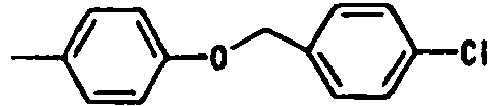
1.60-2.12(5H, m), 2.52-2.66(1, m), 2.71-2. 83 (2H, m), 3. 22-3. 28 (2H, m), 5.01(2H, s), 6. 88-6. 93 (2H, m), 7.11-7.18(2H, m), 7.30-7.41(4H, m) 362 
1. 86-2. 18 (3H, m), 2.35-2.52(1H, m), 2.61-2.69(1H, m), 2.93-3.01(5H, m), 3.24-3.59(3H, m), 4. 49 (2H, s), 6. 67-6. 70 (2H, m), 7.07-7.17(4H, m), 7.23-7.27(2H, m) Table 6 
Reference Example R1 R2 1H-NMR (CDCl3) δ ppm 363 
CH3 1. 50 (9H, s), 2.44(3H, s), 3. 00-3.14(4H, m), 3.49-3.57(4H, m), 3.72(2H, s), 6.89(2H, d, J=7.2 Hz), 7.26(2H, d, J=7.2 Hz). 364 
C2H5 1.15(3H, t, J=7.1Hz), 1. 48 (9H, s), 2.18(1H, brs), 2.69(2H, q, J=7.1Hz), 3.09-3.12(4H, m), 3.55-3. 59 (4H, m), 3. 73 (2H, s), 6. 86-6. 92 (2H, m), 7.23-7.26(2H, m). 365 
CH3 1.09-1.16(3H, m), 1. 78-1. 88 (2H, m), 2. 49 (3H, s), 2. 73-2. 80 (2H, m), 3.17-3.31(3H, m), 3.62-3.79 (5H, m), 3. 92 (2H, s), 6.67-6.70 (2H, m), 6. 91-6. 93 (2H, m), 7.13-7.19(2H, m), 7. 39-7. 42 (2H, m). Table 7 
Reference Example R 1H-MNR (CDCl3) δ ppm 366 -Cl 1. 51-1. 67 (2H, m), 1. 90-2. 04 (2H, m), 2.72(2H, s), 3.18-3.43(4H, m), 6. 89 (2H, d, J=8.4Hz), 7.21(2H, d, J=8. 4Hz) 367 -OCF3 1.53-1. 67 (2H, m), 1. 86-2. 04 (2H, m), 2.73(2H, s), 3.22-3.45(4H, m), 6. 93 (2H, d, J=8.4Hz), 7.11(2H, d, J=8.4Hz). 368 
1.53-1.63(2H, m), 1. 90-2. 06 (2H, m), 2. 73 (2H, s), 3. 24 (3H, s), 3.27-3. 45 (4H, m), 6. 72 (2H, d, J=8. 4Hz), 6.90-7.10(6H, m). 369 
1.54-1.69(2H, m), 1. 92-2. 06 (2H, m), 2.73(2H, s), 3. 20-3. 43 (4H, m), 6.84-6. 96 (6H, m), 7.14(2H, d, J=8.4Hz) 370 
1.58-1.69(2H, m), 1. 88-2. 15 (6H, m), 2.71(2H, s), 2.90-3.04(2H, m), 3.17-3. 44 (6H, m), 4.31-4.46(1H, m), 6.85-6. 94 (6H, m), 7.14(2H, d, J=8.4Hz) 371 
1. 55-1. 71 (2H, m), 1.92-2.04(2H, m), 2.72(2H, s), 3.12-3.35(12H, m), 6.86-7.00(6H, m), 7.14(2H, d, J=8.5Hz). - Following compounds were prepared in the same manner as described in Reference Example 186.
- MS: 269(M+)
- MS: 349(M+-1)
- MS: 353 (M+)
- MS: 381 (M+)
- 1H-NMR(CDCl3) δppm 1.46(9H, s), 1.76-2.05(4H, m), 2.23-2.34(1H, m), 2.62-2.73(2H, m), 3.39-3.48(2H, m), 4.39-4.49(1H, m), 4.78(1H, s), 6.72-6.78(2H, m), 6.82-6.89(2H, m).
- MS: 253 (M+)
- MS: 265(M+)
- MS: 410(M+)
- 1H NMR(CDCl3) δppm 1.51-1.70(2H, m), 1.80-1.92(2H, m), 2.53-2.66(2H, m), 3.48-3.57(2H, m), 3.84-3.92(2H, m), 3.92-4.02(2H, m), 4.63(1H, brs), 4.69(1H, d, J = 4.9 Hz), 6.70-6.78(2H, m), 6.83-6.91(2H, m).
- MS: 337 (M+)
- MS: 293(M+)
- MS: 337(M+)
- 1H NMR(CDCl3) δppm 1.87(4H, t, J = 5.7 Hz), 3.18(4H, t, J = 5.7 Hz), 3.99(4H, s), 6.74(2H, d, J = 8.9 Hz), 6.88(2H, d, J = 8.9 Hz).
- MS: 251 (M+)
- 1H NMR(CDCl3) δppm 1.49(9H, s), 2.95-3.00(4H, m), 3.55-3.60(4H, m), 5.77(1H, s), 6.74-6.86(4H, m).
- 1H NMR(CDCl3) δppm 3.19-3.24(4H, m), 3.29-3.34(4H, m), 4.51(1H, s), 6.76-6.82(2H, m), 6.87-6.97(4H, m), 7.11-7.16(2H, m).
- MS: 349(M+-1)
- 1H NMR(CDCl3) δppm 2.60(4H, t, J = 4.8 Hz), 3.08(4H, t, J = 4.8 Hz), 3.53(2H, s), 6.71-6.78(2H, m), 6.81-6.89(2H, m), 7.27-7.42(4H, m).
- 1H NMR(CDCl3) δppm 3.94-4.01(2H, m), 4.35-4.42(2H, m), 6.73-6.80(2H, m), 7.29-7.36(2H, m), 9.34(1H, s).
- 1H NMR(CDCl3) δppm 6.87-6.93(2H, m), 7.60-7.70(4H, m), 8.54-8.57(2H, m), 9.85(1H, s).
- 1H NMR(CDCl3) δppm 6.84-6.87(2H, m), 7.31-7.34(2H, m), 7.83-7.87(4H, m), 10.11(1H, brs), 10.15(1H, brs).
- 1H NMR(CDCl3) δppm 6.08(1H, s), 6.92-6.96(2H, m), 7. 30-7.33(2H, m), 7.76-7.83(4H, m).
- MS: 266(M+)
- 1H NMR(CDCl3) δppm 4.67(1H, brs), 6.81-6.85(2H, m), 6.90-6.96(4H, m), 7.13-7.16(2H, m).
Table 8 
Reference Example R1 NMR or Ms 396 4-ClPh- 1H NMR (CDCl3) δ 1. 87-2. 01 (2H, m), 2. 04-2. 16 (2H, m), 2.91-3.02 (2H, m), 3. 29-3. 39 (2H, m), 4.34-4.44(1H, m), 4.85(1H, s), 6. 71-6. 78 (2H, m), 6.82-6. 92 (4H, m), 7.20-7. 26 (2H, m). 397 4-CF3Ph- 1H NMR (CDCl3) δ 1.90-2.05(2H, m), 2. 08-2. 20 (2H, 4-CF3Ph- m), 2.94-3.05(2H, m), 3. 30-3. 40 (2H, m), 4.46-4.56(1H, m), 4.64(1H, s), 6. 72-6. 80 (2H, m), 6.86-6. 93 (2H , m), 6.96-7. 00 (2H, m), 7. 52-7. 56 (2H, m). 398 4-FPh- 1H NMR (CDCl3) δ 1. 86-2. 00 (2H, m), 2. 04-2. 16 (2H, m), 398 4-FPh- 2. 90-3. 00 (2H, m), 3. 30-3. 40 (2H, m), 4. 29-4.39(1H, m), 4.72(1H, s), 6.71-6.78(2H, m), 6.83-7.01(6H, m). 399 4-CH3OPh- 1H NMR (CDCl3) δ 1. 86-2. 00 (2H, m), 2. 05-2.13 (2H, m), 4-CH3OPh 2.88-2.99 (2H, m), 3. 31-3. 41 (2H, m), 3.77(3H, s), 4. 25-4.35(1H, m), 4.72(1H, s), 6. 72-6. 77 (2H, m), 6. 80-6. 92 (6H, m). 400 4-CH3Ph- 1H NMR (CDCl3) δ 1.87-2.01 (2H, m), 2. 04-2. 16 (2H, m), 2. 29 (3H, s), 2.90-3.00 (2H, m), 3. 30-3. 40 (2H, m), 4.33-4.43(1H, m), 4.85(1H, s), 6.71-6.78(2H, m), 6. 80-6. 92 (4H, m), 7.06-7.10 (2H, m). 401 -C6H5 1H NMR (CDCl3) δ 1. 89-2. 03 (2H, m), 2. 04-2. 18 (2H, m), 2. 92-3. 02 (2H, m), 3. 31-3. 41 (2H, m), 4.39-4.49(1H, m), 4.92(1H, s), 6. 70-6. 78 (2H, m), 6.84-6. 98 (5H, m), 7.24-7.33(2H, m). 402 4-CNPh- 1H NMR (CDCl3) δ 1. 90-2. 04 (2H, m), 2. 09-2. 18 (2H, m), 2.94-3.04(2H, m), 3.29-3.39(2H, m), 4.49-4.55(1H, m), 6. 75-6. 80 (2H, m), 6. 86-6. 90 (2H, m), 6.93-7.00(2H, m), 7. 55-7. 62 (2H, m). 403 -CH2-cyclo-C6H11 Ms : 289 (M+) 404 
1H NMR (CDCl3) δ 1. 54-2. 07 (11H, m), 2. 74-2. 87 (2H, m), 3. 31-3.43(2H, m), 3.47-3. 57(1H, m), 3.72-3.83(1H, m), 3.88-3. 98 (1H, m), 4.74-4.78(1H, m), 6. 69-6. 76 (2H, m), 6.83-6.88(2H, m). Table 9 
Reference Example R1 R2 NMR 405 -CH3 4-CF3OPh- 1H NMR (CDCl3) δ 3.23(3H, s), 4.88(1H, s), 6.66-6.73(2H , m), 6.80-6.87(2H , m), 6.99-7.08(4H, m). 406 -CH3 4-ClPh- 1H NMR (CDCl3) δ 3.22(3H, s), 4.69(1H, brs), 6.66-6.68(2H, m). 6.81-6.84(2H, m), 7.01-7.04(2H, m), 7.10-7.13(2H, m). 407 -CH3 4-CF3Ph- 1H NMR (CDCl3) δ 3.28(3H, s), 4.80(1H, brs), 6.68-6.71(2H, m), 6.85-6.88(2H, m), 7.06-7.09(2H, m), 7.37-7.40(2H, m). 408 -C2H5 4-CF3OPh- 1H NMR (CDCl3)δ 1.19(3H, t, J=7.1Hz), 3.66(2H, q, J=7.1Hz), 4.75(1H, brs), 6.62-6.66(2H, m), 6.83-6.87(2H, m), 6.98-7.05(4H, m). 409 4-CF3OPhCH2- 4-CF3OPhCH2 1H NMR (CDCl3)δ 4.34(1H, bs), 4.49(4H, brs), 6.61-6.72(4H, m), 7.14-7.16(4H, m), 7.24-7.26(4H, m). 410 -C2H5 4-CF3Ph- 1H NMR (CDCl3) δ 1.21(3H, t, J=7.1 Hz), 3.70(2H, q, J=7.1 Hz), 4.87(1H, brs), 6.62-6.65(2H, m), 6.85-6.91(2H, m), 7.03-7.09(2H. m), 7.34-7.37(2H, m). 411 -C2H5 4-ClPh- 1H NMR (CDCl3) δ 1.17(3H, t, J=7.1 Hz), 3.65(2H, q, J=7.1Hz), 4.73(1H, brs), 6.59-6.63(2H, m), 6.82-6.85(2H. m), 6.98-7.03(2H, m), 7.06-7.10(2H, m). 412 -CH3 4-CF3OPhCH2- 1H NMR (CDCl3) δ 2.90(3H, s), 4.33(1H, brs), 4.40(2H, brs), 6.66-6.70(2H, m), 6.72-6.76(2H, m), 7.13-7.16(2H, m), 7.25-7.27(2H, m). 413 -CH3 4-ClPhCH2- 1H NMR (CDCl3) δ 2.88(3H, s), 4.34(1H, brs), 4.36(2H, brs), 6.65-6.69(2H, m), 6.71-6.76(2H, m), 7.15-7.18(2H, m), 7.25-7.28(2H, m). 414 -CH3 4-CF3PhCH2- 1H NMR (CDCl3) δ 2.92(3H, s), 4.35(1H, brs), 4.46(2H, brs), 6.65-6.68(2H, m), 6.73-6.76(2H, m), 7.34-7.37(2H, m), 7.55-7.58(2H, m). 415 -C2H5 4-CF3OPhCH2- 1H NMR (CDCl3) δ 1.14(3H, t, J=7.1Hz), 4.12(2H, q, J=7.1 Hz), 4.28(1H, brs), 4.39(2H, brs), 6.50-6.80(4H, m), 7.13-7.15(2H, m), 7.26-7.28(2H, m). 416 -C2H5 4-CF3PhCH2- 1H NMR (CDCl3) δ 1.16(3H, t. J=7.0Hz), 3.38(2H, brs), 4.29(1H, brs), 4.45(2H, brs), 6.61-6.70(4H, m), 7.35-7.38(2H, m), 7.54-7.56(2H, m). 417 -C2H5 4-ClPhCH2- 1H NMR (CDCl3) δ 1.14(3H, t, J=7.0Hz), 3.35(2H, brs), 4.28(1H, brs), 4.36(2H, brs), 6.62-6.70(4H, m), 7.17-7.19(2H, m), 7.25-7.28(2H, m). 418 -COCH3 -C6H5 1H NMR (CDCl3)δ 2.06(3H, s), 6.27(1H, brs), 6.69-6.80(2H, m), 7.08-7.33(7H, m). 419 -COCH3 4-ClPh- 1H NMR (CDCl3) δ 2.06(3H. s), 6.50(1H, brs), 6.63-6.85(2H, m), 7.05-7.08(2H, m), 7.18-7.38(4H, m). Table 10 
Reference Example R1 R2 R3 NMR 420 -CH3 4-CF3OPh- -F 1H NMR (CDCl3) δ 3. 22(3H, s), 5.02(1H, brs), 6. 57-6. 71(4H, m), 7.01-7.14(3H, m). 421 -CH3 4-ClPh- -F 1H NMR (CDCl3) δ 3.20(3H, s), 5.02(1H, brs), 6.54-6.70(4H, m), 7. 07-7. 13 (3H, m). 422 -C6H5 -CO2CH3 -H 1H NMR (CDCl3) 6 3. 75 (3H, s), 5. 86(1H, brs), 6. 69-6..72 (2H, m), 7. 05-7. 08 (2H, m), 7.18-7.31(5H, m). 423 -CO2CH3 4-ClPh- -H 1H NMR (CDCl3) δ 3.75(3H, s), 5.52(1H, brs), 6.73-6.76(2H, m), 7.04-7.07(2H, m), 7. 16-7.18(2H, m), 7.26-7.29(2H, m). 424 -COCH3 4-CF3Ph- -H 1H NMR (CDCl3) δ 2. 08 (3H, s), 6.04(1H, brs), 6.83-6.86(2H, m), 7.09-7.12(2H, m), 7.37-7. 40 (2H, m), 7. 56-7. 59 (2H, m). 425 -COCH3 4-CF3OPh- -H 1H NMR (CDCl3) δ 2. 07 (3H, m). 6. 60-6. 92 (3H, 6.98-7.30(6H, m). 426 -CH3 -C6H5 -H 1H NMR (CDCl3) δ 3.24(3H, s), 4.63(1H, brs), 6. 76-6. 84 (5H, m), 7.01-7.05(2H, m), 7. 17-7. 22 (2H, m). 427 -COCH3 4-ClPh- -F 1H NMR (CDCl3) δ 2.07(3H, brs), 6.46-6.61 (2H, m), 6.96-7.36(6H, m). 428 -COCH3 4-CF3OPh- -F 1H NMR (CDCl3) δ 2. 07 (3H, brs), 6.48-6.62 (2H, m), 6.90-7.42(6H, m). Table 11 
Reterence Example R1 R2 NMR or Ms 429 -C6H5 4-CF3OPhCH2- 1H NMR (CDCl3) δ 4.72(1H, brs), 4.89(2H, brs), 6.75-6.83(5H, m), 7.05-7.18(6H, m), 7.34-7. 37 (2H, m). 430 -C6H5 4-CF3PhCH2 1HNMR (CDCl3) δ 4.67(1H, brs), 4.95(2H, brs), 6. 74-6. 83 (5H, m), 7.06-7.18(4H, m), 7.44-7.47(2H, m), 7.54-7.57(2H, m). 431 -C6H5 4-ClPhCH2- 1H NMR (CDCl3) δ 4.64(1H, brs), 4. 86 (2H, brs), 6. 74-6. 82 (5H, m), 7.04-7.08(2H, m), 7.12-7.17(2H, m), 7. 26 (4H, brs). 432 -COCH3 4-CF3OPhCH2- 1H NMR (CDCl3) δ 1. 89 (3H, s), 4.83(2H, s), 6.54(1H, brs), 6.82(4H, m), 7.09-7.12(2H, m), 7. 20-7. 26 (2H, m). 433 -CH3 4-CF3PhCO- 1H NMR (CDCl3) δ 3. 46 (3H, s), 6.28(1H, brs), 6. 68-6. 71 (2H, m), 6. 85-6. 92 (2H, m), 7.33-7. 44 (4H, m). 434 -CH3 4-ClPhCO- 1H NMR (CDCl3) δ 3.44(3H, s), 5.12(1H, brs), 6.67-6.72(2H, m), 6. 88-6. 91 (2H, m), 7. 13-7.16(2H, m), 7.21-7. 24 (2H, m). 435 -H 4-CF3OPhCO- 1H NMR (CDCl3) δ 6. 71-6. 76 (2H, m), 7. 48-7. 52 (4H, m), 8. 02-8. 05 (2H, m), 9.25(1H, s), 10. 10(1H, brs). 436 -CH3 4- CF3OPhCO- 1H NMR (CDCl3) δ 3.45(3H, s), 6.13(1H, brs), 6.69-6.72(2H, m), 6.87-6.89(2H, m), 6. 99-7.02(2H, m), 7. 31-7. 34 (2H, m). 437 -CH3 4-CF3OPhO(CH2)3- 1H NMR (CDCl3) δ 1. 97-2. 06 (2H, m), 2.85(3H, s), 3. 42 (2H, t, J=6.9Hz), 3.99(2H, t, J=6.0Hz), 4.28(1H, brs), 6.65-6.75 (4H, m), 6.86-6.89 (2H, m), 7.11-7.14(2H, m). 438 -H 
219 (M+- 1) Table 12 
Reference Example R1 NMR or Ms 439 
Ms: 367 (M+) 440 
1H NMR (CDCl3) δ 2.96(3H, s), 4. 43 (2H, brs), 4.68(1H,s), 6.63-6.66(2H,m), 6. 76-6.80(2H, m), 7.05-7.08(2H, m), 7.12-7. 15 (2H, m). 441 
1H NMR (CDCl3) δ 1. 90 (3H, brs), 4.83(2H, s), 5.88(1H, brs), 6.74-6. 76 (2H, m), 7. 02-7.06(2H, m), 7.10-7. 13 (2H, m), 7.60-7.63(2H, m). 442 
1H NMR (CDCl3) δ 3. 06 (3H, s), 4. 52 (2H, s), 4. 70 (1H, s), 6. 71 -6. 81 (4H, m), 7.05-7.07(2H, m), 7.41-7.44(2H, m). 443 
1H NMR (CDCl3) δ 2. 99 (3H, s), 4. 44 (2H, s), 4.68(1H, s), 6.66-6.70(2H,m), 6. 77-6. 81(2H, m), 7.04-7.10(4H, m). 444 
1H NMR (CDCl3) δ 3.95(1H, brs), 4. 21 (2H, s), 4. 69(1H, brs), 6. 53-6. 56(2H, m), 6. 79-6. 82(2H, m), 7.09-7. 12(2H, m), 7. 20-7. 23 (2H, m). 445 
1H NMR (CDCl3) δ 4. 28 (3H, brs), 4. 71 (1H, brs), 6.60-6.63(2H, m), 6. 79-6. 83 (2H, m), 7.21-7. 23(2H, m), 7.38-7.40(2H, m). 446 
1H NMR (CDCl3) δ 2. 16 (3H, s), 3. 45 (2H, s), 3.48 (2H, s), 4.82(1H, brs), 6. 76-6. 79(2H, m), 7. 14-7. 22(4H, m), 7. 35-7. 38 (2H, m) . 447 
1H NMR (CDCl3) δ 4. 03(1H, brs), 4. 22 (2H, s), 4. 72(1H, brs), 6. 56-6. 69 (2H, m), 6.80-6.83(2H, m), 7.01-7.04(2H, m), 7.21-7.24(2H, m). - Sodium hydrogencarbonate (1.25 g, 14.91 mmol) was added to a solution of 2-chloro-4-nitro-1H-imidazole (2 g, 13.56 mmol) and epichlorohydrin (1.38 g, 14.91 mmol) in acetonitrile (60 ml), and the resulting mixture was stirred under reflux for 4 hours. The reaction mixture was allowed to return to room temperature, and concentrated under reduced pressure. To the residue, water (20 ml) was added, the resulting mixture was extracted with methylene chloride (15 ml) twice, and the extracts were dried over sodium sulfate, and then filtrated. The filtrate was concentrated under reduced pressure, and the residue was purified by silica gel column chromatography (ethyl acetate/n-hexane = 1/1) to afford 2-chloro-1-(3-chloro-2-hydroxypropyl)-4-nitroimidazole (2.04 g, yield 63%) as a light yellow oil.
1H-NMR (CDCl3) δppm: - 3.51 - 3.70 (2H, m), 4.02 - 4.35 (4H, m), 7.92 (1H, s).
- 2-Chloro-1-(3-chloro-2-hydroxypropyl)-4-nitroimidazole prepared in Example 1 (2.04 g, 8.5 mmol) was dissolved in methylene chloride (20 ml), and 1,8-diazabicyclo[5.4.0]-7-undecene (DBU) (2.04 ml, 13.67 mmol) was added to the solution. The resulting mixture was stirred at room temperature overnight. The reaction mixture was washed with 3N hydrochloric acid (20 ml) and a saturated saline solution (20 ml) in this order, dried over sodium sulfate and then filtered. The filtrate was concentrated under reduced pressure, and the residue was purified by silica gel column chromatography (methylene chloride/ethyl acetate = 20/1) to afford 2-chloro-4-nitro-1-(oxiran-2-ylmethyl)imidazole (190 mg, yield 11%) as a colorless oil.
1H-NMR (CDCl3) δPPM: - 2.55 - 2.69 (1H, m), 2.97 (1H, t, J = 4.2 Hz), 3.26 - 3.43 (1H, m), 3.94 (1H, dd, J = 6.4 Hz, 15.0 Hz), 4.52 (1H, dd, J = 2. 6 Hz, 15.0 Hz), 7.88 (1H, s).
- 2-Chloro-4-nitro-1H-imidazole (6.78 g, 46 mmol) and 2-methyloxiran-2-ylmethyl 4-nitrobenzoate (12 g, 51 mmol) were dissolved in ethyl acetate (24 ml), and triethylamine (1.3 ml, 9.2 mmol) was added to the solution. The resulting mixture was stirred under reflux for 14 hours. The reaction mixture was concentrated under reduced pressure, and methylene chloride (40 ml) was added to the residue. The resulting precipitates were filtered off, and dissolved in methanol (120 ml). To the solution, potassium carbonate (318 mg, 2.3 mmol) was added, and the resulting mixture was stirred at room temperature for 1 hour. To the resulting mixture, 6 N hydrochloric acid (0.8 ml) and magnesium sulfate (8 g) were added in this order with cooling on ice-bath, and the resulting mixture was stirred for 30 minutes. Insoluble matters were removed by filtration through Celite, and the filtrate was concentrated under reduced pressure. To the residue, ethyl acetate (6 ml) and toluene (60 ml) were added. The resulting precipitates were filtered off and dried at 50°C to afford 2-chloro-1-(2,3-dihydroxy-2-methylpropyl)-4-nitroimidazole (7.88 g, yield 72%) as a white powder.
1H-NMR (DMSO-d6) δppm: - 1.02 (3H, s), 3.25 (2H, d, J = 5.3 Hz), 4.04 (2H, s), 4.98 (1H, s), 5.10 (1H, t, J = 5.4 Hz), 8.29 (1H, s).
- Methanesulfonyl chloride (2.01 ml, 25.72 mmol) was added to a solution of 2-chloro-1-(2,3-dihydroxy-2-methylpropyl)-4-nitroimidazole prepared in Example 3 (5.05 g, 21.43 mmol) in pyridine (10 ml) with cooling on ice-bath and the resulting mixture was stirred at room temperature for 1.5 hours. 6N hydrochloric acid was added to the mixture, and the resulting mixture was extracted with ethyl acetate. The organic phase was dried over magnesium sulfate, and then concentrated under reduced pressure to afford 2-chloro-1-(2-hydroxy-3-methanesulfonyloxy-2-methylpropyl)-4-nitroimidazole (6.72 g, quantitative) as a yellow oil.
1H-NMR (CDCl3) δppm: - 1.31 (3H, s), 2.10 (1H, s), 3.11 (3H, s), 4.08 - 4.23 (4H, m), 8.02 (1H, s).
- 2-Chloro-4-nitro-1H-imidazole (1 g, 6.78 mmol), 2-methyloxiran-2-ylmethyl paratoluenesulfonate (2.46 g, 10.15 mmol), benzyl (triethyl) ammonium chloride (1.50 mg, 0.66 mmol) and acetonitrile (10 ml) were stirred under reflux for 8 hours. The reaction mixture was allowed to return to room temperature, diluted with ethyl acetate. The organic phase was washed with a saturated aqueous sodium bicarbonate solution twice, dried over magnesium sulfate and then filtered. The filtrate was concentrated under reduced pressure, and the residue was purified by silica gel column chromatography (methylene chloride/ethyl acetate = 6/1) to afford 2-chloro-1-[2-hydroxy-2-methyl-3-(4-methylbenzenesulfonyloxy)propyl]-4-nitroimidazole (1.86 g, yield 70%) as a light yellow oil.
1H-NMR (CDCl3) δppm: - 1.25 (3H, s), 2.46 (3H, s), 2.80 (1H, s), 3.91 (1H, d, J = 10.4 Hz), 3.95 (1H, d, J = 10.4 Hz), 4.04 - 4.16 (2H, m), 7.38 (2H, d, J = 8.0 Hz), 7.76 (2H, d, J = 8.0 Hz), 7.93 (1H, s).
- 2-Chloro-1-(2-hydroxy-3-methanesulfonyloxy-2-methylpropyl)-4-nitroimidazole prepared in Example 4 (6.72 g, 21.43 mmol) was treated in the same manner as in Example 2 to afford 2-chloro-1-(2-methyloxiran-2-ylmethyl)-4-nitroimidazole (5.6 g, yield 94%) as a white powder.
1H-NMR (CDCl3) δppm: - 1.39 (3H, s), 2.62 (2H, d, J = 4.0 Hz), 2.78 (1H, d, J = 4.0 Hz), 4.00 (1H, d, J = 14.9 Hz), 4.38 (1H, d, J = 14.9 Hz), 7.87 (1H, s).
- Using 2-chloro-1-[2-hydroxy-2-methyl-3-(4-methylbenzenesulfonyloxy)propyl]-4-nitroimidazole prepared in Example 5 (1.11 g, 2.84 mmol) gave 2-chloro-1-(2-methyloxiran-2-ylmethyl)-4-nitro-1H-imidazole (523 mg, yield 85%) as a light yellow powder in the same manner as in Example 2.
- The properties of the obtained compound were same as those of the compound obtained in Example 6.
- 2-Chloro-4-nitro-1H-imidazole (10 g, 67.79 mmol) and (R)-(-)-glycidyl tosylate (17.02 g, 74.58 mmol) were dissolved in acetonitrile (50 ml), sodium hydrogencarbonate (6.26 g, 74.15 mmol) was added to the solution, and the resulting mixture was stirred under reflux for 3.5 hours. The reaction mixture was allowed to return to room temperature. After filtration, the filtrate was concentrated under reduced pressure. The residue was purified by silica gel column chromatography (ethyl acetate/n-hexane = 1/2) to afford (R)-2-chloro-1-[2-hydroxy-3-(4-methylbenzenesulfonyloxy)propyl]-4-nitroimidazole (16.9 g, yield 66%) as a light yellow oil.
1H-NMR (CDCl3) δppm: - 2.47 (3H, s), 3.65 (1H, d, J = 5.8 Hz), 3.93 - 4.33 (5H, m), 7.38 (2H, d, J = 8.3 Hz), 7.70 (2H, d, J = 8.3 Hz), 7.86 (1H, s).
- 2-Chloro-4-nitro-1H-imidazole (1 g, 6.78 mmol) and (R)-(-)-glycidyl tosylate (1.7 g, 7.45 mmol) were dissolved in tetrahydrofuran (THF) (10 ml), sodium hydrogencarbonate (600 mg, 7.14 mmol) was added to the solution, and the resulting mixture was stirred under reflux for 11 hours. The reaction mixture was concentrated under reduced pressure, water was added to the solution, and the resulting mixture was extracted with ethyl acetate. The organic phase was washed with water and a saturated saline solution in this order, dried over sodium sulfate, and filtered. The filtrate was concentrated, and the residue was purified by silica gel column chromatography (ethyl acetate/n-hexane = 1/1) to afford (R)-2-chloro-4-nitro-1-(oxiran-2-ylmethyl)imidazole (1.45 g, yield 57%) as a light yellow oil.
Optical purity 79.2% e.e.
[α]D 27 = 42.55° (concentration: 1.262, CHCl3)
1H-NMR (CDCl3) δppm: - 2.61 (1H, t, J = 2.5 Hz, 4.3 Hz), 2. 97 (1H, t, J = 4.3 Hz), 3.25 - 3.34 (1H, m), 3.95 (1H, dd, J = 6.4 Hz, 15.0 Hz), 4.51 (1H, dd, J = 2.6 Hz, 15.0 Hz), 7.88 (1H, s) .
- 2-Chloro-4-nitro-1H-imidazole (600 g, 4.07 mol) and (R)-2-methyloxiran-2-ylmethyl 4-nitrobenzoate (1060 g, 4.47 mol) were dissolved in ethyl acetate (2124 ml), triethylamine (113.64 ml, 0.82 mol) was added to the solution, and the resulting mixture was stirred under reflux for 16 hours. The reaction mixture was concentrated under reduced pressure, and ethyl acetate (530 ml) and toluene (5300 ml) were added to the residue. The resulting precipitates were filtered off and dissolved in methanol (10.6 1). Potassium carbonate (55.4 g, 0.4 mol) was added to the solution, the resulting mixture was stirred at room temperature for 1 hour, concentrated hydrochloric acid (66 ml) and magnesium sulfate (671 g) were added in this order with cooling on ice-bath, and the resulting mixture was stirred for 30 minutes. Insoluble matters were removed by filtration, and the filtrate was concentrated under reduced pressure. To the residue, ethyl acetate (530 ml) and toluene (5300 ml) were added. The resulting precipitates were filtered off and dried at 50°C to afford (R)-2-chloro-1-(2,3-dihydroxy-2-methylpropyl)-4-nitroimidazole (879.1 g, yield 92%) as a light brown powder.
Optical purity 99.0% e.e.
[α]D 27 = 17.38° (concentration: 1.03, DMSO)
1H-NMR (DMSO-d6) δppm: - 1.01 (3H, s), 3.25 (2H, d, J = 5.3 Hz), 4.05 (2H, s), 5.01 (1H, s), 5.11 (1H, t, J = 5.4 Hz), 8.32 (1H, s).
- (R)-2-Chloro-1-(2,3-dihydroxy-2-methylpropyl)-9-nitroimidazole prepared in Example 10 (879 g, 3.73 mol) was dissolved in pyridine (1778 ml) and cooled to 5°C. To this solution, methanesulfonyl chloride (432.7 ml, 5.59 mol) was added dropwise below 15°C, and the resulting mixture was stirred at the same temperature for 1 hour. To the mixture, 6N hydrochloric acid (5500 ml) was added below 30°C, and the resulting mixture was stirred for 40 minutes with cooling on ice-bath. The precipitates were filtered off and washed with water and toluene in this order to afford primary crystals. In addition, the filtrate was extracted with ethyl acetate (5 liters) twice. The organic phase was washed with water, dried over magnesium sulfate, and filtered to afford a solid. The filtrate was concentrated under reduced pressure. To the residue, toluene was added and the precipitates were filtered off to afford a solid. The solids were combined and dried at 60°C to afford (R)-2-chloro-1-(2-hydroxy-3-methanesulfonyloxy-2-methylpropyl)-4-nitroimidazole (942.6 g, yield 81%) as a white powder.
1H-NMR (DMSO-d6) δppm : - 1.12 (3H, s), 3.23 (3H, s), 4.09 (2H, s), 4.13 (2H, s), 5.60 (1H, br), 8.34 (1H, s).
- (R)-2-Chloro-1-(2-hydroxy-3-methane-sulfonyloxy-2-methylpropyl)-4-nitroimidazole prepared in Example 11 (942.6 g, 3 mol) was suspended in ethyl acetate (9426 ml). DBU (494 ml, 3.3 mol) was added to the suspension, and the resulting mixture was stirred at room temperature for 1 hour. The reaction mixture was washed with water (5 liters). The water layer was extracted with ethyl acetate (5 liters) twice. The organic phases were combined together, and the mixture was washed with a saturated saline solution (5 liters), dried over magnesium sulfate and then filtered. The filtrate was concentrated under reduced pressure, and the residue was purified by silica gel column chromatography (ethyl acetate/n-hexane = 1/2) to afford (R)-2-chloro-1-(2-methyloxiran-2-ylmethyl)-4-nitroimidazole (600.7 g, yield 92%) as a white powder.
Optical purity 98.8% e.e.
[α]D 26 = 31.11° (concentration: 2.02, CHCl3)
1H-NMR (CDCl3) δppm: - 1.38 (3H, s), 2.62 (1H, d, J = 4.0 Hz), 2.78 (1H, d, J = 4.0 Hz), 4.00 (1H, d, J = 14.9 Hz), 4.38 (1H, d, J = 14.9 Hz), 7.87 (1H, s).
- 2-Chloro-4-nitro-1H-imidazole (18.4 g, 125 mmol) and (R)-2-methyloxiran-2-ylmethyl 4-methylbenzene sulfonate (36.2 g, 149 mmol) were suspended in acetonitrile (150 ml). Benzyl(triethyl) ammonium chloride (5.7 g, 25 mmol) was added to the suspension, and the resulting mixture was stirred under reflux for 8 hours. The reaction mixture was concentrated under reduced pressure. The residue was purified by silica gel column chromatography (methylene chloride/ethyl acetate = 20/1) to afford (R)-2-chloro-1-[2-hydroxy-2-methyl-3-(4-methylbenzenesulfonyloxy)propyl]-4-nitroimidazole (20.1 g, 43%) as a white amorphous form.
1H-NMR (CDCl3) δppm: - 1.24 (3H, s), 2.47 (3H, s), 2.81 (1H, s), 3.90 (1H, d, J = 10.4 Hz), 3.95 (1H, d, J = 10.4 Hz), 4.04 - 4.14 (2H, m), 7.39 (2H, d, J = 8.0 Hz), 7.76 (2H, d, J = 8.0 Hz), 7.91 (1H, s).
- 2-Chloro-4-nitro-1H-imidazole (1.51 g, 10.17 mmol) and (R)-2-methyloxiran-2-ylmethyl 4-methylbenzene sulfonate (3.70 g, 15.25 mmol) were suspended in acetonitrile (150 ml). Benzyl(triethyl) ammonium chloride (0.23, 1.02 mmol) was added to this suspension, and the resulting mixture was stirred under reflux for 10 hours. After the reaction mixture was allowed to return to room temperature, ethyl acetate was added to the solution. The resulting mixture was washed with an aqueous sodium hydrogencarbonate, dried over magnesium sulfate and then filtered. The filtrate was concentrated under reduced pressure and dissolved in ethyl acetate (40 ml). DBU (1.57 ml, 10.17 mmol) was added to the solution with cooling on ice-bath, and the resulting mixture was stirred at room temperature for 1.5 hours. The reaction mixture was washed with water, dried over magnesium sulfate, and then concentrated under reduced pressure. The residue was purified by silica gel column chromatography (n-hexane/ethyl acetate = 7/3) to afford (R)-2-chloro-1-(2-methyloxiran-2-ylmethyl)-4-nitroimidazole (1.50 g, yield 68%) as a light yellow oil.
- 2-Chloro-4-nitro-1H-imidazole (3 g, 20.34 mmol) and (S)-2-methyloxiran-2-ylmethyl 4-nitrobenzoate (5.31 g, 22.37 mmol) were dissolved in ethyl acetate (10 ml). Triethylamine (0.57 ml, 4.07 mmol) was added to the solution, and the resulting mixture was stirred at 60-65°C for 10 hours. The reaction mixture was concentrated under reduced pressure. Ethyl acetate (3 ml) and toluene (30 ml) were added to the residue, and the resulting precipitates were filtered off to afford (S)-2-chloro-4-nitro-1-[2-hydroxy-3-(4-nitrobenzoyloxy)-2-methylpropyl]imidazole (6.82 g, yield 87%) as a yellow powder.
1H-NMR (DMSO-d6) δppm: - 1.23 (3H, s), 4.11 - 4.33 (4H, m), 5.61 (1H, s), 8, 25 (2H, d, J = 8.9 Hz), 8.31 - 8.45 (3H, m).
- (S)-2-Chloro-4-nitro-1-[2-hydroxy-3-(4-nitrobenzoyloxy)-2-methylpropyl]imidazole prepared in Example 15 (6.8 g, 17.67 mmol) was dissolved in methanol (68 ml). Potassium carbonate (122 mg, 0.88 mmol) was added to the solution, and the resulting mixture was stirred at room temperature overnight. The mixture was cooled on ice-bath, 6N hydrochloric acid (0.3 ml) and magnesium sulfate (3 g) were added to the mixture in this order, and the mixture was stirred for 30 minutes. Insoluble matters were removed by filtration, and the filtrate was concentrated under reduced pressure. Ethyl acetate (3.4 ml) and toluene (34 ml) were added to the residue, and the resulting precipitates were filtered off to afford (S)-2-chloro-1-(2,3-dihydroxy-2-methylpropyl)-4-nitroimidazole (4.09 g, yield 97%) as a yellow powder.
1H-NMR (DMSO-d6) δppm : - 1.02 (3H, s), 3.25 (2H, d, J = 5.3 Hz), 4.05 (2H, s), 4.98 (1H, s), 5.11 (1H, t, J = 5.2 Hz), 8.30 (1H, s).
- (S)-2-Chloro-1-(2,3-dihydroxy-2-methylpropyl)-4-nitroimidazole prepared in Example 16 (4.05 g, 16.9 mmol) was dissolved in pyridine (8 ml), and this solution was cooled to 4°C. Methanesulfonyl chloride (1.6 ml, 20.28 mmol) was added dropwise to the solution below 15°C followed by stirring at the same temperature for 1 hour. 6N hydrochloric acid (33 ml) was added to the mixture below 30°C. The reaction mixture was extracted with methylene chloride (20 ml) three times. The organic phases were combined, washed with water (20 ml) and a saturated saline solution (20 ml), dried over sodium sulfate and then filtered. The filtrate was concentrated under reduced pressure. Toluene (10 ml) was added to the residue, and the resulting precipitates were filtered off to afford (S)-2-chloro-1-(2-hydroxy-2-methyl-3-methanesulfonyloxy-propyl)-4-nitroimidazole (3.04g, yield 57%) as a white powder.
1H-NMR (DMSO-d6) δppm : - 1.12 (3H, s), 3.24 (3H, s), 4.09 (2H, s), 4.13 (2H, s), 5.62 (1H, br), 8.34 (1H, s).
- (S)-2-Chloro-1-(2-hydroxy-2-methyl-3-methanesulfonyloxypropyl)-4-nitroimidazole prepared in Example 17 (3.02 g, 9.51 mmol) was dissolved in methylene chloride (30 ml). DBU (1.7 ml, 11.41 mmol) was added to the solution, and the resulting mixture was stirred at room temperature for 1.5 hours. The reaction mixture was washed with 3N hydrochloric acid (30 ml) and saturated saline solution (20 ml) in this order, dried over magnesium sulfate and then filtered. The filtrate was concentrated and the residue was purified by silica gel column chromatography (methylene chloride/ethyl acetate = 20/1) to afford (S)-2-chloro-1-(2-methyloxiran-2-ylmethyl)-4-nitroimidazole (1.89 g, yield 91%) as a light yellow solid.
Optical purity 93.2% e.e.
[α]D 27 = -29.15° (concentration: 1.18, CHCl3)
1H-NMR (CDCl3) δppm: - 1.39 (3H, s), 2.63 (1H, d, J = 4.0 Hz), 2.79 (1H, d, J = 4.0 Hz), 4.00 (1H, d, J = 14.9 Hz), 4.38 (1H, d, J = 14.9 Hz), 7.88 (1H, s).
- 2,4-Dinitro-1H-imidazole (10 g, 63.3 mmol), 2-tert-butoxymethyloxirane (27 ml, 189 mmol) and sodium acetate (5.19 g, 189 mmol) were suspended in ethanol (100 ml) followed by stirring under reflux for 17 hours. The reaction mixture was allowed to return to room temperature and concentrated under reduced pressure. Water was added to the residue, and the resulting mixture was extracted with methylene chloride. The organic phase was dried over sodium sulfate and then filtered. The filtrate was concentrated under reduced pressure. The residue was purified by silica gel column chromatography (methylene chloride/methanol = 50/1) to afford 2-tert-butoxymethyl-6-nitro-2,3-dihydroimidazo[2,1-b]oxazole (3.2 g, yield 21%) as a white powder.
1H-NMR (CDCl3) δppm: - 1.18 (9H, s), 3.63 - 3.80 (2H, m), 4.22 - 4.36 (2H, m), 5.27 - 5.42 (1H, m), 7.53 (1H, s).
- Using 2-methyl-2-(2-methoxymethoxyethyl) oxirane, 2-ethyl-2-methoxymethoxymethyloxirane or 2-isopropyl-2-methoxymethoxymethyloxirane gave compounds of Examples 20 to 22 in the same manner as in Example 19.
- White powder, yield 48%, MS = 257
- Light yellow powder, yield 49%
1H-NMR (DMSO-d6) δppm: - 0.91 (3H, t, J = 7.5 Hz), 1.91 (2H, q, J = 7.5 Hz), 3.24 (3H, s), 3.72 (1H, d, J = 11.2 Hz), 3.78 (1H, d, J = 11.2 Hz), 4.15 (1H, d, J = 11.2 Hz), 4.23 (1H, d, J = 11.2 Hz), 4.59 (2H, s), 8.10 (1H, s).
- Light yellow powder, yield 90%
1H-NMR (DMSO-d6) δppm: - 0.94 (6H, d, J = 6.9 Hz), 2.16 - 2.32 (1H, m), 3.24 (3H, s), 3.76 (1H, d, J = 13.0 Hz), 3.82 (1H, d, J = 13.0 Hz), 4.18 (1H, d, J = 13.0 Hz), 4.25 (1H, d, J = 13.0 Hz), 4.59 (2H, s), 8.09 (1H, s).
- Sodium acetate (3.51 g, 42.82 mmol) and 2-(2-methoxymethoxyethyl) oxirane (10.3 g, 77.86 mmol) were added to 2-chloro-4-nitro-1H-imidazole (5.74 g, 38.93 mmol) in ethanol (60 ml), and the resulting mixture was stirred under reflux for 13.5 hours. The reaction mixture was concentrated under reduced pressure. Water was added to the residue, and the resulting mixture was extracted with methylene chloride. The extract was dried over magnesium sulfate and then concentrated under reduced pressure, and the residue was purified by silica gel column chromatography (methylene chloride/methanol = 100/1) and then crystallized from methylene chloride-diisopropyl ether to afford 2-chloro-1-(2-hydroxy-4-methoxymethoxybutyl)-4-nitroimidazole (8.51 g, yield 78%) as a light yellow powder.
1H-NMR (CDCl3) δppm: - 1.67 (2H, m), 3.38 (3H, s), 3.46 (1H, d, J = 2.4 Hz), 3.78 - 3.83 (2H, m), 4.00 (1H, dd, J = 7.6 Hz, 14.3 Hz), 4.11 - 4.21 (2H, m), 4.63 (2H, s), 7.96 (1H, s).
- Colorless liquid, yield 63%
1H-NMR (CDCl3) δppm: - 1.20 (3H, s), 3.08 (1H, s), 3.42 (3H, s), 3.53 (2H, dd, J = 10.4 Hz, 13.8 Hz), 4.67 (2H, s), 8.01 (1H, s).
- Sodium hydride (1.33 g, 33.23 mmol) was added to a solution of 2-chloro-1-(2-hydroxy-methoxymethoxybutyl)-4-nitroimidazole prepared in Example 23 (8.45 g, 30.21 mmol) in 1,4-dioxane (100 ml) with cooling on ice-bath followed by stirring under reflux for 40 hours. The reaction mixture was concentrated under reduced pressure, and cooled on ice-bath. Water was added to the residue, and the resulting mixture was extracted with methylene chloride. The organic phase was dried over magnesium sulfate and then concentrated under reduced pressure. The residue was purified by silica gel column chromatography (methylene chloride/methanol = 100/1) and crystallized from methylene chloride-diisopropyl ether to afford 2-(2-methoxymethoxyethyl)-6-nitro-2,3-dihydroimidazo[2,1-b]oxazole (3.4 g, yield 47%) as a light yellow powder.
1H-NMR (CDCl3) δppm: - 2.11 - 2.35 (2H, m), 3.36 (3H, s), 3.75 (2H, dd, J = 4.8 Hz, 6.8 Hz), 4.08 (1H, dd, J = 7.6 Hz, 10.3 Hz), 4.40 (1H, dd, J = 7.6 Hz, 10.3 Hz), 4.61 (2H, s), 5.43 - 5.54 (1H, m), 7.53 (1H, s).
- Using 2-chloro-1-(2-hydroxy-3-methoxymethoxy-propyl)-4-nitroimidazole prepared in Example 24 gave a compound of Example 26 in the same manner as in Example 25.
- Light yellow powder, yield 38%
1H-NMR (CDCl3) δppm: - 1.66 (3H, s), 3.34 (3H, s), 3.63 (1H, d, J = 11.0 Hz), 3.84 (1H, d, J = 11.0 Hz), 3.93 (1H, d, J = 9.9 Hz), 4.37 (1H, d, J = 9.9 Hz), 4.62 (2H, s), 7.52 (1H, s).
- (R)-2-Chloro-1-(2,3-dihydroxy-2-methy propyl)-4-nitroimidazole prepared in Example 10 (7.4 g, 31 mmol) was dissolved in methylene chloride (120 ml). N, N-diisopropylethylamine (13.1 ml, 74 mmol) and chloromethylmethyl ether (7.1 ml, 74 mmol) were added to the solution followed by stirring at room temperature for 46 hours. The reaction mixture was washed with water, dried over magnesium sulfate and then concentrated under reduced pressure. The residue was purified by silica gel column chromatography (methylene chloride/ethyl acetate = 9/1) to afford (R)-2-chloro-1-(2-hydroxy-3-methoxymethoxy-2-methylpropyl)-4-nitroimidazole (6.0 g, yield 69%) as a light yellow oil.
1H-NMR (CDCl3) δppm: - 1.20 (3H, s), 3.08 (1H, s), 3.42 (3H, s), 3.50 (1H, d, J = 10.4 Hz), 3.55 (1H, d, J = 10.4 Hz), 4.05 (1H, d, J = 14.4 Hz), 4.15 (1H, d, J = 14.4 Hz), 4.67 (2H, s), 8.01 (1H, s).
- Sodium hydride (1.0 g, 25 mmol) was added to a solution of (R)-2-chloro-1-(2-hydroxy-3-methoxymethoxy-2-methylpropyl)-4-nitroimidazole prepared in Example 27 (6.0 g, 21 mmol) in DMF (30 ml) with cooling on ice-bath followed by stirring at room temperature for 1.5 hours. Ice-water was added to the reaction mixture, and the precipitates were filtered off and washed with water to afford (R)-2-methoxymethoxymethyl-2-methyl-6-nitro-2,3-dihydroimidazo[2,1-b]oxazole (3.1 g, yield 59%) as a yellow solid.
1H-NMR (CDCl3) δppm: - 1.66 (3H, s), 3.34 (3H, s), 3.63 (1H, d, J = 11.0 Hz), 3.84 (1H, d, J = 11.0 Hz), 3.93 (1H, d, J = 10.0 Hz), 4.42 (1H, d, J = 10.0 Hz), 4.63 (2H, s), 7.52 (1H, s).
- 2-Chloro-4-nitro-1H-imidazole (6.3 g, 43 mmol), 2-(3-acetoxypropyl)-2-methyloxirane (5.8 g, 39.3 mmol) and sodium acetate (3.9 g, 47.6 mmol) were suspended in ethanol (60 ml) followed by stirring under reflux overnight. The reaction mixture was allowed to return to room temperature and concentrated under reduced pressure. Water was added to the residue, and the resulting mixture was extracted with methylene chloride twice. The organic phases were combined, washed with a saturated aqueous sodium bicarbonate solution and a saturated saline solution in this order, dried over sodium sulfate and then filtered. The filtrate was concentrated under reduced pressure to afford 2-chloro-1-(5-acetoxy-2-hydroxy-2-methylpentyl)-4-nitroimidazole (9.5 g, yield 79%) as a light brown oil.
1H-NMR (CDCl3) δppm: - 1.21 (3H, s), 1.50 - 1.81 (4H, m), 2.05 (3H, s), 3.91 - 4.12 (4H, m), 8.02 (1H, s).
- Using 2-chloro-1-(5-acetoxy-2-hydroxy-2-methylpentyl)-4-nitroimidazole (9.5 g, 31.1 mmol) prepared in Example 29 gave 2-(3-acetoxypropyl)-2-methyl-6-nitro-2,3-dihydroimidazo[2,1-b]oxazole (5.2 g, yield 62%) as a light orange-colored powder in the same manner as in Example 25.
1H-NMR (CDCl3) δppm: - 1.67 (3H, s), 1.67 - 2.00 (4H, m), 2.05 (3H, s), 3.91 - 4.14 (4H, m), 7.52 (1H, s).
- Trifluoroacetic acid (2 ml) was added to a solution of 2-(2-methoxymethoxyethyl)-6-nitro-2,3-dihydroimidazo[2,1-b]oxazole prepared in Example 25 (0.2 g, 0.822 mmol) in methylene chloride (10 ml) followed by stirring at room temperature overnight. The mixture was concentrated under reduced pressure, and the residue was purified by silica gel column chromatography (methylene chloride/methanol = 100/1), and crystallized from methanol-diisopropyl ether to afford 2-(2-hydroxyethyl)-6-nitro-2,3-dihydroimidazo[2,1-b]oxazole (0.11 g, yield 65%) as a light yellow powder.
1H-NMR (DMSO-d6) δppm: - 1.92 - 2.14 (2H, m), 3.52 - 3.63 (2H, m), 4.05 (1H, dd, J = 7.6 Hz, 10.6 Hz), 4.43 (1H, dd, J = 7.6 Hz, 10.6 Hz), 4.72 (1H, t, J = 2.7 Hz), 5.38 - 5.53 (1H, m), 8.12 (1H, s).
- Using 2-tert-butoxymethyl-6-nitro-2,3-dihydroimidazo[2,1-b]oxazole prepared in Example 19 (5.82 g, 24.1 mmol) gave 2-hydroxymethyl-6-nitro-2,3-dihydroimidazo[2,1-b]oxazole (4.25 g, yield 95%) as a white powder in the same manner as in Example 31.
1H-NMR (DMSO-d6) δppm: - 3.55 - 3.67 (1H, m), 3.72 - 3.88 (1H, m), 4.12 (1H, dd, J = 6.5 Hz, 10.5 Hz), 4.36 (1H, t, J = 10.4 Hz), 5.25 - 5.50 (2H, m), 8.11 (1H, s).
- Using 2-methoxymethoxymethyl-2-methyl-6-nitro-2,3-dihydroimidazo[2,1-b]oxazole prepared in Example 26 (4.14 g, 38 mmol) gave 2-hydroxymethyl-2-methyl-6-nitro-2,3-dihydroimidazo[2,1-b]oxazole (2.17 g, yield 64%) as a light yellow powder in the same manner as in Example 31.
Melting point 166-168°C
1H-NMR (DMSO-d6) δppm: - 1.51 (3H, s), 3.53 (1H, d, J = 12.1 Hz), 3.64 (1H, d, J - 12.1 Hz), 4.03 (1H, d, J = 10.6 Hz), 4.24 (1H, d, J = 10.6 Hz), 5.40 (1H, br), 8.10 (1H, s).
- Using 2-(2-methoxymethoxyethyl)-2-methyl-6-nitro-2,3-dihydroimidazo[2,1-b]oxazole prepared in Example 20 (13.4 g, 52.1 mmol) gave 2-(2-hydroxyethyl)-2-methyl-6-nitro-2,3-dihydroimidazo[2,1-b]oxazole (2.32 g, yield 21%) as a light yellow powder in the same manner as in Example 31.
1H-NMR (DMSO-d6) δppm: - 1.58 (3H, s), 1.93 - 2.17 (2H, m), 3.59 (2H, t, J = 6.4 Hz), 4.04 (1H, d J = 10.9 Hz), 4.33 (d, 1H, J = 10.9 Hz), 8.11 (1H, s).
- 2-Ethyl-2-methoxymethoxymethyl-6-nitro-2,3-dihydroimidazo[2,1-b]oxazole prepared in Example 21 (21.5 g, 83.7 mmol) was suspended in methanol (430 ml). Concentrated hydrochloric acid (2.15 ml) was added to this suspension followed by stirring under reflux for 5 hours. The reaction mixture was concentrated under reduced pressure, and the precipitates were filtered off to afford 2-ethyl-2-hydroxymethyl-6-nitro-2,3-dihydroimidazo[2,1-b]oxazole (7.14 g, yield 40%) as a light yellow powder.
1H-NMR (DMSO-d6) δppm: - 0.89 (3H, t, J = 7.4 Hz), 1.95 (2H, q, J = 7.4 Hz), 3.53 - 3.69 (2H, m), 4.08 (1H, d, J = 10.8 Hz), 4.21 (1H, d, J = 10.8 Hz), 5.39 (t, 1H, J = 5.6 Hz), 8.09 (1H, s).
- Using corresponding starting materials gave a compound of Example 36 in the same manner as in Example 35.
- Light yellow powder, yield 50%
1H-NMR (DMSO-d6) δppm: - 0.91 (6H, d, J = 6.9 Hz), 2.12 - 2.23 (1H, m), 3.60 - 3.77 (2H, m), 4.16 (2H, s), 5.35 (1H, t, J = 5.6 Hz), 8.08 (1H, s).
- Trifluoroacetic acid (15 ml) was added to a solution of (R)-2-methoxymethoxymethyl-2-methyl-6-nitro-2,3-dihydroimidazo[2,1-b]oxazole prepared in Example 28 (3.1 g, 13 mmol) in methylene chloride (30 ml) followed by stirring at room temperature for 25 hours. The reaction mixture was concentrated under reduced pressure. Methanol was added to the solution, and the resulting mixture was concentrated under reduced pressure. To the residue, 2-propanol was added, and the precipitates were filtered off and washed with 2-propanol to afford (R)-2-hydroxymethyl-2-methyl-6-nitro-2,3-dihydroimidazo[2,1-b]oxazole (1.2 g, yield 46%) as a light yellow powder.
Melting point 162-163°C
Optical purity 97% e.e.
[α]D 26 = -19.01° (concentration: 0.526, DMSO) - A mixture of 2-(3-acetoxypropyl)-2-methyl-6-nitro-2,3-dihydroimidazo[2,1-b]oxazole prepared in Example 30 (3.2 g, 11.88 mmol), potassium carbonate (320 mg, 2.32 mmol) and methanol (35 ml) was stirred at room temperature for 2 hours. The reaction mixture was concentrated under reduced pressure, and the residue was purified by silica gel column chromatography (methylene chloride/methanol = 25/1) to afford 2-methyl-2-(3-hydroxypropyl)-6-nitro-2,3-dihydroimidazo[2,1-b]oxazole (2.1 g, 78%) as a light yellow powder.
1H-NMR (CDCl3) δppm: - 1.67 - 1.72 (5H, m), 1.91 - 2.07 (2H, m), 3.51 - 3.65 (2H, m), 4.01 (1H, d, J = 10.5 Hz), 4.15 (1H, d, J = 10.5 Hz), 7.66 (1H, s).
- Methanesulfonyl chloride (1.4 ml, 18.09 mmol) in methylene chloride (10 ml) was added dropwise to a mixture of 2-methyl-2-(3-hydroxypropyl)-6-nitro-2,3-dihydroimidazo[2,1-b]oxazole prepared in Example 38 (2.1 g, 9.24 mmol), triethylamine (2.8 g, 20.09 mmol), 4-dimethylaminopyridine (50 mg, 0.41 mmol) and methylene chloride (80 ml) with cooling on ice-bath followed by stirring at room temperature overnight. The reaction mixture was concentrated. 10% hydrochloric acid was added to the residue, and the resulting mixture was stirred for 30 minutes with cooling on ice-bath. The precipitates were filtered off and washed with water to afford 3-(2-methyl-6-nitro-2,3-dihydroimidazo[2,1-b]oxazol-2-yl)propyl methanesulfonate (2.6 g, yield 92%) as a white powder.
1H-NMR (DMSO-d6) δppm: - 1.58 (3H, s), 1.65 - 2.02 (4H, m), 3.17 (3H, s), 4.05 - 4.26 (4H, m), 8.12 (1H, s).
- Using corresponding starting materials gave compounds of Examples 40 to 42 in the same manner as in Example 39.
- Light yellow powder, yield 82%
1H-NMR (DMSO-d6) δppm: - 3.25 (3H, s), 4.11 (1H, dd, J= 6.6 Hz, 11.0 Hz), 4.47 (1H, t, J = 9.1 Hz), 4.55 - 4.70 (2H, m), 5.60 - 5.75 (1H, m), 8.14 (1H, s).
- Light yellow powder, yield 87%
1H-NMR (DMSO-d6) δppm: - 1.64 (3H, s), 3.24 (3H, s), 4.17 (1H, d, J = 11.2 Hz), 4.27 (1H, d, J = 11.2 Hz), 4.52 (2H, br), 8.14 (1H, s).
- Light yellow powder, yield 87%
1H-NMR (DMSO-d6) δppm: - 1.61 (3H, s), 2.38 (2H, t, J = 6.5 Hz), 3.19 (3H, s), 4.11 (1H, d, J = 11.0 Hz), 4.25 (1H, d, J = 11.0 Hz), 4.36 (2H, t, J = 6.5 Hz), 8.14 (1H, s).
- Sodium acetate (0.59 g, 7.18 mmol) was added to a suspension of tert-butyl 3-(2-methyloxiran-2-yl)propionate (1.00 g, 5.39 mmol) and 2-chloro-4-nitro-1H-imidazole (0.53 g, 3.59 mmol) in ethanol (5 ml) followed by stirring under reflux for 6 hours. Insoluble matters were removed by filtration, and the filtrate was concentrated under reduced pressure. The residue was purified by silica gel column chromatography (methylene chloride/methanol = 100/1) to afford tert-butyl 5-(2-chloro-4-nitroimidazol-1-yl)-4-hydroxy-4-methylpentanoate (0.94 g, yield 78%) as a light yellow oil.
1H-NMR (CDCl3) δppm: - 1.17 (3H, s), 1.45 (9H, s), 1.78 - 1.87 (2H, m), 2.43 - 2.54 (2H, m), 3.59 (1H, br), 3.99 (2H, s), 8.06 (1H, s).
- Sodium hydride (0.12 g, 3.07 mmol) was added to a solution of tert-butyl 5-(2-chloro-4-nitroimidazol-1-yl)-4-hydroxy-4-methylpentanoate prepared in Example 43 (0.93 g, 2.79 mmol) in 1,4-dioxane (10 ml) with cooling on ice-bath followed by stirring under reflux for 7.5 hours. The reaction mixture was concentrated under reduced pressure. Water was added to the solution, and the resulting mixture was extracted with methylene chloride. The organic phase was dried over magnesium sulfate and then concentrated under reduced pressure. The residue was treated with diethyl ether to afford tert-butyl 3-(2-methyl-6-nitro-2,3-dihydroimidazo[2,1-b]oxazol-2-yl) propionate (0.35 g, 42%) as a white solid.
1H-NMR (CDCl3) δppm: - 1.45 (9H, s), 1.65 (3H, s), 2.12 - 2.25 (2H, m), 2.37 - 2.46 (2H, m), 3.98 (1H, d, J = 10.3 Hz), 4.10 (1H, d, J = 10.3 Hz), 7.52 (1H, s).
- Trifluoroacetic acid (2 ml) was added to a solution of tert-butyl 3-(2-methyl-6-nitro-2,3-dihydroimidazo[2,1-b]oxazol-2-yl) propionate prepared in Example 44 (0.72 g, 2.42 mmol) in methylene chloride (14 ml) followed by stirring at room temperature for 30 minutes. The reaction mixture was concentrated under reduced pressure. The residue was crystallized from ethanol-methylene chloride to afford 3-(2-methyl-6-nitro-2,3-dihydroimidazo[2,1-b]oxazol-2-yl)propionic acid (0.30 g, 51%) as a light yellow solid.
1H-NMR (DMSO-d6) δppm: - 1.32 (3H, s), 1.91 - 2.09 (1H, m), 2.12 - 2.26 (1H, m), 2.41 - 2.74 (2H, m), 3.89 (2H, s), 7.96 (1H, s), 12.19 (1H, br).
- Sodium hydride (77 mg, 1.9 mmol) was added to a solution of 2-hydroxymethyl-2-methyl-6-nitro-2,3-dihydroimidazo[2,1-b]oxazole prepared in Example 33 (0.32 g, 1.6 mmol) in DMF (3 ml) with cooling on ice-bath followed by stirring at 0°C for 30 minutes. To the reaction mixture, 2-chlorobenzoxazole (0.30 g, 1.9 mmol) in DMF (3 ml) was added with cooling on ice-bath followed by stirring at room temperature for 44 hours. Ice-water was added to the reaction mixture, and the resulting mixture was extracted with ethyl acetate. The organic phase was washed with water, dried over magnesium sulfate and then concentrated. The residue was purified by silica gel column chromatography (methylene chloride/methanol = 100/1) and recrystallized from acetonitrile-isopropanol to afford 2-(2-methyl-6-nitro-2,3-dihydroimidazo[2,1-b]oxazol-2-ylmethoxy)benzoxazole (0.20 g, 39%) as a light yellow solid.
Melting point 200-203°C - Sodium hydride (0.1 g, 2.4 mmol) was added to a solution of (R)-2-hydroxymethyl-2-methyl-6-nitro-2,3-dihydroimidazo[2,1-b]oxazole prepared in Example 37 (0.40 g, 2.0 mmol) in DMF (4 ml) followed by stirring for 30 minutes with cooling on ice-bath. To the reaction mixture, 2-chlorobenzoxazole (0.38 g, 2.4 mmol) in DMF (4 ml) was added with cooling on ice-bath followed by stirring at room temperature for 48 hours. Ice-water was added to the reaction mixture. The precipitates were filtered off, washed with water, and then recrystallized from acetonitrile-isopropanol to afford (R)-2-(2-methyl-6-nitro-2,3-dihydroimidazo[2,1-b]oxazol-2-ylmethoxy)benzoxazole (0.15 g, yield 24%) as a light yellow solid.
Melting point 232-233°C
Optical purity > 99.5% e.e.
[α]D 26=+11.20° (concentration: 0.518, DMSO) - Sodium hydride (50 mg, 1.25 mmol) was added to a mixture of 2-mercaptobenzoxazole (200 mg, 1.3 mmol) and DMF (3 ml) followed by stirring at room temperature for 1 hour. To the reaction mixture, 2-methyl-6-nitro-2,3-dihydroimidazo[2,1-b]oxazol-2-ylmethyl methanesulfonate prepared in Example 41 (330 mg, 1.2 mmol) was added, and the resulting mixture was stirred at 60-70°C for 5 hours. The reaction mixture was allowed to return to room temperature. Water was added to the solution, and the resulting mixture was extracted with ethyl acetate twice. The organic phases were combined, washed with 5% sodium hydroxyde solution and water three times, dried over sodium sulfate and then filtered. The filtrate was concentrated under reduced pressure. The residue was purified by silica gel column chromatography(n-hexane/ethyl acetate = 1/1) to afford 2-(2-methyl-6-nitro-2,3-dihydroimidazo[2,1-b]oxazol-2-ylmethylthio)benzoxazole (37 mg, yield 9%) as a white powder.
Melting point 163-166°C - Using 2-(2-methyl-6-nitro-2,3-dihydroimidazo-[2,1-b]oxazol-2-yl)ethyl methanesulfonate prepared in Example 42 (300 mg, 1 mmol) gave 2-[2-(2-methyl-6-nitro-2,3-dihydroimidazo[2,1-b]oxazol-2-yl)ethylthio]benzoxazole (296 mg, yield 83%) as a white powder in the same manner as in Example 48.
Melting point 174-175°C - A mixture of 2-chloro-4-nitro-1H-imidazole (1.2 g, 8.13 mmol), 5-(2-methyloxiran-2-ylmethylthio)-1-phenyl-1H-tetrazole (1.9 g, 7.65 mmol), sodium acetate (700 mg, 8.53 mmol) and ethanol (20 ml) was stirred under reflux overnight. The reaction mixture was allowed to return to room temperature and concentrated under reduced pressure. To the residue, water was added, and the resulting mixture was extracted with ethyl acetate twice. The organic phases were combined, washed with a saturated aqueous sodium bicarbonate solution twice, then washed with water and a saturated saline solution in this order, dried over sodium sulfate and then filtered. The filtrate was concentrated under reduced pressure. The residue was purified by silica gel column chromatography (methylene chloride/methanol = 50/1) to afford 1-(2-chloro-4-nitroimidazol-1-yl)-2-methyl-3-(1-phenyl-1H-tetrazol-5-ylthio)propane-2-ol to afford (2.1 g, yield 69%) as a light yellow powder.
1H-NMR (CDCl3) δppm: - 1.38 (3H, s), 3.54 (1H, d, J = 14.8 Hz), 3.62 (1H, d, J = 14.8 Hz), 4.19 (2H, s), 4.58 (1H, s), 7.50 - 7.67 (5H, m), 8.08 (1H, s).
- Sodium hydride (220 mg, 5.5 mmol) was added to a mixture of 1-(2-chloro-4-nitroimidazol-1-yl)-2-methyl-3-(1-phenyl-1H-tetrazol-5-ylthio)propane-2-ol prepared in Example 50 (2.1 g, 5.3 mmol) and 1,4-dioxane (40 m), and the resulting mixture was stirred under reflux for 24 hours. The reaction mixture was allowed to return to room temperature, and concentrated under reduced pressure. Water was added to the residue, and the resulting mixture was extracted with ethyl acetate twice. The organic phases were combined, washed with water and a saturated saline solution in this order, dried over sodium sulfate and then filtered. The filtrate was concentrated under reduced pressure. The residue was purified by silica gel column chromatography (n-hexane/ethyl acetate = 1/1) to afford 2-methyl-6-nitro-2-(1-phenyl-1H-tetrazol-5-ylthiomethyl)-2,3-dihydroimidazo[2,1-b]oxazole (500 mg, yield 26%) as a light brown powder.
Melting point 140-147°C - Glycine tert-butyl ester monohydrochloride (0.52 g, 2.27 mmol) in methylene chloride (5 ml) and N,N-diisopropylethylamine (1.05 ml, 4.53 mmol) were added to a triphosgene (0.30 g, 0.76 mmol) in methylene chloride (10 ml) with cooling on ice-bath followed by stirring at room temperature for 2 hours. Insoluble matters were removed by filtration, and the filtrate was concentrated under reduced pressure. The residue was added to a solution of 2-hydroxymethyl-2-methyl-6-nitro-2,3-dihydroimidazo[2,1-b]oxazole prepared in Example 33 (0.30 g, 1.51 mmol) in DMF (3 ml) with cooling on ice-bath. Then cuprous chloride (75 mg, 0.76 mmol) was added to the resulting mixture followed by stirring at room temperature for 22 hours. Water was added to the reaction mixture, the resulting mixture was extracted with ethyl acetate. The organic phase was washed with water, dried over magnesium sulfate and then concentrated under reduced pressure. The residue was purified by silica gel column chromatography (n-hexane/ethyl acetate = 3/2) to afford tert-butyl(2-methyl-6-nitro-2,3-dihydroimidazo[2,1-b]oxazol-2-ylmethoxycarbonylamino)acetate (40 mg, yield 7%) as a white solid.
Melting point 104-106°C - 1,1'-Carbonyldiimidazole (0.44 g, 2.69 mmol) was added to a solution of 4-morpholinoaniline (0.40 g, 2.24 mmol) in THF (4 ml) followed by stirring for 2 hours with cooling on ice-bath. The reaction mixture was filtered and washed with diethyl ether. The filtrate was added to a solution of 2-hydroxymethyl-6-nitro-2,3-dihydroimidazo[2,1-b]oxazole (0.30 g, 1.62 mmol) in DMF (3 ml) with cooling on ice-bath. Then, cuprous chloride (75 mg, 0.76 mmol) was added to the resulting mixture followed by stirring at room temperature for 2 hours. Water was added to the reaction mixture, the resulting mixture was extracted with ethyl acetate, and the extract was washed with water, dried over magnesium sulfate, and then concentrated under reduced pressure. The residue was purified by silica gel column chromatography (methylene chloride/acetone = 9/1), and washed with methylene chloride-ethyl acetate to afford 6-nitro-2,3-dihydroimidazo[2,1-b]oxazol-2-ylmethyl (4-morpholinophenyl)carbamate (34 mg, yield 5%) as a white solid.
1H-NMR (DMSO-d6) δppm : - 2.93 - 3.09 (4H, m), 3. 64 - 3.80 (4H, m), 4.13 (1H, dd, J = 6.8 Hz, 10.9 Hz), 4.34 - 4.55 (3H, m), 5.55 - 5.73 (1H, m), 6.77 - 6.95 (2H, m), 7.18 - 7.41 (2H, m), 8.15 (1H, s), 9.52 (1H, br).
- 4-Chlorophenylisocyanate (169 ml, 1.1 mmol) and cuprous chloride (50 mg, 0.5 mmol) was added to a solution of 2-hydroxyethyl-6-nitro-2,3-dihydroimidazo[2,1-b]oxazole prepared in Example 31 (0.2 g, 1.0 mmol) in DMF (5 ml) with cooling on ice-bath followed by stirring at room temperature for 4 hours. The mixture was cooled on ice-bath and added 10% hydrochloric acid. The resulting mixture was extracted with ethyl acetate, and the extract was washed with water, dried over magnesium sulfate, and then concentrated under reduced pressure. The residue was purified by silica gel column chromatography (methylene chloride/methanol = 100/1) and crystallized from methylene chloride-isopropyl ether to afford 2-(6-nitro-2,3-dihydroimidazo[2,1-b]oxazol-2-yl)ethyl 4-chlorophenylcarbamate (0.16 g, yield 45%) as a white solid.
1H-NMR (DMSO-d6) δppm: - 2.16 - 2.38 (2H, m), 4.08 (1H, dd, J = 7.4 Hz, 10.6 Hz), 4.16 - 4.36 (2H, m), 4.47 (1H, dd, J = 7.4 Hz, 10, 6 Hz), 5.44 - 5.55 (1H, m), 7.30 - 7.36 (2H, m), 7.46 - 7.52 (2H, m), 8.14 (1H, s), 9.83 (1H, br).
- Using phenylisocyanate and 2-hydroxyethyl-2-methyl-6-nitro-2,3-dihydroimidazo[2,1-b]oxazole, 2-ethyl-2-hydroxymethyl-6-nitro-2,3-dihydroimidazo[2,1-b]oxazole or 2-hydroxymethyl-2-isopropyl-6-nitro-2,3-dihydroimidazo[2,1-b]oxazole gave compounds of Examples 55 to 57 in the same manner as in Example 54. In addition, using 2-hydroxymethyl-2-methyl-6-nitro-2,3-dihydroimidazo[2,1-b]oxazole and 3-fluorophenylisosyanate or 4-tert-butoxycarbonylphenyl-isocyanate gave compounds of Examples 58 and 59 in the same manner as in Example 54.
- Yellow solid, yield 17%
1H-NMR (DMSO-d6) δppm: - 1.63 (3H, s), 2.30 (2H, t, J = 6.9 Hz), 4.13 (1H, d, J = 10.9 Hz), 4.21 - 4.32 (3H, m), 6.96 - 7.02 (1H, m), 7.24 - 7.27 (2H, m), 7.43 - 7.46 (2H, m), 8.12 (1H, s), 9.60 (1H, br).
- White solid, yield 60%
1H-NMR (DMSO-d6) δppm : - 0.93 (3H, t, J = 7.4 Hz), 1.89 - 2.11 (2H, m), 4.19 - 4.29 (2H, m), 4.39 - 4.50 (2H, m), 6.99 (1H, t, J = 7.2 Hz), 7.23 - 7.29 (2H, m), 7.34 - 7.55 (2H, m), 8.14 (1H, s), 9.70 (1H, br).
- White solid, yield 73%
1H-NMR (DMSO-d6) δppm: - 0.97 (6H, dd, J = 2.7 Hz, 6.9 Hz), 2.25 - 2.39 (1H, m), 4.20 (1H, d, J = 11.4 Hz), 4.30 (1H, d, J = 11.4 Hz), 4.48 (2H, s), 6.99 (1H, t, J = 7.1 Hz) , 7.23 - 7.29 (2H, m), 7 . 32 - 7.52 (2H, m), 8.13 (1H, s), 9.67 (1H, br).
- White solid, yield 71%
Melting point 168-169°C - White solid, yield 32%
Melting point 177-178°C - Trifluoroacetic acid (1 ml) was added to a suspension of tert-butyl 4-(2-methyl-6-nitro-2,2-dihydroimidazo[2,1-b]oxazol-2-ylmethoxycarbonylamino)benzoate prepared in Example 59 (185 ml, 0.44 mmol) in methylene chloride (10 ml) with cooling on ice-bath followed by stirring at room temperature for 2 hours. The reaction mixture was concentrated under reduced pressure. The residue was dissolved in ethyl acetate. The solution was washed with water, dried over magnesium sulfate, and then concentrated under reduced pressure. The residue was washed with ethyl acetate to afford 4-(2-methyl-6-nitro-2,3-dihydromidazo[2,1-b]oxazol-2-ylmethoxycarbonylamino)benzoic acid (50 mg, yield 31%) as a white solid.
Melting point 248°C (decomposition) - 2-Methyloxiran-2-ylmethyl 4-chlorophenylcarbamate (1.1 g, 4.4 mmol) and 2,4-dinitro-1H-imidazole (0.35 g, 2.2 mmol) were suspended in ethanol (1 ml), and the resulting mixture was stirred at room temperature for 24 hours. Then, sodium acetate (0.36 g, 4.4 mmol) and ethanol (2 ml) were added to the mixture followed by stirring under reflux for 6 hours. The reaction mixture was concentrated under reduced pressure. The residue was added water, and the resulting mixture was extracted with ethyl acetate. The extract was dried over magnesium sulfate and then concentrated under reduced pressure. The residue was crystallized from methylene chloride-diethyl ether to afford 2-methyl-6-nitro-2,3-dihydro-imidazo[2,1-b]oxazol-2-ylmethyl 4-chlorophenylcarbamate (0.17 g, yield 22%) as a light yellow solid.
Melting point 179-181°C - 2-Methyloxiran-2-ylmethyl N-(4-chlorophenyl)-N-methylcarbamate (1.7 g, 6.6 mmol) and 2-chloro-4-nitro-1H-imodazole (0.98 g, 6.6 mmol) were suspended in ethanol (10 ml) added sodium acetate (0.85 g, 10 mmol) followed by stirring under reflux for 4 hours. The reaction mixture was concentrared under reduced pressure. A saturated aqueous sodium hydrogencarbonate was added to the residue, and the resulting mixture was extracted with methylene chloride. The extract was dried over magnesium sulfate and then concentrated under reduced pressure. The residue was purified by silica gel column chromatography (methylene chloride/ethyl acetate = 9/1) to afford 3-(2-chloro-4-nitroimidazol-1-yl)-2-hydroxy-2-methylpropyl N-(4-chlorophenyl-N-methylcarbamate (2.7 g, quantitative) as a light yellow oil.
1H-NMR (CDCl3) δppm: - 1.15 (3H, br), 3.28 (3H, s), 3.78 - 4.28 (4H, m), 7.11 - 7.24 (2H, m), 7.30 - 7.41 (2H, m), 7.90 (1H, br).
- Sodium hydride (0.32 g, 7.9 mmol) was added to a solution of 3-(2-chloro-4-nitroimidazol-1-yl)-2-hydroxy-2-methylpropyl N-(4-chlorophenyl)-N-methylcarbamate prepared in Example 62 (2.7 g, 6.6 mmol) in 1,4-dioxane (30 ml) with cooling on ice-bath followed by stirring under reflux for 12 hours. The reaction mixture was concentrated under reduced pressure. The residue was cooled on ice-bath and added water, and the resulting solution was extracted with methylene chloride. The extract was dried over magnesium sulfate and then concentrated under reduced pressure. The residue was purified by silica gel column chromatography (ethyl acetate) and crystallized from methylene chloride-ethanol to afford 2-methyl-6-nitro-2,3-dihydroimidazo[2,1-b]oxazol-2-ylmethyl N-(4-chlorophenyl)-N-methylcarbamate (0.88 g, yield 36%) as a white solid.
Melting point 146-148°C - A THF solution (15 ml) of 4-chlorophenylisocyanate (1.3 g, 85 mmol) and triethylamine (0.1 ml) were added to a suspension of (R)-2-chloro-1-(2,3-dihydroxy-2-methylpropyl)-4-nitroimidazole prepared in Example 10 (1.5 g, 6.5 mmol) in THF (30 ml) followed by stirring at room temperature for 19 hours. Insoluble matters were removed by filtration, and the filtrate was concentrated under reduced pressure. The residue was purified by silica gel column chromatography (methylene chloride/ethyl acetate = 9/1) to afford (R)-3-(2-chloro-4-nitroimidazol-1-yl)-2-hydroxy-2-methylpropyl 4-chlorophenylcarbamate (2.1 g, yield 83%) as a white solid.
1H-NMR (DMSO-d6) δppm: - 1.15 (3H, s), 3.99 (2H, s), 4.07 (2H, s), 7.29 - 7.39 (2H, m), 7.45 - 7.58 (2H, m), 8.33 (1H, s), 9.86 (1H, br).
- Using various kinds of corresponding phenylisocyanates gave compounds of Examples 65 to 69 in the same manner as in Example 64. In addition, using benzylisocyanate or methylisocyanate gave compounds of Examples 70 and 71 in the same manner as in Example 64.
- Yield 41%
1H-NMR (DMSO-d6) δppm: - 1.15 (3H, s), 4.00 (2H, s), 4.13 (2H, s), 5.41 (1H, s), 7.04 - 7.09 (1H, m), 7.29 - 7.41 (2H, m), 7.55 - 7.66 (1H, m), 8.33 (1H, s), 9.93 (1H, br).
- Yield 62%
1H-NMR (DMSO-d6) δppm: - 1.15 (3H, s), 3.99 (2H, s), 4.13 (2H, s), 5.40 (1H, s), 7.34 - 7.53 (4H, m), 8.33 (1H, s), 9.86 (1H, br).
- Yield 83%
1H-NMR (DMSO-d6) δppm: - 1.16 (3H, s), 4.02 (2H, s), 4.14 (2H, s), 5.42 (1H, s), 7.58 - 7.74 (4H, m), 8.34 (1H, s), 10.14 (1H, br).
- Yield 58%
1H-NMR (DMSO-d6) δppm: - 1.15 (3H, s), 3.99 (2H, s), 4.13 (2H, s), 5.41 (1H, s), 7.31 (2H, d, J = 8.5 Hz), 7.58 (2H, d, J = 8.5 Hz), 8.33 (1H, s), 9.92 (1H, br).
- Yield 95%
1H-NMR (DMSO-d6) δppm: - 1.15 (3H, s), 3.98 (2H, s), 4.12 (2H, s), 5.39 (1H, s), 7.10 - 7.17 (2H, m), 7.45 - 7.51 (2H, m), 8.33 (1H, s), 9.73 (1H, br).
- Yield 72%
1H-NMR (CDCl3) δppm: - 1.20 (3H, s), 3.61 (1H, br), 3.97 - 4.04 (3H, m), 4.23 (1H, d, J = 12.0 Hz), 4.70 - 4.89 (1H, m), 7.13 - 7.39 (5H, m), 8.01 (1H, s).
- Yield 73%
1H-NMR (CDCl3) δppm: - 1.21 (3H, s), 2.80 (3H, d, J = 4.8 Hz), 3.57 (1H, br), 3.98 - 4.16 (3H, m), 4.24 (1H, d, J = 12.3 Hz), 4.72 - 4.91 (1H, m), 8.03 (1H, s).
- (R)-2-Chloro-1-(2,3-dihydroxy-2-methylpropyl)-4-nitroimidazole prepared in Example 10 (2.16 g, 9.18 mmol), N,N-diisopropylethylamine (2.67 ml, 15.30 mmol) and 4-dimethylaminopyridine (0.19 g, 1.53 mmol) were added to a suspension of N-methyl-N-(4-trifluoromethoxybenzyl)carbamoylchloride (2.05 g, 7.65 mmol) in toluene (40 ml) followed by stirring at 100°C for 3.5 hours. The reaction mixture was diluted with ethyl acetate, and the solution washed with 10% hydrochloric acid, dried over magnesium sulfate and then concentrated under reduced pressure. The residue was purified by silica gel column chromatography (methylene chloride/ethyl acetate = 9/1) to afford (R)-3-(2-chloro-4-nitroimidazol-1-yl)-2-hydroxy-2-methylpropyl N-methyl-N-(4-trifluoromethoxybenzyl)carbamate (2.74 g, yield 77%) as a colorless oil.
1H-NMR (CDCl3) δppm: - 1.25 (3H, s), 2.83 (3H, s), 3.87 - 4.17 (4H, m), 4.44 (2H, s), 7.18 - 7.25 (4H, m), 8.05 (1H, s).
- Sodium hydride (0.28 g, 7.04 mmol) was added to a solution of (R)-3-(2-chloro-4-nitroimidazol-1-yl)-2-hydroxy-2-methylpropyl N-methyl-N-(4-trifluoromethoxybenzyl)carbamate prepared in Example 72 (2.74 g, 5.87 mmol) in DMF (20 ml) followed by stirring for 1 hour with cooling on ice-bath. To the reaction mixture, ice-water was added, and the precipitates were filtered off, washed with water and then recrystallized from isopropanol to afford (R)-2-methyl-6-nitro-2,3-dihydroimidazo[2,1-b]oxazol-2-ylmethyl N-methyl-N-(4-trifluoromethoxybenzyl)carbamate (1.40 g, yield 55%) as a white solid.
Melting point 123-124°C - (R)-2-Chloro-1-(2,3-dihydroxy-2-methylpropyl)-4-nitroimidazole prepared in Example 10 (0.95 g, 4.03 mmol), N, N-diisopropylethylamine (1.45 ml, 8.06 mmol) and 4-dimethylaminopyridine (0.10 g, 0.81 mmol) were added to a suspension of N-(4-chlorophenyl)-N-cyclohexylcarbamoylchloride (1.56 g, 6.05 mmol) in toluene (10 ml) followed by stirring at 100°C for 3 hours. The reaction mixture was diluted with ethyl acetate, and the solution was washed with 10% hydrochloric acid, dried over magnesium sulfate and then concentrated under reduced pressure. The residue was purified by silica gel column chromatography (methylene chloride/ethyl acetate = 9/1) to afford (R)-3-(2-chloro-4-nitroimidazol-1-yl)-2-hydroxy-2-methylpropyl-N-(4-chlorophenyl)-N-cyclohexylcarbamate (0.75 g, yield 40%) as a white amorphous form.
1H-NMR (CDCl3) δppm: - 0.78 - 1.22 (6H, m), 1.24 - 1.48 (2H, m), 1.54 - 1.67 (1H, m), 1.70 - 1.93 (4H, m), 2.87 - 3.13 (1H, m), 3.72 - 3.98 (3H, m), 4.00 - 4.24 (2H, m), 7.00 - 7.06 (2H, m), 7.35 - 7.41 (2H, m), 7.80 (1H, br).
- Sodium hydride (76 mg, 1.91 mmol) was added to a solution of (R)-3-(2-chloro-4-nitroimidazol-1-yl)-2-hydroxy-2-methylpropyl N-(4-chlorophenyl)-N-cyclohexylcarbamate prepared in Example 74 (0.75 g, 1.59 mmol) in DMF (7 ml) followed by stirring for 0.5 hours with cooling on ice-bath. To the reaction mixture, ice-water was added, and the resulting mixture was extracted with ethyl acetate. The extract was washed with water, dried over magnesium sulfate and then concentrated under reduced pressure. The residue was recrystallized from isopropanol to afford (R)-2-methyl-6-nitro-2,3-dihydroimidazo[2,1-b]oxazol-2-ylmethyl N-(4-chlorophenyl)-N-cyclohexylcarbamate (0.53 g, yield 77%) as a white solid.
Melting point 175-177°C - N-Methyl-N-(4-trifluoromethoxyphenyl)-carbamoyl chloride (1.33 g, 5.23 mmol), N,N-diisopropylethylamine (1.2 ml, 6.97 mmol) and 4-dimethylaminopyridine (85 mg, 0.70 mmol) were added to a suspension of (R)-2-chloro-1-(2,3-dihydroxy-2-methyl)propyl-4-nitroimidazole prepared in Example 10 (0.82 g, 3.48 mmol) in toluene (10 ml) followed by stirring at 100°C for 5 hours. The reaction mixture was diluted with ethyl acetate, and the solution was washed with water, dried over magnesium sulfate and then concentrated under reduced pressure. The residue was purified by silica gel column chromatography (n-hexane/ethyl acetate = 2/1) to afford (R)-3-(2-chloro-4-nitroimidazol-1-yl)-2-hydroxy-2-methylpropyl N-methyl-N-(4-trifluoromethoxyphenyl)carbamate (1.04 g, yield 65%) as a light yellow amorphous form.
1H-NMR (DMSO-d6) δppm: - 1.02 (3H, s), 3.26 (3H, s), 3.80 - 4.00 (4H, m), 5.39 (1H, s), 7.37 - 7.40 (2H, m), 7.47 - 7.52 (2H, m), 8.25 (1H, s).
- Sodium hydride (0.48 g, 11.9 mmol) was added to a solution of (R)-3-(2-chloro-4-nitroimidazol-1-yl)-2-hydroxy-2-methylpropyl N-methyl-N-(4-trifluoromethoxyphenyl)carbamate prepared in Example 76 (4.50 g, 9.94 mmol) in DMF (13.5 ml) with cooling on ice-bath followed by stirring at room temperature for 1 hour. Water and ethyl acetate were added to the reaction mixture, and the precipitates were filtered off. The precipitates were recrystallized from isopropanol to afford (R)-2-methyl-6-nitro-2,3-dihydroimidazo[2,1-b]oxazol-2-ylmethyl N-methyl-N-(4-trifluoromethoxyphenyl)carbamate (2.95 g, yield 71%) as a light yellow solid.
Melting point 144-145°C
Optical purity 99.8% e.e.
[α]D 24 = 7.68° (concentration: 0.938, CHCl3) - Using corresponding starting materials gave compounds of Examples 78 and 79 in the same manner as in Example 77.
- Yield 26%, melting point 175-178°C
- Yield 27%, melting point 196-197°C
- Iodomethane (0.71 ml, 11.4 mmol) and potassium hydroxide (0.64 g, 11.4 mmol) were added to a solution of (R)-3-(2-chloro-4-nitroimidazol-1-yl)-2-hydroxy-2-methylpropyl 4-chlorophenylcarbamate prepared in Example 64 (1.5 g, 3.8 mmol) in DMSO (40 ml) followed by stirring at room temperature for 4 hours. The mixture was cooled on ice-bath and added 10% hydrochloric acid. The resulting mixture was extracted with ethyl acetate, and the extract was washed with water, dried over magnesium sulfate and then concentrated under reduced pressure. The residue was purified by silica gel column chromatography (n-hexane/ethyl acetate = 1/1) and recrystallized from isopropanol to afford (R)-2-methyl-6-nitro-2,3-dihydroimidazo[2,1-b]oxazol-2-ylmethyl N-(4-chlorophenyl)-N-methylcarbamate (0.67 g, 60%) as a white solid. Melting point 131-133°C
Optical purity 99.8% e.e.
[α]D 26 = 22.86° (concentration: 1.028, CHCl3) - Pyridine (0.37 ml, 4.5 mmol) and triphosgene (0.16 g, 0.5 mmol) were added to a suspension of (R)-2-hydroxymethyl-2-methyl-6-nitro-2,3-dihydroimidazo[2,1-b]oxazole prepared in Example 37 (0.30 g, 1.5 mmol) in methylene chloride (15 ml) with cooling on ice-bath followed by stirring at room temperature for 2.5 hours. To the reaction mixture, bis(4-chlorophenyl)amine (0.39 g, 1.6 mmol) was added, and the resulting mixture was stirred at room temperature for 20 hours. The reaction mixture was cooled on ice-bath and added 10% hydrochloric acid. The resulting mixture was extracted with methylene chloride, and the extract was dried over magnesium sulfate and then concentrated under reduced pressure. The residue was purified by silicagel column chromatography (methylene chloride/ethyl acetate = 19/1) and recrystallized from isopropanol to afford (R)-2-methyl-6-nitro-2,3-dihydroimidazo[2,1-b]oxazol-2-ylmethyl bis(4-chlorophenyl)carbamate (82 mg, yield 12%) as a white solid.
Melting point 200-201°C - Pyridine (0.37 ml, 4.5 mmol) and triphosgene (0.18 g, 0.6 mmol) were added to a suspension of 2-hydroxymethyl-2-methyl-6-nitro-2,3-dihydroimidazo[2,1-b]oxazole prepared in Example 33 (0.3 g, 1.5 mmol) in methylene chloride (15 ml) with cooling on ice-bath followed by stirring at room temperature for 2 hours. The reaction mixture was cooled on ice-bath and added piperidine (0.16 ml, 1.7 mmol). The resulting mixture was stirred at room temperature for 3 hours. The reaction mixture was cooled on ice-bath and added'10% hydrochloric acid, and the insoluble matters were removed by filtration. The filtrate was extracted with methylene chloride, and the organic phase was dried over magnesium sulfate and then concentrated under reduced pressure. The residue was purified by silica gel column chromatography (n-hexane/ethyl acetate = 3/2) and recrystallized from methylene chloride-diisopropyl ether to afford 2-methyl-6-nitro-2,3-dihydroimidazo[2,1-b]oxazol-2-ylmethyl piperidine-1-carboxylate (65 mg, yield 14%) as a white solid.
Melting point 152-154°C - 9-(4-Trifluoromethoxyphenyl)piperazine-1-carbonylchloride (0.26 g, 0.85 mmol), N, N-diisopropylethylamine (0.30 ml, 1.7 mmol) and 4-dimethylaminopyridine (21 mg, 0.17 mmol) were added to a suspension of 2-chloro-1-(2,3-dihydroxy-2-methylpropyl)-4-nitroimidazol prepared in Example 3 (0.30 g, 1.3 mmol) in toluene (5 ml) followed by stirring at 100°C for 2.5 hours. The mixture was diluted with ethyl acetate, washed with water, dried over magnesium sulfate and then concentrated under reduced pressure. The residue was purified by silica gel column chromatography (methylene chloride/ethyl acetate = 9/1) to afford 3-(2-chloro-4-nitroimidazol-1-yl)-2-hydroxy-2-methylpropyl 4-(4-trifluoromethoxyphenyl)piperazine-1-carboxylate (0.24 g, yield 55%) as a light yellow oil.
1H-NMR (CDCl3) δppm: - 1.26 (3H, s), 3.02 - 3.17 (4H, m), 3.39 - 3.72 (4H, m), 3.91 (1H, s), 3.99 - 4.18 (3H, m), 4.34 (1H, d, J = 12.3 Hz), 6.85 - 6.98 (2H, m), 7 .09 - 7.22 (2H, m), 8.05 (1H, s).
- Sodium hydride (23 mg, 0.56 mmol) was added to a solution of 3-(2-chloro-4-nitroimidazol-1-yl)-2-hydroxy-2-methylpropyl 4-(4-trifluoromethoxyphenyl)-piperazine-1-carboxylate prepared in Example 83 (0.24 g, 0.47 mmol) in DMF (2 ml) followed by stirring at 0°C for 1 hour. Ice-water was added to the reaction mixture, and the resulting mixture was extracted with ethyl acetate. The extract was washed with water, dried over magnesium sulfate and then concentrated under reduced pressure. The residue was purified by silica gel column chromatography (ethyl acetate) and then washed with diisopropyl ether to afford 2-methyl-6-nitro-2,3-dihydroimidazo[2,1-b]oxazol-2-ylmethyl 4-4-trifluoromethoxyphenyl)piperazine-1-carboxylate (0.13 g, yield 58%) as a white solid.
Melting point 138-140°C - 2-Chloro-1-(2,3-dihydroxy-2-methylpropyl)-4-nitroimidazole prepared in Example 3 (0.13 g, 0.57 mmol), N,N-diisopropylethylamine (0.13 ml, 0.76 mmol) and 4-dimethylaminopyridine (10 mg, 0.08 mmol) were added to a suspension of 4-(4-trifluoromethylphenyl)-1,2,3,6-tetrahydropyridine-1-carbonylchloride (0.10 g, 0.38 mmol) in toluene (3 ml) followed by stirring at 100°C for 2.5 hours. The reaction mixture was diluted with ethyl acetate, washed with water, dried over magnesium sulfate and then concentrated under reduced pressure. The residue was purified by silica gel column chromatography (methylene chloride/ethyl acetate = 9/1) to afford 3-(2-chloro-4-nitroimidazol-1-yl)-2-hydroxy-2-methylpropyl 4-(4-trifluoromethylphenyl)-1,2,3,6-tetrahydropyridine-1-carboxylate (0.11 g, yield 59%) as a colorless oil.
1H-NMR (CDCl3) δppm: - 1.26 (3H, s), 2.43 - 2.50 (2H, m), 3.50 - 3.78 (2H, m), 3.93 - 4.24 (5H, m), 7.46 (1H, d, J = 8.3 Hz), 7.60 (1H, d, J = 8.3 Hz), 8.05 (1H, s).
- Sodium hydride (11 mg, 0.28 mmol) was added to a solution of 3-(2-chloro-4-nitroimidazol-1-yl)-2-hydroxy-2-methylpropyl 4-(4-trifluoromethylphenyl)-1,2,3,6-tetrahydropyridine-1-carboxylate prepared in Example 85 (0.11 g, 0.23 mmol) in DMF (1 ml) followed by stirring for 1 hour with cooling on ice-bath. Ice-water was added to the reaction mixture, the resulting mixture was extracted with ethyl acetate. The extract was washed with water, dried over magnesium sulfate and then concentrated under reduced pressure. The residue was purified by silica gel column chromatography (methylene chloride/ethyl acetate = 4/1) and then washed with diisopropyl ether to afford 2-methyl-6-nitro-2,3-dihydroimidazo[2,1-b]oxazol-2-ylmethyl 4-(4-trifluoromethylphenyl)-1,2,3,6-tetrahydropyridine-1-carboxylate (0.04 g, yield 39%) as a white solid.
Melting point 113-115°C - (R)-2-Chloro-1-(2,3-dihydroxy-2-methylpropyl)-4-nitroimidazole prepared in Example 10 (4.43 g, 18.79 mmol), N,N-diisopropylethylamine (4.68 ml, 26.84 mmol) and 4-dimethylaminopyridine (0.33 g, 2.68 mmol) were added to a suspension of tert-butyl 4-chlorocarbonylpiperazine-1-carboxylate (3.34 g, 13.42 mmol) in toluene (70 ml), and the resulting mixture was stirred at 100°C for 4.5 hours. The reaction mixture was diluted with ethyl acetate, washed with water, dried over magnesium sulfate and then concentrated under reduced pressure. The residue was purified by silica gel column chromatography (n-hexane/methylene chloride/ethyl acetate = 45/45/10) to afford (R)-3-(2-chloro-4-nitroimidazol-1-yl)-2-hydroxy-2-methylpropyl 9-tert-butoxycarbonylpiperazine-1-carboxylate (4.12 g, yield 69%) as a colorless oil.
1H-NMR (CDCl3) δppm: - 1.23 (3H, s), 1.47 (9H, s), 3.33 - 3.50 (8H, m), 3.91 (1H, s), 3.99 - 4.16 (3H, m), 4.30 (1H, d, J = 12.1 Hz), 8.04 (1H, s).
- Using 4-(4-trifluoromethoxybenzyloxycarbonyl)piperazine-1-carbonylchloride or 4-[3-(4-trifluoromethylphenyl)-2-propenyloxycarbonyl]-piperazine-1-carbonylchloride gave compounds of Examples 88 and 89 in the same manner as in Example 87.
- Yield 81%
1H-NMR (CDCl3) δppm: - 1.24 (3H, s), 3.28 - 3.61 (8H, m), 3.89 (1H, s), 4.00 - 4.20 (3H, m), 4.31 (1H, d, J = 12.5 Hz), 5.14 (2H, s), 7.22 (2H, d, J = 8.7 Hz), 7. 39 (2H, d, J = 8.7 Hz), 8.04 (1H, s).
- Yield 95%
1H-NMR (CDCl3) δppm: - 1.24 (3H, s), 3.33 - 3.61 (8H, m), 3.90 (1H, s), 3.99 - 4.17 (3H, m), 4.31 (1H, d, J = 12.1 Hz), 4.79 (2H, d, J = 6.1 Hz), 6.39 (1H, dt, J = 6.1 Hz, 15.9 Hz), 6.67 (1H, d, J = 15.9 Hz), 7.39 (2H, d, J = 8.3 Hz), 7.49 (2H, d, J = 8.3 Hz), 8.04 (1H, s).
- (R)-2-Chloro-1-(2,3-dihydroxy-2-methyl)propyl-4-nitroimidazole prepared in Example 10 (2.28 g, 9.66 mmol), N,N-diisopropylethylamine (2.81 ml, 16.10 mmol) and 4-dimethylaminopyridine (0.20 g, 1.61 mmol) were added to a suspension of 4-(4-chlorobenzyl)piperazine-1-carbonylchloride (2.20 g, 8.05 mmol) in toluene (30 ml) followed by stirring 100°C for 3 hours. The reaction mixture was diluted with ethyl acetate, washed with water, dried over magnesium sulfate and then concentrated under reduced pressure. The residue was purified by silica gel column chromatography (methylene chloride/ethyl acetate = 9/1) to afford (R)-3-(2-chloro-4-nitroimidazol-1-yl)-2-hydroxy-2-methylpropyl 4-(4-chlorobenzyl)piperazine-1-carboxylate (1.82 g, yield 48%) as a yellow oil.
1H-NMR (CDCl3) δppm: - 1.23 (3H, s), 2.17 - 2.50 (4H, m), 2.55 (1H, s), 3.26 - 3.52 (6H, m), 3.98 - 4.20 (3H, m), 4.30 (1H, d, J = 12.4 Hz), 7.23 - 7.32 (4H, m), 8.05 (1H, s).
- Using corresponding starting materials gave compounds of Examples 91 and 92 in the same manner as in Example 90.
- Yield 31%
1H-NMR (CDCl3) δppm: - 1.23 (3H, s), 2.24 - 2.54 (4H, m), 3.24 - 3.50 (4H, m), 3.56 (2H, s), 3.97 - 4.20 (3H, m), 4.32 (1H, d, J = 12.4 Hz), 7.45 (2H, d, J = 8.0 Hz), 7.58 (2H, d, J = 8.0 Hz), 8.05 (1H, s).
- Yield 47%
1H-NMR (CDCl3) δppm: - 1.23 (3H, s), 2.22 - 2.54 (4H, m), 3.30 - 3.54 (4H, m), 3.50 (2H, s), 3.97 - 4.16 (3H, m), 4.32 (1H, d, J = 12.5 Hz), 7.15 - 7.18 (2H, m), 7.32 - 7.36 (2H, m), 8.05 (1H, s).
- 4-(9-Trifluoromethoxyphenyl)piperazine-1-carbonylchloride (1.25 g, 4.2 mmol), N, N-diisopropylethylamine (0.96 ml, 5.6 mmol) and 4-dimethylaminopyridine (67 mg, 0.56 mmol) were added to a suspension of (R)-2-chloro-1-(2,3-dihydroxy-2-methylpropyl)-4-nitroimidazole prepared in Example 10 (0.65 g, 2.8 mmol) in toluene (13 ml) followed by stirring at 100°C for 8.5 hours. The reaction mixture was diluted with ethyl acetate, washed with water, dried over magnesium sulfate and then concentrated under reduced pressure. The residue was purified by silica gel column chromatography (methylene chloride/ethyl acetate = 19/1) to afford (R)-3-(2-chloro-4-nitroimidazol-1-yl)-2-hydroxy-2-methylpropyl 4-(4-trifluoromethoxyphenyl)piperazine-1-carboxylate (1.29 g, yield 92%) as a yellow oil.
1H-NMR (CDCl3) δppm: - 1.26 (3H, s), 3.02 - 3.17 (4H, m), 3.39 - 3.72 (4H, m), 3.91 (1H, s), 3.99 - 4.18 (3H, m), 4.34 (1H, d, J = 12.3 Hz), 6.85 - 6.98 (2H, m), 7.09 - 7.22 (2H, m), 8.05 (1H, s).
- Using corresponding starting materials gave compounds of Examples 94 to 102 in the same manner as in Example 93.
- Yield 48%
1H-NMR (CDCl3) δppm: - 1.26 (3H, s), 3.13 - 3, 35 (4H, m), 3.48 - 3.72 (4H, m), 3.94 (1H, s), 4.00 - 4.18 (3H, m), 4.33 (1H, d, J = 12.3 Hz), 6.93 (2H, d, J = 8.6 Hz) , 7.50 (2H, d, J = 8.6 Hz), 8.05 (1H, s).
- Yield 54%
1H-NMR (CDCl3) δppm: - 1.24 (3H, s), 2.93 - 3.09 (4H, m), 3.52 - 3.63 (4H, m), 3.77 (3H, s), 3.96 (1H, s), 4.00 - 4.19 (3H, m), 4.32 (1H, d, J = 12.3 Hz), 6.82 - 6.92 (4H, m), 8.05 (1H, s).
- Yield 81%
1H-NMR (CDCl3) δppm: - 1.25 (3H, s), 3.00 - 3.13 (4H, m), 3.52 - 3.65 (4H, m), 3.93 (1H, s), 4.00 - 4.17 (3H, m), 4.33 (1H, d, J = 12.5 Hz), 6.82 - 6.86 (2H, m), 7.20 - 7.25 (2H, m), 8.05 (1H, s).
- Yield 87%
1H-NMR (CDCl3) δppm: - 1.25 (3H, s), 3.04 - 3.22 (4H, m), 3.43 - 3.70 (4H, m), 3.89 (1H, s), 4.00 - 4.17 (3H, m), 4.33 (1H, d, J = 12.3 Hz), 6.78 (1H, ddd, J = 1.6 Hz, 2.4 Hz, 8.4 Hz), 6.85 - 6.88 (2H, m), 7.19 (1H, t, J = 8.4 Hz), 8.05 (1H, s).
- Yield 47%
1H-NMR (DMSO-d6) δppm: - 1.12 (3H, s), 3.15 - 3.26 (4H, m), 3.39 - 3.61 (4H, m), 3.88 (1H, d, J = 11.0 Hz), 3.93 (1H, d, J = 11.0 Hz), 4.07 (1H, d, J = 14.7 Hz), 4.15 (1H, d, J = 14.7 Hz), 6.96 (1H, dd, J = 2.9 Hz, 9.1 Hz), 7.16 (1H, d, J = 2.9 Hz), 7.42 (1H, d, J = 9.1 Hz), 8.34 (1H, s).
- Yield 100%
1H-NMR (CDCl3) δppm: - 1.25 (3H, s), 2.96 - 3.09 (4H, m), 3.50 - 3.67 (4H, m), 3.98 (1H, s), 4.05 - 4.16 (3H, m), 4.33 (1H, d, J = 12.3 Hz), 6.85 - 7.02 (4H, m), 8.05 (1H, s).
- Yield 83%
1H-NMR (CDCl3) δppm: - 1.25 (3H, s), 3.11 - 3.26 (4H, m), 3, 48 - 3.70 (4H, m), 3.91 (1H, s), 4.00 - 4.24 (3H, m), 4.33 (1H, d, J = 12.3 Hz), 7. 02 - 7.20 (3H, m), 7.38 (1H, t, J = 8.0 Hz), 8.05 (1H, s).
- Yield 37%
1H-NMR (CDCl3) δppm: - 1.11 (6H, t, J = 7.1 Hz), 1.20 (3H, s), 3, 16 (4H, q, J = 7.1 Hz), 3.76 (1H, br), 4.06 - 4.11 (3H, m), 4.26 (1H, d, J = 11.1 Hz), 8.05 (1H, s).
- Yield 100%
1H-NMR (CDCl3) δppm: - 1.23 (3H, s), 3.35 - 3.52 (4H, m), 3.61 - 3.72 (4H, m), 3.99 - 4.16 (3H, m), 4.31 (1H, d, J = 12.3 Hz), 8.05 (1H, s).
- (R)-2-Chloro-1-(2,3-dihydroxy-2-methylpropyl)-4-nitroimidazole prepared in Example 10 (2.75 g, 11.66 mmol), N,N-diisopropylethylamine (2.71 ml, 15.54 mmol) and 4-dimethylaminopyridine (0.19 g, 1.55 mmol) were added to a suspension of 4-(4-trifluoromethylbenzylideneamino)piperazine-1-carbonylchloride (2.48 g, 7.77 mmol) in toluene (40 ml) followed by stirring at 100°C for 2.5 hours. The reaction mixture was diluted with ethyl acetate, washed with 10% hydrochloric acid, dried over magnesium sulfate and then concentrated under reduced pressure. The residue was purified by silica gel column chromatography (methylene chloride/ethyl acetate = 9/1) to afford (R)-3-(2-chloro-4-nitroimidazol-1-yl)-2-hydroxy-2-methylpropyl 4-(4-trifluoromethylbenzylideneamino)piperazine-1-carboxylate (4.03 g, quantitative) as a yellow oil.
1H-NMR (CDCl3) δppm: - 1.25 (3H, s), 3.04 - 3.33 (4H, m), 3.48 - 3.76 (4H, m), 3.83 (1H, s), 4.00 - 4.17 (3H, m), 4.33 (1H, d, J = 12.3 Hz), 7.55 (1H, s), 7.59 (2H, d, J = 8.4 Hz), 7.69 (2H, d, J = 8.4 Hz), 8.04 (1H, s).
- (R)-2-Chloro-1-(2,3-dihydroxy-2-methylpropyl)-4-nitroimidazole prepared in Example 10 (1.16 g, 4.68 mmol) and triethylamine (1.63 ml, 11.70 mmol) were added to a suspension of 4-(4-trifluoromethylphenoxy)piperidine-1-carbonylchloride (0.72 g, 2.34 mmol) in toluene (40 ml) followed by stirring at 100°C for 2.5 hours. The reaction mixture was diluted with ethyl acetate, washed with water, dried over magnesium sulfate and then concentrated under reduced pressure. The residue was purified by silica gel column chromatography (methylene chloride/ethyl acetate = 9/1) to afford (R)-3-(2-chloro-4-nitroimidazol-1-yl)-2-hydroxy-2-methylpropyl 4-(4-trifluoromethylphenoxy)-piperidine-1-carboxylate (184 mg, yield 16%) as a colorless oil.
1H-NMR (CDCl3) δppm: - 1.24 (3H, s), 1.72 - 1.98 (4H, m), 3.33 - 3.67 (4H, m), 3.91 - 4.20 (3H, m), 4.24 - 4.39 (1H, m), 4.52 - 4.65 (1H, m), 6.96 (2H, d, J = 8.7 Hz), 7.55 (2H, d, J = 8, 7 Hz), 8.05 (1H, s).
- (R)-2-Chloro-1-(2,3-dihydroxy-2-methylpropyl)-4-nitroimidazole prepared in Example 10 (1.54 g, 7.01 mmol), N,N-diisopropylethylamine (1.63 ml, 9.34 mmol) and 4-dimethylaminopyridine (0.11 g, 0.93 mmol) were added to a suspension of 4-(4-trifluoromethylphenylamino)piperidine-1-carbonylchloride (1.43 g, 4.67 mmol) in toluene (30 ml) followed by stirring at 100°C for 2.5 hours. The reaction mixture was diluted with ethyl acetate, washed with water, dried over magnesium sulfate and then concentrated under reduced pressure. The residue was purified by silica gel column chromatography (methylene chloride/ethyl acetate = 9/1) to afford (R)-3-(2-chloro-4-nitroimidazol-1-yl)-2-hydroxy-2-methylpropyl 4-(4-trifluoromethylphenylamino)piperidine-1-carboxylate (1.44 g, yield 61%) as a light yellow oil.
1H-NMR (CDCl3) δppm: - 1.25 (3H, s), 1.30 - 1.48 (2H, m), 1.98 - 2.13 (2H, m), 2.83 - 3.13 (2H, m), 3.37 - 3.61 (1H, m), 3.83 - 3.96 (2H, m), 3.96 - 4.22 (4H, m), 4.34 (1H, d, J = 11.8 Hz), 7.40 (2H, d, J = 8.5 Hz), 7.60 (2H, d, J = 8.5 Hz), 8.07 (1H, s).
- (R)-2-Chloro-1-(2,3-dihydroxy-2-methyl)-propyl-4-nitroimidazole prepared in Example 10 (0.74 g, 3.11 mmol) and triethylamine (1.74 ml, 12.42 mmol) were added to a suspension of 4-(4-trifluoromethylphenyl)-1,2,3,6-tetrahydropyridine-1-carbonylchloride (0.60 g, 2.07 mmol) in toluene (36 ml) followed by stirring at 100°C for 16 hours. The mixture was diluted with ethyl acetate, washed with water, dried over magnesium sulfate and then concentrated under reduced pressure. The residue was purified by silica gel column chromatography (methylene chloride/ethyl acetate = 9/1) to afford (R)-3-(2-chloro-4-nitroimidazol-1-yl)-2-hydroxy-2-methylpropyl 4-(4-trifluoromethylphenyl)-1,2,3,6-tetrahydropyridine-1-carboxylate (0.32 g, yield 31%) as a light yellow oil.
1H-NMR (CDCl3) δppm: - 1.26 (3H, s), 2.43 - 2.50 (2H, m), 3. 50 - 3.78 (2H, m), 3.93 - 4.24 (5H, m), 7.46 (2H, d, J = 8.3 Hz), 7.60 (2H, d, J = 8.3 Hz), 8.05 (1H, s).
- Using corresponding starting materials gave compounds of Examples 107 to 112 in the same manner as in Example 106.
- Yield 94%
1H-NMR (CDCl3) δppm: - 1.25 (3H, s), 2.41 - 2.59 (2H, m), 3.50 - 3.78 (2H, m), 3.93 - 4.22 (6H, m), 4.35 (1H, d, J = 12.3 Hz), 5.87 - 6.13 (1H, m), 7.26 - 7.37 (4H, m), B.05 (1H, s).
- Yield 92%
1H-NMR (CDCl3) δppm: - 1.26 (3H, s), 2.46 - 2.59 (2H, m), 3.13 - 3.37 (1H, m), 3.50 - 3.74 (2H, m), 4.00 - 4.14 (6H, m), 4.36 (1H, d, J = 12.4 Hz), 7.19 (2H, d, J = 8.0 Hz), 7.37 (2H, d, J - 8.0 Hz), 8.05 (1H, s).
- Yield 63%
1H-NMR (CDCl3) δppm: - 1.23 (3H, s), 2.43 - 2.61 (2H, m), 3.52 - 3.74 (2H, m), 3.82 (3H, s), 4.01 - 4.16 (5H, m), 4.34 (1H, d, J = 12.6 Hz), 5.83 - 6.00 (1H, m), 6.88 (2H, d, J = 8.8 Hz), 7.30 (2H, d, J = 8.8 Hz), 8.05 (1H, s).
- Yield 54%
1H-NMR (CDCl3) δppm: - 1.25 (3H, s), 2.46 - 2.70 (2H, m), 3.50 - 3.78 (2H, m), 4.00 - 4.32 (6H, m), 4.35 (1H, d, J = 12.6 Hz), 5.98 - 6.22 (1H, m), 7.39 - 7.67 (4H, m), 8.06 (1H, s).
- Yield 80%
1H-NMR (CDCl3) δppm: - 1.25 (3H, s), 2.41 - 2.63 (2H, m), 3.50 - 3.76 (2H, m), 3.96 - 4.20 (6H, m), 4.35 (1H, d, J = 12.3 Hz), 5.87 - 6.13 (1H, m), 7.15 - 7.26 (2H, m), 7.43 - 7.48 (2H, m), 8.05 (1H, s).
- Yield 57%
1H-NMR (CDCl3) δppm: - 1.25 (3H, s), 2.41 - 2.63 (2H, m), 3.50 - 3.76 (2H, m), 3.89 - 4.22 (6H, m), 4.35 (1H, d, J = 12.6 Hz), 5.83 - 6.04 (1H, m), 6.99 - 7.06 (2H, m), 7.29 - 7.35 (2H, m), 8.05 (1H, s).
- Using 5-chloro-2,3-dihydroindole-1-carbonylchloride, 5-chloro-1,3-dihydroisoindol-2-carbonylchloride, 6-chloro-3,4-dihydro-1H-isoquinoline-2-carbonylchloride or 6-chloro-3,4-dihydro-2H-quinoline-1-carbonylchloride gave compounds of Examples 113 to 116 in the same manner as in Example 106.
- Light yellow amorphous form, yield 50%
1H-NMR (CDCl3) δppm: - 1.27 (3H, s), 3.14 (2H, t, J = 8.5 Hz), 3. 92 (1H, br), 3.91 - 4.28 (5H, m), 4.37 (1H, d, J = 11.8 Hz), 7.04 - 7.24 (2H, m), 7.73 (1H, d, J = 8.3 Hz), 8.04 (1H, s).
- 1H-NMR (CDCl3) δppm:
- 1.27 (3H, s), 3.93 (1H, d, J = 7.8 Hz), 4.04 - 4.24 (7H, m), 4.32 (1H, d, J = 11.8 Hz), 7.16 - 7.29 (3H, m), 8.07 (1H, s).
- Light yellow oil, yield 63%
1H-NMR (CDCl3) δppm: - 1.24 (3H, s), 2.83 (2H, t, J = 5.8 Hz), 3.46 - 3.76 (2H, m), 3.90 (1H, d, J = 5.3 Hz), 4.01 - 4.15 (3H, m), 4.34 (1H, d, J = 12.3 Hz), 4.43 - 4.65 (2H, m), 6.93 - 7.09 (1H, m), 7.09 - 7.22 (2H, m), 8.04 (1H, s).
- Light yellow oil, yield 70%
1H-NMR (CDCl3) δppm: - 1.26 (3H, s), 1.87 - 2.00 (2H, m), 2.76 (2H, t, J = 6.5 Hz), 3.27 (1H, br), 3.57 - 3.83 (2H, m), 3.98 - 4.17 (3H, m), 4.33 (1H, d, J = 12.0 Hz), 7.12 - 7.16 (2H, m), 7.41 - 7.61 (1H, br), 7.98 (1H, s).
- To the solution of (R)-3-(2-chloro-4-nitroimidazol-1-yl)-2-hydroxy-2-methylpropyl 4-tert-butoxycarbonylpiperazine-1-carboxylate prepared in Example 87 (4.12 g, 9.20 mmol) in DMF (30 ml), sodium hydride (0.44 g, 11.04 mmol) was added followed by stirring for 1 hour with cooling on ice-bath. Ice-water was added to the reaction mixture, and the precipitates were filtered off, purified by silica gel column chromatography (ethyl acetate) and then washed with isopropanol to afford (R)-2-methyl-6-nitro-2,3-dihydroimidazo[2,1-b]oxazol-2-ylmethyl 4-tert-butoxycarbonylpiperazine-1-carboxylate (2.24 g, yield 59%) as a white solid.
Melting point 211-212°C. - To the solution of (R)-3-(2-chloro-4-nitroimidazol-1-yl)-2-hydroxy-2-methylpropyl 4-(4-trifluoromethoxyphenyl)piperazine-1-carboxylate prepared in Example 93 (1.29 g, 2.5 mmol) in DMF (13 ml), sodium hydride (0.12 g, 3 mmol) was added followed by stirring for 1 hour with cooling on ice-bath. To the reaction mixture, ice water was added, and the precipitates were filtered off, washed with water and recrystallized from isopropanol to afford (R)-2-methyl-6-nitro-2,3-dihydroimidazo[2,1-b]oxazol-2-ylmethyl 4-(4-trifluoromethoxyphenyl)piperazine-1-carboxylate (0.70 g, yield 59%) as a white solid.
Optical purity 99.6% e.e.
[α]D 25 = 0.99° (concentration: 0.704, CHCl3)
Melting point 168-169°C. - To the solution of (R)-3-(2-chloro-4-nitroimidazol-1-yl)-2-hydroxy-2-methylpropyl 4-(4-chlorobenzyl)piperazine-1-carboxylate prepared in Example 90 (1.82 g, 3.85 mmol) in DMF (10 ml), sodium hydride (0.31 g, 7.70 mmol) was added followed by stirring for 1 hour with cooling on ice-bath. To the reaction mixture, ice-water was added, and the precipitates were filtered off and washed with isopropanol to afford (R)-2-methyl-6-nitro-2,3-dihydroimidazo[2,1-b]oxazol-2-ylmethyl 4-(4-chlorobenzyl)piperazine-1-carboxylate (0.46 g, yield 28%) as a light yellow solid.
Melting point 161-163°C. - To the solution of (R)-3-(2-chloro-4-nitroimidazol-1-yl)-2-hydroxy-2-methylpropyl 4-(4-trifluoromethylbenzylideneamino)piperazine-1-carboxylate prepared in Example 103 (4.03 g, 7.77 mmol) in DMF (20 ml), sodium hydride (0.37 g, 9.32 mmol) was added followed by stirring for 1 hour with cooling on ice-bath. To the reaction mixture, ice water was added, and the precipitates were filtered off, washed with water and recrystallized from acetonitrile-isopropanol to afford (R)-2-methyl-6-nitro-2,3-dihydroimidazo[2,1-b]oxazol-2-ylmethyl 4-(4-trifluoromethylbenzylideneamino)piperazine-1-carboxylate (2.60 g, yield 69%) as a white solid.
Melting point 176-178°C. - To the solution of (R)-3-(2-chloro-4-nitroimidazol-1-yl)-2-hydroxy-2-methylpropyl 4-(4-trifluoromethylphenylamino)piperidine-1-carboxylate prepared in Example 105 (1.44 g, 2.85 mmol) in DMF (10 ml), sodium hydride (0.14 g, 3.42 mmol) was added followed by stirring for 1 hour with cooling on ice-bath. To the reaction mixture, ice-water was added, and the solution was extracted with ethyl acetate. The organic phase was washed with water, dried over magnesium sulfate and then concentrated under reduced pressure. The residue was purified by silica gel column chromatography (ethyl acetate) and recrystallized from acetonitrile-isopropanol to afford (R)-2-methyl-6-nitro-2,3-dihydroimidazo[2,1-b]oxazol-2-ylmethyl 4-(4-trifluoromethylphenylamino)piperidine-1-carboxylate (0.42 g, yield 31%) as a white solid.
Melting point 137-140°C. - To the solution of (R)-3-(2-chloro-4-nitroimidazol-1-yl)-2-hydroxy-2-methylpropyl 4-(4-trifluoromethylphenoxy)piperidine-1-carboxylate prepared in Example 104 (0.18 g, 0.36 mmol) in DMF (2 ml), sodium hydride (19 mg, 0.47 mmol) was added followed by stirring for 1.5 hours with cooling on ice-bath. To the reaction mixture, ice-water was added, and the solution was extracted with ethyl acetate. The organic phase was washed with water, dried over magnesium sulfate and then concentrated under reduced pressure. The residue was purified by silica gel column chromatography (methylene chloride/ethyl acetate = 9/1) and recrystallized from isopropanol to afford (R)-2-methyl-6-nitro-2,3-dihydroimidazo[2,1-b]oxazol-2-ylmethyl 4-(4-trifluoromethylphenoxy)piperidine-1-carboxylate (0.08 g, yield 47%) as a white solid. Melting point 165-166°C.
- To the solution of (R)-3-(2-chloro-4-nitroimidazol-1-yl)-2-hydroxy-2-methylpropyl 4-(4-trifluoromethylphenyl)-1,2,3,6-tetrahydropyridine-1-carboxylate prepared in Example 106 (0.32 g, 0.65 mmol) in DMF (3 ml), sodium hydride (31 mg, 0.78 mmol) was added followed by stirring for 1.5 hours with cooling on ice-bath. To the reaction mixture, ice-water was added, and the solution was extracted with ethyl acetate. The organic phase was washed with water, dried over magnesium sulfate and then concentrated under reduced pressure. The residue was purified by silica gel column chromatography (methylene chloride/ethyl acetate = 9/1) and recrystallized from isopropanol to afford (R)-2-methyl-6-nitro-2,3-dihydroimidazo[2,1-b]oxazol-2-ylmethyl 4-(4-trifluoromethylphenyl)-1,2,3,6-tetrahydropyridine-1-carboxylate (0.14 g, yield 49%) as a white solid.
Optical purity 98.4% e.e.
[α]D 26 = 2.50° (c0.560, CHCl3).
Melting point 169-171°C. - To the solution of (R)-3-(2-chloro-4-nitroimidazol-1-yl)-2-hydroxy-2-methylpropyl 5-chloro-2,3-dihydroindole-1-carboxylate prepared in Example 113 (0.60 g, 1.44 mmol) in DMF (6 ml), sodium hydride (70 mg, 1.73 mmol) was added followed by stirring 1 hour with cooling on ice-bath. To the reaction mixture, ice-water was added, and the precipitates were filtered off, washed with water and recrystallized from acetonitrile-isopropanol to afford (R)-2-methyl-6-nitro-2,3-dihydroimidazo[2,1-b]oxazol-2-ylmethyl 5-chloro-2,3-dihydroindole-1-carboxylate (0.30 g, yield 55%) as a white solid.
Melting point 189-191°C. - To the solution of (R)-3-(2-chloro-4-nitroimidazol-1-yl)-2-hydroxy-2-methylpropyl 5-chloro-1,3-dihydro-isoindol-2-carboxylate prepared in Example 114 (0.13 g, 0.31 mmol) in DMF (2 ml), sodium hydride (15 mg, 0.37 mmol) was added followed by stirring for 1 hour with cooling on ice-bath. To the reaction mixture, ice-water was added, and the solution was extracted with ethyl acetate. The organic phase was washed with water, dried over magnesium sulfate and then concentrated under reduced pressure. The residue was purified by silica gel column chromatography (ethyl acetate) to afford (R)-2-methyl-6-nitro-2,3-dihydroimidazo[2,1-b]oxazol-2-ylmethyl 5-chloro-1,3-dihydroisoindole 2-carboxylate (7 mg, yield 6%) as a light yellow solid.
Melting point 182°C (decomposition). - To the solution of (R)-3-(2-chloro-4-nitroimidazol-1-yl)-2-hydroxy-2-methylpropyl 6-chloro-3,4-dihydro-1H-isoquinoline-2-carboxylate prepared in Example 115 (0.26 g, 0.61 mmol) in DMF (2 ml), sodium hydride (30 mg, 0.73 mmol) was added followed by stirring for 1 hour with cooling on ice-bath. To the reaction mixture, ice-water was added, and the solution was extracted with ethyl acetate. The organic phase was washed with water, dried over magnesium sulfate, concentrated under reduced pressure and recrystallized from isopropanol to afford (R)-2-methyl-6-nitro-2,3-dihydroimidazo[2,1-b]oxazol-2-ylmethyl 6-chloro-3,4-dihydro-1H-isoquinoline-2-carboxylate (0.12 g, 49%) as a light yellow solid.
Melting point 180-182°C. - To the solution of (R)-3-(2-chloro-4-nitroimidazol-1-yl)-2-hydroxy-2-methylpropyl 6-chloro-3,9-dihydro-2H-quinoline-1-carboxylate prepared in Example 116 (1.84 g, 4.29 mmol) in DMF (10 ml), sodium hydride (0.21 g, 5.15 mmol) was added followed by stirring for 1 hour with cooling on ice-bath. To the reaction mixture, ice-water was added, the solution was extracted with ethyl acetate. The organic phase was washed with water, dried over magnesium sulfate and then concentrated under reduced pressure. The residue was purified by silica gel column chromatography (methylene chloride/ethyl acetate = 9/1) and recrystallized from acetonitrile-isopropanol to afford (R)-2-methyl-6-nitro-2,3-dihydroimidazo[2,1-b]oxazol-2-ylmethyl 6-chloro-3,4-dihydro-2H-quinoline-1-carboxylate (0.68 g, yield 40%) as a white solid.
Melting point 172-174°C. - 4-Trifluoromethoxyphenol (198 mg, 1.11 mmol) was dissolved in DMF (5 ml). To the solution, sodium hydride (48 mg, 1.21 mmol) was added at room temperature, and the solution was stirred for 20 minutes at 80°C. To the resulting solution, 2-chloro-1-(2-methyloxiran-2-ylmethyl)-4-nitroimidazole prepared in Example 6 (220 mg, 1.01 mmol) was added with cooling on ice-bath, and the solution was stirred for 15 minutes at 80°C. The reaction mixture was poured into ice-water, and the mixture was extracted with ethyl acetate. The organic phase was washed with a saturated saline solution, dried over magnesium sulfate and then filtered. The resulting filtrate was concentrated under reduced pressure. The residue was purified by silica gel column chromatography (methylene chloride/ethyl acetate = 10/1) and then crystallized from methylene chloride-diisopropyl ether to afford 2-methyl-6-nitro-2-(4-trifluoromethoxyphenoxymethyl)-2,3-dihydroimidazo[2,1-b]oxazole (170 mg, yield 47%) as a white powder.
Melting point 126.8-127.9°C
MS 358(M-1)+ - 4-[4-(4-Trifluoromethoxyphenoxy)piperidin]-1-ylphenol (244 mg, 0.69 mmol) was dissolved in DMF (10 ml). To the solution, sodium hydride (33 mg, 0.83 mmol) was added at room temperature, and the solution was stirred for 20 minutes at 80°C. To the solution, 2-chloro-1-(2-methyloxiran-2-ylmethyl)-4-nitroimidazole prepared in Example 6 (150 mg, 0.69 mmol) was added with cooling on ice-bath, and the solution was stirred at 80°C for 20 minutes. To the reaction mixture, ice-water was added, and the solution was stirred vigorously. The precipitates were filtered off, washed with water and dissolved in methylene chloride. The solution was washed with a saturated saline solution, dried over magnesium sulfate and then filtered. The resulting filtrate was concentrated under reduced pressure. The residue was purified by silica gel column chromatography (methylene chloride/ethyl acetate = 10/1) and then crystallized from methylene chloride/ethyl acetate to afford 2-methyl-6-nitro-2-(4-[4-(4-trifluoromethoxyphenoxy)piperidin-1-yl]phenoxymethyl}-2,3-dihydroimidazo[2,1-b]oxazole (103 mg, yield 28%) as a white powder.
Melting point 165.4-166.3°C. - 4-[4-(4-Trifluoromethylphenyl)piperazin-1-yl]phenol (296 mg, 0.92 mmol) was dissolved in DMF (10 ml). To the solution, sodium hydride (44 mg, 1.1 mmol) was added at room temperature, and the solution was stirred for 20 minutes at 80°C. To the solution, 2-chloro-1-(2-methyloxiran-2-ylmethyl)-4-nitroimidazole prepared in Example 6 (200 mg, 0.92 mmol) was added with cooling on ice-bath, and the solution was stirred for further 20 minutes at 80°C. To the reaction mixture, ice-water was added, and the solution was stirred vigorously. The precipitates were filtered off, washed with water and dissolved in methylene chloride. The solution was washed with a saturated saline solution, dried over magnesium sulfate and then filtered. The resulting filtrate was concentrated under reduced pressure. The residue was purified by silica gel column chromatography (methylene chloride/ethyl acetate = 10/1) and then crystallized from methylene chloride/ethyl acetate to afford 2-methyl-6-nitro-2-(4-[4-(4-trifluoromethylphenyl)piperazin-1-yl]phenoxymethyl}-2,3-dihydroimidazo[2,1-b]oxazole (178 mg, yield 38%) as a white powder.
Melting point 230.7-233.1°C. - Tert-butyl 4-(4-hydroxyphenyl)piperazine-1-carboxylate (2.01 g, 7.23 mmol) was dissolved in DMF (20 ml). To the solution, sodium hydride (320 mg, 8 mmol) was added at room temperature, and the solution was stirred for 20 minutes at 70°C. To the solution, 2-chloro-1-(2-methyloxiran-2-ylmethyl)-4-nitroimidazole prepared in Example 6 (1.5 g, 7.23 mmol) was added with cooling on ice-bath, and the solution was stirred for further 20 minutes at 80°C. To the reaction mixture, ice-water was added, and the solution was stirred vigorously. The precipitates were filtered off, washed with water and dissolved in methylene chloride. The solution was washed with a saturated saline solution, dried over magnesium sulfate and then filtered. The resulting filtrate was concentrated under reduced pressure. The residue was purified by silica gel column chromatography (methylene chloride/ethyl acetate = 20/1) and then crystallized from methylene chloride/ethyl acetate to afford tert-butyl 4-[4-(2-methyl-6-nitro-2,3-dihydroimidazo[2,1-b]oxazol-2-ylmethoxy)phenyl]piperazine-1-carboxylate (1.5 g, yield 45%) as a white powder.
1H-NMR (CDCl3) δppm: - 1.48 (9H, s), 1.77 (3H, s), 2.99 - 3.03 (4H, m), 3.55 - 3.59 (4H, m), 4.02 (1H, d, J = 10.2 Hz), 4.04 (1H, d, J = 10.1 Hz), 4.18 (1H, d, J = 10.1 Hz), 4.49 (1H, d, J = 10.2 Hz), 6.76 - 6.81 (2H, m), 6.84 - 6.89 (2H, m), 7.55 (1H, s).
- Tert-butyl 4-(4-hydroxyphenyl)piperidine-1-carboxylate (364 mg, 1.31 mmol) was dissolved in DMF (10 ml). To the solution, sodium hydride (58 mg, 1.44 mmol) was added at room temperature, and the solution was stirred for 20 minutes at 80°C. To the solution, 2-chloro-1-(2-methyloxiran-2-ylmethyl)-4-nitroimidazole prepared in Example 6 (300 mg, 1.38 mol) was added with cooling on ice-bath followed by stirring for further 20 minutes at 80°C. To the reaction mixture, ice-water was added, and the solution was stirred vigorously. The precipitates were filtered off, washed with water and dissolved in methylene chloride. The organic phase was washed with a saturated saline solution, dried over magnesium sulfate and then filtered. The resulting filtrate was concentrated under reduced pressure. The residue was purified by silica gel column chromatography (methylene chloride/methanol = 200/1) and then crystallized from methylene chloride-diisopropyl ether to afford tert-butyl 4-[4-(2-methyl-6-nitro-2,3-dihydroimidazo[2,1-b]oxazol-2-ylmethoxy)phenyl]piperidine-1-carboxylate (248 mg, yield 41%) as a white powder.
Melting point 207.8-209.1°C. - Tert-butyl 4-[4-(2-methyl-6-nitro-2,3-dihydroimidazo[2,1-b]oxazol-2-ylmethoxy)phenyl]-piperazine-1-carboxylate prepared in Example 131 (118 mg, 0.26 mmol) was dissolved in methylene chloride (5 ml). To the solution, trifluoroacetic acid (5 ml) was added, and the mixture was stirred at room temperature for 3 hours. The reaction mixture was concentrated under reduced pressure and added methylene chloride (2 ml) and triethylamine (2 ml). The solution was stirred at room temperature for 5 minutes and then concentrated under reduced pressure. The residue was dissolved in DMF (15 ml) and the solution was added a solution of 3,4-dichlorobenzyl alcohol (136 mg, 0.77 mmol) and 1,1'-carbonyldiimidazole (125 mg, 0.77 mmol) in DMF (5 ml) stirred at room temperature for 3 hours followed by stirring at room temperature overnight. The reaction mixture was poured into water and extracted with ethyl acetate. The organic phase was washed with a saturated saline solution, dried over magnesium sulfate and then filtered. The resulting filtrate was concentrated under reduced pressure. The residue was purified by silica gel column chromatography (methylene chloride/methanol = 200/1) and crystallized from methylene chloride-isopropyl ether to afford 3,4-dichlorobenzyl 4-[4-(2-methyl-6-nitro-2,3-dihydroimidazo[2,1-b]oxazol-2-ylmethoxy)-phenyl]piperazine-1-carboxylate (101 mg, yield 70%) as a light yellow powder.
1H-NMR (CDCl3) δppm: - 1.77 (3H, s), 3.01 - 3.06 (4H, m), 3.62 - 3.67 (4H, m), 4.02 (1H, d, J = 10.2 Hz), 4.04 (1H, d, J = 10.2 Hz), 4.18 (1H, d, J = 10.2 Hz), 4.49 (1H, d, J = 10.2 Hz), 5.09 (2H, s), 6.76 - 6.81 (2H, m), 6.84 - 6.89 (2H, m), 7.18 - 7.22 (1H, m), 7.41 - 7.47 (2H, m), 7.55 (1H, s).
- Tert-butyl 4-[4-(2-methyl-6-nitro-2,3-dihydroimidazo[2,1-b]oxazol-2-ylmethoxy)phenyl]-piperazine-1-carboxylate prepared in Example 131 (88 mg, 0.19 mmol) was dissolved in trifluoroacetic acid (5 ml), and the solution was stirred at room temperature for 5 hours. The reaction mixture was concentrated under reduced pressure and added methylene chloride (2 ml) and triethylamine (2 ml). The solution was stirred at room temperature for 5 minutes and then concentrated under reduced pressure. The residue was dissolved in dichloroethane and added 4-trifluoromethylbenzaldehyde (40 µl, 0.29 mmol) and sodium triacetoxyborohydride (82 mg, 0.38 mmol) with cooling on ice-bath followed by stirring at room temperature overnight. To the solution, a saturated sodium hydrogencarbonate solution and methylene chloride were added. The mixture was extracted with methylene chloride, and the organic phase was dried over magnesium sulfate and filtered. The resulting filtrate was concentrated under reduced pressure. The residue was purified by silica gel column chromatography (methylene chloride/methanol = 200/1) and crystallized from methylene chloride-ethyl acetate to afford 2-methyl-6-nitro-2-(4-[4-(4-trifluoromethylbenzyl)piperazin-1-yl]phenoxymethyl}-2,3-dihydroimidazo[2,1-b]oxazole (53 mg, yield 53%) as a white powder.
Melting point 171.8-173.1°C. - Using tert-butyl 4-[4-(2-methyl-6-nitro-2,3-dihydroimidazo[2,1-b]oxazol-2-ylmethoxy)phenyl]-piperidine-1-carboxylate prepared in Example 132 gave the compound of Example 135 in the same manner as in Example 134.
- Yield 45%, melting point 160.6-161.1°C.
- 4-Trifluoromethoxyphenol (1.1 g, 6.17 mmol) was dissolved in DMF (20 ml). To the solution, sodium hydride (260 mg, 6.45 mmol) was added at room temperature, and the solution was stirred for 15 minutes at 80°C. To the solution, (R)-2-chloro-1-(2-methyloxiran-2-ylmethyl)-4-nitroimidazole prepared in Example 12 (1.22 g, 5.61 mmol) was added with cooling on ice-bath, and the solution was stirred for further 2 hours at 80°C. The reaction mixture was poured into ice-water, and the solution was stirred vigorously. The precipitates were filtered off, washed with water and dissolved in methylene chloride. The solution was washed with a saturated saline solution, dried over magnesium sulfate and then filtered. The resulting filtrate was concentrated under reduced pressure. The residue was purified by silica gel column chromatography (methylene chloride/ethyl acetate = 10/1) and and then crystallized from methylene chloride-diisopropyl ether to afford (R)-2-methyl-6-nitro-2-(4-trifluoromethoxyphenoxymethyl)-2,3-dihydroimidazo[2,1-b]oxazole (1.03 g, yield 51%) as a white powder.
Optical purity >99% e.e.
[α]D 28 = 7.67° (concentration: 1.030, CHCl3)
MS 359 (M+)
Melting point 176.5-178.0°C. - Using corresponding starting materials gave compounds of Examples 137 to 139 in the same manner as in Example 136.
- Yield 38%, melting point 227.5-229.0°C, MS 376 (M+).
- Yield 44%, melting point 172-175°C.
- Yield 53%, melting point 236.0-238.7°C.
- Using ethyl 1-(4-hydroxyphenyl)piperidine-4-carboxylate gave the compound of Example 140 in the same manner as in Example 136.
- Yield 30%, melting point 208.2-211.5°C.
- 4-[4-(4-Trifluoromethoxyphenoxy)piperidin-1-yl]phenol (17.4 g, 49.0 mmol) was dissolved in DMF (150 ml). To the solution, sodium hydride (2.15 g, 53.8 mmol) was added at room temperature, and the solution was stirred for 20 minutes at 80°C. To the solution, (R)-2-chloro-1-(2-methyloxiran-2-ylmethyl)-4-nitroimidazole prepared in Example 12 (14.9 g, 68.6 mmol) was added with cooling on ice-bath, and the solution was stirred for further 20 minutes at 80°C. To the reaction mixture, ice-water was added, and the mixture was stirred vigorously. The precipitates were filtered off, washed with water and dissolved in methylene chloride. The solution was washed with a saturated saline solution, dried over magnesium sulfate and then filtered. The resulting filtrate was concentrated under reduced pressure. The residue was purified by silica gel column chromatography (methylene chloride/ethyl acetate = 10/1) and then crystallized from methylene chloride/ethyl acetate to afford (R)-2-methyl-6-nitro-2-{4-[4-(4-trifluoromethoxyphenoxy)piperidin-1-yl]phenoxymethyl}-2,3-dihydroimidazo[2,1-b]oxazole (14.3 g, yield 55%) as a light yellow powder.
MS 535(M+1)+
Optical purity 99.9% e.e.
[α]D 28 = -9.94° (concentration: 1.006, CHCl3)
Melting point 194.5-196°C
1H-NMR (CDCl3) δppm: - 1.77 (3H, s), 1.87 - 2.00 (2H, m), 2.05 - 2.16 (2H, m), 2.95 - 3.05 (2H, m), 3.32 - 3.41 (2H, m), 4.02 (1H, d, J = 10.2 Hz), 4.04 (1H, d, J = 10.2 Hz), 4.18 (1H, d, J = 10.2 Hz), 4.36 - 4.45 (1H, m), 4.49 (1H, d, J = 10.2 Hz), 6.74 - 6.81 (2H, m), 6.87 - 6.94 (4H, m), 7.11 - 7.16 (2H, m), 7.55 (1H, s).
- 4-[4-(4-Trifluoromethoxyphenyl)piperazin-1-yl]phenol (1.7 g, 5.02 mmol) was dissolved in DMF (20 ml). To the solution, sodium hydride (221 mg, 5.53 mmol) was added at room temperature, and the solution was stirred for 20 minutes at 80°C. To the solution, (R)-2-chloro-1-(2-methyloxiran-2-ylmethyl)-4-nitroimidazole prepared in Example 12 (1.2 g, 5.53 mmol) was added with cooling on ice-bath, and the solution was stirred for further 20 minutes at 80°C. To the reaction mixture, ice-water was added, and the solution was stirred vigorously. The precipitates were filtered off, washed with water and dissolved in methylene chloride. The solution was washed with a saturated saline solution, dried over magnesium sulfate and then filtered. The resulting filtrate was concentrated under reduced pressure. The residue was purified by silica gel column chromatography (methylene chloride/ethyl acetate = 10/1) and then recrystallized from ethyl acetate to afford (R)-2-methyl-6-nitro-2-(4-[4-(4-trifluoromethoxyphenyl)piperazin-1-yl]phenoxymethyl}-2,3-dihydroimidazo[2,1-b]oxazole (1.02 g, yield 39%) as a light yellow powder.
MS 519(M+)
Optical purity >99% e.e.
[α]D 28 = -18.02° (concentration: 1.160, CHCl3)
Melting point 262.5-265°C. - Tert-butyl 4-(4-hydroxyphenyl)piperidine-1-carboxylate (1.07 g, 3.86 mmol) was dissolved in DMF (10 ml). To the solution, sodium hydride (185 mg, 4.63 mmol) was added at room temperature, and the solution was stirred for 20 minutes at 80°C. To the solution, (R)-2-chloro-1-(2-methyloxiran-2-ylmethyl)-4-nitroimidazole prepared in Example 12 (923 mg, 4.24 mmol) was added with cooling on ice-bath, and the solution was stirred for further 20 minutes at 80°C. To the reaction mixture, ice-water was added, and the solution was stirred vigorously. The precipitates were filtered off, washed with water and dissolved in methylene chloride. The solution was washed with a saturated saline solution, dried over magnesium sulfate and then filtered. The resulting filtrate was concentrated under reduced pressure. The residue was purified by silica gel column chromatography (methylene chloride/methanol = 200/1) and then crystallized from ethyl acetate-diisopropyl ether to afford tert-butyl (R)-4-[4-(2-methyl-6-nitro-2,3-dihydroimidazo[2,1-b]oxazol-2-ylmethoxy)phenyl]piperidine-1-carboxylate (85.7 mg, yield 48%) as a white powder.
MS 458 (M+)
Optical purity >99% e.e.
[α]D 28 = -1.07° (concentration: 1.028, CHCl3)
Melting point 227.5-228.3°C (decomposition). - Using corresponding starting materials gave the compound of Example 144 in the same manner as in Example 143.
- Tert-butyl (R)-4-[4-(2-methyl-6-nitro-2,3-dihydroimidazo[2,1-b]oxazol-2-ylmethoxy)phenyl]-1,2,3,6-tetrahydropyridine-1-carboxylate Melting point 183.0-189.0°C (decomposition).
- Tert-butyl 4-(4-hydroxybenzoyl)piperazine-1-carboxylate (6.6 g, 21.5 mmol) was dissolved in DMF (50 ml). To the solution, sodium hydride (991 mg, 24.8 mmol) was added at room temperature, and the solution was stirred for 20 minutes at 80°C. To the solution, (R)-2-chloro-1-(2-methyloxiran-2-ylmethyl)-4-nitroimidazole prepared in Example 12 (5.16 mg, 23.7 mmol) was added with cooling on ice-bath, and the solution was stirred for further 20 minutes at 80°C. To the reaction mixture, ice-water was added, and the solution was stirred vigorously. The precipitates were filtered off, washed with water, dissolved in methylene chloride. The organic phase was washed with a saturated saline solution, dried over magnesium sulfate and then filtered. The resulting filtrate was concentrated under reduced pressure. The residue was purified by silica gel column chromatography (methylene chloride/methanol = 100/1) and then crystallized from methylene chloride-diisopropyl ether to afford tert-butyl (R)-4-[4-(2-methyl-6-nitro-2,3-dihydroimidazo[2,1-b]oxazol-2-ylmethoxy)benzoyl]piperazine-1-carboxylate (7.35 g, yield 70%) as a white powder.
MS 488(M+1)+
Melting point 222.5-224.0°C. - Tert-butyl 4-(2-chloro-4-hydroxyphenyl)-piperazine-1-carboxylate (2.7 g, 8.63 mmol) was dissolved in DMF (20 ml). To the solution, sodium hydride (397 mg, 9.92 mmol) was added at room temperature, and the solution was stirred for 20 minutes at 80°C. To the solution, (R)-2-chloro-1-(2-methyloxiran-2-ylmethyl)-4-nitroimidazole prepared in Example 12 (2.1 g, 9.50 mmol) was added with cooling on ice-bath, and the solution was stirred for further 20 minutes at 80°C. To the reaction mixture, ice-water was added, and the solution was stirred vigorously. The precipitates were filtered off, washed with water and dissolved in methylene chloride. The solution was washed with a saturated saline solution, dried over magnesium sulfate and then filtered. The resulting filtrate was concentrated under reduced pressure. The residue was purified by silica gel column chromatography (methylene chloride/methanol = 200/1) and then crystallized from methylene chloride-ethyl acetate to afford tert-butyl (R)-4-[2-chloro-4-(2-methyl-6-nitro-2,3-dihydroimidazo[2,1-b]oxazol-2-ylmethoxy)phenyl]piperazine-1-carboxylate (2.34 g, yield 55%) as a white powder.
MS 493 (M+)
Melting point 207.0-209.5°C. - Tert-butyl 4-(3-hydroxyphenyl)piperazine-1-carboxylate (3.23 g, 11.6 mmol) was dissolved in DMF (40 ml). To the solution, sodium hydride (557 mg, 13.9 mmol) was added at room temperature, and the solution was stirred for 20 minutes at 80°C. To the solution, (R)-2-chloro-1-(2-methyloxiran-2-ylmethyl)-4-nitroimidazole prepared in Example 12 (2.78 g, 12.8 mmol) was added with cooling on ice-bath, and the solution was stirred for further 20 minutes at 80°C. To the reaction mixture, ice-water was added, and the solution was stirred vigorously. The precipitates were filtered off, washed with water and dissolved in methylene chloride. The solution was washed with a saturated saline solution, dried over magnesium sulfate and then filtered. The resulting filtrate was concentrated under reduced pressure. The residue was purified by silica gel column chromatography (methylene chloride/methanol = 100/1) and then crystallized from methylene chloride-ethyl acetate to afford tert-butyl (R)-4-[3-(2-methyl-6-nitro-2,3-dihydroimidazo[2,1-b]oxazol-2-ylmethoxy)phenyl]piperazine-1-carboxylate (1.4 g, yield 26%) as a white powder.
MS 459 (M+)
Melting point 179.5-182.0°C. - Tert-butyl 4-(4-hydroxyphenyl)piperazine-1-carboxylate (13.5 g, 48.8 mmol) was dissolved in DMF (100 ml). To the solution, sodium hydride (2.15 g, 53.7 mmol) was added at room temperature, and the solution was stirred for 20 minutes at 70°C. To the solution, (R)-2-chloro-1-(2-methyloxiran-2-ylmethyl)-4-nitroimidazole prepared in Example 12 (10.6 g, 48.8 mmol) was added with cooling on ice-bath, and the solution was stirred for further 20 minutes at 80°C. To the reaction mixture, ice-water was added, and the solution was stirred vigorously. The precipitates were filtered off, washed with water and dissolved in methylene chloride. The solution was washed with a saturated saline solution, dried over magnesium sulfate and then filtered. The resulting filtrate was concentrated under reduced pressure. The residue was purified by silica gel column chromatography (methylene chloride/methanol = 100/1) and then crystallized from methylene chloride-ethyl acetate to afford tert-butyl (R)-4-[4-(2-methyl-6-nitro-2,3-dihydroimidazo[2,1-b]oxazol-2-ylmethoxy)phenyl]piperazine-1-carboxylate (9.9 g, yield 44%) as a white powder.
Optical purity >99.5% e.e.
[α]D 28 = -10.85° (concentration: 1.014, CHCl3)
MS 459 (M+)
Melting point 230-232°C
1H-NMR (CDCl3) δppm: - 1.48 (9H, s), 1.76 (3H, s), 2.99 - 3.03 (4H, m), 3.54 - 3.59 (4H, m), 4.02 (1H, d, J = 10.2 Hz), 4.04 (1H, d, J = 10.1 Hz), 4.18 (1H, d, J = 10.1 Hz), 4.49 (1H, d, J = 10.2 Hz), 6.76 - 6.81 (2H, m), 6.85 - 6.89 (2H, m), 7.58 (1H, s).
- Tert-butyl (R)-4-[4-(2-methyl-6-nitro-2,3-dihydroimidazo[2,1-b]oxazol-2-ylmethoxy)phenyl]-piperazine-1-carboxylate prepared in Example 148 (300 mg, 0.65 mmol) was dissolved in trifluoroacetic acid (5 ml) followed by stirring at room temperature for 3 hours. The reaction mixture was concentrated under reduced pressure, and the residue was dissolved in methanol. To the solution, a saturated hydrogen chloride (5 ml) in ethyl acetate was added, and the precipitates were filtered off and dried under reduced pressure to afford (R)-[4-(2-methyl-6-nitro-2,3-dihydroimidazo[2,1-b]oxazol-2-ylmethoxy)-phenyl]piperazine dihydrochloride (279 mg, yield 99%) as a light yellow powder.
MS 359 (M+)
Melting point 212-220°C (decomposition)
1H-NMR (DMSO-d6) δppm: - 1.67 (3H, s), 3.22 - 3.31 (8H, m), 4.18 (1H, d, J = 10.9 Hz), 4.23 (2H, s), 4.37 (1H, d, J = 10.9 Hz), 6.85 (2H, d, J = 9.1 Hz), 7.00 (2H, d, J = 9.1 Hz), 8.16 (1H, s), 9.37 (3H, br).
- A mixture of tert-butyl (R)-4-[4-(2-methyl-6-nitro-2,3-dihydroimidazo[2,1-b]oxazol-2-ylmethoxy)-phenyl]piperazine-1-carboxylate prepared in Example 148 (800 mg, 1.74 mmol) and trifluoroacetic acid (3 ml) was stirred at room temperature for 7 hours. The reaction mixture was concentrated under reduced pressure, and the residue was dissolved in methylene chloride (10 ml). To the solution, triethylamine (3 ml, 21.52 mmol) was added followed by stirring at room temperature for 5 minutes. The mixture was concentrated under reduced pressure, and the residue was dissolved in methanol (10 ml). To the solution, 4-trifluoromethylbenzaldehyde (910 mg, 5.23 mmol), sodium cyanotrihydroborate (328 mg, 5.23 mmol) and acetic acid (0.33 ml, 5.23 mmol) were added followed by stirring at room temperature overnight. To the reaction mixture, a saturated sodium hydrogencarbonate solution and methylene chloride were added, and the solution was stirred and then extracted with methylene chloride. The organic phase was dried over magnesium sulfate and filtered. The resulting filtrate was concentrated under reduced pressure. The residue was purified by silica gel column chromatography (methylene chloride/methanol = 200/1) to afford (R)-2-methyl-6-nitro-2-{4-[4-(4-trifluoromethylbenzyl)piperazin-1-yl]phenoxymethyl}-2,3-dihydroimidazo[2,1-b]oxazole (667 mg, yield 74%) as a light yellow powder.
Melting point 205.5-207°C. - Tert-butyl (R)-4-[4-(2-methyl-6-nitro-2,3-dihydroimidazo[2,1-b]oxazol-2-ylmethoxy)phenyl]-piperazine-1-carboxylate prepared in Example 148 (300 mg, 0.65 mmol) was dissolved in methylene chloride (5 ml). To the solution, trifluoroacetic acid (5 ml) was added followed by stirring at room temperature for 3 hours. The reaction mixture was concentrated under reduced pressure and then added methylene chloride (5 ml), triethylamine (2 ml) and ethyl chloroformate (0.11 ml, 1.31 mmol) followed by stirring at room temperature for 1 hour. The reaction mixture was poured into water and extracted with methylene chloride. The organic phase was washed with a saturated saline solution, dried over magnesium sulfate and then filtered. The resulting filtrate was concentrated under reduced pressure. The residue was purified by silica gel column chromatography (methylene chloride/methanol = 200/1) and crystallized from methylene chloride-isopropyl ether to afford ethyl (R)-4-[4-(2-methyl-6-nitro-2,3-dihydroimidazo[2,1-b]oxazol-2-ylmethoxy)phenyl]piperazine-1-carboxylate (182 mg, yield 65%) as a white powder.
[α]D 28 = -9.86° (concentration: 1.014, CHCl3).
MS 431 (M+)
Melting point 210.5-212.0°C. - Tert-butyl (R)-4-[4-(2-methyl-6-nitro-2,3-dihydroimidazo[2,1-b]oxazol-2-ylmethoxy)phenyl]-piperazine-1-carboxylate prepared in Example 148 (300 mg, 0.65 mmol) was dissolved in methylene chloride (5 ml). To the solution, trifluoroacetic acid (5 ml) was added followed by stirring at room temperature for 3 hours. The reaction mixture was concentrated under reduced pressure and then added methylene chloride (2 ml) and triethylamine (2 ml). After stirring at room temperature for 5 minutes, the solution was concentrated under reduced pressure, and the residue was dissolved in DMF (15 ml). To the solution, a mixture of 4-chlorobenzyl alcohol (186 mg, 1.31 mmol), 1,1'-carbonyldiimidazole (212 mg, 1.31 mmol) in DMF (5 ml) stirred at room temperature for 3 hours was added followed by stirring at room temperature overnight. The reaction mixture was poured into water, extracted from ethyl acetate, and the organic phase was washed with a saturated saline solution, dried over magnesium sulfate and then filtered. The resulting filtrate was concentrated under reduced pressure. The residue was purified by silica gel column chromatography (methylene chloride/methanol = 200/1) and crystallized from methylene chloride-isopropyl ether to afford 4-chlorobenzyl (R)-4-[4-(2-methyl-6-nitro-2,3-dihydroimidazo[2,1-b]oxazol-2-ylmethoxy)phenyl]piperazine-1-carboxylate (313 mg, yield 91%) as a light yellow powder.
[α]D 28 = -10.84° (concentration: 1.006, CHCl3)
MS 527 (M+)
Melting point 184.5-187.5°C. - Using corresponding starting materials gave the compound of Example 153 in the same manner as in Example 152.
- Yield 79%, melting point 195-197°C.
- Using tert-butyl (R)-4-[4-(2-methyl-6-nitro-2,3-dihydroimidazo[2,1-b]oxazol-2-ylmethoxy)phenyl]-piperidine-1-carboxylate prepared in Example 143, tert-butyl (R)-4-[4-(2-methyl-6-nitro-2,3-dihydroimidazo-[2,1-b]oxazol-2-ylmethoxy)phenyl]-1,2,3,6-tetrahydropyridine-1-carboxylate prepared in Example 144, tert-butyl (R)-4-[4-(2-methyl-6-nitro-2,3-dihydroimidazo-[2,1-b]oxazol-2-ylmethoxy)benzoyl]piperazine-1-carboxylate prepared in Example 145, or tert-butyl (R)-4-[3-(2-methyl-6-nitro-2,3-dihydroimidazo[2,1-b]oxazol-2-ylmethoxy)phenyl]piperazine-1-carboxylate prepared in Example 147 gave compounds of Examples 154 to 158 in the same manner as in Example 152.
- Yield 54%, melting point 202.5-204°C.
- Yield 67%, melting point 174.3-174.8°C.
- Yield 86%, melting point 168.5-172°C.
- Yield 85%, melting point 132-135°C.
- Yield 50%, melting point 136.5-138°C.
- Tert-butyl (R)-4-[4-(2-methyl-6-nitro-2,3-dihydroimidazo[2,1-b]oxazol-2-ylmethoxy)phenyl]-piperazine-1-carboxylate prepared in Example 148 (4.22 g, 9.60 mmol) was dissolved in methylene chloride (10 ml). To the solution, trifluoroacetic acid (30 ml) was added followed by stirring at room temperature for 5 hours. The reaction mixture was concentrated under reduced pressure and added methylene chloride (10 ml) and triethylamine (10 ml). The solution was stirred at room temperature for 5 minutes and then concentrated under reduced pressure. The residue was dissolved in dichloroethane. To the solution, 4-trifluoromethoxybenzaldehyde (1.64 ml, 11.5 mmol) and sodium triacetoxyborohydride (3.05 g, 14.4 mmol) were added with cooling on ice-bath followed by stirring at room temperature overnight. To the reaction mixture, a saturated sodium hydrogencarbonate solution and methylene chloride were added, and the solution was stirred and extracted with methylene chloride. The organic phase was dried over magnesium sulfate and then filtered. The resulting filtrate was concentrated under reduced pressure. The residue was purified by silica gel column chromatography (methylene chloride/methanol = 200/1) and then crystallized from methylene chloride-ethyl acetate to afford (R)-2-methyl-6-nitro-2-{4-[4-(4-trifluoromethoxybenzyl)piperazin-1-yl]phenoxymethyl}-2,3-dihydroimidazo[2,1-b]oxazole (3.23 g, yield 63%) as a light yellow powder.
Optical purity >99.5% e.e.
[α]D 28 = -8.25° (concentration: 1.018, CHCl3)
MS 533 (M+)
Melting point 213.5-217°C. - The compound of Example 159 was prepared also with the following Example 160.
- 4-[4-(4-Trifluoromethoxybenzyl)piperazin-1-yl]phenol (3.36 g, 9.54 mmol) was dissolved in of DMF (20 ml). To the solution, sodium hydride (420 mg, 10.5 mmol) was added at room temperature, and the solution was stirred for 15 minutes at 80°C. To the reaction mixture, (R)-2-chloro-1-(2-methyloxiran-2-ylmethyl)-4-nitroimidazole prepared in Example 12 (2.18 g, 10.0 mmol) was added with cooling on ice-bath followed by stirring for further 15 minutes at 80°C. To the reaction mixture, ice-water was added, and the solution was stirred vigorously. The precipitates were filtered off, washed with water and dissolved in methylene chloride. The solution was washed with a saturated saline solution, dried over magnesium sulfate and then filtered. The resulting filtrate was concentrated under reduced pressure. The residue was purified by silica gel column chromatography (methylene chloride/methanol = 100/1) and then crystallized from methylene chloride-ethyl acetate to afford (R)-2-methyl-6-nitro-2-{4-[4-(4-trifluoromethoxybenzyl)piperazin-1-yl]phenoxymethyl}-2,3-dihydroimidazo[2,1-b]oxazole (2.0 g, yield 40%) as a light yellow powder.
- Using tert-butyl (R)-4-[4-(2-methyl-6-nitro-2,3-dihydroimidazo[2,1-b]oxazol-2-ylmethoxy)phenyl]-piperidine-1-carboxylate prepared in Example 143, gave tert-butyl (R)-4-[4-(2-methyl-6-nitro-2,3-dihydroimidazo[2,1-b]oxazol-2-ylmethoxy)phenyl)-1,2,3,6-tetrahydropyridine-1-carboxylate prepared in Example 144, or tert-butyl (R)-4-[4-(2-methyl-6-nitro-2,3-dihydroimidazo[2,1-b]oxazol-2-ylmethoxy)benzoyl]-piperazine-1-carboxylate prepared in Example 145 gave compounds of Examples 161-163 in the same manner as in Example 159.
- Yield 45%, melting point 186-188°C.
- Yield 61%, melting point 168-174°C.
- Yield 83%, melting point 155-156°C.
- Tert-butyl (R)-4-[4-(2-methyl-6-nitro-2,3-dihydroimidazo[2,1-b]oxazol-2-ylmethoxy)phenyl]-piperazine-1-carboxylate prepared in Example 148 (120 mg, 0.26 mmol) was dissolved in methylene chloride (5 ml). To the solution, trifluoroacetic acid (5 ml) was added followed by stirring at room temperature for 3 hours. The reaction mixture was concentrated under reduced pressure, then added methylene chloride (2 ml) and triethylamine (2 ml). The solution was stirred at room temperature for 5 minutes and then concentrated under reduced pressure. The residue was dissolved in DMF (10 ml). To the solution, a mixture of 4-trifluoromethoxybenzylamine (125 mg, 0.65 mmol) and 1,1'-carbonyldiimidazole (110 mg, 0.68 mmol) in DMF (5 ml) stirred at room temperature for 3 hours was added followed by stirring at room temperature overnight. The reaction mixture was poured into water and extracted with ethyl acetate. The organic phase was washed with a saturated saline solution, dried over magnesium sulfate and then filtered. The resulting filtrate was concentrated under reduced pressure. The residue was purified by silica gel column chromatography (methylene chloride/methanol = 200/1) and crystallized from methylene chloride-isopropyl ether to afford (R)-4-[4-(2-methyl-6-nitro-2,3-dihydroimidazo[2,1-b]oxazol-2-ylmethoxy)phenyl]piperazine-1-carboxylic acid 4-trifluoromethoxybenzylamide (48 mg, yield 32%) as a white powder.
MS 558(M-18)+
Melting point 166.5-168.5°C. - Tert-butyl (R)-4-[4-(2-methyl-6-nitro-2,3-dihydroimidazo[2,1-b]oxazol-2-ylmethoxy)phenyl]-piperazine-1-carboxylate prepared in Example 148 (300 mg, 0.65 mmol) was dissolved in methylene chloride (5 ml). To the solution, trifluoroacetic acid (5 ml) was added followed by stirring at room temperature for 5 hours. The reaction mixture was concentrated under reduced pressure and added methylene chloride (10 ml), triethylamine (2 ml) and 4-trifluoromethoxybenzoyl chloride (0.15 ml, 0.98 mmol). The reaction mixture was stirred at room temperature for 1 hour, then poured into water, and extracted with methylene chloride. The organic phase was washed with a saturated saline solution, dried over magnesium sulfate and then filtered. The resulting filtrate was concentrated under reduced pressure. The residue was purified by silica gel column chromatography (methylene chloride/ethyl acetate = 10/1) and crystallized from methylene chloride-diisopropyl ether to afford (R)-2-methyl-6-nitro-2-{4-[4-(4-trifluoromethoxybenzoyl)piperazin-1-yl]phenoxymethyl}-2,3-dihydroimidazo[2,1-b]oxazole (263 mg, yield 74%) as a white powder.
MS 547 (M+)
Melting point 201.5-203.2°C. - (R)-2-Methyl-6-nitro-2-[4-(thiomorpholin-4-yl)phenoxymethyl]-2,3-dihydroimidazo[2,1-b]oxazole prepared in Example 137 (85 mg, 0.23 mmol) was dissolved in methylene chloride (5 ml). To the solution, m-chloroperbenzoic acid (59 mg, 0.24 mmol) was added followed by stirring at room temperature for 20 minutes. The reaction mixture was diluted with methylene chloride. The solution was washed with a sodium thiosulfate solution, a saturated sodium hydrogencarbonate solution and a saturated saline solution, dried over magnesium sulfate and then filtered. The resulting filtrate was concentrated under reduced pressure. The residue was crystallized from methylene chloride-isopropyl ether to afford (R)-2-methyl-6-nitro-2-[4-(1-oxothiomorpholin-4-yl)phenoxymethyl]-2,3-dihydroimidazo[2,1-b]oxazole (59 mg, yield 67%) as a white powder.
MS 392 (M+)
Melting point 198-200°C. - A mixture of 2-chloro-1-(2-methyloxiran-2-ylmethyl)-4-nitroimidazole prepared in Example 6 (84 mg, 0.39 mmol), N-methyl-2-(4-trifluoromethoxyphenoxy)ethylamine (100 mg, 0.43 mmol) and DMF (1 ml) was stirred at 65-70°C for 8 hours. The reaction mixture was allowed to return to room temperature, poured into water and extracted with ethyl acetate. The organic phase was washed with a saturated saline solution and dried over sodium sulfate. After filtration, the filtrate was concentrated under reduced pressure. The residue was purified by silica gel column chromatography (methylene chloride/ethyl acetate = 20/1) to afford a yellow oil.
- The yellow oil was dissolved in DMF (1 ml). To the solution, sodium hydride (11 mg, 0.28 mmol) was added followed by stirring at room temperature for 1 hour. To the reaction mixture, ice-water was added, and the solution was extracted with ethyl acetate. The organic phase was washed with a saturated saline solution, dried over magnesium sulfate and filtered. The resulting filtrate was concentrated under reduced pressure. The residue was purified by silica gel column chromatography (methylene chloride/ethyl acetate = 10/1) and crystallized from methylene chloride-diisopropyl ether to afford N-methyl-N-(2-methyl-6-nitro-2,3-dihydroimidazo[2,1-b]oxazol-2-ylmethyl)-2-(4-trifluoromethoxyphenoxy)ethylamine (34 mg, yield 21%) as a white powder.
Melting point 86.4-89.2°C. - A mixture of 2-chloro-4-nitro-1H-imidazole (5.97 g, 27.43 mmol), tert-butyl N-methyl-{2-[N-methyl-(2-methyloxiran-2-ylmethyl)amino]ethyl}carbamate (10.53 g, 40.76 mmol), triethylamine (0.76 ml, 5.49 mmol) and 1-propanol (60 ml) was stirred under reflux for 5 hours. The reaction mixture was allowed to return to room temperature and concentrated under reduced pressure. To the residue, water was added, and the solution was extracted with methylene chloride. The organic phase was washed with a saturated saline solution and dried over sodium sulfate. After filtration, the filtrate was concentrated under reduced pressure. The residue was purified by silica gel column chromatography (methylene chloride/methanol = 20/1) to afford a yellow oil.
- The yellow oil was dissolved in 1,4-dioxane (200 ml). To the solution, sodium hydride (500 mg, 12.5 mmol) was added followed by stirring under reflux overnight. The reaction mixture was allowed to return to room temperature and concentrated under reduced pressure. To the residue, ice-water was added, and the solution was extracted with methylene chloride. The organic phase was washed with a saturated saline solution, dried over sodium sulfate and then filtered. The filtrate was concentrated under reduced pressure. The residue was purified by silica gel column chromatography (methylene chloride/methanol = 20/1) to afford tert-butyl N-methyl-N-(2-[N-methyl-(2-methyl-6-nitro-2,3-dihydroimidazo[2,1-b]oxazol-2-ylmethyl)amino]ethyl}carbamate (1.94 g, yield 13%) as a white powder.
1H-NMR (CDCl3) δppm: - 1.45 (9H, s), 1.58 (3H, s), 2.38 (3H, s), 2.57 - 2.69 (3H, m), 2.79 (3H, s), 2.89 (1H, d, J = 14.9 Hz), 3.15 - 3.25 (2H, bm), 3.85 (1H, d, J = 14.9 Hz), 4.33 (1H, br), 7.52 (1H, s).
- (R)-2-Chloro-1-(2-methyloxiran-2-ylmethyl)-4-nitroimidazole prepared in Example 12 (523 mg, 2.41 mmol) and N-methyl-2-[4-(4-trifluoromethylphenyl)-piperazin-1-yl]ethylamine (900 mg, 3.13 mmol) were added to DMF (15 ml) followed by stirring at 70-80°C for 5 hours. The reaction mixture was allowed to return to room temperature, poured into water and extracted with ethyl acetate. The organic phase was washed with a saturated saline solution and dried over sodium sulfate. After filtration, the filtrate was concentrated under reduced pressure. The residue was purified by silica gel column chromatography (methylene chloride/ethyl acetate = 20/1) to afford a yellow oil.
- The yellow oil was dissolved in DMF (15 ml). To the solution, sodium hydride (115 mg, 2.89 mmol) was added followed by stirring at room temperature for 1 hour. To the reaction mixture, ice-water was added, and the solution was extracted with ethyl acetate. The organic phase was washed with a saturated saline solution, dried over magnesium sulfate and then filtered. The resulting filtrate was concentrated under reduced pressure. The residue was purified by silica gel column chromatography (methylene chloride/ethyl acetate = 10/1) and crystallized from methylene chloride-diisopropyl ether to afford (S)-N-methyl-N-(2-methyl-6-nitro-2,3-dihydroimidazo[2,1-b]oxazol-2-ylmethyl)-2-{4-[4-(trifluoromethyl)phenyl]piperazin-1-yl}ethylamine (173 mg, yield 15%) as a white powder.
MS 468 (M+)
Melting point 148.0-150.5°C. - Using corresponding starting materials gave compounds of Examples 170 to 177 in the same manner as in Example 169.
- White powder, yield 12%
MS 399(M-H)+
Melting point 123.0-126.0°C. - White powder, yield 45%
MS 416 (M+)
Melting point 112.5-115.0°C. - MS 413 (M+)
Melting point 135.5-137.5°C. - White powder, yield 30%
MS 425(M+H)+
Melting point 149.5-151.8°C. - White powder, yield 25%
Melting point 96.5-97°C. - White powder, yield 50%
Melting point 92-95°C. - Melting point 130.5-132°C.
- Light brown powder, yield 26%
1H-NMR (CDCl3) δppm : - 1.58 (3H, s), 1.70 - 1.85 (2H, m), 1.98 (2H, br), 2.37 (3H, s), 2.25 - 2.50 (4H, m), 2.50 - 2.80 (5H, m), 2.90 (1H, d, J = 14.9 Hz), 3.85 (1H, d, J = 9.5 Hz), 4.37 (1H, m), 4.52 (1H, d, J = 14.9 Hz), 7.42 (2H, d, J = 8.7 Hz), 7.52 (1H, s), 7.53 (2H, d, J = 8.7 Hz).
- A mixture of 2-chloro-4-nitro-1H-imidazole (891 mg, 6.04 mmol), 1-(2-methyloxiran-2-ylmethyl)-1H-benzo[d][1,3]oxazin-2,4-dione (1.41 g, 6.04 mmol), sodium acetate (545 mg, 6.64 mmol) and ethanol (10 ml) was stirred under reflux for 10 hours. The reaction mixture was allowed to return to room temperature, and concentrated under reduced pressure. To the residue, water was added, and the solution was extracted with methylene chloride. The organic phase was washed with a saturated saline solution and dried over sodium sulfate. After filtration, the filtrate was concentrated under reduced pressure, and the residue was dissolved in 1,4-dioxane (20 ml). To the solution, sodium hydride (219 mg, 5.48 mmol) was added followed by stirring under reflux for 5 hours. The reaction mixture was allowed to return to room temperature and concentrated under reduced pressure. To the residue, ice-water was added, and the precipitates were filtered off, which were purified by silica gel column chromatography (methylene chloride/ethyl acetate = 20/1) to afford N-(2-ethoxycarbonylphenyl)-2-methyl-6-nitro-2,3-dihydroimidazo[2,1-b]oxazol-2-ylmethylamine (1.15 g, yield 55%) as a white powder.
Melting point 162.5-163.2°C. - A mixture of (R)-2-chloro-1-(2-methyloxiran-2-ylmethyl)-4-nitroimidazole prepared in Example 12 (500 mg, 2.3 mmol), N-methylbenzylamine (334 mg, 2.76 mmol) and DMF (2.5 ml) was stirred at 60°C for 9 hours. The reaction mixture was allowed to return to room temperature and added water followed by extraction with ethyl acetate twice. The organic phases were combined, washed with water three times, and dried over sodium sulfate. After filtration, the filtrate was concentrated under reduced pressure. The residue was purified by silica gel column chromatography (n-hexane/ethyl acetate = 1/1) to afford (S)-1-[2-hydroxy-3-(N-methyl-N-benzylamino)-2-methylpropyl]-2-chloro-4-nitroimidazole (712 mg, yield 91%) as a yellow oil.
1H-NMR (CDCl3) δppm: - 1.13 (3H, s), 2.37 - 2.57 (5H, m), 3.51 (1H, d, J = 12.9 Hz), 3.72 (1H, d, J = 12.9 Hz), 3.85 (2H, s), 7.16 - 7.39 (5H, m), 7.87 (1H, s).
- Using corresponding starting materials gave compounds of Examples 180 to 187 in the same manner as in Example 179.
- Yield 98%
1H-NMR (CDCl3) δppm: - 1.15 (3H, s), 2.35 - 2.57 (5H, m), 3.53 (1H, d, J = 13.3 Hz), 3.67 (1H, d, J = 13.3 Hz), 3.92 (2H, s), 7.10 - 7.31 (4H, m), 7.95 (1H, s).
- Yield 86%
1H-NMR (CDCl3) δppm: - 1.13 (3H, s), 2.33 - 2.59 (5H, m), 3.53 (1H, d, J = 13.2 Hz), 3.68 (1H, d, J = 13.2 Hz), 3.92 (2H, s), 7.19 (2H, d, J = 8.4 Hz), 7.31 (2H, d, J = 8.4 Hz), 7.96 (1H, s).
- Yield 98%
1H-NMR (CDCl3) δppm: - 1.13 (3H, s), 2.37 (3H, s), 2.47 (1H, d, J = 13.9 Hz), 2.58 (1H, d, J = 13.9 Hz), 3.58 (1H, d, J = 13.3 Hz), 3.72 (1H, d, J = 13.3 Hz), 3.94 (2H, s), 7.19 (2H, d, J = 8.6 Hz), 7.31 (2H, d, J = 8.6 Hz), 7.99 (1H, s).
- Yield 100%
1H-NMR (CDCl3) δppm: - 1.15 (3H, s), 2.38 (3H, s), 2.50 (1H, d, J = 13.9 Hz), 2.60 (1H, d, J = 13.9 Hz), 3.55 (1H, d, J = 13.6 Hz), 3.79 (1H, d, J = 13.6 Hz), 3.97 (2H, s), 7.41 (2H, d, J = 8.2 Hz), 7.61 (2H, d, J = 8.2 Hz), 8.00 (1H, s).
- Yield 85%
1H-NMR (CDCl3) δppm: - 1.12 (3H, s), 2.36 - 2.50 (5H, m), 3.45 (1H, d, J = 12.8 Hz), 3.64 (1H, d, J = 12.8 Hz), 3.80 (3H, s), 3.84 (2H, s), 6.84 (2H, dd, J = 1.9 Hz, 8.6 Hz), 7.13 (2H, dd, J = 1.9 Hz, 8. 6 Hz), 7.89 (1H, s).
- Yield 94%
1H-NMR (CDCl3) δppm: - 1.11 (3H, s), 2.34 - 2.47 (5H, m), 2.93 (s, 6H), 3.39 (1H, d, J = 12.8 Hz), 3.60 (1H, d, J = 12.8 Hz), 3.81 (2H, s), 6.65 (2H, d, J = 8.7 Hz), 7.03 (2H, d, J = 8.7 Hz), 7.87 (1H, s).
- Yield 92%
1H-NMR (CDCl3) δppm: - 1.24 (3H, s), 3.06 (3H, s), 3.40 (2H, s), 4.05 (1H, d, J = 14.2 Hz), 4.13 (1H, d, J = 14.2 Hz), 6.74 - 6.89 (3H, m), 7.17 - 7.34 (2H, m), 8.04 (1H, s).
- Yield 92%
1H-NMR (CDCl3) δppm: - 1.24 (3H, s), 3.04 (3H, s), 3.38 (2H, s), 4.08 (2H, s), 6.74 (2H, dd, J = 2.1 Hz, 7.2 Hz), 7.19 (2H, dd, J = 2.1 Hz, 7.2 Hz), 8.02 (1H, s).
- To a mixture of (S)-1-[2-hydroxy-3-(N-methyl-benzylamino)-2-methylpropyl]-2-chloro-4-nitroimidazole prepared in Example 179 (710 mg, 2.1 mmol) and DMF (2.1 ml), sodium hydride (101 mg, 2.51 mmol) was added followed by stirring for 2 hours with cooling on ice-bath. To the reaction mixture, ethylacetate (0.7 ml) and water (5 ml) were added in this order. The precipitates were filtered off and dissolved in isopropyl alcohol (10 ml) with stirring under reflux. To the solution, activated carbon(28 mg) was added followed by stirring under reflux for 20 minutes. After filtration, isopropyl ether (3 ml) was added to the solution, and the mixture was allowed to stand. The precipitates were collected to afford (S)-2-(N-benzyl-N-methyl)aminomethyl-2-methyl-6-nitro-2,3-dihydroimidazo[2,1-b]oxazole (248 mg, yield 39%) as a yellow powder.
Melting point 132.5-133°C. - Using corresponding starting materials gave compounds of Examples 189 to 196 in the same manner as in Example 188.
- Yield 44%, melting point 129-129.5°C.
- Yield 65%, melting point 177.5-178.5°C.
- Yield 53%, melting point 145-146°C.
- Yield 49%, melting point 130-132°C.
- Yield 59%, melting point 144-147°C.
- Yield 47%, melting point 168-169°C.
- Yield 55%, melting point 147-148°C.
- Yield 34%, melting point 174-175°C.
- Tert-butyl (S)-4-[2-(N-methyl-2-methyl-6-nitro-2,3-dihydroimidazo[2,1-b]oxazol-2-ylmethylamino)-ethyl]piperazine-1-carboxylate prepared in Example 173 (300 mg, 0.71 mmol) was dissolved in methylene chloride (5 ml). To the solution, trifluoroacetic acid (5 ml) was added followed by stirring at room temperature for 3 hours. The reaction mixture was concentrated under reduced pressure and added methylene chloride (2 ml) and triethylamine (2 ml). After stirring for 5 minutes at room temperature, the solution was concentrated under reduced pressure. The residue was dissolved in DMF (15 ml). To the solution, a mixture of 4-trifluoromethylbenzyl alcohol (373 mg, 2.12 mmol) and 1,1'-carbonyldiimidazole (344 mg, 2.12 mmol) in DMF (5 ml) stirred at room temperature for 3 hours was added followed by stirring at room temperature for 1 hour. The reaction mixture was poured into water and extracted with ethyl acetate. The organic phase was washed with a saturated saline solution and dried over magnesium sulfate. After filtration, the resulting filtrate was concentrated under reduced pressure. The residue was purified by silica gel column chromatography (methylene chloride/methanol = 50/1) and crystallized from methylene chloride-isopropyl ether to afford 4-trifluoromethylbenzyl (S)-4-[2-(N-methyl-2-methyl-6-nitro-2,3-dihydroimidazo[2,1-b]oxazol-2-ylmethylamino)ethyl]piperazine-1-carboxylate (196 mg, yield 53%) as a white powder.
MS 509 (M-H2O)+
Melting point 77.2-76.9°C. - Tert-butyl (S)-4-[2-(N-methyl-2-methyl-6-nitro-2,3-dihydroimidazo[2,1-b]oxazol-2-ylmethylamino)-ethyl]piperazine-1-carboxylate prepared in Example 173 (400 mg, 0.94 mmol) was dissolved in methylene chloride (5 ml). To the solution, trifluoroacetic acid (5 ml) was added followed by stirring at room temperature for 5 hours. The reaction mixture was concentrated under reduced pressure and added methylene chloride (2 ml) and triethylamine (2 ml). After stirring for 5 minutes at room temperature, the solution was concentrated under reduced pressure. The residue was dissolved in methanol (10 ml). To the solution, 4-(trifluoromethyl)benzaldehyde (0.4 ml, 2.83 mmol), sodium cyanotrihydroborate (178 mg, 2.83 mmol) and acetic acid (0.2 ml) were added followed by stirring at room temperature for 30 minutes. To the solution, a saturated sodium hydrogencarbonate solution and methylene chloride were added followed by stirring, and the mixture was extracted with methylene chloride. The organic phase was dried over magnesium sulfate. After filtration, the resulting filtrate was concentrated under reduced pressure. The residue was purified by silica gel column chromatography (methylene chloride/methanol = 200/1) and crystallized from methylene chloride-isopropyl ether to afford (S)-N-methyl-N-(2-methyl-6-nitro-2,3-dihydroimidazo[2,1-b]oxazol-2-ylmethyl)-2-[4-(4-trifluoromethylbenzyl)piperazin-1-yl]ethylamine (307 mg, yield 68%) as a white powder.
MS 482(M+)
Melting point 102.0-104.5°C. - 2,4-Dinitro-1H-imidazole (0.678 g, 3.92 mmol) and phenyl oxiran-2-ylmethylcarbamate (1.04 g, 5.87 mmol) were dissolved in ethanol (20 ml). To the solution, sodium acetate (0.386 g, 4.70 mmol) was added followed by stirring under reflux overnight. To the reaction mixture, a saturated sodium hydrogencarbonate solution and methylene chloride were added, and the solution was extracted with methylene chloride. The organic phase was dried over sodium sulfate. After filtration, the filtrate was concentrated under reduced pressure. The resulting residue was purified by silica gel column chromatography (methylene chloride/methanol = 50/1) and treated with diisopropyl ether to afford ethyl (6-nitro-2,3-dihydroimidazo[2,1-b]oxazol-2-ylmethyl)carbamate (0.116 g, yield 11.6%) as a light brown solid.
1H-NMR (DMSO-d6) δppm : - 1.15 (3H, t, J = 7.1 Hz), 3.41 - 3.51 (2H, m), 3.93 - 4.11 (3H, m), 4.38 (1H, dd, J = 8.6 Hz, 10.7 Hz), 5.31 - 5.47 (1H, m), 7.52 (1H, br), 8.13 (1H, s).
- 2,4-Dinitro-1H-imidazole (3 g, 19 mmol) and benzyl (2-methyloxiran-2-ylmethyl)carbamate (4.31 g, 19 mmol) were dissolved in ethanol (20 ml). To the solution, sodium acetate (1.56 g, 19.0 mmol) was added followed by stirring at 70°C overnight. To the reaction mixture, a saturated sodium hydrogencarbonate solution and methylene chloride were added, and the solution was extracted with methylene chloride. The organic phase was dried over sodium sulfate. After filtration, the filtrate was concentrated under reduced pressure. The resulting residue was purified by silica gel column chromatography (n-hexane/ethyl acetate = 1/1, methylene chloride/methanol = 50/1) and recrystallized from ethyl acetate-methylene chloride to afford benzyl (2-methyl-6-nitro-2,3-dihydroimidazo[2,1-b]oxazol-2-ylmethyl)carbamate (0.298 g, yield 4.7%) as a colorless solid.
Melting point 171.3-172.2°C
1H-NMR (DMSO-d6) δppm : - 1.55 (3H, s), 3.46 (2H, d, J = 6.3 Hz), 4.06 (1H, d, J = 11.0 Hz), 4.25 (1H, d, J = 11.0 Hz), 5.03 (2H, s), 7.19 - 7.41 (5H, m), 7.76 (1H, t, J = 6.3 Hz), 8.13 (1H, s).
- A mixture of benzyl (2-methyl-6-nitro-2,3-dihydroimidazo[2,1-b]oxazol-2-ylmethyl)carbamate prepared in Example 200 (190 mg, 0.57 mmol), trifluoroacetic acid (4 ml) and methylene chloride (5 ml) was stirred at room temperature overnight. The reaction mixture was concentrated under reduced pressure. To the residue was treated with diethyl ether to afford 2-methyl-6-nitro-2,3-dihydroimidazo[2,1-b]oxazol-2-ylmethylamine trifluoroacetate (120 mg, yield 67%) as a light yellow powder.
1H-NMR (DMSO-d6) δppm: - 1.35 (3H, s), 3.23 (1H, d, J = 9.6 Hz), 3.49 (1H, d, J = 9.6 Hz), 3.82 - 3.98 (2H, m), 7.98 (1H, s), 12.22 (1H, s).
- Using corresponding starting materials gave compounds of Examples 202 to 204 in the same manner as in Example 200.
- Yield 14%, melting point 150.3-151.6°C.
- Yield 11%
1H-NMR (DMSO-d6) δppm: - 3.45 - 3.59 (2H, m), 4.07 (1H, dd, J = 6.6 Hz, 10.8 Hz), 4.39 (1H, dd, J = 8.6 Hz, 10.8 Hz), 5.04 (2H, s), 5.32 - 5.50 (1H, m), 7.23 - 7.41 (5H, m), 7.71 (1H, br), 8.13 (1H, s).
- Yield 27%
1H-NMR (CDCl3) δppm: - 1.43 (9H, s), 3.65 (2H, dd, J = 4.3 Hz, 6.2 Hz), 4.20 (1H, dd, 7.0 Hz, 10.5 Hz), 4.36 (1H, dd, J = 8.6 Hz, 10.5 Hz), 5.20 (1H, t, J = 6.2 Hz), 5.35 - 5.48 (1H, m), 7.56 (1H, s).
- 2,4-Dinitro-1H-imidazole (0.518 g, 3.28 mmol) and 4-chlorobenzyl (2-methyloxiran-2-ylmethyl)carbamate (2.097 g, 8.20 mmol) and sodium acetate (0.538 g, 6.56 mmol) in ethanol (6 ml) was stirred under reflux for 1 hour. To the solution, water was added and the precipitates were filtered off. The resulting solid was treated with diethyl ether to afford 4-chlorobenzyl (2-methyl-6-nitro-2,3-dihydroimidazo[2,1-b]oxazol-2-ylmethyl)carbamate (0.197 g, yield 16%) as a colorless solid.
Melting point 221.0-221.8°C. - Using benzyl N-methyl-(2-methyl-6-nitro-2,3-dihydroimidazo[2,1-b]oxazol-2-ylmethyl)carbamate prepared in Example 202 gave the compound of Example 206 in the same manner as in Example 201.
- Using corresponding starting materials gave compounds of Examples 207 to 211 in the same manner as in Example 205.
- Yield 25%, melting point 200.4-202.1°C.
- Yield 26%, melting point 182.5-183.4°C.
- Yield 17%, melting point 182.3-184.4°C.
- Yield 17%, melting point 182.6-182.9°C.
- Yield 17%, melting point 164.6-165.1°C.
- 2-Chloro-4-nitro-1H-imidazole (0.953 g, 6.46 mmol) and 4-fluorobenzyl N-methyl-(2-methyloxiran-2-ylmethyl)carbamate (1.964 g, 7.75 mmol) were dissolved in ethanol (20 ml). To the solution, sodium acetate (0.583 g, 7.11 mmol) was added followed by stirring under reflux overnight. The reaction mixture was concentrated under reduced pressure. To the residue, ethyl acetate and water were added, and the solution was extracted with ethyl acetate. The organic phase was dried over sodium sulfate. After filtration, the filtrate was concentrated under reduced pressure. The resulting residue was purified by silica gel column chromatography (n-hexane/ethyl acetate = 1/1) to afford 4-fluorobenzyl [3-(2-chloro-4-nitroimidazol-1-yl)-2-hydroxy-2-methylpropyl]-N-methylcarbamate (1.683 g, yield 65%) as a colorless oil.
1H-NMR (CDCl3) δppm: - 1.17 (3H, s), 3.06 (3H, s), 3.25 (1H, d, J = 14.7 Hz), 3.51 (1H, d, J = 14.7 Hz), 4.00 (2H, s), 5.12 (2H, s), 6.95 - 7.09 (2H, m), 7.27 - 7.41 (2H, m), 8.07 (1H, s).
- Using 4-fluorobenzyl N-methyl-(oxiran-2-ylmethyl)carbamate gave the compound of Example 213 in the same manner as in Example 212.
- Yield 51%
1H-NMR (CDCl3) δppm: - 3.04 (3H, s), 3.27 - 3.55 (2H, m), 3.73 - 4.23 (4H, m), 5.11 (2H, s), 7.00 - 7.14 (2H, m), 7.27 - 7.41 (2H, m), 7.96 (1H, s).
- 4-Fluorobenzyl [3-(2-chloro-4-nitroimidazol-1-yl)-2-hydroxy-2-methylpropyl]-N-methylcarbamate prepared in Example 212 (1.683 g, 4.20 mmol) was dissolved in 1,4-dioxane (30 ml). To the solution, sodium hydride (0.185 g, 4.62 mmol) was added followed by stirring at room temperature for 1 hour and then stirred under reflux for 7 hours. The reaction mixture was concentrated under reduced pressure. To the residue, water was added, and the precipitates were filtered off and purified by silica gel column chromatography (n-hexane/acetone = 2/1). The resulting solid was treated with a mixture of n-hexane and ethyl acetate to afford 4-fluorobenzyl N-methyl-(2-methyl-6-nitro-2,3-dihydroimidazo[2,1-b]oxazol-2-ylmethyl)carbamate (0.381 g, yield 25%) as a colorless solid.
Melting point 168.9-169.9°C. - Using 4-fluorobenzyl [3-(2-chloro-4-nitroimidazol-1-yl)-2-hydroxypropyl]-N-methylcarbamate prepared in Example 213 gave the compound of Example 215 in the same manner as in Example 214.
- Yield 16%, melting point 124.5-128.1°C.
- Using corresponding starting materials gave compounds of Examples 216 to 220 in the same manner as in Example 179.
- Yellow oil, yield 98%
1H-NMR (CDCl3) δppm: - 1.13 (3H, s), 1.57 - 1.82 (4H, m), 2.38 - 2.71 (4H, m), 2.40 (3H, m), 3.65 - 3.71 (2H, m), 3.82 (1H, s), 3.89 - 4.01 (2H, m), 6.81 - 6.86 (2H, m), 7.16 - 7.22 (2H, m), 8.06 (1H, s).
- Yellow oil, yield 91%
1H-NMR (CDCl3) δppm: - 1.13 (3H, s), 1.59 - 1.83 (4H, m), 2.41 (3H, s), 2.43 - 2.73 (5H, m), 3.66 - 3.73 (2H, m), 3.84 (1H, s), 3.93 (1H, d, J = 14.2 Hz), 4.00 (1H, d, J = 14.2 Hz), 6.86 - 6.91 (2H, m), 7.07 - 7.12 (2H, m), 8.06 (1H, s).
- Yellow oil, yield 96%
1H-NMR (CDCl3) δppm: - 1.13 (3H, s), 1.54 - 1.70 (2H, m), 1.77 - 1.84 (2H, m), 2.40 (3H, s), 2.42 - 2.60 (3H, m), 2.72 - 2.82 (2H, m), 3.79 (1H, s), 3.84 - 3.89 (2H, m), 3.92 (1H, d, J = 14.2 Hz), 3.99 (1H, d, J = 14.2 Hz), 6.91 (2H, d, J = 8.7 Hz), 7.46 (2H, d, J = 8.7 Hz), 8.06 (1H, s).
- Yellow oil, yield 89%
1H-NMR (CDCl3) δppm: - 1.13 (3H, s), 1.51 - 1.65 (2H, m), 1.77 - 1.84 (2H, m), 2.39 (3H, s), 2.42 - 2.62 (3H, m), 2.76 - 2.88 (2H, m), 3.75 (1H, s), 3.88 - 4.03 (4H, m), 6.81 - 6.88 (2H, m), 7.45 - 7.53 (2H, m), 8.05 (1H, s).
- Yellow oil
1H-NMR (CDCl3) δppm: - 1.11 (3H, s), 1.46 (9H, s), 1.50 - 1.80 (4H, m), 2.37 (3H, s), 2.40 - 2.75 (5H, m), 3.90 (1H, d, J = 14.2 Hz), 3.99 (1H, d, J = 14.2 Hz), 4.22 (2H, br), 8.05 (1H, s).
- Using compounds prepared in Examples 216 to 220 gave compounds of Examples 221 to 225 in the same manner as in Example 188.
- White powder, yield 47%
MS 406(M+1)+
Melting point 179.2-182.1°C. - Melting point 127.2-129.7°C.
- Melting point 131.5-133.6°C.
- Melting point 149-152°C.
- Light yellow powder, yield 37%
Melting point 138.5-140.3°C. - (S)-2-{[1-(Tert-butoxycarbonyl)piperidin-4-yl]-N-methylaminomethyl}-2-methyl-6-nitro-2,3-dihydroimidazo[2,1-b]oxazole prepared in Example 225 (400 mg, 1.01 mmol) was dissolved in methylene chloride (1 ml). To the solution, trifluoroacetic acid (1 ml) was added followed by stirring at room temperature for 5 hours. The reaction mixture was concentrated under reduced pressure and added methylene (1 ml) chloride and triethylamine (2 ml). The solution was stirred at room temperature for 5 minutes and then concentrated under reduced pressure, and the residue was dissolved in DMF (8 ml). To the solution, a mixture of 4-(trifluoromethyl)benzyl alcohol (267 mg, 1.51 mmol) and 1,1'-carbonyldiimidazole (246 mg, 1.51 mmol) in DMF (2 ml) stirred at room temperature for 4 hours was added followed by stirring at room temperature overnight. The reaction mixture was poured into water and extracted with ethyl acetate. The organic phase was washed with a saturated saline solution, dried over magnesium sulfate and then filtered. The resulting filtrate was concentrated under reduced pressure. The residue was purified by silica gel column chromatography (methylene chloride/methanol = 200/1) and crystallized from methylene chloride-isopropyl ether to afford (S)-2-{[1-(4-trifluoromethylbenzyloxycarbonyl)piperidin-4-yl]-N-methylaminomethyl}-2-methyl-6-nitro-2,3-dihydroimidazo[2,1-b]oxazole (341 mg, yield 68%) as a light yellow powder.
Melting point 110.6-113.1°C. - Using corresponding starting materials gave compounds of Examples 227 and 228 in the same manner as in Example 226.
- Melting point 84.2-86.8°C.
- Melting point 116.2-116.6°C.
- 2-Chloro-1-(2-methyloxiran-2-ylmethyl)-4-nitroimidazole prepared in Example 6 (122 mg, 0.56 mmol) and 4-[4-(trifluoromethyl)benzyloxy]piperidine (188 mg, 4.86 mol) were dissolved in DMF (10 ml) followed by stirring at 70-75°C for 5 hours. The reaction mixture was allowed to return to room temperature, poured into water, extracted with ethyl acetate. The organic phase was washed with a saturated saline solution, and dried over magnesium sulfate. After filtration, the filtrate was concentrated under reduced pressure. The residue was purified by silica gel column chromatography (methylene chloride/methanol = 50/1) to afford a yellow oil.
- The yellow oil was dissolved in DMF (10 ml). To the solution, sodium hydride (134 mg, 3.36 mmol) was added with cooling on ice-bath, and the solution was stirred at room temperature for 1 hour. The reaction mixture was poured into water, extracted with ethyl acetate. The organic phase was washed with a saturated saline solution, dried over magnesium sulfate and then filtered. The filtrate was concentrated under reduced pressure. The residue was purified by silica gel column chromatography (methylene chloride/ethyl acetate = 10/1) and crystallized from ethyl acetate-diisopropyl ether to afford 2-methyl-6-nitro-2-[4-(4-trifluorornethylbenzyloxy)piperidin-1-ylmethyl]-2,3-dihydroimidazo[2,1-b]oxazole (41 mg, yield 17%) as a white powder.
MS 440(M-1)+
1H-NMR (CDCl3) δppm : - 1.45 - 1.70 (2H, m), 1.60 (3H, s), 1.75 - 1.88 (2H, m), 2.26 - 2.40 (1H, m), 2.45 - 2.55 (2H, m), 2.72 - 2.95 (3H, m), 3.38 (1H, m), 3.89 (1H, d, J = 9.6 Hz), 4.31 (1H, d, J = 9.6 Hz), 4.54 (2H, s), 7.43 (2H, d, J = 8.2 Hz), 7.53 (1H, s), 7.79 (2H, d, J = 8.2 Hz).
- To a solution of 2-chloro-1-[2-hydroxy-2-methyl-3-(4-methylbenzenesulfonyloxy)propyl]-4-nitroimidazole prepared in Example 5 (0.30 g, 0.77 mmol) and 4-(4-trifluoromethylphenoxy)piperidine (0.21 g, 0.85 mmol) in DMF (6 ml), sodium iodide (0.13 g, 0.77 mmol) and triethylamine (0.12 ml, 0.77 mmol) were added followed by stirring at 80°C for 7 hours. To the reaction mixture, water was added, and the resulting solution was extracted with ethyl acetate. The organic phase was washed with water, dried over magnesium sulfate and then concentrated under reduced pressure. The residue was purified by silica gel column chromatography (methylene chloride/ethyl acetate = 9/1) to afford 1-(2-chloro-4-nitroimidazol-1-yl)-2-methyl-3-[4-(4-trifluoromethylphenoxy)piperidin-1-yl]propan-2-ol (0.23 g, yield 63%) as a yellow oil.
1H-NMR (CDCl3) δppm: - 1.14 (3H, s), 1.76 - 2.04 (4H, m), 2.36 (1H, d, J = 14.0 Hz), 2.43 - 2.72 (3H, m), 2.76 - 3.00 (2H, m), 3.46 - 3.52 (1H, br), 3.98 (2H, s), 4.37 - 4.50 (1H, m), 6.91 - 7.00 (2H, m), 7.48 - 7.61 (2H, m), 8.05 (1H, s).
- Using corresponding starting materials gave the compound of Example 231 in the same manner as in Example 230.
- Yield 61%
1H-NMR (CDCl3) δppm: - 1.14 (3H, s), 1.74 - 2.04 (4H, m), 2.35 (1H, d, J = 13.9 Hz), 2.40 (1H, d, J = 13.9 Hz), 2.43 - 2.70 (2H, m), 2.74 - 3.00 (2H, m), 3.98 (2H, s), 4.25 - 4.41 (1H, m), 6.86 - 6.92 (2H, m), 7.11 - 7.15 (2H, m), 8.05 (1H, s).
- A solution of 2-chloro-1-(2-methyloxiran-2-ylmethyl)-4-nitroimidazole prepared in Example 6 (0.3 g, 1.38 mmol) and N-(piperidin-4-yl)-4-trifluoro-methoxyaniline (0.43 g, 1.66 mmol) in DMF (8 ml) was stirred at 80°C for 2 hours. To the reaction mixture, water was added, and the solution was extracted with ethyl acetate, dried over magnesium sulfate and then concentrated under reduced pressure. The residue was purified by silica gel column chromatography (n-hexane/ethyl acetate = 1/1) to afford 1-(2-chloro-4-nitroimidazol-1-yl)-2-methyl-3-[4-(4-trifluoromethoxyphenylamino)piperidin-1-yl]propan-2-ol (0.37 g, yield 56%) as a yellow oil.
1H-NMR (CDCl3) δppm: - 1.13 (3H, s), 1.39 - 1.63 (2H, m), 1.96 - 2.09 (2H, m), 2.47 (1H, d, J = 13.9 Hz), 2.43 - 2.63 (3H, m), 2. 67 - 2.83 (1H, m), 2.87 - 3.02 (1H, m), 3.15 - 3.39 (1H, m), 3.41 - 3.72 (2H, m), 3.97 (2H, s), 6.46 - 6.59 (2H, m), 6.96 - 7.09 (2H, m), 8.05 (1H, s).
- To a solution of 1-(2-chloro-4-nitroimidazol-1-yl)-2-methyl-3-[4-(4-trifluoromethylphenoxy)-piperidin-1-yl]propan-2-ol prepared in Example 230 (225 mg, 0.49 mmol) in DMF (2.5 ml), sodium hydride (23 mg, 0.59 mmol) was added followed by stirring for 1 hour with cooling on ice-bath. To the reaction mixture, ice-water and ethyl acetate were added. The precipitates were filtered off, washed with water, recrystallized from methylene chloride-diisopropyl ether and then washed with n-hexane to afford 2-methyl-6-nitro-2-[4-(4-trifluoromethylphenoxy)piperidin-1-ylmethyl]-2,3-dihydroimidazo[2,1-b]oxazole (80 mg, yield 39%) as a light yellow solid.
Melting point 113-114°C. - Using corresponding starting materials gave the compound of Example 234 in the same manner as in Example 233.
- Melting point 117-119°C.
- Using 1-(2-chloro-4-nitro-imidazol-1-yl)-2-methyl-3-[4-(4-trifluoromethoxyphenylamino)piperidin-1-yl]propan-2-ol prepared in Example 233 (369 mg, 0.77 mmol) gave 2-[4-(4-trifluoromethoxy-phenylamino)piperidin-1-yl]methyl-2-methyl-6-nitro-2,3-dihydroimidazo[2,1-b]oxazole (25 mg, yield 7%) as a yellow powder in the same manner as in Example 232. MS 441(M+)
1H-NMR (CDCl3) δppm: - 1.11 - 1.40 (2H, m), 1.61 (3H, s), 1.85 - 2.01 (2H, m), 2.37 (1H, dt, J = 2.7 Hz, 11.4 Hz), 2.46 - 2.59 (2H, m), 2.76 - 2.84 (1H, m), 2.87 (1H, d, J = 14.9 Hz), 2.95 - 3.03 (1H, m), 3.10 - 3.25 (1H, m), 3.50 (1H, d, J = 7.8 Hz), 3.90 (1H, d, J = 9.7 Hz), 4.29 (1H, d, J = 9.7 Hz), 6.46 - 6.52 (2H, m), 6.98 - 7.01 (2H, m), 7.50 (1H, s).
- 2-Chloro-4-nitro-1H-imidazole (1.08 g, 7.31 mmol), tert-butyl N-methyl-[1-(2-methyloxiran-2-ylmethyl)piperidin-4-yl]carbamate (2.08 g, 7.31 mmol) and sodium acetate (660 mg, 8.04 mmol) in 1-propanol (15 ml) were stirred under reflux overnight. The reaction mixture was concentrated under reduced pressure. The residue was added water, and the mixture was extracted with methylene chloride. The organic phase was dried over sodium sulfate and then filtered. The resulting filtrate was concentrated under reduced pressure. The residue was purified by silica gel column chromatography (methylene chloride/methanol = 200/1), crystallized from methylene chloride-isopropyl ether to afford tert-butyl N-methyl-[1-(2-methyl-6-nitro-2,3-dihydroimidazo[2,1-b]oxazol-2-ylmethyl)piperidin-4-yl]carbamate (348 mg, yield 12%) as a white powder.
MS 396(M+1)+
Melting point 198.8-201.1°C. - Tert-butyl N-methyl-{1-(2-methyl-6-nitro-2,3-dihydroimidazo[2,1-b]oxazol-2-ylmethyl)piperidin-4-yl}carbamate prepared in Example 236 (207 mg, 0.52 mmol) was dissolved in methylene chloride (5 ml). To the solution, trifluoroacetic acid (5 ml) was added followed by stirring at room temperature for 5 hours. The reaction mixture was concentrated under reduced pressure. To the residue, methylene chloride (5 ml), triethylamine (1 ml) and benzyl chlorocarbonate (0.15 ml, 1.05 mmol) were added followed by stirring at room temperature for 30 minutes. The reaction mixture was poured into water, extracted with methylene chloride. The organic phase was dried over sodium sulfate and then filtered. The resulting filtrate was concentrated under reduced pressure. The residue was purified by silica gel column chromatography (methylene chloride/methanol = 200/1) and crystallized from ethyl acetate-isopropyl ether to afford benzyl N-methyl-[1-(2-methyl-6-nitro-2,3-dihydroimidazo[2,1-b]oxazol-2-ylmethyl)piperidin-4-yl]carbamate (184 mg, yield 82%) as a white powder.
MS 430(M+H)+
Melting point 138.7-139.2°C. - Using 4-chlorobenzyl chlorocarbonate gave the compound of Example 238 in the same manner as in Example 237. Also, using 4-chlorophenylacetyl chloride gave the compound of Example 239 in the same manner as in Example 237.
- Melting point 147.2-149.2°C.
- Melting point 206.8-208°C.
- To a solution of 2-[4-(4-trifluoromethoxyphenyl)aminopiperidin-1-yl]methyl-2-methyl-6-nitro-2,3-dihydroimidazo[2,1-b]oxazole prepared in Example 235 (60 mg, 0.14 mmol) in methanol (2 ml), a 37% formaldehyde solution (51 µl, 0.70 mmol) and sodium cyanotrihydroborate (26 mg, 0.42 mmol) were added followed by stirring at room temperature for further 30 minutes. To the reaction mixture, acetic acid (23 µl, 0.42 mmol) was added followed by stirring at room temperature for 1 hour with cooling on ice-bath. To the reaction mixture, a sodium hydrogencarbonate solution was added, and the mixture was extracted with methylene chloride. The organic phase was dried over magnesium sulfate and then concentrated under reduced pressure. The residue was purified by silica gel column chromatography (methylene chloride/ethyl acetate = 1/1) and crystallized from diisopropyl ether to afford 2-methyl-2-{4-[N-methyl-N-(4-trifluoromethoxyphenyl)]aminopiperidin-1-yl}methyl-6-nitro-2,3-dihydroimidazo[2,1-b]oxazole (40 mg, yield 65%) as a light yellow solid.
Melting point 135-136°C. - A mixture of 2-chloro-4-nitro-1H-imidazole (1.5 g, 10.17 mmol), 4-(4-chlorobenzyloxy)-1-(2-methyloxiran-2-ylmethyl)piperidine (2.5 g, 8.45 mmol), sodium hydrogencarbonate (0.86 g, 10.24 mmol) and ethanol (15 ml) was stirred under reflux for 15 hours. The reaction mixture was allowed to return to room temperature and concentrated under reduced pressure. To the residue, water was added, and the solution was extracted with methylene chloride. The organic phase was dried over sodium sulfate and then concentrated under reduced pressure. The residue was purified by silica gel column chromatography (methylene chloride/ethyl acetate = 10/1) to afford 2-[4-(4-chlorobenzyl)oxypiperidin-1-yl]methyl-2-methyl-6-nitro-2,3-dihydroimidazo[2,1-b]oxazole (662 mg, yield 16%) as a white powder.
Melting point 129-130°C. - A mixture of 2-chloro-1-(2-methyloxiran-2-ylmethyl)-4-nitroimidazole prepared in Example 6 (350 mg, 1.61 mmol), 4-[N-(4-chlorophenyl)-N-methylamino]-piperidine (373 mg, 1.66 mmol) and DMF (15 ml) was stirred at 70°C for 5 hours. To the reaction mixture, sodium hydride (77 mg, 1.93 mmol) was added followed by stirring for 1 hour with cooling on ice-bath. The reaction mixture was poured into ice-water and extracted with ethyl acetate twice. The organic phases were combined, washed with water three times, washed with a saturated saline solution, dried over sodium sulfate and then concentrated under reduced pressure. The residue was purified by silica gel column chromatography (methylene chloride/ethyl acetate = 1/1) to afford 2-{4-[N-(4-chlorophenyl)-N-methyl]aminopiperidin-1-yl}methyl-2-methyl-6-nitro-2,3-dihydroimidazo[2,1-b]oxazole (307 mg, yield 47%) as a light yellow powder.
Melting point 186-187.8°C. - Using 4-(4-trifluoromethoxybenzyl)piperidine, 4-(4-trifluoromethylbenzyl)piperidine, 4-(4-chlorobenzyl)piperidine and 4-(chlorobenzoyl)piperidine gave compounds of Examples 243 to 246 in the same manner as in Example 242.
- Example 244 (not according to the invention) 2-Methyl-6-nitro-2-[4-(4-trifluoromethylbenzyl)-piperidin-1-yl]methyl-2,3-dihydroimidazo[2,1-b]oxazole
Melting point 125-126°C. - Melting point 109-110.5°C
- Melting point 165-167°C.
- A mixture of 2-chloro-1-(2-methyloxiran-2-ylmethyl)-4-nitroimidazole prepared in Example 6 (80 mg, 0.37 mmol), 4-(4-trifluoromethylbenzoyl)piperidine (95 mg, 0.37 mmol), sodium acetate (150 mg, 1.83 mmol) and DMF (2 ml) was stirred at 80°C overnight. The reaction mixture was poured into water, and extracted with ethyl acetate twice. The organic phases were combined, washed with water three times, washed with a saturated saline solution, dried over sodium sulfate and then concentrated under reduced pressure. The residue was purified by silica gel column chromatography (ethyl acetate/n-hexane = 1/1) to afford 2-methyl-6-nitro-2-[4-(4-trifluoromethylbenzoyl)piperidin-1-yl]methyl-2,3-dihydroimidazo[2,1-b]oxazole (46 mg, yield 29%) as a white powder.
Melting point 172-174°C. - Using corresponding starting materials gave the compound of Example 248 in the same manner as in Example 247.
- Melting point 165-167°C.
- (R)-2-Chloro-1-(2-methyloxiran-2-ylmethyl)-4-nitroimidazole prepared in Example 12 (396 mg, 1.82 mmol) and 4-(3,4-dichlorobenzyloxy)piperidine (614 mg, 2.36 mol) in DMF (15 ml) were stirred at 70-75°C for 4 hours. The reaction mixture was allowed to return to room temperature, poured into water, extracted with ethyl acetate. The organic phase was washed with a saturated saline water, dried over magnesium sulfate and then filtered. The filtrate was concentrated under reduced pressure. The residue was purified by silica gel column chromatography (methylene chloride/methanol = 50/1) to afford a yellow oil.
- The yellow oil was dissolved in DMF (15 ml). To the solution, sodium hydride (87 mg, 2.18 mmol) was added with cooling on ice-bath followed by stirring at room temperature overnight. The reaction mixture was poured into water and extracted with ethyl acetate. The extract was washed with a saturated saline solution, dried over magnesium sulfate and then filtered. The filtrate was concentrated under reduced pressure. The residue was purified by silica gel column chromatography (methylene chloride/ethyl acetate = 10/1) and crystallized from methylene chloride-diisopropyl ether to afford (S)-2-[4-(3,4-dichlorobenzyloxy)piperidin-1-ylmethyl]-2-methyl-6-nitro-2,3-dihydroimidazo[2,1-b]oxazole (431 mg, yield 44%) as a white powder.
MS 441 (M+)
Melting point 132.0-136.0°C. - Using (R)-2-chloro-1-(2-methyloxiran-2-ylmethyl)-4-nitroimidazole prepared in Example 12 (1.0 g, 4.6 mmol) and 4-(4-trifluoromethoxybenzoyl)piperidine (1.3 g, 4.8 mmol) gave (S)-[1-(2-methyl-6-nitro-2,3-dihydroimidazo[2,1-b]oxazol-2-ylmethyl)piperidin-4-yl]-(4-trifluoromethoxyphenyl)methanone (771 mg, yield 37%) as a light yellow powder.
Melting point 113.0-115.0°C. - 2-Chloro-4-nitro-1H-imidazole (3.7 g, 25.1 mmol), ethyl (S)-1-(2-methyloxiran-2-ylmethyl)-piperidine-4-carboxylate (4.8 g, 21.1 mmol) and sodium hydrogencarbonate (2.2 g, 25.1 mmol) in ethanol (25 ml) were stirred under reflux overnight. The reaction mixture was concentrated under reduced pressure. To the residue, water was added, and the solution was extracted with methylene chloride. The organic phase was washed with a saturated saline solution, dried over magnesium sulfate and then filtered. The resulting filtrate was concentrated under reduced pressure. The residue was purified by silica gel column chromatography (n-hexane/ethyl acetate = 3/1) and crystallized from diethyl ether to afford ethyl (S)-1-(2-methyl-6-nitro-2,3-dihydroimidazo[2,1-b]oxazol-2-ylmethyl)piperidine-4-carboxylate (1.4 g, yield 20%) as a white powder.
Melting point 101.0-103.0°C. - 4-(4-Trifluoromethoxyphenyl)-1,2,3,6-tetrahydropyridine (0.985 g, 4.05 mmol) and (R)-2-chloro-1-(2-methyloxiran-2-ylmethyl)-4-nitroimidazole prepared in Example 12 (0.839 g, 3.86 mmol) were added to DMF (15 ml), and the solution was stirred at 60°C for 8 hours. The reaction mixture was added water and extracted with ethyl acetate. The organic phases was washed with water and a saturated saline solution, dried over sodium sulfate and then filtered. The resulting filtrate was concentrated under reduced pressure. The residue was purified by silica gel column chromatography (n-hexane/ethyl acetate = 4/1) to afford as oil. The oil was dissolved in DMF (20 ml), and sodium hydride (94 mg, 2.35 mmol) was added with cooling on ice-bath followed by stirring at room temperature overnight. To the reaction mixture, water was added, and the solution was extracted with ethyl acetate. The organic phase was washed with water and a saturated saline solution, dried over sodium sulfate and then filtered. The resulting filtrate was concentrated under reduced pressure. The residue was purified by silica gel column chromatography (n-hexane/ethyl acetate = 1/1) to afford (S)-2-methyl-6-nitro-2-[4-(4-trifluoromethoxyphenyl)-1,2,3,6-tetrahydropyridin-1-ylmethyl]-2,3-dihydroimidazo[2,1-b]oxazole (0.192 g, yield 23%) as a light yellow solid.
1H-NMR (CDCl3) δppm: - 1.68 (3H, s), 2.46 - 3.39 (8H, m), 3.95 (1H, d, J = 10.2 Hz), 4.49 (1H, br), 5.98 (1H, s), 7.16 (2H, d, J = 8.3 Hz), 7.35 (2H, d, J = 8.3 Hz), 7.53 (1H, s).
- (R)-2-Chloro-1-(2-methyloxiran-2-ylmethyl)-4-nitroimidazole prepared in Example 12 (500 mg, 2.30 mmol) and 4-(4-trifluoromethylphenoxy)piperidine (730 mg, 3.0 mmol) in DMF (10 ml) were stirred at 70-75°C for 5 hours. The reaction mixture was allowed to return to room temperature, poured into water, and extracted with ethyl acetate. The extract was washed with a saturated saline solution, dried over magnesium sulfate and then filtered. The filtrate was concentrated under reduced pressure, and the residue was purified by silica gel column chromatography (methylene chloride/methanol = 50/1) to afford (S)-1-(2-chloro-4-nitroimidazol-1-yl)-2-methyl-3-[4-(4-trifluoromethylphenoxy)piperidin-1-yl]propan-2-ol (1.06 g, yield 99%) as a yellow oil.
1H-NMR (CDCl3) δppm: - 1.14 (3H, s), 1.80 - 2.04 (4H, m), 2, 38 (1H, d, J = 14.0 Hz), 2.48 - 2.68 (2H, m), 2.52 (1H, d, J = 14.0 Hz), 2.77 - 2.95 (2H, m), 3.73 (1H, s), 4.01 (2H, s), 4.39 - 4.46 (1H, m), 6.93 - 6.97 (2H, m), 7.49 - 7.55 (2H, m), 8.08 (1H, s).
- (R)-2-Chloro-1-(2-methyloxiran-2-ylmethyl)-4-nitroimidazole prepared in Example 12 (700 mg, 3.22 mmol) and 4-(4-trifluoromethylbenzyloxy)piperidine (1.09 g, 4.86 mol) in DMF (10 ml) were stirred at 70-75°C for 4 hours. The reaction mixture was allowed to return to room temperature, poured into water and extracted with ethyl acetate. The extract was washed with a saturated saline solution, dried over magnesium sulfate and then filtered. The filtrate was concentrated under reduced pressure, and the residue was purified by silica gel column chromatography (methylene chloride/methanol = 50/1) to afford (S)-1-(2-chloro-4-nitroimidazol-1-yl)-2-methyl-3-[4-(4-trifluoromethylbenzyloxy)piperidin-1-yl]propan-2-ol (1.36 g, yield 87%) as a yellow oil.
1H-NMR (CDCl3) δppm: - 1.12 (3H, s), 1.61 - 1.78 (2H, m), 1.88 - 1.96 (2H, m), 2.32 (1H, d, J = 13.9 Hz), 2.35 - 2.56 (2H, m), 2.47 (1H, d, J = 13.9 Hz), 2.72 - 2.81 (1H, m), 2.86 - 2.95 (1H, m), 3.44 - 3.51 (1H, m), 3.63 (1H, bs), 3.97 (2H, s), 4.59 (2H, s), 7.43 - 7.47 (2H, m), 7.58 - 7.62 (2H, m), 8.05 (1H, s).
- Using corresponding starting materials gave compounds of Examples 255 to 260 shown in the following table in the same manner as in Example 254.
Table 13 
Example R 1H NMR (CDCl3) δ Yield (%) 255* 4-OCF3 1.18(3H, s), 1.77-1.89(2H, m), 1.91-2.01(2H, m), 2.37(1H, d, J=13.9Hz), 2.45-2.67(2H, m), 2.61(1H, d, J=13.9Hz), 2.75-2.96(2H, m), 3.71(1H, s), 4.00(2H, s), 4.17-4.34(1H, m), 6.86-6.92(2H, m), 7.11-7.15(2H, m), 8.07(1H, s). 99 256 * 4-Cl 1.13(3H, s), 1.73-1.88(2H, m), 1.91-2.02(2H, m), 2,36(1H, d, J=13.9Hz), 2.44-2.63(2H, m), 2.60(1H, d, J=13.9Hz), 2.76-2.95(2H, m), 3.64(1H, s), 3.99(2H, s), 4.26-4.35(1H, m), 6.79-6.86(2H, m), 7.18-7.26(2H, m), 8.06(1H, s). 99 257 * 4-CN 1.14(3H, s), 1.81-1.92(2H, m), 1.95-2.03(2H, m), 2.36(1H, d, J=13.9Hz), 2.47-2.68(2H, m), 2.51(1H, d, J=13.9Hz), 2.77-2.94(2H, m), 3.53(1H, s), 4.00(2H, s), 4.40-4.47(1H, m), 6.90-6.96(2H, m), 7.53-7.60(2H, m), 8.06(1H, s). 99 258 * 3-CF3 1.14(3H, s), 1.81-1.91(2H, m), 1.94-2.02(2H, m), 2.37(1H, d, J=13.9Hz), 2.47-2.68(2H, m), 2.51(1H, d, J=13.9Hz), 2.77-2.97(2H, m), 5.61(1H, s), 3.99(2H, s), 4.38-4.44(1H, m), 7.0.4-7.12(2H, m), 7.18-7.22(1H, m), 7.36-7.42(1H, m), 8.07(1H, s). 99 * = not according to the invention Table 14 
Example R 1H NMR (CDCl3) δ 259 * OCF3 1.12(3H, s), 1.66-1.76(2H, m), 1.86-1.95(2H, m), 2,32(1H, d, J=13.9Hz), 2,36-2.55(2H, m), 2.46(1H, d, J=13.9Hz), 2.72-2.82(1H, m), 2.85-2.96(1H, m), 3.42-3.49(1H, m), 3.69(1H, s), 4.00(2H, s), 4.52(2H, s), 7.17-7.21(2H, m), 7.35-7.39(2H, m), 8.06(1H, s), 260 * Cl 1.10(3H, s), 1.65-1.74(2H, m), 1.85-1.92(2H, m), 2,31(1H, d, J=13.9Hz), 2,38-2.54(2H, m), 2.46(1H, d, J=13.9Hz), 2.71-2.79(1H, m), 2.84-2.95(1H, m), 3.38-3.48(1H, m), 3.72(1H, s), 3.96(2H, s), 4.48(2H, s), 7.23-7.32(2H, m), 8.05(1H, s). * = not according to the invention - Using (R)-2-chloro-1-(2-methyloxiran-2-ylmethyl)-4-nitroimidazole prepared in Example 12 (0.198 g, 0.910 mmol) and 4-(3-phenyl-2-propenyloxy)piperidine (0.198 g, 0.910 mmol) gave (S)-1-(2-chloro-4-nitroimidazol-1-yl)-2-methyl-3-[4-(3-phenyl-2-propenyloxy)piperidin-1-yl]propan-2-ol (0.192 g, yield 49%) as a brown oil in the same manner as in Example 254.
1H-NMR (CDCl3) δppm : - 1.12 (3H, s), 1.55 - 1.98 (4H, m), 2.28 - 2.94 (6H, m), 3.41 - 3.49 (1H, m), 3.62 (1H, br), 3.95 (2H, s), 4.16 (1H, d, J = 6.0 Hz), 4.17 (1H, d, J = 6.0 Hz), 6.28 (1H, ddd, J = 6.0 Hz, 6.0 Hz, 15.9 Hz), 6.60 (1H, d, J = 15.9 Hz), 7.21 - 7.42 (5H, m), 8.05 (1H, s).
- Using (R)-2-chloro-1-(2-methyloxiran-2-ylmethyl)-4-nitroimidazole prepared in Example 12 (0.217 g, 1.00 mmol) and 4-[3-(4-chloro-phenyl)-2-propenyloxy]piperidine (0.250 g, 0.995 mmol) gave (S)-1-(2-chloro-4-nitroimidazol-1-yl)-3-{4-[3-(4-chlorophenyl)-2-propenyloxy]piperidin-1-yl)-2-methylpropan-2-ol (0.263 g, yield 56%) as a brown liquid in the same manner as in Example 254.
1H-NMR (CDCl3) δppm: - 1.12 (3H, s), 1.55 - 2.01 (4H, m), 2.28 - 2.99 (6H, m), 3.40 - 3.51 (1H, m), 3.60 (1H, br), 3.96 (2H, s), 4.13 - 4.16 (2H, m), 6.20 - 6.31 (1H, m), 6.56 (1H, d, J = 15.7 Hz), 7.19 - 7.34 (4H, m), 8.05 (1H, s).
- (R)-2-Chloro-1-(2-methyloxiran-2-ylmethyl)-4-nitroimidazole prepared in Example 12 (0.103 g, 0.473 mmol) and 4-[3-(4-chlorophenyl)propoxy]piperidine (0.109 g, 0.430 mmol) were dissolved in DMF (10 ml), and the solution was stirred at 60°C for 4 hours. The reaction mixture was added water and extracted with ethyl acetate. The organic phase was combined, washed with water and a saturated saline solution, dried over sodium sulfate and then filtered. The resulting filtrate was concentrated under reduced pressure. The residue was purified by silica gel column chromatography (n-hexane/ethyl acetate = 2/3) to afford an oil. The oil was dissolved in DMF (2 ml). To the solution, sodium hydride (15 mg, 0.375 mmol) was added with cooling on ice-bath followed by stirring at room temperature for 3 hours. To the reaction mixture, water was added, and the precipitates were filtered off, purified by silica gel column chromatography (methylene chloride/ethyl acetate = 6/1) and then recrystallized from ethyl acetate/n-hexane = 1/3 (6 ml) to afford (S)-2-{4-[3-(4-chlorophenyl)propoxy]-piperidin-1-ylmethyl}-2-methyl-6-nitro-2,3-dihydroimidazo[2,1-b]oxazole (36 mg, yield 19%) as a white powder.
Melting point 88.8-91.9°C. - Using (R)-2-chloro-1-(2-methyloxiran-2-ylmethyl)-4-nitroimidazole prepared in Example 12 (0.076 g, 0.350 mmol) and 4-[2-(4-chlorophenyl)ethoxy]-piperidine (0.080 g, 0.334 mmol) gave (S)-1-(2-chloro-4-nitroimidazol-1-yl)-3-{4-[2-(4-chlorophenyl)ethoxy]-piperidin-1-yl}-2-methyl-propan-2-ol (0.109 g, yield 71%) as a light yellow oil in the same manner as in Example 254.
1H-NMR (CDCl3) δppm: - 1.10 (3H, s), 1.51 - 1.72 (2H, m), 1.78 - 1.92 (2H, m), 2.24 - 2.50 (4H, m), 2.55 - 2.88 (4H, m), 3.29 - 3.39 (1H, m), 3.58 - 3.66 (3H, m), 3.94 (2H, s), 7.15 (2H, d, J = 8.5 Hz), 7.24 (2H, d, J = 8.5 Hz), 8.04 (1H, s).
- Triphenyl-(4-trifluoromethylbenzyl)-phosphonium bromide (3.00 g, 5.98 mmol) was dissolved in DMSO (50 ml). To the solution, sodium hydride (0.239 g, 5.98 mmol) was added with cooling on ice-bath followed by stirring at room temperature for 1 hour. To the solution, a solution of benzyl 4-formyloxypiperidine-1-carboxylate (1.497 g, 5.69 mmol) in DMSO (10 ml) was added dropwise followed by stirring at 60°C for 7 hours. The reaction mixture was added water and extracted with ethyl acetate twice. The organic phases were combined, washed with water and a saturated saline solution, dried over sodium sulfate and then filtered. The filtrate was concentrated under reduced pressure. The residue was purified by silica gel column chromatography (n-hexane/ethyl acetate = 4/1) and then purified by silica gel column chromatography (methylene chloride/ethyl acetate = 9/1) to afford benzyl 4-[2-(4-trifluoromethylphenyl)-vinyloxy]piperidin-1-carboxylate as a colorless oil.
- The resulting benzyl 4-[2-(4-trifluoromethylphenyl)vinyloxy]piperidin-1-carboxylate was dissolved in ethanol (10 ml) and reduced by catalytic hydrogenation over 10%Pd/C (90 mg) at room temperature under atomospheric pressure. The reaction mixture was filtered through Celite. The filtrate was concentrated under reduced pressure to afford 4-[2-(trifluoromethylphenyl)ethoxy]piperidine as a brown liquid.
- Using the resulting 4-[2-(trifluoromethylphenyl)ethoxy]piperidine and (R)-2-chloro-1-(2-methyloxiran-2-ylmethyl)-4-nitroimidazole prepared in Example 12 (0.184 g, 0.844 mmol) gave (S)-1-(2-chloro-4-nitroimidazol-1-yl}-2-methyl-3-(4-[2-(4-trifluoromethylphenyl)ethoxy]piperidin-1-yl)propan-2-ol (0.088 g, yield 3%) as a brown oil in the same manner as in Example 254.
1H-NMR (CDCl3) δppm: - 1.10 (3H, s), 1.49 - 1.92 (4H, m), 2.24 - 2.81 (6H, m), 2.92 (2H, t, J = 6.8 Hz), 3.30 - 3.35 (1H, m), 3.65 (2H, t, J = 6.8 Hz), 3.94 (2H, s), 7.34 (2H, d, J = 8.2 Hz), 7.54 (2H, d, J = 8.2 Hz), 8.04 (1H, s).
- Using (R)-2-chloro-1-(2-methyloxiran-2-ylmethyl)-4-nitroimidazole prepared in Example 12 and N-(piperidin-4-yl)-4-trifluoromethoxyaniline gave (S)-1-(2-chloro-4-nitroimidazol-1-yl)-2-methyl-3-[4-(4-trifluoromethoxyphenylamino)piperidin-1-yl]propan-2-ol (1.36 g, yield 88%) as a yellow oil in the same manner as in Example 254.
1H-NMR (CDCl3) δppm: - 1.13 (3H, s), 1.41 - 1.57 (2H, m), 2.03 - 2.08 (2H, m), 2.34 (1H, d, J = 13.9 Hz), 2.49 - 2.59 (3H, m), 2.65 - 2.77 (2H, m), 3. 08 - 2.16 (2H, m), 3.24 - 3.41 (1H, m), 3.97 (2H, s), 6. 47 - 6.55 (2H, m), 6 . 98 - 7.04 (2H, m), 8.05 (1H, s).
- Using corresponding starting materials gave compounds of Examples 267 to 269 shown in the following table in the same manner as in Example 266.
Table 15 
Example R Yield (%) 1H NMR (CDCl3) δ 267 * Cl 99 1.13(3H, s), 1.40-1.53(2H, m), 2.00-2.06(2H, m), 2.35(1H, J=13.9Hz), 2.45.2.59(3H, m), 2.71-3.01(2H, m), 3.18(1H, br), 3.48-3.58(2H, m), 3.97(2H, s), 6.47-6.54(2H, m), 7.07-7.14(2H, m). 8.03(1H, s), 268 * CF, 99 1.14(3H, s), 1.42-1.59(2H, m), 2.03-2.08(2H, m), 2.35(1H, d, J=13.9Hz), 2.49-2.60(2H, m), 2.50(1H, d, J=13.9Hz), 2.74-2.98(2H, m), 3.31-3.39(1H, m), 3.51(1H, s), 3.87(1H, d, J=9.3Hz) 3.97(2H, s), 6.58(2H, d, J=8.7Hz), 7.39(2H, d, J=8.7Hz), 8.05(1H, s), 269 * CN 99 1.13(3H, s), 1.40-1.53(2H, m), 2.00-2-06(2H, m), 2.36(1H, d, J=13.9Hz), 2.45-2.59(2H, m), 2.49(1H, d, J=13.9Hz), 2.71-3.01(2H, m). 3.18(1H, br), 3.48-3.58(2H, m), 3.97(2H, s), 6.51-6.67(2H, m), 7.38-7.44(2H, m), 8.05(1H, s). * = not according to the invention - (R)-2-Chloro-1-(2-methyloxiran-2-ylmethyl)-4-nitroimidazole prepared in Example 12 (0.500 g, 2.29 mmol) and 4-piperidinopiperidine (0.425 g, 2.53 mmol) were dissolved in DMF (5 ml), and the solution was stirred at 70°C for 5 hours. The reaction mixture was added water and extracted with ethyl acetate twice. The organic phases were combined, washed with water and a saturated saline solution, dried over sodium sulfate and then filtered. The resulting filtrate was concentrated under reduced pressure. The residue was purified by silica gel column chromatography (n-hexane/ethyl acetate = 3/2) using basic silica gel to afford (S)-1-(4-piperidinopiperidin-1-yl)-3-(2-chloro-4-nitroimidazol-1-yl)-2-methyl-propan-2-ol (0.656 g, yield 74%) as a brown oil.
1H-NMR (CDCl3) δppm: - 1.11 (3H, s), 1.38 - 1.89 (10H, m), 2.18 - 2.55 (9H, m), 2.70 - 2.81 (1H, m), 2.89 - 3.01 (1H, m), 3.67 (1H, br) , 3.94 (1H, s), 8.05 (1H, s).
- Using (R)-2-chloro-1-(2-methyloxiran-2-ylmethyl)-4-nitroimidazole prepared in Example 12 and 4-[4-(trifluoromethoxy)phenylsulfanyl]piperidine gave (S)-1-(2-chloro-4-nitroimidazol-1-yl)-2-methyl-3-{[4-(4-trifluoromethoxyphenyl)sulfanyl]piperidin-1-yl}propan-2-ol (3.4 g, yield 99%) as a yellow oil in the same manner as in Example 270.
1H-NMR (CDCl3) δppm: - 1.11 (3H, s), 1.58 - 1.73 (2H, m), 1.91 - 1.99 (2H, m), 2.32 (1H, d, J = 13.9 Hz), 2.41 - 2.50 (2H, m), 2.46 (1H, d, J = 13.9 Hz), 2.75 - 3.09 (4H, m), 3.97 (2H, s), 7.11 - 7.17 (2H, m), 7.36 - 7.53 (2H, m), 8.04 (1H, s).
- Using 4-(4-trifluoromethoxybenzyl)piperidine and (R)-2-chloro-1-(2-methyloxiran-2-ylmethyl)-4-nitroimidazole prepared in Example 12 gave (S)-1-(2-chloro-4-nitroimidazol-1-yl)-2-methyl-3-[4-(4-trifluoromethoxybenzyl)piperidin-l-yl]propan-2-ol (crude) as a yellow oil in the same manner as in Example 270.
1H-NMR (CDCl3) δppm: - 1.10 (3H, m), 1.22 - 1.71 (5H, m), 2.26 - 2.55 (6H, m), 2.66 - 2.96 (3H, m), 3.94 (2H, s), 7.09 - 7.18 (4H, m), 8.06 (1H, s).
- Using corresponding starting materials gave compounds of Examples 273 and 274 shown in the following table in the same manner as in Example 272.
Table 16 
Example R Yield (%) 1H NMR (CDCl3) δ 273 * 4-CF3 56 1.10(3H, s), 1.14-1.38(2H, m), 1.47.1.64(3H, m), 2.29(1H, d, J=13.9Hz), 2.30-2.40(2H, m), 2.43(1H, d, J=13.9Hz). 2.60(2H, d, J=6.5Hz), 2.69(1H, d, J=11.7Hz), 2.90(1H, d, J=11.7Hz), 3.74(1H,br) 3.94(2H, s), 7.22-7.26(2H, m), 7.52-7.54(2H, m), 8.05(1H, s). 274 * 4-Cl 65 1.10(3H, s), 1.14-1.63(5H, m), 2.26-2-52(7H, m), 2.68(1H, d, J=11.5Hz), 2.90(1H, d, J=11.5Hz), 3.94(2R, s); 7.00-7.08(2H, m), 7.20-7.29(2H, m), 8.06(1H, s). * = not according to the invention - 4-Phenyl-1,2,3,6-tetrahydropyridine hydrochloride (0.495 g, 2.53 mmol) was added to a sodium hydroxide solution, and the solution was extracted with methylene chloride. The organic phase was dried over sodium sulfate and then filtered. The filtrate was concentrated under reduced pressure. To the residue, (R)-2-chloro-1-(2-methyloxiran-2-ylmethyl)-4-nitroimidazole prepared in Example 12 (0.5 g, 2.29 mmol) and DMF (5 ml) were added followed by stirring at 70°C for 5 hours. The reaction mixture was poured into water and extracted with ethyl acetate twice. The organic phases were combined, washed with water and a saturated saline solution, dried over sodium sulfate and then filtered. The resulting filtrate was concentrated under reduced pressure, and the residue was purified by silica gel column chromatography (n-hexane/ethyl acetate = 2/1) to afford (S)-1-(2-chloro-4-nitroimidazol-1-yl)-2-methyl-3-(4-phenyl-1,2,3,6-tetrahydropyridin-1-yl)propan-2-ol (0.492 g, yield 57%) as a yellow oil.
1H-NMR (CDCl3) δppm: - 1.17 (3H, s), 2.47 (1H, d, J = 13.9 Hz), 2.58 - 2.64 (3H, m), 2.78 - 3.00 (2H, m), 3.27 - 3.40 (2H, m), 3.62 (1H, br), 4.01 (2H, s), 6.02 - 6.05 (1H, m), 7.23 - 7.41 (5H, m), 8.07 (1H, s).
- 4-Phenylpiperidine hydrochloride (0.522 g, 2.64 mmol) was added to a sodium hydroxide solution, and extracted with methylene chloride. The organic phase was dried over sodium sulfate and then filtered. The filtrate was concentrated under reduced pressure. To the residue, (R)-2-chloro-1-(2-methyloxiran-2-ylmethyl)-4-nitroimidazole prepared in Example 12 (0.5 g, 2.29 mmol) and DMF (5 ml) were added followed by stirring at 70°C for 5 hours. The reaction mixture was poured into water and extracted with ethyl acetate twice. The organic phases were combined, washed with water and a saturated saline solution, dried over sodium sulfate and then filtered. The resulting filtrate was concentrated under reduced pressure. The residue was purified by silica gel column chromatography (n-hexane/ethyl acetate = 2/1) to afford (S)-1-(2-chloro-4-nitroimidazol-1-yl)-2-methyl-3-(4-phenylpiperidin-1-yl)propan-2-ol (0.703 g, yield 81%) as a yellow oil.
1H-NMR (CDCl3) δppm: - 1.14 (3H, s), 1 .76 - 1.89 (4H, m), 2.36 (1H, d, J = 13.9 Hz), 2.48 - 2.61 (4H, m), 2.75 - 2.89 (1H, m), 2.98 - 3.09 (1H, m), 3.75 (1H, br), 3.98 (2H, s), 7.18 - 7.35 (5H, m), 8.08 (1H, s).
- (R)-2-Chloro-1-(2-methyloxiran-2-ylmethyl)-4-nitroimidazole prepared in Example 12 (0.329 g, 1.51 mmol) and 4-(4-trifluoromethylphenyl)piperidine (0.40 g, 1.66 mmol) were dissolved in DMF (5 ml) followed by stirring at 70°C for 3 hours. The reaction mixture was poured into water and extracted with ethyl acetate twice. The organic phases were combined, washed with water and a saturated saline solution, dried over sodium sulfate and then filtered. The resulting filtrate was concentrated under reduced pressure. The residue was purified by silica gel column chromatography (n-hexane/ethyl acetate = 2/1) to afford (S)-1-(2-chloro-4-nitroimidazol-1-yl)-2-methyl-3-[4-(4-trifluoromethylphenyl)piperidin-1-yl]propan-2-ol (0.361 g, yield 54%) as a brown oil.
1H-NMR (CDCl3) δppm: - 1.13 (3H, s) 1.71 - 1.93 (4H, m), 2.36 (1H, d, J = 14.0 Hz), 2.48 - 2.65 (4H, m), 2.77 - 2.90 (1H, m), 3.01 - 3.14 (1H, m), 3.64 (1H, br), 3.99 (2H, s), 7.32 (2H, d, J = 8.1 Hz), 7.57 (2H, d, J = 8.1 Hz), 8.07 (1H, s).
- Using (R)-2-chloro-1-(2-methyloxiran-2-ylmethyl)-4-nitroimidazole prepared in Example 12 and tert-butyl piperidin-4-ylcarbamate gave tert-butyl (S)-{1-[3-(2-chloro-4-nitroimidazol-1-yl)-2-hydroxy-2-methylpropyl]piperidin-4-yl}carbamate (yield 92%) a yellow oil in the same manner as in Example 277.
1H-NMR (CDCl3) δppm: - 1.11 (3H, s), 1.32 - 1.51 (2H, m), 1.44 (9H, m), 1.90 - 1.96 (2H, m), 2.32 (1H, d, J = 13.9 Hz), 2.39 - 2.55 (2H, m), 2.46 (1H, d, J = 13.9 Hz), 2. 67 - 2.96 (3H, m), 3.44 (1H, br), 3.59 (1H, s), 3.96 (2H, s), 8.05 (1H, s).
- Using (R)-2-chloro-1-(2-methyloxiran-2-ylmethyl)-4-nitroimidazole prepared in Example 12 (0.332 g, 0.891 mmol) and tert-butyl piperidin-4-yl-N-[2-(4-trifluoromethylphenyl)ethyl]carbamate (0.194 g, 0.891 mmol) gave tert-butyl (S)-{1-[3-(2-chloro-4-nitroimidazol-1-yl)-2-hydroxy-2-methylpropyl]piperidin-4-yl}-N-[2-(4-trifluoromethylphenyl)-ethyl]carbamate (0.370 g, yield 70%) as a light yellow oil in the same manner as in Example 277.
1H-NMR (CDCl3) δppm: - 1.12 (3H, s), 1.49 (9H, s), 1 .55 - 1.80 (4H, m), 2.17 - 2.57 (4H, m), 2. 70 - 2.98 (4H, m), 3. 21 - 3.30 (2H, m), 3.50 (1H, s), 3.95 (2H, s), 7.31 (2H, d, J = 8.2 Hz), 7.57 (2H, d, J = 8.2 Hz), 8.05 (1H, s).
- (S)-1-(2-Chloro-4-nitroimidazol-1-yl)-2-methyl-3-[4-(4-trifluoromethylphenoxy)piperidin-1-yl]propan-2-ol prepared in Example 253 (1.06 g, 2.3 mmol) was dissolved in DMF (15 ml). To the solution, sodium hydride (110 mg, 2.76 mmol) was added with cooling on ice-bath followed by stirring at room temperature overnight. The reaction mixture was poured into water and extracted with ethyl acetate. The organic phase was washed with a saturated saline solution, dried over magnesium sulfate and then filtered. The filtrate was concentrated under reduced pressure. The residue was purified by silica gel column chromatography (methylene chloride/ethyl acetate = 5/1) and crystallized from methylene chloride-diisopropyl ether to afford (S)-2-methyl-6-nitro-2-[4-(4-trifluoromethylphenoxy)piperidin-1-ylmethyl]-2,3-dihydroimidazo[2,1-b]oxazole (431 mg, yield 44%) as a white powder.
MS 427(M+1)+
Optical purity 97.8% e.e.
[α]D 27 = -2.07° (concentration: 1.064, CHCl3)
1H-NMR (CDCl3) δppm: - 1.61 (3H, s), 1.67 - 1.92 (4H, m), 2.41 - 2.51 (1H, m), 2.57 (1H, d, J = 14.9 Hz), 2.58 - 2.67 (1H, m), 2.88 (1H, d, J = 14.9 Hz), 2.74 - 2.98 (2H, m), 3.91 (1H, d, J = 9.7 Hz), 4.31 (1H, d, J = 9.7 Hz), 4.28 - 4.36 (1H, m), 6.91 (2H, d, J = 8.7 Hz), 7.51 (2H, d, J = 8.7 Hz), 7.54 (1H, s).
- (S)-1-(2-Chloro-4-nitroimidazol-1-yl)-2-methyl-3-[4-(4-trifluoromethylbenzyloxy)piperidin-1-yl]propan-2-ol prepared in Example 254 (1.36 g, 2.8 mmol) was dissolved in DMF (15 ml). To the solution, sodium hydride (134 mg, 3.36 mmol) was added with cooling on ice-bath followed by stirring at room temperature overnight. The reaction mixture was poured into water and extracted with ethyl acetate. The organic phase was washed with a saturated saline solution, dried over magnesium sulfate and then filtered. The filtrate was concentrated under reduced pressure, and the residue was purified by silica gel column chromatography (methylene chloride/ethyl acetate = 10/1) and crystallized from methylene chloride-diisopropyl ether to afford (S)-2-methyl-6-nitro-2-[4-(4-trifluoromethylbenzyloxy)piperidin-1-ylmethyl]-2,3-dihydroimidazo[2,1-b]oxazole (431 mg, yield 44%) as a white powder.
MS 440 (M-1)+
Melting point 91-92°C
Optical purity 99.6% e.e.
[α]D 27 = -8.63° (concentration: 1.066, CHCl3)
1H-NMR (CDCl3) δppm: - 1.44 - 1.66 (2H, m), 1.60 (3H, s), 1.71 - 1.85 (2H, m), 2.28 - 2.38 (1H, m), 2.44 - 2.56 (1H, m), 2.52 (1H, d, J = 14.9 Hz), 2.72 - 2.81 (1H, m), 2.84 (1H, d, J = 14.9 Hz), 2.87 - 2.94 (1H, m), 3.33 - 3.41 (1H, m), 3.88 (1H, d, J = 9.6 Hz), 4.31 (1H, d, J = 9.6 Hz), 4.54 (2H, s), 7.41 - 7.44 (2H, m), 7.52 (1H, s), 7.56 - 7.60 (2H, m).
- Using (S)-1-(2-chloro-4-nitroimidazol-1-yl)-2-methyl-3-[4-(4-trifluoromethoxyphenylamino)piperidin-1-yl]propan-2-ol prepared in Example 266 gave (S)-2-[4-(4-trifluoromethoxyphenyl)aminopiperidin-1-yl]methyl-2-methyl-6-nitro-2,3-dihydroimidazo[2,1-b]oxazole (yield 73%) as a white powder in the same manner as in Example 281.
Melting point 107.5-109.0°C
MS 441 (M+)
Optical purity 99.8% e.e.
[α]D 27 = 19.19° (concentration: 1.006, CHCl3) . - Using tert-butyl (S)-{1-[3-(2-chloro-4-nitroimidazol-1-yl)-2-hydroxy-2-methylpropyl]piperidin-4-yl}carbamate prepared in Example 278 gave tert-butyl (S)-[1-(2-methyl-6-nitro-2,3-dihydroimidazo[2,1-b]oxazol-2-ylmethyl)piperidin-4-yl]carbamate (yield 49%) as a white powder in the same manner as in Example 281.
MS 381 (M+)
Melting point 158.5-160.7°C. - Using tert-butyl (S)-(1-[3-(2-chloro-4-nitroimidazol-1-yl)-2-hydroxy-2-methyl-propyl]piperidin-4-yl}-N-[2-(4-trifluoromethylphenyl)ethyl]carbamate prepared in Example 279 (0.37 g, 0.627 mmol) gave tert-butyl (S)-[1-(2-methyl-6-nitro-2,3-dihydroimidazo[2,1-b]oxazol-2-ylmethyl)piperidin-4-yl]-N-[2-(4-trifluoromethylphenyl)ethyl]carbamate (0.211 g, yield 63%) as a light yellow powder in the same manner as in Example 281.
Melting point 206.8-208.6°C. - Using (S)-1-(2-chloro-4-nitro-imidazol-1-yl)-2-methyl-3-{[4-(4-trifluoromethoxyphenyl)sulfanyl]-piperidin-1-yl}propan-2-ol prepared in Example 271 gave (S)-2-methyl-6-nitro-2-{4-[4-(trifluoromethoxyphenyl)sulfanyl]piperidin-1-ylmethyl}-2,3-dihydroimidazo[2,1-b]oxazole (yield 62%) as a white powder in the same manner as in Example 281.
MS 458 (M+)
Melting point 133.0-137.4°C. - Using (S)-1-(2-chloro-4-nitro-imidazol-1-yl)-2-methyl-3-[4-(4-trifluoromethoxybenzyl)piperidin-1-yl]propan-2-ol prepared in Example 272 gave (S)-2-methyl-6-nitro-2-[4-(4-trifluoromethoxybenzyl)piperidin-1-yl]methyl-2,3-dihydroimidazo[2,1-b]oxazole (yield 55%) as a white powder in the same manner as in Example 281.
Melting point 111.0-112.5°C
MS: 440 (M+)
Optical purity 99.0% e.e.
[α]D 27 = 5.38° (concentration: 1.004, CHCl3). - (S)-1-(2-Chloro-4-nitro-imidazol-1-yl)-2-methyl-3-(4-phenyl-1,2,3,6-tetrahydropyridin-1-yl)propan-2-ol prepared in Example 275 (0.492 g, 1.31 mmol) was dissolved in DMF (8 ml). To the solution, sodium hydride (63 mg, 1.57 mmol) was added with cooling on ice-bath followed by stirring at room temperature for 3 hours. To the reaction mixture, water was added. After extraction with ethyl acetate, the organic phase was washed with water and a saturated saline solution, dried over sodium sulfate and then filtered. The resulting filtrate was concentrated under reduced pressure, and the residue was purified by silica gel column chromatography (n-hexane/acetone = 4/1) and recrystallized from methylene chloride-ethyl acetate to afford (S)-2-methyl-6-nitro-2-(4-phenyl-1,2,3,6-tetrahydropyridin-1-ylmethyl)-2,3-dihydroimidazo[2,1-b]oxazole (0.059 g, yield 13%) as a light yellow solid.
Melting point 200.1-201°C. - (S)-1-(2-Chloro-4-nitro-imidazol-1-yl)-2-methyl-3-(4-phenylpiperidin-1-yl)propan-2-ol prepared in Example 276 (0.703 g, 1.86 mmol) was dissolved in DMF (5 ml). To the solution, sodium hydride (89 mg, 2.23 mmol) was added with cooling on ice-bath followed by stirring at room temperature for 3 hours. To the reaction mixture, water was added. The precipitates were filtered off, purified by silica gel column chromatography (n-hexane/acetone = 3/1) and recrystallized from ethyl acetate to afford (S)-2-methyl-6-nitro-2-(4-phenylpiperidin-1-ylmethyl)-2,3-dihydroimidazo[2,1-b]oxazole (0.230 g, yield 36%) as a white powder.
Melting point 158.8-163.9°C. - Melting point 163.4-164.9°C.
- Melting point 138.7-139.9°C.
- Melting point 91.3-92.7°C.
- Melting point 140.6-142.8°C.
- Melting point 84.6-86.8°C.
- Melting point 92.5-94°C.
- (S)-2-[4-(4-Trifluoromethoxyphenyl)amino-piperidin-1-yl]methyl-2-methyl-6-nitro-2,3-dihydroimidazo[2,1-b]oxazole prepared in Example 282 (400 mg, 0.90 mmol) was dissolved in methanol (10 ml). To the solution, a 37% formaldehyde solution (0.13 ml, 4.52 mmol), sodium cyanotrihydroborate (170 mg, 2.71 mmol) and acetic acid (0.17 ml, 2.71 mmol) were added followed by stirring at room temperature for 30 minutes. The reaction mixture was poured into a saturated sodium hydrogencarbonate solution and extracted with methylene chloride. The organic phase was dried over magnesium sulfate and then filtered. The resulting filtrate was concentrated under reduced pressure. The residue was purified by silica gel column chromatography (methylene chloride/methanol = 100/1) and recrystallized from methylene chloride-diisopropyl ether to afford (S)-N-[1-(2-methyl-6-nitro-2,3-dihydroimidazo[2,1-b]oxazol-2-ylmethyl)piperidin-4-yl]-N-methyl-4-trifluoromethoxyaniline (309 mg, yield 78%) as a light yellow crystals.
Optical purity 99.9% e.e.
[α]d 17 = 7.77 (concentration: 1.042, CHCl3)
MS 455 (M+)
Melting point 133.2-134.4°C. - (S)-2-[4-(4-Trifluoromethoxyphenyl)amino-piperidin-1-yl]methyl-2-methyl-6-nitro-2,3-dihydroimidazo[2,1-b]oxazole prepared in Example 282 (153 mg, 0.35 mmol) was dissolved in methylene chloride (5 ml). To the solution, triethylamine (30 µl) and acetyl chloride (30 µl) were added followed by stirring at room temperature for 1.5 hours. The reaction mixture was poured into water and extracted with methylene chloride. The organic phase was dried over magnesium sulfate and then filtered. The resulting filtrate was concentrated under reduced pressure. The residue was purified by silica gel column chromatography (methylene chloride/methanol = 100/1) and crystallized from methylene chloride-diisopropyl ether to afford (S)-N-[1-(2-methyl-6-nitro-2,3 dihydroimidazo[2,1-b]oxazol-2-ylmethyl)piperidin-4-yl]-N-(4-trifluoromethoxyphenyl)acetamide (82 mg, yield 49%) as a white powder.
MS 484 (M+1)+
Melting point 137.0-138.7°C. - Tert-butyl (S)-[1-(2-methyl-6-nitro-2,3-dihydroimidazo[2,1-b]oxazol-2-ylmethyl)piperidin-4-yl]carbamate prepared in Example 283 (0.1 g, 0.262 mmol) was dissolved in ethanol (4 ml). To the solution, 6 N hydrochloric acid (3 ml) was added followed by stirring at room temperature for 5 hours. The reaction mixture was concentrated under reduced pressure. To the residue, methylene (4 ml) chloride and triethylamine (4 ml) were added. The resulting mixture was stirred at room temperature for 5 minutes and then concentrated. To the residue, toluene (10 ml) was added. The solution was concentrated to remove water azeotropically. To the residue, 4-trifluoromethylphenylacetic acid (0.064 g, 0.315 mmol), methylene chloride (4 ml), triethylamine (0.06 ml, 0.393 mmol) and 1-ethyl-3-(3-dimethylaminopropyl)carbodiimide hydrochloride (WSCD) (0.065 g, 0.341 mmol) were added followed by stirring at room temperature overnight. To the reaction mixture, water was added, and the mixture was extracted with methylene chloride twice. The organic phases were combined, washed with water and a saturated saline solution, dried over sodium sulfate and then filtered. The resulting filtrate was concentrated under reduced pressure, and the residue was purified by silica gel column chromatography (n-hexane/acetone = 3/2) and recrystallized from ethyl acetate (3 ml) to afford (S)-2-{4-N-[(4-trifluoromethylphenyl)acetyl]aminopiperidin-1-yl}methyl-2-methyl-6-nitro-2,3-dihydroimidazo[2,1-b]oxazole (32 mg, yield 26%) as a white powder.
Melting point 152.7-154.3°C. - Tert-butyl (S)-[1-(2-methyl-6-nitro-2,3-dihydroimidazo[2,1-b]oxazol-2-ylmethyl)piperidin-4-yl]carbamate prepared in Example 283 (0.300 g, 0.787 mmol) was dissolved in methylene chloride (4 ml). To the solution, trifluoroacetic acid (2 ml) was added followed by stirring at room temperature for 2 hours. The reaction mixture was concentrated under reduced pressure, and added methylene chloride (4 ml) and triethylamine (4 ml). The mixture was stirred at room temperature for 5 minutes and concentrated under reduced pressure. The residue was dissolved in DMF (6 ml). To the solution, a mixture of 4-(trifluoromethyl)benzyl alcohol (0.166 g, 0.944 mmol) in DMF (4 ml) and 1,1'-carbonyldiimidazole (0.153 g, 0.944 mmol) stirred at room temperature for 4 hours was added followed by stirring at room temperature overnight and then at 65°C for 8 hours. To the reaction mixture, water was added, and the solution was extracted with ethyl acetate twice. The organic phases were combined, washed with water and a saturated saline solution, dried over sodium sulfate and then filtered. The resulting filtrate was concentrated under reduced pressure. The residue was purified by silica gel column chromatography (n-hexane/acetone = 2/1) and recrystallized from ethyl acetate to afford 4-trifluoromethylbenzyl (S)-[1-(2-methyl-6-nitro-2,3-dihydroimidazo[2,1-b]oxazol-2-ylmethyl)piperidin-4-yl]carbamate (0.107 g, yield 28%) as a light yellow powder.
Melting point 141.2-144°C. - Using corresponding starting materials gave compounds of Examples 299 and 300 in the same manner as in Example 298.
- Melting point 134.4-136.9°C.
- Melting point 156.2-158.5°C.
- Tert-butyl (S)-[1-(2-methyl-6-nitro-2,3-dihydroimidazo[2,1-b]oxazol-2-ylmethyl)piperidin-4-yl]carbamate prepared in Example 283 (0.300 g, 0.787 mmol) was dissolved in methylene chloride (4 ml). To the solution, trifluoroacetic acid (2 ml) was added followed by stirring at room temperature for 1 hour. The reaction mixture was concentrated under reduced pressure and added methylene chloride (4 ml) and triethylamine (4 ml). The mixture was stirred at room temperature for 20 minutes and then concentrated under reduced pressure. The residue was dissolved in methanol (5 ml). To the solution, 4-trifluoromethylbenzaldehyde (0.164 g, 0.945 mmol), sodium cyanotrihydroborate (0.099 g, 1.57 mmol) and acetic acid (0.09 ml, 1.57 mmol) were added followed by stirring at room temperature for 4 hours. The reaction mixture was concentrated under reduced pressure. To the residue, water was added, and the solution was extracted with methylene chloride. The organic phases were combined, washed with a saturated saline solution, dried over sodium sulfate and then filtered. The resulting filtrate was concentrated under reduced pressure. The residue was purified by silica gel column chromatography (methylene chloride/methanol = 20/1) and recrystallized from isopropyl alcohol to afford (S)-N-[1-(2-methyl-6-nitro-2,3-dihydroimidazo[2,1-b]oxazol-2-ylmethyl)piperidin-4-yl]-4-trifluoromethylbenzylamine (0.078 g, yield 22%) as a light yellow powder.
Melting point 148.6-152.9°C. - Tert-butyl (S)-[1-(2-methyl-6-nitro-2,3-dihydroimidazo[2,1-b]oxazol-2-ylmethyl)piperidin-4-yl]carbamate prepared in Example 283 (0.300 g, 0.787 mmol) was dissolved in methylene chloride (4 ml). To the solution, trifluoroacetic acid (2 ml) was added followed by stirring at room temperature for 2 hours. The reaction mixture was concentrated under reduced pressure and added methylene chloride (4 ml) and triethylamine (4 ml). The mixture was stirred at room temperature for 5 minutes and concentrated under reduced pressure. The residue was called "residue 1".
- On the other hand, 4-(trifluoromethyl)aniline (0.139 g, 0.865 mmol) and pyridine (0.07 ml, 0.865 mmol) was dissolved in THF (4 ml). To the solution, Phenyl chloroformate (0.108 ml, 0.865 mmol) was added with cooling on ice-bath followed by stirring at room temperature for 1 hour. The reaction mixture was added water and extracted with ethyl acetate. The organic phase was washed with water, 10% hydrochloric acid and a saturated saline solution, dried over sodium sulfate and then filtered. The resulting filtrate was concentrated under reduced pressure.
- The resulting residue was dissolved in dimethylsulfoxide (6 ml). To the solution, the "residue 1" was added followed by stirring at room temperature overnight. To the reaction mixture, water was added, and the solution was extracted with ethyl acetate twice. The organic phases were combined, washed with water, a saturated sodium hydrogencarbonate solution and a saturated saline solution, dried over sodium sulfate and then filtered. The filtrate was concentrated under reduced pressure, and the resulting residue was purified by silica gel column chromatography (n-hexane/acetone = 2/1) and recrystallized from isopropyl alcohol-n-hexane (1:1) (6 ml) to afford (S)-1-[1-(2-methyl-6-nitro-2,3-dihydroimidazo[2,1-b]oxazol-2-ylmethyl)piperidin-4-yl]-3-(4-trifluoromethylphenyl)urea (0.064 g, yield 17%) as a light yellow powder.
Melting point 136.8-139.9°C. - Tert-butyl (S)-[1-(2-methyl-6-nitro-2,3-dihydroimidazo[2,1-b]oxazol-2-ylmethyl)piperidin-4-yl]carbamate prepared in Example 283 (360 mg, 0.92 mmol) was dissolved in methylene chloride (5 ml). To the solution, trifluoroacetic acid (5 ml) was added followed by stirring at room temperature for 5 hours. The reaction mixture was concentrated under reduced pressure and added methylene chloride (10 ml) and triethylamine (2 ml). To the solution, 4-trifluoromethylbenzoyl chloride (0.3 ml, 1.85 mmol) was added followed by stirring at room temperature for 1 hour. The reaction mixture was poured into water and extracted with methylene chloride. The organic phase was washed with a saturated saline solution, dried over magnesium sulfate and then filtered. The resulting filtrate was concentrated under reduced pressure. The residue was purified by silica gel column chromatography (methylene chloride/methanol = 20/1) and crystallized from ethyl acetate-diisopropyl ether to afford (S)-2-[4-N-(4-trifluoromethylbenzoyl)aminopiperidin-1-yl]methyl-2-methyl-6-nitro-2,3-dihydroimidazo[2,1-b]oxazole (232 mg, yield 55%) as a white powder.
MS 454 (M+H)+
Melting point 170.5-171.7°C. - Tert-butyl (S)-[1-(2-methyl-6-nitro-2,3-dihydroimidazo[2,1-b]oxazol-2-ylmethyl)piperidin-4-yl]-N-[2-(4-trifluoromethylphenyl)ethyl]carbamate prepared in Example 284 (0.196 g, 0.354 mmol) was dissolved in methylene chloride (2 ml). To the solution, trifluoroacetic acid (1 ml) was added followed by stirring at room temperature for 4 hours. To the reaction mixture, a saturated sodium hydrogencarbonate solution was added, and the solution was extracted with methylene chloride twice. The organic phases were combined, dried over sodium sulfate and then filtered. The filtrate was concentrated under reduced pressure, and the resulting residue was purified by silica gel column chromatography (methylene chloride/ethyl acetate = 10/1) and treated with isopropyl ether to afford (S)-N-[1-(2-methyl-6-nitro-2,3-dihydroimidazo[2,1-b]oxazol-2-ylmethyl)piperidin-4-yl]-2-(4-trifluoromethylphenyl)ethylamine (0.020 g, yield 12%) as a light yellow powder.
Melting point 80.7-84.2°C. - (S)-2-Methyl-6-nitro-2-{4-[4-(trifluoromethoxyphenyl)sulfanyl]piperidin-1-ylmethyl}-2,3-dihydroimidazo[2,1-b]oxazole prepared in Example 285 (300 mg, 0.65 mmol) was dissolved in methylene chloride (5 ml). To the solution, m-chloroperbenzoic acid (169 mg, 0.69 mmol) was added followed by stirring at room temperature for 30 minutes. The reaction mixture was diluted with methylene chloride. The solution was washed with a sodium thiosulfate solution, a saturated sodium hydrogencarbonate solution and a saturated saline solution, dried over sodium sulfate and then filtered. The resulting filtrate was concentrated under reduced pressure. The residue was purified by silica gel column chromatography (methylene chloride/methanol = 50/1) and crystallized from ethyl acetate-isopropyl ether to afford (S)-2-methyl-6-nitro-2-{4-[4-(trifluoromethoxy)benzenesulfinyl]piperidin-1-ylmethyl}-2,3-dihydroimidazo[2,1-b]oxazole (219 mg, yield 71%) as a white powder.
MS 975 (M+H)+
Melting point 107-109°C. - 2-Chloro-4-nitro-1H-imidazole (3.19 g, 21.6 mmol) and tert-butyl 4-(2-methyloxiran-2-ylmethyl)-piperazine-1-carboxylate (5.53 g, 21.6 mmol) and sodium acetate (1.95 g, 23.8 mmol) were dissolved in 1-propanol (50 ml) followed by stirring under reflux for 48 hours. The reaction mixture was diluted with methylene chloride. The solution was washed with water and a saturated saline solution, dried over sodium sulfate and then filtered. The filtrate was concentrated under reduced pressure. The residue was purified by silica gel column chromatography (methylene chloride/methanol = 100/1) and treated with methylene chloride-diisopropyl ether to afford 2-(4-tert-butoxy-carbonylpiperazin-1-yl)methyl-2-methyl-6-nitro-2,3-dihydroimidazo[2,1-b]oxazole (1.85 g, yield 23%) as a white powder.
1H-NMR (CDCl3) δppm: - 1.43 (9H, s), 1.62 (3H, s), 2.45 - 2.68 (5H, m), 2.87 (1H, d, J = 14.9 Hz), 3.30 (4H, br), 3.93 (1H, d, J = 9.7 Hz), 4.30 (1H, d, J = 9.7 Hz), 7.54 (1H, s).
- Using corresponding starting materials gave the compound of Example 307 in the same manner as in Example 306.
- Yield 18%
1H-NMR (CDCl3) δppm: - 1.67 (3H, s), 2.60 - 2.80 (3H, m), 2.80 - 3.00 (3H, m), 3.22 (4H, br), 3.97 (1H, d, J = 9.8 Hz), 4.35 - 4.50 (1H, m), 6.78 - 6.85 (2H, m), 7.46 - 7.51 (2H, m), 7.55 (1H, s).
- To a solution of 2-chloro-4-nitro-1H-imidazole (1.59 g, 10.8 mmol) and 1-(2-methyloxiran-2-ylmethyl)-4-(4-trifluoromethylphenyl)piperazine (3.23 g, 10.8 mmol) in 1-propanol (20 ml), sodium hydrogencarbonate (1.95 g, 23.8 mmol) was added followed by stirring under reflux overnight. The reaction mixture was concentrated under reduced pressure. The residue was added water, and the solution was extracted with methylene chloride. The organic phase was dried over sodium sulfate and then filtered. The filtrate was concentrated under reduced pressure. The residue was purified by silica gel column chromatography (methylene chloride/methanol = 100/1) and crystallized from methylene chloride-isopropyl ether to afford 2-[4-(4-trifluoromethylphenyl)piperazin-1-yl]methyl-2-methyl-6-nitro-2,3-dihydroimidazo[2,1-b]oxazole (1.34 g, yield 29%) as a a light yellow powder.
MS 411 (M+)
Melting point 159-160°C. - Also, the above purification by silica gel column chromatography gives an intermediate, 2-chloro-1-{3-[4-(4-trifluoromethylphenyl)piperazin-1-yl]-2-hydroxy-2-methyl}propyl-4-nitroimidazole (697 mg, yield 15%) as a yellow oil.
1H-NMR (CDCl3) δppm: - 1.17 (3H, s), 2.32 - 2.91 (6H, s), 3.26 - 3.31 (4H, m), 4.03 (2H, s), 6.71 (1H, s), 6.89 - 6.93 (2H, m), 7.45 - 7.51 (2H, m), 8.06 (1H, s).
- Yield 32%, melting point 223-227.8°C.
- Yield 14%, melting point 196.6-197.3°C.
- Yield 18%
1H-NMR (CDCl3) δppm: - 1.61 (3H, s), 2.61 (1H, d, J = 14.8 Hz), 2. 65 - 2.73 (2H, m), 2.82 - 2.95 (2H, m), 2.93 (1H, d, J = 14.8 Hz), 2.99 - 3.09 (4H, m), 3.94 (1H, d, J = 9.7 Hz), 4.34 (1H, d, J = 9.7 Hz), 6.78 - 6.86 (2H, m), 7.06 - 7.11 (2H, m), 7.53 (1H, s).
- 2-Chloro-4-nitro-1H-imidazole (863 mg, 5.85 mmol) and tert-butyl 4-(2-methyloxiran-2-ylmethyl)-piperazine-1-carboxylate (1.5 g, 5.85 mmol) was dissolved in 1-propanol (10 ml) followed by stirring under reflux for 6 hours. The reaction mixture was allowed to return to room temperature and concentrated under reduced pressure. The residue was purified by silica gel column chromatography (methylene chloride/methanol = 100/1) to afford 1-[3-(4-tert-butoxycarbonylpiperazin-1-yl)-2-hydroxy-2-methyl]propyl-2-chloro-4-nitroimidazole (705 mg, yield 29.8%) as a white powder.
1H-NMR (CDCl3) δppm: - 1.15 (3H, s), 1.45 (9H, s), 2.35 (1H, d, J = 13.9 Hz), 2.45 - 2.65 (5H, m), 3.25 (1H, s), 3.42 (4H, t, J = 4.3 Hz), 4.00 (2H, s), 8.05 (1H, s).
- Using 2-chloro-4-nitro-1H-imidazole and tert-butyl 4-(oxiran-2-ylmethyl)piperazine-1-carboxylate, tert-butyl 4-[2-(2-methyloxiran-2-yl)ethyl]piperazine-1-carboxylate or benzyl 4-(2-methyloxiran-2-ylmethyl)-piperazine-1-carboxylate gave compounds of Examples 313 to 315 in the same manner as in Example 312.
- Light yellow powder, yield 43%
1H-NMR (CDCl3) δppm: - 1.46 (9H, s), 2.16 - 2.50 (4H, m), 2.55 - 2.70 (2H, m), 3.40 - 3.51 (4H, m), 3.64 (1H, s), 3.91 - 4.09 (2H, m), 4.17 (1H, dd, J = 2.0 Hz, 13.5 Hz), 8.00 (1H, s).
- White powder, yield 17%
1H-NMR (CDCl3) δppm: - 1.23 (3H, s), 1.40 - 1.74 (11H, m), 2.23 - 2.58 (5H, m), 2.81 - 2.95 (1H, m), 3.26 - 3.51 (4H, m), 3.91 (1H, d, J = 14.0 Hz), 3.99 (1H, d, J = 14.0 Hz), 6.94 (1H, s), 8.07 (1H, s).
- Light yellow oil, yield.81%
1H-NMR (CDCl3) δppm: - 1.14 (3H, s), 2.35 - 2.76 (6H, m), 3.43 - 3.61 (4H, m), 4.01 (2H, s), 5.13 (2H, s), 7.28 - 7.43 (5H, m), 8.04 (1H, s).
- A mixture of 1-[3-(4-tert-butoxycarbonyl-piperazin-1-yl)-2-hydroxy-2-methyl]propyl-2-chloro-4-nitroimidazole prepared in Example 312 (150 mg, 0.37 mmol) and trifluoroacetic acid (5 ml) was stirred at room temperature for 5 hours. The reaction mixture was concentrated under reduced pressure. The residue was dissolved in methylene chloride (5 ml). To the solution, triethylamine (0.23 ml, 1.63 mmol) and isobutyl chloroformate (112 mg, 0.82 mmol) were added in this order followed by stirring at room temperature for 30 minutes. The reaction mixture was washed with water, a saturated sodium hydrogencarbonate solution and a saturated saline solution in this order, dried over magnesium sulfate and then filtered. The filtrate was concentrated under reduced pressure to afford isobutyl 4-[3-(2-chloro-4-nitroimidazol-1-yl)-2-hydroxy-2-methylpropyl]piperazine-1-carboxylate, which was used in the next step without purification.
1H-NMR (CDCl3) δppm: - 0.93 (6H, d, J = 6.7 Hz), 1.14 (3H, s), 1.82 - 2.00 (1H, m), 2.39 (1H, d, J = 13.9 Hz), 2.47 - 2.73 (5H, m), 3.11 (1H, d, J = 7.3 Hz), 3.17 (1H, d, J = 7.3 Hz), 3.41 - 3.55 (4H, m), 3.87 (2H, s), 4.04 (1H, s), 8.10 (1H, s).
- To a mixture of benzyl 4-[3-(2-chloro-4-nitroimidazol-1-yl)-2-hydroxy-2-methylpropyl]-piperazine-1-carboxylate prepared in Example 315 (55.22 g, 126.11 mmol) and 1,4-dioxane (550 ml), sodium hydride (6.05 g, 151.25 mmol) was added followed by stirring under reflux for 14 hours. The reaction mixture was allowed to return to room temperature and concentrated under reduced pressure. To the residue, water was added, and the solution was extracted with methylene chloride twice. The organic phases were washed with a saturated saline solution, dried over magnesium sulfate and then filtered. The filtrate was concentrated under reduced pressure, and the residue was purified by silica gel column chromatography (ethyl acetate) to afford benzyl 4-(2-methyl-6-nitro-2,3-dihydroimidazo[2,1-b]oxazol-2-ylmethyl)piperazine-1-carboxylate (26.54 g, yield 52%) as a white powder.
Melting point 130.5-132.1°C
1H-NMR (CDCl3) δppm: - 1.61 (3H, s), 2.38 - 2.69 (5H, m), 2.86 (1H, d, J = 14.8 Hz), 3.10 - 3.50 (4H, m), 3.92 (1H, d, J = 9.9 Hz), 4.33 (1H, d, J = 9.9 Hz), 5.11 (2H, s), 7.23 - 7.38 (5H, m), 7.53 (1H, s).
- Using corresponding starting materials gave compounds of Examples 318 to 320 in the same manner as in Example 317.
- Light yellow powder, yield 39%, melting point 176.5-177.3°C.
- White powder, yield 45%.
Melting point 185-188°C (decomposition)
1H-NMR (CDCl3) δppm: - 1.45 (9H, s), 2.48 - 2.58 (4H, m), 2.85 (2H, d, J = 5.1 Hz), 3.31 - 3.45 (4H, m), 4.20 (1H, dd, J = 6.9 Hz, 10.3 Hz), 4.34 (1H, dd, J = 8.4 Hz, 10.3 Hz), 5.35 - 5.48 (1H, m), 7.55 (1H, s).
- Light yellow powder, yield 70%, melting point 190-191°C (decomposition).
- A mixture of 3-(2-methyl-6-nitro-2,3-dihydroimidazo[2,1-b]oxazol-2-yl)propyl methanesulfonate (2 g, 6.6 mmol), tert-butyl piperazine-1-carboxylate (1.4 g, 7.5 mmol), triethylamine (1.3 g, 12.85 mmol), potassium iodide (1.8 g, 10.8 mmol) and DMF (15 ml) was stirred at 60°C overnight. The reaction mixture was allowed to return to room temperature and then added water, and the resulting solution was extracted with ethyl acetate three times. The organic phases were combined, washed with water twice and then with a saturated saline solution, dried over sodium sulfate and then filtered. The filtrate was concentrated under reduced pressure, and the residue was purified by silica gel column chromatography (methylene chloride/methanol = 20/1) to afford tert-butyl 4-[3-(2-methyl-6-nitro-2,3-dihydroimidazo[2,1-b]oxazol-2-yl)propyl]piperazine-1-carboxylate (1.9 g, yield 73%) as a white powder.
Melting point 166-167°C. - 2-(4-Tert-butoxycarbonylpiperazin-1-yl)methyl-2-methyl-6-nitro-2,3-dihydroimidazo[2,1-b]oxazole prepared in Example 306 (1.19 g, 3.24 mmol) was dissolved in trifluoroacetic acid (30 ml) followed by stirring at room temperature for 3 hours. The reaction mixture was concentrated under reduced pressure. The residue was dissolved in methanol (30 ml) and added a solution of hydrogen chloride in ethyl acetate slowly followed by stirring for 30 minutes with cooling on ice-bath. The precipitates were filtered off to afford 2-methyl-6-nitro-2-(piperazin-1-ylmethyl)-2,3-dihydroimidazo[2,1-b]oxazole dihydrochloride (1.06 g, yield 96%) as a yellow powder.
1H-NMR (DMSO-d6) δppm: - 1.68 (3H, s), 3.00 - 3.59 (6H, m), 4.14 (1H, d, J = 11.1 Hz), 4.36 (1H, d, J = 11.1 Hz), 4.50 - 6.12 (4H, br), 8.17 (1H, s), 9.62 (2H, br).
- A mixture of tert-butyl 4-(6-nitro-2,3-dihydroimidazo[2,1-b]oxazol-2-ylmethyl)piperazine-1-carboxylate prepared in Example 319 (400 mg, 1.13 mmol) and trifluoroacetic acid (10 ml) was stirred at room temperature for 4 hours. The reaction mixture was concentrated. The residue was dissolved in methylene chloride (10 ml) and neutralized with triethylamine (2 ml, 14.35 mmol). The resulting solution was concentrated under reduced pressure, and the residue was dissolved in methanol (10 ml). To the solution, 4-phenylbenzaldehyde (515 mg, 2.83 mmol), sodium cyanotrihydroborate (214 mg, 3.41 mmol) and acetic acid (0.21 mg, 3.67 mmol) were added in this order followed by stirring at room temperature overnight. The reaction mixture was concentrated. To the residue, water was added, and the solution was extracted with methylene chloride twice. The organic phases were combined, washed with a saturated sodium hydrogencarbonate solution and a saturated saline solution in this order, dried over magnesium sulfate and then filtered. The filtrate was concentrated under reduced pressure. The residue was purified by silica gel column chromatography (methylene chloride/methanol = 20/1) to afford 2-[4-(biphenyl-4-ylmethyl)piperazin-1-ylmethyl]-6-nitro-2,3-dihydroimidazo[2,1-b]oxazole (188 mg, yield 40%) as a white powder.
Melting point 183-185°C (decomposition). - Using corresponding starting materials gave compounds of Examples 324 to 329 in the same manner as in Example 323.
- White powder, yield 36%, melting point 148-149°C.
- White powder, yield 57%.
Melting point 154-156°C. - White powder, yield 53%.
Melting point 181-182°C. - White powder, yield 65%.
Melting point 176-178°C. - White powder, yield 68%
1H-NMR (CDCl3) δppm: - 1.58 (3H, s), 2.36 (4H, br), 2.50 - 2.60 (2H, m), 2.54 (1H, d, J = 14.8 Hz), 2.67 - 2.76 (2H, m), 2.84 (1H, d, J = 14.8 Hz), 2.99 (6H, s), 3.41 (1H, d, J = 12.9 Hz), 3.48 (1H, d, J = 12.9 Hz), 3.87 (1H, d, J = 9.7 Hz), 4.30 (1H, d, J = 9.7 Hz), 6.76 - 6.82 (2H, m), 7.25 - 7.29 (2H, m), 7.46 - 7.51 (4H, m), 7.53 (1H, s).
- White powder, yield 93%
1H-NMR (DMSO-d6) δppm: - 1.52 (3H, s), 2.10 - 2.64 (6H, m), 2.67 (1H, d, J = 15.4 Hz), 2.74 (1H, d, J = 15.4 Hz), 3, 10 - 3.70 (4H, br), 4.04 (1H, d, J = 10.7 Hz), 4.21 (1H, d, J = 10.7 Hz), 6.97 (1H, br), 7.27 - 7.34 (1H, m), 7.38 - 7.45 (2H, m), 7.88 - 7.93 (2H, m), 8.12 (1H, s).
- A mixture of 3,4-(dichlorophenyl)acetic acid (418 mg, 2.04 mmol) and thionyl chloride (3 ml) was stirred under reflux for 6 hours. The reaction mixture was concentrated under reduced pressure to afford a corresponding acid chloride.
- On the other hand, a mixture of 2-(4-tert-butoxycarbonylpiperazin-1-yl)methyl-2-methyl-6-nitro-2,3-dihydroimidazo[2,1-b]oxazole prepared in Example 306 (300 mg, 0.816 mmol) and trifluoroacetic acid (6 ml) was stirred at room temperature for 6 hours. The reaction mixture was concentrated under reduced pressure. The residue was dissolved in methylene chloride (10 ml) and added triethylamine (2 ml, 14.35 mmol). To the solution, a solution of the acid chloride obtained above in methylene chloride (5 ml) was added with cooling on ice-bath followed by stirring at room temperature for 30 minutes. The reaction mixture was washed with a saturated sodium hydrogencarbonate solution, water and a saturated saline solution in this order, dried over sodium sulfate and then filtered. The filtrate was concentrated under reduced pressure, and the residue was purified by silica gel column chromatography (methylene chloride/methanol = 100/1) to afford 2-(3,4-dichlorophenyl)-1-[4-(2-methyl-6-nitro-2,3-dihydroimidazo[2,1-b]oxazol-2-ylmethyl)piperazin-1-yl]ethanone (255 mg, yield 69%) as a white powder.
Melting point 189-191°C. - Using corresponding starting materials gave compounds of Examples 331 and 332 in the same manner as in Example 330.
- Melting point 168-171.4°C.
- Melting point 209-211°C.
- A mixture of 2-(4-tert-butoxycarbonyl-piperazin-1-yl)methyl-2-methyl-6-nitro-2,3-dihydroimidazo[2,1-b]oxazole prepared in Example 306 (500 mg, 1.36 mmol) and trifluoroacetic acid (15 ml) was stirred at room temperature overnight. The reaction mixture was concentrated under reduced pressure. The residue was dissolved in methylene chloride (10 ml) and added triethylamine (2 ml, 14.35 mmol). The solution was concentrated under reduced pressure, and the residue was dissolved in DMF (10 ml). To the solution, 2-bromo-N-(4-trifluoromethylphenyl)acetamide (423 mg, 1.5 mmol), potassium carbonate (207 mg, 1.5 mmol), and sodium iodide (204 mg, 1.36 mmol) were added followed by stirring at room temperature for 5 hours. To the reaction mixture, water was added, and the solution was extracted with ethyl acetate twice. The organic phases were combined, washed with water three times and a saturated saline solution, dried over sodium sulfate and then filtered. The filtrate was concentrated under reduced pressure, and the residue was purified by silica gel column chromatography (methylene chloride/methanol = 100/1) to afford 2-[4-(2-methyl-6-nitro-2,3-dihydroimidazo[2,1-b]oxazol-2-ylmethyl)piperazin-1-yl]-N-(4-trifluoromethylphenyl)acetamide (389 mg, yield 61%) as a white powder.
1H-NMR (CDCl3) δppm: - 1.62 (3H, s), 2.53 - 2.84 (9H, m), 2.88 (1H, d, J = 14.8 Hz), 3.06 (1H, d, J = 16.7 Hz), 3.14 (1H, d, J = 16.7 Hz), 3.93 (1H, d, J = 9.7 Hz), 4.30 (1H, d, J = 9.7 Hz), 7.55 (1H, s), 7.55 - 7.59 (2H, m), 7.65 - 7.71 (2H, m), 9.20 (1H, s).
- Using corresponding starting materials gave compounds of Examples 334 to 336 in the same manner as in Example 333.
- 1H-NMR (CDCl3) δppm:
- 1.25 (3H, t, J = 7.1 Hz), 1.60 (3H, s), 2.45 - 2.64 (6H, m), 2.55 (1H, d, J = 14.8 Hz), 2.72 - 2.81 (2H, m), 2.87 (1H, d, J = 14.8 Hz), 3.14 (2H, s), 3.90 (1H, d, J = 9.7 Hz), 4.16 (2H, q, J = 7.1 Hz), 4.31 (1H, d, J = 9.7 Hz), 7.57 (1H, s).
- Melting point 123-126°C.
- 1H-NMR (CDCl3) δppm:
- 1.60 (3H, s), 2.47 (4H, br), 2.53 (1H, d, J = 14.9 Hz), 2.57 - 2.65 (2H, m), 2.74 - 2.84 (2H, m), 2.87 (1H, d, J = 14.9 Hz), 3.64 (1H, d, J = 16.7 Hz), 3.75 (1H, d, J = 16.7 Hz), 3.90 (1H, d, J = 9.7 Hz), 4.30 (1H, d, J = 9.7 Hz), 7.42 (2H, d, J = 8.6 Hz), 7.59 (1H, s), 7.92 (2H, d, J = 8.6 Hz).
- A mixture of 2-(4-tert-butoxycarbonyl piperazin-1-yl)methyl-2-methyl-6-nitro-2,3-dihydroimidazo[2,1-b]oxazole prepared in Example 306 (130 mg, 0.35 mmol), trifluoroacetic acid (3 ml) and methylene chloride (5 ml) was stirred at room temperature for 1 hour. The reaction mixture was concentrated under reduced pressure. The residue was dissolved in methylene chloride (5 ml) and added triethylamine (107.5 mg, 1.06 mmol). To the solution, benzyl chloroformate (120 mg, 0.71 mmol) was added with cooling on ice-bath followed by stirring at room temperature for 1 hour. The reaction mixture was washed with water, a saturated sodium hydrogencarbonate solution and a saturated saline solution in this order, dried over sodium sulfate and then filtered. The filtrate was concentrated under reduced pressure. The residue was purified by silica gel column chromatography (methylene chloride/methanol = 20/1) to afford a yellow oil. The oil was dissolved in ethyl acetate (5 ml). To the solution, a saturated hydrochloride solution in ethyl acetate was added, and the precipitates were filtered off to afford benzyl 4-(2-methyl-6-nitro-2,3-dihydroimidazo[2,1-b]oxazol-2-ylmethyl)piperazin-1-carboxylate hydrochloride (46.8 mg, yield 30%) as a white powder.
Melting point 130.5-132.1°C. - Using corresponding starting materials gave compounds of Examples 338 to 340 in the same manner as in Example 337.
- Melting point 81-85°C.
- Melting point 158.3-159.8°C.
- Melting point 138-139.4°C.
- To the solution of tert-butyl 4-(6-nitro-2,3-dihydroimidazo[2,1-b]oxazol-2-ylmethyl)piperazine-1-carboxylate prepared in Example 319 (400 mg, 1.13 mmol) in methylene chloride (2 ml), trifluoroacetic acid (1 ml) was added followed by stirring at room temperature for 1 hour. The reaction mixture was concentrated under reduced pressure, and the residue was dissolved in DMF (1 ml) and neutralized with triethylamine (1 ml).
- To the solution, a mixture of 4-trifluoromethylbenzyl alcohol (297 mg, 1.69 mmol), 1,1'-carbonyldiimidazole (274 mg, 1.69 mmol) and DMF (1 ml) stirred at room temperature for 1 hour was added followed by stirring at room temperature for 3 hours. The reaction mixture was diluted with water and extracted with ethyl acetate twice. The organic phases were combined, washed with water twice and then with a saturated saline solution, dried over sodium sulfate and then filtered. The filtrate was concentrated under reduced pressure. The residue was purified by silica gel column chromatography (methylene chloride/methanol = 20/1) to afford 4-trifluoromethylbenzyl 4-(6-nitro-2,3-dihydroimidazo[2,1-b]oxazol-2-ylmethyl)piperazine-1-carboxylate (322 mg, yield 63%) as a light yellow powder.
Melting point 120-122°C. - Using corresponding starting materials gave compounds of Examples 342 and 343 in the same manner as in Example 341.
- Light yellow powder, yield 68%, melting point 139-140°C.
- Light yellow powder, yield 57%, melting point 130-133°C.
- A mixture of 2-(4-tert-butoxycarbonyl-piperazin-1-yl)methyl-2-methyl-6-nitro-2,3-dihydroimidazo[2,1-b]oxazole prepared in Example 306 (220 mg, 0.6 mmol), trifluoroacetic acid (1 ml) and methylene chloride (2 ml) was stirred at room temperature for 2 hours. The reaction mixture was concentrated under reduced pressure. The residue was dissolved in methylene (2 ml) chloride and neutralized with triethylamine (1 ml, 7.17 mmol). The resulting solution was concentrated under reduced pressure, and the residue was dissolved in DMF (2 ml).
- To the solution, a mixture of 3-(4-trifluoromethylphenyl)-2-propyn-1-ol (110 ml, 0.55 mmol), 1,1'-carbonyldiimidazole (90 mg, 0.55 mmol) and DMF (2 ml) stirred at room temperature for 2 hours was added followed by stirring at room temperature overnight. The reaction mixture was diluted with water and extracted with ethyl acetate twice. The organic phases were combined, washed with water twice and then with a saturated saline solution, dried over sodium sulfate and then filtered. The filtrate was concentrated under reduced pressure. The residue was purified by silica gel column chromatography (methylene chloride/ethyl acetate = 5/1).
- The resulting free form was dissolved in ethanol (5 ml) and added a solution of maleic acid (96 mg, 0.83 mmol) in ethanol (5 ml). The precipitates were filtered off to afford 3-(4-trifluoromethylphenyl)-2-propynyl 4-(2-methyl-6-nitro-2,3-dihydroimidazo[2,1-b]oxazol-2-ylmethyl)piperazine-1-carboxylate maleate (227 mg, yield 68%) as a white powder.
Melting point 166°C (decomposition). - A mixture of 2-(4-tert-butoxycarbonyl-piperazin-1-yl)methyl-2-methyl-6-nitro-2,3-dihydroimidazo[2,1-b]oxazole prepared in Example 306 (900 mg, 2.4 mmol) and trifluoroacetic acid (20 ml) was stirred at room temperature for 2 hours. The reaction mixture was concentrated under reduced pressure. The residue was dissolved in methylene (20 ml) chloride and neutralized with triethylamine (6 ml, 43.05 mmol). The resulting mixture was concentrated under reduced pressure, and the residue was dissolved in DMF (5 ml).
- To the solution, a mixture of 4-methylsulfanylbenzyl alcohol (470 mg, 3 mmol), 1,1'-carbonyldiimidazole (500 mg, 3.1 mmol) and DMF (10 ml) stirred at room temperature for 3 hours was added followed by stirring at room temperature overnight. To the reaction mixture, water was added, and the mixture was extracted with ethyl acetate twice. The organic phases were combined, washed with water twice, and then with a saturated saline solution, dried over sodium sulfate and then filtered. The filtrate was concentrated under reduced pressure. The residue was purified by silica gel column chromatography (methylene chloride/methanol = 20/1) to afford 4-methylsulfanylbenzyl 4-(2-methyl-6-nitro-2,3-dihydroimidazo[2,1-b]oxazol-2-ylmethyl)piperazine-1-carboxylate (860 mg, yield 79%) as a white powder. Melting point 118-120°C.
- To a mixture of 4-methylsulfanylbenzyl 4-(2-methyl-6-nitro-2,3-dihydroimidazo[2,1-b]oxazol-2-ylmethyl)piperazine-1-carboxylate prepared in Example 345 (300 mg, 0.67 mmol) and methylene chloride (10 ml), m-chloroperbenzoic acid (210 mg, 0.85 mmol) was added followed by stirring for 2 hours with cooling on ice-bath. The reaction mixture was washed with a saturated sodium sulfite solution, a saturated sodium hydrogencarbonate solution, and a saturated saline solution in this order, dried over sodium sulfate and then filtered. The filtrate was concentrated under reduced pressure, and the residue was recrystallized from isopropyl alcohol-ether to afford 4-methanesulfinylbenzyl 4-(2-methyl-6-nitro-2,3-dihydroimidazo[2,1-b]oxazol-2-ylmethyl)piperazine-1-carboxylate (203 mg, yield 65%) as a white powder. Melting point 117-121°C.
- To a mixture of 4-(tert-butyldimethyl-silanyloxy)benzyl 4-(2-methyl-6-nitro-2,3-dihydro-imidazo[2,1-b]oxazol-2-ylmethyl)piperazine-1-carboxylate (400 mg, 0.75 mmol) and THF(10 ml), a 1M solution of tetrabutylammonium fluoride in THF (0.8 ml, 0.8 mmol) was added followed by stirring for 20 minutes with cooling on ice-bath. To the reaction mixture, ethyl acetate was added, and the solution was washed with a saturated ammonium chloride solution, water and a saturated saline solution in this order, dried over magnesium sulfate and then filtered. The filtrate was concentrated under reduced pressure. To the residue, diethyl ether was added, and the precipitates were filtered off to afford 4-hydroxybenzyl 4-(2-methyl-6-nitro-2,3-dihydroimidazo[2,1-b]oxazol-2-ylmethyl)piperazine-1-carboxylate (95 mg, yield 30%) as a light yellow powder.
1H-NMR (CDCl3) δppm: - 1.59 (3H, s), 2.30 - 2.70 (4H, m), 2.56 (1H, d, J = 15.0 Hz), 2.86 (1H, d, J = 15.0 Hz), 3.10 - 3.55 (4H, m), 3.91 (1H, d, J = 10.0 Hz), 4.28 (1H, d, J = 10.0 Hz), 5.03 (2H, s), 5.30 (1H, brs), 6.84 (2H, d, J = 8.0 Hz), 7.24 (2H, d, J = 8.0 Hz), 7.53 (1H, s).
- A mixture of 4-(1,1-dimethoxyethyl)benzyl 4-(2-methyl-6-nitro-2,3-dihydroimidazo[2,1-b]oxazol-2-ylmethyl)piperazine-1-carboxylate (600 mg, 1.23 mmol), 1 N hydrochloric acid (10 ml, 10 mmol) and THF (15 ml) was stirred at room temperature for 2 hours, then neutralized with a saturated sodium hydrogencarbonate solution, and the resulting mixture was extracted with ethyl acetate. The oranic phase was washed with water and then with a saturated saline solution, dried over magnesium sulfate and then filtered. The filtrate was concentrated under reduced pressure. To the residue, diethyl ether was added, and the precipitates were filtered off to afford 4-acetylbenzyl 4-(2-methyl-6-nitro-2,3-dihydroimidazo[2,1-b]oxazol-2-ylmethyl)piperazine-1-carboxylate (558 mg, yield 99%) as a white powder.
Melting point 101-102°C. - Using 4-[dimethoxy(phenyl)methyl]benzyl 4-(2-methyl-6-nitro-2,3-dihydroimidazo[2,1-b]oxazol-2-ylmethyl)piperazine-1-carboxylate (800 mg, 1.45 mmol) gave 4-benzoylbenzyl 4-(2-methyl-6-nitro-2,3-dihydroimidazo[2,1-b]oxazol-2-ylmethyl)piperazine-1-carboxylate (630 mg, yield 86%) as a white powder in the same manner as in Example 348.
Melting point 105-107°C. - A mixture of 4-(tert-butoxycarbonylamino)-benzyl 4-(2-methyl-6-nitro-2,3-dihydroimidazo[2,1-b]oxazol-2-ylmethyl)piperazine-1-carboxylate (340 mg, 0.66 mmol), trifluoroacetic acid (2 ml) and methylene chloride (10 ml) was stirred at room temperature for 2 hours, and then neutralized with a saturated sodium hydrogencarbonate solution. The organic phase was washed with water and a saturated saline solution in this order, dried over magnesium sulfate and then filtered. The filtrate was concentrated under reduced pressure. To the residue, diethyl ether was added, and the precipitates were filtered off to afford 4-aminobenzyl 4-(2-methyl-6-nitro-2,3-dihydroimidazo[2,1-b]oxazol-2-ylmethyl)piperazine-1-carboxylate (100 mg, yield 37%) as a light yellow powder.
1H-NMR (CDCl3) δppm: - 1.61 (3H, s), 2.35 - 2.70 (4H, m), 2.56 (1H, d, J = 15.0 Hz), 2.85 (1H, d, J = 15.0 Hz), 3.05 - 3.55 (4H, m), 3.69 (2H, brs), 3.91 (1H, d, J = 10.0 Hz), 4.28 (1H, d, J = 10.0 Hz), 4.98 (2H, s), 6.55 (2H, d, J = 8.0 Hz), 7.14 (2H, d, J = 8.0 Hz), 7.53 (1H, s).
- A mixture of 2-(4-tert-butoxycarbonyl-piperazin-1-yl)methyl-2-methyl-6-nitro-2,3-dihydroimidazo[2,1-b]oxazole prepared in Example 306 (130 mg, 0.35 mmol) and trifluoroacetic acid (3 ml) was stirred at room temperature overnight. The reaction mixture was concentrated under reduced pressure, and the residue was dissolved in methylene chloride (3 ml), then neutralized with triethylamine (2 ml, 14.35 mmol). To the solution, phenylisocyanate (63 mg, 0.53 mmol) was added followed by stirring at room temperature for 30 minutes, and then diluted with water. The solution was extracted with methylene chloride, and the organic phase was dried over magnesium sulfate and then filtered. The filtrate was concentrated under reduced pressure. The residue was purified by silica gel column chromatography (methylene chloride/methanol = 50/1) to afford an amorphous form.
- The amorphous form was dissolved in ethyl acetate. To the solution, a saturated hydrochloric acid solution in ethyl acetate was added, and the resulting precipitates were filtered off to afford 4-(2-methyl-6-nitro-2,3-dihydroimidazo[2,1-b]oxazol-2-ylmethyl)piperazine-1-carboxylic acid phenylamide hydrochloride (124 mg, yield 55%) as a light yellow powder.
1H-NMR (DMSO-d6) δppm: - 1.55 (3H, s), 2.50 - 2.56 (4H, m), 2.75 (2H, s), 3.21 - 3.40 (4H, m), 4.05 (1H, d, J = 10.7 Hz), 4.24 (1H, d, J = 10.7 Hz), 6.92 - 6.99 (1H, m), 7.21 - 7.28 (2H, m), 7.44 - 7.48 (2H, m), 8.13 (1H, s), 8.59 (1H, s).
- A mixture of tert-butyl 4-(2-methyl-6-nitro-2,3-dihydroimidazo[2,1-b]oxazol-2-ylmethyl)piperazine-1-carboxylate prepared in Example 306 (140 mg, 0.38 mmol) and trifluoroacetic acid (3 ml) was stirred at room temperature overnight. The reaction mixture was concentrated under reduced pressure, and the residue was dissolved in methylene chloride (3 ml), then neutralized with triethylamine (2 ml, 14.35 mmol). To the solution, isopropylisocyanate (75 µl, 0.76 mmol) was added followed by stirring at room temperature for 1 hour, then diluted with water. The solution was extracted with methylene chloride. The organic phase was dried over magnesium sulfate and then filtered. The filtrate was concentrated under reduced pressure. The residue was purified by silica gel column chromatography (methylene chloride/methanol = 50/1) to afford 4-(2-methyl-6-nitro-2,3-dihydroimidazo[2,1-b]oxazol-2-ylmethyl)piperazine-1-carboxylic acid isopropylamide (90 mg, yield 67%) as a white powder.
Melting point 175-176.3°C. - Using corresponding starting materials gave compounds of Examples 353 and 354 in the same manner as in Example 352.
- 1H-NMR (DMSO-d6) δppm:
- 1.56 (3H, s), 2.50 - 2.56 (4H, m), 2.77 (2H, s), 3.21 - 3.40 (4H, m), 4.08 (1H, d, J = 10.7 Hz), 4.26 (1H, d, J = 10.7 Hz), 6.95 (1H, bd, J = 8.0 Hz), 7.23 (1H, t, J = 8.0 Hz), 7.36 (1H, bd, J = 8.0 Hz), 7.61 (1H, t, J = 2.0 Hz), 8.13 (1H, s), 8.61 (1H, s).
- Melting point 216.5-218.5°C.
- 2-Methyl-6-nitro-2-(piperazin-1-ylmethyl)-2,3-dihydroimidazo[2,1-b]oxazole dihydrochloride prepared in Example 322 (196 mg, 0.73 mmol) was suspended in methylene chloride (10 ml), then neutralized with triethylamine (0.27 ml, 1.94 mmol). To the solution, 4-chlorophenyl isothiocyanate (140 mg, 0.83 mmol) was added followed by stirring at room temperature for 1 hour. The reaction mixture was washed with water, a saturated sodium hydrogencarbonate solution and a saturated saline solution in this order, dried over sodium sulfate and then filtered. The filtrate was concentrated under reduced pressure. The residue was purified by silica gel column chromatography (methylene chloride/methanol = 30/1) to afford 4-(2-methyl-6-nitro-2,3-dihydroimidazo[2,1-b]oxazol-2-ylmethyl)piperazine-l-carbothioic acid (4-chlorophenyl)amide (128 mg, yield 40%) as a light brown powder.
Melting point 204-206°C (decomposition). - Using corresponding starting materials gave compounds of Examples 356 and 357 in the same manner as in Example 355.
- Example 357 (not according to the invention) 4-(2-Methyl-6-nitro-2,3-dihydroimidazo[2,1-b]oxazol-2-ylmethyl)piperazine-1-carbothioic acid (4-methoxyphenyl)amide
Melting point 189-191°C (decomposition). - 2-(4-tert-Butoxycarbonylpiperazin-1-yl)methyl-2-methyl-6-nitro-2,3-dihydroimidazo[2,1-b]oxazole prepared in Example 306 (500 mg, 1.36 mmol) was dissolved in trifluoroacetic acid (10 ml) followed by stirring at room temperature for 3 hours. The reaction mixture was concentrated under reduced pressure, and added methylene chloride (1 ml) and triethylamine (1 ml). The solution was stirred at room temperature for 5 minutes, and then concentrated under reduced pressure. The residue was dissolved in methylene chloride. To the solution, 2-chlorobenzoxazole (0.19 ml, 1.63 mmol) and triethylamine (0.23 ml, 1.63 mmol) were added followed by stirring at room temperature for 1 hour. The reaction mixture was poured into water, and extracted with methylene chloride. The organic phase was washed with a saturated saline solution, dried over magnesium sulfate and then filtered. The filtrate was concentrated under reduced pressure, and the residue was purified by silica gel column chromatography (methylene chloride/methanol = 100/1) and crystallized from methylene chloride-diisopropyl ether to afford 2-[4-(2-methyl-6-nitro-2,3-dihydroimidazo[2,1-b]oxazol-2-ylmethyl)piperazin-1-yl]benzoxazole (325 mg, yield 62%) as a white powder.
MS 384 (M+)
Melting point 228.0-229.5°C. - Using corresponding starting materials gave compounds of Examples 359 to 361 in the same manner as in Example 358.
- White powder, yield 74%
MS 370 (M+)
Melting point 206-209°C (decomposition). - White powder, yield 73%
MS 398 (M+)
Melting point 187.6-189.6°C. - White powder, yield 90%
MS 412 (M+)
Melting point 172.0-174.4°C. - (R)-2-Chloro-1-[2-hydroxy-3-(4-methylbenzene-sulfonyloxy)propyl]-4-nitroimidazole prepared in Example 8 (16.86 g, 44.86 mmol) and tert-butyl piperazine-1-carboxylate (8.36 g, 44.89 mmol) were dissolved in acetonitrile (100 ml). To the solution, triethylamine (6.3 ml, 45.2 mmol) was added followed by stirring under reflux for 6 hours. The reaction mixture was allowed to return to room temperature, and concentrated under reduced pressure. To the residue, water (100 ml) was added and extracted with.ethyl acetate (100 ml) twice. The organic phases were combined, washed with water (100 ml) and a saturated saline solution (100 ml) in this order, dried over sodium sulfate and then filtered. The filtrate was concentrated under reduced pressure, and the residue was purified by silica gel column chromatography (methylene chloride/methanol = 40/1) and then recrystallized from ethyl acetate/n-hexane to afford tert-butyl (S)-4-[3-(2-chloro-4-nitroimidazol-1-yl)-2-hydroxypropyl]piperazine-1-carboxylate (11.61 g, yield 66%) as a light yellow powder.
1H-NMR (CDCl3) δppm: - 1.46 (9H, s), 2.21 - 2.50 (4H, m), 2.54 - 2.70 (2H, m), 3.39 - 3.48 (4H, m), 3.65 (1H, s), 3.89 - 4.10 (2H, m), 4.20 (1H, dd, J = 1.9 Hz, 13.5 Hz), 8.00 (1H, s).
- A mixture of (R)-2-chloro-1-(oxiran-2-ylmethyl)-4-nitroimidazole prepared in Example 9 (1 g, 4.91 mmol), tert-butyl piperazine-1-carboxylate (1.01 g, 5.40 mmol) and DMF (3 ml) was stirred at 70°C for 6 hours. The reaction mixture was allowed to return to room temperature and added water (7 ml). The precipitates were filtered off, and purified by silica gel column chromatography (methylene chloride/methanol = 40/1) to afford tert-butyl (S)-4-[3-(2-chloro-4-nitroimidazol-1-yl)-2-hydroxypropyl]piperazine-1-carboxylate (967 mg, 51%) as a light yellow powder.
- A mixture of 2-chloro-4-nitro-1H-imidazole (6.1 g, 41.35 mmol), (S)-(+)-glycidyl tosylate (12.27 g, 53.75 mmol) and sodium hydrogencarbonate (7.3 g, 86.89 mmol) in ethanol (30 ml) was stirred under reflux for 9 hours. The reaction mixture was allowed to return to room temperature, then diluted with water, and the solution was extracted with methylene chloride twice. The extract was washed with a saturated saline solution, dried over magnesium sulfate and then filtered. The filtrate was concentrated to afford a foam. The resulting foam was dissolved in DMF (60 ml). To the solution, tert-butyl piperazine-1-carboxylate (8.47 g, 45.48 mmol), triethylamine (6.92 ml, 49.64 mmol) and sodium iodide (6.82 g, 45.5 mmol) were added followed by stirring at room temperature for 24 hours. The reaction mixture was poured into water, and extracted with ethyl acetate twice. The organic phases were combined, washed with water three times, dried over magnesium sulfate and then filtered. The filtrate was concentrated under reduced pressure. The resulting residue was purified by silica gel column chromatography (ethyl acetate) to afford tert-butyl (R)-4-[3-(2-chloro-4-nitroimidazol-1-yl)-2-hydroxypropyl]piperazin-1-carboxylate (6.43 g, yield 40%) as a light yellow oil.
1H-NMR (CDCl3) δppm: - 1.48 (9H, s), 2.16 - 2.50 (4H, m), 2.55 - 2.69 (2H, m), 3.37 - 3.50 (4H, m), 3.65 (1H, s), 3.90 - 4.25 (3H, m), 8.00 (1H, s).
- A mixture of (R)-2-chloro-1-(2-methyloxiran-2-ylmethyl)-4-nitroimidazole prepared in Example 12 (7.00 g, 32.2 mmol) and tert-butyl piperazine-1-carboxylate (6.29 g, 33.8 mmol) and DMF (70 ml) was stirred at 70°C for 8 hours. The reaction mixture was allowed to return to room temperature, then diluted with water, and then the solution was extracted with ethyl acetate twice. The organic phases were combined, washed with water three times, dried over sodium sulfate and then filtered. The filtrate was concentrated under reduced pressure. To the residue, diethyl ether was added. The precipitates were filtered off, and dried at room temperature under reduced pressure to afford tert-butyl (S)-4-[3-(2-chloro-4-nitroimidazol-1-yl)-2-hydroxy-2-methylpropyl]piperazin-1-carboxylate (10.25 g, yield 79%) as a light yellow powder.
Optical purity >98.4% e.e.
[α]D 27 = 25.488 (concentration: 1.024, CHCl3)
1H-NMR (CDCl3) δppm: - 1.14 (3H, s), 1.46 (9H, s), 2.34 (1H, d, J = 13.9 Hz), 2.47 - 2.67 (5H, m), 3.26 (1H, s), 3.44 (4H, t, J = 4.4 Hz), 3.99 (2H, s), 8.04 (1H, s).
- To the solution of 2-Chloro-4-nitro-1H-imidazole (89.4 g, 606 mmol) and tert-butyl (S)-4-(2-methyloxiran-2-ylmethyl)piperazine-1-carboxylate (119 g, 466 mmol) in ethanol (475 ml), sodium hydrogencarbonate (58.7 g, 699 mmol) was added followed by stirring under reflux for 6 hours. The reaction mixture was concentrated under reduced pressure, and the residue was added water. The mixture was extracted with ethyl acetate, and the extract was dried over sodium sulfate and then filtered. The filtrate was concentrated under reduced pressure. The residue was dispersed into ethyl acetate, and filtered off to afford a solid. The filtrate was concentrated, and the residue was purified by silica gel column chromatography (n-hexane/acetone = 3/1) to afford a solid. The solids were combined and dried under reduced pressure to afford tert-butyl (S)-4-[3-(2-chloro-4-nitroimidazol-1-yl)-2-hydroxy-2-methylpropyl]-piperazine-1-carboxylate (84.7 g, yield 45%) as a white powder.
- A mixture of (S)-2-chloro-1-(2-methyloxiran-2-ylmethyl)-4-nitroimidazole prepared in Example 18 (440 mg, 2.02 mmol), tert-butyl piperazine-1-carboxylate (414 mg, 2.22 mmol) and DMF (4 ml) was stirred at 55-60°C for 9 hours. The reaction mixture was allowed to return to room temperature, then diluted with water (24 ml), and the solution was extracted with ethyl acetate (10 ml) twice. The organic phases were combined, washed with water (20 ml) three times and a saturated saline solution (10 ml), dried over sodium sulfate and then filtered. The filtrate was concentrated under reduced pressure, and the residue treated with diethyl ether to afford tert-butyl (R)-4-[3-(2-chloro-4-nitroimidazol-1-yl)-2-hydroxy-2-methylpropyl]piperazine-1-carboxylate (662 mg, yield 81%) as a light yellow powder.
1H-NMR (CDCl3) δppm: - 1.15 (3H, s), 1.45 (9H, s), 2.34 (1H, d, J = 13.9 Hz), 2.48 - 2.67 (5H, m), 3.27 (1H, s), 3.44 (4H, t, J = 4.4 Hz), 3.99 (2H, s), 8.04 (1H, s).
- Using 2-chloro-4-nitro-1H-imidazole and tert-butyl (R)-4-(2-methyloxiran-2-ylmethyl)piperazine-1-carboxylate gave the compound of Example 368 in the same manner as in Example 366.
- White powder, yield 20%.
- To a suspension of (S)-1-(2-methyloxiran-2-ylmethyl)-4-(4-trifluoromethoxyphenyl)piperazine (0.93 g, 1.37 mmol) and 2-chloro-4-nitro-1H-imidazole (0.22 g, 1.51 mmol) in acetonitrile (4 ml), sodium hydrogencarbonate (0.17 g, 2.06 mmol) was added followed by stirring under reflux for 9 hours. To the reaction mixture, water was added, and the mixture was extracted with ethyl acetate. The organic phase was dried over magnesium sulfate and concentrated under reduced pressure. The residue was purified by silica gel column chromatography (n-hexane/ethyl acetate = 3/1) to afford (S)-1-(2-chloro-4-nitroimidazol-1-yl)-2-methyl-3-[4-(4-trifluoromethoxyphenyl)piperazin-1-yl]propan-2-ol (0.20 g, yield 31%) as a light yellow oil.
1H-NMR (CDCl3) δppm: - 1.18 (3H, s), 2.41 (1H, d, J = 13.8 Hz), 2.56 (1H, d, J = 13.8 Hz), 2.67 - 2.80 (2H, m), 2.85 - 2.96 (2H, m), 3.13 - 3.25 (4H, m), 4.03 (2H, s), 6.83 - 6.93 (2H, m), 7. 07 - 7.17 (2H, m), 8.07 (1H, s).
- (R)-2-Chloro-1-(2-methyloxiran-2-ylmethyl)-4-nitroimidazole prepared in Example 12 (20 g, 91.9 mmol) and 1-(4-chlorophenyl)piperazine (20.8 g, 0.11 mol) were added to DMF (200 ml) followed by stirring at 70-75°C for 5 hours. The reaction mixture was allowed to return to room temperature, poured into water, and extracted with ethyl acetate. The organic phase was washed with a saturated saline solution, dried over sodium sulfate and then filtered. The filtrate was concentrated under reduced pressure. The residue was purified by silica gel column chromatography (methylene chloride/ethyl acetate = 20/1) to afford (S)-1-(2-chloro-4-nitroimidazol-1-yl)-2-methyl-3-[4-(4-chlorophenyl)piperazin-1-yl]propan-2-ol (33.0 g, yield 87%) as a yellow amorphous form.
1H-NMR (CDCl3) δppm: - 1.53 (3H, s), 2.42 (1H, d, J = 13.9 Hz), 2.55 (1H, d, J = 13.9 Hz), 2.67 - 2.76 (2H, m), 2.81 - 2.90 (2H, m), 3.13 - 3.17 (4H, m), 3.43 (1H, s), 4.03 (2H, s), 6.78 - 6.85 (2H, m), 7.16 - 7.23 (2H, m), 8.06 (1H, s).
- Using corresponding starting materials gave compounds of Examples 371 to 384 shown in the following table in the same manner as in Example 370.
Table 17 
Example R yield (%) 1H NMR (CDCl3) δ 371* 4-CF3 82 1.18(3H, s), 2.41(1H, d, J=13.9Hz), 2.56(1H, d, J=13.9Hz), 2.68-2.79(2H, m), 2.82-2.91(2H, m), 3.26-3.31(5H, m), 4.03(2H, s), 6.91(2H, d, J=8.7Hz), 7.49(2H, d, J=8.7Hz), 8.06(1H, s). 372 * 4-H 92 1.17(3H, s), 2.40(1H, d, J=13.9Hz), 2.55(1H, d, J=13.9Hz), 2.69-2.78(2H, m), 2.83-2.91(2H, m), 3.18-3.22(4H, m), 3.42(1H, s), 4.01(2H, s), 6.85-6.93(3H, m), 7.24-7.31(2H, m), 8.06(1H, s). 373 * 4-F 43 1.16(3H, s), 2.41(1H, d, J=13.9Hz), 2.55(1H, d, J=13.9Hz), 2.69-2.77(2H, m), 2.82.2.91(2H, m), 3.10-3.14(4H, m), 3.41(1H, s), 4.01(2H, s), 6.83-7.00(4H, m), 8.06(1H, s). 374 * 4-OMe 99 1.15(3H, s), 2.42(1H, d, J=13.9Hz), 2.55(1H, d, J=13.9Hz), 2.69-2.78(2H, m), 2.82-2.91(2H, m), 3.07-3.11(4H, m), 3.77(3H, s), 4.02(2H, s), 6.81-6.91(4H, m), 8.07(1H, s). 375 * 4-COOEt 100 1.17(3H, s), 1.37(3H, t, J=7.1Hz), 2.42(1H, d, J=13.9Hz), 2.55(1H, d, J=13.9Hz), 2.68-2.76(2H, m), 2.81-2.89(2H, m), 3.31-8.36(4H, m), 8.40(1H, s), 4.04(2H, s), 4.33(2H,q, J=7.1Hz), 6.83.6.87(2H, m), 7.90-7.95(2H, m), 8.06(1H, s). 376 * 4-Me 86 1.15(3H, s), 2.27(3H, s), 2.41(1H, d, J=13.9Hz), 2.55(1H, d, J=13.9Hz), 2.68-2.77(2H, m), 2.82-2.90 (2H, m), 3.12-3.16(4H, m), 3.47(1H, s), 4.01(2H, s), 6.81-6.85(2H, m), 7.06-7.09(2H, m), 8.06(1H, s). 377 * 4-CN 99 1.18(3H, s), 2.43(1H. d, J=13.9Hz), 2.56(1H, d, J=13.9Hz), 2.66-2.75(2H, m), 2.81-2.90(2H, m), 3.32-3.35(4H, m), 3.51(1H, s), 4.08(1H, d, J=14.3Hz), 4.09(1H, d, J=14.3Hz), 6.82-6.88(2H, m), 7.46-7.52(2H, m), 8.07(1H, s). 378 * 3,4-di-Cl 99 1.17(3H, s), 2.41(1H, d, J=13.9Hz), 2.55(1H, d, J=13.9Hz), 2.68-2.76(2H, m), 2.80.2.89(2H, m), 3.15-3.19(4H, m), 3.40(1H, s), 4.03(2H, s), 6.72(1H, dd, J=8.9, 2.9Hz), 6.94(1H, d, J=2.9Hz), 7.28(1H, d, J=8.9Hz), 8.05(1H, s). 379 * 3-CF3 99 1.17(3H, s), 2.42(1H, d, J=13.9Hz), 2.66(1H, d, J=13.9Hz), 2.69-2.78(2H, m), 2.83-2.93(2H, m), 3.22-3.27(4H, m), 3.36(1H, s), 4.03(2H, s), 7.03-7.11(3H, m), 7.32-7.39(1H, m), 8.06(1H, s). 380 * 2-CF3 99 1.16(3H, s), 2.44(1H, d, J=14.0Hz), 2.57(1H, d, J=14.0Hz), 2.67-2.78(2H, m), 2.81-2.91(2H, m), 2.93-2.96(4H, m), 3.61(1H, s), 4.05(2H, s), 7.21-7.27(1H, m), 7.36-7.39(1H, m), 7.50-7.57(1H, m), 7.60-7.64(1H, m), 8.11(1H, s). 381 * 4-Cl-3-CF3 99 1.18(3H, s), 2.42(1H, d, J=13.9Hz), 2.56(1H, d, J=13.9Hz), 2.68-2.77(2H, m), 2.83-2.92(2H, m), 3.19-3.24(4H, m), 3.40(1H, s), 4.04(2H, s), 6.95(1H, dd, J=8.9, 2.9Hz). 7.16(1H, d, J=2.9Hz), 7.34(1H, d, J=8.9Hz), 8.06(1H, s). 382 * 4-COO'Bu 99 1.17(3H, s), 1.67(9H, s), 2.42(1H, d, J=13.9Hz), 2.55(1H, d, J=13.9Hz), 2.67-2.76(2H, m) 2.81-2.90(2H, m), 3.29-3.33(4H, m), 3.51(1H, s), 4.04(2H, s), 6.84(2H, d, J=9.0Hz), 7.87(2H, d, J=9.0Hz), 8.07(1H, s). 383 * 2-F 99 1.16(3H, s), 2.42(1H, d, J=13.9Hz), 2.67(1H, d, J=13.9Hz), 2.71-2.80(2H, m), 2.85-2.96(2H, m), 3.10-3.14(4H, m), 3.56(1H, s), 4.02(2H, s), 6.91-7.10(4H, m), 8.07(1H, s). 384 * 4-NMe2 82 1.14(3H, s), 2.40(1H, d, J=13.9Hz), 2.54(1H, d, J=13.9Hz), 2.70-2.77(2H, m), 2.81-2.91(8H, m), 3.05-3.09(4H, m), 3.66(1H, s), 4.01(2H, s), 6.72-6.76(2H, m), 6.86-6.91(2H, m), 8.07(1H, s). * = not according to the invention - Using corresponding starting materials gave compounds of Examples 385 and 386 in the same manner as in Example 370.
- Yield 100%
1H-NMR (CDCl3) δppm: - 1.18 (3H, s), 2.44 (1H, d, J = 13.9 Hz), 2.50 (1H, d, J = 13.9 Hz), 2.63 - 2.73 (2H, m), 2.77 - 2.91 (2H, m), 3.31 - 3.35 (4H, m), 3.54 (1H, s), 4.03 - 4.12 (2H, m), 6.63 - 6.66 (2H, m), 8.09 (1H, s), 8.23 - 8.27 (2H, m).
- Yield 81%
1H-NMR (CDCl3) δppm: - 1.17 (3H, s), 2.44 (1H, d, J = 13.9 Hz), 2.57 (1H, d, J = 13.9 Hz), 2.67 - 2.79 (2H, m), 2.84 - 2.93 (2H, m), 3.20 - 3.25 (4H, m), 3.85 (1H, bs), 4.06 (2H, s), 7.16 - 7.19 (2H, m), 8.07 - 8.11 (2H, m), 8.26 - 8.28 (1H, m).
- Using (R)-2-chloro-4-nitro-1-(oxiran-2-ylmethyl)imidazole prepared in Example 9 gave compounds of Examples 387 to 389 in the same manner as in Example 370.
- Yield 86%
1H-NMR (CDCl3) δppm: - 2.27 - 2.36 (1H, m), 2.49 - 2.63 (3H, m), 2.78 - 2.88 (2H, m), 2.97 - 3.18 (4H, m), 3.74 4 (1H, br), 3.96 - 4.08 (2H, m), 4.18 - 4.24 (1H, m), 6.84 - 7.01 (4H, m), 8.02 (1H, s).
- Yield 49%
1H-NMR (CDCl3) δppm: - 2.27 - 2.36 (1H, m), 2.49 - 2.63 (3H, m), 2.78 - 2.87 (2H, m), 3.28 - 3.31 (4H, m), 3.62 (1H, br), 3.95 - 4.11 (2H, m), 4.19 - 4.25 (1H, m), 6.92 (2H, d, J = 8.6 Hz), 7.49 (2H, d, J = 8.6 Hz), 8.02 (1H, s).
- Yield 100%
1H-NMR (CDCl3) δppm: - 2.28 - 2.37 (1H, m), 2.49 - 2.63 (3H, m), 2.76 - 2.85 (2H, m), 3.28 - 3.36 (4H, m), 3.58 (1H, br), 3.96 - 4.12 (2H, m), 4.19 - 4.25 (1H, m), 6.87 (2H, d, J = 8.9 Hz), 7.51 (2H, d, J = 8.9 Hz), 8.01 (1H, s).
- A mixture of (R)-2-chloro-1-(2-methyloxiran-2-ylmethyl)-4-nitroimidazole prepared in Example 12 (15 g, 68.93 mmol) and 4-trifluoromethoxybenzyl piperazine-1-carboxylate (25.17 g, 82.72 mmol) in DMF (75 ml) was stirred at 65-70°C for 20 hours. The reaction mixture was allowed to return to room temperature and poured into water (475 ml), and extracted with ethyl acetate (150 ml). The aqueous layer was extracted with ethyl acetate (150 ml) again. The organic phases were combined, washed with water (400 ml) 3 times and a saturated saline solution (100 ml), dried over sodium sulfate and then filtered. The filtrate was concentrated under reduced pressure. The residue was purified by silica gel column chromatography (ethyl acetate/n-hexane = 1/2) to afford 4-trifluoromethoxybenzyl (S)-4-[3-(2-chloro-4-nitroimidazol-1-yl)-2-hydroxy-2-methylpropyl]-piperazine-1-carboxylate (29.98 g, yield 83%) as a yellow oil.
1H-NMR (CDCl3) δppm: - 1.15 (3H, s), 2.36 (1H, d, J = 14.0 Hz), 2.42 - 2.75 (5H, m), 3.18 (1H, s), 3.42 - 3.58 (4H, m), 4.00 (2H, s), 5.12 (2H, s), 7.21 (2H, d, J = 8.6 Hz), 7.38 (2H, d, J = 8.6 Hz), 8.03 (1H, s).
- A mixture of (R)-2-chloro-1-(2-methyloxiran-2-ylmethyl)-4-nitroimidazole prepared in Example 12 (4.24 g, 19.48 mmol) and 3-(4-trifluoromethylphenyl)-2-propenyl piperazine-1-carboxylate (6.73 g, 21.41 mmol) in DMF (21 ml) were stirred at 50-55°C for 24 hours. The reaction mixture was allowed to return to room temperature and poured into water (90 ml), and extracted with ethyl acetate (60 ml). The aqueous layer was extracted with ethyl acetate (60 ml) again. The organic phases were combined, washed with water (90 ml) 3 times and a saturated saline solution (60 ml), dried over sodium sulfate and then filtered. The filtrate was concentrated under reduced pressure, and the residue was purified by silica gel column chromatography (ethyl acetate/n-hexane = 1/1) to afford 3-(4-trifluoromethylphenyl)-2-propenyl (S)-4-[3-(2-chloro-4-nitroimidazol-1-yl)-2-hydroxy-2-methylpropyl]piperazine-1-carboxylate (9.29 g, yield 90%) as a yellow oil.
1H-NMR (CDCl3) δppm: - 1.16 (3H, s), 2.36 (1H, d, J = 14.0 Hz), 2.43 - 2.76 (5H, m), 3.17 (1H, s), 3.48 - 3.67 (4H, m), 4.00 (2H, s), 4.78 (2H, dd, J = 1.0 Hz, 6.1 Hz), 6.33 - 6.48 (1H, m), 6.66 (1H, d, J = 15.9 Hz), 7.48 (2H, d, J = 8.3 Hz), 7.58 (2H, d, J = 8.3 Hz), 8.04 (1H, s).
- Using corresponding starting materials gave the compound of Example 392 in the same manner as in Example 391.
- 1H-NMR (CDCl3) δppm :
- 1.15 (3H, s), 2.36 (1H, d, J = 13.9 Hz), 2.51 (1H, d, J = 13.9 Hz), 2.48 - 2.63 (2H, m), 2.63 - 2.78 (2H, m), 3.17 (1H, s), 3.39 - 3.63 (4H, m), 4.00 (2H, s), 4.75 (2H, dd, J = 1.1 Hz, 6.3 Hz), 6.28 (1H, dt, J = 6.3 Hz, 15.9 Hz), 6.62 (1H, d, J = 15.9 Hz), 7.15 - 7.18 (2H, m), 7.38 - 7.42 (2H, m), 8.03 (1H, s).
- Tert-butyl (S)-4-[3-(2-chloro-4-nitroimidazol-1-yl)-2-hydroxy-2-methylpropyl)-piperazine-1-carboxylate prepared in Example 365 (10.25 g, 25.4 mmol) was dissolved in DMF (30 ml). To the solution, sodium hydride (1.12 g, 27.9 mmol) was added followed by stirring for 2 hours with cooling on ice-bath. To the reaction mixture, ethyl acetate (10 ml) and water (70 ml) were added. The precipitates were filtered off, and washed with water. The crude solids were recrystallized from ethyl acetate (70 ml) to afford tert-butyl (S)-4-(2-methyl-6-nitro-2,3-dihydroimidazo[2,1-b]oxazol-2-ylmethyl)piperazine-1-carboxylate (6.62 g, yield 71%) as a light yellow powder.
Optical purity >99.5% e.e.
[α]D 27= -20.953° (concentration: 0.492, CHCl3)
1H-NMR (CDCl3) δppm: - 1.44 (9H, s), 1.62 (3H, s), 2.45 - 2.66 (5H, m), 2.87 (1H, d, J = 14.9 Hz), 3.29 (4H, br), 3.92 (1H, d, J = 9.7 Hz), 4.30 (1H, d, J = 9.7 Hz), 7.53 (1H, s).
- Using tert-butyl (S)-4-[3-(2-chloro-4-nitroimidazol-1-yl)-2-hydroxypropyl]piperazine-1-carboxylate prepared in Example 363 (11 g, 28.22 mmol) gave tert-butyl (S)-4-(6-nitro-2,3-dihydroimidazo[2,1-b]oxazol-2-ylmethyl)piperazine-1-carboxylate (7.5 g, yield 75%) as a light yellow powder in the same manner as in Example 393.
Optical purity 96.6% e.e.
[α]D 22 = -11.91° (concentration: 1.016, CHCl3)
1H-NMR (CDCl3) δppm: - 1.45 (9H, s), 2.49 - 2.59 (4H, m), 2.85 (2H, d, J = 5.2 Hz), 3. 33 - 3.44 (4H, m), 4.19 (1H, dd, J = 6.9 Hz, 10.2 Hz), 4.35 (1H, dd, J = 6.9 Hz, 10.2 Hz), 5.36 - 5.49 (1H, m), 7.55 (1H, s).
- Tert-butyl (R)-4-[3-(2-chloro-4-nitroimidazol-1-yl)-2-hydroxypropyl]piperazine-1-carboxylate prepared in Example 364 (6.43 g, 16.49 mmol) was dissolved in 1,4-dioxane (35 ml). To the solution, sodium hydride (730 mg, 18.25 mmol) was added with cooling on ice-bath, and the resulting solution was stirred at room temperature overnight and then stirred under reflux for 24 hours. The reaction mixture was allowed to return to room temperature and concentrated under reduced pressure. To the residue, water was added slowly, the mixture was extracted with methylene chloride twice, dried over sodium sulfate and then filtered. The filtrate was concentrated under reduced pressure. The residue was purified by silica gel column chromatography (ethyl acetate) to afford tert-butyl (R)-4-(6-nitro-2,3-dihydroimidazo[2,1-b]oxazol-2-ylmethyl)piperazine-1-carboxylate (1.23 g, yield 21%) as a white powder.
Optical purity >99% e.e.
[α]D 27= 11.635° (concentration: 1.004, CHCl3)
1H-NMR (CDCl3) δppm: - 1.45 (9H, s), 2.50 - 2.61 (4H, m), 2.85 (2H, d, .J = 5.3 Hz), 3.31 - 3.50 (4H, m), 4.18 (1H, dd, J = 6.9 Hz, 10.2 Hz), 4.35 (1H, dd, J = 8.4 Hz, 10.2 Hz), 5.35 - 5.50 (1H, m), 7.55 (1H, s).
- Tert-butyl (R)-4-[3-(2-chloro-4-nitroimidazol-1-yl)-2-hydroxy-2-methylpropyl]-piperazine-1-carboxylate prepared in Example 368 (376 mg, 0.93 mmol) was dissolved in 1,4-dioxane, (10 ml). To the solution, sodium hydride (45 mg, 1.12 mmol) was added with cooling on ice-bath, and the resulting solution was stirred at room temperature for 30 minutes and then stirred under reflux for 24 hours. The reaction mixture was allowed to return to room temperature and concentrated under reduced pressure. To the residue, water was added slowly, and the solution was extracted with ethyl acetate twice. The organic phase was dried over sodium sulfate and then filtered. The filtrate was concentrated under reduced pressure. The residue was purified by silica gel column chromatography (n-hexane/acetone = 3/1) to afford tert-butyl (R)-4-(2-methyl-6-nitro-2,3-dihydroimidazo[2,1-b]oxazol-2-ylmethyl)piperazin-1-carboxylate (239 mg, yield 70%) as a white powder. Optical purity 99.2% e.e.
[α]D 27 = 21.073° (concentration: 0.522, CHCl3)
1H-NMR (CDCl3) δppm: - 1.45 (9H, s), 1.61 (3H, s), 2.45 - 2.64 (5H, m), 2.87 (1H, d, J = 14.9 Hz), 3.29 (4H, br), 3.92 (1H, d, J = 9.7 Hz), 4.33 (1H, d, J = 9.7 Hz), 7.52 (1H, s).
- To a solution of (S)-1-(2-chloro-4-nitroimidazol-1-yl)-2-methyl-3-[4-(4-trifluoromethoxyphenyl)piperazin-1-yl]propan-2-ol prepared in Example 369 (5.85 g, 12.61 mmol) in THF (150 ml), sodium hydride (0.66 g, 18.92 mmol) was added with cooling on ice-bath followed by stirring under reflux for 6 hours. The reaction mixture was concentrated under reduced pressure, and the residue was added water and ethyl acetate. The precipitates were filtered off, purified by silica gel column chromatography (n-hexane/ethyl acetate = 1/1) and recrystallized from isopropanol to afford (S)-2-[4-(4-trifluoromethoxyphenyl)piperazin-1-yl]methyl-2-methyl-6-nitro-2,3-dihydroimidazo[2,1-b]oxazole (2.58 g, yield 48%) as a light yellow solid.
Optical purity 99.8% e.e.
[α]D 6 = 8.80° (concentration: 1.000, CHCl3)
Melting point 129-130°C. - (S)-1-(2-Chloro-4-nitroimidazol-1-yl)-2-methyl-3-[4-(4-chlorophenyl)piperazin-1-yl]propan-2-ol prepared in Example 370 (33.0 g, 79.7 mmol) was dissolved in DMF (300 ml). To the solution, sodium hydride (3.7 g, 91.6 mmol) was added with cooling on ice-bath followed by stirring at room temperature overnight. To the reaction mixture, ice-water and ethyl acetate were added, and the solution was vigorously stirred. The precipitates were filtered off, washed with water and ethyl acetate, and dried under reduced pressure to afford 23.2 g of a crude light yellow powder. The crude powder was combined with another crude powder synthesized in the same manner (50 g), and the mixture was purified by silica gel column chromatography (methylene chloride/ethyl acetate = 50/1) and crystallized from methylene chloride-ethyl acetate to afford (S)-2-[4-(4-chlorophenyl)piperazin-1-ylmethyl]-2-methyl-6-nitro-2,3-dihydroimidazo[2,1-b]oxazole (45 g, yield 90%) as a white powder.
Optical purity 99.6% e.e.
[α]D 22 = -10.20° (concentration: 0.5, CHCl3)
Melting point 218-219.6°C. - Using corresponding starting materials gave compounds of Examples 399 to 403 in the same manner as in Example 398.
- Yield 42%, [α]D 26 = 2.10° (concentration: 0.5, CHCl3)
Melting point 178.5-179.5°C. - Yield 42%, melting point 145-147.7°C.
- Yield 3%
1H-NMR (CDCl3) δppm: - 1.65 (3H, s), 2.62 (1H, d, J = 14.8 Hz), 2.64 - 2.71 (2H, m), 2.79 - 2.89 (2H, m), 2.92 (1H, d, J = 14.8 Hz), 3.15 - 3.30 (4H, m), 3.95 (1H, d, J = 9.7 Hz), 4.33 (1H, d, J = 9.7 Hz), 6.60 (2H, d, J = 6.2 Hz), 7.53 (1H, s), 8.26 (2H, d, J = 6.2 Hz).
- Melting point 175.8-176.6°C.
- Melting point 211-211.5°C.
- 1-(4-Chlorophenyl)piperazine dihydrochloride (1.31 g, 4.86 mmol) was added to a sodium hydroxide solution, and the resulting mixture was extracted with methylene chloride. The extract was dried over sodium sulfate and then filtered. The filtrate was concentrated under reduced pressure to afford 1-(4-chlorophenyl)piperazine.
- Then, a mixture of 1-(4-chlorophenyl)-piperazine obtained, (R)-2-chloro-1-(oxiran-2-ylmethyl)-4-nitroimidazole prepared in Example 9 (763 mg, 3.75 mmol) and DMF (5 ml) was stirred at 70°C for 6 hours. To the solution, sodium hydride (219 mg, 5.48 mmol) was added with cooling on ice-bath followed by stirring at room temperature for 2 hours. To the reaction mixture, ice-water was added, and precipitates were filtered off. The resulting solids were recrystallized from acetone/water to afford (S)-2-[4-(4-chlorophenyl)piperazin-1-ylmethyl]-6-nitro-2,3-dihydroimidazo[2,1-b]oxazole (250 mg, yield 18%) as a light yellow powder.
Melting point 183-183.5°C. - 4-Trifluoromethoxybenzyl (S)-4-[3-(2-chloro-4-nitroimidazol-1-yl)-2-hydroxy-2-methylpropyl]-piperazine-1-carboxylate prepared in Example 390 (4.3 g, 8.24 mmol) was dissolved in DMF (13 ml). To the solution, sodium hydride (430 mg, 10.7 mmol) was added followed by stirring at the same temperature for 2 hours with cooling on ice-bath. To the reaction mixture, ethyl acetate (4.3 ml) and water (30 ml) were added in this order, and the solution was stirred for 30 minutes. The precipitates were filtered off and washed with water. The solids obtained were recrystallized from ethyl acetate/isopropyl ether and then recrystallized from isopropyl alcohol to afford 4-trifluoromethoxybenzyl (S)-4-(2-methyl-6-nitro-2,3-dihydroimidazo-[2,1-b]oxazol-2-ylmethyl)piperazine-1-carboxylate (3.15 g, yield 79%) as a white powder.
Melting point 139.5-140.5°C
Optical purity >99.5% e.e.
[α]D 27 = 18.04° (concentration: 1.020, CHCl3)
1H-NMR (CDCl3) δppm: - 1.60 (3H, s), 2.39 - 2.75 (5H, m), 2.87 (1H, d, J = 14.9 Hz), 3.14 - 3.56 (4H, m), 3.93 (1H, d, 9.7 Hz), 4.29 (1H, d, J = 9.7 Hz), 5.10 (2H, s), 7.19 (2H, d, J = 8.6 Hz), 7.36 (2H, d, J = 8.6 Hz), 7.54 (1H, s).
- 3-(4-Trifluoromethylphenyl)-2-propenyl (S)-4-[3-(2-chloro-4-nitroimidazol-1-yl)-2-hydroxy-2-methylpropyl]piperazine-1-carboxylate prepared in Example 391 (13.2 g, 24.81 mmol) was dissolved in DMF (40 ml). To the solution, sodium hydride (1.19 g, 29.78 mmol) was added followed by stirring for 1.5 hours with cooling on ice-bath. To the reaction mixture, ethyl acetate (13 ml) and water (92 ml) were added in this order followed by stirring for 30 minutes. The precipitates were filtered off, washed with water and purified by silica gel column chromatography (ethyl acetate) to afford 3-(4-trifluoromethylphenyl)-2-propenyl (S)-4-(2-methyl-6-nitro-2,3-dihydroimidazo[2,1-b]oxazol-2-ylmethyl)piperazine-1-carboxylate (10.17 g, yield 83%) as a light yellow powder.
Melting point 132-133°C
Optical purity 99.0% e.e.
[α]D 27 = -21.73° (concentration: 0.866, CHCl3)
1H-NMR (CDCl3) δppm: - 1.62 (3H, s), 2.48 - 2.75 (5H, m), 2.88 (1H, d, J = 14.9 Hz), 3.15 - 3.57 (4H, m), 3.94 (1H, d, J = 9.7 Hz), 4.29 (1H, d, J = 9.7 Hz), 4.75 (2H, d, J = 1.15 Hz, 6.0 Hz), 6.29 - 6.42 (1H, m), 6.64 (1H, d, J = 15.9 Hz), 7.47 (2H, d, J = 8.4 Hz), 7.52 - 7.62 (3H, m).
- Using corresponding starting materials gave the compound of Example 407 in the same manner as in Example 406.
- Melting point 91-93°C
[α]D 27 = -21.88° (concentration: 0.786, CHCl3)
1H-NMR (CDCl3) δppm: - 1.54 (3H, s), 2.38 - 2.71 (5H, m), 2.84 (1H, d, J = 14.9 Hz), 3. 13 - 3.54 (4H, m), 3.92 (1H, d, J = 9.7 Hz), 4.29 (1H, d, J = 9.7 Hz), 4.73 (2H, dd, J = 1.2 Hz, 6.2 Hz), 6.15 - 6.33 (1H, m), 6.60 (1H, d, J = 16.0 Hz), 7.16 (2H, d, J = 8.7 Hz), 7.40 (2H, d, J = 8.7 Hz), 7.53 (1H, s).
- Tert-butyl (S)-4-(2-methyl-6-nitro-2,3-dihydroimidazo[2,1-b]oxazol-2-ylmethyl)piperazine-1-carboxylate prepared in Example 393 (1.46 g, 3.98 mmol) was dissolved in trifluoroacetic acid (30 ml) followed by stirring at room temperature for 3 hours. The reaction mixture was concentrated under reduced pressure. The residue was dissolved in methanol (30 ml). To the solution, a solution of a saturated hydrogen chloride in ethyl acetate was added followed by stirring for 30 minutes with cooling on ice-bath. The precipitates were filtered off to afford (S)-2-methyl-6-nitro-2-(piperazin-1-ylmethyl)-2,3-dihydro-imidazo[2,1-b]oxazole dihydrochloride (994 mg, yield 73%) as a yellow powder.
1H-NMR (DMSO-d6) δppm: - 1.63 (3H, s), 2.80 - 3.36 (6H, m), 4.11 (1H, d, J = 11.0 Hz), 4.25 - 4.98 (5H, m), 8.15 (1H, s), 9.31 (2H, br).
- A mixture of tert-butyl (S)-4-(6-nitro-2,3-dihydroimidazo[2,1-b]oxazol-2-ylmethyl)piperazine-1-carboxylate prepared in Example 394 (100 mg, 0.27 mmol) and trifluoroacetic acid (2 ml) was stirred at room temperature for 3 hours. The reaction mixture was concentrated under reduced pressure. The residue was dissolved in methylene chloride (5 ml) and neutralized with triethylamine (1 ml, 7.17 mmol), and then the solution was concentrated under reduced pressure. The residue was dissolved in methanol (5 ml), and the solution was added 4-trifluoromethylbenzaldehyde (148 mg, 0.85 mmol), sodium cyanotrihydroborate (53 mg, 0.85 mmol), and acetic acid (49 µl, 0.85 mmol) in this order followed by stirring at room temperature for 18 hours. The reaction mixture was concentrated under reduced pressure. To the residue, a saturated sodium hydrogencarbonate solution was added, and the solution was extracted with methylene chloride twice. The organic phases were combined, washed with a saturated sodium hydrogencarbonate solution and a saturated saline solution in this order, dried over magnesium sulfate and then filtered. The filtrate was concentrated under reduced pressure, and the residue was purified by silica gel column chromatography (methylene chloride/ethyl acetate = 1/1) to afford (S)-6-nitro-2-[4-(4-trifluoromethylbenzyl)piperazin-1-ylmethyl]-2,3-dihydroimidazo[2,1-b]oxazole (53 mg, yield 46%) as a light yellow powder.
Melting point 149-150°C. - A mixture of tert-butyl (S)-4-(6-nitro-2,3-dihydroimidazo[2,1-b]oxazol-2-ylmethyl)piperazine-1-carboxylate prepared in Example 394 (7.2 g, 20.26 mmol), trifluoroacetic acid (24 ml) and methylene chloride (72 ml) was stirred at room temperature for 2 hours. The reaction mixture was concentrated under reduced pressure, and the residue was dissolved in methylene chloride (100 ml), then neutralized with triethylamine (20 ml, 143.49 mmol). The solution was concentrated under reduced pressure, and the residue was dissolved in methanol (72 ml). To the solution, 4-phenylbenzaldehyde (7.38 g, 40.52 mmol), sodium cyanotrihydroborate (3.82 g, 60.78 mmol), and acetic acid (3.48 ml, 60.78 mmol) were added in this order followed by stirring at room temperature for 24 hours. The precipitates were filtered off, washed with methanol, and purified by silica gel column chromatography (methylene chloride/methanol = 10/1) to afford (S)-2-[4-(biphenyl-4-ylmethyl)piperazin-1-ylmethyl]-6-nitro-2,3-dihydroimidazo[2,1-b]oxazole (5.52 g, yield 65%) as a yellow powder.
Optical purity >99.0% e.e.
[α]D 28 = -28.261° (concentration: 0.046, DMSO)
Melting point 207-208°C. - A mixture of tert-butyl (R)-4-(6-nitro-2,3-dihydroimidazo[2,1-b]oxazol-2-ylmethyl)piperazine-1-carboxylate prepared in Example 395 (101.5 mg, 0.29 mmol) and trifluoroacetic acid (2 ml) was stirred at room temperature for 3 hours. The reaction mixture was concentrated under reduced pressure. The residue was dissolved in methylene chloride (5 ml) and neutralized with triethylamine (2 ml, 14.35 mmol), and then the solution was concentrated under reduced pressure. The residue was dissolved in methanol (5 ml). To the solution, 4-phenylbenzaldehyde (156 mg, 0.86 mmol), sodium cyanotrihydroborate (53 mg, 0.84 mmol) and acetic acid (0.05 ml, 0.87 mmol) were added in this order followed by stirring at room temperature overnight. The reaction mixture was concentrated under reduced pressure. To the residue, a saturated sodium hydrogencarbonate solution was added, and the solution was extracted with methylene chloride twice. The organic phases were combined, washed with a saturated sodium hydrogencarbonate solution and a saturated saline solution in this order, dried over magnesium sulfate and then filtered. The filtrate was concentrated under reduced pressure, and the residue was purified by silica gel column chromatography (ethyl acetate) to afford (R)-2-[4-(biphenyl-4-ylmethyl)piperazin-1-ylmethyl]-6-nitro-2,3-dihydroimidazo[2,1-b]oxazole (56 mg, yield 46%) as a white powder.
[α]D 28 = 28.261° (concentration: 0.046, DMSO).
Melting point 224-225°C - Using corresponding starting materials gave the compound of Example 412 in the same manner as in Example 411.
- Yield 48%, melting point 141-143°C.
- A mixture of tert-butyl (S)-4-(2-methyl-6-nitro-2,3-dihydroimidazo[2,1-b]oxazol-2-ylmethyl)-piperazine-1-carboxylate prepared in Example 393 (1.7 g, 4.6 mmol), trifluoroacetic acid (10 ml) and methylene chloride (30 ml) was stirred at room temperature for 3 hours. The reaction mixture was concentrated under reduced pressure. The residue was dissolved in methanol (30 ml). To the solution, 4'-trifluoromethylbiphenyl-4-carboaldehyde (2.3 g, 9.19 mmol), sodium cyanotrihydroborate (580 mg, 9.23 mmol) and acetic acid (0.55 ml, 9.62 mmol) were added in this order followed by stirring at room temperature overnight. The reaction mixture was concentrated under reduced pressure. To the residue, a saturated sodium hydrogencarbonate solution was added, and the solution was extracted with methylene chloride twice. The organic phases were combined, washed with a saturated sodium hydrogencarbonate solution and a saturated saline solution in this order, dried over magnesium sulfate and then filtered. The filtrate was concentrated under reduced pressure, and the residue was purified by silica gel column chromatography (methylene chloride/methanol = 50/1) to afford (S)-2-methyl-6-nitro-2-[4-(4'-trifluoromethylbiphenyl-4-ylmethyl)piperazin-1-ylmethyl]-2,3-dihydroimidazo[2,1-b]oxazole (1.47 g, yield 63%) as a white powder.
[α]D 28 = 1.831° (concentration: 0.71, CHCl3) 1H-NMR (CDCl3) δppm: - 1.60 (3H, s), 2.20 - 2.45 (4H, m), 2.45 - 2.65 (4H, m), 2.50 (1H, d, J = 15.0 Hz), 2.86 (1H, d, J = 15.0 Hz), 3.48 (2H, s), 3.89 (1H, d, J = 10.0 Hz), 4.31 (1H, d, J = 10.0 Hz), 7.37 (2H, d, J = 8.0 Hz), 7.50 - 7.56 (3H, m), 7.68 (4H, s).
- Using corresponding starting materials gave compounds of Examples 414 to 417 in the same manner as in Example 413.
- Melting point 110-112°C.
- Melting point 182-184°C.
- Melting point 137-138°C.
- Melting point 174.3-175.5°C.
- A mixture of tert-butyl (R)-4-(2-methyl-6-nitro-2,3-dihydroimidazo[2,1-b]oxazol-2-ylmethyl)-piperazine-1-carboxylate prepared in Example 396 (100 mg, 0.27 mmol) and trifluoroacetic acid (2 ml) was stirred at room temperature for 3 hours. The reaction mixture was concentrated under reduced pressure. The residue was dissolved in methylene chloride (5 ml) and neutralized with triethylamine (1 ml, 7.17 mmol), and then the solution was concentrated under reduced pressure. The residue was dissolved in methanol (5 ml). To the solution, 4-phenylbenzaldehyde (149 mg, 0.82 mmol), sodium cyanotrihydroborate (51 mg, 0.82 mmol) and acetic acid (48 µl, 0.82 mmol) were added in this order followed by stirring at room temperature for 15 hours. The reaction mixture was concentrated under reduced pressure, and the residue was added a saturated sodium hydrogencarbonate solution. The precipitates were filtered off and purified by silica gel column chromatography (ethyl acetate) to afford (R)-2-(biphenyl-4-ylmethyl)piperazin-1-ylmethyl)-2-methyl-6-nitro-2,3-dihydroimidazo[2,1-b]oxazole (67 mg, yield 57%) as a light yellow powder.
Melting point 112-114°C. - Using corresponding starting materials gave the compound of Example 419 in the same manner as in Example 418.
- Melting point 93-95°C.
- A mixture of tert-butyl (S)-4-(2-methyl-6-nitro-2,3-dihydroimidazo[2,1-b]oxazol-2-ylmethyl)-piperazine-1-carboxylate prepared in Example 393 (1.5 g, 4.1 mmol) and trifluoroacetic acid (20 ml) was stirred at room temperature for 3 hours. The reaction mixture was concentrated under reduced pressure. The residue was dissolved in methylene chloride (20 ml), and the solution was added triethylamine (3 ml) and 4-dimethylaminopyridine (100 mg, 0.82 mmol) in this order. To the mixture, a solution of chloroacetyl chloride (0.49 ml, 6.2 mmol) in methylene chloride (2 ml) was added slowly with cooling on ice-bath followed by stirring at room temperature overnight. The reaction mixture was washed with water twice, a saturated sodium hydrogencarbonate solution and a saturated saline solution in this order, dried over magnesium sulfate and then filtered. The filtrate was concentrated under reduced pressure, and the residue was purified by silica gel column chromatography (methylene chloride/methanol = 100/1) to afford (S)-2-chloro-1-[4-(2-methyl-6-nitro-2,3-dihydroimidazo[2,1-b]oxazol-2-ylmethyl)piperazin-1-yl]ethanone (600 mg, yield 43%) as a light brown powder.
1H-NMR (CDCl3) δppm : - 1.64 (3H, s), 2 . 50 - 2.70 (3H, m), 2.61 (1H, d, J = 15.0 Hz), 2.70 - 2.90 (1H, m), 2.89 (1H, d, J = 15.0 Hz), 3.15 - 3.55 (3H, m), 3. 60 - 3.75 (1H, m), 3.97 (1H, d, J = 10.0 Hz), 4.03 (2H, s), 4.30 (1H, d, J = 10.0 Hz), 7.55 (1H, s).
- A mixture of (S)-2-chloro-1-[4-(2-methyl-6-nitro-2,3-dihydroimidazo[2,1-b]oxazol-2-ylmethyl)-piperazin-1-yl]ethanone prepared in Example 420 (300 mg, 0.87 mmol), 4-chlorophenol (170 mg, 1.32 mmol), potassium carbonate (180 mg, 1.3 mmol) and DMF (5 ml) was stirred at 60°C for 3 hours. The reaction mixture was allowed to return to room temperature, then diluted with water. The solution was extracted with ethyl acetate twice. The organic phases were combined, washed with a sodium hydroxide solution, water and a saturated saline solution in this order, dried over magnesium sulfate and then filtered. The filtrate was concentrated under reduced pressure, and the residue was recrystallized from ethanol to afford (S)-2-(4-chlorophenoxy)-1-[4-(2-methyl-6-nitro-2,3-dihydroimidazo[2,1-b]oxazol-2-ylmethyl)piperazin-1-yl]ethanone (260 mg, yield 68%) as a light brown powder.
Melting point 179-180°C. - Using a mixture of (S)-2-chloro-1-[4-(2-methyl-6-nitro-2,3-dihydroimidazo[2,1-b]oxazol-2-ylmethyl)piperazin-1-yl]ethanone prepared in Example 420 (300 mg, 0.87 mmol) and 4-chlorothiophenol (190 mg, 1.32 mmol) gave (S)-2-(4-chlorophenylsulfanyl)-1-[4-(2-methyl-6-nitro-2,3-dihydroimidazo[2,1-b]oxazol-2-ylmethyl)piperazin-1-yl]ethanone (80 mg, yield 20%) as a white powder in the same manner as in Example 421. Melting point 142-145°C.
- A mixture of tert-butyl (S)-4-(2-methyl-6-nitro-2,3-dihydroimidazo[2,1-b]oxazol-2-ylmethyl)-piperazine-1-carboxylate prepared in Example 393 (300 mg, 0.82 mmol) and trifluoroacetic acid (6 ml) was stirred at room temperature for 3 hours. The reaction mixture was concentrated under reduced pressure. The residue was dissolved in methylene chloride (15 ml), and the solution was added triethylamine (2 ml, 14.35 mmol). To the solution, 4-chlorobenzoyl chloride (150.7 mg, 0.86 mmol) was added with cooling on ice-bath followed by stirring at room temperature for 1 hour. The reaction mixture was washed with a saturated sodium hydrogencarbonate solution, water and a saturated saline solution in this order, dried over sodium sulfate and then filtered. The filtrate was concentrated under reduced pressure, and the residue was treated with diethyl ether-ethyl acetate to afford (S)-(4-chlorophenyl)-[4-(2-methyl-6-nitro-2,3-dihydroimidazo[2,1-b]oxazol-2-ylmethyl)piperazin-1-yl]methanone (282 mg, yield 85%) as a yellow powder.
Melting point 173-174°C. - Using corresponding starting materials gave the compound of Example 424 in the same manner as in Example 423.
- Melting point 116-118°C.
- A mixture of 2-(4-tert-butoxycarbonyl-piperazin-1-yl)methyl-2-methyl-6-nitro-2,3-dihydro-imidazo[2,1-b]oxazole prepared in Example 306 (142 mg, 0.39 mmol), trifluoroacetic acid (1 ml) and methylene chloride (1 ml) was stirred at room temperature for 1 hour. The reaction mixture was concentrated under reduced pressure, and the residue was dissolved in methylene chloride (2 ml). To the mixture, triethylamine (2 ml, 14.35 mmol) was added. To the solution, benzoyl chloride (54 µl, 0.46 mmol) was added with cooling on ice-bath followed by stirring at room temperature for 1 hour. The reaction mixture was diluted with methylene chloride, washed with a saturated sodium hydrogencarbonate solution, water and a saturated saline solution in this order, dried over sodium sulfate and then filtered. The filtrate was concentrated under reduced pressure, and the residue was treated with diethyl ether to afford [4-(2-methyl-6-nitro-2,3-dihydroimidazo[2,1-b]oxazol-2-ylmethyl)piperazin-1-yl]phenylmethanone (72 mg, yield 50%) as a yellow powder.
Melting point 145-148.7°C. - Using corresponding starting materials gave compounds of Examples 426 to 433 in the same manner as in Example 425.
- Melting point 150.0-155.2°C.
- 1H-NMR (CDCl3) δppm:
- 1.62 (3H, s), 2.25 - 2.75 (4H, m), 2.61 (1H, d, J = 14.9 Hz), 2.88 (1H, d, J = 14.9 Hz), 3.00 - 3.93 (4H, br), 3.95 (1H, d, J = 9.8 Hz), 4.30 (1H, d, J = 9.8 Hz), 7.26 - 7.55 (2H, m), 7.59 (1H, s), 8.67 - 8.72 (2H, m).
- Melting point 175.2-175.9°C.
- Melting point 166.8-169.1°C.
- Melting point 158-160.6°C.
- Melting point 184-187°C.
- 1H-NMR (CDCl3) δppm :
- 1.63 (3H, s), 2.45 - 2.80 (4H, m), 2.62 (1H, d, J = 14.9 Hz), 2.90 (1H, d, J = 14.9 Hz), 3.28 - 3.81 (4H, br), 3.95 (1H, d, J = 9.8 Hz), 4.31 (1H, d, J = 9.8 Hz), 7.34 - 7.50 (5H, m), 7.55 (1H, s), 7.56 - 7.63 (4H, m).
- Melting point 161-162°C.
- (S)-2-Methyl-6-nitro-2-(piperazin-1-ylmethyl)-2,3-dihydroimidazo[2,1-b]oxazole dihydrochloride prepared in Example 408 (2.36 mg, 0.882 mmol) was suspended in methylene chloride (10 ml). To the suspension, triethylamine (1 ml, 7.17 mmol) was added. To the solution, 4-(trifluoromethyl)benzoyl chloride (193 mg, 0.926 mmol) was added with cooling on ice-bath followed by stirring at room temperature for 1 hour. The reaction mixture was washed with a saturated sodium hydrogencarbonate solution, water and a saturated saline solution in this order, dried over sodium sulfate and then filtered. The filtrate was concentrated under reduced pressure, and the residue was purified by silica gel column chromatography (methylene chloride/methanol = 50/1) to afford (S)-[4-(2-methyl-6-nitro-2,3-dihydroimidazo[2,1-b]oxazol-2-ylmethyl)piperazin-1-yl]-(4-trifluoromethylphenyl)methanone (264 mg, yield 68%) as a white powder.
Melting point 183-184°C. - Using corresponding starting materials gave compounds of Example 435 to 438 in the same manner as in Example 434. (Compounds in Examples 435 to 437 were prepared with 2-methyl-6-nitro-2-(piperazin-1-ylmethyl)-2,3-dihydroimidazo[2,1-b]oxazole dihydrochloride prepared in Example 322.)
- Melting point 135-137°C.
- Melting point 121-122°C.
- Melting point 122-124°C.
- Melting point 189-190°C.
- A mixture of 3,4-(dichlorophenoxy)acetic acid (234 mg, 1.06 mmol) and thionyl chloride (5 ml) was stirred under reflux for 30 minutes. The reaction mixture was concentrated under reduced pressure to afford corresponding acid chloride. It was dissolved in methylene chloride (5 ml).
- The solution was added to a mixture of (S)-2-methyl-6-nitro-2-(piperazin-1-ylmethyl)-2,3-dihydroimidazo[2,1-b]oxazole dihydrochloride prepared in Example 408 (236 mg, 0.88 mmol), methylene chloride (10 ml), and triethylamine (1 ml, 7.17 mmol) with cooling on ice-bath followed by stirring at room temperature for 1 hour. The reaction mixture was washed with a saturated sodium hydrogencarbonate solution, water and a saturated saline solution in this order, dried over sodium sulfate and then filtered. The filtrate was concentrated under reduced pressure. The residue was purified by silica gel column chromatography (methylene chloride/methanol = 50/1) to afford (S)-2-(3,4-dichlorophenoxy)-1-[4-(2-methyl-6-nitro-2,3-dihydroimidazo[2,1-b]oxazol-2-ylmethyl)-piperazin-1-yl]ethanone (183 mg, yield 44%) as a white powder.
Melting point 164-166°C. - Using corresponding starting materials gave the compound of Example 440 in the same manner as in Example 439.
- Melting point 145-146°C.
- A mixture of 4-chlorocinnamic acid (300 mg, 1.64 mmol), 1-hydroxybenzotriazole (HOBT) (240 mg, 1.77 mmol), WSCD (350 mg, 1.83 mmol) and methylene chloride (10 ml) stirred at room temperature for 30 minutes was added a mixture of (S)-2-methyl-6-nitro-2-(piperazin-1-ylmethyl)-2,3-dihydroimidazo[2,1-b]oxazole dihydrochloride prepared in Example 408 (434 mg, 1.64 mmol), methylene chloride (10 ml), and triethylamine (3.3 ml, 2.37 mmol) with cooling on ice-bath followed by stirring at room temperature for 3 hours. The reaction mixture was washed with a saturated sodium hydrogencarbonate solution, water and a saturated saline solution in this order, dried over sodium sulfate and then filtered. The filtrate was concentrated under reduced pressure. The residue was purified by silica gel column chromatography (ethyl acetate) to afford (S)-3-(4-chlorophenyl)-1-[4-(2-methyl-6-nitro-2,3-dihydroimidazo[2,1-b]oxazol-2-ylmethyl)piperazin-1-yl]propenone (180 mg, yield 26%) as a white powder.
Melting point 220-222°C. - Using corresponding starting materials gave compounds of Examples 442 to 445 in the same manner as in Example 441.
- Melting point 177-178°C.
- Melting point 146-147°C.
- Melting point 213-215°C.
- Melting point 108-111°C.
- A mixture of 2-Methyl-6-nitro-2-(piperazin-1-ylmethyl)-2,3-dihydroimidazo[2,1-b]oxazole dihydrochloride prepared in Example 322 (240 mg, 0.79 mmol), DMF (5 ml) and triethylamine (0.22 ml, 1.58 mmol) was added p-tolylacetic acid (140 mg, 0.93 mmol) and WSCD (180 mg, 0.93 mmol) in this order followed by stirring at room temperature for 1 hour. The reaction mixture was diluted with ethyl acetate, washed with water twice, a saturated sodium hydrogencarbonate solution and a saturated saline solution in this order, dried over sodium sulfate and then filtered. The filtrate was concentrated under reduced pressure, and the residue was treated with diethylether to afford 1-[4-(2-methyl-6-nitro-2,3-dihydroimidazo[2,1-b]oxazol-2-ylmethyl)piperazin-1-yl]-2-(4-tolyl)ethanone (172 mg, yield 64%) as a white powder.
Melting point 213-214°C. - Using corresponding starting materials gave the compound of Example 447 in the same manner as in Example 446.
- Melting point 204-207°C.
- Example 448 (not according to the invention) Preparation of (S)-2-{4-[3-(4-Chlorophenyl)propane-1-sulfonyl]piperazin-1-ylmethyl}-2-methyl-6-nitro-2,3-dihydroimidazo[2,1-b]oxazole
- A mixture of tert-butyl (S)-4-(2-methyl-6-nitro-2,3-dihydroimidazo[2,1-b]oxazol-2-ylmethyl)-piperazine-1-carboxylate prepared in Example 393 (300 mg, 0.82 mmol) and trifluoroacetic acid (10 ml) was stirred at room temperature for 1 hour. The reaction mixture was concentrated under reduced pressure, and the residue was dissolved in methylene chloride (10 ml). To the solution, triethylamine (3 ml, 21.52 mmol) was added followed by stirring at room temperature for 10 minutes, and then 3-(4-chlorophenyl)propane-1-sulfonyl chloride (300 mg, 1.19 mmol) was added followed by stirring at room temperature for 3 days. The reaction mixture was washed with water and a saturated saline solution, dried over sodium sulfate and then filtered. The filtrate was concentrated under reduced pressure. The residue was purified by silica gel column chromatography (methylene chloride/methanol = 50/1) to afford (S)-2-(4-[3-(4-chlorophenyl)propane-1-sulfonyl]piperazin-1-ylmethyl)-2-methyl-6-nitro-2,3-dihydroimidazo[2,1-b]oxazole (330 mg, yield 84%) as a white powder.
Melting point 150-151°C. - Using 2-(4-tert-butoxycarbonylpiperazin-1-ylmethyl)-2-methyl-6-nitro-2,3-dihydroimidazo[2,1-b]oxazole prepared in Example 306 gave compounds of Examples 449 and 450 in the same manner as in Example 448.
- Melting point 202-204°C.
- Melting point 215-217°C.
- A mixture of(S)-2-methyl-6-nitro-2-(piperazin-1-ylmethyl)-2,3-dihydroimidazo[2,1-b]oxazole dihydrochloride prepared in Example 408 (236 mg, 0.88 mmol) and DMF (3 ml) was added potassium carbonate (500 mg, 3.62 mmol) and 2-(4-chlorophenyl)ethanesulfonyl chloride (240 mg, 1 mmol) in this order followed by stirring at room temperature overnight. To the reaction mixture, water was added, and the solution was extracted with ethyl acetate. The organic phase was washed with water three times and saturated saline solution, dried over sodium sulfate and then filtered. The filtrate was concentrated under reduced pressure. The residue was purified by silica gel column chromatography (methylene chloride/methanol = 50/1) to afford (S)-2-(4-[2-(4-chlorophenyl)ethanesulfonyl]piperazin-1-ylmethyl}-2-methyl-6-nitro-2,3-dihydroimidazo[2,1-b]oxazole (100 mg, yield 26%) as a white powder.
Melting point 192-193°C. - Using (S)-2-methyl-6-nitro-2-(piperazin-1-ylmethyl)-2,3-dihydroimidazo[2,1-b]oxazole dihydrochloride prepared in Example 408 gave compounds of Examples 452 to 454 in the same manner as in Example 451. Also, using 2-methyl-6-nitro-2-(piperazin-1-ylmethyl)-2,3-dihydroimidazo[2,1-b]oxazole dihydrochloride prepared in Example 322 gave the compound of Example 455 in the same manner as in Example 451.
- Melting point 216-218°C.
- Melting point 204-206°C.
- Melting point 176-177°C.
- Melting point 182-184°C.
- A mixture of tert-butyl (S)-4-(6-nitro-2,3-dihydroimidazo[2,1-b]oxazol-2-ylmethyl)piperazine-1-carboxylate prepared in Example 394 (300 mg, 0.84 mmol) and methylene chloride (2 ml) was added trifluoroacetic acid (1 ml) followed by stirring at room temperature for 1 hour. The reaction mixture was concentrated under reduced pressure, and the residue was dissolved in DMF (1 ml) and neutralized with triethylamine (1 ml).
- To the solution, a mixture of 4-(trifluoromethyl)benzyl alcohol (297 mg, 1.69 mmol), DMF (1 ml), and 1,1'-carbonyldiimidazole (274 mg, 1.69 mmol) stirred at room temperature for 1 hour was added followed by stirring at room temperature for 3 hours. To the reaction mixture, water was added, and the solution was extracted with ethyl acetate twice. The organic phases were combined, washed with water twice and a saturated saline solution, dried over sodium sulfate and then filtered. The filtrate was concentrated under reduced pressure, and the residue was purified by silica gel column chromatography (methylene chloride/methanol = 20/1) to afford 4-trifluoromethylbenzyl (S)-4-(6-nitro-2,3-dihydroimidazo[2,1-b]oxazol-2-ylmethyl)piperazine-1-carboxylate (273 mg, yield 71%) as a white powder.
[α]D 28 = -14.851° (concentration: 0.404, CHCl3) Melting point 125-125.5°C. - A mixture of tert-butyl (S)-4-(2-methyl-6-nitro-2,3-dihydroimidazo[2,1-b]oxazol-2-ylmethyl)piperazine-1-carboxylate prepared in Example 393 (1.87 g, 5.09 mmol) and methylene chloride (20 ml) was added trifluoroacetic acid (20 ml) followed by stirring for 5 minutes, and then concentrated under reduced pressure. The residue was dissolved in DMF (20 ml). To the solution, a mixture of 1,1'-carbonyldiimidazole (1.76 g, 10.9 mmol), 4-(trifluoromethyl)benzyl alcohol (1.92 g, 10.9 mmol) and DMF (20 ml) stirred at room temperature for 3 hours was added followed by stirring at room temperature overnight. The reaction mixture was extracted with ethyl acetate. The organic phases were combined, washed with water and a saturated saline solution, dried over sodium sulfate and then filtered. The resulting filtrate was concentrated under reduced pressure, and the residue was purified by silica gel column chromatography (n-hexane/acetone = 3/1), recrystallized from isopropyl alcohol. The resulting solids were filtered off and then dried under reduced pressure to afford 4-trifluoromethylbenzyl (S)-4-(2-methyl-6-nitro-2,3-dihydroimidazo[2,1-b]oxazol-2-ylmethyl)piperazine-1-carboxylate (1.48 g, yield 53%) as a light yellow powder.
Melting point 140.4-141.6°C
Optical purity 99.9% e.e.
1H-NMR (CDCl3) δppm: - 1.62 (3H, s), 2.52 - 2.69 (5H, m), 2.88 (1H, d, J = 14.9 Hz), 3.43 (4H, br), 3.93 (1H, d, J = 9.7 Hz), 4.28 (1H, d, J = 9.7 Hz), 5.16 (2H, s), 7.44 (2H, d, J = 8.1 Hz), 7.53 (1H, s), 7.61 (2H, d, J = 8.1 Hz).
- To a mixture of 3,3-dimethyl-2-oxo-2,3-dihydro-1H-indol-5-ylmethyl (S)-4-(2-methyl-6-nitro-2,3-dihydroimidazo[2,1-b]oxazol-2-ylmethyl)piperazine-1-carboxylate (300 mg, 0.62 mmol) and DMF (3 ml), sodium hydride (27 mg, 0.68 mmol) was added followed by stirring for 30 minutes with cooling on ice-bath. To the reaction mixture, methyl iodide (97 mg, 0.68 mmol) was added followed by stirring at room temperature for 2 hours. To the reaction mixture, water was added, and the mixture was extracted with ethyl acetate twice. The organic phases were combined, washed with water twice and a saturated saline solution, dried over sodium sulfate and then filtered. The filtrate was concentrated under reduced pressure, and the residue was purified by silica gel column chromatography (ethyl acetate) to afford 1,3,3-trimethyl-2-oxo-2,3-dihydro-1H-indol-5-ylmethyl (S)-4-(2-methyl-6-nitro-2,3-dihydroimidazo[2,1-b]oxazol-2-ylmethyl)piperazine-1-carboxylate (140 mg, 45%) as a light yellow powder. Melting point 80-100°C (decomposition).
- Using corresponding starting materials gave the compound of Example 459 in the same manner as in Example 458.
- Melting point 189-190°C.
- To a mixture of (S)-2-methyl-6-nitro-2-(piperazin-1-ylmethyl)-2,3-dihydroimidazo[2,1-b]oxazole dihydrochloride prepared in Example 408 (300 mg, 0.88 mmol) and DMF (3 ml), triethylamine (270 mg, 2.67 mmol) was added for neutralization. To the solution, a mixture of 3,5-dichlorobenzyl alcohol (180 mg, 1.02 mmol), DMF (3 ml) and 1,1'-carbonyldiimidazole (180 mg, 1.11 mmol) stirred at room temperature for 2 hours was added followed by stirring at room temperature overnight. To the reaction mixture, water was added, and the mixture was extracted with ethyl acetate twice. The organic phases were combined, washed with water twice and a saturated saline solution, dried over sodium sulfate and then filtered. The filtrate was concentrated under reduced pressure, and the residue was purified by silica gel column chromatography (ethyl acetate) to afford 3,5-dichlorobenzyl (S)-4-(2-methyl-6-nitro-2,3-dihydroimidazo[2,1-b]oxazol-2-ylmethyl)piperazine-1-carboxylate (220 mg, yield 53%) as a white powder.
Melting point 129-130°C. - Using tert-butyl (S)-4-(2-methyl-6-nitro-2,3-dihydroimidazo[2,1-b]oxazol-2-ylmethyl)piperazine-1-carboxylate prepared in Example 393 (1.09 g, 2.97 mmol) gave 3-(3-trifluoromethylphenyl)-2-propenyl (S)-4-(2-methyl-6-nitro-2,3-dihydroimidazo[2,1-b]oxazol-2-ylmethyl)piperazine-1-carboxylate maleate (945 mg, 63%) as a white powder in the same manner as in Example 344. Melting point 136-138°C.
- Using corresponding starting materials gave compounds of Examples 462 to 465 in the same manner as in Example 461.
- Melting point 142-143°C.
- Melting point 150-151°C.
- Melting point 158-159°C.
- Melting point 124-125°C.
- Using tert-butyl (R)-4-(2-methyl-6-nitro-2,3-dihydroimidazo[2,1-b]oxazol-2-ylmethyl)piperazine-1-carboxylate prepared in Example 396 (106 mg, 0.29 mmol) gave 4-fluorobenzyl (R)-4-(2-methyl-6-nitro-2,3-dihydroimidazo[2,1-b]oxazol-2-ylmethyl)piperazine-1-carboxylate (79 mg, yield 66%) as a white powder in the same manner as in Example 457.
[α]D 28 = 19.70° (concentration: 1.066, CHCl3)
Melting point 167-169°C. - A mixture of tert-butyl (S)-4-(2-methyl-6-nitro-2,3-dihydroimidazo[2,1-b]oxazol-2-ylmethyl)piperazine-1-carboxylate prepared in Example 393 (926 mg, 2.52 mmol), trifluoroacetic acid (10 ml) and methylene chloride (3 ml) was stirred at room temperature for 5 hours. The reaction mixture was concentrated under reduced pressure, and the residue was dissolved in DMF (3 ml) and neutralized with triethylamine (2 ml, 14.35 mmol). To the solution, a mixture of 3-(4-trifluoromethylphenyl)-2-propenylamine (761 mg, 3.78 mmol), 1,1'-carbonyldiimidazole (613 mg, 3.78 mmol) and DMF (3 ml) stirred at room temperature overnight was added followed by stirring at room temperature overnight. To the reaction mixture, water was added followed by extraction with ethyl acetate. The extract was washed with water three times and a saturated saline solution, dried over magnesium sulfate and then filtered. The filtrate was concentrated under reduced pressure, and the residue was purified by silica gel column chromatography (methylene chloride/methanol = 20/1) to afford (S)-4-(2-methyl-6-nitro-2,3-dihydroimidazo[2,1-b]oxazol-2-ylmethyl)piperazine-1-carboxylic acid [3-(4-trifluoromethylphenyl)-2-propenyl]amide (1.2 g, yield 96%) as a light yellow powder.
Melting point 105-107°C. - Using 2-(4-tert-butoxycarbonylpiperazin-1-yl)methyl-2-methyl-6-nitro-2,3-dihydroimidazo[2,1-b]oxazole prepared in Example 306 gave compounds of Examples 468 to 470 in the same manner as in Example 467.
- Melting point 201-202.5°C.
- Melting point 216-217°C.
- Melting point 222-224°C.
- (S)-2-Methyl-6-nitro-2-(piperazin-1-ylmethyl)-2,3-dihydroimidazo[2,1-b]oxazole dihydrochloride prepared in Example 408 (236 mg, 0.88 mmol) was dissoloved in a mixture of methylene chloride (15 ml) and triethylamine (2 ml, 14.35 mmol). To the solution, cyclohexyl isocyanate (120 mg, 0.96 mmol) was added followed by stirring at room temperature for 1 hour. The reaction mixture was washed with water and a saturated saline solution, dried over sodium sulfate and then filtered. The filtrate was concentrated under reduced pressure, and the residue was purified by silica gel column chromatography (methylene chloride/methanol = 20/1) to afford (S)-4-(2-methyl-6-nitro-2,3-dihydroimidazo[2,1-b]oxazol-2-ylmethyl)piperazine-1-carboxylic acid cyclohexylamide (164 mg, 47%) as a light yellow powder. Melting point 98-101°C.
- Melting point 167-168°C.
- Melting point 185-188°C (decomposition).
- Melting point 183-184°C.
- Melting point 212-214°C (decomposition).
- Melting point 202-203°C (decomposition).
- (S)-2-Methyl-6-nitro-2-(piperazin-1-ylmethyl)-2,3-dihydroimidazo[2,1-b]oxazole dihydrochloride prepared in Example 408 (236 mg, 0.88 mmol) was dissolved in a mixture of methylene chloride (5 ml) and triethylamine (2 ml, 14.35 mmol). To the solution, a mixture of 4-aminobenzotrifluoride (142 mg, 0.882 mmol), 1,1'-carbonyldiimidazole (143 mg, 0.882 mmol) and DMF (6 ml) stirred at room temperature overnight was added followed by stirring at room temperature for 6 hours. To the reaction mixture, water was added, and the mixture was extracted with ethyl acetate. The organic phase was washed with water three times and a saturated saline solution, dried over sodium sulfate and then filtered. The filtrate was concentrated under reduced pressure, and the residue was purified by silica gel column chromatography (methylene chloride/methanol = 30/1) to afford (S)-4-(2-methyl-6-nitro-2,3-dihydroimidazo[2,1-b]oxazol-2-ylmethyl)piperazine-1-carboxylic acid (4-trifluoromethylphenyl)amide (90 mg, yield 23%) as a white powder.
Melting point 150-152.5°C. - Using corresponding starting materials gave compounds of Examples 478 to 481 in the same manner as in Example 477.
- Melting point 185.5-187.5°C.
- Melting point 101-103.6°C.
- Melting point 156-159°C (decomposition).
- Melting point 207-210°C (decomposition).
- A mixture of (S)-4-(2-methyl-6-nitro-2,3-dihydroimidazo[2,1-b]oxazol-2-ylmethyl)piperazine-1-carboxylic acid (4-trifluoromethylphenyl)amide prepared in Example 477 (200 mg, 0.44 mmol), DMF (4 ml), and sodium hydride (26 mg, 0.66 mmol) was stirred at room temperature for 1.5 hours. To the mixture, methyl iodide (0.5 ml, 0.76 mmol) was added followed by stirring at room temperature overnight. To the reaction mixture, water was added, and the mixture was extracted with ethyl acetate. The organic phase was washed with water three times and a saturated saline solution, dried over sodium sulfate and then filtered. The filtrate was concentrated under reduced pressure, and the residue was purified by silica gel column chromatography (methylene chloride/methanol = 50/1) to afford (S)-4-(2-methyl-6-nitro-2,3-dihydroimidazo[2,1-b]oxazol-2-ylmethyl)piperazine-1-carboxylic acid N-methyl-N-(4-trifluoromethylphenyl)amide (35 mg, yield 17%) as a white powder.
Melting point 100.4-102.4°C. - A mixture of tert-butyl (S)-4-(2-methyl-6-nitro-2,3-dihydroimidazo[2,1-b]oxazol-2-ylmethyl)-piperazine-1-carboxylate prepared in Example 393 (1.17 g, 3.32 mmol), trifluoroacetic acid (5 ml) and methylene chloride (10 ml) was stirred at room temperature for 2 hours. The reaction mixture was concentrated under reduced pressure, and the residue was dissolved in methylene chloride (10 ml). To the resulting solution, triethylamine (5 ml, 35.87 mmol) was added followed by stirring at room temperature for 10 minutes. The solution was concentrated under reduced pressure, the residue was dissolved in DMF (15 ml). To the mixture, potassium carbonate (920 mg, 6.64 mmol) and a solution of 4-(4-trifluoromethylphenyl)-piperidine-1-carbonylchloride (1.07 g, 3.65 mmol) in DMF (10 ml) was added slowly with cooling on ice-bath followed by stirring at room temperature overnight. To the reaction mixture, water was added followed by extraction with ethyl acetate. The extract was washed with water three times and a saturated saline solution, dried over sodium sulfate and then filtered. The filtrate was concentrated under reduced pressure, and the residue was purified by silica gel column chromatography (methylene chloride/methanol = 30/1) to afford (S)-[4-(2-methyl-6-nitro-2,3-dihydroimidazo[2,1-b]oxazol-2-ylmethyl)piperazin-1-yl]-[4-(4-trifluoromethylphenyl)piperidin-1-yl]methanone (575 mg, yield 33%) as a white powder.
Melting point 179.1-181.9°C. - A mixture of (S)-2-methyl-6-nitro-2-(piperazin-1-ylmethyl)-2,3-dihydroimidazo[2,1-b]oxazole dihydrochloride prepared in Example 408 (401 mg, 1.5 mmol), DMF (8 ml) and potassium carbonate (750 mg, 5.4 mmol) was stirred at room temperature for 10 minutes. To the reaction mixture, a solution of 4-(4-chlorophenyl)-1,2,3,6-tetrahydropyridine-1-carbonylchloride (400 mg, 1.56 mmol) in DMF (3 ml) was added slowly with cooling on ice-bath followed by stirring at room temperature overnight. To the reaction mixture, water was added, and the solution was extracted with ethyl acetate. The organic phase was washed with water three times and a saturated saline solution, dried over sodium sulfate and then filtered. The filtrate was concentrated under reduced pressure, and the residue was recrystallized from ethanol to afford (S)-[4-(4-chlorophenyl)-1,2,3,6-tetrahydropyridin-1-yl]-[4-(2-methyl-6-nitro-2,3-dihydroimidazo[2,1-b]oxazol-2-ylmethyl)piperazin-1-yl]methanone (380 mg, yield 53%) as a light yellow powder.
Melting point 161-162°C. - Using (S)-2-methyl-6-nitro-2-(piperazin-1-ylmethyl)-2,3-dihydroimidazo[2,1-b]oxazole dihydrochloride prepared in Example 408 gave compounds of Examples 485 and 486 in the same manner as in Example 484. Also, using 2-methyl-6-nitro-2-(piperazin-1-ylmethyl)-2,3-dihydroimidazo[2,1-b]oxazole dihydrochloride prepared in Example 322 gave the compound of Example 487 in the same manner as in Example 484.
- Melting point 156-159°C.
- Melting point 168.4-171.7°C.
- Melting point 186-187°C.
- Tert-butyl (S)-4-[4-(2-methyl-6-nitro-2,3-dihydroimidazo[2,1-b]oxazol-2-ylmethyl)piperazin-1-yl]benzoate (300 mg, 0.68 mmol) in triluoroacetic acid (10 ml) was stirred at room temperature for 5 hours. The reaction mixture was concentrated under reduced pressure, neutralized with triethylamine, and concentrated under reduced pressure. The residue was purified by silica gel column chromatography (methylene chloride/methanol = 20/1), crystallized from methanol-diisopropyl ether to afford (S)-4-[4-(2-methyl-6-nitro-2,3-dihydroimidazo[2,1-b]oxazol-2-ylmethyl)piperazin-1-yl]benzoic acid (186 mg, yield 71%) as a white powder.
MS 387 (M+)
Melting point 248-252°C. - Tert-butyl (S)-4-(2-methyl-6-nitro-2,3-dihydroimidazo[2,1-b]oxazol-2-ylmethyl)piperazine-1-carboxylate prepared in Example 393 (500 mg, 1.36 mmol) was dissolved in methylene chloride (2 ml). To the solution, trifluoroacetic acid (10 ml) was added followed by stirring at room temperature for 3 hours. The reaction mixture was concentrated under reduced pressure, and added methylene chloride (4 ml) and triethylamine (4 ml). The reaction mixture was stirred at room temperature for 5 minutes and then concentrated under reduced pressure, and the residue was dissolved in DMF (5 ml). To the solution, 4-chloro-2,6-diphenylpyrimidine (400 mg, 1.50 mmol) and DBU (0.2 ml, 1.36 mmol) were added followed by stirring at 100°C for 5 hours. The reaction mixture was allowed to return to room temperature, poured into water, and then the mixture was extracted with ethyl acetate. The organic phase was washed with a saturated saline solution, dried over magnesium sulfate and then filtered. The filtrate was concentrated under reduced pressure, and the residue was purified by silica gel column chromatography (methylene chloride/methanol = 100/1) and crystallized from methylene chloride-diisopropyl ether to afford (S)-2-[4-(2,6-diphenylpyrimidin-4-yl)piperazin-1-ylmethyl]-2-methyl-6-nitro-2,3-dihydroimidazo[2,1-b]oxazole (113 mg, yield 17%) as a white powder.
MS 498(M+H)+.
Melting point 202.5-205.4°C. - Using corresponding starting materials gave the compound of Example 490 in the same manner as in Example 489.
- Yield 7%, melting point 201.2-205.4°C.
- 2-Chloro-4-nitro-1H-imidazole (2.05 g, 13.9 mmol), tert-butyl 4-(2-methyloxiran-2-ylmethyl)-piperazin-1-yl)carbamate (3.14 g, 11.6 mmol) and sodium hydrogencarbonate (1.46 g, 17.4 mmol) in 1-propanol (13 ml) were stirred under heating for 6 hours. The reaction mixture was extracted with ethyl acetate twice. The organic phases were combined, washed with a saturated saline solution, dried over sodium sulfate and then filtered. The resulting filtrate was concentrated under reduced pressure, and the residue was purified by silica gel column chromatography (n-hexane/acetone = 2/1) to afford tert-butyl {4-[3-(2-chloro-4-nitroimidazol-1-yl)-2-hydroxy-2-methylpropyl]piperazin-1-yl}carbamate (1.55 g, yield 32%) as a white powder.
1H-NMR (CDCl3) δppm: - 1.12 (3H, s), 1.46 (9H, s), 2.36 (1H, d, J = 13.9 Hz), 2.50 (1H, d, J = 13.9 Hz), 2.64 - 2.84 (8H, m), 3.32 (1H, s), 3.96 (2H, s), 5.46 (1H, br), 8.03 (1H, s).
- Using 2-chloro-1-(2-methyloxiran-2-ylmethyl)-4-nitroimidazole prepared in Example 6 (4.36 g, 20.0 mmol) and tert-butyl piperazin-1-ylcarbamate (4.44 g, 22.0 mmol) gave tert-butyl {4-[3-(2-chloro-4-nitroimidazol-1-yl)-2-hydroxy-2-methylpropyl]piperazin-1-yl}carbamate (6.08 g, yield 72%) as a white powder in the same manner as in Example 365.
- Using tert-butyl {4-[3-(2-chloro-4-nitroimidazol-1-yl)-2-hydroxy-2-methylpropyl]piperazin-1-yl}carbamate prepared in Example 492 (6.87 g, 16.4 mmol) gave tert-butyl [4-(2-methyl-6-nitro-2,3-dihydroimidazo[2,1-b]oxazol-2-ylmethyl)piperazin-1-yl]carbamate (2.71 g, yield 43%) as a white powder in the same manner as in Example 393.
1H-NMR (CDCl3) δppm: - 1.43 (9H, s), 1.60 (3H, s), 2.36 (1H, d, J = 14.0 Hz), 2 . 52 - 2.90 (9H, m), 3.90 (1H, d, J = 9.7 Hz), 4.27 (1H, d, J = 9.7 Hz), 5.35 (1H, br), 7.53 (1H, s).
- A mixture of tert-butyl [4-(2-methyl-6-nitro-2,3-dihydroimidazo[2,1-b]oxazol-2-ylmethyl)piperazin-1-yl]carbamate prepared in Example 493 (150 mg, 0.39 mmol) and trifluoroacetic acid (4 ml) was stirred at room temperature for 3 hours. The reaction mixture was concentrated under reduced pressure. The residue was dissolved in methylene chloride (4 ml) and neutralized with triethylamine (4 ml, 28.7 mmol). Subsequently, to the solution, benzyl chloroformate (100 mg, 0.59 mmol) was added with cooling on ice-bath followed by stirring at room temperature for 2 hours. To the reaction mixture, a saturated sodium hydrogencarbonate solution was added. The mixture was extracted with methylene chloride. The extract was washed with water and a saturated saline solution, dried over sodium sulfate and then filtered. The filtrate was concentrated under reduced pressure, and the residue was purified by silica gel column chromatography (n-hexane/acetone = 1/1) to afford benzyl [4-(2-methyl-6-nitro-2,3-dihydroimidazo[2,1-b]oxazol-2-ylmethyl)piperazin-1-yl]carbamate (6.5 mg, yield 4%) as a light yellow powder.
1H-NMR (CDCl3) δppm: - 1.60 (3H, s), 2.53 - 2.90 (10H, m), 3.89 (1H, d, J = 9.6 Hz), 4.27 (1H, d, J = 9.6 Hz), 5.11 (2H, s), 5.88 (1H, br), 7.25 - 7.34 (5H, m), 7.52 (1H, s).
- A mixture of tert-butyl [4-(2-methyl-6-nitro-2,3-dihydroimidazo[2,1-b]oxazol-2-ylmethyl)piperazin-1-yl]carbamate prepared in Example 493 (40 mg, 0.11 mmol), 4-trifluoromethoxybenzaldehyde (24 mg, 0.13 mmol), trifluoroacetic acid (0.08 ml) and methylene chloride (1 ml) was stirred at room temperature for 3 hours. The mixture was added a saturated sodium hydrogencarbonate solution for neutralization followed by extraction with methylene chloride. The solution was washed with water and a saturated saline solution, dried over sodium sulfate and then filtered. The filtrate was concentrated under reduced pressure, and the residue was purified by silica gel column chromatography (methylene chloride/ethyl acetate = 3/1) to afford N-[4-(2-methyl-6-nitro-2,3-dihydroimidazo[2,1-b]oxazol-2-ylmethyl)piperazin-1-yl]-N-(4-trifluoromethoxybenzylidene)amine (19 mg, yield 40%) as a white powder.
Melting point 189.2-190.9°C. - A mixture of (R)-2-chloro-1-(2-methyloxiran-2-ylmethyl)-4-nitroimidazole prepared in Example 12 (218 mg, 1 mmol), N-(piperazin-1-yl)-N-(4-trifluoromethylbenzylidene)amine (283 mg, 1.1 mmol) and DMF (2 ml) was stirred at 70-80°C for 7 hours. The reaction mixture was allowed to return to room temperature and then added water, and the resulting solution was extracted with ethyl acetate twice. The organic phases were combined, washed with water 3 times and a saturated saline solution, dried over sodium sulfate and then filtered. The filtrate was concentrated under reduced pressure, and the residue was purified by silica gel column chromatography (n-hexane/acetone = 1/1) to afford (S)-1-(2-chloro-4-nitroimidazol-1-yl)-2-methyl-3-(4-[(4-trifluoromethylbenzylidene)amino]piperazin-1-yl}propan-2-ol (402 mg, yield 85%) as a light yellow powder.
[α]D 27 = 19.01° (concentration: 1.010, CHCl3)
1H-NMR (CDCl3) δppm: - 1.18 (3H, s), 2.42 (1H, d, J = 13.9 Hz), 2.57 (1H, d, J = 13.9 Hz), 2.71 - 2.95 (4H, m), 3.10 - 3.33 (5H, m), 4.02 (2H, s), 7.51 (1H, s), 7.58 (2H, d, J = 8.4 Hz), 7.68 (2H, d, J = 8.4 Hz), 8.05 (1H, s).
- Using (R)-2-chloro-1-(2-methyloxiran-2-ylmethyl)-4-nitroimidazole prepared in Example 12 (29.8 g, 137 mmol) and tert-butyl piperazin-1-ylcarbamate (28.9 g, 144 mmol) gave tert-butyl (S)-{4-[3-(2-chloro-4-nitroimidazol-1-yl)-2-hydroxy-2-methylpropyl]piperazin-1-yl}carbamate (36.68 g, yield 64%) as a white powder in the same manner as in Example 496.
[α]D 27 = 17.793° (concentration: 1.006, CHCl3)
1H-NMR (CDCl3) δppm: - 1.12 (3H, s), 1.45 (9H, s), 2.36 (1H, d, J = 14.0 Hz), 2.50 (1H, d, J = 14.0 Hz), 2.64 - 2.84 (8H, m), 3.32 (1H, s), 3.97 (2H, s), 5.47 (1H, br), 8.04 (1H, s).
- Using corresponding starting materials gave compounds of Examples 498 to 500 in the same manner as in Example 497.
- [α]D 27 = 12.326° (concentration: 1.006, CHCl3)
1H-NMR (CDCl3) δppm: - 1.17 (3H, s), 2.41 (1H, d, J = 13.9 Hz), 2.56 (1H, d, J = 13.9 Hz), 2.71 - 2.95 (4H, m), 3.14 - 3.29 (5H, m), 4.01 (2H, s), 7.19 (2H, d, J = 8.0 Hz), 7.50 (1H, s), 7.62 (2H, d, J = 8.0 Hz), 8.05 (1H, s).
- 1H-NMR (CDCl3) δppm:
- 1.18 (3H, s), 2.93 (1H, d, J = 19.0 Hz), 2.58 (1H, d, J = 14.0 Hz), 2.73 - 2.82 (2H, m), 2.86 - 2.95 (2H, m), 3.17 (1H, s), 3.31 (4H, s), 9.03 (2H, s), 6.82 (1H, s), 7.46 (1H, s), 7.52 (1H, d, J = 8.7 Hz), 7.59 (1H, d, J = 8.7 Hz), 7.83 (1H, s), 8.05 (1H, s).
- 1H-NMR (CDCl3) δppm:
- 1.18 (3H, s), 2.92 (1H, d, J = 14.0 Hz), 2.57 (1H, d, J = 14.0 Hz), 2.71 - 3.00 (4H, m), 3.17 (1H, s), 3.23 - 3.38 (4H, m), 4.02 (2H, s), 6.71 (1H, s), 7.22 (1H, dd, J = 2.1 Hz, 8.7 Hz), 7.33 - 7.43 (2H, m), 7.50 (1H, d, J = 2.1 Hz), 8.05 (1H, s).
- Using (R)-2-chloro-1-(2-methyloxiran-2-ylmethyl)-4-nitroimidazole prepared in Example 12 (0.610 g, 2.82 mmol) and N-(piperazin-1-yl)-4-trifluoromethylaniline (0.760 g, 3.09 mmol) gave (S)-1-(2-chloro-4-nitroimidazol-1-yl)-2-methyl-3-[4-(4-trifluoromethylphenylamino)piperazin-1-yl]propan-2-ol (1.125 g, yield 86%) as a colorless solid in the same manner as in Example 496.
1H-NMR (CDCl3) δppm: - 1.15 (3H, s), 2.39 (1H, d, J = 19.0 Hz), 2.59 (1H, d, J = 14.0 Hz), 2.60 - 2.95 (8H, m), 3.25 (1H, s), 3.99 (2H, s), 4.67 (1H, s), 6.90 (2H, d, J = 8.6 Hz), 7.43 (2H, d, J = 8.6 Hz), 8.04 (1H, s).
- Using (S)-1-(2-chloro-4-nitroimidazol-1-yl)-2-methyl-3-[4-(4-trifluoromethylphenylamino)piperazin-1-yl]propan-2-ol prepared in Example 501 (1.125 g, 2.43 mmol) gave (S)-N-[4-(2-methyl-6-nitro-2,3-dihydroimidazo [2,1-b]oxazol-2-ylmethyl)piperazin-1-yl]-4-trifluoromethylaniline (0.715 g, yield 69%) as a white solid in the same manner as in Example 493.
Melting point 192.1-195.3°C. - Using tert-butyl (S)-{4-(3-(2-chloro-4-nitroimidazol-1-yl)-2-hydroxy-2-methylpropyl]piperazin-1-yl}carbamate prepared in Example 497 (36.68 g) gave tert-butyl (S)-[4-(2-methyl-6-nitro-2,3-dihydroimidazo[2,1-b]oxazol-2-ylmethyl)piperazin-1-yl]carbamate (19.51 g, yield 58%) as a white powder in the same manner as in Example 493.
Optical purity >99.5% e.e.
[α]D 27 = 9.84° (concentration: 1.016, CHCl3)
1H-NMR (CDCl3) δppm: - 1.43 (9H, s), 1.60 (3H, s), 2.35 (1H, d, J = 14.0 Hz), 2.52 - 2.92 (9H, m), 3.89 (1H, d, J = 9.7 Hz), 4.27 (1H, d, J = 9.7 Hz), 5.35 (1H, s), 7.53 (1H, s).
- To a mixture of (S)-1-(2-chloro-4-nitroimidazol-1-yl)-2-methyl-3-{4-[(4-trifluoromethylbenzylidene)amino]piperazin-1-yl)propan-2-ol prepared in Example 496 (847 mg, 0.85 mmol) and DMF (4 ml), sodium hydride (69 mg, 1.73 mmol) was added followed by stirring for 2.5 hours with cooling on ice-bath. To the reaction mixture, water was added, and the precipitates were filtered off. The resulting solid was washed with methanol and recrystallized from acetone/water to afford (S)-N-[4-(2-methyl-6-nitro-2,3-dihydroimidazo[2,1-b]oxazol-2-ylmethyl)piperazin-1-yl]-N-(4-trifluoromethylbenzylidene)amine (248 mg, yield 69%) as a light yellow powder.
Melting point 201-202.3°C (decomposition)
Optical purity >99.5% e.e.
[α]D 27 = -64.64° (concentration: 1.018, CHCl3)
1H-NMR (CDCl3) δppm: - 1.64 (3H, s), 2.55 - 2.79 (3H, m), 2.80 - 3.20 (7H, m), 3.94 (1H, d, J = 9.7 Hz), 4.33 (1H, d, J = 9.7 Hz), 7.44 (1H, s), 7.48 - 7.67 (5H, m).
- Using corresponding starting materials gave compounds of Examples 505 to 507 in the same manner as in Example 504.
- Melting point 188.4-191.2°C
Optical purity >99.0% e.e.
[α]D 22 = -58.30° (concentration: 1.024, CHCl3)
1H-NMR (CDCl3) δppm: - 1.64 (3H, s), 2.55 - 2.77 (3H, m), 2.82 - 3.18 (7H, m), 3.94 (1H, d, J = 9.7 Hz), 4.33 (1H, d, J = 9.7 Hz), 7.16 (2H, d, J = 8.2 Hz), 7.43 (1H, s), 7.55 (1H, s), 7.58 (2H, d, J = 8.2 Hz).
- Melting point 190.2-191.8°C
Optical purity 99.8% e.e.
[α]D 27 = -81.05° (c = 0.992, CHCl3)
1H-NMR (CDCl3) δppm: - 1.64 (3H, s), 2.59 - 2.77 (3H, m), 2.86 - 3.00 (3H, m), 3.05 - 3.26 (4H, m), 3.96 (1H, d, J = 9.7 Hz), 4.33 (1H, d, J = 9.7 Hz), 6.79 (1H, s), 7.39 (1H, s), 7.41 - 7.57 (3H, m), 7.82 (1H, s).
- Optical purity >99.0% e.e.
[α]D 27 = -84.48° (concentration: 1.018, CHCl3)
Melting point 213.8-215.7°C
1H-NMR (CDCl3) δppm: - 1.63 (3H, s), 2.57 - 2.76 (3H, m), 2.81 - 2.95 (3H, m), 3.00 - 3.24 (4H, m), 3.94 (1H, d, J = 9.7 Hz), 4.32 (1H, d, J = 9.7 Hz), 6.67 (1H, s), 7.17 - 7.23 (1H, m), 7.30 - 7.43 (2H, m), 7.48 (1H, d, J = 2, 1Hz), 7.53 (s, 1H).
- To a mixture of tert-butyl (S)-[4-(2-methyl-6-nitro-2,3-dihydroimidazo[2,1-b]oxazol-2-ylmethyl)piperazin-1-yl]carbamate prepared in Example 503 (0.20 g, 0.523 mmol) and 5-chlorobenzofuran-2-carbaldehyde (0.113 g, 0.628 mmol) and methylene chloride (4 ml), trifluoroacetic acid (0.4 ml) was added followed by stirring at room temperature for 2 hours. To the reaction mixture, a saturated sodium hydrogencarbonate solution was added followed by extraction with methylene chloride. The organic phase was washed with a saturated saline solution, dried over sodium sulfate and then filtered. The resulting filtrate was concentrated under reduced pressure, and the residue was purified by silica gel column chromatography (methylene chloride/ethyl acetate = 4/1) to afford (S)-N-(5-chlorobenzofuran-2-ylmethylene)-N-[4-(2-methyl-6-nitro-2,3-dihydroimidazo[2,1-b]oxazol-2-ylmethyl)piperazin-1-yl]amine (0.137 g, yield 59%) as a light yellow powder.
- A mixture of tert-butyl (S)-[4-(2-methyl-6-nitro-2,3-dihydroimidazo[2,1-b]oxazol-2-ylmethyl)-piperazin-1-yl]carbamate prepared in Example 503 (200 mg, 0.52 mmol), trifluoroacetic acid (2 ml) and methylene chloride (4 ml) was stirred at room temperature for 30 minutes. The reaction mixture was concentrated under reduced pressure, and the residue was dissolved in methylene chloride (4 ml) and then neutralized with triethylamine (4 ml, 28.7 mmol). To the neutralized solution, a solution of 4-chloroacetophenone (97 mg, 0.63 mmol) in ethanol (4 ml) was added followed by stirring under reflux for 4 hours. The reaction mixture was allowed to return to room temperature and concentrated under reduced pressure. The residue was purified by silica gel column chromatography (n-hexane/acetone = 3/1) to afford (S)-N-[1-(4-chlorophenyl)ethylidene]-N-[4-(2-methyl-6-nitro-2,3-dihydroimidazo[2,1-b]oxazol-2-ylmethyl)piperazin-1-yl]amine (39 mg, yield 18%) as a light yellow powder.
Melting point 164.6-166.5°C - Using corresponding starting materials gave compounds of Examples 510 to 513 in the same manner as in Example 509.
- Melting point 167.9-169.4°C
- Melting point 177.8-180.1°C
- Melting point 178.6-179.3°C
- Melting point 166.6-169.6°C.
- To a mixture of (S)-N-[4-(2-methyl-6-nitro-2,3-dihydroimidazo[2,1-b]oxazol-2-ylmethyl)piperazin-1-yl]-N-(4-trifluoromethylbenzylidene)amine prepared in Example 504 (100 mg, 0.23 mmol) and THF (4 ml), sodium borohydride (13 mg, 0.34 mmol) was added with cooling on ice-bath followed by stirring at room temperature for 30 minutes. To the reaction mixture, methanol (1 ml) was added, and the solution was concentrated under reduced pressure. The residue was purified by silica gel column chromatography (n-hexane/ethyl acetate = 2/1) to afford (S)-N-[4-(2-methyl-6-nitro-2,3-dihydroimidazo[2,1-b]oxazol-2-ylmethyl)piperazin-1-yl]-N-(4-trifluoromethylbenzyl)amine (32 mg, yield 31%) as a light yellow powder.
Melting point 131.3-135.5°C. - A mixture of tert-butyl (S)-[4-(2-methyl-6-nitro-2,3-dihydroimidazo[2,1-b]oxazol-2-ylmethyl)-piperazin-1-yl]carbamate prepared in Example 503 (300 mg, 0.78 mmol), concentrated hydrochloric acid (2 ml) and methanol (4 ml) was stirred at 50°C for 30 minutes. The reaction mixture was allowed to return to room temperature and concentrated under reduced pressure. The residue was recrystallized from methanol/ether to afford (S)-[4-(2-methyl-6-nitro-2,3-dihydroimidazo[2,1-b]oxazol-2-ylmethyl)piperazin-1-yl]amine dihydrochloride (265 mg, yield 91%) as a yellow powder. Melting point 176°C (decomposition).
- To a suspension of 2-chloro-4-nitro-1H-imidazole (2.21 g, 14.98 mmol) and 3-(2-methyloxiran-2-ylmethyl)-5-(4-trifluoromethoxyphenyl)-3H-[1,3,4]oxadiazol-2-one (2.37 g, 7.49 mmol) in ethanol (25 ml), sodium hydrogencarbonate (1.32 g, 15.73 mmol) was added followed by stirring under reflux for 8 hours. To the reaction mixture, water was added, and the mixture was extracted with methylene chloride. The organic phase was dried over magnesium sulfate, and concentrated under reduced pressure to afford 3-[3-(2-chloro-4-nitroimidazol-1-yl)-2-hydroxy-2-methylpropyl]-5-(4-trifluoromethoxyphenyl)-3H-[1,3,4]oxadiazol-2-one (3.27 g, yield 94%) as a light yellow amorphous form.
1H-NMR (DMSO-d6) δppm: - 1.53 (3H, s), 3.67 (1H, d, J = 8.8 Hz), 3.81 (1H, d, J = 8.8 Hz), 4.49 (2H, s), 7.42 - 7.66 (2H, m), 7.86 - 8.09 (2H, m), 8.54 (1H, s), 10.98 (1H, br).
- Using corresponding starting materials gave compounds of Examples 517 to 523 shown in the following table in the same manner as in Example 516.
Table 18 
Example R 1H NMR δ Yield (%) 517 * 
CDCl3 1.59(3H, s), 3.78(1H, d, J=8.5Hz), 3.86(1H, d, D J=8.5Hz), 4.29(1H, d, J=15.1Hz), 4.57(1H, d, J=16.1Hz), 7.61(2H, d, J=8.1Hz), 7.79(2H, d, J=8.1Hz), 8.06(1H. 6), 9.17(1H, br). 70 518 * 
CDCl3 1.61(3H, s), 3.79 (1H, d, J=8.5Hz), 3.85(1H, d, J=8.5Hz), 4.27(1H, d, J=15.0Hz), 4.56(1H, d, J=15.0Hz), 7.33-7.63 (7H, m), 7.78(2H, d, J=8.4Hz), 8.06(1H, s), 9.02(1H, br). 82 519 * 
CDCl3 1.62(3H, s), 3.75(1H, d, J=8.5Hz), 3.83(1H, d, J=8.5Hz), 4.27(1H, d, J=15.0Hz), 4.54(1H, d, J=16.0Hz), 7.34(2H, dd, J=1.8Hz, 8.6Hz), 7.63(2H, dd, J=1,8Hz, 8.6Hz), 8.03(1H, s), 9.05(1H, br). 57 520 * 
DMSO· d6 1.51(3H, s), 3.66(1H, d, J=8.8Hz), 3.79(1H, d, J=8.8Hz), 4.48(2H, s), 7.24-7.41(2H, m), 7.84-7.96(2H, m). 8.52(1H. s). 64 521 * 
CDCl3 1.56(3H, s), 2.41-2.53(2H, m), 2.81-3.00(2H, m), 3.56(1H, d, J=8.5Hz), 3.63(1H, d, J=8.5Hz), 4.22(1H, d, J = 15.0Hz), 4.42(1H, d, J=15.0Hz), 7.12(2H, d, J=8.4Hz), 7.26(2H, d, J=8.4Hz), 7.55(1H, br), 7.97(1H, s). 92 522 * 
DMSO-d6 1.53(3H, s), 3.63(1H, d, J=8.8Hz), 3.77(1H, d, J=8.8Hz), 4.43(1H, d, J =15.0Hz), 4.51(1H, d, J=15.0Hz), 6.58(1H, d, J=15.9Hz), 7.43·7.55(3H, m). 7.64(2H, d, J =8.5Hz), 7.51(1H, s). 89 523 * 
CDCl3 1.56(3H, s), 3.72(2H, s), 4.25(1H, d, J=15.1Hz), 4.44(1H, d, J=15.1Hz), 4.59(2H, s), 6.85(2H, dd, J=2.3Hz, 6.8Hz), 7.29(2H, dd, J=2.3Hz 6.8Hz), 7.98(1H, s), 8.49 (1H, br). 98 * = not according to the invention - To a solution of 3-[3-(2-chloro-4-nitroimidazol-1-yl)-2-hydroxy-2-methylpropyl]-5-(4-trifluoromethoxyphenyl)-3H-[1,3,4]oxadiazol-2-one prepared in Example 516 (3.27 g, 7.05 mmol) in 1,4-dioxane (70 ml), sodium hydride (0.37 g, 9.17 mmol) was added with cooling on ice-bath followed by stirring under reflux for 3 hours. The reaction mixture was concentrated under reduced pressure. To the solution, water was added with cooling on ice-bath, and the mixture was extracted with ethyl acetate. The extract was dried over magnesium sulfate, and then concentrated under reduced pressure. The residue was purified by silica gel column chromatography (methylene chloride/ethyl acetate = 4/1) and recrystallized from acetonitrile-ethanol to afford 3-(2-methyl-6-nitro-2,3-dihydroimidazo[2,1-b]oxazol-2-ylmethyl)-5-(4-trifluoromethoxyphenyl)-3H-[1,3,4]oxadiazol-2-one (1.43 g, yield 48%) as a white solid.
Melting point 190-191°C. - Using corresponding starting materials gave compounds of Examples 525 to 531 in the same manner as in Example 524.
- Melting point 230-231°C.
- Melting point 248-249°C.
- Melting point 221-222°C.
- Melting point 188-191°C.
- Melting point 249-252°C.
- Melting point 139-140°C.
- Melting point 64-66°C.
- A mixture of 2-chloro-4-nitro-1H-imidazole (170 mg, 1.15 mmol), 3-(2-methyloxiran-2-ylmethyl)-5-phenyl-3H-[1,3,4]oxadiazol-2-one (310 mg, 0.9 mmol), sodium hydrogencarbonate (120 mg, 1.43 mmol) and ethanol (2 ml) was stirred under reflux for 2.5 hours. The reaction mixture was allowed to return to room temperature, then diluted with water. The solution was extracted with methylene chloride. The organic phase was dried over magnesium sulfate and then filtered. The filtrate was concentrated under reduced pressure, the residue was dissolved in 1,4-dioxane (10 ml). To the solution, sodium hydride (55 mg, 1.38 mmol) was added followed by stirring at room temperature for 1 hour and then stirring under reflux for 1.5 hours. The reaction mixture was allowed to return to room temperature. To the solution, water was added, and the mixture was extracted with methylene chloride. The organic phase was dried over magnesium sulfate and then filtered. The filtrate was concentrated under reduced pressure, and the residue was recrystallized from ethanol to afford 3-(2-methyl-6-nitro-2,3-dihydro-imidazo[2,1-b]oxazol-2-ylmethyl)-5-phenyl-3H-[1,3,4]-oxadiazol-2-one (127 mg, yield 32%) as a light brown powder.
Melting point 225-227°C. - A mixture of 2-methyloxiran-2-ylmethyl 4-methylbenzenesulfonate (3.98 g, 18.9 mmol), 5-(4-chlorobenzyl)-3H-[1,3,4]oxadiazol-2-one (5.5 g, 26.11 mmol), potassium carbonate (3.4 g, 24.6 mmol), sodium iodide (3.4 g, 22.68 mmol) and DMF (40 ml) was stirred at room temperature for 21 hours. To the reaction mixture, water was added, and the mixture was extracted with ethyl acetate twice. The organic phases were combined, washed with water three times, dried over magnesium sulfate and then filtered. The filtrate was concentrated under reduced pressure to afford a yellow oil (5.47 g).
- A mixture of 2.3 g of the yellow oil (11.02 mmol), 2,4-dinitro-1H-imidazole (2.26 g, 14.3 mmol), sodium acetate (1.81 g, 22.07 mmol) and ethanol (22 ml) was stirred under reflux for 8 hours. The reaction mixture was allowed to return to room temperature. To the solution, water was added, and the mixture was extracted with ethyl acetate. The organic phase was washed with a saturated sodium hydrogencarbonate solution, dried over magnesium sulfate and then filtered. The filtrate was concentrated under reduced pressure, and the residue was purified by silica gel column chromatography (methylene chloride/ethyl acetate = 3/1) to afford 5-(4-chlorobenzyl)-3-(2-methyl-6-nitro-2,3-dihydroimidazo[2,1-b]oxazol-2-ylmethyl)-3H-[1,3,4]oxadiazol-2-one (240 mg, 9%)as a white solid. Melting point 151-153°C.
- A mixture of 2-methyl-6-nitro-2,3-dihydro-imidazo[2,1-b]oxazol-2-ylmethyl methanesulfonate prepared in Example 41 (1.02 g, 3.67 mmol), 5-(4-bromophenyl)-3H-[1,3,4]oxadiazol-2-one (680 mg, 2.82 mmol), potassium carbonate (580 mg, 4.2 mmol), sodium iodide (890 mg, 5.94 mmol) and DMF (15 ml) was stirred at 100°C for 3 hours. The reaction mixture was allowed to return to room temperature. To the solution, water was added, and the resulting solution was extracted with ethyl acetate twice. The organic phases were combined, washed with water three times, dried over magnesium sulfate and then filtered. The filtrate was concentrated under reduced pressure, and the residue was purified by silica gel column chromatography (methylene chloride/ethyl acetate = 9/1) to afford 5-(4-bromophenyl)-3-(2-methyl-6-nitro-2,3-dihydro-imidazo[2,1-b]oxazol-2-ylmethyl)-3H-[1,3,4]oxadiazol-2-one (17.4 mg, yield 2%) as a light yellow powder. Melting point 231-233°C.
- Using 6-nitro-2,3-dihydroimidazo[2,1-b]oxazol-2-ylmethyl methanesulfonate prepared in Example 40 (3.28 g, 12.46 mmol) and 5-(4-bromophenyl)-3H-[1,3,4]oxadiazol-2-one (1.5 g, 6.22 mmol) gave 5-(4-bromophenyl)-3-(6-nitro-2,3-dihydroimidazo[2,1-b]oxazol-2-ylmethyl)-3H-[1,3,4]oxadiazol-2-one (312 mg, yield 12%) as a light brown powder in the same manner as in Example 534.
Melting point 264°C (decomposition). - Using corresponding starting materials gave the compound of Example 536 in the same manner as in Example 535.
- Melting point 204-207°C.
- A mixture of 5-(pyridin-4-yl)-3H-[1,3,4]-oxadiazol-2-one (150 mg, 0.92 mmol), sodium hydride (41 mg, 1.03 mmol) and DMF (1.5 ml) was stirred at room temperature for 1 hour. To the reaction mixture, 2-(2-methyl-6-nitro-2,3-dihydroimidazo[2,1-b]oxazol-2-yl)ethyl methanesulfonate prepared in Example 42 (200 mg, 0.69 mmol) and sodium iodide (140 mg, 0.93 mmol) were added in this order followed by stirring at 50-60°C for 6 hours. The reaction mixture was allowed to return to room temperature. To the solution, water was added, and the resulting solution was extracted with ethyl acetate twice. The organic phases were combined, washed with water three times, dried over magnesium sulfate and then filtered. The filtrate was concentrated under reduced pressure, and the residue was purified by silica gel column chromatography (methylene chloride/ethyl acetate = 25/1) to afford 3-[2-(2-methyl-6-nitro-2,3-dihydroimidazo[2,1-b]oxazol-2-yl)ethyl]-5-(pyridin-4-yl)-3H-[1,3,4]oxadiazol-2-one (137 mg, yield 56%) as a white powder.
Melting point 147-149°C. - Using corresponding starting materials gave the compound of Example 538 in the same manner as in Example 537.
- Melting point 209-212°C.
- To a solution of 5-(4-trifluoromethoxyphenyl)-3H-[1,3,4]oxadiazol-2-one (0.68 g, 2.76 mmol) and (R)-2-chloro-1-(2-methyloxiran-2-ylmethyl)-4-nitroimidazole prepared in Example 12 (0.50 g, 2.30 mmol) in DMF (5 ml), potassium carbonate (0.38 g, 2.76 mmol) was added followed by stirring at room temperature for 16 hours, and then water was added. The solution was extracted with ethyl acetate, dried over magnesium sulfate, and then concentrated under reduced pressure. The residue was purified by silica gel column chromatography (methylene chloride/ethyl acetate = 4/1) to afford (R)-3-[3-(2-chloro-4-nitroimidazol-1-yl)-2-hydroxy-2-methylpropyl]-5-(4-trifluoromethoxyphenyl)-3H-[1,3,4]oxadiazol-2-one (1.06 g, quantitative yield) as a white amorphous form.
1H-NMR (DMSO-d6) δppm: - 1.53 (3H, s), 3.67 (1H, d, J = 8.8 Hz), 3.81 (1H, d, J = 8.8 Hz), 4.49 (2H, s), 7.42 - 7.66 (2H, m), 7.86 - 8.09 (2H, m), 8.54 (1H, s), 10.98 (1H, br).
- To a solution of (R)-3-[3-(2-chloro-4-nitroimidazol-1-yl)-2-hydroxy-2-methylpropyl]-5-(4-trifluoromethoxyphenyl)-3H-[1,3,4]oxadiazol-2-one prepared in Example 539 (0.87 g, 1.88 mmol) in 1,4-dioxane (18 ml), sodium hydride (98 mg, 2.44 mmol) was added with cooling on ice-bath. The mixture was stirred under reflux for 5 hours, concentrated under reduced pressure, then water was added with cooling on ice-bath. The solution was extracted with ethyl acetate, and the organic phase was dried over magnesium sulfate and then concentrated under reduced pressure. The residue was purified by silica gel column chromatography (methylene chloride/ethyl acetate = 9/1), and recrystallized from acetonitrile/isopropanol to afford (R)-3-(2-methyl-6-nitro-2,3-dihydroimidazo[2,1-b]oxazol-2-ylmethyl)-5-(4-trifluoromethoxyphenyl)-3H-[1,3,4]oxadiazol-2-one (0.32 g, yield 40%) as a white powder.
Optical purity 98.2% e.e.
[α]D 26 = -12.43° (concentration: 0.668, CHCl3)
Melting point 146-148°C. - To a suspension of 2-chloro-4-nitro-1H-imidazole (503 mg, 3.41 mmol), 3-(2-methyloxiran-2-ylmethyl)-3H-benzoxazol-2-one (700 mg, 3.41 mmol) in ethanol (7 ml), sodium acetate (336 mg, 4.1 mmol) was added followed by stirring under reflux for 8 hours. The reaction mixture was allowed to return to room temperature. To a mixture, water was added, and the resulting solution was extracted with methylene chloride. The organic phase was dried over magnesium sulfate and then filtered. The filtrate was concentrated under reduced pressure, and the residue was purified by silica gel column chromatography (methylene chloride/methanol = 30/1) to afford 3-[3-(2-chloro-4-nitroimidazol-1-yl)-2-hydroxy-2-methylpropyl]-3H-benzoxazol-2-one (616 mg, yield 51%) as a light yellow powder.
1H-NMR (CDCl3) δppm: - 1.31 (3H, s), 3.04 (1H, s), 3.87 (1H, d, J = 14.7 Hz), 3.98 (1H, d, J = 14.7 Hz), 4.13 (1H, d, J = 12.5 Hz), 4.24 (1H, d, J = 14.5 Hz), 7.08 - 7.31 (4H, m), 8.04 (1H, s).
- Using corresponding starting materials gave compounds of Examples 542 and 543 shown in the following table in the same manner as in Example 541.
Table 19 
Example R 1H NMR δ Yield (%) 542 * Cl CDCl3 1.32(3H, 6), 3.14(1H, s), 3.87(1H, d, J=14.7Hz), 3.95 (1H, d, J=14.7Hz), 4.11(1H, d, J=14.4Hz), 4.26(1H, d, J=14.4Hz), 7.10-7.23(3H, m), 8.03(1H, s). 35 543 * F CDCl3 1.11(3H, s), 2.66(1H,s), 3.86(1H, d, J=14.6Hz), 3.94(1H, d, J=14.6Hz), 4.16(1H, d, J=14.3Hz), 4.24(1H, d, J=14.3Hz), 6.89-7.00(1H. m), 7.29 (1H, dd, J=2.7Hz, 8.8Hz), 7.37(1H, dd, J=4.4Hz, 8.8Hz), 8.01(1H.s). 33 * = not according to the invention - A mixture of 3-[3-(2-chloro-4-nitroimidazol-1-yl)-2-hydroxy-2-methylpropyl]-3H-benzoxazol-2-one prepared in Example 541 (615 mg, 1.74 mmol), sodium hydride (76.6 mg, 1.91 mmol), 1,4-dioxane (15 ml) was stirred under reflux for 1 hour. The reaction mixture was allowed to return to room temperature. To the solution, water was added and the solution was extracted with methylene chloride. The organic phase was dried over sodium sulfate and then filtered. The filtrate was concentrated under reduced pressure, and the residue was purified by silica gel column chromatography (methylene chloride/methanol = 30/1) to afford 3-(2-methyl-6-nitro-2,3-dihydroimidazo[2,1-b]oxazol-2-ylmetyl)-3H-benzoxazol-2-one (209 mg, yield 38%) as a white powder.
Melting point 222. 7-224. 3°C. - Using corresponding starting materials gave compounds of Examples 545 and 546 in the same manner as in Example 544.
- Melting point 207.6-207.9°C.
- Melting point 246.2-246.8°C.
- A mixture of 2-chloro-4-nitro-1H-imidazole (3.22 g, 21.8 mmol), 5-bromo-3-(2-methyloxiran-2-ylmethyl)-3H-benzoxazol-2-one (6.2 g, 21.8 mmol), sodium acetate (1.97 g, 24 mmol) and ethanol (50 ml) was stirred under reflux for 8 hours. The reaction mixture was allowed to return to room temperature and concentrated under reduced pressure. To the residue, water was added, and the resulting solution was extracted with methylene chloride. The organic phase was dried over magnesium sulfate and then filtered. The filtrate was concentrated under reduced pressure, and the residue was dissolved in 1,4-dioxane (60 ml). To the solution, sodium hydride (528 mg, 13.21 mmol) was added followed by stirring at 70-80°C for 17 hours. The reaction mixture was allowed to return to room temperature and concentrated under reduced pressure. To the residue, water was added, extracted with methylene chloride. The organic phase was dried over magnesium sulfate and then filtered. The filtrate was concentrated under reduced pressure, and the residue was purified by silica gel column chromatography (methylene chloride/methanol = 30/1) to afford 5-bromo-3-(2-methyl-6-nitro-2,3-dihydroimidazo[2,1-b]oxazol-2-ylmetyl)-3H-benzoxazol-2-one (1.82 g, yield 37%) as a white powder.
Melting point 243-245.5°C. - A mixture of 2-chloro-4-nitro-1H-imidazole (1.3 g, 8.78 mmol), 5-phenyl-3-(2-methyloxiran-2-ylmethyl)-3H-benzoxazol-2-one (2.47 g, 8.78 mmol), sodium acetate (792 mg, 9.66 mmol) and ethanol (30 ml) was stirred under reflux for 10 hours. The reaction mixture was allowed to return to room temperature and concentrated under reduced pressure. To the residue, water was added, and the resulting solution was extracted with methylene chloride. The organic phase was dried over magnesium sulfate and then filtered. The filtrate was concentrated under reduced pressure, and the residue was purified by silica gel column chromatography (methylene chloride/methanol = 10/1) to afford 5-(2-chloro-4-nitroimidazol-1-ylmethyl)-3-(9-hydroxybiphenyl-3-yl)-5-methyloxazolidin-2-one (1.82 g, yield 61%) as a white powder.
1H-NMR (DMSO-d6) δppm: - 1.55 (3H, s), 3.85 (1H, d, J = 9.5 Hz), 3.98 (1H, d, J = 9.5 Hz), 4.46 (1H, d, J = 14.9 Hz), 4.56 (1H, d, J = 14.9 Hz), 6.99 (1H, d, J = 8.4 Hz), 7.27 (1H, t, J = 7.3 Hz), 7.36 - 7.57 (6H, m), 8.52 (1H, s), 10.06 (1H, s).
- A mixture of 5-(2-chloro-4-nitroimidazol-1-ylmethyl)-3-(4-hydroxybiphenyl-3-yl)-5-methyloxazolidin-2-one prepared in Example 548 (1.23 g, 2.88 mmol), sodium hydride (127 mg, 3.16 mmol) and DMF (10 ml) was stirred at 100°C for 4 hours. The reaction mixture was allowed to return to room temperature and concentrated under reduced pressure. To the residue, water was added, and the solution was extracted with methylene chloride. The organic phase was washed with water and a saturated saline solution, dried over magnesium sulfate and then filtered. The filtrate was concentrated under reduced pressure, and the residue was purified by silica gel column chromatography (methylene chloride/methanol = 20/1) to afford 3-(2-methyl-6-nitro-2,3-dihydroimidazo[2,1-b]oxazol-2-ylmethyl)-5-phenyl-3H-benzoxazol-2-one (172 mg, yield 15%) as a yellowish brown powder.
Melting point 254-254.6°C. - A mixture of 2-benzoxazolinone (240 mg, 1.8 mmol), sodium hydride (67 mg, 1.95 mmol) and DMF (10 ml) was stirred at room temperature for 30 minutes. To the reaction mixture, 2-(2-methyl-6-nitro-2,3-dihydro-imidazo[2,1-b]oxazol-2-yl)ethyl methanesulfonate prepared in Example 42 (500 mg, 1.7 mmol) was added followed by stirring at 50-60°C for 4 hours. The reaction mixture was allowed to return to room temperature and poured into ice-water. The precipitates were filtered off and recrystallized from ethanol to afford 3-[2-(2-methyl-6-nitro-2,3-dihydroimidazo[2,1-b]oxazol-2-yl)ethyl]-3H-benzoxazol-2-one (320 mg, yield 56%) as a light brown powder. Melting point 193-195°C.
- Using 3-[3-(2-methyloxiran-2-yl)propyl]-3H-benzoxazol-2-one (3.8 g, 16.3 mmol) gave 3-[5-(2-chloro-4-nitroimidazol-1-yl)-4-hydroxy-4-methylpentyl]-3H-benzoxazol-2-one (3.5 g, 68%) as a white powder in the same manner as in Example 541.
1H-NMR (CDCl3) δppm: - 1.20 (3H, s), 1.49 - 1.70 (2H, m), 1.88 - 2.07 (2H, m), 2.68 (1H, s), 3. 81 - 3.93 (2H, m), 4.00 (2H, s) , 6.98 (1H, d, J = 7.3 Hz), 7.09 - 7.26 (3H, m), 8.00 (1H, s).
- Using 3-[4-(2-methyloxiran-2-yl)butyl]-3H-benzoxazol-2-one (1.2 g, 4.86 mmol) gave 3-[6-(2-chloro-4-nitroimidazol-1-yl)-5-hydroxy-5-methylhexyl]-3H-benzoxazol-2-one (1.2 g, 62%) as a white powder in the same manner as in Example 541.
1H-NMR (CDCl3) δppm : - 1.16 (3H, s), 1.38 - 1.58 (4H, m), 1.67 - 1.86 (2H, m), 2.15 (1H, s), 3. 87 (2H, t, J = 6.6 Hz), 3.98 (2H, s), 6.98 (1H, d, J = 7.8 Hz), 7.08 - 7.26 (3H, m), 8.01 (1H, s) .
- Using 3-[5-(2-chloro-4-nitroimidazol-1-yl)-4-hydroxy-4-methylpentyl]-3H-benzoxazol-2-one prepared in Example 551 (3.5 g, 9.2 mmol) gave 3-[3-(2-methyl-6-nitro-2,3-dihydroimidazo[2,1-b]oxazol-2-yl)propyl]-3H-benzoxazol-2-one (2.4 g, yield 76%) as a light yellow powder in the same manner as in Example 544. Melting point 180-181°C.
- Using 3-[6-(2-chloro-4-nitroimidazol-1-yl)-5-hydroxy-5-methylhexyl]-3H-benzoxazol-2-one prepared in Example 552 (1.2 g, 3 mmol) gave 3-[4-(2-methyl-6-nitro-2,3-dihydroimidazo[2,1-b]oxazol-2-yl)butyl]-3H-benzoxazol-2-one (780 mg, yield 72%) as a light yellow powder in the same manner as in Example 544. Melting point 155-158°C.
- Using 1-methyl-3-(2-methyloxiran-2-ylmethyl)-1,3-dihydrobenzimidazol-2-one (1.41 g, 6.46 mmol) gave 1-[3-(2-chloro-4-nitroimidazol-1-yl)-2-hydroxy-2-methylpropyl]-3-methyl-1,3-dihydrobenzimidazol-2-one (1.23 g, yield 63%) as a white powder in the same manner as in Example 541.
1H-NMR (CDCl3) δppm: - 1.23 (3H, s), 3.47 (3H, s), 3.94 (1H, d, J = 12.4 Hz), 4.03 (1H, d, J = 12.4 Hz), 4.06 (1H, d, J = 11.9 Hz), 4.17 (1H, d, J = 11.9 Hz), 4.79 (1H, s), 7.00 - 7.21 (4H, m), 8.09 (1H, s).
- Using corresponding starting materials gave compounds of Examples 556 to 565 shown in the following table in the same manner as in Example 555.
Table 20 
Example R R' 1H NMR δ Yield (%) 556 * 
H 1.23(3H, s), 1.51(9H, s), m), 2.17(2H, s), 2.20-2.41(2H, m), 2.75-2.91(2H, m), 3.90(1H, d, J=14.2Hz), 4.16(1H, d, J=14.2Hz), 4.25-4.50(3H, m), 7.00-7.23(4H, m), 8.09(1H, s). 78 557 * Me 6.Cl 1.24(3H, s), 3.45(3H, a), 3.94(2H, s), 4.06(1H, d, J=14.4Hz), 4.18(1H, d, J=14.4Hz), 6.96(1H, d, J= 8.4Hz), 7.06(1H, d, J=1.9Hz), 7.16(1H, dd, J=1.9 Hz, 8.4 Hz), 8.08(1H, s) 69 558 * Me 6-CF3 1.26(3H, s), 3.51(3H, s), 3.95(1H, d, J=8.5Hz), 4.03 (1H, d, J=8.5Hz), 4.14(1H, d, J=14.3Hz), 4.21(1H, d, J=14.3Hz), 7.13(1H, d, 3=8.3Hz), 7.31(1H, s), 7.48 (1H, d. J=8.3Hz), 8.07(1H, s). 61 559 * Me 5-Cl 1.23(3H, s), 3.47(3H, s), 3.91(1H, d, J=14.8Hz, 3.99 (1H, d, J=14.8Hz), 4.05(1H, d, J =14.0Hz). 4.17(1H, d, J=14.0Hz), 6.97(1H, d, J=8.4Hz). ?.06(it, d, J=1.9Hz), 7.14(1H, dd, J=1.9Hz, 8.4Hz), 8.07(1H, s). 56 560 * Me 6-F 1.24(3H, s), 3.46(3H, s), 3.90(1H, d, J=14.8Hz), 3.97 (1H, d. J=14.8Hz), 4.06(1H. d, J=14.3Hz), 4.17(1H, d, J=14.3Hz), 6.79-7.00(3H, m), 8.08(1H, s). 63 561 * Et 6-Cl 1.21(3H, s), 1.36(3H, t, J=7.2Hz), 3.84-4.20(6H, m), 6.98(1H, d, J=8.4Hz), 7.06(1H, d, J=1.8Hz), 7.15 (1H, dd, J=1.8Hz, 8.4Hz), 8.08(1H, s). 77 562 * isopropyl 6-Cl 1.24(3H, s), 1.65(6H, d, J=7.0Hz), 3.93(2H, s), 4.06 (1H, d, J=14.3Hz), 4.17(1H, d, J=14.3Hz), 4.55-4.75 (1H, m), 7.05(1H, s), 7.18(2H, s), 8.09(1H, s). 69 563 * Me 6-NMe2 1.23(3H, s), 2.96(6H, s), 3.42(3H, s), 3.89(1H, d, J=14.8Hz), 3.99(1H, d, J=14.8 Hz), 4.05(1H, d, J= 14.3 Hz), 4.16(1H, d, J=14.3Hz), 6.39(1H, d, J= 2.2Hz), 6.60(1H, dd, J=2.2Hz, 8.6Hz), 6.92(1H, d. J =8.6Hz), 8.10(1H, s). Crude 564 * n-hexy) 6-Cl 0.87(3H, t, J=6.9Hz), 1.16-1.39(9H, m), 1.64 - 1.82 (2H, m). 3.80-3.93(4H, m), 4.05(1H, d, J=14.3Hz), 4.17(1H, d, J=14.3Hz), 6.97(1H, d, J=8.4Hz), 7.06 (1H, d, J=1.8Hz), 7.14(1H, dd, J=1.8Hz, 8.4Hz), 8.08 (1H, s). 55 565 * Me 6-CO2Et 1.25 (3H, s), 1.42 (3H, t, J=7.1Hz), 3.50 (3H, s), 3.93-4.11 (3H, m), 4.20 (1H, d, J=14.3Hz), 4.40 (2H, q. J=7.1Hz), 7.07 (1H, d, J=8.3Hz), 7.75 (1H, d, J= 1.5Hz), 7.94 (1H, dd, J=1.5Hz, 8.3Hz), 8.07 (1H, s). 48 * = not according to the invention - Using 1-[3-(2-chloro-4-nitroimidazol-1-yl)-2-hydroxy-2-methylpropyl]-3-methyl-1,3-dihydro-benzimidazol-2-one prepared in Example 555 (1.23 g, 3.37 mmol) gave 1-methyl-3-(2-methyl-6-nitro-2,3-dihydroimidazo[2,1-b]oxazol-2-ylmethyl)-1,3-dihydrobenzimidazol-2-one (563 mg, yield 51%) as a white powder in the same manner as in Example 544. Melting point 203.2-204.4°C.
- Using corresponding starting materials gave compounds of Examples 567 to 576 in the same manner as in Example 566.
- Melting point 218-219.1°C.
- Melting point 261.9-265.4°C (decomposition).
- Melting point 232.4-234.7°C.
- Melting point 261.3-263.3°C.
- Melting point 244.2-249.8°C (decomposition).
- Melting point 240.9-245.6°C.
- Melting point 240.5-244.8°C.
- Melting point 264.6-268.3°C (decomposition).
- Melting point 168.1-169.3°C.
- Melting point 265.8-266.7°C.
- Using 1-(2-methyloxiran-2-ylmethyl)-3-phenyl-1,3-dihydrobenzimidazol-2-one (758 mg, 2.7 mmol) gave 1-(2-methyl-6-nitro-2,3-dihydroimidazo[2,1-b]oxazol-2-ylmethyl)-3-phenyl-1,3-dihydrobenzimidazol-2-one (70 mg, yield 13%) as a white powder in the same manner as in Example 200.
Melting point 234.5-234.7°C. - Using corresponding starting materials gave the compound of Example 578 in the same manner as in Example 577.
- Melting point 254.1-254.7°C.
- A mixture of 1-(1-tert-butoxycarbonyl-piperidin-4-yl)-3-(2-methyl-6-nitro-2,3-dihydroimidazo-[2,1-b]oxazol-2-ylmethyl)-1,3-dihydrobenzimidazol-2-one prepared in Example 567 (371 mg, 0.74 mmol), trifluoroacetic acid (1 ml) and methylene chloride (10 ml) was stirred at room temperature for 2 hours. The reaction mixture was concentrated under reduced pressure. To the residue, a saturated sodium hydrogencarbonate solution, and the precipitates were filtered off. The precipitates were washed with water several times to afford 1-(2-methyl-6-nitro-2,3-dihydroimidazo[2,1-b]oxazol-2-ylmethyl)-(3-piperidin-4-yl)-1,3-dihydrobenzimidazol-2-one (255 mg, yield 86%) as a light yellow powder.
Melting point 192.3-198.8°C (decomposition). - To a mixture of 1-(2-methyl-6-nitro-2,3-dihydroimidazo[2,1-b]oxazol-2-ylmethyl)-(3-piperidin-4-yl)-1,3-dihydrobenzimidazol-2-one prepared in Example 579 (90 mg, 0.23 mmol) and methylene chloride (5 ml), triethylamine (75 mg, 0.74 mmol) and benzyl chloroformate (126 mg, 0.74 mmol) were added in this order with cooling on ice-bath followed by stirring at room temperature for 3 hours. The reaction mixture was washed with water, a saturated sodium hydrogencarbonate solution and a saturated saline solution in this order, dried over magnesium sulfate and then filtered. The filtrate was concentrated under reduced pressure, and the residue was purified by silica gel column chromatography (n-hexane/acetone = 1/1) to afford benzyl 4-[3-(2-methyl-6-nitro-2,3-dihydroimidazo[2,1-b]oxazol-2-ylmethyl)-2-oxo-2,3-dihydrobenzimidazol-1-yl]piperidine-1-carboxylate (25 mg, yield 21%) as a white powder.
Melting point 181.7-184.6C. - Using 1-benzyl-3-(2-methyloxiran-2-ylmethyl)-imidazolidin-2-one (680 mg, 2.76 mmol) gave 1-benzyl-3-[3-(2-chloro-4-nitroimidazol-1-yl)-2-hydroxy-2-methylpropyl]imidazolidin-2-one (580 mg, yield 59%) as a white powder in the same manner as in Example 541.
1H-NMR (CDCl3) δppm: - 1.18 (3H, s), 3.17 - 3.54 (6H, m), 4.07 (2H, s), 4.37 (2H, s), 7.17 - 7.40 (5H, m), 8.13 (1H, s).
- Using corresponding starting materials gave compounds of Examples 582 to 587 shown in the following table in the same manner as in Example 581.
Table 21 
Example R (solvent) 1H NMR δ Yield (%) 582 * 
1.19(3H, s), 3.16-3.52(6H, m), 4.06(2H, s), 4.33(2H, s), 6.93-7.09(2H, m), 7.18-7.30(2H, m), 8.13(1H, s). 43 583 * 
1.19(3H, s), 3.16-3.55(6H, m), 4.05(2H, s), 4.31(2H, s), 7.14 (2H, dd, J=2.0Hz, 8.6Hz), 7.46(2H, dd, J=2.0Hz, 8.6 Hz), 8.13 (1H, s). 64 584 * 
1.03(3H, s), 3.02-8.27(4H, m), 3.39-3.55(2H, m), 3.73(3H, s), 4.03(2H, s), 4.29(2H, S), 6.90(2H, d, J=8.6Hz), 7.17(2H, d, J=8.6Hz), 8.48(1H, s). 69 585 * 
1.04(3H, s), 3.05-3.25(4H, m), 3.36-3.48(2H, m), 4.03(2H, s), 4.22(2H, s), 7.28(2H, d, J=8.3Hz), 7.41 (2H, d, J=8.3Hz), 8.48(1H, s). 60 586 * 
1.16(3H ,s), 1.69-1.84(4H, m), 2.00-2.18(2H, m), 2.89-3.02 (2H, m), 3.09-3.50(8H, m), 3.61-3.80(1H, m), 4.00(1H, d, J =14.3Hz, 4.09(1H, d, J=14.9Hz), 7.18-7.36(5H, m), 8.12 (1H, s). Crude 587 * 
1.03(3H, s), 3.05.3.23(4H, m), 3.30-3.60(2H, m), 3.75(3H, s), 3.77(3H, s), 4.02(2H, s), 4.20(2H, s), 6.47(1H, dd, J= 2.2Hz, 8.3Hz), 6.56(1H, d , J=2.2Hz), 7.06(1H, d, J=8.3Hz), 8.48 (1H, s). 58 * = not according to the invention - Using 1-benzyl-3-[3-(2-chloro-4-nitroimidazol-1-yl)-2-hydroxy-2-methylpropyl]imidazolidin-2-one prepared in Example 581 (580 mg, 1.47 mmol) gave 1-benzyl-3-(2-methyl-6-nitro-2,3-dihydroimidazo[2,1-b]oxazol-2-ylmethyl)imidazolidin-2-one (395 mg, yield 75%) as a white powder in the same manner as in Example 544.
Melting point 180.2-180.9°C. - Using corresponding starting materials gave compounds of Examples 589 to 594 in the same manner as in Example 588.
- Melting point 182.5-183.3°C.
- Melting point 205.7-208.1°C.
- Melting point 158.6-160.5°C.
- Melting point 208.7-209.8°C.
- 1H-NMR (CDCl3) δppm:
- 1.41 - 1.72 (7H, m), 1.97 - 2.10 (2H, m), 2.88 - 2.95 (2H, m), 3. 08 - 3.30 (4H, m), 3.43 - 3.70 (4H, m), 3.81 (1H, d, J = 15.0 Hz), 3.91 (1H, d, J = 10.3 Hz), 4.51 (1H, d, J = 10.3 Hz), 7.13 - 7.31 (5H, m), 7.47 (1H, s).
- Melting point 175-175.4°C.
- Using 1-(2-methyloxiran-2-ylmethyl)-3-phenylimidazolidin-2-one (300 mg, 1.29 mmol) gave 1-(2-methyl-6-nitro-2,3-dihydroimidazo[2,1-b]oxazol-2-ylmethyl)-3-phenylimidazolidin-2-one (59 mg, yield 26%) as a white powder in the same manner as in Example 200. Melting point 194.8-197.4°C.
- A mixture of 1-(2,4-dimethoxybenzyl)-3-(2-methyl-6-nitro-2,3-dihydroimidazo[2,1-b]oxazol-2-ylmethyl)imidazolidin-2-one prepared in Example 594 (100 mg, 0.24 mmol), trifluoroacetic acid (2 ml) and methylene chloride (2 ml) was stirred at room temperature for 1 hour. To the reaction mixture, a saturated sodium hydrogencarbonate solution was added for neutralization. The resulting solution was extracted with methylene chloride. The organic phase was dried over sodium sulfate and then filtered. The filtrate was concentrated under reduced pressure, and the residue was treated with diethyl ether to afford 1-(2-methyl-6-nitro-2,3-dihydroimidazo[2,1-b]oxazol-2-ylmethyl)imidazolidin-2-one (50 mg, yield 78%) as a white powder.
Melting point 224.8-229.1°C (decomposition). - A mixture of 3-(2-methyloxiran-2-ylmethyl)-oxazolidin-2-one (2.87 g, 18.23 mmol), 2-chloro-4-nitro-1H-imidazole (2.7 g, 18.23 mmol), sodium acetate (1.64 g, 20.05 mmol) and ethanol (30 ml) was stirred under reflux for 10 hours. The reaction mixture was allowed to return to room temperature and concentrated under reduced pressure. To the residue, methylene chloride was added, and the resulting solution was washed with water, a saturated sodium hydrogencarbonate solution and a saturated saline solution in this order, dried over magnesium sulfate and then filtered. The filtrate was concentrated under reduced pressure, and the residue was dissolved in 1,4-dioxane (50 ml). To the solution, sodium hydride (610 mg, 15.25 mmol) was added followed by stirring under reflux overnight. The reaction mixture was allowed to return to room temperature and concentrated under reduced pressure. To the residue, water was added, and the solution was extracted with methylene chloride. The organic phase was dried over magnesium sulfate and then filtered. The filtrate was concentrated under reduced pressure, and the residue was purified by silica gel column chromatography (methylene chloride/methanol = 20/1) to afford 3-(2-methyl-6-nitro-2,3-dihydroimidazo[2,1-b]oxazol-2-ylmethyl)oxazolidin-2-one (1.54 g, yield 40%) as a white powder.
1H-NMR (DMSO-d6) δppm: - 1.59 (3H, s), 3.46 - 3.71 (4H, m), 4.11 - 4.30 (4H, m), 8.15 (1H, s).
- A mixture of 2-chloro-4-nitro-1H-imidazole (350 mg, 2.37 mmol), 5-azidomethyl-3-(2-methyloxiran-2-ylmethyl)oxazolidin-2-one (500 mg, 2.37 mmol), sodium acetate (214 mg, 2.61 mmol) and ethanol (5 ml) was stirred at 70°C for 8 hours. The reaction mixture was allowed to return to room temperature and concentrated under reduced pressure. To the residue, water was added, and the solution was extracted with methylene chloride. The organic phase was dried over sodium sulfate and then filtered. The filtrate was concentrated under reduced pressure, and the residue was purified by silica gel column chromatography (n-hexane/ethyl acetate = 1/2) to afford 5-azidomethyl-3-[3-(2-chloro-4-nitroimidazol-1-yl)-2-hydroxy-2-methylpropyl]oxazolidin-2-one (640 mg, yield 75%) as a light yellow oil.
1H-NMR (CDCl3) δppm: - 1.23 (3H, s), 3.17 - 3.35 (2H, m), 3.43 - 3.61 (2H, m), 3.67 - 3.84 (2H, m), 4.01 - 4.16 (2H, m), 4.68 - 4.81 (1H, m), 8.04 (1H, s).
- 5-Azidomethyl-3-[3-(2-chloro-4-nitroimidazol-1-yl)-2-hydroxy-2-methylpropyl]oxazolidin-2-one prepared in Example 598 (1 g, 2.78 mmol) was dissolved in 1,4-dioxane (10 ml). To the solution, sodium hydride (130 mg, 3.25 mmol) was added followed by stirring at 80°C for 4 hours. The reaction mixture was allowed to return to room temperature and added water. The resulting solution was concentrated under reduced pressure. To the residue, water was added, and the solution was extracted with methylene chloride. The organic phase was dried over sodium sulfate and then filtered. The filtrate was concentrated under reduced pressure, and the residue was purified by silica gel column chromatography (methylene chloride/ethyl acetate = 20/1) to afford 5-azidomethyl-3-(2-methyl-6-nitro-2,3-dihydroimidazo[2,1-b]oxazol-2-ylmethyl)oxazolidin-2-one (46 mg, yield 5%) as a light brown powder.
MS 323 (M+) - Using 1-(2-methyloxiran-2-ylmethyl)-1,4-dihydrobenzo[d][1,3]oxazin-2-one (5.13 g, 23.04 mmol) gave 1-[3-(2-chloro-4-nitroimidazol-1-yl)-2-hydroxy-2-methylpropyl]-1,4-dihydrobenzo[d][1,3]oxazin-2-one (1.54 g, yield 36%) as a light yellow oil in the same manner as in Example 541.
1H-NMR (CDCl3) δppm: - 1.23 (3H, s), 3.96 (1H, br), 4.04 - 4.20 (4H, m), 5.28 (2H, s), 7.00 - 7.07 (1H, m), 7.11 - 7.24 (2H, m), 7.30 - 7.43 (1H, m), 8.07 (1H, s).
- Using 1-[3-(2-chloro-4-nitroimidazol-1-yl)-2-hydroxy-2-methylpropyl]-1,4-dihydrobenzo[d][1,3]oxazin-2-one prepared in Example 600 (1.54 g, 4.20 mmol) gave 1-(2-methyl-6-nitro-2,3-dihydroimidazo[2,1-b]oxazol-2-ylmethyl-1,4-dihydrobenzo[d][1,3]oxazin-2-one (0.58 g, yield 42%) as a light tan solid in the same manner as in Example 544.
Melting point 230-231°C. - Using 3,3-difluoro-1-(2-methyloxiran-2-ylmethyl)-1,3-dihydroindol-2-one (1.14 g, 4.76 mmol) gave 1-[3-(2-chloro-4-nitroimidazol-1-yl)-2-hydroxy-2-methylpropyl]-3,3-difluoro-1,3-dihydroindol-2-one (968 mg, yield 53%) as a white powder in the same manner as in Example 541.
1H-NMR (DMSO-d6) δppm: - 1.09 (3H, s), 3.73 (1H, d, J = 14.5 Hz), 3.87 (1H, d, J = 14.5 Hz), 4.13 (1H, d, J = 14.4 Hz), 4.21 (1H, d, J = 14.4 Hz), 5.39 (1H, s), 7.20 - 7.26 (1H, m), 7.33 - 7.37 (1H, m), 7.57 - 7.64 (1H, m), 7.67 - 7.71. (1H, m) .
- Using corresponding starting materials gave compounds of Examples 603 and 604 shown in the following table in the same manner as in Example 602.
Table 22 
Example R 1H NMR (CDCl3) δ 603 * Me 1.21(3H, s), 1.38(6H, s), 3.77(1H, d, J=14.8Hz), 3.81(1H, d, J=14.8Hz), 4.05 (1H, d, J=14.3Hz), 4.15(1H, d, J=14.3Hz), 6.91(1H, d, J=7.7Hz), 7.02-7.31 (3H, m), 8.07(1H, s). 604 * H 1.24(3H, s), 3.64(2H, s), 3.79(1H, d, J=14.8Hz), 3.89(1H, d, J=14.8Hz), 4.09 (1H, d, J=14.3Hz), 4.19(1H, d, J=14.3Hz), 6.93(1H, d, J=7.7Hz), 7.12(H, d, J=7.6Hz), 7.25-7.36(2H, m), 8.07(1H, s). * = not according to the invention - Using 1-[3-(2-chloro-4-nitroimidazol-1-yl)-2-hydroxy-2-methylpropyl]-3,3-difluoro-1,3-dihydroindol-2-one prepared in Example 602 (903 mg, 2.34 mmol) gave 3,3-difluoro-1-(2-methyl-6-nitro-2,3-dihydroimidazo[2,1-b]oxazol-2-ylmethyl)-1,3-dihydroindol-2-one (77 mg, yield 9%) as a white powder in the same manner as in Example 544.
Melting point 202-206°C. - Using corresponding starting materials gave the compound of Example 606 in the same manner as in Example 605.
- 1H-NMR (DMSO-d6) δppm:
- 1.25 (3H, s), 1.37 (3H, s), 1.78 (3H, s), 3.96 (1H, d, J = 15.1 Hz), 4.00 (1H, d, J = 10.7 Hz), 4.22 (1H, d, J = 15.1 Hz), 4.57 (1H, d, J = 10.7 Hz) , 7.04 - 7.17 (3H, m), 7.24 - 7.31 (1H, m), 7.44 (1H, s).
- Using 1-ethyl-5-[2-(2-methyloxiran-2-yl)-ethyl]-1H-tetrazol (1.04 g, 5.59 mmol) gave 1-(2-chloro-4-nitroimidazol-1-yl)-4-(l-ethyl-1H-tetrazol-5-yl)-2-methylbutan-2-ol (1.15 g, yield 69%) as a light yellow oil in the same manner as in Example 541.
1H-NMR (CDCl3) δppm: - 1.29 (3H, s), 1.56 (3H, t, J = 7.3 Hz), 2.04 - 2.22 (2H, m), 2.91 - 3.11 (2H, m), 4.10 (2H, s), 4.24 (1H, br), 4.34 (2H, q, J = 7.3 Hz), 8.09 (1H, s).
- Using corresponding starting materials gave compounds of Examples 608 and 609 shown in the following table in the same manner as in Example 607.
Table 23 
Example R 1HNMR (CDCl3) δ Yield(%) 608 * H 1.26(3H, s), 2.02-2.08(2H, m), 2.96-3.17(2H, m), 3.80(1H, s), 4.04(2H, s), 7.42-7.46(2H, m), 7.60-7.62(3H, m), 8.03(1H, s), 60 609 * Cl 1.26(3H, s), 2.08-2.22(2H, m), 2.96-3.15(2H, m), 3.85(1H, s), 4.07(s,2H), 7.40-7.44(2H, m), 7.66-7.61(2H, m), 8.04(1H, s). 66 * = not according to the invention - Using 1-(2-chloro-4-nitroimidazol-1-yl)-4-(1-ethyl-1H-tetrazol-5-yl)-2-methylbutan-2-ol prepared in Example 607 (1.15 g, 3.49 mmol) gave 2-[2-(1-ethyl-1H-tetrazol-5-yl)ethyl]-2-methyl-6-nitro-2,3-dihydroimidazo[2,1-b]oxazole (68 mg, yield 7%) as a light yellow powder in the same manner as in Example 544.
Melting point 135-137°C. - Using corresponding starting materials gave compounds of Examples 611 and 612 in the same manner as in Example 610.
- Melting point 158-159°C.
- Melting point 198-200°C.
- Using 2-(2-methyl-6-nitro-2,3-dihydroimidazo-[2,1-b]oxazol-2-yl)ethyl methanesulfonate prepared in Example 42 (280 mg, 0.96 mmol) and 5-(4-trifluoromethylbenzylidene)thiazolidine-2,4-dione (320 mg, 1.17 mmol) gave 3-[2-(2-methyl-6-nitro-2,3-dihydroimidazo[2,1-b]oxazol-2-yl)ethyl]-5-(4-trifluoromethylbenzylidene)thiazolidine-2,4-dione (260 mg, yield 58%) as a light yellow powder in the same manner as in Example 537.
Melting point 257-258.5°C. - Using 1-(2-methyloxiran-2-ylmethyl)-pyrrolidine-2,5-dione (1.96 g, 11 mmol) gave 1-[3-(2-chloro-4-nitroimidazol-1-yl)-2-hydroxy-2-methylpropyl]pyrrolidine-2,5-dione (589 mg, yield 16%) as a white powder in the same manner as in Example 541.
1H-NMR (DMSO-d6) δppm: - 0.96 (3H, s), 2.68 (4H, s), 3.48 (2H, s), 4.02 (2H, s), 5.19 (1H, s), 8.34 (1H, s).
- Using corresponding starting materials gave compounds of Examples 615 and 616 shown in the following table in the same manner as in Example 614.
Table 24 
Example R 1H NMR δ (CDCl3) Yield (%) 615 * 
1.21(3H, s), 3.48(1H, s), 3.79(1H, d, J=14.6Hz), 3.90(1H, d, J=14.6Hz), 4.01(1H, d, J=14.9Hz), 4.16(1H, d, J=14.9Hz), 7.75-7.93(4H, m), 8.06(1H, s). 71 616 * 
1.21(3H, s), 4.09(1H, d, J=14.4Hz), 4.18(1H, d, J=14.4Hz), 4.05(1H, d, J=14.3Hz), 4.15(1H, d, J=14.3Hz). 4.42(1H, d, J=14.0Hz), 4.49(1H, d, J=14.0Hz). 7.60-7.74(2H, m), 7.81-8.12 (2H, m). 65 * = not according to the invention - Using 1-[3-(2-chloro-4-nitroimidazol-1-yl)-2-hydroxy-2-methylpropyl]pyrrolidine-2,5-dione prepared in Example 614 (589 mg, 1.86 mmol) gave 1-(2-methyl-6-nitro-2,3-dihydroimidazo[2,1-b]oxazol-2-ylmethyl)pyrrolidine-2,5-dione (232 mg, yield 34%) as a white powder in the same manner as in Example 544. Melting point 202.5-203.4°C.
- Using corresponding starting materials gave compounds of Examples 618 and 619 in the same manner as in Example 617.
- Melting point 264.6-268.3°C.
- Melting point 243-245°C (decomposition).
- Using 3-(2-methyloxiran-2-yl)pyridine (7.4 g, 54.75 mmol) gave 1-(2-chloro-4-nitroimidazol-1-yl)-2-(pyridin-3-yl)propan-2-ol (3.3 g, yield 24%) as a white powder in the same manner as in Example 541.
1H-NMR (CDCl3) δppm: - 1.65 (3H, s), 4.19 (1H, d, J = 14.2 Hz), 4.27 (1H, d, J = 14.2 Hz), 5.82 (1H, s), 7.24 - 7.30 (1H, m), 7. 68 - 7.72 (1H, m), 8 . 50 - 8.53 (1H, m), 8.68 (1H, d, J = 2.3 Hz).
- Using 1-(2-chloro-4-nitroimidazol-1-yl)-2-(pyridin-3-yl)propan-2-ol prepared in Example 620 (3.3 g, 11.7 mmol) gave 2-methyl-6-nitro-2-(pyridin-3-yl)-2,3-dihydroimidazo[2,1-b]oxazole (1.8 g, yield 63%) as a light brown powder in the same manner as in Example 544.
Melting point 212-214°C. - To a mixture of 2-methyl-6-nitro-2-(pyridin-3-yl)-2,3-dihydroimidazo[2,1-b]oxazole prepared in Example 621 (800 mg, 3.3 mmol) and methylene chloride (25 ml), m-chloroperbenzoic acid (1 g, 4.06 mmol) was added with cooling on ice-bath followed by stirring at room temperature overnight. The reaction mixture was filtered, and the filtrate was washed with a 20% aqueous sodium sulfite solution, a saturated sodium hydrogencarbonate solution and a saturated saline solution in this order, dried over magnesium sulfate and then filtered. The filtrate was concentrated under reduced pressure to afford 2-methyl-6-nitro-2-(1-oxypyridin-3-yl)-2,3-dihydroimidazo[2,1-b]oxazole (330 mg, 39%) as a white powder.
1H-NMR (DMSO-d6) δppm: - 1.92 (3H, s), 4.51 (2H, s), 7.42 - 7.53 (2H, m), 8.14 (1H, s), 8.20 - 8.24 (1H, m), 8.42 (1H, s).
- Using 1-(2-methyloxiran-2-ylmethyl)piperidin-4-one (2.2 g, 13 mmol) gave 1-(2-methyl-6-nitro-2,3-dihydroimidazo[2,1-b]oxazol-2-ylmethyl)piperidin-4-one (50 mg, yield 1%) as a light yellow powder in the same manner as in Example 597.
Melting point 124-126°C. - Using 4-(2-methyloxiran-2-ylmethyl)-1-(4-trifluoromethylbenzyl)piperazin-2-one (1.6 g, 4.9 mmol) gave 4-[3-(2-chloro-4-nitroimidazol-1-yl)-2-hydroxy-2-methylpropyl]-1-(4-trifluoromethylbenzyl)piperazin-2-one (1 g, yield 43%) as a light yellow powder in the same manner as in Example 541.
1H-NMR (CDCl3) δppm: - 1.18 (3H, s), 2.45 (1H, d, J = 13.9 Hz), 2.57 (1H, d, J = 13.9 Hz), 2.72 - 2.98 (2H, m), 3.19 - 3.44 (3H, m), 3.55 (1H, d, J = 16.5 Hz), 4.00 (1H, d, J = 14.3 Hz), 4.10 (1H, d, J = 14.3 Hz), 4.64 (2H, s), 7.37 (2H, d, J = 8.2 Hz), 7.61 (2H, d, J = 8.2 Hz), 8.02 (1H, s).
- Using corresponding starting materials gave the compound of Example 625 in the same manner as in Example 624.
- 1H-NMR (CDCl3) δppm:
- 1.16 (3H, s), 1.44 (9H, s), 2.41 (1H, d, J = 13.8 Hz), 2.51 (1H, d, J = 13.8 Hz), 2.65 - 2.88 (3H, m), 2.93 - 3.09 (1H, m), 3.12 - 3.28 (2H, m), 3.99 (1H, d, J = 14.3 Hz), 4.08 (1H, d, J = 14.3 Hz), 8.05 (1H, s).
- Using 4-[3-(2-chloro-4-nitroimidazol-1-yl)-2-hydroxy-2-methylpropyl]-1-(4-trifluoromethylbenzyl)-piperazin-2-one prepared in Example 624 (1 g, 2.1 mmol) gave 4-(2-methyl-6-nitro-2,3-dihydroimidazo[2,1-b]oxazol-2-ylmethyl)-1-(4-trifluoromethylbenzyl)piperazin-2-one (206 mg, yield 22%) as a light yellow powder in the same manner as in Example 544.
Melting point 88-93°C. - Using corresponding starting materials gave the compound of Example 627 in the same manner as in Example 626.
- Melting point 193-194°C.
- A mixture of 2-(2-methyl-6-nitro-2,3-dihydroimidazo[2,1-b]oxazol-2-yl)ethyl methanesulfonate prepared in Example 42 (290 mg, 1 mmol), 1-tert-butylpiperazin-2-one hydrochloride (200 mg, 1.28 mmol), triethylamine (242 mg, 2.39 mmol), potassium iodide (250 mg, 1.5 mmol) and DMF (3 ml) was stirred at 70°C for 4 hours. The reaction mixture was allowed to return to room temperature. To the solution, water was added, and the resulting solution was extracted with ethyl acetate twice. The organic phases were combined, washed with water twice and a saturated saline solution, dried over magnesium sulfate and then filtered. The filtrate was concentrated under reduced pressure, and the residue was purified by silica gel column chromatography (methylene chloride/methanol = 20/1) to afford 1-tert-butyl-4-[2-(2-methyl-6-nitro-2,3-dihydroimidazo[2,1-b]oxazol-2-yl)ethyl]piperazin-2-one (27 mg, yield 8%) as a white powder.
Melting point 153-154°C. - Using corresponding starting materials gave the compound of Example 629 in the same manner as in Example 628.
- Melting point 199-202°C (decomposition).
- Using 3-(2-methyl-6-nitro-2,3-dihydroimidazo-[2,1-b]oxazol-2-yl)propyl methanesulfonate prepared in Example 39 (300 mg, 0.98 mmol) gave 1-tert-butyl-4-[3-(2-methyl-6-nitro-2,3-dihydroimidazo[2,1-b]oxazol-2-yl)propyl]piperazin-2-one (150 mg, yield 42%) as a white powder in the same manner as in Example 628. Melting point 147-149°C (decomposition).
- Using 1-(2-methyloxiran-2-ylmethyl)-1H-benzimidazole (350 mg, 1.86 mmol) gave 1-(benzimidazol-1-yl)-3-(2-chloro-4-nitroimidazol-1-yl)-2-methylpropan-2-ol (135 mg, yield 22%) as a white powder in the same manner as in Example 541.
1H-NMR (DMSO-d6) δppm: - 0.99 (3H, s), 4.06 (1H, d, J = 14.2 Hz), 4.23 - 4.45 (3H, m), 5.44 (1H, s), 7.14 - 7.32 (2H, m), 7.57 - 7.77 (2H, m), 8.15 (1H, s), 8.36 (1H, s).
- Using corresponding starting materials gave the compound of Example 632 in the same manner as in Example 631.
- 1H-NMR (CDCl3) δppm:
- 1.19 (3H, s), 3.86 - 4.05 (3H, m), 4.13 (1H, d, J = 14.2 Hz), 6.87 (1H, s), 6.89 (1H, s), 7.47 (1H, s), 8.08 (1H, s).
- Using 1-(benzimidazol-1-yl)-3-(2-chloro-4-nitroimidazol-1-yl)-2-methylpropan-2-ol prepared in Example 631 (135 mg, 0.4 mmol) gave 1-(2-methyl-6-nitro-2,3-dihydroimidazo[2,1-b]oxazol-2-ylmethyl)-1H-benzimidazole (72 mg, yield 60%) as a white powder in the same manner as in Example 544.
Melting point 250.3-251.9°C (decomposition). - Using corresponding starting materials gave the compound of Example 634 in the same manner as in Example 633.
- Melting point 245.5-247.8°C.
- A mixture of (R)-2-chloro-1-(2-methyloxiran-2-ylmethyl)-4-nitroimidazole prepared in Example 12 (100 mg, 0.46 mmol), 1,2,3,4-tetrahydroquinoline (122 mg, 0.92 mmol) and DMF (1 ml) was stirred at 80°C for 8 hours. The reaction mixture was allowed to return to room temperature. To the solution, water was added, and the resulting solution was extracted with ethyl acetate twice. The organic phases were combined, washed with water twice and a saturated saline solution, dried over magnesium sulfate and then filtered. The filtrate was concentrated under reduced pressure, and the residue was purified by silica gel column chromatography (n-hexane/ethyl acetate = 1/1) to afford (S)-1-(2-chloro-4-nitroimidazol-1-yl)-3-(3,4-dihydro-2H-quinolin-1-yl)-2-methylpropan-2-ol (134 mg, yield 83%) as an orange oil.
1H-NMR (CDCl3) δppm: - 1.24 (3H, s), 1.94 - 2.04 (2H, m), 2.39 (1H, m), 2.79 - 2.85 (2H, m), 3.27 - 3.42 (4H, m), 6.66 - 6.72 (2H, m), 6.97 - 7.08 (2H, m), 8.04 (1H, s).
- Using corresponding starting materials gave compounds of Examples 636 to 638 shown in the following table in the same manner as in Example 635.
Table 25 
Example R 1H NMR δ (CDCl3) Yield (%) 636 * 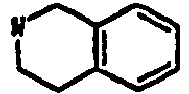
1.18(3H, s), 2.51(1H, d, J=13.9Hz), 2.66(1H, d, J=13.9Hz), 2.82-2.98(4H, m), 3.76(1H, d, J=14.9Hz), 3.88(1H, d, J= 14.9Hz), 4.03(2H, s), 7.00(1H, dd, J=2.3Hz. 7.7Hz), 7.06-7.20 (3H, m), 8.01(1H, s). 87 637 * 
1.20(3H, s), 2.55(1H, d, J=13.8Hz), 2.71(1H, d, J = 13.8Hz), 3.81(1H, d, J=14.8Hz), 3.91(1H, d, J=14.8Hz), 4.05(4H, s), 7.10-7.23(4H, m), 8.00(1H, s). 93 638 * 
1.11(3H, s), 1.67-1.78(4H, m), 2.37(1H, d, J=14.0Hz), 2.51 (1H, d, J=14.0Hz), 2.57-2.82(4H, m), 3.69(1H, s), 3.95(4H, s), 3.99(2H, s), 8.06(1H, s). 100 * = not according to the invention - Using (S)-1-(2-chloro-4-nitroimidazol-1-yl)-3-(3,4-dihydro-2H-quinolin-1-yl)-2-methylpropan-2-ol prepared in Example 635 (134 mg, 0.38 mmol) gave (S)-1-(2-methyl-6-nitro-2,3-dihydroimidazo[2,1-b]oxazol-2-ylmethyl)-1,2,3,4-tetrahydroquinoline (64 mg, 54%) as a white powder in the same manner as in Example 393. Melting point 168-172°C.
- Using corresponding starting materials gave compounds of Examples 640 to 642 in the same manner as in Example 639.
- Melting point 153-155.3°C.
- 1H-NMR (CDCl3) δppm:
- 1.68 (3H, s), 3.01 (1H, d, J = 14.5 Hz), 3.24 (1H, d, J = 14.5 Hz), 3.92 (1H, d, J = 9.6 Hz), 4.08 (4H, s), 4.50 (1H, d, J = 9.6 Hz), 7.13 - 7.21 (4H, m), 7.50 (1H, s).
- Melting point 166.5-168.2°C.
- A mixture of (R)-2-chloro-1-(2-methyloxiran-2-ylmethyl)-4-nitroimidazole prepared in Example 12 (645 mg, 2.97 mmol), (S)-2-(4-trifluoromethoxyphenoxy-methyl)pyrrolidine (930 mg, 3.56 mmol) and DMF (15 ml) was stirred at 80°C for 8 hours. To the reaction mixture, sodium hydride (154 mg, 3.86 mmol) was added followed by stirring for 1 hour with cooling on ice-bath. The reaction mixture was poured into ice-water, and the mixture was extracted with ethyl acetate twice. The organic phases were combined, washed with water twice and a saturated saline solution, dried over magnesium sulfate and then filtered. The filtrate was concentrated under reduced pressure, and the residue was purified by silica gel column chromatography (methylene chloride) and recrystallized from methylene chloride-isopropyl ether to afford (2S)-methyl-6-nitro-2-[(2S)-(4-trifluoromethoxyphenoxymethyl)pyrrolidin-1-ylmethyl]-2,3-dihydroimidazo[2,1-b]oxazole (505 mg, yield 41%) as a white powder.
1H-NMR (CDCl3) δppm: - 1.42 - 1.52 (1H, m), 1.59 (3H, s), 1.61 - 1.79 (2H, m), 1.87 - 1.99 (1H, m), 2.50 - 2.61 (1H, m), 3.03 - 3.17 (2H, m), 3.06 (1H, d, J = 14.7 Hz), 3.20 (1H, d, J = 14.7 Hz), 3.72 - 3.79 (2H, m), 3.92 (1H, dd, J = 9.2 Hz, 3.7 Hz), 4.58 (1H, d, J = 9.5 Hz), 6.80 - 6.88 (2H, m), 7.15 - 7.19 (1H, m), 7.42 (1H, s).
- A mixture of 2-chloro-4-nitro-1H-imidazole (8.39 g, 56.88 mmol), tert-butyl 4-(2-methyloxiran-2-ylmethyl)homopiperazine-1-carboxylate (15.38 g, 56.88 mmol) and sodium acetate (5.13 g, 62.57 mmol) in 1-propanol (100 ml) was stirred under reflux for 10 hours. The reaction mixture was allowed to return to room temperature and then concentrated under reduced pressure. The residue was dissolved in methylene chloride. The solution was washed with water, dried over sodium sulfate and then filtered. The filtrate was concentrated under reduced pressure, and the residue was purified by silica gel column chromatography (methylene chloride/ethyl acetate = 5/1) to afford tert-butyl 4-[3-(2-chloro-4-nitroimidazol-1-yl)-2-hydroxy-2-methylpropyl]homopiperazine-1-carboxylate (6.25 g, yield 27%) as a reddish yellow oil.
1H-NMR (CDCl3) δppm: - 1.14 (3H, s), 1.48 (9H, s), 1.69 - 1.90 (2H, m), 2.40 - 2.55 (1H, m), 2.66 (1H, d, J = 14.1 Hz), 2.75 - 2.98 (5H, m), 3.30 - 3.59 (4H, m), 3.96 (2H, s), 8.06 (1H, s).
- Using tert-butyl 4-[3-(2-chloro-4-nitroimidazol-1-yl)-2-hydroxy-2-methylpropyl]homopiperazine-1-carboxylate prepared in Example 644 (6.25 g, 14.96 mmol) gave tert-butyl 4-(2-methyl-6-nitro-2,3-dihydroimidazo[2,1-b]oxazol-2-ylmethyl)homopiperazine-1-carboxylate (3.07 g, yield 54%) as a white powder in the same manner as in Example 544.
1H-NMR (CDCl3) δppm: - 1.47 (9H, s), 1.59 (3H, s), 1.68 - 1.79 (2H, m), 2.63 - 2.90 (5H, m), 3.06 (1H, d, J = 15.1 Hz), 3.25 - 3.50 (4H, m), 3.91 (1H, d, J = 9.7 Hz), 4.33 (1H, d, J = 9.7 Hz), 7.54 (1H, s).
- A mixture of tert-butyl 4-(2-methyl-6-nitro-2,3-dihydroimidazo[2,1-b]oxazol-2-ylmethyl)-homopiperazine-1-carboxylate prepared in Example 645 (250 mg, 0.655 mmol) and trifluoroacetic acid (10 ml) was stirred at room temperature overnight. The reaction mixture was concentrated under reduced pressure, the residue was dissolved in methylene chloride (10 ml). To the solution, triethylamine (0.27 ml, 1.96 mmol) and benzyl chloroformate (0.19 ml, 1.31 mmol) were added followed by stirring at room temperature for 3 hours. To the reaction mixture, water was added, and the mixture was extracted with methylene chloride. The organic phase was dried over magnesium sulfate and then filtered. The filtrate was concentrated under reduced pressure, and the residue was purified by silica gel column chromatography (methylene chloride/ethyl acetate = 1/1) to afford a light yellow oil. The resulting oil was dissolved in ethyl acetate. To the solution, a saturated hydrochloric acid/ethyl acetate solution was added, and the precipitates were filtered off to afford benzyl 4-(2-methyl-6-nitro-2,3-dihydroimidazo[2,1-b]oxazol-2-ylmethyl)homopiperazine-1-carboxylate hydrochloride (246 mg, yield 83%) as a white powder.
Melting point 115-117°C. - A mixture of tert-butyl 4-(2-methyl-6-nitro-2,3-dihydroimidazo[2,1-b]oxazol-2-ylmethyl)-homopiperazin-1-carboxylate prepared in Example 645 (346 mg, 0.91 mmol) and trifluoroacetic acid (10 ml) was stirred at room temperature overnight. The reaction mixture was concentrated under reduced pressure, and the residue was dissolved in methylene chloride (10 ml). To the solution, triethylamine (0.27 ml, 1.96 mmol) was added. The solution was concentrated under reduced pressure, and the residue was dissolved in methanol (10 ml). To the solution, 4-phenylbenzaldehyde (496 mg, 2.72 mmol), sodium cyanotrihydroborate (171 mg, 2.72 mmol) and acetic acid (0.17 ml, 2.72 mmol) were added in this order followed by stirring at room temperature overnight. The reaction mixture was poured into a saturated sodium hydrogencarbonate solution, then extracted with methylene chloride. The organic phase was dried over magnesium sulfate and then filtered. The filtrate was concentrated under reduced pressure, and the residue was purified by silica gel column chromatography (methylene chloride/ethyl acetate = 5/1) to afford 2-[4-(biphenyl-4-ylmethyl)homopiperazin-1-ylmethyl]-2-methyl-6-nitro-2,3-dihydroimidazo[2,1-b]oxazole (251 mg, yield 62%) as a white powder.
Melting point 138-142.2°C. - 2,4-Dinitro-1H-imidazole (1.0 g, 6.3 mmol), tert-butyl 1-oxa-6-azaspiro[2,5]octane-6-carboxylate (2.0 g, 9.5 mmol) and sodium acetate (612 mg, 7.5 mmol) in ethanol (7 ml) were stirred under reflux for 10 hours. The reaction mixture was concentrated under reduced pressure. To the residue, a saturated sodium hydrogencarbonate solution and methylene chloride were added followed by stirring vigorously, and then the mixture was extracted with methylene chloride. The organic phase was dried over sodium sulfate and then filtered. The resulting filtrate was concentrated under reduced pressure, and the residue was crystallized from methylene chloride-diisopropyl ether to afford 1'-tert-butoxycarbonyl-2,3-dihydro-6-nitrospiro[imidazo[2,1-b]oxazole-2,4'-piperidine] (586 mg, yield 29%) as a white powder.
Melting point 230-232°C. - 2-Chloro-4-nitro-1H-imidazole (3.1 g, 21.0 mmol), tert-butyl 1-oxa-6-azaspiro[2,5]octane-6-carboxylate (4.4 g, 21.0 mmol) and sodium hydrogencarbonate (1.94 g, 23.1 mmol) in ethanol (20 ml) were stirred under reflux for 6 hours. The reaction mixture was concentrated under reduced pressure, and the residue was added water. The resulting solution was extracted with methylene chloride. The organic phase was dried over magnesium sulfate and then filtered. The resulting filtrate was concentrated under reduced pressure, and the residue was purified by silica gel column chromatography (methylene chloride/methanol = 100/1) to afford tert-butyl 4-(2-chloro-4-nitroimidazol-1-ylmethyl)-4-hydroxypiperidine-1-carboxylate (5.4 g, yield 72%) as a yellow oil.
1H-NMR (CDCl3) δppm: - 1.45 - 1.71 (5H, m), 1.46 (9H, s), 3.03 - 3.14 (2H, m), 3.90 - 4.03 (2H, m), 4.02 (2H, s), 7.91 (1H, s).
- 2-Chloro-4-nitro-1H-imidazole (1.29 g, 8.76 mmol), tert-butyl 4-{2-(1-oxa-6-azaspiro[2,5]octan-6-yl)-2-oxoethyl}piperazine-1-carboxylate (2.97 g, 8.76 mmol) and sodium hydrogencarbonate (809 mg, 9.64 mmol) in ethanol (10 ml) was stirred under reflux for 5 hours. The reaction mixture was concentrated under reduced pressure, and a saturated sodium hydrogencarbonate solution was added. The solution was extracted with methylene chloride. The organic phase was dried over magnesium sulfate and then filtered. The resulting filtrate was concentrated under reduced pressure, and the residue was purified by silica gel column chromatography (methylene chloride/methanol = 100/1) to afford tert-butyl 4-{2-[4-(2-chloro-4-nitroimidazol-1-ylmethyl)-4-hydroxypiperidin-1-yl]-2-oxoethyl}piperazine-1-carboxylate (2.58 g, yield 61%) as a yellow oil.
1H-NMR (CDCl3) δppm: - 1.45 (9H, s), 1.53 - 1.71 (4H, m), 2.44 (4H, br), 2.96 - 3.04 (1H, m), 3.10 - 3.27 (2H, m), 3.35 - 3.48 (4H, m), 3.90 - 3.96 (2H, m), 4.05 (2H, s), 4.32 - 4.37 (2H, m), 8.04 (1H, s).
- Using 6-(4-trifluoromethylphenyl)-1-oxa-6-azaspiro[2,5]octane gave the compound of Example 651 in the same manner as in Example 650.
- Light pink powder, yield 54%
1H-NMR (CDCl3) δppm: - 1.60 - 1.66 (2H, m), 1.82 - 1.93 (3H, m), 3.10 - 3.22 (2H, m), 3. 62 - 3.67 (2H, m), 4.07 (2H, s), 6.95 (2H, d, J = 8.7 Hz), 7.50 (2H, d, J = 8.7 Hz), 7.99 (1H, s).
- Tert-butyl 4-(2-chloro-4-nitroimidazol-1-ylmethyl)-4-hydroxypiperidine-1-carboxylate prepared in Example 649 (26.7 g, 74.0 mmol) was dissolved in 1,4-dioxane (200 ml). To the solution, sodium hydride (3.6 g, 88.8 mmol) was added with cooling on ice-bath followed by stirring under reflux for 8 hours. The reaction mixture was concentrated under reduced pressure. To the residue, ice-water and methylene chloride were added followed by stirring vigorously. The precipitates were filtered off, washed with water and methanol, dried under reduced pressure to afford a solid (16.4 g). Then, the filtrate was extracted with methylene chloride. The organic phase was dried over magnesium sulfate and then filtered. The organic phase was concentrated under reduced pressure. The residue was crystallized with methanol to afford a solid (2.7 g). The solids were combined to afford 1'-tert-butoxycarbonyl-2,3-dihydro-6-nitrospiro[imidazo[2,1-b]oxazole-2,4'-piperidine] (19.1 g, yield 79%) as a white powder.
Melting point 230-232°C. - Tert-butyl 4-{2-[4-(2-chloro-4-nitroimidazol-1-ylmethyl)-4-hydroxypiperidin-1-yl]-2-oxoethyl}-piperazine carboxylate prepared in Example 650 (2.58 g, 5.3 mmol) was dissolved in dioxane (30 ml). To the solution, sodium hydride (254 mg, 6.36 mmol) was added with cooling on ice-bath followed by stirring under reflux overnight. The reaction mixture was concentrated under reduced pressure. To the residue, ice-water and ethyl acetate were added followed by stirring vigorously. The precipitates were filtered off, washed with water and ethyl acetate, and then dried under reduced pressure to afford tert-butyl 4-[2-(2,3-dihydro-6-nitrospiro[imidazo[2,1-b]oxazol-2,4'-piperidine]-1'-yl)-2-oxoethyl]piperazine-1-carboxylate (996 mg, yield 42%) as a white powder.
Melting point 211.0-213.0°C. - Using corresponding starting materials gave the compound of Example 654 in the same manner as in Example 653.
- White powder, yield 79%
MS: 368 (M+)
Melting point 249.2-250.1°C. - 1'-Tert-butoxycarbonyl-2,3-dihydro-6-nitrospiro[imidazo[2,1-b]oxazole-2,4'-piperidine] prepared in Example 652 (42 g, 0.13 mol) was suspended in methylene chloride (100 ml). To the suspension, trifluoroacetic acid (60 ml) was added slowly with cooling on ice-bath followed by stirring at room temperature overnight. The reaction mixture was concentrated under reduced pressure, and the residue was crystallized with methanol. The solids were filtered off, washed with methanol and ethyl acetate, and then dried under reduced pressure to afford 2,3-dihydro-6-nitrospiro[imidazo[2,1-b]oxazole-2,4'-piperidine] trifluoroacetate (43.6 g, yield 99%) as a light brown powder.
MS: 224 (M+)
Melting point 196-198°C (decomposition)
1H-NMR (DMSO-d6) δppm: - 2.06 - 2.32 (4H, m), 3.12 - 3.35 (4H, m), 4.24 (2H, s), 8.21 (1H, s), 8.88 (2H, bs).
- 2,3-Dihydro-6-nitrospiro[imidazo[2,1-b]oxazole-2,4'-piperidine] trifluoroacetate prepared in Example 655 (85.5 mg, 0.25 mmol) was suspended in methylene chloride (5 ml). To the suspension, triethylamine (74 µl) and acethyl chloride (20 µl) were added followed by stirring at room temperature for 1 hour. The reaction mixture was concentrated under reduced pressure. To the residue, methanol and water were added followed by stirring vigorously. The precipitates were filtered off, washed with water and isopropyl ether, and then dried under reduced pressure to afford l'-acetyl-2,3-dihydro-6-nitrospiro[imidazo[2,1-b]oxazole-2,4'-piperidine] (37.8 mg, yield 56%) as a white powder.
MS: 266(M+)
Melting point 232.0-234.0°C. - 2,3-Dihydro-6-nitrospiro[imidazo[2,1-b]oxazole-2,4'-piperidine] trifluoroacetate prepared in Example 655 (300 mg, 0.89 mmol) was suspended in methylene chloride (5 ml). To the suspension, triethylamine (0.4 ml, 2.66 mmol) and (α,α,α,-trifluoro-p-tolyl)acetyl chloride (2.7 ml, 1.33 mmol) were added followed by stirring at room temperature for 1 hour. The reaction mixture was poured into a saturated sodium hydrogencarbonate solution, and the mixture was extracted with methylene chloride. The organic phase was dried over magnesium sulfate and then filtered. The resulting filtrate was concentrated under reduced pressure, and the residue was purified by silica gel column chromatography (methylene chloride/methanol = 200/1) and crystallized from methylene chloride-isopropyl ether to afford 1'-(4-trifluoromethylphenylacetyl)-2,3-dihydro-6-nitrospiro[imidazo[2,1-b]oxazole-2,4'-piperidine] (143 mg, yield 39%) as a white powder.
MS: 410 (M+)
Melting point 185.0-187.0°C. - 2,3-Dihydro-6-nitrospiro[imidazo[2,1-b]oxazole-2,4'-piperidine] trifluoroacetate prepared in Example 655 (300 mg, 0.89 mmol), (3,4-dichlorophenyl)-acetic acid (294 mg, 1.24 mmol) and WSCD (255 mg, 1.24 mmol) in DMF (5 ml) were stirred at room temperature for 1.5 hours. To the reaction mixture, water and diethyl ether was added followed by stirring vigorously. The precipitates were filtered off, washed with water and diethyl ether, and then dried under reduced pressure to afford 1'-(3,4-dichlorophenoxy-acetyl)-2,3-dihydro-6-nitrospiro[imidazo[2,1-b]oxazole-2,4'-piperidine] (96 mg, yield 25%) as a white powder. Melting point 218.0-220.0°C.
- 2,3-Dihydro-6-nitrospiro[imidazo[2,1-b]oxazole-2,4'-piperidine] (250 mg, 1.12 mmol) obtained by neutrlization of 2,3-dihydro-6-nitrospiro[imidazo[2,1-b]oxazole-2,4'-piperidine] trifluoroacetate prepared in Example 655 was suspended in methanol (5 ml). To the suspension, a 37% formaldehyde solution (0.25 ml, 3.35 mmol), sodium cyanotrihydroborate (210 mg, 3.35 mmol) and acetic acid (0.19 ml, 3.35 mmol) were added followed by stirring at room temperature for 3 hours. The reaction mixture was poured into a saturated sodium hydrogencarbonate solution, and the mixture was extracted with methylene chloride. The organic phase was dried over sodium sulfate and then filtered. The resulting filtrate was concentrated under reduced pressure. The residue was crystallized from methylene chloride-diisopropyl ether to afford 2,3-dihydro-1'-methyl-6-nitrospiro[imidazo[2,1-b]oxazole-2,4'-piperidine] (160 mg, yield 60%) as a white powder.
MS: 238 (M+)
Melting point 237.0-239.0°C (decomposition). - 2,3-Dihydro-6-nitrospiro[imidazo[2,1-b]oxazole-2,4'-piperidine] trifluoroacetate prepared in Example 655 (197 mg, 0.88 mmol) was suspended in methylene chloride (5 ml). To the suspension, triethylamine (0.36 ml, 2.64 mmol) and benzenesulfonyl chloride (0.28 ml, 2.10 mmol) were added followed by stirring at room temperature for 30 minutes. To the reaction mixture, diisopropyl ether and water were added followed by stirring vigorously. The precipitates were filtered off, washed with water and diisopropyl ether, and then dried under reduced pressure to afford 1'-benzenesulfonyl-2,3-dihydro-6-nitrospiro[imidazo[2,1-b]oxazole-2,4'-piperidine] (210 mg, yield 66%) as a white powder.
MS: 364 (M+)
1H-NMR (DMSO-d6) δppm: - 1.99 - 2.18 (4H, m), 2.49 - 2.63 (2H, m), 3.40 - 3.54 (2H, m), 4.10 (2H, s), 7. 65 - 7.81 (5H, m), 8.21 (1H, s).
- Using corresponding starting materials gave the compound of Example 661 in the same manner as in Example 660.
- 1H-NMR (DMSO-d6) δppm:
- 1.98 - 2.22 (4H, m), 2.94 (3H, s), 3.04 - 3.13 (2H, m), 3.43 - 3.51 (2H, m), 4.16 (2H, s), 8.17 (1H, s).
- 2,3-Dihydro-6-nitrospiro[imidazo[2,1-b]oxazole-2,4'-piperidine] trifluoroacetate prepared in Example 655 (250 mg, 0.74 mmol) was suspended in methylene chloride (5 ml). To the suspension, triethylamine (0.40 ml, 2.96 mmol) and benzyl chloroformate (0.32 ml, 2.22 mmol) were added followed by stirring at room temperature for 30 minutes. The reaction mixture was concentrated under reduced pressure, and the residue was purified by silica gel column chromatography (methylene chloride/methanol = 200/1) and crystallized from methylene chloride-isopropyl ether to afford 1'-benzyloxycarbonyl-2,3-dihydro-6-nitrospiro[imidazo[2,1-b]oxazole-2,4'-piperidine] (224 mg, yield 84%) as a white powder.
Melting point 175.0-177.0°C. - 2,3-Dihydro-6-nitrospiro[imidazo[2,1-b]oxazole-2,4'-piperidine] trifluoroacetate prepared in Example 655 (33 g, 97.6 mmol) was suspended in DMF (200 ml). To the suspension, triethylamine (20 ml, 0.15 mol) was added followed by stirring. To the solution, a mixture of 4-trifluoromethylbenzyl alcohol (25.8 g, 0.15 mol), 1,1'-carbonyldiimidazole (23.7 g, 0.15 mol) and DMF (100 ml) stirred at room temperature for 3 hours was added followed by stirring at 70°C for 2 hours. The reaction mixture was concentrated under reduced pressure. To the residue, water was added, and the precipitates were filtered off. The precipitates were purified by silica gel column chromatography (methylene chloride/ethyl acetate = 10/1) and recrystallized from ethyl acetate-isopropyl ether to afford 1'-(4-trifluoromethylbenzyloxycarbonyl)-2,3-dihydro-6-nitrospiro[imidazo[2,1-b]oxazole-2,4'-piperidine] (37.2 g, yield 90%) as a white powder. Melting point 189-190°C.
- Using corresponding starting materials gave compounds of Examples 664 and 665 in the same manner as in Example 663.
- 1H-NMR (CDCl3) δppm:
- 1.80 - 1.93 (2H, m), 2.13 - 2.19 (2H, m), 3.32 - 3.42 (2H, m), 4.00 - 4.20 (2H, m), 4.03 (2H, s), 5.14 (2H, s), 7.20 - 7.23 (2H, m), 7.38 - 7.46 (2H, m), 7.54 (1H, s).
- 1H-NMR (DMSO-d6) δppm:
- 1.85 - 2.10 (4H, m), 3.15 - 3.40 (2H, m), 3.65 - 3.85 (2H, m), 4.16 (2H, s), 5.03 (2H, s), 7.33 (2H, d, J = 8.5 Hz), 7.58 (2H, d, J = 8.5 Hz), 8.15 (1H, s), 8.27 (1H, s).
- 2,3-Dihydro-6-nitrospiro[imidazo[2,1-b]oxazole-2,4'-piperidine] trifluoroacetate prepared in Example 655 (100 mg, 0.30 mmol) was suspended in DMF (5 ml). To the suspension, triethylamine (43 µl, 0.31 mmol) and phenylisocyanate (34 µl, 0.31 mmol) were. added followed by stirring at room temperature for 30 minutes. To the reaction mixture, water was added followed by stirring, and the precipitates were filtered off. The precipitates were purified by silica gel column chromatography (methylene chloride/methanol = 100/1) and recrystallized from ethyl acetate, filtered off to afford 2,3-dihydro-6-nitrospiro[imidazo[2,1-b]oxazole-2,4'-piperidine]-1'-carboxylic acid phenylamide (90 mg, yield 88%) as a white powder.
MS; 393 (M+)
Melting point 229-232°C (decomposition). - Using pyridine 4-isocyanate or benzyl isocyanate gave compounds of Examples 668 and 669 in the same manner as in Example 667.
- Melting point 217-219°C.
- Melting point 244-247°C (decomposition).
- Triphosgene (227 mg, 0.77 mmol) was dissolved in toluene (10 ml). To the solution, tert-Butyl piperazine-1-carboxylate (425 mg, 2.28 mmol) and diisopropylethylamine (0.4 ml, 2.28 mmol) were added followed by stirring for 1 hour with cooling on ice-bath. To the solution, 2,3-dihydro-6-nitrospiro[imidazo[2,1-b]oxazole-2,4'-piperidine] trifluoroacetate prepared in Example 655 (700 mg, 2.07 mmol) was added. The solution was stirred at room temperature for 1 hour and then stirred under reflux for 1 hour. The reaction mixture was poured into water, and the mixture was extracted with ethyl acetate. The organic phase was washed with a saturated saline solution, dried over magnesium sulfate and then filtered. The resulting filtrate was concentrated under reduced pressure. The residue was purified by silica gel column chromatography (methylene chloride/acetone = 10/1) and then crystallized from methylene chloride-diisopropyl ether to afford tert-butyl 4-(2,3-dihydro-6-nitrospiro[imidazo[2,1-b]oxazole-2,4'-piperidine]-1'-ylcarbonyl)piperazine-1-carboxylate (342 mg, yield 38%) as a white powder. Melting point 260.0-265.0°C (decomposition).
1H-NMR (CDCl3) δppm: - 1.47 (9H, s), 1.90 - 2.02 (2H, m), 2.10 - 2.16 (2H, m), 3.23 - 3.47 (10H, m), 3.60 - 3.66 (2H, m), 3.96 (2H, s), 7.54 (1H, s).
- Using 4-trifluoromethylbenzyl piperazine-1-carboxylate or 1-(4-trifluoromethylbenzyl)piperazine gave compounds of Examples 671 and 672 in the same manner as in Example 670.
- Melting point 221-223°C.
- Melting point 226-230°C (decomposition).
- 2,3-Dihydro-6-nitrospiro[imidazo[2,1-b]oxazole-2,4'-piperidine] trifluoroacetate prepared in Example 655 (200 mg, 0.59 mmol) was suspended in DMF (5 ml). To the suspension, triethylamine (0.1 ml, 0.72 mmol) was added followed by stirring. To the solution, a mixture of N,N-dimethyl-p-phenylenediamine (132 mg, 0.98 mmol), 1,1'-carbonyldiimidazole (82.7 mg, 1.02 mmol) and DMF (5 ml) stirred at room temperature for 3 hours was added followed by stirring at room temperature for 30 minutes. To the reaction mixture, water was added followed by stirring, and the precipitates were filtered off. The precipitates were purified by silica gel column chromatography (methylene chloride/methanol = 100/1) and crystallized from ethyl acetate to afford 2,3-dihydro-6-nitrospiro[imidazo[2,1-b]oxazole-2,4'-piperidine]-1'-carboxylic acid 4-(dimethylamino)phenylamide (181 mg, yield 79%) as a white powder.
MS 386 (M+)
Melting point 244-247°C (decomposition). - Using 4-trifluoromethylbenzylamine or 4-trifluoromethoxybenzylamine gave compounds of Examples 674 and 675 in the same manner as in Example 673.
- Melting point 215-217°C.
- Melting point 223-225°C.
- 2,3-Dihydro-6-nitrospiro[imidazo[2,1-b]oxazole-2,4'-piperidine] trifluoroacetate prepared in Example 655 (200 mg, 0.59 mmol) was suspended in DMF (5 ml). To the suspension, triethylamine (0.24 ml, 1.77 mmol) and 4-chlorophenyl isothiocyanate(200 mg, 1.18 mmol) were added followed by stirring at room temperature for 30 minutes. To the reaction mixture, water was added followed by stirring, and the precipitates were filtered off, purified by silica gel column chromatography (methylene chloride/methanol = 100/1) and crystallized from methylene chloride-diisopropyl ether to afford 2,3-dihydro-6-nitrospiro[imidazo[2,1-b]oxazole-2,4'-piperidine]-1'-carbothioic acid 4-chlorophenylamide (222 mg, yield 87%) as a white powder.
1H-NMR (DMSO-d6) δppm: - 2.02 - 2.19 (4H, m), 3 .59 - 3.69 (2H, m), 4.19 (2H, s), 4.40 - 4.54 (2H, m), 7 .30 - 7.37 (4H, m), 8.18 (1H, s), 9.48 (1H, s).
- Tert-butyl 4-[(2,3-dihydro-6-nitrospiro[imidazo[2,1-b]oxazole-2,4'-piperidin])-1'-ylcarbonyl]aminobenzoate (150 mg, 0.68 mmol) was dissolved in methylene chloride (1 ml). To the solution, trifluoroacetic acid (5 ml) was added followed by stirring at room temperature overnight. The reaction mixture was concentrated under reduced pressure. The residue was crystallized from methanol-ethyl acetate to afford 4-[(2,3-dihydro-6-nitrospiro[imidazo[2,1-b]oxazole-2,4'-piperidin])-1'-ylcarbonyl]aminobenzoic acid (59 mg, yield 45%) as a white powder.
Melting point >300°C.
1H-NMR (DMSO-d6) δppm: - 1.92 - 2.12 (4H, m), 3.32 - 3.39 (2H, m), 3.86 - 3.95 (2H, m), 4.17 (2H, s), 7.45 (2H, d, J = 8.8 Hz), 7.82 (2H, d, J = 8.8 Hz), 8.17 (1H, s), 8.97 (1H, s), 12.54 (1H, s).
- 2,3-Dihydro-6-nitrospiro[imidazo[2,1-b]oxazole-2,4'-piperidine] trifluoroacetate prepared in Example 655 (84 mg, 0.25 mmol) was suspended in DMF (3 ml). To the suspension, triethylamine (76 µl, 0.55 mmol) and 2-chlorobenzothiazole (40 µl, 0.30 mmol) were added followed by stirring at 80°C for 1 hour. The reaction mixture was concentrated under reduced pressure. To the residue, water was added, and the precipitate was filtered off, crystallized from methylene chloride-methanol to afford 2-[(2,3-dihydro-6-nitrospiro[imidazo[2,1-b]oxazole-2,4'-piperidine])-1'-yl]benzothiazole (55 mg, yield 62%) as a white powder.
MS; 357 (M+)
1H-NMR (DMSO-d6) δppm: - 2.05 - 2.23 (4H, m), 3.52 - 3.63 (2H, m), 3.89 - 3.97 (2H, m), 4.18 (2H, s), 7.05 - 7.12 (1H, m), 7.26 - 7.32 (1H, m), 7. 46 - 7.49 (1H, m), 7.76 - 7.80 (1H, m), 8.18 (1H, s).
- Using 5-chloro-1-phenyl-1H-tetrazole gave the compound of Example 679 in the same manner as in Example 678.
- 1H-NMR (DMSO-d6) δppm:
- 2.05 - 2.09. (4H, m), 3.24 - 3.40 (4H, m), 4.14 (2H, s), 7.59 - 7.72 (5H, m), 8.15 (1H, s).
- 2,3-Dihydro-6-nitrospiro[imidazo[2,1-b]oxazole-2,4'-piperidine] trifluoroacetate prepared in Example 655 (700 mg, 2.07 mmol) was suspended in DMF (20 ml). To the suspension, tert-butyl 4-(chloroacetyl)piperazine-1-carboxylate (599 mg, 2.28 mmol), N,N-diisopropylethylamine (0.8 ml, 4.57 mmol) and sodium iodide (310 mg, 2.07 mmol) were added followed by stirring at 100°C for 3 hours. The reaction mixture was allowed to return to room temperature. To the solution, ethyl acetate and water were added followed by stirring vigorously. The precipitates were filtered off, washed with water and ethyl acetate, and then dried under reduced pressure to afford tert-butyl 4-[(2,3-dihydro-6-nitrospiro[imidazo[2,1-b]oxazole-2,4'-piperidin])-1'-ylacetyl]piperazine-1-carboxylate (688 mg, yield 74%) as a white powder.
Melting point >300°C.
1H-NMR (DMSO-d6) δppm: - 1.41 (9H, s), 1.95 - 2.01 (4H, m), 2.43 - 2.64 (4H, m), 3.21 (2H, s), 3.26 - 3.42 (6H, m), 3.50 - 3.52 (2H, m), 4.12 (2H, s), 8.14 (1H, s).
- Using 2-chloro-N-(4-trifluoromethylphenyl)-acetamide or 3-(3-chloropropyl)-3H-benzoxazol-2-one gave compounds of Examples 681 and 682 in the same manner as in Example 680.
- Melting point 273-275°C (decomposition).
- Melting point 190-192°C.
- 2,3-Dihydro-6-nitrospiro[imidazo[2,1-b]oxazole-2,4'-piperidine] trifluoroacetate prepared in Example 655 (200 mg, 0.59 mmol) was suspended in DMF (5 ml). To the suspension, tert-butyl 4-(2-chloroethyl)piperazine-1-carboxylate (150 mg, 0.60 mmol), triethylamine (0.25 ml, 1.79 mmol) and sodium iodide (108 mg, 0.72 mmol) were added followed by stirring at 50°C for 5 hours. The reaction mixture was allowed to return to room temperature. To the solution, ethyl acetate and water were added followed by stirring vigorously. The precipitates were filtered off, washed with water and ethyl acetate, and then dried under reduced pressure to afford tert-butyl 4-[2-(2,3-dihydro-6-nitrospiro[imidazo[2,1-b]oxazole-2,4'-piperidin])-1'-ylethyl]piperazine-1-carboxylate (80 mg, yield 31%) as a white powder.
Melting point 214-215°C. - Tert-butyl 4-[2-(2,3-dihydro-6-nitrospiro[imidazo[2,1-b]oxazol-2,4'-piperidin]-1'-yl)-2-oxoethyl]piperazine-1-carboxylate prepared in Example 653 (300 mg, 0.67 mmol) was dissolved in methylene chloride (5 ml). To the solution, trifluoroacetic acid (5 ml) was added followed by stirring at room temperature for 6 hours. The reaction mixture was concentrated under reduced pressure. To the residue, methylene chloride (1 ml) and triethylamine (1 ml) were added. The reaction mixture was stirred at room temperature for 5 minutes and concentrated under reduced pressure, and the residue was dissolved in DMF (15 ml). To the solution, a mixture of 4-trifluoromethylbenzyl alcohol (293 mg, 1.67 mmol), 1,1'-carbonyldiimidazole (270 mg, 1.67 mmol) and DMF (5 ml) stirred at room temperature for 3 hours was added followed by stirring at room temperature overnight. The reaction mixture was poured into water and extracted with ethyl acetate, and the organic phase was washed with a saturated saline solution and dried over magnesium sulfate. After filtration, the resulting filtrate was concentrated under reduced pressure. The residue was purified by silica gel column chromatography (methylene chloride/methanol = 200/1) and crystallized from methylene chloride-isopropyl ether to afford 4-trifluromethylbenzyl 4-[2-(2,3-dihydro-6-nitrospiro[imidazo[2,1-b]oxazole-2,4'-piperidin]-1'-yl)-2-oxoethyl]piperazine-1-carboxylate (324 mg, yield 88%) as a light pink powder.
MS 553(M+H)+
Melting point 139.0-141.0°C. - Using corresponding starting materials gave the compound of Example 685 in the same manner as in Example 684.
- Melting point 137-139°C.
- Using tert-butyl 4-[2-(2,3-dihydro-6-nitrospiro[imidazo[2,1-b]oxazole-2,4'-piperidin])-1'-ylethyl]piperazine-1-carboxylate prepared in Example 683 gave compounds of Examples 686 to 689 in the same manner as in Example 684.
- Melting point 178-179°C.
- Melting point 174-175°C.
- Melting point 176-177°C.
- 1H-NMR (CDCl3) δppm:
- 1.90 - 2.05 (2H, m), 2.15 - 2.20 (2H, m), 2.40 - 2.80 (12H, m), 3.45 - 3.60 (4H, m), 3.99 (2H, s), 5.17 (2H, s), 7.31 - 7.62 (10H, m).
- Using tert-butyl 4-[(2,3-dihydro-6-nitrospiro[imidazo[2,1-b]oxazole-2,4'-piperidin]-1'-ylacetyl)piperazine-1-carboxylate prepared in Example 680 gave the compound of Example 690 in the same manner as in Example 684.
- Melting point 137-139°C.
- Tert-butyl 4-[2-(2,3-dihydro-6-nitrospiro[imidazo[2,1-b]oxazole-2,4'-piperidine]-1'-yl)-2-oxoethyl]piperazine-1-carboxylate prepared in Example 653 (300 mg, 0.67 mmol) was dissolved in methylene chloride (5 ml). To the solution, trifluoroacetic acid (10 ml) was added followed by stirring at room temperature for 6 hours. The reaction mixture was concentrated under reduced pressure. To the solution, methylene chloride (1 ml) and triethylamine (1 ml) were added followed by stirring at room temperature for 5 minutes. The solution was concentrated under reduced pressure and the residue was dissolved in methanol (10 ml). To the solution, 4-trifluoromethylbenzaldehyde (0.23 ml, 1.67 mmol), sodium cyanotrihydroborate (105 mg, 1.67 mmol) and acetic acid (0.1 ml) were added with cooling on ice-bath followed by stirring at room temperature overnight. To the solution, a saturated aqueous sodium hydrogencarbonate solution and methylene chloride were added followed by stirring. The organic phase was dried over magnesium sulfate and then filtered. The resulting filtrate was concentrated under reduced pressure. The residue was purified by silica gel column chromatography (methylene chloride/methanol = 50/1) and crystallized from methylene chloride-diisopropyl ether to afford 1-(2,3-dihydro-6-nitrospiro[imidazo[2,1-b]oxazole-2,4'-piperidin])-1'-yl)-2-[4-(4-trifluoromethylbenzyl)piperazin-1-yl]ethanone (226 mg, yield 67%) as a white powder.
MS 508(M)+
Melting point 145-147°C. - Using corresponding starting materials gave the compound of Example 692 in the same manner as in Example 691.
- Melting point 187-188°C.
- Using tert-butyl 4-(2,3-dihydro-6-nitrospiro[imidazo[2,1-b]oxazole-2,4'-piperidin]-1'-ylacetyl)piperazine-1-carboxylate prepared in Example 680 gave compounds of Examples 693 and 694 in the same manner as in Example 691.
- Melting point 195-197°C (decomposition).
- Melting point 226-227°C (decomposition).
- Tert-butyl 4-[2-(2,3-dihydro-6-nitrospiro[imidazo[2,1-b]oxazole-2,4'-piperidine]-1'-yl)-2-oxoethyl]piperazine-1-carboxylate prepared in Example 653 (300 mg, 0.67 mmol) was dissolved in methylene chloride (5 ml). To the solution, trifluoroacetic acid (10 ml) was added followed by stirring at room temperature for 4 hours. The reaction mixture was concentrated under reduced pressure. To the solution, methylene chloride (1 ml) and triethylamine (1 ml) were added followed by stirring at room temperature for 5 minutes. The solution was concentrated under reduced pressure, and the residue was dissolved in DMF (10 ml). To the solution, a mixture of 4-aminobenzotrifluoride (0.17 ml, 1.33 mmol) and 1,1'-carbonyldiimidazole (220 mg, 1.33 mmol) and DMF (5 ml) stirred at room temperature for 3 hours was added followed by stirring at room temperature for 2 hours. The reaction mixture was poured into water and extracted with ethyl acetate, and the organic phase was washed with a saturated saline solution, dried over magnesium sulfate and then filtered. The resulting filtrate was concentrated under reduced pressure, and the residue was purified by silica gel column chromatography (methylene chloride/methanol = 200/1) and crystallized from methylene chloride-isopropyl ether to afford 4-[(2,3-dihydro-6-nitrospiro[imidazo[2,1-b]oxazole-2,4'-piperidin]-1'-yl)-2-oxoethyl]piperazine-1-carboxylic acid (4-trifluoromethylphenyl)amide (213 mg, yield 59%) as a white powder.
Melting point 153.0-155.0°C. - Tert-butyl 4-[2-(2,3-dihydro-6-nitrospiro[imidazo[2,1-b]oxazol-2,4 '-piperidin]-1'-yl)-2-oxoethyl]piperazine-1-carboxylate prepared in Example 653 (300 mg, 0.67 mmol) was dissolved in methylene chloride (5 ml). To the solution, trifluoroacetic acid (10 ml) was added followed by stirring at room temperature for 6 hours. The reaction mixture was concentrated under reduced pressure. To the residue, methylene chloride (1 ml) and triethylamine (1 ml) were added followed by stirring at room temperature for 5 minutes, and then the solution was concentrated under reduced pressure. The residue was dissolved in DMF (10 ml). To the solution, 2-bromo-N-(4-trifluoromethylphenyl)acetamide (207 mg, 0.73 mmol) and triethylamine (0.28 ml, 2.0 mmol) were added followed by stirring at 100°C for 2 hours. The reaction mixture was poured into water and extracted with ethyl acetate. The organic phase was washed with a saturated saline solution, dried over magnesium sulfate and then filtered. The resulting filtrate was concentrated under reduced pressure, and the residue was purified by silica gel column chromatography (methylene chloride/methanol = 100/1) and crystallized from methylene chloride-diisopropyl ether to afford 2-{4-[2-(2,3-dihydro-6-nitrospiro[imidazo[2,1-b]oxazole-2,4'-piperidin]-1'-yl)-2-oxoethyl]piperazin-1-yl}-N-[4-trifluoromethylphenyl]acetamide (275 mg, yield 75%) as a white powder.
MS 552(M+1)+
Melting point 133.0-135.0°C. - Tert-butyl 4-[2-(2,3-dihydro-6-nitrospiro[imidazo[2,1-b]oxazole-2,4'-piperidine]-1'-yl)-2-oxoethyl]piperazine-1-carboxylate prepared in Example 653 (227 mg, 0.50 mmol) was dissolved in methylene chloride (5 ml). To the solution, trifluoroacetic acid (5 ml) was added followed by stirring at room temperature for 4 hours. The reaction mixture was concentrated under reduced pressure. To the residue, methylene chloride (1 ml) and triethylamine (1 ml) were added followed by stirring at room temperature for 5 minutes, and then the solution was concentrated under reduced pressure. The residue was dissolved in DMF (5 ml). To the solution, triethylamine (0.21 ml, 1.52 mmol) and 2-chlorobenzoxazole (86 µl, 0.76 mmol) were added followed by stirring at 80°C for 2 hours. To the reaction mixture, water was added, and the mixture was extracted with methylene chloride. The organic phase was dried over magnesium sulfate and then filtered. The resulting filtrate was concentrated under reduced pressure. The residue was crystallized from methylene chloride-ethyl acetate to afford 2-[4-(benzoxazol-2-yl)piperazin-1-yl]-1-(2,3-dihydro-6-nitrospiro[imidazo[2,1-b]oxazole-2,4'-piperidin]-1'-yl)ethanone (99 mg, 42%) as a light yellow powder.
MS 467 (M+)
Melting point 260.0-263.0°C (decomposition). - Compounds gave from appropriate starting materials in the same manner as in the above Examples 1 to 697 are shown in the following tables 26 to 77.
Table 26 
Example R1 R2 R3 R4 R5 R6 R7 mp(°C) 698 * -H -H -H -H -CH3 -H -H 193-195 699 * -H -H -H -H -CO2C2H5, -H -H 195-197.5 700 * -H -H -H -H -OCH3 -H -H 189-190 701 * -H -H -H -H -Cl -Cl -H 182-183 702 * -H -H -H -H -H -H -H 185-186 703 * -CH3 -H -H -H -OCH3 -H -H 177.5-179 704 * -CH3 -H -H -H -F -H -H 194-196 705 * -CH3 -H -H -H -CH3 -H -H 145-147 706 * -CH3 -H -H -H -H -Cl -H 190.5-192 707 * -CH3 -H -H -H -H -H -Cl 163-164 708 * -CH3 -H -H -H -H -H -OCH3 177-180 709 * -CH3 -H -H -H -H -CF3 -H 182-183.6 710 * -CH3 -H -H -OCH3 -OCH3 -OCH3 -H 179-182 711 * -CH3 -H -H -H -H -H -F 142 - 144 712 * -CH3 -H -H -H -Br -H -H 197 - 199 713 * -CH3 -H -H -H -CONH2 -H -H 234 - 235 dec 714 * -CH3 -H -H -H -CO2C2H3 -H -H 151 - 152 715 * -CH3 -H -H -H -COCH3 -H -H 196 - 199 716 * -CH3 -H .H -H -SO2NH2 -H -H 218 - 220 dec 717 * -CH3 -H -H -H -H "CO2C2H5 -H 112 - 114 718 * -CH3 -H -H -H -H -H -CO2C2H3 132 - 134 719 * -CH3 -CH3 -H -H -Br -H -H 132 - 133 720 * -CH3 -H -H -H -CF3 -H -H 198.5 - 200 721 * -CH3 -H -H -H -OCF3 -H -H 163.5 - 164.8 722 * -CH3 -CH3 -H -H -CF3 -H -H 129 - 130 723 * -CH3 -CH3 -H -H -OCF2 -H -H 138 - 140 724 * -CH3 -H -H -H Morpholino- -H -H 223-225 725 * -CH3 -H -H -H Morpholino- -H -H 134-135 726 * -CH3 -H -H -H C2H13NHCO- -H -H 197-198 * = not according to the invention Table 27 
Example n R1 R2 mp(°C) or 1H NMR 727 * 1 -H -CH2Ph 143.5-145 728 * 1 -H -cyclo-C6H11 187-188.5 729 * 1 -CH3 -CH2Ph 141-142 730 * 1 -CH3 -(CH2)2Ph 124-127 731 * 1 -CH3 -cyclo-C6H11 176 - 178 732 * 1 -CH3 -4-PYRIDYL 151-153 (dec) 733 * 1 -CH3 -CH(CH2)2 163-165 734 * 1 -CH3 -CH2CO2C2H6 142-143 735 * 1 -CH3 -C6H13 129-130 736 * 1 -CH3 -(CH2)2CO2C2H3 94-96 737 * 1 -CH3 -CH2CH2Cl DMSO-d6, 1.59(3H, s), 3.22-3.33(2H m), 3.57(2H, t, J=6.0Hz), 4.07(2H, dd, J=11.1Hz, 27.6Hz), 4.27(2H, dd, J=7.6Hz, 9.9Hz), 738 * 1 -H -C6H17 6.47-6.59(1H, m), 8.13(1H, s) DMSO-d6, 0.85(3H, t, J=6.9Hz), 1.00-1.45(12H, m), 2.90-2.98(2H, m), 4.06(1H, dd, J=6.8Hz, 10.8Hz), 4.25-4.46(3H, m), 5.48-5.66(1H, m), 7.28(1H, t, J=5.6Hz), 8.13(1H, s) 739 * 2 -H C6H17- 86-88 740 * 2 -CH3 Ph- 131-133 741 * 2 -CH3 PhCH2- 127-127.5 742 * 2 -CH3 PhCH2CF2- 124-125 * = not according to the invention Table 28 
Example R1 R2 R3 R4 R5 R6 R7 mp(°C) 743 * -CH3 -CH3 -H -H -H -Cl -H 103-104 744 * -CH3 -CH2Ph -H -H -Cl -H -H 168-169 745 * -CH3 -C6H13 -H -H -Cl -H -H 98-100 746 * -CH3 -CH3 -H -H -Br -H -H 147-150 747* -CH3 -CH3 -H -H -CF3 -H -H 140-141 748* -CH3 -CH3 -H -H -F -H -H 111-113 749 * -CH3 -C4H9 -H -H -Cl -H -H 114-116 750 * -CH3 -C2H5 -H -H -Cl -H -H 87-89 751 * -CH3 -CH2CH(CH3)2 -H -H -Cl -H -H 161-165 752 * -CH3 4-ClPhCH2- -H -H -Cl -H -H 175-178 * = not according to the invention Table 29 
Example R1 R2 mp(°C) 753* -CH3 4-CF3OPh- 165-166 754* -CH3 4-CH3OPh- 155-157 765* -CH3 4-ClPh- 157-158 756* -CH3 3-CF3Ph- 100-101 757* -CH3 4-BrPh- 168-170 758* -CH3 4-FPh- 151-154 * = not according to the invention Table 30 
Example R1 R2 mp(°C) 759 * -CH3 4-CF3Ph- 151-153 760 * -CH3 4-ClPh- 143-144 761 * -CH3 3-ClPh- 136-138 762 * -CH3 3,4-Cl2Ph- 142-143 763 * -CH3 4-CH3OPh- 163 -164 764 * -CH3 3-CF3Ph- 105 -107 765 * -CH3 4-FPh- 139-140 766 * -CH3 4-CF3OPhCH2OCO- 166-167 767 * -CH3 4- CF3PhCH=CHCH2OCO- 186 -188 768 * -CH3 4-CF3PhCH2- 205 - 206 769 * -CH3 4-CF3OPhCH2- 133-134 * = not according to the invention Table 31 
Example R1 R2 mp(°C) or 1H NMR 770 -CH3 4-ClPh- 228.8 - 232.2 771 -CH3 4-CF3OPh- 236.2 - 237.4 772 -CH3 4-CF3OPhCH2- CDCl3; 1.76(3H s), 3.03(4H, br), 3.62-3.67(4H,m), 4.01(1H, d, J=10.2Hz), 4.04(1H, d, J=10.2 Hz), 4.18(1H, d, J=10.2Hz), 4.48(1H, d, J=10.2Hz), 5.16(2H, s), 6.76-6.80(2H, m), 6.85-6.89(2H, m), 7.19-7.23(2H, m), 7.38-7.42(2H, m), 7.54(1H, s) 773 -CH3 4-ClPhCH2 174.2 175 774 -CH3 4-CF3OPhCH2OCO- 155.5 - 156.5 775 -CH3 4-CF2PhCH=CHCH2OCO- 155-159.8 Table 32 
Example R1 R2 R3 R4 R5 R6 mp(°C) 776 -CH3 -H -H -H -H -H 151-153.5 777 -CH3 -H -H -I -H -H 220-221 778 -CH3 -H -H -Cl -H -H 185-186.5 779 -CH3 -H -H Morpholino- -H -H 233 - 240 dec 780 -CH3 -H -H Piperidino- -H -H 217 - 218.5 dec Table 33 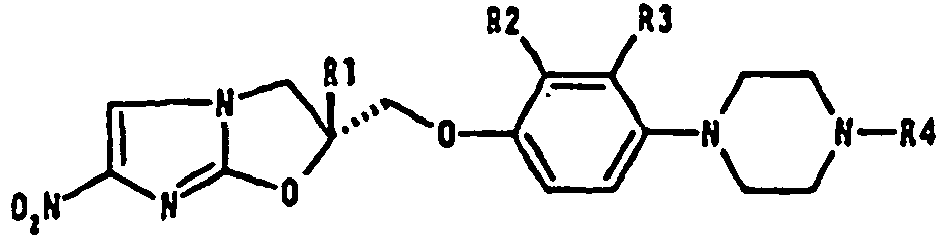
Example R1 R2 R3 R4 mp(°C) or 1H NMR 781 -CH3 -H -H -CH3 230 - 231.5 dec 782 -CH3 -H -Cl -CH3 201 - 204.5 dec 783 -CH3 -H -H 4-CF3Ph- 258-259 dec 784 -CH3 -H -H 4-ClPhCH3- 207- 208.4 785 -CH3 -H -H 4-ClPh- 251 - 257 dec 786 -CH3 H -H CH3CO- 206 - 207.5 787 -CH3 -H -Cl C2H3OCO- 168.5 171 788 -CH3 -Cl -H t-BuOCO- 192 - 194.5 789 -CH3 -Cl -H C2H3OCO- 178.5 - 180.5 790 -CH3 -Cl -Cl t-BuOCO- 233 - 233.5 dec 791 -CH3 -Cl -Cl C2H3OCO- 224.2 - 225.7 792 -CH3 -H -H -CO2CH2CF3 213 - 216 793 -CH3 -H -H -CO2C4H9 197.5 199 794 -CH3 -H -H -CO2(CH2)3CH3 198-201 795 -CH3 -H -H -CO2(CH2)2OCH3 176 - 179 796 -CH3 -H -Cl 4-CF3OPhCH2OCO- 153 - 155 797 -CH3 -Cl -H 4-CF3OPhCH2OCO- 176 - 176.8 798 -CH3 -Cl -Cl 4-CF3OPhCH2OCO- 196.5 - 197.5 799 -CH3 -H -H 4-CF3OPhCH2OCO- 187 - 189 800 -CH3 -H -H 4-CF3PhCH2OCO- 180.5 - 182.5 801 -CH3 -H -H 4-CF3PhCH=CHCH2OCO- 185 - 187 802 -CH3 -H -H 3,4-Cl2PhCH2OCO- 171 - 171.5 803 -CH3 -H -H 4-CF3OPhNHCO- 228 - 232 dec 804 -CH3 -H -H -CO2(CH2)2N(CH3)2 CDCl3: 1.76(3H ,s), 2.30(6H, s), 2.61(2H, t, J=5.8H2), 2.99-3.04(4H, m), 3.60-3.64(4H, m), 4.03(1H, d, J=10.2Hz), 4.04(1H, d, J=10.1Hz), 4.18(1H, d, J=10.1Hz), 4.22(2H, t, J=5.8Hz), 4.49(1H, d, J=10.2Hz), 6.76-6.81(2H, m), 6.83-6-89(2H, m), 7.55(1H, s) Table 34 
Example R1 R2 R3 mp(°C) 805 * -CH3 -CH3 4-CF3OPh- 127.2 - 129.7 806 * -CH3 -CH3 4-CF3Ph- 131.5 - 133.6 807 * -CH3 -CH3 4-NCPh- 149 - 152 808 * -CH3 -CH3 4-CF3OPhCH2OCO- 84.2 - 86.8 809 * -CH3 -CH3 4-ClPhCH2OCO- 116.2 - 116.6 * = not according to the invention Table 35 
Example R1 R2 mp(°C) or 1H NMR 810 * -CH3 -OPh 163.2 - 154.8 811 * CH3 4-CF3PhNH- CDCl3: 1.16-1.42(2H,m), 1.61(3H,s), 1.87-2.01(2H,m), 2.31-2.60(3H,m), 2.78-3.02(4H,m), 3.24-3.30(1H,m), 3.82(1H,d,J=8.1Hz), 3.91(1H,d,J=9.7Hz), 4.29(1H,d,J=9.7Hz), 6.64(2H,d,J=8.6Hz), 6.98-7.36(2H,d,J=8.6Hz), 7.54(1H,s) 812 * -CH3 4-CF3Ph- 130 - 131.8 813 * -CH3 4-CF3PhCH2- 117.6 - 118.5 814 * -CH3 4-ClPhCH2- 146.5 - 147.5 815 * -CH3 4-ClPhCO- 177 - 179 816 * -CH3-CH3 4-CF3PhCO- 98-100 817 * 4-CF3OPhO- 119.4-120.7 818 * -CH3 4-ClPhO- 141 - 144 819 * -CH3 3-CF3PhO- 89 - 91.7 820 * -CH3 4-NCPhO- 171-174.7 821 * -CH3 4-FPhO- 124-128 822 * -CH3 4-CF3OPhCH2O 113-115 823 * -CH3 4-ClPhCH2O- 136 -140 824 * -CH3 4-PhPhCH2O- 116-116.5 825 * -CH3 PhCH2CH2O- 79 - 81 826 * -CH3 4-PyridylCH2O- 80.8 - 83.9 827 * -CH3 3-PyridylCH2O- 77 - 79 828 * -CH3 4-CF3OPhCH2OCO- 101 - 102 829 * -CH3 4-ClPhNHCO- 153-155 830 * -CH3 4-ClPhCH2NHCO- 161-164 831 * -CH3 4-ClPhNH- 159-161 832 * -CH3 4-NCPhNH- 148.5 - 150 833 * -CH3 4-ClPhN(CH3)- 180.2 - 181.1 dec 834 * -CH3 4-NCPhN(CH3)- 188.5 - 191 835 * -CH3 4-CF3PhN(CH3)- 161 - 164 836 -CH3 (4-ClPh)2N- 178.5 - 180 * = not according to the invention Table 36 
Example R1 R2 R3 R4 R5 R6 mp(°C) or 1H NMR 837 * -CH3 -H -H -CH(CH3)2 -H -H 158.5 - 160 838 * -CH3 -H -Cl -Cl -H -H 115 -117.9 839 * -CH3 -H -H -CF3 -H -H 126 -129.2 840 * -H -H -H CF3 -H -H 164 - 166 841 * -CH3 -H -H -OPh -H -H 157 - 158.2 842 * -CH3 -H -OCH3 -OCH3 -OCH3 -H 147 - 151.9 843 * -CH3 -H -H -CO2CH3 -H -H 151 - 152.5 844 * -CH3 -H -H -3-PYRIDYL -H -H 140 - 143.8 845 * -CH3 -H -Ph -H -H -H 94.6 - 96.6 846 * -CH3 -H -H -cyclo-C6H11 -H -H 162 -163.9 847 * -CH3 -Ph -H -H -H -H 146.8 - 149 848 * -CH3 -H -H -CH=CHPh -H -H 178.5 - 181.8 849 * -CH3 -H -CF3 -H -CF3 -H 154 - 156.2 850* -CH3 -H -H -H -H -H CDCl3, 1.59(3H, s), 2.34(4H, bs), 2.50-2.59(2H, m), 2.53(1H, d, J=14.8Hz), 2.67-2.76(2H, m), 285(1H, d, J=14.8Hz), 3.41(1H, d, J=12.9Hz), 3.47(1H, d, J=12.9Hz), 3.87(1H, d, J=9.6Hz), 4.30(1H, d, J=9.6Hz), 7.23-7.33(5H, m), 7.53(1H, s) 851 * -CH3 -H -H -N(CH2)3 -H -H CDCl3 1.58(3H, s), 2.30(4H, br), 2.49-2.57(2H, m), 2.52(1H, d, J=14.9Hz), 2.65-2.73(2H, m), 2.84(1H, d, J=14.9Hz), 2.93(6H, s), 3.34(2H, d, J=3.50Hz), 3.86(1H, d. J=9.6Hz), 4.30(1H, d, J=9.6Hz), 6.67(2H, d, J=8.7Hz), 7.12(2H, d, J=8.7Hz), 7.52(1H, s) 852 * -CH3 -H -H -OCH3 -H -H CDCl3, 1.59(3H, s), 2.31(4H br), 2.50-2.68(2H, m), 2.53(1H, J=14.8Hz), 2.65-2.74(2H, m), 2.84(1H, d, J=14.8Hz), 3.35(1H, d, J=13.0Hz), 3.41(1H, d, J=13.0Hz), 3.79(3H, s), 3.88(1H, d, J=9.7Hz), 4.30(1H, d, J=9.7Hz), 6.83(2H, d, J=8.6Hz), 7.17(2H, d, J=8.6Hz), 7.52(1H, s) 853 * -CH3 -H -H -CH2Ph -H -H CDCl3 1.61(3H, s), 2.30-2.73(9H, m), 2.84(1H, d, J = 14.8Hz), 3.49(2H, s), 3.87(1H, d, J = 9.7Hz), 3.95(2H, s), 4.30(1H, d, J = 9.7Hz), 7.09-7.33(9H, m), 7.52(1H, s) * = not according to the invention Table 37 
Example R1 R2 R3 R4 R5 R6 mp(°C) or 1H NMR 854 * -CH3 -H -H -Cl -H -H 176.8 - 181.3 855 * -CH3 -H -H -Cl -Cl -H 111.8-114.8 856 * -CH3 -H -H -OCH3 -H -H 183.3 - 186.6 857 * -CH3 -H -H -H -H -Cl 123.5-125.3 858 * -CH3 -H -H -H -H -H CDCl3; 1.59(3H, s), 2.37(4H, bs), 2.51-2.61(2H, m), 2.54(1H, d, J=14.8Hz), 2.69-2.76(2H, m), 2.86(1H, d, J=14.8Hz), 3.44(1H, d, J=13.1Hz), 3.51(1H, d, J=13.1Hz), 3.88(1H, d, J=9.6Hz), 4.31(1H, d, J=9.6Hz), 7.29-7.36(3H, m) 7.39-7.47(2H, m), 7.51-7.60(4Hm), 7.53(1H, s) 859 * -CH3 -H -H -CF3 -H -H CDCl3; 1.60(3H, s), 2.37-2.75(9H, m), 2.87(1H, d, J=14.9Hz), 3.49(2H, s), 3.88(1H, d, J=9.6Hz), 4.30(1H, d, J=9.6Hz), 7.37(1H, d, J=8.0Hz), 7.53(1H, s), 7.54(1H, d, J=8.0Hz), 7.68(4H, s) 860 * -CH3 -H -H -OCF3 -H -H CDCl3; 1.60(3H, s), 2.38(4H, br), 2.55(1H, d, J=14.9Hz), 2.60(2H, br), 2.71-2.76(2H, m), 2.87(1H, d, J=14.9Hz), 9.50(2H, s), 3.89(1H, d, J=9.7Hz), 4.30(1H, d, J=9.7Hz), 7.27(2H, d, J=6.6Hz), 7.36(2H, d, J=8.2), 7.47-7.52(2H, m), 7.53(1H, s), 7.55-7.61(2H, m) * = not according to the invention Table 38 
Example R1 R2 mp(°C) 861 * -CH3 
134 - 138.8 862 * -CH3 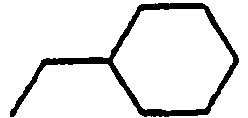
188.6 - 190.7 863 * -CH3 
127 - 31.5 864 * -CH3 
156 - 168.6 865 * -CH3 
102.8-104.9 866 * -CH3 
129 - 133 867 * -CH3 
164.0-168.5 868 * -CH3 
221.5 - 222.3 869 * -CH3 
158 - 159.4 870 * -CH3 
105 - 107 871 * -CH3 
142 - 145.4 * = not according to the invention Table 39 
Example R1 R2 mp(°C) 872 * -CH3 
196 -199.4 873 * -CH3 
102 -104 874 * -CH3 
215.5 - 217 875 * -CH3 
195 -197.8 * = not according to the invention Table 40 
Example R1 R2 R3 R4 R5 R6 mp(°C) or 1H NMR 876 -H -H -H -CF3 -H -H 175.8 - 76.6 877 * -CH3 -H -H -H -H -H 180.6 - 184.2 878 * -CH3 -H -H -F -H -H 175 - 179.5 879 * -CH3 -H -H -OCH3 -H -H 172 - 172.5 880 * -CH3 -H -H -CO2C2H5 -H -H 175 - 179.2 881 * -CH3 -H -H -CH3 -H -H 185 - 185.5 882 * -CH3 -H -H -Cl -Cl -H 177 - 177.3 883 * -CH3 -H -H -H -CF3 -H 171.6 - 173.6 884 * -CH3 -H -H -H -H -CF3 179.5 - 180.3 885 * -CH3 -H -H -Cl -CF3 -H 170.5 - 171.2 886 * -CH3 -H -H -CO2H -H -H 248 - 252 887 * -CH3 -H -H -H -H -F 191 - 192.2 888 -CH3 -H -H -N(CH3)2 -H -H 206 - 207 889 * -H -H -H -F -H -H 178.5 - 179.5 890 -H -H -H -CN -H -H 211 - 211.5 891 * -H -H -H -Cl -H -H 183 - 183.5 892 * -CH3 -H -H -CF3 -H -H CDCl3: 1.64(3H, s), 2.59-2.75(2H. m), 2.62(1H, d, J=15Hz), 2.80.2.95(2H, m), 2.93(1H, d, J=15Hz), 3.00-3.25(4H, m), 1.94(1H, d, J=10Hz), 4.35(1H, d, J=10Hz), 6.86(2H, d, J=8Hz), 7.46(2H, d, J=8Hz), 7.53(1H, s) 893 * -CH3 -H -H CO2C(CH3)3 -H -H 198.5 - 200.5 * = not according to the invention Table 41 
Example R1 R2 R3 R4 R5 R6 mp(°C) 894 * -CH3 -H -H -Cl -H -H 144.2 - 145.6 895 * -CH3 -H -H -OCF3 -H -H 153-156.9 896 * -CH3 -H -H -Cl -Cl -H 114.5 - 116.6 897 * -CH3 -H -H -H -Cl -H 132.4 - 136.3 898 * -CH3 -H -H -H -H -Cl 143.5 - 145 899 * -CH3 -H -H -Br -H -H 151 - 152 900 * -CH3 -H -H -Ph -H -H 134 - 135.2 901 * -CH3 -H -H -CO2CH3 -H -H 127 - 130.5 902 * -CH3 -H -H -OCH3 -H -H 128 - 130 903 * -(CH, -H -H -OCH2Ph -H -H 128 - 131 904 * -CH3 -Cl -H -H -H -Cl 142 - 145.5 905 * -CH3 -H -Cl -H -Cl -H 132 - 135.3 906 * -CH3 -H -H -H -CF3 -H 117 - 118 907 * -CH3 -H -H -CH3 -H -H 117 - 118 908 * -CH3 -H -H -H -OCH3 -H 106 - 108 909 * -CH3 -H -H -H -H -CH3 143 - 145 910 * -CH3 -H -H -H -H -OCH3 127 - 130 911 * -CH3 -H -H -H -H -CF3 144 - 145 912 * -CH3 -H -H -OC4H9 -H -H 126 - 127 913 * -CH3 -H -H -NO2 -H -H 156 - 158 914 * -CH3 -H -CF3 -H -CF3 -H 159 - 160 915 * -CH3 -H -H -CN -H -H 125 - 129 916 * -CH3 -H -H -C(CH3)3 -H -H 147 - 149 917 * -CH3 -H -H -H -CH3 -H 125 - 127 918 * -CH3 -H -H -CH3 -CH3 -H 135 - 138 919 * -CH3 -H -H -OCH3 -OCH3 -H 149 - 151 920 * -CH3 -H -H -H -H -F 181 - 188 921 * -CH3 -H -H -C2H5 -H -H 144 - 146 922 * -CH3 -H .H -SO2CH3 -H -H 112 - 115 923 * -CH3 -H -H -CON(CH3)2 -H -H 108 - 111 924 * -CH3 -H -H -CONHC3H7 -H -H 124 - 126 925 * -CH3 -H -H -OCH(CH3)2 -H -H 122 - 123 926 * -CH3 -H -H -OSO2CH3 -H -H 100 - 104 927 * -CH3 -H -H -I -H -H 132 - 134 928 * -CH3 -H -H -NHCOCH3 -H -H 105 - 109 929 * -CH3 -H -H -CONH2 -H -H 159 - 161 930 * -CH3 -H -H -F -Cl -H 148 - 149 * = not according to the invention Table 42 
Example R1 R2 R3 R4 R5 R6 mp(°C) or 1H NMR 931 * -CH3 -H -H -F -H -H CDCl3 1.62(3H, s), 2.38-2.70(4H, bm), 2.56(1H, d, J=14.9Hz), 2.87(1H, d, J=14.9Hz), 3.41(4H, bs), 3.92(1H, d, -H J=9.7Hz), 4.28(1H, d, J=9.7Hz), 5.06(2H, s), 6.99-7.07(2H, m), 7.28-7.34(2H, m), 7.53(1H, s) . 932 * -CH3 -H -H -CF3 -H -H CDCl3 1.62(3H, s), 2.45-2.75(4H, bm); 2.58(1H, d, J=14.9Hz), 2.86(1H, d, J=14.9Ez), 3.20-3.60(4H, br), 3.94(1H, d, J=9.8Hz), 4.29(1H, d, J=9.8Hz), 5.15(2H, s), 7.44(1H, d, J=8.0Hz), 7.54(1H, s), 7.61(1H, d, J=8.0Hz) 933 * -CH3 -H -H -OH -H -H CDCl3 1.59(3H, s), 2.30-2.70(4H, m), 2.56(1H, d, J=15Hz), 2.86(1H, d, J=15Hz), 3.10-3.55(4H, m), 3.91(1H, d, J=10Hz), -H 4.28(1H, d, J=10Hz), 5.03(2H, s), 5.30(H, brs), 6.84(2H, d, J=8Hz), 7.24(2H, d, J=8Hz), 7.53(1H, s) 934 * -CH3 -H -H -NH2 -H -H CDCl3 1.61(3H, s), 2.35-2.70(4H, m), 2.56(1H, d, J=15Hz), 2.85(1H, d, J=15Hz), 3.05-3.55(4H, m), 3.69(2H, brs), 3.91(1H, d, J=10Hz), 4.28(1H, d, J=10Hz, 4.98(2H, s), 6.55(2H, d, J=8Hz), 7.14(2H, d, J=8Hz), 7.53(1H, s) 935 * -CH3 -H -H (CH3)3C(CH)2Si- -H -H 144-115 936 * -CH3 -H -H (CH3)2COCONH- -H -H 124 - 127 * = not according to the invention Table 43 
Example R1 R2 mp(°C) 937 * -CH3 -(CH2)2Ph 143.5 - 144.6 938 * -CH3 4-ClPh(CH2)2- 118 - 119 939 * -CH3 4-ClPhCH=CHCH2- 121 - 123.3 940 * -CH3 4-CF3PhCH=CHCH2- 121 - 122 941 * -CH3 4-CF3OPhCH=CHCH2- 127 - 128 * = not according to the invention Table 44 
Example R1 R2 R3 R4 R5 R6 mp(°C) or 1H NMR 942 * -CH3 -H -H -H -Cl -H 83 - 85 943 * -CH3 -H -H -F -H -H 174 - 175 944 * -CH3 -H -H -H -H -CH3 187 - 188.5 945 * -CH3 -H -H -H -H -H 163.5 - 165.5 946 * -CH3 -H -H -Cl -H -H 172.5 - 174 947 * .H -H -H -OCF3 -H -H 128 - 129 948 * -CH3 -H -H -Cl -Cl -H 97 - 98 949 * -CH3 -H -H -F -F -H 115 - 116 950 * -CH3 -H -H -H -F -F 101 - 103 951 * -CH3 -H -F -H -F -H 85 - 87 952 * -CH3 -F -F -F -F -F 143 - 144 953 * -CH3 -F -H -F -H -F 92 - 95 954 * -CH3 -H -F -H -H -F 144 - 146 955 * -CH3 -F -H -H -H -F 169 - 170 956 * -CH3 -H -H -F -H -F 178 - 182 957 * -CH3 -H -H -H -F -H 112 - 115 958 * -CH3 -H -H -H -CF3 -H 78 - 80 959 * -CH3 -H -H -H -H -F 175 - 176 960 * -CH3 -H -H -Br -H -H 166 - 167 961 * -H -H -H -F -H -H 121.5 - 122 962 * -H -H -H -Cl -H -H 112.9 - 116.7 963 * -H -H -H -Cl -Cl -H 105.5 - 106 964 * -H -H -H -H -Cl -H 97.6 - 98 965 * -H -H -H -H -F -H 93 - 94 966 * -CH3 -H -H -OCHF2 -H -H 134 - 135 967 * -CH3 -H -H -F -OCH3 -F 71 - 74 968 * -CH3 -H -H -F -OCHF2 -F 84 - 86 969 * -CH3 -H -H -Cl -OCHF2 -H 85 - 87 970 * -CH3 -H -H -Cl -H -H 180 - 181 971 * -CH3 -H -H -CF3 -H -H 185 - 187 972 * -CH3 -H -H -OCF3 -H -H 172 - 173 973 * -CH3 -H -H -OCH2CF3 -H -H 76 - 80 974 * -CH3 -H -H -Cl -OCH2CF2 -H 139 - 140 * = not according to the invention Table 45 
Example R1 R2 R3 R4 R5 R6 mp(°C) or 1H NMR 975 * -CH3 -H -H -OCH2CF9 -Cl -H CDCl3 1.62(3H, s), 2.40-2.75(4H, m), 2.57(1H, d, J=15Hz), 2.87(1H, d, J=16Hz), 3.05-3.50(4H, m), 3.92(1H, d, J=10Hz), 4.28(1H, d, J=10Hz), 4.40(2H, q, J=8Hz), 5-02(2H, s), 6.40(2H, d, J=8Hz), 7.21(2H, dd, J=8,2Hz), 7.39(1H, d, J=2Hz), 7.58(1H, s) 976 * -CH3 -H -H -OCHF2 -Cl -H CDCl3 1.62(3H, s), 2.40-2.70(4H, m), 2.59(1H, d, J=15Hz), 2.87(1H, d, J=16Hz), 3.10-3.55(4H, m), 3.96(1H, d, J=10Hz), 4.30(1H, d, J=10Hz), 5.13(2H, s), 6.53(1H, t, J=73Hz), 7.10-7.30(2H, m), 7.42(1H, s), 7.55(1H, s) 977 * -CH3 -H -H -Br -OCHF2 -F CDCl5 1.62(3H, s), 2.40-2.65(4H, m), 2.59(1H, d, J=15Hz), 2.86(1H, d, J=15Hz), 3.00-3.50(4H, m), 3.96(1H. d, J=10Hz). 4.29(1H, d, J=10Hz), 6.14(2H, s), 6.59(1H, t, J=73Hz), 7.17(1H, m), 7.39(1H, m), 7.55(1H, s) * = not according to the invention Table 46 
Example R1 R2 R3 R4 R5 R6 mp(°C) 978 * -CH3 -H -H -CF3 -H -H 139.8 141.7 979 * -CH3 -H -H -H -Cl -H 108 - 111 980 * -CH3 -H -H -H -H -CH3 185-186 981 * -CH3 -H -H -Cl -CF3 -H 115 - 115.5 982 * -CH3 -H -H -CF3 -CH3 -H 91 - 91.5 983 * -CH3 -H -H -SCF3 -H -H 136.5 - 137 984 * -CH3 -H -H -F -Cl -H 72.5 - 73 985 * -CH3 -H -H -Cl -H -CH3 178.5 - 179 * = not according to the invention Table 47 
Example R1 R2 mp(°C) 986 * -CH3 -CH2-cyclo-C6H11 101 - 103 987 * -CH3 -cyclo-C6H11 189.6 - 191.6 988 * -CH3 -CH2CF3 123.5 - 124 989 * -CH3 -CH2CH=C(CH3)2 138 - 138.5 990 * -CH3 (E)-3.4-Cl2PhCE=CHCH2- 145 - 148 991 * -CH3 (E)-4-ClPhCH=CHCH2- 124 - 125 992 * -CH3 (E)-4-CF3OPhCH=CHCH2- 60 - 61 993 * -H (E)-4-ClPhCH=CHCH2- 113 - 114 994 * -H (E)-4-ClPhC(CH3)=CHCH2- 109 - 110 995 * -H (Z)-4-ClPhC(CH3)=CHCH2. 95 - 96 996 * -CH3 (E)-4-CF3PhCH=CHCH2- 132 - 133 997 * -CH3 (Z)-4-CF3PhCH=CHCH2- 138 - 140 998 * -CH3 (E)-3-CF3-4-ClPhCH=CHCH2- 147 - 149 999 * -CH3 (E)-4-FPhCH=CHCH2- 155 - 156 1000 * -CH3 (E)-4-CF3PhCH=C(CH3)CH2- 122 - 123 1001 * -CH3 (4-CF3Ph)2C=CHCH2- 145 - 146 1002 * -CH3 4-ClPh(CH2)2- 150 - 151 1003 * -CH3 4-ClPh(CH2)3- 96 - 97 1004 * -CH3 4-ClPh(CH2)4- 76 - 82 1005 * -CH3 4-ClPhO(CH2)2- 138 - 139 1006 * -CH3 4-CF3OPh(CH2)3- 46 - 48 1007 * -CH3 4-CF3Ph(CH2)3- 118 - 120 1008 * -CH3 4-CF3PhO(CH2)2- 104 - 108 1009 * -CH3 4-CF3OPhN(CH3)(CH2)2- 102 - 104 1010 * -CH3 (E)-4-ClPhC(CH2)=CHCH2- CDCl3 1.62(3H, s), 2.02-2.10(3H, m), 2.57(1H, d, J=14.9Hz), 2.40-2.73(4H, m), 2.87(1H, d, J=14.9Hz), 3.06-3.62(4H, m), 3.93(1H, d, J=9.7Hz), 4.29(1H, d, J=9.7Hz), 4.76(2H, m), 6.87(1H, dt, J=1.3Hz, 6.7Hz), 7.23-7.37(4H, m), 7.54(1H, s) 1011 * -CH3 (Z)-4-ClPhC(CH3)=CHCH2- CDCl3 1.62(3H, s), 2.02.2.10(3H, m), 2.58(1H, d, J=14.9Hz, 2.35-2.72(4H, m), 2.86(1H, d, J=14.9Hz), 3.04-3.56(4H, m), 3.94(1H. d, J=9.8Hz), 4.30(1H. d, J=9.8Hz). 4.46(2H, m), 6.66(1H, dt, J=1.4Hz, 7.0Hz), 7.04-7.12(2H, m), 7.23-7.35(2H, m), 7.53(1H, s) * = not according to the invention Table 48 
Example R1 R2 mp(°C) 1012 * -CH3 
80 - 85 1013 * -CH3 
120 - 140 1014 * -CH3 
189 - 190 1015 * -CH3 
196.1 - 199.1 1016 * -CH3 
137.4 - 139.2 1017 * -CH3 
71 - 76.4 1018 * -CH3 
121.1 - 122.1 1019 * -CHS3 
177.1 - 178.9 1020 * -CH3 
158.5 - 160.4 * = not according to the invention Table 49 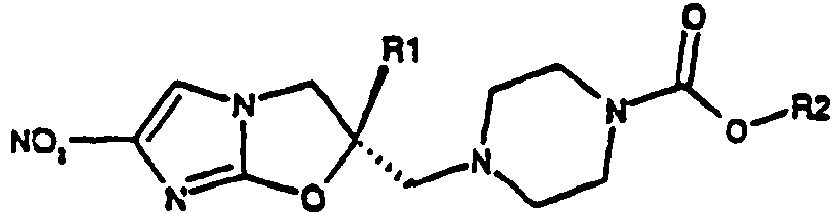
Example R1 R2 mp(°C) 1021 * -CH3 
193.4 - 195.9 1022 * -CH3 
203.6 - 204.9 * 1023 -CH3 
89.7 - 91.8 1024 * -CH3 
185.2 - 187.5 1025 -CH3 
93.6 - 96.5 1026 * CH3 
215.3 - 216.4 1027 * -CH3 
180.7 - 182.3 1028 * -CH3 
170.2 - 170.6 1029 * -CH3 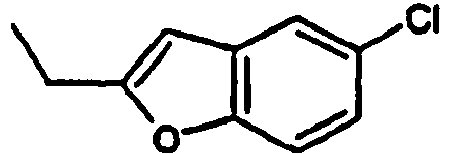
134.3 - 135.7 1030 * -CH3 
83.6 - 86.3 1031 * -CH3 
191.8 - 192.9 * = not according to the invention Table 50 
Example R1 R2 mp(°C) or 1H NMR 1032 * -CH3 
174.3 - 179.2 1033 * -CH3 
108.9 - 113.1 1034 * -CH3 
193.5 - 194.7 1035 * -H 
152 - 153.5 1036 * -H 
190.3 - 191.2 1037 * -H. 
177.5 - 180.9 1038 * -CH3 
127.5 - 128.1 1039 * -CH3 
140 - 141.5 1040 * -CH3 
114 - 117 1041 * -CH3 
CDCl3 1.40-1.62(5H, m), 1.80-1.93(2H, br), 2.46-2.64(13H, m), 2.87(1H, d, J=14.9Hz). 3.37(4H, br), 3.92(1H. d, J=9.7Hz), 4.20(2H. t, J=6.1), 7.53(1H, s) * = not according to the invention Table 51 
Example R1 R2 mp(°C) 1042 * -CH3 4-CF3OPh- 160.5 - 161.4 1043 * -CH3 4-CF3Ph- 158.6 - 160.6 1044 * -CH3 4-CH3OPh- 138.5 - 139.5 1045 * -CH3 Ph- 163 - 163.5 1046 * -CH3 4-FPh- 159 -160 1047 * -CH3 PhCH2- 141.5 - 142 1048 * -CH3 4-ClPh- 177 - 178 1049 * -CH3 4-NCPh- 158 - 169 1050 * -CH3 4-ClPhCH2- 144 - 45 1051 * -CH3 4-CF9PhCH2- 95.5 - 97 1052 * -CH3 4-CF3OPhCH2- 143 - 143.5 1053 * -CH3 4-CF3PhCO- 160.5 - 162.4 1054 * -CH3 4-ClPhCO- 218 - 220.3 1055 * -CH3 4-CF3OPhCO- 169.8 - 172.7 * = not according to the invention Table 52 
Example R1 R2 R3 R4 R5 R6 Mp(°C) 1056 * -H -H -H -CF3 -H -H 215.3 - 217.8 1057 * -H -H -H -Br -H -H 219.2 - 221.3 1058 * -H -F -H -Br -H -H 198.8 - 200.5 1059 * -H -H -F -Cl -H -H 199 - 199.5 1060 * -H -H -H -CN -H -H 180.2 - 184.1 1061 * -H -F -F -F -H -H 188.5 - 189.2 1062 * -H -H -F -F -F -H 191.7 - 192.6 1063 * -H -F -H -Cl -H -H 202.8 - 203.3 * = not according to the invention Table 53 
Example R1 R2 R3 R4 R5 R6 mp(°C) 1064 * -H -H -H -Cl -H -H 214.2 - 214.8 1065 * -H -H -Cl -Cl -H -H 204.1 - 205.7 1066 * -H -H -CF3 -H -H -H 127.8 -131.8 1067 * -H -H -H -OCF3 -H -H 204.2 - 205.3 1068 * -H -H -H -F -H -H 199.2 - 200.2 * = not according to the invention Table 54 
Example R1 R2 R3 R4 R5 mp(°C) 1069 * -H -H -Cl -H -H 164.6 - 165.9 1070 * -H -H -CF3 -H -H 194.9 - 195 1071 * -H -H -OCF3 -H -H 211.7 - 212.1 1072 * -H -H -H -CF3 -H 182.9 - 185.9 * = not according to the invention Table 55 
Example R1 R2 R3 R4 R5 R6 mp(°C) 1073 * -H -H -H -F -H -H 202.5 - 203.1 1074 * -H -H -H -OCH3 -H -H 205.4 - 206.4 1075 * -H -H -H -Cl -H -Cl 162.7 - 164 1076 * -H -H -H -Cl -H -H 233.7 - 236.2 1077 * -H -H -H -1-PYRRYL -H -H 249.1 - 249.7 1078 * -H -H -H -Ph -H -H 211.6 - 212 1079 * -H -H -H -OCH2Ph -H -H 202.2 - 203.9 1080 * -H -H -H -Br -H -H 224.4 - 226.2 1081 * -H -H -H -OC8H17 -H -H 156.8 - 158.3 1082 * -H -H -H -CN -H -H 197.8 - 198.7 1083 * -H -H -H -OPh -H -H 198.1 - 200.1 1084 * -H -H -F -F -F -H 193.8 - 196 1085 * -H -CH3 -H -CH3 -H -CH3 177.9 - 178.3 1086 * -H -CH3 -H -H -H -CH3 175.7 - 178.2 1087 * -H -H -CF3 -H -CF3 -H 200.2 - 202.3 1088 * -H -H -H -Cl -F -H 197.2 - 199.2 1089 * -H -H -H -Br -H -F 206.1 - 207.4 1090 * -H -H -H -F -F -F 174 - 174.7 1091 * -H -H -H -Cl -H -F 202.8 - 203.7 1092 * -H -H -H -C4H9 -H -H 162.2 - 165.1 1093 * -H -H -H -N(Ph)2 -H -H 182.6 - 186.4 1094 * -H -H -H -H -Cl -Cl 223.5 - 224.5 1095 * -H -H -H -I -H -H 217 - 221.1 1096 * -H -H -H -1-(1,2,4-triazolyl) -H -H 200.6 - 202.3 * = not according to the invention Table 56 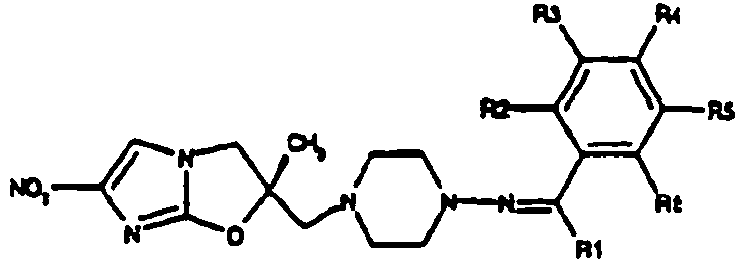
Example R1 R2 R3 R4 R5 R6 MS 1097 * -H -H -H -H -H -H 370 1098 -H -Cl -H -H -H -H 404 1099 * -H -H -Cl -H -H -H 404 1100 * -H -F -H -H -H -H 388 1101 -H -H -H -CH(CH3)2 -H -H 412 1102 * -H -H -H -NO2 -H -H 415 1103 * -H -CF3 -H -H -H -H 438 1104 * -H -H -CF3 -H -H -H 438 1105 * -H -H -H -C(CH3)3 -H -H 426 1106 * -H -H -H -OC2H5 -H -H 414 1107 * -H -Cl -Cl -H -Cl -H 472 1108 * -H -Cl -Cl -H -H -Cl 472 1109 * -H -H -H -H -OPh -H 462 1110 * -H -H -F -H -H -F 406 1111 * -H -F -H -F -H -H 406 1112 * -H -H -H -F -F -H 406 1113 * -H -H -F -H -F -H 406 1114 * -H -H -H -F -F -F 424 1115 * -H -H -F -H -F -F 424 1116 * -H -F -H -H -F -F 424 1117 * -H -H -F -F -H -F 424 1118 * -H -F -H -F -H -F 424 1119 * -H -OCF3 -H -H -H -H 454 1120 * -H -H -H -C2H5 -H -H 398 1121 * -H -H -H -H -Br -H 448 1122 * -H -Br -H -H -H -H 448 1123 * -H -H -H -H -F -F 406 1124 * -H -Cl -H -H -H -Cl 438 1125 * -H -OC2H5 -H -H -H -H 414 1126 * -H -H -H -OC4H9 -H -H 442 1127 * -H -H -H -H -H -OCH2Ph 476 1128 * -H -H -H -H -NO2 -H 415 1129 * -H -H -H -H -OCF3 -H 454 1130 * -H -H -H -Cl -Cl -H 438 1131 * -H -Cl -H -H -Cl -H 438 1132 * -H -H -H -H -OCOCH3 -H 428 1133 * -H -NO2 -H -H -H -H 415 1134 * -H -H -H -H -F -H 388 1135 * -H -H -Cl -H -Cl -H 438 1136 * -H -H -H -H -CN -H 395 1137 * -H -H -OCH3 -H -H -H 430 1138 * -H -OCH3 -OCH3 -H -H -H 400 1139 * -H -OCH3 -H -OCH3 -H -H 430 1190 * -H -OCH3 -H -H -OCH3 -H 430 * = not according to the invention Table 57 
Example R1 R2 R3 R4 R5 R6 MS 1141 * -H -H -H -OCH3 -OCH3 -H 430 1142 * -H -H -H -OCH3 -OCH3 -OCH3 460 1143 * -H -H -Cl -H -H -NO2 449 1144 * -H -H -H -OCH3 -H -NO2 445 1145 * -H -H -OCH3 -H -H -NO2 445 1146 * -H -H -H -H -Ph -H 446 1147 * -H -NHSO2CH3 -H -H -H -H 463 1148 * -H -H -H -CH3 -H -H 384 1149 * -H -H -H -CH3 -CH3 -H 398 1150 * -H -CH3 -H -CH3 -H -H 398 1151 * -H -H -H -H -CH3 -H 384 1152 * -H -H -CH3 -H -H -CH3 398 1153 * -H -H -H -H -H -CH3 384 1154 -H -H -H -H -CH3 -CH3 398 1155 * -H -H -H -OCOCH3 -H -H 428 1156 * -H -H -H -OC3H7 -H -H 428 1157 * -H -H -H -NHCOCH3 -H -H 427 1158 * -H -H -CH3 -H -CH3 -H 398 1159 * -H -H -CH3 -CH3 -H -CH3 412 1160 * -H -H -H -CO2CH3 -H -H 428 1161 * -H -H -H -CH=CHPh(trans) -H -H 472 1162 * -H -H -H -N(CH3)2 -H -H 413 1163 * -H -H -Br -H -H -OCH3 478 1164 * -H -H -H -F -H -Cl 422 1165 * -H -H -Br -H -H -F 466 1166 * -H -H -OCH3 -H -H -F 418 1167 * -H -H -H -CH2CH(CH3)2 -H -H 426 1168 * -H -Br -H -OCH3 -OCH3 -H 508 1169 * -H -F -F -F -F -F 460 1170 * -H -H -H -N(CH3)2 -H -OCH3 443 1171 * -H -H -OCH2Ph -H -OCH2Ph -H 582 1172 * -H -H -H -OCH2Ph -OCH2Ph -H 582 1173 * -H -H -H -H -OC2H5 -H 414 1174 * -H -H -H -H -OCH2Ph -H 476 1175 * -H -H -H -OCH2Ph -OCH3 -H 506 1176 * -H -H -H -SC2H6 -H -H 430 1177 * -H -H -H -OCHF2 -H -H 436 1178 * -H -H -H -OCH(CH3)2 -H -H 428 1179 * -H -H -H -OCH3 -Br -H 478 1180 * -H -H -H -N(C2H5)2 -H -H 441 1181 * -H -H -H -OCH3 -F -H 418 1182 * -H -H -H -OCH3 -CH3 -H 414 1183 * -H -OCH3 -H -H -F -H 418 1184 * -H -Cl -H -H -NO2 -H 449 * = not according to the invention Table 58 
Example R1 R2 R3 R4 R5 R6 MS 1185 * -H -H -H -OC2H3 -OC2H5 -H 458 1186 * -H -H -H -OCO CH3 -OCH3 -H 458 1187 * -H -NO2 -H -OCH3 -OCH3 -H 475 1188 * -H -H -H -SCH3 -H -H 416 1189 * -H -H -H -Cl -NO2 -H 449 1190 * -H -H -H -SO2CH3 -H -H 448 1191 * -H -H -H -OCH3 -OCH2Ph -H 506 1192 * -H -H -H -Cl -CF3 -H 472 1193 * -H -I -H -H -H -H 496 1194 * -H -H -H -H -SCF3 -H 470 1195 * -H -OCH3 -H -OCH3 -OCH3 -H 460 1196 * -H -H -OCH3 -H -OCH3 -H 430 1197 * -H -CO2CH3 -H -H -H -H 428 1198 * -H -OCH3 -H -H -H -OCH3 430 1199 * -H -OCH3 -H -OCH3 -H -OCH3 460 1200 * -H -OCHF2 -H -H -H -H 436 1201 * -H -H -Br -OCH3 -OCH3 -H 508 1202 * -H -H -CH3 -OCH3 -H -CH3 428 1203 * -H -H -H -OH -H -H 386 1204 * -H -H -OCH3 -OH -OCH3 -H 446 1205 * -H -H -H -OH -H -OH 402 1206 * -H -H -H -H -H -OCH3 400 1207 * -H -F -H -H -H -F 406 1208 * -H -H -H -3-PYRIDYL -H -H 447 1209 * -H -H -H -OCH2Ph -Cl -H 510 1210 * -H -H -H -2-THIENYL -H -H 452 1211 * -H -H -OCH3 -OCH3 -OCH3 -H 460 1212 * -H -H -H -cyclo-C6H11 -H -H 452 1213 * -H -H -H CH2=CHCH2O- -H -H 426 1214 * -H -H -H Pyrrolidinyl- -H -H 439 1215 * -H EtOCOCH2O- -H -H -H -H 472 1216 * -H -H -H -OCH3 cyclo-C5H3O- -H 484 1217 * -H -H CF3CF2O- -H - -H 504 1218 * -H -H -H Imidazolyl- -H -H 436 1219 * -H -H -H Piperidino- -H -H 453 1220 * -H -H -H 4-CF3Ph- -H -H 514 1221 * -H -H -H 4-CH3OPh- -H -H 476 1222 * -H -H -H (CH3)2N(CH2)3O- -H -H 471 1223 * -H -H -H Morpholino- -NO2 -H 500 1224 * -H -H -H Piperidino- -NO2 -H 498 1225 * -H -H -H 4-FPh- -H -H 464 1226 * -H -H -H 4-CH3(CH2)3Ph- -H -H 572 1227 * -H -H -H 3,4-F2Ph- -H -H 482 1228 * -H -H -H 4-CH3(CH2)3Ph- -H -H 502 1229 * -H -H -H 3-Cl-4-FPh- -H -H 498 * = not according to the invention Table 59 
Example R1 R2 R3 R4 R5 R6 MS 1230 * -H -H -H 4-CF3OPh- -H -H 530 1231 * -H -H -H 4-CH3Ph- -H -H 460 1232 * -H -H -H 4-NCPh- -H -H 471 1233 * -H -H -H 3,4-(CH3O)3Ph- -H -H 506 1234 * -H -OCH2O- -H -H -H 414 1236 * -H -H -OCH2O- -H -Cl 448 1236 * -H -H -OCH2O- -H -H 414 1237 * -H -H -OCH2O- -OCH3 -H 444 1238 * -H -NO2 -H -OCH2O- -H 459 1239 * -H -H -H 
-F -H 486 1240 * -H -H 
-H -H -NO2 617 1241 * -H -H 
-H -H -NO2 589 1242 * -H -H 
-H -H -OCH3 587 1243 * -H -H -H 
-H -H 437 1244 * -H -H -H 
-H -H 626 1245 * -H -H -H 
-H -H 513 1246 * -H -H -H 
-H -H 486 * = not according to the invention Table 60 
Example R1 mp(°C) or MS 1247 * 
174.1 - 175.8 1248 * 
201.9 - 203 1249 * 
218.8 - 220.1 * 1260 
156 - 159.3 * 1251 * 
386 1252 * 
496 1253 * 
513 1254 * 
440 * = not according to the invention Table 61 
Example R1 mp(°C) 1255 * 
211.5 - 213.6 1256 * 
190.2 - 191.8 1257 * 
182 - 185.7 1258 * 
192.3 - 195.5 1259 * 
218.4 - 218.9 1260 * 
196 - 97.8 1261 * 
212.5 - 212.9 1262 * 
219.2 - 220 1263 * 
209.4 - 210.4 * = not according to the invention Table 62 
Example R1 mp(°C) or MS 1264 * 
205.4 - 206.6 1265 * 
214.7 - 215.2 1266 * 
420 1267 * 
498 1268 * 
420 1269 * 
463 1270 * 
450 * = not according to the invention Table 63 
Example R1 mp(°C) or MS 1271 * 
227.6 - 228.3 1272 * 
428 1273 * 
494 1274 * 
376 1275 * 
374 * = not according to the invention Table 64 
Example R1 mp(°C) or MS 1276 * 
360 1277 * 
374 1278 * 
388 1279 * 
230.6 - 232.6 1280 * 
470 1281 * 
481 1282 * 
470 1283 * 
504 1284 * 
538 1285 * 
481 * = not according to the invention Table 65 
Example: R1 mp(°C) or MS 1286 * 
405 1287 * 
388 1288 * 
481 * = not according to the invention Table 66 
Example R1 mp(°C) or MS 1289 * 
376 1290 * 
217.8 - 218.5 1291 * 
213.2 - 215.6 1292 * 
536 1293 * 
421 1294 * 
390 1295 * 
410 1296 * 
404 1297 * 
524 1298 * 
524 1299 * 
468 * = not according to the invention Table 67 
Example R1 mp(°C) or MS 1300 * 
376 1301 * 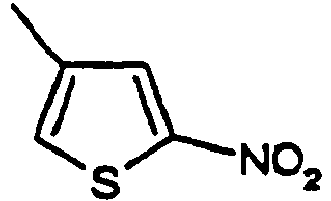
421 * = not according to the invention Table 68 
Example R1 mp(°C) or MS 1302 * 
371 1303 * 
371 1304 * 
371 1305 * 
447 1306 * 
465 1307 * 
515 1308 * 
531 1309 * 
483 1310 * 
461 1311 * 
507 1312 * 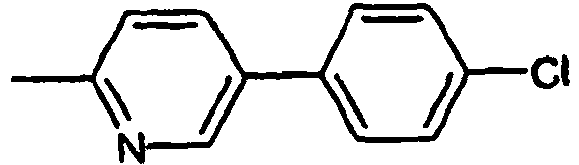
481 * = not according to the invention Table 69 
Example R1 mp(°C) or MS 1313 * 
437 1314 * 
453 1315 * 
437 1316 * 
453 1317 * 
427 1318 * 
449 1319 * 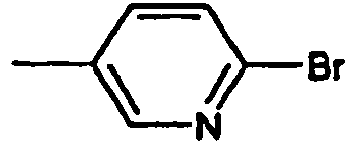
449 1320 * 
439 1321 * 
465 1322 * 
461 1323 * 
477 1324 * 
531 * = not according to the invention Table 70 
Example R1 mp(°C) or MS 1325 * 
507 1326 * 
481 1327 * 
499 1328 * 
453 1329 * 
437 1330 * 
377 1331 * 
189.4 -180.6 1332 * 
498 1333 * 
453 1334 * 
483 1335 * 
487 1336 * 
201.2 - 203.5 * = not according to the invention Table 71 
Example R1 mp(°C) or MS 1337 * 
531 1338 * 
494 1339 * 
483 1340 * 
481 1341 * 
469 1342 * 
467 1343 * 
543 * = not according to the invention Table 72 
Example R1 mp(°C> or MS 1344 * 
469 1345 * 
220.6 - 220.9 1346 * 
421 1347 * 
421 1348 * 
563 1349 * 
499 1350 * 
467 1351* 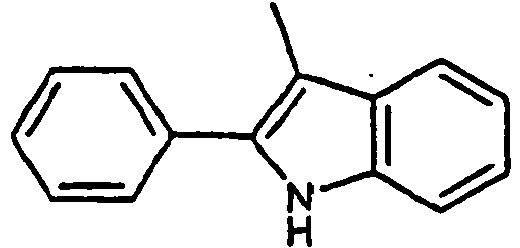
485 * = not according to the invention Table 73 
Example R1 mp(°C) or MS 1352 * 
153.1 - 157.5 1353 * 
492 1354 * 
416 1355 * 
533 1356 * 
410 1357 * 
487 1358 * 
188.6 - 190.6 1359 * 
440 1360 * 
454 1361 * 
412 * = not according to the invention Table 74 
Example R1 R2 R3 R4 R5 mp(°C) 1362 * -H -H -F -H -H 187 - 188 1363 * -H -H -Cl -H -H 183 - 184 1364 * -H -OCH3 -OCH3 -OCH3 -H 169 - 170 1365 * -H -Cl -Cl -H -H 174 - 175 1366 * -Cl -H -H -H -Cl 208 - 209 1367 * -F -F -H -H -H 184 - 185 1368 * -H -F -F -H -H 185 - 186 1369 * -H -H -CO2CH3 -H -H 183 - 184.5 1370 * -H -CO2C2H5 -H -CO2C2H5 -H 181 - 182 1371 * -H -H -OCH3 -H -H 175 - 176 1372 * -Cl -H -H -H -H 173 - 174.5 1373 * -H -Cl -H -H -H 173 - 174 1374 * -H -CF3 -H -H -H 184 - 186 1375 * -CF3 -H -H -H -H 188 - 190 1376 * -H -H -Ph -H -H 187 - 188 1377 * -H -CF3 -H -CF3 -H 183 - 184 1378 * -F -F -F -F -F 235 - 237 1379 * -H -H -SCH3 -H -H 177 - 179 1380 * -H -H -C(CH3)3 -H -H 201 - 202 1381 * -CH3 -H -H -H -H 183 - 185 1382 * -OCF3 -H -H -H -H 190 - 191 1383 * -H -OCF3 -H -H -H 188 - 189 * = not according to the invention Table 75 
Example R1 mp(°C) 1384 * (CH3)2CH- 251-253 1385 * (CH2)2CHCH2- 233-235 1386 * C3H17- 219-220 1387 * Ph(CH2)2- 198-200 1388 * PhCH=CHCH2- 180-181 1389 * Ph(CH2)3- 186.187.5 1390 * (Ph)2CH- 202-204 1991 * Ph- 242.244 1392 * 2-NaphthylCH2- 173.5-174.5 1393 * 4-PyridylCH2- 163-164 1394 * 4-ClPh(CH2)2- 198-200 1395 * (4-ClPh)2CH- 238-240 1396 * 4-CH3Ph- 230-231 1397 * 4-CH3OPh- 248-250 1398 * 2-BocNHPhCH2- 144-145 1399 * CH3OCH2CH2- 1.80-2.00 (m, 2H), 2.15-225 (m, 2H), 3.30-3.40 (m, 5H), 3.68 (t, 2H, J = 4.5Hz), 3.95-4.20 (m, 4H), 4.27 (1, 2H, J = 4.5Hz), 7.54 (s, 1H) 1400 * 
1.46 (s, 9H), 1.80-1.95 (m, 2H), 2.05-2.15 (m, 2H), 2.40-2.50 (m, 4H), 2.66 (t, 2H, J = 5Hz), 3.25-3.45 (m, 6H), 3.90-4.10(m, 4H), 4.24 (t, 2H, J = 5Hz), 7.54 (s. 1H) 1401 * 
1.80-1.95 (m, 2H), 2.05-2.25 (m, 2H), 2.35-2.60 (m, 4H), 2.63-2.81 (m, 2H), 3.25-3.55 (m, 6H), 3.85-4.25 (m, 6H), 5.09 (s, 2H), 7.20-7.40 (m, 4H), 7.54 (s, 1H) * = not according to the invention Table 76 
Example R1 R2 R3 R4 R5 R6 mp(°C ) 1402 * -H -H -H -Cl -H -H 249 - 252 (dec.) 1403 * -H -H -H -F -H -H 236 - 240(dec.) 1404 * -H -H -H -CF3 -H -H 215 - 217 1405 * .H -H -H -OCF3 -H -H 231 - 233 1406 * -H -H -H -CH3 -H -H >300 1407 * -H -H -F Morpholino- -H -H 240 - 245(dec.) 1408 * -H -H -H -CC2C(CH2)3 -H >300 1409 * -H -H -Cl 
-H -H 205 - 207 1410 * -H -H -H 
-H -H 246 - 250(dec.) 1411 * -H -H -F 
-H -H 220 - 225(dec.) * = not according to the invention Table 77 
Example R1 Mp(°C) 1412 * PHCO- 178-180 1413 * PhCH2CO- 170-171 1414 * Ph(CH2)2CO- 160.5-162 1415 * PhOCH2CO- 203-205 1416 * (CH2)2CHCH2CO- 214-215 1417 * 4-CF3PhCO- 165.166 1418 * PhCH2- 249-251 (dec.) 1419 * 4-PhPhCH2- 262-264 (dec.) 1420 * 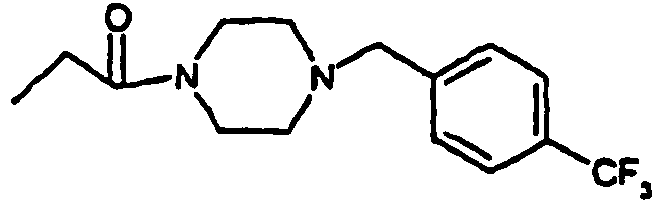
195-197(dec.) 1421 * 
226-227(dec.) * = not according to the invention - A mixture of (R)-2-bromo-4-nitro-1-(2-methyl-2-oxiranylmethyl)imidazole (485 mg, 1.75 mmol), 1-[1-(4-trifluoromethoxyphenyl)piperidin-4-yl]piperazine (720 mg, 2.19 mmol) and ethanol (10 ml) was stirred at 50°C for 8 hours. The reaction mixture was concentrated, and the residue was purified by silica gel column chromatography (methylene chloride/methanol = 20/1) to obtain (S)-1-(2-bromo-4-nitroimidazol-1-yl)-2-methyl-3-{4-[1-(4-trifluoromethoxyphenyl)piperidin-4-yl]piperazin-1-yl}propan-2-ol (792 mg, yield 77%)as a yellow amorphous form.
1H-NMR (CDCl3) δppm: - 1.13(3H, s), 1.50-1.75(2H, m), 1.81-2.00(2H, m), 2.35(1H, d, J = 13.9 Hz), 2.40-2.86(12H, m), 3.57-3.76 (2H, m), 3.98(2H, s), 6.89(2H, d, J = 8.5 Hz), 7.09(2H, d, J = 8.5 Hz), 8.12(1H, s).
- Following compounds were produced in the same manner.
- 1H-NMR(CDCl3) δppm:
- 1.12(3H, s), 1.29-1.48(11H, m), 1.67-1.81(2H, m), 2.34(1H, d, J = 13.8 Hz), 2.38-2.74(12H, m), 3.97(2H, s), 4.02-4.14(2H, m), 8.05(1H, s).
- 1H-NMR(CDCl3) δppm:
- 1.11(3H, s), 1.38-1.57(11H, m), 1.69-1.86(2H, m), 2.24-2.50(9H, m), 2.67-2.79(1H, m), 2.86-3.00(1H, m), 3.31-3.43(4H, m), 3.95(2H, s), 8.04(1H, s).
- (S)-1-(2-bromo-4-nitroimidazol-1-yl)-2-methyl-3-{4-[1-(4-trifluoromethoxyphenyl)piperidin-4-yl]piperazin-1-yl}propan-2-ol (790 mg, 1.34 mmol) was dissolved in N,N-dimethylformamide (4 ml), sodium hydride (69 mg, 1.74 mmol) was added while cooling on ice, and the solution was stirred at the same temperature for 1 hour. To the reaction mixture, ethyl acetate (1.3 ml) and water (10 ml) were added in this order, and the precipitated crystals were filtered off and washed with water. The crystals were purified by silica gel column chromatography (methylene chloride/methanol = 10/1) and recrystallized from ethyl acetate/isopropyl ether to obtain (S)-2-methyl-6-nitro-2-{4-[1-(4-trifluoromethoxyphenyl)piperidin-4-yl]piperazin-1-ylmethyl}-2,3-dihydroimidazo[2,1-b]oxazole (270 mg, yield 40%) as a white powder.
Melting point 180-181.5°C. - Following compounds were produced in the same manner.
- Yield 34%
Melting point 226-228°C. - Yield 23%
Melting point 193-194°C. - Yield 25%
Melting point 148-149°C. - Yield 21%
Melting point 142-143°C. - Yield 29%
Melting point 174-175°C. - Yield 29%
Melting point 137-138°C. - Yield 24%
Melting point 168-169°C. - Yield 27%
Melting point 140-141°C. - Yield 30%
Melting point 218-220°C. - Yield 27%
Melting point 133-134°C. - Yield 41%
Melting point 131-132°C. - A mixture of (R)-2-chloro-4-nitro-1-(2-methyl-2-oxiranylmethyl)imidazole (3 g, 13.79 mmol), tert-butyl 4-piperazin-1-yl-piperidine-1-carboxylate (3.9 g, 14.48 mmol), and ethanol (30 ml) was stirred at 50°C for 9 hours. The reaction mixture was concentrated, and the residue was purified by silica gel column chromatography (methylene chloride/methanol = 10/1) to obtain a yellow amorphous form. The amorphous form was dissolved in N,N-dimethylformamide (18 ml), sodium hydride (651 mg, 16.28 mmol) was added while cooling on ice, and the resultant solution was stirred at the same temperature for 1 hour. To the reaction mixture, ethyl acetate (6 ml) and water (42 ml) were added in this order, and the precipitated crystals were filtered off and washed with water. The filtrate was recrystallized from 2-propanol (20 ml)/water (60 ml) to obtain tert-butyl (S)-4-[4-(2-methyl-6-nitro-2,3-dihydroimidazo[2,1-b]oxazol-2-ylmethyl)piperazin-1-yl]piperidine-1-carboxylate (4.08 g, 66%) as a light yellow powder.
Melting point 181-182°C. - The following compound was produced in the same manner.
- Yield 56%
Melting point 184-185°C. - A mixture of 4-(trifluoromethoxy)benzyl alcohol (480 mg, 2.50 mmol), 1,1'-carbonylbis-1H-imidazole (405 mg, 2.50 mmol), and N,N-dimethylformamide (3 ml) was stirred at room temperature for 14 hours.
- Meanwhile, tert-butyl (S)-4-[4-(2-methyl-6-nitro-2,3-dihydroimidazo[2,1-b]oxazol-2-ylmethyl)-piperazin-1-yl]piperidine-1-carboxylate (750 mg, 1.66 mmol) was dissolved in methylene chloride (5 ml), trifluoroacetic acid (5 ml) was added, and the resultant solution was stirred at room temperature for 14 hours. The reaction mixture was concentrated. To the residue, methanol (5 ml) and triethylamine (5 ml) were added, and the mixture was stirred at room temperature for 10 minutes and then concentrated. The residue was dissolved in N,N-dimethylformamide (5 ml). The solution was added to the above described N,N-dimethylformamide solution followed by stirring at 50°C for 3 hours.
- The reaction mixture was allowed to return to room temperature, poured in water (40 ml), and extracted with ethyl acetate (30 ml) twice. The organic phases were combined, washed with water (40 ml) twice followed by a saturated saline solution (30 ml), and then dried over sodium sulfate. After filtration, the filtrate was concentrated, and the residue was purified by silica gel column chromatography (methylene chloride/methanol = 10/1) and then recrystallized from ethyl acetate/isopropyl ether to obtain 4-trifluoromethoxybenzyl (S)-4-[4-(2-methyl-6-nitro-2,3-dihydroimidazo[2,1-b]oxazol-2-ylmethyl)piperazin-1-yl]piperidine-1-carboxylate (545 mg, 58%) as a light brown powder.
Melting point 105-106°C. - The following compound was produced in the same manner.
- Yield 64%
Melting point 110-111°C. - Tert-butyl (S)-4-[4-(2-methyl-6-nitro-2,3-dihydroimidazo[2,1-b]oxazol-2-ylmethyl)piperazin-1-yl]piperidine-1-carboxylate (750 mg, 1.66 mmol) was dissolved in methylene chloride (5 ml), trifluoroacetic acid (5 ml) was added followed by stirring at room temperature for 1.5 hours. The reaction mixture was concentrated. To the residue, methylene chloride (5 ml) and triethylamine (5 ml) were added, and the mixture was stirred at room temperature for 10 minutes and then concentrated. The residue was dissolved in 1,2-dichloroethane (20 ml), 3-(4-trifluoromethoxyphenyl)propenal (396 mg, 1.83 mmol) and sodium triacetoxyborohydride (564 mg, 2.66 mmol) were added followed by stirring at room temperature for 3.5 hours. The reaction solution was washed with a saturated sodium hydrogencarbonate solution (15 ml), water (20 ml), and a saturated saline solution (20 ml) in this order, and then dried over sodium sulfate. After filtration, the filtrate was concentrated, and the residue was purified by silica gel column chromatography (methylene chloride/methanol = 10/1) and then recrystallized from methanol/water to obtain (S)-2-methyl-6-nitro-2-[4-{1-[3-(4-trifluoromethoxyphenyl)-2-propenyl]piperidin-4-yl}piperazin-1-ylmethyl]-2,3-dihydroimidazo[2,1-b]oxazole (446 mg, 49%) as a light yellow powder.
Melting point 157-158°C. - Following compounds were produced in the same manner.
- Melting point 174-175°C.
- Melting point 146.1-148.6°C.
- Melting point 133-137°C.
Table 84 
Example R1 R2 1H-NMR (CDCl3) δppm 1474 * 
CH3 1.48(9H, s), 1.55(3H, s), 2.36(3H, s), 2.61(1H, d, J=12.3Hz), 2.80(1H, d, J=12.3Hz), 3.03-3.15(4H, m), 3.41(1H, d, J=10.8Hz), 3.48-3.60 (5H, m), 3.69 (1H, d, J=8.1Hz), 4.08 (1H, d, J=8.1Hz), 6.85 (2H, d, J=7.1Hz), 7.06 (2H, d, J=7.1Hz), 7.46 (1H, s). 1475 * 
C2H5 0.97(3H, t, J=7.1Hz), 1.49(9H, s), 1.53(3H, s), 2.54-2.78(3H, m), 2.93-2.96(1H, m), 3.10-3.13(4H, m), 3.39-3.43(1H, m), 3.57-3.67(6H, m), 3.96(1H, d, J=9.8Hz), 6.83-6.85(2H, m), 7.02-7.05(2H, m), 7.43(1H, s). 1476 * H CH3 1.53(3H, s), 2.37(3H, s), 2.60(1H, d, J=12.2Hz), 2.78(1H, d, J=12.2Hz), 2.98-3.18(8H, m), 3.40(1H, d, J=10.8Hz), 3.55(1H, d, J=10.8Hz), 3.66(1H, d, J=8.1Hz), 4.04(1H, d, J=8.1Hz), 6.85(2H, d, J=7.1Hz), 7.06(2H, d, J=7.1Hz), 7.45(1H, s). 1477 * H C2H5 0.98(3H, t, J=7.1Hz), 1.53(3H, s), 2.55-2.75(3H, m), 2.93-2.95(1H, m), 3.15-3.18(4H, m), 3.24-3.28(4H, m), 3.37-3.43(1H, m), 3.62-3.67(2H, m), 3.94(1H, d, J=9.8Hz), 6.82-6.87(2H, m), 7.02-7.05(2H, m), 7.44(1H, s). * = not according to the invention Table 85 
Example R1 R2 mp (°C) 1478 * -CH3 4-ClPh- 202.6 - 204.0 dec 1479 * -CH3 4-CF3PhCH2- 172.0 - 174.2 1480 * -CH3 4-ClPhCH2- 227.0 - 228.3 dec 1481 * -CH3 4-CF3OPhCH2- 176 - 179.5 1482 * -CH3 4-CF3OPh- 114.1 - 116.6 1483 * -CH3 4-CF3Ph- 105 - 110 * = not according to the invention Table 86 
Example R1 R2 R3 mp (°C) 1484* -CH3 -CH3 4-ClPh- 126.2-127.5 1485* -CH3 -CH3 4-CF3OPh- 103.0-106.6 1486* -CH3 -H 4-ClPh- 209.8 - 210.3 dec 1487* -CH3 -H 4-CF3OPh- 110.0 - 113.5 * = not according to the invention Table 87 
Example R1 R2 mp(°C) or 1H NMR 1488 * -CH3 
110.6-111.7 1489 * -CH3 
1H NMR (CDCl3) δppm 1.56-1.71 (7H, m), 2.16(3H, m), 2.57(1H, d, J=14.9Hz), 2.76-3.10(3H, m), 3.93(1H, d, J=9.8Hz), 4.36(1H, d, J=9.8Hz), 7.12(2H, d, J=8.5Hz), 7.55-7.68(3H, m), 9.04(1H, s). 1490 * -CH3 
1H NMR(CDCl3) δppm 1.48-1.68 (4H, m), 1.75-1.95(1H, m), 2.19-2.56(4H, m), 2.75-3.19 (9H, m), 3.53-3.77(4H, m), 3.88(1H, d, J=9.7Hz), 4.36(1H, d, J=9.7Hz), 6.89(2H, d, J=8.5Hz), 7.13(2H, d, J=8.5Hz), 7.63(1H, s). 1491 * -CH3 
148.4 - 149.7 1492 * -CH3 
160.4 - 161.8 1493 * -CH3 
164.4 - 167.3 dec 1494 * -CH3 
140.2 - 142.8 * = not according to the invention Table 88 
Example R1 R2 R3 mp (°C) or 1H NMR 1495 * -CH3 
-CH3 143.1 - 145.8 1496 * -CH3 
-C2H5 1H NMR(CDCl3) δ 0.97(3H, t, J=7.1Hz), 1.51(3H, s), 2.58-2.76(7H, m), 2.89(1H, d, J=14.9Hz), 3.17-3.20(4H, m), 3.38 (1H, d, J=13.3Hz), 3.54-3.64(4H, m), 3.89(1H, d, J=9.8Hz), 6.82-6.85(2H, m), 7.01-7.04(2H, m), 7.27-7.30 (4H, m), 7.41 (1H, s). 1497 * -CH3 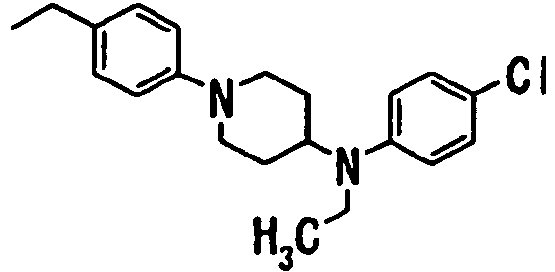
-CH3 100 . 7 - 103.0 * = not according to the invention - The following compounds were produced in the same manner as in Example 649.
Table 89 
Example R Solvent 1H-NMR δppm 1498* -Cl DMSO-d6 1.32-1.50(2H,m),1.55-1.75(2H,m), 2.86-3.02 (2H, m),3.36-3.50 (2H,m), 4.05 (2H,s), 4.93 (1H,s), 6.9 5 (2H,d,J=8.9Hz), 7.21 (2H,d, J=8.9H z), 8.35 (1H, s). 1499* -OCF3 DMSO-d6 1.51-1.67 (2H,m), 1.76-1.94 (2H,m), 2.02 (1H,s), 2.96-3.12 (2H,m), 3.37-3.56(2H,m),4.07(2H,s),6.9(2H,d,J =8.9Hz), 7.12 (2H, d, J=8.9Hz), 8.00 (1H, s). 1500* 
CDCl3 1.57-1.71 (2H,m), 1.78-1.98 (2H,m), 2.92-3.08 (2H,m), 3.24 (3H,s), 3.35-3.51 (2H,m), 4.09 (2H,s), 6.74 (2H,d, J=8.9Hz), 6.88-7.10 (6H,m), 8.02 (1H,s). 1501* 
CDCl3 1.55-1.69(2H,m),1.80-1.98(2H,m), 2.92-3.08 (2H,m), 3.33-3.49 (2H,m), 4.09 (2H,s), 6.82-6.98 (6H,m), 7.14 (2H,d,J=8.9Hz), 8.02 (1H,s). 1502* 
CDCl3 1.53-1.67(2H,m),1.80-2.16(6H,m), 2.84-3.06 (4H,m), 3.24-3.45 (4H,m), 4.11 (2H,s), 4.33-4.47 (1H,m), 6.80-6.92(6H,m),7.14(2H,d,J=8.9Hz), 8.00(1H, s). 1503 * 
CDCl3 1.53-1.65 (2H,m), 1.82-1.98 (2H,m), 2.84-3.00(2H,m),3.14-3.39 (10H,m), 4.07 (2H,s), 6.84-6.96 (6H,m), 7.14 (2H,d,J=8.6Hz), 8.01 (1H,s). * = not according to the invention - The following compounds were produced in the same manner as in Example 652.
Table 90 
Example R1 mp (°C) 1504* -Cl 242.0 - 245.0 1505* -OCF3 235.9 - 236.8dec. 1506* 
214.0 - 215.1dec. 1507* 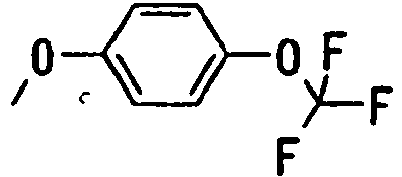
227.3-229.4 1508* 
237.6-238.4 1509* 
254.2 - 256.8 * = not according to the invention - The following compounds were produced in the same manner as in Example 128.
- Melting point 186-188°C.
- Melting point 157-160°C.
- Melting point 207.2-208.0°C (decomposition).
- Melting point 173.2-177.3°C.
- Melting point 151.0-152.3°C.
- Melting point 199.0-200.5°C.
Table 91 
Example R1 R2 mp (°C) 1517 -CH3 -Cl 183.8 - 184 1518 -CH3 -CF3 179.4 - 180.9 1519 -CH3 -F 190.2 - 192.8 1520 -CH3 -OCH3 193.3 - 194.5 1521 -CH3 -CH3 198.2 - 201.1 dec 1522 -CH3 -H 194.5 - 197.5 1523 -CH3 -CN 196.2 - 198.5 dec 1524 -H -OCF3 157.0 - 160.0 1525 -H -Cl 166.5 - 171.0 dec Table 92 
Example R1 R2 R3 R4 R5 R6 MS(M+1) 1526 -CH3 -OCH3 -H -H -H -H 481 1527 -CH3 -H -OCH3 -H -H -H 481 1528 -CH3 -H -H -OCH3 -H -H 481 1529 -CH3 -H -H -H -OCH3 -OCH3 511 1530 -CH3 -OCH3 -H -H -H -OCH3 511 1531 -CH3 -H -H -OCH3 -OCH3 -H 511 1532 -CH3 -H -OCH3 -H -OCH3 -H 511 1533 -CH3 -H -H -H -H -H 451 1534 -CH3 -H -H -H -H -Cl 485 1535 -CH3 -H -H -H -Cl -H 485 1536 -CH3 -H -H -Cl -H -H 485 1537 -CH3 -Cl -Cl -H -H -H 519 1538 -CH3 -Cl -H -Cl -H -H 519 1539 -CH3 -Cl -H -H -Cl -H 519 1540 -CH3 -Cl -H -H -H -Cl 519 1541 -CH3 -H -Cl -Cl -H -H 519 1542 -CH3 -H -Cl -H -Cl -H 519 1543 -CH3 -H -H -H -H -CH3 465 1544 -CH3 -H -H -H -CH3 -H 465 1545 -CH3 -H -H -CH3 -H -H 465 1546 -CH3 -CH3 -CH3 -H -H -H 479 1547 -CH3 -CH3 -H -CH3 -H -H 479 1548 -CH3 -CH3 -H -H -CH3 -H 479 1549 -CH3 -CH3 -H -H -H -CH3 479 1550 -CH3 -H -CH3 -CH3 -H -H 479 1551 -CH3 -H -CH3 -H -CH3 -H 479 1552 -CH3 -H -H -H -H -F 469 1553 -CH3 -H -H -H -F -H 469 1554 -CH3 -H -H -F -H -H 469 1555 -CH3 -F -F -H -H -H 487 1556 -CH3 -F -H -F -H -H 487 1557 -CH3 -F -H -H -F -H 487 1558 -CH3 -F -H -H -H -F 487 1559 -CH3 -H -F -F -H -H 487 1560 -CH3 -CO2C2H5 -H -H -H -H 523 1561 -CH3 -H -CO2C2H5 -H -H -H 523 1562 -CH3 -H -H -CO2C2H5 -H -H 523 1563 -CH3 -CN -H -H -H -H 476 1564 -CH3 -H -CN -H -H -H 476 1565 -CH3 -H -H -CN -H -H 476 1566 -CH3 -H -H -H -H -CF3 519 1567 -CH3 -H -H -H -CF3 -H 519 Table 93 
Example R1 R2 R3 R4 R5 R6 MS (M+1) 1568 -CH3 -H -H -CF3 -H -H 519 1569 -CH3 -H -H -H -H -OCF3 535 1570 -CH3 -H -F -H -F -H 487 1571 -CH3 -H -H -H -OCF3 -H 535 1572 -CH3 -H -H -OCF3 -H -H 535 1573 -CH3 -H -H -H -H -OCH(CH3)2 509 1574 -CH3 -H -H -CH3 -H -CO2C2H5 537 1575 -CH3 -H -H -OCH3 -H -CO2CH3 539 1576 -CH3 -H -H -Br -H -F 547 1577 -CH3 -H -CH3 -H -H -F 483 1578 -CH3 -H -H -C3H7 -H -H 493 1579 -CH3 -H -H -Cl -F -H 503 1580 -CH3 -H -H -NO2 -H -F 514 1581 -CH3 -H -H -CH2CH=CH2 -H -OCH3 521 1582 -CH3 -H -H -H -C6H5 -H 527 1583 -CH3 -H -H -H -N(C2H5)2 -H 522 1584 -CH3 -H -CH=CHCH3 (cis) -H -H -OC2H5 535 1585 -CH3 -H -H -CH(CH3)2 -H -H 493 1586 -CH3 -H -H -H -NHCONH2 -H 509 1587 -CH3 -H -H -CH2CH2COCH3 -H -H 521 1588 -CH3 -H -H -H -NHC6H5 -H 542 1589 -CH3 -H -H -NH2 -H -Cl 500 1590 -CH3 -H -H -CH2CO2CH3 -H -H 523 1591 -CH3 -H -H -OCH3 -H -Cl 515 1592 -CH3 -H -H -H -CO2CH3 -H 509 1593 -CH3 -H -H -COCH3 -H -CONH2 536 1594 -CH3 -H -H -COC2H5 -H -H 507 1595 -CH3 -H -H -COCH3 -H -CH3 507 1596 -CH3 -H -H -COCH3 -OH -H 509 1597 -CH3 -H -H -NHCOCH3 -H -H 508 1598 -CH3 -H -CH3 -CH3 -CH3 -H 493 1599 -CH3 -H -H -H -H -CH2C6H5 541 1600 -CH3 -H -OCH3 -H -H -CO2CH3 539 1601 -CH3 -H -H -SCH3 -H -H 497 1602 -CH3 -H -H -CHF2 -H -H 517 Table 94 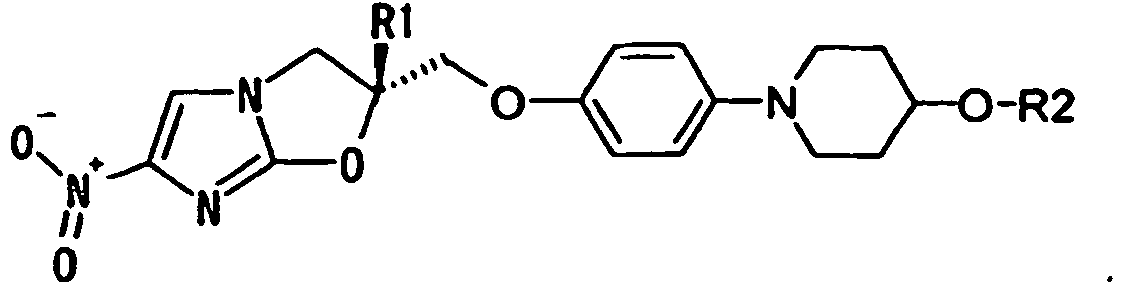
Example R1 R2 MS (M+1) 1603 -CH3 
495 1604 -CH3 
501 1605 -CH3 
507 1606 -CH3 
518 1607 -CH3 
518 1608 -CH3 
522 1609 -CH3 
519 1610 -CH3 
531 1611 -CH3 
525 1612 -CH3 
502 Table 95 
Example R1 R2 MS(M+1) 1613 -CH3 
502 1614 -CH3 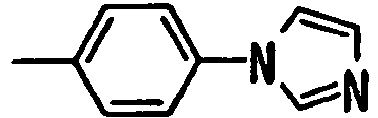
517 1615 -CH3 
521 1616 -CH3 
541 1617 -CH3 
519 1618 -CH3 
505 1619 -CH3 
502 1620 -CH3 
516 1621 -CH3 
507 1622 -CH3 
505 Table 96 
Example R1 R2 MS(M+1) 1623 -CH3 
491 1624 -CH3 
584 1625 -CH3 
582 1626 -CH3 
516 1627 -CH3 
568 1628 -CH3 
659 1629 -CH3 
635 1630 -CH3 
673 1631 -CH3 
508 1632 -CH3 
505 Table 97 
Example R1 R2 MS(M+1) 1633 -CH3 
452 1634 -CH3 
452 1635 -CH3 
492 1636 -CH3 
493 1637 -CH3 
503 1638 -CH3 
Table 98 
Example R1 R2 R3 R4 mp (°C) or 1H NMR 1639 -CH3 -H -H -CH2C6H5 208 - 210.5 1640 -CH3 -H -H 4-BrPhCH2- 213.5 - 215.4 1641 -CH3 -H -H 4-BrPhCH2OCO- 185.4 - 188.5 1642 -CH3 -H -H -cyclo-C6H11 255.4 - 257.9 dec 1643 -CH3 -H -H 4-CF3PhCH=N- 178.0 - 278.6 1644 -CH3 -H -H 4-CF3OPhOCO- 226.5-226.8 1645 -CH3 -H -H 4-CF3PhCCCH2OCO- 186.4-187.7 1646 -H -H -H 4-CF3OPh- 232.0 - 234.5 1647 -H -H -H 4-CF3OPhCH2- 171.4 - 172.9 1648 -H -H -H 4-ClPhCH2- 191.2-192.0 1649 -H -H -H (CH3)3COCO- 1H NMR (CDCl3) δ 1.48 (9H, s), 2.99-3.04(4H, m), 3.55-3.60(4H, m), 4.22-4.37(2H, m), 4.39-4.49(2H, m), 5.56-5.63(1H, m), 6.79-6.91(4H , m), 7.63(1H, s). Table 99 
Example R1 R2 R3 R4 R5 MS(M+1) 1650 -H -CF3 -H -H -H 518 1651 -H -H -NO2 -H -H 495 1652 -H -H -CF3 -H -H 518 1653 -H -H -CH3 -H -H 464 1654 -H -H -CN -H -H 475 1655 -H -H -C6H5 -H -H 526 1656 -H -H -F -H -H 468 1657 -H -Cl -Cl -H -H 518 1658 -CF3 -H -H -H -H 518 1659 -H -H -OCH3 -H -H 480 1660 -H -H -SCH3 -H -H 496 1661 -H -H -SO2CH3 -H -H 528 1662 -H -H -OCH2C6H5 -H- -H 556 1663 -H -Cl -H -Cl- -H 518 1664 -F -F -F -H -H 504 1665 -H -H -OCOCH3 -H -H 508 Table 100 
Example R1 MS(M+1) 1666 4-CF3OPh- 564 1667 4-CH3OPhCH2- 524 1668 4-CH3PhCH2- 508 1669 4-CH3O2CPhCH2- 552 1670 -CH2C6H5 494 1671 4-CH3SPhCH2- 540 1672 4-NO2PhCH2- 539 1673 3,4,5-(CH3O)3PhCH2- 584 1674 2-CH3CONHPhCH2- 551 1675 4-FPhCH2- 512 1676 4-CF3OPhCH2- 578 1677 4-PhCH2OPhCH2- 600 1678 4-CF3SPhCH2- 594 1679 3-CF3OPhCH2- 578 1680 2-CF3OPhCH2- 578 1681 C6F5CH2- 84 1682 PhCH=CHCH2- 520 1683 4-ClPhCH=CHCH2- 554 1684 4-CF3OPhCH=CHCH2- 604 1685 -(CH2)2C6H5 508 1686 Ph(CH2)3- 522 1687 PhCCCH2- 518 1688 PhS(CH2)2- 540 1689 PhCH2O(CH2)2- 538 1690 -CH2CH2CH=CH2 458 1691 -CH2CH2CN 457 1692 CH3(CH2)15- 628 1693 CH3CH2O(CH2)2O(CH2)2- 520 1694 -CH2CH2CCH 456 1695 CF3CF2CF2CH2- 586 1696 -CH2-cyclo-C3H5 458 Table 101 
Example R1 MS(M+1) 1697 
495 1698 
495 1699 
484 1700 
584 1701 
596 1702 
634 1703 
495 1704 
552 1705 
509 1706 
484 Table 102 
Example R1 MS(M+1) 1707 
520 1708 
529 1709 
544 Table 103 
Example R1 MS(M+1) 1710 -CH2CH=CH2 400 1711 -C6H13 444 1712 -CH2CN 399 1713 -(CH2)2CH(CH3)2 430 1714 -CH2CON(CH3)2 445 Table 104 
Example R1 R2 mp (°C) or 1H NMR 1715 -CH3 4-CF3OPh- 157.9 - 158.8 1716 -CH3 4-CF3OPhCH2- 188.4 - 190.2 1717 -CH3 4-CF3OPhCH2OCO- 112.1 - 115.4 1718 -CH3 4-CF3OPhCO- 1719 -CH3 4-CF3OPhNHCO- Table 105 
Example R1 R2 R3 mp(°C) 1720 -H 4-CF3OPh- -CH3 126.9 - 128.9 1721 -H 4-CF3OPh- -C2H5 102.1 - 103.1 1722 -H 4-ClPh- -C2H5 121.7 - 123.6 1723 -H -C6H5 -CH3 169.5 - 171.0 1724 -H 4-CF3OPhCH2- -CH3 134.8 - 136.8 1725 -H 4-ClPhCH2- -CH3 161.4 - 164.1 1726 -H 4-CF3PhCH2- -CH3 136.4 - 137.9 1727 -H 4-CF3OPhCH2- -C2H5 119 - 120.5 1728 -H 4-CF3PhCH2- -C2H5 134.3 - 135.7 1729 -H 4-ClPhCH2- -C2H5 135.8 - 137 1730 -F 4-CF3OPhCH2- -CH3 132.7 - 134.7 1731 -H 4-CF3OPhCH2- 4-CF3OPhCH2- 135.9 - 137 1732 -H 4-CF3OPhCH2- -C6H5 198.9 - 200.8 1733 -H 4-CF3PhCH2- -C6H5 192.7 - 194.7 1734 -H 4-ClPhCH2- -C6H5 195.1 - 196.1 1735 -H -C6H5 -COCH3 167.7 - 168.7 1736 -H 4-ClPh- -COCH3 220.0 - 223.5 1737 -H 4-CF3Ph- -COCH3 223.1 - 224.6 1738 -H 4-CF3OPh- -COCH3 243.6 - 244.9 1739 -F 4-ClPh- -COCH3 221.8 - 223.0 1740 -F 4-CF3OPh- -COCH3 240.3 - 242.9 1741 -H -C6H5 -CO2CH3 182.7 - 184.8 1742 -H 4-ClPh- -CO2CH3 244.0 - 245.1 1743 -H 4-CF3OPhCH2- -H 151.4 - 154.3 1744 -H 4-CF3OPhCH2- -CO2C2H5 105.1 - 107.6 1745 -H 4-ClPh(CH2)2- -CH3 116.1 - 117.6 1746 -H 4-CF3OPhO(CH2)3- -H 189.9 - 191.0 1747 -H 4-CF3OPhCO- -CH3 143.3 - 145.9 Table 106 
Example R1 R2 R3 1H NMR 1748 -H 4-CF3Ph- -CH3 1H NMR(CDCl3) δ 1.80(3H,s),3.28(3H,s),4.06(1H, d,J=10.2Hz),4.11(1H,d,J=10.2Hz),4.26(1H, d, J=10.2Hz), 4.52(1H, d, J=10.2Hz), 6.70(2H, d, J=8.7Hz), 6.88(2H, d, J=8.8Hz), 7.13(2H, d, J=8.8Hz), 7.39(2H, d, J=8.7Hz), 7.57(1H, s). 1749 -H 4-ClPh- -CH3 1H NMR(CDCl3) δ 1.79(3H, s), 3.22(3H, s), 4.04(1H, d, J=10.4Hz), 4.08(1H, d, J=10.4Hz), 4.23(1H, d, J=10.1Hz), 4.50(1H, d, J=10.1Hz), 6.70-6.73(2H, m), 6.81-6.89(2H, m), 7.03-7.06(2H, m), 7.12-7.15(2H, m), 7.56(1H, s). 1750 -H 4-CF3Ph- -C2H5 1H NMR(CDCl3) δ 1.20(3H, d, J=7.1Hz), 1.81(3H, s), 3.71(2H, q, J=7.1Hz), 4.07(1H, d, J=10.2Hz), 4.11(1H, d, J=10.2Hz), 4.27(1H, d, J=10.2Hz), 4.52(1H, d, J=10.2Hz), 6.63-6.66(2H, m), 6.88-6.91(2H, m), 7.10-7.12(2H, m), 7.34-7.37(2H, m), 7.57(1H, s). 1751 -F 4-ClPh- -CH3 1H NMR(CDCl3) δ 1.80(3H, s), 3.20(3H, s), 4.06(1H, d, J=10.2Hz), 4.09(1H, d, J=10.1Hz), 4.25(1H, d, J=10.1Hz), 4.49(1H, d, J=10.2Hz), 6.54-6.57(2H, m), 6.64-6.71(2H, m), 7.09-7.19(3H, m), 7.57(1H, s). 1752 -H 4-CF3OPhCH2- -COCH3 1H NMR(CDCl3) δ 1.79(3H, s), 1.85(3H, s), 4.06(1H, d, J=10.2Hz), 4.08(1H, d, J=10.2Hz), 4.24(1H, d, J=10.2Hz), 4.48(1H, d, J=10.2Hz), 4.82(2H, s), 6.78-6.82(2H, m), 6.88-6.91(2H, m), 7.09-7.11(2H, m), 7.20-7.22(2H, m), 7.56(1H, s). 1753 -H 4-CF3OPhCO- -CH3 1H NMR(CDCl3) δ 1.76(3H, s), 3.45(3H, s), 4.03(1H, d, J=10.1Hz), 4.04(1H, d, J=10.2Hz), 4.18(1H, d, J=10.1Hz), 4.46(1H, d, J=10.2Hz), 6.69-6.72(2H, m), 6.95-6.98(2H, m), 7.37-7.46(4H, m), 7.55(1H, s). 1754 -H 4-ClPhCO- -CH3 1H NMR(CDCl3) δ 1.77(3H, s), 3.43(3H, s), 4.03(1H, d, J=10.1Hz), 4.04(1H, d, J=10.2Hz), 4.18(1H, d, J=10.1Hz), 4.46(1H, d, J=10.2Hz), 6.69-6.72(2H, m), 6.94-6.97(2H, m), 7.13-7.23(4H, m), 7.55(1H, s). 1755 -H 4-ClPhCO- -H 1H NMR(DMSO) δ 1.68(3H, s), 4.17-4.20(1H, m), 4.22-4.30(2H, m), 4.36-4.39(1H, m), 6.88-6.91(2H, m), 7.57-7.66(4H, m), 7.94-7.97(2H, m), 8.15(1H, s), 10.19(1H, brs). Table 107 
Example R1 R2 R3 1H NMR 1756 -H 4-ClPhCO- -H 1H NMR(DMSO) δ 1.68(3H,s), 4.17-4.20(1H, m), 4.22-4.30(2H, m), 4.36-4.39(1H, m), 6.88-6.91(2H, m), 7.57-7.66(4H, m), 7.94-7.97(2H, m), 8.15(1H, s), 10.19(1H, brs). 1757 -H 4-CF3PhCO- -H 1H NMR(DMSO) δ 1.68(3H, s), 4.17-4.21(1H, m), 4.24-4.30(2H, m), 4.36-4.40(1H, m), 6.90-6.93(2H, m), 7.65-7.68(2H, m), 7.88-7.90(2H, m), 8.11-8.13(2H, m), 8.16(1H, s), 10.35(1H, brs). 1758 -H 4-CF3OPhCO- -H 1H NMR(DMSO) δ 1.68(3H, s), 4.17-4.20(1H, m), 4.24-4.31(2H, m), 4.36-4.40(1H, m), 6.89-6.92(2H, m), 7.49-7.52(2H, m), 7.63-7.66(2H, m), 8.04-8.06(2H, m), 8.16(1H, s), 10.23(1H, brs). 1759 -H 4-ClPh- -H 142.6 - 144.7 1760 -H 4-CF3OPh(CH2)2- -H 1761 -H 4-CF3OPh(CH2)2- -CH3 1762 -H 4-CF3OPhO(CH2)3- -C2H5 107.6 - 109.2 1763 -H 4-CF3OPhCOCH2- -H 1764 -H 4-CF3OPhCOCH2- -CH3 Table 108 
Example R1 R2 R3 mp (°C) or 1H NMR 1765 -CH3 -H 4-ClPh- 171.5 - 173.5 1766 -CH3 -H 4-CF3Ph- 172.2 - 174.9 1767 -CH3 -CH3 4-CF3OPhCH2- 138.5 - 141.0 1768 -CH3 -H 4-CF3OPh- 165.1 - 167.2 1769 -CH3 -COCH3 4-CF3OPh- 128.4 - 130.8 1770 -CH3 -CH3 4-CF3OPh- 113.6 - 114.5 1771 -CH3 -CH3 4-CF3Ph- 168.2 - 170.7 1772 -CH3 -COCH3 4-CF3Ph- 132.8 - 133.9 1773 -CH3 -CH3 4-ClPh- 160.9 - 163.4 1774 -CH3 -CO2C2H5 4-CF3OPh- 1H NMR(CDCl3) δ 1.21(3H, t, d=7.1), 1.77(3H, s), 4.05(1H, d, J=10.3Hz), 4.06(1H, d, J=10.2Hz), 4.15-4.22(3H, m), 4.49(1H, d, J=10.3Hz), 4.78(2H, s), 6.74-6.78(2H, m), 7.07-7.13(6H, m), 7.55(1H, s). 1775 -CH3 -COCH3 4-ClPh- 1H NMR(CDCl3) δ 1.78(3H, s), 1.86(3H, s), 4.03(1H, d, J=10.2Hz), 4.05(1H, d, J=10.1Hz), 4.21(1H, d, J=10.1Hz), 4.48(1H, d, J=10.2Hz), 4.78(2H, s), 6.71-6.74(2H, m), 6.87-6.89(2H, m), 7.08-7.11(2H, m), 7.28-7.32(2H, m), 7.55(1H, s). Table 109 
Example R1 R2 mp(°C) 1776 -CH3 -4-PYRIDYL 228.2 - 229.8 dec 1777 -CH3 -CHO 176.0 - 179.5 1778 -CH3 4-ClPhCO- 186.2 - 188.5 1779 -CH3 4-CF3PhCO- 170.3 - 172.4 1780 -CH3 4-CF3OPhCO- 159.7 - 160.7 Table 110 
Example R1 R2 mp(°C) or 1H NMR 1781 -CH3 
177.4 - 184.3 1782 -CH3 
196.3 - 197.8 1783 -CH3 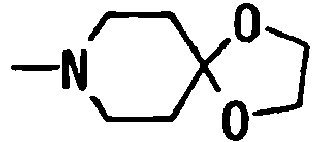
212.3 - 214.0 1784 -CH3 
251.9 - 253.0 1785 -CH3 
216.7 - 219.5 dec 1786 -CH3 
248.1 - 248.2 1787 -CH3 
150.3 - 154.9 1788 -CH3 
150.8 - 151.2 1789 -CH3 
1H NMR(CDCl3) δ 1.55(1H, s),1.60 (1H, s), 1.77(3H, s), 1.80-1.95(2H, m), 2.15-2.40(2H, m), 3.04-3.27(2H, m),3. 33-3.53(2H, m), 3.95-4.11(2H, m),4.19 (1H, d, J=10.2Hz), 4.50(1H, d,J=10.2 Hz), 6.71-6.86(2H, m), 6.88-7.02(2H, m), 7.14-7.31(2H, m), 7.47-7.63(3H, m). 1790 -CH3 
1H NMR(DMSO) δ 1.67(3H, s), 2.61(2H, brs), 3.74(2H, d, J=2.9Hz), .17(1H, d, J=13.0Hz), 4.21(2H, s), 6.28(1H, s), 6.81(2H, d, J=9.1Hz), 6.94(2H, d,J= 9.2Hz), 7.18-7.57(5H, m), 8.17(1H, s). Table 111 
Example R1 R2 mp (°C) or 1H NMR 1791 -CH3 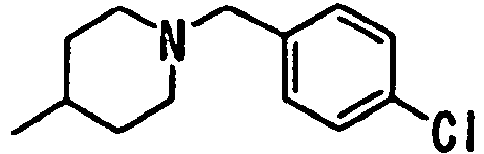
202.0 - 203.5 1792 -CH3 
206.0 1793 -CH3 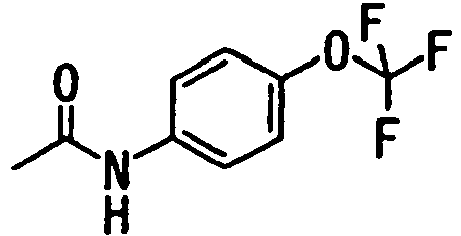
247.8 - 249.8 1794 -CH3 
97.7 - 99.7 1795 -CH3 
172.5 - 175.8 1796 -CH3 
160.7 - 163.0 1797 -CH3 
1H NMR(CDCl3) δ 1.81(3H, s), 3.44 (3H, s), 4.06(1H, d, J=10.24Hz), 4.12(1H, d, J=10.0Hz), 4.27(1H, d, J=10.0Hz), 4.52(1H, d, J=10.2Hz), 6.83-6.91(2H, m), 7.39-7.45(2H, m), 7.51-7.56(3H, m), 7.57(1H, s), 7.62-7.68(2H, m) Table 112 
Example R1 R2 mp(°C) or 1H NMR 1798 -CH3 
1H NMR(CDCl3) δ 1.80(3H, s), 4.01-4.14-(2H, m), 4.26(1H, d, J=10.0Hz), 4.51(1H, d, J=10.3Hz), 6.85(2H, d, J=8.6Hz), 7.03-7.09(4H, m), 7.53-7.60 (4H, m), 7.66(1H, s) 1799 -CH3 
1H NMR(CDCl3) δ 1.81(3H, s), 4.05(1H, d, J=10.3Hz), 4.11(1H, d, J=10.0Hz), 4.26(1H, d, J=10.0Hz), 4.51(1H, d, J=10.3Hz), 6.83-7.05(4H, m), 7.20-7.26 (2H, m), 7.51-7.60(4H, m), 7.65(1H, s) 1800 -CH3 
1801 -CH3 
1802 -CH3 
1803 -CH3 
209.1 - 212.9 Table 113 
Example R1 R2 R3 R4 R5 MS(M+1) 1804 -H -CF3 -H -H -H 517 1805 -H -H -NO2 -H -H 494 1806 -H -H -CF3 -H -H 517 1807 -H -H -CH3 -H -H 463 1808 -H -H -CN -H -H 474 1809 -H -H -C6H5 -H -H 525 1810 -H -H -F -H -H 467 1811 -H -Cl -Cl -H -H 517 1812 -CF3 -H -H -H -H 517 1813 -H -H -OCH3 -H -H 479 1814 -H -H -SCH3 -H -H 495 1815 -H -H -SO2CH3 -H -H 527 1816 -H -H -OCH2C6H5 -H -H 555 1817 -H -Cl -H -Cl -H 517 1818 -F -F -F -H -H 503 1819 -H -H -OCOCH3 -H -H 507 Table 114 
Example R1 MS(M+1) 1820 4-CF3OPh- 563 1821 4-CH3OPhCH2- 523 1822 4-CH3PhCH2- 507 1823 4-CH3O2CPhCH2- 551 1824 -CH2C6H5 493 1825 4-CH3SPhCH2- 539 1826 4-NO2PhCH2- 538 1827 3,4,5- (CH3O)3PhCH2- 583 1828 2-CH3CONHPhCH2- 550 1829 4-FPhCH2- 511 1830 4-CF3OPhCH2- 577 1831 4-PhCH2OPhCH2- 599 1832 4-CF3SPhCH2- 593 1833 3-CF3OPhCH2- 577 1834 2-CF3OPhCH2- 577 1835 C6F5CH2- 583 1836 PhCH=CHCH2- 519 1837 4-ClPhCH=CHCH2- 553 1838 4-CF3OPhCH=CHCH2- 603 1839 - (CH2)2C6H5 507 1840 Ph (CH2)3- 521 1841 PhCCCH2- 517 1842 PhS(CH2)2- 539 1843 PhCH2O(CH2)2- 537 1844 -CH2CH2CH=CH2 457 1845 -CH2CH2CN 456 1846 CH3CH2O(CH2)2O(CH2)2- 519 1847 -CH2CH2CCH 455 1848 CF3CF2CF2CH2- 585 1849 -CH2-cyclo-C3H5 457 Table 115 
Example R1 MS(M+1) 1850 
494 1851 
494 1852 
483 1853 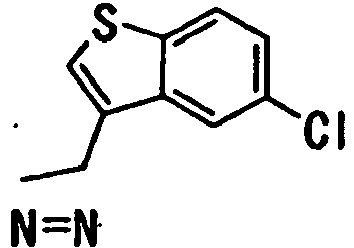
583 1854 
595 1855 
499 1856 
494 1857 
551 1858 
508 1859 
483 1860 
519 1861 
528 Table 116 
Example R1 MS(M+1) 1862 
543 Table 117 
Example R1 MS(M+1) 1863 -CH2CH=CH2 399 1864 -(CH2)2C6H5 463 1865 -C6H13 443 1866 -CH2CN 398 1867 -CH2CON (CH3)2 444 1868 PhCOCH2- 477 Table 118 
Example R1 R2 mp(°C) 1869 -CH3 4-CF3PhCH2- 171.4 - 172.4 1870 -CH3 4-CF3PhCH2OCO- 130.4 - 131.7 1871 -CH3 4-ClPhCH2OCO- 126.8 - 129.1 1872 -CH3 4-CF3OPhCH2OCO- 143.8 - 144.8 1873 -CH3 4-ClPhCH2- 183.0 - 187.2 1874 -CH3 4-CF3OPhCH2- 174.3 - 176.5 1875 -CH3 4-CF3Ph- 156.7 - 157.7 1876 -CH3 (CH3)3COCO- 197.0 - 198.2 1877 -CH3 4-CF3OPh- 154.5 - 156.7 Table 119 
Example R1 R2 mp(°C) or 1H NMR 1878 -CH3 4-ClPhCH2- 214.3 - 216.1 1879 -CH3 4-CF3Ph- 158.5 - 160.1 1880 -CH3 4-CF3OPh- 161.7 - 164.4 1881 -CH3 4-ClPh- 163.5 - 166.3 1882 -CH3 4-CF3OPhCH2- 1H NMR(CDCl3) δ 1.76(3H, s), 4.02(1H, d, J=10.2Hz), 4.04(1H, d, J=10.2Hz), 4.18(1H, d, J=10.2Hz), 4.48(1H, d, J=10.2Hz), 5.00(2H, s), 6.77-6.81(2H, m), 6.85-6.90(2H, m), 7.21-7.23 (2H, m), 7.42-7.45(2H, m), 7.54(1H, s). 1883 -CH3 4-CF3PhCH2- 1H NMR(CDCl3) δ 1.77(3H, s), 4.02(1H, d, J=10.2Hz), 4.04(1H, d, J=10.2Hz), 4.18(1H, d, J=10.2Hz), 4.49(1H, d, J=10.2Hz), 5.07(2H, s), 6.77-6.81(2H, m), 6.85-6.91(2H, m), 7.51-7.55 (3H, m), 7.62-7.65(2H, m). - 4-[4-(4-Trifluoromethoxyphenoxy)piperidin-1-yl]phenol (693 mg, 1.96 mmol) was dissolved in N,N'-dimethylformamide (3 ml), and sodium hydride (86 mg, 2.16 mmol) was added while cooling on ice followed by stirring at 70-75°C for 20 minutes. The mixture was cooled on ice. To the solution, a solution prepared by dissolving (R)-2-bromo-4-nitro-1-(2-methyl-2-oxiranyl-methyl)imidazole (720 mg, 2.75 mmol) in N,N'-dimethylformamide (3 ml) was added followed by stirring at 70-75°C for 20 minutes. The reaction mixture was allowed to return to room temperature, ice water (25 ml) was added, and the resultant solution was extracted with methylene chloride (50 ml) three times. The organic phases were combined, washed with water 3 times, and dried over magnesium sulfate. After filtration, the filtrate was concentrated, and the residue was purified by silica gel column chromatography (methylene chloride/ethyl acetate = 3/1). Recrystallization from ethyl acetate/isopropyl ether gave (R)-2-methyl-6-nitro-2-{4-[4-(4-trifluoromethoxyphenoxy)piperidin-1-yl]phenoxymethyl}-2,3-dihydroimidazo[2,1-b]oxazole (343 mg, 33%) as a light yellow powder.
- A mixture of (R)-2-bromo-4-nitro-1-(2-methyl-2-oxiranylmethyl)imidazole (2.04 g, 7.78 mmol), 3-(4-trifluoromethylphenyl)-2-propenyl piperazine-1-carboxylate (2.69 g, 8.56 mmol) and N,N'-dimethylformamide (10 ml) was stirred at 50°C for 20 hours. The reaction solution was allowed to return to room temperature, water was added, and the resultant solution was extracted with ethyl acetate (15 ml) twice. The organic phases were combined, washed with water three times, and dried over sodium sulfate. After filtration, the filtrate was concentrated, and the residue was purified by silica gel column chromatography (n-hexane/ethyl acetate = 1/2) to obtain 3-(4-trifluoromethylphenyl)-2-propenyl (S)-4-[3-(2-bromo-4-nitroimidazol-1-yl)-2-hydroxy-2-methylpropyl]piperazin-1-carboxylate (3.77 g, 84%) as a yellow oil.
1H-NMR (CDCl3) δppm: - 1.16 (3H, s), 2.36 (1H, d, J = 14.0 Hz), 2.43 - 2.76 (5H, m), 3.21 (1H, s), 3.41 - 3.57 (4H, m), 4.01 (2H, s), 4.78 (2H, dd, J = 1.0 Hz, 6.1 Hz), 6.29 - 6.43 (1H, m), 6.66 (1H, d, J = 16.0 Hz), 7.48 (2H, d, J = 8.3 Hz), 7.58 (2H, d, J = 8.3 Hz), 8.10 (1H, s).
- 3-(4-Trifluoromethylphenyl)-2-propenyl (S)-4-[3-(2-bromo-4-nitroimidazol-1-yl)-2-hydroxy-2-methylpropyl]piperazine-1-carboxylate (3.5 g, 6.07 mmol) was dissolved in N,N'-dimethylformamide (10.5 ml), and sodium hydride (316 mg, 7.89 mmol) was added while cooling on ice followed by stirring at the same temperature for 1.5 hours. To the reaction solution, ethyl acetate (3.5 ml) and water (24.5 ml) were added followed by stirring for 30 minutes. The precipitated crystals were filtered off, washed with water, and purified by silica gel column chromatography (ethyl acetate). Recrystallization from 2-propanol/water gives a light yellow powder of 3-(4-trifluoromethylphenyl)-2-propenyl (S)-4-(2-methyl-6-nitro-2,3-dihydroimidazo[2,1-b]oxazol-2-ylmethyl)piperazine-1-carboxylate (2.07 g, 69%).
- The minimal inhibitory concentration of the 2,3-dihydro-6-nitroimidazo[2,1-b]oxazole compound obtained in Example 397 against Mycobacterium tuberculosis (M. tuberculosis H37Rv) was determined using a 7H11 medium (manufactured by BBL). The above strain had been cultured on a 7H9 medium (manufactured by BBL) in advance, the number of viable cells had been counted, and a cell suspension with the final viable cell count approximately 106 CFU/ml was prepared, using a cell suspension stored freezing at -80°C. 5 µl of the thus prepared cell suspension was inoculated onto the 7H11 agar medium containing the test compound and then cultured at 37°C for 14 days. Thereafter, the culture was subjected to the test to determine the minimal inhibitory concentration.
- The minimal inhibitory concentration of the compound against M. tuberculosis H37Rv was 0.024 µg/ml.
MS 459 (M+).
 |
| Example | X | R | 1H-NMR (CDCl3) δppm |
| 1425 * | none | OCF3 | 1.13(3H, s), 1.50-1.75(2H, m), 1.81-2.00(2H, m), 2.35(1H, d, J=13.9Hz), 2.40-2.86(12H, m), 3.57-3.76(2H, m), 3.98(2H, s), 6.89(2H, d, J=8.5Hz), 7.09(2H, d, J=8.5Hz), 8.12(1H, s). |
| 1426 * | C=O | Cl | 1.13(3H, s), 1.31-1.56(2H, m), 1.70-2.00(2H, m), 2.36(1H, d, J=13.9Hz), 2.65-2.91(12H, m), 3.63-3.84(1H, m), 3.93(2H, s), 4.56-4.74(1H, m), 7.19-7.42(4H, m), 8.13(1H, s). |
| 1427 * | C=O | OCF3 | 1.14(3H, s), 1.35-1.60(2H, m), 1.74-2.00(2H, m), 2.36(1H, d, J=13.9Hz), 2.42-2.93(12H, m), 3.65-3.81(1H, m), 4.00(2H, s), 4.56-4.74(1H, m), 7.25(2H, d, J=8.7Hz), 7.44(2H, d, J=8.7Hz), 8.14(1H, s). |
| 1428 * | CH2 | Cl | 1.12(3H, s), 1.43-2.05(6H, m), 2.34(1H, d, J=13.9Hz), 2.37-2.95(12H, m), 3.47(2H, s), 3.97(2H, s), 7.12-7.30 (4H, m), 8.12(1H, s). |
| 1429 * | CH2 | OCF3 | 1.12(3H, s), 1.44-2.05(6H, m), 2.35(1H, d, J=14.0Hz), 2.42-2.93(12H, m), 3.48(2H, s), 3.98(2H, s), 7.15(2H, d, J=8.6Hz), 7.34(2H, d, J=8.6Hz), 8.12(1H, s). |
| * = not according to the invention |
 |
| Example | X | R | 1H-NMR (CDCl3) δppm |
| 1430 * | C=O | Cl | 1.12(3H, s), 1.43-1.81(4H, m), 2.10-2.62(9H, m), 2.71-3.07(2H, m), 3.31-3.45(4H, m), 3.96(2H, s), 7.24-7.40(4H, m), 8.10(1H, s). |
| 1431 * | C=O | OCF3 | 1.12(3H, s), 1.45-1.83(4H, m), 2.12-2.57(9H, m), 2.71-3.07(2H, m), 3.28-3.47(4H, m), 3.96(2H, s), 7.25(2H, d, J=8.6Hz), 7.45(2H, d, J=8.6Hz), 8.10(1H, s). |
| 1432 * | CH2 | OCF3 | 1.11(3H, s), 1.50-1.98(4H, m), 2.24-3.10(15H, m), 3.54(2H, s), 3.98(2H, s), 7.16(2H, d, J=8.6Hz), 7.34(2H, d, J=8.6Hz), 8.12(1H, s). |
| 1433 * | CH2 | Cl | 1.11(3H, s), 1.40-1.83(4H, m), 2.25-3.02(15H, m), 3.46(2H, s), 3.95(2H, s), 7.14-7.29(4H, m), 8.12(1H, s). |
| 1434 * | none | OCF3 | 1.13(3H, s), 1.50-1.64(2H, m), 1,76-1.88(2H, m), 2.15-2.43(5H, m), 2.52-2.95(6H, m), 3.05-3.19(4H, m), 3.98(2H, s), 6.89(2H, d, J=8.7Hz), 7.11(2H, d, J=8.7Hz), 8.1 (1H, s). |
| 1435 * | none | Cl | 1.13 (3H, s), 1.50-1.64(2H, m), 1,71-1.90(2H, m), 2.12-2.48(5H, m), 2.55-2.90(6H, m), 3.05-3.19(4H, m), 3.96(2H, s), 6.84 (2H, d, J=8.7Hz), 7.18(2H, d, J=8.7Hz), 8.11(1H, s). |
| * = not according to the invention |
 | |||
| Example | X | R | 1H-NMR (CDCl3) δppm |
| 1436 * | Cl | 4-ClPh- | 1.17(3H, s), 2.41(1H, d, J=13.9Hz), 2.56(1H, d, J=13.9Hz), 2.63-2.73(2H, m), 2.76-2.92(2H, m), 3.08-3.18(4H, m), 3.40(1H, s), 4.01(2H, s), 6.80-6.96(6H, m), 7.14-7.24(2H, m), 8.06(1H, s). |
| 1437* | Br | 4-CF3PhCH2- | 1.16(3H, s), 2.39(1H, d, J=13.9Hz), 2.55(1H, d, J=13.9Hz), 2.65-2.78(2H, m), 2.84-2.92(2H, m), 3.02-3.14(4H, m), 3.46(1H, s), 4.01(2H, s), 5.08(2H, s), 6.89(4H, m), 7.48 (2H, d, J=8.3Hz), 7.63(2H, d, J=8.3Hz), 8.12(1H, s). |
| 1438* | Br | 4-ClPhCH2- | 1.16(3H, s), 2.39(1H, d, J=13.9Hz), 2.55(1H, d, J=13.9Hz), 2.63-2.78(2H, m), 2.80-2.96(2H, m), 3.04-3.12(4H, m), 3.47(1H, s), 4.01(2H, s), 4.98(2H, s), 6.88(4H, s), 7.35(4H, s), 8.12(1H, s). |
| 1439 * | Cl | 4-CF3OPhCH2 - | 1.16(3H, s), 2.40(1H, d, J=13.9Hz), 2.55(1H, d, J=13.9Hz), 2.65-2.76(2H, m), 2.78-2.92(2H, m), 3.04-3.12(4H, m), 3.45(1H, s), 4.00(2H, s), 5.0 (2H, s), 6.89(4H, s), 7.22(2H, d, J=8.6Hz), 7.45(2H, d, J=8.6Hz), 8.06 (1H, s). |
| 1440* | Cl | 4-CF3OPh- | 1.18(3H, s), 2.41 (1H, d, J=13.9Hz), 2.56(1H, d, J=13.9Hz), 2.65-2.76(2H, m), 2.78-2.88(2H, m), 3.06-3.20(4H, m), 3.39(1H, s), 4.02(2H, s), 6.84-7.00(6H, m), 7.14(2H, d, J=8.3Hz), 8.06(1H, s). |
| 1441* | Cl | 4-CF3Ph- | 1.18(3H, s), 2.42(1H, d, J=13.9Hz), 2.57(1H, d, J=13.9Hz), 2.65-2.77(2H, m), 2.79-2.92(2H, m), 3.06-3.20(4H, m), 3.40(1H, s), 4.03(2H, s), 6.80-7.00 (6H, m), 7.53(2H, d, J=8.6Hz), 8.07(1H, s). |
| * = not according to the invention |
 | ||
| Example | R | 1H-NMR (CDCl3) δppm |
| 1442 * | Cl- | 1.17(3H, s), 2.40(1H, d, J=13.9Hz), 2.55(1H, d, J=13.9Hz), 2.65-2.92(4H, m), 3.08-3.24(4H, m), 3.40(2H, s), 4.00(2H, s), 4.20(2H, s), 6.54(2H, d, J=8.7Hz), 6.88(2H, d, J=8.7Hz), 7.09(2H, d, J=8.7Hz), 7.18-7.25(2H, m), 8.06(1H, s). |
| 1443* | CF3O- | 1.16(3H, s), 2.41(1H, d, J=13.9Hz), 2.55(1H, d, J=13.9Hz), 2.65-2.92(4H, m), 3.08-3.25(4H, m), 3.44(2H, s), 4.02(2H, s), 4.21(2H, s), 6.57 (2H, d, J=8.6Hz), 6.89(2H, d, J=8.6Hz), 7.01(2H, d, J=8.3Hz), 7.22(2H, d, J=8.3Hz), 8.06(1H, s). |
| * = not according to the invention |
 | |||
| Example | X | R | 1H-NMR (CDCl3) δppm |
| 1444 * | Cl |  | 1.15(3H, s), 1.51-1.86(4H, m), 2.27-2.57(3H, m), 2.75-2.92(2H, m), 3.00-3.16(2H, m), 3.56(1H, s), 4.17(2H, s), 6.90-7.02(4H, m), 7.10-7.25(2H, m), 7.56(2H, d, J=8.8Hz). 8.01(1H, s). |
| 1445* | Br |  | 1.25(3H, s), 1.50-2.00(8H, m), 2.24-2.67(7H, m), 2.75-3.20(4H, m), 3.97(2H, s), 4.25-4.40(1H, m), 6.88(2H, d, J=8.8Hz), 7.13(2H, d, J=8.8Hz), 8.12(1H, s). |
| 1446 * | Cl |  | 1.14(3H, s), 1.76-1.93(4H, m), 2.24-2.52(5H, m), 2.79-2.86(1H, m), 2.95-3.07(1H, m), 3.98(2H, s), 7.17(2H, d, J=8.8Hz), 7.55(2H, d, J=8.8Hz), 8.05(1H, s). |
| 1447 * | Cl |  | 1.13(3H, s), 1.51-1.90(4H, m), 2.19-2.55(5H, m), 2.71-2.83(1H, m), 2.85-3.19(5H, m), 3.51-3.83(4H, m), 3.98(2H, s), 6.90(2H, d, J=8.3Hz), 7.13(2H, d, J=8.3Hz), 8.05(1H, s). |
| 1448 * | Cl |  | 1.15(3H, s), 1.39-1.83(5H, m), 2.33-2.62(3H, m), 3.00-3.15(2H, m), 3.49-3.61(2H, m), 4.17(2H, s), 6.97-7.05(4H, m), 7.21-7.24 (2H, m), 7.53-7.58(2H, m), 8.08(1H), s) |
| 1449 * | Cl |  | 1.14(3H, s), 1.61-1.81(5H, m), 2.34-2.57(3H, m), 2.77-2.84(2H, m), 3.01-3.06(2H, m), 3.99(2H, s), 5.04(2H, s), 6.89-6.95(2H, m), 7.11-7.25(4H, m), 7.43-7.48(2H, m), 8.09(1H, s) |
| 1450 * | Cl |  | 1.14(3H, s), 1.45-1.80(5H, m), 2.38-2.60(3H, m), 2.78-2.90(2H, m), 3.01-3.06(2H, m), 3.98(2H, s), 5.11(2H, s), 6.89-6.93(2H, m), 7.12-7.18(2H, m), 7.52-7.55(2H, m), 7.62-7.65(2H, m), 8.08(1H, s) |
| 1451 * | Cl |  | 1.14(3H, s), 1.38-1.80(5H, m), 2.28-2.60(3H, m), 2.77-2.93(2H, m), 3.02-3.08(2H, m), 3.98(2H, s), 5.01(2H, s), 6.84-6.92(2H, m), 7.11-7.16(2H, m), 7.32-7.36(4H, m), 8.08(1H, s) |
| * = not according to the invention |
 | |||
| Example | R1 | R2 | 1H-NMR (CDCl3) δppm |
| 1452* |  | CH3 | 1.13(3H, s), 1.48(9H, s), 2.42(3H, s), 2.43(2H, s), 3.03-3.13(4H, m), 3.42(H, d, J=10.7Hz), 3.50-3.63 (5H, m), 3.85(2H, s), 6.84(2H, d, J=7.1Hz), 7.11(2H, d, J=7.1Hz), 7.88(1H, s). |
| 1453* |  | C2H5 | 1.06-1.11 (6H, m), 1.48(9H, s)., 2.41(1H, d, J=13.2Hz), 2.55(1H, d, J=13.2Hz), 2.64-2.68(2H, m), 3.10-3.13(4H, m), 3.42(1H, d, J=13.2Hz), 3.57-3.60(4H, m), 3.69(1H, d, J=13.2Hz), 3.79(2H, s), 6.83-6.86(2H, m), 7.09-7.12(2H, m), 7.84(1H, s). |
| * = not according to the invention |
Claims (7)
- A 2,3-dihydro-6-nitroimidazo[2,1-b]oxazole compound represented by the following general formula (1), optically active form thereof, or pharmaceutically acceptable salt thereof:
 wherein R1 represents a C1-6 alkyl group,n represents an integer of 0 to 6, andR2 represents a phenoxy group represented by the following general formula (E):
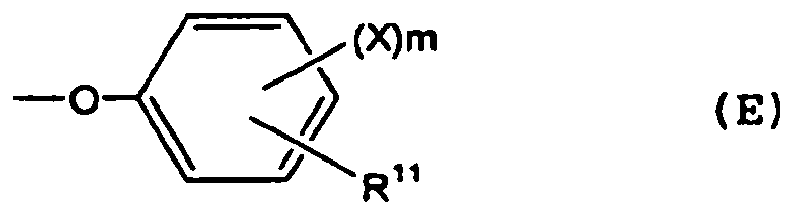 X represents a halogen atom or amino substituted C1-6 alkyl group which may have a C1-6 alkyl group as a substituent,m represents an integer of 0 to 3, andR11 represents:E1) hydrogen atom;E2) halogen-substituted or unsubstituted C1-6 alkyl group;E3) halogen-substituted or unsubstituted C1-6 alkoxy group;E4) a group represented by the following general formula (Ea):
- (W) O-NR12R13 (Ea)
wherein W represents a group -CO- or a C1-6 alkylene group, o represents an integer of 0 or 1, and R12 and R13 each identically or differently represent any one of:(Ea1) hydrogen atom;(Ea2) C1-6 alkyl group;(Ea3) C1-6 alkanoyl group;(Ea4) C1-6 alkoxycarbonyl group;(Ea5) phenyl C1-6 alkyl group (which may be substituted on the phenyl ring by at least one group selected from the group consisting of a halogen atom, a halogen-substituted or unsubstituted C1-6 alkyl group, a halogen-substituted or unsubstituted C1-6 alkoxy group, and a phenoxy group (which may be substituted on the phenyl ring by at least one group selected from the group consisting of a halogen atom, a halogen-substituted or unsubstituted C1-6 alkyl group, and a halogen-substituted or unsubstituted C1-6 alkoxy group as a substituent), and the alkyl portion may be substituted by a C1-6 alkoxyimino group);(Ea6) phenyl group (which may be substituted on the phenyl ring by at least one group selected from the group consisting of a halogen atom, a halogen-substituted or unsubstituted C1-6 alkyl group, and a halogen-substituted or unsubstituted C1-6 alkoxy group);(Ea7) benzoyl group (which may be substituted on the phenyl ring by at least one group selected from a group consisting of a halogen atom, a halogen-substituted or unsubstituted C1-6 alkyl group, and a halogen-substituted or unsubstituted C1-6 alkoxy group);(Ea8) pyridyl group (which may be substituted on the pyridine ring by at least one halogen atom as a substituent);(Ea9) phenyl C1-6 alkyl group (which may be substituted on the phenyl ring by at least one group selected from the group consisting of a halogen atom, a halogen-substituted or unsubstituted C1-6 alkyl group, and a halogen-substituted or unsubstituted C1-6 alkoxy group);(Ea10) phenoxy C1-6 alkyl group (which may be substituted on the phenyl ring by at least one group selected from the group consisting of a halogen atom, a halogen-substituted or unsubstituted C1-6 alkyl group, and a halogen-substituted or unsubstituted C1-6 alkoxy group); and(Ea11) benzoyl C1-6 alkyl group (which may be substituted on the phenyl ring by at least one group selected from the group consisting of a halogen atom, a halogen-substituted or unsubstituted C1-6 alkyl group, and a halogen-substituted or unsubstituted C1-6 alkoxy group),E5) imidazolyl group;E6) triazolyl group;E7) morpholino group;E8) thiomorpholino group;E9) s-oxide thiomorpholino group;E10) piperidyl group represented by the following general formula (Eaa): (Eaa1) hydrogen atom;(Eaa2) C1-6 alkoxycarbonyl group;(Eaa3) phenoxy group (which may be substituted on the phenyl ring by at least one group selected from the group consisting of a halogen atom; a halogen-substituted or unsubstituted C1-6 alkyl group; a halogen-substituted or unsubstituted C1-6 alkoxy group; a C1-4 alkylenedioxy group; a C1-6 alkoxycarbonyl group; a cyano group; a C2-6 alkenyl group; a nitro group; a phenyl group; an amino group which may have, as a substituent, a group selected from the group consisting of a phenyl group, a C1-6 alkyl group, a carbamoyl group and a C1-6 alkanoyl group; a C1-6 alkanoyl-substituted C1-6 alkyl group; a hydroxyl group; a C1-6 alkoxycarbonyl-substituted C1-6 alkyl group; a phenyl C1-6 alkyl group; a C1-6 alkanoyl group; a C1-6 alkylthio group; a 1,2,4-triazolyl group; an isoxazolyl group; an imidazolyl group; a benzothiazolyl group; a 2H-benzotriazolyl group; a pyrrolyl group; a benzoxazolyl group; a piperazinyl group (which may be substituted on the piperazine ring by at least one group selected from the group consisting of a C1-6 alkoxycarbonyl group and a phenyl C1-6 alkyl group (which may be substituted on the phenyl ring by at least one group selected from the group consisting of a halogen atom, a halogen-substituted or unsubstituted C1-6 alkyl group, and a halogen-substituted or unsubstituted C1-6 alkoxy group) as a substituent); a piperidinyl group (which may be substituted on the piperidine ring by at least one group selected from the group consisting of an amino group (which may be substituted on the amino group by at least one group selected from the group consisting of a C1-6 alkyl group and a phenyl group (which may be substituted on the phenyl ring by at least one group selected from the group consisting of a halogen atom, a halogen-substituted or unsubstituted C1-6 alkyl group, and a halogen-substituted or unsubstituted C1-6 alkoxy group) as a substituent); and a carbamoyl group));(Eaa4) hydroxyl group;(Eaa5) carboxy group;(Eaa6) phenyl group (which may be substituted on the phenyl ring by at least one group selected from the group consisting of a phenoxy group (which may be substituted on the phenyl ring by at least one group selected from the group consisting of a halogen atom, a halogen-substituted or unsubstituted C1-6 alkyl group, and a halogen-substituted or unsubstituted C1-6 alkoxy group as a substituent), a halogen atom, a halogen-substituted or unsubstituted C1-6 alkyl group, and a halogen-substituted or unsubstituted C1-6 alkoxy group as a substituent);(Eaa7) C1-6 alkoxy group;(Eaa8) C3-8 cycloalkyl-C1-6 alkoxy group;(Eaa9) phenylcarbamoyl group (which may be substituted on the phenyl ring by at least one group selected from the group consisting of a halogen atom, a halogen-substituted or unsubstituted C1-6 alkyl group, and a halogen-substituted or unsubstituted C1-6 alkoxy group);(Eaa10) tetrahydropyranyloxy group;(Eaa11) 1,3-dioxolanyl group;(Eaa12) oxo group;(Eaa13) naphthyloxy group (which may be substituted on the naphthalene ring by at least one C1-6 alkyl group as a substituent);(Eaa14) 2,3-dihydrobenzofuryloxy group (which may be substituted on the 2,3-dihydrobenzofuran ring by at least one group selected from the group consisting of a C1-6 alkyl group and an oxo group);(Eaa15) benzothiazolyloxy group (which may be substituted on the benzothiazole ring by at least one C1-6 alkyl group);(Eaa16) 1,2,3,4-tetrahydronaphthyloxy group (which may be substituted on the 1,2,3,4-tetrahydronaphthalene ring by at least one oxo group as a substituent);(Eaa17) 1,3-benzoxathiolanyloxy group (which may be substituted on the 1,3-benzoxathiolan ring by at least one oxo group as a substituent);(Eaa18) isoquinolyloxy group;(Eaa19) pyridyloxy group;(Eaa20) quinolyloxy group (which may be substituted on the quinoline ring by at least one C1-6 alkyl group as a substituent);(Eaa21) dibenzofuryloxy group;(Eaa22) 2H-chromenyloxy group (which may be substituted on the 2H-chromen ring by at least one oxo group as a substituent);(Eaa23) benzisoxazolyloxy group;(Eaa24) quinoxalyloxy group;(Eaa25) 2,3-dihydro-1H-indenyloxy group (which may be substituted on the 2,3-dihydro-1H-indene ring by at least one oxo group as a substituent);(Eaa26) benzofurazanyloxy group; or(Eaa27) phenyl C2-6 alkenyl group (which may be substituted on the phenyl ring by at least one group selected from a group consisting of a halogen atom, a halogen-substituted or unsubstituted C1-6 alkyl group, and a halogen-substituted or unsubstituted C1-6 alkoxy group),E11) a group represented by the following general formula (Eab):
 (Eab1) hydrogen atom;(Eab2) C1-6 alkyl group (wherein the alkyl group may be substituted by a morpholino group, benzoyl group, carbamoyl group which may have a C1-6 alkyl group as a substituent, or cyano group);(Eab3) C3-8 cycloalkyl group;(Eab4) phenyl C1-6 alkyl group (which may be substituted on the phenyl ring by at least one group selected from the group consisting of a halogen atom, a cyano group, a phenyl group, a nitro group, a C1-6 alkylthio group, a C1-6 alkylsulfonyl group, a phenyl C1-6 alkoxy group, a C2-6 alkanoyloxy group, a halogen-substituted or unsubstituted C1-6 alkyl group, a halogen-substituted or unsubstituted C1-6 alkoxy group, and a 1,2,3-thiadiazolyl group);(Eab5) C2-6 alkenyl group;(Eab6) phenyl group (which may be substituted on the phenyl ring by at least one group selected from the group consisting of a halogen atom, a cyano group, a halogen-substituted or unsubstituted C1-6 alkyl group, and a halogen-substituted or unsubstituted C1-6 alkoxy group);(Eab7) C1-6 alkanoyl group;(Eab8) phenyl C2-6 alkanoyl group (which may be substituted on the phenyl ring by at least one group selected from the group consisting of a halogen atom, a halogen-substituted or unsubstituted C1-6 alkyl group, and a halogen-substituted or unsubstituted C1-6 alkoxy group);(Eab9) benzoyl group (which may be substituted on the benzene ring by at least one group selected from the group consisting of a halogen atom, a halogen-substituted or unsubstituted C1-6 alkyl group, and a halogen-substituted or unsubstituted C1-6 alkoxy group);(Eab10) C1-20 alkoxycarbonyl group (which may be substituted on the alkoxy group by at least one group selected from the group consisting of a halogen atom, an amino group which may have a C1-6 alkyl group as a substituent, and a C1-6 alkoxy-substituted C1-6 alkoxy group);(Eab11) phenyl C1-6 alkoxycarbonyl group (which may be substituted on the phenyl ring by at least one group selected from the group consisting of a halogen atom, a halogen-substituted or unsubstituted C1-6 alkyl group, a halogen-substituted or unsubstituted C1-6 alkoxy group, a nitro group, a halogen-substituted or unsubstituted C1-6 alkylthio group, an amino group which may have a C1-6 alkanoyl group, a phenyl C1-6 alkoxy group, a C1-6 alkoxycarbonyl group, and a 1,2,3-thiadiazolyl group);(Eab12) a phenyl C3-6 alkenyloxycarbonyl group (which may be substituted on the phenyl ring by at least one group selected from the group consisting of a halogen atom, a halogen-substituted or unsubstituted C1-6 alkyl group, and a halogen-substituted or unsubstituted C1-6 alkoxy group);(Eab13) phenoxycarbonyl group (which may be substituted on the phenyl ring by at least one group selected from the group consisting of a halogen atom, a halogen-substituted or unsubstituted C1-6 alkyl group, and a halogen-substituted or unsubstituted C1-6 alkoxy group);(Eab14) phenyl C1-6 alkylcarbamoyl group (which may be substituted on the phenyl ring by at least one group selected from the group consisting of a halogen atom, a halogen-substituted or unsubstituted C1-6 alkyl group, and a halogen-substituted or unsubstituted C1-6 alkoxy group);(Eab15) phenylcarbamoyl group (which may be substituted on the phenyl ring by at least one group selected from the group consisting of a halogen atom, a halogen-substituted or unsubstituted C1-6 alkyl group, and a halogen-substituted or unsubstituted C1-6 alkoxy group);(Eab16) benzofuryl-substituted C1-6 alkoxycarbonyl group which may be substituted by at least one halogen atom on the benzofuran ring;(Eab17) benzothienyl C1-6 alkoxycarbonyl group (which may be substituted on the benzothiophene ring by at least one group selected from the group consisting of a halogen atom and a halogen-substituted or unsubstituted C1-6 alkoxy group as a substituent);(Eab18) naphthyl-substituted C1-6 alkoxycarbonyl group;(Eab19) pyridyl-substituted C1-6 alkoxycarbonyl group (which may be substituted on the pyridine ring by at least one halogen atom as a substituent);(Eab20) furyl-substituted C1-6 alkoxycarbonyl group (which may be substituted on the furan ring by at least one nitro group as a substituent);(Eab21) thienyl-substituted C1-6 alkoxycarbonyl group (which may have at least one halogen atom as a substituent on the thiophene ring);(Eab22) thiazolyl-substituted C1-6 alkoxycarbonyl group (which may be substituted on the thiazole ring by at least one group selected from the group consisting of a C1-6 alkyl group and a phenyl group (which may be substituted on the phenyl ring by at least one halogen-substituted or unsubstituted C1-6 alkyl group));(Eab23) tetrazolyl-substituted C1-6 alkoxycarbonyl group (which may be substituted on the tetrazole ring by at least one group selected from the group consisting of a C1-6 alkyl group and a phenyl group (which may have at least one halogen atom as a substituent on the phenyl ring) as a substituent);(Eab24) 2,3-dihydro-1H-indenyloxycarbonyl group;(Eab25) adamantane-substituted C1-6 alkoxycarbonyl group;(Eab26) phenyl C3-6 alkynyloxycarbonyl group; (Eab27) phenylthio C1-6 alkoxycarbonyl group; (Eab28) phenyl C1-6 alkoxy-substituted C1-6 alkoxycarbonyl group;(Eab29) C2-6 alkenyloxycarbonyl group; (Eab30) C2-6 alkynyloxycarbonyl group; (Eab31) C3-8 cycloalkyl-substituted C1-6 alkoxycarbonyl group; or(Eab32) benzoyl-substituted C1-6 alkoxycarbonyl group,E12) a group represented by the following general formula (Eb):
 E13) a group represented by the following general formula (Ec):
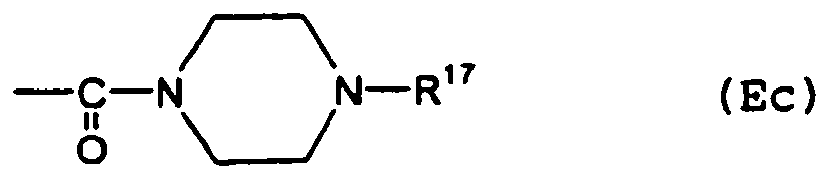 (Ec1) phenyl C1-6 alkyl group (which may be substituted on the phenyl ring by at least one group selected from the group consisting of a halogen atom, a halogen-substituted or unsubstituted C1-6 alkyl group, and a halogen-substituted or unsubstituted C1-6 alkoxy group);(Ec2) C1-6 alkoxycarbonyl group; or(Ec3) phenyl C1-6 alkoxycarbonyl group (which may be substituted on the phenyl ring by at least one group selected from the group consisting of a halogen atom, a halogen-substituted or unsubstituted C1-6 alkyl group, and a halogen-substituted or unsubstituted C1-6 alkoxy group),E14) pyridyl group;E15) a group represented by the following general formula (Ee):
 E16) phenoxy group (which may be substituted on the phenyl ring by at least one group selected from the group consisting of a halogen atom, a halogen-substituted or unsubstituted C1-6 alkyl group, and a halogen-substituted or unsubstituted C1-6 alkoxy group);E17) benzoyl group (which may be substituted on the phenyl ring by at least one group selected from the group consisting of a halogen atom, a halogen-substituted or unsubstituted C1-6 alkyl group, and a halogen-substituted or unsubstituted C1-6 alkoxy group);E18) 8-azabicyclo[3,2,1]octyl group (which may be substituted on the 8-azabicyclo[3,2,1]octane ring by at least one phenoxy group (which may be substituted on the phenyl ring by at least one group selected from the group consisting of a halogen atom, a halogen-substituted or unsubstituted C1-6 alkyl group, and a halogen-substituted or unsubstituted C1-6 alkoxy group) as a substituent);E19) a group represented by the following general formula (Ef):
-CN=N-NR47R48 (Ef)
wherein R47 and R48 each identically or differently represent any one of a hydrogen atom, a C1-6 alkyl group, a phenyl group (which may be substituted on the phenyl ring by at least one group selected from the group consisting of a halogen atom, a halogen-substituted or unsubstituted C1-6 alkyl group, and a halogen-substituted or unsubstituted C1-6 alkoxy group), or a pyridyl group (which may be substituted on the pyridine ring by at least one halogen-substituted or unsubstituted C1-6 alkyl group as a substituent); and further, R47 and R48 may bind to each other together with nitrogen atoms adjacent thereto directly or through other hetero atoms, so as to form a 5-7 membered saturated heterocyclic ring, which may be substituted on the heterocyclic ring by at least one phenyl group (which may be substituted on the phenyl ring by at least one group selected from the group consisting of a halogen atom, a halogen-substituted or unsubstituted C1-6 alkyl group, and a halogen-substituted or unsubstituted C1-6 alkoxy group) as a substituent;E20) phenyl C1-6 alkoxy group (which may be substituted on the phenyl ring by at least one group selected from the group consisting of a halogen atom, a halogen-substituted or unsubstituted C1-6 alkyl group, and a halogen-substituted or unsubstituted C1-6 alkoxy group);E21) amino substituted C2-6 alkenyl group (which may be substituted on the amino group by at least one group selected from the group consisting of a C1-6 alkyl group and a phenyl group (which may be substituted on the phenyl ring by at least one group selected from the group consisting of a halogen atom, a halogen-substituted or unsubstituted C1-6 alkyl group, and a halogen-substituted or unsubstituted C1-6 alkoxy group)); orE22) oxazolidinyl group (which may be substituted on the oxazolidine ring by at least one oxo group as a substituent). - The 2,3-dihydro-6-nitronidazo[2,1-b]oxazole compound according to claim 1, which is selected from the following list of compounds:2-methyl-6-nitro-2-{4-[4-(4-trifluoromethoxyphenoxy)-piperidin-1-yl]phenoxymethyl}-2,3-dihydroimidazo[2,1-b]oxazole,(S)-2-methyl-6-nitro-2-{4-[4-(4-trifluoromethoxyphenoxy)piperidin-1-yl]phenoxymethyl}-2,3-dihydroimidazo[2,1-b]oxazole,(R)-2-methyl-6-nitro-2-{4-[4-(4-trifluoromethoxyphenoxy)piperidin-1-yl]phenoxymethyl}-2,3-dihydroimidazo[2,1-b]oxazole,2-methyl-6-nitro-2-{4-[3-(4-trifluoromethoxyphenoxy)-8-azabicyclo[3.2.1]octan-8-yl]phenoxymethyl}-2,3-dihydroimidazo[2,1-b]oxazole,(S)-2-methyl-6-nitro-2-{4-[3-(4-trifluoromethoxyphenoxy)-8-azabicyclo[3.2.1]octan-8-yl]phenoxymethyl}-2,3-dihydroimidazo[2,1-b]oxazole,(R)-2-methyl-6-nitro-2-{4-[3-(4-trifluoromethoxyphenoxy)-8-azabicyclo[3.2.1]octan-8-yl]phenoxymethyl}-2,3-dihydroimidazo[2,1-b]oxazole,(R)-2-methyl-6-nitro-2-{4-[3-(4-trifluoromethoxyphenoxy)-8-azabicyclo[3.2.1]octan-8-yl]phenoxymethyl}-2,3-dihydroimidazo[2,1-b]oxazole 4-toluene sulfonate,2-methyl-6-nitro-2-{4-[4-(4-trifluoromethylbenzyl)-piperazin-1-yl]phenoxymethyl}-2,3-dihydroimidazo[2,1-b]oxazole,(S)-2-methyl-6-nitro-2-{4-[4-(4-trifluoromethylbenzyl)piperazin-1-yl]phenoxymethyl}-2,3-dihydroimidazo[2,1-b]oxazole,(R)-2-methyl-6-nitro-2-{4-[4-(4-trifluoromethylbenzyl)piperazin-1-yl]phenoxymethyl}-2,3-dihydroimidazo[2,1-b]oxazole,2-methyl-6-nitro-2-{4-[4-(4-trifluoromethoxybenzyl)-piperazin-1-yl]phenoxymethyl}-2,3-dihydroimidazo[2,1-b]oxazole,(S)-2-methyl-6-nitro-2-{4-[4-(4-trifluoromethoxybenzyl)piperazin-1-yl]phenoxymethyl}-2,3-dihydro-imidazo[2,1-b]oxazole,(R)-2-methyl-6-nitro-2-{4-[4-(4-trifluoromethoxybenzyl)piperazin-1-yl]phenoxymethyl}-2,3-dihydro-imidazo[2,1-b]oxazole,2-methyl-6-nitro-2-{4-[4-(4-trifluoromethylphenyl)-piperazin-1-yl]phenoxymethyl}-2,3-dihydroimidazo[2,1-b]oxazole,(S)-2-methyl-6-nitro-2-{4-[4-(4-trifluoromethylphenyl)-piperazin-1-yl]phenoxymethyl}-2,3-dihydroimidazo[2,1-b]oxazole,(R)-2-methyl-6-nitro-2-{4-[4-(4-trifluoromethylphenyl)-piperazin-1-yl]phenoxymethyl}-2,3-dihydroimidazo[2,1-b]oxazole,2-methyl-6-nitro-2-{4-[4-(4-chlorobenzyl)piperazin-1-yl]phenoxymethyl}-2,3-dihydroimidazo[2,1-b]oxazole,(S)-2-methyl-6-nitro-2-{4-[4-(4-chlorobenzyl)piperazin-1-yl]phenoxymethyl}-2,3-dihydroimidazo[2,1-b]oxazole, (R)-2-methyl-6-nitro-2-{4-[4-(4-chlorobenzyl)piperazin-1-yl]phenoxymethyl}-2,3-dihydroimidazo[2,1-b]oxazole,2-methyl-6-nitro-2-{4-[4-(4-chlorophenyl)piperazin-1-yl]phenoxymethyl}-2,3-dihydroimidazo[2,1-b]oxazole,(S)-2-methyl-6-nitro-2-{4-[4-(4-chlorophenyl)piperazin-1-yl]phenoxymethyl}-2,3-dihydroimidazo[2,1-b]oxazole,(R)-2-methyl-6-nitro-2-{4-[4-(4-chlorophenyl)piperazin-1-yl]phenoxymethyl}-2,3-dihydroimidazo[2,1-b]oxazole,2-methyl-6-nitro-2-{4-[4-(4-trifluoromethoxybenzyloxycarbonyl)piperazin-1-yl]phenoxymethyl}-2,3-dihydroimidazo[2,1-b]oxazole,(S)-2-methyl-6-nitro-2-{4-[4-(4-trifluoromethoxybenzyloxycarbonyl)piperazin-1-yl]phenoxymethyl}-2,3-dihydroimidazo[2,1-b]oxazole,(R)-2-methyl-6-nitro-2-{4-[4-(4-trifluoromethoxybenzyloxycarbonyl)piperazin-1-yl]phenoxymethyl}-2,3-dihydroimidazo[2,1-b]oxazole,2-methyl-6-nitro-2-{4-[4-(3,4-dichlorobenzyloxycarbonyl)piperazin-1-yl]phenoxymethyl}-2,3-dihydroimidazo[2,1-b]oxazole,(S)-2-methyl-6-nitro-2-{4-[4-(3,4-dichlorobenzyloxycarbonyl)piperazin-1-yl]phenoxymethyl}-2,3-dihydroimidazo[2,1-b]oxazole,(R)-2-methyl-6-nitro-2-{4-[4-(3,4-dichlorobenzyloxycarbonyl)piperazin-1-yl]phenoxymethyl}-2,3-dihydroimidazo[2,1-b]oxazole,2-methyl-6-nitro-2-{4-[4-(4-chlorophenoxy)piperidin-1-yl]phenoxymethyl}-2,3-dihydroimidazo[2,1-b]oxazole, (S)-2-methyl-6-nitro-2-{4-[4-(4-chlorophenoxy)-piperidin-1-yl]phenoxymethyl}-2,3-dihydroimidazo[2,1-b]oxazole,(R)-2-methyl-6-nitro-2-{4-[4-(4-chlorophenoxy)-piperidin-1-yl]phenoxymethyl}-2,3-dihydroimidazo[2,1-b] oxazole,2-methyl-6-nitro-2-{4-[4-(4-trifluoromethylphenoxy)-piperidin-1-yl]phenoxymethyl}-2,3-dihydroimidazo[2,1-b]oxazole,(S)-2-methyl-6-nitro-2-{4-[4-(4-trifluoromethylphenoxy)piperidin-1-yl]phenoxymethyl}-2,3-dihydroimidazo[2,1-b]oxazole,(R)-2-methyl-6-nitro-2-{4-[4-(4-trifluoromethylphenoxy)piperidin-1-yl]phenoxymethyl}-2,3-dihydroimidazo[2,1-b]oxazole,2-methyl-6-nitro-2-{4-[1-(4-chlorobenzyl)piperidin-4-yl]phenoxymethyl}-2,3-dihydroimidazo[2,1-b]oxazole,(S)-2-methyl-6-nitro-2-{4-[1-(4-chlorobenzyl)piperidin-4-yl]phenoxymethyl}-2,3-dihydroimidazo[2,1-b]oxazole, or(R)-2-methyl-6-nitro-2-{4-[1-(4-chlorobenzyl)piperidin-4-yl]phenoxymethyl}-2,3-dihydroimidazo[2,1-b]oxazole.
- The 2,3-dihydro-6-nitroimidazo[2,1-b]oxazole compound according to claim 1, which is (R)-2-methyl-6-nitro-2-{4-[4-(4-trifluoromethoxyphenoxy)piperidin-1-yl]phenoxymethyl}-2,3-dihydroimidazo[2,1-b]oxazole.
- A pharmaceutical composition which is an antitubercular agent comprising, as an active ingredient, the 2,3-dihydro-6-nitroimidazo[2,1-b]oxazole compound, optically active form thereof, or pharmacologically acceptable salt thereof according to claim 1.
- The pharmaceutical composition according to claim 4 comprising, as an active ingredient, at least one compound selected from the 2,3-dihydro-6-nitroimidazo[2,1-b]oxazole compounds according to claim 2.
- The pharmaceutical composition according to claim 4 comprising, as an active ingredient, the compound according to claim 3.
- A method for producing a compound represented by the following general formula (1a):

said production method comprising: the reaction of a 4-nitroimidazole compound represented by the following general formula (2):


Priority Applications (3)
| Application Number | Priority Date | Filing Date | Title |
|---|---|---|---|
| EP12193820.3A EP2570418A3 (en) | 2002-10-11 | 2003-10-10 | 2,3-dihydro-6-nitroimidazo[2,1-b]oxazoles |
| SI200332254T SI1555267T1 (en) | 2002-10-11 | 2003-10-10 | 2,3-DIHYDRO-6-NITROIMIDAZOS2,1-bCOXAZOLES |
| CY20131100076T CY1113578T1 (en) | 2002-10-11 | 2013-01-25 | 2,3-dihydro-6-nitroimidazo 2,1-B-oxazolia |
Applications Claiming Priority (3)
| Application Number | Priority Date | Filing Date | Title |
|---|---|---|---|
| JP2002298259 | 2002-10-11 | ||
| JP2002298259 | 2002-10-11 | ||
| PCT/JP2003/013070 WO2004033463A1 (en) | 2002-10-11 | 2003-10-10 | 2,3-DIHYDRO-6-NITROIMIDAZO[2,1-b]OXAZOLES |
Related Child Applications (1)
| Application Number | Title | Priority Date | Filing Date |
|---|---|---|---|
| EP12193820.3 Division-Into | 2012-11-22 |
Publications (3)
| Publication Number | Publication Date |
|---|---|
| EP1555267A1 EP1555267A1 (en) | 2005-07-20 |
| EP1555267A4 EP1555267A4 (en) | 2010-08-18 |
| EP1555267B1 true EP1555267B1 (en) | 2013-01-16 |
Family
ID=32089299
Family Applications (2)
| Application Number | Title | Priority Date | Filing Date |
|---|---|---|---|
| EP03754085A Expired - Lifetime EP1555267B1 (en) | 2002-10-11 | 2003-10-10 | 2,3-DIHYDRO-6-NITROIMIDAZO[2,1-b]OXAZOLES |
| EP12193820.3A Withdrawn EP2570418A3 (en) | 2002-10-11 | 2003-10-10 | 2,3-dihydro-6-nitroimidazo[2,1-b]oxazoles |
Family Applications After (1)
| Application Number | Title | Priority Date | Filing Date |
|---|---|---|---|
| EP12193820.3A Withdrawn EP2570418A3 (en) | 2002-10-11 | 2003-10-10 | 2,3-dihydro-6-nitroimidazo[2,1-b]oxazoles |
Country Status (26)
| Country | Link |
|---|---|
| US (1) | US7262212B2 (en) |
| EP (2) | EP1555267B1 (en) |
| JP (1) | JP4186065B2 (en) |
| KR (1) | KR100723847B1 (en) |
| CN (4) | CN101172981A (en) |
| AR (4) | AR041198A1 (en) |
| AU (1) | AU2003272979B2 (en) |
| BE (1) | BE2014C053I2 (en) |
| BR (1) | BRPI0314344B8 (en) |
| CA (1) | CA2497569C (en) |
| CY (2) | CY1113578T1 (en) |
| DK (1) | DK1555267T3 (en) |
| ES (1) | ES2400179T3 (en) |
| FR (1) | FR14C0066I2 (en) |
| HU (1) | HUS1400046I1 (en) |
| LU (1) | LU92517I2 (en) |
| MX (1) | MXPA05003674A (en) |
| MY (1) | MY139244A (en) |
| PL (3) | PL404913A1 (en) |
| PT (1) | PT1555267E (en) |
| RU (1) | RU2326121C3 (en) |
| SI (1) | SI1555267T1 (en) |
| TW (1) | TWI347946B (en) |
| UA (1) | UA83200C2 (en) |
| WO (1) | WO2004033463A1 (en) |
| ZA (1) | ZA200501033B (en) |
Families Citing this family (83)
| Publication number | Priority date | Publication date | Assignee | Title |
|---|---|---|---|---|
| AU2002217999A1 (en) | 2000-11-01 | 2002-05-15 | Cor Therapeutics, Inc. | Process for the production of 4-quinazolinylpiperazin-1-carboxylic acid phenylamides |
| AR041605A1 (en) | 2002-10-15 | 2005-05-26 | Otsuka Pharma Co Ltd | COMPOUND 1- REPLACED-4-NITROIMIDAZOL AND METHOD TO PREPARE THE SAME |
| JP4761756B2 (en) * | 2003-10-31 | 2011-08-31 | 大塚製薬株式会社 | 2,3-Dihydroimidazo [2,1-b] oxazole compound |
| WO2005042542A1 (en) | 2003-10-31 | 2005-05-12 | Otsuka Pharmaceutical Co., Ltd. | 2,3-dihydro-6-nitroimidazo (2,1-b) oxazole compounds for the treatment of tuberculosis |
| TWI300409B (en) | 2004-02-18 | 2008-09-01 | Otsuka Pharma Co Ltd | Method for producing 4-nitroimidazole compound |
| JP4804346B2 (en) | 2004-03-31 | 2011-11-02 | 日本曹達株式会社 | Cyclic amine compounds and pest control agents |
| JP4787529B2 (en) * | 2004-04-09 | 2011-10-05 | 大塚製薬株式会社 | Pharmaceutical composition |
| JP4789966B2 (en) * | 2004-04-09 | 2011-10-12 | 大塚製薬株式会社 | Pharmaceutical composition |
| EP1896453B1 (en) * | 2005-06-20 | 2009-12-02 | Schering Corporation | Carbon-linked substituted piperidines and derivatives thereof useful as histamine h3 antagonists |
| UA95251C2 (en) * | 2005-07-28 | 2011-07-25 | Оцука Фармасьютикал Ко., Лтд. | Pharmaceutical composition comprising 2,3-dihydro-6-nitroimidazo [2 ,1-b] oxazole derivatives |
| JP5105818B2 (en) * | 2005-10-05 | 2012-12-26 | 大塚製薬株式会社 | Pharmaceutical composition |
| TW201233389A (en) | 2005-10-05 | 2012-08-16 | Otsuka Pharma Co Ltd | Antituberculous therapeutic drugs and kit containing the same |
| NZ567127A (en) * | 2005-10-06 | 2010-04-30 | Nippon Soda Co | Bridged cyclic amine compound and pest control agent |
| TW200800268A (en) * | 2005-11-04 | 2008-01-01 | Otsuka Pharma Co Ltd | Medicinal composition showing improved drug absorbability |
| CA2636929A1 (en) * | 2005-12-21 | 2007-07-12 | Decode Genetics, Ehf | Biaryl nitrogen heterocycle inhibitors of lta4h for treating inflammation |
| US20090018169A1 (en) * | 2006-02-13 | 2009-01-15 | Laboratoires Serono Sa | Sulfonamide Derivatives for the Treatment of Bacterial Infections |
| JP2007297305A (en) * | 2006-04-28 | 2007-11-15 | Daiso Co Ltd | Method for producing n-(2,3-epoxy-2-methylpropyl)phthalimide |
| EP2125750B1 (en) * | 2007-02-26 | 2014-05-21 | Vitae Pharmaceuticals, Inc. | Cyclic urea and carbamate inhibitors of 11beta-hydroxysteroid dehydrogenase 1 |
| AR070301A1 (en) * | 2007-05-08 | 2010-03-31 | Otsuka Pharma Co Ltd | EPOXY COMPOUND AND METHOD TO PRODUCE THE SAME |
| US8329897B2 (en) * | 2007-07-26 | 2012-12-11 | Vitae Pharmaceuticals, Inc. | Synthesis of inhibitors of 11β-hydroxysteroid dehydrogenase type 1 |
| EP2185542A2 (en) * | 2007-08-15 | 2010-05-19 | Glaxo Group Limited | Substituted quinoline derivatives as h1 receptor antagonists |
| EP2205585A1 (en) * | 2007-10-16 | 2010-07-14 | Glaxo Group Limited | Quinoline derivatives used to treat inflammatory and allergic diseases |
| AR069207A1 (en) * | 2007-11-07 | 2010-01-06 | Vitae Pharmaceuticals Inc | CYCLIC UREAS AS INHIBITORS OF THE 11 BETA - HIDROXI-ESTEROIDE DESHIDROGENASA 1 |
| JP5490014B2 (en) | 2007-12-11 | 2014-05-14 | ヴァイティー ファーマシューティカルズ,インコーポレイテッド | 11β-hydroxysteroid dehydrogenase type 1 cyclic urea inhibitor |
| TW200934490A (en) * | 2008-01-07 | 2009-08-16 | Vitae Pharmaceuticals Inc | Lactam inhibitors of 11 &abgr;-hydroxysteroid dehydrogenase 1 |
| EP2252601B1 (en) | 2008-01-24 | 2012-12-19 | Vitae Pharmaceuticals, Inc. | Cyclic carbazate and semicarbazide inhibitors of 11beta-hydroxysteroid dehydrogenase 1 |
| CA2714532A1 (en) * | 2008-02-11 | 2009-08-20 | Vitae Pharmaceuticals, Inc. | 1,3-oxazepan-2-one and 1,3-diazepan-2-one inhibitors of 11.beta.-hydroxysteroid dehydrogenase 1 |
| EP2254872A2 (en) * | 2008-02-15 | 2010-12-01 | Vitae Pharmaceuticals, Inc. | Cycloalkyl lactame derivatives as inhibitors of 11-beta-hydroxysteroid dehydrogenase 1 |
| EP2274287B1 (en) * | 2008-03-18 | 2016-03-09 | Vitae Pharmaceuticals, Inc. | Inhibitors of 11beta-hydroxysteroid dehydrogenase type 1 |
| CN101965353B (en) * | 2008-03-26 | 2014-12-17 | 丹诺医药(苏州)有限公司 | Bicyclic nitroimidazoles covalently linked to substituted phenyl oxazolidinones |
| CA2722427A1 (en) | 2008-05-01 | 2009-11-05 | Vitae Pharmaceuticals, Inc. | Cyclic inhibitors of 11beta-hydroxysteroid dehydrogenase 1 |
| EP2291373B1 (en) * | 2008-05-01 | 2013-09-11 | Vitae Pharmaceuticals, Inc. | Cyclic inhibitors of 11beta-hydroxysteroid dehydrogenase 1 |
| JP5538365B2 (en) | 2008-05-01 | 2014-07-02 | ヴァイティー ファーマシューティカルズ,インコーポレイテッド | Cyclic inhibitor of 11β-hydroxysteroid dehydrogenase 1 |
| CL2009001058A1 (en) | 2008-05-01 | 2010-09-10 | Vitae Pharmaceuticals Inc | Compounds derived from substituted oxazines, inhibitors of 11b-hydroxysteroid dehydrogenase type-1; pharmaceutical composition; and use of the compound to inhibit the activity of 11b-hsd1, as in the treatment of diabetes, dyslipidemia, hypertension, obesity, cancer, glaucoma, among others. |
| RU2539979C2 (en) | 2008-07-25 | 2015-01-27 | Вайтаи Фармасьютиклз, Инк. | Cyclic inhibitors of 11beta-hydroxysteroid-dehydrogenase 1 |
| JP5777030B2 (en) | 2008-07-25 | 2015-09-09 | ベーリンガー インゲルハイム インターナショナル ゲゼルシャフト ミット ベシュレンクテル ハフツング | Inhibitor of 11β-hydroxysteroid dehydrogenase 1 |
| US9540322B2 (en) | 2008-08-18 | 2017-01-10 | Yale University | MIF modulators |
| US9643922B2 (en) | 2008-08-18 | 2017-05-09 | Yale University | MIF modulators |
| PE20110368A1 (en) * | 2008-08-18 | 2011-06-13 | Univ Yale | MIF MODULATORS |
| EP2323990B1 (en) | 2008-08-21 | 2014-06-18 | Dynamit Nobel GmbH Explosivstoff- und Systemtechnik | Methods for the production of 2-halo-4-nitroimidazole and intermediates thereof |
| WO2010143007A1 (en) * | 2009-06-10 | 2010-12-16 | Dynamit Nobel Gmbh Explosivstoff-Und Systemtechnik | Method for the production of 2-halogeno-4-nitroimidazole |
| WO2010089303A1 (en) | 2009-02-04 | 2010-08-12 | Boehringer Ingelheim International Gmbh | CYCLIC INHIBITORS OF 11 β-HYDROXYSTEROID DEHYDROGENASE 1 |
| TW201039034A (en) * | 2009-04-27 | 2010-11-01 | Chunghwa Picture Tubes Ltd | Pixel structure and the method of forming the same |
| US20100331320A1 (en) * | 2009-04-30 | 2010-12-30 | Vitae Pharmaceuticals, Inc. | Cyclic inhibitors of 11beta-hydroxysteroid dehydrogenase 1 |
| MA33216B1 (en) | 2009-04-30 | 2012-04-02 | Boehringer Ingelheim Int | CYCLIC INHIBITORS OF 11BETA-HYDROXYSTEROID DEHYDROGENASE 1 |
| EP2440537A1 (en) | 2009-06-11 | 2012-04-18 | Vitae Pharmaceuticals, Inc. | Cyclic inhibitors of 11beta-hydroxysteroid dehydrogenase 1 based on the 1,3 -oxazinan- 2 -one structure |
| WO2011002910A1 (en) | 2009-07-01 | 2011-01-06 | Vitae Pharmaceuticals, Inc. | Cyclic inhibitors of 11beta-hydroxysteroid dehydrogenase 1 |
| EP2459570B1 (en) * | 2009-07-31 | 2014-12-24 | Global Alliance For Tb Drug Development | Nitroimidazooxazine analogues and their uses |
| WO2011014774A1 (en) * | 2009-07-31 | 2011-02-03 | Global Alliance For Tb Drug Development | Nitroimidazooxazines and their uses in anti-tubercular therapy |
| US9198913B2 (en) | 2009-07-31 | 2015-12-01 | Global Alliance For Tb Drug Development | Nitroimidazooxazines and their uses in anti-tubercular therapy |
| EP2495563A4 (en) | 2009-10-26 | 2013-04-10 | Fujifilm Ri Pharma Co Ltd | DIAGNOSTIC AGENT FOR INFECTIOUS DISEASES |
| TW201200523A (en) | 2010-01-29 | 2012-01-01 | Otsuka Pharma Co Ltd | Synthetic intermediate of oxazole compound and method for producing the same |
| GB201012209D0 (en) * | 2010-05-31 | 2010-09-08 | Ge Healthcare Ltd | In vivo imaging agent |
| EP2582698B1 (en) | 2010-06-16 | 2016-09-14 | Vitae Pharmaceuticals, Inc. | Substituted 5-,6- and 7-membered heterocycles, medicaments containing such compounds, and their use |
| JP5813106B2 (en) | 2010-06-25 | 2015-11-17 | ベーリンガー インゲルハイム インターナショナル ゲゼルシャフト ミット ベシュレンクテル ハフツング | Azaspirohexanone as an inhibitor of 11-β-HSD1 for the treatment of metabolic disorders |
| BR112013010021A2 (en) | 2010-11-02 | 2019-09-24 | Boehringer Ingelheim Int | pharmaceutical combinations for the treatment of metabolic disorders. |
| EP2697232B1 (en) | 2011-04-15 | 2016-05-18 | Otsuka Pharmaceutical Co., Ltd. | 6,7-dihydroimidazo[2,1-b][1,3]oxazine bactericides |
| JP2015006994A (en) * | 2011-10-28 | 2015-01-15 | 大正製薬株式会社 | Dihydroimidazooxazole derivative |
| WO2014014845A1 (en) | 2012-07-18 | 2014-01-23 | Vertex Pharmaceuticals Incorporated | Combination therapy comprising|1 -ethyl-3-[5-[2-{1 -hydroxy-1 -methyl-ethyl}pyrimidin-5-yl]-7-(tetra hydrofuran-2-|yl}-1 h-benzimidazol-2-yl]urea and derivatives thereof to treat mycobacterium|diseases |
| FR3000064A1 (en) * | 2012-12-21 | 2014-06-27 | Univ Lille Ii Droit & Sante | SPIROISOXAZOLINE-LIKE COMPOUNDS WITH POTENTIALIZING ACTIVITY OF AN ANTIBIOTIC COMPOSITION AND PHARMACEUTICAL PRODUCT COMPRISING SUCH COMPOUNDS |
| ES2707362T3 (en) | 2013-10-04 | 2019-04-03 | Council Scient Ind Res | 6-nitro-2,3-dihydroimidazo [2,1-b] oxazoles and a method of preparing them |
| CN103524492A (en) * | 2013-10-23 | 2014-01-22 | 中国药科大学 | Quinolones compound with side chain containing nitroimidazole group substitution as well as preparation and use thereof |
| AR101704A1 (en) | 2014-08-28 | 2017-01-04 | Otsuka Pharma Co Ltd | FUSED HETEROCYCLIC COMPOUNDS |
| US9822126B1 (en) | 2014-10-21 | 2017-11-21 | Council Of Scientific & Industrial Research | Substituted 1,2,3-triazol-1-yl-methyl-2,3-dihydro-2-methyl-6-nitroimidazo[2,1-b]oxazoles as anti-mycobacterial agents and a process for the preparation thereof |
| CN105732659B (en) * | 2014-12-12 | 2019-07-16 | 上海阳帆医药科技有限公司 | Nitro glyoxaline compound and preparation method thereof and the purposes in pharmacy |
| JP6542900B2 (en) * | 2015-01-29 | 2019-07-10 | メッドシャイン ディスカバリー インコーポレイテッド | Nitroimidazole derivatives for anti-pulmonary tuberculosis |
| EA201792154A1 (en) | 2015-03-27 | 2018-02-28 | Оцука Фармасьютикал Ко., Лтд. | METHOD FOR OBTAINING 1- (4-HYDROXYPHENYL) -4- (4- TRIFTORMETOXYPHENOXY) PIPERIDINE OR ITS SALT |
| CN106317072B (en) * | 2015-06-17 | 2020-03-17 | 盟科医药技术(上海)有限公司 | Heterocyclic compounds for the treatment of mycobacterial infections and uses thereof |
| WO2017146246A1 (en) | 2016-02-26 | 2017-08-31 | 大塚製薬株式会社 | Piperidine derivative |
| CN105859628B (en) * | 2016-04-19 | 2018-08-07 | 清远职业技术学院 | A kind of antimicrobial compound is to N imidazoles benzaldehyde contracting ortho-aminotoluene schiff bases and its preparation method and application |
| EP3489242A4 (en) * | 2016-07-22 | 2020-06-24 | Medshine Discovery Inc. | NITROIMIDAZOLE CRYSTAL AND SALT, AND THEIR MANUFACTURING METHOD |
| EP3668879B1 (en) * | 2017-08-16 | 2021-09-29 | GlaxoSmithKline Intellectual Property Development Limited | Novel compounds |
| GEP20257802B (en) | 2018-06-11 | 2025-09-25 | Otsuka Pharma Co Ltd | Delamanid-containing composition |
| CN109705022A (en) * | 2018-12-28 | 2019-05-03 | 上海彩迩文生化科技有限公司 | A kind of preparation method of aromatic amine intermediate |
| CN112300192B (en) * | 2019-08-02 | 2023-08-11 | 南京长澳医药科技有限公司 | Nitroimidazole compound, preparation method and application thereof |
| CN110483549B (en) * | 2019-08-30 | 2021-03-05 | 沈阳药科大学 | Preparation method of nitroimidazole pyran antituberculosis drug |
| CN110615800A (en) * | 2019-10-16 | 2019-12-27 | 李丽丽 | Nitroimidazole compound and preparation method and application thereof |
| CN112156088B (en) * | 2020-10-30 | 2021-08-31 | 健民药业集团股份有限公司 | Application of compound in preparation of mycobacterium tuberculosis inhibitor |
| CN113603706A (en) * | 2021-08-04 | 2021-11-05 | 深圳市泰力生物医药有限公司 | Crystal form of delamasil, active drug and pharmaceutical composition containing the crystal form |
| EP4563147A1 (en) | 2022-07-29 | 2025-06-04 | Otsuka Pharmaceutical Co., Ltd. | Delamanid-containing solid dispersion |
| CN115368252B (en) * | 2022-09-19 | 2024-01-12 | 西北农林科技大学 | A 4-aminophenol derivative and its application |
| CN116640106B (en) * | 2023-05-11 | 2024-03-08 | 郑州大学 | A kind of phenylpiperazine compound and its preparation method and application |
| CN119059990B (en) * | 2024-11-01 | 2025-02-07 | 安徽昊帆生物有限公司 | Preparation method of 1-carbamic acid tert-butyl piperazine |
Family Cites Families (1)
| Publication number | Priority date | Publication date | Assignee | Title |
|---|---|---|---|---|
| US5668127A (en) | 1995-06-26 | 1997-09-16 | Pathogenesis Corporation | Nitroimidazole antibacterial compounds and methods of use thereof |
-
2003
- 2003-10-09 TW TW092128165A patent/TWI347946B/en not_active IP Right Cessation
- 2003-10-09 AR ARP030103673A patent/AR041198A1/en active IP Right Grant
- 2003-10-10 BR BRPI0314344A patent/BRPI0314344B8/en not_active IP Right Cessation
- 2003-10-10 WO PCT/JP2003/013070 patent/WO2004033463A1/en not_active Ceased
- 2003-10-10 CN CNA2007100040367A patent/CN101172981A/en active Pending
- 2003-10-10 CN CN201110416170.4A patent/CN102532162B/en not_active Expired - Lifetime
- 2003-10-10 MY MYPI20033866A patent/MY139244A/en unknown
- 2003-10-10 ES ES03754085T patent/ES2400179T3/en not_active Expired - Lifetime
- 2003-10-10 US US10/530,429 patent/US7262212B2/en not_active Expired - Lifetime
- 2003-10-10 EP EP03754085A patent/EP1555267B1/en not_active Expired - Lifetime
- 2003-10-10 RU RU2005114017A patent/RU2326121C3/en active Protection Beyond IP Right Term
- 2003-10-10 PL PL404913A patent/PL404913A1/en unknown
- 2003-10-10 DK DK03754085.3T patent/DK1555267T3/en active
- 2003-10-10 AU AU2003272979A patent/AU2003272979B2/en not_active Expired
- 2003-10-10 CN CNA2007100040371A patent/CN101255170A/en active Pending
- 2003-10-10 CA CA2497569A patent/CA2497569C/en not_active Expired - Lifetime
- 2003-10-10 UA UAA200504391A patent/UA83200C2/en unknown
- 2003-10-10 SI SI200332254T patent/SI1555267T1/en unknown
- 2003-10-10 CN CNB2003801017508A patent/CN100366624C/en not_active Expired - Lifetime
- 2003-10-10 PL PL376157A patent/PL217919B1/en unknown
- 2003-10-10 EP EP12193820.3A patent/EP2570418A3/en not_active Withdrawn
- 2003-10-10 PT PT37540853T patent/PT1555267E/en unknown
- 2003-10-10 PL PL409525A patent/PL409525A1/en unknown
- 2003-10-10 KR KR1020057004567A patent/KR100723847B1/en not_active Expired - Lifetime
- 2003-10-10 MX MXPA05003674A patent/MXPA05003674A/en active IP Right Grant
- 2003-10-14 JP JP2003353868A patent/JP4186065B2/en not_active Expired - Lifetime
-
2005
- 2005-02-03 ZA ZA200501033A patent/ZA200501033B/en unknown
-
2012
- 2012-04-23 AR ARP120101394A patent/AR086485A2/en unknown
-
2013
- 2013-01-25 CY CY20131100076T patent/CY1113578T1/en unknown
- 2013-02-08 AR ARP130100408A patent/AR089950A2/en unknown
- 2013-07-15 AR ARP130102514 patent/AR091771A2/en not_active Application Discontinuation
-
2014
- 2014-08-13 LU LU92517C patent/LU92517I2/en unknown
- 2014-08-14 HU HUS1400046C patent/HUS1400046I1/en unknown
- 2014-09-09 BE BE2014C053C patent/BE2014C053I2/fr unknown
- 2014-09-11 FR FR14C0066C patent/FR14C0066I2/en active Active
- 2014-09-24 CY CY2014041C patent/CY2014041I1/en unknown
Also Published As
Similar Documents
| Publication | Publication Date | Title |
|---|---|---|
| US7262212B2 (en) | 2,3-dihydro-6-nitroimidazo[2,1-b]oxazoles | |
| JP4787529B2 (en) | Pharmaceutical composition | |
| RU2365593C2 (en) | 2,3-DIHYDRO-6-NITROIMIDAZO[2,1-b]OXAZOL DERIVATIVES FOR TREATMENT OF TUBERCULOSIS | |
| UA79113C2 (en) | Triazole derivatives as tachykinin receptor antagonists | |
| CN122036680A (en) | Antifibrotic pyridones | |
| JP5916739B2 (en) | 6,7-Dihydroimidazo [2,1-b] [1,3] oxazine compound | |
| JP5345174B2 (en) | Pharmaceutical composition | |
| JP4761756B2 (en) | 2,3-Dihydroimidazo [2,1-b] oxazole compound | |
| HK1181049A (en) | 2,3-dihydro-6-nitroimidazo[2,1-b]oxazoles compound | |
| HK1085463B (en) | 2,3-dihydro-6-nitroimidazo (2,1-b) oxazoles | |
| HK1118543A (en) | 2,3-dihydro-6-nitroimidazo (2,1-b) oxazoles | |
| HK1120499A (en) | 2,3-dihydro-6-nitroimidazo [2,1-b] oxazoles | |
| HK1171018B (en) | 2,3-dihydro-6-nitroimidazo (2, 1-b) oxazoles | |
| MXPA06004064A (en) | 2,3-dihydro-6-nitroimidazo (2,1-b) oxazole compounds for the treatment of tuberculosis |
Legal Events
| Date | Code | Title | Description |
|---|---|---|---|
| PUAI | Public reference made under article 153(3) epc to a published international application that has entered the european phase |
Free format text: ORIGINAL CODE: 0009012 |
|
| 17P | Request for examination filed |
Effective date: 20050316 |
|
| AK | Designated contracting states |
Kind code of ref document: A1 Designated state(s): AT BE BG CH CY CZ DE DK EE ES FI FR GB GR HU IE IT LI LU MC NL PT RO SE SI SK TR |
|
| RIN1 | Information on inventor provided before grant (corrected) |
Inventor name: MIYAMURA, SHIN;147-13, MUKAININOKOSHI, Inventor name: SUMIDA, TAKUMI Inventor name: ITOTANI, MOTOHIRO Inventor name: TOMISHIGE, TATSUO Inventor name: TAI, KUNINORI Inventor name: SASAKI, HIROFUMI Inventor name: MATSUZAKI, TAKAYUKI Inventor name: HASEGAWA, TAKESHI;DAIICHIAIJITSUHAITSU 607, Inventor name: KURODA, TAKESHI Inventor name: KAWASAKI, MASANORI Inventor name: MATSUMOTO, MAKOTO Inventor name: TSUBOUCHI, HIDETSUGU Inventor name: HARAGUCHI, YOSHIKAZU Inventor name: KOMATSU, MAKOTO Inventor name: HASHIZUME, HIROYUKI;DAIAPARESU 1401, Inventor name: SEIKE, YUJI Inventor name: KURODA, HIDEAKI |
|
| A4 | Supplementary search report drawn up and despatched |
Effective date: 20100721 |
|
| 17Q | First examination report despatched |
Effective date: 20110824 |
|
| GRAP | Despatch of communication of intention to grant a patent |
Free format text: ORIGINAL CODE: EPIDOSNIGR1 |
|
| GRAC | Information related to communication of intention to grant a patent modified |
Free format text: ORIGINAL CODE: EPIDOSCIGR1 |
|
| RIC1 | Information provided on ipc code assigned before grant |
Ipc: C07D 498/20 20060101ALI20120706BHEP Ipc: C07F 7/08 20060101ALI20120706BHEP Ipc: C07D 498/04 20060101AFI20120706BHEP Ipc: A61K 31/424 20060101ALI20120706BHEP Ipc: A61P 31/06 20060101ALI20120706BHEP Ipc: C07D 519/00 20060101ALI20120706BHEP |
|
| GRAS | Grant fee paid |
Free format text: ORIGINAL CODE: EPIDOSNIGR3 |
|
| GRAA | (expected) grant |
Free format text: ORIGINAL CODE: 0009210 |
|
| AK | Designated contracting states |
Kind code of ref document: B1 Designated state(s): AT BE BG CH CY CZ DE DK EE ES FI FR GB GR HU IE IT LI LU MC NL PT RO SE SI SK TR |
|
| REG | Reference to a national code |
Ref country code: GB Ref legal event code: FG4D |
|
| REG | Reference to a national code |
Ref country code: PT Ref legal event code: SC4A Free format text: AVAILABILITY OF NATIONAL TRANSLATION Effective date: 20130118 |
|
| REG | Reference to a national code |
Ref country code: CH Ref legal event code: PCOW Free format text: NEW ADDRESS: 9, KANDA TSUKASA-CHO, 2-CHOME CHIYODA-KU, TOKYO 101-8535 (JP) Ref country code: CH Ref legal event code: EP Ref country code: CH Ref legal event code: NV Representative=s name: BOHEST AG, CH |
|
| REG | Reference to a national code |
Ref country code: DK Ref legal event code: T3 |
|
| REG | Reference to a national code |
Ref country code: IE Ref legal event code: FG4D |
|
| REG | Reference to a national code |
Ref country code: CH Ref legal event code: PCOW Free format text: NEW ADDRESS: 9, KANDA TSUKASA-CHO, 2-CHOME CHIYODA-KU, TOKYO 101-8535 (JP) Ref country code: CH Ref legal event code: NV Representative=s name: BOHEST AG, CH Ref country code: CH Ref legal event code: EP Ref country code: AT Ref legal event code: REF Ref document number: 593861 Country of ref document: AT Kind code of ref document: T Effective date: 20130215 |
|
| RAP2 | Party data changed (patent owner data changed or rights of a patent transferred) |
Owner name: OTSUKA PHARMACEUTICAL CO., LTD. |
|
| REG | Reference to a national code |
Ref country code: SE Ref legal event code: TRGR |
|
| REG | Reference to a national code |
Ref country code: DE Ref legal event code: R096 Ref document number: 60343131 Country of ref document: DE Effective date: 20130314 |
|
| REG | Reference to a national code |
Ref country code: RO Ref legal event code: EPE |
|
| REG | Reference to a national code |
Ref country code: GR Ref legal event code: EP Ref document number: 20130400125 Country of ref document: GR Effective date: 20130225 |
|
| REG | Reference to a national code |
Ref country code: ES Ref legal event code: FG2A Ref document number: 2400179 Country of ref document: ES Kind code of ref document: T3 Effective date: 20130408 |
|
| REG | Reference to a national code |
Ref country code: NL Ref legal event code: T3 |
|
| REG | Reference to a national code |
Ref country code: SK Ref legal event code: T3 Ref document number: E 13733 Country of ref document: SK |
|
| REG | Reference to a national code |
Ref country code: EE Ref legal event code: FG4A Ref document number: E007867 Country of ref document: EE Effective date: 20130404 |
|
| PLBE | No opposition filed within time limit |
Free format text: ORIGINAL CODE: 0009261 |
|
| STAA | Information on the status of an ep patent application or granted ep patent |
Free format text: STATUS: NO OPPOSITION FILED WITHIN TIME LIMIT |
|
| 26N | No opposition filed |
Effective date: 20131017 |
|
| REG | Reference to a national code |
Ref country code: HU Ref legal event code: AG4A Ref document number: E018036 Country of ref document: HU |
|
| REG | Reference to a national code |
Ref country code: DE Ref legal event code: R097 Ref document number: 60343131 Country of ref document: DE Effective date: 20131017 |
|
| REG | Reference to a national code |
Ref country code: CH Ref legal event code: PCAR Free format text: NEW ADDRESS: HOLBEINSTRASSE 36-38, 4051 BASEL (CH) |
|
| REG | Reference to a national code |
Ref country code: NL Ref legal event code: KC1 Free format text: PRODUCT NAME: DELAMANID; REGISTRATION NO/DATE: EU/1/13/875 20140428 Spc suppl protection certif: C300679 Filing date: 20140805 Extension date: 20281009 |
|
| REG | Reference to a national code |
Ref country code: IE Ref legal event code: SPCF Free format text: PRODUCT NAME: DELAMANID; REGISTRATION NO/DATE: EU/1/13/875/001-003 20140428 Spc suppl protection certif: 2014/043 Filing date: 20140806 |
|
| REG | Reference to a national code |
Ref country code: SE Ref legal event code: SPCF Free format text: PRODUCT NAME: DELAMANID; REG. NO/DATE: EU/1/13/875 20140428 Spc suppl protection certif: 1490046-8 |
|
| REG | Reference to a national code |
Ref country code: FR Ref legal event code: CP Free format text: PRODUCT NAME: DELAMANIDE; REGISTRATION NO/DATE: EU/1/13/875 20140428 Spc suppl protection certif: 14C0066 Filing date: 20140911 |
|
| REG | Reference to a national code |
Ref country code: DE Ref legal event code: R065 Free format text: PRODUCT NAME: DELAMANID; REGISTRATION NO/DATE: EU/1/13/875 20140428 Spc suppl protection certif: 122014000078 Filing date: 20140804 Expiry date: 20231011 Extension date: 20281010 Effective date: 20140814 Ref country code: IT Ref legal event code: SPCF Ref document number: 502013902139844 Country of ref document: IT Free format text: PRODUCT NAME: DELAMANID(DELTYBA); AUTHORISATION NUMBER(S) AND DATE(S): EU/1/13/875, 20140428 Spc suppl protection certif: 132014902296251 Ref country code: FI Ref legal event code: SPCF Spc suppl protection certif: C20140050 |
|
| REG | Reference to a national code |
Ref country code: HU Ref legal event code: AA1S Free format text: PRODUCT NAME: DELAMANID; REG. NO/DATE: EU/1/13/875 20140428 Spc suppl protection certif: S1400046 Filing date: 20140814 |
|
| REG | Reference to a national code |
Ref country code: LU Ref legal event code: CCP Free format text: PRODUCT NAME: DELAMANIDE ET SES DERIVES PHARMACEUTIQUEMENT ACCEPTABLES Spc suppl protection certif: 92517 Filing date: 20140813 Expiry date: 20281010 |
|
| REG | Reference to a national code |
Ref country code: EE Ref legal event code: AA1Y Ref document number: E007867 Country of ref document: EE Free format text: PRODUCT NAME: DELAMANIID;REG NO/DATE: K(2014)2916 (LOPLIK) 30.04.2014 Spc suppl protection certif: C20140028 Filing date: 20140910 |
|
| REG | Reference to a national code |
Ref country code: FR Ref legal event code: CP Free format text: PRODUCT NAME: DELAMANIDE; REGISTRATION NO/DATE: EU/1/13/875 20140428 Spc suppl protection certif: 14C0066 Filing date: 20140911 |
|
| REG | Reference to a national code |
Ref country code: GB Ref legal event code: CTFF Free format text: PRODUCT NAME: DELAMANID OPTIONALLY IN THE FORM OF A PHARMACEUTICALLY ACCEPTABLE SALT; REGISTERED: UK EU/1/13/875 20140430 Spc suppl protection certif: SPC/GB14/069 Filing date: 20140929 |
|
| REG | Reference to a national code |
Ref country code: IT Ref legal event code: SPCG Ref document number: 502013902139844 Country of ref document: IT Free format text: PRODUCT NAME: DELAMANID(DELTYBA); AUTHORISATION NUMBER(S) AND DATE(S): EU/1/13/875, 20140428 Spc suppl protection certif: 132014902296251 Extension date: 20281010 |
|
| REG | Reference to a national code |
Ref country code: DK Ref legal event code: CTFF Free format text: PRODUCT NAME: DELAMANID; REG. NO/DATE: EU/7/13/875 20140428 Spc suppl protection certif: CA 2014 00043 Filing date: 20140814 Expiry date: 20231010 Extension date: 20281010 |
|
| REG | Reference to a national code |
Ref country code: SI Ref legal event code: SPCF Ref document number: 1555267 Country of ref document: SI Kind code of ref document: T1 Free format text: PRODUCT NAME: DELAMANID CHEMICAL NAME: (R)-2-METHYL-6-NITRO-2-(4-(4-(4-TRIFLUORO METHOXY PHENOXY)PIPERIDIN-1-YL)PHENOXYMETHYL)-2,3-DIHYDROIMIDAZO (2,1-B)OXAZOLE); NATIONAL AUTHORISATION NUMBER: EU/1/13/875; DATE OF NATIONAL AUTHORISATION: 20140428; AUTHORITY FOR NATIONAL AUTHORISATION: EU Spc suppl protection certif: 201440039 Filing date: 20140926 |
|
| REG | Reference to a national code |
Ref country code: SI Ref legal event code: SPCG Ref document number: 1555267 Country of ref document: SI Kind code of ref document: T1 Free format text: PRODUCT NAME: DELAMANID CHEMICAL NAME: (R)-2-METHYL-6-NITRO-2-(4-(4-(4-TRIFLUORO METHOXY PHENOXY)PIPERIDIN-1-YL)PHENOXYMETHYL)-2,3-DIHYDROIMIDAZO (2,1-B)OXAZOLE); NATIONAL AUTHORISATION NUMBER: EU/1/13/875; DATE OF NATIONAL AUTHORISATION: 20140428; AUTHORITY FOR NATIONAL AUTHORISATION: EU Spc suppl protection certif: 201440039 Filing date: 20140926 Expiry date: 20231010 Extension date: 20281010 |
|
| REG | Reference to a national code |
Ref country code: EE Ref legal event code: FG1Y Ref document number: E007867 Country of ref document: EE Free format text: PRODUCT NAME: DELAMANIID;REG NO/DATE: K(2014)2916 (LOPLIK) 30.04.2014 Spc suppl protection certif: C20140028 00116 Filing date: 20140910 Extension date: 20281010 |
|
| REG | Reference to a national code |
Ref country code: NL Ref legal event code: KC1 Free format text: PRODUCT NAME: DELAMANID; REGISTRATION NO/DATE: EU/1/13/875 20140428 Spc suppl protection certif: C300679 Filing date: 20140805 Extension date: 20281009 |
|
| REG | Reference to a national code |
Ref country code: SK Ref legal event code: SPCF Free format text: PRODUCT NAME: DELAMANID; REGISTRATION NO/DATE: EU/1/13/875/001 - EU/1/13/875/003 20140428 Spc suppl protection certif: 5023-2014 Filing date: 20140910 |
|
| REG | Reference to a national code |
Ref country code: SE Ref legal event code: SPCG Free format text: PRODUCT NAME: DELAMANID; REG. NO/DATE: EU/1/13/875 20140428 Spc suppl protection certif: 1490046-8 Expiry date: 20231011 Extension date: 20281010 |
|
| REG | Reference to a national code |
Ref country code: DE Ref legal event code: R067 Free format text: PRODUCT NAME: DELAMANID; REGISTRATION NO/DATE: EU/1/13/875 20140428 Spc suppl protection certif: 122014000078 Filing date: 20140804 Expiry date: 20231011 Extension date: 20281010 |
|
| REG | Reference to a national code |
Ref country code: DE Ref legal event code: R069 Free format text: PRODUCT NAME: DELAMANID; REGISTRATION NO/DATE: EU/1/13/875 20140428 Spc suppl protection certif: 122014000078 Filing date: 20140804 Expiry date: 20231011 Extension date: 20281010 |
|
| REG | Reference to a national code |
Ref country code: FR Ref legal event code: CT Free format text: PRODUCT NAME: DELAMANIDE; REGISTRATION NO/DATE: EU/1/13/875 20140428 Spc suppl protection certif: 14C0066 Filing date: 20140911 Extension date: 20281009 |
|
| REG | Reference to a national code |
Ref country code: FR Ref legal event code: CT Free format text: PRODUCT NAME: DELAMANIDE; REGISTRATION NO/DATE: EU/1/13/875 20140428 Spc suppl protection certif: 14C0066 Filing date: 20140911 Extension date: 20281009 Ref country code: FR Ref legal event code: AV Effective date: 20150422 |
|
| REG | Reference to a national code |
Ref country code: DK Ref legal event code: CTFG Free format text: PRODUCT NAME: DELAMANID; REG. NO/DATE: EU/7/13/875 20140428 Spc suppl protection certif: CR 2014 00043 Filing date: 20140814 Expiry date: 20231010 Extension date: 20281010 |
|
| REG | Reference to a national code |
Ref country code: SK Ref legal event code: SPCG Free format text: PRODUCT NAME: DELAMANID; REGISTRATION NO/DATE: EU/1/13/875/001 - EU/1/13/875/003 20140430 Spc suppl protection certif: 199 5023-2014 Filing date: 20140910 Extension date: 20281011 |
|
| REG | Reference to a national code |
Ref country code: IE Ref legal event code: SPCG Free format text: PRODUCT NAME: DELAMANID; REGISTRATION NO/DATE: EU/1/13/875/001-003 20140428 Spc suppl protection certif: 2014/043 Extension date: 20281009 Effective date: 20160706 |
|
| PG25 | Lapsed in a contracting state [announced via postgrant information from national office to epo] |
Ref country code: CY Free format text: THE PATENT HAS BEEN ANNULLED BY A DECISION OF A NATIONAL AUTHORITY Effective date: 20130116 |
|
| REG | Reference to a national code |
Ref country code: FR Ref legal event code: PLFP Year of fee payment: 14 |
|
| REG | Reference to a national code |
Ref country code: AT Ref legal event code: SPCG Ref document number: 593861 Country of ref document: AT Kind code of ref document: T Free format text: PRODUCT NAME: DELAMANID; REGISTRATION NO/DATE: EU/1/13/875 (MITTEILUNG) 20140430 Spc suppl protection certif: 48/2014 Filing date: 20140812 Expiry date: 20231010 Extension date: 20281010 Effective date: 20161115 |
|
| REG | Reference to a national code |
Ref country code: HU Ref legal event code: FG4S Ref document number: E018036 Country of ref document: HU Free format text: PRODUCT NAME: DELAMANID; REGISTRATION NO/DATE: EU/1/13/875 20140430 Spc suppl protection certif: S1400046 Filing date: 20140814 |
|
| REG | Reference to a national code |
Ref country code: FR Ref legal event code: PLFP Year of fee payment: 15 |
|
| REG | Reference to a national code |
Ref country code: FR Ref legal event code: PLFP Year of fee payment: 16 |
|
| REG | Reference to a national code |
Ref country code: RO Ref legal event code: SPCG Free format text: PRODUCT NAME: DELAMANID(R)-2-METIL-6-NITRO-2-{4-[4-(4-TRIFLUOROMETOXIFENOXI)PIPERIDIN-1-IL]FENOXIMETIL}-2,3-DIHIDROIMIDAZO[2,1-B]OXAZOL; NATIONAL AUTHORISATION NUMBER: EU/1/13/875; DATE OF NATIONAL AUTHORISATION: 20140428; NUMBER OF FIRST AUTHORISATION IN EUROPEAN ECONOMIC AREA (EEA): EU/1/13/875; DATE OF FIRST AUTHORISATION IN EEA: 20140428 Spc suppl protection certif: C 2014 035 Extension date: 20281010 Effective date: 20170428 |
|
| REG | Reference to a national code |
Ref country code: FI Ref legal event code: SPCG Spc suppl protection certif: 562 Extension date: 20281010 |
|
| REG | Reference to a national code |
Ref country code: GB Ref legal event code: CTFG Free format text: PRODUCT NAME: DELAMANID OPTIONALLY IN THE FORM OF A PHARMACEUTICALLY ACCEPTABLE SALT; REGISTERED: UK EU/1/13/875/001-004 20140430 Spc suppl protection certif: SPC/GB14/069 Filing date: 20140929 Extension date: 20281009 Effective date: 20200612 |
|
| REG | Reference to a national code |
Ref country code: BE Ref legal event code: SPCG Free format text: PRODUCT NAME: DELAMANIDE; AUTHORISATION NUMBER AND DATE: EU/1/13/875 20140430 Spc suppl protection certif: 2014C/053 Filing date: 20140909 Expiry date: 20231010 Extension date: 20281010 Effective date: 20220830 Ref country code: BE Ref legal event code: SPCF Free format text: PRODUCT NAME: DELAMANIDE; AUTHORISATION NUMBER AND DATE: Spc suppl protection certif: 2014C/053 Filing date: 20140909 Expiry date: 20231010 |
|
| PGFP | Annual fee paid to national office [announced via postgrant information from national office to epo] |
Ref country code: SK Payment date: 20220914 Year of fee payment: 20 Ref country code: SE Payment date: 20220912 Year of fee payment: 20 Ref country code: RO Payment date: 20220919 Year of fee payment: 20 Ref country code: NL Payment date: 20220916 Year of fee payment: 20 Ref country code: LU Payment date: 20220929 Year of fee payment: 20 Ref country code: IE Payment date: 20220912 Year of fee payment: 20 Ref country code: GB Payment date: 20220901 Year of fee payment: 20 Ref country code: EE Payment date: 20220905 Year of fee payment: 20 Ref country code: CZ Payment date: 20220916 Year of fee payment: 20 Ref country code: BG Payment date: 20220923 Year of fee payment: 20 |
|
| PGFP | Annual fee paid to national office [announced via postgrant information from national office to epo] |
Ref country code: MC Payment date: 20220930 Year of fee payment: 20 Ref country code: GR Payment date: 20220914 Year of fee payment: 20 Ref country code: FR Payment date: 20220908 Year of fee payment: 20 Ref country code: BE Payment date: 20220916 Year of fee payment: 20 |
|
| PGFP | Annual fee paid to national office [announced via postgrant information from national office to epo] |
Ref country code: TR Payment date: 20221007 Year of fee payment: 20 Ref country code: PT Payment date: 20221010 Year of fee payment: 20 Ref country code: IT Payment date: 20220913 Year of fee payment: 20 Ref country code: FI Payment date: 20221011 Year of fee payment: 20 Ref country code: ES Payment date: 20221102 Year of fee payment: 20 Ref country code: DK Payment date: 20221011 Year of fee payment: 20 Ref country code: DE Payment date: 20220621 Year of fee payment: 20 Ref country code: CY Payment date: 20220902 Year of fee payment: 20 Ref country code: AT Payment date: 20220926 Year of fee payment: 20 |
|
| PGFP | Annual fee paid to national office [announced via postgrant information from national office to epo] |
Ref country code: SI Payment date: 20220919 Year of fee payment: 20 Ref country code: HU Payment date: 20220917 Year of fee payment: 20 Ref country code: CH Payment date: 20221010 Year of fee payment: 20 |
|
| P01 | Opt-out of the competence of the unified patent court (upc) registered |
Effective date: 20230421 |
|
| REG | Reference to a national code |
Ref country code: FR Ref legal event code: SPAY Free format text: PRODUCT NAME: DELAMANIDE; REGISTRATION NO/DATE: EU/1/13/875 20140428 Spc suppl protection certif: 14C0066 Filing date: 20140911 Year of fee payment: 1 Extension date: 20281009 |
|
| REG | Reference to a national code |
Ref country code: DE Ref legal event code: R071 Ref document number: 60343131 Country of ref document: DE |
|
| REG | Reference to a national code |
Ref country code: NL Ref legal event code: MK Effective date: 20231009 |
|
| REG | Reference to a national code |
Ref country code: CH Ref legal event code: PL |
|
| REG | Reference to a national code |
Ref country code: EE Ref legal event code: SPCT Free format text: PARTY DATA CHANGE RELATED TO A GRANTED SPC Spc suppl protection certif: 00116 Ref country code: DK Ref legal event code: EUP Expiry date: 20231010 |
|
| REG | Reference to a national code |
Ref country code: BE Ref legal event code: MK Effective date: 20231010 |
|
| REG | Reference to a national code |
Ref country code: ES Ref legal event code: FD2A Effective date: 20231026 |
|
| PG25 | Lapsed in a contracting state [announced via postgrant information from national office to epo] |
Ref country code: CZ Free format text: LAPSE BECAUSE OF EXPIRATION OF PROTECTION Effective date: 20231010 |
|
| REG | Reference to a national code |
Ref country code: GB Ref legal event code: PE20 Expiry date: 20231009 Ref country code: GB Ref legal event code: CTFE Free format text: PRODUCT NAME: DELAMANID OPTIONALLY IN THE FORM OF A PHARMACEUTICALLY ACCEPTABLE SALT; REGISTERED: UK EU/1/13/875/001-004 20140430 Spc suppl protection certif: SPC/GB14/069 Filing date: 20140929 Expiry date: 20231010 Extension date: 20281009 |
|
| REG | Reference to a national code |
Ref country code: SK Ref legal event code: MK4A Ref document number: E 13733 Country of ref document: SK Expiry date: 20231010 |
|
| REG | Reference to a national code |
Ref country code: SE Ref legal event code: EUG |
|
| PG25 | Lapsed in a contracting state [announced via postgrant information from national office to epo] |
Ref country code: SI Free format text: LAPSE BECAUSE OF EXPIRATION OF PROTECTION Effective date: 20231011 |
|
| REG | Reference to a national code |
Ref country code: IE Ref legal event code: MK9A |
|
| REG | Reference to a national code |
Ref country code: AT Ref legal event code: MK07 Ref document number: 593861 Country of ref document: AT Kind code of ref document: T Effective date: 20231010 |
|
| PG25 | Lapsed in a contracting state [announced via postgrant information from national office to epo] |
Ref country code: SK Free format text: LAPSE BECAUSE OF EXPIRATION OF PROTECTION Effective date: 20231010 |
|
| PG25 | Lapsed in a contracting state [announced via postgrant information from national office to epo] |
Ref country code: GB Free format text: LAPSE BECAUSE OF EXPIRATION OF PROTECTION Effective date: 20231009 |
|
| PG25 | Lapsed in a contracting state [announced via postgrant information from national office to epo] |
Ref country code: ES Free format text: LAPSE BECAUSE OF EXPIRATION OF PROTECTION Effective date: 20231011 |
|
| PG25 | Lapsed in a contracting state [announced via postgrant information from national office to epo] |
Ref country code: SK Free format text: LAPSE BECAUSE OF EXPIRATION OF PROTECTION Effective date: 20231010 Ref country code: PT Free format text: LAPSE BECAUSE OF EXPIRATION OF PROTECTION Effective date: 20231019 Ref country code: IE Free format text: LAPSE BECAUSE OF EXPIRATION OF PROTECTION Effective date: 20231010 Ref country code: GB Free format text: LAPSE BECAUSE OF EXPIRATION OF PROTECTION Effective date: 20231009 Ref country code: ES Free format text: LAPSE BECAUSE OF EXPIRATION OF PROTECTION Effective date: 20231011 |
|
| REG | Reference to a national code |
Ref country code: FR Ref legal event code: SPAY Free format text: PRODUCT NAME: DELAMANIDE; REGISTRATION NO/DATE: EU/1/13/875 20140428 Spc suppl protection certif: 14C0066 Filing date: 20140911 Year of fee payment: 2 Extension date: 20281009 |
|
| REG | Reference to a national code |
Ref country code: FR Ref legal event code: SPAY Free format text: PRODUCT NAME: DELAMANIDE; REGISTRATION NO/DATE: EU/1/13/875 20140428 Spc suppl protection certif: 14C0066 Filing date: 20140911 Year of fee payment: 3 Extension date: 20281009 |
|
| PG2D | Information on lapse in contracting state deleted |
Ref country code: CY |