EP1553720B1 - Modular exponentiation method in decryption or signature generation - Google Patents
Modular exponentiation method in decryption or signature generation Download PDFInfo
- Publication number
- EP1553720B1 EP1553720B1 EP04016352A EP04016352A EP1553720B1 EP 1553720 B1 EP1553720 B1 EP 1553720B1 EP 04016352 A EP04016352 A EP 04016352A EP 04016352 A EP04016352 A EP 04016352A EP 1553720 B1 EP1553720 B1 EP 1553720B1
- Authority
- EP
- European Patent Office
- Prior art keywords
- randomized
- converting
- plaintext
- ciphertext
- mod
- Prior art date
- Legal status (The legal status is an assumption and is not a legal conclusion. Google has not performed a legal analysis and makes no representation as to the accuracy of the status listed.)
- Expired - Lifetime
Links
Images

Classifications
-
- G—PHYSICS
- G06—COMPUTING OR CALCULATING; COUNTING
- G06F—ELECTRIC DIGITAL DATA PROCESSING
- G06F7/00—Methods or arrangements for processing data by operating upon the order or content of the data handled
- G06F7/60—Methods or arrangements for performing computations using a digital non-denominational number representation, i.e. number representation without radix; Computing devices using combinations of denominational and non-denominational quantity representations, e.g. using difunction pulse trains, STEELE computers, phase computers
- G06F7/72—Methods or arrangements for performing computations using a digital non-denominational number representation, i.e. number representation without radix; Computing devices using combinations of denominational and non-denominational quantity representations, e.g. using difunction pulse trains, STEELE computers, phase computers using residue arithmetic
- G06F7/723—Modular exponentiation
-
- G—PHYSICS
- G06—COMPUTING OR CALCULATING; COUNTING
- G06F—ELECTRIC DIGITAL DATA PROCESSING
- G06F2207/00—Indexing scheme relating to methods or arrangements for processing data by operating upon the order or content of the data handled
- G06F2207/72—Indexing scheme relating to groups G06F7/72 - G06F7/729
- G06F2207/7219—Countermeasures against side channel or fault attacks
- G06F2207/7223—Randomisation as countermeasure against side channel attacks
- G06F2207/7233—Masking, e.g. (A**e)+r mod n
Definitions
- the present invention relates to security technologies, and more particularly to a data processing method using the modular exponentiation operation.
- the RSA cryptosystem is the public-key cryptosystem proposed by Rivest, Shamir, and Adleman.
- the public-key cryptosystem includes information called "public key” which may be open to the general public, and secret information called "private key” which must be kept confidential.
- the public key is used for encryption of given data and verification of the signature. Meanwhile, the private key is used for decryption of the encrypted given data and generation of the signature.
- Phi(n) denotes the Euler function for indicating the number of positive integers which are relatively prime to the integer n.
- Phi n p - 1 ⁇ q - 1 .
- the value of e is set as being small compared with the integer n.
- CRT Chinese Remainder Theorem
- proposals have been made concerning various types of public-key cryptosystems which are created by enhancing performance of the RSA cryptosystem. Their examples are multi-prime RSA, multi-exponent RSA, Rabin cryptosystem, HIME(R), and the like, which have been described in after-mentioned documents 4 to 7.
- the CRT is applicable to these public-key cryptosystems as well.
- the present invention provides decryption methods as defined in claims 1 to 3.
- a modular exponentiation computation method is thus provided which is capable of preventing the side-channel attack and simultaneously, which is excellent in the high-speed property and the memory-use amount.
- the present invention enables to avoid computing the inverse.
- the input ciphertext is converted into the randomized ciphertext, and there exists no necessity for performing the inverse operation when converting the randomized plaintext into the plaintext.
- the present invention it becomes possible to implement the decryption processing or the signature generation processing in the public-key cryptographic technologies which is secure against the side-channel attack without using the inverse operation and simultaneously, which is excellent in the high-speed property and the memory-use amount.
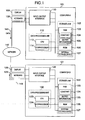
- FIG. 1 illustrates a system configuration where a computer A 101 and a computer B 121, which are connected to each other via a network and to which the computation method for the modular exponentiation operation according to the present invention are applied, are connected to each other via the network 142.
- c m e mod n is computed and outputted.
- c d mod n is computed and outputted.
- m is an integer for indicating the data to be encrypted
- e and n are integers for indicating a public key
- c is an integer for indicating the ciphertext with respect to the data m
- d is an integer for indicating a private key.
- the computer A 101 includes arithmetic-logic operation devices such as a CPU 113 and a coprocessor 114, storage devices such as a RAM 103, a ROM 106, and an external storage device 107, and an input/output interface 110 for performing data input/output with the outside of the computer.
- arithmetic-logic operation devices such as a CPU 113 and a coprocessor 114
- storage devices such as a RAM 103, a ROM 106, and an external storage device 107
- an input/output interface 110 for performing data input/output with the outside of the computer.
- Devices for a user to operate the computer A 101 such as a display 108, a keyboard 109, and a read/write device of detachable/attachable transportable-type storage medium, are connected thereto at the outside thereof.
- the storage devices such as the RAM 103, the ROM 106, and the external storage device 107, implement a storage unit 102.
- the arithmetic-logic operation devices such as the CPU 113 and the coprocessor 114, execute programs stored in the storage unit 102, thereby implementing a data processing unit 112.
- the data processing unit 112 as an encryption processing unit 112, performs encryption of inputted data.
- the computer B 121 has basically the same hardware configuration as that of the computer A 101.
- storage devices such as a RAM 123, a ROM 126, and an external storage device 127, implement a storage unit 122.
- arithmetic-logic operation devices such as a CPU 133 and a coprocessor 134, execute programs stored in the storage unit 122, thereby implementing a data processing unit 132.
- the data processing unit 132 as a decryption processing unit 132, performs decryption of a ciphertext, i.e., encrypted data.
- the above-described respective programs may be stored in advance in the storage units within the above-described computers. Otherwise, the respective programs may be introduced when needed into the above-described storage units from another device via the input/output interfaces and a medium made available to the above-described computers.
- the medium refers to, e.g., a storage medium detachable/attachable from/to the input/output interfaces, or a communications medium (i.e., a network or carrier waves propagating on the network).
- the encryption processing unit 112 judges whether or not the bit length of the plaintext data is equal to a predetermined bit length. If the bit length is found to be longer than the predetermined one, the unit 112 separates the plaintext data so that the bit length will become equal to the predetermined one.
- partial data also referred to as simply "data" which has been separated into the predetermined bit length.
- the computer A 101 assembles encrypted output data from the one or more pieces of partial data encrypted by the encryption processing unit 112.
- the computer A 101 outputs the encrypted data 141 from the input/output interface 110, then transferring the data 141 to the computer B 121 via the network 142.
- the decryption processing unit 132 judges whether or not the bit length of the encrypted data inputted is equal to a predetermined bit length. If the bit length is found to be longer than the predetermined one, the unit 132 separates the encrypted data so that the bit length will become equal to the predetermined one.
- partial data also referred to as simply "data" which has been separated into the predetermined bit length.
- the computer B 121 assembles the plaintext data from the pieces of partial data decrypted by the decryption processing unit 132, then outputting the plaintext data from the display 128 or the like via the input/output interface 130.
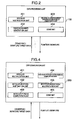
- function blocks of the data processing unit 132 illustrated in FIG. 2 are used as the decryption processing unit 132.
- the data processing unit 132 includes a modular multiplication unit 201, a random-number generation unit 202, a general-purpose modular exponentiation computation unit 203, and a constant 204.
- the decryption processing unit 132 computes the plaintext m, i.e., the partial data before being encrypted, from the ciphertext c which has been separated into the predetermined bit length.
- the decryption processing unit 132 receives the ciphertext c.
- the random-number generation unit 202 generates a random number r (301).
- the general-purpose modular exponentiation computation unit 203 computes r e-1 mod n, then storing the result into s (302).
- the modular multiplication unit 201 computes src mod n, then storing the result into t (303). This computation can be accomplished such that the modular multiplication unit 201 computes sr mod n from s and r, and after that, computes (sr)c mod n.
- the general-purpose modular exponentiation computation unit 203 computes t d-1 mod n, then storing the result into u (304).
- the modular multiplication unit 201 computes us mod n, then storing the result into v (305).
- the modular multiplication unit 201 computes vc mod n, then storing the result into m' (306).
- the decryption processing unit 132 outputs m' as the plaintext m, i.e., the partial data before being encrypted (307).
- the plaintext data is assembled from the plaintext m.
- the general-purpose modular exponentiation computation unit 203 functions as a CRT computation unit 203.
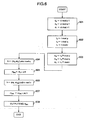
- the CRT computation unit 203 includes a modular multiplication unit 401, a modular addition/subtraction unit 402, a modular-residue computation unit 403, a modular exponentiation computation unit 404, an addition/subtraction/multiplication unit 405, and a constant 406.
- the CRT computation unit 203 computes t d mod n from the integer t and the integer d, using prime numbers p and q.
- p and q are the prime numbers which can divide n with no residue left.
- the CRT computation unit 203 receives the integer t and the integer d.
- the modular-residue computation unit 403 computes d mod p-1 and d mod q-1, then storing the results into d p and d q respectively (501).
- the modular-residue computation unit 403 computes t mod p and t mod q, then storing the results into t p and t q respectively (502).
- the modular exponentiation computation unit 404 computes t p dp mod p and t q dq mod q, then storing the results into m p and m q respectively (503) .
- the modular multiplication unit 401 and the modular addition/subtraction unit 402 compute (m q -m p ) pInv mod q, then storing the result into h (504). This computation can be accomplished such that the modular addition/subtraction unit 402 computes m q -m p mod q, and such that the modular multiplication unit 401 multiplies the result by pInv (i.e., (m q -m p ) pInv mod q).
- the addition/subtraction/multiplication unit 405 computes m p +ph, then storing the result into m pq (505). This computation can be accomplished such that the addition/subtraction/multiplication unit 405 computes ph, and adds m p to the result (i. e. , m p + (ph) ) .
- the integer pInv is stored in the CRT computation unit 203 as the constant 406.
- the CRT computation unit 203 outputs m pq as t d mod n (506).
- the computation method allows implementation of the higher-speed computation as compared with the technique described in the document 3. Also, in the case where e has been determined by the expression 7, as compared with the method of directly computing c d mod n, an increase in the computation amount proves equivalent to the amount of the 20-time modular multiplications.
- execution of the 1024-bit general-purpose modular exponentiation operation necessitates substantially 1500-time modular multiplications. Consequently, it can be said that the computation-amount increase in the above-described computation method is comparatively small in comparison with this value.
- the above-described computation method is also effective for defense against the side-channel attack.
- the reason for this is as follows:
- the step or steps at which the private key is used is, after all, the step 304 alone.
- the integer t i.e., the inputted value at the step 304, is the multiplication result acquired by multiplying the inputted data c by the e exponentiation of the random number r generated at the step 301. Accordingly, the attacker finds it impossible to predict the value of the integer t.
- the Novak's attack is made by taking advantage of the situation where the value to be inputted into the general-purpose modular exponentiation operation has been already known to the attacker. Consequently, the attacker finds it impossible to make the Novak's attack.
- the above-described computation method exhibits immunity against the side-channel attack, since the method reveals none of the information useful for the side-channel attack. Also, the method allows implementation of the high-speed computation, since the method uses no inverse operation. Moreover, the method guarantees that the memory-use amount to be needed is a small one, since the method accompanies none of the necessity for storing in advance the result of the inverse operation into the memory.
- the above-described computation method is also applicable to the multi-prime RSA and the multi-exponent RSA.
- the method exhibits the immunity against the side-channel attack, and further, allows the high-speed computation and implements the small memory-use since the method uses no inverse operation.
- the number of the large prime numbers is set as 3, but may also be set as 4 or more.
- the expression 4 holds in the multi-prime RSA as well.
- the expression 5 is computed in the encryption and verification of the signature, while the expression 6 is computed in the decryption and generation of the signature. Accordingly, when performing the decryption processing, by using the first computation method, the multi-prime RSA exhibits the immunity against the side-channel attack, and further, allows the high-speed computation and implements the small memory-use since the method uses no inverse operation.
- the general-purpose modular exponentiation computation unit 203 functions as the CRT computation unit 203.
- the CRT computation unit 203 computes t d mod n from the integer t and the integer d, using the prime numbers p, q and r.
- p, q and r are the prime numbers which can divide n with no residue left.
- the CRT computation unit 203 receives the integer t and the integer d.
- the modular-residue computation unit 403 computes d mod p-1 and d mod q-1, and d mod r-1, then storing the results into d p , d q , and d r respectively (601) .
- the modular-residue computation unit 403 computes t mod p, t mod q, and t mod r, then storing the results into t p , t q , and t r respectively (602) .
- the modular exponentiation computation unit 404 computes t p dp mod p, t q dq mod q, and t r dr mod r, then storing the results into m p , m q , and m r respectively (603).
- the modular multiplication unit 401 and the modular addition/subtraction unit 402 compute (m q -m p ) pInv mod q, then storing the result into h (604). This computation can be accomplished such that the modular addition/subtraction unit 402 computes (m q -m p ) mod q, and such that the modular multiplication unit 401 multiplies the result by pInv (i.e., (m q -m p ) pInv mod q).
- pInv is the integer satisfying the expression 8.
- the addition/subtraction/multiplication unit 405 computes m p +ph, then storing the result into m pq (605). This computation can be accomplished such that the addition/subtraction/multiplication unit 405 computes ph, and adds m p to the result (i.e., m p +(ph)) .
- the modular multiplication unit 401 and the modular addition/subtraction unit 402 compute (m r -m pq ) pqInv mod r, then storing the result into h (606). This computation can be accomplished such that the modular addition/subtraction unit 402 computes m r -m pq mod r, and such that the modular multiplication unit 401 multiplies the result by pqInv (i.e., (m r -m pq )pqInv mod r).
- the integer pqInv is stored in the CRT computation unit 203 as the constant 406.
- the addition/subtraction/multiplication unit 405 computes m pq +pqh, then storing the result into m pqr (607). This computation can be accomplished such that the addition/subtraction/multiplication unit 405 computes pq, multiplies the result by h, and further, adds m pq to the result (i.e., m pq + ((pq) h) .
- the CRT computation unit 203 outputs m pqr as t d mod n (608).
- the expression 4 holds in the multi-exponent RSA as well.
- the expression 5 is computed in the encryption and verification of the signature, while the expression 6 is computed in the decryption and generation of the signature. Consequently, when performing the decryption processing, by using the first computation method, the multi-exponent RSA exhibits the immunity against the side-channel attack, and further, allows the high-speed computation and implements the small memory-use since the method uses no inverse operation.
- the general-purpose modular exponentiation computation unit 203 functions as the CRT computation unit 203.
- the CRT computation unit 203 computes t d mod n from the integer t and the integer d, using the prime numbers p and q.
- p and q are the prime numbers which can divide n with no residue left.
- n can also be divided by p 2 with no residue left.
- the CRT computation unit 203 receives the integer t and the integer d.
- the modular-residue computation unit 403 computes d mod p-1 and d mod q-1, then storing the results into d p and d q respectively (701) .
- the modular-residue computation unit 403 computes t mod p and t mod q, then storing the results into t p and t q respectively (702) .
- the modular exponentiation computation unit 404 computes t p dp-1 mod p, then storing the result into k (703).
- the modular-residue computation unit 403 computes t p k mod p, then storing the result into m p . Also, the modular exponentiation computation unit 404 computes t q dq mod q, then storing the result into m q (704).
- the modular exponentiation computation unit 404, the modular addition/subtraction unit 402, and the modular-residue computation unit 403 compute c-m p e mod p 2 , then storing the result into g. Also, the modular multiplication unit 401 computes gkeInv mod p 2 , then storing the result into b. Also, the addition/subtraction/multiplication unit 405 computes m q +b, then storing the result into m p2 (705).
- the result to be stored into g can be computed such that the modular exponentiation computation unit 404 computes m p e mod p 2 , and such that the modular-residue computation unit 403 computes c mod p 2 , and such that the modular addition/subtraction unit 402 takes the difference therebetween (i.e., (c mod p 2 ) - (m p e mod p 2 )).
- the result to be stored into b can be computed such that the modular multiplication unit 401 computes gk mod p 2 , and multiplies the result by eInv (i.e., (gk) eInv mod p 2 ) .
- the addition/subtraction/multiplication unit 405 computes mq+b.
- the integer eInv is stored in the CRT computation unit 203 as the constant 406.
- the modular multiplication unit 401 and the modular addition/subtraction unit 402 compute (m q -m p2 ) p 2 Inv mod q, then storing the result into h (706).
- This computation can be accomplished such that the modular addition/subtraction unit 402 computes m q -m p2 mod q, and such that the modular multiplication unit 401 multiplies the result by p 2 Inv (i.e., (m q -m p2 ) p 2 Inv mod q).
- the integer p 2 Inv is stored in the CRT computation unit 203 as the constant 406.
- the addition/subtraction/multiplication unit 405 computes m p2 + p 2 h, then storing the result into m p2q (707). This computation can be accomplished such that the addition/subtraction/multiplication unit 405 computes (p 2 ) h, and adds m p2 to the result (i.e., m p +((p 2 )h)) .
- the CRT computation unit 203 outputs m p2q as t d mod n (708).
- the private key is defined as large prime numbers p and q, while the public key is defined as integers n and e.
- e 2 is set.
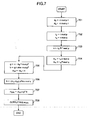
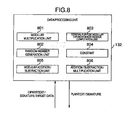
- the data processing unit 132 includes a modular multiplication unit 801, a random-number generation unit 802, a general-purpose modular exponentiation computation unit 803, a constant 804, a modular addition/subtraction unit 805, and an addition/subtraction/multiplication unit 806.
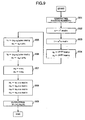
- the decryption processing unit 132 computes the plaintext m from the ciphertext c which has been separated into the predetermined bit length.
- the decryption processing unit 132 receives the ciphertext c.
- the random-number generation unit 802 generates a random number r (901).
- the modular multiplication unit 801 computes r 2 mod n, then storing the result into s (902).
- the modular multiplication unit 801 computes s 2 c mod n, then storing the result into t (903). This computation can be accomplished such that the modular multiplication unit 801 computes s 2 mod n from s, and after that, computes (s 2 )c mod n.
- the general-purpose modular exponentiation computation unit 803 computes t (p-3)/4 mod p and t (q-3)/4 mod q, then storing the results into u p and u q respectively (904) .
- the modular multiplication unit 801 and the modular addition/subtraction unit 805 compute (u q -u p ) pInv mod q, then storing the result into h 1 . Also, the addition/subtraction/multiplication unit 806 computes u p +ph 1 , then storing the result into w 1 (905). These computations can be accomplished as follows: The result to be stored into h 1 can be computed such that the modular addition/subtraction unit 805 computes u q -u p mod q, and such that the modular multiplication unit 801 multiplies the result by pInv (i.e., (u q -u p ) pInv mod q).
- the addition/subtraction/multiplication unit 806 computes ph 1 , and adds u p to the result (i.e., u p + (ph 1 )) .
- pInv is the integer satisfying the expression 8.
- the modular multiplication unit 801 and the modular addition/subtraction unit 805 compute (u q +u p ) pInv mod q, then storing the result into h 2 . Also, the addition/subtraction/multiplication unit 806 computes -u p +ph 2 , then storing the result into w 2 (906). These computations can be accomplished as follows: The result to be stored into h 2 can be computed such that the modular addition/subtraction unit 805 computes u q +u p mod q, and such that the modular multiplication unit 801 multiplies the result by pInv (i.e., (u q +u p ) pInv mod q). After that, the addition/subtraction/multiplication unit 806 computes ph 2 , and subtracts u p from the result (i.e., -u p +(ph 2 )) .
- the addition/subtraction/multiplication unit 806 computes n-w 1 and n-w 2 , then storing the results into w 3 and w 4 respectively (907) .
- the modular multiplication unit 801 computes w 1 cs mod n, w 2 cs mod n, w 3 cs mod n, and w 4 cs mod n, then storing the results into m 1 , m 2 , m 3 , and m 4 respectively (908). These computations can be accomplished such that the modular multiplication unit 801 computes cs mod n, and multiplies the result by w 1 , w 2 , w 3 , and w 4 respectively.
- the decryption processing unit 132 outputs m 1 , m 2 , m 3 , and m 4 as candidates of the plaintext m (909) .
- the above-described computation method is also effective for defense against the side-channel attack.
- the reason for this is as follows:
- the step at which the private key is used for the first time is the step 904.
- the operation result at the step 904 is used.
- the integer t i.e., the inputted value at the step 904
- the Novak's attack is made by taking advantage of the situation where the value to be inputted into the general-purpose modular exponentiation operation has been already known to the attacker. Consequently, the attacker finds it impossible to make the Novak's attack.
- the above-described computation method exhibits immunity against the side-channel attack, since the method reveals none of the information useful for the side-channel attack. Also, the method allows implementation of the high-speed computation, since the method uses no inverse operation. Moreover, the method guarantees that the memory-use amount to be needed is a small one, since the method accompanies none of the necessity for storing in advance the result of the inverse operation into the memory.
- the computations may also be executed in such a manner that -u p is replaced by p-u p .
- This replacement allows the computations to be executed without dealing with the negative integer, thereby making it possible to simplify the programs.
- HIME(R) the private key is defined as large prime numbers p and q, while the public key is defined as integers n and e.
- e is selected so that the expression 20 will be satisfied.
- the prime numbers p and q are selected so that the expression 21 will be satisfied.
- the function blocks of the data processing unit 132 illustrated in FIG. 8 are used as the decryption processing unit 132.
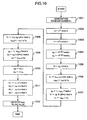
- the decryption processing unit 132 computes the plaintext m from the ciphertext c which has been separated into the predetermined bit length.
- the decryption processing unit 132 receives the ciphertext c.
- the random-number generation unit 802 generates a random number r (1001).
- the modular multiplication unit 801 computes r 2 mod n, then storing the result into s (1002).
- the modular multiplication unit 801 computes S 2 C mod n, then storing the result into t (1003). This computation can be accomplished such that the modular multiplication unit 801 computes s 2 mod n from s, and after that, computes (s 2 )c mod n.
- the general-purpose modular exponentiation computation unit 803 computes t (p-3)/4 mod p and t (q-3)/4 mod q, then storing the results into u p and u q respectively (1004) .
- the modular multiplication unit 801 computes u p t mod p, then storing the result into k (1005).
- the modular multiplication unit 801 and the modular addition/subtraction unit 805 compute (u q -u p ) pInv mod q, then storing the result into h 1 . Also, the addition/subtraction/multiplication unit 806 computes u p +ph 1 , then storing the result into u pq,1 (1006) . These computations can be accomplished as follows: The result to be stored into h 1 can be computed such that the modular addition/subtraction unit 805 computes u q -u p mod q, and such that the modular multiplication unit 801 multiplies the result by pInv (i.e., (u q -u p )pInv mod q).
- the addition/subtraction/multiplication unit 806 computes ph 1 , and adds u p to the result (i.e., u p +(ph 1 )) .
- pInv is the integer satisfying the expression 8.
- the modular multiplication unit 801 and the modular addition/subtraction unit 805 compute t-u pq,1 2 mod n, then storing the result into g 1 . Also, the modular multiplication unit 801 computes g 1 k (2Inv) mod n, then storing the result into b 1 . Also, the addition/subtraction/multiplication unit 806 computes u pq,1 + b 1 , then storing the result into u 1 (1007).
- the result to be stored into g 1 can be computed such that the modular multiplication unit 801 computes u pq,1 2 mod n, and such that the modular addition/subtraction unit 805 subtracts the result from t (i.e., t-(u pq,1 2 ) mod n).
- the result to be stored into b 1 can be computed such that the modular multiplication unit 801 computes k (2Inv) mod n, and multiplies the result by g 1 (i.e., g 1 k(2Inv) mod n).
- the addition/subtraction/multiplication unit 806 computes u pq,1 + b 1 .
- the modular multiplication unit 801 and the modular addition/subtraction unit 805 compute (u q +u p ) pInv mod q, then storing the result into h 2 . Also, the addition/subtraction/multiplication unit 806 computes p-u p +ph 2 , then storing the result into u pq,2 (1008). These computations can be accomplished as follows: The result to be stored into h 2 can be computed such that the modular addition/subtraction unit 805 computes u q +u p mod q, and such that the modular multiplication unit 801 multiplies the result by pInv (i.e., (u q +u p ) pInv mod q).
- the addition/subtraction/multiplication unit 806 computes ph 2 , adds p to the result, and subtracts u p from the further result (i.e., p-u p + (ph 2 ) ) .
- the modular multiplication unit 801 and the modular addition/subtraction unit 805 compute t-u pq,2 2 mod n, then storing the result into g 2 . Also, the modular multiplication unit 801 computes g 2 k (2Inv) mod n, then storing the result into b 2 . Also, the addition/subtraction/multiplication unit 806 computes u pq,2 + b 2 , then storing the result into u 2 (1009). These computations can be accomplished as follows: The result to be stored into g 2 can be computed such that the modular multiplication unit 801 computes u pq,2 2 mod n, and such that the modular addition/subtraction unit 805 subtracts the result from t (i.e.
- the result to be stored into b 2 can be computed such that the modular multiplication unit 801 computes k (2Inv) mod n, and multiplies the result by g 2 (i.e., g 2 k (2Inv) mod n). After that, the addition/subtraction/multiplication unit 806 computes u Pq,2 + b 2 .
- 2Inv is the integer satisfying the expression 35.
- the addition/subtraction/multiplication unit 806 computes n-u 1 and n-u 2 , then storing the results into u 3 and u 4 respectively (1010) .
- the modular multiplication unit 801 computes u 1 cs mod n, u 2 cs mod n, u 3 cs mod n, and u 4 cs mod n, then storing the results into m 1 , m 2 , m 3 , and m 4 respectively (1011). These computations can be accomplished such that the modular multiplication unit 801 computes cs mod n, and multiplies the result by u 1 , u 2 , u 3 , and u 4 respectively.
- the decryption processing unit 132 outputs m 1 , m 2 , m 3 , and m 4 as candidates of the plaintext m (1012) .
- u p 2 s - 2 ⁇ m - 2 ⁇ mod p holds.
- u q 2 s - 2 ⁇ m - 2 ⁇ mod q holds.
- execution of the 1024-bit general-purpose modular exponentiation operation necessitates substantially 1500-time modular multiplications. Consequently, it can be said that the computation-amount increase in the above-described computation method is comparatively small in comparison with this value.
- the above-described computation method is also effective for defense against the side-channel attack.
- the reason for this is as follows:
- the step at which the private key is used for the first time is the step 1004.
- the operation result at the step 1004 is used.
- the integer t i.e., the inputted value at the step 1004 is the multiplication result acquired by multiplying the inputted data c by the four exponentiation of the random number r generated at the step 1001. Accordingly, the attacker finds it impossible to predict the value of the integer t.
- the Novak's attack is made by taking advantage of the situation where the value to be inputted into the general-purpose modular exponentiation operation has been already known to the attacker. Consequently, the attacker finds it impossible to make the Novak's attack.
- the above-described computation method exhibits immunity against the side-channel attack, since the method reveals none of the information useful for the side-channel attack. Also, the method allows implementation of the high-speed computation, since the method uses no inverse operation. Moreover, the method guarantees that the memory-use amount to be needed is a small one, since the method accompanies none of the necessity for storing in advance the result of the inverse operation into the memory.
- the computations may also be executed in such a manner that -u p is replaced by p-u p .
- This replacement allows the computations to be executed without dealing with the negative integer, thereby making it possible to simplify the programs.
- the present invention is usable as a signature generation method.
- the ciphertext c is dealt with as signature-target data c.
- the computers in the above-described embodiments may be smart cards, mobile telephones, or information home electric-appliances. Also, at that time, the modular exponentiation computation may be performed in such a manner that necessary data is inputted on line into the above-described computers.
- the data processing units or the CRT computation units in the above-described respective embodiments may be implemented using the specific-purpose hardware.
- the modular multiplication unit, the modular addition/subtraction unit, the random-number generation unit, the general-purpose modular exponentiation computation unit, the modular-residue computation unit, and the addition/subtraction/multiplication unit may be implemented using the coprocessors or the specific-purpose hardware other than those.
Landscapes
- Physics & Mathematics (AREA)
- General Physics & Mathematics (AREA)
- Engineering & Computer Science (AREA)
- Computational Mathematics (AREA)
- Mathematical Analysis (AREA)
- Mathematical Optimization (AREA)
- Pure & Applied Mathematics (AREA)
- Theoretical Computer Science (AREA)
- Computing Systems (AREA)
- Mathematical Physics (AREA)
- General Engineering & Computer Science (AREA)
- Storage Device Security (AREA)
Applications Claiming Priority (2)
| Application Number | Priority Date | Filing Date | Title |
|---|---|---|---|
| JP2004001602 | 2004-01-07 | ||
| JP2004001602A JP4626148B2 (ja) | 2004-01-07 | 2004-01-07 | 復号または署名作成におけるべき乗剰余算の計算方法 |
Publications (2)
| Publication Number | Publication Date |
|---|---|
| EP1553720A1 EP1553720A1 (en) | 2005-07-13 |
| EP1553720B1 true EP1553720B1 (en) | 2009-10-28 |
Family
ID=34587677
Family Applications (1)
| Application Number | Title | Priority Date | Filing Date |
|---|---|---|---|
| EP04016352A Expired - Lifetime EP1553720B1 (en) | 2004-01-07 | 2004-07-12 | Modular exponentiation method in decryption or signature generation |
Country Status (4)
| Country | Link |
|---|---|
| US (1) | US7512231B2 (enExample) |
| EP (1) | EP1553720B1 (enExample) |
| JP (1) | JP4626148B2 (enExample) |
| DE (1) | DE602004023811D1 (enExample) |
Families Citing this family (10)
| Publication number | Priority date | Publication date | Assignee | Title |
|---|---|---|---|---|
| EP2015171A1 (fr) * | 2007-06-29 | 2009-01-14 | Gemplus | Procédé cryptographique comprenant une exponentiation modulaire sécurisée contre les attaques à canaux cachés sans la connaissance de l'exposant public, cryptoprocesseur pour la mise en oeuvre du procédé et carte à puce associée |
| FR2977953A1 (fr) * | 2011-07-13 | 2013-01-18 | St Microelectronics Rousset | Protection d'un calcul d'exponentiation modulaire par addition d'une quantite aleatoire |
| FR3015079B1 (fr) * | 2013-12-17 | 2016-02-05 | Oberthur Technologies | Verification d'integrite de paire de cles cryptographiques |
| FR3015076B1 (fr) * | 2013-12-17 | 2016-02-05 | Oberthur Technologies | Generation de cles cryptographiques |
| CN105099684B (zh) * | 2014-05-08 | 2019-08-16 | 国民技术股份有限公司 | 一种模幂运算的处理方法、装置及密码设备 |
| WO2017135970A1 (en) * | 2016-02-05 | 2017-08-10 | Entit Software Llc | Extended ciphertexts |
| KR101982237B1 (ko) * | 2017-03-06 | 2019-05-24 | 고려대학교 산학협력단 | 클라우드 컴퓨팅 환경에서의 속성 기반 암호화를 이용한 데이터 공유 방법 및 시스템 |
| KR102003936B1 (ko) * | 2019-02-18 | 2019-07-29 | 주식회사 에이티이엔지 | 해킹방지용 데이터 전송 케이블 |
| US11249726B2 (en) | 2019-09-10 | 2022-02-15 | Intel Corporation | Integrated circuits with modular multiplication circuitry |
| CN111352609B (zh) * | 2020-03-05 | 2022-06-14 | 青岛大学 | 一种基于边缘计算的分布式外包模幂运算方法 |
Family Cites Families (10)
| Publication number | Priority date | Publication date | Assignee | Title |
|---|---|---|---|---|
| EP0697687A4 (en) * | 1994-03-07 | 2000-09-20 | Nippon Telegraph & Telephone | ZERO KNOWLEDGE AUTHENTICATION PROTOCOL-BASED METHOD AND SYSTEM FOR MESSAGE TRANSMISSION |
| US6411715B1 (en) * | 1997-11-10 | 2002-06-25 | Rsa Security, Inc. | Methods and apparatus for verifying the cryptographic security of a selected private and public key pair without knowing the private key |
| EP1050133B2 (en) * | 1998-01-02 | 2009-05-27 | Cryptography Research Inc. | Leak-resistant cryptographic method and apparatus |
| JP4317607B2 (ja) * | 1998-12-14 | 2009-08-19 | 株式会社日立製作所 | 情報処理装置、耐タンパ処理装置 |
| JP4083925B2 (ja) * | 1999-06-24 | 2008-04-30 | 株式会社日立製作所 | 情報処理装置、カード部材および情報処理システム |
| JP2002247025A (ja) * | 2001-02-22 | 2002-08-30 | Hitachi Ltd | 情報処理装置 |
| DE10143728B4 (de) * | 2001-09-06 | 2004-09-02 | Infineon Technologies Ag | Vorrichtung und Verfahren zum Berechnen eines Ergebnisses einer modularen Exponentiation |
| JP4086503B2 (ja) * | 2002-01-15 | 2008-05-14 | 富士通株式会社 | 暗号演算装置及び方法並びにプログラム |
| US7983414B2 (en) * | 2002-09-11 | 2011-07-19 | Giesecke & Devrient Gmbh | Protected cryptographic calculation |
| TW586086B (en) * | 2002-12-27 | 2004-05-01 | Ind Tech Res Inst | Method and apparatus for protecting public key schemes from timing, power and fault attacks |
-
2004
- 2004-01-07 JP JP2004001602A patent/JP4626148B2/ja not_active Expired - Fee Related
- 2004-07-12 DE DE602004023811T patent/DE602004023811D1/de not_active Expired - Lifetime
- 2004-07-12 EP EP04016352A patent/EP1553720B1/en not_active Expired - Lifetime
- 2004-07-19 US US10/893,523 patent/US7512231B2/en not_active Expired - Fee Related
Also Published As
| Publication number | Publication date |
|---|---|
| US20050147241A1 (en) | 2005-07-07 |
| EP1553720A1 (en) | 2005-07-13 |
| JP4626148B2 (ja) | 2011-02-02 |
| DE602004023811D1 (de) | 2009-12-10 |
| US7512231B2 (en) | 2009-03-31 |
| JP2005195829A (ja) | 2005-07-21 |
Similar Documents
| Publication | Publication Date | Title |
|---|---|---|
| Coron | Resistance against differential power analysis for elliptic curve cryptosystems | |
| CA2256179C (en) | Encryption and decryption devices for public-key cryptosystems and recording medium with their processing programs recorded thereon | |
| EP1467512B1 (en) | Encryption process employing chaotic maps and digital signature process | |
| EP3188001A1 (en) | Modular multiplication device and method | |
| US7054444B1 (en) | Public and private key cryptographic method | |
| KR100652377B1 (ko) | 모듈라 지수승 알고리즘, 기록매체 및 시스템 | |
| CN100388663C (zh) | 用于检测一个键对和用于产生rsa键的方法和装置 | |
| EP3503459A1 (en) | Device and method for protecting execution of a cryptographic operation | |
| JP2004304800A (ja) | データ処理装置におけるサイドチャネル攻撃防止 | |
| Nitaj | Diophantine and lattice cryptanalysis of the RSA cryptosystem | |
| US7512231B2 (en) | Computation method for modular exponentiation operation in decryption or signature generation | |
| KR20030075146A (ko) | 암호 체계의 비밀 키 저장 및 복원 방법과 장치 | |
| EP1347596B1 (en) | Digital signature methods and apparatus | |
| US20100287384A1 (en) | Arrangement for and method of protecting a data processing device against an attack or analysis | |
| KR100953715B1 (ko) | Crt-rsa 모듈라 지수승 알고리즘을 이용한 디지털서명 방법, 그 장치 및 이를 기록한 컴퓨터 판독가능 저장매체 | |
| Kayode et al. | Efficient RSA cryptosystem decryption based on Chinese remainder theorem and strong prime | |
| Yakubu et al. | An improved RSA image encryption algorithm using 1-D logistic map | |
| Verma et al. | An improved RSA variant | |
| Fibíková et al. | Practical cryptography-the key size problem: PGP after years | |
| Rivest et al. | RSA (cryptosystem) | |
| Alia | Combining Public-Key Encryption with Digital Signature Cryptosystems | |
| Rutledge | Mathematics of RSA Encryption | |
| Lin et al. | A server-aided computation protocol for RSA enciphering algorithm | |
| Wavhal et al. | Secure Data Transmission using Upgraded Versions of RSA Algorithm | |
| JP3043762B2 (ja) | 鍵生成装置 |
Legal Events
| Date | Code | Title | Description |
|---|---|---|---|
| PUAI | Public reference made under article 153(3) epc to a published international application that has entered the european phase |
Free format text: ORIGINAL CODE: 0009012 |
|
| AK | Designated contracting states |
Kind code of ref document: A1 Designated state(s): AT BE BG CH CY CZ DE DK EE ES FI FR GB GR HU IE IT LI LU MC NL PL PT RO SE SI SK TR |
|
| AX | Request for extension of the european patent |
Extension state: AL HR LT LV MK |
|
| 17P | Request for examination filed |
Effective date: 20060103 |
|
| AKX | Designation fees paid |
Designated state(s): DE FR GB |
|
| GRAP | Despatch of communication of intention to grant a patent |
Free format text: ORIGINAL CODE: EPIDOSNIGR1 |
|
| GRAS | Grant fee paid |
Free format text: ORIGINAL CODE: EPIDOSNIGR3 |
|
| GRAA | (expected) grant |
Free format text: ORIGINAL CODE: 0009210 |
|
| AK | Designated contracting states |
Kind code of ref document: B1 Designated state(s): DE FR GB |
|
| REG | Reference to a national code |
Ref country code: GB Ref legal event code: FG4D |
|
| REF | Corresponds to: |
Ref document number: 602004023811 Country of ref document: DE Date of ref document: 20091210 Kind code of ref document: P |
|
| PLBE | No opposition filed within time limit |
Free format text: ORIGINAL CODE: 0009261 |
|
| STAA | Information on the status of an ep patent application or granted ep patent |
Free format text: STATUS: NO OPPOSITION FILED WITHIN TIME LIMIT |
|
| 26N | No opposition filed |
Effective date: 20100729 |
|
| PGFP | Annual fee paid to national office [announced via postgrant information from national office to epo] |
Ref country code: DE Payment date: 20130711 Year of fee payment: 10 |
|
| PGFP | Annual fee paid to national office [announced via postgrant information from national office to epo] |
Ref country code: FR Payment date: 20130724 Year of fee payment: 10 Ref country code: GB Payment date: 20130710 Year of fee payment: 10 |
|
| REG | Reference to a national code |
Ref country code: DE Ref legal event code: R119 Ref document number: 602004023811 Country of ref document: DE |
|
| GBPC | Gb: european patent ceased through non-payment of renewal fee |
Effective date: 20140712 |
|
| REG | Reference to a national code |
Ref country code: FR Ref legal event code: ST Effective date: 20150331 |
|
| PG25 | Lapsed in a contracting state [announced via postgrant information from national office to epo] |
Ref country code: DE Free format text: LAPSE BECAUSE OF NON-PAYMENT OF DUE FEES Effective date: 20150203 |
|
| REG | Reference to a national code |
Ref country code: DE Ref legal event code: R119 Ref document number: 602004023811 Country of ref document: DE Effective date: 20150203 |
|
| PG25 | Lapsed in a contracting state [announced via postgrant information from national office to epo] |
Ref country code: FR Free format text: LAPSE BECAUSE OF NON-PAYMENT OF DUE FEES Effective date: 20140731 Ref country code: GB Free format text: LAPSE BECAUSE OF NON-PAYMENT OF DUE FEES Effective date: 20140712 |