EP1553451A1 - Photoresist base material, method for purification thereof, and photoresist compositions - Google Patents
Photoresist base material, method for purification thereof, and photoresist compositions Download PDFInfo
- Publication number
- EP1553451A1 EP1553451A1 EP03808872A EP03808872A EP1553451A1 EP 1553451 A1 EP1553451 A1 EP 1553451A1 EP 03808872 A EP03808872 A EP 03808872A EP 03808872 A EP03808872 A EP 03808872A EP 1553451 A1 EP1553451 A1 EP 1553451A1
- Authority
- EP
- European Patent Office
- Prior art keywords
- base material
- photoresist
- group
- recited
- organic group
- Prior art date
- Legal status (The legal status is an assumption and is not a legal conclusion. Google has not performed a legal analysis and makes no representation as to the accuracy of the status listed.)
- Withdrawn
Links
- 0 CCC(CC(C1)C2)(CC1(*C)C1)CC21C(C)=C Chemical compound CCC(CC(C1)C2)(CC1(*C)C1)CC21C(C)=C 0.000 description 3
- GQTLOGQTRXBOHV-UHFFFAOYSA-N CC(C)(C(CC1)C2)C1(CS(ON(C(c1cccc3cccc4c13)=O)C4=O)(=O)=O)C2=O Chemical compound CC(C)(C(CC1)C2)C1(CS(ON(C(c1cccc3cccc4c13)=O)C4=O)(=O)=O)C2=O GQTLOGQTRXBOHV-UHFFFAOYSA-N 0.000 description 1
- RCLCPRYOCVVVFT-UHFFFAOYSA-N CC(c1cc(C(C)c2cc(C(C)c3cc(C4C)c(C)cc3C)c(C)cc2C)c(C)cc1C)c1c(C)cc(C)c4c1 Chemical compound CC(c1cc(C(C)c2cc(C(C)c3cc(C4C)c(C)cc3C)c(C)cc2C)c(C)cc1C)c1c(C)cc(C)c4c1 RCLCPRYOCVVVFT-UHFFFAOYSA-N 0.000 description 1
- LGPYKIDAFQVONA-UHFFFAOYSA-N CCC1(CC2CC(C3)C1)CC31C2=C1C Chemical compound CCC1(CC2CC(C3)C1)CC31C2=C1C LGPYKIDAFQVONA-UHFFFAOYSA-N 0.000 description 1
Classifications
-
- G—PHYSICS
- G03—PHOTOGRAPHY; CINEMATOGRAPHY; ANALOGOUS TECHNIQUES USING WAVES OTHER THAN OPTICAL WAVES; ELECTROGRAPHY; HOLOGRAPHY
- G03F—PHOTOMECHANICAL PRODUCTION OF TEXTURED OR PATTERNED SURFACES, e.g. FOR PRINTING, FOR PROCESSING OF SEMICONDUCTOR DEVICES; MATERIALS THEREFOR; ORIGINALS THEREFOR; APPARATUS SPECIALLY ADAPTED THEREFOR
- G03F7/00—Photomechanical, e.g. photolithographic, production of textured or patterned surfaces, e.g. printing surfaces; Materials therefor, e.g. comprising photoresists; Apparatus specially adapted therefor
- G03F7/004—Photosensitive materials
- G03F7/039—Macromolecular compounds which are photodegradable, e.g. positive electron resists
-
- G—PHYSICS
- G03—PHOTOGRAPHY; CINEMATOGRAPHY; ANALOGOUS TECHNIQUES USING WAVES OTHER THAN OPTICAL WAVES; ELECTROGRAPHY; HOLOGRAPHY
- G03F—PHOTOMECHANICAL PRODUCTION OF TEXTURED OR PATTERNED SURFACES, e.g. FOR PRINTING, FOR PROCESSING OF SEMICONDUCTOR DEVICES; MATERIALS THEREFOR; ORIGINALS THEREFOR; APPARATUS SPECIALLY ADAPTED THEREFOR
- G03F7/00—Photomechanical, e.g. photolithographic, production of textured or patterned surfaces, e.g. printing surfaces; Materials therefor, e.g. comprising photoresists; Apparatus specially adapted therefor
- G03F7/004—Photosensitive materials
- G03F7/0045—Photosensitive materials with organic non-macromolecular light-sensitive compounds not otherwise provided for, e.g. dissolution inhibitors
-
- C—CHEMISTRY; METALLURGY
- C07—ORGANIC CHEMISTRY
- C07C—ACYCLIC OR CARBOCYCLIC COMPOUNDS
- C07C43/00—Ethers; Compounds having groups, groups or groups
- C07C43/02—Ethers
- C07C43/235—Ethers having an ether-oxygen atom bound to a carbon atom of a six-membered aromatic ring and to a carbon atom of a ring other than a six-membered aromatic ring
- C07C43/253—Ethers having an ether-oxygen atom bound to a carbon atom of a six-membered aromatic ring and to a carbon atom of a ring other than a six-membered aromatic ring containing hydroxy or O-metal groups
-
- C—CHEMISTRY; METALLURGY
- C07—ORGANIC CHEMISTRY
- C07C—ACYCLIC OR CARBOCYCLIC COMPOUNDS
- C07C69/00—Esters of carboxylic acids; Esters of carbonic or haloformic acids
- C07C69/66—Esters of carboxylic acids having esterified carboxylic groups bound to acyclic carbon atoms and having any of the groups OH, O—metal, —CHO, keto, ether, acyloxy, groups, groups, or in the acid moiety
- C07C69/67—Esters of carboxylic acids having esterified carboxylic groups bound to acyclic carbon atoms and having any of the groups OH, O—metal, —CHO, keto, ether, acyloxy, groups, groups, or in the acid moiety of saturated acids
- C07C69/708—Ethers
- C07C69/712—Ethers the hydroxy group of the ester being etherified with a hydroxy compound having the hydroxy group bound to a carbon atom of a six-membered aromatic ring
-
- C—CHEMISTRY; METALLURGY
- C07—ORGANIC CHEMISTRY
- C07C—ACYCLIC OR CARBOCYCLIC COMPOUNDS
- C07C69/00—Esters of carboxylic acids; Esters of carbonic or haloformic acids
- C07C69/66—Esters of carboxylic acids having esterified carboxylic groups bound to acyclic carbon atoms and having any of the groups OH, O—metal, —CHO, keto, ether, acyloxy, groups, groups, or in the acid moiety
- C07C69/73—Esters of carboxylic acids having esterified carboxylic groups bound to acyclic carbon atoms and having any of the groups OH, O—metal, —CHO, keto, ether, acyloxy, groups, groups, or in the acid moiety of unsaturated acids
- C07C69/734—Ethers
- C07C69/736—Ethers the hydroxy group of the ester being etherified with a hydroxy compound having the hydroxy group bound to a carbon atom of a six-membered aromatic ring
-
- C—CHEMISTRY; METALLURGY
- C07—ORGANIC CHEMISTRY
- C07C—ACYCLIC OR CARBOCYCLIC COMPOUNDS
- C07C69/00—Esters of carboxylic acids; Esters of carbonic or haloformic acids
- C07C69/96—Esters of carbonic or haloformic acids
-
- C—CHEMISTRY; METALLURGY
- C07—ORGANIC CHEMISTRY
- C07D—HETEROCYCLIC COMPOUNDS
- C07D309/00—Heterocyclic compounds containing six-membered rings having one oxygen atom as the only ring hetero atom, not condensed with other rings
- C07D309/02—Heterocyclic compounds containing six-membered rings having one oxygen atom as the only ring hetero atom, not condensed with other rings having no double bonds between ring members or between ring members and non-ring members
- C07D309/04—Heterocyclic compounds containing six-membered rings having one oxygen atom as the only ring hetero atom, not condensed with other rings having no double bonds between ring members or between ring members and non-ring members with only hydrogen atoms, hydrocarbon or substituted hydrocarbon radicals, directly attached to ring carbon atoms
-
- G—PHYSICS
- G03—PHOTOGRAPHY; CINEMATOGRAPHY; ANALOGOUS TECHNIQUES USING WAVES OTHER THAN OPTICAL WAVES; ELECTROGRAPHY; HOLOGRAPHY
- G03F—PHOTOMECHANICAL PRODUCTION OF TEXTURED OR PATTERNED SURFACES, e.g. FOR PRINTING, FOR PROCESSING OF SEMICONDUCTOR DEVICES; MATERIALS THEREFOR; ORIGINALS THEREFOR; APPARATUS SPECIALLY ADAPTED THEREFOR
- G03F7/00—Photomechanical, e.g. photolithographic, production of textured or patterned surfaces, e.g. printing surfaces; Materials therefor, e.g. comprising photoresists; Apparatus specially adapted therefor
- G03F7/004—Photosensitive materials
- G03F7/039—Macromolecular compounds which are photodegradable, e.g. positive electron resists
- G03F7/0392—Macromolecular compounds which are photodegradable, e.g. positive electron resists the macromolecular compound being present in a chemically amplified positive photoresist composition
-
- C—CHEMISTRY; METALLURGY
- C07—ORGANIC CHEMISTRY
- C07C—ACYCLIC OR CARBOCYCLIC COMPOUNDS
- C07C2603/00—Systems containing at least three condensed rings
- C07C2603/56—Ring systems containing bridged rings
- C07C2603/58—Ring systems containing bridged rings containing three rings
- C07C2603/70—Ring systems containing bridged rings containing three rings containing only six-membered rings
- C07C2603/74—Adamantanes
Definitions
- the present invention relates to a photoresist base material for use in electric-electronic fields of semiconductors, etc., and optical fields, particularly, a photoresist base material for ultrafine processing, a method for purification thereof, and a photoresist composition.
- Lithography based on extreme ultra-violet (EUV), vacuum ultra-violet, electron beam, ion beam, etc., particularly, lithography based on extreme ultra-violet or electron beam is useful as a highly productive ultrafine processing technique in the fabrication of semiconductors, and the like. It is demanded to develop a high-sensitivity high-resolution photoresist that copes with 100 nm or finer, particularly 50 nm or finer processing by means of extreme ultra-violet or electron beam. Concerning a photoresist for use in the above lithography, it is essential to improve the photoresist in sensitivity from the viewpoint of the productivity, resolution, etc., of desired fine patterns.
- a chemical amplification type polyhydroxystyrene-based photoresist is exemplified that has been used for ultrafine processing with a known KrF laser. It is known that the above resist permits fine processing up to approximately 50 nm (for example, Surveillance studies on next-generation EUVL (Extreme Ultra-Violet Lithography) technique, Investigative Report of fiscal year of 2001, Project sponsored by New Energy and Industrial Technology Development Organization).
- the present invention has been made in view of the above circumstances. It is an object of the present invention to provide a photoresist base material that enables ultrafine processing based on extreme ultra-violet, or the like with high sensitivity, a high contrast and a low line-edge roughness, a method for purification thereof and a photoresist composition.
- the present inventors have made diligent studies and as a result have found that the a decrease in the sensitivity of a photoresist is caused by basic impurities such as ammonia, alkali metal ion, alkaline earth metal ion, etc., that are remaining since they are used in synthesis or that are incorporated from a human body or surroundings.
- basic impurities such as ammonia, alkali metal ion, alkaline earth metal ion, etc.
- an optically-acid-generating agent may be added at a high concentration.
- a trace amount of a basic impurity is included therein, it neutralizes proton generated from the acid-generating agent, so that no desired reaction can proceed.
- the present inventors have found that when a photoresist base material is purified so that the basic impurities are removed to a certain value or less, the sensitivity is remarkably increased, and the present invention has been accordingly completed.
- the photoresist base material of the present invention will be explained hereinafter.
- the photoresist base material of the present invention comprises an organic compound represented by the following general formula (1). This compound is radiation-sensitive.
- the above radiation refers to ultraviolet rays having a wavelength of 10 to 300 nm, specifically, extreme ultra-violet and vacuum ultraviolet, or an electron beam, an ion beam, or the like.
- the compound for use in the present invention is preferably reactive with extreme ultra-violet and/or electron beams, more preferably reactive with extreme ultra-violet.
- this compound is also reactive with other general radiations (such as infrared light, visible light ultraviolet light, ultraviolet light (g ray, i ray, etc.), X ray, etc.).
- A is a central structure that is an aliphatic group having 1 to 50 carbon atoms, an aromatic group having 6 to 50 carbon atoms, an organic group containing these aliphatic and aromatic groups together or an organic group having a cyclic structure formed by repetition of these groups
- each of B, C and D is independently a radiation-sensitive group, a group having reactivity to the action of chromophore active to radiation, or a C 1 to C 50 aliphatic group, C 6 to C 50 aromatic group, an organic group containing these aliphatic and aromatic groups together or a substituent having a branched structure, containing such a reactive group
- each of X, Y and Z is independently a single bond or an ether bond
- each of l, m and n is independently an integer of 0 to 5 satisfying l + m + n ⁇ 1, and A, B, C and D may contain a substituent having a heteroatom.
- examples of the C 1 to C 50 aliphatic group include linear aliphatic groups such as methyl, methylene, ethyl, dodecyl, etc., branched aliphatic groups such as isopropyl, isobutyl, tert-butyl, etc., and cyclic aliphatic groups such as cyclohexyl, norbornenyl, adamantyl, diadamantyl, biadamantyl, and the like.
- Examples of the C 6 to C 50 aromatic group include phenyl, phenylene, naphthyl, naphthylene, fluorene, alkyl aromatic group, and the like.
- Examples of the organic group containing these aliphatic and aromatic groups together include a group containing adamantyl and a methylene group together and a group containing adamantyl and phenylene group together.
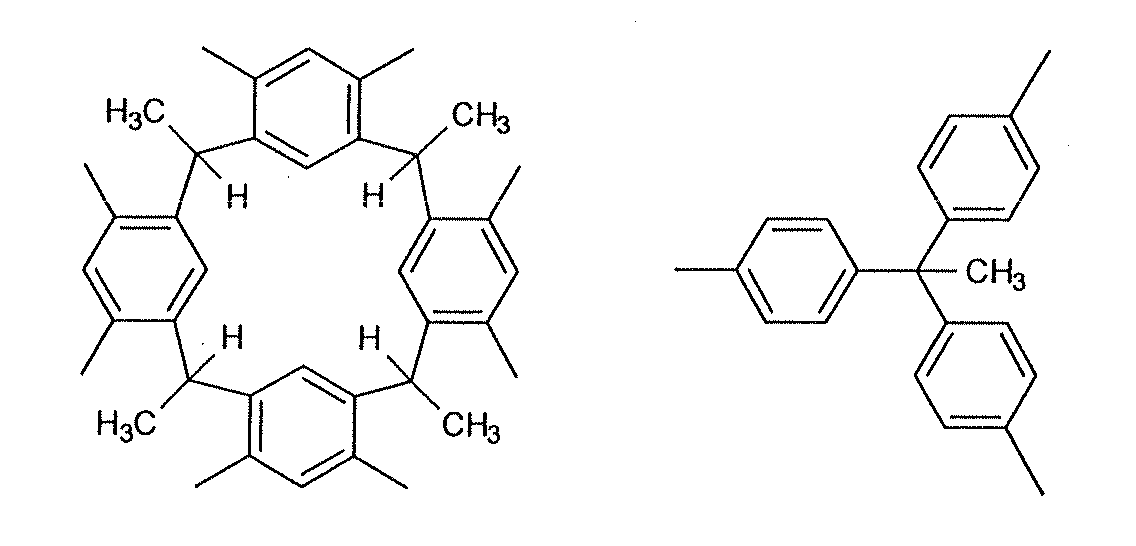
- Examples of the organic group having a cyclic structure formed by repetition of these groups include calixarenes such as calix-[4]-resorcinarene, and the like.
- substituent having a heteroatom examples include acetal groups such as 1-tetrahydropyranyl, 1-tetrahydrofuranyl, methoxymethyl and ethoxyethyl, carbonyl, hydroxyl, carboxyl, a t-butyl ester group, an alkoxy group, a cyano group, an amino group, an amido group, an imido group, pyridyl, and the like.
- the central structure A may be a single organic group above, or may be a group formed by a combination of a plurality of the same or different organic groups above.
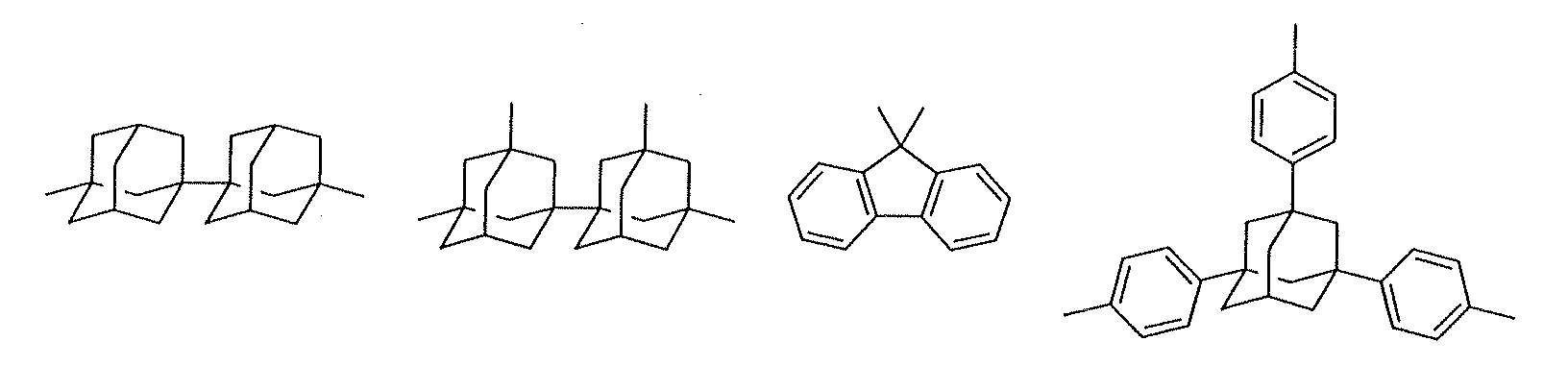
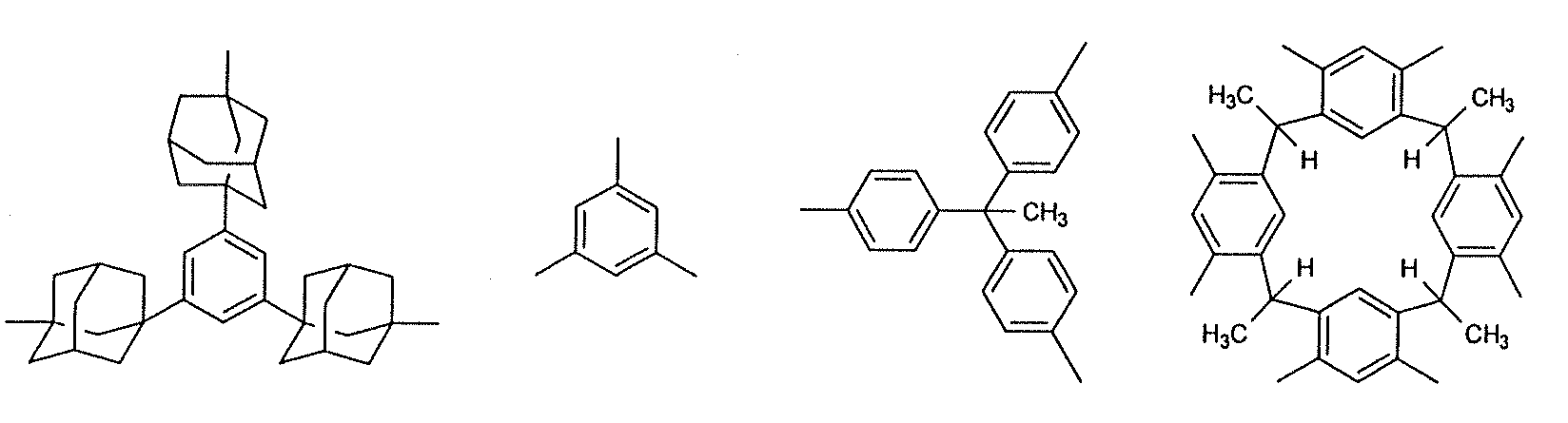
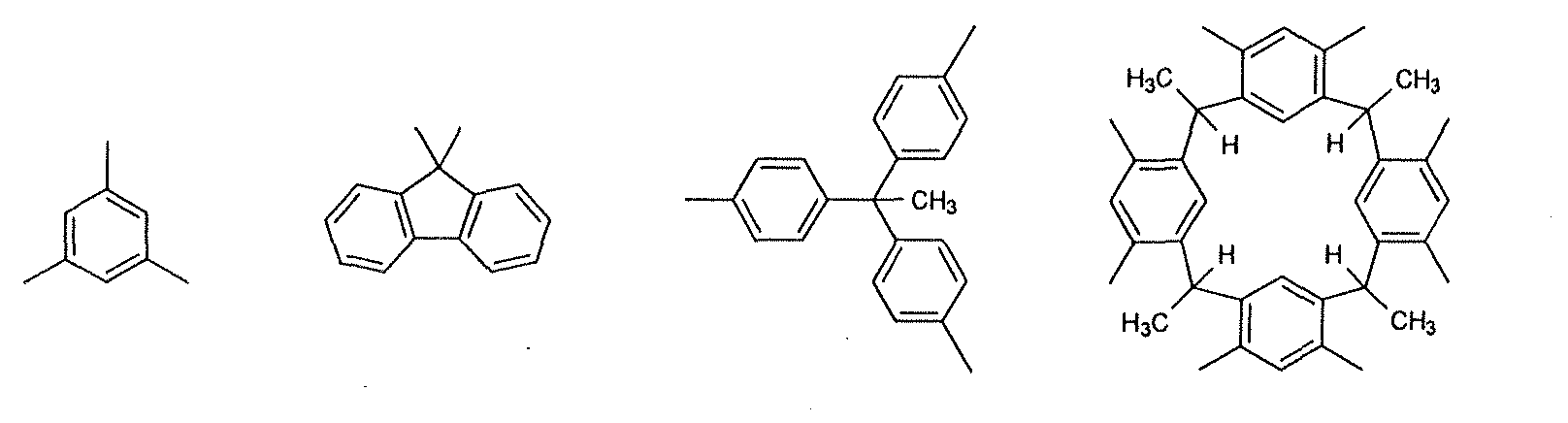
- central structure A examples include organic groups shown below.
- Each of B to D represents a substituent that exhibits reactivity upon irradiation with radiation (radiation-sensitive group), a group having reactivity to a chromophore active to radiation or a substituent containing these.
- the C 1 to C 50 aliphatic group, the C 6 to C 60 aromatic group, the organic group containing these aliphatic and aromatic groups together and the substituent having a heteroatom include those explained with regard to the central structure A.
- examples of the substituent having a branched structure include groups typified by dendron.
- the positions of the substituents B to D on the central structure A are not limited.
- C and D preferably, at least one of them is a hydrogen atom.
- substituents B to D include the following organic groups, radiation-sensitive groups to be described later and groups R, RO- and ROCO-which have reactivity to the action of chromophore active to radiation.
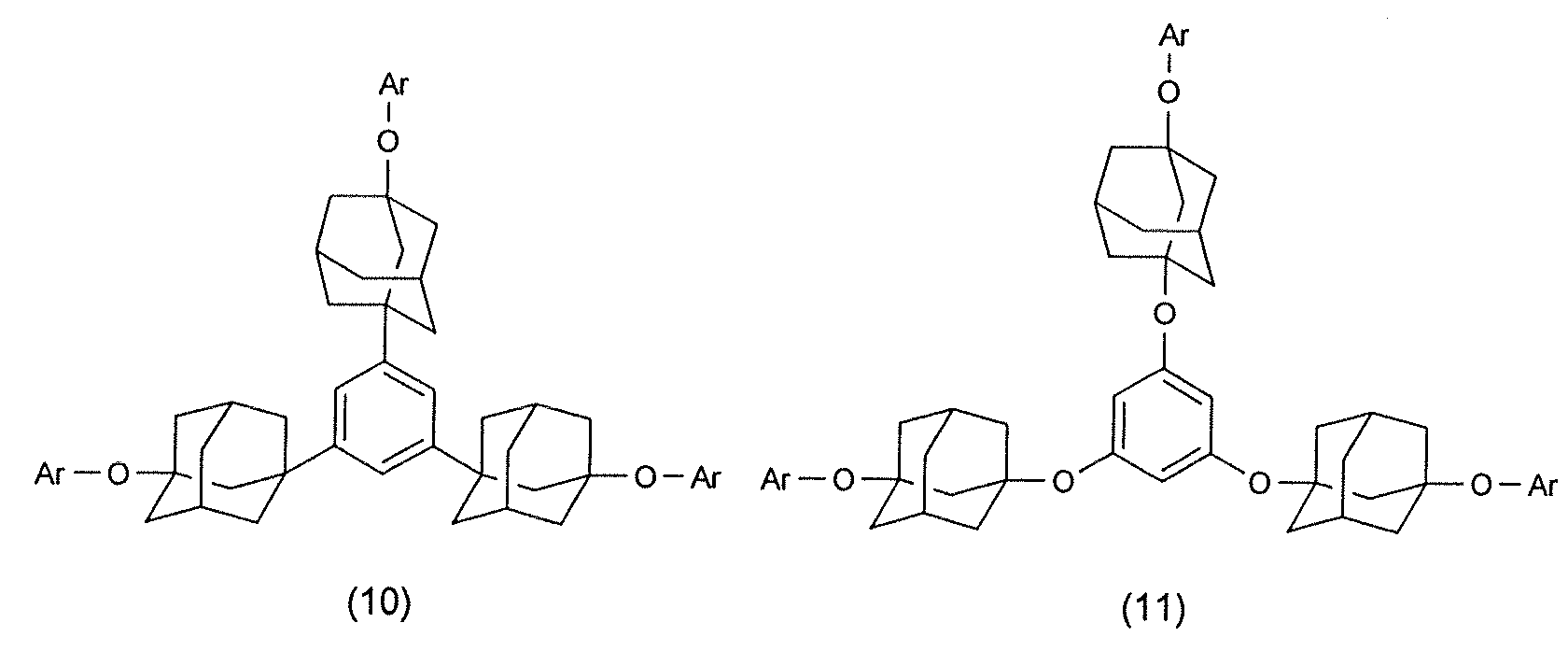
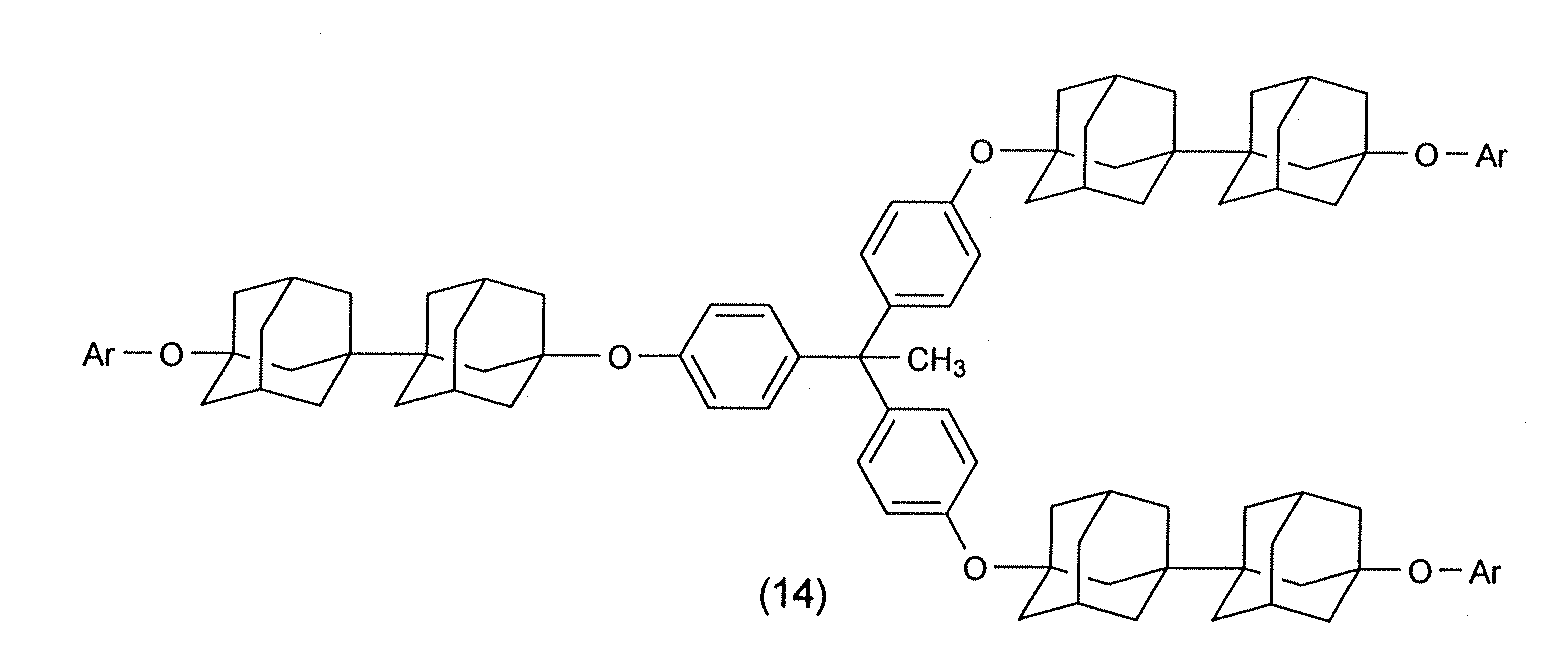
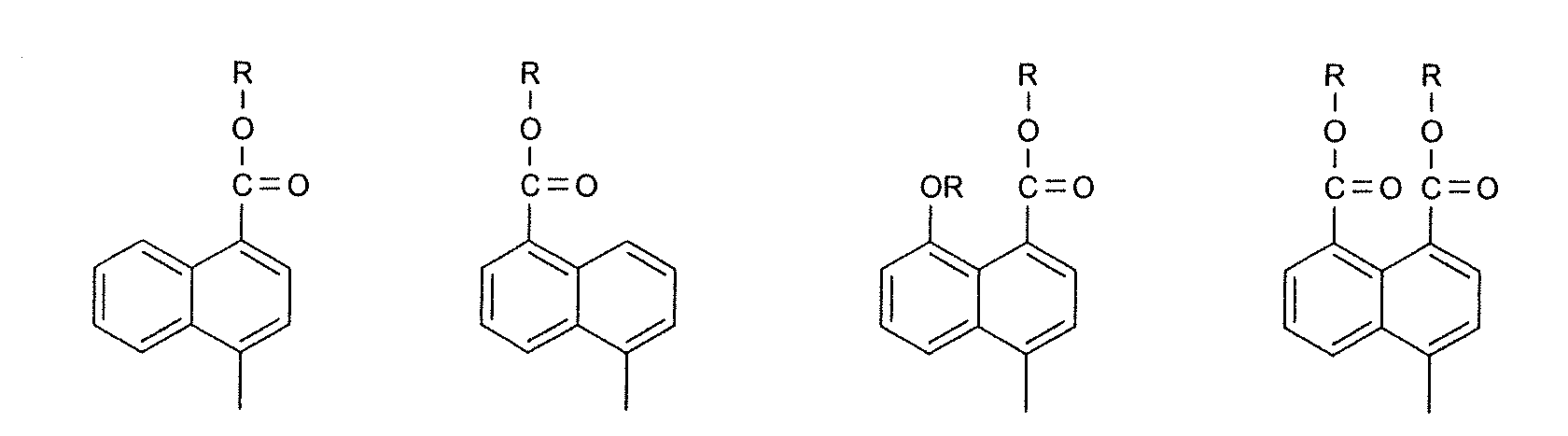
- Ar is phenyl or naphthyl substituted with RO-and/or ROCO in which each of R, RO- and ROCO- is a radiation-sensitive group or a group having reactivity to the action of a chromophore active to radiation.
- the compound for use in the present invention includes compounds of the following formulae (2) to (17), position isomers thereof, and the like.
- any substituent Ar can be suitably used so long as the substituent Ar contains a radiation-sensitive group or a group R, RO- or ROCO- having reactivity to the action of a chromophore active to radiation (to be described later).
- Ar includes the following substituents and position isomers thereof.
- Substituents Ar may be used singly or may be used in combination of two or more members thereof so long as an advantage of the present invention is not impaired.
- any R, any RO- and any ROCO- as substituents can be suitably used so long as they are radiation-sensitive groups or groups having reactivity to the action of a chromophore active to radiation.
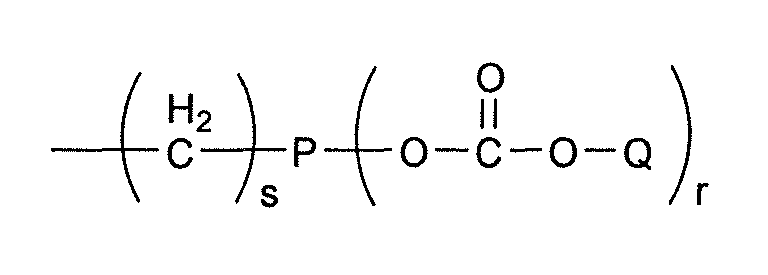
- R include hydrogen; tertiary hydrocarbon groups such as tert-butyl, adamantyl, etc.; substituents in which RO- constitutes a carbonic ester group such as tert-butoxycarbonyl; and substituents in which RO- constitutes an acetal group such as methoxymethyl, 1-ethoxyethyl, 1-phenoxyethyl, etc., and substituents shown below are also included as R.
- R may be used singly or in combination of at least two members of them so long as an advantage of the present invention is not impaired.
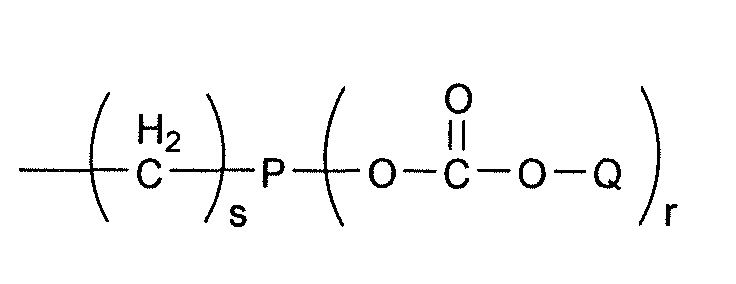
- each of R', R" and R'" is independently an aliphatic hydrocarbon group having 1 to 10 carbon atoms or an aromatic group
- P is an aromatic group having a valence of (r + 1) and having 6 to 20 carbon atoms
- Q is an organic group having 4 to 30 carbon atoms
- r is an integer of 1 to 10
- s is an integer of 0 to 10.
- organic group represented by the numbers of carbon atoms of the aromatic group P and the organic group Q are preferably 6 to 10 and 4 to 20, respectively, and r and s are preferably 1 to 5 and 0 to 3, respectively.
- the content of basic impurities e.g., ammonia, alkali metal ions of Li, Na, K, etc., and alkaline earth metal ions of Ca, Ba, etc.
- the content of basic impurities is 10 ppm or less, preferably 2 ppm or less.
- the photoresist base material comprising the above compound is remarkably improved in sensitivity to radiation, and as a result, a fine processing pattern by lithography using the photoresist composition can be fabricated.
- the compound for use in the present invention is preferably in an amorphous state at room temperature, and the average diameter of the molecule thereof is smaller than the size of an intended pattern and is preferably 5 nm or less, more preferably 2 nm or less.
- the average diameter is defined to be a diameter of the following true sphere.
- a diameter of a volume based on the van der Waals radius of a space occupied by the structure is assumed to be the true sphere.
- the compound for use in the present invention can be synthesized by combining known reactions.
- the impurities can be removed, and the compound can be purified by a known way, as required.
- the above compound is washed with an acidic aqueous solution and treated with an ion-exchange resin to be purified, whereby the content of the basic impurities can be decreased to 10 ppm or less.
- an optimum acidic aqueous solution and an optimum ion-exchange resin can be selected as required depending upon the amount and kind of the basic impurities to be removed or the kind of the compound to be treated.
- an acetic acid aqueous solution having a concentration of 0.01 to 10 mol/liter is used as an acidic aqueous solution
- a cation-exchange resin is used as an ion-exchange resin.
- the washing is carried out using an acetic acid aqueous solution as an acidic aqueous solution, followed by treatment with a cation-exchange resin.
- the thus-obtained compound is useful as a photoresist base material, particularly, as a photoresist base material for use in ultrafine processing with extreme ultra-violet or an electron beam.
- the compound for use in the present invention is in an amorphous state under conditions of use as a photoresist base material, generally, at room temperature as described above, so that the use thereof as a base material is preferred in view of application properties of a photoresist composition and strength of a photoresist film.
- the compound for use in the present invention has a molecule whose average diameter is smaller than the value of line-edge roughness that is required in a desired pattern size, specifically, a size of 100 nm or less, particularly a size of 50 nm or less.
- the line-edge roughness can be suppressed to 2 nm or less, preferably 1 nm or less (3 ⁇ ) when it is used for 20 to 50 nm processing that is a characteristic feature of ultrafine processing based on extreme ultra-violet or an electron beam.
- Such compounds When such compounds are used as a photoresist base material, they may be used singly or in combination of two or more compounds of them so long as an advantage of the present invention is not impaired. Further, compounds formed by combining a plurality of such compounds with arbitrary substituent(s) may be used singly, or in combination of two or more thereof so long as an advantage of the present invention is not impaired.
- the photoresist base material of the present invention can be used as one component for a photoresist composition.
- the composition of the present invention is a liquid composition containing a solid content containing a photoresist base material comprising the above compound(s) and a solvent dissolving this solid content.
- the composition is required to be in a liquid state for uniformly applying a photoresist to a substrate, etc., on which ultrafine processing is to be applied.
- the base material containing a radiation-sensitive group contains a chromophore active to radiation, and it can exhibit its capability as a photoresist by itself, so that it is not especially necessary to add an additive to the solid content.
- a chromophore active to radiation contains a chromophore active to radiation, and it can exhibit its capability as a photoresist by itself, so that it is not especially necessary to add an additive to the solid content.
- an optically-acid-generating agent (PAG) or an optically-base-generating agent (PBG) as a chromophore.
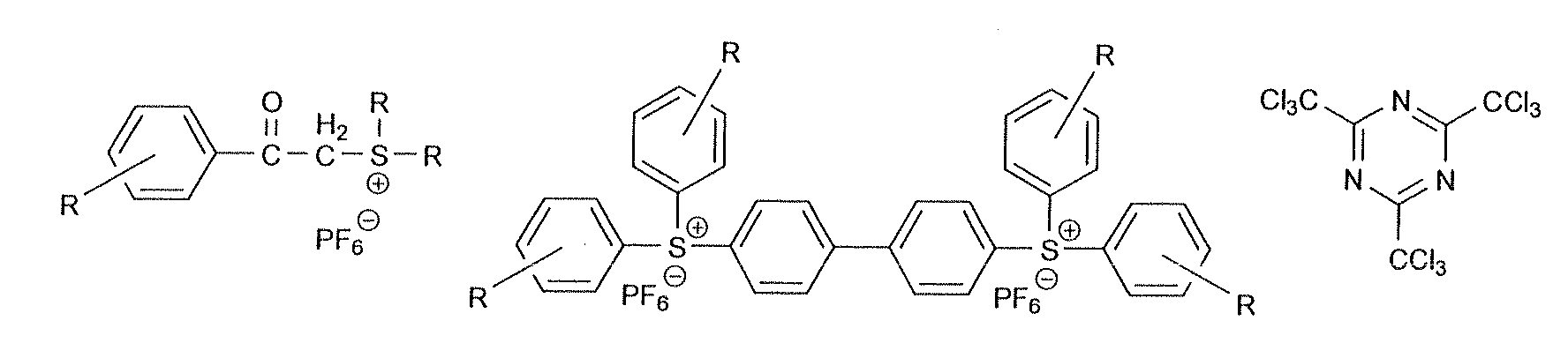
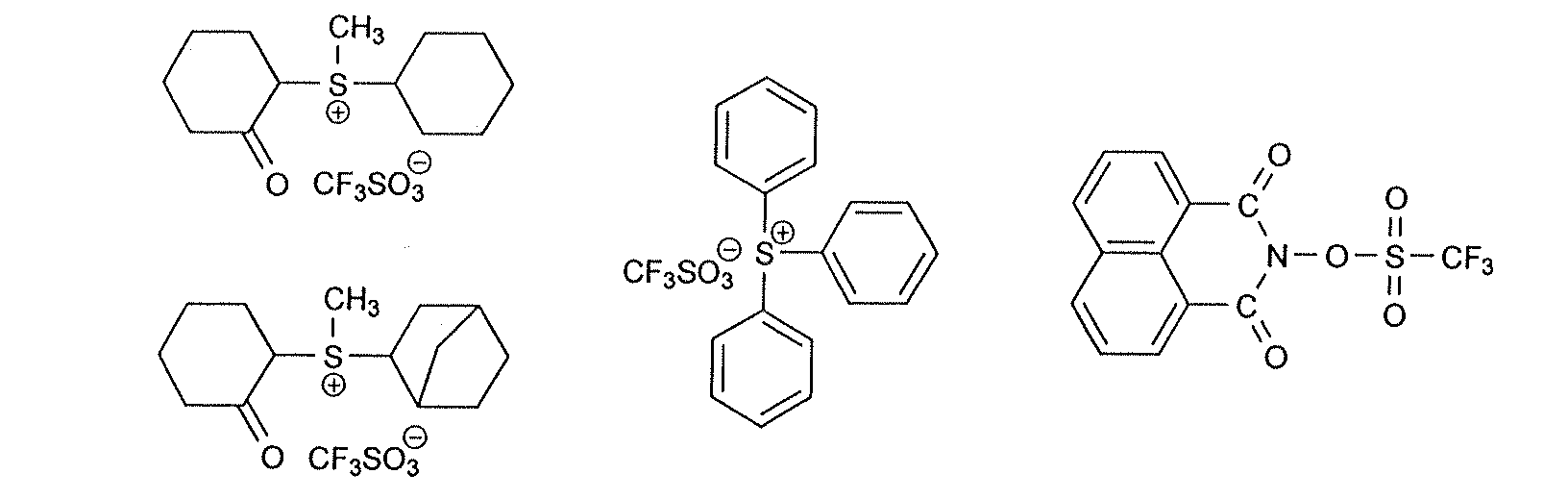
- PAG known compounds represented by the following structures and other compounds having similar activities can be generally used. PAG can be selected among these as required depending upon the kind of the base material, the form and size of a desired fine pattern, and the like.
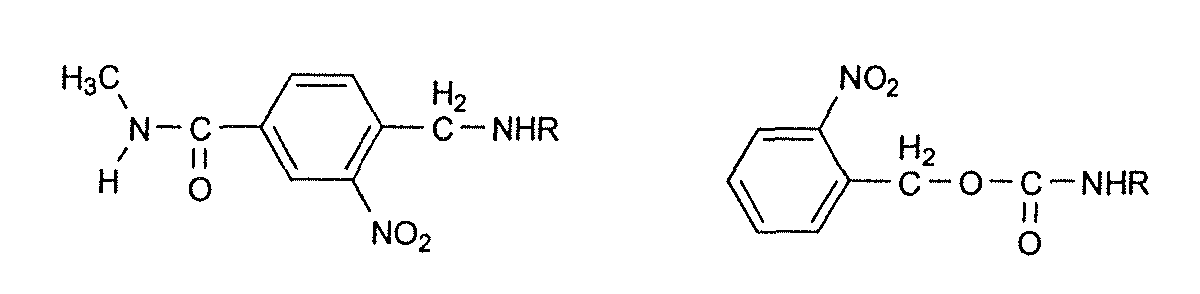
- PBG known compounds represented by the following structures and other compounds having similar activities can be generally used.
- PBG can be selected among these as required depending upon the kind of the base material, the form and size of a desired fine pattern, and the like. Further, when PBG is used as a chromophore, the amount thereof can be adjusted as required, while taking account of the proportion of basic impurities contained in the base material, to prevent excessive addition thereof which makes the reactivity beyond control.
- bases such as tetrabutylammonium hydroxide and salts thereof, an anti-striation agent, a plasticizer, a speed promoter, a photosensitizing agent, a sensitizing agent, an acid proliferation agent, an etching durability enhancer, and the like as required so long as an advantage of the present invention is not impaired.
- Each component in the solid content may be a single component or a mixture of components having the same or different functions, or each may be a mixture of precursors of such components.
- the composition of the solid content and the amount ratio of components of the solid content can be adjusted as required depending upon the form, size, etc., of a desired fine pattern. Generally, an amount ratio, etc., similar to those of a conventional photoresist can be employed.
- the solvent can be selected from those that are generally used as a solvent for a photoresist.
- the solvent includes 2-methoxyethyl ether, glycols such as ethylene glycol monomethyl ether(2-methoxyethanol), propylene glycol monomethyl ether, 1-methoxy-2-propanol acetate, etc., lactic esters such as ethyl lactate, methyl lactate, etc., propionates such as methyl propionate, ethyl propionate, etc., cellosolve esters such as methyl cellosolve acetate, aromatic hydrocarbons such as toluene, xylene, etc., ketones such as methyl ethyl ketone, cyclohexanone, 2-heptanone, etc., and the like.
- the solvent can be selected among these solvents as required depending upon the solubility, film formability, etc., of the base material in the solvent.
- the ratio of the solid content in the composition is generally adjusted to 1 to 40 % by weight based on the total weight of the composition. However, this ratio can be adjusted as required depending upon the kind of the base material.
- the composition of the present invention is uniformly applied to a substrate such as silicon wafer, or any processible coating layer formed on a silicon wafer by a method such as spin coating, dip coating or painting. After the application, generally, the applied composition is dried until a photoresist coating layer comes to be a non-sticking layer, for example, up to 80 to 160°C, for removing the solvent.
- the heating condition can be adjusted as required depending upon the kind, etc., of the base material.
- the substrate whose photoresist coating layer has been non-sticking is irradiated with radiation with a photomask.
- the photoresist coating layer is baked to give or enhance a solubility difference between the exposed region and non-exposed region of the photoresist coating layer.
- the resultant substrate is developed with an alkali developer solution, or the like, for forming a relief image.
- a pattern with an isolated line having a size of 100 nm or finer, particularly, 50 nm or finer, a line/space (L/S) of 1/1, a hole, etc. can be formed with high sensitivity, a high contrast and a low line-edge roughness.
- the photoresist base material and the composition thereof of the present invention are suitably used in the electric and the electronic field including semiconductor devices, the field of optics, and the like, whereby semiconductor devices such as ULSI can be remarkably improved in performances.
- a three-necked flask (volume 500 ml) equipped with a dropping funnel, a Dimroth condenser tube and a thermometer, which had been fully dried and flushed with nitrogen gas, was hermetically charged with resorcinol (33 g, 300 mmol) and acetaldehyde (17 ml, 300 mmol) under nitrogen gas current, and under a slight pressure of nitrogen, distilled methanol (300 ml) was charged thereinto to prepare a methanol solution.
- This methanol solution was heated to 75°C in an oil bath with stirring. Then, 75 ml of concentrated hydrochloric acid was dropwise added gradually from the dropping funnel, followed by continuous stirring under heat at 75°C for 2 hours.
- a catalytic amount of pyridinium p-toluene sulfonate was added to a toluene solution (40 ml) containing the calix-[4]-resorcinarene (2.07 g, 3.8 mmol) obtained in Example 1 and 1,2-dihydropyran (0.32 g, 3.8 mmol), and the mixture was stirred at 0°C for 10 minutes. Completion of the reaction was followed by extraction with diethyl ether, and an extract was washed with a sodium hydrogen carbonate aqueous solution, and the solvent was distilled off under reduced pressure to give a crude product in the form of a white precipitate.
- Example 2 was repeated except that the amount of 1, 2-dihydropyran was changed to 0.16 g (1.9 mmol).
- a calix-[4]-resorcinarene derivative having the above formula (15) in which 50 % of R's were 1-tetrahydropyranyls and 50 % of the R's were hydrogen atoms (2.74 g, yield 82 %).
- This product was used as a photoresist base material.
- the structure of this base material was determined on the basis of NMR measurement, IR measurement, elemental analysis, and the like. This base material had an average diameter of 1.04 nm and was in an amorphous state at room temperature.
- a two-necked flask (volume 100 ml) equipped with a Dimroth condenser tube and a thermometer, which had been fully dried and flushed with nitrogen gas, was hermetically charged with calix-[4]-resorcinarene (2.07 g, 3.8 mmol) obtained in Example 1, potassium carbonate (7.32 g, 30 mmol) and 18-crwon-6 (0.29 g, 1.08 mmol), and the atmosphere in the flask was replaced with nitrogen.
- This base material was determined on the basis of TGA (weight of tert-butyloxycarbonylmethyl dissociated around 170°C), NMR measurement, IR measurement, elemental analysis, and the like. This base material had an average diameter of 0.99 nm and was in an amorphous state at room temperature.
- the thus-obtained precipitate was recovered by filtering, re-precipitated and washed with pure water for purification, to prepare an adamantane derivative having the above formula (3) in which all of Ar's were 4-hydroxyphenyls, and this product was used as a photoresist base material.
- This base material had an average diameter of 0.83 nm and was in an amorphous state at room temperature.
- the resultant precipitate was recovered by filtering and purified by re-precipitation and washing with pure water, to produce an adamantane having the above formula (11) in which all of Ar's were 4-hydroxyphenyls, and this product was used as a photoresist base material.
- This base material had an average diameter of 1.03 nm and was in an amorphous state at room temperature.
- Example 4 was repeated except that the amount of 18-crown-6 was changed to 0.58 g (2.16 mmol) and that the amount of tert-butyl bromoacetate was change to 3.9 g (20 mmol). As a result, there was obtained 3.52 g (yield 73 %), as a crude product, and 2.95 g (purification yield 83 %), as a purified product, of a calix-[4]-resorcinarene derivative having the above formula (15) in which 60 % of R's were tert-butyloxycarbonylmethyls and 40 % thereof were hydrogen atoms. This product was used as a base material.
- This base material was determined on the basis of TGA (weight of tert-butyloxycarbonylmethyl dissociated around 170°C), NMR measurement, IR measurement, elemental analysis, and the like.
- This base material had an average diameter of 1.11 nm and was in an amorphous state at room temperature.
- This crude crystal was washed with pure water (100 ml) twice, then, re-crystallized from a mixture solution of ethanol with water for purification and dried under reduced pressure to give a calix-[4]-resorcinarene derivative having the above formula (15) in which all of R's were 4-(tert-butoxycarbonyloxy)benzyls (1.58 g, yield 90 %).
- This product was used as a base material.
- the structure of this base material was determined on the basis of NMR measurement, IR measurement, elemental analysis, and the like. This base material had an average diameter of 1.40 nm and was in an amorphous state at room temperature.
- Example 8 was repeated except that the amount of 4-tert-butoxycarbonyloxybenzyl alcohol was changed to 0.50 g (2.23 mmol), the amount of 1,1'-azobis(N,N-dimethylformamide) was changed to 0.50 g (2.9 mmol) and that the amount of tri-n-butyl phosphine was changed to 0.59 g (2.9 mmol).
- a calix-[4]-resorcinarene derivative having the above formula (15) in which 25 % of R's were 4-(tert-butoxycarbonyloxy)benzyls and 75 % thereof were hydrogen atoms (0.65 g, yield 85 %).
- This product was used as a base material.
- the structure of this base material was determined on the basis of NMR measurement, IR measurement, elemental analysis, and the like. This base material had an average diameter of 1.06 nm and was in an amorphous state at room temperature.
- a commercially available polyhydroxystyrene (supplied by Aldrich, weight average molecular weight 10,000, molecular weight distribution 1.1) was used as a photoresist base material. While this base material was in an amorphous state at room temperature, it had an average diameter of 2.33 nm.
- the substrate having this coating film was irradiated with extreme ultra-violet (wavelength 13.5 nm) through a photomask for a patterning test with an extreme ultra-violet exposure apparatus. Then, the coating film was baked at 110°C and treated with a 0.25 N tetrabutylammonium hydroxide aqueous solution to develop an imaged resist layer. As a result, there were not found any pattern collapse, etc., in a line/space having a 1/2 pitch width of 50 nm, and there was obtained an excellent pattern of which the line-edge roughness was substantially zero.
- Example 10 was repeated except that the base material was replaced with calix-[4]-resorcinarene derivatives prepared in Examples 2 to 4 and 7 to 9 (Examples 11 to 16) or adamantane derivatives prepared in Examples 5 and 6 (Examples 17 and 18).
- the base material was replaced with calix-[4]-resorcinarene derivatives prepared in Examples 2 to 4 and 7 to 9 (Examples 11 to 16) or adamantane derivatives prepared in Examples 5 and 6 (Examples 17 and 18).
- Example 10 was repeated except that the base material was replaced with polyhydroxystyrene of Comparative Example 1. As a result, there were not found any pattern collapse, etc., in a line/space having a 1/2 pitch width of 50 nm. However, line-edge roughness measurement showed an average of 4 nm, and there was not obtained a pattern that could be said to be excellent.
- the photoresist solution was spin-coated on a silicon wafer, and the thus-formed coating was dried under heat under reduced pressure to form a coating film having a thickness of 110 nm.
- the substrate having this coating film was irradiated with extreme ultra-violet (wavelength 13.5 nm) through a photomask for a patterning test with an extreme ultra-violet exposure apparatus. Then, the coating film was baked at 110°C and treated with a 0.25 N tetrabutylammonium hydroxide aqueous solution to develop an imaged resist layer. As a result, there were not found any pattern collapse, etc., in a line/space having a 1/2 pitch width of 50 nm, and there was obtained an excellent pattern of which the line-edge roughness was substantially zero.
- Example 19 was repeated except that the base material was replaced with calix-[4]-resorcinarene derivatives prepared in Examples 2 to 4 and 7 to 9. As a result, there were not found any pattern collapse, etc., in a line/space having a 1/2 pitch width of 50 nm in any Example, and there were obtained excellent patterns of which the line-edge roughness was substantially zero.
- Example 19 was repeated except that a pattern was drawn directly on a substrate having a coating film with an electron beam irradiation apparatus (CABL9000 (trade name), supplied by CRESTEC CORPORATION) without irradiation through any photomask.
- CABL9000 trade name
- CRESTEC CORPORATION electron beam irradiation apparatus
- Example 26 was repeated except that the base material was replaced with calix-[4]-resorcinarene derivatives prepared in Examples 2 to 4 and 7 to 9. As a result, there were not found any pattern collapse, etc., in a line/space having a 1/2 pitch width of 50 nm, and there was obtained an excellent pattern of which the line-edge roughness was substantially zero.
- Di-tert-butyl carbonate (5.45 g, 25 mmol) was added to a suspension of 4-hydroxybenzyl alcohol (3.1 g, 25 mmol) and potassium carbonate (3.45 g, 25 mmol) in acetone (100 ml) at room temperature, and the mixture was stirred for 24 hours. After completion of the reaction, the acetone was distilled off under reduced pressure, and extraction with ether was carried out. This ether extract was washed with a 1 M sodium hydroxide aqueous solution and a saturated sodium chloride aqueous solution, then, anhydrous magnesium sulfate was added, and water was removed by filtering.
- This precipitate was purified by re-precipitation and washing with pure water, to give 1,1,1-tris[4-(4'-(tert-butoxycarbonyloxy)benzyloxy)phenyl]ethane (1.6 g, yield 87 %).
- This product was used as a photoresist base material.
- the structure of this base material was determined on the basis of NMR measurement, IR measurement, elemental analysis, and the like. This base material had an average diameter of 1.05 nm and was in an amorphous state at room temperature.
- Example 33 was repeated except that the 4-hydroxybenzyl alcohol was replaced with 3,5-dihydroxybenzyl alcohol (3.5 g, 25 mmol). As a result, there was obtained 1,1,1-tris[4-(3',5'-di(tert-butoxycarbonyloxy)benzyloxy)phenyl]ethane (2.3 g, yield 90 %).
- This product was used as a photoresist base material. The structure of this base material was determined on the basis of NMR measurement, IR measurement, elemental analysis, and the like. This base material had an average diameter of 1.17 nm and was in an amorphous state at room temperature.
- PAG di(t-butylphenyl)iodonium o-trifluoromethyl sulfonate
- base tetrabutylammonium hydroxide lactate
- the substrate having this coating film was irradiated with extreme ultra-violet (wavelength 13.5 nm) through a photomask for a patterning test with an extreme ultra-violet exposure apparatus. Then, the coating film was baked at 110°C and treated with a 0.25 N tetrabutylammonium hydroxide aqueous solution to develop an imaged resist layer. As a result, there were not found any pattern collapse, etc., when a line/space having a 1/2 pitch width of 50 nm was created, and there was obtained an excellent pattern of which the line-edge roughness was substantially zero.
- Example 35 was repeated except that the triarylethane compound synthesized in Example 33 and used in the photoresist solution was replaced with the triarylethane compound synthesized in Example 34 for use in a photoresist solution. As a result, there were not found any pattern collapse, etc., when a line/space having a 1/2 pitch width of 50 nm was created, and there was obtained an excellent pattern of which the line-edge roughness was substantially zero.
- a substrate having a similar coating film was prepared from the triarylethane compound synthesized in Example 33 in the same manner as in Example 35.
- a pattern was drawn directly thereon with the above electron beam irradiation apparatus without irradiation through any photomask.
- the substrate having the coating layer was post-treated in the same manner as in Example 35, to develop the imaged resist layer.
- there were not found any pattern collapse, etc. when a line/space having a 1/2 pitch width of 50 nm was created, and there was obtained an excellent pattern of which the line-edge roughness was substantially zero.
- Example 37 was repeated except that the triarylethane compound synthesized in Example 33 and used in the photoresist solution was replaced with the triarylethane compound synthesized in Example 34 for use in the photoresist solution. As a result, there were not found any pattern collapse, etc., when a line/space having a 1/2 pitch width of 50 nm was created, and there was obtained an excellent pattern of which the line-edge roughness was substantially zero.
- Example 19 was repeated except that, as a base material, a copolymer of 4-hydroxystyrene (65 mol%)/styrene (20 mol%)/t-butyl acrylate (15 mol%) was synthesized by a conventional method and used. As a result, there were not found any pattern collapse, etc., in a line/space having a 1/2 pitch width of 50 nm. However, line-edge roughness measurement showed an average of 4 nm, and there was not obtained a pattern that could be said to be excellent.
- Example 26 was repeated except that the base material was replaced with the same copolymer as that used in Comparative Example 3. As a result, there were not found any pattern collapse, etc., in a line/space having a 1/2 pitch width of 50 nm. However, line-edge roughness measurement showed an average of 6 nm, and there was not obtained a pattern that could be said to be excellent.
- a two-necked flask (volume 100 ml) equipped with a Dimroth condenser tube and a thermometer, which had been fully dried and flushed with nitrogen gas, was hermetically charged with calix-[4]-resorcinarene (2.07 g, 3.8 mmol) obtained in Example 1, potassium carbonate (7.32 g, 30 mmol) and 18-crwon-6 (0.29 g, 1.08 mmol), and the atmosphere in the flask was replaced with nitrogen.
- this base material was determined on the basis of TGA (weight of tert-butyloxycarbonylmethyl dissociated around 170°C), NMR measurement, IR measurement, elemental analysis, and the like.
- This base material had an average diameter of 1.10 nm and was in an amorphous state at room temperature. Further, this base material was quantitatively analyzed for a content of potassium ion contained therein with an inductively coupled plasma mass spectrometer, to show 1,000 to 1,500 ppm.
- the calix-[4]-resorcinarene derivative (2 g) obtained in Example 39 was poured into an acetic acid aqueous solution (100 ml) adjusted to 1 mol/L, and the mixture was stirred in a suspension state at room temperature for 3 hours. This product was recovered by filtering and washed with pure water (100 mL) three times. The washed solid was dried at 80°C under reduced pressure to give a derivative treated with the acetic acid aqueous solution.
- a cation exchange resin (Amberlyst 15J-HG Dry, supplied by Hokkaido Organo Shoji Corporation??) substituted with acetone beforehand was packed in a glass column, the acetone solution of the treated derivative was caused to pass through it to concentrate the acetone solution under reduced pressure, the concentrated acetone solution was poured into ultra-pure water to carry out re-precipitation, and the thus-obtained precipitate was dried at 80°C under reduced pressure to give 1.5 g (yield 75 %) of an ion-exchange-treated derivative.
- This derivative was used as a photoresist base material.
- This base material was quantitatively analyzed for a content of potassium ion therein with an inductively coupled plasma mass spectrometer to show 0.5 to 1.5 ppm.
- a solid content containing 100 parts by weight of the calix-[4]-resorcinarene derivative prepared in Example 39 as a base material and 20 parts by weight of (5-propylsulfonyloxyimino-5H-thiophen-2-ylidene)-2-methylphenylacetonitrile (PAG) was dissolved in ethyl lactate (solvent) such that the amount ratio thereof was 20 % by weight, to prepare a photoresist solution (photoresist composition).
- the photoresist solution was spin-coated on a silicon wafer (1,000 rpm, 60 seconds), and the thus-formed coating was heated at 90°C for 180 seconds to form a coating film having a thickness of 1.2 ⁇ m.
- the substrate having this coating film was irradiated with a UV ray at 100 mJ/cm 2 with a g-ray exposure apparatus (M-1S (trade name), supplied by Mikasa Co., Ltd.). Then, the coating film was baked at 100°C for 30 seconds and treated with a 0.25 N tetrabutylammonium hydroxide aqueous solution. A dissolving rate was calculated on the basis of a decrease in film thickness to show 28 nm/second.
- M-1S g-ray exposure apparatus
- a solid content containing 100 parts by weight of the base material prepared in Example 40 and 10 parts by weight of (5-propylsulfonyloxyimino-5H-thiophen-2-ylidene)-2-methylphenylacetonitrile (PAG) was dissolved in 2-methoxyethanol (solvent) such that the amount ratio thereof was 20 % by weight, to prepare a photoresist solution (photoresist composition).
- the photoresist solution was spin-coated on a silicon wafer (1,000 rpm, 60 seconds), and the thus-formed coating was heated at 90°C for 180 seconds to form a coating film having a thickness of 1.2 ⁇ m.
- the substrate having this coating film was irradiated with a UV ray at 80 mJ/cm 2 with the above g-ray exposure apparatus. Then, the coating film was baked at 100°C for 60 seconds and treated with a 0.25 N tetrabutylammonium hydroxide aqueous solution. A dissolving rate was calculated on the basis of a decrease in film thickness to show 1,350 nm/second.
- Example 42 was repeated except that the exposure dose by the g-ray exposure apparatus was changed to 5 mJ/cm 2 .
- a dissolving rate was calculated on the basis of a decrease in film thickness to show 120 nm/second.
- a solid content containing 100 parts by weight of the base material prepared in Example 40 and 2 parts by weight of (5-propylsulfonyloxyimino-5H-thiophen-2-ylidene)-2-methylphenylacetonitrile (PAG) was dissolved in 2-methoxyethanol such that the amount ratio thereof was 20 % by weight, to prepare a photoresist solution (photoresist composition).
- the photoresist solution was spin-coated on a silicon wafer (1,000 rpm, 60 seconds), and the thus-formed coating was heated at 100°C for 180 seconds to form a coating film having a thickness of 1.2 ⁇ m. Then, the substrate having this coating film was irradiated with a UV ray with the above g-ray exposure apparatus.
- the coating film was baked at 110°C for 60 seconds and treated with a 2.38 wt% tetrabutyl ammonium hydroxide aqueous solution for 60 seconds. While the intensity of the UV ray was changed, a solubility curve was prepared. When the sensitivity and contrast were estimated on the basis of the above curve, they were 19.2 mJ/cm 2 and 5.0, respectively. Further, when irradiation with the UV ray at 5 mJ/cm 2 was carried out with a photomask, there was obtained an image having a line width of 6 ⁇ m.
- calix-[4]-resorcinarene derivative (average diameter: 1.06 nm, in an amorphous state at room temperature) having the above formula (15) in which 40 % of R's were tert-butyloxycarbonylmethyls and 60 % thereof were hydrogen atoms, in the same manner as in Example 39 except that the amount ratio of potassium carbonate and tert-butyl bromoacetate was changed to 4/5.
- the above derivative was purified in the same manner as in Example 40 and used as a base material.
- a photoresist solution was prepared using the above base material in the same manner as in Example 44, and a sensitivity curve thereof was prepared. As a result, when the sensitivity of a resist was estimated on the basis of the curve, it was 10.0 mJ/cm 2 .
- calix-[4]-resorcinarene derivative (average diameter: 1.00 nm, in an amorphous state at room temperature) having the above formula (15) in which 27 % of R's were tert-butyloxycarbonylmethyls and 73 % thereof were hydrogen atoms, in the same manner as in Example 39 except that the amount ratio of potassium carbonate and tert-butyl bromoacetate was changed to 3/5.
- the above derivative was purified in the same manner as in Example 40 and used as a base material.
- a photoresist solution was prepared using the above base material in the same manner as in Example 44, and a sensitivity curve thereof was prepared. As a result, when the sensitivity of a resist was estimated on the basis of the curve, it was 2.4 mJ/cm 2 .
- a photoresist base material that enables ultrafine processing by extreme ultra-violet, etc., with high sensitivity, a high contrast and a low line-edge roughness, a method for purification thereof and a photoresist composition.
Landscapes
- Chemical & Material Sciences (AREA)
- Organic Chemistry (AREA)
- Physics & Mathematics (AREA)
- Spectroscopy & Molecular Physics (AREA)
- General Physics & Mathematics (AREA)
- Organic Low-Molecular-Weight Compounds And Preparation Thereof (AREA)
- Materials For Photolithography (AREA)
- Exposure And Positioning Against Photoresist Photosensitive Materials (AREA)
Abstract
A photoresist base material comprising an extreme
ultra-violet reactive organic compound of the following
formula (1),
 wherein A is a central structure that is an
aliphatic group having 1 to 50 carbon atoms, an aromatic
group having 6 to 50 carbon atoms, an organic group
containing these together or an organic group having a
cyclic structure formed by repetition of these, each of B
to D is an extreme ultra-violet reactive group, a group
having reactivity to the action of a chromophore active to
extreme ultra-violet, or a C1 to C50 aliphatic group, C6 to
C50 aromatic group, an organic group containing these
together or a substituent having a branched structure,
containing such a reactive group, X to Z are single bonds
or ether bonds, l to n are integers of 0 to 5 satisfying l
+ m + n ≥ 1, and A to D may contain a substituent having a
heteroatom. The photoresist base material and a composition
thereof enable ultrafine processing based on extreme ultra-violet.
wherein A is a central structure that is an
aliphatic group having 1 to 50 carbon atoms, an aromatic
group having 6 to 50 carbon atoms, an organic group
containing these together or an organic group having a
cyclic structure formed by repetition of these, each of B
to D is an extreme ultra-violet reactive group, a group
having reactivity to the action of a chromophore active to
extreme ultra-violet, or a C1 to C50 aliphatic group, C6 to
C50 aromatic group, an organic group containing these
together or a substituent having a branched structure,
containing such a reactive group, X to Z are single bonds
or ether bonds, l to n are integers of 0 to 5 satisfying l
+ m + n ≥ 1, and A to D may contain a substituent having a
heteroatom. The photoresist base material and a composition
thereof enable ultrafine processing based on extreme ultra-violet.
Description
The present invention relates to a photoresist base
material for use in electric-electronic fields of
semiconductors, etc., and optical fields, particularly, a
photoresist base material for ultrafine processing, a
method for purification thereof, and a photoresist
composition.
Lithography based on extreme ultra-violet (EUV),
vacuum ultra-violet, electron beam, ion beam, etc.,
particularly, lithography based on extreme ultra-violet or
electron beam is useful as a highly productive ultrafine
processing technique in the fabrication of semiconductors,
and the like. It is demanded to develop a high-sensitivity
high-resolution photoresist that copes with 100 nm or finer,
particularly 50 nm or finer processing by means of extreme
ultra-violet or electron beam. Concerning a photoresist for
use in the above lithography, it is essential to improve
the photoresist in sensitivity from the viewpoint of the
productivity, resolution, etc., of desired fine patterns.
As a photoresist for use in the ultrafine
processing based on extreme ultra-violet, a chemical
amplification type polyhydroxystyrene-based photoresist is
exemplified that has been used for ultrafine processing
with a known KrF laser. It is known that the above resist
permits fine processing up to approximately 50 nm (for
example, Surveillance studies on next-generation EUVL
(Extreme Ultra-Violet Lithography) technique, Investigative
Report of fiscal year of 2001, Project sponsored by New
Energy and Industrial Technology Development Organization).
However, when 50 nm or finer patterns that is the greatest
advantage of ultrafine processing based on extreme ultra-violet
are made, this resist causes problems of a low
contrast, a large line-edge roughness, a low resist
sensitivity, a large amount of a resist outgas, etc., so
that performances inherent to the extreme ultra-violet have
been fully brought out. Under the circumstances, it has
been demanded to develop a higher-performance photoresist
for use with extreme ultra-violet.
For coping with this demand, there is proposed a
method using a chemical amplification type photoresist
having a high concentration of an optically-acid-generating
compound (e.g., JP-A-2002-055457). In this method, however,
Examples do not show any specific results of sensitivity,
line-edge roughness, a created line width, etc., in the
case of using extreme ultra-violet with regard to a
photoresist containing a base material that is a
hydroxystyrene/styrene/t-butyl acrylate terpolymer, an
optically-acid-generating agent that is di(t-butylphenyl)iodonium
o-trifluoromethyl sulfonate contained
in an amount of at least about 5 % based on a total solid
content, tetrabutylammonium hydroxide lactate and ethyl
lactate. Based on these results, from the viewpoint of
line-edge roughness, it has been therefore considered that
processing as fine as 100 nm as is shown in the case of
using an electron beam is the limit. It is assumed to be
caused by an excess reaction of the base material due to an
excess addition of the optically-acid-generating agent,
that is, excess diffusion of an acid into a non-exposed
portion.
While fine processing based on electron beam is
inferior to that using extreme ultra-violet in productivity,
it is suitable for fabricating special semiconductors of
which the lifetime production quantity is small, since it
does not require a mask. As a photoresist for use with
electron beam, both positive type and negative type
photoresists of many kinds are proposed, and it is said
that an isolated line having a width of 8 nm can be created
when an electron beam irradiation apparatus having a
sufficiently small focusing radius is used. In this case,
however, the molecular form of a polymer compound contained
as a base material is reflected in the line-edge roughness,
a line width is not sufficiently fine.
With developments in far finer processing of
semiconductors, severer values are required concerning the
line-edge roughness. In conventional photoresists
containing a polymer compound as a base material, however,
the molecular form thereof is reflected in the line-edge
roughness. In the region of 50 nm or finer ultrafine
processing, therefore, it has been theoretically difficult
to carry out the processing while limiting the line-edge
roughness, for example, to 3 nm or less when a polymer
compound having a molecular size of approximately several
tens nm is used.
The present invention has been made in view of the
above circumstances. It is an object of the present
invention to provide a photoresist base material that
enables ultrafine processing based on extreme ultra-violet,
or the like with high sensitivity, a high contrast and a
low line-edge roughness, a method for purification thereof
and a photoresist composition.
For achieving the above object, the present
inventors have made diligent studies and as a result have
found that the a decrease in the sensitivity of a
photoresist is caused by basic impurities such as ammonia,
alkali metal ion, alkaline earth metal ion, etc., that are
remaining since they are used in synthesis or that are
incorporated from a human body or surroundings.
In the case where a photoresist absorbs extreme
ultra-violet in a high ratio when extreme ultra-violet
passes therethrough and the intensity of a light source is
low, an optically-acid-generating agent may be added at a
high concentration. When even a trace amount of a basic
impurity is included therein, it neutralizes proton
generated from the acid-generating agent, so that no
desired reaction can proceed.
The present inventors have found that when a
photoresist base material is purified so that the basic
impurities are removed to a certain value or less, the
sensitivity is remarkably increased, and the present
invention has been accordingly completed.
According to the present invention, there are
provided the following photoresist base material, and the
like.






and X, Y and Z are ether bonds.


and X, Y and Z are ether bonds.


l + m + n = 3 or 8.


l + m + n = 3 or 8.
The photoresist base material of the present
invention will be explained hereinafter.
The photoresist base material of the present
invention comprises an organic compound represented by the
following general formula (1). This compound is radiation-sensitive.
The above radiation refers to ultraviolet rays
having a wavelength of 10 to 300 nm, specifically, extreme
ultra-violet and vacuum ultraviolet, or an electron beam,
an ion beam, or the like.
The compound for use in the present invention is
preferably reactive with extreme ultra-violet and/or
electron beams, more preferably reactive with extreme
ultra-violet. In addition, this compound is also reactive
with other general radiations (such as infrared light,
visible light ultraviolet light, ultraviolet light (g ray,
i ray, etc.), X ray, etc.).
 wherein A is a central structure that is an
aliphatic group having 1 to 50 carbon atoms, an aromatic
group having 6 to 50 carbon atoms, an organic group
containing these aliphatic and aromatic groups together or
an organic group having a cyclic structure formed by
repetition of these groups, each of B, C and D is
independently a radiation-sensitive group, a group having
reactivity to the action of chromophore active to radiation,
or a C1 to C50 aliphatic group, C6 to C50 aromatic group, an
organic group containing these aliphatic and aromatic
groups together or a substituent having a branched
structure, containing such a reactive group, each of X, Y
and Z is independently a single bond or an ether bond, each
of l, m and n is independently an integer of 0 to 5
satisfying l + m + n ≥ 1, and A, B, C and D may contain a
substituent having a heteroatom.
wherein A is a central structure that is an
aliphatic group having 1 to 50 carbon atoms, an aromatic
group having 6 to 50 carbon atoms, an organic group
containing these aliphatic and aromatic groups together or
an organic group having a cyclic structure formed by
repetition of these groups, each of B, C and D is
independently a radiation-sensitive group, a group having
reactivity to the action of chromophore active to radiation,
or a C1 to C50 aliphatic group, C6 to C50 aromatic group, an
organic group containing these aliphatic and aromatic
groups together or a substituent having a branched
structure, containing such a reactive group, each of X, Y
and Z is independently a single bond or an ether bond, each
of l, m and n is independently an integer of 0 to 5
satisfying l + m + n ≥ 1, and A, B, C and D may contain a
substituent having a heteroatom.
In the central structure A, examples of the C1 to
C50 aliphatic group include linear aliphatic groups such as
methyl, methylene, ethyl, dodecyl, etc., branched aliphatic
groups such as isopropyl, isobutyl, tert-butyl, etc., and
cyclic aliphatic groups such as cyclohexyl, norbornenyl,
adamantyl, diadamantyl, biadamantyl, and the like. Examples
of the C6 to C50 aromatic group include phenyl, phenylene,
naphthyl, naphthylene, fluorene, alkyl aromatic group, and
the like. Examples of the organic group containing these
aliphatic and aromatic groups together include a group
containing adamantyl and a methylene group together and a
group containing adamantyl and phenylene group together.
Examples of the organic group having a cyclic structure
formed by repetition of these groups include calixarenes
such as calix-[4]-resorcinarene, and the like. Examples of
the substituent having a heteroatom include acetal groups
such as 1-tetrahydropyranyl, 1-tetrahydrofuranyl,
methoxymethyl and ethoxyethyl, carbonyl, hydroxyl, carboxyl,
a t-butyl ester group, an alkoxy group, a cyano group, an
amino group, an amido group, an imido group, pyridyl, and
the like. The central structure A may be a single organic
group above, or may be a group formed by a combination of a
plurality of the same or different organic groups above.
Specific examples of the central structure A
include organic groups shown below.



Each of B to D represents a substituent that
exhibits reactivity upon irradiation with radiation
(radiation-sensitive group), a group having reactivity to a
chromophore active to radiation or a substituent containing
these. In these substituents B to D, the C1 to C50 aliphatic
group, the C6 to C60 aromatic group, the organic group
containing these aliphatic and aromatic groups together and
the substituent having a heteroatom include those explained
with regard to the central structure A. Further, examples
of the substituent having a branched structure include
groups typified by dendron. The positions of the
substituents B to D on the central structure A are not
limited.
Of B, C and D, preferably, at least one of them is
a hydrogen atom.
Specific examples of the substituents B to D
include the following organic groups, radiation-sensitive
groups to be described later and groups R, RO- and ROCO-which
have reactivity to the action of chromophore active
to radiation.


Ar is phenyl or naphthyl substituted with RO-and/or
ROCO in which each of R, RO- and ROCO- is a
radiation-sensitive group or a group having reactivity to
the action of a chromophore active to radiation.
Specifically, the compound for use in the present
invention includes compounds of the following formulae (2)
to (17), position isomers thereof, and the like.

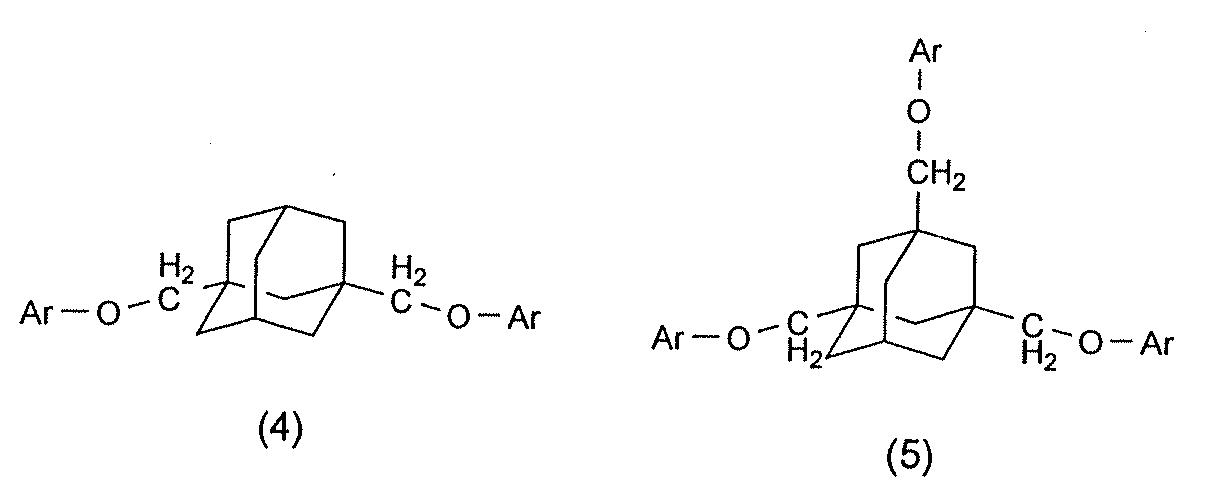

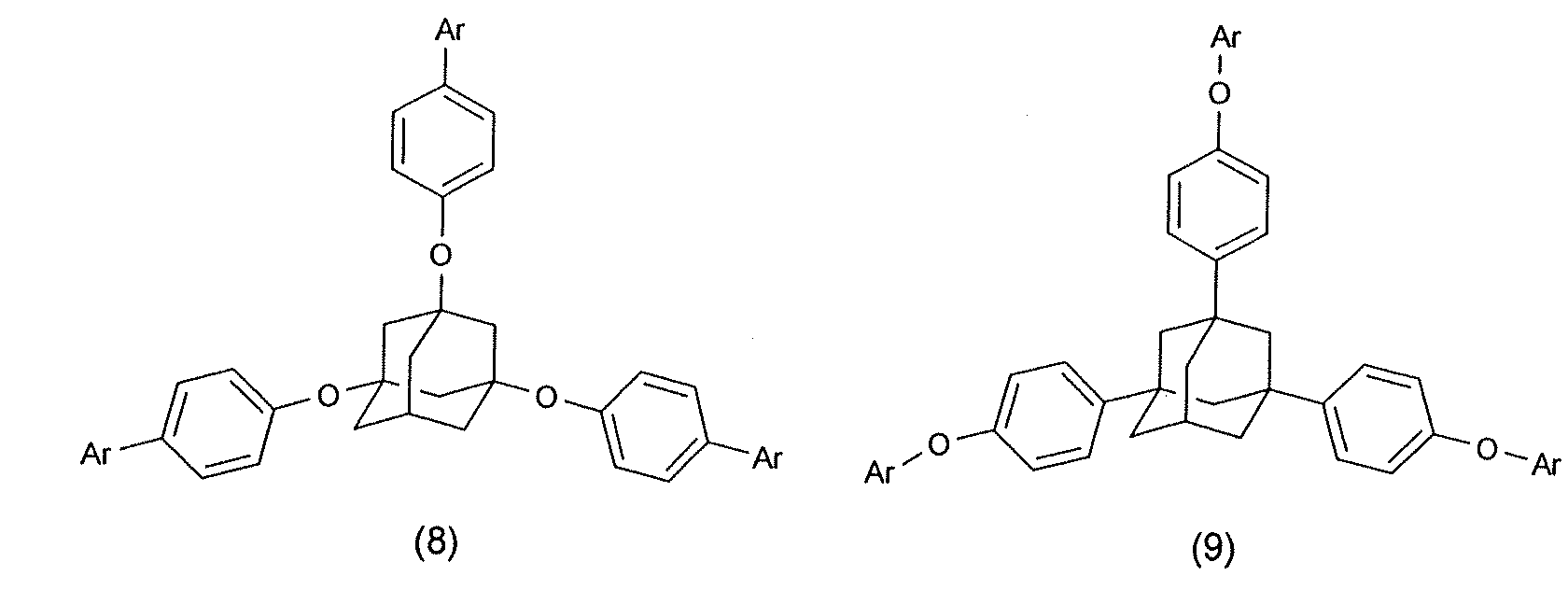



In the compounds of the above formulae (2) to (14),
any substituent Ar can be suitably used so long as the
substituent Ar contains a radiation-sensitive group or a
group R, RO- or ROCO- having reactivity to the action of a
chromophore active to radiation (to be described later).
Specifically, Ar includes the following substituents and
position isomers thereof. Substituents Ar may be used
singly or may be used in combination of two or more members
thereof so long as an advantage of the present invention is
not impaired.


In the above formulae (15) to (17) and the above
substituent Ar, any R, any RO- and any ROCO- as
substituents can be suitably used so long as they are
radiation-sensitive groups or groups having reactivity to
the action of a chromophore active to radiation. Specific
examples of R include hydrogen; tertiary hydrocarbon groups
such as tert-butyl, adamantyl, etc.; substituents in which
RO- constitutes a carbonic ester group such as tert-butoxycarbonyl;
and substituents in which RO- constitutes
an acetal group such as methoxymethyl, 1-ethoxyethyl, 1-phenoxyethyl,
etc., and substituents shown below are also
included as R. The substituents R may be used singly or in
combination of at least two members of them so long as an
advantage of the present invention is not impaired.


 wherein each of R', R" and R'" is independently an
aliphatic hydrocarbon group having 1 to 10 carbon atoms or
an aromatic group, P is an aromatic group having a valence
of (r + 1) and having 6 to 20 carbon atoms, Q is an organic
group having 4 to 30 carbon atoms, r is an integer of 1 to
10 and s is an integer of 0 to 10.
wherein each of R', R" and R'" is independently an
aliphatic hydrocarbon group having 1 to 10 carbon atoms or
an aromatic group, P is an aromatic group having a valence
of (r + 1) and having 6 to 20 carbon atoms, Q is an organic
group having 4 to 30 carbon atoms, r is an integer of 1 to
10 and s is an integer of 0 to 10.
In the organic group represented by
 the numbers of carbon atoms of the aromatic group P and the
organic group Q are preferably 6 to 10 and 4 to 20,
respectively, and r and s are preferably 1 to 5 and 0 to 3,
respectively.
the numbers of carbon atoms of the aromatic group P and the
organic group Q are preferably 6 to 10 and 4 to 20,
respectively, and r and s are preferably 1 to 5 and 0 to 3,
respectively.
Specifically, the following organic groups are
included.


In the compound for use in the present invention,
the content of basic impurities (e.g., ammonia, alkali
metal ions of Li, Na, K, etc., and alkaline earth metal
ions of Ca, Ba, etc.) is 10 ppm or less, preferably 2 ppm
or less.
When the content of the basic impurities is
decreased to 10 ppm or less, the photoresist base material
comprising the above compound is remarkably improved in
sensitivity to radiation, and as a result, a fine
processing pattern by lithography using the photoresist
composition can be fabricated.
The compound for use in the present invention is
preferably in an amorphous state at room temperature, and
the average diameter of the molecule thereof is smaller
than the size of an intended pattern and is preferably 5 nm
or less, more preferably 2 nm or less.
The average diameter is defined to be a diameter of
the following true sphere. In a structure obtained by
carrying out geometry optimization according to the AMI
method of semiempirical orbit method program package
MOPAC97, a diameter of a volume based on the van der Waals
radius of a space occupied by the structure is assumed to
be the true sphere.
The compound for use in the present invention can
be synthesized by combining known reactions. When the
compound contains impurities, the impurities can be removed,
and the compound can be purified by a known way, as
required.
In the present invention, the above compound is
washed with an acidic aqueous solution and treated with an
ion-exchange resin to be purified, whereby the content of
the basic impurities can be decreased to 10 ppm or less. In
this case, an optimum acidic aqueous solution and an
optimum ion-exchange resin can be selected as required
depending upon the amount and kind of the basic impurities
to be removed or the kind of the compound to be treated. In
the present invention, preferably, an acetic acid aqueous
solution having a concentration of 0.01 to 10 mol/liter is
used as an acidic aqueous solution, and a cation-exchange
resin is used as an ion-exchange resin. For purification,
particularly preferably, the washing is carried out using
an acetic acid aqueous solution as an acidic aqueous
solution, followed by treatment with a cation-exchange
resin.
The thus-obtained compound is useful as a
photoresist base material, particularly, as a photoresist
base material for use in ultrafine processing with extreme
ultra-violet or an electron beam.
That is, the compound for use in the present
invention is in an amorphous state under conditions of use
as a photoresist base material, generally, at room
temperature as described above, so that the use thereof as
a base material is preferred in view of application
properties of a photoresist composition and strength of a
photoresist film.
As described above, further, the compound for use
in the present invention has a molecule whose average
diameter is smaller than the value of line-edge roughness
that is required in a desired pattern size, specifically, a
size of 100 nm or less, particularly a size of 50 nm or
less. When the above compound is used as a base material,
therefore, the line-edge roughness can be suppressed to 2
nm or less, preferably 1 nm or less (3 σ) when it is used
for 20 to 50 nm processing that is a characteristic feature
of ultrafine processing based on extreme ultra-violet or an
electron beam.
When such compounds are used as a photoresist base
material, they may be used singly or in combination of two
or more compounds of them so long as an advantage of the
present invention is not impaired. Further, compounds
formed by combining a plurality of such compounds with
arbitrary substituent(s) may be used singly, or in
combination of two or more thereof so long as an advantage
of the present invention is not impaired.
The photoresist base material of the present
invention can be used as one component for a photoresist
composition.
The composition of the present invention is a
liquid composition containing a solid content containing a
photoresist base material comprising the above compound(s)
and a solvent dissolving this solid content. In the present
invention, the composition is required to be in a liquid
state for uniformly applying a photoresist to a substrate,
etc., on which ultrafine processing is to be applied.
The base material containing a radiation-sensitive
group, provided by the present invention, contains a
chromophore active to radiation, and it can exhibit its
capability as a photoresist by itself, so that it is not
especially necessary to add an additive to the solid
content. However, when it is desirable to enhance the
performance thereof as a photoresist or when a base
material containing a group having reactivity to a
chromophore active to radiation is used, there may be added
an optically-acid-generating agent (PAG) or an optically-base-generating
agent (PBG) as a chromophore.
As a PAG, known compounds represented by the
following structures and other compounds having similar
activities can be generally used. PAG can be selected among
these as required depending upon the kind of the base
material, the form and size of a desired fine pattern, and
the like.






As a PBG, known compounds represented by the
following structures and other compounds having similar
activities can be generally used. PBG can be selected among
these as required depending upon the kind of the base
material, the form and size of a desired fine pattern, and
the like. Further, when PBG is used as a chromophore, the
amount thereof can be adjusted as required, while taking
account of the proportion of basic impurities contained in
the base material, to prevent excessive addition thereof
which makes the reactivity beyond control.

In the present invention, besides PAG and PBG,
there can be added bases such as tetrabutylammonium
hydroxide and salts thereof, an anti-striation agent, a
plasticizer, a speed promoter, a photosensitizing agent, a
sensitizing agent, an acid proliferation agent, an etching
durability enhancer, and the like as required so long as an
advantage of the present invention is not impaired.
Each component in the solid content may be a single
component or a mixture of components having the same or
different functions, or each may be a mixture of precursors
of such components. The composition of the solid content
and the amount ratio of components of the solid content can
be adjusted as required depending upon the form, size, etc.,
of a desired fine pattern. Generally, an amount ratio, etc.,
similar to those of a conventional photoresist can be
employed.
The solvent can be selected from those that are
generally used as a solvent for a photoresist. Specifically,
the solvent includes 2-methoxyethyl ether, glycols such as
ethylene glycol monomethyl ether(2-methoxyethanol),
propylene glycol monomethyl ether, 1-methoxy-2-propanol
acetate, etc., lactic esters such as ethyl lactate, methyl
lactate, etc., propionates such as methyl propionate, ethyl
propionate, etc., cellosolve esters such as methyl
cellosolve acetate, aromatic hydrocarbons such as toluene,
xylene, etc., ketones such as methyl ethyl ketone,
cyclohexanone, 2-heptanone, etc., and the like. The solvent
can be selected among these solvents as required depending
upon the solubility, film formability, etc., of the base
material in the solvent.
The ratio of the solid content in the composition
is generally adjusted to 1 to 40 % by weight based on the
total weight of the composition. However, this ratio can be
adjusted as required depending upon the kind of the base
material.
The composition of the present invention is
uniformly applied to a substrate such as silicon wafer, or
any processible coating layer formed on a silicon wafer by
a method such as spin coating, dip coating or painting.
After the application, generally, the applied composition
is dried until a photoresist coating layer comes to be a
non-sticking layer, for example, up to 80 to 160°C, for
removing the solvent. The heating condition can be adjusted
as required depending upon the kind, etc., of the base
material.
Then, the substrate whose photoresist coating layer
has been non-sticking is irradiated with radiation with a
photomask. After the exposure, the photoresist coating
layer is baked to give or enhance a solubility difference
between the exposed region and non-exposed region of the
photoresist coating layer. The resultant substrate is
developed with an alkali developer solution, or the like,
for forming a relief image. By the above procedures, a
processed ultrafine pattern is formed on the substrate.
When ultrafine processing with extreme ultra-violet
or an electron beam is carried out with using the
photoresist base material of the present invention and the
composition thereof, a pattern with an isolated line having
a size of 100 nm or finer, particularly, 50 nm or finer, a
line/space (L/S) of 1/1, a hole, etc., can be formed with
high sensitivity, a high contrast and a low line-edge
roughness.
The photoresist base material and the composition
thereof of the present invention are suitably used in the
electric and the electronic field including semiconductor
devices, the field of optics, and the like, whereby
semiconductor devices such as ULSI can be remarkably
improved in performances.
The present invention will be specifically
explained with reference to Examples hereinafter, while the
present invention shall not be limited to the following
Examples. Average diameters of base materials were
determined according to the foregoing method.
A three-necked flask (volume 500 ml) equipped with
a dropping funnel, a Dimroth condenser tube and a
thermometer, which had been fully dried and flushed with
nitrogen gas, was hermetically charged with resorcinol (33
g, 300 mmol) and acetaldehyde (17 ml, 300 mmol) under
nitrogen gas current, and under a slight pressure of
nitrogen, distilled methanol (300 ml) was charged thereinto
to prepare a methanol solution. This methanol solution was
heated to 75°C in an oil bath with stirring. Then, 75 ml of
concentrated hydrochloric acid was dropwise added gradually
from the dropping funnel, followed by continuous stirring
under heat at 75°C for 2 hours. After completion of the
reaction, the reaction mixture was allowed to cool to room
temperature, and then cooled in an ice bath. The reaction
mixture was allowed to stand for 1 hour, to form an
intended white crude crystal, and it was recovered by
filtering. This crude crystal was washed with pure water
(100 ml) twice, and recrystallized from a mixture of
ethanol with water to purify it, and the thus-obtained
crystal was dried under reduced pressure to give calix-[4]-resorcinarene
having the above formula (15) in which all of
R's were hydrogen atoms (16 g, yield 40.2 %). This product
was used as a photoresist base material. The structure of
this base material was determined on the basis of NMR
measurement, IR measurement, elemental analysis, and the
like. This base material had an average diameter of 0.88 nm
and was in an amorphous state at room temperature.
A catalytic amount of pyridinium p-toluene
sulfonate was added to a toluene solution (40 ml)
containing the calix-[4]-resorcinarene (2.07 g, 3.8 mmol)
obtained in Example 1 and 1,2-dihydropyran (0.32 g, 3.8
mmol), and the mixture was stirred at 0°C for 10 minutes.
Completion of the reaction was followed by extraction with
diethyl ether, and an extract was washed with a sodium
hydrogen carbonate aqueous solution, and the solvent was
distilled off under reduced pressure to give a crude
product in the form of a white precipitate. The crude
product was recovered by filtering, washed with pure water
and recrystallized for its purification, to give a calix-[4]-resorcinarene
derivative having the above formula (15)
in which all of R's were 1-tetrahydropyranyls (4.02 g,
yield 87 %). This product was used as a photoresist base
material. The structure of this base material was
determined on the basis of NMR measurement, IR measurement,
elemental analysis, and the like. This base material had an
average diameter of 1.16 nm and was in an amorphous state
at room temperature.
Example 2 was repeated except that the amount of
1, 2-dihydropyran was changed to 0.16 g (1.9 mmol). As a
result, there was obtained a calix-[4]-resorcinarene
derivative having the above formula (15) in which 50 % of
R's were 1-tetrahydropyranyls and 50 % of the R's were
hydrogen atoms (2.74 g, yield 82 %). This product was used
as a photoresist base material. The structure of this base
material was determined on the basis of NMR measurement, IR
measurement, elemental analysis, and the like. This base
material had an average diameter of 1.04 nm and was in an
amorphous state at room temperature.
A two-necked flask (volume 100 ml) equipped with a
Dimroth condenser tube and a thermometer, which had been
fully dried and flushed with nitrogen gas, was hermetically
charged with calix-[4]-resorcinarene (2.07 g, 3.8 mmol)
obtained in Example 1, potassium carbonate (7.32 g, 30
mmol) and 18-crwon-6 (0.29 g, 1.08 mmol), and the
atmosphere in the flask was replaced with nitrogen. Then,
38 ml of acetone was added to prepare a solution, then,
tert-butyl bromoacetate (1.95 g, 10 mmol) was added, and in
a nitrogen atmosphere, the mixture was refluxed under heat
in an oil bath at 75°C for 24 hours with stirring. After
completion of the reaction, the reaction solution was
allowed to cool to room temperature, ice water was poured
into the reaction solution, and the mixture was stirred for
1 hour to obtain a white precipitate. This precipitate was
recovered by filtering and dried under reduced pressure to
give a crude product of a calix-[4]-resorcinarene
derivative having the above formula (15) in which 25 % of
R's were tert-butyloxycarbonylmethyls and 75 % thereof were
hydrogen atoms (2.23 g, yield 70 %). For removing potassium
carbonate contained in a trace amount, then, it was
dissolved in acetone (10 ml), the mixture was poured into
an acetic acid aqueous solution (1 mol/liter, 300 ml) to
give a white crystal. This crystal was recovered by
filtering and dried under reduced pressure to give the
above derivative purified (1.81 g, purification yield 81 %).
This crystal was used as a base material. The structure of
this base material was determined on the basis of TGA
(weight of tert-butyloxycarbonylmethyl dissociated around
170°C), NMR measurement, IR measurement, elemental analysis,
and the like. This base material had an average diameter of
0.99 nm and was in an amorphous state at room temperature.
Sodium hydride having an amount of 3.5 equivalent
weights (based on aliphatic hydroxyl groups) was gradually
added to a tetrahydrofuran solution containing 1 equivalent
weight of 1,3,5-trihydroxyadamantane, then, 3.5 equivalent
weights (based on aliphatic hydroxyl groups) of 4-bromophenyl
acetate was added, and the mixture was stirred
for 5 hours while it was refluxed under heat. After the
reaction mixture was cooled, diluted hydrochloric acid was
gradually added to prepare an acidic aqueous solution, and
the solution was again stirred for 1 hour while it was
refluxed under heat. The thus-obtained precipitate was
recovered by filtering, re-precipitated and washed with
pure water for purification, to prepare an adamantane
derivative having the above formula (3) in which all of
Ar's were 4-hydroxyphenyls, and this product was used as a
photoresist base material. This base material had an
average diameter of 0.83 nm and was in an amorphous state
at room temperature.
To a tetrahydrofuran solution of 1,3-dihydroxyadamantane
was gradually added a mixture of an
equimolar amount of sodium hydride with an equimolar amount
of 4-bromophenyl acetate, and the resulting mixture was
stirred under reflux under heat for 5 hours. After the
reaction mixture was cooled, pure water was added, the
resultant precipitate was recovered by filtering and washed
with pure water to give a mixture containing unreacted 1,3-dihydroxyadamantane,
1-(4'-acetoxyphenyloxy)-3-hydroxyadamantane
and 1,3-di(4'-acetoxyphenyloxy)adamantine
at a ratio of 1:2:1. The above mixture was purified to give
1-(4'-acetoxyphenyloxy)-3-hydroxyadamantane. To a
tetrahydrofuran solution thereof was gradually added 1
equivalent weight (based on aliphatic hydroxyl groups) of
sodium hydride, then, 1/3 equivalent weight (based on
aliphatic hydroxyl groups) of 1,3,5-tribromobenzene was
added, and the mixture was stirred under reflux under heat
for 5 hours. After the reaction mixture was cooled, diluted
hydrochloric acid was gradually added to prepare an acidic
aqueous solution, and then the aqueous solution was again
stirred under reflux under heat for 1 hour. The resultant
precipitate was recovered by filtering and purified by re-precipitation
and washing with pure water, to produce an
adamantane having the above formula (11) in which all of
Ar's were 4-hydroxyphenyls, and this product was used as a
photoresist base material. This base material had an
average diameter of 1.03 nm and was in an amorphous state
at room temperature.
Example 4 was repeated except that the amount of
18-crown-6 was changed to 0.58 g (2.16 mmol) and that the
amount of tert-butyl bromoacetate was change to 3.9 g (20
mmol). As a result, there was obtained 3.52 g (yield 73 %),
as a crude product, and 2.95 g (purification yield 83 %),
as a purified product, of a calix-[4]-resorcinarene
derivative having the above formula (15) in which 60 % of
R's were tert-butyloxycarbonylmethyls and 40 % thereof were
hydrogen atoms. This product was used as a base material.
The structure of this base material was determined on the
basis of TGA (weight of tert-butyloxycarbonylmethyl
dissociated around 170°C), NMR measurement, IR measurement,
elemental analysis, and the like. This base material had an
average diameter of 1.11 nm and was in an amorphous state
at room temperature.
A suspension of 4-hydroxybenzyl alcohol (3.1 g, 25
mmol), di-tert-butyl-dicarbonate (5.45 g, 25 mmol) and
potassium carbonate (3.45 g, 25 mmol) in acetone (100 ml)
was stirred at room temperature under nitrogen atmosphere
for 24 hours. After completion of the reaction, the solvent
was distilled off under reduced pressure, followed by
extraction with ether. An extract was washed with a 1M-NaOH
aqueous solution, then, washed with a saturated sodium
chloride aqueous solution, dried over anhydrous magnesium
sulfate and filtered. The solvent was distilled off under
reduced pressure, followed by purification by silica gel
column chromatography (hexane/ethyl acetate), and 4-tert-butoxycarbonyloxybenzyl
alcohol was thereby synthesized
(1.52 g, yield 27 %). Then, a mixture solution of calix-[4]-resorcinarene
(0.44 g, 0.80 mmol) obtained in Example 1
and 4-tert-butoxycarbonyloxybenzyl alcohol (1.5 g, 6.69
mmol) in a toluene/tetrahydrofuran (THF) (30 ml/20 ml) was
stirred at 0°C under nitrogen atmosphere for 10 minutes.
Then, 1,1'-azobis(N,N-dimethylformamide) (1.49 g, 8.7 mmol)
and tri-n-butyl phosphine (1.76 g, 8.7 mmol) were added,
and the mixture was stirred at 0°C under nitrogen atmosphere
for 30 minutes. After completion of the reaction, an
intended white crude crystal was formed and was recovered
by filtering. This crude crystal was washed with pure water
(100 ml) twice, then, re-crystallized from a mixture
solution of ethanol with water for purification and dried
under reduced pressure to give a calix-[4]-resorcinarene
derivative having the above formula (15) in which all of
R's were 4-(tert-butoxycarbonyloxy)benzyls (1.58 g, yield
90 %). This product was used as a base material. The
structure of this base material was determined on the basis
of NMR measurement, IR measurement, elemental analysis, and
the like. This base material had an average diameter of
1.40 nm and was in an amorphous state at room temperature.
Example 8 was repeated except that the amount of 4-tert-butoxycarbonyloxybenzyl
alcohol was changed to 0.50 g
(2.23 mmol), the amount of 1,1'-azobis(N,N-dimethylformamide)
was changed to 0.50 g (2.9 mmol) and
that the amount of tri-n-butyl phosphine was changed to
0.59 g (2.9 mmol). As a result, there was obtained a calix-[4]-resorcinarene
derivative having the above formula (15)
in which 25 % of R's were 4-(tert-butoxycarbonyloxy)benzyls
and 75 % thereof were hydrogen atoms (0.65 g, yield 85 %).
This product was used as a base material. The structure of
this base material was determined on the basis of NMR
measurement, IR measurement, elemental analysis, and the
like. This base material had an average diameter of 1.06 nm
and was in an amorphous state at room temperature.
A commercially available polyhydroxystyrene
(supplied by Aldrich, weight average molecular weight
10,000, molecular weight distribution 1.1) was used as a
photoresist base material. While this base material was in
an amorphous state at room temperature, it had an average
diameter of 2.33 nm.
A solid content containing 100 parts by weight of
the base material prepared in Example 1, 2 parts by weight
of di(t-butylphenyl)iodonium o-trifluoromethyl sulfonate
(PAG) and 0.2 part by weight of tetrabutylammonium
hydroxide lactate (base) was dissolved in ethyl lactate
(solvent) such that the amount ratio thereof as a solid
content was 5 % by weight, to prepare a photoresist
solution (photoresist composition). The photoresist
solution was spin-coated on a silicon wafer, and the thus-formed
coating was dried under heat under reduced pressure
to form a coating film having a thickness of 110 nm. Then,
the substrate having this coating film was irradiated with
extreme ultra-violet (wavelength 13.5 nm) through a
photomask for a patterning test with an extreme ultra-violet
exposure apparatus. Then, the coating film was baked
at 110°C and treated with a 0.25 N tetrabutylammonium
hydroxide aqueous solution to develop an imaged resist
layer. As a result, there were not found any pattern
collapse, etc., in a line/space having a 1/2 pitch width of
50 nm, and there was obtained an excellent pattern of which
the line-edge roughness was substantially zero.
Example 10 was repeated except that the base
material was replaced with calix-[4]-resorcinarene
derivatives prepared in Examples 2 to 4 and 7 to 9
(Examples 11 to 16) or adamantane derivatives prepared in
Examples 5 and 6 (Examples 17 and 18). As a result, there
were not found any pattern collapse, etc., in a line/space
having a 1/2 pitch width of 50 nm in any Example, and there
were obtained excellent patterns of which the line-edge
roughness was substantially zero.
Example 10 was repeated except that the base
material was replaced with polyhydroxystyrene of
Comparative Example 1. As a result, there were not found
any pattern collapse, etc., in a line/space having a 1/2
pitch width of 50 nm. However, line-edge roughness
measurement showed an average of 4 nm, and there was not
obtained a pattern that could be said to be excellent.
A solid content containing 100 parts by weight of
the base material prepared in Example 1, 20 parts by weight
of (5-propylsulfonyloxyimino-5H-thiophen-2-ylidene)-2-methylphenylacetonitrile
(PAG) and 0.2 part by weight of
tetrabutylammonium hydroxide lactate (base) was dissolved
in ethyl lactate (solvent) such that the amount ratio
thereof as a solid content was 5 % by weight, to prepare a
photoresist solution (photoresist composition). The
photoresist solution was spin-coated on a silicon wafer,
and the thus-formed coating was dried under heat under
reduced pressure to form a coating film having a thickness
of 110 nm. Then, the substrate having this coating film was
irradiated with extreme ultra-violet (wavelength 13.5 nm)
through a photomask for a patterning test with an extreme
ultra-violet exposure apparatus. Then, the coating film was
baked at 110°C and treated with a 0.25 N tetrabutylammonium
hydroxide aqueous solution to develop an imaged resist
layer. As a result, there were not found any pattern
collapse, etc., in a line/space having a 1/2 pitch width of
50 nm, and there was obtained an excellent pattern of which
the line-edge roughness was substantially zero.
Example 19 was repeated except that the base
material was replaced with calix-[4]-resorcinarene
derivatives prepared in Examples 2 to 4 and 7 to 9. As a
result, there were not found any pattern collapse, etc., in
a line/space having a 1/2 pitch width of 50 nm in any
Example, and there were obtained excellent patterns of
which the line-edge roughness was substantially zero.
Example 19 was repeated except that a pattern was
drawn directly on a substrate having a coating film with an
electron beam irradiation apparatus (CABL9000 (trade name),
supplied by CRESTEC CORPORATION) without irradiation
through any photomask. As a result, there were not found
any pattern collapse, etc., in a line/space having a 1/2
pitch width of 50 nm, and there was obtained an excellent
pattern of which the line-edge roughness was substantially
zero.
Example 26 was repeated except that the base
material was replaced with calix-[4]-resorcinarene
derivatives prepared in Examples 2 to 4 and 7 to 9. As a
result, there were not found any pattern collapse, etc., in
a line/space having a 1/2 pitch width of 50 nm, and there
was obtained an excellent pattern of which the line-edge
roughness was substantially zero.
Di-tert-butyl carbonate (5.45 g, 25 mmol) was added
to a suspension of 4-hydroxybenzyl alcohol (3.1 g, 25 mmol)
and potassium carbonate (3.45 g, 25 mmol) in acetone (100
ml) at room temperature, and the mixture was stirred for 24
hours. After completion of the reaction, the acetone was
distilled off under reduced pressure, and extraction with
ether was carried out. This ether extract was washed with a
1 M sodium hydroxide aqueous solution and a saturated
sodium chloride aqueous solution, then, anhydrous magnesium
sulfate was added, and water was removed by filtering. The
residue was concentrated under reduced pressure and
purified by silica gel column chromatography, whereby 4-(tert-butoxycarbonyloxy)benzyl
alcohol (1.52 g, yield 27 %)
was obtained. Then, in an ice bath and under nitrogen
current, the total amount (1.52 g, 6.7 mmol) of the thus-obtained
4-(tert-butoxycarbonyloxy)benzyl alcohol and
1,1,1-tris(4-hydroxyphenyl)ethane (0.61 g, 2 mmol) were
hermetically charged, then, toluene (30 ml) and THF (20 ml)
were poured thereinto, and the mixture was stirred for 10
minutes to prepare a mixture solution. Into this mixture
solution were poured N,N,N',N'-tetramethylazodicarboxamide
(1.5 g, 8.7 mmol) and tri-n-butyl phosphine (1.8 g, 8.7
mmol), and the mixture was stirred in a nitrogen atmosphere
at 0°C for 30 minutes. After the reaction mixture was
cooled, pure water was added, extraction with diethyl ether
was carried out, and diethyl ether was distilled off under
reduced pressure, to give a precipitate. This precipitate
was purified by re-precipitation and washing with pure
water, to give 1,1,1-tris[4-(4'-(tert-butoxycarbonyloxy)benzyloxy)phenyl]ethane
(1.6 g, yield
87 %). This product was used as a photoresist base material.
The structure of this base material was determined on the
basis of NMR measurement, IR measurement, elemental
analysis, and the like. This base material had an average
diameter of 1.05 nm and was in an amorphous state at room
temperature.
Example 33 was repeated except that the 4-hydroxybenzyl
alcohol was replaced with 3,5-dihydroxybenzyl
alcohol (3.5 g, 25 mmol). As a result, there was obtained
1,1,1-tris[4-(3',5'-di(tert-butoxycarbonyloxy)benzyloxy)phenyl]ethane
(2.3 g, yield
90 %). This product was used as a photoresist base material.
The structure of this base material was determined on the
basis of NMR measurement, IR measurement, elemental
analysis, and the like. This base material had an average
diameter of 1.17 nm and was in an amorphous state at room
temperature.
A solid content containing 100 parts by weight of
the triaryl ethane compound synthesized in Example 33 as a
base material, 2 parts by weight of di(t-butylphenyl)iodonium
o-trifluoromethyl sulfonate (PAG) and
0.2 part by weight of tetrabutylammonium hydroxide lactate
(base) was dissolved in ethyl lactate (solvent) such that
the amount ratio thereof was 5 % by weight, to prepare a
photoresist solution (photoresist composition). The
photoresist solution was spin-coated on a silicon wafer,
and the thus-formed coating was dried under heat under
reduced pressure to form a coating film having a thickness
of 110 nm. Then, the substrate having this coating film was
irradiated with extreme ultra-violet (wavelength 13.5 nm)
through a photomask for a patterning test with an extreme
ultra-violet exposure apparatus. Then, the coating film was
baked at 110°C and treated with a 0.25 N tetrabutylammonium
hydroxide aqueous solution to develop an imaged resist
layer. As a result, there were not found any pattern
collapse, etc., when a line/space having a 1/2 pitch width
of 50 nm was created, and there was obtained an excellent
pattern of which the line-edge roughness was substantially
zero.
Example 35 was repeated except that the
triarylethane compound synthesized in Example 33 and used
in the photoresist solution was replaced with the
triarylethane compound synthesized in Example 34 for use in
a photoresist solution. As a result, there were not found
any pattern collapse, etc., when a line/space having a 1/2
pitch width of 50 nm was created, and there was obtained an
excellent pattern of which the line-edge roughness was
substantially zero.
A substrate having a similar coating film was
prepared from the triarylethane compound synthesized in
Example 33 in the same manner as in Example 35. With regard
to this substrate having the coating film, a pattern was
drawn directly thereon with the above electron beam
irradiation apparatus without irradiation through any
photomask. Then, the substrate having the coating layer was
post-treated in the same manner as in Example 35, to
develop the imaged resist layer. As a result, there were
not found any pattern collapse, etc., when a line/space
having a 1/2 pitch width of 50 nm was created, and there
was obtained an excellent pattern of which the line-edge
roughness was substantially zero.
Example 37 was repeated except that the
triarylethane compound synthesized in Example 33 and used
in the photoresist solution was replaced with the
triarylethane compound synthesized in Example 34 for use in
the photoresist solution. As a result, there were not found
any pattern collapse, etc., when a line/space having a 1/2
pitch width of 50 nm was created, and there was obtained an
excellent pattern of which the line-edge roughness was
substantially zero.
Example 19 was repeated except that, as a base
material, a copolymer of 4-hydroxystyrene (65 mol%)/styrene
(20 mol%)/t-butyl acrylate (15 mol%) was synthesized by a
conventional method and used. As a result, there were not
found any pattern collapse, etc., in a line/space having a
1/2 pitch width of 50 nm. However, line-edge roughness
measurement showed an average of 4 nm, and there was not
obtained a pattern that could be said to be excellent.
Example 26 was repeated except that the base
material was replaced with the same copolymer as that used
in Comparative Example 3. As a result, there were not found
any pattern collapse, etc., in a line/space having a 1/2
pitch width of 50 nm. However, line-edge roughness
measurement showed an average of 6 nm, and there was not
obtained a pattern that could be said to be excellent.
A two-necked flask (volume 100 ml) equipped with a
Dimroth condenser tube and a thermometer, which had been
fully dried and flushed with nitrogen gas, was hermetically
charged with calix-[4]-resorcinarene (2.07 g, 3.8 mmol)
obtained in Example 1, potassium carbonate (7.32 g, 30
mmol) and 18-crwon-6 (0.29 g, 1.08 mmol), and the
atmosphere in the flask was replaced with nitrogen. Then,
38 ml of acetone was added to prepare a solution, then,
tert-butyl bromoacetate (3.51 g, 18 mmol) was added, and in
a nitrogen atmosphere, the mixture was refluxed under heat
in an oil bath at 75°C for 24 hours with stirring. After
completion of the reaction, the reaction solution was
allowed to cool to room temperature, ice water was poured
into the reaction solution, and the mixture was stirred for
1 hour to obtain a white precipitate. This precipitate was
recovered by filtering and dried under reduced pressure to
give a crude product of a calix-[4]-resorcinarene
derivative having the above formula (15) in which 50 % of
R's were tert-butyloxycarbonylmethyls and 50 % thereof were
hydrogen atoms (3.04 g, yield 80 %). For removing potassium
carbonate contained in a trace amount, then, it was
dissolved in acetone (10 ml), the mixture was poured into
an acetic acid aqueous solution (1 mol/liter, 300 ml) to
give a white crystal. This crystal was recovered by
filtering and dried under reduced pressure to give the
above derivative purified (2.58 g, purification yield 85 %).
This crystal was used as a base material. The structure of
this base material was determined on the basis of TGA
(weight of tert-butyloxycarbonylmethyl dissociated around
170°C), NMR measurement, IR measurement, elemental analysis,
and the like. This base material had an average diameter of
1.10 nm and was in an amorphous state at room temperature.
Further, this base material was quantitatively analyzed for
a content of potassium ion contained therein with an
inductively coupled plasma mass spectrometer, to show 1,000
to 1,500 ppm.
The calix-[4]-resorcinarene derivative (2 g)
obtained in Example 39 was poured into an acetic acid
aqueous solution (100 ml) adjusted to 1 mol/L, and the
mixture was stirred in a suspension state at room
temperature for 3 hours. This product was recovered by
filtering and washed with pure water (100 mL) three times.
The washed solid was dried at 80°C under reduced pressure to
give a derivative treated with the acetic acid aqueous
solution.
Then, a cation exchange resin (Amberlyst 15J-HG Dry,
supplied by Hokkaido Organo Shoji Corporation??)
substituted with acetone beforehand was packed in a glass
column, the acetone solution of the treated derivative was
caused to pass through it to concentrate the acetone
solution under reduced pressure, the concentrated acetone
solution was poured into ultra-pure water to carry out re-precipitation,
and the thus-obtained precipitate was dried
at 80°C under reduced pressure to give 1.5 g (yield 75 %) of
an ion-exchange-treated derivative. This derivative was
used as a photoresist base material. This base material was
quantitatively analyzed for a content of potassium ion
therein with an inductively coupled plasma mass
spectrometer to show 0.5 to 1.5 ppm.
A solid content containing 100 parts by weight of
the calix-[4]-resorcinarene derivative prepared in Example
39 as a base material and 20 parts by weight of (5-propylsulfonyloxyimino-5H-thiophen-2-ylidene)-2-methylphenylacetonitrile
(PAG) was dissolved in ethyl
lactate (solvent) such that the amount ratio thereof was
20 % by weight, to prepare a photoresist solution
(photoresist composition). The photoresist solution was
spin-coated on a silicon wafer (1,000 rpm, 60 seconds), and
the thus-formed coating was heated at 90°C for 180 seconds
to form a coating film having a thickness of 1.2 µm. Then,
the substrate having this coating film was irradiated with
a UV ray at 100 mJ/cm2 with a g-ray exposure apparatus (M-1S
(trade name), supplied by Mikasa Co., Ltd.). Then, the
coating film was baked at 100°C for 30 seconds and treated
with a 0.25 N tetrabutylammonium hydroxide aqueous solution.
A dissolving rate was calculated on the basis of a decrease
in film thickness to show 28 nm/second.
A solid content containing 100 parts by weight of
the base material prepared in Example 40 and 10 parts by
weight of (5-propylsulfonyloxyimino-5H-thiophen-2-ylidene)-2-methylphenylacetonitrile
(PAG) was dissolved in 2-methoxyethanol
(solvent) such that the amount ratio thereof
was 20 % by weight, to prepare a photoresist solution
(photoresist composition). The photoresist solution was
spin-coated on a silicon wafer (1,000 rpm, 60 seconds), and
the thus-formed coating was heated at 90°C for 180 seconds
to form a coating film having a thickness of 1.2 µm. Then,
the substrate having this coating film was irradiated with
a UV ray at 80 mJ/cm2 with the above g-ray exposure
apparatus. Then, the coating film was baked at 100°C for 60
seconds and treated with a 0.25 N tetrabutylammonium
hydroxide aqueous solution. A dissolving rate was
calculated on the basis of a decrease in film thickness to
show 1,350 nm/second.
Example 42 was repeated except that the exposure
dose by the g-ray exposure apparatus was changed to 5 mJ/cm2.
A dissolving rate was calculated on the basis of a decrease
in film thickness to show 120 nm/second.
A solid content containing 100 parts by weight of
the base material prepared in Example 40 and 2 parts by
weight of (5-propylsulfonyloxyimino-5H-thiophen-2-ylidene)-2-methylphenylacetonitrile
(PAG) was dissolved in 2-methoxyethanol
such that the amount ratio thereof was 20 %
by weight, to prepare a photoresist solution (photoresist
composition). The photoresist solution was spin-coated on a
silicon wafer (1,000 rpm, 60 seconds), and the thus-formed
coating was heated at 100°C for 180 seconds to form a
coating film having a thickness of 1.2 µm. Then, the
substrate having this coating film was irradiated with a UV
ray with the above g-ray exposure apparatus. Then, the
coating film was baked at 110°C for 60 seconds and treated
with a 2.38 wt% tetrabutyl ammonium hydroxide aqueous
solution for 60 seconds. While the intensity of the UV ray
was changed, a solubility curve was prepared. When the
sensitivity and contrast were estimated on the basis of the
above curve, they were 19.2 mJ/cm2 and 5.0, respectively.
Further, when irradiation with the UV ray at 5 mJ/cm2 was
carried out with a photomask, there was obtained an image
having a line width of 6 µm.
There was synthesized a calix-[4]-resorcinarene
derivative (average diameter: 1.06 nm, in an amorphous
state at room temperature) having the above formula (15) in
which 40 % of R's were tert-butyloxycarbonylmethyls and
60 % thereof were hydrogen atoms, in the same manner as in
Example 39 except that the amount ratio of potassium
carbonate and tert-butyl bromoacetate was changed to 4/5.
The above derivative was purified in the same manner as in
Example 40 and used as a base material. A photoresist
solution was prepared using the above base material in the
same manner as in Example 44, and a sensitivity curve
thereof was prepared. As a result, when the sensitivity of
a resist was estimated on the basis of the curve, it was
10.0 mJ/cm2.
There was synthesized a calix-[4]-resorcinarene
derivative (average diameter: 1.00 nm, in an amorphous
state at room temperature) having the above formula (15) in
which 27 % of R's were tert-butyloxycarbonylmethyls and
73 % thereof were hydrogen atoms, in the same manner as in
Example 39 except that the amount ratio of potassium
carbonate and tert-butyl bromoacetate was changed to 3/5.
The above derivative was purified in the same manner as in
Example 40 and used as a base material. A photoresist
solution was prepared using the above base material in the
same manner as in Example 44, and a sensitivity curve
thereof was prepared. As a result, when the sensitivity of
a resist was estimated on the basis of the curve, it was
2.4 mJ/cm2.
According to the present invention, there can be
provided a photoresist base material that enables ultrafine
processing by extreme ultra-violet, etc., with high
sensitivity, a high contrast and a low line-edge roughness,
a method for purification thereof and a photoresist
composition.
Claims (21)
1. A photoresist base material comprising an extreme
ultra-violet reactive organic compound represented by the
following general formula (1),
 wherein A is a central structure that is an
aliphatic group having 1 to 50 carbon atoms, an aromatic
group having 6 to 50 carbon atoms, an organic group
containing said aliphatic group and said aromatic group
together or an organic group having a cyclic structure
formed by repetition of these groups, each of B, C and D is
independently an extreme ultra-violet reactive group, a
group having reactivity to the action of chromophore active
to extreme ultra-violet, or a C1 to C50 aliphatic group, C6
to C50 aromatic group, an organic group containing said
aliphatic group and said aromatic group together or a
substituent having a branched structure, containing such a
reactive group, each of X, Y and Z is independently a
single bond or an ether bond, each of l, m and n is
independently an integer of 0 to 5 satisfying l + m + n ≥ 1,
and A, B, C and D may contain a substituent having a
heteroatom.
wherein A is a central structure that is an
aliphatic group having 1 to 50 carbon atoms, an aromatic
group having 6 to 50 carbon atoms, an organic group
containing said aliphatic group and said aromatic group
together or an organic group having a cyclic structure
formed by repetition of these groups, each of B, C and D is
independently an extreme ultra-violet reactive group, a
group having reactivity to the action of chromophore active
to extreme ultra-violet, or a C1 to C50 aliphatic group, C6
to C50 aromatic group, an organic group containing said
aliphatic group and said aromatic group together or a
substituent having a branched structure, containing such a
reactive group, each of X, Y and Z is independently a
single bond or an ether bond, each of l, m and n is
independently an integer of 0 to 5 satisfying l + m + n ≥ 1,
and A, B, C and D may contain a substituent having a
heteroatom.
2. The photoresist base material as recited in claim 1,
wherein said organic compound reactive to extreme ultra-violet
is in an amorphous state at room temperature and has
a molecule whose average diameter is 2 nm or less.
3. The photoresist base material as recited in claim 1
or 2, wherein A is an organic group represented by

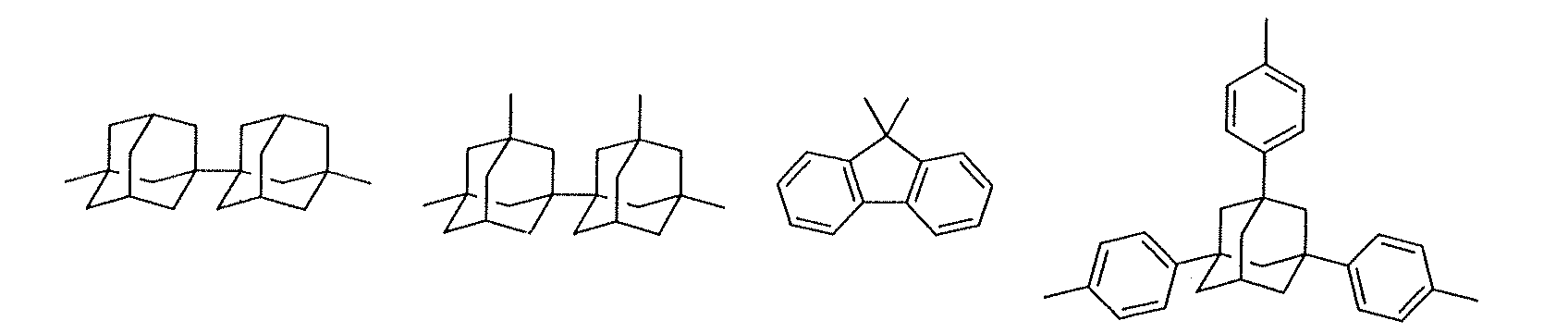
 each of B, C and D is an extreme ultra-violet
reactive group, a group having reactivity to the action of
chromophore active to extreme ultra-violet, or an organic
group represented by
each of B, C and D is an extreme ultra-violet
reactive group, a group having reactivity to the action of
chromophore active to extreme ultra-violet, or an organic
group represented by 
 wherein Ar is a phenyl or naphthyl group
substituted with RO- and/or ROCO- in which R, RO- and ROCO
are extreme ultra-violet reactive groups or groups having
reactivity to the action of a chromophore active to extreme
ultra-violet, and
wherein Ar is a phenyl or naphthyl group
substituted with RO- and/or ROCO- in which R, RO- and ROCO
are extreme ultra-violet reactive groups or groups having
reactivity to the action of a chromophore active to extreme
ultra-violet, and
X, Y and Z are ether bonds.
X, Y and Z are ether bonds.
4. The photoresist base material as recited in claim 3,
wherein A is an organic group represented by

 each of B, C and D is a hydrogen atom, tert-butyl,
tert-butyloxycarbonylmethyl, tert-butyloxycarbonyl, 1-tetrahydropyranyl,
1-tetrahydrofuranyl, 1-ethoxyethyl, 1-phenoxyethyl,
an organic group represented by
each of B, C and D is a hydrogen atom, tert-butyl,
tert-butyloxycarbonylmethyl, tert-butyloxycarbonyl, 1-tetrahydropyranyl,
1-tetrahydrofuranyl, 1-ethoxyethyl, 1-phenoxyethyl,
an organic group represented by  in which P is an aromatic group having a valence of
(r + 1) and having 6 to 20 carbon atoms, Q is an organic
group having 4 to 30 carbon atoms, r is an integer of 1 to
10 and s is an integer of 0 to 10,
or an organic group represented by
in which P is an aromatic group having a valence of
(r + 1) and having 6 to 20 carbon atoms, Q is an organic
group having 4 to 30 carbon atoms, r is an integer of 1 to
10 and s is an integer of 0 to 10,
or an organic group represented by
 in which Ar is a phenyl or naphthyl group
substituted with RO- and/or ROCO- in which R is hydrogen,
tert-butyl, tert-butyloxycarbonylmethyl, tert-butyloxycarbonyl,
1-tetrahydropyranyl, 1-tetrahydrofuranyl,
1-ethoxyethyl, 1-phenoxyethyl, an organic group represented
by
in which Ar is a phenyl or naphthyl group
substituted with RO- and/or ROCO- in which R is hydrogen,
tert-butyl, tert-butyloxycarbonylmethyl, tert-butyloxycarbonyl,
1-tetrahydropyranyl, 1-tetrahydrofuranyl,
1-ethoxyethyl, 1-phenoxyethyl, an organic group represented
by
 in which P is an aromatic group having a valence of
(r + 1) and having 6 to 20 carbon atoms, Q is an organic
group having 4 to 30 carbon atoms, r is an integer of 1 to
10 and s is an integer of 0 to 10,
in which P is an aromatic group having a valence of
(r + 1) and having 6 to 20 carbon atoms, Q is an organic
group having 4 to 30 carbon atoms, r is an integer of 1 to
10 and s is an integer of 0 to 10,
and X, Y and Z are ether bonds.
and X, Y and Z are ether bonds.
5. The photoresist base material as recited in claim 4,
wherein A is an organic group represented by
 each of B, C and D is a hydrogen atom, tert-butyl,
tert-butyloxycarbonylmethyl, tert-butyloxycarbonyl, 1-tetrahydropyranyl,
1-tetrahydrofuranyl, 1-ethoxyethyl, 1-phenoxyethyl
or an organic group represented by
each of B, C and D is a hydrogen atom, tert-butyl,
tert-butyloxycarbonylmethyl, tert-butyloxycarbonyl, 1-tetrahydropyranyl,
1-tetrahydrofuranyl, 1-ethoxyethyl, 1-phenoxyethyl
or an organic group represented by
 in which P is an aromatic group having a valence of
(r + 1) and having 6 to 20 carbon atoms, Q is an organic
group having 4 to 30 carbon atoms, r is an integer of 1 to
10 and s is an integer of 0 to 10,
in which P is an aromatic group having a valence of
(r + 1) and having 6 to 20 carbon atoms, Q is an organic
group having 4 to 30 carbon atoms, r is an integer of 1 to
10 and s is an integer of 0 to 10,
and X, Y and Z are ether bonds.
and X, Y and Z are ether bonds.
6. A photoresist base material comprising a radiation-sensitive
organic compound represented by the following
general formula (1),  wherein A is an organic group represented by
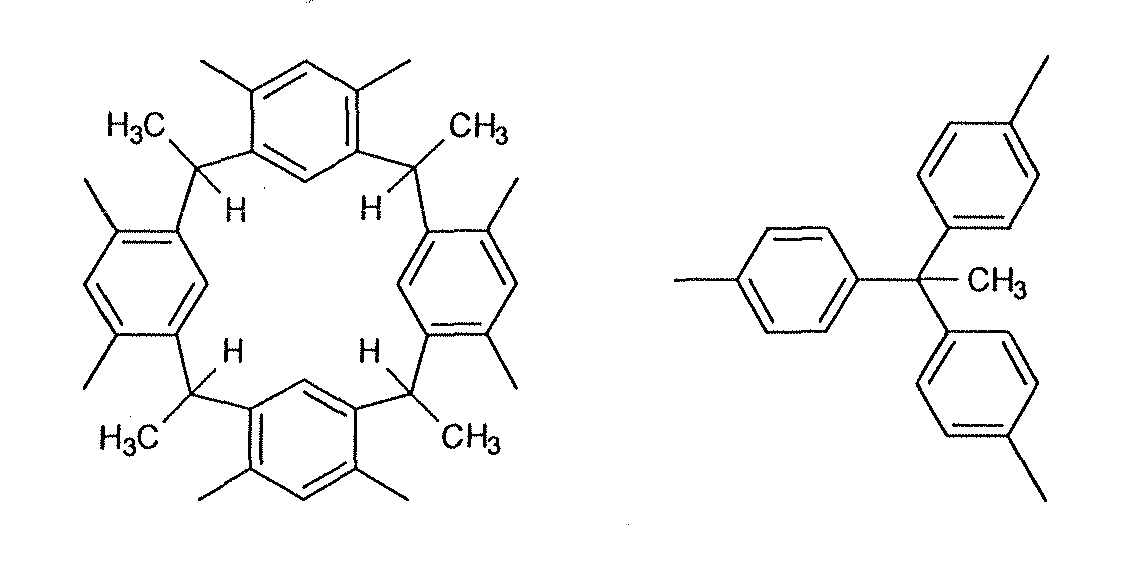 each of B, C and D is independently an organic
group represented by
each of B, C and D is independently an organic
group represented by
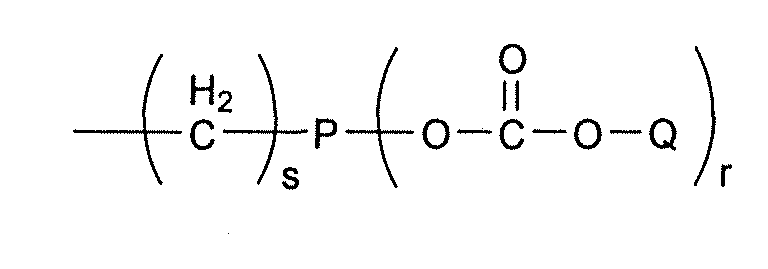 in which P is an aromatic group having a valence of
(r + 1) and having 6 to 20 carbon atoms, Q is an organic
group having 4 to 30 carbon atoms, r is an integer of 1 to
10 and s is an integer of 0 to 10, and
in which P is an aromatic group having a valence of
(r + 1) and having 6 to 20 carbon atoms, Q is an organic
group having 4 to 30 carbon atoms, r is an integer of 1 to
10 and s is an integer of 0 to 10, and
l + m + n = 3 or 8.
l + m + n = 3 or 8.
7. The photoresist base material as recited in claim 6,
wherein the organic group represented by
 is 4-(tert-butoxycarbonyloxy)benzyl or 3,5-di(tert-butoxycarbonyloxy)benzyl.
8. The photoresist base material as recited in claim 6,
wherein the radiation is extreme ultra-violet or electron
beam.
9. The photoresist base material as recited in any one
of claims 1 to 8, wherein at least one of B, C and D is a
hydrogen atom and X, Y and Z are ether bonds.
10. The photoresist base material as recited in any one
of 1 to 8, which has a basic impurity content of 10 ppm or
less.
11. A photoresist composition containing a solid
content containing the photoresist base material recited in
any one of claims 1 to 8 and a solvent.
12. A photoresist composition comprising a solid
content containing the photoresist base material recited in
claim 10 and a solvent.
13. The photoresist composition as recited in claim 11
or 12, which further contains an optically-acid-generating
agent.
14. A method for purification of a photoresist base
material, which comprises washing the photoresist base
material recited in any one of claims 1 to 8 with an acidic
aqueous solution and treating the material with an ion-exchange
resin.
15. The method for purification of a photoresist base
material as recited in claim 14, wherein said acidic
aqueous solution is an acetic acid aqueous solution.
16. A method for improvement of the photoresist base
material recited in any one of claims 1 to 8 in radiation
sensitivity, which comprises decreasing the content of
basic impurities to 10 ppm or less.
17. A method for fine processing by lithography, which
uses the photoresist composition recited in claim 11 or 12.
18. A semiconductor device fabricated using the
photoresist composition recited in claim 11 or 12.
19. An organic compound represented by the following
general formula (1),  wherein A is an organic group represented by
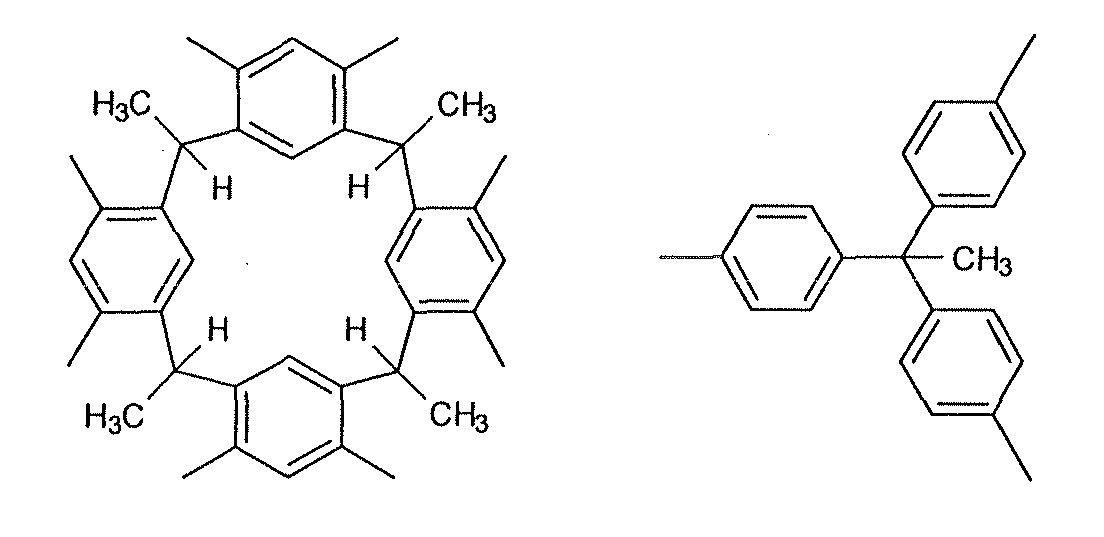 each of B, C and D is independently an organic
group represented by
each of B, C and D is independently an organic
group represented by
 in which P is an aromatic group having a valence of
(r + 1) and having 6 to 20 carbon atoms, Q is an organic
group having 4 to 30 carbon atoms, r is an integer of 1 to
10 and s is an integer of 0 to 10,
in which P is an aromatic group having a valence of
(r + 1) and having 6 to 20 carbon atoms, Q is an organic
group having 4 to 30 carbon atoms, r is an integer of 1 to
10 and s is an integer of 0 to 10,
and
l + m + n = 3 or 8.
and
l + m + n = 3 or 8.
20. The organic compound as recited in claim 19, which
has a basic impurity content of 10 ppm or less.
21. A method for purification of an organic compound,
which comprises washing the organic compound recited in
claim 19 with an acidic aqueous solution and treating the
compound with an ion-exchange resin.
Applications Claiming Priority (5)
| Application Number | Priority Date | Filing Date | Title |
|---|---|---|---|
| JP2002300144 | 2002-10-15 | ||
| JP2002300144 | 2002-10-15 | ||
| JP2003112458 | 2003-04-17 | ||
| JP2003112458A JP4429620B2 (en) | 2002-10-15 | 2003-04-17 | Radiation sensitive organic compounds |
| PCT/JP2003/011137 WO2004036315A1 (en) | 2002-10-15 | 2003-09-01 | Photoresist base material, method for purification thereof, and photoresist compositions |
Publications (2)
| Publication Number | Publication Date |
|---|---|
| EP1553451A1 true EP1553451A1 (en) | 2005-07-13 |
| EP1553451A4 EP1553451A4 (en) | 2009-12-16 |
Family
ID=32109447
Family Applications (1)
| Application Number | Title | Priority Date | Filing Date |
|---|---|---|---|
| EP03808872A Withdrawn EP1553451A4 (en) | 2002-10-15 | 2003-09-01 | PHOTOSENSITIVE MEDIUM, PURIFICATION METHOD THEREFOR, AND PHOTOSENSITIVE COMPOSITIONS |
Country Status (7)
| Country | Link |
|---|---|
| US (1) | US20050271971A1 (en) |
| EP (1) | EP1553451A4 (en) |
| JP (1) | JP4429620B2 (en) |
| KR (1) | KR20050061538A (en) |
| AU (1) | AU2003261865A1 (en) |
| TW (1) | TWI282037B (en) |
| WO (1) | WO2004036315A1 (en) |
Families Citing this family (24)
| Publication number | Priority date | Publication date | Assignee | Title |
|---|---|---|---|---|
| US7001708B1 (en) * | 2001-11-28 | 2006-02-21 | University Of Central Florida Research Foundation, Inc. | Photosensitive polymeric material for worm optical data storage with two-photon fluorescent readout |
| US7923192B2 (en) | 2004-02-20 | 2011-04-12 | Tokyo Ohka Kogyo Co., Ltd. | Base material for pattern-forming material, positive resist composition and method of resist pattern formation |
| KR20070003980A (en) * | 2004-04-05 | 2007-01-05 | 이데미쓰 고산 가부시키가이샤 | Calixresorcinnarene compound, photoresist substrate and composition thereof |
| JP3946715B2 (en) | 2004-07-28 | 2007-07-18 | 東京応化工業株式会社 | Positive resist composition and resist pattern forming method |
| JP4468119B2 (en) | 2004-09-08 | 2010-05-26 | 東京応化工業株式会社 | Resist composition and resist pattern forming method |
| JP4837323B2 (en) | 2004-10-29 | 2011-12-14 | 東京応化工業株式会社 | Resist composition, resist pattern forming method and compound |
| TWI400568B (en) | 2004-12-24 | 2013-07-01 | Mitsubishi Gas Chemical Co | Radiation-sensitive composition, amorphous film and method for forming resist pattern |
| JP4618715B2 (en) * | 2005-01-27 | 2011-01-26 | 日東電工株式会社 | Liquid crystal compound |
| US7981588B2 (en) | 2005-02-02 | 2011-07-19 | Tokyo Ohka Kogyo Co., Ltd. | Negative resist composition and method of forming resist pattern |
| JP5138157B2 (en) | 2005-05-17 | 2013-02-06 | 東京応化工業株式会社 | Positive resist composition and resist pattern forming method |
| CN101218202A (en) * | 2005-06-01 | 2008-07-09 | 木下博雄 | Calixarenes compound, photoresist base material comprising the same, and composition thereof |
| JP4813103B2 (en) | 2005-06-17 | 2011-11-09 | 東京応化工業株式会社 | COMPOUND, POSITIVE RESIST COMPOSITION AND METHOD FOR FORMING RESIST PATTERN |
| JP4732038B2 (en) | 2005-07-05 | 2011-07-27 | 東京応化工業株式会社 | COMPOUND, POSITIVE RESIST COMPOSITION AND METHOD FOR FORMING RESIST PATTERN |
| EP1991910A4 (en) * | 2006-02-16 | 2010-12-01 | Cornell Res Foundation Inc | MOLECULAR GLASS PHOTORESISTS BASED ON ADAMANTANE FOR SUB-200 NM LITHOGRAPHY |
| TW200905398A (en) * | 2007-04-27 | 2009-02-01 | Idemitsu Kosan Co | Photoresist base material and photoresist composition containing the same |
| JP5396738B2 (en) * | 2007-05-09 | 2014-01-22 | 三菱瓦斯化学株式会社 | Radiation-sensitive composition, compound, method for producing compound, and method for forming resist pattern |
| KR20100017795A (en) * | 2007-06-15 | 2010-02-16 | 이데미쓰 고산 가부시키가이샤 | Cyclic compound, photoresist base material and photoresist composition |
| JPWO2009001927A1 (en) * | 2007-06-28 | 2010-08-26 | 出光興産株式会社 | Method for producing cyclic compound with introduced substituent and photoresist base material |
| JP5354420B2 (en) * | 2007-12-11 | 2013-11-27 | 出光興産株式会社 | Cyclic compound, photoresist base material, photoresist composition, fine processing method and semiconductor device |
| JP5435995B2 (en) * | 2009-01-30 | 2014-03-05 | 出光興産株式会社 | Method for producing cyclic compound |
| JP5701576B2 (en) | 2009-11-20 | 2015-04-15 | 富士フイルム株式会社 | Dispersion composition, photosensitive resin composition, and solid-state imaging device |
| JP2013079230A (en) | 2011-09-23 | 2013-05-02 | Rohm & Haas Electronic Materials Llc | Calixarene and photoresist composition comprising the same |
| JP2013067612A (en) | 2011-09-23 | 2013-04-18 | Rohm & Haas Electronic Materials Llc | Calixarene compound and photoresist composition comprising the same |
| KR101935293B1 (en) * | 2016-10-28 | 2019-01-04 | 한양대학교 에리카산학협력단 | Novel resorcinarne-based amphiphiles and uses thereof |
Family Cites Families (17)
| Publication number | Priority date | Publication date | Assignee | Title |
|---|---|---|---|---|
| DE3888400D1 (en) * | 1987-06-12 | 1994-04-21 | Ciba Geigy | Photoresist compositions. |
| JP3039048B2 (en) * | 1991-11-01 | 2000-05-08 | 住友化学工業株式会社 | Positive radiation-sensitive resist composition |
| JP2655384B2 (en) * | 1991-11-08 | 1997-09-17 | 富士写真フイルム株式会社 | Positive resist composition |
| JP3340864B2 (en) * | 1994-10-26 | 2002-11-05 | 富士写真フイルム株式会社 | Positive chemically amplified resist composition |
| JPH10310545A (en) * | 1997-05-09 | 1998-11-24 | Jsr Corp | Phenolic dendrimer compound and radiation-sensitive composition containing the same |
| TW383416B (en) * | 1997-06-26 | 2000-03-01 | Matsushita Electric Industrial Co Ltd | Pattern forming method |
| JPH11322656A (en) * | 1998-05-11 | 1999-11-24 | Jsr Corp | Novel calixarene derivative and calixresorcinarene derivative, and photosensitive composition |
| US6093517A (en) * | 1998-07-31 | 2000-07-25 | International Business Machines Corporation | Calixarenes for use as dissolution inhibitors in lithographic photoresist compositions |
| JP3850596B2 (en) * | 1999-02-25 | 2006-11-29 | 本州化学工業株式会社 | Novel partially protected trisphenols and process for their production |
| JP4135277B2 (en) * | 1999-10-12 | 2008-08-20 | Jsr株式会社 | Radiation sensitive resin composition |
| JP4141625B2 (en) * | 2000-08-09 | 2008-08-27 | 東京応化工業株式会社 | Positive resist composition and substrate provided with the resist layer |
| JP2002182392A (en) * | 2000-12-11 | 2002-06-26 | Fuji Photo Film Co Ltd | Positive type resist composition for electron beam or x- ray |
| JP2002229193A (en) * | 2001-02-06 | 2002-08-14 | Fuji Photo Film Co Ltd | Positive resist composition for electron beam or x-ray |
| US7534547B2 (en) * | 2001-03-29 | 2009-05-19 | Osaka Gas Company Limited | Optically active compound and photosensitive resin composition |
| JP3988580B2 (en) * | 2001-08-23 | 2007-10-10 | Jsr株式会社 | Sulfonyl oxime compound, radiation-sensitive acid generator using the same, positive-type radiation-sensitive resin composition, and negative-type radiation-sensitive resin composition |
| JP4004820B2 (en) * | 2001-10-01 | 2007-11-07 | 富士フイルム株式会社 | Resist composition for positive electron beam, X-ray or EUV |
| US7013965B2 (en) * | 2003-04-29 | 2006-03-21 | General Electric Company | Organic matrices containing nanomaterials to enhance bulk thermal conductivity |
-
2003
- 2003-04-17 JP JP2003112458A patent/JP4429620B2/en not_active Expired - Fee Related
- 2003-09-01 EP EP03808872A patent/EP1553451A4/en not_active Withdrawn
- 2003-09-01 US US10/531,208 patent/US20050271971A1/en not_active Abandoned
- 2003-09-01 AU AU2003261865A patent/AU2003261865A1/en not_active Abandoned
- 2003-09-01 KR KR1020057006474A patent/KR20050061538A/en not_active Ceased
- 2003-09-01 WO PCT/JP2003/011137 patent/WO2004036315A1/en not_active Ceased
- 2003-09-05 TW TW092124659A patent/TWI282037B/en not_active IP Right Cessation
Also Published As
| Publication number | Publication date |
|---|---|
| KR20050061538A (en) | 2005-06-22 |
| US20050271971A1 (en) | 2005-12-08 |
| EP1553451A4 (en) | 2009-12-16 |
| JP4429620B2 (en) | 2010-03-10 |
| WO2004036315B1 (en) | 2004-06-03 |
| WO2004036315A1 (en) | 2004-04-29 |
| AU2003261865A1 (en) | 2004-05-04 |
| TWI282037B (en) | 2007-06-01 |
| TW200405957A (en) | 2004-04-16 |
| JP2004191913A (en) | 2004-07-08 |
Similar Documents
| Publication | Publication Date | Title |
|---|---|---|
| US20050271971A1 (en) | Photoresist base material, method for purification thereof, and photoresist compositions | |
| US9678423B2 (en) | Resist composition, method for forming resist pattern, acid generator and compound | |
| US9766541B2 (en) | Positive-type resist composition, method for forming resist pattern, photo-reactive quencher, and polymeric compound | |
| US8039194B2 (en) | Photoacid generators for extreme ultraviolet lithography | |
| KR102104173B1 (en) | Resist composition and resist patterning process | |
| US20090042123A1 (en) | Calixresorcinarene compound, photoresist base comprising the same, and composition thereof | |
| US9164381B2 (en) | Resist composition, method of forming resist pattern, and compound | |
| JP3236073B2 (en) | Resist composition and pattern forming method using the same | |
| US20070190451A1 (en) | Calixresorcinarene compounds, photoresist base materials, and compositions thereof | |
| US20100266952A1 (en) | Cyclic compound, photoresist base, photoresist composition, microfabrication process, and semiconductor device | |
| WO2015045426A1 (en) | Compounders for Enhancing Generation of Chemical Species | |
| JPH08160606A (en) | Chemically amplified positive resist material | |
| CN114924464B (en) | Chemically amplified positive resist composition and resist pattern forming method | |
| US20150111155A1 (en) | Resist composition, method of forming resist pattern, compound and polymeric compound | |
| JPWO2008136372A1 (en) | Photoresist base material and photoresist composition comprising the same | |
| JP2005075767A (en) | Photoresist base material, purification method thereof, and photoresist composition | |
| JPH09323970A (en) | New sulfonium salt and chemically amplified positive resist material | |
| CN119451998A (en) | Composition, resin composition, film-forming composition, pattern forming method, and compound | |
| CN105980347B (en) | Method for producing novel alicyclic ester compound, novel alicyclic ester compound, (meth)acrylic copolymer obtained by polymerizing the same, and photosensitive resin composition containing the same | |
| US20240295812A1 (en) | Resist composition, method for forming resist pattern, method for producing compounds, intermediate, and compounds | |
| WO2015174072A1 (en) | Compounders for enhancing generation of chemical species | |
| KR20160122117A (en) | (meth)acrylic acid ester compound and production method therefor | |
| JP4623260B2 (en) | Resist compounds and compositions | |
| KR20090055824A (en) | Photosensitive Molecular Compounds and Photoresist Compositions Comprising the Same | |
| JP2017016053A (en) | Resin composition and manufacturing method of device using the same |
Legal Events
| Date | Code | Title | Description |
|---|---|---|---|
| PUAI | Public reference made under article 153(3) epc to a published international application that has entered the european phase |
Free format text: ORIGINAL CODE: 0009012 |
|
| 17P | Request for examination filed |
Effective date: 20050404 |
|
| AK | Designated contracting states |
Kind code of ref document: A1 Designated state(s): AT BE BG CH CY CZ DE DK EE ES FI FR GB GR HU IE IT LI LU MC NL PT RO SE SI SK TR |
|
| AX | Request for extension of the european patent |
Extension state: AL LT LV MK |
|
| DAX | Request for extension of the european patent (deleted) | ||
| RBV | Designated contracting states (corrected) |
Designated state(s): DE |
|
| A4 | Supplementary search report drawn up and despatched |
Effective date: 20091113 |
|
| STAA | Information on the status of an ep patent application or granted ep patent |
Free format text: STATUS: THE APPLICATION HAS BEEN WITHDRAWN |
|
| 18W | Application withdrawn |
Effective date: 20100120 |