EP1553145B1 - Nachbesserung von Mehrschicht-Oxidelack in Gasturbinen-Scheiben und Dichtungen - Google Patents
Nachbesserung von Mehrschicht-Oxidelack in Gasturbinen-Scheiben und Dichtungen Download PDFInfo
- Publication number
- EP1553145B1 EP1553145B1 EP04257995.3A EP04257995A EP1553145B1 EP 1553145 B1 EP1553145 B1 EP 1553145B1 EP 04257995 A EP04257995 A EP 04257995A EP 1553145 B1 EP1553145 B1 EP 1553145B1
- Authority
- EP
- European Patent Office
- Prior art keywords
- paint
- touch
- layer
- oxide
- imperfection
- Prior art date
- Legal status (The legal status is an assumption and is not a legal conclusion. Google has not performed a legal analysis and makes no representation as to the accuracy of the status listed.)
- Expired - Lifetime
Links
- 239000003973 paint Substances 0.000 title claims description 87
- 230000007797 corrosion Effects 0.000 claims description 32
- 238000005260 corrosion Methods 0.000 claims description 32
- 238000000034 method Methods 0.000 claims description 31
- 239000002245 particle Substances 0.000 claims description 29
- 229910000601 superalloy Inorganic materials 0.000 claims description 29
- 239000011230 binding agent Substances 0.000 claims description 27
- 239000000758 substrate Substances 0.000 claims description 27
- PNEYBMLMFCGWSK-UHFFFAOYSA-N aluminium oxide Inorganic materials [O-2].[O-2].[O-2].[Al+3].[Al+3] PNEYBMLMFCGWSK-UHFFFAOYSA-N 0.000 claims description 21
- 239000002904 solvent Substances 0.000 claims description 18
- QDOXWKRWXJOMAK-UHFFFAOYSA-N dichromium trioxide Chemical compound O=[Cr]O[Cr]=O QDOXWKRWXJOMAK-UHFFFAOYSA-N 0.000 claims description 15
- 230000002401 inhibitory effect Effects 0.000 claims description 11
- GWEVSGVZZGPLCZ-UHFFFAOYSA-N Titan oxide Chemical compound O=[Ti]=O GWEVSGVZZGPLCZ-UHFFFAOYSA-N 0.000 claims description 10
- MCMNRKCIXSYSNV-UHFFFAOYSA-N Zirconium dioxide Chemical compound O=[Zr]=O MCMNRKCIXSYSNV-UHFFFAOYSA-N 0.000 claims description 10
- VYPSYNLAJGMNEJ-UHFFFAOYSA-N Silicium dioxide Chemical compound O=[Si]=O VYPSYNLAJGMNEJ-UHFFFAOYSA-N 0.000 claims description 8
- KPUWHANPEXNPJT-UHFFFAOYSA-N disiloxane Chemical class [SiH3]O[SiH3] KPUWHANPEXNPJT-UHFFFAOYSA-N 0.000 claims description 8
- ZCDOYSPFYFSLEW-UHFFFAOYSA-N chromate(2-) Chemical compound [O-][Cr]([O-])(=O)=O ZCDOYSPFYFSLEW-UHFFFAOYSA-N 0.000 claims description 6
- 239000007787 solid Substances 0.000 claims description 6
- BPQQTUXANYXVAA-UHFFFAOYSA-N Orthosilicate Chemical compound [O-][Si]([O-])([O-])[O-] BPQQTUXANYXVAA-UHFFFAOYSA-N 0.000 claims description 5
- 238000001035 drying Methods 0.000 claims description 5
- 239000000463 material Substances 0.000 claims description 5
- 238000007788 roughening Methods 0.000 claims description 5
- 229910019142 PO4 Inorganic materials 0.000 claims description 4
- 238000004140 cleaning Methods 0.000 claims description 4
- NBIIXXVUZAFLBC-UHFFFAOYSA-K phosphate Chemical compound [O-]P([O-])([O-])=O NBIIXXVUZAFLBC-UHFFFAOYSA-K 0.000 claims description 4
- 239000010452 phosphate Substances 0.000 claims description 4
- 229920001296 polysiloxane Polymers 0.000 claims description 4
- 239000000377 silicon dioxide Substances 0.000 claims description 4
- 244000137852 Petrea volubilis Species 0.000 claims description 3
- 230000001680 brushing effect Effects 0.000 claims description 2
- 238000000576 coating method Methods 0.000 description 21
- 239000011248 coating agent Substances 0.000 description 19
- 239000000203 mixture Substances 0.000 description 17
- 238000012360 testing method Methods 0.000 description 16
- 238000009472 formulation Methods 0.000 description 15
- PXHVJJICTQNCMI-UHFFFAOYSA-N Nickel Chemical compound [Ni] PXHVJJICTQNCMI-UHFFFAOYSA-N 0.000 description 14
- 239000007789 gas Substances 0.000 description 9
- 230000008569 process Effects 0.000 description 9
- XEEYBQQBJWHFJM-UHFFFAOYSA-N Iron Chemical compound [Fe] XEEYBQQBJWHFJM-UHFFFAOYSA-N 0.000 description 8
- 239000000567 combustion gas Substances 0.000 description 8
- 238000001723 curing Methods 0.000 description 7
- 229910052759 nickel Inorganic materials 0.000 description 7
- KFZMGEQAYNKOFK-UHFFFAOYSA-N Isopropanol Chemical compound CC(C)O KFZMGEQAYNKOFK-UHFFFAOYSA-N 0.000 description 6
- 239000003570 air Substances 0.000 description 4
- 229910017052 cobalt Inorganic materials 0.000 description 4
- 239000010941 cobalt Substances 0.000 description 4
- GUTLYIVDDKVIGB-UHFFFAOYSA-N cobalt atom Chemical compound [Co] GUTLYIVDDKVIGB-UHFFFAOYSA-N 0.000 description 4
- 238000002485 combustion reaction Methods 0.000 description 4
- 229910052742 iron Inorganic materials 0.000 description 4
- 238000004519 manufacturing process Methods 0.000 description 4
- 230000003647 oxidation Effects 0.000 description 4
- 238000007254 oxidation reaction Methods 0.000 description 4
- 230000003746 surface roughness Effects 0.000 description 4
- 230000002411 adverse Effects 0.000 description 3
- 230000008901 benefit Effects 0.000 description 3
- 239000000843 powder Substances 0.000 description 3
- 239000002699 waste material Substances 0.000 description 3
- 239000004111 Potassium silicate Substances 0.000 description 2
- 239000012876 carrier material Substances 0.000 description 2
- 229910000151 chromium(III) phosphate Inorganic materials 0.000 description 2
- 238000009826 distribution Methods 0.000 description 2
- 238000010438 heat treatment Methods 0.000 description 2
- 229910052751 metal Inorganic materials 0.000 description 2
- 239000002184 metal Substances 0.000 description 2
- NNHHDJVEYQHLHG-UHFFFAOYSA-N potassium silicate Chemical compound [K+].[K+].[O-][Si]([O-])=O NNHHDJVEYQHLHG-UHFFFAOYSA-N 0.000 description 2
- 229910052913 potassium silicate Inorganic materials 0.000 description 2
- 235000019353 potassium silicate Nutrition 0.000 description 2
- 230000009467 reduction Effects 0.000 description 2
- 230000002829 reductive effect Effects 0.000 description 2
- 230000008439 repair process Effects 0.000 description 2
- 238000005507 spraying Methods 0.000 description 2
- 239000012720 thermal barrier coating Substances 0.000 description 2
- QAOWNCQODCNURD-UHFFFAOYSA-L Sulfate Chemical compound [O-]S([O-])(=O)=O QAOWNCQODCNURD-UHFFFAOYSA-L 0.000 description 1
- NINIDFKCEFEMDL-UHFFFAOYSA-N Sulfur Chemical compound [S] NINIDFKCEFEMDL-UHFFFAOYSA-N 0.000 description 1
- 229910045601 alloy Inorganic materials 0.000 description 1
- 239000000956 alloy Substances 0.000 description 1
- 229910000323 aluminium silicate Inorganic materials 0.000 description 1
- 239000012080 ambient air Substances 0.000 description 1
- 150000001768 cations Chemical class 0.000 description 1
- 239000000919 ceramic Substances 0.000 description 1
- 238000006243 chemical reaction Methods 0.000 description 1
- JOPOVCBBYLSVDA-UHFFFAOYSA-N chromium(6+) Chemical compound [Cr+6] JOPOVCBBYLSVDA-UHFFFAOYSA-N 0.000 description 1
- IKZBVTPSNGOVRJ-UHFFFAOYSA-K chromium(iii) phosphate Chemical compound [Cr+3].[O-]P([O-])([O-])=O IKZBVTPSNGOVRJ-UHFFFAOYSA-K 0.000 description 1
- 239000000356 contaminant Substances 0.000 description 1
- 230000007423 decrease Effects 0.000 description 1
- HNPSIPDUKPIQMN-UHFFFAOYSA-N dioxosilane;oxo(oxoalumanyloxy)alumane Chemical compound O=[Si]=O.O=[Al]O[Al]=O HNPSIPDUKPIQMN-UHFFFAOYSA-N 0.000 description 1
- 238000001704 evaporation Methods 0.000 description 1
- 230000008020 evaporation Effects 0.000 description 1
- 239000000446 fuel Substances 0.000 description 1
- 238000009499 grossing Methods 0.000 description 1
- 238000013007 heat curing Methods 0.000 description 1
- 229910001385 heavy metal Inorganic materials 0.000 description 1
- 229910052909 inorganic silicate Inorganic materials 0.000 description 1
- 238000011835 investigation Methods 0.000 description 1
- 238000009673 low cycle fatigue testing Methods 0.000 description 1
- 239000011159 matrix material Substances 0.000 description 1
- 150000002739 metals Chemical class 0.000 description 1
- TWNQGVIAIRXVLR-UHFFFAOYSA-N oxo(oxoalumanyloxy)alumane Chemical compound O=[Al]O[Al]=O TWNQGVIAIRXVLR-UHFFFAOYSA-N 0.000 description 1
- 239000002694 phosphate binding agent Substances 0.000 description 1
- 230000002028 premature Effects 0.000 description 1
- 239000011253 protective coating Substances 0.000 description 1
- 238000009419 refurbishment Methods 0.000 description 1
- 239000002002 slurry Substances 0.000 description 1
- 239000011593 sulfur Substances 0.000 description 1
- 229910052717 sulfur Inorganic materials 0.000 description 1
Images
Classifications
-
- F—MECHANICAL ENGINEERING; LIGHTING; HEATING; WEAPONS; BLASTING
- F01—MACHINES OR ENGINES IN GENERAL; ENGINE PLANTS IN GENERAL; STEAM ENGINES
- F01D—NON-POSITIVE DISPLACEMENT MACHINES OR ENGINES, e.g. STEAM TURBINES
- F01D5/00—Blades; Blade-carrying members; Heating, heat-insulating, cooling or antivibration means on the blades or the members
- F01D5/12—Blades
- F01D5/28—Selecting particular materials; Particular measures relating thereto; Measures against erosion or corrosion
- F01D5/286—Particular treatment of blades, e.g. to increase durability or resistance against corrosion or erosion
-
- C—CHEMISTRY; METALLURGY
- C09—DYES; PAINTS; POLISHES; NATURAL RESINS; ADHESIVES; COMPOSITIONS NOT OTHERWISE PROVIDED FOR; APPLICATIONS OF MATERIALS NOT OTHERWISE PROVIDED FOR
- C09D—COATING COMPOSITIONS, e.g. PAINTS, VARNISHES OR LACQUERS; FILLING PASTES; CHEMICAL PAINT OR INK REMOVERS; INKS; CORRECTING FLUIDS; WOODSTAINS; PASTES OR SOLIDS FOR COLOURING OR PRINTING; USE OF MATERIALS THEREFOR
- C09D1/00—Coating compositions, e.g. paints, varnishes or lacquers, based on inorganic substances
-
- C—CHEMISTRY; METALLURGY
- C09—DYES; PAINTS; POLISHES; NATURAL RESINS; ADHESIVES; COMPOSITIONS NOT OTHERWISE PROVIDED FOR; APPLICATIONS OF MATERIALS NOT OTHERWISE PROVIDED FOR
- C09D—COATING COMPOSITIONS, e.g. PAINTS, VARNISHES OR LACQUERS; FILLING PASTES; CHEMICAL PAINT OR INK REMOVERS; INKS; CORRECTING FLUIDS; WOODSTAINS; PASTES OR SOLIDS FOR COLOURING OR PRINTING; USE OF MATERIALS THEREFOR
- C09D1/00—Coating compositions, e.g. paints, varnishes or lacquers, based on inorganic substances
- C09D1/02—Coating compositions, e.g. paints, varnishes or lacquers, based on inorganic substances alkali metal silicates
-
- C—CHEMISTRY; METALLURGY
- C09—DYES; PAINTS; POLISHES; NATURAL RESINS; ADHESIVES; COMPOSITIONS NOT OTHERWISE PROVIDED FOR; APPLICATIONS OF MATERIALS NOT OTHERWISE PROVIDED FOR
- C09D—COATING COMPOSITIONS, e.g. PAINTS, VARNISHES OR LACQUERS; FILLING PASTES; CHEMICAL PAINT OR INK REMOVERS; INKS; CORRECTING FLUIDS; WOODSTAINS; PASTES OR SOLIDS FOR COLOURING OR PRINTING; USE OF MATERIALS THEREFOR
- C09D5/00—Coating compositions, e.g. paints, varnishes or lacquers, characterised by their physical nature or the effects produced; Filling pastes
- C09D5/18—Fireproof paints including high temperature resistant paints
-
- F—MECHANICAL ENGINEERING; LIGHTING; HEATING; WEAPONS; BLASTING
- F01—MACHINES OR ENGINES IN GENERAL; ENGINE PLANTS IN GENERAL; STEAM ENGINES
- F01D—NON-POSITIVE DISPLACEMENT MACHINES OR ENGINES, e.g. STEAM TURBINES
- F01D25/00—Component parts, details, or accessories, not provided for in, or of interest apart from, other groups
- F01D25/007—Preventing corrosion
-
- F—MECHANICAL ENGINEERING; LIGHTING; HEATING; WEAPONS; BLASTING
- F01—MACHINES OR ENGINES IN GENERAL; ENGINE PLANTS IN GENERAL; STEAM ENGINES
- F01D—NON-POSITIVE DISPLACEMENT MACHINES OR ENGINES, e.g. STEAM TURBINES
- F01D5/00—Blades; Blade-carrying members; Heating, heat-insulating, cooling or antivibration means on the blades or the members
- F01D5/12—Blades
- F01D5/28—Selecting particular materials; Particular measures relating thereto; Measures against erosion or corrosion
- F01D5/288—Protective coatings for blades
-
- F—MECHANICAL ENGINEERING; LIGHTING; HEATING; WEAPONS; BLASTING
- F05—INDEXING SCHEMES RELATING TO ENGINES OR PUMPS IN VARIOUS SUBCLASSES OF CLASSES F01-F04
- F05D—INDEXING SCHEME FOR ASPECTS RELATING TO NON-POSITIVE-DISPLACEMENT MACHINES OR ENGINES, GAS-TURBINES OR JET-PROPULSION PLANTS
- F05D2230/00—Manufacture
- F05D2230/80—Repairing, retrofitting or upgrading methods
-
- F—MECHANICAL ENGINEERING; LIGHTING; HEATING; WEAPONS; BLASTING
- F05—INDEXING SCHEMES RELATING TO ENGINES OR PUMPS IN VARIOUS SUBCLASSES OF CLASSES F01-F04
- F05D—INDEXING SCHEME FOR ASPECTS RELATING TO NON-POSITIVE-DISPLACEMENT MACHINES OR ENGINES, GAS-TURBINES OR JET-PROPULSION PLANTS
- F05D2230/00—Manufacture
- F05D2230/90—Coating; Surface treatment
-
- F—MECHANICAL ENGINEERING; LIGHTING; HEATING; WEAPONS; BLASTING
- F05—INDEXING SCHEMES RELATING TO ENGINES OR PUMPS IN VARIOUS SUBCLASSES OF CLASSES F01-F04
- F05D—INDEXING SCHEME FOR ASPECTS RELATING TO NON-POSITIVE-DISPLACEMENT MACHINES OR ENGINES, GAS-TURBINES OR JET-PROPULSION PLANTS
- F05D2300/00—Materials; Properties thereof
- F05D2300/20—Oxide or non-oxide ceramics
- F05D2300/21—Oxide ceramics
- F05D2300/2112—Aluminium oxides
-
- F—MECHANICAL ENGINEERING; LIGHTING; HEATING; WEAPONS; BLASTING
- F05—INDEXING SCHEMES RELATING TO ENGINES OR PUMPS IN VARIOUS SUBCLASSES OF CLASSES F01-F04
- F05D—INDEXING SCHEME FOR ASPECTS RELATING TO NON-POSITIVE-DISPLACEMENT MACHINES OR ENGINES, GAS-TURBINES OR JET-PROPULSION PLANTS
- F05D2300/00—Materials; Properties thereof
- F05D2300/60—Properties or characteristics given to material by treatment or manufacturing
- F05D2300/611—Coating
-
- Y—GENERAL TAGGING OF NEW TECHNOLOGICAL DEVELOPMENTS; GENERAL TAGGING OF CROSS-SECTIONAL TECHNOLOGIES SPANNING OVER SEVERAL SECTIONS OF THE IPC; TECHNICAL SUBJECTS COVERED BY FORMER USPC CROSS-REFERENCE ART COLLECTIONS [XRACs] AND DIGESTS
- Y02—TECHNOLOGIES OR APPLICATIONS FOR MITIGATION OR ADAPTATION AGAINST CLIMATE CHANGE
- Y02T—CLIMATE CHANGE MITIGATION TECHNOLOGIES RELATED TO TRANSPORTATION
- Y02T50/00—Aeronautics or air transport
- Y02T50/60—Efficient propulsion technologies, e.g. for aircraft
-
- Y—GENERAL TAGGING OF NEW TECHNOLOGICAL DEVELOPMENTS; GENERAL TAGGING OF CROSS-SECTIONAL TECHNOLOGIES SPANNING OVER SEVERAL SECTIONS OF THE IPC; TECHNICAL SUBJECTS COVERED BY FORMER USPC CROSS-REFERENCE ART COLLECTIONS [XRACs] AND DIGESTS
- Y10—TECHNICAL SUBJECTS COVERED BY FORMER USPC
- Y10T—TECHNICAL SUBJECTS COVERED BY FORMER US CLASSIFICATION
- Y10T29/00—Metal working
- Y10T29/49—Method of mechanical manufacture
- Y10T29/49316—Impeller making
- Y10T29/49318—Repairing or disassembling
-
- Y—GENERAL TAGGING OF NEW TECHNOLOGICAL DEVELOPMENTS; GENERAL TAGGING OF CROSS-SECTIONAL TECHNOLOGIES SPANNING OVER SEVERAL SECTIONS OF THE IPC; TECHNICAL SUBJECTS COVERED BY FORMER USPC CROSS-REFERENCE ART COLLECTIONS [XRACs] AND DIGESTS
- Y10—TECHNICAL SUBJECTS COVERED BY FORMER USPC
- Y10T—TECHNICAL SUBJECTS COVERED BY FORMER US CLASSIFICATION
- Y10T29/00—Metal working
- Y10T29/49—Method of mechanical manufacture
- Y10T29/49718—Repairing
- Y10T29/49746—Repairing by applying fluent material, e.g., coating, casting
-
- Y—GENERAL TAGGING OF NEW TECHNOLOGICAL DEVELOPMENTS; GENERAL TAGGING OF CROSS-SECTIONAL TECHNOLOGIES SPANNING OVER SEVERAL SECTIONS OF THE IPC; TECHNICAL SUBJECTS COVERED BY FORMER USPC CROSS-REFERENCE ART COLLECTIONS [XRACs] AND DIGESTS
- Y10—TECHNICAL SUBJECTS COVERED BY FORMER USPC
- Y10T—TECHNICAL SUBJECTS COVERED BY FORMER US CLASSIFICATION
- Y10T29/00—Metal working
- Y10T29/49—Method of mechanical manufacture
- Y10T29/49826—Assembling or joining
- Y10T29/49885—Assembling or joining with coating before or during assembling
Definitions
- the present invention relates to gas turbine engines and, more particularly, to the protection of turbine disks and seals against oxidation and corrosion.
- gas turbine In an aircraft gas turbine (jet) engine, air is drawn into the front of the engine compressed by a shaft-mounted compressor, and mixed with fuel. The mixture is burned, and the hot combustion gases are passed through a turbine mounted on the same shaft. The flow of combustion gas turns the turbine, which turns the shaft and provides power to the compressor and to the fan.
- the compressor and a high-pressure turbine are mounted on one shaft having a first set of turbines, and the fan and a low-pressure turbine are mounted on a separate shaft having a second set of turbines.
- the hot exhaust gases and the air propelled by the fan flow from the back of the engine, driving it and the aircraft forward. The hotter the combustion and exhaust gases, the more efficient the operation of the jet engine. There is thus an incentive to raise the combustion-gas temperature.
- the turbine (sometimes termed a “turbine rotor”) includes one or more turbine disks, a number of turbine blades mounted to the turbine disks and extending radially outwardly therefrom into the combustion-gas flow path, and rotating seals that prevent the hot combustion gases from contacting the turbine shaft and related components.
- the materials used in the turbine limit the maximum operating temperature of the combustion gas. Great efforts have been made to increase the temperature capabilities of the turbine blades, resulting in increasing combustion as operating temperatures and increased engine efficiency.
- the turbine disks and seals for use at the highest operating temperatures are made of nickel-base superalloys selected for good toughness and fatigue resistance. These superalloys are selected for their mechanical properties. They have some resistance to oxidation and corrosion damage, but that resistance is not sufficient to protect them at the operating temperatures that are now being reached.
- One corrosion resistant coating which has been developed for use with turbine disks and seals, is a three-layer oxide based paint system that may be applied to the corrosion susceptible areas of turbine disks and seals.
- This three-layer oxide based paint coating system comprises alumina and chromia particles, which are oxides of metals that are found in the superalloy substrate.
- Such a coating system does not adversely affect the fatigue life of the turbine disks and seals and greatly increases the corrosion resistance of the component to which it is applied.
- small coating imperfection regions sometimes develop, exposing the superalloy substrate. Placing an aircraft engine into service with such coating imperfections present on the component would open up the component under these areas of imperfection to corrosion.
- One solution is to strip all of the coating off of the component and reapply the coating. However, such a solution is expensive and time consuming.
- touch-up oxide paint should be able to be applied after initial manufacture and inhibit corrosion from occurring between planned engine overhauls, which generally occur approximately every 3000 cycles.
- touch-up oxide paint should not affect the low cycle fatigue (LCF) life, readily adhere to a superalloy substrate, and function effectively to 1400°F (760°C). This need extends to other components of the gas turbine engine with layer paint oxide coating systems as well.
- the present invention fulfills these needs, and further provides related advantages.
- US 5,985,368 discloses a thermal barrier coating for metal substrates such as superalloys.
- the coating is a slurry composition, comprising spheres of zirconia, at least some of which are hollow, contained within a porous oxide matrix, such as aluminosilicate.
- EP 1 197 585 discloses a method of repairing a thermal barrier coating on a component designed for use in a hostile thermal environment, such as turbine, combustor and augmentor components of a gas turbine engine.
- EP 1 088 908 discloses a method for smoothing the surface of a ceramic-based protective coating which exhibits roughness.
- the present invention is directed to a method for repairing an imperfection in a corrosion-inhibiting layer paint oxide system comprising a plurality of layers on a turbine engine component, the method comprising the steps of: providing a turbine engine component comprising a superalloy substrate, wherein at least a portion of the substrate has been treated with a corrosion inhibiting paint oxide system, wherein an imperfection region is present on the system exposing the superalloy substrate beneath the system; providing a touch-up paint comprising alumina particles, an evaporable solvent, and a binder selected from the group consisting of silicate, silicone, chromate phosphate, siloxane, and combinations thereof; applying a layer of the touch-up paint to the imperfection region; drying the layer of touch-up paint; and curing the dried layer of touch-up paint in the range 540°C to 760°C, wherein curing the dried layer of touch-up paint occurs during initial engine operation where the engine component reaches a temperature sufficient to fully cure the dried layer of touch-
- the method of the present invention includes providing a turbine engine component comprising an iron-based, nickel-based, and/or cobalt based superalloy substrate, to which a paint oxide system comprising a plurality of layers and comprising chromia and alumina has been applied, but where at least one small imperfection region, which exposes the surface of the superalloy substrate, is present within the paint oxide system region.
- the imperfection surface may be lightly roughened to a surface roughness in the range of about 0.254 ⁇ m (10 microinches) to about 2.54 ⁇ m (100 microinches) R a .
- a preselected number of layers of touch-up oxide paint are applied to the surface of the imperfection region(s).
- the paint comprises alumina particles as a particulate solid in the paint, and may also comprise oxide particles selected from the group consisting of chromia, silica, titania, zirconia, tantala particles, and combinations thereof, a carrier material, typically an evaporable solvent, and a binder selected from the group consisting of silicate, silicone, chromate phosphate, siloxane, and combinations thereof. Suitable binders are described in U.S. Pat. Nos. 4,319,924 ; 3,248,251 ; 3,248,250 ; and 3,248,249 .
- the application of the layer(s) may be performed by hand or by spraying the layer(s) onto the imperfection region(s).
- the number of layers of the touch-up paint can be of one layer or more than one layer, as the thickness of the touch-up oxide paint layer(s) should be about equal to the thickness of the original layered oxide paint system.
- the heat gun therefore heats the layer(s) to a temperature sufficient to drive off the evaporable solvent and to dry the binder.
- a higher heat gun temperature will require a shorter treatment time, while a lower heat gun temperature will require a longer treatment time.
- the heat gun optionally may cure the binder.
- the layer may also be heated using heat lamps or any other convenient heating method.
- the touch-up paint layer(s) need only be dried, but can be fully cured, before engine build-up. Curing of dried only repairs will occur during initial engine operation where engine components reach temperatures sufficiently high to fully cure the touch up.
- An advantage of the present invention is a significant labor, capital and materials cost reduction as stripping and reapplying a layered chromia and alumina coating is no longer required due to the touch-up method of the present invention.
- Another advantage of the present invention is that the process is more environmentally friendly than current practice since heavy metal based powder waste such as alumina powder waste and chromia powder waste is reduced.
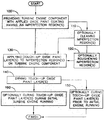
- FIG. 1 there is shown the method of the present invention for applying a touch-up oxide paint to an aircraft engine component substrate to which a three-layer paint oxide system comprising chromia and alumina has been applied, but which system contains an imperfection region(s).
- the initial step 100 of the process is the provision of a turbine engine component with an applied three-layer paint oxide system comprising alumina and chromia, having at least one imperfection region.
- the component comprises a nickel-based, iron-based, and/or cobalt-based superalloy substrate.
- the three-layer paint oxide system is present on at least a portion of a surface of the component substrate.
- the thickness of the three-layer paint oxide system is in the range of about 12.7 ⁇ m (0.0005 inch) to about 63.5 ⁇ m (0.0025 inch).
- the imperfection in the three-layer paint oxide system exposes the nickel-based, iron-based, and/or cobalt-based superalloy substrate beneath the three-layer paint oxide system to corrosion attack.
- the imperfection region may be a spalled region, a scratched region, a chipped region, and/or an uncoated region. A plurality of such regions may be present on the substrate, but should not be continuous.
- the optional next step 110 of the process is cleaning the imperfection region(s), if required, with isopropyl alcohol, a solvent with similar properties, or combinations thereof to remove any dirt, particles, films and/or other contaminants, referred to herein as "extraneous material" that may adversely affect adhesion of the touch-up paint layer to the imperfection region(s).
- the optional next step 120 of the process is roughening the imperfection region(s) to a surface roughness in the range of about 0.254 ⁇ m (10 microinches) to about 2.54 ⁇ m (100 microinches) R a .
- the optional next step 120 of the process is roughening the imperfection region(s) to a surface roughness in the range of about 0.508 ⁇ m (20 microinches) to about 1.524 ⁇ m (60 microinches) R a .
- Such a surface roughness may be achieved using any means known in the art, such as, for example rubbing the imperfection region(s) with 320 mesh aluminum oxide sand paper or an equivalent sand paper.
- the next step 130 of the process is applying a preselected number of layers of touch-up oxide paint to the surface of the imperfection region(s).
- the touch-up oxide paint comprises alumina particles as a particulate solid in the paint and may also comprise oxide particles selected from the group consisting of chromia, silica, titania, zirconia, tantala particles, and combinations thereof, a carrier material, typically an evaporable solvent, and a binder selected from the group consisting of silicate, silicone, chromate phosphate, siloxane, and combinations thereof.
- the oxide particles in the paint should have diameters smaller than the overall desired coating thickness.
- the next step 140 of the invention is drying the touch-up oxide paint layer(s) preferably at room temperature, by exposing the oxide paint layer(s) to ambient air for a preselected period of time, generally in the range of about one hour to about ten hours, depending on the solvent and the binder in the touch-up oxide paint, so that the layer(s) is dry enough to prevent damage to the layer(s), during engine manufacture, prior to curing the layer(s).
- a preselected period of time generally in the range of about one hour to about ten hours, depending on the solvent and the binder in the touch-up oxide paint, so that the layer(s) is dry enough to prevent damage to the layer(s), during engine manufacture, prior to curing the layer(s).
- Such drying usually entails evaporation of a substantial portion of the solvent.
- the use of a heat gun may be required to render the layer(s) sufficiently dry to handle.
- a heat gun producing heated air having a temperature sufficient to drive off the evaporable solvent and to dry the binder, and preferably at a temperature of about 300°F (150°C), will need to be used on the layer(s) for a time of about 15 minutes to about 4 hours.
- a higher heat gun temperature will require a shorter treatment time, while a lower heat gun temperature will require a longer treatment time.
- the heat gun optionally may cure the binder.
- a higher heat gun temperature will require a shorter treatment time, while a lower heat gun temperature will require a longer treatment time.
- the touch-up paint comprises alumina, chromia, a siloxane binder, and an evaporable solvent. While the siloxane binder will dry at ambient conditions in approximately two hours to a tack-free handleable coating, the binder requires a heat cure at a temperature of about 400°F (205°C) to about 500°F (260°C) to achieve the performance necessary in the present invention.
- the optional final step 150 of the invention is curing the touch-up oxide paint layer(s) by heating the paint layer(s) to a temperature in the range of about 300°F (150°C) to about 1000°F (540°C) for a period of time in the range of about 10 minutes to about 4 hours, preferably to a temperature of about 650°F (345°C) for about 30 minutes.
- the touch-up paint layer(s) are cured as required by the specific paint formulation prior to initial engine running. As is well known in the art, a higher cure temperature will require a shorter treatment time, while a lower cure temperature will require a longer treatment time.
- the final step 160 of the invention is curing the touch-up layer(s) during initial turbine engine running.
- the operating temperature of the coated components is in the range of 1000°F (540°C) to 1400°F (760°C) and at such temperatures the applied layer(s) will cure in less than about 30 minutes.
- the final cured oxide touch-up coating provides corrosion protection to the underlying superalloy component substrate, does not adversely impact the LCF of the superalloy component, adheres to the superalloy component substrate, and is temperature capable up to about 1400°F (760°C). Above a temperature of about 1400°F (760°C), coating adhesion decreases and certain silicate binders become unstable in contact with the base alloys.
- the present invention also comprises an aircraft engine component, wherein the component is a turbine disk or turbine seal comprising an iron-based superalloy, a nickel-based superalloy, or a cobalt-based superalloy, that has been treated with the touch-up paint of the present invention, wherein at least a portion of the component was initially manufactured with an a corrosion inhibiting three-layer paint oxide system comprising alumina and chromia, with an imperfection present in the three-layer paint oxide system.
- a touch-up paint comprising at least alumina particles is provided and a layer of the touch-up paint is applied to the imperfection region.
- the tough up paint may also comprise oxide particles selected from the group consisting of chromia, silica, titania, zirconia, tantala particles, and combinations thereof. The layer of touch-up paint is then dried and cured.
- the first testing formulation comprised alumina particles, titania particles, a potassium silicate binder, and an evaporable solvent.
- the second testing formulation comprised alumina particles, a hexavalent chromium phosphate binder, and an evaporable solvent.
- the third testing formulation comprised alumina particles, chromia particles, a siloxane binder, and an evaporable solvent.
- the fourth testing formulation comprised alumina particles, an alkaline inorganic silicate binder, and an evaporable solvent.
- a corrosion test which simulates the morphology of corrosion observed in field run hardware, was run on a nickel-based superalloy substrate samples using a bar sample as a control.
- Several nickel-based superalloy substrates samples which had been subjected to 320 grit blast, were prepared and coated with a layer of each of the four testing formulations listed above.
- Each testing formulation on each sample was cured prior to the corrosion test.
- the first testing formulation and the second testing formulation demonstrated a corrosion resistance that was over 5 times better than corrosion resistance of the bare substrate.
- the third testing formulation and the fourth testing formulation demonstrated a corrosion resistance that was about 2.5 times better than the corrosion resistance of the bare substrate as determined by substrate material attack.
Landscapes
- Engineering & Computer Science (AREA)
- Chemical & Material Sciences (AREA)
- Materials Engineering (AREA)
- Mechanical Engineering (AREA)
- General Engineering & Computer Science (AREA)
- Life Sciences & Earth Sciences (AREA)
- Wood Science & Technology (AREA)
- Organic Chemistry (AREA)
- Inorganic Chemistry (AREA)
- Paints Or Removers (AREA)
- Other Surface Treatments For Metallic Materials (AREA)
Claims (10)
- Verfahren zur Behebung eines Defekts in einem korrosionshemmenden Schicht-Oxidlacksystem, das eine Mehrzahl von Schichten auf einem Turbinentriebwerkbauteil umfasst, wobei das Verfahren die folgenden Schritte umfasst:Bereitstellen eines Turbinentriebwerkbauteils, das aus einem Superlegierungssubstrat besteht, wobei mindestens ein Teil des Substrats mit einem korrosionshemmenden Schicht-Oxidlacksystem behandelt wurde, wobei ein Defektbereich auf dem System vorhanden ist, der das Superlegierungssubstrat unterhalb des Systems freilegt;Bereitstellen eines Nachbesserungslacks, der Aluminiumoxidpartikeln, ein verdampfbares Lösungsmittel und ein Bindemittel umfasst, das aus der Gruppe bestehend aus Silikat, Silikon, Chromat Phosphat, Siloxan und Kombinationen davon ausgewählt ist;Auftragen einer Schicht von Nachbesserungslack auf den Defektbereich;Trocknen der Schicht von Nachbesserungslack; undAushärten der getrockneten Schicht des Nachbesserungslacks im Bereich von 540°C bis 760°C, wobei das Aushärten der getrockneten Schicht des Nachbesserungslacks bei der Inbetriebnahme des Triebwerks erfolgt, bei der das Triebwerkbauteil eine Temperatur erreicht, die ausreicht, um die getrocknete Schicht von Nachbesserungslack vollständig auszuhärten.
- Verfahren nach Anspruch 1, ferner umfassend den Schritt des Reinigens des Defektbereichs zur Entfernung von Fremdstoffen.
- Verfahren nach Anspruch 1, ferner umfassend den Schritt des Aufrauens des Defektbereichs nach dem Schritt des Bereitstellens eines Turbinentriebwerkbauteils.
- Verfahren nach Anspruch 2, ferner umfassend den Schritt des Aufrauens des Defektbereichs nach dem Schritt des Reinigens des Defektbereichs.
- Verfahren nach Anspruch 4, wobei der Schritt des Aufrauens mit Sandpapier durchgeführt wird.
- Verfahren nach Anspruch 1, wobei der Schritt des Trocknens mit einer Heizpistole durchgeführt wird, wobei die Heizpistole die Schicht erwärmt, um das verdampfbare Lösungsmittel abzutreiben und das Bindemittel für einen Zeitraum von 15 Minuten bis 4 Stunden zu trocknen.
- Verfahren nach Anspruch 1, wobei der Nachbesserungslack ferner zusätzliche Oxidpartikeln umfasst, die aus der Gruppe bestehend aus Chromoxid, Kieselsäure, Titanoxid, Zirkoniumoxid, Tantaloxid und Kombinationen davon ausgewählt sind.
- Verfahren nach Anspruch 7, wobei die Oxidpartikeln einen Durchmesser im Bereich von 0,1 µm bis 25 µm aufweisen und wobei die Oxidpartikeln einen Volumenanteil des gesamten Feststoffgehalts im Lack im Bereich von 20 Volumenprozent bis 70 Volumenprozent ausmachen.
- Verfahren nach Anspruch 8, wobei die Oxidpartikeln einen Durchmesser im Bereich von 0,1 µm bis 10 µm aufweisen und wobei die Oxidpartikeln einen Volumenanteil des gesamten Feststoffgehalts im Lack im Bereich von 46 Volumenprozent bis 52 Volumenprozent ausmachen.
- Verfahren nach Anspruch 1, wobei zwei Schichten von Nachbesserungslack durch Bürsten auf den Defektbereich aufgetragen werden.
Applications Claiming Priority (2)
| Application Number | Priority Date | Filing Date | Title |
|---|---|---|---|
| US747458 | 2003-12-29 | ||
| US10/747,458 US7546683B2 (en) | 2003-12-29 | 2003-12-29 | Touch-up of layer paint oxides for gas turbine disks and seals |
Publications (2)
| Publication Number | Publication Date |
|---|---|
| EP1553145A1 EP1553145A1 (de) | 2005-07-13 |
| EP1553145B1 true EP1553145B1 (de) | 2019-08-14 |
Family
ID=34592534
Family Applications (1)
| Application Number | Title | Priority Date | Filing Date |
|---|---|---|---|
| EP04257995.3A Expired - Lifetime EP1553145B1 (de) | 2003-12-29 | 2004-12-21 | Nachbesserung von Mehrschicht-Oxidelack in Gasturbinen-Scheiben und Dichtungen |
Country Status (2)
| Country | Link |
|---|---|
| US (1) | US7546683B2 (de) |
| EP (1) | EP1553145B1 (de) |
Families Citing this family (8)
| Publication number | Priority date | Publication date | Assignee | Title |
|---|---|---|---|---|
| US8367967B2 (en) * | 2004-10-29 | 2013-02-05 | United Technologies Corporation | Method and apparatus for repairing thermal barrier coatings |
| US7604867B2 (en) * | 2005-12-20 | 2009-10-20 | General Electric Company | Particulate corrosion resistant coating composition, coated turbine component and method for coating same |
| US9127550B2 (en) * | 2012-08-10 | 2015-09-08 | Siemens Energy, Inc. | Turbine superalloy component defect repair with low-temperature curing resin |
| CA2904185C (en) | 2013-03-13 | 2021-02-23 | General Electric Company | Coatings for metallic substrates |
| CN104551522A (zh) * | 2014-10-24 | 2015-04-29 | 沈阳黎明航空发动机(集团)有限责任公司 | 一种航空发动机大型整铸机匣热校型方法 |
| CN105566955A (zh) * | 2016-02-03 | 2016-05-11 | 中国林业科学研究院木材工业研究所 | 一种木质器材用水基防火涂料 |
| DE102017212075A1 (de) | 2017-07-14 | 2019-01-17 | MTU Aero Engines AG | Verfahren zum Beschichten eines Bauteils für den Heißgaskanal einer Strömungsmaschine |
| CN110899070A (zh) * | 2019-11-19 | 2020-03-24 | 中国航发沈阳黎明航空发动机有限责任公司 | 一种海洋环境下耐高温防腐蚀涂层修复工艺方法 |
Family Cites Families (40)
| Publication number | Priority date | Publication date | Assignee | Title |
|---|---|---|---|---|
| US3248251A (en) | 1963-06-28 | 1966-04-26 | Teleflex Inc | Inorganic coating and bonding composition |
| US3246249A (en) | 1962-03-09 | 1966-04-12 | Philco Corp | Programmable digital high and low limit detector system |
| US3248249A (en) * | 1963-06-28 | 1966-04-26 | Telefiex Inc | Inorganic coating and bonding composition |
| US3248250A (en) | 1963-06-28 | 1966-04-26 | Teleflex Inc | Coating and bonding composition |
| US4319924A (en) * | 1974-02-12 | 1982-03-16 | Coatings For Industry, Inc. | Low-temperature curing coating composition |
| US4097287A (en) | 1975-09-04 | 1978-06-27 | Kansai Paint Co., Ltd. | Inorganic film forming composition for coating |
| GB2028682B (en) | 1978-07-28 | 1982-08-18 | Res Inst For Special Inorganic | Method for producing corrosion-heat-and oxidation-resistant materials |
| CH641760A5 (de) * | 1978-11-27 | 1984-03-15 | Ciba Geigy Ag | Schaedlingsbekaempfungsmittel. |
| US4975330A (en) | 1983-11-28 | 1990-12-04 | Sermatech International, Inc. | Coating compositions containing unreacted hexavalent chromium, a method of applying and an article |
| US4724172A (en) | 1983-12-29 | 1988-02-09 | Sermatech International, Inc. | Thick coating compositions |
| US4650395A (en) | 1984-12-21 | 1987-03-17 | United Technologies Corporation | Coolable seal segment for a rotary machine |
| US4671997A (en) | 1985-04-08 | 1987-06-09 | United Technologies Corporation | Gas turbine composite parts |
| US4863516A (en) | 1987-01-23 | 1989-09-05 | Sermatech International, Inc. | Coating composition |
| ES2032012T3 (es) * | 1987-04-07 | 1993-01-01 | The Boc Group Plc | Separacion de aire. |
| CH678067A5 (de) * | 1989-01-26 | 1991-07-31 | Asea Brown Boveri | |
| US5162460A (en) | 1991-10-17 | 1992-11-10 | Dow Corning Corporation | Moisture-curable silicone corrosion resistant coatings |
| GB9210683D0 (en) * | 1992-05-19 | 1992-07-08 | Rolls Royce Plc | Multiplex aluminide-silicide coating |
| US5795659A (en) * | 1992-09-05 | 1998-08-18 | International Inc. | Aluminide-silicide coatings coated products |
| US6333121B1 (en) | 1992-10-13 | 2001-12-25 | General Electric Company | Low-sulfur article having a platinum-aluminide protective layer and its preparation |
| US5437737A (en) * | 1994-02-07 | 1995-08-01 | United Technologies Corporation | Repair coating for superalloy articles, such as gas turbine engine components |
| GB2286977A (en) | 1994-02-24 | 1995-09-06 | Lee Chwen Chern | Inorganic coating composition |
| US5684066A (en) | 1995-12-04 | 1997-11-04 | H.B. Fuller Licensing & Financing, Inc. | Protective coatings having enhanced properties |
| US5898994A (en) * | 1996-06-17 | 1999-05-04 | General Electric Company | Method for repairing a nickel base superalloy article |
| US5759932A (en) | 1996-11-08 | 1998-06-02 | General Electric Company | Coating composition for metal-based substrates, and related processes |
| US6835465B2 (en) | 1996-12-10 | 2004-12-28 | Siemens Westinghouse Power Corporation | Thermal barrier layer and process for producing the same |
| US5968240A (en) | 1997-08-19 | 1999-10-19 | Sermatech International Inc. | Phosphate bonding composition |
| US6057047A (en) | 1997-11-18 | 2000-05-02 | United Technologies Corporation | Ceramic coatings containing layered porosity |
| US6074464A (en) | 1998-02-03 | 2000-06-13 | Sermatech International, Inc. | Phosphate bonded aluminum coatings |
| US6224657B1 (en) | 1998-10-13 | 2001-05-01 | Sermatech International, Inc. | Hexavalent chromium-free phosphate-bonded coatings |
| US6294261B1 (en) | 1999-10-01 | 2001-09-25 | General Electric Company | Method for smoothing the surface of a protective coating |
| US6365236B1 (en) | 1999-12-20 | 2002-04-02 | United Technologies Corporation | Method for producing ceramic coatings containing layered porosity |
| US6428630B1 (en) | 2000-05-18 | 2002-08-06 | Sermatech International, Inc. | Method for coating and protecting a substrate |
| EP1162284A1 (de) * | 2000-06-05 | 2001-12-12 | Alstom (Switzerland) Ltd | Verfahren zum Reparieren einer beschichteten Komponenten |
| US6605364B1 (en) * | 2000-07-18 | 2003-08-12 | General Electric Company | Coating article and method for repairing a coated surface |
| US6413578B1 (en) | 2000-10-12 | 2002-07-02 | General Electric Company | Method for repairing a thermal barrier coating and repaired coating formed thereby |
| DE60103612T2 (de) | 2001-04-21 | 2005-06-16 | Alstom Technology Ltd | Verfahren zum Reparieren einer keramischen Beschichtung |
| FR2827311B1 (fr) * | 2001-07-12 | 2003-09-19 | Snecma Moteurs | Procede de reparation locale de pieces revetues d'une barriere thermique |
| US6575703B2 (en) | 2001-07-20 | 2003-06-10 | General Electric Company | Turbine disk side plate |
| EP1371812A1 (de) | 2002-06-04 | 2003-12-17 | ALSTOM (Switzerland) Ltd | Verfahren zum Reparieren von beschädigten Laufschaufeln des Turbinenteils einer Gasturbine |
| US6893737B2 (en) * | 2002-12-27 | 2005-05-17 | General Electric Company | Low cost aluminide process for moderate temperature applications |
-
2003
- 2003-12-29 US US10/747,458 patent/US7546683B2/en not_active Expired - Lifetime
-
2004
- 2004-12-21 EP EP04257995.3A patent/EP1553145B1/de not_active Expired - Lifetime
Non-Patent Citations (1)
| Title |
|---|
| None * |
Also Published As
| Publication number | Publication date |
|---|---|
| US20050138805A1 (en) | 2005-06-30 |
| EP1553145A1 (de) | 2005-07-13 |
| US7546683B2 (en) | 2009-06-16 |
Similar Documents
| Publication | Publication Date | Title |
|---|---|---|
| US7749569B2 (en) | Methods for improving corrosion and oxidation resistance to the under platform region of a gas turbine blade | |
| US7993759B2 (en) | Corrosion coating for turbine blade environmental protection | |
| US6919121B2 (en) | Component with repaired thermal barrier coating | |
| JP5459940B2 (ja) | 環境保護用の歪み耐性皮膜 | |
| US7754342B2 (en) | Strain tolerant corrosion protecting coating and spray method of application | |
| US20090047135A1 (en) | Layered corrosion resistant coating for turbine blade environmental protection | |
| JP2008111425A (ja) | ガスタービンエンジン圧縮機用摩擦皮膜 | |
| JP2007187152A (ja) | 腐食防止セラミックコーティングおよび塗装方法 | |
| JP2007185654A (ja) | コーティング方法およびコーティングされた物品 | |
| EP1939325A2 (de) | Dehnungstolerante Korrosionsschutzschicht und Bandverfahren zum Auftragen | |
| EP1553145B1 (de) | Nachbesserung von Mehrschicht-Oxidelack in Gasturbinen-Scheiben und Dichtungen | |
| EP1980713B1 (de) | Gasturbinenlaufschaufel und zugehöriges verfahren zum schutz einer gasturbinenlaufschaufel | |
| WO2010134918A1 (en) | Methods for improving corrosion and oxidation resistance to the under platform region of a gas turbine blade | |
| WO2010134917A1 (en) | Corrosion resistant articles | |
| US20130230406A1 (en) | Corrosion Resistant Articles | |
| EP4155351A1 (de) | Korrosionsschutzbeschichtungen | |
| US20070039175A1 (en) | Methods for repairing turbine engine components | |
| Richter | Repair of Diffusion Coatings |
Legal Events
| Date | Code | Title | Description |
|---|---|---|---|
| PUAI | Public reference made under article 153(3) epc to a published international application that has entered the european phase |
Free format text: ORIGINAL CODE: 0009012 |
|
| AK | Designated contracting states |
Kind code of ref document: A1 Designated state(s): AT BE BG CH CY CZ DE DK EE ES FI FR GB GR HU IE IS IT LI LT LU MC NL PL PT RO SE SI SK TR |
|
| AX | Request for extension of the european patent |
Extension state: AL BA HR LV MK YU |
|
| 17P | Request for examination filed |
Effective date: 20060113 |
|
| AKX | Designation fees paid |
Designated state(s): DE FR GB |
|
| RIC1 | Information provided on ipc code assigned before grant |
Ipc: C09D 5/18 20060101ALI20050408BHEP Ipc: C09D 1/02 20060101ALI20050408BHEP Ipc: F01D 5/28 20060101ALI20050408BHEP Ipc: C09D 1/00 20060101AFI20050408BHEP Ipc: C09D 4/00 20060101ALI20050408BHEP |
|
| GRAP | Despatch of communication of intention to grant a patent |
Free format text: ORIGINAL CODE: EPIDOSNIGR1 |
|
| RIC1 | Information provided on ipc code assigned before grant |
Ipc: F01D 5/28 20060101ALI20190117BHEP Ipc: F01D 25/00 20060101ALI20190117BHEP Ipc: C09D 1/02 20060101ALI20190117BHEP Ipc: C09D 4/00 20060101ALI20190117BHEP Ipc: C09D 1/00 20060101AFI20190117BHEP Ipc: C09D 5/18 20060101ALI20190117BHEP |
|
| INTG | Intention to grant announced |
Effective date: 20190221 |
|
| GRAS | Grant fee paid |
Free format text: ORIGINAL CODE: EPIDOSNIGR3 |
|
| GRAA | (expected) grant |
Free format text: ORIGINAL CODE: 0009210 |
|
| REG | Reference to a national code |
Ref country code: DE Ref legal event code: R081 Ref document number: 602004054185 Country of ref document: DE Owner name: GENERAL ELECTRIC COMPANY, SCHENECTADY, US Free format text: FORMER OWNER: GENERAL ELECTRIC CO., SCHENECTADY, N.Y., US |
|
| AK | Designated contracting states |
Kind code of ref document: B1 Designated state(s): DE FR GB |
|
| REG | Reference to a national code |
Ref country code: GB Ref legal event code: FG4D |
|
| REG | Reference to a national code |
Ref country code: DE Ref legal event code: R096 Ref document number: 602004054185 Country of ref document: DE |
|
| REG | Reference to a national code |
Ref country code: DE Ref legal event code: R097 Ref document number: 602004054185 Country of ref document: DE |
|
| PLBE | No opposition filed within time limit |
Free format text: ORIGINAL CODE: 0009261 |
|
| STAA | Information on the status of an ep patent application or granted ep patent |
Free format text: STATUS: NO OPPOSITION FILED WITHIN TIME LIMIT |
|
| 26N | No opposition filed |
Effective date: 20200603 |
|
| P01 | Opt-out of the competence of the unified patent court (upc) registered |
Effective date: 20230414 |
|
| PGFP | Annual fee paid to national office [announced via postgrant information from national office to epo] |
Ref country code: GB Payment date: 20231121 Year of fee payment: 20 |
|
| PGFP | Annual fee paid to national office [announced via postgrant information from national office to epo] |
Ref country code: FR Payment date: 20231122 Year of fee payment: 20 Ref country code: DE Payment date: 20231121 Year of fee payment: 20 |
|
| REG | Reference to a national code |
Ref country code: DE Ref legal event code: R071 Ref document number: 602004054185 Country of ref document: DE |
|
| REG | Reference to a national code |
Ref country code: GB Ref legal event code: PE20 Expiry date: 20241220 |
|
| PG25 | Lapsed in a contracting state [announced via postgrant information from national office to epo] |
Ref country code: GB Free format text: LAPSE BECAUSE OF EXPIRATION OF PROTECTION Effective date: 20241220 |
|
| PG25 | Lapsed in a contracting state [announced via postgrant information from national office to epo] |
Ref country code: GB Free format text: LAPSE BECAUSE OF EXPIRATION OF PROTECTION Effective date: 20241220 |