EP1553121A1 - Aliphatic polyester polyether copolymer, process for producing the same and aliphatic polyester composition using the copolymer - Google Patents
Aliphatic polyester polyether copolymer, process for producing the same and aliphatic polyester composition using the copolymer Download PDFInfo
- Publication number
- EP1553121A1 EP1553121A1 EP03741132A EP03741132A EP1553121A1 EP 1553121 A1 EP1553121 A1 EP 1553121A1 EP 03741132 A EP03741132 A EP 03741132A EP 03741132 A EP03741132 A EP 03741132A EP 1553121 A1 EP1553121 A1 EP 1553121A1
- Authority
- EP
- European Patent Office
- Prior art keywords
- aliphatic
- aliphatic polyester
- molar
- weight
- polyether copolymer
- Prior art date
- Legal status (The legal status is an assumption and is not a legal conclusion. Google has not performed a legal analysis and makes no representation as to the accuracy of the status listed.)
- Withdrawn
Links
Classifications
-
- C—CHEMISTRY; METALLURGY
- C08—ORGANIC MACROMOLECULAR COMPOUNDS; THEIR PREPARATION OR CHEMICAL WORKING-UP; COMPOSITIONS BASED THEREON
- C08G—MACROMOLECULAR COMPOUNDS OBTAINED OTHERWISE THAN BY REACTIONS ONLY INVOLVING UNSATURATED CARBON-TO-CARBON BONDS
- C08G63/00—Macromolecular compounds obtained by reactions forming a carboxylic ester link in the main chain of the macromolecule
- C08G63/78—Preparation processes
- C08G63/82—Preparation processes characterised by the catalyst used
- C08G63/85—Germanium, tin, lead, arsenic, antimony, bismuth, titanium, zirconium, hafnium, vanadium, niobium, tantalum, or compounds thereof
- C08G63/86—Germanium, antimony, or compounds thereof
- C08G63/863—Germanium or compounds thereof
-
- C—CHEMISTRY; METALLURGY
- C08—ORGANIC MACROMOLECULAR COMPOUNDS; THEIR PREPARATION OR CHEMICAL WORKING-UP; COMPOSITIONS BASED THEREON
- C08G—MACROMOLECULAR COMPOUNDS OBTAINED OTHERWISE THAN BY REACTIONS ONLY INVOLVING UNSATURATED CARBON-TO-CARBON BONDS
- C08G63/00—Macromolecular compounds obtained by reactions forming a carboxylic ester link in the main chain of the macromolecule
- C08G63/02—Polyesters derived from hydroxycarboxylic acids or from polycarboxylic acids and polyhydroxy compounds
- C08G63/60—Polyesters derived from hydroxycarboxylic acids or from polycarboxylic acids and polyhydroxy compounds derived from the reaction of a mixture of hydroxy carboxylic acids, polycarboxylic acids and polyhydroxy compounds
-
- C—CHEMISTRY; METALLURGY
- C08—ORGANIC MACROMOLECULAR COMPOUNDS; THEIR PREPARATION OR CHEMICAL WORKING-UP; COMPOSITIONS BASED THEREON
- C08G—MACROMOLECULAR COMPOUNDS OBTAINED OTHERWISE THAN BY REACTIONS ONLY INVOLVING UNSATURATED CARBON-TO-CARBON BONDS
- C08G63/00—Macromolecular compounds obtained by reactions forming a carboxylic ester link in the main chain of the macromolecule
- C08G63/66—Polyesters containing oxygen in the form of ether groups
-
- C—CHEMISTRY; METALLURGY
- C08—ORGANIC MACROMOLECULAR COMPOUNDS; THEIR PREPARATION OR CHEMICAL WORKING-UP; COMPOSITIONS BASED THEREON
- C08G—MACROMOLECULAR COMPOUNDS OBTAINED OTHERWISE THAN BY REACTIONS ONLY INVOLVING UNSATURATED CARBON-TO-CARBON BONDS
- C08G63/00—Macromolecular compounds obtained by reactions forming a carboxylic ester link in the main chain of the macromolecule
- C08G63/66—Polyesters containing oxygen in the form of ether groups
- C08G63/668—Polyesters containing oxygen in the form of ether groups derived from polycarboxylic acids and polyhydroxy compounds
- C08G63/672—Dicarboxylic acids and dihydroxy compounds
-
- C—CHEMISTRY; METALLURGY
- C08—ORGANIC MACROMOLECULAR COMPOUNDS; THEIR PREPARATION OR CHEMICAL WORKING-UP; COMPOSITIONS BASED THEREON
- C08G—MACROMOLECULAR COMPOUNDS OBTAINED OTHERWISE THAN BY REACTIONS ONLY INVOLVING UNSATURATED CARBON-TO-CARBON BONDS
- C08G63/00—Macromolecular compounds obtained by reactions forming a carboxylic ester link in the main chain of the macromolecule
- C08G63/78—Preparation processes
- C08G63/82—Preparation processes characterised by the catalyst used
- C08G63/85—Germanium, tin, lead, arsenic, antimony, bismuth, titanium, zirconium, hafnium, vanadium, niobium, tantalum, or compounds thereof
-
- C—CHEMISTRY; METALLURGY
- C08—ORGANIC MACROMOLECULAR COMPOUNDS; THEIR PREPARATION OR CHEMICAL WORKING-UP; COMPOSITIONS BASED THEREON
- C08L—COMPOSITIONS OF MACROMOLECULAR COMPOUNDS
- C08L67/00—Compositions of polyesters obtained by reactions forming a carboxylic ester link in the main chain; Compositions of derivatives of such polymers
-
- C—CHEMISTRY; METALLURGY
- C08—ORGANIC MACROMOLECULAR COMPOUNDS; THEIR PREPARATION OR CHEMICAL WORKING-UP; COMPOSITIONS BASED THEREON
- C08L—COMPOSITIONS OF MACROMOLECULAR COMPOUNDS
- C08L67/00—Compositions of polyesters obtained by reactions forming a carboxylic ester link in the main chain; Compositions of derivatives of such polymers
- C08L67/02—Polyesters derived from dicarboxylic acids and dihydroxy compounds
- C08L67/025—Polyesters derived from dicarboxylic acids and dihydroxy compounds containing polyether sequences
-
- C—CHEMISTRY; METALLURGY
- C08—ORGANIC MACROMOLECULAR COMPOUNDS; THEIR PREPARATION OR CHEMICAL WORKING-UP; COMPOSITIONS BASED THEREON
- C08L—COMPOSITIONS OF MACROMOLECULAR COMPOUNDS
- C08L67/00—Compositions of polyesters obtained by reactions forming a carboxylic ester link in the main chain; Compositions of derivatives of such polymers
- C08L67/04—Polyesters derived from hydroxycarboxylic acids, e.g. lactones
-
- C—CHEMISTRY; METALLURGY
- C08—ORGANIC MACROMOLECULAR COMPOUNDS; THEIR PREPARATION OR CHEMICAL WORKING-UP; COMPOSITIONS BASED THEREON
- C08G—MACROMOLECULAR COMPOUNDS OBTAINED OTHERWISE THAN BY REACTIONS ONLY INVOLVING UNSATURATED CARBON-TO-CARBON BONDS
- C08G63/00—Macromolecular compounds obtained by reactions forming a carboxylic ester link in the main chain of the macromolecule
- C08G63/66—Polyesters containing oxygen in the form of ether groups
- C08G63/664—Polyesters containing oxygen in the form of ether groups derived from hydroxy carboxylic acids
-
- C—CHEMISTRY; METALLURGY
- C08—ORGANIC MACROMOLECULAR COMPOUNDS; THEIR PREPARATION OR CHEMICAL WORKING-UP; COMPOSITIONS BASED THEREON
- C08L—COMPOSITIONS OF MACROMOLECULAR COMPOUNDS
- C08L2205/00—Polymer mixtures characterised by other features
- C08L2205/02—Polymer mixtures characterised by other features containing two or more polymers of the same C08L -group
-
- C—CHEMISTRY; METALLURGY
- C08—ORGANIC MACROMOLECULAR COMPOUNDS; THEIR PREPARATION OR CHEMICAL WORKING-UP; COMPOSITIONS BASED THEREON
- C08L—COMPOSITIONS OF MACROMOLECULAR COMPOUNDS
- C08L2205/00—Polymer mixtures characterised by other features
- C08L2205/03—Polymer mixtures characterised by other features containing three or more polymers in a blend
Definitions
- the present invention relates to a macromolecular aliphatic polyester polyether copolymer, to a process for producing the same and to an aliphatic polyester composition using the copolymer. More particularly, it relates to an aliphatic polyester polyether copolymer having a practically sufficient high molecular weight and an excellent mechanical property, to a process for producing the same and to an aliphatic polyester composition using the copolymer.
- biodegradable macromolecular substances have a characteristic that they have a biodegradable property but, as compared with resins such as polyolefin, aromatic polyester resin and engineering plastic, there is a problem that their physical property, particularly mechanical strength, is not so sufficiently good for practical use.
- resin where a biodegradable polyester resin is copolymerized with polyether such as polyethylene glycol has been proposed (refer to Patent Document 1).
- polybutylene succinate has a sufficient elongation but, in some uses, strength such as elasticity is somewhat low and is too soft while, although polylactic acid has a high rigidity, it lacks in elongation and has a hard and fragile property whereby its use is limited. Therefore, compositions where they are subjected to a melt blending have been proposed (refer to Patent Document 2).
- compositions disclosed as such are compositions which are suitable for the formation of film and the like, they are insufficient in terms of physical property for the field of use as injection molded products where higher impact strength and rigidity are demanded or, to be more specific, interior parts for automobiles, home appliance parts and baskets whereby there has been a demand for a composition having both higher impact strength and rigidity.
- An object of the present invention is to provide an aliphatic polyester polyether copolymer having a biodegradable property and a sufficient mechanical physical property, a process for producing the same and an aliphatic polyester composition having both higher impact strength and rigidity.
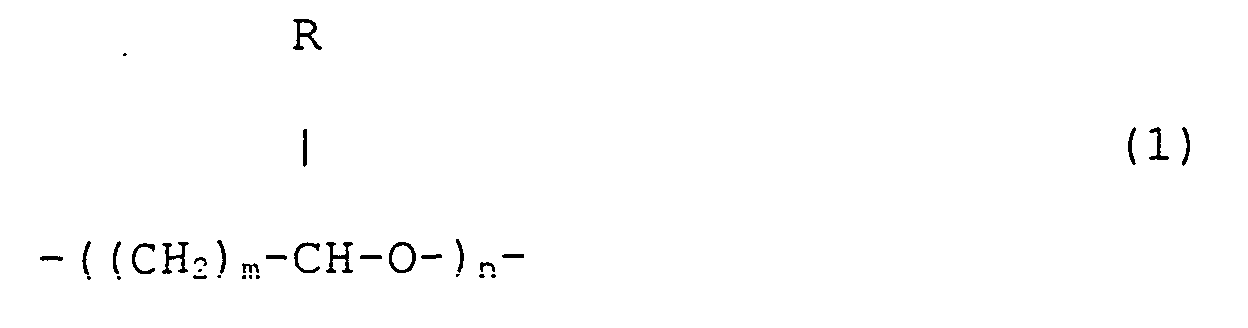
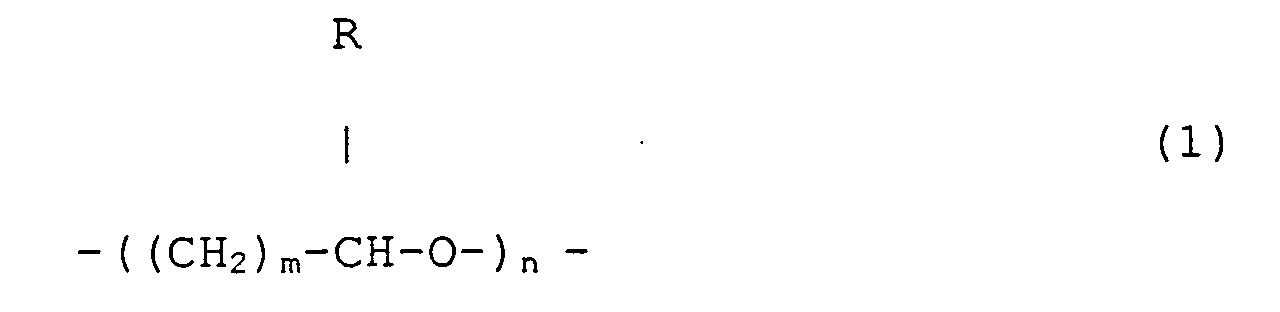
- the first gist of the present invention relates, as shown in claim 1, to an aliphatic polyester polyether copolymer having an aliphatic polyester moiety comprising 35 to 50 molar % of an aliphatic diol unit, 35 to 50 molar % of an aliphatic dicarboxylic acid unit and 0 to 30 molar % of an aliphatic oxycarboxylic acid unit and a polyether moiety having the following formula (I), wherein ⁇ sp /C is not less than 1.40 and the ratio by weight of the polyether moiety to the aliphatic polyester polyether copolymer is 0.1 to 90% by weight.
- R is hydrogen or an alkyl group; m is an integer of 1 to 10; and n is an integer of 4 to 1,000.
- the second gist of the present invention relates to a process for the production of an aliphatic polyester polyether copolymer by a polycondensation reaction of an aliphatic diol, an aliphatic dicarboxylic acid or a derivative aliphatic oxycarboxylic acid and a polyether represented by the following formula (2) in the presence of a catalyst, characterized in that, the aliphatic oxycarboxylic acid is compounded in an amount of 0.1 to 100 part(s) by weight to 100 parts by weight of the aliphatic dicarboxylic acid.
- R 1 is hydrogen or an alkyl group
- R 2 and R 3 each independently is hydrogen or an organic group where at least one of R 2 and R 3 is hydrogen
- m is an integer of 1 to 10
- n is an integer of 4 to 1,000.
- the third gist of the present invention is an aliphatic polyester composition, characterized in that, (A) the aliphatic polyester polyether copolymer mentioned in claim 1, (B) an aliphatic polyester of a number-average molecular weight of 10, 000 to 300, 000 comprising an aliphatic diol unit, an aliphatic dicarboxylic acid unit and an aliphatic oxycarboxylic acid unit and (C) polylactic acid having a number-average molecular weight of not less than 30,000 are melted and blended.
- the aliphatic diol component which is an aliphatic diol unit constituting the aliphatic polyester polyether copolymer of the present invention is an aliphatic and alicyclic compound having two hydroxyl groups and its preferred specific example is represented by the following formula (3). HO-R 4 -OH
- R 4 is a divalent aliphatic hydrocarbon group and its carbon numbers are usually not less than 2 for the lower limit and are usually not more than 11 or, preferably, not more than 6 for the upper limit.
- R 4 includes a cycloalkylene group which may have a branched chain.
- Preferred R 4 is - (CH 2 ) p - where p is an integer which is usually not less than 2 for the lower limit and usually not more than 11 or, preferably, not more than 6 for the upper limit.
- aliphatic diol which is able to be used for the present invention and its specific examples are ethylene glycol, 1,3-propanediol, 1,4-butanediol, 1,5-pentanediol, 1,6-hexanediol, 1,4-cyclohexanediol and 1,4-cyclohexanedimethanol.
- 1,4-butanediol and ethylene glycol are preferred inviewof physical propertyof the resulting copolymer and 1,4-butanediol is particularly preferred.
- Each of them may be used solely or two or more thereof may be used as a mixture.
- amount of the aliphatic diol unit is not less than 35 molar % or, preferably, not less than 45 molar % for the lower limit and is not more than 50 molar % or, preferably, not more than 49.95 molar % for the upper limit.
- the aliphatic dicarboxylic acid component comprising the aliphatic dicarboxylic acid unit is an aliphatic dicarboxylic acid and derivative thereof and is a dicarboxylic acid represented by the following formula (4), a lower alkyl ester having 1 to 4 carbon(s) thereof, an anhydride thereof, etc. HOOC-R 5 -COOH
- R 5 is a direct bond or a divalent aliphatic hydrocarbon group where its carbon number is usually not less than 2 for the lower limit and is not more than 11 or, preferably, not more than 6 for the upper limit.
- R 5 includes a cycloalkylene group or may have a branched chain.
- Preferred R 5 is -(CH 2 ) q - in which q is an integer of not less than 0 for the lower limit and not more than 11 or, preferably, not more than 6 for the upper limit.
- Preferred specific examples of the aliphatic dicarboxylic acid and derivatives thereof are oxalic acid, succinicacid, glutaricacid, adipicacid, sebacicacid, suberic acid and dodecane-dicarboxylic acid.
- succinic acid, adipic acid, sebacic acid and dedecane-dicarboxylic acid are preferred, succinic acid and adipic acid are more preferred and succinic acid is particularly preferred in view of physical property of the resulting copolymer.
- succinic acid, adipic acid, sebacic acid and dedecane-dicarboxylic acid are preferred, succinic acid and adipic acid are more preferred and succinic acid is particularly preferred in view of physical property of the resulting copolymer.
- succinic acid, adipic acid, sebacic acid and dedecane-dicarboxylic acid are preferred, succinic acid and adipic acid are more preferred and succinic acid is particularly preferred in view of physical property of the resulting copolymer.
- succinic acid, adipic acid, sebacic acid and dedecane-dicarboxylic acid are more preferred and succinic acid is particularly preferred in view of physical property of the resulting copolymer.
- amount of the aliphatic dicarboxylic acid unit is not less than 35 molar % or, preferably, not less than 45 molar % for the lower limit and is not more than 50 molar % or, preferably, not more than 49. 95 molar % for the upper limit.
- aliphatic oxycarboxylic acid component comprising the aliphatic oxycarboxylic acid unit
- an aliphatic oxycarboxylic acid of the following formula (5), C 1-4 lower alkyl ester thereof and intramolecular ester thereof are suitable.
- R 6 is a divalent aliphatic hydrocarbon group. It has one or more carbon(s) and its upper limit is usually not more than 11 or, preferably, not more than 6. Although R 6 may include a cycloalkylene group, it is preferably a chain hydrocarbon. The term "chain” shall include a branched chain.
- More preferred one is an ⁇ -hydroxycarboxylic acid where one carbon atom has hydroxyl group and carboxyl group and particularly preferred one is that which is represented by the formula (6) in view of polymerization activity.
- a is an integer of 0 or 1 ormore, preferably, 0 or 1 to 10 or, more preferably, 0 or 1 to 5.
- aliphatic carboxylic acid examples include lactic acid, glycolic acid, 3-hydroxybutyric acid, 4-hydroxybutyric acid, 2-hydroxy-3-methyl-n-butyric acid, 2-hydroxy-3,3-dimethylbutyric acid, 2-hydroxy-3-methylbutyric acid, 2-methylbutyric acid, 1-hydroxycaproic acid and 2-hydroxyisocaproic acid, a compound where ring of a lactone such as caprolacton is open and a mixture thereof.
- any of D-, L- and racemic substances may be used and, with regard to its form, it may be solid, liquid or aqueous solution.
- lactic acid and/or glycolic acid where an increase in polymerization speed is significant and availability is easy are/is particularly preferred and lactic acid is most preferred.
- aqueous solutions of 30 to 95% are preferred since they are easily available.
- amount of the aliphatic oxycarboxylic acid is not less than 0 molar % or, preferably, not less than 0.1 molar % for the lower limit and not more than 30 molar % or, preferably, not more than 10 molar % for the upper limit.
- the aliphatic polyester polyether copolymer of the present invention contains an aliphatic oxycarboxylic acid. Also in view of the effect that crystallinity of the resulting aliphatic polyester polyether copolymer lowers and in view of the miscibility upon blending with polylactic acid, it is still preferred that the aliphatic oxycarboxylic acid is contained.
- polyester polyether copolymer of the present invention further contains a monomer unit having at least three hydroxyl groups and/or carboxyl groups
- Specific examples of the component therefor are malic acid, citric acid, 1,2,3-propanetriol, trimethylolpropane, pentaerythritol, glycerol, tartaric acid and 1,2,4-butanetriol. Among them, malic acid and citric acid are preferred since they are apt to give a high molecular weight.
- the amount thereof in the total constituting components which constitute the copolymer is not less than 0 molar % or, preferably, not less than 0.001 molar % for the lower limit and usually not more than 5 molar % or, preferably, not more than 1 molar % for the upper limit.
- the polyether moiety of the present invention is represented by the above formula (1) and, in the formula, specific examples of R are hydrogen and an alkyl group having 1 to 5 carbon(s) such as methyl group, ethyl group, n-propyl group, isopropyl group, n-butyl group and isobutyl group. Among them, hydrogen and methyl group are preferred and the most preferred one is hydrogen.
- m is an integer where the lower limit is not less than 1 while the upper limit is usually not more than 10, preferably not more than 6, more preferably not more than 4, still more preferablynot more than 3 and, most preferably, 2.
- n is an integer where the lower limit is usually not less than 4, preferably not less than 10 and, more preferably, not less than 20 while the upper limit is usually not more than 1,000, preferably not more than 500, more preferably not more than 200 and, most preferably, not more than 50.
- R 1 are the same as those for R in the formula (1).
- R 2 and R 3 each independently is hydrogen or an organic group and at least one of them is hydrogen. Examples of the organic group are alkyl group, glycidyl group, epoxy group and acyl group.
- Preferred R 2 and R 3 are hydrogen, methyl group, ethyl group and glycidyl group and, in view of reactivity and easy availability, hydrogen and methyl group are most preferred. Each of them may be used either solely or two or more thereof may be used as a mixture.
- Preferred ranges of m and n in the formula (2) are the same as those in the formula (1).
- Preferredpolyethermoiety is selected from polyethylene glycol, polypropylene glycol, poly 1,3-propanediol and polytetramethylene glycol and two or more thereof may be used jointly. Among them, polytetramethylene glycol and poly 1,3-propanediol are particularly preferred and poly 1,3-propanediol is most preferred.
- the ratio by weight of the polyether moiety in the aliphatic polyester polyether copolymer is not less than 0.1% by weight, preferably not less than 1% by weight or, more preferably, not less than 5% by weight for the lower limit while it is not more than 90% by weight, preferably not more than 70% by weight, more preferably not more than 50% by weight or, most preferably, not more than 30% by weight for the upper limit.
- the ratio by weight of the polyether moiety to the aliphatic polyester polyether copolymer is too small, an effect of improving the mechanical property is small while, when it is too large, there is a tendency that heat resistant lowers and molding property lowers.
- fusion polycondensation, solution copolymerization, etc. are able to be adopted for the process for producing the aliphatic polyester polyether copolymer of the present invention.
- Amount of the aliphatic diol used in the polycondensation is substantially equimolar to 100 mol of the aliphatic dicarboxylic acid but, since there is distillation in general during the esterification, an excessive amount to an extent of 1 to 20 molar % is usually used.
- the aliphatic oxycarboxylic acid When the aliphatic oxycarboxylic acid is added, it is added in an amount of usually not less than 0. 1 part by weight, preferably not less than 1.0 part by weight or, more preferably, not less than 2.0 parts by weight for the lower limit and not more than 100 parts by weight, preferably not more than 50 parts by weight or, more preferably, not more than 20 parts by weight for the upper limit to 100 parts by weight of the aliphatic dicarboxylic acid and a polycondensation is carried out.
- timing and method for addition of the aliphatic oxycarboxylic acid when the addition is conducted prior to the polycondensation reaction there is no particular limitation for timing and method for addition of the aliphatic oxycarboxylic acid when the addition is conducted prior to the polycondensation reaction and examples thereof are (1) a method where a catalyst is in a state of being previously dissolved in an aliphatic oxycarboxylic acid solution is added and (2) a method where it is added together with addition of the catalyst in a stage of charging the materials.
- Timing for the introduction of the polyether component may be any of charging together with another monomer in the initial stage of polymerization and before initiation of the vacuation but charging together with another monomer is preferred in view of simplification of the steps.
- Polymerization temperature in the production of the aliphatic polyester polyether copolymer of the present invention is recommended to be selected from the range which is usually not lower than 150°C or, preferably, not lower than 180°C for the lower limit and is usually not higher than 260°C or, preferably, not higher than 230°c for the upper limit.
- Time for the polymerization is usually not shorter than 2 hours or, preferably, not shorter than 4 hours for the lower limit and is usually not longer than 15 hours for the upper limit.
- Degree of vacuation is usually not more than 1.33 ⁇ 10 3 Pa of, preferably, not more than 0.27 ⁇ 10 3 Pa.
- composition ratio of the aliphatic polyester polyether copolymer of the present invention it is necessary that the molar ratio of the total amount of hydroxyl group of the aliphatic diol and terminal hydroxyl group of the polyether terminal to the amount of carboxyl group of the aliphatic dicarboxylic acid is substantially equal.
- the aliphatic polyester polyether copolymer of the present invention is produced in the presence of a polymerization catalyst.
- the catalyst are titanium compounds, antimony compounds, tin compounds and zinc compounds and, among them, germanium compounds are preferred.
- germanium compounds are germanium oxide, organic germanium compounds such as tetraalkoxy germanium and inorganic germanium compounds such as germanium chloride.
- germanium oxide, tetraethoxy germanium and tetrabutoxy germanium are preferred and germanium oxide is particularly preferred. Joint use with other catalysts is also acceptable if that does not deteriorate the object of the present invention.
- Amount of the catalyst used is usually not less than 10 ppm, preferably not less than 20 ppm or, more preferably, not less than 50 ppm for the lower limit and is usually not more than 30, 000 ppm, preferably, not more than 1,000 ppm or, more preferably, not more than 500 ppm for the upper limit.
- timing of addition of the catalyst there is no particular limitation for the timing of addition of the catalyst provided that it is prior to the polycondensation and the catalyst may be added when the materials are charged or may be added upon initiation of vacuation.
- a method where the catalyst is added together with aliphatic oxycarboxylic acid such as lactic acid and/or glycolic acid upon charging the materials or a method wherein the catalyst is added by dissolving in an aqueous solution of the aliphatic oxycarboxylic acid is preferred.
- a method where the catalyst is added by dissolving in an aqueous solution of the aliphatic oxycarboxylic acid is particularly preferred because polymerization speed becomes high.
- Molar % of each component of the aliphatic polyester moiety in the present invention is able to be determined by measurement of the aliphatic polyester polyether copolymer by 1 H-NMR. Ratio by weight of the polyether moiety to the aliphatic polyester polyether copolymer is able to be determined by such a manner that weight of the polyether is determined from molar fraction of the polyether moiety and then its ratio by weight in the copolymer is calculated.
- Reducing viscosity ⁇ sp /C of the aliphatic polyester polyether copolymer of the present invention is not less than 1.4, preferably not less than 1.5 and, more preferably, not less than 1.8.
- the upper limit is usually not more than 4.0, preferably not more than 3.5 and, more preferably, not more than 3.2.
- the aliphatic polyester polyether copolymer of the present invention contains substantially no aromatic compound such as an aromatic dicarboxylic acid and the amount of the aromatic compound in the aliphatic polyester polyether copolymer of the present invention is usually not more than 5 molar %, preferably not more than 3 molar %, more preferably not more than 1 molar % and, most preferably, entirely nil.
- Breaking extension upon a tensile test for a sample which is prepared by molding of the aliphatic polyester polyether copolymer of the present invention is preferably not less than 400%, more preferably not less than 600%, still more preferably, not less than 900% and, most preferably, not less than 1,000% and its upper limit is usually not more than 3,000%.
- Strength at breaking point in a tensile test is preferably not less than 15 MPa, more preferably not less than 20 MPa and, still more preferably, not less than 30 MPa and its upper limit is usually not more than 60 MPa.
- Each peak temperature of loss modulus G" and tan ⁇ in a dynamic viscoelasticity test of the sample prepared by molding of the aliphatic polyester polyether copolymer of the present invention is preferably not higher than -30°C and, more preferably, not higher than -40°C.
- peak temperatures of G" and tan ⁇ are within a practically used temperature or a preservation temperature, physical property tends to change during the use or during the preservation.
- the preferred lower limit is -60°C or, more preferably, -50°C.
- Storage modulus (G') at the measuring temperature range of -50 to 60°C is usually not less than 1 ⁇ 10 5 Pa, preferably 1 ⁇ 10 6 Pa or, more preferably, not less than 1 ⁇ 10 7 Pa for the lower limit and, for the upper limit, it is usually not more than 1 ⁇ 10 10 Pa.
- Loss modulus (G) at the measuring temperature range of -50 to 60°C is usually not less than 1 ⁇ 10 4 Pa, preferably 1 ⁇ 10 5 Pa or, more preferably, not less than 1 ⁇ 10 6 Pa for the lower limit and, for the upper limit, it is usually not more than 1 ⁇ 10 8 Pa.
- concentration of consumption acid in a biodegradation test of an aerobic closed type is usually not more than 6-fold or, preferably, not more than 3-fold of that with polybutylene succinate.
- the biodegradation test of an aerobic closed type means a method where, in a biodegradation test according to JIS K6950, amount of a sample plastic to be added is changed to 500 mg/l instead of 100 mg/1.
- the aliphatic polyester polyether copolymer of the present invention is able to be utilized for molded products such as film, laminate film, sheet, plate, elongated sheet, monofilament, multifilament, nonwoven fabric, flat yarn, staple fiber, crimp fiber, striped tape, split yarn, compounded fiber, blow bottle and foamed product by commonly used plastic molding methods such as injection molding, hollow molding and extrusion molding.
- agent for crystal nucleus, antioxidant, lubricant, coloring agent, releasing agent, filler, other polymer, etc. may be added thereto if necessary.
- the aliphatic polyester polyether copolymer of the present invention has biodegradability, has a characteristic of being completely degraded by bacteria in the soil and is a very useful polymer in view of environmental hygiene. Therefore, it is able to be used for various uses such as shopping bag, garbage bag, film for agricultural use, synthetic paper, container for cosmetics, container for detergents, container for bleaching agents, fishing line, fishnet, rope, binding material, surgical string, cover stock material for hygiene, cooling box and cushion material.
- the aliphatic polyester composition of the present invention which is a subj ect of the present invention is a product prepared by a melt blending of the above-mentioned (A) aliphatic polyester polyether copolymer with (B) an aliphatic polyester of a number-average molecular weight of 10,000 to 300,000 comprising an aliphatic diol unit, an aliphatic dicarboxylic acid unit and an aliphatic oxycarboxylic acid unit and (C) polylactic acid of a number-average molecular weight of not less than 30,000.
- A aliphatic polyester polyether copolymer
- B an aliphatic polyester of a number-average molecular weight of 10,000 to 300,000 comprising an aliphatic diol unit, an aliphatic dicarboxylic acid unit and an aliphatic oxycarboxylic acid unit
- C polylactic acid of a number-average molecular weight of not less than 30,000.
- the aliphatic polyester (B) is able to be manufactured by polycondensation of aliphatic oxycarboxylic acid component, aliphatic dicarboxylic acid component and aliphatic diol component in the above-mentioned aliphatic polyester polyether copolymer in the presence of a catalyst.
- Amount of the aliphatic oxycarboxylic acid is usually not less than 0.04 mol, preferably not less than 1 mol or, more preferably, not less than 3 mol for the lower limit and is usually not more than 60 mol, preferably not more than 20 mol or, more preferably, not more than 10 mol for the upper limit to 100 mol of the aliphatic dicarboxylic acid or a derivative thereof.
- the aliphatic oxycarboxylic acid is too little, an effect for improving the polymerization reaction is hardly achieved and macromolecular polyester is hardly prepared while, when it is too much, heat resistance and strength may become insufficient.
- copolymerizing component may be introduced into the aliphatic polyester (B) used for the present invention so far as the effect is not deteriorated thereby.
- tri- or more functional hydroxypolycarboxylic acid, polycarboxylic acid, polyhydric alcohol or the like is added as other copolymerizing component, the fusion viscosity is able to be enhanced and that is preferred.
- specific examples thereof are malic acid, trimethylolpropane, glycerol, pentaerythritol and trimellitic acid. Inviewof physical property of the resulting polyester, malic acid, trimethylolpropane and glycerol are particularly preferred.
- Amount of other copolymerizing component as such is usually not less than 0 molar % or, preferably, not less than 0.01 molar % for the lower limit and usually not more than 5 molar % or, preferably, not more than 1 molar % for the upper limit in the total constituting units which constitute the aliphatic polyester (B).
- the aliphatic polyester (B) which is a subject of the present invention is a polyester where an aliphatic diol component and an aliphatic dicarboxylic acid component are main components.
- molar ratio of the aliphatic diol unit to the aliphatic dicarboxylic acid unit is substantially same and, when molar numbers of the total constituting components of the aliphatic polyester (B) are 100, it is preferred that the aliphatic oxycarboxylic acid unit is 0.02 to 30 mol.
- the aliphatic oxycarboxylic acid component is lactic acid
- miscibility with polylactic acid (C) is enhanced and that is much preferred.
- number-average molecular weight Mn is usually not less than 10, 000 or, preferably, it is not less than 30, 000 for the lower limit while, for the upper limit, it is usually not more than 300,000.
- polylactic acid (C) used in the present invention number-average molecular weight for achieving a sufficient strength is not less than 30, 000 or, preferably, not less than 100, 000.
- the molar ratio of an L-substance to a D-substance constituting the polylactic acid all compositions from 100/0 to 0/100 may be used and, in view of physical property of the resulting polylactic acid, that which has a high elasticity is preferred and it is preferred that an L-substance is not less than 95%.
- the process for the production of polylactic acid and its examples are a ring-opening polymerization via a lactide and a direct polycondensation of lactic acid.
- the aliphatic polyester polyether copolymer (A) is 1 to 50 part(s) by weight to 100 part (s) by weight in total comprising 1 to 99 part (s) by weight of the aliphatic polyester (B) and 99 to 1 part(s) by weight of polylactic acid (C).
- the mixing ratio in compounding the aliphatic polyester (B) to polylactic acid (C) is that the lower limit of the aliphatic polyester (B) is made preferably not less than 60 parts by weight or, more preferably, not less than 70 parts by weight while the upper limit of polylactic acid (C) is made preferably not more than 40 parts by weight or, more preferably, not more than 30 parts by weight.
- the lower limit of the aliphatic polyester (B) is made preferably not less than 60 parts by weight or, more preferably, not less than 70 parts by weight while the upper limit of polylactic acid (C) is made preferably not more than 40 parts by weight or, more preferably, not more than 30 parts by weight.
- the mixing ratio in compounding the aliphatic polyester (B) to polylactic acid (C) is that the upper limit of the aliphatic polyester (B) is made preferably not more than 40 parts by weight or, more preferably, not more than 30 parts by weight while the lower limit of polylactic acid (C) is made preferably not less than 60 parts by weight or, more preferably, not less than 70 parts by weight.
- the compounding amount of the aliphatic polyester polyether copolymer (A) to 100 parts by weight in total of the aliphatic polyester (B) and polylactic acid (C) is made preferably not less than 10 parts by weight or, more preferably, not less than 20 parts by weight for the lower limit and, for the upper limit, it is made preferably not more than 40 parts by weight.
- the amount is too much, although impact strength is improved, there may be the case where rigidity lowers.
- known kneading art may be adopted and that may be conducted in a fused state of each of the above-mentioned components.
- lubricant in the aliphatic polyester composition of the present invention, it is also possible, if necessary, to use lubricant, wax, coloring agent, filler, stabilizer, etc. together therewith in subjecting to a practical use within such an extent that the advantage of the present invention is not deteriorated.
- Molar % of the aliphatic polyester moiety in the copolymer was 49.2 molar % for a succinic acid unit, 49.0 molar % for a 1, 4-butanediol unit and 1.8 molar for a lactic acid unit. Ratio by weight of polyether moiety was 9.6% by weight.
- Strand of the resulting copolymer was very tough.
- the breaking elongation was 410% and the strength at breaking point was 27 MPa.
- a biodegradation test of an aerobic closed type was conducted using 150 mg of the sample, consumed oxygen amount during 28 days was 230 mg and degradation rate was 100%.
- Reaction was carried out by the same method as in Example 1 except that 94.5 g of succinic acid, 76.1 g of 1, 4-butanediol, 35.31 g of PEG having a number-average molecular weight of 1, 000 and 4.85 g of a 90% aqueous solution of lactic acid in which 1% by weight of germanium oxide was previously dissolved were used in Example 1 and the polymerization was finished by conducting the reaction at 0.07 ⁇ 10 3 Pa for 4.5 hours to give a white copolymer. Reduced viscosity ( ⁇ sp /c) of the resulting copolymer was 2.18.
- Molar % of the aliphatic polyester moiety in the copolymer was 49.5 molar % for a succinic acid unit, 48.5 molar % for a 1, 4-butanediol unit and 2. 0 molar for a lactic acid unit. Ratio by weight of polyether moiety was 19.3% by weight.
- Strand of the resulting copolymer was very tough.
- the breaking elongation was 650% and the strength at breaking point was 38 MPa.
- a biodegradation test of an aerobic closed type was conducted using 150 mg of the sample, consumed oxygen amount during 28 days was 165 mg and degradation rate was 75%.
- Reaction was carried out by the same method as in Example 1 except that PEG having a number-average molecular weight of 1, 000 was changed to 17.65 g of polypropylene glycol (PPG) having a number-average molecular weight of 1,000 in Example 1 and the polymerization was finished by conducting the reaction at 0.07 ⁇ 10 3 Pa for 6.5 hours to give a white copolymer.
- Reduced viscosity ( ⁇ sp /c) of the resulting copolymer was 1.85.
- Molar % of the aliphatic polyester moiety in the copolymer was 49.4 molar % for a succinic acidunit, 48. 8 molar % for a 1, 4-butanediol unit and 1.8 molar for a lactic acid unit. Ratio by weight of polyether moiety was 9.1% by weight.
- Strand of the resulting copolymer was very tough.
- the breaking elongation was 500% and the strength at breaking point was 34 MPa.
- Reaction was carried out by the same method as in Example 1 except that PEG having a number-average molecular weight of 1,000 was changed to 17.65 g of the above-synthesized P 1,3 PD having a number-average molecular weight of 1, 050 in Example 1 and the reaction was carried out at 0.07 ⁇ 10 3 Pa for 4.7 hours to finish the polymerization whereupon a white copolymer was prepared. Reduced viscosity ( ⁇ sp /c) of the resulting copolymer was 1.83.
- Molar % of the aliphatic polyester moiety in the copolymer was 49.0 molar % for a succinic acid unit, 48.8 molar % for a 1, 4-butanediol unit and 2.2 molar for a lactic acid unit. Ratio by weight of polyether moiety was 9.6% by weight.
- Strand of the resulting copolymer was very tough.
- the breaking elongation was 500% and the strength at breaking point was 34 MPa.
- a biodegradation test of an aerobic closed type was conducted using 150 mg of the sample, consumed oxygen amount during 28 days was 5 mg and degradation rate was 2%.
- Reaction was carried out by the same method as in Example 1 except that PEG having a number-average molecular weight of 2, 000 was changed to 17.65 g of polytetramethylene glycol (PTMG) having a number-average molecular weight of 2,000 in Example 1 and the reaction was carried out at 0.07 ⁇ 10 3 Pa for 6 hours to finish the polymerization whereupon a white copolymer was prepared.
- Reduced viscosity ( ⁇ sp /c) of the resulting copolymer was 1.88.
- Molar % of the aliphatic polyester moiety in the copolymer was 49.4 molar % for a succinic acid unit, 48. 8 molar % for a 1, 4-butanediol unit and 1. 8 molar for a lactic acid unit. Ratio by weight of polyether moiety was 9.6% by weight.
- Strand of the resulting copolymer was very tough.
- the breaking elongation was 520% and the strength at breaking point was 40 MPa.
- a biodegradation test of an aerobic closed type was conducted using 150 mg of the sample, consumed oxygen amount during 28 days was 44 mg and degradation rate was 20%.
- Reaction was carried out by the same method as in Example 1 except that PEG having a number-average molecular weight of 1,000 was changed to 35.2 g of PTMG having a number-average molecular weight of 2,000 in Example 2 and the reaction was carried out at 0.07 ⁇ 10 3 Pa for 6 hours to finish the polymerization whereupon a white copolymer was prepared.
- Reduced viscosity ( ⁇ sp /c) of the resulting copolymer was 1.91.
- Strand of the resulting copolymer was very tough.
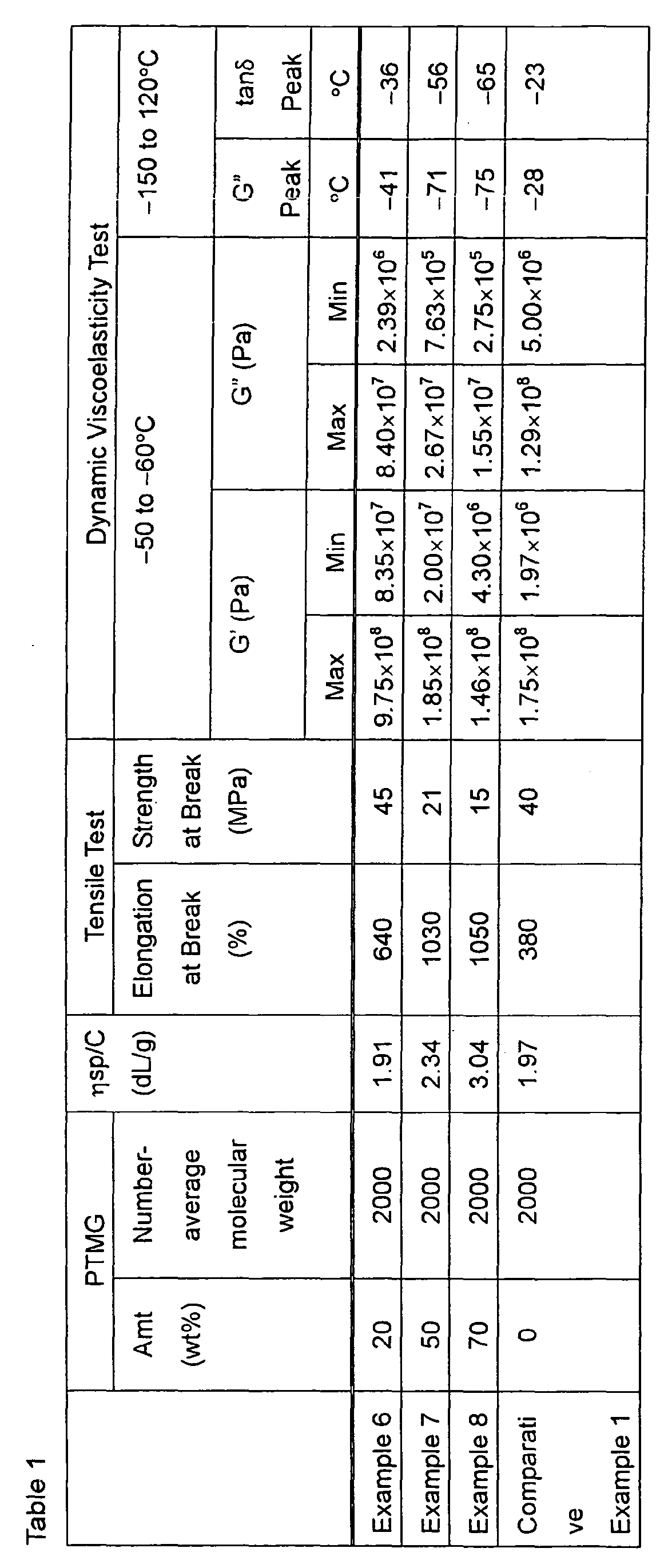
- Molar % of the aliphatic polyester moiety in the copolymer was 49.4 molar % for a succinic acid unit, 48.8 molar % for a 1,4-butanediol unit and 1.8 molar for a lactic acid unit. Ratio by weight of polyether moiety was 20.0% by weight. Result of a tensile test and a dynamic viscoelasticity of the resulting copolymer are shown in Table 1.
- Reaction was carried out by the same method as in Example 1 except that 59.1 g of succinic acid, 45.5 g of 1, 4-butanediol, 88.0 g of PTMG having a number-average molecular weight of 2, 000 and 3.63 g of 90% aqueous solution of lactic acid in which 2% by weight of germanium oxide was previously dissolved were used in Example 1 and the reaction was carried out at 0.07 ⁇ 10 3 Pa for 4. 5 hours to finish the polymerization whereupon a white semi-transparent copolymer was prepared. Reduced viscosity ( ⁇ sp /c) of the resulting copolymer was 2.34.
- Molar % of the aliphatic polyester moiety in the copolymer was 49.0 molar % for a succinic acid unit, 48.7 molar % for a 1,4-butanediol unit and 2.3 molar for a lactic acid unit.
- Ratio by weight of polyether moiety was 49.1% by weight.
- Strand of the resulting copolymer was very tough and also shows rubber elasticity. Result of a tensile test and a dynamic viscoelasticity test of the resulting copolymer are shown in Table 1. When a biodegradation test of an aerobic closed type was conducted using 150 mg of the sample, consumed oxygen amount during 28 days was 30 mg and degradation rate was 10%.
- Reaction was carried out by the same method as in Example 1 except that 35. 3 g of succinic acid, 2.40 g of 1, 4-butanediol, 123.2 g of PTMG having a number-average molecular weight of 2, 000 and 1.91 g of 90% aqueous solution of lactic acid in which 2% by weight of germanium oxide was previously dissolved were used in Example 1 and the reaction was carried out at 0.07 ⁇ 10 3 Pa for 5 hours to finish the polymerization whereupon a white semi-transparent copolymer was prepared. Reduced viscosity ( ⁇ sp /c) of the resulting copolymer was 3.04.
- Molar % of the aliphatic polyester moiety in the copolymer was 49.0 molar % for a succinic acidunit, 48.5molar % for a 1, 4-butanediol unit and 2.5 molar for a lactic acid unit. Ratio by weight of polyether moiety was 69.0% by weight.
- Reaction was carried out by the same method as in Example 5 except that 87.6 g of 1,4-butanediol was changed to 83.6 g and, instead of 90% aqueous solution of malic acid in which 1% by weight of germanium oxide was dissolved, 0.39 g of 27.7% by weight aqueous solution of lactic acid in which 4% by weight of germanium oxide was previously dissolved in Example 5 and the reaction was carried out at 0.07 ⁇ 10 3 Pa for 5 hours to finish the polymerization whereupon a white semi-transparent copolymer was prepared. Reduced viscosity ( ⁇ sp /c) of the resulting copolymer was 1.89.
- Molar % of the aliphatic polyester moiety in the copolymer was 49.1 molar % for a succinic acid unit, 48.4 molar % for a 1, 4-butanediol unit and 0. 32 molar for a malic acid unit. Ratio by weight of polyether moiety was 9.6% by weight.
- Strand of the resulting copolymer was very tough and also shows rubber elasticity. As a result of a tensile test of the resulting copolymer, elongation was 510 and ultimate breakage was 38 MPa. When a biodegradation test of an aerobic closed type was conducted using 150 mg of the sample, consumed oxygen amount during 28 days was 42 mg and degradation rate was 19%.
- Reduced viscosity ( ⁇ sp /C) of the resultingpolyester was 1.97. Molar % of each component is 48.8 molar % for a succinic acid unit, 48.8 molar % for a 1, 4-butanediol unit and 2.4 molar % of a lactic acid unit. Result of tensile test and dynamic viscoelasticity test of the resulting polyester is shown in Table 1.
- copolymer a white and semi-transparent aliphatic polyester polyether copolymer was prepared (hereinafter, referred to as "copolymer").
- Reduced viscosity ( ⁇ sp /c) of the resulting copolymer was 1.91.
- Molar % of the aliphatic polyester moiety in the copolymer was 49.4 molar % for a succinic acid unit, 48.8 molar % for a 1, 4-butanediol unit and 1. 8 molar for a lactic acid unit. Ratio by weight of polyether moiety to the copolymer was 20.0% by weight.
- the present invention is based on the Japanese Patent Application filed on July 3, 2002 (ApplicationNo. 2002/195,089) and the Japanese Patent Application filed on July 3, 2002 (Application No. 2002/195,090) and their contents are incorporated herein as references.
- the aliphatic polyester polyether copolymer of the present invention shows good physical data in a tensile test, has a sufficient mechanical strength and biodegradability and is able to be advantageously used for the use where those physical properties are demanded. According to a process for the production of the present invention, a macromolecular aliphatic polyester polyether copolymer is able to be prepared.
- the aliphatic polyester composition of the present invention has sufficient impact strength and rigidity and is able to be used for various uses. It is particularly suitable for an injectionmoldingmethod, a hollow molding method, etc. and is particularly preferably able to be utilized for molded products such as interior parts for automobiles, home appliance parts and baskets.
Landscapes
- Chemical & Material Sciences (AREA)
- Health & Medical Sciences (AREA)
- Chemical Kinetics & Catalysis (AREA)
- Medicinal Chemistry (AREA)
- Polymers & Plastics (AREA)
- Organic Chemistry (AREA)
- Polyesters Or Polycarbonates (AREA)
- Biological Depolymerization Polymers (AREA)
Abstract
Description
JP-A-8-59808
JP-A-9-272789



Claims (17)
- An aliphatic polyester polyether copolymer, which has an aliphatic polyester moiety comprising 35 to 50 molar % of an aliphatic diol unit, 35 to 50 molar % of an aliphatic dicarboxylic acid unit and 0 to 30 molar % of an aliphatic oxycarboxylic acid unit and a polyether moiety having the following formula (I) wherein ηsp/C is not less than 1.40 and the ratio by weight of the polyether moiety to the aliphatic polyester polyether copolymer is 0.1 to 90% by weight.(In the formula, R is hydrogen or an alkyl group; m is an integer of 1 to 10; and n is an integer of 4 to 1,000.)
- The aliphatic polyester polyether copolymer according to claim 1, wherein the aliphatic polyester moiety is an aliphatic polyester comprising 35 to 49. 9 molar % of an aliphatic diol unit, 35 to 49.95 molar % of an aliphatic dicarboxylic acid unit and 0.1 to 30 molar % of an aliphatic oxycarboxylic acid unit.
- The aliphatic polyester polyether copolymer according to claim 1, wherein a monomer unit having at least three hydroxyl groups and/or carboxyl groups is contained within a range of from 0.001 molar % to 5 molar % to the aliphatic dicarboxylic acid unit.
- The aliphatic polyester polyether copolymer according to claim 1, wherein the polyether moiety represented by the formula (1) is at least one member selected from polyethylene glycol, polypropylene glycol, poly-1,3-propanediol and polytetramethylene glycol.
- The aliphatic polyester polyether copolymer according to claim 1, wherein the aliphatic oxycarboxylic acid unit is a unit of lactic acid and/or glycolic acid.
- The aliphatic polyester polyether copolymer according to claim 1, wherein the aliphatic diol unit is a unit of 1,4-butanediol and/or ethylene glycol.
- The aliphatic polyester polyether copolymer according to claim 1, wherein the aliphatic dicarboxylic acid unit is a unit of succinic acid and/or adipic acid.
- The aliphatic polyester polyether copolymer according to claim 1, wherein a breaking extension in a tensile test is not less than 400% and strength at breaking point is not less than 15 MPa.
- The aliphatic polyester polyether copolymer according to claim 1, wherein peak temperature for each of tan δ and loss modulus G" in a dynamic viscoelasticity test is not higher than -30°C.
- The aliphatic polyester polyether copolymer according to claim 1, wherein a storage modulus and a loss modulus G" within a measuring temperature range of -50 to 60°C in a dynamic viscoelasticity test are from 1 × 10⁵ Pa to 1 × 10¹⁰ Pa and from 1 × 10⁴ Pa to 1 × 10⁸ Pa, respectively.
- The aliphatic polyester polyether copolymer according to claim 1, wherein a consumed oxygen amount in a biodegradability test of an aerobic and closed type is not more than 6-fold of that of polybutylene succinate.
- A process for producing an aliphatic polyester polyether copolymer by a polycondensation reaction of an aliphatic diol, an aliphatic dicarboxylic acid or a derivative aliphatic oxycarboxylic acid and a polyether represented by the following formula (2) in the presence of a catalyst,
wherein the aliphatic oxycarboxylic acid is compounded in an amount of 0.1 to 100 part(s) by weight to 100 parts by weight of the aliphatic dicarboxylic acid.(In the formula (2), R1 is hydrogen or an alkyl group; R2 and R3 each independently is hydrogen or an organic group where at least one of R2 and R3 is hydrogen; m is an integer of 1 to 10; and n is an integer of 4 to 1,000.)
- The process for producing an aliphatic polyester polyether copolymer according to claim 12, wherein the catalyst is a germanium compound.
- The process for producing an aliphatic polyester polyether copolymer according to claim 13, wherein the amount of the germanium catalyst used is not more than 500 ppm to the theoretical yield of the resulting copolymer.
- The process for producing an aliphatic polyester polyether copolymer according to claim 13, wherein germanium oxide is dissolved in an aqueous solution of the aliphatic oxycarboxylic acid and a polycondensation reaction is carried out.
- An aliphatic polyester composition, characterized in that, (A) the aliphatic polyester polyether copolymer mentioned in claim 1, (B) an aliphatic polyester of a number average molecular weight of 10,000 to 300,000 comprising an aliphatic diol unit, an aliphatic dicarboxylic acid unit and an aliphatic oxycarboxylic acid unit and (C) polylactic acid having a number average molecular weight of not less than 30, 000 are melted and blended.
- The polyester composition according to claim 16, wherein the amount of the aliphatic polyester polyether copolymer (A) is 1 to 50 part (s) by weight to 100 parts by weight in total of 1 to 99% by weight of the aliphatic polyester (B) and 99 to 1 part(s) by weight of polylactic acid (C).
Applications Claiming Priority (5)
| Application Number | Priority Date | Filing Date | Title |
|---|---|---|---|
| JP2002195090 | 2002-07-03 | ||
| JP2002195089 | 2002-07-03 | ||
| JP2002195090 | 2002-07-03 | ||
| JP2002195089A JP2004035733A (en) | 2002-07-03 | 2002-07-03 | Aliphatic polyester composition |
| PCT/JP2003/008232 WO2004005369A1 (en) | 2002-07-03 | 2003-06-27 | Aliphatic polyester polyether copolymer, process for producing the same and aliphatic polyester composition using the copolymer |
Publications (2)
| Publication Number | Publication Date |
|---|---|
| EP1553121A1 true EP1553121A1 (en) | 2005-07-13 |
| EP1553121A4 EP1553121A4 (en) | 2006-02-08 |
Family
ID=30117380
Family Applications (1)
| Application Number | Title | Priority Date | Filing Date |
|---|---|---|---|
| EP03741132A Withdrawn EP1553121A4 (en) | 2002-07-03 | 2003-06-27 | ALIPHATIC POLYETHER-POLYESTER COPOLYMER, PROCESS FOR PRODUCING THE SAME, AND ALIPHATIC POLYESTER COMPOSITION USING THE COPOLYMER |
Country Status (5)
| Country | Link |
|---|---|
| US (1) | US7342086B2 (en) |
| EP (1) | EP1553121A4 (en) |
| CN (1) | CN100402577C (en) |
| AU (1) | AU2003281227A1 (en) |
| WO (1) | WO2004005369A1 (en) |
Families Citing this family (5)
| Publication number | Priority date | Publication date | Assignee | Title |
|---|---|---|---|---|
| CN101717494B (en) * | 2009-11-23 | 2012-07-18 | 中国科学院宁波材料技术与工程研究所 | Preparation method of biodegradable aromatic-aliphatic copolyester |
| CN104945861A (en) * | 2011-02-02 | 2015-09-30 | 三菱化学株式会社 | Polyester resin composition |
| CN103910860B (en) * | 2014-04-11 | 2016-01-20 | 江苏金聚合金材料有限公司 | A kind of preparation method of degradable oxyacetic acid copolyesters |
| JP2017145275A (en) * | 2016-02-15 | 2017-08-24 | 株式会社Adeka | Resin modifier, resin composition, and film using the same |
| CN113831521B (en) * | 2021-11-15 | 2022-05-24 | 中核华纬工程设计研究有限公司 | Polyether modified PBAT degradable plastic and preparation method thereof |
Family Cites Families (16)
| Publication number | Priority date | Publication date | Assignee | Title |
|---|---|---|---|---|
| US5278275A (en) * | 1990-07-02 | 1994-01-11 | Toyo Boseki Kabushiki Kaisha | Polyurethane resin composition |
| US5593778A (en) * | 1993-09-09 | 1997-01-14 | Kanebo, Ltd. | Biodegradable copolyester, molded article produced therefrom and process for producing the molded article |
| JP3363589B2 (en) * | 1994-06-09 | 2003-01-08 | 昭和高分子株式会社 | Biodegradable aliphatic polyester composition |
| JPH0859808A (en) * | 1994-08-17 | 1996-03-05 | Unitika Ltd | Aliphatic polyester ether |
| DE4440837A1 (en) * | 1994-11-15 | 1996-05-23 | Basf Ag | Biodegradable polymers, processes for their production and their use for the production of biodegradable moldings |
| JP3503260B2 (en) * | 1995-04-27 | 2004-03-02 | 大日本インキ化学工業株式会社 | Method for producing lactic acid-based polyether polyester |
| EP0765913B1 (en) * | 1995-09-29 | 2002-08-28 | Dainippon Ink And Chemicals, Inc. | Process for the preparation of lactic acid-based polyester compositions |
| JP3339297B2 (en) * | 1996-04-02 | 2002-10-28 | 三菱化学株式会社 | Aliphatic polyester composition |
| JPH09272732A (en) * | 1996-04-03 | 1997-10-21 | Teijin Ltd | Method for producing polyoxyalkylene copolymerized aliphatic polyester |
| JPH09290019A (en) * | 1996-04-26 | 1997-11-11 | Teijin Ltd | Medical material with excellent blood compatibility |
| JP3235968B2 (en) * | 1996-10-14 | 2001-12-04 | ダイセル化学工業株式会社 | Three-component biodegradable resin composition |
| JPH11152326A (en) * | 1997-11-20 | 1999-06-08 | Yushiro Chem Ind Co Ltd | Aliphatic polyester copolymer and method for producing the same |
| CN1200972C (en) * | 2000-07-17 | 2005-05-11 | 三井化学株式会社 | Lactic acid-based resin composition and molded article made therefrom |
| JP2002047402A (en) * | 2000-08-02 | 2002-02-12 | Daicel Chem Ind Ltd | Biodegradable agricultural multi-film |
| DE60116127T2 (en) * | 2000-10-06 | 2006-08-24 | The Procter & Gamble Company, Cincinnati | PLASTIC ARTICLES FROM BIODEGRADABLE POLYESTER MIXED COMPOSITIONS |
| ITTO20010060A1 (en) * | 2001-01-25 | 2002-07-25 | Novamont Spa | TERNARTIE MIXTURES OF BIODEGRADABLE ALIPHATIC POLYESTERS AND PRODUCTS OBTAINED FROM THESE. |
-
2003
- 2003-06-27 AU AU2003281227A patent/AU2003281227A1/en not_active Abandoned
- 2003-06-27 EP EP03741132A patent/EP1553121A4/en not_active Withdrawn
- 2003-06-27 CN CNB038191989A patent/CN100402577C/en not_active Expired - Lifetime
- 2003-06-27 WO PCT/JP2003/008232 patent/WO2004005369A1/en not_active Ceased
-
2005
- 2005-01-03 US US11/026,154 patent/US7342086B2/en not_active Expired - Lifetime
Also Published As
| Publication number | Publication date |
|---|---|
| WO2004005369A1 (en) | 2004-01-15 |
| CN1675283A (en) | 2005-09-28 |
| EP1553121A4 (en) | 2006-02-08 |
| US20050192412A1 (en) | 2005-09-01 |
| US7342086B2 (en) | 2008-03-11 |
| AU2003281227A1 (en) | 2004-01-23 |
| CN100402577C (en) | 2008-07-16 |
Similar Documents
| Publication | Publication Date | Title |
|---|---|---|
| JP3411289B2 (en) | Biodegradable polymer, its production and its use for producing biodegradable shaped bodies | |
| FI117440B (en) | Biodegradable polymers, process for their preparation and their use for the preparation of biodegradable molds | |
| JP3402006B2 (en) | Aliphatic polyester copolymer | |
| KR20130010080A (en) | Process for producing cling films | |
| KR101784221B1 (en) | Biodegradable resin composition and biodegradable film prepared from the same | |
| JPH11124495A (en) | Polylactic acid-based polymer composition and molded article | |
| JP3387052B2 (en) | Biodegradable polyester resin composition and its use | |
| KR102069509B1 (en) | Biodegradable poly(butylene tetramethyleneglutarate-co-butylene terephthalate) aliphatic and aromatic polyester resin and the manufacturing method thereof | |
| EP0792901B1 (en) | Production of aliphatic copolyesters | |
| US7342086B2 (en) | Aliphatic polyester polyether copolymer, process for producing the same and aliphatic polyester composition using the copolymer | |
| JP2004211008A (en) | Biodegradable copolymer and method for producing the same | |
| JP3584579B2 (en) | Plasticized aliphatic polyester composition and molded article thereof | |
| JP4569127B2 (en) | Aliphatic polyester and method for producing the same | |
| KR101941123B1 (en) | Biodegradable resin composition and biodegradable film prepared therefrom | |
| JP4134827B2 (en) | Aliphatic polyester polyether copolymer | |
| JP3601530B2 (en) | Method for producing aliphatic polyester copolymer | |
| JP5050610B2 (en) | Molded product of resin composition with excellent low-temperature characteristics | |
| JP5135740B2 (en) | Polyester and production method thereof, and polyester block copolymer | |
| JP2752876B2 (en) | Polyester injection molding | |
| JP3387304B2 (en) | Method for producing high molecular weight aliphatic polyester copolymer having amide bond | |
| JP3127960B1 (en) | Biodegradable polyester copolymer and method for producing the same | |
| JPH0711517A (en) | Polyester multifilament | |
| JP2662492B2 (en) | Polyester hollow molded body | |
| KR100368533B1 (en) | Manufacturing method of biodegradable aliphatic polyester | |
| JP2709235B2 (en) | Polyester crimped fiber |
Legal Events
| Date | Code | Title | Description |
|---|---|---|---|
| PUAI | Public reference made under article 153(3) epc to a published international application that has entered the european phase |
Free format text: ORIGINAL CODE: 0009012 |
|
| 17P | Request for examination filed |
Effective date: 20050117 |
|
| AK | Designated contracting states |
Kind code of ref document: A1 Designated state(s): AT BE BG CH CY CZ DE DK EE ES FI FR GB GR HU IE IT LI LU MC NL PT RO SE SI SK TR |
|
| AX | Request for extension of the european patent |
Extension state: AL LT LV MK |
|
| DAX | Request for extension of the european patent (deleted) | ||
| RBV | Designated contracting states (corrected) |
Designated state(s): DE |
|
| A4 | Supplementary search report drawn up and despatched |
Effective date: 20051222 |
|
| RAP1 | Party data changed (applicant data changed or rights of an application transferred) |
Owner name: MITSUBISHI CHEMICAL CORPORATION |
|
| 17Q | First examination report despatched |
Effective date: 20060413 |
|
| STAA | Information on the status of an ep patent application or granted ep patent |
Free format text: STATUS: THE APPLICATION IS DEEMED TO BE WITHDRAWN |
|
| 18D | Application deemed to be withdrawn |
Effective date: 20080704 |