EP1550085B1 - Verfahren zum erzeugen eines computerlesbaren modelles - Google Patents
Verfahren zum erzeugen eines computerlesbaren modelles Download PDFInfo
- Publication number
- EP1550085B1 EP1550085B1 EP03750398A EP03750398A EP1550085B1 EP 1550085 B1 EP1550085 B1 EP 1550085B1 EP 03750398 A EP03750398 A EP 03750398A EP 03750398 A EP03750398 A EP 03750398A EP 1550085 B1 EP1550085 B1 EP 1550085B1
- Authority
- EP
- European Patent Office
- Prior art keywords
- connection
- elements
- grid
- construction
- construction element
- Prior art date
- Legal status (The legal status is an assumption and is not a legal conclusion. Google has not performed a legal analysis and makes no representation as to the accuracy of the status listed.)
- Expired - Lifetime
Links
Images




Classifications
-
- G—PHYSICS
- G06—COMPUTING OR CALCULATING; COUNTING
- G06T—IMAGE DATA PROCESSING OR GENERATION, IN GENERAL
- G06T19/00—Manipulating three-dimensional [3D] models or images for computer graphics
-
- G—PHYSICS
- G06—COMPUTING OR CALCULATING; COUNTING
- G06T—IMAGE DATA PROCESSING OR GENERATION, IN GENERAL
- G06T17/00—Three-dimensional [3D] modelling for computer graphics
- G06T17/10—Constructive solid geometry [CSG] using solid primitives, e.g. cylinders, cubes
-
- A—HUMAN NECESSITIES
- A63—SPORTS; GAMES; AMUSEMENTS
- A63H—TOYS, e.g. TOPS, DOLLS, HOOPS OR BUILDING BLOCKS
- A63H33/00—Other toys
- A63H33/04—Building blocks, strips, or similar building parts
-
- G—PHYSICS
- G05—CONTROLLING; REGULATING
- G05B—CONTROL OR REGULATING SYSTEMS IN GENERAL; FUNCTIONAL ELEMENTS OF SUCH SYSTEMS; MONITORING OR TESTING ARRANGEMENTS FOR SUCH SYSTEMS OR ELEMENTS
- G05B19/00—Program-control systems
- G05B19/02—Program-control systems electric
- G05B19/18—Numerical control [NC], i.e. automatically operating machines, in particular machine tools, e.g. in a manufacturing environment, so as to execute positioning, movement or co-ordinated operations by means of program data in numerical form
- G05B19/4097—Numerical control [NC], i.e. automatically operating machines, in particular machine tools, e.g. in a manufacturing environment, so as to execute positioning, movement or co-ordinated operations by means of program data in numerical form characterised by using design data to control NC machines, e.g. CAD/CAM
- G05B19/4099—Surface or curve machining, making three-dimensional [3D] objects, e.g. desktop manufacturing
-
- G—PHYSICS
- G05—CONTROLLING; REGULATING
- G05B—CONTROL OR REGULATING SYSTEMS IN GENERAL; FUNCTIONAL ELEMENTS OF SUCH SYSTEMS; MONITORING OR TESTING ARRANGEMENTS FOR SUCH SYSTEMS OR ELEMENTS
- G05B2219/00—Program-control systems
- G05B2219/30—Nc systems
- G05B2219/32—Operator till task planning
- G05B2219/32155—Editor and library for objects
-
- G—PHYSICS
- G05—CONTROLLING; REGULATING
- G05B—CONTROL OR REGULATING SYSTEMS IN GENERAL; FUNCTIONAL ELEMENTS OF SUCH SYSTEMS; MONITORING OR TESTING ARRANGEMENTS FOR SUCH SYSTEMS OR ELEMENTS
- G05B2219/00—Program-control systems
- G05B2219/30—Nc systems
- G05B2219/32—Operator till task planning
- G05B2219/32156—Each defined object has corresponding set of geometrical macros
-
- G—PHYSICS
- G05—CONTROLLING; REGULATING
- G05B—CONTROL OR REGULATING SYSTEMS IN GENERAL; FUNCTIONAL ELEMENTS OF SUCH SYSTEMS; MONITORING OR TESTING ARRANGEMENTS FOR SUCH SYSTEMS OR ELEMENTS
- G05B2219/00—Program-control systems
- G05B2219/30—Nc systems
- G05B2219/32—Operator till task planning
- G05B2219/32157—Create a new object by combining existing objects
-
- G—PHYSICS
- G05—CONTROLLING; REGULATING
- G05B—CONTROL OR REGULATING SYSTEMS IN GENERAL; FUNCTIONAL ELEMENTS OF SUCH SYSTEMS; MONITORING OR TESTING ARRANGEMENTS FOR SUCH SYSTEMS OR ELEMENTS
- G05B2219/00—Program-control systems
- G05B2219/30—Nc systems
- G05B2219/35—Nc in input of data, input till input file format
- G05B2219/35008—Www cad, world wide design and manufacturing
-
- G—PHYSICS
- G05—CONTROLLING; REGULATING
- G05B—CONTROL OR REGULATING SYSTEMS IN GENERAL; FUNCTIONAL ELEMENTS OF SUCH SYSTEMS; MONITORING OR TESTING ARRANGEMENTS FOR SUCH SYSTEMS OR ELEMENTS
- G05B2219/00—Program-control systems
- G05B2219/30—Nc systems
- G05B2219/35—Nc in input of data, input till input file format
- G05B2219/35023—Constraint based modeling, keep relationships between elements
-
- G—PHYSICS
- G05—CONTROLLING; REGULATING
- G05B—CONTROL OR REGULATING SYSTEMS IN GENERAL; FUNCTIONAL ELEMENTS OF SUCH SYSTEMS; MONITORING OR TESTING ARRANGEMENTS FOR SUCH SYSTEMS OR ELEMENTS
- G05B2219/00—Program-control systems
- G05B2219/30—Nc systems
- G05B2219/35—Nc in input of data, input till input file format
- G05B2219/35079—Features, functions like special relationdship, assembly locations
-
- G—PHYSICS
- G05—CONTROLLING; REGULATING
- G05B—CONTROL OR REGULATING SYSTEMS IN GENERAL; FUNCTIONAL ELEMENTS OF SUCH SYSTEMS; MONITORING OR TESTING ARRANGEMENTS FOR SUCH SYSTEMS OR ELEMENTS
- G05B2219/00—Program-control systems
- G05B2219/30—Nc systems
- G05B2219/35—Nc in input of data, input till input file format
- G05B2219/35114—Generation of connection between two or more surfaces
-
- G—PHYSICS
- G05—CONTROLLING; REGULATING
- G05B—CONTROL OR REGULATING SYSTEMS IN GENERAL; FUNCTIONAL ELEMENTS OF SUCH SYSTEMS; MONITORING OR TESTING ARRANGEMENTS FOR SUCH SYSTEMS OR ELEMENTS
- G05B2219/00—Program-control systems
- G05B2219/30—Nc systems
- G05B2219/35—Nc in input of data, input till input file format
- G05B2219/35117—Define surface by elements, meshes
-
- G—PHYSICS
- G05—CONTROLLING; REGULATING
- G05B—CONTROL OR REGULATING SYSTEMS IN GENERAL; FUNCTIONAL ELEMENTS OF SUCH SYSTEMS; MONITORING OR TESTING ARRANGEMENTS FOR SUCH SYSTEMS OR ELEMENTS
- G05B2219/00—Program-control systems
- G05B2219/30—Nc systems
- G05B2219/35—Nc in input of data, input till input file format
- G05B2219/35134—3-D cad-cam
-
- G—PHYSICS
- G05—CONTROLLING; REGULATING
- G05B—CONTROL OR REGULATING SYSTEMS IN GENERAL; FUNCTIONAL ELEMENTS OF SUCH SYSTEMS; MONITORING OR TESTING ARRANGEMENTS FOR SUCH SYSTEMS OR ELEMENTS
- G05B2219/00—Program-control systems
- G05B2219/30—Nc systems
- G05B2219/35—Nc in input of data, input till input file format
- G05B2219/35142—Generate tile patterns, mosaic
-
- G—PHYSICS
- G05—CONTROLLING; REGULATING
- G05B—CONTROL OR REGULATING SYSTEMS IN GENERAL; FUNCTIONAL ELEMENTS OF SUCH SYSTEMS; MONITORING OR TESTING ARRANGEMENTS FOR SUCH SYSTEMS OR ELEMENTS
- G05B2219/00—Program-control systems
- G05B2219/30—Nc systems
- G05B2219/35—Nc in input of data, input till input file format
- G05B2219/35201—Use cad data to test function of designed part, design for test DFT
-
- G—PHYSICS
- G05—CONTROLLING; REGULATING
- G05B—CONTROL OR REGULATING SYSTEMS IN GENERAL; FUNCTIONAL ELEMENTS OF SUCH SYSTEMS; MONITORING OR TESTING ARRANGEMENTS FOR SUCH SYSTEMS OR ELEMENTS
- G05B2219/00—Program-control systems
- G05B2219/30—Nc systems
- G05B2219/35—Nc in input of data, input till input file format
- G05B2219/35218—From cad data derive fixture configuration and assembly program
-
- G—PHYSICS
- G05—CONTROLLING; REGULATING
- G05B—CONTROL OR REGULATING SYSTEMS IN GENERAL; FUNCTIONAL ELEMENTS OF SUCH SYSTEMS; MONITORING OR TESTING ARRANGEMENTS FOR SUCH SYSTEMS OR ELEMENTS
- G05B2219/00—Program-control systems
- G05B2219/30—Nc systems
- G05B2219/35—Nc in input of data, input till input file format
- G05B2219/35219—From cad data derive cutting, stacking, sorting program
-
- G—PHYSICS
- G05—CONTROLLING; REGULATING
- G05B—CONTROL OR REGULATING SYSTEMS IN GENERAL; FUNCTIONAL ELEMENTS OF SUCH SYSTEMS; MONITORING OR TESTING ARRANGEMENTS FOR SUCH SYSTEMS OR ELEMENTS
- G05B2219/00—Program-control systems
- G05B2219/30—Nc systems
- G05B2219/45—Nc applications
- G05B2219/45007—Toy
-
- G—PHYSICS
- G05—CONTROLLING; REGULATING
- G05B—CONTROL OR REGULATING SYSTEMS IN GENERAL; FUNCTIONAL ELEMENTS OF SUCH SYSTEMS; MONITORING OR TESTING ARRANGEMENTS FOR SUCH SYSTEMS OR ELEMENTS
- G05B2219/00—Program-control systems
- G05B2219/30—Nc systems
- G05B2219/49—Nc machine tool, till multiple
- G05B2219/49008—Making 3-D object with model in computer memory
-
- G—PHYSICS
- G06—COMPUTING OR CALCULATING; COUNTING
- G06T—IMAGE DATA PROCESSING OR GENERATION, IN GENERAL
- G06T2219/00—Indexing scheme for manipulating 3D models or images for computer graphics
- G06T2219/20—Indexing scheme for editing of 3D models
- G06T2219/2008—Assembling, disassembling
-
- Y—GENERAL TAGGING OF NEW TECHNOLOGICAL DEVELOPMENTS; GENERAL TAGGING OF CROSS-SECTIONAL TECHNOLOGIES SPANNING OVER SEVERAL SECTIONS OF THE IPC; TECHNICAL SUBJECTS COVERED BY FORMER USPC CROSS-REFERENCE ART COLLECTIONS [XRACs] AND DIGESTS
- Y02—TECHNOLOGIES OR APPLICATIONS FOR MITIGATION OR ADAPTATION AGAINST CLIMATE CHANGE
- Y02P—CLIMATE CHANGE MITIGATION TECHNOLOGIES IN THE PRODUCTION OR PROCESSING OF GOODS
- Y02P90/00—Enabling technologies with a potential contribution to greenhouse gas [GHG] emissions mitigation
- Y02P90/02—Total factory control, e.g. smart factories, flexible manufacturing systems [FMS] or integrated manufacturing systems [IMS]
Definitions
- This invention relates to the field of computer aided modelling of a virtual reality by means of predefined geometrical elements.
- Computer aided modelling of a virtual reality is the task of creating a model of a geometrical object, interpreting the model, manipulating the model, and otherwise handling a model of a geometrical object in a computer system.
- modelling of a virtual reality is an interesting topic in that it makes it possible to visualise ideas before they are actually implemented in the real world. If the virtual reality model is sufficiently easy to modify much time can be saved in the process of developing and refining a geometrical object compared to a situation where the same process should have been carried in the real world. A simple task of painting an object in the real world may easily take several hours, whereas the computer can apply a new colour to visualise of a model within milliseconds or seconds.
- modelling of a virtual reality is interesting in that it makes it possible to create a model of an object that exists in the real world and via a computer visualise and manipulate the model in some sense.
- the model of the object in the real world can be stored for different purposes, e.g. for advanced documentation purposes.
- modelling concepts of physical construction toy sets are known as such.
- concepts using modular or semi-modular concepts were, and are, very popular.
- these concepts provide a set of pre-manufactured elements that can be interconnected with each other in some predetermined way according to modules of the pre-manufactured elements.
- the pre-manufactured elements resembles well-known objects adapted to a specific modelling task.
- building a model of a house the elements may resemble wall bricks, roof tiles, doors, and windows.
- the object of selecting the elements in this way is that the work involved with the building of a model of a house is reduced significantly compared to a situation where all details of,the house is to be defined each time a new model should be made. However, the complete freedom in building a house or another object is traded off for the simplicity of building the model.
- Document WO-A-0043959 presents a system for generating a computer readable model of a geometrical object constructed from a plurality of interconnectable construction elements.
- connection elements such as connectors and corresponding receptors
- Connectivity information is important information in order to generate realistic models of physical objects, for example in order to ensure that a virtual model does not comprise any element which floats above a surface without being connected to a supporting part of the modelled object
- a method of generating a computer readable model of a geometrical object constructed from a plurality of interconnectable construction elements, wherein each construction element has a number of connection elements for connecting the construction element with another construction element comprising encoding a first and a second one of the plurality of construction elements as corresponding first and second data structures, each representing the connection elements of the corresponding construction element, and each of the connection elements having associated with it one of a plurality of predetermined connection types; determining a first connection element of the first construction element and a second connection element of the second construction element located in a predetermined proximity of each other; and retrieving connectivity information of the corresponding connection types of the first and second connection elements indicative of whether the first and second connection elements provide a connection between the first and the second construction element.
- connection elements such as different types of knobs, holes, tubes, hinges, edges, shafts, etc.
- construction element comprises any suitable type of constructional element having connection elements for connecting it to one or more other constructional element and which may be used to create physical objects and which may be digitally represented on a computer.
- construction elements include elements of a construction toy set, e.g. building blocks such as bricks, etc.
- construction element further comprises aggregates of interconnected smaller construction elements, e.g. two or more connected bricks.
- connection types are grouped into a number of connection groups, e.g. connectors, receptors, and mixed elements.
- Connectors are connection elements which may be received by a receptor of another construction element, thereby providing a connection between the construction elements.
- a connector may fit between parts of another element, into a hole, or the like.
- Receptors are connection elements which can receive a connector of another construction elements.
- Mixed elements are parts that can function both as a receptor and a connector, typically depending on the type of the cooperating connection element of the other construction element.
- the method further comprises providing a connection table including connectivity information of pairs of the connection types; and the step of retrieving connectivity information comprises retrieving the connectivity information from the connection table.
- connection table is intended to comprise any suitable data structure for storing connectivity information for pairs of connection types.
- a data structure may be a look-up table indexed by pairs of connection types.
- connection table By providing a connection table, an efficient and extendable data structure is provided for storing connectivity information relating pairs of connection types. Furthermore, a fast connectivity detection is made possible.
- each of the respective data structures further represents a number of grids relative to the corresponding construction element, each grid having a number of grid points; and each of the connection elements of the construction element is associated with one of the grid points and has a corresponding connection type.
- connection elements such as size, shape, connection properties, etc.
- connection properties of a construction element may be reduced to one or more attributes associated with each of the grid points. Consequently, an efficient representation of the connection properties of a construction element is achieved.
- connection elements are in a predetermined proximity of each other.
- an exact match of coordinates may be required for two connection elements to be considered within a predetermined proximity.
- the grid points coincide within predetermined limits, i.e. that they are placed in a predetermined neighbourhood form each other.
- the size of the neighbourhood may depend on the types of physical connection elements to be modelled, e.g. how they actually cooperate in order to connect, and on the accuracy of placing construction elements that should be enforced.
- each plane along which a construction element may be connected to another construction element is divided into grid segments, e.g. squares where each of the grid segments has a grid point in the centre.
- each connection element has an associated direction, indicating in which direction the connection element may engage with a corresponding connection element.
- connection elements located on a common plane and having a common direction correspond to segments of an orthogonal grid with predetermined distance between neighbouring grid points.
- connection elements of all construction elements of a set of construction elements are placed on the construction elements according to predetermined rules, allowing to associate each connection element with a corresponding grid point.
- connection elements on different, non-parallel planes are not required to have the same distance between the respective grid points.
- the distance between connection elements on horizontal planes may be different than the distance between connection elements on vertical planes.
- connection elements by associating connection elements with predetermined grid points the determination whether a connection element of a first construction element is in a predetermined neighbourhood of a connection element of a second construction element may be performed in an efficient way, as the determination may be limited to identifying neighbouring grid points.
- the method further comprises
- connection types of the connection elements are dynamic, i.e. they may be changed depending on the geometric context a construction element is placed in, thereby providing a more realistic modelling of the connection properties of physical construction elements.
- a first connection element of a first construction element and a second connection element of a second construction element may, when positioned in a predetermined geometric relation to each other, cooperatively provide different connection properties than the individual connection elements.
- first and second connection elements will often depend on their mutual geometric relation, i.e. on the way the connection elements are placed with respect to each other, e.g. how close they are placed to each other, in which relative orientation they are placed to each other, and/or the like. In one embodiment, this is modelled by determining whether the first and second connection elements are positioned within a predetermined proximity from each other; and, if they are placed in such proximity from each other, assigning the determined resulting connection type to the first and second connection element.
- this is represented by assigning a resulting connection type to at least a resulting connection element.
- the resulting connection element is one of the first and second connection elements.
- the resulting connection type is assigned to both the first and the second connection elements.
- first and second connection elements have reassigned their respective original connection types, if the corresponding construction elements are re-positioned such that the connection elements are no longer positioned in the required geometric relation.
- the resulting connection element may be a new connection element, e.g. defined such that it has a position related to the positions of the first and second connection elements.
- connection elements may be combined yielding a resulting connection type.
- combination table is intended to comprise any suitable data structure for storing resulting connection types for pairs of connection types.
- a data structure may be a look-up table indexed by pairs of connection types, where each entry of the look-up table comprises a resulting connection type resulting from the combination of a pair of connection elements, each connection element having a respective one of the corresponding pair of connection types.
- connection types of connection elements may change due to their combination with other connection types.
- this situation is efficiently modelled when each of the grids associated with the construction elements has at least one grid edge and the method further comprises
- connection elements on the corresponding edges may change their properties depending on the type of connection element on or close to the corresponding edge of the other construction element.
- connection elements By providing a combination table including a resulting connection type for each pair of connection types; and by assigning the resulting connection types to the connection elements on the edges of the construction elements, if an edge-to-edge extension is detected, even complex connection properties of co-operating construction elements may be modelled.
- edge-to-edge extension comprises the placement of two grids placed next to each other such that there corresponding grids combine to a combined grid.
- edge-to-edge extension comprises two parallel grids having respective parallel grid edges and a predetermined overlap along the parallel grid edges, such that the grid points close to the edge coincide.
- each of the respective data structures further represents a bounding volume of the corresponding construction element; and each of the grids corresponds to a surface of the bounding volume.
- each construction element may be represented by a small number of grids, even if the construction element has a complex shape.
- an efficient detection of co-operating connection elements of two construction elements may be achieved, as the complexity of the shape of the construction elements is translated into the connection types which, in turn, are associated as attributes to the grid points related to the surfaces of the bounding volumes.
- bounding volumes provide an efficient representation for detecting neighbouring construction elements by employing known collision detection algorithms.
- the bounding volumes may be bounding boxes having mutually orthogonal sides, or bounding volumes having different shapes.
- the method further comprises encoding respective positions of the first and second construction element with respect to a common volume reference grid, the first and second grid of the corresponding first and second construction elements corresponding to respective first and second planes of the volume reference grid; the grid points of the first and second grids corresponding to respective reference grid points of the volume reference grid; and detecting whether the first and second grids correspond to a common plane of the volume reference grid and whether at least a first grid point of the first grid is located in the same reference grid point as a second grid point of the second grid.
- volume reference grid e.g. a cubic volume grid
- surface grids as planes of the reference volume grid
- the bounding volumes are defined as planes with respect to the volume reference grid. In one embodiment they may coincide with the grid planes of the volume reference grid or, alternatively, may be defined as planes between the grid planes of the volume reference grid.
- the method further comprises
- the term coinciding grid points comprises grid points having the same coordinates.
- the construction elements are placed in a discrete reference grid and all coordinates are multiples of an arbitrary length unit, an exact match of coordinates may be required, i.e. the grid points are located in a common reference grid point.
- a continuous, or quasi-continuous reference coordinate system it may be required that the grid points coincide within predetermined limits.
- connection elements When each of the connection elements further has an associated direction, a further attribute is associated with each grid point, thereby providing a further degree of freedom.
- connectivity information is intended to comprise information about the connection properties of a pair of connection types, e.g. for a given pair of connection types whether or not two connection elements of these connection types provide a connection, whether they make a connection impossible and/or the like.
- the connectivity information comprises an indicator for each pair of connection types indicating one of a predetermined group of connectivity types, the group consisting of a valid connection which provides a connection between a corresponding pair of connection elements, an invalid connection which prevents a connection between a corresponding pair of connection elements, and an indifferent connection.
- connection comprises a pair of connection types which, when placed within a predetermined neighbourhood from each other, do not cooperate to connect the two corresponding construction elements, but which do not prevent such a placement either.
- the step of determining a first connection element of the first construction element and a second connection element of the second construction element located in a predetermined proximity of each other further comprises determining the first and second connection elements from a predetermined subset of connection elements. Hence only a subset of connection elements needs to be searched in order to determine a relevant pair of connection elements, thereby increasing the efficiency of the method.
- each of the respective data structures further represents a bounding volume of the corresponding construction element; the method further comprises detecting an intersection of the bounding volumes of the first and second construction elements; and the step of determining the first and second connection elements from a predetermined subset of connection elements comprises determining the first and second connection elements from connection elements comprised in the determined intersection.
- the subset of relevant connection elements is determined as connection elements which potentially may provide a connection, since they are comprised in the intersection of bounding boxes.
- the present invention can be implemented in different ways including the method described above and in the following, a system, and further product means, each yielding one or more of the benefits and advantages described in connection with the first-mentioned method, and each having one or more preferred embodiments corresponding to the preferred embodiments described in connection with the first-mentioned method and disclosed in the dependant claims.
- the invention further relates to a data processing system comprising
- the features of the method described above and in the following may be implemented in software and carried out in a data processing system or other processing means caused by the execution of computer-executable instructions.
- the instructions may be program code means loaded in a memory, such as a RAM, from a storage medium or from another computer via a computer network.
- the described features may be implemented by hardwired circuitry instead of software or in combination with software.
- the invention further relates to a data processing system adapted to perform the method described above and in the following.
- the invention further relates to a computer program comprising program code means for performing all the steps of the method described above and in the following when said program is run on a computer.
- the invention further relates to a computer program product comprising program code means stored on a computer readable medium for performing the method described above and in the following when said computer program product is run on a computer.
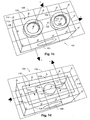
- Figs. 1a-e show perspective views of a representation of a construction element according to an embodiment of the invention.
- Fig. 1a shows a representation of a construction element 101.
- the construction element 101 is a digital representation of a physical building block having on one of its faces, designated 103, two knobs 102 which can connect to corresponding holes of another building block.
- the building block further comprises a hole 104 penetrating the building block from face 105 to the opposite face of the building block. The hole is adapted to receive corresponding connectors of other building blocks.
- the digital representation of the building block 101 comprises a bounding volume 106 represented by thick lines in fig. 1a.
- the bounding volume 106 is a bounding volume of the building block 101 including the knobs 102.
- the digital representation further of the building block is described with respect to an internal right-handed coordinate system 107. It is understood that the choice of coordinate system, in particular the location of its origin and the directions of the axes, may be selected according to any suitable convention. Hence, in a corresponding data structure the position and orientation of the building block may be represented by the coordinates of the origin and the direction of the axes of the coordinate system 107 with respect to an external coordinate system, e.g. the coordinate system of another building block or a global "world" coordinate system.
- the bounding volume may be represented in a data structure relative to the coordinate system 107, e.g. by the coordinates of the two corners 110 with respect to the coordinate system 107.
- Fig. 1b shows a representation of the building block 101 with a bounding volume 108 that includes the building block but without the knobs 102.
- collision detection between different building blocks relies on both types of bounding volumes, i.e. the bounding volume 106 shown in fig. 1 a and the bounding volume 108 of fig. 1 b.
- each plane along which the building block may be connected to another building block is divided into squares with a connection point in the centre of each square, i.e. the edges of the squares correspond to half-distances between neighbouring connection points.
- Fig. 1 c shows the building block 101 and illustrates the representation of the connection elements on one face of the building block.
- the representation represents a square grid 109 in the plane of the face 103 of the building block which includes the two knobs 102.
- the square grid comprises a number of squares, each having a grid point as a centre, as exemplified by square 130 and grid point 111.
- Each grid point has an associated direction, as indicated by arrows, e.g. arrow 112 of grid point 111.
- the direction of the grid points of grid 109 is pointing outwards, i.e. in the direction of the y-axis of the coordinate system 107.
- a representation of the grid 109 may comprise the coordinates of a predetermined grid point, e.g. the grid point 113, with respect to the coordinate system 107, the direction of the grid points, i.e. the direction of arrow 114 with respect to the coordinate system, the size of the grid, i.e. the number of squares in x- direction and z-direction, respectively, and the attributes related to each of the grid points.
- a predetermined grid point e.g. the grid point 113
- the direction of the grid points i.e. the direction of arrow 114 with respect to the coordinate system
- the size of the grid i.e. the number of squares in x- direction and z-direction, respectively
- attributes related to each of the grid points i.e. the number of squares in x- direction and z-direction
- Fig. 1d illustrates the connection grid 120 of the face 116, opposite to face 103 (not shown in fig. 1 d) of the building block 101.
- This face of the building block comprises two holes 117 defined by the edges 118 and a small centre knob 119, a so-called secondary pin.
- the holes of the physical building block are arranged to be able to receive knobs, such as the knobs 102, of another building block, thereby cooperatively connecting two building blocks.
- the holes are represented by the corresponding grid points of the grid 120, as represented by arrows 121.
- the origin of the coordinate system corresponds to the grid point 122.
- Fig. 1e illustrates the connection grid 123 of the face 105 of the building block 101 which comprises the hole 104.
- the grid point 124 represents the connectivity properties of the hole 104.
- a graphical representation when graphically representing the building block on a display, e.g. a computer screen, the bounding volumes, coordinate systems, and grids do not need to be shown.
- a graphical representation only includes a rendering of the building block itself.
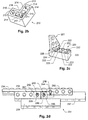
- Figs. 2a-c illustrate examples of construction elements and their connection elements.
- Fig. 2a shows two building blocks 201 and 202.
- Building block 201 is a brick having four knobs 203 on its top face and four corresponding holes on the bottom face (not shown).
- Brick 202 is an example of a building block with a surface that comprises planes which are not mutually orthogonal. Specifically, building block 202 has a slanted face 204. As is illustrated in fig. 2a, in their current positions, the building blocks 201 and 202 do not connect.
- Fig. 2b shows a building block 210 having a non-rectangular top and bottom face.
- the bottom face comprises holes 211, 212, and 213 for receiving corresponding knobs of one or more other building blocks.
- the holes are defined by the edges 214, the secondary pins 215, as well as the corners 216 and 217. Hence, the properties of all of the above elements determine the connectivity properties of this face of the building block.
- Fig. 2c illustrates a building block 220 being connected with a building block 221, thereby forming a combined building block.
- Building block 220 comprises knobs 222 on its top face which are connectors fitting in corresponding holes of another building block.
- the gaps 223 between the knobs function as receptors for other connectors, such as the side face 224 of block 221.
- this property is determined by the dimensions of the gaps and the dimensions of the building block 221, i.e. the width 225 of its sides.
- these properties are represented by corresponding attributes of connection points, as will be illustrated in greater detail below.
- Fig. 2d illustrates an invalid connection of a building block to another building block comprising a number of bricks.
- the building block 231 comprises bricks 232, 233, 234, 235, 236, and 237.
- Each building block comprises knob connectors and antiknob receptors as described above.
- Building blocks 232, 233, and 236 comprise knob connectors on a top side as well as on the side faces:
- building block 232 comprises knob 238 on the side face
- building block 233 comprises knob 239 on the side face
- building block 236 comprises knob 240 on its side face.
- Fig. 3 shows a perspective view of a building block and its corresponding connectivity grids.
- the building block 301 has a top surface 302 with eight knobs 303a-h, a bottom surface with corresponding holes (not shown) and side faces 304.
- connectivity grids 305 and 306 of the top surface and the bottom surface, respectively, are shown.
- the connection points are illustrated by circles as exemplified by circles 307a-k.
- connection points 307a-h correspond to knobs 303a-h, respectively.
- connection grids comprising only void receptors may be defined for the side surfaces.
- connection elements of the building block As can be seen from fig. 3, a representation of the connection elements of the building block by the connection points placed in a regular grid, imposes certain constraints on the physical placement of the connection elements on the physical building blocks.
- the grid 305 is located in the plane of the top surface of the building block from which the knobs 303 extend
- the grid points are placed in a square grid where each square has a dimension of 5x5 units of an arbitrary length unit (LU).
- the connection elements are also placed on a corresponding square grid, and the distance between connection elements in a plane of the building block is a multiple of 10 LU.
- the upper and lower surfaces of the building block are rectangular and have a dimension of 20LU x 40 LU, and neighbouring connection elements are spaced apart by 10 LU.
- connection elements are spaced apart by 12 LU.
- the grid dimensions in different dimensions may vary, thereby potentially causing situations as shown in fig. 2d above.
- connection points is defined with respect to the internal coordinate system 308 of the building block.
- Fig. 4 shows a top view of the building block of fig. 3.
- the connectivity grid 305 is shown including the grid points.
- the direction of the grid points in the example of fig. 3 is pointing out of the plane of the drawing.
- a data structure representing the grid of connection points comprises, for each connection point: The coordinates of the connection point with respect of the coordinate system 308, the direction of the connection element, and a connectivity type.
- the brick in the example of fig. 4 has 45 connection points on the top surface and 45 connection points on the bottom surface. Specifying the above values for each of the connection points is a time-consuming and error-prone task.
- connection points are located in regular structures, thereby allowing and advantageous automated data generation.
- the coordinates of the connection points may be determined iteratively, and the direction of the connection elements is the same for all connection points of a grid.
- a data structure representing the grid of connection points comprises:
- connection points may then be represented as a two-dimensional array C indexed by i and j, where C[0,0] corresponds to connection point 401 and C[i,j] corresponds to the connection point with coordinates P 0 + (5i , 0, 5j).
- a two dimensional coordinate system in the plane of the connectivity grid may be defined. In figure 4, this is illustrated by the coordinate system 402.
- the two-dimensional coordinate system may then be represented by the coordinates of its origin 401 and a rotation matrix with respect to the internal coordinate system 308 of the building block.
- Figs. 5a-b illustrate examples of data structures representing connection points according to an embodiment of the invention.
- Fig. 5a illustrates a data structure representing the connection points of the top grid of the building block of fig. 4.
- the data structure corresponds to a two-dimensional array C[i,j] as described above.
- Each array element corresponds to a connection type.
- knobs e.g. knob 303 in fig. 4
- C[i,j] K
- a gap between two knobs e.g. gap 404 in fig. 4
- a gap in the centre of four knobs e.g. gap 405 in fig. 4
- tube gap a gap in the centre of four knobs
- Knobs are connectors which may be received by receptors of other building blocks, e.g. by holes 212 illustrated in fig. 2b.
- Edge gaps are receptors which may receive edges, e.g. as illustrated in fig. 2c or edges 211 illustrated in fig. 2b.
- Tube gaps are receptors which may receive other connectors, e.g. knobs or tubes of a suitable size.
- a building block as the one illustrated in fig. 4 but with a different number of knobs corresponds to a connectivity array similar to the one shown in fig. 5a.
- data structures representing this type of building blocks may be generated automatically, by specifying the dimensions of the building block.
- a number of different types of connectivity arrays may be defined, e.g. array types for top, side and bottom surfaces of regular building blocks as the building block of fig. 3. Instances of these array types may then be automatically generated for a variety of different types and sizes of similar construction elements. Hence, it is an advantage that the data structures representing a large variety of building blocks may be generated in an efficient manner.
- Fig. 5b shows the connectivity array corresponding to the bottom face of the building block shown in fig. 2b.
- connection types in figs 5a-b are represented by mnemonics indicative of the actual physical function of the connection elements, the connection types may be coded by any other suitable means, e.g. by enumerating connection types, bit coding, or the like.
- connection type may comprise a connection category and a parameter.
- connection properties of the different connection types are defined in a corresponding connection table.
- the connection table indicates, for each pair of connection type, the connectivity properties.
- the connection table is stored as a look-up table in a suitable data structure.
- An embodiment of such a connection table is illustrated in table 1.
- each field in table 1 indicates the connectivity of the corresponding two connection types.
- connection types of table 1 are:
- connection table of table 1 is symmetrical along the diagonal.
- the above table may easily be extended to comprise a new connection type by adding a corresponding row and column with the corresponding connectivities of the new connection type with the respective existing connection types.
- Fig. 6 shows a top view of two construction element in an edge-to-edge extension.
- two building blocks 601 and 602 are placed in an edge-to-edge extension, i.e. their top surfaces are placed in the same plane and a subset of their respective connection points coincide as indicated by the dashed line 603.
- each of the building blocks 601 and 602 are of the type shown in figs. 3 and 4.
- connection point 605 corresponds to a connection point of type 1/4TG of building block 601 and of type 1/2TG of building block 602.
- connection point 606 is of type EG of each of the building blocks 601 and 602, while it is of type 2EG in the combined building block.
- connection point 607 is of type 1/2TG of each of the building blocks 601 and 602, while it is of type TG in the combined building block.
- connection elements may change dependant on the placement of the corresponding construction element in relation to other construction elements.
- this situation may be modelled by defining a combination table describing the combined or resulting connection types of overlapping connection points.
- Table 2 is an example of such a combination table indicating the combinations of the connection types introduced above.
- the combination table is stored as a look-up table in a suitable data structure. Table 2.
- each field comprises the combined connection type. If a combination of two connection types does not yield a connection type which connects to any other connection type, the table entry is F.
- connection element when an edge gap ( ⁇ EG) is placed next to a void connector (VC), e.g. an empty surface, the resulting connection element may be thought of as being a wider gap. In table 2, this is approximated by ( ⁇ +1)EG.
- a resulting connection type for e.g. three connection elements may be determined by first determining the first resulting connection type for two of the combined connection elements, and subsequently determining a second resulting connection type of the combination of the first resulting connection type and the connection type of the third connection element.
- the above table may easily be extended to comprise a new connection type by adding a corresponding row and column with the corresponding resulting connection types resulting from a combination of the new connection type with the respective existing connection types.
- Fig. 7 shows a perspective view of a geometrical object including two connected groups of building blocks.
- the geometrical object comprises five elements 701, 702, 703, 704, and 705.
- the geometrical object comprises two groups of building blocks: A first group of building blocks includes building blocks 701, 702, and 703, while a second group includes building blocks 704 and 705.
- the building blocks 701 and 704 in this example are rotably connected, e.g. by a single knob - antiknob connection described above, or by any other way of connecting which does not prevent the building blocks from rotating relative to each other, e.g. a hinge connection, two or more knob-antiknob connections on a common line, etc.
- FIG. 7 is an example of building blocks which are not necessarily bound to the position and orientation constraints given within a geometrical object.
- Other examples of such connections include connections between building blocks that allow for a relative translation of the connected building blocks.
- groups of building blocks may need to be described by separate coordinate systems, as is illustrated by the grid systems 706 and 707.
- Fig. 8 shows a flow diagram of a method of placing a construction element as a part of a computer-implemented process of generating a computer readable model of a geometrical object.
- a construction element is placed in a predetermined initial position.
- the construction element is represented by a data structure as illustrated above, and the position and orientation of the construction element is described by suitable coordinates describing the position and orientation of the internal coordinate system of the construction element with respect to a suitable coordinate system, e.g. a three dimensional right-handed "world" or reference coordinate system.
- the process For a given context, e.g. a scene, a geometrical object, or the like, the process generates and maintains a set of data structures, each representing a building block placed within that context. Placing a new construction element within that context corresponds to generating a new instance of a corresponding data structure as a part of that set of data structures.
- the placement of the construction element may be caused by a user command, e.g. during an interactive process of constructing a digital model of a geometrical object.
- a computer may provide a user interface allowing a user to select different construction elements, e.g. construction elements of different types, shape, size, color, etc, and to place a selected construction element in a predetermined position and orientation in a three dimensional graphical scene rendered on the display of the computer.
- the user interface may provide a drag-and-drop operation for placing the construction element as well as operations for manipulating, e.g. rotating, the construction element.
- the placement of the construction element may be restricted, e.g. to discrete positions on a predetermined grid, e.g. in a system where all distances are measured as multiples of an arbitrary length unit (LU), the grid points of the reference grid may be spaced apart by 1 LU.
- a predetermined grid e.g. in a system where all distances are measured as multiples of an arbitrary length unit (LU)
- the grid points of the reference grid may be spaced apart by 1 LU.
- step 802 the computer-implemented process detects where the construction element that was placed in step 801, intersects with any other construction elements already present in the scene, e.g. construction elements previously placed by the user:
- This collision detection may be performed by any suitable collision detection method, preferably a collision detection method based on a bounding volume of the construction element. Examples of such algorithms are disclosed in e.g. David H. Eberly: "3D Game Engine Design", Morgan Kaufmann, 2001.
- the collision detection may result in that the position in which the construction element was placed is already occupied by another construction element. This situation may be detected by detecting an intersection of the bounding volumes which is larger than a predetermined limit. If an invalid intersection is detected, placement of the construction element at this position and orientation may be rejected.
- step 803 the process tests in step 803 whether the newly placed construction element validly intersects with another construction element.
- a valid intersection may, for example be detected as an intersection of the respective bounding volumes which is smaller than a predetermined limit.
- the representation of the construction element comprises two bounding volumes, a bounding volume including the connection elements (fig. 1 a) and a bounding volume including the body of the construction element but not the connection elements (fig. 1 b).
- the collision detection step may use these two bounding volumes to detect an invalid collision, if the bounding volumes without connection elements of the respective construction elements overlap. A valid overlap is detected, if the bounding volumes including the connection elements overlap but not the bounding volumes without connection elements, or if any of the surfaces of any the bounding volumes intersect but the bounding volumes do not overlap.
- any initial scene without user-placed construction elements may comprise a default construction element, e.g. a support plate with connection elements for placing construction elements in top of the ground plate.
- step 804 If a valid collision between the newly placed construction element and one or more other construction elements was detected in step 803, the process continues at step 804 and checks whether the newly placed construction element may be validly connected to the construction element(s) it validly intersects with.
- a preferred embodiment of this connectivity detection sub-process will be described in greater detail below.
- the connectivity detection may result in an acceptance of the placement of the construction element, if it validly connects to the construction element(s) it intersects with, or in a rejection if it does not validly connect with any one of the construction elements it intersects with.
- the process may be initiated again by a user action, e.g. by replacing the rejected construction element in an alternative position and/or orientation, by placing another construction element in the scene, or the like.
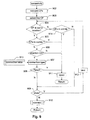
- Fig. 9 shows a flow diagram of the sub-process 804 of connecting a first digital construction element to another, second digital construction element according to an embodiment of the invention.
- the first construction element may be a newly placed brick and the second construction element may be a previously constructed structure of bricks, where a detection algorithm has detected an intersection between the newly placed brick and the second construction element.
- the construction elements are oriented so that main axes of their bounding volumes correspond to x, y, and z axes of right-handed orthogonal world coordinate system.
- connection elements themselves may differ in nature and shape.
- connection elements in the same horizontal plane correspond to segments of an orthogonal grid with fixed distance between neighbouring segments.
- connection points of the first construction element and of the second construction element that belong to the detected intersection. Only those connection points that are not already connected need to be considered; these connection points will be referred to as the relevant connection points.
- a first relevant connection point of the first construction element is selected. This may be an arbitrarily selected connection point, a connection point selected by the user, or the like.
- step 904 for the selected connection point of the first construction element the process checks whether there are any relevant connection points of the second construction element having the same coordinates as the selected connection point.
- the construction elements are placed in a discrete volume reference grid and all coordinates are multiples of an arbitrary length unit, an exact match of coordinates may be required.
- a continuous, or quasi-continuous reference coordinate system it may be required that the grid points coincide within predetermined limits.
- step 914 it is detected whether there are any other of the relevant connection points within a predetermined neighbourhood of the selected connection point.
- the predetermined neighbourhood corresponds to a cube (x ⁇ 5 LU, y ⁇ 5 LU, z ⁇ 5 LU) around the selected connection point at (x, y, z), since in this embodiment the distance between two adjacent connection elements is 10 LU. If there are any other of the relevant connection points within a predetermined neighbourhood of the selected connection point, connection of the two construction elements is rejected (step 911) and the algorithm terminates.
- connection points in this embodiment are placed on a regular grid, an invalid placement of the construction element may efficiently be detected: If a mismatch with a relevant connection point of the second construction element is found for one of the relevant connection points of the first construction element, the remaining connection points of the first construction element do not need to be checked, thereby increasing the speed of the detection process.
- the above test ensures that a connection as indicated in fig. 2d is rejected, as the connection point corresponding to knob 239 is misplaced with respect to the regular grid. It is noted that in the example of fig. 2d, the connection point 243 would not cause a conflict, since, due to the slight difference in height, it does not belong to the intersection of bounding volumes, i.e. there is no contact between brick 241 and 236.
- step 914 If no conflicting relevant connection point is found in step 914, the process continues at step 909.
- step 904 the process continuous at step 905, where it is detected whether there is any other relevant connection points within a predetermined neighbourhood of the selected connection point, in this embodiment in a cube (x ⁇ 5 LU, y ⁇ 5 LU, z ⁇ 5 LU) around the selected connection point at (x, y, z), as described above. If another connection point is found in the predetermined neighbourhood, the position is rejected (step 911). Otherwise, the process continuous at step 906.
- the above restriction may not be desired.
- the above restriction may be limited to certain connection types, e.g. in the above example all connection types different from "void".
- step 906 the process detects whether the selected connection point and the detected matching connection point have opposite directions, i.e. if their associated directions are along a common line, but in opposite orientation. Hence, only connection elements positioned in a relative orientation suitable for them to engage, are accepted.
- this limitation may be relaxed, e.g. by accepting a range of orientations in embodiments where the connection elements accept a range of orientations.
- step 911 If the relative direction of the connection points are accepted, the process continues at step 907, otherwise, the position is rejected (step 911).
- connection types of the selected connection point and the corresponding detected matching connection point are compared by retrieving the connectivity rule of the corresponding pair of connection types from a stored connection table 913, e.g. a connection table according to table 1 above.
- the connectivity may be true, false, or void, as described in connection with table 1.
- step 908 it is tested whether the connectivity result is "false”, i.e. no valid connection is possible between the corresponding connection types. If the connectivity result is "false”, the position of the first construction element is rejected (step 911), otherwise the connectivity result is stored and the process proceeds to step 909.
- step 909 it is tested, whether all relevant connection points of the first construction element have been processed. If not, a yet unprocessed relevant connection point is selected (step 912) and processed by performing the above steps 904, 905, 906, 907, and 908 with the now selected connection point.
- step 910 it is determined, based on the stored connectivity results, how the construction elements connect, and their respective data structures are updated accordingly. This will be described in greater detail in connection with fig. 10. Once the data structures are updated, the sub-process terminates and returns to the overall process of fig. 8.
- Fig. 10 shows a flow diagram of an embodiment of sub-process 910 of updating the data structures representing the connected construction element. The updating is based on the connectivity results determined for all the relevant connection points of the intersection of the bounding volumes of the first and second construction elements.
- step 1001 it is checked whether all connectivity results are "void”. If yes, i.e. if nothing prevents a position of the construction element, but none of the connection elements actually engage to connect the construction elements, the new construction element is allowed in its present position.
- the data structure of the first and second construction elements may be updated.
- the first construction element should not be combined with the second construction element to a combined construction element having a combined bounding volume, etc.
- an additional algorithm may decide, e.g. based on the bounding volumes, whether a physical building block placed in this position would fall down, tilt, etc. and allow or reject the position accordingly.
- step 1002 the process determines, how the construction elements are connected, i.e. whether they are connected rigidly or whether the connection allows for a relative rotation, translation and/or the like.
- step 1005 the process continues at step 1005, where the first and second construction elements are assigned to respective groups, each having their respective reference coordinate system, bounding volumes, etc, thereby allowing to model different relative positions and/or orientations of the groups of construction elements.
- the first and second construction elements are assigned to respective groups, each having their respective reference coordinate system, bounding volumes, etc, thereby allowing to model different relative positions and/or orientations of the groups of construction elements.
- a connected structure of construction elements may be described by a data structure comprising a number of groups of construction elements.
- a group is a structure in which all construction elements are rigidly connected in a way that all connection points of all construction elements are grid points of the same orthogonal grid.
- Each group of construction elements includes one or more construction elements where the group determines a common orthogonal coordinate system (grid), a bounding volume, and connectivity grids of the construction elements of that group.
- step 1002 If a rigid connection was detected in step 1002, the process continues at step 1003.
- one or more of the connectivity points of the first and second construction elements may change their connectivity type due to the connection.
- step 1003 those connection points of the first and second construction elements are detected which have the same position and the same direction.
- a resulting connection type is looked up in a stored combination table 1006, as was described in connection with table 2 above.
- step 1004 the data structure of the second construction element is updated with the information from the first construction element, i.e. the bounding volume of the second construction element is updated to be a union of the bounding volumes of the first and second construction elements, the connectivity grids are update to also include the connectivity points of the first construction element, etc.
- the rejection of a position of a new construction element due to an inaccurate placement may lead to a further processing rather than a simple rejection:
- hypothetical neighbouring positions or small displacements may be analysed to decide whether an acceptable position may be achieved. This may result in that the construction element snaps, within predetermined limits, into the closest position which provides an acceptable position.
- a construction element When a construction element is removed from a structure, e.g. in response to a corresponding user command, its data structure is removed from the combined data structure. In one embodiment, this may be implemented by recalculating the combined data structure of the remaining construction elements.
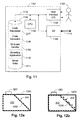
- Fig. 11 shows a data processing system for generating computer-readable models of geometrical objects according to an embodiment of the invention.
- the computer system designated 1101 is adapted to facilitate designing, storing, manipulating, and sharing of geometrical constructions according to the invention.
- the computer system 1101 can be used as a stand alone system or as a client in a client/server system.
- the computer comprises memory 1102 partly implemented as a volatile and a non-volatile memory means e.g. a hard-disc and a random access memory (RAM).
- the memory comprises model code interpreter 1107, model code generator 1108, Ul-Event Handler 1109, and Modelling Application 1110 executable by the central processing unit 1103. Further, the memory comprises Model Data 1111.
- the Code Interpreter 1107 is adapted to read and interpret code defining a model according to the invention, i.e. code representing the data structures of the construction elements of a model.
- code representing the data structures of the construction elements of a model.
- the Code Interpreter is adapted to read a model according to the invention and to convert such a model into a known graphic format for presentation on a computer display. Based on the data structures described above for representing a model of an object, this conversion can be implemented by a person skilled in the art by applying well-known graphical principles known within the field of graphical computing.
- the UI-Event Handler 1109 is adapted to convert a user's interaction with a user interface into proper user commands recognisable by the Code Generator 1108.
- a set of possible and recognisable commands can comprise: Getting a construction element from a library of elements, placing a construction element to be connected to another construction element, disconnecting a construction element, discarding a construction element, manipulating a construction element, a group of construction elements, etc., e.g. by initiating a rotation, etc.
- each command there may be associated a set of respective parameters, e.g. coordinates, types of construction elements, etc.
- the Code Generator 1108 is adapted to modify the data structures describing an actual model according to the invention as described above and in response to a user's commands. As a concurrent or subsequent task, the Code Interpreter can be executed for presenting the result of the Code Generator.
- the Modelling Application 1110 is adapted to control memory, files, the user interface, etc.
- a user 1105 is capable of interacting with the computer system 1101 by means of the user interface 1106.
- the computer system comprises an input/output unit (I/O) 1104.
- the input/output unit can be used as an interface to different types of storage media and different types of computer networks, e.g. the Internet. Further, the input/output unit (I/O) 1104 can be used for exchanging models with other users e.g. interactively.
- Data exchange between the memory 1102, the central processing unit (CPU) 1103, the user interface (UI) 1106, and the input/output unit 1104 is accomplished by means of the data bus 1112.
- Fig. 12a shows a side view of a building block, e.g. building block 202 of fig. 2a, with a slanted surface and corresponding bounding volumes according to a first embodiment of the invention.
- the building block 202 comprises a slanted surface 204 and knobs 1201 on the top of the building block.
- the representation of the building block 202 comprises a hierarchy of bounding volumes.
- a first bounding volume 1202 comprises a slanted surface, while a second bounding volume 1203 is a box with sides being orthogonal to each other.
- two building blocks are detected as being in contact, only if the bounding volume 1203 has an intersection with a corresponding bounding volume of another building block.
- the bounding volume 1202 may be used for an initial efficient detection of possibly connected building blocks.
- the representation of the building block 202 may comprise additional bounding volumes, such as bounding volumes including connection elements as described in connection with figs. 1 a-b.
- Fig. 12b shows a side view of the building block 202 with a slanted surface and the corresponding bounding volumes according to a second embodiment of the invention.
- the representation of the building block 202 comprises a hierarchy of bounding volumes.
- the representation instead of a bounding volume with a slanted surface, the representation comprises a bounding volume 1204 having a step-function like shape, thereby providing an approximation of a slanted surface.
- the above method and system may be applied in connection with a computer application for designing physical models, e.g. a computer application which simulates the connectivity behaviour of a corresponding set of physical construction elements.
- a physical toy constructions set may be supplemented by a digital version of said construction set, thereby allowing a user, e.g. a child, to digitally design models without restricting the number of available construction elements, etc., thereby providing for an interesting playing experience.
- It is an advantage of the invention that it provides a method and system which allows to realistically model even complex connectivity properties of a physical construction set and, at the same time, provides an efficient modelling process. Consequently, a user experiences an interactive digital construction process without having to wait for the computer to determine whether a proposed position of a construction element corresponds to the connection rules of the construction set.
- the method may further be applied to analyse properties of a designed model, to generate construction instructions, or the like.
- the method may be applied in the computer gaming industry and all other areas of computer graphics where predetermined 3D elements have to be put together according to a plurality of connection rules.
Landscapes
- Engineering & Computer Science (AREA)
- Physics & Mathematics (AREA)
- General Physics & Mathematics (AREA)
- Geometry (AREA)
- Computer Graphics (AREA)
- Software Systems (AREA)
- Theoretical Computer Science (AREA)
- Manufacturing & Machinery (AREA)
- Human Computer Interaction (AREA)
- General Engineering & Computer Science (AREA)
- Computer Hardware Design (AREA)
- Automation & Control Theory (AREA)
- Processing Or Creating Images (AREA)
- Image Generation (AREA)
- Stored Programmes (AREA)
- Devices For Executing Special Programs (AREA)
- Preparing Plates And Mask In Photomechanical Process (AREA)
- Measuring Or Testing Involving Enzymes Or Micro-Organisms (AREA)
- Oscillators With Electromechanical Resonators (AREA)
- Compression, Expansion, Code Conversion, And Decoders (AREA)
Claims (17)
- Verfahren zum Erzeugen eines computerlesbaren Modells eines geometrischen Objekts (231), das aus einer Mehrzahl miteinander verbindbarer Bauelemente aufgebaut ist, wobei jedes Bauelement (232, 233, 234, 235) eine Anzahl von Verbindungselementen zum Verbinden des Bauelements mit einem anderen Bauelement aufweist, wobei das Verfahren umfasst:Codieren eines ersten und eines zweiten der Mehrzahl von Bauelementen als entsprechende erste und zweite Datenstrukturen, die jeweils die Verbindungselemente (307x) des entsprechenden Bauelements darstellen, und wobei mit jedem der Verbindungselemente einer Mehrzahl vorbestimmter Verbindungstypen verknüpft ist;Bestimmen eines ersten Verbindungselements (238) des ersten Bauelements und eines zweiten Verbindungselements (242) des zweiten Bauelements, die in einer vorbestimmten Nähe zueinander angeordnet sind; undAbrufen von Verbindungsfähigkeitsinformationen der entsprechenden Verbindungstypen des ersten und zweiten Verbindungselements, die anzeigen, ob das erste und zweite Verbindungselement eine Verbindung zwischen dem ersten und zweiten Bauelement bereitstellen.
- Verfahren nach Anspruch 1, dadurch gekennzeichnet, dass das Verfahren ferner aufweist, eine Verbindungstabelle zu liefern, die Verbindungsfähigkeitsinformationen von Paaren der Verbindungstypen enthält; und der Schritt zum Abrufen von Verbindungsfähigkeitsinformationen aufweist, die Verbindungsfähigkeitsinformationen aus der Verbindungstabelle abzurufen.
- Verfahren nach Anspruch 1 oder 2, dadurch gekennzeichnet, dass das Verfahren weiter umfasst:- Bereitstellen einer Kombinationstabelle, die einen resultierenden Verbindungstyp für jedes eines vorbestimmten Satzes von Verbindungstyppaaren enthält;- Bestimmen eines ersten und zweiten Verbindungselements, die in einem vorbestimmten geometrischen Verhältnis zueinander positioniert sind;- Abrufen eines resultierenden Verbindungstyps des ersten und zweiten Verbindungselements aus der Kombinationstabelle; und- Zuordnen des abgerufenen resultierenden Verbindungstyps zu mindestens einem resultierenden Verbindungselement.
- Verfahren nach einem der Ansprüche 1 bis 3, dadurch gekennzeichnet, dass die jeweiligen Datenstrukturen weiter eine Anzahl von Gittern in Bezug zu dem entsprechenden Bauelement darstellen, wobei jedes Gitter eine Anzahl von Gitterpunkten aufweist; und jedes der Verbindungselemente des Bauelements mit einem der Gitterpunkt verknüpft ist und einen entsprechenden Verbindungstyp aufweist.
- Verfahren nach Anspruch 4, dadurch gekennzeichnet, dass jedes der Gitter mindestens eine Gitterkante aufweist und das Verfahren ferner umfasst:- Bereitstellen einer Kombinationstabelle, die einen resultierenden Verbindungstyp für jedes Paar von Verbindungstypen enthält;- Ermitteln, ob ein erstes Gitter des ersten Bauelements in einer Erstreckung Kante an Kante eines zweiten Gitters des zweiten Bauelements platziert ist, wobei eine erste Kante des ersten Gitters mit einer zweiten Kante des zweiten Gitters ausgerichtet ist;- Identifizieren, für ein erstes Verbindungselement des ersten Gitters, eines entsprechenden zweiten Verbindungselements des zweiten Gitters;- Abrufen eines resultierenden Verbindungstyps einer Kombination des ersten und zweiten Verbindungselements aus der Kombinationstabelle; und- Zuordnen des abgerufenen resultierenden Verbindungstyps zu dem ersten und zweiten Verbindungselement.
- Verfahren nach Anspruch 4 oder 5, dadurch gekennzeichnet, dass jede der jeweiligen Datenstrukturen weiter ein Begrenzungsvolumen des entsprechenden Bauelements darstellt, und jedes der Gitter einer Oberfläche des Begrenzungsvolumens entspricht.
- Verfahren nach Anspruch 6, dadurch gekennzeichnet, dass das Verfahren ferner umfasst:Codieren jeweiliger Positionen des ersten und zweiten Bauelements in Bezug zu einem gemeinsamen Volumenreferenzgitter, wobei das erste und zweite Gitter der entsprechenden ersten und zweiten Bauelemente jeweiligen ersten und zweiten Ebenen des Volumenreferenzgitters entsprechen; und die Gitterpunkte des ersten und zweiten Gitters jeweiligen Referenzgitterpunkten des Volumenreferenzgitters entsprechen; undErmitteln, ob das erste und zweite Gitter einer gemeinsamen Ebene des Volumenreferenzgitters entsprechen und ob sich mindestens ein erster Gitterpunkt des ersten Gitters in dem gleichen Referenzgitterpunkt wie ein zweiter Gitterpunkt des zweiten Gitters befindet.
- Verfahren nach Anspruch 7, dadurch gekennzeichnet, dass das Verfahren ferner umfasst:- Identifizieren aller Paare übereinstimmender Gitterpunkte des ersten Gitters und des zweiten Gitters;- Abrufen von Verbindungsfähigkeitsinformationen aus der Verbindungsfähigkeitstabelle für jedes der identifizierten Paare von Gitterpunkten;- Ablehnen von Verbindung zwischen dem ersten und zweiten Bauelement, wenn mindestens ein Paar von Gitterpunkten einer ungültigen Verbindung entspricht; ansonsten Akzeptieren der Verbindung zwischen dem ersten und zweiten Verbindungselement, wenn mindestens ein Paar von Gitterpunkten einer gültigen Verbindung entspricht.
- Verfahren nach einem der Ansprüche 1 bis 8, dadurch gekennzeichnet, dass jedes der Verbindungselemente weiter eine zugehörige Richtung aufweist.
- Verfahren nach einem der Ansprüche 1 bis 9, dadurch gekennzeichnet, dass die Verbindungsfähigkeitsinformationen einen Indikator für jedes Paar von Verbindungstypen aufweisen, der einen einer vorbestimmten Gruppe von Verbindungsfähigkeitstypen anzeigt, wobei die Gruppe aus einer gültigen Verbindung, die eine Verbindung zwischen einem entsprechenden Paar von Verbindungselementen liefert, einer ungültigen Verbindung, die eine Verbindung zwischen einem entsprechenden Paar von Verbindungselementen verhindert, und einer neutralen Verbindung besteht.
- Verfahren nach einem der Ansprüche 1 bis 10, dadurch gekennzeichnet, dass der Schritt zum Bestimmen eines ersten Verbindungselements des ersten Bauelements und eines zweiten Verbindungselements des zweiten Bauelements, die in einer vorbestimmten Nähe zueinander angeordnet ist, ferner umfasst, das erste und zweite Verbindungselement aus einem vorbestimmten Untersatz von Verbindungselementen zu bestimmen .
- Verfahren nach Anspruch 11, dadurch gekennzeichnet, dass die jeweiligen Datenstrukturen ferner ein Begrenzungsvolumen des entsprechenden Bauelements darstellen; das Verfahren weiter umfasst, eine Überschneidung der Begrenzungsvolumen des ersten und zweiten Bauelements zu ermitteln; und der Schritt zum Bestimmen des ersten und zweiten Verbindungselements aus einem vorbestimmten Untersatz von Verbindungselementen umfasst, das erste und zweite Verbindungselement aus Verbindungselementen zu bestimmten, die in den bestimmten Überschneidungen enthalten sind.
- Datenverarbeitungssystem (1101), aufweisend:Mittel zum Erzeugen einer computerlesbaren Modells eines geometrischen Objekts (231), das aus einer Mehrzahl miteinander verbundener Bauelemente aufgebaut wird, wobei jedes Bauelement (232, 233, 234, 235) eine Anzahl von Verbindungselementen zum Verbinden des Bauelements mit einem anderen Bauelement aufweist;Mittel zum Codieren eines ersten und eines zweiten der Mehrzahl von Bauelementen als entsprechende erste und zweite Datenstrukturen, die jeweils Verbindungselemente (301x) des entsprechenden Bauelements darstellen, und mit jedem der Verbindungselemente eine Mehrzahl vorbestimmter Verbindungstypen verknüpft ist;Mittel zum Bestimmen eines ersten Verbindungselements (238) des ersten Bauelements und eines zweiten Verbindungselements (242) des zweiten Bauelements, die in einer vorbestimmten Nähe voneinander angeordnet sind; undMittel zum Abrufen von Verbindungsfähigkeitsinformationen der entsprechenden Verbindungstypen des ersten und zweiten Verbindungselements, die anzeigen, ob das erste und zweite Verbindungselement eine Verbindung zwischen dem ersten und zweiten Bauelement bereitstellen.
- Datenverarbeitungssystem nach Anspruch 13, dadurch gekennzeichnet, dass das Datenverarbeitungssystem weiter Speichermittel zum Speichern einer Verbindungstabelle aufweist, die Verbindungsfähigkeitsinformationen von Paaren der Verbindungstypen enthält.
- Datenverarbeitungssystem nach Anspruch 13 oder 14, dadurch gekennzeichnet, dass das Datenverarbeitungssystem weiter Speichermittel zum Speichern einer Kombinationstabelle aufweist, die einen resultierenden Verbindungstyp für jedes eines vorbestimmten Satzes von Verbindungstyppaaren enthält.
- Computerprogramm, das Programmcodemittel zum Ausführen aller der Schritte eines jeglichen der Ansprüche 1 bis 12 aufweist, wenn man das Programm auf einem Computer laufen lässt.
- Computerprogrammprodukt, das Programmcodemittel aufweist, die auf einem computerlesbaren Medium zum Ausführen des Verfahrens eines jeglichen der Ansprüche 1 bis 12 gespeichert sind, wenn man das Computerprogramm auf einem Computer laufen lässt.
Applications Claiming Priority (5)
| Application Number | Priority Date | Filing Date | Title |
|---|---|---|---|
| DK200201549 | 2002-10-11 | ||
| DKPA200201549 | 2002-10-11 | ||
| US42103402P | 2002-10-24 | 2002-10-24 | |
| US421034P | 2002-10-24 | ||
| PCT/DK2003/000674 WO2004034333A1 (en) | 2002-10-11 | 2003-10-09 | Method of generating a computer readable model |
Publications (2)
| Publication Number | Publication Date |
|---|---|
| EP1550085A1 EP1550085A1 (de) | 2005-07-06 |
| EP1550085B1 true EP1550085B1 (de) | 2006-12-13 |
Family
ID=32094936
Family Applications (1)
| Application Number | Title | Priority Date | Filing Date |
|---|---|---|---|
| EP03750398A Expired - Lifetime EP1550085B1 (de) | 2002-10-11 | 2003-10-09 | Verfahren zum erzeugen eines computerlesbaren modelles |
Country Status (14)
| Country | Link |
|---|---|
| US (1) | US7439972B2 (de) |
| EP (1) | EP1550085B1 (de) |
| JP (1) | JP4509789B2 (de) |
| KR (1) | KR100970790B1 (de) |
| AT (1) | ATE348372T1 (de) |
| AU (1) | AU2003269854A1 (de) |
| CA (1) | CA2497621C (de) |
| DE (1) | DE60310431T2 (de) |
| DK (1) | DK1550085T3 (de) |
| ES (1) | ES2277106T3 (de) |
| NO (1) | NO332876B1 (de) |
| PL (1) | PL375082A1 (de) |
| PT (1) | PT1550085E (de) |
| WO (1) | WO2004034333A1 (de) |
Cited By (1)
| Publication number | Priority date | Publication date | Assignee | Title |
|---|---|---|---|---|
| WO2011039041A3 (en) * | 2009-10-02 | 2012-01-05 | Lego A/S | Connectivity depended geometry optimization for real-time rendering |
Families Citing this family (42)
| Publication number | Priority date | Publication date | Assignee | Title |
|---|---|---|---|---|
| US7596473B2 (en) | 2003-05-20 | 2009-09-29 | Interlego Ag | Method of constructing a virtual construction model |
| US7755620B2 (en) | 2003-05-20 | 2010-07-13 | Interlego Ag | Method and system for manipulating a digital representation of a three-dimensional object |
| US8674983B1 (en) * | 2004-07-09 | 2014-03-18 | The Mathworks, Inc. | System and method for synchronizing and using a three dimensional view with a block diagram model |
| US7467154B2 (en) | 2005-06-29 | 2008-12-16 | Microsoft Corporation | Producing a locally optimal path through a lattice by overlapping search |
| WO2008011391A2 (en) * | 2006-07-21 | 2008-01-24 | University Of Utah Research Foundation | Ray tracing a three-dimensional scene using a hierarchical data structure |
| US9092901B2 (en) * | 2006-11-29 | 2015-07-28 | University Of Utah Research Foundation | Parallel grid population |
| US8374829B2 (en) | 2007-03-16 | 2013-02-12 | Lego A/S | Automatic generation of building instructions for building element models |
| US7979251B2 (en) | 2007-03-16 | 2011-07-12 | Lego A/S | Automatic generation of building instructions for building element models |
| US8257157B2 (en) * | 2008-02-04 | 2012-09-04 | Polchin George C | Physical data building blocks system for video game interaction |
| US8113072B1 (en) | 2009-02-27 | 2012-02-14 | The United States Of America As Represented By The Secretary Of The Navy | Electromagnetic physical scale model modularization system |
| EP2462537A1 (de) | 2009-08-04 | 2012-06-13 | Eyecue Vision Technologies Ltd. | System und verfahren zur objektextraktion |
| US9595108B2 (en) | 2009-08-04 | 2017-03-14 | Eyecue Vision Technologies Ltd. | System and method for object extraction |
| US20110165939A1 (en) * | 2010-01-05 | 2011-07-07 | Ganz | Method and system for providing a 3d activity in a virtual presentation |
| US8836719B2 (en) | 2010-04-23 | 2014-09-16 | Ganz | Crafting system in a virtual environment |
| CA2840911C (en) | 2011-07-05 | 2019-09-24 | Lego A/S | Toy building set |
| JP5988563B2 (ja) * | 2011-10-25 | 2016-09-07 | キヤノン株式会社 | 画像処理装置と画像処理装置の制御方法およびプログラムと、情報処理装置と情報処理装置の制御方法およびプログラム |
| JP2014102685A (ja) * | 2012-11-20 | 2014-06-05 | Sony Corp | 情報処理装置、情報処理方法及びプログラム |
| US10579207B2 (en) * | 2014-05-14 | 2020-03-03 | Purdue Research Foundation | Manipulating virtual environment using non-instrumented physical object |
| US10583354B2 (en) | 2014-06-06 | 2020-03-10 | Lego A/S | Interactive game apparatus and toy construction system |
| US10518188B2 (en) | 2014-06-30 | 2019-12-31 | Microsoft Technology Licensing, Llc | Controlling physical toys using a physics engine |
| US10478723B2 (en) | 2014-06-30 | 2019-11-19 | Microsoft Technology Licensing, Llc | Track based play systems |
| US10537821B2 (en) | 2014-06-30 | 2020-01-21 | Microsoft Technology Licensing, Llc | Interactive play sets |
| KR102435699B1 (ko) | 2014-10-02 | 2022-08-25 | 레고 에이/에스 | 게임 시스템 |
| US9919226B2 (en) | 2014-10-08 | 2018-03-20 | Microsoft Technology Licensing, Llc | Storage and charging device for game pieces |
| US9696757B2 (en) | 2014-10-08 | 2017-07-04 | Microsoft Corporation | Transfer of attributes between generations of characters |
| US10369477B2 (en) | 2014-10-08 | 2019-08-06 | Microsoft Technology Licensing, Llc | Management of resources within a virtual world |
| GB2532075A (en) | 2014-11-10 | 2016-05-11 | Lego As | System and method for toy recognition and detection based on convolutional neural networks |
| CN104898456B (zh) * | 2015-04-02 | 2018-06-19 | 苏州乐派特机器人有限公司 | 实物化编程的方法及其在机器人领域的应用 |
| DK3337585T3 (da) | 2015-08-17 | 2022-11-07 | Lego As | Fremgangsmåde til at skabe et virtuelt spilmiljø og interaktivt spilsystem under anvendelse af fremgangsmåden |
| US10552550B2 (en) * | 2015-09-26 | 2020-02-04 | Intel Corporation | Technologies for physical programming |
| US10649572B2 (en) | 2015-11-03 | 2020-05-12 | Microsoft Technology Licensing, Llc | Multi-modal sensing surface |
| US10338753B2 (en) | 2015-11-03 | 2019-07-02 | Microsoft Technology Licensing, Llc | Flexible multi-layer sensing surface |
| US10955977B2 (en) | 2015-11-03 | 2021-03-23 | Microsoft Technology Licensing, Llc | Extender object for multi-modal sensing |
| US9914066B2 (en) | 2016-03-07 | 2018-03-13 | Microsoft Technology Licensing, Llc | Electromagnetically coupled building blocks |
| DK3454956T3 (da) | 2016-05-09 | 2021-10-25 | Lego As | System og fremgangsmåde til legetøjsgenkendelse |
| US11433310B2 (en) | 2016-07-05 | 2022-09-06 | Lego A/S | Method for creating a virtual object |
| CN109641150B (zh) | 2016-07-05 | 2022-06-07 | 乐高公司 | 用于创建虚拟对象的方法 |
| USD834105S1 (en) | 2017-06-01 | 2018-11-20 | Mattel-Mega Holdings (Us), Llc | Construction set element |
| USD844394S1 (en) | 2018-03-29 | 2019-04-02 | Kraft Foods Group Brands Llc | Mold |
| US10894342B2 (en) | 2018-03-29 | 2021-01-19 | Kraft Foods Group Brands Llc | System and method for molding comestible building blocks |
| CN109308039A (zh) * | 2018-11-23 | 2019-02-05 | 广州艾考教育科技有限公司 | 一种磁吸式连接控制器 |
| KR102398897B1 (ko) | 2021-08-24 | 2022-05-17 | 주식회사 소풍앤컴퍼니 | 가상현실(vr)과 레고를 이용한 에듀테크 교육컨텐츠 지원 시스템 및 그 구동방법 |
Family Cites Families (11)
| Publication number | Priority date | Publication date | Assignee | Title |
|---|---|---|---|---|
| US4275449A (en) * | 1978-04-28 | 1981-06-23 | National Research Development Corporation | Modelling arrangements |
| NL8600831A (nl) | 1986-04-02 | 1987-11-02 | Oce Nederland Bv | Werkwijze voor het opwekken en bewerken van modellen van twee- of driedimensionale objecten in een computer en voor het weergeven van die modellen op een display. |
| US5293479A (en) | 1991-07-08 | 1994-03-08 | Quintero Smith Incorporated | Design tool and method for preparing parametric assemblies |
| US6016147A (en) | 1995-05-08 | 2000-01-18 | Autodesk, Inc. | Method and system for interactively determining and displaying geometric relationships between three dimensional objects based on predetermined geometric constraints and position of an input device |
| JPH09179893A (ja) * | 1995-12-21 | 1997-07-11 | Tokyo Gas Co Ltd | 図面データ入力方法および装置 |
| JP3559154B2 (ja) | 1997-11-10 | 2004-08-25 | 富士通株式会社 | 三次元モデル作成装置及び方法並びに三次元モデル作成プログラムを記録したコンピュータ読み取り可能な記録媒体 |
| ATE278226T1 (de) * | 1999-01-22 | 2004-10-15 | Lego As | Virtuelle-realität modellierung |
| AUPP964899A0 (en) * | 1999-04-08 | 1999-04-29 | Freeland, Warwick Peter | Constructional system |
| US6741245B1 (en) * | 1999-04-23 | 2004-05-25 | Mitsubishi Electric Research Laboratories, Inc. | Method for decorating a virtual model |
| US6889176B1 (en) * | 2000-07-24 | 2005-05-03 | Ford Global Technologies, Llc | Method for reconstructing the topology of a polygonal soup |
| US20020196250A1 (en) * | 2001-06-20 | 2002-12-26 | Gateway, Inc. | Parts assembly for virtual representation and content creation |
-
2003
- 2003-10-09 US US10/527,295 patent/US7439972B2/en not_active Expired - Lifetime
- 2003-10-09 PT PT03750398T patent/PT1550085E/pt unknown
- 2003-10-09 CA CA2497621A patent/CA2497621C/en not_active Expired - Lifetime
- 2003-10-09 AU AU2003269854A patent/AU2003269854A1/en not_active Abandoned
- 2003-10-09 EP EP03750398A patent/EP1550085B1/de not_active Expired - Lifetime
- 2003-10-09 PL PL03375082A patent/PL375082A1/xx not_active Application Discontinuation
- 2003-10-09 KR KR1020057006044A patent/KR100970790B1/ko not_active Expired - Fee Related
- 2003-10-09 JP JP2004542209A patent/JP4509789B2/ja not_active Expired - Fee Related
- 2003-10-09 WO PCT/DK2003/000674 patent/WO2004034333A1/en not_active Ceased
- 2003-10-09 DE DE60310431T patent/DE60310431T2/de not_active Expired - Lifetime
- 2003-10-09 AT AT03750398T patent/ATE348372T1/de active
- 2003-10-09 ES ES03750398T patent/ES2277106T3/es not_active Expired - Lifetime
- 2003-10-09 DK DK03750398T patent/DK1550085T3/da active
-
2005
- 2005-05-03 NO NO20052183A patent/NO332876B1/no not_active IP Right Cessation
Cited By (2)
| Publication number | Priority date | Publication date | Assignee | Title |
|---|---|---|---|---|
| WO2011039041A3 (en) * | 2009-10-02 | 2012-01-05 | Lego A/S | Connectivity depended geometry optimization for real-time rendering |
| US9230360B2 (en) | 2009-10-02 | 2016-01-05 | Lego A/S | Connectivity depended geometry optimization for real-time rendering |
Also Published As
| Publication number | Publication date |
|---|---|
| ES2277106T3 (es) | 2007-07-01 |
| HK1083550A1 (zh) | 2006-07-07 |
| NO20052183L (no) | 2005-05-03 |
| DE60310431T2 (de) | 2007-10-11 |
| PL375082A1 (en) | 2005-11-14 |
| CA2497621A1 (en) | 2004-04-22 |
| WO2004034333A1 (en) | 2004-04-22 |
| ATE348372T1 (de) | 2007-01-15 |
| DE60310431D1 (de) | 2007-01-25 |
| NO332876B1 (no) | 2013-01-28 |
| JP4509789B2 (ja) | 2010-07-21 |
| CA2497621C (en) | 2012-09-25 |
| DK1550085T3 (da) | 2007-04-10 |
| KR20050049531A (ko) | 2005-05-25 |
| AU2003269854A1 (en) | 2004-05-04 |
| US7439972B2 (en) | 2008-10-21 |
| US20060106815A1 (en) | 2006-05-18 |
| PT1550085E (pt) | 2007-02-28 |
| KR100970790B1 (ko) | 2010-07-16 |
| JP2006502485A (ja) | 2006-01-19 |
| EP1550085A1 (de) | 2005-07-06 |
Similar Documents
| Publication | Publication Date | Title |
|---|---|---|
| US7439972B2 (en) | Method of generating a computer readable model | |
| US7755620B2 (en) | Method and system for manipulating a digital representation of a three-dimensional object | |
| EP2483868B1 (de) | Konnektivitätsabhängige geometrieoptimierung für echtzeit-rendering | |
| JPH07111721B2 (ja) | 線要素データの3次元変換装置及び方法 | |
| Bin | Inputting constructive solid geometry representations directly from 2D orthographic engineering drawings | |
| US6646641B1 (en) | Extrapolation of behavioral constraints in a computer-implemented graphics system | |
| CN100495443C (zh) | 生成计算机可读模型的方法和数据处理系统 | |
| JP2937937B2 (ja) | 三次元オブジェクトデータ処理方法 | |
| CN119919604B (zh) | 生成三维网格的方法、装置、系统、存储介质及程序产品 | |
| HK1083550B (en) | Method and data processing system for generating a computer readable model | |
| de Vries et al. | Interactive 3D Modeling in the Inception Phase of Architectural Design. | |
| JP2966445B2 (ja) | 立体の表示方法および装置 | |
| Yang | Computer aided metamorphoses as an architectural design tool | |
| CN120107501A (zh) | 3d数字城市目标vr空间切割体冲突检测方法 | |
| Allan | Polygon mesh modelling for computer graphics | |
| Li | Geometric refinement algorithms in electronic sculpturing. | |
| CN120530426A (zh) | 网格生成方法 | |
| CN118643558A (zh) | 基于eda软件参数化的3d建模装置及建模方法 | |
| JPH10283503A (ja) | 3次元図形加工装置,及び3次元図形加工方法 | |
| Wang et al. | Collapsible 3D GIS Visualization | |
| JP2021157296A (ja) | 図面の作成方法およびシステム | |
| HAN et al. | Mellon University 1luhan9061@ gmail. com 2dcardoso@ cmu. edu | |
| JPH06348787A (ja) | 画像表示装置 | |
| Bertol | Computer-Aided Design Methodology |
Legal Events
| Date | Code | Title | Description |
|---|---|---|---|
| PUAI | Public reference made under article 153(3) epc to a published international application that has entered the european phase |
Free format text: ORIGINAL CODE: 0009012 |
|
| 17P | Request for examination filed |
Effective date: 20050308 |
|
| AK | Designated contracting states |
Kind code of ref document: A1 Designated state(s): AT BE BG CH CY CZ DE DK EE ES FI FR GB GR HU IE IT LI LU MC NL PT RO SE SI SK TR |
|
| AX | Request for extension of the european patent |
Extension state: AL LT LV MK |
|
| GRAP | Despatch of communication of intention to grant a patent |
Free format text: ORIGINAL CODE: EPIDOSNIGR1 |
|
| DAX | Request for extension of the european patent (deleted) | ||
| GRAS | Grant fee paid |
Free format text: ORIGINAL CODE: EPIDOSNIGR3 |
|
| RAP1 | Party data changed (applicant data changed or rights of an application transferred) |
Owner name: INTERLEGO AG Owner name: LEGO A/S |
|
| GRAA | (expected) grant |
Free format text: ORIGINAL CODE: 0009210 |
|
| AK | Designated contracting states |
Kind code of ref document: B1 Designated state(s): AT BE BG CH CY CZ DE DK EE ES FI FR GB GR HU IE IT LI LU MC NL PT RO SE SI SK TR |
|
| PG25 | Lapsed in a contracting state [announced via postgrant information from national office to epo] |
Ref country code: IT Free format text: LAPSE BECAUSE OF FAILURE TO SUBMIT A TRANSLATION OF THE DESCRIPTION OR TO PAY THE FEE WITHIN THE PRESCRIBED TIME-LIMIT;WARNING: LAPSES OF ITALIAN PATENTS WITH EFFECTIVE DATE BEFORE 2007 MAY HAVE OCCURRED AT ANY TIME BEFORE 2007. THE CORRECT EFFECTIVE DATE MAY BE DIFFERENT FROM THE ONE RECORDED. Effective date: 20061213 Ref country code: RO Free format text: LAPSE BECAUSE OF FAILURE TO SUBMIT A TRANSLATION OF THE DESCRIPTION OR TO PAY THE FEE WITHIN THE PRESCRIBED TIME-LIMIT Effective date: 20061213 Ref country code: SI Free format text: LAPSE BECAUSE OF FAILURE TO SUBMIT A TRANSLATION OF THE DESCRIPTION OR TO PAY THE FEE WITHIN THE PRESCRIBED TIME-LIMIT Effective date: 20061213 Ref country code: SK Free format text: LAPSE BECAUSE OF FAILURE TO SUBMIT A TRANSLATION OF THE DESCRIPTION OR TO PAY THE FEE WITHIN THE PRESCRIBED TIME-LIMIT Effective date: 20061213 Ref country code: CZ Free format text: LAPSE BECAUSE OF FAILURE TO SUBMIT A TRANSLATION OF THE DESCRIPTION OR TO PAY THE FEE WITHIN THE PRESCRIBED TIME-LIMIT Effective date: 20061213 |
|
| REG | Reference to a national code |
Ref country code: GB Ref legal event code: FG4D |
|
| REG | Reference to a national code |
Ref country code: CH Ref legal event code: NV Representative=s name: ISLER & PEDRAZZINI AG Ref country code: CH Ref legal event code: EP |
|
| REG | Reference to a national code |
Ref country code: IE Ref legal event code: FG4D |
|
| REF | Corresponds to: |
Ref document number: 60310431 Country of ref document: DE Date of ref document: 20070125 Kind code of ref document: P |
|
| REG | Reference to a national code |
Ref country code: PT Ref legal event code: SC4A Free format text: AVAILABILITY OF NATIONAL TRANSLATION Effective date: 20070205 |
|
| PG25 | Lapsed in a contracting state [announced via postgrant information from national office to epo] |
Ref country code: BG Free format text: LAPSE BECAUSE OF FAILURE TO SUBMIT A TRANSLATION OF THE DESCRIPTION OR TO PAY THE FEE WITHIN THE PRESCRIBED TIME-LIMIT Effective date: 20070313 |
|
| REG | Reference to a national code |
Ref country code: GR Ref legal event code: EP Ref document number: 20070400550 Country of ref document: GR |
|
| REG | Reference to a national code |
Ref country code: SE Ref legal event code: TRGR |
|
| REG | Reference to a national code |
Ref country code: DK Ref legal event code: T3 |
|
| ET | Fr: translation filed | ||
| REG | Reference to a national code |
Ref country code: ES Ref legal event code: FG2A Ref document number: 2277106 Country of ref document: ES Kind code of ref document: T3 |
|
| REG | Reference to a national code |
Ref country code: CH Ref legal event code: PCAR Free format text: ISLER & PEDRAZZINI AG;POSTFACH 1772;8027 ZUERICH (CH) |
|
| PLBE | No opposition filed within time limit |
Free format text: ORIGINAL CODE: 0009261 |
|
| STAA | Information on the status of an ep patent application or granted ep patent |
Free format text: STATUS: NO OPPOSITION FILED WITHIN TIME LIMIT |
|
| REG | Reference to a national code |
Ref country code: GB Ref legal event code: 732E |
|
| 26N | No opposition filed |
Effective date: 20070914 |
|
| PG25 | Lapsed in a contracting state [announced via postgrant information from national office to epo] |
Ref country code: MC Free format text: LAPSE BECAUSE OF NON-PAYMENT OF DUE FEES Effective date: 20071031 |
|
| PG25 | Lapsed in a contracting state [announced via postgrant information from national office to epo] |
Ref country code: EE Free format text: LAPSE BECAUSE OF FAILURE TO SUBMIT A TRANSLATION OF THE DESCRIPTION OR TO PAY THE FEE WITHIN THE PRESCRIBED TIME-LIMIT Effective date: 20061213 |
|
| PG25 | Lapsed in a contracting state [announced via postgrant information from national office to epo] |
Ref country code: CY Free format text: LAPSE BECAUSE OF FAILURE TO SUBMIT A TRANSLATION OF THE DESCRIPTION OR TO PAY THE FEE WITHIN THE PRESCRIBED TIME-LIMIT Effective date: 20061213 Ref country code: LU Free format text: LAPSE BECAUSE OF NON-PAYMENT OF DUE FEES Effective date: 20071009 |
|
| PG25 | Lapsed in a contracting state [announced via postgrant information from national office to epo] |
Ref country code: HU Free format text: LAPSE BECAUSE OF FAILURE TO SUBMIT A TRANSLATION OF THE DESCRIPTION OR TO PAY THE FEE WITHIN THE PRESCRIBED TIME-LIMIT Effective date: 20070614 |
|
| REG | Reference to a national code |
Ref country code: FR Ref legal event code: PLFP Year of fee payment: 13 |
|
| REG | Reference to a national code |
Ref country code: FR Ref legal event code: PLFP Year of fee payment: 14 |
|
| REG | Reference to a national code |
Ref country code: FR Ref legal event code: PLFP Year of fee payment: 15 |
|
| REG | Reference to a national code |
Ref country code: FR Ref legal event code: PLFP Year of fee payment: 16 |
|
| PGFP | Annual fee paid to national office [announced via postgrant information from national office to epo] |
Ref country code: NL Payment date: 20211020 Year of fee payment: 19 |
|
| PGFP | Annual fee paid to national office [announced via postgrant information from national office to epo] |
Ref country code: DE Payment date: 20211020 Year of fee payment: 19 Ref country code: AT Payment date: 20211021 Year of fee payment: 19 Ref country code: SE Payment date: 20211020 Year of fee payment: 19 Ref country code: PT Payment date: 20211001 Year of fee payment: 19 Ref country code: TR Payment date: 20211007 Year of fee payment: 19 Ref country code: IE Payment date: 20211020 Year of fee payment: 19 Ref country code: GB Payment date: 20211022 Year of fee payment: 19 Ref country code: FI Payment date: 20211021 Year of fee payment: 19 Ref country code: DK Payment date: 20211022 Year of fee payment: 19 Ref country code: ES Payment date: 20211223 Year of fee payment: 19 |
|
| PGFP | Annual fee paid to national office [announced via postgrant information from national office to epo] |
Ref country code: IT Payment date: 20211028 Year of fee payment: 19 Ref country code: GR Payment date: 20211012 Year of fee payment: 19 Ref country code: FR Payment date: 20211021 Year of fee payment: 19 Ref country code: CH Payment date: 20211020 Year of fee payment: 19 Ref country code: BE Payment date: 20211020 Year of fee payment: 19 |
|
| REG | Reference to a national code |
Ref country code: DE Ref legal event code: R119 Ref document number: 60310431 Country of ref document: DE |
|
| REG | Reference to a national code |
Ref country code: DK Ref legal event code: EBP Effective date: 20221031 |
|
| REG | Reference to a national code |
Ref country code: SE Ref legal event code: EUG |
|
| REG | Reference to a national code |
Ref country code: CH Ref legal event code: PL |
|
| REG | Reference to a national code |
Ref country code: NL Ref legal event code: MM Effective date: 20221101 |
|
| REG | Reference to a national code |
Ref country code: AT Ref legal event code: MM01 Ref document number: 348372 Country of ref document: AT Kind code of ref document: T Effective date: 20221009 |
|
| REG | Reference to a national code |
Ref country code: BE Ref legal event code: MM Effective date: 20221031 |
|
| GBPC | Gb: european patent ceased through non-payment of renewal fee |
Effective date: 20221009 |
|
| PG25 | Lapsed in a contracting state [announced via postgrant information from national office to epo] |
Ref country code: PT Free format text: LAPSE BECAUSE OF NON-PAYMENT OF DUE FEES Effective date: 20230410 Ref country code: NL Free format text: LAPSE BECAUSE OF NON-PAYMENT OF DUE FEES Effective date: 20221101 Ref country code: LI Free format text: LAPSE BECAUSE OF NON-PAYMENT OF DUE FEES Effective date: 20221031 Ref country code: FR Free format text: LAPSE BECAUSE OF NON-PAYMENT OF DUE FEES Effective date: 20221031 Ref country code: DE Free format text: LAPSE BECAUSE OF NON-PAYMENT OF DUE FEES Effective date: 20230503 Ref country code: CH Free format text: LAPSE BECAUSE OF NON-PAYMENT OF DUE FEES Effective date: 20221031 Ref country code: AT Free format text: LAPSE BECAUSE OF NON-PAYMENT OF DUE FEES Effective date: 20221009 |
|
| PG25 | Lapsed in a contracting state [announced via postgrant information from national office to epo] |
Ref country code: SE Free format text: LAPSE BECAUSE OF NON-PAYMENT OF DUE FEES Effective date: 20221010 Ref country code: GR Free format text: LAPSE BECAUSE OF NON-PAYMENT OF DUE FEES Effective date: 20230508 |
|
| PG25 | Lapsed in a contracting state [announced via postgrant information from national office to epo] |
Ref country code: BE Free format text: LAPSE BECAUSE OF NON-PAYMENT OF DUE FEES Effective date: 20221031 |
|
| PG25 | Lapsed in a contracting state [announced via postgrant information from national office to epo] |
Ref country code: IT Free format text: LAPSE BECAUSE OF NON-PAYMENT OF DUE FEES Effective date: 20221009 Ref country code: IE Free format text: LAPSE BECAUSE OF NON-PAYMENT OF DUE FEES Effective date: 20221009 Ref country code: GB Free format text: LAPSE BECAUSE OF NON-PAYMENT OF DUE FEES Effective date: 20221009 Ref country code: DK Free format text: LAPSE BECAUSE OF NON-PAYMENT OF DUE FEES Effective date: 20221031 |
|
| REG | Reference to a national code |
Ref country code: ES Ref legal event code: FD2A Effective date: 20231128 |
|
| PG25 | Lapsed in a contracting state [announced via postgrant information from national office to epo] |
Ref country code: ES Free format text: LAPSE BECAUSE OF NON-PAYMENT OF DUE FEES Effective date: 20221010 |
|
| PG25 | Lapsed in a contracting state [announced via postgrant information from national office to epo] |
Ref country code: PT Free format text: LAPSE BECAUSE OF EXPIRATION OF PROTECTION Effective date: 20231018 Ref country code: ES Free format text: LAPSE BECAUSE OF NON-PAYMENT OF DUE FEES Effective date: 20221010 |
|
| PG25 | Lapsed in a contracting state [announced via postgrant information from national office to epo] |
Ref country code: FI Free format text: LAPSE BECAUSE OF NON-PAYMENT OF DUE FEES Effective date: 20221009 |
|
| PG25 | Lapsed in a contracting state [announced via postgrant information from national office to epo] |
Ref country code: PT Free format text: LAPSE BECAUSE OF NON-PAYMENT OF DUE FEES Effective date: 20221010 |
|
| PG25 | Lapsed in a contracting state [announced via postgrant information from national office to epo] |
Ref country code: PT Free format text: LAPSE BECAUSE OF NON-PAYMENT OF DUE FEES Effective date: 20221010 |
|
| PG25 | Lapsed in a contracting state [announced via postgrant information from national office to epo] |
Ref country code: TR Free format text: LAPSE BECAUSE OF NON-PAYMENT OF DUE FEES Effective date: 20221009 |