EP1549083A2 - Verfahren und Vorrichtung zur Überlagerung eines graphischen Objektes über ein digitales Bild - Google Patents
Verfahren und Vorrichtung zur Überlagerung eines graphischen Objektes über ein digitales Bild Download PDFInfo
- Publication number
- EP1549083A2 EP1549083A2 EP04106755A EP04106755A EP1549083A2 EP 1549083 A2 EP1549083 A2 EP 1549083A2 EP 04106755 A EP04106755 A EP 04106755A EP 04106755 A EP04106755 A EP 04106755A EP 1549083 A2 EP1549083 A2 EP 1549083A2
- Authority
- EP
- European Patent Office
- Prior art keywords
- graphics object
- digital
- processor
- compressed
- picture
- Prior art date
- Legal status (The legal status is an assumption and is not a legal conclusion. Google has not performed a legal analysis and makes no representation as to the accuracy of the status listed.)
- Withdrawn
Links
- 238000000034 method Methods 0.000 title claims abstract description 35
- 238000002156 mixing Methods 0.000 claims description 8
- 230000001419 dependent effect Effects 0.000 claims 1
- 230000008569 process Effects 0.000 description 11
- 230000001413 cellular effect Effects 0.000 description 5
- 238000007781 pre-processing Methods 0.000 description 4
- 239000002131 composite material Substances 0.000 description 3
- 230000004048 modification Effects 0.000 description 3
- 238000012986 modification Methods 0.000 description 3
- 238000012545 processing Methods 0.000 description 3
- 238000006243 chemical reaction Methods 0.000 description 2
- 238000010586 diagram Methods 0.000 description 2
- 230000006870 function Effects 0.000 description 2
- 238000003780 insertion Methods 0.000 description 2
- 230000037431 insertion Effects 0.000 description 2
- 238000005070 sampling Methods 0.000 description 2
- ZWAJLVLEBYIOTI-OLQVQODUSA-N (1s,6r)-7-oxabicyclo[4.1.0]heptane Chemical compound C1CCC[C@@H]2O[C@@H]21 ZWAJLVLEBYIOTI-OLQVQODUSA-N 0.000 description 1
- 239000003086 colorant Substances 0.000 description 1
- 230000000717 retained effect Effects 0.000 description 1
- 238000012546 transfer Methods 0.000 description 1
- 230000009466 transformation Effects 0.000 description 1
Images


Classifications
-
- H—ELECTRICITY
- H04—ELECTRIC COMMUNICATION TECHNIQUE
- H04N—PICTORIAL COMMUNICATION, e.g. TELEVISION
- H04N5/00—Details of television systems
- H04N5/222—Studio circuitry; Studio devices; Studio equipment
- H04N5/262—Studio circuits, e.g. for mixing, switching-over, change of character of image, other special effects ; Cameras specially adapted for the electronic generation of special effects
- H04N5/272—Means for inserting a foreground image in a background image, i.e. inlay, outlay
-
- H—ELECTRICITY
- H04—ELECTRIC COMMUNICATION TECHNIQUE
- H04N—PICTORIAL COMMUNICATION, e.g. TELEVISION
- H04N9/00—Details of colour television systems
- H04N9/64—Circuits for processing colour signals
- H04N9/74—Circuits for processing colour signals for obtaining special effects
Definitions
- Embodiments of the present invention are directed to methods of overlaying graphics object on digital pictures, and in particular overlaying with both the graphics object and digital picture in compressed format.
- each pixel may comprise a value for each of the primary colors red, green and blue, also known as RGB format.
- each pixel may comprise a luminance value (which may be likened to a black and white value of the pixel) and two chrominance values (which together define the color of the pixel).
- the luminance/chrominance format may be referred to as "Y,Cb,Cr" format (with Y representing the luminance value and the Cb,Cr representing the chrominance values), or "YUV" format.
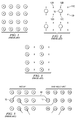
- Figure 1 illustrates a 4 pixel by 4 pixel portion of a digital picture.
- the "X" locations indicate a luminance value
- the circles (which in Figure 1 are coextensive with the "X” locations) represent the combined chrominance values associated with each luminance value.
- Digital pictures with coextensive luminance and chrominance values as illustrated in Figure 1 are said to reside in "4:4:4" space. While 4:4:4 space may provide the best resolution for displaying a digital picture, the amount of memory required to store the picture, and therefore the amount of bandwidth required to transfer the picture, may be quite large.
- CCD charge couple device
- FIG. 2 illustrates an exemplary 4 pixel by 4 pixel portion of a digital picture where the luminance values are retained, but 12 of the 16 chrominance values are removed.
- the system illustrated in Fig ure 2 may be referred to as "4:2:0" space.
- the circles representing the chrominance values in Figure 2 do not imply additional pixels; rather, the chrominance values are placed between the luminance "X's" to represent that the chrominance values apply to the luminance values in close proximity.
- the chrominance values represented by circle 10 when converted back to 4:4:4 space for display on an electronic device, may be applied to each of the surrounding luminance values 12A -F as a good approximation of the original picture.
- Y,Cb,Cr space may be a "4:2:2"space, as illustrated in Figure 3.
- missing chrominance values may b e simply copied from one of the closest, and still present, chrominance values, or the chrominance values may be calculated by combining a plurality of chrominance values in close proximity.
- compressed or down - sampled 4:2:2 and 4:2:0 spaces may redu ce the amount of storage needed for each picture or stream of pictures, storage of digital pictures in this manner conflicts with features that many consumers utilize in their digital still photography and digital movie endeavors.
- FIG. 4 illustrates overlaying.
- a digital picture 2 and an overlay 4 may be provided to, or acquired by, a processor -based device.
- the processor-based device may overlay or combine the d igital picture 2 and the overlay 4 to create a composite image 6 comprising most of the features of the digital picture 2, but also certain additional features such as borders 7 and a date 8 of the overlay 4. Overlaying of the related art is accomplished on a pixel-by-pixel basis.
- Figure 5 illustrates a pixel-level overlay procedure of the related art.
- pixels noted as "CK" contain a value set at a pre-defined "color-key” value, indicating that they should not be transferred to the picture.
- Each pixel in a graphics object is analyzed to determine whether it contains the value of the color-key. If so, the corresponding pixel in the picture remains unchanged. However, if a pixel in the graphics object contains a value other than the color-key, the value is written to the composite or combined picture. For example, pixel 14 of the graphics object, having a value other than the color-key, is written to the corresponding pixel 16 in the picture in the overlay process, as indicated by arrow 18.
- Overlaying a graphics object in accordance with the related art is done in 4:4:4 space; however, digital pictures are usually stored in a reduced format 4:2:2 or 4:2:0 space. Thus, before an overlay operation may take place, the digital picture must be converted from the 4:2:2 or 4:2:0 space to the 4:4:4 space. After the overlaying process, the picture must be converted back to the desired compressed size format for coding or storage. While a desktop computer or bank of servers may have sufficient computer capacity to perform the conversion operations, smaller mobile devices, such as personal digital assistants and cellular telephones, may not.
- some embodiments of the invention may comprise combining digital graphics object and a digital picture while both the digital graphics object and the digital picture are in a down-sampled or compressed format.
- Other embodiments of the invention may comprise a processor and a memory coupled to the processor. The processor, executing a program, overlays a digital graphics object and a digital picture while each of the digital graphics object and the digital picture are in compressed format.
- Other exemplary embodiments may be a method comprising compressing an uncompressed graphics object to create a compressed graphics object, then replacing a pixel luminance value of a compressed digital picture with a pixel luminance value of the compressed graphics object, and modifying a chrominance value of the compressed digital picture based on a chrominance value of the compressed graphics object.
- Yet other exemplary embodiments may comprise a computer readable media storing a program that, when executed by a processor, performs a method comprising overlaying a graphics object onto a picture while both the graphics object and the picture ar e in a compressed format.
- Yet further alternative embodiments may comprise a computer readable media storing a program that, when executed by a processor, performs a method comprising compressing a graphics object to create a compressed graphics object by combining a plurality of chrominance values into a single chrominance value, calculating a weight factor based on a number of luminance values (associated with the plurality of chrominance values) that indicate that the corresponding luminance values in a picture to be overlaid by the graphics object should remain unchanged, and storing the weight factor within the compressed graphics object.
- the present invention comprises a combination of features and advantages which enable it to overcome various problems of prior devices.
- the various characteristics described above, as sell as other features, will be readily apparent to those skilled in the art upon reading the following detailed description of the preferred embodiments of the invention, and by referring to the accompanying drawings.
- the terms “including” and “comprising” are used in an open-ended fashion, and thus should be interpreted to mean “including, but not limited to".
- the term “couple” or “couples” is intended to mean either an indirect or direct electrical or mechanical connection. Thus, if a first device couples to a second device, that connection may be through a direct connection, or through an indirect connection via other devices and connections.
- FIG. 6 illustrates a processor-based system in accordance with embodiments of the invention.
- the processor -based system may comprise a central processing unit (CPU) 20.
- the CPU may take many forms depending upon the form of system 100.
- the CPU 20 may be a processor, such as processors manufactured by Intel® and/or AMD®. In other embodiments, less computing power may be needed, and thus the CPU may be implemented as a microcontroller.
- the processor-based system 100 may further comprise a memory 22 coupled to the CPU, and other devices, by way of a system bus 24.
- the memory may be a volatile or a non-volatile random access memory (RAM).
- the system 100 may further comprise a graphics driver 26 coupled to the system bus 24.
- the graphics driver may be responsible for receiving text and images in a digital format from the CPU and/or other components, and displaying the information on an attached display 28.
- the system 100 may further comprise an input/output (I/O) device (I/O DEV) 30 to allow a user of the system 100 to direct operation and supply information.
- the I/O device 30 may take many forms depending on the form of the system 100.
- the I/O device may be one or more of a keyboard and/or mouse.
- the display 28 may be a "touch screen" display, and thus the I/O device 30 and the display 28 may be integral components. Regardless of the for m of the I/O device 30, the I/O device 30 may be coupled to the CPU 20, as well as other components, by way of an I/O interface (I/O INTF) 32.
- I/O INTF I/O interface
- the processor-based system 100 may further comprise, in some embodiments, a radio transceiver 34, and associated antenna 36, coupled to the CPU 20.
- system 100 may be a wireless device such as a personal digital assistant (PDA) capable of sending and receiving electronic data.
- PDA personal digital assistant
- system 100 may comprise a digital signal processor 38, and corresponding speaker 40, and thus the system 100 may be a cellular telephone, or a device having a combination of functionalities including that of a PDA and cellular telephone.
- the processor -based system 100 may be capable of receiving and modifying digital pictures, possibly by overlaying graphics objects on the pictures. The overlaying may be for a single digital picture, or for each picture in a stream of pictures representing video.
- the system 100 may further comprise a charge couple device (CCD) array 42 coupled to the CPU 20.
- CCD charge couple device
- the system 100 may be a digital camera, a video camera, or a cellular telephone with picture capture capability.
- the system 100 may thus be capable of acquiring pictures prior to their modification by graphics overlaying.
- the system 100 may also comprise a battery 44.
- Overlaying a graphics object on a digital picture of the related art involves operations with each of graphics object and digital picture in the 4:4:4 graphics space.
- digital pictures are stored and transferred in a down-sampled or compressed format, such as 4:2:2 or 4:2:0 space.
- graphics overlaying of the related art requires converting the digital picture from its compressed 4:2:2 or 4:2:0 space into 4:4:4 space prior to overlaying the graphics obj ect, and then further requires compressing the modified digital picture from the 4:4:4 space back to a compressed format, such as 4:2:2 or 4:2:0.
- the overlaying of the graphics object on the digital picture is performed with both the graphics object and the digital picture in the compressed format, eliminating the need for pre -overlay processing and post-overlay processing of the digital picture.
- the graphics object which a user desires to overlay on a digital picture may be provided to the user in a compressed format, and thus the overlaying in the compressed format may be done without pre-processing of the graphics object.
- the graphics may be provided uncompressed, and thus the graphics object may be down-sampled prior to the overlay procedure; however, the pre-processing of the graphics object may be completed well in advance of the actual overlay process, and at times when processor utilization is otherwise low.
- Figure 7 illustrates a flow diagram of the overall process of overlaying graphics objects on digital pictures in compressed space.
- the process may start (block 700) and proceed to a determination of whether the graphics object is in compressed format (block 702). If the graphics object is not in a compressed format, the process may move to compressing graphics object (block 704).
- the discussion now turns to down-sampling or compressing the graphics object in accordance with embodiments of the invention.
- Figure 8A illustrates six pixels from a portion of a graphics object in 4:4:4 space (the luminance and chrominance values directly correspond).
- the letters A, B, C, D, E and F, and their corresponding circles illustrate luminance and chrominance values in 4:4:4 space.
- the number of luminance values remains unchanged between compressed and uncompressed graphics objects and pictures; however, the number of chrominance values is reduced.
- Compressing the graphics object preferably involves generating combined or composite chrominance values, as illustrated by the dashed circle 800.
- Figure 8A illustrates that the combined chrominance value 800 may be made up of weighted contributions from the chrominance values of each of the surrounding pixels.
- Figure 8A also illustrates the relative weight of the surrounding chrominance values to create combined chrominance value 800 in accordance with at least some embodiments of the invention.
- Figure 8A assumes that it is desired that all the pixels A-F of the exemplary graphics object find their way into the picture, and thus all the pixels A-F contribute to the combined chrominance value 800.
- the calculation of the combined chrominance value 800 preferably does not include a contribution from that pixel.
- Figure 8B illustrates a situation where the pixel values B, E and F are not meant to replace the corresponding pixels in the picture (indicated by a "0" proximate to the pixel).
- the combined chrominance value 800 is comprised only of contributions from pixels A, C and D.
- Equation 1 illustrates the calculation of the chrominance value in this exemplary case.
- CHO (1 ⁇ 1/8 ⁇ A) + (0 ⁇ 1/4 ⁇ B) + (1 ⁇ 1/8 ⁇ C) + (1 ⁇ 1/8 ⁇ D) + (0 ⁇ 1/4 ⁇ E) + (1 ⁇ 1/8 ⁇ F)
- CCHO is the down-sampled chrominance value (800) placed in the compressed graphics object.
- a weight factor is defined for each down-sampled chrominance value, the weight factor playing a part in the blending of chrominance values of the compressed graphics overlay and the compressed digital picture.
- the weight factor may be defined as a summation of the relative contributions of each of the pixels from the 4:4:4 space (if any). Equations 2 and 3, reproduced immediately below, illustrate calculation of the weight factor W for the exemplary system of Figure 8B.
- the pixel A contributes 1/8
- pixel C contributes 1/8
- th e pixel D contributes 1/8 for a total weight factor of 3/8 (Equation 3).
- the weight factor is stored within the compressed graphics object.
- the weight factors may be stored within the compressed graphics object, yet separate from the combined chrominance values.
- the least significant bits of each combined chrominance value may be dedicated to storing the weight factor.
- Figure 9 illustrates, in a graphical form, the down -sampling or conversion of a graphics object 920 in 4:4:4 space to a compressed graphics object 930, in this example in a 4:2:0 space.
- a pixel within the uncompressed graphic object 920 having the value of the color-key (CK) is indicative of a pixel that should not be written into the digital picture.
- Pixel A of Figure 9 illustrates a pixel having the value of the color key, and thus a transform of the luminance value from the uncompressed space to the compressed space (arrow 900) preferably involves writing a value for the luminance of the corresponding pixel (LA) in the compressed graphics object 930 that indicates transparency.
- a luminance value of zero indicates transparency, however any luminance value could be designated as the value indicating transparency.
- arrow 902 illustrates pixel B in the uncompressed graphics object 920 that has the value of the color-key, and therefore the luminance of the corresponding pixel (LB) in the compressed graphics object indicates transparency.
- Pixel C illustrates a pixel that is intended to be written into the digital pi cture, and thus comprises value other than the color -key (indicated by " CK ").
- the luminance value of the pixel C is written to the luminance of the pixel (LC) of the compressed graphics object, as illustrated by arrow 904.
- the luminance of the uncompressed pixel values D and F having values other than the color -key, are likewise transferred into the compressed graphics objects.
- Figure 9 also illustrates calculation of a combined chrominance value, but with contributions only from pi xels whose chrominance values are other than the color -key.
- the chrominance value calculated, indicated by circle 906, is therefore a combination of the chrominance values of all pixels having values other than the color-key in the uncompressed graphics object 920.
- Figure 9 also illustrates holding a value indicating the weight factor as part of the chrominance values, in this particular example 3/8.
- the next step in the process may be a determination of whether a luminance value of a pixel in a compressed graphics object indicates transparency (block 706). If a luminance value in the compressed graphics object indicates non-transparency (preferably a non -zero value), then the corresponding luminance value in the compressed picture is replaced with the luminance value from the graphics object (block 708). If the luminance value in a graphics object indicates transparency, then the corresponding luminance va lue in the digital picture remains unchanged (block 710). Regardless of whether the luminance value in the picture is replaced or remains unchanged, the next step in the process may be determining whether all the luminance values in a graphics object have been analyzed (block 712).
- embodiments of the invention in addition to converting the graphics object from an uncompressed to a compressed state (if needed) and transferring at least some of the luminance values from the compressed graphics object to the compressed digital picture, embodiments of the invention also selectively combine chrominance values in the compressed graphics object and compressed digital picture.
- a weight factor of a chrominance value in the compressed graphics obj ect is non-zero (block 714)
- the next step may be combining the chrominance value from the graphics object with the chrominance value of the picture based on the weight factor.
- Equation 4 illustrates that as the weight factor changes, so too does the relative contribution from the graphics object and the digital picture.
- a weight factor of zero for a chrominance value may indicate that all of the luminance values to which the chrominance value is related indicate transparency, and thus the chrominance value in the digital picture remains unchanged.
- the next step in the process may be a determination if any further chrominance values need to be combined (block 718). If no further chrominance values are left to combine, the process may end (block 720).
- embodiments of the invention may convert a uncompressed graphics object (e.g. , a graphics object in a 4:4:4 space) to a compressed graphics object (e.g. , a 4:2:2 or 4:2:0 space) prior to overlaying.
- a uncompressed graphics object e.g. , a graphics object in a 4:4:4 space
- a compressed graphics object e.g. , a 4:2:2 or 4:2:0 space
- the weight factor may be included within the compressed graphics object file (either as separate data values, or within the least significant bits of the chrominance value).
- the compressed graphics object may not specifically contain the weight factor for each chrominance value, and in these embodiments the weight factor may be calculated contemporaneously with the combining of the chrominance values (block 716 of Figure 7).
- the application of the alpha value may be done in a pre-processing method when the graphics overlay is converted from an uncompressed space to a compressed space.
- the alpha value is used during transformation of the non-compressed graphics object to the compressed graphics object. Overlaying of the compressed graphics object onto the compressed digital picture may take place as described above.
- the alpha value may be applied to the luminance value in the compressed graphics object just prior to its insertion into the digital picture.
- the weight factor when combining chrominance values with relative weights dictated by the weight factor, the weight factor too is multiplied by the alpha value prior to the combination.
Landscapes
- Engineering & Computer Science (AREA)
- Multimedia (AREA)
- Signal Processing (AREA)
- Image Processing (AREA)
Priority Applications (1)
| Application Number | Priority Date | Filing Date | Title |
|---|---|---|---|
| EP20040106755 EP1549083A3 (de) | 2003-12-19 | 2004-12-20 | Verfahren und Vorrichtung zur Überlagerung eines graphischen Objektes über ein digitales Bild |
Applications Claiming Priority (5)
| Application Number | Priority Date | Filing Date | Title |
|---|---|---|---|
| EP03293277 | 2003-12-19 | ||
| EP03293277 | 2003-12-19 | ||
| US10/823,183 US20050134608A1 (en) | 2003-12-19 | 2004-04-13 | Method, and related system, for overlaying a graphics object on a digital picture |
| US823183 | 2004-04-13 | ||
| EP20040106755 EP1549083A3 (de) | 2003-12-19 | 2004-12-20 | Verfahren und Vorrichtung zur Überlagerung eines graphischen Objektes über ein digitales Bild |
Publications (2)
| Publication Number | Publication Date |
|---|---|
| EP1549083A2 true EP1549083A2 (de) | 2005-06-29 |
| EP1549083A3 EP1549083A3 (de) | 2007-10-24 |
Family
ID=34556781
Family Applications (1)
| Application Number | Title | Priority Date | Filing Date |
|---|---|---|---|
| EP20040106755 Withdrawn EP1549083A3 (de) | 2003-12-19 | 2004-12-20 | Verfahren und Vorrichtung zur Überlagerung eines graphischen Objektes über ein digitales Bild |
Country Status (1)
| Country | Link |
|---|---|
| EP (1) | EP1549083A3 (de) |
Citations (2)
| Publication number | Priority date | Publication date | Assignee | Title |
|---|---|---|---|---|
| US5969770A (en) | 1995-05-24 | 1999-10-19 | Thomson Consumer Electronics, Inc., | Animated "on-screen" display provisions for an MPEG video signal processing system |
| EP1134985A1 (de) | 2000-03-15 | 2001-09-19 | THOMSON multimedia | Kodierung von Objekten in Videobildern |
Family Cites Families (2)
| Publication number | Priority date | Publication date | Assignee | Title |
|---|---|---|---|---|
| JPH07154818A (ja) * | 1993-11-29 | 1995-06-16 | Matsushita Electric Ind Co Ltd | 映像信号合成装置 |
| US6714257B2 (en) * | 2001-06-29 | 2004-03-30 | Koninklijke Philips Electronics N.V. | Color key preservation during sample rate conversion |
-
2004
- 2004-12-20 EP EP20040106755 patent/EP1549083A3/de not_active Withdrawn
Patent Citations (2)
| Publication number | Priority date | Publication date | Assignee | Title |
|---|---|---|---|---|
| US5969770A (en) | 1995-05-24 | 1999-10-19 | Thomson Consumer Electronics, Inc., | Animated "on-screen" display provisions for an MPEG video signal processing system |
| EP1134985A1 (de) | 2000-03-15 | 2001-09-19 | THOMSON multimedia | Kodierung von Objekten in Videobildern |
Also Published As
| Publication number | Publication date |
|---|---|
| EP1549083A3 (de) | 2007-10-24 |
Similar Documents
| Publication | Publication Date | Title |
|---|---|---|
| RU2738693C1 (ru) | Способы кодирования, декодирования и представления изображений высокого динамического диапазона | |
| US7715656B2 (en) | Magnification and pinching of two-dimensional images | |
| US7372485B1 (en) | Digital camera device and methodology for distributed processing and wireless transmission of digital images | |
| US6275206B1 (en) | Block mapping based up-sampling method and apparatus for converting color images | |
| US7239428B2 (en) | Method of super image resolution | |
| US20050024380A1 (en) | Method for reducing random access memory of IC in display devices | |
| JP5080678B2 (ja) | 二次元画像の透視変換 | |
| US20060077211A1 (en) | Embedded device with image rotation | |
| EP1122691A2 (de) | Verfahren und Vorrichtung zur digitalen Bildkompression | |
| JP4460447B2 (ja) | 情報端末 | |
| EP1200935A1 (de) | Verfahren und system zur erzeugung einer verbesserten digitalen bilddatei | |
| US7468752B2 (en) | Camera output format for real time viewfinder/video image | |
| EP1704556B1 (de) | Verfahren und system zum kombinieren eines digitalen graphikobjekts und eines digitalen bildes | |
| US20050134608A1 (en) | Method, and related system, for overlaying a graphics object on a digital picture | |
| CN1802846B (zh) | 用于图像处理的方法和设备 | |
| CN101287057A (zh) | 一种节省暂存内存的图片解压缩储存方法及其模块 | |
| JP4086580B2 (ja) | 画像処理装置、プログラム及び方法 | |
| US5751858A (en) | Moving picture coding apparatus | |
| JP2002247376A (ja) | 画像処理装置 | |
| CN120238702A (zh) | 动态图像显示方法、装置、电子设备、存储介质和程序产品 | |
| CN121098995A (zh) | 数据生成方法、图像处理方法、数据及电子设备 | |
| CN116228525A (zh) | 图像处理方法、装置、电子设备及可读存储介质 | |
| Chihoub et al. | A band processing imaging library for a TriCore-based digital still camera | |
| JP2023131497A (ja) | 画像処理装置、撮像装置、画像処理方法、プログラムおよび記録媒体 | |
| US20080074502A1 (en) | Digital Camera |
Legal Events
| Date | Code | Title | Description |
|---|---|---|---|
| PUAI | Public reference made under article 153(3) epc to a published international application that has entered the european phase |
Free format text: ORIGINAL CODE: 0009012 |
|
| AK | Designated contracting states |
Kind code of ref document: A2 Designated state(s): AT BE BG CH CY CZ DE DK EE ES FI FR GB GR HU IE IS IT LI LT LU MC NL PL PT RO SE SI SK TR |
|
| AX | Request for extension of the european patent |
Extension state: AL BA HR LV MK YU |
|
| PUAL | Search report despatched |
Free format text: ORIGINAL CODE: 0009013 |
|
| AK | Designated contracting states |
Kind code of ref document: A3 Designated state(s): AT BE BG CH CY CZ DE DK EE ES FI FR GB GR HU IE IS IT LI LT LU MC NL PL PT RO SE SI SK TR |
|
| AX | Request for extension of the european patent |
Extension state: AL BA HR LV MK YU |
|
| RIC1 | Information provided on ipc code assigned before grant |
Ipc: H04N 9/75 20060101AFI20070917BHEP |
|
| 17P | Request for examination filed |
Effective date: 20080424 |
|
| AKX | Designation fees paid |
Designated state(s): DE FR GB |
|
| RBV | Designated contracting states (corrected) |
Designated state(s): DE FR GB NL |
|
| 17Q | First examination report despatched |
Effective date: 20090225 |
|
| STAA | Information on the status of an ep patent application or granted ep patent |
Free format text: STATUS: THE APPLICATION IS DEEMED TO BE WITHDRAWN |
|
| 18D | Application deemed to be withdrawn |
Effective date: 20151020 |