EP1548672A1 - Verfahren zum Einstellen einer Produktnummer in ROM-Typ RFID Chips und Verfahren, Vorrichtung und System zur Verwaltung von Produktimplementierung - Google Patents
Verfahren zum Einstellen einer Produktnummer in ROM-Typ RFID Chips und Verfahren, Vorrichtung und System zur Verwaltung von Produktimplementierung Download PDFInfo
- Publication number
- EP1548672A1 EP1548672A1 EP04020680A EP04020680A EP1548672A1 EP 1548672 A1 EP1548672 A1 EP 1548672A1 EP 04020680 A EP04020680 A EP 04020680A EP 04020680 A EP04020680 A EP 04020680A EP 1548672 A1 EP1548672 A1 EP 1548672A1
- Authority
- EP
- European Patent Office
- Prior art keywords
- product
- user
- rfid chips
- numbers
- rom type
- Prior art date
- Legal status (The legal status is an assumption and is not a legal conclusion. Google has not performed a legal analysis and makes no representation as to the accuracy of the status listed.)
- Ceased
Links
Images


Classifications
-
- G—PHYSICS
- G06—COMPUTING OR CALCULATING; COUNTING
- G06K—GRAPHICAL DATA READING; PRESENTATION OF DATA; RECORD CARRIERS; HANDLING RECORD CARRIERS
- G06K17/00—Methods or arrangements for effecting co-operative working between equipments covered by two or more of main groups G06K1/00 - G06K15/00, e.g. automatic card files incorporating conveying and reading operations
-
- G—PHYSICS
- G07—CHECKING-DEVICES
- G07G—REGISTERING THE RECEIPT OF CASH, VALUABLES, OR TOKENS
- G07G1/00—Cash registers
- G07G1/0036—Checkout procedures
Definitions
- the present invention relates to a method for setting product numbers in ROM (Read-Only-Memory) type RFID chips by using a computer, and a method, an apparatus and a system for managing product implementation.
- ROM Read-Only-Memory
- Wireless tags have recently come into wide use for various purposes of entrance and exit management, sales management, inventory management, production management, ID verification, etc.
- the wireless tags have been not standardized yet in terms of names and definitions thereof. That is, various names such as “RFID tag”, “RFID chip”, “contactless ID tag”, “wireless ID tag”, “contactless tag”, etc. have been given to the wireless tags in accordance with chip makers.
- RFID tag a module including a wireless communication IC and an antenna
- wireless tag a module including a wireless communication IC and an antenna
- RFID is an abbreviation for Radio Frequency IDentification.
- a wireless tag structure adapted to a judgment as to whether an article is genuine.
- a wireless tag having a read-only memory (ROM) is used for checking accurately whether the article is genuine.
- a wireless tag reader has been proposed (see JP-A-2003-263622).
- JP-A-2003-263622 a service identification code having a value common to a plurality of wireless tags for indicating a common purpose and service data having different values corresponding to wireless tags are provided as tag data.
- the data structure of a wireless tag having an ROM is divided into a service identification code common to articles and continuous data for managing the articles. When the service identification code assigned to an article is checked, a judgment can be made as to whether the article is genuine.
- JP-A-2002-24767 an ID management method and a management system have been proposed (see JP-A-2002-24767).
- JP-A-2002-24767 there is provided a mechanism in which both issuing and circulation of IDs having message authentication codes (MAC) and allowed to be assigned to articles individually are managed so that management of articles can be performed efficiently and reliably by use of the IDs.
- attribute information which is attribute information for classifying IDs and which is information for indicating the fields of use of IDs or names of client companies
- a message authentication code are written in a wireless ID tag.
- IC chips used in wireless tags are classified into IC chips of the type using non-rewritable ROMs as memory portions (hereinafter referred to as "ROM type RFID chips") and IC chips of the type using rewritable RAMs (Random Access Memories) as memory portions (hereinafter referred to as "RAM type RFID chips").
- ROM type RFID chips non-rewritable ROMs as memory portions
- RAM type RFID chips Random Access Memories
- Identification information for user products is set in the ROM type RFID chips. Because each semiconductor maker generally gives serial numbers to the ROM type RFID chips uniquely, any other person cannot set the numbers. On the other hand, the RAM type RFID chips may make unstable operations in addition to the aforementioned disadvantage. Accordingly, there is some case where the ROM type RFID chips may be absolutely advantageous and essential. It is however necessary to verify sequential data attached to the products by each user (product maker) to check whether the products are genuine because sequential data (serial numbers) are stored in the ROM type RFID chips by the semiconductor maker. Accordingly, it is necessary to inquire of a server about this verification at each time it happens.
- the ROM type RFID chips have a disadvantage that the cost of communication is high.
- An object of the present invention is to provide a product number setting method which is applied to ROM type RFID chips so that production numbers (product numbers) can be set in the ROM type RFID chips on the basis of data assigned by a user to thereby make the aforementioned verification needless to attain reduction in the cost of communication.
- Another object of the invention is to provide a method, an apparatus and a system for managing product implementation in the ROM type RFID chips.
- production numbers can be set in ROM type RFID chips on the basis of a user's request.
- the cost of communication can be reduced because the verification for checking whether the products are genuine can be dispensed with.
- Fig. 1 is a sequence view for explaining a product number setting method applied to ROM type RFID chips in an embodiment of the invention.
- a tag maker may mediate between the user and the chip maker.
- the chip maker transmits ID format specifications (restrictions) such as character restrictions, number length restrictions, padding rule, etc. to the user (S101).
- the user issues the production numbers of user's products (such as drink, cloth or drugs) while considering these restrictions (S11).
- the issued contents are delivered or transmitted as a production number list to the chip maker through a recording medium such as a CD-R or a magnetic tape or through a communication protocol such as FTP (File Transfer Protocol) (S102).
- FTP File Transfer Protocol
- the chip maker Upon reception of the production number list, the chip maker assigns chip IDs (S12). On this occasion, an ID format is generated so that an EDC is calculated while a header is added to each chip ID.
- the ID format specification will be described later.
- Each production number may be encoded.
- the reason why the production number is encoded is that the length of a storage field of each ROM type RFID chip is limited. ID uniqueness of each number assigned by the user is further verified. That is, ID uniqueness is verified to check whether the user assigns duplicate IDs or not. Such duplicate IDs are excluded if necessary. Then, in a semiconductor production apparatus, while a lithographic technique is applied onto a silicon wafer to produce IC chips having unique IDs, the IC wafer is cut into IC chips and antennas are attached to the IC chips respectively to produce ROM type RFID chips (S13).
- the uniqueness verification is achieved in such a manner that an application data field in each ID format is divided into a user number field and a serial number field or in such a manner that the application data field is entirely used as the field of each number assigned by the user so that the uniqueness of the number assigned by the user can be verified.
- efficiency of utilization of the ID field is reduced but labor for verification in the latter manner can be dispensed with.
- the ROM type RFID chips produced as described above, as well as the chip ID list, are delivered to the user (delivery, S103).
- the chip ID list can be delivered through a recording medium such as a CD-R or a magnetic tape or through a communication protocol such as FTP in the same manner as described above.
- the user Upon reception of the ROM type RFID chips, the user produces products as described above (S14) so that the ROM type RFID chips are mounted in the products respectively. On this occasion, ID information is read. Moreover, a production number is extracted and the product is marked, labeled or printed with the production number by production number indicating means such as a marker, a labeler or a printer (so that the production number can be indicated).
- production number indicating means such as a marker, a labeler or a printer (so that the production number can be indicated).
- production numbers are encoded when chip IDs are assigned. It is therefore necessary to decode the encoded production numbers on the basis of the same table as the character conversion table used at the time of the encoding.
- S15 After the production, the user manages product information (S15).
- S15 missing number analysis is executed.
- the missing number management executed here relates to the yield of chip manufacturing.
- ID ID information
- the product is marked or labeled.
- the read ID and the extracted production number are registered in a database while associated with each other so that product information can be managed.
- missing numbers related to the yield of the ROM type RFID chips etc. can be analyzed on the basis of the production number list (which is a list of production numbers assigned by the user or in accordance with the user specifications) and the product information (which is generated after the ROM type RFID chips are mounted in the products respectively).
- the production number list which is a list of production numbers assigned by the user or in accordance with the user specifications
- the product information which is generated after the ROM type RFID chips are mounted in the products respectively.
- such missing numbers are caused by a loss at the time of cutting the silicon wafer into IC chips having IDs written therein, a loss at the time of handling the IC chips, and so on, for example, in a semiconductor production apparatus.
- such missing numbers can be compensated for as follows. When the user executes the missing number analysis, a list of missing numbers is generated.
- the missing number list is transmitted to the chip maker to reorder ROM type RFID chips corresponding to the missing numbers.
- the chip maker produces the ROM type RFID chips corresponding to the missing numbers again by the semiconductor production apparatus in accordance with the missing number list and delivers the ROM type RFID chips to the user.
- production numbers can be set by the steps of: (1) sending ID format specifications from a chip maker to a user; (2) designing a user ID format (in consideration of character restrictions, number length restrictions, padding rule, etc.); (3) issuing production numbers from a user production number issue apparatus (such as a personal computer); and (4) tying the RAM type RFID chips bought from the chip maker with products produced by the user in a user production apparatus (i.e. encoding a production number, writing the encoded production number in the RAM type RFID chip and marking or printing the RAM type RFID chip with the production number).
- Fig. 2 is a flow chart showing a detailed procedure for encoding/decoding the production number.
- a product number setting apparatus 3 shown in Fig. 6 and provided on the chip maker side registers a character conversion table corresponding to a service ID (user identification information) in a production number management server 1 (S21) and compresses the production number in accordance with the registered character conversion table (data compression, S22).
- a product implementation managing apparatus 2 shown in Fig. 6 and provided on the user side inquires of the production number management server 1 (S23) with the service ID used as a key when the production number is decoded.
- the production number management server 1 notifies the product implementation managing apparatus 2 of the same character conversion table as used at the time of encoding performed by the product number setting apparatus 3 (notification of a character conversion table corresponding to the service ID, S24) and permits the user to read the ID of the ROM type RFID chip (S25).
- the product implementation managing apparatus 2 provided on the user side can read the production number normally (decoding of the production number, S26).
- Inquiry and notification about the character conversion table are executed on the basis of communication due to a server client system which will be described later. Incidentally, when the step S23 results in "NO", the step S23 may be repeated or this routine may be terminated (End).
- Fig. 3 shows an example of data structure of the character conversion table. Because the storage field of each ROM type RFID chip is finite, there is such consideration that a number space for setting production numbers can be made as large as possible.
- Fig. 3 shows the case where each ANK (Alphabetic Numeric and Kana) character is compressed into and expressed by 6 bits.
- Fig. 3 shows the case where alphabets (A) ranging from A to Z, numerals (N) ranging from 0 to 9 and six symbols are used, kana characters (K) may be used in place of or in addition to these characters.
- Fig. 4 is a view showing the configuration of an ID format for each ROM type RFID chip used in this embodiment. Incidentally, each numeral shown in Fig. 4 expresses the number of bits.
- the ID format is composed of 128 bits as a whole.
- a header has a length of 4 or 6 bits. Accordingly, the header is formed so that 16 or 64 kinds of service IDs can be discriminated from one another.
- a service ID is assigned in common to specific applications or categories. Besides the service ID, intrinsic data identified in a specific application or category and service data for holding sequential numbers to identify ROM type RFID chips having the same service ID are set in an application data field.
- service data peculiar to each user can be set in the application data field as follows.
- the application data field has a length of 88 bits.
- the application data field has a length of 84 bits.
- the application data field has a length of 74 bits.
- the application data application data field
- a user number setting field a user number setting field
- a production number setting field uniqueness of each production number can be guaranteed.
- a service ID having a length of 36 bits may be provided so that a code corresponding to an EAN (European Article Number) code (international article code) can be used as a service identification code.
- EAN European Article Number
- a service identification code International article code
- issue number IDs 13 or 14 bits
- uniqueness of IDs different in issue number can be secured.
- uniqueness of each ID is verified in accordance with the issue number (see the step S12 in Fig. 1), uniqueness of ID corresponding to the same issue number can be secured.
- the EDC having a length of residual 24 bits is provided for checking data read error.
- the EDC makes the same operation as that of parity used in parity check for confirming ID matching. After the EDC is checked, only normal data is used. Data that cannot satisfy the EDC check is treated as invalid data.
- Whether a product is genuine can be checked as follows. The tag information of the ROM type RFID chip stuck to the product is read. If the service identification code ID assigned to the product is included in the tag information, the product can be regarded as being genuine. In this manner, the ROM type RFID chip can be used so that the product is regarded as being genuine if legal service ID is contained in the tag information read from the product provided with the ROM type RFID chip.
- Fig. 5 is a block diagram showing the internal configuration of an ROM type RFID chip used in this embodiment of the invention and a tag reader for reading the contents of the ROM type RFID chip.
- the ROM type RFID chip 10 is an IC chip which is managed on the basis of unique ID information and which includes an ROM 11, a radio frequency (RF) circuit 13, and a digital circuit 12 for connecting the ROM 11 and the RF circuit 13 to each other.
- the ROM type RFID chip 10 is driven by electric wave given from the tag reader 20. Electric wave emitted from the tag reader 20 is received by an antenna 14 which is attached to the outside of the chip or included in the chip.
- the RF circuit 13 generates electric power by electromagnetic induction using the received electric wave and transmits data recorded in the ROM 11.
- the data includes the sequential production number for specifying the chip per se.
- the tag reader 20 includes a radio frequency (RF) circuit 21, a communication protocol control circuit 22, an RAM 23, a power supply circuit 24, and an external interface circuit 25.
- RF radio frequency
- the tag reader 20 performs convergence control through the communication protocol control circuit 22 under the control of a not-shown CPU.
- Electric wave emitted from the ROM type RFID chip 10 at a distance permitting the electric wave to reach the tag reader 20 is received by the radio frequency (RF) circuit 21 through an antenna 26, so that data of the ROM type RFID chip 10 is taken in the tag reader 20.
- the data taken in the tag reader 20 is uploaded to a product implementation managing apparatus 2, for example, through a terminal apparatus 7 connected to the tag reader 20 through the external interface circuit 25.
- an application program prepared in advance is executed to accomplish its purpose.
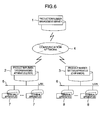
- Fig. 6 shows an example of an ROM type RFID chip producing and product implementation managing system for achieving the production number setting method and the product implementation managing method applied to ROM type RFID chips according to the invention.
- this system is provided as a server client system.
- the reference numeral 1 designates a production number management server.
- a product implementation managing apparatus 2 is provided so that a user can manage products.
- a product number setting apparatus 3 is provided so that a semiconductor maker can manage production of ROM type RFID chips.
- the production number management server 1 is connected to the product implementation managing apparatus 2 and the product number setting apparatus 3 through a communication network 4.
- the communication network 4 may be a private line network or may be an open line network such as the Internet.
- the product implementation managing apparatus 2 and the product number setting apparatus 3 are connected to LANs 5 and 6 respectively.
- Terminal apparatuses 7 and 8 are connected to the product implementation managing apparatus 2 and the product number setting apparatus 3 through the LANs 5 and 6 respectively.
- the product implementation managing apparatus 2 and the product number setting apparatus 3 perform management of products and management of production of ROM type RFID chips by communicating with the terminal apparatuses 7 and 8 through the LANs 5 and 6 respectively.
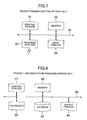
- Fig. 7 shows an example of the internal configuration of the product number setting apparatus 3.
- Fig. 8 shows an example of the internal configuration of the product implementation managing apparatus 2.
- the product number setting apparatus 3 includes a control portion 31, a memory 32, a receiving portion 33, and an input portion 34.
- the constituent members 31 to 34 of the product number setting apparatus 3 are connected to one another through a bus 35 composed of address, data and control lines.
- the product number setting apparatus 3 configured as described above operates as follows. Production numbers assigned by the user are received in the product number setting apparatus 3 by the receiving portion 33 through the communication network 4. Or production numbers assigned in accordance with the user specification are taken in the product number setting apparatus 3 through the input portion 34.
- the control portion 31 sequentially sets the assigned product numbers in the application data fields of ROM type RFID chips 10 respectively on the basis of the ID format specification defined in advance in accordance with a program recorded in the memory 32 and gives instructions to produce ROM type RFID chips.
- the product implementation managing apparatus 2 includes a control portion 41, a memory 42, a tag reader 20, a database 43 (external memory), and an output portion 44.
- the constituent members 20 and 41 to 44 are connected to one another through a bus 45 composed of address, data and control lines.
- the product implementation managing apparatus 2 configured as described above operates as follows. After an ROM type RFID chip 10 is mounted in each user product, chip information of the ROM type RFID chip 10 is read by the tag reader 20 under the program control of the control portion 41. The production number extracted from the read information is registered in the database 43 so as to be associated with the user product. The user product is marked, printed or labeled with the extracted production number through the input portion 44 (i.e. the production number is displayed).
- the product number setting apparatus 3 registers the character conversion table in the production number management server 1.
- the product implementation managing apparatus 2 inquires of the production number management server 1 and receives download service from the production number management server 1.
- the production number management server 1 may be provided and managed either on the semiconductor maker side or on the user side or may be provided and managed on the tag maker side which mediates between the semiconductor maker side and the user side.
- the chip maker is instructed to produce ROM type RFID chips in the condition that production numbers assigned by the user are set sequentially in the application data fields of ROM type RFID chips respectively on the basis of the ID format specification defined in advance. For this reason, data can be recorded in accordance with the user's request. Because data can be recorded in accordance with the user's request, verification for checking whether the product is genuine can be dispensed with. Accordingly, communication executed for verification at each time it happens can be dispensed with, so that the cost of communication can be reduced.
- EPC Electronic Protocol Code
- a product is genuine can be checked as follows.
- the tag information of the ROM type RFID chip stuck onto the product is read. If the service identification code assigned to the product is included in the tag information, the product can be regarded as being genuine.
- the ROM type RFID chip can be used so that the product is regarded as being genuine if the legal service identification code is included in the tag information when the tag information of the product provided with the ROM type RFID chip is read in this manner.
- the application data field may be further divided into a user number setting field and a production number setting field to guarantee uniqueness of the production number.
- the production number assigned by the user may be assigned to the application data field as a whole.
- one of the duplicate numbers may be deleted or sub-numbers may be added so that management can be made on the basis of the sub-numbers. In this manner, reliable product management can be made.
- Compressed alphabetic characters may be assigned to the production numbers so that compression or restoration can be made by use of the same conversion table at the time of number issue or at the time of number reading.
- missing numbers caused by the yield of ROM type RFID chips may be analyzed on the basis of the production number list (which is a list of production numbers assigned) and the product information (which is generated after the ROM type RFID chips are mounted in the products respectively) so that the missing numbers can be assigned to other products. In this manner, number space restrictions caused by capacity restrictions can be utilized effectively.
Landscapes
- Physics & Mathematics (AREA)
- General Physics & Mathematics (AREA)
- Engineering & Computer Science (AREA)
- Theoretical Computer Science (AREA)
- Management, Administration, Business Operations System, And Electronic Commerce (AREA)
- General Factory Administration (AREA)
- Semiconductor Integrated Circuits (AREA)
Applications Claiming Priority (2)
| Application Number | Priority Date | Filing Date | Title |
|---|---|---|---|
| JP2003435585A JP4317443B2 (ja) | 2003-12-26 | 2003-12-26 | Rom型rfidチップへの製品番号設定方法、製品番号設定装置、製品実装管理方法、およびシステム |
| JP2003435585 | 2003-12-26 |
Publications (1)
| Publication Number | Publication Date |
|---|---|
| EP1548672A1 true EP1548672A1 (de) | 2005-06-29 |
Family
ID=34545134
Family Applications (1)
| Application Number | Title | Priority Date | Filing Date |
|---|---|---|---|
| EP04020680A Ceased EP1548672A1 (de) | 2003-12-26 | 2004-08-31 | Verfahren zum Einstellen einer Produktnummer in ROM-Typ RFID Chips und Verfahren, Vorrichtung und System zur Verwaltung von Produktimplementierung |
Country Status (6)
| Country | Link |
|---|---|
| US (1) | US7378941B2 (de) |
| EP (1) | EP1548672A1 (de) |
| JP (1) | JP4317443B2 (de) |
| KR (1) | KR100669268B1 (de) |
| CN (1) | CN100458835C (de) |
| TW (1) | TWI274287B (de) |
Families Citing this family (24)
| Publication number | Priority date | Publication date | Assignee | Title |
|---|---|---|---|---|
| JP3843975B2 (ja) * | 2003-10-01 | 2006-11-08 | ソニー株式会社 | 記録媒体管理装置および記録媒体管理方法 |
| JP4720098B2 (ja) * | 2004-04-16 | 2011-07-13 | 日本電気株式会社 | Id発行管理システム、物品情報管理システムおよびid発行管理方法 |
| US20050240498A1 (en) * | 2004-04-22 | 2005-10-27 | Arnold Thaler | Product verification and activation system, method and apparatus |
| US7846532B2 (en) | 2005-03-17 | 2010-12-07 | Solutia Incorporated | Sound reducing wedge shaped polymer interlayers |
| KR100656350B1 (ko) | 2005-06-13 | 2006-12-13 | 한국전자통신연구원 | 소정의 데이터 저장 형식을 갖는 정보 기록 매체 |
| US7639144B2 (en) * | 2005-12-13 | 2009-12-29 | a2b Trackin Solutions | System and method of validating asset tracking codes |
| CN1987914A (zh) * | 2006-10-12 | 2007-06-27 | 北京飞天诚信科技有限公司 | 一种用于硬件设备管理的方法 |
| US7842395B2 (en) | 2006-11-01 | 2010-11-30 | Solutia Inc. | Multiple layer interlayers having a gradient region |
| US20130227653A1 (en) * | 2008-11-29 | 2013-08-29 | Yu Yung Choi | System and method for streamlined registration of products over a communication network and for verification and management of information related thereto |
| KR100936607B1 (ko) * | 2007-12-17 | 2010-01-13 | 한국전자통신연구원 | Rfid 태그의 활성화 코드 생성 방법 |
| BRPI0722304B1 (pt) * | 2007-12-20 | 2020-01-07 | Telefonaktiebolaget Lm Ericsson (Publ) | Método para controlar um servidor de aplicativo, servidor de aplicativo, e, dispositivo terminal de uma rede móvel |
| US20110156880A1 (en) * | 2008-09-12 | 2011-06-30 | Paul T Rygaard | System and method for customizing a computer system |
| US20100077116A1 (en) * | 2008-09-24 | 2010-03-25 | A2B Tracking Solutions, Inc. | System for processing code data |
| SG177597A1 (en) * | 2009-07-10 | 2012-03-29 | Certicom Corp | System and method for performing serialization of devices |
| CN102427582B (zh) * | 2011-12-31 | 2014-03-26 | 北京握奇数据系统有限公司 | 一种智能卡的配置方法及装置 |
| US8981905B2 (en) | 2012-03-30 | 2015-03-17 | A2B Tracking Solutions, Inc | Secure asset tracking system |
| CN103984606B (zh) * | 2014-05-27 | 2017-11-14 | 深圳大成创安达电子科技发展有限公司 | 一种勘探专用电子芯片的id搜索系统及方法 |
| US10009351B2 (en) | 2015-05-22 | 2018-06-26 | Yu Yung Choi | System and method for access and management of physical objects over a communication network related thereto |
| US20180068047A1 (en) * | 2016-09-08 | 2018-03-08 | Mapper Lithography Ip B.V. | Method and system for fabricating unique chips using a charged particle multi-beamlet lithography system |
| US10714427B2 (en) | 2016-09-08 | 2020-07-14 | Asml Netherlands B.V. | Secure chips with serial numbers |
| US10418324B2 (en) | 2016-10-27 | 2019-09-17 | Asml Netherlands B.V. | Fabricating unique chips using a charged particle multi-beamlet lithography system |
| CN108197196A (zh) * | 2017-12-27 | 2018-06-22 | 北京京存技术有限公司 | 芯片标识码的确定方法、装置、设备及存储介质 |
| CN112347801B (zh) * | 2020-10-27 | 2024-07-26 | 任玉海 | 一种电子芯片信息数据解析方法 |
| CN114580597B (zh) * | 2022-03-08 | 2022-11-29 | 芯电智联(北京)科技有限公司 | 一种nfc防伪标签的生产补标方法 |
Citations (2)
| Publication number | Priority date | Publication date | Assignee | Title |
|---|---|---|---|---|
| EP1170694A2 (de) * | 2000-07-06 | 2002-01-09 | Hitachi, Ltd. | System und Verfahren zur Verwaltung eines Identifizierungskodes |
| US20020116274A1 (en) * | 2001-02-21 | 2002-08-22 | International Business Machines Corporation | Method to address security and privacy issues of the use of RFID systems to track consumer products |
Family Cites Families (10)
| Publication number | Priority date | Publication date | Assignee | Title |
|---|---|---|---|---|
| US6172596B1 (en) * | 1994-09-09 | 2001-01-09 | Intermec Ip Corp. | System method and apparatus for identifying and communicating with a plurality of types of radio frequency communication devices |
| US6196466B1 (en) * | 1998-06-09 | 2001-03-06 | Symbol Technologies, Inc. | Data compression method using multiple base number systems |
| US6226619B1 (en) | 1998-10-29 | 2001-05-01 | International Business Machines Corporation | Method and system for preventing counterfeiting of high price wholesale and retail items |
| US7190257B2 (en) * | 1999-03-16 | 2007-03-13 | Intermec Ip Corp. | Data encoding in radio frequency identification transponders |
| CN2436977Y (zh) * | 2000-07-26 | 2001-06-27 | 赖俊鹏 | 用于防伪辨识、生产管制及资料撷取处理的辨识母体构造 |
| JP2002203214A (ja) | 2000-12-28 | 2002-07-19 | Hitachi Cable Ltd | 製造物の製造履歴管理システム |
| CN2462501Y (zh) * | 2001-01-22 | 2001-11-28 | 赖俊鹏 | 改进的光碟片 |
| KR100404869B1 (ko) * | 2001-05-04 | 2003-11-07 | 이광희 | 상품의 진위여부 확인방법 및 이를 위한 시스템 |
| JP4434549B2 (ja) * | 2002-03-07 | 2010-03-17 | 株式会社日立製作所 | 管理装置および管理方法 |
| JP4062985B2 (ja) * | 2002-06-24 | 2008-03-19 | 株式会社日立製作所 | 電子タグ固有番号管理方法および管理サーバ |
-
2003
- 2003-12-26 JP JP2003435585A patent/JP4317443B2/ja not_active Expired - Fee Related
-
2004
- 2004-08-20 TW TW093125181A patent/TWI274287B/zh not_active IP Right Cessation
- 2004-08-24 KR KR1020040066725A patent/KR100669268B1/ko not_active Expired - Fee Related
- 2004-08-25 CN CNB2004101005850A patent/CN100458835C/zh not_active Expired - Fee Related
- 2004-08-31 US US10/931,676 patent/US7378941B2/en not_active Expired - Fee Related
- 2004-08-31 EP EP04020680A patent/EP1548672A1/de not_active Ceased
Patent Citations (2)
| Publication number | Priority date | Publication date | Assignee | Title |
|---|---|---|---|---|
| EP1170694A2 (de) * | 2000-07-06 | 2002-01-09 | Hitachi, Ltd. | System und Verfahren zur Verwaltung eines Identifizierungskodes |
| US20020116274A1 (en) * | 2001-02-21 | 2002-08-22 | International Business Machines Corporation | Method to address security and privacy issues of the use of RFID systems to track consumer products |
Also Published As
| Publication number | Publication date |
|---|---|
| TWI274287B (en) | 2007-02-21 |
| CN100458835C (zh) | 2009-02-04 |
| US7378941B2 (en) | 2008-05-27 |
| KR100669268B1 (ko) | 2007-01-16 |
| TW200521866A (en) | 2005-07-01 |
| CN1637768A (zh) | 2005-07-13 |
| JP4317443B2 (ja) | 2009-08-19 |
| KR20050066965A (ko) | 2005-06-30 |
| US20050140502A1 (en) | 2005-06-30 |
| JP2005196290A (ja) | 2005-07-21 |
Similar Documents
| Publication | Publication Date | Title |
|---|---|---|
| US7378941B2 (en) | Method for setting product number in ROM type RFID chip and method, apparatus and system for managing product implementation | |
| JP4062985B2 (ja) | 電子タグ固有番号管理方法および管理サーバ | |
| US9514323B2 (en) | RFID system with segmented RFID data ownership | |
| CN100380400C (zh) | 无线标签和无线标签用服务器 | |
| US20040257203A1 (en) | Data encoding in radio frequency identification transponders | |
| US20070109103A1 (en) | Commercial product activation and monitoring using radio frequency identification (RFID) technology | |
| US8452672B2 (en) | Method for managing the hardware device | |
| WO2007066861A1 (en) | Rfid tag for ip address-based rfid service and rfid service method using the same | |
| US20120044060A1 (en) | Electronic Device And Data Management System | |
| US7482908B2 (en) | Radio-frequency-device personalization | |
| CN104517139A (zh) | 成批编码标签的装置和方法 | |
| JP2006023962A (ja) | 非接触icタグシステム | |
| US7267269B2 (en) | Product distribution management system, toner cartridge distribution management system, and product distribution management method | |
| US7076800B2 (en) | IC card terminal unit and IC card duplication method | |
| US7520424B2 (en) | Identification storage medium arrangement, a read apparatus and an identification system | |
| JP4047016B2 (ja) | 非接触icタグ、貨物管理システム、貨物管理方法、貨物管理プログラムおよび記録媒体 | |
| US20070046431A1 (en) | System and method for combining RFID tag memory | |
| CN102982353A (zh) | 信息处理终端和信息处理方法 | |
| US20140362417A1 (en) | Method of pairing between a unique identifier of a device for digitizing documents and a user account identifier | |
| TW201209720A (en) | Information service system for processing in accordance with tag component data | |
| KR100622653B1 (ko) | Rfid이용 단말기 라이프 사이클 관리 시스템 및 그 방법 | |
| WO2006116085A2 (en) | System and method for combining rfid tag memory | |
| KR20060032549A (ko) | 네트워크를 이용한 태그 저장정보 갱신 방법 및 시스템과이를 위한 기록매체 | |
| KR20060031005A (ko) | 무선 인식 태그와, 상기 무선 인식 태그내 상품 유통경로데이터 저장 방법 및 시스템과 이를 위한 기록매체 | |
| Guideline | RFID Bar Code Interoperability |
Legal Events
| Date | Code | Title | Description |
|---|---|---|---|
| PUAI | Public reference made under article 153(3) epc to a published international application that has entered the european phase |
Free format text: ORIGINAL CODE: 0009012 |
|
| AK | Designated contracting states |
Kind code of ref document: A1 Designated state(s): AT BE BG CH CY CZ DE DK EE ES FI FR GB GR HU IE IT LI LU MC NL PL PT RO SE SI SK TR |
|
| AX | Request for extension of the european patent |
Extension state: AL HR LT LV MK |
|
| 17P | Request for examination filed |
Effective date: 20051220 |
|
| AKX | Designation fees paid |
Designated state(s): DE FR GB |
|
| STAA | Information on the status of an ep patent application or granted ep patent |
Free format text: STATUS: THE APPLICATION HAS BEEN REFUSED |
|
| 18R | Application refused |
Effective date: 20080624 |