EP1548645B1 - Procédé de traitement d'images numériques comportant du flou de mouvement - Google Patents
Procédé de traitement d'images numériques comportant du flou de mouvement Download PDFInfo
- Publication number
- EP1548645B1 EP1548645B1 EP03029392A EP03029392A EP1548645B1 EP 1548645 B1 EP1548645 B1 EP 1548645B1 EP 03029392 A EP03029392 A EP 03029392A EP 03029392 A EP03029392 A EP 03029392A EP 1548645 B1 EP1548645 B1 EP 1548645B1
- Authority
- EP
- European Patent Office
- Prior art keywords
- image data
- image
- photos
- fuzzy
- take
- Prior art date
- Legal status (The legal status is an assumption and is not a legal conclusion. Google has not performed a legal analysis and makes no representation as to the accuracy of the status listed.)
- Expired - Lifetime
Links
Images


Classifications
-
- G—PHYSICS
- G06—COMPUTING OR CALCULATING; COUNTING
- G06T—IMAGE DATA PROCESSING OR GENERATION, IN GENERAL
- G06T5/00—Image enhancement or restoration
- G06T5/73—Deblurring; Sharpening
-
- G—PHYSICS
- G06—COMPUTING OR CALCULATING; COUNTING
- G06T—IMAGE DATA PROCESSING OR GENERATION, IN GENERAL
- G06T5/00—Image enhancement or restoration
- G06T5/10—Image enhancement or restoration using non-spatial domain filtering
-
- H—ELECTRICITY
- H04—ELECTRIC COMMUNICATION TECHNIQUE
- H04N—PICTORIAL COMMUNICATION, e.g. TELEVISION
- H04N1/00—Scanning, transmission or reproduction of documents or the like, e.g. facsimile transmission; Details thereof
- H04N1/46—Colour picture communication systems
- H04N1/56—Processing of colour picture signals
- H04N1/58—Edge or detail enhancement; Noise or error suppression, e.g. colour misregistration correction
-
- G—PHYSICS
- G06—COMPUTING OR CALCULATING; COUNTING
- G06T—IMAGE DATA PROCESSING OR GENERATION, IN GENERAL
- G06T2207/00—Indexing scheme for image analysis or image enhancement
- G06T2207/20—Special algorithmic details
- G06T2207/20172—Image enhancement details
- G06T2207/20201—Motion blur correction
Definitions
- the invention relates to a method for processing digital image data of images captured with a photographic camera.
- the object of the invention was therefore to develop a method in which at least some of the blurred images can be corrected as well as possible afterwards.
- Shaky images are identified by the image data along at least two of their dimensions, so z. B. in the x and y directions are examined for their sharpness out. Due to the relative movement which took place during the recording, a directed blurring occurs in the reproduced image data. The blur consists in the direction of the relative movement, along other directions, in particular perpendicular thereto, the image data, however, can be sharp. Shaky shots are thus characterized by having different degrees of sharpness along different directions in the image. So while blurred images are detected by the fact that no sharp structures can be found along all directions to be examined in the image, shaky images are on it recognized that they are blurred along one direction, along another, substantially perpendicular direction, are sharp.
- the directions to be examined need not necessarily be perpendicular to each other. It could also be, for example, a parallel to an image page and the image diagonal, which are examined.
- sharp transitions ie edges in the picture data
- blurred shots namely occur on such edges, since the density jumps are washed out here.
- edge detection methods are known, for example, from image data sharpening.
- One of these methods is in the EP 1 122 689 described.
- it is also possible to detect blurred images by performing a Fourier transformation along at least two directions of the image data. It can be assumed that the image has been blurred if much larger amplitudes of the occurring higher frequencies are observed in the Fourier transform along one direction than along another direction investigated.
- the image data is transferred from local to frequency space.
- the image motif disturbing frequency can then be determined, which was superimposed by the relative movement during recording the image motif.
- the correction according to the invention now aims to separate this noise component from the actual recorded image component, so that this noise component can be replaced by a correction component, which also includes a simple elimination of the interference component, so that subsequently the originally desired image component and the correction component are combined again can, from which the corrected image content results, which comprises a comparatively undisturbed representation of the image motif to be recorded.
- the Fourier transform is logarithmized. This achieves a conversion into a sum of the shares, so that the noise component of the image data is separate from the actually desired image motif, ie the image portion.
- the mathematical equivalents of the described steps are shown below.
- the interference component s 1 ( ⁇ x , ⁇ y ), which is decoupled from the image component and limited to a defined spatial region, can be replaced by a correction component. This is explained in detail with reference to the description of the figures.
- the images identified as blurred are marked blurred in the output of the digital images.
- the customer can recognize that the image motif was not captured optimally, but the image processing was attempted to create an acceptable image from it.
- the labeling of blurred images can be advantageously made on the Indexprint.
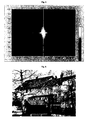
- Fig. 1 shows a blurred black and white recording, which should be corrected by the method according to the invention.
- Fig. 1 Fourier transformed image data in a first correction step and logarithmized in a second correction step to decouple image and noise component.
- Fig. 2 shows, with a Nyquist shift was made for better illustration.
- the direction of camera shake can be determined by the line pattern, which is easily visible in the picture.
- the direction of displacement of the image data is in fact perpendicular to the lines to be seen. Visible is this shake or shift, by the in Fig. 2 a re-Fourier transformation is performed.
- Fig. 3 The result of this third correction step is in Fig. 3 shown, where only the average image detail has been shown enlarged.
- This image again shows the multiply transformed image data in a spatial representation, but now the displacement or interference component and the image component are decoupled.
- the noise component is looped in the center of the picture, in each case at the coinciding corners of the quadrants.
- the coordinate axes themselves represent the image information which belongs to the highest amplitude frequencies in the original image data.
- the task of the further procedure is now, the disturbance part of in Fig. 3 in the center loop-shaped light appears to eliminate, without thereby falsifying the image data, which are located on the coordinate axes but also in the background of the entire representation, too strong.
- the correction component can consist of, for example, an average over the data of the quadrant with a noise component. An example of this is in Fig. 4 shown.
Landscapes
- Engineering & Computer Science (AREA)
- Physics & Mathematics (AREA)
- General Physics & Mathematics (AREA)
- Theoretical Computer Science (AREA)
- Multimedia (AREA)
- Signal Processing (AREA)
- Image Processing (AREA)
- Image Analysis (AREA)
Claims (12)
- Procédé pour le traitement de données numériques d'images, de photos de motifs d'images pris avec une caméra, comprenant les étapes suivantes :- la détection de photos floues dues à un mouvement relatif entre le motif d'image à prendre et la caméra avec laquelle ledit motif est pris,- corrections des photos floues et- sortie des photos corrigées sur un médium de stockage.caractérisé en ce que l'on transforme, pour la correction de photos, la partie de l'image à conserver et la partie de la perturbation, due au mouvement de la camera par rapport au motif d'image à prendre, grâce au calcul du logarithme de la transformée de Fourier des données d'image, en une somme et découple de cette manière lesdites parties, que l'on détermine, grâce à un nouveau calcul du logarithme de la transformée de Fourier, la partie de la perturbation, que la partie de la perturbation déterminée est remplacée par une partie de correction et que la partie d'image et la partie de correction sont regroupées et retransformées en parties d'image corrigées.
- Procédé selon la revendication 1, caractérisé en ce que l'on analyse, pour la détermination des photos floues, due au mouvement de la camera par rapport au motif d'image à prendre, les données d'image le long d'au moins deux directions du plan x-y à l'intérieur de la photo floue due au mouvement de la camera par rapport au motif d'image à prendre.
- Procédé selon la revendication 2, caractérisé en ce que l'on analyse les données d'image le long de trois directions à l'intérieur du plan x-y.
- Procédé selon les revendications 2 ou 3, caractérisé en ce que l'on détermine, le long des directions à analyser, des sauts de densité à l'intérieur des données d'image.
- Procédé selon la revendication 4, caractérisé en ce que l'on qualifie les données d'image le long d'une direction à analyser comme étant nettes si elles présentent un nombre minimal de sauts de densité.
- Procédé selon les revendications 1 ou 2, caractérisé en ce que l'on qualifie les données d'image comme photos floues, due au mouvement de la camera par rapport au motif d'image à prendre, si elles sont reconnues comme étant floues dans au moins une des directions à analyser, et dans au moins une autre direction comme étant nette.
- Procédé selon la revendication 1, caractérisé en ce que l'on compare entre elles, pour la détermination des parties de correction, des zones de données d'image correspondantes à l'intérieur des quadrants des données d'image transformées grâce à une transformation de Fourier des transformées de Fourier obtenues par le calcul de logarithme.
- Procédé selon la revendication 7, caractérisé en ce que l'on effectue la correction en adaptant des zones perturbées à l'intérieur des quadrants des données d'image transformées à des zones de données d'image correspondantes à l'intérieur des quadrants sans perturbation.
- Procédé selon la revendication 8, caractérisé en ce que les données d'image transformées, qui appartiennent aux fréquences avec les plus grandes amplitudes, ne soient pas modifiées.
- Procédé selon la revendication 1, caractérisé en ce que des photos qui sont floues dues au mouvement de la camera par rapport au motif d'image à prendre sont marquées lors de la sortie.
- Procédé selon la revendication 10, caractérisé en ce que des photos qui sont floues dues au mouvement de la camera par rapport au motif d'image à prendre sont marquées sur un indexprint.
- Procédé selon la revendication 1, caractérisé en ce que des photos qui sont floues, dues au mouvement de la camera par rapport au motif d'image à prendre, et d'autres photos sont sorties de façon séparé.
Priority Applications (2)
| Application Number | Priority Date | Filing Date | Title |
|---|---|---|---|
| DE50309706T DE50309706D1 (de) | 2003-12-19 | 2003-12-19 | Verfahren zur Verarbeitung digitaler Bilddaten von verwackelten Aufnahmen |
| EP03029392A EP1548645B1 (fr) | 2003-12-19 | 2003-12-19 | Procédé de traitement d'images numériques comportant du flou de mouvement |
Applications Claiming Priority (1)
| Application Number | Priority Date | Filing Date | Title |
|---|---|---|---|
| EP03029392A EP1548645B1 (fr) | 2003-12-19 | 2003-12-19 | Procédé de traitement d'images numériques comportant du flou de mouvement |
Publications (2)
| Publication Number | Publication Date |
|---|---|
| EP1548645A1 EP1548645A1 (fr) | 2005-06-29 |
| EP1548645B1 true EP1548645B1 (fr) | 2008-04-23 |
Family
ID=34530681
Family Applications (1)
| Application Number | Title | Priority Date | Filing Date |
|---|---|---|---|
| EP03029392A Expired - Lifetime EP1548645B1 (fr) | 2003-12-19 | 2003-12-19 | Procédé de traitement d'images numériques comportant du flou de mouvement |
Country Status (2)
| Country | Link |
|---|---|
| EP (1) | EP1548645B1 (fr) |
| DE (1) | DE50309706D1 (fr) |
Families Citing this family (1)
| Publication number | Priority date | Publication date | Assignee | Title |
|---|---|---|---|---|
| JP5657375B2 (ja) * | 2010-12-24 | 2015-01-21 | オリンパス株式会社 | 内視鏡装置及びプログラム |
Family Cites Families (6)
| Publication number | Priority date | Publication date | Assignee | Title |
|---|---|---|---|---|
| US3947109A (en) * | 1974-08-08 | 1976-03-30 | Kinder Claude E | Apparatus and method for processing photographic paper strip |
| US5111515A (en) * | 1990-06-29 | 1992-05-05 | The United States Of America As Represented By The Secretary Of The Air Force | Image deconvolution by a logarithmic exponential nonlinear joint transform process |
| US5365303A (en) * | 1992-05-21 | 1994-11-15 | Olympus Optical Co., Ltd. | Shake-free image restoration system |
| JPH11284944A (ja) * | 1998-03-31 | 1999-10-15 | Canon Inc | 画像処理方法及び装置 |
| US7176962B2 (en) * | 2001-03-01 | 2007-02-13 | Nikon Corporation | Digital camera and digital processing system for correcting motion blur using spatial frequency |
| US6987530B2 (en) * | 2001-05-29 | 2006-01-17 | Hewlett-Packard Development Company, L.P. | Method for reducing motion blur in a digital image |
-
2003
- 2003-12-19 EP EP03029392A patent/EP1548645B1/fr not_active Expired - Lifetime
- 2003-12-19 DE DE50309706T patent/DE50309706D1/de not_active Expired - Fee Related
Also Published As
| Publication number | Publication date |
|---|---|
| EP1548645A1 (fr) | 2005-06-29 |
| DE50309706D1 (de) | 2008-06-05 |
Similar Documents
| Publication | Publication Date | Title |
|---|---|---|
| DE69628723T2 (de) | Gradientengestütztes Verfahren zur Erzeugung von Werten für unbekannte Pixel in einem Digitalbild | |
| DE69432239T2 (de) | Bildfelddetektion | |
| DE69713941T2 (de) | Bildverarbeitungssystem | |
| DE68917413T2 (de) | Verfahren und Vorrichtung zur Bildsignalverarbeitung. | |
| DE102012204019B4 (de) | Verfahren zur Reduzierung von Bewegungsartefakten | |
| DE69733989T2 (de) | Verfahren zur Extrahierung von Daten und Verfahren zur Verdeckerung von Daten | |
| DE69021365T2 (de) | Halbtonbildabtastsystem. | |
| DE3876090T4 (de) | Apparat und verfahren zum lokalisieren von rändern und vorlagengrenzlinien in videoabtastzeilen. | |
| DE19530829C2 (de) | Verfahren zum elektronischen Wiederauffinden von einem Dokument hinzugefügter Information | |
| DE60309979T2 (de) | Verfahren und Vorrichtung zur Korrektur von Bilddaten, die von einem Originalbild erhalten wurden, das von einem Randabfall des Lichtes beeinflusst wird | |
| DE112006003272B4 (de) | Verfahren und Vorrichtung zum Entfernen von Rauschen aus einem digitalen Bild | |
| DE102007013570A1 (de) | Verfahren zur Rauschverminderung in digitalen Bildern mit lokal unterschiedlichem und gerichtetem Rauschen | |
| DE3789091T2 (de) | Bildverarbeitungsverfahren und -system zur Bildrekonstruktion. | |
| EP3635677B1 (fr) | Procédé et dispositif de correction d'image | |
| DE69209866T2 (de) | Verfahren zur Bildverarbeitung und Abtastsystem/Ausdrucksystem zur Durchführung dieses Verfahrens | |
| DE2652287C3 (de) | Verfahren und Vorrichtung zur Bestimmung der Schärfe eines Bildes | |
| WO2007051566A2 (fr) | Procede et dispositif de traitement d'image | |
| DE112017006779T5 (de) | Kamerasystem einschliesslich objektiv mit vergrösserungsgradient | |
| EP1251464A2 (fr) | Procédé de retouche des images binaires en trame renumérisées | |
| DE102007058498A1 (de) | Verfahren und Vorrichtung zur Rauschunterdrückung in medizinischen Bildern | |
| EP3656561A1 (fr) | Correction d'image rapide pour l'inspection d'image | |
| EP2054853B1 (fr) | Dispositif et procédé de réduction des artefacts de transition dans une image complète qui se compose d'images partielles | |
| DE69724200T2 (de) | Verfahren und Vorrichtung zur Erzeugung einer digitalen Bilddarstellung | |
| DE102020115256A1 (de) | Bildverarbeitungsgerät, Bildaufnahmegerät, Bildverarbeitungsverfahren, Programm und Speichermedium | |
| DE69225684T2 (de) | Verfahren und Gerät zur Durchführung einer zweidimensionalen Digitalfilterung |
Legal Events
| Date | Code | Title | Description |
|---|---|---|---|
| PUAI | Public reference made under article 153(3) epc to a published international application that has entered the european phase |
Free format text: ORIGINAL CODE: 0009012 |
|
| AK | Designated contracting states |
Kind code of ref document: A1 Designated state(s): AT BE BG CH CY CZ DE DK EE ES FI FR GB GR HU IE IT LI LU MC NL PT RO SE SI SK TR |
|
| AX | Request for extension of the european patent |
Extension state: AL LT LV MK |
|
| AKX | Designation fees paid | ||
| 17P | Request for examination filed |
Effective date: 20060215 |
|
| RBV | Designated contracting states (corrected) |
Designated state(s): AT BE BG CH CY CZ DE DK EE ES FI FR GB GR HU IE IT LI LU MC NL PT RO SE SI SK TR |
|
| 19U | Interruption of proceedings before grant |
Effective date: 20060101 |
|
| 19W | Proceedings resumed before grant after interruption of proceedings |
Effective date: 20070502 |
|
| RBV | Designated contracting states (corrected) |
Designated state(s): CH DE FR GB IT LI |
|
| RAP1 | Party data changed (applicant data changed or rights of an application transferred) |
Owner name: IMAGING SOLUTIONS AG |
|
| GRAP | Despatch of communication of intention to grant a patent |
Free format text: ORIGINAL CODE: EPIDOSNIGR1 |
|
| GRAC | Information related to communication of intention to grant a patent modified |
Free format text: ORIGINAL CODE: EPIDOSCIGR1 |
|
| GRAS | Grant fee paid |
Free format text: ORIGINAL CODE: EPIDOSNIGR3 |
|
| GRAA | (expected) grant |
Free format text: ORIGINAL CODE: 0009210 |
|
| AK | Designated contracting states |
Kind code of ref document: B1 Designated state(s): CH DE FR GB IT LI |
|
| REG | Reference to a national code |
Ref country code: GB Ref legal event code: FG4D Free format text: NOT ENGLISH |
|
| REG | Reference to a national code |
Ref country code: CH Ref legal event code: EP |
|
| REF | Corresponds to: |
Ref document number: 50309706 Country of ref document: DE Date of ref document: 20080605 Kind code of ref document: P |
|
| ET | Fr: translation filed | ||
| PGFP | Annual fee paid to national office [announced via postgrant information from national office to epo] |
Ref country code: CH Payment date: 20081215 Year of fee payment: 6 |
|
| PLBE | No opposition filed within time limit |
Free format text: ORIGINAL CODE: 0009261 |
|
| STAA | Information on the status of an ep patent application or granted ep patent |
Free format text: STATUS: NO OPPOSITION FILED WITHIN TIME LIMIT |
|
| PGFP | Annual fee paid to national office [announced via postgrant information from national office to epo] |
Ref country code: IT Payment date: 20081222 Year of fee payment: 6 |
|
| 26N | No opposition filed |
Effective date: 20090126 |
|
| PGFP | Annual fee paid to national office [announced via postgrant information from national office to epo] |
Ref country code: FR Payment date: 20081212 Year of fee payment: 6 |
|
| PGFP | Annual fee paid to national office [announced via postgrant information from national office to epo] |
Ref country code: DE Payment date: 20081219 Year of fee payment: 6 |
|
| PGFP | Annual fee paid to national office [announced via postgrant information from national office to epo] |
Ref country code: GB Payment date: 20081216 Year of fee payment: 6 |
|
| REG | Reference to a national code |
Ref country code: CH Ref legal event code: PL |
|
| GBPC | Gb: european patent ceased through non-payment of renewal fee |
Effective date: 20091219 |
|
| REG | Reference to a national code |
Ref country code: FR Ref legal event code: ST Effective date: 20100831 |
|
| PG25 | Lapsed in a contracting state [announced via postgrant information from national office to epo] |
Ref country code: LI Free format text: LAPSE BECAUSE OF NON-PAYMENT OF DUE FEES Effective date: 20091231 Ref country code: FR Free format text: LAPSE BECAUSE OF NON-PAYMENT OF DUE FEES Effective date: 20091231 Ref country code: CH Free format text: LAPSE BECAUSE OF NON-PAYMENT OF DUE FEES Effective date: 20091231 |
|
| PG25 | Lapsed in a contracting state [announced via postgrant information from national office to epo] |
Ref country code: DE Free format text: LAPSE BECAUSE OF NON-PAYMENT OF DUE FEES Effective date: 20100701 |
|
| PG25 | Lapsed in a contracting state [announced via postgrant information from national office to epo] |
Ref country code: GB Free format text: LAPSE BECAUSE OF NON-PAYMENT OF DUE FEES Effective date: 20091219 |
|
| PG25 | Lapsed in a contracting state [announced via postgrant information from national office to epo] |
Ref country code: IT Free format text: LAPSE BECAUSE OF NON-PAYMENT OF DUE FEES Effective date: 20091219 |