<Technical Field>
The present invention relates to improvement in a wheel
supporting rolling bearing unit for supporting rotatably a
wheel on a suspension system of a vehicle (car).
<Background Art>
As the wheel supporting rolling bearing unit, structures
shown in FIGS.10 and 11 are set forth in JP-A-2001-221243,
for example. First, a structure of a first example shown in
FIG.10 will be explained hereunder. A wheel 1 constituting
the wheel is supported rotatably on an end portion of an axle
3 constituting a suspension system by a wheel supporting
rolling bearing unit 2. More particularly, inner rings 5,
5 as a stationary side raceway ring, which constitutes the
wheel supporting rolling bearing unit 2, are fitted onto a
supporting shaft 4 fixed to the end portion of the axle 3,
and then the inner rings 5, 5 are fixed with a nut 6. Meanwhile,
the wheel 1 is coupled/fixed to a hub 7 as a rotary side raceway
ring, which constitutes the wheel supporting rolling bearing
unit 2, by a plurality of stud bolts 8, 8 and nuts 9, 9.
Double row outer ring raceways 10a, 10b that act as a
rotary side raceway surface respectively are formed on an inner
peripheral surface of the hub 7, and a fitting flange 11 is
formed on an outer peripheral surface of the same. The wheel
1 as well as a drum 12 constituting a baking system is
coupled/fixed to a one-side surface (an outside surface in
the first example, a left side surface in FIGS.10 and 11) of
the fitting flange 11 by the stud bolts 8, 8 and nuts 9, 9.
Balls 14, 14 are provided rollably between the outer
ring raceways 10a, 10b and inner ring raceways 13, 13, which
are formed on outer peripheral surfaces of the inner rings
5, 5 to act as the stationary side raceway surface respectively,
every plural pieces in a state that these balls 14, 14 are
held in cages 15, 15 respectively. A double row angular contact
ball bearing having a back-to-back arrangement is constructed
by combining respective constituent members mutually in this
manner, so that the hub 7 is supported rotatably around the
inner rings 5, 5 to bear the radial load and the thrust load.
In this case, seal rings 16a, 16b are provided between inner
peripheral surfaces of both end portions of the hub 7 and outer
peripheral surfaces of end portions of the inner rings 5, 5
to isolate a space in which the balls 14, 14 are provided from
the external space. In addition, an opening portion of an
outer end (Here, an "outside in the axial direction" means
the outside of the hub in the width direction when such hub
is fitted to the vehicle. Similarly, an "inside" means the
inside of the hub on the middle side in the width direction.)
of the hub 7 is covered with a cap 17.
Upon using the above wheel supporting rolling bearing
unit 2, as shown in FIG.10, the supporting shaft 4 onto which
the inner rings 5, 5 are fitted and fixed is fixed to the axle
3 and also the wheel 1, to which a tire (not shown) is fitted,
and the drum 12 are fixed to the fitting flange 11 of the hub
7. Also, a braking drum brake is constructed by assembling
in combination the drum 12, a wheel cylinder and shoes (not
shown) supported on a backing plate 18 fixed to the end portion
of the axle 3. Upon braking, a pair of shoes provided to the
inner diameter side of the drum 12 are pushed against an inner
peripheral surface of the drum 12.
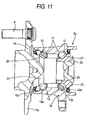
Next, a structure of a second example shown in FIG.11
in the prior art will be explained hereunder. In the case
of this wheel supporting rolling bearing unit 2a, a hub 7a
as the rotary side raceway ring is supported rotatably by a
plurality of balls 14, 14 on the inner diameter side of an
outer ring 19 as the stationary side raceway ring. Therefore,
the double row outer ring raceways 10a, 10b as the stationary
side raceway surface are provided on the inner peripheral
surface of the outer ring 19 respectively, and first and second
inner ring raceways 20, 21 as the rotary side raceway surface
are provided on the outer peripheral surface of the hub 7a
respectively.
The hub 7a is constructed by using a hub main body 22
as a main shaft member and an inner ring 23 in combination.
A fitting flange 11a for supporting the wheel is provided to
an outer end portion of the outer peripheral surface of the
hub main body 22, and the first inner ring raceway 20 is provided
to an middle portion thereof, and also a small-diameter stepped
portion 24 that is smaller in diameter than a portion in which
the first inner ring raceway 20 is formed is provided to the
middle portion thereof near an inner end. Then, the inner
ring 23, to an outer peripheral surface of which the second
inner ring raceway 21 having a circular-arc sectional shape
is provided, is fitted onto the small-diameter stepped portion
24. In addition, an inner end surface of the inner ring 23
is pressed with a caulking portion 25 that is formed by
elastically deforming an inner end surface of the hub main
body 22 outward in the radial direction. Thus, the inner ring
23 is fixed to the hub main body 22. Further, seal rings 16c,
16d are provided between an inner peripheral surface of the
outer ring 19 on both end portions and the outer peripheral
surface of the middle portion of the hub 7a and the outer
peripheral surface of the inner end portion of the inner ring
23 respectively. Thus, the spaces in which the balls 14, 14
are provided are isolated from the external space between the
inner peripheral surface of the outer ring 19 and the outer
peripheral surface of the hub 7a.
In this case, in the case of the above wheel supporting
rolling bearing unit 2a shown in FIG.11, the rigidity can be
enhanced because the first inner ring raceway 20 is formed
directly on the outer peripheral surface of the middle portion
of the hub main body 22. In other words, the first inner ring
raceway to be provided in the middle portion of the wheel
supporting rolling bearing unit can be formed on the outer
peripheral surface of the inner ring prepared as a separate
body of the hub main body, and then this inner ring can be
fitted/fixed onto the hub main body. In this case, unless
an inference of the inner ring into the hub main body is
increased, the rigidity is lowered, like a structure shown
in FIG.11, rather than the case where the first inner ring
raceway 20 is formed directly on the outer peripheral surface
of the middle portion of the hub main body 22. A working of
fitting the inner ring as the separate body onto the hub main
body from the inner end portion to the middle portion while
keeping a large inference is troublesome. In contrast, as
shown in FIG.11, the wheel supporting rolling bearing unit
2a having the high rigidity can be constructed without trouble
by employing the structure in which the first inner ring raceway
20 is formed directly on the outer peripheral surface of the
middle portion of the hub main body 22.
In the case of the wheel supporting rolling bearing unit
2 (or 2a) as set forth in above JP-A-2001-221243, it is
unavoidable that a torque (running resistance of the wheel
supporting rolling bearing unit) required to turn the hub 7
(or 7a) is increased because of the presence of the seal rings
16a, 16b (or 16c, 16d) that close the opening portions on both
ends of the space in which the balls 14, 14 are provided. As
a result, since the running performances, mainly the
acceleration performance and the fuel consumption performance,
of the vehicle into which this wheel supporting rolling bearing
unit is incorporated are worsened, improvement in the running
performances is desired in view of the recent trend toward
the energy saving. The technology to reduce the sliding
resistance between the seal member and the sliding portion
of the counter member by mixing plastic fine grains which are
impregnated with the lubricant into the rubber composition
constituting the seal member is known in JP-A-8-319379.
However, no description is given in JP-A-8-31937 9 that suggests
getting of the high- performance structure as a whole by
applying the above rubber composition to the wheel supporting
rolling bearing unit.
In addition, as the structure that reduced the running
torque of the rolling bearing unit by reducing the resistance
of the seal-ring providing portion, improvement in the
inference of the seal lip as set forth in JP-A-10-252762 was
considered in the prior art.
In the case of the wheel supporting rolling bearing unit
as the subj ect of the present invention, even though the running
torque should be reduced, the structure capable of keeping
the wheel supporting rigidity to ensure the controllability
and also preventing sufficiently the entering of the foreign
matter into the internal space of the rolling bearing unit
to ensure the durability of the rolling bearing unit is needed.
In other words, the supporting rigidity must be assured by
enhancing the rigidity of the rolling bearing unit to ensure
the controllability, nevertheless the rolling resistance of
respective rolling members is increased if a preload applied
to respective rolling members is increased simply to enhance
the rigidity, whereby the running torque cannot be reduced.
Also, in case it is considered only that the sliding resistance
of the seal ring is lowered simply, prevention of the entering
of the foreign matter into the internal space of the rolling
bearing unit cannot be sufficiently attained and thus the
durability cannot be sufficiently assured.
A wheel supporting rolling bearing unit of the present
invention has been made in view of such circumstances, and
realizes a structure that has a high rigidity, an excellent
durability, and a low running torque.
<Disclosure of the Invention>
A wheel supporting rolling bearing unit of the present
invention comprises a stationary side raceway ring, a rotary
side raceway ring, a plurality of balls, and a seal ring, as
in the above wheel supporting rolling bearing unit known in
the prior art.
The stationary side raceway ring is supported/fixed on
a suspension system in use.
The rotary side raceway ring supports/fixes a wheel in
use.
A plurality of balls are provided between a stationary
side raceway surface and a rotary side raceway surface, each
of which has a circular-arc sectional shape, on mutually
opposing peripheral surfaces of the stationary side raceway
ring and the rotary side raceway ring.
A pair of seal rings seals opening portions on both end
portions of a space in which the balls are provided between
the mutually opposing peripheral surfaces of the stationary
side raceway ring and the rotary side raceway ring.
One raceway ring, which is positioned inside in a radial
direction, out of the stationary side raceway ring and the
rotary side raceway ring consists of a main shaft member and
an inner ring. Then, the main shaft member has a first inner
ring raceway formed directly in a middle portion of an outer
peripheral surface in an axial direction to serve as the
stationary side raceway surface or the rotary side raceway
surface and a small-diameter stepped portion formed on one
end portion of the outer peripheral surface in the axial
direction. Also, the inner ring on an outer peripheral surface
of which a second inner ring raceway as the stationary side
raceway surface or the rotary side raceway surface is formed
is fitted/fixed onto the small-diameter stepped portion.
Also, the pair of seal rings have two or three seal lips
which are formed of elastic material respectively and a top
end edge of each of which slidingly comes into contact with
a counter surface.
In particular, in the wheel supporting rolling bearing
unit of the present invention, an axial load to apply a preload
to the balls is set to 1.96 to 4.9 kN.
Also, a rigidity factor is set to 0.09 or more.
Also, a torque required to relatively run the stationary
side raceway ring and the rotary side raceway ring at 200 min-1
based on a friction between the seal lips provided to both
seal rings and a counter surface is set to 0.06 to 0.4 N·
m in total in both seal rings.
Also, a torque required to relatively run the stationary
side raceway ring and the rotary side raceway ring at 200 min-1
(200 RPM) based on a rolling resistance of each ball is set
to 0.15 to 0.45 N·m.
The rigidity factor set forth in this specification means
a ratio (R/Cr) of the rigidity R [kN·m/deg] of the wheel
supporting rolling bearing unit to a radial dynamic rated load
Cr [N] of the wheel supporting rolling bearing unit. The
rigidity R in this case is represented by an inclination angle
between both raceway rings when a moment load is loaded to
the rotary side raceway ring in a situation that the stationary
side raceway ring constituting the wheel supporting rolling
bearing unit is fixed. For example, the rigidity is measured
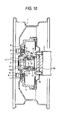
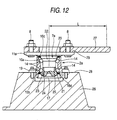
as shown in FIG.12. In this case, FIG.12 shows the condition
in which the rigidity R of the wheel supporting rolling bearing
unit 2a shown in above FIG.11 is measured.
In the measuring operation, the outer ring 19 as the
stationary side raceway ring is secured to an upper surface
of a fixing pedestal 26 and a base end portion (left end portion
in FIG.12) of a lever plate 27 is coupled/fixed to the fitting
flange 11a of the hub 7a as the rotary side raceway ring. Then,
the load is applied to the portion, which is part from a center
of rotation of the hub 7a by a distance L corresponding to
a radius of rotation of the tire, for example, on the upper
surface of the lever plate 27 to apply the moment load of 1.5
kN·m to the hub 7a via the lever plate 27. Since the hub 7a
is inclined from the outer ring 19 based on this moment load,
this inclination angle is measured as an inclination angle
[deg] of a clamp face 29 of the fitting flange 11a to an upper
surface 28 of the fixing pedestal 26. Then, the rigidity R
[kN·m/deg] is derived by dividing the moment load (1.5 kN·
m) by this inclination angle. Then, the above rigidity factor
is derived by dividing the rigidity R by the radial dynamic
rated load Cr [N] of the wheel supporting rolling bearing unit
2a.
In the case of the wheel supporting rolling bearing unit
of the present invention constructed as above, the running
torque can be reduced sufficiently while assuring the necessary
rigidity and the durability.
First, since the axial load to apply a preload to the
balls is regulated in a range of 1.96 to 4.9 kN, the running
torque can be reduced sufficiently while maintaining the
rigidity and the durability. If the axial load is below 1.96
kN, the preload is not enough and then the rigidity of the
wheel supporting rolling bearing unit becomes insufficient.
Thus, the controllability of the vehicle into which the wheel
supporting rolling bearing unit is incorporated becomes worse.
In contrast, if the axial load is in excess of 4.9 kN,
the preload is applied excessively (a contact pressure of the
rolling contact portion is increased excessively) and then
the rolling resistance (running torque) of the wheel supporting
rolling bearing unit is increased excessively. Then, a
heating value at the rolling contact portion becomes too large,
and then a temperature rise in the wheel supporting rolling
bearing unit becomes conspicuous. Thus, the grease that is
sealed in the bearing unit is ready to deteriorate immediately.
As a result, the durability of the wheel supporting rolling
bearing unit is lowered. Also, as the result of excessive
increase of the contact pressure of the rolling contact portion,
the rolling fatigue life of the stationary side raceway ring,
the rotary side raceway ring and rolling contact surfaces of
the balls is shortened, and the durability of the wheel
supporting rolling bearing unit is lowered in this respect.
In contrast, in the case of the present invention, since
the axial load to apply the preload to the balls is regulated
in a range of 1. 96 to 4. 9 kN, the running torque can be reduced
sufficiently while keeping the rigidity and the durability.
Also, since the rigidity factor is set to 0.09 or more,
the controllability of the vehicle into which the wheel
supporting rolling bearing unit is incorporated can be secured
while maintaining the rigidity of the wheel supporting rolling
bearing unit. Conversely speaking, the controllability
becomes worse if the rigidity factor is below 0.09.
Here, because the higher rigidity factor is preferable
from a viewpoint of assuring the controllability, an upper
limit is not particularly defined. Any high value of the
rigidity factor may be employed if other requirements are
satisfied. Meanwhile, as the approach that is normally taken
to enhance the rigidity factor, a value of the preload should
be increased or a pitch diameter of the balls or a pitch between
the balls arranged in double rows in the axial direction should
be increased.
In this case, as described above, there is a limit to
an increase of the preload. Also, there is a limit to increases
of the pitch diameter and the pitch in the axial direction
from a viewpoint of reduction in size and weight. Therefore,
when the wheel supporting rolling bearing unit is made of normal
steel material (the outer ring and the hub are made of S53C
and the inner ring and the balls are made of SUJ2), an upper
limit of the rigidity factor becomes almost 0.18. In this
case, when a part (e.g., balls) or all of constituent elements
of the wheel supporting rolling bearing unit are made of
ceramics, the rigidity factor can be increased unless the
preload and the pitch diameter and the pitch in the axial
direction are increased. Therefore, in this case, the
rigidity factor can also be increased to exceed 0.18.
Also, since the torque required to relatively run the
stationary side raceway ring and the rotary side raceway ring
at 200 min-1 based on the friction between the seal lip provided
in plural to both sealing rings respectively and the counter
surface is set to 0.06 to 0.4 N·m, the running torque can be
reduced sufficiently while assuring the durability of the wheel
supporting rolling bearing unit.
That is, as the result of experiments made by the
inventors of the present invention, it was understood that,
insofar as the number of the seal lips is set to two or three
in both seal rings, a validity of the sealing performance can
be decided based on a total magnitude of the running resistances
of both seal rings irrespective of the structure of the seal
ring. Of course, from a respect of assuring the sealing
performance of the seal ring that has the small running
resistance, it is important that a difference in the running
resistance between a pair of seal rings should be made small.
From this respect, the running resistance of 0. 03 N·m or more
must be assured in the seal ring that has the small running
resistance. Also, it was understood that, if the running
resistance of the seal ring that has the small running
resistance is set to 0.03 N·m or more and a total running
resistance of a pair of seal rings is set to 0.06 N·m or more,
the required sealing performance can be attained.
In the case of the wheel supporting rolling bearing unit
of the present invention, since the torque of 0.06 N·m or more
is assured, the sealing performance attained by the seal ring
can be sufficiently assured by maintaining sufficiently the
contact pressure of the slide contact portion between top ends
of the seal lips constituting the seal ring and the counter
surface. As a result, the durability of this wheel supporting
rolling bearing unit can be ensured by preventing effectively
the entering of the foreign matter such as a muddy water, or
the like into the inside of the wheel supporting rolling bearing
unit. Conversely speaking, if the contact pressure of the
slide contact portion between the top ends of the seal lips
and the counter surface to reduce the torque lower than 0.06
N·m, a function of preventing the entering of the foreign matter
become insufficient and thus the durability of the wheel
supporting rolling bearing unit is lowered.
In contrast, if the torque exceeds 0.4 N·m, it is
difficult to suppress the running torque of the wheel
supporting rolling bearing unit as a whole sufficiently low
(0.85 N·m or less).
On the contrary, in the case of the present invention,
since the torque required to relatively run the stationary
side raceway ring and the rotary side raceway ring at 200 min-1
based on the friction between the seal lip and the counter
surface is regulated in a range of 0.06 to 0.4 N·m, the running
torque can be reduced while assuring the durability.
In addition, since the torque required to relatively
run the stationary side raceway ring and the rotary side raceway
ring at 200 min-1 based on the rolling resistance of the balls
is regulated in a range of 0.15 to 0.45 N·m, the running torque
of the wheel supporting rolling bearing unit as a whole can
be suppressed sufficiently low (0.85 N·m or less) while
assuring the controllability and the durability.
If the torque is lessened below 0.15 N·m, the preload
must be lowered considerably and, as described above, the
rigidity of the wheel supporting rolling bearing unit is not
enough. Thus, the controllability of the vehicle into which
the wheel supporting rolling bearing unit is incorporated is
worsened.
In contrast, if the torque is enhanced so as to exceed
0.45 N·m, the increase of the preload is brought about. Thus,
as described above, reduction in the durability of the wheel
supporting rolling bearing unit is caused owing to the
deterioration of the grease and the reduction in the rolling
fatigue life, which are caused with an increase of the heating
value at the rolling contact portion. Also, it is difficult
to suppress the running torque of the wheel supporting rolling
bearing unit as a whole sufficiently low.
In contrast, in the case of the present invention, since
the torque required to relatively run the stationary side
raceway ring and the rotary side raceway ring at 200 min-1
based on the rolling resistance of the balls is regulated in
a range of 0.15 to 0.45 N·m, the running torque can be reduced
while assuring the controllability and the durability.
<Brief Description of the Drawings>
FIG.1 is a sectional view showing a first example of
a structure serving as a subject of the present invention;
FIG.2 is a sectional view showing a second example of
the same;
FIG.3 is a sectional view showing a third example of
the same;
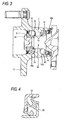
FIG. 4 is a partial sectional view showing a first example
of a particular structure of a seal ring, which can be applied
to the present invention;
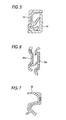
FIG. 5 is a partial sectional view showing a second example
of the same;
FIG. 6 is a partial sectional view showing a third example
of the same;
FIG. 7 is a partial sectional view showing a fourth example
of the same;
FIG. 8 is a partial sectional view showing a fifth example
of the same;
FIG. 9 is a partial sectional view showing a first example
of a structure that can reduce a slide resistance;
FIG.10 is a sectional view showing a first example of
a wheel supporting rolling bearing unit, which is well known
in the prior art, in a state that such unit is fitted into
the suspension system;
FIG.11 is a sectional view showing a second example of
the same; and
FIG.12 is a sectional view showing a condition in which
a rigidity of the wheel supporting rolling bearing unit is
measured.
<Best Mode for Carrying Out the Invention>
First, three examples of a structure of a wheel supporting
rolling bearing unit as the subject of the present invention
will be explained hereinafter. In this case, the present
invention has the structure shown in above FIGS.10 and 11 as
the subject, and first and second examples described in the
following show the case where the present invention is applied
to the wheel supporting rolling bearing unit used to support
rotatably the driving wheel (rear wheel of the FR car, front
wheel of the FF car, all wheels of the 4WD car). An importance
of the present invention is particularly high as the wheel
supporting rolling bearing unit for the driving wheel. The
reason for this is that, in the case of the wheel supporting
rolling bearing unit for the idler wheel (front wheel of the
FR car, rear wheel of the FF car) shown in FIGS.10 and 11,
the seal rings (16a, 16d) on one end side can be omitted by
sealing the opening on one end of the raceway ring (the hub
7 in FIG.10, the outer ring 19 in FIG.11) positioned on the
outer diameter side by the cap 17 (FIG.10) and thus only one
seal ring that generates the sliding resistance can be provided,
nevertheless two seal rings are required in the case of the
wheel supporting rolling bearing unit for the driving wheel.
First, like the above structure shown in FIG.11, a first
example shown in FIG.1 supports rotatably the hub 7b as the
rotary side raceway ring by a plurality of balls 14, 14 on
the inner diameter side of the outer ring 19 as the stationary
side raceway ring. A spline hole 30 into which a spline shaft
(not shown) attached to the constant velocity joint is inserted
is formed in a center portion of a hub main body 22a as the
main shaft member constituting the hub 7b. Also, the inner
ring 23 is fixed to the hub main body 22a by pressing the inner
end portion of the inner ring 23, which is fitted onto the
small-diameter stepped portion 24 formed in the inner end
portion of the hub main body 22a, with the caulking portion
25, which is formed by elastically deforming the inner end
portion of the hub main body 22a outward in the diameter
direction, to constitute the hub 7b. Then, the space in which
the balls 14, 14 are provided between the inner peripheral
surface of the outer ring 19 and the outer peripheral surface
of the hub 7b is isolated from the external space by providing
the seal rings 16c, 16d between the inner peripheral surfaces
on both end portions of the outer ring 19 and the outer
peripheral surface of the middle portion of the hub main body
22a and the outer peripheral surface of the inner end portion
of the inner ring 23 respectively.
In the case where the present invention is applied to
such structure, an axial load to apply the preload to the balls
14, 14 is set to 1.96 to 4.9 kN by regulating a load that is
applied to process the caulking portion 25 formed on the inner
end portion of the hub main body 22a. Then, a torque (rolling
resistance) that is required to turn the hub 7 on the inside
of the outer ring 19 at 200 min-1 is set to 0.15 to 0.45 N
·m. Also, the rigidity factor is set to 0.09 or more. Further,
the total running resistance (torque) of both seal rings 16c,
16d is regulated in a range of 0.06 to 0.4 N·m. Then, the
entering of the foreign matter such as muddy water, or the
like into the spaces in which the balls 14, 14 are provided
is prevented by both seal rings 16c, 16d. Structures of other
portions are similar to the above conventional structure shown
in FIG.11.
Next, in the case of a second example shown in FIG.2,
the inner end surface of the inner ring 23 that is fitted onto
the small-diameter stepped portion 24, which is provided to
the inner end portion of the hub main body 22b as the main
shaft member, to constitute the hub 7c as the rotary side raceway
ring together with the hub main body 22b is protruded inward
rather than the inner end surface of the hub main body 22b.
When assembled into the vehicle, the outer end surface of the
constant velocity joint (not shown) comes to the inner end
surface of the inner ring 23 to prevent the removal of the
inner ring 23 from the small-diameter stepped portion 24. The
axial load to apply the preload is adjusted by the torque that
is applied to tighten the nut that is screwed onto the outer
end portion of the spline shaft (not shown). Other
configurations are similar to those in the case in the first
example shown in FIG.1.
Next, in the case of a third example shown in FIG.3,
the case where the present invention is applied to the wheel
supporting rolling bearing unit that supports rotatably the
idler wheel as shown in above FIG.10 is shown. In the above
structure shown in FIG.10, a pair of inner rings 5, 5 are fixed
by the nut 6 that is screwed onto the outer end portion of
the supporting shaft 4a. In contrast, in the present
embodiment, a first inner ring raceway ring 20 is formed
directly on the middle portion of a supporting shaft 4a as
a main shaft member, and also the inner ring 5 is fixed to
the supporting shaft 4a by pressing the outer end surface of
the inner ring 5 with the caulking portion 25 that is formed
by elastically deforming an outer end surface of a supporting
shaft 4b outward in the diameter direction. The axial load
to apply the preload is adjusted by a load applied when the
caulking portion 25 is worked. Structures and operations of
other portions are similar to the first embodiment and the
configuration shown in FIG.10.
Next, five examples of a particular structure of a seal
ring, which can be applied to the present invention, will be
explained with reference to FIGS. 4 to 8 hereunder. These four
examples shown in FIGS.4 to 7 show a structure that can be
utilized as the inside seal rings 16b, 16d in the first to
third examples of the wheel supporting rolling bearing unit
shown in FIGS.1 to 3 and the structure explained previously
in FIG.11 respectively. Following explanation will be made
by taking the case where the present invention is applied to
the structure in FIGS.1 and 2 as an example.
First, a first example shown in FIG.4 is a combinational
seal ring in which an outer diameter-side seal ring 31 that
is fitted/fixed into the inner end portion of the outer ring
19 (FIGS. 1 and 2) and an inner diameter-side seal ring 32 that
is fitted/fixed onto the portion located near the inner ends
of the inner ring 23 (FIGS.1 and 2) are combined with each
other. This seal ring has three seal lips in total, i.e.,
two on the inner diameter side and one on the outer diameter
side.
Next, a second example shown in FIG.5 is a combinational
seal ring in which a seal ring 33 that is fitted/fixed into
the inner end portion of the outer ring 19 (FIGS. 1 and 2) and
a slinger 34 that is fitted/fixed onto the portion located
near the inner ends of the inner ring 23 (FIGS.1 and 2) are
combined with each other. The seal ring 33 has three seal
lips.
Next, a third example shown in FIG.6 is a combinational
seal ring in which a seal ring 35a that engages with the inner
peripheral surface of the inner end portion of the outer ring
19 (FIGS.1 and 2) and a seal ring 35b that engages with the
outer peripheral surface of the portion located near the inner
ends of the inner ring 23 (FIGS.1 and 2) are combined with
each other. In the case of the present example, this seal
ring has three seal lips in total, i.e., two on the seal ring
35a engaging with the outer ring 19 side and one on the seal
ring 35b engaging with the inner ring 23 side.
Next, in a seal ring shown in FIG.7, top end edges of
two seal lips provided to a seal ring 36 that is fitted into
the inner end portion of the outer ring 19 (FIGS.1 and 2)
slidingly come into contact with the outer peripheral surface
of the portion located near the inner ends of the inner ring
23 (FIGS.1 and 2). In this case, the seal ring 36 shown in
FIG.7 can also be used to block the opening portion on the
outer end side of the space in which the balls are provided.
Next, a seal ring 37 shown in FIG.8 shows a structure
that can be utilized as a seal ring that is provided between
the inner peripheral surface of the outer end portion of the
outer ring 19 (FIGS. 1 and 2) or the inner end portion (FIG.3)
of the hub 7 and the outer peripheral surface of the middle
portion of the hub main bodies 22a (FIG.1), 22b (FIG.2) and
the supporting shaft 4a (FIG.3) . In this seal ring 37, three
seal lips are provided to the core bar that can be fitted/fixed
into the outer end portion of the outer ring 19, and the top
end edges of these seal lips are slidingly brought into contact
with the inside surface of the fitting flange 11a (FIGS.1 to
3) or the curved-surface portion that connects continuously
this inside surface and the outer peripheral surfaces of the
hub main bodies 22, 22a.
The opening portions on both end portions of the space
in which the balls 14, 14 are provided are sealed by assembling
a pair of seal rings selected from those shown in FIGS.4 to
8 between the inner peripheral surface of the outer end portion
of the outer ring 19 (FIGS.1 and 2), which constitutes the
wheel supporting rolling bearing unit shown in FIGS.1 to 3,
or the inner end portion (FIG.3) of the hub 7 and the outer
peripheral surface of the middle portion of the hub main bodies
22a (FIG.1), 22b (FIG.2) and the supporting shaft 4a (FIG.3)
and the outer peripheral surface of the inner end portion of
the inner ring 23 (FIGS.1 and 2), and the outer peripheral
surface of the outer end portion (FIG.3) of the inner ring
5. Then, even when any seal rings are combined with each other,
the total running resistance of both seal rings is adjusted
in a range of 0.06 to 0.4 N·m by the method described later,
for example. Also, the running resistance of the seal ring
that has the lower running resistance is lowered by the method
described later but is kept to 0.3 N·m or more.
In this event, as the method of reducing the torque
required for the relative rotation between the seal ring and
the counter member when any one of the above seal rings is
employed, there are methods (1) to (4) described as follows,
for example. These methods may be employed solely or in
combination respectively.
As the sectional shape that is available in this case,
the sectional shape in the prior invention disclosed in Patent
Application No.2002-71338, for example, may be considered.
In the structure in the prior invention, as shown in FIG.9,
a thickness of a seal lip 38b of three seal lips 38a, 38b,
38c is reduced gradually from the base end portion toward the
middle portion and then is increased from the middle portion
toward the top end portion. Also, a thickness of the seal
lip 38b is maximized at a part of the portion located near
the top end. In addition, the shape is decided to satisfy
0.80d1≦d2≦ 0.98d1 and 0.1S2≦S1≦0.5S2
where d1 is a thickness of the base end portion of the seal
lip 38b, d2 is a thickness of a minimum thickness portion in
which a thickness is minimized in the middle portion, S1 is
a sectional area of a portion extended from the base end portion
to the minimum thickness portion in the axial direction, and
S2 is an area of a portion extended from the minimum thickness
portion to the top end edge.
<Examples>
Next, results of experiments to check advantages of the
present invention will be explained hereunder. In Experiment,
a pair of seal rings selected from five types of seal rings
shown in FIGS. 4 to 8 were assembled into the wheel supporting
rolling bearing unit shown in FIG.1 or FIG.3, and then the
relationship between a total value of the running resistance
(seal torque) of both seal rings and the sealing performance
was obtained. Adjustment of the sealing torque was executed
by adjustment of the interference (an amount of elastic
deformation) of the seal lip, adjustment of the thickness of
the seal lip, exchange of the elastic material, and adjustment
of the contact conditions to the counter surface. Then, six
types of seal rings whose seal torque is 0.01 to 0.10 N·m were
manufactured with respect to above five types of seal rings
respectively. Then, respective seal rings were incorporated
into the wheel supporting rolling bearing unit shown in FIG.1
or FIG.3 to take a muddy-water entering test. In this muddy-water
entering test, as one cycle, the step of running
relatively the seal rings and the member having the counter
surface while pouring the muddy water on the area, in which
the seal ring is provided, at a rate of 3000 cc/min was continued
for 17 hours and then the step of drying the concerned area
by stopping the rotation and the pouring of the muddy water
was continued for 3 hours. These steps were repeated in 20
cycles every sample. Also, the lubrication of the wheel
supporting rolling bearing unit was executed by injecting a
grease whose viscosity is 10×10-6 to 14×10-6 m2/s(10 to 14
cSt). The hub 7b (or 7) were revolved at 200 min-1 in the
environment of 20°C.
Results of the experiment executed under such conditions
are given in Table 1.
| Seal torque (N·m) | 4 ○+8 ○ | 4 ○+7 ○ | 5 ○+8 ○ | 5 ○+7 ○ | 6 ○+8 ○ | 6 ○+7 ○ |
| 0.01 | × | × | × | × | × | × |
| 0.03 | ○ | × | Δ | × | × | × |
| 0.05 | ○ | Δ | ○ | Δ | Δ | Δ |
| 0.06 | ○ | ○ | ○ | ○ | ○ | ○ |
| 0.08 | ○ | ○ | ○ | ○ | ○ | ○ |
| 0.10 | ○ | ○ | ○ | ○ | ○ | ○ |
Here, in Table 1, encircled figures represent the drawing
number in which the seal ring is set forth respectively. For
example, 4 ○ represents the seal ring shown in FIG.4 and 8 ○
represents the seal ring shown in FIG. 8. Also, 4 ○+8 ○
represents a combination of the seal ring shown in FIG.4 and
the seal ring shown in FIG.8. Also, a mark "×" indicates
the fact that a large amount of muddy water entered into the
internal space in which the grease is sealed, a mark "Δ"
indicates the fact that a small amount of muddy water entered
into the same, and a mark "○" indicates the fact that the
entering of the muddy water was not observed. It is appreciated
based on such experimental results that, if the seal torque
is in excess of 0.06 N·m, the entering of the muddy water can
be prevented by all seal rings.
Next, second to fifth Experiments that were executed
by incorporating the seal ring shown in FIG.5 and the seal
ring shown in FIG.9 into the wheel supporting rolling bearing
unit shown in FIG. 8 to know the influences of the seal torque
(running resistance), the axial load to apply the preload,
the rolling resistance, and the rigidity factor upon the
controllability, the running torque of the overall rolling
bearing unit, and the durability will be explained with
reference to Tables 2 to 5. In Tables 2 to 5, a mark "×"
indicates the fact that the problem arose in practical use
in any respect, a mark "Δ" indicates the fact that the problem
slightly arose in practical use in any respect, and a mark
"○" indicates the fact that no problem arose in all respects.
Here, second to fifth Experiments were carried out three times
under the same conditions respectively.
First, Table 2 gives results of second Experiment that
was executed to know the influence of the seal torque upon
the running torque of the overall rolling bearing unit and
the durability. This Experiment was executed at a rotational
speed of 200 min
-1.
| Seal torque[N·m] | Evaluation |
| 0.01 | × | × | × |
| 0.03 | × | Δ | × |
| 0.05 | ○ | ○ | ○ |
| 0.06 | ○ | ○ | ○ |
| 0.10 | ○ | ○ | ○ |
| 0.35 | ○ | ○ | ○ |
| 0.40 | ○ | ○ | ○ |
| 0.55 | × | × | × |
| 0.70 | × | × | × |
As the result of second Experiment given in Table 2,
it was understood that, if the seal torque is in a range of
0.06 to 0.40 N·m, the satisfactory performance can be obtained
in both respects of the running torque of the overall rolling
bearing unit and the durability. In contrast, if the seal
torque is at 0.01 N·m and 0.03 N·m, the entering of the foreign
matter such as the muddy water, or the like into the internal
space in which the balls 14, 14 are provided could not
sufficiently prevented, and thus the problem arose in the
respect of assuring the durability. In contrast, if the seal
torque is at 0.55 N·m and 0.70 N·m, the running torque of the
overall rolling bearing unit could not be suppressed low. In
this case, from the result of the second experiment whose
results are given in Table 2, the good performances were
obtained in a combination "5 ○+8 ○" when the seal torque was
0.05 N·m. From the result of the second experiment whose
results are given in Table 1, the lower limit of the seal torque
was 0.06 N·m.
Next, Table 3 gives results of third Experiment that
was executed to know the influence of the axial load (preload)
upon the rigidity of the rolling bearing unit and the
durability.
| Preload [kN] | Evaluation |
| 0.49 | × | × | × |
| 0.98 | × | Δ | Δ |
| 1.96 | ○ | ○ | ○ |
| 2.94 | ○ | ○ | ○ |
| 3.92 | ○ | ○ | ○ |
| 4.90 | ○ | ○ | ○ |
| 5.88 | Δ | Δ | Δ |
| 6.86 | × | Δ | × |
As the result of third Experiment given in Table 3, it
was understood that, if the axial load is in a range of 1.96
to 4.90 N·m, the satisfactory performance can be obtained in
both respects of the controllability and the durability of
the rolling bearing unit. In contrast, if the axial load is
at 0.49 kN and 0.98 kN, the rigidity of the rolling bearing
unit was low and thus the sufficient controllability could
not be assured. In contrast, if the axial load is at 5.88
kN and 6.86 kN, the rolling resistance was increased and the
durability of the rolling bearing unit was degraded.
Next, Table 4 gives results of fourth Experiment that
was executed to know the influence of the rolling resistance
upon the rigidity of the rolling bearing unit and the durability.
This Experiment was executed at a rotational speed of 200 min
-1.
| Rolling Resistance [N·m] | Evaluation |
| 0.10 | × | × | × |
| 0.12 | Δ | Δ | × |
| 0.15 | ○ | ○ | ○ |
| 0.25 | ○ | ○ | ○ |
| 0.35 | ○ | ○ | ○ |
| 0.45 | ○ | ○ | ○ |
| 0.55 | × | Δ | Δ |
| 0.65 | × | × | × |
As the result of fourth Experiment given in Table 4,
it was understood that, if the rolling resistance is in a range
of 0.15 to 0.45 N·m, the satisfactory performance can be
obtained in both respects of the controllability and the
durability of the rolling bearing unit. In contrast, if the
rolling resistance is at 0.10 N·m and 0.12 N·m, the rigidity
of the rolling bearing unit was low and thus the sufficient
controllability could not be assured. In contrast, if the
rolling resistance is at 0.55 N·m and 0.65 N·m, the durability
of the rolling bearing unit was degraded.
In addition, Table 5 gives results of fifth Experiment
that was executed to know the influence of the rigidity factor
upon the rigidity of the rolling bearing unit.
| Rigidity factor | Evaluation |
| 0.07 | × | × | × |
| 0.08 | × | × | Δ |
| 0.09 | ○ | ○ | ○ |
| 0.10 | ○ | ○ | ○ |
| 0.15 | ○ | ○ | ○ |
| 0.18 | ○ | ○ | ○ |
As the result of fifth Experiment given in Table 5, it
was understood that, if the rigidity factor is 0.09 or more,
the satisfactory performance of the controllability can be
obtained. In contrast, if the rigidity factor is at 0.07 and
0.08, the rigidity of the rolling bearing unit was low and
thus the sufficient controllability could not be assured. In
this case, as described above, the higher rigidity factor is
better insofar as other requirements are satisfied.
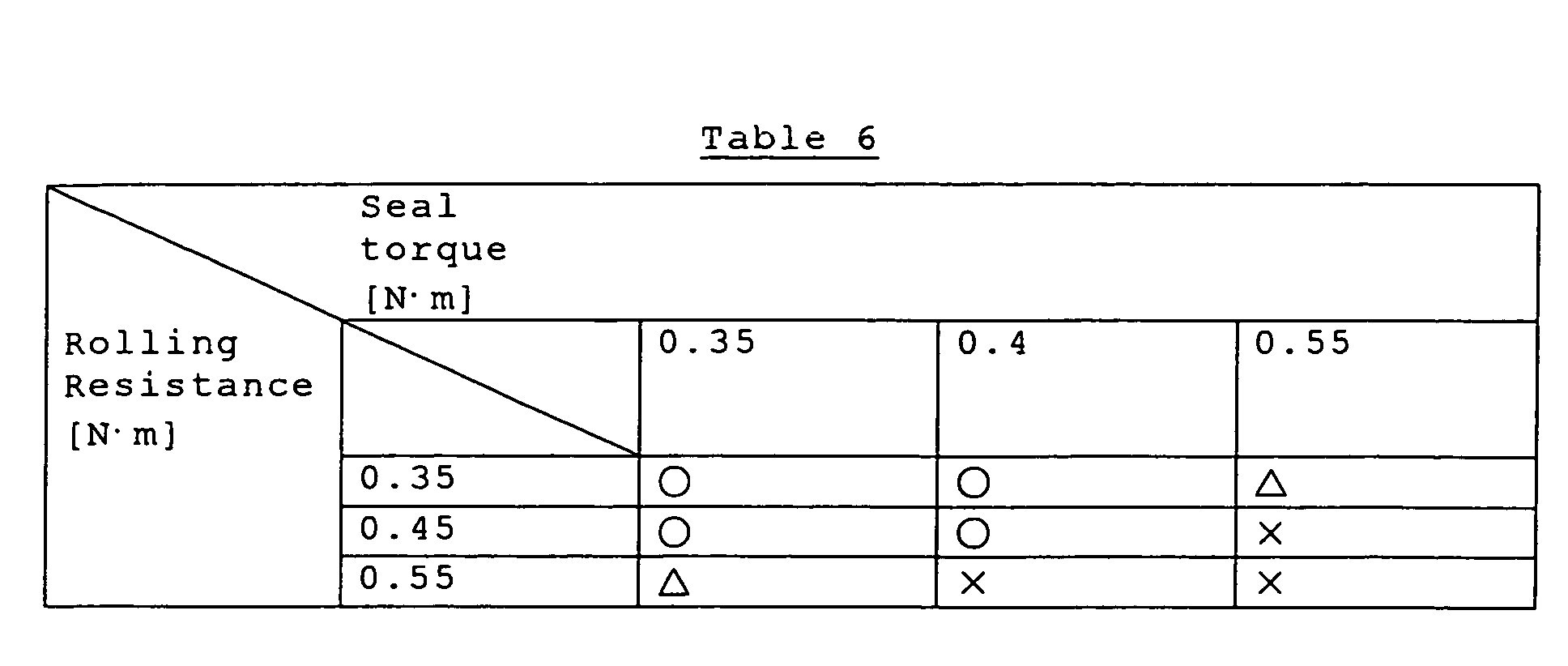
Next, Table 6 gives results of Experiment that was
executed to know the influences of the seal torque and the
rolling resistance upon the running torque of the rolling
bearing unit as a whole. This Experiment was executed at a
rotational speed of 200 min
-1.
In Table 6, a mark "×" indicates the fact that the running
torque was large as a whole, a mark "Δ" indicates the fact
that the running torque was slightly large, and a mark "○"
indicates the fact that the running torque was small. As
apparent from this Table 6, the present invention in which
a total seal torque of a pair of seal rings and the rolling
resistance are suppressed to 0.4 N·m or less and 0.45 N·m or
less respectively could suppress as a whole the running torque
low such as 0.85 N·m or less.
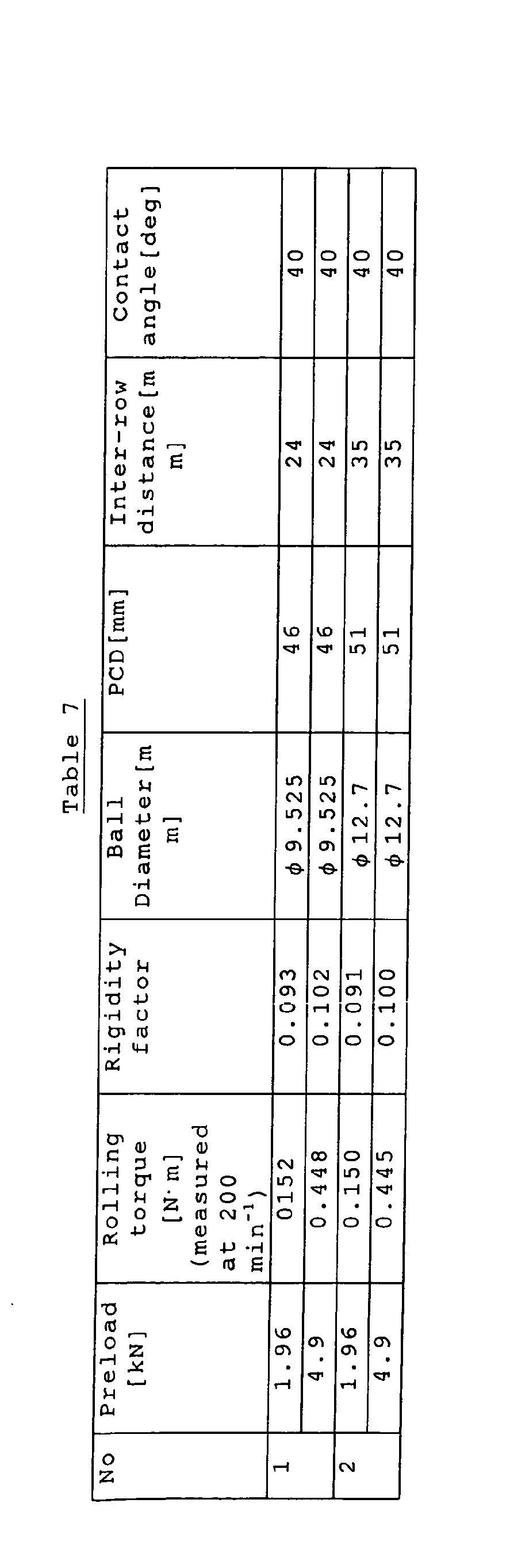
In Table 7, the ball diameter denotes a diameter of the
ball, the PCD denotes a pitch diameter of a ball sequence of
these balls, the inter-row distance denotes a pitch (center
distance between the balls) of the ball sequences arranges
in double rows in the axial direction, and the contact angle
denotes a contact angle between the balls and the inner ring
raceway and the outer ring raceway.
Also, the influence of the contact angle upon the rigidity
factor is given in Table 8. It was appreciated from Table
8 that the rigidity factor becomes small as the contact angle
becomes small.
| Preload [kN] | Contact angle [deg] | Rigidity factor | Ball Diameter [mm] | PCD [mm] | Inter-row Distance [mm] |
| 1.96 | 40 | 0.093 | Ø 9.525 | 45 | 24 |
| 1.96 | 35 | 0.089 | Ø 9.525 | 45 | 24 |
The present invention is explained in detail with
reference to particular embodiments, but it is apparent for
the person skilled in the art that various variations and
modifications can be applied without departing from a spirit
and a scope of the present invention.
The present application was filed based on Japanese
Patent Application (Patent Application No.2002-261194) filed
on September 6, 2002 and the contents thereof are incorporated
herein by the reference.
<Industrial Applicability>
Since the wheel supporting rolling bearing unit of the
present invention is constructed and acts as described above,
such bearing unit can contribute to the improvement in the
running performances of the vehicle, mainly the
controllability, the acceleration performance, and the fuel
consumption performance, by reducing the running torque of
the hub, which rotates together with the wheel, while assuring
the rigidity and the durability.
An example of a trial calculation to improve the fuel
consumption performance will be explained hereunder. The
running resistance of the wheel supporting rolling bearing
unit having the above structure shown in FIGS. 1 to 3 was almost
1.5 N·m in the prior art. In contrast, the running resistance
of the wheel supporting rolling bearing unit of the present
invention is in a range of 0.21 to 0.85 N·m. That is, the
running resistance is lowered by 43 % or more rather than the
prior art. It is considered that, if the running resistance
of the wheel supporting rolling bearing unit is lowered by
10 %, the fuel consumption (fuel consumption ratio) can be
improved by about 0.1%. Therefore, suppose that the car the
fuel consumption of which is about 10 km/L travels 100,000
km a year, the fuel can be saved by about 43 to 86 L a year
by employing the wheel supporting rolling bearing unit of the
present invention. Suppose that 1, 000, 000 cars travel in this
country, the fuel that can be saved a year reaches 43, 000, 000
L to 86,000,000 L. In addition, it is possible to say that
the industrial usability is extremely high because the fuel
consumption can be improved not to cause other disadvantages.