EP1548142A1 - High-strength cold-rolled steel sheet excellent in coating film adhesion - Google Patents
High-strength cold-rolled steel sheet excellent in coating film adhesion Download PDFInfo
- Publication number
- EP1548142A1 EP1548142A1 EP04028368A EP04028368A EP1548142A1 EP 1548142 A1 EP1548142 A1 EP 1548142A1 EP 04028368 A EP04028368 A EP 04028368A EP 04028368 A EP04028368 A EP 04028368A EP 1548142 A1 EP1548142 A1 EP 1548142A1
- Authority
- EP
- European Patent Office
- Prior art keywords
- steel sheet
- mass
- oxides
- coating film
- film adhesion
- Prior art date
- Legal status (The legal status is an assumption and is not a legal conclusion. Google has not performed a legal analysis and makes no representation as to the accuracy of the status listed.)
- Granted
Links
Images



Classifications
-
- C—CHEMISTRY; METALLURGY
- C22—METALLURGY; FERROUS OR NON-FERROUS ALLOYS; TREATMENT OF ALLOYS OR NON-FERROUS METALS
- C22C—ALLOYS
- C22C38/00—Ferrous alloys, e.g. steel alloys
- C22C38/02—Ferrous alloys, e.g. steel alloys containing silicon
-
- C—CHEMISTRY; METALLURGY
- C22—METALLURGY; FERROUS OR NON-FERROUS ALLOYS; TREATMENT OF ALLOYS OR NON-FERROUS METALS
- C22C—ALLOYS
- C22C38/00—Ferrous alloys, e.g. steel alloys
- C22C38/04—Ferrous alloys, e.g. steel alloys containing manganese
-
- C—CHEMISTRY; METALLURGY
- C23—COATING METALLIC MATERIAL; COATING MATERIAL WITH METALLIC MATERIAL; CHEMICAL SURFACE TREATMENT; DIFFUSION TREATMENT OF METALLIC MATERIAL; COATING BY VACUUM EVAPORATION, BY SPUTTERING, BY ION IMPLANTATION OR BY CHEMICAL VAPOUR DEPOSITION, IN GENERAL; INHIBITING CORROSION OF METALLIC MATERIAL OR INCRUSTATION IN GENERAL
- C23C—COATING METALLIC MATERIAL; COATING MATERIAL WITH METALLIC MATERIAL; SURFACE TREATMENT OF METALLIC MATERIAL BY DIFFUSION INTO THE SURFACE, BY CHEMICAL CONVERSION OR SUBSTITUTION; COATING BY VACUUM EVAPORATION, BY SPUTTERING, BY ION IMPLANTATION OR BY CHEMICAL VAPOUR DEPOSITION, IN GENERAL
- C23C30/00—Coating with metallic material characterised only by the composition of the metallic material, i.e. not characterised by the coating process
-
- C—CHEMISTRY; METALLURGY
- C21—METALLURGY OF IRON
- C21D—MODIFYING THE PHYSICAL STRUCTURE OF FERROUS METALS; GENERAL DEVICES FOR HEAT TREATMENT OF FERROUS OR NON-FERROUS METALS OR ALLOYS; MAKING METAL MALLEABLE, e.g. BY DECARBURISATION OR TEMPERING
- C21D2211/00—Microstructure comprising significant phases
- C21D2211/005—Ferrite
-
- C—CHEMISTRY; METALLURGY
- C21—METALLURGY OF IRON
- C21D—MODIFYING THE PHYSICAL STRUCTURE OF FERROUS METALS; GENERAL DEVICES FOR HEAT TREATMENT OF FERROUS OR NON-FERROUS METALS OR ALLOYS; MAKING METAL MALLEABLE, e.g. BY DECARBURISATION OR TEMPERING
- C21D2211/00—Microstructure comprising significant phases
- C21D2211/008—Martensite
-
- C—CHEMISTRY; METALLURGY
- C21—METALLURGY OF IRON
- C21D—MODIFYING THE PHYSICAL STRUCTURE OF FERROUS METALS; GENERAL DEVICES FOR HEAT TREATMENT OF FERROUS OR NON-FERROUS METALS OR ALLOYS; MAKING METAL MALLEABLE, e.g. BY DECARBURISATION OR TEMPERING
- C21D8/00—Modifying the physical properties of ferrous metals or ferrous alloys by deformation combined with, or followed by, heat treatment
- C21D8/02—Modifying the physical properties of ferrous metals or ferrous alloys by deformation combined with, or followed by, heat treatment during manufacturing of plates or strips
- C21D8/0221—Modifying the physical properties of ferrous metals or ferrous alloys by deformation combined with, or followed by, heat treatment during manufacturing of plates or strips characterised by the working steps
- C21D8/0226—Hot rolling
-
- C—CHEMISTRY; METALLURGY
- C21—METALLURGY OF IRON
- C21D—MODIFYING THE PHYSICAL STRUCTURE OF FERROUS METALS; GENERAL DEVICES FOR HEAT TREATMENT OF FERROUS OR NON-FERROUS METALS OR ALLOYS; MAKING METAL MALLEABLE, e.g. BY DECARBURISATION OR TEMPERING
- C21D8/00—Modifying the physical properties of ferrous metals or ferrous alloys by deformation combined with, or followed by, heat treatment
- C21D8/02—Modifying the physical properties of ferrous metals or ferrous alloys by deformation combined with, or followed by, heat treatment during manufacturing of plates or strips
- C21D8/0221—Modifying the physical properties of ferrous metals or ferrous alloys by deformation combined with, or followed by, heat treatment during manufacturing of plates or strips characterised by the working steps
- C21D8/0236—Cold rolling
-
- C—CHEMISTRY; METALLURGY
- C21—METALLURGY OF IRON
- C21D—MODIFYING THE PHYSICAL STRUCTURE OF FERROUS METALS; GENERAL DEVICES FOR HEAT TREATMENT OF FERROUS OR NON-FERROUS METALS OR ALLOYS; MAKING METAL MALLEABLE, e.g. BY DECARBURISATION OR TEMPERING
- C21D8/00—Modifying the physical properties of ferrous metals or ferrous alloys by deformation combined with, or followed by, heat treatment
- C21D8/02—Modifying the physical properties of ferrous metals or ferrous alloys by deformation combined with, or followed by, heat treatment during manufacturing of plates or strips
- C21D8/0278—Modifying the physical properties of ferrous metals or ferrous alloys by deformation combined with, or followed by, heat treatment during manufacturing of plates or strips involving a particular surface treatment
Definitions
- the present invention relates to a high-strength cold-rolled steel sheet excellent in coating film adhesion, and more particularly, to a cold-rolled steel sheet which has a tensile strength no lower than 550 MPa and is suitable for use as a steel sheet for automobile parts on account of its excellent coating film adhesion.
- Si is less influential in reducing ductility and is effective in increasing strength while retaining ductility.
- Si content is poor in chemical treatability and hence in coating film adhesion. Consequently, it was necessary to reduce Si content in the case where chemical treatability is important.
- excess Si forms an Si-containing intergranular oxide on the surface of steel sheet, thereby causing cracks to occur and aggravating coating film adhesion.
- IF steel Interstitial Free steel.
- IF steel is limited in carbon content (no more than 0.005%) and has its texture controlled by a specific recrystallization temperature, so that it is improved in deep drawability.
- IF steel with a very low carbon content will not achieve the high strength intended by the present invention.
- the retained austenite-containing steel sheet mentioned above contains such alloying elements as C, Si, Mn, and A1 in large amounts so as to secure retained austenite. Therefore, it is poor in weldability.
- An example of steel having an Si/Mn ratio lower than 1 is mild steel nearly free of Si, which is known to have good chemical treatability.
- a certain amount of Si is necessary for steel to have both high strength and good ductility, and hence there is a limit of reducing the Si content to keep the Si/Mn ratio below 1.
- a steel sheet does not always exhibit good chemical treatability even though it has a Si/Mn ratio lower than 1, for a certain Si content and an adequately controlled Mn content.
- the present invention was completed in view of the foregoing. It is an object of the present invention to provide a cold-rolled steel sheet characterized by a tensile strength no lower than 500 MPa and excellent coating film adhesion and weldability.
- the present invention is directed to a high-strength cold-rolled steel sheet excellent in coating film adhesion, which is a DP (Dual Phase) steel sheet of ferrite-tempered martensite type containing no more than 1 mass% of C (excluding 0 mass%), 0.05 to 2 mass% of Si, and 1 to 5 mass% of Mn, having a tensile strength no lower than 550 MPa, satisfying the equation (1) below, and being characterized by its surface in which there exist Si-Mn complex oxides no larger than 5 ⁇ m in diameter of the equivalent circle as many as 10 or more per 100 ⁇ m 2 and the coverage of oxides composed mainly of Si on the surface of steel sheet is no more than 10% of surface area (requirement (I)).
- DP Direct Phase
- the equivalent circle means the circle of the same area as the Si-Mn complex oxide.
- This steel sheet will be referred to as "Steel sheet 1 of the present invention” hereinafter.
- [Si]/[Mn] ⁇ 0.4 where [Si] denotes an Si content (in mass%) and [Mn] denotes an Mn content (in mass%).
- oxides composed mainly of Si means those oxides in which Si (as one of the constituents excluding oxygen) accounts for no less than 70% in atomic ratio. Such oxides are considered to be amorphous according to the result of analysis.
- the ratio of the surface area of steel sheet which is covered by the oxides composed mainly of Si was obtained by observation under a TEM (Transmission Electron Microscope), quantitative analysis and mapping of Si, O, Mn, and Fe by EDX (Energy Dispersive X-ray), and image analysis of these data.
- Observation under a TEM was accomplished by using an extraction replica, which is explained in Examples given later.
- Observation under a TEM for an extraction replica may be replaced by surface mapping for Si, O, Mn, and Fe by AES (Auger Electron Spectroscopy) at a magnification of 2000 to 5000, and the resulting data may be used for image analysis.
- the present invention is directed also to a high-strength cold-rolled steel sheet excellent in coating film adhesion, which is a DP (Dual Phase) steel sheet of ferrite-tempered martensite type containing no more than 1 mass% of C (excluding 0 mass%), no more than 2 mass% of Si (excluding 0 mass%), and 1 to 5 mass% of Mn, having a tensile strength no lower than 550 MPa, and being characterized by its surface whose cross section does not show cracks with a width no larger than 3 ⁇ m and a depth no smaller than 5 ⁇ m in arbitrary ten fields of observation under an SEM (Scanning Electron Microscope) with a magnification of 2000 (requirement (II)).
- This steel sheet will be referred to as "Steel sheet 2 of the present invention” hereinafter.
- Fig. 1 which is a schematic sectional view of the steel sheet. They are found by observing the vicinity of the surface of the steel sheet under an SEM with a magnification of 2000 (Model S-4500 of Hitachi Ltd.).
- the present invention is directed also to a high-strength cold-rolled steel sheet excellent in coating film adhesion, which is a DP (Dual Phase) steel sheet of ferrite-tempered martensite type containing no more than 1 mass% of C (excluding 0 mass%), 0.05 to 2 mass% of Si, and 1 to 5 mass% of Mn, having a tensile strength no lower than 550 MPa, satisfying the equation (1) above, and meeting the above-mentioned requirements (I) and (II). (This steel sheet will be referred to as "Steel sheet 3 of the present invention" hereinafter.)
- the steel sheets of the present invention should preferably have a composition specified by the equations (2) and (3) below as an additional requirement, so that they exhibit good weldability.
- [C], [Si], [Mn], [P], and [S] denote the content (in mass%) of these elements.
- the steel sheet according to the present invention has a high strength in excess of 550 MPa, exhibits good chemical treatability, and/or good coating film adhesion owing to controlled fine cracks, and provides good weldability. It is suitable for automotive parts. It can be produced without cladding or expensive elements.
- Fig. 1 is a schematic diagram showing cracks in the cross section of the steel sheet.
- Fig. 2 is a diagram illustrating (part of) one manufacturing process in Examples.
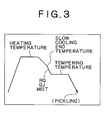
- Fig. 3 is a diagram illustrating (part of) another manufacturing process in Examples.
- Fig. 4 is an electron micrograph (TEM) of sample in experiment No. 1 in Examples. (Extraction replica, ⁇ 15000)
- Fig. 5 is an electron micrograph (TEM) of sample in experiment No. 29 in Examples. (Extraction replica, ⁇ 15000)
- Fig. 6 is an electron micrograph (TEM) of sample in experiment No. 34 in Examples. (Extraction replica, ⁇ 15000)
- Fig. 7 is an electron micrograph (SEM) showing the cross section near the surface of the steel sheet in experiment No. 1 in Examples.
- Fig. 8 is an electron micrograph (SEM) showing the cross section near the surface of the steel sheet in experiment No. 29 in Examples.
- Fig. 9 is an electron micrograph (SEM) showing the cross section near the surface of the steel sheet in experiment No. 34 in Examples.
- Fig. 10 is an electron micrograph (SEM) showing the surface of the steel sheet (after chemical treatment) in experiment No. 1 in Examples.
- Fig. 11 is an electron micrograph (SEM) showing the surface of the steel sheet (after chemical treatment) in experiment No. 29 in Examples.
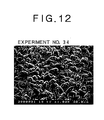
- Fig. 12 is an electron micrograph (SEM) showing the surface of the steel sheet (after chemical treatment) in experiment No. 34 in Examples.
- the present inventors have carried out a series of researches to obtain a high-strength steel sheet excellent in coating film adhesion and proposed a technique for improving the chemical treatability of a steel sheet containing Si in a comparatively large amount.
- This technique is intended to improve chemical treatability by finely dispersing amorphous Si oxides detrimental to chemical treatability while controlling the annealing atmosphere.
- major oxides that occur when the Si content is relatively low Si content: 0.05 to 2% as defined in the present invention
- Si-Mn complex oxides rather than amorphous Si oxides. It is considered that these complex oxides are also detrimental to coating film adhesion.
- the present inventors searched for the possibility of positively using Si-Mn complex oxides for improvement of chemical treatability.
- the electrochemical inhomogeneous field mentioned above should preferably be of the same size.
- the present invention specifies that there should exist Si-Mn complex oxides no larger than 5 ⁇ m in diameter of the equivalent circle as many as 10 or more per 100 ⁇ m 2 (or 1 per 10 ⁇ m 2 or more on average), with the average distance between particles of complex oxides being several micrometers. This condition is necessary for easy formation of the electrochemical inhomogeneous field of the above-specified size.
- the number of particles of Si-Mn complex oxides should preferably be 50 or more per 100 ⁇ m 2 , more preferably 100 per or more 100 ⁇ m 2 , and most desirably 150 or more per 100 ⁇ m 2 , because the electrochemical inhomogeneous field does not necessarily occur in every particle of the Si-Mn complex oxides which are present.
- An example of the Si-Mn complex oxides is Mn 2 SiO 4 . It is considered that about 50 nm is the maximum observable size of Si-Mn complex oxides.
- the Si-Mn complex oxides functioning as nucleating sites for zinc phosphate crystals will not contribute to good chemical treatability if there exist other substances detrimental to chemical treatment. Hence, the resulting steel sheet will be poor in coating film adhesion.
- oxides composed mainly of Si are present on the surface of steel sheet, zinc phosphate crystals do not form on them, which leads to considerably poor chemical treatability. Consequently, the present invention requires that the coverage of oxides composed mainly of Si on the surface of steel sheet should be no more than 10% of surface area.
- the present inventors had previously proposed a technique of improving chemical treatability by finely dispersing oxides composed mainly of Si, as mentioned above.
- the presence of oxides should be minimized in the present invention which is intended to utilize the action of Si-Mn complex oxides as mentioned above. Therefore, the coverage of oxides composed mainly of Si on the surface of steel sheet should preferably be no more than 5% of surface area, most desirably 0% of surface area.
- Sharp cracks present on the surface of the steel sheet prevent zinc phosphate crystals from sticking to them at the time of chemical treatment. As the result, corrosion readily proceeds there, aggravating coating film adhesion. For this plausible reason, it is important to minimize the occurrence of sharp cracks in order to improve coating film adhesion.
- the present inventors had previously proposed a technique of improving coating film adhesion by restricting to 10 ⁇ m or less the depth of linear oxides (narrower than 30 nm) composed of Si and oxygen. This technique is based on the assumption that continuous annealing will not be followed by pickling. However, in common practice, continuous annealing is followed by pickling, and pickling removes linear oxides, thereby causing cracks to occur.
- the present inventors conceived that it would be possible to improve coating film adhesion more by controlling cracks than by regulating the depth of linear oxides (as in the technology they had previously proposed) and they investigated the shape of cracks to be controlled. As the result, it was found that zinc phosphate crystals hardly stick to cracks having a width approximately equal to or smaller than their particle diameter. This holds true particularly for cracks deeper than 5 ⁇ m. Thus, according to the present invention, cracks to be controlled are limited to those which are narrower than 3 ⁇ m and deeper than 5 ⁇ m.
- the steel sheet according to the present invention is required to have the following chemical composition so that it has controlled cracks for efficient deposition of the above-mentioned oxides and it exhibits the characteristic properties of high-strength steel sheet.
- oxides composed mainly of Si adversely affect chemical treatability, it is more desirable to suppress them as much as possible rather than finely dispersing them.
- the object of suppressing such oxides can be achieved if the [Si]/[Mn] ratio in the chemical composition is no larger than 0.4, preferably no larger than 0.3.
- Carbon is essential for strength.
- the minimum carbon content is 0.05 mass%. An excess carbon content aggravates weldability. Therefore, the carbon content should be no larger than 1 mass%, preferably no larger than 0.23 mass%, and more preferably no larger than 0.15 mass%.
- Si 0.05 to 2 mass% (for steel sheets 1 and 3)
- Si increases strength without decreasing ductility, it may be contained in the steel sheet.
- a certain amount of Si is necessary for the Si-Mn complex oxides with a diameter of the equivalent circle no larger than 5 ⁇ m to form as much as specified by the requirement (I) mentioned above.
- a minimum amount of Si for this purpose is 0.05 mass%.
- An adequate amount should be no less than 0.15 mass%, preferably no less than 0.3 mass%, and more preferably no less than 0.5 mass%. Si in an excess amount brings about solid solution hardening more than necessary, which leads to an increased rolling load. Therefore, the content of Si should be no larger than 2 mass%, preferably no larger than 1.5 mass%.
- Mn is also essential for strength; however, excess Mn is detrimental to ductility.
- An adequate content of Mn should be no less than 1 mass%, preferably no less than 2 mass%, and no more than 5 mass%, preferably no more than 3.5 mass%.
- the steel sheet according to the present invention should contain the above-mentioned elements, with the remainder being substantially iron. It may contain inevitable impurities, such as A1 no more than 1 mass%, N no more than 0.01 mass%, and O no more than 0.01 mass%, originating from raw materials or incorporated depending on production conditions. It may be positively incorporated with additional elements, such as Cr, Mo, Ni, Ti, Nb, V, P, and B, in an amount not harmful to the effect of the present invention.
- the amount of these additional elements to strengthen the steel sheet is specified as follows. Cr : 0.1 to 1 mass% Mo : 0.1 to 1 mass% Ni : 0.1 to 1 mass% Ti : 0.005 to 0.1 mass% Nb : 0.005 to 0.1 mass% V : 0.0005 to 0.01 mass% P : 0.005 t0 0.1 mass% B : 0.0003 to 0.01 mass%
- Cr 0.1 to 1 mass%
- Mo 0.1 to 1 mass%
- Ni 0.1 to 1 mass%
- Ti 0.005 to 0.1 mass%
- Nb 0.005 to 0.1 mass%
- V 0.0005 to 0.01 mass%
- P 0.005 t0 0.1 mass%
- B 0.0003 to 0.01 mass%
- the present invention covers a steel sheet having a strength no lower than 550 MPa (preferably no lower than 750 MPa, more preferably no lower than 900 MPa).
- the steel sheet should contain C, Si, and Mn (and optionally P) in an adequate amount as specified below according to strength and weldability desired.
- the present invention covers a DP (Dual Phase) steel sheet of ferrite-tempered martensite type.
- the steel may be composed solely of ferrite and tempered martensite, or it may additionally contain pearlite, bainite, and retained austenite in an amount not harmful to the effect of the present invention. They inevitably remain in the manufacturing process, but they should be as little as possible.
- the shape of the oxides that separate out on the surface thereof should be controlled according to the requirement (I) mentioned above.
- This object is achieved not only by the controlled steel composition as mentioned above but also by pickling (that follows hot rolling) with hydrochloric acid (1 to 18 mass%) at 70 to 90°C for about 40 seconds or more (preferably 60 seconds or more) and continuous annealing in an atmosphere with a dew point no higher than -40°C, preferably no higher than -45°C.
- the total dipping time should be 40 seconds at the minimum.
- the hot rolled steel sheet need undergo pickling.
- the winding temperature for hot rolling should be no higher than 500°C, preferably no higher than 480°C;
- the hot rolled steel sheet should be dipped in hydrochloric acid (1 to 18 mass%) at 70 to 90°C for 40 seconds or more, preferably 60 seconds or more;
- Continuous annealing should be performed in an atmosphere with a dew point no higher than -40°C, preferably no higher than -45°C;
- the hardening start temperature at the time of annealing (which may be referred to as "slow cooling end temperature”) should be no higher than 550°C, preferably from 400 to 450°C.
- the production conditions should be such that generation of grain boundary oxides which can become start points for the cracks is restrained.
- the present invention does not specify other manufacturing conditions than mentioned above.
- the steel sheet may be produced in the usual way by melting, casting, and hot rolling.
- the manufacturing process in Examples that follow involves pickling that follows continuous annealing, pickling is not mandatory in the present invention.
- a steel with the chemical composition shown in Table 1 was prepared by melting, and the resulting steel was cast into a slab, which underwent hot rolling, followed by pickling. Winding and pickling were performed under the conditions shown in Tables 2 and 3. Pickling involved an aqueous solution of hydrochloric acid (1 to 18 mass%) at 70 to 90°C. Pickling was followed by cold rolling, which gave a 1.4 mm thick steel sheet.
- the steel sheet underwent continuous annealing by either of the processes shown in Figs. 2 and 3.
- the process shown in Fig. 2 involves cooling with water quenching (WQ) that follows soaking and slow cooling.
- the process shown in Fig. 3 involves cooling with mist, gas blowing (GJ), or water-cooled roll quenching (RQ).
- the heating temperature, slow cooling end temperature, and tempering temperature shown in Tables 2 and 3 correspond to those shown in Figs. 2 and 3.
- the dew point is that of the atmosphere in the continuous annealing furnace. After cooling, the steel sheet underwent tempering. In the process shown Fig. 2, pickling was carried out before and/or after tempering.
- the thus obtained steel sheet was examined for mechanical properties and coating film adhesion. All of the steel sheet samples were found to be composed mainly of ferrite and tempered martensite.
- an extraction replica is prepared from the surface of the steel sheet. Then, it is observed under a TEM (Model H-800 of Hitachi, Ltd.) with a magnification of 15000. An average number of particles (per 100 ⁇ m 2 ) is counted in arbitrary 20 fields of observation.
- the ratio of the surface area of steel sheet which is covered by the oxides composed mainly of Si was obtained by observation of a sample under a TEM and ensuing image analysis.
- the sample was prepared by the extraction replica method consisting of four steps (a) to (d) as explained in the following.
- the treated sample was photographed in ten fields of observation (each measuring 13 by 11 cm) through a TEM with a magnification of 15000.
- the resulting electron micrograph was examined to measure the area covered by oxides composed mainly of Si (or oxides in which Si as the constituents excluding oxygen accounts for no less than 70% in atomic ratio). In this way there was obtained the coverage of oxides composed mainly of Si.
- Samples in Nos. 32, 38, and 40 meet the requirement for the steel sheet 1 of the present invention and hence they are excellent in chemical treatability and coating film adhesion.
- the results suggest that it is necessary to control the winding temperature and slow cooling end temperature for the steel sheet to have good coating film adhesion, with cracks properly controlled.
- Samples in Nos. 34 to 36 meet the requirement for the steel sheet 2 of the present invention and hence they are free of cracks and excellent in coating film adhesion.
- the results suggest that it is necessary to control the composition and the shape of the oxides that separate out on the surface of the steel sheet for the steel sheet to have good chemical treatability and coating film adhesion.
- samples in Nos. 29, 30, 31, 33, 39, and 41 do not meet the requirement for the steel sheets (1 to 3) of the present invention and hence they are poor in coating film adhesion.
- samples in Nos. 29 to 31 do not meet the requirement for [Si]/[Mn] ratio and hence they do not give oxides having the shape specified in the present invention.
- they have many cracks (because they are not produced under the desired conditions) and they are poor in coating film adhesion.
- Samples in Nos. 33, 39, and 41 are not produced under the desirable conditions and hence they do not have oxides with the shape specified in the present invention. They have cracks and are poor in coating film adhesion.
- Sample in No. 37 meets the requirements and hence is excellent in coating film adhesion; but it cannot be formed satisfactorily on account of its poor ductility.
- Samples in Nos. 1 to 27 meet the requirement for the steel sheet 3 of the present invention (or the requirements for the steel sheets (1 and 2) of the present invention) and they also satisfy the equations (2) and (3) and hence they are excellent in chemical treatability, coating film adhesion (free of cracks), and weldability.
- Sample in No. 28 meets the requirements for the steel sheet 3 of the present invention; however, the results suggest that the composition should satisfy the equations (2) and (3) for the steel sheet to exhibit good weldability.
- Figs. 4 indicates that sample in No. 1 has fine Si-Mn complex oxides but does not have oxides composed mainly of Si.
- Fig. 5 indicates that sample in No. 29 is covered with oxides composed mainly of Si.
- Fig. 6 indicates that sample in No. 34 does not have fine Si-Mn complex oxides although it has particulate matter (which is rust).
- Figs. 7 to 9 indicate that sample in No. 1 is free from cracks.
- Fig. 8 indicates that sample in No. 29 has cracks, 5 ⁇ m deep.
- Fig. 9 indicates that sample in No. 34 is free of cracks and hence excellent in coating film adhesion.
- Figs. 10 indicates that sample in No. 1 has fine zinc phosphate crystals free of interstice.
- Fig. 11 indicates that sample in No. 29 has small zinc phosphate crystals with large interstices.
- Fig. 12 indicates that sample in No. 34 has large zinc phosphate crystals with large interstices.
Landscapes
- Chemical & Material Sciences (AREA)
- Engineering & Computer Science (AREA)
- Materials Engineering (AREA)
- Mechanical Engineering (AREA)
- Metallurgy (AREA)
- Organic Chemistry (AREA)
- Chemical Kinetics & Catalysis (AREA)
- Heat Treatment Of Sheet Steel (AREA)
Abstract
Description
- The present invention relates to a high-strength cold-rolled steel sheet excellent in coating film adhesion, and more particularly, to a cold-rolled steel sheet which has a tensile strength no lower than 550 MPa and is suitable for use as a steel sheet for automobile parts on account of its excellent coating film adhesion.
- There is a growing demand for high-strength steel products necessary for automobiles with less fuel consumption and lower weight than before. This trend is prevailing also in the field of cold-rolled steel sheet. On the other hand, cold-rolled steel sheets are required to have sufficient ductility (such as elongation) because they are formed into automotive parts by pressing. Increase in strength can be effectively achieved by incorporation with alloying elements; however, they adversely affect ductility as their amount increases.
- Of these alloying elements, Si is less influential in reducing ductility and is effective in increasing strength while retaining ductility. However, with an increased Si content, the resulting steel sheet is poor in chemical treatability and hence in coating film adhesion. Consequently, it was necessary to reduce Si content in the case where chemical treatability is important. Moreover, excess Si forms an Si-containing intergranular oxide on the surface of steel sheet, thereby causing cracks to occur and aggravating coating film adhesion.
- One way to reconcile mechanical properties and chemical treatability is by cladding a steel sheet of high Si content with a layer of low Si content. Such a cladding layer contributes to chemical treatability without adverse effect on the mechanical properties of the steel sheet. (See Japanese Patent Laid-open No. Hei-5-787452) And the steel sheet of high Si content ensures sufficient mechanical properties. Unfortunately, cladding needs a complex process which leads to an increased production cost.
- There is a conventional technology of adding a special alloying element, such as Ni and Cu, which prevents Si (detrimental to chemical treatment) from concentrating in the surface of a steel sheet. (See Japanese Patent No. 2951480 and Japanese Patent No. 3266328) This technology suffers a disadvantage of requiring expensive Ni or Cu, which leads to an increase in production cost.
- The conventional technology mentioned above is concerned with so-called IF (Interstitial Free) steel. IF steel is limited in carbon content (no more than 0.005%) and has its texture controlled by a specific recrystallization temperature, so that it is improved in deep drawability. However, IF steel with a very low carbon content will not achieve the high strength intended by the present invention.
- There is a technology of ensuring chemical treatability by causing NbC to separate out and function as a site for nucleation of zinc phosphate crystals. (See Japanese Patent No. 2003-3049147) This technology is also designed to improve deep drawability by keeping the carbon content low (no more than 0.02%) for texture control. The steel of this technology has a slightly higher carbon content than the above-mentioned IF steel, but is still unsatisfactory in strength. Japanese Patent No. 3049147 discloses two inventions which respectively achieve a strength of 539 MPa (55 kgf/mm2) and 588 MPa (60 kgf/mm2) which is in excess of 550 MPa. This strength has been realized by increasing the content of P or Mo. Unfortunately, these elements are detrimental to weldability.
- There has been proposed a retained austenite-containing steel sheet which has good chemical treatability owing to the controlled ratio of SiO2/Mn2SiO4 in the surface layer. (See Japanese Patent Laid-open No. 2003-201538) To obtain this steel sheet, it is necessary to control oxides in the surface layer, to perform pickling or brushing on the surface after continuous annealing, thereby removing Si oxides and controlling the Si/Fe ratio, and to keep the dew point above -30°C at the temperature below the Ac1 transformation point, thereby limiting the amount of Si oxides to be formed.
- Unfortunately, pickling and brushing increase the number of manufacturing steps, which leads to a higher production cost. In addition, the control of dew point, which is accomplished in a continuous annealing furnace, is not very effective so long as Examples show in the document. According to data in the document, the ratio of SiO2/Mn2SiO4 in the surface layer is about 1.0. This value suggests that SiO2, which prevents the formation of film crystals due to chemical treatment, occurs as much as Mn2SiO4. Judging from these results, the disclosed technology will not sufficiently improve chemical treatability.
- Moreover, the retained austenite-containing steel sheet mentioned above contains such alloying elements as C, Si, Mn, and A1 in large amounts so as to secure retained austenite. Therefore, it is poor in weldability.
- There has been proposed another technology of improving chemical treatability, which is intended to keep below 1 the Si/Mn ratio in oxides determined by surface analysis with XPS (X-ray photoelectron spectroscopy). (See Japanese Patent Laid-open No. Hei-4-276060)
- An example of steel having an Si/Mn ratio lower than 1 is mild steel nearly free of Si, which is known to have good chemical treatability. However, a certain amount of Si is necessary for steel to have both high strength and good ductility, and hence there is a limit of reducing the Si content to keep the Si/Mn ratio below 1. Further, it turned out that a steel sheet does not always exhibit good chemical treatability even though it has a Si/Mn ratio lower than 1, for a certain Si content and an adequately controlled Mn content.
- The present invention was completed in view of the foregoing. It is an object of the present invention to provide a cold-rolled steel sheet characterized by a tensile strength no lower than 500 MPa and excellent coating film adhesion and weldability.
- The present invention is directed to a high-strength cold-rolled steel sheet excellent in coating film adhesion, which is a DP (Dual Phase) steel sheet of ferrite-tempered martensite type containing no more than 1 mass% of C (excluding 0 mass%), 0.05 to 2 mass% of Si, and 1 to 5 mass% of Mn, having a tensile strength no lower than 550 MPa, satisfying the equation (1) below, and being characterized by its surface in which there exist Si-Mn complex oxides no larger than 5 µm in diameter of the equivalent circle as many as 10 or more per 100 µm2 and the coverage of oxides composed mainly of Si on the surface of steel sheet is no more than 10% of surface area (requirement (I)). The equivalent circle means the circle of the same area as the Si-Mn complex oxide. (This steel sheet will be referred to as "
Steel sheet 1 of the present invention" hereinafter.) - The term "oxides composed mainly of Si" mentioned above means those oxides in which Si (as one of the constituents excluding oxygen) accounts for no less than 70% in atomic ratio. Such oxides are considered to be amorphous according to the result of analysis.
- The ratio of the surface area of steel sheet which is covered by the oxides composed mainly of Si was obtained by observation under a TEM (Transmission Electron Microscope), quantitative analysis and mapping of Si, O, Mn, and Fe by EDX (Energy Dispersive X-ray), and image analysis of these data. Observation under a TEM was accomplished by using an extraction replica, which is explained in Examples given later. Observation under a TEM for an extraction replica may be replaced by surface mapping for Si, O, Mn, and Fe by AES (Auger Electron Spectroscopy) at a magnification of 2000 to 5000, and the resulting data may be used for image analysis.
- The present invention is directed also to a high-strength cold-rolled steel sheet excellent in coating film adhesion, which is a DP (Dual Phase) steel sheet of ferrite-tempered martensite type containing no more than 1 mass% of C (excluding 0 mass%), no more than 2 mass% of Si (excluding 0 mass%), and 1 to 5 mass% of Mn, having a tensile strength no lower than 550 MPa, and being characterized by its surface whose cross section does not show cracks with a width no larger than 3 µm and a depth no smaller than 5 µm in arbitrary ten fields of observation under an SEM (Scanning Electron Microscope) with a magnification of 2000 (requirement (II)). (This steel sheet will be referred to as "Steel sheet 2 of the present invention" hereinafter.)
- The width and depth of cracks are shown in Fig. 1 (which is a schematic sectional view of the steel sheet). They are found by observing the vicinity of the surface of the steel sheet under an SEM with a magnification of 2000 (Model S-4500 of Hitachi Ltd.).
- The present invention is directed also to a high-strength cold-rolled steel sheet excellent in coating film adhesion, which is a DP (Dual Phase) steel sheet of ferrite-tempered martensite type containing no more than 1 mass% of C (excluding 0 mass%), 0.05 to 2 mass% of Si, and 1 to 5 mass% of Mn, having a tensile strength no lower than 550 MPa, satisfying the equation (1) above, and meeting the above-mentioned requirements (I) and (II). (This steel sheet will be referred to as "Steel sheet 3 of the present invention" hereinafter.)
- The steel sheets of the present invention should preferably have a composition specified by the equations (2) and (3) below as an additional requirement, so that they exhibit good weldability.
- The steel sheet according to the present invention has a high strength in excess of 550 MPa, exhibits good chemical treatability, and/or good coating film adhesion owing to controlled fine cracks, and provides good weldability. It is suitable for automotive parts. It can be produced without cladding or expensive elements.
- Fig. 1 is a schematic diagram showing cracks in the cross section of the steel sheet.
- Fig. 2 is a diagram illustrating (part of) one manufacturing process in Examples.
- Fig. 3 is a diagram illustrating (part of) another manufacturing process in Examples.
- Fig. 4 is an electron micrograph (TEM) of sample in experiment No. 1 in Examples. (Extraction replica, ×15000)
- Fig. 5 is an electron micrograph (TEM) of sample in experiment No. 29 in Examples. (Extraction replica, ×15000)
- Fig. 6 is an electron micrograph (TEM) of sample in experiment No. 34 in Examples. (Extraction replica, ×15000)
- Fig. 7 is an electron micrograph (SEM) showing the cross section near the surface of the steel sheet in experiment No. 1 in Examples.
- Fig. 8 is an electron micrograph (SEM) showing the cross section near the surface of the steel sheet in experiment No. 29 in Examples.
- Fig. 9 is an electron micrograph (SEM) showing the cross section near the surface of the steel sheet in experiment No. 34 in Examples.
- Fig. 10 is an electron micrograph (SEM) showing the surface of the steel sheet (after chemical treatment) in experiment No. 1 in Examples.
- Fig. 11 is an electron micrograph (SEM) showing the surface of the steel sheet (after chemical treatment) in experiment No. 29 in Examples.
- Fig. 12 is an electron micrograph (SEM) showing the surface of the steel sheet (after chemical treatment) in experiment No. 34 in Examples.
- The results of investigation carried out to obtain a steel sheet excellent in coating film adhesion revealed that the object is achieved if the following requirements (I) and/or (II) are met. This finding led to the present invention. The steel sheet that meets these requirements and has a high strength (in excess of 550 MPa) and good ductility can be produced in specific compositions under specific manufacturing conditions as mentioned later.
- (I) In the surface of steel sheet:
- (i) there should exist Si-Mn complex oxides no larger than 5 µm in diameter of the equivalent circle as many as 10 or more per 100 µm2, and
- (ii) the coverage of oxides composed mainly of Si on the surface of steel sheet should be no more than 10% of the surface area. ("Mainly" means that Si accounts for no less than 70% (in atomic ratio) in the constituents of oxides other than oxygen.)
- (II) The cross section of the surface of steel sheet should not show cracks with a width no larger than 3 µm and a depth no smaller than 5 µm in arbitrary ten fields of observation under an SEM with a magnification of 2000.
-
- The above-mentioned requirements (I) and (II) were established for the following reasons.
- Requirement that in the surface of steel sheet, there should exist Si-Mn complex oxides no larger than 5 µm in diameter of the equivalent circle as many as 10 or more per 100 µm2.
- The present inventors have carried out a series of researches to obtain a high-strength steel sheet excellent in coating film adhesion and proposed a technique for improving the chemical treatability of a steel sheet containing Si in a comparatively large amount. (See Japanese Patent Application No. 2003-106152.) This technique is intended to improve chemical treatability by finely dispersing amorphous Si oxides detrimental to chemical treatability while controlling the annealing atmosphere. However, major oxides that occur when the Si content is relatively low (Si content: 0.05 to 2% as defined in the present invention) are Si-Mn complex oxides rather than amorphous Si oxides. It is considered that these complex oxides are also detrimental to coating film adhesion. With this in mind, the present inventors searched for the possibility of positively using Si-Mn complex oxides for improvement of chemical treatability.
- As the result, it turned out that chemical treatability improves if Si-Mn complex oxides are finely dispersed into iron oxides formed in the surface layer of steel sheet, so as to form the "inhomogeneous field of oxide interface" which functions as the nucleating site for zinc phosphate crystals (as mentioned later). It is not yet elucidated why the Si-Mn complex oxides specified in the present invention function as the nucleating site for zinc phosphate crystals. A probable reason is as follows.
- It is known that zinc phosphate crystals tend to form during chemical treatment in the "electrochemical inhomogeneous field" originating from the grain boundary or the periphery of the Ti colloid which has been attached to the surface of steel sheet at the time of surface preparation. It is considered that the Si-Mn complex oxides specified in the present invention also create the electrochemical inhomogeneous field around them, thereby helping zinc phosphate crystals to stick easily at the time of chemical treatment, which leads to improved chemical treatability.
- It is considered that zinc phosphate crystals after chemical treatment should preferably be no larger than several micrometers from the standpoint of coating film adhesion. Consequently, it is also considered that the electrochemical inhomogeneous field mentioned above should preferably be of the same size. For this reason, the present invention specifies that there should exist Si-Mn complex oxides no larger than 5 µm in diameter of the equivalent circle as many as 10 or more per 100 µm2 (or 1 per 10 µm2 or more on average), with the average distance between particles of complex oxides being several micrometers. This condition is necessary for easy formation of the electrochemical inhomogeneous field of the above-specified size.
- The number of particles of Si-Mn complex oxides should preferably be 50 or more per 100 µm2, more preferably 100 per or more 100 µm2, and most desirably 150 or more per 100 µm2, because the electrochemical inhomogeneous field does not necessarily occur in every particle of the Si-Mn complex oxides which are present. An example of the Si-Mn complex oxides is Mn2SiO4. It is considered that about 50 nm is the maximum observable size of Si-Mn complex oxides.
- Requirement that the coverage of oxides composed mainly of Si on the surface of steel sheet should be no more than 10% of surface area.
- The Si-Mn complex oxides functioning as nucleating sites for zinc phosphate crystals will not contribute to good chemical treatability if there exist other substances detrimental to chemical treatment. Hence, the resulting steel sheet will be poor in coating film adhesion.
- If oxides composed mainly of Si are present on the surface of steel sheet, zinc phosphate crystals do not form on them, which leads to considerably poor chemical treatability. Consequently, the present invention requires that the coverage of oxides composed mainly of Si on the surface of steel sheet should be no more than 10% of surface area.
- The present inventors had previously proposed a technique of improving chemical treatability by finely dispersing oxides composed mainly of Si, as mentioned above. However, it turned that that the presence of oxides should be minimized in the present invention which is intended to utilize the action of Si-Mn complex oxides as mentioned above. Therefore, the coverage of oxides composed mainly of Si on the surface of steel sheet should preferably be no more than 5% of surface area, most desirably 0% of surface area.
- Requirement that the cross section of the surface layer of the steel sheet does not show cracks with a width no larger than 3 µm and a depth no smaller than 5 µm in arbitrary ten fields of observation under an SEM with a magnification of 2000.
- Sharp cracks present on the surface of the steel sheet prevent zinc phosphate crystals from sticking to them at the time of chemical treatment. As the result, corrosion readily proceeds there, aggravating coating film adhesion. For this plausible reason, it is important to minimize the occurrence of sharp cracks in order to improve coating film adhesion.
- The present inventors had previously proposed a technique of improving coating film adhesion by restricting to 10 µm or less the depth of linear oxides (narrower than 30 nm) composed of Si and oxygen. This technique is based on the assumption that continuous annealing will not be followed by pickling. However, in common practice, continuous annealing is followed by pickling, and pickling removes linear oxides, thereby causing cracks to occur.
- How the depth of cracks relates with linear oxides is not yet quantitatively elucidated. It is considered that linear oxides dissolve in acid or mechanically drop off, thereby giving rise to cracks. It is also considered that such cracks are deeper than the size of linear oxides because they dissolve further in acid even after linear oxides have been removed.
- With the foregoing in mind, the present inventors conceived that it would be possible to improve coating film adhesion more by controlling cracks than by regulating the depth of linear oxides (as in the technology they had previously proposed) and they investigated the shape of cracks to be controlled. As the result, it was found that zinc phosphate crystals hardly stick to cracks having a width approximately equal to or smaller than their particle diameter. This holds true particularly for cracks deeper than 5 µm. Thus, according to the present invention, cracks to be controlled are limited to those which are narrower than 3 µm and deeper than 5 µm.
- Based on the foregoing is established the requirement that the cross section of the surface layer of the steel sheet should not show the above-specified cracks in arbitrary ten fields of observation under an SEM with a magnification of 2000.
- The steel sheet according to the present invention is required to have the following chemical composition so that it has controlled cracks for efficient deposition of the above-mentioned oxides and it exhibits the characteristic properties of high-strength steel sheet.
- Since oxides composed mainly of Si adversely affect chemical treatability, it is more desirable to suppress them as much as possible rather than finely dispersing them. The object of suppressing such oxides can be achieved if the [Si]/[Mn] ratio in the chemical composition is no larger than 0.4, preferably no larger than 0.3.
- Carbon is essential for strength. The minimum carbon content is 0.05 mass%. An excess carbon content aggravates weldability. Therefore, the carbon content should be no larger than 1 mass%, preferably no larger than 0.23 mass%, and more preferably no larger than 0.15 mass%.
- Since Si increases strength without decreasing ductility, it may be contained in the steel sheet. A certain amount of Si is necessary for the Si-Mn complex oxides with a diameter of the equivalent circle no larger than 5 µm to form as much as specified by the requirement (I) mentioned above. A minimum amount of Si for this purpose is 0.05 mass%. An adequate amount should be no less than 0.15 mass%, preferably no less than 0.3 mass%, and more preferably no less than 0.5 mass%. Si in an excess amount brings about solid solution hardening more than necessary, which leads to an increased rolling load. Therefore, the content of Si should be no larger than 2 mass%, preferably no larger than 1.5 mass%.
- Mn is also essential for strength; however, excess Mn is detrimental to ductility. An adequate content of Mn should be no less than 1 mass%, preferably no less than 2 mass%, and no more than 5 mass%, preferably no more than 3.5 mass%.
- The steel sheet according to the present invention should contain the above-mentioned elements, with the remainder being substantially iron. It may contain inevitable impurities, such as A1 no more than 1 mass%, N no more than 0.01 mass%, and O no more than 0.01 mass%, originating from raw materials or incorporated depending on production conditions. It may be positively incorporated with additional elements, such as Cr, Mo, Ni, Ti, Nb, V, P, and B, in an amount not harmful to the effect of the present invention.
- The amount of these additional elements to strengthen the steel sheet is specified as follows.
Cr : 0.1 to 1 mass%
Mo : 0.1 to 1 mass%
Ni : 0.1 to 1 mass%
Ti : 0.005 to 0.1 mass%
Nb : 0.005 to 0.1 mass%
V : 0.0005 to 0.01 mass%
P : 0.005 t0 0.1 mass%
B : 0.0003 to 0.01 mass%
These additional elements will aggravate ductility and weldability when added in an excess amount. - The left side of each of the equations (2) and (3) above is known as the parameter to evaluate spot weldability. {Tanaka et al., Nippon Koukan Gihou, No. 105 (1984); Heuschkel, J. : Weld J26 (10), P560 S(1947)} The more the parameter increases, the more the weldability decreases. It was found in the present invention that spot weldability decreases when the left hand in (2) and (3) exceeds 0.25 and 0.34, respectively.
- The present invention covers a steel sheet having a strength no lower than 550 MPa (preferably no lower than 750 MPa, more preferably no lower than 900 MPa). The steel sheet should contain C, Si, and Mn (and optionally P) in an adequate amount as specified below according to strength and weldability desired.
- For tensile strength from 550 to 650 MPa.
- For tensile strength from 650 (exclusive) to 750 MPa.
- For tensile strength from 750 (exclusive) to 1050 MPa.
- For tensile strength in excess of 1050 MPa.
- The present invention covers a DP (Dual Phase) steel sheet of ferrite-tempered martensite type. The steel may be composed solely of ferrite and tempered martensite, or it may additionally contain pearlite, bainite, and retained austenite in an amount not harmful to the effect of the present invention. They inevitably remain in the manufacturing process, but they should be as little as possible.
- For the steel sheet to have good chemical treatability, the shape of the oxides that separate out on the surface thereof should be controlled according to the requirement (I) mentioned above. This object is achieved not only by the controlled steel composition as mentioned above but also by pickling (that follows hot rolling) with hydrochloric acid (1 to 18 mass%) at 70 to 90°C for about 40 seconds or more (preferably 60 seconds or more) and continuous annealing in an atmosphere with a dew point no higher than -40°C, preferably no higher than -45°C. Incidentally, in the case of pickling with several acid baths for intermittent dipping, the total dipping time should be 40 seconds at the minimum. Thus, in order to control the formation of the oxides so as to satisfy the requirement (I), the hot rolled steel sheet need undergo pickling.
- For the steel sheet to be free of cracks as provided in the requirement (II) mentioned above, the manufacturing process is specified as follows:
- The winding temperature for hot rolling should be no higher than 500°C, preferably no higher than 480°C; The hot rolled steel sheet should be dipped in hydrochloric acid (1 to 18 mass%) at 70 to 90°C for 40 seconds or more, preferably 60 seconds or more; Continuous annealing should be performed in an atmosphere with a dew point no higher than -40°C, preferably no higher than -45°C; The hardening start temperature at the time of annealing (which may be referred to as "slow cooling end temperature") should be no higher than 550°C, preferably from 400 to 450°C. Thus, in order to restrict the formation of the cracks and to satisfy the requirement (II), the production conditions should be such that generation of grain boundary oxides which can become start points for the cracks is restrained.
- The present invention does not specify other manufacturing conditions than mentioned above. Thus the steel sheet may be produced in the usual way by melting, casting, and hot rolling. Although the manufacturing process in Examples that follow involves pickling that follows continuous annealing, pickling is not mandatory in the present invention.
- The invention will be described in more detail with reference to the following examples, which are not intended to restrict the scope thereof, and various changes and modifications may be made in the invention without departing from the spirit and scope thereof.
- In each example, a steel with the chemical composition shown in Table 1 was prepared by melting, and the resulting steel was cast into a slab, which underwent hot rolling, followed by pickling. Winding and pickling were performed under the conditions shown in Tables 2 and 3. Pickling involved an aqueous solution of hydrochloric acid (1 to 18 mass%) at 70 to 90°C. Pickling was followed by cold rolling, which gave a 1.4 mm thick steel sheet.
- The steel sheet underwent continuous annealing by either of the processes shown in Figs. 2 and 3. The process shown in Fig. 2 involves cooling with water quenching (WQ) that follows soaking and slow cooling. The process shown in Fig. 3 involves cooling with mist, gas blowing (GJ), or water-cooled roll quenching (RQ).
- The heating temperature, slow cooling end temperature, and tempering temperature shown in Tables 2 and 3 correspond to those shown in Figs. 2 and 3. The dew point is that of the atmosphere in the continuous annealing furnace. After cooling, the steel sheet underwent tempering. In the process shown Fig. 2, pickling was carried out before and/or after tempering.
- The thus obtained steel sheet was examined for mechanical properties and coating film adhesion. All of the steel sheet samples were found to be composed mainly of ferrite and tempered martensite.
- Mechanical properties were determined by measuring the tensile strength (TS), total elongation (El), and yield ratio (YP) of specimens (conforming to JIS No. 5) taken from the steel sheet. A discoid specimen measuring 100 mm in diameter and 1.4 mm thick was tested for stretch-flanging performance. The test method consists of punching a hole (10 mm in diameter) in the specimen and expanding the hole by a 60° conical punch, with the burr upward. The bore expanding ratio (λ) was measured when the conical punch passed through with cracking. (according to JFST 1001 provided by The Japan Iron and Steel Federation).
- For evaluation of coating film adhesion, samples were examined for chemical treatability and the presence of cracks in the following manner. After chemical treatment, the surface of the treated steel sheet was observed under an SEM with a magnification of 1000 to confirm the presence of zinc phosphate crystals in ten fields of observation. The result was rated according to the following criterion.
O : Zinc phosphate crystals are present uniformly in all of ten fields of observation.
× : There is at least one field of observation in which zinc phosphate crystals are not present. - Method for chemical treatment
- Chemical treating solution : "Parbond L3020" from Nihon Parkerizing Co., Ltd.
- Process of chemical treatment : degreasing → water washing → surface conditioning → chemical treatment
- First, an extraction replica is prepared from the surface of the steel sheet. Then, it is observed under a TEM (Model H-800 of Hitachi, Ltd.) with a magnification of 15000. An average number of particles (per 100 µm2) is counted in arbitrary 20 fields of observation.
- The ratio of the surface area of steel sheet which is covered by the oxides composed mainly of Si was obtained by observation of a sample under a TEM and ensuing image analysis. The sample was prepared by the extraction replica method consisting of four steps (a) to (d) as explained in the following.
- (a) Vacuum deposition of carbon on the surface of steel sheet.
- (b) Cross-cutting (2 to 3 mm square each) of the sample surface.
- (c) Corrosion with an etching solution composed of 10% acetylacetone and 90% methanol. This corrosion brings carbon into relief.
- (d) Storing the sample in alcohol for observation.
-
- The treated sample was photographed in ten fields of observation (each measuring 13 by 11 cm) through a TEM with a magnification of 15000. The resulting electron micrograph was examined to measure the area covered by oxides composed mainly of Si (or oxides in which Si as the constituents excluding oxygen accounts for no less than 70% in atomic ratio). In this way there was obtained the coverage of oxides composed mainly of Si.
- The presence of cracks (width : no larger than 3 µm, depth : no smaller than 5 µm) was examined by observing the cross section of the surface layer of the steel sheet in ten fields of observation (each measuring 13 by 11 cm) under an SEM (Model S-4500 of Hitachi Ltd.) with a magnification of 2000.


- The results shown in Tables 1 to 3 are discussed in the following. (No. means Experiment No.)
- Samples in Nos. 32, 38, and 40 meet the requirement for the
steel sheet 1 of the present invention and hence they are excellent in chemical treatability and coating film adhesion. The results suggest that it is necessary to control the winding temperature and slow cooling end temperature for the steel sheet to have good coating film adhesion, with cracks properly controlled. - Samples in Nos. 34 to 36 meet the requirement for the steel sheet 2 of the present invention and hence they are free of cracks and excellent in coating film adhesion. The results suggest that it is necessary to control the composition and the shape of the oxides that separate out on the surface of the steel sheet for the steel sheet to have good chemical treatability and coating film adhesion.
- By contrast, samples in Nos. 29, 30, 31, 33, 39, and 41 do not meet the requirement for the steel sheets (1 to 3) of the present invention and hence they are poor in coating film adhesion. In other words, samples in Nos. 29 to 31 do not meet the requirement for [Si]/[Mn] ratio and hence they do not give oxides having the shape specified in the present invention. Moreover, they have many cracks (because they are not produced under the desired conditions) and they are poor in coating film adhesion.
- Samples in Nos. 33, 39, and 41 are not produced under the desirable conditions and hence they do not have oxides with the shape specified in the present invention. They have cracks and are poor in coating film adhesion.
- Sample in No. 37 meets the requirements and hence is excellent in coating film adhesion; but it cannot be formed satisfactorily on account of its poor ductility.
- Samples in Nos. 1 to 27 meet the requirement for the steel sheet 3 of the present invention (or the requirements for the steel sheets (1 and 2) of the present invention) and they also satisfy the equations (2) and (3) and hence they are excellent in chemical treatability, coating film adhesion (free of cracks), and weldability.
- Sample in No. 28 meets the requirements for the steel sheet 3 of the present invention; however, the results suggest that the composition should satisfy the equations (2) and (3) for the steel sheet to exhibit good weldability.
- Samples in Nos. 1, 29, and 34 gave the extraction replicas whose electron micrographs (by observation under a TEM) are shown in Figs. 4 to 6. Fig. 4 indicates that sample in No. 1 has fine Si-Mn complex oxides but does not have oxides composed mainly of Si. Fig. 5 indicates that sample in No. 29 is covered with oxides composed mainly of Si. Fig. 6 indicates that sample in No. 34 does not have fine Si-Mn complex oxides although it has particulate matter (which is rust).
- Samples in Nos. 1, 29, and 34 have the cross section near the surface of the steel sheet whose electron micrographs (by observation under an SEM) are shown in Figs. 7 to 9. Fig. 7 indicates that sample in No. 1 is free from cracks. Fig. 8 indicates that sample in No. 29 has cracks, 5 µm deep. Fig. 9 indicates that sample in No. 34 is free of cracks and hence excellent in coating film adhesion.
- Samples in Nos. 1, 29, and 34 have the surface texture whose electron micrographs (by observation under an SEM) are shown in Figs. 10 to 12. Fig. 10 indicates that sample in No. 1 has fine zinc phosphate crystals free of interstice. Fig. 11 indicates that sample in No. 29 has small zinc phosphate crystals with large interstices. Fig. 12 indicates that sample in No. 34 has large zinc phosphate crystals with large interstices.
Claims (5)
- A high-strength cold-rolled steel sheet excellent in coating film adhesion, which is a DP (Dual Phase) steel sheet of ferrite-tempered martensite type containing no more than 1 mass% of C (excluding 0 mass%), 0.05 to 2 mass% of Si, and 1 to 5 mass% of Mn, having a tensile strength no lower than 550 MPa, satisfying the equation (1) below, and being characterized by its surface in which there exist Si-Mn complex oxides no larger than 5 µm in diameter of the equivalent circle as many as 10 or more per 100 µm2 and the coverage of oxides composed mainly of Si on the surface of steel sheet is no more than 10% of surface area.
- A high-strength cold-rolled steel sheet excellent in coating film adhesion, which is a DP (Dual Phase) steel sheet of ferrite-tempered martensite type containing no more than 1 mass% of C (excluding 0 mass%), no more than 2 mass% of Si (excluding 0 mass%), and 1 to 5 mass% of Mn, having a tensile strength no lower than 550 MPa, and being characterized by its surface whose cross section does not show cracks with a width no larger than 3 µm and a depth no smaller than 5 µm in arbitrary ten fields of observation under an SEM with a magnification of 2000.
- A high-strength cold-rolled steel sheet excellent in coating film adhesion according to claim 1 or 2, which is a DP (Dual Phase) steel sheet of ferrite-tempered martensite type containing no more than 1 mass% of C (excluding 0 mass%), 0.05 to 2 mass% of Si, and 1 to 5 mass% of Mn, having a tensile strength no lower than 550 MPa, satisfying the equation (1) below, and meeting the following requirements (I) and (II).(I) In the surface of the steel sheet, there exist Si-Mn complex oxides no larger than 5 µm in diameter of the equivalent circle as many as 10 or more per 100 µm2 and the coverage of oxides composed mainly of Si on the surface of steel sheet is no more than 10% of surface area.(II) The cross section near the surface of the steel sheet does not show cracks with a width no larger than 3 µm and a depth no smaller than 5 µm in arbitrary ten fields of observation under an SEM with a magnification of 2000.
- The high-strength steel sheets as defined in anyone of Claims 1 to 3, which satisfies the equations (2) and (3) below.
- The high-strength steel sheets as defined in anyone of Claims 1 to 4,wherein the coverage of oxides composed mainly of Si on the surface of steel sheet is no more than 5% of surface area.
Priority Applications (1)
| Application Number | Priority Date | Filing Date | Title |
|---|---|---|---|
| DE602004015922T DE602004015922T3 (en) | 2003-12-25 | 2004-11-30 | High strength, cold rolled steel sheet with excellent adhesion of coating |
Applications Claiming Priority (2)
| Application Number | Priority Date | Filing Date | Title |
|---|---|---|---|
| JP2003429151 | 2003-12-25 | ||
| JP2003429151A JP3934604B2 (en) | 2003-12-25 | 2003-12-25 | High strength cold-rolled steel sheet with excellent coating adhesion |
Publications (3)
| Publication Number | Publication Date |
|---|---|
| EP1548142A1 true EP1548142A1 (en) | 2005-06-29 |
| EP1548142B1 EP1548142B1 (en) | 2008-08-20 |
| EP1548142B2 EP1548142B2 (en) | 2013-07-03 |
Family
ID=34545001
Family Applications (1)
| Application Number | Title | Priority Date | Filing Date |
|---|---|---|---|
| EP04028368.1A Expired - Lifetime EP1548142B2 (en) | 2003-12-25 | 2004-11-30 | High-strength cold-rolled steel sheet excellent in coating film adhesion |
Country Status (5)
| Country | Link |
|---|---|
| US (1) | US20050139293A1 (en) |
| EP (1) | EP1548142B2 (en) |
| JP (1) | JP3934604B2 (en) |
| AT (1) | ATE405685T1 (en) |
| DE (1) | DE602004015922T3 (en) |
Cited By (12)
| Publication number | Priority date | Publication date | Assignee | Title |
|---|---|---|---|---|
| GB2433746A (en) * | 2005-12-27 | 2007-07-04 | Kobe Steel Ltd | Steel sheet with excellent weldability |
| WO2008102009A1 (en) * | 2007-02-23 | 2008-08-28 | Corus Staal Bv | Cold rolled and continuously annealed high strength steel strip and method for producing said steel |
| WO2009021897A1 (en) * | 2007-08-15 | 2009-02-19 | Thyssenkrupp Steel Ag | Dual-phase steel, flat product made of such dual-phase steel and method for producing a flat product |
| EP2123786A1 (en) * | 2008-05-21 | 2009-11-25 | ArcelorMittal France | Method of manufacturing very high-resistance, cold-laminated dual-phase steel sheets, and sheets produced thereby |
| EP1865085A4 (en) * | 2005-03-31 | 2010-07-28 | Kobe Steel Ltd | High-strength cold-rolled steel sheet excellent in coating adhesion, workability and hydrogen embrittlement resistance, and steel component for automobile |
| CN102317490A (en) * | 2009-03-30 | 2012-01-11 | 新日本制铁株式会社 | Carburized steel parts |
| WO2015014333A3 (en) * | 2013-07-30 | 2015-11-05 | Salzgitter Flachstahl Gmbh | Micro-alloyed high-strength multi-phase steel containing silicon and having a minimum tensile strength of 750 mpa and improved properties and method for producing a strip from said steel |
| EP2785889A4 (en) * | 2011-11-28 | 2016-03-02 | Arcelormittal Investigación Y Desarrollo Sl | High silicon bearing dual phase steels with improved ductility |
| EP2623630A4 (en) * | 2010-09-30 | 2016-11-23 | Jfe Steel Corp | HIGH STRENGTH STEEL SHEET AND PRODUCTION METHOD THEREOF |
| US9598743B2 (en) | 2010-09-29 | 2017-03-21 | Jfe Steel Corporation | High strength steel sheet and method for manufacturing the same |
| EP3418419A4 (en) * | 2016-03-31 | 2019-01-23 | JFE Steel Corporation | THIN STEEL SHEET, PLATED STEEL SHEET, METHOD FOR PRODUCING HOT ROLLED STEEL SHEET, METHOD FOR PRODUCING COMPLETELY HARD LAMINATED STEEL SHEET, METHOD FOR PRODUCING THIN STEEL SHEET, AND PROCESS FOR PRODUCING THE SAME PRODUCTION OF PLATED STEEL SHEET |
| EP2829626B1 (en) * | 2012-03-19 | 2019-06-26 | JFE Steel Corporation | Method for producing high-strength hot-dip galvanized steel sheet, and high-strength hot-dip galvanized steel sheet |
Families Citing this family (14)
| Publication number | Priority date | Publication date | Assignee | Title |
|---|---|---|---|---|
| CN101370954B (en) * | 2006-03-31 | 2010-10-06 | 株式会社神户制钢所 | High-strength cold-rolled steel sheet having excellent chemical conversion treatability |
| KR100851189B1 (en) * | 2006-11-02 | 2008-08-08 | 주식회사 포스코 | Steel plate for ultra high strength line pipe with excellent low temperature toughness and manufacturing method |
| ATE516380T1 (en) * | 2007-08-15 | 2011-07-15 | Thyssenkrupp Steel Europe Ag | DUAL PHASE STEEL, FLAT PRODUCT FROM SUCH A DUAL PHASE STEEL AND METHOD FOR PRODUCING A FLAT PRODUCT |
| KR101238087B1 (en) * | 2008-06-13 | 2013-02-27 | 가부시키가이샤 고베 세이코쇼 | Steel material for dissimilar metal joining, joined body of dissimilar metals and process for joining dissimilar metal materials |
| JP5399681B2 (en) | 2008-10-08 | 2014-01-29 | Jfeスチール株式会社 | High workability and high strength steel pipe excellent in chemical conversion and process for producing the same |
| JP5810499B2 (en) * | 2010-09-29 | 2015-11-11 | Jfeスチール株式会社 | Manufacturing method of high-strength steel sheet |
| JP5834388B2 (en) * | 2010-09-29 | 2015-12-24 | Jfeスチール株式会社 | Manufacturing method of high-strength steel sheet |
| JP5637530B2 (en) * | 2010-10-26 | 2014-12-10 | Jfeスチール株式会社 | Ultra-high strength cold-rolled steel sheet with a tensile strength of 780 MPa or more that has high ductility and excellent chemical conversion properties |
| JP5853683B2 (en) | 2011-01-25 | 2016-02-09 | Jfeスチール株式会社 | Method for producing cold-rolled steel sheet with excellent chemical conversion and post-coating corrosion resistance |
| JP5637230B2 (en) | 2013-02-28 | 2014-12-10 | Jfeスチール株式会社 | Manufacturing method of high-strength cold-rolled steel sheet |
| KR20150126699A (en) * | 2013-04-18 | 2015-11-12 | 신닛테츠스미킨 카부시키카이샤 | Case-hardening steel material and case-hardening steel member |
| JP6210175B2 (en) | 2015-03-18 | 2017-10-11 | Jfeスチール株式会社 | High-strength cold-rolled steel sheet and manufacturing method thereof |
| PL3276030T3 (en) * | 2015-03-23 | 2020-09-21 | Nippon Steel Corporation | HOT ROLLED STEEL SHEET AND THE METHOD OF PRODUCTION AND THE METHOD OF PRODUCTION OF THIN ROLLED STEEL SHEET |
| JP7006774B2 (en) * | 2018-11-09 | 2022-01-24 | Jfeスチール株式会社 | Cold-rolled steel sheet for zirconium-based chemical conversion treatment and its manufacturing method, and zirconium-based chemical conversion-treated steel sheet and its manufacturing method |
Citations (6)
| Publication number | Priority date | Publication date | Assignee | Title |
|---|---|---|---|---|
| JPH04276060A (en) * | 1991-02-28 | 1992-10-01 | Sumitomo Metal Ind Ltd | Cold rolled steel sheet and its manufacture |
| JPH09310163A (en) * | 1996-05-20 | 1997-12-02 | Kawasaki Steel Corp | High-strength galvanized steel sheet with excellent press workability and plating adhesion |
| JPH10158784A (en) * | 1996-11-27 | 1998-06-16 | Kawasaki Steel Corp | High strength hot rolled steel sheet |
| JP2001342543A (en) * | 2000-03-30 | 2001-12-14 | Nippon Steel Corp | High strength hot rolled steel sheet excellent in hole expandability and ductility and method for producing the same |
| JP2003147486A (en) * | 2002-11-05 | 2003-05-21 | Kawasaki Steel Corp | High strength cold rolled steel sheet |
| JP2004323969A (en) * | 2003-04-10 | 2004-11-18 | Kobe Steel Ltd | High strength cold rolled steel sheet excellent in chemical processing |
Family Cites Families (11)
| Publication number | Priority date | Publication date | Assignee | Title |
|---|---|---|---|---|
| JPH0768583B2 (en) * | 1984-03-07 | 1995-07-26 | 住友金属工業株式会社 | High-tensile cold-rolled steel sheet manufacturing method |
| JP2562049B2 (en) * | 1989-01-11 | 1996-12-11 | 株式会社神戸製鋼所 | Manufacturing method of high strength cold rolled steel sheet with excellent local deformability |
| JP2793284B2 (en) * | 1989-08-29 | 1998-09-03 | 株式会社神戸製鋼所 | Manufacturing method of ultra-high strength cold rolled steel sheet with excellent bake hardenability |
| JP3254107B2 (en) * | 1995-05-19 | 2002-02-04 | 株式会社神戸製鋼所 | Ultra-high-strength steel sheet excellent in delayed fracture resistance and method of manufacturing the same |
| JPH11193418A (en) * | 1997-12-29 | 1999-07-21 | Kobe Steel Ltd | Manufacture of high strength cold rolled steel sheet excellent in flatness characteristic |
| CN1117884C (en) * | 1998-09-29 | 2003-08-13 | 川崎制铁株式会社 | High-strength thin steel sheet, high-strength alloyed hot-dip galvanized steel sheet, and manufacturing method thereof |
| CN1170954C (en) * | 1999-02-25 | 2004-10-13 | 川崎制铁株式会社 | Steel sheet, hot-dipped steel sheet and method for producing alloyed hot-dipped steel sheet |
| DE60127879T2 (en) † | 2000-02-29 | 2007-09-06 | Jfe Steel Corp. | High strength hot rolled steel sheet with excellent stretch aging properties |
| JP2002173714A (en) * | 2000-09-29 | 2002-06-21 | Kawasaki Steel Corp | High-strength hot-dip coated steel sheet and method for producing the same |
| JP4085583B2 (en) † | 2001-02-27 | 2008-05-14 | Jfeスチール株式会社 | High-strength cold-rolled galvanized steel sheet and method for producing the same |
| FR2830260B1 (en) * | 2001-10-03 | 2007-02-23 | Kobe Steel Ltd | DOUBLE-PHASE STEEL SHEET WITH EXCELLENT EDGE FORMABILITY BY STRETCHING AND METHOD OF MANUFACTURING THE SAME |
-
2003
- 2003-12-25 JP JP2003429151A patent/JP3934604B2/en not_active Expired - Lifetime
-
2004
- 2004-11-30 EP EP04028368.1A patent/EP1548142B2/en not_active Expired - Lifetime
- 2004-11-30 DE DE602004015922T patent/DE602004015922T3/en not_active Expired - Lifetime
- 2004-11-30 US US10/998,950 patent/US20050139293A1/en not_active Abandoned
- 2004-11-30 AT AT04028368T patent/ATE405685T1/en active
Patent Citations (6)
| Publication number | Priority date | Publication date | Assignee | Title |
|---|---|---|---|---|
| JPH04276060A (en) * | 1991-02-28 | 1992-10-01 | Sumitomo Metal Ind Ltd | Cold rolled steel sheet and its manufacture |
| JPH09310163A (en) * | 1996-05-20 | 1997-12-02 | Kawasaki Steel Corp | High-strength galvanized steel sheet with excellent press workability and plating adhesion |
| JPH10158784A (en) * | 1996-11-27 | 1998-06-16 | Kawasaki Steel Corp | High strength hot rolled steel sheet |
| JP2001342543A (en) * | 2000-03-30 | 2001-12-14 | Nippon Steel Corp | High strength hot rolled steel sheet excellent in hole expandability and ductility and method for producing the same |
| JP2003147486A (en) * | 2002-11-05 | 2003-05-21 | Kawasaki Steel Corp | High strength cold rolled steel sheet |
| JP2004323969A (en) * | 2003-04-10 | 2004-11-18 | Kobe Steel Ltd | High strength cold rolled steel sheet excellent in chemical processing |
Non-Patent Citations (6)
| Title |
|---|
| DATABASE WPI Section Ch Week 200477, Derwent World Patents Index; Class M24, AN 2004-780743, XP002314973 * |
| PATENT ABSTRACTS OF JAPAN vol. 017, no. 073 (C - 1026) 15 February 1993 (1993-02-15) * |
| PATENT ABSTRACTS OF JAPAN vol. 1998, no. 04 31 March 1998 (1998-03-31) * |
| PATENT ABSTRACTS OF JAPAN vol. 1998, no. 11 30 September 1998 (1998-09-30) * |
| PATENT ABSTRACTS OF JAPAN vol. 2002, no. 04 4 August 2002 (2002-08-04) * |
| PATENT ABSTRACTS OF JAPAN vol. 2003, no. 09 3 September 2003 (2003-09-03) * |
Cited By (31)
| Publication number | Priority date | Publication date | Assignee | Title |
|---|---|---|---|---|
| EP2679699A3 (en) * | 2005-03-31 | 2014-08-20 | Kabushiki Kaisha Kobe Seiko Sho | High strength cold-rolled steel sheet and automobile components of steel having excellent properties in coating film adhesion, workability, and hydrogen embrittlement resistivity |
| EP2671960A1 (en) * | 2005-03-31 | 2013-12-11 | Kabushiki Kaisha Kobe Seiko Sho | High strength cold-rolled steel sheet and automobile components of steel having excellent properties in coating film adhesion, workability, and hydrogen embrittlement resistivity |
| EP1865085A4 (en) * | 2005-03-31 | 2010-07-28 | Kobe Steel Ltd | High-strength cold-rolled steel sheet excellent in coating adhesion, workability and hydrogen embrittlement resistance, and steel component for automobile |
| US8986468B2 (en) | 2005-03-31 | 2015-03-24 | Kobe Steel, Ltd. | High-strength cold-rolled steel sheet excellent in coating adhesion, workability and hydrogen embrittlement resistance, and steel component for automobile |
| EP2671961A1 (en) * | 2005-03-31 | 2013-12-11 | Kabushiki Kaisha Kobe Seiko Sho | High strength cold-rolled steel sheet and automobile components of steel having excellent properties in coating film adhesion, workability, and hydrogen embrittlement resistivity |
| GB2433746B (en) * | 2005-12-27 | 2009-07-01 | Kobe Steel Ltd | Steel sheet having excellent weldability |
| US9085816B2 (en) | 2005-12-27 | 2015-07-21 | Kobe Steel, Ltd. | Steel sheet having excellent weldability |
| GB2433746A (en) * | 2005-12-27 | 2007-07-04 | Kobe Steel Ltd | Steel sheet with excellent weldability |
| EP3421634A1 (en) * | 2007-02-23 | 2019-01-02 | Tata Steel IJmuiden B.V. | Cold rolled and continuously annealed high strength steel strip and method for producing said steel |
| WO2008102009A1 (en) * | 2007-02-23 | 2008-08-28 | Corus Staal Bv | Cold rolled and continuously annealed high strength steel strip and method for producing said steel |
| WO2009021897A1 (en) * | 2007-08-15 | 2009-02-19 | Thyssenkrupp Steel Ag | Dual-phase steel, flat product made of such dual-phase steel and method for producing a flat product |
| EP2028282A1 (en) | 2007-08-15 | 2009-02-25 | ThyssenKrupp Steel AG | Dual-phase steel, flat product made of such dual-phase steel and method for manufacturing a flat product |
| RU2470087C2 (en) * | 2008-05-21 | 2012-12-20 | Арселормитталь Инвестигасьон И Десарролло Сл | Method of making cold-rolled sheets from two-phase steel with very high hardness, and sheets thus produced |
| US10190187B2 (en) | 2008-05-21 | 2019-01-29 | Arcelormittal | Manufacturing method for very high-strength, cold-rolled, dual-phase steel sheets |
| US12448661B2 (en) | 2008-05-21 | 2025-10-21 | Arcelormittal | Very high-strength, cold-rolled, dual steel sheets |
| WO2009150319A1 (en) * | 2008-05-21 | 2009-12-17 | Arcelormittal Investigacion Y Desarrollo Sl | Method for manufacturing very high strength, cold-rolled, dual phase steel sheets, and sheets thus produced |
| EP2123786A1 (en) * | 2008-05-21 | 2009-11-25 | ArcelorMittal France | Method of manufacturing very high-resistance, cold-laminated dual-phase steel sheets, and sheets produced thereby |
| CN102317490A (en) * | 2009-03-30 | 2012-01-11 | 新日本制铁株式会社 | Carburized steel parts |
| US8801873B2 (en) | 2009-03-30 | 2014-08-12 | Nippon Steel & Sumitomo Metal Corporation | Carburized steel part |
| CN102317490B (en) * | 2009-03-30 | 2013-09-11 | 新日铁住金株式会社 | Carburized steel parts |
| US9598743B2 (en) | 2010-09-29 | 2017-03-21 | Jfe Steel Corporation | High strength steel sheet and method for manufacturing the same |
| EP2623630A4 (en) * | 2010-09-30 | 2016-11-23 | Jfe Steel Corp | HIGH STRENGTH STEEL SHEET AND PRODUCTION METHOD THEREOF |
| US9534270B2 (en) | 2010-09-30 | 2017-01-03 | Jfe Steel Corporation | High strength steel sheet and method for manufacturing the same |
| RU2601037C2 (en) * | 2011-11-28 | 2016-10-27 | Арселормитталь Инвестигасьон И Десарролло С.Л. | High silicon bearing dual phase steels with improved ductility |
| EP2785889A4 (en) * | 2011-11-28 | 2016-03-02 | Arcelormittal Investigación Y Desarrollo Sl | High silicon bearing dual phase steels with improved ductility |
| US10449751B2 (en) | 2012-03-19 | 2019-10-22 | Jfe Steel Corporation | Method for manufacturing high strength galvanized steel sheet |
| EP2829626B1 (en) * | 2012-03-19 | 2019-06-26 | JFE Steel Corporation | Method for producing high-strength hot-dip galvanized steel sheet, and high-strength hot-dip galvanized steel sheet |
| WO2015014333A3 (en) * | 2013-07-30 | 2015-11-05 | Salzgitter Flachstahl Gmbh | Micro-alloyed high-strength multi-phase steel containing silicon and having a minimum tensile strength of 750 mpa and improved properties and method for producing a strip from said steel |
| US10612113B2 (en) | 2013-07-30 | 2020-04-07 | Salzgitter Flachstahl Gmbh | Micro-alloyed high-strength multi-phase steel containing silicon and having a minimum tensile strength of 750 MPA and improved properties and method for producing a strip from said steel |
| US11453926B2 (en) | 2016-03-31 | 2022-09-27 | Jfe Steel Corporation | Steel sheet, plated steel sheet, method for producing hot-rolled steel sheet, method for producing cold-rolled full hard steel sheet, method for producing steel sheet, and method for producing plated steel sheet |
| EP3418419A4 (en) * | 2016-03-31 | 2019-01-23 | JFE Steel Corporation | THIN STEEL SHEET, PLATED STEEL SHEET, METHOD FOR PRODUCING HOT ROLLED STEEL SHEET, METHOD FOR PRODUCING COMPLETELY HARD LAMINATED STEEL SHEET, METHOD FOR PRODUCING THIN STEEL SHEET, AND PROCESS FOR PRODUCING THE SAME PRODUCTION OF PLATED STEEL SHEET |
Also Published As
| Publication number | Publication date |
|---|---|
| DE602004015922T3 (en) | 2013-09-12 |
| EP1548142B2 (en) | 2013-07-03 |
| EP1548142B1 (en) | 2008-08-20 |
| DE602004015922D1 (en) | 2008-10-02 |
| US20050139293A1 (en) | 2005-06-30 |
| JP3934604B2 (en) | 2007-06-20 |
| ATE405685T1 (en) | 2008-09-15 |
| JP2005187863A (en) | 2005-07-14 |
Similar Documents
| Publication | Publication Date | Title |
|---|---|---|
| EP1548142B1 (en) | High-strength cold-rolled steel sheet excellent in coating film adhesion | |
| KR100955982B1 (en) | High strength cold rolled sheet and automotive steel parts with excellent film adhesion, processability and hydrogen embrittlement resistance | |
| CA2714117C (en) | High strength galvanized steel sheet with excellent formability and method for manufacturing the same | |
| US9039847B2 (en) | High strength cold rolled steel sheet and method for manufacturing the same | |
| CN112840045B (en) | Hot-rolled steel sheet and method for producing same | |
| JP3889768B2 (en) | High-strength cold-rolled steel sheets and automotive steel parts with excellent coating film adhesion and ductility | |
| EP4350016A1 (en) | Steel sheet, member, method for producing said steel sheet, and method for producing said member | |
| EP2527482B1 (en) | Process for producing a high-strength hot-dip galvanized steel sheet with excellent material stability and processability | |
| KR102857760B1 (en) | Hot pressed member and manufacturing method thereof | |
| JPWO2020080553A1 (en) | Hot-rolled steel sheet and its manufacturing method | |
| KR102865563B1 (en) | Steel plates, members and methods of manufacturing them | |
| CN115151673A (en) | Steel plates, members and their manufacturing methods | |
| JP7444097B2 (en) | Hot rolled steel sheet and its manufacturing method | |
| EP4043594B1 (en) | High-strength steel sheet, shock-absorbing member, and method for producing high-strength steel sheet | |
| JP5659604B2 (en) | High strength steel plate and manufacturing method thereof | |
| WO2021125283A1 (en) | Steel sheet and method for manufacturing same | |
| WO2023095870A1 (en) | Zinc-plated steel sheet | |
| US20240068065A1 (en) | Steel sheet, member, and methods for manufacturing the same | |
| EP4043593B1 (en) | High strength steel sheet, impact absorbing member, and method for manufacturing high strength steel sheet | |
| JP2007297700A (en) | High strength hot dip aluminum plated steel sheet for fuel tank and its production method | |
| WO2023132344A1 (en) | Steel sheet and method for manufacturing same | |
| JP7708344B1 (en) | Galvanized steel sheet and member, and manufacturing method thereof | |
| EP4350015A1 (en) | Steel sheet, member, and methods for producing said steel sheet and said member | |
| CN120265812A (en) | High-strength steel sheet, high-strength plated steel sheet, and methods for producing the same and parts thereof |
Legal Events
| Date | Code | Title | Description |
|---|---|---|---|
| PUAI | Public reference made under article 153(3) epc to a published international application that has entered the european phase |
Free format text: ORIGINAL CODE: 0009012 |
|
| AK | Designated contracting states |
Kind code of ref document: A1 Designated state(s): AT BE BG CH CY CZ DE DK EE ES FI FR GB GR HU IE IS IT LI LU MC NL PL PT RO SE SI SK TR |
|
| AX | Request for extension of the european patent |
Extension state: AL HR LT LV MK YU |
|
| 17P | Request for examination filed |
Effective date: 20050714 |
|
| AKX | Designation fees paid |
Designated state(s): AT DE FR GB |
|
| 17Q | First examination report despatched |
Effective date: 20071026 |
|
| GRAP | Despatch of communication of intention to grant a patent |
Free format text: ORIGINAL CODE: EPIDOSNIGR1 |
|
| GRAS | Grant fee paid |
Free format text: ORIGINAL CODE: EPIDOSNIGR3 |
|
| GRAA | (expected) grant |
Free format text: ORIGINAL CODE: 0009210 |
|
| AK | Designated contracting states |
Kind code of ref document: B1 Designated state(s): AT DE FR GB |
|
| REG | Reference to a national code |
Ref country code: GB Ref legal event code: FG4D |
|
| REF | Corresponds to: |
Ref document number: 602004015922 Country of ref document: DE Date of ref document: 20081002 Kind code of ref document: P |
|
| PLBI | Opposition filed |
Free format text: ORIGINAL CODE: 0009260 |
|
| PLAX | Notice of opposition and request to file observation + time limit sent |
Free format text: ORIGINAL CODE: EPIDOSNOBS2 |
|
| 26 | Opposition filed |
Opponent name: CORUS STAAL BV Effective date: 20090520 |
|
| PLAF | Information modified related to communication of a notice of opposition and request to file observations + time limit |
Free format text: ORIGINAL CODE: EPIDOSCOBS2 |
|
| PLAB | Opposition data, opponent's data or that of the opponent's representative modified |
Free format text: ORIGINAL CODE: 0009299OPPO |
|
| PLBB | Reply of patent proprietor to notice(s) of opposition received |
Free format text: ORIGINAL CODE: EPIDOSNOBS3 |
|
| PLAB | Opposition data, opponent's data or that of the opponent's representative modified |
Free format text: ORIGINAL CODE: 0009299OPPO |
|
| R26 | Opposition filed (corrected) |
Opponent name: TATA STEEL IJMUIDEN BV Effective date: 20090520 |
|
| PUAH | Patent maintained in amended form |
Free format text: ORIGINAL CODE: 0009272 |
|
| STAA | Information on the status of an ep patent application or granted ep patent |
Free format text: STATUS: PATENT MAINTAINED AS AMENDED |
|
| 27A | Patent maintained in amended form |
Effective date: 20130703 |
|
| AK | Designated contracting states |
Kind code of ref document: B2 Designated state(s): AT DE FR GB |
|
| REG | Reference to a national code |
Ref country code: DE Ref legal event code: R102 Ref document number: 602004015922 Country of ref document: DE Effective date: 20130703 |
|
| REG | Reference to a national code |
Ref country code: FR Ref legal event code: PLFP Year of fee payment: 12 |
|
| REG | Reference to a national code |
Ref country code: FR Ref legal event code: PLFP Year of fee payment: 13 |
|
| REG | Reference to a national code |
Ref country code: FR Ref legal event code: PLFP Year of fee payment: 14 |
|
| REG | Reference to a national code |
Ref country code: FR Ref legal event code: PLFP Year of fee payment: 15 |
|
| PGFP | Annual fee paid to national office [announced via postgrant information from national office to epo] |
Ref country code: DE Payment date: 20191119 Year of fee payment: 16 |
|
| PGFP | Annual fee paid to national office [announced via postgrant information from national office to epo] |
Ref country code: FR Payment date: 20191014 Year of fee payment: 16 |
|
| PGFP | Annual fee paid to national office [announced via postgrant information from national office to epo] |
Ref country code: AT Payment date: 20191025 Year of fee payment: 16 |
|
| PGFP | Annual fee paid to national office [announced via postgrant information from national office to epo] |
Ref country code: GB Payment date: 20191129 Year of fee payment: 16 |
|
| REG | Reference to a national code |
Ref country code: DE Ref legal event code: R119 Ref document number: 602004015922 Country of ref document: DE |
|
| REG | Reference to a national code |
Ref country code: AT Ref legal event code: MM01 Ref document number: 405685 Country of ref document: AT Kind code of ref document: T Effective date: 20201130 |
|
| GBPC | Gb: european patent ceased through non-payment of renewal fee |
Effective date: 20201130 |
|
| PG25 | Lapsed in a contracting state [announced via postgrant information from national office to epo] |
Ref country code: AT Free format text: LAPSE BECAUSE OF NON-PAYMENT OF DUE FEES Effective date: 20201130 |
|
| PG25 | Lapsed in a contracting state [announced via postgrant information from national office to epo] |
Ref country code: FR Free format text: LAPSE BECAUSE OF NON-PAYMENT OF DUE FEES Effective date: 20201130 |
|
| PG25 | Lapsed in a contracting state [announced via postgrant information from national office to epo] |
Ref country code: DE Free format text: LAPSE BECAUSE OF NON-PAYMENT OF DUE FEES Effective date: 20210601 Ref country code: GB Free format text: LAPSE BECAUSE OF NON-PAYMENT OF DUE FEES Effective date: 20201130 |