EP1545648B1 - Pumpenantrieb und kontrollsystem für die infusion zu und absaugung von einer chirurgieeingriffsstelle - Google Patents
Pumpenantrieb und kontrollsystem für die infusion zu und absaugung von einer chirurgieeingriffsstelle Download PDFInfo
- Publication number
- EP1545648B1 EP1545648B1 EP03759434.8A EP03759434A EP1545648B1 EP 1545648 B1 EP1545648 B1 EP 1545648B1 EP 03759434 A EP03759434 A EP 03759434A EP 1545648 B1 EP1545648 B1 EP 1545648B1
- Authority
- EP
- European Patent Office
- Prior art keywords
- pump
- pumping system
- aspiration
- pressure
- pumping
- Prior art date
- Legal status (The legal status is an assumption and is not a legal conclusion. Google has not performed a legal analysis and makes no representation as to the accuracy of the status listed.)
- Revoked
Links
- 238000001802 infusion Methods 0.000 title claims description 44
- 239000012530 fluid Substances 0.000 claims description 66
- 238000005086 pumping Methods 0.000 claims description 37
- 230000037361 pathway Effects 0.000 claims description 30
- 239000007788 liquid Substances 0.000 claims description 28
- 238000000605 extraction Methods 0.000 claims description 20
- 230000002572 peristaltic effect Effects 0.000 claims description 13
- 238000006073 displacement reaction Methods 0.000 claims description 9
- 238000013016 damping Methods 0.000 claims description 6
- 238000001514 detection method Methods 0.000 claims 1
- 230000000007 visual effect Effects 0.000 claims 1
- 238000000034 method Methods 0.000 description 22
- 238000002347 injection Methods 0.000 description 16
- 239000007924 injection Substances 0.000 description 16
- 239000002872 contrast media Substances 0.000 description 9
- 239000003814 drug Substances 0.000 description 6
- FAPWRFPIFSIZLT-UHFFFAOYSA-M Sodium chloride Chemical compound [Na+].[Cl-] FAPWRFPIFSIZLT-UHFFFAOYSA-M 0.000 description 5
- 230000004872 arterial blood pressure Effects 0.000 description 5
- 238000013461 design Methods 0.000 description 5
- 229940079593 drug Drugs 0.000 description 5
- 230000007246 mechanism Effects 0.000 description 5
- 230000000694 effects Effects 0.000 description 4
- 239000011780 sodium chloride Substances 0.000 description 4
- 238000011282 treatment Methods 0.000 description 4
- 208000007536 Thrombosis Diseases 0.000 description 3
- 210000001367 artery Anatomy 0.000 description 3
- 230000036772 blood pressure Effects 0.000 description 3
- 230000003247 decreasing effect Effects 0.000 description 3
- 230000003902 lesion Effects 0.000 description 3
- 230000037452 priming Effects 0.000 description 3
- 230000008569 process Effects 0.000 description 3
- 230000001225 therapeutic effect Effects 0.000 description 3
- 239000008280 blood Substances 0.000 description 2
- 210000004369 blood Anatomy 0.000 description 2
- 210000004204 blood vessel Anatomy 0.000 description 2
- 239000000032 diagnostic agent Substances 0.000 description 2
- 229940039227 diagnostic agent Drugs 0.000 description 2
- 238000010586 diagram Methods 0.000 description 2
- 238000011010 flushing procedure Methods 0.000 description 2
- 238000010348 incorporation Methods 0.000 description 2
- 230000004044 response Effects 0.000 description 2
- 210000003752 saphenous vein Anatomy 0.000 description 2
- 238000004659 sterilization and disinfection Methods 0.000 description 2
- 238000002560 therapeutic procedure Methods 0.000 description 2
- 238000012800 visualization Methods 0.000 description 2
- IAYPIBMASNFSPL-UHFFFAOYSA-N Ethylene oxide Chemical compound C1CO1 IAYPIBMASNFSPL-UHFFFAOYSA-N 0.000 description 1
- 230000004913 activation Effects 0.000 description 1
- 238000002399 angioplasty Methods 0.000 description 1
- 238000013459 approach Methods 0.000 description 1
- 230000000740 bleeding effect Effects 0.000 description 1
- 210000000748 cardiovascular system Anatomy 0.000 description 1
- 239000003795 chemical substances by application Substances 0.000 description 1
- 238000004140 cleaning Methods 0.000 description 1
- 229940039231 contrast media Drugs 0.000 description 1
- 238000005336 cracking Methods 0.000 description 1
- 230000000994 depressogenic effect Effects 0.000 description 1
- 238000002405 diagnostic procedure Methods 0.000 description 1
- 230000001804 emulsifying effect Effects 0.000 description 1
- 230000037406 food intake Effects 0.000 description 1
- 238000009499 grossing Methods 0.000 description 1
- 239000003978 infusion fluid Substances 0.000 description 1
- 238000007689 inspection Methods 0.000 description 1
- 238000001361 intraarterial administration Methods 0.000 description 1
- 230000003287 optical effect Effects 0.000 description 1
- 230000000541 pulsatile effect Effects 0.000 description 1
- 230000005855 radiation Effects 0.000 description 1
- 230000002285 radioactive effect Effects 0.000 description 1
- 238000011012 sanitization Methods 0.000 description 1
- 230000035945 sensitivity Effects 0.000 description 1
- 239000007921 spray Substances 0.000 description 1
- 230000001954 sterilising effect Effects 0.000 description 1
- 238000001356 surgical procedure Methods 0.000 description 1
- 229940124597 therapeutic agent Drugs 0.000 description 1
- 239000012780 transparent material Substances 0.000 description 1
- 230000002792 vascular Effects 0.000 description 1
- 238000011179 visual inspection Methods 0.000 description 1
Images


Classifications
-
- A—HUMAN NECESSITIES
- A61—MEDICAL OR VETERINARY SCIENCE; HYGIENE
- A61M—DEVICES FOR INTRODUCING MEDIA INTO, OR ONTO, THE BODY; DEVICES FOR TRANSDUCING BODY MEDIA OR FOR TAKING MEDIA FROM THE BODY; DEVICES FOR PRODUCING OR ENDING SLEEP OR STUPOR
- A61M1/00—Suction or pumping devices for medical purposes; Devices for carrying-off, for treatment of, or for carrying-over, body-liquids; Drainage systems
- A61M1/71—Suction drainage systems
- A61M1/74—Suction control
- A61M1/743—Suction control by changing the cross-section of the line, e.g. flow regulating valves
-
- A—HUMAN NECESSITIES
- A61—MEDICAL OR VETERINARY SCIENCE; HYGIENE
- A61M—DEVICES FOR INTRODUCING MEDIA INTO, OR ONTO, THE BODY; DEVICES FOR TRANSDUCING BODY MEDIA OR FOR TAKING MEDIA FROM THE BODY; DEVICES FOR PRODUCING OR ENDING SLEEP OR STUPOR
- A61M1/00—Suction or pumping devices for medical purposes; Devices for carrying-off, for treatment of, or for carrying-over, body-liquids; Drainage systems
- A61M1/71—Suction drainage systems
- A61M1/77—Suction-irrigation systems
Definitions
- the invention generally relates to medical devices and procedures where fluids preferably are simultaneously infused and aspirated from the patient.
- the invention more particularly concerns a multi-use, or preferably a single-use pumping system, to infuse and aspirate liquids to and from a surgical site through a catheter, conduit or tube.
- Nash discloses the use of peristaltic pumps as the infusion and extraction pumps (Nash).
- Peristaltic pumps have a number of attributes that account for their widespread use in medical applications.
- the pumps are accurate in metering flow over a range of pressures.
- the maximum and minimum variations in flow rate during a pump cycle do not vary too greatly from the mean flow rate.
- the fluid pathway (e.g., a tube) of the pumps is easily sterilized and visible. When not in operation, there is very little if any leakage through the peristaltic pump head.
- peristaltic pumps are relatively energy inefficient, thereby requiring AC power or large batteries as their power supply.
- the pumping system that uses such pumps is usually sufficiently large that it will not fit within the confines of the "sterile field" of the operating room.
- a pump system typically is located at a remote region of the operating room, distant from the doctor, who must then direct another person to actually operate, or at least monitor, the pump system.
- Drasler discloses the use of jets to emulsify the thrombus in the blood vessel.
- the high pressure jets as described are generated "with a positive displacement pump, such as a piston pump" which is designed to be disposable for sanitary reasons (Drasler).
- the pump can operate under pulsatile or steady flow.
- the invention described by Drasler may allow the fluid to exhaust by directing the spray of the catheter inlet back towards the exhaust outlet of the catheter, or alternatively" a vacuum pump to provide for removal of the fragmented thrombus or tissue, or a roller pump may be used to accomplish a similar effect.”
- the Drasler inventions pertain to high pressure applications, such as cutting and emulsifying thrombi using liquid jets.
- medical intervention pertains to other treatments such as infusion of a diagnostic agent or a therapy
- single cylinder reciprocating pumps by their design, result in large variations in instantaneous flow rate during a pump cycle.
- the fluctuations in the instantaneous flow rate range from a minimum flow rate of zero to a maximum that is a number of times greater than the mean flow rate.
- the fluctuating flow rate has a pronounced impact on the pressure in the aspiration.
- U.S. Patent No. 5,630,799 to Bieser et al discloses an apparatus for supplying liquid to a body cavity during an endoscopic procedure.
- the apparatus includes a feedback loop-controlled liquid supply device inherently capable of supplying liquid at a substantially constant pressure substantially independent of the flow rate of liquid delivered by the liquid supply device within a relatively wide range of flow rate.
- a disposable plastic pump cassette having an inflow pump in a housing, and an operative cannula. The surgical procedure is performed with continuous control over the body cavity pressure, regardless of the outflow flow rate.
- Bieser focuses on controlling the pressure of the supplied liquid rather than the volume of liquid.
- the infusate of Bieser is supplied by a dynamic pump such as a centrifugal pump, which preferably provides a constant pressure head in a manner substantially insensitive to variations in flow rate.
- the variations in instantaneous flow rate as a result of the back and forth motion of the pump piston require the liquid in the conduit connecting the patient to the pump to be accelerated during increasing flow, and decelerated during decreasing flow.
- the force required to accelerate the flow in the conduit results in a decreased pressure at the entrance to the pump.
- the variations in flow rate also increase the instantaneous frictional losses in the catheter because the frictional losses are related to the square of the flow's velocity.
- the frictional losses at peak instantaneous flows are substantially higher than the losses associated with a steady flow at the mean flow rate.
- the force required to overcome the increased losses also results in a lower pressure at the pump entrance.
- Another drawback associated with the reciprocating pump is leakage through the pump when it is stopped.
- the leakage occurs in the direction of flow and is due to the arrangement of the check-valves within the pump, which allow virtually unrestricted flow only in the intended direction.
- This drawback becomes problematic when the aspiration, conduit is located in an elevated pressure environment such as an artery or the aspiration conduct is used as a pathway to introduce medication or other liquids when aspiration is stopped.
- the arterial blood pressure can be sufficient to cause bleeding through the aspiration conduit, through the aspiration pump and into the aspiration or extraction bag.
- US 5 630 799 discloses a fluid management system including an aspiration pump and an infusion pump.
- the pump on the aspiration side of the system is a positive displacement pump, whereas the infusion pump is described as centrifugal pump, i.e. a pump of the dynamic type.
- the present invention addresses and solves these and other shortcomings of the prior art.
- the pumping system of the present invention fulfills these and other objectives.
- the pumping system of the invention utilizes non-peristaltic-type positive displacement pumps such as reciprocating pumps for flushing and extracting fluid through a catheter to clear debris.
- the invention furthermore features flow control devices such as a pulse damper and a shut-off valve, and a controller to manage the process.
- the combination of these features yields an infusion/aspiration circuit with all the desired attributes, including high efficiency, low cost and compact size.
- the objective of the invention is an infusion/aspiration pumping system that is compatible with the needs of a compact, single-use medical device for use in diagnostic and therapeutic treatments.
- the terms "aspiration” and “extraction” as used herein, are essentially synonymous.
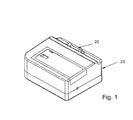
- the system is suitable for use as a single-use device due to the incorporation of inexpensive non-peristaltic-type pumps, such as single cylinder reciprocating pumps, used in conjunction with other fluid control elements, to achieve flow attributes similar to that of a peristaltic pump design, yet at a much reduced cost and size. See Figure 1 .
- the reduced size of the invention relative to the current state of the art system incorporating peristaltic pumps having similar flow capacities, allows the entire system to be contained within the sterile field of the operating room environment, therefore more accessible to the operating physician throughout the medical intervention procedure.
- the reduced cost of the reciprocating pumps allows a single-use design to be more cost effective, eliminating the need for cleaning and re-sterilization of the pumping mechanism after use.
- the pumping system (see figure 2 ) of a preferred embodiment of the invention utilizes positive displacement pumps that may be capable of self-priming, such as reciprocating pumps to drive the flow of fluid for infusion 64 and aspiration 80 during a medical intervention procedure.
- the fluid control elements of the invention alter the flow attributes inherent in a reciprocating pump, by serving a damping function and a start/stop or valve function (to be discussed later), such that the flow is more suited for use in interventional medical procedures.
- a preferred embodiment provides for a more visible pathway, with transparent viewports 20, such that the pathway may be visually inspected before and during use of the pumping system.
- the present invention addresses the fluctuating flow shortcoming of the single cylinder reciprocating pump by incorporating a compliant element (e.g., diaphragm 30, or damper spring 40 and damper piston 42, or elastomeric conduit 44, as shown in Figures 3 and 4a-4c ) in the fluid pathway between the guide catheter 72 and the entrance to the aspiration pump 80 (as shown in Fig. 6b ), to act as a pulse damper, smoothing the instantaneous flow rate in the conduit.
- a compliant element e.g., diaphragm 30, or damper spring 40 and damper piston 42, or elastomeric conduit 44, as shown in Figures 3 and 4a-4c
- the compliant element smoothes flow in the conduit by distorting a small distance (not shown) in response to an increase in fluid pressure. This has the effect of increasing the available volume for the fluid, thereby effectively storing liquid (and energy) from the conduit during the high pressure portion of the pump cycle. Conversely, when the fluid pressure falls, the compliant element moves in the opposite direction, effectively decreasing the available volume for the fluid, and thereby releasing liquid (and energy) to the system during the low pressure portion of the pump cycle.
- the compliant element could be a simple thin walled elastomeric conduit 44 or any other approach that creates a damping effect by increasing the available volume for liquid to reduce pressure, and vice-versa.
- a preferred embodiment solves the leakage problem of reciprocating pumps by adding a shut-off valve 38 or 51 (as shown in Fig. 3 , 5a and 5b , to be discussed later) at the entrance to the aspiration pump 80 (as shown in Fig. 6b )..
- the valve 38 or 51 closes off the fluid pathway 32 when the aspiration pump 80 is stopped.
- the valve 38 or 51 can be actuated by a number of means, electronic, pressure level in the conduit or pressure level in the pump, or manual control. Actuation by pressure level in the conduit is particularly valuable because such a valve insures against excessive pressure buildup within the lumen of a vessel or other cavity of the patient, while preventing flow at lower pressures, such as the level of blood pressure typically generated on the arterial side of the cardiovascular system. Such valves are sometimes referred to as "pressure activated" valves.
- the shut-off valve 38 embodiment may also incorporate the features of a damping mechanism. This can be accomplished by a compliant element in the form of a diaphragm 30 exposed to atmospheric pressure, such that as the valve is open, the variations in the aspiration rate of flow through the fluid pathway 32 are minimized by the compliance of the diaphragm 30.
- a compliant element in the form of a diaphragm 30 exposed to atmospheric pressure, such that as the valve is open, the variations in the aspiration rate of flow through the fluid pathway 32 are minimized by the compliance of the diaphragm 30.
- the aspiration pump 80 When the aspiration pump 80 is inactive, the arterial pressure 34 from the body, in cooperation with the spring 35 closes the disk 33, thereby halting the aspiration through the fluid pathway 32.
- the shut-off valve 38 would reopen the fluid pathway 32 when the aspiration pump 80 is activated and vacuum is applied to both the diaphragm 30 and the disk 33.
- Vacuum is then transferred from the fluid pathway 32, to the diaphragm 30, via fluid bypass port 31.
- the larger area of the diaphragm 30, relative to that of the disk 33, would allow atmospheric pressure acting on the diaphragm 30 to overcome the spring 35 pressure and arterial pressure 34 acting on the disk 33, reopening and allowing extraction through the fluid pathway 32.
- the shut-off valve 51 may be activated upon the injection of medication, contrasting agent, or other fluids 57, through the injection pathway 55.
- Valve 51 differs from valve 38 by, among other things, providing an injection pathway 55; which may be accessed through valve injection port 53.
- the shut-off valve 51 will close off the aspiration through the fluid pathway 32 as the injection of fluids 57 is made. This is desirable to prevent the flow of the injected fluid 57 directly to the extraction pump 80, rather than toward the patient.
- single cylinder reciprocating pumps provide an attractive option with the exception of not being able to visually inspect the fluid pathway of the pump.
- Infusion devices that are used in the arterial or venous system need to provide protection against accidental air infusion.
- An effective and inexpensive means of protection is visual inspection of the fluid pathway prior to and during infusion.
- a reciprocating pump consists essentially of a piston moving back and forth in a cylinder and two one-way valves that control flow into and out of the cylinder.
- An embodiment of the present invention mitigates the inspection problem by providing a transparent viewport 20 (as shown in Fig. 2 ), and utilizing transparent tubing 21. Additionally inlet 66 and outlet 68 check-valves may be made of transparent material. Furthermore the preferred embodiment relocates these elements of the pump to visible areas of the fluid pathway. In this manner, the remaining pumping volume that cannot be readily inspected is reduced to the cylinder volume of the pump.
- the typical cylinder volume for the inexpensive pumps used in this embodiment is below the threshold of concern cited in infusion device standards.
- the pumping system shown is illustrative of embodiments contemplated by the present invention, including the incorporation of reciprocating pumps 64, 80, in a reduced size and lower cost, single-use package, along with flow control devices (e.g., a shut off valve 76, a pulse damper 78, etc.), to alter the inherent flow characteristics of these reciprocating pumps.
- flow control devices e.g., a shut off valve 76, a pulse damper 78, etc.
- the infusion 64 and aspiration pumps 80 of the present invention may be arranged in a single housing 23, along with the necessary tubing 84, 85 and valves 66, 68 (referring to Figs. 6a and 6b ) to supply and extract.
- the housing 23 may be of modular design, with one module containing the reciprocating pumps 64, 80, tubing 21, 84, 85 and valves 66, 68, 76, while a second module contains the required electronics and user interface to control the pumps and/or valves (not shown). This embodiment would facilitate sterilization of the system.
- the pumps 64, 80, and valves 66, 68, 76 are best sterilized using gamma radiation.
- Electronic components typically cannot be sterilized by gamma irradiation.
- the section containing the electronics could be separated from the rest of the pumping system and sterilized (using non radioactive methods (e.g., ethylene oxide).
- the reciprocating, aspiration pump 80 as shown in Fig. 6b may be used to aspirate fluid and any debris from the patient during medical intervention procedures, i.e. the pump 80 aspirates to remove any debris produced during diagnostics or procedures (e.g., angioplasty), by drawing the debris through a lumen, such as a catheter 72.
- the aspiration pump 80 is capable of matching or exceeding the rate of flow of the infusion pump 64 (see Fig. 6a ), which need only provide enough flow to flush or agitate the lesion site. This imbalanced flow may be used to ensure that debris is evacuated from the patient, rather than being washed into the rest of the vascular system.
- the flow rate of the aspiration pump 80 may be in the range of e.g., 40 to 200 mL/minute.
- the aspiration pump 80 may be a reciprocating piston pump, or more preferably a reciprocating diaphragm pump, such as that supplied by ACI Medical (San Marcos, CA), or other vendors, but may be any positive displacement pump that meets the requirements of low cost, and reduced size relative to a peristaltic pump with similar flow rates.
- the aspiration pump 80 inlet is connected to a conduit suitable for extracting fluid from a patient, such as a guide catheter 72; the valve (if used) is connected to the aspiration pump 80 which is in turn connected to a conduit or flexible aspiration tubing 85 to route the fluid to an extraction bag 82 or container.
- the reciprocating, infusion pump 64 as shown in Fig. 6b is used to deliver fluid to the patient during the procedure, e.g., the infusion pump 64 provides an injection of fluid (e.g., saline, drugs, and/or contrast agent) into the procedure site (e.g., saphenous vein graft, carotid, etc.) to agitate any debris and allow visualization of the procedure.
- fluid e.g., saline, drugs, and/or contrast agent
- the flow rate of the infusion pump 64 may be in the range of e.g., 20 to 50 mL/ minute.
- the infusion pump 64 may be a reciprocating diaphragm pump, or alternatively may be a reciprocating piston pump, as discussed above.
- the flexible infusion tubing 84 is connected to the source of fluid e.g., the reservoir bag 62, to be injected, generally located approximately two feet above the infusion pump 64 to provide some positive head pressure to the pump.
- the outlet from the pump 64 is connected via conduit of flexible infusion tubing 84 to a means of injecting the fluid within the body, such as a flush catheter 70, which may be inserted 71 through a guide connector branch 74 into the inner diameter of the guide catheter 72, ultimately extending out of the end of the guide catheter 72 and into the procedure site (e.g., saphenous vein graft, carotid, etc.)
- the aspiration pump 80 and the infusion pump 64 may contain a mechanism to allow the determination of the speed of the pump, such as an optical sensor to detect light reflected from a reflective surface of the rotating motor shaft, or alternatively, a sensor to detect fluctuating voltage, which is proportional to the speed of rotation of the shaft, or any other means of detecting pump rotation.
- a control system may be utilized to monitor, maintain or alter the speed of the pumps, or alternatively activate an alarm if needed, e.g., in the event of a stalled motor.
- the positive displacement pumps are in intimate contact with the fluid, and are intended to be sized to provide sufficient flow to meet the system requirements.
- a blocked catheter will cause the pumps to stall and stop pumping until the blockage is cleared.
- This feature precludes the need for a pressure sensor as is required on the peristaltic system, because the pumps are not powerful enough to cause a significant and possibly dangerous pressure without stalling.
- the pumps Conversely, if the pumped fluid changes to gas, from liquid, the pumps will speed up significantly due to the greatly reduced load. Therefore, a control system is very adaptable to these embodiments.
- the pumps' sensitivity to load variations is also helpful during the priming process. While air is being cleared through the pumps ahead of the liquid, the pumps will run relatively fast, then slow down significantly when the liquid has reached the pumping cylinders.
- the speed variation is detectable and can be used to signal to the operator that the pump is primed with liquid. The same speed variation would occur in reverse if a primed system experienced a large leak, resulting in an ingestion of air, causing the pumps to speed up. as previously discussed, this condition can be detected and used to initiate an alarm, for example.
- Figures 6a and 6b show fluid pathways.
- the fluid pathway is schematically split into infusion, Fig. 6a , and extraction, Fig. 6b .
- the fluid circuit path consists of reservoir bag 62, infusion pump 64, infusion pump inlet check-valve 66, infusion pump outlet check-valve 68, flush catheter 70, guide catheter 72, guide connector branch 74 having an injection branch 73, shut-off valve 76, pulse damper 78, aspiration pump 80 with internal inlet and exhaust check-valves (not shown), extraction bag 82, and flexible tubing for infusion 84 and aspiration 85, preferably of the transparent or translucent variety to transport the fluid from one of the above-described components to the next.
- fluid from reservoir bag 62 flows past infusion pump inlet check-valve 66 to infusion pump 64, where it is pumped past infusion pump outlet check-valve 68, through flexible infusion tubing 84 into the entrance portion of flush catheter 70. From there, the fluid flows out the distal end of the catheter 70 into the lesion or procedure site within the body of the patient that is to receive the diagnostic or therapeutic treatment.
- fluid within the procedure site to be removed from the patient's body flows under pressure e.g., blood pressure, or applied vacuum, into the distal end of the guide catheter 72 (catheter 70 maybe inserted into guide catheter 72 via guide connector branch 74), flowing through and exiting at the proximal end of the guide catheter, into the guide connector branch 74, and into flexible aspiration tubing 85. From there, the extracted fluid flows past or through the shut off valve 76, which may be incorporated into the damper valve 78 (as shown in fig.
- aspiration pump 80 which may contain internal check-valves (not shown) or alternatively, external check-valves similar in operation to those of the infusion pump 64. Finally the fluid from the aspiration pump 80, flows through more flexible aspiration tubing 85 to be collected by extraction bag 82.
- the saline reservoir bag 62 is located in an elevated position to avoid entraining air in the system, and the flush catheter 70 is now inserted onto the guidewire by techniques known in the art.
- This attachment procedure has the potential to trap a small air bubble at the tip, just inside the flush catheter 70.
- the fact that there is an open flow path through the infusion pump 64 serves to create a positive drip through the catheter 70 and expel the air bubble.
- the flush catheter 70 is now slid along the guidewire, and inside the guide catheter 72 to the lesion site (via guide connector branch 74).
- the pump process begins with the aspiration pump 80 running first for a set time period to establish a suction pressure prior to the infusion pump 64 turning on.
- the infusion pump 64 turns on at a flow rate significantly less than that of the aspiration pump, to assure that debris is not forced distal of the procedure site, rather than into the guide catheter 72.
- a distal balloon (not shown) may be used to create an area which may be vigorously flushed without allowing any debris to travel in the distal direction. Additionally, aspirating more fluid than is infused may keep debris from backing up into the artery (etc.) in the proximal direction.
- the flow of saline from the reservoir bag 62 is halted and the extraction side shut-off valve 76 is closed.
- these steps can be carried out nearly simultaneously.
- the syringe (not shown) containing the contrast medium is purged of air, and inserted into the injection port 73 of guide connector branch 74 located at the proximal end of the guide catheter 72.
- the plunger of the syringe is depressed, thereby injecting the contrast medium into the guide connector branch 74. Note that this injection port is in a direct flow path with the extraction side 75 of the guide connector branch 74.
- shut-off valve 76 should be in the "closed” position; otherwise, the relatively low resistance offered by the extraction side 75 of the guide connector branch 74 compared to the "patient" side 77 of the guide connector branch 74, will likely cause most of the contrast medium to flow straight out of the guide connector branch 74, ultimately ending up in the extraction bag 82, rather than in the patient, where it is desired.
- the syringe may either be left in the guide connector branch 74, or it may be withdrawn.
- the pumping system may be re-energized in the same sequence as described previously.
- the pumps are de-energized, starting first with the infusate pump 64.
- the extraction side shut-off valve 76 is closed.
- the catheter 70 is withdrawn from the patient's body.
- the saline solution is drained or pumped into the extraction bag 82, clearing the lines.
- the liquid flow circuit is then disassembled, and the pump system may be discarded. Components that are to be re-used, if any, are cleaned and sterilized.
Landscapes
- Health & Medical Sciences (AREA)
- Heart & Thoracic Surgery (AREA)
- Life Sciences & Earth Sciences (AREA)
- Animal Behavior & Ethology (AREA)
- Engineering & Computer Science (AREA)
- Anesthesiology (AREA)
- Biomedical Technology (AREA)
- Hematology (AREA)
- Veterinary Medicine (AREA)
- Vascular Medicine (AREA)
- General Health & Medical Sciences (AREA)
- Public Health (AREA)
- Pulmonology (AREA)
- Infusion, Injection, And Reservoir Apparatuses (AREA)
- External Artificial Organs (AREA)
- Reciprocating Pumps (AREA)
Claims (11)
- Pumpensystem zur Verwendung bei medizinischen Anwendungeln, bei denen Flüssigkeiten in ein lebendes Wesen infundiert werden und aus diesem abgesaugt werden, wobei das System umfasst:(a) eine Einrichtung zum Infundieren einer Flüssigkeit in den Patienten;(b) eine Einrichtung zum Absaugen einer Flüssigkeit aus dem Patienten entlang eines Absaugwegs (85), wobei jede der Einrichtungen eine positive Verdrängungspumpe (64, 80), die keine Pumpe vom Peristaltiktyp ist, umfasst, wobei die positive Verdrängungspumpe eine Einlass- und eine Auslass-Seite aufweist, wobei wenigstens die Absaugeinrichtung ein Absperrventil (76) aufweist, das an der Einlass-Seite dieser Pumpe angeordnet ist; und(c) eine Dämpfungsvorrichtung (30, 40/42, 44, 78) zum Dämpfen von Druckschwankungen wenigstens in der gepumpten Flüssigkeit im Absaugweg; und(d) eine Einrichtung zum Steuern der Pumpe.
- Pumpensystem nach Anspruch 1, das außerdem eine Einrichtung zur unabhängigen Steuerung des Flüssigkeitsdrucks oder -volumens auf den Infusions- und Extraktionsseiten umfasst.
- Pumpensystem nach Anspruch 1, wobei das System in der Lage ist, einen kontinuierlichen Fluidweg aus der Infusatpumpeneinrichtung durch den Patienten und hinaus zu der Absaugpumpeneinrichtung aufrecht zu halten, sowohl wenn die Pumpeneinrichtung in Betrieb ist als auch im Leerlaufbetrieb.
- Pumpensystem nach Anspruch 1, wobei das System zur Selbstansaugung in der Lage ist.
- Pumpensystem nach Anspruch 1, das außerdem eine visuelle Luftblasendetektion aufweist.
- Pumpensystem nach Anspruch 1, wobei eine einzige Pumpe sowohl einen positiven Druck für die Infusionseinrichtung, als auch einen negativen Druck für die Extraktionseinrichtung erzeugt.
- Pumpensystem nach Anspruchl, wobei die Infusionseinrichtung und die Extraktionseinrichtung von getrennten Pumpen gebildet werden.
- Pumpensystem nach Anspruch 1, wobei die Infusionseinrichtung eine Kolbenpumpe umfasst.
- Pumpensystem nach Anspruch 1, wobei die Extraktionseinrichtung eine Membranpumpe umfasst.
- Pumpensystem nach Anspruch 7, wobei die Pumpen von Motoren angetrieben werden, wobei die Motoren Geschwindigkeitssensoren aufweisen, und wobei elektrische Ausgangssignale von den Geschwindigkeitssensoren in einer negativen Rückkopplungschleife zur Einstellung der Geschwindigkeit der Motoren verwendet werden.
- Pumpensystem nach Anspruch 1, wobei das Absperrventil (76) die Dämpfungsvorrichtung (30, 40/42, 44, 78) beinhaltet.
Applications Claiming Priority (3)
| Application Number | Priority Date | Filing Date | Title |
|---|---|---|---|
| US10/253,034 US7998107B2 (en) | 2002-09-24 | 2002-09-24 | Interventional procedure drive and control system |
| US253034 | 2002-09-24 | ||
| PCT/US2003/029941 WO2004028592A1 (en) | 2002-09-24 | 2003-09-23 | Pump drive and control system for infusion to and aspiration from a surgical site |
Publications (2)
| Publication Number | Publication Date |
|---|---|
| EP1545648A1 EP1545648A1 (de) | 2005-06-29 |
| EP1545648B1 true EP1545648B1 (de) | 2015-06-03 |
Family
ID=31993074
Family Applications (1)
| Application Number | Title | Priority Date | Filing Date |
|---|---|---|---|
| EP03759434.8A Revoked EP1545648B1 (de) | 2002-09-24 | 2003-09-23 | Pumpenantrieb und kontrollsystem für die infusion zu und absaugung von einer chirurgieeingriffsstelle |
Country Status (6)
| Country | Link |
|---|---|
| US (2) | US7998107B2 (de) |
| EP (1) | EP1545648B1 (de) |
| JP (1) | JP4618713B2 (de) |
| AU (1) | AU2003275165A1 (de) |
| CA (1) | CA2503484C (de) |
| WO (1) | WO2004028592A1 (de) |
Families Citing this family (69)
| Publication number | Priority date | Publication date | Assignee | Title |
|---|---|---|---|---|
| US7727181B2 (en) | 2002-10-09 | 2010-06-01 | Abbott Diabetes Care Inc. | Fluid delivery device with autocalibration |
| EP1552146B1 (de) | 2002-10-09 | 2011-04-20 | Abbott Diabetes Care Inc. | Kraftstoffzufuhrvorrichtung, system und verfahren |
| US7399401B2 (en) * | 2002-10-09 | 2008-07-15 | Abbott Diabetes Care, Inc. | Methods for use in assessing a flow condition of a fluid |
| US7993108B2 (en) | 2002-10-09 | 2011-08-09 | Abbott Diabetes Care Inc. | Variable volume, shape memory actuated insulin dispensing pump |
| US7679407B2 (en) * | 2003-04-28 | 2010-03-16 | Abbott Diabetes Care Inc. | Method and apparatus for providing peak detection circuitry for data communication systems |
| CN101180093B (zh) | 2005-03-21 | 2012-07-18 | 雅培糖尿病护理公司 | 用于提供结合的药剂输液以及分析物监测系统的方法和系统 |
| US7768408B2 (en) | 2005-05-17 | 2010-08-03 | Abbott Diabetes Care Inc. | Method and system for providing data management in data monitoring system |
| EP1746558B1 (de) * | 2005-07-20 | 2013-07-17 | MedTAG Ltd. | System für die Simulation eines manuellen Eingriffes in einem medizinischen Verfahren |
| US7503910B2 (en) * | 2006-02-01 | 2009-03-17 | Carmeli Adahan | Suctioning system, method and kit |
| EP1909863A1 (de) * | 2005-07-24 | 2008-04-16 | Carmeli Adahan | Wundverschluss und drainagesystem |
| WO2007013064A1 (en) * | 2005-07-24 | 2007-02-01 | Carmeli Adahan | Suctioning system, method and kit |
| US20070060878A1 (en) | 2005-09-01 | 2007-03-15 | Possis Medical, Inc. | Occlusive guidewire system having an ergonomic handheld control mechanism and torqueable kink-resistant guidewire |
| US8608703B2 (en) | 2007-06-12 | 2013-12-17 | Medrad, Inc. | Infusion flow guidewire system |
| US7756561B2 (en) * | 2005-09-30 | 2010-07-13 | Abbott Diabetes Care Inc. | Method and apparatus for providing rechargeable power in data monitoring and management systems |
| US7583190B2 (en) | 2005-10-31 | 2009-09-01 | Abbott Diabetes Care Inc. | Method and apparatus for providing data communication in data monitoring and management systems |
| US20070129630A1 (en) * | 2005-12-07 | 2007-06-07 | Shimko Daniel A | Imaging method, device and system |
| US20070135706A1 (en) * | 2005-12-13 | 2007-06-14 | Shimko Daniel A | Debridement method, device and kit |
| US8579853B2 (en) | 2006-10-31 | 2013-11-12 | Abbott Diabetes Care Inc. | Infusion devices and methods |
| US12290277B2 (en) | 2007-01-02 | 2025-05-06 | Aquabeam, Llc | Tissue resection with pressure sensing |
| US9232959B2 (en) | 2007-01-02 | 2016-01-12 | Aquabeam, Llc | Multi fluid tissue resection methods and devices |
| EP2120737B1 (de) | 2007-02-05 | 2020-04-01 | Boston Scientific Limited | Thrombektomie-vorrichtung |
| CA2687406A1 (en) | 2007-05-07 | 2008-11-13 | Carmeli Adahan | Suction system |
| US20090216189A1 (en) * | 2007-09-24 | 2009-08-27 | Seth Gasser | Device and method for controlling flow of liquid fluid in arthroscopic surgery |
| JP5506702B2 (ja) | 2008-03-06 | 2014-05-28 | アクアビーム エルエルシー | 流体流れ内を伝達される光学エネルギーによる組織切除および焼灼 |
| US9510854B2 (en) | 2008-10-13 | 2016-12-06 | Boston Scientific Scimed, Inc. | Thrombectomy catheter with control box having pressure/vacuum valve for synchronous aspiration and fluid irrigation |
| CA2740875A1 (en) * | 2008-10-15 | 2010-04-22 | Symbios Medical Products, Llc | Electronic flow control |
| JP2010148800A (ja) * | 2008-12-26 | 2010-07-08 | Cardio Corp | 血液供給装置 |
| WO2015035249A2 (en) | 2013-09-06 | 2015-03-12 | Procept Biorobotics Corporation | Automated image-guided tissue resection and treatment |
| WO2010129375A1 (en) | 2009-04-28 | 2010-11-11 | Abbott Diabetes Care Inc. | Closed loop blood glucose control algorithm analysis |
| US10588609B2 (en) | 2010-02-04 | 2020-03-17 | Procept Biorobotics Corporation | Gene analysis and generation of stem cell methods and apparatus |
| EP2603254A4 (de) | 2010-08-12 | 2016-08-24 | Boston Scient Ltd | Infusionsflusssystem und flüssigkeitskupplung |
| JP2014500538A (ja) | 2010-10-12 | 2014-01-09 | タニス,ケヴィン ジェイ. | 医療機器 |
| CN104203078B (zh) | 2012-02-29 | 2018-04-20 | 普罗赛普特生物机器人公司 | 自动化图像引导的组织切除和处理 |
| US20130310738A1 (en) * | 2012-05-21 | 2013-11-21 | Lifemedix, Llc | Portable intravenous fluid delivery device with a user interface |
| GB2516379B (en) * | 2012-05-29 | 2015-08-26 | Apex Medical Corp | Negative pressure wound therapy system with a buffering unit |
| NL2009424C2 (en) * | 2012-09-06 | 2014-03-10 | D O R C Dutch Ophthalmic Res Ct International B V | Irrigation/aspiration system, cartridge, pump unit, surgical machine, method for controlling. |
| ITPR20120072A1 (it) * | 2012-10-31 | 2014-05-01 | Ca Mi Societa A Responsabilita Li Mitata | Dispositivo per il recupero di aria proveniente da un aspiratore e impianto comprendente tale dispositivo |
| AU2014236701B2 (en) | 2013-03-14 | 2018-07-19 | Smith & Nephew Inc. | Systems and methods for applying reduced pressure therapy |
| US9737649B2 (en) | 2013-03-14 | 2017-08-22 | Smith & Nephew, Inc. | Systems and methods for applying reduced pressure therapy |
| CA2920850C (en) | 2013-08-13 | 2022-08-30 | Smith & Nephew, Inc. | Systems and methods for applying reduced pressure therapy |
| US10219814B2 (en) | 2013-12-13 | 2019-03-05 | Rex Medical, L.P. | Aspiration system for thrombectomy procedures |
| US9433427B2 (en) | 2014-04-08 | 2016-09-06 | Incuvate, Llc | Systems and methods for management of thrombosis |
| US9248221B2 (en) | 2014-04-08 | 2016-02-02 | Incuvate, Llc | Aspiration monitoring system and method |
| US9883877B2 (en) | 2014-05-19 | 2018-02-06 | Walk Vascular, Llc | Systems and methods for removal of blood and thrombotic material |
| BR112016031037B1 (pt) | 2014-06-30 | 2023-02-07 | Procept Biorobotics Corporation | Aparelho para ablação de tecido vascular |
| US12133789B2 (en) | 2014-07-31 | 2024-11-05 | Smith & Nephew, Inc. | Reduced pressure therapy apparatus construction and control |
| EP3659638B1 (de) | 2014-07-31 | 2026-01-07 | Smith & Nephew, Inc. | Systeme und verfahren zur anwendung einer therapie mit reduziertem druck |
| CN107072591B (zh) | 2014-09-05 | 2021-10-26 | 普罗赛普特生物机器人公司 | 与靶器官图像的治疗映射结合的医师控制的组织切除 |
| ES2842750T3 (es) * | 2014-09-05 | 2021-07-14 | Procept Biorobotics Corp | Aparato para el aislamiento de células |
| CA2972691C (en) | 2014-12-30 | 2023-02-21 | Smith & Nephew, Inc. | Systems and methods for applying reduced pressure therapy |
| EP3240586B1 (de) | 2014-12-30 | 2024-08-28 | Smith & Nephew, Inc | System zur anwendung von therapien mit reduziertem druck |
| US10702292B2 (en) | 2015-08-28 | 2020-07-07 | Incuvate, Llc | Aspiration monitoring system and method |
| US10561440B2 (en) | 2015-09-03 | 2020-02-18 | Vesatek, Llc | Systems and methods for manipulating medical devices |
| US20170100142A1 (en) | 2015-10-09 | 2017-04-13 | Incuvate, Llc | Systems and methods for management of thrombosis |
| US10226263B2 (en) | 2015-12-23 | 2019-03-12 | Incuvate, Llc | Aspiration monitoring system and method |
| AU2017218439B2 (en) | 2016-02-12 | 2022-07-28 | Smith & Nephew, Inc. | Systems and methods for detecting operational conditions of reduced pressure therapy |
| US10492805B2 (en) | 2016-04-06 | 2019-12-03 | Walk Vascular, Llc | Systems and methods for thrombolysis and delivery of an agent |
| EP4059530B1 (de) | 2016-05-13 | 2025-07-23 | Smith & Nephew, Inc. | Automatische wundenverbindungsdetektion in unterdruckwundtherapiesystemen |
| EP3318226B1 (de) | 2016-11-03 | 2021-01-06 | This AG | Saubere venturi aspiration |
| JP2019054914A (ja) * | 2017-09-20 | 2019-04-11 | 多田プラスチック工業株式会社 | 体内不要物吸引装置 |
| DE102018107439A1 (de) * | 2018-03-28 | 2019-10-02 | Karl Storz Se & Co. Kg | Medizinisches Instrument |
| WO2019200201A1 (en) | 2018-04-12 | 2019-10-17 | The Regents Of The University Of Michigan | System for effecting and controlling oscillatory pressure within balloon catheters for fatigue fracture of calculi |
| US11678905B2 (en) | 2018-07-19 | 2023-06-20 | Walk Vascular, Llc | Systems and methods for removal of blood and thrombotic material |
| CN110456837B (zh) * | 2019-07-29 | 2021-03-19 | 清华大学 | 正负压一体流体压力调节装置、系统及方法 |
| EP4168678A4 (de) * | 2020-06-18 | 2024-06-19 | Milwaukee Electric Tool Corporation | Vakuumpumpe mit einem magnetventil |
| US11957365B2 (en) * | 2020-11-20 | 2024-04-16 | Covidien Lp | Aspiration pulsator |
| JP2024506061A (ja) | 2021-02-04 | 2024-02-08 | アンプリチュード バスキュラー システムズ インコーポレイテッド | 脈動バルーンカテーテルシステム及びそれを使用する方法 |
| US12274458B2 (en) | 2021-02-15 | 2025-04-15 | Walk Vascular, Llc | Systems and methods for removal of blood and thrombotic material |
| EP4291261A1 (de) | 2021-02-15 | 2023-12-20 | Walk Vascular, LLC | Systeme und verfahren zur entfernung von blut und thrombotischem material |
Citations (8)
| Publication number | Priority date | Publication date | Assignee | Title |
|---|---|---|---|---|
| US2474512A (en) | 1945-11-27 | 1949-06-28 | Fluor Corp | Pulsation elimination in fluid streams |
| US3838944A (en) | 1971-08-27 | 1974-10-01 | E Kolfertz | Diaphragm pumps with pressure equalising chambers |
| US4650462A (en) | 1985-07-29 | 1987-03-17 | Minnesota Mining And Manufacturing Company | Irrigation system |
| US4921477A (en) | 1987-10-14 | 1990-05-01 | The Cooper Companies, Inc. | Surgical irrigation and aspiration system with dampening device |
| US5066282A (en) | 1987-09-23 | 1991-11-19 | Leocor, Inc. | Positive displacement piston driven blood pump |
| US5843022A (en) | 1995-10-25 | 1998-12-01 | Scimied Life Systems, Inc. | Intravascular device utilizing fluid to extract occlusive material |
| US5931808A (en) | 1992-10-19 | 1999-08-03 | Arthrotek, Inc. | Cassette for endoscope |
| EP1010437A1 (de) | 1998-06-30 | 2000-06-21 | Nidek Co., Ltd. | Saug- und Spülvorrichtung |
Family Cites Families (28)
| Publication number | Priority date | Publication date | Assignee | Title |
|---|---|---|---|---|
| GB1312251A (en) * | 1969-06-13 | 1973-04-04 | Nat Res Dev | Blood pumps |
| US3860000A (en) * | 1973-07-12 | 1975-01-14 | Lear Siegler Inc | Medical apparatus and method for feeding and aspirating |
| US4180074A (en) * | 1977-03-15 | 1979-12-25 | Fibra-Sonics, Inc. | Device and method for applying precise irrigation, aspiration, medication, ultrasonic power and dwell time to biotissue for surgery and treatment |
| DE3205449C2 (de) * | 1982-02-16 | 1985-10-17 | Fresenius AG, 6380 Bad Homburg | Vorrichtung zum Reinigen des Blutes von Stoffwechselprodukten |
| US4604089A (en) * | 1983-08-15 | 1986-08-05 | Codman & Shurtleff, Inc. | Pressure regulated irrigation system for arthroscopy |
| JPS61272045A (ja) * | 1985-05-29 | 1986-12-02 | 住友ベークライト株式会社 | 超音波手術装置 |
| JPS63238870A (ja) * | 1987-03-27 | 1988-10-04 | 日機装株式会社 | プログラム可能な連続微量注入ポンプ |
| JPH01117350U (de) * | 1988-01-29 | 1989-08-08 | ||
| US5813842A (en) * | 1989-09-22 | 1998-09-29 | Tamari; Yehuda | Pressure sensitive valves for extracorporeal pumping-3 |
| US5191878A (en) | 1990-04-12 | 1993-03-09 | Olympus Optical Co., Ltd. | Endoscope device |
| CA2048120A1 (en) | 1990-08-06 | 1992-02-07 | William J. Drasler | Thrombectomy method and device |
| EP0533321A3 (en) * | 1991-07-22 | 1993-05-12 | Dow Corning Wright Corporation | Expanding atherectomy device |
| EP0692266B1 (de) * | 1991-08-21 | 2000-03-22 | Smith & Nephew, Inc. | Flüssigkeitsbehandlungssystem |
| US5242404A (en) * | 1992-02-12 | 1993-09-07 | American Cyanamid Company | Aspiration control system |
| ATE187652T1 (de) * | 1992-11-06 | 2000-01-15 | Grieshaber & Co Ag | Ophthalmologisches aspirations- und irrigationssystem |
| JPH07265319A (ja) * | 1994-03-28 | 1995-10-17 | Surgical Syst & Instr Inc | 閉塞した血管を開放するアテレクトミー装置 |
| JP3328078B2 (ja) * | 1994-04-28 | 2002-09-24 | 日機装株式会社 | 透析濾過装置 |
| US5531681A (en) * | 1995-01-13 | 1996-07-02 | Abbott Laboratories | Apparatus for altering composition of nutritional product during enteral tube feeding |
| US5650071A (en) * | 1995-06-07 | 1997-07-22 | Cobe Laboratories, Inc. | Technique for priming and recirculating fluid through a dialysis machine to prepare the machine for use |
| US6024720A (en) | 1995-07-18 | 2000-02-15 | Aquarius Medical Corporation | Fluid management system for arthroscopic surgery |
| JP3767008B2 (ja) * | 1996-04-11 | 2006-04-19 | 日本ゼオン株式会社 | 医療用膨張・収縮駆動装置 |
| US5697898A (en) * | 1996-05-31 | 1997-12-16 | Surgical Design Corporation | Automated free flow mechanism for use in phacoemulsification, irrigation and aspiration of the eye |
| US5779721A (en) | 1996-07-26 | 1998-07-14 | Kensey Nash Corporation | System and method of use for revascularizing stenotic bypass grafts and other blood vessels |
| JPH10263078A (ja) * | 1997-03-26 | 1998-10-06 | Nissho Corp | チューブ内に発生する気泡測定方法および気泡測定装置 |
| US6986753B2 (en) | 1998-05-21 | 2006-01-17 | Buivision | Constant ocular pressure active infusion system |
| JP4331869B2 (ja) * | 1999-06-24 | 2009-09-16 | 株式会社根本杏林堂 | 心拍動下冠動脈バイパス手術用自己血潅流装置 |
| ES2278785T3 (es) | 2000-09-22 | 2007-08-16 | C.R. Bard, Inc. | Sistema quirurgico de irrigacion. |
| JP4326942B2 (ja) * | 2001-07-17 | 2009-09-09 | フォックス・ホロー・テクノロジーズ・インコーポレーテッド | 液体量を制御しつつ局所的な灌注及び吸引を行うための液体交換システム |
-
2002
- 2002-09-24 US US10/253,034 patent/US7998107B2/en not_active Expired - Fee Related
-
2003
- 2003-09-23 WO PCT/US2003/029941 patent/WO2004028592A1/en not_active Ceased
- 2003-09-23 AU AU2003275165A patent/AU2003275165A1/en not_active Abandoned
- 2003-09-23 EP EP03759434.8A patent/EP1545648B1/de not_active Revoked
- 2003-09-23 JP JP2004540181A patent/JP4618713B2/ja not_active Expired - Fee Related
- 2003-09-23 CA CA2503484A patent/CA2503484C/en not_active Expired - Fee Related
-
2011
- 2011-08-16 US US13/211,015 patent/US8157787B2/en not_active Expired - Fee Related
Patent Citations (8)
| Publication number | Priority date | Publication date | Assignee | Title |
|---|---|---|---|---|
| US2474512A (en) | 1945-11-27 | 1949-06-28 | Fluor Corp | Pulsation elimination in fluid streams |
| US3838944A (en) | 1971-08-27 | 1974-10-01 | E Kolfertz | Diaphragm pumps with pressure equalising chambers |
| US4650462A (en) | 1985-07-29 | 1987-03-17 | Minnesota Mining And Manufacturing Company | Irrigation system |
| US5066282A (en) | 1987-09-23 | 1991-11-19 | Leocor, Inc. | Positive displacement piston driven blood pump |
| US4921477A (en) | 1987-10-14 | 1990-05-01 | The Cooper Companies, Inc. | Surgical irrigation and aspiration system with dampening device |
| US5931808A (en) | 1992-10-19 | 1999-08-03 | Arthrotek, Inc. | Cassette for endoscope |
| US5843022A (en) | 1995-10-25 | 1998-12-01 | Scimied Life Systems, Inc. | Intravascular device utilizing fluid to extract occlusive material |
| EP1010437A1 (de) | 1998-06-30 | 2000-06-21 | Nidek Co., Ltd. | Saug- und Spülvorrichtung |
Non-Patent Citations (3)
| Title |
|---|
| AHN ET AL.: "A modified transparent angiography catheter: preliminary in vivo and in vitro evaluations", AJNR, vol. 10, no. 3, May 1989 (1989-05-01), pages 587 - 588, XP055271493, Retrieved from the Internet <URL:http://www.ajnr.org/content/10/3/587.full.pdf> |
| E.W. MCALLISTER: "Pipeline Rules of Thumb Handbook", 2002, GULF PROFESSIONAL PUBLISHING, ISBN: 978-0-7506-7471-3, article V. LARRY BEYNART: "Pulsation Control for Reciprocating Pumps", pages: 413 - 420, XP055271492 |
| V, LARRY BEYNART: "Pulsation dampening in suction and discharge systems for PD pumps", WORLD PUMPS, vol. 1999, no. 397, October 1999 (1999-10-01), pages 20 - 24, XP004186421 |
Also Published As
| Publication number | Publication date |
|---|---|
| CA2503484A1 (en) | 2004-04-08 |
| US20120004601A1 (en) | 2012-01-05 |
| AU2003275165A1 (en) | 2004-04-19 |
| US8157787B2 (en) | 2012-04-17 |
| EP1545648A1 (de) | 2005-06-29 |
| WO2004028592A1 (en) | 2004-04-08 |
| JP2006500175A (ja) | 2006-01-05 |
| US20040059284A1 (en) | 2004-03-25 |
| US7998107B2 (en) | 2011-08-16 |
| CA2503484C (en) | 2012-03-13 |
| JP4618713B2 (ja) | 2011-01-26 |
Similar Documents
| Publication | Publication Date | Title |
|---|---|---|
| CA2503484C (en) | Pump drive and control system for infusion to and aspiration from a surgical site | |
| US12156665B2 (en) | Systems and methods for removal of blood and thrombotic material | |
| US11931058B2 (en) | Atherectomy motor control system with tactile feedback | |
| US3841331A (en) | Suction-pump assembly for drawing body fluids | |
| JP4714205B2 (ja) | 血管造影用注射装置用の注射器を自動的に再充填する方法 | |
| US20230047964A1 (en) | Atherectomy motor control system | |
| JP4119479B2 (ja) | 自動空気除去機能付き血液造影剤注入器 | |
| JP2020121190A (ja) | 組織移送のためのデバイスおよび方法 | |
| US11090079B2 (en) | Atherectomy motor control system with haptic feedback | |
| JP2020505114A (ja) | 血液および血栓性物質を除去するためのシステムおよび方法 | |
| JP2004528058A (ja) | 流体注入装置 | |
| WO1994019031A1 (en) | Apheresis system incorporating alternative site for anticoagulant addition | |
| JP2025530982A (ja) | 流体工学管理システム |
Legal Events
| Date | Code | Title | Description |
|---|---|---|---|
| PUAI | Public reference made under article 153(3) epc to a published international application that has entered the european phase |
Free format text: ORIGINAL CODE: 0009012 |
|
| 17P | Request for examination filed |
Effective date: 20050419 |
|
| AK | Designated contracting states |
Kind code of ref document: A1 Designated state(s): AT BE BG CH CY CZ DE DK EE ES FI FR GB GR HU IE IT LI LU MC NL PT RO SE SI SK TR |
|
| RBV | Designated contracting states (corrected) |
Designated state(s): DE FR GB IT |
|
| RAP1 | Party data changed (applicant data changed or rights of an application transferred) |
Owner name: KENSEY NASH CORPORATION |
|
| 17Q | First examination report despatched |
Effective date: 20130808 |
|
| GRAP | Despatch of communication of intention to grant a patent |
Free format text: ORIGINAL CODE: EPIDOSNIGR1 |
|
| INTG | Intention to grant announced |
Effective date: 20141218 |
|
| GRAS | Grant fee paid |
Free format text: ORIGINAL CODE: EPIDOSNIGR3 |
|
| GRAA | (expected) grant |
Free format text: ORIGINAL CODE: 0009210 |
|
| AK | Designated contracting states |
Kind code of ref document: B1 Designated state(s): DE FR GB IT |
|
| REG | Reference to a national code |
Ref country code: GB Ref legal event code: FG4D |
|
| REG | Reference to a national code |
Ref country code: FR Ref legal event code: PLFP Year of fee payment: 13 |
|
| REG | Reference to a national code |
Ref country code: DE Ref legal event code: R096 Ref document number: 60347685 Country of ref document: DE |
|
| REG | Reference to a national code |
Ref country code: DE Ref legal event code: R026 Ref document number: 60347685 Country of ref document: DE |
|
| PLBI | Opposition filed |
Free format text: ORIGINAL CODE: 0009260 |
|
| 26 | Opposition filed |
Opponent name: APOGEE 108 LIMITED Effective date: 20160226 |
|
| PLAX | Notice of opposition and request to file observation + time limit sent |
Free format text: ORIGINAL CODE: EPIDOSNOBS2 |
|
| PG25 | Lapsed in a contracting state [announced via postgrant information from national office to epo] |
Ref country code: IT Free format text: LAPSE BECAUSE OF FAILURE TO SUBMIT A TRANSLATION OF THE DESCRIPTION OR TO PAY THE FEE WITHIN THE PRESCRIBED TIME-LIMIT Effective date: 20150603 |
|
| PLAF | Information modified related to communication of a notice of opposition and request to file observations + time limit |
Free format text: ORIGINAL CODE: EPIDOSCOBS2 |
|
| REG | Reference to a national code |
Ref country code: FR Ref legal event code: PLFP Year of fee payment: 14 |
|
| REG | Reference to a national code |
Ref document number: 60347685 Country of ref document: DE Representative=s name: FRIESE GOEDEN PATENTANWAELTE, DE Ref country code: DE Ref legal event code: R082 Ref country code: DE Ref legal event code: R082 Ref document number: 60347685 Country of ref document: DE Representative=s name: FRIESE GOEDEN PATENTANWAELTE PARTGMBB, DE |
|
| REG | Reference to a national code |
Ref country code: DE Ref legal event code: R082 Ref document number: 60347685 Country of ref document: DE Representative=s name: FRIESE GOEDEN PATENTANWAELTE PARTGMBB, DE |
|
| PLBB | Reply of patent proprietor to notice(s) of opposition received |
Free format text: ORIGINAL CODE: EPIDOSNOBS3 |
|
| PGFP | Annual fee paid to national office [announced via postgrant information from national office to epo] |
Ref country code: DE Payment date: 20160920 Year of fee payment: 14 Ref country code: GB Payment date: 20160921 Year of fee payment: 14 |
|
| PGFP | Annual fee paid to national office [announced via postgrant information from national office to epo] |
Ref country code: FR Payment date: 20160816 Year of fee payment: 14 |
|
| RDAF | Communication despatched that patent is revoked |
Free format text: ORIGINAL CODE: EPIDOSNREV1 |
|
| REG | Reference to a national code |
Ref country code: DE Ref legal event code: R064 Ref document number: 60347685 Country of ref document: DE Ref country code: DE Ref legal event code: R103 Ref document number: 60347685 Country of ref document: DE |
|
| RDAG | Patent revoked |
Free format text: ORIGINAL CODE: 0009271 |
|
| STAA | Information on the status of an ep patent application or granted ep patent |
Free format text: STATUS: PATENT REVOKED |
|
| 27W | Patent revoked |
Effective date: 20171228 |
|
| GBPR | Gb: patent revoked under art. 102 of the ep convention designating the uk as contracting state |
Effective date: 20171228 |