EP1545039B1 - Méthode de décodage par sphères avec rayon réglable - Google Patents
Méthode de décodage par sphères avec rayon réglable Download PDFInfo
- Publication number
- EP1545039B1 EP1545039B1 EP03293223A EP03293223A EP1545039B1 EP 1545039 B1 EP1545039 B1 EP 1545039B1 EP 03293223 A EP03293223 A EP 03293223A EP 03293223 A EP03293223 A EP 03293223A EP 1545039 B1 EP1545039 B1 EP 1545039B1
- Authority
- EP
- European Patent Office
- Prior art keywords
- symbols
- value
- integer
- symbol
- probability value
- Prior art date
- Legal status (The legal status is an assumption and is not a legal conclusion. Google has not performed a legal analysis and makes no representation as to the accuracy of the status listed.)
- Expired - Lifetime
Links
Images

Classifications
-
- H—ELECTRICITY
- H04—ELECTRIC COMMUNICATION TECHNIQUE
- H04L—TRANSMISSION OF DIGITAL INFORMATION, e.g. TELEGRAPHIC COMMUNICATION
- H04L1/00—Arrangements for detecting or preventing errors in the information received
- H04L1/004—Arrangements for detecting or preventing errors in the information received by using forward error control
- H04L1/0045—Arrangements at the receiver end
- H04L1/0047—Decoding adapted to other signal detection operation
- H04L1/005—Iterative decoding, including iteration between signal detection and decoding operation
-
- H—ELECTRICITY
- H04—ELECTRIC COMMUNICATION TECHNIQUE
- H04L—TRANSMISSION OF DIGITAL INFORMATION, e.g. TELEGRAPHIC COMMUNICATION
- H04L1/00—Arrangements for detecting or preventing errors in the information received
- H04L1/004—Arrangements for detecting or preventing errors in the information received by using forward error control
- H04L1/0056—Systems characterized by the type of code used
- H04L1/0071—Use of interleaving
-
- H—ELECTRICITY
- H04—ELECTRIC COMMUNICATION TECHNIQUE
- H04L—TRANSMISSION OF DIGITAL INFORMATION, e.g. TELEGRAPHIC COMMUNICATION
- H04L1/00—Arrangements for detecting or preventing errors in the information received
- H04L1/02—Arrangements for detecting or preventing errors in the information received by diversity reception
- H04L1/06—Arrangements for detecting or preventing errors in the information received by diversity reception using space diversity
- H04L1/0618—Space-time coding
- H04L1/0637—Properties of the code
- H04L1/065—Properties of the code by means of convolutional encoding
-
- H—ELECTRICITY
- H04—ELECTRIC COMMUNICATION TECHNIQUE
- H04L—TRANSMISSION OF DIGITAL INFORMATION, e.g. TELEGRAPHIC COMMUNICATION
- H04L25/00—Baseband systems
- H04L25/02—Details ; arrangements for supplying electrical power along data transmission lines
- H04L25/03—Shaping networks in transmitter or receiver, e.g. adaptive shaping networks
- H04L25/03006—Arrangements for removing intersymbol interference
- H04L25/03178—Arrangements involving sequence estimation techniques
- H04L25/03203—Trellis search techniques
- H04L25/03242—Methods involving sphere decoding
-
- H—ELECTRICITY
- H04—ELECTRIC COMMUNICATION TECHNIQUE
- H04L—TRANSMISSION OF DIGITAL INFORMATION, e.g. TELEGRAPHIC COMMUNICATION
- H04L25/00—Baseband systems
- H04L25/02—Details ; arrangements for supplying electrical power along data transmission lines
- H04L25/03—Shaping networks in transmitter or receiver, e.g. adaptive shaping networks
- H04L25/03006—Arrangements for removing intersymbol interference
- H04L2025/0335—Arrangements for removing intersymbol interference characterised by the type of transmission
- H04L2025/03426—Arrangements for removing intersymbol interference characterised by the type of transmission transmission using multiple-input and multiple-output channels
-
- H—ELECTRICITY
- H04—ELECTRIC COMMUNICATION TECHNIQUE
- H04L—TRANSMISSION OF DIGITAL INFORMATION, e.g. TELEGRAPHIC COMMUNICATION
- H04L25/00—Baseband systems
- H04L25/02—Details ; arrangements for supplying electrical power along data transmission lines
- H04L25/03—Shaping networks in transmitter or receiver, e.g. adaptive shaping networks
- H04L25/03006—Arrangements for removing intersymbol interference
- H04L2025/03433—Arrangements for removing intersymbol interference characterised by equaliser structure
- H04L2025/03439—Fixed structures
- H04L2025/03445—Time domain
- H04L2025/03458—Lattice
-
- H—ELECTRICITY
- H04—ELECTRIC COMMUNICATION TECHNIQUE
- H04L—TRANSMISSION OF DIGITAL INFORMATION, e.g. TELEGRAPHIC COMMUNICATION
- H04L25/00—Baseband systems
- H04L25/02—Details ; arrangements for supplying electrical power along data transmission lines
- H04L25/0202—Channel estimation
- H04L25/0204—Channel estimation of multiple channels
-
- H—ELECTRICITY
- H04—ELECTRIC COMMUNICATION TECHNIQUE
- H04L—TRANSMISSION OF DIGITAL INFORMATION, e.g. TELEGRAPHIC COMMUNICATION
- H04L25/00—Baseband systems
- H04L25/02—Details ; arrangements for supplying electrical power along data transmission lines
- H04L25/0202—Channel estimation
- H04L25/024—Channel estimation channel estimation algorithms
- H04L25/0242—Channel estimation channel estimation algorithms using matrix methods
- H04L25/0248—Eigen-space methods
-
- H—ELECTRICITY
- H04—ELECTRIC COMMUNICATION TECHNIQUE
- H04L—TRANSMISSION OF DIGITAL INFORMATION, e.g. TELEGRAPHIC COMMUNICATION
- H04L25/00—Baseband systems
- H04L25/02—Details ; arrangements for supplying electrical power along data transmission lines
- H04L25/03—Shaping networks in transmitter or receiver, e.g. adaptive shaping networks
- H04L25/03006—Arrangements for removing intersymbol interference
- H04L25/03178—Arrangements involving sequence estimation techniques
- H04L25/03312—Arrangements specific to the provision of output signals
- H04L25/03318—Provision of soft decisions
Definitions
- the present invention relates to a method for interpreting at least one signal transmitted by means of at least one transmitting antenna and received by means of at least one receiving antenna, which method includes:
- Such an interpreting method may be used in telecommunication systems in which multiple antennas are used at a receiver end and/or at a transmitter end of a wireless link, which systems are called Multiple Input Multiple Output systems (further referred to as MIMO systems).
- MIMO systems have been shown to offer large transmission capacities compared to those offered by single antenna systems. In particular, MIMO capacity increases linearly with the number of transmitting or receiving antennas, whichever the smallest, for a given Signal-to-Noise Ratio and under favourable uncorrelated channel conditions. MIMO techniques are thus likely to be used in future wireless systems intended to provide large spectral efficiencies or, alternatively, reduce the transmitting power required for obtaining a spectral efficiency equivalent to that which is obtained in current telecommunication systems.
- Such MIMO techniques will very likely be combined with multi-carrier modulation techniques like OFDM (standing for Orthogonal Frequency Division Multiplex) and MC-CDMA (standing for MultiCarrier-Code Division Multiple Access) techniques, whose use in future wireless systems is also considered.
- OFDM standing for Orthogonal Frequency Division Multiplex
- MC-CDMA standing for MultiCarrier-Code Division Multiple Access
- a particular type of MIMO systems makes use of a Bit Interleaved Coded Modulation technique, further referred to as BICM, according to which the transmitter includes a channel encoder intended to apply an encoding, e.g. by means of a convolutional code or of a turbo code, to uncoded data bits, and to provide a binary stream to an interleaver.
- This interleaver will then deliver permutated bits, which are to be divided into word sequences intended to be transformed into a series of coded symbols featuring each a plurality of components, the components of a same symbol being intended to be transmitted during a same time chip by respective transmitting antennas.
- Transmitted symbols are to be interpreted on the receiver end, which is usually performed in MIMO systems of the BICM type by means of an iterative space-time interpreting process, which iterative process is intended to produce estimates of the original uncoded data bits on the basis of which the transmitted symbols have been generated.
- the spatial diversity induced by the use of multiple transmitting and receiving antennas eases such a decoding, since this diversity provides a larger amount of information than that which would be provided by a single signal transmitted through a single communication channel.
- the initial probability value associated with a given listed symbol may for example consist in a metric representing the distance between the given listed symbol and the received symbol.
- the probability values thus obtained may be refined by making use, in a subsequent decoding step, of additional knowledge pertaining to the encoding scheme which has been used originally for encoding the received signal.
- the refined probability value produced for each bit belonging to a same set of bits representative of all listed symbols by such a decoding step may then be used, in an a posteriori or, preferably, in an extrinsic form from which a priori information related to each bit under consideration has been individually removed, for constituting a priori information to be taken into account in addition to the above-described metrics during execution of another marginalization step in a subsequent iteration of the iterative interpreting method.
- a so-called list sphere selecting technique may be used for selecting, among predetermined symbols forming a lattice constellation of symbols which may potentially be received, estimated symbols which may represent a transmitted symbol.
- a metric representing the distance between the received symbol and a given estimated symbol of the lattice constellation may represent the probability value associated with said estimated symbol.
- only the most likely symbols of the lattice are examined, i.e. those closest to the received symbol, such a limitation being performed by only examining symbols which are included in a sphere having a predetermined radius and centred on the received symbol.
- Such list sphere selecting schemes have been described in European Patent applications EP 1 215 839 A1 and EP 1 221 773 A1 .
- the probability value will no longer be a soft value intended to be reused in the iterative process and then refined.
- such an integer probability value will be a non-refineable hard value, indicative of an irrevocable decision and likely to disturb the iterative process and to cause decoding errors.
- the invention aims at solving this problem, by providing an interpreting method in which hard probability values resulting from a lack of diversity in the values of the bits representing the listed symbols are prevented from disturbing an iterative process like the one described above.
- a method according to the opening paragraph is characterized according to a first aspect of the invention in that the symbol listing step involves defining a radius value of a sphere intended to encompass the symbols to be listed, which radius value is chosen such that at least one probability value associated with at least one bit which is invariant among selected symbols located within said sphere is non-integer and higher than a predetermined probability threshold.
- the invention aims at preventing the occurrence of integer probability values, and thus at preventing such integer values from producing significant adverse effects on an iterative interpreting process, by trying to ensure ab initio that all values of all bits are represented among the population constituted by the symbols selected during the symbol listing step.
- a tuning of the sphere radius performed as described above will enable to add to the symbols included within said sphere a virtual symbol located at the surface of the sphere, which virtual symbol will be deemed featuring a different value for the at least one bit which is invariant among all listed symbols, when said virtual symbol will be processed simultaneously with said listed symbols in the course of the marginalization step.
- the selected radius value R is chosen essentially equal to dc 2 +2. ⁇ 2 .ln[(1/ ⁇ )-1], where dc represents a distance which may separate the center of the sphere from a symbol previously identified as most likely representative of the transmitted symbol, ⁇ 2 representing a noise variance and (1- ⁇ ) the probability threshold.
- the choice of the value ⁇ will enable a simple and automatic tuning of the radius value R of the sphere to be used for carrying out the symbol listing step, such a tuning ensuring that the resulting list will be just large enough to include a sufficient number of symbols for the probability value associated to invariant bits representing said symbols to be at least equal to 1- ⁇ .
- the symbol forming the most likely representative of the transmitted symbol may previously have been identified by performing an initializing step, for example by means of a so-called minimum mean square error technique, or by means of a hard-output sphere decoding technique as described in the above mentioned documents, or according to other known techniques, such as a scheme known to those skilled in the art as the Schnorr-Euchner strategy. Since the main purpose of this initializing step is to provide a hard decision relating to a single symbol instead of soft decisions compiled in a list of estimated symbols with associated likelihood values, the initializing step may be performed quickly and at a relatively low cost in terms of computing power.
- the selected radius value R is chosen essentially equal to dc 2 +2. ⁇ 2 .ln[(Ni/No).((1/ ⁇ )-1)], where dc represents a distance which may separate the center of the sphere from a symbol previously identified as most likely representative of the transmitted symbol, ⁇ 2 representing a noise variance and (1- ⁇ ) the probability threshold, Ni representing a number of virtual symbols also separated from the center of the sphere of radius R by a distance dc, and No representing a number of virtual symbols located at the surface of said sphere.
- the choice of the probability threshold ⁇ will enable a simple and automatic tuning of the radius value R of the sphere to be used for carrying out the symbol listing step, such a tuning ensuring that the resulting list will be just large enough to include Ni virtual symbols for which a given bit has a first value and No virtual symbols for which said given bit has a second, different value, so that the probability value associated to invariant bits representing symbols included in the sphere is at least equal to 1- ⁇ .
- the probability value correction step may further include a substitution step for substituting a predetermined non-integer substitution value for an integer probability value associated to a bit which is invariant from any one symbol listed in said original list to another.
- Such a variant of the invention guarantees that no integer probability values will be left free to damage the soft-decision iterative interpreting process described above, since they will automatically be replaced by non-integer values.
- this variant of the invention may be used individually, it will preferably be used cumulatively with one of the embodiments of the invention described above.
- substitution value may for example be chosen equal to 1- ⁇ if the integer probability value is 1 and equal to ⁇ if the integer probability value is 0, where ⁇ is a predetermined non-integer value chosen lower than 1/2.
- decoding means intended to carry out the decoding step may output integer refined probability values, even if all probability values provided to said decoding means are of a non-integer nature. Such situations may occur due to approximations which will be made during the computational process leading to the refined probability values. As already explained above, such non-integer refined probability values may have an adverse impact on the performance of the iterative interpreting process and lead to errors in the interpretation.
- a method as described above should thus preferably also include :
- the threshold value may for example be chosen equal to 1- ⁇ if the integer refined probability value is 1 and equal to ⁇ if the integer refined probability value is 0, where ⁇ is a predetermined non-integer value chosen lower than 1/2.
- the invention also relates to a telecommunication system including at least one transmitter provided with at least one transmitting antenna and at least one receiver provided with at least one receiving antenna, which receiver includes:
- the invention also relates to a communication device provided with at least one receiving antenna and including:
- the transmitter TR shown in the example depicted here includes a channel encoder CHENC intended to apply an encoding, e.g. by means of a convolutional code or of a turbo code, to uncoded data bits Uncb, and to provide a binary stream Tb to be transmitted.
- the transmitter TR includes an interleaver INTL intended to generate permutated bits Pb, such an interleaving being useful for a later processing on the receiver side, since it will allow to obtain uncorrelated data.
- the permutated bits Pb are then divided into sequences of Nt words of at least one bit each, which word sequences are then mapped, i.e. transformed into a series of coded symbols Zi by a mapping and modulation module MAPMD, each symbol Zi then featuring Nt components. Successive symbols Zi are then fed to symbol encoding means essentially formed by a space-time encoder SPTENC, which performs a processing of said symbols Zi before their transmission.
- each symbol Zi is intended to be transmitted during a same time chip by respective transmitting antennas (ta1,ta2...taNt).
- the receiver REC shown in the example depicted here includes a space-time decoder SPTDEC intended to produce decoded data bits Decb which should ultimately correspond to the originally uncoded data bits Uncb.
- This space-time decoder SPTDEC includes a space-time detector DET intended to process data carried by signals received by means of the receiving antennas (ra1,ra2...raNr), and to produce probability values PrIV(ck) related to bits ck constituting estimates of the transmitted permutated bits Pb.
- the space-time detector DET includes:
- the interleaved probability values PrIV(ck) are intended to be de-interleaved by a de-interleaver DINTL which is to output soft probability values PrV(ck) related to estimates of bits included in the binary stream Tb.
- Decoding means CHDEC formed in this example by a channel decoder included in the receiver REC, are intended to generate the decoded data bits Decb on the basis of said probability values PrV(ck).
- these decoding means CHDEC will make use of prior knowledge pertaining to the encoding scheme used by the channel encoder CHENC included in the transmitter TR for encoding the data bits Uncb, which prior knowledge will enable said decoding means CHDEC to refine the probability values PrV(ck) delivered by the space-time detector DET via the de-interleaver DINTL.
- the space-time detector DET will make use of a priori information Pra(ck) generated for each bit ck in the course of previous decoding steps, and delivered by the decoding means CHDEC in the form of extrinsic information Exd(ck) representative of said refined probability values through an interleaver INTR, which interleaver is identical to the interleaver INTL included in the transmitter TR.
- an a posteriori probability value APP(ck 1) for the kth bit ck to be equal to 1
- x . ⁇ l ⁇ k ⁇ ( cl cl x ) ⁇ x ⁇ LoS p y
- x) represents a likelihood for receiving y if it is supposed that x has been transmitted, and ⁇ (cl cl(x)) represents an a priori probability that the value of the lth bit cl actually equals that of the lth bit cl of a given symbol x belonging to the list of symbols LoS.
- x . ⁇ l ⁇ k ⁇ ( cl cl x ) ⁇ x ⁇ LoS p y
- the symbol listing means SLM included in the space-time detector DET will define a radius value of a sphere intended to encompass the symbols to be listed, which radius value is chosen such that at least one probability value associated with at least one bit which would be invariant among symbols located within said sphere will be non-integer and greater than a predetermined probability threshold.
- the space-time detector DET will further include substitution means, not shown here, for substituting a predetermined non-integer substitution value for an integer probability value PrIV(ck) associated to any given bit ck which would be invariant from any one symbol listed in the list of symbols LoS to another.
- substitution means not shown here, for substituting a predetermined non-integer substitution value for an integer probability value PrIV(ck) associated to any given bit ck which would be invariant from any one symbol listed in the list of symbols LoS to another.
- programmable listing parameters Lpr will help tailoring the list of symbols LoS to be delivered by said symbol listing means SLM in such a way that said list features a suitable diversity, so that the above described substitution means will only be triggered in exceptional situations where the symbol listing means SLM will have failed to produce a list of symbols LoS offering a sufficient diversity despite all efforts made in this purpose.
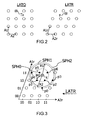
- Fig.2 shows in two dimensions an original lattice constellation LATO constituted by symbols which may be transmitted by a transmitter as described above, and a second lattice constellation LATR constituted by symbols which may potentially be received by means of a receiver as described above.
- the original lattice constellation LATO is defined by a first basic vector system (A1, A2), the second lattice constellation LATR being defined by a second basic vector system (A1r, A2r), which is usually different from the first one because of channel communication conditions affecting signals exchanged between the transmitter and the receiver.
- Y is a vector representative of the received symbol y
- B a vector representative of a symbol originally transmitted
- C a matrix representative of the channel or channels through which said symbol has been transmitted
- N a vector representative of the noise affecting said communication channel or channels
- Symbol decoding means at the receiver end are intended to provide a list of estimated symbols belonging to the second lattice constellation LATR, which estimated symbols may represent the transmitted symbol Tx.
- a metric representing the distance between the received symbol y and a given estimated symbol of the lattice constellation may be computed in order to provide a probability value associated with said estimated symbol.
- only the most likely symbols of the second lattice constellation LATR are to be examined, i.e. those symbols who are the closest to the received symbol y.
- the sphere SPH1 may either be centered on the received symbol y, as is the case in the embodiment of the invention shown here, or may also be centered on a particular symbol of the lattice constellation LATR, which symbol will previously have been identified as being the most likely representative of the received symbol y.
- the probability for this bit c0 to have its actual value "1" will be automatically set to 1 at the end of the marginalization step, the probability for this bit c0 to have another value, e.g. "0" being then conversely set to 0.
- Such an integer probability value will be a non-refineable hard value, indicative of an irrevocable decision and likely to disturb the iterative interpreting process and to cause decoding errors.
- a same conclusion would apply to a list of symbols generated by means of another sphere SPH0 having a smaller radius R0, though it is understandable that such a smaller sphere will offer a smaller amount of statistical information.
- a non-approximated probability value associated with the bit c0 of symbols located within this smaller sphere SPH0 will thus be smaller, for example of the order of 0,9, than a non-approximated probability value associated with the bit c0 of symbols located within the greater sphere SPH1, which could for example be of the order of 0,999.
- the invention aims at preventing integer probability values from appearing in the course of the marginalization step, and thus at preventing such integer probability values from producing significant adverse effects on the iterative interpreting process, by allowing to tune the radius of the sphere used for identifying the symbols to be included in the list of symbols in such a way that said sphere is large enough for encompassing symbols featuring different values for all bits representing said symbols, which should be achieved by virtue of the invention by setting said sphere radius so that the probability value associated with bit c0 which would be invariant among symbols included in spheres SPH0 and SPH1 will be non-integer and greater than a predetermined probability threshold.
- the symbols to be selected will be included in a sphere SPH2 having a radius R2 whose value is chosen essentially equal to dc 2 +2. ⁇ 2 .ln[(1/ ⁇ )-1], where dc represents a distance which may separate the center of the sphere from a symbol previously identified as most likely representative of the transmitted symbol, ⁇ 2 representing a noise variance and (1- ⁇ ) the probability threshold.
- This embodiment of the invention ensures that at least one symbol for which the bit c0 will be equal to 0, which symbol will usually be virtual but coincides with point p0 in the example depicted here, will be located at the surface of the sphere SPH2 and thus included in the list generated by the symbol listing means.
- the a posteriori probability value p(c0 0
- y) may thus be considered proportional to e -R2 2 /2. ⁇ 2 .
- y) will have a non-integer value, i.e. be equal to 1- ⁇ , ⁇ being a non-integer value and defined in the above-mentioned programmable listing parameters Lpr, for example ⁇ 10 -5 or 10 -6 .
- the above-described receiver REC further includes :
- the decoding means DM intended to carry out the decoding step may sometimes output an integer refined probability value, even if all probability values provided to said decoding means are of a non-integer nature. Such situations may occur due to approximations which will be made during the computational process leading to the refined probability values.
- a refined probability value Exd(ck) equal to 0 or to 1 would have an adverse impact on the performance of the iterative interpreting process and lead to errors in the interpretation, which is prevented in this embodiment of the invention thanks to the integer refined probability detection means IPDM and to the thresholding means IRRM.
Landscapes
- Engineering & Computer Science (AREA)
- Computer Networks & Wireless Communication (AREA)
- Signal Processing (AREA)
- Power Engineering (AREA)
- Error Detection And Correction (AREA)
- Radio Transmission System (AREA)
- Detection And Prevention Of Errors In Transmission (AREA)
- Position Input By Displaying (AREA)
Claims (9)
- Méthode pour interpréter au moins un signal transmis au moyen d'au moins une antenne de transmission et reçu au moyen d'au moins une antenne de réception, ladite méthode incluant :- une étape de listage de symboles pour produire une liste de symboles choisis parmi des symboles prédéterminés qui peuvent potentiellement être reçus au moyen d'au moins une antenne de réception, chaque symbole listé étant représenté par au moins un bit,- une étape de marginalisation pour traiter lesdits symboles listés afin de produire au moins une valeur de probabilité à associer à l'au moins dit bit, et- une étape de décodage pour affiner l'au moins dite valeur de probabilité en tenant compte de la connaissance concernant un schéma d'encodage utilisé pour encoder le signal reçu, une valeur de probabilité affinée produite au cours de l'étape de décodage étant destinée à être utilisée en tant que valeur de probabilité a priori durant une étape de marginalisation subséquente,- ladite méthode étant caractérisée en ce que l'étape de listage de symboles implique de définir une valeur de rayon d'une sphère destinée à contenir les symboles à lister, ladite valeur de rayon étant choisie de manière qu'au moins une valeur de probabilité associée avec l'au moins dit bit, qui est un variant parmi les symboles choisis logés à l'intérieur de ladite sphère soit un nombre non entier supérieur à un seuil de probabilité prédéterminé.
- Méthode selon la revendication 1 caractérisée en ce que la valeur de rayon choisie R est choisie essentiellement égale à dc2+2.σ2.1n[(1/ ε)-1], où de représente une distance qui peut séparer le centre de la sphère d'un symbole précédemment identifié comme le représentant le plus probable du symbole transmis, σ2 représentant une variance de bruit et (1-ε) le seuil de probabilité.
- Méthode selon la revendication 1, caractérisée en ce que la valeur de rayon choisie R est choisie essentiellement égale à dc2+2.σ2.ln[(Ni/No).((1/ε)-1)], où de représente une distance qui peut séparer le centre de la sphère d'un symbole précédemment identifié comme représentant le plus probable du symbole transmis, σ 2 représentant une variance de bruit et (1-ε) le seuil de probabilité, Ni représentant un nombre de symboles virtuels aussi séparé du centre de la sphère de rayon R par une distance de et No représentant un nombre de symboles virtuels logés à la surface de ladite sphère.
- Méthode selon une des revendications 1 à 3, incluant de plus une étape de substitution pour substituer une valeur de substitution non entière prédéterminée pour une valeur de probabilité entière associée à un bit qui est invariant à partir de n'importe quel symbole listé dans ladite liste originale jusqu'à un autre.
- Méthode selon la revendication 4, caractérisée en ce que la valeur de substitution est égale à 1-ε si la valeur de probabilité entière est 1 et est égale à ε si la valeur de probabilité entière est 0, ε étant une valeur non entière prédéterminée choisie inférieure à ½.
- Méthode selon une des revendications 1 à 5, caractérisée en ce qu'elle comprend de plus :- une étape de détection de la probabilité affinée entière pour détecter les situations dans lesquelles au moins une valeur de probabilité affinée produite par l'étape de décodage est une valeur entière, et- une étape de seuillage pour remplacer une telle valeur de probabilité affinée entière par une valeur de seuil non entière prédéterminée.
- Méthode selon la revendication 6, caractérisée en ce que la valeur de seuil est égale à 1-δ si la valeur de probabilité affinée entière est 1 et est égale à δ si la valeur de probabilité affinée entière est 0, δ étant une valeur non entière prédéterminée choisie inférieure à ½.
- Système de télécommunication incluant au moins un émetteur prévu avec au moins une antenne d'émission et au moins un récepteur prévu avec au moins une antenne de réception, ledit récepteur incluant :- des moyens de listage de symboles (SLM) pour produire une liste de symboles choisis parmi des symboles prédéterminés qui peuvent potentiellement être reçus au moyen de l'au moins dite antenne de réception, chaque symbole listé étant représenté par au moins un bit,- des moyens de marginalisation (MGM) pour traiter lesdits symboles listés afin de produire au moins une valeur de probabilité à associer à l'au moins dit bit, et- des moyens de décodage (Chdec) pour affiner l'au moins dite valeur de probabilité en tenant compte de la connaissance concernant un schéma d'encodage utilisé pour encoder le signal reçu, une valeur de probabilité affinée produite au cours de l'état de décodage étant destinée à être utilisée en tant que valeur de probabilité a priori durant une étape de marginalisation subséquente,- le système de télécommunication étant caractérisé en ce que les moyens de listage de symboles (SLM) sont prévus pour calculer une valeur du rayon d'une sphère destinée à contenir des symboles à lister, la valeur de rayon étant choisie de manière qu'au moins ladite valeur de probabilité associée à l'au moins dit bit est un avariant parmi les symboles logés à l'intérieur de ladite sphère et non entière et plus grand qu'un seuil de probabilité prédéterminé.
- Un dispositif de communication muni d'au moins une antenne de réception et incluant :- des moyens de listage de symboles (SLM) pour produire une liste de symboles choisis parmi des symboles prédéterminés qui peuvent potentiellement être reçus au moyen de l'au moins dite antenne de réception, chaque symbole listé étant représenté par au moins un bit,- des moyens de marginalisation (MGM) pour traiter lesdits symboles listés afin de produire au moins une valeur de probabilité à associer à l'au moins dit bit, et- des moyens de décodage (Chdec) pour affiner l'au moins dite valeur de probabilité en tenant compte de la connaissance concernant un schéma d'encodage utilisé pour encoder le signal reçu, une valeur de probabilité affinée produite au cours de l'état de décodage étant destinée à être utilisée en tant que valeur de probabilité a priori durant une étape de marginalisation subséquente,- le système de télécommunication étant caractérisé en ce que les moyens de listage de symboles (SLM) sont prévus pour calculer une valeur du rayon d'une sphère destinée à contenir des symboles à lister, la valeur de rayon étant choisie de manière qu'au moins ladite valeur de probabilité associée à l'au moins dit bit est un avariant parmi les symboles logés à l'intérieur de ladite sphère et non entière et plus grand qu'un seuil de probabilité prédéterminé.
Priority Applications (4)
| Application Number | Priority Date | Filing Date | Title |
|---|---|---|---|
| EP03293223A EP1545039B1 (fr) | 2003-12-18 | 2003-12-18 | Méthode de décodage par sphères avec rayon réglable |
| DE60317355T DE60317355T2 (de) | 2003-12-18 | 2003-12-18 | Verfahren zum Interpretieren wenigstens eines Signals mittels wenigstens einer Sendeantenne und mittels wenigstens einer Empfangsantenne |
| AT03293223T ATE377876T1 (de) | 2003-12-18 | 2003-12-18 | Verfahren zur kugeldekodierung mit einstellbarem radius |
| JP2004368540A JP4429156B2 (ja) | 2003-12-18 | 2004-12-20 | 少なくとも1つの信号を判定するための方法、少なくとも1つの送信機を備える通信システムおよび通信装置 |
Applications Claiming Priority (1)
| Application Number | Priority Date | Filing Date | Title |
|---|---|---|---|
| EP03293223A EP1545039B1 (fr) | 2003-12-18 | 2003-12-18 | Méthode de décodage par sphères avec rayon réglable |
Publications (2)
| Publication Number | Publication Date |
|---|---|
| EP1545039A1 EP1545039A1 (fr) | 2005-06-22 |
| EP1545039B1 true EP1545039B1 (fr) | 2007-11-07 |
Family
ID=34486493
Family Applications (1)
| Application Number | Title | Priority Date | Filing Date |
|---|---|---|---|
| EP03293223A Expired - Lifetime EP1545039B1 (fr) | 2003-12-18 | 2003-12-18 | Méthode de décodage par sphères avec rayon réglable |
Country Status (4)
| Country | Link |
|---|---|
| EP (1) | EP1545039B1 (fr) |
| JP (1) | JP4429156B2 (fr) |
| AT (1) | ATE377876T1 (fr) |
| DE (1) | DE60317355T2 (fr) |
Families Citing this family (1)
| Publication number | Priority date | Publication date | Assignee | Title |
|---|---|---|---|---|
| CN101060385B (zh) * | 2006-04-19 | 2010-04-21 | 大唐移动通信设备有限公司 | 在多输入多输出系统中实现软判决的方法 |
Family Cites Families (1)
| Publication number | Priority date | Publication date | Assignee | Title |
|---|---|---|---|---|
| US7236536B2 (en) * | 2001-07-26 | 2007-06-26 | Lucent Technologies Inc. | Method and apparatus for detection and decoding of signals received from a linear propagation channel |
-
2003
- 2003-12-18 AT AT03293223T patent/ATE377876T1/de not_active IP Right Cessation
- 2003-12-18 EP EP03293223A patent/EP1545039B1/fr not_active Expired - Lifetime
- 2003-12-18 DE DE60317355T patent/DE60317355T2/de not_active Expired - Lifetime
-
2004
- 2004-12-20 JP JP2004368540A patent/JP4429156B2/ja not_active Expired - Fee Related
Also Published As
| Publication number | Publication date |
|---|---|
| EP1545039A1 (fr) | 2005-06-22 |
| JP4429156B2 (ja) | 2010-03-10 |
| DE60317355D1 (de) | 2007-12-20 |
| ATE377876T1 (de) | 2007-11-15 |
| JP2005204303A (ja) | 2005-07-28 |
| DE60317355T2 (de) | 2008-08-28 |
Similar Documents
| Publication | Publication Date | Title |
|---|---|---|
| EP1402673B1 (fr) | Procédé de transmission dans un réseau de radiocommunications et dispositif correspondant | |
| KR101153941B1 (ko) | Mimo 다중통신 시스템 및 신호 분리 방법 | |
| Hochwald et al. | Unitary space-time modulation for multiple-antenna communications in Rayleigh flat fading | |
| US7292658B2 (en) | Method and device for efficient decoding of symbols transmitted in a MIMO telecommunication system | |
| EP2405590A1 (fr) | Codeur, récepteur, système de communication sans fil, procédé de sélection de motifs de poinçonnage et programme associé | |
| EP1550254B1 (fr) | Procédé de transmission et dispositif | |
| US8401122B2 (en) | Sphere decoding of symbols transmitted in a telecommunication system | |
| WO2003058905A1 (fr) | Procede de transmission et de reception de donnees et appareil connexe | |
| US8699605B2 (en) | Method and apparatus for receiving in multiple-input multiple-output system | |
| US20040208145A1 (en) | MIMO system and method for radio communication | |
| EP1069722A2 (fr) | Système et méthode de communication sans fil avec une architecture par couches temporelle et spatiale, et récepteur pour la détection d'utilisateurs multiples | |
| US20060056550A1 (en) | Receiver for use in a MIMO system | |
| JP6180333B2 (ja) | 無線周波数受信機において信号を復号化する方法 | |
| CN112866154B (zh) | 使用增强学习在串行干扰消除接收器中发现码字解码顺序的方法和装置 | |
| EP1545039B1 (fr) | Méthode de décodage par sphères avec rayon réglable | |
| CN101222258B (zh) | Mimo多码字通信方法、装置及系统 | |
| Ganesh et al. | Performance improvement in rayleigh faded channel using deep learning | |
| EP1545081B1 (fr) | Procédé de décodage doux avec une correction de la valeur de probabilité | |
| EP1545038B1 (fr) | Méthode pour interpréter des symboles transmis permettant une adaptation itérative d'une liste fondamentale de symboles | |
| US8081577B2 (en) | Method of calculating soft value and method of detecting transmission signal | |
| JP4980121B2 (ja) | 受信装置 | |
| Andrieu et al. | Particle smoothing techniques with turbo principle for MIMO systems | |
| Shah et al. | Complexity reduction in iterative soft-in soft-out sphere detection | |
| WO2024091727A1 (fr) | Décodage de données multi-symboles reçues corrélées par prediction d'effet de bruit | |
| John et al. | A pilot-aided non-resampling sequential Monte Carlo detector for coded MIMO-OFDM systems |
Legal Events
| Date | Code | Title | Description |
|---|---|---|---|
| PUAI | Public reference made under article 153(3) epc to a published international application that has entered the european phase |
Free format text: ORIGINAL CODE: 0009012 |
|
| AK | Designated contracting states |
Kind code of ref document: A1 Designated state(s): AT BE BG CH CY CZ DE DK EE ES FI FR GB GR HU IE IT LI LU MC NL PT RO SE SI SK TR |
|
| AX | Request for extension of the european patent |
Extension state: AL LT LV MK |
|
| 17P | Request for examination filed |
Effective date: 20050823 |
|
| AKX | Designation fees paid |
Designated state(s): AT BE BG CH CY CZ DE DK EE ES FI FR GB GR HU IE IT LI LU MC NL PT RO SE SI SK TR |
|
| RAP1 | Party data changed (applicant data changed or rights of an application transferred) |
Owner name: MITSUBISHI DENKI KABUSHIKI KAISHA Owner name: MITSUBISHI ELECTRIC INFORMATION TECHNOLOGY CENTRE |
|
| GRAP | Despatch of communication of intention to grant a patent |
Free format text: ORIGINAL CODE: EPIDOSNIGR1 |
|
| GRAS | Grant fee paid |
Free format text: ORIGINAL CODE: EPIDOSNIGR3 |
|
| GRAA | (expected) grant |
Free format text: ORIGINAL CODE: 0009210 |
|
| AK | Designated contracting states |
Kind code of ref document: B1 Designated state(s): AT BE BG CH CY CZ DE DK EE ES FI FR GB GR HU IE IT LI LU MC NL PT RO SE SI SK TR |
|
| REG | Reference to a national code |
Ref country code: GB Ref legal event code: FG4D |
|
| REG | Reference to a national code |
Ref country code: IE Ref legal event code: FG4D |
|
| REG | Reference to a national code |
Ref country code: CH Ref legal event code: EP |
|
| REF | Corresponds to: |
Ref document number: 60317355 Country of ref document: DE Date of ref document: 20071220 Kind code of ref document: P |
|
| ET | Fr: translation filed | ||
| PG25 | Lapsed in a contracting state [announced via postgrant information from national office to epo] |
Ref country code: CH Free format text: LAPSE BECAUSE OF FAILURE TO SUBMIT A TRANSLATION OF THE DESCRIPTION OR TO PAY THE FEE WITHIN THE PRESCRIBED TIME-LIMIT Effective date: 20071107 Ref country code: LI Free format text: LAPSE BECAUSE OF FAILURE TO SUBMIT A TRANSLATION OF THE DESCRIPTION OR TO PAY THE FEE WITHIN THE PRESCRIBED TIME-LIMIT Effective date: 20071107 Ref country code: ES Free format text: LAPSE BECAUSE OF FAILURE TO SUBMIT A TRANSLATION OF THE DESCRIPTION OR TO PAY THE FEE WITHIN THE PRESCRIBED TIME-LIMIT Effective date: 20080218 Ref country code: SE Free format text: LAPSE BECAUSE OF FAILURE TO SUBMIT A TRANSLATION OF THE DESCRIPTION OR TO PAY THE FEE WITHIN THE PRESCRIBED TIME-LIMIT Effective date: 20080207 Ref country code: NL Free format text: LAPSE BECAUSE OF FAILURE TO SUBMIT A TRANSLATION OF THE DESCRIPTION OR TO PAY THE FEE WITHIN THE PRESCRIBED TIME-LIMIT Effective date: 20071107 |
|
| NLV1 | Nl: lapsed or annulled due to failure to fulfill the requirements of art. 29p and 29m of the patents act | ||
| PG25 | Lapsed in a contracting state [announced via postgrant information from national office to epo] |
Ref country code: SI Free format text: LAPSE BECAUSE OF FAILURE TO SUBMIT A TRANSLATION OF THE DESCRIPTION OR TO PAY THE FEE WITHIN THE PRESCRIBED TIME-LIMIT Effective date: 20071107 Ref country code: BG Free format text: LAPSE BECAUSE OF FAILURE TO SUBMIT A TRANSLATION OF THE DESCRIPTION OR TO PAY THE FEE WITHIN THE PRESCRIBED TIME-LIMIT Effective date: 20080207 |
|
| REG | Reference to a national code |
Ref country code: CH Ref legal event code: PL |
|
| PG25 | Lapsed in a contracting state [announced via postgrant information from national office to epo] |
Ref country code: AT Free format text: LAPSE BECAUSE OF FAILURE TO SUBMIT A TRANSLATION OF THE DESCRIPTION OR TO PAY THE FEE WITHIN THE PRESCRIBED TIME-LIMIT Effective date: 20071107 |
|
| PG25 | Lapsed in a contracting state [announced via postgrant information from national office to epo] |
Ref country code: DK Free format text: LAPSE BECAUSE OF FAILURE TO SUBMIT A TRANSLATION OF THE DESCRIPTION OR TO PAY THE FEE WITHIN THE PRESCRIBED TIME-LIMIT Effective date: 20071107 Ref country code: CZ Free format text: LAPSE BECAUSE OF FAILURE TO SUBMIT A TRANSLATION OF THE DESCRIPTION OR TO PAY THE FEE WITHIN THE PRESCRIBED TIME-LIMIT Effective date: 20071107 Ref country code: MC Free format text: LAPSE BECAUSE OF NON-PAYMENT OF DUE FEES Effective date: 20071231 |
|
| PG25 | Lapsed in a contracting state [announced via postgrant information from national office to epo] |
Ref country code: SK Free format text: LAPSE BECAUSE OF FAILURE TO SUBMIT A TRANSLATION OF THE DESCRIPTION OR TO PAY THE FEE WITHIN THE PRESCRIBED TIME-LIMIT Effective date: 20071107 Ref country code: BE Free format text: LAPSE BECAUSE OF FAILURE TO SUBMIT A TRANSLATION OF THE DESCRIPTION OR TO PAY THE FEE WITHIN THE PRESCRIBED TIME-LIMIT Effective date: 20071107 Ref country code: RO Free format text: LAPSE BECAUSE OF FAILURE TO SUBMIT A TRANSLATION OF THE DESCRIPTION OR TO PAY THE FEE WITHIN THE PRESCRIBED TIME-LIMIT Effective date: 20071107 |
|
| PLBE | No opposition filed within time limit |
Free format text: ORIGINAL CODE: 0009261 |
|
| STAA | Information on the status of an ep patent application or granted ep patent |
Free format text: STATUS: NO OPPOSITION FILED WITHIN TIME LIMIT |
|
| PG25 | Lapsed in a contracting state [announced via postgrant information from national office to epo] |
Ref country code: PT Free format text: LAPSE BECAUSE OF FAILURE TO SUBMIT A TRANSLATION OF THE DESCRIPTION OR TO PAY THE FEE WITHIN THE PRESCRIBED TIME-LIMIT Effective date: 20080407 |
|
| 26N | No opposition filed |
Effective date: 20080808 |
|
| PG25 | Lapsed in a contracting state [announced via postgrant information from national office to epo] |
Ref country code: IE Free format text: LAPSE BECAUSE OF NON-PAYMENT OF DUE FEES Effective date: 20071218 |
|
| PG25 | Lapsed in a contracting state [announced via postgrant information from national office to epo] |
Ref country code: GR Free format text: LAPSE BECAUSE OF FAILURE TO SUBMIT A TRANSLATION OF THE DESCRIPTION OR TO PAY THE FEE WITHIN THE PRESCRIBED TIME-LIMIT Effective date: 20080208 Ref country code: EE Free format text: LAPSE BECAUSE OF FAILURE TO SUBMIT A TRANSLATION OF THE DESCRIPTION OR TO PAY THE FEE WITHIN THE PRESCRIBED TIME-LIMIT Effective date: 20071107 |
|
| PG25 | Lapsed in a contracting state [announced via postgrant information from national office to epo] |
Ref country code: FI Free format text: LAPSE BECAUSE OF FAILURE TO SUBMIT A TRANSLATION OF THE DESCRIPTION OR TO PAY THE FEE WITHIN THE PRESCRIBED TIME-LIMIT Effective date: 20071107 |
|
| PG25 | Lapsed in a contracting state [announced via postgrant information from national office to epo] |
Ref country code: CY Free format text: LAPSE BECAUSE OF FAILURE TO SUBMIT A TRANSLATION OF THE DESCRIPTION OR TO PAY THE FEE WITHIN THE PRESCRIBED TIME-LIMIT Effective date: 20071107 |
|
| PG25 | Lapsed in a contracting state [announced via postgrant information from national office to epo] |
Ref country code: LU Free format text: LAPSE BECAUSE OF NON-PAYMENT OF DUE FEES Effective date: 20071218 |
|
| PG25 | Lapsed in a contracting state [announced via postgrant information from national office to epo] |
Ref country code: TR Free format text: LAPSE BECAUSE OF FAILURE TO SUBMIT A TRANSLATION OF THE DESCRIPTION OR TO PAY THE FEE WITHIN THE PRESCRIBED TIME-LIMIT Effective date: 20071107 Ref country code: HU Free format text: LAPSE BECAUSE OF FAILURE TO SUBMIT A TRANSLATION OF THE DESCRIPTION OR TO PAY THE FEE WITHIN THE PRESCRIBED TIME-LIMIT Effective date: 20080508 |
|
| PG25 | Lapsed in a contracting state [announced via postgrant information from national office to epo] |
Ref country code: IT Free format text: LAPSE BECAUSE OF NON-PAYMENT OF DUE FEES Effective date: 20071231 |
|
| PGFP | Annual fee paid to national office [announced via postgrant information from national office to epo] |
Ref country code: GB Payment date: 20131219 Year of fee payment: 11 Ref country code: DE Payment date: 20131220 Year of fee payment: 11 |
|
| PGFP | Annual fee paid to national office [announced via postgrant information from national office to epo] |
Ref country code: FR Payment date: 20131230 Year of fee payment: 11 |
|
| REG | Reference to a national code |
Ref country code: DE Ref legal event code: R119 Ref document number: 60317355 Country of ref document: DE |
|
| GBPC | Gb: european patent ceased through non-payment of renewal fee |
Effective date: 20141218 |
|
| REG | Reference to a national code |
Ref country code: FR Ref legal event code: ST Effective date: 20150831 |
|
| PG25 | Lapsed in a contracting state [announced via postgrant information from national office to epo] |
Ref country code: GB Free format text: LAPSE BECAUSE OF NON-PAYMENT OF DUE FEES Effective date: 20141218 Ref country code: DE Free format text: LAPSE BECAUSE OF NON-PAYMENT OF DUE FEES Effective date: 20150701 |
|
| PG25 | Lapsed in a contracting state [announced via postgrant information from national office to epo] |
Ref country code: FR Free format text: LAPSE BECAUSE OF NON-PAYMENT OF DUE FEES Effective date: 20141231 |