EP1542988B1 - Derives de la quinolyl propyl piperidine et leur utilisation en tant qu'antimicrobiens - Google Patents
Derives de la quinolyl propyl piperidine et leur utilisation en tant qu'antimicrobiens Download PDFInfo
- Publication number
- EP1542988B1 EP1542988B1 EP03769605A EP03769605A EP1542988B1 EP 1542988 B1 EP1542988 B1 EP 1542988B1 EP 03769605 A EP03769605 A EP 03769605A EP 03769605 A EP03769605 A EP 03769605A EP 1542988 B1 EP1542988 B1 EP 1542988B1
- Authority
- EP
- European Patent Office
- Prior art keywords
- propyl
- radical
- oxo
- piperidine
- derivative
- Prior art date
- Legal status (The legal status is an assumption and is not a legal conclusion. Google has not performed a legal analysis and makes no representation as to the accuracy of the status listed.)
- Expired - Lifetime
Links
- 239000000203 mixture Substances 0.000 title claims abstract description 51
- 239000000543 intermediate Substances 0.000 title abstract description 24
- 238000002360 preparation method Methods 0.000 title abstract description 5
- NQRYJNQNLNOLGT-UHFFFAOYSA-N tetrahydropyridine hydrochloride Natural products C1CCNCC1 NQRYJNQNLNOLGT-UHFFFAOYSA-N 0.000 title description 10
- 125000003178 carboxy group Chemical group [H]OC(*)=O 0.000 claims abstract description 32
- 150000003839 salts Chemical class 0.000 claims abstract description 25
- 125000000217 alkyl group Chemical group 0.000 claims abstract description 21
- 125000002023 trifluoromethyl group Chemical group FC(F)(F)* 0.000 claims abstract description 18
- 125000003545 alkoxy group Chemical group 0.000 claims abstract description 13
- 229910052731 fluorine Inorganic materials 0.000 claims abstract description 12
- 125000004453 alkoxycarbonyl group Chemical group 0.000 claims abstract description 11
- 125000000753 cycloalkyl group Chemical group 0.000 claims abstract description 10
- 125000005843 halogen group Chemical group 0.000 claims abstract description 10
- CBOIHMRHGLHBPB-UHFFFAOYSA-N hydroxymethyl Chemical group O[CH2] CBOIHMRHGLHBPB-UHFFFAOYSA-N 0.000 claims abstract description 10
- 125000002943 quinolinyl group Chemical class N1=C(C=CC2=CC=CC=C12)* 0.000 claims abstract description 9
- 150000003053 piperidines Chemical class 0.000 claims abstract description 7
- 229910052739 hydrogen Inorganic materials 0.000 claims abstract description 6
- 125000005842 heteroatom Chemical group 0.000 claims abstract description 5
- -1 trifluoromethoxy, carboxyl Chemical group 0.000 claims description 220
- 238000000034 method Methods 0.000 claims description 35
- 150000003254 radicals Chemical group 0.000 claims description 26
- IJGRMHOSHXDMSA-UHFFFAOYSA-N Atomic nitrogen Chemical compound N#N IJGRMHOSHXDMSA-UHFFFAOYSA-N 0.000 claims description 23
- 150000002576 ketones Chemical group 0.000 claims description 20
- SMWDFEZZVXVKRB-UHFFFAOYSA-N anhydrous quinoline Natural products N1=CC=CC2=CC=CC=C21 SMWDFEZZVXVKRB-UHFFFAOYSA-N 0.000 claims description 16
- 229910052736 halogen Inorganic materials 0.000 claims description 15
- 125000004432 carbon atom Chemical group C* 0.000 claims description 14
- 125000002924 primary amino group Chemical group [H]N([H])* 0.000 claims description 14
- 125000001424 substituent group Chemical group 0.000 claims description 14
- 125000004093 cyano group Chemical group *C#N 0.000 claims description 12
- 229910052757 nitrogen Inorganic materials 0.000 claims description 12
- 150000002367 halogens Chemical class 0.000 claims description 10
- 238000007254 oxidation reaction Methods 0.000 claims description 10
- NINIDFKCEFEMDL-UHFFFAOYSA-N Sulfur Chemical compound [S] NINIDFKCEFEMDL-UHFFFAOYSA-N 0.000 claims description 7
- 150000001412 amines Chemical class 0.000 claims description 7
- QVGXLLKOCUKJST-UHFFFAOYSA-N atomic oxygen Chemical compound [O] QVGXLLKOCUKJST-UHFFFAOYSA-N 0.000 claims description 7
- 125000002057 carboxymethyl group Chemical group [H]OC(=O)C([H])([H])[*] 0.000 claims description 7
- 239000003814 drug Substances 0.000 claims description 7
- 125000001153 fluoro group Chemical group F* 0.000 claims description 7
- 229910052760 oxygen Inorganic materials 0.000 claims description 7
- 239000001301 oxygen Substances 0.000 claims description 7
- 125000004029 hydroxymethyl group Chemical group [H]OC([H])([H])* 0.000 claims description 6
- 238000003786 synthesis reaction Methods 0.000 claims description 6
- 125000003342 alkenyl group Chemical group 0.000 claims description 5
- 125000006242 amine protecting group Chemical group 0.000 claims description 5
- 230000015572 biosynthetic process Effects 0.000 claims description 5
- 239000001257 hydrogen Substances 0.000 claims description 5
- 229910052717 sulfur Inorganic materials 0.000 claims description 5
- 239000011593 sulfur Substances 0.000 claims description 5
- BNJMRELGMDUDDB-UHFFFAOYSA-N $l^{1}-sulfanylbenzene Chemical compound [S]C1=CC=CC=C1 BNJMRELGMDUDDB-UHFFFAOYSA-N 0.000 claims description 4
- 125000000304 alkynyl group Chemical group 0.000 claims description 4
- 125000004430 oxygen atom Chemical group O* 0.000 claims description 4
- 230000008569 process Effects 0.000 claims description 4
- YXQBIYAXXPMBME-UHFFFAOYSA-N 1-(2-cyclohexylsulfanylethyl)-4-[3-(3-fluoro-6-methoxyquinolin-4-yl)-3-oxopropyl]piperidine-3-carboxylic acid Chemical compound C12=CC(OC)=CC=C2N=CC(F)=C1C(=O)CCC(C(C1)C(O)=O)CCN1CCSC1CCCCC1 YXQBIYAXXPMBME-UHFFFAOYSA-N 0.000 claims description 3
- USRVSMRZTNGBJX-UHFFFAOYSA-N 4-[3-(6-methoxyquinolin-4-yl)-3-oxopropyl]-1-(2-thiophen-2-ylsulfanylethyl)piperidine-3-carboxylic acid Chemical compound C12=CC(OC)=CC=C2N=CC=C1C(=O)CCC(C(C1)C(O)=O)CCN1CCSC1=CC=CS1 USRVSMRZTNGBJX-UHFFFAOYSA-N 0.000 claims description 3
- 125000003158 alcohol group Chemical group 0.000 claims description 3
- 125000004122 cyclic group Chemical group 0.000 claims description 3
- QUPDWYMUPZLYJZ-UHFFFAOYSA-N ethyl Chemical group C[CH2] QUPDWYMUPZLYJZ-UHFFFAOYSA-N 0.000 claims description 3
- 125000003356 phenylsulfanyl group Chemical group [*]SC1=C([H])C([H])=C([H])C([H])=C1[H] 0.000 claims description 3
- FOCFPJMYOMPLQA-UHFFFAOYSA-N 1-[2-(2,5-difluorophenyl)sulfanylethyl]-4-[3-(3-fluoro-6-methoxyquinolin-4-yl)-3-oxopropyl]piperidine-3-carboxylic acid Chemical compound C12=CC(OC)=CC=C2N=CC(F)=C1C(=O)CCC(C(C1)C(O)=O)CCN1CCSC1=CC(F)=CC=C1F FOCFPJMYOMPLQA-UHFFFAOYSA-N 0.000 claims description 2
- YUTLQNDHNRGFFE-UHFFFAOYSA-N 2-[1-[2-(2,5-difluorophenyl)sulfanylethyl]-4-[3-(3-fluoro-6-methoxyquinolin-4-yl)-3-oxopropyl]piperidin-3-yl]acetic acid Chemical compound C12=CC(OC)=CC=C2N=CC(F)=C1C(=O)CCC(C(C1)CC(O)=O)CCN1CCSC1=CC(F)=CC=C1F YUTLQNDHNRGFFE-UHFFFAOYSA-N 0.000 claims description 2
- SLLCIDOSCMDWLS-UHFFFAOYSA-N 4-[3-(3-fluoro-6-methoxyquinolin-4-yl)-3-oxopropyl]-1-[3-(2,3,5-trifluorophenyl)prop-2-ynyl]piperidine-3-carboxylic acid Chemical compound C12=CC(OC)=CC=C2N=CC(F)=C1C(=O)CCC(C(C1)C(O)=O)CCN1CC#CC1=CC(F)=CC(F)=C1F SLLCIDOSCMDWLS-UHFFFAOYSA-N 0.000 claims description 2
- VWNMWKSURFWKAL-UHFFFAOYSA-N 4-[3-(6-methoxyquinolin-4-yl)-3-oxopropyl]-1-[3-(2,3,5-trifluorophenyl)prop-2-ynyl]piperidine-3-carboxylic acid Chemical compound C12=CC(OC)=CC=C2N=CC=C1C(=O)CCC(C(C1)C(O)=O)CCN1CC#CC1=CC(F)=CC(F)=C1F VWNMWKSURFWKAL-UHFFFAOYSA-N 0.000 claims description 2
- CIUQDSCDWFSTQR-UHFFFAOYSA-N [C]1=CC=CC=C1 Chemical compound [C]1=CC=CC=C1 CIUQDSCDWFSTQR-UHFFFAOYSA-N 0.000 claims description 2
- 239000008194 pharmaceutical composition Substances 0.000 claims description 2
- DITHIFQMPPCBCU-UHFFFAOYSA-N propa-1,2-diene Chemical group [CH]=C=C DITHIFQMPPCBCU-UHFFFAOYSA-N 0.000 claims description 2
- 125000002887 hydroxy group Chemical group [H]O* 0.000 claims 4
- ORTFAQDWJHRMNX-UHFFFAOYSA-M oxidooxomethyl Chemical group [O-][C]=O ORTFAQDWJHRMNX-UHFFFAOYSA-M 0.000 claims 3
- 238000004519 manufacturing process Methods 0.000 claims 2
- 125000005366 cycloalkylthio group Chemical group 0.000 claims 1
- 125000004435 hydrogen atom Chemical group [H]* 0.000 claims 1
- WKXRHAACRPUBIC-UHFFFAOYSA-N 2-piperidin-1-ium-3-ylacetate Chemical compound OC(=O)CC1CCCNC1 WKXRHAACRPUBIC-UHFFFAOYSA-N 0.000 abstract description 7
- 150000001875 compounds Chemical class 0.000 abstract description 5
- 125000001494 2-propynyl group Chemical group [H]C#CC([H])([H])* 0.000 abstract description 4
- 125000001997 phenyl group Chemical group [H]C1=C([H])C([H])=C(*)C([H])=C1[H] 0.000 abstract description 4
- 229940027991 antiseptic and disinfectant quinoline derivative Drugs 0.000 abstract description 2
- 125000001316 cycloalkyl alkyl group Chemical group 0.000 abstract description 2
- 125000000876 trifluoromethoxy group Chemical group FC(F)(F)O* 0.000 abstract 2
- 125000006570 (C5-C6) heteroaryl group Chemical group 0.000 abstract 1
- HBAQYPYDRFILMT-UHFFFAOYSA-N 8-[3-(1-cyclopropylpyrazol-4-yl)-1H-pyrazolo[4,3-d]pyrimidin-5-yl]-3-methyl-3,8-diazabicyclo[3.2.1]octan-2-one Chemical class C1(CC1)N1N=CC(=C1)C1=NNC2=C1N=C(N=C2)N1C2C(N(CC1CC2)C)=O HBAQYPYDRFILMT-UHFFFAOYSA-N 0.000 abstract 1
- 125000000468 ketone group Chemical group 0.000 abstract 1
- 125000001160 methoxycarbonyl group Chemical group [H]C([H])([H])OC(*)=O 0.000 abstract 1
- VUNPWIPIOOMCPT-UHFFFAOYSA-N piperidin-3-ylmethanol Chemical class OCC1CCCNC1 VUNPWIPIOOMCPT-UHFFFAOYSA-N 0.000 abstract 1
- 125000001436 propyl group Chemical group [H]C([*])([H])C([H])([H])C([H])([H])[H] 0.000 description 158
- 239000002253 acid Substances 0.000 description 92
- YMWUJEATGCHHMB-UHFFFAOYSA-N Dichloromethane Chemical compound ClCCl YMWUJEATGCHHMB-UHFFFAOYSA-N 0.000 description 90
- WEVYAHXRMPXWCK-UHFFFAOYSA-N Acetonitrile Chemical compound CC#N WEVYAHXRMPXWCK-UHFFFAOYSA-N 0.000 description 63
- XLYOFNOQVPJJNP-UHFFFAOYSA-N water Substances O XLYOFNOQVPJJNP-UHFFFAOYSA-N 0.000 description 46
- OKKJLVBELUTLKV-UHFFFAOYSA-N Methanol Chemical compound OC OKKJLVBELUTLKV-UHFFFAOYSA-N 0.000 description 45
- 239000000243 solution Substances 0.000 description 43
- CSNNHWWHGAXBCP-UHFFFAOYSA-L Magnesium sulfate Chemical compound [Mg+2].[O-][S+2]([O-])([O-])[O-] CSNNHWWHGAXBCP-UHFFFAOYSA-L 0.000 description 40
- XEKOWRVHYACXOJ-UHFFFAOYSA-N Ethyl acetate Chemical compound CCOC(C)=O XEKOWRVHYACXOJ-UHFFFAOYSA-N 0.000 description 36
- ZMANZCXQSJIPKH-UHFFFAOYSA-N Triethylamine Chemical compound CCN(CC)CC ZMANZCXQSJIPKH-UHFFFAOYSA-N 0.000 description 33
- 239000000047 product Substances 0.000 description 32
- 238000003756 stirring Methods 0.000 description 30
- HEMHJVSKTPXQMS-UHFFFAOYSA-M Sodium hydroxide Chemical compound [OH-].[Na+] HEMHJVSKTPXQMS-UHFFFAOYSA-M 0.000 description 28
- FAPWRFPIFSIZLT-UHFFFAOYSA-M Sodium chloride Chemical compound [Na+].[Cl-] FAPWRFPIFSIZLT-UHFFFAOYSA-M 0.000 description 27
- WYURNTSHIVDZCO-UHFFFAOYSA-N Tetrahydrofuran Chemical compound C1CCOC1 WYURNTSHIVDZCO-UHFFFAOYSA-N 0.000 description 26
- 239000012074 organic phase Substances 0.000 description 26
- 239000002904 solvent Substances 0.000 description 26
- RTZKZFJDLAIYFH-UHFFFAOYSA-N Diethyl ether Chemical compound CCOCC RTZKZFJDLAIYFH-UHFFFAOYSA-N 0.000 description 23
- XJLSEXAGTJCILF-RXMQYKEDSA-N (R)-nipecotic acid zwitterion Chemical compound OC(=O)[C@@H]1CCCNC1 XJLSEXAGTJCILF-RXMQYKEDSA-N 0.000 description 20
- VYPSYNLAJGMNEJ-UHFFFAOYSA-N Silicium dioxide Chemical compound O=[Si]=O VYPSYNLAJGMNEJ-UHFFFAOYSA-N 0.000 description 19
- 239000007864 aqueous solution Substances 0.000 description 19
- 238000006243 chemical reaction Methods 0.000 description 18
- 229910052943 magnesium sulfate Inorganic materials 0.000 description 18
- 235000019341 magnesium sulphate Nutrition 0.000 description 18
- 229920006395 saturated elastomer Polymers 0.000 description 18
- 125000004014 thioethyl group Chemical group [H]SC([H])([H])C([H])([H])* 0.000 description 16
- QTBSBXVTEAMEQO-UHFFFAOYSA-N Acetic acid Chemical compound CC(O)=O QTBSBXVTEAMEQO-UHFFFAOYSA-N 0.000 description 15
- 239000002585 base Substances 0.000 description 15
- 125000001495 ethyl group Chemical group [H]C([H])([H])C([H])([H])* 0.000 description 15
- NLKNQRATVPKPDG-UHFFFAOYSA-M potassium iodide Chemical compound [K+].[I-] NLKNQRATVPKPDG-UHFFFAOYSA-M 0.000 description 15
- ZMXDDKWLCZADIW-UHFFFAOYSA-N N,N-Dimethylformamide Chemical compound CN(C)C=O ZMXDDKWLCZADIW-UHFFFAOYSA-N 0.000 description 14
- 238000004587 chromatography analysis Methods 0.000 description 14
- 239000011541 reaction mixture Substances 0.000 description 13
- 239000011780 sodium chloride Substances 0.000 description 13
- 238000001228 spectrum Methods 0.000 description 13
- YLQBMQCUIZJEEH-UHFFFAOYSA-N tetrahydrofuran Natural products C=1C=COC=1 YLQBMQCUIZJEEH-UHFFFAOYSA-N 0.000 description 13
- LFQSCWFLJHTTHZ-UHFFFAOYSA-N Ethanol Chemical compound CCO LFQSCWFLJHTTHZ-UHFFFAOYSA-N 0.000 description 12
- VEXZGXHMUGYJMC-UHFFFAOYSA-N Hydrochloric acid Chemical compound Cl VEXZGXHMUGYJMC-UHFFFAOYSA-N 0.000 description 12
- 235000019502 Orange oil Nutrition 0.000 description 12
- 230000009471 action Effects 0.000 description 12
- 239000012298 atmosphere Substances 0.000 description 12
- 239000003921 oil Substances 0.000 description 12
- 235000019198 oils Nutrition 0.000 description 12
- 239000010502 orange oil Substances 0.000 description 12
- 239000012429 reaction media Substances 0.000 description 12
- 238000010992 reflux Methods 0.000 description 12
- 239000012300 argon atmosphere Substances 0.000 description 11
- ORTFAQDWJHRMNX-UHFFFAOYSA-N hydroxidooxidocarbon(.) Chemical compound O[C]=O ORTFAQDWJHRMNX-UHFFFAOYSA-N 0.000 description 11
- 239000002245 particle Substances 0.000 description 11
- 239000000741 silica gel Substances 0.000 description 11
- 229910002027 silica gel Inorganic materials 0.000 description 11
- XKRFYHLGVUSROY-UHFFFAOYSA-N Argon Chemical compound [Ar] XKRFYHLGVUSROY-UHFFFAOYSA-N 0.000 description 10
- IAZDPXIOMUYVGZ-UHFFFAOYSA-N Dimethylsulphoxide Chemical compound CS(C)=O IAZDPXIOMUYVGZ-UHFFFAOYSA-N 0.000 description 10
- 238000001816 cooling Methods 0.000 description 10
- 239000000706 filtrate Substances 0.000 description 10
- 125000004356 hydroxy functional group Chemical group O* 0.000 description 10
- BWHMMNNQKKPAPP-UHFFFAOYSA-L potassium carbonate Chemical compound [K+].[K+].[O-]C([O-])=O BWHMMNNQKKPAPP-UHFFFAOYSA-L 0.000 description 10
- 238000000425 proton nuclear magnetic resonance spectrum Methods 0.000 description 10
- 238000011282 treatment Methods 0.000 description 10
- CSCPPACGZOOCGX-UHFFFAOYSA-N Acetone Chemical compound CC(C)=O CSCPPACGZOOCGX-UHFFFAOYSA-N 0.000 description 9
- KDLHZDBZIXYQEI-UHFFFAOYSA-N Palladium Chemical compound [Pd] KDLHZDBZIXYQEI-UHFFFAOYSA-N 0.000 description 9
- 238000009833 condensation Methods 0.000 description 9
- 230000005494 condensation Effects 0.000 description 9
- 125000002496 methyl group Chemical group [H]C([H])([H])* 0.000 description 9
- 230000003647 oxidation Effects 0.000 description 9
- 239000000460 chlorine Substances 0.000 description 8
- 239000012153 distilled water Substances 0.000 description 8
- 150000002923 oximes Chemical class 0.000 description 8
- DYHSDKLCOJIUFX-UHFFFAOYSA-N tert-butoxycarbonyl anhydride Chemical compound CC(C)(C)OC(=O)OC(=O)OC(C)(C)C DYHSDKLCOJIUFX-UHFFFAOYSA-N 0.000 description 8
- YXFVVABEGXRONW-UHFFFAOYSA-N Toluene Chemical compound CC1=CC=CC=C1 YXFVVABEGXRONW-UHFFFAOYSA-N 0.000 description 7
- 238000002329 infrared spectrum Methods 0.000 description 7
- 239000007787 solid Substances 0.000 description 7
- 0 *C1C(CCC(*)(c(c2c3)c(*)cnc2ccc3O*)O)CCNC1 Chemical compound *C1C(CCC(*)(c(c2c3)c(*)cnc2ccc3O*)O)CCNC1 0.000 description 6
- HEDRZPFGACZZDS-UHFFFAOYSA-N Chloroform Chemical compound ClC(Cl)Cl HEDRZPFGACZZDS-UHFFFAOYSA-N 0.000 description 6
- PXGOKWXKJXAPGV-UHFFFAOYSA-N Fluorine Chemical compound FF PXGOKWXKJXAPGV-UHFFFAOYSA-N 0.000 description 6
- KWYUFKZDYYNOTN-UHFFFAOYSA-M Potassium hydroxide Chemical compound [OH-].[K+] KWYUFKZDYYNOTN-UHFFFAOYSA-M 0.000 description 6
- DKGAVHZHDRPRBM-UHFFFAOYSA-N Tert-Butanol Chemical compound CC(C)(C)O DKGAVHZHDRPRBM-UHFFFAOYSA-N 0.000 description 6
- 150000001408 amides Chemical class 0.000 description 6
- 239000008346 aqueous phase Substances 0.000 description 6
- 238000010511 deprotection reaction Methods 0.000 description 6
- UAOMVDZJSHZZME-UHFFFAOYSA-N diisopropylamine Chemical compound CC(C)NC(C)C UAOMVDZJSHZZME-UHFFFAOYSA-N 0.000 description 6
- 239000003480 eluent Substances 0.000 description 6
- 150000002148 esters Chemical class 0.000 description 6
- 238000003818 flash chromatography Methods 0.000 description 6
- VLKZOEOYAKHREP-UHFFFAOYSA-N n-Hexane Chemical compound CCCCCC VLKZOEOYAKHREP-UHFFFAOYSA-N 0.000 description 6
- 235000020004 porter Nutrition 0.000 description 6
- 230000009467 reduction Effects 0.000 description 6
- JQWHASGSAFIOCM-UHFFFAOYSA-M sodium periodate Chemical compound [Na+].[O-]I(=O)(=O)=O JQWHASGSAFIOCM-UHFFFAOYSA-M 0.000 description 6
- GEHJYWRUCIMESM-UHFFFAOYSA-L sodium sulfite Chemical compound [Na+].[Na+].[O-]S([O-])=O GEHJYWRUCIMESM-UHFFFAOYSA-L 0.000 description 6
- FYSNRJHAOHDILO-UHFFFAOYSA-N thionyl chloride Chemical compound ClS(Cl)=O FYSNRJHAOHDILO-UHFFFAOYSA-N 0.000 description 6
- NOTFZGFABLVTIG-UHFFFAOYSA-N Cyclohexylethyl acetate Chemical compound CC(=O)OCCC1CCCCC1 NOTFZGFABLVTIG-UHFFFAOYSA-N 0.000 description 5
- 229910052786 argon Inorganic materials 0.000 description 5
- 125000004429 atom Chemical group 0.000 description 5
- 239000003795 chemical substances by application Substances 0.000 description 5
- 239000012230 colorless oil Substances 0.000 description 5
- 238000007796 conventional method Methods 0.000 description 5
- 229910000027 potassium carbonate Inorganic materials 0.000 description 5
- 230000004224 protection Effects 0.000 description 5
- 150000003248 quinolines Chemical class 0.000 description 5
- 125000000391 vinyl group Chemical group [H]C([*])=C([H])[H] 0.000 description 5
- 125000000175 2-thienyl group Chemical group S1C([*])=C([H])C([H])=C1[H] 0.000 description 4
- NLXLAEXVIDQMFP-UHFFFAOYSA-N Ammonia chloride Chemical compound [NH4+].[Cl-] NLXLAEXVIDQMFP-UHFFFAOYSA-N 0.000 description 4
- MHAJPDPJQMAIIY-UHFFFAOYSA-N Hydrogen peroxide Chemical compound OO MHAJPDPJQMAIIY-UHFFFAOYSA-N 0.000 description 4
- WTDHULULXKLSOZ-UHFFFAOYSA-N Hydroxylamine hydrochloride Chemical compound Cl.ON WTDHULULXKLSOZ-UHFFFAOYSA-N 0.000 description 4
- DGAQECJNVWCQMB-PUAWFVPOSA-M Ilexoside XXIX Chemical compound C[C@@H]1CC[C@@]2(CC[C@@]3(C(=CC[C@H]4[C@]3(CC[C@@H]5[C@@]4(CC[C@@H](C5(C)C)OS(=O)(=O)[O-])C)C)[C@@H]2[C@]1(C)O)C)C(=O)O[C@H]6[C@@H]([C@H]([C@@H]([C@H](O6)CO)O)O)O.[Na+] DGAQECJNVWCQMB-PUAWFVPOSA-M 0.000 description 4
- JGFZNNIVVJXRND-UHFFFAOYSA-N N,N-Diisopropylethylamine (DIPEA) Chemical compound CCN(C(C)C)C(C)C JGFZNNIVVJXRND-UHFFFAOYSA-N 0.000 description 4
- MZRVEZGGRBJDDB-UHFFFAOYSA-N N-Butyllithium Chemical compound [Li]CCCC MZRVEZGGRBJDDB-UHFFFAOYSA-N 0.000 description 4
- SJRJJKPEHAURKC-UHFFFAOYSA-N N-Methylmorpholine Chemical compound CN1CCOCC1 SJRJJKPEHAURKC-UHFFFAOYSA-N 0.000 description 4
- JUJWROOIHBZHMG-UHFFFAOYSA-N Pyridine Chemical compound C1=CC=NC=C1 JUJWROOIHBZHMG-UHFFFAOYSA-N 0.000 description 4
- UIIMBOGNXHQVGW-UHFFFAOYSA-M Sodium bicarbonate Chemical compound [Na+].OC([O-])=O UIIMBOGNXHQVGW-UHFFFAOYSA-M 0.000 description 4
- 239000000443 aerosol Substances 0.000 description 4
- 239000003085 diluting agent Substances 0.000 description 4
- 238000001704 evaporation Methods 0.000 description 4
- 230000008020 evaporation Effects 0.000 description 4
- 239000011737 fluorine Substances 0.000 description 4
- 208000015181 infectious disease Diseases 0.000 description 4
- 150000002825 nitriles Chemical class 0.000 description 4
- 239000011734 sodium Substances 0.000 description 4
- 229910052708 sodium Inorganic materials 0.000 description 4
- RYHBNJHYFVUHQT-UHFFFAOYSA-N 1,4-Dioxane Chemical compound C1COCCO1 RYHBNJHYFVUHQT-UHFFFAOYSA-N 0.000 description 3
- 125000004180 3-fluorophenyl group Chemical group [H]C1=C([H])C(*)=C([H])C(F)=C1[H] 0.000 description 3
- 125000001541 3-thienyl group Chemical group S1C([H])=C([*])C([H])=C1[H] 0.000 description 3
- VHYFNPMBLIVWCW-UHFFFAOYSA-N 4-Dimethylaminopyridine Chemical compound CN(C)C1=CC=NC=C1 VHYFNPMBLIVWCW-UHFFFAOYSA-N 0.000 description 3
- QTBSBXVTEAMEQO-UHFFFAOYSA-M Acetate Chemical compound CC([O-])=O QTBSBXVTEAMEQO-UHFFFAOYSA-M 0.000 description 3
- QGZKDVFQNNGYKY-UHFFFAOYSA-N Ammonia Chemical compound N QGZKDVFQNNGYKY-UHFFFAOYSA-N 0.000 description 3
- 238000006237 Beckmann rearrangement reaction Methods 0.000 description 3
- ZLMJMSJWJFRBEC-UHFFFAOYSA-N Potassium Chemical compound [K] ZLMJMSJWJFRBEC-UHFFFAOYSA-N 0.000 description 3
- DNIAPMSPPWPWGF-UHFFFAOYSA-N Propylene glycol Chemical compound CC(O)CO DNIAPMSPPWPWGF-UHFFFAOYSA-N 0.000 description 3
- PMZURENOXWZQFD-UHFFFAOYSA-L Sodium Sulfate Chemical compound [Na+].[Na+].[O-]S([O-])(=O)=O PMZURENOXWZQFD-UHFFFAOYSA-L 0.000 description 3
- 241001080024 Telles Species 0.000 description 3
- 150000007513 acids Chemical class 0.000 description 3
- 239000002671 adjuvant Substances 0.000 description 3
- 238000003379 elimination reaction Methods 0.000 description 3
- 239000006260 foam Substances 0.000 description 3
- 238000005984 hydrogenation reaction Methods 0.000 description 3
- 230000007062 hydrolysis Effects 0.000 description 3
- 238000006460 hydrolysis reaction Methods 0.000 description 3
- 239000002198 insoluble material Substances 0.000 description 3
- QJGQUHMNIGDVPM-UHFFFAOYSA-N nitrogen group Chemical group [N] QJGQUHMNIGDVPM-UHFFFAOYSA-N 0.000 description 3
- 229910052763 palladium Inorganic materials 0.000 description 3
- 239000011591 potassium Substances 0.000 description 3
- 229910052700 potassium Inorganic materials 0.000 description 3
- LPNYRYFBWFDTMA-UHFFFAOYSA-N potassium tert-butoxide Chemical compound [K+].CC(C)(C)[O-] LPNYRYFBWFDTMA-UHFFFAOYSA-N 0.000 description 3
- 125000006239 protecting group Chemical group 0.000 description 3
- 235000010265 sodium sulphite Nutrition 0.000 description 3
- 239000008247 solid mixture Substances 0.000 description 3
- 238000006467 substitution reaction Methods 0.000 description 3
- JTNYJHPSLKYXCX-ZWKOTPCHSA-N tert-butyl (3r,4r)-3-ethenyl-4-[3-(6-methoxyquinolin-4-yl)-3-oxopropyl]piperidine-1-carboxylate Chemical compound C12=CC(OC)=CC=C2N=CC=C1C(=O)CC[C@@H]1CCN(C(=O)OC(C)(C)C)C[C@@H]1C=C JTNYJHPSLKYXCX-ZWKOTPCHSA-N 0.000 description 3
- LWIHDJKSTIGBAC-UHFFFAOYSA-K tripotassium phosphate Chemical compound [K+].[K+].[K+].[O-]P([O-])([O-])=O LWIHDJKSTIGBAC-UHFFFAOYSA-K 0.000 description 3
- FAMPJEBIOBJNOO-PBHICJAKSA-N (3r,4r)-4-[3-(3-fluoro-6-methoxyquinolin-4-yl)-3-oxopropyl]-1-[(2-methylpropan-2-yl)oxycarbonyl]piperidine-3-carboxylic acid Chemical compound C12=CC(OC)=CC=C2N=CC(F)=C1C(=O)CC[C@@H]1CCN(C(=O)OC(C)(C)C)C[C@@H]1C(O)=O FAMPJEBIOBJNOO-PBHICJAKSA-N 0.000 description 2
- VMFXEMVJFYZZFF-UHFFFAOYSA-N 2-(2-bromoethylsulfanyl)-1,4-difluorobenzene Chemical compound FC1=CC=C(F)C(SCCBr)=C1 VMFXEMVJFYZZFF-UHFFFAOYSA-N 0.000 description 2
- HZAXFHJVJLSVMW-UHFFFAOYSA-N 2-Aminoethan-1-ol Chemical compound NCCO HZAXFHJVJLSVMW-UHFFFAOYSA-N 0.000 description 2
- 125000004211 3,5-difluorophenyl group Chemical group [H]C1=C(F)C([H])=C(*)C([H])=C1F 0.000 description 2
- QVJFKLDDQFSFFS-NWDGAFQWSA-N 3-[(3r,4r)-3-ethenyl-1-[(2-methylpropan-2-yl)oxycarbonyl]piperidin-4-yl]propanoic acid Chemical compound CC(C)(C)OC(=O)N1CC[C@@H](CCC(O)=O)[C@@H](C=C)C1 QVJFKLDDQFSFFS-NWDGAFQWSA-N 0.000 description 2
- YYROPELSRYBVMQ-UHFFFAOYSA-N 4-toluenesulfonyl chloride Chemical compound CC1=CC=C(S(Cl)(=O)=O)C=C1 YYROPELSRYBVMQ-UHFFFAOYSA-N 0.000 description 2
- AMKGKYQBASDDJB-UHFFFAOYSA-N 9$l^{2}-borabicyclo[3.3.1]nonane Chemical compound C1CCC2CCCC1[B]2 AMKGKYQBASDDJB-UHFFFAOYSA-N 0.000 description 2
- GUBGYTABKSRVRQ-XLOQQCSPSA-N Alpha-Lactose Chemical compound O[C@@H]1[C@@H](O)[C@@H](O)[C@@H](CO)O[C@H]1O[C@@H]1[C@@H](CO)O[C@H](O)[C@H](O)[C@H]1O GUBGYTABKSRVRQ-XLOQQCSPSA-N 0.000 description 2
- 241000894006 Bacteria Species 0.000 description 2
- WKBOTKDWSSQWDR-UHFFFAOYSA-N Bromine atom Chemical compound [Br] WKBOTKDWSSQWDR-UHFFFAOYSA-N 0.000 description 2
- VEXZGXHMUGYJMC-UHFFFAOYSA-M Chloride anion Chemical compound [Cl-] VEXZGXHMUGYJMC-UHFFFAOYSA-M 0.000 description 2
- 229910021595 Copper(I) iodide Inorganic materials 0.000 description 2
- WQZGKKKJIJFFOK-GASJEMHNSA-N Glucose Natural products OC[C@H]1OC(O)[C@H](O)[C@@H](O)[C@@H]1O WQZGKKKJIJFFOK-GASJEMHNSA-N 0.000 description 2
- UFHFLCQGNIYNRP-UHFFFAOYSA-N Hydrogen Chemical compound [H][H] UFHFLCQGNIYNRP-UHFFFAOYSA-N 0.000 description 2
- GUBGYTABKSRVRQ-QKKXKWKRSA-N Lactose Natural products OC[C@H]1O[C@@H](O[C@H]2[C@H](O)[C@@H](O)C(O)O[C@@H]2CO)[C@H](O)[C@@H](O)[C@H]1O GUBGYTABKSRVRQ-QKKXKWKRSA-N 0.000 description 2
- WHXSMMKQMYFTQS-UHFFFAOYSA-N Lithium Chemical compound [Li] WHXSMMKQMYFTQS-UHFFFAOYSA-N 0.000 description 2
- BAVYZALUXZFZLV-UHFFFAOYSA-N Methylamine Chemical compound NC BAVYZALUXZFZLV-UHFFFAOYSA-N 0.000 description 2
- 241000699670 Mus sp. Species 0.000 description 2
- 150000001204 N-oxides Chemical class 0.000 description 2
- XBDQKXXYIPTUBI-UHFFFAOYSA-N Propionic acid Chemical class CCC(O)=O XBDQKXXYIPTUBI-UHFFFAOYSA-N 0.000 description 2
- LOUPRKONTZGTKE-WZBLMQSHSA-N Quinine Chemical compound C([C@H]([C@H](C1)C=C)C2)C[N@@]1[C@@H]2[C@H](O)C1=CC=NC2=CC=C(OC)C=C21 LOUPRKONTZGTKE-WZBLMQSHSA-N 0.000 description 2
- VMHLLURERBWHNL-UHFFFAOYSA-M Sodium acetate Chemical compound [Na+].CC([O-])=O VMHLLURERBWHNL-UHFFFAOYSA-M 0.000 description 2
- 241000295644 Staphylococcaceae Species 0.000 description 2
- 241000191967 Staphylococcus aureus Species 0.000 description 2
- PVVUJMPJDPJDSE-UHFFFAOYSA-N [CH-]1C=CC=C1.C1=CC=C[C-]1P(C1=CC=CC=C1)C1=CC=CC=C1.Cl.[Fe+2] Chemical compound [CH-]1C=CC=C1.C1=CC=C[C-]1P(C1=CC=CC=C1)C1=CC=CC=C1.Cl.[Fe+2] PVVUJMPJDPJDSE-UHFFFAOYSA-N 0.000 description 2
- DHKHKXVYLBGOIT-UHFFFAOYSA-N acetaldehyde Diethyl Acetal Natural products CCOC(C)OCC DHKHKXVYLBGOIT-UHFFFAOYSA-N 0.000 description 2
- 125000005090 alkenylcarbonyl group Chemical group 0.000 description 2
- 125000004414 alkyl thio group Chemical group 0.000 description 2
- 235000019270 ammonium chloride Nutrition 0.000 description 2
- 239000003242 anti bacterial agent Substances 0.000 description 2
- 244000052616 bacterial pathogen Species 0.000 description 2
- TZCXTZWJZNENPQ-UHFFFAOYSA-L barium sulfate Chemical compound [Ba+2].[O-]S([O-])(=O)=O TZCXTZWJZNENPQ-UHFFFAOYSA-L 0.000 description 2
- WGQKYBSKWIADBV-UHFFFAOYSA-N benzylamine Chemical compound NCC1=CC=CC=C1 WGQKYBSKWIADBV-UHFFFAOYSA-N 0.000 description 2
- GDTBXPJZTBHREO-UHFFFAOYSA-N bromine Substances BrBr GDTBXPJZTBHREO-UHFFFAOYSA-N 0.000 description 2
- 229910052794 bromium Inorganic materials 0.000 description 2
- 239000002775 capsule Substances 0.000 description 2
- 239000003054 catalyst Substances 0.000 description 2
- 238000003776 cleavage reaction Methods 0.000 description 2
- LSXDOTMGLUJQCM-UHFFFAOYSA-M copper(i) iodide Chemical compound I[Cu] LSXDOTMGLUJQCM-UHFFFAOYSA-M 0.000 description 2
- WGLUMOCWFMKWIL-UHFFFAOYSA-N dichloromethane;methanol Chemical compound OC.ClCCl WGLUMOCWFMKWIL-UHFFFAOYSA-N 0.000 description 2
- 229940043279 diisopropylamine Drugs 0.000 description 2
- 150000002009 diols Chemical class 0.000 description 2
- DGODWNOPHMXOTR-UHFFFAOYSA-N dipotassium;dioxido(dioxo)osmium;dihydrate Chemical compound O.O.[K+].[K+].[O-][Os]([O-])(=O)=O DGODWNOPHMXOTR-UHFFFAOYSA-N 0.000 description 2
- 201000010099 disease Diseases 0.000 description 2
- 208000037265 diseases, disorders, signs and symptoms Diseases 0.000 description 2
- 239000000839 emulsion Substances 0.000 description 2
- PQVSTLUFSYVLTO-UHFFFAOYSA-N ethyl n-ethoxycarbonylcarbamate Chemical compound CCOC(=O)NC(=O)OCC PQVSTLUFSYVLTO-UHFFFAOYSA-N 0.000 description 2
- 239000011521 glass Substances 0.000 description 2
- 239000008103 glucose Substances 0.000 description 2
- 230000002140 halogenating effect Effects 0.000 description 2
- 238000010438 heat treatment Methods 0.000 description 2
- 125000001072 heteroaryl group Chemical group 0.000 description 2
- 125000004446 heteroarylalkyl group Chemical group 0.000 description 2
- 238000004128 high performance liquid chromatography Methods 0.000 description 2
- 150000004678 hydrides Chemical class 0.000 description 2
- 150000002431 hydrogen Chemical class 0.000 description 2
- 125000002768 hydroxyalkyl group Chemical group 0.000 description 2
- UWNADWZGEHDQAB-UHFFFAOYSA-N i-Pr2C2H4i-Pr2 Natural products CC(C)CCC(C)C UWNADWZGEHDQAB-UHFFFAOYSA-N 0.000 description 2
- 239000003701 inert diluent Substances 0.000 description 2
- 229910052500 inorganic mineral Inorganic materials 0.000 description 2
- PNDPGZBMCMUPRI-UHFFFAOYSA-N iodine Chemical compound II PNDPGZBMCMUPRI-UHFFFAOYSA-N 0.000 description 2
- 229910052740 iodine Chemical group 0.000 description 2
- 239000008101 lactose Substances 0.000 description 2
- 239000007788 liquid Substances 0.000 description 2
- 229910052744 lithium Inorganic materials 0.000 description 2
- 239000012280 lithium aluminium hydride Substances 0.000 description 2
- ZCSHNCUQKCANBX-UHFFFAOYSA-N lithium diisopropylamide Chemical compound [Li+].CC(C)[N-]C(C)C ZCSHNCUQKCANBX-UHFFFAOYSA-N 0.000 description 2
- GLXDVVHUTZTUQK-UHFFFAOYSA-M lithium hydroxide monohydrate Substances [Li+].O.[OH-] GLXDVVHUTZTUQK-UHFFFAOYSA-M 0.000 description 2
- 229940040692 lithium hydroxide monohydrate Drugs 0.000 description 2
- HQKMJHAJHXVSDF-UHFFFAOYSA-L magnesium stearate Chemical compound [Mg+2].CCCCCCCCCCCCCCCCCC([O-])=O.CCCCCCCCCCCCCCCCCC([O-])=O HQKMJHAJHXVSDF-UHFFFAOYSA-L 0.000 description 2
- 229910052751 metal Inorganic materials 0.000 description 2
- 239000002184 metal Substances 0.000 description 2
- CWYFTFZWNOZBTM-DOMZBBRYSA-N methyl (3r,4r)-4-[3-(3-fluoro-6-methoxyquinolin-4-yl)-3-oxopropyl]piperidine-3-carboxylate Chemical compound COC(=O)[C@H]1CNCC[C@H]1CCC(=O)C1=C(F)C=NC2=CC=C(OC)C=C12 CWYFTFZWNOZBTM-DOMZBBRYSA-N 0.000 description 2
- SGFHXWJMYMNURF-DYVFJYSZSA-N methyl (3r,4r)-4-[3-(6-methoxyquinolin-4-yl)-3-oxopropyl]piperidine-3-carboxylate Chemical compound COC(=O)[C@H]1CNCC[C@H]1CCC(=O)C1=CC=NC2=CC=C(OC)C=C12 SGFHXWJMYMNURF-DYVFJYSZSA-N 0.000 description 2
- NTNUDYROPUKXNA-UHFFFAOYSA-N methyl 2-(triphenyl-$l^{5}-phosphanylidene)acetate Chemical compound C=1C=CC=CC=1P(C=1C=CC=CC=1)(=CC(=O)OC)C1=CC=CC=C1 NTNUDYROPUKXNA-UHFFFAOYSA-N 0.000 description 2
- BCDBHIAXYFPJCT-UHFFFAOYSA-N methyl piperidine-3-carboxylate Chemical compound COC(=O)C1CCCNC1 BCDBHIAXYFPJCT-UHFFFAOYSA-N 0.000 description 2
- 235000010755 mineral Nutrition 0.000 description 2
- 239000011707 mineral Substances 0.000 description 2
- 125000004708 n-butylthio group Chemical group C(CCC)S* 0.000 description 2
- XJLSEXAGTJCILF-UHFFFAOYSA-N nipecotic acid Chemical compound OC(=O)C1CCCNC1 XJLSEXAGTJCILF-UHFFFAOYSA-N 0.000 description 2
- 150000007524 organic acids Chemical class 0.000 description 2
- CTSLXHKWHWQRSH-UHFFFAOYSA-N oxalyl chloride Chemical compound ClC(=O)C(Cl)=O CTSLXHKWHWQRSH-UHFFFAOYSA-N 0.000 description 2
- 125000004043 oxo group Chemical group O=* 0.000 description 2
- 150000002940 palladium Chemical class 0.000 description 2
- NFHFRUOZVGFOOS-UHFFFAOYSA-N palladium;triphenylphosphane Chemical compound [Pd].C1=CC=CC=C1P(C=1C=CC=CC=1)C1=CC=CC=C1.C1=CC=CC=C1P(C=1C=CC=CC=1)C1=CC=CC=C1.C1=CC=CC=C1P(C=1C=CC=CC=1)C1=CC=CC=C1.C1=CC=CC=C1P(C=1C=CC=CC=1)C1=CC=CC=C1 NFHFRUOZVGFOOS-UHFFFAOYSA-N 0.000 description 2
- 125000003884 phenylalkyl group Chemical group 0.000 description 2
- 229920001223 polyethylene glycol Polymers 0.000 description 2
- 239000012286 potassium permanganate Substances 0.000 description 2
- 239000000843 powder Substances 0.000 description 2
- WGYKZJWCGVVSQN-UHFFFAOYSA-N propylamine Chemical compound CCCN WGYKZJWCGVVSQN-UHFFFAOYSA-N 0.000 description 2
- UMJSCPRVCHMLSP-UHFFFAOYSA-N pyridine Natural products COC1=CC=CN=C1 UMJSCPRVCHMLSP-UHFFFAOYSA-N 0.000 description 2
- 230000007017 scission Effects 0.000 description 2
- 238000000926 separation method Methods 0.000 description 2
- 239000000377 silicon dioxide Substances 0.000 description 2
- 239000001632 sodium acetate Substances 0.000 description 2
- 235000017281 sodium acetate Nutrition 0.000 description 2
- 235000017557 sodium bicarbonate Nutrition 0.000 description 2
- 229910000030 sodium bicarbonate Inorganic materials 0.000 description 2
- 229910052938 sodium sulfate Inorganic materials 0.000 description 2
- 235000011152 sodium sulphate Nutrition 0.000 description 2
- 239000008174 sterile solution Substances 0.000 description 2
- 239000000126 substance Substances 0.000 description 2
- 239000000725 suspension Substances 0.000 description 2
- LFXITLUWXUDOKG-QWHCGFSZSA-N tert-butyl (3r,4r)-3-ethenyl-4-(3-methoxy-3-oxopropyl)piperidine-1-carboxylate Chemical compound COC(=O)CC[C@@H]1CCN(C(=O)OC(C)(C)C)C[C@@H]1C=C LFXITLUWXUDOKG-QWHCGFSZSA-N 0.000 description 2
- HDHNAAHMQADMSO-LEWJYISDSA-N tert-butyl (3r,4r)-3-ethenyl-4-[3-[(6-methoxyquinolin-4-yl)-[(2-methylpropan-2-yl)oxycarbonyl]amino]-3-oxopropyl]piperidine-1-carboxylate Chemical compound C12=CC(OC)=CC=C2N=CC=C1N(C(=O)OC(C)(C)C)C(=O)CC[C@@H]1CCN(C(=O)OC(C)(C)C)C[C@@H]1C=C HDHNAAHMQADMSO-LEWJYISDSA-N 0.000 description 2
- CSOGXDNEHXSDQG-ZWKOTPCHSA-N tert-butyl (3r,4r)-3-ethenyl-4-[3-[(6-methoxyquinolin-4-yl)amino]-3-oxopropyl]piperidine-1-carboxylate Chemical compound C12=CC(OC)=CC=C2N=CC=C1NC(=O)CC[C@@H]1CCN(C(=O)OC(C)(C)C)C[C@@H]1C=C CSOGXDNEHXSDQG-ZWKOTPCHSA-N 0.000 description 2
- 125000005931 tert-butyloxycarbonyl group Chemical group [H]C([H])([H])C(OC(*)=O)(C([H])([H])[H])C([H])([H])[H] 0.000 description 2
- VZGDMQKNWNREIO-UHFFFAOYSA-N tetrachloromethane Chemical compound ClC(Cl)(Cl)Cl VZGDMQKNWNREIO-UHFFFAOYSA-N 0.000 description 2
- 125000003718 tetrahydrofuranyl group Chemical group 0.000 description 2
- ONDSBJMLAHVLMI-UHFFFAOYSA-N trimethylsilyldiazomethane Chemical compound C[Si](C)(C)[CH-][N+]#N ONDSBJMLAHVLMI-UHFFFAOYSA-N 0.000 description 2
- DKRSEIPLAZTSFD-LSDHHAIUSA-N viquidil Chemical compound C12=CC(OC)=CC=C2N=CC=C1C(=O)CC[C@@H]1CCNC[C@@H]1C=C DKRSEIPLAZTSFD-LSDHHAIUSA-N 0.000 description 2
- LEEBEWDOKIVTDC-RISCZKNCSA-N (3R,4R)-4-[3-(3-fluoro-6-methoxyquinolin-4-yl)-3-oxopropyl]piperidine-3-carboxylic acid Chemical compound C12=CC(OC)=CC=C2N=CC(F)=C1C(=O)CC[C@@H]1CCNC[C@@H]1C(O)=O LEEBEWDOKIVTDC-RISCZKNCSA-N 0.000 description 1
- YXQBIYAXXPMBME-GCJKJVERSA-N (3r,4r)-1-(2-cyclohexylsulfanylethyl)-4-[3-(3-fluoro-6-methoxyquinolin-4-yl)-3-oxopropyl]piperidine-3-carboxylic acid Chemical compound C([C@H]([C@H](C1)C(O)=O)CCC(=O)C2=C(F)C=NC3=CC=C(C=C32)OC)CN1CCSC1CCCCC1 YXQBIYAXXPMBME-GCJKJVERSA-N 0.000 description 1
- USRVSMRZTNGBJX-UTKZUKDTSA-N (3r,4r)-4-[3-(6-methoxyquinolin-4-yl)-3-oxopropyl]-1-(2-thiophen-2-ylsulfanylethyl)piperidine-3-carboxylic acid Chemical compound C([C@H]([C@H](C1)C(O)=O)CCC(=O)C2=CC=NC3=CC=C(C=C32)OC)CN1CCSC1=CC=CS1 USRVSMRZTNGBJX-UTKZUKDTSA-N 0.000 description 1
- 125000004169 (C1-C6) alkyl group Chemical group 0.000 description 1
- TUSWGABQFZWXGQ-UHFFFAOYSA-N 1-(2-butylsulfanylethyl)-4-[3-(6-methoxyquinolin-4-yl)-3-oxopropyl]piperidine-3-carboxylic acid Chemical compound OC(=O)C1CN(CCSCCCC)CCC1CCC(=O)C1=CC=NC2=CC=C(OC)C=C12 TUSWGABQFZWXGQ-UHFFFAOYSA-N 0.000 description 1
- VPZSRMLOXRNCGQ-UHFFFAOYSA-N 1-(2-cyclobutylsulfanylethyl)-4-[3-(3-fluoro-6-methoxyquinolin-4-yl)-3-oxopropyl]piperidine-3-carboxylic acid Chemical compound C12=CC(OC)=CC=C2N=CC(F)=C1C(=O)CCC(C(C1)C(O)=O)CCN1CCSC1CCC1 VPZSRMLOXRNCGQ-UHFFFAOYSA-N 0.000 description 1
- SHLUUQCBZKFKIT-UHFFFAOYSA-N 1-(2-cyclobutylsulfanylethyl)-4-[3-(6-methoxyquinolin-4-yl)-3-oxopropyl]piperidine-3-carboxylic acid Chemical compound C12=CC(OC)=CC=C2N=CC=C1C(=O)CCC(C(C1)C(O)=O)CCN1CCSC1CCC1 SHLUUQCBZKFKIT-UHFFFAOYSA-N 0.000 description 1
- WBDCSNUTYALLFZ-UHFFFAOYSA-N 1-(2-cyclohexylsulfanylethyl)-4-[3-(6-methoxyquinolin-4-yl)-3-oxopropyl]piperidine-3-carboxylic acid Chemical compound C12=CC(OC)=CC=C2N=CC=C1C(=O)CCC(C(C1)C(O)=O)CCN1CCSC1CCCCC1 WBDCSNUTYALLFZ-UHFFFAOYSA-N 0.000 description 1
- KVAAZUCZNZBCOT-UHFFFAOYSA-N 1-(2-cyclopentylsulfanylethyl)-4-[3-(3-fluoro-6-methoxyquinolin-4-yl)-3-oxopropyl]piperidine-3-carboxylic acid Chemical compound C12=CC(OC)=CC=C2N=CC(F)=C1C(=O)CCC(C(C1)C(O)=O)CCN1CCSC1CCCC1 KVAAZUCZNZBCOT-UHFFFAOYSA-N 0.000 description 1
- HONQQXDSIBMKBE-UHFFFAOYSA-N 1-(2-cyclopentylsulfanylethyl)-4-[3-(6-methoxyquinolin-4-yl)-3-oxopropyl]piperidine-3-carboxylic acid Chemical compound C12=CC(OC)=CC=C2N=CC=C1C(=O)CCC(C(C1)C(O)=O)CCN1CCSC1CCCC1 HONQQXDSIBMKBE-UHFFFAOYSA-N 0.000 description 1
- ROXMIARUFKLKLF-UHFFFAOYSA-N 1-(2-cyclopropylsulfanylethyl)-4-[3-(3-fluoro-6-methoxyquinolin-4-yl)-3-oxopropyl]piperidine-3-carboxylic acid Chemical compound C12=CC(OC)=CC=C2N=CC(F)=C1C(=O)CCC(C(C1)C(O)=O)CCN1CCSC1CC1 ROXMIARUFKLKLF-UHFFFAOYSA-N 0.000 description 1
- BGQDZQHOWKIWDO-UHFFFAOYSA-N 1-(2-cyclopropylsulfanylethyl)-4-[3-(6-methoxyquinolin-4-yl)-3-oxopropyl]piperidine-3-carboxylic acid Chemical compound C12=CC(OC)=CC=C2N=CC=C1C(=O)CCC(C(C1)C(O)=O)CCN1CCSC1CC1 BGQDZQHOWKIWDO-UHFFFAOYSA-N 0.000 description 1
- QTAXEKNKAKBPCT-UHFFFAOYSA-N 1-[2-(3-fluorophenyl)sulfanylethyl]-4-[3-(6-methoxyquinolin-4-yl)-3-oxopropyl]piperidine-3-carboxylic acid Chemical compound C12=CC(OC)=CC=C2N=CC=C1C(=O)CCC(C(C1)C(O)=O)CCN1CCSC1=CC=CC(F)=C1 QTAXEKNKAKBPCT-UHFFFAOYSA-N 0.000 description 1
- AQSWEBUXDOYVSQ-UHFFFAOYSA-N 1-[2-(5-fluorothiophen-2-yl)sulfanylethyl]-4-[3-(6-methoxyquinolin-4-yl)-3-oxopropyl]piperidine-3-carboxylic acid Chemical compound C12=CC(OC)=CC=C2N=CC=C1C(=O)CCC(C(C1)C(O)=O)CCN1CCSC1=CC=C(F)S1 AQSWEBUXDOYVSQ-UHFFFAOYSA-N 0.000 description 1
- JBZYWRWKCCOXOB-UHFFFAOYSA-N 1-[3-(2,5-difluorophenyl)prop-2-ynyl]-4-[3-(3-fluoro-6-methoxyquinolin-4-yl)-3-oxopropyl]piperidine-3-carboxylic acid Chemical compound C12=CC(OC)=CC=C2N=CC(F)=C1C(=O)CCC(C(C1)C(O)=O)CCN1CC#CC1=CC(F)=CC=C1F JBZYWRWKCCOXOB-UHFFFAOYSA-N 0.000 description 1
- DQHARUPZHZTFAH-UHFFFAOYSA-N 1-[3-(3,5-difluorophenyl)prop-2-ynyl]-4-[3-(3-fluoro-6-methoxyquinolin-4-yl)-3-oxopropyl]piperidine-3-carboxylic acid Chemical compound C12=CC(OC)=CC=C2N=CC(F)=C1C(=O)CCC(C(C1)C(O)=O)CCN1CC#CC1=CC(F)=CC(F)=C1 DQHARUPZHZTFAH-UHFFFAOYSA-N 0.000 description 1
- XSMLLZPSNLQCQU-UHFFFAOYSA-N 1-bromo-2,3,5-trifluorobenzene Chemical compound FC1=CC(F)=C(F)C(Br)=C1 XSMLLZPSNLQCQU-UHFFFAOYSA-N 0.000 description 1
- UXRYWCYIEPFJMM-QAPCUYQASA-N 1-o-tert-butyl 3-o-methyl (3r,4r)-4-[3-(3-fluoro-6-methoxyquinolin-4-yl)-3-oxopropyl]piperidine-1,3-dicarboxylate Chemical compound COC(=O)[C@H]1CN(C(=O)OC(C)(C)C)CC[C@H]1CCC(=O)C1=C(F)C=NC2=CC=C(OC)C=C12 UXRYWCYIEPFJMM-QAPCUYQASA-N 0.000 description 1
- HKFBHLWVKMVMQM-UHFFFAOYSA-N 2-[1-(2-cyclobutylsulfanylethyl)-4-[3-(6-methoxyquinolin-4-yl)-3-oxopropyl]piperidin-3-yl]acetic acid Chemical compound C12=CC(OC)=CC=C2N=CC=C1C(=O)CCC(C(C1)CC(O)=O)CCN1CCSC1CCC1 HKFBHLWVKMVMQM-UHFFFAOYSA-N 0.000 description 1
- UHWAQMQWAMCQEM-UHFFFAOYSA-N 2-[1-(2-cyclohexylsulfanylethyl)-4-[3-(6-methoxyquinolin-4-yl)-3-oxopropyl]piperidin-3-yl]acetic acid Chemical compound C12=CC(OC)=CC=C2N=CC=C1C(=O)CCC(C(C1)CC(O)=O)CCN1CCSC1CCCCC1 UHWAQMQWAMCQEM-UHFFFAOYSA-N 0.000 description 1
- DLZUDGPLJJMLTR-UHFFFAOYSA-N 2-[1-(2-cyclopentylsulfanylethyl)-4-[3-(6-methoxyquinolin-4-yl)-3-oxopropyl]piperidin-3-yl]acetic acid Chemical compound C12=CC(OC)=CC=C2N=CC=C1C(=O)CCC(C(C1)CC(O)=O)CCN1CCSC1CCCC1 DLZUDGPLJJMLTR-UHFFFAOYSA-N 0.000 description 1
- KBDULULYLCLROQ-UHFFFAOYSA-N 2-[1-(2-cyclopropylsulfanylethyl)-4-[3-(6-methoxyquinolin-4-yl)-3-oxopropyl]piperidin-3-yl]acetic acid Chemical compound C12=CC(OC)=CC=C2N=CC=C1C(=O)CCC(C(C1)CC(O)=O)CCN1CCSC1CC1 KBDULULYLCLROQ-UHFFFAOYSA-N 0.000 description 1
- QZYGREZDLJVVSV-UHFFFAOYSA-N 2-[1-[(2-methylpropan-2-yl)oxycarbonyl]piperidin-3-yl]acetic acid Chemical compound CC(C)(C)OC(=O)N1CCCC(CC(O)=O)C1 QZYGREZDLJVVSV-UHFFFAOYSA-N 0.000 description 1
- LTYDBIIYMSMAGW-UHFFFAOYSA-N 2-[1-[2-(2,5-difluorophenyl)sulfanylethyl]-4-[3-(6-methoxyquinolin-4-yl)-3-oxopropyl]piperidin-3-yl]acetic acid Chemical compound C12=CC(OC)=CC=C2N=CC=C1C(=O)CCC(C(C1)CC(O)=O)CCN1CCSC1=CC(F)=CC=C1F LTYDBIIYMSMAGW-UHFFFAOYSA-N 0.000 description 1
- LMICCJZNIBEUHC-UHFFFAOYSA-N 2-[1-[2-(3,5-difluorophenyl)sulfanylethyl]-4-[3-(6-methoxyquinolin-4-yl)-3-oxopropyl]piperidin-3-yl]acetic acid Chemical compound C12=CC(OC)=CC=C2N=CC=C1C(=O)CCC(C(C1)CC(O)=O)CCN1CCSC1=CC(F)=CC(F)=C1 LMICCJZNIBEUHC-UHFFFAOYSA-N 0.000 description 1
- UMYUWFZSKAUWGH-UHFFFAOYSA-N 2-[1-[2-(5-fluorothiophen-2-yl)sulfanylethyl]-4-[3-(6-methoxyquinolin-4-yl)-3-oxopropyl]piperidin-3-yl]acetic acid Chemical compound C12=CC(OC)=CC=C2N=CC=C1C(=O)CCC(C(C1)CC(O)=O)CCN1CCSC1=CC=C(F)S1 UMYUWFZSKAUWGH-UHFFFAOYSA-N 0.000 description 1
- XLNAAWCLPIWJLN-UHFFFAOYSA-N 2-[4-[1-(3-fluoro-6-methoxyquinolin-4-yl)propyl]-1-[(2-methylpropan-2-yl)oxycarbonyl]piperidin-3-yl]acetic acid Chemical compound FC=1C=NC2=CC=C(OC)C=C2C=1C(CC)C1CCN(C(=O)OC(C)(C)C)CC1CC(O)=O XLNAAWCLPIWJLN-UHFFFAOYSA-N 0.000 description 1
- MHQRSYQIOFCDMZ-UHFFFAOYSA-N 2-[4-[3-(3-fluoro-6-methoxyquinolin-4-yl)-3-hydroxypropyl]-1-[(2-methylpropan-2-yl)oxycarbonyl]piperidin-3-yl]acetic acid Chemical compound C12=CC(OC)=CC=C2N=CC(F)=C1C(O)CCC1CCN(C(=O)OC(C)(C)C)CC1CC(O)=O MHQRSYQIOFCDMZ-UHFFFAOYSA-N 0.000 description 1
- JFYZODZOGJGBRR-UHFFFAOYSA-N 2-[4-[3-(6-methoxyquinolin-4-yl)-3-oxopropyl]-1-(2-phenylsulfanylethyl)piperidin-3-yl]acetic acid Chemical compound C12=CC(OC)=CC=C2N=CC=C1C(=O)CCC(C(C1)CC(O)=O)CCN1CCSC1=CC=CC=C1 JFYZODZOGJGBRR-UHFFFAOYSA-N 0.000 description 1
- IGWUSEOCKZJJNQ-UHFFFAOYSA-N 2-[4-[3-(6-methoxyquinolin-4-yl)-3-oxopropyl]-1-(2-pyridin-2-ylsulfanylethyl)piperidin-3-yl]acetic acid Chemical compound C12=CC(OC)=CC=C2N=CC=C1C(=O)CCC(C(C1)CC(O)=O)CCN1CCSC1=CC=CC=N1 IGWUSEOCKZJJNQ-UHFFFAOYSA-N 0.000 description 1
- DSYKZHYJLOIPNG-UHFFFAOYSA-N 2-[4-[3-(6-methoxyquinolin-4-yl)-3-oxopropyl]-1-(2-thiophen-2-ylsulfanylethyl)piperidin-3-yl]acetic acid Chemical compound C12=CC(OC)=CC=C2N=CC=C1C(=O)CCC(C(C1)CC(O)=O)CCN1CCSC1=CC=CS1 DSYKZHYJLOIPNG-UHFFFAOYSA-N 0.000 description 1
- RARANNHOXNHQBV-UHFFFAOYSA-N 2-[4-[3-(6-methoxyquinolin-4-yl)-3-oxopropyl]-1-(2-thiophen-3-ylsulfanylethyl)piperidin-3-yl]acetic acid Chemical compound C12=CC(OC)=CC=C2N=CC=C1C(=O)CCC(C(C1)CC(O)=O)CCN1CCSC=1C=CSC=1 RARANNHOXNHQBV-UHFFFAOYSA-N 0.000 description 1
- VAAOBUYKGQIDFC-UHFFFAOYSA-N 2-chloroethylsulfanylcyclohexane Chemical compound ClCCSC1CCCCC1 VAAOBUYKGQIDFC-UHFFFAOYSA-N 0.000 description 1
- 125000003903 2-propenyl group Chemical group [H]C([*])([H])C([H])=C([H])[H] 0.000 description 1
- 125000004105 2-pyridyl group Chemical group N1=C([*])C([H])=C([H])C([H])=C1[H] 0.000 description 1
- WDTCYDQYUFTEFZ-UHFFFAOYSA-N 3-fluoro-4-iodo-6-methoxyquinoline Chemical compound N1=CC(F)=C(I)C2=CC(OC)=CC=C21 WDTCYDQYUFTEFZ-UHFFFAOYSA-N 0.000 description 1
- LEJRFUDTXRWNFQ-UHFFFAOYSA-N 3-fluoro-6-methoxyquinoline Chemical compound N1=CC(F)=CC2=CC(OC)=CC=C21 LEJRFUDTXRWNFQ-UHFFFAOYSA-N 0.000 description 1
- CELKOWQJPVJKIL-UHFFFAOYSA-N 3-fluoropyridine Chemical compound FC1=CC=CN=C1 CELKOWQJPVJKIL-UHFFFAOYSA-N 0.000 description 1
- VMXHPVSBAOVOQH-UHFFFAOYSA-N 4-[3-(3-fluoro-6-methoxyquinolin-4-yl)-3-oxopropyl]-1-(2-phenylsulfanylethyl)piperidine-3-carboxylic acid Chemical compound C12=CC(OC)=CC=C2N=CC(F)=C1C(=O)CCC(C(C1)C(O)=O)CCN1CCSC1=CC=CC=C1 VMXHPVSBAOVOQH-UHFFFAOYSA-N 0.000 description 1
- AKQSPSDHQPEHIM-UHFFFAOYSA-N 4-[3-(3-fluoro-6-methoxyquinolin-4-yl)-3-oxopropyl]-1-[2-(3-fluorothiophen-2-yl)sulfanylethyl]piperidine-3-carboxylic acid Chemical compound C12=CC(OC)=CC=C2N=CC(F)=C1C(=O)CCC(C(C1)C(O)=O)CCN1CCSC=1SC=CC=1F AKQSPSDHQPEHIM-UHFFFAOYSA-N 0.000 description 1
- MSWVRSQXSFHMLS-UHFFFAOYSA-N 4-[3-(3-fluoro-6-methoxyquinolin-4-yl)-3-oxopropyl]-1-[2-(4-fluorothiophen-2-yl)sulfanylethyl]piperidine-3-carboxylic acid Chemical compound C12=CC(OC)=CC=C2N=CC(F)=C1C(=O)CCC(C(C1)C(O)=O)CCN1CCSC1=CC(F)=CS1 MSWVRSQXSFHMLS-UHFFFAOYSA-N 0.000 description 1
- LHROEEFIWQARBE-UHFFFAOYSA-N 4-[3-(3-fluoro-6-methoxyquinolin-4-yl)-3-oxopropyl]-1-[2-(5-fluorothiophen-2-yl)sulfanylethyl]piperidine-3-carboxylic acid Chemical compound C12=CC(OC)=CC=C2N=CC(F)=C1C(=O)CCC(C(C1)C(O)=O)CCN1CCSC1=CC=C(F)S1 LHROEEFIWQARBE-UHFFFAOYSA-N 0.000 description 1
- KWZATMYEKHGYLC-UHFFFAOYSA-N 4-[3-(3-fluoro-6-methoxyquinolin-4-yl)-3-oxopropyl]-1-[3-(3-fluorothiophen-2-yl)prop-2-ynyl]piperidine-3-carboxylic acid Chemical compound C12=CC(OC)=CC=C2N=CC(F)=C1C(=O)CCC(C(C1)C(O)=O)CCN1CC#CC=1SC=CC=1F KWZATMYEKHGYLC-UHFFFAOYSA-N 0.000 description 1
- QHXKCIVSDBXSHJ-UHFFFAOYSA-N 4-[3-(3-fluoro-6-methoxyquinolin-4-yl)-3-oxopropyl]-1-[3-(4-fluorothiophen-2-yl)prop-2-ynyl]piperidine-3-carboxylic acid Chemical compound C12=CC(OC)=CC=C2N=CC(F)=C1C(=O)CCC(C(C1)C(O)=O)CCN1CC#CC1=CC(F)=CS1 QHXKCIVSDBXSHJ-UHFFFAOYSA-N 0.000 description 1
- AQVTUJPLJAGTPU-UHFFFAOYSA-N 4-[3-(6-methoxyquinolin-4-yl)-3-oxopropyl]-1-(2-phenylsulfanylethyl)piperidine-3-carboxylic acid Chemical compound C12=CC(OC)=CC=C2N=CC=C1C(=O)CCC(C(C1)C(O)=O)CCN1CCSC1=CC=CC=C1 AQVTUJPLJAGTPU-UHFFFAOYSA-N 0.000 description 1
- WRXPRHCCSQOWBX-UHFFFAOYSA-N 4-[3-(6-methoxyquinolin-4-yl)-3-oxopropyl]-1-(2-propylsulfanylethyl)piperidine-3-carboxylic acid Chemical compound OC(=O)C1CN(CCSCCC)CCC1CCC(=O)C1=CC=NC2=CC=C(OC)C=C12 WRXPRHCCSQOWBX-UHFFFAOYSA-N 0.000 description 1
- XATQXUOVRFTJLR-UHFFFAOYSA-N 4-[3-(6-methoxyquinolin-4-yl)-3-oxopropyl]-1-(2-pyridin-2-ylsulfanylethyl)piperidine-3-carboxylic acid Chemical compound C12=CC(OC)=CC=C2N=CC=C1C(=O)CCC(C(C1)C(O)=O)CCN1CCSC1=CC=CC=N1 XATQXUOVRFTJLR-UHFFFAOYSA-N 0.000 description 1
- WTBBWXVHBSGWKF-UHFFFAOYSA-N 4-[3-(6-methoxyquinolin-4-yl)-3-oxopropyl]-1-(2-thiophen-3-ylsulfanylethyl)piperidine-3-carboxylic acid Chemical compound C12=CC(OC)=CC=C2N=CC=C1C(=O)CCC(C(C1)C(O)=O)CCN1CCSC=1C=CSC=1 WTBBWXVHBSGWKF-UHFFFAOYSA-N 0.000 description 1
- TTYVECQWCUJXCS-UHFFFAOYSA-N 4-fluoropyridine Chemical compound FC1=CC=NC=C1 TTYVECQWCUJXCS-UHFFFAOYSA-N 0.000 description 1
- ZCYVEMRRCGMTRW-UHFFFAOYSA-N 7553-56-2 Chemical group [I] ZCYVEMRRCGMTRW-UHFFFAOYSA-N 0.000 description 1
- 239000004475 Arginine Substances 0.000 description 1
- 241000193738 Bacillus anthracis Species 0.000 description 1
- 208000035143 Bacterial infection Diseases 0.000 description 1
- LSNNMFCWUKXFEE-UHFFFAOYSA-M Bisulfite Chemical compound OS([O-])=O LSNNMFCWUKXFEE-UHFFFAOYSA-M 0.000 description 1
- 201000004813 Bronchopneumonia Diseases 0.000 description 1
- TTYFMSLIMXOZDH-FSNQEEDMSA-N CC(CC(=O)C1=C2C=C(C=CC2=NC=C1F)OC)[C@H]3CCN(C[C@@H]3C(=O)O)CCSC4CCCCC4 Chemical compound CC(CC(=O)C1=C2C=C(C=CC2=NC=C1F)OC)[C@H]3CCN(C[C@@H]3C(=O)O)CCSC4CCCCC4 TTYFMSLIMXOZDH-FSNQEEDMSA-N 0.000 description 1
- SSDKJXFLSVBZLR-QAPCUYQASA-N CC1=C(C2=C(C=CC(=C2)OC)N=C1F)C(=O)CC[C@@H]3CCN(C[C@@H]3C(=O)O)C(=O)OC(C)(C)C Chemical compound CC1=C(C2=C(C=CC(=C2)OC)N=C1F)C(=O)CC[C@@H]3CCN(C[C@@H]3C(=O)O)C(=O)OC(C)(C)C SSDKJXFLSVBZLR-QAPCUYQASA-N 0.000 description 1
- GAWIXWVDTYZWAW-UHFFFAOYSA-N C[CH]O Chemical class C[CH]O GAWIXWVDTYZWAW-UHFFFAOYSA-N 0.000 description 1
- OYPRJOBELJOOCE-UHFFFAOYSA-N Calcium Chemical compound [Ca] OYPRJOBELJOOCE-UHFFFAOYSA-N 0.000 description 1
- BVKZGUZCCUSVTD-UHFFFAOYSA-L Carbonate Chemical compound [O-]C([O-])=O BVKZGUZCCUSVTD-UHFFFAOYSA-L 0.000 description 1
- 206010007882 Cellulitis Diseases 0.000 description 1
- ZAMOUSCENKQFHK-UHFFFAOYSA-N Chlorine atom Chemical compound [Cl] ZAMOUSCENKQFHK-UHFFFAOYSA-N 0.000 description 1
- 235000001258 Cinchona calisaya Nutrition 0.000 description 1
- XFXPMWWXUTWYJX-UHFFFAOYSA-N Cyanide Chemical compound N#[C-] XFXPMWWXUTWYJX-UHFFFAOYSA-N 0.000 description 1
- FBPFZTCFMRRESA-KVTDHHQDSA-N D-Mannitol Chemical compound OC[C@@H](O)[C@@H](O)[C@H](O)[C@H](O)CO FBPFZTCFMRRESA-KVTDHHQDSA-N 0.000 description 1
- 229920002307 Dextran Polymers 0.000 description 1
- BWLUMTFWVZZZND-UHFFFAOYSA-N Dibenzylamine Chemical compound C=1C=CC=CC=1CNCC1=CC=CC=C1 BWLUMTFWVZZZND-UHFFFAOYSA-N 0.000 description 1
- XBPCUCUWBYBCDP-UHFFFAOYSA-N Dicyclohexylamine Chemical compound C1CCCCC1NC1CCCCC1 XBPCUCUWBYBCDP-UHFFFAOYSA-N 0.000 description 1
- MYMOFIZGZYHOMD-UHFFFAOYSA-N Dioxygen Chemical compound O=O MYMOFIZGZYHOMD-UHFFFAOYSA-N 0.000 description 1
- LVGKNOAMLMIIKO-UHFFFAOYSA-N Elaidinsaeure-aethylester Natural products CCCCCCCCC=CCCCCCCCC(=O)OCC LVGKNOAMLMIIKO-UHFFFAOYSA-N 0.000 description 1
- 241000194031 Enterococcus faecium Species 0.000 description 1
- 201000000297 Erysipelas Diseases 0.000 description 1
- CPELXLSAUQHCOX-UHFFFAOYSA-N Hydrogen bromide Chemical class Br CPELXLSAUQHCOX-UHFFFAOYSA-N 0.000 description 1
- 241000588748 Klebsiella Species 0.000 description 1
- 206010061259 Klebsiella infection Diseases 0.000 description 1
- 208000024233 Klebsiella infectious disease Diseases 0.000 description 1
- ODKSFYDXXFIFQN-BYPYZUCNSA-P L-argininium(2+) Chemical compound NC(=[NH2+])NCCC[C@H]([NH3+])C(O)=O ODKSFYDXXFIFQN-BYPYZUCNSA-P 0.000 description 1
- ROHFNLRQFUQHCH-YFKPBYRVSA-N L-leucine Chemical compound CC(C)C[C@H](N)C(O)=O ROHFNLRQFUQHCH-YFKPBYRVSA-N 0.000 description 1
- KDXKERNSBIXSRK-YFKPBYRVSA-N L-lysine Chemical compound NCCCC[C@H](N)C(O)=O KDXKERNSBIXSRK-YFKPBYRVSA-N 0.000 description 1
- ROHFNLRQFUQHCH-UHFFFAOYSA-N Leucine Natural products CC(C)CC(N)C(O)=O ROHFNLRQFUQHCH-UHFFFAOYSA-N 0.000 description 1
- 239000002841 Lewis acid Substances 0.000 description 1
- 208000032376 Lung infection Diseases 0.000 description 1
- KDXKERNSBIXSRK-UHFFFAOYSA-N Lysine Natural products NCCCCC(N)C(O)=O KDXKERNSBIXSRK-UHFFFAOYSA-N 0.000 description 1
- 239000004472 Lysine Substances 0.000 description 1
- FYYHWMGAXLPEAU-UHFFFAOYSA-N Magnesium Chemical compound [Mg] FYYHWMGAXLPEAU-UHFFFAOYSA-N 0.000 description 1
- 229930195725 Mannitol Natural products 0.000 description 1
- 241001465754 Metazoa Species 0.000 description 1
- RJQXTJLFIWVMTO-TYNCELHUSA-N Methicillin Chemical compound COC1=CC=CC(OC)=C1C(=O)N[C@@H]1C(=O)N2[C@@H](C(O)=O)C(C)(C)S[C@@H]21 RJQXTJLFIWVMTO-TYNCELHUSA-N 0.000 description 1
- 241000588621 Moraxella Species 0.000 description 1
- PHSPJQZRQAJPPF-UHFFFAOYSA-N N-alpha-Methylhistamine Chemical compound CNCCC1=CN=CN1 PHSPJQZRQAJPPF-UHFFFAOYSA-N 0.000 description 1
- UEEJHVSXFDXPFK-UHFFFAOYSA-N N-dimethylaminoethanol Chemical compound CN(C)CCO UEEJHVSXFDXPFK-UHFFFAOYSA-N 0.000 description 1
- 229910019142 PO4 Inorganic materials 0.000 description 1
- 239000005662 Paraffin oil Substances 0.000 description 1
- OAICVXFJPJFONN-UHFFFAOYSA-N Phosphorus Chemical compound [P] OAICVXFJPJFONN-UHFFFAOYSA-N 0.000 description 1
- 239000002202 Polyethylene glycol Substances 0.000 description 1
- 241000588769 Proteus <enterobacteria> Species 0.000 description 1
- 208000022274 Proteus Infections Diseases 0.000 description 1
- 208000011501 Proteus infectious disease Diseases 0.000 description 1
- 208000006311 Pyoderma Diseases 0.000 description 1
- KJTLSVCANCCWHF-UHFFFAOYSA-N Ruthenium Chemical compound [Ru] KJTLSVCANCCWHF-UHFFFAOYSA-N 0.000 description 1
- 206010039438 Salmonella Infections Diseases 0.000 description 1
- 206010056430 Staphylococcal sepsis Diseases 0.000 description 1
- 229920002472 Starch Polymers 0.000 description 1
- 241000193998 Streptococcus pneumoniae Species 0.000 description 1
- CZMRCDWAGMRECN-UGDNZRGBSA-N Sucrose Chemical compound O[C@H]1[C@H](O)[C@@H](CO)O[C@@]1(CO)O[C@@H]1[C@H](O)[C@@H](O)[C@H](O)[C@@H](CO)O1 CZMRCDWAGMRECN-UGDNZRGBSA-N 0.000 description 1
- 229930006000 Sucrose Natural products 0.000 description 1
- RAHZWNYVWXNFOC-UHFFFAOYSA-N Sulphur dioxide Chemical group O=S=O RAHZWNYVWXNFOC-UHFFFAOYSA-N 0.000 description 1
- 244000299461 Theobroma cacao Species 0.000 description 1
- 235000009470 Theobroma cacao Nutrition 0.000 description 1
- FZWLAAWBMGSTSO-UHFFFAOYSA-N Thiazole Chemical compound C1=CSC=N1 FZWLAAWBMGSTSO-UHFFFAOYSA-N 0.000 description 1
- 238000007239 Wittig reaction Methods 0.000 description 1
- 206010052428 Wound Diseases 0.000 description 1
- 208000027418 Wounds and injury Diseases 0.000 description 1
- 150000001241 acetals Chemical class 0.000 description 1
- 150000001242 acetic acid derivatives Chemical class 0.000 description 1
- 238000005903 acid hydrolysis reaction Methods 0.000 description 1
- 239000004480 active ingredient Substances 0.000 description 1
- 230000001154 acute effect Effects 0.000 description 1
- 229910052783 alkali metal Inorganic materials 0.000 description 1
- 229910001516 alkali metal iodide Inorganic materials 0.000 description 1
- 150000001340 alkali metals Chemical class 0.000 description 1
- 229910052784 alkaline earth metal Inorganic materials 0.000 description 1
- 150000001342 alkaline earth metals Chemical class 0.000 description 1
- 125000005092 alkenyloxycarbonyl group Chemical group 0.000 description 1
- 125000004448 alkyl carbonyl group Chemical group 0.000 description 1
- AZDRQVAHHNSJOQ-UHFFFAOYSA-N alumane Chemical compound [AlH3] AZDRQVAHHNSJOQ-UHFFFAOYSA-N 0.000 description 1
- 229910052782 aluminium Inorganic materials 0.000 description 1
- XAGFODPZIPBFFR-UHFFFAOYSA-N aluminium Chemical compound [Al] XAGFODPZIPBFFR-UHFFFAOYSA-N 0.000 description 1
- 229910021529 ammonia Inorganic materials 0.000 description 1
- 150000003863 ammonium salts Chemical class 0.000 description 1
- 230000000845 anti-microbial effect Effects 0.000 description 1
- 239000004599 antimicrobial Substances 0.000 description 1
- ODKSFYDXXFIFQN-UHFFFAOYSA-N arginine Natural products OC(=O)C(N)CCCNC(N)=N ODKSFYDXXFIFQN-UHFFFAOYSA-N 0.000 description 1
- 229960003121 arginine Drugs 0.000 description 1
- 125000003118 aryl group Chemical group 0.000 description 1
- OJHAHQJRQIOCFK-UHFFFAOYSA-N azane;chloroform;methanol Chemical compound N.OC.ClC(Cl)Cl OJHAHQJRQIOCFK-UHFFFAOYSA-N 0.000 description 1
- HYTACLVSJIFYBY-UHFFFAOYSA-N azane;dichloromethane;methanol Chemical compound N.OC.ClCCl HYTACLVSJIFYBY-UHFFFAOYSA-N 0.000 description 1
- 230000001580 bacterial effect Effects 0.000 description 1
- 208000022362 bacterial infectious disease Diseases 0.000 description 1
- 230000000721 bacterilogical effect Effects 0.000 description 1
- UPABQMWFWCMOFV-UHFFFAOYSA-N benethamine Chemical compound C=1C=CC=CC=1CNCCC1=CC=CC=C1 UPABQMWFWCMOFV-UHFFFAOYSA-N 0.000 description 1
- JUHORIMYRDESRB-UHFFFAOYSA-N benzathine Chemical compound C=1C=CC=CC=1CNCCNCC1=CC=CC=C1 JUHORIMYRDESRB-UHFFFAOYSA-N 0.000 description 1
- SRSXLGNVWSONIS-UHFFFAOYSA-N benzenesulfonic acid Chemical class OS(=O)(=O)C1=CC=CC=C1 SRSXLGNVWSONIS-UHFFFAOYSA-N 0.000 description 1
- 125000003236 benzoyl group Chemical group [H]C1=C([H])C([H])=C(C([H])=C1[H])C(*)=O 0.000 description 1
- 125000001797 benzyl group Chemical group [H]C1=C([H])C([H])=C(C([H])=C1[H])C([H])([H])* 0.000 description 1
- 125000001246 bromo group Chemical group Br* 0.000 description 1
- 230000005587 bubbling Effects 0.000 description 1
- 239000011575 calcium Substances 0.000 description 1
- 229910052791 calcium Inorganic materials 0.000 description 1
- MIOPJNTWMNEORI-UHFFFAOYSA-N camphorsulfonic acid Chemical class C1CC2(CS(O)(=O)=O)C(=O)CC1C2(C)C MIOPJNTWMNEORI-UHFFFAOYSA-N 0.000 description 1
- 229910052799 carbon Inorganic materials 0.000 description 1
- 125000002915 carbonyl group Chemical group [*:2]C([*:1])=O 0.000 description 1
- KXZJHVJKXJLBKO-UHFFFAOYSA-N chembl1408157 Chemical compound N=1C2=CC=CC=C2C(C(=O)O)=CC=1C1=CC=C(O)C=C1 KXZJHVJKXJLBKO-UHFFFAOYSA-N 0.000 description 1
- 239000003153 chemical reaction reagent Substances 0.000 description 1
- 239000003638 chemical reducing agent Substances 0.000 description 1
- 229910052801 chlorine Inorganic materials 0.000 description 1
- OEYIOHPDSNJKLS-UHFFFAOYSA-N choline Chemical compound C[N+](C)(C)CCO OEYIOHPDSNJKLS-UHFFFAOYSA-N 0.000 description 1
- 229960001231 choline Drugs 0.000 description 1
- LOUPRKONTZGTKE-UHFFFAOYSA-N cinchonine Natural products C1C(C(C2)C=C)CCN2C1C(O)C1=CC=NC2=CC=C(OC)C=C21 LOUPRKONTZGTKE-UHFFFAOYSA-N 0.000 description 1
- 150000001860 citric acid derivatives Chemical class 0.000 description 1
- 239000011248 coating agent Substances 0.000 description 1
- 238000000576 coating method Methods 0.000 description 1
- 238000013270 controlled release Methods 0.000 description 1
- 239000006071 cream Substances 0.000 description 1
- 238000002425 crystallisation Methods 0.000 description 1
- 230000008025 crystallization Effects 0.000 description 1
- 238000010908 decantation Methods 0.000 description 1
- 238000006392 deoxygenation reaction Methods 0.000 description 1
- 229960005215 dichloroacetic acid Drugs 0.000 description 1
- ZBCBWPMODOFKDW-UHFFFAOYSA-N diethanolamine Chemical compound OCCNCCO ZBCBWPMODOFKDW-UHFFFAOYSA-N 0.000 description 1
- MGHPNCMVUAKAIE-UHFFFAOYSA-N diphenylmethanamine Chemical compound C=1C=CC=CC=1C(N)C1=CC=CC=C1 MGHPNCMVUAKAIE-UHFFFAOYSA-N 0.000 description 1
- 239000002270 dispersing agent Substances 0.000 description 1
- 239000003937 drug carrier Substances 0.000 description 1
- 230000002526 effect on cardiovascular system Effects 0.000 description 1
- 230000000694 effects Effects 0.000 description 1
- 230000008030 elimination Effects 0.000 description 1
- 239000003995 emulsifying agent Substances 0.000 description 1
- 230000032050 esterification Effects 0.000 description 1
- 238000005886 esterification reaction Methods 0.000 description 1
- CCIVGXIOQKPBKL-UHFFFAOYSA-N ethanesulfonic acid Chemical class CCS(O)(=O)=O CCIVGXIOQKPBKL-UHFFFAOYSA-N 0.000 description 1
- CHDFNIZLAAFFPX-UHFFFAOYSA-N ethoxyethane;oxolane Chemical compound CCOCC.C1CCOC1 CHDFNIZLAAFFPX-UHFFFAOYSA-N 0.000 description 1
- LVGKNOAMLMIIKO-QXMHVHEDSA-N ethyl oleate Chemical compound CCCCCCCC\C=C/CCCCCCCC(=O)OCC LVGKNOAMLMIIKO-QXMHVHEDSA-N 0.000 description 1
- 229940093471 ethyl oleate Drugs 0.000 description 1
- 238000001914 filtration Methods 0.000 description 1
- 238000004108 freeze drying Methods 0.000 description 1
- VZCYOOQTPOCHFL-OWOJBTEDSA-L fumarate(2-) Chemical class [O-]C(=O)\C=C\C([O-])=O VZCYOOQTPOCHFL-OWOJBTEDSA-L 0.000 description 1
- 125000002541 furyl group Chemical group 0.000 description 1
- 125000005456 glyceride group Chemical group 0.000 description 1
- 239000008187 granular material Substances 0.000 description 1
- 238000001033 granulometry Methods 0.000 description 1
- 150000004820 halides Chemical class 0.000 description 1
- 230000026030 halogenation Effects 0.000 description 1
- 238000005658 halogenation reaction Methods 0.000 description 1
- 150000003840 hydrochlorides Chemical class 0.000 description 1
- XMBWDFGMSWQBCA-UHFFFAOYSA-N hydrogen iodide Chemical compound I XMBWDFGMSWQBCA-UHFFFAOYSA-N 0.000 description 1
- 230000003301 hydrolyzing effect Effects 0.000 description 1
- XLYOFNOQVPJJNP-UHFFFAOYSA-M hydroxide Chemical compound [OH-] XLYOFNOQVPJJNP-UHFFFAOYSA-M 0.000 description 1
- 125000002883 imidazolyl group Chemical group 0.000 description 1
- 238000000338 in vitro Methods 0.000 description 1
- 238000001727 in vivo Methods 0.000 description 1
- 239000012442 inert solvent Substances 0.000 description 1
- 206010022000 influenza Diseases 0.000 description 1
- 239000011630 iodine Substances 0.000 description 1
- SUMDYPCJJOFFON-UHFFFAOYSA-N isethionic acid Chemical class OCCS(O)(=O)=O SUMDYPCJJOFFON-UHFFFAOYSA-N 0.000 description 1
- FZWBNHMXJMCXLU-BLAUPYHCSA-N isomaltotriose Chemical compound O[C@@H]1[C@@H](O)[C@H](O)[C@@H](CO)O[C@@H]1OC[C@@H]1[C@@H](O)[C@H](O)[C@@H](O)[C@@H](OC[C@@H](O)[C@@H](O)[C@H](O)[C@@H](O)C=O)O1 FZWBNHMXJMCXLU-BLAUPYHCSA-N 0.000 description 1
- 239000007951 isotonicity adjuster Substances 0.000 description 1
- 229960003136 leucine Drugs 0.000 description 1
- 150000007517 lewis acids Chemical class 0.000 description 1
- 239000008263 liquid aerosol Substances 0.000 description 1
- UBJFKNSINUCEAL-UHFFFAOYSA-N lithium;2-methylpropane Chemical compound [Li+].C[C-](C)C UBJFKNSINUCEAL-UHFFFAOYSA-N 0.000 description 1
- WGOPGODQLGJZGL-UHFFFAOYSA-N lithium;butane Chemical compound [Li+].CC[CH-]C WGOPGODQLGJZGL-UHFFFAOYSA-N 0.000 description 1
- ANYCDYKKVZQRMR-UHFFFAOYSA-N lithium;quinoline Chemical class [Li].N1=CC=CC2=CC=CC=C21 ANYCDYKKVZQRMR-UHFFFAOYSA-N 0.000 description 1
- 239000006210 lotion Substances 0.000 description 1
- 231100000053 low toxicity Toxicity 0.000 description 1
- 239000000314 lubricant Substances 0.000 description 1
- 229960003646 lysine Drugs 0.000 description 1
- 239000011777 magnesium Substances 0.000 description 1
- 229910052749 magnesium Inorganic materials 0.000 description 1
- 235000019359 magnesium stearate Nutrition 0.000 description 1
- 150000002688 maleic acid derivatives Chemical class 0.000 description 1
- 230000003211 malignant effect Effects 0.000 description 1
- 239000000594 mannitol Substances 0.000 description 1
- 235000010355 mannitol Nutrition 0.000 description 1
- 238000002844 melting Methods 0.000 description 1
- 230000008018 melting Effects 0.000 description 1
- AFVFQIVMOAPDHO-UHFFFAOYSA-M methanesulfonate group Chemical class CS(=O)(=O)[O-] AFVFQIVMOAPDHO-UHFFFAOYSA-M 0.000 description 1
- WLAWPCSMKRSEEU-GCJKJVERSA-N methyl (3r,4r)-4-[3-(6-methoxyquinolin-4-yl)-3-oxopropyl]-1-(2-thiophen-2-ylsulfanylethyl)piperidine-3-carboxylate Chemical compound C([C@@H]([C@@H](CC1)CCC(=O)C=2C3=CC(OC)=CC=C3N=CC=2)C(=O)OC)N1CCSC1=CC=CS1 WLAWPCSMKRSEEU-GCJKJVERSA-N 0.000 description 1
- LHNNWRSHBMGXCI-UHFFFAOYSA-N methyl acetate;dihydrochloride Chemical compound Cl.Cl.COC(C)=O LHNNWRSHBMGXCI-UHFFFAOYSA-N 0.000 description 1
- 229960003085 meticillin Drugs 0.000 description 1
- REXKPAQQPPFLNY-UHFFFAOYSA-N n,n-diethylethanamine;n,n-dimethylmethanamine Chemical compound CN(C)C.CCN(CC)CC REXKPAQQPPFLNY-UHFFFAOYSA-N 0.000 description 1
- 125000004706 n-propylthio group Chemical group C(CC)S* 0.000 description 1
- 150000002823 nitrates Chemical class 0.000 description 1
- 239000002674 ointment Substances 0.000 description 1
- 235000008390 olive oil Nutrition 0.000 description 1
- 239000004006 olive oil Substances 0.000 description 1
- 235000005985 organic acids Nutrition 0.000 description 1
- 150000002895 organic esters Chemical class 0.000 description 1
- 239000003960 organic solvent Substances 0.000 description 1
- 125000001979 organolithium group Chemical group 0.000 description 1
- 125000001715 oxadiazolyl group Chemical group 0.000 description 1
- 125000003431 oxalo group Chemical group 0.000 description 1
- 125000002971 oxazolyl group Chemical group 0.000 description 1
- XEEVLJKYYUVTRC-UHFFFAOYSA-N oxomalonic acid Chemical compound OC(=O)C(=O)C(O)=O XEEVLJKYYUVTRC-UHFFFAOYSA-N 0.000 description 1
- 238000007911 parenteral administration Methods 0.000 description 1
- 239000003208 petroleum Substances 0.000 description 1
- 239000000546 pharmaceutical excipient Substances 0.000 description 1
- UYWQUFXKFGHYNT-UHFFFAOYSA-N phenylmethyl ester of formic acid Natural products O=COCC1=CC=CC=C1 UYWQUFXKFGHYNT-UHFFFAOYSA-N 0.000 description 1
- 125000004344 phenylpropyl group Chemical group 0.000 description 1
- 235000021317 phosphate Nutrition 0.000 description 1
- 150000003013 phosphoric acid derivatives Chemical class 0.000 description 1
- 229910052698 phosphorus Inorganic materials 0.000 description 1
- 239000011574 phosphorus Substances 0.000 description 1
- FAIAAWCVCHQXDN-UHFFFAOYSA-N phosphorus trichloride Chemical compound ClP(Cl)Cl FAIAAWCVCHQXDN-UHFFFAOYSA-N 0.000 description 1
- 238000000053 physical method Methods 0.000 description 1
- 239000006187 pill Substances 0.000 description 1
- USISRUCGEISZIB-UHFFFAOYSA-N piperidin-3-one Chemical class O=C1CCCNC1 USISRUCGEISZIB-UHFFFAOYSA-N 0.000 description 1
- 125000003386 piperidinyl group Chemical group 0.000 description 1
- NNFCIKHAZHQZJG-UHFFFAOYSA-N potassium cyanide Chemical compound [K+].N#[C-] NNFCIKHAZHQZJG-UHFFFAOYSA-N 0.000 description 1
- 229910000160 potassium phosphate Inorganic materials 0.000 description 1
- 235000011009 potassium phosphates Nutrition 0.000 description 1
- 239000002244 precipitate Substances 0.000 description 1
- YORCIIVHUBAYBQ-UHFFFAOYSA-N propargyl bromide Chemical compound BrCC#C YORCIIVHUBAYBQ-UHFFFAOYSA-N 0.000 description 1
- 230000001681 protective effect Effects 0.000 description 1
- 125000003373 pyrazinyl group Chemical group 0.000 description 1
- 125000002098 pyridazinyl group Chemical group 0.000 description 1
- 125000004076 pyridyl group Chemical group 0.000 description 1
- 125000000714 pyrimidinyl group Chemical group 0.000 description 1
- 125000000168 pyrrolyl group Chemical group 0.000 description 1
- 229960000948 quinine Drugs 0.000 description 1
- LISFMEBWQUVKPJ-UHFFFAOYSA-N quinolin-2-ol Chemical compound C1=CC=C2NC(=O)C=CC2=C1 LISFMEBWQUVKPJ-UHFFFAOYSA-N 0.000 description 1
- 229910052703 rhodium Inorganic materials 0.000 description 1
- 239000010948 rhodium Substances 0.000 description 1
- MHOVAHRLVXNVSD-UHFFFAOYSA-N rhodium atom Chemical compound [Rh] MHOVAHRLVXNVSD-UHFFFAOYSA-N 0.000 description 1
- 229910052707 ruthenium Inorganic materials 0.000 description 1
- BIXNGBXQRRXPLM-UHFFFAOYSA-K ruthenium(3+);trichloride;hydrate Chemical compound O.Cl[Ru](Cl)Cl BIXNGBXQRRXPLM-UHFFFAOYSA-K 0.000 description 1
- 206010039447 salmonellosis Diseases 0.000 description 1
- 238000007127 saponification reaction Methods 0.000 description 1
- 210000002966 serum Anatomy 0.000 description 1
- 239000003381 stabilizer Substances 0.000 description 1
- 238000010561 standard procedure Methods 0.000 description 1
- 239000008107 starch Substances 0.000 description 1
- 235000019698 starch Nutrition 0.000 description 1
- 239000008223 sterile water Substances 0.000 description 1
- 230000001954 sterilising effect Effects 0.000 description 1
- 238000004659 sterilization and disinfection Methods 0.000 description 1
- 229940031000 streptococcus pneumoniae Drugs 0.000 description 1
- 150000003890 succinate salts Chemical class 0.000 description 1
- 239000005720 sucrose Substances 0.000 description 1
- 125000000475 sulfinyl group Chemical group [*:2]S([*:1])=O 0.000 description 1
- 125000000472 sulfonyl group Chemical group *S(*)(=O)=O 0.000 description 1
- 150000003467 sulfuric acid derivatives Chemical class 0.000 description 1
- 239000000829 suppository Substances 0.000 description 1
- 239000006188 syrup Substances 0.000 description 1
- 235000020357 syrup Nutrition 0.000 description 1
- 239000003826 tablet Substances 0.000 description 1
- 150000003892 tartrate salts Chemical class 0.000 description 1
- OREGNAKZSUKOPB-DLBZAZTESA-N tert-butyl (3r,4r)-3-ethenyl-4-[3-(3-fluoro-6-methoxyquinolin-4-yl)-3-oxopropyl]piperidine-1-carboxylate Chemical compound C12=CC(OC)=CC=C2N=CC(F)=C1C(=O)CC[C@@H]1CCN(C(=O)OC(C)(C)C)C[C@@H]1C=C OREGNAKZSUKOPB-DLBZAZTESA-N 0.000 description 1
- 125000000999 tert-butyl group Chemical group [H]C([H])([H])C(*)(C([H])([H])[H])C([H])([H])[H] 0.000 description 1
- 150000003512 tertiary amines Chemical class 0.000 description 1
- 125000003831 tetrazolyl group Chemical group 0.000 description 1
- 238000002560 therapeutic procedure Methods 0.000 description 1
- 125000001113 thiadiazolyl group Chemical group 0.000 description 1
- 125000000335 thiazolyl group Chemical group 0.000 description 1
- 125000001544 thienyl group Chemical group 0.000 description 1
- 150000003573 thiols Chemical class 0.000 description 1
- LBLYYCQCTBFVLH-UHFFFAOYSA-M toluenesulfonate group Chemical group C=1(C(=CC=CC1)S(=O)(=O)[O-])C LBLYYCQCTBFVLH-UHFFFAOYSA-M 0.000 description 1
- 238000011200 topical administration Methods 0.000 description 1
- 231100000419 toxicity Toxicity 0.000 description 1
- 230000001988 toxicity Effects 0.000 description 1
- 230000009466 transformation Effects 0.000 description 1
- 230000001131 transforming effect Effects 0.000 description 1
- 229940062627 tribasic potassium phosphate Drugs 0.000 description 1
- 150000004684 trihydrates Chemical class 0.000 description 1
- 235000015112 vegetable and seed oil Nutrition 0.000 description 1
- 239000008158 vegetable oil Substances 0.000 description 1
- 239000003981 vehicle Substances 0.000 description 1
- 229920002554 vinyl polymer Polymers 0.000 description 1
- 238000009736 wetting Methods 0.000 description 1
- 239000000080 wetting agent Substances 0.000 description 1
Classifications
-
- C—CHEMISTRY; METALLURGY
- C07—ORGANIC CHEMISTRY
- C07D—HETEROCYCLIC COMPOUNDS
- C07D401/00—Heterocyclic compounds containing two or more hetero rings, having nitrogen atoms as the only ring hetero atoms, at least one ring being a six-membered ring with only one nitrogen atom
- C07D401/02—Heterocyclic compounds containing two or more hetero rings, having nitrogen atoms as the only ring hetero atoms, at least one ring being a six-membered ring with only one nitrogen atom containing two hetero rings
- C07D401/06—Heterocyclic compounds containing two or more hetero rings, having nitrogen atoms as the only ring hetero atoms, at least one ring being a six-membered ring with only one nitrogen atom containing two hetero rings linked by a carbon chain containing only aliphatic carbon atoms
-
- A—HUMAN NECESSITIES
- A61—MEDICAL OR VETERINARY SCIENCE; HYGIENE
- A61P—SPECIFIC THERAPEUTIC ACTIVITY OF CHEMICAL COMPOUNDS OR MEDICINAL PREPARATIONS
- A61P31/00—Antiinfectives, i.e. antibiotics, antiseptics, chemotherapeutics
- A61P31/04—Antibacterial agents
-
- C—CHEMISTRY; METALLURGY
- C07—ORGANIC CHEMISTRY
- C07D—HETEROCYCLIC COMPOUNDS
- C07D211/00—Heterocyclic compounds containing hydrogenated pyridine rings, not condensed with other rings
- C07D211/04—Heterocyclic compounds containing hydrogenated pyridine rings, not condensed with other rings with only hydrogen or carbon atoms directly attached to the ring nitrogen atom
- C07D211/06—Heterocyclic compounds containing hydrogenated pyridine rings, not condensed with other rings with only hydrogen or carbon atoms directly attached to the ring nitrogen atom having no double bonds between ring members or between ring members and non-ring members
- C07D211/08—Heterocyclic compounds containing hydrogenated pyridine rings, not condensed with other rings with only hydrogen or carbon atoms directly attached to the ring nitrogen atom having no double bonds between ring members or between ring members and non-ring members with hydrocarbon or substituted hydrocarbon radicals directly attached to ring carbon atoms
- C07D211/18—Heterocyclic compounds containing hydrogenated pyridine rings, not condensed with other rings with only hydrogen or carbon atoms directly attached to the ring nitrogen atom having no double bonds between ring members or between ring members and non-ring members with hydrocarbon or substituted hydrocarbon radicals directly attached to ring carbon atoms with substituted hydrocarbon radicals attached to ring carbon atoms
- C07D211/34—Heterocyclic compounds containing hydrogenated pyridine rings, not condensed with other rings with only hydrogen or carbon atoms directly attached to the ring nitrogen atom having no double bonds between ring members or between ring members and non-ring members with hydrocarbon or substituted hydrocarbon radicals directly attached to ring carbon atoms with substituted hydrocarbon radicals attached to ring carbon atoms with hydrocarbon radicals, substituted by carbon atoms having three bonds to hetero atoms with at the most one bond to halogen, e.g. ester or nitrile radicals
-
- C—CHEMISTRY; METALLURGY
- C07—ORGANIC CHEMISTRY
- C07D—HETEROCYCLIC COMPOUNDS
- C07D409/00—Heterocyclic compounds containing two or more hetero rings, at least one ring having sulfur atoms as the only ring hetero atoms
- C07D409/14—Heterocyclic compounds containing two or more hetero rings, at least one ring having sulfur atoms as the only ring hetero atoms containing three or more hetero rings
-
- Y—GENERAL TAGGING OF NEW TECHNOLOGICAL DEVELOPMENTS; GENERAL TAGGING OF CROSS-SECTIONAL TECHNOLOGIES SPANNING OVER SEVERAL SECTIONS OF THE IPC; TECHNICAL SUBJECTS COVERED BY FORMER USPC CROSS-REFERENCE ART COLLECTIONS [XRACs] AND DIGESTS
- Y02—TECHNOLOGIES OR APPLICATIONS FOR MITIGATION OR ADAPTATION AGAINST CLIMATE CHANGE
- Y02P—CLIMATE CHANGE MITIGATION TECHNOLOGIES IN THE PRODUCTION OR PROCESSING OF GOODS
- Y02P20/00—Technologies relating to chemical industry
- Y02P20/50—Improvements relating to the production of bulk chemicals
- Y02P20/55—Design of synthesis routes, e.g. reducing the use of auxiliary or protecting groups
Definitions
- the present invention relates to quinolylpropylpiperidine derivatives of general formula (I): which are active as antimicrobials.
- the invention also relates to process and preparation intermediates and compositions containing them.
- R 1 is in particular alkoxy (C1-6)
- R 2 is hydrogen
- R 3 is in position -2 or -3 and represents (C1-6) alkyl which may be optionally substituted with 1 to 3 substituents chosen from thiol halogen, alkylthio, trifluoromethyl, carboxy, alkyloxycarbonyl, alkylcarbonyl, alkenyloxycarbonyl, alkenylcarbonyl, hydroxy optionally substituted by alkyl ...
- R 4 is -CH 2 -R 5 wherein R 5 is selected from hydroxyalkyl, alkenyl, alkynyl , tetrahydrofuryl, optionally substituted phenylalkyl, optionally substituted phenylalkenyl, optionally substituted heteroarylalkyl, optionally substituted heteroaroyl ...,
- patent applications WO-A-01 25227 and WO-A-02 40474 respectively disclose derivatives of quinolyl propylpiperidine 3-carboxy or 3-hydroxy methyl type variously substituted on quinoline but having no oxo group in particular. position 1 of the propyl group attached to the 4-position of quinoline and quinolylpropylpiperidine derivatives 4-carboxy or 4-hydroxymethyl also variously substituted on quinoline, also having no oxo group in position 1 of the propyl group.
- European Patent Application EP30044 has described quinoline derivatives useful as cardiovascular, having the general formula: in which R 1 is in particular alkyloxy, AB is -CH 2 -CH 2 -, -CHOH-CH 2 -, -CH 2 -CHOH-, -CH 2 -CO- or -CO-CH 2 -, R 1 is H , OH or alkyloxy, R 2 is ethyl or vinyl, R 3 is especially alkyl, hydroxyalkyl, cycloalkyl, hydroxy, alkenyl, alkynyl, tetrahydrofuryl, phenylalkyl, optionally substituted diphenylalkyl, optionally substituted phenylalkenyl, optionally substituted benzoyl or benzoylalkyl, heteroaryl or optionally heteroarylalkyl. substituted and Z is H or alkyl or forms with R 3 a cycloalkyl radical.
- radicals and alkyl portions are in straight or branched chain and contain, unless otherwise stated, 1 to 4 carbon atoms, and that when R 3 carries a halogen substituent, this may be selected from fluorine, chlorine, bromine and iodine, fluorine being preferred.
- R 3 when R 3 bears a heteroaryl substituent, the latter may be chosen, without limitation, from thienyl, furyl, pyrrolyl, imidazolyl, thiazolyl, oxazolyl, thiadiazolyl, oxadiazolyl, tetrazolyl, pyridyl, pyridazinyl, pyrazinyl and pyrimidinyl.
- the products of general formula (I) can be obtained according to process A by condensation of the R 3 chain on the quinolylpropylpiperidine derivative of general formula (II): in which the ketone function is, if appropriate, intermediately protected, R 1 and R 4 are defined as above and R ' 2 represents a carboxy or carboxymethyl protected radical, to obtain a quinolylpropylpiperidine derivative of general formula (III): for which R 1 , R ' 2 , R 3 and R 4 are defined as above and K represents an oxyrenene atom or a ketone protecting group, then converting R' 2 to a carboxy or carboxymethyl radical, and or, where appropriate, reduction of the carboxy radical thus obtained or of the protected carboxy radical which R ' 2 may represent in a hydroxymethyl radical and optionally conversion of it to a carboxymethyl radical according to the usual methods, and then, where appropriate, separation isomers, removal of the acid-protecting radical, removal of the ketone-protecting radical
- R 3 is defined as above and X represents a halogen atom, a methylsulphonyloxy radical or a trifluoromethylsulphonyloxy or p-toluenesulphonyloxy radical, operating in an anhydrous medium, preferably an inert medium (nitrogen or argon for example) in an organic solvent such as an amide (dimethylformamide for example), a ketone (acetone for example) or a nitrile (acetonitrile for example) in the presence of a base such as a nitrogenous organic base (for example triethylamine) or a mineral base (alkaline carbonate eg potassium carbonate) at a temperature of between 20 ° C and the reflux temperature of the solvent.
- a derivative is used for which X is a bromine or iodine atom.
- R 3 is propargyl substituted with phenyl, cycloalkyl or heteroaryl
- the condensation of the propargyl chain is carried out by means of propargyl bromide, under the conditions stated above, where appropriate in the presence of an alkali metal iodide, for example potassium iodide or potassium iodide. sodium.
- the reaction is carried out by the action of a halide derived from the cyclic radical to be substituted, in the presence of triethylamine, in an anhydrous medium, optionally without a solvent or in a solvent such as an amide (dimethylformamide for example) or a nitrile (acetonitrile for example) and in the presence of a palladium salt such as tetrakis triphenylphosphine palladium and cuprous iodide, at a temperature of between 20 ° C and the reflux temperature of the solvent.
- a halide derived from the cyclic radical to be substituted in the presence of triethylamine, in an anhydrous medium, optionally without a solvent or in a solvent such as an amide (dimethylformamide for example) or a nitrile (acetonitrile for example) and in the presence of a palladium salt such as tetrakis triphenylphosphine palladium and cuprous
- the reaction is carried out, after protection in the form of cyclic acetal or not of the ketone function in the alpha position of the quinoline, by action of an organolithium such as n -butyllithium or tert-butyllithium on the propargyl derivative obtained above, in an anhydrous medium in an ether such as tetrahydrofuran at a temperature between -78 and 0 ° C, then action of a cycloalkanone followed by the deoxygenation of the intermediate alcohol and finally the deprotection of the ketone function according to conventional methods.
- organolithium such as n -butyllithium or tert-butyllithium
- an anhydrous medium in an ether such as tetrahydrofuran at a temperature between -78 and 0 ° C
- the protected carboxy or carboxymethyl radical represented by R ' 2 may be chosen from easily hydrolysable esters. By way of example, mention may be made of methyl, benzyl or tert-butyl esters, or of allyl or phenylpropyl esters. If necessary, the protection of the carboxy radical is carried out simultaneously with the reaction. In this case the product of general formula (II) used bears a radical R ' 2 is a carboxy or carboxymethyl radical.
- the elimination, if necessary, of the acid-protecting radical to obtain a quinolylpropylpiperidine derivative for which R 2 is a carboxy or carboxymethyl radical, is carried out according to the usual methods, in particular by acid hydrolysis or saponification of the ester R ' 2 .
- the sodium hydroxide is used in a hydroorganic medium, for example in an alcohol such as methanol or an ether such as dioxane, at a temperature of between 20 ° C. and the reflux temperature of the reaction mixture. It is also possible to carry out hydrolysis in aqueous hydrochloric medium at a temperature of between 20 and 100 ° C.
- the derivative of general formula (I) for which R 2 is hydroxymethyl can be prepared by the action of an appropriate reducing agent on a derivative for which R ' 2 is carboxy or protected carboxy and the ketone function in alpha quinoline is intermediate and, also according to the invention, the derivative of general formula (I) for which R 2 is carboxymethyl can be prepared from the derivative for which R '2 is hydroxymethyl, obtained as described above, by action. thereon of a halogenating or tosylating agent, then a cyanidation agent and finally hydrolyzing the nitrile.
- the reduction of the carboxy can be carried out according to the usual methods which do not affect the rest of the molecule, in particular by action of a hydride (lithium aluminum hydride and diisobutyl hydride for example) in a solvent such as an ether (tetrahydrofuran for example) at a temperature of between 20 and 60 ° C.
- a hydride lithium aluminum hydride and diisobutyl hydride for example
- a solvent such as an ether (tetrahydrofuran for example) at a temperature of between 20 and 60 ° C.
- the ketone function in the alpha position of the quinoline is protected intermediately and then deprotected according to the conventional methods known to those skilled in the art, in particular via an acetal, cyclic or otherwise.
- the reduction of the free acid can be carried out according to methods also known to those skilled in the art, by by hydrogenation in the presence of a rhodium or ruthenium catalyst, by the action of sodium hydroboride in the presence of Lewis acid or aluminum hydride and lithium in ether.
- the ketone function is in this case also intermediately protected.
- the transformation of the hydroxymethyl radical in the 3-position of the piperidine into a carboxymethyl radical is carried out according to the usual methods which do not affect the rest of the molecule, in particular by the action of a halogenating agent such as, for example, thionyl chloride. or phosphorus trichloride or phosphorus tribromide, or a tosylating agent, and then an alkaline cyanide, for example (potassium cyanide or sodium cyanide, to prepare the corresponding cyanomethyl derivative, followed by hydrolysis of the nitrile.
- a halogenating agent such as, for example, thionyl chloride. or phosphorus trichloride or phosphorus tribromide, or a tosylating agent
- an alkaline cyanide for example (potassium cyanide or sodium cyanide, to prepare the corresponding cyanomethyl derivative, followed by hydrolysis of the nitrile.
- the halogenation may be carried out in a chlorinated solvent (dichloromethane or chloroform, for example) at a temperature between 0 ° C. and the reflux temperature of the solvent.
- a chlorinated solvent dichloromethane or chloroform, for example
- the products of general formula (I) can also be obtained according to method B, by condensation of the R 3 chain on the quinolylpropylpiperidine derivative (II ') of general formula: in which R 1 and R 4 are defined as above and R ' 2 represents a carboxy or carboxymethyl protected radical, to obtain a quinolylpropylpiperidine derivative of general formula (III'): in which R 1 , R ' 2 and R 4 are defined as above and R 3 is defined as above, and then oxidation in ketone of the alcohol function in the alpha position of quinoline to obtain a derivative of formula (III) such that defined above, wherein R 1 , R ' 2 and R 4 are defined as above and K represents an oxygen atom, and further synthesis as described above.
- the ketone oxidation of the alcohol function is carried out by conventional methods that do not alter the rest of the molecule, for example by oxidation according to D.Swern, JOC, 44, 41-48 (1979), especially in the presence of chloride. oxalyl and dimethylsulfoxide, where appropriate in a solvent, for example dichloromethane, at a temperature between -60 and 20 ° C.
- the intermediate (II) as well as the intermediate (II ') can be prepared according to a method described in patent FR 99 11679.
- the quinolylpropylpiperidine derivative of general formula (II), for which R 1 is a fluorine atom, can be prepared by oxidation of the quinolylpropylpiperidine derivative of general formula (V) : in which Rz represents an amino-protecting radical, optionally protecting the carboxy radical thus obtained, then, if appropriate, after protecting the ketone, reducing the carboxy radical or the carboxy radical protected in a hydroxymethyl radical and transforming it in a carboxymethyl radical as described above, protection of the latter and release of the ketone and the amine.
- the oxidation of the derivative of formula (V) is preferably carried out in two stages: the diol is first obtained by oxidation of the vinyl group by potassium osmate dihydrate and N-oxide of 4-methyl morpholine in a mixture of dichloromethane and water at a temperature between 0 ° C. and the reflux temperature of the solvent, preferably at 30 ° C., and then the diol is oxidized with potassium permanganate and sodium metaperiodate in a mixture of acetonitrile and water at a temperature between 0 ° C and the reflux temperature of the solvent, preferably at 0 ° C. Protections and deprotections of carboxy, ketone and amine are carried out by the usual methods, recalled if necessary above.
- the quinolylpropylpiperidine derivative of general formula (V) is obtained by condensation of the lithiated derivative at the 4-position of quinoline (VI): on a piperidine derivative of general formula (VII): wherein Rz is an amine protecting group defined above and Ra is an alkyl group containing 1 to 4 carbon atoms, preferably a methyl.
- the formation of the lithiated derivative at the 4-position of quinoline (VI) is carried out using a strong lithiated base such as butyllithium, sec-butyllithium, or preferably lithium diisopropylamide, in a solvent such as an ether tetrahydrofuran, for example, at a temperature between -78 ° C and -40 ° C.
- a strong lithiated base such as butyllithium, sec-butyllithium, or preferably lithium diisopropylamide
- a solvent such as an ether tetrahydrofuran
- the quinoline derivative (VI) may be prepared according to the method described in the patent application WO200240474.
- the piperidine derivative of general formula (VII) can be prepared by Beckmann rearrangement of oxime (VIII) followed by cleavage of the amide thus obtained in acid, and then esterification of this acid by the conventional methods described in the literature.
- the Beckmann rearrangement of the oxime (VIII) to amide can be carried out according to the methods described in the literature (M. Smith, J.March, Advanced Organic Chemistry, 5th Edition, p1415), for example by reaction of a sodium chloride. sulfonic acid (such as paratoluene chloride sulfonyl) on the oxime in a solvent such as aqueous acetone or dichloromethane in the presence of a base such as sodium hydroxide or aqueous potassium hydroxide or an amine such as triethylamine or diisopropylethylamine, for example, at a temperature between 20 ° C and the reflux temperature of the solvent.
- a sodium chloride. sulfonic acid such as paratoluene chloride sulfonyl
- a solvent such as aqueous acetone or dichloromethane
- a base such as sodium hydroxide or aqueous potassium hydroxide
- an amine
- the cleavage of the amide produced by the Beckmann rearrangement into acid can be carried out according to the standard methods of the literature, such as basic hydrolysis with sodium hydroxide or potassium hydroxide, or even, for example, by treatment of the amide with di-tert-butyl dicarbonate in dichloromethane in the presence of triethylamine and 4-dimethylamino-pyridine followed by treatment with lithium hydroxide monohydrate and an aqueous solution of hydrogen peroxide using tetrahydrofuran as the solvent, for example .
- the oxime (VIII) can be obtained from the quinolylpropylpiperidine derivative of general formula (IX): by reaction with hydroxylamine hydrochloride in pyridine or in a mixture of water and alcohol such as methanol in the presence of a base such as sodium acetate, for example.
- the quinolylpropylpiperidine derivative of general formula (IX) may be prepared by applying the method described in patent application FR 2354771.
- the quinolylpropylpiperidine derivative of general formula (II') can be prepared by oxidation in a basic medium of quinolylpropylpiperidine derivative of the general formula (X): in which R 4 is defined as above, R 2 is a protecting group of amino, and R " 2 is the protected carboxy radical corresponding to R ' 2 , then deprotection of the amino. oxygen, preferably in an inert solvent such as dimethylsulfoxide, in the presence of tert-butanol and a base such as potassium tert-butoxide or sodium, at a temperature between 0 and 100 ° C.
- the deprotection of the amine function of piperidine is carried out according to the conventional methods mentioned above.
- the quinolylpropylpiperidine derivative of general formula (X) can be prepared by selective hydrogenation of the quinolylpropylpiperidine derivative of general formula (XI): in which R 4 , Rz and R " 2 are defined as above, under a pressure of 1 to 100 bar and at a temperature between 20 and 80 ° C, in a solvent such as an alcohol, ethanol for example, or a dimethylformamide amide for example in the presence of a catalyst, for example palladium on carbon or palladium on barium sulphate, the protective radical is more particularly the benzyloxycarbonyl radical, in which case the hydrogenation reaction leads directly to the deprotection of the amine.
- the quinolylpropylpiperidine derivative of general formula (XI) can be prepared by condensation of a quinoline derivative of general formula (XII): in which R 4 is defined as above and Hal represents an iodine or bromine atom, on a piperidine derivative of general formula (XIII): wherein R " 2 and Rz are defined as above.
- the reaction is carried out by successive action of an organoborane (9-borabicyclo [3,3,1] nonane for example) in a solvent such as an ether (tetrahydrofuran, dioxane for example) at a temperature of between -20 and 20 ° C, then the addition of the quinoline derivative of general formula (VII), by analogy with the methods described by Suzuki et al., Pure and Appl. Chem., 57, 1749 (1985).
- the reaction is generally carried out in the presence of a palladium salt (palladium diphenylphosphinoferrocene chloride for example) and a base such as potassium phosphate at a temperature between 20 ° C and the reflux temperature of the solvent.
- the piperidine derivative of general formula (XIII) can be prepared by Wittig reaction, by condensation of a phosphorus ylide with a piperidine derivative of general formula (XIV): wherein Rz is defined as above.
- methyl (triphenylphosphoranylidene) acetate in a solvent such as toluene, for example, at a temperature of between 20 ° and 110 ° C.
- the 3-oxo piperidine derivative of general formula (XIV) can be prepared according to or analogous to the method described by Y. Takeuchi et al., Synthesis, 10, 1814 (1999).
- the quinolylpropylpiperidine derivative of the general formula (II '), for which R' 2 is a protected carboxy radical may be prepared from the corresponding derivative for which R ' 2 is a protected carboxymethyl radical, the alpha-hydroxy quinoline being protected by reduction of this radical to alcohol, conversion to a p-toluenesulphonyloxy derivative, ethyl and then conversion of this derivative to a vinyl derivative by elimination reaction followed by oxidation of the derivative obtained, followed by deprotection of the function alcohol in alpha of quinoline and protection of the carboxy radical.
- the reduction of the protected acid to a hydroxyethyl radical is carried out according to the usual methods which do not affect the rest of the molecule, in particular the reaction is carried out by the action of a hydride, lithium aluminum hydride or diisobutyl hydride. aluminum for example, in a solvent such as an ether, tetrahydrofuran for example, at a temperature between 20 and 60 ° C.
- the conversion of the hydroxyethyl derivative to a p-toluenesulphonyloxyethyl derivative is carried out in particular according to the method described by LF Fieser and M. Fieser, Reagents for Organic Synthesis, Vol 1, 1179 (1967), from p-toluenesulphonyl chloride in the presence a base such as a tertiary amine, for example triethylamine, or aromatic, for example pyridine, in a halogenated solvent, dichloromethane for example, or without a solvent, at a temperature between 0 and 50 ° C.
- a base such as a tertiary amine, for example triethylamine, or aromatic, for example pyridine
- the p-toluenesulfonyloxyethyl derivative is converted into a vinyl derivative by elimination reaction, in particular according to the method described by A. Sharma et al., Org. Prep Proced. Int., 25 (3), 330-333 (1993), in the presence of a base, for example potassium t-butoxide, in a solvent, for example dimethylsulfoxide, at a temperature between 20 and 100 ° C .
- a base for example potassium t-butoxide
- a solvent for example dimethylsulfoxide
- the conversion of the vinyl derivative into a carboxy derivative is carried out by the oxidation methods described in the literature, in particular by sodium meta-periodate in the presence of ruthenium trichloride hydrate, in a mixture of solvents such as, for example, the mixture water / acetonitrile, at a temperature between 20 and 60 ° C.
- quinolylpropylpiperidine derivatives of general formula (I) can be purified, if appropriate, by physical methods such as crystallization or chromatography.
- the compounds of general formula (I) also exist in enantiomeric and diastereoisomeric forms, which forms and mixtures thereof are within the scope of the present invention.
- the latter may optionally be separated in particular by chromatography on silica or by high performance liquid chromatography (HPLC).
- HPLC high performance liquid chromatography
- cis and trans derivatives can be separated by silica chromatography or high performance liquid chromatography (HPLC).
- quinolylpropylpiperidine derivatives of general formula (I) can be converted into acid addition salts by known methods. It is understood that these salts are also within the scope of the present invention.
- salts formed with the mineral acids hydroochlorides, hydrobromides, sulphates, nitrates, phosphates
- organic acids succinates, fumarates, tartrates, acetates, propionates, maleates, citrates, methanesulfonates, ethanesulfonates, phenylsulfonates, toluenesulfonates, isethionates, naphthylsulfonates or camphorsulfonates, or with substitution derivatives of these compounds).
- Some of the quinolylpropylpiperidine derivatives of the general formula (I) bearing a carboxy radical can be converted to the form of metal salts or to addition salts with the nitrogenous bases according to the methods known per se. These salts are also within the scope of the present invention.
- the salts can be obtained by the action of a metal base (for example alkaline or alkaline earth), ammonia or an amine, on a product according to the invention, in a suitable solvent such as an alcohol, an ether or water, or by exchange reaction with a salt of an organic acid.
- the salt formed precipitates after optional concentration of the solution, it is separated by filtration, decantation or lyophilization.
- salts with alkali metals sodium, potassium, lithium
- alkaline earth metals magnesium, calcium
- ammonium salt nitrogenous base salts
- nitrogenous base salts ethanolamine, diethanolamine, trimethylamine triethylamine, methylamine, propylamine, diisopropylamine, N, N-dimethylethanolamine, benzylamine, dicyclohexylamine, N-benzyl- ⁇ -phenethylamine, N, N'-dibenzylethylenediamine, diphenylenediamine, benzhydrylamine, quinine, choline, arginine, lysine, leucine, dibenzylamine).
- the quinolylpropylpiperidine derivatives according to the invention are particularly interesting antibacterial agents.
- the quinolylpropylpiperidine derivatives according to the invention have been active at concentrations of between 0.03 and 4 ⁇ g / ml on meticillin-resistant Staphylococcus aureus AS5155, also at concentrations between 0.06 and 8 ⁇ g / ml on Streptococcus pneumoniae 6254-01 and at concentrations between 0.06 and 64 ⁇ g / ml on Enterococcus faecium H983401 and, on gram negative germs, they were active at concentrations between 0 12 and 32 ⁇ g / ml on Moraxella catharrhalis IPA152; in vivo, they were active on experimental infections of the mice Staphylococcus aureus IP8203 at doses of between 12 and 150 mg / kg subcutaneously (DC 50 ) and for some of them at doses between 26 and 150 mg / kg orally.
- DC 50 subcutaneously
- the products according to the invention are particularly interesting because of their low toxicity. None of the products showed toxicity at the dose of 100 mg / kg subcutaneously in mice.
- These products can also be used as medicaments in the treatment of colibacillosis and associated infections, in proteus, klebsiella and salmonella infections and in other conditions caused by gram (-) bacteria.
- the subject of the present invention is therefore also, as medicaments, and in particular medicaments intended for the treatment of bacterial infections in humans or animals, the compounds of formula (I) as defined above, as well as their pharmaceutically acceptable salts. acceptable, and especially the preferred compounds mentioned above.
- the present invention also relates to pharmaceutical compositions containing at least one quinolylpropylpiperidine derivative according to the invention, where appropriate in salt form, in the pure form or in the form of an association with one or more compatible diluents or adjuvants. and pharmaceutically acceptable.
- compositions according to the invention can be used orally, parenterally, topically, rectally or in aerosols.
- compositions for oral administration can be used tablets, pills, capsules, powders or granules.
- the active product according to the invention is mixed with one or more inert diluents or adjuvants, such as sucrose, lactose or starch.
- these compositions may comprise substances other than diluents, for example a lubricant such as magnesium stearate or a coating intended for controlled release.
- compositions for oral administration pharmaceutically acceptable solutions, suspensions, emulsions, syrups and elixirs containing inert diluents such as water or paraffin oil can be used.
- inert diluents such as water or paraffin oil
- These compositions may also comprise substances other than diluents, for example wetting, sweetening or flavoring products.
- compositions for parenteral administration may be sterile solutions or emulsions.
- a solvent or vehicle water, propylene glycol, polyethylene glycol, vegetable oils, in particular olive oil, injectable organic esters, for example ethyl oleate, may be used.
- These compositions may also contain adjuvants, in particular wetting agents, isotonic agents, emulsifiers, dispersants and stabilizers.
- Sterilization can be done in several ways, for example using a bacteriological filter, irradiation or heating. They can also be prepared as sterile solid compositions that can be dissolved at the time of use in sterile water or any other sterile injectable medium.
- compositions for topical administration may be, for example, creams, ointments, lotions or aerosols.
- compositions for rectal administration are suppositories or rectal capsules, which contain, in addition to the active ingredient, excipients such as cocoa, semi-synthetic glycerides or polyethylene glycols.
- compositions may also be aerosols.
- the compositions may be stable sterile solutions or solid compositions dissolved at the time of use in sterile pyrogen-free water, serum or other pharmaceutically acceptable carrier.
- the active principle is finely divided and combined with a water-soluble solid diluent or carrier with a particle size of 30 to 80 ⁇ m, for example dextran, mannitol or lactose.
- the novel quinolylpropylpiperidine derivatives according to the invention are particularly useful in the treatment of infections of bacterial origin.
- the doses depend on the desired effect and the duration of the treatment. The doctor will determine the most appropriate dosage according to the treatment, according to the age, the weight, the degree of infection and other factors specific to the subject to be treated. Generally, the doses are between 750 mg and 3 g of active product in 2 or 3 doses per day or between 400 mg and 1.2 g intravenously for an adult.
- Methyl (3R, 4R) -4- [3- (3-fluoro-6-methoxy-quinolin-4-yl) -3-oxo-propyl] -piperidine-3-carboxylate can be prepared in the following manner:
- the reaction mixture is diluted with 25 cm 3 of ethyl acetate and then an aqueous 5N sodium hydroxide solution is added in order to adjust the pH of the mixture.
- aqueous phase at a value between 8 and 8.5.
- the organic phase is decanted and the aqueous phase is extracted with 3 times 40 cm 3 of ethyl acetate.
- the organic phases are combined, washed twice with 50 cm 3 of a saturated aqueous sodium chloride solution, dried over anhydrous magnesium sulphate, filtered and concentrated to dryness under pressure.
- Methyl (3R, 4R) -1- tert- butyloxycarbonyl-4- [3- (3-fluoro-6-methoxy-quinolin-4-yl) -3-oxo-propyl] -piperidine-3-carboxylate may be prepared as follows:
- reaction mixture After stirring for 16 hours at a temperature in the region of 20 ° C., the reaction mixture is concentrated to dryness under reduced pressure (2.7 kPa). The residue is taken up with 150 cm 3 of CH 2 Cl 2 , washed with 3 times 50 cm 3 of water and then 50 cm 3 of a saturated aqueous solution of sodium chloride.
- the organic phase is decanted and then filtered through Celite® on a sintered glass. Celite® is rinsed with 2 times 10 cm 3 dichloromethane. The pH of the filtrate is adjusted to a value close to 7 by addition of acetic acid. The filtrate is then washed with twice 20 cm 3 of a saturated aqueous solution of sodium chloride. The organic phase is dried over anhydrous magnesium sulphate, filtered and concentrated to dryness under reduced pressure (2.7 kPa) to give 3.1 g of an orange oil which is purified by flash chromatography [eluent: dichloromethane / methanol / acetonitrile (98/2/2 by volume)].
- the organic phase is decanted, washed successively with twice 40 cm 3 of water and 40 cm 3 of a saturated aqueous sodium chloride solution, dried over anhydrous magnesium sulfate, filtered and concentrated to dryness under pressure. reduced (2.7 kPa) to give 8 g of an orange oil which is purified by flash chromatography [eluent: dichloromethane / methanol / acetonitrile (100/0/0 then 99 / 0.5 / 0.5 by volume) ].
- reaction medium After stirring for 3 hours at a temperature in the region of 22 ° C., the reaction medium is concentrated to dryness under reduced pressure (2.7 kPa) to give 5.3 g of (3R, 4R) -1- tert- butyloxycarbonyl- 4- (2-methoxycarbonyl-ethyl) -3-vinylpiperidine, as an orange oil.
- (3R, 4R) -4- [3- (6-methoxy-quinolin-4-yl) -3-oxo-propyl] -3-vinyl-piperidine can be prepared by applying the method described in the patent application FR 2354771.
- the organic phase is dried over magnesium sulphate, filtered and then evaporated to dryness under reduced pressure (2 kPa) at a temperature in the region of 30 ° C.
- the residue obtained is purified by chromatography on a column of silica gel (particle size 70-200 ⁇ m, diameter 2 cm), eluting with a mixture of dichloromethane-methanol-ammonia (28%) (40/5 / 0.5%). volumes) and collecting fractions of 10 cm 3 .
- the fractions containing the expected product are combined and then evaporated according to the conditions described previously.
- the reaction medium After cooling to a temperature in the region of 20 ° C., the reaction medium is filtered and the insoluble material is washed with twice 10 cm 3 of acetonitrile. The filtrate is evaporated under reduced pressure (2 kPa) at a temperature of 40 ° C. The evaporation residue is taken up in 50 cm 3 of distilled water and 100 cm 3 of ethyl acetate. The organic phase is washed with 3 times 30 cm 3 of distilled water and 2 times 50 cm 3 of a saturated aqueous solution of sodium chloride, dried over magnesium sulfate and evaporated according to the conditions described above.
- the oil obtained is purified by chromatography on a column of silica gel (particle size 70-200 ⁇ m, diameter 2.5 cm), eluting with a mixture of dichloromethane-methanol (90/10 by volume) and collecting fractions of 10 cm 3 .
- the fractions containing the expected product are combined and then evaporated under reduced pressure (2 kPa) at a temperature in the region of 40 ° C.
- 0.4 g of (3R, 4R) -4- [3-oxo-3- (3-fluoro-6-methoxyquinolin-4-yl) -propyl] -1- [2- (2,5-difluoro-phenylsulfanyl) are obtained.
- the evaporation residue obtained is taken up in 20 cm 3 of water and 20 cm 3 of diethyl ether, the aqueous phase is decanted and neutralized with 1.3 cm 3 of a 1N aqueous hydrochloric acid solution and is then extracted with 70 cm 3 of ethyl acetate.
- the organic phase is dried over magnesium sulphate, filtered and then evaporated according to the same preceding conditions.
- 0.23 g of (3RS, 4RS) -4- [3-oxo-3- (3-fluoro-6-methoxyquinolin-4-yl) -propyl] -1- [2- (2,5-difluoric acid) is obtained.
- -difluoro-phenylsulfanyl) -ethyl] -piperidine-3-acetic acid in the form of a beige-colored solid.
- the reactiofinel medium is filtered and the insoluble material is washed with twice 30 cm 3 of acetonitrile.
- the filtrate is evaporated under reduced pressure (2 kPa) at a temperature in the region of 40 ° C.
- the evaporation residue is taken up in 100 cm 3 of distilled water and 150 cm 3 of ethyl acetate.
- the organic phase is washed with 3 times 100 cm 3 of distilled water and 2 times 100 cm 3 of a saturated aqueous solution of sodium chloride, dried over magnesium sulfate and evaporated according to the conditions described above.
- the oil obtained is purified by chromatography under argon pressure of 50 kPa, on a column of silica gel (particle size 40-60 microns, diameter 4 cm), eluting with a mixture of cyclohexane-ethyl acetate (50 50 volumes) and collecting 60 cm 3 fractions.
- the fractions containing the expected product are combined and then evaporated under reduced pressure (2 kPa) at a temperature in the region of 40 ° C.
- 1.7 g of (3RS, 4RS) -4- [3- (R, S) -hydroxy-3- (3-fluoro-6-methoxyquinolin-4-yl) propyl] -1- [2- (3-yl) -propionic acid) are obtained.
- Methyl (2,5-difluoro-phenylsulfanyl) -ethyl] -piperidine-3-acetate as a viscous orange oil.
- the oxygen is again introduced by bubbling for a further 3 hours and 30 minutes with vigorous stirring.
- the yellow solution obtained is purged with nitrogen and then cooled to 0 ° C.
- 0.5 cm 3 of pure acetic acid is then added to 20 cm 3 of water and then 200 cm 3 of ether.
- the organic phase is decanted, washed with 7 times 20 cm 3 of water and with 3 times 20 cm 3 of a saturated aqueous solution of sodium chloride, dried over magnesium sulfate, filtered and concentrated under reduced pressure (5 kPa). at a temperature of 40 ° C.
- a gum is obtained which is taken up in 20 cm 3 of ether. We focus again in the same conditions than previously.
- the organic phase is decanted, washed with 100 cm 3 of saturated aqueous sodium chloride solution, dried over magnesium sulfate, filtered and then concentrated under reduced pressure (5 kPa) at a temperature in the region of 40 ° C.
- An oil is obtained which is purified by chromatography, under a nitrogen pressure of 50 kPa, on a column of silica gel (particle size 20-45 ⁇ , diameter 2 cm, height 20 cm), eluting with a mixture of cyclohexane-ethyl acetate (70/30 by volume) and collecting 40 cm 3 fractions. Fractions 8 to 12 are combined and then concentrated as before.
- (4RS) -4-allyl-1-benzyloxycarbonyl-piperidin-3-one can be prepared according to Takeuchi Y et al. described in Synthesis 1999, 10, 1814.
- the organic phase is dried over magnesium sulfate, filtered and then evaporated to dryness under reduced pressure (2 kPa) at a temperature in the region of 30 ° C.
- the residue obtained is purified by chromatography on a column of silica gel (particle size 70-200 ⁇ m, diameter 2 cm), eluting with a mixture of chloroform-methanol-ammonia (28%) (12/3 / 0.5%). volumes) and collecting fractions of 10 cm 3 .
- the fractions containing the expected product are combined and then evaporated according to the conditions described previously.
- the filtrate is evaporated under reduced pressure (2 kPa) at a temperature in the region of 40 ° C.
- the evaporation residue is taken up in 50 cm 3 of distilled water and 100 cm 3 of ethyl acetate.
- the organic phase is washed with 3 times 30 cm 3 of distilled water and 2 times 50 cm 3 of a saturated aqueous solution of sodium chloride, dried over magnesium sulfate and evaporated according to the conditions described above.
- the oil obtained is purified by chromatography on a column of silica gel (particle size 70-200 ⁇ m, diameter 2.5 cm), eluting with a mixture of ethyl acetate-petroleum ether (80/20 by volume) and by collecting fractions of 10 cm 3 .
- Methyl (3R, 4R) -4- [3-oxo-3- (6-methoxyquinolin-4-yl) propyl] -piperidine-3-carboxylate can be obtained by applying the method described in the patent application. FR 99 11679.
- reaction mixture After cooling to about 20 ° C, the reaction mixture is supplemented with 150 cm 3 of ethyl acetate and 150 cm 3 of water and decanted.
- the aqueous phase is extracted with 3 times 150 cm 3 of ethyl acetate.
- the organic phases are combined, washed with 5 times 150 cm 3 of water, dried over sodium sulfate, filtered and concentrated under reduced pressure (5 kPa) at a temperature in the region of 40 ° C.
Landscapes
- Chemical & Material Sciences (AREA)
- Organic Chemistry (AREA)
- Health & Medical Sciences (AREA)
- Communicable Diseases (AREA)
- Oncology (AREA)
- Chemical Kinetics & Catalysis (AREA)
- General Chemical & Material Sciences (AREA)
- Medicinal Chemistry (AREA)
- Nuclear Medicine, Radiotherapy & Molecular Imaging (AREA)
- Pharmacology & Pharmacy (AREA)
- Life Sciences & Earth Sciences (AREA)
- Animal Behavior & Ethology (AREA)
- General Health & Medical Sciences (AREA)
- Public Health (AREA)
- Veterinary Medicine (AREA)
- Pharmaceuticals Containing Other Organic And Inorganic Compounds (AREA)
- Plural Heterocyclic Compounds (AREA)
- Hydrogenated Pyridines (AREA)
Description
- La présente invention concerne des dérivés de quinolyl propyl pipéridine de formule générale (I) :

- Dans les demandes de brevet WO 99/37635 et WO 00/43383 ont été décrits des dérivés de quinolyl propyl pipéridine antimicrobiens, de formule générale :

- Par ailleurs, les demandes de brevets WO-A-01 25227 et WO-A-02 40474 décrivent respectivement des dérivés de type quinolyl propyl pipéridine 3-carboxy ou 3-hydroxy méthyle diversement substitués sur la quinoléine mais ne comportant pas de groupe oxo en position 1 du radical propyle fixé en position 4 de la quinoléine et des dérivés de type quinolyl propyl pipéridine 4-carboxy ou 4-hydroxyméthyle également diversement substitués sur la quinoléine, ne comportant pas non plus de groupe oxo en position 1 du radical propyle.
- Enfin, dans la demande de brevet européen EP30044 ont été décrits des dérivés de quinoléine utiles comme cardiovasculaires, répondant à la formule générale :

- Il a maintenant été trouvé, et c'est ce qui fait l'objet de la présente invention, que les produits de formule générale (I) pour lesquels :
- R1 est un atome d'hydrogène ou de fluor,
- R2 représente un radical carboxy, carboxyméthyle ou hydroxyméthyle,
- R3 représente un radical alcoyle (1 à 6 atomes de carbone) substitué par un radical phénylthio pouvant lui même porter 1 à 4 substituants choisis dans le groupe constitué par halogène, hydroxy, alcoyle, alcoyloxy, trifluorométhyle, trifluorométhoxy, carboxy, alcoyloxycarbonyle, cyano et amino, par un radical cycloalcoylthio dont la partie cyclique contient 3 à 7 chaînons, pouvant lui-même porter un ou plusieurs substituants choisis parmi halogène et trifluorométhyle, ou par un radical hétéroarylthio de 5 à 6 chaînons comprenant 1 à 4 hétéroatomes choisis parmi l'azote, l'oxygène et le soufre, pouvant lui-même porter un ou plusieurs substituants choisis dans le groupe constitué par halogène, hydroxy, alcoyle, alcoyloxy, trifluorométhyle, trifluorométhoxy, carboxy, alcoyloxycarbonyle, cyano et amino ou R3 représente un radical propargyle substitué par un radical phényle pouvant lui même porter 1 à 4 substituants choisis dans le groupe constitué par halogène, hydroxy, alcoyle, alcoyloxy, trifluorométhyle, trifluorométhoxy, carboxy, alcoyloxycarbonyle, cyano et amino, ou substitué par un radical cycloalcoyle contenant 3 à 7 chaînons pouvant lui-même porter un ou plusieurs substituants choisis parmi halogène et trifluorométhyle, ou substitué par un radical hétéroaryle de 5 à 6 chaînons comprenant 1 à 4 hétéroatomes choisis parmi l'azote, l'oxygène et le soufre et pouvant lui-même porter un ou plusieurs substituants choisis dans le groupe constitué par halogène, hydroxy, alcoyle, alcoyloxy, trifluorométhyle, trifluorométhoxy, carboxy, alcoyloxycarbonyle, cyano et amino, et
- R4 représente un radical alcoyle contenant 1 à 6 atomes de carbone, alcényl-CH2- ou alcynyl-CH2- dont les parties alcényle ou alcynyle contiennent 2 à 6 atomes de carbone, cycloalcoyle ou cycloalcoyl alcoyle dont la partie cycloalcoyle contient 3 à 8 atomes de carbone,
- Il est entendu que les radicaux et portions alcoyle sont en chaîne droite ou ramifiée et contiennent, sauf mention spéciale, 1 à 4 atomes de carbone, et que lorsque R3 porte un substituant halogène, celui-ci peut être choisi parmi fluor, chlore, brome et iode, le fluor étant préféré.
- Dans la formule générale ci-dessus, lorsque R3 porte un substituant hétéroaryle, ce dernier peut être choisi, à titre non limitatif, parmi thiényle, furyle, pyrrolyle, imidazolyle, thiazolyle, oxazolyle, thiadiazolyle, oxadiazolyle, tétrazolyle, pyridyle, pyridazinyle, pyrazinyle et pyrimidinyle.
- L'invention a notamment pour objet les dérivés de formule générale (I) telle que définie précédemment, dans laquelle R4 représente un radical alcoyle comportant de 1 à 6 atomes de carbone, notamment méthyle, ceux dans laquelle R2 représente un radical carboxy et ceux dans laquelle R3 représente un radical alcoyle, notamment éthyle, substitué par un radical phénylthio, cycloalcoylthio ou hétéroarylthio éventuellement substitués tels que définis plus haut, plus particulièrement ceux dans laquelle R3 représente un radical éthyle substitué par un radical thiénylthio, phénylthio substitué par halogène, notamment fluor, ou par trifluorométhyle, cyclohexylthio ou cyclopentylthio, et ceux dont les noms suivent :
- Acide 1-(2-cyclohexylsulfanyl-éthyl)-4-[3-(3-fluoro-6-méthoxy-quinolin-4-yl)-3-oxo-propyl]-pipéridine-3-carboxylique,
- Acide 4-[3-(3-fluoro-6-méthoxy-quinolin-4-yl)-3-oxo-propyl]-1-[3-(2,3,5-trifluoro-phényl)-prop-2-ynyl]-pipéridine-3-carboxylique,
- Acide 4-[3-oxo-3-(3-fluoro-6-méthoxyquinolin-4-yl)-propyl]-1-[2-(2,5-difluoro-phénylsulfanyl)-éthyl]-pipéridine-3-carboxylique,
- Acide 4-[3-oxo-3-(3-fluoro-6-méthoxyquinolin-4-yl)-propyl]-1-[2-(2,5-difluoro-phénylsulfanyl)-éthyl]-pipéridine-3-acétique,
- Acide 4-[3-oxo-3-(6-méthoxyquinolin-4-yl)-propyl]- 1-[2-(2-thiénylsulfanyl)-éthyl]-pipéridine-3-carboxylique,
- Acide 4-[3-oxo-3-(6-méthoxyquinolin-4-yl)propyl]-1-[3-(2,3,5-trifluorophényl)prop-2-ynyl]pipéridine-3-carboxylique,
- Selon l'invention, les produits de formule générale (I) peuvent être obtenus selon le procédé A par condensation de la chaîne R3 sur le dérivé de quinolyl propyl pipéridine de formule générale (II) :


- La condensation de la chaîne R3 sur la pipéridine s'effectue avantageusement par action d'un dérivé de formule générale :
R3-X (IV)
dans laquelle R3 est défini comme précédemment et X représente un atome d'halogène, un radical méthylsulfonyloxy, un radical trifluorométhylsulfonyloxy ou p-toluènesulfonyloxy, en opérant en milieu anhydre, de préférence inerte (azote ou argon par exemple) dans un solvant organique tel qu'un amide (diméthylformamide par exemple), une cétone (acétone par exemple) ou un nitrile (acétonitrile par exemple) en présence d'une base telle qu'une base organique azotée (par exemple triéthylamine) ou une base minérale (carbonate alcalin : carbonate de potassium par exemple) à une température comprise entre 20°C et la température de reflux du solvant. De préférence, on fait agir un dérivé pour lequel X est un atome de brome ou d'iode. - Des dérivés de formule (IV) sont décrits ou peuvent être préparés comme décrit, par exemple, dans les demandes WO20012522 et WO 200240474.
- Lorsque R3 représente propargyle substitué par phényle, cycloalcoyle ou hétéroaryle, il peut être aussi préférable de condenser un halogénure de propargyle, puis de substituer la chaîne par un radical phényle, cycloalcoyle ou hétéroaryle. Dans cette alternative, la condensation de la chaîne propargylique s'effectue au moyen de bromure de propargyle, dans les conditions énoncées ci-dessus, le cas échéant en présence d'un iodure de métal alcalin comme par exemple l'iodure de potassium ou de sodium.
Lorsqu'il s'agit de la substitution par un radical phényle ou hétéroaryle, la réaction s'effectue par action d'un halogénure dérivé du radical cyclique à substituer, en présence de triéthylamine, en milieu anhydre, éventuellement sans solvant ou dans un solvant tel qu'un amide (diméthylformamide par exemple) ou un nitrile (acétonitrile par exemple) et en présence d'un sel de palladium comme par exemple le tétrakis triphénylphosphine palladium et d'iodure cuivreux, à une température comprise entre 20°C et la température de reflux du solvant.
Lorsqu'il s'agit de la substitution par un groupement cycloalkyle, la réaction s'effectue, après protection sous forme d'acétal cyclique ou non de la fonction cétone en position alpha de la quinoléine, par action d'un organolithien comme le n-butyllithium ou le tert-butyllithium sur le dérivé propargylique obtenu précédemment, en milieu anhydre dans un éther comme par exemple le tétrahydrofurane à une température comprise entre -78 et 0°C, puis action d'une cycloalcanone suivi de la désoxygénation de l'alcool intermédiaire et enfin de la déprotection de la fonction cétone selon les méthodes classiques. - Il est entendu que, lorsque les radicaux alcoyle représentés par R3 portent des substituants carboxy ou amino, ces derniers sont préalablement protégés, puis libérés après la réaction. On opère selon les méthodes habituelles qui n'altèrent pas le reste de la molécule, notamment selon les méthodes décrites par T.W. Greene et P.G.M. Wuts, Protective Groups in Organic Synthesis (2ème éd.), A. Wiley - Interscience Publication (1991), ou par Mc Omie, Protective Groups in Organic Chemistry, Plenum Press (1973).
- Le radical carboxy ou carboxyméthyle protégé représenté par R'2 peut être choisi parmi les esters facilement hydrolysables. A titre d'exemple peuvent être cités les esters méthyliques, benzyliques, tertiobutyliques., ou bien les esters d'allyle ou de phénylpropyle. Le cas échéant, la protection du radical carboxy s'effectue simultanément à la réaction. Dans ce cas le produit de formule générale (II) mis en oeuvre porte un radical R'2 est un radical carboxy ou carboxyméthyle.
- L'élimination, le cas échéant, du radical protecteur d'acide pour obtenir un dérivé de quinolyl propyl pipéridine pour lequel R2 est un radical carboxy ou carboxyméthyle, s'effectue selon les méthodes habituelles, notamment par hydrolyse acide ou saponification de l'ester R'2. On fait notamment agir la soude en milieu hydroorganique, par exemple dans un alcool comme le méthanol ou un éther comme le dioxane, à une température comprise entre 20°C et la température de reflux du mélange réactionnel. On peut également mettre en oeuvre une hydrolyse en milieu chlorhydrique aqueux à une température comprise entre 20 et 100°C.
- Selon l'invention, le dérivé de formule générale (I) pour lequel R2 est hydroxyméthyle peut être préparé par action d'un agent de réduction approprié sur un dérivé pour lequel R'2 est carboxy ou carboxy protégé et la fonction cétone en alpha de la quinoléine est intermédiairement et, également selon l'invention, le dérivé de formule générale (I) pour lequel R2 est carboxyméthyle peut être préparé à partir du dérivé pour lequel R'2 est hydroxyméthyle, obtenu comme décrit ci-dessus, par action sur celui-ci d'un agent d'halogénation ou de tosylation, puis d'un agent de cyanuration et enfin hydrolyse du nitrile.
- On peut effectuer la réduction du carboxy selon les méthodes habituelles qui n'altèrent pas le reste de la molécule, en particulier par action d'un hydrure (hydrure d'aluminium et de lithium ou hydrure de diisobutyl aluminium par exemple) dans un solvant tel qu'un éther (tétrahydrofurane par exemple) à une température comprise entre 20 et 60°C. On protège intermédiairement puis déprotège la fonction cétone en position alpha de la quinoléine selon les méthodes classiques connues de l'homme du métier, notamment via un acétal, cyclique ou non.
- La réduction de l'acide libre peut être effectuée selon des méthodes également connues de l'homme du métier, par exemple par hydrogénation en présence d'un catalyseur à base de rhodium ou de ruthénium, par action de hydroborure de sodium en présence d'acide de Lewis ou d'hydrure d'aluminium et de lithium dans l'éther. De préférence, la fonction cétone est dans ce cas également intermédiairement protégée.
- La transformation du radical hydroxyméthyle en position 3 de la pipéridine en un radical carboxyméthyle s'effectue selon les méthodes habituelles qui n'altèrent pas le reste de la molécule, notamment par action d'un agent d'halogénation comme par exemple le chlorure de thionyle ou le trichlorure de phosphore ou le tribromure de phosphore, ou d'un agent de tosylation, puis d'un cyanure alcalin, par exemple (cyanure de potassium ou cyanure de sodium, pour préparer le dérivé cyanométhyle correspondant, suivie de l'hydrolyse du nitrile.
- L'halogénation peut être effectuée dans un solvant chloré (dichlorométhane ou chloroforme par exemple), à une température comprise entre 0°C et la température de reflux du solvant.
- Selon l'invention, les produits de formule générale (I) peuvent également être obtenus selon le procédé B, par condensation de la chaîne R3 sur le dérivé de quinolyl propyl pipéridine (II') de formule générale :


- La condensation de la chaîne R3 sur la pipéridine est effectuée dans les mêmes conditions que celles décrites dans la méthode A.
- L'oxydation en cétone de la fonction alcool est effectuée par les méthodes classiques n'altérant pas le reste de la molécule, par exemple par oxydation selon D.Swern, J.O.C., 44, 41-48 (1979), notamment en présence de chlorure d'oxalyle et de diméthylsulfoxyde, le cas échéant dans un solvant, par exemple le dichlorométhane, à un température comprise entre -60 et 20°C.
- Lorsque R1 est un hydrogène, l'intermédiaire (II) ainsi que l'intermédiaire (II') peuvent être préparés selon une méthode décrite dans le brevet FR 99 11679.
- Le dérivé de quinolyl propyl pipéridine de formule générale (II), pour lequel R1 est un atome de fluor peut être préparé par oxydation du dérivé de quinolyl propyl pipéridine de formule générale (V) :

- L'oxydation du dérivé de formule (V) est faite de préférence en deux étapes : on obtient tout d'abord le diol par oxydation du groupement vinyl par l'osmate de potassium dihydraté et le N-oxyde de 4-méthyl morpholine dans un mélange de dichlorométhane et d'eau à une température comprise entre 0°C et la température de reflux du solvant, de préférence à 30°C, puis on oxyde le diol par le permanganate de potassium et le métaperiodate de sodium dans un mélange d'acétonitrile et d'eau à une température comprise entre 0°C et la température de reflux du solvant, de préférence à 0°C. Les protections et déprotections du carboxy, de la cétone et de l'amine sont réalisées par les méthodes habituelles, rappelées le cas échéant plus haut.
- La réduction du carboxy ou du carboxy protégé ainsi que la transformation de l'hydroxyméthyle en carboxyméthyle sont également réalisées par les méthodes rappelées plus haut.
- Selon l'invention, le dérivé de quinolyl propyl pipéridine de formule générale (V) est obtenu par condensation du dérivé lithié en position 4 de la quinoléine (VI) :


- La formation du dérivé lithié en position 4 de la quinoléine (VI) se fait à l'aide d'une base lithiée forte comme le butyllithium, le sec-butyllithium, ou de préférence le lithium diisopropylamidure, dans un solvant tel qu'un éther, le tétrahydrofurane par exemple, à une température comprise entre -78°C et -40°C. La condensation de ce dérivé lithié de quinoléine sur l'ester (VII) se fait dans le même solvant, à une température comprise entre -78°C et 0°C.
- Le dérivé de quinoléine (VI) peut être préparé selon la méthode décrite dans la demande de brevet WO200240474.
- Le dérivé de pipéridine de formule générale (VII) peut être préparé par réarrangement de Beckmann de l'oxime (VIII)
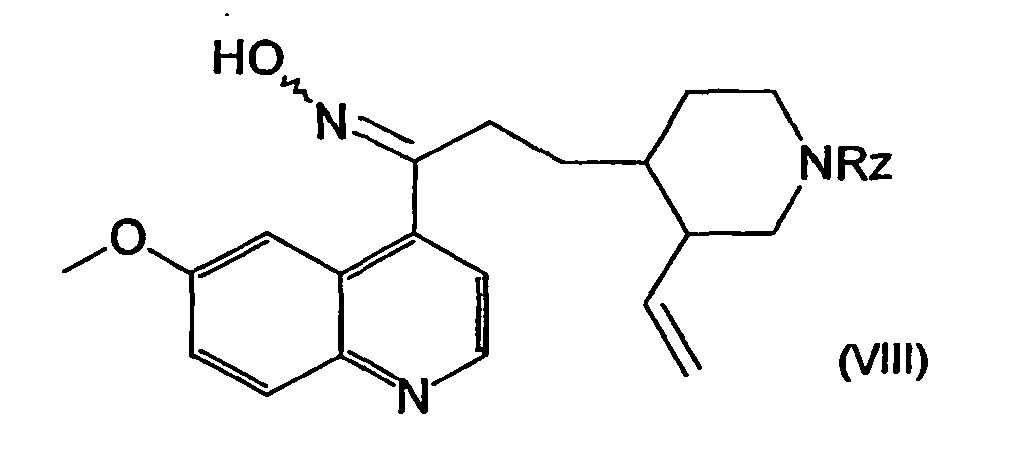
- Le réarrangement de Beckmann de l'oxime (VIII) en amide peut être réalisé selon les méthodes décrites dans la littérature (M. Smith, J.March, Advanced Organic Chemistry, 5ème Edition, p1415) par exemple par réaction d'un chlorure d'acide sulfonique (comme le chlorure de paratoluène sulfonyle) sur l'oxime dans un solvant comme l'acétone aqueuse ou le dichlorométhane en présence d'une base telle que la soude ou la potasse aqueuse ou une amine comme la triéthylamine ou Ia diisopropyléthylamine par exemple, à une température comprise entre 20°C et la température de reflux du solvant.
- Le clivage de l'amide produit par le réarrangement de Beckmann en acide peut être réalisé selon les méthodes classiques de la littérature, comme l'hydrolyse basique par la soude ou la potasse, ou bien encore par exemple par traitement de l'amide par le dicarbonate de di-tert-butyle dans le dichlorométhane en présence de triéthylamine et de 4-diméthylamino-pyridine suivi d'un traitement par l'hydroxyde de lithium monohydraté et une solution aqueuse de peroxyde d'hydrogène en utilisant comme solvant le tétrahydrofurane par exemple.
- L'oxime (VIII) peut être obtenue à partir du dérivé de quinolyl propyl pipéridine de formule générale (IX) :

- Le dérivé de quinolyl propyl pipéridine de formule générale (IX) peut être préparé par application de la méthode décrite dans la demande de brevet FR 2354771.
- Lorsque R1 est un fluor et R'2 est un carboxyméthyle, le dérivé de quinolyl propyl pipéridine de formule générale (II') peut être préparé par oxydation en milieu basique du dérivé de quinolyl propyl pipéridine de formule générale (X) :

- Le dérivé de quinolyl propyl pipéridine de formule générale (X) peut être préparé par hydrogénation sélective du dérivé de quinolyl propyl pipéridine de formule générale(XI) :

- Le dérivé de quinolyl propyl pipéridine de formule générale (XI) peut être préparé par condensation d'un dérivé de quinoléine de formule générale (XII) :


- La réaction s'effectue par action successive d'un organoborane (9-borabicyclo[3,3,1]nonane par exemple) dans un solvant tel qu'un éther (tétrahydrofurane, dioxane par exemple) à une température comprise entre -20 et 20°C, puis de l'addition du dérivé de quinoléine de formule générale (VII), par analogie avec les méthodes décrites par Suzuki et al., Pure and Appl. Chem., 57, 1749 (1985). La réaction s'effectue généralement en présence d'un sel de palladium (chlorure de palladium diphénylphosphinoferrocène par exemple) et d'une base comme le phosphate de potassium à une température comprise entre 20°C et la température de reflux du solvant.
- Le dérivé de la pipéridine de formule générale (XIII) peut être préparé par réaction de Wittig, par condensation d'un ylure de phosphore sur un dérivé de pipéridine de formule générale (XIV) :

- On opère avantageusement au moyen de (triphénylphosphorany-lidène) acétate de méthyle, dans un solvant comme par exemple le toluène, à une température comprise entre 20 et 110°C.
- Le dérivé d'oxo-3 pipéridine de formule générale (XIV) peut être préparé selon ou par analogie avec la méthode décrite par Y. Takeuchi et coll., Synthesis, 10, 1814 (1999).
- Le dérivé de quinoléine de formule générale (XII) dans laquelle R1 représente un atome de fluor peut être préparé selon la méthode décrite dans le brevet WO200240474-A2.
- Le dérivé de quinolyl propyl pipéridine de formule générale (II'), pour lequel R'2 est un radical carboxy protégé peut être préparé à partir du dérivé correspondant pour lequel R'2 est un radical carboxyméthyle protégé, l'hydroxy en alpha de la quinoléine étant protégé, par réduction de ce radical en alcool, transformation en un dérivé p-toluènesulfonyloxy, éthyle puis transformation de ce dérivé en dérivé vinylique par réaction d'élimination suivie de l'oxydation du dérivé obtenu, puis de la déprotection de la fonction alcool en alpha de la quinoléine et de la protection du radical carboxy.
- La réduction de l'acide protégé en un radical hydroxyéthyle s'effectue selon les méthodes habituelles qui n'altèrent pas le reste de la molécule, notamment on opère par action d'un hydrure, hydrure d'aluminium et de lithium ou hydrure de diisobutyl aluminium par exemple, dans un solvant tel qu'un éther, tétrahydrofurane par exemple, à une température comprise entre 20 et 60°C.
- La transformation du dérivé hydroxyéthyle en un dérivé p.toluènesulfonyloxyéthyle s'effectue notamment selon la méthode décrite par L.F. Fieser et M. Fieser, Reagents for Organic Synthesis, vol 1, 1179 (1967), à partir du chlorure de p-toluènesulfonyle en présence d'une base comme une amine tertiaire, par exemple la triéthylamine, ou aromatique, par exemple la pyridine, dans un solvant halogéné, dichlorométhane par exemple, ou sans solvant, à une température comprise entre 0 et 50°C.
- La transformation du dérivé p-toluènesulfonyloxyéthyle en dérivé vinylique s'effectue par réaction d'élimination, notamment selon la méthode décrite par A. Sharma et coll., Org. Prep Proced. Int., 25(3), 330-333 (1993), en présence d'une base, par exemple le t-butylate de potassium, dans un solvant, le diméthylsulfoxyde par exemple, à une température comprise entre 20 et 100°C.
- La transformation du dérivé vinylique en un dérivé carboxy s'effectue par les méthodes d'oxydation décrites dans la littérature, notamment par le méta periodate de sodium en présence d'hydrate de trichlorure de ruthénium, dans un mélange de solvants comme par exemple le mélange eau/acétonitrile, à une température comprise entre 20 et 60°C.
- Il est entendu que les dérivés de formule générale (I), mais aussi les intermédiaires de formules (II) et (II'), (III) et (III'), (V), (VIII), (IX), (X) ainsi que leurs intermédiaires de préparation présentent une isomérie «cis/trans» au niveau des substituants en position 3 et 4 de la pipéridine. Les dérivés de configuration «trans» peuvent être obtenus à partir des dérivés de configuration «cis» selon ou par analogie avec la méthode décrite dans la demande internationale WO 99/37635, ou à partir d'intermédiaires existant sous forme de mélanges, après séparation selon les méthodes connues.
- Les dérivés de quinolyl propyl pipéridine de formule générale (I) peuvent être purifiés, le cas échéant, par des méthodes physiques telles que la cristallisation ou la chromatographie.
- Par ailleurs, il est également entendu que les composés de formule générale (I) existent également sous formes énantiomères et diastéréoisomères, lesquelles formes ainsi que leurs mélanges entrent dans le cadre de la présente invention. Ces derniers peuvent la cas échéant être séparés notamment par chromatographie sur silice ou par Chromatographie Liquide Haute Performance (CLHP). De même, les dérivés cis et trans peuvent être séparés par chromatographie sur silice ou par Chromatographie Liquide Haute Performance (CLHP).
- Les dérivés de quinolyl propyl pipéridine de formule générale (I) peuvent être transformés en sels d'addition avec les acides, par les méthodes connues. Il est entendu que ces sels entrent aussi dans le cadre de la présente invention.
- Comme exemples de sels d'addition avec des acides pharmaceutiquement acceptables, peuvent être cités les sels formés avec les acides minéraux (chlorhydrates, bromhydrates, sulfates, nitrates, phosphates) ou avec les acides organiques (succinates, fumarates, tartrates, acétates, propionates, maléates, citrates, méthanesulfonates, éthanesulfonates, phénylsulfonates, p.toluènesulfonates, iséthionates, naphtylsulfonates ou camphorsulfonates, ou avec des dérivés de substitution de ces composés).
- Certains des dérivés de quinolyl propyl pipéridine de formule générale (I) portant un radical carboxy peuvent être transformés à l'état de sels métalliques ou en sels d'addition avec les bases azotées selon les méthodes connues en soi. Ces sels entrent également dans le cadre de la présente invention. Les sels peuvent être obtenus par action d'une base métallique (par exemple alcaline ou alcalino terreuse), de l'ammoniac ou d'une amine, sur un produit selon l'invention, dans un solvant approprié tel qu'un alcool, un éther ou l'eau, ou par réaction d'échange avec un sel d'un acide organique. Le sel formé précipite après concentration éventuelle de la solution, il est séparé par filtration, décantation ou lyophilisation. Comme exemples de sels pharmaceutiquement acceptables peuvent être cités les sels avec les métaux alcalins (sodium, potassium, lithium) ou avec les métaux alcalinoterreux (magnésium, calcium), le sel d'ammonium, les sels de bases azotées (éthanolamine, diéthanolamine, triméthylamine, triéthylamine, méthylamine, propylamine, diisopropylamine, NN-diméthyléthanolamine, benzylamine, dicyclohexylamine, N-benzyl-□-phénéthylamine, NN'-dibenzyléthylènediamine, diphénylènediamine, benzhydrylamine, quinine, choline, arginine, lysine, leucine, dibenzylamine).
- Les dérivés de quinolyl propyl pipéridine selon l'invention sont des agents antibactériens particulièrement intéressants.
- In vitro, sur germes gram, positifs les dérivés de quinolyl propyl pipéridine selon l'invention se sont montrés actifs à des concentrations comprises entre 0,03 et 4 µg/ml sur Staphylococcus aureus AS5155 résistante à la méticilline, également à des concentrations comprises entre 0,06 et 8 µg/ml sur Streptococcus pneumoniae 6254-01 et à des concentrations comprises entre 0,06 et 64 µg/ml sur Enterococcus faecium H983401 et, sur germes gram négatifs, ils se sont montrés actifs à des concentrations comprises entre 0,12 et 32 µg/ml sur Moraxella catharrhalis IPA152 ; in vivo, ils se sont montrés actifs sur les infections expérimentales de la souris à Staphylococcus aureus IP8203 à des doses comprises entre 12 et 150 mg/kg par voie sous cutanée (DC50) et pour certains d'entre eux à des doses comprises entre 26 et 150 mg/kg par voie orale.
- Enfin, les produits selon l'invention sont particulièrement intéressants du fait de leur faible toxicité. Aucun des produits n'a manifesté de toxicité à la dose de 100 mg/kg par voie sous cutanée chez la souris.
- Ces propriétés rendent aptes lesdits produits, ainsi que leurs sels d'acides et de bases pharmaceutiquement acceptables, à être utilisés comme médicaments dans le traitement des affections à germes sensibles provoquées par des bactéries à gram (+) et notamment dans celui des staphylococcies, telles que septicémies à staphylocoques, staphylococcies malignes de la face ou cutanée, pyodermites, plaies septiques ou suppurantes, anthrax, phlegmons, érysipèles, staphylococcies aiguës primitives ou post grippales, broncho-pneumonies, suppurations pulmonaires.
- Ces produits peuvent également être utilisés comme médicaments dans le traitement des colibacilloses et infections associées, dans les infections à proteus, à klebsiella et à salmonella et dans d'autres affections provoquées par des bactéries à gram (-).
- La présente invention a donc également pour objet, à titre de médicaments et notamment de médicaments destinés au traitement des infections bactériennes chez l'homme ou l'animal, les composés de formule (I) tels que définis ci-dessus ainsi que leurs sels pharmaceutiquement acceptables, et notamment les composés préférés mentionnés plus haut.
- La présente invention concerne également les compositions pharmaceutiques contenant au moins un dérivé de quinolyl propyl pipéridine selon l'invention, le cas échéant sous forme de sel, à l'état pur ou sous forme d'une association avec un ou plusieurs diluants ou adjuvants compatibles et pharmaceutiquement acceptables.
- Les compositions selon l'invention peuvent être utilisées par voie orale, parentérale, topique, rectale ou en aérosols.
- Comme compositions solides pour administration orale peuvent être utilisés des comprimés, des pilules, des gélules, des poudres ou des granulés. Dans ces compositions, le produit actif selon l'invention est mélangé à un ou plusieurs diluants ou adjuvants inertes, tels que saccharose, lactose ou amidon. Ces compositions peuvent comprendre des substances autres que les diluants, par exemple un lubrifiant tel que le stéarate de magnésium ou un enrobage destiné à une libération contrôlée.
- Comme compositions liquides pour administration orale, on peut utiliser des solutions pharmaceutiquement acceptables, des suspensions, des émulsions, des sirops et des élixirs contenant des diluants inertes tels que l'eau ou l'huile de paraffine. Ces compositions peuvent également comprendre des substances autres que les diluants, par exemple des produits mouillants, édulcorants ou aromatisants.
- Les compositions pour administration parentérale, peuvent être des solutions stériles ou des émulsions. Comme solvant ou véhicule, on peut employer l'eau, le propylèneglycol, un polyéthylèneglycol, des huiles végétales, en particulier l'huile d'olive, des esters organiques injectables, par exemple l'oléate d'éthyle. Ces compositions peuvent également contenir des adjuvants, en particulier des agents mouillants, isotonisants, émulsifiants, dispersants et stabilisants.
- La stérilisation peut se faire de plusieurs façons, par exemple à l'aide d'un filtre bactériologique, par irradiation ou par chauffage. Elles peuvent également être préparées sous forme de compositions solides stériles qui peuvent être dissoutes au moment de l'emploi dans de l'eau stérile ou tout autre milieu stérile injectable.
- Les compositions pour administration topique peuvent être par exemple des crèmes, des pommades, des lotions ou des aérosols.
- Les compositions pour administration rectale sont les suppositoires ou les capsules rectales, qui contiennent outre le principe actif, des excipients tels que le beurre de cacao, des glycérides semi-synthétiques ou des polyéthylèneglycols.
- Les compositions peuvent également être des aérosols. Pour l'usage sous forme d'aérosols liquides, les compositions peuvent être des solutions stériles stables ou des compositions solides dissoutes au moment de l'emploi dans de l'eau stérile apyrogène, dans du sérum ou tout autre véhicule pharmaceutiquement acceptable. Pour l'usage sous forme d'aérosols secs destinés à être directement inhalés, le principe actif est finement divisé et associé à un diluant ou véhicule solide hydrosoluble d'une granulométrie de 30 à 80 µm, par exemple le dextrane, le mannitol ou le lactose.
- En thérapeutique humaine, les nouveaux dérivés de quinolyl propyl pipéridine selon l'invention sont particulièrement utiles dans le traitement des infections d'origine bactérienne. Les doses dépendent de l'effet recherché et de la durée du traitement. Le médecin déterminera la posologie qu'il estime la plus appropriée en fonction du traitement, en fonction de l'âge, du poids, du degré de l'infection et des autres facteurs propres au sujet à traiter. Généralement, les doses sont comprises entre 750 mg et 3 g de produit actif en 2 ou 3 prises par jour par voie orale ou entre 400 mg et 1,2 g par voie intraveineuse pour un adulte.
- L'exemple suivant illustre une composition selon l'invention.
- On prépare selon la technique habituelle une composition liquide destinée à l'usage parentéral comprenant :
- Acide (3R,4R) -4-[3-(3-fluoro-6-méthoxyquinolin-4-yl)-3-oxopropyl]-1-[3-(2,3,5-trifluorophénylthio)prop-2-ynyl] pipéridine-3-carboxylique..... 1 g
- Glucose..... qsp 2,5%
- hydroxyde de sodium..... qsp pH = 4-4,5
- eau ppi..... qsp 20 ml
- L'invention a enfin pour objet, à titre de produits industriels nouveaux et notamment à titre de produits intermédiaires nécessaires à la préparation des produits de formule (I) :
- les produits de formule (II) telle que définie plus haut, dans laquelle R1 est un atome de fluor et la cétone est libre ou protégée ;
- les produits de formule (A) :

- les produits de formule (B) :

- les produits de formule (V) telle que définie plus haut ;
- Les produits de formule (C) :

- les produits de formule (VIII) telle que définie plus haut.
- Parmi les produits selon l'invention, plus particulièrement intéressants sont les dérivés de quinolyl propyl pipéridine cités ci-après, et notamment ceux décrits dans les exemples, à titre non limitatif :
- Acide (3BS,4RS) ou (3SR,4RS)-4-[3-oxo-3-(6-méthoxyquinolin-4-yl)propyl]-1-(2-phénylthioéthyl)pipéridine-3-carboxylique
- Acide (3RS,4RS) ou (3SR, 4RS)-4-[3-oxo-3-(6-méthoxyquinolin-4-yl)propyl]-1-[2-(3-fluorophénylthio)éthyl]pipéridine-3-carboxylique
- Acide (3RS,4RS) ou (3SR,4RS)-4-[3-oxo-3-(6-méthoxyquinolin-4-yl)propyl]-1-[2-(2,5-difluorophénylthio)éthyl)pipéridine-3-carboxylique
- Acide (3RS,4RS) ou (3SR,4R5)-4-[3-oxo-3-(6-méthoxyquinolin-4-yl)propyl]-1-[2-(3,5-difluorophénylthio)éthyl]pipéridine-3-carboxylique
- Acide (3RS,4RS) ou (3SR,4RS)-4-[3-oxo-3-(6-méthoxyquinolin-4-yl)propyl]-1-[2-(2,3,5-trifluorophénylthio)éthyl]pipéridine-3-carboxylique
- Acide (3RS,4RS) ou (3SR,4RS)-4-[3-oxo-3-(6-méthoxyquinolin-4-yl)propyl]-1-[2-(n-propylthio)éthyl]pipéridine-3-carboxylique
- Acide (3RS,4RS) ou (3SR,4RS)-4-[3-oxo-3-(6-méthoxyquinolin-4-yl)propyl]-1-[2-(n-butylthio)éthyl]pipéridine-3-carboxylique
- Acide (3RS,4RS) ou (3SR,4RS)-4-[3-oxo-3-(6-méthoxyquinolin-4-yl)propyl]-1-[2-(cyclopropylthio)éthyl]pipéridine-3-carboxylique
- Acide (3RS, 4RS) ou (3SR,4RS)-4-[3-oxo-3-(6-méthoxyquinolin-4-yl)propyl]-1-[2-(cyclobutylthio)éthyl]pipéridine-3-carboxylique
- Acide (3RS,4RS) ou (3SR,4RS)-4-[3-oxo-3-(6-méthoxyquinolin-4-yl)propyl]-1-[2-(cyclopentylthio)éthyl]pipéridine-3-carboxylique
- Acide (3RS,4RS) ou (3SR,4RS)-4-[3-oxo-3-(6-méthoxyquinolin-4-yl)propyl]-1-[2-(cyclohexylthio)éthyl]pipéridine-3-carboxylique
- Acide (3RS,4RS) ou (3SR,4RS)-4-[3-oxo-3-(6-méthoxyquinolin-4-yl)propyl]-1-[2-(thien-2-yl)thioéthyl]pipéridine-3-carboxylique
- Acide (3RS,4RS) ou (3SR,4RS)-4-[3-oxo-3-(6-méthoxyquinolin-4-yl)propyl]-1-[2-(5-fluorothien-2-yl)thioéthyl]pipéridine-3-carboxylique
- Acide (3RS,4RS) ou (3SR,4RS)-4-[3-oxo-3-(6-méthoxyquinolin-4-yl)propyl]-1-[2-(4-fluorothien-2-yl)thioéthyl]pipéridine-3-carboxylique
- Acide (3RS,4RS) ou (3SR,4RS)-4-[3-oxo-3-(6-méthoxyquinolin-4-yl)propyl]-1-[2-(3-fluorothien-2-yl)thioéthyl]pipéridine-3-carboxylique
- Acide (3RS,4RS) ou (3SR,4RS)-4-[3-oxo-3-(6-méthoxyquinolin-4-yl)propyl]-1-[2-(thien-3-yl)thioéthyl]pipéridine-3-carboxylique
- Acide (3RS,4RS) ou (3SR,4RS)-4-[3-oxo-3-(6-méthoxyquinolin-4-yl)propyl]-1-[2-(1,3-thiazol-2-yl)thioéthyl]pipéridine-3-carboxylique
- Acide (3RS,4RS) ou (3SR,4RS)-4-[3-oxo-3-(6-méthoxyquinolin-4-yl)propyl]-1-[2-(pyridin-2-yl)thioéthyl]pipéridine-3-carboxylique
- Acide (3RS,4RS) ou (3SR,4RS)-4-[3-oxo-3-(6-méthoxyquinolin-4-yl)propyl]-1-[2-(4-fluoropyridin-2-yl)thioéthyl]pipéridine-3-carboxylique
- Acide (3RS,4RS) ou (3SR,4RS)-4-[3-oxo-3-(6-méthoxyquinolin-4-yl)propyl]-1-[2-(3-fluoro-pyridin-2-yl)thioéthyl]pipéridine-3-carboxylique
- Acide (3RS,4RS) ou (3SR,4RS)-4-[3-oxo-3-(6-méthoxyquinolin-4-yl)propyl]-1-[3-(3-fluoro-phényl)-prop-2-ynyl]-pipéridine-3-carboxylique
- Acide (3RS,4RS) ou (3SR,4RS)-4-[3-oxo-3-(6-méthoxyquinolin-4-yl)propyl]-1-[3-(2,5-difluoro-phényl)-prop-2-ynyl]-pipéridine-3-carboxylique
- Acide (3RS,4RS) ou (3SR,4RS)-4-[3-oxo-3-(6-méthoxyquinolin-4-yl)propyl]-1-[3-(3,5-difluoro-phényl)-prop-2-ynyl]-pipéridine-3-carboxylique
- Acide (3RS,4RS) ou (3SR,4RS)-4-[3-oxo-3-(6-méthoxyquinolin-4-yl)propyl]-1-[3-(2,3,5-trifluoro-phényl)-prop-2-ynyl]-pipéridine-3-carboxylique
- Acide (3RS,4RS) ou (3SR,4RS)-4-[3-oxo-3-(6-méthoxyquinolin-4-yl)propyl]-1-[3-(thien-2-yl)-prop-2-ynyl]-pipéridine-3-carboxylique
- Acide (3RS,4RS) ou (3SR,4RS)-43-oxo-3-(6-méthoxyquinolin-4-yl)propyl]-1-[3-(5-fluorothien-2-yl)-prop-2-ynyl]-pipéridine-3-carboxylique
- Acide (3RS,4RS) ou (3SR,4RS)-4-[3-oxo-3-(6-méthoxyquinolin-4-yl)propyl]-1-[3-(4-fluorothien-2-yl)-prop-2-ynyl]-pipéridine-3-carboxylique
- Acide (3RS,4RS) ou (3SR,4RS)-4-[3-oxo-3-(6-méthoxyquinolin-4-yl)propyl]-1-[3-(3-fluorothien-2-yl)-prop-2-ynyl]-pipéridine-3-carboxylique
- Acide (3RS,4RS) ou (3SR,4RS)-4-[3-oxo-3-(3-fluoro-6-méthoxyquinolin-4-yl)propyl]-1-(2-phénylthioéthyl)pipéridine-3-carboxylique
- Acide (3RS,4RS) ou (3SR,4RS)-4-[3-oxo-3-(3-fluoro-6-méthoxyquinolin-4-yl)propyl]-1-[2-(3-fluorophénylthio)éthyl]pipéridine-3-carboxylique
- Acide (3RS,4RS) ou (3SR,4RS)-4-[3-oxo-3-(3-fluoro-6-méthoxyquinolin-4-yl)propyl]-1-[2-(2,5-difluorophénylthio) éthyl] pipéridine-3-carboxylique
- Acide (3RS,4RS) ou (3SR,4RS)-4-[3-oxo-3-(3-fluoro-6-méthoxyquinolin-4-yl)propyl]-1-[2-(3,5-difluorophénylthio)éthyl]pipéridine-3-carboxylique
- Acide (3RS,4RS) ou (3SR,4RS)-4-[3-oxo-3-(3-fluoro-6-méthoxyquinolin-4-yl)propyl]-1-[2-(2,3,5-trifluorophénylthio)éthyl]pipéridine-3-carboxylique
- Acide (3RS,4RS) ou (3SR,4RS)-4-[3-oxo-3-(3-fluoro-6-méthoxyquinolin-4-yl)propyl]-1-[2-(n-propylthio)éthylpipéridine-3-carboxylique
- Acide (3RS,4RS) ou (3SR,4RS)-4-[3-oxo-3-(3-fluoro-6-méthoxyquinolin-4-yl)propyl]-1-[2-(n-butylthio)éthyl]pipéridine-3-carboxylique
- Acide (3RS,4RS) ou (3SR,4RS)-4-[3-oxo-3-(3-fluoro-6-méthoxyquinolin-4-yl)propyl]-1-[2-(cyclopropylthio)éthyl]pipéridine-3-carboxylique
- Acide (3RS,4RS) ou (3SR,4RS)-4-[3-oxo-3-(3-fluoro-6-méthoxyquinolin-4-yl)propyl]-1-[2-(cyclobutylthio)éthyl]pipéridine-3-carboxylique
- Acide (3RS,4RS) ou (3SR,4RS)-4-[3-oxo-3-(3-fluoro-6-méthoxyquinolin-4-yl)propyl]-1-[2-(cyclopentylthio)éthyl]pipéridine-3-carboxylique
- Acide (3RS,4RS) ou (3SR,4RS)-4-[3-oxo-3-(3-fluoro-6-méthoxyquinolin-4-yl)propyl]-1-[2-(cyclohexylthio)éthyl]pipéridine-3-carboxylique
- Acide (3RS,4RS) ou (3SR,4RS)-4-[3-oxo-3-(3-fluoro-6-méthoxyquinolin-4-yl)propyl]-1-[2-(thien-2-yl)thioéthyl]pipéridine-3-carboxylique
- Acide (3RS,4RS) ou (3SR,4RS)-4-[3-oxo-3-(3-fluoro-6-méthoxyquinolin-4-yl)propyl]-1-[2-(5-fluorothien-2-yl)thioéthyl]pipéridine-3-carboxylique
- Acide (3RS,4RS) ou (3SR,4RS)-4-[3-oxo-3-(3-fluoro-6-méthoxyquinolin-4-yl)propyl]-1-[2-(4-fluorothien-2-yl)thioéthyl]pipéridine-3-carboxylique
- Acide (3RS,4RS) ou (3SR,4RS)-4-[3-oxo-3-(3-fluoro-6-méthoxyquinolin-4-yl)propyl]-1-[2-(3-fluorothien-2-yl)thioéthyl]pipéridine-3-carboxylique
- Acide (3RS,4RS) ou (3SR,4RS)-4-[3-oxo-3-(3-fluoro-6-méthoxyquinolin-4-yl)propyl]-1-[2-(thien-3-yl)thioéthyl]pipéridine-3-carboxylique
- Acide (3RS,4RS) ou (3SR,4RS)-4-[3-oxo-3-(3-fluoro-6-méthoxyquinolin-4-yl)propyl]-1-[2-(1,3-thiazol-2-yl)thioéthyl]pipéridine-3-carboxylique
- Acide (3RS,4RS) ou (3SR,4RS)-4-[3-oxo-3-(3-fluoro-6-méthoxyquinolin-4-yl)propyl]-1-[2-(pyridin-2-yl)thioéthyl]pipéridine-3-carboxylique
- Acide (3RS,4RS) ou (3SR,4RS)-4-[3-oxo-3-(3-fluoro-6-méthoxyquinolin-4-yl)propyl]-1-[2-(4-fluoropyridin-2-yl)thioéthyl]pipéridine-3-carboxylique
- Acide (3RS,4RS) ou (3SR,4RS)-4-[3-oxo-3-(3-fluoro-6-méthoxyquinolin-4-yl)propyl]-1-[2-(3-fluoro-pyridin-2-yl)thioéthyl]pipéridine-3-carboxylique
- Acide (3RS,4RS) ou (3SR,4RS)-4-[3-oxo-3-(3-fluoro-6-méthoxyquinolin-4-yl)propyl]-1-[3-(3-fluoro-phényl)-prop-2-ynyl]-pipéridine-3-carboxylique
- Acide (3RS,4RS) ou (3SR,4RS)-4-[3-oxo-3-(3-fluoro-6-méthoxyquinolin-4-yl)propyl]-1-[3-(2,5-difluoro-phényl)-prop-2-ynyl]-pipéridine-3-carboxylique
- Acide (3RS,4RS) ou (3SR,4RS)-4-[3-oxo-3-(3-fluoro-6-méthoxyquinolin-4-yl)propyl]-1-[3-(3,5-difluoro-phényl)-prop-2-ynyl]-pipéridine-3-carboxylique
- Acide (3RS,4RS) ou (3SR,4RS)-4-[3-oxo-3-(3-fluoro-6-méthoxyquinolin-4-yl)propyl]-1-[3-(2,3,5-trifluoro-phényl)-prop-2-ynyl]-pipéridine-3-carboxylique
- Acide (3RS,4RS) ou (3SR,4RS)-4-[3-oxo-3-(3-fluoro-6-méthoxyquinolin-4-yl)propyl]-1-[3-(thien-2-yl)-prop-2-ynyl]-pipéridine-3-carboxylique
- Acide (3RS,4RS) ou (3SR,4RS)-43-oxo-3-(3-fluoro-6-méthoxyquinolin-4-yl)propyl]-1-[3-(5-fluorothien-2-yl)-prop-2-ynyl]-pipéridine-3-carboxylique
- Acide (3RS, 4RS) ou (3SR,4RS)-4-[3-oxo-3-(3-fluoro-6-méthoxyquinolin-4-yl)propyl]-1-[3-(4-fluorothien-2-yl)-prop-2-ynyl]-pipéridine-3-carboxylique
- Acide (3RS,4RS) ou (3SR,4RS)-4-[3-oxo-3-(3-fluoro-6-méthoxyquinolin-4-yl)propyl]-1-[3-(3-fluorothien-2-yl)-prop-2-ynyl]-pipéridine-3-carboxylique
- Acide (3RS,4RS) où (3SR,4RS)-4-[3-oxo-3-(3-fluoro-6-méthoxyquinolin-4-yl)propyl]-1-[3-(thien-3-yl)-prop-2-ynyl]-pipéridine-3-carboxylique
- Acide (3RS, 4RS) ou (3SR,4RS)-4-[3-oxo-3-(6-méthoxyquinolin-4-yl)propyl]-1-(2-phénylthioéthyl)pipéridine-3-acétique
- Acide (3RS,4RS) ou (3SR,4RS)-4-[3-oxo-3-(6-méthoxyquinolin-4-yl)propyl]-1-[2-(3-fluorophénylthio)éthyl]pipéridine-3-acétique
- Acide (3RS,4RS) ou (3SR,4RS)-4-[3-oxo-3-(6-méthoxyquinolin-4-yl)propyl]-1-[2-(2,5-difluorophénylthio)éthyl]pipéridine-3-acétique
- Acide (3RS,4RS) ou (3SR,4RS)-4-[3-oxo-3-(6-méthoxyquinolin-4-yl)propyl]-1-[2-(3,5-difluorophénylthio)éthyl]pipéridine-3-acétique
- Acide (3RS,4RS) ou (3SR,4RS)-4-[3-oxo-3-(6-méthoxyquinolin-4-yl)propyl]-1-[2-(2,3,5-trifluorophénylthio)éthyl]pipéridine-3-acétique
- Acide (3RS,4RS) ou (3SR,4RS)-4-[3-oxo-3-(6-méthoxyquinolin-4-yl)propyl)-1-[2-(n-propylthio)éthyl]pipéridine-3-acétique
- Acide (3RS,4RS) ou (3SR,4RS)-4-[3-oxo-3-(6-méthoxyquinolin-4-yl)propyl]-1-[2-(n-butylthio)éthyl]pipéridine-3-acétique
- Acide (3RS,4RS) ou (3SR,4RS)-4-[3-oxo-3-(6-méthoxyquinolin-4-yl)propyl]-1-[2-(cyclopropylthio)éthyl]pipéridine-3-acétique
- Acide (3RS,4RS) ou (3SR,4RS)-4-[3-oxo-3-(6-méthoxyquinolin-4-yl)propyl]-1-[2-(cyclobutylthio)éthyl]pipéridine-3-acétique
- Acide (3RS,4RS) ou (3SR,4RS)-4-[3-oxo-3-(6-méthoxyquinolin-4-yl)propyl]-1-[2-(cyclopentylthio)éthyl]pipéridine-3-acétique
- Acide (3RS,4RS) ou (3SR,4RS)-4-[3-oxo-3-(6-méthoxyquinolin-4-yl)propyl]-1-[2-(cyclohexylthio)éthyl]pipéridine-3-acétique
- Acide (3RS,4RS) ou (3SR,4RS)-4-[3-oxo-3-(6-méthoxyquinolin-4-yl)propyl]-1-[2-(thien-2-yl)thioéthyl]pipéridine-3-acétique
- Acide (3RS,4RS) ou (3SR,4RS)-4-[3-oxo-3-(6-méthoxyquinolin-4-yl)propyl]-1-[2-(5-fluorothien-2-yl)thioéthyl]pipéridine-3-acétique
- Acide (3RS,4RS) ou (3SR,4RS)-4-[3-oxo-3-(6-méthoxyquinolin-4-yl)propyl]-1-[2-(4-fluorothien-2-yl)thioéthyl]pipéridine-3-acétique
- Acide (3RS,4RS) ou (3SR,4RS)-4-[3-oxo-3-(6-méthoxyquinolin-4-yl)propyl]-1-[2-(3-fluorothien-2-yl)thioéthyl]pipéridine-3-acétique
- Acide (3RS,4RS) ou (3SR,4RS)-4-[3-oxo-3-(6-méthoxyquinolin-4-yl)propyl]-1-[2-(thien-3-yl)thioéthyl]pipéridine-3-acétique
- Acide (3RS,4RS) ou (3SR,4RS)-4-[3-oxo-3-(6-méthoxyquinolin-4-yl)propyl]-1-[2-(1,3-thiazol-2-yl)thioéthyl]pipéridine-3-acétique
- Acide (3RS,4RS) ou (3SR,4RS)-4-[3-oxo-3-(6-méthoxyquinolin-4-yl)propyl]-1-[2-(pyridin-2-yl)thioéthyl]pipéridine-3-acétique
- Acide (3RS,4RS) ou (3SR,4RS)-4-[3-oxo-3-(6-méthoxyquinolin-4-yl)propyl]-1-[2-(4-fluoropyridin-2-yl)thioéthyl]pipéridine-3-acétique
- Acide (3RS,4RS) ou (3SR,4RS)-4-[3-oxo-3-(6-méthoxyquinolin-4-yl)propyl]-1-[2-(3-fluoro-pyridin-2-yl)thioéthyl]pipéridine-3-acétique
- Acide (3RS,4RS) ou (3SR, 4RS)-4-[3-oxo-3-(6-méthoxyquinolin-4-yl)propyl]-1-[3-(3-fluoro-phényl)-prop-2-ynyl]-pipéridine-3-acétique
- Acide (3RS,4RS) ou (3SR,4RS)-4-[3-oxo-3-(6-méthoxyquinolin-4-yl)propyl]-1-[3-(2,5-difluoro-phényl)-prop-2-ynyl]-pipéridine-3-acétique
- Acide (3RS,4RS) ou (3SR,4RS)-4-[3-oxo-3-(6-méthoxyquinolin-4-yl)propyl]-1-[3-(3,5-difluoro-phényl)-prop-2-ynyl]-pipéridine-3-acétique
- Acide (3RS,4RS) ou (3SR,4RS)-4-[3-oxo-3-(6-méthoxyquinolin-4-yl)propyl]-1-[3-(2,3,5-trifluoro-phényl)-prop-2-ynyl]-pipéridine-3-acétique
- Acide (3RS,4RS) ou (3SR,4RS)-4-[3-oxo-3-(6-méthoxyquinolin-4-yl)propyl]-1-[3-(thien-2-yl)-prop-2-ynyl]-pipéridine-3-acétique
- Acide (3RS,4RS) ou (3SR,4RS)-43-oxo-3-(6-méthoxyquinolin-4-yl)propyl]-1-[3-(5-fluorothien-2-yl)-prop-2-ynyl]-pipéridine-3-acétique
- Acide (3RS,4RS) ou (3SR,4RS)-4-[3-oxo-3-(6-méthoxyquinolin-4-yl)propyl]-1-[3-(4-fluorothien-2-yl)-prop-2-ynyl]-pipéridine-3-acétique
- Acide (3RS,4RS) ou (3SR,4RS)-4-[3-oxo-3-(6-méthoxyquinolin-4-yl)propyl]-1-[3-(3-fluorothien-2-yl)-prop-2-ynyl]-pipéridine-3-acétique
- Acide (3RS,4RS) ou (3SR,4RS)-4-[3-oxo-3-(6-méthoxyquinolin-4-yl)propyl]-1-[3-(thien-3-yl)-prop-2-ynyl]-pipéridine-3-acétique
- Une solution de 0,084 g (0,163 mmol) de (3R,4R)-1-(2-cyclohexylsulfanyl-éthyl)-4-[3-(3-fluoro-6-méthoxy-quinolin-4-yl)-3-oxo-propyl]-pipéridine-3-carboxylate de méthyle dans 4,5 cm3 d'acide chlorhydrique 5N est chauffée à une température voisine de 80°C pendant 5 heures. Après arrêt du chauffage puis retour à température ambiante, on ajoute successivement 10 cm3 de CH2Cl2 et 5 cm3 d'eau. On ajoute alors une solution aqueuse d'hydroxyde de sodium 5N puis 1N afin d'ajuster le pH de la phase aqueuse à une valeur voisine de 8. La phase organique est décantée puis la phase aqueuse est extraite avec 2 fois 15 cm3 de CH2Cl2. Les phases organiques sont réunies, séchées sur sulfate de magnésium anhydre, filtrées et concentrées à sec sous pression réduite (2,7 kPa) pour donner 0,073 g d'une huile orange qui est purifiée par chromatographie-flash [éluant : dichlorométhane / méthanol / acétonitrile (92 / 4 / 4 en volumes)]. Après concentration des fractions sous pression réduite, on obtient 0,03 g d'acide (3R,4R)-1-(2-cyclohexylsulfanyl-éthyl)-4-[3-(3-fluoro-6-méthoxy-quinolin-4-yl)-3-oxo-propyl]-pipéridine-3-carboxylique, sous forme d'une huile jaune.
- Spectre de R.M.N. 1H (300 MHz, (CD3)2SO d6, δ en ppm) : 1,25 (mt : 5H) ; de 1, 50 à 1,98 (mt : 10H) ; 2,28 (mt : 1H) ; 2,42 (d, J = 12 Hz : 1H) ; de 2,50 à 2,80 (mt : 6H) ; 2,88 (mt : 1H) ; 3,06 (t large: 1H) ; 3,15 (mt : 2H) ; 3,92 (s : 3H) ; 7,10 (d, J = 3 Hz : 1H) ; 7,50 (dd, J = 9 et 3 Hz : 1H) ; 8, 05 (d, J = 9 Hz : 1H) ; 8,90 (s : 1H) .
- Le (3R,4R)-1-(2-cyclohexylsulfanyl-éthyl)-4-[3-(3-fluoro-6-méthoxy-quinolin-4-yl)-3-oxo-propyl]-pipéridine-3-carboxylate de méthyle peut être préparé de la manière suivante :
- A 1,5 g (4 mmol) de (3R,4R)-4-[3-(3-fluoro-6-méthoxy-quinolin-4-yl)-3-oxo-propyl]-pipéridine-3-carboxylate de méthyle en solution dans 20 cm3 d'acétonitrile et 0,8 cm3 de diméthylformamide, on ajoute à une température voisine de 20°C, sous atmosphère d'argon, 1,66 g de carbonate de potassium, 0,665 g d'iodure de potassium puis une solution de 0,738 g de 2-chloroéthyl cyclohexyl sulfure dans 10 cm3 d'acétonitrile. Après 16 heures d'agitation à reflux et refroidissement du mélange réactionnel, on ajoute 20 cm3 d'eau puis on concentre à sec sous pression réduite (2,7 kPa). Le résidu est repris avec 70 cm3 de CH2Cl2, lavé par 2 fois 35 cm3 d'eau puis 40 cm3 d'une solution aqueuse saturée en chlorure de sodium. La phase organique est séchée sur sulfate de magnésium anhydre, filtrée et concentrée à sec sous pression réduite (2,7 kPa) pour donner 2,2 g d'une huile orange qui est purifiée par chromatographie-flash [éluant : dichlorométhane / méthanol / acétonitrile (98 / 1 / 1 en volumes)]. Après concentration des fractions sous pression réduite, on obtient 0,67 g d'une huile orange qui est purifiée par chromatographie-flash [éluant : dichlorométhane/ méthanol / acétonitrile (98 / 2 / 2 en volumes)]. Après concentration des fractions sous pression réduite, on obtient 0,495 g de (3R,4R)-1-(2-cyclohexylsulfanyl-éthyl)-4-[3-(3-fluoro-6-méthoxy-quinolin-4-yl)-3-oxo-propyl]-pipéridine-3-carboxylate de méthyle, sous forme d'une huile orange.
- Le (3R,4R)-4-[3-(3-fluoro-6-méthoxy-quinolin-4-yl)-3-oxo-propyl]-pipéridine-3-carboxylate de méthyle peut être préparé de la manière suivante :
- A 4 g (7,23 mmol) de (3R, 4R)-1-tert-butyloxycarbonyl-4-[3-(3-fluoro-6-méthoxy-quinolin-4-yl)-3-oxo-propyl]-pipéridine-3-carboxylate de méthyle en solution dans 20 cm3 d'acétate d'éthyle, on ajoute à une température voisine de 20°C, 9 cm3 d'une solution 4 N d'acide chlorhydrique dans de l'acétate d'éthyle et 10 cm3 de MeOH. Après 4 heures d'agitation à une température voisine de 20°C, on dilue le mélange réactionnel avec 25 cm3 d'acétate d'éthyle puis on ajoute une solution aqueuse d'hydroxyde de sodium 5N afin d'ajuster le pH de la phase aqueuse à une valeur comprise entre 8 et 8,5. La phase organique est décantée puis la phase aqueuse est extraite avec 3 fois 40 cm3 d'acétate d'éthyle. Les phases organiques sont réunies, lavées avec 2 fois 50 cm3 d'une solution aqueuse saturée en chlorure de sodium, séchées sur sulfate de magnésium anhydre, filtrées et concentrées à sec sous pression réduite (2,7 kPa) pour donner 2,33 g de (3R,4R)-4-[3-(3-fluoro-6-méthoxy-quinolin-4-yl)-3-oxo-propyl]-pipéridine-3-carboxylate de méthyle, sous forme d'une huile orange.
- Le (3R,4R)-1-tert-butyloxycarbonyl-4-[3-(3-fluoro-6-méthoxy-quinolin-4-yl)-3-oxo-propyl]-pipéridine-3-carboxylate de méthyle peut être préparé de la manière suivante :
- A 3,33 g (7,23 mmol) d'acide (3R,4R)-1-tert-butyloxycarbonyl-4-[3-(3-fluoro-6-méthoxy-quinolin-4-yl)-3-oxo-propyl]-pipéridine-3-carboxylique en solution dans 150 cm3 de dichlorométhane, on ajoute à une température voisine de 20°C, sous atmosphère d'argon, 1,58 cm3 d'une solution de chlorure de thionyle. Après 1 heure d'agitation à une température voisine de 20°C, le mélange réactionnel est coulé sur une solution de 10,55 cm3 de N,N-diisopropyléthylamine dans 150 cm3 de méthanol. Après 16 heures d'agitation à une température voisine de 20°C, le mélange réactionnel est concentré à sec sous pression réduite (2,7 kPa). Le résidu est repris avec 150 cm3 de CH2Cl2, lavé par 3 fois 50 cm3 d'eau puis 50 cm3 d'une solution aqueuse saturée en chlorure de sodium. La phase organique est séchée sur sulfate de magnésium anhydre, filtrée et concentrée à sec sous pression réduite (2,7 kPa) pour donner 4 g de (3R,4R)-1-tert-butyloxycarbonyl-4- [3- (3-fluoro-6-méthoxy-quinolin-4-yl)-3-oxo-propyl]-pipéridine-3-carboxylate de méthyle, sous forme d'une huile orange.
- L'acide (3R,4R)-1-tert-butyloxycarbonyl-4-[3-(3-fluoro-6-méthoxy-quinolin-4-yl)-3-oxo-propyl]-pipéridine-3-carboxylique peut être préparé de la manière suivante :
- A 3,7 g (7,76 mmol) de (3R,4R)-1-tert-butyloxycarbonyl-3-(1RS,2-dihydroxy-éthyl)-4-[3-(3-fluoro-6-méthoxy-quinolin-4-yl)-3-oxo-propyl]-pipéridine en solution dans 200 cm3 d'acétonitrile et 5 cm3 d'eau, on ajoute successivement à une température voisine de 0°C, sous atmosphère d'argon, 0,147 g de permanganate de potassium puis une solution de 4,15 g de métaperiodate de sodium dans 16 cm3 d'acétonitrile et 26 cm3 d'eau. Après 2 heures d'agitation à une température voisine de 0°C, on ajoute 100 cm3 d'une solution aqueuse saturée en sulfite de sodium. Après 2 heures d'agitation à une température voisine de 20°C, le milieu réactionnel est filtré sur Célite® sur verre fritté. La Célite® est rincée par 2 fois 20 cm3 d'acétonitrile. Le pH du filtrat est ajusté à une valeur comprise entre 4 et 5 par addition d'acide acétique. Le filtrat est ensuite concentré à sec sous pression réduite (2,7 kPa). Le résidu est repris avec 150 cm3 de CH2Cl2, lavé par 2 fois 50 cm3 d'eau puis 75 cm3 d'une solution aqueuse saturée en chlorure de sodium. La phase organique est séchée sur sulfate de magnésium anhydre, filtrée et concentrée à sec sous pression réduite (2,7 kPa) pour donner 3,33 g d'acide (3R,4R)-1-tert-butyloxycarbonyl-4-[3-(3-fluoro-6-méthoxy-quinolin-4-yl)-3-oxo-propyl]-pipéridine-3-carboxylique, sous forme d'une mousse jaune.
- Le (3R,4R)-1-tert-butyloxycarbonyl-3-(1RS,2-dihydroxy-éthyl)-4-[3-(3-fluoro-6-méthoxy-quinolin-4-yl)-3-oxo-propyl]-pipéridine peut être préparé de la manière suivante :
- A 2,47 g (5, 02 mmol) de (3R,4R)-1-tert-butyloxycarbonyl-4-[3-(3-fluoro-6-méthoxy-quinolin-4-yl)-3-oxo-propyl]-3-vinyl-pipéridine en solution dans 56,2 cm3 de dichlorométhane et 1,25 cm3 d'eau, on ajoute successivement à une température voisine de 30°C, sous atmosphère d'argon, 1,3 g de N-oxyde de 4-méthyl morpholine puis 0,0562 g d'osmate de potassium dihydraté. Après 15 heures d'agitation à une température voisine de 30°C, on ajoute 100 cm3 d'une solution aqueuse saturée en sulfite de sodium. Après 10 minutes d'agitation à une température voisine de 20°C, la phase organique est décantée puis filtrée sur Célite® sur verre fritté. La Célite® est rincée par 2 fois 10 cm3 dichlorométhane. Le pH du filtrat est ajusté à une valeur voisine de 7 par addition d'acide acétique. Le filtrat est ensuite lavé par 2 fois 20 cm3 d'une solution aqueuse saturée en chlorure de sodium. La phase organique est séchée sur sulfate de magnésium anhydre, filtrée et concentrée à sec sous pression réduite (2,7 kPa) pour donner 3,1 g d'unè huile orange qui est purifiée par chromatographie-flash [éluant : dichlorométhane / méthanol / acétonitrile (98 / 2 / 2 en volumes)]. Après concentration des fractions sous pression réduite, on obtient 1,9 g de (3R, 4R)-1-tert-butyloxycarbonyl-3-(1RS,2-dihydroxy-éthyl)-4-[3-(3-fluoro-6-méthoxy-quinolin-4-yl)-3-oxo-propyl]-pipéridine, sous forme d'une huile jaune.
- Le (3R,4R)-1-tert-butyloxycarbonyl-4-[3-(3-fluoro-6-méthoxy-quinolin-4-yl)-3-oxo-propyl]-3-vinyl-pipéridine peut être préparé de la manière suivante :
- A 3,57 cm3 (25,4 mmol) de diisopropylamine en solution dans 20 cm3 de tétrahydrofurane, on ajoute à une température voisine de -78°C, sous atmosphère d'argon, 15,9 cm3 d'une solution de nBuli 1,6M/hexane. Après retour à une température voisine de 0°C pendant une période de 10 minutes, le milieu réactionnel est refroidi de nouveau à une température voisine de -78°C. On ajoute alors, sous atmosphère d'argon, une solution de 2,97 g (16,8 mmol) de 3-fluoro-6-méthoxy-quinoléine dans 40 cm3 de tétrahydrofurane. Après 4 heures d'agitation à une température voisine de -78°C puis retour à une température voisine de -40°C, on ajoute sous atmosphère d'argon, une solution de 6 g de (17,6 mmol) de (3R, 4R)-1-tert-butyloxycarbonyl-4-(2-méthoxycarbonyl-ethyl)-3-vinyl-pipéridine dans 40 cm3 de tétrahydrofurane. Après 10 minutes d'agitation à une température voisine de -40°C puis retour en 10 minutes à une température voisine de -10°C, on ajoute successivement 30 cm3 d'une solution aqueuse saturée avec du chlorure d'ammonium, 30 cm3 d'acétate d'éthyle et 30 cm3 d'eau. La phase organique est décantée, lavée successivement par 2 fois 40 cm3 d'eau et 40 cm3 d'une solution aqueuse saturée en chlorure de sodium, séchée sur sulfate de magnésium anhydre, filtrée et concentrée à sec sous pression réduite (2,7 kPa) pour donner 8 g d'une huile orange qui est purifiée par chromatographie-flash [éluant : dichlorométhane / méthanol / acétonitrile (100 / 0 / 0 puis 99 / 0,5 / 0,5 en volumes)]. Après concentration des fractions sous pression réduite, on obtient 2,47 g de (3R, 4R)-1-tert-butyloxycarbonyl-4-[3-(3-fluoro-6-méthoxy-quinolin-4-yl)-3-oxo-propyl]-3-vinyl-pipéridine, sous forme d'une huile jaune.
- Le (3R,4R)-1-tert-butyloxycarbonyl-4-(2-méthoxycarbonyl-éthyl)-3-vinyl-pipéridine peut être préparé de la manière suivante :
- A 5 g (17,64 mmol) de (3R,4R)-1-tert-butyloxycarbonyl-4-(2-carboxy-éthyl)-3-vinyl-pipéridine en solution dans 50 cm3 de méthanol, on ajoute à une température voisine de 15°C, sous atmosphère d'argon, 50 cm3 d'une solution de triméthylsilyldiazométhane 2M/hexane. Après 3 heures d'agitation à une température voisine de 22°C, le milieu réactionnel est concentré à sec sous pression réduite (2,7 kPa) pour donner 5,3 g de (3R,4R)-1-tert-butyloxycarbonyl-4-(2-méthoxycarbonyl-éthyl)-3-vinyl-pipéridine, sous forme d'une huile orange.
- Le (3R,4R)-1-tert-butyloxycarbonyl-4-(2-carboxy-éthyl)-3-vinyl-pipéridine peut être préparé de la manière suivante :
- A 2 g (3,7 mmol) de (3R,4R)-1-tert-butyloxycarbonyl-4-{3-[tert-butyloxycarbonyl-(6-méthoxy-quinolin-4-yl)-amino]-3-oxo-propyl}-3-vinyl-pipéridine en solution dans 56 cm3 de tétrahydrofurane et 18 cm3 d'eau, on ajoute successivement à une température voisine de 20°C, sous atmosphère d'argon, 2,26 cm3 d'une solution aqueuse de peroxyde d'hydrogène à 9,8 mol/L et 0,310 g d'hydroxyde de lithium monohydraté. Après 16 heures d'agitation, on ajoute 50 cm3 d'une solution aqueuse saturée en sulfite de sodium puis on évapore le tétrahydrofurane sous pression réduite (2,7 kPa). La phase aqueuse est filtrée et le résidu est lavé par 3 fois 30 cm3 d'eau. Les filtrats sont réunis, acidifiés à un pH voisin de 3,5 par addition d'acide acétique puis extrait par 3 fois 40 cm3 de dichlorométhane. Les phases organiques sont réunies, séchées sur sulfate de magnésium anhydre, filtrées et concentrées à sec sous pression réduite (2,7 kPa) pour donner 0,9 g de (3R,4R)-1-tert-butyloxycarbonyl-4-(2-carboxy-éthyl)-3-vinyl-pipéridine, sous forme d'une huile incolore.
- Le (3R,4R)-1-tert-butyloxycarbonyl-4-{3-[tert-butyloxycarbonyl-(6-méthoxy-quinolin-4-yl)-amino]-3-oxo-propyl}-3-vinyl-pipéridine peut être préparé de la manière suivante :
- A 5,8 g (13,21 mmol) de (3R,4R)-1-tert-butyloxycarbonyl-4-[3-(6-méthoxy-quinolin-4-ylamino)-3-oxo-propyl]-3-vinyl-pipéridine en solution dans 150 cm3 de dichlorométhane, on ajoute successivement à une température voisine de 20°C, sous atmosphère d'argon, 1,85 cm3 de triéthylamine , 11,5 g de dicarbonate de di-tert-butyle et 1,61 g de 4-(diméthylamino)pyridine. Après 16 heures d'agitation, le milieu réactionnel est lavé successivement par 2 fois 200 cm3 d'eau puis 2 fois 200 cm3 d'une solution aqueuse saturée en chlorure d'ammonium. La phase organique est séchée sur sulfate de magnésium anhydre, filtrée et concentrée à sec sous pression réduite (2,7 kPa) pour donner 8,2 g de (3R,4R)-1-tert-butyloxycarbonyl-4-{3-[tert-butyloxycarbonyl-(6-méthoxy-quinolin-4-yl)-amino]-3-oxo-propyl}-3-vinyl-pipéridine, sous forme d'une huile orange.
- Le (3R, 4R)-1-tert-butyloxycarbonyl-4-[3-(6-méthoxy-quinolin-4-ylamino)-3-oxo-propyl]-3-vinyl-pipéridine peut être préparé de la manière suivante :
- A 2,5 g (5,69 mmol) de (3R,4R)-1-tert-butyloxycarbonyl-4-[3-[(E,Z)-hydroxyimino]-3-(6-méthoxy-quinolin-4-yl)-propyl]-3-vinyl-pipéridine en solution dans 12,75 cm3 d'acétone, on ajoute successivement à une température voisine de 20°C, sous atmosphère d'argon, 1,73 g de chlorure de p-toluène sulfonyle puis une solution de 0,322 g d'hydroxyde de potassium dans 4,5 cm3 d'eau. Après 30 minutes d'agitation à reflux, le milieu réactionnel est concentré à sec sous pression réduite (2,7 kPa). Le résidu est repris avec 100 cm3 de CH2Cl2 puis lavé par 3 fois 50 cm3 d'eau. La phase organique est séchée sur sulfate de magnésium anhydre, filtrée et concentrée à sec sous pression réduite (2,7 kPa) pour donner 3,2 g d'un solide orange qui est purifié par chromatographie-flash [éluant : dichlorométhane / méthanol / acétonitrile (96 / 2 / 2 en volumes)]. Après concentration des fractions sous pression réduite, on obtient 1 g de (3R,4R)-1-tert-butyloxycarbonyl-4-[3-(6-méthoxy-quinolin-4-ylamino)-3-oxo-propyl]-3-vinyl-pipéridine, sous forme d'un solide beige.
- Le (3R,4R)-1-tert-butyloxycarbonyl-4-[3-[(E,Z)-hydroxyimino]-3-(6-méthoxy-quinolin-4-yl)-propyl]-3-vinyl-pipéridine peut être préparé de la manière suivante :
- A 6,4 g (13,85 mmol) de (3R,4R)-1-tert-butyloxycarbonyl-4-[3-(6-méthoxy-quinolin-4-yl)-3-oxo-propyl]-3-vinyl-pipéridine en solution dans 5 cm3 de méthanol et 75 cm3 d'eau, on ajoute successivement à une température voisine de 20°C, 1,2 g de chlorhydrate d'hydroxylamine puis 2,35 g d'acétate de sodium trihydraté. Après 72 heures d'agitation, le milieu réactionnel est extrait avec 100 cm3 puis 2 fois 50 cm3 de dichlorométhane. Les phases organiques sont regroupées, lavées par 100 cm3 d'eau, séchées sur sulfate de magnésium anhydre, filtrées et concentrées à sec sous pression réduite (2,7 kPa) pour donner 5,9 g de (3R,4R)-1-tert-butyloxycarbonyl-4-[3-[(E,Z)-hydroxyimino]-3-(6-méthoxy-quinolin-4-yl)-propyl]-3-vinyl-pipéridine, sous forme d'un solide orange.
- Le (3R,4R)-1-tert-butyloxycarbonyl-4-[3-(6-méthoxy-quinolin-4-yl)-3-oxo-propyl]-3-vinyl-pipéridine peut être préparé de la manière suivante :
- A 5 g (13,85 mmol) de (3R,4R)-4-[3-(6-méthoxy-quinolin-4-yl)-3-oxo-propyl]-3-vinyl-pipéridine en solution dans 100 cm3 de dichlorométhane, on ajoute successivement à une température voisine de 20°C, sous atmosphère d'argon, 4,28 cm3 de triéthylamine puis une solution de 3,43 g de dicarbonate de di-tert-butyle dans 50 cm3 de dichlorométhane. Après 16 heures d'agitation, le milieu réactionnel est lavé par 3 fois 150 cm3 d'eau. La phase organique est séchée sur sulfate de magnésium anhydre, filtrée et concentrée à sec sous pression réduite (2,7 kPa) pour donner 6,4 g de (3R,4R)-1-tert-butyloxycarbonyl-4-[3-(6-méthoxy-quinolin-4-yl)-3-oxo-propyl]-3-vinyl-pipéridine, sous forme d'une huile orange.
- La (3R,4R)-4-[3-(6-méthoxy-quinolin-4-yl)-3-oxo-propyl]-3-vinyl-pipéridine peut être préparé par application de la méthode décrite dans la demande de brevet FR 2354771.
- Un mélange de 0,1 g de (3R,4R)-4-[3-oxo-3-(3-fluoro-6-méthoxyquinolin-4-yl)-propyl]-1-[2-(2,5-difluoro-phénylsulfanyl)-éthyl]-pipéridine-3-carboxylate de méthyle dans 2 cm3 d'acide chlorhydrique 5N , est porté à une température voisine de 80°C sous agitation et atmosphère inerte pendant 5 heures. Après refroidissement aux environs de 20°C, le milieu réactionnel est neutralisé par 1,8 cm3 de soude 5N jusqu'au PH 6 et ensuite extrait par 20 cm3 de dichlorométhane. La phase organique est séchée sur du sulfate de magnésium, filtrée puis évaporée à sec sous pression réduite (2 kPa) à une température voisine de 30°C. Le résidu obtenu est purifié par chromatographie sur une colonne de gel de silice (granulométrie 70-200 µm ; diamètre 2 cm), en éluant par un mélange de dichlorométhane-méthanol-ammoniaque (28%) (40/5/0,5 en volumes) et en recueillant des fractions de 10 cm3. Les fractions contenant le produit attendu sont réunies puis évaporées selon les conditions décrites précédemment. On obtient 0,072 g d'acide (3R,4R)-4-[3-oxo-3-(3-fluoro-6-méthoxyquinolin-4-yl)-propyl]-1-[2-(2,5-difluoro-phénylsulfanyl)-éthyl]-pipéridine-3-carboxylique, sous forme d'un solide de couleur beige.
- Spectre de R.M.N. 1H (300 MHz, (CD3)2SO d6, δ en ppm) : de 1,55 à 1,90 (mt : 5H) ; 2,29 (mt : 1H) ; 2,44 (d large, J = 12 Hz : 1H) ; 2,61 (mt : 1H) ; 2,68 (t, J = 7 Hz : 2H) ; 2, 79 (mt : 1H) ; 2,97 (mt : 1H) ; 3,12 (mt : 2H) ; 3,20 (t large, J = 6 Hz : 2H) ; 3,91 (s : 3H) ; de 7,00 à 7,15 (mt : 1H) ; 7,09 (d, J = 3 Hz : 1H) ; de 7,20 à 7,40 (mt : 2H) ; 7,47 (dd, J = 9 et 3 Hz : 1H) ; 8,05 (d, J = 9 Hz : 1H) ; 8,89 (d, J = 0,5 Hz . 1H) ; de 12,80 à 13,20 (mf étalé : 1H).
- Un mélange de 0,57 g de (3R,4R)-4-[3-oxo-3-(3-fluoro-6-méthoxyquinolin-4-yl)-propyl]-pipéridine-3-carboxylate de méthyle obtenu comme décrit à l'exemple 1, 0,462 g de 2-(2-bromo-éthylsulfanyl)-1,4-difluoro-benzène, 0,253 g d'iodure de potassium et 1,05 g de carbonate de potassium dans 25 cm3 d'acétonitrile est chauffé sous agitation et sous atmosphère inerte pendant 20 heures à une température voisine de 75°C. Après refroidissement à une température voisine de 20°C, le milieu réactionnel est filtré et l'insoluble est lavé par 2 fois 10 cm3 d'acétonitrile. Le filtrat est évaporé sous pression réduite (2 kPa) à une température voisine de 40°C. Le résidu d'évaporation est repris par 50 cm3 d'eau distillée et 100 cm3 d'acétate d'éthyle. La phase organique est lavée par 3 fois 30 cm3 d'eau distillée et 2 fois 50 cm3 d'une solution aqueuse saturée en chlorure de sodium, séchée sur sulfate de magnésium et évaporée selon les conditions décrites précédemment. L'huile obtenue est purifiée par chromatographie , sur une colonne de gel de silice (granulométrie 70-200 µm ; diamètre 2.5 cm), en éluant par un mélange de dichlorométhane-méthanol (90/10 en volumes) et en recueillant des fractions de 10 cm3. Les fractions contenant le produit attendu sont réunies puis évaporées sous pression réduite (2 kPa) à une température voisine de 40°C. On obtient 0.4 g de (3R,4R)-4-[3-oxo-3-(3-fluoro-6-méthoxyquinolin-4-yl)-propyl]- 1-[2-(2,5-difluoro-phénylsulfanyl)-éthyl]-pipéridine-3-carboxylate de méthyle, sous forme d'une huile visqueuse de couleur orange.
- Spectre de R.M.N. 1H (300 MHz, (CD3)2SO d6, δ en ppm) : 1,56 (mt : 1H) ; de 1,65 à 2,00 (mt : 4H) ; 2,24 (mt : 1H) ; 2,40 (d large, J = 12 Hz : 1H) ; de 2,50 à 2,70 (mt : 3H) ; 2,72 (mt : 1H) ; 2,85 (mt : 1H) ; 3,04 (mt : 2H) ; 3,12 (t, J = 7 Hz : 2H) ; 3,57 (s : 3H) ; 3, 90 (s : 3H) ; de 7,00 à 7,10 (mt : 1H) ; 7,09 (d, J = 3 Hz : 1H) ; de 7,20 à 7,35 (mt : 2H) ; 7,48 (dd, J = 9 et 3 Hz : 1H) ; 8,05 (d, J = 9 Hz : 1H) ; 8,89 (s : 1H).
- Un mélange de 0,3 g de (3RS,4RS)-4-[3-oxo-3-(3-fluoro-6-méthoxyquinolin-4-yl)-propyl]-1-[2-(2,5-difluoro-phénylsulfanyl)-éthyl]-pipéridine-3-acétate de méthyle dans 1,34 cm3 d'une solution aqueuse de soude 1N et 5 cm3 de dioxane, est porté à une température voisine de 60°C sous agitation et atmosphère inerte pendant 1 heure. Après refroidissement aux environs de 20°C, le milieu réactionnel est évaporé à sec sous pression réduite (2 kPa) à une température voisine de 50°C. Le résidu d'évaporation obtenu est repris par 20 cm3 d'eau et 20 cm3 d'éther diéthylique, la phase aqueuse est décantée et neutralisée par 1,3 cm3 d'une solution aqueuse d'acide chlorhydrique 1N et est ensuite extraite par 70 cm3 d'acétate d'éthyle. La phase organique est séchée sur du sulfate de magnésium, filtrée puis évaporée selon les mêmes conditions précédentes. On obtient 0,23 g d'acide (3RS,4RS)-4-[3-oxo-3-(3-fluoro-6-méthoxyquinolin-4-yl)-propyl]- 1-[2-(2,5-difluoro-phénylsulfanyl)-éthyl]-pipéridine-3-acétique, sous forme d'un solide de couleur beige.
- Spectre de R.M.N. 1H (300 MHz, (CD3)2SO d6, δ en ppm) : 1,32 (t très large, J = 13,5 Hz : 1H) ; 1,49 (d large : J = 13,5 Hz : 1H) ; de 1,50 à 1,75 (mt : 3H) ; de 1,90 à 2,20 (mt : 3H) ; 2,20 (d mt, J = 16,5 Hz : 1H) ; 2,47 (dd, J = 16,5 et 9 Hz : 1H) ; de 2,50 à 2,70 (mt : 2H) ; 2,78 (mt : 2H) ; 3,06 (t, J = 7,5 Hz : 2H) ; 3,12 (t, J = 7 Hz : 2H) ; 3,90 (s : 3H) ; de 7,00 à 7,15 (mt : 1H) ; 7,10 (d, J = 3 Hz : 1H) ; de 7,20 à 7,35 (mt : 2H) ; 7,47 (dd, J = 9 et 3 Hz : 1H) ; 8,04 (d, J = 9 Hz : 1H) ; 8,88 (s : 1H) .
- A une solution de 1,32 cm3 de dichlorure d'oxalyle dans 30 cm3 de dichlorométhane refroidie à -70°C, sous agitation et atmosphère inerte, on coule 1,88 cm3 de diméthylsulfoxyde dans 6 cm3 de dichlorométhane en 10 minutes. Au bout de 10 minutes, on coule une solution de 1,7 g de (3RS,4RS)-4-[3-(R,S)-hydroxy-3-(3-fluoro-6-méthoxyquinolin-4-yl)-propyl]-1-[2-(2,5-difluoro-phénylsulfanyl)-éthyl]-pipéridine-3-acétate de méthyle dans 15 cm3 de dichlorométhane en 10 minutes. Au bout de 15 minutes, on ajoute goutte à goutte 8,4 cm3 de triéthylamine dans 10 cm3 de dichlorométhane en 15 minutes et le milieu réactionnel est agité pendant 45 minutes au voisinage de -70°C puis 20 heures au voisinage de 20°C. On coule sur la masse réactionnelle 50 cm3 d'eau distillée, la phase organique est décantée, lavée par 50 cm3 d'une solution aqueuse d'hydrogénocarbonate de sodium saturée, par 2 fois 30 cm3 d'eau distillée et 30 cm3 d'une solution aqueuse de chlorure de sodium saturée. L'extrait organique est séché sur du sulfate de magnésium, filtré et évaporé sous pression réduite (2 kPa) à une température voisine de 40°C. Le résidu obtenu est purifié par chromatographie sous une pression d'argon de 50 kPa, sur une colonne de gel de silice (granulométrie 40-60 µm ; diamètre 3 cm), en éluant par un mélange de cyclohexane-acétate d'éthyle (60/40 en volumes) et en recueillant des fractions de 10 cm3. Les fractions contenant le produit attendu sont réunies puis évaporées selon les conditions décrites précédemment. On obtient 1,37 g de (3RS,4RS)-4-[3-oxo-3-(3-fluoro-6-méthoxyquinolin-4-yl)-propyl]-1-[2-(2,5-difluoro-phénylsulfanyl)-éthyl]-pipéridine-3-acétate de méthyle.
Spectre infra-rouge : (CCl4) 2930; 1737; 1701; 1621; 1506; 1484; 1468; 1232; 1189; 1166; 1028; 905 et 834 cm-1 - Un mélange de 6,5 g de dichlorhydrate du (3RS,4RS)-4-[3-(R,S)-hydroxy-3-(3-fluoro-6-méthoxyquinolin-4-yl)-propyl]-pipéridine-3-acétate de méthyle, 3,9.g de 2-(2-bromo-éthylsulfanyl)-1,4-difluoro-benzène dissout dans 10 cm3 de diméthylformamide, 2,32 g d'iodure de potassium, 5,8 g de carbonate de potassium et 3,93 cm3 de triétylamine dans 200 cm3 d'acétonitrile est chauffé sous agitation et sous atmosphère inerte pendant 22 heures à une température voisine de 70°C . Après refroidissement à une température voisine de 20°C, le milieu réactiofinel est filtré et l'insoluble est lavé par 2 fois 30 cm3 d'acétonitrile. Le filtrat est évaporé sous pression réduite (2 kPa) à une température voisine de 40°C. Le résidu d'évaporation est repris par 100 cm3 d'eau distillée et 150 cm3 d'acétate d'éthyle. La phase organique est lavée par 3 fois 100 cm3 d'eau distillée et 2 fois 100 cm3 d'une solution aqueuse saturée en chlorure de sodium, séchée sur sulfate de magnésium et évaporée selon les conditions décrites précédemment. L'huile obtenue est purifiée par chromatographie sous pression d'argon de 50 kPa , sur une colonne de gel de silice (granulométrie 40-60 µm ; diamètre 4 cm), en éluant par un mélange de cyclohexane-acétate d'éthyle (50/50 en volumes) et en recueillant des fractions de 60 cm3. Les fractions contenant le produit attendu sont réunies puis évaporées sous pression réduite (2 kPa) à une température voisine de 40°C. On obtient 1,7 g de (3RS,4RS)-4-[3-(R,S)-hydroxy-3-(3-fluoro-6-méthoxyquinolin-4-yl)-propyl]- 1-[2-(2,5-difluoro-phénylsulfanyl)-éthyl]-pipéridine-3-acétate de méthyle, sous forme d'une huile visqueuse de couleur orange.
- Spectre de R.M.N. 1H (300 MHz, (CD3)2SO d6, δ en ppm) . Nous observons le mélange de deux diastéréoisomères dans les proportions 50/50 : de 0,90 à 2,60 (mt : 14H) ; de 2,60 à 2,80 (mt : 2H) ; 3,08 (t large, J = 7 Hz : 2H) ; 3,47 et 3,55 (2 s : 3H en totalité) ; 3,89 (s : 3H) ; 5,33 (t très large, J = 7 Hz : 1H) ; 5,83 (s large : 1H) ; 7,05 (mt : 1H) ; de 7,15 à 7,35 (mt : 2H) ; 7,38 (d mt, J = 9 Hz : 1H) ; de 7,90 à 8,00 (mt : 2H) ; 8,68 (s large : 1H) .
- Une solution de 940 mg d'acide (3RS, 4RS) et (3SR, 4RS)-4-[3-(R,S)-hydroxy-3-(3-fluoro-6-méthoxyquinolin-4-yl)propyl]-1-(tert-butyloxycarbonyl)-pipéridine-3-acétique dans 20 cm3 de méthanol est refroidie à une température voisine de -25°C, sous agitation et sous atmosphère inerte. A cette solution est ajoutée en 5 minutes 0,43 cm3 de chlorure de thionyle. Le mélange est ramené à une température voisine de 20°C, tandis que l'agitation est poursuivie pendant encore 1 heure 30 minutes. On concentre le mélange réactionnel sous pression réduite (5 kPa) à une température voisine de 40°C puis on ajoute 30 cm3 de méthanol. On renouvelle cette série d'opérations 3 fois. On obtient 920 mg de dichlorhydrate de (3RS, 4RS) et (3SR, 4RS)-4-[3-(R,S)-hydroxy-3-(3-fluoro-6-méthoxyquinolin-4-yl)propyl]-pipéridine-3-acétate de méthyle, sous forme d'une mousse jaune.
- Spectre infra rouge (KBr) : 3249; 1949; 2503; 2020; 1731; 1622; 1604; 1555; 1497; 1457; 1420; 1308; 1242; 1200; 1175; 1080; 1014; 872; 832 et 795 cm-1
- Acide (3RS, 4RS) et (3SR, 4RS)-4-[3-(R,S)-hydroxy-3-(3-fluoro-6-méthoxyquinolin-4-yl)propyl]-1-(tert-butyloxy-carbonyl)-pipéridine-3-acétique.
- Une solution de 1,16g de (3RS,4RS) et (3SR,4RS)-4-[3-(3-fluoro-6-méthoxyquinolin-4-yl)-3-propyl]-1-(tert-butyloxycarbonyl)-pipéridine-3-acétate de méthyle, 100 cm3 de diméthylsulfoxyde anhydre et 25 cm3 de tert-butanol anhydre est agitée sous atmosphère inerte exempte d'eau à 20°C. On purge cette solution incolore avec de l'oxygène pur jusqu'à saturation du mélange réactionnel. On ajoute alors une solution contenant 685 mg de tert-butoxyde de potassium dans 8 cm3 de tert-butanol anhydre. L'oxygène est de nouveau introduit par barbotage pendant encore 3 heures et 30 minutes sous forte agitation. La solution jaune obtenue est purgée à l'azote puis refroidie à 0°C. On ajoute ensuite 0,5 cm3 d'acide acétique pur dans 20 cm3 d'eau puis 200 cm3 d'éther. La phase organique est décantée, lavée par 7 fois 20 cm3 d'eau et par 3 fois 20 cm3 d'une solution aqueuse saturée de chlorure de sodium, séchée sur sulfate de magnésium, filtrée et concentrée sous pression réduite (5 kPa) à une température voisine de 40°C. On obtient une gomme que l'on reprend dans 20 cm3 d'éther. On concentre de nouveau dans les mêmes conditions que précédemment. On obtient 945 mg d'acide (3RS,4RS) et (3SR,4RS)-4-[3-(R,S)-hydroxy-3-(3-fluoro-6-méthoxyquinolin-4-yl)propyl]-1-(tert-butyloxycarbonyl)-pipéridine-3-acétique, sous forme d'une mousse blanche.
- Spectre infra rouge (KBr) : 2973; 2932; 2864; 1693; 1668; 1623; 1510; 1468; 1429; 1366; 1232; 1166; 1030 et 831 cm-1
- Spectre infra rouge (CH2Cl2) : 3600; 2982; 2939; 2867; 1710; 1682; 1623; 1509; 1468; 1429; 1367; 1231; 1162; 1030; 909; 896 et 834 cm-1
- (3RS, 4RS) et (3SR, 4RS)-4-[3-(3-fluoro-6-méthoxyquinolin-4-yl)-3-propyl]-1-(tert-butyloxycarbonyl )-pipéridine-3-acétate de méthyle.
- Une solution de 1,85 g de (3RS,4RS) et (3SR,4RS)-4-[3-(3-fluoro-6-méthoxyquinolin-4-yl)propyl]-pipéridine-3-acétate de méthyle, 0,7 cm3 de triéthylamine et 40 cm3 de dichlorométhane est refroidie, à une température voisine de 0°C, sous agitation et sous atmosphère d'argon. A cette solution incolore est ajoutée en 20 minutes une solution de 1,16 g de di-tert-butyldicarbonate dissous dans 40 cm3 de dichlorométhane. Le mélange est ramené à une température voisine de 20°C, tandis que l'agitation est poursuivie pendant encore 10 heures. On ajoute alors au mélange réactionnel 200 cm3 d'eau. La phase organique est décantée, lavée par 100 cm3 d'une solution aqueuse saturée de chlorure de sodium, séchée sur sulfate de magnésium, filtrée, puis concentrée sous pression réduite (5 kPa) à une température voisine de 40°C. On obtient une huile que l'on purifie par chromatographie, sous une pression d'azote de 50 kPa, sur une colonne de gel de silice (granulométrie 20-45µ ; diamètre 2 cm; hauteur 20 cm), en éluant par un mélange de cyclohexane-acétate d'éthyle (70/30 en volumes) et en recueillant des fractions de 40 cm3. Les fractions 8 à 12 sont réunies, puis concentrées comme précédemment. On obtient 2,16 g de (3RS,4RS) et (3SR,4RS)-4-[3-(3-fluoro-6-méthoxyquinolin-4-yl)-3-propyl]-1-(tert-butyloxycarbonyl)-pipéridine-3-acétate de méthyle, sous forme d'une huile incolore.
- Spectre infra rouge (CCl4 3006; 1740; 1695; 1622; 1507; 1468; 1428; 1366; 1231; 1166; 1034; 909 et 832 cm-1
- (3RS, 4RS) et (3SR, 4RS)-4-[3-(3-Fluoro-6-méthoxyquinolin-4-yl)propyl]-pipéridine-3-acétate de méthyle.
- Dans un autoclave, on introduit 2,65 g de (4RS)-1-benzyloxycarbonyl-4-[3-(3-fluoro-6-méthoxyquinolin-4-yl) propyl]-pipéridine-3-ylidène acétate de méthyle, isomère Z, 45 cm3 d'éthanol absolu et 265 mg de palladium sur charbon à 10 %. Le mélange réactionnel est agité sous 5 bars d'hydrogène à 22°C pendant 24 heures, puis, filtré sur supercel, rincé avec 5 fois 20 cm3 d'éthanol absolu. Les filtrats réunis sont concentrés sous pression réduite (5 kPa) à une température voisine de 40°C. On obtient 1,85 g de (3RS, 4RS) et (3SR, 4RS)-4-[3-(3-fluoro-6-méthoxyquinolin-4-yl)propyl]-pipéridine-3-acétate de méthyle, sous forme d'une huile incolore.
- Spectre de R.M.N. 1H (300 MHz, (CD3)2SO d6, δ en ppm). de 1,10 à 1,80 (mt : 7H) ; de 1,90 à 2,30 (mt : 2H) ; de 2,35 à 2,60 (mt : 3H) ; de 2,65 à 2,95 (mt : 2H) ; 3,06 (mt : 2H) ; 3,55 et 3,56 (2s : 3H en totalité) ; 3,95 et 3,96 (2s : 3H en totalité) ; de 7,30 à 7,45 (mt : 2H) ; 7,96 (d, J = 9 Hz : 1H) ; 8,70 (s large : 1H).
- (4RS)-1-benzyloxycarbonyl-4-[3-(3-Fluoro-6-méthoxyquinolin-4-yl) propyl]-pipéridine-3-ylidène acétate de méthyle, isomère Z.
- Une solution de 5,8 g de (4RS)-4-allyl-1-benzyloxycarbonyl pipéridin-3-ylidène acétate de méthyle (isomère Z) dans 15 cm3 de tétrahydrofurane est ajoutée lentement, à une température voisine de 0°C, sous agitation et sous atmosphère inerte, à 45 cm3 d'une solution 0,5 M de 9-borabicyclo[3,3,1]nonane dans le tétrahydrofurane. Le mélange est ensuite ramené à une température voisine de 20°C, tandis que l'agitation est poursuivie pendant encore 4 heures. 5,5 g de 4-iodo-3-fluoro-6-méthoxy quinoléine en solution dans 100cm3 de tétrahydrofurane sont ajoutés, puis 11,2 g de phosphate de potassium tribasique, et enfin 386 mg de chlorure de palladium diphénylphosphinoferrocène. Le mélange réactionnel est chauffé pendant 2 heures au reflux puis agité 48 heures à température ambiante. La suspension obtenue est filtrée. Le filtrat est concentré puis repris dans 200 cm3 d'acétate d'éthyle. La solution obtenue est lavée par 2 fois 200 cm3 d'eau puis par 2 fois 200 cm3 d'une solution aqueuse saturée de chlorure de sodium, séchée sur sulfate de magnésium, filtrée, puis concentrée sous pression réduite (5 kPa) à une température voisine de 40°C. On obtient 15 g d'une huile que l'on purifie par chromatographie, sous une pression d'azote de 50 kPa, sur une colonne de gel de silice (granulométrie 20-45µ ; diamètre 6 cm ; hauteur 38 cm), en éluant par un mélange de cyclohexane-acétate d'éthyle (85/15 en volumes en faisant un gradient jusqu'à 70/30 en volumes) et en recueillant des fractions de 200 cm3. Les fractions 31 à 34 sont réunies, puis concentrées. On obtient 4,7 g de (4RS)-1-benzyloxycarbonyl-4-[3-(3-fluoro-6-méthoxyquinolin-4-yl) propyl]-pipéridine-3-ylidène acétate de méthyle (isomère Z), sous forme d'une huile incolore.
- Spectre infra rouge (CCl4): 3091; 3068; 3034; 1705; 1655; 1622; 1507; 1468; 1434; 1361; 1263; 1231; 1207; 1173; 1141; 1034; 909; 832 et 696 cm-1
- (4RS)-4-allyl-1-benzyloxycarbonyl pipéridin-3-ylidène acétate de méthyle, isomère Z.
- Une solution contenant 16,3 g de (4RS)-4-allyl-1-benzyloxy-carbonyl pipéridin-3-one dans 200 cm 3 de toluène est agitée au reflux avec du (triphénylphosphoranylidène) acétate de méthyle, sous atmosphère inerte, pendant 16 heures. Après refroidissement à environ 20°C, le mélange réactionnel est concentré sous pression réduite (5 kPa) à une température voisine de 40°C, le résidu obtenu, solubilisé dans 50 cm3 de dichlorométhane à chaud, est purifié par chromatographie, sous une pression d'azote de 50 kPa, sur une colonne de gel de silice (granulométrie 20-45µ ; diamètre 10 cm; hauteur 45 cm), en éluant par un mélange de cyclohexane-acétate d'éthyle (80/20 en volumes) et en recueillant des fractions de 250 cm3. Les fractions 13 à 15 sont réunies, puis concentrées comme ci-dessus. On obtient 5,8 g de (4RS)-4-allyl-1-benzyloxy-carbonyl pipéridin-3-ylidène acétate de méthyle (isomère Z), sous forme d'une huile incolore.
- Spectre infra rouge (CCl4) : 3068; 3034; 2949; 2853; 1722; 1705; 1655; 1643; 1434; 1260; 1200; 1174; 1144; 993; 918 et 696 cm-1
- La (4RS)-4-allyl-1-benzyloxycarbonyl-piperidin-3-one peut être préparée selon Takeuchi Y et coll. décrit dans Synthesis 1999, 10, 1814.
- Un mélange de 0,43 g de (3R,4R)-4-[3-oxo-3-(6-méthoxyquinolin-4-yl)-propyl]-1-[2-(2-thiénylsulfanyl)-éthyl]-pipéridine-3-carboxylate de méthyle dans 5 cm3 d'acide chlorhydrique 5N , est porté à une température voisine de 80°C sous agitation et atmosphère inerte pendant 5 heures. Après refroidissement aux environs de 20°C, le milieu réactionnel est neutralisé par 4,7 cm3 de soude 5N jusqu'au PH 6 et ensuite extrait par 30 cm3 de dichlorométhane. La phase organique est séchée sur du sulfate de magnésium, filtrée puis évaporée à sec sous pression réduite (2 kPa) à une température voisine de 30°C. Le résidu obtenu est purifié par chromatographie sur une colonne de gel de silice (granulométrie 70-200 µm ; diamètre 2 cm), en éluant par un mélange de chloroforme-méthanol-ammoniaque (28%) (12/3/0,5 en volumes) et en recueillant des fractions de 10 cm3. Les fractions contenant le produit attendu sont réunies puis évaporées selon les conditions décrites précédemment. On obtient 0,4 g d'acide (3R,4R)-4-[3-oxo-3-(6-méthoxyquinolin-4-yl)-propyl]- 1-[2-(2-thiénylsulfanyl)-éthyl]-pipéridine-3-carboxylique, sous forme d'un huile de couleur jaune.
- Spectre de R.M.N. 1H (300 MHz, (CD3)2SO d6, δ en ppm) : de 1,55 à 1,85 (mt : 5H) ; 2,35 (mt : 1H) ; de 2,40 à 2,50 (mt : 1H) ; de 2,60 à 2,75 (mt : 3H) ; 2,84 (mt : 1H) ; de 2,90 à 3,10 (mt : 3H) ; 3,19 (mt : 2H) ; 3,89 (s : 3H) ; 7,06 (dd, J = 6 et 3,5 Hz : 1H) ; 7,22 (d large, J = 3,5 Hz : 1H) ; 7,48 (dd, J = 9 et 3 Hz : 1H) ; 7,62 (dd, J = 6 et 1 Hz : 1H) ; 7,73 (d, J = 3 Hz : 1H) ; 7,91 (d, J = 5 Hz : 1H) ; 8,02 ( d, J = 9 Hz : 1H) ; 8,88 (d, J = 5 Hz : 1H) .
- Un mélange de 0,95 g de (3R,4R)-4-[3-oxo-3-(6-méthoxy-quinolin-4-yl)-propyl]-pipéridine-3-carboxylate de méthyle, 0,72 g de 2-(2-bromo-éthylsulfanyl)-2-thiophène , 0,44 g d'iodure de potassium et 1,9 g de carbonate de potassium dans 40 cm3 d'acétonitrile est chauffé sous agitation et sous atmosphère inerte pendant 17 heures à une température voisine de 70°C . Après refroidissement à une température voisine de 20°C, le milieu réactionnel est filtré et l'insoluble est lavé par 2 fois 15 cm3 d'acétonitrile. Le filtrat est évaporé sous pression réduite (2 kPa) à une température voisine de 40°C. Le résidu d'évaporation est repris par 50 cm3 d'eau distillée et 100 cm3 d'acétate d'éthyle. La phase organique est lavée par 3 fois 30 cm3 d'eau distillée et 2 fois 50 cm3 d'une solution aqueuse saturée en chlorure de sodium, séchée sur sulfate de magnésium et évaporée selon les conditions décrites précédemment. L'huile obtenue est purifiée par chromatographie , sur une colonne de gel de silice (granulométrie 70-200 µm ; diamètre 2.5 cm), en éluant par un mélange de acétate d'éthyle-éther de pétrole (80/20 en volumes) et en recueillant des fractions de 10 cm3. Les fractions contenant le produit attendu sont réunies puis évaporées sous pression réduite (2 kPa) à une température voisine de 40°C. On obtient 0.43 g de (3R,4R)-4-[3-oxo-3-(6-méthoxyquinolin-4-yl)-propyl]- 1-[2-(2-thiénylsulfanyl)-éthyl]-pipéridine-3-carboxylate de méthyle, sous forme d'une huile visqueuse de couleur brune.
- Spectre de R.M.N. 1H (300 MHz, (CD3)2SO d6, δ en ppm) : 1,56 (mt : 1H) ; de 1,60 à 1,95 (mt : 4H) ; 2,21 (mt : 1H) ; 2,36 (d large, J = 12 Hz : 1H) ; de 2,40 à 2,60 (mt : 3H) ; de 2,70 à 2, 85 (mt : 2H) ; 2,91 (t, J = 7 Hz : 2H) ; de 3,00 à 3,30 (mt : 2H) ; 3,57 (s : 3H) ; 3,89 (s : 3H) ; 7,05 (dd, J = 6 et 3,5 Hz : 1H) ; 7,18 (dd, J = 3,5 et 1 Hz : 1H) ; 7,49 (dd, J = 9 et 3 Hz : 1H) ; 7,61 (dd, J = 6 et 1 Hz : 1H) ; 7,73 (d, J = 3 Hz : 1H) ; 7,92 (d, J = 5 Hz : 1H) ; 8,03 (d, J = 9 Hz : 1H) ; 8,90 (d, J = 5 Hz : 1H) .
- Le (3R,4R)-4-[3-oxo-3-(6-méthoxyquinolin-4-yl)-propyl]-pipéridine-3-carboxylate de méthyle peut être obtenu par application de la méthode décrite dans la demande de brevet FR 99 11679.
- Une solution de 1 g de (3R,4R)-4-[3-oxo-3-(6-méthoxyquinolin-4-yl) propyl]-1-[3-(2,3,5-trifluorophényl)prop-2-ynyl]pipéridine-3-carboxylate de méthyle dans 10 cm3 d'une solution aqueuse d'acide chlorhydrique 5N est agitée pendant 4 heures à une température voisine de 80°C. Après refroidissement à une température voisine de 20°C, on ajoute 10 cm3 d'eau, puis 10 cm3 de chloroforme, puis 1,9 g d'hydrogénocarbonate de sodium en poudre. Le mélange est extrait par 3 fois 10 cm3 de chloroforme. Les phases organiques sont réunies, séchées sur sulfate de sodium, filtrées puis concentrées sous pression réduite (5 kPa) à une température voisine de 40°C. Le résidu obtenu est purifié par chromatographie sous une pression de 50 kPa d'azote, sur une colonne de gel de silice (granulométrie 20-45µ ; diamètre 2,5 cm ; 30 g), en éluant par un mélange de dichlorométhane-méthanol (96/4 en volumes) et en recueillant d'abord une fraction de 150 cm3, puis des fractions de 10 cm3. Les fractions 5 à 22 sont réunies, puis concentrées comme précédemment. On obtient 0,583 g d'acide (3R,4R)-4-[3-oxo-3-(6-méthoxyquinolin-4-yl)propyl]-1-[3-(2,3,5-trifluoro-phényl)prop-2-ynyl]pipéridine-3-carboxylique, sous forme d'un solide de couleur verte fondant vers 70°C.
- Spectre de R.M.N. 1H (300 MHz, (CD3)2SO d6, δ en ppm) : de 1,60 à 1,95 (mt : 5H) ; 2,44 (mt : 1H) ; 2,58 (d large, J = 11 Hz : 1H) ; 2,73 (mt : 2H) ; 2,92 (mt : 1H) ; 3,19 (mt : 2H) ; 3,67 (s : 2H) ; 3,88 (s : 3H) ; 7,32 (mt : 1H) ; 7,48 (dd, J = 9 et 2,5 Hz : 1H) ; 7,63 (mt : 1H) ; 7,72 (d, J = 2,5 Hz : 1H) ; 7,92 (d, J = 4, 5 Hz : 1H) ; 8,02 (d, J = 9 Hz : 1H) ; 8,89 (d, J = 4,5 Hz : 1H) ; de 12,30 à 12,80 (mf étalé : 1H).
- Pouvoir rotatoire : αD 20=+27,9° +/-0,8, dans le méthanol à 0,5 %.
- Un mélange de 17,28 g de (3R,4R)-4-[3-oxo-3-(6-méthoxyquinolin-4-yl) propyl]-1-(prop-2-ynyl)pipéridine-3-carboxylate de méthyle dans 173 cm3 de triéthylamine est agité pendant 5 minutes sous atmosphère inerte à une température voisine de 20°C. On ajoute 4,05 g de tétrakis triphénylphosphine palladium, 0,834 g d'iodure cuivreux et 7,9 g de 1-bromo-2,3,5-trifluorobenzène. Le mélange est agité pendant 2 heures à une température voisine de 80°C. Après refroidissement à environ 20°C, le mélange réactionnel est additionné de 150 cm3 d'acétate d'éthyle et 150 cm3 d'eau, puis décanté. La phase aqueuse est extraite par 3 fois 150 cm3 d'acétate d'éthyle. Les phases organiques sont réunies, lavées par 5 fois 150 cm3 d'eau, séchées sur sulfate de sodium, filtrées, concentrées sous pression réduite (5 kPa) à une température voisine de 40°C. Le résidu obtenu est purifié par chromatographie sous une pression d'azote de 50 kPa, sur une colonne de gel de silice (granulométrie 20-45µ ; diamètre 7 cm ; 600 g), en éluant par de l'acétate d'éthyle pur et en recueillant d'abord une fraction de 2,5 l , puis des fractions de 250 cm3. Les fractions 2 à 29 sont réunies puis concentrées comme ci-dessus. On obtient 18,4 g de (3R,4R)-4-[3-oxo-3-(6-méthoxyquinolin-4-yl)propyl]-1-[3-(2,3,5-trifluoro-phényl)prop-2-ynyl]pipéridine-3-carboxylate de méthyle, sous forme d'une huile jaune.
- Spectre de R.M.N. 1H (400 MHz, (CD3)2SO d6, δ en ppm) : de 1,55 à 1,95 (mt : 5H) ; 2,39 (mt : 1H) ; 2,58 (d large, J = 10 Hz : 1H) ; 2,68 (mt : 1H) ; 2,82 (mt : 1H) ; 2,91 (mt : 1H) ; 3,09 (mt : 1H) ; 3,23 (mt :1H) ; 3,58 (s : 3H) ; 3,61 (s : 2H) ; 3,88 (s : 3H) ; 7,31 (mt : 1H) ; 7,49 (dd, J = 9 et 2,5 Hz : 1H) ; de 7,55 à 7,65 (mt : 1H) ; 7,73 (d, J = 2,5 Hz : 1H) ; 7,92 (d, J = 4,5 Hz : 1H) ; 8,02 (d, J = 9 Hz : 1H) ; 8,89 (d, J = 4,5 Hz : 1H).
Claims (17)
- Un dérivé de quinolyl propyl pipéridine, caractérisé en ce qu'il répond à la formule générale
 R1 représente un atome d'hydrogène ou de fluor,R2 représente un radical carboxy, carboxyméthyle ou hydroxyméthyle,R3 représente un radical alcoyle (1 à 6 atomes de carbone) substitué par un radical phénylthio pouvant lui même porter 1 à 4 substituants choisis dans le groupe constitué par halogène, hydroxy, alcoyle, alcoyloxy, trifluorométhyle, trifluorométhoxy, carboxy, alcoyloxycarbonyle, cyano et amino, par un radical cycloalcoylthio dont la partie cyclique contient 3 à 7 chaînons pouvant lui-même porter 1 ou plusieurs substituants choisis parmi halogène et trifluorométhyle, ou par un radical hétéroarylthio de 5 à 6 chaînons comprenant 1 à 4 hétéroatomes choisis parmi l'azote, l'oxygène et le soufre, pouvant lui-même porter un ou plusieurs substituants choisis dans le groupe constitué par halogène, hydroxy, alcoyle, alcoyloxy, trifluorométhyle, trifluorométhoxy, carboxy, alcoyloxycarbonyle, cyano et amino ou R3 représente un radical propargyle substitué par un radical phényle pouvant lui même porter 1 à 4 substituants choisis dans le groupe constitué par halogène, hydroxy, alcoyle, alcoyloxy, trifluorométhyle, trifluorométhoxy, carboxy, alcoyloxycarbonyle, cyano et amino, ou substitué par un radical cycloalcoyle contenant 3 à 7 chaînons, pouvant lui-même porter 1 ou plusieurs substituants choisis parmi halogène et trifluorométhyle, ou substitué par un radical hétéroaryle de 5 à 6 chaînons comprenant 1 à 4 hétéroatomes choisis parmi l'azote, l'oxygène et le soufre et pouvant lui-même porter un ou plusieurs substituants choisis dans le groupe constitué par halogène, hydroxy, alcoyle, alcoyloxy, trifluorométhyle, trifluorométhoxy, carboxy, alcoyloxycarbonyle, cyano et amino, etR4 représente un radical alcoyle contenant 1 à 6 atomes de carbone, alcényl-CH2- ou alcynyl-CH2- dont les parties alcényle ou alcynyle contiennent 2 à 6 atomes de carbone, cycloalcoyle ou cycloalcoyl alcoyle dont la partie cycloalcoyle contient 3 à 8 atomes de carbone,sous ses différentes forme isomères, énantiomères et diastéréoisomères, séparées ou en mélanges, ainsi que ses sels.
 - Un dérivé de formule (I) telle que définie à la revendication 1, dans laquelle R4 représente un radical alcoyle contenant de 1 à 6 atomes de carbone.
- Un dérivé de formule (I) telle que définie à la revendication 1 ou 2, dans laquelle R2 représente un radical carboxy.
- Un dérivé de formule (I) telle que définie à l'une quelconque des revendications 1 à 3, dans laquelle R3 représente un radical alcoyle renfermant de 1 à 6 atomes de carbone, -substitué par un radical phénylthio, cycloalcoylthio ou hétéroarylthio éventuellement substitué, tel que défini à la revendication 1.
- Un dérivé de formule (I) telle que définie à l'une quelconque des revendications 1 à 4, dans laquelle R3 représente un radical éthyle substitué par un radical thiénylthio, phénylthio substitué par halogène, cyclohexylthio ou cyclopentylthio.
- L'un quelconque des dérivés de formule (I) telle que définie à la revendication 1, dont les noms suivent :Acide 1-(2-cyclohexylsulfanyl-éthyl)-4-[3-(3-fluoro-6-méthoxy-quinolin-4-yl)-3-oxo-propyl]-pipéridine-3-carboxylique ;Acide 4-[3-(3-fluoro-6-méthoxy-quinolin-4-yl)-3-oxo-propyl]-1-[3-(2,3,5-trifluoro-phényl)-prop-2-ynyl]-pipéridine-3-carboxylique ;Acide 4-[3-oxo-3-(3-fluoro-6-méthoxyquinolin-4-yl)-propyl]-1-[2-(2,5-difluoro-phénylsulfanyl)-éthyl]-pipéridine-3-carboxylique ;Acide 4-[3-oxo-3-(3-fluoro-6-méthoxyquinolin-4-yl)-propyl]-1-[2-(2,5-difluoro-phénylsulfanyl)-éthyl]-pipéridine-3-acétique ;Acide 4-[3-oxo-3-(6-méthoxyquinolin-4-yl)-propyl]- 1-[2-(2-thiophènesulfanyl)-éthyl]-pipéridine-3-carboxylique ;Acide 4-[3-oxo-3-(6-méthoxyquinolin-4-yl)propyl]-1-[3-(2,3,5-trifluorophényl)prop-2-ynyl]pipéridine-3-carboxylique ;sous leurs différentes formes isomères, séparées ou en mélanges, et leur sels.
- Un procécé de préparation de dérivé de quinolyl propyl pipéridine selon la revendication 1, caractérisé en ce que l'on condense la chaîne R3 définie dans la revendication 1, sur le dérivé de quinolyl propyl pipéridine de formule générale (II)


puis, le cas échéant, sépare les isomères, élimine le radical protecteur d'acide, élimine le radical protecteur de la cétone, et/ou transforme le produit obtenu en un sel. - Un procédé de préparation de dérivé de quinolyl propyl pipéridine selon la revendication 1, caractérisé en ce que l'on condense la chaîne R3 définie dans la revendication 1, sur le dérivé de quinolyl propyl pipéridine de formule générale (II') :


- Procédé selon la revendication 7, caractérisé en ce que l'on prépare le dérivé de quinolyl propyl pipéridine de formule (II) pour lequel R1 est un atome de fluor par un procédé selon lequel l'on condense le dérivé lithié en position 4 de la quinoléine (VI) :


- A titre de médicaments, les dérivés de quinolyl propylpipéridine tels que définis à la revendication 1, ainsi que leurs sels pharmaceutiquement acceptables.
- A titre de médicaments, les dérivés de quinolyl propylpipéridine tels que définis à l'une quelconque des revendications 2 à 6, ainsi que leurs sels pharmaceutiquement acceptables.
- Compositions pharmaceutiques contenant, à titre de principe actif, au moins un médicament selon l'une des revendications 10 et 11.
- Un dérivé de quinolyl pipéridine, caractérisé en ce qu'il répond à la formule générale (II) :

- Un dérivé de quinolyl propyl pipéridine, caractérisé en ce qu'il répond à la formule générale (A) :

- Un dérivé de quinolyl propyl pipéridine, caractérisé en ce qu'il répond à la formule générale (B) :

- Un dérivé de quinolyl propyl pipéridine, caractérisé en ce qu'il répond à la formule générale (C) :

- Un dérivé de quinolyl propyl pipéridine, caractérisé en ce qu'il répond à la formule générale (VIII) :

Applications Claiming Priority (3)
| Application Number | Priority Date | Filing Date | Title |
|---|---|---|---|
| FR0211212 | 2002-09-11 | ||
| FR0211212A FR2844270B1 (fr) | 2002-09-11 | 2002-09-11 | Derives de la quinolyl propyl piperidine, leur procede et intermediaires de preparation et les compositions qui les contiennent |
| PCT/FR2003/002686 WO2004024712A1 (fr) | 2002-09-11 | 2003-09-10 | Derives de la quinolyl propyl piperidine et leur utilisation en tant qu’antimicrobiens |
Publications (2)
| Publication Number | Publication Date |
|---|---|
| EP1542988A1 EP1542988A1 (fr) | 2005-06-22 |
| EP1542988B1 true EP1542988B1 (fr) | 2006-04-12 |
Family
ID=31725983
Family Applications (1)
| Application Number | Title | Priority Date | Filing Date |
|---|---|---|---|
| EP03769605A Expired - Lifetime EP1542988B1 (fr) | 2002-09-11 | 2003-09-10 | Derives de la quinolyl propyl piperidine et leur utilisation en tant qu'antimicrobiens |
Country Status (10)
| Country | Link |
|---|---|
| US (1) | US7232834B2 (fr) |
| EP (1) | EP1542988B1 (fr) |
| AT (1) | ATE323080T1 (fr) |
| AU (1) | AU2003278296A1 (fr) |
| CA (1) | CA2503732A1 (fr) |
| DE (1) | DE60304587T2 (fr) |
| EC (1) | ECSP055644A (fr) |
| ES (1) | ES2263036T3 (fr) |
| FR (1) | FR2844270B1 (fr) |
| WO (1) | WO2004024712A1 (fr) |
Families Citing this family (26)
| Publication number | Priority date | Publication date | Assignee | Title |
|---|---|---|---|---|
| GB0112834D0 (en) | 2001-05-25 | 2001-07-18 | Smithkline Beecham Plc | Medicaments |
| US7312212B2 (en) * | 2002-01-29 | 2007-12-25 | Glaxo Group Limited | Aminopiperidine derivatives |
| WO2003064431A2 (fr) * | 2002-01-29 | 2003-08-07 | Glaxo Group Limited | Composes aminopiperidine, leur procede de preparation et compositions pharmaceutiques les contenant |
| TW200406413A (en) * | 2002-06-26 | 2004-05-01 | Glaxo Group Ltd | Compounds |
| TW200409637A (en) | 2002-06-26 | 2004-06-16 | Glaxo Group Ltd | Compounds |
| ES2340484T3 (es) | 2002-11-05 | 2010-06-04 | Glaxo Group Limited | Agentes antibacterianos. |
| AU2003291227A1 (en) | 2002-11-05 | 2004-06-07 | Smithkline Beecham Corporation | Antibacterial agents |
| AR042486A1 (es) * | 2002-12-18 | 2005-06-22 | Glaxo Group Ltd | Compuesto de quinolina y naftiridina halosustituido en la posicion 3, procedimiento para preparar el compuesto, composicion farmaceutica que lo comprende y su uso para preparar dicha composicion . |
| EP1773831A1 (fr) * | 2004-07-08 | 2007-04-18 | Glaxo Group Limited | Agents antibacteriens |
| JP2008528588A (ja) * | 2005-01-25 | 2008-07-31 | グラクソ グループ リミテッド | 抗菌剤 |
| EP1846411A4 (fr) * | 2005-01-25 | 2010-08-04 | Glaxo Group Ltd | Agents antibacteriens |
| EP1845995A4 (fr) | 2005-01-25 | 2010-03-03 | Glaxo Group Ltd | Agents antibacteriens |
| WO2006081264A1 (fr) | 2005-01-25 | 2006-08-03 | Glaxo Group Limited | Agents antibacteriens |
| EP1846416A4 (fr) | 2005-01-25 | 2009-07-01 | Glaxo Group Ltd | Agents antibacteriens |
| US7842810B2 (en) * | 2005-03-31 | 2010-11-30 | Janssen Pharmaceutica, Nv | Bicyclic pyrazole compounds as antibacterial agents |
| DE602007009205D1 (de) | 2006-04-06 | 2010-10-28 | Glaxo Group Ltd | Pyrrolochinoxalinonderivate als antibakterielle mittel |
| EP1992628A1 (fr) | 2007-05-18 | 2008-11-19 | Glaxo Group Limited | Dérivés et analogues de N-éthylquinolones et N-éthylazaquinolones |
| NZ579877A (en) * | 2007-04-20 | 2011-09-30 | Glaxo Group Ltd | Tricyclic nitrogen containing compounds as antibacterial agents |
| EP2080761A1 (fr) | 2008-01-18 | 2009-07-22 | Glaxo Group Limited | Composés |
| FR2936798B1 (fr) * | 2008-10-03 | 2012-09-28 | Novexel | Nouveaux composes heterocycliques azotes, leur preparation et leur utilisation comme medicaments antibacteriens. |
| FR2937034B1 (fr) * | 2008-10-10 | 2012-11-23 | Novexel | Nouveaux composes heterocycliques azotes, leur preparation et leur utilisation comme medicaments antibacteriens |
| FR2936951B1 (fr) * | 2008-10-10 | 2010-12-03 | Novexel | Nouvelles combinaisons de composes heterocycliques azotes antibacteriens avec d'autres composes antibacteriens et leur utilisation comme medicaments |
| EP2352734A1 (fr) | 2008-10-17 | 2011-08-10 | Glaxo Group Limited | Composés azotés tricycliques utilisés comme agents antibactériens |
| WO2010081874A1 (fr) | 2009-01-15 | 2010-07-22 | Glaxo Group Limited | Composés naphthyridine-2(1h)-one utiles comme antibactériens |
| CA2958800C (fr) | 2014-08-22 | 2020-10-27 | Glaxosmithkline Intellectual Property Development Limited | Composes contenant de l'azote tricyclique pour le traitement de l'infection a neisseria gonorrhoeae |
| UY36851A (es) | 2015-08-16 | 2017-03-31 | Glaxosmithkline Ip Dev Ltd | Compuestos para uso en aplicaciones antibacterianas |
Family Cites Families (4)
| Publication number | Priority date | Publication date | Assignee | Title |
|---|---|---|---|---|
| CH533123A (de) | 1968-07-02 | 1973-01-31 | Hoffmann La Roche | Verfahren zur Herstellung von Chinolinderivaten |
| JP2002535323A (ja) * | 1999-01-20 | 2002-10-22 | スミスクライン・ビーチャム・パブリック・リミテッド・カンパニー | プロテインキナーゼ阻害剤としてのピペリジニルキノリン |
| FR2798656B1 (fr) * | 1999-09-17 | 2004-12-17 | Aventis Pharma Sa | Derives de la quinolyl propyl piperidine, leur preparation et les compositions qui les contiennent |
| FR2816618B1 (fr) * | 2000-11-15 | 2002-12-27 | Aventis Pharma Sa | Derives heterocyclylalcoyl piperidine, leur preparation et les compositions qui les contiennent |
-
2002
- 2002-09-11 FR FR0211212A patent/FR2844270B1/fr not_active Expired - Fee Related
-
2003
- 2003-09-10 WO PCT/FR2003/002686 patent/WO2004024712A1/fr not_active Ceased
- 2003-09-10 US US10/659,164 patent/US7232834B2/en not_active Expired - Fee Related
- 2003-09-10 CA CA002503732A patent/CA2503732A1/fr not_active Abandoned
- 2003-09-10 AU AU2003278296A patent/AU2003278296A1/en not_active Abandoned
- 2003-09-10 DE DE60304587T patent/DE60304587T2/de not_active Expired - Fee Related
- 2003-09-10 EP EP03769605A patent/EP1542988B1/fr not_active Expired - Lifetime
- 2003-09-10 ES ES03769605T patent/ES2263036T3/es not_active Expired - Lifetime
- 2003-09-10 AT AT03769605T patent/ATE323080T1/de not_active IP Right Cessation
-
2005
- 2005-03-04 EC EC2005005644A patent/ECSP055644A/es unknown
Also Published As
| Publication number | Publication date |
|---|---|
| AU2003278296A1 (en) | 2004-04-30 |
| ES2263036T3 (es) | 2006-12-01 |
| EP1542988A1 (fr) | 2005-06-22 |
| FR2844270B1 (fr) | 2006-05-19 |
| DE60304587T2 (de) | 2007-02-22 |
| CA2503732A1 (fr) | 2004-03-25 |
| US20040087619A1 (en) | 2004-05-06 |
| DE60304587D1 (de) | 2006-05-24 |
| ECSP055644A (es) | 2005-07-06 |
| FR2844270A1 (fr) | 2004-03-12 |
| US7232834B2 (en) | 2007-06-19 |
| WO2004024712A1 (fr) | 2004-03-25 |
| ATE323080T1 (de) | 2006-04-15 |
Similar Documents
| Publication | Publication Date | Title |
|---|---|---|
| EP1539734B1 (fr) | Derives de la quinolyl propyl piperidine et leur utilisation en tant qu'agents antimicrobiens | |
| FR2844270A1 (fr) | Derives de la quinolyl propyl piperidine, leur procede et intermediaires de preparation et les compositions qui les contiennent | |
| EP1337529B1 (fr) | Derives heterocyclylalcoyl piperidine, leur preparation et les compositions qui les contiennent | |
| EP1484328B1 (fr) | Dérivés de la quinolyl propyl piperidine et leur utilisation en tant qu' agents antimicrobiens | |
| EP1370550B1 (fr) | Derives de la quinolyl propyl piperidine, leur preparation et les compositions qui les contiennent | |
| US6602884B2 (en) | Quinolylpropylpiperidine derivatives, their preparation, and compositions containing them | |
| EP1611127A2 (fr) | Derives de quinoleines-4-substituees avec une activite antimicrobienne | |
| WO2005097781A1 (fr) | Derives de quinoleines-4-substituees, leurs procede et intermediaires de preparation et les compositions pharmaceutiques qui les contiennent | |
| EP1654252A2 (fr) | Quinolines substituees comme antimicrobiens | |
| FR2842807A1 (fr) | Derives de la quinolyl propyl piperidine, procede et intermediaires de preparation et compositions les renfermant |
Legal Events
| Date | Code | Title | Description |
|---|---|---|---|
| PUAI | Public reference made under article 153(3) epc to a published international application that has entered the european phase |
Free format text: ORIGINAL CODE: 0009012 |
|
| 17P | Request for examination filed |
Effective date: 20050411 |
|
| AK | Designated contracting states |
Kind code of ref document: A1 Designated state(s): AT BE BG CH CY CZ DE DK EE ES FI FR GB GR HU IE IT LI LU MC NL PT RO SE SI SK TR |
|
| AX | Request for extension of the european patent |
Extension state: AL LT LV MK |
|
| GRAP | Despatch of communication of intention to grant a patent |
Free format text: ORIGINAL CODE: EPIDOSNIGR1 |
|
| DAX | Request for extension of the european patent (deleted) | ||
| RAP1 | Party data changed (applicant data changed or rights of an application transferred) |
Owner name: NOVEXEL |
|
| GRAS | Grant fee paid |
Free format text: ORIGINAL CODE: EPIDOSNIGR3 |
|
| GRAA | (expected) grant |
Free format text: ORIGINAL CODE: 0009210 |
|
| AK | Designated contracting states |
Kind code of ref document: B1 Designated state(s): AT BE BG CH CY CZ DE DK EE ES FI FR GB GR HU IE IT LI LU MC NL PT RO SE SI SK TR |
|
| PG25 | Lapsed in a contracting state [announced via postgrant information from national office to epo] |
Ref country code: CZ Free format text: LAPSE BECAUSE OF FAILURE TO SUBMIT A TRANSLATION OF THE DESCRIPTION OR TO PAY THE FEE WITHIN THE PRESCRIBED TIME-LIMIT Effective date: 20060412 Ref country code: RO Free format text: LAPSE BECAUSE OF FAILURE TO SUBMIT A TRANSLATION OF THE DESCRIPTION OR TO PAY THE FEE WITHIN THE PRESCRIBED TIME-LIMIT Effective date: 20060412 Ref country code: SI Free format text: LAPSE BECAUSE OF FAILURE TO SUBMIT A TRANSLATION OF THE DESCRIPTION OR TO PAY THE FEE WITHIN THE PRESCRIBED TIME-LIMIT Effective date: 20060412 Ref country code: AT Free format text: LAPSE BECAUSE OF FAILURE TO SUBMIT A TRANSLATION OF THE DESCRIPTION OR TO PAY THE FEE WITHIN THE PRESCRIBED TIME-LIMIT Effective date: 20060412 Ref country code: NL Free format text: LAPSE BECAUSE OF FAILURE TO SUBMIT A TRANSLATION OF THE DESCRIPTION OR TO PAY THE FEE WITHIN THE PRESCRIBED TIME-LIMIT Effective date: 20060412 Ref country code: IE Free format text: LAPSE BECAUSE OF FAILURE TO SUBMIT A TRANSLATION OF THE DESCRIPTION OR TO PAY THE FEE WITHIN THE PRESCRIBED TIME-LIMIT Effective date: 20060412 Ref country code: SK Free format text: LAPSE BECAUSE OF FAILURE TO SUBMIT A TRANSLATION OF THE DESCRIPTION OR TO PAY THE FEE WITHIN THE PRESCRIBED TIME-LIMIT Effective date: 20060412 Ref country code: FI Free format text: LAPSE BECAUSE OF FAILURE TO SUBMIT A TRANSLATION OF THE DESCRIPTION OR TO PAY THE FEE WITHIN THE PRESCRIBED TIME-LIMIT Effective date: 20060412 |
|
| REG | Reference to a national code |
Ref country code: GB Ref legal event code: FG4D Free format text: NOT ENGLISH |
|
| REG | Reference to a national code |
Ref country code: CH Ref legal event code: EP |
|
| GBT | Gb: translation of ep patent filed (gb section 77(6)(a)/1977) |
Effective date: 20060426 |
|
| REF | Corresponds to: |
Ref document number: 60304587 Country of ref document: DE Date of ref document: 20060524 Kind code of ref document: P |
|
| REG | Reference to a national code |
Ref country code: IE Ref legal event code: FG4D Free format text: LANGUAGE OF EP DOCUMENT: FRENCH |
|
| PG25 | Lapsed in a contracting state [announced via postgrant information from national office to epo] |
Ref country code: DK Free format text: LAPSE BECAUSE OF FAILURE TO SUBMIT A TRANSLATION OF THE DESCRIPTION OR TO PAY THE FEE WITHIN THE PRESCRIBED TIME-LIMIT Effective date: 20060712 Ref country code: SE Free format text: LAPSE BECAUSE OF FAILURE TO SUBMIT A TRANSLATION OF THE DESCRIPTION OR TO PAY THE FEE WITHIN THE PRESCRIBED TIME-LIMIT Effective date: 20060712 |
|
| PG25 | Lapsed in a contracting state [announced via postgrant information from national office to epo] |
Ref country code: PT Free format text: LAPSE BECAUSE OF FAILURE TO SUBMIT A TRANSLATION OF THE DESCRIPTION OR TO PAY THE FEE WITHIN THE PRESCRIBED TIME-LIMIT Effective date: 20060912 |
|
| PG25 | Lapsed in a contracting state [announced via postgrant information from national office to epo] |
Ref country code: BE Free format text: LAPSE BECAUSE OF NON-PAYMENT OF DUE FEES Effective date: 20060930 Ref country code: MC Free format text: LAPSE BECAUSE OF NON-PAYMENT OF DUE FEES Effective date: 20060930 |
|
| NLV1 | Nl: lapsed or annulled due to failure to fulfill the requirements of art. 29p and 29m of the patents act | ||
| REG | Reference to a national code |
Ref country code: IE Ref legal event code: FD4D |
|
| REG | Reference to a national code |
Ref country code: ES Ref legal event code: FG2A Ref document number: 2263036 Country of ref document: ES Kind code of ref document: T3 |
|
| PLBE | No opposition filed within time limit |
Free format text: ORIGINAL CODE: 0009261 |
|
| STAA | Information on the status of an ep patent application or granted ep patent |
Free format text: STATUS: NO OPPOSITION FILED WITHIN TIME LIMIT |
|
| 26N | No opposition filed |
Effective date: 20070115 |
|
| BERE | Be: lapsed |
Owner name: NOVEXEL Effective date: 20060930 |
|
| PG25 | Lapsed in a contracting state [announced via postgrant information from national office to epo] |
Ref country code: GR Free format text: LAPSE BECAUSE OF FAILURE TO SUBMIT A TRANSLATION OF THE DESCRIPTION OR TO PAY THE FEE WITHIN THE PRESCRIBED TIME-LIMIT Effective date: 20060713 |
|
| REG | Reference to a national code |
Ref country code: CH Ref legal event code: PL |
|
| PG25 | Lapsed in a contracting state [announced via postgrant information from national office to epo] |
Ref country code: EE Free format text: LAPSE BECAUSE OF FAILURE TO SUBMIT A TRANSLATION OF THE DESCRIPTION OR TO PAY THE FEE WITHIN THE PRESCRIBED TIME-LIMIT Effective date: 20060412 Ref country code: BG Free format text: LAPSE BECAUSE OF FAILURE TO SUBMIT A TRANSLATION OF THE DESCRIPTION OR TO PAY THE FEE WITHIN THE PRESCRIBED TIME-LIMIT Effective date: 20060712 |
|
| PG25 | Lapsed in a contracting state [announced via postgrant information from national office to epo] |
Ref country code: HU Free format text: LAPSE BECAUSE OF FAILURE TO SUBMIT A TRANSLATION OF THE DESCRIPTION OR TO PAY THE FEE WITHIN THE PRESCRIBED TIME-LIMIT Effective date: 20061013 Ref country code: TR Free format text: LAPSE BECAUSE OF FAILURE TO SUBMIT A TRANSLATION OF THE DESCRIPTION OR TO PAY THE FEE WITHIN THE PRESCRIBED TIME-LIMIT Effective date: 20060412 Ref country code: LI Free format text: LAPSE BECAUSE OF NON-PAYMENT OF DUE FEES Effective date: 20070930 Ref country code: LU Free format text: LAPSE BECAUSE OF NON-PAYMENT OF DUE FEES Effective date: 20060910 Ref country code: CH Free format text: LAPSE BECAUSE OF NON-PAYMENT OF DUE FEES Effective date: 20070930 |
|
| PGFP | Annual fee paid to national office [announced via postgrant information from national office to epo] |
Ref country code: ES Payment date: 20080924 Year of fee payment: 6 |
|
| PG25 | Lapsed in a contracting state [announced via postgrant information from national office to epo] |
Ref country code: CY Free format text: LAPSE BECAUSE OF FAILURE TO SUBMIT A TRANSLATION OF THE DESCRIPTION OR TO PAY THE FEE WITHIN THE PRESCRIBED TIME-LIMIT Effective date: 20060412 |
|
| PGFP | Annual fee paid to national office [announced via postgrant information from national office to epo] |
Ref country code: IT Payment date: 20080913 Year of fee payment: 6 |
|
| PGFP | Annual fee paid to national office [announced via postgrant information from national office to epo] |
Ref country code: GB Payment date: 20080827 Year of fee payment: 6 |
|
| PGFP | Annual fee paid to national office [announced via postgrant information from national office to epo] |
Ref country code: DE Payment date: 20081002 Year of fee payment: 6 |
|
| PGFP | Annual fee paid to national office [announced via postgrant information from national office to epo] |
Ref country code: FR Payment date: 20080929 Year of fee payment: 6 |
|
| GBPC | Gb: european patent ceased through non-payment of renewal fee |
Effective date: 20090910 |
|
| REG | Reference to a national code |
Ref country code: FR Ref legal event code: ST Effective date: 20100531 |
|
| PG25 | Lapsed in a contracting state [announced via postgrant information from national office to epo] |
Ref country code: FR Free format text: LAPSE BECAUSE OF NON-PAYMENT OF DUE FEES Effective date: 20090930 Ref country code: DE Free format text: LAPSE BECAUSE OF NON-PAYMENT OF DUE FEES Effective date: 20100401 |
|
| PG25 | Lapsed in a contracting state [announced via postgrant information from national office to epo] |
Ref country code: GB Free format text: LAPSE BECAUSE OF NON-PAYMENT OF DUE FEES Effective date: 20090910 |
|
| PG25 | Lapsed in a contracting state [announced via postgrant information from national office to epo] |
Ref country code: IT Free format text: LAPSE BECAUSE OF NON-PAYMENT OF DUE FEES Effective date: 20090910 |
|
| REG | Reference to a national code |
Ref country code: ES Ref legal event code: FD2A Effective date: 20110711 |
|
| PG25 | Lapsed in a contracting state [announced via postgrant information from national office to epo] |
Ref country code: ES Free format text: LAPSE BECAUSE OF NON-PAYMENT OF DUE FEES Effective date: 20110629 |
|
| PG25 | Lapsed in a contracting state [announced via postgrant information from national office to epo] |
Ref country code: ES Free format text: LAPSE BECAUSE OF NON-PAYMENT OF DUE FEES Effective date: 20090911 |