EP1541106A2 - Verbundstoff für einen elastischen Windelverschluss und Vefahren zu seiner Herstellung - Google Patents
Verbundstoff für einen elastischen Windelverschluss und Vefahren zu seiner Herstellung Download PDFInfo
- Publication number
- EP1541106A2 EP1541106A2 EP04028234A EP04028234A EP1541106A2 EP 1541106 A2 EP1541106 A2 EP 1541106A2 EP 04028234 A EP04028234 A EP 04028234A EP 04028234 A EP04028234 A EP 04028234A EP 1541106 A2 EP1541106 A2 EP 1541106A2
- Authority
- EP
- European Patent Office
- Prior art keywords
- elastic
- nonwoven fabric
- composite
- web
- fibers
- Prior art date
- Legal status (The legal status is an assumption and is not a legal conclusion. Google has not performed a legal analysis and makes no representation as to the accuracy of the status listed.)
- Granted
Links
Images


Classifications
-
- B—PERFORMING OPERATIONS; TRANSPORTING
- B32—LAYERED PRODUCTS
- B32B—LAYERED PRODUCTS, i.e. PRODUCTS BUILT-UP OF STRATA OF FLAT OR NON-FLAT, e.g. CELLULAR OR HONEYCOMB, FORM
- B32B27/00—Layered products comprising a layer of synthetic resin
- B32B27/40—Layered products comprising a layer of synthetic resin comprising polyurethanes
-
- A—HUMAN NECESSITIES
- A61—MEDICAL OR VETERINARY SCIENCE; HYGIENE
- A61F—FILTERS IMPLANTABLE INTO BLOOD VESSELS; PROSTHESES; DEVICES PROVIDING PATENCY TO, OR PREVENTING COLLAPSING OF, TUBULAR STRUCTURES OF THE BODY, e.g. STENTS; ORTHOPAEDIC, NURSING OR CONTRACEPTIVE DEVICES; FOMENTATION; TREATMENT OR PROTECTION OF EYES OR EARS; BANDAGES, DRESSINGS OR ABSORBENT PADS; FIRST-AID KITS
- A61F13/00—Bandages or dressings; Absorbent pads
- A61F13/15—Absorbent pads, e.g. sanitary towels, swabs or tampons for external or internal application to the body; Supporting or fastening means therefor; Tampon applicators
- A61F13/56—Supporting or fastening means
- A61F13/5622—Supporting or fastening means specially adapted for diapers or the like
-
- A—HUMAN NECESSITIES
- A61—MEDICAL OR VETERINARY SCIENCE; HYGIENE
- A61F—FILTERS IMPLANTABLE INTO BLOOD VESSELS; PROSTHESES; DEVICES PROVIDING PATENCY TO, OR PREVENTING COLLAPSING OF, TUBULAR STRUCTURES OF THE BODY, e.g. STENTS; ORTHOPAEDIC, NURSING OR CONTRACEPTIVE DEVICES; FOMENTATION; TREATMENT OR PROTECTION OF EYES OR EARS; BANDAGES, DRESSINGS OR ABSORBENT PADS; FIRST-AID KITS
- A61F13/00—Bandages or dressings; Absorbent pads
- A61F13/15—Absorbent pads, e.g. sanitary towels, swabs or tampons for external or internal application to the body; Supporting or fastening means therefor; Tampon applicators
- A61F13/56—Supporting or fastening means
- A61F13/62—Mechanical fastening means ; Fabric strip fastener elements, e.g. hook and loop
-
- B—PERFORMING OPERATIONS; TRANSPORTING
- B32—LAYERED PRODUCTS
- B32B—LAYERED PRODUCTS, i.e. PRODUCTS BUILT-UP OF STRATA OF FLAT OR NON-FLAT, e.g. CELLULAR OR HONEYCOMB, FORM
- B32B25/00—Layered products comprising a layer of natural or synthetic rubber
- B32B25/10—Layered products comprising a layer of natural or synthetic rubber next to a fibrous or filamentary layer
-
- B—PERFORMING OPERATIONS; TRANSPORTING
- B32—LAYERED PRODUCTS
- B32B—LAYERED PRODUCTS, i.e. PRODUCTS BUILT-UP OF STRATA OF FLAT OR NON-FLAT, e.g. CELLULAR OR HONEYCOMB, FORM
- B32B25/00—Layered products comprising a layer of natural or synthetic rubber
- B32B25/14—Layered products comprising a layer of natural or synthetic rubber comprising synthetic rubber copolymers
-
- B—PERFORMING OPERATIONS; TRANSPORTING
- B32—LAYERED PRODUCTS
- B32B—LAYERED PRODUCTS, i.e. PRODUCTS BUILT-UP OF STRATA OF FLAT OR NON-FLAT, e.g. CELLULAR OR HONEYCOMB, FORM
- B32B25/00—Layered products comprising a layer of natural or synthetic rubber
- B32B25/16—Layered products comprising a layer of natural or synthetic rubber comprising polydienes homopolymers or poly-halodienes homopolymers
-
- B—PERFORMING OPERATIONS; TRANSPORTING
- B32—LAYERED PRODUCTS
- B32B—LAYERED PRODUCTS, i.e. PRODUCTS BUILT-UP OF STRATA OF FLAT OR NON-FLAT, e.g. CELLULAR OR HONEYCOMB, FORM
- B32B27/00—Layered products comprising a layer of synthetic resin
- B32B27/12—Layered products comprising a layer of synthetic resin next to a fibrous or filamentary layer
-
- B—PERFORMING OPERATIONS; TRANSPORTING
- B32—LAYERED PRODUCTS
- B32B—LAYERED PRODUCTS, i.e. PRODUCTS BUILT-UP OF STRATA OF FLAT OR NON-FLAT, e.g. CELLULAR OR HONEYCOMB, FORM
- B32B27/00—Layered products comprising a layer of synthetic resin
- B32B27/18—Layered products comprising a layer of synthetic resin characterised by the use of special additives
-
- B—PERFORMING OPERATIONS; TRANSPORTING
- B32—LAYERED PRODUCTS
- B32B—LAYERED PRODUCTS, i.e. PRODUCTS BUILT-UP OF STRATA OF FLAT OR NON-FLAT, e.g. CELLULAR OR HONEYCOMB, FORM
- B32B27/00—Layered products comprising a layer of synthetic resin
- B32B27/30—Layered products comprising a layer of synthetic resin comprising vinyl (co)polymers; comprising acrylic (co)polymers
- B32B27/306—Layered products comprising a layer of synthetic resin comprising vinyl (co)polymers; comprising acrylic (co)polymers comprising vinyl acetate or vinyl alcohol (co)polymers
-
- B—PERFORMING OPERATIONS; TRANSPORTING
- B32—LAYERED PRODUCTS
- B32B—LAYERED PRODUCTS, i.e. PRODUCTS BUILT-UP OF STRATA OF FLAT OR NON-FLAT, e.g. CELLULAR OR HONEYCOMB, FORM
- B32B27/00—Layered products comprising a layer of synthetic resin
- B32B27/32—Layered products comprising a layer of synthetic resin comprising polyolefins
-
- B—PERFORMING OPERATIONS; TRANSPORTING
- B32—LAYERED PRODUCTS
- B32B—LAYERED PRODUCTS, i.e. PRODUCTS BUILT-UP OF STRATA OF FLAT OR NON-FLAT, e.g. CELLULAR OR HONEYCOMB, FORM
- B32B3/00—Layered products comprising a layer with external or internal discontinuities or unevennesses, or a layer of non-planar shape; Layered products comprising a layer having particular features of form
- B32B3/02—Layered products comprising a layer with external or internal discontinuities or unevennesses, or a layer of non-planar shape; Layered products comprising a layer having particular features of form characterised by features of form at particular places, e.g. in edge regions
- B32B3/08—Layered products comprising a layer with external or internal discontinuities or unevennesses, or a layer of non-planar shape; Layered products comprising a layer having particular features of form characterised by features of form at particular places, e.g. in edge regions characterised by added members at particular parts
- B32B3/085—Layered products comprising a layer with external or internal discontinuities or unevennesses, or a layer of non-planar shape; Layered products comprising a layer having particular features of form characterised by features of form at particular places, e.g. in edge regions characterised by added members at particular parts spaced apart pieces on the surface of a layer
-
- B—PERFORMING OPERATIONS; TRANSPORTING
- B32—LAYERED PRODUCTS
- B32B—LAYERED PRODUCTS, i.e. PRODUCTS BUILT-UP OF STRATA OF FLAT OR NON-FLAT, e.g. CELLULAR OR HONEYCOMB, FORM
- B32B5/00—Layered products characterised by the non- homogeneity or physical structure, i.e. comprising a fibrous, filamentary, particulate or foam layer; Layered products characterised by having a layer differing constitutionally or physically in different parts
- B32B5/02—Layered products characterised by the non- homogeneity or physical structure, i.e. comprising a fibrous, filamentary, particulate or foam layer; Layered products characterised by having a layer differing constitutionally or physically in different parts characterised by structural features of a fibrous or filamentary layer
- B32B5/022—Non-woven fabric
-
- B—PERFORMING OPERATIONS; TRANSPORTING
- B32—LAYERED PRODUCTS
- B32B—LAYERED PRODUCTS, i.e. PRODUCTS BUILT-UP OF STRATA OF FLAT OR NON-FLAT, e.g. CELLULAR OR HONEYCOMB, FORM
- B32B5/00—Layered products characterised by the non- homogeneity or physical structure, i.e. comprising a fibrous, filamentary, particulate or foam layer; Layered products characterised by having a layer differing constitutionally or physically in different parts
- B32B5/02—Layered products characterised by the non- homogeneity or physical structure, i.e. comprising a fibrous, filamentary, particulate or foam layer; Layered products characterised by having a layer differing constitutionally or physically in different parts characterised by structural features of a fibrous or filamentary layer
- B32B5/04—Layered products characterised by the non- homogeneity or physical structure, i.e. comprising a fibrous, filamentary, particulate or foam layer; Layered products characterised by having a layer differing constitutionally or physically in different parts characterised by structural features of a fibrous or filamentary layer characterised by a layer being specifically extensible by reason of its structure or arrangement, e.g. by reason of the chemical nature of the fibres or filaments
-
- B—PERFORMING OPERATIONS; TRANSPORTING
- B32—LAYERED PRODUCTS
- B32B—LAYERED PRODUCTS, i.e. PRODUCTS BUILT-UP OF STRATA OF FLAT OR NON-FLAT, e.g. CELLULAR OR HONEYCOMB, FORM
- B32B5/00—Layered products characterised by the non- homogeneity or physical structure, i.e. comprising a fibrous, filamentary, particulate or foam layer; Layered products characterised by having a layer differing constitutionally or physically in different parts
- B32B5/02—Layered products characterised by the non- homogeneity or physical structure, i.e. comprising a fibrous, filamentary, particulate or foam layer; Layered products characterised by having a layer differing constitutionally or physically in different parts characterised by structural features of a fibrous or filamentary layer
- B32B5/08—Layered products characterised by the non- homogeneity or physical structure, i.e. comprising a fibrous, filamentary, particulate or foam layer; Layered products characterised by having a layer differing constitutionally or physically in different parts characterised by structural features of a fibrous or filamentary layer the fibres or filaments of a layer being of different substances, e.g. conjugate fibres, mixture of different fibres
-
- B—PERFORMING OPERATIONS; TRANSPORTING
- B32—LAYERED PRODUCTS
- B32B—LAYERED PRODUCTS, i.e. PRODUCTS BUILT-UP OF STRATA OF FLAT OR NON-FLAT, e.g. CELLULAR OR HONEYCOMB, FORM
- B32B7/00—Layered products characterised by the relation between layers; Layered products characterised by the relative orientation of features between layers, or by the relative values of a measurable parameter between layers, i.e. products comprising layers having different physical, chemical or physicochemical properties; Layered products characterised by the interconnection of layers
- B32B7/04—Interconnection of layers
- B32B7/12—Interconnection of layers using interposed adhesives or interposed materials with bonding properties
- B32B7/14—Interconnection of layers using interposed adhesives or interposed materials with bonding properties applied in spaced arrangements, e.g. in stripes
-
- D—TEXTILES; PAPER
- D04—BRAIDING; LACE-MAKING; KNITTING; TRIMMINGS; NON-WOVEN FABRICS
- D04H—MAKING TEXTILE FABRICS, e.g. FROM FIBRES OR FILAMENTARY MATERIAL; FABRICS MADE BY SUCH PROCESSES OR APPARATUS, e.g. FELTS, NON-WOVEN FABRICS; COTTON-WOOL; WADDING ; NON-WOVEN FABRICS FROM STAPLE FIBRES, FILAMENTS OR YARNS, BONDED WITH AT LEAST ONE WEB-LIKE MATERIAL DURING THEIR CONSOLIDATION
- D04H1/00—Non-woven fabrics formed wholly or mainly of staple fibres or like relatively short fibres
- D04H1/40—Non-woven fabrics formed wholly or mainly of staple fibres or like relatively short fibres from fleeces or layers composed of fibres without existing or potential cohesive properties
- D04H1/58—Non-woven fabrics formed wholly or mainly of staple fibres or like relatively short fibres from fleeces or layers composed of fibres without existing or potential cohesive properties by applying, incorporating or activating chemical or thermoplastic bonding agents, e.g. adhesives
- D04H1/593—Non-woven fabrics formed wholly or mainly of staple fibres or like relatively short fibres from fleeces or layers composed of fibres without existing or potential cohesive properties by applying, incorporating or activating chemical or thermoplastic bonding agents, e.g. adhesives to layered webs
-
- D—TEXTILES; PAPER
- D04—BRAIDING; LACE-MAKING; KNITTING; TRIMMINGS; NON-WOVEN FABRICS
- D04H—MAKING TEXTILE FABRICS, e.g. FROM FIBRES OR FILAMENTARY MATERIAL; FABRICS MADE BY SUCH PROCESSES OR APPARATUS, e.g. FELTS, NON-WOVEN FABRICS; COTTON-WOOL; WADDING ; NON-WOVEN FABRICS FROM STAPLE FIBRES, FILAMENTS OR YARNS, BONDED WITH AT LEAST ONE WEB-LIKE MATERIAL DURING THEIR CONSOLIDATION
- D04H13/00—Other non-woven fabrics
-
- B—PERFORMING OPERATIONS; TRANSPORTING
- B32—LAYERED PRODUCTS
- B32B—LAYERED PRODUCTS, i.e. PRODUCTS BUILT-UP OF STRATA OF FLAT OR NON-FLAT, e.g. CELLULAR OR HONEYCOMB, FORM
- B32B37/00—Methods or apparatus for laminating, e.g. by curing or by ultrasonic bonding
- B32B37/12—Methods or apparatus for laminating, e.g. by curing or by ultrasonic bonding characterised by using adhesives
- B32B37/1207—Heat-activated adhesive
- B32B2037/1215—Hot-melt adhesive
-
- B—PERFORMING OPERATIONS; TRANSPORTING
- B32—LAYERED PRODUCTS
- B32B—LAYERED PRODUCTS, i.e. PRODUCTS BUILT-UP OF STRATA OF FLAT OR NON-FLAT, e.g. CELLULAR OR HONEYCOMB, FORM
- B32B2255/00—Coating on the layer surface
- B32B2255/02—Coating on the layer surface on fibrous or filamentary layer
-
- B—PERFORMING OPERATIONS; TRANSPORTING
- B32—LAYERED PRODUCTS
- B32B—LAYERED PRODUCTS, i.e. PRODUCTS BUILT-UP OF STRATA OF FLAT OR NON-FLAT, e.g. CELLULAR OR HONEYCOMB, FORM
- B32B2255/00—Coating on the layer surface
- B32B2255/10—Coating on the layer surface on synthetic resin layer or on natural or synthetic rubber layer
-
- B—PERFORMING OPERATIONS; TRANSPORTING
- B32—LAYERED PRODUCTS
- B32B—LAYERED PRODUCTS, i.e. PRODUCTS BUILT-UP OF STRATA OF FLAT OR NON-FLAT, e.g. CELLULAR OR HONEYCOMB, FORM
- B32B2255/00—Coating on the layer surface
- B32B2255/26—Polymeric coating
-
- B—PERFORMING OPERATIONS; TRANSPORTING
- B32—LAYERED PRODUCTS
- B32B—LAYERED PRODUCTS, i.e. PRODUCTS BUILT-UP OF STRATA OF FLAT OR NON-FLAT, e.g. CELLULAR OR HONEYCOMB, FORM
- B32B2262/00—Composition or structural features of fibres which form a fibrous or filamentary layer or are present as additives
- B32B2262/02—Synthetic macromolecular fibres
-
- B—PERFORMING OPERATIONS; TRANSPORTING
- B32—LAYERED PRODUCTS
- B32B—LAYERED PRODUCTS, i.e. PRODUCTS BUILT-UP OF STRATA OF FLAT OR NON-FLAT, e.g. CELLULAR OR HONEYCOMB, FORM
- B32B2262/00—Composition or structural features of fibres which form a fibrous or filamentary layer or are present as additives
- B32B2262/02—Synthetic macromolecular fibres
- B32B2262/0207—Elastomeric fibres
- B32B2262/0215—Thermoplastic elastomer fibers
-
- B—PERFORMING OPERATIONS; TRANSPORTING
- B32—LAYERED PRODUCTS
- B32B—LAYERED PRODUCTS, i.e. PRODUCTS BUILT-UP OF STRATA OF FLAT OR NON-FLAT, e.g. CELLULAR OR HONEYCOMB, FORM
- B32B2262/00—Composition or structural features of fibres which form a fibrous or filamentary layer or are present as additives
- B32B2262/02—Synthetic macromolecular fibres
- B32B2262/0253—Polyolefin fibres
-
- B—PERFORMING OPERATIONS; TRANSPORTING
- B32—LAYERED PRODUCTS
- B32B—LAYERED PRODUCTS, i.e. PRODUCTS BUILT-UP OF STRATA OF FLAT OR NON-FLAT, e.g. CELLULAR OR HONEYCOMB, FORM
- B32B2262/00—Composition or structural features of fibres which form a fibrous or filamentary layer or are present as additives
- B32B2262/02—Synthetic macromolecular fibres
- B32B2262/0292—Polyurethane fibres
-
- B—PERFORMING OPERATIONS; TRANSPORTING
- B32—LAYERED PRODUCTS
- B32B—LAYERED PRODUCTS, i.e. PRODUCTS BUILT-UP OF STRATA OF FLAT OR NON-FLAT, e.g. CELLULAR OR HONEYCOMB, FORM
- B32B2274/00—Thermoplastic elastomer material
-
- B—PERFORMING OPERATIONS; TRANSPORTING
- B32—LAYERED PRODUCTS
- B32B—LAYERED PRODUCTS, i.e. PRODUCTS BUILT-UP OF STRATA OF FLAT OR NON-FLAT, e.g. CELLULAR OR HONEYCOMB, FORM
- B32B2307/00—Properties of the layers or laminate
- B32B2307/50—Properties of the layers or laminate having particular mechanical properties
- B32B2307/51—Elastic
-
- B—PERFORMING OPERATIONS; TRANSPORTING
- B32—LAYERED PRODUCTS
- B32B—LAYERED PRODUCTS, i.e. PRODUCTS BUILT-UP OF STRATA OF FLAT OR NON-FLAT, e.g. CELLULAR OR HONEYCOMB, FORM
- B32B2307/00—Properties of the layers or laminate
- B32B2307/50—Properties of the layers or laminate having particular mechanical properties
- B32B2307/514—Oriented
-
- B—PERFORMING OPERATIONS; TRANSPORTING
- B32—LAYERED PRODUCTS
- B32B—LAYERED PRODUCTS, i.e. PRODUCTS BUILT-UP OF STRATA OF FLAT OR NON-FLAT, e.g. CELLULAR OR HONEYCOMB, FORM
- B32B2307/00—Properties of the layers or laminate
- B32B2307/50—Properties of the layers or laminate having particular mechanical properties
- B32B2307/54—Yield strength; Tensile strength
-
- B—PERFORMING OPERATIONS; TRANSPORTING
- B32—LAYERED PRODUCTS
- B32B—LAYERED PRODUCTS, i.e. PRODUCTS BUILT-UP OF STRATA OF FLAT OR NON-FLAT, e.g. CELLULAR OR HONEYCOMB, FORM
- B32B2323/00—Polyalkenes
- B32B2323/04—Polyethylene
- B32B2323/046—LDPE, i.e. low density polyethylene
-
- Y—GENERAL TAGGING OF NEW TECHNOLOGICAL DEVELOPMENTS; GENERAL TAGGING OF CROSS-SECTIONAL TECHNOLOGIES SPANNING OVER SEVERAL SECTIONS OF THE IPC; TECHNICAL SUBJECTS COVERED BY FORMER USPC CROSS-REFERENCE ART COLLECTIONS [XRACs] AND DIGESTS
- Y10—TECHNICAL SUBJECTS COVERED BY FORMER USPC
- Y10T—TECHNICAL SUBJECTS COVERED BY FORMER US CLASSIFICATION
- Y10T428/00—Stock material or miscellaneous articles
- Y10T428/24—Structurally defined web or sheet [e.g., overall dimension, etc.]
- Y10T428/24008—Structurally defined web or sheet [e.g., overall dimension, etc.] including fastener for attaching to external surface
-
- Y—GENERAL TAGGING OF NEW TECHNOLOGICAL DEVELOPMENTS; GENERAL TAGGING OF CROSS-SECTIONAL TECHNOLOGIES SPANNING OVER SEVERAL SECTIONS OF THE IPC; TECHNICAL SUBJECTS COVERED BY FORMER USPC CROSS-REFERENCE ART COLLECTIONS [XRACs] AND DIGESTS
- Y10—TECHNICAL SUBJECTS COVERED BY FORMER USPC
- Y10T—TECHNICAL SUBJECTS COVERED BY FORMER US CLASSIFICATION
- Y10T428/00—Stock material or miscellaneous articles
- Y10T428/24—Structurally defined web or sheet [e.g., overall dimension, etc.]
- Y10T428/24802—Discontinuous or differential coating, impregnation or bond [e.g., artwork, printing, retouched photograph, etc.]
- Y10T428/2481—Discontinuous or differential coating, impregnation or bond [e.g., artwork, printing, retouched photograph, etc.] including layer of mechanically interengaged strands, strand-portions or strand-like strips
-
- Y—GENERAL TAGGING OF NEW TECHNOLOGICAL DEVELOPMENTS; GENERAL TAGGING OF CROSS-SECTIONAL TECHNOLOGIES SPANNING OVER SEVERAL SECTIONS OF THE IPC; TECHNICAL SUBJECTS COVERED BY FORMER USPC CROSS-REFERENCE ART COLLECTIONS [XRACs] AND DIGESTS
- Y10—TECHNICAL SUBJECTS COVERED BY FORMER USPC
- Y10T—TECHNICAL SUBJECTS COVERED BY FORMER US CLASSIFICATION
- Y10T442/00—Fabric [woven, knitted, or nonwoven textile or cloth, etc.]
- Y10T442/60—Nonwoven fabric [i.e., nonwoven strand or fiber material]
- Y10T442/601—Nonwoven fabric has an elastic quality
-
- Y—GENERAL TAGGING OF NEW TECHNOLOGICAL DEVELOPMENTS; GENERAL TAGGING OF CROSS-SECTIONAL TECHNOLOGIES SPANNING OVER SEVERAL SECTIONS OF THE IPC; TECHNICAL SUBJECTS COVERED BY FORMER USPC CROSS-REFERENCE ART COLLECTIONS [XRACs] AND DIGESTS
- Y10—TECHNICAL SUBJECTS COVERED BY FORMER USPC
- Y10T—TECHNICAL SUBJECTS COVERED BY FORMER US CLASSIFICATION
- Y10T442/00—Fabric [woven, knitted, or nonwoven textile or cloth, etc.]
- Y10T442/60—Nonwoven fabric [i.e., nonwoven strand or fiber material]
- Y10T442/601—Nonwoven fabric has an elastic quality
- Y10T442/602—Nonwoven fabric comprises an elastic strand or fiber material
-
- Y—GENERAL TAGGING OF NEW TECHNOLOGICAL DEVELOPMENTS; GENERAL TAGGING OF CROSS-SECTIONAL TECHNOLOGIES SPANNING OVER SEVERAL SECTIONS OF THE IPC; TECHNICAL SUBJECTS COVERED BY FORMER USPC CROSS-REFERENCE ART COLLECTIONS [XRACs] AND DIGESTS
- Y10—TECHNICAL SUBJECTS COVERED BY FORMER USPC
- Y10T—TECHNICAL SUBJECTS COVERED BY FORMER US CLASSIFICATION
- Y10T442/00—Fabric [woven, knitted, or nonwoven textile or cloth, etc.]
- Y10T442/60—Nonwoven fabric [i.e., nonwoven strand or fiber material]
- Y10T442/637—Including strand or fiber material which is a monofilament composed of two or more polymeric materials in physically distinct relationship [e.g., sheath-core, side-by-side, islands-in-sea, fibrils-in-matrix, etc.] or composed of physical blend of chemically different polymeric materials or a physical blend of a polymeric material and a filler material
- Y10T442/641—Sheath-core multicomponent strand or fiber material
-
- Y—GENERAL TAGGING OF NEW TECHNOLOGICAL DEVELOPMENTS; GENERAL TAGGING OF CROSS-SECTIONAL TECHNOLOGIES SPANNING OVER SEVERAL SECTIONS OF THE IPC; TECHNICAL SUBJECTS COVERED BY FORMER USPC CROSS-REFERENCE ART COLLECTIONS [XRACs] AND DIGESTS
- Y10—TECHNICAL SUBJECTS COVERED BY FORMER USPC
- Y10T—TECHNICAL SUBJECTS COVERED BY FORMER US CLASSIFICATION
- Y10T442/00—Fabric [woven, knitted, or nonwoven textile or cloth, etc.]
- Y10T442/60—Nonwoven fabric [i.e., nonwoven strand or fiber material]
- Y10T442/674—Nonwoven fabric with a preformed polymeric film or sheet
-
- Y—GENERAL TAGGING OF NEW TECHNOLOGICAL DEVELOPMENTS; GENERAL TAGGING OF CROSS-SECTIONAL TECHNOLOGIES SPANNING OVER SEVERAL SECTIONS OF THE IPC; TECHNICAL SUBJECTS COVERED BY FORMER USPC CROSS-REFERENCE ART COLLECTIONS [XRACs] AND DIGESTS
- Y10—TECHNICAL SUBJECTS COVERED BY FORMER USPC
- Y10T—TECHNICAL SUBJECTS COVERED BY FORMER US CLASSIFICATION
- Y10T442/00—Fabric [woven, knitted, or nonwoven textile or cloth, etc.]
- Y10T442/60—Nonwoven fabric [i.e., nonwoven strand or fiber material]
- Y10T442/674—Nonwoven fabric with a preformed polymeric film or sheet
- Y10T442/678—Olefin polymer or copolymer sheet or film [e.g., polypropylene, polyethylene, ethylene-butylene copolymer, etc.]
-
- Y—GENERAL TAGGING OF NEW TECHNOLOGICAL DEVELOPMENTS; GENERAL TAGGING OF CROSS-SECTIONAL TECHNOLOGIES SPANNING OVER SEVERAL SECTIONS OF THE IPC; TECHNICAL SUBJECTS COVERED BY FORMER USPC CROSS-REFERENCE ART COLLECTIONS [XRACs] AND DIGESTS
- Y10—TECHNICAL SUBJECTS COVERED BY FORMER USPC
- Y10T—TECHNICAL SUBJECTS COVERED BY FORMER US CLASSIFICATION
- Y10T442/00—Fabric [woven, knitted, or nonwoven textile or cloth, etc.]
- Y10T442/60—Nonwoven fabric [i.e., nonwoven strand or fiber material]
- Y10T442/681—Spun-bonded nonwoven fabric
-
- Y—GENERAL TAGGING OF NEW TECHNOLOGICAL DEVELOPMENTS; GENERAL TAGGING OF CROSS-SECTIONAL TECHNOLOGIES SPANNING OVER SEVERAL SECTIONS OF THE IPC; TECHNICAL SUBJECTS COVERED BY FORMER USPC CROSS-REFERENCE ART COLLECTIONS [XRACs] AND DIGESTS
- Y10—TECHNICAL SUBJECTS COVERED BY FORMER USPC
- Y10T—TECHNICAL SUBJECTS COVERED BY FORMER US CLASSIFICATION
- Y10T442/00—Fabric [woven, knitted, or nonwoven textile or cloth, etc.]
- Y10T442/60—Nonwoven fabric [i.e., nonwoven strand or fiber material]
- Y10T442/697—Containing at least two chemically different strand or fiber materials
Definitions
- the invention relates to a composite material, in particular for elastic diaper closures.
- Diapers often have mechanical Velcro closures that close easily and let it open again.
- Part of the velcro is with female fastener elements provided and glued in the front cuff area of the diaper.
- An associated hook tape with male fastener elements Attached to locking tabs, each on the right and left at the rear Cuff area of the diaper are fastened and usually made of one consist of elastic material.
- the elastic closure tabs When closing the diaper closure and When wearing the diaper, the elastic closure tabs sometimes overstretched. The overstretching is with a permanent stretching of the elastic Material and adversely affects the fit of the diaper.
- EP 0 809 992 B1 discloses an elastic closure band for diaper closures known that a plastically deformable area in the form of a moisture-permeable Foil and has several stretchable areas.
- the stretchy ones Areas change in the direction of the width of the band with the plastic deformable areas and are in the form of a line, a band or provided a spiral.
- Nonwoven fabric with elastic properties, which fibers of an elastic polymer and fiber components of a non-elastic thermoplastic polymer.
- the elastic Nonwoven fabric can be used inter alia as a waistband for diapers. Diaper closures are often more than double in use stretched from their original length and are a much larger strain subjected as the waistband of a diaper. For applications where a very large elongation is required, the nonwoven material appears as such therefore not suitable.
- suitable for elastic diaper closures specify elastic composite in which an overstretching by improper use or by strains during one intended use is largely excluded.
- the composite according to the invention is characterized by a clearly perceptible Stretch limit off.
- the composite can be up to this limit with low power to be stretched. In the stretch range up to this limit poses the composite elastically returns when relieved.
- the Composite When using the Composite as a diaper closure flap will this area during the Closing the diaper perceived as an elastic work area. at Reaching the yield strength defined by the material is a strong increase to note the force necessary for further dilation and the diaper closure behaves inelastic above the defined yield strength. This has an advantageous effect on the fit of the diaper.
- Due to the elasticity of the Diaper closure tab allows the diaper closure to the movements of Person to be stretched and relax again accordingly. It will the diaper closure is not overstretched due to the existing yield strength, so that the fit of the diaper is maintained during use.
- Male fasteners can be used as a diaper closure tab tailored composite in the form of a hook tape by gluing or welding, z. B. by ultrasound, are attached.
- the elasticity of the composite which is the required force when stretched or the elastic restoring force is determined by the properties of the Carrier film specified.
- the percentage elongation of the composite up to to reach the yield strength is not due to the Vorverstreckung fixed elastic fiber content of the cover layer.
- the carrier film is preferably one after the cast film or blown film process produced film with a thermoplastic elastomer. Suitable for this Polymer blends include polyurethanes, SBS, SIS or SEBS polymers, Low density polyethylene or mixtures of these polymers as an elastic component. Due to the longitudinal orientation of the Polymers during the extrusion process, the carrier film is preferably in Transverse direction elastic.
- the carrier film can also be crosslinked elastomers, such as z. As NBR or EPDM included.
- the nonwoven fabric may be made of a fiber blend of elastic fibers and Fibers consist of a non-elastic thermoplastic polymer.
- the top layer consists of a spunbonded fabric whose filaments a filament core of a thermoplastic elastomer and a filament cladding made of a non-elastic thermoplastic polymer.
- the individual filaments are constructed as so-called bicomponent fiber.
- Suitable polymer blends for the elastomeric filament core include For example, polyurethanes, SIS, SBS or SEBS polymers or Mixtures of these polymers, as elastic component.
- Not elastic filament sheath can be made of polypropylene or polyethylene, for example consist.
- the spunbond fabric is made from continuous filaments that by means of an air flow using a venturi effect from spinnerets withdrawn and placed in Whirllage on a sliver.
- the fiber fleece solidified, wherein the solidification by means of a calender under influence of heat and pressure, by needling, hot air hardening or others, The method known to the person skilled in the art for nonwoven bonding can be carried out.
- a Subsequent transverse expansion of the consolidated fibrous web causes cold stretching the non-elastic fiber content.
- nonwoven bicomponent fibers which has an elastic core and a sheath a non-elastic thermoplastic polymer
- it is the transverse strain of the consolidated fibrous web to a cold drawing the sheath polymer of the bicomponent fibers.
- the layer of the sheath polymer is oriented in the fiber direction, which partially up to the breaking point oriented shell polymer for a steep increase in tear strength the bicomponent fibers provides.
- the fiber fleece turns under the action of the elastic core of the bicomponent fibers elastic back.
- the pre-strain described becomes an elastic Fiber fleece produced with a defined yield strength, which in accordance with the Prelongation to a clearly perceptible yield point elastic stretch.
- the pre-strain modified nonwoven fabric is relaxed and after its elastic recovery on one or both sides of the carrier film laminated, which is also elastic in the transverse direction.
- the cover layer of the composite according to the invention expediently has a basis weight of between 10 g / m 2 and 200 g / m 2 . Particularly preferred is a basis weight between 10 g / m 2 and 30 g / m 2 .
- the individual fibers preferably have a diameter between 10 .mu.m and 30 .mu.m. According to a preferred embodiment of the invention, the non-elastic fiber content within the fiber mixture is up to 60 wt .-%, more preferably about 20 wt .-%.
- the elastic carrier film preferably has a basis weight between 5 g / m 2 and 150 g / m 2 . It may consist of a multilayer coextrusion film which has a core of a thermoplastic elastomer and a one or both sides arranged adhesion promoter layer to improve the adhesion of the adjacent cover layer.
- the adhesion promoter layer expediently has a high affinity for laminating adhesives.
- the thickness of the coextrusion film is preferably 50 ⁇ m to 150 ⁇ m with a thickness ratio in the case of a three-layer structure of 1: 10: 1 to 1: 30: 1. All layers of the coextrusion film may consist of elastic thermoplastic polymers.
- the adhesion promoter layer can be modified by additives so that the carrier film does not block and has a particularly good affinity for laminating adhesives.
- materials for the layers of the coextrusion film mineral fillers and blends of SIS, SBS, SEBS and PU polymers with polyolefins, such as.
- polyethylene, polypropylene, EVA and EBA are used.
- the adhesion promoter layer may further consist of a purely polyolefinic material. In the context of the invention, however, it is also the case that monofilms or coextruded films are used in other than the specified layer ratios.
- the carrier film and the cover layer are preferably connected by an elastic hotmelt adhesive, wherein the adhesive application is punctiform, grid-like, line-shaped in a direction transverse to the direction of elongation strip or over the entire surface.
- the hot melt adhesives used are preferably elastic thermoplastics based on SIS, SBS or SEBS polymers or mixtures thereof.
- the hotmelt adhesive is preferably applied with basis weights between 2 g / m 2 and 20 g / m 2 between the elastic carrier film and the cover layer.
- the distance of the glue lines may be 0.2 mm to 5 mm, preferably 0.5 mm to 2 mm.
- the width of the adhesive track is preferably 0.3 mm to 2 mm, particularly preferably 0.5 mm to 1.5 mm.
- the invention also provides a process for producing a composite material according to claim 9. Preferred embodiments of the method are described in claims 10 to 18.
- Figures 1a and 1b show a composite for an elastic diaper closure consisting of an elastic carrier film 1, which is a preferred Stretching direction, and two laminated cover layers 2 from Nonwoven fabric comprising fibers 3 made of an elastic polymer and by a Elongation of the nonwoven fabric 2 stretched in the preferred direction of elongation Contains fiber content 4 of a non-elastic thermoplastic polymer.
- a cover layer 2 On the outside of a cover layer 2 is a hook tape 5 with male Fastened closure elements 6, which together with female closure elements, in the front cuff area of a not shown Diaper are glued on, make a velcro.
- a comparative Considering Fig. 1 a and 1 b it can be seen that the composite in the illustrated preferred direction of elongation is elastically stretchable.
- the composite allows elastic elongation of 30% to 150% of the original length, wherein the achievement of the elastic yield strength over a steep increase in power is defined.
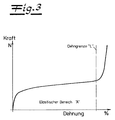
- the expansion behavior of the material is shown in FIG. 3 shown.
- the tensile force required for elongation of the invention is Composite over elongation (extension based on the original length). From Fig. 3 it takes out that the composite can be stretched to the yield strength with little force. about this expansion area, the composite is elastically at discharge back. Upon reaching the yield strength defined in the material is a strong To ascertain increase in the force necessary for further dilation. This area is clearly perceived as a non-elastic area.
- the cover layer consists of a spunbonded fabric whose Filaments 7 a filament core 3 made of a thermoplastic elastomer and a filament sheath 4 made of a non-elastic thermoplastic polymer exhibit.
- the fibrous web 2 is modified by a pre-stretching, before it is laminated onto the carrier film 1.
- pre-stretching or Pre-stretching changes the structure of the filaments. This will be from a comparative Consideration of Fig. 2a and 2b clearly.
- the filaments 7 of the nonwoven fabric 2 have the geometry shown in Fig. 2a on.
- the filament sheath 4 becomes plastic deformed while the filament core 3 only elastic deformation experiences.
- the filament 7 contracts again and then has the contour shown in Fig. 2b. Due to the plastic deformation of the non-elastic filament sheath 4, this now has a corrugated Structure on. If the filament 7 is stretched in use, straightened the non-elastic Filamentmantel 4 initially along the elastic Filament core 3 and sets the strain virtually no resistance opposite. If the filament 7 again by stretching an undulatory Has reached contour, which corresponds in principle to the representation in Fig. 2a, is reaches the elastic yield point of the nonwoven fabric 2 and an elongation over this yield point addition can only take place when the filament sheath 4 a undergoes further cold stretching. This second cold drawing is with a steep increase in the force required for further stretching.
- the nonwoven fabric 2 has no elastic properties in this area more on. This is particularly apparent from the Fig. 3, in which the Elongation required tensile force of a composite material according to the invention over the strain is applied.
- the filaments 7 of the composite In the unstretched state, the filaments 7 of the composite on the contour shown in Fig. 2b.
- the elastic Stretch area "A" runs the curve over a large area relatively flat, allowing to stretch the composite in this Area only comparatively small forces are required.
- the filaments 7 have a They also contour during maximum stretching during pre-stretching possessed.
- the nonwoven fabric 2 from a fiber mixture of elastic fibers and fibers of a non-elastic thermoplastic polymer.
- a Web made of non-woven fabric which has elastic fibers and fiber content of a non-elastic thermoplastic elastomer. This will then in the web transverse direction while stretching the non-elastic Fibers stretched.
- the non-woven fabric for example via a stretching frame or through a roll arrangement of profiled rolls, z. B. grooved rollers, out.
- an elongation takes place in the web transverse direction by 50% to 200% of the original web width, with the transverse strain on the desired yield strength of the composite is matched.
- the stretched Nonwoven fabric 2 is elastically back after the transverse strain and largely reaches the starting width again.
- the pre-strain modified nonwoven fabric 2 is used without stretching an elastic hotmelt adhesive 8 laminated on the carrier film 1.
- the hot melt adhesive 8 can be parallel to the web longitudinal direction Strips are applied, the strips have a width of preferably 0.3 to 2 mm, more preferably 0.5 to 1.5 mm, and in one Distance of preferably 0.2 to 5 mm, particularly preferably 0.5 to 2 mm, be applied to the elastic carrier film 1 and / or the nonwoven web.
- the elastic adhesive 8 may contain SIS, SBS, SEBS or PU polymers or mixtures thereof. Expediently, the adhesive 8 is applied to the non-woven fabric 2 and / or the carrier film 1 at a coating weight of 5 to 10 g / m 2 .
- the adhesive 8 can also be sprayed flat, creating a closed adhesive film or open, discontinuous, flaky adhesive film.
- the nonwoven fabric 2 or the nonwoven fabrics 2 and the carrier film 1 are in one Laminating pressed by means of two rollers.
- the after this Process produced composite is tensile strength in the longitudinal direction and behaves inelastic in the web longitudinal direction. In the transverse direction, the composite behaves however, to the extent by the measures according to the invention established yield strength almost rubber elastic, that is, the composite returns to its original position after the dilation. Of the so bonded composite is cut to finished product width.
- the elastic composite with hook bands 5 self-adhesive coating compounds and non-adhesive films completed and processed into rolls.
- the composite preferably allows a dilation and elastic recovery over a utility area from 30 to 150%, wherein the achievement of the elastic yield strength over the steep increase in power is defined.
Landscapes
- Health & Medical Sciences (AREA)
- Engineering & Computer Science (AREA)
- Textile Engineering (AREA)
- Animal Behavior & Ethology (AREA)
- Biomedical Technology (AREA)
- Heart & Thoracic Surgery (AREA)
- Vascular Medicine (AREA)
- Life Sciences & Earth Sciences (AREA)
- Epidemiology (AREA)
- General Health & Medical Sciences (AREA)
- Public Health (AREA)
- Veterinary Medicine (AREA)
- Mechanical Engineering (AREA)
- Absorbent Articles And Supports Therefor (AREA)
- Laminated Bodies (AREA)
- Slide Fasteners, Snap Fasteners, And Hook Fasteners (AREA)
Abstract
Description
- Fig. 1a und 1b
- einen erfindungsgemäßen Verbundstoff im ungedehnten sowie im gedehnten Zustand;
- Fig. 2a und 2b
- ein Filament, aus dem die Deckschicht des Verbundstoffes gefertigt ist,
- Fig. 3
- ein Dehnungs-Spannungs-Diagramm des Verbundstoffes.
Claims (18)
- Verbundstoff, insbesondere für elastische Windelverschlüsse, bestehend auseiner elastischen Trägerfolie (1), die eine bevorzugte Dehnungsrichtung aufweist, undmindestens einer aufkaschierten Deckschicht (2) aus einem Faservlies, welches Fasern (3) aus einem elastischen Polymer und durch eine Dehnung des Faservlieses in der bevorzugten Dehnungsrichtung verstreckte Faseranteile (4) aus einem nicht elastischen thermoplastischen Polymer enthält.
- Verbundstoff nach Anspruch 1, dadurch gekennzeichnet, dass die Deckschicht (2) aus einem Spinnvlies besteht, dessen Filamente (7) einen Filamentkern (3) aus einem thermoplastischen Elastomer und einen Filamentmantel (4) aus einem nicht elastischen thermoplastischen Polymer aufweisen.
- Verbundstoff nach Anspruch 1, dadurch gekennzeichnet, dass das Faservlies (2) aus einer Fasermischung aus elastischen Fasern und Fasern aus einem nicht elastischen thermoplastischen Polymer besteht.
- Verbundstoff nach einem der Ansprüche 1 bis 3, dadurch gekennzeichnet, dass die Deckschicht (2) ein Flächengewicht zwischen 10 g/m2 und 200 g/m2 aufweist.
- Verbundstoff nach einem der Ansprüche 1 bis 4, dadurch gekennzeichnet, dass der nicht elastische Faseranteil (4) innerhalb des Fasergemisches bis zu 60 Gew.-%, vorzugsweise etwa 20 Gew.-%, beträgt.
- Verbundstoff nach einem der Ansprüche 1 bis 5, dadurch gekennzeichnet, dass die elastische Trägerfolie (1) ein Flächengewicht zwischen 5 g/m2 und 150 g/m2 aufweist.
- Verbundstoff nach einem der Ansprüche 1 bis 6, dadurch gekennzeichnet, dass die elastische Trägerfolie (1) aus einer mehrschichtigen Coextrusionsfolie besteht, die einen Kern aus einem thermoplastischen Elastomer und eine einoder beidseitig angeordnete Haftvermittlerschicht zur Verbesserung der Haftung der angrenzenden Deckschicht (2) aufweist.
- Verbundstoff nach einem der Ansprüche 1 bis 7, dadurch gekennzeichnet, dass die Trägerfolie (1) und die Deckschicht (2) durch einen elastischen Schmelzklebstoff (8) verbunden sind, wobei der Klebstoffauftrag punktförmig, gitterartig, linienförmig in quer zur Dehnungsrichtung verlaufenden Streifen oder vollflächig erfolgt.
- Verfahren zur Herstellung eines Verbundstoffes nach einem der Ansprüche 1 bis 8,
wobei eine Bahn aus Faservlies hergestellt wird, welches elastische Fasern und Faseranteile aus einem nicht elastischen thermoplastischen Elastomer enthält,
wobei das Faservlies in Bahnquerrichtung unter Verstreckung der nicht elastischen Faseranteile gedehnt wird und
wobei das vorgedehnte Faservlies nach seiner elastischen Rückstellung ein- oder beidseitig auf eine Trägerfolie aufkaschiert wird, die quer zur Bahnlängsrichtung elastisch ist. - Verfahren nach Anspruch 9, dadurch gekennzeichnet, dass das Faservlies aus Filamenten hergestellt wird, die einen Filamentkern aus einem thermoplastischen Elastomer und einen Filamentmantel aus einem nicht elastischen thermoplastischen Polymer aufweisen.
- Verfahren nach Anspruch 9, dadurch gekennzeichnet, dass das Faservlies aus einer Fasermischung aus elastischen Fasern und Fasern aus einem nicht elastischen thermoplastischen Polymer hergestellt wird.
- Verfahren nach einem der Ansprüche 9 bis 11, dadurch gekennzeichnet, dass das Faservlies mechanisch oder thermisch verfestigt und ein Flächengewicht zwischen 10 g/m2 und 200 g/m2 eingestellt wird.
- Verfahren nach einem der Ansprüche 9 bis 12, dadurch gekennzeichnet, dass das Faservlies in Bahnquerrichtung um 50 % bis 200 % der ursprünglichen Bahnbreite gedehnt wird, wobei die Querdehnung auf die gewünschte Dehngrenze des Verbundstoffes angestimmt wird.
- Verfahren nach einem der Ansprüche 9 bis 13, dadurch gekennzeichnet, dass das Faservlies zur Querdehnung über einen Reckrahmen oder durch eine Walzenanordnung aus Profilwalzen geführt wird.
- Verfahren nach einem der Ansprüche 9 bis 14, dadurch gekennzeichnet, dass das vorgedehnte Faservlies unter Verwendung eines elastischen Schmelzklebstoffes auf die Trägerfolie aufkaschiert wird.
- Verfahren nach Anspruch 15, dadurch gekennzeichnet, dass der Schmelzklebstoff in zur Bahnlängsrichtung parallelen Streifen appliziert wird, wobei die Streifen eine Breite von vorzugsweise 0,3 bis 2 mm aufweisen und in einem Abstand von vorzugsweise 0,2 bis 5 mm auf die elastische Trägerfolie und/oder die Vliesbahn aufgebracht werden.
- Verfahren nach Anspruch 15, dadurch gekennzeichnet, dass der Klebstoff punktförmig auf die zu verbindenden Flächen aufgebracht wird.
- Verfahren nach Anspruch 15, dadurch gekennzeichnet, dass der Klebstoff flächig aufgesprüht wird, wobei ein geschlossener Klebstofffilm oder ein offener, diskontinuierlicher, schuppiger Klebstofffilm erzeugt wird.
Priority Applications (1)
| Application Number | Priority Date | Filing Date | Title |
|---|---|---|---|
| PL04028234T PL1541106T3 (pl) | 2003-12-13 | 2004-11-29 | Materiał zespolony do elastycznego zapięcia pieluchy i sposób jego wytwarzania |
Applications Claiming Priority (2)
| Application Number | Priority Date | Filing Date | Title |
|---|---|---|---|
| DE10358409 | 2003-12-13 | ||
| DE2003158409 DE10358409B4 (de) | 2003-12-13 | 2003-12-13 | Verbundstoff für einen elastischen Windelverschluss und Verfahren zu seiner Herstellung |
Publications (3)
| Publication Number | Publication Date |
|---|---|
| EP1541106A2 true EP1541106A2 (de) | 2005-06-15 |
| EP1541106A3 EP1541106A3 (de) | 2009-05-27 |
| EP1541106B1 EP1541106B1 (de) | 2014-04-16 |
Family
ID=34485360
Family Applications (1)
| Application Number | Title | Priority Date | Filing Date |
|---|---|---|---|
| EP20040028234 Expired - Lifetime EP1541106B1 (de) | 2003-12-13 | 2004-11-29 | Verbundstoff für einen elastischen Windelverschluss und Vefahren zu seiner Herstellung |
Country Status (6)
| Country | Link |
|---|---|
| US (1) | US7501361B2 (de) |
| EP (1) | EP1541106B1 (de) |
| JP (1) | JP4391400B2 (de) |
| DE (1) | DE10358409B4 (de) |
| ES (1) | ES2477591T3 (de) |
| PL (1) | PL1541106T3 (de) |
Cited By (5)
| Publication number | Priority date | Publication date | Assignee | Title |
|---|---|---|---|---|
| EP2106776A1 (de) * | 2008-03-31 | 2009-10-07 | Nordenia Technologies GmbH | Elastischer Verbundstoff |
| EP2005925A4 (de) * | 2006-03-31 | 2010-09-15 | Kb Seiren Ltd | Medizinisches basis-flächengebilde und dieses enthaltendes medizinisches flächengebilde |
| EP2228209A1 (de) * | 2009-03-11 | 2010-09-15 | Nordenia Deutschland Gronau GmbH | Elastisches Laminat, insbesondere für elastische Windelverschlusselemente |
| EP2340796A1 (de) * | 2009-12-29 | 2011-07-06 | Nordenia Deutschland Gronau GmbH | Verfahren zur Herstellung einer Materialbahn, aus der elastisch dehnbare Windelverschlusselemente ausstanzbar sind |
| EP3228292A1 (de) * | 2016-04-08 | 2017-10-11 | Mondi AG | Elastisches laminat sowie verfahren zur herstellung des elastischen laminates |
Families Citing this family (9)
| Publication number | Priority date | Publication date | Assignee | Title |
|---|---|---|---|---|
| ES2270205T3 (es) * | 2004-03-22 | 2007-04-01 | Nordenia Deutschland Gronau Gmbh | Material compuesto para cierres de tipo velcro, especialmente cierres para pañales. |
| DE502005005395D1 (de) * | 2005-02-12 | 2008-10-30 | Nordenia Deutschland Gronau | Verbundstoffelement für einen Klettverschluss, insbesondere einen Windelverschluss, und Verfahren zu seiner Herstellung |
| DE102006055089A1 (de) * | 2006-06-29 | 2008-01-03 | Koester Gmbh & Co. Kg | Elastischer Verbundstoff, Verfahren zum Herstellen eines Verbundstoffs, Verschlussband, Bandmaterial und Windel |
| WO2009010984A1 (en) * | 2007-07-19 | 2009-01-22 | Avgol Industries 1953 Ltd | Non-woven material |
| DE102007050874A1 (de) | 2007-10-24 | 2009-04-30 | HÄNSEL VERBUNDTECHNIK GmbH | Textiles Laminat aus einer elastischen Trägerschicht und zumindest einer Vliesstoffschicht, Bandmaterial aus dem Laminat, Windelverschluss, sowie Verfahren zum Herstellen des Bandmaterials |
| DE102008035956A1 (de) | 2008-07-31 | 2010-02-04 | Nordenia Deutschland Gronau Gmbh | Verfahren zur Herstellung eines Kaschierverbundes für die Bildung hinterspritzter Kunststoffformteile |
| IT1395029B1 (it) * | 2009-08-06 | 2012-09-05 | Marzi | Materiale multistrato, procedimento per la realizzazione di tale materiale ed articolo provvisto di porzioni di aggancio a struttura multistrato. |
| EP2335662B1 (de) * | 2009-12-19 | 2020-03-25 | Mondi AG | Elastisches Verbundmaterial |
| DE102021208606B4 (de) | 2021-08-06 | 2025-02-06 | Friedrich-Alexander Universität Erlangen-Nürnberg, Körperschaft des öffentlichen Rechts | Verfahren zur Herstellung eines Polymer-Vliesstoffs |
Family Cites Families (8)
| Publication number | Priority date | Publication date | Assignee | Title |
|---|---|---|---|---|
| US4879170A (en) * | 1988-03-18 | 1989-11-07 | Kimberly-Clark Corporation | Nonwoven fibrous hydraulically entangled elastic coform material and method of formation thereof |
| JP3422609B2 (ja) | 1995-11-14 | 2003-06-30 | 花王株式会社 | 使い捨ておむつ |
| JPH09294772A (ja) * | 1996-04-30 | 1997-11-18 | Kao Corp | 使い捨ておむつ |
| DE10151045C2 (de) * | 2001-10-16 | 2003-09-25 | Freudenberg Carl Kg | Vliesverbundstoff für mechanische Verschlusssysteme, Verfahren zu dessen Herstellung und dessen Verwendung |
| US20030125707A1 (en) * | 2001-12-31 | 2003-07-03 | Kimberly-Clark Worldwide, Inc. | Mechanical fastening system for an absorbent article |
| DE10212842A1 (de) * | 2002-03-11 | 2003-10-09 | Fibertex As Aalborg | Vliesmaterial mit elastischen Eigenschaften |
| US8323435B2 (en) * | 2002-07-31 | 2012-12-04 | Kimberly-Clark Worldwide, Inc. | Mechanical fastening system for an article |
| MXPA06002055A (es) * | 2003-08-22 | 2006-05-25 | Advanced Design Concept Gmbh | Material compuesto no tejido-pelicula completamente elastico. |
-
2003
- 2003-12-13 DE DE2003158409 patent/DE10358409B4/de not_active Expired - Fee Related
-
2004
- 2004-11-29 ES ES04028234.5T patent/ES2477591T3/es not_active Expired - Lifetime
- 2004-11-29 EP EP20040028234 patent/EP1541106B1/de not_active Expired - Lifetime
- 2004-11-29 PL PL04028234T patent/PL1541106T3/pl unknown
- 2004-12-09 US US11/008,704 patent/US7501361B2/en not_active Expired - Fee Related
- 2004-12-09 JP JP2004357295A patent/JP4391400B2/ja not_active Expired - Fee Related
Cited By (6)
| Publication number | Priority date | Publication date | Assignee | Title |
|---|---|---|---|---|
| EP2005925A4 (de) * | 2006-03-31 | 2010-09-15 | Kb Seiren Ltd | Medizinisches basis-flächengebilde und dieses enthaltendes medizinisches flächengebilde |
| EP2106776A1 (de) * | 2008-03-31 | 2009-10-07 | Nordenia Technologies GmbH | Elastischer Verbundstoff |
| EP2228209A1 (de) * | 2009-03-11 | 2010-09-15 | Nordenia Deutschland Gronau GmbH | Elastisches Laminat, insbesondere für elastische Windelverschlusselemente |
| WO2010102742A1 (de) * | 2009-03-11 | 2010-09-16 | Nordenia Deutschland Gronau Gmbh | Elastisches laminat, insbesondere für elastische windelverschlusselemente |
| EP2340796A1 (de) * | 2009-12-29 | 2011-07-06 | Nordenia Deutschland Gronau GmbH | Verfahren zur Herstellung einer Materialbahn, aus der elastisch dehnbare Windelverschlusselemente ausstanzbar sind |
| EP3228292A1 (de) * | 2016-04-08 | 2017-10-11 | Mondi AG | Elastisches laminat sowie verfahren zur herstellung des elastischen laminates |
Also Published As
| Publication number | Publication date |
|---|---|
| EP1541106B1 (de) | 2014-04-16 |
| ES2477591T3 (es) | 2014-07-17 |
| JP4391400B2 (ja) | 2009-12-24 |
| PL1541106T3 (pl) | 2014-09-30 |
| DE10358409B4 (de) | 2006-07-13 |
| DE10358409A1 (de) | 2005-07-14 |
| JP2005170047A (ja) | 2005-06-30 |
| US7501361B2 (en) | 2009-03-10 |
| EP1541106A3 (de) | 2009-05-27 |
| US20050130543A1 (en) | 2005-06-16 |
Similar Documents
| Publication | Publication Date | Title |
|---|---|---|
| EP1686209B1 (de) | Verfahren zur Herstellung eines Vliesverbundmaterials | |
| EP1736306B1 (de) | Verbundstoffbahn mit elastischen und unelastischen Bereichen | |
| EP1342562B1 (de) | Verfahren zur Herstellung einer luftdurchlässigen Verbundfolie mit textiler Oberfläche, die elastische und nichtelastische Bereiche aufweist | |
| DE69415536T2 (de) | Elastische mehrschichtige folie aus schrittweise gestrecktem faserigem vliesstoff und elastomerfilm und verfahren zu deren herstellung | |
| DE10358409B4 (de) | Verbundstoff für einen elastischen Windelverschluss und Verfahren zu seiner Herstellung | |
| EP2465985B1 (de) | Verfahren zur Herstellung eines elastischen Verbundstoffes mit textiler Oberfläche | |
| EP3228291B1 (de) | Weichelastische folie für folienbändchen | |
| DE10202333A1 (de) | Verfahren zur Herstellung einer elastischen, luftdurchlässigen Verbundfolie | |
| EP1321288B1 (de) | Elastisches Folienlaminat | |
| EP2564822A1 (de) | Verfahren zur Herstellung einer Materialbahn, aus der elastisch dehnbare Windelverschlusselemente ausstanzbar sind | |
| EP1712669B1 (de) | Verfahren zur Herstellung einer elastischen Verbundstoffbahn | |
| EP1316418B1 (de) | Monoaxial elastische Laminatfolie | |
| EP1721591B1 (de) | Verschlussstreifen für Windeln | |
| EP3228292B1 (de) | Elastisches laminat sowie verfahren zur herstellung des elastischen laminates | |
| EP2110241B1 (de) | Verbundmaterial, insbesondere für Verschlusselemente an Windeln, mit hohem Dehnungsvermögen und semielastischen Eigenschaften | |
| EP1342563B1 (de) | Verfahren zur Herstellung einer elastischen Verbundfolie mit textiler Oberfläche | |
| DE19804875C2 (de) | Selbstklebende Materialbahn | |
| EP1773581B1 (de) | Elastisches laminat | |
| EP0935035B1 (de) | Selbstklebende Materialbahn | |
| DE3602629A1 (de) | Bituminoese dachschweissbahn und verfahren zu ihrer herstellung | |
| DE10304370A1 (de) | Querelastische, mehrschichtige Materialbahnen und Verfahren zur Herstellung derselben | |
| EP4054499A1 (de) | Verfahren zur herstellung eines elastischen laminates sowie nach dem verfahren erhältliches laminat | |
| DE102024113233A1 (de) | Soft elastic blown film | |
| DE102024119044A1 (de) | SEBS based elastic blown film (SEBS basierte, elastische Blasfolie) | |
| DE102023116943A1 (de) | Coextrusionsverbundfolie und Verfahren zur Herstellung einer Coextrusionsverbundfolie |
Legal Events
| Date | Code | Title | Description |
|---|---|---|---|
| PUAI | Public reference made under article 153(3) epc to a published international application that has entered the european phase |
Free format text: ORIGINAL CODE: 0009012 |
|
| AK | Designated contracting states |
Kind code of ref document: A2 Designated state(s): AT BE BG CH CY CZ DE DK EE ES FI FR GB GR HU IE IS IT LI LU MC NL PL PT RO SE SI SK TR |
|
| AX | Request for extension of the european patent |
Extension state: AL HR LT LV MK YU |
|
| PUAL | Search report despatched |
Free format text: ORIGINAL CODE: 0009013 |
|
| AK | Designated contracting states |
Kind code of ref document: A3 Designated state(s): AT BE BG CH CY CZ DE DK EE ES FI FR GB GR HU IE IS IT LI LU MC NL PL PT RO SE SI SK TR |
|
| AX | Request for extension of the european patent |
Extension state: AL HR LT LV MK YU |
|
| 17P | Request for examination filed |
Effective date: 20090625 |
|
| AKX | Designation fees paid |
Designated state(s): AT BE BG CH CY CZ DE DK EE ES FI FR GB GR HU IE IS IT LI LU MC NL PL PT RO SE SI SK TR |
|
| 17Q | First examination report despatched |
Effective date: 20100211 |
|
| GRAP | Despatch of communication of intention to grant a patent |
Free format text: ORIGINAL CODE: EPIDOSNIGR1 |
|
| INTG | Intention to grant announced |
Effective date: 20131030 |
|
| GRAS | Grant fee paid |
Free format text: ORIGINAL CODE: EPIDOSNIGR3 |
|
| GRAA | (expected) grant |
Free format text: ORIGINAL CODE: 0009210 |
|
| AK | Designated contracting states |
Kind code of ref document: B1 Designated state(s): AT BE BG CH CY CZ DE DK EE ES FI FR GB GR HU IE IS IT LI LU MC NL PL PT RO SE SI SK TR |
|
| RAP1 | Party data changed (applicant data changed or rights of an application transferred) |
Owner name: MONDI GRONAU GMBH |
|
| REG | Reference to a national code |
Ref country code: GB Ref legal event code: FG4D Free format text: NOT ENGLISH |
|
| REG | Reference to a national code |
Ref country code: CH Ref legal event code: EP |
|
| REG | Reference to a national code |
Ref country code: AT Ref legal event code: REF Ref document number: 662062 Country of ref document: AT Kind code of ref document: T Effective date: 20140515 |
|
| REG | Reference to a national code |
Ref country code: IE Ref legal event code: FG4D Free format text: LANGUAGE OF EP DOCUMENT: GERMAN |
|
| REG | Reference to a national code |
Ref country code: DE Ref legal event code: R096 Ref document number: 502004014583 Country of ref document: DE Effective date: 20140522 |
|
| REG | Reference to a national code |
Ref country code: SE Ref legal event code: TRGR |
|
| REG | Reference to a national code |
Ref country code: NL Ref legal event code: T3 |
|
| REG | Reference to a national code |
Ref country code: ES Ref legal event code: FG2A Ref document number: 2477591 Country of ref document: ES Kind code of ref document: T3 Effective date: 20140717 |
|
| REG | Reference to a national code |
Ref country code: PL Ref legal event code: T3 |
|
| PG25 | Lapsed in a contracting state [announced via postgrant information from national office to epo] |
Ref country code: IS Free format text: LAPSE BECAUSE OF FAILURE TO SUBMIT A TRANSLATION OF THE DESCRIPTION OR TO PAY THE FEE WITHIN THE PRESCRIBED TIME-LIMIT Effective date: 20140816 Ref country code: FI Free format text: LAPSE BECAUSE OF FAILURE TO SUBMIT A TRANSLATION OF THE DESCRIPTION OR TO PAY THE FEE WITHIN THE PRESCRIBED TIME-LIMIT Effective date: 20140416 Ref country code: CY Free format text: LAPSE BECAUSE OF FAILURE TO SUBMIT A TRANSLATION OF THE DESCRIPTION OR TO PAY THE FEE WITHIN THE PRESCRIBED TIME-LIMIT Effective date: 20140416 Ref country code: GR Free format text: LAPSE BECAUSE OF FAILURE TO SUBMIT A TRANSLATION OF THE DESCRIPTION OR TO PAY THE FEE WITHIN THE PRESCRIBED TIME-LIMIT Effective date: 20140717 Ref country code: BG Free format text: LAPSE BECAUSE OF FAILURE TO SUBMIT A TRANSLATION OF THE DESCRIPTION OR TO PAY THE FEE WITHIN THE PRESCRIBED TIME-LIMIT Effective date: 20140716 |
|
| PG25 | Lapsed in a contracting state [announced via postgrant information from national office to epo] |
Ref country code: PT Free format text: LAPSE BECAUSE OF FAILURE TO SUBMIT A TRANSLATION OF THE DESCRIPTION OR TO PAY THE FEE WITHIN THE PRESCRIBED TIME-LIMIT Effective date: 20140818 |
|
| REG | Reference to a national code |
Ref country code: DE Ref legal event code: R097 Ref document number: 502004014583 Country of ref document: DE |
|
| PG25 | Lapsed in a contracting state [announced via postgrant information from national office to epo] |
Ref country code: DK Free format text: LAPSE BECAUSE OF FAILURE TO SUBMIT A TRANSLATION OF THE DESCRIPTION OR TO PAY THE FEE WITHIN THE PRESCRIBED TIME-LIMIT Effective date: 20140416 Ref country code: RO Free format text: LAPSE BECAUSE OF FAILURE TO SUBMIT A TRANSLATION OF THE DESCRIPTION OR TO PAY THE FEE WITHIN THE PRESCRIBED TIME-LIMIT Effective date: 20140416 Ref country code: EE Free format text: LAPSE BECAUSE OF FAILURE TO SUBMIT A TRANSLATION OF THE DESCRIPTION OR TO PAY THE FEE WITHIN THE PRESCRIBED TIME-LIMIT Effective date: 20140416 Ref country code: SK Free format text: LAPSE BECAUSE OF FAILURE TO SUBMIT A TRANSLATION OF THE DESCRIPTION OR TO PAY THE FEE WITHIN THE PRESCRIBED TIME-LIMIT Effective date: 20140416 |
|
| PLBE | No opposition filed within time limit |
Free format text: ORIGINAL CODE: 0009261 |
|
| STAA | Information on the status of an ep patent application or granted ep patent |
Free format text: STATUS: NO OPPOSITION FILED WITHIN TIME LIMIT |
|
| 26N | No opposition filed |
Effective date: 20150119 |
|
| REG | Reference to a national code |
Ref country code: DE Ref legal event code: R097 Ref document number: 502004014583 Country of ref document: DE Effective date: 20150119 |
|
| PG25 | Lapsed in a contracting state [announced via postgrant information from national office to epo] |
Ref country code: MC Free format text: LAPSE BECAUSE OF FAILURE TO SUBMIT A TRANSLATION OF THE DESCRIPTION OR TO PAY THE FEE WITHIN THE PRESCRIBED TIME-LIMIT Effective date: 20140416 Ref country code: LU Free format text: LAPSE BECAUSE OF FAILURE TO SUBMIT A TRANSLATION OF THE DESCRIPTION OR TO PAY THE FEE WITHIN THE PRESCRIBED TIME-LIMIT Effective date: 20141129 Ref country code: BE Free format text: LAPSE BECAUSE OF NON-PAYMENT OF DUE FEES Effective date: 20141130 |
|
| REG | Reference to a national code |
Ref country code: CH Ref legal event code: PL |
|
| PG25 | Lapsed in a contracting state [announced via postgrant information from national office to epo] |
Ref country code: CH Free format text: LAPSE BECAUSE OF NON-PAYMENT OF DUE FEES Effective date: 20141130 Ref country code: SI Free format text: LAPSE BECAUSE OF FAILURE TO SUBMIT A TRANSLATION OF THE DESCRIPTION OR TO PAY THE FEE WITHIN THE PRESCRIBED TIME-LIMIT Effective date: 20140416 Ref country code: LI Free format text: LAPSE BECAUSE OF NON-PAYMENT OF DUE FEES Effective date: 20141130 |
|
| REG | Reference to a national code |
Ref country code: IE Ref legal event code: MM4A |
|
| PG25 | Lapsed in a contracting state [announced via postgrant information from national office to epo] |
Ref country code: IE Free format text: LAPSE BECAUSE OF NON-PAYMENT OF DUE FEES Effective date: 20141129 |
|
| REG | Reference to a national code |
Ref country code: FR Ref legal event code: PLFP Year of fee payment: 12 |
|
| REG | Reference to a national code |
Ref country code: AT Ref legal event code: MM01 Ref document number: 662062 Country of ref document: AT Kind code of ref document: T Effective date: 20141129 |
|
| PG25 | Lapsed in a contracting state [announced via postgrant information from national office to epo] |
Ref country code: AT Free format text: LAPSE BECAUSE OF NON-PAYMENT OF DUE FEES Effective date: 20141129 |
|
| PG25 | Lapsed in a contracting state [announced via postgrant information from national office to epo] |
Ref country code: HU Free format text: LAPSE BECAUSE OF FAILURE TO SUBMIT A TRANSLATION OF THE DESCRIPTION OR TO PAY THE FEE WITHIN THE PRESCRIBED TIME-LIMIT; INVALID AB INITIO Effective date: 20041129 |
|
| REG | Reference to a national code |
Ref country code: FR Ref legal event code: PLFP Year of fee payment: 13 |
|
| PGFP | Annual fee paid to national office [announced via postgrant information from national office to epo] |
Ref country code: CZ Payment date: 20161128 Year of fee payment: 13 Ref country code: GB Payment date: 20161122 Year of fee payment: 13 Ref country code: NL Payment date: 20161118 Year of fee payment: 13 |
|
| PGFP | Annual fee paid to national office [announced via postgrant information from national office to epo] |
Ref country code: ES Payment date: 20161114 Year of fee payment: 13 Ref country code: PL Payment date: 20161025 Year of fee payment: 13 Ref country code: SE Payment date: 20161118 Year of fee payment: 13 |
|
| REG | Reference to a national code |
Ref country code: FR Ref legal event code: PLFP Year of fee payment: 14 |
|
| REG | Reference to a national code |
Ref country code: SE Ref legal event code: EUG |
|
| REG | Reference to a national code |
Ref country code: NL Ref legal event code: MM Effective date: 20171201 |
|
| GBPC | Gb: european patent ceased through non-payment of renewal fee |
Effective date: 20171129 |
|
| PG25 | Lapsed in a contracting state [announced via postgrant information from national office to epo] |
Ref country code: CZ Free format text: LAPSE BECAUSE OF NON-PAYMENT OF DUE FEES Effective date: 20171129 |
|
| PG25 | Lapsed in a contracting state [announced via postgrant information from national office to epo] |
Ref country code: SE Free format text: LAPSE BECAUSE OF NON-PAYMENT OF DUE FEES Effective date: 20171130 |
|
| PG25 | Lapsed in a contracting state [announced via postgrant information from national office to epo] |
Ref country code: NL Free format text: LAPSE BECAUSE OF NON-PAYMENT OF DUE FEES Effective date: 20171201 |
|
| PG25 | Lapsed in a contracting state [announced via postgrant information from national office to epo] |
Ref country code: GB Free format text: LAPSE BECAUSE OF NON-PAYMENT OF DUE FEES Effective date: 20171129 |
|
| REG | Reference to a national code |
Ref country code: ES Ref legal event code: FD2A Effective date: 20190103 |
|
| PG25 | Lapsed in a contracting state [announced via postgrant information from national office to epo] |
Ref country code: ES Free format text: LAPSE BECAUSE OF NON-PAYMENT OF DUE FEES Effective date: 20171130 |
|
| PG25 | Lapsed in a contracting state [announced via postgrant information from national office to epo] |
Ref country code: PL Free format text: LAPSE BECAUSE OF NON-PAYMENT OF DUE FEES Effective date: 20171129 |
|
| PGFP | Annual fee paid to national office [announced via postgrant information from national office to epo] |
Ref country code: TR Payment date: 20201126 Year of fee payment: 17 |
|
| PGFP | Annual fee paid to national office [announced via postgrant information from national office to epo] |
Ref country code: FR Payment date: 20201120 Year of fee payment: 17 Ref country code: IT Payment date: 20201124 Year of fee payment: 17 Ref country code: DE Payment date: 20201106 Year of fee payment: 17 |
|
| REG | Reference to a national code |
Ref country code: DE Ref legal event code: R119 Ref document number: 502004014583 Country of ref document: DE |
|
| PG25 | Lapsed in a contracting state [announced via postgrant information from national office to epo] |
Ref country code: DE Free format text: LAPSE BECAUSE OF NON-PAYMENT OF DUE FEES Effective date: 20220601 |
|
| PG25 | Lapsed in a contracting state [announced via postgrant information from national office to epo] |
Ref country code: FR Free format text: LAPSE BECAUSE OF NON-PAYMENT OF DUE FEES Effective date: 20211130 |
|
| PG25 | Lapsed in a contracting state [announced via postgrant information from national office to epo] |
Ref country code: IT Free format text: LAPSE BECAUSE OF NON-PAYMENT OF DUE FEES Effective date: 20211129 |
|
| PG25 | Lapsed in a contracting state [announced via postgrant information from national office to epo] |
Ref country code: TR Free format text: LAPSE BECAUSE OF NON-PAYMENT OF DUE FEES Effective date: 20211129 |