EP1540281B1 - Verfahren und einrichtung zum anzeigen topographischer daten - Google Patents
Verfahren und einrichtung zum anzeigen topographischer daten Download PDFInfo
- Publication number
- EP1540281B1 EP1540281B1 EP03772072.9A EP03772072A EP1540281B1 EP 1540281 B1 EP1540281 B1 EP 1540281B1 EP 03772072 A EP03772072 A EP 03772072A EP 1540281 B1 EP1540281 B1 EP 1540281B1
- Authority
- EP
- European Patent Office
- Prior art keywords
- data
- stored
- compression
- display screen
- display
- Prior art date
- Legal status (The legal status is an assumption and is not a legal conclusion. Google has not performed a legal analysis and makes no representation as to the accuracy of the status listed.)
- Expired - Lifetime
Links
- 238000000034 method Methods 0.000 title claims description 44
- 238000007906 compression Methods 0.000 claims description 48
- 230000006835 compression Effects 0.000 claims description 48
- 238000012937 correction Methods 0.000 claims description 14
- 230000006837 decompression Effects 0.000 claims description 14
- 238000012545 processing Methods 0.000 claims description 13
- 230000004044 response Effects 0.000 claims 4
- 238000013144 data compression Methods 0.000 description 12
- 238000004422 calculation algorithm Methods 0.000 description 9
- 238000004364 calculation method Methods 0.000 description 3
- 238000013507 mapping Methods 0.000 description 3
- 238000012986 modification Methods 0.000 description 3
- 230000004048 modification Effects 0.000 description 3
- 230000015556 catabolic process Effects 0.000 description 2
- 238000006731 degradation reaction Methods 0.000 description 2
- 238000010586 diagram Methods 0.000 description 2
- 239000004973 liquid crystal related substance Substances 0.000 description 2
- 238000013519 translation Methods 0.000 description 2
- IYLGZMTXKJYONK-ACLXAEORSA-N (12s,15r)-15-hydroxy-11,16-dioxo-15,20-dihydrosenecionan-12-yl acetate Chemical compound O1C(=O)[C@](CC)(O)C[C@@H](C)[C@](C)(OC(C)=O)C(=O)OCC2=CCN3[C@H]2[C@H]1CC3 IYLGZMTXKJYONK-ACLXAEORSA-N 0.000 description 1
- 230000001174 ascending effect Effects 0.000 description 1
- 238000004590 computer program Methods 0.000 description 1
- 238000013500 data storage Methods 0.000 description 1
- 230000001419 dependent effect Effects 0.000 description 1
- 238000001983 electron spin resonance imaging Methods 0.000 description 1
- 238000005516 engineering process Methods 0.000 description 1
- 238000005259 measurement Methods 0.000 description 1
- IYLGZMTXKJYONK-UHFFFAOYSA-N ruwenine Natural products O1C(=O)C(CC)(O)CC(C)C(C)(OC(C)=O)C(=O)OCC2=CCN3C2C1CC3 IYLGZMTXKJYONK-UHFFFAOYSA-N 0.000 description 1
- 238000000638 solvent extraction Methods 0.000 description 1
Images




Classifications
-
- G—PHYSICS
- G01—MEASURING; TESTING
- G01C—MEASURING DISTANCES, LEVELS OR BEARINGS; SURVEYING; NAVIGATION; GYROSCOPIC INSTRUMENTS; PHOTOGRAMMETRY OR VIDEOGRAMMETRY
- G01C21/00—Navigation; Navigational instruments not provided for in groups G01C1/00 - G01C19/00
- G01C21/20—Instruments for performing navigational calculations
-
- G—PHYSICS
- G09—EDUCATION; CRYPTOGRAPHY; DISPLAY; ADVERTISING; SEALS
- G09B—EDUCATIONAL OR DEMONSTRATION APPLIANCES; APPLIANCES FOR TEACHING, OR COMMUNICATING WITH, THE BLIND, DEAF OR MUTE; MODELS; PLANETARIA; GLOBES; MAPS; DIAGRAMS
- G09B29/00—Maps; Plans; Charts; Diagrams, e.g. route diagram
- G09B29/10—Map spot or coordinate position indicators; Map reading aids
- G09B29/106—Map spot or coordinate position indicators; Map reading aids using electronic means
Definitions
- the present invention relates to a method and apparatus for displaying data, such as topographical data, and to a computer program for enabling display of such data. More particularly, the present invention relates to displaying data, such as topographical data, for efficient representation of data in a low-cost portable hand-held device.
- Portable mapping devices such as GPS (Global Positioning System) and PDAs (Personal Digital Assistants) are capable of displaying and manipulating digital maps. In addition to the roads, streets, rivers, lakes and other geographic features, these maps often display topographical information as well.
- topographical information is presented only as a set of topographical lines similar to the ones that are used in conventional paper topographical maps. Therefore, a true value of the terrain elevation is known and stored only for the topographical lines that are stored for the map, e.g.- Garmin Hand-Held GPS Vista device. This makes it difficult to compute elevation at other points or to create new topographical lines for the elevation levels that are not pre-stored for the map. This also requires a large data storage if topographical lines with a high resolution are required.
- U.S. Patent No. 5, 902, 347 to Backman et al. and entitled Hand-held GPS-mapping Device, discloses a hand-held GPS mapping device containing a GPS receiver, a database capable of storing vector or bit-mapped graphics, a viewing port, an embedded processor, a simplified user interface, a data compression algorithm, and other supporting electronics.
- U.S. Patent No. 5, 902, 347, to Backman et al. discloses two features, namely, a device that allows to view map images in the bright sun light and a device which divides a bit image of a topographical map by tiles and then compresses each tile with regular image compression algorithms such as TIFF (Tagged Image File Format).
- the first device is not relevant to the present invention.
- the second device while the abstract thereof mentioned vector maps, this is only to include such map images under the first device- having a screen that can be viewed outside.
- the tile compression method of the second device is applicable only to the bit map images - photo images, of the map, that is, so called raster maps.
- the present invention is not concerned with a bit image or with a vector map. Rather, the present invention deals with Digital Elevation Model data, which is quite different from both. DEM allows computing true elevation in any point of the map while a photo image of a map does not allow retrieving any digital information about features such as road direction or elevation, etc.
- the present invention allows one to create tiles of different size with different resolution of data, which depend on the zoom level where these tiles are intended to be used.
- Image data cannot be simply thinned out so creation of tiles with different internal resolution of the data is impossible and is not even mentioned in U.S. Patent No. 5, 902, 347, to Backman et al.
- DE 43 23 081 A describes electronic orientation devices known for determining location, for example for tourists, which are used in motor vehicles as city guides or navigation aids.
- relevant map data are input into a programmable memory by means of a memory medium (CD-ROM) and are output via an LCD (liquid crystal display) screen as a map image, it being possible to select different scales.
- CD-ROM memory medium
- LCD liquid crystal display
- a method and a device for representing geographical data are proposed, by means of which the calculation and output of a pictorial representation of the horizon line is possible for any desired location.
- the output of the horizon line facilitates orientation in an unfamiliar place, since the actually visible landscape contour is displayed.
- the output can be carried out in a panoramic representation and also as a map representation. Use as navigation and orientation aid.
- a cell compression structure is utilized such that each cell can be decompressed independent of the others. Then, the data can be decompressed on-the-fly only for those cells that are needed to provide data for the area displayed on the screen of the device and only for the zoom levels that are currently used.
- elevation data for example, is compressed using off-line processing.
- An asymmetrical compression algorithm is utilized so as to emphasize simplicity in the decompression of the data by providing most of the processing during the off-line data compression, thereby allowing the use of high-power computing devices to compress the data and allowing simple display devices having limited computing capabilities to decompress the data.
- lossy compression is utilized to increase the data compression ratio. Both the average (rms) and maximum data compression error or the average (rms) and. relative data compression error are controlled.
- the limitation on the absolute data compression error may be achieved by storing explicit corrections for the grid points where a good fit cannot be achieved with a desired level of data compression.
- data is decompressed and recomputed to a new grid, which is parallel to the screen and with a grid step, which is comparable with the screen size and resolution of a map presentation on the screen.
- the topographical lines are computed on-the-fly using the screen reference grid of the new grid noted above.
- the elevation lines step is created on-the-fly and can either be user-specified or automatically determined from the map scale.
- the elevation value can be determined in real-time for any map location presented on the display screen.
- the user can view an elevation profile of a selected road, street, trail, track, or any other line feature and can view an elevation profile along the line of travel or perpendicular to the line of travel or at any arbitrary angle with respect to the line of travel and at any distance from the current position.
- the current invention allows one to decompress and to display DEM data in a small hand-held device, such as PDA, that does not have direct position information from a GPS subsystem, internal or external.
- a small hand-held device such as PDA
- real time position information obtained from GPS allows the afore-said device to decompress, to restore, and to display topographical data that is relevant to the actual user position without any direct intervention by the user.
- a device can display only topographical information for the area explicitly selected by the user. Such area may or may not be related to the current position of the user.
- a user of the device always has an option to directly command the device to display topographical information about an area of his/her choosing even if a GPS subsystem is present and active.
- FIG. 1 is a block diagram illustrating a hand-held GPS unit 100 which may be used in accordance with an embodiment of the topographical data display technique of the present invention.
- an entry device 110 such as a keypad or touchpad, is connected to a CPU (Central Processing Unit) 130 of the hand-held GPS unit 100.
- CPU Central Processing Unit
- An antenna 151 is connected to an RF front-end 150 whose output is connected to a GPS DSP (Digital Signal Processor) 120. Radio frequency signals from a plurality of satellites (not shown) are received by the antenna 151 and processed by the RF front-end 150 and the GPS DSP 120.
- GPS DSP Digital Signal Processor
- the CPU 130 in addition to receiving an output from the GPS DSP 120, is connected to a memory card or other memory device 140, a code RAM (Random Access Memory) 160, a System RAM 165, and a VRAM (Video Random Access Memory) 170.
- the output of the VRAM 170 is fed to a VCTRL (Video Controller) 190, which in turn feeds the display screen 180, which is normally an LCD (Liquid Crystal Display) device.
- VCTRL Video Controller
- data corresponding to a topographical map of a particular area is stored in a compressed form in the memory card 140.
- the total amount of data is limited only by the capacity of the memory card 140.
- the area that is covered by the given amount of compressed topographical data is determined by the compression ratio of the data compression algorithm used.
- the compression ratio is effected by the resolution of the initial DEM data (size of the data grid step), the desired range of zooms when the topographical data needs to be presented, an acceptable level of data degradation - lossy compression, and a size of the screen. Since the present invention allows one to achieve a very high data compression ratio, it provides the largest area of coverage for a given memory card size.
- the GPS DSP 120 determines the exact location of the hand-held GPS unit 100.
- the CPU 130 in conjunction with the memory card 140, code RAM 160, system RAM 165, VRAM 170 and VCTRL 190, display that portion of the stored topographical map including the exact location of the hand-held GPS unit 100 on the display screen 180.
- the various features of the present invention are discussed in detail below. These features may be effected with the hand-held GPS unit 100 illustrated in Figure 1 .
- Topographic information is available in different digital data formats and provides coverage of large areas.
- the most common is a Digital Elevation Model where elevation values of the Earth surface are recorded and stored at the vertices of a regular grid, usually rectangular. This is the input elevation data format that is used by the present invention.
- Many other Digital Elevation formats can be converted into DEM by knowledgeable in the art by using many commercial tools, e.g. Arc View from ESRI.
- Such grids can take a lot of memory, and thus data compression is required even for desktop computers.
- High compression ratios can be achieved only by using lossy compression algorithms. That is, the restored decompressed elevations differ from the original ones.
- the original grid is divided into cells (relatively small rectangular pieces) such that each cell can be decompressed independently from the others.
- the cell size is selected such that its size is comparable with the actual area that can be displayed at a particular range of zooms. Therefore, at most only 4 cells, for example, need to be decompressed for every screen for a particular range of zoom level. It is clear that digital map displays at different zoom levels can have different resolution of the underlying data. When a device displays 10 mi width across the screen, for example, the effective feature resolution that is available to the user is much less than when the same screen covers only a 100m width across the screen.
- cells of different size and different resolution that cover the same area are used.
- a cell with the most detailed resolution may be based on a topographical grid with 10m grid steps and have 128x128 grid points.
- the next level of cells will have also 128x128 grid points but with a grid step of 100m, and another level of cells will have the same number of points, but with a 1000 m grid step. Therefore, with the same speed of decompression, different cell levels cover area 100 times larger with an appropriate reduction in resolution of only 10 times.
- RMSE Root Mean Square Error
- the RMSE directly depends on the compression ratio, and a required RMSE can be obtained by changing the compression ratio. However, the value of the maximum error is quite arbitrary.
- all cell points are checked for deviation. If a deviation is greater than an acceptable level, the values of deviation and point positions are written into an archive. During decompression, the restored decompressed elevation data of a point is corrected by using deviation value stored in the archive.
- the format of the correction values table can be as follows.
- the table is written to the end of the each cell archive and consists of the deviations and coordinates of the points with the deviations equal or greater than d.
- the initial cells must be compared with the cells restored from the archive.
- c be a counter of elements. Its value is initially 0. A linear search is effected (along the rows, over the whole cell) for elements with large deviations (that is, the absolute value s of the difference between the original elevation data and the restored data from the archive is greater than d). If s ⁇ d, then c is incremented and the search continues. Otherwise, c is written into the archive, then 2(s - d) if s>0, and 2(s + d) + 1 else. After that, c is set to 0 and the process goes on.
- the value of d is to be coordinated with the RMS error value, such that the number of points to be stored is small.
- the additional correction table is checked, and if its size is > 0 then the correction is applied to a decompressed cell.
- the correction algorithm can be performed for any lossy compression algorithm.
- the amount of information loss is usually controlled by the size of the resultant archive.
- An example of such an algorithm is disclosed in US Patent No. 5,764,807, issued June 9, 1998 , and entitled: Data Compression Using Set Partitioning In Hierarchical Trees.
- Any data that is loaded into a nonvolatile memory of a portable device must be prepared off line and then used in real time.
- An important difference between the present invention and any other method is that other methods are generally symmetric in terms of processing complexity. Compression and decompression with the TIFF method takes about the same computing power. The only difference is that off-line, a large amount of data can be prepared while on-line only a small amount of data is decompressed at every given time. Therefore, while the total time that is required to compress or decompress the entire data set is about the same, user experience is positive since, due to the limitation of the viewing screen area, the user is working only with a small amount of data at every moment.
- each tile is compressed and decompressed many times to make sure that the error rms is close to the allowed value but is not too small since a value smaller than the allowed rms value will produce a larger data set -that is, unnecessarily poorer compression.
- An additional elevation buffer may be used to increase the processing speed and reduce the required memory size for small map scales. It is actually a subgrid of the original grid. Its size should be greater than the size of any of the following requests.
- the number of nodes is fixed, and the step is chosen according to the intended zoom scales at which this grid will be used.
- the elevations of the nodes are exactly the same as for the corresponding original nodes.
- the elevation buffer scrolls over the map according to elevation requests. To reduce calculations it is organized as a torus. During scrolling only the origin of the buffer is shifted, but not the data itself. Thus, only new nodes are to be filled.
- This feature in addition to the use of a cell compression structure wherein each cell can be decompressed independent of the others, helps to increase the dynamic range of the zoom scales of data presentation without an undue increase in the processing speed of decompression.
- a screen grid simplifies the topographical lines calculation, map turning, seamless lines drawing when the map scrolls and so on. Its sides are parallel to the screen. The step determines speed and quality of the topographical lines. A small step provides better quality, but slower speed.
- the screen grid should be larger than the screen itself (for scrolling). Note that the screen sides are not necessarily parallel to the sides of the cells (that is, the original grid), due to rotation. Moreover, after translation to original coordinates, the screen rectangle is generally transformed to a parallelogram (because of the fact that the x and y axes can be changed disproportionately, for example, being specified as longitude and latitude respectively).
- the original grid in shown as dashed lines
- the above-described intermediate grid in shown as thin black lines
- the screen grid border as thick black lines.
- the elevation values of a decompressed cell are written to the intermediate grid and then the elevations of the screen grid are calculated using the intermediate grid.
- the step of the intermediate grid mesh be a unit of measurement, and let the grid nodes coordinates (x, y) be integers.
- This formula is uniquely defined by the following condition: elevations of nodes are kept unchanged and elevation values are linear along the coordinate lines within a mesh. The advantage of this formula is that it uses only the 4 nearest nodes of the grid.
- the above-noted formula represents a hyperboloid surface on the mesh.
- surfaces including quadrics
- Topographical lines are imaginary lines that join points of equal elevation on the surface of the land above or below a reference surface such as mean sea level.
- isolines one usually means a family of isolines with elevations that are divisible by a step of isolines.
- each screen grid mesh is divided into 4 triangles by its central point.
- the elevation of the central point is supposed to be the average of the corner elevations.
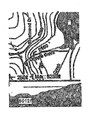
- Elevation lines are built for each of the triangles independently (as if the terrain surface was consist of such flat triangles). The lines are parallel within the triangles and attach with each other on sides of adjacent triangles. This is illustrated in Figure 4 .
- the elevation value can be determined in real time for any map location, using the elevation formula noted above. To provide better consistency with elevation lines one can calculate the elevation using the screen grid and the same formula or to determine elevation using the triangulation technique described above. All these methods provide similar results.
- the user can view an elevation profile of a selected road, street, trail, track, or any other line feature and can view an elevation profile along the line of travel or perpendicular to the line of travel or at any arbitrary angle with respect to the line of travel and at any distance from the current position.
- All of the elevation profiles noted above can be represented as a polygonal line. Such a line can be divided by a set of points to polygonal lines of equal length (this length should be small enough depending on the required profile resolution). Then one can calculate the elevation of each point from the set as noted above and build the graph of the profile.
- Figures 6-8 illustrate display screens for various elevation profiles.
Landscapes
- Engineering & Computer Science (AREA)
- Radar, Positioning & Navigation (AREA)
- Remote Sensing (AREA)
- Physics & Mathematics (AREA)
- Theoretical Computer Science (AREA)
- General Physics & Mathematics (AREA)
- Mathematical Physics (AREA)
- Automation & Control Theory (AREA)
- Business, Economics & Management (AREA)
- Educational Administration (AREA)
- Educational Technology (AREA)
- Instructional Devices (AREA)
- Position Fixing By Use Of Radio Waves (AREA)
- Navigation (AREA)
Claims (36)
- Tragbare in der Hand zu haltende Datenanzeigevorrichtung, umfassend:eine CPU (Zentraleinheit);eine Eingabevorrichtung, eine Speichereinheit und zumindest ein RAM (einen Schreib-Lese-Speicher), die alle mit der CPU wirkverbunden sind;einen digitalen Datenempfänger zum Zuführen von digitalen Daten an die CPU, die einen auf dem Bildschirm anzuzeigenden Positionsstandort kennzeichnen; undeinen Video-Controller und einen Anzeigebildschirm, wobei der Video-Controller Signale von der CPU über das zumindest eine RAM empfängt und Signale an den Anzeigebildschirm ausgibt, um ein Bild auf dem Anzeigebildschirm als Reaktion auf die von der CPU empfangenen Daten herzustellen;wobei Kenndaten als komprimierte Zellen im Speicher gespeichert werden, die CPU lediglich die Daten der Zellen sofort dekomprimiert, die zum Bereitstellen der Kenndaten für einen auf dem Anzeigebildschirm und gemäß einer benötigten Auflösung und Zoom-Stufe des Bildschirms angezeigten Bildbereich benötigt werden; und dadurch gekennzeichnet ist, dassdie Kenndaten unter Verwendung einer Komprimierungstechnik komprimiert werden, wobei ein RMSE (mittlerer quadratischer Fehler) einer Komprimierung unterhalb eines vorab gewählten Werts und eines maximalen und/oder eines relativen Fehlers einer Komprimierung liegt und eine Dekomprimierung gesteuert ist.
- Vorrichtung nach Anspruch 1, wobei die Kenndaten digitale Erhebungsdaten umfassen.
- Vorrichtung nach Anspruch 1, wobei der digitale Datenempfänger eine GPS-(Globale-Positionierungs-System-)Einheit aufweist, die mit der CPU wirkverbunden ist, um GPS-Signale zu empfangen und zu erzeugen und eine digitale Ausgabe an die CPU weiterzuleiten, die einen Positionsstandort für die Anzeigevorrichtung als Reaktion auf die empfangenen GPS-Signale kennzeichnet.
- Vorrichtung nach Anspruch 1, wobei die Eingabeeinheit zur manuellen Eingabe von digitalen Daten in den digitalen Datenempfänger eingerichtet ist, wobei die digitalen Daten einen auf dem Anzeigebildschirm anzuzeigenden Positionsstandort kennzeichnen.
- Vorrichtung nach Anspruch 2, wobei die digitalen Erhebungsdaten vor der Speicherung als komprimierte Zellen im Speicher offline komprimiert werden.
- Vorrichtung nach Anspruch 5, wobei die Komprimierungstechnik asymmetrisch ist, sodass eine signifikant größere Verarbeitung während der Offline-Komprimierung stattfindet als während einer Dekomprimierung durch die CPU in der Vorrichtung stattfindet.
- Vorrichtung nach Anspruch 1, wobei der Speicher eine Korrekturwertetabelle für die gespeicherten komprimierten Zellen umfasst, wobei die CPU auf die Korrekturwertetabelle zugreift, um die komprimierten Zellwerte zum Begrenzen von absoluten Komprimierungsfehlern zu korrigieren.
- Vorrichtung nach Anspruch 1, wobei die CPU die im Speicher gespeicherten Kenndaten dekomprimiert und diese in einem neuen Raster parallel zu einem auf dem Anzeigebildschirm angezeigten Raster neu berechnet, wobei das neue Raster einen Rasterschritt aufweist, der mit der auf dem Anzeigebildschirm angezeigten Bildschirmgröße und Auflösung vergleichbar ist.
- Vorrichtung nach Anspruch 8, wobei die CPU die Kennlinien unter Verwendung des neuen Rasters sofort berechnet.
- Vorrichtung nach Anspruch 2, wobei die Anzeige ein Erhebungsprofil entweder einer gewählten Strecke, Straße, eines Wegs oder einer Route oder einer anderen Kurseigenschaft anzeigt, wobei das Erhebungsprofil von der CPU unter Verwendung der im Speicher gespeicherten Daten berechnet wird.
- Vorrichtung nach Anspruch 2, wobei die Anzeige zum Anzeigen eines Erhebungsprofils längs einer Reiseroute eingerichtet ist, wobei das Erhebungsprofil durch die CPU unter Verwendung der im Speicher gespeicherten Daten berechnet wird.
- Vorrichtung nach Anspruch 2, wobei die Anzeige ein Erhebungsprofil in einem bestimmten Winkel in Bezug auf eine Reiseroute und in einem bestimmten Abstand vom Positionsstandort der Anzeige angezeigt, wobei das Erhebungsprofil durch die CPU unter Verwendung der im Speicher gespeicherten Daten berechnet wird.
- Verfahren zum Anzeigen von Daten auf einem Bildschirm einer tragbaren in der Hand zu haltenden Vorrichtung, wobei das Verfahren umfasst:Empfangen einer digitalen Ausgabe eines auf der Vorrichtung anzuzeigenden Positionsstandorts zum Erzeugen eines Bilds auf einem Anzeigebildschirm der Vorrichtung als Reaktion auf die digitale Ausgabe; undSpeichern von Kenndaten als komprimierte Zellen und sofortiges Dekomprimieren nur der zum Bereitstellen von Kenndaten für einen auf dem Anzeigebildschirm erforderlichen Daten; dadurch gekennzeichnet, dassdie Kenndaten unter Verwendung einer Komprimierungstechnik komprimiert werden, bei der ein RMSE (mittlerer quadratischer Fehler) einer Komprimierung unterhalb eines vorab gewählten Werts und eines maximalen und/oder eines relativen Fehlers einer Komprimierung liegt und eine Dekomprimierung gesteuert wird.
- Verfahren nach Anspruch 13, wobei die Kenndaten digitale Erhebungsdaten aufweisen.
- Verfahren nach Anspruch 13, wobei das Empfangen der digitalen Ausgabe, die einen Positionsstandort auf dem Anzeigebildschirm der Anzeigevorrichtung kennzeichnet, das Empfangen von GPS-(Globalen Positionsbestimmungssystem-)Signalen und Erzeugen der digitalen Ausgabe umfasst.
- Verfahren nach Anspruch 13, wobei das Empfangen der digitalen Ausgabe, die einen Positionsstandort auf dem Anzeigebildschirm der Anzeigevorrichtung kennzeichnet, das manuelle Eingeben von digitalen Daten in die CPU umfasst, die einen auf dem Anzeigebildschirm anzuzeigenden Positionsstandort kennzeichnen.
- Verfahren nach Anspruch 13, wobei die Kenndaten offline komprimiert werden, bevor sie als komprimierte Zellen in der Vorrichtung gespeichert werden.
- Verfahren nach Anspruch 17, wobei die Daten mit einer asymmetrischen Komprimierungstechnik komprimiert und dekomprimiert werden, so dass eine signifikant größere Verarbeitung während einer Offline-Komprimierung stattfindet als diese während einer Dekomprimierung in der Vorrichtung stattfindet.
- Verfahren nach Anspruch 13, ferner umfassend das Speichern einer Korrekturwertetabelle für die gespeicherten komprimierten Zellen, wobei auf die gespeicherte Korrekturwertetabelle zugegriffen wird, um die komprimierten Zellenwerte zum Begrenzen von absoluten Komprimierungsfehlern zu korrigieren.
- Verfahren nach Anspruch 13, ferner umfassend das Dekomprimieren von gespeicherten digitalen Erhebungsdaten und das Neuberechnen von diesen auf einem neuen Raster parallel zu einem auf dem Anzeigebildschirm angezeigten Raster, wobei das neue Raster einen mit der Bildschirmgröße und Auflösung des Anzeigebildschirms vergleichbaren Rasterschritt aufweist.
- Verfahren nach Anspruch 20, ferner umfassend das sofortige Berechnen von Kennlinien unter Verwendung des neuen Rasters.
- Verfahren nach Anspruch 14, ferner umfassend das Anzeigen eines Erhebungsprofils entweder einer gewählten Strecke, Straße, eines Wegs oder einer Route oder einer anderen Kurseigenschaft, wobei das Erhebungsprofil von der CDU unter Verwendung der im Speicher gespeicherten Daten berechnet wird.
- Verfahren nach Anspruch 14, ferner umfassend das Anzeigen eines Erhebungsprofils längs einer Reiseroute, wobei das Erhebungsprofil durch die CPU unter Verwendung der im Speicher gespeicherten Daten berechnet wird.
- Verfahren nach Anspruch 14, ferner umfassend das Anzeigen eines Erhebungsprofils in einem bestimmten Winkel in Bezug auf eine Reiseroute und in einem bestimmten Abstand von einem Positionsstandort der Anzeige, wobei das Erhebungsprofil von der CPU unter Verwendung der im Speicher gespeicherten Daten berechnet wird.
- Programmspeichervorrichtung, die von einer Maschine lesbar ist und die zugreifbar ein Programm von Anweisungen umfasst, die von der Maschine ausführbar sind, um Verfahrensschritte zum Anzeigen von Daten auf einem Bildschirm einer tragbaren in der Hand zu haltenden Vorrichtung auszuführen, wobei das Verfahren umfasst:Empfangen einer digitalen Ausgabe, die einen Positionsstandort der Vorrichtung zum Erzeugen eines Bilds auf einem Anzeigebildschirm der Vorrichtung als Reaktion auf die digitale Ausgabe kennzeichnet; undSpeichern von Kenndaten als komprimierte Zellen und sofortiges Dekomprimieren lediglich der Daten, die zum Bereitstellen der Kenndaten für einen auf dem Anzeigebildschirm angezeigten Bildbereich benötigt werden; dadurch gekennzeichnet, dassdie Kenndaten unter Verwendung einer Komprimierungstechnik komprimiert werden, bei der ein RMSE (mittlerer quadratischer Fehler) einer Komprimierung unterhalb eines vorab gewählten Werts liegt, wobei ein maximaler und/oder ein relativer Fehler der Komprimierung und der Dekomprimierung gesteuert wird.
- Vorrichtung nach Anspruch 25, wobei die Kenndaten digitale Erhebungsdaten umfassen.
- Vorrichtung nach Anspruch 25, wobei das Empfangen einer digitalen Ausgabe, die einen Positionsstandort der Anzeigevorrichtung kennzeichnet, das Empfangen von GPS-(globalen Positionierungssystem-) Signalen und das Erzeugen der digitalen Ausgabe umfasst.
- Vorrichtung nach Anspruch 25, wobei das Empfangen einer digitalen Ausgabe, die einen Positionsstandort der Anzeigevorrichtung kennzeichnet, das manuelle Eingeben von digitalen Daten in die CPU umfasst, die einen auf dem Anzeigebildschirm anzuzeigenden Positionsstandort kennzeichnen.
- Vorrichtung nach Anspruch 25, wobei die Kenndaten sofort komprimiert werden, bevor sie als komprimierte Zellen in der Vorrichtung gespeichert werden.
- Vorrichtung nach Anspruch 25, wobei die Daten mit einer asymmetrischen Komprimierungstechnik komprimiert und dekomprimiert werden, so dass eine signifikant größere Verarbeitung während einer Offline-Komprimierung stattfindet als während einer die Komprimierung in der Vorrichtung stattfindet.
- Vorrichtung nach Anspruch 25, wobei das Verfahren ferner das Speichern einer Korrekturwertetabelle für die gespeicherten komprimierten Zellen umfasst, wobei auf die gespeicherte Korrekturwertetabelle zugegriffen wird, um die komprimierten Zellwerte zum Begrenzen von absoluten Komprimierungsfehlern zu korrigieren.
- Vorrichtung nach Anspruch 25, wobei das Verfahren ferner das Dekomprimieren von gespeicherten Kenndaten und Neuberechnen von diesen in einem neuen Raster parallel zu einem auf dem Anzeigebildschirm angezeigten Raster umfasst, wobei das neue Raster einen Rasterschritt aufweist, der mit der auf dem Anzeigebildschirm angezeigten Bildschirmgröße und Auflösung vergleichbar ist.
- Vorrichtung nach Anspruch 32, wobei das Verfahren ferner das sofortige Berechnen von Kennlinien unter Verwendung des neuen Rasters umfasst.
- Vorrichtung nach Anspruch 26, wobei das Verfahren ferner das Anzeigen eines Erhebungsprofils entweder einer gewählten Strecke, Straße, eines Weges oder einer Route oder einer anderen Kurseigenschaft umfasst, wobei das Erhebungsprofil unter Verwendung der gespeicherten Daten berechnet wird.
- Vorrichtung nach Anspruch 32, wobei das Verfahren ferner das Anzeigen eines Erhebungsprofils längs einer Reiseroute umfasst, wobei das Erhebungsprofil unter Verwendung der gespeicherten Daten berechnet wird..
- Vorrichtung nach Anspruch 26, wobei das Verfahren ferner das Anzeigen eines Erhebungsprofils in einem bestimmten Winkel in Bezug auf eine Reiseroute und in einem bestimmten Abstand vom Positionsstandort der Anzeige eingerichtet ist, wobei das Erhebungsprofil unter Verwendung der im Speicher gespeicherten Daten berechnet wird.
Applications Claiming Priority (3)
| Application Number | Priority Date | Filing Date | Title |
|---|---|---|---|
| US208261 | 2002-07-31 | ||
| US10/208,261 US6748323B2 (en) | 2002-07-31 | 2002-07-31 | Displaying data |
| PCT/US2003/023777 WO2004011882A1 (en) | 2002-07-31 | 2003-07-31 | Method and device for displaying topographical data |
Publications (2)
| Publication Number | Publication Date |
|---|---|
| EP1540281A1 EP1540281A1 (de) | 2005-06-15 |
| EP1540281B1 true EP1540281B1 (de) | 2014-02-26 |
Family
ID=31186781
Family Applications (1)
| Application Number | Title | Priority Date | Filing Date |
|---|---|---|---|
| EP03772072.9A Expired - Lifetime EP1540281B1 (de) | 2002-07-31 | 2003-07-31 | Verfahren und einrichtung zum anzeigen topographischer daten |
Country Status (3)
| Country | Link |
|---|---|
| US (1) | US6748323B2 (de) |
| EP (1) | EP1540281B1 (de) |
| WO (1) | WO2004011882A1 (de) |
Families Citing this family (39)
| Publication number | Priority date | Publication date | Assignee | Title |
|---|---|---|---|---|
| KR100891593B1 (ko) * | 2002-12-12 | 2009-04-03 | 엘지디스플레이 주식회사 | 액정표시장치 및 그 구동방법 |
| JP2005165045A (ja) * | 2003-12-03 | 2005-06-23 | Denso Corp | 地図表示機能を有する電子機器及びプログラム |
| KR100712966B1 (ko) * | 2004-12-27 | 2007-05-02 | 주식회사 엔지스테크널러지 | 항법 서비스 방법 및 그에 따른 단말기 |
| US8253619B2 (en) * | 2005-02-15 | 2012-08-28 | Techtronic Power Tools Technology Limited | Electromagnetic scanning imager |
| US7495582B2 (en) * | 2005-03-08 | 2009-02-24 | Northrop Grumman Corporation | Geographic information storage, transmission and display system |
| US7498955B2 (en) * | 2005-03-08 | 2009-03-03 | Northrop Grumman Corporation | Geographic image strorage, transmission and display system |
| US7466244B2 (en) * | 2005-04-21 | 2008-12-16 | Microsoft Corporation | Virtual earth rooftop overlay and bounding |
| US8850011B2 (en) * | 2005-04-21 | 2014-09-30 | Microsoft Corporation | Obtaining and displaying virtual earth images |
| US7557736B1 (en) * | 2005-08-31 | 2009-07-07 | Hrl Laboratories, Llc | Handheld virtual overlay system |
| US7590490B2 (en) * | 2006-01-09 | 2009-09-15 | Mitac International Corporation | Smart detour |
| CA2543527A1 (en) * | 2006-04-13 | 2007-10-13 | Tinyview Wireless Media Inc. | System and method of delivering vector based images to mobile devices |
| US20070250515A1 (en) * | 2006-04-21 | 2007-10-25 | Lea David H | Method and system of securing content and destination of digital download via the internet |
| US7945386B2 (en) * | 2006-08-25 | 2011-05-17 | Mitac International Corporation | Rerouting in vehicle navigation systems |
| US20080139181A1 (en) * | 2006-12-08 | 2008-06-12 | Magellan Navigation, Inc. | Methods and apparatus for measuring the effectiveness of advertisements presented on a mobile navigation device |
| US7685163B2 (en) * | 2007-01-07 | 2010-03-23 | Apple Inc. | Automated creation of media asset illustrations |
| US7692655B2 (en) * | 2007-02-16 | 2010-04-06 | Mitac International Corporation | Apparatus and method of generating curved baseline for map labeling |
| US7783417B2 (en) * | 2007-03-09 | 2010-08-24 | Mitac International Corporation | Methods and apparatus for determining a route having an estimated minimum fuel usage for a vehicle |
| US8031937B2 (en) * | 2007-04-04 | 2011-10-04 | Telefonaktiebolaget Lm Ericsson (Publ) | Frame buffer compression and decompression method for graphics rendering |
| US8078641B2 (en) * | 2007-04-25 | 2011-12-13 | Mitac International Corporation | Adjusting spatial operations based on map density |
| US7882102B2 (en) * | 2007-09-10 | 2011-02-01 | Mitac International Corporation | Nearest-neighbor geographic search |
| US8554475B2 (en) | 2007-10-01 | 2013-10-08 | Mitac International Corporation | Static and dynamic contours |
| US20090138190A1 (en) * | 2007-11-26 | 2009-05-28 | Magellan Navigation, Inc. | System and Method of Providing Traffic Data to a Mobile Device |
| US20090171584A1 (en) * | 2007-12-31 | 2009-07-02 | Magellan Navigation, Inc. | System and Method for Accessing a Navigation System |
| US20090182498A1 (en) * | 2008-01-11 | 2009-07-16 | Magellan Navigation, Inc. | Systems and Methods to Provide Navigational Assistance Using an Online Social Network |
| US8290703B2 (en) * | 2008-01-18 | 2012-10-16 | Mitac International Corporation | Method and apparatus for access point recording using a position device |
| US8498808B2 (en) * | 2008-01-18 | 2013-07-30 | Mitac International Corp. | Method and apparatus for hybrid routing using breadcrumb paths |
| US8700314B2 (en) | 2008-01-18 | 2014-04-15 | Mitac International Corporation | Method and apparatus to search for local parking |
| WO2009143870A1 (en) * | 2008-05-29 | 2009-12-03 | Tomtom International B.V. | Navigation apparatus and method of generating a view therefor |
| US20100035631A1 (en) * | 2008-08-07 | 2010-02-11 | Magellan Navigation, Inc. | Systems and Methods to Record and Present a Trip |
| US8249804B2 (en) * | 2008-08-20 | 2012-08-21 | Mitac International Corporation | Systems and methods for smart city search |
| US8219317B2 (en) * | 2008-09-22 | 2012-07-10 | Mitac International Corporation | Route navigation via a proximity point |
| US8175794B1 (en) * | 2009-10-06 | 2012-05-08 | Google Inc. | Switching between best views of a place |
| US8886445B1 (en) * | 2010-03-05 | 2014-11-11 | The United States Of America As Represented By The Administrator Of The National Aeronautics And Space Administration | Automatic aircraft collision avoidance system and method |
| EP2518444B1 (de) * | 2011-04-29 | 2014-06-11 | Harman Becker Automotive Systems GmbH | Navigationsvorrichtung und Verfahren zur Bestimmung einer Höhenkoordinate |
| US9002126B2 (en) | 2012-05-04 | 2015-04-07 | Environmental Systems Research Institute (ESRI) | Limited error raster compression |
| US9819964B2 (en) | 2012-05-04 | 2017-11-14 | Environmental Systems Research Institute, Inc. | Limited error raster compression |
| US9383448B2 (en) | 2012-07-05 | 2016-07-05 | Deca System Co., Ltd. | Golf GPS device with automatic hole recognition and playing hole selection |
| CN103530905B (zh) * | 2013-11-05 | 2016-02-10 | 武汉大学 | 一种针对等高线平三角区域的消除方法 |
| CN114861025B (zh) * | 2022-05-07 | 2024-06-25 | 合肥信息工程监理咨询有限公司 | 一种基于地理信息系统的智慧点位档案管理系统 |
Family Cites Families (5)
| Publication number | Priority date | Publication date | Assignee | Title |
|---|---|---|---|---|
| DE4323081C2 (de) | 1993-07-10 | 1995-06-08 | Daimler Benz Ag | Verfahren und Vorrichtung zur Darstellung geographischer Daten |
| US5764807A (en) * | 1995-09-14 | 1998-06-09 | Primacomp, Inc. | Data compression using set partitioning in hierarchical trees |
| US6023278A (en) * | 1995-10-16 | 2000-02-08 | Margolin; Jed | Digital map generator and display system |
| US5861920A (en) * | 1996-11-08 | 1999-01-19 | Hughes Electronics Corporation | Hierarchical low latency video compression |
| US5902347A (en) * | 1996-11-19 | 1999-05-11 | American Navigation Systems, Inc. | Hand-held GPS-mapping device |
-
2002
- 2002-07-31 US US10/208,261 patent/US6748323B2/en not_active Expired - Lifetime
-
2003
- 2003-07-31 WO PCT/US2003/023777 patent/WO2004011882A1/en not_active Ceased
- 2003-07-31 EP EP03772072.9A patent/EP1540281B1/de not_active Expired - Lifetime
Also Published As
| Publication number | Publication date |
|---|---|
| WO2004011882A1 (en) | 2004-02-05 |
| WO2004011882B1 (en) | 2004-04-22 |
| US20040024526A1 (en) | 2004-02-05 |
| EP1540281A1 (de) | 2005-06-15 |
| US6748323B2 (en) | 2004-06-08 |
Similar Documents
| Publication | Publication Date | Title |
|---|---|---|
| EP1540281B1 (de) | Verfahren und einrichtung zum anzeigen topographischer daten | |
| EP1174843B1 (de) | Fahrzeugnavigationsvorrichtung und Aufzeichnungsmedium zur Programmabspeicherung dafür | |
| US6222482B1 (en) | Hand-held device providing a closest feature location in a three-dimensional geometry database | |
| US8085268B2 (en) | Techniques for drawing geodetic polygons | |
| CN102346923B (zh) | 一种基于经纬网格的数据分级组织方法 | |
| US20020113797A1 (en) | Systems and methods for representing and displaying graphics | |
| US5987380A (en) | Hand-held GPS-mapping device | |
| US7415356B1 (en) | Techniques for accurately synchronizing portions of an aerial image with composited visual information | |
| Baltsavias | Digital ortho-images—a powerful tool for the extraction of spatial-and geo-information | |
| US6930715B1 (en) | Method, system and program product for augmenting an image of a scene with information about the scene | |
| US9430866B2 (en) | Derivative-based selection of zones for banded map display | |
| US6829536B2 (en) | System and method for processing weather information | |
| US20120290199A1 (en) | Apparatus, system and method for self orientation | |
| US6678610B2 (en) | Method for obtaining a map representation, and a navigation device | |
| JP3803113B2 (ja) | データのモザイクを構築するための装置および方法 | |
| JP2006505794A5 (ja) | 地理的位置を決定し及び測定を行うコンピュータ化システム及び方法、並びにプログラム | |
| Chen et al. | Geographical data acquisition | |
| US6856312B1 (en) | Method for generating three-dimensional form data and apparatus therefor | |
| JP2000298430A (ja) | 地図作成システム及び地図作成方法 | |
| Cheng et al. | Orthorectification and DEM generation from high resolution satellite data | |
| Jang et al. | View-Dependent Multiresolution Splatting of Non-Uniform Data. | |
| EP1003015A2 (de) | Verfahren zur Karteninformationsverarbeitung | |
| JPH10133569A (ja) | 数値地図形状データ合成時のその名称処理方法 | |
| CN111667567B (zh) | 电离层三维展示方法和装置 | |
| JP4357213B2 (ja) | 地図データベースおよびそれを用いた地図描画方法ならびに地図描画装置 |
Legal Events
| Date | Code | Title | Description |
|---|---|---|---|
| PUAI | Public reference made under article 153(3) epc to a published international application that has entered the european phase |
Free format text: ORIGINAL CODE: 0009012 |
|
| 17P | Request for examination filed |
Effective date: 20050121 |
|
| AK | Designated contracting states |
Kind code of ref document: A1 Designated state(s): AT BE BG CH CY CZ DE DK EE ES FI FR GB GR HU IE IT LI LU MC NL PT RO SE SI SK TR |
|
| RBV | Designated contracting states (corrected) |
Designated state(s): DE FR GB |
|
| RAP1 | Party data changed (applicant data changed or rights of an application transferred) |
Owner name: MAGELLAN NAVIGATION, INC. |
|
| RAP1 | Party data changed (applicant data changed or rights of an application transferred) |
Owner name: MITAC INTERNATIONAL CORP. |
|
| 17Q | First examination report despatched |
Effective date: 20101105 |
|
| GRAP | Despatch of communication of intention to grant a patent |
Free format text: ORIGINAL CODE: EPIDOSNIGR1 |
|
| INTG | Intention to grant announced |
Effective date: 20131126 |
|
| GRAS | Grant fee paid |
Free format text: ORIGINAL CODE: EPIDOSNIGR3 |
|
| GRAA | (expected) grant |
Free format text: ORIGINAL CODE: 0009210 |
|
| AK | Designated contracting states |
Kind code of ref document: B1 Designated state(s): DE FR GB |
|
| REG | Reference to a national code |
Ref country code: GB Ref legal event code: FG4D |
|
| REG | Reference to a national code |
Ref country code: DE Ref legal event code: R081 Ref document number: 60345762 Country of ref document: DE Owner name: DIDI (HK) SCIENCE AND TECHNOLOGY LIMITED, HK Free format text: FORMER OWNER: THALES NORTH AMERICA, INC., SANTA CLARA, CALIF., US |
|
| REG | Reference to a national code |
Ref country code: DE Ref legal event code: R096 Ref document number: 60345762 Country of ref document: DE Effective date: 20140410 |
|
| REG | Reference to a national code |
Ref country code: DE Ref legal event code: R097 Ref document number: 60345762 Country of ref document: DE |
|
| PLBE | No opposition filed within time limit |
Free format text: ORIGINAL CODE: 0009261 |
|
| STAA | Information on the status of an ep patent application or granted ep patent |
Free format text: STATUS: NO OPPOSITION FILED WITHIN TIME LIMIT |
|
| 26N | No opposition filed |
Effective date: 20141127 |
|
| REG | Reference to a national code |
Ref country code: DE Ref legal event code: R097 Ref document number: 60345762 Country of ref document: DE Effective date: 20141127 |
|
| REG | Reference to a national code |
Ref country code: FR Ref legal event code: ST Effective date: 20150331 |
|
| PG25 | Lapsed in a contracting state [announced via postgrant information from national office to epo] |
Ref country code: FR Free format text: LAPSE BECAUSE OF NON-PAYMENT OF DUE FEES Effective date: 20140731 |
|
| REG | Reference to a national code |
Ref country code: GB Ref legal event code: 732E Free format text: REGISTERED BETWEEN 20161201 AND 20161207 |
|
| REG | Reference to a national code |
Ref country code: DE Ref legal event code: R082 Ref document number: 60345762 Country of ref document: DE Representative=s name: SPRANGER + BURGER PATENTANWAELTE, DE Ref country code: DE Ref legal event code: R081 Ref document number: 60345762 Country of ref document: DE Owner name: DIDI (HK) SCIENCE AND TECHNOLOGY LIMITED, HK Free format text: FORMER OWNER: MITAC INTERNATIONAL CORP., TAO YUAN, HSIEN, TW |
|
| PGFP | Annual fee paid to national office [announced via postgrant information from national office to epo] |
Ref country code: GB Payment date: 20220720 Year of fee payment: 20 Ref country code: DE Payment date: 20220720 Year of fee payment: 20 |
|
| REG | Reference to a national code |
Ref country code: DE Ref legal event code: R071 Ref document number: 60345762 Country of ref document: DE |
|
| REG | Reference to a national code |
Ref country code: GB Ref legal event code: PE20 Expiry date: 20230730 |
|
| PG25 | Lapsed in a contracting state [announced via postgrant information from national office to epo] |
Ref country code: GB Free format text: LAPSE BECAUSE OF EXPIRATION OF PROTECTION Effective date: 20230730 |