EP1538868A2 - Audioverstärkungsgerät - Google Patents
Audioverstärkungsgerät Download PDFInfo
- Publication number
- EP1538868A2 EP1538868A2 EP05004862A EP05004862A EP1538868A2 EP 1538868 A2 EP1538868 A2 EP 1538868A2 EP 05004862 A EP05004862 A EP 05004862A EP 05004862 A EP05004862 A EP 05004862A EP 1538868 A2 EP1538868 A2 EP 1538868A2
- Authority
- EP
- European Patent Office
- Prior art keywords
- frequency
- level
- listener
- feedback
- stimulus
- Prior art date
- Legal status (The legal status is an assumption and is not a legal conclusion. Google has not performed a legal analysis and makes no representation as to the accuracy of the status listed.)
- Granted
Links
Images


Classifications
-
- H—ELECTRICITY
- H04—ELECTRIC COMMUNICATION TECHNIQUE
- H04R—LOUDSPEAKERS, MICROPHONES, GRAMOPHONE PICK-UPS OR LIKE ACOUSTIC ELECTROMECHANICAL TRANSDUCERS; ELECTRIC HEARING AIDS; PUBLIC ADDRESS SYSTEMS
- H04R3/00—Circuits for transducers
- H04R3/02—Circuits for transducers for preventing acoustic reaction, i.e. acoustic oscillatory feedback
-
- H—ELECTRICITY
- H04—ELECTRIC COMMUNICATION TECHNIQUE
- H04R—LOUDSPEAKERS, MICROPHONES, GRAMOPHONE PICK-UPS OR LIKE ACOUSTIC ELECTROMECHANICAL TRANSDUCERS; ELECTRIC HEARING AIDS; PUBLIC ADDRESS SYSTEMS
- H04R25/00—Electric hearing aids
- H04R25/35—Electric hearing aids using translation techniques
- H04R25/353—Frequency, e.g. frequency shift or compression
-
- H—ELECTRICITY
- H04—ELECTRIC COMMUNICATION TECHNIQUE
- H04R—LOUDSPEAKERS, MICROPHONES, GRAMOPHONE PICK-UPS OR LIKE ACOUSTIC ELECTROMECHANICAL TRANSDUCERS; ELECTRIC HEARING AIDS; PUBLIC ADDRESS SYSTEMS
- H04R25/00—Electric hearing aids
- H04R25/45—Prevention of acoustic reaction, i.e. acoustic oscillatory feedback
- H04R25/453—Prevention of acoustic reaction, i.e. acoustic oscillatory feedback electronically
-
- H—ELECTRICITY
- H04—ELECTRIC COMMUNICATION TECHNIQUE
- H04R—LOUDSPEAKERS, MICROPHONES, GRAMOPHONE PICK-UPS OR LIKE ACOUSTIC ELECTROMECHANICAL TRANSDUCERS; ELECTRIC HEARING AIDS; PUBLIC ADDRESS SYSTEMS
- H04R25/00—Electric hearing aids
- H04R25/50—Customised settings for obtaining desired overall acoustical characteristics
- H04R25/505—Customised settings for obtaining desired overall acoustical characteristics using digital signal processing
-
- H—ELECTRICITY
- H04—ELECTRIC COMMUNICATION TECHNIQUE
- H04R—LOUDSPEAKERS, MICROPHONES, GRAMOPHONE PICK-UPS OR LIKE ACOUSTIC ELECTROMECHANICAL TRANSDUCERS; ELECTRIC HEARING AIDS; PUBLIC ADDRESS SYSTEMS
- H04R25/00—Electric hearing aids
- H04R25/70—Adaptation of deaf aid to hearing loss, e.g. initial electronic fitting
Definitions
- the present invention relates generally to the audio amplification apparatus for processing sound signals, and in particular to a procedure for fitting of audio amplification apparatus for use by a listener.
- the present invention is suitable for adjusting audio amplification apparatus such as hearing aids, and it will be convenient to describe the invention in relation to that exemplary, non-limiting application.
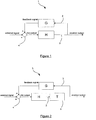
- a theoretical model 1 of a hearing aid is shown in Figure 1.
- An external signal received by the hearing aid is amplified along a forward transfer path 2 to provide a signal to an output transducer.
- the hearing aid amplifier has a forward transfer function H.
- Feedback in the hearing aid occurs when the acoustic signal from the output transducer finds its way back to the input transducer of the amplifier.
- a feedback path 3 is shown and includes a transfer function G of all combined feedback paths. The feedback signal is added to the forward transfer path 2 in the theoretical model 1 by a summation device 4.
- a frequency transposition element is introduced into the audio amplifier to shift the frequency of the input sound signal either upwardly or downwardly, in addition to amplifying the signal, before sending it to the output transducer.
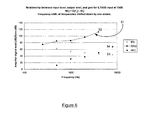
- One such frequency transposing amplifier is described in pending Australian Patent Application No 2002300314, filed 29 July. The manner in which the frequency transposing amplifier operates is illustrated by the theoretical model 5 shown in Figure 2.
- a frequency transposing element 6 has been added to the forward transfer path 2 of the audio amplifier.
- the frequency of the amplified external signal is transposed to a different frequency.
- the output, and hence the feedback signal is at a different frequency from that of the external input signal so that successive summation of a signal at the microphone input at a particular frequency cannot occur.
- the introduction of such a frequency shifting component can make the closed loop gain of the system stable and avoid spontaneous oscillation under certain conditions.
- a frequency transposing amplifier Whilst a frequency transposing amplifier may be stable in terms of its closed loop gain, the amplifier output may be increased to a level which causes unwanted artefacts. Such artefacts are introduced when the output of the amplifier is at a sufficiently high level so that attenuation of the signal via the feedback path results in a feedback signal of sufficiently high level to cause distortion when added to the incoming signal.
- a feedback suppression amplifier that addresses this problem is described in co-pending Australian Patent Application No 2003236382, filed 20 August 2003.
- the feedback suppression system described in that co-pending patent application acts to remove or compensate for the presence of feedback signals at transposed frequencies in the closed loop system shown in Figure 2.
- the frequency-dependent amplification of any hearing aid needs to be adjusted to suit each individual wearer's hearing loss.
- the fitting procedure required to make such adjustments is a time consuming and often inaccurate process, requiring multiple attempts before the hearing aid is adjusted to suit each individual's needs.
- it is difficult to adjust the frequency dependent amplification of a hearing aid so that input signals having levels similar to the average level of speech signals are amplified such that they are perceived as equally loud across a range of frequencies by the hearing aid wearer.
- the calculation of the activation levels to determine when output signal correction is required is frequency dependent, and is affected by the characteristics of the acoustic feedback path of the hearing aid when it is worn by a user.
- the determination of suitable activation levels is a difficult and time consuming task, and may require several attempts to achieve a result acceptable to a hearing aid user.
- One aspect of the present invention provides a method of adjusting frequency-dependent amplification in an audio amplification apparatus, the audio amplification apparatus including:
- the frequency-dependent amplification at each frequency is derived by subtracting the magnitude of a standardised input signal component at that frequency from the magnitude of the stimulus level at a transposed frequency.
- the magnitude of the input signal component at each frequency may be the level of international long-term average speech spectrum (ILTASS) at an overall level of 70 dB SPL at that frequency.
- ILTASS international long-term average speech spectrum
- the stimuli are applied directly to the output transducer.
- the predefined loudness perception level of the listener may be selected from the group of: very soft, soft, comfortable but slightly soft, comfortable, comfortable but slightly loud, loud but OK, uncomfortably loud and extremely uncomfortable.
- the predefined loudness perception of the listener level is comfortable but slightly soft.
- the predefined loudness perception level of the listener may be determined by:
- the predefined loudness perception level of the listener may be determined by:
- Another aspect of the invention provides a method of adjusting frequency-dependent amplification in an audio amplification apparatus, the audio amplification apparatus including:
- the magnitude of the input signal component at each frequency may be the level of international long-term average speech spectrum (ILTASS) at an overall level of 70 dB SPL at that frequency.
- ILTASS international long-term average speech spectrum
- the predefined loudness perception level of the listener may be selected from the group of: very soft, soft, comfortable but slightly soft, comfortable, comfortable but slightly loud, loud but OK, uncomfortably loud and extremely uncomfortable.
- the predefined loudness perception of the listener level is comfortable but slightly soft.
- the predefined loudness perception level of the listener may be determined by:
- the predefined loudness perception level of the listener may be determined by:
- Yet another aspect of the invention provides a method of determining activation levels for feedback suppression in an audio amplification apparatus, the audio amplification apparatus including:
- the disturbance threshold level may be a hearing threshold level.
- the feedback path transfer function G at each frequency may be determined by:
- the feedback path transfer function G at each frequency may be determined by:
- the activation level A at each frequency may be determined from the amplification and feedback path transfer function at that frequency and from the disturbance threshold level at a transposed frequency.
- the method may further including the steps of:
- the forward transfer path may include a frequency transposing element, and the activation level As at each frequency may be determined from S, F s and H at that frequency and D at a transposed frequency.
- a further aspect of the invention includes a method of fitting an audio amplification apparatus, including the steps of:
- a still further aspect of the invention provides a signal processing device for use in an audio amplification apparatus, the device acting to receive digitised sound signals and generate output transducer signals, the sound processing device including:
- the processing means may be implemented in digital signal processing (DSP) technology.
- DSP digital signal processing
- FIG. 3 there is shown generally a sound processing device 10 in which input signals from a microphone are sampled, converted to a digital representation, and then periodically subject to a windowing operation followed by a Fast Fourier Transform (FFT).
- FFT Fast Fourier Transform
- the result of the FFT is analysed to estimate the magnitude and phase of each frequency component of the input signal.
- the magnitudes are processed to produce amplitude control signals which are assigned to a number of oscillators. These oscillators are tuned to appropriate frequencies using information derived from the changes over time in the phase estimates.
- the final output signal is constructed by summing the output signals for the oscillators, and subsequently converting the composite signal from digital to analogue form.
- the composite output signal is then conveyed to a suitable transducer, such as the earphone (receiver) of a hearing aid.
- a suitable transducer such as the earphone (receiver) of a hearing aid.
- an input sound signal received at a microphone 11 is preamplified and filtered to limit its bandwidth in the preamplifier and anti aliasing filter.
- An analogue to digital converter 13 samples the band limited signal at a constant rate and converts the sampled signal into digital form.
- a block of sequential input samples is placed in the memory of a suitable digital signal processing (DSP) unit.
- DSP digital signal processing
- These samples are windowed by a windowing block 14 which multiplies each sample by a corresponding coefficient.
- windowing block 14 which multiplies each sample by a corresponding coefficient.
- a 256 point window with coefficients defined by the product of a hamming window and a mathematical sinc function is suitable when an input sampling rate of 14.4 kHz is used.
- the window of outputs are stacked and added (using a standard numerical operation known as folding) to produce a set of windowed input samples. This set of data is then processed by the 128 point FFT block 15.
- the FFT and subsequent processing performed by the sound processing device of Figure 1 are executed every time a new set of 32 samples has been obtained from the input transducer.
- the FFT and subsequent processing steps are repeated at intervals of approximately 2.2 ms.
- differing sampling rates, different types and links of the window function and Fourier transform, and different extents of FFT overlap may be envisaged.
- the outputs of the FFT block 15 comprise a set of complex numbers which together represent approximately a short term spectrum of the input signal.
- the first 64 bins contain spectral estimates covering the frequency range of zero to 7.2 kHz, approximately (for a sampling rate of 14.4 kHz). Ignoring the first and last of these bins, which generally do not contain signals of interest in the present exemplary hearing aid implementation of the sound processing device, the remaining bins each provide information about a substantially contiguous sub band of the input frequency range, each bin extending over a bandwidth of approximately 112.5 Hz.
- the first bin of interest contains a complex number which describes the real and imaginary components of the input signal-within a bandwidth of approximately 112.5 Hz centred on a frequency of 112.5 Hz.
- the power of each component of the input signal is estimated for each frequency bin by summing the squares of the real and imaginary parts of the complex estimate.
- a well known deficiency for the FFT for spectral analysis in general is that the output bins are spaced at constant frequency intervals (e.g. 112.5 Hz in the present case, and have a constant band width, e.g. approximately 112.5 Hz).
- constant frequency intervals e.g. 112.5 Hz in the present case
- band width e.g. approximately 112.5 Hz.
- This extension of the standard FFT process is embodied in an algorithm described as a phase vocoder.
- the phase angle is estimated by calculating the inverse tangent of the quotient of the imaginary and real parts of the complex number in each FFT bin.
- a look-up table is provided containing the pre-calculated tangents of a relatively small number (e.g. 64) of phase values. This table contains discrete samples of the range of possible phase values over any two quadrants (e.g. for phase values between - ⁇ /2 and + ⁇ /2 radians). These values correspond to the case where the real part of the complex number from the FFT bin is positive. If the real part is in fact negative, it is firstly treated as positive, and later the phase estimate is corrected by adding an appropriate constant to the phase angle initially calculated.
- phase value for each FFT bin is estimated by a process of successive approximation.
- a starting value for the phase angle being sought is selected, and the tangent of that value is obtained from the look-up table.
- the tangent of the candidate phase value is then multiplied by the imaginary part of the complex number in the FFT bin.
- the product is then compared with the corresponding real part, and the candidate phase value is adjusted up or down according to the difference between the estimated and actual real path.
- the new candidate value is used to obtain the corresponding tangent from the look-up table. This process is repeated until the candidate phase value has the desired accuracy. It has been found that adequate precision can be obtained with a 64 entry look-up table encompassing a phase range of - ⁇ /2 to + ⁇ /2. Because multiplication and table look-ups can be carried out very rapidly and efficiently in current DSP devices, the above described algorithm is particularly suitable for use in a wearable, digital hearing aid.
- the rate of change of the phase in each FFT bin over time is estimated. This is because the rate of phase change in a particular bin is known to be proportional to the difference in frequency between the dominant component contained in that bin and the nominal centre frequency of the bin.
- the rate of phase change for each bin is calculated by subtracting the phase estimates obtained from the immediately previous FFT operation from the current phase estimates. Phase differences are accumulated over time, and then multiplied by a suitable scaling factor to represent the frequency off-set between the input signal component dominating the content of each FFT bin and the corresponding centre frequency for that bin. It will be appreciated that alternative processes to determine the phase estimates may be used, for example, a direct calculation process.
- a bank of 24 oscillators is used in the sound processing device 10.
- the bank of oscillators is indicated by the reference 21.
- the information contained in the 62 FFT bins is reduced to 24 bands in the reduction block 16, with each band assigned to a corresponding oscillator.
- the frequency range covered by the 24 bands are normally, but not necessarily, contiguous.
- the reduction of the FFT bins to a smaller number of bands may be accomplished in various ways. One practical technique is to exploit the fact that less frequency resolution is generally needed in an assistive hearing device at high frequencies than at low frequencies. Thus the contents of several relatively high frequency FFT bins can be combined into a single processing band.
- the combining operation is performed by summing powers of the FFT bins, and by obtaining the required precise frequency estimate from only one of the combined bins.
- the bin selected for this purpose is the one containing the highest power out of the set of combined bins.
- each bin is usually assigned separately to a corresponding band for further processing.
- the outputs of each of the 24 bands are then analysed by a frequency estimation block 17 and a magnitude estimation block 18 to derive an estimate respectively of the frequency and magnitude of each of the 24 bands of the input signal.
- the frequency estimation is derived from phase information provided by the reduction block 16.
- Frequency and magnitude data for each analysis band are provided to a frequency transposition block 19 and magnitude processing block 20.
- Each of the 24 oscillators in the sound processing device 10 generates a sine wave that can be controlled in both amplitude and frequency.
- the desired amplitude is determined by the magnitude processing block 20 from the magnitude data for the corresponding band.
- the conversion between the power value and the desired oscillator amplitude may be specified by a look-up table or calculated from an appropriate equation. Accordingly, any desired amount of amplification or attenuation of the input signal may be achieved at each frequency (i.e. within the frequency range associated with each band).
- the desired oscillation frequency of each oscillator is set by the frequency translation block 19 and may be specified by a look-up table or calculated from an equation. For example, if no change to the frequencies present in the input signal is required, each of the oscillators is merely tuned to generate the same frequency as that estimated from input signal in the corresponding band as determined by the frequency estimation block 17. However, if frequency translation is required to be formed by the frequency translation block 19 (for example, lowering of one or more input frequencies by 1 octave), then the frequency estimated from the input signal in each band is multiplied by an appropriate factor (for example, 0.5) before applying it to tune the corresponding oscillator.
- an appropriate factor for example, 0.5
- both the amplitude control and the frequency control for each oscillator can be specified completely independently of the operation of all other oscillators. Thus it is possible to lower some input frequencies and not others, or to lower each input frequency by a different amount. It will be appreciated that it is also possible to raise input frequencies in the same manner.
- amplitude control signals are provided from the magnitude processing block 20 to each of the 24 oscillators in the bank of oscillators, whilst frequency control information is provided from the frequency translation block 19 to that same bank of oscillators.
- the composite output signal is produced by summing the output signals from the bank of all 24 oscillators.
- the composite signal is then converted to analogue form by the digital to analogue converter 22 and amplified by amplifier 23 to drive a suitable transducer 24 (such as the earphone of a hearing aid or other receiver).
- Feedback artefacts resulting from the frequency translation carried out in the sound processing device 10 are compensated for or removed. Given the input to output frequency mapping employed by the sound processing device 10, it is possible to predict the frequency of the feedback signal produced by any given external signal. The time delay between the original external signal and its corresponding frequency lowered feedback signal can also be accurately predicted and is directly related to the signal processing delay of one complete loop around the system.
- the output signal level at the input frequency of each of the 24 bands is accordingly monitored by a feedback prediction block 25 to determine if it is above or below a predefined activation level. If the output signal level is above the activation level, a feedback correction block 26 computes the difference between the output signal level and the predetermined activation level in terms of acoustic power. In alternative embodiments of the invention, the difference may be computed in terms of decibels.
- transposed frequency computation block 27 the transposed frequency at which the undesired feedback signal component will occur is calculated, and the calculated difference is used to effectively "correct" the output signal at that transposed frequency to compensate for the presence of the undesired feedback signal component.
- “translation” is to be understood as encompassing any form of frequency modification including, for example, frequency shifting, frequency compression and any shift in frequency from a first to a second value.
- the activation level is an estimate of the output signal level which will result in a feedback signal which, when amplified and transposed, will be audible or otherwise create a perceptual disturbance to the listener.
- a set of activation levels are required by the feedback detection block 25 to activate the feedback suppression at the frequency of each of the 24 bands.
- the characteristics of the feedback path may be different for each situation, and may change over time. Accordingly, the activation levels may be fixed or may be adaptable to change according to changes in the characteristics of the feedback path over time.
- FIG. 4 illustrates in more detail the operation of the sound processing device 10 during suppression of an undesired feedback signal component resulting from frequency translation.
- a first frequency of an output signal intended to drive one of the oscillators in the bank is analysed.
- the output signal level at that output frequency is compared with the activation level. If the output signal level is below the activation level, there is no need to perform any feedback suppression at that frequency, and processing moves on to the next output frequency. If however, the output signal level is above the activation level, the difference between them is calculated at step 32 in terms of acoustic power.
- the transposed frequency of the undesired feedback signal component is computed using input to output frequency mapping. This computation determines the frequency at which the undesired feedback signal component is effectively applied as an additional input signal to one of the oscillators in the bank.
- step 34 at the computed transposed frequency, the feedback correction value is subtracted from the output signal level after an appropriate delay dependent on the processing delay of the amplifier.
- step 35 a determination is made as to whether all output frequencies have been analysed, and if so, processing is continued by other elements of the sound processing device 10 at step 36.
- the quantity that is subtracted from the output signal level is best done in terms of acoustic power (squared linear amplitude). However, due to programming efficiency, it may be more advantageous to perform computations in terms of decibels in some situations, for example when the total signal level is not greatly above the audibility threshold at the expected feedback frequency.
- the activation level is set to low, feedback suppression will cause the amplifier to reduce the output level at a given transposed frequency, even when no feedback signal is present. This may result in a reduction of the wanted signal even if there was one present at that frequency. If the activation level is set to high, feedback artefacts will be present at the transposed frequency, and may be audible.
- the undesired feedback signal component is subtracted from the output signal at each of the transposed frequencies to compensate for the pressure of the undesired feedback signal component.
- the undesired feedback signal component may be subtracted from the input sound signal, prior to amplification and frequency translation, in order to achieve the same connection of the output signal.
- the amplification of the input sound signal at each of the transposed frequencies may be reduced to compensate for the undesired feedback signal component.
- the sound processing device is implemented according to digital signal processing techniques.
- the input signal is windowed and processed as a block of data every 2.2 ms which corresponds to 32 input data samples at a sampling rate of 14.4 kHz.
- the output signal of the amplifier 23 is generated by summing together the outputs of the 24 oscillators in the bank.
- the amplitude and frequency controls of the oscillators are determined by pre-processing of the input signal and are updated once for every block of data analysed.
- One example of a practical fitting procedure to determine the frequency-dependent amplifications of the amplifier involves obtaining a subjective rating of loudness from the listener.
- the subjective loudness of a stimulus can be judged using a loudness rating scale, such as one containing nine loudness descriptors: Very soft, Soft, Comfortable but slightly soft, Comfortable, Comfortable but slightly loud, Loud but OK, Uncomfortably loud and Extremely uncomfortable.
- a set of comfortable but slightly soft levels are measured and used to determine the desired amplification versus frequency of the amplifier.
- An appropriate set of stimuli, each of narrow bandwidth, is chosen to be presented to the listener.
- these stimuli are narrow-band noises, each of one-third octave bandwidth, centred at standard frequencies (i.e. 100, 125, 160, 200, 250, 315, 400, 500, 630, 800, 1000, 1250, 1600 Hz, etc).
- the stimuli are presented to the listener using an audio amplifier apparatus having a theoretical model 40 shown in Figure 5. It will be noted from this Figure that transducer output is temporarily disconnected from the amplifier circuit to break the feedback loop, thus eliminating any feedback signal from the output.
- a stimulus generator 41 is connected to the receiver to deliver the desired stimulus to the listener via the transducer. At each stimulus frequency, the stimulus is generated and presented to the listener. The listener responds by describing the perceived loudness. The level of the stimulus is increased and decreased during the fitting procedure so as to converge upon a level which is perceived by the listener to be comfortable but slightly soft.
- each stimulus is presented to the listener, and the listener chooses the most appropriate loudness descriptor from a written list of loudness categories.
- the stimuli may be presented with varying level and frequency in an appropriate sequence until the loudness at each frequency is perceived as comfortable but slightly soft.
- An alternative practical implementation involves comparing the loudness of each stimulus with that of a reference stimulus at a selected, fixed frequency.
- the level of the reference stimulus is set to evoke a loudness perceived as approximately comfortable but slightly soft, and its frequency is chosen to be relatively close to the frequencies of the other stimuli to be presented.
- each such stimulus maybe presented to the listener with the reference stimulus in a sequential pair (i.e. reference stimulus followed by comparison stimulus, or vice versa ), and the listener is asked which of each pair of sounds is louder.
- the level of the reference stimulus is kept constant.
- the level of each comparison stimulus is adjusted until its loudness is perceived to be equal to that of the reference stimulus.
- the system shown in the attached drawings is implemented partly in a digital signal processor.
- the level of signals is digitally measured and recorded without the need for separate sound measurement equipment.
- the level of the stimulus output is recorded for each level found to produce comfortable but slightly soft loudness at each frequency.
- the amplification required at each input frequency can be defined as the difference (in dB) between the amplifier input ILTASS level and the comfortable but slightly soft level at the shifted (output) frequency. This can be described by the equation:
- the set of required amplification can be calculated from the set of comfortable but slightly soft levels and the known ILTASS input levels.
- an equal loudness contour of transducer output levels can be derived from the adjusted stimuli levels.
- the equal loudness contour is derived by interpolating between each of the adjusted stimuli levels at the frequencies at which the stimuli are presented to the receiver.
- the set of required amplifications are then derived by subtracting the magnitude of the known ILTASS level at a particular frequency from the magnitude of the stimulus level defined by the equal loudness contour at the transposed frequency resulting from the frequency transposing element in the forward transfer path.
- FIG. 6 An example of this is shown in Figure 6.
- This Figure illustrates the relationship between input level, output level, and amplification for a downward frequency shift performed by the frequency transposing block 6 of one octave across all frequencies.
- the amplifications of the amplifier 40 make the output signal comfortable but slightly soft for each one-third octave frequency component when the input frequency components have levels corresponding to those of an average speech signal at 70dB SPL overall level. It will be appreciated from the foregoing that in the absence of any external signal applied to the amplifier 40, the input signal applied to the forward transfer path of the amplifier 40 corresponds to the feedback signal applied to the summation device 4 from the feedback path 3.
- Stimuli are presented to the transducer from the stimulus generator 41 at a series of frequencies separated by one third of an octave.
- the stimulus level at each frequency is adjusted to meet the predefined loudness perception level of the listener, in this case the comfortable but slightly soft level.
- the adjusted stimulus levels are then used to derive an equal loudness contour of transducer output levels - referenced 51 in Figure 6 - by interpolating between the stimulus levels.
- the amplification of the amplifier at each desired frequency is determined by subtracting the magnitude of the ILTASS standardised input signal component at that frequency from the magnitude of the stimulus at a transposed frequency as read from the equal loudness contour 51.
- a 4000 Hz stimulus with a level producing comfortable but slightly soft loudness is referenced 52.
- such a stimulus will have arisen from an input signal in the forward transfer path of an amplifier at 8000 Hz, which will then be frequency transposed downward by one octave to 4000 Hz.
- the ILTASS standardised input signal component level at 8000 Hz, referenced 53 is used to determine the amplification at 8000 Hz.
- the difference between the amplitudes of the ILTASS standardised input signal component level 53 at 8000 Hz and stimulus level 52 at 4000 Hz is then used to derive the amplification to be applied at 8000 Hz, referenced 54 in Figure 6.
- the difference between the amplitudes of the ILTASS standardised input signal component level and stimulus level at the same frequency are used to derive the amplification to be applied atthat same frequency.
- the output signal equal loudness level contour C(f) can be defined in units of dB by:
- the frequency dependent amplification can be obtained by presenting stimuli to the receiver at a number of frequencies, adjusting the stimulus level at each frequency to meet a predefined loudness perception level of the listener, deriving an equal loudness contour of transducer output levels from the adjusted stimuli levels, and deriving the frequency dependent amplification of levels of input signals at each frequency from the equal loudness contour at the corresponding transposed frequencies.
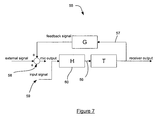
- Figure 7 shows a theoretical model 55 of an audio amplification device including a forward transfer path 56 and a feedback path 57.
- the feedback path is disconnected from the forward transfer path during hearing aid fitting.
- the feedback loop is broken at the microphone output 58, and a desired input signal is applied at the input 59 to the amplifier 60 in the forward transfer path 56.
- the relevant ILTASS standardised input signal component is applied, and the amplification H(f) is adjusted until the listener indicates that the receiver output meets a predefined loudness perception level of the listener.
- the stimuli are presented one at a time at an appropriate level.
- the level chosen may be the listener's hearing threshold level, their comfortable but slightly soft level, or some other predefined loudness perception level which elicits a detectable amount of feedback.
- the apparatus and listener are situated in a quiet environment (e.g. a sound-proof, or semi sound-proof booth), where background noise levels are low.
- a quiet environment e.g. a sound-proof, or semi sound-proof booth
- the level of the stimuli (and feedback signals) should be high enough to ensure a relatively high signal-to-noise ratio. This needs to be considered when choosing the level of the stimuli to be presented.
- the transfer function of the feedback path can be determined by comparing the stimulus level S(fo) with the feedback signal level F S (fi).
- the feedback suppressor should become active once the output level is above the activation level.
- the activation level is defined as the output level which causes a feedback signal which, when amplified and optionally shifted in frequency by the hearing aid, will be just audible (or just disturbing) to the listener.
- activation level is the output level that causes a feedback signal which, when amplified and shifted in frequency, would be just above the inherent noise level of the amplifier.
- the feedback signal is amplified and optionally shifted in frequency, and the corresponding output level is determined by the amplification, H(fi).
- the magnitude of the stimulus, listener's hearing threshold level, feedback signal component and amplification may all be taken at the same frequency to determine the activation level at which the undesired feedback signal component is suppressed at that same frequency.
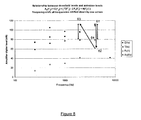
- FIG 8 shows the activation levels calculated from a stimulus set of comfortable but slightly soft levels, C(fo), and the corresponding feedback signals.
- the subscript 'C' has been used to indicate that the set of activation levels, A C (fo), and the set of feedback levels, F C (fo), are in response to the stimulus set of comfortable but slightly soft levels, C(f o ).
- a 4000-Hz stimulus with a level producing comfortable but slightly soft loudness is shown in Figure 8 at position 61.
- This stimulus will cause a feedback signal at the microphone with frequency of 4000 Hz at the level shown at position 62, F S (f' i ).
- This input signal will then be amplified and optionally shifted in frequency.
- the activation levels for feedback suppression in an audio amplification apparatus are determined from listener disturbance threshold levels, amplification and feedback path transfer function.
- the activation levels A(f) can be determined by the following:
- the listener disturbance threshold levels may be the hearing threshold levels of a listener.
- the activation level at each frequency will be determined from the amplification and feedback path transfer function at that frequency and from the disturbance threshold level at a transposed frequency.
- the activation level at each frequency will be determined from the amplifiication, feedback path transfer function and disturbance threshold level at that frequency.
- the stimulus generator 41 can be used to generate a set of output stimuli, which can be used to directly calculate the feedback path transfer function by measuring and recording output transducer signal components and feedback signal components at various frequencies.
- a suitable set of stimuli may be the set of comfortable but slightly soft equal loudness levels, but other sets of stimuli may equally be used.
- the characteristics of the feedback path change with disturbances to the sound field around the ear and head. It is therefore possible to construct several different feedback path situations which reflect typical changes in the feedback path that may be expected during every day use of the hearing aid.
- the feedback path transfer function G(f) at each frequency is determined by presenting stimuli to the receiver at various frequencies, recording output transducer signal components O(f) and feedback signal components F O (f) resulting from those stimuli, and deriving the feedback path transfer function at each frequency from the transducer output signal components O(f) and the feedback signal components F O (f).
- the feedback path transfer function may also be estimated by detecting the onset of feedback oscillation in a conventional, non-shifting audio amplification apparatus, as shown in Figure 1. Without the use of any external apparatus, the amplification at each frequency can be adjusted, and the feedback path transfer function at that frequency derived from the lowest amplification at which feedback oscillation is detected. This onset indicates that the magnitude of the feedback path and the magnitude of the amplification are equal in units of dB, and also that the phase of the loop gain is a whole multiple of 360°. Typically, the onset of feedback oscillation is heard by an audiologist but may also be measured at the output transducer. Once the feedback path transfer function has been estimated, the activation levels may be derived, as described above.
- the above-described embodiment of the sound processor 10 may be implemented by digital signal processing techniques, using processing means to perform the various computations and control the operation of the various other elements of the sound processor 10. It will be appreciated that although a substantially digital implementation of the sound processing device and method has been described above, some or all of the elements or processing stages may be implemented using other techniques, such as by use of analogue electronic circuits. For example, the oscillators may be implemented using appropriate analogue circuits, resulting in a reduction in the electrical power requirements of the processing system, and therefore providing benefits for a practical implementation in a wearable hearing aid.
Landscapes
- Health & Medical Sciences (AREA)
- General Health & Medical Sciences (AREA)
- Otolaryngology (AREA)
- Physics & Mathematics (AREA)
- Engineering & Computer Science (AREA)
- Acoustics & Sound (AREA)
- Signal Processing (AREA)
- Tone Control, Compression And Expansion, Limiting Amplitude (AREA)
- Amplifiers (AREA)
- Circuit For Audible Band Transducer (AREA)
Priority Applications (1)
| Application Number | Priority Date | Filing Date | Title |
|---|---|---|---|
| EP10174694A EP2249582A1 (de) | 2004-04-01 | 2005-03-05 | Audioverstärkungsgerät |
Applications Claiming Priority (2)
| Application Number | Priority Date | Filing Date | Title |
|---|---|---|---|
| AU2004201374 | 2004-04-01 | ||
| AU2004201374A AU2004201374B2 (en) | 2004-04-01 | 2004-04-01 | Audio amplification apparatus |
Related Child Applications (1)
| Application Number | Title | Priority Date | Filing Date |
|---|---|---|---|
| EP10174694.9 Division-Into | 2010-08-31 |
Publications (3)
| Publication Number | Publication Date |
|---|---|
| EP1538868A2 true EP1538868A2 (de) | 2005-06-08 |
| EP1538868A3 EP1538868A3 (de) | 2006-09-13 |
| EP1538868B1 EP1538868B1 (de) | 2013-09-18 |
Family
ID=34437897
Family Applications (2)
| Application Number | Title | Priority Date | Filing Date |
|---|---|---|---|
| EP10174694A Withdrawn EP2249582A1 (de) | 2004-04-01 | 2005-03-05 | Audioverstärkungsgerät |
| EP05004862.8A Expired - Lifetime EP1538868B1 (de) | 2004-04-01 | 2005-03-05 | Audioverstärkungsgerät |
Family Applications Before (1)
| Application Number | Title | Priority Date | Filing Date |
|---|---|---|---|
| EP10174694A Withdrawn EP2249582A1 (de) | 2004-04-01 | 2005-03-05 | Audioverstärkungsgerät |
Country Status (4)
| Country | Link |
|---|---|
| US (1) | US8351626B2 (de) |
| EP (2) | EP2249582A1 (de) |
| AU (1) | AU2004201374B2 (de) |
| DK (1) | DK1538868T3 (de) |
Cited By (13)
| Publication number | Priority date | Publication date | Assignee | Title |
|---|---|---|---|---|
| EP2148526A1 (de) * | 2008-07-24 | 2010-01-27 | Oticon A/S | Modifizierung von spektralem Inhalt zur robusten Rückkopplungskanalschätzung |
| EP2106163A3 (de) * | 2008-03-25 | 2010-12-22 | Starkey Laboratories, Inc. | Vorrichtung und Verfahren zur dynamischen Detektion und Dämpfung von periodischer Schallrückkopllung |
| US8681999B2 (en) | 2006-10-23 | 2014-03-25 | Starkey Laboratories, Inc. | Entrainment avoidance with an auto regressive filter |
| US8917891B2 (en) | 2010-04-13 | 2014-12-23 | Starkey Laboratories, Inc. | Methods and apparatus for allocating feedback cancellation resources for hearing assistance devices |
| WO2014206491A1 (en) | 2013-06-28 | 2014-12-31 | Phonak Ag | Method and apparatus for fitting a hearing device employing frequency transposition |
| US8942398B2 (en) | 2010-04-13 | 2015-01-27 | Starkey Laboratories, Inc. | Methods and apparatus for early audio feedback cancellation for hearing assistance devices |
| CN104349258A (zh) * | 2013-08-08 | 2015-02-11 | 奥迪康有限公司 | 助听器装置及反馈降低方法 |
| US9635483B2 (en) | 2014-02-17 | 2017-04-25 | Bang & Olufsen A/S | System and a method of providing sound to two sound zones |
| US9654885B2 (en) | 2010-04-13 | 2017-05-16 | Starkey Laboratories, Inc. | Methods and apparatus for allocating feedback cancellation resources for hearing assistance devices |
| US9729976B2 (en) | 2009-12-22 | 2017-08-08 | Starkey Laboratories, Inc. | Acoustic feedback event monitoring system for hearing assistance devices |
| EP3211920A1 (de) * | 2016-02-25 | 2017-08-30 | audiosus GmbH | Verfahren und vorrichtung zur konfiguration eines nutzerspezifischen hörsystems |
| EP1830602B1 (de) * | 2006-03-01 | 2019-07-31 | Sonova AG | Methode zur Erwerbung von Einstellungsparameter eines Hörgerätes, und ein Hörgerät |
| US10395668B2 (en) | 2017-03-29 | 2019-08-27 | Bang & Olufsen A/S | System and a method for determining an interference or distraction |
Families Citing this family (12)
| Publication number | Priority date | Publication date | Assignee | Title |
|---|---|---|---|---|
| WO2012041373A1 (de) * | 2010-09-29 | 2012-04-05 | Siemens Medical Instruments Pte. Ltd. | Verfahren und vorrichtung zur frequenzkompression |
| US20130013302A1 (en) | 2011-07-08 | 2013-01-10 | Roger Roberts | Audio input device |
| US9743201B1 (en) * | 2013-03-14 | 2017-08-22 | Apple Inc. | Loudspeaker array protection management |
| WO2014190086A2 (en) * | 2013-05-22 | 2014-11-27 | Starkey Laboratories, Inc. | Augmented reality multisensory display device incorporated with hearing assistance device features |
| US9264824B2 (en) | 2013-07-31 | 2016-02-16 | Starkey Laboratories, Inc. | Integration of hearing aids with smart glasses to improve intelligibility in noise |
| TWI566241B (zh) * | 2015-01-23 | 2017-01-11 | 宏碁股份有限公司 | 語音信號處理裝置及語音信號處理方法 |
| US10575103B2 (en) * | 2015-04-10 | 2020-02-25 | Starkey Laboratories, Inc. | Neural network-driven frequency translation |
| CN106157978B (zh) * | 2015-04-15 | 2020-04-07 | 宏碁股份有限公司 | 语音信号处理装置及语音信号处理方法 |
| US9843875B2 (en) | 2015-09-25 | 2017-12-12 | Starkey Laboratories, Inc. | Binaurally coordinated frequency translation in hearing assistance devices |
| US10085099B2 (en) * | 2015-11-03 | 2018-09-25 | Bernafon Ag | Hearing aid system, a hearing aid device and a method of operating a hearing aid system |
| EP3609197B1 (de) | 2018-08-06 | 2021-04-14 | SONY Corporation | Verfahren zur audiowiedergabe, computersoftware, nicht-flüchtiges maschinenlesbares medium, und audioverarbeitungsvorrichtung |
| EP4430848A4 (de) * | 2021-11-10 | 2025-10-29 | Melisono Ab | Hörkorrektursystem |
Citations (2)
| Publication number | Priority date | Publication date | Assignee | Title |
|---|---|---|---|---|
| US6201875B1 (en) | 1998-03-17 | 2001-03-13 | Sonic Innovations, Inc. | Hearing aid fitting system |
| AU2002300314A1 (en) | 2002-07-29 | 2004-02-12 | Hearworks Pty. Ltd. | Apparatus And Method For Frequency Transposition In Hearing Aids |
Family Cites Families (51)
| Publication number | Priority date | Publication date | Assignee | Title |
|---|---|---|---|---|
| US3894195A (en) | 1974-06-12 | 1975-07-08 | Karl D Kryter | Method of and apparatus for aiding hearing and the like |
| US4118604A (en) | 1977-09-06 | 1978-10-03 | Paul Yanick | Loudness contour compensated hearing aid having ganged volume, bandpass filter, and compressor control |
| US4366349A (en) * | 1980-04-28 | 1982-12-28 | Adelman Roger A | Generalized signal processing hearing aid |
| US4419544A (en) * | 1982-04-26 | 1983-12-06 | Adelman Roger A | Signal processing apparatus |
| DE3205685A1 (de) * | 1982-02-17 | 1983-08-25 | Robert Bosch Gmbh, 7000 Stuttgart | Hoergeraet |
| CA1240028A (en) | 1983-10-25 | 1988-08-02 | Harvey A. Dillon | Hearing aid amplification method and apparatus |
| US4783818A (en) | 1985-10-17 | 1988-11-08 | Intellitech Inc. | Method of and means for adaptively filtering screeching noise caused by acoustic feedback |
| US4879749A (en) | 1986-06-26 | 1989-11-07 | Audimax, Inc. | Host controller for programmable digital hearing aid system |
| US4731850A (en) | 1986-06-26 | 1988-03-15 | Audimax, Inc. | Programmable digital hearing aid system |
| EP0280909B1 (de) | 1987-02-17 | 1991-10-30 | Siemens Aktiengesellschaft | Schaltungsanordnung zum Erkennen von Schwingungen |
| EP0280907B1 (de) | 1987-02-17 | 1991-10-09 | Siemens Audiologische Technik GmbH | Schaltungsanordnung zum Unterdrücken von Schwingungen |
| US5014319A (en) * | 1988-02-15 | 1991-05-07 | Avr Communications Ltd. | Frequency transposing hearing aid |
| US5091952A (en) | 1988-11-10 | 1992-02-25 | Wisconsin Alumni Research Foundation | Feedback suppression in digital signal processing hearing aids |
| US5259033A (en) | 1989-08-30 | 1993-11-02 | Gn Danavox As | Hearing aid having compensation for acoustic feedback |
| US5680467A (en) | 1992-03-31 | 1997-10-21 | Gn Danavox A/S | Hearing aid compensating for acoustic feedback |
| JP2865268B2 (ja) * | 1993-03-16 | 1999-03-08 | 日本電信電話株式会社 | 音響伝達特性等化装置 |
| US5621802A (en) | 1993-04-27 | 1997-04-15 | Regents Of The University Of Minnesota | Apparatus for eliminating acoustic oscillation in a hearing aid by using phase equalization |
| US5412734A (en) | 1993-09-13 | 1995-05-02 | Thomasson; Samuel L. | Apparatus and method for reducing acoustic feedback |
| EP0585976A3 (en) | 1993-11-10 | 1994-06-01 | Phonak Ag | Hearing aid with cancellation of acoustic feedback |
| EP0855129A1 (de) | 1995-10-10 | 1998-07-29 | AudioLogic, Incorporated | Digitales signalverarbeitendes hörgerät mit verarbeitungsstrategiewahl |
| US6072884A (en) | 1997-11-18 | 2000-06-06 | Audiologic Hearing Systems Lp | Feedback cancellation apparatus and methods |
| US6434246B1 (en) | 1995-10-10 | 2002-08-13 | Gn Resound As | Apparatus and methods for combining audio compression and feedback cancellation in a hearing aid |
| US6327366B1 (en) | 1996-05-01 | 2001-12-04 | Phonak Ag | Method for the adjustment of a hearing device, apparatus to do it and a hearing device |
| US5937377A (en) | 1997-02-19 | 1999-08-10 | Sony Corporation | Method and apparatus for utilizing noise reducer to implement voice gain control and equalization |
| US6498858B2 (en) | 1997-11-18 | 2002-12-24 | Gn Resound A/S | Feedback cancellation improvements |
| DE59814316D1 (de) | 1998-01-14 | 2008-12-18 | Bernafon Ag | Schaltung und Verfahren zur adaptiven Unterdrückung einer akustischen Rückkopplung |
| US6347148B1 (en) | 1998-04-16 | 2002-02-12 | Dspfactory Ltd. | Method and apparatus for feedback reduction in acoustic systems, particularly in hearing aids |
| AU6168099A (en) | 1998-09-30 | 2000-04-17 | House Ear Institute | Band-limited adaptive feedback canceller for hearing aids |
| AU5969499A (en) | 1998-10-07 | 2000-04-26 | Oticon A/S | Feedback management for hearing aid |
| US6252967B1 (en) | 1999-01-21 | 2001-06-26 | Acoustic Technologies, Inc. | Reducing acoustic feedback with digital modulation |
| DE19904538C1 (de) | 1999-02-04 | 2000-07-13 | Siemens Audiologische Technik | Verfahren zur Rückkopplungserkennung in einem Hörgerät und Hörgerät |
| WO2000047014A1 (en) | 1999-02-05 | 2000-08-10 | The University Of Melbourne | Adaptive dynamic range optimisation sound processor |
| WO2000065872A1 (en) * | 1999-04-26 | 2000-11-02 | Dspfactory Ltd. | Loudness normalization control for a digital hearing aid |
| JP3935290B2 (ja) * | 1999-06-11 | 2007-06-20 | ティーオーエー株式会社 | 音声放送装置 |
| DK1203509T3 (da) | 1999-07-19 | 2007-01-02 | Oticon As | Tilbagekoblingsannullering med anvendelse af båndbreddedetektering |
| US6434247B1 (en) | 1999-07-30 | 2002-08-13 | Gn Resound A/S | Feedback cancellation apparatus and methods utilizing adaptive reference filter mechanisms |
| US6480610B1 (en) | 1999-09-21 | 2002-11-12 | Sonic Innovations, Inc. | Subband acoustic feedback cancellation in hearing aids |
| DK1119218T3 (en) | 2000-01-21 | 2018-09-10 | Oticon As | Electromagnetic feedback reduction in a communication device |
| EP2066139A3 (de) | 2000-09-25 | 2010-06-23 | Widex A/S | Hörgerät |
| US6831986B2 (en) | 2000-12-21 | 2004-12-14 | Gn Resound A/S | Feedback cancellation in a hearing aid with reduced sensitivity to low-frequency tonal inputs |
| CA2409838A1 (en) | 2001-04-10 | 2002-11-19 | Phonah Ag | Method for adjustment of a hearing aid to suit an individual |
| DE10131964B4 (de) | 2001-07-02 | 2005-11-03 | Siemens Audiologische Technik Gmbh | Verfahren zum Betrieb eines digitalen programmierbaren Hörgerätes sowie digitales programmierbares Hörgerät |
| US20040175010A1 (en) * | 2003-03-06 | 2004-09-09 | Silvia Allegro | Method for frequency transposition in a hearing device and a hearing device |
| EP1333700A3 (de) * | 2003-03-06 | 2003-09-17 | Phonak Ag | Verfahren zur Frequenzunsetzung in einem Hörgerät und ein solches Hörgerät |
| AU2003236382B2 (en) | 2003-08-20 | 2011-02-24 | Phonak Ag | Feedback suppression in sound signal processing using frequency transposition |
| US7756276B2 (en) * | 2003-08-20 | 2010-07-13 | Phonak Ag | Audio amplification apparatus |
| US6912289B2 (en) | 2003-10-09 | 2005-06-28 | Unitron Hearing Ltd. | Hearing aid and processes for adaptively processing signals therein |
| AU2005232314B2 (en) * | 2005-11-11 | 2010-08-19 | Phonak Ag | Feedback compensation in a sound processing device |
| US7715571B2 (en) | 2006-03-23 | 2010-05-11 | Phonak Ag | Method for individually fitting a hearing instrument |
| AU2008203351B2 (en) * | 2007-08-08 | 2011-01-27 | Oticon A/S | Frequency transposition applications for improving spatial hearing abilities of subjects with high frequency hearing loss |
| US8000487B2 (en) * | 2008-03-06 | 2011-08-16 | Starkey Laboratories, Inc. | Frequency translation by high-frequency spectral envelope warping in hearing assistance devices |
-
2004
- 2004-04-01 AU AU2004201374A patent/AU2004201374B2/en not_active Ceased
-
2005
- 2005-03-05 EP EP10174694A patent/EP2249582A1/de not_active Withdrawn
- 2005-03-05 DK DK05004862.8T patent/DK1538868T3/da active
- 2005-03-05 EP EP05004862.8A patent/EP1538868B1/de not_active Expired - Lifetime
-
2010
- 2010-07-12 US US12/834,380 patent/US8351626B2/en not_active Expired - Fee Related
Patent Citations (2)
| Publication number | Priority date | Publication date | Assignee | Title |
|---|---|---|---|---|
| US6201875B1 (en) | 1998-03-17 | 2001-03-13 | Sonic Innovations, Inc. | Hearing aid fitting system |
| AU2002300314A1 (en) | 2002-07-29 | 2004-02-12 | Hearworks Pty. Ltd. | Apparatus And Method For Frequency Transposition In Hearing Aids |
Non-Patent Citations (1)
| Title |
|---|
| KAMERLING S, JANSE K, VAN DER MEULEN F: "A new way of Acoustic Feedback Suppression", PREPRINTS OF PAPERS PRESENTED AT THE AES CONVENTION, vol. 104, no. 4735, 16 May 1998 (1998-05-16), XP002370645 |
Cited By (18)
| Publication number | Priority date | Publication date | Assignee | Title |
|---|---|---|---|---|
| EP1830602B1 (de) * | 2006-03-01 | 2019-07-31 | Sonova AG | Methode zur Erwerbung von Einstellungsparameter eines Hörgerätes, und ein Hörgerät |
| US8681999B2 (en) | 2006-10-23 | 2014-03-25 | Starkey Laboratories, Inc. | Entrainment avoidance with an auto regressive filter |
| EP2106163A3 (de) * | 2008-03-25 | 2010-12-22 | Starkey Laboratories, Inc. | Vorrichtung und Verfahren zur dynamischen Detektion und Dämpfung von periodischer Schallrückkopllung |
| US8571244B2 (en) | 2008-03-25 | 2013-10-29 | Starkey Laboratories, Inc. | Apparatus and method for dynamic detection and attenuation of periodic acoustic feedback |
| EP2148526A1 (de) * | 2008-07-24 | 2010-01-27 | Oticon A/S | Modifizierung von spektralem Inhalt zur robusten Rückkopplungskanalschätzung |
| US8422707B2 (en) | 2008-07-24 | 2013-04-16 | Oticon A/S | Spectral content modification for robust feedback channel estimation |
| US11818544B2 (en) | 2009-12-22 | 2023-11-14 | Starkey Laboratories, Inc. | Acoustic feedback event monitoring system for hearing assistance devices |
| US9729976B2 (en) | 2009-12-22 | 2017-08-08 | Starkey Laboratories, Inc. | Acoustic feedback event monitoring system for hearing assistance devices |
| US10924870B2 (en) | 2009-12-22 | 2021-02-16 | Starkey Laboratories, Inc. | Acoustic feedback event monitoring system for hearing assistance devices |
| US8942398B2 (en) | 2010-04-13 | 2015-01-27 | Starkey Laboratories, Inc. | Methods and apparatus for early audio feedback cancellation for hearing assistance devices |
| US8917891B2 (en) | 2010-04-13 | 2014-12-23 | Starkey Laboratories, Inc. | Methods and apparatus for allocating feedback cancellation resources for hearing assistance devices |
| US9654885B2 (en) | 2010-04-13 | 2017-05-16 | Starkey Laboratories, Inc. | Methods and apparatus for allocating feedback cancellation resources for hearing assistance devices |
| WO2014206491A1 (en) | 2013-06-28 | 2014-12-31 | Phonak Ag | Method and apparatus for fitting a hearing device employing frequency transposition |
| CN104349258A (zh) * | 2013-08-08 | 2015-02-11 | 奥迪康有限公司 | 助听器装置及反馈降低方法 |
| CN104349258B (zh) * | 2013-08-08 | 2019-08-06 | 奥迪康有限公司 | 助听器装置及反馈降低方法 |
| US9635483B2 (en) | 2014-02-17 | 2017-04-25 | Bang & Olufsen A/S | System and a method of providing sound to two sound zones |
| EP3211920A1 (de) * | 2016-02-25 | 2017-08-30 | audiosus GmbH | Verfahren und vorrichtung zur konfiguration eines nutzerspezifischen hörsystems |
| US10395668B2 (en) | 2017-03-29 | 2019-08-27 | Bang & Olufsen A/S | System and a method for determining an interference or distraction |
Also Published As
| Publication number | Publication date |
|---|---|
| DK1538868T3 (da) | 2013-10-28 |
| AU2004201374A1 (en) | 2005-10-20 |
| AU2004201374B2 (en) | 2010-12-23 |
| US8351626B2 (en) | 2013-01-08 |
| EP1538868A3 (de) | 2006-09-13 |
| US20100278356A1 (en) | 2010-11-04 |
| EP1538868B1 (de) | 2013-09-18 |
| EP2249582A1 (de) | 2010-11-10 |
Similar Documents
| Publication | Publication Date | Title |
|---|---|---|
| US8351626B2 (en) | Audio amplification apparatus | |
| US7778426B2 (en) | Feedback suppression in sound signal processing using frequency translation | |
| JP7791209B2 (ja) | ノイズの多い環境における音声最適化 | |
| US6434246B1 (en) | Apparatus and methods for combining audio compression and feedback cancellation in a hearing aid | |
| US6594365B1 (en) | Acoustic system identification using acoustic masking | |
| EP3796680B1 (de) | Automatische klang- und entzerrungssteuerung | |
| EP2299733A1 (de) | Anordnung zur Rückkoppelungsunterdrückung | |
| CN102308596B (zh) | 避免啸声和次振荡的谱带替换的设备和方法 | |
| CN101084697A (zh) | 具有反馈模型增益估计的助听器 | |
| US20040125962A1 (en) | Method and apparatus for dynamic sound optimization | |
| US7756276B2 (en) | Audio amplification apparatus | |
| US20110268285A1 (en) | Sound image localization estimating device, sound image localization control system, sound image localization estimation method, and sound image localization control method | |
| JP4522509B2 (ja) | オーディオ装置 | |
| US10135413B2 (en) | Automatic timbre control | |
| CN117714956B (zh) | 确定听力仪器的声学特性 | |
| US20250294298A1 (en) | Hearing aid system and a method of operating a hearing aid system | |
| CN119301969A (zh) | 助听器系统和操作助听器系统的方法 |
Legal Events
| Date | Code | Title | Description |
|---|---|---|---|
| PUAI | Public reference made under article 153(3) epc to a published international application that has entered the european phase |
Free format text: ORIGINAL CODE: 0009012 |
|
| AK | Designated contracting states |
Kind code of ref document: A2 Designated state(s): AT BE BG CH CY CZ DE DK EE ES FI FR GB GR HU IE IS IT LI LT LU MC NL PL PT RO SE SI SK TR |
|
| AX | Request for extension of the european patent |
Extension state: AL BA HR LV MK YU |
|
| PUAL | Search report despatched |
Free format text: ORIGINAL CODE: 0009013 |
|
| AK | Designated contracting states |
Kind code of ref document: A3 Designated state(s): AT BE BG CH CY CZ DE DK EE ES FI FR GB GR HU IE IS IT LI LT LU MC NL PL PT RO SE SI SK TR |
|
| AX | Request for extension of the european patent |
Extension state: AL BA HR LV MK YU |
|
| 17P | Request for examination filed |
Effective date: 20070226 |
|
| 17Q | First examination report despatched |
Effective date: 20070404 |
|
| AKX | Designation fees paid |
Designated state(s): CH DE DK LI |
|
| GRAP | Despatch of communication of intention to grant a patent |
Free format text: ORIGINAL CODE: EPIDOSNIGR1 |
|
| INTG | Intention to grant announced |
Effective date: 20130506 |
|
| GRAS | Grant fee paid |
Free format text: ORIGINAL CODE: EPIDOSNIGR3 |
|
| GRAA | (expected) grant |
Free format text: ORIGINAL CODE: 0009210 |
|
| AK | Designated contracting states |
Kind code of ref document: B1 Designated state(s): CH DE DK LI |
|
| REG | Reference to a national code |
Ref country code: CH Ref legal event code: EP |
|
| REG | Reference to a national code |
Ref country code: DK Effective date: 20131025 Ref legal event code: T3 |
|
| REG | Reference to a national code |
Ref country code: DE Ref legal event code: R096 Ref document number: 602005041240 Country of ref document: DE Effective date: 20131114 |
|
| PLBI | Opposition filed |
Free format text: ORIGINAL CODE: 0009260 |
|
| PLAX | Notice of opposition and request to file observation + time limit sent |
Free format text: ORIGINAL CODE: EPIDOSNOBS2 |
|
| 26 | Opposition filed |
Opponent name: SIEMENS MEDICAL INSTRUMENTS PTE. LTD. Effective date: 20140618 |
|
| REG | Reference to a national code |
Ref country code: DE Ref legal event code: R026 Ref document number: 602005041240 Country of ref document: DE Effective date: 20140618 |
|
| PLAF | Information modified related to communication of a notice of opposition and request to file observations + time limit |
Free format text: ORIGINAL CODE: EPIDOSCOBS2 |
|
| PLBB | Reply of patent proprietor to notice(s) of opposition received |
Free format text: ORIGINAL CODE: EPIDOSNOBS3 |
|
| PLAB | Opposition data, opponent's data or that of the opponent's representative modified |
Free format text: ORIGINAL CODE: 0009299OPPO |
|
| R26 | Opposition filed (corrected) |
Opponent name: SIEMENS MEDICAL INSTRUMENTS PTE. LTD. Effective date: 20140618 |
|
| RAP2 | Party data changed (patent owner data changed or rights of a patent transferred) |
Owner name: SONOVA AG |
|
| PLAB | Opposition data, opponent's data or that of the opponent's representative modified |
Free format text: ORIGINAL CODE: 0009299OPPO |
|
| R26 | Opposition filed (corrected) |
Opponent name: SIVANTOS PTE. LTD. Effective date: 20140618 |
|
| PLCK | Communication despatched that opposition was rejected |
Free format text: ORIGINAL CODE: EPIDOSNREJ1 |
|
| REG | Reference to a national code |
Ref country code: DE Ref legal event code: R100 Ref document number: 602005041240 Country of ref document: DE |
|
| PLBN | Opposition rejected |
Free format text: ORIGINAL CODE: 0009273 |
|
| STAA | Information on the status of an ep patent application or granted ep patent |
Free format text: STATUS: OPPOSITION REJECTED |
|
| 27O | Opposition rejected |
Effective date: 20160804 |
|
| PGFP | Annual fee paid to national office [announced via postgrant information from national office to epo] |
Ref country code: CH Payment date: 20170327 Year of fee payment: 13 |
|
| PGFP | Annual fee paid to national office [announced via postgrant information from national office to epo] |
Ref country code: DK Payment date: 20170327 Year of fee payment: 13 |
|
| PGFP | Annual fee paid to national office [announced via postgrant information from national office to epo] |
Ref country code: DE Payment date: 20170329 Year of fee payment: 13 |
|
| REG | Reference to a national code |
Ref country code: DE Ref legal event code: R119 Ref document number: 602005041240 Country of ref document: DE |
|
| REG | Reference to a national code |
Ref country code: DK Ref legal event code: EBP Effective date: 20180331 |
|
| REG | Reference to a national code |
Ref country code: CH Ref legal event code: PL |
|
| PG25 | Lapsed in a contracting state [announced via postgrant information from national office to epo] |
Ref country code: DE Free format text: LAPSE BECAUSE OF NON-PAYMENT OF DUE FEES Effective date: 20181002 |
|
| PG25 | Lapsed in a contracting state [announced via postgrant information from national office to epo] |
Ref country code: LI Free format text: LAPSE BECAUSE OF NON-PAYMENT OF DUE FEES Effective date: 20180331 Ref country code: CH Free format text: LAPSE BECAUSE OF NON-PAYMENT OF DUE FEES Effective date: 20180331 |
|
| PG25 | Lapsed in a contracting state [announced via postgrant information from national office to epo] |
Ref country code: DK Free format text: LAPSE BECAUSE OF NON-PAYMENT OF DUE FEES Effective date: 20180331 |