EP1536232A2 - Analytical sandwich assay for the determination of NT-proBNP - Google Patents
Analytical sandwich assay for the determination of NT-proBNP Download PDFInfo
- Publication number
- EP1536232A2 EP1536232A2 EP04027831A EP04027831A EP1536232A2 EP 1536232 A2 EP1536232 A2 EP 1536232A2 EP 04027831 A EP04027831 A EP 04027831A EP 04027831 A EP04027831 A EP 04027831A EP 1536232 A2 EP1536232 A2 EP 1536232A2
- Authority
- EP
- European Patent Office
- Prior art keywords
- mak
- probnp
- pak
- test
- antibody
- Prior art date
- Legal status (The legal status is an assumption and is not a legal conclusion. Google has not performed a legal analysis and makes no representation as to the accuracy of the status listed.)
- Granted
Links
Images


Classifications
-
- G—PHYSICS
- G01—MEASURING; TESTING
- G01N—INVESTIGATING OR ANALYSING MATERIALS BY DETERMINING THEIR CHEMICAL OR PHYSICAL PROPERTIES
- G01N33/00—Investigating or analysing materials by specific methods not covered by groups G01N1/00 - G01N31/00
- G01N33/48—Biological material, e.g. blood, urine; Haemocytometers
- G01N33/50—Chemical analysis of biological material, e.g. blood, urine; Testing involving biospecific ligand binding methods; Immunological testing
- G01N33/53—Immunoassay; Biospecific binding assay; Materials therefor
-
- G—PHYSICS
- G01—MEASURING; TESTING
- G01N—INVESTIGATING OR ANALYSING MATERIALS BY DETERMINING THEIR CHEMICAL OR PHYSICAL PROPERTIES
- G01N33/00—Investigating or analysing materials by specific methods not covered by groups G01N1/00 - G01N31/00
- G01N33/48—Biological material, e.g. blood, urine; Haemocytometers
- G01N33/50—Chemical analysis of biological material, e.g. blood, urine; Testing involving biospecific ligand binding methods; Immunological testing
- G01N33/74—Chemical analysis of biological material, e.g. blood, urine; Testing involving biospecific ligand binding methods; Immunological testing involving hormones or other non-cytokine intercellular protein regulatory factors such as growth factors, including receptors to hormones and growth factors
-
- C—CHEMISTRY; METALLURGY
- C07—ORGANIC CHEMISTRY
- C07K—PEPTIDES
- C07K16/00—Immunoglobulins [IG], e.g. monoclonal or polyclonal antibodies
- C07K16/18—Immunoglobulins [IG], e.g. monoclonal or polyclonal antibodies against material from animals or humans
- C07K16/26—Immunoglobulins [IG], e.g. monoclonal or polyclonal antibodies against material from animals or humans against hormones ; against hormone releasing or inhibiting factors
-
- G—PHYSICS
- G01—MEASURING; TESTING
- G01N—INVESTIGATING OR ANALYSING MATERIALS BY DETERMINING THEIR CHEMICAL OR PHYSICAL PROPERTIES
- G01N33/00—Investigating or analysing materials by specific methods not covered by groups G01N1/00 - G01N31/00
- G01N33/48—Biological material, e.g. blood, urine; Haemocytometers
- G01N33/50—Chemical analysis of biological material, e.g. blood, urine; Testing involving biospecific ligand binding methods; Immunological testing
- G01N33/53—Immunoassay; Biospecific binding assay; Materials therefor
- G01N33/5302—Apparatus specially adapted for immunological test procedures
-
- G—PHYSICS
- G01—MEASURING; TESTING
- G01N—INVESTIGATING OR ANALYSING MATERIALS BY DETERMINING THEIR CHEMICAL OR PHYSICAL PROPERTIES
- G01N33/00—Investigating or analysing materials by specific methods not covered by groups G01N1/00 - G01N31/00
- G01N33/48—Biological material, e.g. blood, urine; Haemocytometers
- G01N33/50—Chemical analysis of biological material, e.g. blood, urine; Testing involving biospecific ligand binding methods; Immunological testing
- G01N33/53—Immunoassay; Biospecific binding assay; Materials therefor
- G01N33/543—Immunoassay; Biospecific binding assay; Materials therefor with an insoluble carrier for immobilising immunochemicals
-
- G—PHYSICS
- G01—MEASURING; TESTING
- G01N—INVESTIGATING OR ANALYSING MATERIALS BY DETERMINING THEIR CHEMICAL OR PHYSICAL PROPERTIES
- G01N33/00—Investigating or analysing materials by specific methods not covered by groups G01N1/00 - G01N31/00
- G01N33/48—Biological material, e.g. blood, urine; Haemocytometers
- G01N33/50—Chemical analysis of biological material, e.g. blood, urine; Testing involving biospecific ligand binding methods; Immunological testing
- G01N33/53—Immunoassay; Biospecific binding assay; Materials therefor
- G01N33/543—Immunoassay; Biospecific binding assay; Materials therefor with an insoluble carrier for immobilising immunochemicals
- G01N33/54366—Apparatus specially adapted for solid-phase testing
- G01N33/54386—Analytical elements
- G01N33/54387—Immunochromatographic test strips
- G01N33/54388—Immunochromatographic test strips based on lateral flow
-
- C—CHEMISTRY; METALLURGY
- C07—ORGANIC CHEMISTRY
- C07K—PEPTIDES
- C07K2317/00—Immunoglobulins specific features
- C07K2317/30—Immunoglobulins specific features characterized by aspects of specificity or valency
- C07K2317/34—Identification of a linear epitope shorter than 20 amino acid residues or of a conformational epitope defined by amino acid residues
-
- G—PHYSICS
- G01—MEASURING; TESTING
- G01N—INVESTIGATING OR ANALYSING MATERIALS BY DETERMINING THEIR CHEMICAL OR PHYSICAL PROPERTIES
- G01N2333/00—Assays involving biological materials from specific organisms or of a specific nature
- G01N2333/435—Assays involving biological materials from specific organisms or of a specific nature from animals; from humans
- G01N2333/575—Hormones
- G01N2333/58—Atrial natriuretic factor complex; Atriopeptin; Atrial natriuretic peptide [ANP]; Brain natriuretic peptide [BNP, proBNP]; Cardionatrin; Cardiodilatin
-
- Y—GENERAL TAGGING OF NEW TECHNOLOGICAL DEVELOPMENTS; GENERAL TAGGING OF CROSS-SECTIONAL TECHNOLOGIES SPANNING OVER SEVERAL SECTIONS OF THE IPC; TECHNICAL SUBJECTS COVERED BY FORMER USPC CROSS-REFERENCE ART COLLECTIONS [XRACs] AND DIGESTS
- Y10—TECHNICAL SUBJECTS COVERED BY FORMER USPC
- Y10S—TECHNICAL SUBJECTS COVERED BY FORMER USPC CROSS-REFERENCE ART COLLECTIONS [XRACs] AND DIGESTS
- Y10S436/00—Chemistry: analytical and immunological testing
- Y10S436/811—Test for named disease, body condition or organ function
-
- Y—GENERAL TAGGING OF NEW TECHNOLOGICAL DEVELOPMENTS; GENERAL TAGGING OF CROSS-SECTIONAL TECHNOLOGIES SPANNING OVER SEVERAL SECTIONS OF THE IPC; TECHNICAL SUBJECTS COVERED BY FORMER USPC CROSS-REFERENCE ART COLLECTIONS [XRACs] AND DIGESTS
- Y10—TECHNICAL SUBJECTS COVERED BY FORMER USPC
- Y10S—TECHNICAL SUBJECTS COVERED BY FORMER USPC CROSS-REFERENCE ART COLLECTIONS [XRACs] AND DIGESTS
- Y10S530/00—Chemistry: natural resins or derivatives; peptides or proteins; lignins or reaction products thereof
- Y10S530/80—Antihypertensive peptides
Definitions
- the present invention relates to an analytical sandwich, in particular a Test element, in particular in the form of a working on the sandwich principle immunochromatographic test strip, for the determination of N-terminal pro-brain Natriuretic Peptides (NT-proBNP).
- NT-proBNP N-terminal pro-brain Natriuretic Peptides
- NT-proBNP is a promising marker for the diagnosis and management of Heart failure.
- An overview of heart failure and the importance of NT-proBNP as marker substance for this purpose is found, for example, in WO 00/45176 on pages 1 to 4, to which reference is expressly made: Furthermore, the documents US 5,786,163, US 6,461,828, US 6,117,644, EP 1 151 304, WO 02/083913 and EP Patent Application No. 03 010 591.0 of May 12, 2003 (Klemt et al.) With NT-proBNP, Antibodies for this purpose and determination procedures are concerned.
- NT-proBNP test currently available in the in vitro diagnostic market is the fully automated Elecsys® NT-proBNP test from Roche Diagnostics, which is based on a Sandwich reaction with electrochemiluminescence detection works. This test is for use designed in large central laboratories and required to carry in addition to liquid, accurate to dosing reagents a relatively complex device for dosing the liquids and for detecting the luminescence signal. An easy to use, visually without need Evaluation unit exiting quick test for NT-proBNP is currently not on the market.
- the immunological detection reagents essentially labeled and unlabelled antibodies or antigens
- a sample liquid especially body fluids such Blood, serum, plasma, urine, saliva, etc.
- the Carrier capillary active for example, a membrane or a capillary channels provided plastic carrier.
- NT-proBNP determination as soon as possible to exclude heart failure as a cause of respiratory distress or to diagnose and initiate appropriate treatment. Because the Elecsys® NT-proBNP test can only be performed in the central laboratory, is a fast NT-proBNP determination Hardly possible outside of routine times. It would therefore be just for the Emergency ward would be an advantage if a quick test was available, even outside the Routine times could be done directly in the emergency department. The quick test should However, the same reference ranges and cut - offs are granted as the reference method in Central Laboratory (Elecsys® NT-proBNP) for a good comparability of results - regardless of the type of test actually performed - to allow.
- Central Laboratory Elecsys® NT-proBNP
- the polyclonal antibodies (PAK) used in the Elecsys® NT-proBNP test recognize one very special fraction of the NT-proBNP ("native" NT-proBNP, see EP patent application No. 03 010 591.0 from May 12, 2003 to Klemt et al .; Accordingly, the epitopes of NT-proBNP are recognized with amino acids 1-21 (AS 1-21) and 39-50 (AS 39-50)). However, it has been shown that these polyclonal antibodies for NT-proBNP rapid tests, the particulate label such. B.
- colloidal gold as a label are unsuitable because they are based on physico-chemical Interactions with the rapid test components (such as support materials, matrices etc.) show a high, unwanted variability in signal generation. This has clear Quality variations of the test from batch to batch result.
- Object of the present invention was therefore to overcome the disadvantages of the prior art remove.
- a reproducible producible and with good correlation to Laboratory test provided for the determination of NT-proBNP become.
- the invention relates to an immunological test, in particular in the form of a rapid test such as B.
- an analytical test element as in the independent claims is characterized. Preferred embodiments are defined in the dependent claims played.
- the solution according to the invention for the preparation of an immunological test in sandwich format especially a quick test that correlates well with the Elecsys® reference method the use of a specific antibody combination comprising at least two antibodies against NT-proBNP, wherein at least one antibody is a monoclonal antibody (MAK; in English: monoclonal antibody or MAB).
- MAK monoclonal antibody
- Another antibody of the Sandwich tests according to the invention may either also be a MAK or a polyclonal Antibody (PAK) may be polyclonal antibody or PAB.
- AK Antibody
- MAK MAK
- PAK PAK
- AK in English: antibody or AB
- PAK PAK
- the of the Antibodies recognized epitopes overlap slightly, preferably by less than 5 Amino acids, more preferably less than 2 amino acids.
- Preferred is an antibody combination comprising at least one polyclonal antibody (PAK, in English polyclonal antibody or PAB) and a monoclonal antibody (MAK; in English momoclonal antibody or MAB) (so-called PAK / MAK combination) against NT-proBNP.
- PAK polyclonal antibody
- MAK monoclonal antibody
- PAK / MAK combination PAK / MAK combination
- PAK means a polyclonal antibody, which is directed against the epitope of NT-proBNP with the amino acids X to Y.
- MAK is a corresponding monoclonal antibody.
- AK generally refers to an antibody (eg, PAK or MAK) that is directed against the epitope of NT-proBNP with amino acids X to Y. is directed.
- MAK a.b.c. (X-Y) is one from the deposited cell line a.b.c. won, against the epitope of NT-proBNP directed with the amino acids X to Y monoclonal antibody.
- the MAb preferably immobilizes on the particulate label, especially on a gold label.
- suitable particulate labels are for example colored latices, other metal tellabel, Polymer label, or semiconductor nanocrystals (so-called quantum dots).
- the MAK label conjugate so provided on the rapid test device that it passes through the Sample liquid can be detached from this, for example by impregnation suitable carrier materials such as nonwovens, membranes, etc.
- suitable carrier materials such as nonwovens, membranes, etc.
- the PAH which is preferably obtained by immunizing mammals, especially sheep, goats, or rabbit is preferably offered as a biotin derivative in the rapid test and can be linked to an avidin or streptavidin detection line.
- immunizing mammals especially sheep, goats, or rabbit
- both the labeled AK in particular the labeled MAb
- the second antibody in particular the second MAK or PAK
- the correspondingly marked AK can capture and thus a binding of the sandwich complex of 1st AK, and second analyte AK to a Solid phase of the rapid test causes.
- the MAK used according to the invention does not necessarily have to be in the reference system (Elecsys® Test) recognized epitope (AS 1-21) to allow a good correlation with the reference test ensure a good correlation with the Elecsys® reference system, which is polyclonal Antibodies against the epitopes AS1-21 and AS39-50 of NT-proBNP used (PAK (1-21) and PAK (39-50)), show the antibody combinations mentioned in claim 1, in particular the MAK / PAH combinations MAK 17.3.1 (13-16) / PAH (39-50) and MAK 18.4.34 (27-31) / PAH (39-50).
- polyclonal antibodies for example, PAK (1-21) and PAH (39-50) can be used per se obtained, characterized and identified methods known to those skilled in the art, in particular in analogy to Example 2 of WO 00/45176.
- the monoclonal antibodies for example MAK (38-42) and MAK (44-50) can be detected after to obtain, characterize and identify processes known to those skilled in the art, in particular in analogy to Example 3 of WO 00/45176 or Example 3 of the EP patent application No. 03 010 591.0 from May 12, 2003 (Klemt et al.).
- the preferred monoclonal antibodies MAK 17.3.1 (13-16), MAK 16.1.39 (38-42), MAK 18.29.23 (64-67) and MAK 18.4.34 (27-31) are according to Example 3 of the EP Patent Application No. 03 010 591.0 dated May 12, 2003 by Klemt et al. to win.
- DSM ACC2591 (May 7, 2003) for MAK 17.3.1 (13-16); DSM ACC2590 (May 7th 2003) for MAK 16.1.39 (38-42); DSM ACC2593 (May 7, 2003) for MAK 18.29.23 (64-67); and DSM ACC2592 (May 7, 2003) for MAK 18/4/34 (27-31).
- DSM ACC2591 (May 7, 2003) for MAK 17.3.1 (13-16)
- DSM ACC2590 May 7th 2003) for MAK 16.1.39 (38-42
- DSM ACC2593 (May 7, 2003) for MAK 18.29.23 (64-67)
- DSM ACC2592 (May 7, 2003) for MAK 18/4/34 (27-31).
- the combination MAK 18.4.34 (27-31) / PAH was found for the test according to the invention (39-50) as particularly advantageous: With this combination could be a special for Quickest suitable function curve can be adjusted (see Example 3).
- the combination MAK 17.3.1 (13-16) / PAK (39-50) showed in comparison a lower sensitivity of the Test.
- FIG. 1 schematically shows a preferred embodiment of a device according to the invention Rapid test devices in the form of an immunochromatographic test strip imaged.
- FIG. 2 shows the correlation of the antibody combination MAK 17.3.1 (13-16) / PAH (39-50) in FIG Elecsys® wet test format using the Elecsys® reference method PAK (1-21) / PAK (39-50).
- FIG. 3 shows the correlation of the antibody combination MAK 18.4.34 (27-31) / PAH (39-50) in FIG Elecsys® wet test format using the Elecsys® reference method PAK (1-21) / PAK (39-50).
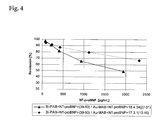
- FIG. 4 shows functional curves of NT-proBNP test strips according to Example 1 different antibody combinations.
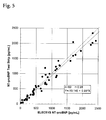
- FIG. 5 shows the correlation of an NT-proBNP test tire with the antibody combination: Au-MAK18.4.34 (27-31) / Bi-PAK (39-50) to the Elecsys® NT-proBNP test kit.
- the test device (FIG. 1) consists of a carrier material (5) onto which a sample application zone (1), an erythrocyte separation zone (2), a detection zone (3) and a suction zone (4) are applied are.
- a sample application matrix (6) is arranged, which is a Erythrocyte separation matrix (7) partially overlapped.
- the erythrocyte separation matrix (7) in turn something overlaps the detection matrix (8) (detection zone) on which an immobilized substance in the form of a line (9) is applied.
- a suction matrix (10) slightly overlaps the Detection matrix (8).
- the sample application matrix (6) are all those reagents required to form a complex with the analyte to be detected are.
- the sample application zone consists of 2 superimposed webs, the first ("gold fleece”) containing a gold-labeled antibody to NT-proBNP (MAK 18.4.34 (27-31)) and the second nonwoven (“Biotinvlies”) is a biotinylated antibody against NT-proBNP (PAK (39-50)).
- the first (“gold fleece”) containing a gold-labeled antibody to NT-proBNP (MAK 18.4.34 (27-31)
- Biotinvlies is a biotinylated antibody against NT-proBNP (PAK (39-50)
- PAK 39-50
- a 350 micron thick polyester film (Pütz) is used.
- As a "gold fleece” or “Biotin fleece” of sample application matrix 6 is a 360 ⁇ m thick polyester fleece (Roche Diagnostics) used.
- As Erytrozytenabtrennmatrix 7 is a 1.8 mm thick glass fiber fleece (Roche Diagnostics).
- As a detection matrix 8 is a 140 micron thick Nitrocellulose membrane (Sartorius).
- the suction matrix 10 is a 1.8 mm thick glass fiber fleece (Roche Diagnostics).
- the individual components (6, 7, 8, 10) are as shown in Fig. 1 by means of Hot melt adhesive slightly overlapping adhered to the support layer 5.
- the drinking formula for the "gold and biotin nonwovens” is:
Landscapes
- Health & Medical Sciences (AREA)
- Life Sciences & Earth Sciences (AREA)
- Immunology (AREA)
- Engineering & Computer Science (AREA)
- Chemical & Material Sciences (AREA)
- Molecular Biology (AREA)
- Biomedical Technology (AREA)
- Hematology (AREA)
- Urology & Nephrology (AREA)
- Medicinal Chemistry (AREA)
- General Health & Medical Sciences (AREA)
- Biochemistry (AREA)
- Physics & Mathematics (AREA)
- Microbiology (AREA)
- Analytical Chemistry (AREA)
- Cell Biology (AREA)
- Biotechnology (AREA)
- General Physics & Mathematics (AREA)
- Pathology (AREA)
- Food Science & Technology (AREA)
- Endocrinology (AREA)
- Organic Chemistry (AREA)
- Biophysics (AREA)
- Proteomics, Peptides & Aminoacids (AREA)
- Genetics & Genomics (AREA)
- Peptides Or Proteins (AREA)
- Investigating Or Analysing Biological Materials (AREA)
- Investigating Or Analysing Materials By The Use Of Chemical Reactions (AREA)
- Preparation Of Compounds By Using Micro-Organisms (AREA)
Abstract
Die Erfindung betrifft immunologische Schnelltests zur Bestimmung von NT-proBNP, die spezielle Antikörperkombinationen verwenden. Der erfindungsgemäße Schnelltest kann vorteilhaft als immunochromatographischer Teststreifen vorliegen. <IMAGE>The invention relates to immunological rapid tests for the determination of NT-proBNP using special antibody combinations. The rapid test according to the invention can advantageously be present as an immunochromatographic test strip. <IMAGE>
Description
Die vorliegende Erfindung betrifft einen analytischen Sandwichtest, insbesondere ein Testelement, insbesondere in Form eines nach dem Sandwich-Prinzip arbeitenden immunochromatographischen Teststreifens, für die Bestimmung von N-terminalem pro-Brain Natriuretic Peptide (NT-proBNP).The present invention relates to an analytical sandwich, in particular a Test element, in particular in the form of a working on the sandwich principle immunochromatographic test strip, for the determination of N-terminal pro-brain Natriuretic Peptides (NT-proBNP).
NT-proBNP ist ein viel versprechender Marker für die Diagnose und das Management von Herzinsuffizienz. Eine Übersicht über Herzinsuffizienz und die Bedeutung von NT-proBNP als Markersubstanz hierfür findet sich beispielsweise in WO 00/45176 auf den Seiten 1 bis 4, auf die hier ausdrücklich Bezug genommen wird: Weiterhin sind die Dokumente US 5,786,163, US 6,461,828, US 6,117,644, EP 1 151 304, WO 02/083913 und die EP-Patentanmeldung Nr. 03 010 591.0 vom 12.5.2003 (Klemt et al.) mit NT-proBNP, Antikörpern hierzu und Bestimmungsverfahren hierzu befasst.NT-proBNP is a promising marker for the diagnosis and management of Heart failure. An overview of heart failure and the importance of NT-proBNP as marker substance for this purpose is found, for example, in WO 00/45176 on pages 1 to 4, to which reference is expressly made: Furthermore, the documents US 5,786,163, US 6,461,828, US 6,117,644, EP 1 151 304, WO 02/083913 and EP Patent Application No. 03 010 591.0 of May 12, 2003 (Klemt et al.) With NT-proBNP, Antibodies for this purpose and determination procedures are concerned.
Der einzige zur Zeit im In-vitro-Diagnostik-Markt verfügbare NT-proBNP-Test ist der vollautomatisierte Elecsys® NT-proBNP-Test von Roche Diagnostics, welcher auf Basis einer Sandwichreaktion mit Elektrochemilumineszenzdetektion arbeitet. Dieser Test ist für den Einsatz in großen Zentrallabors konzipiert und benötigt zur Durchführung neben flüssigen, genau zu dosierenden Reagenzien ein verhältnismäßig komplexes Gerät zur Dosierung der Flüssigkeiten und zur Detektion des Lumineszenzsignals. Ein einfach zu bedienender, zur Not visuell ohne Auswertegerät auskommender Schnelltest für NT-proBNP ist zur Zeit nicht auf dem Markt.The only NT-proBNP test currently available in the in vitro diagnostic market is the fully automated Elecsys® NT-proBNP test from Roche Diagnostics, which is based on a Sandwich reaction with electrochemiluminescence detection works. This test is for use designed in large central laboratories and required to carry in addition to liquid, accurate to dosing reagents a relatively complex device for dosing the liquids and for detecting the luminescence signal. An easy to use, visually without need Evaluation unit exiting quick test for NT-proBNP is currently not on the market.
Schnelltests für immunologisch nachweisbare Substanzen sind für eine Vielzahl von unterschiedlichen Parametern seit langem bekannt, beispielsweise aus WO 97/06439, EP 0 291 194, US 5,591,645, US 4,861,711, US 5,141,850, US 6,506,612, US 5,458,852, US 5,073,484. Hier werden meist die immunolgischen Nachweisreagenzien (im Wesentlichen markierte und unmarkierte Antikörper bzw. Antigene) in trockener Form auf einem Träger bereitgestellt, der den Transport einer Probenflüssigkeit (insbesondere Körperflüssigkeiten wie Blut, Serum, Plasma, Urin, Speichel etc.) auf oder in dem Träger erlaubt. Vorzugsweise ist der Träger hierzu kapillaraktiv, beipielsweise eine Membran oder ein mit Kapillarkanälen versehener Kunststoffträger. In der Fachwelt spricht man oft von immunchromatographischen Teststreifen oder Testdevices. Rapid tests for immunologically detectable substances are available for a variety of different parameters have long been known, for example from WO 97/06439, EP 0 291 194, US 5,591,645, US 4,861,711, US 5,141,850, US 6,506,612, US 5,458,852, US 5,073,484. Here are usually the immunological detection reagents (essentially labeled and unlabelled antibodies or antigens) in dry form on a support provided, the transport of a sample liquid (especially body fluids such Blood, serum, plasma, urine, saliva, etc.) on or in the vehicle. Preferably, the Carrier capillary active, for example, a membrane or a capillary channels provided plastic carrier. In the professional world, one often speaks of immunochromatographic Test strips or test devices.
Bei Patienten mit akuter Atemnot ist es von Vorteil so schnell wie möglich eine NT-proBNP-Bestimmung durchzuführen um eine Herzinsuffizienz als Ursache der Atemnot auszuschliessen bzw. zu diagnostizieren und eine entsprechende Behandlung einzuleiten. Da der Elecsys® NT-proBNP-Test nur im Zentrallabor durchgeführt werden kann, ist eine schnelle NT-proBNP-Bestimmung ausserhalb der Routinezeiten nur schwer möglich. Es wäre daher gerade für die Notfallstation von Vorteil wenn ein Schnelltest zur Verfügung stünde, der auch ausserhalb der Routinezeiten direkt in der Notfallstation durchgeführt werden könnte. Der Schnelltest sollte dabei aber die gleichen Referenzbereiche und cut-offs gewähren wie die Referenzmethode im Zentrallabor (Elecsys® NT-proBNP), um so eine gute Vergleichbarkeit der Ergebnisse - unabhängig von der tatsächlich durchgeführten Art des Tests - zu ermöglichen.In patients with acute respiratory distress, it is beneficial to have an NT-proBNP determination as soon as possible to exclude heart failure as a cause of respiratory distress or to diagnose and initiate appropriate treatment. Because the Elecsys® NT-proBNP test can only be performed in the central laboratory, is a fast NT-proBNP determination Hardly possible outside of routine times. It would therefore be just for the Emergency ward would be an advantage if a quick test was available, even outside the Routine times could be done directly in the emergency department. The quick test should However, the same reference ranges and cut - offs are granted as the reference method in Central Laboratory (Elecsys® NT-proBNP) for a good comparability of results - regardless of the type of test actually performed - to allow.
Die im Elecsys® NT-proBNP-Test verwendeten polyklonalen Antikörper (PAK) erkennen eine ganz spezielle Fraktion des NT-proBNP ("natives" NT-proBNP; siehe EP-Patentanmeldung Nr. 03 010 591.0 vom 12.5.2003 von Klemt et al.; erkannt werden demnach die Epitope von NT-proBNP mit den Aminosäuren 1-21 (AS 1-21) und 39-50 (AS 39-50)). Es hat sich jedoch gezeigt, dass diese polyklonalen Antikörper für NT-proBNP-Schnelltests, die partikuläre Label wie z. B. kolloidales Gold als Label verwenden, ungeeignet sind, da sie auf Grund physiko-chemischer Wechselwirkungen mit den Schnelltestkomponenten (wie z. B. Trägermaterialien, Matrizes etc.) eine hohe, unerwünschte Variabilität in der Signalgenerierung zeigen. Dies hat deutliche Qualitätsschwankungen des Testes von Charge zu Charge zur Folge.The polyclonal antibodies (PAK) used in the Elecsys® NT-proBNP test recognize one very special fraction of the NT-proBNP ("native" NT-proBNP, see EP patent application No. 03 010 591.0 from May 12, 2003 to Klemt et al .; Accordingly, the epitopes of NT-proBNP are recognized with amino acids 1-21 (AS 1-21) and 39-50 (AS 39-50)). However, it has been shown that these polyclonal antibodies for NT-proBNP rapid tests, the particulate label such. B. using colloidal gold as a label are unsuitable because they are based on physico-chemical Interactions with the rapid test components (such as support materials, matrices etc.) show a high, unwanted variability in signal generation. This has clear Quality variations of the test from batch to batch result.
Aufgabe der vorliegenden Erfindung war es deshalb, die Nachteile des Standes der Technik zu beseitigen. Insbesondere sollte ein reproduzierbar herstellbarer und mit guter Korrelation zur Labormethode ausgestatteter Schnelltest für die Bestimmung von NT-proBNP bereitgestellt werden.Object of the present invention was therefore to overcome the disadvantages of the prior art remove. In particular, a reproducible producible and with good correlation to Laboratory test provided for the determination of NT-proBNP become.
Diese Aufgabe wird durch den Gegenstand der Erfindung gelöst.This object is achieved by the subject matter of the invention.
Gegestand der Erfindung ist ein immunologischer Test, insbesondere in Form eines Schnelltests wie z. B.eines analytischen Testelements, wie er in den unabhängigen Patentansprüchen charakterisiert ist. Bevorzugte Ausführungsformen sind in den abhängigen Ansprüchen wiedergegeben.The invention relates to an immunological test, in particular in the form of a rapid test such as B. an analytical test element, as in the independent claims is characterized. Preferred embodiments are defined in the dependent claims played.
Die erfindungsgemässe Lösung zur Herstellung eines immunologischen Tests im Sandwich-Format, insbesondere eines Schnelltestes, der gut zur Elecsys® Referenzmethode korreliert, sieht die Verwendung einer speziellen Antikörperkombination umfassend mindestens zwei Antikörper gegen NT-proBNP vor, wobei mindestens ein Antikörper ein monoklonaler Antikörper (MAK; im Englischen: monoclonal antibody oder MAB) ist. Ein weiterer Antikörper des erfindungsgemäßen Sandwichtests kann entweder ebenfalls ein MAK oder aber ein polyklonaler Antikörper (PAK; im Englischen: polyclonal antibody oder PAB) sein. Hierbei ist einer dieser Antikörper (kurz: AK; im Englischen: antibody oder AB) zumindest gegen Teile des Epitops von NT-proBNP umfassend die Aminosäuren 38 bis 50 gerichtet (im Folgenden auch kurz AK (38-50) bzw. MAK (38-50) bzw. PAK (38-50) genannt). Zumindest ein weiterer Antikörper ist zumindest gegen Teile des Epitops von NT-proBNP umfassend die Aminosäuren 1 bis 37 oder 43 bis 76 gerichtet ist (im Folgenden auch kurz AK (1-37) oder AK (43-76) bzw. MAK (1-37) oder MAK (43-76) bzw. PAK (1-37) oder PAK (43-76) genannt). Dabei können die von den Antikörpern erkannten Epitope geringfügig überlappen, bevorzugt um weniger als 5 Aminosäuren, ganz bevorzugt um weniger als 2 Aminosäuren.The solution according to the invention for the preparation of an immunological test in sandwich format, especially a quick test that correlates well with the Elecsys® reference method the use of a specific antibody combination comprising at least two antibodies against NT-proBNP, wherein at least one antibody is a monoclonal antibody (MAK; in English: monoclonal antibody or MAB). Another antibody of the Sandwich tests according to the invention may either also be a MAK or a polyclonal Antibody (PAK) may be polyclonal antibody or PAB. Here is one of these Antibody (abbreviated: AK, in English: antibody or AB) at least to parts of the epitope of NT-proBNP comprising amino acids 38 to 50 directed (hereinafter also abbreviated AK (38-50) or MAK (38-50) or PAK (38-50)). At least one more antibody is at least against portions of the epitope of NT-proBNP comprising amino acids 1 to 37 or 43 to 76 (hereinafter abbreviated AK (1-37) or AK (43-76) or MAK (1-37) or MAK (43-76) or PAK (1-37) or PAK (43-76)). Here, the of the Antibodies recognized epitopes overlap slightly, preferably by less than 5 Amino acids, more preferably less than 2 amino acids.
Bevorzugt ist eine Antikörperkombination umfassend mindestens einen polyklonalen Antikörper (PAK; im Englischen polyclonal antibody oder PAB) und einen monoklonalen Antikörper (MAK; im Englischen momoclonal antibody oder MAB) (sogenannte PAK/MAK Kombination) gegen NT-proBNP.Preferred is an antibody combination comprising at least one polyclonal antibody (PAK, in English polyclonal antibody or PAB) and a monoclonal antibody (MAK; in English momoclonal antibody or MAB) (so-called PAK / MAK combination) against NT-proBNP.
Im Sprachgebrauch dieser Patentanmeldung bedeutet PAK (X-Y) einen polyklonalen Antikörper, der gegen das Epitop von NT-proBNP mit den Aminosäuren X bis Y gerichtet ist. MAK (X-Y) ist ein entsprechender monoklonaler Antikörper. AK (X-Y) bezeichnet generell einen Antikörper (z. B. PAK oder MAK), der gegen das Epitop von NT-proBNP mit den Aminosäuren X bis Y gerichtet ist.As used in this application, PAK (X-Y) means a polyclonal antibody, which is directed against the epitope of NT-proBNP with the amino acids X to Y. MAK (X-Y) is a corresponding monoclonal antibody. AK (X-Y) generally refers to an antibody (eg, PAK or MAK) that is directed against the epitope of NT-proBNP with amino acids X to Y. is directed.
MAK a.b.c. (X-Y) ist ein aus der hinterlegten Zelllinie a.b.c. gewonnener, gegen das Epitop von NT-proBNP mit den Aminosäuren X bis Y gerichteter monoklonaler Antikörper.MAK a.b.c. (X-Y) is one from the deposited cell line a.b.c. won, against the epitope of NT-proBNP directed with the amino acids X to Y monoclonal antibody.
Um eine reproduzierbare Qualität des Antikörper-Label-Konjugates zu garantieren wird bevorzugt der MAK auf dem partikulären Label, insbesondere auf einem Goldlabel, immobilisiert. Weitere geeignete partikuläre Label sind beispielsweise gefärbte Latices, andere Metallsollabel, Polymerlabel, oder Halbleiter-Nanokristalle (sogenannte Quantum Dots). Vorzugsweise wird das MAK-Label-Konjugat so auf dem Schnelltestdevice zur Verfügung gestellt, dass es durch die Probenflüssigkeit von diesem abgelöst werden kann, beispielsweise durch Imprägnierung geeigneter Trägermaterialien wie Vliese, Membranen etc. Es ist jedoch auch möglich, das MAK-Label-Konjugat als Lösung zum Schnelltest zuzugeben.To guarantee a reproducible quality of the antibody label conjugate the MAb preferably immobilizes on the particulate label, especially on a gold label. Further suitable particulate labels are for example colored latices, other metal tellabel, Polymer label, or semiconductor nanocrystals (so-called quantum dots). Preferably, the MAK label conjugate so provided on the rapid test device that it passes through the Sample liquid can be detached from this, for example by impregnation suitable carrier materials such as nonwovens, membranes, etc. However, it is also possible to use the MAK label conjugate as a solution to the rapid test admit.
Der PAK, der vorzugsweise durch Immunisieren von Säugetieren, insbesondere Schafen, Ziegen, oder Kaninchen gewonnen wird, wird vorzugsweise als Biotinderivat im Schnelltest angeboten und kann an einen Avidin- oder Streptavidin-Nachweisstrich gebunden werden. Es ist jedoch auch möglich, den PAK direkt im Schnelltestdevice zu immobilisieren, beispielsweise in Form eines Nachweisstriches auf einer geeigneten Chromatographiemembran.The PAH, which is preferably obtained by immunizing mammals, especially sheep, goats, or rabbit is preferably offered as a biotin derivative in the rapid test and can be linked to an avidin or streptavidin detection line. However, it is also possible to immobilize the PAH directly in the rapid test device, for example in shape a detection line on a suitable chromatography membrane.
Erfindungsgemäß ist es auch möglich, wenn auch weniger bevorzugt, sowohl den gelabelten AK, insbesondere den gelabelten MAK, als auch den zweiten Antikörper, insbesondere den zweiten MAK oder PAK, in Lösung oder in Lösungen zum Schnelltest einzusetzen. Auf dem Testdevice befindet sich dann in einer Nachweiszone ein Bindepartner, der den entsprechend markierten AK abfangen kann und so eine Bindung des Sandwichkomplexes aus 1. AK, Analyt und 2. AK an eine Festphase des Schnelltests bewirkt.According to the invention, it is also possible, although less preferred, for both the labeled AK, in particular the labeled MAb, as well as the second antibody, in particular the second MAK or PAK, in solution or in solutions for rapid test use. On the test device is then in a detection zone a binding partner, the correspondingly marked AK can capture and thus a binding of the sandwich complex of 1st AK, and second analyte AK to a Solid phase of the rapid test causes.
Der erfindungsgemäß eingesetzte MAK muss nicht unbedingt das im Referenzsystem (Elecsys® Test) erkannte Epitop (AS 1-21) erkennen, um eine gute Korrelation mit dem Referenztest zu gewährleisten: Eine gute Korrelation mit dem Elecsys®-Referenzsystem, welches polyklonale Antikörper gegen die Epitope AS1-21 und AS39-50 von NT-proBNP verwendet (PAK (1-21) und PAK (39-50)), zeigen die in Anspruch 1 genannten Antikörperkombinationen, insbesondere die MAK/PAK-Kombinationen MAK 17.3.1(13-16)/PAK (39-50) und MAK 18.4.34(27-31)/PAK (39-50).The MAK used according to the invention does not necessarily have to be in the reference system (Elecsys® Test) recognized epitope (AS 1-21) to allow a good correlation with the reference test ensure a good correlation with the Elecsys® reference system, which is polyclonal Antibodies against the epitopes AS1-21 and AS39-50 of NT-proBNP used (PAK (1-21) and PAK (39-50)), show the antibody combinations mentioned in claim 1, in particular the MAK / PAH combinations MAK 17.3.1 (13-16) / PAH (39-50) and MAK 18.4.34 (27-31) / PAH (39-50).
Die polyklonalen Antikörper, beispielsweise PAK (1-21) und PAK (39-50) können nach an sich dem Fachmann bekannten Verfahren gewonnen, charakterisiert und identifiziert werden, insbesondere in Analogie zu Beispiel 2 von WO 00/45176.The polyclonal antibodies, for example, PAK (1-21) and PAH (39-50) can be used per se obtained, characterized and identified methods known to those skilled in the art, in particular in analogy to Example 2 of WO 00/45176.
Die monoklonalen Antikörper, beispielsweise MAK (38-42) und MAK (44-50) können nach an sich dem Fachmann bekannten Verfahren gewonnen, charakterisiert und identifiziert werden, insbesondere in Analogie zu Beispiel 3 von WO 00/45176 oder Beispiel 3 der EP-Patentanmeldung Nr. 03 010 591.0 vom 12.5.2003 (Klemt et al.).The monoclonal antibodies, for example MAK (38-42) and MAK (44-50) can be detected after to obtain, characterize and identify processes known to those skilled in the art, in particular in analogy to Example 3 of WO 00/45176 or Example 3 of the EP patent application No. 03 010 591.0 from May 12, 2003 (Klemt et al.).
Die Markierung der Antikörper, beispielsweise mit Gold- oder anderen Labeln, Biotin etc. erfolgt
nach an sich dem Fachmann bekannten Methoden (vgl. auch hierzu Beispiel 2 in WO 00/45176
und Beispiel 2 in der EP-Patentanmeldung Nr. 03 010 591.0 vom 12.5.2003 von Klemt et al.) Die
Markierung mit Gold ist beispielsweise in EP-A 0 898 170 detailliert beschreiben.The labeling of the antibodies, for example with gold or other labels, biotin, etc. takes place
according to methods known per se to the person skilled in the art (cf. also Example 2 in WO 00/45176
and Example 2 in EP Patent Application No. 03 010 591.0 of 12.5.2003 by Klemt et al.) Die
Marking with gold is described in detail, for example, in EP-
Insbesondere die bevorzugten monoklonalen Antikörper MAK 17.3.1 (13-16), MAK 16.1.39 (38-42), MAK 18.29.23 (64-67) und MAK 18.4.34(27-31) sind gemäß Beispiel 3 der EP-Patentanmeldung Nr. 03 010 591.0 vom 12.5.2003 von Klemt et al. zu gewinnen. Entsprechende Zelllinien sind bei der Deutschen Sammlung von Mikroorganismen und Zellkulturen GmbH (DSZM) hinterlegt (Eingangsnummern der Hinterlegungsstelle und Datum der Hinterlegung: DSM ACC2591 (7. Mai 2003) für MAK 17.3.1 (13-16); DSM ACC2590 (7. Mai 2003) für MAK 16.1.39 (38-42); DSM ACC2593 (7. Mai 2003) für MAK 18.29.23 (64-67); und DSM ACC2592 (7. Mai 2003) für MAK 18.4.34(27-31).In particular, the preferred monoclonal antibodies MAK 17.3.1 (13-16), MAK 16.1.39 (38-42), MAK 18.29.23 (64-67) and MAK 18.4.34 (27-31) are according to Example 3 of the EP Patent Application No. 03 010 591.0 dated May 12, 2003 by Klemt et al. to win. Corresponding cell lines are in the German collection of microorganisms and Zellkulturen GmbH (DSZM) (entry numbers of the depository and date deposit: DSM ACC2591 (May 7, 2003) for MAK 17.3.1 (13-16); DSM ACC2590 (May 7th 2003) for MAK 16.1.39 (38-42); DSM ACC2593 (May 7, 2003) for MAK 18.29.23 (64-67); and DSM ACC2592 (May 7, 2003) for MAK 18/4/34 (27-31).
Die Kombination MAK 18.4.34(27-31) / PAK (39-50) führt zu einer vergleichbar guten Korrelation mit dem Referenztest wie die Kombination MAK 17.3.1(13-16) / PAK (39-50) (siehe auch Beispiel 2).The combination MAK 18.4.34 (27-31) / PAK (39-50) leads to a comparably good one Correlation with the reference test such as the combination MAK 17.3.1 (13-16) / PAH (39-50) (see also example 2).
Für den erfindungsgemäßen Test erwiesen sich zudem die Kombination MAK 18.4.34(27-31) /PAK (39-50) als besonders vorteilhaft: Mit dieser Kombination konnte eine besonders für Schnellteste geeignete Funktionskurve angepasst werden (siehe Beispiel 3). Die Kombination MAK 17.3.1(13-16) / PAK (39-50) zeigte im Vergleich dazu eine schlechtere Empfindlichkeit des Testes.In addition, the combination MAK 18.4.34 (27-31) / PAH was found for the test according to the invention (39-50) as particularly advantageous: With this combination could be a special for Quickest suitable function curve can be adjusted (see Example 3). The combination MAK 17.3.1 (13-16) / PAK (39-50) showed in comparison a lower sensitivity of the Test.
Die Erfindung wird anhand der nachfolgenden Beispiele und Figuren näher erläutert.The invention will be explained in more detail with reference to the following examples and figures.
In Figur 1 ist schematisch eine bevorzugte Ausführungsform eines erfindungsgemäßen Schnelltestdevices in Form eines immunochromatographischen Teststreifens abgebildet.FIG. 1 schematically shows a preferred embodiment of a device according to the invention Rapid test devices in the form of an immunochromatographic test strip imaged.
Figur 2 zeigt die Korrelation der Antikörper-Kombination MAK 17.3.1(13-16) / PAK (39-50) im Elecsys®-Nasstestformat mit der Elecsys®-Referenzmethode PAK (1-21)/PAK (39-50).FIG. 2 shows the correlation of the antibody combination MAK 17.3.1 (13-16) / PAH (39-50) in FIG Elecsys® wet test format using the Elecsys® reference method PAK (1-21) / PAK (39-50).
Figur 3 zeigt die Korrelation der Antikörper-Kombination MAK 18.4.34 (27-31) / PAK (39-50) im Elecsys®-Nasstestformat mit der Elecsys®-Referenzmethode PAK (1-21)/PAK (39-50).FIG. 3 shows the correlation of the antibody combination MAK 18.4.34 (27-31) / PAH (39-50) in FIG Elecsys® wet test format using the Elecsys® reference method PAK (1-21) / PAK (39-50).
Figur 4 zeigt Funktionskurven von NT-proBNP-Teststreifen gemäß Beispiel 1 mit unterschiedlichen Antikörperkombinationen.FIG. 4 shows functional curves of NT-proBNP test strips according to Example 1 different antibody combinations.
Figur 5 zeigt die Korrelation eines NT-proBNP-Testreifens mit der Antikörperkombination: Au-MAK18.4.34(27-31) / Bi-PAK (39-50) zum Elecsys® NT-proBNP-Testkit. FIG. 5 shows the correlation of an NT-proBNP test tire with the antibody combination: Au-MAK18.4.34 (27-31) / Bi-PAK (39-50) to the Elecsys® NT-proBNP test kit.
Die Ziffern in den Figuren bedeuten:
- 1
- Probenaufgabezone
- 2
- Erythrozytenabtrennzone
- 3
- Detektionszone
- 4
- Saugzone
- 5
- Trägermaterial
- 6
- Probenaufgabematrix ("Biotinvlies" und "Goldvlies")
- 7
- Erythrozytenabtrennmatrix
- 8
- Detektionsmatrix
- 9
- strichförmige Immobilisierungszone
- 10
- Saugmatrix
- 1
- Sample application zone
- 2
- Erythrozytenabtrennzone
- 3
- detection zone
- 4
- suction zone
- 5
- support material
- 6
- Sample application matrix ("biotin fleece" and "gold fleece")
- 7
- erythrocyte
- 8th
- detection matrix
- 9
- line-shaped immobilization zone
- 10
- Saugmatrix
Das Testdevice (Fig. 1) besteht aus einem Trägermaterial (5) auf das eine Probenaufgabezone (1), eine Erythrozytenabtrennzone (2), eine Detektionszone (3) und eine Saugzone (4) aufgebracht sind. In der Probenaufgabezone (1) ist eine Probenaufgabematrix (6) angeordnet, die eine Erythrozytenabtrennmatrix (7) teilweise überlappt. Die Erythrozytenabtrennmatrix (7) ihrerseits überlappt etwas die Detektionsmatrix (8) (Detektionszone), auf der eine immobilisierte Substanz in Form eines Striches (9) aufgebracht ist. Eine Saugmatrix (10) überlappt etwas die Detektionsmatrix (8). In der Probenaufgabematrix (6) sind alle diejenigen Reagenzien untergebracht, die zur Bildung eines Komplexes mit dem nachzuweisenden Analyten erforderlich sind. Im vorliegenden Fall besteht die Probenaufgabezone aus 2 übereinanderliegenden Vliesen, wobei das erste ("Goldvlies") mit einem goldmarkierten Antikörper gegen NT-proBNP (MAK 18.4.34 (27-31)) getränkt ist und das zweite Vlies ("Biotinvlies") einen biotinylierten Antikörper gegen NT-proBNP (PAK (39-50)) enthält. Innerhalb der Detektionszone ist ein Strich (9) aus Streptavidin aufgebracht.The test device (FIG. 1) consists of a carrier material (5) onto which a sample application zone (1), an erythrocyte separation zone (2), a detection zone (3) and a suction zone (4) are applied are. In the sample application zone (1) a sample application matrix (6) is arranged, which is a Erythrocyte separation matrix (7) partially overlapped. The erythrocyte separation matrix (7) in turn something overlaps the detection matrix (8) (detection zone) on which an immobilized substance in the form of a line (9) is applied. A suction matrix (10) slightly overlaps the Detection matrix (8). In the sample application matrix (6) are all those reagents required to form a complex with the analyte to be detected are. In the present case, the sample application zone consists of 2 superimposed webs, the first ("gold fleece") containing a gold-labeled antibody to NT-proBNP (MAK 18.4.34 (27-31)) and the second nonwoven ("Biotinvlies") is a biotinylated antibody against NT-proBNP (PAK (39-50)). Within the detection zone is a line (9) off Applied streptavidin.
Als Trägerschicht 5 wird eine 350 µm dicke Polyesterfolie (Pütz) verwendet. Als "Goldvlies" bzw.
"Biotinvlies" der Probenaufgabematrix 6 wird ein 360 µm dickes Polyestervlies (Roche
Diagnostics) verwendet. Als Erytrozytenabtrennmatrix 7 wird ein 1.8 mm dickes Glasfaservlies
(Roche Diagnostics) verwendet. Als Detektionsmatrix 8 dient eine 140 µm dicke
Nitrocellulosemembran (Sartorius). Als Saugmatrix 10 dient ein 1.8 mm dickes Glasfaservlies
(Roche Diagnostics). Die einzelnen Komponenten (6, 7, 8, 10) werden wie in Fig. 1 gezeigt mittels
Schmelzkleber leicht überlappend auf die Trägerschicht 5 aufgeklebt.As a
- Biotinvlies":Biotin fleece ":
-
100 mM Hepes pH 7.4, 0.1 % Tween®,
20 µg/mL biotinylierter PAK (39-50)100 mM Hepes pH 7.4, 0.1% Tween®,
20 μg / mL biotinylated PAH (39-50) - "Goldvlies":"Gold fleece":
- 100 mM Hepes pH 7.4, OD 4 MAK 18.4.34 (27-31)-Goldkonjugat100 mM Hepes pH 7.4, OD 4 MAK 18.4.34 (27-31) gold conjugate
Die Korrelation der MAK / PAK Kombinationen MAK 17.3.1(13-16) / PAK (39-50) und MAK 18.4.34(27-31) / PAK (39-50) zum Elecsys®-Testkit (PAK (1-21)/PAK (30-50)) wurde in einem Elektrochemilumineszenz Immunoassay auf Elecsys® 2010 (Roche Diagnostics) untersucht. Dazu wurde der PAK (39-50) als biotinyliertes Fangreagenz und ruthenilierte F(ab')2 Fragmente der MAKs als Detektionsreagenz eingesetzt. 20 µl Probe oder Standard Material wurde mit jeweils 75 µl der beiden Antikörper Reagenzien für 9 Minuten bei 37 C inkubiert. Danach wurden 35 µl Streptavidin beschichtete magnetische Polystyrol Partikel zugegeben und für weitere 9 Minuten bei Raumtemperatur inkubiert. Das Elektrolumineszenz Signal eines Aliquots der Inkubationslösung wurde standardmässig auf Elecsys® 2010 gemessen und über eine Standardkurve in ein Konzentrationssignal umgerechnet.The correlation of the MAK / PAK combinations MAK 17.3.1 (13-16) / PAK (39-50) and MAK 18.4.34 (27-31) / PAK (39-50) to the Elecsys® test kit (PAK (1) 21) / PAK (30-50)) was tested in an electrochemiluminescence immunoassay on Elecsys® 2010 (Roche Diagnostics). For this purpose, the PAK (39-50) was used as a biotinylated capture reagent and ruthenilized F (ab ') 2 fragments of the MAbs as a detection reagent. 20 μl sample or standard material was incubated with each 75 μl of the two antibody reagents for 9 minutes at 37 ° C. Thereafter, 35 μl of streptavidin coated magnetic polystyrene particles were added and incubated for a further 9 minutes at room temperature. The electroluminescent signal of an aliquot of the incubation solution was measured by standard on Elecsys® 2010 and converted into a concentration signal using a standard curve.
Klinische Proben von Herzinsuffizienzpatienten wurden nun mit beiden MAK/PAK Testvarianten und dem Elecsys® Kit vermessen. Die Ergebnisse sind in den Figuren 2 und 3 abgebildet. Mit beiden MAK/PAK Varianten erhält man eine sehr gute Korrelation zum Elecsys® Kit (r=0.978 und r=0.957). Clinical samples from heart failure patients have now been tested with both MAK / PAK test variants and the Elecsys® Kit. The results are shown in FIGS. 2 and 3. With Both MAK / PAK variants give a very good correlation to the Elecsys® Kit (r = 0.978 and r = 0.957).
Ein NT-proBNP-Teststreifen wurden gemäss Beispiel 1 hergestellt. Dabei wurde folgende Tränkrezeptur für die Reagenzvliese verwendet:
- "Biotinvlies":
- 100 mM Hepes pH 7.4, 0.1 % Tween®
20 µg/mL biotinylierter PAK (39-50) - "Goldvlies":
- 100 mM Hepes pH 7.4, OD 4 MAK 18.4.34 (27-31)- oder MAK 17.3.1 (13-16)-Goldkonjugat
- "Biotin fleece":
- 100 mM Hepes pH 7.4, 0.1% Tween®
20 μg / mL biotinylated PAH (39-50) - "Gold fleece":
- 100 mM Hepes pH 7.4, OD 4 MAK 18.4.34 (27-31) or MAK 17.3.1 (13-16) gold conjugate
Heparinisierte Blutproben von gesunden Spendern wurden mit NT-proBNP-haltigen Seren von Herzinsuffizienzpatienten aufgestockt und aliqotiert. 150 µl der aufgestockten Blutproben wurden auf den Teststreifen pipettiert und auf dem CARDIAC Reader® (Roche Diagnostics) vermessen. Die Reaktionszeit nach der Probenerkennung betrug 12 Minuten. Zur Bestimmung der NT-proBNP-Konzentration der Proben wurde von einem Aliquot das Plasma abzentrifugiert und mit einem Elecsys® NT-proBNP-Kit (Roche Diagnostics) vermessen. Die so erhaltenen Funktionskurven der beiden Teststreifenvarianten MAK 17.3.1(13-16) / PAK (39-50) und MAK 18.4.34(27-31) / PAK (39-50) sind in Figur 4 abgebildet. Für die Variante MAK 18.4.34(27-31) /PAK (39-50) ergibt sich eine deutlich steilere Standardkurve und damit ein sensitiverer Test.Heparinized blood samples from healthy donors were obtained from NT-proBNP-containing sera from Heart failure patients were increased and aliqotiert. 150 μl of the spiked blood samples were pipetted onto the test strip and measured on the CARDIAC Reader® (Roche Diagnostics). The reaction time after the sample recognition was 12 minutes. To determine the NT-proBNP concentration The samples were centrifuged off an aliquot of the plasma and washed with an Elecsys® NT-proBNP kit (Roche Diagnostics). The thus obtained Functional curves of the two test strip variants MAK 17.3.1 (13-16) / PAK (39-50) and MAK 18.4.34 (27-31) / PAK (39-50) are shown in FIG. For the variant MAK 18.4.34 (27-31) / PAK (39-50) results in a significantly steeper standard curve and thus a more sensitive test.
Heparinisierte Blutproben gesunder Spender wurden mit NT-proBNP-haltigen Seren von Herzinsuffizienzpatienten versetzt und aliquotiert. 150 µl dieser "aufgestockten" Blutproben wurden auf den Teststreifen pipettiert und im CARDIAC Reader® (Roche Diagnostics) nach dem Standardverfahren vermessen. Von der gleichen Probe wurde Plasma abzentrifugiert und mit dem Elecsys® NT-proBNP-Kit auf einem Elecsys® 1010 Analysensytem (Roche Diagnostics) vermessen. Auf diese Weise wurden 60 Proben hergestellt und mit beiden Systemen gemessen. Figur 5 zeigt die Messwerte für beide Systeme. Die Korrelation ist mit r=0.95 sehr gut.Heparinized blood samples from healthy donors were obtained from NT-proBNP-containing sera from Heart failure patients and aliquoted. 150 μl of these "spiked up" blood samples were pipetted onto the test strip and in the CARDIAC Reader® (Roche Diagnostics) after the Measure standard procedure. From the same sample, plasma was spun down and incubated with the Elecsys® NT-proBNP kit on an Elecsys® 1010 analyzer (Roche Diagnostics) measure. In this way, 60 samples were prepared and measured by both systems. FIG. 5 shows the measured values for both systems. The correlation is very good with r = 0.95.
Claims (10)
mindestens zwei Antikörper gegen NT-proBNP verwendet werden, wobei
mindestens einer dieser Antikörper ein MAK ist,
und einer dieser Antikörper zumindest gegen Teile des Epitops von NT-proBNP umfassend die Aminosäuren 38 bis 50 gerichtet ist, und
einer dieser Antikörper zumindest gegen Teile des Epitops von NT-proBNP umfassend die Aminosäuren 1 bis 37 oder 43 bis 76 gerichtet ist, wobei
die von den Antikörpern erkannten Epitope geringfügig überlappen können.Immunological sandwich test for the determination of NT-proBNP, characterized in that
at least two antibodies against NT-proBNP are used, wherein
at least one of these antibodies is a MAK,
and one of these antibodies is directed at least to portions of the epitope of NT-proBNP comprising amino acids 38 to 50, and
one of said antibodies is directed at least to portions of the epitope of NT-proBNP comprising amino acids 1 to 37 or 43 to 76, wherein
the epitopes recognized by the antibodies may overlap slightly.
Applications Claiming Priority (2)
| Application Number | Priority Date | Filing Date | Title |
|---|---|---|---|
| DE10355731 | 2003-11-28 | ||
| DE10355731A DE10355731A1 (en) | 2003-11-28 | 2003-11-28 | Analytical sandwich test to determine NT-proBNP |
Publications (3)
| Publication Number | Publication Date |
|---|---|
| EP1536232A2 true EP1536232A2 (en) | 2005-06-01 |
| EP1536232A3 EP1536232A3 (en) | 2006-08-09 |
| EP1536232B1 EP1536232B1 (en) | 2010-11-10 |
Family
ID=34442338
Family Applications (1)
| Application Number | Title | Priority Date | Filing Date |
|---|---|---|---|
| EP04027831A Expired - Lifetime EP1536232B1 (en) | 2003-11-28 | 2004-11-24 | Analytical sandwich assay for the determination of NT-proBNP |
Country Status (13)
| Country | Link |
|---|---|
| US (2) | US7507550B2 (en) |
| EP (1) | EP1536232B1 (en) |
| JP (1) | JP4236629B2 (en) |
| KR (1) | KR100620297B1 (en) |
| CN (1) | CN1316248C (en) |
| AT (1) | ATE487946T1 (en) |
| AU (1) | AU2004231236B2 (en) |
| BR (1) | BRPI0405215B8 (en) |
| CA (1) | CA2488483C (en) |
| DE (2) | DE10355731A1 (en) |
| ES (1) | ES2355556T3 (en) |
| MX (1) | MXPA04011672A (en) |
| SG (1) | SG112059A1 (en) |
Cited By (1)
| Publication number | Priority date | Publication date | Assignee | Title |
|---|---|---|---|---|
| WO2012028697A1 (en) | 2010-09-01 | 2012-03-08 | Eth Zürich, Institute Of Molecular Biology And Biophysics | Affinity purification system based on donor strand complementation |
Families Citing this family (33)
| Publication number | Priority date | Publication date | Assignee | Title |
|---|---|---|---|---|
| FR2843396B1 (en) * | 2002-08-07 | 2005-04-15 | Bio Rad Pasteur | SPECIFIC ANTIBODIES FOR THE DIAGNOSIS OF HEART FAILURE |
| DE10355731A1 (en) * | 2003-11-28 | 2005-06-30 | Roche Diagnostics Gmbh | Analytical sandwich test to determine NT-proBNP |
| CN101000343B (en) | 2006-01-14 | 2012-11-14 | 霍夫曼-拉罗奇有限公司 | Immunological test element with improved control zone |
| EP1970709B1 (en) * | 2007-03-06 | 2013-07-10 | Roche Diagnostics GmbH | The use of BNP-type peptides for predicting the need for dialysis |
| EP2167965B1 (en) * | 2007-06-22 | 2013-04-10 | B.R.A.H.M.S GmbH | Method for detecting analytes |
| CN101230101B (en) * | 2008-01-25 | 2012-03-28 | 中国人民解放军第三军医大学 | A kind of recombinant protein used as NT-proBNP immunodiagnostic reagent standard and its preparation method and application |
| US9482677B2 (en) * | 2008-02-27 | 2016-11-01 | Scios Inc. | Method, composition and device for sampling natriuretic peptides in a biological fluid |
| US20090286329A1 (en) * | 2008-05-19 | 2009-11-19 | Abbott Laboratoires | Isolated human autoantibodies to natriuretic peptides and methods and kits for detecting human autoantibodies to natriuretic peptides |
| RU2423072C1 (en) * | 2009-11-19 | 2011-07-10 | Федеральное государственное учреждение "Ивановский научно-исследовательский институт материнства и детства имени В.Н. Городкова Федерального агентства по высокотехнологичной медицинской помощи" | Method of predicting outcome of post-hypoxic disorders of cardio-vascular system in newborns |
| EP2594940A1 (en) * | 2011-11-16 | 2013-05-22 | Koninklijke Philips Electronics N.V. | Particle repulsion to enhance surface contact in magnetic particle immunoassays |
| CN102692512A (en) * | 2012-06-26 | 2012-09-26 | 南京基蛋生物科技有限公司 | Double-antibody sandwich rapid detection kit of N-terminal pro-brain natriuretic peptide (NT-proBNP) |
| CN102879589A (en) * | 2012-09-26 | 2013-01-16 | 中国人民解放军总医院 | Human NT-proBNP preparation capable of stable preservation and preparation method thereof |
| EP2969143A1 (en) * | 2013-03-14 | 2016-01-20 | Instrumentation Laboratory Company | Plasma separation from blood using a filtration device and methods thereof |
| CN105092832B (en) * | 2015-08-28 | 2016-11-30 | 宁波瑞源生物科技有限公司 | A kind of NT-proBNP fluorescence immunoassay reagent and preparation method thereof |
| US10436773B2 (en) | 2016-01-18 | 2019-10-08 | Jana Care, Inc. | Mobile device based multi-analyte testing analyzer for use in medical diagnostic monitoring and screening |
| CN105699458A (en) * | 2016-02-03 | 2016-06-22 | 洪国粦 | Novel immunosensor for NT-proBNP detection and preparation method thereof |
| CN106771168A (en) * | 2016-12-30 | 2017-05-31 | 武汉纽康度生物科技股份有限公司 | Fluorescence immune chromatography detection card and its preparation method and application |
| CN107478848B (en) * | 2017-08-23 | 2019-04-16 | 广州瑞博奥生物科技有限公司 | Kit for quantitative detection of human NT-proBNP and preparation method thereof |
| WO2019118971A1 (en) * | 2017-12-15 | 2019-06-20 | Jana Care, Inc. | Biomedical measuring devices, systems, and methods for measuring peptide concentration to monitor a condition |
| US12001939B2 (en) | 2018-12-11 | 2024-06-04 | Eko.Ai Pte. Ltd. | Artificial intelligence (AI)-based guidance for an ultrasound device to improve capture of echo image views |
| US12400762B2 (en) | 2018-12-11 | 2025-08-26 | Eko.Ai Pte. Ltd. | Automatic clinical workflow that recognizes and analyzes 2D and doppler modality echocardiogram images for automated cardiac measurements and diagnosis of cardiac amyloidosis and hypertrophic cardiomyopathy |
| US11931207B2 (en) | 2018-12-11 | 2024-03-19 | Eko.Ai Pte. Ltd. | Artificial intelligence (AI) recognition of echocardiogram images to enhance a mobile ultrasound device |
| US12322100B2 (en) | 2018-12-11 | 2025-06-03 | Eko.Ai Pte. Ltd. | Automatic clinical workflow that recognizes and analyzes 2D and doppler modality echocardiogram images for automated cardiac measurements and grading of aortic stenosis severity |
| US11446009B2 (en) | 2018-12-11 | 2022-09-20 | Eko.Ai Pte. Ltd. | Clinical workflow to diagnose heart disease based on cardiac biomarker measurements and AI recognition of 2D and doppler modality echocardiogram images |
| CN112707964B (en) * | 2019-10-25 | 2022-11-08 | 东莞市朋志生物科技有限公司 | Recombinant antibody for resisting N-terminal brain natriuretic peptide precursor |
| US11536732B2 (en) | 2020-03-13 | 2022-12-27 | Jana Care, Inc. | Devices, systems, and methods for measuring biomarkers in biological fluids |
| JP7352503B2 (en) * | 2020-03-26 | 2023-09-28 | 三洋化成工業株式会社 | Magnetic particles, immunoassay reagents, immunoassay kits, and immunoassay methods |
| WO2022034159A1 (en) * | 2020-08-14 | 2022-02-17 | F. Hoffmann-La Roche Ag | Igfbp7 for the assessment of silent brain infarcts and cognitive decline |
| CN111781385B (en) * | 2020-08-19 | 2023-07-18 | 武汉生之源生物科技股份有限公司 | NT-proBNP detection kit and preparation method thereof |
| CN112964885B (en) * | 2021-02-20 | 2022-11-11 | 广东菲鹏生物有限公司 | Amino-terminal brain natriuretic peptide detection method and kit |
| CN112986586A (en) * | 2021-02-20 | 2021-06-18 | 广东菲鹏生物有限公司 | A kind of amino terminal brain natriuretic peptide detection method and kit |
| CN113580583B (en) * | 2021-08-04 | 2023-06-02 | 江苏毕辉建设工程有限公司 | Pipeline splicing device for water heating construction of orderly spliced house building |
| EP4462122A1 (en) | 2023-05-08 | 2024-11-13 | Roche Diagnostics GmbH | Method of manufacturing a plurality of analytical test elements |
Family Cites Families (24)
| Publication number | Priority date | Publication date | Assignee | Title |
|---|---|---|---|---|
| US5073484A (en) * | 1982-03-09 | 1991-12-17 | Bio-Metric Systems, Inc. | Quantitative analysis apparatus and method |
| DE3445816C1 (en) * | 1984-12-15 | 1986-06-12 | Behringwerke Ag, 3550 Marburg | Flat diagnostic agent |
| CA1303983C (en) * | 1987-03-27 | 1992-06-23 | Robert W. Rosenstein | Solid phase assay |
| ES2150428T3 (en) | 1987-04-27 | 2000-12-01 | Unilever Nv | SPECIFIC UNION TESTS. |
| US5252496A (en) * | 1989-12-18 | 1993-10-12 | Princeton Biomeditech Corporation | Carbon black immunochemical label |
| US5141850A (en) * | 1990-02-07 | 1992-08-25 | Hygeia Sciences, Inc. | Porous strip form assay device method |
| US5458852A (en) | 1992-05-21 | 1995-10-17 | Biosite Diagnostics, Inc. | Diagnostic devices for the controlled movement of reagents without membranes |
| GB9211686D0 (en) | 1992-06-03 | 1992-07-15 | Medisinsk Innovation A S | Chemical compounds |
| US5485852A (en) * | 1994-12-12 | 1996-01-23 | Johnson; Lanny L. | Pain tolerance testing device |
| WO1997006439A1 (en) | 1995-08-09 | 1997-02-20 | Quidel Corporation | Test strip and method for one step lateral flow assay |
| US6833275B1 (en) * | 1997-07-22 | 2004-12-21 | Roche Diagnostics Gmbh | Gold conjugates containing detergent |
| US6117644A (en) * | 1998-06-04 | 2000-09-12 | Ottawa Heart Institute Research Corporation | Predicting and detecting cardiac allograft rejection |
| GB9827348D0 (en) * | 1998-12-12 | 1999-02-03 | Univ Leicester | Natriuretic peptide |
| ATE373826T1 (en) | 1999-01-29 | 2007-10-15 | Roche Diagnostics Gmbh | METHOD FOR DETECTION OF N-TERMINAL PROBNP |
| US6136963A (en) * | 1999-07-27 | 2000-10-24 | Heska Corporation | Parasitic helminth DiAg2 nucleic acid molecules, and uses thereof |
| JP2002272458A (en) * | 2000-09-29 | 2002-09-24 | Shionogi & Co Ltd | Sandwich measurement method using specific antibody to dog BNP |
| US7632647B2 (en) | 2001-04-13 | 2009-12-15 | Biosite Incorporated | Use of B-type natriuretic peptide as a prognostic indicator in acute coronary syndromes |
| US6461828B1 (en) * | 2001-09-04 | 2002-10-08 | Syn X Pharma | Conjunctive analysis of biological marker expression for diagnosing organ failure |
| AUPS169202A0 (en) | 2002-04-11 | 2002-05-16 | Goetze, Jens Peter | Neuropeptide assay |
| JP4610025B2 (en) * | 2002-11-18 | 2011-01-12 | シン.クス ファーマ、インコーポレイテッド | Polyclonal monoclonal Elisa assay for NT-proBNP detection |
| US20040096919A1 (en) * | 2002-11-18 | 2004-05-20 | Michelle Davey | Polyclonal-monoclonal ELISA assay for detecting N-terminus proBNP |
| US7109023B2 (en) * | 2002-11-18 | 2006-09-19 | Princeton Biomeditech Corporation | Immunossay device for diagnosing congestive heart failure and predicting mortality in congestive heart failure patients |
| EP1625163B8 (en) * | 2003-05-12 | 2011-11-02 | Roche Diagnostics GmbH | Method of detecting probnp with a monoclonal antibody binding to the amino acids 38-43 |
| DE10355731A1 (en) * | 2003-11-28 | 2005-06-30 | Roche Diagnostics Gmbh | Analytical sandwich test to determine NT-proBNP |
-
2003
- 2003-11-28 DE DE10355731A patent/DE10355731A1/en not_active Withdrawn
-
2004
- 2004-11-22 US US10/994,851 patent/US7507550B2/en not_active Expired - Lifetime
- 2004-11-22 AU AU2004231236A patent/AU2004231236B2/en not_active Expired
- 2004-11-24 KR KR1020040096674A patent/KR100620297B1/en not_active Expired - Lifetime
- 2004-11-24 EP EP04027831A patent/EP1536232B1/en not_active Expired - Lifetime
- 2004-11-24 SG SG200406770A patent/SG112059A1/en unknown
- 2004-11-24 MX MXPA04011672A patent/MXPA04011672A/en active IP Right Grant
- 2004-11-24 AT AT04027831T patent/ATE487946T1/en active
- 2004-11-24 ES ES04027831T patent/ES2355556T3/en not_active Expired - Lifetime
- 2004-11-24 DE DE502004011867T patent/DE502004011867D1/en not_active Expired - Lifetime
- 2004-11-25 CA CA2488483A patent/CA2488483C/en not_active Expired - Lifetime
- 2004-11-25 JP JP2004339760A patent/JP4236629B2/en not_active Expired - Lifetime
- 2004-11-25 BR BRPI0405215A patent/BRPI0405215B8/en not_active IP Right Cessation
- 2004-11-26 CN CNB2004100958784A patent/CN1316248C/en not_active Expired - Lifetime
-
2009
- 2009-01-15 US US12/354,410 patent/US9140709B2/en active Active
Cited By (1)
| Publication number | Priority date | Publication date | Assignee | Title |
|---|---|---|---|---|
| WO2012028697A1 (en) | 2010-09-01 | 2012-03-08 | Eth Zürich, Institute Of Molecular Biology And Biophysics | Affinity purification system based on donor strand complementation |
Also Published As
| Publication number | Publication date |
|---|---|
| ES2355556T3 (en) | 2011-03-28 |
| US9140709B2 (en) | 2015-09-22 |
| DE10355731A1 (en) | 2005-06-30 |
| EP1536232B1 (en) | 2010-11-10 |
| JP2005181304A (en) | 2005-07-07 |
| ATE487946T1 (en) | 2010-11-15 |
| AU2004231236A1 (en) | 2005-06-16 |
| JP4236629B2 (en) | 2009-03-11 |
| AU2004231236B2 (en) | 2006-10-19 |
| DE502004011867D1 (en) | 2010-12-23 |
| EP1536232A3 (en) | 2006-08-09 |
| US20090123947A1 (en) | 2009-05-14 |
| MXPA04011672A (en) | 2005-06-01 |
| US7507550B2 (en) | 2009-03-24 |
| BRPI0405215B8 (en) | 2021-07-27 |
| BRPI0405215B1 (en) | 2016-08-02 |
| CA2488483A1 (en) | 2005-05-28 |
| HK1078647A1 (en) | 2006-03-17 |
| CN1316248C (en) | 2007-05-16 |
| SG112059A1 (en) | 2005-06-29 |
| CA2488483C (en) | 2011-09-06 |
| KR20050052354A (en) | 2005-06-02 |
| KR100620297B1 (en) | 2006-09-12 |
| CN1641352A (en) | 2005-07-20 |
| BRPI0405215A (en) | 2005-07-19 |
| US20050118662A1 (en) | 2005-06-02 |
Similar Documents
| Publication | Publication Date | Title |
|---|---|---|
| EP1536232B1 (en) | Analytical sandwich assay for the determination of NT-proBNP | |
| EP1143248B1 (en) | Method to immobilise conjugates in diagnostic tests | |
| DE68923800T2 (en) | DEVICE AND METHOD FOR DETERMINING AN ANALYTIC IN A LIQUID SAMPLE BY MEANS OF FOLLOW-UP REACTIONS. | |
| DE3889833T2 (en) | Diagnostic device and method, characterized by a targeted flow. | |
| DE69115369T2 (en) | Immunoassay with complementary visible signal | |
| DE69410293T2 (en) | Flow interruption test device | |
| DE3852040T2 (en) | DEVICE AND METHOD FOR DETERMINING A COMPONENT OF A SAMPLE. | |
| EP1808696B1 (en) | Immunological test element with improved control zone | |
| DE69329377T2 (en) | RELEASE AGENT FOR RED BLOOD CELLS IN EXAMINATIONS WITH SPECIFIC BINDING | |
| DE3880162T2 (en) | TEST PROCEDURE. | |
| DE69128618T2 (en) | DEVICE AND METHOD FOR PERFORMING IMMUNOASSAYS | |
| DE69231362T2 (en) | SIMULTANEOUS TESTING OF MEDICINAL PRODUCTS AND FINGERPRINT TEST PROCEDURE | |
| EP0363942B1 (en) | Method for the determination of a specific binding substance | |
| EP0998675B1 (en) | Use of check surfaces for identifying disturbing samples in a detection procedure | |
| DE60013320T2 (en) | ANALYTASSAY DEVICE WITH PRE-BEER ZONE | |
| EP1759209B1 (en) | Method for increasing the dynamic measuring range of test elements, especially immunological test elements, that are based on specific bonding reactions | |
| DE3922960A1 (en) | METHOD FOR DETERMINING AN ANALYTE | |
| EP2194381B1 (en) | Testing element with combined control and calibration zone | |
| DE4434093A1 (en) | Method for the qualitative and / or quantitative detection of a substance to be determined | |
| DE69228419T2 (en) | HLA TYPING | |
| WO2008135274A2 (en) | Method for the detection of specific immunoglobulin class g antibodies | |
| DE19637418A1 (en) | Homogeneous detection methods for the determination of subpopulations of an analyte | |
| EP1327886B1 (en) | Method for detecting analytes with analytical elements | |
| EP1711826B1 (en) | Biosensor and method for operating the latter | |
| DE4214589A1 (en) | Immunosensor with regenerable capture reagent - comprising protein C1q immobilised on membrane |
Legal Events
| Date | Code | Title | Description |
|---|---|---|---|
| PUAI | Public reference made under article 153(3) epc to a published international application that has entered the european phase |
Free format text: ORIGINAL CODE: 0009012 |
|
| AK | Designated contracting states |
Kind code of ref document: A2 Designated state(s): AT BE BG CH CY CZ DE DK EE ES FI FR GB GR HU IE IS IT LI LU MC NL PL PT RO SE SI SK TR |
|
| AX | Request for extension of the european patent |
Extension state: AL HR LT LV MK YU |
|
| PUAL | Search report despatched |
Free format text: ORIGINAL CODE: 0009013 |
|
| AK | Designated contracting states |
Kind code of ref document: A3 Designated state(s): AT BE BG CH CY CZ DE DK EE ES FI FR GB GR HU IE IS IT LI LU MC NL PL PT RO SE SI SK TR |
|
| AX | Request for extension of the european patent |
Extension state: AL HR LT LV MK YU |
|
| 17P | Request for examination filed |
Effective date: 20070209 |
|
| AKX | Designation fees paid |
Designated state(s): AT BE BG CH CY CZ DE DK EE ES FI FR GB GR HU IE IS IT LI LU MC NL PL PT RO SE SI SK TR |
|
| 17Q | First examination report despatched |
Effective date: 20071213 |
|
| GRAP | Despatch of communication of intention to grant a patent |
Free format text: ORIGINAL CODE: EPIDOSNIGR1 |
|
| GRAS | Grant fee paid |
Free format text: ORIGINAL CODE: EPIDOSNIGR3 |
|
| GRAA | (expected) grant |
Free format text: ORIGINAL CODE: 0009210 |
|
| AK | Designated contracting states |
Kind code of ref document: B1 Designated state(s): AT BE BG CH CY CZ DE DK EE ES FI FR GB GR HU IE IS IT LI LU MC NL PL PT RO SE SI SK TR |
|
| REG | Reference to a national code |
Ref country code: GB Ref legal event code: FG4D Free format text: NOT ENGLISH |
|
| REG | Reference to a national code |
Ref country code: CH Ref legal event code: EP |
|
| REG | Reference to a national code |
Ref country code: IE Ref legal event code: FG4D Free format text: LANGUAGE OF EP DOCUMENT: GERMAN |
|
| REF | Corresponds to: |
Ref document number: 502004011867 Country of ref document: DE Date of ref document: 20101223 Kind code of ref document: P |
|
| REG | Reference to a national code |
Ref country code: NL Ref legal event code: VDEP Effective date: 20101110 |
|
| REG | Reference to a national code |
Ref country code: ES Ref legal event code: FG2A Ref document number: 2355556 Country of ref document: ES Kind code of ref document: T3 Effective date: 20110328 |
|
| BERE | Be: lapsed |
Owner name: ROCHE DIAGNOSTICS G.M.B.H. Effective date: 20101130 Owner name: F.HOFFMANN-LA ROCHE A.G. Effective date: 20101130 |
|
| PG25 | Lapsed in a contracting state [announced via postgrant information from national office to epo] |
Ref country code: SI Free format text: LAPSE BECAUSE OF FAILURE TO SUBMIT A TRANSLATION OF THE DESCRIPTION OR TO PAY THE FEE WITHIN THE PRESCRIBED TIME-LIMIT Effective date: 20101110 Ref country code: FI Free format text: LAPSE BECAUSE OF FAILURE TO SUBMIT A TRANSLATION OF THE DESCRIPTION OR TO PAY THE FEE WITHIN THE PRESCRIBED TIME-LIMIT Effective date: 20101110 Ref country code: IS Free format text: LAPSE BECAUSE OF FAILURE TO SUBMIT A TRANSLATION OF THE DESCRIPTION OR TO PAY THE FEE WITHIN THE PRESCRIBED TIME-LIMIT Effective date: 20110310 Ref country code: BG Free format text: LAPSE BECAUSE OF FAILURE TO SUBMIT A TRANSLATION OF THE DESCRIPTION OR TO PAY THE FEE WITHIN THE PRESCRIBED TIME-LIMIT Effective date: 20110210 Ref country code: CY Free format text: LAPSE BECAUSE OF FAILURE TO SUBMIT A TRANSLATION OF THE DESCRIPTION OR TO PAY THE FEE WITHIN THE PRESCRIBED TIME-LIMIT Effective date: 20101110 Ref country code: SE Free format text: LAPSE BECAUSE OF FAILURE TO SUBMIT A TRANSLATION OF THE DESCRIPTION OR TO PAY THE FEE WITHIN THE PRESCRIBED TIME-LIMIT Effective date: 20101110 Ref country code: NL Free format text: LAPSE BECAUSE OF FAILURE TO SUBMIT A TRANSLATION OF THE DESCRIPTION OR TO PAY THE FEE WITHIN THE PRESCRIBED TIME-LIMIT Effective date: 20101110 Ref country code: PT Free format text: LAPSE BECAUSE OF FAILURE TO SUBMIT A TRANSLATION OF THE DESCRIPTION OR TO PAY THE FEE WITHIN THE PRESCRIBED TIME-LIMIT Effective date: 20110310 |
|
| REG | Reference to a national code |
Ref country code: IE Ref legal event code: FD4D |
|
| PG25 | Lapsed in a contracting state [announced via postgrant information from national office to epo] |
Ref country code: GR Free format text: LAPSE BECAUSE OF FAILURE TO SUBMIT A TRANSLATION OF THE DESCRIPTION OR TO PAY THE FEE WITHIN THE PRESCRIBED TIME-LIMIT Effective date: 20110211 Ref country code: MC Free format text: LAPSE BECAUSE OF NON-PAYMENT OF DUE FEES Effective date: 20101130 |
|
| PG25 | Lapsed in a contracting state [announced via postgrant information from national office to epo] |
Ref country code: IE Free format text: LAPSE BECAUSE OF FAILURE TO SUBMIT A TRANSLATION OF THE DESCRIPTION OR TO PAY THE FEE WITHIN THE PRESCRIBED TIME-LIMIT Effective date: 20101110 Ref country code: CZ Free format text: LAPSE BECAUSE OF FAILURE TO SUBMIT A TRANSLATION OF THE DESCRIPTION OR TO PAY THE FEE WITHIN THE PRESCRIBED TIME-LIMIT Effective date: 20101110 Ref country code: EE Free format text: LAPSE BECAUSE OF FAILURE TO SUBMIT A TRANSLATION OF THE DESCRIPTION OR TO PAY THE FEE WITHIN THE PRESCRIBED TIME-LIMIT Effective date: 20101110 |
|
| PG25 | Lapsed in a contracting state [announced via postgrant information from national office to epo] |
Ref country code: PL Free format text: LAPSE BECAUSE OF FAILURE TO SUBMIT A TRANSLATION OF THE DESCRIPTION OR TO PAY THE FEE WITHIN THE PRESCRIBED TIME-LIMIT Effective date: 20101110 Ref country code: BE Free format text: LAPSE BECAUSE OF NON-PAYMENT OF DUE FEES Effective date: 20101130 Ref country code: RO Free format text: LAPSE BECAUSE OF FAILURE TO SUBMIT A TRANSLATION OF THE DESCRIPTION OR TO PAY THE FEE WITHIN THE PRESCRIBED TIME-LIMIT Effective date: 20101110 Ref country code: DK Free format text: LAPSE BECAUSE OF FAILURE TO SUBMIT A TRANSLATION OF THE DESCRIPTION OR TO PAY THE FEE WITHIN THE PRESCRIBED TIME-LIMIT Effective date: 20101110 Ref country code: SK Free format text: LAPSE BECAUSE OF FAILURE TO SUBMIT A TRANSLATION OF THE DESCRIPTION OR TO PAY THE FEE WITHIN THE PRESCRIBED TIME-LIMIT Effective date: 20101110 |
|
| PLBE | No opposition filed within time limit |
Free format text: ORIGINAL CODE: 0009261 |
|
| STAA | Information on the status of an ep patent application or granted ep patent |
Free format text: STATUS: NO OPPOSITION FILED WITHIN TIME LIMIT |
|
| 26N | No opposition filed |
Effective date: 20110811 |
|
| REG | Reference to a national code |
Ref country code: DE Ref legal event code: R097 Ref document number: 502004011867 Country of ref document: DE Effective date: 20110811 |
|
| REG | Reference to a national code |
Ref country code: ES Ref legal event code: FD2A Effective date: 20120110 |
|
| PG25 | Lapsed in a contracting state [announced via postgrant information from national office to epo] |
Ref country code: ES Free format text: LAPSE BECAUSE OF NON-PAYMENT OF DUE FEES Effective date: 20101125 |
|
| PG25 | Lapsed in a contracting state [announced via postgrant information from national office to epo] |
Ref country code: LU Free format text: LAPSE BECAUSE OF NON-PAYMENT OF DUE FEES Effective date: 20101124 Ref country code: HU Free format text: LAPSE BECAUSE OF FAILURE TO SUBMIT A TRANSLATION OF THE DESCRIPTION OR TO PAY THE FEE WITHIN THE PRESCRIBED TIME-LIMIT Effective date: 20110511 |
|
| PG25 | Lapsed in a contracting state [announced via postgrant information from national office to epo] |
Ref country code: TR Free format text: LAPSE BECAUSE OF FAILURE TO SUBMIT A TRANSLATION OF THE DESCRIPTION OR TO PAY THE FEE WITHIN THE PRESCRIBED TIME-LIMIT Effective date: 20101110 |
|
| REG | Reference to a national code |
Ref country code: FR Ref legal event code: PLFP Year of fee payment: 12 |
|
| REG | Reference to a national code |
Ref country code: FR Ref legal event code: PLFP Year of fee payment: 13 |
|
| REG | Reference to a national code |
Ref country code: FR Ref legal event code: PLFP Year of fee payment: 14 |
|
| REG | Reference to a national code |
Ref country code: FR Ref legal event code: PLFP Year of fee payment: 15 |
|
| P01 | Opt-out of the competence of the unified patent court (upc) registered |
Effective date: 20230502 |
|
| PGFP | Annual fee paid to national office [announced via postgrant information from national office to epo] |
Ref country code: GB Payment date: 20231019 Year of fee payment: 20 |
|
| PGFP | Annual fee paid to national office [announced via postgrant information from national office to epo] |
Ref country code: ES Payment date: 20231201 Year of fee payment: 20 |
|
| PGFP | Annual fee paid to national office [announced via postgrant information from national office to epo] |
Ref country code: IT Payment date: 20231019 Year of fee payment: 20 Ref country code: FR Payment date: 20231019 Year of fee payment: 20 Ref country code: DE Payment date: 20231019 Year of fee payment: 20 Ref country code: CH Payment date: 20231201 Year of fee payment: 20 Ref country code: AT Payment date: 20231023 Year of fee payment: 20 |
|
| REG | Reference to a national code |
Ref country code: DE Ref legal event code: R071 Ref document number: 502004011867 Country of ref document: DE |
|
| REG | Reference to a national code |
Ref country code: CH Ref legal event code: PL |
|
| REG | Reference to a national code |
Ref country code: ES Ref legal event code: FD2A Effective date: 20241202 |
|
| REG | Reference to a national code |
Ref country code: GB Ref legal event code: PE20 Expiry date: 20241123 |
|
| REG | Reference to a national code |
Ref country code: AT Ref legal event code: MK07 Ref document number: 487946 Country of ref document: AT Kind code of ref document: T Effective date: 20241124 |
|
| PG25 | Lapsed in a contracting state [announced via postgrant information from national office to epo] |
Ref country code: GB Free format text: LAPSE BECAUSE OF EXPIRATION OF PROTECTION Effective date: 20241123 |
|
| PG25 | Lapsed in a contracting state [announced via postgrant information from national office to epo] |
Ref country code: ES Free format text: LAPSE BECAUSE OF EXPIRATION OF PROTECTION Effective date: 20241125 |
|
| PG25 | Lapsed in a contracting state [announced via postgrant information from national office to epo] |
Ref country code: GB Free format text: LAPSE BECAUSE OF EXPIRATION OF PROTECTION Effective date: 20241123 Ref country code: ES Free format text: LAPSE BECAUSE OF EXPIRATION OF PROTECTION Effective date: 20241125 |