EP1535998A1 - Pflanzliche nukleotid-zucker- pyrophosphatase/phosphodiesterase (nppase), verfahren zu ihrer gewinnung und ihre verwendung bei der herstellung von assay-vorrichtungen und bei der herstellung von transgenen pflanzen - Google Patents
Pflanzliche nukleotid-zucker- pyrophosphatase/phosphodiesterase (nppase), verfahren zu ihrer gewinnung und ihre verwendung bei der herstellung von assay-vorrichtungen und bei der herstellung von transgenen pflanzen Download PDFInfo
- Publication number
- EP1535998A1 EP1535998A1 EP03740519A EP03740519A EP1535998A1 EP 1535998 A1 EP1535998 A1 EP 1535998A1 EP 03740519 A EP03740519 A EP 03740519A EP 03740519 A EP03740519 A EP 03740519A EP 1535998 A1 EP1535998 A1 EP 1535998A1
- Authority
- EP
- European Patent Office
- Prior art keywords
- seq
- nppase
- enzyme product
- cdna
- enzyme
- Prior art date
- Legal status (The legal status is an assumption and is not a legal conclusion. Google has not performed a legal analysis and makes no representation as to the accuracy of the status listed.)
- Withdrawn
Links
Images





Classifications
-
- C—CHEMISTRY; METALLURGY
- C12—BIOCHEMISTRY; BEER; SPIRITS; WINE; VINEGAR; MICROBIOLOGY; ENZYMOLOGY; MUTATION OR GENETIC ENGINEERING
- C12Q—MEASURING OR TESTING PROCESSES INVOLVING ENZYMES, NUCLEIC ACIDS OR MICROORGANISMS; COMPOSITIONS OR TEST PAPERS THEREFOR; PROCESSES OF PREPARING SUCH COMPOSITIONS; CONDITION-RESPONSIVE CONTROL IN MICROBIOLOGICAL OR ENZYMOLOGICAL PROCESSES
- C12Q1/00—Measuring or testing processes involving enzymes, nucleic acids or microorganisms; Compositions therefor; Processes of preparing such compositions
- C12Q1/34—Measuring or testing processes involving enzymes, nucleic acids or microorganisms; Compositions therefor; Processes of preparing such compositions involving hydrolase
- C12Q1/42—Measuring or testing processes involving enzymes, nucleic acids or microorganisms; Compositions therefor; Processes of preparing such compositions involving hydrolase involving phosphatase
-
- C—CHEMISTRY; METALLURGY
- C12—BIOCHEMISTRY; BEER; SPIRITS; WINE; VINEGAR; MICROBIOLOGY; ENZYMOLOGY; MUTATION OR GENETIC ENGINEERING
- C12N—MICROORGANISMS OR ENZYMES; COMPOSITIONS THEREOF; PROPAGATING, PRESERVING, OR MAINTAINING MICROORGANISMS; MUTATION OR GENETIC ENGINEERING; CULTURE MEDIA
- C12N9/00—Enzymes; Proenzymes; Compositions thereof; Processes for preparing, activating, inhibiting, separating or purifying enzymes
- C12N9/14—Hydrolases (3)
-
- C—CHEMISTRY; METALLURGY
- C12—BIOCHEMISTRY; BEER; SPIRITS; WINE; VINEGAR; MICROBIOLOGY; ENZYMOLOGY; MUTATION OR GENETIC ENGINEERING
- C12N—MICROORGANISMS OR ENZYMES; COMPOSITIONS THEREOF; PROPAGATING, PRESERVING, OR MAINTAINING MICROORGANISMS; MUTATION OR GENETIC ENGINEERING; CULTURE MEDIA
- C12N9/00—Enzymes; Proenzymes; Compositions thereof; Processes for preparing, activating, inhibiting, separating or purifying enzymes
- C12N9/14—Hydrolases (3)
- C12N9/16—Hydrolases (3) acting on ester bonds (3.1)
Definitions
- the invention relates to the field of the production, purification and characterization of various isoforms of nucleotide pyrophosphatase/phosphodiesterase (NPPase) especially of rice and barley, and to the applications of this enzyme in the determination of levels of nucleotide sugars, and of sulphonucleotides, as well as in the production of transgenic plants in which there is overexpression of cDNA's of the genes that code for the said isoforms of NPPase, giving rise to plants with reduced content of starch and cell-wall polysaccharides and high resistance to salinity and temperature.
- NPPase nucleotide pyrophosphatase/phosphodiesterase
- UDPglucose is the fundamental precursor of the biosynthesis of cellulose and of cell-wall polysaccharides. It is also the precursor molecule of processes connected with the glycosylation of proteins and lipids.
- ADPglucose is the universal precursor of the biosynthesis of starch in storage tissues of plants. Its concentration in the cell is determining for the quantity and quality of the starch produced by the plant. Considerations of the factors that govern the endogenous levels of ADPG and UDPG in the plant cell have basically revolved around their synthesizing enzymes, such as ADPG pyrophosphorylase, UDPG pyrophosphorylase and sucrose synthase (Preiss, (1988) "Biosynthesis of starch and its regulation”.
- starch is a basic essential as a viscosity-increasing and gelling agent.
- the biosynthesis of starch in the plant cell starting from ADPG takes place in the subcellular compartment called the plastid.
- ADPG is both synthesized and utilized in this compartment, and therefore the levels of starch can be controlled by controlling the processes that regulate the ADPG levels.
- the various applications of starch produced in a plant are based on the balance of amylose and amylopectin, which determines the structure of the starch granule, as well as its viscosity in aqueous suspensions. The ratio of amylose to amylopectin depends on the concentration of ADPG in the plant cell.
- Chromatographic and radiological techniques are powerful tools for determining levels of nucleotides such as sulphonucleotides (APS and PAPS among others; Yoshida, H., Fukui, S., Yamashina, I., Tanaka, T., Sakano, T., Usui, T., Shimotsuji, T., Yabuuchi, H.,
- nucleoside diphosphate sugars such as the derivatives of glucose, ribose, mannose, galactose, glucuronic acid, fructose and galacturonic acid
- nucleoside diphosphate sugars such as the derivatives of glucose, ribose, mannose, galactose, glucuronic acid, fructose and galacturonic acid
- the invention describes the purification and applications of an enzymatic product of plant origin that we designate NPPase, which catalyses the hydrolysis of small molecules with phosphodiester or phosphosulphate bonds and in particular ADPG and APS, as the preferred substrates.
- NPPase which catalyses the hydrolysis of small molecules with phosphodiester or phosphosulphate bonds and in particular ADPG and APS, as the preferred substrates.
- ES 200201647 with the experimental data available to them at that time, the inventors tentatively designated the enzymatic product isolated as NSPPase, but in the later, second priority (ES 200202673), with the data that had been accumulated, its designation was changed to NPPase as at present.
- the plant enzyme of the invention has various isoforms in the plant tissues from which it can be obtained (Baroja-Fernández, E., Zandueta-Criado, A., Rodriguez-López, M., Akazawa, T., Pozueta-Romero, J. (2000) "Distinct isoforms of ADPglucose pyrophosphatase and ADPglucose pyrophosphorylase occur in the suspension-cultured cells of sycamore ( Acer pseudoplatanus L.). FEBS Lett. 480, 277-282).
- the isoform that is simplest to extract is the one we call soluble, whereas other isoforms, which we can call particulates, are found firmly adhering to the starch granules.
- (2002) "Diphosphonucleotide phosphatase/phosphodiesterase from yellow lupin ( Lupinus luteus L.) belongs to a novel group of specific metallophosphatases”. FEBS Lett. 519, 159-163). Moreover, it shares homology with other sequences that code for unknown or possible proteins of dicotyledonous plants such as Arabidopsis and chickpea.
- One object of the invention is, firstly, the production, characterization and sequencing of various soluble 70-kDa isoforms of NPPase in substantially pure form, starting from plant tissues of barley ( Hordeum vulgare ) and rice ( Oryza sativa ).
- Another object is the production of complete cDNA's that code for the NPPases and contrasting them with sequences available in databases.
- the said plants do not accumulate the marker of osmotic toxicity PAP, so that they are more resistant to high concentrations of salts than the control plants.
- Another object of the invention is the method used for making devices or kits for determination of nucleoside diphosphate sugars and sulphonucleotides based on the use of the enzymatic product with NPPase activity.
- the plant product with NPPase enzyme activity according to the invention can be obtained and purified starting from any plant tissue from any species, i.e. any monocotyledon or dicotyledon, for example barley ( Hordeum vulgare ), wheat ( Triticum aestivum ), rice ( Oryza sativa ), pepper ( Capsicum annuum ), tomato ( Lycopersicon sculentum ), potato ( Solanum tuberosum ), Arabidopsis ( Arabidopsis thaliana ), or sycamore ( Acer pseudoplatanus L.), to cite just some of the numerous representative examples of different families and genera.
- barley Hordeum vulgare
- wheat Triticum aestivum
- rice Oryza sativa
- pepper Capsicum annuum
- tomato Lycopersicon sculentum
- potato Solanum tuberosum
- Arabidopsis Arabidopsis thaliana
- sycamore A
- the general method for obtaining and purifying the soluble plant NPPase described in the invention includes the following steps, in which slight variations are admissible that do not substantially alter the general scheme of the method of extraction and purification.
- NPPase is especially abundant in young leaves and is practically absent from storage tissues such as endosperms of seeds and tubers, accordingly it is recommended to use young leaves for the extraction of NPPase.
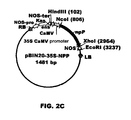
- pNPP was digested successively with the enzymes HindIII, T4 DNA polymerase and XbaI.
- the fragment released (which contains the cDNA of NPPase) was cloned in the plasmid pVT'BSP after being digested successively by the enzymes NcoI, T4 DNA polymerase and XbaI.
- p35SNPPNOS which has the constitutive promoter 35S, the cDNA of NPPase and the Nos terminator.
- p35SNPPNOS was digested successively with the enzymes HindIII, T4 DNA polymerase and XbaI and was cloned within the binary plasmid pBIN20 (Hennegan, K.P., Danna, K.J. "pBIN20: An improved binary vector for Agrobacterium-mediated transformation" Plant Mol. Biol. Rep. 16, 129-131) which had previously been digested successively with the enzymes HindIII, T4 DNA polymerase and XbaI.
- pBIN20-35S-NPP The plasmid thus obtained was designated with the name of pBIN20-35S-NPP (Fig. 2).
- E. coli XL1 Blue
- pBIN20-35S-NPP was introduced into Agrobacterium tumefaciens , which was used for transforming species such as tomato, tobacco, potato etc.
- Agrobacterium tumefaciens which was used for transforming species such as tomato, tobacco, potato etc.
- the coupling enzyme it is possible to use 5'-nucleotidase, which will hydrolyse the nucleoside monophosphate to equimolar quantities of the corresponding nucleoside and Pi.
- the Pi released in either of the two cases is easily quantifiable by known colorimetric methods.
- the strategy for determination of levels of sulphonucleotides such as APS is based on the hydrolysis of these nucleotides and consequent production of equimolar quantities of sulphate, which can be determined by turbidimetry or by nephelometry (Sörbo, B. (1987) "Sulfate: turbidimetric and nephelometric methods” Methods Enzymol. 143, 3-6).
- Examples are presented below which describe in detail the method of production and purification of the soluble NPPase of young barley leaves. The same method, with slight changes appropriate to each case, can be applied to any other species.
- Other examples describe the use of NPPase for the production of assay kits for determination of nucleotide sugars and sulphonucleotides.
- Another example shows the production of a complete cDNA that codes for soluble NPPase.
- the precipitate obtained after 30 minutes of centrifugation at 30 000 g (20°C) was resuspended in 2900 mL of Mes 50 mM pH 4.2, then heated on a water bath at 62°C for 20 minutes, cooled in ice, and centrifuged at 30 000 g for 20 minutes.
- the proteins of the supernatant were precipitated using 50% ammonium sulphate, and resuspended in 5.7 mL of Mes 50 mM pH 6.
- the sample was submitted to gel filtration in a Superdex 200 column (Pharmacia LKB Biotechnology, Uppsala, Sweden) pre-equilibrated with Mes pH 6 and NaCl 150 mM.
- the fractions with NPPase activity were combined, concentrated, and submitted to isoelectric focusing in a native gel, permitting purification of the protein to homogeneity (Fig. 3).
- G1P was determined spectrophotometrically in 300 microlitres of mixture containing Hepes 50 mM pH 7, EDTA 1 mM, MgCl 2 2 mM, KCl 15 mM, NAD + 0.6 mM, one unit of phosphoglucomutase and one unit of glucose-6-phosphate dehydrogenase from Leuconostoc mesenteroides , and 30 microlitres of the supernatant resulting from step 1. After 20 minutes of incubation, the production of NADH was monitored at 340 nm using a Multiskan EX spectrophotometer (Labsystems). The amount of NADH produced by any protein extract in the absence of ADPG in step 1 was negligible.
- Table 1 presented below shows the purification of soluble NPPase starting from barley leaves.
- the unit (U) is defined as the quantity of enzyme that catalyses the production of 1 ⁇ mol of product per minute.
- Total volume (mL) Total protein (mg) Total activity (mU) Specific activity (mU/mg protein)
- Purification (factor) Supernatant 100000 x g 2900 24 286 1 195 000 50 - pH 4.2 / 62°C 2900 778 1 067 000 1370 28 Superdex 200 86 164 300 1820 37 Isoelectric focusing 14 0.6 21 870 36 455 740
- Example 3 Identification of the product with enzymatic activity obtained
- Example 4 Obtaining a complete cDNA that codes for the soluble NPPase from rice and an incomplete cDNA that codes for the soluble NPPase of barley
- the NPPase enzyme exhibits a very wide distribution among plants, so that the enzymatic product with NPPase activity can be obtained from any plant, especially from tissues of young plants such as leaves and roots .
- Table 4 shows the specific activities (mU / mg protein) obtained in various monocotyledons and dicotyledons.
- glucose-nucleoside diphosphates such as ADPG, UDPG, CDP-glucose, GDP-glucose and TMP-glucose
- a kit is prepared containing the following elements:
- Determination of the quantity of glucose-nucleoside diphosphate present in the test sample is based on spectrophotometric determination of the NADH produced according to the following coupled reaction:
- the quantity of NDP-glucose in a test sample could be determined by preparing a cocktail with the composition (for 1 ml):
- Example 7 Preparation of enzyme kits for determination of nucleoside diphosphates of sugars other than glucose
- Determination of the quantity of nucleoside diphosphate sugar present in the test sample is based on colorimetric determination of the orthophosphate released according to the following coupled enzymatic reaction:
- the quantity of NDP-sugar in a test sample could be determined by preparing a cocktail (1 ml) consisting of:
- Example 8 Preparation of enzyme kits for determination of PAPS and APS
- Example 9 Production of transgenic plants of tobacco, potato and tomato that overexpress NPPase
Landscapes
- Chemical & Material Sciences (AREA)
- Life Sciences & Earth Sciences (AREA)
- Health & Medical Sciences (AREA)
- Organic Chemistry (AREA)
- Engineering & Computer Science (AREA)
- Zoology (AREA)
- Wood Science & Technology (AREA)
- Genetics & Genomics (AREA)
- Bioinformatics & Cheminformatics (AREA)
- Biochemistry (AREA)
- Biotechnology (AREA)
- Microbiology (AREA)
- Molecular Biology (AREA)
- General Health & Medical Sciences (AREA)
- General Engineering & Computer Science (AREA)
- Medicinal Chemistry (AREA)
- Proteomics, Peptides & Aminoacids (AREA)
- Biomedical Technology (AREA)
- Analytical Chemistry (AREA)
- Physics & Mathematics (AREA)
- Biophysics (AREA)
- Immunology (AREA)
- Enzymes And Modification Thereof (AREA)
- Measuring Or Testing Involving Enzymes Or Micro-Organisms (AREA)
- Breeding Of Plants And Reproduction By Means Of Culturing (AREA)
- Apparatus Associated With Microorganisms And Enzymes (AREA)
- Electrostatic Separation (AREA)
Applications Claiming Priority (5)
| Application Number | Priority Date | Filing Date | Title |
|---|---|---|---|
| ES200201647 | 2002-07-15 | ||
| ES200201647 | 2002-07-15 | ||
| ES200202673 | 2002-11-20 | ||
| ES200202673 | 2002-11-20 | ||
| PCT/ES2003/000363 WO2004007706A1 (es) | 2002-07-15 | 2003-07-15 | Azucar-nucleótido pirofosfatasa/fosfodiesterasa (nppasa) vegetal, procedimiento de obtención, uso en la fabricación de dispositivos de ensayo y su utilización en la obtención de plantas transgénicas |
Publications (1)
| Publication Number | Publication Date |
|---|---|
| EP1535998A1 true EP1535998A1 (de) | 2005-06-01 |
Family
ID=30116973
Family Applications (1)
| Application Number | Title | Priority Date | Filing Date |
|---|---|---|---|
| EP03740519A Withdrawn EP1535998A1 (de) | 2002-07-15 | 2003-07-15 | Pflanzliche nukleotid-zucker- pyrophosphatase/phosphodiesterase (nppase), verfahren zu ihrer gewinnung und ihre verwendung bei der herstellung von assay-vorrichtungen und bei der herstellung von transgenen pflanzen |
Country Status (8)
| Country | Link |
|---|---|
| US (1) | US20060242739A1 (de) |
| EP (1) | EP1535998A1 (de) |
| JP (1) | JP2005532806A (de) |
| CN (1) | CN1668739A (de) |
| AU (1) | AU2003281068A1 (de) |
| BR (1) | BR0312665A (de) |
| MX (1) | MXPA05000599A (de) |
| WO (1) | WO2004007706A1 (de) |
Cited By (2)
| Publication number | Priority date | Publication date | Assignee | Title |
|---|---|---|---|---|
| WO2011008510A3 (en) * | 2009-06-30 | 2011-03-10 | E. I. Du Pont De Nemours And Company | Plant seeds with altered storage compound levels, related constructs and methods involving genes encoding cytosolic pyrophosphatase |
| ES2354895A1 (es) * | 2008-09-12 | 2011-03-21 | Iden Carbohydrate Biotechnology S.L | Procedimiento para la producción de plantas transgénicas que presentan alto contenido y rendimiento en almidón y alto balance amilosa/amilopectina. |
Families Citing this family (6)
| Publication number | Priority date | Publication date | Assignee | Title |
|---|---|---|---|---|
| WO2006000066A2 (en) * | 2004-06-29 | 2006-01-05 | Puratos Naamloze Vennootschap | Dough comprising nucleotide pyrophosphatase inhibitor |
| US8187646B2 (en) | 2004-06-29 | 2012-05-29 | Puratos N.V. | Nucleotide pyrophosphatase inhibitor and coenzyme regenerating systems |
| CN102676556A (zh) * | 2012-05-15 | 2012-09-19 | 四川农业大学 | 一种来源于新疆沙冬青的i型液泡膜焦磷酸酶的基因序列及其克隆方法 |
| CN104946612B (zh) * | 2015-07-15 | 2016-11-16 | 北京中科紫鑫科技有限责任公司 | 一种分离纯化无机焦磷酸酶的方法 |
| CN106755022B (zh) * | 2015-11-25 | 2020-08-04 | 中国科学院大连化学物理研究所 | 乙酰葡萄糖胺磷酸变位酶AtAGM编码基因及其酶、制备、应用与酶活性检测方法 |
| CN113481180A (zh) * | 2021-07-05 | 2021-10-08 | 吉林大学 | 碱性嗜热无机焦磷酸酶及其在增强聚合酶链式反应和合成udp-半乳糖反应中的应用 |
Family Cites Families (4)
| Publication number | Priority date | Publication date | Assignee | Title |
|---|---|---|---|---|
| US5792920A (en) * | 1988-11-10 | 1998-08-11 | Imperial Chemical Industries Plc | Plants with altered ability to synthesize starch and process for obtaining them |
| CA2179383A1 (en) * | 1994-01-14 | 1995-07-20 | Ira D. Goldfine | Antagonists to insulin receptor tyrosine kinase inhibitor |
| US6329204B1 (en) * | 1999-02-10 | 2001-12-11 | E. I. Du Pont De Nemours & Company | Plant caffeic acid 3-0-methyltransferase homologs |
| JP2003521921A (ja) * | 2000-02-02 | 2003-07-22 | ウニベルジダード プブリカ デ ナバラ | 植物adpグルコースピロホスファターゼ、その製造方法、アッセイ装置及びトランスジェニック植物の製造におけるその使用 |
-
2003
- 2003-07-15 AU AU2003281068A patent/AU2003281068A1/en not_active Abandoned
- 2003-07-15 JP JP2004520690A patent/JP2005532806A/ja active Pending
- 2003-07-15 BR BR0312665-0A patent/BR0312665A/pt not_active IP Right Cessation
- 2003-07-15 EP EP03740519A patent/EP1535998A1/de not_active Withdrawn
- 2003-07-15 US US10/520,696 patent/US20060242739A1/en not_active Abandoned
- 2003-07-15 CN CN03817056.6A patent/CN1668739A/zh active Pending
- 2003-07-15 WO PCT/ES2003/000363 patent/WO2004007706A1/es not_active Ceased
- 2003-07-15 MX MXPA05000599A patent/MXPA05000599A/es not_active Application Discontinuation
Non-Patent Citations (1)
| Title |
|---|
| See references of WO2004007706A1 * |
Cited By (2)
| Publication number | Priority date | Publication date | Assignee | Title |
|---|---|---|---|---|
| ES2354895A1 (es) * | 2008-09-12 | 2011-03-21 | Iden Carbohydrate Biotechnology S.L | Procedimiento para la producción de plantas transgénicas que presentan alto contenido y rendimiento en almidón y alto balance amilosa/amilopectina. |
| WO2011008510A3 (en) * | 2009-06-30 | 2011-03-10 | E. I. Du Pont De Nemours And Company | Plant seeds with altered storage compound levels, related constructs and methods involving genes encoding cytosolic pyrophosphatase |
Also Published As
| Publication number | Publication date |
|---|---|
| US20060242739A1 (en) | 2006-10-26 |
| MXPA05000599A (es) | 2005-08-29 |
| WO2004007706A8 (es) | 2004-04-29 |
| BR0312665A (pt) | 2005-04-26 |
| WO2004007706A1 (es) | 2004-01-22 |
| AU2003281068A1 (en) | 2004-02-02 |
| JP2005532806A (ja) | 2005-11-04 |
| CN1668739A (zh) | 2005-09-14 |
Similar Documents
| Publication | Publication Date | Title |
|---|---|---|
| Liao et al. | GmPAP3, a novel purple acid phosphatase-like gene in soybean induced by NaCl stress but not phosphorus deficiency | |
| Sawake et al. | KONJAC1 and 2 are key factors for GDP-mannose generation and affect L-ascorbic acid and glucomannan biosynthesis in Arabidopsis | |
| Dai et al. | Cloning and expression analysis of a UDP-galactose/glucose pyrophosphorylase from melon fruit provides evidence for the major metabolic pathway of galactose metabolism in raffinose oligosaccharide metabolizing plants | |
| EP0455316B1 (de) | Plasmide, die die DNA-Sequenzen für die Veränderung des Kohlehydrat- und Proteingehalts bzw. Komposition in Pflanzen enthalten, sowie diese Plasmide enthaltende Pflanzen und Pflanzenzellen | |
| Litterer et al. | Characterization and expression of Arabidopsis UDP-sugar pyrophosphorylase | |
| US20060242739A1 (en) | Plant nucleotide-sugar pyrophosphatase/phosphodiesterase (nppase), method of obtaining same and use of same in the production of assay devices and in the production of transgenic plants | |
| CA2554780C (en) | Method of producing recombinant sucrose synthase, use thereof in the production of sucrose-determination kits, method of producing adpglucose and method of obtaining transgenic plants having leaves and reserve organs which accumulate a high concentration of adpglucose and starch | |
| Zhang et al. | Cloning and characterization of two fructokinases from maize | |
| Draborg et al. | Cloning, characterization and expression of a bifunctional fructose-6-phosphate, 2-kinase/fructose-2, 6-bisphosphatase from potato | |
| Litterer et al. | Biosynthesis of UDP‐glucuronic acid in developing soybean embryos: possible role of UDP‐sugar pyrophosphorylase | |
| US7205150B2 (en) | Transgenic plants over-expressing plant ADP-glucose pyrophosphatase | |
| US8841513B2 (en) | Procedure for producing transgenic plants providing high starch content and yield and high amylose/amylopectin balance | |
| JP2005532806A5 (de) | ||
| Muñoz Pérez et al. | Plant nucleotide-sugar pyrophosphatase/phosphodiesterase (NPPASE), method of obtaining same and use of same in the production of assay devices and in the production of transgenic plants | |
| Lin et al. | Purification and characterization of an alkaline invertase from shoots of etiolated rice seedlings | |
| EP1378567A1 (de) | Bakterielle adp-glucose-pyrophosphatase, verfahren zu ihrer gewinnung und ihre verwendung bei der herstellung von testvorrichtungen und der gewinnung von transgenen pflanzen und bakterien | |
| Weng et al. | Cloning, expression and characterization of UDP-glucose pyrophosphorylase from shoots of Bambusa oldhamii | |
| 圈争圈 | The author has granted a non | |
| Li | Molecular cloning of maize endosperm soluble starch synthase I |
Legal Events
| Date | Code | Title | Description |
|---|---|---|---|
| PUAI | Public reference made under article 153(3) epc to a published international application that has entered the european phase |
Free format text: ORIGINAL CODE: 0009012 |
|
| 17P | Request for examination filed |
Effective date: 20050104 |
|
| AK | Designated contracting states |
Kind code of ref document: A1 Designated state(s): AT BE BG CH CY CZ DE DK EE ES FI FR GB GR HU IE IT LI LU MC NL PT RO SE SI SK TR |
|
| AX | Request for extension of the european patent |
Extension state: AL LT LV MK |
|
| DAX | Request for extension of the european patent (deleted) | ||
| RIN1 | Information on inventor provided before grant (corrected) |
Inventor name: NANJO, YOHEI CELL-FREE SCIENCE AND TECHNOLOGY Inventor name: MITSUI, TOSHIAKI Inventor name: POZUETA ROMERO, FRANCISCO JAVIER Inventor name: BAROJA FERNANDEZ, MIREN EDURNE Inventor name: RODRIGUEZ LOPEZ MILAGROS Inventor name: MUNOZ PEREZ, FRANCISCO JOSE |
|
| STAA | Information on the status of an ep patent application or granted ep patent |
Free format text: STATUS: THE APPLICATION IS DEEMED TO BE WITHDRAWN |
|
| 18D | Application deemed to be withdrawn |
Effective date: 20090730 |