EP1535636A1 - Porous membrane - Google Patents
Porous membrane Download PDFInfo
- Publication number
- EP1535636A1 EP1535636A1 EP03741308A EP03741308A EP1535636A1 EP 1535636 A1 EP1535636 A1 EP 1535636A1 EP 03741308 A EP03741308 A EP 03741308A EP 03741308 A EP03741308 A EP 03741308A EP 1535636 A1 EP1535636 A1 EP 1535636A1
- Authority
- EP
- European Patent Office
- Prior art keywords
- membrane
- porous membrane
- polyamide
- acid
- water absorption
- Prior art date
- Legal status (The legal status is an assumption and is not a legal conclusion. Google has not performed a legal analysis and makes no representation as to the accuracy of the status listed.)
- Withdrawn
Links
Classifications
-
- B—PERFORMING OPERATIONS; TRANSPORTING
- B01—PHYSICAL OR CHEMICAL PROCESSES OR APPARATUS IN GENERAL
- B01D—SEPARATION
- B01D71/00—Semi-permeable membranes for separation processes or apparatus characterised by the material; Manufacturing processes specially adapted therefor
- B01D71/06—Organic material
- B01D71/56—Polyamides, e.g. polyester-amides
-
- B—PERFORMING OPERATIONS; TRANSPORTING
- B01—PHYSICAL OR CHEMICAL PROCESSES OR APPARATUS IN GENERAL
- B01D—SEPARATION
- B01D67/00—Processes specially adapted for manufacturing semi-permeable membranes for separation processes or apparatus
- B01D67/0002—Organic membrane manufacture
- B01D67/0009—Organic membrane manufacture by phase separation, sol-gel transition, evaporation or solvent quenching
-
- B—PERFORMING OPERATIONS; TRANSPORTING
- B01—PHYSICAL OR CHEMICAL PROCESSES OR APPARATUS IN GENERAL
- B01D—SEPARATION
- B01D69/00—Semi-permeable membranes for separation processes or apparatus characterised by their form, structure or properties; Manufacturing processes specially adapted therefor
- B01D69/08—Hollow fibre membranes
-
- B—PERFORMING OPERATIONS; TRANSPORTING
- B01—PHYSICAL OR CHEMICAL PROCESSES OR APPARATUS IN GENERAL
- B01D—SEPARATION
- B01D2325/00—Details relating to properties of membranes
- B01D2325/02—Details relating to pores or porosity of the membranes
- B01D2325/022—Asymmetric membranes
- B01D2325/023—Dense layer within the membrane
-
- B—PERFORMING OPERATIONS; TRANSPORTING
- B01—PHYSICAL OR CHEMICAL PROCESSES OR APPARATUS IN GENERAL
- B01D—SEPARATION
- B01D2325/00—Details relating to properties of membranes
- B01D2325/22—Thermal or heat-resistance properties
-
- B—PERFORMING OPERATIONS; TRANSPORTING
- B01—PHYSICAL OR CHEMICAL PROCESSES OR APPARATUS IN GENERAL
- B01D—SEPARATION
- B01D2325/00—Details relating to properties of membranes
- B01D2325/32—Melting point or glass-transition temperatures
Definitions
- the present invention relates to a porous membrane, particularly a porous membrane useful as a medical separation membrane.
- Porous membranes are widely used in various fields.
- a medical separation membrane particularly a hemodialysis membrane, comprises natural polymer membranes made from cellulose and the like, and synthetic polymer membranes made from polysulfone, polymethyl methacrylate, ethylene-vinylalcohol copolymer, polyacrylonitrile, polyamide, polyallylether sulfone, polyester polymer alloy and the like.
- a membrane using polyamide has been widely employed for medical use and the like, since it is superior in biocompatibility and free of bisphenol A, which is an endocrine disruptor feared to exert an adverse influence on human body, as a constitution component, and the like.
- AC sterilization which includes treatment with hot water
- polyamide membranes generally show high water absorbability and they show degraded mechanical property in water absorption state, their size and structure vary particularly when treated with hot water, and AC sterilization has been difficult to apply.
- JP-A-7-256067 describes a permselective membrane made from polyamide, which has a water content of not less than 8 wt% and heat of crystallization of not more than 30 mJ/mg. While this publication admits a disadvantage of polyamide membrane in the resistance to AC sterilization because higher water contents are associated with lower heat resistance when the membrane contains water, it concludes that AC sterilization of polyamide having a high water content is possible at 121°C, when the glass transition point of the dry resin is not less than 130°C. According to the study of the present inventors, however, it has been clarified that even a membrane produced using such polyamide fails to show sufficient dimensional stability and the like under AC sterilization conditions, and the AC sterilization markedly degrades membrane performance.
- the present invention aims at providing a porous membrane made from polyamide as a main material, which is useful as a medical separation membrane and the like, shows extremely small dimensional changes during a hot water treatment, and which particularly permits an AC sterilization treatment.
- the present inventors have conducted intensive studies in an attempt to achieve the aforementioned objects and found that the use of a polyamide having low equilibrium water absorption as a material of a membrane enables provision of a membrane superior in hot water resistance.
- a medical separation membrane made of a hollow fiber membrane comprising a polyamide having an equilibrium water absorption of not more than 10% as a main material has high dimensional stability under AC sterilization conditions, which resulted in the completion of the present invention.
- the present invention provides the following:
- the porous membrane of the present invention is characterized by the use of a polyamide having an equilibrium water absorption of not more than 10% as a main material.
- equilibrium water absorption a value measured by the method shown in (i) equilibrium water absorption to be mentioned later in [Examples].
- use of a polyamide having an equilibrium water absorption of not more than 10% as a main material is meant that a material of a porous membrane (namely, a polymer material forming the skeleton of a porous membrane) comprises a polyamide having an equilibrium water absorption of not more than 10% or the polyamide and other polymers (optional component).
- the polyamide having an equilibrium water absorption of not more than 10% to be used in the present invention preferably shows an equilibrium water absorption of not more than 7%, more preferably not more than 5%.
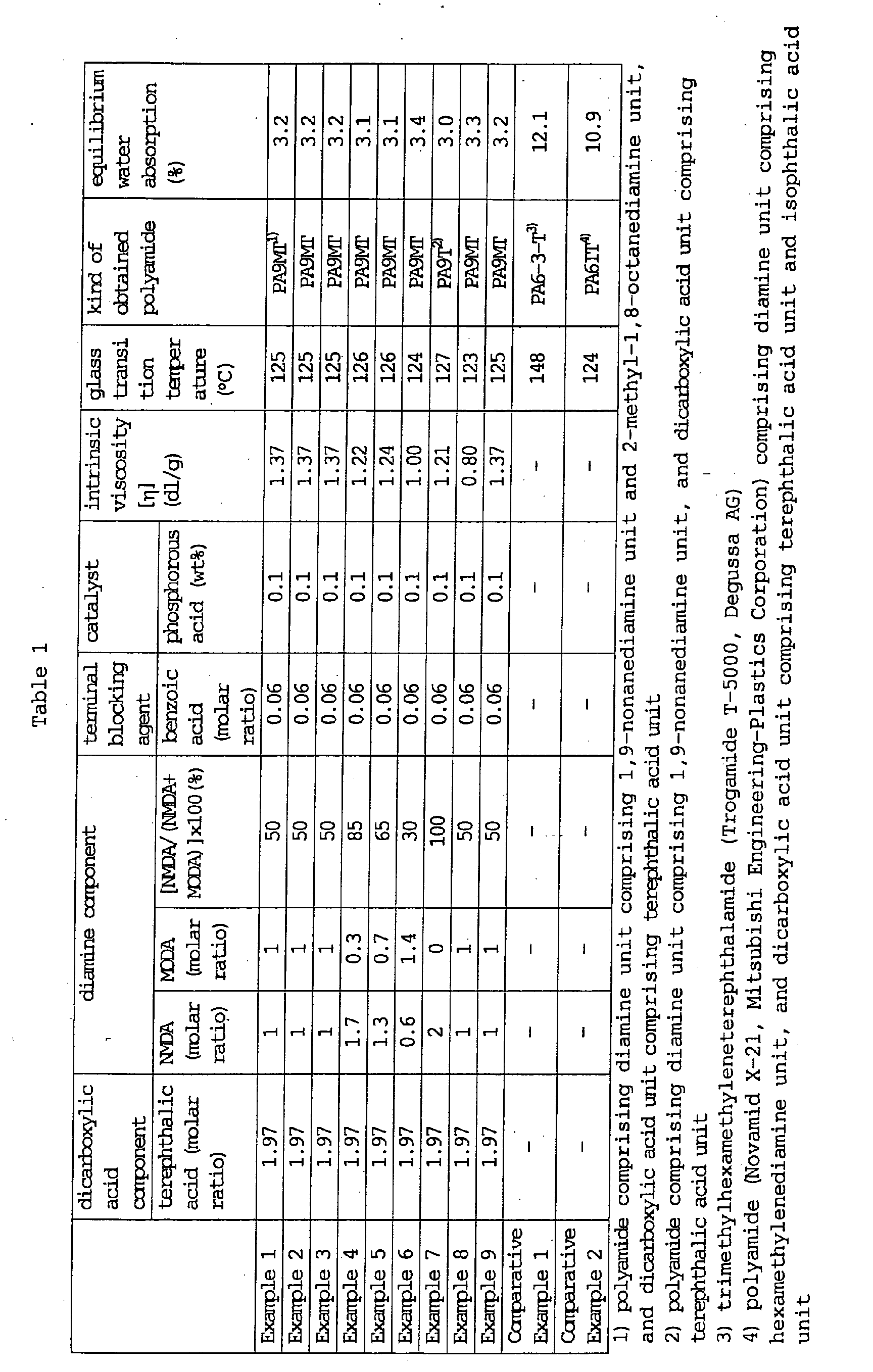
- a polyamide having an equilibrium water absorption of not more than 10% is realized by, for example, a polyamide comprising a dicarboxylic acid component comprising 60-100 mol% of terephthalic acid and a diamine component comprising 60-100 mol% of 1,9-nonanediamine and/or 2-methyl-1,8-octanediamine.
- a porous membrane comprising such a polyamide tends to show degraded hot water resistance.
- the amount of terephthalic acid in the dicarboxylic acid component is preferably 75-100 mol%, more preferably 90-100 mol%.
- the obtained polyamide becomes superior in the heat resistance, mechanical property and the like, further improving the dimensional stability during hot water treatment of the object porous membrane.
- dicarboxylic acid component other than terephthalic acid for example, aliphatic dicarboxylic acids such as malonic acid, dimethylmalonic acid, succinic acid, glutaric acid, adipic acid, 2-methyladipic acid, trimethyladipic acid, pimelic acid, 2,2-dimethylglutaric acid, 3,3-diethylsuccinic acid, azelaic acid, sebacic acid, suberic acid, dimer acid and the like; alicyclic dicarboxylic acids such as 1,3-cyclopentanedicarboxylic acid, 1,4-cyclohexanedicarboxylic acid and the like; aromatic dicarboxylic acids such as isophthalic acid, 2,6-naphthalenedicarboxylic acid, 2,7-naphthalenedicarboxylic acid, 1,4-naphthalenedicarboxylic acid, 1,4-phenylenedioxydiacetic acid, 1,3-phenylenedioxydiacetic acid
- the amount of 1,9-nonanediamine and/or 2-methyl-1,8-octanediamine in the diamine component is preferably 75-100 mol%, more preferably 90-100 mol%.
- the amount of 1,9-nonanediamine and/or 2-methyl-1,8-octanediamine in the diamine component is within the preferable range, the obtained polyamide becomes superior in low water absorption, heat resistance and the like, further improving the dimensional stability during hot water treatment of the object porous membrane.
- NMDA 1,9-nonanediamine
- MODA 2-methyl-1,8-octanediamine
- the proportion thereof is preferably NMDA:MODA (molar ratio) of 100:0-10:90, more preferably 95:5-20:80, and particularly preferably 90:10-40:60.
- diamine component other than 1,9-nonanediamine and 2-methyl-1,8-octanediamine for example, straight chain aliphatic diamines such as 1,6-hexanediamine, 1,7-heptanediamine, 1,8-octanediamine, 1,10-decanediamine, 1,11-undecanediamine, 1,12-dodecanediamine and the like; branched chain diamines such as 2-methyl-1,5-pentanediamine, 3-methyl-1,5-pentanediamine, 2,2,4-trimethyl-1,6-hexanediamine, 2,4,4-trimethyl-1,6-hexanediamine, 5-methyl-1,9-nonanediamine and the like; alicyclic diamines such as cyclohexanediamine, methylcyclohexanediamine, isophoronediamine, bis(4-aminocyclohexyl)methane, norbornanedimethylamine, tricyclodecanedimethylamine and the
- not less than 10% of the molecular chain terminal group of polyamide is preferably blocked with a terminal blocking agent, wherein the blocking rate of the terminal group is more preferably not less than 40%, further preferably not less than 60% and particularly preferably not less than 70%.
- the terminal blocking agent is free of any particular limitation as long as it is a monofunctional compound having reactivity with amino group or carboxyl group on the polyamide terminal. From the aspects of reactivity, safety of the blocked terminal and the like, monocarboxylic acid and monoamine are preferable, and from the aspects of easy handling and the like, monocarboxylic acid is more preferable.
- acid anhydrides such as phthalic anhydride and the like, monoisocyanate, monoacid halide, monoesters, monoalcohols and the like can be also used.
- the monocarboxylic acid that can be used as a terminal blocking agent is free of any particular limitation as long as it has reactivity with amino group and, for example, aliphatic monocarboxylic acids such as acetic acid, propionic acid, butyric acid, valeric acid, caproic acid, caprylic acid, lauric acid, tridecylic acid, myristic acid, palmitic acid, stearic acid, pivalic acid, isobutyric acid and the like; alicyclic monocarboxylic acids such as cyclohexanecarboxylic acid and the like; aromatic monocarboxylic acids such as benzoic acid, toluic acid, ⁇ -naphthalenecarboxylic acid, ⁇ -naphthalenecarboxylic acid, methylnaphthalenecarboxylic acid, phenylacetic acid and the like, and a mixture of any of these can be mentioned.
- aliphatic monocarboxylic acids such as acetic acid, prop
- acetic acid, propionic acid, butyric acid, valeric acid, caproic acid, caprylic acid, lauric acid, tridecylic acid, myristic acid, palmitic acid, stearic acid and benzoic acid are particularly preferable.
- the monoamine that can be used as a terminal blocking agent is free of any particular limitation as long as it has reactivity with carboxyl group and, for example, aliphatic monoamines such as methylamine, ethylamine, propylamine, butylamine, hexylamine, octylamine, decylamine, stearylamine, dimethylamine, diethylamine, dipropylamine, dibutylamine and the like; alicyclic monoamines such as cyclohexylamine, dicyclohexylamine and the like; aromatic monoamines such as aniline, toluidine, diphenylamine, naphthylamine and the like, and a mixture of any of these can be mentioned.
- aliphatic monoamines such as methylamine, ethylamine, propylamine, butylamine, hexylamine, octylamine, decylamine, stearylamine, dimethylamine,
- butylamine, hexylamine, octylamine, decylamine, stearylamine, cyclohexylamine and aniline are particularly preferable.
- the polyamide can be produced using any method known as a method of producing crystalline polyamide.
- it can be produced by methods such as a melt polymerization method or an interfacial polymerization method using acid chloride and diamine as starting materials; melt polymerization method, solid phase polymerization method, melt extruder polymerization method and the like using dicarboxylic acid and diamine as starting materials.
- a phosphorus catalyst such as phosphoric acid, phosphorous acid, hypophosphorous acid, or a salt thereof, an ester thereof and the like is preferably added to the reaction system.
- hypophosphorous acid derivatives (hypophosphorous acid salt, hypophosphorous acid ester etc.) are preferable, and sodium hypophosphite is particularly preferable in view of the cost and easy handling.
- the amount of these phosphorus catalysts to be added is preferably 0.01-5 wt%, more preferably 0.05-2 wt%, and particularly preferably 0.07-1 wt%, relative to the total weight of dicarboxylic acid and diamine.
- the amount of the above-mentioned terminal blocking agent to be used varies depending on the reactivity and boiling point of the terminal blocking agent to be used, reactor, reaction conditions and the like, it is generally within the range of 0.1-15 mol% of the total number of moles of dicarboxylic acid and diamine.
- the polyamide to be used in the present invention have a high glass transition point in a dry state and a glass transition point of not less than 60°C is preferable, not less than 80°C is more preferable, and not less than 100°C is particularly preferable.
- the glass transition point refers to an intermediate temperature between two inflection points observed near the glass transition temperature when measured by raising temperature from 30°C to 200°C at 10°C/min using DSC (Mettler-Toledo International Inc.: DSC30).
- the polyamide to be used in the present invention preferably has an intrinsic viscosity [ ⁇ ] of 0.4-3.0 dl/g, more preferably 0.6-2.0 dl/g, and particularly preferably 0.8-1.8 dl/g, as measured in concentrated sulfuric acid at 30°C.
- an intrinsic viscosity [ ⁇ ] of 0.4-3.0 dl/g, more preferably 0.6-2.0 dl/g, and particularly preferably 0.8-1.8 dl/g, as measured in concentrated sulfuric acid at 30°C.
- the intrinsic viscosity [ ⁇ ] is lower than the above-mentioned range, the mechanical strength of the object porous membrane tends to decrease.
- solubility in a solvent during preparation of film forming dope to be mentioned later and the film forming dope tends to increase the viscosity to lower the film formability.
- the intrinsic viscosity [ ⁇ ] was measured by dissolving polyamide in concentrated sulfuric acid to give sample solutions having a concentration of 0.05, 0.1, 0.2 and 0.4 g/dl, measuring the flow time (sec) of sample solutions having respective concentrations at 30°C, calculating the intrinsic viscosity ( ⁇ inh) of the following samples from the following formula, and extrapolating the value into concentration 0.
- ⁇ inh [ln(t 1 /t 0 )]/c wherein ⁇ inh is intrinsic viscosity (dl/g), t 0 is flow time (sec) of solvent, t 1 is flow time (sec) of sample solution, and c is concentration (g/dl) of the sample in the solution.
- the production method of the porous membrane of the present invention is not particularly limited, for example, the membrane can be preferably produced by the following method.
- a film forming dope containing a polymer and a solvent, or a film forming dope further containing additives as necessary is prepared.
- the polymer to be used here may be a polyamide having an equilibrium water absorption of not more than 10% alone or may contain other polymer as necessary.
- the concentration composition of the polyamide in the film forming dope needs only to fall within the range permitting film forming and function as a membrane, and is preferably 5-50 wt%.
- the concentration of polyamide is preferably 10-30 wt% because a membrane having high permeability and mechanical strength can be obtained.
- such polymer when a different polymer is to be added for the purpose of imparting hydrophilicity, improving biocompatibility, improving viscosity and the like, such polymer may be added to a film forming dope in a proportion of 0-20 wt%, preferably 0-10 wt%.
- polyvinylpyrrolidone PVP
- polyethylene glycol polyethylene glycol monoester
- copolymer of polyethylene glycol and polypropylene glycol polyvinyl alcohol
- polyvinyl alcohol ethylene-vinyl alcohol copolymer
- water-soluble derivative of cellulose polysorbate
- polymethoxyethyl acrylate polyhydroxyethyl methacrylate and the like
- the solvent may be any as long as it can dissolve polymer, or polymer and additive, and, for example, N-methyl-2-pyrrolidone (NMP), N,N-dimethylacetamide (DMAc), dimethyl sulfoxide (DMSO), dimethylformamide (DMF), N-methylmorpholineoxide (NMMO) and the like can be mentioned, which may be used alone or in a mixture of two or more kinds thereof.
- NMP N-methyl-2-pyrrolidone
- DMAc N,N-dimethylacetamide
- DMSO dimethyl sulfoxide
- DMF dimethylformamide
- NMMO N-methylmorpholineoxide
- An additive is used for controlling phase separation temperature and viscosity of film forming dope or improving film formability, and, for example, water and the like can be mentioned.
- the concentration range of water is 0-10 wt%, preferably 0-5 wt%, of a film forming dope.
- salt and the like may be added.
- the kind of salt for example, one or more kinds selected from the group consisting of lithium chloride, sodium chloride, calcium chloride, lithium acetate and lithium nitrate can be mentioned.
- the amount of the salt to be added it is any amount according to the combination of polymer, solvent and additive.
- a film forming dope is prepared by mixing a polymer and a solvent (and additive to be used as necessary) at a high temperature (generally 60-150°C). Then, in the case of a hollow fiber, for example, the prepared film forming dope is extruded from a double annular nozzle while injecting, into the inside from a double annular nozzle, a hollow-forming agent such as a coagulation liquid or a non-coagulative solvent (solvent that prevents coagulation of film forming dope) and the like to be mentioned later, and, if necessary, introducing into the coagulation liquid to achieve film forming.
- the coagulation liquid may be contacted with the film forming dope only in the inside of the hollow fiber, on the outside alone or on both sides. In the case of a flat membrane, a film forming dope is cast on a cast plate to allow immersion in a coagulation liquid and the like to achieve film forming.
- the coagulation liquid any can be used without particularly limitation as long as it has an action to coagulate a polymer to be the material of a membrane and is miscible with the solvent of a film forming dope.
- the kind of the coagulation liquid for example, water; a mixture of a water-soluble solvent such as NMP, DMAc, DMSO, DMF, NMMO and the like with water and the like can be mentioned.
- an aqueous solution containing salts such as lithium chloride, sodium chloride, calcium chloride, lithium acetate, lithium nitrate and the like; polymers such as PVP, polyethylene glycol, polyethylene glycol monoester, copolymer of polyethylene glycol and polypropylene glycol, polyvinyl alcohol, ethylene-vinyl alcohol copolymer, water-soluble derivative of cellulose, polysorbate, polymethoxyethyl acrylate, polyhydroxyethyl methacrylate and the like, and the like can be also used.
- salts such as lithium chloride, sodium chloride, calcium chloride, lithium acetate, lithium nitrate and the like
- polymers such as PVP, polyethylene glycol, polyethylene glycol monoester, copolymer of polyethylene glycol and polypropylene glycol, polyvinyl alcohol, ethylene-vinyl alcohol copolymer, water-soluble derivative of cellulose, polysorbate, polymethoxyethyl acrylate, polyhydroxye
- a gas such as nitrogen, air and the like or a non-coagulative solvent such as hexane and the like, and the like can be used on the outside of the hollow fiber.
- a gas such as nitrogen, air and the like or a non-coagulative solvent such as hexane and the like can be used in the inside of the hollow fiber.
- the membrane after contact with a coagulation liquid is washed with water, and dried and heat-treated as necessary. Then, it is incorporated into a module by a known method and used as various industrial or medical membranes.
- the main material (polymer) in the porous membrane of the present invention is a polyamide having an equilibrium water absorption of not more than 10% (e.g., a polyamide comprising a dicarboxylic acid component comprising 60-100 mol% of terephthalic acid and a diamine component comprising 60-100 mol% of 1,9-nonanediamine and/or 2-methyl-1,8-octanediamine), and may contain a polymer selected from the group consisting of PVP, polyethylene glycol, polyethylene glycol monoester, copolymer of polyethylene glycol and polypropylene glycol, polyvinyl alcohol, ethylene-vinyl alcohol copolymer, water-soluble derivative of cellulose, polysorbate, polymethoxyethyl acrylate, polyhydroxyethyl methacrylate and the like as other polymer.
- a polyamide having an equilibrium water absorption of not more than 10% e.g., a polyamide comprising a dicarboxylic acid component compris
- polyamide in a proportion of 50-100 wt%, more preferably 60-100 wt%, and still more preferably 70-100 wt%, of the total polymer constituting the porous membrane.
- the porous membrane of the present invention may be a hollow fiber membrane or a flat membrane. Since the membrane area per unit volume can be increased and small sized membrane can be produced, a hollow fiber membrane is preferable as a medical separation membrane.
- the membrane thickness is preferably within the range of 3-2000 ⁇ m, more preferably 10-1000 ⁇ m, still more preferably 10-400 ⁇ m, to ensure spinnability and mechanical strength and permeability of the membrane.
- the outer diameter of a hollow fiber membrane is preferably within the range of 40-5000 ⁇ m, more preferably 40-3000 ⁇ m, still more preferably 100-1000 ⁇ m.
- the membrane thickness is preferably within the range of 3-2000 ⁇ m, more preferably 10-1000 ⁇ m, particularly preferably 10-400 ⁇ m.
- the porosity (%) of the porous membrane of the present invention is preferably 20-90%, more preferably 60-90%, from the aspects of permeability and mechanical strength of the membrane.
- the porosity (%) here is calculated by the following formula.
- Porosity (%) ⁇ (W W -W D ) / ⁇ W ⁇ / ⁇ W D / ⁇ E + (W W -W D ) / ⁇ W ⁇ ⁇ 100 wherein W W is the weight of water-containing membrane, W D is the weight of dry membrane, ⁇ W is specific gravity of water and ⁇ E is specific gravity of polymer constituting the porous membrane.
- an average pore size is preferably within the range of 0.2-50 ⁇ m, more preferably 0.3-3 ⁇ m.
- the average pore size is a value obtained by drawing a straight line perpendicular to the membrane surface on an electron micrograph (maximum magnification x6000) of a section perpendicular to the film forming direction (extrusion direction or cast direction of film forming dope), measuring, with regard to all the voids on the straight line, the length of the part where the straight line pass through the voids, and averaging the measured lengths.
- the structure of the porous membrane of the present invention may be a homogeneous (porous structure) membrane or an asymmetric (porous structure) membrane.
- an asymmetric membrane having a dense layer that defines fractionation ability and a support layer having mechanical strength and high permeability, which functions as a support of the above-mentioned dense layer, is preferable.
- an inner layer is preferably a dense layer and the outer layer is preferably a support layer.
- a dens outermost layer i.e., a membrane structure of dense layer (inner layer)-support layer (intermediate layer)-dense layer (outer layer).
- a support layer constituting an asymmetric membrane for example, a network gradient structure wherein the pore size increases from the dense layer (inner layer) toward the outside, a network homogeneous structure wherein the pore size is generally uniform in the entire membrane thickness direction, a finger void structure having finger like crude large pores and the like can be mentioned.
- a network gradient structure is preferable in the case of a medical separation membrane.
- the thickness of the dense layer is preferably about 0.05-10 ⁇ m, more preferably about 0.1-2 ⁇ m.
- the average pore size of a dense layer is preferably within the range of 1-2000 nm, more preferably 5-500 nm.
- the average pore size of the dense layer is a value obtained by drawing a straight line perpendicular to the membrane surface on an electron micrograph (maximum magnification x60000) of a section perpendicular to the film forming direction (extrusion direction or cast direction of film forming dope), measuring, with regard to all the voids on the straight line in the dense layer, the length of the part where the straight line pass through the voids, and averaging the measured lengths.
- the surface of the dense layer may or may not substantially have irregularities, since the structure of the dense layer influences fractionation performance, the surface is preferably formed to have irregularities due to plural protrusions to achieve high permeability.
- the average roughness of the surface of the dense layer is preferably within the range of 1-10 nm, more preferably 3-10 nm.
- the average roughness can be determined by measuring the shape of the surface (observation area 5 ⁇ m square) in a tapping mode at a measurement frequency of 0.5Hz using an atom force microscopic device (e.g., Dimension 3100, Digital Instrument Inc.), and analyzing the obtained measurement data with the data processing software attached to the device.
- the measuring software of the device is changed to an Off-line Mode, big swell in the data is flattened by a Modify/Flatten command, sectional shape is obtained from the measurement data by an Analysis/Section command, and the roughness (Ra) of the flat direction length 5 ⁇ m calculated then is taken as the average roughness.
- the average pore size of the support layer is preferably within the range of 0.2-50 ⁇ m, more preferably 0.3-3 ⁇ m.
- the average pore size is a value obtained by drawing a straight line perpendicular to the membrane surface on an electron micrograph (maximum magnification x6000) of a section perpendicular to the film forming direction (extrusion direction or cast direction of film forming dope), measuring, with regard to all the voids on the straight line in the support layer, the length of the part where the straight line pass through the voids, and averaging the measured lengths.
- the surface of the support layer preferably has pores made by opening a part of the structure of the support layer, which have an average pore size of 0.01-100 ⁇ m, more preferably an average pore size of 0.1-10 ⁇ m.
- the average pore size of the pores in the support layer surface is obtained by measuring the longest diameter and the shortest diameter of the pore in an electron micrograph (maximum magnification x6000) of the surface and averaging the measures.
- the porous membrane of the present invention has high fractionation ability and high permeability, and is particularly useful as a medical separation membrane, and extremely useful as a hemodialysis membrane among others.
- the membrane of the present invention is contacted with the blood, hemolysis or thrombus causing practical problems does not occur, and the membrane has sufficient blood compatibility for medical use.
- the porous membrane of the present invention is used as a hemodialysis membrane, high rejection rate of albumin and high permeability of urea can be concurrently afforded, and high rejection rate of albumin and high permeability of urea and ⁇ 2 -microglobulin ( ⁇ 2 -MG) are preferably afforded concurrently.
- albumin can be preferably prevented by not less than 90%, more preferably not less than 97%, still more preferably not less than 99%.
- urea clearance of not less than 125 mL/min, more preferably not less than 175 mL/min, more preferably not less than 185 mL/min, can be achieved.
- the ⁇ 2 -MG clearance of preferably not less than 35 mL/min, more preferably not less than 45 mL/min, can be achieved.
- the performances shown here are measured by the measurement methods of (iv) urea clearance, ⁇ 2 -MG clearance and albumin rejection in the following Examples.
- the porous membrane of the present invention shows lower water absorption of the main material polyamide as compared to this kind of conventional porous membranes, and therefore, has fine hot water resistance.
- the following superior characteristics are observed under AC sterilization conditions.
- a hollow fiber 1 was pulled out from the obtained hollow fiber bundle and cut into a length of 20 cm.
- a hollow fiber 2 was pulled out from the remaining hollow fiber bundle and modulated by a known method to give module 1 and module 2.
- a hollow fiber 3 was further pulled out from the remaining hollow fiber bundle and an inner diameter, a membrane thickness and average roughness of the inner surface of a dense layer were measured, as well as the membrane structure was observed. The membrane structure was observed with a scanning electron microscope (S-3500N, Hitachi Science Systems, Ltd.).
- the inner layer was a dense layer
- the outer layer was a support layer also acting as a support of the above-mentioned dense layer, which had a network gradient structure having increasing pore size from the above-mentioned dense layer toward the outside, and pores having an average pore size of 1.0 ⁇ m were formed on the outer surface of the support layer.
- the average roughness of the inner surface of the dense layer was 5.1 nm.
- the detail of the membrane structure (structure of support layer, average pore size-of outer surface of support layer, average roughness of inner surface of dense layer) and the size of the hollow fiber (outer diameter, inner diameter, membrane thickness) are shown in Table 3.
- the hollow fiber 1 and module 2 were stood still in water at 121°C for 20 min (AC sterilization). Using the hollow fiber 1 after the hot water treatment (AC sterilization), the fiber length, inner diameter and membrane thickness were measured.
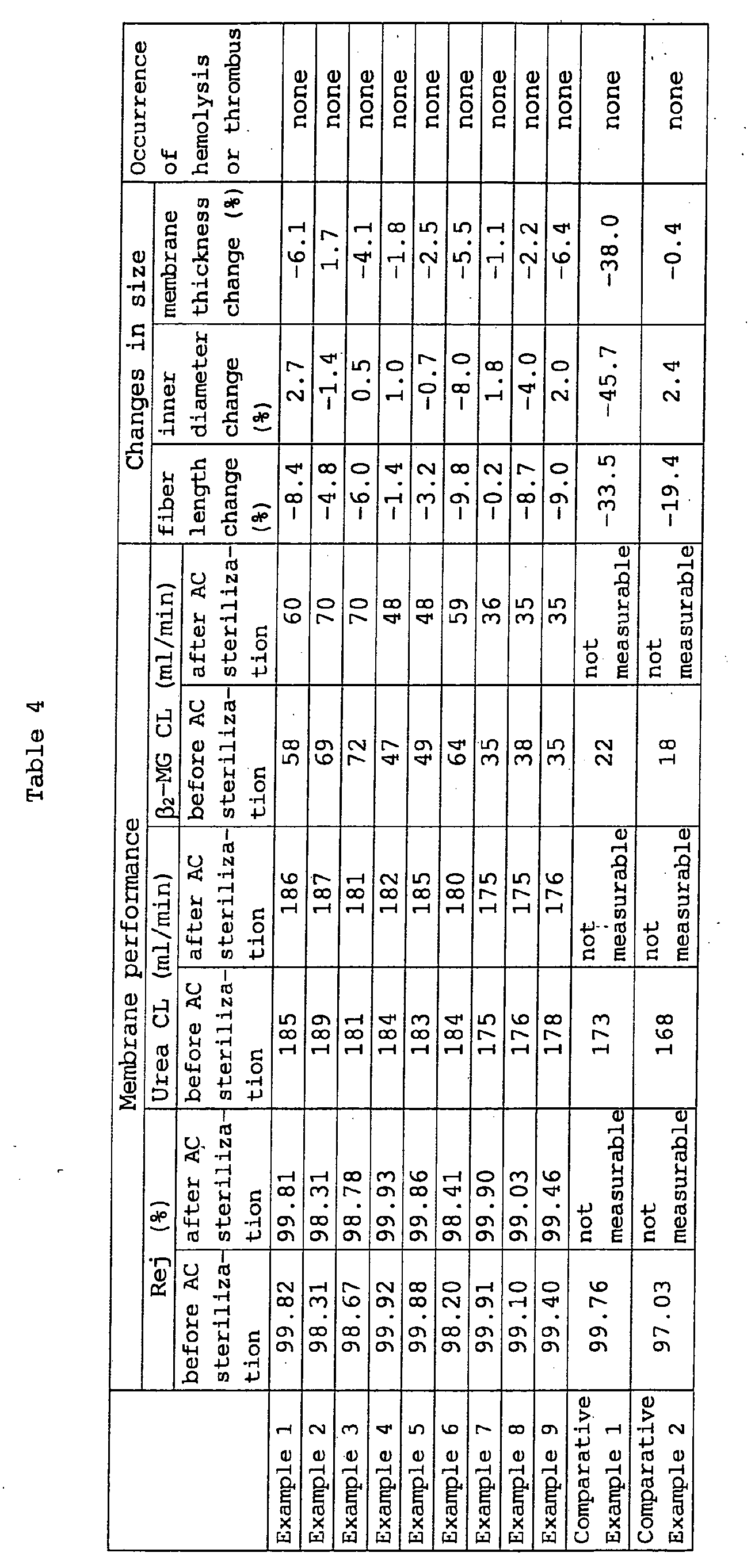
- module 1 before hot water treatment (AC sterilization) and module 2 after treatment membrane performance (urea clearance, ⁇ 2 -MG clearance and albumin rejection) were measured. At this time, hemolysis or thrombus causing practical problem did not occur.
- Example 2 In the same manner as in Example 1, with regard to the hollow fiber and module obtained from this hollow fiber bundle, the detail of the membrane structure (structure of support layer, average pore size of outer surface of support layer, average roughness of inner surface of dense layer) and the size of the hollow fiber (outer diameter, inner diameter, membrane thickness) are shown in Table 3, membrane performance (urea clearance, ⁇ 2 -MG clearance and albumin rejection) before and after the hot water treatment (AC sterilization), changes in size (fiber length ⁇ inner diameter ⁇ membrane thickness) due to the hot water treatment (AC sterilization), and occurrence or otherwise of hemolysis and thrombus are shown in Table 4. Agglutination of hollow fiber membranes due to the hot water treatment (AC sterilization) did not occur.
- Table 3 membrane performance (urea clearance, ⁇ 2 -MG clearance and albumin rejection) before and after the hot water treatment (AC sterilization), changes in size (fiber length ⁇ inner diameter ⁇ membrane thickness) due to the hot water treatment (AC sterilization), and occurrence or otherwise of hemolysis and throm
- Example 2 In the same manner as in Example 1, with regard to the hollow fiber and module obtained from this hollow fiber bundle, the detail of the membrane structure (structure of support layer, average pore size of outer surface of support layer, average roughness of inner surface of dense layer) and the size of the hollow fiber (outer diameter, inner diameter, membrane thickness) are shown in Table 3, membrane performance (urea clearance, ⁇ 2 -MG clearance and albumin rejection) before and after the hot water treatment (AC sterilization), changes in size (fiber length ⁇ inner diameter ⁇ membrane thickness) due to the hot water treatment (AC sterilization), and occurrence or otherwise of hemolysis and thrombus are shown in Table 4. Agglutination of hollow fiber membranes occurred due to the hot water treatment (AC sterilization).
- Table 3 membrane performance (urea clearance, ⁇ 2 -MG clearance and albumin rejection) before and after the hot water treatment (AC sterilization), changes in size (fiber length ⁇ inner diameter ⁇ membrane thickness) due to the hot water treatment (AC sterilization), and occurrence or otherwise of hemolysis and thrombus are shown
- Example 2 In the same manner as in Example 1, with regard to the hollow fiber and module obtained from this hollow fiber bundle, the detail of the membrane structure (structure of support layer, average pore size of outer surface of support layer, average roughness of inner surface of dense layer) and the size of the hollow fiber (outer diameter, inner diameter, membrane thickness) are shown in Table 3, membrane performance (urea clearance, ⁇ 2 -MG clearance and albumin rejection) before and after the hot water treatment (AC sterilization)., changes in size (fiber length ⁇ inner diameter ⁇ membrane thickness) due to the hot water treatment (AC sterilization), and occurrence or otherwise of hemolysis and thrombus are shown in Table 4. Agglutination of hollow fiber membranes occurred due to the hot water treatment (AC sterilization).
- the hollow fibers of Examples 1-9 and Comparative Examples 1-2 all had a membrane structure wherein the inner layer was a dense layer and the outer layer was a support layer that also acts as a support of the dense layer. These support layers each had a structure shown in Table 3.
- the hollow fibers prepared in Examples 1-9 showed extremely small dimensional changes (having high dimensional stability) even after AC sterilization, and membrane performance showed almost no changes because a polyamide having an equilibrium water absorption of not more than 10% was used as a starting material.
- agglutination of hollow fiber membranes due to the hot water treatment (AC sterilization) did not occur.
- the hollow fibers prepared in Comparative Examples 1 and 2 showed insufficient dimensional stability after AC sterilization (greater dimensional changes), and the membrane performance was markedly degraded (in practice, frequent occurrence of crushed hollow fiber and leakage prevented measurement of urea clearance, ⁇ 2 -MG clearance and albumin rejection) because a polyamide having an equilibrium water absorption of more than 10% was used as a starting material. Moreover, agglutination of hollow fiber membranes due to the hot water treatment (AC sterilization) occurred.
- a porous membrane superior in hot water resistance can be provided using polyamide as a material.
- the porous membrane obtained in the present invention shows extremely small dimensional changes even after a hot water treatment, and can make a medical separation membrane permitting an AC sterilization treatment.
- the membrane becomes particularly useful as a hemodialysis membrane among medical separation membranes.
Landscapes
- Chemical & Material Sciences (AREA)
- Chemical Kinetics & Catalysis (AREA)
- Dispersion Chemistry (AREA)
- Engineering & Computer Science (AREA)
- Manufacturing & Machinery (AREA)
- Separation Using Semi-Permeable Membranes (AREA)
- External Artificial Organs (AREA)
- Manufacture Of Porous Articles, And Recovery And Treatment Of Waste Products (AREA)
- Compositions Of Macromolecular Compounds (AREA)
Abstract
A polyamide having an equilibrium water absorption of
not more than 10% is used as a main material. As a polyamide
having an equilibrium water absorption of not more than 10%,
for example, a polyamide comprising a dicarboxylic acid
component comprising 60-100 mol% of terephthalic acid and a
diamine component comprising 60-100 mol% of 1,9-nonanediamine
and/or 2-methyl-1,8-octanediamine is used. As a result, a
porous membrane showing extremely small dimensional change even
after a hot water treatment, and particularly useful as a
medical separation membrane permitting an AC sterilization
treatment and the like is obtained.
Description
The present invention relates to a porous membrane,
particularly a porous membrane useful as a medical separation
membrane.
Porous membranes are widely used in various fields. Of
these, a medical separation membrane, particularly a
hemodialysis membrane, comprises natural polymer membranes made
from cellulose and the like, and synthetic polymer membranes
made from polysulfone, polymethyl methacrylate, ethylene-vinylalcohol
copolymer, polyacrylonitrile, polyamide,
polyallylether sulfone, polyester polymer alloy and the like.
Of the synthetic polymer membranes, a membrane using
polyamide has been widely employed for medical use and the like,
since it is superior in biocompatibility and free of bisphenol
A, which is an endocrine disruptor feared to exert an adverse
influence on human body, as a constitution component, and the
like.
While medical separation membranes are always subjected
to a sterilization treatment, autoclave sterilization (AC
sterilization), which includes treatment with hot water, is
widely used as one of the sterilization methods because of high
safety and the like. However, since polyamide membranes
generally show high water absorbability and they show degraded
mechanical property in water absorption state, their size and
structure vary particularly when treated with hot water, and AC
sterilization has been difficult to apply.
JP-A-7-256067 describes a permselective membrane made
from polyamide, which has a water content of not less than 8
wt% and heat of crystallization of not more than 30 mJ/mg.
While this publication admits a disadvantage of polyamide
membrane in the resistance to AC sterilization because higher
water contents are associated with lower heat resistance when
the membrane contains water, it concludes that AC sterilization
of polyamide having a high water content is possible at 121°C,
when the glass transition point of the dry resin is not less
than 130°C. According to the study of the present inventors,
however, it has been clarified that even a membrane produced
using such polyamide fails to show sufficient dimensional
stability and the like under AC sterilization conditions, and
the AC sterilization markedly degrades membrane performance.
In view of the above-mentioned situation, the present
invention aims at providing a porous membrane made from
polyamide as a main material, which is useful as a medical
separation membrane and the like, shows extremely small
dimensional changes during a hot water treatment, and which
particularly permits an AC sterilization treatment.
The present inventors have conducted intensive studies
in an attempt to achieve the aforementioned objects and found
that the use of a polyamide having low equilibrium water
absorption as a material of a membrane enables provision of a
membrane superior in hot water resistance. In addition, they
have found that, particularly, a medical separation membrane
made of a hollow fiber membrane comprising a polyamide having
an equilibrium water absorption of not more than 10% as a main
material has high dimensional stability under AC sterilization
conditions, which resulted in the completion of the present
invention.
Accordingly, the present invention provides the
following:
The porous membrane of the present invention is
characterized by the use of a polyamide having an equilibrium
water absorption of not more than 10% as a main material.
As used herein, by the "equilibrium water absorption" is
meant a value measured by the method shown in (i) equilibrium
water absorption to be mentioned later in [Examples]. In
addition, by the "use of a polyamide having an equilibrium
water absorption of not more than 10% as a main material" is
meant that a material of a porous membrane (namely, a polymer
material forming the skeleton of a porous membrane) comprises a
polyamide having an equilibrium water absorption of not more
than 10% or the polyamide and other polymers (optional
component).
The polyamide having an equilibrium water absorption of
not more than 10% to be used in the present invention
preferably shows an equilibrium water absorption of not more
than 7%, more preferably not more than 5%.
In the present invention, a polyamide having an
equilibrium water absorption of not more than 10% is realized
by, for example, a polyamide comprising a dicarboxylic acid
component comprising 60-100 mol% of terephthalic acid and a
diamine component comprising 60-100 mol% of 1,9-nonanediamine
and/or 2-methyl-1,8-octanediamine. When the amount of
terephthalic acid in the dicarboxylic acid component is less
than 60 mol% or the amount of 1,9-nonanediamine and/or 2-methyl-1,8-octanediamine
in the diamine component is less than
60 mol%, a porous membrane comprising such a polyamide tends to
show degraded hot water resistance.
In this polyamide, the amount of terephthalic acid in
the dicarboxylic acid component is preferably 75-100 mol%, more
preferably 90-100 mol%. When the amount of terephthalic acid
in the dicarboxylic acid component is within the preferable
range, the obtained polyamide becomes superior in the heat
resistance, mechanical property and the like, further improving
the dimensional stability during hot water treatment of the
object porous membrane. As the dicarboxylic acid component
other than terephthalic acid, for example, aliphatic
dicarboxylic acids such as malonic acid, dimethylmalonic acid,
succinic acid, glutaric acid, adipic acid, 2-methyladipic acid,
trimethyladipic acid, pimelic acid, 2,2-dimethylglutaric acid,
3,3-diethylsuccinic acid, azelaic acid, sebacic acid, suberic
acid, dimer acid and the like; alicyclic dicarboxylic acids
such as 1,3-cyclopentanedicarboxylic acid, 1,4-cyclohexanedicarboxylic
acid and the like; aromatic
dicarboxylic acids such as isophthalic acid, 2,6-naphthalenedicarboxylic
acid, 2,7-naphthalenedicarboxylic acid,
1,4-naphthalenedicarboxylic acid, 1,4-phenylenedioxydiacetic
acid, 1,3-phenylenedioxydiacetic acid, diphenic acid, dibenzoic
acid, 4,4'-oxydibenzoic acid, diphenylmethane-4,4'-dicarboxylic
acid, diphenylsulfone-4,4'-dicarboxylic acid, 4,4'-biphenyldicarboxylic
acid and the like; and the like can be
contained, which may be one or more kinds.
In the polyamide, moreover, the amount of 1,9-nonanediamine
and/or 2-methyl-1,8-octanediamine in the diamine
component is preferably 75-100 mol%, more preferably 90-100
mol%. When the amount of 1,9-nonanediamine and/or 2-methyl-1,8-octanediamine
in the diamine component is within the
preferable range, the obtained polyamide becomes superior in
low water absorption, heat resistance and the like, further
improving the dimensional stability during hot water treatment
of the object porous membrane. In the 1,9-nonanediamine (NMDA)
and/or 2-methyl-1,8-octanediamine (MODA), the proportion
thereof is preferably NMDA:MODA (molar ratio) of 100:0-10:90,
more preferably 95:5-20:80, and particularly preferably 90:10-40:60.
As the diamine component other than 1,9-nonanediamine
and 2-methyl-1,8-octanediamine, for example, straight chain
aliphatic diamines such as 1,6-hexanediamine, 1,7-heptanediamine,
1,8-octanediamine, 1,10-decanediamine, 1,11-undecanediamine,
1,12-dodecanediamine and the like; branched
chain diamines such as 2-methyl-1,5-pentanediamine, 3-methyl-1,5-pentanediamine,
2,2,4-trimethyl-1,6-hexanediamine, 2,4,4-trimethyl-1,6-hexanediamine,
5-methyl-1,9-nonanediamine and the
like; alicyclic diamines such as cyclohexanediamine,
methylcyclohexanediamine, isophoronediamine, bis(4-aminocyclohexyl)methane,
norbornanedimethylamine,
tricyclodecanedimethylamine and the like; aromatic diamines
such as p-phenylenediamine, m-phenylenediamine, xylenediamine,
4,4'-diaminodiphenylsulfone, 4,4'-diaminodiphenylether and the
like; and the like can be contained, which may be one or more
kinds. Of these, 1,7-heptanediamine, 1,8-octanediamine, 1,10-decanediamine,
1,11-undecanediamine and 1,12-dodecanediamine
are preferable because the obtained polyamide is superior in
various properties.
For controlling the molecular weight, not less than 10%
of the molecular chain terminal group of polyamide is
preferably blocked with a terminal blocking agent, wherein the
blocking rate of the terminal group is more preferably not less
than 40%, further preferably not less than 60% and particularly
preferably not less than 70%. The terminal blocking agent is
free of any particular limitation as long as it is a
monofunctional compound having reactivity with amino group or
carboxyl group on the polyamide terminal. From the aspects of
reactivity, safety of the blocked terminal and the like,
monocarboxylic acid and monoamine are preferable, and from the
aspects of easy handling and the like, monocarboxylic acid is
more preferable. Other than these, acid anhydrides such as
phthalic anhydride and the like, monoisocyanate, monoacid
halide, monoesters, monoalcohols and the like can be also used.
The monocarboxylic acid that can be used as a terminal
blocking agent is free of any particular limitation as long as
it has reactivity with amino group and, for example, aliphatic
monocarboxylic acids such as acetic acid, propionic acid,
butyric acid, valeric acid, caproic acid, caprylic acid, lauric
acid, tridecylic acid, myristic acid, palmitic acid, stearic
acid, pivalic acid, isobutyric acid and the like; alicyclic
monocarboxylic acids such as cyclohexanecarboxylic acid and the
like; aromatic monocarboxylic acids such as benzoic acid,
toluic acid, α-naphthalenecarboxylic acid, β-naphthalenecarboxylic
acid, methylnaphthalenecarboxylic acid,
phenylacetic acid and the like, and a mixture of any of these
can be mentioned. Of these, from the aspects of reactivity,
safety of the blocked terminal, cost and the like, acetic acid,
propionic acid, butyric acid, valeric acid, caproic acid,
caprylic acid, lauric acid, tridecylic acid, myristic acid,
palmitic acid, stearic acid and benzoic acid are particularly
preferable.
As the monoamine that can be used as a terminal blocking
agent is free of any particular limitation as long as it has
reactivity with carboxyl group and, for example, aliphatic
monoamines such as methylamine, ethylamine, propylamine,
butylamine, hexylamine, octylamine, decylamine, stearylamine,
dimethylamine, diethylamine, dipropylamine, dibutylamine and
the like; alicyclic monoamines such as cyclohexylamine,
dicyclohexylamine and the like; aromatic monoamines such as
aniline, toluidine, diphenylamine, naphthylamine and the like,
and a mixture of any of these can be mentioned. Of these, from
the aspects of reactivity, high boiling point, stability of
blocked terminal, cost and the like, butylamine, hexylamine,
octylamine, decylamine, stearylamine, cyclohexylamine and
aniline are particularly preferable.
The polyamide can be produced using any method known as
a method of producing crystalline polyamide. For example, it
can be produced by methods such as a melt polymerization method
or an interfacial polymerization method using acid chloride and
diamine as starting materials; melt polymerization method,
solid phase polymerization method, melt extruder polymerization
method and the like using dicarboxylic acid and diamine as
starting materials. For the purpose of preventing increase in
the polycondensation rate and deterioration of polyamide
produced during polymerization for production of polyamide, a
phosphorus catalyst such as phosphoric acid, phosphorous acid,
hypophosphorous acid, or a salt thereof, an ester thereof and
the like is preferably added to the reaction system. Of these,
in view of the quality of the resulting polyamide,
hypophosphorous acid derivatives (hypophosphorous acid salt,
hypophosphorous acid ester etc.) are preferable, and sodium
hypophosphite is particularly preferable in view of the cost
and easy handling. The amount of these phosphorus catalysts to
be added is preferably 0.01-5 wt%, more preferably 0.05-2 wt%,
and particularly preferably 0.07-1 wt%, relative to the total
weight of dicarboxylic acid and diamine. While the amount of
the above-mentioned terminal blocking agent to be used varies
depending on the reactivity and boiling point of the terminal
blocking agent to be used, reactor, reaction conditions and the
like, it is generally within the range of 0.1-15 mol% of the
total number of moles of dicarboxylic acid and diamine.
It is preferable that the polyamide to be used in the
present invention have a high glass transition point in a dry
state and a glass transition point of not less than 60°C is
preferable, not less than 80°C is more preferable, and not less
than 100°C is particularly preferable. When the glass
transition point is not less than 60°C, the object porous
membrane becomes more superior in the heat resistance, and the
dimensional stability during hot water treatment is further
improved. As used herein, the glass transition point refers to
an intermediate temperature between two inflection points
observed near the glass transition temperature when measured by
raising temperature from 30°C to 200°C at 10°C/min using DSC
(Mettler-Toledo International Inc.: DSC30).
The polyamide to be used in the present invention
preferably has an intrinsic viscosity [η] of 0.4-3.0 dl/g, more
preferably 0.6-2.0 dl/g, and particularly preferably 0.8-1.8
dl/g, as measured in concentrated sulfuric acid at 30°C. When
the intrinsic viscosity [η] is lower than the above-mentioned
range, the mechanical strength of the object porous membrane
tends to decrease. When the intrinsic viscosity [η] is higher
than the above-mentioned range, solubility in a solvent during
preparation of film forming dope to be mentioned later and the
film forming dope tends to increase the viscosity to lower the
film formability.
The intrinsic viscosity [η] was measured by dissolving
polyamide in concentrated sulfuric acid to give sample
solutions having a concentration of 0.05, 0.1, 0.2 and 0.4 g/dl,
measuring the flow time (sec) of sample solutions having
respective concentrations at 30°C, calculating the intrinsic
viscosity (ηinh) of the following samples from the following
formula, and extrapolating the value into concentration 0.
ηinh=[ln(t1 /t0 )]/c
wherein ηinh is intrinsic viscosity (dl/g), t0 is flow
time (sec) of solvent, t1 is flow time (sec) of sample solution,
and c is concentration (g/dl) of the sample in the solution.
While the production method of the porous membrane of
the present invention is not particularly limited, for example,
the membrane can be preferably produced by the following method.
First, a film forming dope containing a polymer and a
solvent, or a film forming dope further containing additives as
necessary is prepared. The polymer to be used here may be a
polyamide having an equilibrium water absorption of not more
than 10% alone or may contain other polymer as necessary. The
concentration composition of the polyamide in the film forming
dope needs only to fall within the range permitting film
forming and function as a membrane, and is preferably 5-50 wt%.
Particularly, when a medical separation membrane (particularly
one made of hollow fiber membrane) is to be prepared, the
concentration of polyamide is preferably 10-30 wt% because a
membrane having high permeability and mechanical strength can
be obtained. On the other hand, when a different polymer is to
be added for the purpose of imparting hydrophilicity, improving
biocompatibility, improving viscosity and the like, such
polymer may be added to a film forming dope in a proportion of
0-20 wt%, preferably 0-10 wt%. As such polymer, one or more
kinds selected from the group consisting of
polyvinylpyrrolidone (PVP), polyethylene glycol, polyethylene
glycol monoester, copolymer of polyethylene glycol and
polypropylene glycol, polyvinyl alcohol, ethylene-vinyl alcohol
copolymer, water-soluble derivative of cellulose, polysorbate,
polymethoxyethyl acrylate, polyhydroxyethyl methacrylate and
the like can be mentioned.
The solvent may be any as long as it can dissolve
polymer, or polymer and additive, and, for example, N-methyl-2-pyrrolidone
(NMP), N,N-dimethylacetamide (DMAc), dimethyl
sulfoxide (DMSO), dimethylformamide (DMF), N-methylmorpholineoxide
(NMMO) and the like can be mentioned,
which may be used alone or in a mixture of two or more kinds
thereof.
An additive is used for controlling phase separation
temperature and viscosity of film forming dope or improving
film formability, and, for example, water and the like can be
mentioned. The concentration range of water is 0-10 wt%,
preferably 0-5 wt%, of a film forming dope. With the aim of
controlling the dissolution state of a film forming dope, and
improving film formability, salt and the like may be added. As
the kind of salt, for example, one or more kinds selected from
the group consisting of lithium chloride, sodium chloride,
calcium chloride, lithium acetate and lithium nitrate can be
mentioned. As for the amount of the salt to be added, it is
any amount according to the combination of polymer, solvent and
additive.
A film forming dope is prepared by mixing a polymer and
a solvent (and additive to be used as necessary) at a high
temperature (generally 60-150°C). Then, in the case of a
hollow fiber, for example, the prepared film forming dope is
extruded from a double annular nozzle while injecting, into the
inside from a double annular nozzle, a hollow-forming agent
such as a coagulation liquid or a non-coagulative solvent
(solvent that prevents coagulation of film forming dope) and
the like to be mentioned later, and, if necessary, introducing
into the coagulation liquid to achieve film forming. The
coagulation liquid may be contacted with the film forming dope
only in the inside of the hollow fiber, on the outside alone or
on both sides. In the case of a flat membrane, a film forming
dope is cast on a cast plate to allow immersion in a
coagulation liquid and the like to achieve film forming.
As the coagulation liquid, any can be used without
particularly limitation as long as it has an action to
coagulate a polymer to be the material of a membrane and is
miscible with the solvent of a film forming dope. As the kind
of the coagulation liquid, for example, water; a mixture of a
water-soluble solvent such as NMP, DMAc, DMSO, DMF, NMMO and
the like with water and the like can be mentioned. Where
necessary, an aqueous solution containing salts such as lithium
chloride, sodium chloride, calcium chloride, lithium acetate,
lithium nitrate and the like; polymers such as PVP,
polyethylene glycol, polyethylene glycol monoester, copolymer
of polyethylene glycol and polypropylene glycol, polyvinyl
alcohol, ethylene-vinyl alcohol copolymer, water-soluble
derivative of cellulose, polysorbate, polymethoxyethyl acrylate,
polyhydroxyethyl methacrylate and the like, and the like can be
also used. When a coagulation liquid is contacted with a film
forming dope only in the inside of a hollow fiber, a gas such
as nitrogen, air and the like or a non-coagulative solvent such
as hexane and the like, and the like can be used on the outside
of the hollow fiber. When the coagulation liquid is contacted
only with the outside of the hollow fiber, a gas such as
nitrogen, air and the like or a non-coagulative solvent such as
hexane and the like can be used in the inside of the hollow
fiber. The membrane after contact with a coagulation liquid is
washed with water, and dried and heat-treated as necessary.
Then, it is incorporated into a module by a known method and
used as various industrial or medical membranes.
The main material (polymer) in the porous membrane of
the present invention is a polyamide having an equilibrium
water absorption of not more than 10% (e.g., a polyamide
comprising a dicarboxylic acid component comprising 60-100 mol%
of terephthalic acid and a diamine component comprising 60-100
mol% of 1,9-nonanediamine and/or 2-methyl-1,8-octanediamine),
and may contain a polymer selected from the group consisting of
PVP, polyethylene glycol, polyethylene glycol monoester,
copolymer of polyethylene glycol and polypropylene glycol,
polyvinyl alcohol, ethylene-vinyl alcohol copolymer, water-soluble
derivative of cellulose, polysorbate, polymethoxyethyl
acrylate, polyhydroxyethyl methacrylate and the like as other
polymer.
It is preferable to contain polyamide in a proportion of
50-100 wt%, more preferably 60-100 wt%, and still more
preferably 70-100 wt%, of the total polymer constituting the
porous membrane.
The porous membrane of the present invention may be a
hollow fiber membrane or a flat membrane. Since the membrane
area per unit volume can be increased and small sized membrane
can be produced, a hollow fiber membrane is preferable as a
medical separation membrane. In the case of a hollow fiber
membrane, the membrane thickness is preferably within the range
of 3-2000 µm, more preferably 10-1000 µm, still more preferably
10-400 µm, to ensure spinnability and mechanical strength and
permeability of the membrane. In addition, the outer diameter
of a hollow fiber membrane is preferably within the range of
40-5000 µm, more preferably 40-3000 µm, still more preferably
100-1000 µm. In the case of a flat membrane, the membrane
thickness is preferably within the range of 3-2000 µm, more
preferably 10-1000 µm, particularly preferably 10-400 µm.
The porosity (%) of the porous membrane of the present
invention is preferably 20-90%, more preferably 60-90%, from
the aspects of permeability and mechanical strength of the
membrane. The porosity (%) here is calculated by the following
formula.
Porosity (%)
={ (WW -WD ) /ρW } / {WD /ρE + (WW -WD ) /ρW } × 100
wherein WW is the weight of water-containing membrane, WD
is the weight of dry membrane, ρW is specific gravity of water
and ρE is specific gravity of polymer constituting the porous
membrane.
While the size of void varies depending on the use of
the porous membrane, an average pore size is preferably within
the range of 0.2-50 µm, more preferably 0.3-3 µm. As used
herein, the average pore size is a value obtained by drawing a
straight line perpendicular to the membrane surface on an
electron micrograph (maximum magnification x6000) of a section
perpendicular to the film forming direction (extrusion
direction or cast direction of film forming dope), measuring,
with regard to all the voids on the straight line, the length
of the part where the straight line pass through the voids, and
averaging the measured lengths.
The structure of the porous membrane of the present
invention may be a homogeneous (porous structure) membrane or
an asymmetric (porous structure) membrane. In the case of a
medical separation membrane, an asymmetric membrane having a
dense layer that defines fractionation ability and a support
layer having mechanical strength and high permeability, which
functions as a support of the above-mentioned dense layer, is
preferable. In the case of a medical separation membrane
comprising a hollow fiber membrane, an inner layer is
preferably a dense layer and the outer layer is preferably a
support layer. To prevent invasion of a contaminant substance
and the like, it is also possible to make a dens outermost
layer, i.e., a membrane structure of dense layer (inner layer)-support
layer (intermediate layer)-dense layer (outer layer).
As the structure of a support layer constituting an asymmetric
membrane, for example, a network gradient structure wherein the
pore size increases from the dense layer (inner layer) toward
the outside, a network homogeneous structure wherein the pore
size is generally uniform in the entire membrane thickness
direction, a finger void structure having finger like crude
large pores and the like can be mentioned. Of these, a network
gradient structure is preferable in the case of a medical
separation membrane.
When the porous membrane of the present invention is an
asymmetric membrane, the thickness of the dense layer is
preferably about 0.05-10 µm, more preferably about 0.1-2 µm.
The average pore size of a dense layer is preferably within the
range of 1-2000 nm, more preferably 5-500 nm. As used herein,
the average pore size of the dense layer is a value obtained by
drawing a straight line perpendicular to the membrane surface
on an electron micrograph (maximum magnification x60000) of a
section perpendicular to the film forming direction (extrusion
direction or cast direction of film forming dope), measuring,
with regard to all the voids on the straight line in the dense
layer, the length of the part where the straight line pass
through the voids, and averaging the measured lengths. While
the surface of the dense layer may or may not substantially
have irregularities, since the structure of the dense layer
influences fractionation performance, the surface is preferably
formed to have irregularities due to plural protrusions to
achieve high permeability. Particularly, for use as a medical
separation membrane, the average roughness of the surface of
the dense layer is preferably within the range of 1-10 nm, more
preferably 3-10 nm. The average roughness here can be
determined by measuring the shape of the surface (observation
area 5 µm square) in a tapping mode at a measurement frequency
of 0.5Hz using an atom force microscopic device (e.g.,
Dimension 3100, Digital Instrument Inc.), and analyzing the
obtained measurement data with the data processing software
attached to the device. To be specific, the measuring software
of the device is changed to an Off-line Mode, big swell in the
data is flattened by a Modify/Flatten command, sectional shape
is obtained from the measurement data by an Analysis/Section
command, and the roughness (Ra) of the flat direction length 5
µm calculated then is taken as the average roughness.
When the porous membrane of the present invention is to
be an asymmetric membrane (membrane consisting of a dense layer
and a support layer), the average pore size of the support
layer is preferably within the range of 0.2-50 µm, more
preferably 0.3-3 µm. As used herein, the average pore size is
a value obtained by drawing a straight line perpendicular to
the membrane surface on an electron micrograph (maximum
magnification x6000) of a section perpendicular to the film
forming direction (extrusion direction or cast direction of
film forming dope), measuring, with regard to all the voids on
the straight line in the support layer, the length of the part
where the straight line pass through the voids, and averaging
the measured lengths. To keep high diffusion permeability, the
surface of the support layer preferably has pores made by
opening a part of the structure of the support layer, which
have an average pore size of 0.01-100 µm, more preferably an
average pore size of 0.1-10 µm. As used herein, the average
pore size of the pores in the support layer surface is obtained
by measuring the longest diameter and the shortest diameter of
the pore in an electron micrograph (maximum magnification
x6000) of the surface and averaging the measures.
The porous membrane of the present invention has high
fractionation ability and high permeability, and is
particularly useful as a medical separation membrane, and
extremely useful as a hemodialysis membrane among others. When
the membrane of the present invention is contacted with the
blood, hemolysis or thrombus causing practical problems does
not occur, and the membrane has sufficient blood compatibility
for medical use. When the porous membrane of the present
invention is used as a hemodialysis membrane, high rejection
rate of albumin and high permeability of urea can be
concurrently afforded, and high rejection rate of albumin and
high permeability of urea and β2-microglobulin (β2-MG) are
preferably afforded concurrently. Specifically, albumin can be
preferably prevented by not less than 90%, more preferably not
less than 97%, still more preferably not less than 99%. In
addition, urea clearance of not less than 125 mL/min, more
preferably not less than 175 mL/min, more preferably not less
than 185 mL/min, can be achieved. The β2-MG clearance of
preferably not less than 35 mL/min, more preferably not less
than 45 mL/min, can be achieved. The performances shown here
(high rejection rate of albumin, high urea permeability, high
β2-MG permeability) are measured by the measurement methods of
(iv) urea clearance, β2-MG clearance and albumin rejection in
the following Examples.
The porous membrane of the present invention shows lower
water absorption of the main material polyamide as compared to
this kind of conventional porous membranes, and therefore, has
fine hot water resistance. When particularly used as a medical
separation membrane, therefore, the following superior
characteristics are observed under AC sterilization conditions.
The present invention is explained in detail in the
following by referring to Examples, which are not to be
construed as limitative. The equilibrium water absorption,
rate of changes in fiber length, rate of changes in inner
diameter, rate of changes in membrane thickness and membrane
performance were evaluated by the following methods.
A hollow fiber membrane before and after standing still
in hot water at 121°C for 20 min (AC sterilization) was cut
with a razor. The sectional shape was observed with an optical
microscope and the inner diameter and membrane thickness were
measured.
Inner diameter change [%]=(Li,a-Li,b)/Li,b×100
Membrane thickness change [%]=(Lt,a-Lt,b)/Lt,b×100
Equilibrium water absorption of polyamide (PA9MT)
obtained from terephthalic acid as a dicarboxylic acid
component, NMDA and MODA as diamine components, benzoic acid
(molar ratio; terephthalic acid:benzoic
acid:NMDA:MODA=1.97:0.06:1:1) as a terminal blocking agent, and
phosphorous acid (0.1 wt% of starting material) as a catalyst,
which had an intrinsic viscosity [η] of 1.37 dl/g and glass
transition point of 125°C was measured. Then, a film forming
dope containing this polyamide (15 wt%), PVP (K-90, BASF, 3
wt%), water (2 wt%), LiCl (5 wt%) and NMP (75 wt%) was prepared.
This dope was discharged into the air at 60°C from a spinneret
using water as a hollow-forming agent, led into water to allow
solidification, washed with water and dried.
A hollow fiber 1 was pulled out from the obtained hollow
fiber bundle and cut into a length of 20 cm. A hollow fiber 2
was pulled out from the remaining hollow fiber bundle and
modulated by a known method to give module 1 and module 2. A
hollow fiber 3 was further pulled out from the remaining hollow
fiber bundle and an inner diameter, a membrane thickness and
average roughness of the inner surface of a dense layer were
measured, as well as the membrane structure was observed. The
membrane structure was observed with a scanning electron
microscope (S-3500N, Hitachi Science Systems, Ltd.). As a
result, it was found that the inner layer was a dense layer,
the outer layer was a support layer also acting as a support of
the above-mentioned dense layer, which had a network gradient
structure having increasing pore size from the above-mentioned
dense layer toward the outside, and pores having an average
pore size of 1.0 µm were formed on the outer surface of the
support layer. Moreover, the average roughness of the inner
surface of the dense layer was 5.1 nm. The detail of the
membrane structure (structure of support layer, average pore
size-of outer surface of support layer, average roughness of
inner surface of dense layer) and the size of the hollow fiber
(outer diameter, inner diameter, membrane thickness) are shown
in Table 3.
The hollow fiber 1 and module 2 were stood still in
water at 121°C for 20 min (AC sterilization). Using the hollow
fiber 1 after the hot water treatment (AC sterilization), the
fiber length, inner diameter and membrane thickness were
measured.
Using module 1 before hot water treatment (AC
sterilization) and module 2 after treatment, membrane
performance (urea clearance, β2-MG clearance and albumin
rejection) were measured. At this time, hemolysis or thrombus
causing practical problem did not occur.
The membrane performance before and after the hot water
treatment (AC sterilization) and changes in size (fiber
length · inner diameter · membrane thickness) due to the hot
water treatment are shown in Table 4. Agglutination of hollow
fiber membranes due to the hot water treatment (AC
sterilization) did not occur.
In the same manner as in Example 1, equilibrium water
absorption of polyamide obtained from dicarboxylic acid
component (terephthalic acid), diamine components (NMDA, MODA)
and terminal blocking agent (benzoic acid) at the molar ratio
shown in Table 1 was measured. Using this polyamide, each
component shown in Table 2 was added at a given wt% to give a
film forming dope, from which a hollow fiber bundle was
prepared. In the same manner as in Example 1, with regard to
the hollow fiber and module obtained from this hollow fiber
bundle, the detail of the membrane structure (structure of
support layer, average pore size of outer surface of support
layer, average roughness of inner surface of dense layer) and
the size of the hollow fiber (outer diameter, inner diameter,
membrane thickness) are shown in Table 3, membrane performance
(urea clearance, β2-MG clearance and albumin rejection) before
and after the hot water treatment (AC sterilization), changes
in size (fiber length · inner diameter · membrane thickness) due
to the hot water treatment (AC sterilization), and occurrence
or otherwise of hemolysis and thrombus are shown in Table 4.
Agglutination of hollow fiber membranes due to the hot water
treatment (AC sterilization) did not occur.
The equilibrium water absorption of "Trogamide T-5000"
(trimethylhexamethyleneterephthalamide (PA6-3-T), Degussa AG,
glass transition point 148°C) was measured. Then, a film
forming dope containing this polyamide (15 wt%), PVP (K-90,
BASF, 3 wt%), water (2 wt%) and DMSO (80 wt%) was prepared.
Using this dope and in the same manner as in Example 1, a
hollow fiber bundle was obtained. In the same manner as in
Example 1, with regard to the hollow fiber and module obtained
from this hollow fiber bundle, the detail of the membrane
structure (structure of support layer, average pore size of
outer surface of support layer, average roughness of inner
surface of dense layer) and the size of the hollow fiber (outer
diameter, inner diameter, membrane thickness) are shown in
Table 3, membrane performance (urea clearance, β2-MG clearance
and albumin rejection) before and after the hot water treatment
(AC sterilization), changes in size (fiber length · inner
diameter · membrane thickness) due to the hot water treatment
(AC sterilization), and occurrence or otherwise of hemolysis
and thrombus are shown in Table 4. Agglutination of hollow
fiber membranes occurred due to the hot water treatment (AC
sterilization).
The equilibrium water absorption of "Novamid X-21"
(polyamide (PA6IT) made from diamine unit comprising
hexamethylenediamine unit, and dicarboxylic acid unit
comprising terephthalic acid unit and isophthalic acid unit,
Mitsubishi Engineering-Plastics Corporation, glass transition
point 124°C) was measured. Then, a film forming dope
containing this polyamide (13 wt%), PVP (K-90, BASF, 2 wt%) and
DMSO (85 wt%) was prepared. Using this dope and in the same
manner as in Example 1, a hollow fiber bundle was obtained. In
the same manner as in Example 1, with regard to the hollow
fiber and module obtained from this hollow fiber bundle, the
detail of the membrane structure (structure of support layer,
average pore size of outer surface of support layer, average
roughness of inner surface of dense layer) and the size of the
hollow fiber (outer diameter, inner diameter, membrane
thickness) are shown in Table 3, membrane performance (urea
clearance, β2-MG clearance and albumin rejection) before and
after the hot water treatment (AC sterilization)., changes in
size (fiber length · inner diameter · membrane thickness) due to
the hot water treatment (AC sterilization), and occurrence or
otherwise of hemolysis and thrombus are shown in Table 4.
Agglutination of hollow fiber membranes occurred due to the hot
water treatment (AC sterilization).

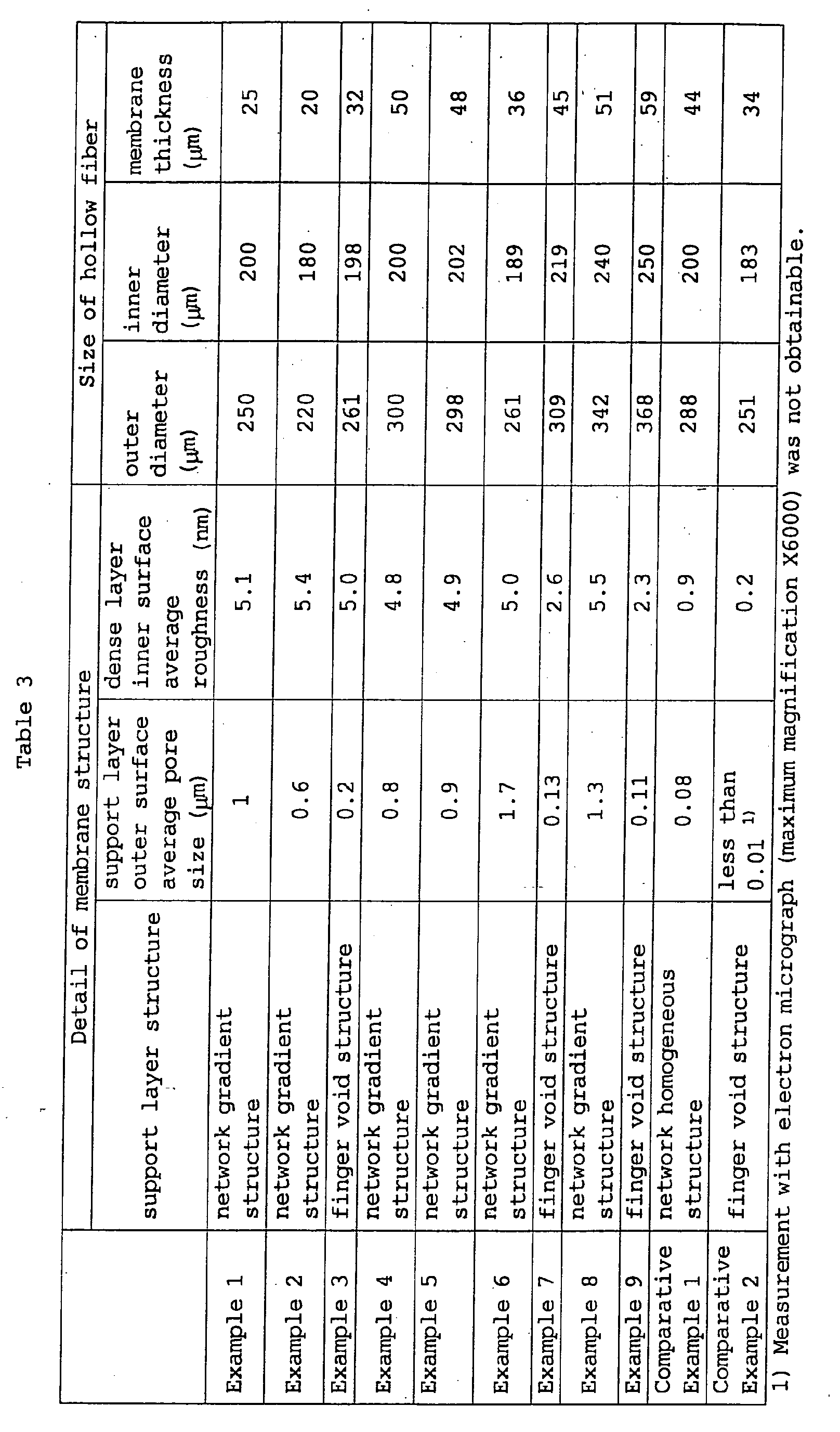
The hollow fibers of Examples 1-9 and Comparative
Examples 1-2 all had a membrane structure wherein the inner
layer was a dense layer and the outer layer was a support layer
that also acts as a support of the dense layer. These support
layers each had a structure shown in Table 3.
As is clear from Table 4, the hollow fibers prepared in
Examples 1-9 showed extremely small dimensional changes (having
high dimensional stability) even after AC sterilization, and
membrane performance showed almost no changes because a
polyamide having an equilibrium water absorption of not more
than 10% was used as a starting material. In addition,
agglutination of hollow fiber membranes due to the hot water
treatment (AC sterilization) did not occur. In contrast, the
hollow fibers prepared in Comparative Examples 1 and 2 showed
insufficient dimensional stability after AC sterilization
(greater dimensional changes), and the membrane performance was
markedly degraded (in practice, frequent occurrence of crushed
hollow fiber and leakage prevented measurement of urea
clearance, β2-MG clearance and albumin rejection) because a
polyamide having an equilibrium water absorption of more than
10% was used as a starting material. Moreover, agglutination
of hollow fiber membranes due to the hot water treatment (AC
sterilization) occurred.
As is clear from the above explanation, according to the
present invention, a porous membrane superior in hot water
resistance can be provided using polyamide as a material. The
porous membrane obtained in the present invention shows
extremely small dimensional changes even after a hot water
treatment, and can make a medical separation membrane
permitting an AC sterilization treatment. In addition, since
contact with blood does not result in hemolysis or thrombus,
the membrane becomes particularly useful as a hemodialysis
membrane among medical separation membranes.
This application is based on application No. 2002-204733
filed in Japan, the contents of which are incorporated hereinto
by reference.
Claims (14)
- A porous membrane comprising a polyamide having an equilibrium water absorption of not more than 10% as a main material.
- The porous membrane of claim 1, wherein the polyamide having an equilibrium water absorption of not more than 10% comprises a dicarboxylic acid component comprising 60-100 mol% of terephthalic acid and a diamine component comprising 60-100 mol% of 1,9-nonanediamine and/or 2-methyl-1,8-octanediamine.
- The porous membrane of claim 1, wherein the polyamide having an equilibrium water absorption of not more than 10% is contained in a proportion of 50-100 wt% in the material.
- The porous membrane of claim 1, wherein the material further comprises polyvinylpyrrolidone.
- The porous membrane of claim 2, wherein a molar ratio of the 1,9-nonanediamine and 2-methyl-1,8-octanediamine in the diamine component is 100:0-10:90.
- The porous membrane of claim 1, wherein the polyamide having an equilibrium water absorption of not more than 10% comprises a molecular chain terminal group blocked with a terminal blocking agent by not less than 10% thereof.
- The porous membrane of claim 6, wherein the terminal blocking agent is benzoic acid.
- The porous membrane of claim 1, wherein the polyamide having an equilibrium water absorption of not more than 10% has a glass transition point of not less than 60°C.
- The porous membrane of claim 1, wherein the polyamide having an equilibrium water absorption of not more than 10% shows an intrinsic viscosity of 0.4-3.0 dl/g as measured in concentrated sulfuric acid at 30°C.
- The porous membrane of claim 1, which has a membrane thickness of 3-2000 µm.
- The porous membrane of claim 1, which is an asymmetric membrane comprising a dense layer and a support layer.
- The porous membrane of claim 11, wherein the dense layer has an average surface roughness of 1-10 nm.
- The porous membrane of claim 11, wherein the support layer comprises pores having an average pore size of 0.01-100 µm on the surface.
- The porous membrane of claim 1, which has a β2-microglobulin clearance of not less than 35 mL/min.
Applications Claiming Priority (3)
| Application Number | Priority Date | Filing Date | Title |
|---|---|---|---|
| JP2002204733 | 2002-07-12 | ||
| JP2002204733 | 2002-07-12 | ||
| PCT/JP2003/008758 WO2004006991A1 (en) | 2002-07-12 | 2003-07-10 | Porous membrane |
Publications (2)
| Publication Number | Publication Date |
|---|---|
| EP1535636A1 true EP1535636A1 (en) | 2005-06-01 |
| EP1535636A4 EP1535636A4 (en) | 2011-02-16 |
Family
ID=30112733
Family Applications (1)
| Application Number | Title | Priority Date | Filing Date |
|---|---|---|---|
| EP03741308A Withdrawn EP1535636A4 (en) | 2002-07-12 | 2003-07-10 | POROUS MEMBRANE |
Country Status (7)
| Country | Link |
|---|---|
| US (1) | US7364660B2 (en) |
| EP (1) | EP1535636A4 (en) |
| JP (1) | JP4287373B2 (en) |
| CN (1) | CN1668349A (en) |
| AU (1) | AU2003281177A1 (en) |
| TW (1) | TWI308160B (en) |
| WO (1) | WO2004006991A1 (en) |
Cited By (2)
| Publication number | Priority date | Publication date | Assignee | Title |
|---|---|---|---|---|
| WO2008046630A1 (en) * | 2006-10-19 | 2008-04-24 | Joanneum Research Forschungsgesellschaft Mbh | Devices for and methods of monitoring a parameter of a fluidic sample by microdialysis |
| WO2008046779A1 (en) * | 2006-10-18 | 2008-04-24 | Gambro Lundia Ab | Hollow fiber membrane and method for manufacturing thereof |
Families Citing this family (19)
| Publication number | Priority date | Publication date | Assignee | Title |
|---|---|---|---|---|
| JP4591011B2 (en) * | 2004-03-31 | 2010-12-01 | 東洋紡績株式会社 | Porous membrane, method for producing the same, and lithium ion secondary battery using the same |
| JP4843988B2 (en) * | 2005-04-05 | 2011-12-21 | 東洋紡績株式会社 | Polysulfone hollow fiber membrane blood purifier |
| JP4843993B2 (en) * | 2005-04-26 | 2011-12-21 | 東洋紡績株式会社 | Blood purifier |
| JP4843992B2 (en) * | 2005-04-26 | 2011-12-21 | 東洋紡績株式会社 | Blood purifier |
| EP2005983A4 (en) * | 2006-03-09 | 2011-06-15 | Toyo Boseki | Hollow fiber membrane with excellent performance stability and blood purifier and method for producing hollow fiber membrane |
| US20100303520A1 (en) * | 2009-05-28 | 2010-12-02 | Canon Kabushiki Kaisha | Resin composition, lamination film containing the same, and image forming apparatus that uses lamination film as component |
| CN102449046B (en) | 2009-05-28 | 2016-06-22 | 佳能株式会社 | Resin composition, laminated film containing same, and image forming apparatus using laminated film as a member |
| JP6188723B2 (en) * | 2012-01-25 | 2017-08-30 | フレゼニウス・ヘモケア・イタリア・ソシエタ・ア・レスポンサビリタ・リミタータFRESENIUS HEMOCARE ITALIA S.r.l. | Blood filter, system, and use of blood filter or system |
| KR102107541B1 (en) | 2012-06-27 | 2020-05-07 | 도레이 카부시키가이샤 | Composite semipermeable membrane |
| JPWO2014156644A1 (en) * | 2013-03-28 | 2017-02-16 | 東レ株式会社 | Porous membrane and water purifier |
| CN103721478A (en) * | 2013-12-20 | 2014-04-16 | 苏州鑫帛泰纺织科研有限公司 | Porous hollow fiber fabric |
| US20170157814A1 (en) * | 2014-09-30 | 2017-06-08 | Sekisui Plastics Co., Ltd. | Resin expanded sheet and method for producing resin expanded molded article |
| JP6675335B2 (en) * | 2017-01-31 | 2020-04-01 | ユニチカ株式会社 | Polyamide ultrafiltration membrane having organic solvent resistance and method for producing the same |
| CN108854566B (en) * | 2017-05-10 | 2021-11-12 | 微宏动力系统(湖州)有限公司 | Liquid film conveying device for preparing porous membrane |
| US12673275B2 (en) * | 2019-01-29 | 2026-07-07 | Donaldson Company, Inc. | System and method for deaeration |
| CN113631256B (en) | 2019-03-29 | 2023-08-01 | 旭化成医疗株式会社 | blood purifier |
| US12274958B2 (en) | 2019-10-23 | 2025-04-15 | Donaldson Company, Inc. | Filtration and deaeration system |
| JP7731121B2 (en) * | 2020-09-24 | 2025-08-29 | 学校法人 工学院大学 | Porous membrane and method for producing the same |
| JP7793926B2 (en) * | 2020-10-28 | 2026-01-06 | 東レ株式会社 | Hollow fibers and blood purifiers |
Family Cites Families (18)
| Publication number | Priority date | Publication date | Assignee | Title |
|---|---|---|---|---|
| NO153836C (en) * | 1978-05-15 | 1986-06-04 | Pall Corp | HYDROFILE, ALCOHOLUALLY SOLUBLE POLYAMIDE MEMBRANES AND PROCEDURES FOR THEIR PREPARATION. |
| US4707265A (en) * | 1981-12-18 | 1987-11-17 | Cuno Incorporated | Reinforced microporous membrane |
| SE460521B (en) * | 1987-08-31 | 1989-10-23 | Gambro Dialysatoren | PERMSELECTIVE ASYMMETRIC MEMBRANE AND PROCEDURES FOR ITS PREPARATION |
| US5006247A (en) * | 1989-08-15 | 1991-04-09 | Minnesota Mining And Manufacturing Company | Asymmetric porous polyamide membranes |
| US5562826A (en) * | 1991-10-26 | 1996-10-08 | Hoechst Aktiengesellschaft | Semipermeable, porous, asymmetric polyether amide membranes |
| DE59206996D1 (en) * | 1991-10-26 | 1996-10-02 | Hoechst Ag | Hydrophilic, asymmetrical, chemical-resistant polyaramid membrane |
| JP3474247B2 (en) * | 1994-02-18 | 2003-12-08 | 株式会社クラレ | Resin composition for surface mount components |
| JPH07256067A (en) | 1994-03-25 | 1995-10-09 | Terumo Corp | Selective permeable membrane |
| US5868936A (en) | 1996-06-20 | 1999-02-09 | Baxter International Inc. | Affinity membrane system and method of using same |
| JPH10263375A (en) * | 1997-03-26 | 1998-10-06 | Teijin Ltd | Permselective hollow fiber membrane |
| JP3424810B2 (en) | 1998-11-17 | 2003-07-07 | 東洋紡績株式会社 | High performance blood purification membrane |
| JP2000178368A (en) | 1998-12-21 | 2000-06-27 | Kuraray Co Ltd | Polyamide sheet |
| JP2000186141A (en) * | 1998-12-22 | 2000-07-04 | Kuraray Co Ltd | Polyamide and polyamide film composed thereof |
| US6780327B1 (en) * | 1999-02-25 | 2004-08-24 | Pall Corporation | Positively charged membrane |
| JP3940250B2 (en) * | 2000-05-22 | 2007-07-04 | 三菱化学株式会社 | Polyamide resin packaging / container |
| DE60216854T2 (en) * | 2001-06-05 | 2007-09-06 | KURARAY CO., LTD, Kurashiki | polyamide composition |
| US7094851B2 (en) * | 2001-12-06 | 2006-08-22 | Gore Enterprise Holdings, Inc. | Low equivalent weight ionomer |
| EP1331236A1 (en) * | 2002-01-25 | 2003-07-30 | Dsm N.V. | Solid-state post-condensation process for increasing the molecular weight of a polyamide |
-
2003
- 2003-07-10 US US10/520,864 patent/US7364660B2/en not_active Expired - Fee Related
- 2003-07-10 CN CN03816443.4A patent/CN1668349A/en active Pending
- 2003-07-10 EP EP03741308A patent/EP1535636A4/en not_active Withdrawn
- 2003-07-10 AU AU2003281177A patent/AU2003281177A1/en not_active Abandoned
- 2003-07-10 JP JP2004521171A patent/JP4287373B2/en not_active Expired - Fee Related
- 2003-07-10 WO PCT/JP2003/008758 patent/WO2004006991A1/en not_active Ceased
- 2003-07-11 TW TW092118982A patent/TWI308160B/en not_active IP Right Cessation
Cited By (8)
| Publication number | Priority date | Publication date | Assignee | Title |
|---|---|---|---|---|
| WO2008046779A1 (en) * | 2006-10-18 | 2008-04-24 | Gambro Lundia Ab | Hollow fiber membrane and method for manufacturing thereof |
| EP2228126A1 (en) * | 2006-10-18 | 2010-09-15 | Gambro Lundia AB | Hollow firbe membrane and use thereof |
| AU2007312413B2 (en) * | 2006-10-18 | 2011-09-29 | Gambro Lundia Ab | Hollow fiber membrane and method for manufacturing thereof |
| EP2383031A1 (en) * | 2006-10-18 | 2011-11-02 | Gambro Lundia AB | Microdialysis device |
| US8596467B2 (en) | 2006-10-18 | 2013-12-03 | Gambro Lundia Ab | Hollow fiber membrane and method for manufacturing thereof |
| US9156005B2 (en) | 2006-10-18 | 2015-10-13 | Gambro Lundia Ab | Hollow fiber membrane and method for manufacturing thereof |
| WO2008046630A1 (en) * | 2006-10-19 | 2008-04-24 | Joanneum Research Forschungsgesellschaft Mbh | Devices for and methods of monitoring a parameter of a fluidic sample by microdialysis |
| US8535537B2 (en) | 2006-10-19 | 2013-09-17 | Joanneum Research Forschungsgesellschaft Mbh | Devices for and methods of monitoring a parameter of a fluidic sample by microdialysis |
Also Published As
| Publication number | Publication date |
|---|---|
| WO2004006991A1 (en) | 2004-01-22 |
| TW200404841A (en) | 2004-04-01 |
| AU2003281177A1 (en) | 2004-02-02 |
| TWI308160B (en) | 2009-04-01 |
| JP4287373B2 (en) | 2009-07-01 |
| JPWO2004006991A1 (en) | 2005-11-10 |
| US20050145561A1 (en) | 2005-07-07 |
| EP1535636A4 (en) | 2011-02-16 |
| CN1668349A (en) | 2005-09-14 |
| AU2003281177A8 (en) | 2004-02-02 |
| US7364660B2 (en) | 2008-04-29 |
Similar Documents
| Publication | Publication Date | Title |
|---|---|---|
| US7364660B2 (en) | Porous membrane | |
| EP2217357B1 (en) | Polyethylene membrane with polyamide coating | |
| US12048897B2 (en) | Forward osmosis membrane and method of forming a forward osmosis membrane | |
| EP2805761B1 (en) | Composite semipermeable membrane and method for manufacturing same | |
| JP2011502775A5 (en) | ||
| JP2014094374A5 (en) | ||
| US5152894A (en) | Semipermeable membrane made from a homogeneously miscible polymer blend | |
| EP0480039A1 (en) | Composite membrane | |
| WO2014050701A1 (en) | Composite semipermeable membrane | |
| KR100289413B1 (en) | Polysulfone Hollow Fiber Membrane and Manufacturing Method Thereof | |
| JPH0711019A (en) | Semipermeable membrane of homogeneously miscible polymer alloy | |
| JP4265701B2 (en) | Polysulfone porous membrane | |
| WO1990003210A1 (en) | Porous membrane and process for its manufacture | |
| JP2005193193A (en) | Semi-aromatic polyamide porous membrane and method for producing the same | |
| JPH05208122A (en) | Microporous asymmetrical hydrophilic film | |
| JP2025015714A (en) | Forward osmosis membrane and forward osmosis membrane module including the same | |
| JP4754400B2 (en) | Blood purification membrane and method for producing the same | |
| US5859175A (en) | Process for the preparation of polyether amide solutions, steam-sterilizable dialysis membranes obtainable using the polyether-amide solutions, and a process for the production of these membranes | |
| WO2022214341A1 (en) | Solution of polymer p in n-tert-butyl-2-pyrrolidione for the use of membranes | |
| JPH08257380A (en) | Microporous separation membrane | |
| RU2846186C2 (en) | Mutually continuous highly bound porous polymer ultrafiltration membrane, as well as method for preparation and use thereof | |
| KR100416135B1 (en) | Polysulfone hollow fiber membrane for hemodialysis and its manufacturing method. | |
| KR20010003232A (en) | A polysulfone based hollow fiber membrane for hemodialysis and preparing process for the same | |
| JPH07328399A (en) | Porous membrane consisting of aromatic polyamides | |
| JPH09173760A (en) | Air filter |
Legal Events
| Date | Code | Title | Description |
|---|---|---|---|
| PUAI | Public reference made under article 153(3) epc to a published international application that has entered the european phase |
Free format text: ORIGINAL CODE: 0009012 |
|
| 17P | Request for examination filed |
Effective date: 20050112 |
|
| AK | Designated contracting states |
Kind code of ref document: A1 Designated state(s): AT BE BG CH CY CZ DE DK EE ES FI FR GB GR HU IE IT LI LU MC NL PT RO SE SI SK TR |
|
| AX | Request for extension of the european patent |
Extension state: AL LT LV MK |
|
| DAX | Request for extension of the european patent (deleted) | ||
| A4 | Supplementary search report drawn up and despatched |
Effective date: 20110119 |
|
| STAA | Information on the status of an ep patent application or granted ep patent |
Free format text: STATUS: THE APPLICATION IS DEEMED TO BE WITHDRAWN |
|
| 18D | Application deemed to be withdrawn |
Effective date: 20110418 |