EP1534036A2 - Verfahren und Vorrichtung mit positionsbasierten Diensten zur Leitweglenkung eines Rufes in einem Fernsprechkommunikationssystem - Google Patents
Verfahren und Vorrichtung mit positionsbasierten Diensten zur Leitweglenkung eines Rufes in einem Fernsprechkommunikationssystem Download PDFInfo
- Publication number
- EP1534036A2 EP1534036A2 EP04026542A EP04026542A EP1534036A2 EP 1534036 A2 EP1534036 A2 EP 1534036A2 EP 04026542 A EP04026542 A EP 04026542A EP 04026542 A EP04026542 A EP 04026542A EP 1534036 A2 EP1534036 A2 EP 1534036A2
- Authority
- EP
- European Patent Office
- Prior art keywords
- user
- telephonic
- positioner
- call
- location
- Prior art date
- Legal status (The legal status is an assumption and is not a legal conclusion. Google has not performed a legal analysis and makes no representation as to the accuracy of the status listed.)
- Withdrawn
Links
Images

Classifications
-
- H—ELECTRICITY
- H04—ELECTRIC COMMUNICATION TECHNIQUE
- H04M—TELEPHONIC COMMUNICATION
- H04M3/00—Automatic or semi-automatic exchanges
- H04M3/42—Systems providing special services or facilities to subscribers
- H04M3/42229—Personal communication services, i.e. services related to one subscriber independent of his terminal and/or location
- H04M3/42263—Personal communication services, i.e. services related to one subscriber independent of his terminal and/or location where the same subscriber uses different terminals, i.e. nomadism
-
- H—ELECTRICITY
- H04—ELECTRIC COMMUNICATION TECHNIQUE
- H04W—WIRELESS COMMUNICATION NETWORKS
- H04W4/00—Services specially adapted for wireless communication networks; Facilities therefor
- H04W4/02—Services making use of location information
-
- H—ELECTRICITY
- H04—ELECTRIC COMMUNICATION TECHNIQUE
- H04W—WIRELESS COMMUNICATION NETWORKS
- H04W4/00—Services specially adapted for wireless communication networks; Facilities therefor
- H04W4/02—Services making use of location information
- H04W4/029—Location-based management or tracking services
-
- H—ELECTRICITY
- H04—ELECTRIC COMMUNICATION TECHNIQUE
- H04M—TELEPHONIC COMMUNICATION
- H04M2242/00—Special services or facilities
- H04M2242/30—Determination of the location of a subscriber
-
- H—ELECTRICITY
- H04—ELECTRIC COMMUNICATION TECHNIQUE
- H04W—WIRELESS COMMUNICATION NETWORKS
- H04W4/00—Services specially adapted for wireless communication networks; Facilities therefor
- H04W4/16—Communication-related supplementary services, e.g. call-transfer or call-hold
Definitions
- the present invention relates generally to a manner by which to provide a location based presence service for a telephonic communication system. More particularly, the present invention relates to apparatus, and an associated method, by which automatically to locate a user and to maintain, automatically, a database identifying the location of the user.
- the database us used to facilitate routing of a call, placed to the user, to a telephonic station most convenient to the user based upon the user's location.
- a location server e.g., is used to maintain a listing of the user's location.
- inquiry is made of the location server, or other depository of the listing, to identify the location of the user.
- selection is made to route the call responsive to the identified location of the user.
- the call is routed to any appropriate communication station, such as a WLAN-based or LAN-based SIP phone, a POTS phone, or a cellular mobile station, designated to be used when the user is proximate to, or out of proximity of, designated locations.
- Telephonic communications are effectuated by way of telephonic communication systems that provide call connections between the telephonic stations and pursuant to which the telephonic communications are effectuated.
- a telephonic communication system when installed and made operational typically provides for the communication of voice, as well as non-voice data. Significant portions of the world's populated areas are encompassed by telephonic communication systems.
- a user of a telephonic communication system communicates therethrough by way of the telephonic, or other communication, stations that are connected to the telephonic networks of the telephonic communication systems. Separate telephonic networks are interconnected, and telephonic communications are effectuable between telephonic stations coupled to different ones of the telephonic networks.
- circuit-switched communication techniques make use of circuit-switched communication techniques.
- call connections are formed, and telephonic communications are effectuated upon circuit-switched channels that are dedicated, during a call connection, to a single communication session between a single set of telephonic stations.
- Telephonic communications are permitted between the telephonic stations of the set of telephonic stations for so long as the circuit-switched connection is maintained.
- the connection is maintained, however, irrespective of the amount, or regularity, of the telephonic communications between the telephonic stations during the communication session. If communications are carried out only intermittently, the dedicated channel formed pursuant to the circuit-switched connection is inefficiently utilized.
- IP Internet Protocol
- IP protocol is a formatting scheme used in many communication systems. Communication devices operable in such communication systems are constructed to format, to send, to receive, to transport, and to operate upon, IP formatted data.
- Telephonic communications are increasingly effectuated by way of communication systems that provide for packet-switched communications. Some of the telephonic communications are effectuated by way of the internet backbone, or other packet data network. Telephonic stations connected to LANs (local area networks)or WLANs (wireless local area networks), for instance, permit SIP (session interface protocol) phones to be connected thereto, operable by users to communicate telephonically therethrough by way of packet switched connections.
- LANs local area networks
- WLANs wireless local area networks
- Telephonic communications are also effectuable by way of cellular mobile stations of cellular communication systems.
- the networks of various types of cellular communication systems have also been installed to encompass significant portions of the populated areas of the world. Telephonic communications are permitted by way of cellular communication networks through the use of cellular mobile stations.
- Cellular communication systems are now generally also constructed to be operable using digital communication techniques, sometimes also by way of packet switched call connections.
- a user might well have access, at different times, to telephonic stations operable in different types of communication systems.
- a calling party that is, a party that initiates a call to a user, might best complete the call connection and communicate telephonically with the user at different times, through different ones of the telephonic stations.
- the user is unable to accept the call and complete the call connection.
- call forwarding services are available to provide such functions.
- call forwarding services require that the user enter call forwarding information. Constant user access is required and increased communication system loading occurs as a result of calls that would not necessarily terminate on a home switching system of the user.
- Conventional presence servers are sometimes also used.
- Conventional presence servers are used, for instance, in computer networks. When a user of a computer logs on to a network, the presence server is alerted to the user's presence in the network. When telephonic communications are effectuated by way of such networks, a user's presence at a particular location can analogously be registered. But, here again, active steps are required to be undertaken by the user to update the locational information stored at the presence server.
- the present invention accordingly, advantageously provides apparatus, and an associated method, by which to provide a location-based presence service for a telephonic communication system.
- a manner is provided by which automatically to locate a user. And, thereafter, also automatically, a database identifying the location of a user is maintained. Use of the information is made to facilitate routing of a call to a telephonic station most convenient to a user based upon the location of the user.
- the user need not perform any action pursuant to operation of an embodiment of the present invention.
- the user's location is ascertained, and updated, wholly free of user interaction.
- a location server, or other storage depository is used to maintain the history of the user's location.
- inquiry is made of the information stored at the storage depository.
- the inquiry is made to identify the up-to-date location of the user.
- selection is made to route the call responsive to the identified, i.e., ascertained, location of the user.
- the call is routed to any appropriate communication station, such as an SIP phone connectable to a WLAN or LAN, a POTS phone, or cellular mobile station, designated to be used when the user is in proximity to, or out of proximity of, designated locations.
- the user i.e., the called party to whom a calling party shall place a call, carries a device that determines, or facilitates the determination of, the user.
- the device for instance, is formed of a GPS (Global Positioning System) receiver forming part of a cellular mobile station.
- GPS Global Positioning System
- the GPS receiver operates in conventional manner, to identify the position of the GPS receiver. Indications of the position determined by the GPS receiver are provided to the cellular mobile station transmitter circuitry, or other appropriate transmitter circuitry. And, the indications are communicated, by way of a radio air interface, to the network portion of the cellular communication system.
- the positional information is thereafter routed to a storage depository whereat the positional indicia is stored.
- a location server is, coupled to, and accessible by way of, a packet data network.
- the location server is queried to ascertain the location of the user, and the call is routed to a telephonic station designated for use when the user is positioned at the indicated location.
- the originating party originates at a TDM (time division multiplexed) network to a generic number associated with the user.
- a call request is routed to a TDM switch.
- the TDM switch generates a query to the location server to ascertain the location of the user.
- the location server responds to the query with indications of the location of the user.
- the switch utilizes the returned information to route the call request to a designated telephonic station.
- the telephonic station is a telephonic station designated to be used by the user when the user is positioned in selected locations.
- the designated telephonic station is selectably designated to be of any type of telephonic station with which a call connection with the originating party can be formed.
- the user designates which telephonic stations that form the designated stations when the user is positioned at selected locations.
- the information is stored, for instance, at, or is otherwise accessible from, the telephonic switch.
- the present invention accordingly, advantageously provides apparatus, and an associated method for a communication system.
- the communication system has a network through which communications are routable to a user positioned to communicate selectably by way of a selected one of a first communication station and at least a second communication station. Routing of the communications by way of a telephonic call router to the selected one of the first and at least second communication stations is facilitated.
- a positioner is adapted to receive indications of a location at which the user is positioned. The indications are provided to the positioner free of user action.
- a positioner is adapted to receive indications of a location at which the user is positioned. The indications are provided to the positioner free of user action.
- the positioner automatically identifies, at least relative to the first and at least second communication stations, positioning of the user.
- a call routing instructor is coupled to the positioner. The call routing instructor instructs the telephonic call router to which of the first and at least second communication stations to route the call. Instructions generated by the call routing instructor are responsive to identification of the positioning of the user made by the positioner.
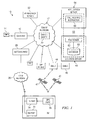
- a telephonic communication system shown generally at 10, provides for telephonic communications between telephonic stations.
- telephonic calls originated at an originating station are routed to a terminating station, a call connection is formed, and telephonic communication of data is effectuated. Telephonic communication of both voice data and non-voice data is permitted.
- the telephonic communication system shown in Figure 1, is representative of any of various implementations.
- the system includes a network 12 that, in various exemplary implementations, forms a TDM (time division multiplexed) or IP (internet protocol) network.
- the network is also representative of a network formed of separate parts, including a TDM portion and an IP portion, as well as any of various other network implementations. While the following description shall describe exemplary operation of an embodiment of the present invention with respect to its implementation to include a TDM-based or IP-based network, the teachings of the present invention are analogously also applicable in other types of telephonic communication systems.
- Telephonic communications are originated by any appropriate telephonic station, suitably coupled to, and operable in, the telephonic communication system.
- the telephonic station 14 is representative of an originating telephonic station that originates a call to a user, identified pursuant to an embodiment of the present invention by a designated, generic dialing code.
- the telephonic station is coupled to the network 12, here by way of a gateway (GWY) 16.
- GWY gateway
- the telephonic station 14 is representative of any of various types of telephonic stations capable of originating a telephonic call.
- the telephonic station is representative of a POTS (plain old telephone system) phone, a TDM (time division multiplexed) phone, SIP (session interface protocol) session phone, or a wireless mobile station, as well as other telephonic communication stations.
- POTS plain old telephone system
- TDM time division multiplexed
- SIP session interface protocol
- a call request is routed to the network 12 to be routed under the control of a telephonic switch entity 22.
- the switch entity 22 is representative of a TDM switch when the network forms the TDM network.
- the switch entity 22 is representative of a soft switch when the network 12 forms an IP network.
- the switch entity performs switching functions, as appropriate for the type of network at which the switch entity is embodied.
- the network 26 of a cellular communication system here a GSM (global system for mobile communications) cellular communication system also forms part of the telephonic communication system.
- the network 26 is coupled to the network 12 by way of a gateway/mobile switching center (GWY/MSC) 28. Communications are effectuated by the network 26 by way of a radio air interface with mobile stations, of which the mobile station 32 is representative. While the network 26 is here represented as a GSM network, such representation is exemplary only.
- the network is also representative of the networks of other cellular, and other radio, communication systems, e.g., systems operable pursuant to applicable TDMA (time-division, multiple-access), CDMA (code-division, multiple-access), UMTS (universal mobile telephone service), EDGE (enhanced data for GSM evolution), as well as other operating standards.
- TDMA time-division, multiple-access
- CDMA code-division, multiple-access
- UMTS universal mobile telephone service
- EDGE enhanced data for GSM evolution
- the mobile station 32 is carried by a user and includes radio transceiver circuitry formed of a transmit part 34 and a receive part 36.
- the mobile station also includes a position tracking element, here a GPS receiver 38.
- the GPS receiver operates in conjunction with a GPS satellite system, here represented by the satellites 42, to obtain positional indicia of the location of the GPS receiver and, thereby, also the location of the user that carries the mobile station 32.
- positional indicia associated with the mobile station is determined at the network 26, or elsewhere.
- the positional indicia associated with the location of the mobile station and, hence, the user thereof, is used pursuant to operation of an embodiment of the present invention by which to route a call originated by an originating party at an originating station, such as the telephonic station 14, to a terminating station most convenient to the user that carries the mobile station 32. Depending upon the location of the user, the call is routed to the mobile station or to another telephonic station.
- the positional indicia determined by the GPS receiver, or elsewhere, is communicated to a location server 46 that also is coupled to the network 12.
- the routing of the positional indicia is carried out in any of various manners.
- the positional indicia is communicated by way of the network 26 through the gateway 28 and the network 12 to be delivered to the location server.
- the positional indicia is communicated back to a satellite 42 and, in turn, forwarded to an SMLC (satellite mobile location center) 47 and then to a GMLC (global mobile location center) 48 and then delivered location server 46.
- SMLC short cell mobile location center
- GMLC global mobile location center
- the GMLC 48 and the location server are, for instance, commonly located, or connected by way of the network 12.
- IP internet protocol
- SIP Internet protocol
- An application server 54 also is coupled to the network 12.
- the application server is also representative of a service control point (SCP).
- SCP service control point
- the user of the mobile station 32 typically also has telephonic access to the telephonic communication system depending upon the user's location. For instance, the user might sometimes be located at one or separate work locations at which a telephonic station is positioned, at other times at a home location, also at which one or more telephonic stations are positioned, and sometimes also located elsewhere at other locations, also at which the user has access to a telephonic station.
- a calling party is not necessarily aware when originating a call to the user at the location at which the user is positioned.
- the user When the user is located at the user's work location, for instance, the user might well prefer utilizing a work telephonic station rather than a cellular mobile station for which charges accrue for each minute of talk time.
- An embodiment of the present invention provides apparatus 60 automatically to identify the location at which a user is positioned so that a call subsequently placed to the user is routed to a preferred, designated telephonic station.
- the elements forming the apparatus 60 are functionally represented and are implementable in any desired manner, such as by algorithms executable by processing circuitry, and the elements of the apparatus are implemented at any desired location, here distributed between the application server 54 and the location server 46.
- the apparatus in the exemplary implementation, includes a positioner 62, embodied at the location server and a call routing instructor 66 embodied at the application server.
- the positioner includes, or otherwise accesses, a database 68 at which positional indicia associated with the location of the mobile station, such as the mobile station 32, and, hence, the user that carries the mobile station.
- the information stored at the database is accessible by the application server and is used to select to where to route the call originated by the originating party at the originating telephonic station 14.
- the call routing instructor includes a listing of designated telephonic stations to which to route the call depending upon the location of the user.
- the positional indicia maintained at the location server is used in conjunction with the information maintained at the application server to route the call to an appropriate terminating telephonic station.
- possible terminating telephonic stations include a WLAN or LAN based SIP phone 72, a POTS phone 74, and the wireless mobile station 32.
- Other appropriate terminating telephonic stations can analogously be represented.
- FIG. 2 illustrates a message sequence diagram, shown generally at 84, representative of signaling generated when a call placed by an originating party at the originating station 14 is to be completed to a user whose position is identified by the user's carriage of the mobile station 32.
- a call request initiated at the telephonic station 14 is routed to the network 12 and the switch 22 thereof.
- the call request includes the telephonic identifier of a generic number associated with the user.
- the switch inquires, indicated by the segment 88, of the application server 54 and the element 66 embodied thereat.
- the application server queries, indicated by the segment 92, the location server 48 and the positioning indicia stored at the database of the positioner 62 thereof. And, as indicated by the block 94, the positioning indicia is retrieved therefrom. And, as indicated by the segment 96, the information is returned to the application server.
- the rules contained in the call routing instructor are used to select the telephonic station to which the call is to be routed, as indicated by the block 98.
- the identity of the designated telephonic station is provided, indicated by the segment 102, to the switch 22. And, responsive thereto, the switch routes the call request, indicated by the segment 104, to the designated telephonic station 72 or 74, etc.
- a call connection is formed, indicated by the block 106, and telephonic communications commence.
- the position of the user is updated, as appropriate, so that up-to-date information is stored at the location server.
- Figure 3 illustrates a method flow diagram, shown generally at 112, of the method of operation of an embodiment of the present invention.
- the method facilitates routing of communications by way of a telephonic call router to a selected one of a first and at least second communication stations.
- the positioning of a user is automatically identified.
- the positioning identifies the user, at least relative to the first and at least second communication stations.
- the telephonic call router is instructed to which of the first and at least second communication stations to which to route a call. Thereby, the call is routed to a telephonic station positioned in proximity to the location at which the user is positioned.
- a manner is provided by which automatically route a call to a location at which the intended recipient of a call is positioned.
- the routing is performed automatically, wholly without intervention by the user to identify the user's location.
Landscapes
- Engineering & Computer Science (AREA)
- Signal Processing (AREA)
- Computer Networks & Wireless Communication (AREA)
- Mobile Radio Communication Systems (AREA)
- Telephonic Communication Services (AREA)
Applications Claiming Priority (2)
| Application Number | Priority Date | Filing Date | Title |
|---|---|---|---|
| US720303 | 2003-11-24 | ||
| US10/720,303 US20050113108A1 (en) | 2003-11-24 | 2003-11-24 | Location-based location service apparatus, and associated method, for routing a call in a telephonic communication system |
Publications (2)
| Publication Number | Publication Date |
|---|---|
| EP1534036A2 true EP1534036A2 (de) | 2005-05-25 |
| EP1534036A3 EP1534036A3 (de) | 2006-07-26 |
Family
ID=34435819
Family Applications (1)
| Application Number | Title | Priority Date | Filing Date |
|---|---|---|---|
| EP04026542A Withdrawn EP1534036A3 (de) | 2003-11-24 | 2004-11-09 | Verfahren und Vorrichtung mit positionsbasierten Diensten zur Leitweglenkung eines Rufes in einem Fernsprechkommunikationssystem |
Country Status (2)
| Country | Link |
|---|---|
| US (1) | US20050113108A1 (de) |
| EP (1) | EP1534036A3 (de) |
Cited By (2)
| Publication number | Priority date | Publication date | Assignee | Title |
|---|---|---|---|---|
| GB2446846A (en) * | 2007-01-31 | 2008-08-27 | Hewlett Packard Development Co | Service routing for communication systems based upon location of mobile communication device |
| EP2466863A1 (de) * | 2010-12-20 | 2012-06-20 | Mitel Networks Corporation | Umleitung einer Kommunikation gemäss dem Standort eines mobilen Kommunikationsgerätes |
Families Citing this family (8)
| Publication number | Priority date | Publication date | Assignee | Title |
|---|---|---|---|---|
| US7940792B2 (en) * | 2004-02-11 | 2011-05-10 | Microsoft Corporation | System and methods for facilitating third-party call and device control |
| US7260403B1 (en) * | 2004-11-30 | 2007-08-21 | Sprint Spectrum L.P. | Method and system for dynamically routing voice calls to one of a plurality of associated subscriber terminals |
| EP1911198A4 (de) * | 2005-06-29 | 2012-08-01 | Nortel Networks Ltd | Verfahren und geräte zur unterstützung von ortsdiensten in einem kommunikationssystem |
| US20070060174A1 (en) * | 2005-09-15 | 2007-03-15 | Bellsouth Intellectual Property Corporation | Methods, systems, and computer program products for updating message routing profiles |
| US20070060137A1 (en) * | 2005-09-15 | 2007-03-15 | Bellsouth Intellectual Property Corporation | Methods, systems, and computer program products for call/message routing based on determined subscriber activity |
| US8270958B2 (en) * | 2007-06-20 | 2012-09-18 | Verizon Patent And Licensing Inc. | Apparatus, system and method for automated communication forwarding |
| KR101953308B1 (ko) * | 2012-08-01 | 2019-05-23 | 삼성전자주식회사 | 커뮤니케이션 정보 전송 시스템 및 방법 |
| US9538453B1 (en) | 2013-03-08 | 2017-01-03 | Sprint Spectrum L.P. | Determining a serving system for a mobile station in an area served by multiple serving systems |
Family Cites Families (9)
| Publication number | Priority date | Publication date | Assignee | Title |
|---|---|---|---|---|
| WO1998021911A1 (en) * | 1996-11-12 | 1998-05-22 | Telefonaktiebolaget Lm Ericsson (Publ) | Device for routing information updates |
| JP3298484B2 (ja) * | 1997-12-24 | 2002-07-02 | カシオ計算機株式会社 | 情報送信装置 |
| US6873846B1 (en) * | 1999-04-01 | 2005-03-29 | Lucent Technologies Inc. | Extending a location based telephone call from a wireless telephone set using a generic routing list |
| US6320534B1 (en) * | 1999-08-24 | 2001-11-20 | Lucent Technologies Inc. | Location based personal telephone routing system |
| US6937869B1 (en) * | 2000-05-10 | 2005-08-30 | Sprint Spectrum L.P. | Route planning system for mobile telecommunications |
| KR100731015B1 (ko) * | 2001-01-09 | 2007-06-22 | 엘지전자 주식회사 | 위치 정합형 정보 서비스 제공 방법 |
| US7486958B2 (en) * | 2001-09-05 | 2009-02-03 | Networks In Motion, Inc. | System and method for maintaining an online point-of-interest directory |
| US7099677B2 (en) * | 2001-11-29 | 2006-08-29 | Bellsouth Intellectual Property Corp. | Smart call delivery GIS integration |
| US7308267B2 (en) * | 2003-08-12 | 2007-12-11 | At&T Knowledge Ventures, L.P. | Wireless direct routing service |
-
2003
- 2003-11-24 US US10/720,303 patent/US20050113108A1/en not_active Abandoned
-
2004
- 2004-11-09 EP EP04026542A patent/EP1534036A3/de not_active Withdrawn
Cited By (3)
| Publication number | Priority date | Publication date | Assignee | Title |
|---|---|---|---|---|
| GB2446846A (en) * | 2007-01-31 | 2008-08-27 | Hewlett Packard Development Co | Service routing for communication systems based upon location of mobile communication device |
| EP2466863A1 (de) * | 2010-12-20 | 2012-06-20 | Mitel Networks Corporation | Umleitung einer Kommunikation gemäss dem Standort eines mobilen Kommunikationsgerätes |
| US9008683B2 (en) | 2010-12-20 | 2015-04-14 | Mitel Networks Corporation | Call localization systems and methods |
Also Published As
| Publication number | Publication date |
|---|---|
| US20050113108A1 (en) | 2005-05-26 |
| EP1534036A3 (de) | 2006-07-26 |
Similar Documents
| Publication | Publication Date | Title |
|---|---|---|
| EP1212910B1 (de) | System zum vergleichen von mobilfunkteilnehmerprofilen | |
| US6556823B2 (en) | Location dependent service for mobile telephones | |
| US6018657A (en) | System and method for communicating a message using a cellular telephone network | |
| EP1854318B1 (de) | Dynamische identitätsassoziation in einem drahtlosen netzwerk | |
| AU740307B2 (en) | A communication system that communicates position information of roaming mobile stations | |
| KR100960248B1 (ko) | 셀룰러 통신 시스템에서 향상된 국제 다이얼링을 지원하는방법 및 장치 | |
| US7801534B2 (en) | Method and system for conveying location-granularity preferences with location-based service requests | |
| JPH11511309A (ja) | 通信システム・アーキテクチャおよびそのための配信方法 | |
| US7991393B1 (en) | Wireline terminal accessing mobile telephone services | |
| JPH08505025A (ja) | 通話を確立する方法 | |
| EP1534036A2 (de) | Verfahren und Vorrichtung mit positionsbasierten Diensten zur Leitweglenkung eines Rufes in einem Fernsprechkommunikationssystem | |
| US20070149243A1 (en) | System and method for routing special number calls from a dual-mode wireless communications device operating in the unlicensed mode | |
| US8761718B2 (en) | Verification of communications network-derived location information | |
| WO2000022862A1 (en) | Method for routing calls based on subscriber's location | |
| EP1855490B1 (de) | Verfahren zur realisation von mobiler nummern-portabilität basierend auf einem datenservice | |
| FI92007C (fi) | Menetelmä puhelun muodostamiseksi matkapuhelinverkossa, matkapuhelinkeskus ja vierailijarekisteri | |
| WO2006018854A1 (en) | International calling system and method | |
| CA2283087A1 (en) | Method and system for delivery of wireless user identification and location |
Legal Events
| Date | Code | Title | Description |
|---|---|---|---|
| PUAI | Public reference made under article 153(3) epc to a published international application that has entered the european phase |
Free format text: ORIGINAL CODE: 0009012 |
|
| AK | Designated contracting states |
Kind code of ref document: A2 Designated state(s): AT BE BG CH CY CZ DE DK EE ES FI FR GB GR HU IE IS IT LI LU MC NL PL PT RO SE SI SK TR |
|
| AX | Request for extension of the european patent |
Extension state: AL HR LT LV MK YU |
|
| PUAL | Search report despatched |
Free format text: ORIGINAL CODE: 0009013 |
|
| AK | Designated contracting states |
Kind code of ref document: A3 Designated state(s): AT BE BG CH CY CZ DE DK EE ES FI FR GB GR HU IE IS IT LI LU MC NL PL PT RO SE SI SK TR |
|
| AX | Request for extension of the european patent |
Extension state: AL HR LT LV MK YU |
|
| AKX | Designation fees paid | ||
| RAP1 | Party data changed (applicant data changed or rights of an application transferred) |
Owner name: ALCATEL LUCENT |
|
| STAA | Information on the status of an ep patent application or granted ep patent |
Free format text: STATUS: THE APPLICATION IS DEEMED TO BE WITHDRAWN |
|
| 18D | Application deemed to be withdrawn |
Effective date: 20070127 |
|
| REG | Reference to a national code |
Ref country code: DE Ref legal event code: 8566 |