EP1533715A2 - Verfahren und Vorrichtung zur Datenklassifizierung, Verfahren und Vorrichtung zum Generieren von Kurzfassungsdaten, und Informationsaufzeichnungsmedium - Google Patents
Verfahren und Vorrichtung zur Datenklassifizierung, Verfahren und Vorrichtung zum Generieren von Kurzfassungsdaten, und Informationsaufzeichnungsmedium Download PDFInfo
- Publication number
- EP1533715A2 EP1533715A2 EP04026852A EP04026852A EP1533715A2 EP 1533715 A2 EP1533715 A2 EP 1533715A2 EP 04026852 A EP04026852 A EP 04026852A EP 04026852 A EP04026852 A EP 04026852A EP 1533715 A2 EP1533715 A2 EP 1533715A2
- Authority
- EP
- European Patent Office
- Prior art keywords
- contents
- data
- story
- contents data
- classification
- Prior art date
- Legal status (The legal status is an assumption and is not a legal conclusion. Google has not performed a legal analysis and makes no representation as to the accuracy of the status listed.)
- Withdrawn
Links
Images










Classifications
-
- H—ELECTRICITY
- H04—ELECTRIC COMMUNICATION TECHNIQUE
- H04N—PICTORIAL COMMUNICATION, e.g. TELEVISION
- H04N21/00—Selective content distribution, e.g. interactive television or video on demand [VOD]
- H04N21/80—Generation or processing of content or additional data by content creator independently of the distribution process; Content per se
- H04N21/83—Generation or processing of protective or descriptive data associated with content; Content structuring
- H04N21/84—Generation or processing of descriptive data, e.g. content descriptors
-
- G—PHYSICS
- G06—COMPUTING OR CALCULATING; COUNTING
- G06F—ELECTRIC DIGITAL DATA PROCESSING
- G06F16/00—Information retrieval; Database structures therefor; File system structures therefor
- G06F16/70—Information retrieval; Database structures therefor; File system structures therefor of video data
- G06F16/78—Retrieval characterised by using metadata, e.g. metadata not derived from the content or metadata generated manually
- G06F16/783—Retrieval characterised by using metadata, e.g. metadata not derived from the content or metadata generated manually using metadata automatically derived from the content
- G06F16/7837—Retrieval characterised by using metadata, e.g. metadata not derived from the content or metadata generated manually using metadata automatically derived from the content using objects detected or recognised in the video content
- G06F16/784—Retrieval characterised by using metadata, e.g. metadata not derived from the content or metadata generated manually using metadata automatically derived from the content using objects detected or recognised in the video content the detected or recognised objects being people
-
- G—PHYSICS
- G06—COMPUTING OR CALCULATING; COUNTING
- G06V—IMAGE OR VIDEO RECOGNITION OR UNDERSTANDING
- G06V20/00—Scenes; Scene-specific elements
- G06V20/40—Scenes; Scene-specific elements in video content
-
- G—PHYSICS
- G11—INFORMATION STORAGE
- G11B—INFORMATION STORAGE BASED ON RELATIVE MOVEMENT BETWEEN RECORD CARRIER AND TRANSDUCER
- G11B27/00—Editing; Indexing; Addressing; Timing or synchronising; Monitoring; Measuring tape travel
- G11B27/02—Editing, e.g. varying the order of information signals recorded on, or reproduced from, record carriers
- G11B27/031—Electronic editing of digitised analogue information signals, e.g. audio or video signals
- G11B27/034—Electronic editing of digitised analogue information signals, e.g. audio or video signals on discs
-
- G—PHYSICS
- G11—INFORMATION STORAGE
- G11B—INFORMATION STORAGE BASED ON RELATIVE MOVEMENT BETWEEN RECORD CARRIER AND TRANSDUCER
- G11B27/00—Editing; Indexing; Addressing; Timing or synchronising; Monitoring; Measuring tape travel
- G11B27/10—Indexing; Addressing; Timing or synchronising; Measuring tape travel
- G11B27/102—Programmed access in sequence to addressed parts of tracks of operating record carriers
- G11B27/105—Programmed access in sequence to addressed parts of tracks of operating record carriers of operating discs
-
- G—PHYSICS
- G11—INFORMATION STORAGE
- G11B—INFORMATION STORAGE BASED ON RELATIVE MOVEMENT BETWEEN RECORD CARRIER AND TRANSDUCER
- G11B27/00—Editing; Indexing; Addressing; Timing or synchronising; Monitoring; Measuring tape travel
- G11B27/10—Indexing; Addressing; Timing or synchronising; Measuring tape travel
- G11B27/19—Indexing; Addressing; Timing or synchronising; Measuring tape travel by using information detectable on the record carrier
- G11B27/28—Indexing; Addressing; Timing or synchronising; Measuring tape travel by using information detectable on the record carrier by using information signals recorded by the same method as the main recording
-
- H—ELECTRICITY
- H04—ELECTRIC COMMUNICATION TECHNIQUE
- H04N—PICTORIAL COMMUNICATION, e.g. TELEVISION
- H04N21/00—Selective content distribution, e.g. interactive television or video on demand [VOD]
- H04N21/40—Client devices specifically adapted for the reception of or interaction with content, e.g. set-top-box [STB]; Operations thereof
- H04N21/47—End-user applications
- H04N21/482—End-user interface for programme selection
- H04N21/4828—End-user interface for programme selection for searching programme descriptors
-
- H—ELECTRICITY
- H04—ELECTRIC COMMUNICATION TECHNIQUE
- H04N—PICTORIAL COMMUNICATION, e.g. TELEVISION
- H04N7/00—Television systems
- H04N7/16—Analogue secrecy systems; Analogue subscription systems
- H04N7/162—Authorising the user terminal, e.g. by paying; Registering the use of a subscription channel, e.g. billing
- H04N7/163—Authorising the user terminal, e.g. by paying; Registering the use of a subscription channel, e.g. billing by receiver means only
-
- G—PHYSICS
- G11—INFORMATION STORAGE
- G11B—INFORMATION STORAGE BASED ON RELATIVE MOVEMENT BETWEEN RECORD CARRIER AND TRANSDUCER
- G11B2220/00—Record carriers by type
- G11B2220/20—Disc-shaped record carriers
Definitions
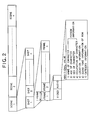
- contents data included in a broadcasting wave has a data format shown in FIG. 2.
- the story analyzing unit 161 reads the contents data recorded on the HD 121 to develop the contents data on a RAM (not shown).
- the story analyzing unit 161 executes the following processes to generate person matrix data and location matrix data. Both the processes, which will be described later, are simultaneously performed by the story analyzing unit 161.
- rows and columns mean the person names extracted by the above process, that is, person names appearing in the story corresponding to the contents data. Therefore, in the example shown in FIG. 3, it is understood that n persons including “person 1", “person 2", “person 3",..., "person n” appear in the story of the contents data.
- a counter is arranged in a field at which each row and each column cross in the person matrix generating table TBL1.
- the person matrix generating table TBL1 is updated by incrementing the counter.
- the person matrix generating table TBL1 is updated through the following processes.
- the story analyzing unit 161 retrieves the contents data developed on the RAM to extract all location names serving as stages in the story from the location information in the additional information included in the contents data.
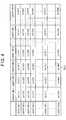
- the story analyzing unit 161 generates a location matrix generating table TBL2 shown in FIG. 4 in the table recording unit 15 on the basis of the extracted location names.
- rows and columns mean the location names extracted by the above process, that is, location names serving as stages in the story corresponding to the contents data. Therefore, in the example shown in FIG. 4, it is understood that m locations including “location 1", “location 2", “location 3",..., “location m” appear in the story of the contents data.
- the updating method used here is basically the same as that of the process performed when the person matrix generating table TBL1 is updated, however it is different only in increment references of the counters as follows. That is,
- the story analyzing unit 161 calculates root mean squares (RMS) in accordance with the following (Equation 11) and (Equation 12) to generate data corresponding to the root mean squares.
- RMS root mean squares
- the story analyzing unit 161 classifies the contents data in "person group ab4".
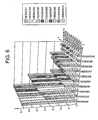
- the contents data belonging to the group is supposed as data in which any character has low probability of appearance and in which only one person appears for a certain amount of time, for example, if the contents data is of a drama, the drama is supposed as a drama in which, although a main character is present at any rate, secondary characters are very frequently appear.
- the story classification tables TBL3-k are arranged, for example, in units of categories of contents data such as a drama and a documentary.
- a story classification is stored in association with a combination of a person group and location group.
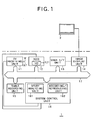
- the HDD 12 includes the HD 121, and reads and writes data from/in the HD 121 under the control of the system control unit 16.
- contents data and story classifications corresponding to the contents data are recorded in association with each other.
- a database of the contents data is structured in the HD 121.
- the story analyzing unit 161 outputs a control signal to the HDD 12 to read the contents data recorded by the recording reservation, on the HD 121 (step S1).
- the contents data is read by the HDD 12, supplied to the system control unit 16, and developed on the RAM (not shown) in the system control unit 16.
- the story analyzing unit 161 outputs the classification result and the data including, for example, a character string such as "process is ended” to the image display unit 14 (step S6) to end the process.
- a character string such as "process is ended”
- the image display unit 14 step S6
- an image corresponding to the data is displayed on the monitor 2.
- the story analyzing unit 161 retrieves the contents data developed on the RAM to extracts all person names and all location names appearing in a story from the person information and the location information in the additional information included in the contents data, and generate the person matrix generating table TBL1 and the location matrix generating table TBL2 in the table recording unit 15.
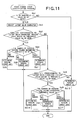
- step Sc1 The process contents of the location group classification process are shown in FIG. 12.
- the story analyzing unit 161 determines whether the value dB calculated on the basis of (Equation 12) in step S3 in FIG. 8 is larger than the threshold value RB (step Sc1 in FIG. 12).
- step Sc1 the story analyzing unit 161 determines the location group of the contents data as "location group aa” (step Sb13 in FIG. 12) to end the process.
- the story analyzing unit 161 extracts the largest values ⁇ (i) corresponding to the latent central locations selected in the step Sc2 in FIG. 12, and it is determined whether the values ⁇ (i) include a value ⁇ (i) larger than the threshold value H ⁇ (step Sc3 in FIG. 12).
- the story analyzing unit 161 determines the number of latent central locations having values larger than the threshold value H ⁇ (step Sc4 in FIG. 12), and the location group of the contents data is determined as follows:
- step Sc5 to step Sc7 in FIG. 12 to end the process.
- step Sc8 in FIG. 12 the story analyzing unit 161 determines the number of locations having values exceeding the threshold value L ⁇ (step Sc9 in FIG. 12), and the location group of the contents data is determined as follows:
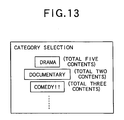
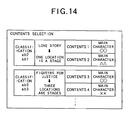
- the category selection screen is a screen to cause a user to select a category serving as a reproduction candidate when the reproduction candidate is selected from the contents data recorded on the HD 121.
- category names corresponding to all the contents data recorded on the HD 121 are displayed as buttons as shown in FIG. 13.
- the recording/reproducing unit 162 When image data corresponding to each contents selection screen is generated, the recording/reproducing unit 162 generates the image data corresponding to the screen in accordance with the story classification and the category corresponding to each contents data.
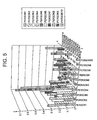
- the image processing apparatus 1 determines a latent central location serving as a main stage in the contents on the basis of a story matrix in determination of a data classification, and classifies the contents data on the basis of the determination result.
- the image processing apparatus 1 in the embodiment records contents data received through the TV receiving unit 11 on the HDD 12, however, a device for Internet connection may be arranged instead of the TV receiving unit 11, to download the contents data from the internet through the device.
- Additional information for each frame is added to the contents data recorded on the HDD 12 in the embodiment.
- the additional information can be added for every frames, shots, or scenes.
- information such as "no change from frame f1 to frame f30" need to be added to the additional information.
- the story matrix generating process it is enough that the story analyzing unit 161 increments the same counters at t(ij) in the frames f1 to f30.
- the image processing apparatus 1 in the embodiment has a story classification table TBL3-k for each category of the contents data.
- the image processing apparatus 1 may have only one story classification table TBL3-k.
- the story classification tables TBL3-k may be arranged not only for categories but also for sexes, ages, and the like of latent main characters.
- the image processing apparatus 1 in the embodiment determines a story classification of the contents data every time recording of contents data is performed, however, a determination timing of the story classification is not limited to the above timing, and the story classification may be determined in reproduction of the contents data.
- the operation of the process which determines a story classification corresponding to the contents data is executed by the story analyzing unit 161
- the image processing apparatus 1 may includes a recording medium on which a program which regulates the operation of the recording process is recorded, and a computer which reads the recording medium, and the operation of the same recording process as described above may be performed by reading the program with the computer.
- the image processing apparatus 1 in the embodiment determines a story classification after the story matrix is converted by the (Equation 9) and (Equation 10), however, a data classification may be determined without converting the story matrix.
- Each counter stored in the reproduction history table TBL4 may be cleared at arbitrary timings. However, since the counter values are necessary to recognize the taste of a user, it is assumed in Application 1 that reproduction histories are continuously accumulated without be cleared.
- the recording/reproducing unit 162 records the contents data on the HDD 12 at the time of the reservation.
- the operation performed at this time is the same as that in the "embodiment" described above.
- contents data which is not matched with the taste of a user is automatically determined as an object to be erased, the contents data can be automatically erased while reflecting the intention of the user.
- the story analyzing unit 161 compares the values cA and cB with predetermined threshold values to decide whether the human relationships in the stories corresponding to both the contents data and the positions of the latent central locations in the stories are similar. On the basis of the determination result, the stories of both the contents data are compared with each other.
- the threshold values are arbitrarily determined.
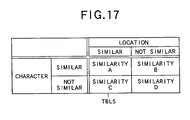
- a story comparing table TBL5 shown in FIG. 17 is stored in the table recording unit 15.
- the story analyzing unit 161 determines the similarity of stories of both the contents data to be compared with each other.
- similarities between the stories of both the contents are given in an order: "similarity A” > "similarity B” > “similarity C” > "similarity D”.
- an input signal corresponding to the input operation is output to the system control unit 16.
- the story analyzing unit 161 executes the processes shown in FIG. 18 in accordance with the input signal.
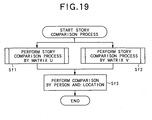
- the story analyzing unit 161 reads two contents data selected as objects of the stories which are compared with each other (step Se1), and generates story matrix data corresponding to both the contents data (step Se2).
- the story analyzing unit 161 converts the calculated story matrix data into data corresponding to the matrixes U and V (step Se3). Since the processes performed at this time are the same as those in steps S1 to S3 in FIG. 8, a detailed description thereof will be omitted.
- the story analyzing unit 161 performs a display process of a story comparing result (step Se6) to end the process. More specifically, for example, the story analyzing unit 161 generates an image data including a character string such as "As a result of story comparison, it is considered that both the contents are very similar to each other.” to supply the image data to the image display unit 14. As a result, an image corresponding to the image data is displayed on the monitor 2.
- step Sg1 the story analyzing unit 161 calculates a value cA in accordance with the (Equation 14) (step Sg2), and decides whether the calculated value cA is a predetermined threshold value or less (step Sg3).
- step Sg3 the story analyzing unit 161 determines that the human relationships in the stories of both the contents data are not similar to each other (step Sg5) to end the process.
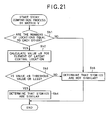
- step Sh1 determines whether the numbers of appearing locations of both the contents data are equal to each other on the basis of the numbers of parameters included in the matrix V corresponding to both the contents data.
- step Sh5 the story analyzing unit 161 determines that the positionings of the central locations in the stories of both the contents data are not similar to each other.
- step Sh1 the story analyzing unit 161 calculates a value cB in accordance with the (Equation 15) (step Sh2), and decides whether the calculated value cB is a predetermined threshold value or less (step Sh3).
- step Sh3 the story analyzing unit 161 determines that the positionings of the central locations of both the contents data are not similar to each other (step Sh5).
- step Sh4 the story analyzing unit 161 determines that the positionings of the central locations of both the contents data are similar to each other (step Sh4) to end the process.
- an input signal corresponding to the input operation is transmitted to the system control unit 16.
- the story analyzing unit 161 generates image data corresponding to a selection screen to select contents data to be summarized to output the image data to the image display unit 14.
- a selection screen corresponding to the image data is displayed on the monitor 2.
- the selection screen may have any configuration.
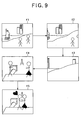
- the story analyzing unit 161 selects a frame in which both the latent main character and the latent central location simultaneously appear in the contents data. At this time, the story analyzing unit 161 retrieves additional information included in all the frames corresponding to the contents data to select frames in which the latent main character or the like appears. The story analyzing unit 161 extracts data corresponding to the selected frame from the contents data, and re-arranges the data in a time-series manner to generate summary data corresponding to the contents data.
- step Si4 the story analyzing unit 161 outputs a control signal added with the summary data generated in step Si4 to the HDD 12 (step Si5).
- the summary data is recorded on the HD 121 in association with the contents data to be summarized.
- the story analyzing unit 161 performs a display process of the summary data (step Si6) to end the process. More specifically, the control signal added with the summary data is transmitted from the story analyzing unit 161 to the image display unit 14. As a result, the image display unit 14 outputs an image signal or the like corresponding to the summary data to the monitor 2.
- the recording/reproducing unit 162 continuously reproduces the summary data recorded on the HD 121 in association with the contents data.
- the user can select contents data desired to be reproduced by the user herself/himself with reference to the continuously reproduced summary data.
Landscapes
- Engineering & Computer Science (AREA)
- Multimedia (AREA)
- Signal Processing (AREA)
- Theoretical Computer Science (AREA)
- Library & Information Science (AREA)
- Physics & Mathematics (AREA)
- General Physics & Mathematics (AREA)
- Computer Security & Cryptography (AREA)
- Human Computer Interaction (AREA)
- Data Mining & Analysis (AREA)
- Databases & Information Systems (AREA)
- General Engineering & Computer Science (AREA)
- Information Retrieval, Db Structures And Fs Structures Therefor (AREA)
Applications Claiming Priority (2)
| Application Number | Priority Date | Filing Date | Title |
|---|---|---|---|
| JP2003390977A JP2005157463A (ja) | 2003-11-20 | 2003-11-20 | データ分類方法、要約データ生成方法、データ分類装置、要約データ生成装置、データ分類プログラム、要約データ生成プログラム及び情報記録媒体 |
| JP2003390977 | 2003-11-20 |
Publications (1)
| Publication Number | Publication Date |
|---|---|
| EP1533715A2 true EP1533715A2 (de) | 2005-05-25 |
Family
ID=34431603
Family Applications (1)
| Application Number | Title | Priority Date | Filing Date |
|---|---|---|---|
| EP04026852A Withdrawn EP1533715A2 (de) | 2003-11-20 | 2004-11-11 | Verfahren und Vorrichtung zur Datenklassifizierung, Verfahren und Vorrichtung zum Generieren von Kurzfassungsdaten, und Informationsaufzeichnungsmedium |
Country Status (3)
| Country | Link |
|---|---|
| US (1) | US20050114399A1 (de) |
| EP (1) | EP1533715A2 (de) |
| JP (1) | JP2005157463A (de) |
Families Citing this family (16)
| Publication number | Priority date | Publication date | Assignee | Title |
|---|---|---|---|---|
| JP2005176240A (ja) * | 2003-12-15 | 2005-06-30 | Pioneer Electronic Corp | コンテンツデータ再生装置、広告情報配信システム、広告情報配信方法、コンテンツデータ再生プログラム及び情報記録媒体 |
| US20060287996A1 (en) * | 2005-06-16 | 2006-12-21 | International Business Machines Corporation | Computer-implemented method, system, and program product for tracking content |
| US20070005592A1 (en) * | 2005-06-21 | 2007-01-04 | International Business Machines Corporation | Computer-implemented method, system, and program product for evaluating annotations to content |
| JP2007041987A (ja) * | 2005-08-05 | 2007-02-15 | Sony Corp | 画像処理装置および方法、並びにプログラム |
| JP2007133808A (ja) * | 2005-11-14 | 2007-05-31 | Canon Inc | 情報処理装置、コンテンツ処理方法、記憶媒体およびプログラム |
| US8315507B2 (en) | 2006-01-05 | 2012-11-20 | Nec Corporation | Video generation device, video generation method, and video generation program |
| US7756720B2 (en) * | 2006-01-25 | 2010-07-13 | Fameball, Inc. | Method and system for the objective quantification of fame |
| US20090259669A1 (en) * | 2008-04-10 | 2009-10-15 | Iron Mountain Incorporated | Method and system for analyzing test data for a computer application |
| US8145598B2 (en) * | 2009-02-23 | 2012-03-27 | Iron Mountain Incorporated | Methods and systems for single instance storage of asset parts |
| US8090683B2 (en) * | 2009-02-23 | 2012-01-03 | Iron Mountain Incorporated | Managing workflow communication in a distributed storage system |
| US20100215175A1 (en) * | 2009-02-23 | 2010-08-26 | Iron Mountain Incorporated | Methods and systems for stripe blind encryption |
| US8397051B2 (en) * | 2009-02-23 | 2013-03-12 | Autonomy, Inc. | Hybrid hash tables |
| US9535899B2 (en) | 2013-02-20 | 2017-01-03 | International Business Machines Corporation | Automatic semantic rating and abstraction of literature |
| US10073835B2 (en) | 2013-12-03 | 2018-09-11 | International Business Machines Corporation | Detecting literary elements in literature and their importance through semantic analysis and literary correlation |
| US9298802B2 (en) | 2013-12-03 | 2016-03-29 | International Business Machines Corporation | Recommendation engine using inferred deep similarities for works of literature |
| US11100557B2 (en) | 2014-11-04 | 2021-08-24 | International Business Machines Corporation | Travel itinerary recommendation engine using inferred interests and sentiments |
Family Cites Families (2)
| Publication number | Priority date | Publication date | Assignee | Title |
|---|---|---|---|---|
| US6829384B2 (en) * | 2001-02-28 | 2004-12-07 | Carnegie Mellon University | Object finder for photographic images |
| US6892193B2 (en) * | 2001-05-10 | 2005-05-10 | International Business Machines Corporation | Method and apparatus for inducing classifiers for multimedia based on unified representation of features reflecting disparate modalities |
-
2003
- 2003-11-20 JP JP2003390977A patent/JP2005157463A/ja not_active Abandoned
-
2004
- 2004-11-10 US US10/984,757 patent/US20050114399A1/en not_active Abandoned
- 2004-11-11 EP EP04026852A patent/EP1533715A2/de not_active Withdrawn
Also Published As
| Publication number | Publication date |
|---|---|
| US20050114399A1 (en) | 2005-05-26 |
| JP2005157463A (ja) | 2005-06-16 |
Similar Documents
| Publication | Publication Date | Title |
|---|---|---|
| EP1533715A2 (de) | Verfahren und Vorrichtung zur Datenklassifizierung, Verfahren und Vorrichtung zum Generieren von Kurzfassungsdaten, und Informationsaufzeichnungsmedium | |
| US20010039656A1 (en) | Broadcast program storing system | |
| US6859803B2 (en) | Apparatus and method for program selection utilizing exclusive and inclusive metadata searches | |
| US8250623B2 (en) | Preference extracting apparatus, preference extracting method and preference extracting program | |
| US7745718B2 (en) | Music-piece classifying apparatus and method, and related computer program | |
| JP4645676B2 (ja) | 情報処理装置、関連アイテムの提供方法、及びプログラム | |
| US20100250554A1 (en) | Adding and processing tags with emotion data | |
| US7051048B2 (en) | Data management system, data management method, and program | |
| CN101778233B (zh) | 数据处理装置以及数据处理方法 | |
| US20170094362A1 (en) | Information processing apparatus, method, and program | |
| JPWO2006019101A1 (ja) | コンテンツ関連情報取得装置、コンテンツ関連情報取得方法、およびコンテンツ関連情報取得プログラム | |
| JP3982460B2 (ja) | コンテンツ連動型コメント表示方法、コメント表示システム、サーバ装置、コメント表示装置及びコメント表示プログラム及びコンピュータ読み取り可能な記録媒体 | |
| JP2005529425A (ja) | 個人プロファイルに基づくコンテンツ増加の方法、システム及び装置 | |
| CN101202864A (zh) | 动画再现装置 | |
| WO2007043679A1 (ja) | 情報処理装置およびプログラム | |
| CN104699696B (zh) | 文件推荐方法和装置 | |
| CN103562919A (zh) | 利用网络的信息检索方法及相应的语音对话方法 | |
| JP4487018B2 (ja) | 関連シーン付与装置及び関連シーン付与方法 | |
| JP2002108892A (ja) | データ管理システム、データ管理方法、及び、記録媒体 | |
| JP2003085207A (ja) | 映像情報レコメンドシステム、方法及び装置、並びに、映像情報レコメンドプログラム及びプログラムの記録媒体 | |
| CN102054019A (zh) | 信息处理装置、场景搜索方法和程序 | |
| JP2006094018A (ja) | 番組推薦装置、番組推薦方法、プログラムおよびそのプログラムを記録した記録媒体 | |
| KR102252522B1 (ko) | 내용 기반 동영상 목차 자동생성 방법 및 시스템 | |
| JP4730869B2 (ja) | テレビジョン番組情報表示装置 | |
| US20040193592A1 (en) | Recording and reproduction apparatus |
Legal Events
| Date | Code | Title | Description |
|---|---|---|---|
| PUAI | Public reference made under article 153(3) epc to a published international application that has entered the european phase |
Free format text: ORIGINAL CODE: 0009012 |
|
| AK | Designated contracting states |
Kind code of ref document: A2 Designated state(s): AT BE BG CH CY CZ DE DK EE ES FI FR GB GR HU IE IS IT LI LU MC NL PL PT RO SE SI SK TR |
|
| AX | Request for extension of the european patent |
Extension state: AL HR LT LV MK YU |
|
| STAA | Information on the status of an ep patent application or granted ep patent |
Free format text: STATUS: THE APPLICATION HAS BEEN WITHDRAWN |
|
| 18W | Application withdrawn |
Effective date: 20071024 |