EP1533332A1 - Novel polyimide copolymer and metal laminate comprising the same - Google Patents
Novel polyimide copolymer and metal laminate comprising the same Download PDFInfo
- Publication number
- EP1533332A1 EP1533332A1 EP03738668A EP03738668A EP1533332A1 EP 1533332 A1 EP1533332 A1 EP 1533332A1 EP 03738668 A EP03738668 A EP 03738668A EP 03738668 A EP03738668 A EP 03738668A EP 1533332 A1 EP1533332 A1 EP 1533332A1
- Authority
- EP
- European Patent Office
- Prior art keywords
- component
- polyimide copolymer
- metal laminate
- novel polyimide
- kinds
- Prior art date
- Legal status (The legal status is an assumption and is not a legal conclusion. Google has not performed a legal analysis and makes no representation as to the accuracy of the status listed.)
- Granted
Links
Classifications
-
- C—CHEMISTRY; METALLURGY
- C08—ORGANIC MACROMOLECULAR COMPOUNDS; THEIR PREPARATION OR CHEMICAL WORKING-UP; COMPOSITIONS BASED THEREON
- C08G—MACROMOLECULAR COMPOUNDS OBTAINED OTHERWISE THAN BY REACTIONS ONLY INVOLVING UNSATURATED CARBON-TO-CARBON BONDS
- C08G73/00—Macromolecular compounds obtained by reactions forming a linkage containing nitrogen with or without oxygen or carbon in the main chain of the macromolecule, not provided for in groups C08G12/00 - C08G71/00
- C08G73/06—Polycondensates having nitrogen-containing heterocyclic rings in the main chain of the macromolecule
- C08G73/10—Polyimides; Polyester-imides; Polyamide-imides; Polyamide acids or similar polyimide precursors
-
- C—CHEMISTRY; METALLURGY
- C08—ORGANIC MACROMOLECULAR COMPOUNDS; THEIR PREPARATION OR CHEMICAL WORKING-UP; COMPOSITIONS BASED THEREON
- C08G—MACROMOLECULAR COMPOUNDS OBTAINED OTHERWISE THAN BY REACTIONS ONLY INVOLVING UNSATURATED CARBON-TO-CARBON BONDS
- C08G73/00—Macromolecular compounds obtained by reactions forming a linkage containing nitrogen with or without oxygen or carbon in the main chain of the macromolecule, not provided for in groups C08G12/00 - C08G71/00
- C08G73/06—Polycondensates having nitrogen-containing heterocyclic rings in the main chain of the macromolecule
- C08G73/10—Polyimides; Polyester-imides; Polyamide-imides; Polyamide acids or similar polyimide precursors
- C08G73/1042—Copolyimides derived from at least two different tetracarboxylic compounds or two different diamino compounds
-
- B—PERFORMING OPERATIONS; TRANSPORTING
- B32—LAYERED PRODUCTS
- B32B—LAYERED PRODUCTS, i.e. PRODUCTS BUILT-UP OF STRATA OF FLAT OR NON-FLAT, e.g. CELLULAR OR HONEYCOMB, FORM
- B32B15/00—Layered products comprising a layer of metal
- B32B15/04—Layered products comprising a layer of metal comprising metal as the main or only constituent of a layer, which is next to another layer of the same or of a different material
- B32B15/08—Layered products comprising a layer of metal comprising metal as the main or only constituent of a layer, which is next to another layer of the same or of a different material of synthetic resin
-
- B—PERFORMING OPERATIONS; TRANSPORTING
- B32—LAYERED PRODUCTS
- B32B—LAYERED PRODUCTS, i.e. PRODUCTS BUILT-UP OF STRATA OF FLAT OR NON-FLAT, e.g. CELLULAR OR HONEYCOMB, FORM
- B32B27/00—Layered products comprising a layer of synthetic resin
- B32B27/34—Layered products comprising a layer of synthetic resin comprising polyamides
-
- C—CHEMISTRY; METALLURGY
- C08—ORGANIC MACROMOLECULAR COMPOUNDS; THEIR PREPARATION OR CHEMICAL WORKING-UP; COMPOSITIONS BASED THEREON
- C08G—MACROMOLECULAR COMPOUNDS OBTAINED OTHERWISE THAN BY REACTIONS ONLY INVOLVING UNSATURATED CARBON-TO-CARBON BONDS
- C08G73/00—Macromolecular compounds obtained by reactions forming a linkage containing nitrogen with or without oxygen or carbon in the main chain of the macromolecule, not provided for in groups C08G12/00 - C08G71/00
- C08G73/06—Polycondensates having nitrogen-containing heterocyclic rings in the main chain of the macromolecule
- C08G73/10—Polyimides; Polyester-imides; Polyamide-imides; Polyamide acids or similar polyimide precursors
- C08G73/1085—Polyimides with diamino moieties or tetracarboxylic segments containing heterocyclic moieties
-
- H—ELECTRICITY
- H05—ELECTRIC TECHNIQUES NOT OTHERWISE PROVIDED FOR
- H05K—PRINTED CIRCUITS; CASINGS OR CONSTRUCTIONAL DETAILS OF ELECTRIC APPARATUS; MANUFACTURE OF ASSEMBLAGES OF ELECTRICAL COMPONENTS
- H05K1/00—Printed circuits
- H05K1/02—Details
- H05K1/03—Use of materials for the substrate
-
- H—ELECTRICITY
- H05—ELECTRIC TECHNIQUES NOT OTHERWISE PROVIDED FOR
- H05K—PRINTED CIRCUITS; CASINGS OR CONSTRUCTIONAL DETAILS OF ELECTRIC APPARATUS; MANUFACTURE OF ASSEMBLAGES OF ELECTRICAL COMPONENTS
- H05K1/00—Printed circuits
- H05K1/02—Details
- H05K1/03—Use of materials for the substrate
- H05K1/0313—Organic insulating material
- H05K1/032—Organic insulating material consisting of one material
- H05K1/0346—Organic insulating material consisting of one material containing N
-
- Y—GENERAL TAGGING OF NEW TECHNOLOGICAL DEVELOPMENTS; GENERAL TAGGING OF CROSS-SECTIONAL TECHNOLOGIES SPANNING OVER SEVERAL SECTIONS OF THE IPC; TECHNICAL SUBJECTS COVERED BY FORMER USPC CROSS-REFERENCE ART COLLECTIONS [XRACs] AND DIGESTS
- Y10—TECHNICAL SUBJECTS COVERED BY FORMER USPC
- Y10T—TECHNICAL SUBJECTS COVERED BY FORMER US CLASSIFICATION
- Y10T428/00—Stock material or miscellaneous articles
- Y10T428/31504—Composite [nonstructural laminate]
- Y10T428/31678—Of metal
- Y10T428/31681—Next to polyester, polyamide or polyimide [e.g., alkyd, glue, or nylon, etc.]
-
- Y—GENERAL TAGGING OF NEW TECHNOLOGICAL DEVELOPMENTS; GENERAL TAGGING OF CROSS-SECTIONAL TECHNOLOGIES SPANNING OVER SEVERAL SECTIONS OF THE IPC; TECHNICAL SUBJECTS COVERED BY FORMER USPC CROSS-REFERENCE ART COLLECTIONS [XRACs] AND DIGESTS
- Y10—TECHNICAL SUBJECTS COVERED BY FORMER USPC
- Y10T—TECHNICAL SUBJECTS COVERED BY FORMER US CLASSIFICATION
- Y10T428/00—Stock material or miscellaneous articles
- Y10T428/31504—Composite [nonstructural laminate]
- Y10T428/31678—Of metal
- Y10T428/31692—Next to addition polymer from unsaturated monomers
-
- Y—GENERAL TAGGING OF NEW TECHNOLOGICAL DEVELOPMENTS; GENERAL TAGGING OF CROSS-SECTIONAL TECHNOLOGIES SPANNING OVER SEVERAL SECTIONS OF THE IPC; TECHNICAL SUBJECTS COVERED BY FORMER USPC CROSS-REFERENCE ART COLLECTIONS [XRACs] AND DIGESTS
- Y10—TECHNICAL SUBJECTS COVERED BY FORMER USPC
- Y10T—TECHNICAL SUBJECTS COVERED BY FORMER US CLASSIFICATION
- Y10T428/00—Stock material or miscellaneous articles
- Y10T428/31504—Composite [nonstructural laminate]
- Y10T428/31721—Of polyimide
Definitions
- the present invention relates to a novel polyimide copolymer and a metal laminate using the same, and more particularly to a novel polyimide copolymer capable of suitably using as a film for a flexible printed circuit board and a metal laminate using the same.
- a metal laminate has been formed in some cases by directly coating a metallic conductor with polyamic acid as a polyimide precursor copolymer, followed by heating to effect polyimidization. It is known that the metal laminate thus obtained has a poor dimensional stability and suffers from curling.
- JP-B-5-22399, JP-B-6-93537, JP-B-7-39161, etc. disclose metal laminates with distinguished dimensional stability, adhesiveness, flatness after etching, reduction in curling, etc., manufactured by forming a plurality layers of a polyimide resin layer having low thermal expansion and other polyimide resin layers on a conductor, where two or three kinds of polyimide precursor copolymers must be used, the individual copolymer solutions must be applied one by one to the conductor to form an insulation multilayer, and a ratio in thickness of the resulting individual polyimide layers must be specified, inevitably complicating the manufacture of the metal laminate thereby.
- the present applicant has already proposed a metal laminate where one kind of polyimide copolymer layer is directly laminated to a metallic conductor (WO 01/29136).
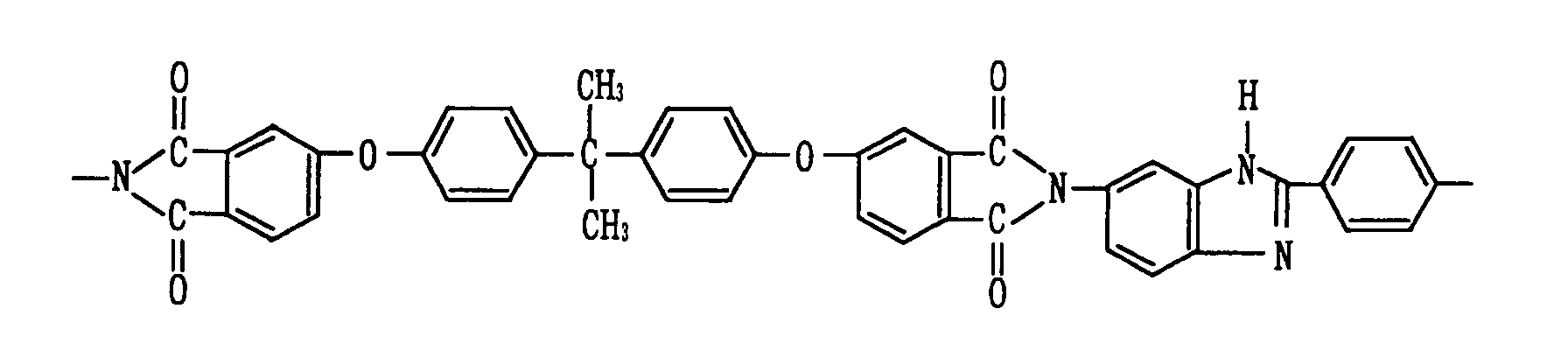
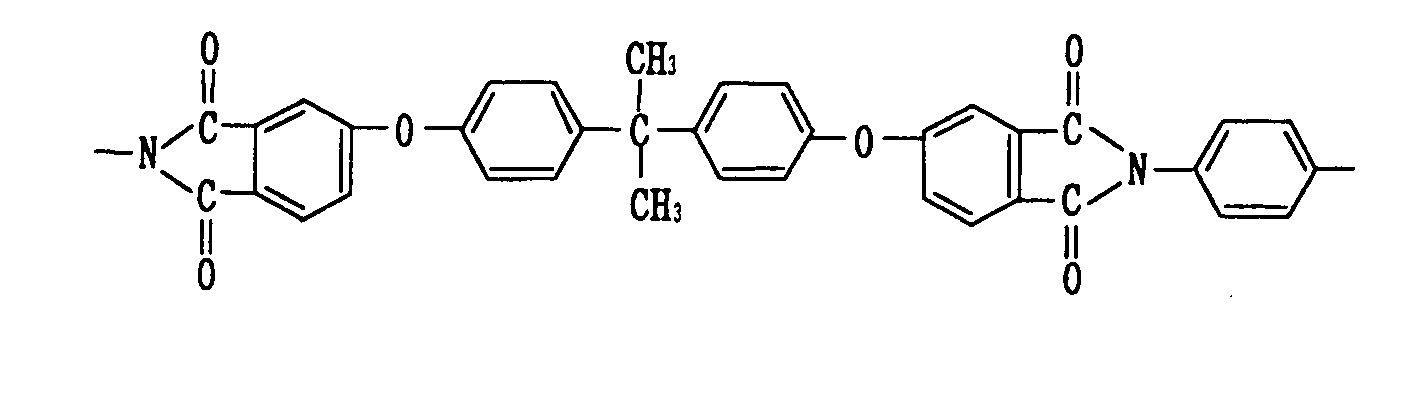
- the polyimide copolymer used therein is a copolymer of isopropylidenebis(4-phenyleneoxy-4-phthalic acid) dianhydride and 6-amino-2-(p-aminophenyl)benzimidazole.
- the polyimide copolymer obtained by polycondensation of these monomer components has a high adhesive strength by itself and can give a metal laminate with a satisfactory peel strength even if laminated directly to a metallic foil without interposing an adhesive layer therebetween, and also has a good solder heat resistance, but originally the polyimide copolymer has not been intended to lower the coefficient of linear thermal expansion or percent heat shrinkage or improvement of curling resistance.
- An object of the present invention is to provide a polyimide copolymer capable of giving a flexible printed circuit board with satisfactory adhesive strength and dimensional stability in a metal laminate comprising one kind of polyimide copolymer layer formed on the metallic conductor, by lowering the coefficient of linear thermal expansion or percent heat shrinkage of the polyimide copolymer or approaching the coefficient of linear thermal expansion or percent heat shrinkage of the polyimide copolymer to that of the conductor, thereby effectively suppressing curling, twisting, warping, etc. of the metal laminate even if subjected to heat hysteresis, and also to provide a metal laminate using the same.
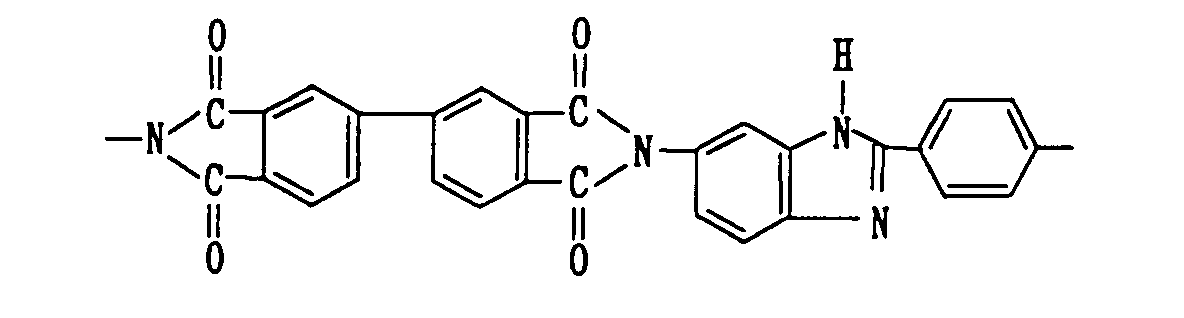
- the object of the present invention can be attained by a novel polyimide copolymer, which is a copolymer comprising two kinds of tetracarboxylic acid dianhydrides consisting of (A) isopropylidenebis(4-phenyleneoxy-4-phthalic acid) dianhydride and (B) 3,3' ,4,4' -biphenyltetracarboxylic acid dianhydride, and one kind of a diamine consisting of (C) 6-amino-2-(p-aminophenyl)benzimidazole or two or three kinds of diamines consisting of said component (C) and (D) at least one kind of diamines consisting of bis(4-aminophenyl)ether (D 1 ) and phenylenediamine (D 2 ), and also by a metal laminate comprising a metallic foil and a layer of said polyimide copolymers laminated thereto.
- the present novel polyimide copolymer is film-
- Tetracarboxylic acid dianhydrides for use in the synthesis of the present novel polyimide copolymer are two kinds of acid dianhydrides consisting of (A) isopropylidenebis(4-phenylene-oxy-4-phthalic acid) dianhydride as shown below: and (B) 3,3' ,4,4' -biphenyltetracarboxylic acid dianhydride as shown below:
- Component (A) and component (B) are used in a proportion of component (A) to component (B) of 10 - 80% by mole, preferably 20 - 60% by mole to 90 - 20% by mole, preferably 80 - 40% by mole.
- a proportion of component (A) is more than 80% by mole, curling will be pronounced in the stage of forming a metal laminate, together with an increased coefficient of linear thermal expansion and also with an increased percent heat shrinkage.
- a proportion of component (A) is less than 10% by mole, the resulting film will become not only brittle, but also the adhesive strength will be no more observable in the metal laminate.
- tetracarboxylic acid dianhydrides can be used together within such a range as not to deteriorate the object of the present invention.
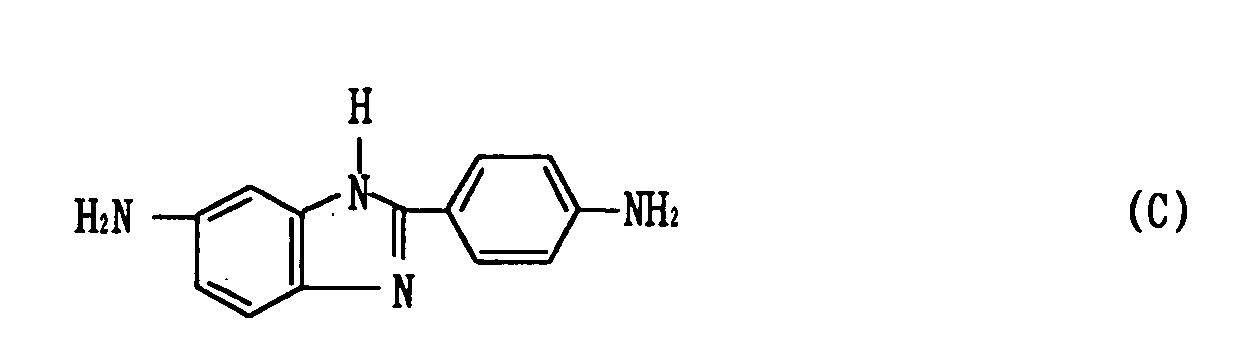
- Diamine for use in forming a polyimide copolymer upon reaction with these two kinds of tetracarboxylic acid dianhydrides is (C) 6-amino-2-(p-aminophenyl) benzimidazole as shown below:
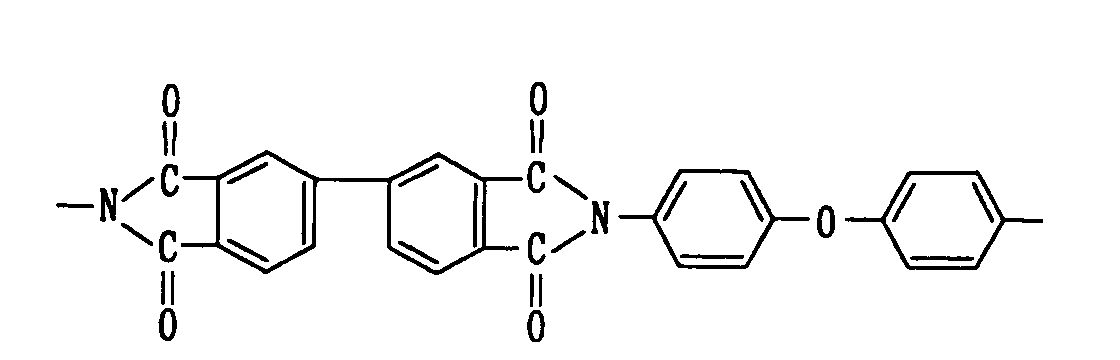
- diamine compound (C) can be used together with (D) at least one of bis(4-aminophenyl)ether (D 1 ) and phenylenediamine, for example, p-phenylenediamine (D 2 ) as shown below:
- a proportion of component (D 1 ) to component (C) is not more than 40% by mole, preferably 30 - 10% by mole, to not less than 60% by mole, preferably 70 - 90% by mole.
- a proportion of component (D 1 ) to component (C) is more than 40% by mole, curling will be pronounced in the stage of forming a metal laminate, together with an increased coefficient of linear thermal expansion.
- a proportion of component (D 2 ) to component (C) is not more than 80% by mole, preferably 70 - 50% by mole to not less than 20% by mole, preferably 30 - 50% by mole.
- a proportion of component (D 2 ) to component (C) is more than 80% by mole, curling will be pronounced in the stage of forming a metal laminate.
- a proportion of sum total of components (D 1 ) and (D 2 ) to component (C) is generally not more than 75% by mole to not less than 25% by mole, though dependent on a proportion of diamine compound (D 1 ) to diamine compound (D 2 ), and component (C) and component (D) can be used in such a molar ratio as not to cause curling in the stage of forming a metal laminate.
- diamine compounds can be used together in such a range as not to deteriorate the object of the present invention.
- Reaction of tetracarboxylic acid dianhydrides with diamine(s) is carried out preferably in a N-methyl-2-pyrrolidone solvent, but can be carried out also in a polar solvent such as dimethylformamide, dimethylacetamide, m-cresol, etc.
- diamine (mixture) or its solution in a polar solvent is dropwise added to a solution in a polar solvent of tetracarboxylic acid dianhydride mixture at about 0° - about 60°C, and then subjected to reaction at about 0° - about 60°C for about 0.5 - about 5 hours to form polyamic acid as a polyimide precursor copolymer.
- the polyamic acid solution in a polar solvent is applied to a metallic foil, typically a copper foil, and after removal of the solvent by drying, polyimidization reaction is carried out by heating.
- a metallic foil typically a copper foil
- polyimidization reaction is carried out by heating.
- the polyamic acid-applied metallic foil is passed through a drying oven heated to a temperature of about 150° - about 450°C, preferably about 200°C- about 400°C, to form a metal laminate substantially free from the solvent.
- the polar solvent used in the synthesis reaction of polyimide precursor copolymer can be used as a polar solvent for the polyamic acid as such.
- N-methyl-2-pyrrolidone is a preferable polar solvent.
- Polyimide copolymers having said repeat units are insoluble in various solvents and thus their molecular weights or viscosities cannot be determined or the ranges thereof cannot be specified, but it is certain that these polyimide copolymers have molecular weights necessary for enabling film formation.
- stage of polyamic acids which are deemed to be in a form of polyimide precursor copolymers, it is possible to determine a viscosity of a reaction mixture solution at a given concentration of solid matters, but the viscosity is of variable nature, e.g. dependent on reaction time, etc.
- a solvent such as dimethyl formamide, dimethyl acetamide, N-methyl-2-pyrrolidone, m-cresol, etc.
- a polyimide copolymer film having a thickness of about 5- about 50 ⁇ m with good mechanical strength and thermal dimensional stability can be also obtained by removing the metallic foil from the thus formed metal laminate.
- the above-mentioned polyimide precursor copolymer solution was applied to a roughened surface of rolled electrolytic copper foil (product of Furukawa Electric Co., Ltd.; thickness : 10 ⁇ m) with a coat thickness of 18 ⁇ m using a reverse type roll coater, and then the solvent was continuously removed therefrom through a hot air drying oven at 120°C, followed by heat treatment by elevating the temperature up to 400°C over 10 minutes to form a 12.5 ⁇ m-thick polyimide layer on the copper foil.
- Example 1 the amount of component (A) was changed to 260.0g (0.5 moles), that of component (B) to 441.0g (1.5 moles) and that of N-methyl-2-pyrrolidone to 6,510ml, respectively, and 7,572g of a varnish-state polyimide precursor copolymer solution (8,200cps ; 15 wt.%) was obtained.
- a polyimide-laminated copper foil was manufactured from the thus obtained polyimide precursor copolymer solution in the same manner as in Example 1.
- Example 2 the amount of N-methyl-2-pyrrolidone was changed to 6,520ml and that of component (C) to 403.2g (1.8 moles), respectively, while 40.0g (0.2 moles) of (D 1 ) bis(4-aminophenyl)ether was additional used. 7,470g of a varnish-state polyimide precursor copolymer solution (5,500cps ; 15 wt.%) was obtained. A polyimide-laminated copper foil was manufactured from the thus obtained polyimide precursor copolymer solution in the same manner as in Example 1.
- Example 3 the amount of N-methyl-2-pyrrolidone was changed to 6,200ml, that of component (C) to 313.6g (1.4 moles) and that of component (D 1 ) to 80.0g (0.6 moles), respectively. 7,221g of a varnish-state polyimide precursor copolymer solution (3,800cps ; 15 wt.%) was obtained. A polyimide-laminated copper foil was manufactured from the thus obtained polyimide precursor copolymer solution in the same manner as in Example 1.
- Glass transition temperature (Tg) Loss elastic modulus E” in terms of Pa unit was obtained from dynamic viscoelasticity determined by a dynamic viscoelasticity analyzer DMe 7e made by Parkin Elmer Co., Ltd. and maximum E" was made "Tg"
- CTE Coefficient of linear thermal expansion
- Adhesive strength A laminate, 1cm ⁇ 10cm, was subjected to determination according to JIS C-6481
- Percent shrinkage after etching Percent dimensional changes in MD direction and TD direction before and after etching were determined according to JIS C-6481
- Percent heat shrinkage A film obtained from a laminate, 10cm ⁇ 20cm, by etching was subjected to heat treatment in a hot air oven at 150°C for 30 minutes to determine percent dimensional changes in MD direction and TD direction before and after the heat treatment
- Curling A laminate, 5cm ⁇ 5cm, was gently placed on a horizontal flat base to bring the laminate into a concave state thereon, and the state was visually observed without applying any particular external force thereto
- Example 1 the amount of component (B) was changed to 588.0g (2.0 moles) and that of N-methyl-2-pyrrolidone to 5,870ml, respectively, without using component (A). 6,699g of a varnish-state polyimide precursor copolymer solution (6,450cps ; 15 wt.%) was obtained. A polyimide-laminated copper foil was manufactured from the thus obtained polyimide precursor copolymer solution in the same manner as in Example 1.
- Example 1 the amount of component (A) was changed to 936.0g (1.8 moles), that of component (B) to 58.8g (0.2 moles) and that of N-methyl-2-pyrrolidone to 8,170ml, respectively. 9,234g of a varnish-state polyimide precursor copolymer solution (2,500cps ; 15 wt.%) was obtained. A polyimide-laminated copper foil was manufactured from the thus obtained polyimide precursor copolymer solution in the same manner as in Example 1.
- Example 3 the amount of N-methyl-2-pyrrolidone was changed to 6,400ml, that of component (C) to 224.0g (1.0 mole) and that of component (D 1 ) to 200.0g (1.0 mole), respectively. 7,375g of a varnish-state polyimide precursor copolymer solution (2,700cps ; 15 wt.%) was obtained. A polyimide-laminated copper foil was manufactured from the thus obtained polyimide precursor copolymer solution in the same manner as in Example 1.
- Example 3 the amount of N-methyl-2-pyrrolidone was changed to 6,270ml, that of component (C) to 44.8g (0.2 moles) and that of component (D 1 ) to 360.0g (1.8 moles), respectively. 6,981g of a varnish-state polyimide precursor copolymer solution (7,900cps ; 15 wt.%) was obtained. A polyimide-laminated copper foil was manufactured from the thus obtained polyimide precursor copolymer solution in the same manner as in Example 1.
- the resulting polyimide precursor varnish was continuously applied to the roughened surface of a rolled electrolytic copper foil (thickness : 10 ⁇ m ; a product made by the Furukawa Electric Co., Ltd.) with a coat thickness of 18 ⁇ m using a reverse type roll coater, and then the solvent was continuously removed therefrom through a hot air drying oven at 120°C, followed by heat treatment for polyimidization by elevating the temperature up to 400°C over 10 minutes to obtain a copper foil/polyimide laminate with a 12.5 ⁇ m-thick polyimide layer and without any curling.
- Example 5 the amount of N-methyl-2-pyrrolidone was changed to 5,730ml, that of component (C) to 224.0g (1.0 mole) and that of component (D 2 ) to 108.0g (1.0 mole), respectively. 6,736g of a polyimide precursor copolymer solution (concentration of solid matters : 15 wt.% ; viscosity : 1,850cps) was obtained. A curling-free copper foil/polyimide laminate was also manufactured from the thus obtained polyimide precursor varnish in the same manner as in Example 5.
- Example 5 the amount of component (A) was changed to 260.0g (0.5 moles), that of component (B) to 441.0g (1.5 moles), that of N-methyl-2-pyrrolidone to 5,720ml, that of component (C) to 179.2g (0.8 moles) and that of component (D 2 ) to 129.2g (1.2 moles), respectively. 6,723g of a polyimide precursor copolymer solution (concentration of solid matters : 15 wt.% ; viscosity : 2,180cps) was obtained. A curling-free copper foil/polyimide laminate was also manufactured from the thus obtained polyimide precursor varnish in the same manner as in Example 5.
- Example 5 the amount of component (A) was changed to 260.0g (0.5 moles), that of component (B) to 441.0g (1.5 moles), that of N-methyl-2-pyrrolidone to 5,850ml, that of component (C) to 224.0g (1.0 mole) and that of component (D 2 ) to 108.0g (1.0 mole), respectively. 6,880g of a polyimide precursor copolymer solution (concentration of solid matters : 15 wt.% ; viscosity : 2,300cps) was obtained. A curling-free copper foil/polyimide laminate was also manufactured from the thus obtained polyimide precursor varnish in the same manner as in Example 5.
- Example 5 the amount of component (B) was changed to 588.0g (2.0 moles), that of N-methyl-2-pyrrolidone to 5,260ml, that of component (C) to 134.4g (0.6 moles) and that of component (D 2 ) to 86.4g (0.8 moles), respectively, without using component (A). 120.0g (0.6 moles) of bis(4-aminophenyl)ether was further used. 6,182g of a polyimide precursor copolymer solution (concentration of solid matters : 15 wt.% ; viscosity : 3,200cps) was obtained. A copper foil/polyimide laminate was also manufactured from the thus obtained polyimide precursor varnish in the same manner as in Example 5.
- Example 5 the amount of N-methyl-2-pyrrolidone was changed to 5,060ml and that of component (D 2 ) to 216.0g (2.0 moles), respectively, without using component (C). 5,963g of a polyimide precursor copolymer solution (concentration of solid matters : 15 wt.% ; viscosity : 1,000cps) was obtained. A copper foil/polyimide laminate was also manufactured from the thus obtained polyimide precursor varnish in the same manner as in Example 5.
- Elastic modulus Films obtained from laminates, 10cm ⁇ 20cm, by etching were subjected to determination according to ASTM D-882-83
- a metal laminate manufactured by laminating the present novel polyimide copolymer to a metallic foil has a low curling susceptibility to cause curling, twisting, warping, etc. against temperature changes due to a low coefficient of linear thermal expansion of the polyimide copolymer, and also has satisfactory adhesiveness and thermal dimensional stability and a low water absorbability, and thus can be used as a suitable for a flexible, finely printed circuit board requiring a high dimensional stability.
- a metal laminate with desired properties can be manufactured by a simple method, i.e. by forming a single polyimide copolymer layer on a metallic foil.
Landscapes
- Chemical & Material Sciences (AREA)
- Health & Medical Sciences (AREA)
- Chemical Kinetics & Catalysis (AREA)
- Medicinal Chemistry (AREA)
- Polymers & Plastics (AREA)
- Organic Chemistry (AREA)
- Engineering & Computer Science (AREA)
- Microelectronics & Electronic Packaging (AREA)
- Laminated Bodies (AREA)
- Macromolecular Compounds Obtained By Forming Nitrogen-Containing Linkages In General (AREA)
Abstract
Description






| Determination/observation item | Ex. 1 | Ex. 2 | Ex. 3 | Ex.4 | |
| Tg | (°C) | 306 | 323 | 318 | 301 |
| CTE | (ppm/°C) | 32 | 17 | 23 | 32 |
| Adhesive strength | (Kg/cm) | 1.80 | 1.92 | 1.85 | 1.90 |
| Tensile strength | (MPa) | 164 | 244 | 237 | 240 |
| Elongation at break | (%) | 46 | 36 | 47 | 66 |
| Water absorbability | (%) | 2.98 | 3.36 | 3.05 | 2.27 |
| Percent shrinkage after etching | |||||
| MD direction | (%) | -0.05 | 0.099 | 0.067 | -0.054 |
| TD direction | (%) | -0.118 | 0.061 | 0.048 | -0.084 |
| Percent heat shrinkage | |||||
| MD direction | (%) | -0.165 | 0.121 | 0.037 | -0.086 |
| TD direction | (%) | -0.181 | 0.05 | 0.013 | -0.107 |
| Curling | |||||
| Laminate | flat | flat | flat | flat |
| Determination/observation item | Comp. Ex. 1 | Comp. Ex. 2 | Comp. Ex. 3 | Comp. Ex.4 | |
| Tg | (°C) | 341 | 301 | 276 | 266 |
| CTE | (ppm/°C) | 6.5 | 48 | 39 | 47 |
| Adhesive strength | (Kg/cm) | 0.5 | - | - | - |
| Tensile strength | (MPa) | 329 | 133 | 191 | 185 |
| Elongation at break | (%) | 20 | 60 | 62 | 80 |
| Water absorbability | (%) | 3.75 | 2.61 | 1.93 | 1.20 |
| Percent shrinkage after etching | |||||
| MD direction | (%) | - | -0.163 | -0.136 | -0.285 |
| TD direction | (%) | - | -0.228 | -0.242 | -0.270 |
| Percent heat shrinkage | |||||
| MD direction | (%) | - | -0.404 | -0.237 | -0.401 |
| TD direction | (%) | - | -0.411 | -0.346 | -0.495 |
| Curling | |||||
| Laminate | large | large | large | large |
| Determination/observation item | Ex.5 | Ex.6 | Ex.7 | Ex.8 | Ex.9 | Comp. Ex.5 | |
| Tg | (°C) | 312 | 330 | 311 | 321 | 304 | 329 |
| CTE | (ppm/°C) | 21 | 19 | 23 | 23 | 25 | 18 |
| Adhesive strength | (Kg/cm) | 1.2 | 1.5 | 1.1 | 1.2 | 1.0 | 1.2 |
| Elastic modulus | (GPa) | 4.8 | 3.8 | 4.2 | 3.9 | 4.2 | 4.1 |
| Tensile strength | (MPa) | 256 | 204 | 202 | 193 | 198 | 239 |
| Elongation at break | (%) | 47 | 30 | 38 | 32 | 48 | 42 |
| Water absorbability | (%) | 2.3 | 3.0 | 2.3 | 2.8 | 2.1 | 3.0 |
| Percent shrinkage after etching | |||||||
| MD direction | (%) | 0.049 | 0.085 | 0.023 | 0.043 | -0.013 | 0.069 |
| TD direction | (%) | 0.060 | 0.109 | 0.035 | 0.049 | -0.011 | 0.076 |
| Percent heat shrinkage | |||||||
| MD direction | (%) | 0.039 | 0.081 | -0.022 | 0.016 | -0.084 | 0.083 |
| TD direction | (%) | 0.058 | 0.110 | -0.019 | 0.035 | -0.062 | 0.090 |
| Curling Laminate | flat | flat | flat | flat | flat | a little curled | |
| Film obtained by etching | flat | flat | flat | flat | flat | a little curled | |
| Heat-treated film | flat | flat | flat | flat | flat | pencil state | |
| Note) "Pencil state" means such a state that the film is curled and shrinked into a bar-like form |
Claims (17)
- A novel polyimide copolymer, which is a copolymer comprising two kinds of tetracarboxylic acid dianhydrides consisting of (A) isopropylidene-bis(4-phenyleneoxy-4-phthalic acid) dianhydride and (B) 3,3' ,4,4' -biphenyltetracarboxylic acid dianhydride, and (C) 6-amino-2-(p-aminophenyl)benzimidazole.
- A novel polyimide copolymer according to Claim 1, wherein the copolymer has a film formability.
- A novel polyimide copolymer according to Claim 1, wherein the two kinds of tetracarboxylic acid dianhydrides are used in a proportion of component (A) to component (B) of 10 - 80 mol.% to 90 - 20 mol.%.
- A film formed from a novel polyimide copolymer according to Claim 3.
- A metal laminate manufactured by laminating a layer of a novel polyimide copolymer according to Claim 3 to a metallic foil.
- A metal laminate according to Claim 5 for use as a flexible printed circuit board.
- A novel polyimide copolymer, which is a copolymer comprising two kinds of tetracarboxylic acid dianhydrides consisting of (A) isopropylidene-bis(4-phenyleneoxy-4-phthalic acid) dianhydride and (B) 3,3' ,4,4' -biphenyltetracarboxylic acid dianhydride, and two or three kinds of diamines consisting of (C) 6-amino-2-(p-aminophenyl)benzimidazole and (D) at least one kind of diamines consisting of bis(4-aminophenyl)ether (D1) and phenylenediamine (D2).
- A novel polyimide copolymer according to Claim 7, wherein the copolymer has a film formability.
- A novel polyimide copolymer according to Claim 7, wherein the two kinds of tetracarboxylic acid dianhydrides are used in a proportion of component (A) to component (B) of 10 - 80 mol.% to 90 - 20 mol.%, and the diamines are used in a proportion of component (C) to component (D1) of not less than 60 mol.% to not more than 40 mol.%.
- A novel polyimide copolymer according to Claim 7, wherein the two kinds of tetracarboxylic acid dianhydrides are used in a proportion of component (A) to component (B) of 10 - 80 mol.% to 90 - 20 mol.%, and the diamines are used in a proportion of component (C) to component (D2) of not less than 20 mol.% to not more than 80 mol.%.
- A film manufactured from a novel polyimide copolymer according to Claim 9.
- A film manufactured from a novel polyimide copolymer according to Claim 10.
- A metal laminate manufactured by laminating a layer of a novel polyimide copolymer according to Claim 9 to a metallic foil.
- A metal laminate manufactured by laminating a layer of a novel polyimide copolymer according to Claim 10 to a metallic foil.
- A metal laminate according to Claim 13 for use as a flexible printed circuit board.
- A metal laminate according to Claim 14 for use as a flexible printed circuit board.
- A process for manufacturing a metal laminate laminated with a polyimide copolymer layer, characterized by subjecting two kinds of tetracarboxylic acid dianhydrides consisting of (A) isopropylidenebis(4-phenyleneoxy-4-phthalic acid) dianhydride and (B) 3,3 ' ,4,4 ' - biphenyltetracarboxylic acid dianhydride to reaction with one kind of diamine consisting of (C) 6-amino-2-(p-aminophenyl)benzimidazole or two or three kinds of diamines consisting of component (C) and (D) at least one kind of diamines consisting of bis(4-aminophenyl)ether (D1) and phenylenediamine (D2) in a polar solvent, applying the resulting solution of polyamic acid in the polar solvent to a metallic foil, and then drying the solvent off, followed by heating to a polyimidization reaction temperature.
Applications Claiming Priority (5)
| Application Number | Priority Date | Filing Date | Title |
|---|---|---|---|
| JP2002239145 | 2002-08-20 | ||
| JP2002239145 | 2002-08-20 | ||
| JP2002326599 | 2002-11-11 | ||
| JP2002326599 | 2002-11-11 | ||
| PCT/JP2003/008484 WO2004018545A1 (en) | 2002-08-20 | 2003-07-03 | Novel polyimide copolymer and metal laminate comprising the same |
Publications (3)
| Publication Number | Publication Date |
|---|---|
| EP1533332A1 true EP1533332A1 (en) | 2005-05-25 |
| EP1533332A4 EP1533332A4 (en) | 2010-07-07 |
| EP1533332B1 EP1533332B1 (en) | 2011-05-18 |
Family
ID=31949541
Family Applications (1)
| Application Number | Title | Priority Date | Filing Date |
|---|---|---|---|
| EP20030738668 Expired - Lifetime EP1533332B1 (en) | 2002-08-20 | 2003-07-03 | Novel polyimide copolymer and metal laminate comprising the same |
Country Status (8)
| Country | Link |
|---|---|
| US (3) | US7459216B2 (en) |
| EP (1) | EP1533332B1 (en) |
| JP (1) | JP4193797B2 (en) |
| KR (1) | KR100573514B1 (en) |
| CN (1) | CN1311001C (en) |
| AU (1) | AU2003246262A1 (en) |
| TW (1) | TWI249563B (en) |
| WO (1) | WO2004018545A1 (en) |
Families Citing this family (15)
| Publication number | Priority date | Publication date | Assignee | Title |
|---|---|---|---|---|
| JP4193797B2 (en) | 2002-08-20 | 2008-12-10 | 日本メクトロン株式会社 | Novel polyimide copolymer and its metal laminate |
| JP2010105258A (en) * | 2008-10-30 | 2010-05-13 | Unimatec Co Ltd | Method of manufacturing tubular polyimide belt |
| JP5716493B2 (en) * | 2011-03-30 | 2015-05-13 | 宇部興産株式会社 | Method for producing polyimide film, polyimide film, and polyimide metal laminate using the same |
| JP5793118B2 (en) * | 2011-06-30 | 2015-10-14 | Jfeケミカル株式会社 | Polyamic acid composition and polyimide |
| JP5870720B2 (en) * | 2011-07-08 | 2016-03-01 | 宇部興産株式会社 | Carbon nanotube dispersant made of polyamic acid |
| TWI577546B (en) * | 2011-08-12 | 2017-04-11 | 宇部興產股份有限公司 | Method of producing polyimide metal laminate |
| JP6060715B2 (en) * | 2012-02-10 | 2017-01-18 | 宇部興産株式会社 | Polyimide gas separation membrane and gas separation method |
| TWI460211B (en) * | 2012-04-20 | 2014-11-11 | Taimide Technology Inc | Aromatic polyimine film, preparation method thereof and application thereof |
| KR101595457B1 (en) | 2012-05-03 | 2016-02-18 | 주식회사 엘지화학 | New poly-amic acid, photo-sensitive resin composition, dry film, and circuit board |
| TWI690545B (en) * | 2014-03-31 | 2020-04-11 | 日商日產化學工業股份有限公司 | Composition for forming peeling layer |
| JP7195848B2 (en) * | 2018-09-29 | 2022-12-26 | 日鉄ケミカル&マテリアル株式会社 | Polyamic acid, polyimide, resin film, metal-clad laminate and manufacturing method thereof |
| KR102489446B1 (en) * | 2020-11-30 | 2023-01-19 | 주식회사 넥스플렉스 | Composition for manufacturing polyimide film and polyimide film for flexible metal clad laminate manufactured using the same |
| US11643514B2 (en) * | 2021-04-23 | 2023-05-09 | Dupont Electronics, Inc. | Polyimide films and electronic devices |
| JP7587865B2 (en) * | 2022-04-13 | 2024-11-21 | ネックスフレックス カンパニー,リミテッド | Composition for producing polyimide film and polyimide film for flexible metal foil laminate produced using the same |
| TWI853231B (en) * | 2022-04-14 | 2024-08-21 | 南韓商奈克斯弗萊克斯股份有限公司 | Composition for manufacturing polyimide film and polyimide film for flexible metal clad laminate manufactured using the same |
Family Cites Families (14)
| Publication number | Priority date | Publication date | Assignee | Title |
|---|---|---|---|---|
| US3247165A (en) * | 1962-11-15 | 1966-04-19 | Minnesota Mining & Mfg | Polyimides |
| JPS431832Y1 (en) | 1965-06-12 | 1968-01-26 | ||
| JPS451832B1 (en) * | 1966-06-30 | 1970-01-21 | ||
| JPH0739161B2 (en) | 1988-03-28 | 1995-05-01 | 新日鐵化学株式会社 | Double-sided conductor polyimide laminate and manufacturing method thereof |
| US4937133A (en) * | 1988-03-28 | 1990-06-26 | Nippon Steel Chemical Co., Ltd. | Flexible base materials for printed circuits |
| JP2762688B2 (en) | 1990-05-17 | 1998-06-04 | ブラザー工業株式会社 | Sewing machine winding machine |
| JP3018647B2 (en) | 1991-10-03 | 2000-03-13 | 松下電器産業株式会社 | Air conditioner failure diagnosis device |
| US5290909A (en) * | 1993-05-28 | 1994-03-01 | Industrial Technology Research Institute | Polyimide composition for polyimide/copper foil laminate |
| JPH0739161A (en) | 1993-07-22 | 1995-02-07 | Shindengen Electric Mfg Co Ltd | Synchronous rectification-type switching power supply |
| JP3223142B2 (en) * | 1997-08-22 | 2001-10-29 | チッソ株式会社 | Manufacturing method of liquid crystal display element |
| TW526223B (en) * | 1999-10-18 | 2003-04-01 | Nippon Mektron Kk | Novel polyimide copolymer and metal laminate using the same |
| JP3982296B2 (en) * | 2002-03-27 | 2007-09-26 | 日本メクトロン株式会社 | New polyimide copolymer |
| JP4193797B2 (en) | 2002-08-20 | 2008-12-10 | 日本メクトロン株式会社 | Novel polyimide copolymer and its metal laminate |
| US7071282B2 (en) * | 2003-06-03 | 2006-07-04 | General Electric Company | Benzimidazole diamine-based polyetherimide compositions and methods for making them |
-
2003
- 2003-07-03 JP JP2004530528A patent/JP4193797B2/en not_active Expired - Lifetime
- 2003-07-03 WO PCT/JP2003/008484 patent/WO2004018545A1/en not_active Ceased
- 2003-07-03 TW TW92118239A patent/TWI249563B/en not_active IP Right Cessation
- 2003-07-03 KR KR1020047006711A patent/KR100573514B1/en not_active Expired - Lifetime
- 2003-07-03 CN CNB038194376A patent/CN1311001C/en not_active Expired - Lifetime
- 2003-07-03 EP EP20030738668 patent/EP1533332B1/en not_active Expired - Lifetime
- 2003-07-03 AU AU2003246262A patent/AU2003246262A1/en not_active Abandoned
-
2004
- 2004-03-31 US US10/815,164 patent/US7459216B2/en not_active Expired - Fee Related
-
2008
- 2008-10-31 US US12/290,523 patent/US20090133907A1/en not_active Abandoned
- 2008-10-31 US US12/290,518 patent/US7763321B2/en not_active Expired - Lifetime
Also Published As
| Publication number | Publication date |
|---|---|
| US20040180227A1 (en) | 2004-09-16 |
| JP4193797B2 (en) | 2008-12-10 |
| US20090133907A1 (en) | 2009-05-28 |
| US20090136671A1 (en) | 2009-05-28 |
| US7763321B2 (en) | 2010-07-27 |
| JPWO2004018545A1 (en) | 2005-12-08 |
| EP1533332B1 (en) | 2011-05-18 |
| TW200403320A (en) | 2004-03-01 |
| CN1311001C (en) | 2007-04-18 |
| WO2004018545A1 (en) | 2004-03-04 |
| AU2003246262A1 (en) | 2004-03-11 |
| TWI249563B (en) | 2006-02-21 |
| US7459216B2 (en) | 2008-12-02 |
| KR20040064701A (en) | 2004-07-19 |
| CN1675288A (en) | 2005-09-28 |
| EP1533332A4 (en) | 2010-07-07 |
| KR100573514B1 (en) | 2006-04-26 |
Similar Documents
| Publication | Publication Date | Title |
|---|---|---|
| US7763321B2 (en) | Polyimide copolymer and metal laminate using the same | |
| JP5180814B2 (en) | Laminated body for flexible wiring board | |
| JP2004176046A (en) | Low-temperature polyimide adhesive composition and relating method thereto | |
| JP5168009B2 (en) | Polyimide and process for producing the same | |
| JP4634439B2 (en) | Metal laminate and manufacturing method thereof | |
| WO2001028767A1 (en) | Laminate and process for producing the same | |
| KR20230004322A (en) | Polyamide acid, polyimide, polyimide film, metal-clad laminate and circuit | |
| EP1606108B1 (en) | Double-sided metallic laminate and method for manufacturing the same | |
| WO2007013758A1 (en) | Metallic laminate and method of manufacturing the same | |
| US8518550B2 (en) | Polyimide, polyimide film and laminated body | |
| KR100573214B1 (en) | Novel Polyimide Copolymers | |
| JP7837183B2 (en) | Bond ply, circuit boards and striplines using the same | |
| KR100502177B1 (en) | Double-Sided Metallic Laminate and Method for Preparing thereof | |
| JP5567283B2 (en) | Polyimide film | |
| KR102630417B1 (en) | Multilayer films for electronic circuit applications | |
| KR20070106779A (en) | Laminate for wiring board | |
| CN100519626C (en) | Novel polyimide copolymer and metal laminate using the same | |
| KR100822840B1 (en) | Flexible Copper Clad Laminated Film | |
| JP2006245286A (en) | Flexible printed circuit board and manufacturing method thereof | |
| KR101401657B1 (en) | Polyimide resin composition and metal clad laminate the same | |
| JP2014167132A (en) | Polyimide film | |
| KR20050038275A (en) | Aliphatic polyimide-metal composite film |
Legal Events
| Date | Code | Title | Description |
|---|---|---|---|
| PUAI | Public reference made under article 153(3) epc to a published international application that has entered the european phase |
Free format text: ORIGINAL CODE: 0009012 |
|
| 17P | Request for examination filed |
Effective date: 20050223 |
|
| AK | Designated contracting states |
Kind code of ref document: A1 Designated state(s): AT BE BG CH CY CZ DE DK EE ES FI FR GB GR HU IE IT LI LU MC NL PT RO SE SI SK TR |
|
| AX | Request for extension of the european patent |
Extension state: AL LT LV MK |
|
| DAX | Request for extension of the european patent (deleted) | ||
| RBV | Designated contracting states (corrected) |
Designated state(s): DE FR GB IT |
|
| A4 | Supplementary search report drawn up and despatched |
Effective date: 20100604 |
|
| GRAP | Despatch of communication of intention to grant a patent |
Free format text: ORIGINAL CODE: EPIDOSNIGR1 |
|
| RIC1 | Information provided on ipc code assigned before grant |
Ipc: B32B 15/08 20060101ALI20101001BHEP Ipc: C08G 73/10 20060101AFI20101001BHEP Ipc: B32B 27/34 20060101ALI20101001BHEP Ipc: H05K 1/03 20060101ALI20101001BHEP |
|
| GRAS | Grant fee paid |
Free format text: ORIGINAL CODE: EPIDOSNIGR3 |
|
| GRAA | (expected) grant |
Free format text: ORIGINAL CODE: 0009210 |
|
| AK | Designated contracting states |
Kind code of ref document: B1 Designated state(s): DE FR GB IT |
|
| REG | Reference to a national code |
Ref country code: GB Ref legal event code: FG4D |
|
| REG | Reference to a national code |
Ref country code: DE Ref legal event code: R096 Ref document number: 60337167 Country of ref document: DE Effective date: 20110630 |
|
| RIN2 | Information on inventor provided after grant (corrected) |
Inventor name: TAKEICHI, TOSHIE Inventor name: LIN, JENQ-TAIN |
|
| PLBE | No opposition filed within time limit |
Free format text: ORIGINAL CODE: 0009261 |
|
| STAA | Information on the status of an ep patent application or granted ep patent |
Free format text: STATUS: NO OPPOSITION FILED WITHIN TIME LIMIT |
|
| 26N | No opposition filed |
Effective date: 20120221 |
|
| REG | Reference to a national code |
Ref country code: DE Ref legal event code: R097 Ref document number: 60337167 Country of ref document: DE Effective date: 20120221 |
|
| REG | Reference to a national code |
Ref country code: FR Ref legal event code: PLFP Year of fee payment: 13 |
|
| REG | Reference to a national code |
Ref country code: FR Ref legal event code: PLFP Year of fee payment: 14 |
|
| REG | Reference to a national code |
Ref country code: FR Ref legal event code: PLFP Year of fee payment: 15 |
|
| REG | Reference to a national code |
Ref country code: FR Ref legal event code: PLFP Year of fee payment: 16 |
|
| PGFP | Annual fee paid to national office [announced via postgrant information from national office to epo] |
Ref country code: FR Payment date: 20180612 Year of fee payment: 16 |
|
| PGFP | Annual fee paid to national office [announced via postgrant information from national office to epo] |
Ref country code: IT Payment date: 20180713 Year of fee payment: 16 Ref country code: GB Payment date: 20180627 Year of fee payment: 16 Ref country code: DE Payment date: 20180619 Year of fee payment: 16 |
|
| REG | Reference to a national code |
Ref country code: DE Ref legal event code: R119 Ref document number: 60337167 Country of ref document: DE |
|
| GBPC | Gb: european patent ceased through non-payment of renewal fee |
Effective date: 20190703 |
|
| PG25 | Lapsed in a contracting state [announced via postgrant information from national office to epo] |
Ref country code: GB Free format text: LAPSE BECAUSE OF NON-PAYMENT OF DUE FEES Effective date: 20190703 Ref country code: DE Free format text: LAPSE BECAUSE OF NON-PAYMENT OF DUE FEES Effective date: 20200201 |
|
| PG25 | Lapsed in a contracting state [announced via postgrant information from national office to epo] |
Ref country code: FR Free format text: LAPSE BECAUSE OF NON-PAYMENT OF DUE FEES Effective date: 20190731 |
|
| PG25 | Lapsed in a contracting state [announced via postgrant information from national office to epo] |
Ref country code: IT Free format text: LAPSE BECAUSE OF NON-PAYMENT OF DUE FEES Effective date: 20190703 |