EP1533236B1 - Etikettieren von Produkten - Google Patents
Etikettieren von Produkten Download PDFInfo
- Publication number
- EP1533236B1 EP1533236B1 EP04257236A EP04257236A EP1533236B1 EP 1533236 B1 EP1533236 B1 EP 1533236B1 EP 04257236 A EP04257236 A EP 04257236A EP 04257236 A EP04257236 A EP 04257236A EP 1533236 B1 EP1533236 B1 EP 1533236B1
- Authority
- EP
- European Patent Office
- Prior art keywords
- product
- blobs
- image
- labeller
- given
- Prior art date
- Legal status (The legal status is an assumption and is not a legal conclusion. Google has not performed a legal analysis and makes no representation as to the accuracy of the status listed.)
- Expired - Lifetime
Links
- 238000002372 labelling Methods 0.000 title claims abstract description 44
- 238000000034 method Methods 0.000 claims abstract description 9
- 238000003384 imaging method Methods 0.000 claims abstract description 5
- 239000003086 colorant Substances 0.000 claims description 36
- 238000001914 filtration Methods 0.000 claims description 8
- 238000012545 processing Methods 0.000 claims description 8
- 238000004458 analytical method Methods 0.000 claims description 7
- 241000227653 Lycopersicon Species 0.000 claims description 5
- 235000007688 Lycopersicon esculentum Nutrition 0.000 claims description 5
- 238000012876 topography Methods 0.000 claims description 2
- 238000013459 approach Methods 0.000 description 6
- 239000004820 Pressure-sensitive adhesive Substances 0.000 description 2
- 238000011144 upstream manufacturing Methods 0.000 description 2
- 239000000853 adhesive Substances 0.000 description 1
- 230000001070 adhesive effect Effects 0.000 description 1
- 238000004891 communication Methods 0.000 description 1
- 238000010276 construction Methods 0.000 description 1
- 230000001419 dependent effect Effects 0.000 description 1
- 238000001514 detection method Methods 0.000 description 1
- 238000010586 diagram Methods 0.000 description 1
- 235000021384 green leafy vegetables Nutrition 0.000 description 1
- 230000001788 irregular Effects 0.000 description 1
- 239000000463 material Substances 0.000 description 1
- 238000012986 modification Methods 0.000 description 1
- 230000004048 modification Effects 0.000 description 1
- 230000007935 neutral effect Effects 0.000 description 1
- 229920001296 polysiloxane Polymers 0.000 description 1
- 230000002250 progressing effect Effects 0.000 description 1
- 239000007787 solid Substances 0.000 description 1
Images


Classifications
-
- B—PERFORMING OPERATIONS; TRANSPORTING
- B65—CONVEYING; PACKING; STORING; HANDLING THIN OR FILAMENTARY MATERIAL
- B65C—LABELLING OR TAGGING MACHINES, APPARATUS, OR PROCESSES
- B65C9/00—Details of labelling machines or apparatus
- B65C9/40—Controls; Safety devices
-
- B—PERFORMING OPERATIONS; TRANSPORTING
- B65—CONVEYING; PACKING; STORING; HANDLING THIN OR FILAMENTARY MATERIAL
- B65C—LABELLING OR TAGGING MACHINES, APPARATUS, OR PROCESSES
- B65C3/00—Labelling other than flat surfaces
-
- Y—GENERAL TAGGING OF NEW TECHNOLOGICAL DEVELOPMENTS; GENERAL TAGGING OF CROSS-SECTIONAL TECHNOLOGIES SPANNING OVER SEVERAL SECTIONS OF THE IPC; TECHNICAL SUBJECTS COVERED BY FORMER USPC CROSS-REFERENCE ART COLLECTIONS [XRACs] AND DIGESTS
- Y10—TECHNICAL SUBJECTS COVERED BY FORMER USPC
- Y10T—TECHNICAL SUBJECTS COVERED BY FORMER US CLASSIFICATION
- Y10T156/00—Adhesive bonding and miscellaneous chemical manufacture
- Y10T156/17—Surface bonding means and/or assemblymeans with work feeding or handling means
-
- Y—GENERAL TAGGING OF NEW TECHNOLOGICAL DEVELOPMENTS; GENERAL TAGGING OF CROSS-SECTIONAL TECHNOLOGIES SPANNING OVER SEVERAL SECTIONS OF THE IPC; TECHNICAL SUBJECTS COVERED BY FORMER USPC CROSS-REFERENCE ART COLLECTIONS [XRACs] AND DIGESTS
- Y10—TECHNICAL SUBJECTS COVERED BY FORMER USPC
- Y10T—TECHNICAL SUBJECTS COVERED BY FORMER US CLASSIFICATION
- Y10T156/00—Adhesive bonding and miscellaneous chemical manufacture
- Y10T156/17—Surface bonding means and/or assemblymeans with work feeding or handling means
- Y10T156/1702—For plural parts or plural areas of single part
-
- Y—GENERAL TAGGING OF NEW TECHNOLOGICAL DEVELOPMENTS; GENERAL TAGGING OF CROSS-SECTIONAL TECHNOLOGIES SPANNING OVER SEVERAL SECTIONS OF THE IPC; TECHNICAL SUBJECTS COVERED BY FORMER USPC CROSS-REFERENCE ART COLLECTIONS [XRACs] AND DIGESTS
- Y10—TECHNICAL SUBJECTS COVERED BY FORMER USPC
- Y10T—TECHNICAL SUBJECTS COVERED BY FORMER US CLASSIFICATION
- Y10T156/00—Adhesive bonding and miscellaneous chemical manufacture
- Y10T156/17—Surface bonding means and/or assemblymeans with work feeding or handling means
- Y10T156/1702—For plural parts or plural areas of single part
- Y10T156/1705—Lamina transferred to base from adhered flexible web or sheet type carrier
- Y10T156/1707—Discrete spaced laminae on adhered carrier
- Y10T156/171—Means serially presenting discrete base articles or separate portions of a single article
Definitions
- This invention relates to a product labelling apparatus according to the preamble of claim 1, and a method according to the preamble of claim 17, and known from WO 02/102669 A .
- the turret rotates each head, consecutively, to a labelling station.
- a head normally communicates with the vacuum plenum which keeps it in a retracted position; also, due to end perforations in the head, the negative pressure holds a label at the end of the head.
- the head is coupled to the positive pressure plenum which causes the head to rapidly extend until it tamps a product below.
- the force of the tamping forms an adhesive bond between the pressure sensitive adhesive of the label and the product.
- Labels are fed to each pick-up head from a label cassette with a label web comprising serially arranged labels on a release tape.
- the labelling apparatus of Weisbeck is suited to label a continuous line of products passing under the labeller.
- agricultural produce which is to be labelled arrives in trays, each tray having an arrangement of cup-like depressions which hold the products.
- a bank of tamping labellers may be used and the trays conveyed underneath this bank of labellers.
- some mechanism is required to ensure that the labellers, when tamping, do not miss the products.
- One approach in this regard is to use a limited number of types of trays to hold the products, where each type of tray has predefined pattern of cup-like depressions.
- the labelling apparatus may then be configured to expect products to be arranged in a certain pattern, with the expected pattern being based on the type of tray that will next pass under the labellers.
- a vision system may be used to detect the type of tray.
- a drawback with this approach is that products may not be present in each of the tray cups.
- a further drawback is that some types of products, such as vine ripened tomatoes, may have obstructions (the vines) which may end up being labelled rather than the product itself.
- the present invention aims to provide an improved product labelling apparatus and method in a simple yet effective manner and to alleviate at least some of the problems of the prior art.
- a product labelling apparatus has inter alia a plurality of labellers, an imager for imaging products, and a processor responsive to an output of the imager and operatively connected to a control input of each of the labellers.
- the processor processes an image received from the imager to identify a portion of a product which portion will pass a target area of a given labeller.
- the processor then tracks progress of that portion of the product and controls an appropriate one of the labellers to label the portion of the product when that portion of the product is at the target area of the given labeller.
- the imager may be a colour camera.
- the image may be filtered to leave a first range of colours which may represent the colours of the products.
- the filtered image may be processed to obtain a plurality of groups of blobs, each blob comprising an area of the first range of colours and each group of blobs representing a product.
- a blob may then be selected from a given group of blobs which blob represents a portion of a product which will pass a target area of a given labeller.
- the progress of the product represented by the given group of blobs may be tracked and the given labeller is controlled to label the noted portion of the product.
- product labelling apparatus comprising:
- the method of the invention set out in Claim 17 may in a further preferred embodiment include:
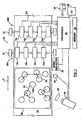
- a labelling apparatus 10 comprises labellers 12a to 12h (referred to individually as labellers 12) mounted by mounts 14 at a fixed position above a conveyer 16, which moves in a downstream direction D.
- the labellers 12 are arranged as an upstream bank 18a of labellers (12a to 12d) and a downstream bank 18d of labellers (12e to 12h).
- Each bank 18a, 18d of labellers extends transversely of the conveyor 16.
- the labellers in a bank are equally spaced and the labellers of the downstream bank 18d are offset from those of the upstream bank 18a so that each labeller has a different transverse position over the conveyor.
- the labellers 12 extend substantially across the width of the conveyor so as to provide eight distinct transverse positions over the conveyor.
- the labellers 12 are operatively connected to a processor 22 on paths 20.
- the processor has an associated memory 23 and user interface 36.
- Memory 23 is loaded with software so that the processor may operate as hereafter described from a computer readable medium which may be, for example, a disk 34, a CD-ROM, a solid state memory chip, or a file downloaded from a remote source.
- the labellers 12 are downstream of an imager 24, which in this embodiment is a colour camera; a filter 25 may be positioned in front of the camera.
- the camera is arranged to image an area of the conveyor and output this image to the processor 22.
- products 26 may be carried in trays 28 and the camera may image an area which captures one such tray.
- a photocell 29 may detect the leading edge of a tray when the tray is within the field of view of the camera and output a detect signal to the camera 24 which prompts the camera to capture the image of the tray.
- the photocell may also output directly to processor 22.
- a conveyor speed indicator 32 (which, for example, may be a rotary encoder, a sensor which senses marks on the conveyor, or, where the conveyor moves at a known constant speed, simply a timer) also outputs to the processor.
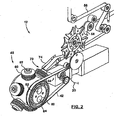
- an example labeller 12 has a rotatably mounted turret 40.
- a timing belt 42 connects the turret 40 to a stepper motor 44.
- a label cassette (not shown) has a cassette magazine (not shown) to which is wound a label web 56.
- the web comprises a release tape 58 carrying a plurality of labels backed with a pressure sensitive adhesive.
- the label web extends from the cassette magazine along a tongue 74 to a label pick-up station 70, with the release tape 58 returning.
- a communication path 20 from the processor 22 ( Figure 1 ) terminates at stepper motor 44.
- the turret 40 has a stationary core 80 with a port 82 for connection to a vacuum source (not shown) and a port 84 for connection to a source of positive pressure (not shown).
- a bellows 60 fabricated of flexible material, such as rubber or silicone, is stretched over a lip of each air diffuser (not shown) extending from the turret 40.
- the tamping end 62 of each bellows is perforated with pin holes. Further details of example labeller 12 may be had from WO 02/102669 published December 27, 2002 .
- Another exemplary tamping labeller is a piston-type tamping labeller, such as the afore-referenced labeller of US 6,257,294 to Weisbeck. Also, it will be appreciated that if the products are of a reasonably uniform nature, other types of labellers may be suitable, such as a labeller which wipes labels onto the products.
- Tray 28 may have a pattern of cup-like depressions, however, as illustrated in Figure 1 , not all of the depressions may hold a product. Thus, the products are unpredictably positioned in the tray. For example, as illustrated, the products may be vine ripened tomatoes which remain attached to vines 30 such that the products are irregularly spaced.
- a user may input the type of products that will be held by trays 28 placed on conveyor 16.
- the processor may retrieve from memory 23 a range of foreground colours indicative of the predominant colour of the products, a range of colours of any obstructions, and a range of background colours indicative of the colour of the trays (S110).
- the trays may be manufactured so as to uniformly have a colour which is distinct from the colour of any product that will be labelled by labelling apparatus 10.
- the trays may be blue in colour and, if so, memory 23 stores a range of blue colours as the background colour.
- the range of foreground colours may be reds. Further a range of greens may be retrieved as indicating the colour of the obstructing vines.
- the conveyor 16 may then be advanced in downstream direction D to convey trays 28, loaded with the indicated products, toward labelling apparatus 10.
- the photocell prompts the camera 24 to image the tray.
- the camera then sends this image to processor 22 (S112).
- the processor can then process this image as follows. With knowledge of the range of colours representative of the product, the processor can electronically filter out from the image all but this range of colours to obtain a first (product colour) filtered image (S114).
- the processor can also electronically filter out the range of colours representative of the background colours, i.e. the colour of the trays, in order to obtain a second (background colour) filtered image (S116).
- the processor can electronically filter out from the camera image all but this range of colours in order to obtain a third (obstruction colour) filtered image (S118).
- a third (obstruction colour) filtered image S118.
- physical filters 25 may be placed in front of the camera. In this instance, the camera may take up to three (rapid) consecutive images and the processor may control which of the filters is in front of the camera while each image is taken. (The control path to the optional filters 25 is not shown).
- the processor may then establish groups of blobs, each group representing a product. In doing so, the processor may overlay the second filter on the first filter in order to assist in establishing the perimeter of each group of blobs. Further, the processor may overlay the third filter on the first filter in order to better delineate the boundary between the blobs and obstructions. Additionally, the processor may connect separated blobs in a group, at least where such orphan blobs are not separated by areas represented in the third filtered image (S120).
- Each labeller 12 ( Figure 1 ) can label a product which lies within a certain range of transverse positions on the conveyor 16.
- the processor may therefore overlay "swaths" (or paths) 212 on the groups 230 of blobs where each swath represents the range of transverse portions over which one labeller can label a product.
- swath 212b represents the transverse positions over which labeller 12b may label a product, and so on.
- the processor may then select a blob that is comfortably within a given swath 212.
- the selection process may involve looking for the largest blob that is comfortably within a given swath. For example, for group 226a (which represents product 26a of Figure 1 ), the processor may note that blob 230b is comfortably within swath 212b and that blob 230a is comfortably within swath 212f. In this instance, the processor may select blob 230a, as it is the larger of the two blobs.
- the processor Once the processor has identified an appropriate swath 212 for a given group of blobs, it chooses the labeller 12 associated with that swath as the labeller to label the product which is represented by the given group of blobs (S122).
- the tray When the photocell 29 detects the leading edge of a tray, the tray is a known distance from labellers 12. This detection signal may be input from the photocell directly to processor 22. Alternatively, this signal may be indirectly received by the processor as the image signal from camera 24. With the processor knowing when the leading edge of a tray is at the photocell and knowing the speed of the conveyor from speed indicator 32, the processor will be aware when each product 26 in tray 28 reaches one of the banks 18 of labellers 12. Thus, the processor can track a product represented by a given group of blobs reaches each bank of labellers. Therefore, the processor can signal the labeller which it chose to label a product represented by the given group of blobs at an appropriate time (S124).
- the processor can track the progress of the tray by notionally progressing the image of the groups of blobs with respect to notional banks of labellers. In this way, the processor will know when a given group of blobs reaches each notional bank of labellers and can fire the chosen labeller for the given group of blobs at the appropriate time.
- the processor may establish groups of blobs with only a filtered image leaving the first range of colours representing a product.
- such an approach is not likely to be as robust as one which also uses a filtered image leaving the background colours.
- the approach becomes even more robust if use is made of a filtered image leaving the obstruction colours.
- a monochrome blob analysis may be used.
- the imager 24 may be a monochrome camera and different grey-scales may be considered to be indicative of different colours.
- the processor may retrieve from memory 23 a range of grey-scales indicative of the predominant colour of the products, a range of grey-scales indicative of background colours (i.e., the colours of the trays), and a range of grey-scales indicative of obstructions. Mechanical or electronic filtering may be used to obtain images of the different ranges of grey-scales which are indicative of the selected colours. Blob-based analysis may then proceed as described hereinbefore in order to target products for labelling.
- processor 22 may obtain and analyse topographic images.
- the processor 22 may be configured to generate a topographic image (without colour information) from output received from stereoscopic cameras (as, for example, infra-red cameras), ultrasonic imagers, sonar imagers, or radar imagers.
- Processor 22 may then be configured to analyse the topographic image to identify topographies indicative of products and then select a suitable high point on each product for labelling.
- Product recognition may be accomplished in any suitable fashion, such as with a neutral network. Where there are obstructions (stems), the processor must also be configured to identify, and avoid labelling, these.
Landscapes
- Image Analysis (AREA)
- Image Processing (AREA)
- Labeling Devices (AREA)
- Sorting Of Articles (AREA)
- Polishing Bodies And Polishing Tools (AREA)
- Vending Machines For Individual Products (AREA)
- Transition And Organic Metals Composition Catalysts For Addition Polymerization (AREA)
- Confectionery (AREA)
Claims (18)
- Produkt-Etikettiervorrichtung (10) mit:einer Mehrzahl von Etikettiergeräten (12a-12h), jedes zum Etikettieren eines Produkts, welches sich innerhalb eines Zielbereichs befindet;einer Bildgebungsvorrichtung (24) zum direkten Abbilden von Produkten;einem Prozessor (22), der auf einen Ausgang der Bildgebungsvorrichtung anspricht und mit einem·Kontroll-Eingang jeder der Mehrzahl der Etikettiergeräte betriebsmäßig verbunden ist;dadurch gekennzeichnet, dass der Prozessor eingerichtet ist zum:Verarbeiten eines von der Bildgebungsvorrichtung empfangenen Bildes, um ein Hindernis am Produkt zu identifizieren und um einen Zielabschnitt eines Produkts zu identifizieren, welcher das Hindernis nicht aufweist und welcher zur Aufnahme eines Etiketts geeignet ist, welcher Zielabschnitt einen Zielbereich eines bestimmten Etikettiergeräts passieren wird; undVerfolgen des Fortschreitens des Zielabschnitts des Produkts und Steuern eines geeigneten der Mehrzahl der Etikettiergeräte, um den Zielabschnitt des Produkts zu etikettieren, wenn sich der Zielabschnitt des Produkts im Zielbereich des bestimmten der Mehrzahl der Etikettiergeräte befindet.
- Produkt-Etikettiervorrichtung (10) nach Anspruch 1, wobei die Bildgebungsvorrichtung (24) eine Farbkamera ist und weiters ein Filter (25) zum Ausfiltern aller Farbbereiche außer einem ersten Bereich von Farben aus dem Bild oder aus dem Licht, das auf der Kamera auftrifft, aufweist, so dass ein gefiltertes Bild für den Prozessor verfügbar ist.
- Produkt-Etikettiervorrichtung (10) nach Anspruch 2, wobei das Verarbeiten eines Bildes umfasst:Verarbeiten des gefilterten Bildes zum Erhalt einer Mehrzahl von Gruppen (226) von Flecken (230), wobei jeder Fleck eine Fläche des ersten Farbbereichs aufweist und jede Gruppe von Flecken ein Produkt darstellt; undAuswählen eines Flecks aus einer bestimmten Gruppe von Flecken auf Basis des Zielbereichs jedes der Etikettiergeräte, wobei ausgewählte Flecken den Zielabschnitt des Produkts repräsentieren, welcher Zielabschnitt den Zielbereich des bestimmten Etikettiergeräts passieren wird.
- Produkt-Etikettiervorrichtung (10) nach Anspruch 3, wobei das Filter ein physikalisches Filter (25) vor der Kamera ist.
- Produkt-Etikettiervorrichtung (10) nach Anspruch 3, wobei das Filter ein elektronisches Filter ist, welches vorzugsweise im Prozessor implementiert ist.
- Produkt-Etikettiervorrichtung (10) nach Anspruch 3, weiters mit einem zweiten Filter zum Ausfiltern aller Farbbereiche außer einem zweiten Farbbereich, der eine Hintergrundfarbe darstellt, aus dem Bild, oder aus einem Licht, das auf der Kamera auftrifft.
- Produkt-Etikettiervorrichtung (10) nach Anspruch 6, wobei der Prozessor weiters zur Verbindung von Flecken (230) in jeder Gruppe von Flecken (226) vorgesehen ist, um ein Produkt darzustellen, und wobei das Auswählen nach dem Verbinden erfolgt, und wobei vorzugsweise das Verbinden das Überlagern des gefilterten Kamera-Bildes, das die Hintergrundfarbe darstellt, auf das gefilterte Bild, das den ersten Farbbereich aufweist, umfasst, um das Identifizieren der Gruppen von Flecken (226) zu unterstützen.
- Produkt-Etikettiervorrichtung (10) nach Anspruch 7, weiters mit einem dritten Filter zum Ausfiltern aller Farbbereiche außer einem dritten Bereich von Farben, der Farben von Hindernissen darstellt, und wobei das Verbinden das Überlagern des gefilterten Bildes, das die Farben der Hindernisse darstellt, auf das gefilterte Bild mit dem ersten Bereich von Farben umfasst, um das Identifizieren der Gruppen von Flecken (226) zu unterstützen.
- Produkt-Etikettiervorrichtung (10) nach Anspruch 1, weiters mit einem Förderer (16), der eingerichtet ist, die Produkte durch ein Sichtfeld der Bildgebungsvorrichtung (24) hindurch und am Etikettiergerät (12) vorbei zu bewegen.
- Produkt-Etikettiervorrichtung (10) nach Anspruch 1, wobei die Produkte Stücke landwitschaftlicher Erzeugnisse sind und wobei vorzugsweise die Etikettiergeräte (12) Druck-Etikettiergeräte sind.
- Produkt-Etikettiervorrichtung (10) nach Anspruch 8, wobei die Produkte rote Tomaten sind, wobei Gruppen der Tomaten durch grüne Rispen miteinander verbunden sind und wobei das Filter rotes Licht hindurch lässt und das dritte Filter grünes Licht hindurch lässt.
- Produkt-Etikettiervorrichtung (10) nach Anspruch 3, wobei die Auswahl auch auf Größen der Flecken (230) in der bestimmten Gruppe von Flecken (226) beruht.
- Produkt-Etikettiervorrichtung (10) nach Anspruch 1, wobei der Prozessor zum Verarbeiten eines Bildes vorgesehen ist, um ein topographisches Bild zu erzeugen und um das topographische Bild zu analysieren, um Topographien zu identifizieren, die die Produkte anzeigen, und um an jedem Produkt einen hohen Punkt zum Etikettieren auszuwählen.
- Produkt-Etikettiervorrichtung (10) nach Anspruch 13, wobei die Bildgebungsvorrichtung (24) eine Stereoskop-Kamera ist, oder wobei die Bilder Schallwellen sind, oder wobei die Bildgebungsvorrichtung (24) eine Radar-Bildgebungsvorrichtung ist.
- Produkt-Etikettiervorrichtung (10) nach Anspruch 1, wobei die Bildgebungsvorrichtung (24) eine Monochrom-Kamera ist und weiters ein Filter zum Ausfiltern von allen außer einem ersten Bereich von Grautönen aus dem Bild oder aus dem Licht, das auf die Kamera auftrifft, umfasst, so dass ein gefiltertes Bild für den Prozessor (22) zur Verfügung steht, und wobei vorzugsweise die Verarbeitung eines Bildes umfasst:Verarbeiten des gefilterten Bildes zum Erhalt einer Mehrzahl von Gruppen von Flecken (226), wobei jeder Fleck ein Feld des ersten Bereichs von Grautönen aufweist und wobei jede Gruppe von Flecken ein Produkt darstellt; undAuswählen eines Flecks aus einer bestimmten Gruppe von Flecken auf Basis des Zielbereichs jedes der Etikettiergeräte, wobei der ausgewählte Fleck den Zielabschnitt des Produkts darstellt, welcher Zielabschnitt den Zielbereich des bestimmten Etikettiergeräts passieren wird.
- Produkt-Etikettiervorrichtung (10) nach Anspruch 1, bei welcher der Prozessor eingerichtet ist zum:Verarbeiten des Bildes, um das Bild auf eine Darstellung einer Mehrzahl von Flecken (226) zu reduzieren;Analysieren der Darstellung, um einen der Mehrzahl von Flecken innerhalb eines Etikettierbereichs des Etikettiergeräts auszuwählen; undSteuern des Etikettiergeräts derart, dass das Etikettiergerät ein Etikett an einem Zielbereich des Produkts anbringt, wobei der Zielbereich des Produkts einem der Mehrzahl von Flecken innerhalb des Etikettierbereichs des Etikettiergeräts entspricht.
- Verfahren zum Etikettieren von landwirtschaftlichen Produkten, welches umfasst:direktes Abbilden der Produkte (24);dadurch gekennzeichnet, dass aus der Abbildung ein Hindernis auf einem Produkt identifiziert und ein Zielabschnitt des Produkts, der das Hindernis nicht aufweist, als zum Aufnehmen eines Etiketts geeignet identifiziert wird, und das einen Zielbereich eines bestimmten von einer Mehrzahl von Etikettiergeräten (12a-12h) passieren wird; und dass das Fortschreiten des Zielabschnitts des Produkts verfolgt und ein geeignetes der Mehrzahl der Etikettiergeräte gesteuert wird, den Zielabschnitt des Produkts zu etikettieren, wenn sich der Zielabschnitt des Produkts im Zielbereich des bestimmten der Mehrzahl von Etikettiergeräten befindet.
- Verfahren zum Etikettieren von landwirtschaftlichen Produkten nach Anspruch 17, welches umfasst:Filtern des Bildes, um einen ersten Bereich von Farben, der Farben des Produkts darstellt, übrig zu lassen;Erhalten einer Mehrzahl von Gruppen von Flecken (226), wobei jeder Fleck eine Fläche des ersten Farbbereichs aufweist und wobei jede Gruppe von Flecken eines der Produkte darstellt;Auswählen eines Flecks aus einer bestimmten Gruppe von Flecken, welcher Fleck einen Zielbereich eines bestimmten Produkts darstellt, welches einen Zielbereich eines bestimmten Etikettiergeräts (12) passieren wird;Verfolgen des bestimmten Produkts, das durch die bestimmte Gruppe von Flecken dargestellt ist; undSteuern des bestimmten Etikettiergeräts, um den Zielbereich des bestimmten Produkts zu etikettieren.
Priority Applications (2)
| Application Number | Priority Date | Filing Date | Title |
|---|---|---|---|
| PL04257236T PL1533236T3 (pl) | 2003-11-21 | 2004-11-22 | Etykietowanie produktów |
| CY20091100379T CY1108952T1 (el) | 2003-11-21 | 2009-03-31 | Επικολληση ετικετων σε προϊοντα |
Applications Claiming Priority (2)
| Application Number | Priority Date | Filing Date | Title |
|---|---|---|---|
| US10/719,636 US7153378B2 (en) | 2003-11-21 | 2003-11-21 | Product labelling |
| US719636 | 2003-11-21 |
Publications (2)
| Publication Number | Publication Date |
|---|---|
| EP1533236A1 EP1533236A1 (de) | 2005-05-25 |
| EP1533236B1 true EP1533236B1 (de) | 2009-01-07 |
Family
ID=34435813
Family Applications (1)
| Application Number | Title | Priority Date | Filing Date |
|---|---|---|---|
| EP04257236A Expired - Lifetime EP1533236B1 (de) | 2003-11-21 | 2004-11-22 | Etikettieren von Produkten |
Country Status (11)
| Country | Link |
|---|---|
| US (1) | US7153378B2 (de) |
| EP (1) | EP1533236B1 (de) |
| AT (1) | ATE420028T1 (de) |
| AU (1) | AU2004231225B2 (de) |
| CA (1) | CA2487995C (de) |
| CY (1) | CY1108952T1 (de) |
| DE (1) | DE602004018891D1 (de) |
| ES (1) | ES2319651T3 (de) |
| MX (1) | MXPA04011544A (de) |
| PL (1) | PL1533236T3 (de) |
| PT (1) | PT1533236E (de) |
Families Citing this family (14)
| Publication number | Priority date | Publication date | Assignee | Title |
|---|---|---|---|---|
| US6729375B2 (en) * | 2001-06-19 | 2004-05-04 | Joe & Samia Management Inc. | Labelling apparatus and method |
| US7949154B2 (en) | 2006-12-18 | 2011-05-24 | Cryovac, Inc. | Method and system for associating source information for a source unit with a product converted therefrom |
| CA2798674C (en) | 2008-05-05 | 2013-12-17 | Joe And Samia Management Inc. | Labeller |
| MX2013002795A (es) | 2010-09-13 | 2013-05-09 | Sinclair Systems International Llc | Sistema de reconocimiento de vision para etiquetado de productos agricolas. |
| US9809730B2 (en) * | 2015-06-10 | 2017-11-07 | Upm Raflatac Oy | Printable label comprising a clear face layer and a clear adhesive layer |
| US10078977B2 (en) * | 2015-12-04 | 2018-09-18 | Chromera, Inc. | Optically determining messages on a display |
| WO2017165737A1 (en) | 2016-03-24 | 2017-09-28 | Sleiman Sumier | Labeller and method of using the same |
| WO2018081613A1 (en) | 2016-10-28 | 2018-05-03 | Ppg Industries Ohio, Inc. | Coatings for increasing near-infrared detection distances |
| KR20240144457A (ko) | 2018-11-13 | 2024-10-02 | 피피지 인더스트리즈 오하이오 인코포레이티드 | 은닉 패턴을 검출하는 방법 |
| US11561329B2 (en) | 2019-01-07 | 2023-01-24 | Ppg Industries Ohio, Inc. | Near infrared control coating, articles formed therefrom, and methods of making the same |
| US11605177B2 (en) * | 2019-06-11 | 2023-03-14 | Cognex Corporation | System and method for refining dimensions of a generally cuboidal 3D object imaged by 3D vision system and controls for the same |
| US11335021B1 (en) | 2019-06-11 | 2022-05-17 | Cognex Corporation | System and method for refining dimensions of a generally cuboidal 3D object imaged by 3D vision system and controls for the same |
| DE102021112479A1 (de) | 2021-05-12 | 2022-11-17 | Espera-Werke Gmbh | Verfahren zum Betrieb eines Etikettiersystems |
| CN116409489B (zh) * | 2023-06-09 | 2023-09-05 | 金动力智能科技(深圳)有限公司 | 一种编带检测贴标机 |
Family Cites Families (13)
| Publication number | Priority date | Publication date | Assignee | Title |
|---|---|---|---|---|
| US189741A (en) * | 1877-04-17 | Improvement in water-closets | ||
| US4574393A (en) * | 1983-04-14 | 1986-03-04 | Blackwell George F | Gray scale image processor |
| US5155683A (en) * | 1991-04-11 | 1992-10-13 | Wadiatur Rahim | Vehicle remote guidance with path control |
| US5448652A (en) * | 1991-09-27 | 1995-09-05 | E. I. Du Pont De Nemours And Company | Adaptive display system |
| DE69228120T2 (de) * | 1992-10-19 | 1999-08-05 | International Business Machines Corp., Armonk, N.Y. | Verfahren und Vorrichtung zum Unterdrücken einer Farbe in mehrfarbigen Dokumenten |
| CA2142960C (en) * | 1995-02-17 | 2004-05-11 | William Rietheimer | Produce labeller |
| WO1997002951A1 (en) | 1995-07-07 | 1997-01-30 | Maliner Bruce J | Label scanning system |
| US5848189A (en) * | 1996-03-25 | 1998-12-08 | Focus Automation Systems Inc. | Method, apparatus and system for verification of patterns |
| DE19750204A1 (de) | 1997-11-13 | 1999-05-27 | Etifix Etikettiersysteme Gmbh | Anlage und Verfahren zum Etikettieren von Gegenständen unterschiedlicher Größe |
| US6257294B1 (en) * | 1998-03-10 | 2001-07-10 | Agri-Tech, Ltd. | High speed produce label applicator |
| FR2796143B1 (fr) * | 1999-07-07 | 2001-09-21 | Xeda International | Dispositif d'evaluation de la geometrie d'articles transportes par un convoyeur |
| US6493079B1 (en) * | 2000-09-07 | 2002-12-10 | National Instruments Corporation | System and method for machine vision analysis of an object using a reduced number of cameras |
| US6729375B2 (en) | 2001-06-19 | 2004-05-04 | Joe & Samia Management Inc. | Labelling apparatus and method |
-
2003
- 2003-11-21 US US10/719,636 patent/US7153378B2/en not_active Expired - Lifetime
-
2004
- 2004-11-19 AU AU2004231225A patent/AU2004231225B2/en not_active Expired
- 2004-11-19 CA CA002487995A patent/CA2487995C/en not_active Expired - Lifetime
- 2004-11-19 MX MXPA04011544A patent/MXPA04011544A/es active IP Right Grant
- 2004-11-22 ES ES04257236T patent/ES2319651T3/es not_active Expired - Lifetime
- 2004-11-22 AT AT04257236T patent/ATE420028T1/de active
- 2004-11-22 PL PL04257236T patent/PL1533236T3/pl unknown
- 2004-11-22 PT PT04257236T patent/PT1533236E/pt unknown
- 2004-11-22 DE DE602004018891T patent/DE602004018891D1/de not_active Expired - Lifetime
- 2004-11-22 EP EP04257236A patent/EP1533236B1/de not_active Expired - Lifetime
-
2009
- 2009-03-31 CY CY20091100379T patent/CY1108952T1/el unknown
Also Published As
| Publication number | Publication date |
|---|---|
| EP1533236A1 (de) | 2005-05-25 |
| CY1108952T1 (el) | 2014-07-02 |
| MXPA04011544A (es) | 2005-07-01 |
| DE602004018891D1 (de) | 2009-02-26 |
| AU2004231225B2 (en) | 2007-12-20 |
| US20050109443A1 (en) | 2005-05-26 |
| CA2487995C (en) | 2008-12-23 |
| AU2004231225A1 (en) | 2005-06-09 |
| PT1533236E (pt) | 2009-02-20 |
| US7153378B2 (en) | 2006-12-26 |
| PL1533236T3 (pl) | 2009-06-30 |
| CA2487995A1 (en) | 2005-05-21 |
| ATE420028T1 (de) | 2009-01-15 |
| ES2319651T3 (es) | 2009-05-11 |
Similar Documents
| Publication | Publication Date | Title |
|---|---|---|
| EP1533236B1 (de) | Etikettieren von Produkten | |
| Raja et al. | Real-time robotic weed knife control system for tomato and lettuce based on geometric appearance of plant labels | |
| US4843561A (en) | Apparatus for locating and manipulating agricultural products | |
| CN107529719B (zh) | 用于播种种子的系统和方法 | |
| Woebbecke et al. | Shape features for identifying young weeds using image analysis | |
| US9156064B2 (en) | Apparatus and method for sorting plant material | |
| EP0997064A3 (de) | Startvorrichtung für Verteilmaschinen von landwirtschaftlichen Produkten | |
| EP3911142B1 (de) | Safransammelvorrichtung | |
| JP2017080661A (ja) | 選別装置 | |
| JP2022509749A (ja) | 根菜類を収穫する機械の動作を制御する方法 | |
| WO2016171546A1 (en) | Agricultural processing machine with a measuring device behind a window and agricultural material processing method | |
| JP3054706B1 (ja) | ナスの自動収穫方法及び装置 | |
| US12507616B2 (en) | Root crop harvester | |
| US20040094006A1 (en) | Method and apparatus for inspecting and cutting elongated articles | |
| IES970572A2 (en) | Apparatus for preparing mushrooms | |
| EP3798638B1 (de) | Probenverarbeitungsvorrichtung und probenverarbeitungsverfahren | |
| WO2022123889A1 (ja) | 作業車、作物状態検出システム、作物状態検出方法、作物状態検出プログラム、及び作物状態検出プログラムが記録されている記録媒体 | |
| EP3466553A1 (de) | Vorrichtung und verfahren zum klassifizieren von saatgut | |
| JP2000237696A (ja) | 物品検査装置 | |
| CN111957594A (zh) | 一种检测锥状物位姿及自动分拣锥状物的装置及分拣方法 | |
| US11666947B2 (en) | Selector machine | |
| CN113607168B (zh) | 扦插机器视觉定位装置及方法 | |
| AU2006202169A1 (en) | An improved label applicator | |
| CA2434893C (en) | Method and apparatus for inspecting and cutting elongated articles | |
| CN121732447A (zh) | 食用菌的分拣方法及系统 |
Legal Events
| Date | Code | Title | Description |
|---|---|---|---|
| PUAI | Public reference made under article 153(3) epc to a published international application that has entered the european phase |
Free format text: ORIGINAL CODE: 0009012 |
|
| AK | Designated contracting states |
Kind code of ref document: A1 Designated state(s): AT BE BG CH CY CZ DE DK EE ES FI FR GB GR HU IE IS IT LI LU MC NL PL PT RO SE SI SK TR |
|
| AX | Request for extension of the european patent |
Extension state: AL HR LT LV MK YU |
|
| 17P | Request for examination filed |
Effective date: 20050622 |
|
| AKX | Designation fees paid |
Designated state(s): AT BE BG CH CY CZ DE DK EE ES FI FR GB GR HU IE IS IT LI LU MC NL PL PT RO SE SI SK TR |
|
| 17Q | First examination report despatched |
Effective date: 20051025 |
|
| GRAP | Despatch of communication of intention to grant a patent |
Free format text: ORIGINAL CODE: EPIDOSNIGR1 |
|
| GRAS | Grant fee paid |
Free format text: ORIGINAL CODE: EPIDOSNIGR3 |
|
| GRAA | (expected) grant |
Free format text: ORIGINAL CODE: 0009210 |
|
| AK | Designated contracting states |
Kind code of ref document: B1 Designated state(s): AT BE BG CH CY CZ DE DK EE ES FI FR GB GR HU IE IS IT LI LU MC NL PL PT RO SE SI SK TR |
|
| REG | Reference to a national code |
Ref country code: GB Ref legal event code: FG4D |
|
| REG | Reference to a national code |
Ref country code: CH Ref legal event code: EP Ref country code: CH Ref legal event code: NV Representative=s name: KIRKER & CIE S.A. |
|
| REG | Reference to a national code |
Ref country code: IE Ref legal event code: FG4D |
|
| REG | Reference to a national code |
Ref country code: PT Ref legal event code: SC4A Free format text: AVAILABILITY OF NATIONAL TRANSLATION Effective date: 20090211 |
|
| REF | Corresponds to: |
Ref document number: 602004018891 Country of ref document: DE Date of ref document: 20090226 Kind code of ref document: P |
|
| REG | Reference to a national code |
Ref country code: GR Ref legal event code: EP Ref document number: 20090400410 Country of ref document: GR |
|
| REG | Reference to a national code |
Ref country code: SE Ref legal event code: TRGR |
|
| REG | Reference to a national code |
Ref country code: ES Ref legal event code: FG2A Ref document number: 2319651 Country of ref document: ES Kind code of ref document: T3 |
|
| PG25 | Lapsed in a contracting state [announced via postgrant information from national office to epo] |
Ref country code: SI Free format text: LAPSE BECAUSE OF FAILURE TO SUBMIT A TRANSLATION OF THE DESCRIPTION OR TO PAY THE FEE WITHIN THE PRESCRIBED TIME-LIMIT Effective date: 20090107 |
|
| REG | Reference to a national code |
Ref country code: PL Ref legal event code: T3 |
|
| PG25 | Lapsed in a contracting state [announced via postgrant information from national office to epo] |
Ref country code: FI Free format text: LAPSE BECAUSE OF FAILURE TO SUBMIT A TRANSLATION OF THE DESCRIPTION OR TO PAY THE FEE WITHIN THE PRESCRIBED TIME-LIMIT Effective date: 20090107 |
|
| PG25 | Lapsed in a contracting state [announced via postgrant information from national office to epo] |
Ref country code: IS Free format text: LAPSE BECAUSE OF FAILURE TO SUBMIT A TRANSLATION OF THE DESCRIPTION OR TO PAY THE FEE WITHIN THE PRESCRIBED TIME-LIMIT Effective date: 20090507 |
|
| PG25 | Lapsed in a contracting state [announced via postgrant information from national office to epo] |
Ref country code: EE Free format text: LAPSE BECAUSE OF FAILURE TO SUBMIT A TRANSLATION OF THE DESCRIPTION OR TO PAY THE FEE WITHIN THE PRESCRIBED TIME-LIMIT Effective date: 20090107 Ref country code: DK Free format text: LAPSE BECAUSE OF FAILURE TO SUBMIT A TRANSLATION OF THE DESCRIPTION OR TO PAY THE FEE WITHIN THE PRESCRIBED TIME-LIMIT Effective date: 20090107 Ref country code: CZ Free format text: LAPSE BECAUSE OF FAILURE TO SUBMIT A TRANSLATION OF THE DESCRIPTION OR TO PAY THE FEE WITHIN THE PRESCRIBED TIME-LIMIT Effective date: 20090107 |
|
| PLBE | No opposition filed within time limit |
Free format text: ORIGINAL CODE: 0009261 |
|
| STAA | Information on the status of an ep patent application or granted ep patent |
Free format text: STATUS: NO OPPOSITION FILED WITHIN TIME LIMIT |
|
| PG25 | Lapsed in a contracting state [announced via postgrant information from national office to epo] |
Ref country code: RO Free format text: LAPSE BECAUSE OF FAILURE TO SUBMIT A TRANSLATION OF THE DESCRIPTION OR TO PAY THE FEE WITHIN THE PRESCRIBED TIME-LIMIT Effective date: 20090107 Ref country code: SK Free format text: LAPSE BECAUSE OF FAILURE TO SUBMIT A TRANSLATION OF THE DESCRIPTION OR TO PAY THE FEE WITHIN THE PRESCRIBED TIME-LIMIT Effective date: 20090107 |
|
| 26N | No opposition filed |
Effective date: 20091008 |
|
| PG25 | Lapsed in a contracting state [announced via postgrant information from national office to epo] |
Ref country code: BG Free format text: LAPSE BECAUSE OF FAILURE TO SUBMIT A TRANSLATION OF THE DESCRIPTION OR TO PAY THE FEE WITHIN THE PRESCRIBED TIME-LIMIT Effective date: 20090407 |
|
| PG25 | Lapsed in a contracting state [announced via postgrant information from national office to epo] |
Ref country code: MC Free format text: LAPSE BECAUSE OF NON-PAYMENT OF DUE FEES Effective date: 20091130 |
|
| PGFP | Annual fee paid to national office [announced via postgrant information from national office to epo] |
Ref country code: PL Payment date: 20100930 Year of fee payment: 7 |
|
| PGFP | Annual fee paid to national office [announced via postgrant information from national office to epo] |
Ref country code: AT Payment date: 20101022 Year of fee payment: 7 Ref country code: IE Payment date: 20101028 Year of fee payment: 7 |
|
| PGFP | Annual fee paid to national office [announced via postgrant information from national office to epo] |
Ref country code: CH Payment date: 20101026 Year of fee payment: 7 Ref country code: CY Payment date: 20101011 Year of fee payment: 7 Ref country code: DE Payment date: 20101130 Year of fee payment: 7 Ref country code: PT Payment date: 20101025 Year of fee payment: 7 |
|
| PGFP | Annual fee paid to national office [announced via postgrant information from national office to epo] |
Ref country code: SE Payment date: 20101022 Year of fee payment: 7 Ref country code: GR Payment date: 20101022 Year of fee payment: 7 Ref country code: BE Payment date: 20101116 Year of fee payment: 7 |
|
| PG25 | Lapsed in a contracting state [announced via postgrant information from national office to epo] |
Ref country code: LU Free format text: LAPSE BECAUSE OF NON-PAYMENT OF DUE FEES Effective date: 20091122 |
|
| PG25 | Lapsed in a contracting state [announced via postgrant information from national office to epo] |
Ref country code: HU Free format text: LAPSE BECAUSE OF FAILURE TO SUBMIT A TRANSLATION OF THE DESCRIPTION OR TO PAY THE FEE WITHIN THE PRESCRIBED TIME-LIMIT Effective date: 20090708 |
|
| REG | Reference to a national code |
Ref country code: PT Ref legal event code: MM4A Free format text: LAPSE DUE TO NON-PAYMENT OF FEES Effective date: 20120522 |
|
| BERE | Be: lapsed |
Owner name: JOE & SAMIA MANAGEMENT INC. Effective date: 20111130 |
|
| REG | Reference to a national code |
Ref country code: CH Ref legal event code: PL |
|
| REG | Reference to a national code |
Ref country code: SE Ref legal event code: EUG |
|
| REG | Reference to a national code |
Ref country code: GR Ref legal event code: ML Ref document number: 20090400410 Country of ref document: GR Effective date: 20120605 |
|
| PG25 | Lapsed in a contracting state [announced via postgrant information from national office to epo] |
Ref country code: CH Free format text: LAPSE BECAUSE OF NON-PAYMENT OF DUE FEES Effective date: 20111130 Ref country code: LI Free format text: LAPSE BECAUSE OF NON-PAYMENT OF DUE FEES Effective date: 20111130 |
|
| REG | Reference to a national code |
Ref country code: IE Ref legal event code: MM4A |
|
| PG25 | Lapsed in a contracting state [announced via postgrant information from national office to epo] |
Ref country code: PT Free format text: LAPSE BECAUSE OF NON-PAYMENT OF DUE FEES Effective date: 20120522 Ref country code: GR Free format text: LAPSE BECAUSE OF NON-PAYMENT OF DUE FEES Effective date: 20120605 Ref country code: BE Free format text: LAPSE BECAUSE OF NON-PAYMENT OF DUE FEES Effective date: 20111130 |
|
| REG | Reference to a national code |
Ref country code: DE Ref legal event code: R119 Ref document number: 602004018891 Country of ref document: DE Effective date: 20120601 |
|
| REG | Reference to a national code |
Ref country code: AT Ref legal event code: MM01 Ref document number: 420028 Country of ref document: AT Kind code of ref document: T Effective date: 20111122 |
|
| PG25 | Lapsed in a contracting state [announced via postgrant information from national office to epo] |
Ref country code: CY Free format text: LAPSE BECAUSE OF NON-PAYMENT OF DUE FEES Effective date: 20111122 |
|
| PG25 | Lapsed in a contracting state [announced via postgrant information from national office to epo] |
Ref country code: SE Free format text: LAPSE BECAUSE OF NON-PAYMENT OF DUE FEES Effective date: 20111123 Ref country code: IE Free format text: LAPSE BECAUSE OF NON-PAYMENT OF DUE FEES Effective date: 20111122 |
|
| PG25 | Lapsed in a contracting state [announced via postgrant information from national office to epo] |
Ref country code: AT Free format text: LAPSE BECAUSE OF NON-PAYMENT OF DUE FEES Effective date: 20111122 |
|
| PG25 | Lapsed in a contracting state [announced via postgrant information from national office to epo] |
Ref country code: PL Free format text: LAPSE BECAUSE OF NON-PAYMENT OF DUE FEES Effective date: 20111122 |
|
| REG | Reference to a national code |
Ref country code: PL Ref legal event code: LAPE |
|
| PG25 | Lapsed in a contracting state [announced via postgrant information from national office to epo] |
Ref country code: DE Free format text: LAPSE BECAUSE OF NON-PAYMENT OF DUE FEES Effective date: 20120601 |
|
| REG | Reference to a national code |
Ref country code: FR Ref legal event code: PLFP Year of fee payment: 12 |
|
| REG | Reference to a national code |
Ref country code: FR Ref legal event code: PLFP Year of fee payment: 13 |
|
| REG | Reference to a national code |
Ref country code: FR Ref legal event code: PLFP Year of fee payment: 14 |
|
| REG | Reference to a national code |
Ref country code: FR Ref legal event code: PLFP Year of fee payment: 15 |
|
| PGFP | Annual fee paid to national office [announced via postgrant information from national office to epo] |
Ref country code: GB Payment date: 20230928 Year of fee payment: 20 |
|
| PGFP | Annual fee paid to national office [announced via postgrant information from national office to epo] |
Ref country code: NL Payment date: 20231013 Year of fee payment: 20 Ref country code: FR Payment date: 20230929 Year of fee payment: 20 |
|
| PGFP | Annual fee paid to national office [announced via postgrant information from national office to epo] |
Ref country code: ES Payment date: 20231207 Year of fee payment: 20 |
|
| PGFP | Annual fee paid to national office [announced via postgrant information from national office to epo] |
Ref country code: TR Payment date: 20231121 Year of fee payment: 20 Ref country code: IT Payment date: 20231010 Year of fee payment: 20 |
|
| REG | Reference to a national code |
Ref country code: NL Ref legal event code: MK Effective date: 20241121 |
|
| REG | Reference to a national code |
Ref country code: ES Ref legal event code: FD2A Effective date: 20241202 |
|
| REG | Reference to a national code |
Ref country code: GB Ref legal event code: PE20 Expiry date: 20241121 |
|
| PG25 | Lapsed in a contracting state [announced via postgrant information from national office to epo] |
Ref country code: GB Free format text: LAPSE BECAUSE OF EXPIRATION OF PROTECTION Effective date: 20241121 |
|
| PG25 | Lapsed in a contracting state [announced via postgrant information from national office to epo] |
Ref country code: ES Free format text: LAPSE BECAUSE OF EXPIRATION OF PROTECTION Effective date: 20241123 |
|
| PG25 | Lapsed in a contracting state [announced via postgrant information from national office to epo] |
Ref country code: GB Free format text: LAPSE BECAUSE OF EXPIRATION OF PROTECTION Effective date: 20241121 Ref country code: ES Free format text: LAPSE BECAUSE OF EXPIRATION OF PROTECTION Effective date: 20241123 |