EP1533193A1 - Occupant detection system - Google Patents
Occupant detection system Download PDFInfo
- Publication number
- EP1533193A1 EP1533193A1 EP04027009A EP04027009A EP1533193A1 EP 1533193 A1 EP1533193 A1 EP 1533193A1 EP 04027009 A EP04027009 A EP 04027009A EP 04027009 A EP04027009 A EP 04027009A EP 1533193 A1 EP1533193 A1 EP 1533193A1
- Authority
- EP
- European Patent Office
- Prior art keywords
- weight
- occupant
- weight sensor
- weight sensors
- seat cushion
- Prior art date
- Legal status (The legal status is an assumption and is not a legal conclusion. Google has not performed a legal analysis and makes no representation as to the accuracy of the status listed.)
- Granted
Links
- 238000001514 detection method Methods 0.000 title claims abstract description 9
- 210000001217 buttock Anatomy 0.000 description 5
- OKTJSMMVPCPJKN-UHFFFAOYSA-N Carbon Chemical compound [C] OKTJSMMVPCPJKN-UHFFFAOYSA-N 0.000 description 4
- 229910052799 carbon Inorganic materials 0.000 description 4
- 125000006850 spacer group Chemical group 0.000 description 4
- 239000000463 material Substances 0.000 description 2
- 239000012858 resilient material Substances 0.000 description 2
- 229920003002 synthetic resin Polymers 0.000 description 2
- 239000000057 synthetic resin Substances 0.000 description 2
- 230000000694 effects Effects 0.000 description 1
Images



Classifications
-
- B—PERFORMING OPERATIONS; TRANSPORTING
- B60—VEHICLES IN GENERAL
- B60R—VEHICLES, VEHICLE FITTINGS, OR VEHICLE PARTS, NOT OTHERWISE PROVIDED FOR
- B60R21/00—Arrangements or fittings on vehicles for protecting or preventing injuries to occupants or pedestrians in case of accidents or other traffic risks
- B60R21/01—Electrical circuits for triggering passive safety arrangements, e.g. airbags, safety belt tighteners, in case of vehicle accidents or impending vehicle accidents
- B60R21/015—Electrical circuits for triggering passive safety arrangements, e.g. airbags, safety belt tighteners, in case of vehicle accidents or impending vehicle accidents including means for detecting the presence or position of passengers, passenger seats or child seats, and the related safety parameters therefor, e.g. speed or timing of airbag inflation in relation to occupant position or seat belt use
- B60R21/01512—Passenger detection systems
- B60R21/01516—Passenger detection systems using force or pressure sensing means
-
- B—PERFORMING OPERATIONS; TRANSPORTING
- B60—VEHICLES IN GENERAL
- B60N—SEATS SPECIALLY ADAPTED FOR VEHICLES; VEHICLE PASSENGER ACCOMMODATION NOT OTHERWISE PROVIDED FOR
- B60N2/00—Seats specially adapted for vehicles; Arrangement or mounting of seats in vehicles
- B60N2/002—Seats provided with an occupancy detection means mounted therein or thereon
- B60N2/0021—Seats provided with an occupancy detection means mounted therein or thereon characterised by the type of sensor or measurement
- B60N2/003—Seats provided with an occupancy detection means mounted therein or thereon characterised by the type of sensor or measurement characterised by the sensor mounting location in or on the seat
- B60N2/0033—Seats provided with an occupancy detection means mounted therein or thereon characterised by the type of sensor or measurement characterised by the sensor mounting location in or on the seat mounted on or in the foam cushion
-
- B—PERFORMING OPERATIONS; TRANSPORTING
- B60—VEHICLES IN GENERAL
- B60R—VEHICLES, VEHICLE FITTINGS, OR VEHICLE PARTS, NOT OTHERWISE PROVIDED FOR
- B60R21/00—Arrangements or fittings on vehicles for protecting or preventing injuries to occupants or pedestrians in case of accidents or other traffic risks
- B60R21/01—Electrical circuits for triggering passive safety arrangements, e.g. airbags, safety belt tighteners, in case of vehicle accidents or impending vehicle accidents
- B60R21/015—Electrical circuits for triggering passive safety arrangements, e.g. airbags, safety belt tighteners, in case of vehicle accidents or impending vehicle accidents including means for detecting the presence or position of passengers, passenger seats or child seats, and the related safety parameters therefor, e.g. speed or timing of airbag inflation in relation to occupant position or seat belt use
- B60R21/01512—Passenger detection systems
- B60R21/01516—Passenger detection systems using force or pressure sensing means
- B60R21/0152—Passenger detection systems using force or pressure sensing means using strain gauges
-
- B—PERFORMING OPERATIONS; TRANSPORTING
- B62—LAND VEHICLES FOR TRAVELLING OTHERWISE THAN ON RAILS
- B62J—CYCLE SADDLES OR SEATS; AUXILIARY DEVICES OR ACCESSORIES SPECIALLY ADAPTED TO CYCLES AND NOT OTHERWISE PROVIDED FOR, e.g. ARTICLE CARRIERS OR CYCLE PROTECTORS
- B62J1/00—Saddles or other seats for cycles; Arrangement thereof; Component parts
- B62J1/12—Box-shaped seats; Bench-type seats, e.g. dual or twin seats
-
- B—PERFORMING OPERATIONS; TRANSPORTING
- B60—VEHICLES IN GENERAL
- B60N—SEATS SPECIALLY ADAPTED FOR VEHICLES; VEHICLE PASSENGER ACCOMMODATION NOT OTHERWISE PROVIDED FOR
- B60N2210/00—Sensor types, e.g. for passenger detection systems or for controlling seats
- B60N2210/40—Force or pressure sensors
Definitions
- the present invention relates to an occupant detection system having a plurality of weight sensors arranged in a seat cushion in order to detect an occupant sitting on a seat, the weight sensors being turned on by the weight of the occupant.
- An airbag system for a passenger seat of a motor vehicle detects whether or not an occupant is seated on a seat, and carries out control so that, if an occupant is seated when the vehicle is involved in collision, an airbag is deployed, and if an occupant is not seated, the airbag is not deployed.
- a plurality of weight sensors that are turned on by the weight of an occupant are electrically connected in parallel to each other on an upper face of a seat cushion, and when at least one of the weight sensors is turned on, the system detects that an occupant is seated.
- the system detects that an occupant is seated when any one of the plurality of weight sensors electrically connected in parallel to each other is turned on, and therefore if only one weight sensor is turned on by an article such as a handbag placed on the seat cushion, there is a possibility that seating of an occupant might be erroneously detected.
- the present invention has been accomplished under the above-mentioned circumstances, and it is an object thereof to prevent an article placed on a seat cushion from being erroneously detected as an occupant when detecting an occupant sitting on a seat by means of a plurality of weight sensors provided in the seat cushion.
- an occupant detection system comprising a plurality of weight sensors arranged in a seat cushion in order to detect an occupant sitting on a seat, the weight sensors being turned on by the weight of the occupant, wherein a plurality of weight sensor groups are arranged in the front-and-rear direction, each weight sensor group comprising two weight sensors that are connected in series and arranged to the left and right on an upper face of the seat cushion, wherein the plurality of weight sensor groups are connected in parallel to each other, and wherein an occupant is detected when two of the weight sensors of at least one weight sensor group are both turned on.
- a front weight sensor group 13 and a rear weight sensor group 14 of embodiments correspond to the weight sensor groups of the present invention.
- a seat S for a motor vehicle includes a seat cushion 11 and a seat back 12.
- Four weight sensors 13L and 13R; 14L and 14R having an identical structure are arranged inside a cover of an upper face of the seat cushion 11.
- the two weight sensors 13L and 13R forming a front weight sensor group 13 are arranged so as to be spaced from each other in the lateral direction in a front part of the seat cushion 11.
- the two weight sensors 14L and 14R forming a rear weight sensor group 14 are arranged so as to be spaced from each other in the lateral direction in a rear part of the seat cushion 11.
- the two weight sensors 13L and 13R on the front side are connected in series, via harnesses a , b , c , d , and e, to a pair of terminals 15a and 15b of a controller 15 housed in the rear part of the seat cushion 11.
- the two weight sensors 14L and 14R on the rear side are connected in series, via harnesses a , f , g , h , and e, to the pair of terminals 15a and 15b of the controller 15.
- the front weight sensor group 13 and the rear weight sensor group 14 are connected in parallel to each other.
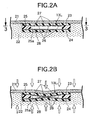
- weight sensors 13L and 13R; 14L and 14R are now described with reference to FIGS. 2A and 2B and FIG. 3. Since the structures of the four weight sensors 13L and 13R; 14L and 14R are all identical, the structure of the weight sensor 13L is described as the representative thereof.
- the weight sensor 13L is disposed so as to be held between a lower face of a cover 21 and an upper face of a cushion material 22 of the seat cushion 11.
- the weight sensor 13L is formed from an upper film 23 and a lower film 24 made of a resilient material such as a synthetic resin, a spacer 25 that has a circular opening 25a and is held between the upper film 23 and the lower film 24, flexible first and second electrodes 26 and 27 made of carbon, etc. and fixed to a lower face of the upper film 23 so as to face the opening 25a, and a flexible circular third electrode 28 made of carbon, etc. and fixed to an upper face of the lower film 24 so as to face the opening 25a.
- the first and second electrodes 26 and 27, which are formed into a comb shape, are arranged so as to mesh with each other, and are connected in series in a circuit linking the pair of terminals 15a and 15b of the controller 15.
- the upper film 23 and the lower film 24 of the weight sensor 13L deform so as to be pushed into the opening 25a of the spacer 25, so that the first and second electrodes 26 and 27 which are fixed to the upper film 23 come into contact with the third electrode 28 which is fixed to the lower film 24 within the opening 25a.
- the first and second electrodes 26 and 27 are connected to each other via the third electrode 28.
- the load of the buttocks of the occupant acts mainly on the front left and right of the seat cushion 11, the two weight sensors 13L and 13R connected in series and forming the front weight sensor group 13 are both turned on, and the pair of terminals 15a and 15b of the controller 15 are connected to each other, so that the seated occupant is detected.
- the sitting posture is such that the occupant sits on a rear part of the seat S
- the load of the buttocks of the occupant acts mainly on the rear left and right of the seat cushion 11
- the two weight sensors 14L and 14R connected in series and forming the rear weight sensor group 14 are both turned on, and the pair of terminals 15a and 15b of the controller 15 are connected to each other, so that the seated occupant is detected.
- the two weight sensors 13L and 13R of the front weight sensor group 13 and the two weight sensors 14L and 14R of the rear weight sensor group 14 might all be turned on, but if either the two weight sensors 13L and 13R on the front side or the two weight sensors 14L and 14R on the rear side are turned on, the occupant can be detected reliably.
- the detection performance of the occupant detection system can be enhanced by means of a simple structure.
- weight sensors 13L and 13R; 14L and 14R of a second embodiment are now described with reference to FIGS. 4A, 4B, and FIG. 5.
- the arrangement is the same as that of the first embodiment.
- the structures of the four weight sensors 13L and 13R; 14L and 14R of the second embodiment are all identical. Therefore, the weight sensor 13L is described as the representative thereof.
- the weight sensor 13L is disposed so as to be held between a lower face of a cover 21 and an upper face of a cushion material 22 of a seat cushion 11.
- the weight sensor 13L is formed from an upper film 23 and a lower film 24 made of a resilient material such as a synthetic resin, a flexible circular first electrode 29 made of carbon, etc. and fixed to a lower face of the upper film 23, a flexible circular second electrode 30 made of carbon, etc. and fixed to an upper face of the lower film 24, and a spacer 25 that has a circular opening 25a and is held between the first and second electrodes 29 and 30.
- the first and second electrodes 29 and 30 are each connected in series in a circuit linking a pair of terminals 15a and 15b of a controller 15.
- the upper film 23 and the lower film 24 of the weight sensor 13L deform so as to be pushed into the opening 25a of the spacer 25, and the first electrode 29 which is fixed to the upper film 23 and the second electrode 30 which is fixed to the lower film 24, come into contact with each other within the opening 25a.
- the front weight sensor group 13 and the rear weight sensor group 14 are provided, but three or more weight sensor groups connected in parallel to each other may be arranged side by side in the front-and-rear direction.
- weight sensors 13L and 13R; 14L and 14R are not limited to those of the embodiments.
- An occupant detection system includes: a front weight sensor group formed from two weight sensors that are connected in series and arranged to the left and right on an upper face of a seat cushion; and a rear weight sensor group formed from two weight sensors that are connected in series and arranged to the left and right on the upper face of the seat cushion.
- the weight sensor groups are connected in parallel to each other. Regardless of whether an occupant sits on a front or rear part of a seat, since the load of the buttocks always acts on both left and right sides of the seat cushion, two series-connected left and right weight sensors of at least one of the plurality of weight sensor groups are both turned on without fail, thereby reliably detecting the occupant.
Landscapes
- Engineering & Computer Science (AREA)
- Mechanical Engineering (AREA)
- Aviation & Aerospace Engineering (AREA)
- Transportation (AREA)
- Seats For Vehicles (AREA)
- Chair Legs, Seat Parts, And Backrests (AREA)
- Air Bags (AREA)
Abstract
Description
- The present invention relates to an occupant detection system having a plurality of weight sensors arranged in a seat cushion in order to detect an occupant sitting on a seat, the weight sensors being turned on by the weight of the occupant.
- An airbag system for a passenger seat of a motor vehicle detects whether or not an occupant is seated on a seat, and carries out control so that, if an occupant is seated when the vehicle is involved in collision, an airbag is deployed, and if an occupant is not seated, the airbag is not deployed.
- In an occupant detection system disclosed in Japanese Patent Application Laid-open No. 10-39045 that is used for such a purpose, a plurality of weight sensors that are turned on by the weight of an occupant are electrically connected in parallel to each other on an upper face of a seat cushion, and when at least one of the weight sensors is turned on, the system detects that an occupant is seated.
- However, in the above-mentioned conventional arrangement, the system detects that an occupant is seated when any one of the plurality of weight sensors electrically connected in parallel to each other is turned on, and therefore if only one weight sensor is turned on by an article such as a handbag placed on the seat cushion, there is a possibility that seating of an occupant might be erroneously detected.
- The present invention has been accomplished under the above-mentioned circumstances, and it is an object thereof to prevent an article placed on a seat cushion from being erroneously detected as an occupant when detecting an occupant sitting on a seat by means of a plurality of weight sensors provided in the seat cushion.
- In order to attain the object, in accordance with the present invention, there is provided an occupant detection system comprising a plurality of weight sensors arranged in a seat cushion in order to detect an occupant sitting on a seat, the weight sensors being turned on by the weight of the occupant, wherein a plurality of weight sensor groups are arranged in the front-and-rear direction, each weight sensor group comprising two weight sensors that are connected in series and arranged to the left and right on an upper face of the seat cushion, wherein the plurality of weight sensor groups are connected in parallel to each other, and wherein an occupant is detected when two of the weight sensors of at least one weight sensor group are both turned on.
- A front
weight sensor group 13 and a rearweight sensor group 14 of embodiments correspond to the weight sensor groups of the present invention. - In accordance with the arrangement of the present invention, regardless of whether an occupant sits on a front or rear part of the seat, since the load of the buttocks always acts on both left and right sides of the seat cushion, two series-connected left and right weight sensors of at least one weight sensor group of the plurality of weight sensor groups are both turned on without fail, whereby the occupant can be reliably detected. When an article such as a handbag is placed on the seat cushion, since the probability of both left and right weight sensors of one group being turned on is low, the possibility of the article being erroneously detected as an occupant is low.
- The above-mentioned object, other objects, characteristics, and advantages of the present invention will become apparent from preferred embodiments that will be described in detail below by reference to the attached drawings.
-
- FIG. 1 is a plan view of a seat equipped with weight sensors according to a first embodiment of the present invention.
- FIGS. 2A and 2B are enlarged sectional views along line 2-2 in FIG. 1.
- FIG. 3 is a view along arrowed line 3-3 in FIG. 2.
- FIGS. 4A and 4B are views, corresponding to FIGS. 2A and 2B, of a weight sensor of a second embodiment.
- FIG. 5 is a view from arrowed line 5-5 in FIG. 4.
-
- As shown in FIG. 1, a seat S for a motor vehicle includes a
seat cushion 11 and aseat back 12. Fourweight sensors seat cushion 11. The twoweight sensors weight sensor group 13 are arranged so as to be spaced from each other in the lateral direction in a front part of theseat cushion 11. The twoweight sensors weight sensor group 14 are arranged so as to be spaced from each other in the lateral direction in a rear part of theseat cushion 11. The twoweight sensors terminals controller 15 housed in the rear part of theseat cushion 11. The twoweight sensors terminals controller 15. The frontweight sensor group 13 and the rearweight sensor group 14 are connected in parallel to each other. - The structures of the
weight sensors weight sensors weight sensor 13L is described as the representative thereof. - The
weight sensor 13L is disposed so as to be held between a lower face of acover 21 and an upper face of acushion material 22 of theseat cushion 11. Theweight sensor 13L is formed from anupper film 23 and alower film 24 made of a resilient material such as a synthetic resin, aspacer 25 that has acircular opening 25a and is held between theupper film 23 and thelower film 24, flexible first andsecond electrodes upper film 23 so as to face the opening 25a, and a flexible circularthird electrode 28 made of carbon, etc. and fixed to an upper face of thelower film 24 so as to face the opening 25a. The first andsecond electrodes terminals controller 15. - Therefore, when the weight of an occupant acts on the
cover 21 of theseat cushion 11, as shown in FIG. 2B, theupper film 23 and thelower film 24 of theweight sensor 13L deform so as to be pushed into the opening 25a of thespacer 25, so that the first andsecond electrodes upper film 23 come into contact with thethird electrode 28 which is fixed to thelower film 24 within the opening 25a. As a result, the first andsecond electrodes third electrode 28. - When an occupant sits on the seat S, if the sitting posture is such that the occupant sits on a front or rear part of the seat S, the load of the buttocks of the occupant acts mainly on the front left and right of the
seat cushion 11, the twoweight sensors weight sensor group 13 are both turned on, and the pair ofterminals controller 15 are connected to each other, so that the seated occupant is detected. If the sitting posture is such that the occupant sits on a rear part of the seat S, the load of the buttocks of the occupant acts mainly on the rear left and right of theseat cushion 11, the twoweight sensors weight sensor group 14 are both turned on, and the pair ofterminals controller 15 are connected to each other, so that the seated occupant is detected. When the occupant sits on a middle part of the seat S, the twoweight sensors weight sensor group 13 and the twoweight sensors weight sensor group 14 might all be turned on, but if either the twoweight sensors weight sensors - On the other hand, when an article such as a handbag is placed on the
seat cushion 11, at most one of the fourweight sensors weight sensors weight sensors - In this way, since the arrangement and wiring of the
weight sensors - The structures of
weight sensors weight sensors weight sensors weight sensor 13L is described as the representative thereof. - The
weight sensor 13L is disposed so as to be held between a lower face of acover 21 and an upper face of acushion material 22 of aseat cushion 11. Theweight sensor 13L is formed from anupper film 23 and alower film 24 made of a resilient material such as a synthetic resin, a flexible circularfirst electrode 29 made of carbon, etc. and fixed to a lower face of theupper film 23, a flexible circularsecond electrode 30 made of carbon, etc. and fixed to an upper face of thelower film 24, and aspacer 25 that has acircular opening 25a and is held between the first andsecond electrodes second electrodes terminals controller 15. - Therefore, when the weight of an occupant acts on the
cover 21 of theseat cushion 11, as shown in FIG. 4B, theupper film 23 and thelower film 24 of theweight sensor 13L deform so as to be pushed into the opening 25a of thespacer 25, and thefirst electrode 29 which is fixed to theupper film 23 and thesecond electrode 30 which is fixed to thelower film 24, come into contact with each other within the opening 25a. - In this way, also in accordance with this second embodiment, the same effects as those of the first embodiment can be obtained.
- Although embodiments of the present invention have been described in detail above, the present invention can be modified in a variety of ways without departing from the subject matter of the present invention.
- For example, in the embodiments, the front
weight sensor group 13 and the rearweight sensor group 14 are provided, but three or more weight sensor groups connected in parallel to each other may be arranged side by side in the front-and-rear direction. - Furthermore, the structures of the
weight sensors - An occupant detection system includes: a front weight sensor group formed from two weight sensors that are connected in series and arranged to the left and right on an upper face of a seat cushion; and a rear weight sensor group formed from two weight sensors that are connected in series and arranged to the left and right on the upper face of the seat cushion. The weight sensor groups are connected in parallel to each other. Regardless of whether an occupant sits on a front or rear part of a seat, since the load of the buttocks always acts on both left and right sides of the seat cushion, two series-connected left and right weight sensors of at least one of the plurality of weight sensor groups are both turned on without fail, thereby reliably detecting the occupant.
Claims (1)
- An occupant detection system comprising a plurality of weight sensors arranged in a seat cushion in order to detect an occupant sitting on a seat, the weight sensors being turned on by the weight of the occupant,
wherein a plurality of weight sensor groups are arranged in the front-and-rear direction, each weight sensor group comprising two weight sensors that are connected in series and arranged to the left and right on an upper face of the seat cushion,
wherein the plurality of weight sensor groups are connected in parallel to each other, and
wherein an occupant is detected when two of the weight sensors of at least one weight sensor group are both turned on.
Applications Claiming Priority (2)
| Application Number | Priority Date | Filing Date | Title |
|---|---|---|---|
| JP2003390937A JP4430381B2 (en) | 2003-11-20 | 2003-11-20 | Occupant detection device |
| JP2003390937 | 2003-11-20 |
Publications (2)
| Publication Number | Publication Date |
|---|---|
| EP1533193A1 true EP1533193A1 (en) | 2005-05-25 |
| EP1533193B1 EP1533193B1 (en) | 2010-01-13 |
Family
ID=34431600
Family Applications (1)
| Application Number | Title | Priority Date | Filing Date |
|---|---|---|---|
| EP04027009A Expired - Lifetime EP1533193B1 (en) | 2003-11-20 | 2004-11-12 | Occupant detection system |
Country Status (5)
| Country | Link |
|---|---|
| US (1) | US7162344B2 (en) |
| EP (1) | EP1533193B1 (en) |
| JP (1) | JP4430381B2 (en) |
| CN (1) | CN1296728C (en) |
| DE (1) | DE602004025077D1 (en) |
Cited By (7)
| Publication number | Priority date | Publication date | Assignee | Title |
|---|---|---|---|---|
| EP1591321A3 (en) * | 2004-04-28 | 2005-12-14 | Denso Corporation | Sitting sensor for vehicle |
| FR2888789A1 (en) * | 2005-07-20 | 2007-01-26 | Peugeot Citroen Automobiles Sa | AUTOMOTIVE VEHICLE SEAT MAINASSURE AND METHOD OF MAKING SUCH A MATTRESS |
| WO2008043536A1 (en) * | 2006-10-12 | 2008-04-17 | Piero Enrico Gilardi | Method for producing a presence sensor, in particular for seat pans of vehicle seats, and presence sensor produced according to said method |
| DE102007016119A1 (en) * | 2007-04-03 | 2008-10-09 | Continental Automotive Gmbh | Seat occupancy sensor for motor vehicle, has recess provided in area of connection structures in sections in distance layer such that connection structures does not contact with coupling agent in area of recess |
| US7708101B2 (en) | 2005-01-24 | 2010-05-04 | F.S. Fehrer Automotive Gmbh | Motor vehicle seat having occupant detector |
| LU92400B1 (en) * | 2014-03-17 | 2015-09-18 | Iee Interntional Electronics & Engineering Sa | Seat occupancy sensor |
| US11945386B2 (en) | 2020-07-29 | 2024-04-02 | Langfang Golden Time Technology Development Co., Ltd. | Pneumatic identification apparatus for weight of seat occupant, and pneumatic identification seat |
Families Citing this family (34)
| Publication number | Priority date | Publication date | Assignee | Title |
|---|---|---|---|---|
| DE10304570B4 (en) * | 2003-02-05 | 2012-10-18 | Volkswagen Ag | Driver's seat with weight sensor |
| US7395895B2 (en) * | 2005-12-02 | 2008-07-08 | Seats, Inc. | Seat switch |
| JP4721062B2 (en) * | 2006-11-28 | 2011-07-13 | 株式会社デンソー | Seating sensor |
| DE102007056238B4 (en) * | 2006-11-29 | 2012-05-31 | Denso Corporation | load sensor |
| JP2008132928A (en) * | 2006-11-29 | 2008-06-12 | Denso Corp | Seating sensor |
| JP4779957B2 (en) * | 2006-12-15 | 2011-09-28 | 株式会社デンソー | Occupant protection system |
| JP5103027B2 (en) * | 2007-01-29 | 2012-12-19 | トヨタ紡織株式会社 | Vehicle seat |
| JP5103028B2 (en) * | 2007-01-29 | 2012-12-19 | トヨタ紡織株式会社 | Vehicle seat |
| US7726432B2 (en) * | 2007-06-29 | 2010-06-01 | Seats, Inc. | Seat assembly with ignition switch and switch actuator |
| DE102008053626B4 (en) | 2007-10-31 | 2016-09-08 | Denso Corporation | Seat sensor |
| JP5499491B2 (en) * | 2009-02-27 | 2014-05-21 | アイシン精機株式会社 | Occupant detection sensor and occupant detection system |
| WO2011047171A2 (en) | 2009-10-16 | 2011-04-21 | Kesumo, Llc | Foot-operated controller |
| BR112012018816B1 (en) * | 2009-12-21 | 2021-07-27 | Aisin Seiki Kabushiki Kaisha | SEAT CUSHION FOR A VEHICLE SEAT AND METHOD FOR MOUNTING A LOAD DETECTION DEVICE |
| CN102172888B (en) * | 2011-02-16 | 2013-01-30 | 清华大学 | Polishing head |
| US8393432B2 (en) | 2011-03-18 | 2013-03-12 | Seats, Inc. | Vehicle seat switch actuator |
| CN102424027B (en) * | 2011-11-14 | 2014-02-12 | 江苏大学 | Device and method for identifying passenger type and sitting posture based on sitting trace |
| US9076419B2 (en) | 2012-03-14 | 2015-07-07 | Bebop Sensors, Inc. | Multi-touch pad controller |
| CN103852804A (en) * | 2012-12-04 | 2014-06-11 | 刘卫建 | Automatic personnel positioning device |
| JP5604566B1 (en) * | 2013-07-05 | 2014-10-08 | 株式会社フジクラ | Membrane switch and seat device |
| JP6193657B2 (en) * | 2013-07-17 | 2017-09-06 | 株式会社フジクラ | Motorcycle seat device and motorcycle |
| CN103514737B (en) * | 2013-09-18 | 2016-12-07 | 杭州九树网络科技有限公司 | Intelligence share-car control system and intelligence car pooling control method |
| US10362989B2 (en) | 2014-06-09 | 2019-07-30 | Bebop Sensors, Inc. | Sensor system integrated with a glove |
| CN104095441A (en) * | 2014-06-30 | 2014-10-15 | 张全成 | System capable of controlling air-conditioner through seats and conducting head counting |
| US9827996B2 (en) | 2015-06-25 | 2017-11-28 | Bebop Sensors, Inc. | Sensor systems integrated with steering wheels |
| US20170305301A1 (en) * | 2016-04-22 | 2017-10-26 | Bebop Sensors, Inc. | Vehicle seat sensor systems for use with occupant classification systems |
| JP6744570B2 (en) * | 2016-06-17 | 2020-08-19 | アイシン精機株式会社 | Occupancy detection device |
| JP6740747B2 (en) | 2016-06-23 | 2020-08-19 | アイシン精機株式会社 | Seating detection method and seating detection device |
| JP6574213B2 (en) * | 2017-03-08 | 2019-09-11 | アイシン精機株式会社 | Seating sensor |
| US10553097B2 (en) * | 2017-11-09 | 2020-02-04 | Chukwunoso ARINZE | Interactive smart seat system |
| US11958385B2 (en) * | 2018-04-09 | 2024-04-16 | Ts Tech Co., Ltd. | Seat |
| US10884496B2 (en) | 2018-07-05 | 2021-01-05 | Bebop Sensors, Inc. | One-size-fits-all data glove |
| US11480481B2 (en) | 2019-03-13 | 2022-10-25 | Bebop Sensors, Inc. | Alignment mechanisms sensor systems employing piezoresistive materials |
| FR3116900B1 (en) | 2020-11-27 | 2023-01-13 | Faurecia Sieges Dautomobile | Method for determining the occupancy state of a seat and corresponding determination system |
| JP7641783B2 (en) | 2021-03-25 | 2025-03-07 | 株式会社フジクラ | Seat sensor and seat device |
Citations (7)
| Publication number | Priority date | Publication date | Assignee | Title |
|---|---|---|---|---|
| GB1467769A (en) * | 1974-04-15 | 1977-03-23 | Nissan Motor | Vehicle having apparatus for inflating vehicle passenger protection bag with seat occupant detector |
| JPH1039045A (en) | 1996-07-24 | 1998-02-13 | Toyota Motor Corp | Occupant detection sensor |
| US6109117A (en) * | 1996-12-19 | 2000-08-29 | Automotive Systems Laboratory, Inc. | Seat weight sensor |
| US6367837B1 (en) * | 1999-03-18 | 2002-04-09 | Toyota Jidosha Kabushiki Kaisha | Seated-state detection sensor and passenger seat air bag device control system employing the seated-state detection sensor |
| US20020163171A1 (en) * | 1999-12-14 | 2002-11-07 | Ekkehard Kraft | Vehicle occupant protection system having a child seat for a motor vehicle |
| DE10143326A1 (en) * | 2001-09-05 | 2003-03-27 | Bosch Gmbh Robert | Device for weight classification of persons, especially motor vehicle seat occupants has an array of seat pressure sensors that are joined into groups |
| EP1491408A1 (en) * | 2003-06-23 | 2004-12-29 | IEE INTERNATIONAL ELECTRONICS & ENGINEERING S.A. | Seat occupant sensor |
Family Cites Families (5)
| Publication number | Priority date | Publication date | Assignee | Title |
|---|---|---|---|---|
| WO1998014345A2 (en) * | 1996-10-03 | 1998-04-09 | I.E.E. International Electronics & Engineering S.A.R.L. | Method and device for determining several parameters of a seated person |
| US20010040056A1 (en) * | 1997-09-19 | 2001-11-15 | Aloyse Schoos | Method and device for determining several parameters of a person sitting on a seat |
| JP3685475B2 (en) * | 1998-03-26 | 2005-08-17 | タカタ株式会社 | Seat weight measuring device |
| DE602004024258D1 (en) * | 2003-05-20 | 2009-12-31 | Fujikura Ltd | Seating detection switch |
| JP2005069968A (en) * | 2003-08-27 | 2005-03-17 | Aisin Seiki Co Ltd | Seating detection device |
-
2003
- 2003-11-20 JP JP2003390937A patent/JP4430381B2/en not_active Expired - Fee Related
-
2004
- 2004-11-12 US US10/987,906 patent/US7162344B2/en not_active Expired - Lifetime
- 2004-11-12 EP EP04027009A patent/EP1533193B1/en not_active Expired - Lifetime
- 2004-11-12 DE DE602004025077T patent/DE602004025077D1/en not_active Expired - Lifetime
- 2004-11-19 CN CNB2004100866316A patent/CN1296728C/en not_active Expired - Fee Related
Patent Citations (7)
| Publication number | Priority date | Publication date | Assignee | Title |
|---|---|---|---|---|
| GB1467769A (en) * | 1974-04-15 | 1977-03-23 | Nissan Motor | Vehicle having apparatus for inflating vehicle passenger protection bag with seat occupant detector |
| JPH1039045A (en) | 1996-07-24 | 1998-02-13 | Toyota Motor Corp | Occupant detection sensor |
| US6109117A (en) * | 1996-12-19 | 2000-08-29 | Automotive Systems Laboratory, Inc. | Seat weight sensor |
| US6367837B1 (en) * | 1999-03-18 | 2002-04-09 | Toyota Jidosha Kabushiki Kaisha | Seated-state detection sensor and passenger seat air bag device control system employing the seated-state detection sensor |
| US20020163171A1 (en) * | 1999-12-14 | 2002-11-07 | Ekkehard Kraft | Vehicle occupant protection system having a child seat for a motor vehicle |
| DE10143326A1 (en) * | 2001-09-05 | 2003-03-27 | Bosch Gmbh Robert | Device for weight classification of persons, especially motor vehicle seat occupants has an array of seat pressure sensors that are joined into groups |
| EP1491408A1 (en) * | 2003-06-23 | 2004-12-29 | IEE INTERNATIONAL ELECTRONICS & ENGINEERING S.A. | Seat occupant sensor |
Non-Patent Citations (1)
| Title |
|---|
| PATENT ABSTRACTS OF JAPAN vol. 1998, no. 06 30 April 1998 (1998-04-30) * |
Cited By (9)
| Publication number | Priority date | Publication date | Assignee | Title |
|---|---|---|---|---|
| EP1591321A3 (en) * | 2004-04-28 | 2005-12-14 | Denso Corporation | Sitting sensor for vehicle |
| US7708101B2 (en) | 2005-01-24 | 2010-05-04 | F.S. Fehrer Automotive Gmbh | Motor vehicle seat having occupant detector |
| FR2888789A1 (en) * | 2005-07-20 | 2007-01-26 | Peugeot Citroen Automobiles Sa | AUTOMOTIVE VEHICLE SEAT MAINASSURE AND METHOD OF MAKING SUCH A MATTRESS |
| WO2008043536A1 (en) * | 2006-10-12 | 2008-04-17 | Piero Enrico Gilardi | Method for producing a presence sensor, in particular for seat pans of vehicle seats, and presence sensor produced according to said method |
| DE102007016119A1 (en) * | 2007-04-03 | 2008-10-09 | Continental Automotive Gmbh | Seat occupancy sensor for motor vehicle, has recess provided in area of connection structures in sections in distance layer such that connection structures does not contact with coupling agent in area of recess |
| DE102007016119B4 (en) * | 2007-04-03 | 2009-07-30 | Continental Automotive Gmbh | Seat occupancy sensor for the control of an occupant protection system in a motor vehicle |
| LU92400B1 (en) * | 2014-03-17 | 2015-09-18 | Iee Interntional Electronics & Engineering Sa | Seat occupancy sensor |
| WO2015139967A1 (en) * | 2014-03-17 | 2015-09-24 | Iee International Electronics & Engineering S.A. | Seat occupancy sensor |
| US11945386B2 (en) | 2020-07-29 | 2024-04-02 | Langfang Golden Time Technology Development Co., Ltd. | Pneumatic identification apparatus for weight of seat occupant, and pneumatic identification seat |
Also Published As
| Publication number | Publication date |
|---|---|
| US7162344B2 (en) | 2007-01-09 |
| JP2005153556A (en) | 2005-06-16 |
| US20050140210A1 (en) | 2005-06-30 |
| CN1296728C (en) | 2007-01-24 |
| EP1533193B1 (en) | 2010-01-13 |
| JP4430381B2 (en) | 2010-03-10 |
| CN1619341A (en) | 2005-05-25 |
| DE602004025077D1 (en) | 2010-03-04 |
Similar Documents
| Publication | Publication Date | Title |
|---|---|---|
| US7162344B2 (en) | Occupant detection system | |
| JP5083605B2 (en) | Load sensor | |
| CN101423035B (en) | Seating sensor | |
| US20090107258A1 (en) | Seating sensor | |
| US11731533B2 (en) | Seat occupancy sensor | |
| JP4629124B2 (en) | Seating sensor | |
| EP2329998A1 (en) | Seat occupancy detection device | |
| WO2007090737A1 (en) | Vehicle seat with pressure-activatable sensor | |
| US7629546B2 (en) | Load sensor | |
| US7859422B2 (en) | Seat sensor | |
| EP3178690A1 (en) | Seating detection device | |
| JP4065244B2 (en) | Occupant detection device | |
| JP4226536B2 (en) | Occupant detection device | |
| JP4058010B2 (en) | Occupant detection device | |
| JP2017109728A (en) | Seating detection device | |
| JP2008132928A (en) | Seating sensor | |
| US10640009B2 (en) | Seat occupancy sensor having an array of sensors shifted from a center of a seat of a vehicle | |
| JP2006298039A (en) | Crew seating posture detection system and car seat | |
| US20170106826A1 (en) | Seat occupancy sensor | |
| JP2005206088A (en) | Occupant detection device |
Legal Events
| Date | Code | Title | Description |
|---|---|---|---|
| PUAI | Public reference made under article 153(3) epc to a published international application that has entered the european phase |
Free format text: ORIGINAL CODE: 0009012 |
|
| AK | Designated contracting states |
Kind code of ref document: A1 Designated state(s): AT BE BG CH CY CZ DE DK EE ES FI FR GB GR HU IE IS IT LI LU MC NL PL PT RO SE SI SK TR |
|
| AX | Request for extension of the european patent |
Extension state: AL HR LT LV MK YU |
|
| 17P | Request for examination filed |
Effective date: 20051118 |
|
| AKX | Designation fees paid |
Designated state(s): DE FR GB |
|
| GRAP | Despatch of communication of intention to grant a patent |
Free format text: ORIGINAL CODE: EPIDOSNIGR1 |
|
| GRAS | Grant fee paid |
Free format text: ORIGINAL CODE: EPIDOSNIGR3 |
|
| GRAA | (expected) grant |
Free format text: ORIGINAL CODE: 0009210 |
|
| AK | Designated contracting states |
Kind code of ref document: B1 Designated state(s): DE FR GB |
|
| REG | Reference to a national code |
Ref country code: GB Ref legal event code: FG4D |
|
| REF | Corresponds to: |
Ref document number: 602004025077 Country of ref document: DE Date of ref document: 20100304 Kind code of ref document: P |
|
| PLBE | No opposition filed within time limit |
Free format text: ORIGINAL CODE: 0009261 |
|
| STAA | Information on the status of an ep patent application or granted ep patent |
Free format text: STATUS: NO OPPOSITION FILED WITHIN TIME LIMIT |
|
| 26N | No opposition filed |
Effective date: 20101014 |
|
| REG | Reference to a national code |
Ref country code: DE Ref legal event code: R084 Ref document number: 602004025077 Country of ref document: DE |
|
| REG | Reference to a national code |
Ref country code: GB Ref legal event code: 746 Effective date: 20150709 |
|
| REG | Reference to a national code |
Ref country code: FR Ref legal event code: PLFP Year of fee payment: 12 |
|
| REG | Reference to a national code |
Ref country code: FR Ref legal event code: PLFP Year of fee payment: 13 |
|
| REG | Reference to a national code |
Ref country code: FR Ref legal event code: PLFP Year of fee payment: 14 |
|
| PGFP | Annual fee paid to national office [announced via postgrant information from national office to epo] |
Ref country code: FR Payment date: 20171012 Year of fee payment: 14 |
|
| PGFP | Annual fee paid to national office [announced via postgrant information from national office to epo] |
Ref country code: GB Payment date: 20181107 Year of fee payment: 15 |
|
| PG25 | Lapsed in a contracting state [announced via postgrant information from national office to epo] |
Ref country code: FR Free format text: LAPSE BECAUSE OF NON-PAYMENT OF DUE FEES Effective date: 20181130 |
|
| PGFP | Annual fee paid to national office [announced via postgrant information from national office to epo] |
Ref country code: DE Payment date: 20191029 Year of fee payment: 16 |
|
| GBPC | Gb: european patent ceased through non-payment of renewal fee |
Effective date: 20191112 |
|
| PG25 | Lapsed in a contracting state [announced via postgrant information from national office to epo] |
Ref country code: GB Free format text: LAPSE BECAUSE OF NON-PAYMENT OF DUE FEES Effective date: 20191112 |
|
| REG | Reference to a national code |
Ref country code: DE Ref legal event code: R119 Ref document number: 602004025077 Country of ref document: DE |
|
| PG25 | Lapsed in a contracting state [announced via postgrant information from national office to epo] |
Ref country code: DE Free format text: LAPSE BECAUSE OF NON-PAYMENT OF DUE FEES Effective date: 20210601 |