EP1533167A1 - Dispositif de fixation d'une machine électrique dans un carter d'embrayage d'un véhicule automobile - Google Patents
Dispositif de fixation d'une machine électrique dans un carter d'embrayage d'un véhicule automobile Download PDFInfo
- Publication number
- EP1533167A1 EP1533167A1 EP04292552A EP04292552A EP1533167A1 EP 1533167 A1 EP1533167 A1 EP 1533167A1 EP 04292552 A EP04292552 A EP 04292552A EP 04292552 A EP04292552 A EP 04292552A EP 1533167 A1 EP1533167 A1 EP 1533167A1
- Authority
- EP
- European Patent Office
- Prior art keywords
- studs
- parts
- staples
- fingers
- clutch
- Prior art date
- Legal status (The legal status is an assumption and is not a legal conclusion. Google has not performed a legal analysis and makes no representation as to the accuracy of the status listed.)
- Granted
Links
Images


Classifications
-
- B—PERFORMING OPERATIONS; TRANSPORTING
- B60—VEHICLES IN GENERAL
- B60K—ARRANGEMENT OR MOUNTING OF PROPULSION UNITS OR OF TRANSMISSIONS IN VEHICLES; ARRANGEMENT OR MOUNTING OF PLURAL DIVERSE PRIME-MOVERS IN VEHICLES; AUXILIARY DRIVES FOR VEHICLES; INSTRUMENTATION OR DASHBOARDS FOR VEHICLES; ARRANGEMENTS IN CONNECTION WITH COOLING, AIR INTAKE, GAS EXHAUST OR FUEL SUPPLY OF PROPULSION UNITS IN VEHICLES
- B60K6/00—Arrangement or mounting of plural diverse prime-movers for mutual or common propulsion, e.g. hybrid propulsion systems comprising electric motors and internal combustion engines
- B60K6/20—Arrangement or mounting of plural diverse prime-movers for mutual or common propulsion, e.g. hybrid propulsion systems comprising electric motors and internal combustion engines the prime-movers consisting of electric motors and internal combustion engines, e.g. HEVs
- B60K6/22—Arrangement or mounting of plural diverse prime-movers for mutual or common propulsion, e.g. hybrid propulsion systems comprising electric motors and internal combustion engines the prime-movers consisting of electric motors and internal combustion engines, e.g. HEVs characterised by apparatus, components or means specially adapted for HEVs
- B60K6/26—Arrangement or mounting of plural diverse prime-movers for mutual or common propulsion, e.g. hybrid propulsion systems comprising electric motors and internal combustion engines the prime-movers consisting of electric motors and internal combustion engines, e.g. HEVs characterised by apparatus, components or means specially adapted for HEVs characterised by the motors or the generators
-
- B—PERFORMING OPERATIONS; TRANSPORTING
- B60—VEHICLES IN GENERAL
- B60K—ARRANGEMENT OR MOUNTING OF PROPULSION UNITS OR OF TRANSMISSIONS IN VEHICLES; ARRANGEMENT OR MOUNTING OF PLURAL DIVERSE PRIME-MOVERS IN VEHICLES; AUXILIARY DRIVES FOR VEHICLES; INSTRUMENTATION OR DASHBOARDS FOR VEHICLES; ARRANGEMENTS IN CONNECTION WITH COOLING, AIR INTAKE, GAS EXHAUST OR FUEL SUPPLY OF PROPULSION UNITS IN VEHICLES
- B60K6/00—Arrangement or mounting of plural diverse prime-movers for mutual or common propulsion, e.g. hybrid propulsion systems comprising electric motors and internal combustion engines
- B60K6/20—Arrangement or mounting of plural diverse prime-movers for mutual or common propulsion, e.g. hybrid propulsion systems comprising electric motors and internal combustion engines the prime-movers consisting of electric motors and internal combustion engines, e.g. HEVs
- B60K6/22—Arrangement or mounting of plural diverse prime-movers for mutual or common propulsion, e.g. hybrid propulsion systems comprising electric motors and internal combustion engines the prime-movers consisting of electric motors and internal combustion engines, e.g. HEVs characterised by apparatus, components or means specially adapted for HEVs
- B60K6/40—Arrangement or mounting of plural diverse prime-movers for mutual or common propulsion, e.g. hybrid propulsion systems comprising electric motors and internal combustion engines the prime-movers consisting of electric motors and internal combustion engines, e.g. HEVs characterised by apparatus, components or means specially adapted for HEVs characterised by the assembly or relative disposition of components
-
- B—PERFORMING OPERATIONS; TRANSPORTING
- B60—VEHICLES IN GENERAL
- B60K—ARRANGEMENT OR MOUNTING OF PROPULSION UNITS OR OF TRANSMISSIONS IN VEHICLES; ARRANGEMENT OR MOUNTING OF PLURAL DIVERSE PRIME-MOVERS IN VEHICLES; AUXILIARY DRIVES FOR VEHICLES; INSTRUMENTATION OR DASHBOARDS FOR VEHICLES; ARRANGEMENTS IN CONNECTION WITH COOLING, AIR INTAKE, GAS EXHAUST OR FUEL SUPPLY OF PROPULSION UNITS IN VEHICLES
- B60K6/00—Arrangement or mounting of plural diverse prime-movers for mutual or common propulsion, e.g. hybrid propulsion systems comprising electric motors and internal combustion engines
- B60K6/20—Arrangement or mounting of plural diverse prime-movers for mutual or common propulsion, e.g. hybrid propulsion systems comprising electric motors and internal combustion engines the prime-movers consisting of electric motors and internal combustion engines, e.g. HEVs
- B60K6/42—Arrangement or mounting of plural diverse prime-movers for mutual or common propulsion, e.g. hybrid propulsion systems comprising electric motors and internal combustion engines the prime-movers consisting of electric motors and internal combustion engines, e.g. HEVs characterised by the architecture of the hybrid electric vehicle
- B60K6/48—Parallel type
-
- F—MECHANICAL ENGINEERING; LIGHTING; HEATING; WEAPONS; BLASTING
- F16—ENGINEERING ELEMENTS AND UNITS; GENERAL MEASURES FOR PRODUCING AND MAINTAINING EFFECTIVE FUNCTIONING OF MACHINES OR INSTALLATIONS; THERMAL INSULATION IN GENERAL
- F16D—COUPLINGS FOR TRANSMITTING ROTATION; CLUTCHES; BRAKES
- F16D3/00—Yielding couplings, i.e. with means permitting movement between the connected parts during the drive
- F16D3/50—Yielding couplings, i.e. with means permitting movement between the connected parts during the drive with the coupling parts connected by one or more intermediate members
- F16D3/70—Yielding couplings, i.e. with means permitting movement between the connected parts during the drive with the coupling parts connected by one or more intermediate members comprising elastic elements arranged in holes in one coupling part and surrounding pins on the other coupling part
-
- Y—GENERAL TAGGING OF NEW TECHNOLOGICAL DEVELOPMENTS; GENERAL TAGGING OF CROSS-SECTIONAL TECHNOLOGIES SPANNING OVER SEVERAL SECTIONS OF THE IPC; TECHNICAL SUBJECTS COVERED BY FORMER USPC CROSS-REFERENCE ART COLLECTIONS [XRACs] AND DIGESTS
- Y02—TECHNOLOGIES OR APPLICATIONS FOR MITIGATION OR ADAPTATION AGAINST CLIMATE CHANGE
- Y02T—CLIMATE CHANGE MITIGATION TECHNOLOGIES RELATED TO TRANSPORTATION
- Y02T10/00—Road transport of goods or passengers
- Y02T10/60—Other road transportation technologies with climate change mitigation effect
- Y02T10/62—Hybrid vehicles
Definitions
- the invention relates to a fastening device of an electric machine in a clutch housing of a motor vehicle.
- the invention applies for example to the fixing of an alternator-starter in a crankcase clutch located between the gearbox housing and the crankcase of the motor vehicle.
- a machine such as an alternator-starter is placed coaxially with the combustion engine, after the clutch, and fixed inside the crankcase Clutch.
- the electric machine is linked in rotation with the combustion engine via studs rubber, which are attached to the lid of the clutch mechanism and housed in hub cavities of the rotor of the electric machine provided for this purpose.
- connection between the electric machine and the engine combustion engine, in particular the crankshaft of the engine is achieved by means of rubber pads for catch up with flaws such as flawed alignment between the motor axis and the axis of the electric machine, itself fixed in the clutch housing, a difference in behavior of the two connected elements resulting from a difference in bearing type between that of the electric machine, which is usually a bearing, and that of the internal combustion engine, which is general a smooth bearing, and deformations of the crankshaft when the combustion engine is loaded.
- the rubber pads provide both the flexibility needed to overcome mounting faults and different characteristics of the mounted elements, and the rigidity necessary for the transmission of forces, including torque transmission.
- the rubber is therefore chosen for its qualities of stiffness, but also depreciation; synthetic rubber especially because of the ambient temperature in which the system works.
- the rubber is installed with a radial prestressing during assembly.
- This prestress is obtained by placing the rubber pads under a weak angle on the surfaces and then forcing them into the axial direction of the box, which contains the machine electric, to the engine.
- this editing operation can hardly be integrated into a process current industry by the time and the tools it imposed.
- the object of the invention is achieved with a device for fixing an electric machine in a clutch housing of a motor vehicle, the crankcase clutch comprising an integral clutch cover a regular steering wheel and also a combustion engine of the motor vehicle to be coupled in rotation to a crank shaft of the engine, the electric machine comprising a stator, a rotor, and a support hub of the rotor, and the rotor support hub being connected by coupling means in rotation to the lid Clutch.
- the means coupling in rotation include fingers secured to the clutch cover and the studs made in a synthetic rubber in two parts, each stud having an outer frame in two parts and a inner frame in one part, the fingers constituting supports for the studs.
- the armature is dimensioned so that the volume of a stud in rubber is the one that is necessary for the realization the elastic function when it is compressed in place, on the one hand, and that the prestressing efforts of both parts of the outer frame in their housing in the hub of the rotor are always superior to the efforts in service, on the other hand.
- the two parts of the frame outside are dimensioned so that the stud in rubber can be compressed to a lower rib at that of the cell in which it must be introduced, so that the assembly is done without axial effort.
- both parts of the outer frame are kept in a close position one of the other with at least two staples.
- the staples are arranged in pairs according to essentially two provisions. According to the first provision, both parts of the outer frame are maintained in their close position by a single pair of staples disposed in a transverse median plane with respect to the longitudinal extent of the stud. According to a second layout, both sides of the outer frame are held by two pairs of staples arranged in parallel and transversal plans with respect to the longitudinal extent of the stud.
- the two parts of the outer frame are shaped so that a staple of this pair of staples can be introduced first, by one of his ends, in a reservation made in one of the two parts of the outer frame and that the other staple of the pair of staples can be introduced by one of these two ends, in a reservation practiced in the other of the two parts of the frame exterior. Then, when the two parts of the outer armature are brought together by compressing the Rubber stud, each of the two staples, shaped appropriately, is pushed into a notch practiced in the other of the two parts of the frame exterior.
- the clips are made of spring steel.
- the fingers which constitute supports for the rubber studs, are shaped so as to be able to to be engaged in piercing respectively in each of the studs. Fingers are stems secured to the clutch cover and secured to it by riveting or welding. Fingers whose section cross section has the same shape as the holes of the studs, extend from one side of the clutch cover and are circumferentially spaced equidistantly. In same time, the fingers extend parallel to the tree crankshaft. However, without departing from the principle of present invention, the fingers can be oriented, according to a variant, so as to form a low angle acute with an axis parallel to the crankshaft.
- Staples used for close-fitting of the two parts of the outer frame of the Rubber studs are chosen with regard to the characteristics of their materials and the shape of its ends so that when starting the engine to combustion and the first ramp up of it, the efforts are such that the staples are no longer subjected to the effort introduced in preparation and that they therefore release the rubber studs. Once both parts of the outer frame separated, the Normal operation of the rubber pads is ensured.
- the staples made of a heat sensitive material.
- the studs are enclosed and compressed by a frame exterior of which both parts are maintained brought together by connecting elements of a material thermosensitive. These liaison elements are then break at the first temperature rise of the combustion engine.
- the principle of confinement and compression of a rubber stud by an armature according to the present invention is applicable to any establishment of a vibratory isolation system, called a "silent block", and mainly every time that the mounting conditions do not allow to place mounting tools.
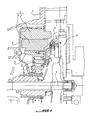
- the coupling means in rotation 7, 8 include fingers 7 integral with the lid clutch 3 and studs 8 made of a rubber of synthesis in two parts 81, 82.
- the pads 8 are adhesive on the outer frames 83, 84 in two parts and on an inner frame 85 in one part.
- the fingers 7 constitute supports for the studs 8.
- the fingers 7 are prismatic rods secured to the clutch cover 3 by riveting. They extend from one side of the clutch cover 3, there are circumferentially spaced equidistantly. The 7 fingers extend parallel to the tree crankshaft 5.
- the pads 8 are made of an elastomeric material such as silicone. They include a pair of staples 9, preferably two pairs of staples 9, intended to maintain both parties 83, 84 of the outer frame temporarily in one position close to each other for the establishment of pads. Both pairs of staples can be mounted parallel or anti-parallel.
- Figure 2 shows the layout of the machine in particular of the rotor 12, the support hub 13, of a bearing 14, for example a ball bearing, and that the clutch cover 3, a finger 7 and a plot 8 in detail.
- the pads 8 are respectively embedded in conjugated cavities circumferentially produced equidistantly in the support hub 13.
- the mounting of the studs 8 is done in the manner next.
- the first step is to install the studs 8 in definitive position on the fingers 7.
- the second operation is to prepare the studs, and in particular their external reinforcement, for the insertion of the studs in the conjugated cavities of the hub 13.
- the two parts 83, 84 of the outer armature are in the position shown in Figure 3.
- the distance between the two opposite parallel walls of the two parts of the outer frame is at a distance represented by the L1 coast.
- This L1 coast corresponds to the width of each of the conjugated cavities made in the support hub 13.
- the application of a force F in the direction shown in Figure 4 can compress the stud 8 so as to obtain an L2 coast less than the L1 side.
- the L2 coast must be chosen in such a way that the distance s (see Figure 4) between the ends above, referenced 831, 841 and the lower extremities opposite, referenced 832, 842, is a game of a few tenths of a millimeter. Then, using a suitable tool, the staples 9, which are inserted by one of their ends into recesses formed in either of the two parts of the outer frame, are pushed from such that the free end engages in a notch provided for this purpose in the other part of the outer frame. Releasing the effort F, the coast L2 is realized and the staples are maintained in friction position such as F divided by 2 and multiplied with a coefficient of friction either greater than the staple reminder effect.
- the third operation is to finish the assembly, that is to say insert the pads 8 in the corresponding conjugate cavities of the hub of 13. Since the L2 side is now lower at the L1 side, the assembly is very easy.
- the fourth operation of mounting the studs is to release the pads, that is to say to undo the stapling of the two parts of the outer frame.
- a slight effort higher than F we apply on the pad 8 a slight effort higher than F, and that in his direction, developing a couple by the electric motor higher than he will develop in normal service.
- Such an operation is in general possible because it is almost instantaneous and therefore without consequences for the reliability of the engine electric.
- FIG. can advantageously provide the outer frame of a singing having a low angle ⁇ , for example of the order of 3 °, on the returns 833, 843, 834, 844 of the two parts of the outer frame.
- these weak angles cause a jamming effort and therefore very important blocking of the studs 8 in the cavities combined with a reduced prestressing effort in the rubber.
Landscapes
- Engineering & Computer Science (AREA)
- Mechanical Engineering (AREA)
- Chemical & Material Sciences (AREA)
- Combustion & Propulsion (AREA)
- Transportation (AREA)
- General Engineering & Computer Science (AREA)
- Connection Of Motors, Electrical Generators, Mechanical Devices, And The Like (AREA)
- Mechanical Operated Clutches (AREA)
- Arrangement Of Transmissions (AREA)
- Motor Or Generator Frames (AREA)
Abstract
Description
- la figure 1 représente un mode de réalisation du dispositif de fixation d'une machine électrique, telle qu'un alternateur-démarreur, dans un carter d'embrayage 2 fixé entre le carter de boíte de vitesses et le carter du moteur à combustion d'un véhicule automobile. Le carter d'embrayage 2 comporte un couvercle d'embrayage 3 solidaire d'un volant ordinaire 6 du moteur à combustion destiné à être accouplé en rotation à un arbre vilebrequin 5 du moteur. La machine électrique 1 comporte un stator 11, un rotor 12 et un moyeu de support 13 du rotor 12. Le moyeu de support 13 est relié par des moyens d'accouplement en rotation 7, 8 au couvercle d'embrayage 3.
Claims (8)
- Dispositif de fixation d'une machine électrique (1) dans un carter d'embrayage (2) d'un véhicule automobile, le carter d'embrayage (2) comportant un couvercle d'embrayage (3) solidaire d'un volant d'inertie (6) d'un moteur à combustion du véhicule automobile pour être accouplé en rotation à un arbre vilebrequin (5) du moteur, la machine électrique (1) comportant un stator (11), un rotor (12) et un moyeu de support (13) du rotor (12) et le moyeu de support (13) du rotor (12) étant relié par des moyens d'accouplement en rotation (7, 8) au couvercle d'embrayage (3),
caractérisé en ce que les moyens d'accouplement en rotation (7, 8) comprennent des doigts (7) solidaires du couvercle d'embrayage (3) et des plots (8) réalisés en un caoutchouc de synthèse en deux parties (81, 82) ayant une armature extérieure (83, 84) en deux parties et une armature intérieure (85) en une seule partie, les doigts (7) constituant des supports pour les plots (8). - Dispositif selon la revendication 1, caractérisé en ce que les doigts (7) sont des tiges prismatiques solidaires du couvercle d'embrayage (3) par rivetage ou soudage et s'étendant d'un côté de celui-ci en étant circonférentiellement espacés de façon équidistante.
- Dispositif selon la revendication 1 ou 2, caractérisé en ce que les doigts (7) s'étendent parallèlement à l'arbre vilebrequin (5).
- Dispositif selon l'une quelconque des revendications 1 à 3, caractérisé en ce que les plots (8) sont réalisés en un matériau élastomère tel que du silicone.
- Dispositif selon la revendication 3, caractérisé en ce que les plots (8) comprennent au moins une paire d'agrafes (9) destinées à maintenir les deux parties (83, 84) de l'armature extérieure temporairement en une position rapprochée l'une de l'autre pour la mise en place des plots (8).
- Dispositif selon l'une quelconque des revendications 1 à 5, caractérisé en ce que les plots (8) comprennent deux paires d'agrafes (9) destinées à maintenir les deux parties (83, 84) de l'armature extérieure temporairement en une position rapprochée l'une de l'autre pour la mise en place des plots (8), les deux paires d'agrafes étant montées anti-parallèles.
- Dispositif selon l'une quelconque des revendications 1 à 5, caractérisé en ce que les plots (8) comprennent deux paires d'agrafes (9) destinées à maintenir les deux parties (83, 84) de l'armature extérieure temporairement en une position rapprochée l'une de l'autre pour la mise en place des plots (8), les deux paires d'agrafes étant montées parallèles.
- Carter d'un embrayage pour un véhicule automobile, le carter comprenant en son intérieur une machine électrique telle un alternateur-démarreur, caractérisé en ce qu'il comprend un dispositif selon l'une quelconque des revendications 1 à 7.
Applications Claiming Priority (2)
| Application Number | Priority Date | Filing Date | Title |
|---|---|---|---|
| FR0313542A FR2862359B1 (fr) | 2003-11-19 | 2003-11-19 | Dispositif de fixation d'une machine electrique dans un carter d'embrayage d'un vehicule automobile |
| FR0313542 | 2003-11-19 |
Publications (2)
| Publication Number | Publication Date |
|---|---|
| EP1533167A1 true EP1533167A1 (fr) | 2005-05-25 |
| EP1533167B1 EP1533167B1 (fr) | 2006-12-20 |
Family
ID=34430019
Family Applications (1)
| Application Number | Title | Priority Date | Filing Date |
|---|---|---|---|
| EP04292552A Expired - Lifetime EP1533167B1 (fr) | 2003-11-19 | 2004-10-27 | Dispositif de fixation d'une machine électrique dans un carter d'embrayage d'un véhicule automobile |
Country Status (5)
| Country | Link |
|---|---|
| EP (1) | EP1533167B1 (fr) |
| AT (1) | ATE348726T1 (fr) |
| DE (1) | DE602004003773T2 (fr) |
| ES (1) | ES2279315T3 (fr) |
| FR (1) | FR2862359B1 (fr) |
Cited By (1)
| Publication number | Priority date | Publication date | Assignee | Title |
|---|---|---|---|---|
| WO2010046003A1 (fr) | 2008-10-22 | 2010-04-29 | Bayerische Motoren Werke Aktiengesellschaft | Véhicule électrique |
Citations (3)
| Publication number | Priority date | Publication date | Assignee | Title |
|---|---|---|---|---|
| US20010015586A1 (en) * | 1999-12-29 | 2001-08-23 | Francois Honorio | Attachment device for electrical equipment, such as an alternator/starter motor, in a clutch housing of an automobile |
| EP1279828A1 (fr) * | 2001-07-27 | 2003-01-29 | Peugeot Citroen Automobiles SA | Dispositif d'accouplement élastique entre le rotor d'une machine électrique et l'arbre vilebrequin d'un moteur thermique de véhicule automobile |
| US20030151319A1 (en) * | 2002-02-11 | 2003-08-14 | Kahlon Gurinder S. | Integrated torque converter and starter-generator |
-
2003
- 2003-11-19 FR FR0313542A patent/FR2862359B1/fr not_active Expired - Fee Related
-
2004
- 2004-10-27 ES ES04292552T patent/ES2279315T3/es not_active Expired - Lifetime
- 2004-10-27 AT AT04292552T patent/ATE348726T1/de not_active IP Right Cessation
- 2004-10-27 DE DE602004003773T patent/DE602004003773T2/de not_active Expired - Lifetime
- 2004-10-27 EP EP04292552A patent/EP1533167B1/fr not_active Expired - Lifetime
Patent Citations (3)
| Publication number | Priority date | Publication date | Assignee | Title |
|---|---|---|---|---|
| US20010015586A1 (en) * | 1999-12-29 | 2001-08-23 | Francois Honorio | Attachment device for electrical equipment, such as an alternator/starter motor, in a clutch housing of an automobile |
| EP1279828A1 (fr) * | 2001-07-27 | 2003-01-29 | Peugeot Citroen Automobiles SA | Dispositif d'accouplement élastique entre le rotor d'une machine électrique et l'arbre vilebrequin d'un moteur thermique de véhicule automobile |
| US20030151319A1 (en) * | 2002-02-11 | 2003-08-14 | Kahlon Gurinder S. | Integrated torque converter and starter-generator |
Cited By (1)
| Publication number | Priority date | Publication date | Assignee | Title |
|---|---|---|---|---|
| WO2010046003A1 (fr) | 2008-10-22 | 2010-04-29 | Bayerische Motoren Werke Aktiengesellschaft | Véhicule électrique |
Also Published As
| Publication number | Publication date |
|---|---|
| ATE348726T1 (de) | 2007-01-15 |
| EP1533167B1 (fr) | 2006-12-20 |
| FR2862359B1 (fr) | 2006-02-10 |
| FR2862359A1 (fr) | 2005-05-20 |
| ES2279315T3 (es) | 2007-08-16 |
| DE602004003773D1 (de) | 2007-02-01 |
| DE602004003773T2 (de) | 2007-10-11 |
Similar Documents
| Publication | Publication Date | Title |
|---|---|---|
| WO2013174616A1 (fr) | Dispositif de transmission de couple pour vehicule automobile | |
| WO2013140082A1 (fr) | Dispositif de transmission de couple pour un vehicule automobile | |
| EP2711579B1 (fr) | Ensemble de transmission de couple, en particulier pour véhicule automobile | |
| WO2018001583A1 (fr) | Groupe motoreducteur pour actionneur electrique de frein a disque, frein et procede d'industrialisation et d'assemblage | |
| FR2684052A1 (fr) | Dispositif pour relier par articulation des organes d'une ligne d'echappement, notamment d'un vehicule automobile. | |
| EP2776728A1 (fr) | Ensemble de transmission de couple, en particulier pour vehicule automobile | |
| EP1533167B1 (fr) | Dispositif de fixation d'une machine électrique dans un carter d'embrayage d'un véhicule automobile | |
| FR2695180A1 (fr) | Amortisseur de torsion, notamment disque de friction d'embrayage pour véhicule automobile. | |
| EP0730712B1 (fr) | Dispositif preamortisseur de torsion | |
| FR2689191A1 (fr) | Friction d'embrayage, notamment pour véhicule industriel. | |
| FR2722548A1 (fr) | Embrayage a friction comprenant un volant moteur | |
| FR2798530A1 (fr) | Systeme d'entrainement comprenant un agencement d'amortissement d'oscillations de torsion entre un rotor et un stator | |
| EP0729553A1 (fr) | Double volant amortisseur | |
| FR2902840A1 (fr) | Dispositif de demarrage pour moteur thermique | |
| FR2563597A1 (fr) | Dispositif amortisseur de torsion a butee elastique, notamment friction d'embrayage | |
| FR2726341A1 (fr) | Dispositif d'amortissement de torsion | |
| FR3064036A1 (fr) | Disque d'embrayage avec rondelle de frottement | |
| EP0732524A1 (fr) | Amortisseur de torsion | |
| FR3075296B1 (fr) | Dispositif d'amortissement pendulaire pour un vehicule automobile | |
| FR3004027A1 (fr) | Piece de decouplage entre un moteur et son support, et assemblage d'un moteur sur son support integrant une telle piece de decouplage | |
| FR2942521A1 (fr) | Demarreur pour vehicules | |
| EP3734101B1 (fr) | Dispositif de progressivite pour disque d'embrayage a friction et disque d'embrayage a friction integrant un tel dispositif | |
| FR2835298A1 (fr) | Dispositif d'accouplement elastique entre le rotor d'une machine electrique tournante reversible et l'arbre primaire de la boite de vitesses d'un moteur thermique de vehicule automobile | |
| FR3067422A1 (fr) | Mecanisme d'embrayage pour un vehicule automobile | |
| FR2652398A1 (en) | Driven discs of a friction clutch |
Legal Events
| Date | Code | Title | Description |
|---|---|---|---|
| PUAI | Public reference made under article 153(3) epc to a published international application that has entered the european phase |
Free format text: ORIGINAL CODE: 0009012 |
|
| AK | Designated contracting states |
Kind code of ref document: A1 Designated state(s): AT BE BG CH CY CZ DE DK EE ES FI FR GB GR HU IE IT LI LU MC NL PL PT RO SE SI SK TR |
|
| AX | Request for extension of the european patent |
Extension state: AL HR LT LV MK |
|
| 17P | Request for examination filed |
Effective date: 20051026 |
|
| AKX | Designation fees paid |
Designated state(s): AT BE BG CH CY CZ DE DK EE ES FI FR GB GR HU IE IT LI LU MC NL PL PT RO SE SI SK TR |
|
| GRAP | Despatch of communication of intention to grant a patent |
Free format text: ORIGINAL CODE: EPIDOSNIGR1 |
|
| RTI1 | Title (correction) |
Free format text: FIXING DEVICE FOR AN ELECTRIC MACHINE IN A CLUTCH HOUSING OF AN AUTOMOBILE |
|
| GRAS | Grant fee paid |
Free format text: ORIGINAL CODE: EPIDOSNIGR3 |
|
| GRAA | (expected) grant |
Free format text: ORIGINAL CODE: 0009210 |
|
| AK | Designated contracting states |
Kind code of ref document: B1 Designated state(s): AT BE BG CH CY CZ DE DK EE ES FI FR GB GR HU IE IT LI LU MC NL PL PT RO SE SI SK TR |
|
| PG25 | Lapsed in a contracting state [announced via postgrant information from national office to epo] |
Ref country code: NL Free format text: LAPSE BECAUSE OF FAILURE TO SUBMIT A TRANSLATION OF THE DESCRIPTION OR TO PAY THE FEE WITHIN THE PRESCRIBED TIME-LIMIT Effective date: 20061220 Ref country code: PL Free format text: LAPSE BECAUSE OF FAILURE TO SUBMIT A TRANSLATION OF THE DESCRIPTION OR TO PAY THE FEE WITHIN THE PRESCRIBED TIME-LIMIT Effective date: 20061220 Ref country code: RO Free format text: LAPSE BECAUSE OF FAILURE TO SUBMIT A TRANSLATION OF THE DESCRIPTION OR TO PAY THE FEE WITHIN THE PRESCRIBED TIME-LIMIT Effective date: 20061220 Ref country code: FI Free format text: LAPSE BECAUSE OF FAILURE TO SUBMIT A TRANSLATION OF THE DESCRIPTION OR TO PAY THE FEE WITHIN THE PRESCRIBED TIME-LIMIT Effective date: 20061220 Ref country code: SI Free format text: LAPSE BECAUSE OF FAILURE TO SUBMIT A TRANSLATION OF THE DESCRIPTION OR TO PAY THE FEE WITHIN THE PRESCRIBED TIME-LIMIT Effective date: 20061220 Ref country code: DK Free format text: LAPSE BECAUSE OF FAILURE TO SUBMIT A TRANSLATION OF THE DESCRIPTION OR TO PAY THE FEE WITHIN THE PRESCRIBED TIME-LIMIT Effective date: 20061220 Ref country code: SK Free format text: LAPSE BECAUSE OF FAILURE TO SUBMIT A TRANSLATION OF THE DESCRIPTION OR TO PAY THE FEE WITHIN THE PRESCRIBED TIME-LIMIT Effective date: 20061220 Ref country code: AT Free format text: LAPSE BECAUSE OF FAILURE TO SUBMIT A TRANSLATION OF THE DESCRIPTION OR TO PAY THE FEE WITHIN THE PRESCRIBED TIME-LIMIT Effective date: 20061220 Ref country code: IE Free format text: LAPSE BECAUSE OF FAILURE TO SUBMIT A TRANSLATION OF THE DESCRIPTION OR TO PAY THE FEE WITHIN THE PRESCRIBED TIME-LIMIT Effective date: 20061220 Ref country code: CZ Free format text: LAPSE BECAUSE OF FAILURE TO SUBMIT A TRANSLATION OF THE DESCRIPTION OR TO PAY THE FEE WITHIN THE PRESCRIBED TIME-LIMIT Effective date: 20061220 |
|
| REG | Reference to a national code |
Ref country code: GB Ref legal event code: FG4D Free format text: NOT ENGLISH |
|
| REG | Reference to a national code |
Ref country code: CH Ref legal event code: EP |
|
| REF | Corresponds to: |
Ref document number: 602004003773 Country of ref document: DE Date of ref document: 20070201 Kind code of ref document: P |
|
| REG | Reference to a national code |
Ref country code: IE Ref legal event code: FG4D Free format text: LANGUAGE OF EP DOCUMENT: FRENCH |
|
| PG25 | Lapsed in a contracting state [announced via postgrant information from national office to epo] |
Ref country code: SE Free format text: LAPSE BECAUSE OF FAILURE TO SUBMIT A TRANSLATION OF THE DESCRIPTION OR TO PAY THE FEE WITHIN THE PRESCRIBED TIME-LIMIT Effective date: 20070320 Ref country code: BG Free format text: LAPSE BECAUSE OF FAILURE TO SUBMIT A TRANSLATION OF THE DESCRIPTION OR TO PAY THE FEE WITHIN THE PRESCRIBED TIME-LIMIT Effective date: 20070320 |
|
| GBT | Gb: translation of ep patent filed (gb section 77(6)(a)/1977) |
Effective date: 20070307 |
|
| PG25 | Lapsed in a contracting state [announced via postgrant information from national office to epo] |
Ref country code: PT Free format text: LAPSE BECAUSE OF FAILURE TO SUBMIT A TRANSLATION OF THE DESCRIPTION OR TO PAY THE FEE WITHIN THE PRESCRIBED TIME-LIMIT Effective date: 20070424 |
|
| NLV1 | Nl: lapsed or annulled due to failure to fulfill the requirements of art. 29p and 29m of the patents act | ||
| REG | Reference to a national code |
Ref country code: ES Ref legal event code: FG2A Ref document number: 2279315 Country of ref document: ES Kind code of ref document: T3 |
|
| PLBE | No opposition filed within time limit |
Free format text: ORIGINAL CODE: 0009261 |
|
| STAA | Information on the status of an ep patent application or granted ep patent |
Free format text: STATUS: NO OPPOSITION FILED WITHIN TIME LIMIT |
|
| 26N | No opposition filed |
Effective date: 20070921 |
|
| REG | Reference to a national code |
Ref country code: GB Ref legal event code: 746 Effective date: 20080329 |
|
| BERE | Be: lapsed |
Owner name: PEUGEOT CITROEN AUTOMOBILES S.A. Effective date: 20071031 |
|
| PG25 | Lapsed in a contracting state [announced via postgrant information from national office to epo] |
Ref country code: GR Free format text: LAPSE BECAUSE OF FAILURE TO SUBMIT A TRANSLATION OF THE DESCRIPTION OR TO PAY THE FEE WITHIN THE PRESCRIBED TIME-LIMIT Effective date: 20070321 |
|
| PG25 | Lapsed in a contracting state [announced via postgrant information from national office to epo] |
Ref country code: MC Free format text: LAPSE BECAUSE OF NON-PAYMENT OF DUE FEES Effective date: 20071031 |
|
| PG25 | Lapsed in a contracting state [announced via postgrant information from national office to epo] |
Ref country code: BE Free format text: LAPSE BECAUSE OF NON-PAYMENT OF DUE FEES Effective date: 20071031 |
|
| PG25 | Lapsed in a contracting state [announced via postgrant information from national office to epo] |
Ref country code: EE Free format text: LAPSE BECAUSE OF FAILURE TO SUBMIT A TRANSLATION OF THE DESCRIPTION OR TO PAY THE FEE WITHIN THE PRESCRIBED TIME-LIMIT Effective date: 20061220 |
|
| REG | Reference to a national code |
Ref country code: CH Ref legal event code: PL |
|
| PG25 | Lapsed in a contracting state [announced via postgrant information from national office to epo] |
Ref country code: LU Free format text: LAPSE BECAUSE OF NON-PAYMENT OF DUE FEES Effective date: 20071027 Ref country code: CY Free format text: LAPSE BECAUSE OF FAILURE TO SUBMIT A TRANSLATION OF THE DESCRIPTION OR TO PAY THE FEE WITHIN THE PRESCRIBED TIME-LIMIT Effective date: 20061220 |
|
| PG25 | Lapsed in a contracting state [announced via postgrant information from national office to epo] |
Ref country code: HU Free format text: LAPSE BECAUSE OF FAILURE TO SUBMIT A TRANSLATION OF THE DESCRIPTION OR TO PAY THE FEE WITHIN THE PRESCRIBED TIME-LIMIT Effective date: 20070621 Ref country code: TR Free format text: LAPSE BECAUSE OF FAILURE TO SUBMIT A TRANSLATION OF THE DESCRIPTION OR TO PAY THE FEE WITHIN THE PRESCRIBED TIME-LIMIT Effective date: 20061220 |
|
| PG25 | Lapsed in a contracting state [announced via postgrant information from national office to epo] |
Ref country code: LI Free format text: LAPSE BECAUSE OF NON-PAYMENT OF DUE FEES Effective date: 20081031 Ref country code: CH Free format text: LAPSE BECAUSE OF NON-PAYMENT OF DUE FEES Effective date: 20081031 |
|
| REG | Reference to a national code |
Ref country code: ES Ref legal event code: GC2A Effective date: 20110406 |
|
| PGFP | Annual fee paid to national office [announced via postgrant information from national office to epo] |
Ref country code: GB Payment date: 20120924 Year of fee payment: 9 |
|
| PGFP | Annual fee paid to national office [announced via postgrant information from national office to epo] |
Ref country code: IT Payment date: 20120924 Year of fee payment: 9 |
|
| PGFP | Annual fee paid to national office [announced via postgrant information from national office to epo] |
Ref country code: DE Payment date: 20120924 Year of fee payment: 9 Ref country code: FR Payment date: 20121115 Year of fee payment: 9 |
|
| PGFP | Annual fee paid to national office [announced via postgrant information from national office to epo] |
Ref country code: ES Payment date: 20120920 Year of fee payment: 9 |
|
| REG | Reference to a national code |
Ref country code: DE Ref legal event code: R119 Ref document number: 602004003773 Country of ref document: DE |
|
| GBPC | Gb: european patent ceased through non-payment of renewal fee |
Effective date: 20131027 |
|
| REG | Reference to a national code |
Ref country code: DE Ref legal event code: R079 Ref document number: 602004003773 Country of ref document: DE Free format text: PREVIOUS MAIN CLASS: B60K0006040000 Ipc: B60K0006000000 |
|
| PG25 | Lapsed in a contracting state [announced via postgrant information from national office to epo] |
Ref country code: GB Free format text: LAPSE BECAUSE OF NON-PAYMENT OF DUE FEES Effective date: 20131027 |
|
| REG | Reference to a national code |
Ref country code: DE Ref legal event code: R079 Ref document number: 602004003773 Country of ref document: DE Free format text: PREVIOUS MAIN CLASS: B60K0006040000 Ipc: B60K0006000000 Effective date: 20140625 Ref country code: DE Ref legal event code: R119 Ref document number: 602004003773 Country of ref document: DE Effective date: 20140501 |
|
| REG | Reference to a national code |
Ref country code: FR Ref legal event code: ST Effective date: 20140630 |
|
| PG25 | Lapsed in a contracting state [announced via postgrant information from national office to epo] |
Ref country code: IT Free format text: LAPSE BECAUSE OF NON-PAYMENT OF DUE FEES Effective date: 20131027 Ref country code: DE Free format text: LAPSE BECAUSE OF NON-PAYMENT OF DUE FEES Effective date: 20140501 Ref country code: FR Free format text: LAPSE BECAUSE OF NON-PAYMENT OF DUE FEES Effective date: 20131031 |
|
| REG | Reference to a national code |
Ref country code: ES Ref legal event code: FD2A Effective date: 20141107 |
|
| PG25 | Lapsed in a contracting state [announced via postgrant information from national office to epo] |
Ref country code: ES Free format text: LAPSE BECAUSE OF NON-PAYMENT OF DUE FEES Effective date: 20131028 |