EP1533020A1 - Purification and concentration synthetic biological molecules - Google Patents
Purification and concentration synthetic biological molecules Download PDFInfo
- Publication number
- EP1533020A1 EP1533020A1 EP04257246A EP04257246A EP1533020A1 EP 1533020 A1 EP1533020 A1 EP 1533020A1 EP 04257246 A EP04257246 A EP 04257246A EP 04257246 A EP04257246 A EP 04257246A EP 1533020 A1 EP1533020 A1 EP 1533020A1
- Authority
- EP
- European Patent Office
- Prior art keywords
- membrane
- charge
- retentate
- inlet
- synthetic
- Prior art date
- Legal status (The legal status is an assumption and is not a legal conclusion. Google has not performed a legal analysis and makes no representation as to the accuracy of the status listed.)
- Granted
Links
- 238000000746 purification Methods 0.000 title claims description 6
- 239000012528 membrane Substances 0.000 claims abstract description 92
- 239000012465 retentate Substances 0.000 claims abstract description 22
- 238000000108 ultra-filtration Methods 0.000 claims abstract description 19
- 238000000034 method Methods 0.000 claims abstract description 13
- 238000001914 filtration Methods 0.000 claims abstract description 9
- 239000012530 fluid Substances 0.000 claims description 18
- 238000007873 sieving Methods 0.000 claims description 11
- 238000011144 upstream manufacturing Methods 0.000 claims description 11
- 239000000706 filtrate Substances 0.000 claims description 9
- 239000012535 impurity Substances 0.000 claims description 9
- 238000004891 communication Methods 0.000 claims description 8
- 239000000203 mixture Substances 0.000 claims description 8
- 230000006872 improvement Effects 0.000 claims description 3
- 239000012141 concentrate Substances 0.000 abstract description 5
- 239000012527 feed solution Substances 0.000 abstract 1
- 230000035699 permeability Effects 0.000 description 6
- 230000004907 flux Effects 0.000 description 5
- 239000011148 porous material Substances 0.000 description 4
- 230000008569 process Effects 0.000 description 4
- 239000007787 solid Substances 0.000 description 4
- 108091034117 Oligonucleotide Proteins 0.000 description 3
- JLCPHMBAVCMARE-UHFFFAOYSA-N [3-[[3-[[3-[[3-[[3-[[3-[[3-[[3-[[3-[[3-[[3-[[5-(2-amino-6-oxo-1H-purin-9-yl)-3-[[3-[[3-[[3-[[3-[[3-[[5-(2-amino-6-oxo-1H-purin-9-yl)-3-[[5-(2-amino-6-oxo-1H-purin-9-yl)-3-hydroxyoxolan-2-yl]methoxy-hydroxyphosphoryl]oxyoxolan-2-yl]methoxy-hydroxyphosphoryl]oxy-5-(5-methyl-2,4-dioxopyrimidin-1-yl)oxolan-2-yl]methoxy-hydroxyphosphoryl]oxy-5-(6-aminopurin-9-yl)oxolan-2-yl]methoxy-hydroxyphosphoryl]oxy-5-(6-aminopurin-9-yl)oxolan-2-yl]methoxy-hydroxyphosphoryl]oxy-5-(6-aminopurin-9-yl)oxolan-2-yl]methoxy-hydroxyphosphoryl]oxy-5-(6-aminopurin-9-yl)oxolan-2-yl]methoxy-hydroxyphosphoryl]oxyoxolan-2-yl]methoxy-hydroxyphosphoryl]oxy-5-(5-methyl-2,4-dioxopyrimidin-1-yl)oxolan-2-yl]methoxy-hydroxyphosphoryl]oxy-5-(4-amino-2-oxopyrimidin-1-yl)oxolan-2-yl]methoxy-hydroxyphosphoryl]oxy-5-(5-methyl-2,4-dioxopyrimidin-1-yl)oxolan-2-yl]methoxy-hydroxyphosphoryl]oxy-5-(5-methyl-2,4-dioxopyrimidin-1-yl)oxolan-2-yl]methoxy-hydroxyphosphoryl]oxy-5-(6-aminopurin-9-yl)oxolan-2-yl]methoxy-hydroxyphosphoryl]oxy-5-(6-aminopurin-9-yl)oxolan-2-yl]methoxy-hydroxyphosphoryl]oxy-5-(4-amino-2-oxopyrimidin-1-yl)oxolan-2-yl]methoxy-hydroxyphosphoryl]oxy-5-(4-amino-2-oxopyrimidin-1-yl)oxolan-2-yl]methoxy-hydroxyphosphoryl]oxy-5-(4-amino-2-oxopyrimidin-1-yl)oxolan-2-yl]methoxy-hydroxyphosphoryl]oxy-5-(6-aminopurin-9-yl)oxolan-2-yl]methoxy-hydroxyphosphoryl]oxy-5-(4-amino-2-oxopyrimidin-1-yl)oxolan-2-yl]methyl [5-(6-aminopurin-9-yl)-2-(hydroxymethyl)oxolan-3-yl] hydrogen phosphate Polymers Cc1cn(C2CC(OP(O)(=O)OCC3OC(CC3OP(O)(=O)OCC3OC(CC3O)n3cnc4c3nc(N)[nH]c4=O)n3cnc4c3nc(N)[nH]c4=O)C(COP(O)(=O)OC3CC(OC3COP(O)(=O)OC3CC(OC3COP(O)(=O)OC3CC(OC3COP(O)(=O)OC3CC(OC3COP(O)(=O)OC3CC(OC3COP(O)(=O)OC3CC(OC3COP(O)(=O)OC3CC(OC3COP(O)(=O)OC3CC(OC3COP(O)(=O)OC3CC(OC3COP(O)(=O)OC3CC(OC3COP(O)(=O)OC3CC(OC3COP(O)(=O)OC3CC(OC3COP(O)(=O)OC3CC(OC3COP(O)(=O)OC3CC(OC3COP(O)(=O)OC3CC(OC3COP(O)(=O)OC3CC(OC3COP(O)(=O)OC3CC(OC3CO)n3cnc4c(N)ncnc34)n3ccc(N)nc3=O)n3cnc4c(N)ncnc34)n3ccc(N)nc3=O)n3ccc(N)nc3=O)n3ccc(N)nc3=O)n3cnc4c(N)ncnc34)n3cnc4c(N)ncnc34)n3cc(C)c(=O)[nH]c3=O)n3cc(C)c(=O)[nH]c3=O)n3ccc(N)nc3=O)n3cc(C)c(=O)[nH]c3=O)n3cnc4c3nc(N)[nH]c4=O)n3cnc4c(N)ncnc34)n3cnc4c(N)ncnc34)n3cnc4c(N)ncnc34)n3cnc4c(N)ncnc34)O2)c(=O)[nH]c1=O JLCPHMBAVCMARE-UHFFFAOYSA-N 0.000 description 3
- 230000007935 neutral effect Effects 0.000 description 3
- 239000004695 Polyether sulfone Substances 0.000 description 2
- 230000015572 biosynthetic process Effects 0.000 description 2
- 229920002678 cellulose Polymers 0.000 description 2
- 239000001913 cellulose Substances 0.000 description 2
- 238000004587 chromatography analysis Methods 0.000 description 2
- 238000000576 coating method Methods 0.000 description 2
- 150000001875 compounds Chemical class 0.000 description 2
- 238000004132 cross linking Methods 0.000 description 2
- 230000007423 decrease Effects 0.000 description 2
- 238000004821 distillation Methods 0.000 description 2
- 238000005516 engineering process Methods 0.000 description 2
- 125000002887 hydroxy group Chemical group [H]O* 0.000 description 2
- 238000004519 manufacturing process Methods 0.000 description 2
- 229920006393 polyether sulfone Polymers 0.000 description 2
- 238000001556 precipitation Methods 0.000 description 2
- 239000000047 product Substances 0.000 description 2
- 239000004627 regenerated cellulose Substances 0.000 description 2
- 230000000717 retained effect Effects 0.000 description 2
- 239000000020 Nitrocellulose Substances 0.000 description 1
- 239000002033 PVDF binder Substances 0.000 description 1
- FJWGYAHXMCUOOM-QHOUIDNNSA-N [(2s,3r,4s,5r,6r)-2-[(2r,3r,4s,5r,6s)-4,5-dinitrooxy-2-(nitrooxymethyl)-6-[(2r,3r,4s,5r,6s)-4,5,6-trinitrooxy-2-(nitrooxymethyl)oxan-3-yl]oxyoxan-3-yl]oxy-3,5-dinitrooxy-6-(nitrooxymethyl)oxan-4-yl] nitrate Chemical compound O([C@@H]1O[C@@H]([C@H]([C@H](O[N+]([O-])=O)[C@H]1O[N+]([O-])=O)O[C@H]1[C@@H]([C@@H](O[N+]([O-])=O)[C@H](O[N+]([O-])=O)[C@@H](CO[N+]([O-])=O)O1)O[N+]([O-])=O)CO[N+](=O)[O-])[C@@H]1[C@@H](CO[N+]([O-])=O)O[C@@H](O[N+]([O-])=O)[C@H](O[N+]([O-])=O)[C@H]1O[N+]([O-])=O FJWGYAHXMCUOOM-QHOUIDNNSA-N 0.000 description 1
- 230000002411 adverse Effects 0.000 description 1
- 230000008901 benefit Effects 0.000 description 1
- 238000005266 casting Methods 0.000 description 1
- 150000001793 charged compounds Chemical class 0.000 description 1
- 239000002801 charged material Substances 0.000 description 1
- 239000012707 chemical precursor Substances 0.000 description 1
- 239000011248 coating agent Substances 0.000 description 1
- 239000002131 composite material Substances 0.000 description 1
- 230000003247 decreasing effect Effects 0.000 description 1
- 230000001627 detrimental effect Effects 0.000 description 1
- 239000003814 drug Substances 0.000 description 1
- 230000000694 effects Effects 0.000 description 1
- 238000010894 electron beam technology Methods 0.000 description 1
- 238000009472 formulation Methods 0.000 description 1
- 125000005843 halogen group Chemical group 0.000 description 1
- 239000000383 hazardous chemical Substances 0.000 description 1
- 239000003446 ligand Substances 0.000 description 1
- 239000000463 material Substances 0.000 description 1
- 229920001220 nitrocellulos Polymers 0.000 description 1
- 229920002492 poly(sulfone) Polymers 0.000 description 1
- 230000000379 polymerizing effect Effects 0.000 description 1
- 239000004810 polytetrafluoroethylene Substances 0.000 description 1
- 229920001343 polytetrafluoroethylene Polymers 0.000 description 1
- 229920002981 polyvinylidene fluoride Polymers 0.000 description 1
- 238000011106 process-scale chromatography Methods 0.000 description 1
- 230000009467 reduction Effects 0.000 description 1
- 239000011347 resin Substances 0.000 description 1
- 229920005989 resin Polymers 0.000 description 1
- 239000002904 solvent Substances 0.000 description 1
- 239000000126 substance Substances 0.000 description 1
- 239000000758 substrate Substances 0.000 description 1
- 238000003786 synthesis reaction Methods 0.000 description 1
- 229940124597 therapeutic agent Drugs 0.000 description 1
- ILJSQTXMGCGYMG-UHFFFAOYSA-N triacetic acid Chemical compound CC(=O)CC(=O)CC(O)=O ILJSQTXMGCGYMG-UHFFFAOYSA-N 0.000 description 1
Images

Classifications
-
- C—CHEMISTRY; METALLURGY
- C07—ORGANIC CHEMISTRY
- C07K—PEPTIDES
- C07K1/00—General methods for the preparation of peptides, i.e. processes for the organic chemical preparation of peptides or proteins of any length
- C07K1/14—Extraction; Separation; Purification
- C07K1/34—Extraction; Separation; Purification by filtration, ultrafiltration or reverse osmosis
-
- B—PERFORMING OPERATIONS; TRANSPORTING
- B01—PHYSICAL OR CHEMICAL PROCESSES OR APPARATUS IN GENERAL
- B01D—SEPARATION
- B01D61/00—Processes of separation using semi-permeable membranes, e.g. dialysis, osmosis or ultrafiltration; Apparatus, accessories or auxiliary operations specially adapted therefor
- B01D61/14—Ultrafiltration; Microfiltration
- B01D61/145—Ultrafiltration
-
- B—PERFORMING OPERATIONS; TRANSPORTING
- B01—PHYSICAL OR CHEMICAL PROCESSES OR APPARATUS IN GENERAL
- B01D—SEPARATION
- B01D61/00—Processes of separation using semi-permeable membranes, e.g. dialysis, osmosis or ultrafiltration; Apparatus, accessories or auxiliary operations specially adapted therefor
- B01D61/14—Ultrafiltration; Microfiltration
- B01D61/16—Feed pretreatment
-
- B—PERFORMING OPERATIONS; TRANSPORTING
- B01—PHYSICAL OR CHEMICAL PROCESSES OR APPARATUS IN GENERAL
- B01D—SEPARATION
- B01D61/00—Processes of separation using semi-permeable membranes, e.g. dialysis, osmosis or ultrafiltration; Apparatus, accessories or auxiliary operations specially adapted therefor
- B01D61/14—Ultrafiltration; Microfiltration
- B01D61/18—Apparatus therefor
-
- B—PERFORMING OPERATIONS; TRANSPORTING
- B01—PHYSICAL OR CHEMICAL PROCESSES OR APPARATUS IN GENERAL
- B01D—SEPARATION
- B01D61/00—Processes of separation using semi-permeable membranes, e.g. dialysis, osmosis or ultrafiltration; Apparatus, accessories or auxiliary operations specially adapted therefor
- B01D61/14—Ultrafiltration; Microfiltration
- B01D61/22—Controlling or regulating
-
- B—PERFORMING OPERATIONS; TRANSPORTING
- B01—PHYSICAL OR CHEMICAL PROCESSES OR APPARATUS IN GENERAL
- B01D—SEPARATION
- B01D69/00—Semi-permeable membranes for separation processes or apparatus characterised by their form, structure or properties; Manufacturing processes specially adapted therefor
- B01D69/02—Semi-permeable membranes for separation processes or apparatus characterised by their form, structure or properties; Manufacturing processes specially adapted therefor characterised by their properties
-
- B—PERFORMING OPERATIONS; TRANSPORTING
- B01—PHYSICAL OR CHEMICAL PROCESSES OR APPARATUS IN GENERAL
- B01D—SEPARATION
- B01D2311/00—Details relating to membrane separation process operations and control
- B01D2311/04—Specific process operations in the feed stream; Feed pretreatment
Definitions
- the present invention relates to the purification and concentration of synthetically manufactured biological molecules. More particularly, it relates to the purification and concentration of synthetically manufactured biological molecules, such as oligonucleotides, synthetic DNA and synthetic RNA, by ultrafiltration.
- Synthetic biological molecules such as oligonucleotides, synthetic DNA and synthetic RNA are being investigated as therapeutic agents. These molecules would be used in lieu of natural or recombinant molecules. There are a number of reasons for doing so. Some molecules just don't exist in nature or for some reason can't be replicated yet using recombinant technologies. Synthetic synthesis can overcome this limitation. Often, there are variants of eth same molecule. Synthetics allow one to custom tailor the molecule to its desired form. Lastly, synthetics and their manufacture are often less expense to manufacture and often avoid the issues of handling biohazards.
- These molecules are typically formed by synthetic chemical precursors and are assembled on various solid substrates within synthesizers.
- the molecules generally are cleared from their solid support and then subjected to a purification step such as ultrafiltration or chromatographic capture to remove impurities.
- the desired molecules are relatively small, typically having a molecular weight from about 0.5 to about 5 Kilo Daltons (KD).
- the present invention provides the means for enabling ultrafiltration in this application.
- the present invention is an ultrafiltration (UF) membrane having a nominal molecular weight cut off (NMWCO) of from about 0.5 KD to about 10 KD wherein the membrane surfaces have a charge that is either positive or negative.
- UF ultrafiltration
- NMWCO nominal molecular weight cut off
- the present invention is also a method of using the charged UF membrane to purify and concentrate synthetic biological molecules by using the charged surface either to repel the synthetic biomolecules retaining them in the retentate or to attract the synthetic biomolecules preferentially for filtration through the membrane.
- the present invention allows for the removal of small molecular weight impurities, thereby reducing the need for chromatography or other steps to achieve similar purification levels. It also allows for the use of larger pored membranes, thereby increasing flux and improving process speed and economics and creating greater yields of product.
- the present invention relates to the use of one or more charged, positive or negative, membranes to purify and/or concentrate synthetic biomolecules such as oligonucleotides, synthetic DNA and synthetic RNA.
- the problem with ultrafiltration in the processing of synthetic biomolecules is two-fold.
- the molecules themselves are small, typically from about 0.5 to about 5 KD in size. This requires the use of very tight UF membranes. Even then, often these molecules are the same size as the openings in the membranes. As a result, often the target molecule will pass through the membrane, resulting in lower yields of that molecule.
- such tight membranes have very low flux characteristics, meaning that little material passes through them in a given time. This increases the amount of time necessary to process a given amount of fluid over a larger pored membrane. Additionally, the low flux can create higher back and transmembrane pressures on the membrane and system, which is also detrimental.
- the present invention uses one or more UF membranes that contain either a positive or negative charge.
- the membrane contains the same charge as the target molecule. As same charges repel each other, the membrane repels the target molecule away from its surface. This phenomenon can be used to one's advantage. It allows one to use a membrane with a higher NMWCO than the target molecule to achieve higher flux and greater throughput while also increasing yields of the target molecule.
- the similarly charged target molecules behave as if they are larger than they actually are due to the charge they and the membrane(s) have. Thus, even though physically the target molecules could pass through the membrane, their like charge prevents this from happening.
- the smaller impurities still pass through the membrane even when they have the like charge due to their smaller size and the force of filtration which is greater than the force of charge repulsion.
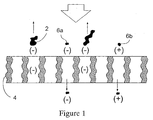
- Figure 1 shows a diagrammatic representation of a membrane and molecule according to the present invention.
- the target molecule 2 is assumed to be negative and the surface of the membrane 4 is made to have a negative charge as well.
- the impurities 6A and B may be negative or positive.
- the molecules 2 are repelled from the membrane 4 due to their like charges and are retained in the retentate.
- FIG. 2 shows a system according to the present invention for purifying and/or concentrating synthetic biomolecules.
- a source 20 of the biomolecules is in the fluid communication with a filter holder 22.
- the system is run in tangential flow mode (TFF).
- a pump 24 is located downstream from the source 20. Its outlet 26 is connected to the inlet 28 of the holder 22. Downstream is one or more membranes 30 that separate the holder 22 into an upstream compartment 32 and a downstream compartment 34. Fluid and any solids or solvents reaching the downstream compartment 34 must first pass through the one or more membranes 30.
- the upstream compartment 32 also has a retentate outlet 36.
- the retentate outlet 36 also has a return loop 38 in fluid communication upstream of the inlet 28 to return retentate back to the system if desired.
- an optional retentate pump 40 As shown, the return loop 38 is between the pump 24 and the inlet 28 of the holder. Altematively, it may return to the source 20 or any point between the source 20 and the inlet 28.
- the filtrate outlet 42 located in the downstream chamber.
- fluid from the source enters the inlet 28 of the holder 22 and flows across the one or more membranes 30. Fluid and either impurities or the target molecule pass through them to the downstream compartment 34. It is preferred that the target molecule and the membrane(s) have the like charge.
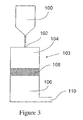
- FIG. 3 shows a normal flow system of the invention.
- the source 100 is in fluid communication with the inlet 102 of the filter device 103. Fluid enters the inlet 102 into an upstream compartment 104 that is separated from a downstream compartment 106 by an ultrafilter membrane 108. Any fluid, solid or solute, reaching the downstream compartment 106 must have passed through the membrane 108. The filtrate then exits the device through outlet 110.
- Figure 2 can function in a normal flow manner by eliminating the optional return loop 18 and pump 20.
- Sieving is the ratio of concentration of desired molecule downstream of the filter compared to the concentration of molecule upstream of the filter after filtration. The higher the value the greater the amount of the desired molecule passes through the filter. Thus a high value is indicative of the molecule readily passing through the filter. Conversely a low value is indicative of most of the molecule being retained upstream of the filter. Where it is desired to keep the molecule upstream (retentate side) of the filter and the molecule of interest and the membrane have the same charge a low sieving value is desirable. Conversely when it is desired to have the molecule in the filtrate (passing through the membrane or filter) a high value is desirable.
- Permeability is the filtration rate of the membrane or filter. It is largely determined by the pore size, percentage porosity and thickness of the membrane and the viscosity and concentration of the solution being filtered. For an uncharged membrane permeability decreases as sieving decreases. For a charged membrane according to the present invention, the sieving improves over that of the uncharged membrane (the sieving value either goes lower if the molecule is in the retentate or goes higher if the molecule is in the filtrate) while the permeability remains the same or is only slightly decreased such that the combination of sieving and permeability is overall improved as compared to an uncharged system.
- the improvement in sieving should be at least 1.5 fold, alternatively, at least 2 fold, alternatively at least 5 fold, preferably at 10 fold, more preferably at 50 fold better than the sieving value achieved with an uncharged membrane or filter.
- Any ultrafiltration membrane that is capable of carrying a desired charge at least under operating conditions is useful in the present invention.
- Such membranes are well known in the art.
- US 2003/0178368 A1 teaches how to make a charged cellulosic filtration membrane by covalently modifying the membrane's surfaces with a charged compound or a compound capable of being chemically modified to possess a charge.
- a cellulosic (cellulose, cellulose di- or tri-acetate, cellulose nitrate or blends thereof) membrane has hydroxyl moieties that are derivitized to form the charged surfaces.
- a wide variety of compounds can be used. Most possess a halide moiety capable of reacting with the membrane surface (including the interior of its pores) as well as a hydroxyl moiety capable of reacting with a second ligand that imparts the charge, positive or negative.
- US 4,824,568 teaches casting a polymeric coating onto a membrane's surface and then crosslinking it in place with UV light, electron beam or another energy source to input a charge to the membrane such as PVDF, polyethersulfone, polysulfone. PTFE resin and the like.
- Suitable membranes include but are not limited to polyethersulfone membranes such as BIOMAX® membranes, composite regenerated cellulose membranes such as Ultracel® membranes or regenerated cellulose membranes, such as PL membranes; all available from Millipore Corporation of Billerica, Massachusetts.
- the NMWCO for these membranes can be from about 0.5kD to about 20 kD, preferably from about 1kD to 10kD.
- the size selected depends upon the molecule to be purified and/or concentrated, its charge, the level of charge that one is capable of applying to the membrane surfaces, whether the system is run as TFF, normal or the like, and the pressure under which the system is run.
- the repulsion effect can be enhanced by modifying the pH of the solution being filtered so as to cause the synthetic biomolecule or the membrane to have the same charge as the membrane or synthetic biomolecule.
- the molecule may have an opposite charge or a neutral charge.
- raising or lowering the pH will cause the molecule to take on the same charge as the membrane.
- a membrane may have an opposite charge or a neutral charge.
- raising or lowering the pH will cause the membrane to take on the same charge as the molecule to be separated.
Landscapes
- Engineering & Computer Science (AREA)
- Water Supply & Treatment (AREA)
- Chemical & Material Sciences (AREA)
- Chemical Kinetics & Catalysis (AREA)
- Organic Chemistry (AREA)
- Biophysics (AREA)
- Molecular Biology (AREA)
- Biochemistry (AREA)
- Health & Medical Sciences (AREA)
- General Health & Medical Sciences (AREA)
- Genetics & Genomics (AREA)
- Medicinal Chemistry (AREA)
- Life Sciences & Earth Sciences (AREA)
- Proteomics, Peptides & Aminoacids (AREA)
- Analytical Chemistry (AREA)
- Separation Using Semi-Permeable Membranes (AREA)
- Peptides Or Proteins (AREA)
- Apparatus Associated With Microorganisms And Enzymes (AREA)
- Measuring Or Testing Involving Enzymes Or Micro-Organisms (AREA)
Abstract
Description
- The present invention relates to the purification and concentration of synthetically manufactured biological molecules. More particularly, it relates to the purification and concentration of synthetically manufactured biological molecules, such as oligonucleotides, synthetic DNA and synthetic RNA, by ultrafiltration.
- Synthetic biological molecules, such as oligonucleotides, synthetic DNA and synthetic RNA are being investigated as therapeutic agents. These molecules would be used in lieu of natural or recombinant molecules. There are a number of reasons for doing so. Some molecules just don't exist in nature or for some reason can't be replicated yet using recombinant technologies. Synthetic synthesis can overcome this limitation. Often, there are variants of eth same molecule. Synthetics allow one to custom tailor the molecule to its desired form. Lastly, synthetics and their manufacture are often less expense to manufacture and often avoid the issues of handling biohazards.
- These molecules are typically formed by synthetic chemical precursors and are assembled on various solid substrates within synthesizers.
- After formation, they need to be purified and in many instances concentrated, either for further processing or formulation.
- The molecules generally are cleared from their solid support and then subjected to a purification step such as ultrafiltration or chromatographic capture to remove impurities.
- The desired molecules are relatively small, typically having a molecular weight from about 0.5 to about 5 Kilo Daltons (KD).
- As such, they are difficult to purify and concentrate by ultrafiltration as they are often about the same size as the membrane pore used to retain them. This results in relatively low yields of product being obtained Additionally, the membranes, having such small pore sizes, suffer from low fluxes and processing times can be measured in hours. This drives up the cost of the process as well as placing an undue burden on the membranes and the system components.
- Due to this limitation, ultrafiltration is not widely accepted for this application and one uses chromatography, precipitation or distillation techniques to purify and concentrate these molecules.
- These processes have their own disadvantages. They are biotech-based and most times, especially process scale chromatography, are more expensive than ultrafiltration. The precipitation often introduces an additional chemical that needs to be removed. Distillation may adversely affect the molecules especially any that are heat sensitive.
- The present invention provides the means for enabling ultrafiltration in this application.
- The present invention is an ultrafiltration (UF) membrane having a nominal molecular weight cut off (NMWCO) of from about 0.5 KD to about 10 KD wherein the membrane surfaces have a charge that is either positive or negative. The present invention is also a method of using the charged UF membrane to purify and concentrate synthetic biological molecules by using the charged surface either to repel the synthetic biomolecules retaining them in the retentate or to attract the synthetic biomolecules preferentially for filtration through the membrane.
- The present invention allows for the removal of small molecular weight impurities, thereby reducing the need for chromatography or other steps to achieve similar purification levels. It also allows for the use of larger pored membranes, thereby increasing flux and improving process speed and economics and creating greater yields of product.
-
- Figure 1 shows a cross-sectional cut away of a membrane of the present invention in use.
- Figure 2 shows a system according to the present invention
- Figure 3 shows a second system of the present invention.
-
- The present invention relates to the use of one or more charged, positive or negative, membranes to purify and/or concentrate synthetic biomolecules such as oligonucleotides, synthetic DNA and synthetic RNA.
- As mentioned above, the problem with ultrafiltration in the processing of synthetic biomolecules is two-fold. First, the molecules themselves are small, typically from about 0.5 to about 5 KD in size. This requires the use of very tight UF membranes. Even then, often these molecules are the same size as the openings in the membranes. As a result, often the target molecule will pass through the membrane, resulting in lower yields of that molecule. Secondly, such tight membranes have very low flux characteristics, meaning that little material passes through them in a given time. This increases the amount of time necessary to process a given amount of fluid over a larger pored membrane. Additionally, the low flux can create higher back and transmembrane pressures on the membrane and system, which is also detrimental.
- The present invention uses one or more UF membranes that contain either a positive or negative charge.
- Preferably, the membrane contains the same charge as the target molecule. As same charges repel each other, the membrane repels the target molecule away from its surface. This phenomenon can be used to one's advantage. It allows one to use a membrane with a higher NMWCO than the target molecule to achieve higher flux and greater throughput while also increasing yields of the target molecule.
- The similarly charged target molecules behave as if they are larger than they actually are due to the charge they and the membrane(s) have. Thus, even though physically the target molecules could pass through the membrane, their like charge prevents this from happening.
- Additionally, the smaller impurities still pass through the membrane even when they have the like charge due to their smaller size and the force of filtration which is greater than the force of charge repulsion.
- Figure 1 shows a diagrammatic representation of a membrane and molecule according to the present invention. In this embodiment, the
target molecule 2 is assumed to be negative and the surface of themembrane 4 is made to have a negative charge as well. The impurities 6A and B may be negative or positive. As shown, as the fluid containing the target molecule passes over themembrane 4 themolecules 2 are repelled from themembrane 4 due to their like charges and are retained in the retentate. The impurities due to their size and the filtration force, whether of like or different charge, pass through the membrane to the filtrate side. - Figure 2 shows a system according to the present invention for purifying and/or concentrating synthetic biomolecules. A
source 20 of the biomolecules is in the fluid communication with afilter holder 22. In this embodiment, the system is run in tangential flow mode (TFF). A pump 24 is located downstream from thesource 20. Its outlet 26 is connected to the inlet 28 of theholder 22. Downstream is one or more membranes 30 that separate theholder 22 into an upstream compartment 32 and a downstream compartment 34. Fluid and any solids or solvents reaching the downstream compartment 34 must first pass through the one or more membranes 30. The upstream compartment 32 also has a retentate outlet 36. Optionally, as shown, the retentate outlet 36 also has a return loop 38 in fluid communication upstream of the inlet 28 to return retentate back to the system if desired. Also shown is an optional retentate pump 40. As shown, the return loop 38 is between the pump 24 and the inlet 28 of the holder. Altematively, it may return to thesource 20 or any point between thesource 20 and the inlet 28. Also shown is the filtrate outlet 42 located in the downstream chamber. - In operation, fluid from the source enters the inlet 28 of the
holder 22 and flows across the one or more membranes 30. Fluid and either impurities or the target molecule pass through them to the downstream compartment 34. It is preferred that the target molecule and the membrane(s) have the like charge. - Figure 3 shows a normal flow system of the invention. The
source 100 is in fluid communication with theinlet 102 of thefilter device 103. Fluid enters theinlet 102 into anupstream compartment 104 that is separated from adownstream compartment 106 by anultrafilter membrane 108. Any fluid, solid or solute, reaching thedownstream compartment 106 must have passed through themembrane 108. The filtrate then exits the device throughoutlet 110. - Alternatively, the embodiment of Figure 2 can function in a normal flow manner by eliminating the
optional return loop 18 andpump 20. - Two characteristics of the selected membrane or filter are important to note in this regard, sieving and permeability.
- Sieving is the ratio of concentration of desired molecule downstream of the filter compared to the concentration of molecule upstream of the filter after filtration. The higher the value the greater the amount of the desired molecule passes through the filter. Thus a high value is indicative of the molecule readily passing through the filter. Conversely a low value is indicative of most of the molecule being retained upstream of the filter. Where it is desired to keep the molecule upstream (retentate side) of the filter and the molecule of interest and the membrane have the same charge a low sieving value is desirable. Conversely when it is desired to have the molecule in the filtrate (passing through the membrane or filter) a high value is desirable.
- Permeability is the filtration rate of the membrane or filter. It is largely determined by the pore size, percentage porosity and thickness of the membrane and the viscosity and concentration of the solution being filtered. For an uncharged membrane permeability decreases as sieving decreases. For a charged membrane according to the present invention, the sieving improves over that of the uncharged membrane (the sieving value either goes lower if the molecule is in the retentate or goes higher if the molecule is in the filtrate) while the permeability remains the same or is only slightly decreased such that the combination of sieving and permeability is overall improved as compared to an uncharged system. For example, where the molecule is the same charge as the membrane and thus kept in the retentate, the improvement is observed as a lower sieving value accompanied with no or little reduction in permeability. According to the present invention, the improvement in sieving should be at least 1.5 fold, alternatively, at least 2 fold, alternatively at least 5 fold, preferably at 10 fold, more preferably at 50 fold better than the sieving value achieved with an uncharged membrane or filter.
- Any ultrafiltration membrane that is capable of carrying a desired charge at least under operating conditions is useful in the present invention. Such membranes are well known in the art.
- For example, US 2003/0178368 A1 teaches how to make a charged cellulosic filtration membrane by covalently modifying the membrane's surfaces with a charged compound or a compound capable of being chemically modified to possess a charge. For example, a cellulosic (cellulose, cellulose di- or tri-acetate, cellulose nitrate or blends thereof) membrane has hydroxyl moieties that are derivitized to form the charged surfaces. A wide variety of compounds can be used. Most possess a halide moiety capable of reacting with the membrane surface (including the interior of its pores) as well as a hydroxyl moiety capable of reacting with a second ligand that imparts the charge, positive or negative.
- US 4,824,568 teaches casting a polymeric coating onto a membrane's surface and then crosslinking it in place with UV light, electron beam or another energy source to input a charge to the membrane such as PVDF, polyethersulfone, polysulfone. PTFE resin and the like..
- Other technologies such as polymerizing and crosslinking charged coatings or grafting charged materials onto the membrane surface can also be used.
- Suitable membranes include but are not limited to polyethersulfone membranes such as BIOMAX® membranes, composite regenerated cellulose membranes such as Ultracel® membranes or regenerated cellulose membranes, such as PL membranes; all available from Millipore Corporation of Billerica, Massachusetts.
- The NMWCO for these membranes can be from about 0.5kD to about 20 kD, preferably from about 1kD to 10kD. The size selected depends upon the molecule to be purified and/or concentrated, its charge, the level of charge that one is capable of applying to the membrane surfaces, whether the system is run as TFF, normal or the like, and the pressure under which the system is run.
- In some instances, the repulsion effect can be enhanced by modifying the pH of the solution being filtered so as to cause the synthetic biomolecule or the membrane to have the same charge as the membrane or synthetic biomolecule. For example at neutral pH (pH=7), the molecule may have an opposite charge or a neutral charge. However, depending on its isoelectric point, raising or lowering the pH will cause the molecule to take on the same charge as the membrane. Likewise a membrane may have an opposite charge or a neutral charge. However, depending on its isoelectric point, raising or lowering the pH will cause the membrane to take on the same charge as the molecule to be separated.
Claims (9)
- A system for the purification of synthetic biomolecules comprising a filtration holder having an inlet, a filtrate outlet and a retentate outlet, and one or more ultrafiltration membranes located in the holder such that all filtrate must enter the inlet and pass through the one or more membranes before exiting the housing through the outlet, the one or more membranes having a nominal molecular weight cutoff (NMWCO) of from about 0.5 kD to about 20 kD and the membrane surfaces having a charge selected from the group consisting of positive and negative charges.
- The system of claim 1 whereina) the membrane has a NMWCO of from about 1 to about 10 kD and it contains a negative charge, orb) the membrane has a NMWCO of from about 1.5 to about 5 kD and the membrane contains a positive charge.
- The system of claim 1 or 2 further comprisinga) a return loop in fluid communication between the retentate outlet and the inlet, orb) a pump upstream of the inlet, orc) a return loop in fluid communication between the retentate outlet and the inlet and a pump upstream of the inlet, ord) a return loop in fluid communication between the retentate outlet and the inlet, a pump upstream of the inlet and a second pump located in the return loop between the retentate outlet and the inlet, ore) a return loop in fluid communication between the retentate outlet and the inlet and a supply of retentate buffer in fluid communication with the return loop.
- A method for purifying desired synthetic biomolecules comprising supplying a source containing at least the desired synthetic biomolecules, providing one or more ultrafiltration membranes have a NMWCO of from about 0.5 to about 10 kD and containing a charge selected from the group consisting of positive and negative charges, filtering the source so as to obtain a retentate stream and a filtrate stream and recovering the desired synthetic biomolecules from a stream selected from the group consisting of the retentate stream and the filtrate stream.
- A method of claim 4 whereina) the membrane has a NMWCO of from about 1 to about 10 kD and it contains a negative charge, orb) the membrane has a NMWCO of from about 1.5 to about 5 kD and the membrane contains a positive charge.
- A method of claim 4 or 5 further comprising a retentate recirculation loop and circulating the retentate through the loop and mixing the retentate with the source of biomolecules.
- A method of separating a desired synthetic biomolecule from a solution containing a mixture of synthetic biomolecules, impurities and a carrier fluid comprising the steps of providing a solution containing a mixture of synthetic biomolecules, impurities and a carrier fluid, contacting the mixture with a charge ultrafiltration membrane having a NMWCO of from about 0.5 to about 10kD, wherein the synthetic molecule and membrane have like net charges and separating the desired synthetic biomolecule from the mixture by retaining the desired synthetic biomolecule upstream of the membrane and passing the impurities, other synthetic biomolecules and carrier fluids through the membrane.
- The method of claim 7 whereina) the pH of the mixture is adjusted such that the desired synthetic biomolecule has a net charge that is the same as the net charge of the membrane, orb) the pH of the mixture is adjusted such that the membrane has a charge that is the same as the charge of the desired synthetic biomolecule, orc) the pH of the source is adjusted such that the desired synthetic biomolecule has a charge that is the same as the charge of the membrane, ord) the pH of the source is adjusted such that the membrane has a charge that is the same as the charge of the desired synthetic biomolecule.
- The method of any one of claims 4 to 8 wherein the sieving value has at least a 1.5 fold improvement over that of an uncharged membrane of the same type.
Applications Claiming Priority (2)
| Application Number | Priority Date | Filing Date | Title |
|---|---|---|---|
| US52468203P | 2003-11-24 | 2003-11-24 | |
| US524682P | 2003-11-24 |
Publications (2)
| Publication Number | Publication Date |
|---|---|
| EP1533020A1 true EP1533020A1 (en) | 2005-05-25 |
| EP1533020B1 EP1533020B1 (en) | 2011-05-25 |
Family
ID=34435226
Family Applications (1)
| Application Number | Title | Priority Date | Filing Date |
|---|---|---|---|
| EP04257246A Expired - Lifetime EP1533020B1 (en) | 2003-11-24 | 2004-11-23 | Method for purification and concentration of synthetic biological molecules |
Country Status (5)
| Country | Link |
|---|---|
| US (1) | US8075780B2 (en) |
| EP (1) | EP1533020B1 (en) |
| JP (3) | JP2005177743A (en) |
| AT (1) | ATE510611T1 (en) |
| ES (1) | ES2365135T3 (en) |
Cited By (3)
| Publication number | Priority date | Publication date | Assignee | Title |
|---|---|---|---|---|
| CN115090124A (en) * | 2022-07-01 | 2022-09-23 | 浙江理工大学 | A kind of preparation method and application of interfacial polymerization reaction to generate electric double layer composite film |
| WO2022231661A1 (en) * | 2021-04-30 | 2022-11-03 | Hydranautics | Concentration and diafiltration of oligonucleotides |
| US12221605B2 (en) | 2015-05-29 | 2025-02-11 | CureVac Manufacturing GmbH | Method for producing and purifying RNA, comprising at least one step of tangential flow filtration |
Families Citing this family (15)
| Publication number | Priority date | Publication date | Assignee | Title |
|---|---|---|---|---|
| JP2014511687A (en) | 2011-03-31 | 2014-05-19 | モデルナ セラピューティクス インコーポレイテッド | Engineered nucleic acid delivery and formulation |
| ES2981185T3 (en) * | 2013-03-14 | 2024-10-07 | Translate Bio Inc | Methods for purifying messenger RNA |
| US11155572B2 (en) | 2013-03-15 | 2021-10-26 | Glaxosmithkline Biologicals Sa | RNA purification methods |
| EP2971033B8 (en) | 2013-03-15 | 2019-07-10 | ModernaTX, Inc. | Manufacturing methods for production of rna transcripts |
| EP2971161B1 (en) | 2013-03-15 | 2018-12-26 | ModernaTX, Inc. | Ribonucleic acid purification |
| JP6571679B2 (en) | 2014-04-25 | 2019-09-04 | トランスレイト バイオ, インコーポレイテッド | Method for purifying messenger RNA |
| DK3294885T3 (en) | 2015-05-08 | 2020-08-10 | Curevac Real Estate Gmbh | METHOD OF PREPARING RNA |
| SI3350333T1 (en) | 2015-09-17 | 2022-04-29 | ModernaTX,Inc. | Polynucleotides containing a stabilizing tail region |
| US12385034B2 (en) | 2016-06-24 | 2025-08-12 | Modernatx, Inc. | Methods and apparatus for filtration |
| KR102056938B1 (en) * | 2018-01-26 | 2019-12-17 | (주)메타포어 | Membrane structure with matrix structure and biomolecule filter using the same |
| CN118421617A (en) | 2018-08-24 | 2024-08-02 | 川斯勒佰尔公司 | Method for purifying messenger RNA |
| WO2020203142A1 (en) * | 2019-03-29 | 2020-10-08 | 栗田工業株式会社 | Particle removal device and particle removal method |
| JP7272377B2 (en) * | 2021-01-29 | 2023-05-12 | 横河電機株式会社 | Concentrator and concentration method |
| JP7589618B2 (en) * | 2021-03-26 | 2024-11-26 | 横河電機株式会社 | Filter device and water sampling system |
| CN119817854B (en) * | 2025-01-26 | 2025-08-22 | 浙江大学 | A stepwise separation method for tobacco extracts based on a cascade nanofiltration membrane combination process and its application |
Citations (3)
| Publication number | Priority date | Publication date | Assignee | Title |
|---|---|---|---|---|
| JPH03193121A (en) * | 1989-12-25 | 1991-08-22 | Sumitomo Bakelite Co Ltd | Selective separation of protein |
| US5997745A (en) * | 1998-04-08 | 1999-12-07 | Zenon Environmental Inc. | Method for producing high purity water using triple pass reverse osmosis (TPRO) |
| US20030178368A1 (en) * | 1999-07-30 | 2003-09-25 | Van Reis Robert D. | Charged filtration membranes and uses therefor |
Family Cites Families (9)
| Publication number | Priority date | Publication date | Assignee | Title |
|---|---|---|---|---|
| JPS58198299A (en) | 1982-05-12 | 1983-11-18 | Res Assoc Petroleum Alternat Dev<Rapad> | Concentration of saccharide solution |
| JPS62106099A (en) * | 1985-10-30 | 1987-05-16 | Nitto Electric Ind Co Ltd | Method of separating coenzyme |
| US4824568A (en) * | 1986-05-16 | 1989-04-25 | Millipore Corporation | Composite ultrafiltration membranes |
| GB2247419B (en) * | 1989-10-30 | 1993-08-25 | Aligena Ag | Semipermeable composite membranes |
| US5437774A (en) * | 1993-12-30 | 1995-08-01 | Zymogenetics, Inc. | High molecular weight electrodialysis |
| BA97174A (en) | 1997-02-26 | 1999-08-02 | Hajrudin Ferizovic | Membrane entire machine |
| DE69734205T2 (en) * | 1996-10-10 | 2006-07-06 | Neose Technologies, Inc. | CLEANING OF CARBOHYDRATES BY MEANS OF REVERSE OSMOSIS AND NANOFILTRATION |
| EP0853123A1 (en) | 1997-01-10 | 1998-07-15 | Roche Diagnostics GmbH | Purification of DNA by 'cross-flow-filtration' |
| DE60027291T2 (en) | 1999-05-14 | 2007-01-18 | Pall Corp. | ELECTRICALLY LOADED MEMBRANE |
-
2004
- 2004-11-04 US US10/981,328 patent/US8075780B2/en not_active Expired - Fee Related
- 2004-11-15 JP JP2004330306A patent/JP2005177743A/en active Pending
- 2004-11-23 AT AT04257246T patent/ATE510611T1/en not_active IP Right Cessation
- 2004-11-23 EP EP04257246A patent/EP1533020B1/en not_active Expired - Lifetime
- 2004-11-23 ES ES04257246T patent/ES2365135T3/en not_active Expired - Lifetime
-
2009
- 2009-11-02 JP JP2009252011A patent/JP2010075185A/en not_active Withdrawn
-
2012
- 2012-08-10 JP JP2012178304A patent/JP2012245002A/en active Pending
Patent Citations (3)
| Publication number | Priority date | Publication date | Assignee | Title |
|---|---|---|---|---|
| JPH03193121A (en) * | 1989-12-25 | 1991-08-22 | Sumitomo Bakelite Co Ltd | Selective separation of protein |
| US5997745A (en) * | 1998-04-08 | 1999-12-07 | Zenon Environmental Inc. | Method for producing high purity water using triple pass reverse osmosis (TPRO) |
| US20030178368A1 (en) * | 1999-07-30 | 2003-09-25 | Van Reis Robert D. | Charged filtration membranes and uses therefor |
Non-Patent Citations (4)
| Title |
|---|
| CHILDRESS A E ET AL: "Effect of humic substances and anionic surfactants on the surface charge and performance of reverse osmosis membranes", DESALINATION, ELSEVIER SCIENTIFIC PUBLISHING CO, AMSTERDAM, NL, vol. 118, no. 1-3, 20 September 1998 (1998-09-20), pages 167 - 174, XP004139079, ISSN: 0011-9164 * |
| LI S-L ET AL: "Separation of l-glutamine from fermentation broth by nanofiltration", JOURNAL OF MEMBRANE SCIENCE, ELSEVIER SCIENTIFIC PUBL.COMPANY. AMSTERDAM, NL, vol. 222, no. 1-2, 1 September 2003 (2003-09-01), pages 191 - 201, XP004456397, ISSN: 0376-7388 * |
| PATENT ABSTRACTS OF JAPAN vol. 015, no. 450 (C - 0885) 15 November 1991 (1991-11-15) * |
| VAN REIS R ET AL: "High-performance tangential flow filtration using charged membranes", JOURNAL OF MEMBRANE SCIENCE, ELSEVIER SCIENCE, AMSTERDAM, NL, vol. 159, no. 1-2, 1 July 1999 (1999-07-01), pages 133 - 142, XP004169169, ISSN: 0376-7388 * |
Cited By (4)
| Publication number | Priority date | Publication date | Assignee | Title |
|---|---|---|---|---|
| US12221605B2 (en) | 2015-05-29 | 2025-02-11 | CureVac Manufacturing GmbH | Method for producing and purifying RNA, comprising at least one step of tangential flow filtration |
| WO2022231661A1 (en) * | 2021-04-30 | 2022-11-03 | Hydranautics | Concentration and diafiltration of oligonucleotides |
| CN115090124A (en) * | 2022-07-01 | 2022-09-23 | 浙江理工大学 | A kind of preparation method and application of interfacial polymerization reaction to generate electric double layer composite film |
| CN115090124B (en) * | 2022-07-01 | 2023-09-05 | 浙江理工大学 | Preparation method and application of electric double layer composite membrane generated by interfacial polymerization reaction |
Also Published As
| Publication number | Publication date |
|---|---|
| ES2365135T3 (en) | 2011-09-23 |
| JP2012245002A (en) | 2012-12-13 |
| ATE510611T1 (en) | 2011-06-15 |
| JP2005177743A (en) | 2005-07-07 |
| EP1533020B1 (en) | 2011-05-25 |
| US20050112755A1 (en) | 2005-05-26 |
| US8075780B2 (en) | 2011-12-13 |
| JP2010075185A (en) | 2010-04-08 |
Similar Documents
| Publication | Publication Date | Title |
|---|---|---|
| US8075780B2 (en) | Purification and concentration of synthetic biological molecules | |
| de Morais Coutinho et al. | State of art of the application of membrane technology to vegetable oils: A review | |
| JP5531073B2 (en) | Ultrafiltration membrane and manufacturing method | |
| EP1889653B1 (en) | Crosslinked cellulosic nanofiltration membranes | |
| TWI446956B (en) | Method of improving performance of ultrafiltration or microfiltration membrane processes in backwash water treatment | |
| EP1200179B1 (en) | Charged filtration membranes and uses therefor | |
| JP2003505243A5 (en) | ||
| JP2002544327A5 (en) | ||
| US12543758B2 (en) | Systems and methods for protein recovery | |
| JP2009221137A (en) | Separation method of biocomponent using ultrafiltration membrane, and module and apparatus | |
| EP2281624A1 (en) | Filtration method | |
| JP2001513419A (en) | Hollow fiber co-flow filtration device | |
| JP2945479B2 (en) | Treatment of taxane solutes using membranes | |
| JP3183720B2 (en) | Concentration method of latex dispersion | |
| Vandanjon et al. | Concentration and desalting by membrane processes of a natural pigment produced by the marine diatom Haslea ostrearia Simonsen | |
| US7700762B2 (en) | Plasmid DNA clarification | |
| KR20210105360A (en) | composite semipermeable membrane | |
| US5942120A (en) | Composite microporous ultrafiltration membrane, method of making thereof, and separation methods | |
| KR20190016347A (en) | Methods for purification and solvent substitution of quantum dots and quantum dots prepared using the same. | |
| JP5516835B2 (en) | Multi-layer multilayer flat membrane | |
| RU2086635C1 (en) | Method for vodka purification | |
| Allegrezza | Membranes in the downstream processing of biotech manufactured drugs | |
| SK55493A3 (en) | Membrane for polydispersion and / or emulsion partitioning and membrane manufacturing method |
Legal Events
| Date | Code | Title | Description |
|---|---|---|---|
| PUAI | Public reference made under article 153(3) epc to a published international application that has entered the european phase |
Free format text: ORIGINAL CODE: 0009012 |
|
| AK | Designated contracting states |
Kind code of ref document: A1 Designated state(s): AT BE BG CH CY CZ DE DK EE ES FI FR GB GR HU IE IS IT LI LU MC NL PL PT RO SE SI SK TR |
|
| AX | Request for extension of the european patent |
Extension state: AL HR LT LV MK YU |
|
| 17P | Request for examination filed |
Effective date: 20050418 |
|
| AKX | Designation fees paid |
Designated state(s): AT BE BG CH CY CZ DE DK EE ES FI FR GB GR HU IE IS IT LI LU MC NL PL PT RO SE SI SK TR |
|
| GRAP | Despatch of communication of intention to grant a patent |
Free format text: ORIGINAL CODE: EPIDOSNIGR1 |
|
| GRAC | Information related to communication of intention to grant a patent modified |
Free format text: ORIGINAL CODE: EPIDOSCIGR1 |
|
| RTI1 | Title (correction) |
Free format text: METHOD FOR PURIFICATION AND CONCENTRATION OF SYNTHETIC BIOLOGICAL MOLECULES |
|
| GRAC | Information related to communication of intention to grant a patent modified |
Free format text: ORIGINAL CODE: EPIDOSCIGR1 |
|
| GRAS | Grant fee paid |
Free format text: ORIGINAL CODE: EPIDOSNIGR3 |
|
| GRAA | (expected) grant |
Free format text: ORIGINAL CODE: 0009210 |
|
| AK | Designated contracting states |
Kind code of ref document: B1 Designated state(s): AT BE BG CH CY CZ DE DK EE ES FI FR GB GR HU IE IS IT LI LU MC NL PL PT RO SE SI SK TR |
|
| REG | Reference to a national code |
Ref country code: GB Ref legal event code: FG4D |
|
| REG | Reference to a national code |
Ref country code: CH Ref legal event code: EP |
|
| REG | Reference to a national code |
Ref country code: IE Ref legal event code: FG4D |
|
| REG | Reference to a national code |
Ref country code: DE Ref legal event code: R096 Ref document number: 602004032802 Country of ref document: DE Effective date: 20110707 |
|
| REG | Reference to a national code |
Ref country code: CH Ref legal event code: NV Representative=s name: PATENTANWAELTE SCHAAD, BALASS, MENZL & PARTNER AG |
|
| REG | Reference to a national code |
Ref country code: NL Ref legal event code: T3 |
|
| REG | Reference to a national code |
Ref country code: ES Ref legal event code: FG2A Ref document number: 2365135 Country of ref document: ES Kind code of ref document: T3 Effective date: 20110923 |
|
| PG25 | Lapsed in a contracting state [announced via postgrant information from national office to epo] |
Ref country code: PT Free format text: LAPSE BECAUSE OF FAILURE TO SUBMIT A TRANSLATION OF THE DESCRIPTION OR TO PAY THE FEE WITHIN THE PRESCRIBED TIME-LIMIT Effective date: 20110926 Ref country code: SE Free format text: LAPSE BECAUSE OF FAILURE TO SUBMIT A TRANSLATION OF THE DESCRIPTION OR TO PAY THE FEE WITHIN THE PRESCRIBED TIME-LIMIT Effective date: 20110525 |
|
| PG25 | Lapsed in a contracting state [announced via postgrant information from national office to epo] |
Ref country code: IS Free format text: LAPSE BECAUSE OF FAILURE TO SUBMIT A TRANSLATION OF THE DESCRIPTION OR TO PAY THE FEE WITHIN THE PRESCRIBED TIME-LIMIT Effective date: 20110925 Ref country code: GR Free format text: LAPSE BECAUSE OF FAILURE TO SUBMIT A TRANSLATION OF THE DESCRIPTION OR TO PAY THE FEE WITHIN THE PRESCRIBED TIME-LIMIT Effective date: 20110826 Ref country code: SI Free format text: LAPSE BECAUSE OF FAILURE TO SUBMIT A TRANSLATION OF THE DESCRIPTION OR TO PAY THE FEE WITHIN THE PRESCRIBED TIME-LIMIT Effective date: 20110525 Ref country code: FI Free format text: LAPSE BECAUSE OF FAILURE TO SUBMIT A TRANSLATION OF THE DESCRIPTION OR TO PAY THE FEE WITHIN THE PRESCRIBED TIME-LIMIT Effective date: 20110525 Ref country code: CY Free format text: LAPSE BECAUSE OF FAILURE TO SUBMIT A TRANSLATION OF THE DESCRIPTION OR TO PAY THE FEE WITHIN THE PRESCRIBED TIME-LIMIT Effective date: 20110525 Ref country code: AT Free format text: LAPSE BECAUSE OF FAILURE TO SUBMIT A TRANSLATION OF THE DESCRIPTION OR TO PAY THE FEE WITHIN THE PRESCRIBED TIME-LIMIT Effective date: 20110525 |
|
| PG25 | Lapsed in a contracting state [announced via postgrant information from national office to epo] |
Ref country code: CZ Free format text: LAPSE BECAUSE OF FAILURE TO SUBMIT A TRANSLATION OF THE DESCRIPTION OR TO PAY THE FEE WITHIN THE PRESCRIBED TIME-LIMIT Effective date: 20110525 Ref country code: EE Free format text: LAPSE BECAUSE OF FAILURE TO SUBMIT A TRANSLATION OF THE DESCRIPTION OR TO PAY THE FEE WITHIN THE PRESCRIBED TIME-LIMIT Effective date: 20110525 |
|
| PG25 | Lapsed in a contracting state [announced via postgrant information from national office to epo] |
Ref country code: PL Free format text: LAPSE BECAUSE OF FAILURE TO SUBMIT A TRANSLATION OF THE DESCRIPTION OR TO PAY THE FEE WITHIN THE PRESCRIBED TIME-LIMIT Effective date: 20110525 Ref country code: SK Free format text: LAPSE BECAUSE OF FAILURE TO SUBMIT A TRANSLATION OF THE DESCRIPTION OR TO PAY THE FEE WITHIN THE PRESCRIBED TIME-LIMIT Effective date: 20110525 Ref country code: RO Free format text: LAPSE BECAUSE OF FAILURE TO SUBMIT A TRANSLATION OF THE DESCRIPTION OR TO PAY THE FEE WITHIN THE PRESCRIBED TIME-LIMIT Effective date: 20110525 Ref country code: DK Free format text: LAPSE BECAUSE OF FAILURE TO SUBMIT A TRANSLATION OF THE DESCRIPTION OR TO PAY THE FEE WITHIN THE PRESCRIBED TIME-LIMIT Effective date: 20110525 |
|
| REG | Reference to a national code |
Ref country code: CH Ref legal event code: PFA Owner name: EMD MILLIPORE CORPORATION Free format text: MILLIPORE CORPORATION#290 CONCORD ROAD#BILLERICA, MA 01821-2405 (US) -TRANSFER TO- EMD MILLIPORE CORPORATION#290 CONCORD ROAD#BILLERICA, MA 01821 (US) |
|
| REG | Reference to a national code |
Ref country code: NL Ref legal event code: TD Effective date: 20120227 |
|
| PLBE | No opposition filed within time limit |
Free format text: ORIGINAL CODE: 0009261 |
|
| STAA | Information on the status of an ep patent application or granted ep patent |
Free format text: STATUS: NO OPPOSITION FILED WITHIN TIME LIMIT |
|
| REG | Reference to a national code |
Ref country code: ES Ref legal event code: PC2A Owner name: EMD MILLIPORE CORPORATION Effective date: 20120416 |
|
| REG | Reference to a national code |
Ref country code: FR Ref legal event code: CD Owner name: EMD MILLIPORE CORPORATION Effective date: 20120327 |
|
| 26N | No opposition filed |
Effective date: 20120228 |
|
| REG | Reference to a national code |
Ref country code: DE Ref legal event code: R082 Ref document number: 602004032802 Country of ref document: DE Representative=s name: HENKEL, BREUER & PARTNER, DE |
|
| REG | Reference to a national code |
Ref country code: DE Ref legal event code: R097 Ref document number: 602004032802 Country of ref document: DE Effective date: 20120228 |
|
| PG25 | Lapsed in a contracting state [announced via postgrant information from national office to epo] |
Ref country code: MC Free format text: LAPSE BECAUSE OF NON-PAYMENT OF DUE FEES Effective date: 20111130 |
|
| REG | Reference to a national code |
Ref country code: DE Ref legal event code: R082 Ref document number: 602004032802 Country of ref document: DE Representative=s name: PATENTANWAELTE HENKEL, BREUER & PARTNER, DE Effective date: 20120613 Ref country code: DE Ref legal event code: R081 Ref document number: 602004032802 Country of ref document: DE Owner name: EMD MILLIPORE CORPORATION, BILLERICA, US Free format text: FORMER OWNER: MILLIPORE CORP., BILLERICA, MASS., US Effective date: 20120613 Ref country code: DE Ref legal event code: R082 Ref document number: 602004032802 Country of ref document: DE Representative=s name: PATENTANWAELTE HENKEL, BREUER & PARTNER MBB, DE Effective date: 20120613 |
|
| REG | Reference to a national code |
Ref country code: IE Ref legal event code: MM4A |
|
| PG25 | Lapsed in a contracting state [announced via postgrant information from national office to epo] |
Ref country code: IE Free format text: LAPSE BECAUSE OF NON-PAYMENT OF DUE FEES Effective date: 20111123 |
|
| PG25 | Lapsed in a contracting state [announced via postgrant information from national office to epo] |
Ref country code: LU Free format text: LAPSE BECAUSE OF NON-PAYMENT OF DUE FEES Effective date: 20111123 |
|
| PG25 | Lapsed in a contracting state [announced via postgrant information from national office to epo] |
Ref country code: BG Free format text: LAPSE BECAUSE OF FAILURE TO SUBMIT A TRANSLATION OF THE DESCRIPTION OR TO PAY THE FEE WITHIN THE PRESCRIBED TIME-LIMIT Effective date: 20110825 |
|
| PG25 | Lapsed in a contracting state [announced via postgrant information from national office to epo] |
Ref country code: TR Free format text: LAPSE BECAUSE OF FAILURE TO SUBMIT A TRANSLATION OF THE DESCRIPTION OR TO PAY THE FEE WITHIN THE PRESCRIBED TIME-LIMIT Effective date: 20110525 |
|
| PG25 | Lapsed in a contracting state [announced via postgrant information from national office to epo] |
Ref country code: HU Free format text: LAPSE BECAUSE OF FAILURE TO SUBMIT A TRANSLATION OF THE DESCRIPTION OR TO PAY THE FEE WITHIN THE PRESCRIBED TIME-LIMIT Effective date: 20110525 |
|
| REG | Reference to a national code |
Ref country code: FR Ref legal event code: PLFP Year of fee payment: 12 |
|
| REG | Reference to a national code |
Ref country code: FR Ref legal event code: PLFP Year of fee payment: 13 |
|
| PGFP | Annual fee paid to national office [announced via postgrant information from national office to epo] |
Ref country code: BE Payment date: 20160926 Year of fee payment: 13 |
|
| PGFP | Annual fee paid to national office [announced via postgrant information from national office to epo] |
Ref country code: NL Payment date: 20161010 Year of fee payment: 13 Ref country code: DE Payment date: 20161116 Year of fee payment: 13 Ref country code: CH Payment date: 20161115 Year of fee payment: 13 Ref country code: FR Payment date: 20161014 Year of fee payment: 13 Ref country code: GB Payment date: 20161123 Year of fee payment: 13 |
|
| PGFP | Annual fee paid to national office [announced via postgrant information from national office to epo] |
Ref country code: ES Payment date: 20161011 Year of fee payment: 13 Ref country code: IT Payment date: 20161122 Year of fee payment: 13 |
|
| REG | Reference to a national code |
Ref country code: DE Ref legal event code: R119 Ref document number: 602004032802 Country of ref document: DE |
|
| REG | Reference to a national code |
Ref country code: NL Ref legal event code: MM Effective date: 20171201 |
|
| GBPC | Gb: european patent ceased through non-payment of renewal fee |
Effective date: 20171123 |
|
| PG25 | Lapsed in a contracting state [announced via postgrant information from national office to epo] |
Ref country code: CH Free format text: LAPSE BECAUSE OF NON-PAYMENT OF DUE FEES Effective date: 20171130 Ref country code: LI Free format text: LAPSE BECAUSE OF NON-PAYMENT OF DUE FEES Effective date: 20171130 |
|
| REG | Reference to a national code |
Ref country code: FR Ref legal event code: ST Effective date: 20180731 Ref country code: BE Ref legal event code: MM Effective date: 20171130 |
|
| PG25 | Lapsed in a contracting state [announced via postgrant information from national office to epo] |
Ref country code: IT Free format text: LAPSE BECAUSE OF NON-PAYMENT OF DUE FEES Effective date: 20171123 Ref country code: FR Free format text: LAPSE BECAUSE OF NON-PAYMENT OF DUE FEES Effective date: 20171130 Ref country code: DE Free format text: LAPSE BECAUSE OF NON-PAYMENT OF DUE FEES Effective date: 20180602 Ref country code: NL Free format text: LAPSE BECAUSE OF NON-PAYMENT OF DUE FEES Effective date: 20171201 |
|
| PG25 | Lapsed in a contracting state [announced via postgrant information from national office to epo] |
Ref country code: BE Free format text: LAPSE BECAUSE OF NON-PAYMENT OF DUE FEES Effective date: 20171130 Ref country code: GB Free format text: LAPSE BECAUSE OF NON-PAYMENT OF DUE FEES Effective date: 20171123 |
|
| PG25 | Lapsed in a contracting state [announced via postgrant information from national office to epo] |
Ref country code: ES Free format text: LAPSE BECAUSE OF NON-PAYMENT OF DUE FEES Effective date: 20171124 |