EP1531249A2 - Internal combustion engine and control method thereof - Google Patents
Internal combustion engine and control method thereof Download PDFInfo
- Publication number
- EP1531249A2 EP1531249A2 EP04026743A EP04026743A EP1531249A2 EP 1531249 A2 EP1531249 A2 EP 1531249A2 EP 04026743 A EP04026743 A EP 04026743A EP 04026743 A EP04026743 A EP 04026743A EP 1531249 A2 EP1531249 A2 EP 1531249A2
- Authority
- EP
- European Patent Office
- Prior art keywords
- fuel
- air
- valve
- catalyst
- combustion chamber
- Prior art date
- Legal status (The legal status is an assumption and is not a legal conclusion. Google has not performed a legal analysis and makes no representation as to the accuracy of the status listed.)
- Withdrawn
Links
- 238000002485 combustion reaction Methods 0.000 title claims abstract description 186
- 238000000034 method Methods 0.000 title claims description 50
- 239000000446 fuel Substances 0.000 claims abstract description 188
- 239000003054 catalyst Substances 0.000 claims abstract description 117
- 239000000203 mixture Substances 0.000 claims abstract description 52
- 230000008859 change Effects 0.000 claims abstract description 5
- 238000002347 injection Methods 0.000 claims description 53
- 239000007924 injection Substances 0.000 claims description 53
- 230000007246 mechanism Effects 0.000 abstract description 15
- 239000007789 gas Substances 0.000 description 28
- 230000008569 process Effects 0.000 description 20
- QVGXLLKOCUKJST-UHFFFAOYSA-N atomic oxygen Chemical compound [O] QVGXLLKOCUKJST-UHFFFAOYSA-N 0.000 description 11
- 229910052760 oxygen Inorganic materials 0.000 description 11
- 239000001301 oxygen Substances 0.000 description 11
- 230000001360 synchronised effect Effects 0.000 description 10
- 230000001172 regenerating effect Effects 0.000 description 9
- 239000003502 gasoline Substances 0.000 description 7
- 230000004913 activation Effects 0.000 description 3
- 230000006835 compression Effects 0.000 description 3
- 238000007906 compression Methods 0.000 description 3
- 230000003247 decreasing effect Effects 0.000 description 2
- 238000010586 diagram Methods 0.000 description 2
- 230000000694 effects Effects 0.000 description 2
- 239000002828 fuel tank Substances 0.000 description 2
- 239000007788 liquid Substances 0.000 description 2
- 230000001737 promoting effect Effects 0.000 description 2
- 238000011144 upstream manufacturing Methods 0.000 description 2
- 239000002699 waste material Substances 0.000 description 2
- 230000003213 activating effect Effects 0.000 description 1
- 238000006243 chemical reaction Methods 0.000 description 1
- 238000001514 detection method Methods 0.000 description 1
- 239000000428 dust Substances 0.000 description 1
- 238000005516 engineering process Methods 0.000 description 1
- 230000008020 evaporation Effects 0.000 description 1
- 238000001704 evaporation Methods 0.000 description 1
- 230000009467 reduction Effects 0.000 description 1
- 239000000779 smoke Substances 0.000 description 1
- 238000010792 warming Methods 0.000 description 1
Images



Classifications
-
- F—MECHANICAL ENGINEERING; LIGHTING; HEATING; WEAPONS; BLASTING
- F02—COMBUSTION ENGINES; HOT-GAS OR COMBUSTION-PRODUCT ENGINE PLANTS
- F02D—CONTROLLING COMBUSTION ENGINES
- F02D41/00—Electrical control of supply of combustible mixture or its constituents
- F02D41/0002—Controlling intake air
- F02D41/0007—Controlling intake air for control of turbo-charged or super-charged engines
-
- F—MECHANICAL ENGINEERING; LIGHTING; HEATING; WEAPONS; BLASTING
- F02—COMBUSTION ENGINES; HOT-GAS OR COMBUSTION-PRODUCT ENGINE PLANTS
- F02D—CONTROLLING COMBUSTION ENGINES
- F02D41/00—Electrical control of supply of combustible mixture or its constituents
- F02D41/02—Circuit arrangements for generating control signals
- F02D41/021—Introducing corrections for particular conditions exterior to the engine
- F02D41/0235—Introducing corrections for particular conditions exterior to the engine in relation with the state of the exhaust gas treating apparatus
- F02D41/024—Introducing corrections for particular conditions exterior to the engine in relation with the state of the exhaust gas treating apparatus to increase temperature of the exhaust gas treating apparatus
- F02D41/025—Introducing corrections for particular conditions exterior to the engine in relation with the state of the exhaust gas treating apparatus to increase temperature of the exhaust gas treating apparatus by changing the composition of the exhaust gas, e.g. for exothermic reaction on exhaust gas treating apparatus
-
- F—MECHANICAL ENGINEERING; LIGHTING; HEATING; WEAPONS; BLASTING
- F02—COMBUSTION ENGINES; HOT-GAS OR COMBUSTION-PRODUCT ENGINE PLANTS
- F02D—CONTROLLING COMBUSTION ENGINES
- F02D41/00—Electrical control of supply of combustible mixture or its constituents
- F02D41/30—Controlling fuel injection
- F02D41/3094—Controlling fuel injection the fuel injection being effected by at least two different injectors, e.g. one in the intake manifold and one in the cylinder
-
- F—MECHANICAL ENGINEERING; LIGHTING; HEATING; WEAPONS; BLASTING
- F02—COMBUSTION ENGINES; HOT-GAS OR COMBUSTION-PRODUCT ENGINE PLANTS
- F02B—INTERNAL-COMBUSTION PISTON ENGINES; COMBUSTION ENGINES IN GENERAL
- F02B37/00—Engines characterised by provision of pumps driven at least for part of the time by exhaust
- F02B37/04—Engines with exhaust drive and other drive of pumps, e.g. with exhaust-driven pump and mechanically-driven second pump
- F02B37/10—Engines with exhaust drive and other drive of pumps, e.g. with exhaust-driven pump and mechanically-driven second pump at least one pump being alternatively or simultaneously driven by exhaust and other drive, e.g. by pressurised fluid from a reservoir or an engine-driven pump
-
- F—MECHANICAL ENGINEERING; LIGHTING; HEATING; WEAPONS; BLASTING
- F02—COMBUSTION ENGINES; HOT-GAS OR COMBUSTION-PRODUCT ENGINE PLANTS
- F02B—INTERNAL-COMBUSTION PISTON ENGINES; COMBUSTION ENGINES IN GENERAL
- F02B39/00—Component parts, details, or accessories relating to, driven charging or scavenging pumps, not provided for in groups F02B33/00 - F02B37/00
- F02B39/02—Drives of pumps; Varying pump drive gear ratio
- F02B39/08—Non-mechanical drives, e.g. fluid drives having variable gear ratio
- F02B39/10—Non-mechanical drives, e.g. fluid drives having variable gear ratio electric
-
- F—MECHANICAL ENGINEERING; LIGHTING; HEATING; WEAPONS; BLASTING
- F02—COMBUSTION ENGINES; HOT-GAS OR COMBUSTION-PRODUCT ENGINE PLANTS
- F02D—CONTROLLING COMBUSTION ENGINES
- F02D13/00—Controlling the engine output power by varying inlet or exhaust valve operating characteristics, e.g. timing
- F02D13/02—Controlling the engine output power by varying inlet or exhaust valve operating characteristics, e.g. timing during engine operation
- F02D13/0261—Controlling the valve overlap
-
- F—MECHANICAL ENGINEERING; LIGHTING; HEATING; WEAPONS; BLASTING
- F02—COMBUSTION ENGINES; HOT-GAS OR COMBUSTION-PRODUCT ENGINE PLANTS
- F02D—CONTROLLING COMBUSTION ENGINES
- F02D41/00—Electrical control of supply of combustible mixture or its constituents
- F02D41/0002—Controlling intake air
- F02D2041/001—Controlling intake air for engines with variable valve actuation
-
- F—MECHANICAL ENGINEERING; LIGHTING; HEATING; WEAPONS; BLASTING
- F02—COMBUSTION ENGINES; HOT-GAS OR COMBUSTION-PRODUCT ENGINE PLANTS
- F02D—CONTROLLING COMBUSTION ENGINES
- F02D41/00—Electrical control of supply of combustible mixture or its constituents
- F02D41/30—Controlling fuel injection
- F02D41/38—Controlling fuel injection of the high pressure type
- F02D41/40—Controlling fuel injection of the high pressure type with means for controlling injection timing or duration
- F02D41/402—Multiple injections
- F02D41/405—Multiple injections with post injections
-
- Y—GENERAL TAGGING OF NEW TECHNOLOGICAL DEVELOPMENTS; GENERAL TAGGING OF CROSS-SECTIONAL TECHNOLOGIES SPANNING OVER SEVERAL SECTIONS OF THE IPC; TECHNICAL SUBJECTS COVERED BY FORMER USPC CROSS-REFERENCE ART COLLECTIONS [XRACs] AND DIGESTS
- Y02—TECHNOLOGIES OR APPLICATIONS FOR MITIGATION OR ADAPTATION AGAINST CLIMATE CHANGE
- Y02T—CLIMATE CHANGE MITIGATION TECHNOLOGIES RELATED TO TRANSPORTATION
- Y02T10/00—Road transport of goods or passengers
- Y02T10/10—Internal combustion engine [ICE] based vehicles
- Y02T10/12—Improving ICE efficiencies
Definitions
- the invention relates to an internal combustion engine in which power is generated by burning an air-fuel mixture in a combustion chamber, and a control method thereof. More particularly, the invention relates to an internal combustion engine and a control method thereof, which make it possible to activate a catalyst for purifying exhaust gas discharged from a combustion chamber early.
- JP-A-2001-304016 a technology is known, in which a fuel injection valve injects fuel during an expansion stroke, oxygen that becomes unnecessary during a compression stroke and CO that is generated due to incomplete combustion during the expansion stroke are supplied to a catalyst, and the catalyst is activated using heat of reaction between the oxygen and the CO when the engine is started in a cold state.
- an internal combustion engine with a turbocharger which makes it possible to improve fuel economy and suppress generation of smoke.
- the internal combustion engine with a turbocharger includes a port injector for injecting fuel into an intake port, and an in-cylinder injector for injecting fuel directly into a combustion chamber. Further, as disclosed in Japanese Patent Application Publication No.
- JP-A-4-183945 an in-cylinder injection internal combustion engine is known, in which a valve overlap period during which both of an intake valve and an exhaust valve are opened is increased during engine low-load operation so that the amount of high-temperature unburned gas that remains in a combustion chamber is increased, whereby the temperature of an air-fuel mixture is maintained at high temperature before ignition, evaporation of fuel is promoted, a combustion speed is improved, and combustion is stabilized.
- the internal combustion engine needs to be further improved in order to reduce exhaust emissions, for example, immediately after the engine is started in the cold state.
- a first aspect of the invention relates to an internal combustion engine in which power is generated by burning a mixture of fuel supplied from fuel injection means and air in a combustion chamber continuous with an intake port that is opened/closed by an intake valve and an exhaust port that is opened/closed by an exhaust valve.
- the internal combustion engine includes valve opening characteristic setting means for changing a valve opening characteristic of at least one of the intake valve and the exhaust valve; a turbocharger for supercharging air taken into the combustion chamber; supercharging pressure setting means for supercharging pressure generated by the turbocharger; a catalyst for purifying exhaust gas discharged from the combustion chamber; and control means for controlling the supercharging pressure setting means such that pressure of the air taken into the combustion chamber becomes larger than back pressure until it is determined that the catalyst has been activated, and setting a valve overlap period during which both of the intake valve and the exhaust valve are opened.
- the internal combustion engine includes the supercharging pressure setting means for changing the supercharging pressure generated by the turbocharger; and the valve opening characteristic setting means for changing the valve opening characteristic of at least one of the intake valve and the exhaust valve.
- the valve overlap period during which both of the intake valve and the exhaust valve are opened is set while the pressure of the air taken into the combustion chamber is set to a value larger than the back pressure until it is determined that the catalyst has been activated, for example, immediately after the engine is started.
- so-called blow-by from the intake port to the exhaust port is reliably promoted, and a sufficient amount of air (oxygen) can be delivered to the catalyst together with unburned fuel.
- so-called after-burning in the catalyst and an exhaust pipe can be promoted, and the temperature of exhaust gas can be increased. Therefore, the catalyst can be activated early, and the exhaust emissions can be suitably reduced.
- the turbocharger may include a motor which is the supercharging pressure setting means, and which rotates a compressor element.
- the fuel injection means may be an in-cylinder injector for injecting the fuel directly into the combustion chamber.
- the catalyst of an in-cylinder injection internal combustion engine can be activated early.
- the controller may cause the in-cylinder injector to inject the fuel also during an exhaust stroke until it is determined that the catalyst has been activated.
- the in-cylinder injector injects the fuel also during the exhaust stroke in addition to normal fuel injection (in-cylinder injection)
- the temperature of exhaust gas discharged from the combustion chamber can be increased by promoting combustion in the combustion chamber, and a sufficient amount of air (oxygen) can be delivered to the catalyst together with unburned fuel.
- the fuel injection means may be a port injector for injecting the fuel into the intake port.
- a catalyst of a port injection internal combustion engine can be also activated early.
- the control means may set an air-fuel ratio of the mixture in the intake port to a lean air-fuel ratio until it is determined that the catalyst has been activated.
- the catalyst can be efficiently activated by delivering a sufficient amount of air (oxygen) to the catalyst together with unburned fuel, and promoting so-called after-burning.
- the fuel injection means may include a port injector for injecting the fuel into the intake port, and an in-cylinder injector for injecting the fuel directly into the combustion chamber.
- the controller may cause the port injector to inject the fuel such that an air-fuel ratio of the mixture in the intake port (and the exhaust port) becomes lean and may cause the in-cylinder injector to inject the fuel until it is determined that the catalyst has been activated.
- the temperature of exhaust gas can be increased by delivering a sufficient amount of air (oxygen) to the catalyst together with unburned fuel. Accordingly, the catalyst can be activated early, and exhaust emissions can be suitably reduced.
- control means may cause the in-cylinder injector to inject the fuel also during an exhaust stroke until it is determined that the catalyst has been activated.
- a second aspect of the invention relates to a control method for an internal combustion engine including a combustion chamber continuous with an intake port that is opened/closed by an intake valve and an exhaust port that is opened/closed by an exhaust valve; valve opening characteristic setting means for changing a valve opening characteristic of at least one of the intake valve and the exhaust valve; a turbocharger which can change a supercharging pressure; and a catalyst for purifying exhaust gas discharged from the combustion chamber, wherein power is generated by burning a mixture of fuel supplied from fuel injection means and air in the combustion chamber.
- the control method includes the steps of setting pressure of air supercharged by the turbocharger and taken into the combustion chamber to a value larger than back pressure until it is determined that the catalyst has been activated; and setting a valve overlap period during which both of the intake valve and the exhaust valve are opened.
- FIG. 1 is a schematic diagram showing an internal combustion engine according to the invention.
- An internal combustion engine 1 shown in FIG. 1 is configured as a multicylinder internal combustion engine for a vehicle (for example, a four-cylinder internal combustion engine. However, FIG. 1 shows only one cylinder).
- a piston 3 is reciprocated using combustion of an air-fuel mixture in each combustion chamber 2, whereby power is obtained from a crank shaft S.
- the internal combustion engine 1 is described as a so-called gasoline engine.
- the invention is not limited to the gasoline engine. It is apparent that the invention can be applied to a diesel engine.
- each intake port 4 that is continuous with each combustion chamber 2 is connected to an intake pipe 6 via an intake manifold.
- Each exhaust port 5 that is continuous with each combustion chamber 2 is connected to an exhaust pipe 7 via an exhaust manifold.
- an intake valve Vi for opening/closing the intake port 4 and an exhaust valve Ve for opening/closing the exhaust port 5 are provided for each combustion chamber 2.
- Each intake valve Vi and each exhaust valve Ve are opened/closed by a valve drive mechanism 8.
- This valve drive mechanism 8 includes a variable valve timing mechanism (valve opening characteristic setting means) which can change the valve opening characteristic of at least one of the intake valve Vi and the exhaust valve Ve.
- the internal combustion engine 1 includes ignition plugs 9 whose number corresponds to the number of cylinders. Each ignition plug 9 is provided in the cylinder head so as to be opposed to the corresponding combustion chamber 2.
- the internal combustion engine 1 includes in-cylinder injectors 10c whose number corresponds to the number of cylinders. Each in-cylinder injector 10c can inject fuel such as gasoline directly into each combustion chamber 2. Each in-cylinder injector 10c is connected to a fuel tank (not shown) for storing liquid fuel such as gasoline via a fuel supply pipe (not shown).
- the internal combustion engine 1 includes port injectors 10p whose number corresponds to the number of cylinders, as shown in FIG. 1. Each port injector 10p can inject the fuel such as gasoline into the corresponding intake port 4. Each port injector 10p is connected to the fuel tank (not shown) for storing the liquid fuel such as gasoline via the fuel supply pipe (not shown). At least one in-cylinder injector 10c is provided for each combustion chamber 2. At least one port injector 10p is provided for each intake port 4.
- Each piston 3 of the internal combustion engine 1 is configured such that a concave portion having a so-called deep dish shape is formed at the top face thereof.
- each in-cylinder injector 10c can inject the fuel such as gasoline directly toward the concave portion of the piston 3 in each combustion chamber 2 with air being taken into each combustion chamber 2.
- a layer of an air-fuel mixture is formed in the vicinity of the ignition plug 9 such that the layer of the air-fuel mixture is separated from an air layer therearound (i.e., the air-fuel mixture is stratified). Therefore, it is possible to stably perform stratified charge combustion using an extremely lean mixture.
- the intake pipe 6 is connected to a surge tank 11, as shown in FIG. 1.
- the surge tank 11 is connected to an air cleaner 14 via an air supply pipe 12. Dust, dirt, and the like in the intake air are removed using the air cleaner 14.
- a throttle valve 15 for adjusting an intake air amount is provided at a certain position in the air supply pipe 12.
- the electronically controlled throttle valve 15 includes an accelerator position sensor 15a for detecting an operation amount (depression amount) of an accelerator pedal AP, a throttle motor 15b for opening/closing the throttle valve 15, and a throttle valve opening amount sensor 15c for detecting the opening amount of the throttle valve 15.
- a pressure sensor 16 for detecting the pressure (intake air pressure) in the air supply pipe 12 is provided between the surge tank 11 and the throttle valve 15 in the air supply pipe 12.
- the exhaust pipe 7 is connected to a catalyst device 17 including, for example, a NOx storage reduction catalyst, as shown in FIG. 1.
- a catalyst device 17 including, for example, a NOx storage reduction catalyst, as shown in FIG. 1.
- exhaust gas discharged from each combustion chamber 2 is purified.
- a temperature sensor 18 for detecting a catalyst bed temperature is provided in the catalyst device 17.
- the internal combustion engine 1 may include an EGR (exhaust gas recirculation) passage through which exhaust gas flows back to the surge tank 11 of an intake air system from the exhaust pipe 7.
- EGR valve for adjusting the amount of exhaust gas flowing back to the surge tank 11 is provided in the EGR passage.
- the aforementioned internal combustion engine 1 further includes a turbocharger 20 in order to obtain high output and high fuel efficiency by introducing more intake air into each combustion chamber 2, and performing lean-burn operation.
- the turbocharger 20 includes a turbine impeller (turbine element) 21 and a compressor impeller (compressor element) 22, as shown in FIG. 1.
- the turbine impeller 21 and the compressor impeller 22 are connected and integrated with each other by a rotation shaft 23.
- the turbine impeller 21 is provided so as to be rotatable in a casing incorporated between the exhaust pipe 7 and the catalyst device 17.
- the compressor impeller 22 is provided so as to be rotatable in a casing incorporated between the air cleaner 14 and the throttle valve 15. Since the turbine impeller 21 is rotated by exhaust gas discharged from each combustion chamber 2, the compressor impeller 22 can be rotated. Thus, air that is taken via the air cleaner 14 can be compressed (supercharged) by the compressor impeller 22.
- turbocharger 20 of the internal combustion engine 1 is configured as a so-called motor-assist turbocharger.
- the turbocharger 20 includes a turbo motor 24 (supercharging pressure setting means) that is provided on the rotation shaft 23 which connects the turbine impeller 21 and the compressor impeller 22. That is, the turbocharger 20 can function as a typical turbocharger which compresses the intake air using only energy of the exhaust gas of the internal combustion engine 1. Also, the turbocharger 20 can further increase the pressure of the intake air (supercharging pressure) by operating the turbo motor 24 so as to forcibly rotate the compressor impeller 22.
- an alternating current motor which includes a rotor fixed on the rotation shaft 23 and a stator disposed around the rotor, is employed. As shown in FIG. 1, the turbo motor 24 is connected to an inverter unit 25. As the turbo motor 24, a so-called motor-generator which can function as both of a motor and a generator.
- the internal combustion engine 1 includes an inter-cooler 26 incorporated in the air supply pipe 12 so as to be positioned between the compressor impeller 22 and the throttle valve 15.
- the inter-cooler 26 cools the intake air whose temperature has been increased due to compression by the compressor impeller 22, whereby charging efficiency is improved.
- an air-cooled or liquid-cooled heat exchanger is employed as the inter-cooler 26 for example.
- a bypass passage 27 that connects an upstream side and a downstream side of the turbocharger 20 (compressor impeller 22) is provided in the air supply pipe 12.
- the bypass passage 27 is opened/closed by an air bypass valve 28 that is provided at a certain position in the bypass passage 27.
- an air bypass valve 28 a valve which can be electrically opened/closed may be used.
- a mechanical one-way valve may be used, which is opened only when the pressure on the downstream side of the compressor impeller 22 becomes higher than the pressure on the upstream side of the compressor impeller 22 by a predetermined value.
- the turbocharger 20 in the embodiment is configured as a so-called variable nozzle turbocharger.
- the turbocharger 20 includes plural movable vanes (not shown) disposed outside of the turbine impeller 21. That is, the flow amount of exhaust gas flowing into the turbine impeller 21 is controlled by changing the positions of these movable vanes, whereby the supercharging pressure can be freely adjusted.
- the turbocharger 20 may include a mechanism which performs a variable control of a turbine capacity (A/R variable mechanism) and the like.
- a passage (not shown) which bypasses the turbocharger 20 is provided for the exhaust pipe 7.
- a waste gate valve is provided at a certain position in the passage. The waste gate valve is opened when the supercharging pressure becomes equal to or higher than a predetermined pressure so as to adjust the supercharging pressure by decreasing the flow amount of exhaust gas flowing to the turbine impeller 21.
- the internal combustion engine 1 includes a regenerative generator 30 connected to the crank shaft S, in addition to the aforementioned turbocharger 20, as shown in FIG. 1.
- the regenerative generator 30 can function as a regenerative brake unit which is operated in coordination with a hydraulic brake unit (not shown).
- the regenerative generator is connected to a battery 31 which is used as a power source for various auxiliary machines, via an inverter unit 25. That is, when the accelerator pedal AP is returned, or when a command for decelerating or stopping the internal combustion engine 1 (vehicle) is issued, the regenerative generator 30 converts kinetic energy of the internal combustion engine 1 to electric energy, and recovers the electric energy, thereby applying braking force to the internal combustion engine 1.
- the voltage of the electric power regenerated by the regenerative generator 30 is changed by the inverter unit 25, and then, the electric power is used for charging the battery 31.
- the braking force generated by the regenerative generator 30 (regenerative brake) and the braking force generated by the hydraulic brake unit are appropriately combined such that energy is recovered most efficiently.
- the so-called motor-generator which can function as both of the motor and the generator may be employed.
- a vehicle including the aforementioned internal combustion engine 1 and the turbocharger 20 may be configured as a so-called hybrid vehicle.
- the aforementioned internal combustion engine 1 includes an electric control unit (hereinafter, referred to as "ECU") 50 which functions as control means.
- the ECU 50 includes a CPU, ROM, RAM, input/output ports, and a storage device for storing various information, maps, and the like.
- the input/output ports of the ECU 50 are connected to the aforementioned valve drive mechanism 8, the injectors 10c and 10p, the accelerator position sensor 15a, the throttle motor 15b, the throttle valve opening amount sensor 15c, the pressure sensor 16, the temperature sensor 18, a crank angle sensor 19, the inverter unit 25, the air bypass valve 28, and the like.
- the ECU 50 controls the valve drive mechanism 8, the ignition plugs 9, the injectors 10c and 10p, the throttle valve 15, and the like, based on detection values of the various sensors, and the like, using the various maps stored in the storage device. Also, the ECU 50 functions as the control means for the turbocharger 20 (turbo motor 24) when the brake is applied to the internal combustion engine 1.
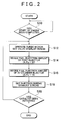
- the catalyst of the catalyst device 17 is activated early according to a control procedure shown in FIG. 2 in order to reduce exhaust emission immediately after the engine is started.
- the ECU 50 obtains an engine rotational speed based on a signal from the crank angle sensor 19, and determines whether the obtained engine rotational speed is higher than a predetermined threshold value. Then, when the engine rotational speed becomes higher than the predetermined threshold value, the ECU 50 determines that start of the internal combustion engine 1 has been completed (S10). When the ECU 50 determines that the start of the internal combustion engine 1 has been completed, the ECU 50 operates the turbo motor 24 for the turbocharger 20, and sets a valve overlap period during which both of the intake valve Vi and the exhaust valve Ve for each combustion chamber 2 are opened (S12).
- step S12 the ECU 50 gives a predetermined command signal to the inverter unit 25 connected to the turbo motor 24 such that the intake air pressure detected by the pressure sensor 16, that is, the pressure of the air that has been supercharged by the turbocharger 20 to be taken into each combustion chamber 2 becomes higher than back pressure inherent in the internal combustion engine 1 (exhaust back pressure) that is obtained in advance.
- the turbo motor 24 is controlled such that the intake air pressure becomes higher than the back pressure, for example, by approximately 10 to 30 kPa.
- the ECU 50 sets the overlap period, that is, the period during which both of the intake valve Vi and the exhaust valve Ve are opened, according to a map that is made in advance, and gives a predetermined command signal to the valve drive mechanism 8 including the variable valve timing mechanism.
- each in-cylinder injector 10c injects the fuel into each combustion chamber 2 (i.e., performs synchronous injection). Further, each in-cylinder injector 10c injects the fuel into each combustion chamber 2 (i.e., performs non-synchronous injection) also during the exhaust stroke.
- the air-fuel ratio A/Fe of the air-fuel mixture in each exhaust port 5 is maintained at approximately 16 at which burning of the air-fuel mixture can be promoted easily. That is, in the internal combustion engine 1, the intake air pressure and the overlap period are set in step S12, the air-fuel ratio A/Fp in each intake port 4 is set in step S14, the air-fuel ratio A/Fc in each combustion chamber 2 is set in step S16, and the fuel injection amount during the exhaust stroke is set in step S 18 such that the air-fuel ratio A/Fe of the air-fuel mixture in each exhaust port 5 becomes approximately 16 finally.
- the ECU 50 obtains the catalyst bed temperature of the catalyst device 17 based on a signal from the temperature sensor 18 in the catalyst device 17, and determines whether the obtained catalyst bed temperature is higher than the predetermined threshold value (S20).
- step S20 when the ECU 50 determines that the obtained catalyst bed temperature is higher than the predetermined threshold value, the ECU 50 determines that the catalyst of the catalyst device 17 has been fully activated. In this case, the ECU 50 terminates a series of processes in FIG. 2, and starts a control for the internal combustion engine 1 that is performed during normal operation.
- step S20 when the ECU 50 determines that the catalyst bed temperature is equal to or lower than the predetermined threshold value in step S20, the ECU 50 determines that the catalyst of the catalyst device 17 has not been fully activated, and repeatedly performs the aforementioned processes in step S12 to step S 18.
- the overlap period during which both of the intake valve Vi and the exhaust valve Ve are opened is set while the pressure of the air taken into each combustion chamber 2 (intake air pressure) is set to a value larger than the back pressure until it is determined that the catalyst of the catalyst device 17 has been activated in step S20 immediately after the engine is started.
- each in-cylinder injector 10c injects the fuel into each combustion chamber 2 (S16).
- A/Fc 14
- the air-fuel ratio becomes smaller than the stoichiometric air-fuel ratio. Therefore, combustion in each combustion chamber 2 is stably performed, and the combustion is performed with the air-fuel ratio of the air-fuel mixture being in the vicinity of the stoichiometric air-fuel ratio.
- the temperature of exhaust gas can be increased.
- each in-cylinder injector 10c injects the fuel also during the exhaust stroke (S 18) until it is determined that the catalyst of the catalyst device 17 has been activated in step S20.
- the in-cylinder injector 10c injects the fuel also during the exhaust stroke, whereby a sufficient amount of air (oxygen) can be delivered to the catalyst together with unburned fuel.
- the catalyst can be activated rapidly immediately after the engine is started, and exhaust emissions can be suitably reduced.
- blow-by from the intake port 4 to the exhaust port 5 is caused by effectively using the turbocharger 20 that is the so-called motor-assist turbo charger, whereby unburned fuel and a sufficient amount of air can be delivered to the catalyst. Therefore, an air pump and the like which are conventionally used for supplying secondary air to the catalyst in order to activate the catalyst become unnecessary.
- each in-cylinder injector 10c injects the fuel into each combustion chamber 2 during the exhaust stroke in step S18.
- the fuel injection during the exhaust stroke in step S18 may be omitted.
- each port injector 10p may perform non-synchronous injection into each intake port 4 such that the air-fuel ratio A/Fe of the air-fuel mixture in each exhaust port 5 is maintained at approximately 16, instead of fuel injection during the exhaust stroke in step S 18.
- FIG. 3 is a flow chart showing another control procedure that can be performed in order to reduce exhaust emissions immediately after the engine is started.
- the ECU 50 obtains the engine rotational speed based on the signal from the crank angle sensor 19, and determines whether the obtained engine rotational speed is higher than the predetermined threshold value.
- the ECU 50 determines that the start of the internal combustion engine 1 has been completed (S30).
- the ECU 50 operates the turbo motor 24 for the turbocharger 20, and sets the valve overlap period during which both of the intake valve Vi and the exhaust valve Ve for each combustion chamber 2 are opened (S32).
- step S32 the ECU 50 gives a predetermined command signal to the inverter unit 25 connected to the turbo motor 24 such that the intake air pressure detected by the pressure sensor 16 becomes higher than the back pressure inherent in the internal combustion engine 1.
- the ECU 50 sets the overlap period during which both of the intake valve Vi and the exhaust valve Ve are opened, according to the map that is made in advance, and the like, and gives a predetermined command signal to the valve drive mechanism 8 including the variable valve timing mechanism.
- step S36 the ECU 50 decides the amount of fuel to be injected from each in-cylinder injector 10c during the exhaust stroke of the internal combustion engine 1 (S36).
- step S32 the intake air pressure and the overlap period are set in step S32
- the air-fuel ratio A/Fc in each combustion chamber 2 is set in step S34
- the fuel injection amount during the exhaust stroke is set in step S36 such that the air-fuel ratio A/Fe of the air-fuel mixture in each exhaust port 5 becomes approximately 16 finally.
- the ECU 50 obtains the catalyst bed temperature based on the signal from the temperature sensor 18 in the catalyst device 17, and determines whether the obtained catalyst bed temperature is higher than the predetermined threshold value (S38).
- the ECU 50 determines that the catalyst of the catalyst device 17 has been fully activated. In this case, the ECU 50 terminates a series of processes in FIG. 3, and starts the control for the internal combustion engine 1 that is performed during normal operation.
- step S38 when the ECU 50 determines that the catalyst bed temperature is equal to or lower than the predetermined threshold value in step S38, the ECU 50 determines that the catalyst of the catalyst device 17 has not been fully activated, and repeatedly performs the aforementioned processes in step S32 to step S36.
- blow-by of the fresh air from the intake port 4 to the exhaust port 5 is reliably promoted, and unburned fuel in the combustion chamber 2 is brought to the exhaust port 5 by the flow of the fresh air. Therefore, in the case where the control procedure shown in FIG. 3 is employed as well, a sufficient amount of air (oxygen) can be delivered to the catalyst together with unburned fuel. Accordingly, after-burning in the catalyst device 17 can be promoted, and the catalyst can be activated efficiently.
- oxygen oxygen
- each in-cylinder injector 10c injects the fuel also during the exhaust stroke (S36) until it is determined that the catalyst of the catalyst device 17 has been activated in step S38, a sufficient amount of air (oxygen) can be delivered to the catalyst together with unburned fuel.
- the overlap period during which both of the intake valve Vi and the exhaust valve Ve are opened is appropriately set, whereby the air-fuel ratio A/Fe of the air-fuel mixture in each exhaust port 5 can be maintained at approximately 16 at which burning of the air-fuel mixture can be promoted easily.
- the catalyst can be activated early not only in the internal combustion engine that includes both of the port injector and the in-cylinder injector, such as the internal combustion engine 1, but also in the in-cylinder injection internal combustion engine that includes, as the fuel injection means, only the in-cylinder injector for injecting the fuel directly into the combustion chamber.
- FIG. 4 is a flow chart showing yet another control procedure that can be performed in the internal combustion engine 1 in order to reduce exhaust emissions immediately after the engine is started.
- the ECU 50 determines that the start of the internal combustion engine 1 has been completed when the engine rotational speed obtained based on the signal from the crank angle sensor 19 becomes higher than the predetermined threshold value (S50).
- the ECU 50 determines that the start of the internal combustion engine 1 has been completed, the ECU 50 operates the turbo motor 24 for the turbocharger 20, and sets the overlap period during which both of the intake valve Vi and the exhaust valve Ve for each combustion chamber 2 are opened (S52).
- step S52 the ECU 50 gives a predetermined command signal to the inverter unit 25 connected to the turbo motor 24 such that the intake air pressure detected by the pressure sensor 16 becomes higher than the back pressure inherent in the internal combustion engine 1.
- the ECU 50 sets the overlap period during which both of the intake valve Vi and the exhaust valve Ve are opened, according to the map and the like that are made in advance, and gives a predetermined command signal to the valve drive mechanism 8 including the variable valve timing mechanism.
- the air-fuel ratio A/Fe of the air-fuel mixture in each exhaust port 5 is maintained at approximately 16 at which burning of the air-fuel mixture can be promoted easily, due to blow-by of the lean air-fuel mixture whose air-fuel ratio A/Fp is approximately 16 from the intake port 4 to the exhaust port 5.
- the ECU 50 obtains the catalyst bed temperature based on the signal from the temperature sensor 18 in the catalyst device 17, and determines whether the obtained catalyst bed temperature is higher than the predetermined threshold value (S56).
- the ECU 50 determines that the catalyst bed temperature is higher than the threshold value, and therefore determines that the catalyst of the catalyst device 17 has been fully activated in step S56.
- the ECU 50 terminates a series of the processes in FIG. 4, and starts the control for the internal combustion engine 1 that is performed during normal operation. Meanwhile, when the ECU 50 determines that the catalyst bed temperature is equal to or lower than the predetermined threshold value in step S56, the ECU 50 repeatedly performs the aforementioned processes in step S52 to S54.
- the valve overlap period during which both of the intake valve Vi and the exhaust valve Ve are opened is set while the pressure of the air taken into each combustion chamber 2 (intake air pressure) is set to a value larger than the back pressure until it is determined that the catalyst of the catalyst device 17 has been activated in step S56, for example, immediately after the engine is started.
- A/Fp 16
- each port injector 10p may perform non-synchronous injection into each intake port 4 between step S54 and step S56 such that the air-fuel ratio A/Fe of the air-fuel mixture in each exhaust port 5 is maintained at, for example, approximately 16.
- the catalyst can be activated early not only in the internal combustion engine that includes both of the port injector and the in-cylinder injector, such as the internal combustion engine 1, but also in the port injection internal combustion engine that includes, as the fuel injection means, only the port injector for injecting the fuel into the intake port.
- An internal combustion engine (1) in which power is generated by burning a mixture of fuel supplied from a port injector (10p) and/or an in-cylinder injector (10c) and air in a combustion chamber (2), includes a valve drive mechanism (8) which can change a valve opening characteristic of at least one of an intake valve (Vi) and an exhaust valve (Ve); a turbocharger (20) which supercharges air taken into the combustion chamber (2); a turbo motor (24) which changes supercharging pressure generated by the turbocharger (20); a catalyst device (17) including a catalyst for purifying exhaust gas discharged from the combustion chamber (2); and an ECU (50) which controls the turbo motor (24) such that pressure of the air taken into the combustion chamber (2) becomes larger than back pressure until it is determined that the catalyst has been activated, and which sets a valve overlap period during which both of the intake valve (Vi) and the exhaust valve (Ve) are opened.
- a valve drive mechanism (8) which can change a valve opening characteristic of at least one of an intake valve (Vi) and an exhaust valve (V
Landscapes
- Engineering & Computer Science (AREA)
- Chemical & Material Sciences (AREA)
- Combustion & Propulsion (AREA)
- Mechanical Engineering (AREA)
- General Engineering & Computer Science (AREA)
- Output Control And Ontrol Of Special Type Engine (AREA)
- Electrical Control Of Air Or Fuel Supplied To Internal-Combustion Engine (AREA)
- Exhaust Gas After Treatment (AREA)
- Combined Controls Of Internal Combustion Engines (AREA)
- Supercharger (AREA)
Abstract
Description
- The invention relates to an internal combustion engine in which power is generated by burning an air-fuel mixture in a combustion chamber, and a control method thereof. More particularly, the invention relates to an internal combustion engine and a control method thereof, which make it possible to activate a catalyst for purifying exhaust gas discharged from a combustion chamber early.
- Recently, it has become more and more important to reduce exhaust emissions such as HC, for example, immediately after an engine is started in a cold state, since enforcement of the emission control and the like is strengthened. Therefore, as disclosed in Japanese Patent Application Publication No. JP-A-8-296458, an in-cylinder injection internal combustion engine is known, in which a fuel injection valve injects fuel directly into a combustion chamber during an exhaust stroke so that unburned fuel (and air) is burned in a catalyst, whereby the catalyst is activated early. Also, as disclosed in Japanese Patent Application Publication No. JP-A-2001-304016, a technology is known, in which a fuel injection valve injects fuel during an expansion stroke, oxygen that becomes unnecessary during a compression stroke and CO that is generated due to incomplete combustion during the expansion stroke are supplied to a catalyst, and the catalyst is activated using heat of reaction between the oxygen and the CO when the engine is started in a cold state.
- As disclosed in Japanese Patent Application Publication No. JP-A-2002-048035, an internal combustion engine with a turbocharger which makes it possible to improve fuel economy and suppress generation of smoke. The internal combustion engine with a turbocharger includes a port injector for injecting fuel into an intake port, and an in-cylinder injector for injecting fuel directly into a combustion chamber. Further, as disclosed in Japanese Patent Application Publication No. JP-A-4-183945, an in-cylinder injection internal combustion engine is known, in which a valve overlap period during which both of an intake valve and an exhaust valve are opened is increased during engine low-load operation so that the amount of high-temperature unburned gas that remains in a combustion chamber is increased, whereby the temperature of an air-fuel mixture is maintained at high temperature before ignition, evaporation of fuel is promoted, a combustion speed is improved, and combustion is stabilized.
- However, as described above, even if the fuel is injected directly into the combustion chamber during the exhaust stroke or the compression stroke, it is difficult to reliably supply the catalyst with air of an amount necessary for activating (warming) the catalyst. Thus, the internal combustion engine needs to be further improved in order to reduce exhaust emissions, for example, immediately after the engine is started in the cold state.
- It is an object of the invention to provide an internal combustion engine and a control method thereof, which make it possible to reliably activate a catalyst early, and to suitably reduce exhaust emissions.
- A first aspect of the invention relates to an internal combustion engine in which power is generated by burning a mixture of fuel supplied from fuel injection means and air in a combustion chamber continuous with an intake port that is opened/closed by an intake valve and an exhaust port that is opened/closed by an exhaust valve. The internal combustion engine includes valve opening characteristic setting means for changing a valve opening characteristic of at least one of the intake valve and the exhaust valve; a turbocharger for supercharging air taken into the combustion chamber; supercharging pressure setting means for supercharging pressure generated by the turbocharger; a catalyst for purifying exhaust gas discharged from the combustion chamber; and control means for controlling the supercharging pressure setting means such that pressure of the air taken into the combustion chamber becomes larger than back pressure until it is determined that the catalyst has been activated, and setting a valve overlap period during which both of the intake valve and the exhaust valve are opened.
- According to the first aspect of the invention, the internal combustion engine includes the supercharging pressure setting means for changing the supercharging pressure generated by the turbocharger; and the valve opening characteristic setting means for changing the valve opening characteristic of at least one of the intake valve and the exhaust valve. In the internal combustion engine, the valve overlap period during which both of the intake valve and the exhaust valve are opened is set while the pressure of the air taken into the combustion chamber is set to a value larger than the back pressure until it is determined that the catalyst has been activated, for example, immediately after the engine is started. Thus, so-called blow-by from the intake port to the exhaust port is reliably promoted, and a sufficient amount of air (oxygen) can be delivered to the catalyst together with unburned fuel. As a result, in the internal combustion engine, so-called after-burning in the catalyst and an exhaust pipe can be promoted, and the temperature of exhaust gas can be increased. Therefore, the catalyst can be activated early, and the exhaust emissions can be suitably reduced.
- In the first aspect of the invention, the turbocharger may include a motor which is the supercharging pressure setting means, and which rotates a compressor element.
- In the first aspect of the invention, the fuel injection means may be an in-cylinder injector for injecting the fuel directly into the combustion chamber. With the configuration, the catalyst of an in-cylinder injection internal combustion engine can be activated early.
- In the first aspect of the invention, the controller may cause the in-cylinder injector to inject the fuel also during an exhaust stroke until it is determined that the catalyst has been activated. With the configuration, since the in-cylinder injector injects the fuel also during the exhaust stroke in addition to normal fuel injection (in-cylinder injection), the temperature of exhaust gas discharged from the combustion chamber can be increased by promoting combustion in the combustion chamber, and a sufficient amount of air (oxygen) can be delivered to the catalyst together with unburned fuel.
- In the first aspect of the invention, the fuel injection means may be a port injector for injecting the fuel into the intake port. With the configuration, a catalyst of a port injection internal combustion engine can be also activated early. In this case, the control means may set an air-fuel ratio of the mixture in the intake port to a lean air-fuel ratio until it is determined that the catalyst has been activated.
- With the aforementioned configuration, since air and the fuel supplied from the fuel injection means are uniformly mixed at the intake port, blow-by of the uniform and lean mixture from the intake port to the exhaust port is promoted. Thus, in the internal combustion engine, the catalyst can be efficiently activated by delivering a sufficient amount of air (oxygen) to the catalyst together with unburned fuel, and promoting so-called after-burning.
- In the first aspect of the invention, the fuel injection means may include a port injector for injecting the fuel into the intake port, and an in-cylinder injector for injecting the fuel directly into the combustion chamber. Also, the controller may cause the port injector to inject the fuel such that an air-fuel ratio of the mixture in the intake port (and the exhaust port) becomes lean and may cause the in-cylinder injector to inject the fuel until it is determined that the catalyst has been activated.
- With the configuration, the temperature of exhaust gas can be increased by delivering a sufficient amount of air (oxygen) to the catalyst together with unburned fuel. Accordingly, the catalyst can be activated early, and exhaust emissions can be suitably reduced.
- In the first aspect of the invention, the control means may cause the in-cylinder injector to inject the fuel also during an exhaust stroke until it is determined that the catalyst has been activated.
- A second aspect of the invention relates to a control method for an internal combustion engine including a combustion chamber continuous with an intake port that is opened/closed by an intake valve and an exhaust port that is opened/closed by an exhaust valve; valve opening characteristic setting means for changing a valve opening characteristic of at least one of the intake valve and the exhaust valve; a turbocharger which can change a supercharging pressure; and a catalyst for purifying exhaust gas discharged from the combustion chamber, wherein power is generated by burning a mixture of fuel supplied from fuel injection means and air in the combustion chamber. The control method includes the steps of setting pressure of air supercharged by the turbocharger and taken into the combustion chamber to a value larger than back pressure until it is determined that the catalyst has been activated; and setting a valve overlap period during which both of the intake valve and the exhaust valve are opened.
- According to the invention, it is possible to provide the internal combustion engine and control method thereof, which make it possible to reliably activate the catalyst early and to suitably reduce exhaust emissions.
- The foregoing and further objects, features and advantages of the invention will become apparent from the following description of preferred embodiments with reference to the accompanying drawings, wherein like numerals are used to represent like elements and wherein:
- FIG. 1 is a schematic diagram showing a configuration of an internal combustion engine according to the invention;
- FIG. 2 is a flow chart explaining operation of the internal combustion engine shown in FIG. 2;
- FIG. 3 is a flow chart showing another control procedure that can be performed in the internal combustion engine shown in FIG. 1 in order to reduce exhaust emissions immediately after the engine is started; and
- FIG. 4 is a flow chart showing a yet another control procedure that can be performed in the internal combustion engine shown in FIG. 1 in order to reduce exhaust emissions immediately after the engine is started.
-
- Hereinafter, an exemplary embodiment of the invention will be described with reference to accompanying drawings.
- FIG. 1 is a schematic diagram showing an internal combustion engine according to the invention. An internal combustion engine 1 shown in FIG. 1 is configured as a multicylinder internal combustion engine for a vehicle (for example, a four-cylinder internal combustion engine. However, FIG. 1 shows only one cylinder). A piston 3 is reciprocated using combustion of an air-fuel mixture in each
combustion chamber 2, whereby power is obtained from a crank shaft S. In the embodiment, the internal combustion engine 1 is described as a so-called gasoline engine. However, the invention is not limited to the gasoline engine. It is apparent that the invention can be applied to a diesel engine. - As shown in FIG. 1, each
intake port 4 that is continuous with eachcombustion chamber 2 is connected to anintake pipe 6 via an intake manifold. Eachexhaust port 5 that is continuous with eachcombustion chamber 2 is connected to an exhaust pipe 7 via an exhaust manifold. Also, in a cylinder head of the internal combustion engine 1, an intake valve Vi for opening/closing theintake port 4 and an exhaust valve Ve for opening/closing theexhaust port 5 are provided for eachcombustion chamber 2. Each intake valve Vi and each exhaust valve Ve are opened/closed by a valve drive mechanism 8. This valve drive mechanism 8 includes a variable valve timing mechanism (valve opening characteristic setting means) which can change the valve opening characteristic of at least one of the intake valve Vi and the exhaust valve Ve. Further, the internal combustion engine 1 includesignition plugs 9 whose number corresponds to the number of cylinders. Eachignition plug 9 is provided in the cylinder head so as to be opposed to the correspondingcombustion chamber 2. - Also, the internal combustion engine 1 includes in-
cylinder injectors 10c whose number corresponds to the number of cylinders. Each in-cylinder injector 10c can inject fuel such as gasoline directly into eachcombustion chamber 2. Each in-cylinder injector 10c is connected to a fuel tank (not shown) for storing liquid fuel such as gasoline via a fuel supply pipe (not shown). In addition, the internal combustion engine 1 includesport injectors 10p whose number corresponds to the number of cylinders, as shown in FIG. 1. Eachport injector 10p can inject the fuel such as gasoline into thecorresponding intake port 4. Eachport injector 10p is connected to the fuel tank (not shown) for storing the liquid fuel such as gasoline via the fuel supply pipe (not shown). At least one in-cylinder injector 10c is provided for eachcombustion chamber 2. At least oneport injector 10p is provided for eachintake port 4. - Each piston 3 of the internal combustion engine 1 is configured such that a concave portion having a so-called deep dish shape is formed at the top face thereof. In the internal combustion engine 1, each in-
cylinder injector 10c can inject the fuel such as gasoline directly toward the concave portion of the piston 3 in eachcombustion chamber 2 with air being taken into eachcombustion chamber 2. Thus, in the internal combustion engine 1, a layer of an air-fuel mixture is formed in the vicinity of theignition plug 9 such that the layer of the air-fuel mixture is separated from an air layer therearound (i.e., the air-fuel mixture is stratified). Therefore, it is possible to stably perform stratified charge combustion using an extremely lean mixture. - Meanwhile, the
intake pipe 6 is connected to a surge tank 11, as shown in FIG. 1. The surge tank 11 is connected to anair cleaner 14 via anair supply pipe 12. Dust, dirt, and the like in the intake air are removed using theair cleaner 14. Also, athrottle valve 15 for adjusting an intake air amount is provided at a certain position in theair supply pipe 12. In the embodiment, as thethrottle valve 15, an electronically controlled throttle valve is employed. The electronically controlledthrottle valve 15 includes anaccelerator position sensor 15a for detecting an operation amount (depression amount) of an accelerator pedal AP, athrottle motor 15b for opening/closing thethrottle valve 15, and a throttle valve opening amount sensor 15c for detecting the opening amount of thethrottle valve 15. Further, apressure sensor 16 for detecting the pressure (intake air pressure) in theair supply pipe 12 is provided between the surge tank 11 and thethrottle valve 15 in theair supply pipe 12. - Also, the exhaust pipe 7 is connected to a
catalyst device 17 including, for example, a NOx storage reduction catalyst, as shown in FIG. 1. In thecatalyst device 17, exhaust gas discharged from eachcombustion chamber 2 is purified. Atemperature sensor 18 for detecting a catalyst bed temperature is provided in thecatalyst device 17. The internal combustion engine 1 may include an EGR (exhaust gas recirculation) passage through which exhaust gas flows back to the surge tank 11 of an intake air system from the exhaust pipe 7. In this case, an EGR valve for adjusting the amount of exhaust gas flowing back to the surge tank 11 is provided in the EGR passage. - The aforementioned internal combustion engine 1 further includes a
turbocharger 20 in order to obtain high output and high fuel efficiency by introducing more intake air into eachcombustion chamber 2, and performing lean-burn operation. Theturbocharger 20 includes a turbine impeller (turbine element) 21 and a compressor impeller (compressor element) 22, as shown in FIG. 1. Theturbine impeller 21 and thecompressor impeller 22 are connected and integrated with each other by arotation shaft 23. - As shown in FIG. 1, the
turbine impeller 21 is provided so as to be rotatable in a casing incorporated between the exhaust pipe 7 and thecatalyst device 17. Also, thecompressor impeller 22 is provided so as to be rotatable in a casing incorporated between theair cleaner 14 and thethrottle valve 15. Since theturbine impeller 21 is rotated by exhaust gas discharged from eachcombustion chamber 2, thecompressor impeller 22 can be rotated. Thus, air that is taken via theair cleaner 14 can be compressed (supercharged) by thecompressor impeller 22. - Also, the
turbocharger 20 of the internal combustion engine 1 is configured as a so-called motor-assist turbocharger. Theturbocharger 20 includes a turbo motor 24 (supercharging pressure setting means) that is provided on therotation shaft 23 which connects theturbine impeller 21 and thecompressor impeller 22. That is, theturbocharger 20 can function as a typical turbocharger which compresses the intake air using only energy of the exhaust gas of the internal combustion engine 1. Also, theturbocharger 20 can further increase the pressure of the intake air (supercharging pressure) by operating theturbo motor 24 so as to forcibly rotate thecompressor impeller 22. - As the
turbo motor 24, an alternating current motor, which includes a rotor fixed on therotation shaft 23 and a stator disposed around the rotor, is employed. As shown in FIG. 1, theturbo motor 24 is connected to aninverter unit 25. As theturbo motor 24, a so-called motor-generator which can function as both of a motor and a generator. - With the configuration, electric energy can be recovered by operating the
turbo motor 24 as the generator using the energy of exhaust gas. - Also, the internal combustion engine 1 includes an inter-cooler 26 incorporated in the
air supply pipe 12 so as to be positioned between thecompressor impeller 22 and thethrottle valve 15. Theinter-cooler 26 cools the intake air whose temperature has been increased due to compression by thecompressor impeller 22, whereby charging efficiency is improved. As theinter-cooler 26, for example, an air-cooled or liquid-cooled heat exchanger is employed. Further, abypass passage 27 that connects an upstream side and a downstream side of the turbocharger 20 (compressor impeller 22) is provided in theair supply pipe 12. Thebypass passage 27 is opened/closed by anair bypass valve 28 that is provided at a certain position in thebypass passage 27. As anair bypass valve 28, a valve which can be electrically opened/closed may be used. Alternatively, a mechanical one-way valve may be used, which is opened only when the pressure on the downstream side of thecompressor impeller 22 becomes higher than the pressure on the upstream side of thecompressor impeller 22 by a predetermined value. - The
turbocharger 20 in the embodiment is configured as a so-called variable nozzle turbocharger. Theturbocharger 20 includes plural movable vanes (not shown) disposed outside of theturbine impeller 21. That is, the flow amount of exhaust gas flowing into theturbine impeller 21 is controlled by changing the positions of these movable vanes, whereby the supercharging pressure can be freely adjusted. Also, theturbocharger 20 may include a mechanism which performs a variable control of a turbine capacity (A/R variable mechanism) and the like. Further, a passage (not shown) which bypasses theturbocharger 20 is provided for the exhaust pipe 7. A waste gate valve is provided at a certain position in the passage. The waste gate valve is opened when the supercharging pressure becomes equal to or higher than a predetermined pressure so as to adjust the supercharging pressure by decreasing the flow amount of exhaust gas flowing to theturbine impeller 21. - The internal combustion engine 1 includes a
regenerative generator 30 connected to the crank shaft S, in addition to theaforementioned turbocharger 20, as shown in FIG. 1. Theregenerative generator 30 can function as a regenerative brake unit which is operated in coordination with a hydraulic brake unit (not shown). The regenerative generator is connected to abattery 31 which is used as a power source for various auxiliary machines, via aninverter unit 25. That is, when the accelerator pedal AP is returned, or when a command for decelerating or stopping the internal combustion engine 1 (vehicle) is issued, theregenerative generator 30 converts kinetic energy of the internal combustion engine 1 to electric energy, and recovers the electric energy, thereby applying braking force to the internal combustion engine 1. The voltage of the electric power regenerated by theregenerative generator 30 is changed by theinverter unit 25, and then, the electric power is used for charging thebattery 31. - The braking force generated by the regenerative generator 30 (regenerative brake) and the braking force generated by the hydraulic brake unit are appropriately combined such that energy is recovered most efficiently. Also, as the
regenerative generator 30, the so-called motor-generator which can function as both of the motor and the generator may be employed. Thus, a vehicle including the aforementioned internal combustion engine 1 and theturbocharger 20 may be configured as a so-called hybrid vehicle. - The aforementioned internal combustion engine 1 includes an electric control unit (hereinafter, referred to as "ECU") 50 which functions as control means. The
ECU 50 includes a CPU, ROM, RAM, input/output ports, and a storage device for storing various information, maps, and the like. The input/output ports of theECU 50 are connected to the aforementioned valve drive mechanism 8, theinjectors accelerator position sensor 15a, thethrottle motor 15b, the throttle valve opening amount sensor 15c, thepressure sensor 16, thetemperature sensor 18, acrank angle sensor 19, theinverter unit 25, theair bypass valve 28, and the like. TheECU 50 controls the valve drive mechanism 8, the ignition plugs 9, theinjectors throttle valve 15, and the like, based on detection values of the various sensors, and the like, using the various maps stored in the storage device. Also, theECU 50 functions as the control means for the turbocharger 20 (turbo motor 24) when the brake is applied to the internal combustion engine 1. - Recently, it has become more and more important to reduce exhaust emissions such as HC, for example, immediately after an engine is started in a cold state, since enforcement of the emission control and the like is strengthened. Therefore, in the aforementioned internal combustion engine 1, the catalyst of the
catalyst device 17 is activated early according to a control procedure shown in FIG. 2 in order to reduce exhaust emission immediately after the engine is started. - Hereinafter, the control procedure for the internal combustion engine 1 shown in FIG. 2 will be described. In this case, when the ignition switch is turned on and the internal combustion engine 1 is started, the
ECU 50 obtains an engine rotational speed based on a signal from thecrank angle sensor 19, and determines whether the obtained engine rotational speed is higher than a predetermined threshold value. Then, when the engine rotational speed becomes higher than the predetermined threshold value, theECU 50 determines that start of the internal combustion engine 1 has been completed (S10). When theECU 50 determines that the start of the internal combustion engine 1 has been completed, theECU 50 operates theturbo motor 24 for theturbocharger 20, and sets a valve overlap period during which both of the intake valve Vi and the exhaust valve Ve for eachcombustion chamber 2 are opened (S12). - More specifically, in step S12, the
ECU 50 gives a predetermined command signal to theinverter unit 25 connected to theturbo motor 24 such that the intake air pressure detected by thepressure sensor 16, that is, the pressure of the air that has been supercharged by theturbocharger 20 to be taken into eachcombustion chamber 2 becomes higher than back pressure inherent in the internal combustion engine 1 (exhaust back pressure) that is obtained in advance. In the embodiment, theturbo motor 24 is controlled such that the intake air pressure becomes higher than the back pressure, for example, by approximately 10 to 30 kPa. At substantially the same time, theECU 50 sets the overlap period, that is, the period during which both of the intake valve Vi and the exhaust valve Ve are opened, according to a map that is made in advance, and gives a predetermined command signal to the valve drive mechanism 8 including the variable valve timing mechanism. - After the process in step S12 is performed, the
ECU 50 decides the fuel injection amount of eachport injector 10p (S14). More specifically, in step S14, theECU 50 sets the valve opening period of eachport injector 10p such that the air-fuel ratio A/Fp of the air-fuel mixture in eachintake port 4 becomes, for example, approximately 30 (i.e., A/Fp = 30), based on the intake air pressure that is set in step S12 and the like, according to the map that is made in advance. Then, theECU 50 gives a predetermined command signal to eachport injector 10p. - After the process in step S14 is performed, the
ECU 50 further decides the fuel injection amount of each in-cylinder injector (S16). More specifically, instep 16, theECU 50 decides the valve opening period of each in-cylinder injector 10c such that the air-fuel ratio A/Fc of the air-fuel mixture in eachcombustion chamber 2 becomes, for example, approximately 14 (A/Fc = 14), based on the intake air pressure that is set in step S12, the overlap period during which both of the intake valve Vi and the exhaust vale Ve are opened that is set in step S12, that is, a blow-by amount of the lean air-fuel mixture (A/Fp = 30) that blows from theintake port 4 to theexhaust port 5 due to the valve overlap, and the like, according to the map that is made in advance, and the like. Then, theECU 50 gives a predetermined command signal to each in-cylinder injector 10c. - Further, after the process in step S16 is performed, the
ECU 50 decides the amount of the fuel to be injected from each in-cylinder injector 10c during the exhaust stroke of the internal combustion engine 1 (step S18). More specifically, in step S18, theECU 50 decides the valve opening period and the valve opening timing of each in-cylinder injector 10c such that the air-fuel ratio A/Fe of the air-fuel mixture in eachexhaust port 5 becomes, for example, approximately 16 (A/Fe = 16), based on the intake air pressure that is set in step S12, the overlap period during which both of the intake valve Vi and the exhaust vale Ve are opened (the blow-by amount of the lean air-fuel mixture that blows from theintake port 4 to the exhaust port 5) that is set in step S12, the fuel injection amount of eachport injector 10p and the fuel injection amount of each in-cylinder injector 10c, and the like, according to the map that is made in advance, and the like. Then, theECU 50 gives a predetermined command signal to each in-cylinder injector 10c. - Thus, when the process in
step S 18 has been completed, eachport injector 10p injects the fuel into each intake port (i.e., performs synchronous injection) such that the air-fuel ratio of the air-fuel mixture in eachintake port 4 becomes lean (in this case, A/Fp = 30), that is, the air-fuel ratio becomes larger than a stoichiometric air-fuel ratio. In addition, each in-cylinder injector 10c injects the fuel into each combustion chamber 2 (i.e., performs synchronous injection). Further, each in-cylinder injector 10c injects the fuel into each combustion chamber 2 (i.e., performs non-synchronous injection) also during the exhaust stroke. As a result, the air-fuel ratio A/Fe of the air-fuel mixture in eachexhaust port 5 is maintained at approximately 16 at which burning of the air-fuel mixture can be promoted easily. That is, in the internal combustion engine 1, the intake air pressure and the overlap period are set in step S12, the air-fuel ratio A/Fp in eachintake port 4 is set in step S14, the air-fuel ratio A/Fc in eachcombustion chamber 2 is set in step S16, and the fuel injection amount during the exhaust stroke is set in step S 18 such that the air-fuel ratio A/Fe of the air-fuel mixture in eachexhaust port 5 becomes approximately 16 finally. - After the process in step S18 is performed, the
ECU 50 obtains the catalyst bed temperature of thecatalyst device 17 based on a signal from thetemperature sensor 18 in thecatalyst device 17, and determines whether the obtained catalyst bed temperature is higher than the predetermined threshold value (S20). In step S20, when theECU 50 determines that the obtained catalyst bed temperature is higher than the predetermined threshold value, theECU 50 determines that the catalyst of thecatalyst device 17 has been fully activated. In this case, theECU 50 terminates a series of processes in FIG. 2, and starts a control for the internal combustion engine 1 that is performed during normal operation. Meanwhile, when theECU 50 determines that the catalyst bed temperature is equal to or lower than the predetermined threshold value in step S20, theECU 50 determines that the catalyst of thecatalyst device 17 has not been fully activated, and repeatedly performs the aforementioned processes in step S12 to stepS 18. - As described above, in the internal combustion engine 1, the overlap period during which both of the intake valve Vi and the exhaust valve Ve are opened is set while the pressure of the air taken into each combustion chamber 2 (intake air pressure) is set to a value larger than the back pressure until it is determined that the catalyst of the
catalyst device 17 has been activated in step S20 immediately after the engine is started. Thus, it is possible to reliably promote blow-by of the lean air-fuel mixture (A/Fp = 30), which is generated by uniformly mixing the air and the fuel in eachintake port 4, from theintake port 4 to theexhaust port 5. Therefore, a sufficient amount of air (oxygen) can be delivered to the catalyst together with unburned fuel. Accordingly, in the internal combustion engine 1, after-burning in thecatalyst device 17 can be promoted, and the catalyst can be activated efficiently. - Also, in the internal combustion engine 1, in addition to the fuel injection to each intake port 4 (S14), each in-
cylinder injector 10c injects the fuel into each combustion chamber 2 (S16). As a result, the air-fuel ratio of the air-fuel mixture inside eachcombustion chamber 2 becomes relatively rich (A/Fc = 14), that is, the air-fuel ratio becomes smaller than the stoichiometric air-fuel ratio. Therefore, combustion in eachcombustion chamber 2 is stably performed, and the combustion is performed with the air-fuel ratio of the air-fuel mixture being in the vicinity of the stoichiometric air-fuel ratio. Thus, the temperature of exhaust gas can be increased. Further, in the internal combustion engine 1, each in-cylinder injector 10c injects the fuel also during the exhaust stroke (S 18) until it is determined that the catalyst of thecatalyst device 17 has been activated in step S20. Thus, in addition to the normal fuel injection (port injection and in-cylinder injection), the in-cylinder injector 10c injects the fuel also during the exhaust stroke, whereby a sufficient amount of air (oxygen) can be delivered to the catalyst together with unburned fuel. - As a result, after-burning of the fuel in the catalyst of the
catalyst device 17 and the exhaust pipe 7 can be promoted, and the temperature of exhaust gas can be increased in the internal combustion engine 1. Therefore, the catalyst can be activated rapidly immediately after the engine is started, and exhaust emissions can be suitably reduced. Also, in the internal combustion engine 1, blow-by from theintake port 4 to theexhaust port 5 is caused by effectively using theturbocharger 20 that is the so-called motor-assist turbo charger, whereby unburned fuel and a sufficient amount of air can be delivered to the catalyst. Therefore, an air pump and the like which are conventionally used for supplying secondary air to the catalyst in order to activate the catalyst become unnecessary. - In the internal combustion engine 1 including the
turbocharger 20, since exhaust gas discharged from eachcombustion chamber 2 passes through theturbocharger 20 before flowing into thecatalyst device 17, the temperature of exhaust gas is decreased to a certain degree due to heat capacity of theturbocharger 20, that is, heat capacity of theturbine impeller 21 and thecompressor impeller 22. However, if a difference between the intake air pressure set in step S12 and the back pressure is made sufficiently large, the influence of heat loss of the exhaust gas at theturbocharger 20 on activation of the catalyst is substantially negligible. - In the control procedure shown in FIG. 2, in addition to the normal port injection and the normal in-cylinder injection, each in-
cylinder injector 10c injects the fuel into eachcombustion chamber 2 during the exhaust stroke in step S18. However, the fuel injection during the exhaust stroke in step S18 may be omitted. In the case where the fuel injection during the exhaust stroke is omitted, the air-fuel ratio A/Fp in eachintake port 4 is set to, for example, approximately 22 (A/Fp = 22) instep S 14, the air-fuel ratio A/Fc in eachcombustion chamber 2 is set to, for example, approximately 12 (A/Fc = 12) in step S16, and the overlap period during which both of the intake valve Vi and the exhaust valve Ve are opened is appropriately set, whereby the air-fuel ratio A/Fe of the air-fuel mixture in eachexhaust port 5 can be maintained at approximately 16 at which burning of the air-fuel mixture can be promoted easily. Further, eachport injector 10p may perform non-synchronous injection into eachintake port 4 such that the air-fuel ratio A/Fe of the air-fuel mixture in eachexhaust port 5 is maintained at approximately 16, instead of fuel injection during the exhaust stroke instep S 18. - FIG. 3 is a flow chart showing another control procedure that can be performed in order to reduce exhaust emissions immediately after the engine is started.
- Hereinafter, the control procedure for the internal combustion engine 1 shown in FIG. 3 will be described. In this control procedure as well, when the ignition switch is turned on and the internal combustion engine 1 is started, the
ECU 50 obtains the engine rotational speed based on the signal from thecrank angle sensor 19, and determines whether the obtained engine rotational speed is higher than the predetermined threshold value. When the engine rotational speed becomes higher than the predetermined threshold value, theECU 50 determines that the start of the internal combustion engine 1 has been completed (S30). When theECU 50 determines that the start of the internal combustion engine 1 has been completed, theECU 50 operates theturbo motor 24 for theturbocharger 20, and sets the valve overlap period during which both of the intake valve Vi and the exhaust valve Ve for eachcombustion chamber 2 are opened (S32). - In step S32, the
ECU 50 gives a predetermined command signal to theinverter unit 25 connected to theturbo motor 24 such that the intake air pressure detected by thepressure sensor 16 becomes higher than the back pressure inherent in the internal combustion engine 1. At substantially the same time, theECU 50 sets the overlap period during which both of the intake valve Vi and the exhaust valve Ve are opened, according to the map that is made in advance, and the like, and gives a predetermined command signal to the valve drive mechanism 8 including the variable valve timing mechanism. - After the process in step S32 is performed, the
ECU 50 decides the fuel injection amount of each in-cylinder injector 10c (S34). More specifically, in step S34, theECU 50 decides the valve opening period of each in-cylinder injector 10c such that the air-fuel ratio A/Fc of the air-fuel mixture in eachcombustion chamber 2 becomes, for example, approximately 12 (A/Fc = 12), based on the intake air pressure that is set in step S32, the overlap period during which both of the intake valve Vi and the exhaust vale Ve are opened that is set in step S32, that is, the blow-by amount of fresh air that blows from theintake port 4 to theexhaust port 5 due to the valve overlap, and the like, according to the map that is made in advance, and the like. Then, theECU 50 gives a predetermined command signal to each in-cylinder injector 10c. - Further, after the process in step S34 is performed, the
ECU 50 decides the amount of fuel to be injected from each in-cylinder injector 10c during the exhaust stroke of the internal combustion engine 1 (S36). In step S36, theECU 50 decides the valve opening period and the valve opening timing of each in-cylinder injector 10c such that the air-fuel ratio A/Fe of the air-fuel mixture in eachexhaust port 5 becomes, for example, approximately 16 (A/Fe = 16), based on the intake air pressure that is set in step S32, the overlap period during which both of the intake valve Vi and the exhaust vale Ve are opened (the blow-by amount of the fresh air) that is set in step S32, the fuel injection amount of each in-cylinder injector 10c that is decided in step S34, and the like, according to the map that is made in advance, and the like. Then, theECU 50 gives a predetermined command signal to each in-cylinder injector 10c. - Thus, when the process in step S36 has been completed, each in-
cylinder injector 10c injects the fuel into each combustion chamber 2 (i.e., performs synchronous injection) such that the air-fuel ratio of the air-fuel mixture in eachcombustion chamber 2 becomes rich (in this case, A/Fc = 12). Further, each in-cylinder injector 10c injects the fuel into each combustion chamber 2 (i.e., performs non-synchronous injection) also during the exhaust stroke. As a result, the air-fuel ratio A/Fe of the air-fuel mixture in eachexhaust port 5 is maintained at approximately 16 at which burning of the air-fuel mixture can be promoted easily. That is, in the case where the control procedure shown in FIG. 3 is performed as well, the intake air pressure and the overlap period are set in step S32, the air-fuel ratio A/Fc in eachcombustion chamber 2 is set in step S34, and the fuel injection amount during the exhaust stroke is set in step S36 such that the air-fuel ratio A/Fe of the air-fuel mixture in eachexhaust port 5 becomes approximately 16 finally. - After the process in step S36 is performed, the
ECU 50 obtains the catalyst bed temperature based on the signal from thetemperature sensor 18 in thecatalyst device 17, and determines whether the obtained catalyst bed temperature is higher than the predetermined threshold value (S38). When theECU 50 determines that the obtained catalyst bed temperature is higher than the predetermined threshold value in step S38, theECU 50 determines that the catalyst of thecatalyst device 17 has been fully activated. In this case, theECU 50 terminates a series of processes in FIG. 3, and starts the control for the internal combustion engine 1 that is performed during normal operation. Meanwhile, when theECU 50 determines that the catalyst bed temperature is equal to or lower than the predetermined threshold value in step S38, theECU 50 determines that the catalyst of thecatalyst device 17 has not been fully activated, and repeatedly performs the aforementioned processes in step S32 to step S36. - As described above, in the case where the control procedure shown in FIG. 3 is performed as well, the overlap period during which both of the intake valve Vi and the exhaust valve Ve are opened is set while the pressure of the air taken into each combustion chamber 2 (intake air pressure) is set to a value larger than the back pressure until it is determined that the catalyst of the
catalyst device 17 has been activated in step S38 immediately after the engine is started. Also, in the case shown in FIG. 3, each in-cylinder injector 10c injects the fuel into each combustion chamber 2 (i.e., performs synchronous injection) such that the air-fuel ratio of the air-fuel mixture in eachcombustion chamber 2 becomes rich (A/Fc = 12). Thus, blow-by of the fresh air from theintake port 4 to theexhaust port 5 is reliably promoted, and unburned fuel in thecombustion chamber 2 is brought to theexhaust port 5 by the flow of the fresh air. Therefore, in the case where the control procedure shown in FIG. 3 is employed as well, a sufficient amount of air (oxygen) can be delivered to the catalyst together with unburned fuel. Accordingly, after-burning in thecatalyst device 17 can be promoted, and the catalyst can be activated efficiently. - Also, since the air-fuel ratio of the air-fuel mixture in each
combustion chamber 2 becomes relatively rich (A/Fc = 12), the combustion is stably performed when the engine is cold, and the ignition timing can be retarded due to stable combustion in eachcombustion chamber 2. Thus, the temperature of exhaust gas can be increased. Further, since each in-cylinder injector 10c injects the fuel also during the exhaust stroke (S36) until it is determined that the catalyst of thecatalyst device 17 has been activated in step S38, a sufficient amount of air (oxygen) can be delivered to the catalyst together with unburned fuel. - As a result, in the case where the control procedure shown in FIG. 3 is employed as well, after-burning of the fuel in the catalyst of the
catalyst device 17 can be promoted, and the temperature of exhaust gas can be increased. Therefore, the catalyst can be activated rapidly after the engine is started, and exhaust emissions can be suitably reduced. In this case as well, the air pump and the like which are conventionally used for supplying secondary air to the catalyst in order to activate the catalyst become unnecessary. Further, if a difference between the intake air pressure set in step S32 and the back pressure is made sufficiently large, the influence of heat loss of the exhaust gas at theturbocharger 20 on activation of the catalyst is substantially negligible. Also, in the processes shown in FIG. 3, the fuel injection during the exhaust stroke may be omitted. In the case where the fuel injection during the exhaust stroke is omitted, the overlap period during which both of the intake valve Vi and the exhaust valve Ve are opened is appropriately set, whereby the air-fuel ratio A/Fe of the air-fuel mixture in eachexhaust port 5 can be maintained at approximately 16 at which burning of the air-fuel mixture can be promoted easily. - As described above, in the case where the control procedure shown in FIG. 3 is employed, it is possible to obtain substantially the same effects as those obtained in the case where the control procedure shown in FIG. 2 is employed. That is, according to the invention, the catalyst can be activated early not only in the internal combustion engine that includes both of the port injector and the in-cylinder injector, such as the internal combustion engine 1, but also in the in-cylinder injection internal combustion engine that includes, as the fuel injection means, only the in-cylinder injector for injecting the fuel directly into the combustion chamber.
- FIG. 4 is a flow chart showing yet another control procedure that can be performed in the internal combustion engine 1 in order to reduce exhaust emissions immediately after the engine is started.
- Hereinafter, the control procedure for the internal combustion engine 1 shown in FIG. 4 will be described. In this case as well, when the ignition switch is turned on and the internal combustion engine 1 is started, the
ECU 50 determines that the start of the internal combustion engine 1 has been completed when the engine rotational speed obtained based on the signal from thecrank angle sensor 19 becomes higher than the predetermined threshold value (S50). When theECU 50 determines that the start of the internal combustion engine 1 has been completed, theECU 50 operates theturbo motor 24 for theturbocharger 20, and sets the overlap period during which both of the intake valve Vi and the exhaust valve Ve for eachcombustion chamber 2 are opened (S52). - In step S52, the
ECU 50 gives a predetermined command signal to theinverter unit 25 connected to theturbo motor 24 such that the intake air pressure detected by thepressure sensor 16 becomes higher than the back pressure inherent in the internal combustion engine 1. At substantially the same time, theECU 50 sets the overlap period during which both of the intake valve Vi and the exhaust valve Ve are opened, according to the map and the like that are made in advance, and gives a predetermined command signal to the valve drive mechanism 8 including the variable valve timing mechanism. - After the process in step S52 is performed, the
ECU 50 decides the fuel injection amount of eachport injector 10p (S54). More specifically, in step S54, theECU 50 decides the valve opening period of eachport injector 10p such that the air-fuel ratio A/Fp of the air-fuel mixture in eachintake port 4 becomes, for example, approximately 16 (A/Fp = 16), based on the intake air pressure set in step S52 according to the map that is made in advance and the like, and gives a predetermined command signal to eachport injector 10p. - Thus, when the process in step S54 has been completed, each
port injector 10p injects the fuel into each intake port 4 (i.e., performs synchronous injection) such that the air-fuel ratio of the air-fuel mixture in eachintake port 4 becomes lean (A/Fp = 16). As a result, the air-fuel ratio A/Fe of the air-fuel mixture in eachexhaust port 5 is maintained at approximately 16 at which burning of the air-fuel mixture can be promoted easily, due to blow-by of the lean air-fuel mixture whose air-fuel ratio A/Fp is approximately 16 from theintake port 4 to theexhaust port 5. - Further, after the process in step S54 is performed, the
ECU 50 obtains the catalyst bed temperature based on the signal from thetemperature sensor 18 in thecatalyst device 17, and determines whether the obtained catalyst bed temperature is higher than the predetermined threshold value (S56). When theECU 50 determines that the catalyst bed temperature is higher than the threshold value, and therefore determines that the catalyst of thecatalyst device 17 has been fully activated in step S56, TheECU 50 terminates a series of the processes in FIG. 4, and starts the control for the internal combustion engine 1 that is performed during normal operation. Meanwhile, when theECU 50 determines that the catalyst bed temperature is equal to or lower than the predetermined threshold value in step S56, theECU 50 repeatedly performs the aforementioned processes in step S52 to S54. - As described above, in the case where the processes shown in FIG. 4 are performed as well, the valve overlap period during which both of the intake valve Vi and the exhaust valve Ve are opened is set while the pressure of the air taken into each combustion chamber 2 (intake air pressure) is set to a value larger than the back pressure until it is determined that the catalyst of the
catalyst device 17 has been activated in step S56, for example, immediately after the engine is started. Thus, it is possible to reliably promote blow-by of the lean air-fuel mixture (A/Fp = 16), which is generated by uniformly mixing the air and the fuel in eachintake port 4, from theintake port 4 to theexhaust port 5. Accordingly, a sufficient amount of air (oxygen) can be delivered to the catalyst together with unburned fuel. Also, in the case where the control procedure shown in FIG. 4 is employed, since the air-fuel ratio A/Fc of the air-fuel mixture in eachcombustion chamber 2 is maintained at approximately 16, the combustion temperature of the air-fuel mixture in eachcombustion chamber 2 is increased, and therefore the temperature of exhaust gas discharged from eachcombustion chamber 2 can be increased. - As a result, in the case where the control procedure shown in FIG. 4 is employed as well, since after-burning of the fuel in the catalyst of the
catalyst device 17 can be promoted, and the temperature of exhaust gas can be increased, the catalyst can be activated rapidly immediately after the engine is started, and exhaust emissions can be suitably reduced. Also, in the case where the control procedure shown in FIG. 4 is employed, it is possible to suppress occurrence of excessive torque due to supply of an excessive amount of fuel to eachcombustion chamber 2 immediately after the engine is started. Also, in this case as well, the air pump and the like which are conventionally used for supplying secondary air to the catalyst in order to activate the catalyst become unnecessary. Further, if a difference between the intake air pressure set in step S52 and the back pressure is made sufficiently large, the influence of heat loss of the exhaust gas at theturbocharger 20 on activation of the catalyst is substantially negligible. - After the air-fuel ratio in each
intake port 4 is appropriately set in step S54 in FIG. 4, eachport injector 10p may perform non-synchronous injection into eachintake port 4 between step S54 and step S56 such that the air-fuel ratio A/Fe of the air-fuel mixture in eachexhaust port 5 is maintained at, for example, approximately 16. In this case, for example, the air-fuel ratio A/Fp in eachintake port 4 is set to approximately 18 (A/Fp = 18) in step S54, and the air-fuel ratio A/Fp in eachintake port 4 at the time of the non-synchronous injection is set to approximately 14 (A/Fp = 14). - As described above, in the case where the control procedure shown in FIG. 4 is employed, it is possible to obtain substantially the same effects as those obtained in the case where the control procedure shown in FIG. 2 is employed. That is, according to the invention, the catalyst can be activated early not only in the internal combustion engine that includes both of the port injector and the in-cylinder injector, such as the internal combustion engine 1, but also in the port injection internal combustion engine that includes, as the fuel injection means, only the port injector for injecting the fuel into the intake port.
- An internal combustion engine (1) in which power is generated by burning a mixture of fuel supplied from a port injector (10p) and/or an in-cylinder injector (10c) and air in a combustion chamber (2), includes a valve drive mechanism (8) which can change a valve opening characteristic of at least one of an intake valve (Vi) and an exhaust valve (Ve); a turbocharger (20) which supercharges air taken into the combustion chamber (2); a turbo motor (24) which changes supercharging pressure generated by the turbocharger (20); a catalyst device (17) including a catalyst for purifying exhaust gas discharged from the combustion chamber (2); and an ECU (50) which controls the turbo motor (24) such that pressure of the air taken into the combustion chamber (2) becomes larger than back pressure until it is determined that the catalyst has been activated, and which sets a valve overlap period during which both of the intake valve (Vi) and the exhaust valve (Ve) are opened.
Claims (9)
- An internal combustion engine in which power is generated by burning a mixture of fuel supplied from fuel injection means (10c, 10p) and air in a combustion chamber (2) continuous with an intake port (4) that is opened/closed by an intake valve (Vi) and an exhaust port (5) that is opened/closed by an exhaust valve (Ve), characterized by comprising:valve opening characteristic setting means (8) for changing a valve opening characteristic of at least one of the intake valve (Vi) and the exhaust valve (Ve);a turbocharger (20) for supercharging air taken into a combustion chamber (2);supercharging pressure setting means (24) for changing supercharging pressure generated by the turbocharger;a catalyst (17) for purifying exhaust gas discharged from the combustion chamber (2); andcontrol means (50) for controlling the supercharging pressure setting means (24) such that pressure of the air taken into the combustion chamber (2) becomes larger than back pressure until it is determined that the catalyst (17) has been activated, and setting a valve overlap period during which both of the intake valve (Vi) and the exhaust valve (Ve) are opened.
- The internal combustion engine according to claim 1, characterized in that the turbocharger (20) includes a motor (24) which is the supercharging pressure setting means (24), and which rotates a compressor element.
- The internal combustion engine according to claim 1 or 2, characterized in that the fuel injection means (10c) is an in-cylinder injector (10c) for injecting the fuel directly into the combustion chamber (2).
- The internal combustion engine according to claim 3, characterized in that the control means (50) causes the in-cylinder injector (10c) to inject the fuel also during an exhaust stroke until it is determined that the catalyst (17) has been activated.
- The internal combustion engine according to claim 1 or 2, characterized in that the fuel injection means (10p) is a port injector (10p) for injecting fuel into the intake port (4).
- The internal combustion engine according to claim 5, characterized in that the control means (50) sets an air-fuel ratio of the mixture in the intake port (4) to a lean air-fuel ratio until it is determined that the catalyst (17) has been activated.
- The internal combustion engine according to claim 1 or 2, characterized in that the fuel injection means (10c, 10p) includes a port injector (10p) for injecting the fuel into the intake port (4), and the an in-cylinder injector (10c) for injecting the fuel directly into the combustion chamber (2); and the control means (50) causes the port injector (10p) to inject the fuel such that an air-fuel ratio of the mixture in the intake port (4) becomes lean and causes the in-cylinder injector (10c) to inject the fuel until it is determined that the catalyst (17) has been activated.
- The internal combustion engine according to claim 7, characterized in that the control means (50) causes the in-cylinder injector (10c) to inject the fuel also during an exhaust stroke until it is determined that the catalyst (17) has been activated.
- A control method for an internal combustion engine including a combustion chamber (2) continuous with an intake port (4) that is opened/closed by an intake valve (Vi) and an exhaust port (5) that is opened/closed by an exhaust valve (Ve); valve opening characteristic setting means (8) for changing a valve opening characteristic of at least one of the intake valve (Vi) and the exhaust valve (Ve); a turbocharger (20) which can change a supercharging pressure; and a catalyst (17) for purifying exhaust gas discharged from the combustion chamber (2), wherein power is generated by burning a mixture of fuel supplied from fuel injection means (10c, 10p) and air in the combustion chamber (2), the control method characterized by comprising the steps of:setting pressure of air supercharged by the turbocharger (20) and taken into the combustion chamber (2) to a value larger than back pressure until it is determined that the catalyst (17) has been activated; andsetting a valve overlap period during which both of the intake valve (Vi) and the exhaust valve (Ve) are opened.
Applications Claiming Priority (2)
| Application Number | Priority Date | Filing Date | Title |
|---|---|---|---|
| JP2003381730 | 2003-11-11 | ||
| JP2003381730A JP4033110B2 (en) | 2003-11-11 | 2003-11-11 | Internal combustion engine and control method for internal combustion engine |
Publications (2)
| Publication Number | Publication Date |
|---|---|
| EP1531249A2 true EP1531249A2 (en) | 2005-05-18 |
| EP1531249A3 EP1531249A3 (en) | 2006-09-13 |
Family
ID=34431435
Family Applications (1)
| Application Number | Title | Priority Date | Filing Date |
|---|---|---|---|
| EP04026743A Withdrawn EP1531249A3 (en) | 2003-11-11 | 2004-11-10 | Internal combustion engine and control method thereof |
Country Status (3)
| Country | Link |
|---|---|
| US (1) | US7178327B2 (en) |
| EP (1) | EP1531249A3 (en) |
| JP (1) | JP4033110B2 (en) |
Cited By (10)
| Publication number | Priority date | Publication date | Assignee | Title |
|---|---|---|---|---|
| FR2870887A1 (en) * | 2004-05-28 | 2005-12-02 | Bosch Gmbh Robert | METHOD FOR MANAGING AN INTERNAL COMBUSTION ENGINE |
| WO2006095515A1 (en) * | 2005-03-11 | 2006-09-14 | Toyota Jidosha Kabushiki Kaisha | Engine |
| WO2007034308A3 (en) * | 2005-09-22 | 2007-10-04 | Toyota Motor Co Ltd | Boost pressure control apparatus and boost pressure control method of internal combustion engine |
| EP2006516A1 (en) * | 2007-06-22 | 2008-12-24 | ABB Turbo Systems AG | Exhaust gas turbo charger |
| EP1749990A3 (en) * | 2005-08-03 | 2009-12-09 | HONDA MOTOR CO., Ltd. | An engine system with a supercharger |
| WO2010040677A1 (en) * | 2008-10-06 | 2010-04-15 | Robert Bosch Gmbh | Method for introducing fuel into a combustion chamber of an internal combustion engine |
| DE102012022712A1 (en) * | 2012-11-21 | 2014-05-22 | Deutz Aktiengesellschaft | Diesel particulate filter and method of regeneration thereof |
| EP3103984A1 (en) * | 2015-06-08 | 2016-12-14 | Toyota Jidosha Kabushiki Kaisha | Internal combustion engine |
| FR3037357A1 (en) * | 2015-06-10 | 2016-12-16 | Peugeot Citroen Automobiles Sa | METHOD FOR HEATING AN EXHAUST SYSTEM OF AN INTERNAL COMBUSTION ENGINE ASSEMBLY BY AIR INJECTION |
| WO2018138013A1 (en) * | 2017-01-27 | 2018-08-02 | Bayerische Motoren Werke Aktiengesellschaft | Method for purifying exhaust gas of an internal combustion engine |
Families Citing this family (81)
| Publication number | Priority date | Publication date | Assignee | Title |
|---|---|---|---|---|
| US7314033B2 (en) | 2004-11-18 | 2008-01-01 | Massachusetts Institute Of Technology | Fuel management system for variable ethanol octane enhancement of gasoline engines |
| US20080060627A1 (en) | 2004-11-18 | 2008-03-13 | Massachusetts Institute Of Technology | Optimized fuel management system for direct injection ethanol enhancement of gasoline engines |
| JP4306642B2 (en) * | 2005-05-17 | 2009-08-05 | トヨタ自動車株式会社 | Internal combustion engine control system |
| JP4517951B2 (en) * | 2005-06-16 | 2010-08-04 | トヨタ自動車株式会社 | Control device for internal combustion engine |
| JP4356664B2 (en) * | 2005-08-22 | 2009-11-04 | トヨタ自動車株式会社 | Control device for internal combustion engine |
| US7395786B2 (en) * | 2005-11-30 | 2008-07-08 | Ford Global Technologies, Llc | Warm up strategy for ethanol direct injection plus gasoline port fuel injection |
| US7647916B2 (en) * | 2005-11-30 | 2010-01-19 | Ford Global Technologies, Llc | Engine with two port fuel injectors |
| US7412966B2 (en) * | 2005-11-30 | 2008-08-19 | Ford Global Technologies, Llc | Engine output control system and method |
| US7877189B2 (en) * | 2005-11-30 | 2011-01-25 | Ford Global Technologies, Llc | Fuel mass control for ethanol direct injection plus gasoline port fuel injection |
| US7357101B2 (en) * | 2005-11-30 | 2008-04-15 | Ford Global Technologies, Llc | Engine system for multi-fluid operation |
| US7594498B2 (en) * | 2005-11-30 | 2009-09-29 | Ford Global Technologies, Llc | System and method for compensation of fuel injector limits |
| US7293552B2 (en) * | 2005-11-30 | 2007-11-13 | Ford Global Technologies Llc | Purge system for ethanol direct injection plus gas port fuel injection |
| US7278396B2 (en) * | 2005-11-30 | 2007-10-09 | Ford Global Technologies, Llc | Method for controlling injection timing of an internal combustion engine |
| US8132555B2 (en) * | 2005-11-30 | 2012-03-13 | Ford Global Technologies, Llc | Event based engine control system and method |
| US7730872B2 (en) * | 2005-11-30 | 2010-06-08 | Ford Global Technologies, Llc | Engine with water and/or ethanol direct injection plus gas port fuel injectors |
| US7406947B2 (en) * | 2005-11-30 | 2008-08-05 | Ford Global Technologies, Llc | System and method for tip-in knock compensation |
| US7640912B2 (en) * | 2005-11-30 | 2010-01-05 | Ford Global Technologies, Llc | System and method for engine air-fuel ratio control |
| US8434431B2 (en) * | 2005-11-30 | 2013-05-07 | Ford Global Technologies, Llc | Control for alcohol/water/gasoline injection |
| US7159568B1 (en) | 2005-11-30 | 2007-01-09 | Ford Global Technologies, Llc | System and method for engine starting |
| US7287492B2 (en) * | 2005-11-30 | 2007-10-30 | Ford Global Technologies, Llc | System and method for engine fuel blend control |
| US7302933B2 (en) * | 2005-11-30 | 2007-12-04 | Ford Global Technologies Llc | System and method for engine with fuel vapor purging |
| US7665452B2 (en) * | 2006-03-17 | 2010-02-23 | Ford Global Technologies, Llc | First and second spark plugs for improved combustion control |
| US7389751B2 (en) * | 2006-03-17 | 2008-06-24 | Ford Global Technology, Llc | Control for knock suppression fluid separator in a motor vehicle |
| US8267074B2 (en) * | 2006-03-17 | 2012-09-18 | Ford Global Technologies, Llc | Control for knock suppression fluid separator in a motor vehicle |
| US7740009B2 (en) * | 2006-03-17 | 2010-06-22 | Ford Global Technologies, Llc | Spark control for improved engine operation |
| US8015951B2 (en) * | 2006-03-17 | 2011-09-13 | Ford Global Technologies, Llc | Apparatus with mixed fuel separator and method of separating a mixed fuel |
| US7255080B1 (en) | 2006-03-17 | 2007-08-14 | Ford Global Technologies, Llc | Spark plug heating for a spark ignited engine |
| US7533651B2 (en) * | 2006-03-17 | 2009-05-19 | Ford Global Technologies, Llc | System and method for reducing knock and preignition in an internal combustion engine |
| US7647899B2 (en) * | 2006-03-17 | 2010-01-19 | Ford Global Technologies, Llc | Apparatus with mixed fuel separator and method of separating a mixed fuel |
| US7337754B2 (en) * | 2006-03-17 | 2008-03-04 | Ford Global Technologies Llc | Apparatus with mixed fuel separator and method of separating a mixed fuel |
| US7581528B2 (en) * | 2006-03-17 | 2009-09-01 | Ford Global Technologies, Llc | Control strategy for engine employng multiple injection types |
| US7578281B2 (en) * | 2006-03-17 | 2009-08-25 | Ford Global Technologies, Llc | First and second spark plugs for improved combustion control |
| US7779813B2 (en) * | 2006-03-17 | 2010-08-24 | Ford Global Technologies, Llc | Combustion control system for an engine utilizing a first fuel and a second fuel |
| US7933713B2 (en) * | 2006-03-17 | 2011-04-26 | Ford Global Technologies, Llc | Control of peak engine output in an engine with a knock suppression fluid |
| US7665428B2 (en) * | 2006-03-17 | 2010-02-23 | Ford Global Technologies, Llc | Apparatus with mixed fuel separator and method of separating a mixed fuel |
| US7426918B2 (en) | 2006-03-20 | 2008-09-23 | Ford Global Technologies, Llc | Engine having multiple injector locations |
| US7275516B1 (en) | 2006-03-20 | 2007-10-02 | Ford Global Technologies, Llc | System and method for boosted direct injection engine |
| US7886522B2 (en) * | 2006-06-05 | 2011-02-15 | Kammel Refaat | Diesel gas turbine system and related methods |
| US7681554B2 (en) * | 2006-07-24 | 2010-03-23 | Ford Global Technologies, Llc | Approach for reducing injector fouling and thermal degradation for a multi-injector engine system |
| US7287509B1 (en) | 2006-08-11 | 2007-10-30 | Ford Global Technologies Llc | Direct injection alcohol engine with variable injection timing |
| US7909019B2 (en) | 2006-08-11 | 2011-03-22 | Ford Global Technologies, Llc | Direct injection alcohol engine with boost and spark control |
| EP2677134B1 (en) | 2006-11-15 | 2016-03-23 | Mitsubishi Electric Corporation | Automotive hybrid engine assist system |
| US7461628B2 (en) | 2006-12-01 | 2008-12-09 | Ford Global Technologies, Llc | Multiple combustion mode engine using direct alcohol injection |
| US8359837B2 (en) * | 2006-12-22 | 2013-01-29 | Cummins Inc. | Temperature determination and control of exhaust aftertreatment system adsorbers |
| WO2008095129A2 (en) * | 2007-01-31 | 2008-08-07 | Turbodyne Technologies, Inc. | Generation and management of mass air flow |
| US8214130B2 (en) | 2007-08-10 | 2012-07-03 | Ford Global Technologies, Llc | Hybrid vehicle propulsion system utilizing knock suppression |
| US7676321B2 (en) * | 2007-08-10 | 2010-03-09 | Ford Global Technologies, Llc | Hybrid vehicle propulsion system utilizing knock suppression |
| US7971567B2 (en) | 2007-10-12 | 2011-07-05 | Ford Global Technologies, Llc | Directly injected internal combustion engine system |
| DE102007056216B4 (en) * | 2007-11-22 | 2016-02-04 | Robert Bosch Gmbh | Method and control unit for accelerated heating of a catalytic converter in the exhaust system of a supercharged variable-valve engine |
| US20090133399A1 (en) * | 2007-11-27 | 2009-05-28 | Caterpillar Inc. | Turbocharger system implementing real time speed limiting |
| US8118009B2 (en) | 2007-12-12 | 2012-02-21 | Ford Global Technologies, Llc | On-board fuel vapor separation for multi-fuel vehicle |
| US8550058B2 (en) | 2007-12-21 | 2013-10-08 | Ford Global Technologies, Llc | Fuel rail assembly including fuel separation membrane |
| US8141356B2 (en) * | 2008-01-16 | 2012-03-27 | Ford Global Technologies, Llc | Ethanol separation using air from turbo compressor |
| JP5050917B2 (en) * | 2008-02-25 | 2012-10-17 | マツダ株式会社 | Supercharged engine system |
| JP5181334B2 (en) * | 2008-03-17 | 2013-04-10 | 本田技研工業株式会社 | Vehicle with internal combustion engine with supercharger |
| JP2009257301A (en) * | 2008-03-19 | 2009-11-05 | Ihi Corp | Warm-up method and warm-up system for catalytic converter for purifying exhaust gas |
| US7845315B2 (en) | 2008-05-08 | 2010-12-07 | Ford Global Technologies, Llc | On-board water addition for fuel separation system |
| JP4633138B2 (en) * | 2008-05-13 | 2011-02-16 | 三菱電機株式会社 | Engine start system |
| US8474258B2 (en) * | 2008-09-24 | 2013-07-02 | Deere & Company | Stoichiometric compression ignition engine with increased power output |
| JP5245733B2 (en) * | 2008-11-07 | 2013-07-24 | 日産自動車株式会社 | Engine exhaust purification system |
| US20100263639A1 (en) * | 2009-04-20 | 2010-10-21 | Ford Global Technologies, Llc | Engine Control Method and System |
| JP5724296B2 (en) * | 2010-10-28 | 2015-05-27 | いすゞ自動車株式会社 | Engine system |
| WO2012108362A1 (en) * | 2011-02-07 | 2012-08-16 | 日産自動車株式会社 | Control device for multi-cylinder internal combustion engine |
| US8272362B2 (en) | 2011-03-29 | 2012-09-25 | Ford Global Technologies, Llc | Engine control method and system |
| JP5741345B2 (en) * | 2011-09-20 | 2015-07-01 | 三菱自動車工業株式会社 | Engine control device |
| JP5810862B2 (en) * | 2011-11-18 | 2015-11-11 | 三菱自動車工業株式会社 | Control device for internal combustion engine |
| WO2013080362A1 (en) * | 2011-12-01 | 2013-06-06 | トヨタ自動車株式会社 | Control device for internal combustion engine |
| BR112015000256B1 (en) * | 2012-07-06 | 2021-04-06 | Toyota Jidosha Kabushiki Kaisha | INTERNAL COMBUSTION ENGINE AND CONTROL DEVICE FOR AN INTERNAL COMBUSTION ENGINE |
| WO2014167649A1 (en) * | 2013-04-09 | 2014-10-16 | トヨタ自動車株式会社 | Control device for internal combustion engine |
| JP5867443B2 (en) * | 2013-04-12 | 2016-02-24 | トヨタ自動車株式会社 | Internal combustion engine |
| DE102014017676A1 (en) * | 2014-11-28 | 2016-06-02 | Man Truck & Bus Ag | A method for cold start preheating a supercharged internal combustion engine and / or an exhaust aftertreatment device |
| JP6337819B2 (en) * | 2015-03-30 | 2018-06-06 | トヨタ自動車株式会社 | Internal combustion engine |
| US10422296B2 (en) * | 2015-06-11 | 2019-09-24 | Ford Global Technologies, Llc | Methods and system for improving fuel delivery amount accuracy |
| WO2018096589A1 (en) * | 2016-11-22 | 2018-05-31 | マツダ株式会社 | Control device of compression autoignition engine |
| US10145320B1 (en) | 2017-08-31 | 2018-12-04 | Ford Global Technologies, Llc | Methods and systems for boost and EGR control |
| JP2019152114A (en) * | 2018-03-01 | 2019-09-12 | マツダ株式会社 | Control device for engine |
| US11143097B2 (en) | 2018-11-29 | 2021-10-12 | Deere & Company | Electrified air system for removing cold start aids |
| US11745550B2 (en) | 2019-08-06 | 2023-09-05 | Deere & Company | Electrified air system for use with central tire inflation system |
| US11292302B2 (en) | 2019-08-06 | 2022-04-05 | Deere & Company | Electrified air system for use with central tire inflation system |
| US11292301B2 (en) | 2019-08-06 | 2022-04-05 | Deere & Company | Electrified air system for use with central tire inflation system |
| US11873774B2 (en) * | 2021-10-27 | 2024-01-16 | Ford Global Technologies, Llc | Method and system for reactivating a catalyst |
Citations (4)
| Publication number | Priority date | Publication date | Assignee | Title |
|---|---|---|---|---|
| JPH04183945A (en) | 1990-11-19 | 1992-06-30 | Toyota Motor Corp | Cylinder direct injection type spark ignition engine |
| JPH08296458A (en) | 1995-04-25 | 1996-11-12 | Kubota Corp | Fuel limiter for diesel engine |
| JP2001304016A (en) | 2000-04-28 | 2001-10-31 | Mitsubishi Motors Corp | Exhaust gas purification device for internal combustion engine |
| JP2002048035A (en) | 2000-08-02 | 2002-02-15 | Yamaha Motor Co Ltd | In-cylinder injection engine with supercharger |
Family Cites Families (11)
| Publication number | Priority date | Publication date | Assignee | Title |
|---|---|---|---|---|
| US4235076A (en) * | 1979-05-03 | 1980-11-25 | General Motors Corporation | Vehicle engine having turbocharger bypass with boost control and converter warm-up functions |
| DE4335153C2 (en) * | 1993-10-15 | 1995-09-21 | Porsche Ag | Exhaust system for an internal combustion engine with an exhaust gas turbocharger |
| JP3052777B2 (en) | 1995-04-27 | 2000-06-19 | 三菱自動車工業株式会社 | In-cylinder injection internal combustion engine |
| US6568173B1 (en) * | 2000-08-02 | 2003-05-27 | Ford Global Technologies, Inc. | Control method for turbocharged diesel engine aftertreatment system |
| JP2002276418A (en) * | 2001-03-23 | 2002-09-25 | Hitachi Ltd | In-cylinder injection engine with turbocharger and control method therefor |
| JP3972611B2 (en) * | 2001-07-30 | 2007-09-05 | 日産自動車株式会社 | Exhaust gas purification device for internal combustion engine |
| DE10140120A1 (en) | 2001-08-16 | 2003-03-06 | Bosch Gmbh Robert | Method and device for operating an internal combustion engine |
| KR100504422B1 (en) * | 2001-09-07 | 2005-07-29 | 미쓰비시 지도샤 고교(주) | Exhaust emission control device for engine |
| DE10203025B4 (en) * | 2002-01-26 | 2012-12-06 | Robert Bosch Gmbh | Device and method for controlling an internal combustion engine |
| DE10217589B4 (en) | 2002-04-19 | 2005-06-09 | Siemens Ag | Process for heating a catalytic converter in the exhaust gas tract of an internal combustion engine |
| DE10259052B3 (en) | 2002-12-17 | 2004-04-01 | Siemens Ag | Heating method for exhaust catalyzer of direct fuel injection IC engine for automobile using increased exothermy in catalyzer for accelerated heating during cold-starting |
-
2003
- 2003-11-11 JP JP2003381730A patent/JP4033110B2/en not_active Expired - Fee Related
-
2004
- 2004-11-01 US US10/976,989 patent/US7178327B2/en not_active Expired - Fee Related
- 2004-11-10 EP EP04026743A patent/EP1531249A3/en not_active Withdrawn
Patent Citations (4)
| Publication number | Priority date | Publication date | Assignee | Title |
|---|---|---|---|---|
| JPH04183945A (en) | 1990-11-19 | 1992-06-30 | Toyota Motor Corp | Cylinder direct injection type spark ignition engine |
| JPH08296458A (en) | 1995-04-25 | 1996-11-12 | Kubota Corp | Fuel limiter for diesel engine |
| JP2001304016A (en) | 2000-04-28 | 2001-10-31 | Mitsubishi Motors Corp | Exhaust gas purification device for internal combustion engine |
| JP2002048035A (en) | 2000-08-02 | 2002-02-15 | Yamaha Motor Co Ltd | In-cylinder injection engine with supercharger |
Cited By (17)
| Publication number | Priority date | Publication date | Assignee | Title |
|---|---|---|---|---|
| FR2870887A1 (en) * | 2004-05-28 | 2005-12-02 | Bosch Gmbh Robert | METHOD FOR MANAGING AN INTERNAL COMBUSTION ENGINE |
| WO2006095515A1 (en) * | 2005-03-11 | 2006-09-14 | Toyota Jidosha Kabushiki Kaisha | Engine |
| US7415966B2 (en) | 2005-03-11 | 2008-08-26 | Toyota Jidosha Kabushiki Kaisha | Engine |
| KR100879486B1 (en) * | 2005-03-11 | 2009-01-20 | 도요타 지도샤(주) | engine |
| US7707988B2 (en) | 2005-03-11 | 2010-05-04 | Toyota Jidosha Kabushiki Kaisha | Engine |
| EP1749990A3 (en) * | 2005-08-03 | 2009-12-09 | HONDA MOTOR CO., Ltd. | An engine system with a supercharger |
| US8011185B2 (en) | 2005-09-22 | 2011-09-06 | Toyota Jidosha Kabushiki Kaisha | Boost pressure control apparatus and boost pressure control method of internal combustion engine |
| WO2007034308A3 (en) * | 2005-09-22 | 2007-10-04 | Toyota Motor Co Ltd | Boost pressure control apparatus and boost pressure control method of internal combustion engine |
| EP2006516A1 (en) * | 2007-06-22 | 2008-12-24 | ABB Turbo Systems AG | Exhaust gas turbo charger |
| WO2009000804A3 (en) * | 2007-06-22 | 2009-02-19 | Abb Turbo Systems Ag | Exhaust-driven turbocharger |
| WO2010040677A1 (en) * | 2008-10-06 | 2010-04-15 | Robert Bosch Gmbh | Method for introducing fuel into a combustion chamber of an internal combustion engine |
| DE102012022712A1 (en) * | 2012-11-21 | 2014-05-22 | Deutz Aktiengesellschaft | Diesel particulate filter and method of regeneration thereof |
| US10156196B2 (en) | 2012-11-21 | 2018-12-18 | Deutz Aktiengesellschaft | Method for regenerating a diesel particulate filter |
| EP3103984A1 (en) * | 2015-06-08 | 2016-12-14 | Toyota Jidosha Kabushiki Kaisha | Internal combustion engine |
| US10655547B2 (en) | 2015-06-08 | 2020-05-19 | Toyota Jidosha Kabushiki Kaisha | Internal combustion engine |
| FR3037357A1 (en) * | 2015-06-10 | 2016-12-16 | Peugeot Citroen Automobiles Sa | METHOD FOR HEATING AN EXHAUST SYSTEM OF AN INTERNAL COMBUSTION ENGINE ASSEMBLY BY AIR INJECTION |
| WO2018138013A1 (en) * | 2017-01-27 | 2018-08-02 | Bayerische Motoren Werke Aktiengesellschaft | Method for purifying exhaust gas of an internal combustion engine |
Also Published As
| Publication number | Publication date |
|---|---|
| US7178327B2 (en) | 2007-02-20 |
| JP4033110B2 (en) | 2008-01-16 |
| EP1531249A3 (en) | 2006-09-13 |
| JP2005146893A (en) | 2005-06-09 |
| US20050097888A1 (en) | 2005-05-12 |
Similar Documents
| Publication | Publication Date | Title |
|---|---|---|
| US7178327B2 (en) | Internal combustion engine and control method thereof | |
| US10975789B2 (en) | Systems and methods for expediting engine warming | |
| RU2692882C2 (en) | Engine operating method with exhaust gas recirculation system (embodiments) | |
| EP1657417B1 (en) | Control device for turbocharger with electric motor | |
| CN102207038B (en) | Control apparatus for turbocharged diesel engine | |
| JP2003106145A (en) | Method and apparatus for operating an internal combustion engine | |
| JP3994855B2 (en) | Control device for internal combustion engine | |
| JP5211997B2 (en) | Method and apparatus for controlling direct injection engine with turbocharger | |
| JP4182846B2 (en) | Control device for internal combustion engine | |
| JP2009209809A (en) | Supercharging device for engine | |
| JP2019090378A (en) | Engine with supercharger | |
| WO2006091374A2 (en) | Slectively by passing a dpf in hybrid hccii combustion engine | |
| JP5519331B2 (en) | Vehicle control device | |
| US20100076668A1 (en) | Control apparatus for internal combustion engine | |
| US7255095B1 (en) | Dual combustion mode engine | |
| JP2004270602A (en) | Supercharging device and engine supercharging method | |
| JP4031227B2 (en) | Exhaust gas recirculation device for in-cylinder injection engine with supercharger | |
| JP2025535888A (en) | Method for heating catalytic converters in hybrid-powered vehicles - Patent Application 20070122997 | |
| US11506140B1 (en) | Control apparatus and method of engine for hybrid vehicle | |
| JP3680568B2 (en) | Control device for turbocharged engine | |
| JPH11117785A (en) | Control device for supercharged engine | |
| JP3763177B2 (en) | Diesel engine control device | |
| JP2003322038A (en) | Internal combustion engine control device | |
| JP3903805B2 (en) | Turbocharger | |
| JP2008075565A (en) | Control device for internal combustion engine |
Legal Events
| Date | Code | Title | Description |
|---|---|---|---|
| PUAI | Public reference made under article 153(3) epc to a published international application that has entered the european phase |
Free format text: ORIGINAL CODE: 0009012 |
|
| 17P | Request for examination filed |
Effective date: 20041110 |
|
| AK | Designated contracting states |
Kind code of ref document: A2 Designated state(s): AT BE BG CH CY CZ DE DK EE ES FI FR GB GR HU IE IS IT LI LU MC NL PL PT RO SE SI SK TR |
|
| AX | Request for extension of the european patent |
Extension state: AL HR LT LV MK YU |
|
| PUAL | Search report despatched |
Free format text: ORIGINAL CODE: 0009013 |
|
| AK | Designated contracting states |
Kind code of ref document: A3 Designated state(s): AT BE BG CH CY CZ DE DK EE ES FI FR GB GR HU IE IS IT LI LU MC NL PL PT RO SE SI SK TR |
|
| AX | Request for extension of the european patent |
Extension state: AL HR LT LV MK YU |
|
| AKX | Designation fees paid |
Designated state(s): DE FR GB |
|
| 17Q | First examination report despatched |
Effective date: 20110303 |
|
| STAA | Information on the status of an ep patent application or granted ep patent |
Free format text: STATUS: THE APPLICATION IS DEEMED TO BE WITHDRAWN |
|
| 18D | Application deemed to be withdrawn |
Effective date: 20110714 |