EP1530399A2 - Verfahren und Vorrichtung zur Steuerung einer Kommunikationsverbindung - Google Patents
Verfahren und Vorrichtung zur Steuerung einer Kommunikationsverbindung Download PDFInfo
- Publication number
- EP1530399A2 EP1530399A2 EP04256445A EP04256445A EP1530399A2 EP 1530399 A2 EP1530399 A2 EP 1530399A2 EP 04256445 A EP04256445 A EP 04256445A EP 04256445 A EP04256445 A EP 04256445A EP 1530399 A2 EP1530399 A2 EP 1530399A2
- Authority
- EP
- European Patent Office
- Prior art keywords
- link
- bit rate
- links
- connection
- capacity
- Prior art date
- Legal status (The legal status is an assumption and is not a legal conclusion. Google has not performed a legal analysis and makes no representation as to the accuracy of the status listed.)
- Withdrawn
Links
Images


Classifications
-
- H—ELECTRICITY
- H04—ELECTRIC COMMUNICATION TECHNIQUE
- H04W—WIRELESS COMMUNICATION NETWORKS
- H04W28/00—Network traffic management; Network resource management
- H04W28/16—Central resource management; Negotiation of resources or communication parameters, e.g. negotiating bandwidth or QoS [Quality of Service]
-
- H—ELECTRICITY
- H04—ELECTRIC COMMUNICATION TECHNIQUE
- H04W—WIRELESS COMMUNICATION NETWORKS
- H04W28/00—Network traffic management; Network resource management
- H04W28/16—Central resource management; Negotiation of resources or communication parameters, e.g. negotiating bandwidth or QoS [Quality of Service]
- H04W28/18—Negotiating wireless communication parameters
- H04W28/22—Negotiating communication rate
-
- H—ELECTRICITY
- H04—ELECTRIC COMMUNICATION TECHNIQUE
- H04W—WIRELESS COMMUNICATION NETWORKS
- H04W28/00—Network traffic management; Network resource management
- H04W28/16—Central resource management; Negotiation of resources or communication parameters, e.g. negotiating bandwidth or QoS [Quality of Service]
- H04W28/24—Negotiating SLA [Service Level Agreement]; Negotiating QoS [Quality of Service]
Definitions
- the present invention relates to a method and a controller for controlling a connection.
- the area covered by the network is divided into a number of cells.
- Each cell is served by a base transceiver station which transmits signals to and receives signals from terminals or user equipment located in the respective cell associated with a particular base transceiver station.
- the base transceiver station may be sometimes referred to as "node B".
- the term base transceiver station is intended to cover any entity in any standard which provides the function where radio signals are transmitted to and received from user equipment.
- the system described may allow for the communication of voice, data, multimedia and so on.
- the known systems typically operate in accordance with a given standard or specification which sets out what the various elements of the system are permitted to do and how that should be achieved.
- the standard or specification may define if the user or more precisely user equipment is provided with a packet switched service or a circuit switched service.
- Communication protocols and/or parameters which should be used for the connection may also be defined.
- a specific set of rules on which a communication can be based need to be defined to enable communication to take place in the system.
- GSM Global System for Mobile communications
- 3G third generation
- UMTS Universal Telecommunication System
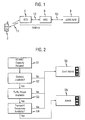
- FIG 2 shows the radio resource management (RRM) and call admission control (CAC) functionalities in a UMTS system.
- the radio resource management functionality is responsible for utilisation of the air interface resources, that is the radio resources.
- the communications between the user equipment and the base station are via the air interface.
- the radio resource management is used to guarantee quality of service, to maintain the planned coverage area and to offer high capacity.
- the RRM functionality therefore deals with handover control, power control, admission control (to the air interface), load control and packet scheduling functionalities.
- the call admission control is responsible for admission control of the transport network.
- the call admission control checks there are resources available for the call in the radio access network. These resources are not radio resources but are usually wired connections between for example the base transceiver station and the base transceiver station controller (the Iub interface).
- a radio resource request is received. This can either be from the mobile station or from a core network. This will depend on whether the user equipment is initiating the call or whether the user equipment is to receive a call.
- a capacity request can be a real time or a non real time request depending on the nature of the call.
- step S2 it is determined whether or not there is a code available.
- CDMA Code Division Multiple Access
- a number of users can use the same frequency at the same time. The users are distinguished by orthogonal codes.
- Step 2 checks whether there are any free codes available for the connection. If it is determined that there are codes are available, then the next step is to check whether the transmission receiver power is available for a given bit rate. This is done in step S3.
- step S4 it is checked whether or not there are transport resources available i.e. resources between for example the base station and the radio network controller. If there is, then the next step is S5 where the call is admitted.
- step S6 the next step is S6.
- the call admission control and the radio resource management do not interact.
- a call can be admitted by the radio resource management since there are enough radio resources available but it can be still blocked at the Iub interface.
- the other resource may not be used to capacity. This is inefficient.
- a method of controlling a connection comprising a first link and a second link, said method comprising the steps of determining if one of said links is limiting capacity of said connection and if so, changing one or more parameters relating to at least one of said links to change the capacity of at least one of said links.
- a method of controlling a connection comprising a first link and a second link, said method comprising the steps of determining if one of said links is limiting capacity of said connection and if so, changing one or more parameters relating to at least one of said links whereby the other of said links is used to improve the quality of said connection.
- a method of selecting a bit rate for a connection comprising a first link and a second link, said method comprising the steps of, for a plurality of bit rates determining if resources are available in both first and second links for a given bit rate, selecting a bit rate for which it is determined in said determining step that resources are available in both said first and second links, and using said selecting bit rate in said connection.
- a method of changing a bit rate for one of a plurality of connections comprising a first link and a second link, said method comprising the steps of selecting a new bit rate for said one connection, and determining if resources are available in both said first and second links for said new bit rate and if so selecting said new bit rate for said connection.
- a controller for controlling a connection comprising a first link and a second link
- said controller comprising means for determining if one of said links is limiting capacity of said connection and means for causing one or more parameters relating to at least one of said links to be changed to thereby change the capacity of at least one of said links, if one of the links is limiting capacity.
- a controller for controlling a connection comprising a first link and a second link
- said controller comprising means for determining if one of said links is limiting capacity of said connection, and means for causing one or more parameters relating to at least one of said links to be changed if one of the links is changing capacity whereby the other of said links is used to improve the quality of said connection.
- a controller for selecting a bit rate for a connection comprising a first link and a second link
- said controller comprising, determining means for determining for a plurality of bit rates if resources are available in both said first and second links for a given bit rate, and selecting means for selecting a bit rate for which it is determined in said determining step that resources are available in both said first and second links.
- a controller for changing a bit rate for one of a plurality of connections comprising a first link and a second link
- said controller comprising means for selecting a new bit rate for said one connection, and means for determining if resources are available in both said first and second links for said new bit rate, and means for selecting, if so, said new bit rate for said connection.
- FIG 1 schematically shows a network within which embodiments of the present invention can be implemented.
- User equipment 2 is shown as having a connection to a base transceiver station 4.
- the connection between the user equipment 2 and the base transceiver station 4 is via a radio interface 11. This is the so called air interface.
- the user equipment 2 can take any suitable form of wireless equipment and may for example be a mobile telephone, a mobile station, a lap top, computer, personal digital assistant, or a mobile telephone or the like connected to any of these types of equipment or any other equipment.
- the base transceiver station 4 is connected to a radio network controller RNC 6. It should be appreciated that depending on the standard in question, the radio network controller may be referred to as a base station controller. It should be appreciated that for the purposes of this document, the term radio network controller 6 is intended to cover any other functionality providing a similar function, that is some control of the base transceiver station 4.
- a radio network controller 6 will control a number of base transceiver stations 4. For clarity, only one base transceiver station is shown. Likewise, each base transceiver station 4 in practice will communicate with a large number of user equipment, only one of which is again shown for clarity.
- Iub interface There is an interface 12 between the base transceiver station 4 and the radio network controller 6. This is referred to as the Iub interface. This is a wired connection.
- the base transceiver stations and the radio network controller together define a radio access network RAN 10.
- the radio access network 10 may be referred to a UTRAN (UMTS transport RAN).
- the functions provided by the radio network controller may be provided in distributed format with those functions effectively being provided by base transceiver station entities.
- the RNC function may be limited with the majority or at least some of the function being distributed to the base transceiver stations.
- the RAN 10 is connected to a core network 8 via a connection 13 which is a wired connection.
- a radio resource management function together with a call admission control function is provided in the radio access network 10.
- This combined function may be provided in the radio network controller, in one or more base transceiver stations or a combination of base transceiver stations and radio network controller.
- the optimum positioning of the radio resource management and call admission control function may depend on the implementation of the network. Where the radio network controller 6 has a relatively full function, it is preferred that the radio resource management and call admission control functions be provided in the radio network controller 6.
- figure 3 shows schematically the combined radio resource management function and call admission control function.
- the example shown in figure 3 is for a new connection, that is where the user equipment 2 initiates a call or the user equipment is about to receive a call.
- step T1 the available Iub capacity is checked. This can be based on current measurements or on estimations.
- the method illustrated in figure 3 is run for a capacity allocation period.
- the capacity allocation period may be fixed and may be of the order of 100-2000ms. This is by way of example only and other time periods may be used. Alternatively, the capacity allocation period may vary with time. For example, the capacity allocation period may be shorter during periods of peak demand and longer during other periods.
- bit rate for a given request can be selected from a set of bit rates which includes a minimum allocated bit rate and a maximum allocated bit rate.
- the set may be predefined or may be defined depending on the nature of the call and/or the time of day.
- one of the capacity requests in selected.
- step T4 a bit rate is assigned to the capacity request. This is based on the information determined in step T2. The assigned bit rate starts with the minimum allocated bit rate.
- step T5 it is determined whether or not there are enough code and power resources for the assigned bit rate for the capacity request. In other words, it is determined whether or not there are sufficient radio resources. If so, the next step is step T6 where the sum of the bit rates of all the connections is checked to see whether or not it is less than the capacity of the Iub interface. In other words, it is checked to see whether there are transport resources available. If there are still transport resources available, then the next step would be step T7 which effectively feeds back to step T3 and the steps T3 to T6 are carried out for the next capacity request. Once all of the capacity requests have been completed, then the next step would be step T8. Steps T2 to T7 are then repeated for the next highest allocated bit rate.
- bit rate allocated in the previous bit rate loop operation is selected. For example, if there are three available bit rates, bit rate a, bit rate b and bit rate c where a is the minimum and c is the maximum bit rate, if there is sufficient capacity for bit rate a and bit rate b, but not for bit rate c, the flow shown in figure 3 will effectively show that bit rate a and b can be used but that there will not be enough code and power resources and/or enough transport resources for rate c. Once this is determined, then the selected bit rate is the highest bit rate i.e. bit rate b for which there are sufficient radio and transport resources.
- all the capacity requests are allocated bit rates starting with the minimum allowed bit rate and increasing step by step. At each step it is checked whether the power and code resources and transport resources are available to do this allocation.
- the defined range of minimum and maximum allocated bit rates will be dependent on the type of service, quality of service and/or time of the request. It should be appreciated that, different capacity requests may have different possible bit rate ranges.
- a common set of available bit rates may be used for all capacity requests.
- figure 4 shows the steps which are carried out where the capacity is to be altered during a connection.
- the embodiment shown in figure 4 is in the context of a packet connection.
- embodiments of the present invention may also be applicable to circuit switched connections.
- the arrangement shown in figure 3 can be carried out for both packet and circuit switched connections.
- step A1 the available Iub capacity is checked to provide the quantity CapacityIub. This is the transport resource. This is based on measurements or can be estimated.
- step A2 it is determined which bearer or connection is to be considered.
- step S3 it is determined whether the bearer is one which requires bit rate modification. If not, the next step is A6 where the user is returned to step A2 and the next bearer or connection is selected. In other words, step A2-A6 are repeated for all of the bearers or connections.
- step A3 If it is determined in step A3 that the bearer requires bit rate modification, then it is checked to see whether or not there is enough code and power resources available. This is carried out in Step A4.
- step A4 it is assumed that the bearer is assigned the desired new bit rate. If it is determined that there are enough code and power resources i.e. radio resources, then the next step is step A5 where it is determined whether the sum of all the bit rates is less than the capacity of the Iub connection. In other words, it is checked to see if there are sufficient transport resources. If there are, for the desired new bit rate, then the next step is step A6 as discussed already.
- step A4 or A5 If it is determined in step A4 or A5 that there are not sufficient radio resources or sufficient transport resources, then the bit rate prior to modification is used.
- the same sort of method as shown in figure 3 is used where the process is repeated for a range of bit rates for a minimum to a maximum bit rate.
- the bit rate which is used will be the maximum bit rate for which there are sufficient radio resources as well as sufficient transport resources.
- figure 5 shows a flow chart for the equalisation of the capacities.
- the embodiments shown in figure 5 is directed to attempting to equalise the Iub, that is the transport capacity and the air interface, that is the radio resource capacity.
- step B1 it is determined whether the capacity of the system is limited by one of the two links i.e. by the radio resource or the transport resource link. If it is determined that there is no limit imposed in the capacity by either or the two links, then the next step will be B2 which is to do nothing.
- step B3 This is generally determined if the power or codes are the limiting factor.
- step B4 There are a number of different options which can be used in step B4. These options can be used as alternatives in different embodiments of the invention or in further embodiments of the invention, two or more of these options may be combined.
- the last bit rate allocation which is able to be accommodated by the radio resources can be selected.
- a higher BLER block error rate
- Block error rate is the number of blocks or packets which can be discarded in a connection.
- relatively more capacity may be scheduled to users with a low required power per correct received bit. In other words more is scheduled to users with a low required power/bit and less to users with a high required power/bit. As discussed below, this leads to a lower average power/bit.
- a higher activity factor may be used at the Iub interface. A higher activity factor means that less overbooking can be used.
- step B5 If it is determined in step B1 that the capacity is being limited by the Iub interface capability then the next step is step B5. If it is concluded that the Iub interface is the limiting factor and that there is enough air interface capacity then the next step is B6.
- One option would be to keep the last bit rate allocation which can be supported by the available transport and radio resources. Alternatively or additionally, one or more of the following three actions can be taken. As mentioned in relation to the air interface, these options can be used separately or two more options can be used in combination.
- a lower block error rate can be used and/or relatively more capacity can be scheduled to users with a high required power per correct bit and/or a lower activity factor can be used at the Iub interface. The use of a lower block error rate leads to a better end user quality of service.
- the option of scheduling relatively more to users with a high required power is used, this will lead to a different quality of service distribution amongst the users.
- the option of using a lower activity factor at the Iub interface means that there is more over booking at the Iub interface which means that it is more likely that blocks are discarded at the Iub interface.
- embodiments of the invention try to improve the "capacity" of the limiting link or try to use the non limiting link to the maximum capacity to improve the quality of service.
- preferred embodiments of the present invention set parameters for these various different actions. For example, there may be a maximum block error rate or a minimum block error rate.
- the maximum permitted block error rate may be defined with reference to the currently used block error rate for example, if the current block error rate is x, then the maximum block error rate that can be used is x + y.
- this maximum block error rate could be defined for example using subtraction, multiplication, and the introduction of various other factors. This can be done for any of the parameters which are altered. That is the block error rate, the number of uses scheduled and the over booking factor.
- FT Fair throughput
- FR fair resource scheduling
- FT scheduling all the users get the same amount of resources, received/transmitted power and allocation time.
- Iub throughput the system throughput
- FT scheduling the user's quality of service is identical for all users, whereas in the case of FR, the users at the cell get a lower bit rate.
- Different scheduling can be used depending on where there is limitation in capacity provided by the link. For example, FR scheduling can be used in the case where capacity is linked by the Iub capacity. FT scheduling can be used where the limitation and capacity is provided by the radio resource.
- error rates other than BLER maybe used.
- FIG 5 is preferable used in conjunction with the embodiments shown in figure 3 or figure 4.
- the embodiment of figure 3 or figure 4 can both be used without the embodiments shown in figure 5.
- the embodiment shown in figure 5 may be used outside the arrangement shown in figure 3 or figure 4.
- Embodiments of the invention have been described as starting with the lowest bit rate and then repeating with the next highest bit rate. Other embodiments of the invention may start with the highest bit rate and repeat with the next highest rate and so on. In alternative embodiments, a more sophisticated approach may be taken, where an estimate is made for the optimum bit rate and depending on the results of the process, the bit rate is increased or decreased depending on whether the bit rate is supportable.
- Embodiments of the present invention have been described as being carried out in the RNC and or base stations.
- a separate entity may be provided to carry out the combined radio resource management and call admission control function. This entity may be solely responsible for this function or may alternatively provide additional functions.
- the embodiment shown in Figure 5 may used separate CAC and RRM functions.
- the combined radio resource management and call admission control function is provided in the radio access network.
- this function may for example be provided in the core network.
- Embodiments of the present invention may be implemented in software and or hardware. Embodiments of the present invention also relate to a computer program for carrying out the methods described in relation to figures 3, 4 and/or 5.
- Embodiments of the present invention have been described in relation to the UMTS standard. However, it should be appreciated that embodiments of the present invention can be applied to any other suitable standard not limited to 3G standards.
- the radio resource capacity has been defined by the code and power resources. In some embodiments of the present invention, it may be sufficient to consider only one of these i.e. the code or the power resources. In alternative embodiments of the present invention, alternative measures of the radio resources may be used and the determination of radio resource capacity. This is particularly the case where embodiments of the invention are used in different standards, for example standards which do not use code division multiple access.
- Embodiments of the present invention can be used for hardware or baseband resources for which the same principles can be applied as for the transport resources.
- the capacity of the transport network has been considered in the context the capacity of the Iub interface. It should be appreciated that different standards may have interfaces which are equivalent or the same as the Iub interface. Embodiments of the present invention are applicable to such systems. Additionally, other measures of the transport network capacity can be used to determine the availability of transport resources.
Landscapes
- Engineering & Computer Science (AREA)
- Quality & Reliability (AREA)
- Computer Networks & Wireless Communication (AREA)
- Signal Processing (AREA)
- Mobile Radio Communication Systems (AREA)
- Communication Control (AREA)
Applications Claiming Priority (2)
| Application Number | Priority Date | Filing Date | Title |
|---|---|---|---|
| GB0326173 | 2003-11-10 | ||
| GBGB0326173.2A GB0326173D0 (en) | 2003-11-10 | 2003-11-10 | A method and a controlling a connection |
Publications (2)
| Publication Number | Publication Date |
|---|---|
| EP1530399A2 true EP1530399A2 (de) | 2005-05-11 |
| EP1530399A3 EP1530399A3 (de) | 2005-07-06 |
Family
ID=29726252
Family Applications (1)
| Application Number | Title | Priority Date | Filing Date |
|---|---|---|---|
| EP04256445A Withdrawn EP1530399A3 (de) | 2003-11-10 | 2004-10-20 | Verfahren und Vorrichtung zur Steuerung einer Kommunikationsverbindung |
Country Status (4)
| Country | Link |
|---|---|
| US (1) | US20050113105A1 (de) |
| EP (1) | EP1530399A3 (de) |
| CN (2) | CN101102601B (de) |
| GB (1) | GB0326173D0 (de) |
Cited By (1)
| Publication number | Priority date | Publication date | Assignee | Title |
|---|---|---|---|---|
| WO2011072735A1 (en) * | 2009-12-16 | 2011-06-23 | Nokia Siemens Networks Oy | Coordinated transport and radio interface scheduling for a mobile communication network |
Families Citing this family (6)
| Publication number | Priority date | Publication date | Assignee | Title |
|---|---|---|---|---|
| GB0326173D0 (en) * | 2003-11-10 | 2003-12-17 | Nokia Corp | A method and a controlling a connection |
| EP2471283A1 (de) | 2009-08-25 | 2012-07-04 | Telefonaktiebolaget L M Ericsson (PUBL) | Multicast-kanalsteuerungsinformationen |
| JP7048251B2 (ja) * | 2017-10-19 | 2022-04-05 | 株式会社closip | Lte通信システム及び通信制御方法 |
| CN111245538B (zh) * | 2018-11-29 | 2021-11-09 | 华为技术有限公司 | 链路质量检测方法及相关设备 |
| US10993137B2 (en) | 2018-11-30 | 2021-04-27 | At&T Intellectual Property I, L.P. | Flexible configuration of guaranteed bitrate admission control for 5G or other next generation network |
| US20230038198A1 (en) * | 2021-08-03 | 2023-02-09 | At&T Intellectual Property I, L.P. | Dynamic wireless network throughput adjustment |
Family Cites Families (16)
| Publication number | Priority date | Publication date | Assignee | Title |
|---|---|---|---|---|
| US5914950A (en) * | 1997-04-08 | 1999-06-22 | Qualcomm Incorporated | Method and apparatus for reverse link rate scheduling |
| EP1142154B1 (de) * | 1998-12-18 | 2004-10-06 | Nokia Corporation | Verfahren zur verkehrsbelastungssteuerung in einem telekommunikationsnetzwerk |
| FI107505B (fi) * | 1999-02-16 | 2001-08-15 | Nokia Networks Oy | Pääsynvalvontamenetelmä |
| US6434380B1 (en) * | 1999-12-13 | 2002-08-13 | Telefonaktiebolaget Lm Ericsson (Publ) | Dynamic negotiation of resources for user equipment in wireless communications system |
| US6393276B1 (en) * | 2000-01-12 | 2002-05-21 | Telefonaktiebolaget Lm Ericsson | Mobile station assisted forward link open loop power and rate control in a CDMA system |
| US6738624B1 (en) * | 2000-11-16 | 2004-05-18 | Nokia Corporation | Method and system for capacity reporting in a mobile telecommunications network |
| US6947436B2 (en) * | 2001-02-01 | 2005-09-20 | Motorola, Inc. | Method for optimizing forward link data transmission rates in spread-spectrum communications systems |
| US6669067B2 (en) * | 2001-03-15 | 2003-12-30 | William E. Schuster | Flexible bag carrier for vehicles |
| JP4331598B2 (ja) * | 2001-08-21 | 2009-09-16 | ノキア コーポレイション | 通信ネットワーク内のデータ送信 |
| EP1313244B1 (de) * | 2001-11-16 | 2016-11-02 | Google, Inc. | Kommunikationseinrichtung und verfahren zur kommunikation in einem digitalen mobilen kommunikationsnetz |
| KR100605941B1 (ko) * | 2001-11-28 | 2006-08-02 | 삼성전자주식회사 | 데이터 통신시스템에서 서비스품질을 보장하기 위한데이터 송신 방법 및 장치 |
| US7031254B2 (en) * | 2002-01-25 | 2006-04-18 | Lucent Technologies Inc. | Rate control system and method for a link within a wireless communications system |
| DE60310575T2 (de) * | 2002-08-28 | 2007-10-11 | Interdigital Technology Corp., Wilmington | System zur verwaltung von drahtlosen funkbetriebsmitteln unter verwendung eines automaten |
| US20050043035A1 (en) * | 2003-08-21 | 2005-02-24 | Diesen Michael J. | Method and apparatus for providing multimedia broadcast multicast service data to a subscriber to a multimedia broadcast multicast service |
| WO2005032185A1 (en) * | 2003-09-30 | 2005-04-07 | Telefonaktiebolaget Lm Ericsson (Publ) | System and method for reporting measurements in a communication system |
| GB0326173D0 (en) * | 2003-11-10 | 2003-12-17 | Nokia Corp | A method and a controlling a connection |
-
2003
- 2003-11-10 GB GBGB0326173.2A patent/GB0326173D0/en not_active Ceased
-
2004
- 2004-02-26 US US10/786,537 patent/US20050113105A1/en not_active Abandoned
- 2004-10-20 EP EP04256445A patent/EP1530399A3/de not_active Withdrawn
- 2004-11-10 CN CN2007101262497A patent/CN101102601B/zh not_active Expired - Fee Related
- 2004-11-10 CN CN200410092528.2A patent/CN1617627A/zh active Pending
Cited By (1)
| Publication number | Priority date | Publication date | Assignee | Title |
|---|---|---|---|---|
| WO2011072735A1 (en) * | 2009-12-16 | 2011-06-23 | Nokia Siemens Networks Oy | Coordinated transport and radio interface scheduling for a mobile communication network |
Also Published As
| Publication number | Publication date |
|---|---|
| US20050113105A1 (en) | 2005-05-26 |
| EP1530399A3 (de) | 2005-07-06 |
| CN101102601A (zh) | 2008-01-09 |
| CN1617627A (zh) | 2005-05-18 |
| GB0326173D0 (en) | 2003-12-17 |
| CN101102601B (zh) | 2011-01-05 |
Similar Documents
| Publication | Publication Date | Title |
|---|---|---|
| EP1325660B1 (de) | Funkressourcenverwaltung | |
| CN103281791B (zh) | 用于对增强专用信道(e-dch)的数据进行复用的方法及wtru | |
| EP1227695B1 (de) | Verfahren zur Rufzulassungssteuerung, Kommunikationssystem und Basisstationgerät | |
| US6907250B2 (en) | Wireless channel changeover method and mobile communication system | |
| EP1213894A1 (de) | Verfahren zur Planung einer Dienstqualität in einem Kommunikationssystem mit hoher datenate | |
| EP2047644B1 (de) | Prioritätsbestimmung von trägerkanälen in einem drahtlosen telekommunikationsnetz | |
| KR100974387B1 (ko) | 무선 통신 시스템에서 자원 할당을 최적화하기 위한시스템들 및 방법들 | |
| US7245922B2 (en) | Method and apparatus for controlling quality of service for multiple services through power setting | |
| JP2007520131A (ja) | Utran無線アクセスネットワークにおける無線リソース管理方法、コアネットワークサービスノード、および無線アクセスネットワーク制御装置 | |
| MXPA06013445A (es) | Medidas de estimacion de canal y de indicador de calidad de canal (cqi) para un gprs de enlace descendente de alta velocidad. | |
| EP1887828B1 (de) | Mobilkommunikationssystem und kommunikationssteuerverfahren dafür | |
| CN101374099A (zh) | 高速数据传输方法、系统及装置 | |
| WO2003049485A1 (en) | A method and arrangement for allocation the quantity of a channel to a mobile station as a function of the measured quality | |
| CA2396397A1 (en) | A radio telecommunications system and method of operating the same with optimized agprs resources | |
| US20040071125A1 (en) | Fairness method for supplemental channel resources | |
| AU2005286172B2 (en) | Resource allocation in a communication system | |
| CN113273242B (zh) | 基础设施设备、无线通信网络和方法 | |
| US20050113105A1 (en) | Method and a controller for controlling a connection | |
| WO2001076096A1 (en) | A packet scheduler and method | |
| EP1900146B1 (de) | Betriebsmittelzuteilungsverfahren, kommunikationssystem, netzwerkelement, modul, computerprogrammprodukt und computerprogramm-verteilungsmedium | |
| US20020102983A1 (en) | Method and apparatus for controlling quality of service for multiple services through power setting | |
| WO2001062017A2 (en) | Method for operating a user station in a cellular communication system | |
| US20080132266A1 (en) | Maximum Allowable Transmission Rate Deciding Method, Mobile Station And Wireless Base Station | |
| US20090080395A1 (en) | Mobile communication system, base station device, and mobile communication method | |
| WO2007135236A1 (en) | Managing quality-of-service profiles in a mobile telecommunications system |
Legal Events
| Date | Code | Title | Description |
|---|---|---|---|
| PUAI | Public reference made under article 153(3) epc to a published international application that has entered the european phase |
Free format text: ORIGINAL CODE: 0009012 |
|
| AK | Designated contracting states |
Kind code of ref document: A2 Designated state(s): AT BE BG CH CY CZ DE DK EE ES FI FR GB GR HU IE IT LI LU MC NL PL PT RO SE SI SK TR |
|
| AX | Request for extension of the european patent |
Extension state: AL HR LT LV MK |
|
| PUAL | Search report despatched |
Free format text: ORIGINAL CODE: 0009013 |
|
| AK | Designated contracting states |
Kind code of ref document: A3 Designated state(s): AT BE BG CH CY CZ DE DK EE ES FI FR GB GR HU IE IT LI LU MC NL PL PT RO SE SI SK TR |
|
| AX | Request for extension of the european patent |
Extension state: AL HR LT LV MK |
|
| 17P | Request for examination filed |
Effective date: 20050930 |
|
| AKX | Designation fees paid |
Designated state(s): AT BE BG CH CY CZ DE DK EE ES FI FR GB GR HU IE IT LI LU MC NL PL PT RO SE SI SK TR |
|
| 17Q | First examination report despatched |
Effective date: 20051028 |
|
| RAP1 | Party data changed (applicant data changed or rights of an application transferred) |
Owner name: NOKIA SIEMENS NETWORKS OY |
|
| STAA | Information on the status of an ep patent application or granted ep patent |
Free format text: STATUS: THE APPLICATION IS DEEMED TO BE WITHDRAWN |
|
| 18D | Application deemed to be withdrawn |
Effective date: 20120612 |