EP1530379B1 - Verfahren und Vorrichtung zur Farbkompensation in einer Bildanzeigevorrichtung für Benutzer mit Farbsehfehlern - Google Patents
Verfahren und Vorrichtung zur Farbkompensation in einer Bildanzeigevorrichtung für Benutzer mit Farbsehfehlern Download PDFInfo
- Publication number
- EP1530379B1 EP1530379B1 EP04026338A EP04026338A EP1530379B1 EP 1530379 B1 EP1530379 B1 EP 1530379B1 EP 04026338 A EP04026338 A EP 04026338A EP 04026338 A EP04026338 A EP 04026338A EP 1530379 B1 EP1530379 B1 EP 1530379B1
- Authority
- EP
- European Patent Office
- Prior art keywords
- color
- user
- perceptivity
- colors
- gain values
- Prior art date
- Legal status (The legal status is an assumption and is not a legal conclusion. Google has not performed a legal analysis and makes no representation as to the accuracy of the status listed.)
- Expired - Lifetime
Links
Images




Classifications
-
- G—PHYSICS
- G09—EDUCATION; CRYPTOGRAPHY; DISPLAY; ADVERTISING; SEALS
- G09G—ARRANGEMENTS OR CIRCUITS FOR CONTROL OF INDICATING DEVICES USING STATIC MEANS TO PRESENT VARIABLE INFORMATION
- G09G5/00—Control arrangements or circuits for visual indicators common to cathode-ray tube indicators and other visual indicators
- G09G5/02—Control arrangements or circuits for visual indicators common to cathode-ray tube indicators and other visual indicators characterised by the way in which colour is displayed
-
- H—ELECTRICITY
- H04—ELECTRIC COMMUNICATION TECHNIQUE
- H04N—PICTORIAL COMMUNICATION, e.g. TELEVISION
- H04N9/00—Details of colour television systems
- H04N9/64—Circuits for processing colour signals
-
- H—ELECTRICITY
- H04—ELECTRIC COMMUNICATION TECHNIQUE
- H04N—PICTORIAL COMMUNICATION, e.g. TELEVISION
- H04N9/00—Details of colour television systems
- H04N9/64—Circuits for processing colour signals
- H04N9/68—Circuits for processing colour signals for controlling the amplitude of colour signals, e.g. automatic chroma control circuits
-
- G—PHYSICS
- G09—EDUCATION; CRYPTOGRAPHY; DISPLAY; ADVERTISING; SEALS
- G09G—ARRANGEMENTS OR CIRCUITS FOR CONTROL OF INDICATING DEVICES USING STATIC MEANS TO PRESENT VARIABLE INFORMATION
- G09G2340/00—Aspects of display data processing
- G09G2340/14—Solving problems related to the presentation of information to be displayed
Definitions
- the present invention relates to an image display device, and more particularly, to a method of compensating colors in an image display device for users with color vision deficiency and a device of the same.
- the present invention is suitable for a wide scope of applications, it is particularly suitable for allowing users with deficient color vision, namely, partial color blindness, to view displayed images as vividly and naturally as normal users.
- a method for displaying a digital color image to a visually impaired person includes the steps of measuring the visual response of the person and specifying a set of enhancement profile relating to the person's color and spatial frequency visual perception, adjusting the color content of the digital color image in response to a color content enhancement profile; adjusting the spatial frequency content of the image in response to a spatial frequency profile; adjusting the contrast of the image in response to a contrast adjustment profile; and displaying the adjusted digital image to the person.
- color vision deficiency i.e., color blindness or partial color blindness
- users with color vision deficiency who do not have the same vision characteristics for colors as normal people, may view the colors displayed from the image display device differently as compared to normal users.
- 'color blind' people having color deficient vision as compared to normal people are referred to as 'color blind' or 'partially color blind'.
- the broad definition of 'color blindness' is a deficiency in the overall color perceptive ability. More specifically, the term 'color blindness' is used when a person has completely lost the ability to perceive a specific color.
- 'partial color blindness' refers to a state less severe than 'color blindness', wherein a person has, nevertheless, a deficient color perceptive ability as compared to someone with normal vision.
- a 'partially color blind individual' eventually refers to someone with partial color blindness.
- the term 'partially color blind individual/user' or 'individual/user with partial color blindness' will be used to describe users of the present invention who have partial color deficient vision, and not those who have completely lost the ability to distinguish certain colors.
- the rod cells which contain information on the brightness of light
- the cone cells which can distinguish colors and the brightness of light
- Partial color blindness is mostly inherited, and it is known to have no medical cure.
- the partially color blind individuals lack perceptivity for certain colors only and are fully capable of distinguishing the rest of the colors. And so, they generally judge that the colors they perceive through their eyes are natural and normal. Therefore, in certain cases, the partially color blind people are completely unaware of their color deficient vision, which leads them to the misconception that the colors seen through their eyes are in fact natural and normal to everybody else.
- the present invention has been devised to provide a method and device for compensating colors within the image display device, so as to allow the users having color vision deficiency to perceive the displayed colors as vividly and naturally as seen through the eyes of normal users.
- the present invention is directed to a method of compensating colors in an image display device for users with color vision deficiency and a device of the same that substantially obviate one or more problems due to limitations and disadvantages of the related art.
- An object of the present invention is to provide a method of compensating colors in an image display device for users with color vision deficiency and a device of the same that controls the colors of a displayed image, thereby allowing the partially color blind users to view the displayed image through the same color vision as that of normal users.
- a method of compensating colors in an image display device includes a step of determining whether a user is partially color blind or normal, and a step of controlling gain values of a plurality of color signals depending upon the user's color perceptivity so as to compensate colors displayed on a screen, if the user is determined to be partially color blind.
- the step of determining whether the user is partially color blind or normal is carried out by using a test pattern provided on the screen, or by using a user information pre-stored in the image display device, if the user is a pre-registered user.
- a color of which a user's color perceptivity is not identical to that of a standard perceptivity value is detected, and gain values of color signals corresponding to colors other than the detected color are controlled.
- the gain values of the plurality of color signals corresponding to the colors other than the detected color are proportionally controlled depending upon a contrast rate between the user's color perceptivity of the detected color and the standard perceptivity value.
- a contrast gain corresponding to each of said color signals is controlled so as to control the gain values of the color signals.
- the controller determines the user's partial color blindness and the user's color perceptivity depending upon a plurality of answers to the test patterns provided by the user.
- the controller may also determine the user's partial color blindness and the user's color perceptivity by searching the user's user information, if the user is a registered user.
- the controller displays an icon or message for indicating that the colors of the screen are being compensated, as the controller controls the gain values of the plurality of color signals.
- the image display device of the present invention will be referred to as a television (TV) receiver for simplicity.
- TV television
- most of the terminologies used in the description of the present invention are generally known terms. However, in some cases, terminologies specifically chosen by the inventor will also be used herein, the terminologies of which will be fully explained in the detailed description of the present invention. Therefore, the details of the present invention should not be understood based on such terminologies only, but by the meaning of the terms lying within the purpose of the present invention.
- the term 'partially color blind individual/user' or 'individual/user with partial color blindness' will generally refer to individuals with vision (i.e. , a sense of color) different from that of normal individuals.
- partial color blindness is categorized into a plurality of types, whereby color compensation for each type will be processed accordingly.
- the different types of visions with partial color blindness will be described in detail with reference to FIGs. 1 to 4 .
- the three types of partial color blindness are specified as the first to third embodiments of the present invention. Nevertheless, it will be understood that when specifying the different types of partial color blindness in more detail, the scope of the present invention will also apply to any other type of partial color blindness apart from the three types described above.
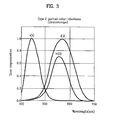
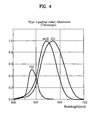
- FIGs. 1 to 4 illustrate graphs showing the difference in vision between a normal individual and a partially color blind individual in accordance with each of the three different types of partial color blindness.
- the x-axis represents the wavelength (wherein the unit is in nanometers (nm))
- the y-axis represents the responsivity (i.e. , degree of sensing a specific color) of the partially color blind individual.
- the graphs represent the relation between three different types of wavelengths and the corresponding type of partial color blindness.
- the three wavelengths are categorized based on their lengths, the shortest wavelength being s( ⁇ ), the medium wavelength being m( ⁇ ), and the longest wavelength being l( ⁇ ).
- FIG. 1 illustrates a graph showing the vision of a normal individual, wherein the normal individual's responsivity to each of the s( ⁇ ), m( ⁇ ), and l( ⁇ ) wavelengths are equally 1.0.
- FIG. 2 illustrates a graph showing the vision of an individual with Type 1 partial color blindness.
- the individual with Type 1 partial color blindness shows a responsivity of 1.0 to the s( ⁇ ) and m( ⁇ ) wavelengths, which is the same as the normal individual. However, unlike the normal individual, the responsivity to the l( ⁇ ) wavelength is 0.75.
- the medical terminology for this type of color blindness is Protanope, however, it will be referred to as the Type 1 partial color blindness for simplicity.
- FIG. 3 illustrates a graph showing the vision of an individual with Type 2 partial color blindness.
- the individual with Type 2 partial color blindness shows a responsivity of 1.0 to the ⁇ ) and l( ⁇ ) wavelengths, which is the same as the normal individual.
- the responsivity to the m( ⁇ ) wavelength is 0.7.
- the medical terminology for this type of color blindness is Deuteranope, however, it will be referred to as the Type 2 partial color blindness for simplicity.
- FIG. 4 illustrates a graph showing the vision of an individual with Type 3 partial color blindness.
- the individual with Type 3 partial color blindness shows a responsivity of 1.0 to the m( ⁇ ) and l( ⁇ ) wavelengths, which is the same as the normal individual.
- the responsivity to the s( ⁇ ) wavelength is 0.5.
- the medical terminology for this type of color blindness is Tritanope, however, it will be referred to as the Type 3 partial color blindness for simplicity.
- each of the specific wavelengths respectively corresponds to each of the red (R), green (G), and blue (B) wavelengths, which are the basic colors used for representing and displaying an image.
- the individual with the Type 1 partial color blindness shows deficient vision responsivity for the red (R) wavelength as compared to the normal individual.
- the individual with the Type 2 partial color blindness shows deficient vision responsivity for the green (G) wavelength.
- the individual with the Type 3 partial color blindness shows deficient vision responsivity for the blue (B) wavelength.
- the colors red (R), green (G), and blue (B) will be referred to as R, G, and B, respectively, for simplicity.
- FIG. 5 illustrates a block diagram of a device for compensating colors in the image display device according to the present invention.
- a digital television (DTV) receiver is given-as an example for simplicity, nevertheless, the same description can also be equally applied to personal computers (PC) or mobile phones.
- PC personal computers
- a video signal received through a tuner 10 is decoded from a decoder 20.
- the decoded video signal is then sent to an A/D converter 30 to be converted into a digital signal.
- the A/D converter (ADC) 30 is not necessary.
- the video signal outputted from the A/D converter 30 is inputted to a video processor 40, wherein the digitalized video signal is converted into R, G, and B signals.
- the digitalized video signal is a luminance/color difference signal including Y, U, and V signals, which are then converted into R, G, and B signals at the video processor 40 in order to be suitable for human vision.
- a microcomputer 70 generally controls the above-described process.
- the microcomputer 70 also sends a command to a display controller 50 to compensate R, G, and B signals in accordance with the vision of the partially color blind user. Subsequently, the display controller 50 controls the gain values of the R, G, and B signals in the displayed image depending upon the color compensation command sent from the microcomputer 70.
- a memory 80 allows the microcomputer 70 to determine whether the user is partially color blind or not by storing a user information of the corresponding user and a test pattern for testing partial color blindness. Therefore, the microcomputer 70 of the present invention determines the vision of the present user based on the data stored in the memory 80. The process will be described in detail with reference to FIGs. 6 and 7 .
- FIG. 6 illustrates a flowchart of a method of compensating colors in the image display device according to a first embodiment of the present invention. Referring to FIG. 6 , the user's vision is verified through testing, and the flowchart of the color compensation process depending upon the verified result is illustrated herein.
- the microcomputer 70 displays a series of test patterns for testing partial color blindness (e.g. , the test patterns shown in FIG. 8 ), which is pre-programmed in the memory 80 (S10).
- a series of test patterns for testing partial color blindness e.g. , the test patterns shown in FIG. 8
- the general patterns used for testing color blindness may be used.
- the user views a series of test patterns displayed on the TV screen and uses the dial pad on the remote controller to input and transmit his or her answers.
- the microcomputer 70 determines whether the user is partially color blind or not, based on the data provided by the user (S20). Also, when the user is determined to be partially color blind, then the type of partial color blindness is also determined accordingly.
- test patterns for testing partial color blindness are shown in FIG. 8 .
- the general test patterns for testing color blindness are applied herein, whereby the test patterns enable the microcomputer 70 of the present invention to determine whether the user is 'partially color blind' or 'normal'. If designed and created in the future, a specialized test pattern for specifically testing partial color blindness may then be applied herein.
- Step 20 when a user is determined to have a normal vision, the original gain values for the R, G, and B signals are used (S21). However, when the user is determined to have a color defective vision, then the gain values for the R, G, and B signals should be controlled.
- the gain values for the R, G, and B signals are controlled.
- the perceptivity for the color red (R) color in a defective user with Type 1 partial color blindness is only 0.75 times that of an individual with normal vision. Therefore, when compensating the colors, the microcomputer 70 lowers the gain values for the G and B signals to 0.75 times their original values (S31).
- the above-described method for controlling the R, G, and B gain values are similarly applied to the remaining two types of partial color blindness.
- the gain values for the R, G, and B signals are controlled.
- the perceptivity for the color green (G) color in a defective user with Type 2 partial color blindness is only 0.7 times that of an individual with normal vision. Therefore, when compensating the colors, the microcomputer 70 lowers the gain values for the R and B signals to 0.7 times their original values (S41).
- the gain values for the R, G, and B signals are controlled.
- the perceptivity for the color blue (B) color in a defective user with Type 3 partial color blindness is only 0.5 times that of an individual with normal vision. Therefore, when compensating the colors, the microcomputer 70 lowers the gain values for the G and B signals to 0.5 times their original values (S50).
- a display 60 when a color compensated image for partially color blind users is being displayed, a display 60 either notifies that color compensation is in process or displays an icon or message indicating the corresponding type of partial color blindness.
- color compensation is carried out by controlling the gain values of remaining colors to be of the same level as to that of the specific color, thereby enabling the user with color deficient vision to view the displayed image as viewed by a normal user.
- FIG. 7 illustrates a flowchart of a method of compensating colors in the image display device according to a second embodiment of the present invention.
- a user is tested for partial color blindness, just as shown in FIG. 6 , and a user information including the corresponding test results are pre-stored in the memory 80 of the device, then, after a simple user identification process, a color compensation suitable for the corresponding user is directly carried out.
- a user identification process for verifying the current user is carried out (S70).
- a plurality of conventional user identification methods can be used herein. Generally, a specific user can be verified by simply inputting data, such as user identification (ID) and password.
- Another identification method can include selecting a corresponding user name or user number among a list of pre-registered users.
- the microcomputer 70 searches for the corresponding user information of the verified user (S80). Thereafter, based on the user's color vision information included in the searched user information, the microcomputer 70 determines whether the user is normal or partially color blind, and if the user is partially color blind, then, the microcomputer 70 verifies the type of partial color blindness (S90).
- Step 90 when the user is determined to be partially color blind, the microcomputer 70 carries out a color compensation process corresponding to the verified user (S91).
- the same method of FIG. 6 may be used in the method for compensating colors depending upon the user's type of partial color blindness.
- the gain values for the R, G, and B signals are controlled.
- the perceptivity for the color red (R) color in a defective user with Type 1 partial color blindness is only 0.75 times that of an individual with normal vision. Therefore, when compensating the colors, the microcomputer 70 lowers the gain values for the G and B signals to 0.75 times their original values (S31).
- the gain values for the R, G, and B signals are controlled.
- the perceptivity for the color green (G) color in a defective user with Type 2 partial color blindness is only 0.7 times that of an individual with normal vision. Therefore, when compensating the colors, the microcomputer 70 lowers the gain values for the R and B signals to 0.7 times their original values (S41).
- the gain values for the R, G, and B signals are controlled.
- the perceptivity for the color blue (B) color in a defective user with Type 3 partial color blindness is only 0.5 times that of an individual with normal vision. Therefore, when compensating the colors, the microcomputer 70 lowers the gain values for the G and B signals to 0.5 times their original values (S50).
- a display 60 when a color compensated image for partially color blind users is being displayed, a display 60 either notifies that color compensation is in process or displays an icon or message indicating the corresponding type of partial color blindness.
- the step of verifying the current user Step 71 if the verified user is determined to be a non-registered user, or if the information as to whether the current user is partially color blind or not is not included in the user information, then the step of testing the user for partial color blindness (S20), as shown in FIG. 6 , is carried out in order to determine the user's color vision.
- the method of compensating colors in an image display device for users with color vision deficiency and the device of the same according to the present invention are advantageous in that a wide range of users with deficient color vision can perceive displayed images as vividly and naturally as seen through the eyes of normal individuals.
Landscapes
- Engineering & Computer Science (AREA)
- Multimedia (AREA)
- Signal Processing (AREA)
- Physics & Mathematics (AREA)
- Computer Hardware Design (AREA)
- General Physics & Mathematics (AREA)
- Theoretical Computer Science (AREA)
- Controls And Circuits For Display Device (AREA)
- Color Image Communication Systems (AREA)
- Processing Of Color Television Signals (AREA)
- Image Processing (AREA)
- Digital Computer Display Output (AREA)
Claims (14)
- Verfahren zum Kompensieren von Farben in einer Bildanzeigevorrichtung, das Folgendes umfasst:einen Schritt des Bestimmens, ob ein Nutzer teilweise farbenblind oder normalsichtig ist (S20, S30, S40; S90); undeinen Schritt des Steuerns von Verstärkungswerten mehrerer Farbsignale in Abhängigkeit von der Farbwahrnehmung des Nutzers, um Farben, die auf einem Bildschirm angezeigt werden, zu kompensieren, wenn festgestellt wird, dass der Nutzer teilweise farbenblind ist (S31, S41, S50; S91);wobei der Schritt des Steuerns von Verstärkungswerten der mehreren Farbsignale durch Detektieren (S30, S40; S81, S90) einer bestimmten Farbe ausgeführt wird, für die die Farbwahrnehmung eines Nutzers geringer ist als ein Standardwahrnehmungswert, einschließlich des Ermittelns- eines Verhältnisses zwischen der Farbwahrnehmung der detektierten Farbe durch den Nutzer und einem Standardwahrnehmungswert;
gekennzeichnet durch
proportionales Steuern (S31, S41, S50; S91), in Abhängigkeit von dem ermittelten Verhältnis, von Verstärkungswerten der mehreren Farbsignale, die nur anderen Farben als der detektierten Farbe entsprechen, wodurch die Verstärkungswerte von Farbsignalen verringert werden, die anderen Farben als der detektierten Farbe entsprechen. - Verfahren gemäß Anspruch 1, wobei der Schritt des Bestimmens (S10, S20, S30, S40); ob der Nutzer teilweise farbenblind oder normalsichtig ist, unter Verwendung eines Testmusters, das auf dem Bildschirm angezeigt wird, ausgeführt wird (S10).
- Verfahren gemäß Anspruch 1, wobei der Schritt des Bestimmens (S70, S71, S80, S81, S90) , ob der Nutzer teilweise farbenblind oder normalsichtig ist, unter Verwendung von Nutzerinformationen ausgeführt wird, die in der Bildanzeigevorrichtung gespeichert sind, wenn der Nutzer ein bereits registrierter Nutzer ist.
- Verfahren gemäß Anspruch 1, wobei der Schritt des Steuerns (S31, S41, S50; S91) von Verstärkungswerten der mehreren Farbsignale durch Identifizieren (S30, S40; S90) eines Typs von teilweiser Farbenblindheit ausgeführt wird, der der Farbwahrnehmung des Nutzers für jede Farbe entspricht.
- Verfahren gemäß Anspruch 4, das des Weiteren das Steuern (S31, S41, S50; S91) der Verstärkungswerte der Farbsignale auf einen zuvor festgelegten Wert umfasst, der dem identifizierten Typ von teilweiser Farbenblindheit entspricht.
- Verfahren gemäß Anspruch 1, wobei - zusammen mit dem Steuern der Verstärkungswerte der mehreren Farbsignale - ein Symbol oder eine Meldung angezeigt wird, das bzw. die besagt, dass die Farben des Bildschirms kompensiert werden.
- Vorrichtung zum Kompensieren von Farben in einer Bildanzeigevorrichtung, die Folgendes umfasst:einen Speicher (80) zum Speichern mehrerer Testmuster (Figur 8) zum Testen der teilweisen Farbenblindheit eines Nutzers und von Nutzerinformationen; undeine Steuereinheit (50, 70), die dafür geeignet ist, die teilweise Farbenblindheit eines Nutzers und die Wahrnehmungsfähigkeit mehrerer Farben durch einen Nutzer in Abhängigkeit von Testmustern (Figur 8) oder von Nutzerinformationen zu bestimmen und Verstärkungswerte für mehrere Farbsignale in Abhängigkeit von der Farbwahrnehmung des Nutzers zu steuern;wobei die Steuereinheit (50, 70) des Weiteren dafür geeignet ist, eine bestimmte Farbe zu detektieren, für die die Farbwahrnehmung eines Nutzers geringer ist als die eines Standardwahrnehmungswertes, wodurch ein Verhältnis zwischen der Farbwahrnehmung der detektierten Farbe durch den Nutzer und einem Standardwahrnehmungswert ermittelt wird;
dadurch gekennzeichnet, dass
die Steuereinheit (50, 70) des Weiteren dafür geeignet ist, Verstärkungswerte der mehreren Farbsignale, die nur anderen Farben als der detektierten Farbe entsprechen, in Abhängigkeit von dem ermittelten Verhältnis proportional zu steuern, wodurch die Verstärkungswerte (Rc, Gc, Bc) von Farbsignalen verringert werden, die anderen Farben als der detektierten Farbe (R, G, B) entsprechen. - Vorrichtung gemäß Anspruch 7, wobei die Steuereinheit (50, 70) die teilweise Farbenblindheit und Farbwahrnehmung des Nutzers in Abhängigkeit von mehreren Antworten auf die Testmuster (Figur 8), die dem Nutzer dargeboten werden, ermittelt.
- Vorrichtung gemäß Anspruch 7, wobei die Steuereinheit (50, 70) die teilweise Farbenblindheit und Farbwahrnehmung des Nutzers mittels Durchsuchen der Nutzerinformationen des Nutzers ermittelt, wenn der Nutzer ein registrierter Nutzer ist.
- Vorrichtung gemäß Anspruch 9, wobei die Steuereinheit (50, 70) anhand einer Nutzerkennung (ID) feststellt, ob der Nutzer ein registrierter Nutzer ist.
- Vorrichtung gemäß Anspruch 7, wobei die Steuereinheit (50, 70) die Farbwahrnehmung des Nutzers für Rot (R), Grün (G) und Blau (B) ermittelt.
- Vorrichtung gemäß Anspruch 7, wobei die Steuereinheit (50, 70) in dem Speicher (80) nach einem Typ von teilweiser Farbenblindheit sucht, der der Farbwahrnehmung des Nutzers für jede Farbe entspricht.
- Vorrichtung gemäß Anspruch 7, wobei die Steuereinheit (50, 70) die Verstärkungswerte der Farbsignale auf einen zuvor festgelegten Wert steuert, der dem gesuchten. Typ von teilweiser Farbenblindheit entspricht.
- Vorrichtung gemäß Anspruch 7, wobei die Steuereinheit (50, 70) ein Symbol oder eine Meldung anzeigt, um anzuzeigen, dass die Farben eines Bildschirms (60) kompensiert werden, wenn die Steuereinheit (50, 70) die Verstärkungswerte (Rc, Gc, Bc) der mehreren Farbsignale steuert.
Applications Claiming Priority (2)
| Application Number | Priority Date | Filing Date | Title |
|---|---|---|---|
| KR1020030078675A KR100587333B1 (ko) | 2003-11-07 | 2003-11-07 | 색약자의 시각특성을 고려한 영상 디스플레이의색보정방법 및 장치 |
| KR2003078675 | 2003-11-07 |
Publications (3)
| Publication Number | Publication Date |
|---|---|
| EP1530379A2 EP1530379A2 (de) | 2005-05-11 |
| EP1530379A3 EP1530379A3 (de) | 2006-07-19 |
| EP1530379B1 true EP1530379B1 (de) | 2009-08-12 |
Family
ID=34431735
Family Applications (1)
| Application Number | Title | Priority Date | Filing Date |
|---|---|---|---|
| EP04026338A Expired - Lifetime EP1530379B1 (de) | 2003-11-07 | 2004-11-05 | Verfahren und Vorrichtung zur Farbkompensation in einer Bildanzeigevorrichtung für Benutzer mit Farbsehfehlern |
Country Status (5)
| Country | Link |
|---|---|
| US (1) | US7333117B2 (de) |
| EP (1) | EP1530379B1 (de) |
| KR (1) | KR100587333B1 (de) |
| CN (1) | CN100581270C (de) |
| DE (1) | DE602004022498D1 (de) |
Families Citing this family (52)
| Publication number | Priority date | Publication date | Assignee | Title |
|---|---|---|---|---|
| KR100707952B1 (ko) * | 2005-05-10 | 2007-04-16 | 삼성전자주식회사 | 디스플레이장치 및 그 제어방법 |
| KR100810268B1 (ko) * | 2006-04-06 | 2008-03-06 | 삼성전자주식회사 | 모바일 디스플레이 장치에서의 색약자를 위한 구현 방법 |
| US20070273708A1 (en) * | 2006-05-24 | 2007-11-29 | Markus Andreasson | Reading glasses for the color blind |
| US20080278521A1 (en) * | 2007-05-09 | 2008-11-13 | Hyun-Chang Kang | Display device and driving method thereof |
| CN101459764B (zh) * | 2007-12-14 | 2011-10-12 | 廖礼士 | 视觉缺陷测量及补偿的系统及方法 |
| CN101515447B (zh) * | 2008-02-22 | 2012-01-25 | 鸿富锦精密工业(深圳)有限公司 | 电子设备和显示器及其显示参数设置方法 |
| US8615596B1 (en) | 2009-01-14 | 2013-12-24 | Sprint Communications Company L.P. | Communication method and system for providing content to a communication device according to a user preference |
| JP2010232738A (ja) * | 2009-03-25 | 2010-10-14 | Fuji Xerox Co Ltd | 画像処理装置、画像形成装置およびプログラム |
| US8542324B2 (en) | 2010-05-28 | 2013-09-24 | Microsoft Corporation | Efficient image and video recoloring for colorblindness |
| JP5710899B2 (ja) * | 2010-06-23 | 2015-04-30 | 一夫 市川 | 水晶体評価装置、制御プログラム、及び水晶体評価装置の制御方法 |
| US20120001932A1 (en) * | 2010-07-02 | 2012-01-05 | Burnett William R | Systems and methods for assisting visually-impaired users to view visual content |
| WO2013037684A1 (en) * | 2011-09-12 | 2013-03-21 | Oce-Technologies B.V. | Method for converting a full colour image to a monochrome image |
| US9704416B2 (en) | 2012-11-29 | 2017-07-11 | Samsung Electronics Co., Ltd. | Television system and image display method thereof |
| CN103870148B (zh) * | 2012-12-18 | 2017-02-08 | 中兴通讯股份有限公司 | 一种移动终端及其界面显示方法 |
| US9377922B2 (en) * | 2012-12-26 | 2016-06-28 | Verizon Patent And Licensing Inc. | Aiding people with impairments |
| US9370299B2 (en) | 2013-05-16 | 2016-06-21 | Successfactors, Inc. | Display accessibility for color vision impairment |
| WO2015004437A1 (en) | 2013-07-08 | 2015-01-15 | Spectral Edge Limited | Image processing method and system |
| CN103530624B (zh) * | 2013-10-25 | 2017-01-11 | 小米科技有限责任公司 | 一种生成信息的方法、装置及终端设备 |
| US10324593B2 (en) | 2014-01-28 | 2019-06-18 | International Business Machines Corporation | Impairment-adaptive electronic data interaction system |
| KR102278957B1 (ko) * | 2014-08-14 | 2021-07-19 | 엘지전자 주식회사 | 영상 표시 장치 및 그 장치의 제어 방법 |
| KR102261759B1 (ko) * | 2014-09-04 | 2021-06-07 | 삼성디스플레이 주식회사 | 표시 장치 |
| KR102199218B1 (ko) * | 2014-09-05 | 2021-01-07 | 삼성디스플레이 주식회사 | 표시 장치, 표시 제어 장치 및 표시 방법 |
| CN104270588A (zh) * | 2014-09-18 | 2015-01-07 | 华东师范大学 | 一种色盲色觉辅助装置 |
| KR102250045B1 (ko) * | 2014-10-06 | 2021-05-11 | 삼성디스플레이 주식회사 | 디스플레이 장치 및 디스플레이 시스템 |
| US10102763B2 (en) | 2014-11-28 | 2018-10-16 | D2L Corporation | Methods and systems for modifying content of an electronic learning system for vision deficient users |
| KR102261422B1 (ko) | 2015-01-26 | 2021-06-09 | 삼성디스플레이 주식회사 | 표시 장치 |
| KR102392810B1 (ko) | 2015-06-10 | 2022-05-03 | 삼성디스플레이 주식회사 | 표시 장치 및 그의 구동 방법 |
| KR102393373B1 (ko) | 2015-06-12 | 2022-05-03 | 삼성디스플레이 주식회사 | 표시 장치 및 그 구동 방법 |
| KR102386112B1 (ko) | 2015-07-30 | 2022-04-14 | 삼성디스플레이 주식회사 | 표시 장치 |
| CN106488219A (zh) * | 2015-08-25 | 2017-03-08 | 中兴通讯股份有限公司 | 图像显示方法及装置 |
| CN106550280A (zh) * | 2015-09-17 | 2017-03-29 | 中兴通讯股份有限公司 | 图像显示方法及装置 |
| CN105187809A (zh) * | 2015-10-16 | 2015-12-23 | 京东方科技集团股份有限公司 | 显示处理方法、显示处理装置和显示装置 |
| KR102510393B1 (ko) * | 2015-12-31 | 2023-03-16 | 삼성디스플레이 주식회사 | 표시 장치 및 그 구동 방법 |
| KR101768071B1 (ko) | 2016-03-23 | 2017-08-14 | 고려대학교 산학협력단 | 색약 보정 방법 및 그 장치 |
| EP3674851B1 (de) | 2016-07-07 | 2025-12-31 | Capital One Services, LLC | Gestenbasierte benutzerschnittstelle |
| CN107801010A (zh) * | 2016-09-05 | 2018-03-13 | 英业达科技有限公司 | 图像处理方法与图像处理装置 |
| US10605614B2 (en) * | 2016-10-17 | 2020-03-31 | International Business Machines Corporation | Generation of route network data for movement |
| CN106504713A (zh) * | 2016-11-21 | 2017-03-15 | 四川长虹电器股份有限公司 | 电视机色觉障碍模式调节系统及方法 |
| US10885676B2 (en) * | 2016-12-27 | 2021-01-05 | Samsung Electronics Co., Ltd. | Method and apparatus for modifying display settings in virtual/augmented reality |
| CN106982379A (zh) * | 2017-04-21 | 2017-07-25 | 北京小米移动软件有限公司 | 屏幕色彩的管理方法、装置及终端 |
| US10431139B2 (en) * | 2017-07-25 | 2019-10-01 | Lenovo (Singapore) Pte. Ltd. | Screen color calibration |
| CN107948627B (zh) * | 2017-11-27 | 2019-11-08 | 腾讯科技(深圳)有限公司 | 视频播放方法、装置、计算设备及存储介质 |
| US10922203B1 (en) * | 2018-09-21 | 2021-02-16 | Nvidia Corporation | Fault injection architecture for resilient GPU computing |
| KR102010360B1 (ko) * | 2018-10-08 | 2019-08-14 | 넷마블 주식회사 | 색각 이상 판단 장치 및 방법 |
| WO2020232032A1 (en) | 2019-05-13 | 2020-11-19 | Dolby Laboratories Licensing Corporation | Metameric stabilization via custom viewer color matching function |
| US11069311B1 (en) * | 2020-04-13 | 2021-07-20 | Robert Sternbach | Colorblind video adapter |
| CN113556441A (zh) * | 2020-04-26 | 2021-10-26 | 北京小米移动软件有限公司 | 信息处理方法、装置、终端及存储介质 |
| KR20220030615A (ko) * | 2020-09-03 | 2022-03-11 | 삼성전자주식회사 | 전자장치 및 그 제어방법 |
| KR102419677B1 (ko) * | 2022-01-28 | 2022-07-13 | 주식회사 써니웨이브텍 | 개용 표시 장치 |
| CN114942815A (zh) * | 2022-06-06 | 2022-08-26 | 上海小度技术有限公司 | 呈现信息的方法、装置、设备及存储介质 |
| KR20240105722A (ko) | 2022-12-28 | 2024-07-08 | 한국전자기술연구원 | 색약 장애인을 위한 분할 렌더링을 위한 시스템 및 이를 위한 방법 |
| KR20250086060A (ko) | 2023-12-06 | 2025-06-13 | 주식회사 우리아이티 | 적녹 색약 보강 처리 시스템, 방법 및 이를 이용한 애플리케이션 |
Family Cites Families (11)
| Publication number | Priority date | Publication date | Assignee | Title |
|---|---|---|---|---|
| US4169285A (en) * | 1977-12-07 | 1979-09-25 | Sefel J. & Associates Inc. | Method for producing color representations of quantifiable data by maximizing differential perception of colors |
| DE69623884T2 (de) * | 1995-07-25 | 2003-05-28 | Kabushiki Kaisha Toyota Chuo Kenkyusho, Aichi | Bildverarbeitungsvorrichtung |
| US7134091B2 (en) * | 1999-02-01 | 2006-11-07 | Microsoft Corporation | Quality of displayed images with user preference information |
| US6674436B1 (en) * | 1999-02-01 | 2004-01-06 | Microsoft Corporation | Methods and apparatus for improving the quality of displayed images through the use of display device and display condition information |
| US6591008B1 (en) * | 2000-06-26 | 2003-07-08 | Eastman Kodak Company | Method and apparatus for displaying pictorial images to individuals who have impaired color and/or spatial vision |
| US6931151B2 (en) * | 2001-11-21 | 2005-08-16 | Intel Corporation | Method and apparatus for modifying graphics content prior to display for color blind use |
| US7035462B2 (en) * | 2002-08-29 | 2006-04-25 | Eastman Kodak Company | Apparatus and method for processing digital images having eye color defects |
| US7145571B2 (en) * | 2002-11-01 | 2006-12-05 | Tenebraex Corporation | Technique for enabling color blind persons to distinguish between various colors |
| WO2004073512A1 (en) * | 2003-02-21 | 2004-09-02 | Harman/Becker Automotive Systems (Becker Division) Gmbh | Method for obtaining a colour palette in a display to compensate for colour blindness |
| EP1453006A1 (de) * | 2003-02-28 | 2004-09-01 | Océ-Technologies B.V. | Transformiertes digitales Farbbild mit verbesserter Farbunterscheidbarkeit für Farbblinde |
| US7092551B2 (en) * | 2003-07-30 | 2006-08-15 | Xerox Corporation | System and method for measuring and quantizing document quality |
-
2003
- 2003-11-07 KR KR1020030078675A patent/KR100587333B1/ko not_active Expired - Fee Related
-
2004
- 2004-11-05 DE DE602004022498T patent/DE602004022498D1/de not_active Expired - Lifetime
- 2004-11-05 EP EP04026338A patent/EP1530379B1/de not_active Expired - Lifetime
- 2004-11-08 CN CN200410088309A patent/CN100581270C/zh not_active Expired - Fee Related
- 2004-11-08 US US10/982,954 patent/US7333117B2/en not_active Expired - Lifetime
Also Published As
| Publication number | Publication date |
|---|---|
| US20050134800A1 (en) | 2005-06-23 |
| DE602004022498D1 (de) | 2009-09-24 |
| EP1530379A2 (de) | 2005-05-11 |
| EP1530379A3 (de) | 2006-07-19 |
| KR20050044114A (ko) | 2005-05-12 |
| US7333117B2 (en) | 2008-02-19 |
| KR100587333B1 (ko) | 2006-06-08 |
| CN100581270C (zh) | 2010-01-13 |
| CN1615028A (zh) | 2005-05-11 |
Similar Documents
| Publication | Publication Date | Title |
|---|---|---|
| US7333117B2 (en) | Method of compensating colors in image display device for users with color vision deficiency and device of the same | |
| KR100810268B1 (ko) | 모바일 디스플레이 장치에서의 색약자를 위한 구현 방법 | |
| RU2158059C1 (ru) | Устройство и способ автоматического регулирования параметров изображения на экране дисплея | |
| KR100712644B1 (ko) | 비주얼 컨텐츠를 터미널 사용자의 색각 특성에 적합하도록적응 변환시키는 방법 및 시스템 | |
| US7145571B2 (en) | Technique for enabling color blind persons to distinguish between various colors | |
| US7916152B2 (en) | Technique for enabling color blind persons to distinguish between various colors | |
| KR100707952B1 (ko) | 디스플레이장치 및 그 제어방법 | |
| US10204591B2 (en) | Display device and display control method thereof | |
| JP2005524154A5 (de) | ||
| KR20140008977A (ko) | 색각 이상자를 위한 색 변환 방법 및 장치 | |
| Pieri et al. | Hitting the mark—a new color difference metric for HDR and WCG imagery | |
| US20210084731A1 (en) | Illumination light adjusting system, illumination light adjusting method, and non-transitory computer-readable storage medium | |
| CN109064990A (zh) | 一种显示装置及其影像调整方法 | |
| US20050156942A1 (en) | System and method for identifying at least one color for a user | |
| KR20050011115A (ko) | 색상 감지 미약자를 위한 자동차용 색상 보정 방법 및 장치 | |
| CN108419045A (zh) | 一种基于红外热成像技术的监控方法及装置 | |
| JP2006040055A (ja) | 画像表示装置 | |
| EP1706081B1 (de) | System und verfahren zur identifizierung mindestens einer farbe für einen anwender | |
| EP2525326A1 (de) | Bildverarbeitungsverfahren und Bildverarbeitungsvorrichtung | |
| KR101768071B1 (ko) | 색약 보정 방법 및 그 장치 | |
| CN112957003A (zh) | 色觉障碍检测方法、装置、设备及计算机可读存储介质 | |
| US6492968B1 (en) | Method for detecting color mixing defects on liquid crystal monitors | |
| KR20060079404A (ko) | 영상 디스플레이 장치에서의 색 보정 방법 | |
| US20030020735A1 (en) | Apparatus and method for on screen display | |
| JP5854965B2 (ja) | 情報表示装置 |
Legal Events
| Date | Code | Title | Description |
|---|---|---|---|
| PUAI | Public reference made under article 153(3) epc to a published international application that has entered the european phase |
Free format text: ORIGINAL CODE: 0009012 |
|
| 17P | Request for examination filed |
Effective date: 20041105 |
|
| AK | Designated contracting states |
Kind code of ref document: A2 Designated state(s): AT BE BG CH CY CZ DE DK EE ES FI FR GB GR HU IE IS IT LI LU MC NL PL PT RO SE SI SK TR |
|
| AX | Request for extension of the european patent |
Extension state: AL HR LT LV MK YU |
|
| PUAL | Search report despatched |
Free format text: ORIGINAL CODE: 0009013 |
|
| AK | Designated contracting states |
Kind code of ref document: A3 Designated state(s): AT BE BG CH CY CZ DE DK EE ES FI FR GB GR HU IE IS IT LI LU MC NL PL PT RO SE SI SK TR |
|
| AX | Request for extension of the european patent |
Extension state: AL HR LT LV MK YU |
|
| RIC1 | Information provided on ipc code assigned before grant |
Ipc: H04N 9/64 20060101AFI20050228BHEP Ipc: G06T 5/00 20060101ALI20060609BHEP |
|
| 17Q | First examination report despatched |
Effective date: 20070208 |
|
| AKX | Designation fees paid |
Designated state(s): DE FR NL |
|
| GRAP | Despatch of communication of intention to grant a patent |
Free format text: ORIGINAL CODE: EPIDOSNIGR1 |
|
| GRAS | Grant fee paid |
Free format text: ORIGINAL CODE: EPIDOSNIGR3 |
|
| GRAA | (expected) grant |
Free format text: ORIGINAL CODE: 0009210 |
|
| AK | Designated contracting states |
Kind code of ref document: B1 Designated state(s): DE FR NL |
|
| REF | Corresponds to: |
Ref document number: 602004022498 Country of ref document: DE Date of ref document: 20090924 Kind code of ref document: P |
|
| NLV1 | Nl: lapsed or annulled due to failure to fulfill the requirements of art. 29p and 29m of the patents act | ||
| PG25 | Lapsed in a contracting state [announced via postgrant information from national office to epo] |
Ref country code: NL Free format text: LAPSE BECAUSE OF FAILURE TO SUBMIT A TRANSLATION OF THE DESCRIPTION OR TO PAY THE FEE WITHIN THE PRESCRIBED TIME-LIMIT Effective date: 20090812 |
|
| PLBE | No opposition filed within time limit |
Free format text: ORIGINAL CODE: 0009261 |
|
| STAA | Information on the status of an ep patent application or granted ep patent |
Free format text: STATUS: NO OPPOSITION FILED WITHIN TIME LIMIT |
|
| 26N | No opposition filed |
Effective date: 20100517 |
|
| REG | Reference to a national code |
Ref country code: FR Ref legal event code: PLFP Year of fee payment: 12 |
|
| REG | Reference to a national code |
Ref country code: FR Ref legal event code: PLFP Year of fee payment: 13 |
|
| REG | Reference to a national code |
Ref country code: FR Ref legal event code: PLFP Year of fee payment: 14 |
|
| REG | Reference to a national code |
Ref country code: FR Ref legal event code: PLFP Year of fee payment: 15 |
|
| PGFP | Annual fee paid to national office [announced via postgrant information from national office to epo] |
Ref country code: DE Payment date: 20191004 Year of fee payment: 16 |
|
| PGFP | Annual fee paid to national office [announced via postgrant information from national office to epo] |
Ref country code: FR Payment date: 20191008 Year of fee payment: 16 |
|
| REG | Reference to a national code |
Ref country code: DE Ref legal event code: R119 Ref document number: 602004022498 Country of ref document: DE |
|
| PG25 | Lapsed in a contracting state [announced via postgrant information from national office to epo] |
Ref country code: FR Free format text: LAPSE BECAUSE OF NON-PAYMENT OF DUE FEES Effective date: 20201130 |
|
| PG25 | Lapsed in a contracting state [announced via postgrant information from national office to epo] |
Ref country code: DE Free format text: LAPSE BECAUSE OF NON-PAYMENT OF DUE FEES Effective date: 20210601 |