EP1529657A1 - Adaptiver Fahrzeugreifen, der Nanostrukturteilchen aufweist - Google Patents
Adaptiver Fahrzeugreifen, der Nanostrukturteilchen aufweist Download PDFInfo
- Publication number
- EP1529657A1 EP1529657A1 EP04025986A EP04025986A EP1529657A1 EP 1529657 A1 EP1529657 A1 EP 1529657A1 EP 04025986 A EP04025986 A EP 04025986A EP 04025986 A EP04025986 A EP 04025986A EP 1529657 A1 EP1529657 A1 EP 1529657A1
- Authority
- EP
- European Patent Office
- Prior art keywords
- actuators
- vehicle tire
- tire
- tire according
- vehicle
- Prior art date
- Legal status (The legal status is an assumption and is not a legal conclusion. Google has not performed a legal analysis and makes no representation as to the accuracy of the status listed.)
- Granted
Links
- 239000002086 nanomaterial Substances 0.000 title claims abstract description 10
- 230000003044 adaptive effect Effects 0.000 title description 3
- 239000002245 particle Substances 0.000 claims abstract description 19
- 239000000835 fiber Substances 0.000 claims abstract description 11
- 239000000463 material Substances 0.000 claims description 33
- 239000002717 carbon nanostructure Substances 0.000 claims description 10
- 239000002071 nanotube Substances 0.000 claims description 10
- OKTJSMMVPCPJKN-UHFFFAOYSA-N Carbon Chemical compound [C] OKTJSMMVPCPJKN-UHFFFAOYSA-N 0.000 abstract description 5
- 238000005452 bending Methods 0.000 abstract description 3
- 229920000642 polymer Polymers 0.000 abstract description 3
- 229910052799 carbon Inorganic materials 0.000 abstract description 2
- 239000002048 multi walled nanotube Substances 0.000 abstract 2
- 239000010410 layer Substances 0.000 description 21
- 239000002121 nanofiber Substances 0.000 description 7
- 150000002500 ions Chemical class 0.000 description 5
- 230000010354 integration Effects 0.000 description 4
- 241000446313 Lamella Species 0.000 description 3
- 229910000831 Steel Inorganic materials 0.000 description 3
- 239000011324 bead Substances 0.000 description 3
- 230000009286 beneficial effect Effects 0.000 description 3
- 125000004432 carbon atom Chemical group C* 0.000 description 3
- 239000002131 composite material Substances 0.000 description 3
- 238000004519 manufacturing process Methods 0.000 description 3
- 239000010959 steel Substances 0.000 description 3
- 238000005299 abrasion Methods 0.000 description 2
- 239000002800 charge carrier Substances 0.000 description 2
- 238000010276 construction Methods 0.000 description 2
- 230000008602 contraction Effects 0.000 description 2
- 238000013016 damping Methods 0.000 description 2
- 238000009826 distribution Methods 0.000 description 2
- 230000000694 effects Effects 0.000 description 2
- 239000010408 film Substances 0.000 description 2
- 239000000446 fuel Substances 0.000 description 2
- 229910002804 graphite Inorganic materials 0.000 description 2
- 239000010439 graphite Substances 0.000 description 2
- 229910052751 metal Inorganic materials 0.000 description 2
- 239000002184 metal Substances 0.000 description 2
- 230000002441 reversible effect Effects 0.000 description 2
- XMWRBQBLMFGWIX-UHFFFAOYSA-N C60 fullerene Chemical class C12=C3C(C4=C56)=C7C8=C5C5=C9C%10=C6C6=C4C1=C1C4=C6C6=C%10C%10=C9C9=C%11C5=C8C5=C8C7=C3C3=C7C2=C1C1=C2C4=C6C4=C%10C6=C9C9=C%11C5=C5C8=C3C3=C7C1=C1C2=C4C6=C2C9=C5C3=C12 XMWRBQBLMFGWIX-UHFFFAOYSA-N 0.000 description 1
- 239000006096 absorbing agent Substances 0.000 description 1
- 230000001133 acceleration Effects 0.000 description 1
- 239000004480 active ingredient Substances 0.000 description 1
- 230000006978 adaptation Effects 0.000 description 1
- 239000000956 alloy Substances 0.000 description 1
- 229910045601 alloy Inorganic materials 0.000 description 1
- 239000002041 carbon nanotube Substances 0.000 description 1
- 229910021393 carbon nanotube Inorganic materials 0.000 description 1
- 150000001875 compounds Chemical class 0.000 description 1
- 230000006835 compression Effects 0.000 description 1
- 238000007906 compression Methods 0.000 description 1
- 239000004020 conductor Substances 0.000 description 1
- 239000000470 constituent Substances 0.000 description 1
- 230000001419 dependent effect Effects 0.000 description 1
- 238000011161 development Methods 0.000 description 1
- 230000018109 developmental process Effects 0.000 description 1
- 229910003460 diamond Inorganic materials 0.000 description 1
- 239000010432 diamond Substances 0.000 description 1
- 230000005684 electric field Effects 0.000 description 1
- 230000007613 environmental effect Effects 0.000 description 1
- 238000011156 evaluation Methods 0.000 description 1
- 230000003203 everyday effect Effects 0.000 description 1
- 239000011888 foil Substances 0.000 description 1
- 229910003472 fullerene Inorganic materials 0.000 description 1
- 238000010438 heat treatment Methods 0.000 description 1
- 239000011159 matrix material Substances 0.000 description 1
- 150000002739 metals Chemical class 0.000 description 1
- 238000000034 method Methods 0.000 description 1
- 229910001000 nickel titanium Inorganic materials 0.000 description 1
- 239000013307 optical fiber Substances 0.000 description 1
- 239000004033 plastic Substances 0.000 description 1
- 238000005096 rolling process Methods 0.000 description 1
- 239000012781 shape memory material Substances 0.000 description 1
- 238000010008 shearing Methods 0.000 description 1
- 230000035939 shock Effects 0.000 description 1
- 150000004760 silicates Chemical class 0.000 description 1
- 239000002356 single layer Substances 0.000 description 1
- 230000006641 stabilisation Effects 0.000 description 1
- 238000011105 stabilization Methods 0.000 description 1
- 239000000126 substance Substances 0.000 description 1
- 239000000725 suspension Substances 0.000 description 1
- 239000010409 thin film Substances 0.000 description 1
- XLYOFNOQVPJJNP-UHFFFAOYSA-N water Substances O XLYOFNOQVPJJNP-UHFFFAOYSA-N 0.000 description 1
Images


Classifications
-
- B—PERFORMING OPERATIONS; TRANSPORTING
- B82—NANOTECHNOLOGY
- B82Y—SPECIFIC USES OR APPLICATIONS OF NANOSTRUCTURES; MEASUREMENT OR ANALYSIS OF NANOSTRUCTURES; MANUFACTURE OR TREATMENT OF NANOSTRUCTURES
- B82Y30/00—Nanotechnology for materials or surface science, e.g. nanocomposites
-
- B—PERFORMING OPERATIONS; TRANSPORTING
- B60—VEHICLES IN GENERAL
- B60C—VEHICLE TYRES; TYRE INFLATION; TYRE CHANGING; CONNECTING VALVES TO INFLATABLE ELASTIC BODIES IN GENERAL; DEVICES OR ARRANGEMENTS RELATED TO TYRES
- B60C1/00—Tyres characterised by the chemical composition or the physical arrangement or mixture of the composition
-
- B—PERFORMING OPERATIONS; TRANSPORTING
- B60—VEHICLES IN GENERAL
- B60C—VEHICLE TYRES; TYRE INFLATION; TYRE CHANGING; CONNECTING VALVES TO INFLATABLE ELASTIC BODIES IN GENERAL; DEVICES OR ARRANGEMENTS RELATED TO TYRES
- B60C19/00—Tyre parts or constructions not otherwise provided for
-
- B—PERFORMING OPERATIONS; TRANSPORTING
- B60—VEHICLES IN GENERAL
- B60C—VEHICLE TYRES; TYRE INFLATION; TYRE CHANGING; CONNECTING VALVES TO INFLATABLE ELASTIC BODIES IN GENERAL; DEVICES OR ARRANGEMENTS RELATED TO TYRES
- B60C9/00—Reinforcements or ply arrangement of pneumatic tyres
- B60C9/0028—Reinforcements comprising mineral fibres, e.g. glass or carbon fibres
-
- B—PERFORMING OPERATIONS; TRANSPORTING
- B60—VEHICLES IN GENERAL
- B60C—VEHICLE TYRES; TYRE INFLATION; TYRE CHANGING; CONNECTING VALVES TO INFLATABLE ELASTIC BODIES IN GENERAL; DEVICES OR ARRANGEMENTS RELATED TO TYRES
- B60C9/00—Reinforcements or ply arrangement of pneumatic tyres
- B60C9/02—Carcasses
Definitions
- the invention relates to vehicle tires, which show an adaptive, ie selectable behavior with regard to their mechanical properties. Such behavior is desirable for vehicle tires for a variety of reasons. Thus, for example, the requirements for the tires of a vehicle change greatly as soon as the load of a vehicle changes. This problem is usually countered by adjusting the tire pressure accordingly. Likewise, it is particularly necessary for the tires of off-road vehicles to adapt the mechanical properties of the tires to the currently prevailing environmental conditions.
- German Patent Application DE 100 01 348 A1 proposes an electromechanical tire pressure control system which is arranged in the vehicle wheel and which ensures control and adaptation of the tire pressures during the journey.
- German Patent Application DE 100 01 348 A1 proposes an electromechanical tire pressure control system which is arranged in the vehicle wheel and which ensures control and adaptation of the tire pressures during the journey.
- an electric pump is used whose power is supplied via a likewise additionally provided in the wheel integrated generator. This design makes the proposed system difficult, error prone, complex and expensive.
- the solution according to the invention essentially consists in that the vehicle tire is provided with actuators.
- the actuators may be different structures act whose physical, especially mechanical properties can be changed due to external influences. hereby the possibility is created, the physical / mechanical Properties of the vehicle wheel as a complete system solely by the change of the physical / mechanical Achieve properties of the tire.
- Different tire parameters such as Cross-section, elasticity or the shape of the tread to the respective driving situation such as high-speed, acceleration, Braking, cornering or to the respective Road conditions (dry, water, snow) or road conditions be adjusted.
- An advantageous choice of the class of materials for the realization the actuator functionality are slides from shape memory Materials made of special alloys (eg NiTi). Two such micro / nano-thin films are stacked allow for different voltage usage give them a contraction, bsw. a reversible snapback to the original size. By stacking a variety Such double foils add up the changes in length and Forces. Actuators from such films are, for example commercially available at www.robotstore.com.
- the actuators may consist of or be formed of nanostructure particles, preferably of carbon nanostructure particles. These show a number of outstanding chemical and mechanical properties. Known representatives of the carbon nanostructure particles are the so-called fullerenes, "football-like" molecules of 60 carbon atoms. Such carbon nanostructure particles have diamond-like mechanical stability at a fraction of the density of steel; Thus, they are particularly suitable for use in mechanical components, especially with regard to lightweight construction applications. In addition, carbon nanostructure particles have the special property of changing their spatial dimensions when receiving or delivering electrical charges. This behavior opens up the possibility of advantageously applying the nanostructure particles mentioned as constituents of mechanical actuators.
- a class of nanostructure particles particularly suitable for actuators are fibers, elongated giant molecules of, for example, carbon atoms.
- the fibers or films which may also consist of other materials such as silicates or metals, can be easily integrated into a material structure and cause a macroscopically measurable change in length due to the addition of individual changes in length, for example, when applying an electrical voltage. In this way it is possible, for example, to effect a desired change in shape of a vehicle tire solely by the application of an electrical voltage to the tire. As soon as the electrical voltage is no longer applied, the tire returns to its original shape; the described process is therefore reversible.
- the fibers may be at least partially nanotubes with a diameter of about 0.4 to 30 nm.
- the carbon atoms are arranged in a regular array of hexagonal rings (hexagonal atomic lattice structure) as a tube. This arrangement corresponds to a coiled layer of graphite, but it is far superior in graphite to mechanical properties. Due to the stable carbon configuration in the tube composite Nanotubes have extreme hardness and tear resistance. The current and thermal conductivity of the nanotubes is also extraordinary - current densities of up to 1000 amperes per square centimeter can be achieved without the material starting to melt.
- the extremely high thermal conductivity (twice as high as that of the diamond) advantageously contributes to a rapid and even heat distribution in the material and thus effectively prevents the occurrence of thermally induced mechanical stresses.
- Nanotubes as actuator material are discussed, for example, in the publication S. Roth and RH Baughman "Actuators of Individual Carbon Nanotubes" (Current Applied Physics 2, 311-314 (2002)).
- Nanotubes the so-called multi-wall-Bucky-Fibers. They consist of several concentric nested nanotubes. This structure allows, for example, ions directly between to store the cylinder walls of the multi-wall Bucky Fibers; In the electric field, the ions migrate and generate this way the length change of the multi-wall Bucky-Fiber and so that of the surrounding material.
- the direct integration of the actuators into the material of the vehicle tire represents an interesting possibility for realizing the vehicle tire according to the invention.
- the nanofibers can already be introduced into the elastic matrix material of the tire during production.
- the tire wall can be divided into a multiplicity of actuator segments, which partly consist of nanotubes, which preferably cause bending deformation of the tire wall segment, and partly of nanofoils, which cause an expansion of the tire wall segment.
- the desired deformations of the tire can be taken into account.
- the carbon nanostructure particles used contribute to the stabilization of the vehicle tire according to the invention due to their outstanding mechanical properties.
- the requirements for the mechanical properties of the tire material used decrease, so that the number of those materials which are suitable for use in such a vehicle tire significantly increases.
- the properties of the resulting composite material can be optimized in an advantageous manner with regard to use as a tire material.
- the low weight of the nanostructure particles used makes it possible to meet lightweight construction requirements as far as possible.
- the actuators in a integrated material from the material of the vehicle tire integrated are.
- this material may be a rubber compound adapted to the material of the tire or to trade a plastic with the material of the tire enters into a stable mechanical connection.
- This variant offers the particular advantage that the choice of the material can be taken from the point of view, how big the ion density and the mobility of the ions in the material in question. These parameters play for the functionality in particular of the carbon nanostructure particles as actuators an essential role.
- the restrictions regarding the mechanical Properties of the material used such as the abrasion resistance in this embodiment of the invention of minor importance, because the Material in which the actuators are embedded, inside of the tire and thus lower mechanical loads is exposed.
- this variant allows Prefabricated actuator structures in high circulation prepare and in the way of a hose in the tires insert, which is particularly beneficial to pricing affects the vehicle tire according to the invention.
- the actuators are layer by layer in a lamellar structure angeordet.
- the nanostructure particles z. B. in the Form of nanotubes may exist in two substantially arranged in parallel layers by, for example, a between the two layers arranged polymer layer are separated from each other. It can be the two outer Layers comprising the carbon nanostructure particles each contacted electrically. The resulting Slats can then be side by side parallel to the alignment the individual layers and / or arranged one behind the other combined into individual segments.
- the advantage is that on the one hand the length changes the successively arranged slats and on the other hand, the applied forces of juxtaposed Add slats.
- this modular allows Realization a simple and inexpensive production the actuator structures according to the invention.
- the smallest unit Can the lamellae or even those formed from them Segments are produced identically in large numbers.
- the Concrete design of the required for each application Design then takes place through the integration of the individual louvers or the individual segments. That's the way it will be possible, with little effort a flexible way to Realization of different inventive vehicle tires to accomplish.
- this variant of the invention offers the possibility of the thickness of the slats used to the to adapt to particular requirements, ie in particular Places where the application of larger forces is required Use slats of large thickness.
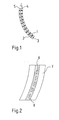
- the structure of a lamella as can be used, for example, for the realization of an actuator structure according to the invention, will be explained below with reference to the schematic illustration in FIG.
- the lamella shows a first layer 1 with nanofiber bundles and a second layer 2, which runs essentially parallel to the first layer 1 and likewise has nanofiber bundles.
- the two layers 1 and 2 consist of a polymer in which the nanofiber bundles are embedded.
- the nanofibers can also be arranged disorderly in a felt-like, pressed structure.
- Between the two layers 1 and 2 extends an electrical insulating layer 3.
- the two layers 1 and 2 have the electrical connections 4 and 5, which are connected to a DC voltage source.
- the nanofiber bundles When a direct electrical voltage is applied to the two layers 1 and 2 as shown in the figure, the nanofiber bundles receive charge carriers or ions in one layer. As a result of the uptake or release of charge carriers, an expansion or contraction of the nanofiber bundles involved is connected, as a result the lamella shows a bend when a voltage is applied.
- Fig. 2 shows a single-layer realization of the integration of the lamellae in the tire material, wherein the orientation of the individual lamellae is adapted to the tire mold.
- the lamellae can be embedded in an additional layer of a material different from the tire material.
- Fig. 3 a multi-layer configuration of the slats is shown, wherein the slats are arranged partially overlapping. In this way, the lamellae can be arranged in such a way that the number of layers in the areas of the tire in which increased forces occur or are required, is adjusted accordingly. This may be necessary in particular in the region of the bead and the tread.
- the slats are integrated in an additional layer; It may also be advantageous to integrate the lamellae directly into the material of the blanket or the carcass of the tire.
- electrical connection elements in the tire are necessary.
- the actuators may be electrically contacted by metal tracks or nets introduced into the tire.
- a particularly advantageous embodiment of the invention is that the shape of the vehicle tire can be selected.
- vehicle tires are exposed to different requirements depending on the current driving situation.
- FIG. 4 shows a vehicle tire according to the invention, in which the tire cross-section has been adapted for rapid straight-ahead driving (dotted). The change in cross-section is achieved by the lamellae 41 being stretched near the tread 42 and the louvers 43 flexing near the bead region. In contrast, it is necessary, for example, in curves or braking maneuvers or on snow-slippery road surface to increase the bearing surface of the tire to give the vehicle the necessary stability.
- FIG. 5 shows the corresponding tire cross section.
- the elasticity of the vehicle tire be designed selectable. For example, it may be due to the Actuators can be achieved that the vehicle tires in case an increased payload is set harder or road bumps cushions. This is with conventional vehicle tires achieved so far via an increase in air pressure, which requires a certain effort. Likewise depends the elasticity of conventional vehicle tires to a high degree from the outside temperature or the tire temperature.
- the invention offers here a simple solution for the optimal choice the elasticity of the tire for the prevailing conditions.
- the described functionality can do so be used in case of a pressure loss in the tire Emergency running properties by a corresponding stiffening of the Tire using the actuators.
- the adaptive tire deformation for damping the vertical vibrations on uneven road surface be used.
- FIG. 7 This application of the vehicle tire according to the invention is illustrated in FIG. 7.
- the vehicle tire can oscillate dotted between the two and dashed lines maximum deflections are offset. This leads with suitable Actuation of the actuators for an effective damping the above-mentioned vertical vibrations and thus a clear increased ride comfort.
- the control unit may be integrated in the tires or located outside the tire.
- the sensor data can be obtained from a wide variety of sensors.
- sensors can be integrated directly into the tire material. These may be, for example, sensors based on the piezoelectric effect, which are particularly suitable for detecting deformations such as, for example, strains or compressions in the tire material.
- optical fiber sensors can be used for the said application because of their good integrability in composite materials.
- the control device determines which voltage is applied to the actuators in which region of the vehicle tire and in this way dynamically optimizes the mechanical behavior of the vehicle tire.
- sensor data can be used, which are obtained from already existing in the vehicle sensors such as speed sensors or yaw rate sensors.
- the evaluation of the sensor data and the resulting possible dynamic control of the properties of the vehicle tire according to the invention thus provides the unique opportunity to develop the last passive component of the chassis, namely the tire to an actively controllable functional unit in the system of the chassis.
- the resulting fully active chassis is to be illustrated below with reference to the schematic representation of Figure 8.
- the body tree 81 ie, the vehicle itself, is in contact with the road surface 86 via the active suspension spring-damper system and the tire.
- the active chassis shows a spring 87, a shock absorber 84 and an active actuator 82, which are connected to the undamped mass of the front axle 87.
- the vehicle tire according to the invention shows active actuators, which are formed by the actuators. This leads to completely new design options in the field of driving dynamics and thus on the one hand to an increase in driving pleasure and on the other hand to further improve road safety and lower fuel consumption.
Landscapes
- Engineering & Computer Science (AREA)
- Mechanical Engineering (AREA)
- Chemical & Material Sciences (AREA)
- Nanotechnology (AREA)
- Physics & Mathematics (AREA)
- Composite Materials (AREA)
- Condensed Matter Physics & Semiconductors (AREA)
- General Physics & Mathematics (AREA)
- Materials Engineering (AREA)
- Crystallography & Structural Chemistry (AREA)
- Tires In General (AREA)
Abstract
Description
Ein solches Verhalten ist für Fahrzeugreifen aus den unterschiedlichsten Gründen wünschenswert. So ändern sich beispielsweise die Anforderungen an die Bereifung eines Fahrzeuges stark, sobald sich die Zuladung eines Fahrzeuges ändert. Dieser Problematik wird üblicherweise dadurch begegnet, dass der Reifendruck entsprechend angepasst wird. Ebenso ist es insbesondere für die Bereifung von Geländefahrzeugen erforderlich, die mechanischen Eigenschaften der Reifen an die momentan herrschenden Umgebungsbedingungen anzupassen.
Um den oben geschilderten Anforderungen gerecht zu werden, wird in der deutschen Patentanmeldung DE 100 01 348 A1 eine elektromechanische Reifendruckregelanlage vorgeschlagen, die im Fahrzeugrad angeordnet ist und die eine Kontrolle und Anpassung der Reifendrücke während der Fahrt gewährleistet. Der damit verbundene apparative Aufwand ist jedoch beachtlich: so wird in der vorgeschlagenen Lösung eine elektrische Pumpe verwendet, deren Stromversorgung über einen ebenfalls zusätzlich vorzusehenden in das Rad integrierten Generator erfolgt. Diese Ausgestaltung macht das vorgeschlagene System schwer, fehleranfällig, komplex und teuer.
Derartige Kohlenstoff-Nanostrukturteilchen weisen diamantartige mechanische Stabilität bei einem Bruchteil der Dichte von Stahl auf; damit sind sie für die Anwendung in mechanischen Bauteilen insbesondere auch im Hinblick auf Leichtbauanwendungen besonders geeignet.
Darüber hinaus haben Kohlenstoff-Nanostrukturteilchen die besondere Eigenschaft, bei Aufnahme oder Abgabe elektrischer Ladungen ihre räumlichen Abmessungen zu ändern. Dieses Verhalten eröffnet die Möglichkeit, die genannten Nanostrukturteilchen als Bestandteile von mechanischen Aktuatoren in vorteilhafter Weise anzuwenden.
Die Fasern bzw. Folien, die auch aus anderen Materialien wie beispielsweise Silikaten oder Metallen bestehen können, können einfach in eine Materialstruktur integriert werden und bewirken aufgrund der Addition der einzelnen Längenänderungen beispielsweise beim Anlegen einer elektrischen Spannung eine makroskopisch messbare Längenänderung. Auf diese Weise wird es möglich, beispielsweise eine gewünschte Formänderung eines Fahrzeugreifens allein durch das Anlegen einer elektrischen Spannung an den Reifen zu bewirken. Sobald die elektrische Spannung nicht mehr anliegt, kehrt der Reifen in seine ursprüngliche Form zurück; der geschilderte Vorgang ist also reversibel.
Diese Anordnung entspricht einer aufgerollten Schicht Graphit, jedoch ist sie hinsichtlich ihrer mechanischen Eigenschaften Graphit weit überlegen.
Aufgrund der stabilen Kohlenstoffkonfiguration im Röhrenverbund besitzen Nanotubes extreme Härte und Reißfestigkeit. Auch die Strom- und Wärmeleitfähigkeit der Nanotubes ist außergewöhnlich - Stromdichten bis zu 1000 Ampere pro Quadratzentimeter können erreicht werden, ohne dass das Material zu schmelzen beginnt. Die extrem hohe Wärmeleitfähigkeit (doppelt so hoch wie die des Diamant) trägt in vorteilhafter Weise zu einer schnellen und gleichmäßen Wärmeverteilung im Material bei und unterbindet so wirksam das Auftreten thermisch induzierter mechanischer Spannungen.
Nanotubes als Aktuatormaterial werden bspw. in der Publikation S. Roth and R.H. Baughman "Actuators of Individual Carbon Nanotubes" (Current Applied Physics 2, 311-314 (2002)) diskutiert.
Die Reifenwandung kann dabei in eine Vielzahl von Aktuatorsegmenten aufgeteilt sein, die teilweise aus Nanotubes, die vorzugsweise eine Biegeverformung des Reifenwandsegmentes bewirken, und teilweise aus Nanofolien, die eine Dehnung des Reifenwandsegmentes bewirken. Durch geeignete Verteilung des einen oder anderen Aktuatortyps entlang der Reifenwandungen bei der Reifenherstellung kann den angestrebten Verformungen des Reifens Rechnung getragen werden.
Bei der Integration der erfindungsgemäßen Aktuatoren in das Material des Fahrzeugreifens kommt ein weiterer Vorteil insbesondere der Verwendung von Kohlenstoff-Nanostrukturteilchen zum Tragen: Einerseits tragen die verwendeten Kohlenstoff-Nanostrukturteilchen durch ihre überragenden mechanischen Eigenschaften zur Stabilisierung des erfindungsgemäßen Fahrzeugreifens bei. Hierdurch sinken die Anforderungen an die mechanischen Eigenschaften des verwendeten Reifenmaterials, so dass sich die Zahl derjenigen Materialien, die zur Verwendung in einem derartigen Fahrzeugreifen geeignet sind, deutlich erhöht.
Dies führt dazu, dass beispielsweise auch Materialien verwendet werden können, die auf Grund ihrer mechanischen Eigenschaften ohne die zusätzliche Verwendung von Kohlenstoff-Nanostrukturteilchen für die Verwendung in konventionellen Fahrzeugreifen zunächst nicht in Frage kommen würden. Durch die Integration der beschriebenen Aktuatoren lassen sich die Eigenschaften des so entstehenden Verbundmaterials in vorteilhafter Weise im Hinblick auf die Verwendung als Reifenmaterial optimieren.
Darüber hinaus gestattet es das geringe Gewicht der verwendeten Nanostrukturteilchen, Leichtbauanforderungen weitestgehend gerecht zu werden.
Zwischen den beiden Schichten 1 und 2 verläuft eine elektrische isolierende Schicht 3. Die beiden Schichten 1 und 2 weisen die elektrischen Anschlüsse 4 und 5 auf, die mit einer Gleichspannungsquelle verbunden sind. Beim Anlegen einer elektrischen Gleichspannung an die beiden Schichten 1 und 2 wie in der Figur gezeigt nehmen die Nanofaserbündel in einer Schicht Ladungsträger bzw. Ionen auf. Da mit der Aufnahme bzw. der Abgabe von Ladungsträgern eine Ausdehnung bzw. Kontraktion der beteiligten Nanofaserbündel verbunden ist, zeigt die Lamelle im Ergebnis bei Anlegen einer Spannung eine Biegung.
Fig. 2 zeigt eine einlagige Realisation der Integration der Lamellen in das Reifenmaterial, wobei die Ausrichtung der einzelnen Lamellen an die Reifenform angepasst ist. Dabei können die Lamellen in eine zusätzliche Schicht aus einem vom Reifenmaterial verschiedenen Material eingebettet sein.
In Fig. 3 ist eine mehrlagige Konfiguration der Lamellen dargestellt, wobei die Lamellen teilüberlappend angeordnet sind. Auf diese Weise lassen sich die Lamellen in der Weise anordnen, dass die Anzahl der Lagen in den Bereichen des Reifens, in denen erhöhte Kräfte auftreten beziehungsweise erforderlich sind, entsprechend angepasst wird. Dies kann insbesondere im Bereich des Wulstes und der Lauffläche erforderlich sein.
Zur Ansteuerung der Aktuatoren sind elektrische Verbindungselemente im Reifen notwendig. Beispielsweise können die Aktuatoren durch in den Reifen eingebrachte Metallbahnen oder - netze elektrisch kontaktiert werden. Bereits in konventionellen Fahrzeugreifen sind z. B. Stahlgürtel im Bereich der Lauffläche integriert. Diese bereits vorhandenen Stahlgürtel können in vorteilhafter Weise als Leiterbahnen zur Kontaktierung der Aktuatoren verwendet werden.
Im Unterschied hierzu ist es beispielsweise in Kurven oder bei Bremsmanövern oder auch bei schneeglatter Fahrbahn notwendig, die Auflagefläche des Reifens zu erhöhen, um dem Fahrzeug die notwendige Stabilität zu verleihen. In Figur 5 ist der korrespondierende Reifenquerschnitt dargestellt.
Das so entstehende vollständig aktive Fahrwerk soll im folgenden anhand der schematischen Darstellung der Figur 8 verdeutlicht werden. Die Aufbaumasse 81, d. h. das Fahrzeug selbst, steht hier über das Feder-Dämpfer-System eines aktiven Fahrwerks und den Reifen mit der Straßenoberfläche 86 in Kontakt. Dabei zeigt das aktive Fahrwerk eine Feder 87, einen Stoßdämpfer 84 sowie ein aktives Stellglied 82, die mit der ungedämpften Masse der Vorderachse 87 verbunden sind. Bei der Verwendung konventioneller Fahrzeugreifen stellen diese Reifen nur passive Feder-Dämpfersysteme ohne eigene aktive Komponente dar. Im Unterschied hierzu zeigt der erfindungsgemäße Fahrzeugreifen aktive Stellglieder, die durch die Aktuatoren gebildet werden.
Dies führt zu völlig neuen Gestaltungsmöglichkeiten im Bereich der Fahrdynamik und damit einerseits zu einer Erhöhung des Fahrspaßes und andererseits zu einer weiteren Verbesserung der Sicherheit im Straßenverkehr sowie niedrigerem Kraftstoffverbrauch.
Claims (13)
- Fahrzeugreifen mit wählbaren mechanischen Eigenschaften,
dadurch gekennzeichnet, dass der Fahrzeugreifen mit einem oder mehreren Aktuatoren zur Änderung der physikalischen Eigenschaften des Fahrzeugreifens versehen ist. - Fahrzeugreifen nach Anspruch 1,
dadurch gekennzeichnet, dass die Aktuatoren als Folien ausgebildet sind. - Fahrzeugreifen nach Anspruch 1,
dadurch gekennzeichnet, dass die Aktuatoren Nanostrukturteilchen aufweisen. - Fahrzeugreifen nach Anspruch 3,
dadurch gekennzeichnet,
das es sich bei den Nanostrukturteilchen um Kohlenstoff-Nanostrukturteilchen handelt. - Fahrzeugreifen nach Anspruch 3 oder 4,
dadurch gekennzeichnet, dass es sich bei den Nanostrukturteilchen um Fasern handelt. - Fahrzeugreifen nach Anspruch 5,
dadurch gekennzeichnet, dass es sich bei den Fasern mindestens teilweise um Nanotubes handelt. - Fahrzeugreifen nach einem der Ansprüche 5 oder 6,
dadurch gekennzeichnet, dass es sich bei den Fasern mindestens teilweise um Multi-Wall-Bucky-Fibers handelt. - Fahrzeugreifen nach einem der vorangehenden Ansprüche,
dadurch gekennzeichnet, dass die Aktuatoren in das Material des Fahrzeugreifens integriert sind. - Fahrzeugreifen nach einem der vorangehenden Ansprüche 1-7,
dadurch gekennzeichnet, dass die Aktuatoren in ein vom Material des Fahrzeugreifens verschiedenes Material integriert sind. - Fahrzeugreifen nach einem der vorangehenden Ansprüche,
dadurch gekennzeichnet, dass die Aktuatoren schichtweise in einer Lamellenstruktur angeordet sind. - Fahrzeugreifen nach einem der vorangehenden Ansprüche,
dadurch gekennzeichnet, dass die Form des Fahrzeugreifens wählbar ist. - Fahrzeugreifen nach einem der vorangehenden Ansprüche,
dadurch gekennzeichnet, dass die Elastizität des Fahrzeugreifens wählbar ist. - Fahrzeugreifen nach einem der vorangehenden Ansprüche,
dadurch gekennzeichnet, dass die Aktuatoren mit einer insbesondere in den Reifen integrierten Steuereinheit verbunden sind, die die Aktuatoren anhand von Sensordaten oder Benutzereingaben ansteuert.
Applications Claiming Priority (2)
| Application Number | Priority Date | Filing Date | Title |
|---|---|---|---|
| DE2003152339 DE10352339B4 (de) | 2003-11-06 | 2003-11-06 | Adaptiver-Fahrzeugreifen |
| DE10352339 | 2003-11-06 |
Publications (2)
| Publication Number | Publication Date |
|---|---|
| EP1529657A1 true EP1529657A1 (de) | 2005-05-11 |
| EP1529657B1 EP1529657B1 (de) | 2006-08-16 |
Family
ID=34428639
Family Applications (1)
| Application Number | Title | Priority Date | Filing Date |
|---|---|---|---|
| EP20040025986 Expired - Lifetime EP1529657B1 (de) | 2003-11-06 | 2004-11-02 | Adaptiver Fahrzeugreifen, der Nanostrukturteilchen aufweist |
Country Status (2)
| Country | Link |
|---|---|
| EP (1) | EP1529657B1 (de) |
| DE (2) | DE10352339B4 (de) |
Cited By (2)
| Publication number | Priority date | Publication date | Assignee | Title |
|---|---|---|---|---|
| US20090314406A1 (en) * | 2008-06-24 | 2009-12-24 | Gm Global Technology Operations, Inc. | Self-healing and self-cleaning tires utilizing active material actuation |
| US20110024010A1 (en) * | 2009-07-31 | 2011-02-03 | Gm Global Technology Operations, Inc. | Performance adaptive tires utilizing active material actuation |
Families Citing this family (2)
| Publication number | Priority date | Publication date | Assignee | Title |
|---|---|---|---|---|
| DE102007056689A1 (de) | 2007-11-24 | 2009-05-28 | Continental Aktiengesellschaft | Fahrzeugluftreifen |
| JP7456286B2 (ja) | 2020-05-26 | 2024-03-27 | 住友ゴム工業株式会社 | トレッド可変装置、空気入りタイヤ、及びグリップ力制御方法 |
Citations (1)
| Publication number | Priority date | Publication date | Assignee | Title |
|---|---|---|---|---|
| US5411070A (en) * | 1990-04-05 | 1995-05-02 | Yadegar; Iraj | Self-contained anti-skid device for pneumatic tires |
Family Cites Families (5)
| Publication number | Priority date | Publication date | Assignee | Title |
|---|---|---|---|---|
| DE69904632T2 (de) * | 1998-10-28 | 2003-10-02 | Pirelli Pneumatici S.P.A., Milano | Wulstkern für luftreifen und luftreifen mit diesem kern |
| DE10001348A1 (de) * | 2000-01-14 | 2001-07-19 | Paul Horlacher | Elektromechanische Reifendruckregelanlage |
| DE10044074A1 (de) * | 2000-09-05 | 2002-03-14 | Josef W Eckel | Vorrichtung zum Verringern des Rollwiderstandes bei Autoreifen |
| DE10050595A1 (de) * | 2000-10-12 | 2002-04-18 | Oskar Bschorr | Aktoren zur Neutralisation profilbedingter Reifenschwingungen |
| DE10122812A1 (de) * | 2001-05-10 | 2002-11-28 | Continental Ag | Fahrzeugluftreifen |
-
2003
- 2003-11-06 DE DE2003152339 patent/DE10352339B4/de not_active Expired - Fee Related
-
2004
- 2004-11-02 DE DE200450001189 patent/DE502004001189D1/de not_active Expired - Lifetime
- 2004-11-02 EP EP20040025986 patent/EP1529657B1/de not_active Expired - Lifetime
Patent Citations (1)
| Publication number | Priority date | Publication date | Assignee | Title |
|---|---|---|---|---|
| US5411070A (en) * | 1990-04-05 | 1995-05-02 | Yadegar; Iraj | Self-contained anti-skid device for pneumatic tires |
Non-Patent Citations (1)
| Title |
|---|
| YONG K. KIM: "Nanocomposite Fibers", NATIONAL TEXTILE CENTER ANNUAL REPORT M00-D08, November 2000 (2000-11-01), XP002315786, Retrieved from the Internet <URL:http://www.ntcresearch.org/pdf-rpts/AnRp00/m00-d08.pdf> [retrieved on 20050131] * |
Cited By (4)
| Publication number | Priority date | Publication date | Assignee | Title |
|---|---|---|---|---|
| US20090314406A1 (en) * | 2008-06-24 | 2009-12-24 | Gm Global Technology Operations, Inc. | Self-healing and self-cleaning tires utilizing active material actuation |
| US20090314404A1 (en) * | 2008-06-24 | 2009-12-24 | Gm Global Technology Operations, Inc | Methods of reducing tire rolling resistance utilizing active material actuation |
| US9211687B2 (en) * | 2008-06-24 | 2015-12-15 | GM Global Technology Operations LLC | Self-healing and self-cleaning tires utilizing active material actuation |
| US20110024010A1 (en) * | 2009-07-31 | 2011-02-03 | Gm Global Technology Operations, Inc. | Performance adaptive tires utilizing active material actuation |
Also Published As
| Publication number | Publication date |
|---|---|
| DE10352339B4 (de) | 2007-03-15 |
| DE502004001189D1 (de) | 2006-09-28 |
| DE10352339A1 (de) | 2005-06-23 |
| EP1529657B1 (de) | 2006-08-16 |
Similar Documents
| Publication | Publication Date | Title |
|---|---|---|
| DE60127109T2 (de) | Piezoelektrischer generator für sensoren in fahrzeugreifen | |
| EP1417108B1 (de) | Verfahren zu beeinflussung des wankverhaltens von kraftfahrzeugen | |
| DE102010056388A1 (de) | Fahrzeug mit einem Blattfederelement zur Federung des Fahrzeugs | |
| EP3487718B1 (de) | Feder- und dämpfungsanordnung für ein motorrad | |
| DE102007034840A1 (de) | Fahrwerkssystem für ein Kraftfahrzeug und Verfahren zur Fahrdynamikregelung | |
| DE102011104071A1 (de) | Blattfeder und Verfahren zu deren Herstellung | |
| DE102020118706B4 (de) | Verfahren zur Prüfung der Eignung einer Solltrajektorie für eine Trajektorienregelung eines Fahrzeugs | |
| EP1877294B1 (de) | Lenkvorrichtung, insbesondere für eine hinterachslenkung | |
| EP0648623B1 (de) | Luftreifen, insbesondere Kraftfahrzeugluftreifen | |
| EP1894755A2 (de) | Fahrwerksanordnung | |
| EP1529657B1 (de) | Adaptiver Fahrzeugreifen, der Nanostrukturteilchen aufweist | |
| DE10202114A1 (de) | Verbundstoff-Bogen-Einblattfeder | |
| DE102020210048A1 (de) | Verfahren zum Schutz von Bauteilen einer Steer-by-wire-Lenkung sowie Steer-by-wire-Lenkung | |
| EP1577125A2 (de) | Variables Federungssystem für ein Kraftfahrzeug mit mindestens einem Hauptfederelement und mindestens einem Dämpferelement | |
| EP2252473A1 (de) | Verstellbarer radträger | |
| DE102019105566A1 (de) | Fahrwerksanordnung für ein Kraftfahrzeug sowie Verfahren zum Betreiben eines Kraftfahrzeuges | |
| DE102008028077A1 (de) | Vorrichtung zur aktiven Beeinflussung der Radstellung der Hinterräder eines Fahrzeugs | |
| DE10314251A1 (de) | Fahrwerkregelung | |
| DE102012207487A1 (de) | Fahrwerks-Lenker aus faserverstärktem Kunststoffmaterial | |
| DE102015225824A1 (de) | Querblattfedersystem | |
| DE10352338A1 (de) | Fahrzeugteil mit Aktuator | |
| WO2022084535A1 (de) | Blattfedervorrichtung sowie blattfeder und dämpferanordnung | |
| DE10123381A1 (de) | Zweirad mit aktiven Feder-/Dämpferelementen | |
| DE102016221306A1 (de) | Verstellbare Radaufhängung | |
| DE202009011643U1 (de) | Bremsausgleich für Bremsanlagen von Fahrzeugen |
Legal Events
| Date | Code | Title | Description |
|---|---|---|---|
| PUAI | Public reference made under article 153(3) epc to a published international application that has entered the european phase |
Free format text: ORIGINAL CODE: 0009012 |
|
| AK | Designated contracting states |
Kind code of ref document: A1 Designated state(s): AT BE BG CH CY CZ DE DK EE ES FI FR GB GR HU IE IS IT LI LU MC NL PL PT RO SE SI SK TR |
|
| AX | Request for extension of the european patent |
Extension state: AL HR LT LV MK YU |
|
| 17P | Request for examination filed |
Effective date: 20051031 |
|
| AKX | Designation fees paid |
Designated state(s): DE |
|
| GRAP | Despatch of communication of intention to grant a patent |
Free format text: ORIGINAL CODE: EPIDOSNIGR1 |
|
| GRAS | Grant fee paid |
Free format text: ORIGINAL CODE: EPIDOSNIGR3 |
|
| GRAA | (expected) grant |
Free format text: ORIGINAL CODE: 0009210 |
|
| AK | Designated contracting states |
Kind code of ref document: B1 Designated state(s): DE |
|
| REF | Corresponds to: |
Ref document number: 502004001189 Country of ref document: DE Date of ref document: 20060928 Kind code of ref document: P |
|
| RAP2 | Party data changed (patent owner data changed or rights of a patent transferred) |
Owner name: DAIMLERCHRYSLER AG |
|
| PLBE | No opposition filed within time limit |
Free format text: ORIGINAL CODE: 0009261 |
|
| STAA | Information on the status of an ep patent application or granted ep patent |
Free format text: STATUS: NO OPPOSITION FILED WITHIN TIME LIMIT |
|
| 26N | No opposition filed |
Effective date: 20070518 |
|
| PGFP | Annual fee paid to national office [announced via postgrant information from national office to epo] |
Ref country code: DE Payment date: 20150129 Year of fee payment: 11 |
|
| REG | Reference to a national code |
Ref country code: DE Ref legal event code: R119 Ref document number: 502004001189 Country of ref document: DE |
|
| PG25 | Lapsed in a contracting state [announced via postgrant information from national office to epo] |
Ref country code: DE Free format text: LAPSE BECAUSE OF NON-PAYMENT OF DUE FEES Effective date: 20160601 |