EP1529521A2 - Verwendung von hydrierten Sojaglyceriden in kosmetische Zubereitungen - Google Patents
Verwendung von hydrierten Sojaglyceriden in kosmetische Zubereitungen Download PDFInfo
- Publication number
- EP1529521A2 EP1529521A2 EP04105522A EP04105522A EP1529521A2 EP 1529521 A2 EP1529521 A2 EP 1529521A2 EP 04105522 A EP04105522 A EP 04105522A EP 04105522 A EP04105522 A EP 04105522A EP 1529521 A2 EP1529521 A2 EP 1529521A2
- Authority
- EP
- European Patent Office
- Prior art keywords
- acid
- oil
- peg
- skin
- advantageous
- Prior art date
- Legal status (The legal status is an assumption and is not a legal conclusion. Google has not performed a legal analysis and makes no representation as to the accuracy of the status listed.)
- Ceased
Links
- 0 *c(cccc1)c1C(c(ccc(N(*)*)c1)c1O)=O Chemical compound *c(cccc1)c1C(c(ccc(N(*)*)c1)c1O)=O 0.000 description 1
Classifications
-
- A—HUMAN NECESSITIES
- A61—MEDICAL OR VETERINARY SCIENCE; HYGIENE
- A61Q—SPECIFIC USE OF COSMETICS OR SIMILAR TOILETRY PREPARATIONS
- A61Q19/00—Preparations for care of the skin
- A61Q19/007—Preparations for dry skin
-
- A—HUMAN NECESSITIES
- A61—MEDICAL OR VETERINARY SCIENCE; HYGIENE
- A61K—PREPARATIONS FOR MEDICAL, DENTAL OR TOILETRY PURPOSES
- A61K8/00—Cosmetics or similar toiletry preparations
- A61K8/18—Cosmetics or similar toiletry preparations characterised by the composition
- A61K8/92—Oils, fats or waxes; Derivatives thereof, e.g. hydrogenation products thereof
- A61K8/922—Oils, fats or waxes; Derivatives thereof, e.g. hydrogenation products thereof of vegetable origin
-
- A—HUMAN NECESSITIES
- A61—MEDICAL OR VETERINARY SCIENCE; HYGIENE
- A61Q—SPECIFIC USE OF COSMETICS OR SIMILAR TOILETRY PREPARATIONS
- A61Q19/00—Preparations for care of the skin
-
- A—HUMAN NECESSITIES
- A61—MEDICAL OR VETERINARY SCIENCE; HYGIENE
- A61Q—SPECIFIC USE OF COSMETICS OR SIMILAR TOILETRY PREPARATIONS
- A61Q19/00—Preparations for care of the skin
- A61Q19/008—Preparations for oily skin
-
- A—HUMAN NECESSITIES
- A61—MEDICAL OR VETERINARY SCIENCE; HYGIENE
- A61Q—SPECIFIC USE OF COSMETICS OR SIMILAR TOILETRY PREPARATIONS
- A61Q19/00—Preparations for care of the skin
- A61Q19/08—Anti-ageing preparations
Definitions
- the present invention relates to the use of hydrogenated soy glycerides in cosmetic preparations.
- Cosmetic cleansing products are usually in the form of gels, lotions and Solids (soap bars, washing synthetics) offered.
- Skin care products as a rule Creams, ointments or lotions are usually used to moisturize and restore the skin and skin care with cosmetic or dermatological agents (e.g. Vitamins, antioxidants, UV sunscreen filters). This is especially important when the natural Skin's ability to regenerate is insufficient to withstand the environmental, mechanical or chemical irritants, sunlight and wind-borne strains (the et al accelerate skin aging) and compensate for damage to the skin.
- Emulsions are understood In general, heterogeneous systems consisting of two are not or only limited to each other consist of miscible liquids, which are commonly referred to as phases and where one of the two liquids in the form of very fine droplets in the other Liquid is dispersed. Viewed externally and with the naked eye, emulsions appear homogeneous.
- O / W emulsion oil-in-water emulsion
- the basic character of an O / W emulsion is characterized by the water.
- W / O emulsion, eg butter water-in-oil emulsion, eg butter
- the oil phase of cosmetic emulsions can be built up from a large number of lipophilic compounds, for example oils, fats, waxes, silicone oils.
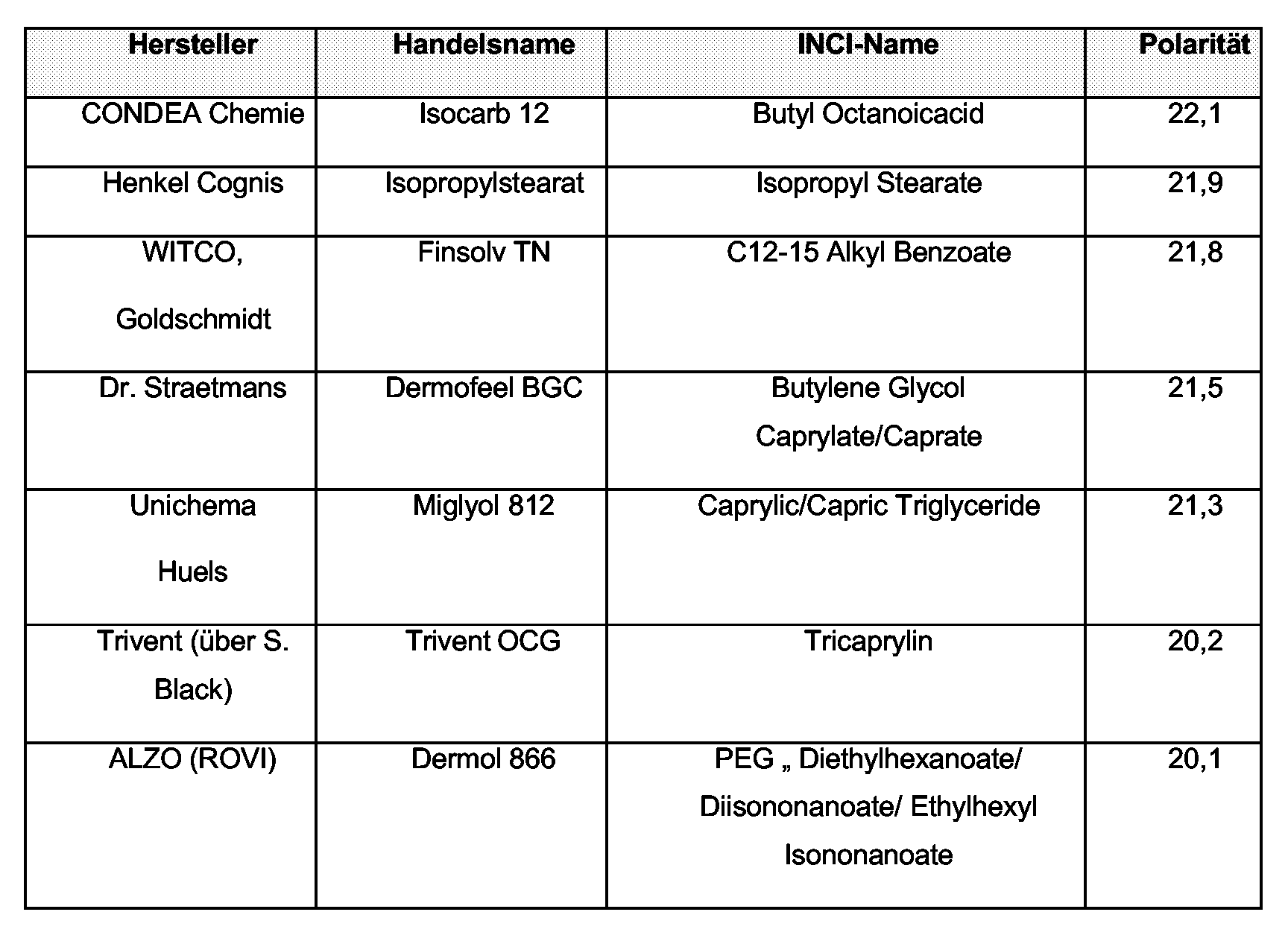
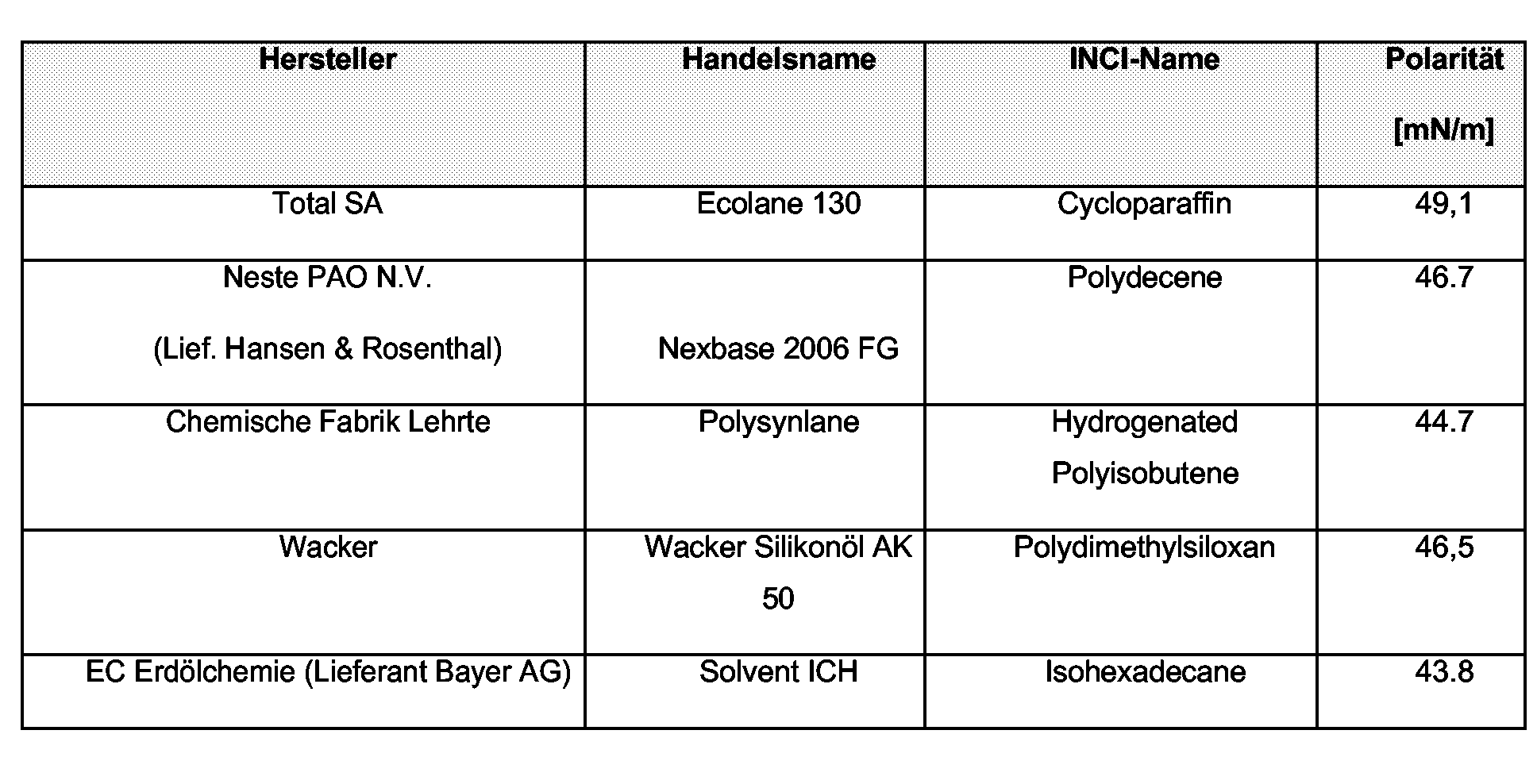
- the oils, fats and waxes differ among other things in their polarity. Usually this is defined by the interfacial tension of an oil against water. In this case, the lower the interfacial tension between this oil phase and water, the greater the polarity of the relevant oil phase.
- the interfacial tension is the force acting on an imaginary line of one meter length located in the interface between two phases.
- the physical unit for this interfacial tension is calculated classically by the force / length relationship and is usually expressed in mN / m (millinewtons divided by meters).
- Lipids are considered polar whose surface tension to water is less than 20 mN / m than non-polar ones whose interfacial tension with water is more than 30 mN / m. Lipids with an interfacial tension to water between 20 and 30 mN / m are generally referred to as medium polar.
- Polar oils are, for example, those from the group of lecithins and fatty acid triglycerides, namely the triglycerol esters of saturated and / or unsaturated, branched and / or unbranched alkanecarboxylic acids having a chain length of 8 to 24, in particular 12 to 18, carbon atoms.
- the intermediate polarity lipophilic compounds include the compounds from the group of ethers, esters and waxes, for example, alkyl benzoates.
- the group of nonpolar oil components includes, for example, all hydrocarbon compounds such as Vaseline (petrolatum), paraffin oil, squalane, squalene, polyolefins and hydrogenated polyisobutenes.
- the oil components of cosmetic preparations can also be distinguished by their origin (vegetable, animal, mineral) and their chemical structure (eg ethers, esters, hydrocarbons, silicone oils) as well as by their state of matter (solid, liquid).
- waxes in cosmetic preparations. They serve in the formulations mostly as consistency. In addition, they prevent, not least because of their good Adsorbtionshttps to oils, the oiling of the oil component in W / O emulsions at higher temperature. Waxes were originally in the plant and animal kingdom widespread and chemically diversified substance mixtures whose main components are esters of higher fatty acids with also higher primary alcohols, called. Today, in connection with the industrial utilization of waxes, the predominant substitution of these natural substances by mineral and synthetic raw materials under waxes is understood to mean substances and mixtures of substances with certain processing-technological properties.
- Such substances or mixtures are kneadable at 20 ° C solid to brittle hard, coarse to fine crystalline, translucent to opaque, but not glassy, melting above 40 ° C without decomposition, already slightly above the melting point relatively low viscosity, highly temperature-dependent in consistency and solubility , It is characteristic of waxes that they not only consist of a large number of analogous or similar chemically defined compounds, but also often contain components of several substance classes next to one another.
- the use of waxes in cosmetic preparations usually entails a series of sensory disadvantages which make the use of the preparations unattractive to the consumer.
- the Natural Moisturizing Factor includes, for example, urea and certain amino acids.
- the task of cosmetic skincare products is to provide the skin with water on the one hand, and to replace the moisture factors lost by the stress on the skin on the other hand.
- the classic skin moisturizers include in cosmetics, among others, polyols such as glycerol and sorbitol.
- the inventively advantageously used hydrogenated soy glycerides can be selected from the mono-, Di- and / or triglycerides, wherein the triglycerides are preferred according to the invention.
- the soy glycerides used in the invention preferably contain fatty acid glycerides, those made from fatty acids with a carbon chain length of 18 to 20 carbon atoms consist.
- the fatty acids of the soy glycerides used according to the invention are hydrogenated to 20-50% (saturated), preferably hydrogenated to 25-35% (saturated) and more preferably hydrogenated to 30% (saturated). Furthermore, the fatty acids of the soy glycerides used according to the invention are advantageously present in the form of 50-80%, preferably 55-75% and particularly preferably 70%, in the form of monounsaturated fatty acids.
- hydrochlorosulfate soy glycerides does not mean that the Soy glycerides are fully hydrogenated. Rather, under “hydrogenated soy glycerides” According to the invention, it is understood that one (defined above) is a proportion of the fatty acids the soy glycerides are hydrogenated.
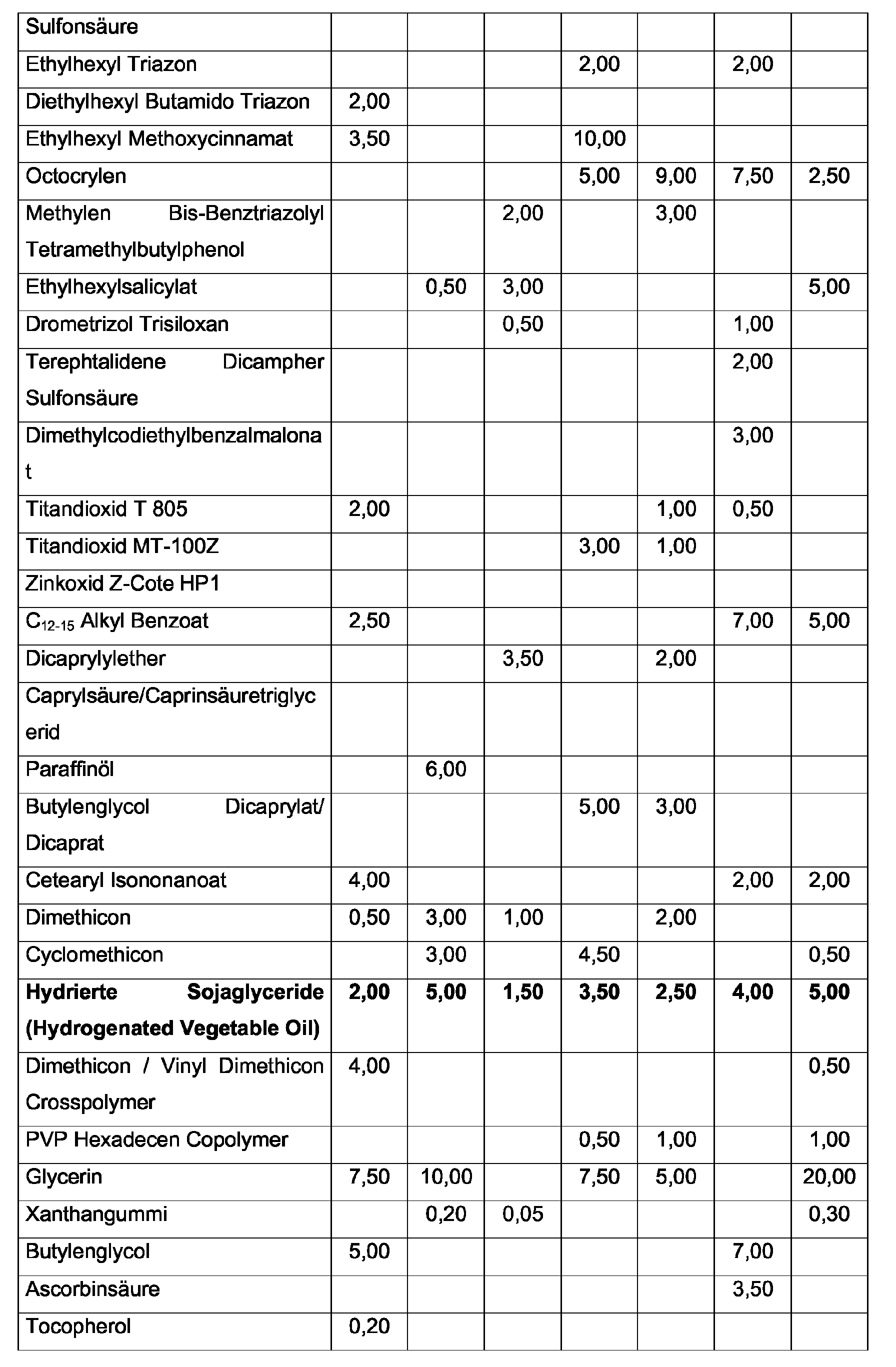
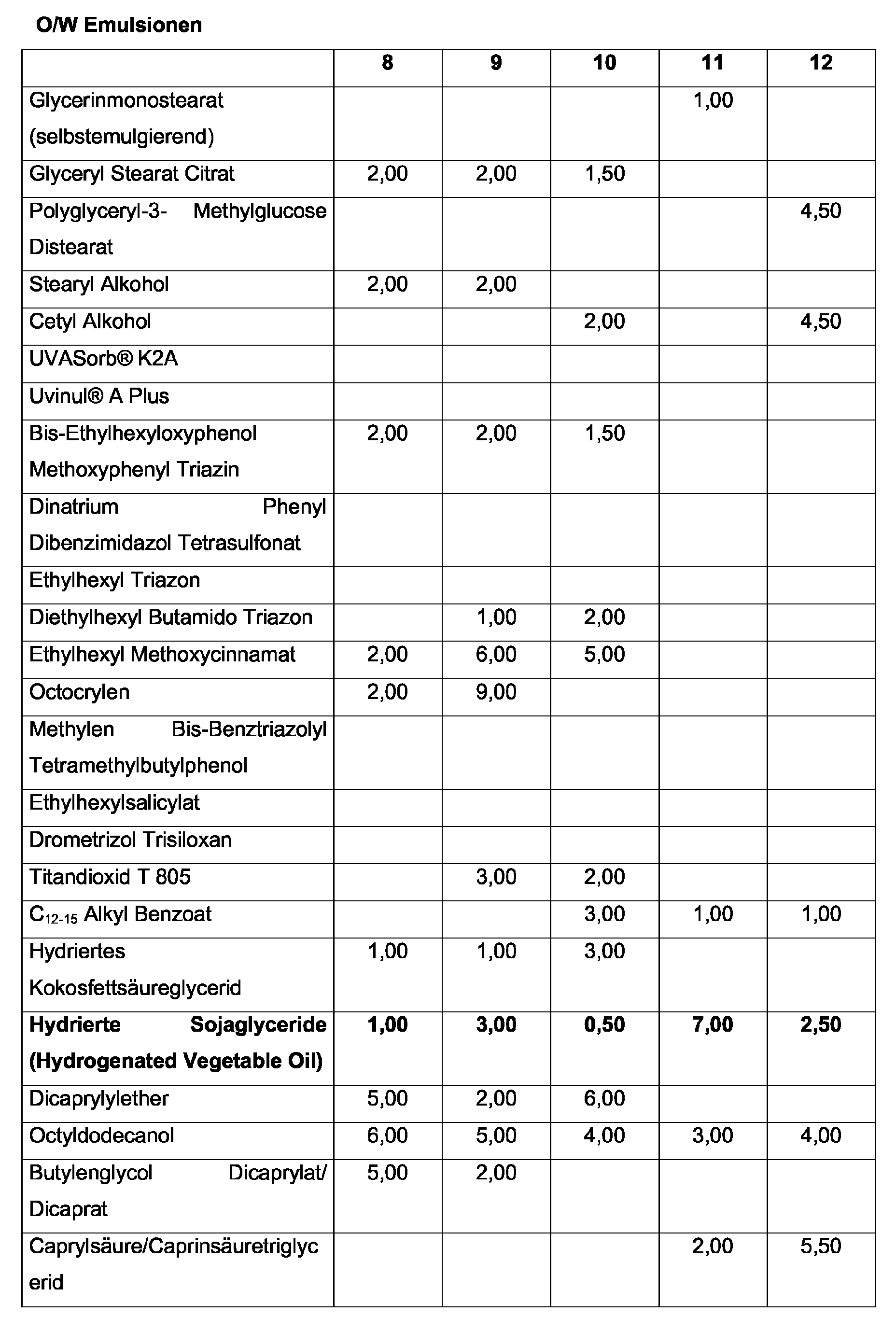
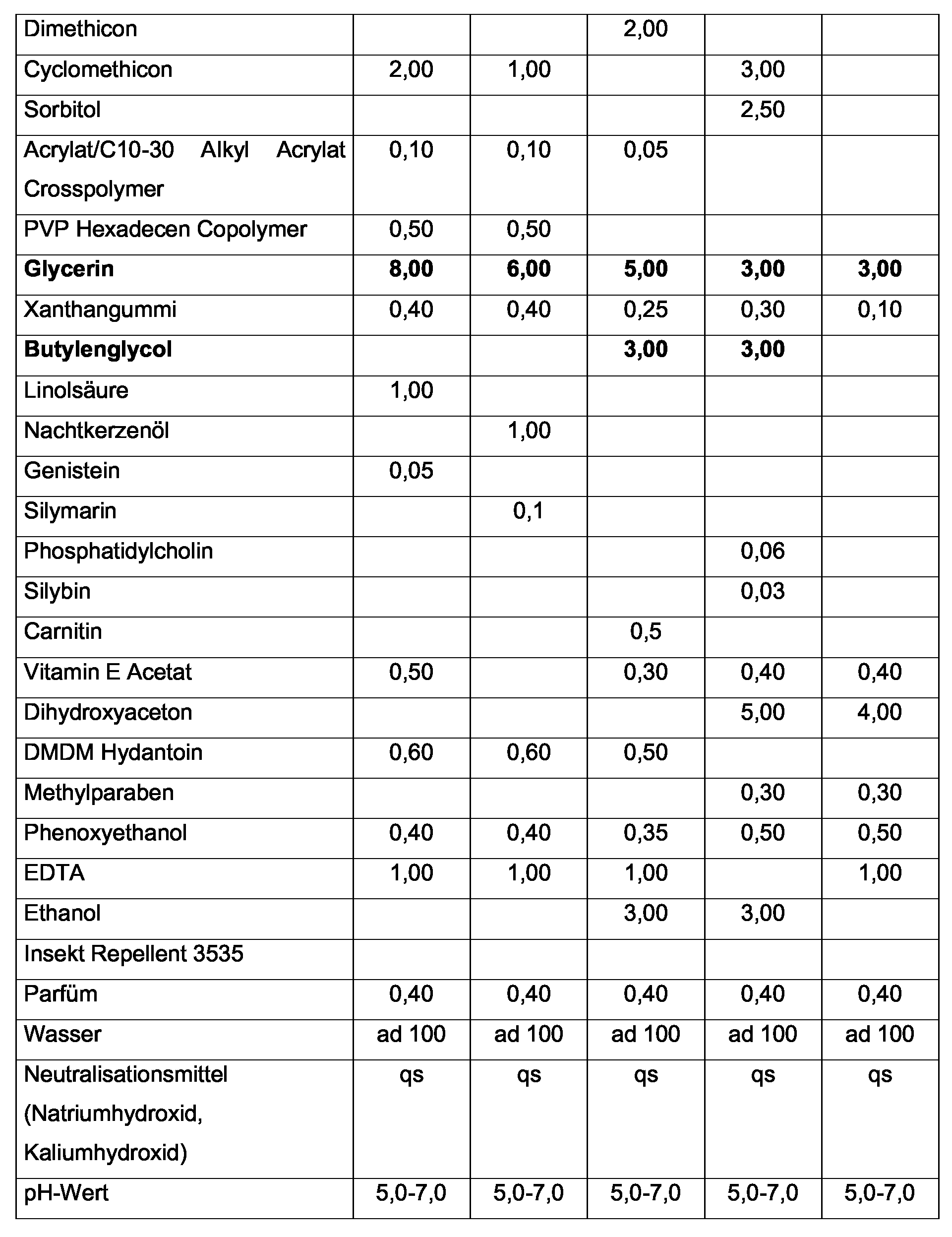
- the hydrogenated soy glycerides used according to the invention are used in the preparations According to the invention advantageously in a concentration of 0.5 to 7% by weight and According to the invention preferably in a concentration of 2 to 5% by weight, in each case used on the total weight of the preparation.
- Preparations within the meaning of the present invention may then be in addition to one or more Oil phases additionally contain one or more water phases and, for example, in the form of W / O, O / W, W / O / W or O / W / O emulsions (or equivalent Silicone oil emulsions) are present.
- Such formulations may also preferably include a microemulsion (eg, a PIT emulsion), a solid emulsions (i.e., an emulsion, which is stabilized by solids, eg. B.
- a Pickering emulsion a sprayable or foamable emulsion or a hydrodispersion.
- the Preparations in the context of the present invention also be virtually anhydrous (Water content below 5% by weight based on the total weight of the preparation) as for example oil gels.
- solids-containing emulsions such as make-up or wound protection products as well as transparent or translucent to milky gelatinous Products.
- O / W emulsions, hydrodispersions, gel creams are preferred according to the invention.
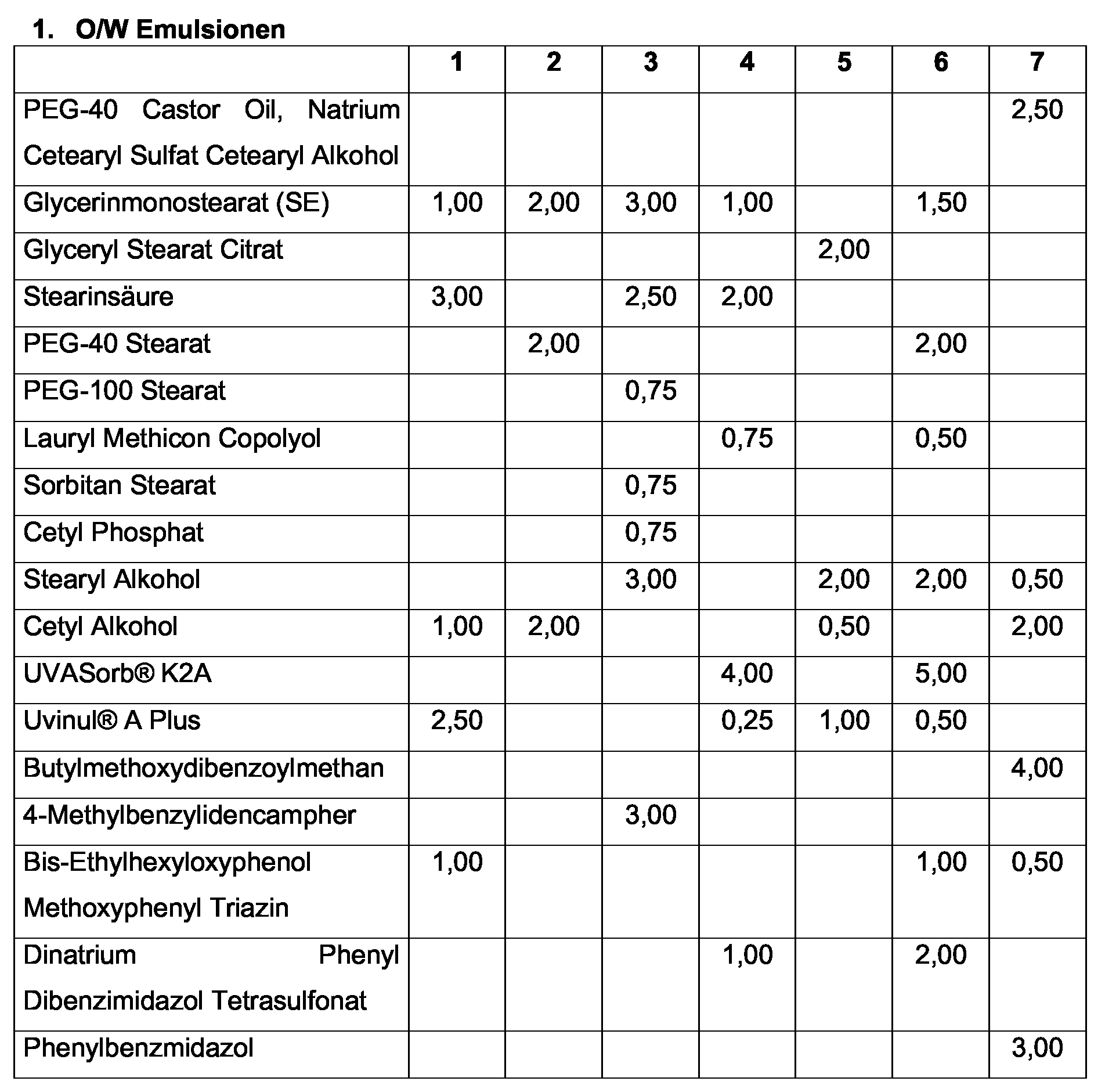
- O / W emulsifiers are glyceryl stearate citrate, Cetearyl sulfate, ethoxylated fatty acids (PEG-40 stearate, PEG-100 stearate) and / or Phosphate emulsifiers (e.g., cetyl phosphate) or salts of palmitic and stearic acid used.
- the one or more w / o emulsifiers can be selected from the group of silicone emulsifiers.
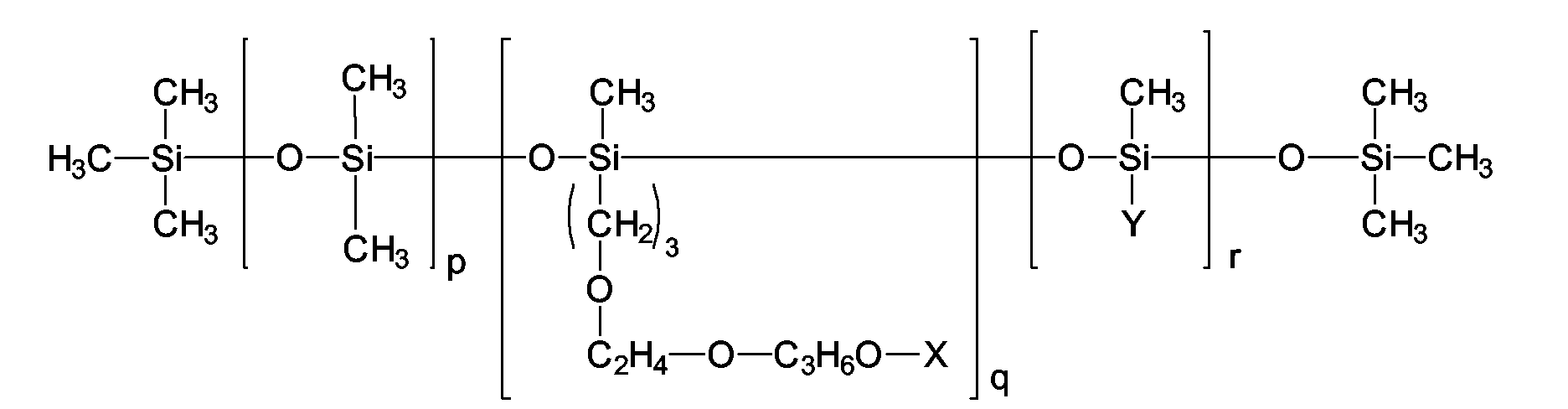
- the group of the alkyl methicone copolyols and / or alkyl dimethicone copolyols in particular from the group of the compounds which are characterized by the following chemical structure: wherein X and Y are independently selected from the group H (hydrogen) and the branched and unbranched alkyl groups, acyl groups and alkoxy groups having 1-24 carbon atoms, p is a number from 0-200, q is a number from 1-40, and r represents a number from 1-100.
- Silicone emulsifiers are dimethicone copolyols available from Th.Goldschmidt AG under the trade names ABIL® B 8842, ABIL® B 8843, ABIL® B 8847, ABIL® B 8851, ABIL® B 8852, ABIL® B 8863, ABIL® B 8873 and ABIL® B 88183 are sold.
- cetyl dimethicone copolyol which is derived from sold by the company Th.Goldschmidt AG under the trade name ABIL® EM 90 becomes.
- cyclomethicone dimethicone copolyol which from the company Th.Goldschmidt AG under the trade name ABIL® EM 97 on sale is.
- the emulsifier lauryl methicone copolyol has been found to be particularly advantageous, which under the trade name Dow Corning® 5200 Formulation Aid of Company Dow Corning Ltd. is available.
- Another advantageous silicone emulsifier is octyl dimethicone ethoxy glucoside from the company Wacker.
- An inventive aqueous phase of the preparations according to the invention can advantageously contain customary cosmetic auxiliaries, such as, for example, alcohols, in particular such low carbon number, preferably ethanol and / or isopropanol, diols or lower C-number polyols and their ethers, preferably propylene glycol, glycerol, Butylene glycol, sorbitol, ethylene glycol, ethylene glycol monoethyl or monobutyl ether, Propylene glycol monomethyl, monoethyl or monobutyl ether, diethylene glycol monomethyl or monoethyl ether and analogous products.
- customary cosmetic auxiliaries such as, for example, alcohols, in particular such low carbon number, preferably ethanol and / or isopropanol, diols or lower C-number polyols and their ethers, preferably propylene glycol, glycerol, Butylene glycol, sorbitol, ethylene glycol
- the content of one or more polyols in the Preparations in which the hydrogenated soy glycerides are used according to the invention 5 to 20% by weight and preferably 7.5 to 12.5% by weight, based in each case on Total weight of the preparation.
- Particularly preferred according to the invention is a polyol Glycerol used.
- the aqueous phase according to the invention polymers, foam stabilizers, electrolytes and in particular one or more thickening agents, which or which are advantageous can be selected from the group silicon dioxide, aluminum silicates, polysaccharides or their derivatives, for. Hyaluronic acid, xanthan gum, hydroxypropyl methylcellulose, particularly advantageous from the group of polyacrylates, preferably a Polyacrylate from the group of the so-called Carbopole [from the company. Bf. Goodrich], for example Carbopols types 980, 981, 1382, 2984, 5984, ETD 2020, ETD 2050, Ultrez 10, each alone or in combination.
- Carbopole from the company. Bf. Goodrich
- An oil (or lipid) phase which is advantageous according to the invention can, in addition to the invention used hydrogenated soy glycerides advantageously contain further lipophilic compounds.
- Particularly advantageous polar lipids in the context of the present invention are all native lipids, such as. Olive oil, sunflower oil, soybean oil, peanut oil, rapeseed oil, almond oil, palm oil, coconut oil, castor oil, wheat germ oil, grapeseed oil, thistle oil, evening primrose oil, macadamia nut oil, corn oil, avocado oil and the like and those listed below.
- the oil phase may advantageously be selected from the group of dialkyl ethers, the group of saturated or unsaturated, branched or unbranched alcohols. It is particularly advantageous if the oil phase contains or consists entirely of C 12-15 -alkyl benzoate.
- the oil phase can be advantageously selected from the group of Guerbet alcohols.
- Guerbet alcohols are named after Marcel Guerbet, who first described their production. They arise according to the reaction equation by oxidation of an alcohol to an aldehyde, by aldol condensation of the aldehyde, elimination of water from the aldol and hydrogenation of allyl aldehyde. Guerbet alcohols are fluid even at low temperatures and cause virtually no skin irritation. Advantageously, they can be used as greasing, overfatting and also moisturizing ingredients in skin and hair care products.
- R 1 and R 2 are generally unbranched alkyl radicals.
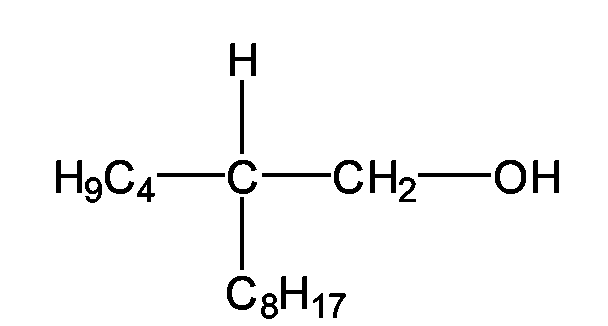
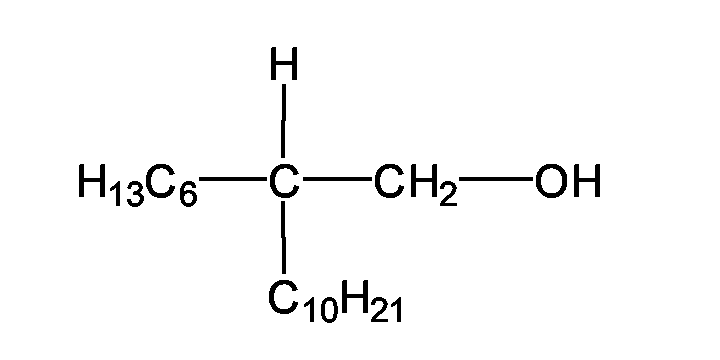
- Guerbet alcohols preferred according to the invention are the 2-butyloctanol - it has the chemical structure and is available, for example, under the trade name Isofol® 12 from Condea Chemie GmbH - and 2-hexyldecanol - it has the chemical structure and is available, for example, under the trade name Isofol® 16 from Condea Chemie GmbH.
- Mixtures of Guerbet alcohols according to the invention are also advantageously usable according to the invention.
- Mixtures of 2-butyloctanol and 2-hexyldecanol are available, for example, under the trade name Isofol® 14 from Condea Chemie GmbH.
- the total amount of Guerbet alcohols in the finished cosmetic or dermatological Preparations are advantageously from the range up to 25.0 wt .-%, preferably 0.5 - 15.0% by weight, based on the total weight of the preparations.
- any mixtures of such oil and wax components are advantageous in Use of the present invention. It may also be advantageous if necessary waxes, for example cetyl palmitate, as the sole lipid component of the oil phase use.
- Non-polar oils are, for example, those which are selected from the group of branched and unbranched hydrocarbons and waxes, in particular Vaseline (Petrolatum), paraffin oil, squalane and squalene, polyolefins and hydrogenated polyisobutenes.
- Vaseline Petrolatum
- paraffin oil squalane and squalene
- polyolefins polyolefins
- hydrogenated polyisobutenes are the preferred substances.
- the oil phase can be advantageously selected from the group the branched and unbranched hydrocarbons and waxes, the dialkyl ethers, the Group of saturated or unsaturated, branched or unbranched alcohols, and the fatty acid triglycerides, namely the triglycerol esters of saturated and / or unsaturated branched and / or unbranched alkanecarboxylic acids of a chain length of 8 to 24, in particular 12-18 C-atoms.
- the fatty acid triglycerides may be, for example be selected from the group of synthetic, semisynthetic and natural oils, e.g. Olive oil, sunflower oil, soybean oil, peanut oil, rapeseed oil, almond oil, Palm oil, coconut oil, palm kernel oil and the like, provided that in the main claim required conditions are met.
- fat and / or wax components from the group of vegetable waxes, animal waxes, mineral waxes and petrochemicals Waxes are chosen.
- candelilla waxes Carnauba wax, japan wax, esparto wax, cork wax, guaruma wax, Rice germ oil wax, sugarcane wax, berry wax, ouricury wax, montan wax, jojoba wax, Shea butter, beeswax, shellac wax, spermaceti, lanolin (wool wax), cudgel fat, Ceresin, ozokerite (ground wax), paraffin waxes and microwaxes, provided in the main claim required conditions are met.
- fat and / or wax components are chemically modified waxes and synthetic waxes, such as those available under the trade names Syncrowax HRC (glyceryl tribehenate), and Syncrowax AW 1C (C 18-36 fatty acid) from CRODA GmbH and Montanester waxes, Sasol waxes, hydrogenated jojoba waxes, synthetic or modified beeswaxes (eg dimethicone copolyol beeswax and / or C 30-50 -alkyl beeswax), polyalkylene waxes, polyethylene glycol waxes, but also chemically modified fats such.
- Syncrowax HRC glycol tribehenate
- Syncrowax AW 1C C 18-36 fatty acid
- Hydrogenated vegetable oils for example hydrogenated castor oil and / or hydrogenated coconut fat glycerides
- triglycerides such as trihydroxystearin, fatty acids, fatty acid esters and glycol esters such as C 20-40 alkyl stearate, C 20-40 alkyl hydroxystearoyl stearate and / or glycol montanate.
- organosilicon compounds which have similar physical properties as the said fat and / or wax components, such as stearoxytrimethylsilane, provided that the conditions required in the main claim are met.
- the fat and / or wax components both individually and present in the mixture. Also, any mixtures of such oil and wax components are advantageous to use in the context of the present invention.
- the oil phase is selected from the group consisting of 2-ethylhexyl isostearate, octyldodecanol, isotridecyl isononanoate, butylene glycol dicaprylate / dicaprate, 2-ethylhexyl cocoate, C 12-15 alkyl benzoate, caprylic capric triglyceride, dicaprylyl ether, if the conditions required in the main claim are met.
- Particularly advantageous are mixtures of octyldodecanol, caprylic-capric triglyceride, dicaprylyl ether, dicaprylyl carbonate, cocoglycerides, or mixtures of C 12-15 -alkyl benzoate and 2-ethylhexyl isostearate, mixtures of C 12-15 -alkyl benzoate and butylene glycol dicaprylate / dicaprate and mixtures from C 12-15 -alkyl benzoate, 2-ethylhexyl isostearate and isotridecyl isononanoate if the conditions required in the main claim are met.
- hydrocarbons are paraffin oil, cycloparaffin, squalane, squalene, hydrogenated Polyisobutene or polydecene advantageous in the context of the present invention use. if the conditions required in the main claim are met.
- one or more waxes may be present in a total concentration of up to 10% by weight, based on the total weight of the preparation. Furthermore, the waxes may have a melting point of greater than 30 ° C and, usually even melting points of 38- 55 ° C. The advantages of the invention over the prior art are in this case especially in waxes with a melting point of 38-44 ° C apparently.
- silicone oils may be present as monomers, which are typically characterized by structural elements, as follows:
- Silicone oils are high molecular weight synthetic polymeric compounds in which silicon atoms linked via oxygen atoms chain and / or net-like and the rest Valencies of silicon by hydrocarbon radicals (mostly methyl, more rarely ethyl, Propyl, phenyl groups and the like a.) Are saturated.
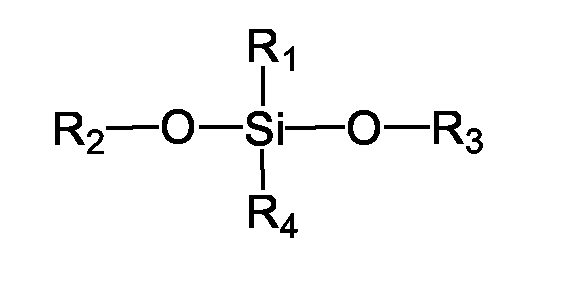
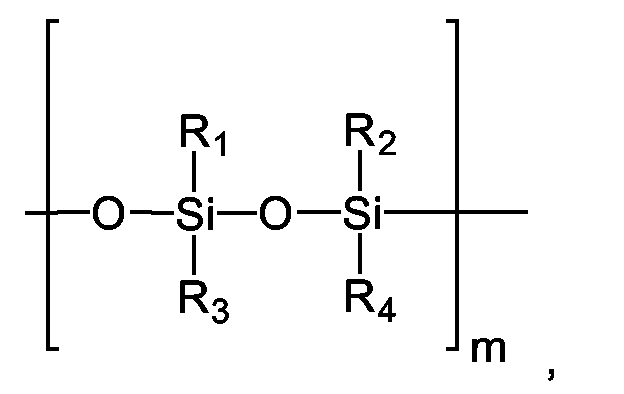
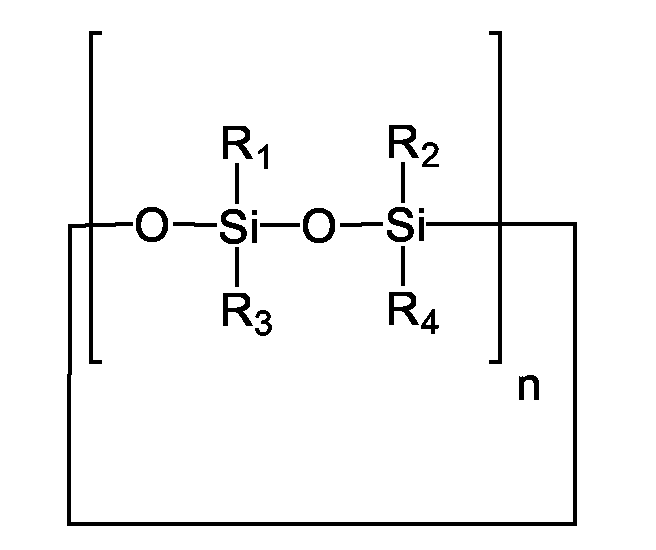
- linear silicones having several siloxy units which are advantageously used according to the invention, they are generally characterized by structural elements as follows: wherein the silicon atoms can be substituted with identical or different alkyl radicals and / or aryl radicals, which are here generalized by the radicals R 1 - R 4 (to say that the number of different radicals is not necessarily limited to 4).
- m can assume values of 2 - 200,000.
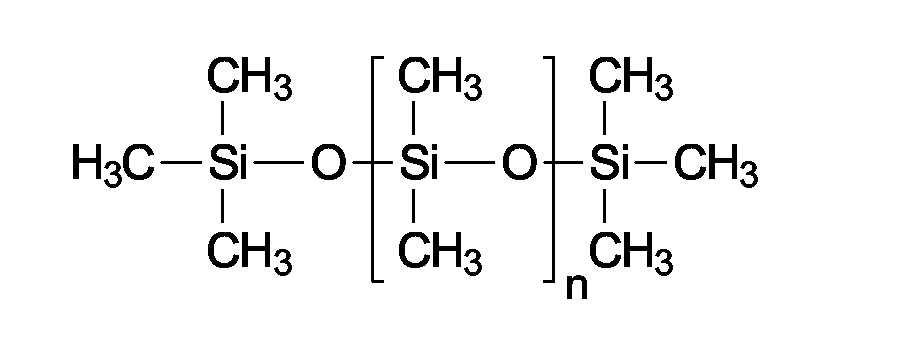
- the linear silicone oils are called polyorganosiloxanes; the methyl-substituted polyorganosiloxanes, which are the quantitatively most important compounds of this group and are characterized by the following structural formula are also referred to as polydimethylsiloxane or dimethicone (INCI).
- Dimethicones are available in different chain lengths or with different molecular weights. Dimethicones of different chain lengths and phenyltrimethicones are particularly advantageous linear silicone oils in the context of the present invention.
- Particularly advantageous polyorganosiloxanes in the context of the present invention are further for example, dimethylpolysiloxanes [poly (dimethylsiloxane)], which z. B. under the Trade names ABIL 10 to 10,000 are available from Th. Goldschmidt.
- dimethylpolysiloxanes poly (dimethylsiloxane)
- ABIL 10 to 10,000 are available from Th. Goldschmidt.
- phenylmethylpolysiloxanes INCI: phenyl dimethicone, phenyl trimethicone
- cyclic silicones octamethylcyclotetrasiloxane or decamethylcyclopentasiloxane
- INCI also referred to as cyclomethicones
- amino-modified silicones INCI: Amodimethicones
- silicone waxes e.g. B.
- Polysiloxane-polyalkylene copolymers (INCI: Stearyl dimethicone and cetyl dimethicone) and dialkoxydimethylpolysiloxanes (stearoxy Dimethicones and behenoxy stearyl dimethicones), which are available as various abil-wax types available from Th. Goldschmidt.
- Cyclic silicones which are advantageously used in accordance with the invention are generally characterized by structural elements as follows wherein the silicon atoms can be substituted with identical or different alkyl radicals and / or aryl radicals, which are here generalized by the radicals R 1 - R 4 (to say that the number of different radicals is not necessarily limited to 4).
- n can assume values of 3/2 to 20. Broken values for n take into account that odd numbers of siloxyl groups may be present in the cycle.
- Particularly advantageous cyclic silicone oils in the context of the present invention are Cyclomethicones, in particular Cyclomethicone D5 and / or Cyclomethicone D6.
- silicone oils or silicone waxes in the context of the present invention are cyclic and / or linear silicone oils and silicone waxes.
- the ratio of lipids to choose silicone oils in about as 1: 1 (generally x: y).
- phenyltrimethicone is chosen as the silicone oil.
- silicone oils for example Dimethicone, phenyldimethicone, cyclomethicone (octamethylcyclotetrasiloxane), for example Hexamethylcyclotrisiloxane, polydimethylsiloxane, poly (methylphenylsiloxane), Cetyl dimethicone, behenoxydimethicone are advantageous for the purposes of the present To use invention.
- silicone oils of similar constitution to those mentioned above Select compounds whose derivatized organic side chains, for example polyethoxylated and / or polypropoxylated.
- These include, for example, polysiloxane-polyalkyl-polyether copolymers such as the cetyl dimethicone copolyol and the cetyl dimethicone copolyol (and) polyglyceryl-4-isostearate (and) hexyl laurate.
- the preparations according to the invention can also be further cosmetic and / or dermatological active ingredients, auxiliaries and additives.
- Cosmetics which are advantageous according to the invention are characterized, for example, by the fact that one or more active substances are selected from the group of UV light protection filters, Vitamins, vitamin derivatives, antioxidants, anti-wrinkle active ingredients, self-tanner, Depigmenting agents, repellents, plant extracts, enzymes, anhydrous polyols, dyes, Effect substances.
- Preferred inorganic pigments are metal oxides and / or other water-insoluble or insoluble metal compounds, in particular oxides of titanium (TiO 2 ), zinc (ZnO), iron (eg Fe 2 O 3 ), zirconium (ZrO 2 ), silicon ( SiO 2 ), manganese (for example MnO), aluminum (Al 2 O 3 ), cerium (for example Ce 2 O 3 ), mixed oxides of the corresponding metals and mixtures of such oxides, and the barium sulfate (BaSO 4) 4 ).
- the titanium dioxide pigments can be used both in the rutile and anatase crystal modifications present and can be advantageously treated superficially in the context of the present invention ("coated"), wherein, for example, a hydrophilic, amphiphilic or hydrophobic character be formed or should be preserved.
- This surface treatment can be in it exist that the pigments according to known methods with a thin hydrophilic and / or hydrophobic inorganic and / or organic layer provided become.
- the various surface coating may be within the meaning of the present Invention also contain water.
- coated and uncoated titanium dioxides can be used in the sense of the present invention Invention also in the form of commercially available oily or aqueous predispersions to Application come. These predispersions may advantageously dispersing agents and / or solubilization promoters may be added.
- the titanium dioxides according to the invention are distinguished by a primary particle size of between 10 nm and 150 nm. trade name coating additional components of predispersion Manufacturer MT-100TV Aluminum hydroxide stearic acid - Tayca Corporation MT-100Z Aluminum hydroxide stearic acid - Tayca Corporation MT-100F Stearic acid iron oxide - Tayca Corporation MT 500SAS Alumina, silica silicone - Tayca Corporation MT 100AQ Silica aluminum hydroxide alginic acid - Tayca Corporation Eusolex T-2000 Alumina Simethicone - Merck KgaA Eosolex TS Alumina, stearic acid - Merck KgaA Titanium dioxide P25 none - Degussa Titanium Dioxide T805 (Uvinul TiO 2 ) octyltrimethylsilane - Degussa UV titanium X170 Alumina Dimethicone - Kemira UV titanium X161 Alumina, si
- titanium dioxides are MT-100Z and MT-100 TV from Tayca Corporation, Eusolex T-2000 and Eusolex TS from Merck and the Titanium dioxide T 805 from Degussa.
- zinc oxides may also be used in the form of commercially available oily or aqueous predispersions.
- Zinc oxide particles and predispersions of zinc oxide particles which are suitable according to the invention are distinguished by a primary particle size of ⁇ 300 nm and can be obtained from the following companies under the following trade names: trade name coating Manufacturer Z-Cote HP1 2% Dimethicone BASF Z Cote / BASF ZnO NDM 5% Dimethicone MR MZ 707M 7% Dimethicone M. Tayca Corp. Nanox 500 / Elementis ZnO neutral / MR
- Particularly preferred zinc oxides in the context of the invention are the Z-Cote HP1 of the BASF and the zinc oxide NDM from Haarmann & Reimer.
- the total amount of one or more inorganic pigments in the finished cosmetic preparation is advantageously from the range 0.1 wt .-% to 25 wt .-% selected, preferably 0.5 wt .-% to 18 wt .-%.
- Organic pigment for the purposes of the present invention is 2,2'-methylenebis (6- (2H-benzotriazol-2-yl) -4- (1,1,3,3-tetramethylbutyl) -phenol) [INCI: bisoctyltriazole], which is marketed under the trade name Tinosorb® M by CIBA-Chemikalien GmbH is available.
- UV-A filter substances for the purposes of the present invention are dibenzoylmethane derivatives, in particular 4- (tert-butyl) -4'-methoxydibenzoylmethane (CAS no. 70356-09-1) sold by Givaudan under the trademark Parsol® 1789 and by Merck under the Trade name Eusolex® 9020 is sold.
- dibenzoylmethane derivatives in particular 4- (tert-butyl) -4'-methoxydibenzoylmethane (CAS no. 70356-09-1) sold by Givaudan under the trademark Parsol® 1789 and by Merck under the Trade name Eusolex® 9020 is sold.
- UV-A filter substances are the phenylene-1,4-bis (2-benzimidazyl) -3,3'-5,5'-tetrasulfonic acid and their salts, especially the corresponding sodium, potassium or Triethanolammonium salts, especially the phenylene-1,4-bis (2-benzimidazyl) -3,3'-5,5'-tetrasulfonic acid bis-sodium salt with the INCI name bisimidazylate, which for example under the trade name Neo Heliopan AP at Haarmann & Reimer is available.
- 1,4-di (2-oxo-10-sulfo-3-bomylidenemethyl) benzene and its Salts especially the entprechenden 10-sulfato compounds, in particular the corresponding Sodium, potassium or triethanolammonium salt, which is also known as benzene-1,4-di (2-oxo-3-bomylidenemethyl-10-sulfonic acid) referred to as.
- a particularly advantageous hydroxybenzophenone in the context of the present invention is hexyl 2- (4'-diethylamino-2'-hydroxybenzoyl) benzoate (also: aminobenzophenone), which is available under the trade name Uvinul A Plus from BASF.
- Advantageous UV filter substances in the sense of the present invention are also so-called Broadband filter, i. Filter substances that absorb both UV-A and UV-B radiation.
- Advantageous broadband filters or UV-B filter substances are, for example, bis-resorcinyl triazine derivatives having the following structure: wherein R 1 , R 2 and R 3 are independently selected from the group of branched and unbranched alkyl groups having 1 to 10 carbon atoms or represent a single hydrogen atom.
- R 1 , R 2 and R 3 are independently selected from the group of branched and unbranched alkyl groups having 1 to 10 carbon atoms or represent a single hydrogen atom.
- R 1 , R 2 and R 3 are independently selected from the group of branched and unbranched alkyl groups having 1 to 10 carbon atoms or represent a single hydrogen atom.
- R 1 , R 2 and R 3 are independently selected from the group of branched and unbranched alkyl groups having 1 to 10 carbon atoms or represent a single hydrogen atom.
- Particularly advantageous preparations in the context of the present invention which is characterized by have a high or very high UV-A protection, preferably contain several UV-A and / or broadband filters, in particular dibenzoylmethane derivatives [for example 4- (tert-butyl) -4'-methoxydibenzoylmethane], Benzotriazole derivatives [for example, the 2,2'-methylenebis (6- (2H-benzotriazol-2-yl) -4- (1,1,3,3-tetramethylbutyl) phenol)], Phenylene-1,4-bis- (2-benzimidazyl) -3,3'-5,5'-tetrasulfonic and / or their salts, the 1,4-di (2-oxo-10-sulfo-3-bomylidenemethyl) benzene and / or its salts and / or the 2,4-bis - [[4- (2-ethyl-hexyloxy) -2-hydroxy
- Particularly preferred UV filter substance in the context of the present invention is also an unsymmetrically substituted s-triazine whose chemical structure is represented by the formula which is also referred to below as Dioctylbutylamidotriazon (INCI: Dioctylbutamidotriazone) and is available under the trade name UVASORB HEB in Sigma 3V.
- Dioctylbutylamidotriazon ICI: Dioctylbutamidotriazone
- Also advantageous in the context of the present invention is a symmetrically substituted s-triazine, the 4,4 ', 4 "- (1,3,5-triazine-2,4,6-triyltriimino) tris-benzoic acid tris (2-ethylhexyl ester), synonym: 2,4,6-tris [anilino (p-carbo-2'-ethyl-1'-hexyloxy)] - 1,3,5-triazine (INCI: octyl triazone), which is marketed by BASF Aktiengesellschaft under the trade name UVINUL® T 150 is sold.
- Also advantageous for the purposes of the present invention are 2,4-bis - ⁇ [4- (3-sulfonato) -2-hydroxy-propyloxy) -2-hydroxy] -phenyl ⁇ -6- (4-methoxyphenyl) -1, 3,5-triazine sodium salt containing 2,4-bis - ⁇ [4- (3- (2-propyloxy) -2-hydroxy-propyloxy) -2-hydroxy] -phenyl ⁇ -6- (4-methoxyphenyl) - 1,3,5-triazine, the 2,4-bis - ⁇ [4- (2-ethyl-hexyloxy) -2-hydroxy] -phenyl ⁇ -6- [4- (2-methoxyethylcarboxyl) -phenylamino] -1 , 3,5-triazine, which is 2,4-bis - ⁇ [4- (3- (2-propyloxy) -2-hydroxy-propyloxy) -2-hydroxy] -
- An advantageous broadband filter for the purposes of the present invention is the 2,2'-methylene-bis (6- (2H-benzotriazol-2-yl) -4- (1,1,3,3-tetramethylbutyl) phenol), which available under the trade name Tinosorb® M from CIBA-Chemikalien GmbH.
- Advantageous broadband filter according to the present invention is further the 2- (2H-benzotriazol-2-yl) -4-methyl-6- [2-methyl-3- [1,3,3,3-tetramethyl-1 - [( trimethylsilyl) oxy] disiloxanyl] propyl] phenol (CAS No .: 155633-54-8) with the INCI name Drometrizole Trisiloxane.
- liquid UV filter substances in the context of the present Invention are homomenthyl salicylate (INCI: homosalates), 2-ethylhexyl-2-hydroxybenzoate (2-ethylhexyl salicylate, octyl salicylate, INCI: octyl salicylates), 4-isopropylbenzyl salicylate and esters of cinnamic acid, preferably 4-methoxycinnamic acid (2-ethylhexyl) ester (2-ethylhexyl-4-methoxycinnamate, INCI: octyl methoxycinnamate) and 4-methoxycinnamic acid isopentyl ester (Isopentyl-4-methoxycinnamate, INCI: isoamyl p-methoxycinnamate), 3- (4- (2,2-Ethoxycarbonylvinyl) phenoxy) propenyl) me
- a further light stabilizer filter substance to be advantageously used according to the invention is this Ethylhexyl-2-cyano-3,3-diphenylacrylate (octocrylene), which was sold by BASF under the name Uvinul® N 539 is available.
- polymer-bound or polymeric UV filter substances in preparations according to the present invention, in particular those as described in WO-A-92/20690.
- UV filters used in the context of the present invention can, of course, not be limiting.
- the preparations according to the invention contain the substances, the UV radiation absorb in the UV-A and / or UV-B range, in a total of z. B. 0.1 wt .-% to 30 wt .-%, preferably 0.5 to 20 wt .-%, in particular 1.0 to 15.0% by weight, in each case based on the total weight of the preparations, of cosmetic Preparations that provide the hair or the skin in front of the entire area protect the ultraviolet radiation. You can also use it as a sunscreen Hair or the skin serve.
- Vitamins and vitamin derivatives are Vitamins and vitamin derivatives
- vitamins A, B 1-6 , B 12 , C, D, E, F, H, K and PP include, among others, vitamins A, B 1-6 , B 12 , C, D, E, F, H, K and PP and their derivatives.
- vitamins A, B 1-6 , B 12 , C, D, E, F, H, K and PP can be used according to the invention advantageously in a concentration of 0.001 to 10 wt .-%, preferably 0.05 to 7 wt .-%, particularly preferably 0.5 to 5 wt .-%, based on the total weight of the preparation in which they contain are included.
- Retinyl palmitate as preferred vitamin derivatives according to the invention, are thereby Ascorbylglucoside, tocopheryl acetate, tocopheryl palmitate, niacinamide, panthenol used.
- Vitamins and their derivatives in one Concentration of 0.05 to 1% by weight, preferably in a concentration of 0.01 to 0.5 % By weight and most preferably in a concentration of 0.05 to 0.2 % By weight, based on the total weight of the preparation.
- the antioxidants are selected from the group consisting of amino acids (eg glycine, lysine, arginine, cysteine, histidine, tyrosine, tryptophan) and their derivatives (as salt, ester, ether, sugar, nucleotide, nucleoside, Peptide and lipid association), imidazoles (eg, urocanic acid) and derivatives thereof (as the salt, ester, ether, sugar, nucleotide, nucleoside, peptide and / or lipid junction), peptides such as D , L-carnosine, D-carnosine, L-carnosine, anserine and their derivatives (eg as salt, ester, ether, sugar, thiol, nucleotide, nucleoside, peptide and lipid combination), carotenoids , Carotenes (eg ⁇ -carotene, ⁇ -carotene, ⁇ -lycopene, phytoen
- chelators eg apoferritin, desferral, lactoferrin, ⁇ -hydroxyfatty acids, palmitic acid, phytic acid
- their derivatives as salt, ester, ether, sugar, thiol, nucleotide, nucleoside, peptide and / or lipid combination
- ⁇ -hydroxy acids eg citric acid, lactic acid, malic acid
- humic acid bile acid, bile extracts, bilirubin, biliverdin, EDTA, EGTA and their derivatives
- unsaturated fatty acids and their derivatives eg ⁇ -linolenic acid, linoleic acid, Oleic acid
- folic acid and its derivatives furfurylidene sorbitol and its derivatives, ubiquinone, ubiquinol, plastoquinone and their derivatives (as a salt, ester, ether, sugar, thiol, nucleotide
- Glycosyl rutin Ferula acid, caffeic acid
- furfurylidenglucitol butylhydroxytoluene, butylhydroxyanisole, nordihydroguaiacetic acid, nordihydroguiaretic acid, trihydroxybutyrophenone and their derivatives (as salt, ester, ether, sugar, nucleotide, nucleoside, peptide and lipid combination).
- Uric acid and its derivatives, mannose and its derivatives (as a salt, ester, ether, sugar, thiol, nucleotide, nucleoside, peptide and lipid combination).
- Zinc and its derivatives eg ZnO, ZnSO 4
- selenium and its derivatives eg selenium methionine, Ebselen
- stilbenes and their derivatives eg stilbene oxide, trans-stilbene oxide
- inventively suitable derivatives as salt, ester, ether
- Sugar, thiol, nucleotide, nucleoside, peptide and / or lipid Verbidung of these drugs.
- the amount of the aforementioned antioxidants (one or more compounds) in the preparations is preferably 0.001 to 30 wt .-%, particularly preferably 0.05 - 20 Wt .-%, in particular 1 - 10 wt .-%, based on the total weight of the preparation.
- vitamin E and / or its derivatives are the antioxidant (s), it is advantageous to their respective concentrations from the range of 0.001 to 10 wt .-%, based on the total weight of the formulation to choose.
- the one or more Antioxidants represent advantageous, their respective concentrations from the field from 0.001 to 10% by weight, based on the total weight of the formulation.
- active ingredients in the context of the present invention are natural active ingredients and / or their derivatives, such as.
- alpha-lipoic acid phytoene, D-biotin, coenzyme Q10, alpha-glucosylrutin, carnitine, carnosine, natural and / or synthetic isoflavonoids, Creatine, creatinine, lignans, taurine and / or ⁇ -alanine.
- the skin soothing and nourishing substances include, for example, panthenol, allantoin, tannin and Plant ingredients such as azulene and bisabolol, glycyrrhizin, hamamelin and plant extracts like chamomile, aloe vera, hamazelis, liquorice root.
- the amount of the aforementioned active ingredients (one or more compounds) in the preparations is preferably from 0.001 to 30% by weight, particularly preferably from 0.05 to 20% by weight, in particular 1-10% by weight, based on the total weight of the preparation.
- Glycerol aldehyde hydroxymethylglyoxal, ⁇ -dialdehyde, erythrulose, 6-aldo-D-fructose, Ninhydrin, 5-hydroxy-1,4-naphthoquinone (juglone), 2-hydroxy-1,4-naphthoquinone (Lawson).
- DHA 1,3-dihydroxyacetone
- Dicarboxylic acids such as 8-hexadecene-1,16-dicarboxylic acid (dioic acid, CAS number 20701-68-2), Kojic acid, ascorbic acid and azelaic acid and their derivatives are used.
- the total concentration of depigmenting agents in the corresponding preparation 0.001 to 10 wt .-%, preferably 0.005 to 8 wt .-%, in particular 0.05 - 5 wt .-%.
- a content of repellents of 0.005 to 70.0% by weight is advantageous. used, in particular 0.01 to 50.0 wt .-% and most preferably 3 to 15 Wt .-% based on the total weight of the preparation.
- pigmentary dyes advantageous according to the invention it is possible to use all compounds listed from the corresponding positive list of the Cosmetics Ordinance or the EC list of cosmetic colorants. In most cases, they are identical to the food-approved dyes.
- the preparations according to the invention may also contain other dyes.
- advantageous color pigments are titanium dioxide, mica, iron oxides (eg Fe 2 O 3 , Fe 3 O 4 , FeO (OH)) and / or tin oxide.
- Advantageous dyes are, for example, carmine, Berlin blue, chrome oxide green, ultramarine blue and / or manganese violet. It is particularly advantageous to choose the dyes and / or color pigments from the following list.
- CIN Color Index Numbers
- the dye one or more substances from the following 2,4-Dihydroxyazobenzene, 1- (2'-chloro-4'-nitro-1'-phenylazo) -2-hydroxynaphthalene, Ceres red, 2- (4-sulfo-1-naphthylazo) -1-naphthol-4-sulfonic acid, calcium salt of 2-hydroxy-1,2'-azonaphthalene-1'-sulfonic acid, Calcium and barium salts of 1- (2-sulfo-4-methyl-1-phenylazo) -2-naphthylcarboxylic acid, Calcium salt of 1- (2-sulfo-1-naphthylazo) -2-hydroxynaphthalene-3-carboxylic acid, Aluminum salt of 1- (4-sulfo-1-phenylazo) -2-naphthol-6-sulfonic acid, Aluminum salt of 1- (4-sulfo-1-naphthylazo)
- Titanium dioxides according to the invention which are both rutile and anatase in the crystal modification can be present, are advantageously treated superficially in the context of the present invention ("coated"), wherein, for example, a hydrophilic, amphiphilic or hydrophobic Character should be formed or preserved.
- This surface treatment can consist in that the pigments according to known methods with a thin hydrophilic and / or hydrophobic inorganic and / or organic layer provided become.
- the various surface coatings may be in accordance with the present Invention also contain water.
- Inorganic surface coatings for the purposes of the present invention may consist of aluminum oxide (Al 2 O 3 ), aluminum hydroxide Al (OH) 3 or aluminum oxide hydrate (also: Alumina, CAS No .: 1333-84-2), sodium hexametaphosphate (NaPO 3 ) 6 , sodium metaphosphate (NaPO 3 ) n , silicon dioxide (SiO 2 ) (also: silica, CAS No .: 7631-86-9), zirconium oxide (ZrO 2 ) or iron oxide (Fe 2 O 3 ).
- Al 2 O 3 aluminum oxide
- Al (OH) 3 or aluminum oxide hydrate also: Alumina, CAS No .: 1333-84-2
- sodium hexametaphosphate (NaPO 3 ) 6 sodium metaphosphate (NaPO 3 ) n
- silicon dioxide (SiO 2 ) also: silica, CAS No .: 7631-86-9
- oxides, oxide hydrates or phosphates for example of the elements Al, Si, Zr are precipitated in dense layers on the pigment surface.
- the inorganic aftertreatment is generally carried out in an aqueous suspension of the pigment by adding soluble aftertreatment chemicals, such as aluminum sulfate, and subsequent precipitation of the sparingly soluble in the neutral range of hydroxide by targeted adjustment of the pH with sodium hydroxide solution.
- the coated pigments are separated from the suspension by filtration and washed thoroughly to remove the dissolved salts, then the isolated pigments are dried.
- titanium dioxides to the Aluminum hydroxide has been applied to the surface, e.g. Sun's Chemical available titanium dioxide types C47-051 and C47-5175.
- Further preferred Pigments are titanium dioxides coated with aluminum and / or silicon oxides, such as e.g. from the company Krosnos Titan: Kronos 1071 and 1075 or from the company Kingfisher: A310.03 Mathematics Aspen.
- Organic surface coatings in the sense of the present invention may exist from vegetable or animal aluminum stearate, vegetable or animal stearic acid, Lauric acid, dimethylpolysiloxane (also: dimethicone), methylpolysiloxane (methicone), Simethicone (a mixture of dimethylpolysiloxane with an average Chain length from 200 to 350 dimethylsiloxane units and silica gel) or alginic acid. These Organic surface coatings may be used alone, in combination and / or in combination occur with inorganic coating materials.
- pearlescent pigments are, for example, pulverulent pigments or castor oil dispersions of bismuth oxychloride and / or titanium dioxide and bismuth oxychloride and / or titanium dioxide on mica. Particularly advantageous is z. B. that under the CIN 77163 listed luster pigment.
- pearlescent pigment types based on mica / metal oxide group Occupancy / layer thickness colour
- Silver-white pearlescent pigments TiO 2 : 40-60 nm silver interference pigments TiO 2 : 60-80 nm yellow TiO 2 : 80-100 nm red
- TiO 2 100-140 nm blue
- TiO 2 120-160 nm
- Color Luster Pigments Fe 2 O 3 bronze Fe 2 O 3 copper Fe 2 O 3 red Fe 2 O 3 rotviolett Fe 2 O 3 Red Green Fe 2 O 3 black combination pigments
- pearlescent pigments which are advantageous in the context of the present invention are obtainable in numerous ways known per se.
- other substrates except mica can be coated with other metal oxides such.
- silica and the like As silica and the like.
- pearlescent pigments which are prepared using SiO 2 .
- Such pigments which may also have additional gonichromatic effects are, for. B. under the trade name Sicopearl Fantastico available from BASF.
- the dyes and pigments can be present both individually and in a mixture as well be coated with each other, with different coating thicknesses In general, different color effects are caused.
- the pigmentary dyes particularly preferred according to the invention are those listed blue pigments such as e.g. INCI: CI 77007, Outremer Supercosmetique W 6803 from Les Colorants Wackherr, INCI: CI 77891 + Mica + Silica, Timiron Splendid Blue from Merck.
- Titan dioxide and silicon dioxide Mica e.g. INCI: Mica + CI 77891 + Silica, Timiron Arctic Silver from Merck, INCI: Mica + CI 77891, Timiron Gleamer Flake MP-45 from Merck; with titanium dioxide and tin oxide coated alumina or silica, e.g., INCI: silica + CI 77891 + tin oxides, Xirona Magic Mauve from Merck; e.g., INCl: Alumina + CI 77891 + Tin Oxide, Xirona Silver, with Titanium dioxide and Berlin blue-coated mica, e.g. INCI: Mica + CI 77891 + CI 77510, Colorona Light Blue and Colorona Dark Blue by Merck.
- INCI titanium dioxide and silicon dioxide Mica
- INCI Mica + CI 77891 + Silica, Timiron Arctic Silver from Merck
- INCI Mica + CI 77891, Timiron Gleamer Flake MP-45 from Merck
- Glitter and glitter particles can also be advantageously contained in at least one of the preparations according to the invention.
- anionic, cationic, nonionic and zwitterionic surfactants may also be advantageously present in the preparations.
- the complexing agents are selected from the group consisting of ethylenediaminetetraacetic acid (EDTA) and their anions, nitrilotriacetic acid (NTA) and their Anions, hydroxyethylenediaminotriacetic acid (HOEDTA) and their anions, Diethylenetaminopentaacetic acid (DPTA) and its anions, trans-1,2-diaminocyclohexanetetraacetic acid (CDTA) and their anions, Tetrasodium Iminodisuccinate, Trisodium Etylenediamine disuccinate.
- EDTA ethylenediaminetetraacetic acid
- NTA nitrilotriacetic acid
- HOEDTA hydroxyethylenediaminotriacetic acid
- DPTA diethylenetaminopentaacetic acid
- CDTA trans-1,2-diaminocyclohexanetetraacetic acid
- emulsion I 80-97% by volume of emulsion I is foamed with 3-20% by volume of a suitable gas (eg propane / butane, compressed air, nitrogen).
- a suitable gas eg propane / butane, compressed air, nitrogen.
- W / O emulsions 1 2 3 4 5 Cetyl dimethicone copolyol 4.00 2.50 3.00 Polyglyceryl-2 dipolyhydroxystearate 3.00 1.00 Isostearyl diglyceryl succinate 0.75 0.30 Lauryl Methicon Copolyol 2.00 Polysorbate-65 2.00 1.50 PEG-100 stearate 1.20 0.70 Cetearyl sulphate 0.25 1.00 dimethicone 4.00 2.00 cyclomethicone 12,00 20.00 30.00 15.00 UVASorb® K2A 0.50 Uvinul® A Plus 2.00 0.50 4.00 0.25 Bis-Ethylhexyloxyphenol Methoxyphenyl Triazine 1.00 0.50 Dis
- Example 1 (Eye Shadow Gel): Wt .-% PEG-8 (polyethylene glycol 400) 2.00 ethanol 5.00 Aristoflex AVC 1.50 glycerin 2.00 panthenol 0.50 tocopherol 0.50 Timiron Splendid blue® (Merck KgaA) 4.50 Chrome oxide green 1.00 Hydrogenated Soy Glycerides (Hydrogenated Vegetable Oil) 1.00 Perfume, preservatives, NaOH, complexing agents, dyes, antioxidants etc. q.s.
- Example 2 Highlighter Gel: % By weight Carbomer 1.50 glycerin 2.50 1.3 butylene glycol 2.50 Glitter pigments (e.g., Helicone HC Scarabeus, Wacker) 1.00 EDTA 0.20 Dimethicone 1.50 Hydrogenated Soy Glycerides (Hydrogenated Vegetable Oil) 2.00 Perfume, preservatives, NaOH, dyes, antioxidants, etc. q.s.
- Carbomer 1.50 glycerin 2.50
- butylene glycol 2.50 Glitter pigments (e.g., Helicone HC Scarabeus, Wacker) 1.00 EDTA 0.20 Dimethicone 1.50 Hydrogenated Soy Glycerides (Hydrogenated Vegetable Oil) 2.00 Perfume, preservatives, NaOH, dyes, antioxidants, etc. q.s.
- Example 3 (Eye Liner Gel): % By weight pearlescent 10.00 iron oxide 3.00 silica 2.00 Aristoflex AVC 1.00 Hyroxyproylethyl cellulose 0.35 Hydrogenated Soy Glycerides (Hydrogenated Vegetable Oil) 5.00 Citric Acid q.s. glycerin 5.00 PVP / VA copolymer 2.00 Perfume, preservatives, dyes, NaOH, complexing agents, antioxidants, etc. q.s. water ad 100.00
- Example 1 (emulsion make-up): % By weight PEG-30 stearate 2.00 glycerol 1.00 stearic acid 1.00 cyclomethicone 7.00 octyldodecanol 7.00 Isopropyl lanolate 4.00 squalane 2.00 Hydrogenated Soy Glycerides (Hydrogenated Vegetable Oil) 3.00 Octyl methoxycinnamate 2.00 Butyl methoxydibenzoylmethane 1.00 Xanthan gum 0.20 glycerin 5.00 Butylenglkcol 2.00 Vitamin E acetate 1.00 magnesium silicate 1.00 mica 1.00 iron oxide 1.00 Titanium dioxide 2.50 talc 5.00 EDTA 0.50 Perfume, preservatives, NaOH, antioxidants etc.
- Example 2 % By weight Cyclomethicone and PEG / PPG -18 / 18 dimethicone (e.g., Dow Corning 3225 Formulation Aid) 10.00 cyclomethicone 10.00 beeswax 3.00 Polyglyceryl-4-oleate 2.00 iron oxide 1.00 Titanium dioxide 2.50 talc 12,00 Sodium chloride 2.00 Hydrogenated Soy Glycerides (Hydrogenated Vegetable Oil) 5.00 Perfume, preservatives, NaOH, antioxidants etc. q.s.
- Example 3 (Cover Cream): % By weight cyclomethicone 44,00 beeswax 3.00 carnauba 5.00 lanolin 5.00 paraffin oil 8.40 Hydrogenated Soy Glycerides (Hydrogenated Vegetable Oil) 7.00 Cetyl alcohol 2.60 iron oxide 3.00 Titanium dioxide 7.50 nylon 6.00 talc 10.50 Perfume, preservatives, antioxidants etc. q.s.
- Example 4 (emulsion make-up): % By weight cyclomethicone 18,00 Phenyl 3.00 Cetyl PEG / PPG - 10/1 Dimethicone (e.g., Abil EM 90) 4.00 paraffin oil 3.00 iron oxide 2.30 Titanium dioxide 4.50 talc 2.00 Sodium chloride 2.00 Quaternium-18 hectorite 0.30 Propylene carbonate 0.08 Hydrogenated Soy Glycerides (Hydrogenated Vegetable Oil) 5.00 Perfume, preservatives, NaOH, antioxidants etc. q.s. water ad 100.00
Landscapes
- Health & Medical Sciences (AREA)
- Life Sciences & Earth Sciences (AREA)
- Veterinary Medicine (AREA)
- Animal Behavior & Ethology (AREA)
- General Health & Medical Sciences (AREA)
- Public Health (AREA)
- Dermatology (AREA)
- Chemical & Material Sciences (AREA)
- Oil, Petroleum & Natural Gas (AREA)
- Birds (AREA)
- Epidemiology (AREA)
- Gerontology & Geriatric Medicine (AREA)
- Cosmetics (AREA)
Abstract
Description
Die Grenzflächenspannung ist diejenige Kraft, die an einer gedachten, in der Grenzfläche zwischen zwei Phasen befindlichen Linie der Länge von einem Meter wirkt. Die physikalische Einheit für diese Grenzflächenspannung errechnet sich klassisch nach der Beziehung Kraft/Länge und wird gewöhnlich in mN/m (Millinewton geteilt durch Meter) wiedergegeben. Sie hat positives Vorzeichen, wenn sie das Bestreben hat, die Grenzfläche zu verkleinern. Im umgekehrten Falle hat sie negatives Vorzeichen. Als polar werden Lipide angesehen, deren Grenzflächenspannung gegen Wasser weniger als 20 mN/m beträgt als unpolar solche, deren Grenzflächenspannung gegen Wasser mehr als 30 mN/m beträgt. Lipide mit einer Grenzflächenspannung gegen Wasser zwischen 20 und 30 mN/m werden im allgemeinen als mittelpolar bezeichnet.
Polare Öle, sind beispielsweise solche aus der Gruppe der Lecithine und der Fettsäuretriglyceride, namentlich der Triglycerinester gesättigter und/oder ungesättigter, verzweigter und/oder unverzweigter Alkancarbonsäuren einer Kettenlänge von 8 bis 24, insbesondere 12 bis 18 C-Atomen.
Zu den lipophilen Verbindungen mit mittlerer Polarität werden die Verbindungen aus der Gruppe der Ether, Ester und Wachse gezählt, beispielsweise Alkybenzoate.
Zur Gruppe der unpolaren Ölkomponenten zählen beispielsweise alle Kohlenwasserstoff-Verbindungen wie Vaseline (Petrolatum), Paraffinöl, Squalan, Squalen, Polyolefine und hydrogenierte Polyisobutene.
Die Ölkomponenten kosmetischer Zubereitungen können ferner über ihre Herkunft (pflanzlich, tierisch, mineralisch) und ihren chemischen Aufbau (z.B. Ether, Ester, Kohlenwasserstoffe, Silikonöle) sowie anhand ihres Aggregatzustandes (fest, flüssig) unterschieden werden.
Als Wachse wurden ursprünglich im Pflanzen- und Tierreich weit verbreitete und chemisch weit gefächerte Substanzgemische, deren Hauptkomponenten Ester höherer Fettsäuren mit ebenfalls höheren primären Alkoholen sind, bezeichnet. Heute versteht man im Zusammenhang mit der industriellen Verwertung der Wachse der überwiegenden Substitution dieser Naturstoffe durch mineralische und synthetische Rohstoffe unter Wachse Stoffe und Stoffgemische mit bestimmten verarbeitungstechnologischen Eigenschaften. Solche Stoffe bzw. Stoffgemische sind bei 20 °C knetbar fest bis brüchig hart, grob bis feinkristallin, durchscheinend bis opak, jedoch nicht glasartig, oberhalb 40 °C ohne Zersetzung schmelzend, schon wenig oberhalb des Schmelzpunktes verhältnismäßig niedrigviskos, stark temperaturabhängig in Konsistenz und Löslichkeit. Charakteristisch für Wachse ist, dass sie nicht nur aus einer Vielzahl analoger bzw. ähnlicher chemisch definierter Verbindungen bestehen, sondern vielfach auch Bestandteile mehrerer Stoffklassen nebeneinander enthalten.
Der Einsatz von Wachsen in kosmetischen Zubereitungen (insbesondere Emulsionen) bringt jedoch in der Regel eine Reihe sensorischer Nachteile mit sich, welche die Anwendung der Zubereitungen beim Verbraucher unattraktiv machen. Der Einsatz größerer Mengen von Wachsen mit einem Schmelzpunkt von > 30°C (insbesondere mit einem Schmelzpunkt zwischen 38 und 44 °C) führt in der Regel zu einem trockenen, stumpfen Hautgefühl. Ferner werden derartige Zubereitungen auf der Haut schwer verteilbar.
Es war daher eine Aufgabe der vorliegenden Erfindung, kosmetische und/oder dermatologische Zubereitungen zu entwickeln, die einen Wachsgehalt (insbesondere an Wachsen mit einem Schmelzpunkt von > 30°C) von bis zu 10 Gewichts-%, bezogen auf das Gesamtgewicht der Zubereitung aufweisen können, ohne ein unangenehmes trockenstumpfes Hautgefühl nach der Anwendung zurück zu lassen und die beim Auftragen auf die Haut leicht zu verteilen sind.
Ein großer Nachteil am Stand der Technik besteht in den negativen sensorischen Eigenschaften Polyol-haltiger kosmetischer und/oder dermatologischer Zubereitungen. Diese fühlen sich in der Regel auf der Haut klebrig und schmierig an und machen die entsprechenden Produkte für den Verbraucher unattraktiv. Dies ist insbesondere dann der Fall, wenn größere Mengen (größer 5 Gewichts-%) an Polyolen (insbesondere Glycerin) in den Zubereitungen enthalten sind.
Besonders großer Beliebtheit bei den Verbrauchern erfreuen sich Öl- bzw. Lipidkomponenten pflanzlichen Ursprungs, denen eine besonders gute Verträglichkeit und Umweltfreundlichkeit nachgesagt wird. Leider ist die Herstellung/Gewinnung derartiger Lipidkomponenten relativ aufwendig und kostspielig, so dass Kosmetika auf Basis pflanzlicher Lipide für den Verbraucher in der Regel relativ teuer sind. Auch zeigen Zubereitungen auf Basis pflanzlicher Öle in Kombination mit Wachsen und/oder Polyolen die bereits oben beschriebenen negativen sensorischen Eigenschaften in einer recht intensiven Ausprägung.
Es war daher die Aufgabe der vorliegenden Erfindung, kosmetische und/oder dermatologische Zubereitungen auf der Basis pflanzlicher Lipide zu entwickeln, die besonders kostengünstig sind und selbst mit größeren Mengen an Wachsen und/oder Polyolen kombiniert werden können ohne die bekannten negativen sensorischen Eigenschaften (z.B. klebrig und schmierig bei Einsatz von Polyolen, unangenehmes trocken-stumpfes Hautgefühl sowie schlechte Verteilbarkeit bei Wachsen) aufzuweisen.
Ferner war es die Aufgabe der vorliegenden Erfindung, derartige kosmetische und/oder dermatologische Zubereitungen zu entwickeln, die
- zur Behandlung und Prophylaxe der Symptome der Hautalterung,
- zur Straffung und Glättung der Haut sowie zur Reduzierung von Falten,
- zur Befeuchtung der Haut,
- zur Erhöhung der Hautelastizität und Weichheit der Haut,
- zur Regulierung des Fettgehaltes der Haut und/oder
- zur Erhöhung der Wirksamkeit kosmetischer Wirkstoffe
- die Verwendung von hydrierten Sojaglyceriden in kosmetischen Zubereitungen zur Behandlung und Prophylaxe der Symptome der Hautalterung,
- die Verwendung von hydrierten Sojaglyceriden in kosmetischen Zubereitungen zur Straffung und Glättung der Haut sowie zur Reduzierung von Falten,
- die Verwendung von hydrierten Sojaglyceriden in kosmetischen Zubereitungen zur Befeuchtung der Haut,
- die Verwendung von hydrierten Sojaglyceriden in kosmetischen Zubereitungen zur Erhöhung der Hautelastizität und Weichheit der Haut,
- die Verwendung von hydrierten Sojaglyceriden in kosmetischen Zubereitungen zur Regulierung des Fettgehaltes der Haut sowie
- die Verwendung von hydrierten Sojaglyceriden in kosmetischen Zubereitungen zur Erhöhung der Wirksamkeit kosmetischer Wirkstoffe.
- die Verwendung von hydrierten Sojaglyceriden in kosmetischen Zubereitungen zur Regeneration der Haut
- die Verwendung von hydrierten Sojaglyceriden in kosmetischen Zubereitungen zur Verfeinerung der Hautextur und Poren
- die Verwendung von hydrierten Sojaglyceriden in kosmetischen Zubereitungen zur Stärkung der Hautbarriere
- die Verwendung von hydrierten Sojaglyceriden in kosmetischen Zubereitungen zur Straffung der Haut
- die Verwendung von hydrierten Sojaglyceriden in kosmetischen Zubereitungen zur Entgiftung der Haut
Ferner liegen die Fettsäuren der erfindungsgemäß verwendeten Sojaglyceride vorteilhaft zu 50 - 80 %, bevorzugt zu 55 -75% und besonders bevorzugt zu 70% in Form einfach ungesättigter Fettsäuren vor.







Die erfindungsgemäßen Vorteile gegenüber dem Stande der Technik werden dabei insbesondere bei Wachsen mit einem Schmelzpunkt von 38-44 °C offenbar.

| Handelsname | Coating | zusätzliche Bestandteile der Vordispersion | Hersteller |
| MT-100TV | Aluminiumhydroxid Stearinsäure | - | Tayca Corporation |
| MT-100Z | Aluminiumhydroxid Stearinsäure | - | Tayca Corporation |
| MT-100F | Stearinsäure Eisenoxid | - | Tayca Corporation |
| MT-500SAS | Alumina, Silica Silikon | - | Tayca Corporation |
| MT-100AQ | Silica Aluminiumhydroxid Alginsäure | - | Tayca Corporation |
| Eusolex T-2000 | Alumina Simethicone | - | Merck KgaA |
| Eosolex TS | Alumina, Stearinsäure | - | Merck KgaA |
| Titandioxid P25 | None | - | Degussa |
| Titandioxid T805 (Uvinul TiO2) | Octyltrimethylsilan | - | Degussa |
| UV-Titan X170 | Alumina Dimethicone | - | Kemira |
| UV-Titan X161 | Alumina, Silica Stearinsäure | - | Kemira |
| Tioveil AQ 10PG | Alumina Silica | Wasser Propylenglycol | Solaveil Uniquema |
| Mirasun TiW 60 | Alumina Silica | Wasser | Rhone-Poulenc |
| Handelsname | Coating | Hersteller |
| Z- Cote HP1 | 2% Dimethicone | BASF |
| Z- Cote | / | BASF |
| ZnO NDM | 5% Dimethicone | H&R |
| MZ 707M | 7% Dimethicone | M. Tayca Corp. |
| Nanox 500 | / | Elementis |
| ZnO Neutral | / | H&R |
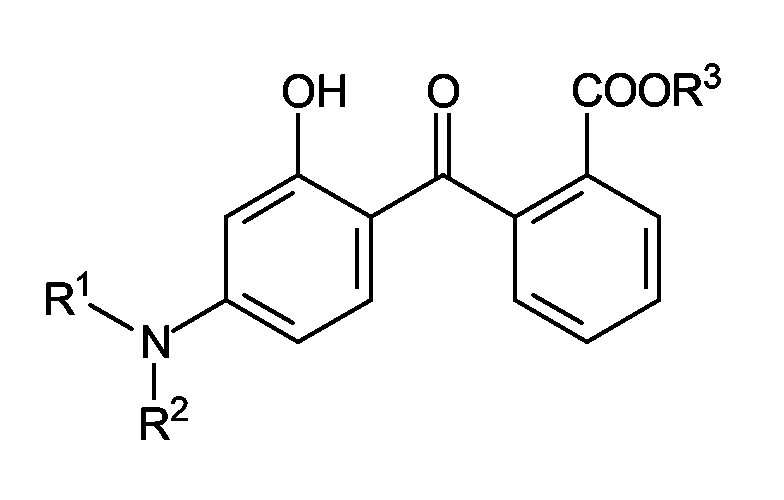
- R1 und R2 unabhängig voneinander Wasserstoff, C1-C20-Alkyl, C3-C10-Cycloalkyl oder C3-C10-Cycloalkenyl bedeuten, wobei die Substituenten R1 und R2 gemeinsam mit dem Stickstoffatom, an das sie gebunden sind, einen 5- oder 6-Ring bilden können und
- R3 einen C1-C20-Alkyl Rest bedeutet.


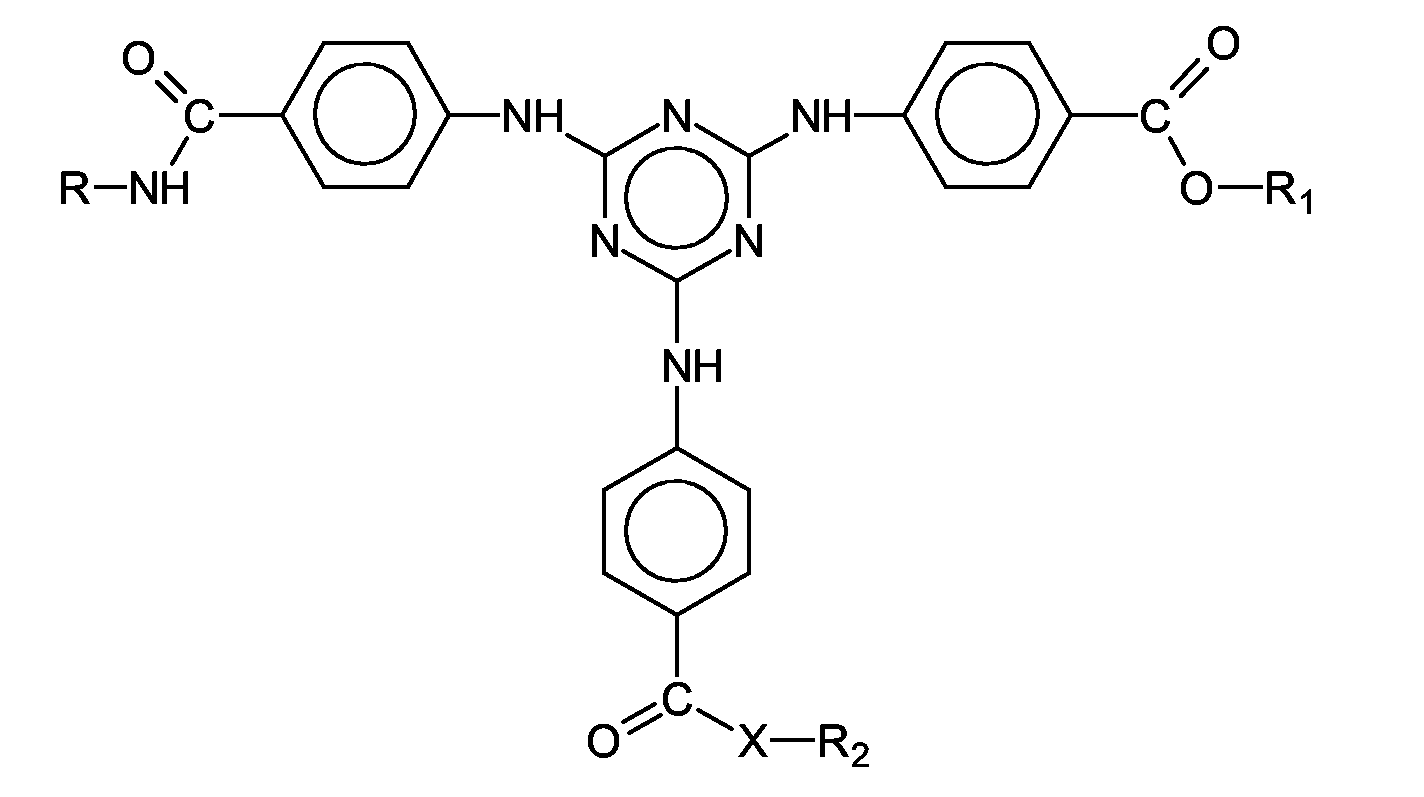
- R
- einen verzweigten oder unverzweigten C1-C18-Alkylrest, einen C5-C12-Cycloalkylrest, gegebenenfalls substituiert mit einer oder mehreren C1-C4- Alkylgruppen, darstellt,
- X
- ein Sauerstoffatom oder eine NH-Gruppe darstellt,
- R1
- einen verzweigten oder unverzweigten C1-C18-Alkylrest, einen C5-C12-Cycloalkylrest,
gegebenenfalls substituiert mit einer oder mehreren C1-C4- Al kylgruppen, oder ein
Wasserstoffatom, ein Alkalimetallatom, eine Ammoniumgruppe oder eine Gruppe der
Formel
bedeutet, in welcher
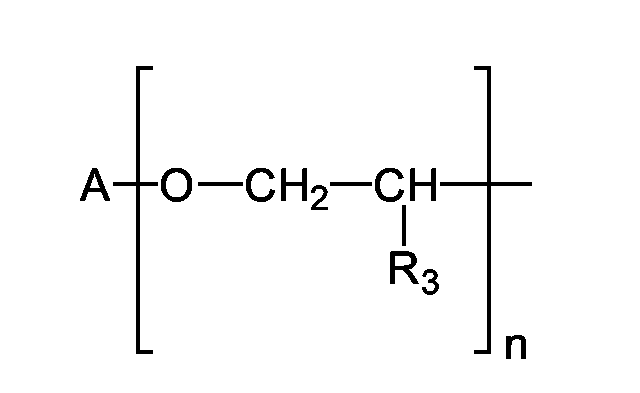
- A
- einen verzweigten oder unverzweigten C1-C18-Alkylrest, einen C5-C12-Cycloalkyl- oder Arylrest darstellt, gegebenenfalls substituiert mit einer oder mehreren C1-C4- Alkylgruppen,
- R3
- ein Wasserstoffatom oder eine Methylgruppe darstellt,
- n
- eine Zahl von 1 bis 10 darstellt,
- R2
- einen verzweigten oder unverzweigten C1-C18-Alkylrest, einen C5-C12-Cycloalkylrest,
gegebenenfalls substituiert mit einer oder mehreren C1-C4- AI kylgruppen, darstellt,
wenn X die NH-Gruppe darstellt, und
einen verzweigten oder unverzweigten C1-C18-Alkylrest, einen C5-C12-Cycloalkylrest, gegebenenfalls substituiert mit einer oder mehreren C1-C4- AI kylgruppen, oder ein Wasserstoffatom, ein Alkalimetallatom, eine Ammoniumgruppe oder eine Gruppe der Formelbedeutet, in welcher
- A
- einen verzweigten oder unverzweigten C1-C18-Alkylrest, einen C5-C12-Cycloalkyl- oder Arylrest darstellt, gegebenenfalls substituiert mit einer oder mehreren C1-C4- Alkylgruppen,
- R3
- ein Wasserstoffatom oder eine Methylgruppe darstellt,
- n
- eine Zahl von 1 bis 10 darstellt,


Ein vorteilhafter Breitbandfilter im Sinne der vorliegenden Erfindung ist das 2,2'-Methylen-bis-(6-(2H-benzotriazol-2-yl)-4-(1,1,3,3-tetramethylbutyl)-phenol), welches unter der Handelsbezeichnung Tinosorb® M bei der CIBA-Chemikalien GmbH erhältlich ist.
- 3-Benzylidencampher-Derivate, vorzugsweise 3-(4-Methylbenzyliden)campher, 3-Benzylidencampher;
- 4-Aminobenzoesäure-Derivate, vorzugsweise 4-(Dimethylamino)-benzoesäure(2-ethylhexyl)ester, 4-(Dimethylamino)benzoesäureamylester;
- 2,4,6-Trianilino-(p-carbo-2'-ethyl-1'-hexyloxy)-1,3,5-triazin;
- Ester der Benzalmalonsäure, vorzugsweise 4-Methoxybenzalmalonsäuredi(2-ethylhexyl)-ester;
- Ester der Zimtsäure, vorzugsweise 4-Methoxyzimtsäure(2-ethylhexyl)ester, 4-Methoxyzimtsäureisopentylester;
- Derivate des Benzophenons, vorzugsweise 2-Hydroxy-4-methoxybenzophenon, 2-Hydroxy-4-methoxy-4'-methylbenzophenon, 2,2'-Dihydroxy-4-methoxybenzophenon
- sowie an Polymere gebundene UV-Filter.
- Salze der 2-Phenylbenzimidazol-5-sulfonsäure, wie ihr Natrium-, Kalium- oder ihr Triethanolammonium-Salz, sowie die Sulfonsäure selbst;
- Sulfonsäure-Derivate des 3-Benzylidencamphers, wie z. B. 4-(2-Oxo-3-bornylidenmethyl)benzolsulfonsäure, 2-Methyl-5-(2-oxo-3-bornylidenmethyl)sulfonsäure und deren Salze.
| Chemische oder sonstige Bezeichnung | CIN | Farbe |
| Pigment Green | 10006 | Grün |
| Acid Green 1 | 10020 | Grün |
| 2,4-Dinitrohydroxynaphthalin-7-sulfosäure | 10316 | Gelb |
| Pigment Yellow 1 | 11680 | Gelb |
| Pigment Yellow 3 | 11710 | Gelb |
| Pigment Orange 1 | 11725 | Orange |
| 2,4-Dihydroxyazobenzol | 11920 | Orange |
| Solvent Red 3 | 12010 | Rot |
| 1-(2'-Chlor-4'-nitro-1'-phenylazo)-2-hydroxynaphthalin | 12085 | Rot |
| Pigment Red 3 | 12120 | Rot |
| Ceresrot; Sudanrot; Fettrot G | 12150 | Rot |
| Pigment Red 112 | 12370 | Rot |
| Pigment Red 7 | 12420 | Rot |
| Pigment Brown 1 | 12480 | Braun |
| 4-(2'-Methoxy-5'-sulfosäurediethylamid-1'-phenylazo)-3-hydroxy-5"-chloro-2",4"-dimethoxy-2-naphthoesäureanilid | 12490 | Rot |
| Disperse Yellow 16 | 12700 | Gelb |
| 1-(4-Sulfo-1-phenylazo)-4-amino-benzol-5-sulfosäure | 13015 | Gelb |
| 2,4-Dihydroxy-azobenzol-4'-sulfosäure | 14270 | Orange |
| 2-(2,4-Dimethylphenylazo-5-sulfosäure )-1-hydroxynaphthalin-4-sulfosäure | 14700 | Rot |
| 2-(4-Sulfo-1-naphthylazo)-1-naphthol-4-sulfosäure | 14720 | Rot |
| 2-(6-Sulfo-2,4-xylylazo)-1-naphthol-5-sulfosäure | 14815 | Rot |
| 1-(4'-Sulfophenylazo)-2-hydrooynaphthalin | 15510 | Orange |
| 1-(2-Sulfosäure-4-chlor-5-carbonsäure-1-phenylazo)-2-hydroxynaphthalin | 15525 | Rot |
| 1-(3-Methyl-phenylazo-4-sulfosäure)-2-hydroxynaphthalin | 15580 | Rot |
| 1-(4',(8')-Sulfosäurenaphthylazo)-2-hydroxynaphthalin | 15620 | Rot |
| 2-Hydrooy-1,2'-azonaphthalin-1'-sulfosäure | 15630 | Rot |
| 3-Hydroxy-4-phenylazo-2-naphthylcarbonsäure | 15800 | Rot |
| 1-(2-Sulfo-4-methyl-1-phenylazo)-2-naphthylcarbonsäure | 15850 | Rot |
| 1-(2-Sulfo-4-methyl-5-chlor-1-phenylazo)-2-hydroxynaphthalin-3-carbonsäure | 15865 | Rot |
| 1-(2-Sulfo-1-naphthylazo)-2-hydroxynaphthalin-3-carbonsäure | 15880 | Rot |
| 1-(3-Sulfo-1-phenylazo)-2-naphthol-6-sulfosäure | 15980 | Orange |
| 1-(4-Sulfo-1-phenylazo)-2-naphthol-6-sulfosäure | 15985 | Gelb |
| Allura Red | 16035 | Rot |
| 1-(4-Sulfo-1-naphthylazo)-2-naphthol-3,6-disulfosäure | 16185 | Rot |
| Acid Orange 10 | 16230 | Orange |
| 1-(4-Sulfo-1-naphthylazo)-2-naphthol-6,8-disulfosäure | 16255 | Rot |
| 1-(4-Sulfo-1-naphthylazo)-2-naphthol-3,6,8-trisulfosäure | 16290 | Rot |
| 8-Amino-2 -phenylazo-1-naphthol-3,6-disulfosäure | 17200 | Rot |
| Acid Red 1 | 18050 | Rot |
| Acid Red 155 | 18130 | Rot |
| Acid Yellow 121 | 18690 | Gelb |
| Acid Red 180 | 18736 | Rot |
| Acid Yellow 11 | 18820 | Gelb |
| Acid Yellow 17 | 18965 | Gelb |
| 4-(4-Sulfo-1-phenylazo)-1-(4-sulfophenyl)-5-hydroxypyrazolon-3-carbonsäure | 19140 | Gelb |
| Pigment Yellow 16 | 20040 | Gelb |
| 2,6-(4'-Sulfo-2", 4"-dimethyl)-bis-phenylazo)1,3-dihydroxybenzol | 20170 | Orange |
| Acid Black 1 | 20470 | Schwarz |
| Pigment Yellow 13 | 21100 | Gelb |
| Pigment Yellow 83 | 21108 | Gelb |
| Solvent Yellow | 21230 | Gelb |
| Acid Red 163 | 24790 | Rot |
| Acid Red 73 | 27290 | Rot |
| 2-[4'-(4"-Sulfo-1"-phenylazo)-7'-sulfo-1'-naphthylazo]-1-hydroxy-7-aminonaphthalin-3,6-disulfosäure | 27755 | Schwarz |
| 4'-[(4"-Sulfo-1"-phenylazo)-7'-sulfo-1'-naphthylazo]-1-hydroxy-8-acetyl-aminonaphthalin-3,5-disulfosäure | 28440 | Schwarz |
| Direct Orange 34, 39, 44, 46, 60 | 40215 | Orange |
| Food Yellow | 40800 | Orange |
| trans-ß-Apo-8'-Carotinaldehyd (C30) | 40820 | Orange |
| trans-Apo-8'-Carotinsäure (C30)-ethylester | 40825 | Orange |
| Canthaxanthin | 40850 | Orange |
| Acid Blue 1 | 42045 | Blau |
| 2,4-Disulfo-5-hydroxy-4'-4"-bis-(diethylamino)triphenyl-carbinol | 42051 | Blau |
| 4-[(-4-N-Ethyl-p-sulfobenzylamino)-phenyl-(4-hydroxy-2-sulfophenyl)-(methylen)-1-(N-ethyIN-p-sulfobenzyl)-2,5-cyclohexadienimin] | 42053 | Grün |
| Acid Blue 7 | 42080 | Blau |
| (N-Ethyl-p-sulfobenzyl-amino)-phenyl-(2-sulfophenyl)-methylen-(N-ethyl-N-p-sulfo-benzyl)Δ2,5-cyclohexadienimin | 42090 | Blau |
| Acid Green 9 | 42100 | Grün |
| Diethyl-di-sulfobenzyl-di-4-amino-2-chlor-di-2-methyl-fuchsonimmonium | 42170 | Grün |
| Basic Violet 14 | 42510 | Violett |
| Basic Violet 2 | 42520 | Violett |
| 2'-Methyl-4'-(N-ethyl-N-m-sulfobenzyl)-amino-4"-(N-diethyl)- | 42735 | Blau |
| amino-2-methyl-N-ethylN-m-sulfobenzyl-fuchsonimmonium | ||
| 4'-(N-Dimethyl)-amino-4"-(N-phenyl)-aminonaphtho-N-dimethyl-fuchsonimmonium | 44045 | Blau |
| 2-Hydroxy-3,6-disulfo-4,4'-bis-dimethylaminonaphthofuchsonimmonium | 44090 | Grün |
| Acid Red 52 | 45100 | Rot |
| 3-(2'-Methylphenylamino)-6-(2'-methyl-4'-sulfophenylamino)-9-(2"-carboxyphenyl)-xantheniumsalz | 45190 | Violett |
| Acid Red 50 | 45220 | Rot |
| Phenyl-2-oxyfluoron-2-carbonsäure | 45350 | Gelb |
| 4,5-Dibromfluorescein | 45370 | Orange |
| 2,4,5,7-Tetrabromfluorescein | 45380 | Rot |
| Solvent Dye | 45396 | Orange |
| Acid Red 98 | 45405 | Rot |
| 3',4',5',6'-Tetrachlor-2,4,5,7-tetrabromfluorescein | 45410 | Rot |
| 4,5-Diiodfluorescein | 45425 | Rot |
| 2,4,5,7-Tetraiodfluorescein | 45430 | Rot |
| Chinophthalon | 47000 | Gelb |
| Chinophthalon-disulfosäure | 47005 | Gelb |
Hierzu werden Oxide, Oxidhydrate oder Phosphate beispielsweise der Elemente Al, Si, Zr in dichten Schichten auf die Pigmentoberfläche aufgefällt.
Die anorganische Nachbehandlung geschieht im allgemeinen in einer wässrigen Suspension des Pigmentes durch Zugabe löslicher Nachbehandlungschemikalien, wie z.B. Aluminiumsulfat, und anschließende Ausfällung des im neutralen Bereich schwerlöslichen Hydroxides durch gezielte Einstellung des pH-Wertes mit Natronlauge.
Nach der anorganischen Nachbehandlung werden die gecoateten Pigmente durch Filtration aus der Suspension abgetrennt und sorgfältig gewaschen, um die gelösten Salze zu entfernen, anschließend werden die isolierten Pigmente getrocknet.
Dazu zählen natürliche Perlglanzpigmente, wie z. B.
- "Fischsilber" (Guanin/Hypoxanthin-Mischkristalle aus Fischschuppen) und
- "Perlmutt" (vermahlene Muschelschalen),
| Gruppe | Belegung / Schichtdicke | Farbe |
| Silberweiße Perlglanzpigmente | TiO2: 40 - 60 nm | silber |
| Interferenzpigmente | TiO2: 60 - 80 nm | gelb |
| TiO2: 80 -100 nm | rot | |
| TiO2: 100 - 140 nm | blau | |
| TiO2: 120 - 160 nm | grün | |
| Farbglanzpigmente | Fe2O3 | bronze |
| Fe2O3 | kupfer | |
| Fe2O3 | rot | |
| Fe2O3 | rotviolett | |
| Fe2O3 | rotgrün | |
| Fe2O3 | schwarz | |
| Kombinationspigmente | TiO2 / Fe2O3 | Goldtöne |
| TiO2 / Cr2O3 | grün | |
| TiO2 / Berliner Blau | tiefblau | |
| TiO2 / Carmin | rot |
Erfindungsgemäß vorteilhaft können auch anionische, kationische, nichtionische und zwitterionische Tenside in den Zubereitungen enthalten sein.
Die Versuche wurden von 10 Versuchspersonen durchgeführt, die sich jeweils eine definierte Menge (0,1 ml) an Tagescreme der Rezepturen I und II in jeweils der gleichen Weise auf jeweils einen Unterarm auftrugen, die Creme verteilten und nach dem Eincremen den sensorischen Eindruck beurteilten.
| Formelgrundlagen | Rezeptur I | Rezeptur II |
| mit 2% | ||
| hydriertem | ||
| mit 2% Shea | Sojaglyceriden | |
| Butter (INCI: | (INCI: | |
| Nivea Visage Tagescreme | Butyrospermum | Hydrogenated |
| Parkii) | Vegetable Oil) |
| Sensorikkriterien | Rezeptur I | Rezeptur II |
| Sehr gut | ||
| Verteilbarkeit | verteilbar | verteilbar |
| stumpf, | Weich, | |
| Rückstand | wachsartig | geschmeidig |
| Taurin | 1,00 | ||||||
| Vitamin E Acetat | 0,40 | 0,25 | 0,50 | 0,75 | 1,00 | ||
| Retinol | 0,05 | ||||||
| Dioic Acid (Octadecendicarbonsäure) | 0,20 | 0,25 | |||||
| Pyridoxin | 0,5 | ||||||
| Fucogel® 1000 | 1,50 | 5,00 | |||||
| Dihydroxyaceton | 5,00 | ||||||
| DMDM Hydantoin | 0,60 | 0,40 | 0,20 | ||||
| Methylparaben | 0,10 | 0,25 | 0,50 | ||||
| Phenoxyethanol | 0,40 | 0,50 | 0,40 | 0,50 | 0,60 | ||
| EDTA | 0,20 | 0,35 | 0,50 | 0,02 | 0,03 | ||
| Ethanol | 2,00 | 1,50 | 3,00 | 5,00 | 1,00 | ||
| Insekt Repellent 3535 | 5,00 | ||||||
| Parfüm | 0,20 | 0,20 | 0,30 | 0,40 | |||
| Wasser | ad 100 | ad 100 | ad 100 | ad 100 | ad 100 | ad 100 | ad 100 |
| Neutralisationsmittel (Natriumhydroxid, Kaliumhydroxid) | qs | qs | qs | qs | qs | qs | qs |
| pH-Wert | 6,0-7,5 | 4,5-7,0 | 6,5-8,5 | 5,0-7,0 | 6,0-8,0 | 4,0-6,0 | 5,0-7,5 |
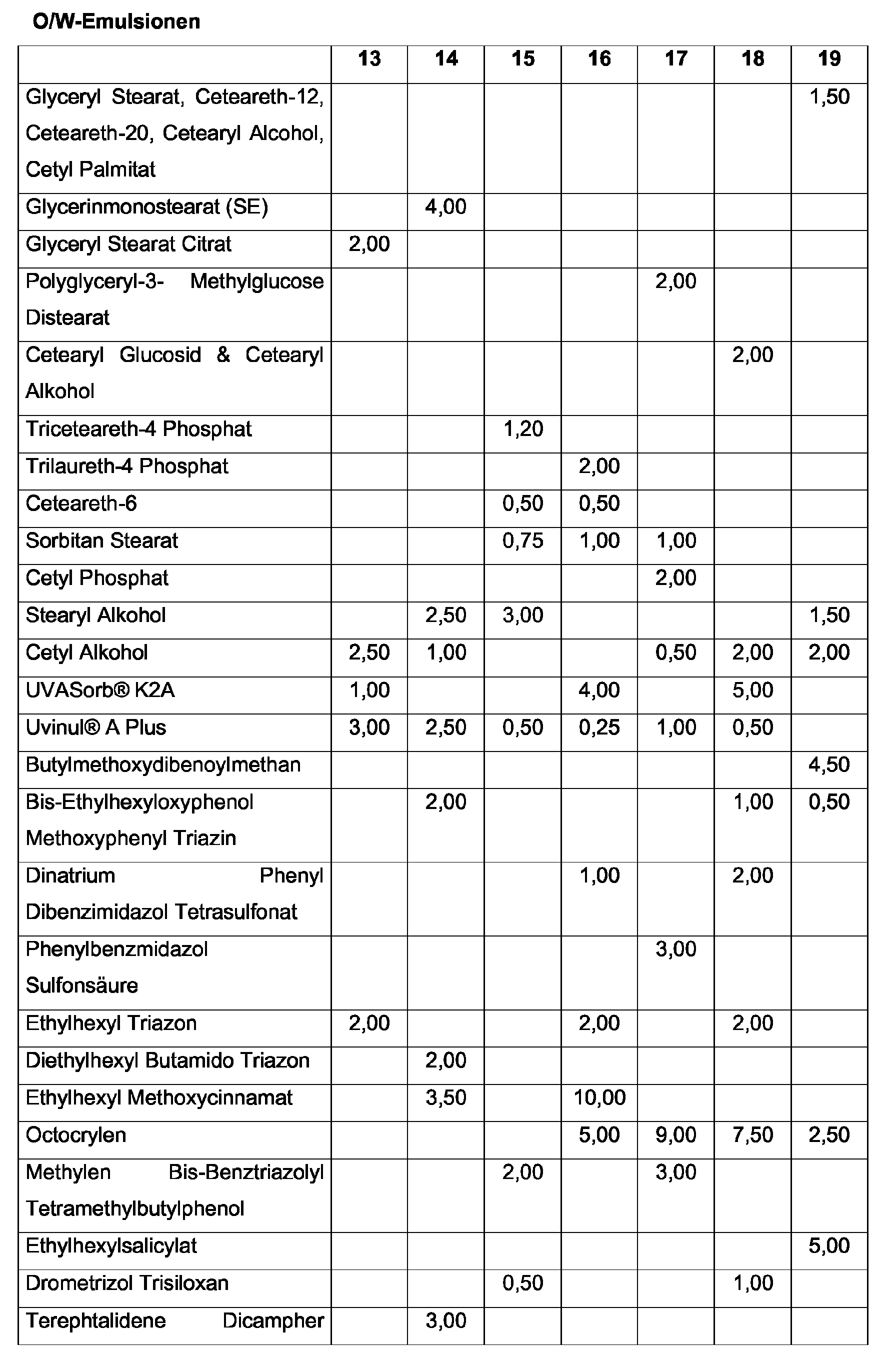
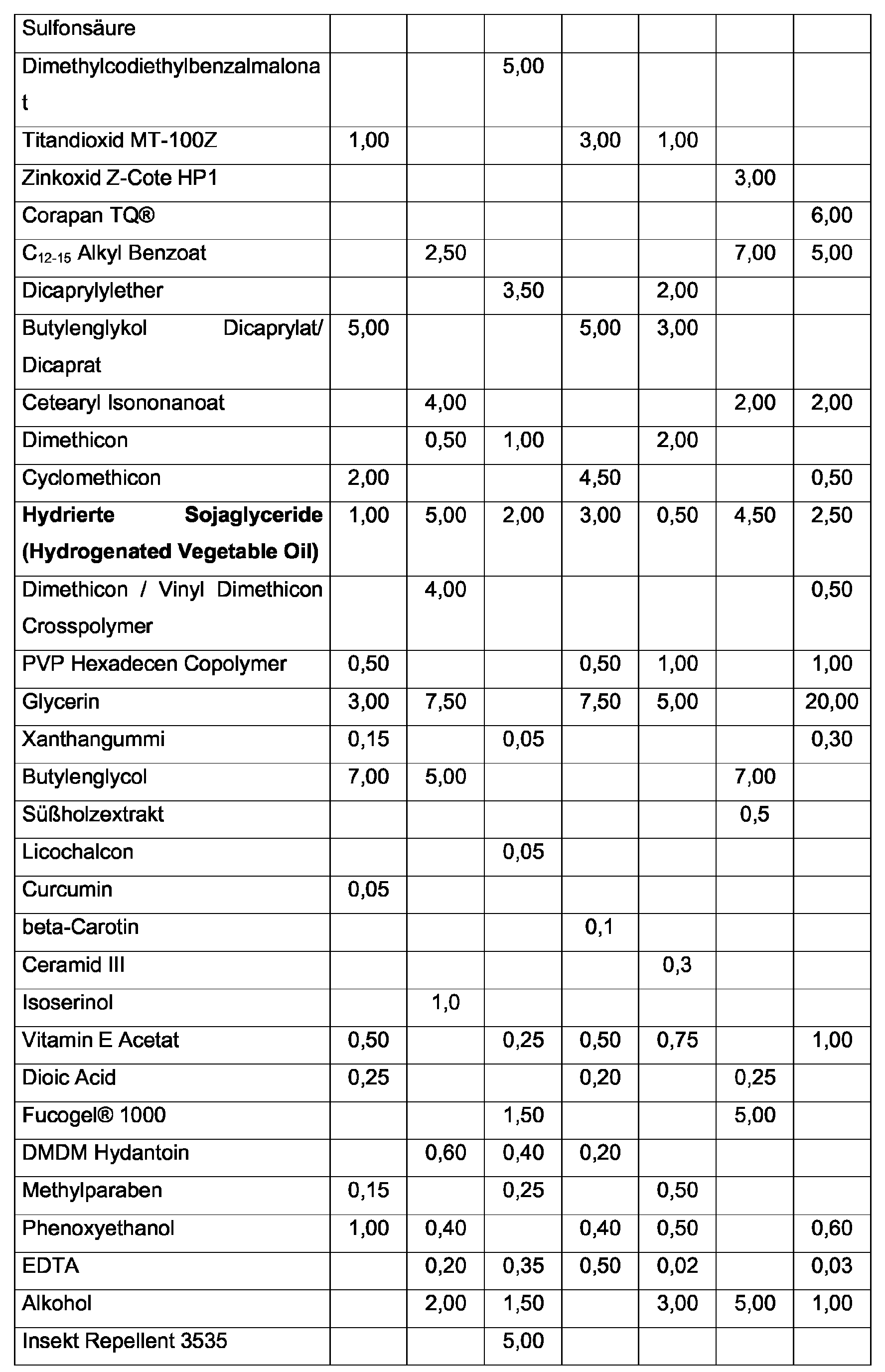
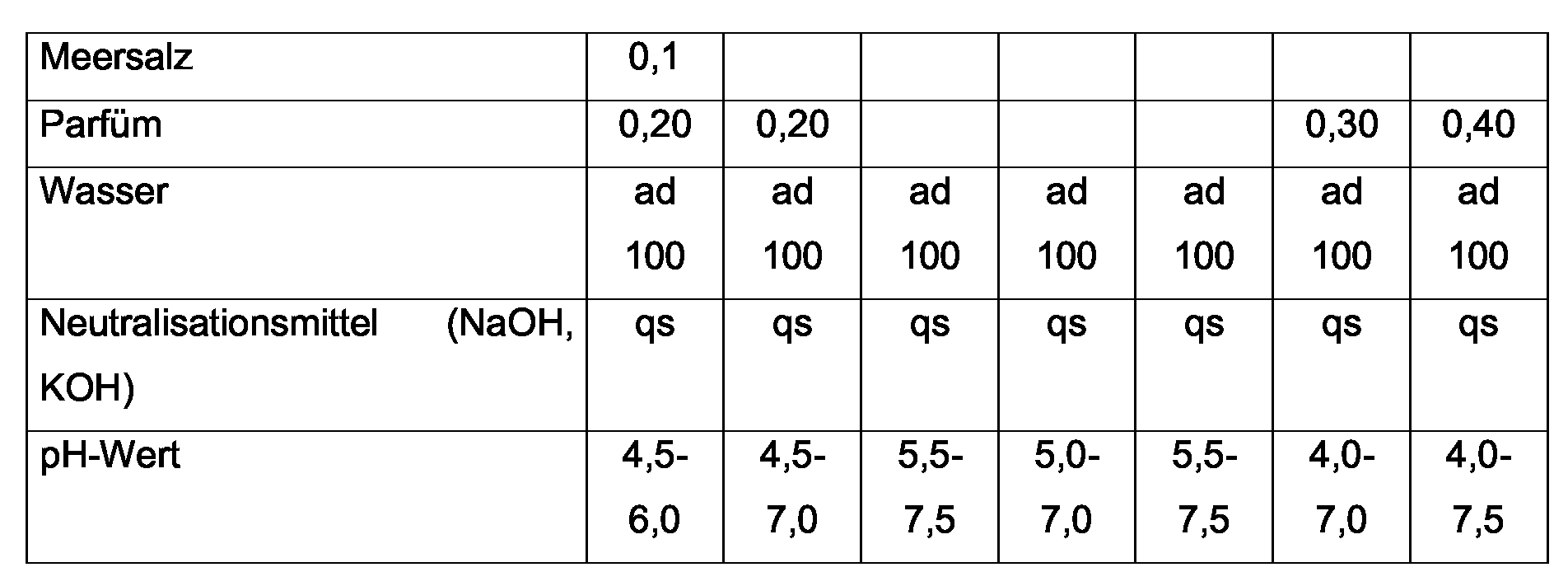


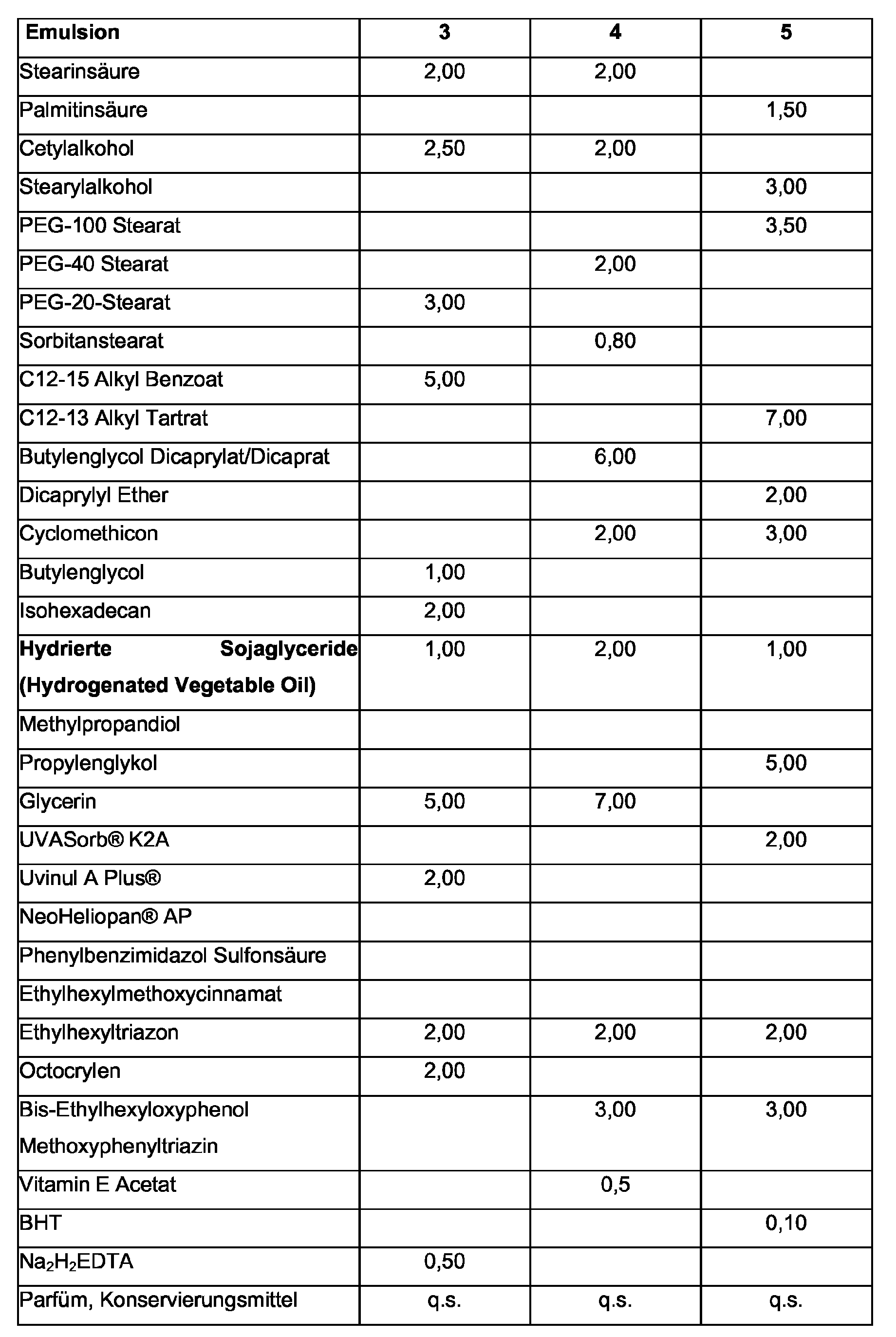


| 3. W/O-Emulsionen | |||||
| 1 | 2 | 3 | 4 | 5 | |
| Cetyl Dimethicon Copolyol | 4,00 | 2,50 | 3,00 | ||
| Polyglyceryl-2 Dipolyhydroxystearat | 3,00 | 1,00 | |||
| Isostearyl Diglyceryl Succinat | 0,75 | 0,30 | |||
| Lauryl Methicon Copolyol | 2,00 | ||||
| Polysorbat-65 | 2,00 | 1,50 | |||
| PEG-100 Stearat | 1,20 | 0,70 | |||
| Cetearyl Sulfat | 0,25 | 1,00 | |||
| Dimethicon | 4,00 | 2,00 | |||
| Cyclomethicon | 12,00 | 20,00 | 30,00 | 15,00 | |
| UVASorb® K2A | 0,50 | ||||
| Uvinul® A Plus | 2,00 | 0,50 | 4,00 | 0,25 | |
| Bis-Ethylhexyloxyphenol Methoxyphenyl Triazin | 1,00 | 0,50 | |||
| Dinatrium Phenyl Dibenzimidazol Tetrasulfonat | 1,50 | 2,00 | |||
| Drometrizol Trisiloxan | 1,00 | ||||
| 4-Methylbenzylidencampher | 4,00 | ||||
| Methylen Bis-Benztriazolyl Tetramethylbutylphenol | 3,00 | ||||
| Ethylhexyl Methoxycinnamat | 3,00 | 4,00 | 10,00 | ||
| Ethylheyl Salicylat | 5,00 | 3,50 | |||
| Octocrylen | 5,00 | 4,00 | |||
| Diethylhexyl Butamido Triazon | 1,00 | 6,50 | |||
| Ethylhexyl Triazon | 3,00 | 4,00 | |||
| Titandioxid MT-100 Z | 0,50 | 1,00 | 1,50 | 0,50 | |
| Zinkoxid Z-Cote | 2,00 | 4,00 | |||
| Dicaprylyl Carbonat | 5,00 | 15,00 | 4,00 | ||
| Dihexyl Carbonat | 10,00 | ||||
| C12-15 Alkyl Benzoat | 7,00 | 10,00 | |||
| Mineral Öl | 10,00 | 6,00 | |||
| Kokosfettsäureglycerid | 2,00 | 5,00 | |||
| Hydrierte Sojaglyceride (Hydrogenated Vegetable Oil) | 2,00 | 1,00 | 5,00 | 0,50 | 7,00 |
| PVP Hexadecen Copolymer | 0,75 | 0,40 | |||
| Glycerin | 5,00 | 12,50 | 5,00 | 15,50 | |
| Sorbitol | 5,00 | 10,00 | |||
| α-Glucosylrutin | 0,15 | ||||
| EDTA | 0,15 | 0,03 | 0,15 | ||
| Glycin Soja | 0,75 | 1,50 | |||
| Magnesiumsulfat | 0,75 | 1,00 | 0,45 | 1,00 | |
| DMDM Hydantoin | 0,05 | 0,10 | |||
| Phenoxyethanol | 1,00 | 0,75 | 0,50 | 1,00 | |
| Alkohol | 2,00 | 5,00 | 1,00 | ||
| Farbstoff, öllöslich | 0,02 | ||||
| Parfüm | 0,30 | 0,45 | 0,35 | 0,15 | |
| Wassser | ad. 100 | ad. 100 | ad. 100 | ad. 100 | ad. 100 |
| 5.W/O Emulsionen (Cremes & Lotions) | ||||||
| 1 | 2 | 3 | 4 | 5 | 6 | |
| Cetyldimethicon Copolyol | 4,00 | |||||
| Polyglyceryl-2-dipolyhydroxystearat | 5,00 | 4,50 | 4,50 | |||
| Polyglyceryl-3-Diisostearat | 1,75 | 1,50 | ||||
| PEG-30-dipolyhydroxystearat | 3,00 | 5,00 | ||||
| Bis-Ethylhexyloxyphenol Methoxyphenyl Triazin | 3,00 | 1,50 | ||||
| Butyl Methoxydibenzoylmethan | 4,00 | |||||
| UVASorb® K2A | 2,00 | 2,50 | ||||
| Uvinul ® A Plus | 3,00 | 1,00 | 3,00 | 0,25 | 2,50 | |
| Phenylbenzmidazol Sulfonsäure | 4,00 | 2,00 | 0,50 | |||
| Ethylhexyl Methoxycinnamat | 8,00 | 5,00 | 4,00 | |||
| Diethylhexyl Butamido Triazon | 3,00 | 1,00 | 1,00 | 3,00 | ||
| Ethylhexyl Triazon | 4,00 | 2,00 | 4,00 | |||
| Octocrylen | 7,00 | 2,50 | ||||
| Drometrizol Trisiloxan | ||||||
| Titandioxid Uvinul® T 805 | 2,00 | 1,00 | 5,00 | |||
| Titandioxid MT-100 TV | 2,00 | |||||
| Zinkoxid Z-Cote® HP1 | 2,50 | 3,00 | ||||
| Corapan TQ® | 6,00 | |||||
| Mineralöl | 6,00 | 5,00 | 8,00 | |||
| Kokosfettsäureglycerid | 4,00 | 6,50 | 3,00 | |||
| Hydrierte Sojaglyceride (Hydrogenated Vegetable Oil) | 1,00 | 0,50 | 7,00 | 1,00 | 2,50 | 3,00 |
| C12-15 Alkyl Benzoat | 9,00 | 8,00 | 9,00 | |||
| Dicaprylylether | 10,00 | 7,00 | ||||
| Butylenglycol Dicaprylat/Dicaprat | 9,00 | 7,00 | 8,00 | 4,00 | ||
| Cyclomethicon | 2,00 | 2,00 | ||||
| PVP Eicosene Copolymer | 0,50 | 1,50 | 1,00 | |||
| Trinatrium EDTA | 1,00 | 1,00 | 0,50 | 0,35 | ||
| Ethylhexyloxyglycerin | 0,30 | 0,50 | ||||
| Methylpropandiol | 7,50 | |||||
| Glycerin | 5,00 | 7,50 | 6,00 | 8,00 | 7,50 | 2,50 |
| Butylenglykol | 2,50 | |||||
| Glycin Soja | 1,00 | |||||
| MgSO4 | 1,00 | 0,50 | 0,30 | 0,30 | 0,50 | |
| Milchsäure & Natriumsalz der Milchsäure | 1,00 | 0,50 | 0,85 | |||
| Vitamin E | 0,50 | 0,50 | 1,00 | 1,00 | ||
| DMDM Hydantoin | 0,60 | 0,20 | ||||
| Methylparaben | 0,50 | 0,15 | ||||
| Phenoxyethanol | 0,50 | 0,40 | 0,50 | 0,60 | 1,00 | 0,60 |
| Dihydroxyaceton | 5,50 | |||||
| Alcohol | 3,00 | 2,00 | 3,00 | 1,00 | ||
| Parfüm | 0,20 | 0,20 | 0,20 | 0,20 | ||
| Wasser | ad 100 | ad 100 | ad 100 | ad 100 | ad 100 | ad 100 |
| 6. Hydrodispersionen | ||||||
| 1 | 2 | 3 | 4 | 5 | 6 | |
| Glyceryl Stearat Citrat | 0,40 | |||||
| Cetyl Alkohol | 2,00 | |||||
| Natrium Carbomer | 0,30 | |||||
| Acrylates/C10-30 Alkyl Acrylate Crosspolymer | 0,30 | 0,40 | 0,10 | 0,10 | ||
| Ceteareth-20 | 1,00 | |||||
| Xanthan Gummi | 0,50 | 0,15 | 0,50 | |||
| Dimethicon / Vinyl Dimethicon Crosspolymer | 5,00 | 3,00 | ||||
| UVASorb® K2A | 3,50 | |||||
| Uvinul®A Plus | 0,25 | 0,50 | 2,00 | 1,50 | ||
| Butyl Methoxydibenzoylmethan | 3,50 | |||||
| Bis-Ethylhexyloxyphenol Methoxypheny Triazin | 2,00 | 0,25 | ||||
| Terephthaliden Dicampher Sulfonsäure | 0,50 | |||||
| Dinatrium Phenyl Dibenzimidazol Tetrasulfonat | 0,75 | 1,00 | ||||
| Phenylbenzimidazol Sulfonsäure | 2,00 | |||||
| Ethylhexyl Methoxycinnamat | 7,00 | 5,00 | 8,00 | |||
| Methylen Bis-Benzotriazolyl Tetramethylbutylphenol | ||||||
| Butyl Methoxydibenzoylmethan | 3,50 | |||||
| Diethylhexyl Butamido Triazon | 2,00 | 2,00 | ||||
| Ethylhexyl Triazon | 4,00 | 3,00 | 4,00 | |||
| Octocrylen | 10,00 | 2,50 | ||||
| Titandioxid MT-100 Z | 0,50 | 2,00 | 1,00 | 2,00 | 3,00 | 1,00 |
| C12-15 Alkyl Benzoat | 2,00 | 2,50 | ||||
| C18-36 Triglycerid Fettsäure | 1,00 | |||||
| Butylenglycol Dicaprylat/Dicaprat | 4,00 | 6,00 | ||||
| Dicaprylyl Carbonat | 3,00 | |||||
| Dicaprylylether | 2,00 | |||||
| Cyclomethicon | 7,50 | |||||
| Lanolin | 0,35 | |||||
| Hydrierte Sojaglyceride (Hydrogenated Vegetable Oil) | 1,00 | 2,00 | 3,00 | 4,00 | 0,50 | 5,50 |
| PVP Hexadecen Copolymer | 0,50 | 0,50 | 0,50 | 1,00 | ||
| Ethylhexyloxyglycerin | 0,75 | 1,00 | 0,50 | |||
| Glycerin | 10,00 | 5,00 | 5,00 | 5,00 | 15,00 | |
| Butylenglycol | 7,00 | |||||
| Glycin Soja | 1,00 | |||||
| Vitamin E Acetat | 0,50 | 0,25 | 0,50 | 0,25 | 0,75 | 1,00 |
| α - Glycosylrutin | 0,25 | |||||
| Trinatrium EDTA | 1,00 | 1,00 | 0,10 | 0,20 | ||
| lodopropinylbutylcarbamat | 0,20 | 0,10 | 0,15 | |||
| Methylparaben | 0,50 | 0,20 | 0,15 | |||
| Phenoxyethanol | 0,50 | 0,40 | 0,40 | 1,00 | 0,60 | |
| Ethanol | 3,00 | 10,00 | 4,00 | 3,50 | 1,00 | |
| Parfüm, Farbstoffe | q.s. | q.s. | q.s. | q.s. | q.s. | q.s. |
| Wasser | ad 100 | ad 100 | ad 100 | ad 100 | ad 100 | ad 100 |
| Neutralisationsmittel (Natriumhydroxid, Kaliumhydroxid) | qs | qs | qs | qs | qs | qs |
| pH-Wert | 4,5-5,5 | 5,0-7,0 | 5,0-7,0 | 5,0-7,0 | 4,0-6,0 | 5,0-7,5 |
| 6. Gelcremes | |||||
| 1 | 2 | 3 | 4 | 5 | |
| Carbomer | 0,125 | 0,125 | 0,125 | 0,125 | 0,125 |
| Shea Butter | 1,00 | ||||
| Mineralöl | 6,00 | ||||
| Octyldodecanol | 1,50 | ||||
| Caprylsäure/Caprinsäuretriglycerid | 4,00 | ||||
| Dicaprylyl Carbonat | 9,00 | 1,00 | 3,00 | ||
| Dimethicon | 0,50 | ||||
| Cyclomethicon | 9,00 | 2,00 | 3,00 | 2,00 | 1,00 |
| Diazolidinylharnstoff | 0,20 | 0,20 | 0,20 | 0,20 | 0,20 |
| Phenoxyethanol + Ethyl-, Methyl-, Propyl- Butyl-, Isobutylparaben | 0,50 | 0,50 | 0,50 | 0,50 | 0,50 |
| Parfum | 0,25 | 0,25 | |||
| Glycerylstearatcitrat | 1,00 | 1,00 | 1,00 | 1,00 | 1,00 |
| Hydrierte Kokosfettsäureglycerid | 1,00 | 1,00 | 1,00 | ||
| Hydrierte Sojaglyceride (Hydrogenated Vegetable Oil) | 2,00 | 1,00 | 2,00 | 3,00 | 1,00 |
| Ammonium Acryloyldimethyltaurat/VP Copolymer | 0,125 | ||||
| Hydroxyethylcellulose | 0,375 | 0,375 | 0,375 | 0,375 | 0,375 |
| Menthol | 0,10 | 0,50 | 1,00 | 0,10 | 0,10 |
| Wasser + Alcohol Denat | 3,00 | ||||
| Wasser + Blue 1 | 0,200 | 0,60 | 0,40 | ||
| Wasser + Glycerin | 10,00 | 10,00 | 10,00 | 10,00 | 10,00 |
| Xanthangummi | 0,125 | 0,125 | 0,125 | 0,125 | |
| Wasser | ad 100,0 | ad 100,0 | ad 100,0 | ad 100,0 | ad 100,0 |
| Neutralisationsmittel (Natriumhydroxid, Kaliumhydroxid) | qs | qs | qs | qs | qs |
| pH-Wert | 4,5-5,5 | 6,5-8,5 | 5,0-7,0 | 4,0-6,0 | 5,0-7,5 |
| 7. Ölgele | |||||
| 1 | 2 | 3 | 4 | 5 | |
| Octyldodecanol | 9,00 | 9,00 | |||
| Caprylsäure/Caprinsäuretriglycerid | 9,00 | 6,00 | |||
| C12-15- Alkyl Benzoate | 5,00 | 8,00 | |||
| Butylenglycol Dicaprylat/Dicaprat | 9,00 | 8,00 | |||
| Dicaprylylether | 9,00 | 4,00 | |||
| Dicaprylylcarbonat | 7,00 | ||||
| Hydrierte Sojaglyceride (Hydrogenated Vegetable Oil) | 5,00 | 7,00 | 3,00 | 1,50 | 7,00 |
| Ethyl Galaktomannan (N-Hance® AG 200) | 3,50 | 4,00 | |||
| C20-40 Fettsäuren + Polyethylen (Performacid®350) | 3,60 | ||||
| Hydroxyoctacosanyl Hydroxystearat | 2,00 | ||||
| Disteardimonium Hectorit | 1,00 | 1,00 | |||
| Cetyl Dimethicon | 0,50 | 4,50 | |||
| Cyclomethicon | 15,00 | 5,00 | |||
| UVASorb® K2A | 1,00 | ||||
| Uvinul®A Plus | 1,00 | 3,50 | 2,75 | 2,00 | 0,50 |
| Ethylhexylmethoxycinnamat | 6,00 | 10,00 | 3,0 | ||
| Octocrylen | 3,50 | 7,50 | 10,00 | ||
| Ethylhexylsalicylat | 3,50 | 4,00 | |||
| Ethylhexyl Triazon | 2,00 | ||||
| Diethylhexyl Butamido Triazon | 0,50 | 3,00 | 4,0 | ||
| Polysaccharid-N-alkylurethanen, Inulincarbamat | 1,50 | 4,50 | 5,50 | 1,00 | 3,00 |
| Phenoxyethanol | 0,50 | ||||
| Parfüm, Farbstoff | q.s. | q.s. | q.s. | q.s. | q.s. |
| Mineralöl | ad. 100 | ad. 100 | ad. 100 | ||
| Reisöl | ad. 100 | ad. 100 |
| 8. Feststoffstablisierte Emulsionen | |||||
| 1 | 2 | 3 | 4 | 5 | |
| Mineralöl | 16,00 | 16,00 | |||
| Octyldodecanol | 9,00 | 9,00 | 5,00 | ||
| Caprylic/Capric Triglycerid | 9,00 | 9,00 | 6,00 | ||
| C12-15- Alkyl Benzoat | 5,00 | 8,00 | |||
| Butylene Glykol Dicaprylat/Dicaprat | 8,00 | ||||
| Dicaprylyl Ether | 9,00 | 4,00 | |||
| Dicaprylyl Carbonat | 9,00 | ||||
| Hydroxyoctacosanyl Hydroxystearat | 2,00 | 2,00 | 2,00 | 2,00 | 1,50 |
| Disteardimonium Hectorit | 1,00 | 0,750 | 0,50 | 0,50 | 0,25 |
| Cera Microcristallina + Paraffinöl | 2,50 | 5,00 | |||
| Hydrierte Sojaglyceride (Hydrogenated Vegetable Oil) | 2,50 | 0,75 | 1,00 | 3,50 | 1,00 |
| Hydroxypropyl Methylcellulose | 0,15 | 0,05 | |||
| Dimethicon | 4,50 | ||||
| UVASorb® K2A | 2,00 | 5,00 | 3,00 | 1,50 | 1,00 |
| Bis-Ethylhexyloxyphenol Methoxypheny Triazin | 1,00 | 3,00 | 0,75 | 1,00 | 1,00 |
| Terephthaliden Dicampher Sulfonsäure | 2,00 | 0,50 | |||
| Phenylbenzmidazol Sulfonsäure | 2,00 | 0,50 | 1,00 | ||
| Uvinul® A Plus | 2,75 | 0,50 | |||
| Ethylhexylmethoxycinnamat | 6,00 | 3,0 | |||
| Octocrylen | 3,50 | 7,50 | |||
| Ethylhexyl Salicylat | 3,50 | 4,00 | |||
| Diethylhexyl Butamido Triazon | 4,0 | ||||
| Titandioxid Eusolex ® T-2000 | 2,00 | 4,00 | 2,00 | 4,00 | |
| Titandioxid T 805 ® | 3,00 | ||||
| Silica Dimethyl Silylat | 1,00 | ||||
| Bornitrid | 2,00 | 3,00 | |||
| Tapioca Stärke | 1,00 | ||||
| Natriumchlorid | 1,00 | 1,00 | 1,00 | 1,00 | |
| Glycerin | 5,0 | 10,0 | 6,00 | 10,0 | |
| Trinatrium EDTA | 1,00 | 1,00 | |||
| Methylparaben | 0,21 | 0,20 | |||
| Propylparaben | 0,07 | ||||
| Phenoxyethanol | 0,50 | 0,40 | 0,40 | 0,50 | |
| Hexamidin Diisethionat | 0,08 | ||||
| Diazolidinyl Harnstoff | 0,28 | 0,28 | |||
| Alkohol | 5,00 | 2,50 | |||
| Parfüm | 0,45 | 0,20 | 0,45 | ||
| Wasser | ad 100 | ad 100 | ad 100 | ad 100 | ad 100 |
| Beispiel 1 (Eye Shadow Gel): | |
| Gew.-% | |
| PEG-8 (Polyethylenglycol 400) | 2,00 |
| Ethanol | 5,00 |
| Aristoflex AVC | 1,50 |
| Glycerin | 2,00 |
| Panthenol | 0,50 |
| Tocopherolacetat | 0,50 |
| Timiron Splendid blue ® (Merck KgaA) | 4,50 |
| Chromoxid grün | 1,00 |
| Hydrierte Sojaglyceride (Hydrogenated Vegetable Oil) | 1,00 |
| Parfüm, Konservierungsmittel, NaOH, Komplexbildner, Farbstoffe, Antioxidantien etc. | q.s. |
| Wasser | ad 100,00 |
| Beispiel 2 (Highlighter Gel): | |
| Gew. % | |
| Carbomer | 1,50 |
| Glycerin | 2,50 |
| 1,3 Butylenglycol | 2,50 |
| Glitzerpigmente (z.B. Helicone HC Scarabeus, Wacker) | 1,00 |
| EDTA | 0,20 |
| Dimethicone | 1,50 |
| Hydrierte Sojaglyceride (Hydrogenated Vegetable Oil) | 2,00 |
| Parfüm, Konservierungsmittel, NaOH, Farbstoffe, Antioxidantien, etc. | q.s. |
| Wasser | ad 100,00 |
| Beispiel 3 (Eye Liner Gel): | |
| Gew. % | |
| Perlglanzpigmente | 10,00 |
| Eisenoxid | 3,00 |
| Silica | 2,00 |
| Aristoflex AVC | 1,00 |
| Hyroxyproylethyl Cellulose | 0,35 |
| Hydrierte Sojaglyceride (Hydrogenated Vegetable Oil) | 5,00 |
| Citric Acid | q.s. |
| Glycerin | 5,00 |
| PVP / VA Copolymer | 2,00 |
| Parfüm, Konservierungsmittel, Farbstoffe, NaOH, Komplexbildner, Antioxidantien, etc. | q.s. |
| Wasser | ad 100,00 |
| Beispiel 1 (Emulsions-Make-up): | |
| Gew. % | |
| PEG-30 Stearat | 2,00 |
| Glycerinmonostearat | 1,00 |
| Stearinsäure | 1,00 |
| Cyclomethicon | 7,00 |
| Octyldodecanol | 7,00 |
| Isopropyl Lanolat | 4,00 |
| Squalan | 2,00 |
| Hydrierte Sojaglyceride (Hydrogenated Vegetable Oil) | 3,00 |
| Octyl Methoxycinnamat | 2,00 |
| Butyl Methoxydibenzoylmethan | 1,00 |
| Xanthan Gum | 0,20 |
| Glycerin | 5,00 |
| Butylenglkcol | 2,00 |
| Vitamin E Acetat | 1,00 |
| Magnesiumsilikat | 1,00 |
| Glimmer | 1,00 |
| Eisenoxid | 1,00 |
| Titandioxid | 2,50 |
| Talkum | 5,00 |
| EDTA | 0,50 |
| Parfüm, Konservierungsmittel, NaOH, Antioxidantien etc. | q.s. |
| Wasser | ad 100,00 |
| Beispiel 2 (Emulsions-Make-up): | |
| Gew. % | |
| Cyclomethicon and PEG /PPG -18/18 Dimethicon | |
| (z.B. Dow Corning 3225 Formulation Aid) | 10,00 |
| Cyclomethicon | 10,00 |
| Bienenwachs | 3,00 |
| Polyglyceryl-4 Oleat | 2,00 |
| Eisenoxid | 1,00 |
| Titandioxid | 2,50 |
| Talkum | 12,00 |
| Natrium Chlorid | 2,00 |
| Hydrierte Sojaglyceride (Hydrogenated Vegetable Oil) | 5,00 |
| Parfüm, Konservierungsmittel, NaOH, Antioxidantien etc. | q.s. |
| Wasser | ad 100,00 |
| Beispiel 3 (Cover Cream): | |
| Gew. % | |
| Cyclomethicon | 44,00 |
| Bienenwachs | 3,00 |
| Carnaubawachs | 5,00 |
| Lanolinöl | 5,00 |
| Paraffinöl | 8,40 |
| Hydrierte Sojaglyceride (Hydrogenated Vegetable Oil) | 7,00 |
| Cetyl Alkohol | 2,60 |
| Eisenoxid | 3,00 |
| Titandioxid | 7,50 |
| Nylon | 6,00 |
| Talkum | 10,50 |
| Parfüm, Konservierungsmittel, Antioxidantien etc. | q.s. |
| Beispiel 4 (Emulsions-Make-up): | |
| Gew. % | |
| Cyclomethicon | 18,00 |
| Phenyltrimethicon | 3,00 |
| Cetyl PEG/PPG - 10/1 Dimethicon (z.B. Abil EM 90) | 4,00 |
| Paraffinöl | 3,00 |
| Eisenoxid | 2,30 |
| Titandioxid | 4,50 |
| Talkum | 2,00 |
| Natrium Chlorid | 2,00 |
| Quaternium-18 Hectorit | 0,30 |
| Propylen Carbonat | 0,08 |
| Hydrierte Sojaglyceride (Hydrogenated Vegetable Oil) | 5,00 |
| Parfüm, Konservierungsmittel, NaOH, Antioxidantien etc. | q.s. |
| Wasser | ad 100,00 |
Claims (10)
- Verwendung von hydrierten Sojaglyceriden in kosmetischen Zubereitungen zur Behandlung und Prophylaxe der Symptome der Hautalterung.
- Verwendung von hydrierten Sojaglyceriden in kosmetischen Zubereitungen zur Straffung und Glättung der Haut sowie zur Reduzierung von Falten.
- Verwendung von hydrierten Sojaglyceriden in kosmetischen Zubereitungen zur Befeuchtung der Haut.
- Verwendung von hydrierten Sojaglyceriden in kosmetischen Zubereitungen zur Erhöhung der Hautelastizität und Weichheit der Haut.
- Verwendung von hydrierten Sojaglyceriden in kosmetischen Zubereitungen zur Regulierung des Fettgehaltes der Haut.
- Verwendung von hydrierten Sojaglyceriden in kosmetischen Zubereitungen zur Erhöhung der Wirksamkeit kosmetischer Wirkstoffe.
- Verwendung nach einem der vorhergehenden Ansprüche, dadurch gekennzeichnet, dass die Zubereitung in Form einer Emulsion vorliegt.
- Verwendung nach Anspruch 7, dadurch gekennzeichnet, dass die Zubereitung ein oder mehrere Polyole enthält.
- Verwendung nach Anspruch 7 oder 8, dadurch gekennzeichnet, dass die Zubereitung ein oder mehrere Wachse mit einem Schmelzpunkt von größer 30 °C enthält.
- Verwendung nach einem der vorhergehenden Ansprüche, dadurch gekennzeichnet, dass die Zubereitung hydrierte Sojaglyceride in einer Konzentration von 0,5 bis 5 Gewichts-%, bezogen auf das Gesamtgewicht der Zubereitung enthält.
Applications Claiming Priority (2)
| Application Number | Priority Date | Filing Date | Title |
|---|---|---|---|
| DE2003152371 DE10352371A1 (de) | 2003-11-10 | 2003-11-10 | Verwendung von hydrierten Sojaglyceriden in kosmetischen Zubereitungen |
| DE10352371 | 2003-11-10 |
Publications (2)
| Publication Number | Publication Date |
|---|---|
| EP1529521A2 true EP1529521A2 (de) | 2005-05-11 |
| EP1529521A3 EP1529521A3 (de) | 2005-05-25 |
Family
ID=34428642
Family Applications (1)
| Application Number | Title | Priority Date | Filing Date |
|---|---|---|---|
| EP04105522A Ceased EP1529521A3 (de) | 2003-11-10 | 2004-11-04 | Verwendung von hydrierten Sojaglyceriden in kosmetische Zubereitungen |
Country Status (2)
| Country | Link |
|---|---|
| EP (1) | EP1529521A3 (de) |
| DE (1) | DE10352371A1 (de) |
Cited By (5)
| Publication number | Priority date | Publication date | Assignee | Title |
|---|---|---|---|---|
| EP1579848A1 (de) * | 2004-03-23 | 2005-09-28 | Beiersdorf AG | Taurinhaltige Zubereitungen zur Verbesserung der Hautbarriere |
| EP1632223A1 (de) * | 2004-08-10 | 2006-03-08 | Coty B.V. | Kosmetische Zusammensetzung zur Hautregenerierung |
| WO2008144079A1 (en) * | 2007-02-02 | 2008-11-27 | Colgate-Palmolive Company | Antiperspirant / deodorant compositions |
| US7976828B2 (en) | 2007-02-02 | 2011-07-12 | Colgate-Palmolive Company | Antiperspirant/deodorant composition |
| WO2019170362A1 (de) * | 2018-03-08 | 2019-09-12 | Beiersdorf Ag | Sonnenschutzmittel mit reduzierter textilverfleckung enthaltend hydriertes pflanzenöl und diethylamino hydroxybenzoyl hexyl benzoate |
Families Citing this family (3)
| Publication number | Priority date | Publication date | Assignee | Title |
|---|---|---|---|---|
| DE102006009783A1 (de) * | 2006-03-01 | 2007-09-06 | Beiersdorf Ag | Verwendung kosmetischer oder dermatologische Zubereitungen enthaltend Glycyrrhetin und/oder Glycyrrhizin und 2,4-Bis-{[4-(2-ethyl-hexyloxy)-2-hydroxy]-phenyl}-6-(4-methoxyphenyl)-1,3,5-triazin t zur Steigerung der Pigmentierung der Humanhaut |
| DE102007037678A1 (de) * | 2007-08-10 | 2009-02-12 | Beiersdorf Ag | Kosmetische Zubereitung zur Verbesserung des Hautzustandes |
| DE102012214716A1 (de) * | 2012-08-20 | 2014-02-20 | Beiersdorf Ag | Durch Phosphatemulgatoren stabilisierte Emulsion |
Family Cites Families (15)
| Publication number | Priority date | Publication date | Assignee | Title |
|---|---|---|---|---|
| GB9113484D0 (en) * | 1991-06-21 | 1991-08-07 | Unilever Plc | Cosmetic composition |
| FR2714831B1 (fr) * | 1994-01-10 | 1996-02-02 | Oreal | Composition cosmétique et/ou dermatologique contenant des dérivés d'acide salicylique et procédé de solubilisation de ces dérivés. |
| FR2717077B1 (fr) * | 1994-03-08 | 1997-01-03 | Oreal | Composition pour lutter contre les taches et/ou le vieillissement de la peau, ses utilisations. |
| US5691287A (en) * | 1995-12-21 | 1997-11-25 | S. C. Johnson & Son, Inc. | Low irritation cleansing bar |
| DE19742480B4 (de) * | 1997-09-26 | 2008-08-21 | Sebapharma Gmbh & Co. | Duschöl |
| US6194452B1 (en) * | 1997-11-07 | 2001-02-27 | Howard Murad | Stable pharmaceutical compositions including ascorbic acid and methods of using same |
| DE19832888A1 (de) * | 1998-07-22 | 2000-01-27 | Beiersdorf Ag | Pflegende kosmetische und dermatologische Zubereitungen mit einem Gehalt an Fettsäuren |
| DE19835239A1 (de) * | 1998-08-04 | 2000-02-24 | Johnson & Johnson Gmbh | Schäumende Ölzubereitung und deren Verwendung |
| DE19856555A1 (de) * | 1998-12-08 | 2000-06-15 | Cognis Deutschland Gmbh | Ölbäder |
| WO2001078657A1 (en) * | 2000-04-12 | 2001-10-25 | P&G - Clairol, Inc. | Cationic emulsifier-enhanced liquid crystal gel network based skin care moisturizing compositions |
| US6696049B2 (en) * | 2000-07-10 | 2004-02-24 | The Procter & Gamble Company | Cosmetic compositions |
| DE10054702A1 (de) * | 2000-11-04 | 2002-05-16 | Michael Petry | Gemisch zur Behandlung der Haut |
| DE10062611A1 (de) * | 2000-12-15 | 2002-06-27 | Merz & Co Gmbh & Co | Hautöle aus öllöslichen Komponenten und W/O-Emulgatoren mit einem HLB-Wert von 2-6 sowie wahlweise einem oder mehreren üblichen Zusatzstoffen, Verfahren zu deren Herstellung und ihre Verwendung |
| DE10062610A1 (de) * | 2000-12-15 | 2002-06-27 | Merz & Co Gmbh & Co | Vesikelbildende Hautöle aus öllöslichen Komponenten und W/O-Emulgatoren nit einem HLB-Wert von 2-6 und vesikelbildenden Lipiden sowie wahlweise einem oder mehreren üblichen Zusatzstoffen, Verfahren zu deren Herstellung und ihre Verwendung |
| DE10125585A1 (de) * | 2001-05-25 | 2002-12-05 | Physioderm Gmbh & Co Kg | Lebensmittelfette als Hautschutz |
-
2003
- 2003-11-10 DE DE2003152371 patent/DE10352371A1/de not_active Withdrawn
-
2004
- 2004-11-04 EP EP04105522A patent/EP1529521A3/de not_active Ceased
Cited By (9)
| Publication number | Priority date | Publication date | Assignee | Title |
|---|---|---|---|---|
| EP1579848A1 (de) * | 2004-03-23 | 2005-09-28 | Beiersdorf AG | Taurinhaltige Zubereitungen zur Verbesserung der Hautbarriere |
| EP1632223A1 (de) * | 2004-08-10 | 2006-03-08 | Coty B.V. | Kosmetische Zusammensetzung zur Hautregenerierung |
| WO2008144079A1 (en) * | 2007-02-02 | 2008-11-27 | Colgate-Palmolive Company | Antiperspirant / deodorant compositions |
| US7976828B2 (en) | 2007-02-02 | 2011-07-12 | Colgate-Palmolive Company | Antiperspirant/deodorant composition |
| US7976829B2 (en) | 2007-02-02 | 2011-07-12 | Colgate-Palmolive Company | Antiperspirant/deodorant compositions |
| EP2559457A1 (de) * | 2007-02-02 | 2013-02-20 | Colgate-Palmolive Company | Schweisshemmende/desodorierende Zusammensetzungen |
| US9789038B2 (en) | 2007-02-02 | 2017-10-17 | Colgate-Palmolive Company | Antiperspirant/deodorant compositions |
| WO2019170362A1 (de) * | 2018-03-08 | 2019-09-12 | Beiersdorf Ag | Sonnenschutzmittel mit reduzierter textilverfleckung enthaltend hydriertes pflanzenöl und diethylamino hydroxybenzoyl hexyl benzoate |
| EP3761948B1 (de) | 2018-03-08 | 2022-03-02 | Beiersdorf AG | Sonnenschutzmittel mit reduzierter textilverfleckung enthaltend hydriertes pflanzenöl und diethylamino hydroxybenzoyl hexyl benzoate |
Also Published As
| Publication number | Publication date |
|---|---|
| EP1529521A3 (de) | 2005-05-25 |
| DE10352371A1 (de) | 2005-06-09 |
Similar Documents
| Publication | Publication Date | Title |
|---|---|---|
| EP1534217B1 (de) | Dünnflüssige kosmetische oder dermatologische zubereitungen von typ öl-in-wasser | |
| DE10162844A1 (de) | Kosmetische und dermatologische Lichtschutzformulierungen mit einem Gehalt an Bis-Resorcinyltriazinderivaten und Benzoxazol-Derivaten | |
| EP1380288B1 (de) | Kosmetische und dermatologische Lichtschutzformulierungen an einem Gehalt an hydrophobisierten Acrylamidomethylpropylsulfonsäure-Polymeren | |
| DE10162840A1 (de) | Kosmetische und dermatologische Lichtschutzformulierungen mit einem Gehalt an wasserlöslichen UV-Filtersubstanzen und Benzoxazol-Derivaten | |
| DE10162842A1 (de) | Kosmetische und dermatologische Lichtschutzformulierungen mit einem Gehalt an Benzotriazolen und Benzoxazol-Derivaten | |
| EP1352639A1 (de) | Kosmetische und dermatologische Formulierungen mit einem Gehalt an Hydroxybenzophenonen und einem oder mehreren vorgelatinisierten, quervernetzten Stärkederivaten | |
| DE10247695A1 (de) | Emulsion mit substituierten Sacchariden | |
| EP1557160A1 (de) | Schäumbare kosmetische O/W-Emulsion | |
| EP1391193B1 (de) | Silikon-in-Wasser-Emulsion enthaltend spezifisches Polyether-Polydimethylsiloxan-Copolymer | |
| DE10162841A1 (de) | Kosmetische und dermatologische Lichtschutzformulierungen mit einem Gehalt an Benzoxazol-Derivaten | |
| EP1458342A1 (de) | Komestiche und dermatologische lichtschutzformulierungen mit einem gehalt an hydroxybenzophenonen und benzoxazol-derivaten | |
| US20050244443A1 (en) | Cosmetic concentrate | |
| EP1454619B1 (de) | Kosmetische und dermatologische Emulsionen | |
| DE10352371A1 (de) | Verwendung von hydrierten Sojaglyceriden in kosmetischen Zubereitungen | |
| DE102004003437B4 (de) | Dünnflüssige O/W-Emulsion und diese enthaltender Sprayapplikator | |
| EP1565156A1 (de) | Lichtschutzkonzentrat mit wasserlöslichen polymeren | |
| DE10214054A1 (de) | Wasserfeste kosmetische und dermatologische Lichtschutzformulierungen mit einem Gehalt an Alpha Olefin/Maleinsäureanhydrid-Copolymeren | |
| DE10214052A1 (de) | Wasserfeste kosmetische und dermatologische Lichtschutzformulierungen mit einem Gehalt an acetylierten Stearinsäureestern | |
| DE10353030A1 (de) | Konservierende Wirkstoffkombination | |
| DE102004002612A1 (de) | Visualisierung von Sonnenschutzmitteln auf der Haut | |
| EP1581176A2 (de) | Dünnflüssige kosmetische oder dermatologische zubereitungen vom typ öl-in-wasser | |
| DE10252235A1 (de) | Emulgatorkombination | |
| DE102004002602A1 (de) | Visualisierung von Sonnenschutzmitteln auf der Haut | |
| EP1555014A1 (de) | Kosmetische und dermatologische Lichtschutzformulierungen | |
| DE10249367A1 (de) | Kosmetische und dermatologische Lichtschutzformulierungen mit einem Gehalt an Hydroxybenzophenonen und Benzoxazol-Derivaten |
Legal Events
| Date | Code | Title | Description |
|---|---|---|---|
| PUAI | Public reference made under article 153(3) epc to a published international application that has entered the european phase |
Free format text: ORIGINAL CODE: 0009012 |
|
| PUAL | Search report despatched |
Free format text: ORIGINAL CODE: 0009013 |
|
| AK | Designated contracting states |
Kind code of ref document: A2 Designated state(s): AT BE BG CH CY CZ DE DK EE ES FI FR GB GR HU IE IS IT LI LU MC NL PL PT RO SE SI SK TR |
|
| AX | Request for extension of the european patent |
Extension state: AL HR LT LV MK YU |
|
| AK | Designated contracting states |
Kind code of ref document: A3 Designated state(s): AT BE BG CH CY CZ DE DK EE ES FI FR GB GR HU IE IS IT LI LU MC NL PL PT RO SE SI SK TR |
|
| AX | Request for extension of the european patent |
Extension state: AL HR LT LV MK YU |
|
| RIN1 | Information on inventor provided before grant (corrected) |
Inventor name: KUNERT, JUTTA Inventor name: RIEDEL, HEIDI Inventor name: BLECKMANN, ANDREAS Inventor name: MAX, HEINER |
|
| 17P | Request for examination filed |
Effective date: 20051125 |
|
| AKX | Designation fees paid |
Designated state(s): AT BE BG CH CY CZ DE DK EE ES FI FR GB GR HU IE IS IT LI LU MC NL PL PT RO SE SI SK TR |
|
| 17Q | First examination report despatched |
Effective date: 20110302 |
|
| STAA | Information on the status of an ep patent application or granted ep patent |
Free format text: STATUS: THE APPLICATION HAS BEEN REFUSED |
|
| 18R | Application refused |
Effective date: 20111119 |