EP1529235B1 - Contact lenses - Google Patents
Contact lenses Download PDFInfo
- Publication number
- EP1529235B1 EP1529235B1 EP03784181.4A EP03784181A EP1529235B1 EP 1529235 B1 EP1529235 B1 EP 1529235B1 EP 03784181 A EP03784181 A EP 03784181A EP 1529235 B1 EP1529235 B1 EP 1529235B1
- Authority
- EP
- European Patent Office
- Prior art keywords
- zone
- central optical
- peripheral
- edge
- peripheral zone
- Prior art date
- Legal status (The legal status is an assumption and is not a legal conclusion. Google has not performed a legal analysis and makes no representation as to the accuracy of the status listed.)
- Expired - Lifetime
Links
- 230000002093 peripheral effect Effects 0.000 claims description 114
- 230000003287 optical effect Effects 0.000 claims description 108
- 238000002156 mixing Methods 0.000 claims description 53
- 238000013461 design Methods 0.000 claims description 34
- 210000000744 eyelid Anatomy 0.000 claims description 15
- 238000004519 manufacturing process Methods 0.000 claims description 15
- 230000007423 decrease Effects 0.000 claims description 14
- 238000000034 method Methods 0.000 claims description 11
- 238000012937 correction Methods 0.000 claims description 10
- 230000007704 transition Effects 0.000 claims description 6
- 239000000203 mixture Substances 0.000 claims description 5
- 238000007493 shaping process Methods 0.000 claims description 3
- 230000004438 eyesight Effects 0.000 description 23
- 238000011960 computer-aided design Methods 0.000 description 17
- 201000009310 astigmatism Diseases 0.000 description 13
- 238000007620 mathematical function Methods 0.000 description 10
- 208000001491 myopia Diseases 0.000 description 8
- 201000010041 presbyopia Diseases 0.000 description 8
- 238000000465 moulding Methods 0.000 description 6
- 239000000463 material Substances 0.000 description 5
- 230000000750 progressive effect Effects 0.000 description 5
- IYLGZMTXKJYONK-ACLXAEORSA-N (12s,15r)-15-hydroxy-11,16-dioxo-15,20-dihydrosenecionan-12-yl acetate Chemical compound O1C(=O)[C@](CC)(O)C[C@@H](C)[C@](C)(OC(C)=O)C(=O)OCC2=CCN3[C@H]2[C@H]1CC3 IYLGZMTXKJYONK-ACLXAEORSA-N 0.000 description 4
- IYLGZMTXKJYONK-UHFFFAOYSA-N ruwenine Natural products O1C(=O)C(CC)(O)CC(C)C(C)(OC(C)=O)C(=O)OCC2=CCN3C2C1CC3 IYLGZMTXKJYONK-UHFFFAOYSA-N 0.000 description 4
- 239000000919 ceramic Substances 0.000 description 3
- 230000007547 defect Effects 0.000 description 3
- 238000012986 modification Methods 0.000 description 3
- 230000004048 modification Effects 0.000 description 3
- 238000013519 translation Methods 0.000 description 3
- 230000000007 visual effect Effects 0.000 description 3
- 238000005516 engineering process Methods 0.000 description 2
- 201000006318 hyperopia Diseases 0.000 description 2
- 230000004305 hyperopia Effects 0.000 description 2
- 230000004379 myopia Effects 0.000 description 2
- 230000008520 organization Effects 0.000 description 2
- 210000001747 pupil Anatomy 0.000 description 2
- 238000011160 research Methods 0.000 description 2
- 102100026735 Coagulation factor VIII Human genes 0.000 description 1
- 206010015958 Eye pain Diseases 0.000 description 1
- 206010019233 Headaches Diseases 0.000 description 1
- 101000911390 Homo sapiens Coagulation factor VIII Proteins 0.000 description 1
- WOBHKFSMXKNTIM-UHFFFAOYSA-N Hydroxyethyl methacrylate Chemical compound CC(=C)C(=O)OCCO WOBHKFSMXKNTIM-UHFFFAOYSA-N 0.000 description 1
- 206010020675 Hypermetropia Diseases 0.000 description 1
- 125000000174 L-prolyl group Chemical group [H]N1C([H])([H])C([H])([H])C([H])([H])[C@@]1([H])C(*)=O 0.000 description 1
- XUIMIQQOPSSXEZ-UHFFFAOYSA-N Silicon Chemical compound [Si] XUIMIQQOPSSXEZ-UHFFFAOYSA-N 0.000 description 1
- 206010047513 Vision blurred Diseases 0.000 description 1
- 230000032683 aging Effects 0.000 description 1
- 238000004364 calculation method Methods 0.000 description 1
- 238000006243 chemical reaction Methods 0.000 description 1
- 230000006835 compression Effects 0.000 description 1
- 238000007906 compression Methods 0.000 description 1
- 238000007796 conventional method Methods 0.000 description 1
- 210000004087 cornea Anatomy 0.000 description 1
- 230000007812 deficiency Effects 0.000 description 1
- 230000001419 dependent effect Effects 0.000 description 1
- 230000000694 effects Effects 0.000 description 1
- 231100000869 headache Toxicity 0.000 description 1
- 239000000017 hydrogel Substances 0.000 description 1
- 238000010348 incorporation Methods 0.000 description 1
- 239000007788 liquid Substances 0.000 description 1
- 230000010355 oscillation Effects 0.000 description 1
- 238000012892 rational function Methods 0.000 description 1
- 208000014733 refractive error Diseases 0.000 description 1
- 229910052710 silicon Inorganic materials 0.000 description 1
- 239000010703 silicon Substances 0.000 description 1
- 208000021792 sore eyes Diseases 0.000 description 1
- 230000006641 stabilisation Effects 0.000 description 1
- 238000011105 stabilization Methods 0.000 description 1
- 230000000087 stabilizing effect Effects 0.000 description 1
- 230000001131 transforming effect Effects 0.000 description 1
Images
Classifications
-
- G—PHYSICS
- G02—OPTICS
- G02C—SPECTACLES; SUNGLASSES OR GOGGLES INSOFAR AS THEY HAVE THE SAME FEATURES AS SPECTACLES; CONTACT LENSES
- G02C7/00—Optical parts
- G02C7/02—Lenses; Lens systems ; Methods of designing lenses
- G02C7/04—Contact lenses for the eyes
- G02C7/048—Means for stabilising the orientation of lenses in the eye
-
- G—PHYSICS
- G02—OPTICS
- G02C—SPECTACLES; SUNGLASSES OR GOGGLES INSOFAR AS THEY HAVE THE SAME FEATURES AS SPECTACLES; CONTACT LENSES
- G02C7/00—Optical parts
- G02C7/02—Lenses; Lens systems ; Methods of designing lenses
- G02C7/04—Contact lenses for the eyes
- G02C7/041—Contact lenses for the eyes bifocal; multifocal
- G02C7/043—Translating type
-
- G—PHYSICS
- G02—OPTICS
- G02C—SPECTACLES; SUNGLASSES OR GOGGLES INSOFAR AS THEY HAVE THE SAME FEATURES AS SPECTACLES; CONTACT LENSES
- G02C7/00—Optical parts
- G02C7/02—Lenses; Lens systems ; Methods of designing lenses
- G02C7/04—Contact lenses for the eyes
- G02C7/041—Contact lenses for the eyes bifocal; multifocal
- G02C7/044—Annular configuration, e.g. pupil tuned
-
- G—PHYSICS
- G02—OPTICS
- G02C—SPECTACLES; SUNGLASSES OR GOGGLES INSOFAR AS THEY HAVE THE SAME FEATURES AS SPECTACLES; CONTACT LENSES
- G02C2202/00—Generic optical aspects applicable to one or more of the subgroups of G02C7/00
- G02C2202/08—Series of lenses, lens blanks
Definitions
- This invention is related to contact lenses.
- the present invention is related to contact lenses, which require a predetermined orientation on an eye, such as toric contact lenses, biofocal or multifocal contact lenses, or toric multifocal contact lenses.
- Contact lenses of the invention may provide an improved visual performance since prism optical effects derived from incorporation of orientation features in the lenses are substantially eliminated.
- Contact lenses are widely used for correcting many different types of vision deficiencies. These include defects such as near-sightedness and far-sightedness (myopia and hypermetropia, respectively), astigmatism, and defects in near range vision usually associated with aging (presbyopia).
- presbyopia occurs as a person ages when the lens of the eye begins to crystallize and lose its elasticity, eventually resulting in the eye losing the ability to focus at near distances, such as the normal reading distance, and in some cases at intermediate distances.
- Presbyopic persons (presbyopes) complain of difficulty performing close tasks.
- ophthalmic lenses are required that are more positively powered or less negatively powered than the distance correction.
- Some presbyopic persons have both near vision and far vision defects, requiring segmented bifocal or multifocal lenses or progressive multifocal lenses, instead of single vision lenses, to properly correct their vision.
- Astigmatism occurs as the refractive error in an eye is dependent upon meridian. This is usually due to one or more refractive surfaces, most commonly the anterior cornea, having a toroidal shape. It may also be due to one or more surfaces being transversely displaced or tilted. Astigmatism is usually regular, which means that the principal (maximum and minimum power) meridians are perpendicular to each other. People with astigmatism have blurred vision at all distances, although this may be worse at distance or near, depending on the type of astigmatism. These people may complain of sore eyes and headaches associated with demanding visual tasks. Astigmatism can corrected with an astigmatic ophthalmic lens, which usually has one spherical surface and one toroidal (cylindrical) surface.
- presbyopes also has an astigmatism vision error.
- Those presbyopes may require to wear contact lenses capable of correcting both astigmatism and presbyopia.
- toric multifocal contact lenses may have a cylindrical optical surface (or power) to correct astigmatism vision errors and a multifocal power to compensate for presbyopia.
- a contact lens such as a toric contact lens, a segmented multifocal contact lens or a toric multifocal contact lens
- a contact lens is provided with prism ballast, which is generally a base-down prism to increase the mass of the lower portion of the lens and to create a weighting effect to orient the lens.
- WO 01/75509 discloses a contact lens according to the preamble of claim 1 having a prism ballast that is provided within an inner zone of the lens between a central optic zone and a surrounding peripheral zone.
- the ballast portion increases in thickness along a superior-inferior line parallel to a vertical meridian of the lens, and has a substantially uniform thickness perpendicular thereto.
- US 4 618 229 discloses ballasted multifocal contact lens having a vent for releasing constrictive pressure provided in its lower and ballasted portion.
- the vent has a surface which tapers from the anterior surface toward the posterior surface to allow the lens to be positioned below the inferior lid.
- Stabilizing portions are formed on the lens adjacent each side of the vent that engage the inferior lid for adjusting the lens should it be rotated off axis.
- An object of the invention is to provide a contact lens having an orientation feature which can maintain a predetermined orientation on an eye while it does not cause prism optical distortions.
- Another object of the invention is to provide a family of toric and/or multifocal contact lenses each having an orientation feature which can maintain a predetermined orientation on an eye while it does not cause prism optical distortions.
- a further object of the invention is to provide a method for producing a contact lens having an orientation feature which can maintain a predetermined orientation on an eye while it does not cause prism optical distortions.
- a contact lens having a double slab-off-like features on the anterior surface thereof.
- Such contact lens comprises an anterior surface and an opposite posterior surface.
- the anterior surface includes a horizontal meridian, a vertical meridian, a central optical zone, a blending zone extending outwardly from the central optical zone and surrounding the central optical zone, a peripheral zone surrounding the blending zone, and an edge zone circumscribing and tangent to the peripheral zone.
- the blending zone blends the central optical zone and the peripheral zone together to eliminate flexion points or sharp edges or both at the junction between the central optical zone and the peripheral zone, thus enabling separate and independent designs of the central optical zone and the peripheral zone.
- the blending zone has a surface which provides a continuous transition from the central optical zone to the peripheral zone and ensures that the peripheral zone, the blending zone and the central optical zone are tangent to each other.
- the peripheral zone has a surface that, in combination with the posterior surface, provides in the peripheral zone a lens thickness profile characterized by having a mirror symmetry with respect to a plane cutting through the vertical meridian.
- the lens thickness profile in the peripheral zone is further characterized by having a substantially constant thickness in the peripheral zone along the horizonal meridian and having a thickness which decreases progressively from the horizontal meridian upward to the bottom edge of the edge zone or downward to the top edge of the edge zone along each of the vertical meridian and lines parallel to the vertical meridian.
- the surface of the peripheral zone includes a series of isolines from one side to the other side of the lens.
- the thickness of the lens in the peripheral zone is substantially constant along each of the series of isolines. More preferably, each of isolines above the horizontal meridian is a different arc mimicking an edge arc of the upper eyelid of an eye at a given eye-opening position, whereas each of isolines below the horizontal meridian is a different arc mimicking an edge arc of the lower eyelid of the eye at a given eye-opening position. Even more preferably, the thickness of the lens in the peripheral zone decreases significantly when approaching the top or bottom of the lens.
- the invention in another aspect, provides a method for producing a contact lens having an orientation feature of the invention as described above.
- the method comprises the steps of shaping a contact lens by a manufacturing means to have an anterior surface having a vertical meridian, a horizontal meridian, a central optical zone, a blending zone extending outwardly from the central optical zone and surrounding the central optical zone, a peripheral zone surrounding the blending zone, and an edge zone circumscribing and tangent to the peripheral zone; and an opposite posterior surface, wherein the central optical zone and the peripheral zone are designed separately and independently from each other and then blended together by the blending zone to eliminate flexion points or sharp edges or both at the junction between the central optical zone and the peripheral zone, wherein the blending zone has a surface which provides a continuous transition from the central optical zone to the peripheral zone and ensures that the peripheral zone, the blending zone and the central optical zone are tangent to each other, and wherein the peripheral zone has a surface that, in combination with the posterior surface, provides in the peripheral zone of
- the thickness profile is further characterized by having a substantially constant thickness in the peripheral zone along the horizontal meridian and by having a thickness which decreases progressively from the horizontal upward to the bottom edge of the edge zone or downward to the top edge of the edge zone along each of the vertical meridian and lines parallel to the vertical meridian.
- the invention in a further aspect, provides a family of contact lenses having a series of different cylindrical power corrections and/or different multifocal powers, wherein each contact lens in the series comprises: an anterior surface having a vertical meridian, a horizontal meridian, a central optical zone, a blending zone extending outwardly from the central optical zone and surrounding the central optical zone, a peripheral zone surrounding the blending zone, and an edge zone circumscribing and tangent to the peripheral zone; and an opposite posterior surface, wherein the blending zone blends the central optical zone and the peripheral zone together to eliminate flexion points or sharp edges or both at the junction between the central optical zone and the peripheral zone, thus enabling separate and independent designs of the central optical zone and the peripheral zone, wherein the peripheral zone, the blending zone and the central optical zone are tangent to each other, and wherein the peripheral zone has a surface that, in combination with the posterior surface, provides in the peripheral zone of the lens a thickness profile which is characterized by having a mirror symmetry with respect to a
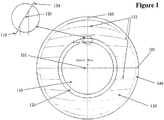
- Figure 1 is a front elevational view of a preferred embodiment of the invention.
- the present invention provides a contact lens comprising: an anterior surface having a vertical meridian, a horizontal meridian, a central optical zone, a blending zone extending outwardly from the central optical zone, a peripheral zone surrounding the blending zone, and an edge zone circumscribing and tangent to the peripheral zone; and an opposite posterior surface, wherein the blending zone has a surface which ensure that the peripheral zone, the blending zone and the central optical zone are tangent to each other, and wherein the peripheral zone has a surface that, in combination with the posterior surface, provides in the peripheral zone a lens thickness profile characterized by having a mirror symmetry with respect to a plane cutting through the vertical meridian, by having a substantially constant thickness in a region around the horizonal meridian and by having a thickness which decreases progressively from the horizontal meridian to the top or bottom of the contact lens along each of the vertical meridian and lines parallel to the vertical meridian.
- a “vertical meridian” refers to an imaginary line running vertically from the top, through the center, to the bottom of the anterior surface of a contact lens when said contact lens is maintained at a predetermined orientation on an eye.
- a “horizontal meridian” refers to an imaginary line running horizontally from the left side, through the center, to the right side of the anterior surface of a contact lens when said contact lens is maintained at a predetermined orientation on an eye.
- the horizontal and vertical meridians are perpendicular to each other.
- the peripheral zone can be composed of one or more peripheral bands or regions which are patched together to form a continuous surface.
- the area of the peripheral zone typically is equal to or larger than the area of the central optical zone, preferably is at least about 60% of the total area of the anterior surface of a contact lens.
- the anterior surface can have a series of isolines from one side to the other side of the lens. Along each of the series of isolines, the lens thickness in the peripheral zone remains substantially constant. It is understood that there could be some variation in thickness in a small portion near the outer peripheral edge of the peripheral zone.
- the isolines can all be straight lines parallel to the horizontal meridian; or one of the isolines is a straight line coincidental with the horizontal meridian and the rest isolines are arcs.
- each of arcs above the horizontal meridian is different from each other and mimics one arc of the edge of the upper eyelid of an eye at an eye-opening position
- each of arcs below the horizontal meridian is different from each other and mimics one arc of the edge of the lower eyelid of the eye at the eye-opening position.
- the entire peripheral zone of a contact lens of the invention has acontinuity in first derivative and/or in second derivative.
- Such peripheral zone can be a continuous surface defined by one or more mathematical functions, preferably by a spline-based mathematical function, or is made of several different surface patches.
- a lens thickness profile in the peripheral zone is characterized by having a mirror symmetry with respect to a plane cutting through the horizontal meridian.
- a blending zone between the peripheral zone and the central optical zone is most preferably needed for enabling separate and independent designs of the central optical zone and the peripheral zone and for ensuring a continuous transition from the central optical zone to the peripheral zone.
- a contact lens can be produced to have flexion points and/or sharp edges at the junction between two zones being eliminated and thereby provide improved wearer's comfort.
- the blending zone of the invention can be any surface described by a mathematical function, preferably a spline-based mathematical function, or made of different surface patches.
- a contact lens of the invention can be a toric, multifocal, or toric multifocal contact lens. As will be readily appreciated by those of skill in the art, many different types of optical zones are possible with the present invention.
- At least one of the optical zones of the anterior and posterior surfaces includes a first portion to provide distant vision correction for the eye and a second portion disposed beneath the first portion to provide near vision correction for the eye.
- At least one of the optical zones of the anterior and posterior surfaces has a distant vision zone, an intermediate vision zone, and a near vision zone.
- An optical zone including three vision zones can provide distance vision correction (e.g., driving), intermediate vision correction (e.g., working on computer), and near vision correction (e.g., reading books or newspapers).
- the intermediate vision zone is located between the distant vision zone and the near vision zone.
- the intermediate vision zone provides intermediate vision correction and has an area that is sufficient to overlay a substantial portion of the pupil and disposed in a position within the optical zone so that the pupil is substantially subtended by the intermediate vision zone when gazing at an intermediate vision point below the substantially horizontal point.
- the intermediate vision zone is a progressive power zone having an optical power that continuously changes from distant vision to near vision.
- a further example is that at least one of the optical zones of the anterior and posterior surfaces has a toric optics feature to correct for a wearer's astigmatism.
- one of the optical zones of the anterior and posterior surfaces comprises a toric optics feature and the other optical zone comprises a multifocal optics feature, wherein both the optical zones combine together to provide a cylindrical optical power to correct astigmatism vision errors and a multifocal power to compensate for presbyopia.
- the multifocal optics feature can be multiple concentric annular zones or a progressive power zone or the like.
- the multifocal optics feature is a progressive power zone which is substantially concentric with the central axis.
- the progressive power zone has a diameter of preferably about 1.0 mm to about 3.0 mm, more preferably about 1.5 mm to 2.2 mm.
- the toric optics feature can be on the anterior surface and the multifocal optics feature can be on the posterior surface or vice versa.
- the toric optics feature is on the anterior surface and the multifocal optics feature is on the posterior surface.
- the toric optics feature can have the shape of the toric optics of any conventional toric lens.
- the toric optics feature is circular. More preferably, circular toric optics feature is substantially concentric with the central axis.
- one of the optical zones of the anterior and posterior surfaces comprises a toric optics feature and a multifocal optics feature therewithin, wherein the two optical zones combine together to provide a cylindrical optical power to correct astigmatism vision errors and a multifocal power to compensate for presbyopia.
- Both the toric and multifocal optics features can be either on the anterior surface or on the posterior surface.
- both the toric and multifocal optics features are on the anterior surface.
- the anterior surface of a contact lens preferably comprises a circular edge zone which is adjacent to the peripheral zone.
- the edge zone in combination with the posterior surface, provides a substantially uniform thickness which may provide comfortable lens fit on an eye.
- Figure 1 is a front elevational view (the anterior surface) of a contact lens according to a preferred embodiment of the invention.
- the anterior surface of the contact lens 100 has a center 101, a horizontal meridian 103, a vertical meridian 105, a central optical zone 110, a blending zone 120, a peripheral zone 130, and a circular edge zone 140.
- the blending zone 120 extends outwardly from the optical zone 110 to the peripheral zone 130.
- the blending zone 140 has a surface ensuring that the central optical zone 110, the blending zone 120 and the peripheral zone 130 are tangent to each other.
- the surface of the blending zone 120 is continuous in first and/or second derivative from the outer peripheral edge of the optical zone 110 to the inner peripheral edge of the peripheral zone 130.
- the surface of the blending zone 120 is described by a spline-based mathematical function.
- the peripheral zone 130 includes a series of isolines along which the thickness of the contact lens are substantially constant.
- One of the isolines coincides with the horizontal meridian 103 running horizontally through the center 101 and the rest isolines are arc.
- Each of arcs, which are above the central horizontal isoline, is different from each other and mimics one arc of the peripheral edge of the upper eyelid of the human eye at a given eye-opening position.
- Each of arcs, which are below the central horizontal isoline is different from each other and mimics one arc of the peripheral edge of the lower eyelid of the human eye at a given eye-opening position.
- the upper and lower eyelids of en eye can have a different shaped arc, depending upon the fully or partially opening or fully closing position of the eye.
- both the arcs representing the edge of the upper eyelid and the edge of the lower eyelid are close to a straight line.
- both the arcs representing the edge of the upper eyelid and the edge of the lower eyelid have steep curvatures.
- Such relationship between the curvature of both the arcs representing the edge of the upper eyelid and the edge of the lower eyelid is preferably incorporated in the design of a contact lens of the invention as shown in Figure 1 , namely, closer to the horizontal meridian an isoline, flatter the curvature of the isoline.
- the thickness across the central region around the horizontal meridian 103 will remain relatively constant and decrease progressively from the horizontal meridian 103 to the top or bottom of the anterior surface along the vertical meridian 105 and along each of lines parallel to the vertical meridian 105. More preferably, the thickness decreases sharply in a region near the top of the lens.
- the circular edge zone 140 extends outwardly from the outer peripheral edge of the peripheral zone 130.
- the edge zone 140 is tangent to the peripheral zone and, in combination with the posterior surface, provides a substantially uniform thickness which may provide comfortable lens fit on an eye.
- CAD computer aided design
- An optical CAD system is used to design an optical model lens.
- An optical model lens refers to an ophthalmic lens that is designed in a computer system and generally does not contain other non-optical systems which are parts of an ophthalmic lens.
- CAD optical computer aided design
- exemplary optical computer aided design systems includes, but are not limited to Advanced System Analysis program (ASAP) from Breault Research Organization and ZEMAX (Focus Software, Inc.).
- ASAP Advanced System Analysis program
- ZEMAX Zik-Edge Software, Inc.
- the optical design will be performed using Advanced System Analysis program (ASAP) from Breault Research Organization with input from ZEMAX (Focus Software, Inc.).
- the design of the optical model lens can be transformed by, for example, a mechanical CAD system, into a mechanical lens design that includes optical zones, peripheral zones and blending zones.
- a mechanical CAD system CAD system
- the design of an optimized optical model lens into a mechanical lens design at least the peripheral zone of the anterior surface has a common design for a family of contact lenses and the optical zone and the peripheral zone are patched together by a blending zone which ensures a continuous transition between the two zones.
- any known, suitable mechanical CAD system can be used in the invention.
- a mechanical CAD system capable of representing precisely and mathematically high order surfaces is used to design a contact lens.
- An example of such mechanical CAD system is Pro/Engineer.
- the design of a contact lens may be translated back and forth between the optical CAD and mechanical CAD systems using a translation format which allows a receiving system, either optical CAD or mechanical CAD, to construct NURBs or Beizier surfaces of an intended design.
- exemplary translation formats include, but are not limited to, VDA (Verband der Automobilindustrie) and IGES (Initial Graphics Exchange Specification).
- VDA Very Dossian Deformation
- IGES Initial Graphics Exchange Specification
- Any mathematical function can be used to describe the anterior surface, posterior surface, peripheral edge of an ophthalmic lens, as long as they have sufficient dynamic range which allow the design of that lens to be optimized.
- Exemplary mathematical functions include conic and quadric functions, polynomials of any degree, Zernike polynomials, exponential functions, trigonometric functions, hyperbolic functions, rational functions, Fourier series, and wavelets.
- a combination of two or more mathematical functions is used to describe the front (anterior) surface and base (posterior) surface of an ophthalmic lens. More preferably, Zernike polynomials are used to describe the front (anterior) surface and base (posterior) surface of an ophthalmic lens. Even more preferably, Zernike polynomials and spline-based mathematical functions are used together to describe the front (anterior) surface and base (posterior) surface of an ophthalmic lens.
- the present invention provides a family of contact lenses having a series of different cylindrical power corrections and/or different multifocal powers, wherein each contact lens in the series comprises: an anterior surface having a vertical meridian, a horizontal meridian, a central optical zone, a blending zone extending outwardly from the central optical zone, a peripheral zone surrounding the blending zone, and an edge zone circumscribing and tangent to the peripheral zone; and an opposite posterior surface, wherein the peripheral zone, the blending zone and the central optical zone are tangent to each other, and wherein the peripheral zone has a surface that, in combination with the posterior surface, provides in the peripheral zone of the lens a thickness profile which is characterized by having a mirror symmetry with respect to a plane cutting through the vertical meridian, by having a substantially constant thickness in a region around the horizontal meridian and by having a thickness which decreases progressively from the horizontal meridian to the top or bottom of the contact lens along each of the vertical meridian and
- Contact lenses of the invention can be either hard or soft lenses.
- Soft contact lenses of the invention are preferably made from a soft contact lens material, such as a silicon hydrogel or HEMA. It will be understood that any lens described above comprising any soft contact lens material would fall within the scope of the invention.
- a contact lens of the invention can be produced in a computer-controlled manufacturing system.
- the lens design can be converted into a data file containing control signals that is interpreted by a computer-controlled manufacturing device.
- a computer-controlled manufacturing device is a device that can be controlled by a computer system and that is capable of producing directly an ophthalmic lens or an optical tool for producing an ophthalmic lens. Any known, suitable computer controllable manufacturing device can be used in the invention.
- a computer controllable manufacturing device is a numerically controlled lathe, preferably a two-axis lathe with a 45° piezo cutter or a lathe apparatus disclosed by Durazo and Morgan in US patent No.
- a numerically controlled lathe from Precitech, Inc., for example, such as Optoform ultra-precision lathes (models 30, 40, 50 and 80) having Variform piezo-ceramic fast tool servo attachment.
- contact lenses are molded from contact lens molds including molding surfaces that replicate the contact lens surfaces when a lens is cast in the molds.
- an optical cutting tool with a numerically controlled lathe may be used to form metallic optical tools. The tools are then used to make convex and concave surface molds that are then used, in conjunction with each other, to form the lens of the invention using a suitable liquid lens-forming material placed between the molds followed by compression and curing of the lens-forming material.
- contact lenses according to the invention can be manufactured by imparting contact lens molds two molding surfaces, a first molding surface and a second molding surface.
- the present invention provides a method for producing a contact lens of the invention.
- the method comprises the steps of shaping a contact lens by a manufacturing means to have an anterior surface having a vertical meridian, a horizontal meridian, a central optical zone, a blending zone extending outwardly from the central optical zone, a peripheral zone surrounding the blending zone, and an edge zone circumscribing and tangent to the peripheral zone; and an opposite posterior surface, wherein the blending zone has a surface which ensures that the peripheral zone, the blending zone and the central optical zone are tangent to each other, and wherein the peripheral zone has a surface that, in combination with the posterior surface, provides in the peripheral zone of the lens a thickness profile which is characterized by having a mirror symmetry with respect to a plane cutting through the vertical meridian, by having a substantially constant thickness in a region around the horizontal meridian and by having a thickness which decreases progressively from the horizontal meridian to the top or bottom of the contact lens along
- a contact lens having complicated surface feature or the optical tool to be used for making the same is fabricated by using a numerically controlled lathe, for example, such as Optoform ultra-precision lathes (models 30, 40, 50 and 80) having Variform piezo-ceramic fast tool servo attachment from Sterling International Technologies, Inc.
- a numerically controlled lathe for example, such as Optoform ultra-precision lathes (models 30, 40, 50 and 80) having Variform piezo-ceramic fast tool servo attachment from Sterling International Technologies, Inc.
- an user defines a set of parameters, such as a surface tolerance, a concentricity tolerance, orientation of the lens design, the number of spokes to be generated for each of the anterior and posterior surfaces, creating zero point at 0,0, orientation of Z-axis, and type of lens surface (concave or convex surface) to be converted into a geometry.
- parameters such as a surface tolerance, a concentricity tolerance, orientation of the lens design, the number of spokes to be generated for each of the anterior and posterior surfaces, creating zero point at 0,0, orientation of Z-axis, and type of lens surface (concave or convex surface) to be converted into a geometry.
- a “surface tolerance” refers to the allowed position-deviation of a projected point from an ideal position on a surface of a lens design. The deviation can be in the direction either parallel or perpendicular to the central axis of a lens design.
- a “concentricity tolerance” refers to the allowed deviation of a point from a given arc.
- a "spoke” refers to a ray radiating outwardly from the central axis and is perpendicular to the central axis.
- a “semi-diameter spoke” refers to a line segment from the central axis to the edge of a lens design.
- Electrode-spaced semi-diameter spokes means that all semi-diameter spokes radiate outwardly from the central axis and separate from each other by one equal angle.
- a "point spacing” refers to a distance between two points along the semi-diameter spoke.
- a user determines the number of points to be projected onto the a surface of the lens design (for example, the anterior surface) along each of the number of evenly-spaced semi-diameter spokes in a direction parallel to the central axis.
- Evenly-spaced points are projected along the semi-diameter probing spoke, in which each pairs of points are separating by a point spacing of 10 microns. Then, all of the projected points are divided into a series of groups, each group composed of three consecutive points, a first point, a middle point and a third point.
- Each of the points can belong to either one group or two groups.
- the point spacing between the first and additional points is equal to point spacing between the additional and middle points.
- the above-determined number of points are projected onto the anterior surface of the lens design along each of 96 semi-diameter spokes.
- a semi-meridian which is continuous in first derivative is generated.
- the semi-meridian includes a series of arcs and optionally straight lines, wherein each arc is defined by fitting at least three consecutive points into a spherical mathematical function within a desired concentricity tolerance.
- Each of the straight lines is obtained by connecting at least three consecutive points.
- arc fitting routine is started from the central axis to the edge.
- a mini-file containing both the information for the header and the information about the geometry of the lens is generated.
- This mini-file also contains a zero semi-meridian that is based on the average height of each of the other meridians at each of radial locations and that gives the Variform a zero position on which it can base its oscillation calculations.
- all semi-meridians have the same number of zones. This is accomplished by copying the last zone of a semi-meridian for a number of time to equalize the numbers of zones for all meridians.
- the mini-file is complete, it is loaded into an Optoform ultra-precision lathe (models 30, 40, 50 or 80) having Variform piezo-ceramic fast tool servo attachment and run to produce a translating contact lens.
Landscapes
- Health & Medical Sciences (AREA)
- Ophthalmology & Optometry (AREA)
- Physics & Mathematics (AREA)
- General Health & Medical Sciences (AREA)
- General Physics & Mathematics (AREA)
- Optics & Photonics (AREA)
- Eyeglasses (AREA)
Priority Applications (1)
| Application Number | Priority Date | Filing Date | Title |
|---|---|---|---|
| EP12174985.7A EP2508936B1 (en) | 2002-08-06 | 2003-08-05 | Contact lenses |
Applications Claiming Priority (3)
| Application Number | Priority Date | Filing Date | Title |
|---|---|---|---|
| US40173602P | 2002-08-06 | 2002-08-06 | |
| US401736P | 2002-08-06 | ||
| PCT/EP2003/008658 WO2004015480A1 (en) | 2002-08-06 | 2003-08-05 | Contact lenses |
Related Child Applications (2)
| Application Number | Title | Priority Date | Filing Date |
|---|---|---|---|
| EP12174985.7A Division EP2508936B1 (en) | 2002-08-06 | 2003-08-05 | Contact lenses |
| EP12174985.7A Division-Into EP2508936B1 (en) | 2002-08-06 | 2003-08-05 | Contact lenses |
Publications (2)
| Publication Number | Publication Date |
|---|---|
| EP1529235A1 EP1529235A1 (en) | 2005-05-11 |
| EP1529235B1 true EP1529235B1 (en) | 2017-06-14 |
Family
ID=31715725
Family Applications (2)
| Application Number | Title | Priority Date | Filing Date |
|---|---|---|---|
| EP03784181.4A Expired - Lifetime EP1529235B1 (en) | 2002-08-06 | 2003-08-05 | Contact lenses |
| EP12174985.7A Expired - Lifetime EP2508936B1 (en) | 2002-08-06 | 2003-08-05 | Contact lenses |
Family Applications After (1)
| Application Number | Title | Priority Date | Filing Date |
|---|---|---|---|
| EP12174985.7A Expired - Lifetime EP2508936B1 (en) | 2002-08-06 | 2003-08-05 | Contact lenses |
Country Status (6)
| Country | Link |
|---|---|
| US (1) | US7040757B2 (enExample) |
| EP (2) | EP1529235B1 (enExample) |
| JP (1) | JP4485360B2 (enExample) |
| AU (1) | AU2003260369A1 (enExample) |
| CA (1) | CA2492541C (enExample) |
| WO (1) | WO2004015480A1 (enExample) |
Cited By (1)
| Publication number | Priority date | Publication date | Assignee | Title |
|---|---|---|---|---|
| DE102016103203A1 (de) | 2016-02-24 | 2017-08-24 | Valeo Schalter Und Sensoren Gmbh | Verfahren zum Erkennen eines blockierten Zustands eines Radarsensors, Radarsensorvorrichtung, Fahrerassistenzsystem sowie Kraftfahrzeug |
Families Citing this family (77)
| Publication number | Priority date | Publication date | Assignee | Title |
|---|---|---|---|---|
| US6467903B1 (en) | 2000-03-31 | 2002-10-22 | Ocular Sciences, Inc. | Contact lens having a uniform horizontal thickness profile |
| US7628485B2 (en) | 2000-03-31 | 2009-12-08 | Coopervision International Holding Company, Lp | Contact lens having a uniform horizontal thickness profile |
| US8244702B2 (en) * | 2002-02-26 | 2012-08-14 | International Business Machines Corporation | Modification of a data repository based on an abstract data representation |
| US7101042B2 (en) * | 2003-08-12 | 2006-09-05 | S.I.B. Investments Llc | Multifocal contact lens |
| US6939005B2 (en) * | 2003-08-20 | 2005-09-06 | Johnson & Johnson Vision Care Inc. | Rotationally stabilized contact lenses |
| US20050041203A1 (en) * | 2003-08-20 | 2005-02-24 | Lindacher Joseph Michael | Ophthalmic lens with optimal power profile |
| US7036930B2 (en) | 2003-10-27 | 2006-05-02 | Johnson & Johnson Vision Care, Inc. | Methods for reducing corneal staining in contact lens wearers |
| US7201480B2 (en) * | 2004-05-20 | 2007-04-10 | Johnson & Johnson Vision Care, Inc. | Methods for rotationally stabilizing contact lenses |
| CA2575028A1 (en) * | 2004-08-04 | 2006-02-09 | Novartis Ag | Soft contact lenses with stiffening rib features therein |
| US8122012B2 (en) * | 2005-01-14 | 2012-02-21 | International Business Machines Corporation | Abstract record timeline rendering/display |
| TW200630662A (en) | 2005-02-23 | 2006-09-01 | Novartis Ag | A toric lens design |
| US7444332B2 (en) * | 2005-11-10 | 2008-10-28 | International Business Machines Corporation | Strict validation of inference rule based on abstraction environment |
| US7440945B2 (en) * | 2005-11-10 | 2008-10-21 | International Business Machines Corporation | Dynamic discovery of abstract rule set required inputs |
| US7621635B2 (en) * | 2005-12-22 | 2009-11-24 | Bausch & Lamb Incorporated | Toric contact lenses |
| CN101523271B (zh) * | 2006-10-10 | 2012-07-04 | 诺瓦提斯公司 | 具有光学控制周边部分的透镜以及设计和制造该透镜的方法 |
| WO2008062503A1 (en) * | 2006-11-20 | 2008-05-29 | Menicon Co., Ltd. | Contact lens and method for manufacturing the same |
| US7832858B2 (en) * | 2007-05-11 | 2010-11-16 | Ferrara Daniel C | Contact lens permitting translation |
| US8140557B2 (en) | 2007-05-15 | 2012-03-20 | International Business Machines Corporation | Ontological translation of abstract rules |
| US8317505B2 (en) | 2007-08-21 | 2012-11-27 | Johnson & Johnson Vision Care, Inc. | Apparatus for formation of an ophthalmic lens precursor and lens |
| US8318055B2 (en) | 2007-08-21 | 2012-11-27 | Johnson & Johnson Vision Care, Inc. | Methods for formation of an ophthalmic lens precursor and lens |
| US7905594B2 (en) | 2007-08-21 | 2011-03-15 | Johnson & Johnson Vision Care, Inc. | Free form ophthalmic lens |
| US8313828B2 (en) | 2008-08-20 | 2012-11-20 | Johnson & Johnson Vision Care, Inc. | Ophthalmic lens precursor and lens |
| US8974526B2 (en) | 2007-08-27 | 2015-03-10 | Amo Groningen B.V. | Multizonal lens with extended depth of focus |
| FR2921163B1 (fr) * | 2007-09-19 | 2009-12-25 | Precilens Lab | Lentille de contact stabilisee. |
| US8646908B2 (en) | 2008-03-04 | 2014-02-11 | Johnson & Johnson Vision Care, Inc. | Rotationally stabilized contact lenses and methods for their design |
| SG10201506615RA (en) | 2008-04-18 | 2015-10-29 | Holden Brien Vision Inst | Myopia control means |
| WO2010019397A2 (en) * | 2008-08-11 | 2010-02-18 | Novartis Ag | A lens design and method for preventing or slowing the progression of myopia |
| US9417464B2 (en) | 2008-08-20 | 2016-08-16 | Johnson & Johnson Vision Care, Inc. | Method and apparatus of forming a translating multifocal contact lens having a lower-lid contact surface |
| EP2365790A1 (en) * | 2008-11-12 | 2011-09-21 | Vision Crc Limited | Improved method for characterizing lenses |
| SG172261A1 (en) * | 2008-12-19 | 2011-07-28 | Novartis Ag | Correction of peripheral defocus of an eye and control of refractive error development |
| US8240849B2 (en) * | 2009-03-31 | 2012-08-14 | Johnson & Johnson Vision Care, Inc. | Free form lens with refractive index variations |
| US8807076B2 (en) | 2010-03-12 | 2014-08-19 | Johnson & Johnson Vision Care, Inc. | Apparatus for vapor phase processing ophthalmic devices |
| BR112013007153A2 (pt) | 2010-09-27 | 2016-06-14 | Johnson & Johnson Vision Care | lentes de contato conversoras para presbiopia |
| KR101848224B1 (ko) | 2010-09-27 | 2018-04-12 | 존슨 앤드 존슨 비젼 케어, 인코포레이티드 | 교대보기 노안용 콘택트 렌즈 |
| CN103180777B (zh) * | 2010-09-27 | 2015-12-02 | 庄臣及庄臣视力保护公司 | 非对称平移式远视接触镜片 |
| AU2011336183B2 (en) | 2010-12-01 | 2015-07-16 | Amo Groningen B.V. | A multifocal lens having an optical add power progression, and a system and method of providing same |
| US8672476B2 (en) | 2011-03-24 | 2014-03-18 | Johnson & Johnson Vision Care, Inc. | Contact lenses with improved movement |
| US8801176B2 (en) | 2011-03-24 | 2014-08-12 | Johnson & Johnson Vision Care, Inc. | Contact lenses with improved movement |
| US12044905B2 (en) | 2011-04-28 | 2024-07-23 | Journey1 Inc | Contact lenses for refractive correction |
| US9028063B2 (en) | 2011-08-26 | 2015-05-12 | Johnson & Johnson Vision Care, Inc. | Translating presbyopic contact lens pair |
| US20140063444A1 (en) * | 2012-03-30 | 2014-03-06 | Johnson & Johnson Vision Care, Inc. | Methods and apparatus for forming a translating multifocal contact lens |
| TWI588560B (zh) | 2012-04-05 | 2017-06-21 | 布萊恩荷登視覺協會 | 用於屈光不正之鏡片、裝置、方法及系統 |
| US9823493B2 (en) * | 2012-08-30 | 2017-11-21 | Johnson & Johnson Vision Care, Inc. | Compliant dynamic translation zones for contact lenses |
| US9995947B2 (en) | 2012-09-07 | 2018-06-12 | BeautiEyes, LLC | Prosthesis and method for widening the palpebral fissure of an individual's eye |
| US9201250B2 (en) | 2012-10-17 | 2015-12-01 | Brien Holden Vision Institute | Lenses, devices, methods and systems for refractive error |
| CA2887655C (en) | 2012-10-17 | 2021-11-02 | Brien Holden Vision Institute | Lenses, devices, methods and systems for refractive error |
| US8888277B2 (en) | 2012-10-26 | 2014-11-18 | Johnson & Johnson Vision Care, Inc. | Contact lens with improved fitting characteristics |
| AU2013200761A1 (en) * | 2013-02-13 | 2014-08-28 | Brien Holden Vision Institute | Contact lens stabilisation |
| US9316848B2 (en) * | 2013-03-15 | 2016-04-19 | Johnson & Johnson Vision Care, Inc. | Ophthalmic devices with stabilization features |
| US9581832B2 (en) * | 2013-03-15 | 2017-02-28 | Johnson & Johnson Vision Care, Inc. | Method and apparatus for encapsulating a rigid insert in a contact lens for correcting vision in astigmatic patients |
| US8974055B2 (en) | 2013-03-15 | 2015-03-10 | Johnson & Johnson Vision Care, Inc. | Method and apparatus for encapsulating a rigid insert in a contact lens for correcting vision in astigmatic patients |
| WO2015157437A1 (en) * | 2014-04-09 | 2015-10-15 | BeautiEyes, LLC | Aperture widening prosthesis including spline surface topography and methods of making the same |
| US9645412B2 (en) | 2014-11-05 | 2017-05-09 | Johnson & Johnson Vision Care Inc. | Customized lens device and method |
| IL303151B2 (en) | 2015-09-23 | 2025-04-01 | Ohio State Innovation Foundation | A contact lens that includes a lenticular at the top of the contact lens |
| US10191302B2 (en) | 2015-09-23 | 2019-01-29 | Ohio State Innovation Foundation | Contact lens comprising lenticular-like curve |
| US9927633B2 (en) | 2015-10-28 | 2018-03-27 | Johnson & Johnson Vision Care, Inc. | Friction stabilized contact lenses |
| US10359643B2 (en) | 2015-12-18 | 2019-07-23 | Johnson & Johnson Vision Care, Inc. | Methods for incorporating lens features and lenses having such features |
| EP3413841A1 (en) | 2016-02-09 | 2018-12-19 | AMO Groningen B.V. | Progressive power intraocular lens, and methods of use and manufacture |
| JP6646531B2 (ja) | 2016-06-20 | 2020-02-14 | Hoya株式会社 | コンタクトレンズおよびその製造方法 |
| US10274751B2 (en) | 2016-07-05 | 2019-04-30 | Bausch & Lomb Incorporated | Prism ballasted contact lens |
| US10786959B2 (en) * | 2016-07-18 | 2020-09-29 | Johnson & Johnson Vision Care, Inc | Mold for contact lens with non-rotationally symmetric rim or edge |
| US9933633B1 (en) | 2016-11-08 | 2018-04-03 | Paul Douglas Becherer | Bifocal contact lenses providing reduced glare and blurriness in dim lighting |
| WO2019046714A1 (en) | 2017-09-01 | 2019-03-07 | Ohio State Innovation Foundation | FLEXIBLE CONTACT LENS COMPRISING A LENTICULAR IN A UPPER PART OF THE CONTACT LENS WITH ENHANCED LACRYMAL EXCHANGE |
| AR115981A1 (es) | 2019-03-19 | 2021-03-17 | Ohio State Innovation Foundation | Lente de contacto |
| US11029537B2 (en) * | 2019-05-14 | 2021-06-08 | Johnson & Johnson Vision Care, Inc | Soft contact lens with new stabilization zones for improved angular stability and comfort |
| US11327341B2 (en) * | 2019-06-14 | 2022-05-10 | Johnson & Johnson Vision Care, Inc | Toric contact lens stabilization design based on thickness gradients orthogonal to eyelid margin |
| US11886046B2 (en) | 2019-12-30 | 2024-01-30 | Amo Groningen B.V. | Multi-region refractive lenses for vision treatment |
| USD1075870S1 (en) | 2020-03-26 | 2025-05-20 | Ohio State Innovation Foundation | Contact lens |
| US11934043B2 (en) * | 2020-04-30 | 2024-03-19 | Coopervision International Limited | Myopia control lens and related methods |
| AU2021294407A1 (en) * | 2020-06-26 | 2023-02-02 | Brien Holden Vision Institute Limited | Geometrically defined shapes and/or contour optical elements for ophthalmic lenses and methods for creating such geometrically defined shapes and/or contour optical elements |
| US11364696B2 (en) | 2020-09-18 | 2022-06-21 | Johnson & Johnson Vision Care, Inc | Apparatus for forming an ophthalmic lens |
| WO2022159518A1 (en) * | 2021-01-20 | 2022-07-28 | Tung Hsiao Ching | Peripheral anti-defocus optical devices |
| CN114945858B (zh) | 2021-07-07 | 2023-09-12 | 沈阳康恩德医疗科技有限公司 | 通过周边畸变的调制来调节屈光不正发展的系统、装置和方法 |
| TW202401101A (zh) * | 2022-03-14 | 2024-01-01 | 美商旅程一號公司 | 散光矯正接觸鏡片 |
| KR20240135805A (ko) * | 2022-06-12 | 2024-09-12 | 페가비젼 코포레이션 | 콘택트렌즈 |
| CN117192806B (zh) * | 2023-09-22 | 2024-05-31 | 首都医科大学附属北京同仁医院 | 一种异型四象限非对称角膜塑形镜 |
| WO2025222381A1 (zh) * | 2024-04-23 | 2025-10-30 | 辰瑞光学(重庆)有限公司 | 模具及镜片制备方法 |
Family Cites Families (61)
| Publication number | Priority date | Publication date | Assignee | Title |
|---|---|---|---|---|
| US2544246A (en) * | 1950-08-01 | 1951-03-06 | George H Butterfield | Corneal contact lens |
| GB1463107A (enExample) * | 1973-06-19 | 1977-02-02 | Strachan J P F | |
| US4525043A (en) * | 1977-11-11 | 1985-06-25 | Leonard Bronstein | Contact lens |
| US4254065A (en) * | 1979-04-04 | 1981-03-03 | Ratkowski Donald J | Injection molding of contact lenses |
| US4310225A (en) * | 1979-08-06 | 1982-01-12 | Gentex Corporation | Ophthalmic lens series |
| US4418991A (en) * | 1979-09-24 | 1983-12-06 | Breger Joseph L | Presbyopic contact lens |
| ATE4844T1 (de) * | 1980-06-12 | 1983-10-15 | Biolens Sa | Kontaktlinse fuer gerichtete optische korrektur. |
| US4573775A (en) * | 1982-08-19 | 1986-03-04 | Vistakon, Inc. | Bifocal contact lens |
| US4580882A (en) * | 1983-04-21 | 1986-04-08 | Benjamin Nuchman | Continuously variable contact lens |
| US4549794A (en) | 1983-05-05 | 1985-10-29 | Schering Corporation | Hydrophilic bifocal contact lens |
| US4618229A (en) * | 1983-07-22 | 1986-10-21 | Bausch & Lomb Incorporated | Bifocal contact lens |
| US4618227A (en) * | 1983-10-07 | 1986-10-21 | Vistakon, Inc. | Soft contact lens |
| CS246212B1 (en) * | 1984-06-18 | 1986-10-16 | Otto Wichterle | Toric contact lens with centre of gravity shifted towards its border,mould for its production and method of moulds production |
| US4614413A (en) * | 1985-02-05 | 1986-09-30 | Obssuth George A | Contact lens |
| FR2582416A1 (fr) | 1985-05-24 | 1986-11-28 | Bourgeois Sa | Lentille de contact bifocale |
| CA1333757C (en) * | 1986-06-24 | 1995-01-03 | Gregory N. Miller | Contact lens and method of making same |
| US4702573A (en) * | 1986-08-25 | 1987-10-27 | Morstad David P | Variable powered contact lens |
| US5071244A (en) * | 1990-10-03 | 1991-12-10 | Ross Richard M | Soft bifocal contact lens |
| US5210695A (en) * | 1990-10-26 | 1993-05-11 | Gerber Optical, Inc. | Single block mounting system for surfacing and edging of a lens blank and method therefor |
| NL9200400A (nl) | 1992-03-04 | 1993-10-01 | Jose Jorge Pavlotzky Handelend | Bifocale contactlens, alsmede werkwijze voor het vervaardigen van een dergelijke contactlens. |
| GB9306424D0 (en) | 1993-03-27 | 1993-05-19 | Pilkington Visioncare Inc | Contact lens designed to accommodate and correct for the effects of presbyopia |
| US5493350A (en) * | 1993-03-31 | 1996-02-20 | Seidner; Leonard | Multipocal contact lens and method for preparing |
| US5404183A (en) * | 1993-03-31 | 1995-04-04 | Seidner; Leonard | Multifocal contact lens and method for preparing |
| US5526071A (en) * | 1993-03-31 | 1996-06-11 | Permeable Technologies, Inc. | Multifocal contact lens and method for preparing |
| US5691797A (en) * | 1993-03-31 | 1997-11-25 | Permeable Technologies, Inc. | Multifocal contact lens |
| US5619289A (en) * | 1993-03-31 | 1997-04-08 | Permeable Technologies, Inc. | Multifocal contact lens |
| US5532768A (en) * | 1993-10-04 | 1996-07-02 | Menicon Co., Ltd. | Contact lens |
| US5499064A (en) * | 1994-01-28 | 1996-03-12 | Paralax, Inc. | Visual aid device having a locking device |
| US5861114A (en) * | 1994-06-10 | 1999-01-19 | Johnson&Johnson Vision Products, Inc. | Method of manufacturing complex optical designs in soft contact lenses |
| WO1996008745A1 (en) | 1994-09-16 | 1996-03-21 | Permeable Technologies, Inc. | Multifocal contact lens and method for preparing |
| US5635998A (en) * | 1994-12-06 | 1997-06-03 | Baugh; Thomas K. | Translating multifocal contact lens |
| US5652638A (en) | 1995-05-04 | 1997-07-29 | Johnson & Johnson Vision Products, Inc. | Concentric annular ring lens designs for astigmatism |
| BR9807960B1 (pt) | 1997-04-07 | 2009-05-05 | série de lentes de contato tóricas. | |
| US6122999A (en) | 1997-04-17 | 2000-09-26 | Novartis Ag | Lathe apparatus and method |
| DE19726918A1 (de) * | 1997-06-25 | 1999-01-07 | Woehlk Contact Linsen Gmbh | Multifokale Kontaktlinse |
| US6109749A (en) | 1997-11-04 | 2000-08-29 | Bernstein; Paul R. | Soft bifocal contact lenses |
| US6089711A (en) * | 1997-11-05 | 2000-07-18 | Blankenbecler; Richard | Radial gradient contact lenses |
| JPH11258553A (ja) * | 1998-03-09 | 1999-09-24 | Menicon Co Ltd | プリズムバラスト型コンタクトレンズ及びその製造方法並びにそれに用いられるモールド型 |
| CA2339776C (en) * | 1998-08-06 | 2005-10-25 | John B. W. Lett | Multifocal aspheric lens |
| US6270218B1 (en) * | 1998-10-26 | 2001-08-07 | Johnson & Johnson Vision Products, Inc. | Contact lenses with off-axis bevel |
| US6176578B1 (en) * | 1998-12-09 | 2001-01-23 | Johnson & Johnson Vision Care, Inc. | Toric contact lenses |
| US6183082B1 (en) * | 1998-12-21 | 2001-02-06 | Johnson & Johnson Vision Care, Inc. | Contact lenses with constant peripheral geometry |
| GB9903170D0 (en) | 1999-02-13 | 1999-04-07 | Contact Lens Precision Lab Lim | Contact lenses |
| US6206520B1 (en) * | 1999-03-25 | 2001-03-27 | Johnson & Johnson Vision Care, Inc. | Contact lenses with contoured edges |
| US20020024631A1 (en) * | 1999-08-31 | 2002-02-28 | Roffman Jeffrey H. | Rotationally stabilized contact lenses |
| AUPQ468399A0 (en) | 1999-12-16 | 2000-01-20 | Iolco Pty Ltd | A contact lens |
| US6568990B2 (en) * | 2000-01-18 | 2003-05-27 | Ncrx Optical Solutions, Inc. | System and method for ophthalmic lens manufacture |
| US6364483B1 (en) * | 2000-02-22 | 2002-04-02 | Holo Or Ltd. | Simultaneous multifocal contact lens and method of utilizing same for treating visual disorders |
| US6467903B1 (en) * | 2000-03-31 | 2002-10-22 | Ocular Sciences, Inc. | Contact lens having a uniform horizontal thickness profile |
| CN1177243C (zh) | 2000-06-27 | 2004-11-24 | 佳视科学公司 | 隐形眼镜,配制,设计及改变角膜形状的方法 |
| US6454409B1 (en) * | 2000-08-15 | 2002-09-24 | Johnson & Johnson Vision Care, Inc. | Contact lenses |
| US6773107B2 (en) * | 2000-08-17 | 2004-08-10 | Novartis Ag | Soft translating contact lens for presbyopia |
| US6474814B1 (en) * | 2000-09-08 | 2002-11-05 | Florida Optical Engineering, Inc | Multifocal ophthalmic lens with induced aperture |
| US6595639B1 (en) * | 2000-11-10 | 2003-07-22 | Ocular Sciences, Inc. | Junctionless ophthalmic lenses and methods for making same |
| US6491392B2 (en) * | 2000-12-08 | 2002-12-10 | Johnson & Johnson Vison Care, Inc. | Dynamically stabilized contact lenses |
| US6406145B1 (en) * | 2000-12-20 | 2002-06-18 | Johnson & Johnson Vision Care, Inc. | Contact lenses with improved centering and orienting |
| US6709102B2 (en) * | 2001-01-16 | 2004-03-23 | Arthur G. Duppstadt | Multifocal contact lens and method of making the same |
| US6746118B2 (en) * | 2001-07-17 | 2004-06-08 | Soft Focal Company, Inc. | Bifocal contact lens with secondary prism |
| US7036931B2 (en) * | 2003-01-29 | 2006-05-02 | Novartis Ag | Ophthalmic lenses |
| US7004585B2 (en) * | 2003-02-11 | 2006-02-28 | Novartis Ag | Ophthalmic lens having an optical zone blend design |
| US7063422B2 (en) * | 2003-04-16 | 2006-06-20 | Novartis Ag | Multifocal ophthalmic lens |
-
2003
- 2003-08-05 CA CA2492541A patent/CA2492541C/en not_active Expired - Lifetime
- 2003-08-05 EP EP03784181.4A patent/EP1529235B1/en not_active Expired - Lifetime
- 2003-08-05 EP EP12174985.7A patent/EP2508936B1/en not_active Expired - Lifetime
- 2003-08-05 AU AU2003260369A patent/AU2003260369A1/en not_active Abandoned
- 2003-08-05 JP JP2004526883A patent/JP4485360B2/ja not_active Expired - Lifetime
- 2003-08-05 WO PCT/EP2003/008658 patent/WO2004015480A1/en not_active Ceased
- 2003-08-06 US US10/635,817 patent/US7040757B2/en not_active Expired - Lifetime
Non-Patent Citations (1)
| Title |
|---|
| None * |
Cited By (1)
| Publication number | Priority date | Publication date | Assignee | Title |
|---|---|---|---|---|
| DE102016103203A1 (de) | 2016-02-24 | 2017-08-24 | Valeo Schalter Und Sensoren Gmbh | Verfahren zum Erkennen eines blockierten Zustands eines Radarsensors, Radarsensorvorrichtung, Fahrerassistenzsystem sowie Kraftfahrzeug |
Also Published As
| Publication number | Publication date |
|---|---|
| JP4485360B2 (ja) | 2010-06-23 |
| EP2508936B1 (en) | 2016-11-23 |
| CA2492541A1 (en) | 2004-02-19 |
| AU2003260369A1 (en) | 2004-02-25 |
| JP2005534985A (ja) | 2005-11-17 |
| EP2508936A1 (en) | 2012-10-10 |
| EP1529235A1 (en) | 2005-05-11 |
| WO2004015480A1 (en) | 2004-02-19 |
| US7040757B2 (en) | 2006-05-09 |
| US20050068489A1 (en) | 2005-03-31 |
| CA2492541C (en) | 2012-10-30 |
Similar Documents
| Publication | Publication Date | Title |
|---|---|---|
| EP1529235B1 (en) | Contact lenses | |
| CA2491460C (en) | Translating contact lens having a ramped ridge | |
| US6923540B2 (en) | Toric multifocal contact lenses | |
| US7080906B2 (en) | Translating bifocal wear modality | |
| EP1590703B1 (en) | Opththalmic lenses | |
| CA2526076C (en) | Contact lenses | |
| CA2457573C (en) | Ophthalmic lens having an optical zone blend design | |
| JP2005534985A5 (enExample) | ||
| EP1552336A1 (en) | Method of manufacturing a contact lens | |
| MXPA06005361A (en) | Translating bifocal wear modality |
Legal Events
| Date | Code | Title | Description |
|---|---|---|---|
| PUAI | Public reference made under article 153(3) epc to a published international application that has entered the european phase |
Free format text: ORIGINAL CODE: 0009012 |
|
| 17P | Request for examination filed |
Effective date: 20050307 |
|
| AK | Designated contracting states |
Kind code of ref document: A1 Designated state(s): AT BE BG CH CY CZ DE DK EE ES FI FR GB GR HU IE IT LI LU MC NL PT RO SE SI SK TR |
|
| AX | Request for extension of the european patent |
Extension state: AL LT LV MK |
|
| DAX | Request for extension of the european patent (deleted) | ||
| 17Q | First examination report despatched |
Effective date: 20100708 |
|
| GRAP | Despatch of communication of intention to grant a patent |
Free format text: ORIGINAL CODE: EPIDOSNIGR1 |
|
| INTG | Intention to grant announced |
Effective date: 20170123 |
|
| RIN1 | Information on inventor provided before grant (corrected) |
Inventor name: LINDACHER, JOSEPH MICHAEL Inventor name: YE, MING Inventor name: HALL, JORDAN WILLIAM |
|
| GRAS | Grant fee paid |
Free format text: ORIGINAL CODE: EPIDOSNIGR3 |
|
| GRAA | (expected) grant |
Free format text: ORIGINAL CODE: 0009210 |
|
| STAA | Information on the status of an ep patent application or granted ep patent |
Free format text: STATUS: THE PATENT HAS BEEN GRANTED |
|
| AK | Designated contracting states |
Kind code of ref document: B1 Designated state(s): AT BE BG CH CY CZ DE DK EE ES FI FR GB GR HU IE IT LI LU MC NL PT RO SE SI SK TR |
|
| REG | Reference to a national code |
Ref country code: GB Ref legal event code: FG4D |
|
| REG | Reference to a national code |
Ref country code: CH Ref legal event code: EP Ref country code: AT Ref legal event code: REF Ref document number: 901515 Country of ref document: AT Kind code of ref document: T Effective date: 20170615 |
|
| REG | Reference to a national code |
Ref country code: DE Ref legal event code: R081 Ref document number: 60350328 Country of ref document: DE Owner name: ALCON INC., CH Free format text: FORMER OWNER: NOVARTIS AG, 4056 BASEL, CH |
|
| REG | Reference to a national code |
Ref country code: IE Ref legal event code: FG4D |
|
| REG | Reference to a national code |
Ref country code: DE Ref legal event code: R096 Ref document number: 60350328 Country of ref document: DE |
|
| REG | Reference to a national code |
Ref country code: FR Ref legal event code: PLFP Year of fee payment: 15 |
|
| REG | Reference to a national code |
Ref country code: NL Ref legal event code: MP Effective date: 20170614 |
|
| PG25 | Lapsed in a contracting state [announced via postgrant information from national office to epo] |
Ref country code: ES Free format text: LAPSE BECAUSE OF FAILURE TO SUBMIT A TRANSLATION OF THE DESCRIPTION OR TO PAY THE FEE WITHIN THE PRESCRIBED TIME-LIMIT Effective date: 20170614 Ref country code: FI Free format text: LAPSE BECAUSE OF FAILURE TO SUBMIT A TRANSLATION OF THE DESCRIPTION OR TO PAY THE FEE WITHIN THE PRESCRIBED TIME-LIMIT Effective date: 20170614 Ref country code: GR Free format text: LAPSE BECAUSE OF FAILURE TO SUBMIT A TRANSLATION OF THE DESCRIPTION OR TO PAY THE FEE WITHIN THE PRESCRIBED TIME-LIMIT Effective date: 20170915 |
|
| REG | Reference to a national code |
Ref country code: AT Ref legal event code: MK05 Ref document number: 901515 Country of ref document: AT Kind code of ref document: T Effective date: 20170614 |
|
| PG25 | Lapsed in a contracting state [announced via postgrant information from national office to epo] |
Ref country code: SE Free format text: LAPSE BECAUSE OF FAILURE TO SUBMIT A TRANSLATION OF THE DESCRIPTION OR TO PAY THE FEE WITHIN THE PRESCRIBED TIME-LIMIT Effective date: 20170614 Ref country code: NL Free format text: LAPSE BECAUSE OF FAILURE TO SUBMIT A TRANSLATION OF THE DESCRIPTION OR TO PAY THE FEE WITHIN THE PRESCRIBED TIME-LIMIT Effective date: 20170614 Ref country code: BG Free format text: LAPSE BECAUSE OF FAILURE TO SUBMIT A TRANSLATION OF THE DESCRIPTION OR TO PAY THE FEE WITHIN THE PRESCRIBED TIME-LIMIT Effective date: 20170914 |
|
| PG25 | Lapsed in a contracting state [announced via postgrant information from national office to epo] |
Ref country code: CZ Free format text: LAPSE BECAUSE OF FAILURE TO SUBMIT A TRANSLATION OF THE DESCRIPTION OR TO PAY THE FEE WITHIN THE PRESCRIBED TIME-LIMIT Effective date: 20170614 Ref country code: RO Free format text: LAPSE BECAUSE OF FAILURE TO SUBMIT A TRANSLATION OF THE DESCRIPTION OR TO PAY THE FEE WITHIN THE PRESCRIBED TIME-LIMIT Effective date: 20170614 Ref country code: AT Free format text: LAPSE BECAUSE OF FAILURE TO SUBMIT A TRANSLATION OF THE DESCRIPTION OR TO PAY THE FEE WITHIN THE PRESCRIBED TIME-LIMIT Effective date: 20170614 Ref country code: SK Free format text: LAPSE BECAUSE OF FAILURE TO SUBMIT A TRANSLATION OF THE DESCRIPTION OR TO PAY THE FEE WITHIN THE PRESCRIBED TIME-LIMIT Effective date: 20170614 Ref country code: EE Free format text: LAPSE BECAUSE OF FAILURE TO SUBMIT A TRANSLATION OF THE DESCRIPTION OR TO PAY THE FEE WITHIN THE PRESCRIBED TIME-LIMIT Effective date: 20170614 |
|
| REG | Reference to a national code |
Ref country code: DE Ref legal event code: R097 Ref document number: 60350328 Country of ref document: DE |
|
| REG | Reference to a national code |
Ref country code: CH Ref legal event code: PL |
|
| PG25 | Lapsed in a contracting state [announced via postgrant information from national office to epo] |
Ref country code: MC Free format text: LAPSE BECAUSE OF FAILURE TO SUBMIT A TRANSLATION OF THE DESCRIPTION OR TO PAY THE FEE WITHIN THE PRESCRIBED TIME-LIMIT Effective date: 20170614 |
|
| PLBE | No opposition filed within time limit |
Free format text: ORIGINAL CODE: 0009261 |
|
| STAA | Information on the status of an ep patent application or granted ep patent |
Free format text: STATUS: NO OPPOSITION FILED WITHIN TIME LIMIT |
|
| PG25 | Lapsed in a contracting state [announced via postgrant information from national office to epo] |
Ref country code: LI Free format text: LAPSE BECAUSE OF NON-PAYMENT OF DUE FEES Effective date: 20170831 Ref country code: CH Free format text: LAPSE BECAUSE OF NON-PAYMENT OF DUE FEES Effective date: 20170831 Ref country code: DK Free format text: LAPSE BECAUSE OF FAILURE TO SUBMIT A TRANSLATION OF THE DESCRIPTION OR TO PAY THE FEE WITHIN THE PRESCRIBED TIME-LIMIT Effective date: 20170614 |
|
| 26N | No opposition filed |
Effective date: 20180315 |
|
| REG | Reference to a national code |
Ref country code: BE Ref legal event code: MM Effective date: 20170831 |
|
| PG25 | Lapsed in a contracting state [announced via postgrant information from national office to epo] |
Ref country code: LU Free format text: LAPSE BECAUSE OF NON-PAYMENT OF DUE FEES Effective date: 20170805 |
|
| REG | Reference to a national code |
Ref country code: FR Ref legal event code: PLFP Year of fee payment: 16 |
|
| PG25 | Lapsed in a contracting state [announced via postgrant information from national office to epo] |
Ref country code: BE Free format text: LAPSE BECAUSE OF NON-PAYMENT OF DUE FEES Effective date: 20170831 Ref country code: SI Free format text: LAPSE BECAUSE OF FAILURE TO SUBMIT A TRANSLATION OF THE DESCRIPTION OR TO PAY THE FEE WITHIN THE PRESCRIBED TIME-LIMIT Effective date: 20170614 |
|
| PG25 | Lapsed in a contracting state [announced via postgrant information from national office to epo] |
Ref country code: HU Free format text: LAPSE BECAUSE OF FAILURE TO SUBMIT A TRANSLATION OF THE DESCRIPTION OR TO PAY THE FEE WITHIN THE PRESCRIBED TIME-LIMIT; INVALID AB INITIO Effective date: 20030805 |
|
| PG25 | Lapsed in a contracting state [announced via postgrant information from national office to epo] |
Ref country code: CY Free format text: LAPSE BECAUSE OF NON-PAYMENT OF DUE FEES Effective date: 20170614 |
|
| REG | Reference to a national code |
Ref country code: DE Ref legal event code: R081 Ref document number: 60350328 Country of ref document: DE Owner name: ALCON INC., CH Free format text: FORMER OWNER: NOVARTIS AG, 4056 BASEL, CH |
|
| REG | Reference to a national code |
Ref country code: GB Ref legal event code: 732E Free format text: REGISTERED BETWEEN 20200123 AND 20200129 |
|
| PG25 | Lapsed in a contracting state [announced via postgrant information from national office to epo] |
Ref country code: TR Free format text: LAPSE BECAUSE OF FAILURE TO SUBMIT A TRANSLATION OF THE DESCRIPTION OR TO PAY THE FEE WITHIN THE PRESCRIBED TIME-LIMIT Effective date: 20170614 |
|
| PG25 | Lapsed in a contracting state [announced via postgrant information from national office to epo] |
Ref country code: PT Free format text: LAPSE BECAUSE OF FAILURE TO SUBMIT A TRANSLATION OF THE DESCRIPTION OR TO PAY THE FEE WITHIN THE PRESCRIBED TIME-LIMIT Effective date: 20170614 |
|
| PGFP | Annual fee paid to national office [announced via postgrant information from national office to epo] |
Ref country code: IT Payment date: 20220726 Year of fee payment: 20 Ref country code: IE Payment date: 20220726 Year of fee payment: 20 Ref country code: GB Payment date: 20220721 Year of fee payment: 20 Ref country code: DE Payment date: 20220608 Year of fee payment: 20 |
|
| PGFP | Annual fee paid to national office [announced via postgrant information from national office to epo] |
Ref country code: FR Payment date: 20220721 Year of fee payment: 20 |
|
| P01 | Opt-out of the competence of the unified patent court (upc) registered |
Effective date: 20230504 |
|
| REG | Reference to a national code |
Ref country code: DE Ref legal event code: R071 Ref document number: 60350328 Country of ref document: DE |
|
| REG | Reference to a national code |
Ref country code: GB Ref legal event code: PE20 Expiry date: 20230804 |
|
| REG | Reference to a national code |
Ref country code: IE Ref legal event code: MK9A |
|
| PG25 | Lapsed in a contracting state [announced via postgrant information from national office to epo] |
Ref country code: IE Free format text: LAPSE BECAUSE OF EXPIRATION OF PROTECTION Effective date: 20230805 Ref country code: GB Free format text: LAPSE BECAUSE OF EXPIRATION OF PROTECTION Effective date: 20230804 |