EP1529068B1 - Fluorpolymer - Google Patents
Fluorpolymer Download PDFInfo
- Publication number
- EP1529068B1 EP1529068B1 EP03756534A EP03756534A EP1529068B1 EP 1529068 B1 EP1529068 B1 EP 1529068B1 EP 03756534 A EP03756534 A EP 03756534A EP 03756534 A EP03756534 A EP 03756534A EP 1529068 B1 EP1529068 B1 EP 1529068B1
- Authority
- EP
- European Patent Office
- Prior art keywords
- formula
- polymer
- repeating unit
- group
- polymer according
- Prior art date
- Legal status (The legal status is an assumption and is not a legal conclusion. Google has not performed a legal analysis and makes no representation as to the accuracy of the status listed.)
- Expired - Lifetime
Links
Classifications
-
- C—CHEMISTRY; METALLURGY
- C08—ORGANIC MACROMOLECULAR COMPOUNDS; THEIR PREPARATION OR CHEMICAL WORKING-UP; COMPOSITIONS BASED THEREON
- C08J—WORKING-UP; GENERAL PROCESSES OF COMPOUNDING; AFTER-TREATMENT NOT COVERED BY SUBCLASSES C08B, C08C, C08F, C08G or C08H
- C08J5/00—Manufacture of articles or shaped materials containing macromolecular substances
- C08J5/20—Manufacture of shaped structures of ion-exchange resins
- C08J5/22—Films, membranes or diaphragms
- C08J5/2206—Films, membranes or diaphragms based on organic and/or inorganic macromolecular compounds
- C08J5/2218—Synthetic macromolecular compounds
- C08J5/2231—Synthetic macromolecular compounds based on macromolecular compounds obtained by reactions involving unsaturated carbon-to-carbon bonds
- C08J5/2237—Synthetic macromolecular compounds based on macromolecular compounds obtained by reactions involving unsaturated carbon-to-carbon bonds containing fluorine
-
- B—PERFORMING OPERATIONS; TRANSPORTING
- B01—PHYSICAL OR CHEMICAL PROCESSES OR APPARATUS IN GENERAL
- B01D—SEPARATION
- B01D71/00—Semi-permeable membranes for separation processes or apparatus characterised by the material; Manufacturing processes specially adapted therefor
- B01D71/06—Organic material
- B01D71/30—Polyalkenyl halides
- B01D71/32—Polyalkenyl halides containing fluorine atoms
-
- B—PERFORMING OPERATIONS; TRANSPORTING
- B01—PHYSICAL OR CHEMICAL PROCESSES OR APPARATUS IN GENERAL
- B01D—SEPARATION
- B01D71/00—Semi-permeable membranes for separation processes or apparatus characterised by the material; Manufacturing processes specially adapted therefor
- B01D71/06—Organic material
- B01D71/30—Polyalkenyl halides
- B01D71/32—Polyalkenyl halides containing fluorine atoms
- B01D71/34—Polyvinylidene fluoride
-
- B—PERFORMING OPERATIONS; TRANSPORTING
- B01—PHYSICAL OR CHEMICAL PROCESSES OR APPARATUS IN GENERAL
- B01D—SEPARATION
- B01D71/00—Semi-permeable membranes for separation processes or apparatus characterised by the material; Manufacturing processes specially adapted therefor
- B01D71/06—Organic material
- B01D71/76—Macromolecular material not specifically provided for in a single one of groups B01D71/08 - B01D71/74
- B01D71/78—Graft polymers
-
- B—PERFORMING OPERATIONS; TRANSPORTING
- B01—PHYSICAL OR CHEMICAL PROCESSES OR APPARATUS IN GENERAL
- B01D—SEPARATION
- B01D71/00—Semi-permeable membranes for separation processes or apparatus characterised by the material; Manufacturing processes specially adapted therefor
- B01D71/06—Organic material
- B01D71/76—Macromolecular material not specifically provided for in a single one of groups B01D71/08 - B01D71/74
- B01D71/82—Macromolecular material not specifically provided for in a single one of groups B01D71/08 - B01D71/74 characterised by the presence of specified groups, e.g. introduced by chemical after-treatment
-
- C—CHEMISTRY; METALLURGY
- C08—ORGANIC MACROMOLECULAR COMPOUNDS; THEIR PREPARATION OR CHEMICAL WORKING-UP; COMPOSITIONS BASED THEREON
- C08F—MACROMOLECULAR COMPOUNDS OBTAINED BY REACTIONS ONLY INVOLVING CARBON-TO-CARBON UNSATURATED BONDS
- C08F214/00—Copolymers of compounds having one or more unsaturated aliphatic radicals, each having only one carbon-to-carbon double bond, and at least one being terminated by a halogen
- C08F214/18—Monomers containing fluorine
- C08F214/182—Monomers containing fluorine not covered by the groups C08F214/20 - C08F214/28
-
- C—CHEMISTRY; METALLURGY
- C08—ORGANIC MACROMOLECULAR COMPOUNDS; THEIR PREPARATION OR CHEMICAL WORKING-UP; COMPOSITIONS BASED THEREON
- C08F—MACROMOLECULAR COMPOUNDS OBTAINED BY REACTIONS ONLY INVOLVING CARBON-TO-CARBON UNSATURATED BONDS
- C08F259/00—Macromolecular compounds obtained by polymerising monomers on to polymers of halogen containing monomers as defined in group C08F14/00
- C08F259/08—Macromolecular compounds obtained by polymerising monomers on to polymers of halogen containing monomers as defined in group C08F14/00 on to polymers containing fluorine
-
- H—ELECTRICITY
- H01—ELECTRIC ELEMENTS
- H01M—PROCESSES OR MEANS, e.g. BATTERIES, FOR THE DIRECT CONVERSION OF CHEMICAL ENERGY INTO ELECTRICAL ENERGY
- H01M8/00—Fuel cells; Manufacture thereof
- H01M8/10—Fuel cells with solid electrolytes
- H01M8/1016—Fuel cells with solid electrolytes characterised by the electrolyte material
- H01M8/1018—Polymeric electrolyte materials
- H01M8/102—Polymeric electrolyte materials characterised by the chemical structure of the main chain of the ion-conducting polymer
- H01M8/1023—Polymeric electrolyte materials characterised by the chemical structure of the main chain of the ion-conducting polymer having only carbon, e.g. polyarylenes, polystyrenes or polybutadiene-styrenes
-
- H—ELECTRICITY
- H01—ELECTRIC ELEMENTS
- H01M—PROCESSES OR MEANS, e.g. BATTERIES, FOR THE DIRECT CONVERSION OF CHEMICAL ENERGY INTO ELECTRICAL ENERGY
- H01M8/00—Fuel cells; Manufacture thereof
- H01M8/10—Fuel cells with solid electrolytes
- H01M8/1016—Fuel cells with solid electrolytes characterised by the electrolyte material
- H01M8/1018—Polymeric electrolyte materials
- H01M8/1039—Polymeric electrolyte materials halogenated, e.g. sulfonated polyvinylidene fluorides
-
- H—ELECTRICITY
- H01—ELECTRIC ELEMENTS
- H01M—PROCESSES OR MEANS, e.g. BATTERIES, FOR THE DIRECT CONVERSION OF CHEMICAL ENERGY INTO ELECTRICAL ENERGY
- H01M8/00—Fuel cells; Manufacture thereof
- H01M8/10—Fuel cells with solid electrolytes
- H01M8/1016—Fuel cells with solid electrolytes characterised by the electrolyte material
- H01M8/1018—Polymeric electrolyte materials
- H01M8/1069—Polymeric electrolyte materials characterised by the manufacturing processes
- H01M8/1072—Polymeric electrolyte materials characterised by the manufacturing processes by chemical reactions, e.g. in situ polymerisation or in situ crosslinking
-
- C—CHEMISTRY; METALLURGY
- C08—ORGANIC MACROMOLECULAR COMPOUNDS; THEIR PREPARATION OR CHEMICAL WORKING-UP; COMPOSITIONS BASED THEREON
- C08J—WORKING-UP; GENERAL PROCESSES OF COMPOUNDING; AFTER-TREATMENT NOT COVERED BY SUBCLASSES C08B, C08C, C08F, C08G or C08H
- C08J2327/00—Characterised by the use of homopolymers or copolymers of compounds having one or more unsaturated aliphatic radicals, each having only one carbon-to-carbon double bond, and at least one being terminated by a halogen; Derivatives of such polymers
- C08J2327/02—Characterised by the use of homopolymers or copolymers of compounds having one or more unsaturated aliphatic radicals, each having only one carbon-to-carbon double bond, and at least one being terminated by a halogen; Derivatives of such polymers not modified by chemical after-treatment
- C08J2327/12—Characterised by the use of homopolymers or copolymers of compounds having one or more unsaturated aliphatic radicals, each having only one carbon-to-carbon double bond, and at least one being terminated by a halogen; Derivatives of such polymers not modified by chemical after-treatment containing fluorine atoms
-
- H—ELECTRICITY
- H01—ELECTRIC ELEMENTS
- H01M—PROCESSES OR MEANS, e.g. BATTERIES, FOR THE DIRECT CONVERSION OF CHEMICAL ENERGY INTO ELECTRICAL ENERGY
- H01M2300/00—Electrolytes
- H01M2300/0017—Non-aqueous electrolytes
- H01M2300/0065—Solid electrolytes
- H01M2300/0082—Organic polymers
-
- Y—GENERAL TAGGING OF NEW TECHNOLOGICAL DEVELOPMENTS; GENERAL TAGGING OF CROSS-SECTIONAL TECHNOLOGIES SPANNING OVER SEVERAL SECTIONS OF THE IPC; TECHNICAL SUBJECTS COVERED BY FORMER USPC CROSS-REFERENCE ART COLLECTIONS [XRACs] AND DIGESTS
- Y02—TECHNOLOGIES OR APPLICATIONS FOR MITIGATION OR ADAPTATION AGAINST CLIMATE CHANGE
- Y02E—REDUCTION OF GREENHOUSE GAS [GHG] EMISSIONS, RELATED TO ENERGY GENERATION, TRANSMISSION OR DISTRIBUTION
- Y02E60/00—Enabling technologies; Technologies with a potential or indirect contribution to GHG emissions mitigation
- Y02E60/30—Hydrogen technology
- Y02E60/50—Fuel cells
-
- Y—GENERAL TAGGING OF NEW TECHNOLOGICAL DEVELOPMENTS; GENERAL TAGGING OF CROSS-SECTIONAL TECHNOLOGIES SPANNING OVER SEVERAL SECTIONS OF THE IPC; TECHNICAL SUBJECTS COVERED BY FORMER USPC CROSS-REFERENCE ART COLLECTIONS [XRACs] AND DIGESTS
- Y02—TECHNOLOGIES OR APPLICATIONS FOR MITIGATION OR ADAPTATION AGAINST CLIMATE CHANGE
- Y02P—CLIMATE CHANGE MITIGATION TECHNOLOGIES IN THE PRODUCTION OR PROCESSING OF GOODS
- Y02P70/00—Climate change mitigation technologies in the production process for final industrial or consumer products
- Y02P70/50—Manufacturing or production processes characterised by the final manufactured product
Definitions
- the present invention provides polymers comprising aromatic fluorinated repeating units and aliphatic fluorinated units, and process for their preparation.
- the field of the invention is also that of membranes prepared with said polymers and that of solid electrolyte fuel cell devices comprising at least one of its membranes.
- the field of the invention can be defined as that of fuel cells, and more particularly fuel cells having a membrane as electrolyte such as PEMFC ("Proton Exchange Membrane Fuel Cell” cells for fuel cell membrane proton exchange proton ) and DMFC ("Direct Methanol Fuel Cell” for Direct Methanol Fuel Cell).
- PEMFC Proton Exchange Membrane Fuel Cell
- DMFC Direct Methanol Fuel Cell
- the electrochemical reaction takes place, strictly speaking, at an electrode-membrane-electrode assembly.
- the electrode-membrane-electrode assembly is a very thin assembly with a thickness of the order of a millimeter and each electrode is fed from the rear, by the gases for example using a fluted plate.
- each assembly formed of two electrodes and a membrane, defining an elementary cell of the fuel cell is thus disposed between two sealed plates which, on the one hand, ensure the distribution of hydrogen, anode side and, on the other hand, oxygen on the cathode side.
- These plates are called bipolar plates.
- the ionic conducting membrane is generally an organic membrane containing ionic groups which, in the presence of water, allow the conduction of the protons produced at the anode by oxidation of hydrogen.
- This membrane is generally between 50 and 150 microns and results from a compromise between the mechanical strength and the ohmic drop.
- This membrane also allows the separation of gases.
- the chemical and electrochemical resistance of these membranes allows, in general, battery operation over periods of over 1000 hours.
- the polymer constituting the membrane must therefore fulfill a number of conditions relating to its mechanical, physicochemical and electrical properties which are, inter alia, those defined below.
- the polymer must first be able to give thin films, 50 to 100 micrometers, dense, without defects.
- the mechanical properties, elastic modulus, tensile strength, ductility, must make it compatible with assembly operations including, for example, clamping between metal frames.
- the properties must be preserved by changing from dry to wet.
- the polymer must have good thermal stability to hydrolysis and have good resistance to reduction and oxidation up to temperatures of about 200 ° C. This thermomechanical stability is appreciated in terms of ionic conductivity variation, and in terms of variation of the mechanical properties.
- the polymer must finally have a high ionic conductivity, this conductivity is provided by strong acidic groups, such as phosphoric acid groups, but especially sulfonic groups connected to the polymer chain.
- these polymers will generally be defined by their equivalent weight, that is to say by the weight of polymer in grams per acid equivalent (or in other words, by the ion exchange capacity expressed in millimoles of acid function per gram of polymer).
- the best systems developed today are able to provide a specific power of 1 W.cm -2 , a current density of 2 A.cm -2 for 0.5 volts.
- Membranes prepared with these products are inexpensive but do not have sufficient hydrogen stability at 50-60 ° C for long-term applications.
- sulfonated polystyrene derivatives have a higher stability than sulfonated phenolic resins, but can not be used at more than 50-60 ° C.
- These polymers have excellent electrochemical properties due to their high proton conductivity and good chemical stability. Their properties are stable up to 90-100 ° C for several thousand hours. In such conditions of use, aging phenomena are not marked. On the other hand, assuming very large-scale manufacturing, these polymers are not suitable, particularly for the automotive industry, because of their very high cost, of the order of 800 euros / m 2 .
- the permeability to alcohols excludes them from the field of application of direct batteries to methanol and operating at high temperature, namely between 100 and 150 ° C.
- alkyl group in the foregoing and the following is generally understood to mean a linear or branched alkyl group of 1 to 20 carbon atoms, cyclic of 3 to 20 carbon atoms, for example a methyl group ethyl, n-propyl, i-propyl.
- This alkyl group may be substituted by one or more substituents chosen from halogen atoms such as fluorine, alkyl groups, as defined above.
- perfluorinated alkyl group means an alkyl group in which all the hydrogen atoms are totally substituted with fluorine atoms.
- divalent group comprising at least one carbon aromatic ring is meant an aromatic group forming a bridge between the group W and the group Q.
- this group may be an arylene group containing from 6 to 20 carbon atoms, including two hydrogens on the This group may be further substituted by halogen atoms such as fluorine, alkyl groups, as defined above.
- halogen atoms such as fluorine, alkyl groups, as defined above.
- phenylene and naphthalene By way of examples, mention may be made of phenylene and naphthalene.
- simple bond is meant, in what precedes and what follows, a simple covalent bond forming a bridge between the group Ar and the group G.
- the set of -Ar-QG groups corresponds to -Ar- BOY WUT.
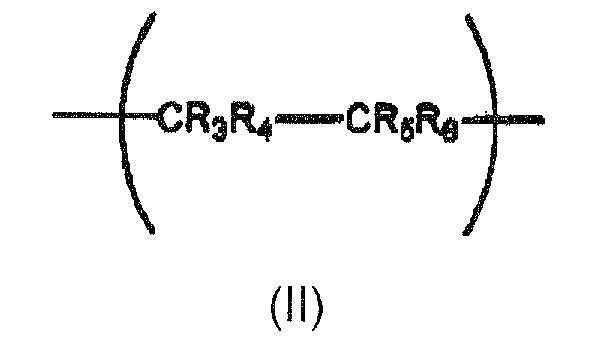
- the polymers of the invention therefore correspond to copolymers comprising one or more repeating units of formula (I) and secondly, one or more repeating units of formula (II). It is understood that these copolymers may also comprise branching units, these branching units being derived from the units of formula (I) and (II), these branching units being at the level of the branching points when the polymer is a branching agent. graft polymer.
- the W and Q groups can be positioned on the Ar group in the ortho, para and meta positions, but advantageously in the para position.
- R 3 , R 4 , R 5 and R 6 which may be identical or different, represent H, Cl, I, an optionally substituted alkyl group or a fluorinated group as defined above (ie F or an alkyl group substituted by at least one fluorine atom), the condition being that at least one of the groups R 3 , R 4 , R 5 and R 6 represents a fluorinated group, ie according to the invention, a fluorine atom or an alkyl group substituted by at least one fluorine atom.
- the polymers of the invention exhibit a mechanical resistance to temperatures above 100 ° C which is not the case of the polymers of the prior art.
- the repeating unit (s) of formula (I) are present in a minor amount relative to the repeating unit (s) of formula (II), which provides access to a good level of thermal conductivity.
- the polymers in accordance with the invention comprise from 10 to 40 mol% of repeating units of formula (I) and from 90 to 60 mol% of repeating units of formula (II).
- the molecular weight of the polymer according to the invention is generally from 10 4 to 2.10 6 g / mol.
- the equivalent molecular weight of the polymer according to the invention is generally from 800 to 1500.
- the polymer according to the invention may be a random, sequential or alternating polymer.
- the polymer is a graft polymer.
- polymers result from a grafting on a base polymer whose backbone consists of at least one repeating unit of formula (II), side chains consisting of at least one repeating unit of formula (I).
- a particular grafting technique consists in treating a base polymer comprising at least one repeating unit of formula (II) with ozone and then reacting on the polymer treated a suitable aromatic monomer allowing after polymerization to obtain side chains comprising at least one minus a repeating unit of formula (I). It is understood that the grounds allowing grafting are partially modified and constitute branching units.
- a particular graft polymer according to the invention is a polymer, in which the main chain comprises a repeating unit of formula (IIa), as defined above, and the side chain or chains consist of a repeating unit of formula (Ia). ) or (Ib) as defined above.
- the polymers that are the subject of the invention can be obtained by any type of process.
- An effective radical initiator in this process may be selected from peroxypyvalate derivatives, such as tert-butyl peroxypivalate, peroxide derivatives such as benzoyl peroxide.
- This process may comprise at the end of the polymerization step a crosslinking step by adding a crosslinking agent.
- the crosslinking agents are chosen so as to ensure a nucleophilic substitution, for example, of two fluorine atoms belonging to two distinct polymer chains.
- crosslinking agents agents having two nucleophilic functions, such as diamine compounds such as hexamethylene diamine, may be mentioned.
- the process may further comprise, after the polymerization step or possibly after the crosslinking step, an acid hydrolysis step making it possible to transform the R 1 into OH function and the R 2 in H.
- these may be prepared by a grafting process consisting of grafting onto a base polymer consisting advantageously of a main chain comprising one or more repeating units of formula (II), one or more side chains consisting of one or more repeating units of formula (I).
- the base polymer undergoes a preliminary treatment capable of creating one or more reactive sites capable of reacting with the monomer (s) of formula (III) (giving after polymerization one or more repeating units of formula (I)).
- the reactive sites created make it possible to initiate the polymerization reaction of the monomers of formula (III) to form the side chains.
- a polymer comprising a main chain comprising one or more repeating units of formula (II) and side chains of polymeric nature constituted by one or more repeating units of formula (I) is obtained.
- the preliminary treatment can be used, for example, to create on the main chain of the base polymer one or more radical sites, from which they can starting a polymerization of the aromatic monomer (s) of formula (III).
- the base polymer can be obtained by a radical polymerization process of monomer of formula (IV) or can be commercially available.
- the base polymer may be polyvinylidene fluoride.
- This base polymer for example, is subjected to an ozonization treatment.
- This ozonization treatment will make it possible to create radical sites on the backbone of the base polymer which will make it possible to initiate the polymerization of the monomers of formula (III).
- the polymers according to the invention have the peculiarity of having good chemical and mechanical stability, especially at temperatures above 100 ° C.
- the present invention also relates to a membrane comprising at least one polymer, described above.
- the membranes can be prepared conventionally, for example by casting, that is to say that the polymer is dissolved in a suitable solvent, such as acetone, and then applied to a flat surface, for example a glass plate, using a device, such as a hand applicator.
- a suitable solvent such as acetone
- the wet film forming polymer is then dried to form a film of suitable thickness, for example 15 to 150 ⁇ m, and then peeled off the substrate.
- the present invention also relates to a fuel cell device comprising one or more membranes comprising at least polymers according to the invention.
- the membrane is placed between two electrodes, for example carbon fabric, possibly platinum, and impregnated for example with polymer, according to the invention. The whole is pressed by heating.
- electrodes for example carbon fabric, possibly platinum, and impregnated for example with polymer, according to the invention. The whole is pressed by heating.
- This assembly is then inserted between two plates (for example, in graphite, called bipolar plates, which ensure the distribution of the gases and the electrical conductivity).
- Hastelloy reactor 160 ml, equipped with two valves, a safety disk and a manometer, are introduced 12.8 g (50 mmol) of aromatic monomer as defined above, 0.61 g of peroxypyvalate tert-butyl and 55 g of acetonitrile.
- the reactor is closed, evacuated and cooled to -80 ° C. and then 13.3 g (0.208 mol) of vinylidene fluoride are introduced.
- the reactor is allowed to return to room temperature and is placed in the ice cream. Then the reactor is heated to 75 ° C in an oil bath for 15 hours. After cooling to room temperature and then in ice, the reactor is brought back to ambient pressure.
- the acetonitrile is partially evaporated, then the copolymer obtained is precipitated in an Erlenmeyer flask by slow addition, dropwise, with stirring, 200 ml of cold pentane.
- the copolymer sticks to the walls of the Erlenmeyer flask and after decantation, separation and drying under vacuum at 80 ° C. to constant weight, 13 g of orange viscous product are obtained.
- the yield is 50%.
- Hastelloy reactor 160 mL, equipped with two valves, a safety disc and a pressure gauge, are introduced 8.5 g (33 mmol) of aromatic monomer as defined above, 0.77 g of peroxypyvalate tert-butyl and 55 g of acetonitrile.
- the reactor is closed, evacuated and cooled to -80 ° C., then 13.3 g (89 mmol) of hexafluoropropene and 13.3 g (0.208 mol) of vinylidene fluoride are introduced.
- the reactor is allowed to return to room temperature and is then placed in the ice. Then the reactor is heated to 75 ° C in an oil bath for 15 hours.
- Hastelloy reactor of 160 mL, equipped with two valves, a safety disc and a pressure gauge, are introduced 10 g (37 mmol) of parachlorosulfonyl- ⁇ , ⁇ , ⁇ -trifluoroxystyrene monomer, 0.56 g of tert-butyl peroxypyvalate and 55 g of acetonitrile.
- the reactor is closed, evacuated and cooled to -80 ° C. and then 13.3 g (0.208 mol) of vinylidene fluoride are introduced.
- the reactor is allowed to return to room temperature and is then placed in the ice. Then the reactor is heated to 75 ° C in an oil bath for 15 hours.
- Example 4 provides an example of preparation of a graft polymer whose main chain consists of a fluorinated aliphatic repeating unit (IIa pattern) and the side chains consist of a fluorinated aromatic repeating unit (Ia pattern) resulting from homopolymerization.
- the base polymer on the backbone of which the grafts are attached, is polyvinylidene fluoride (PVDF).
- PVDF polyvinylidene fluoride
- Example 5 provides an example of preparation of a graft polymer whose backbone consists of a fluorinated aliphatic repeating unit (IIa) and the side chains consist of a fluorinated aromatic repeating unit (unit Ib) resulting from the polymerization (para-chlorosulfonyl- ⁇ , ⁇ , ⁇ -trifluoroxystyrene).
- the base polymer on the backbone of which the grafts are attached, is polyvinylidene fluoride (PVDF).
- PVDF polyvinylidene fluoride
- This polymer undergoes an ozonization treatment, this treatment making it possible to form reactive functions, such as in Example 4.
- This example proposes the preparation of a proton exchange membrane for fuel cells from the copolymer prepared according to Example 3.
Landscapes
- Chemical & Material Sciences (AREA)
- Chemical Kinetics & Catalysis (AREA)
- Engineering & Computer Science (AREA)
- Manufacturing & Machinery (AREA)
- General Chemical & Material Sciences (AREA)
- Sustainable Energy (AREA)
- Polymers & Plastics (AREA)
- Electrochemistry (AREA)
- Sustainable Development (AREA)
- Life Sciences & Earth Sciences (AREA)
- Organic Chemistry (AREA)
- Health & Medical Sciences (AREA)
- Medicinal Chemistry (AREA)
- Inorganic Chemistry (AREA)
- Materials Engineering (AREA)
- Crystallography & Structural Chemistry (AREA)
- Fuel Cell (AREA)
- Addition Polymer Or Copolymer, Post-Treatments, Or Chemical Modifications (AREA)
- Manufacture Of Macromolecular Shaped Articles (AREA)
Claims (9)
- Fluorpolymer umfassend wenigstens eine sich wiederholende Struktureinheit der Formel (I):

 - die Gruppen X und Y, die gleich oder verschieden sind, H oder F darstellen;- die Gruppe Z F oder eine perfluorierte Alkylgruppe darstellt;- die Gruppe Ar eine zweiwertige Gruppe darstellt, die wenigstens ein gegebenenfalls substituiertes aromatisches Kohlenstoffringsystem umfasst;- die Gruppe W -O-, -OCF2-, -CF2O- oder -(CF2)n- darstellt, wobei n eine ganze Zahl von 1 bis 10 ist;- die Gruppe Q eine Einfachbindung oder eine Gruppe -(CF2)n darstellt, wobei n eine ganze Zahl von 1 bis 10 ist;- die Gruppe G eine Gruppe darstellt, die aus Folgendem ausgewählt ist:- SO2R1, wobei R1 OH, F oder Cl darstellt, oder- P(=O)(OR2)2, wobei R2 H oder eine gegebenenfalls substituierte Alkylgruppe darstellt;- die Gruppen R3, R4, R5 oder R6, die gleich oder verschieden sind, H, Cl, l, eine gegebenenfalls substituierte Alkylgruppe oder eine fluorhaltige Gruppe darstellen, die aus Folgendem ausgewählt ist:- F, einer durch wenigstens ein Fluoratom substituierten Alkylgruppe, mit der Maßgabe, dass wenigstens eines von R3, R4, R5 oder R6 eine fluorhaltige Gruppe darstellt und das Polymer ein Pfropfpolymer ist, das aus einer Hauptkette besteht, die wenigstens eine sich wiederholende Struktureinheit der vorstehend definierten Formel (II) umfasst, auf die eine oder mehr Seitenketten gepfropft sind, die aus wenigstens einer sich wiederholenden Struktureinheit der vorstehend definierten Formel (I) bestehen.
 - Polymer gemäß Anspruch 1, dessen Molekulargewicht 104 bis 2.106 g/Mol beträgt.
- Polymer gemäß Anspruch 1 oder 2, wobei das Äquivalentmolekulargewicht des erfindungsgemäßen Polymers 800 bis 1500 ist.
- Polymer gemäß einem der Ansprüche 1 bis 3, wobei die sich wiederholende Struktureinheit oder sich wiederholenden Struktureinheiten der Formel (I) in untergeordneter Menge bezüglich der sich wiederholenden Struktureinheit oder sich wiederholenden Struktureinheiten der Formel (II) vorliegen.
- Polymer gemäß Anspruch 4, das 10 bis 40 Mol-% der sich wiederholenden Struktureinheit oder sich wiederholenden Struktureinheiten der Formel (I) und 90 bis 60 Mol-% der sich wiederholenden Struktureinheit oder sich wiederholenden Struktureinheiten der Formel (II) umfasst.
- Polymer gemäß einem der Ansprüche 1 bis 5, das ein statistisches, sequentielles oder alternierendes Polymer ist.
- Polymer gemäß einem der Ansprüche 1 bis 6, bei dem die Hauptkette eine sich wiederholende Struktureinheit der Formel (IIa) umfasst:
-CH2-CF2- (IIa)
und die Seitenkette oder Seitenketten aus einer sich wiederholenden Struktureinheit der folgenden Formel (Ia) oder (Ib) bestehen:

- Membran umfassend wenigstens ein Polymer gemäß einem der Ansprüche 1 bis 7.
- Brennstoffzellensystem umfassend wenigstens eine Membran gemäß Anspruch 8.
Applications Claiming Priority (3)
| Application Number | Priority Date | Filing Date | Title |
|---|---|---|---|
| FR0210159 | 2002-08-09 | ||
| FR0210159A FR2843398B1 (fr) | 2002-08-09 | 2002-08-09 | Polymeres fluores, membranes preparees a partir de ceux-ci et dispositif de pile a combustible comprenant ces membranes |
| PCT/FR2003/002485 WO2004016665A2 (fr) | 2002-08-09 | 2003-08-07 | Polymeres fluores |
Publications (2)
| Publication Number | Publication Date |
|---|---|
| EP1529068A2 EP1529068A2 (de) | 2005-05-11 |
| EP1529068B1 true EP1529068B1 (de) | 2009-01-21 |
Family
ID=30471044
Family Applications (1)
| Application Number | Title | Priority Date | Filing Date |
|---|---|---|---|
| EP03756534A Expired - Lifetime EP1529068B1 (de) | 2002-08-09 | 2003-08-07 | Fluorpolymer |
Country Status (5)
| Country | Link |
|---|---|
| EP (1) | EP1529068B1 (de) |
| AT (1) | ATE421544T1 (de) |
| DE (1) | DE60325971D1 (de) |
| FR (1) | FR2843398B1 (de) |
| WO (1) | WO2004016665A2 (de) |
Families Citing this family (5)
| Publication number | Priority date | Publication date | Assignee | Title |
|---|---|---|---|---|
| FR2876694B1 (fr) * | 2004-10-19 | 2006-12-08 | Commissariat Energie Atomique | Polymeres fluores et membranes preparees a partir de tels polymeres, notamment pour piles a combustible et procede de synthese de tels polymeres |
| US7459505B2 (en) | 2005-05-03 | 2008-12-02 | General Motors Corporation | Block copolymers with acidic groups |
| CA2624452C (en) * | 2005-09-30 | 2015-04-07 | Battelle Memorial Institute | Polymers for use in fuel cell components |
| FR3014873B1 (fr) * | 2013-12-13 | 2017-03-31 | Commissariat Energie Atomique | Copolymeres comprenant des groupes protogenes reticulables utilisables pour constituer des membranes de pile a combustible |
| FR3089979B1 (fr) * | 2018-12-17 | 2021-11-05 | Arkema France | Polymères fluorés électroactifs comprenant des groupements polarisables |
Family Cites Families (3)
| Publication number | Priority date | Publication date | Assignee | Title |
|---|---|---|---|---|
| US5834523A (en) * | 1993-09-21 | 1998-11-10 | Ballard Power Systems, Inc. | Substituted α,β,β-trifluorostyrene-based composite membranes |
| AU5889296A (en) * | 1995-06-07 | 1996-12-30 | Ballard Power Systems Inc. | Copolymeric compositions of trifluorostyrene, substituted tr ifluorostyrene and substituted ethylene, and ion-exchange me mbranes formed therefrom |
| IT1318594B1 (it) * | 2000-06-23 | 2003-08-27 | Ausimont Spa | Processo di polimerizzazione di monomeri solfonici. |
-
2002
- 2002-08-09 FR FR0210159A patent/FR2843398B1/fr not_active Expired - Fee Related
-
2003
- 2003-08-07 AT AT03756534T patent/ATE421544T1/de not_active IP Right Cessation
- 2003-08-07 EP EP03756534A patent/EP1529068B1/de not_active Expired - Lifetime
- 2003-08-07 WO PCT/FR2003/002485 patent/WO2004016665A2/fr not_active Ceased
- 2003-08-07 DE DE60325971T patent/DE60325971D1/de not_active Expired - Lifetime
Also Published As
| Publication number | Publication date |
|---|---|
| EP1529068A2 (de) | 2005-05-11 |
| FR2843398B1 (fr) | 2007-04-27 |
| FR2843398A1 (fr) | 2004-02-13 |
| WO2004016665A3 (fr) | 2004-04-08 |
| WO2004016665A2 (fr) | 2004-02-26 |
| DE60325971D1 (de) | 2009-03-12 |
| ATE421544T1 (de) | 2009-02-15 |
Similar Documents
| Publication | Publication Date | Title |
|---|---|---|
| CA2494694C (fr) | Polymeres de type polyphenylenes, leur procede de preparation, membranes et dispositif de pile a combustible comprenant ces membranes | |
| EP0897407B1 (de) | Sulfonierte polyimide, membrane und brennstoffzelle | |
| CA2690842C (fr) | Materiau composite pour membrane de pile a combustible a base de particules inorganiques organomodifiees et procede de preparation de ceux-ci | |
| EP2601172B1 (de) | Schwefelhaltiges und sulfonhaltiges aromatisches perfluoralkanmonomer | |
| EP2611527B1 (de) | Verwendung eines funktionalisierten minerals zur chemischen stabilisierung eines polymers, eine derart stabilisierte membran, verfahren zu deren herstelllung sowie deren verwendungen | |
| EP2601243A1 (de) | Triazinpolymer zur verwendung als membran in einer kraftstoffzelle | |
| EP2081195B1 (de) | Festpolyelektrolyt, prozess zu seiner herstellung und durch verwendung des polyelektrolyts hergestellte membran-elektrodenbaugruppe für brennstoffzellen | |
| EP1529068A2 (de) | Fluorpolymer | |
| TW200915647A (en) | Membrane-electrode assembly, method for producing the same and solid polymer fuel cell | |
| KR20100022103A (ko) | 촉매 잉크, 촉매 잉크의 제조 방법, 막-전극 접합체의 제조 방법 및 이것에 의해 얻어지는 막-전극 접합체, 그리고 연료 전지 | |
| EP3501050B1 (de) | Verfahren zur herstellung von protonenleitenden partikeln, welche die sauerstoffreduktion oder die wasserstoffoxidation katalysieren, durch pfropfung von spezifischen protonenleitenden fluorierten polymeren auf deren oberflächen | |
| EP3080173B1 (de) | Copolymere mit vernetzbaren protogenen gruppen für ein brennstoffzellmembranen | |
| EP2454295A1 (de) | Fluorierte copolymere, daraus hergestellte membranen und brennstoffzellenelement mit diesen membranen | |
| EP3573751B1 (de) | Eine brennstoffzellenmembran | |
| WO2001025312A1 (fr) | Polyimides sulfones, membranes preparees avec ceux-ci et dispositif de pile a combustible comportant ces membranes | |
| EP2774946A1 (de) | Verwendung eines functionalisierten polysiloxannetzes zur chemischen stabilisierung eines polymers, derart stabilisierte membran, herstellungsverfahren dafür und verwendungen davon | |
| WO2001065623A1 (fr) | Procede de preparation d'assemblages electrode - membrane, assemblages ainsi obtenus et piles a combustible comprenant ces assemblages | |
| EP2697857B1 (de) | Phosphonierte spezifische copolymere und damit gepfropfte anorganische partikel | |
| FR2988395A1 (fr) | Suspension aqueuse comprenant des particules de catalyseur metallique et des particules de polymere specifique conducteur de protons utilisable pour la fabrication de couche active d'electrode | |
| JP2008311147A (ja) | 膜−電極接合体及びその製造方法、並びに固体高分子型燃料電池 |
Legal Events
| Date | Code | Title | Description |
|---|---|---|---|
| PUAI | Public reference made under article 153(3) epc to a published international application that has entered the european phase |
Free format text: ORIGINAL CODE: 0009012 |
|
| 17P | Request for examination filed |
Effective date: 20050104 |
|
| AK | Designated contracting states |
Kind code of ref document: A2 Designated state(s): AT BE BG CH CY CZ DE DK EE ES FI FR GB GR HU IE IT LI LU MC NL PT RO SE SI SK TR |
|
| RAP1 | Party data changed (applicant data changed or rights of an application transferred) |
Owner name: COMMISSARIAT A L'ENERGIE ATOMIQUE |
|
| RIN1 | Information on inventor provided before grant (corrected) |
Inventor name: SOUZY, RENAUD Inventor name: PINERI, MICHEL Inventor name: AMEDURI, BRUNO Inventor name: MARSACQ, DIDIER |
|
| 17Q | First examination report despatched |
Effective date: 20071018 |
|
| GRAP | Despatch of communication of intention to grant a patent |
Free format text: ORIGINAL CODE: EPIDOSNIGR1 |
|
| RTI1 | Title (correction) |
Free format text: FLUORINATED POLYMERS, |
|
| GRAS | Grant fee paid |
Free format text: ORIGINAL CODE: EPIDOSNIGR3 |
|
| GRAA | (expected) grant |
Free format text: ORIGINAL CODE: 0009210 |
|
| AK | Designated contracting states |
Kind code of ref document: B1 Designated state(s): AT BE BG CH CY CZ DE DK EE ES FI FR GB GR HU IE IT LI LU MC NL PT RO SE SI SK TR |
|
| REG | Reference to a national code |
Ref country code: GB Ref legal event code: FG4D Free format text: NOT ENGLISH |
|
| REG | Reference to a national code |
Ref country code: CH Ref legal event code: EP |
|
| REG | Reference to a national code |
Ref country code: IE Ref legal event code: FG4D Free format text: LANGUAGE OF EP DOCUMENT: FRENCH |
|
| REF | Corresponds to: |
Ref document number: 60325971 Country of ref document: DE Date of ref document: 20090312 Kind code of ref document: P |
|
| PG25 | Lapsed in a contracting state [announced via postgrant information from national office to epo] |
Ref country code: NL Free format text: LAPSE BECAUSE OF FAILURE TO SUBMIT A TRANSLATION OF THE DESCRIPTION OR TO PAY THE FEE WITHIN THE PRESCRIBED TIME-LIMIT Effective date: 20090121 |
|
| NLV1 | Nl: lapsed or annulled due to failure to fulfill the requirements of art. 29p and 29m of the patents act | ||
| PG25 | Lapsed in a contracting state [announced via postgrant information from national office to epo] |
Ref country code: SI Free format text: LAPSE BECAUSE OF FAILURE TO SUBMIT A TRANSLATION OF THE DESCRIPTION OR TO PAY THE FEE WITHIN THE PRESCRIBED TIME-LIMIT Effective date: 20090121 Ref country code: FI Free format text: LAPSE BECAUSE OF FAILURE TO SUBMIT A TRANSLATION OF THE DESCRIPTION OR TO PAY THE FEE WITHIN THE PRESCRIBED TIME-LIMIT Effective date: 20090121 Ref country code: ES Free format text: LAPSE BECAUSE OF FAILURE TO SUBMIT A TRANSLATION OF THE DESCRIPTION OR TO PAY THE FEE WITHIN THE PRESCRIBED TIME-LIMIT Effective date: 20090502 |
|
| REG | Reference to a national code |
Ref country code: IE Ref legal event code: FD4D |
|
| PG25 | Lapsed in a contracting state [announced via postgrant information from national office to epo] |
Ref country code: PT Free format text: LAPSE BECAUSE OF FAILURE TO SUBMIT A TRANSLATION OF THE DESCRIPTION OR TO PAY THE FEE WITHIN THE PRESCRIBED TIME-LIMIT Effective date: 20090622 Ref country code: AT Free format text: LAPSE BECAUSE OF FAILURE TO SUBMIT A TRANSLATION OF THE DESCRIPTION OR TO PAY THE FEE WITHIN THE PRESCRIBED TIME-LIMIT Effective date: 20090121 Ref country code: SE Free format text: LAPSE BECAUSE OF FAILURE TO SUBMIT A TRANSLATION OF THE DESCRIPTION OR TO PAY THE FEE WITHIN THE PRESCRIBED TIME-LIMIT Effective date: 20090421 |
|
| PG25 | Lapsed in a contracting state [announced via postgrant information from national office to epo] |
Ref country code: CZ Free format text: LAPSE BECAUSE OF FAILURE TO SUBMIT A TRANSLATION OF THE DESCRIPTION OR TO PAY THE FEE WITHIN THE PRESCRIBED TIME-LIMIT Effective date: 20090121 Ref country code: DK Free format text: LAPSE BECAUSE OF FAILURE TO SUBMIT A TRANSLATION OF THE DESCRIPTION OR TO PAY THE FEE WITHIN THE PRESCRIBED TIME-LIMIT Effective date: 20090121 Ref country code: IE Free format text: LAPSE BECAUSE OF FAILURE TO SUBMIT A TRANSLATION OF THE DESCRIPTION OR TO PAY THE FEE WITHIN THE PRESCRIBED TIME-LIMIT Effective date: 20090121 Ref country code: EE Free format text: LAPSE BECAUSE OF FAILURE TO SUBMIT A TRANSLATION OF THE DESCRIPTION OR TO PAY THE FEE WITHIN THE PRESCRIBED TIME-LIMIT Effective date: 20090121 |
|
| PLBE | No opposition filed within time limit |
Free format text: ORIGINAL CODE: 0009261 |
|
| STAA | Information on the status of an ep patent application or granted ep patent |
Free format text: STATUS: NO OPPOSITION FILED WITHIN TIME LIMIT |
|
| PG25 | Lapsed in a contracting state [announced via postgrant information from national office to epo] |
Ref country code: SK Free format text: LAPSE BECAUSE OF FAILURE TO SUBMIT A TRANSLATION OF THE DESCRIPTION OR TO PAY THE FEE WITHIN THE PRESCRIBED TIME-LIMIT Effective date: 20090121 Ref country code: RO Free format text: LAPSE BECAUSE OF FAILURE TO SUBMIT A TRANSLATION OF THE DESCRIPTION OR TO PAY THE FEE WITHIN THE PRESCRIBED TIME-LIMIT Effective date: 20090121 |
|
| 26N | No opposition filed |
Effective date: 20091022 |
|
| PG25 | Lapsed in a contracting state [announced via postgrant information from national office to epo] |
Ref country code: BG Free format text: LAPSE BECAUSE OF FAILURE TO SUBMIT A TRANSLATION OF THE DESCRIPTION OR TO PAY THE FEE WITHIN THE PRESCRIBED TIME-LIMIT Effective date: 20090421 |
|
| BERE | Be: lapsed |
Owner name: COMMISSARIAT A L'ENERGIE ATOMIQUE Effective date: 20090831 |
|
| REG | Reference to a national code |
Ref country code: FR Ref legal event code: TQ |
|
| PG25 | Lapsed in a contracting state [announced via postgrant information from national office to epo] |
Ref country code: MC Free format text: LAPSE BECAUSE OF NON-PAYMENT OF DUE FEES Effective date: 20090831 |
|
| REG | Reference to a national code |
Ref country code: CH Ref legal event code: PL |
|
| GBPC | Gb: european patent ceased through non-payment of renewal fee |
Effective date: 20090807 |
|
| PG25 | Lapsed in a contracting state [announced via postgrant information from national office to epo] |
Ref country code: LI Free format text: LAPSE BECAUSE OF NON-PAYMENT OF DUE FEES Effective date: 20090831 Ref country code: CH Free format text: LAPSE BECAUSE OF NON-PAYMENT OF DUE FEES Effective date: 20090831 |
|
| PG25 | Lapsed in a contracting state [announced via postgrant information from national office to epo] |
Ref country code: BE Free format text: LAPSE BECAUSE OF NON-PAYMENT OF DUE FEES Effective date: 20090831 |
|
| PG25 | Lapsed in a contracting state [announced via postgrant information from national office to epo] |
Ref country code: GR Free format text: LAPSE BECAUSE OF FAILURE TO SUBMIT A TRANSLATION OF THE DESCRIPTION OR TO PAY THE FEE WITHIN THE PRESCRIBED TIME-LIMIT Effective date: 20090422 |
|
| PG25 | Lapsed in a contracting state [announced via postgrant information from national office to epo] |
Ref country code: GB Free format text: LAPSE BECAUSE OF NON-PAYMENT OF DUE FEES Effective date: 20090807 |
|
| PG25 | Lapsed in a contracting state [announced via postgrant information from national office to epo] |
Ref country code: IT Free format text: LAPSE BECAUSE OF FAILURE TO SUBMIT A TRANSLATION OF THE DESCRIPTION OR TO PAY THE FEE WITHIN THE PRESCRIBED TIME-LIMIT Effective date: 20090121 |
|
| PG25 | Lapsed in a contracting state [announced via postgrant information from national office to epo] |
Ref country code: LU Free format text: LAPSE BECAUSE OF NON-PAYMENT OF DUE FEES Effective date: 20090807 |
|
| PG25 | Lapsed in a contracting state [announced via postgrant information from national office to epo] |
Ref country code: HU Free format text: LAPSE BECAUSE OF FAILURE TO SUBMIT A TRANSLATION OF THE DESCRIPTION OR TO PAY THE FEE WITHIN THE PRESCRIBED TIME-LIMIT Effective date: 20090722 |
|
| PG25 | Lapsed in a contracting state [announced via postgrant information from national office to epo] |
Ref country code: TR Free format text: LAPSE BECAUSE OF FAILURE TO SUBMIT A TRANSLATION OF THE DESCRIPTION OR TO PAY THE FEE WITHIN THE PRESCRIBED TIME-LIMIT Effective date: 20090121 |
|
| PG25 | Lapsed in a contracting state [announced via postgrant information from national office to epo] |
Ref country code: CY Free format text: LAPSE BECAUSE OF FAILURE TO SUBMIT A TRANSLATION OF THE DESCRIPTION OR TO PAY THE FEE WITHIN THE PRESCRIBED TIME-LIMIT Effective date: 20090121 |
|
| REG | Reference to a national code |
Ref country code: FR Ref legal event code: PLFP Year of fee payment: 14 |
|
| REG | Reference to a national code |
Ref country code: FR Ref legal event code: PLFP Year of fee payment: 15 |
|
| PGFP | Annual fee paid to national office [announced via postgrant information from national office to epo] |
Ref country code: FR Payment date: 20170831 Year of fee payment: 15 Ref country code: DE Payment date: 20170817 Year of fee payment: 15 |
|
| REG | Reference to a national code |
Ref country code: DE Ref legal event code: R119 Ref document number: 60325971 Country of ref document: DE |
|
| PG25 | Lapsed in a contracting state [announced via postgrant information from national office to epo] |
Ref country code: DE Free format text: LAPSE BECAUSE OF NON-PAYMENT OF DUE FEES Effective date: 20190301 |
|
| PG25 | Lapsed in a contracting state [announced via postgrant information from national office to epo] |
Ref country code: FR Free format text: LAPSE BECAUSE OF NON-PAYMENT OF DUE FEES Effective date: 20180831 |