EP1528617A2 - Lithium battery having effective performance - Google Patents
Lithium battery having effective performance Download PDFInfo
- Publication number
- EP1528617A2 EP1528617A2 EP04256676A EP04256676A EP1528617A2 EP 1528617 A2 EP1528617 A2 EP 1528617A2 EP 04256676 A EP04256676 A EP 04256676A EP 04256676 A EP04256676 A EP 04256676A EP 1528617 A2 EP1528617 A2 EP 1528617A2
- Authority
- EP
- European Patent Office
- Prior art keywords
- carbonate
- volume
- parts
- lithium battery
- mixed solvent
- Prior art date
- Legal status (The legal status is an assumption and is not a legal conclusion. Google has not performed a legal analysis and makes no representation as to the accuracy of the status listed.)
- Granted
Links
Images


Classifications
-
- H—ELECTRICITY
- H01—ELECTRIC ELEMENTS
- H01M—PROCESSES OR MEANS, e.g. BATTERIES, FOR THE DIRECT CONVERSION OF CHEMICAL ENERGY INTO ELECTRICAL ENERGY
- H01M10/00—Secondary cells; Manufacture thereof
- H01M10/05—Accumulators with non-aqueous electrolyte
- H01M10/056—Accumulators with non-aqueous electrolyte characterised by the materials used as electrolytes, e.g. mixed inorganic/organic electrolytes
- H01M10/0564—Accumulators with non-aqueous electrolyte characterised by the materials used as electrolytes, e.g. mixed inorganic/organic electrolytes the electrolyte being constituted of organic materials only
- H01M10/0566—Liquid materials
- H01M10/0568—Liquid materials characterised by the solutes
-
- H—ELECTRICITY
- H01—ELECTRIC ELEMENTS
- H01M—PROCESSES OR MEANS, e.g. BATTERIES, FOR THE DIRECT CONVERSION OF CHEMICAL ENERGY INTO ELECTRICAL ENERGY
- H01M10/00—Secondary cells; Manufacture thereof
- H01M10/05—Accumulators with non-aqueous electrolyte
- H01M10/052—Li-accumulators
-
- H—ELECTRICITY
- H01—ELECTRIC ELEMENTS
- H01M—PROCESSES OR MEANS, e.g. BATTERIES, FOR THE DIRECT CONVERSION OF CHEMICAL ENERGY INTO ELECTRICAL ENERGY
- H01M10/00—Secondary cells; Manufacture thereof
- H01M10/05—Accumulators with non-aqueous electrolyte
- H01M10/052—Li-accumulators
- H01M10/0525—Rocking-chair batteries, i.e. batteries with lithium insertion or intercalation in both electrodes; Lithium-ion batteries
-
- H—ELECTRICITY
- H01—ELECTRIC ELEMENTS
- H01M—PROCESSES OR MEANS, e.g. BATTERIES, FOR THE DIRECT CONVERSION OF CHEMICAL ENERGY INTO ELECTRICAL ENERGY
- H01M10/00—Secondary cells; Manufacture thereof
- H01M10/05—Accumulators with non-aqueous electrolyte
- H01M10/056—Accumulators with non-aqueous electrolyte characterised by the materials used as electrolytes, e.g. mixed inorganic/organic electrolytes
- H01M10/0564—Accumulators with non-aqueous electrolyte characterised by the materials used as electrolytes, e.g. mixed inorganic/organic electrolytes the electrolyte being constituted of organic materials only
- H01M10/0566—Liquid materials
- H01M10/0569—Liquid materials characterised by the solvents
-
- H—ELECTRICITY
- H01—ELECTRIC ELEMENTS
- H01M—PROCESSES OR MEANS, e.g. BATTERIES, FOR THE DIRECT CONVERSION OF CHEMICAL ENERGY INTO ELECTRICAL ENERGY
- H01M4/00—Electrodes
- H01M4/02—Electrodes composed of, or comprising, active material
- H01M4/36—Selection of substances as active materials, active masses, active liquids
- H01M4/48—Selection of substances as active materials, active masses, active liquids of inorganic oxides or hydroxides
- H01M4/485—Selection of substances as active materials, active masses, active liquids of inorganic oxides or hydroxides of mixed oxides or hydroxides for inserting or intercalating light metals, e.g. LiTi2O4 or LiTi2OxFy
-
- H—ELECTRICITY
- H01—ELECTRIC ELEMENTS
- H01M—PROCESSES OR MEANS, e.g. BATTERIES, FOR THE DIRECT CONVERSION OF CHEMICAL ENERGY INTO ELECTRICAL ENERGY
- H01M4/00—Electrodes
- H01M4/02—Electrodes composed of, or comprising, active material
- H01M4/36—Selection of substances as active materials, active masses, active liquids
- H01M4/48—Selection of substances as active materials, active masses, active liquids of inorganic oxides or hydroxides
- H01M4/50—Selection of substances as active materials, active masses, active liquids of inorganic oxides or hydroxides of manganese
- H01M4/505—Selection of substances as active materials, active masses, active liquids of inorganic oxides or hydroxides of manganese of mixed oxides or hydroxides containing manganese for inserting or intercalating light metals, e.g. LiMn2O4 or LiMn2OxFy
-
- H—ELECTRICITY
- H01—ELECTRIC ELEMENTS
- H01M—PROCESSES OR MEANS, e.g. BATTERIES, FOR THE DIRECT CONVERSION OF CHEMICAL ENERGY INTO ELECTRICAL ENERGY
- H01M4/00—Electrodes
- H01M4/02—Electrodes composed of, or comprising, active material
- H01M4/36—Selection of substances as active materials, active masses, active liquids
- H01M4/48—Selection of substances as active materials, active masses, active liquids of inorganic oxides or hydroxides
- H01M4/52—Selection of substances as active materials, active masses, active liquids of inorganic oxides or hydroxides of nickel, cobalt or iron
- H01M4/525—Selection of substances as active materials, active masses, active liquids of inorganic oxides or hydroxides of nickel, cobalt or iron of mixed oxides or hydroxides containing iron, cobalt or nickel for inserting or intercalating light metals, e.g. LiNiO2, LiCoO2 or LiCoOxFy
-
- H—ELECTRICITY
- H01—ELECTRIC ELEMENTS
- H01M—PROCESSES OR MEANS, e.g. BATTERIES, FOR THE DIRECT CONVERSION OF CHEMICAL ENERGY INTO ELECTRICAL ENERGY
- H01M4/00—Electrodes
- H01M4/02—Electrodes composed of, or comprising, active material
- H01M4/13—Electrodes for accumulators with non-aqueous electrolyte, e.g. for lithium-accumulators; Processes of manufacture thereof
- H01M4/131—Electrodes based on mixed oxides or hydroxides, or on mixtures of oxides or hydroxides, e.g. LiCoOx
-
- H—ELECTRICITY
- H01—ELECTRIC ELEMENTS
- H01M—PROCESSES OR MEANS, e.g. BATTERIES, FOR THE DIRECT CONVERSION OF CHEMICAL ENERGY INTO ELECTRICAL ENERGY
- H01M4/00—Electrodes
- H01M4/02—Electrodes composed of, or comprising, active material
- H01M4/13—Electrodes for accumulators with non-aqueous electrolyte, e.g. for lithium-accumulators; Processes of manufacture thereof
- H01M4/133—Electrodes based on carbonaceous material, e.g. graphite-intercalation compounds or CFx
-
- Y—GENERAL TAGGING OF NEW TECHNOLOGICAL DEVELOPMENTS; GENERAL TAGGING OF CROSS-SECTIONAL TECHNOLOGIES SPANNING OVER SEVERAL SECTIONS OF THE IPC; TECHNICAL SUBJECTS COVERED BY FORMER USPC CROSS-REFERENCE ART COLLECTIONS [XRACs] AND DIGESTS
- Y02—TECHNOLOGIES OR APPLICATIONS FOR MITIGATION OR ADAPTATION AGAINST CLIMATE CHANGE
- Y02E—REDUCTION OF GREENHOUSE GAS [GHG] EMISSIONS, RELATED TO ENERGY GENERATION, TRANSMISSION OR DISTRIBUTION
- Y02E60/00—Enabling technologies; Technologies with a potential or indirect contribution to GHG emissions mitigation
- Y02E60/10—Energy storage using batteries
Definitions
- the present invention relates to a lithium battery, and, more particularly, to a lithium battery using a non-aqueous solvent for extended charge/discharge cycle life, improved high-temperature storage stability and improved low-temperature discharge characteristics.
- Lithium batteries that are widely being used as power supplies for portable electronic devices such as notebook computers, camcorders or mobile phones, include a cathode containing a lithium metal composite oxide or sulfur capable of intercalating and deintercalating lithium ions, an anode containing a carbon material or lithium metal, and an electrolytic solution having an appropriate amount of a lithium salt dissolved in a non-aqueous mixed solvent.
- the average discharge voltage of lithium batteries is in a range of about 3.6 to about 3.7 V, which is relatively higher than that of other alkali batteries or nickelcadmium batteries.
- a mixed solvent having a cyclic carbonate such as ethylene carbonate or propylene carbonate, and a linear carbonate such as dimethyl carbonate, ethylmethyl carbonate or diethyl carbonate, mixed in each appropriate amount, is used as a solvent for the electrolytic solution.
- a lithium salt such as LiPF 6 , LiBF 4 or LiClO 4 is typically used as a solute for the electrolytic solution, and serves as a source of lithium ions in a cell, allowing the lithium battery to operate.
- lithium ions in a cathode active material such as lithium metal composite oxide move to an anode active material such as graphite and are intercalated between lattice planes of the anode active material.
- anode active material such as graphite
- the lithium ions in the electrolytic solution react with carbon of the anode active material such as graphite on the surface of the anode active material, thus producing compounds such as Li 2 CO 3 , Li 2 O, LiOH or the like.
- SEI solid electrolyte interface
- the SEI film works as an ion tunnel and allows only lithium ions to pass through.
- the SEI film working as an ion tunnel prevents a laminated structure of an anode from being disintegrated by intercalation of high molecular weight organic solvent molecules moving with lithium ions in the electrolytic solution to the anode active material.
- the electrolytic solution and the anode active material do not contact each other by the SEI film, so that the electrolytic solution is not decomposed by intercalation of high molecular weight organic solvent molecules and the amount of lithium ions in the electrolytic solution is reversibly maintained, thereby ensuring stable charge and discharge.
- the thickness of the battery may increase during charging due to a gas such as CO, CO 2 , CH 4 , C 2 H 6 or the like generated when a carbonate-based solvent is decomposed during formation of the SEI film, as described in C. R. Yang, Y. Y. Wang and C. C. Wan, J. Power Sources, pages 66 - 70, Vol. 72, 1998.
- a gas such as CO, CO 2 , CH 4 , C 2 H 6 or the like generated when a carbonate-based solvent is decomposed during formation of the SEI film, as described in C. R. Yang, Y. Y. Wang and C. C. Wan, J. Power Sources, pages 66 - 70, Vol. 72, 1998.
- Japanese Patent Laid-Open Publication No. Hei 07-176323 disclosing an electrolytic solution having CO 2 added thereto.
- Japanese Patent Laid-Open Publication No. Hei 07-320779 discloses a technique of suppressing decomposition of an electrolytic solution by adding a sulfide-based compound thereto.
- Japanese Patent Laid-Open Publication No. Hei 09-73918 discloses a battery having improved high-temperature storage stability using diphenyl picryl hydrazyl (DPPH).
- Japanese Patent Laid-Open Publication No. Hei 08-321313 discloses a battery having an improved charge/discharge cycle by adding a specific compound to an electrolytic solution.
- a nonaqueous solvent contained in a conventional lithium battery employs a mixed solvent having a large amount of ethylene carbonate as a cyclic carbonate compound having a high dielectric constant and an appropriate amount of low-viscosity linear carbonate compound such as dimethyl carbonate or diethyl carbonate.
- a mixed solvent having a large amount of ethylene carbonate as a cyclic carbonate compound having a high dielectric constant and an appropriate amount of low-viscosity linear carbonate compound such as dimethyl carbonate or diethyl carbonate.
- US 5,686,138 discloses a lithium secondary battery using a nonaqueous solvent comprising 20 to 80% by volume of ethylene carbonate.
- an SEI film is structurally unstable, resulting in a sharp increase of the internal pressure of the battery.
- ethylene carbonate Since ethylene carbonate has a relatively high freezing point, i.e. , 37 to 39°C, it is at a solid state at room temperature, meaning that its ion conductivity is low at low temperature. Thus, a lithium battery using a nonaqueous solvent comprising a large amount of ethylene carbonate has poor low-temperature conductivity. To solve this problem, methods for providing a lithium secondary battery having good high-rate discharge characteristics at low temperature have been proposed.
- Japanese Patent Laid-Open Publication No. Hei 07-153486 discloses a lithium secondary battery using an electrolytic solution comprising 0.5 to 50% by volume of ⁇ -butyrolactone and a mixture of ethylene carbonate and dimethyl carbonate in a volume ratio of 1:1. Although adding ⁇ -butyrolactone improves high-rate discharge characteristics at low temperature, life characteristics of a battery may deteriorate.
- U.S. Patent No. 6,503,657 discloses a nonaqueous electrolyte secondary battery using a nonaqueous solvent comprising 5 to 40% by volume of ethylene carbonate, 40 to 95% by volume of ⁇ -butyrolactone and 0.05 to 10% by volume of vinylene carbonate.
- a nonaqueous solvent comprising 5 to 40% by volume of ethylene carbonate, 40 to 95% by volume of ⁇ -butyrolactone and 0.05 to 10% by volume of vinylene carbonate.
- Japanese Patent Laid-Open Publication No. Hei 06-20721 discloses a nonaqueous secondary battery comprising a carbonaceous cathode including graphite having d-value (d 002 ) of the lattice plane (002) obtained by X-ray diffraction of less than 0.337, 20 to 50% by volume of ⁇ -butyrolactone and a remainder of cyclic carbonates.
- d 002 the lattice plane obtained by X-ray diffraction of less than 0.337
- 20 to 50% by volume of ⁇ -butyrolactone and a remainder of cyclic carbonates.
- the nonaqueous solvent does not contain linear carbonates, the viscosity of an electrolytic solution is high so that the ion conductivity is low, and low-temperature discharge capacity may deteriorate.
- Japanese Patent Laid-Open Publication No. Hei 08-64242 discloses a nonaqueous secondary battery using a mixed solvent comprising 10 to 50% by volume of ⁇ -butyrolactone and/or sulfolane, and 90 to 50% by volume of dimethyl carbonate.
- the nonaqueous electrolytic solution system of the secondary battery has a low dielectric constant, resulting in poor life characteristics of the battery.
- a lithium battery which can exhibit improved charge/discharge cycle characteristics, effective high-temperature storage stability and effective low-temperature discharge characteristics by varying compositions of a nonaqueous mixed solvent used for an electrolytic solution of a conventional lithium battery.
- the first preferred embodiment of the lithium battery comprises an anode, a cathode, a separator, and an electrolytic solution.
- the anode preferably comprises mainly a carbon material.
- the cathode comprises mainly a compound capable of intercalating and deintercalating lithium.
- the separator is interposed between the cathode and the anode.
- the electrolytic solution has an electrolyte solute dissolved in a nonaqueous solvent, which comprises a mixed solvent containing 8 to 15% by volume of ethylene carbonate, 10 to 35% by volume of ⁇ -butyrolactone, 35 to 65% by volume of at least one linear carbonate selected from the group consisting of dimethyl carbonate, diethyl carbonate, ethylmethyl carbonate, methylpropyl carbonate, ethylpropyl carbonate and methylbutyl carbonate and 8 to 15% by volume of fluorobenzene, and 0.5 to 9 parts by volume of vinylene carbonate based on 100 parts by volume of the mixed solvent.
- a nonaqueous solvent which comprises a mixed solvent containing 8 to 15% by volume of ethylene carbonate, 10 to 35% by volume of ⁇ -butyrolactone, 35 to 65% by volume of at least one linear carbonate selected from the group consisting of dimethyl carbonate, diethyl carbonate, ethylmethyl carbonate, methylpropy
- a lithium battery comprising an anode, a cathode, a separator, and an electrolytic solution.
- the anode preferably comprises mainly a carbon material.
- the cathode comprises mainly a compound capable of intercalating and deintercalating lithium.
- the separator is disposed between the anode and the cathode.
- the electrolyte solution has an electrolyte solute dissolved in a nonaqueous solvent, which comprises a mixed solvent containing 8 to 15% by volume of ethylene carbonate, 10 to 35% by volume of ⁇ -butyrolactone, 35 to 65% by volume of linear carbonate selected from the group consisting of dimethyl carbonate, diethyl carbonate, ethylmethyl carbonate, methylpropyl carbonate, ethylpropyl carbonate and methylbutyl carbonate, and 8 to 15% by volume of fluorobenzene, 0.5 to 9 parts by volume of vinylene carbonate based on the volume of the mixed solvent, and 0.05 to 5 parts by volume of vinyl sulfone, isooxazole or a mixture thereof based on 100 parts by volume of the mixed solvent.
- a nonaqueous solvent which comprises a mixed solvent containing 8 to 15% by volume of ethylene carbonate, 10 to 35% by volume of ⁇ -butyrolactone, 35 to 65% by volume of linear carbon
- the nonaqueous solvent for a lithium battery according to the invention includes not more than 15% by volume of ethylene carbonate, which is quite a small amount compared to a composition of the conventional nonaqueous solvent, while satisfying various characteristics required for lithium batteries that can be commercially acceptable.
- the nonaqueous solvent used for a lithium battery according to the invention comprises vinylene carbonate dissolved alone or in combination with vinyl sulfone, isooxazole or a mixture thereof in a mixed solvent containing ethylene carbonate and ⁇ -butyrolactone for a high dielectric constant, linear carbonate for low viscosity, and fluorobenzene for high ion conductivity.
- a lithium battery according to the present invention will now be described in more detail.
- the lithium battery according to the first embodiment of the present invention includes an anode, a cathode, a separator, and an electrolyte solution.
- the anode is preferably composed mainly of a carbon material.
- the cathode is composed mainly of a compound capable of intercalating and deintercalating lithium.
- the separator is interposed between the cathode and the anode.
- the electrolyte solution has an electrolyte solute dissolved in a nonaqueous solvent.
- the nonaqueous solvent includes a mixed solvent containing 8 to 15% by volume of ethylene carbonate (EC), 10 to 35% by volume of ⁇ -butyrolactone (GBL), 35 to 65% by volume of at least one linear carbonate selected from the group consisting of dimethyl carbonate (DMC), diethyl carbonate (DEC), ethylmethyl carbonate (EMC), methylpropyl carbonate (MPC), ethylpropyl carbonate (EPC) and methylbutyl carbonate (MBC) and 8 to 15% by volume of fluorobenzene (FB), and 0.5 to 9 parts by volume of vinylene carbonate (VC) based on 100 parts by volume of the mixed solvent.
- DMC dimethyl carbonate
- DEC diethyl carbonate
- EMC ethylmethyl carbonate
- MPC methylpropyl carbonate
- EPC ethylpropyl carbonate
- MMC methylbutyl carbonate
- FB fluorobenzene
- the anode has a stacked structure in which an anode active material layer is stacked on an anode plate, e.g. , a copper foil, by a binder.
- anode active material include, but not limited to, crystalline carbon, amorphous carbon, crystalline graphite, amorphous graphite or combinations thereof.
- Preferred examples of the binder include polyvinylidene fluoride (PVDF), a copolymer of vinylidene fluoride and hexafluoropropylene, styrene-butadien rubber (SBR), and polyacrylonitrile, etc.
- a relative weight ratio of the anode active material to the binder is preferably in a range of 90:10 to 98:2. If the relative weight of the anode active material is less than 90, a discharge capacity of a battery is insufficient. If the relative weight of the binder is less than 2, adhesion between the anode plate and the anode active material layer is insufficient.
- the anode active material layer may further include conductive particles such as carbon black, acetylene black or ketene black, in a conventionally acceptable amount.
- the anode active material layer may further include additives that have been conventionally used. Usable examples of the additives include oxalic acid, maleic acid and the like.
- the cathode has a stacked structure in which a cathode active material layer is stacked on a cathode plate, e.g., an aluminum or aluminum alloy foil.
- a cathode active material layer a cathode active material and conductive particles are stacked on the cathode plate by a binder.
- the cathode active material must have a function of intercalating and deintercalating lithium.
- the cathode active material may be a lithium composite oxide, preferably, Li x MO 2 or Li y M 2 O 4 (where M is a transition element, 0 ⁇ x ⁇ 1 and 0 ⁇ y ⁇ 2).
- the cathode active material is at least one selected from the group consisting of LiCoO 2 , LiMnO 2 , LiNiO 2 , LiCrO 2 and LiMn 2 O 4 , etc.
- sulfur or a sulfur-containing compound may be used as the cathode active material.
- the conductive particles used for the cathode active material layer are preferably at least one selected from the group consisting of carbon black, acetylene black and keten black, like in the case of the anode active material.
- Preferred examples of the binder include PVDF, a vinylidene fluoride-hexafluoropropylene (VDF-HFP) copolymer, SBR and the like, like in the anode active material layer.
- a relative weight ratio of the cathode active material to the binder is preferably in a range of 90:10 to 98:2.
- the cathode active material layer may further include additives that have been conventionally used.
- the additives include alkoxide compounds, boron based compounds and the like.
- a separator is interposed between the cathode and the anode.
- the separator not only prevents electrical short between the cathode and the anode but also provides a movement passage of lithium ions.
- Suitable examples of the separator useful in the present invention include a polyolefin-based separator, fluorinated polyolefin-based separator, fluorine resin based separator such as a polyethylene separator, a polypropylene separator, a polyvinylidene fluoride separator, a VDF-HFP copolymer separator, a polyethylene/polypropylene bilayer separator, a polypropylene/polyethylene/ polypropylene triple layer separator or a polyethylene/polypropylene/polyethylene triple layer separator, and the like.
- An electrolytic solution is impregnated into an electrode unit having the anode, the separator and the cathode.
- the electrolytic solution includes a nonaqueous solvent and an electrolyte solute dissolved in the nonaqueous solvent.
- the electrolyte solute is preferably selected from the group consisting of LiPF 6 , LiBF 4 , LiClO 4 , LiCF 3 SO 3 , LiC 4 F 9 SO 3 , LiN(CF 3 SO 2 ) 2 and LiAsF 6 .
- the electrolyte solute is preferably used at a concentration in a range of 0.8 to 2.5 M. If the concentration of the electrolyte solute is less than 0.8 M, or greater than 2.5 M, life characteristics of a battery may deteriorate.
- the non-aqueous solvent used for the lithium battery according to the first embodiment of the present invention comprises a mixed solvent containing 8 to 15% by volume of ethylene carbonate, 10 to 35% by volume of ⁇ -butyrolactone, 35 to 65% by volume of at least one linear carbonate selected from the group consisting of dimethyl carbonate, diethyl carbonate, ethylmethyl carbonate, methylpropyl carbonate, ethylpropyl carbonate and methylbutyl carbonate and 8 to 15% by volume of fluorobenzene, and 0.5 to 9 parts by volume of vinylene carbonate based on 100 parts by volume of the mixed solvent.
- ethylene carbonate Since ethylene carbonate has a high dielectric constant, it has been generally used in a large amount, generally 20 to 80% by volume, in order to obtain greater than or equal to a predetermined level of dielectric constant. However, if ethylene carbonate is contained in the nonaqueous solvent in a large amount, because of its high freezing point, that is, 37 to 39°C, the ion conductivity of the electrolytic solution at low temperature may deteriorate, resulting in deterioration of discharge characteristics at low temperature.
- the nonaqueous solvent system comprises ethylene carbonate at a low amount of 8 to 15% by volume, preferably, 10 to 15% by volume.
- the nonaqueous solvent system according to the present invention comprises 10 to 35%, preferably 15 to 25%, by volume of ⁇ -butyrolactone, which has a relatively high dielectric constant. Since ⁇ -butyrolactone has a low freezing point of - 45°C, it has a low-temperature ion conductivity greater than that of ethylene carbonate and can alleviate swelling occurring when the battery is stored at high temperature for an extended period of time. Also, since it has lower viscosity than ethylene carbonate, it can be advantageously used in view of low temperature discharge characteristics.
- the nonaqueous solvent used for the lithium battery according to the first embodiment of the present invention, if the amount of ethylene carbonate is less than 8 % by volume and the amount of ⁇ -butyrolactone is less than 10 % by volume, the shortage gives rise to a deterioration of cycle life characteristics due to a small dielectric constant of the nonaqueous solvent system. If the amount of ethylene carbonate is greater than 15 % by volume and the amount of ⁇ -butyrolactone is greater than 35 % by volume, the excess may result in a sharp increase in the viscosity of the nonaqueous solvent system, so that the lithium ion conductivity is reduced and the cycle life and discharge characteristics of the battery may deteriorate.
- the nonaqueous solvent used for the lithium battery according to the embodiment of the present invention comprises 35 to 65% by volume of at least one linear carbonate selected from the group consisting of dimethyl carbonate, diethyl carbonate, ethylmethyl carbonate, methylpropyl carbonate, ethylpropyl carbonate and methylbutyl carbonate. If the amount of the linear carbonate is less than 35% by volume, the resistance of the battery may increase and the low temperature discharge characteristic of the battery may deteriorate. If the amount of the linear carbonate is greater than 65% by volume, the thickness of the battery when stored at high temperature may increase and the safety of the battery may be impaired.
- the nonaqueous solvent used for the lithium battery according to the first embodiment of the present invention also comprises 8 to 15% by volume of fluorobenzene, which is included in the nonaqueous solvent system in order to improve the low temperature characteristic and charge/discharge cycle characteristic of the battery. If the amount of fluorobenzene is less than 8% by volume, the effect of improving the low temperature characteristic is negligible. If the amount of fluorobenzene is greater than 15% by volume, the excess gives rise to an increase in the thickness of the battery when stored at high temperature and the safety of the battery may be impaired.
- the nonaqueous solvent used for the lithium battery according to the first embodiment of the present invention also comprises 0.5 to 9 parts, preferably 1 to 3 parts, more preferably 1 to 2 parts, by volume of vinylene carbonate based on 100 parts by volume of the mixed solvent, as described above.
- Adding vinylene carbonate to the nonaqueous solvent system according to the present invention can remedy poor cycle life characteristics of the battery due to a reduction in the content of ethylene carbonate and a large amount of ⁇ -butyrolactone. This is presumably because vinylene carbonate can form a new SEI film when an SEI film is decayed due to repeated shrinkage and expansion of the anode active material during charge and discharge cycles, thereby preventing decomposition of an electrolytic solution.
- adding vinylene carbonate improves cycle life characteristics of the battery, the extent of swelling of the battery when stored at high temperature for an extended period of time may increase.
- the amount of vinylene carbonate is less than 0.5 parts by volume, the effect of adding vinylene carbonate cannot be exerted substantially. If the amount of vinylene carbonate is greater than 9 parts by volume, the extent of swelling of the battery when stored at high temperature for an extended period of time may exceed an allowable range.
- the lithium battery of the first embodiment may further include 8 to 15% by volume of at least one selected from the group consisting of propylene carbonate (PC), 1,2-butylene carbonate, 2,3-butylene carbonate, 1,2-pentene carbonate and 2,3-pentene carbonate.
- PC propylene carbonate
- 1,2-butylene carbonate 1,2-butylene carbonate
- 2,3-butylene carbonate 1,2-pentene carbonate and 2,3-pentene carbonate.
- a lithium battery comprising an anode composed mainly of a carbon material, a cathode composed mainly of a compound capable of intercalating and deintercalating lithium, a separator disposed between the anode and the cathode, and an electrolyte solution of an electrolyte solute dissolved in a nonaqueous solvent, the nonaqueous solvent comprising a mixed solvent including 35 to 65% by volume of linear carbonate selected from the group consisting of dimethyl carbonate, diethyl carbonate, ethylmethyl carbonate, methylpropyl carbonate, ethylpropyl carbonate and methylbutyl carbonate, and 8 to 15% by volume of fluorobenzene, 0.5 to 9 parts by volume of vinylene carbonate based on the volume of the mixed solvent, and 0.05 to 5 parts by volume of vinyl sulfone (VS), isooxazole (ISO) or a mixture thereof based on 100 parts by volume
- VS vinyl sulfone
- the anode, the cathode and the separator used in the lithium battery according to the second embodiment of the present invention are the same as those of the lithium battery according to the first embodiment of the present invention, and an explanation thereof will not be given.
- nonaqueous solvent used in the lithium battery according to the second embodiment of the present invention examples include a mixed solvent containing 8 to 15% by volume of ethylene carbonate, 10 to 35% by volume of ⁇ -butyrolactone, 35 to 65% by volume of at least one linear carbonate selected from the group consisting of dimethyl carbonate, diethyl carbonate, ethylmethyl carbonate, methylpropyl carbonate, ethylpropyl carbonate and methylbutyl carbonate and 8 to 15% by volume of fluorobenzene, and 0.5 to 9 parts by volume of vinylene carbonate and 0.05 to 5 parts by volume of vinyl sulfone, isooxazole or a mixture thereof based on 100 parts by volume of the mixed solvent.
- a mixed solvent containing 8 to 15% by volume of ethylene carbonate, 10 to 35% by volume of ⁇ -butyrolactone, 35 to 65% by volume of at least one linear carbonate selected from the group consisting of dimethyl carbonate, diethyl carbonate
- the non-aqueous solvent used in the lithium battery according to the second embodiment of the present invention further includes vinyl sulfone, isooxazole or a mixture thereof, by which swelling of the battery, which may occur due to use of vinyl carbonate when the battery is stored at high temperature, can be suppressed.
- the lithium battery according to the second embodiment of the present invention can effectively maintain a low temperature discharge characteristic, charge and discharge cycle life characteristic and high temperature storage stability (that is, suppressed swelling and ensured safety of the battery when stored at high temperature for a long time) by employing the non-aqueous solvent including the mixed solvent according to the first embodiment of the present invention and further comprising vinyl sulfone, isooxazole or a mixture thereof in addition to vinylene carbonate.
- the amount of vinyl sulfone, isooxazole or a mixture thereof is preferably in a range of 0.05 to 5 parts, more preferably 0.07 to 2 parts, most preferably 0.1 to 0.5 parts by volume based on 100 parts by volume of the mixed solvent. If the amount is less than 0.05 parts by volume, the effect of adding vinyl sulfone and/or isooxazole cannot be substantially exerted. If the amount is greater than 5 parts by volume, the SEI film is excessively formed so that the resistance of the battery may increase, resulting in deterioration of life characteristics of the battery.
- the lithium battery of the second embodiment may further include 8 to 15% by volume of at least one selected from the group consisting of propylene carbonate, 1,2-butylene carbonate, 2,3-butylene carbonate, 1,2-pentene carbonate and 2,3-pentene carbonate.
- the present invention can be applied to batteries of various known types including a coin type, a button type, a prismatic type, a cylindrical type, a pouch type and the like.
- a lithium battery according to the present invention and a method for manufacturing the lithium battery will be described below in greater detail with reference to the following examples. It will be understood by those skilled in the art that the following examples further illustrate the present invention in detail but are not to be construed to limit the scope thereof.
- EC ethylene carbonate
- GBL ⁇ -butyrolactone
- EMC ethylmethyl carbonate
- FB fluorobenzene
- a 463450 prismatic type battery was manufactured using the prepared nonaqueous solvent by a general manufacturing method.
- LiCoO 2 as a cathode active material
- 4 g polyvinylidene fluoride to be referred to as "PVDF”
- 4 g carbon black Product name: "Super-P”
- NMP N-methyl-2-pyrrolydone
- the cathode active material composition was coated onto a 20- ⁇ m-thick and 42.5-cm-wide aluminum foil using a 150- ⁇ m-gap doctor blade, subjected to drying and rolling, and cut into a cathode plate of a predetermined size.
- anode plate In order to manufacture an anode plate, 92 g crystalline artificial graphite ("P15B", available from Japan Carbon Co.) as an anode active material and 8 g PVDF as a binder were dissolved in 50 g NMP, followed by ball milling for about 5 hours to provide an anode active material composition.
- P15B crystalline artificial graphite
- PVDF crystalline artificial graphite
- the anode active material composition was coated onto a 15- ⁇ m-thick and 44-cm-wide copper foil using a 145- ⁇ m-gap doctor blade, subjected to drying and rolling, and cut into the anode plate of a predetermined size.
- a 25- ⁇ m-thick polyethylene separator (“MQA44B", available from Celgard) was interposed between the cathode plate and the anode plate, wound, rolled and put into a 34mm x 50mm x 4.2mm prismatic type can, followed by impregnating with 2 ml of the nonaqueous electrolytic solution, thereby completing the 463450 prismatic type battery.
- 463450 prismatic type lithium batteries were manufactured in the same manner as in Example 1, except that compositions of the nonaqueous electrolytic solution were varied as shown in Table 1 so as not to fall within the ranges for the first and second embodiments of the present invention.
- the 463450 prismatic type lithium batteries manufactured in Examples 1-9 and Comparative Examples 1-10 each having nominal capacity of 780 mAh, were charged under conditions of a constant current and a constant voltage at a current of 160 mA for two and a half hours up to the battery voltage of 4.2 V, and were left to stand for 30 minutes, followed by discharging the batteries under the condition of a constant current of 160 mA to the final battery voltage of 3.0 V.
- the charge/discharge cycle was repeated and charge/discharge cycle life was measured. The measurement was performed at 25°C.
- FIG. 1 is a graph showing the results of charge/discharge cycle life test for lithium batteries manufactured in Examples 1 through 9 and Comparative Examples 1 through 10.
- E denotes “Example”
- CE denotes "Comparative Example”.
- the lithium batteries manufactured in Examples 1 through 9 using the nonaqueous solvent according to the present invention maintained approximately 80% or greater of the initial discharge capacity after 300 cycles, except that the lithium battery manufactured in Example 6 exhibited rather poorer cycle life performance than the lithium batteries manufactured in other Examples, which is still much better than that of the lithium batteries manufactured in most Comparative Examples.
- the battery capacity of the lithium batteries manufactured in Comparative Examples was substantially reduced after 300 cycles.
- FIG. 2 illustrates a change in the thickness of lithium batteries manufactured in Examples 1 through 8 and Comparative Examples 1 through 8 while being left in a chamber maintained at high temperature of 85°C at intervals of 4 or 24 hours for 4 days.
- the thickness of the lithium batteries manufactured in Examples 1 through 8 increased less than that of the lithium batteries manufactured in Comparative Examples 1 through 8 by as much as about 2.5 mm.
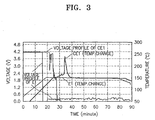
- FIG. 3 illustrates measurement results of voltages and temperatures of the 463450 prismatic type batteries manufactured in Example 1 and Comparative Example 1 while being left in an oven maintained at a temperature of 150°C for one hour after the batteries having nominal capacity of 780 mAh were charged under conditions of a constant current and a constant voltage at a current of 160 mA for 3 hours up to battery voltage of 4.2 V, and were left to stand for 1 hour in a chamber maintained at 150°C. The temperature of the chamber was raised up to 150°C at a speed of 5°C/min.
- the lithium battery manufactured in Example 1 exhibited higher stability at high temperature than the battery manufactured in Comparative Example 1.
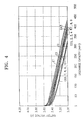
- FIG. 4 illustrates measurement results of low temperature discharge characteristics of lithium batteries manufactured in Examples 1-5 and 7-9 and Comparative Examples 1-4 and 6-10.
- the lithium batteries manufactured in Examples 1-5 and 7-9 had larger low-temperature discharge capacity than those manufactured in Comparative Examples 1-4 and 6-10.
- Composition of nonaqueous solvent (ml) Lithium salt EC GBL EMC DMC FB PC VC VS ISO
- Example 1 15 25 50 - 10 - 2 - - LiPF 6 (1.0M)
- Example 2 15 25 45 - 10 5 2 - - "
- Example 3 15 25 40 - 10 10 2 - - "
- Example 4 15 25 50 - 10 - 1.5 - 0.1 "
- Example 5 15 15 60 - 10 - 1.5 - 0.35 "
- Example 8 10 35 40 - 7 8 2 0.2 - "
- Example 9 15 25 - 50 10 - 2 - - Comparative Example 1 15 25 50 - 10 - - - - " Comparative Example 2 15 25 45 - 10 5
- a lithium battery according to the present invention satisfies various characteristics required for lithium batteries that can be commercially acceptable, that is, extended charge/discharge cycle life, improved high-temperature storage stability and improved low-temperature discharge characteristics while using a non-aqueous solvent containing ethylene carbonate in a small amount of not more than 15% by volume.
Landscapes
- Chemical & Material Sciences (AREA)
- Chemical Kinetics & Catalysis (AREA)
- Electrochemistry (AREA)
- General Chemical & Material Sciences (AREA)
- Inorganic Chemistry (AREA)
- Engineering & Computer Science (AREA)
- Manufacturing & Machinery (AREA)
- General Physics & Mathematics (AREA)
- Condensed Matter Physics & Semiconductors (AREA)
- Physics & Mathematics (AREA)
- Materials Engineering (AREA)
- Secondary Cells (AREA)
- Battery Electrode And Active Subsutance (AREA)
Abstract
Description
| Composition of nonaqueous solvent (ml) | Lithium salt | |||||||||
| EC | GBL | EMC | DMC | FB | PC | VC | VS | ISO | ||
| Example 1 | 15 | 25 | 50 | - | 10 | - | 2 | - | - | LiPF6 (1.0M) |
| Example 2 | 15 | 25 | 45 | - | 10 | 5 | 2 | - | - | " |
| Example 3 | 15 | 25 | 40 | - | 10 | 10 | 2 | - | - | " |
| Example 4 | 15 | 25 | 50 | - | 10 | - | 1.5 | - | 0.1 | " |
| Example 5 | 15 | 15 | 60 | - | 10 | - | 1.5 | - | 0.35 | " |
| Example 6 | 12 | 18 | 30 | 27 | 8 | 5 | 2 | 0.7 | - | " |
| Example 7 | 8 | 22 | 30 | 22 | 8 | 10 | 2 | 0.35 | - | " |
| Example 8 | 10 | 35 | 40 | - | 7 | 8 | 2 | 0.2 | - | " |
| Example 9 | 15 | 25 | - | 50 | 10 | - | 2 | - | - | |
| Comparative Example 1 | 15 | 25 | 50 | - | 10 | - | - | - | - | " |
| Comparative Example 2 | 15 | 25 | 45 | - | 10 | 5 | - | - | - | " |
| Comparative Example 3 | 15 | 25 | 40 | - | 10 | 10 | - | - | - | " |
| Comparative Example 4 | 23.1 | 23.1 | 38.5 | 7.7 | 7.6 | - | - | - | - | " |
| Comparative Example 5 | 30 | - | 55 | - | 10 | 5 | - | 0.55 | - | " |
| Comparative Example 6 | 25 | 75 | - | - | - | - | 2 | - | - | " |
| Comparative Example 7 | 5 | 95 | - | - | - | - | 2 | - | - | " |
| Comparative Example 8 | 55 | 45 | - | - | - | - | 2 | - | - | " |
| Comparative Example 9 | 40 | 10 | - | 40 | - | - | - | - | - | " |
| Comparative Example 10 | 40 | 10 | - | 40 | - | - | 2 | - | - | " |
Claims (14)
- A lithium battery comprising:an anode;a cathode comprising a compound capable of intercalating and deintercalating lithium;a separator interposed between the cathode and the anode; andan electrolyte solution having an electrolyte solute dissolved in a nonaqueous solvent, the nonaqueous solvent comprising a mixed solvent containing 8 to 15% by volume of ethylene carbonate, 10 to 35% by volume of γ-butyrolactone, 35 to 65% by volume of at least one linear carbonate selected from dimethyl carbonate, diethyl carbonate, ethylmethyl carbonate, methylpropyl carbonate, ethylpropyl carbonate and methylbutyl carbonate and 8 to 15% by volume of fluorobenzene, and 0.5 to 9 parts by volume of vinylene carbonate based on 100 parts by volume of the mixed solvent.
- The lithium battery according to claim 1, further comprising 8 to 15% by volume of at least one of propylene carbonate, 1,2-butylene carbonate, 2,3-butylene carbonate, 1,2-pentene carbonate and 2,3-pentene carbonate.
- The lithium battery according to claim 1 or 2, wherein the anode comprises a carbon material.
- The lithium battery according to any of claims 1 to 3, wherein the amount of the vinylene carbonate is 1 to 3 parts by volume based on 100 parts by volume of the mixed solvent.
- The lithium battery according to any of claims 1 to 4, wherein the compound capable of intercalating and deintercalating lithium is at least one selected from sulfur, a sulfur-containing compound, lithium composite oxide, a compound represented by LixMO2, and a compound represented by LiyM2O4, where M is a transition element, and 0≤x≤1 and 0≤y≤2.
- The lithium battery according to claim 5, wherein the compound capable of intercalating and deintercalating lithium is at least one selected from LiCoO2, LiMnO2, LiNiO2, LiCrO2 and LiMn2O4.
- The lithium battery according to any of claims 1 to 6, wherein the electrolyte solute is selected from LiPF6, LiBF4, LiClO4, LiCF3SO3, LiC4F9SO3, LiN(CF3SO2)2 and LiAsF6.
- The lithium battery according to any of claims 1 to 7, wherein the concentration of the electrolyte solute is in a range of 0.8 to 2.5 M.
- A lithium battery according to any of claims 1 to 8, further comprising 0.05 to 5 parts by volume of vinyl sulfone, isooxazole or a mixture thereof based on 100 parts by volume of the mixed solvent.
- The lithium battery according to claim 9, wherein the amount of vinylene carbonate is 1 to 3 parts by volume based on 100 parts by volume of the mixed solvent and the amount of vinyl sulfone, isooxazole or a mixture thereof is 0.07 to 2 parts by volume based on 100 parts by volume of the mixed solvent.
- An electrolyte for a lithium battery, comprising:a nonaqueous solvent comprising a mixed solvent containing 8 to 15% by volume of ethylene carbonate, 10 to 35% by volume of γ-butyrolactone, 35 to 65% by volume of at least one linear carbonate selected from dimethyl carbonate, diethyl carbonate, ethylmethyl carbonate, methylpropyl carbonate, ethylpropyl carbonate and methylbutyl carbonate, and 8 to 15% by volume of fluorobenzene;0.5 to 9 parts by volume of vinylene carbonate based on 100 parts by volume of the mixed solvent; andan electrolyte solute dissolved in said nonaqueous solvent.
- The electrolyte according to claim 11, further comprising 8 to 15% by volume of at least one selected from propylene carbonate, 1,2-butylene carbonate, 2,3-butylene carbonate, 1,2-pentene carbonate and 2,3-pentene carbonate.
- The electrolyte according to claim 11 or 12, further comprising 0.05 to 5 parts by volume of vinyl sulfone, isooxazole or a mixture thereof based on 100 parts by volume of the mixed solvent.
- The electrolyte according to any of claims 11 to 13, further comprising 8 to 15% by volume of at least one selected from propylene carbonate, 1,2-butylene carbonate, 2,3-butylene carbonate, 1,2-pentene carbonate and 2,3-pentene carbonate.
Applications Claiming Priority (2)
| Application Number | Priority Date | Filing Date | Title |
|---|---|---|---|
| KR2003075821 | 2003-10-29 | ||
| KR1020030075821A KR100603303B1 (en) | 2003-10-29 | 2003-10-29 | Lithium Battery with Efficient Performance |
Publications (3)
| Publication Number | Publication Date |
|---|---|
| EP1528617A2 true EP1528617A2 (en) | 2005-05-04 |
| EP1528617A3 EP1528617A3 (en) | 2006-10-04 |
| EP1528617B1 EP1528617B1 (en) | 2008-07-09 |
Family
ID=34420681
Family Applications (1)
| Application Number | Title | Priority Date | Filing Date |
|---|---|---|---|
| EP04256676A Expired - Lifetime EP1528617B1 (en) | 2003-10-29 | 2004-10-28 | Lithium battery having effective performance |
Country Status (6)
| Country | Link |
|---|---|
| US (1) | US7078132B2 (en) |
| EP (1) | EP1528617B1 (en) |
| JP (1) | JP4012174B2 (en) |
| KR (1) | KR100603303B1 (en) |
| CN (1) | CN1612383B (en) |
| DE (1) | DE602004014876D1 (en) |
Cited By (5)
| Publication number | Priority date | Publication date | Assignee | Title |
|---|---|---|---|---|
| EP2410593A1 (en) * | 2010-07-13 | 2012-01-25 | Samsung SDI Co., Ltd. | Lithium secondary battery |
| US8221922B2 (en) | 2007-04-12 | 2012-07-17 | Panasonic Corporation | Non-aqueous electrolyte secondary battery |
| WO2012172195A1 (en) * | 2011-06-14 | 2012-12-20 | Commissariat A L'energie Atomique Et Aux Energies Alternatives | Liquid electrolyte for lithium accumulator, containing a ternary mixture of non-aqueous organic solvents |
| CN113904071A (en) * | 2021-09-28 | 2022-01-07 | 蜂巢能源科技有限公司 | Secondary liquid injection method and application thereof |
| EP4307405A4 (en) * | 2021-04-28 | 2024-09-04 | GS Yuasa International Ltd. | NON-AQUEOUS ELECTROLYTE ELECTRICITY STORAGE ELEMENT |
Families Citing this family (27)
| Publication number | Priority date | Publication date | Assignee | Title |
|---|---|---|---|---|
| WO2006085691A1 (en) | 2005-02-10 | 2006-08-17 | Showa Denko K.K | Secondary-battery cutrrent collector, secondary-battery cathode, secondary-battery anode, secondary battery and production method thereof |
| KR101137747B1 (en) * | 2005-06-10 | 2012-04-25 | 미쓰비시 가가꾸 가부시키가이샤 | Nonaqueous electrolyte solution, nonaqueous electrolyte secondary battery and carbonate compound |
| JP4824349B2 (en) * | 2005-06-16 | 2011-11-30 | パナソニック株式会社 | Lithium ion secondary battery |
| JP5153060B2 (en) * | 2005-06-16 | 2013-02-27 | パナソニック株式会社 | Lithium ion secondary battery |
| JP5085856B2 (en) * | 2005-07-07 | 2012-11-28 | パナソニック株式会社 | Lithium ion secondary battery |
| US20070141470A1 (en) * | 2005-12-16 | 2007-06-21 | Kensuke Nakura | Lithium ion secondary battery |
| CN101371396B (en) * | 2006-05-19 | 2011-03-23 | 松下电器产业株式会社 | Nonaqueous electrolyte secondary battery |
| KR100898857B1 (en) * | 2006-08-25 | 2009-05-21 | 주식회사 엘지화학 | Non-aqueous electrolyte and secondary battery using the same |
| JP5394610B2 (en) * | 2007-02-20 | 2014-01-22 | パナソニック株式会社 | Nonaqueous electrolyte secondary battery |
| JP5532584B2 (en) * | 2008-11-06 | 2014-06-25 | 三菱化学株式会社 | Non-aqueous electrolyte and lithium secondary battery using the same |
| KR101459402B1 (en) * | 2009-06-17 | 2014-11-10 | 주식회사 엘지화학 | Electrolyte Solution for Secondary Battery with Improved Safety and Lithium Secondary Battery Containing the Same |
| KR101135502B1 (en) | 2008-12-22 | 2012-04-16 | 삼성에스디아이 주식회사 | Lithium secondary battery |
| US8623558B2 (en) * | 2010-03-29 | 2014-01-07 | Panasonic Corporation | Non-aqueous electrolyte and non-aqueous electrolyte secondary battery using the same |
| CN102361097A (en) * | 2011-11-14 | 2012-02-22 | 中国海洋石油总公司 | Preparation method of low-temperature electrolyte for lithium iron phosphate power battery |
| CN102780037B (en) * | 2012-07-19 | 2017-07-28 | 宁德新能源科技有限公司 | A kind of nonaqueous electrolyte and the lithium ion battery comprising the nonaqueous electrolyte |
| CN102780039A (en) * | 2012-07-24 | 2012-11-14 | 华为技术有限公司 | Nonaqueous organic electrolyte of lithium ion secondary battery and preparation method of nonaqueous organic electrolyte |
| CN104064754B (en) * | 2014-06-27 | 2016-05-11 | 胡莹 | A kind of preparation method of lithium manganese oxide |
| WO2018096735A1 (en) | 2016-11-24 | 2018-05-31 | 住友電気工業株式会社 | Semiconductor module |
| JP7120773B2 (en) * | 2018-02-20 | 2022-08-17 | 三星エスディアイ株式会社 | Electrolyte for non-aqueous electrolyte secondary battery and non-aqueous electrolyte secondary battery |
| CN108389969B (en) * | 2018-03-01 | 2021-08-13 | 广东工业大学 | A green solvent system and mixed solution for the preparation of perovskite layers in perovskite solar cells |
| US12288877B2 (en) * | 2020-07-13 | 2025-04-29 | International Business Machines Corporation | Rechargeable metal halide battery with intercalation anode |
| EP4447182A4 (en) * | 2021-12-09 | 2026-03-25 | Kyocera Corp | ELECTROLYTE SOLUTION, SECONDARY BATTERY AND SEMI-SOLID BATTERY |
| CN114614096B (en) * | 2022-02-24 | 2024-03-08 | 复旦大学 | Quick-charging electrolyte and application thereof in lithium ion battery |
| JP2025510855A (en) * | 2022-03-30 | 2025-04-15 | エルジー エナジー ソリューション リミテッド | Nonaqueous electrolyte and lithium secondary battery containing same |
| JP2025540881A (en) * | 2022-12-23 | 2025-12-16 | エルジー エナジー ソリューション リミテッド | Electrolyte for lithium-sulfur secondary battery and lithium-sulfur secondary battery including the same |
| US20260058206A1 (en) * | 2022-12-23 | 2026-02-26 | Lg Energy Solution, Ltd. | Electrolyte for lithium-sulfur secondary battery, and lithium-sulfur secondary battery comprising same |
| CN116053579A (en) * | 2022-12-27 | 2023-05-02 | 山东阳谷华泰化工股份有限公司 | A kind of low-temperature organic electrolytic solution and application thereof based on isoxazole derivatives |
Family Cites Families (17)
| Publication number | Priority date | Publication date | Assignee | Title |
|---|---|---|---|---|
| JPS59203369A (en) | 1983-05-04 | 1984-11-17 | Showa Denko Kk | battery |
| US5686138A (en) * | 1991-11-12 | 1997-11-11 | Sanyo Electric Co., Ltd. | Lithium secondary battery |
| JPH0620721A (en) | 1992-07-03 | 1994-01-28 | Asahi Chem Ind Co Ltd | Nonaqueous secondary battery |
| JP3401884B2 (en) | 1993-11-30 | 2003-04-28 | 日本電池株式会社 | Lithium secondary battery |
| JPH07176323A (en) | 1993-12-21 | 1995-07-14 | Mitsubishi Cable Ind Ltd | Electrolytic solution and negative electrode for li secondary battery |
| JPH07320779A (en) | 1994-05-20 | 1995-12-08 | Sanyo Electric Co Ltd | Nonaqueous electrolytic battery |
| JPH0864242A (en) | 1994-08-25 | 1996-03-08 | Sanyo Electric Co Ltd | Nonaqueous electrolyte secondary battery |
| JPH08321313A (en) | 1995-05-24 | 1996-12-03 | Sanyo Electric Co Ltd | Nonaqueous electrolyte battery |
| JPH0973918A (en) | 1995-09-05 | 1997-03-18 | Fuji Elelctrochem Co Ltd | Non-aqueous electrolyte for batteries |
| TW431004B (en) * | 1998-10-29 | 2001-04-21 | Toshiba Corp | Nonaqueous electrolyte secondary battery |
| KR100316686B1 (en) * | 1999-07-01 | 2001-12-12 | 안복현 | Nonaqueous electrolyte battery |
| US6503663B1 (en) * | 2000-05-05 | 2003-01-07 | Samsung Sdi Co., Ltd. | Organic electrolyte and lithium secondary battery |
| KR20010008242A (en) | 2000-11-17 | 2001-02-05 | 박종현 | The price differential system is caused by member grade in the web |
| KR100629688B1 (en) | 2002-10-15 | 2006-09-28 | 부전전자부품 주식회사 | Front sound unidirectional microphone |
| KR100471970B1 (en) * | 2002-11-20 | 2005-03-11 | 삼성에스디아이 주식회사 | An electrolyte for a lithium ion battery and a lithium ion battery comprising the same |
| KR100515298B1 (en) * | 2003-03-24 | 2005-09-15 | 삼성에스디아이 주식회사 | A non-aqueous electrolyte and a lithium secondary battery comprising the same |
| KR100612272B1 (en) * | 2003-07-31 | 2006-08-11 | 삼성에스디아이 주식회사 | Non-aqueous electrolyte and lithium secondary battery comprising same |
-
2003
- 2003-10-29 KR KR1020030075821A patent/KR100603303B1/en not_active Expired - Fee Related
-
2004
- 2004-06-18 JP JP2004181365A patent/JP4012174B2/en not_active Expired - Fee Related
- 2004-09-13 US US10/938,538 patent/US7078132B2/en not_active Expired - Lifetime
- 2004-10-28 DE DE602004014876T patent/DE602004014876D1/en not_active Expired - Lifetime
- 2004-10-28 EP EP04256676A patent/EP1528617B1/en not_active Expired - Lifetime
- 2004-10-29 CN CN2004100880370A patent/CN1612383B/en not_active Expired - Fee Related
Cited By (8)
| Publication number | Priority date | Publication date | Assignee | Title |
|---|---|---|---|---|
| US8221922B2 (en) | 2007-04-12 | 2012-07-17 | Panasonic Corporation | Non-aqueous electrolyte secondary battery |
| EP2410593A1 (en) * | 2010-07-13 | 2012-01-25 | Samsung SDI Co., Ltd. | Lithium secondary battery |
| WO2012172195A1 (en) * | 2011-06-14 | 2012-12-20 | Commissariat A L'energie Atomique Et Aux Energies Alternatives | Liquid electrolyte for lithium accumulator, containing a ternary mixture of non-aqueous organic solvents |
| FR2976735A1 (en) * | 2011-06-14 | 2012-12-21 | Commissariat Energie Atomique | LIQUID ELECTROLYTE FOR LITHIUM ACCUMULATOR COMPRISING A TERNARY MIXTURE OF NONAQUEOUS ORGANIC SOLVENTS. |
| US9225040B2 (en) | 2011-06-14 | 2015-12-29 | Commissariat A L'energie Atomique Et Aux Energies Alternatives | Liquid electrolyte for lithium accumulator, containing a ternary mixture of non-aqueous organic solvents |
| EP4307405A4 (en) * | 2021-04-28 | 2024-09-04 | GS Yuasa International Ltd. | NON-AQUEOUS ELECTROLYTE ELECTRICITY STORAGE ELEMENT |
| CN113904071A (en) * | 2021-09-28 | 2022-01-07 | 蜂巢能源科技有限公司 | Secondary liquid injection method and application thereof |
| CN113904071B (en) * | 2021-09-28 | 2023-05-26 | 蜂巢能源科技有限公司 | Secondary liquid injection method and application thereof |
Also Published As
| Publication number | Publication date |
|---|---|
| JP4012174B2 (en) | 2007-11-21 |
| KR100603303B1 (en) | 2006-07-20 |
| CN1612383B (en) | 2010-06-16 |
| KR20050040974A (en) | 2005-05-04 |
| DE602004014876D1 (en) | 2008-08-21 |
| EP1528617B1 (en) | 2008-07-09 |
| US7078132B2 (en) | 2006-07-18 |
| EP1528617A3 (en) | 2006-10-04 |
| US20050095507A1 (en) | 2005-05-05 |
| JP2005135895A (en) | 2005-05-26 |
| CN1612383A (en) | 2005-05-04 |
Similar Documents
| Publication | Publication Date | Title |
|---|---|---|
| US7078132B2 (en) | Lithium battery having effective performance | |
| EP3793005B1 (en) | Method of manufacturing negative electrode for lithium secondary battery and lithium secondary battery | |
| KR102675258B1 (en) | Lithium secondary battery with improved high temperature storage property | |
| EP2206189B1 (en) | Non-aqueous electrolyte lithium secondary battery | |
| US7678504B2 (en) | Lithium secondary battery and a method for preparing the same | |
| US9088036B2 (en) | Rechargeable lithium battery | |
| KR101211127B1 (en) | Electrolyte for lithium secondary battery and lithium secondary battery comprising the same | |
| KR20060112823A (en) | Lithium secondary battery | |
| KR20080033883A (en) | battery | |
| KR20050014408A (en) | A non-aqueous electrolyte and a lithium secondary battery comprising the same | |
| KR100573109B1 (en) | Organic electrolyte and lithium battery employing the same | |
| EP3793009B1 (en) | Methods for manufacturing lithium composite negative electrode active material and lithium composite negative electrode | |
| KR102845976B1 (en) | Non-aqueous electrolyte solution for lithium secondary battery and lithium secondary battery comprising the same | |
| KR100984134B1 (en) | Electrolyte for lithium secondary battery and lithium secondary battery comprising same | |
| KR102501252B1 (en) | Non-aqueous electrolyte for lithium secondary battery and lithium secondary battery comprising the same | |
| KR101952838B1 (en) | Non-aqueous electrolyte solution for lithium secondary battery and lithium secondary battery comprising the same | |
| KR101349941B1 (en) | Electrolyte For Lithium Secondary Battery and Lithium Secondary Battery Including The Same | |
| KR20210146520A (en) | Electrolyte additives for secondary battery, non-aqueous electrolyte for secondary battery comprising the same and secondary battery | |
| KR20230091026A (en) | Nonaqueous electrolyte for lithium secondary battery and lithium secondary battery comprising the same | |
| KR101584850B1 (en) | Non-aqueous liquid electrolyte and lithium secondary battery comprising the same | |
| KR100987377B1 (en) | Manufacturing method of lithium battery | |
| KR102633568B1 (en) | Electrolyte additive for secondary battery, non-aqueous electrolyte for lithium secondary battery comprising the same and lithium secondary battery | |
| KR102939892B1 (en) | Lithium secondary battery | |
| KR20210148715A (en) | Nonaqueous electrolyte for lithium secondary battery and lithium secondary battery comprising the same | |
| KR102953704B1 (en) | Lithium secondary battery |
Legal Events
| Date | Code | Title | Description |
|---|---|---|---|
| PUAI | Public reference made under article 153(3) epc to a published international application that has entered the european phase |
Free format text: ORIGINAL CODE: 0009012 |
|
| 17P | Request for examination filed |
Effective date: 20041117 |
|
| AK | Designated contracting states |
Kind code of ref document: A2 Designated state(s): AT BE BG CH CY CZ DE DK EE ES FI FR GB GR HU IE IT LI LU MC NL PL PT RO SE SI SK TR |
|
| AX | Request for extension of the european patent |
Extension state: AL HR LT LV MK |
|
| RIN1 | Information on inventor provided before grant (corrected) |
Inventor name: KIM, CHANG-SEOB,C/O 109-601 DAEWOO APT. Inventor name: KIM, KWANG-CHUNSAMSUNG SDI CO., LTD. Inventor name: KWON, TEAK-HYEN,C/O DA-102 MUGUNGHWA APT. Inventor name: YOON, JANG-HO,103-2404 DAEWOO APT. Inventor name: KIM, JIN-SUNG,C/O 513-803 JUGONG 10 DANJI APT. Inventor name: LEE, JIN-UK Inventor name: SONG, MIN-HO,C/O 303 YUGANG VILLA |
|
| RIN1 | Information on inventor provided before grant (corrected) |
Inventor name: YOON, JANG-HO C/LEGAL & IP TEAM SAMSUNG SDI CO Inventor name: LEE, JIN-UK C/O LEGAL &IP TEAM, SAMSUNG SDI CO Inventor name: KIM, CHANG-SEOB,C/O 109-601 DAEWOO APT. Inventor name: KWON, TEAK-HYEN,C/O DA-102 MUGUNGHWA APT. Inventor name: SONG, MIN-HO,C/O 303 YUGANG VILLA Inventor name: KIM, KWANG-CHUNSAMSUNG SDI CO., LTD. Inventor name: KIM, JIN-SUNG,C/O 513-803 JUGONG 10 DANJI APT. |
|
| RIN1 | Information on inventor provided before grant (corrected) |
Inventor name: KIM, CHANG-SEOB, C/O 109-601 DAEWOO APT. Inventor name: LEE, JIN-UK C/O LEGAL &IP TEAM, SAMSUNG SDI CO.LTD Inventor name: KWON, TEAK-HYEN, C/O DA-102 MUGUNGHWA APT. Inventor name: KIM, JIN-SUNG, C/O 513-803 JUGONG 10 DANJI APT. Inventor name: YOON, JANG-HO C/LEGAL & IP TEAM SAMSUNG SDI CO.LTD Inventor name: SONG, MIN-HO, C/O 303 YUGANG VILLA Inventor name: KIM, KWANG-CHUN LEGAL & IP SAMSUNG SDI CO., LTD. |
|
| PUAL | Search report despatched |
Free format text: ORIGINAL CODE: 0009013 |
|
| AK | Designated contracting states |
Kind code of ref document: A3 Designated state(s): AT BE BG CH CY CZ DE DK EE ES FI FR GB GR HU IE IT LI LU MC NL PL PT RO SE SI SK TR |
|
| AX | Request for extension of the european patent |
Extension state: AL HR LT LV MK |
|
| 17Q | First examination report despatched |
Effective date: 20070319 |
|
| AKX | Designation fees paid |
Designated state(s): DE FR GB |
|
| GRAP | Despatch of communication of intention to grant a patent |
Free format text: ORIGINAL CODE: EPIDOSNIGR1 |
|
| GRAS | Grant fee paid |
Free format text: ORIGINAL CODE: EPIDOSNIGR3 |
|
| GRAA | (expected) grant |
Free format text: ORIGINAL CODE: 0009210 |
|
| AK | Designated contracting states |
Kind code of ref document: B1 Designated state(s): DE FR GB |
|
| REG | Reference to a national code |
Ref country code: GB Ref legal event code: FG4D |
|
| REF | Corresponds to: |
Ref document number: 602004014876 Country of ref document: DE Date of ref document: 20080821 Kind code of ref document: P |
|
| PLBE | No opposition filed within time limit |
Free format text: ORIGINAL CODE: 0009261 |
|
| STAA | Information on the status of an ep patent application or granted ep patent |
Free format text: STATUS: NO OPPOSITION FILED WITHIN TIME LIMIT |
|
| 26N | No opposition filed |
Effective date: 20090414 |
|
| REG | Reference to a national code |
Ref country code: FR Ref legal event code: PLFP Year of fee payment: 13 |
|
| REG | Reference to a national code |
Ref country code: FR Ref legal event code: PLFP Year of fee payment: 14 |
|
| REG | Reference to a national code |
Ref country code: FR Ref legal event code: PLFP Year of fee payment: 15 |
|
| PGFP | Annual fee paid to national office [announced via postgrant information from national office to epo] |
Ref country code: GB Payment date: 20201022 Year of fee payment: 17 Ref country code: FR Payment date: 20201013 Year of fee payment: 17 Ref country code: DE Payment date: 20201013 Year of fee payment: 17 |
|
| REG | Reference to a national code |
Ref country code: DE Ref legal event code: R119 Ref document number: 602004014876 Country of ref document: DE |
|
| GBPC | Gb: european patent ceased through non-payment of renewal fee |
Effective date: 20211028 |
|
| PG25 | Lapsed in a contracting state [announced via postgrant information from national office to epo] |
Ref country code: GB Free format text: LAPSE BECAUSE OF NON-PAYMENT OF DUE FEES Effective date: 20211028 Ref country code: DE Free format text: LAPSE BECAUSE OF NON-PAYMENT OF DUE FEES Effective date: 20220503 |
|
| PG25 | Lapsed in a contracting state [announced via postgrant information from national office to epo] |
Ref country code: FR Free format text: LAPSE BECAUSE OF NON-PAYMENT OF DUE FEES Effective date: 20211031 |