EP1527622B1 - Procédé pour l' intégration de réseaux radio et dispositif correspondant - Google Patents
Procédé pour l' intégration de réseaux radio et dispositif correspondant Download PDFInfo
- Publication number
- EP1527622B1 EP1527622B1 EP03740866A EP03740866A EP1527622B1 EP 1527622 B1 EP1527622 B1 EP 1527622B1 EP 03740866 A EP03740866 A EP 03740866A EP 03740866 A EP03740866 A EP 03740866A EP 1527622 B1 EP1527622 B1 EP 1527622B1
- Authority
- EP
- European Patent Office
- Prior art keywords
- radio network
- radio
- reference oscillator
- centre frequency
- frequency
- Prior art date
- Legal status (The legal status is an assumption and is not a legal conclusion. Google has not performed a legal analysis and makes no representation as to the accuracy of the status listed.)
- Expired - Lifetime
Links
- 238000000034 method Methods 0.000 title claims abstract description 22
- 238000005516 engineering process Methods 0.000 claims description 15
- 230000001413 cellular effect Effects 0.000 claims description 3
- 238000010295 mobile communication Methods 0.000 claims description 3
- 238000001228 spectrum Methods 0.000 abstract description 15
- 238000004891 communication Methods 0.000 description 10
- 230000001360 synchronised effect Effects 0.000 description 6
- 230000005540 biological transmission Effects 0.000 description 3
- 238000006243 chemical reaction Methods 0.000 description 2
- 230000009286 beneficial effect Effects 0.000 description 1
- 230000001934 delay Effects 0.000 description 1
- 238000001514 detection method Methods 0.000 description 1
- 230000009977 dual effect Effects 0.000 description 1
- 238000009432 framing Methods 0.000 description 1
- 230000006870 function Effects 0.000 description 1
- 230000002093 peripheral effect Effects 0.000 description 1
- 230000004044 response Effects 0.000 description 1
- 238000000926 separation method Methods 0.000 description 1
- 230000005236 sound signal Effects 0.000 description 1
Images



Classifications
-
- H—ELECTRICITY
- H04—ELECTRIC COMMUNICATION TECHNIQUE
- H04W—WIRELESS COMMUNICATION NETWORKS
- H04W16/00—Network planning, e.g. coverage or traffic planning tools; Network deployment, e.g. resource partitioning or cells structures
- H04W16/14—Spectrum sharing arrangements between different networks
-
- H—ELECTRICITY
- H04—ELECTRIC COMMUNICATION TECHNIQUE
- H04B—TRANSMISSION
- H04B7/00—Radio transmission systems, i.e. using radiation field
- H04B7/24—Radio transmission systems, i.e. using radiation field for communication between two or more posts
- H04B7/26—Radio transmission systems, i.e. using radiation field for communication between two or more posts at least one of which is mobile
- H04B7/2662—Arrangements for Wireless System Synchronisation
- H04B7/2668—Arrangements for Wireless Code-Division Multiple Access [CDMA] System Synchronisation
-
- H—ELECTRICITY
- H04—ELECTRIC COMMUNICATION TECHNIQUE
- H04B—TRANSMISSION
- H04B7/00—Radio transmission systems, i.e. using radiation field
- H04B7/24—Radio transmission systems, i.e. using radiation field for communication between two or more posts
- H04B7/26—Radio transmission systems, i.e. using radiation field for communication between two or more posts at least one of which is mobile
- H04B7/2662—Arrangements for Wireless System Synchronisation
- H04B7/2671—Arrangements for Wireless Time-Division Multiple Access [TDMA] System Synchronisation
- H04B7/2678—Time synchronisation
- H04B7/2687—Inter base stations synchronisation
- H04B7/2693—Centralised synchronisation, i.e. using external universal time reference, e.g. by using a global positioning system [GPS] or by distributing time reference over the wireline network
-
- H—ELECTRICITY
- H04—ELECTRIC COMMUNICATION TECHNIQUE
- H04J—MULTIPLEX COMMUNICATION
- H04J3/00—Time-division multiplex systems
- H04J3/02—Details
- H04J3/06—Synchronising arrangements
- H04J3/0635—Clock or time synchronisation in a network
- H04J3/0638—Clock or time synchronisation among nodes; Internode synchronisation
- H04J3/0644—External master-clock
-
- H—ELECTRICITY
- H04—ELECTRIC COMMUNICATION TECHNIQUE
- H04W—WIRELESS COMMUNICATION NETWORKS
- H04W28/00—Network traffic management; Network resource management
- H04W28/16—Central resource management; Negotiation of resources or communication parameters, e.g. negotiating bandwidth or QoS [Quality of Service]
- H04W28/18—Negotiating wireless communication parameters
-
- H—ELECTRICITY
- H04—ELECTRIC COMMUNICATION TECHNIQUE
- H04W—WIRELESS COMMUNICATION NETWORKS
- H04W56/00—Synchronisation arrangements
- H04W56/0035—Synchronisation arrangements detecting errors in frequency or phase
-
- H—ELECTRICITY
- H04—ELECTRIC COMMUNICATION TECHNIQUE
- H04W—WIRELESS COMMUNICATION NETWORKS
- H04W88/00—Devices specially adapted for wireless communication networks, e.g. terminals, base stations or access point devices
- H04W88/02—Terminal devices
- H04W88/06—Terminal devices adapted for operation in multiple networks or having at least two operational modes, e.g. multi-mode terminals
-
- H—ELECTRICITY
- H04—ELECTRIC COMMUNICATION TECHNIQUE
- H04W—WIRELESS COMMUNICATION NETWORKS
- H04W88/00—Devices specially adapted for wireless communication networks, e.g. terminals, base stations or access point devices
- H04W88/08—Access point devices
- H04W88/10—Access point devices adapted for operation in multiple networks, e.g. multi-mode access points
Definitions
- This invention relates generally to integrating wireless telephony systems with systems supporting digital broadband broadcasting.
- WCDMA Wideband code division multiple access
- WCDMA has a number of variations, including direct spread with frequency division duplex (in which the uplink and the downlink are separated in frequency), direct spread with time division duplex (in which the uplink and the downlink are separated by time), and multiple carrier CDMA.
- Direct spread-frequency division duplex WCDMA typically utilizes a 5 MHz bandwidth or a multiple of a 5 MHz bandwidth.
- Third generation wireless systems may utilize technologies in accordance with different standards, including cdma2000.
- Cdma2000 is a variation of a multiple carrier CDMA technology and is compatible with second generation wireless systems that are operating in North America.
- second generation (2G) wireless systems are operating around the world.
- second generation wireless systems typically comply with global systems for communications (GSM) standards, which are based on a time division multiple access technology.
- GSM global systems for communications
- cdmaOne which is based on a code division multiple access technology.
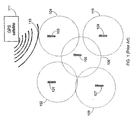
- FIG. 1 shows a system of base stations 101, 103, 105, 107, and 109 that support global system for mobile communications (GSM) that are synchronized by a global positioning system (GPS) reference system 111 in accordance with prior art.
- Base stations 101-109 service geographical areas 102, 104, 106, 108, and 110, respectively.
- Global positioning system (GPS) 111 provides a time reference 113 for base stations 101-109. Time reference 113 may be used to synchronize base stations101-109 to a common time base and to adjust reference oscillators that control the center frequencies of radios that are associated with base stations 101-109.
- the time base may be used to establish the timing for a time division multiple access system (TDMA) structure. Frequency adjustment may be needed to correct drifting for the center frequencies that are associated with base stations 101-109, in which the frequency drifting may cause interference with geographical areas 102-110.
- TDMA time division multiple access system
- FIG. 2 shows a system of single frequency network (SFN) base stations 201 and 203 that are synchronized by global positioning system reference system 111 in accordance with prior art.
- Single frequency network base stations 201 and 203 may support a direct spread wideband code division technology, in which a plurality of wireless terminals is simultaneously utilizing the same frequency spectrum
- Base stations 201 and 203 support geographical areas 202 and 204, respectively.
- Global positioning system 111 provides time reference 113 to synchronize transmissions from base stations 201 and 203. Time reference 113 may also be used to correct drifting of local oscillators that control the center frequencies of radios in base stations 201 and 203.
- DVB-T digital video broadcasting
- VHF very high frequency
- UHF ultra high frequency
- OFDM orthogonal frequency division multiplexing
- DVB-T is largely designed for unidirectional, broadcast, and multicast media delivery, in which the frequency bandwidth is sufficiently large to support data rates as much as 32 Mbps on the downlink (base station to wireless terminal).
- ISDB-T Integrated Services Digital Broadcasting-Terrestrial transmission
- DTV Digital Television
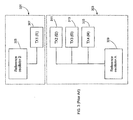
- FIG 3 shows two different radio networks that are synchronized by different reference oscillators in accordance with prior art.
- a radio network 301 comprises a radio 307 and a reference oscillator 305.
- a radio network 303 comprises radios 311, 313, and 315 and a reference oscillator 309.
- Reference oscillator 305 adjusts a center frequency f1 for radio 307.
- Reference oscillator 309 adjusts center frequencies f2, f3, and f4 for radios 311, 313, and 315, respectively.
- Radio network 301 may support a wideband CDMA technology such as WCDMA, while radio network 303 may support a different radio technology and telecommunications service such as terrestrial digital video broadcasting.
- center frequency f1 is significantly removed from center frequencies f2, f3, and f4.
- radio network 301 may utilize frequency spectrum at approximately 2 GHz while radio network 303 may utilize a frequency spectrum in the UHF band, e.g. channel 40 that corresponds to approximately 626 MHz). Because of the disparity of center frequencies, radio network 301 and radio network 303 utilize separate reference oscillators.
- radio networks are being deployed that are not integrated either from a service provider's or from a user's perspective.
- Different radio systems may utilize different center frequencies and different frequency bandwidths, while having different symmetry configurations.
- a WCDMA system may be deployed in the 2GHz spectrum, utilizing direct spread CDMA with approximately equivalent data rates on the uplink (wireless terminal to base station) and downlink (base station to wireless terminal), while a DVB-T system may be deployed in the UHF television frequency spectrum that utilizes OFDM modulation with a high data rate on the downlink.
- a wireless terminal requires two separate radio frequency (RF) front-ends.
- RF radio frequency
- Integrating different radio network systems may facilitate the support of different telecommunication services to a user.
- cellular radio services are almost ubiquitous throughout the word.
- broadband, multicast video services are being developer and may soon be widely deployed.
- a user wishes to have a single wireless terminal even though the user may subscribe to a plurality of telecommunication services that may be supported by different radio networks. Consequently, a method and apparatus that integrates associated radio networks are beneficial in advancing the art in support of these telecommunication services.
- An aspect of the present invention provides methods and apparatus for integrating the operation of a plurality of radio networks.
- the plurality of radio networks may utilize common frequency spectrum.
- the center frequencies for radios in each of the radio networks are adjusted so that frequency drift in relation to each radio network is reduced.
- system information about the plurality of radio networks may be sent on a radio channel that is associated with one of the radio networks.
- a wideband code division multiple access (WCDMA) radio network and a terrestrial digital video broadcast (DVB-T) radio network are integrated for operation in an IMT-2000 frequency spectrum (corresponding to approximately 2 GHz).
- the WCDMA radio network comprises at least one radio and a reference oscillator.
- the WCDMA radio network is coupled to a UMTS terrestrial radio access network (UTRAN) that comprises a radio network controller.
- UTRAN UMTS terrestrial radio access network
- an oscillator synchronizer synchronizes a first reference oscillator that is associated with the WCDMA radio network and a second reference oscillator that is associated with the DVB-T radio network in order to adjust radio center frequencies.
- System information about both radio networks is broadcasted to wireless terminals on a broadcast channel (BCCH) over a radio channel and may be supported by delivery of the system information within the UTRAN and the core network.
- the embodiment supports integrated operation of both WCDMA and DVB-T services at a wireless terminal.
- a reference oscillator at either the WCDMA radio network or the DVB-T radio network adjusts center frequencies for radios that are associated with the other radio network.
- US 5,903,835 discloses a dual mode telephone with a satellite communication adapter and a means to synchronize separate reference oscillators.
- a cellular-type handportable phone is equipped with a connector for the attachment of accessories.
- An S connector provides a satellite communication adapter accessory access to the handset's signal processing resources which may operate in an alternative mode to process signals received from a satellite.
- PCS Personal Communication Services
- EP 0785692 discloses a paging system for multi-network terminals, in which each terminal passes to a network with which it maintains a communication session the points in time at which the terminal can successfully receive and process paging messages.
- FIG. 1 shows a system of base stations that support global system for mobile communications (GSM) that are synchronized by a global positioning system (GPS) reference clock in accordance with prior art;
- GSM global system for mobile communications
- GPS global positioning system
- FIG. 2 shows a system of single frequency network (SFN) base stations that are synchronized by a global positioning system (GPS) reference system in accordance with prior art;
- SFN single frequency network
- GPS global positioning system
- Figure 3 shows two different radio networks that are synchronized by Different reference oscillators in accordance with prior art
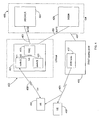
- FIG. 4 shows a system architecture that integrates two different radio network systems in accordance with an embodiment of the invention
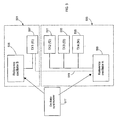
- Figure 5 shows a common oscillator synchroniser that synchronizes two radio network systems in accordance with an embodiment of the invention
- Figure 6 shows an architecture of a radio network controller
- Figure 7 shows an architecture of a wireless terminal
- Figure 8 shows a message scenario for a wireless system that integrates two radio network systems in accordance with an embodiment of the invention.
- FIG. 4 shows a system architecture of a wireless system 400 that integrates two different radio network systems in accordance with an embodiment of the invention.
- a radio network 403 comprises a UMTS (universal mobile telecommunication services) terrestrial radio access network (UTRAN) and a radio network 409 comprises a terrestrial video broadcast network 409.
- Radio network 403 typically comprises a plurality of radio network subsystems (RNS), e.g. RNS 407.
- Radio network system 407 comprises node B 411 and node B 413. Node B 411 and 413 function as base stations in an UMTS architecture, providing radio communications to wireless terminals 401 and 402 over a radio channel 459 (as specified by a Uu interface 459).
- a radio network controller 415 owns and controls radio resources in its domain (e.g. node B 411 and 413).
- Radio network controller 415 is a service access point for all services that UTRAN 403 provides for a core network (CN) 405.
- Core network 405 comprises a mobile services switching center/visitor location register (MSC/VLR) 423 and a serving GPRS (general packet radio service) support node (SGSN) 425.
- MSC/VLR 423 is a telecommunication switch and a database that serves wireless terminals 401 and 402.
- the functionality of SGSN 425 is similar to that of MSC/VLR 423 but is typically used for packet switched services.
- An Iu-CS interface 451 connects UTRAN 403 to MSC/VLR 423 in order to support circuit switched services.
- An Iu-PS interface 453 connects UTRAN 403 to SGSN 425 in order to support packet switched services.
- Radio network 409 comprises a DVB radio 417 and provides digital content to wireless terminals 401 and 402 over a broadcast radio channel 461.
- a radio channel 461 is configured to provide a wide bandwidth capacity on the downlink (i.e. from DVB radio 407 to wireless terminals 401 and 402).
- Content delivery of the digital multimedia content is broadcasted or multicasted, in which the transmitted content to wireless terminals 401 and 402 is the same.
- Radio network 409 receives the digital multimedia content from core network 405 over interface 457 which may connect to an entity of core network 405 such as SGSN 425 or a gateway GPRS support node (GGSN) that is not shown or another connectivity gateway to receive content from the Internet (not shown in the Figure 4 ).
- GGSN gateway GPRS support node
- radio networks 403 and 409 utilize frequency spectra that are allocated for third generation mobile systems by the International Telecommunications Union (ITU).
- ITU International Telecommunications Union
- the IMT-2000 bands span 1920 MHz to 2170 MHz.
- no new frequency spectrum has been allocated, although existing frequency spectrum (approximately 1850 MHz to 2000 GHz) for second generation mobile systems can be used.
- Wireless terminals 401 and 402 are informed about the frequency configuration through messages on the broadcast channel (BCCH) that are transmitted in accordance with the Uu interface. Messaging on the broadcast channel is discussed in more detail in the context of Figure 8 .
- BCCH broadcast channel
- radio networks 403 and 409 may utilize different radio transmission schemes (e.g. different modulation techniques) and, furthermore, may support different telecommunication services to wireless users.
- radio system 400 enables integrated operation of radio networks 403 and 409 as will be discussed in the context of Figures 5-8 .
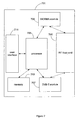
- FIG. 5 shows a common oscillator synchronizer 517 that synchronizes radio networks systems 501 and 503 in accordance with an embodiment of the invention.
- radio network 501 may correspond to DVB-T access point 409 and radio network 503 may correspond to node B 411 in Figure 4 .
- Radio network 501 comprises a reference oscillator 505 and a radio 507.
- Radio network 503 comprises a reference oscillator 509 and radios 511, 513, and 515.
- Reference oscillator 505 adjusts a center frequency f1 that is associated with radio 507.
- Reference oscillator 509 adjusts center frequencies f2, f3, and f4 that are associated with radios 511, 513, and 515, respectively.
- oscillator synchronizer 517 synchronizes reference oscillators 505 and 509 in order to provide frequency and time stability that are required for the simultaneous operation of radio network 501 and radio network 503 that utilize [MT-2000 frequency spectrum.
- Oscillator synchronizer 517 may be implemented in a number of ways.
- oscillator synchronizer 517 may comprise a very high performance standard manufactured by Tekelec Systemes (www.temex-telecom.com) as model Epsilon Clock 2S RB.
- the center frequencies of radios 507, 511, 513, and 515 may drift in relationship with each other, possibly causing a performance (e.g. adjacent channel interference) of radio networks 501 and 503 not to meet performance specifications.
- Figure 5 pictorially shows radio network 501 and radio network 503 in close proximity, as is the case if both radio networks 501 and 503 are co-located, variations of the embodiment may support configurations in which radio networks 501 and 503 are physically separated by a distance that is limited by time delays between oscillator synchronizer 517 and reference oscillator 509 and between oscillator synchronizer 517 and reference oscillator 505. Also, with the embodiment of the invention, oscillator synchronizer 517 may be physically associated with radio network 501 or radio network 503 or may be remotely associated with networks 501 and 503.
- reference oscillator 509 adjusts the center frequency of radio 507 through a connection 519, thus obviating the need for reference oscillator 505 and oscillator synchronizer 517.
- reference oscillator 505 adjusts radios 511, 513, and 515 through a connection (not shown), thus obviating the need for reference oscillator 509.
- FIG. 5 shows two radio networks 501 and 503
- other embodiments of the invention may support more than two radio networks.
- oscillator synchronizer 517 may synchronize reference oscillators in each of the radio networks.
- a reference oscillator in one of the radio networks may adjust radios in the other radio networks.
- Radio network controller 415 comprises a processor 601, a data structure 603 that contains system information about radio network 403 and radio network 409.
- the system information comprises center frequencies that are associated with radios 507, 511, 513, and 515.
- a data port 605 supports communications between radio network controller 415 and core network 405 in order to support Iu-CS interface 451 and lu-PS interface 453.
- A-data port 607 support communications between radio network controller 415 and node B 411 and 413.
- a data port 609 supports communications between radio network controller 415 and a control center (not shown) that enables the service provider to configure radio network controller 415, including system information that is contained in data structure 603.
- FIG 7 shows an architecture of wireless terminal 401 (as shown in Figure 4 ).
- Wireless terminal 701 comprises a processor 703, a radio frequency (RF) front end 705, a WCDMA module 709, a DVB-T module 707, a user interface 711, and a memory 713.
- RF front end 705 receives RF signals on radio channel 459 (associated with WCDMA) and radio channel 461 (associated with DVB-T).
- RF front end 705 filters, amplifies, and demodulates RF signals received on radio channel 459 (corresponding to WCDMA) and on broadcast radio channel 461 (corresponding to DVB-T) into corresponding intermediate signals.
- WCDMA module 709 does further conversion of the WCDMA intermediate signal that may include message framing and error detection or correction, resulting in a WCDMA data signal that is processed by processor 703.
- DVB-T module 707 does further conversion of the DVB-T intermediate signal, resulting in a DVB-T data signal that is also processed by processor 703.
- WCDMA module 709 and DVB-T module 707 are logically associated with a radio subsystem. Alternatively all or part of WCDMA module 709 and DVB-T module 707 may physically reside in a radio subsystem or may physically reside in processor 703.
- Processor 703 processes the WCDMA data signal and the DVB-T data signal so that data outputs can be provided to a user on user interface 711.
- the DVB-T output signal may correspond to a video image on a video display while the WCDMA output signal may correspond to an audio signal that is played through an audio output device.
- the embodiment also enables processor 703 to store processed signals in memory 713 for access at subsequent time.
- Processor 703 receives system information from node B 411 (as shown in Figure 4 ) through RF front end 705 and WCDMA module 709.
- the system information may be contained in a system information message (as discussed in the context of Figure 8 ).
- Processor 703 processes the system information and configures WCDMA module 709 and DVB-T module 707 in accordance with the system information.
- FIG. 8 shows a message scenario for a wireless system that integrates radio network 403 and radio network 409 in accordance with an embodiment of the invention.
- System information 809 is stored in data structure 603 of radio network controller 415.
- System information 809 may originate from core network 405, radio network controller 415, or node B 411 and 413.
- a system information update procedure is initiated by radio network controller 415 by a system information request message 811 being sent from radio network controller 415 to node B 411 over Iub interface 455.
- Node B 411 receives updated system information 809 comprising information about a current configuration of DVB-T access point 409. If the updated system information is successfully broadcasted on Uu interface 459, node B 411 returns a system information response message 813 to radio network controller 415.
- node B 411 sends a system information message 815 to wireless terminals 701, 803, 805, and 807 on a broadcast channel (BCCH), which is a logical channel supported by Uu interface 459.
- System information message 815 carries system information blocks (SIBs), which group together system information elements of the same nature.
- SIBs system information blocks
- System information message 815 may carry several system information blocks or only part of a system information block, depending on the size of the system information blocks that are transmitted.
- information about DVB-T access point 409 e.g. the center frequency of radio 511) is contained in one or more system information blocks that are transmitted to wireless terminals 701, 803,805, and 807.
- the embodiment may use a system information block that is specified in3d Generation Partnership Project (3GPP) specification TS25. 331 (RRC Protocol Specification).
- 3GPP 3d Generation Partnership Project
- Node B 411 may receive system information that comprises the center frequencies that are associated with radios 507,511, 513, and 515 from radio network controller 415 as contained in data structure 603.
- radio network 403 and radio network 409 may exchange configuration information (e. g. a number of configured radios, associated frequency bandwidth and guardband requirements) for a geographical region.
- One of the radio networks may utilize the configuration information in order to calculate a frequency allocation and instruct the other radio network of the frequency allocation.
- the center frequency of each configured radio may be determined by adding the spectrum requirements of the configured radios and by minimizing interference among the configured radios. In general, the center frequencies are chosen to maintain a maximum frequency separation between adjacent spectra of the configured radios.
- the computer system may include at least one computer such as a microprocessor, digital signal processor, and associated peripheral electronic circuitry.
Landscapes
- Engineering & Computer Science (AREA)
- Computer Networks & Wireless Communication (AREA)
- Signal Processing (AREA)
- Radar, Positioning & Navigation (AREA)
- Remote Sensing (AREA)
- Quality & Reliability (AREA)
- Mobile Radio Communication Systems (AREA)
- Radar Systems Or Details Thereof (AREA)
- Small-Scale Networks (AREA)
- Radio Relay Systems (AREA)
- Input Circuits Of Receivers And Coupling Of Receivers And Audio Equipment (AREA)
Claims (12)
- Procédé pour l'intégration d'un premier réseau radio (501) à un second réseau radio (503), dans lequel un premier service de télécommunications et une première fréquence centrale sont associés au premier réseau radio, dans lequel un second service de télécommunications et une seconde fréquence centrale sont associés au second réseau radio, et dans lequel le premier service de télécommunications est différent du second service de télécommunications, le procédé comprenant les étapes consistant à :(a) ajuster la première fréquence centrale avec un premier oscillateur de référence (505) ;(b) ajuster la seconde fréquence centrale avec un second oscillateur de référence (509), dans lequel la seconde fréquence centrale est différente de la première fréquence centrale ; et(c) synchroniser le premier oscillateur de référence et le second oscillateur de référence pour intégrer le premier réseau radio au second réseau radio, en permettant ainsi le fonctionnement simultané des services de télécommunications du premier réseau radio et du second réseau radio.
- Procédé selon la revendication 1, comprenant en outre l'étape consistant à :(d) diffuser des informations de système à un terminal sans fil (401, 402), dans lequel les informations de système comprennent des paramètres concernant le premier réseau radio et le second réseau radio.
- Procédé selon la revendication 2, comprenant en outre l'étape consistant à :(e) recevoir les informations de système pour diffuser les informations de système au terminal sans fil.
- Procédé selon la revendication 2, comprenant en outre l'étape consistant à :(e) déterminer la première fréquence centrale et la seconde fréquence centrale en fonction d'une configuration du premier réseau radio et du second réseau radio.
- Procédé selon la revendication 4, dans lequel l'étape (e) comprend les étapes consistant à :(i) échanger des informations de configuration entre les premier et second réseaux radio ; et(ii) calculer les première et seconde fréquences centrales en fonction des informations de configuration.
- Procédé selon la revendication 5, dans lequel les informations de configuration comprennent des exigences de largeur de bande de fréquence.
- Procédé selon l'une quelconque des revendications précédentes, dans lequel le premier réseau radio prend en charge une technologie sélectionnée dans un groupe se composant d'une technologie d'accès multiples à division de code (CDMA) de bande large et à division de fréquence en duplex, une technologie CDMA de bande large et à division de temps en duplex, une technologie CDMA à porteuses multiples, et une technologie de système global de communications mobiles (GSM).
- Procédé selon l'une quelconque des revendications précédentes, dans lequel le second réseau radio prend en charge un service multicast de bande large.
- Procédé selon la revendication 8, dans lequel le second réseau radio est conforme à la norme de diffusion vidéo numérique terrestre (DVB-T).
- Procédé selon l'une quelconque des revendications précédentes, dans lequel le premier réseau radio comprend un réseau radio cellulaire.
- Appareil comprenant :un synchroniseur d'oscillateur (517) configuré pour synchroniser un premier oscillateur de référence (505) d'un premier réseau radio (501) avec un second oscillateur de référence (509) d'un second réseau radio (503), dans lequel le premier réseau radio comprend :dans lequel, à la synchronisation du premier oscillateur de référence et du second oscillateur de référence, le premier réseau radio est intégré au second réseau radio pour permettre le fonctionnement simultané des services de télécommunications du premier réseau radio et du second réseau radio.une première radio (507) qui est configurée pour une première fréquence centrale ; etle premier oscillateur de référence, le premier oscillateur de référence étant configuré pour ajuster la première radio en fonction de la première fréquence centrale ; etle second réseau radio comprend :une seconde radio (511, 513, 515) qui est configurée pour une seconde fréquence centrale ; etle second oscillateur de référence, le second oscillateur de référence étant configuré pour ajuster la seconde radio en fonction de la seconde fréquence centrale, dans lequel la seconde fréquence centrale est différente de la première fréquence centrale,
- Appareil selon la revendication 11, dans lequel le premier réseau radio prend en charge une technologie radio cellulaire et le second réseau radio prend en charge une technologie de diffusion vidéo numérique terrestre.
Applications Claiming Priority (3)
| Application Number | Priority Date | Filing Date | Title |
|---|---|---|---|
| US10/190,143 US7103374B2 (en) | 2002-07-03 | 2002-07-03 | Synchronization of transmitter and receiver frequencies in multiaccess networks |
| US190143 | 2002-07-03 | ||
| PCT/IB2003/002536 WO2004006445A2 (fr) | 2002-07-03 | 2003-06-30 | Synchronisation des frequences d'un emetteur et d'un recepteur dans des reseaux a acces multiples |
Publications (3)
| Publication Number | Publication Date |
|---|---|
| EP1527622A2 EP1527622A2 (fr) | 2005-05-04 |
| EP1527622A4 EP1527622A4 (fr) | 2007-05-23 |
| EP1527622B1 true EP1527622B1 (fr) | 2009-03-11 |
Family
ID=29999808
Family Applications (1)
| Application Number | Title | Priority Date | Filing Date |
|---|---|---|---|
| EP03740866A Expired - Lifetime EP1527622B1 (fr) | 2002-07-03 | 2003-06-30 | Procédé pour l' intégration de réseaux radio et dispositif correspondant |
Country Status (8)
| Country | Link |
|---|---|
| US (1) | US7103374B2 (fr) |
| EP (1) | EP1527622B1 (fr) |
| KR (1) | KR100624170B1 (fr) |
| CN (1) | CN100556210C (fr) |
| AT (1) | ATE425598T1 (fr) |
| AU (1) | AU2003281442A1 (fr) |
| DE (1) | DE60326592D1 (fr) |
| WO (1) | WO2004006445A2 (fr) |
Families Citing this family (49)
| Publication number | Priority date | Publication date | Assignee | Title |
|---|---|---|---|---|
| US7245939B2 (en) * | 2002-09-09 | 2007-07-17 | Interdigital Technology Corporation | Reducing the effect of signal interference in null areas caused by overlapping antenna patterns |
| US7236808B2 (en) * | 2002-09-09 | 2007-06-26 | Interdigital Technology Corporation | Vertical dynamic beam-forming |
| EP1569343A1 (fr) * | 2004-02-26 | 2005-08-31 | Ford Global Technologies, LLC | Système de réglage de radiofréquence |
| KR20060130244A (ko) * | 2004-04-16 | 2006-12-18 | 코닌클리케 필립스 일렉트로닉스 엔.브이. | 다수의 표준을 수용하기 위한 수신기 |
| US8000675B2 (en) * | 2004-04-16 | 2011-08-16 | Sony Ericsson Mobile Communications Ab | Low cost method for receiving broadcast channels with a cellular terminal |
| US7336646B2 (en) * | 2004-10-26 | 2008-02-26 | Nokia Corporation | System and method for synchronizing a transport stream in a single frequency network |
| US7444165B2 (en) * | 2004-12-13 | 2008-10-28 | Broadcom Corporation | Method and system for providing broadcast services through a cellular and/or wireless network to a plurality of mobile devices via service provider integration |
| US7450900B2 (en) * | 2004-12-13 | 2008-11-11 | Broadcom Corporation | Method and system for cellular network and integrated broadcast television (TV) downlink with intelligent service control |
| US7483716B2 (en) | 2004-12-13 | 2009-01-27 | Broadcom Corporation | Method and system for mobile receiver architecture for US band cellular and VHF/UHF broadcasting |
| US20060128302A1 (en) * | 2004-12-13 | 2006-06-15 | Van Rooyen Pieter G W | Method and system for a mobile receiver architecture for world band cellular and broadcasting |
| US8396508B2 (en) * | 2004-12-13 | 2013-03-12 | Broadcom Corporation | Method and system for a mobile receiver architecture for European band cellular and broadcasting |
| US7421244B2 (en) * | 2004-12-13 | 2008-09-02 | Broadcom Corporation | Method and system for mobile receiver antenna architecture for handling various digital video broadcast channels |
| US7242960B2 (en) * | 2004-12-13 | 2007-07-10 | Broadcom Corporation | Method and system for cellular network services and an intelligent integrated broadcast television downlink having intelligent service control with feedback |
| US8103305B2 (en) * | 2004-12-13 | 2012-01-24 | Broadcom Corporation | Method and system for cellular network and integrated broadcast television (TV) downlink with intelligent service control with feedback information |
| US7430438B2 (en) * | 2004-12-13 | 2008-09-30 | Broadcom Corporation | Method and system for mobile receiver antenna architecture for US band cellular and broadcasting services |
| US20060130099A1 (en) * | 2004-12-13 | 2006-06-15 | Rooyen Pieter V | Method and system for cellular network and integrated broadcast television (TV) downlink with intelligent service control without feedback |
| US7324832B2 (en) * | 2004-12-13 | 2008-01-29 | Broadcom Corporation | Method and system for a mobile architecture that supports a cellular or wireless network and broadcast utilizing an integrated single chip cellular and broadcast silicon solution |
| US7286794B2 (en) * | 2004-12-13 | 2007-10-23 | Broadcom Corporation | Method and system for joint broadcast receiving and cellular communication at mobile terminal or device without service control |
| US7313414B2 (en) * | 2004-12-13 | 2007-12-25 | Broadcom Corporation | Method and system for mobile receiver antenna architecture for European cellular and broadcasting services |
| US20060128425A1 (en) * | 2004-12-13 | 2006-06-15 | Rooyen Pieter V | Method and system for mobile architecture supporting cellular or wireless networks and broadcast utilizing a multichip cellular and broadcast silicon solution |
| US7949341B2 (en) * | 2004-12-13 | 2011-05-24 | Broadcom Corporation | Method and system for mobile receiver antenna architecture for world band cellular and broadcasting services |
| US20060128331A1 (en) * | 2004-12-13 | 2006-06-15 | Rooyen Pieter V | Method and system for mobile architecture supporting cellular or wireless networks and broadcast utilizing a single chip cellular and single chip broadcast silicon solution |
| US20060128329A1 (en) * | 2004-12-13 | 2006-06-15 | Pieter Van Rooyen | Method and system for receiver front end (RFE) architecture supporting broadcast utilizing a fractional N synthesizer for European, world and US wireless bands |
| US7991426B2 (en) * | 2004-12-13 | 2011-08-02 | Broadcom Corporation | Method and system for joint broadcast receiving and cellular communication via a mobile terminal or device with UMTS as an integration channel |
| WO2006123916A1 (fr) * | 2005-05-20 | 2006-11-23 | Electronics And Telecommunications Research Institute | Equipement utilisateur multimode et procede de controle de routage associe |
| US20070072606A1 (en) * | 2005-09-28 | 2007-03-29 | Pieter Van Rooyen | Method and system for mitigating interference from analog TV in a DVB-H system |
| US9088373B2 (en) * | 2005-09-28 | 2015-07-21 | Broadcom Corporation | Method and system for communicating information in a wireless communication system |
| EP1796409A3 (fr) * | 2005-12-08 | 2011-08-03 | Electronics and Telecommunications Research Institute | Appareil, système et méthode pour transmettre l'information d'interfonctionnement d'un système de communication mobile et d'un système d'accès, sans fil et haut débit |
| US7525485B2 (en) * | 2006-01-10 | 2009-04-28 | Broadcom Corporation | Method and system for antenna geometry for multiple antenna handsets |
| EP1841142A1 (fr) | 2006-03-27 | 2007-10-03 | Matsushita Electric Industries Co., Ltd. | Mode sommeil et initiation d'un service pour terminal mobile |
| US8254865B2 (en) * | 2006-04-07 | 2012-08-28 | Belair Networks | System and method for frequency offsetting of information communicated in MIMO-based wireless networks |
| US7606541B1 (en) * | 2006-04-12 | 2009-10-20 | Nortel Network Limited | Enhanced holdover for synchronous networks employing packet switched network backhaul |
| CN100466858C (zh) * | 2006-05-10 | 2009-03-04 | 华为技术有限公司 | 一种扩展无线通信网络系统和方法 |
| US9148181B2 (en) * | 2006-06-09 | 2015-09-29 | Texas Instruments Incorporated | Reference clock compensation in DVB-H receivers |
| US7899488B2 (en) * | 2006-07-31 | 2011-03-01 | Motorola Mobility, Inc. | Method and apparatus for extending network discovery range |
| CN101360268B (zh) * | 2007-07-31 | 2012-07-25 | 北京新岸线移动通信技术有限公司 | Td-scdma体制下一种高速率多媒体广播技术的实现方法 |
| CN101360269B (zh) * | 2007-07-31 | 2012-07-04 | 北京新岸线移动通信技术有限公司 | Wcdma体制下一种高速率多媒体广播技术的实现方法 |
| US8111718B1 (en) * | 2007-12-05 | 2012-02-07 | Clearwire IP Holdings, LLC | Communication system and method that reduces interference |
| GB2469309B (en) * | 2009-04-08 | 2011-02-23 | Ip Access Ltd | Communication unit and method for frequency synchronising in a cellular communication network |
| US8584256B2 (en) | 2010-04-21 | 2013-11-12 | Fox Entertainment Group, Inc. | Digital delivery system and user interface for enabling the digital delivery of media content |
| US10339570B2 (en) | 2010-04-21 | 2019-07-02 | Fox Entertainment Group, Inc. | Customized billboard website advertisements |
| ES2379813B1 (es) * | 2010-06-15 | 2013-03-15 | Telefónica, S.A. | Sistema de distribucion hibrido de señales inalambricas de banda ancha en interiores |
| US8942742B2 (en) | 2010-11-16 | 2015-01-27 | Fox Digital Enterprises, Inc. | Method and apparatus for synchronizing multiple transmitters |
| US9014732B2 (en) | 2010-11-16 | 2015-04-21 | Fox Digital Enterprises, Inc. | Method and apparatus for synchronizing multiple transmitters |
| GB201109520D0 (en) * | 2011-06-07 | 2011-07-20 | Nordic Semiconductor Asa | Synchronised radio transreceiver |
| KR102727765B1 (ko) | 2011-09-30 | 2024-11-07 | 인터디지탈 패튼 홀딩스, 인크 | 감소된 채널 대역폭을 사용하는 장치 통신 |
| US9553701B2 (en) | 2012-09-26 | 2017-01-24 | Interdigital Patent Holdings, Inc. | Methods, systems and apparatuses for operation in long-term evolution systems |
| CN105379317B (zh) * | 2013-06-14 | 2019-05-28 | 微软技术许可有限责任公司 | 基于邻近的社交交互的方法和系统 |
| KR20150049947A (ko) * | 2013-10-31 | 2015-05-08 | 삼성전기주식회사 | 적응형 듀얼밴드 미모 와이파이 장치 및 그 동작 방법 |
Citations (1)
| Publication number | Priority date | Publication date | Assignee | Title |
|---|---|---|---|---|
| EP0785692A2 (fr) * | 1995-11-02 | 1997-07-23 | Koninklijke KPN N.V. | Système de messagerie pour terminaux de réseaux multiples |
Family Cites Families (11)
| Publication number | Priority date | Publication date | Assignee | Title |
|---|---|---|---|---|
| KR0143023B1 (ko) * | 1994-08-03 | 1998-08-01 | 김광호 | 디지탈 무선전화기의 송수신 신호처리 회로 |
| EP0728383B1 (fr) | 1994-09-14 | 2007-08-22 | Ericsson Inc. | Adaptateur de telecommunications par satellite pour combine cellulaire |
| US6775519B1 (en) * | 1995-06-07 | 2004-08-10 | Globalstar L.P. | Method and apparatus for accounting for user terminal session-based connection to a satellite communication system |
| HK1042389A1 (zh) * | 1999-01-15 | 2002-08-09 | 爱尔比奎特公司 | 在话音通信网络内实现同步的带内信令 |
| US6628946B1 (en) * | 1999-05-20 | 2003-09-30 | Telefonaktiebolaget Lm Ericsson (Publ) | Method and apparatus for broadcasting system information in a cellular communications network |
| CA2382128A1 (fr) * | 1999-08-27 | 2001-03-08 | Nokia Corporation | Terminal multimedia mobile pour la diffusion video numerique |
| GB2354403B (en) * | 1999-09-16 | 2004-02-11 | Ericsson Telefon Ab L M | Communication systems |
| GB2368751B (en) * | 2000-09-20 | 2004-04-21 | Nec Technologies | Removal of reference frequency offset of a local oscillator in a telecommunications receiver |
| AUPR048500A0 (en) * | 2000-10-02 | 2000-10-26 | Nec Australia Pty Ltd | Radio frequency communications |
| US6717547B2 (en) * | 2001-06-21 | 2004-04-06 | Rosum Corporation | Position location using broadcast television signals and mobile telephone signals |
| US6968219B2 (en) * | 2001-08-15 | 2005-11-22 | Qualcomm, Incorporated | Method for reducing power consumption in bluetooth and CDMA modes of operation |
-
2002
- 2002-07-03 US US10/190,143 patent/US7103374B2/en not_active Expired - Lifetime
-
2003
- 2003-06-30 CN CNB038148854A patent/CN100556210C/zh not_active Expired - Fee Related
- 2003-06-30 DE DE60326592T patent/DE60326592D1/de not_active Expired - Lifetime
- 2003-06-30 AU AU2003281442A patent/AU2003281442A1/en not_active Abandoned
- 2003-06-30 EP EP03740866A patent/EP1527622B1/fr not_active Expired - Lifetime
- 2003-06-30 WO PCT/IB2003/002536 patent/WO2004006445A2/fr not_active Ceased
- 2003-06-30 AT AT03740866T patent/ATE425598T1/de not_active IP Right Cessation
- 2003-06-30 KR KR1020047020916A patent/KR100624170B1/ko not_active Expired - Fee Related
Patent Citations (1)
| Publication number | Priority date | Publication date | Assignee | Title |
|---|---|---|---|---|
| EP0785692A2 (fr) * | 1995-11-02 | 1997-07-23 | Koninklijke KPN N.V. | Système de messagerie pour terminaux de réseaux multiples |
Also Published As
| Publication number | Publication date |
|---|---|
| US7103374B2 (en) | 2006-09-05 |
| KR100624170B1 (ko) | 2006-09-19 |
| EP1527622A4 (fr) | 2007-05-23 |
| WO2004006445A3 (fr) | 2004-12-16 |
| EP1527622A2 (fr) | 2005-05-04 |
| KR20050016615A (ko) | 2005-02-21 |
| DE60326592D1 (de) | 2009-04-23 |
| CN100556210C (zh) | 2009-10-28 |
| AU2003281442A8 (en) | 2004-01-23 |
| WO2004006445A2 (fr) | 2004-01-15 |
| US20040005870A1 (en) | 2004-01-08 |
| ATE425598T1 (de) | 2009-03-15 |
| AU2003281442A1 (en) | 2004-01-23 |
| CN1663298A (zh) | 2005-08-31 |
Similar Documents
| Publication | Publication Date | Title |
|---|---|---|
| EP1527622B1 (fr) | Procédé pour l' intégration de réseaux radio et dispositif correspondant | |
| EP1407560B1 (fr) | Diffusion audio/vidéo numérique sur des systèmes cellulaires | |
| US5898929A (en) | Method and apparatus for synchronizing private radio systems | |
| EP2068501B1 (fr) | Système et procédé de communication cellulaire pour communications distribuées | |
| US6836506B2 (en) | Synchronizing timing between multiple air link standard signals operating within a communications terminal | |
| CN100468976C (zh) | 在使用等级改变过程的无干扰方式下能与gsm发射机共同操作的地面数字视频广播(dvb-t)接收机 | |
| US20150365221A1 (en) | Method, base station and mobile station for tdd operation in a communication system | |
| AU8388501A (en) | Receiver | |
| KR20080002934A (ko) | 무선 방송 네트워크의 신호 재획득 방법 | |
| CN1328919C (zh) | 利用公共系统时钟的多模式基站的同步 | |
| US20070286262A1 (en) | Reference clock compensation in DVB-H receivers | |
| JP2004524742A (ja) | Tdma無線通信ネットワークにおけるチャネル使用状態の自動検出及びその自動修正 | |
| US6266536B1 (en) | System and method for dynamic overlap compensation in a simulcast network | |
| KR20050122795A (ko) | 직교주파수다중접속 통신 시스템에서 보호구간 설정 방법및 장치 | |
| US6917604B2 (en) | Method and apparatus for performing neighbor cell signal strength measurements for discontinuously transmitting broadcast carriers | |
| US6597681B1 (en) | Time-based mapping of control channel bursts in a wireless communication network | |
| CN101534151B (zh) | 时序同步控制方法与移动装置 | |
| EP1240721B1 (fr) | Emission de frequence pour terminal amcr a mode de reception par creneaux |
Legal Events
| Date | Code | Title | Description |
|---|---|---|---|
| PUAI | Public reference made under article 153(3) epc to a published international application that has entered the european phase |
Free format text: ORIGINAL CODE: 0009012 |
|
| 17P | Request for examination filed |
Effective date: 20041129 |
|
| AK | Designated contracting states |
Kind code of ref document: A2 Designated state(s): AT BE BG CH CY CZ DE DK EE ES FI FR GB GR HU IE IT LI LU MC NL PT RO SE SI SK TR |
|
| AX | Request for extension of the european patent |
Extension state: AL LT LV MK |
|
| DAX | Request for extension of the european patent (deleted) | ||
| RIC1 | Information provided on ipc code assigned before grant |
Ipc: H04B 7/26 20060101AFI20070116BHEP Ipc: H04Q 7/32 20060101ALI20070116BHEP |
|
| A4 | Supplementary search report drawn up and despatched |
Effective date: 20070420 |
|
| 17Q | First examination report despatched |
Effective date: 20070608 |
|
| GRAP | Despatch of communication of intention to grant a patent |
Free format text: ORIGINAL CODE: EPIDOSNIGR1 |
|
| RTI1 | Title (correction) |
Free format text: METHOD FOR INTEGRATING RADIO NETWORKS AND CORRESPONDING APPARATUS |
|
| GRAS | Grant fee paid |
Free format text: ORIGINAL CODE: EPIDOSNIGR3 |
|
| GRAA | (expected) grant |
Free format text: ORIGINAL CODE: 0009210 |
|
| AK | Designated contracting states |
Kind code of ref document: B1 Designated state(s): AT BE BG CH CY CZ DE DK EE ES FI FR GB GR HU IE IT LI LU MC NL PT RO SE SI SK TR |
|
| REG | Reference to a national code |
Ref country code: GB Ref legal event code: FG4D |
|
| REG | Reference to a national code |
Ref country code: CH Ref legal event code: EP |
|
| REG | Reference to a national code |
Ref country code: IE Ref legal event code: FG4D |
|
| REF | Corresponds to: |
Ref document number: 60326592 Country of ref document: DE Date of ref document: 20090423 Kind code of ref document: P |
|
| PG25 | Lapsed in a contracting state [announced via postgrant information from national office to epo] |
Ref country code: FI Free format text: LAPSE BECAUSE OF FAILURE TO SUBMIT A TRANSLATION OF THE DESCRIPTION OR TO PAY THE FEE WITHIN THE PRESCRIBED TIME-LIMIT Effective date: 20090311 Ref country code: NL Free format text: LAPSE BECAUSE OF FAILURE TO SUBMIT A TRANSLATION OF THE DESCRIPTION OR TO PAY THE FEE WITHIN THE PRESCRIBED TIME-LIMIT Effective date: 20090311 Ref country code: SI Free format text: LAPSE BECAUSE OF FAILURE TO SUBMIT A TRANSLATION OF THE DESCRIPTION OR TO PAY THE FEE WITHIN THE PRESCRIBED TIME-LIMIT Effective date: 20090311 |
|
| NLV1 | Nl: lapsed or annulled due to failure to fulfill the requirements of art. 29p and 29m of the patents act | ||
| PG25 | Lapsed in a contracting state [announced via postgrant information from national office to epo] |
Ref country code: AT Free format text: LAPSE BECAUSE OF FAILURE TO SUBMIT A TRANSLATION OF THE DESCRIPTION OR TO PAY THE FEE WITHIN THE PRESCRIBED TIME-LIMIT Effective date: 20090311 Ref country code: SE Free format text: LAPSE BECAUSE OF FAILURE TO SUBMIT A TRANSLATION OF THE DESCRIPTION OR TO PAY THE FEE WITHIN THE PRESCRIBED TIME-LIMIT Effective date: 20090611 |
|
| PG25 | Lapsed in a contracting state [announced via postgrant information from national office to epo] |
Ref country code: BE Free format text: LAPSE BECAUSE OF FAILURE TO SUBMIT A TRANSLATION OF THE DESCRIPTION OR TO PAY THE FEE WITHIN THE PRESCRIBED TIME-LIMIT Effective date: 20090311 |
|
| PG25 | Lapsed in a contracting state [announced via postgrant information from national office to epo] |
Ref country code: EE Free format text: LAPSE BECAUSE OF FAILURE TO SUBMIT A TRANSLATION OF THE DESCRIPTION OR TO PAY THE FEE WITHIN THE PRESCRIBED TIME-LIMIT Effective date: 20090311 Ref country code: CZ Free format text: LAPSE BECAUSE OF FAILURE TO SUBMIT A TRANSLATION OF THE DESCRIPTION OR TO PAY THE FEE WITHIN THE PRESCRIBED TIME-LIMIT Effective date: 20090311 Ref country code: PT Free format text: LAPSE BECAUSE OF FAILURE TO SUBMIT A TRANSLATION OF THE DESCRIPTION OR TO PAY THE FEE WITHIN THE PRESCRIBED TIME-LIMIT Effective date: 20090824 Ref country code: ES Free format text: LAPSE BECAUSE OF FAILURE TO SUBMIT A TRANSLATION OF THE DESCRIPTION OR TO PAY THE FEE WITHIN THE PRESCRIBED TIME-LIMIT Effective date: 20090622 |
|
| PG25 | Lapsed in a contracting state [announced via postgrant information from national office to epo] |
Ref country code: SK Free format text: LAPSE BECAUSE OF FAILURE TO SUBMIT A TRANSLATION OF THE DESCRIPTION OR TO PAY THE FEE WITHIN THE PRESCRIBED TIME-LIMIT Effective date: 20090311 Ref country code: RO Free format text: LAPSE BECAUSE OF FAILURE TO SUBMIT A TRANSLATION OF THE DESCRIPTION OR TO PAY THE FEE WITHIN THE PRESCRIBED TIME-LIMIT Effective date: 20090311 |
|
| PLBE | No opposition filed within time limit |
Free format text: ORIGINAL CODE: 0009261 |
|
| STAA | Information on the status of an ep patent application or granted ep patent |
Free format text: STATUS: NO OPPOSITION FILED WITHIN TIME LIMIT |
|
| PG25 | Lapsed in a contracting state [announced via postgrant information from national office to epo] |
Ref country code: BG Free format text: LAPSE BECAUSE OF FAILURE TO SUBMIT A TRANSLATION OF THE DESCRIPTION OR TO PAY THE FEE WITHIN THE PRESCRIBED TIME-LIMIT Effective date: 20090611 Ref country code: DK Free format text: LAPSE BECAUSE OF FAILURE TO SUBMIT A TRANSLATION OF THE DESCRIPTION OR TO PAY THE FEE WITHIN THE PRESCRIBED TIME-LIMIT Effective date: 20090311 Ref country code: MC Free format text: LAPSE BECAUSE OF NON-PAYMENT OF DUE FEES Effective date: 20090630 |
|
| REG | Reference to a national code |
Ref country code: CH Ref legal event code: PL |
|
| 26N | No opposition filed |
Effective date: 20091214 |
|
| REG | Reference to a national code |
Ref country code: IE Ref legal event code: MM4A |
|
| PG25 | Lapsed in a contracting state [announced via postgrant information from national office to epo] |
Ref country code: CH Free format text: LAPSE BECAUSE OF NON-PAYMENT OF DUE FEES Effective date: 20090630 Ref country code: IE Free format text: LAPSE BECAUSE OF NON-PAYMENT OF DUE FEES Effective date: 20090630 Ref country code: LI Free format text: LAPSE BECAUSE OF NON-PAYMENT OF DUE FEES Effective date: 20090630 |
|
| PGFP | Annual fee paid to national office [announced via postgrant information from national office to epo] |
Ref country code: FR Payment date: 20100709 Year of fee payment: 8 |
|
| PG25 | Lapsed in a contracting state [announced via postgrant information from national office to epo] |
Ref country code: GR Free format text: LAPSE BECAUSE OF FAILURE TO SUBMIT A TRANSLATION OF THE DESCRIPTION OR TO PAY THE FEE WITHIN THE PRESCRIBED TIME-LIMIT Effective date: 20090612 |
|
| PG25 | Lapsed in a contracting state [announced via postgrant information from national office to epo] |
Ref country code: IT Free format text: LAPSE BECAUSE OF FAILURE TO SUBMIT A TRANSLATION OF THE DESCRIPTION OR TO PAY THE FEE WITHIN THE PRESCRIBED TIME-LIMIT Effective date: 20090311 |
|
| PG25 | Lapsed in a contracting state [announced via postgrant information from national office to epo] |
Ref country code: LU Free format text: LAPSE BECAUSE OF NON-PAYMENT OF DUE FEES Effective date: 20090630 |
|
| PG25 | Lapsed in a contracting state [announced via postgrant information from national office to epo] |
Ref country code: HU Free format text: LAPSE BECAUSE OF FAILURE TO SUBMIT A TRANSLATION OF THE DESCRIPTION OR TO PAY THE FEE WITHIN THE PRESCRIBED TIME-LIMIT Effective date: 20090912 |
|
| PG25 | Lapsed in a contracting state [announced via postgrant information from national office to epo] |
Ref country code: TR Free format text: LAPSE BECAUSE OF FAILURE TO SUBMIT A TRANSLATION OF THE DESCRIPTION OR TO PAY THE FEE WITHIN THE PRESCRIBED TIME-LIMIT Effective date: 20090311 |
|
| PG25 | Lapsed in a contracting state [announced via postgrant information from national office to epo] |
Ref country code: CY Free format text: LAPSE BECAUSE OF FAILURE TO SUBMIT A TRANSLATION OF THE DESCRIPTION OR TO PAY THE FEE WITHIN THE PRESCRIBED TIME-LIMIT Effective date: 20090311 |
|
| REG | Reference to a national code |
Ref country code: FR Ref legal event code: ST Effective date: 20120229 |
|
| PG25 | Lapsed in a contracting state [announced via postgrant information from national office to epo] |
Ref country code: FR Free format text: LAPSE BECAUSE OF NON-PAYMENT OF DUE FEES Effective date: 20110630 |
|
| PGFP | Annual fee paid to national office [announced via postgrant information from national office to epo] |
Ref country code: DE Payment date: 20120627 Year of fee payment: 10 |
|
| PGFP | Annual fee paid to national office [announced via postgrant information from national office to epo] |
Ref country code: GB Payment date: 20120627 Year of fee payment: 10 |
|
| REG | Reference to a national code |
Ref country code: DE Ref legal event code: R119 Ref document number: 60326592 Country of ref document: DE |
|
| GBPC | Gb: european patent ceased through non-payment of renewal fee |
Effective date: 20130630 |
|
| PG25 | Lapsed in a contracting state [announced via postgrant information from national office to epo] |
Ref country code: GB Free format text: LAPSE BECAUSE OF NON-PAYMENT OF DUE FEES Effective date: 20130630 Ref country code: DE Free format text: LAPSE BECAUSE OF NON-PAYMENT OF DUE FEES Effective date: 20140101 |
|
| REG | Reference to a national code |
Ref country code: DE Ref legal event code: R079 Ref document number: 60326592 Country of ref document: DE Free format text: PREVIOUS MAIN CLASS: H04Q0007200000 Ipc: H04W0084000000 |
|
| REG | Reference to a national code |
Ref country code: DE Ref legal event code: R119 Ref document number: 60326592 Country of ref document: DE Effective date: 20140101 Ref country code: DE Ref legal event code: R079 Ref document number: 60326592 Country of ref document: DE Free format text: PREVIOUS MAIN CLASS: H04Q0007200000 Ipc: H04W0084000000 Effective date: 20140630 |