EP1526146A1 - Hochreaktive Polyurethan-Pulverlackzusammensetzungen auf Basis epoxidgruppenterminierter, uretdiongruppenhaltiger Polyadditionsverbindungen - Google Patents
Hochreaktive Polyurethan-Pulverlackzusammensetzungen auf Basis epoxidgruppenterminierter, uretdiongruppenhaltiger Polyadditionsverbindungen Download PDFInfo
- Publication number
- EP1526146A1 EP1526146A1 EP20040104070 EP04104070A EP1526146A1 EP 1526146 A1 EP1526146 A1 EP 1526146A1 EP 20040104070 EP20040104070 EP 20040104070 EP 04104070 A EP04104070 A EP 04104070A EP 1526146 A1 EP1526146 A1 EP 1526146A1
- Authority
- EP
- European Patent Office
- Prior art keywords
- powder coating
- group
- uretdione
- quaternary ammonium
- polyurethane powder
- Prior art date
- Legal status (The legal status is an assumption and is not a legal conclusion. Google has not performed a legal analysis and makes no representation as to the accuracy of the status listed.)
- Granted
Links
- 239000000843 powder Substances 0.000 title claims abstract description 58
- 150000001875 compounds Chemical class 0.000 title claims abstract description 46
- 238000000576 coating method Methods 0.000 title claims description 23
- 239000011248 coating agent Substances 0.000 title claims description 10
- 239000004593 Epoxy Substances 0.000 title description 6
- 239000000463 material Substances 0.000 title 1
- PCHXZXKMYCGVFA-UHFFFAOYSA-N 1,3-diazetidine-2,4-dione Chemical group O=C1NC(=O)N1 PCHXZXKMYCGVFA-UHFFFAOYSA-N 0.000 claims abstract description 47
- 239000004814 polyurethane Substances 0.000 claims abstract description 39
- 239000003054 catalyst Substances 0.000 claims abstract description 36
- 229920002635 polyurethane Polymers 0.000 claims abstract description 36
- 125000002887 hydroxy group Chemical group [H]O* 0.000 claims abstract description 28
- 239000000203 mixture Substances 0.000 claims abstract description 21
- 229920000642 polymer Polymers 0.000 claims abstract description 17
- 238000002844 melting Methods 0.000 claims abstract description 15
- 230000008018 melting Effects 0.000 claims abstract description 15
- 239000000654 additive Substances 0.000 claims abstract description 9
- 235000011114 ammonium hydroxide Nutrition 0.000 claims abstract description 9
- 239000008199 coating composition Substances 0.000 claims description 35
- 229910052751 metal Inorganic materials 0.000 claims description 22
- 239000002184 metal Substances 0.000 claims description 22
- 239000005056 polyisocyanate Substances 0.000 claims description 17
- 229920001228 polyisocyanate Polymers 0.000 claims description 17
- -1 quaternary ammonium carboxylates Chemical class 0.000 claims description 15
- IQPQWNKOIGAROB-UHFFFAOYSA-N isocyanate group Chemical group [N-]=C=O IQPQWNKOIGAROB-UHFFFAOYSA-N 0.000 claims description 14
- 229920000728 polyester Polymers 0.000 claims description 14
- 125000005442 diisocyanate group Chemical group 0.000 claims description 13
- 125000001453 quaternary ammonium group Chemical group 0.000 claims description 12
- 150000002009 diols Chemical class 0.000 claims description 11
- 238000002360 preparation method Methods 0.000 claims description 11
- 125000005595 acetylacetonate group Chemical group 0.000 claims description 8
- NIMLQBUJDJZYEJ-UHFFFAOYSA-N isophorone diisocyanate Chemical compound CC1(C)CC(N=C=O)CC(C)(CN=C=O)C1 NIMLQBUJDJZYEJ-UHFFFAOYSA-N 0.000 claims description 8
- 229910000000 metal hydroxide Inorganic materials 0.000 claims description 8
- 150000004692 metal hydroxides Chemical class 0.000 claims description 8
- LYCAIKOWRPUZTN-UHFFFAOYSA-N Ethylene glycol Chemical compound OCCO LYCAIKOWRPUZTN-UHFFFAOYSA-N 0.000 claims description 6
- 238000000034 method Methods 0.000 claims description 6
- 239000004033 plastic Substances 0.000 claims description 6
- 239000007787 solid Substances 0.000 claims description 6
- 239000000758 substrate Substances 0.000 claims description 6
- 125000000524 functional group Chemical group 0.000 claims description 5
- 239000011521 glass Substances 0.000 claims description 5
- 239000010985 leather Substances 0.000 claims description 5
- 229920000515 polycarbonate Polymers 0.000 claims description 5
- 239000004417 polycarbonate Substances 0.000 claims description 5
- 229920000570 polyether Polymers 0.000 claims description 5
- CTKINSOISVBQLD-UHFFFAOYSA-N Glycidol Chemical compound OCC1CO1 CTKINSOISVBQLD-UHFFFAOYSA-N 0.000 claims description 4
- RRAMGCGOFNQTLD-UHFFFAOYSA-N hexamethylene diisocyanate Chemical compound O=C=NCCCCCCN=C=O RRAMGCGOFNQTLD-UHFFFAOYSA-N 0.000 claims description 4
- 229920001610 polycaprolactone Polymers 0.000 claims description 4
- 230000008569 process Effects 0.000 claims description 4
- 239000002023 wood Substances 0.000 claims description 4
- CDMDQYCEEKCBGR-UHFFFAOYSA-N 1,4-diisocyanatocyclohexane Chemical compound O=C=NC1CCC(N=C=O)CC1 CDMDQYCEEKCBGR-UHFFFAOYSA-N 0.000 claims description 3
- ALQSHHUCVQOPAS-UHFFFAOYSA-N Pentane-1,5-diol Chemical compound OCCCCCO ALQSHHUCVQOPAS-UHFFFAOYSA-N 0.000 claims description 3
- WERYXYBDKMZEQL-UHFFFAOYSA-N butane-1,4-diol Chemical compound OCCCCO WERYXYBDKMZEQL-UHFFFAOYSA-N 0.000 claims description 3
- 239000003795 chemical substances by application Substances 0.000 claims description 3
- KORSJDCBLAPZEQ-UHFFFAOYSA-N dicyclohexylmethane-4,4'-diisocyanate Chemical compound C1CC(N=C=O)CCC1CC1CCC(N=C=O)CC1 KORSJDCBLAPZEQ-UHFFFAOYSA-N 0.000 claims description 3
- 239000007788 liquid Substances 0.000 claims description 3
- 229920006149 polyester-amide block copolymer Polymers 0.000 claims description 3
- 229920006324 polyoxymethylene Polymers 0.000 claims description 3
- 229920006295 polythiol Polymers 0.000 claims description 3
- 125000005207 tetraalkylammonium group Chemical group 0.000 claims description 3
- NHXVNEDMKGDNPR-UHFFFAOYSA-N zinc;pentane-2,4-dione Chemical compound [Zn+2].CC(=O)[CH-]C(C)=O.CC(=O)[CH-]C(C)=O NHXVNEDMKGDNPR-UHFFFAOYSA-N 0.000 claims description 3
- KRHYYFGTRYWZRS-UHFFFAOYSA-M Fluoride anion Chemical compound [F-] KRHYYFGTRYWZRS-UHFFFAOYSA-M 0.000 claims description 2
- WPYMKLBDIGXBTP-UHFFFAOYSA-N benzoic acid Chemical compound OC(=O)C1=CC=CC=C1 WPYMKLBDIGXBTP-UHFFFAOYSA-N 0.000 claims description 2
- 239000000945 filler Substances 0.000 claims description 2
- XXMIOPMDWAUFGU-UHFFFAOYSA-N hexane-1,6-diol Chemical compound OCCCCCCO XXMIOPMDWAUFGU-UHFFFAOYSA-N 0.000 claims description 2
- 229910052744 lithium Inorganic materials 0.000 claims description 2
- SLCVBVWXLSEKPL-UHFFFAOYSA-N neopentyl glycol Chemical compound OCC(C)(C)CO SLCVBVWXLSEKPL-UHFFFAOYSA-N 0.000 claims description 2
- 239000000049 pigment Substances 0.000 claims description 2
- 229920000058 polyacrylate Polymers 0.000 claims description 2
- 235000012424 soybean oil Nutrition 0.000 claims description 2
- 239000003549 soybean oil Substances 0.000 claims description 2
- 239000007858 starting material Substances 0.000 claims description 2
- 150000005622 tetraalkylammonium hydroxides Chemical class 0.000 claims description 2
- ZIBGPFATKBEMQZ-UHFFFAOYSA-N triethylene glycol Chemical compound OCCOCCOCCO ZIBGPFATKBEMQZ-UHFFFAOYSA-N 0.000 claims description 2
- 150000002924 oxiranes Chemical group 0.000 claims 5
- CZZVAVMGKRNEAT-UHFFFAOYSA-N 2,2-dimethylpropane-1,3-diol;3-hydroxy-2,2-dimethylpropanoic acid Chemical class OCC(C)(C)CO.OCC(C)(C)C(O)=O CZZVAVMGKRNEAT-UHFFFAOYSA-N 0.000 claims 1
- 239000004611 light stabiliser Substances 0.000 claims 1
- 239000006223 plastic coating Substances 0.000 claims 1
- 239000003981 vehicle Substances 0.000 claims 1
- 150000002118 epoxides Chemical group 0.000 abstract description 11
- 238000004519 manufacturing process Methods 0.000 abstract description 9
- DDFHBQSCUXNBSA-UHFFFAOYSA-N 5-(5-carboxythiophen-2-yl)thiophene-2-carboxylic acid Chemical group S1C(C(=O)O)=CC=C1C1=CC=C(C(O)=O)S1 DDFHBQSCUXNBSA-UHFFFAOYSA-N 0.000 abstract description 3
- VHUUQVKOLVNVRT-UHFFFAOYSA-N Ammonium hydroxide Chemical group [NH4+].[OH-] VHUUQVKOLVNVRT-UHFFFAOYSA-N 0.000 abstract description 3
- 239000000908 ammonium hydroxide Substances 0.000 abstract description 3
- 229940043379 ammonium hydroxide Drugs 0.000 abstract description 3
- 238000010438 heat treatment Methods 0.000 abstract description 2
- 239000004922 lacquer Substances 0.000 abstract 2
- 239000002253 acid Substances 0.000 description 13
- 238000001723 curing Methods 0.000 description 9
- 238000006243 chemical reaction Methods 0.000 description 8
- 229920005906 polyester polyol Polymers 0.000 description 6
- OUPZKGBUJRBPGC-UHFFFAOYSA-N 1,3,5-tris(oxiran-2-ylmethyl)-1,3,5-triazinane-2,4,6-trione Chemical compound O=C1N(CC2OC2)C(=O)N(CC2OC2)C(=O)N1CC1CO1 OUPZKGBUJRBPGC-UHFFFAOYSA-N 0.000 description 5
- 239000004971 Cross linker Substances 0.000 description 5
- UKLDJPRMSDWDSL-UHFFFAOYSA-L [dibutyl(dodecanoyloxy)stannyl] dodecanoate Chemical compound CCCCCCCCCCCC(=O)O[Sn](CCCC)(CCCC)OC(=O)CCCCCCCCCCC UKLDJPRMSDWDSL-UHFFFAOYSA-L 0.000 description 5
- 239000012975 dibutyltin dilaurate Substances 0.000 description 5
- 238000006471 dimerization reaction Methods 0.000 description 5
- 230000000694 effects Effects 0.000 description 5
- 229920003023 plastic Polymers 0.000 description 5
- 239000002904 solvent Substances 0.000 description 5
- 239000005058 Isophorone diisocyanate Substances 0.000 description 4
- 239000007795 chemical reaction product Substances 0.000 description 4
- 238000004132 cross linking Methods 0.000 description 4
- 150000001991 dicarboxylic acids Chemical class 0.000 description 4
- GWEVSGVZZGPLCZ-UHFFFAOYSA-N Titan oxide Chemical compound O=[Ti]=O GWEVSGVZZGPLCZ-UHFFFAOYSA-N 0.000 description 3
- 125000001931 aliphatic group Chemical group 0.000 description 3
- 239000002981 blocking agent Substances 0.000 description 3
- MTHSVFCYNBDYFN-UHFFFAOYSA-N diethylene glycol Chemical compound OCCOCCO MTHSVFCYNBDYFN-UHFFFAOYSA-N 0.000 description 3
- 239000000539 dimer Substances 0.000 description 3
- 238000013035 low temperature curing Methods 0.000 description 3
- 229920005862 polyol Polymers 0.000 description 3
- 150000003077 polyols Chemical class 0.000 description 3
- 238000004383 yellowing Methods 0.000 description 3
- LFQSCWFLJHTTHZ-UHFFFAOYSA-N Ethanol Chemical compound CCO LFQSCWFLJHTTHZ-UHFFFAOYSA-N 0.000 description 2
- JOYRKODLDBILNP-UHFFFAOYSA-N Ethyl urethane Chemical compound CCOC(N)=O JOYRKODLDBILNP-UHFFFAOYSA-N 0.000 description 2
- XEEYBQQBJWHFJM-UHFFFAOYSA-N Iron Chemical compound [Fe] XEEYBQQBJWHFJM-UHFFFAOYSA-N 0.000 description 2
- KKEYFWRCBNTPAC-UHFFFAOYSA-N Terephthalic acid Chemical compound OC(=O)C1=CC=C(C(O)=O)C=C1 KKEYFWRCBNTPAC-UHFFFAOYSA-N 0.000 description 2
- 150000007513 acids Chemical class 0.000 description 2
- WNLRTRBMVRJNCN-UHFFFAOYSA-N adipic acid Chemical compound OC(=O)CCCCC(O)=O WNLRTRBMVRJNCN-UHFFFAOYSA-N 0.000 description 2
- 150000001409 amidines Chemical class 0.000 description 2
- IISBACLAFKSPIT-UHFFFAOYSA-N bisphenol A Chemical compound C=1C=C(O)C=CC=1C(C)(C)C1=CC=C(O)C=C1 IISBACLAFKSPIT-UHFFFAOYSA-N 0.000 description 2
- 150000007942 carboxylates Chemical class 0.000 description 2
- 230000003197 catalytic effect Effects 0.000 description 2
- 238000001816 cooling Methods 0.000 description 2
- 230000007423 decrease Effects 0.000 description 2
- WOZVHXUHUFLZGK-UHFFFAOYSA-N dimethyl terephthalate Chemical compound COC(=O)C1=CC=C(C(=O)OC)C=C1 WOZVHXUHUFLZGK-UHFFFAOYSA-N 0.000 description 2
- 238000005516 engineering process Methods 0.000 description 2
- JBKVHLHDHHXQEQ-UHFFFAOYSA-N epsilon-caprolactam Chemical compound O=C1CCCCCN1 JBKVHLHDHHXQEQ-UHFFFAOYSA-N 0.000 description 2
- 150000004673 fluoride salts Chemical class 0.000 description 2
- 150000004679 hydroxides Chemical class 0.000 description 2
- 239000012948 isocyanate Substances 0.000 description 2
- 150000002513 isocyanates Chemical class 0.000 description 2
- ZFSLODLOARCGLH-UHFFFAOYSA-N isocyanuric acid Chemical group OC1=NC(O)=NC(O)=N1 ZFSLODLOARCGLH-UHFFFAOYSA-N 0.000 description 2
- QQVIHTHCMHWDBS-UHFFFAOYSA-N isophthalic acid Chemical compound OC(=O)C1=CC=CC(C(O)=O)=C1 QQVIHTHCMHWDBS-UHFFFAOYSA-N 0.000 description 2
- 150000002596 lactones Chemical class 0.000 description 2
- BDJRBEYXGGNYIS-UHFFFAOYSA-N nonanedioic acid Chemical compound OC(=O)CCCCCCCC(O)=O BDJRBEYXGGNYIS-UHFFFAOYSA-N 0.000 description 2
- 125000002524 organometallic group Chemical group 0.000 description 2
- 239000003973 paint Substances 0.000 description 2
- 150000003003 phosphines Chemical class 0.000 description 2
- XNGIFLGASWRNHJ-UHFFFAOYSA-N phthalic acid Chemical compound OC(=O)C1=CC=CC=C1C(O)=O XNGIFLGASWRNHJ-UHFFFAOYSA-N 0.000 description 2
- 239000000047 product Substances 0.000 description 2
- 150000003242 quaternary ammonium salts Chemical class 0.000 description 2
- 239000002516 radical scavenger Substances 0.000 description 2
- CXMXRPHRNRROMY-UHFFFAOYSA-N sebacic acid Chemical compound OC(=O)CCCCCCCCC(O)=O CXMXRPHRNRROMY-UHFFFAOYSA-N 0.000 description 2
- 238000005245 sintering Methods 0.000 description 2
- 239000007921 spray Substances 0.000 description 2
- TYFQFVWCELRYAO-UHFFFAOYSA-N suberic acid Chemical compound OC(=O)CCCCCCC(O)=O TYFQFVWCELRYAO-UHFFFAOYSA-N 0.000 description 2
- 239000000126 substance Substances 0.000 description 2
- 150000003512 tertiary amines Chemical class 0.000 description 2
- 231100000331 toxic Toxicity 0.000 description 2
- 230000002588 toxic effect Effects 0.000 description 2
- IMNIMPAHZVJRPE-UHFFFAOYSA-N triethylenediamine Chemical compound C1CN2CCN1CC2 IMNIMPAHZVJRPE-UHFFFAOYSA-N 0.000 description 2
- HFVMEOPYDLEHBR-UHFFFAOYSA-N (2-fluorophenyl)-phenylmethanol Chemical compound C=1C=CC=C(F)C=1C(O)C1=CC=CC=C1 HFVMEOPYDLEHBR-UHFFFAOYSA-N 0.000 description 1
- ZWVMLYRJXORSEP-UHFFFAOYSA-N 1,2,6-Hexanetriol Chemical compound OCCCCC(O)CO ZWVMLYRJXORSEP-UHFFFAOYSA-N 0.000 description 1
- FKTHNVSLHLHISI-UHFFFAOYSA-N 1,2-bis(isocyanatomethyl)benzene Chemical compound O=C=NCC1=CC=CC=C1CN=C=O FKTHNVSLHLHISI-UHFFFAOYSA-N 0.000 description 1
- BPXVHIRIPLPOPT-UHFFFAOYSA-N 1,3,5-tris(2-hydroxyethyl)-1,3,5-triazinane-2,4,6-trione Chemical compound OCCN1C(=O)N(CCO)C(=O)N(CCO)C1=O BPXVHIRIPLPOPT-UHFFFAOYSA-N 0.000 description 1
- QPYKYDBKQYZEKG-UHFFFAOYSA-N 2,2-dimethylpropane-1,1-diol Chemical compound CC(C)(C)C(O)O QPYKYDBKQYZEKG-UHFFFAOYSA-N 0.000 description 1
- WMYINDVYGQKYMI-UHFFFAOYSA-N 2-[2,2-bis(hydroxymethyl)butoxymethyl]-2-ethylpropane-1,3-diol Chemical compound CCC(CO)(CO)COCC(CC)(CO)CO WMYINDVYGQKYMI-UHFFFAOYSA-N 0.000 description 1
- QOFLTGDAZLWRMJ-UHFFFAOYSA-N 2-methylpropane-1,1-diol Chemical compound CC(C)C(O)O QOFLTGDAZLWRMJ-UHFFFAOYSA-N 0.000 description 1
- 150000000376 2-oxazolines Chemical class 0.000 description 1
- RDFQSFOGKVZWKF-UHFFFAOYSA-N 3-hydroxy-2,2-dimethylpropanoic acid Chemical compound OCC(C)(C)C(O)=O RDFQSFOGKVZWKF-UHFFFAOYSA-N 0.000 description 1
- 239000004970 Chain extender Substances 0.000 description 1
- FBPFZTCFMRRESA-FSIIMWSLSA-N D-Glucitol Natural products OC[C@H](O)[C@H](O)[C@@H](O)[C@H](O)CO FBPFZTCFMRRESA-FSIIMWSLSA-N 0.000 description 1
- FBPFZTCFMRRESA-KVTDHHQDSA-N D-Mannitol Chemical compound OC[C@@H](O)[C@@H](O)[C@H](O)[C@H](O)CO FBPFZTCFMRRESA-KVTDHHQDSA-N 0.000 description 1
- FBPFZTCFMRRESA-JGWLITMVSA-N D-glucitol Chemical compound OC[C@H](O)[C@@H](O)[C@H](O)[C@H](O)CO FBPFZTCFMRRESA-JGWLITMVSA-N 0.000 description 1
- WHXSMMKQMYFTQS-UHFFFAOYSA-N Lithium Chemical compound [Li] WHXSMMKQMYFTQS-UHFFFAOYSA-N 0.000 description 1
- 229930195725 Mannitol Natural products 0.000 description 1
- 239000004594 Masterbatch (MB) Substances 0.000 description 1
- 150000001204 N-oxides Chemical class 0.000 description 1
- LGRFSURHDFAFJT-UHFFFAOYSA-N Phthalic anhydride Natural products C1=CC=C2C(=O)OC(=O)C2=C1 LGRFSURHDFAFJT-UHFFFAOYSA-N 0.000 description 1
- OFOBLEOULBTSOW-UHFFFAOYSA-N Propanedioic acid Natural products OC(=O)CC(O)=O OFOBLEOULBTSOW-UHFFFAOYSA-N 0.000 description 1
- KDYFGRWQOYBRFD-UHFFFAOYSA-N Succinic acid Natural products OC(=O)CCC(O)=O KDYFGRWQOYBRFD-UHFFFAOYSA-N 0.000 description 1
- ZJCCRDAZUWHFQH-UHFFFAOYSA-N Trimethylolpropane Chemical compound CCC(CO)(CO)CO ZJCCRDAZUWHFQH-UHFFFAOYSA-N 0.000 description 1
- 239000007983 Tris buffer Substances 0.000 description 1
- YIMQCDZDWXUDCA-UHFFFAOYSA-N [4-(hydroxymethyl)cyclohexyl]methanol Chemical compound OCC1CCC(CO)CC1 YIMQCDZDWXUDCA-UHFFFAOYSA-N 0.000 description 1
- 150000001252 acrylic acid derivatives Chemical class 0.000 description 1
- 230000002411 adverse Effects 0.000 description 1
- 150000001298 alcohols Chemical class 0.000 description 1
- 229910052782 aluminium Inorganic materials 0.000 description 1
- XAGFODPZIPBFFR-UHFFFAOYSA-N aluminium Chemical compound [Al] XAGFODPZIPBFFR-UHFFFAOYSA-N 0.000 description 1
- 150000001412 amines Chemical class 0.000 description 1
- 125000003277 amino group Chemical group 0.000 description 1
- 150000008064 anhydrides Chemical class 0.000 description 1
- 125000003118 aryl group Chemical group 0.000 description 1
- 239000012298 atmosphere Substances 0.000 description 1
- QVGXLLKOCUKJST-UHFFFAOYSA-N atomic oxygen Chemical compound [O] QVGXLLKOCUKJST-UHFFFAOYSA-N 0.000 description 1
- 150000001556 benzimidazoles Chemical class 0.000 description 1
- 239000011230 binding agent Substances 0.000 description 1
- 230000015572 biosynthetic process Effects 0.000 description 1
- OHJMTUPIZMNBFR-UHFFFAOYSA-N biuret Chemical compound NC(=O)NC(N)=O OHJMTUPIZMNBFR-UHFFFAOYSA-N 0.000 description 1
- JHIWVOJDXOSYLW-UHFFFAOYSA-N butyl 2,2-difluorocyclopropane-1-carboxylate Chemical compound CCCCOC(=O)C1CC1(F)F JHIWVOJDXOSYLW-UHFFFAOYSA-N 0.000 description 1
- 239000006227 byproduct Substances 0.000 description 1
- 125000005587 carbonate group Chemical group 0.000 description 1
- BVKZGUZCCUSVTD-UHFFFAOYSA-N carbonic acid Chemical class OC(O)=O BVKZGUZCCUSVTD-UHFFFAOYSA-N 0.000 description 1
- 125000003178 carboxy group Chemical group [H]OC(*)=O 0.000 description 1
- 125000002843 carboxylic acid group Chemical group 0.000 description 1
- 230000008859 change Effects 0.000 description 1
- PMMYEEVYMWASQN-IMJSIDKUSA-N cis-4-Hydroxy-L-proline Chemical compound O[C@@H]1CN[C@H](C(O)=O)C1 PMMYEEVYMWASQN-IMJSIDKUSA-N 0.000 description 1
- 238000004140 cleaning Methods 0.000 description 1
- 238000003776 cleavage reaction Methods 0.000 description 1
- 239000000470 constituent Substances 0.000 description 1
- 239000007799 cork Substances 0.000 description 1
- 239000003431 cross linking reagent Substances 0.000 description 1
- 239000013078 crystal Substances 0.000 description 1
- IFDVQVHZEKPUSC-UHFFFAOYSA-N cyclohex-3-ene-1,2-dicarboxylic acid Chemical compound OC(=O)C1CCC=CC1C(O)=O IFDVQVHZEKPUSC-UHFFFAOYSA-N 0.000 description 1
- 238000000354 decomposition reaction Methods 0.000 description 1
- 125000004663 dialkyl amino group Chemical group 0.000 description 1
- 150000001990 dicarboxylic acid derivatives Chemical class 0.000 description 1
- 235000014113 dietary fatty acids Nutrition 0.000 description 1
- GYZLOYUZLJXAJU-UHFFFAOYSA-N diglycidyl ether Chemical class C1OC1COCC1CO1 GYZLOYUZLJXAJU-UHFFFAOYSA-N 0.000 description 1
- 238000002845 discoloration Methods 0.000 description 1
- 125000003700 epoxy group Chemical group 0.000 description 1
- 150000002148 esters Chemical class 0.000 description 1
- 238000001125 extrusion Methods 0.000 description 1
- 239000000194 fatty acid Substances 0.000 description 1
- 229930195729 fatty acid Natural products 0.000 description 1
- 150000004665 fatty acids Chemical class 0.000 description 1
- 238000009472 formulation Methods 0.000 description 1
- 230000009477 glass transition Effects 0.000 description 1
- 125000005843 halogen group Chemical group 0.000 description 1
- 125000001072 heteroaryl group Chemical group 0.000 description 1
- 238000000265 homogenisation Methods 0.000 description 1
- 150000002460 imidazoles Chemical class 0.000 description 1
- 230000006872 improvement Effects 0.000 description 1
- 239000011261 inert gas Substances 0.000 description 1
- 239000004615 ingredient Substances 0.000 description 1
- 229910052742 iron Inorganic materials 0.000 description 1
- 238000002372 labelling Methods 0.000 description 1
- VZCYOOQTPOCHFL-UPHRSURJSA-N maleic acid Chemical compound OC(=O)\C=C/C(O)=O VZCYOOQTPOCHFL-UPHRSURJSA-N 0.000 description 1
- 239000011976 maleic acid Substances 0.000 description 1
- FPYJFEHAWHCUMM-UHFFFAOYSA-N maleic anhydride Chemical compound O=C1OC(=O)C=C1 FPYJFEHAWHCUMM-UHFFFAOYSA-N 0.000 description 1
- 239000000594 mannitol Substances 0.000 description 1
- 235000010355 mannitol Nutrition 0.000 description 1
- 239000000178 monomer Substances 0.000 description 1
- 125000004433 nitrogen atom Chemical group N* 0.000 description 1
- 239000001301 oxygen Substances 0.000 description 1
- 229910052760 oxygen Inorganic materials 0.000 description 1
- 239000002245 particle Substances 0.000 description 1
- WXZMFSXDPGVJKK-UHFFFAOYSA-N pentaerythritol Chemical compound OCC(CO)(CO)CO WXZMFSXDPGVJKK-UHFFFAOYSA-N 0.000 description 1
- 239000004848 polyfunctional curative Substances 0.000 description 1
- 229940098458 powder spray Drugs 0.000 description 1
- 150000003222 pyridines Chemical class 0.000 description 1
- 230000009257 reactivity Effects 0.000 description 1
- 238000011084 recovery Methods 0.000 description 1
- 238000007142 ring opening reaction Methods 0.000 description 1
- 230000007017 scission Effects 0.000 description 1
- 238000000926 separation method Methods 0.000 description 1
- 239000000243 solution Substances 0.000 description 1
- 239000000600 sorbitol Substances 0.000 description 1
- 238000005507 spraying Methods 0.000 description 1
- 238000003756 stirring Methods 0.000 description 1
- PXQLVRUNWNTZOS-UHFFFAOYSA-N sulfanyl Chemical class [SH] PXQLVRUNWNTZOS-UHFFFAOYSA-N 0.000 description 1
- 230000000475 sunscreen effect Effects 0.000 description 1
- 239000000516 sunscreening agent Substances 0.000 description 1
- UFDHBDMSHIXOKF-UHFFFAOYSA-N tetrahydrophthalic acid Natural products OC(=O)C1=C(C(O)=O)CCCC1 UFDHBDMSHIXOKF-UHFFFAOYSA-N 0.000 description 1
- 239000004408 titanium dioxide Substances 0.000 description 1
- RUELTTOHQODFPA-UHFFFAOYSA-N toluene 2,6-diisocyanate Chemical compound CC1=C(N=C=O)C=CC=C1N=C=O RUELTTOHQODFPA-UHFFFAOYSA-N 0.000 description 1
- 231100000721 toxic potential Toxicity 0.000 description 1
- VZCYOOQTPOCHFL-UHFFFAOYSA-N trans-butenedioic acid Natural products OC(=O)C=CC(O)=O VZCYOOQTPOCHFL-UHFFFAOYSA-N 0.000 description 1
- 239000013638 trimer Substances 0.000 description 1
- QXJQHYBHAIHNGG-UHFFFAOYSA-N trimethylolethane Chemical compound OCC(C)(CO)CO QXJQHYBHAIHNGG-UHFFFAOYSA-N 0.000 description 1
- XSQUKJJJFZCRTK-UHFFFAOYSA-N urea group Chemical group NC(=O)N XSQUKJJJFZCRTK-UHFFFAOYSA-N 0.000 description 1
- AVWRKZWQTYIKIY-UHFFFAOYSA-N urea-1-carboxylic acid Chemical compound NC(=O)NC(O)=O AVWRKZWQTYIKIY-UHFFFAOYSA-N 0.000 description 1
- 239000012463 white pigment Substances 0.000 description 1
- PAPBSGBWRJIAAV-UHFFFAOYSA-N ε-Caprolactone Chemical compound O=C1CCCCCO1 PAPBSGBWRJIAAV-UHFFFAOYSA-N 0.000 description 1
Classifications
-
- C—CHEMISTRY; METALLURGY
- C08—ORGANIC MACROMOLECULAR COMPOUNDS; THEIR PREPARATION OR CHEMICAL WORKING-UP; COMPOSITIONS BASED THEREON
- C08G—MACROMOLECULAR COMPOUNDS OBTAINED OTHERWISE THAN BY REACTIONS ONLY INVOLVING UNSATURATED CARBON-TO-CARBON BONDS
- C08G18/00—Polymeric products of isocyanates or isothiocyanates
- C08G18/06—Polymeric products of isocyanates or isothiocyanates with compounds having active hydrogen
- C08G18/70—Polymeric products of isocyanates or isothiocyanates with compounds having active hydrogen characterised by the isocyanates or isothiocyanates used
- C08G18/72—Polyisocyanates or polyisothiocyanates
- C08G18/77—Polyisocyanates or polyisothiocyanates having heteroatoms in addition to the isocyanate or isothiocyanate nitrogen and oxygen or sulfur
- C08G18/78—Nitrogen
- C08G18/79—Nitrogen characterised by the polyisocyanates used, these having groups formed by oligomerisation of isocyanates or isothiocyanates
- C08G18/798—Nitrogen characterised by the polyisocyanates used, these having groups formed by oligomerisation of isocyanates or isothiocyanates containing urethdione groups
-
- C—CHEMISTRY; METALLURGY
- C08—ORGANIC MACROMOLECULAR COMPOUNDS; THEIR PREPARATION OR CHEMICAL WORKING-UP; COMPOSITIONS BASED THEREON
- C08G—MACROMOLECULAR COMPOUNDS OBTAINED OTHERWISE THAN BY REACTIONS ONLY INVOLVING UNSATURATED CARBON-TO-CARBON BONDS
- C08G18/00—Polymeric products of isocyanates or isothiocyanates
- C08G18/06—Polymeric products of isocyanates or isothiocyanates with compounds having active hydrogen
- C08G18/08—Processes
- C08G18/16—Catalysts
- C08G18/18—Catalysts containing secondary or tertiary amines or salts thereof
- C08G18/1875—Catalysts containing secondary or tertiary amines or salts thereof containing ammonium salts or mixtures of secondary of tertiary amines and acids
-
- C—CHEMISTRY; METALLURGY
- C08—ORGANIC MACROMOLECULAR COMPOUNDS; THEIR PREPARATION OR CHEMICAL WORKING-UP; COMPOSITIONS BASED THEREON
- C08G—MACROMOLECULAR COMPOUNDS OBTAINED OTHERWISE THAN BY REACTIONS ONLY INVOLVING UNSATURATED CARBON-TO-CARBON BONDS
- C08G18/00—Polymeric products of isocyanates or isothiocyanates
- C08G18/06—Polymeric products of isocyanates or isothiocyanates with compounds having active hydrogen
- C08G18/08—Processes
- C08G18/16—Catalysts
- C08G18/22—Catalysts containing metal compounds
-
- C—CHEMISTRY; METALLURGY
- C08—ORGANIC MACROMOLECULAR COMPOUNDS; THEIR PREPARATION OR CHEMICAL WORKING-UP; COMPOSITIONS BASED THEREON
- C08G—MACROMOLECULAR COMPOUNDS OBTAINED OTHERWISE THAN BY REACTIONS ONLY INVOLVING UNSATURATED CARBON-TO-CARBON BONDS
- C08G18/00—Polymeric products of isocyanates or isothiocyanates
- C08G18/06—Polymeric products of isocyanates or isothiocyanates with compounds having active hydrogen
- C08G18/28—Polymeric products of isocyanates or isothiocyanates with compounds having active hydrogen characterised by the compounds used containing active hydrogen
- C08G18/2805—Compounds having only one group containing active hydrogen
- C08G18/2815—Monohydroxy compounds
- C08G18/2845—Monohydroxy epoxy compounds
-
- C—CHEMISTRY; METALLURGY
- C08—ORGANIC MACROMOLECULAR COMPOUNDS; THEIR PREPARATION OR CHEMICAL WORKING-UP; COMPOSITIONS BASED THEREON
- C08G—MACROMOLECULAR COMPOUNDS OBTAINED OTHERWISE THAN BY REACTIONS ONLY INVOLVING UNSATURATED CARBON-TO-CARBON BONDS
- C08G18/00—Polymeric products of isocyanates or isothiocyanates
- C08G18/06—Polymeric products of isocyanates or isothiocyanates with compounds having active hydrogen
- C08G18/28—Polymeric products of isocyanates or isothiocyanates with compounds having active hydrogen characterised by the compounds used containing active hydrogen
- C08G18/30—Low-molecular-weight compounds
- C08G18/32—Polyhydroxy compounds; Polyamines; Hydroxyamines
- C08G18/3203—Polyhydroxy compounds
- C08G18/3206—Polyhydroxy compounds aliphatic
-
- C—CHEMISTRY; METALLURGY
- C08—ORGANIC MACROMOLECULAR COMPOUNDS; THEIR PREPARATION OR CHEMICAL WORKING-UP; COMPOSITIONS BASED THEREON
- C08G—MACROMOLECULAR COMPOUNDS OBTAINED OTHERWISE THAN BY REACTIONS ONLY INVOLVING UNSATURATED CARBON-TO-CARBON BONDS
- C08G18/00—Polymeric products of isocyanates or isothiocyanates
- C08G18/06—Polymeric products of isocyanates or isothiocyanates with compounds having active hydrogen
- C08G18/28—Polymeric products of isocyanates or isothiocyanates with compounds having active hydrogen characterised by the compounds used containing active hydrogen
- C08G18/30—Low-molecular-weight compounds
- C08G18/32—Polyhydroxy compounds; Polyamines; Hydroxyamines
- C08G18/3203—Polyhydroxy compounds
- C08G18/3212—Polyhydroxy compounds containing cycloaliphatic groups
-
- C—CHEMISTRY; METALLURGY
- C08—ORGANIC MACROMOLECULAR COMPOUNDS; THEIR PREPARATION OR CHEMICAL WORKING-UP; COMPOSITIONS BASED THEREON
- C08G—MACROMOLECULAR COMPOUNDS OBTAINED OTHERWISE THAN BY REACTIONS ONLY INVOLVING UNSATURATED CARBON-TO-CARBON BONDS
- C08G18/00—Polymeric products of isocyanates or isothiocyanates
- C08G18/06—Polymeric products of isocyanates or isothiocyanates with compounds having active hydrogen
- C08G18/28—Polymeric products of isocyanates or isothiocyanates with compounds having active hydrogen characterised by the compounds used containing active hydrogen
- C08G18/40—High-molecular-weight compounds
- C08G18/42—Polycondensates having carboxylic or carbonic ester groups in the main chain
- C08G18/4266—Polycondensates having carboxylic or carbonic ester groups in the main chain prepared from hydroxycarboxylic acids and/or lactones
- C08G18/4269—Lactones
- C08G18/4277—Caprolactone and/or substituted caprolactone
-
- C—CHEMISTRY; METALLURGY
- C08—ORGANIC MACROMOLECULAR COMPOUNDS; THEIR PREPARATION OR CHEMICAL WORKING-UP; COMPOSITIONS BASED THEREON
- C08G—MACROMOLECULAR COMPOUNDS OBTAINED OTHERWISE THAN BY REACTIONS ONLY INVOLVING UNSATURATED CARBON-TO-CARBON BONDS
- C08G2150/00—Compositions for coatings
- C08G2150/20—Compositions for powder coatings
-
- Y—GENERAL TAGGING OF NEW TECHNOLOGICAL DEVELOPMENTS; GENERAL TAGGING OF CROSS-SECTIONAL TECHNOLOGIES SPANNING OVER SEVERAL SECTIONS OF THE IPC; TECHNICAL SUBJECTS COVERED BY FORMER USPC CROSS-REFERENCE ART COLLECTIONS [XRACs] AND DIGESTS
- Y10—TECHNICAL SUBJECTS COVERED BY FORMER USPC
- Y10S—TECHNICAL SUBJECTS COVERED BY FORMER USPC CROSS-REFERENCE ART COLLECTIONS [XRACs] AND DIGESTS
- Y10S528/00—Synthetic resins or natural rubbers -- part of the class 520 series
- Y10S528/905—Polymer prepared from isocyanate reactant has adhesive property
-
- Y—GENERAL TAGGING OF NEW TECHNOLOGICAL DEVELOPMENTS; GENERAL TAGGING OF CROSS-SECTIONAL TECHNOLOGIES SPANNING OVER SEVERAL SECTIONS OF THE IPC; TECHNICAL SUBJECTS COVERED BY FORMER USPC CROSS-REFERENCE ART COLLECTIONS [XRACs] AND DIGESTS
- Y10—TECHNICAL SUBJECTS COVERED BY FORMER USPC
- Y10T—TECHNICAL SUBJECTS COVERED BY FORMER US CLASSIFICATION
- Y10T428/00—Stock material or miscellaneous articles
- Y10T428/31504—Composite [nonstructural laminate]
- Y10T428/31551—Of polyamidoester [polyurethane, polyisocyanate, polycarbamate, etc.]
- Y10T428/31605—Next to free metal
Definitions
- the invention relates to polyurethane powder coating compositions based on epoxy group-terminated, uretdione group-containing polyaddition compounds which cure at low bake temperatures, a method of manufacture Such compositions and their use for the production of Plastics, in particular polyurethane powder coating coatings, the low baking temperatures to high gloss or dull, light and crosslink weatherproof paint films.
- DE 30 30 539 and DE 30 30 572 describe processes for the preparation of uretdione group-containing polyaddition compounds whose terminal isocyanate groups with monoalcohols or monoamines are irreversibly blocked. adversely In particular, the chains are terminating constituents of the crosslinking agents that belong to low network densities of PUR powder paint coatings and therefore too lead to moderate solvent resistance.
- Uretdion Powder Coating Crosslinker which contains uretdione groups Polyisocyanates with diols and ester and / or carbonate group-containing Chain extenders or produced using dimer diols are described in EP 0 639 598 and in EP 0 720 994.
- Hydroxyl-terminated, uretdione group-containing polyaddition compounds are the subject of EP 0 669 353. They show, due to their functionality of two have improved resistance to solvents.
- the powder coating compositions based on all these uretdione group-containing Polyisocyanates have in common that they are not volatile in the curing reaction Emit connections. However, the baking temperatures are included at least 180 ° C at a high level.
- amidines as catalysts in PU powder coating compositions. Although these catalysts lead to a Lowering the curing temperature, but show a considerable yellowing, which is generally undesirable in the coating area. Cause of this yellowing are probably the reactive nitrogen atoms in the amidines. These can come with Reacting atmospheric oxygen to N-oxides, which are responsible for the discoloration.
- EP 0 803 524 also mentions other catalysts which have hitherto been available for have been used for this purpose, but without any particular effect on the Curing temperature show. These include those from polyurethane chemistry known organometallic catalysts, such as. Dibutyltin dilaurate (DBTL), or tertiary amines, such as. For example, 1,4-diazabicyclo [2.2.2] octane (DABC).
- DBTL Dibutyltin dilaurate
- DABC 1,4-diazabicyclo [2.2.2] octane
- WO 00/34355 discloses catalysts based on metal acetylacetonates, z. As zinc acetylacetonate claims. Such catalysts are actually capable of curing the temperature of uretdione group-containing To reduce polyurethane powder coating compositions show as Reaction products but mainly allophanates (M. Gedan-Smolka, F. Lehmann, D. Lehmann "New catalysts for the low temperature curing of uretdione powder International Waterborne, High solids and Powder Coatings Symposium, New Orleans, 21. - 23.02.2001).
- Allophanates are the reaction products one mole of alcohol and two moles of isocyanate, while in the conventional Urethane chemistry one mole of alcohol with one mole of isocyanate. By the unwanted allophanate formation thus becomes technically and economically valuable Isocyanate groups destroyed.
- Another object of the invention is also a process for the preparation of Powder coating compositions.
- the invention also provides the use of the invention Powder coating compositions for the production of powder coating coatings Metal, plastic, glass, wood or leather substrates or other heat resistant substrates.
- the uretdione group-containing polyisocyanate compounds a1) be prepared from any diisocyanates by catalytic dimerization of Obtained isocyanate groups.
- any diisocyanates for the preparation of a1) are aliphatic, cycloaliphatic, araliphatic and / or aromatic diisocyanates.
- Preferred examples are 1,6-diisocyanatohexane (HDI), 2-methylpentamethylene diisocyanate-1,5 (DI 51), 2,2,4 (2,4,4) -trimethylhexamethylene diisocyanate, 4,4'-diisocyanatodicyclohexylmethane, 1,3- and 1,4-diisocyanatocyclohexane, Isophorone diisocyanate (IPDI), diphenylmethane-2,4 'and / or -4,4'-diisocyanate, Xylylene diisocyanate or 2,4- and 2,6-toluene diisocyanate and any mixtures of these isomers, these diisocyanates alone or in Mixtures for the preparation of component a1) can be used. Also the uretdione polyisocyanate compounds a1) are arbitrary miscible with each other and within the meaning of the invention for the component a1) used.
- Diisocyanates As catalysts for the preparation of component a1) from the mentioned Diisocyanates are basically all known, the dimerization of isocyanate groups catalyzing compounds suitable. Examples are tertiary organic Phosphines (US 4614 785, DE 19 34 763 and DE 39 00 053), tris (dialkylamino) phosphines (DE 30 30 513, DE 32 27 779 and DE 34 37 635), substituted pyridines (DE 10 81 895 and DE 37 39 549) and substituted imidazoles or benzimidazoles (EP 0 417 603).
- tertiary organic Phosphines US 4614 785, DE 19 34 763 and DE 39 00 053
- tris (dialkylamino) phosphines DE 30 30 513, DE 32 27 779 and DE 34 37 635
- substituted pyridines DE 10 81 895 and DE 37 39 549
- Preferred polyisocyanate compounds a1) are uretdione groups
- Polyisocyanates consisting of diisocyanates with aliphatic and / or cycloaliphatic bound isocyanate groups are prepared.
- IPDI isophorone diisocyanate
- HDI 1,6-diisocyanatohexane
- the isocyanurate-free uretdione of isophorone diisocyanate is highly viscous at room temperature and greater than 10 3 mPa s, at 60 ° C the viscosity is 13 ⁇ 10 3 mPa s and at 80 ° C at 1.410 3 mPa s.
- the free NCO content is between 16.8 and 18.5 wt .-%, ie that more or less high levels of polyuretdione of IPDI must be present in the reaction product.
- the monomer content is 1 wt .-%.
- the total NCO content of the reaction product after heating to 180 to 200 ° C is 37.5 to 37.8 wt .-%.
- the diisocyanates a2) are those indicated above, for Preparation of component a1) suitable diisocyanates. They can be up to 60% by weight, based on the total weight of components a1) and a2) make up Suitable mixtures are z. B. also solutions of Uretdioren in Diisocyanates, as after catalytic dimerization and without separation of the unreacted diisocyanate can be obtained.
- the isocyanurates a2) are the trimers of the diisocyanates which also for the production of the uretdione groups Polyisocyanate compounds a1) are used.
- the isocyanurates can separately from the polyisocyanate compound a1), or they are already Part of the polyisocyanate compound a1), as they partially in the dimerization of diisocyanates are by-produced.
- Suitable compounds b) are all those customarily used in PU chemistry Diols of molecular weight of at least 62. Examples may be mentioned Ethylene glycol, triethylene glycol, butanediol-1,4, pentanediol-1,5, 1,6-hexanediol, 3-methylpentanediol-1,5, Neopentyl glycol, 2,2,4 (2,4,4) -trimethylhexanediol and Hydroxypivalate. They become alone or in mixtures used.
- Suitable compounds b) are also diols which contain further functional groups contain. These are the linear hydroxyl group-containing compounds known per se Polyesters, polycarbonates, polycaprolactones, polyethers, polythioethers, Polyesteramides, polyurethanes or polyacetals. They preferably have one number average molecular weight from 134 to 3,500. Preferred are linear hydroxyl-containing polyester - polyester polyols - or mixtures thereof Polyester. They are z. B. by reaction of diols with underschüssigen Amounts of dicarboxylic acids, corresponding dicarboxylic anhydrides, corresponding dicarboxylic acid esters of lower alcohols, lactones or Hydroxycarboxylic acids produced.
- Diols suitable for the preparation of the polyester polyols are in addition to the above 2-methylpropanediol, 2,2-dimethylpropanediol, Diethylene glycol, dodecanediol-1,12, 1,4-cyclohexanedimethanol and 1,2- and 1,4-cyclohexanediol.
- Dicarboxylic acids or derivatives suitable for preparing the polyesterpolyols may be aliphatic, cycloaliphatic, aromatic and / or heteroaromatic Be nature and, where appropriate, z. B. by halogen atoms, substituted and / or be unsaturated.
- Preferred dicarboxylic acids or derivatives include succinic, adipic, Cork, azelaic and sebacic acid, 2,2,4 (2,4,4) -trimethyladipic acid, phthalic acid, Phthalic anhydride, isophthalic acid, terephthalic acid, terephthalic acid dimethyl ester, Tetrahydrophthalic acid, maleic acid, maleic anhydride and dimers Fatty acids.
- Suitable polyester polyols are also those which are in a known manner Ring opening from lactones, such as ⁇ -caprolactone, and simple diols as starter molecules let produce.
- the diols and dicarboxylic acids used to prepare the polyester polyols or their derivatives can be used in any mixtures.
- Compounds c) are those which in addition to an epoxide group at least one wear further functional group, such as.
- Especially preferred are 2,3-epoxy-1-propanol and epoxidized soybean oil.
- the epoxide-terminated, uretdione group-containing polyaddition compounds A) are below 40 ° C in solid and above 130 ° C in liquid form and have number average molar masses between 1 000 and 15 000. you are in EP 1 063 269.
- Diols can also z.
- dodecane-1,12 or dimer diols can be used. Of the Use of polyols is also possible.
- Trimethylolpropane ditrimethylolpropane, trimethylolethane, hexanetriol-1,2,6, butanediol-1,2,4, Tris ( ⁇ -hydroxyethyl) isocyanurate, pentaerythritol, mannitol or sorbitol be used.
- di- or polyols with other functional groups leave the known hydroxyl-containing polyesters, polycaprolactones, Polycarbonates, polyethers, polythioethers, polyesteramides, polyurethanes, Polycaprolactame or polyacetals used. Particularly advantageous is the Use of polyesters and polycaprolactones.
- the hydroxyl-containing polymers B) are preferably polyesters, Polyethers, polyacrylates, polyurethanes and / or polycarbonates having an OH number from 20 to 200 (in mg KOH / gram). Particularly preferred Polyesters having an OH number of 30 to 150, a number average molecular weight from 500 to 6,000 g / mol and a melting point between 40 and 130 ° C. used. Such binders are described for example in EP 0 669 354 and EP 0 254 152. Of course, mixtures can also such polymers are used.
- the amount of hydroxyl-containing Polymer is chosen so that 0.3 to 1 to each hydroxyl group of the polymer Uretdione group of the uretdione group-containing invention PolyadditionsENS deleted.
- Useful catalysts C) for accelerating the crosslinking reaction of uretdione group-containing polyaddition compound according to the invention with the hydroxyl-containing polymers are metal acetylacetonates, metal hydroxides, Metal alcoholates or quaternary ammonium salts with hydroxides, fluorides or Carboxylates. They are z. In WO 00/34355, DE 103 20 267, DE 102 05 608 and DE 103 20 266. Examples are zinc acetylacetonate, Lithium isopropylpalkoholate, tetraalkylammonium hydroxide, tetraalylammonium fluoride or tetraalkylammonium benzoate.
- the proportion of the catalyst in the total amount of the invention Polyurethane powder compositions is 0.001 to 3 wt%.
- uretdion phenomenon termer polyaddition compounds include hydroxyl-containing polyesters. Due to the manufacturing method These polyesters usually still carry them to a significant extent Acid groups. The content of the acid group of the polyesters should be less than 20 mg KOH / g be otherwise, otherwise the catalysts are inhibited too much. In the presence of Such polyesters bearing acid groups, it is advantageous to to use uretdione group-containing polyaddition compounds whose terminal Epoxide groups are able to trap the acid groups. This will be the Use of expensive catalysts in excess, based on the acid groups, As well as the use costs are more intensive and / or more toxic Acid scavengers.
- the cross-linking effect of the epoxide groups in the uretdione group-containing polyaddition compounds is due to the Viscosity-enhancing effect, although undesirable, but usually bothers because the low concentration not. On the contrary, it may even be an improvement the resistance of the coatings to chemicals or Outdoor weathering resistance can be expected.
- uxiliaries and additives such as leveling agents, z. As polysilicone or acrylates, Sunscreens, e.g. As sterically hindered amines, or other aids, such as z. B. in EP0 669 353, in a total amount of 0.05 to 5 wt .-% are added.
- Fillers and pigments such as. As titanium dioxide, can in an amount of up to 50% by weight of the total composition.
- additional catalysts such as those in polyurethane chemistry already are known to be included. It is mainly about organometallic catalysts, such as. As dibutyltin dilaurate (DBTL), or tertiary amines, such as. As 1,4-diazabicyclo [2,2,2] octane, in amounts of 0.001 to 1% by weight.
- organometallic catalysts such as. As dibutyltin dilaurate (DBTL), or tertiary amines, such as. As 1,4-diazabicyclo [2,2,2] octane, in amounts of 0.001 to 1% by weight.
- Homogenization of all ingredients to make a powder coating composition can in suitable aggregates, such. B. heated kneaders, preferably, however, by extrusion, with upper temperature limits from 120 to 130 ° C should not be exceeded. The extruded mass is after cooling to room temperature and after suitable comminution to Milled ready to spray powder.
- Applying the ready-to-spray powder suitable substrates can according to the known methods, such as. B. by electrostatic powder spraying, vortex sintering or electrostatic vortex sintering respectively. After powder application, the coated workpieces become Curing 4 to 60 minutes to a temperature of 120 to 220 ° C, preferably 6 to 30 minutes at 120 to 180 ° C, heated.
- the low-temperature-curing powder coating compositions according to the invention are usually cured at temperatures of 120 to 160 ° C. Their use not only saves energy and (curing) time but it can also be many temperature-sensitive substrates coat, which is undesirable at temperatures of 180 ° C or higher Yellowing, decomposition and / or embrittlement phenomena would show. In addition to metal, glass, wood, leather, plastics and MDF boards are also certain Aluminum substrates predestined. In the latter leads too high Temperature stress sometimes to an undesirable change in the crystal structure. Low-temperature-curing powder coating compositions of the prior art However, technology has the problem of being expensive and / or toxic acid scavengers need to use the catalyst deactivating acid groups in the to bind hydroxyl-containing polymer. It can be in the polyurethane powder coating compositions of the invention curable at very low temperatures be waived. The produced from it Powder coatings are high-gloss or matt, light and weather-resistant and show a good course.
- the di- or polyol, the epoxide component and the catalyst are placed in a reactor and dissolved in a solvent. With vigorous stirring and an inert gas atmosphere, the calculated amount of isophorone diisocyanate uretdione dissolved in a solvent is added so rapidly that the reaction temperature does not exceed 100 ° C. The reaction is monitored by titrimetric NCO determination and is complete after 1 to 3 hours. Thereafter, the solvent is removed, the product is cooled and optionally comminuted.
- the ground products - uretdione group-containing polyaddition compound, polyester, catalyst, leveling agent, white pigment - are intimately mixed in a pug mill and then homogenized in the extruder at 80 to 140 ° C. After cooling, the extrudate is crushed and ground with a pin mill to a particle size ⁇ 100 microns.
- the powder thus produced is applied with an electrostatic powder spray system at 60 KV on degreased, optionally pretreated iron sheets and baked in a convection oven at 160 ° C for 30 minutes.
- Powder coating compositions (in% by weight):
Landscapes
- Chemical & Material Sciences (AREA)
- Health & Medical Sciences (AREA)
- Chemical Kinetics & Catalysis (AREA)
- Medicinal Chemistry (AREA)
- Polymers & Plastics (AREA)
- Organic Chemistry (AREA)
- Paints Or Removers (AREA)
- Polyurethanes Or Polyureas (AREA)
Abstract
Description
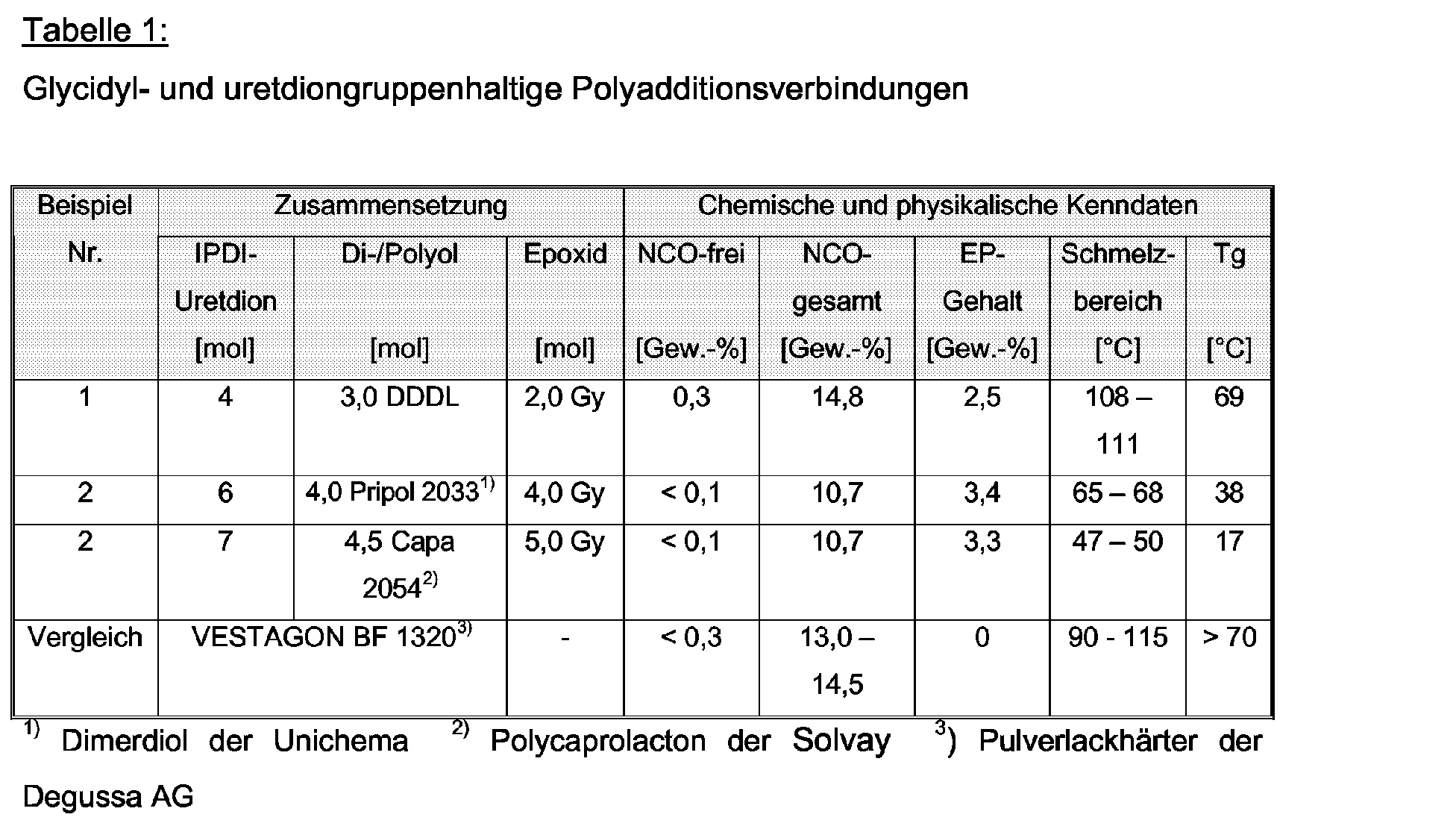
- DDDL:
- Dodecandiol-1,12
- P:
- Pentandiol-1,5
- Gy:
- 2,3-Epoxy-1-propanol
- EP:
- Epoxid
- Tg:
- Glasumwandlungstemperatur


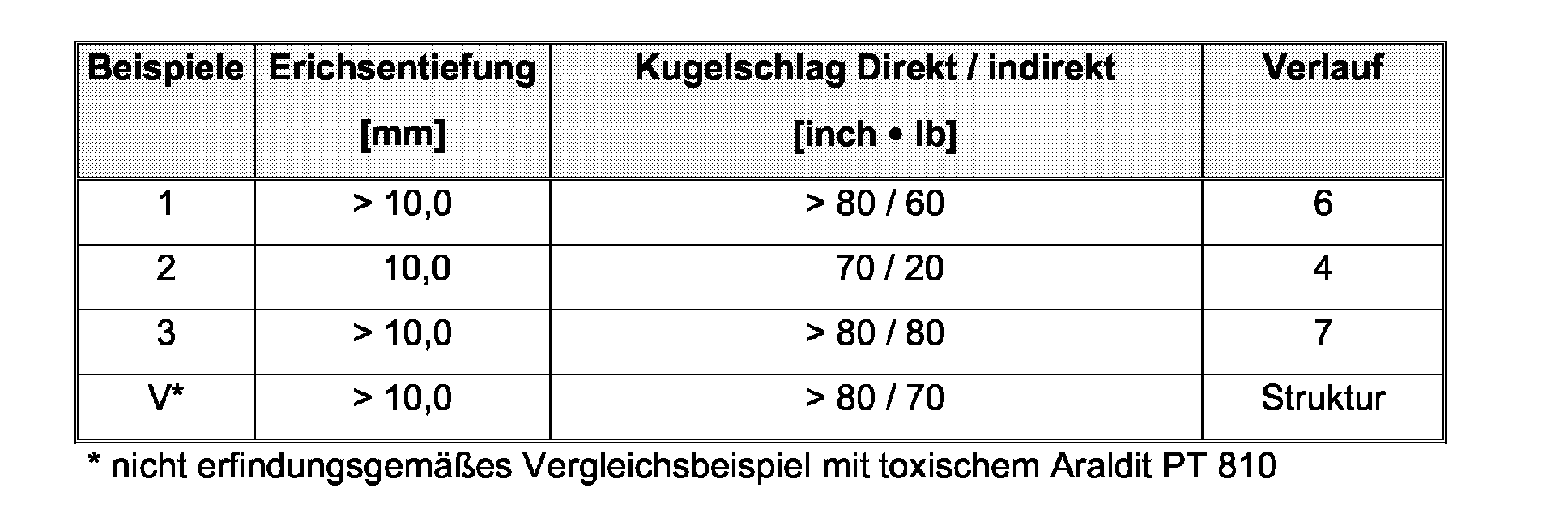
Kugelschlag nach ASTM D 2794-93
Verlauf nach PCI (1 bis 10, 1 sehr schlecht, 10 sehr gut)
Claims (17)
- Polyurethan-Pulverlackzusammensetzung im Wesentlichen enthaltendwobei die beiden Komponenten A) und B) in dem Verhältnis vorliegen, dass auf jede Hydroxylgruppe der Komponente B) 0,3 bis 1 Uretdiongruppe der Komponente A) entfällt und der Anteil des Katalysators unter C) 0,001 bis 3 Gew.-% an der Gesamtmenge der Komponenten A) und B) beträgt.A) mindestens eine epoxidgruppenterminierte, uretdiongruppenhaltige Polyadditionsverbindung mit einem Schmelzpunkt von 40 bis 130 °C, einer zahlenmittleren Molmasse zwischen 1 000 und 15 000 und einem Gehalt an freien Isocyanatgruppen (berechnet als NCO, Molekulargewicht = 42) von 0 bis 2 Gew.-%;B) mindestens ein hydroxylgruppenhaltiges Polymer mit einem Schmelzpunkt von 40 bis 130 °C und einer OH-Zahl von 20 bis 200 mg KOH/g;C) mindestens einen Katalysator aus der Gruppe der Metallacetylacetonate, Metallhydroxide, Metallalkoholate, quartären Ammoniumhydroxide, quartären Ammoniumfluoride oder quartären Ammoniumcarboxylate;D) gegebenenfalls Hilfs- und Zusatzstoffe;
- Polyurethan-Pulverlackzusammensetzung nach Anspruch 1,
dadurch gekennzeichnet, dass als Komponente A) epoxidgruppenterminierte, uretdiongruppenhaltige Polyadditionsverbindungen, erhalten durch Umsetzung vonwobei die Polyadditionsverbindungen unterhalb von 40 °C in fester und oberhalb von 130 °C in flüssiger Form vorliegen, zahlenmittlere Molmassen zwischen 1 000 bis 15 000 und einen Gehalt an freien Isocyanatgruppen (berechnet als NCO; Molekulargewicht = 42) von 0 bis 2 Gew.-% aufweisen, eingesetzt werden.a) 40 bis 84,5 Gew.-% mindestens einer Polyisocyanatkomponente, die aufgebaut ist aus1. mindestens 40 Gew.-% einer Uretdiongruppen aufweisenden Polyisocyanatverbindung mit einer mittleren Funktionalität von mindestens 2,0
und2. höchstens 60 Gew.-% mindestens einer Diisocyanatverbindung und/oder Isocyanuratverbindung ohne Uretdiongruppen;b) 50 bis 15 Gew.-% mindestens einer Verbindung mit mindestens zwei Hydroxylgruppen;c) 10 bis 0,5 Gew.-% mindestes einer Verbindung mit mindestens einer Epoxidgruppe und mindestens einer anderen gegenüber Isocyanatgruppen reaktiven funktionellen Gruppe; - Polyurethan-Pulverlackzusammensetzung nach mindestens einem der vorherigen Ansprüche,
dadurch gekennzeichnet, dass Uretdiongruppen aufweisende Polyisocyanatverbindungen a1), hergestellt aus 1,6-Diisocyanatohexan (HDI), 2-Methylpentamethylendiisocyanat-1,5 (DI 51), 2,2,4 (2,4,4)-Trimethylhexamethylendiisocyanat, 4,4'-Diisocyanatodicyclohexylmethan, 1,3- und 1,4-Diisocyanatocyclohexan und Isophorondiisocyanat (IPDI) oder Gemischen solcher Diisocyanate, eingesetzt werden. - Polyurethan-Pulverlackzusammensetzung nach mindestens einem der vorherigen Ansprüche,
dadurch gekennzeichnet, dass Diisocyanate und/oder Isocyanurate a2), ausgewählt aus 1,6-Diisocyanatohexan (HDI), 2-Methylpentamethylendiisocyanat-1,5 (DI 51), 2,2,4 (2,4,4)-Trimethylhexamethylendiisocyanat, 4,4'-Diisocyanatodicyclohexyl-methan, 1,3- und 1 ,4-Diisocyanatocyclohexan oder Isophorondiisocyanat (IPDI) oder Gemischen, eingesetzt werden. - Polyurethan-Pulverlackzusammensetzung nach mindestens einem der vorherigen Ansprüche,
dadurch gekennzeichnet, dass als Verbindungen b) Diole, ausgewählt aus Ethylenglykol, Triethylenglykol, Butandiol-1,4, Pentandiol-1,5, Hexandiol-1,6, 3-Methyl-pentandiol-1,5, Neopentylglykol, 2,2,4 (2,4,4)-Trimethylhexandiol und Hydroxypivalinsäureneopentylglykolester, allein oder in Mischungen eingesetzt werden. - Polyurethan-Pulverlackzusammensetzung nach mindestens einem der vorherigen Ansprüche,
dadurch gekennzeichnet, dass Verbindungen b), ausgewählt aus linearen hydroxylgruppenhaltigen Polyestern, Polycarbonaten, Polycaprolactonen, Polyethern, Polythioethern, Polyesteramiden, Polyurethanen oder Polyacetalen, allein oder in Mischungen eingesetzt werden. - Polyurethan-Pulverlackzusammensetzung nach mindestens einem der vorherigen Ansprüche,
dadurch gekennzeichnet, dass 2,3-Epoxy-1-propanol und/oder epoxidiertes Sojaöl als Komponente c) eingesetzt werden. - Polyurethan-Pulverlackzusammensetzungen nach mindestens einem der vorherigen Ansprüche,
dadurch gekennzeichnet, dass als hydroxylgruppenhaltige Polymere B) Polyester, Polyether, Polyacrylate, Polyurethane und Polycarbonate, allein oder in Mischungen, enthalten sind. - Polyurethan-Pulverlackzusammensetzung nach mindestens einem der vorherigen Ansprüche,
dadurch gekennzeichnet, dass als Katalysator C) Zinkacetylacetonat, Lithiumisopropyalkoholat, Tetraalkylammoniumhydroxid, Tetraalkylammoniumfluorid und/oder Tetraalkylammoniumbenzoat enthalten ist. - Polyurethan-Pulverlackzusammensetzung nach mindestens einem der vorherigen Ansprüche,
dadurch gekennzeichnet, dass als Hilfs- und Zusatzstoffe D) Verlaufsmittel, Lichtschutzmittel, Füllstoff, zusätzliche Katalysatoren und/oder Pigmente enthalten sind. - Verfahren zur Herstellung von Polyurethan-Pulverlackzusammensetzungen, im Wesentlichen enthaltendwobei die beiden Komponenten A) und B) in dem Verhältnis vorliegen, dass auf jede Hydroxylgruppe der Komponente B) 0,3 bis 1 Uretdiongruppe der Komponente A) entfällt und der Anteil des Katalysators unter C) 0,001 bis 3 Gew.-% an der Gesamtmenge der Komponente A) und B) beträgt, in beheizbaren Aggregaten bei einer Temperaturobergrenze von 120 bis 130 °C.A) mindestens eine epoxidgruppenterminierte, uretdiongruppenhaltige Polyadditionsverbindung mit einem Schmelzpunkt von 40 bis 130 °C, einer zahlenmittleren Molmasse zwischen 1 000 und 15 000 und einem Gehalt an freien Isocyanatgruppen (berechnet als NCO, Molekulargewicht = 42) von 0 bis 2 Gew.-%;B) mindestens ein hydroxylgruppenhaltiges Polymer mit einem Schmelzpunkt von 40 bis 130 °C und einer OH-Zahl von 20 bis 200 mg KOH/g;C) mindestens einen Katalysator aus der Gruppe der Metallacetylacetonate, Metallhydroxide, Metallalkoholate, quartären Ammoniumhydroxide, quartären Ammoniumfluoride oder quartären Ammoniumcarboxylate;D) gegebenenfalls Hilfs- und Zusatzstoffe;
- Verwendung von Zusammensetzungen auswobei die beiden Komponenten A) und B) in dem Verhältnis vorliegen, dass auf jede Hydroxylgruppe der Komponente B) 0,3 bis 1 Uretdiongruppe der Komponente A) entfällt und der Anteil des Katalysators unter C) 0,001 bis 3 Gew.-% an der Gesamtmenge der Komponenten A) und B) beträgt, in Polyurethan-Pulverlackzusammensetzungen.A) mindestens einer epoxidgruppenterminierten, uretdiongruppenhaltigen Polyadditionsverbindung mit einem Schmelzpunkt von 40 bis 130 °C, einer zahlenmittleren Molmasse zwischen 1 000 und 15 000 und einem Gehalt an freien Isocyanatgruppen (berechnet als NCO, Molekulargewicht = 42) von 0 bis 2 Gew.-%;B) mindestens einem hydroxylgruppenhaltigen Polymer mit einem Schmelzpunkt von 40 bis 130 °C und einer OH-Zahl von 20 bis 200mg KOH/g;C) mindestens einem Katalysator aus der Gruppe der Metallacetylacetonate, Metallhydroxide, Metallalkoholate, quartären Ammoniumhydroxide, quartären Ammoniumfluoride oder quartären Ammoniumcarboxylate;D) gegebenenfalls Hilfs- und Zusatzstoffen;
- Verwendung nach Anspruch 12,
dadurch gekennzeichnet, dass Ausgangsverbindungen nach mindestens einem der Ansprüche 1 bis 10 enthalten sind. - Verwendung nach mindestens einem der Ansprüche 12 bis 13 zur Herstellung von Pulverlackbeschichtungen auf Metall-, Kunststoff-, Holz-, Glas-, Lederoder sonstigen hitzeresistenten Untergründen.
- Metall-, Glas-, Holz-, Leder- oder Kunststoffbeschichtungszusammensetzungen, im Wesentlichen enthaltend eine Polyurethan-Pulverlackzusammensetzung auswobei die beiden Komponenten A) und B) in dem Verhältnis vorliegen, dass auf jede Hydroxylgruppe der Komponente B) 0,3 bis 1 Uretdiongruppe der Komponente A) entfällt und der Anteil des Katalysators unter C) 0,001 bis 3 Gew.-% an der Gesamtmenge der Komponenten A) und B) beträgt.A) mindestens einer epoxidgruppenterminierten, uretdiongruppenhaltigen Polyadditionsverbindung mit einem Schmelzpunkt von 40 bis 130 °C, einer zahlenmittleren Molmasse zwischen 1 000 und 15 000 und einem Gehalt an freien Isocyanatgruppen (berechnet als NCO, Molekulargewicht = 42) von 0 bis 2 Gew.-%;B) mindestens einem hydroxylgruppenhaltigen Polymer mit einem Schmelzpunkt von 40 bis 130 °C und einer OH-Zahl von 20 bis 200mg KOH/g;C) mindestens einem Katalysator aus der Gruppe der Metallacetylacetonate, Metallhydroxide, Metallalkoholate, quartären Ammoniumhydroxide, quartären Ammoniumfluoride oder quartären Ammoniumcarboxylate;D) gegebenenfalls Hilfs- und Zusatzstoffen;
- Metallbeschichtung nach Anspruch 15 für Automobilkarossen, Motor- und Fahrräder, Gebäudeteile und Haushaltsgeräte.
- Beschichtungszusammensetzung nach einem der Ansprüche 15 bis 16,
dadurch gekennzeichnet, dass diese Verbindungen nach mindestens einem der Ansprüche 1 bis 10 enthalten.
Applications Claiming Priority (2)
| Application Number | Priority Date | Filing Date | Title |
|---|---|---|---|
| DE10348966 | 2003-10-22 | ||
| DE2003148966 DE10348966A1 (de) | 2003-10-22 | 2003-10-22 | Hochreaktive Polyurethan-Pulverlackzusammensetzungen auf Basis epoxidgruppenterminierter, uretdiongruppenhaltiger Polyadditionsverbindungen |
Publications (2)
| Publication Number | Publication Date |
|---|---|
| EP1526146A1 true EP1526146A1 (de) | 2005-04-27 |
| EP1526146B1 EP1526146B1 (de) | 2006-08-09 |
Family
ID=34384391
Family Applications (1)
| Application Number | Title | Priority Date | Filing Date |
|---|---|---|---|
| EP20040104070 Expired - Lifetime EP1526146B1 (de) | 2003-10-22 | 2004-08-25 | Hochreaktive Polyurethan-Pulverlackzusammensetzungen auf Basis epoxidgruppenterminierter, uretdiongruppenhaltiger Polyadditionsverbindungen |
Country Status (7)
| Country | Link |
|---|---|
| US (1) | US7300997B2 (de) |
| EP (1) | EP1526146B1 (de) |
| JP (1) | JP2005126713A (de) |
| AT (1) | ATE335776T1 (de) |
| CA (1) | CA2485627A1 (de) |
| DE (2) | DE10348966A1 (de) |
| ES (1) | ES2266994T3 (de) |
Cited By (6)
| Publication number | Priority date | Publication date | Assignee | Title |
|---|---|---|---|---|
| WO2006040225A1 (de) * | 2004-10-07 | 2006-04-20 | Degussa Ag | Hoch reaktive uretdiongruppenhaltige polyurethanzusammensetzungen |
| WO2007045615A1 (de) * | 2005-10-21 | 2007-04-26 | Evonik Degussa Gmbh | Metallfreie 1k-polyurethansysteme |
| EP1903066A1 (de) * | 2006-09-23 | 2008-03-26 | Bayer MaterialScience AG | Polyurethan-Pulverlack |
| WO2009095117A1 (de) * | 2008-02-01 | 2009-08-06 | Evonik Degussa Gmbh | Verfahren zur herstellung hochreaktiver uretdiongruppenhaltiger polyurethanzusammensetzungen im dryblend |
| EP3543270A1 (de) | 2018-03-23 | 2019-09-25 | Covestro Deutschland AG | Katalysatorsystem für uretdiondispersionen |
| WO2019180129A1 (de) | 2018-03-23 | 2019-09-26 | Covestro Deutschland Ag | Katalysatorsystem für uretdiondispersionen |
Families Citing this family (23)
| Publication number | Priority date | Publication date | Assignee | Title |
|---|---|---|---|---|
| DE10320266A1 (de) * | 2003-05-03 | 2004-11-18 | Degussa Ag | Feste Uretdiongruppenhaltige Polyurethan-Pulverlackzusammensetzungen bei niedriger Temperatur härtbar |
| DE10320267A1 (de) * | 2003-05-03 | 2004-11-18 | Degussa Ag | Bei niedriger Temperatur härtbare feste uretdiongruppenhaltige Polyurethan-Pulverlackzusammensetzungen |
| DE10346957A1 (de) * | 2003-10-09 | 2005-05-04 | Degussa | Hochreaktive, flüssige uretdiongruppenhaltige Polyurenthansysteme, die bei niedriger Temperatur härtbar sind |
| DE10346958A1 (de) * | 2003-10-09 | 2005-05-12 | Degussa | Uretdiongruppenhaltige Polyurethanzusammensetzungen, welche bei niedriger Temperatur härtbar sind |
| DE10348966A1 (de) | 2003-10-22 | 2005-06-02 | Degussa Ag | Hochreaktive Polyurethan-Pulverlackzusammensetzungen auf Basis epoxidgruppenterminierter, uretdiongruppenhaltiger Polyadditionsverbindungen |
| DE102004011004A1 (de) * | 2004-03-06 | 2005-09-22 | Degussa Ag | Verfahren zur Herstellung fester, hochreaktiver Uretdiongruppen haltiger Polyurethanzusammensetzungen |
| DE102004020451A1 (de) * | 2004-04-27 | 2005-12-01 | Degussa Ag | Uretdiongruppenhaltige Polyurethanzusammensetzungen, welche bei niedriger Temperatur härtbar sind und (teil-)kristalline Harze enthalten |
| DE102004020429A1 (de) * | 2004-04-27 | 2005-11-24 | Degussa Ag | Uretdiongruppenhaltige Polyurethanzusammensetzungen, welche bei niedriger Temperatur härtbar sind und (teil-)kristalline Harze enthalten |
| DE102004048773A1 (de) * | 2004-10-07 | 2006-04-13 | Degussa Ag | Hydroxylterminierte uretdiongruppenhaltige Polyurethanverbindungen |
| DE102005013329A1 (de) * | 2005-03-23 | 2006-11-16 | Degussa Ag | Niedrigviskose uretdiongruppenhaltige Polyadditionsverbindungen, Verfahren zur Herstellung und Verwendung |
| DE102005013401A1 (de) * | 2005-03-23 | 2006-09-28 | Degussa Ag | Niedrigviskose uretdiongruppenhaltige Polyadditionsverbindungen, Verfahren zur Herstellung und Verwendung |
| DE102006055081A1 (de) * | 2006-11-22 | 2008-05-29 | Ems-Chemie Ag | Urethanepoxide für die Tieftemperaturhärtung von Beschichtungen, Verfahren zur Herstellung sowie Verwendung |
| US20080265201A1 (en) * | 2007-04-26 | 2008-10-30 | Degussa Gmbh | Low-temperature-curable polyurethane compositions with uretdione groups, containing polymers based on polyols that carry secondary oh groups |
| DE102007062316A1 (de) | 2007-12-21 | 2009-06-25 | Evonik Degussa Gmbh | Reaktive Isocyanatzusammensetzungen |
| DE102008002703A1 (de) * | 2008-06-27 | 2009-12-31 | Evonik Degussa Gmbh | Hochreaktive, Uretdiongruppen haltige Polyurethanzusammensetzungen, die metallfreie Acetylacetonate enthalten |
| EP2161294A1 (de) | 2008-09-05 | 2010-03-10 | Hexion Specialty Chemicals Research Belgium S.A. | Hydroxypolyesterharze mit hoher Tg |
| US8293836B2 (en) * | 2009-05-20 | 2012-10-23 | Basf Coatings Gmbh | Curable coating composition containing a compound having a uretdione group and a different functional group and cured coatings |
| US8629231B2 (en) * | 2009-05-20 | 2014-01-14 | Basf Coatings Gmbh | Methods of making oligomers, coating compositions containing them, and coated articles |
| US8476376B2 (en) | 2010-03-11 | 2013-07-02 | Evonik Degussa Gmbh | Heat-curing powder-lacquer compositions yielding a matte surface after curing of the coating, as well as a simple method for production of same |
| CN106519133B (zh) * | 2016-11-10 | 2019-01-29 | 万华化学集团股份有限公司 | 一种磺酸型水性聚氨酯-丙烯酸酯自消光树脂及其制备方法和应用 |
| EP3853278B1 (de) | 2018-09-20 | 2025-08-20 | 3M Innovative Properties Company | Polymeres material mit einem uretdionhaltigen material und einer epoxidkomponente, zweiteilige zusammensetzungen und verfahren |
| EP3856818A4 (de) | 2018-09-25 | 2022-07-13 | 3M Innovative Properties Company | Polymeres material mit einem uretdionhaltigen material und einem thermisch aktivierbaren amin, zweiteilige zusammensetzungen und verfahren |
| CN111635499A (zh) * | 2020-06-05 | 2020-09-08 | 西安增材制造国家研究院有限公司 | 一种环氧改性聚氨酯树脂、体系及其制备方法与应用 |
Citations (2)
| Publication number | Priority date | Publication date | Assignee | Title |
|---|---|---|---|---|
| EP1063269A2 (de) * | 1999-06-22 | 2000-12-27 | Degussa-Hüls Aktiengesellschaft | Epoxidterminierte, uretdiongruppenhaltige Polyadditionsverbindungen, Verfahren zu ihrer Herstellung sowie deren Verwendung |
| DE10205608A1 (de) * | 2002-02-11 | 2003-08-21 | Degussa | Bei niedriger Temperatur härtbare feste uretdiongruppenhaltige Polyurethan-Pulverlackzusammensetzungen |
Family Cites Families (12)
| Publication number | Priority date | Publication date | Assignee | Title |
|---|---|---|---|---|
| DE19940855A1 (de) * | 1999-08-27 | 2001-03-01 | Basf Coatings Ag | Lösemittelhaltiger Beschichtungsstoff und seine Verwendung |
| DE10118540A1 (de) * | 2001-04-14 | 2002-10-17 | Degussa | Verfahren zur Herstellung von Uretdiongruppen haltigen Polyadditionsverbindungen |
| DE10320266A1 (de) * | 2003-05-03 | 2004-11-18 | Degussa Ag | Feste Uretdiongruppenhaltige Polyurethan-Pulverlackzusammensetzungen bei niedriger Temperatur härtbar |
| DE10320267A1 (de) * | 2003-05-03 | 2004-11-18 | Degussa Ag | Bei niedriger Temperatur härtbare feste uretdiongruppenhaltige Polyurethan-Pulverlackzusammensetzungen |
| DE10346957A1 (de) | 2003-10-09 | 2005-05-04 | Degussa | Hochreaktive, flüssige uretdiongruppenhaltige Polyurenthansysteme, die bei niedriger Temperatur härtbar sind |
| DE10346958A1 (de) * | 2003-10-09 | 2005-05-12 | Degussa | Uretdiongruppenhaltige Polyurethanzusammensetzungen, welche bei niedriger Temperatur härtbar sind |
| DE10347902A1 (de) * | 2003-10-15 | 2005-05-19 | Degussa Ag | Feste uretdiongruppenhaltige Polyadditionsverbindungen |
| DE10348965A1 (de) * | 2003-10-22 | 2005-05-25 | Degussa Ag | Epoxidgruppenhaltige Pulverlackzusammensetzungen, die bei niedrigen Temperaturen aushärten |
| DE10348966A1 (de) | 2003-10-22 | 2005-06-02 | Degussa Ag | Hochreaktive Polyurethan-Pulverlackzusammensetzungen auf Basis epoxidgruppenterminierter, uretdiongruppenhaltiger Polyadditionsverbindungen |
| JP2005130911A (ja) * | 2003-10-28 | 2005-05-26 | Nelson Precision Casting Co Ltd | ゴルフクラブヘッドと重りの結合構造 |
| DE102004020429A1 (de) * | 2004-04-27 | 2005-11-24 | Degussa Ag | Uretdiongruppenhaltige Polyurethanzusammensetzungen, welche bei niedriger Temperatur härtbar sind und (teil-)kristalline Harze enthalten |
| DE102004020451A1 (de) * | 2004-04-27 | 2005-12-01 | Degussa Ag | Uretdiongruppenhaltige Polyurethanzusammensetzungen, welche bei niedriger Temperatur härtbar sind und (teil-)kristalline Harze enthalten |
-
2003
- 2003-10-22 DE DE2003148966 patent/DE10348966A1/de not_active Withdrawn
-
2004
- 2004-08-25 AT AT04104070T patent/ATE335776T1/de not_active IP Right Cessation
- 2004-08-25 ES ES04104070T patent/ES2266994T3/es not_active Expired - Lifetime
- 2004-08-25 DE DE200450001148 patent/DE502004001148D1/de not_active Expired - Fee Related
- 2004-08-25 EP EP20040104070 patent/EP1526146B1/de not_active Expired - Lifetime
- 2004-10-14 US US10/963,503 patent/US7300997B2/en not_active Expired - Fee Related
- 2004-10-19 JP JP2004304708A patent/JP2005126713A/ja active Pending
- 2004-10-20 CA CA 2485627 patent/CA2485627A1/en not_active Abandoned
Patent Citations (2)
| Publication number | Priority date | Publication date | Assignee | Title |
|---|---|---|---|---|
| EP1063269A2 (de) * | 1999-06-22 | 2000-12-27 | Degussa-Hüls Aktiengesellschaft | Epoxidterminierte, uretdiongruppenhaltige Polyadditionsverbindungen, Verfahren zu ihrer Herstellung sowie deren Verwendung |
| DE10205608A1 (de) * | 2002-02-11 | 2003-08-21 | Degussa | Bei niedriger Temperatur härtbare feste uretdiongruppenhaltige Polyurethan-Pulverlackzusammensetzungen |
Cited By (10)
| Publication number | Priority date | Publication date | Assignee | Title |
|---|---|---|---|---|
| WO2006040225A1 (de) * | 2004-10-07 | 2006-04-20 | Degussa Ag | Hoch reaktive uretdiongruppenhaltige polyurethanzusammensetzungen |
| US8569440B2 (en) | 2004-10-07 | 2013-10-29 | Evonik Degussa Gmbh | Highly reactive polyurethane compositions containing uretdione groups |
| WO2007045615A1 (de) * | 2005-10-21 | 2007-04-26 | Evonik Degussa Gmbh | Metallfreie 1k-polyurethansysteme |
| CN1951974B (zh) * | 2005-10-21 | 2012-04-04 | 赢创德固赛有限责任公司 | 不含金属的1k聚氨酯体系 |
| EP1903066A1 (de) * | 2006-09-23 | 2008-03-26 | Bayer MaterialScience AG | Polyurethan-Pulverlack |
| US7919552B2 (en) | 2006-09-23 | 2011-04-05 | Bayer Materialscience Ag | Polyurethane powder lacquer |
| WO2009095117A1 (de) * | 2008-02-01 | 2009-08-06 | Evonik Degussa Gmbh | Verfahren zur herstellung hochreaktiver uretdiongruppenhaltiger polyurethanzusammensetzungen im dryblend |
| US8702899B2 (en) | 2008-02-01 | 2014-04-22 | Evonik Degussa Gmbh | Dryblend process for preparing high-reactivity polyurethane compositions containing uretdione groups |
| EP3543270A1 (de) | 2018-03-23 | 2019-09-25 | Covestro Deutschland AG | Katalysatorsystem für uretdiondispersionen |
| WO2019180129A1 (de) | 2018-03-23 | 2019-09-26 | Covestro Deutschland Ag | Katalysatorsystem für uretdiondispersionen |
Also Published As
| Publication number | Publication date |
|---|---|
| EP1526146B1 (de) | 2006-08-09 |
| ATE335776T1 (de) | 2006-09-15 |
| ES2266994T3 (es) | 2007-03-01 |
| US7300997B2 (en) | 2007-11-27 |
| CA2485627A1 (en) | 2005-04-22 |
| DE10348966A1 (de) | 2005-06-02 |
| JP2005126713A (ja) | 2005-05-19 |
| US20050090636A1 (en) | 2005-04-28 |
| DE502004001148D1 (de) | 2006-09-21 |
Similar Documents
| Publication | Publication Date | Title |
|---|---|---|
| EP1526146B1 (de) | Hochreaktive Polyurethan-Pulverlackzusammensetzungen auf Basis epoxidgruppenterminierter, uretdiongruppenhaltiger Polyadditionsverbindungen | |
| EP1475399B1 (de) | Feste uretdiongruppenhaltige Polyurethan-Pulverlackzusammensetzungen bei niedriger Temperatur härtbar | |
| EP1334987B1 (de) | Bei niedriger Temperatur härtbare feste uretdiongruppenhaltige Polyurethan-Pulverlackzusammensetzungen | |
| DE102004020451A1 (de) | Uretdiongruppenhaltige Polyurethanzusammensetzungen, welche bei niedriger Temperatur härtbar sind und (teil-)kristalline Harze enthalten | |
| EP1740633A1 (de) | Uretdiongruppenhaltige polyurethanzusammensetzungen, welche bei niedriger temperatur härtbar sind und (teil-)kristalline harze enthalten | |
| EP1475400A1 (de) | Bei niedriger Temperatur härtbare feste uretdiongruppenhaltige Polyurethan-Pulverlackzusammensetzungen | |
| DE3030588A1 (de) | Verfahren zur herstellung von blockierungsmittelfreien polyurethan-pulverlacken mit hoher lagerstabilitaet, die oberhalb 120(grad) c haertbar sind, sowie die danach hergestellten polyurethan-pulverlacke | |
| DE10347901A1 (de) | Polyurethan-Pulverlackbeschichtungen, welche feste uretdiongruppenhaltige Polyadditionsverbindungen enthalten, und ein Verfahren zu ihrer Herstellung | |
| WO2008068073A1 (de) | Lagerstabile pur-pulverlackzusammensetzungen und ihre verwendung für trübungsarme und flexible polyurethan-beschichtungen | |
| WO2008028769A1 (de) | Bei niedriger temperatur härtbare, uretdiongruppenhaltige polyurethanzusammensetzungen mit quartären ammoniumhalogeniden | |
| DE102004011005A1 (de) | Bei niedriger Temperatur härtbare uretdiongruppenhaltige Polyurethanzusammensetzungen | |
| DE102004062588A1 (de) | Hochreaktive uretdiongruppenhaltige Polyurethanzusammensetzungen auf Basis von 1,4-Diisocyanatocyclohexylmethan | |
| WO2008138855A1 (de) | Bei niedriger temperatur härtbare, uretdiongruppen aufweisende polyurethanzusammensetzungen enthaltend polymere auf der basis von sekundären oh-gruppen tragenden polyolen | |
| DE3711374A1 (de) | Polyurethan-pulverlacke, die nach aushaertung eine matte oberflaeche ergeben | |
| EP1318161A1 (de) | PUR-Pulverlackzusammensetzungen und ihre Verwendung für Polyurethan-Pulverlacke und insbesondere für Pulver-Coil Coating-Lacke | |
| DE3739479A1 (de) | Pur-pulverlacke fuer matte ueberzuege | |
| EP1321482B1 (de) | Verwendung von Polyurethan-Pulverlacken | |
| EP1063269B1 (de) | Epoxidterminierte, uretdiongruppenhaltige Polyadditionsverbindungen, Verfahren zu ihrer Herstellung sowie deren Verwendung | |
| EP1362875A1 (de) | Bifunktionelle Polyadditionsverbindungen als Vernetzer für Polyurethan-Pulverlacke | |
| DE10233104A1 (de) | Verwendung von PUR-Pulverlacken für Coil Coating-Beschichtungen mit mattem Erscheinungsbild | |
| EP0538597A1 (de) | Blockierte höherfuntionelle Polyisocyanataddukte, ein Verfahren zu ihrer Herstellung sowie deren Verwendung | |
| EP0780417A2 (de) | Hydroxyl- und uretdiongruppenhaltige Polyisocyanate | |
| EP1057842A1 (de) | Verlaufmittel enthaltende hydroxyl- und uretdiongruppenhaltige Polyadditionsprodukte, ein Verfahren zu ihrer Herstellung sowie deren Verwendung zur Herstellung von Polyurethan-Pulverlacken | |
| EP0780416A1 (de) | Pulverlack und seine Verwendung zur Beschichtung von hitzeresistenten Substraten | |
| EP3929233A1 (de) | Reaktive polyurethan-zusammensetzungen |
Legal Events
| Date | Code | Title | Description |
|---|---|---|---|
| PUAI | Public reference made under article 153(3) epc to a published international application that has entered the european phase |
Free format text: ORIGINAL CODE: 0009012 |
|
| 17P | Request for examination filed |
Effective date: 20040825 |
|
| AK | Designated contracting states |
Kind code of ref document: A1 Designated state(s): AT BE BG CH CY CZ DE DK EE ES FI FR GB GR HU IE IT LI LU MC NL PL PT RO SE SI SK TR |
|
| AX | Request for extension of the european patent |
Extension state: AL HR LT LV MK |
|
| 17Q | First examination report despatched |
Effective date: 20050620 |
|
| AKX | Designation fees paid |
Designated state(s): AT BE BG CH CY CZ DE DK EE ES FI FR GB GR HU IE IT LI LU MC NL PL PT RO SE SI SK TR |
|
| GRAP | Despatch of communication of intention to grant a patent |
Free format text: ORIGINAL CODE: EPIDOSNIGR1 |
|
| GRAS | Grant fee paid |
Free format text: ORIGINAL CODE: EPIDOSNIGR3 |
|
| GRAA | (expected) grant |
Free format text: ORIGINAL CODE: 0009210 |
|
| AK | Designated contracting states |
Kind code of ref document: B1 Designated state(s): AT BE BG CH CY CZ DE DK EE ES FI FR GB GR HU IE IT LI LU MC NL PL PT RO SE SI SK TR |
|
| PG25 | Lapsed in a contracting state [announced via postgrant information from national office to epo] |
Ref country code: SI Free format text: LAPSE BECAUSE OF FAILURE TO SUBMIT A TRANSLATION OF THE DESCRIPTION OR TO PAY THE FEE WITHIN THE PRESCRIBED TIME-LIMIT Effective date: 20060809 Ref country code: FI Free format text: LAPSE BECAUSE OF FAILURE TO SUBMIT A TRANSLATION OF THE DESCRIPTION OR TO PAY THE FEE WITHIN THE PRESCRIBED TIME-LIMIT Effective date: 20060809 Ref country code: NL Free format text: LAPSE BECAUSE OF FAILURE TO SUBMIT A TRANSLATION OF THE DESCRIPTION OR TO PAY THE FEE WITHIN THE PRESCRIBED TIME-LIMIT Effective date: 20060809 Ref country code: CZ Free format text: LAPSE BECAUSE OF FAILURE TO SUBMIT A TRANSLATION OF THE DESCRIPTION OR TO PAY THE FEE WITHIN THE PRESCRIBED TIME-LIMIT Effective date: 20060809 Ref country code: IE Free format text: LAPSE BECAUSE OF FAILURE TO SUBMIT A TRANSLATION OF THE DESCRIPTION OR TO PAY THE FEE WITHIN THE PRESCRIBED TIME-LIMIT Effective date: 20060809 Ref country code: PL Free format text: LAPSE BECAUSE OF FAILURE TO SUBMIT A TRANSLATION OF THE DESCRIPTION OR TO PAY THE FEE WITHIN THE PRESCRIBED TIME-LIMIT Effective date: 20060809 Ref country code: RO Free format text: LAPSE BECAUSE OF FAILURE TO SUBMIT A TRANSLATION OF THE DESCRIPTION OR TO PAY THE FEE WITHIN THE PRESCRIBED TIME-LIMIT Effective date: 20060809 Ref country code: SK Free format text: LAPSE BECAUSE OF FAILURE TO SUBMIT A TRANSLATION OF THE DESCRIPTION OR TO PAY THE FEE WITHIN THE PRESCRIBED TIME-LIMIT Effective date: 20060809 |
|
| REG | Reference to a national code |
Ref country code: GB Ref legal event code: FG4D Free format text: NOT ENGLISH |
|
| PG25 | Lapsed in a contracting state [announced via postgrant information from national office to epo] |
Ref country code: MC Free format text: LAPSE BECAUSE OF NON-PAYMENT OF DUE FEES Effective date: 20060831 Ref country code: BE Free format text: LAPSE BECAUSE OF NON-PAYMENT OF DUE FEES Effective date: 20060831 |
|
| REG | Reference to a national code |
Ref country code: CH Ref legal event code: EP |
|
| REG | Reference to a national code |
Ref country code: IE Ref legal event code: FG4D Free format text: LANGUAGE OF EP DOCUMENT: GERMAN |
|
| REF | Corresponds to: |
Ref document number: 502004001148 Country of ref document: DE Date of ref document: 20060921 Kind code of ref document: P |
|
| GBT | Gb: translation of ep patent filed (gb section 77(6)(a)/1977) |
Effective date: 20060913 |
|
| PG25 | Lapsed in a contracting state [announced via postgrant information from national office to epo] |
Ref country code: BG Free format text: LAPSE BECAUSE OF FAILURE TO SUBMIT A TRANSLATION OF THE DESCRIPTION OR TO PAY THE FEE WITHIN THE PRESCRIBED TIME-LIMIT Effective date: 20061109 Ref country code: DK Free format text: LAPSE BECAUSE OF FAILURE TO SUBMIT A TRANSLATION OF THE DESCRIPTION OR TO PAY THE FEE WITHIN THE PRESCRIBED TIME-LIMIT Effective date: 20061109 Ref country code: SE Free format text: LAPSE BECAUSE OF FAILURE TO SUBMIT A TRANSLATION OF THE DESCRIPTION OR TO PAY THE FEE WITHIN THE PRESCRIBED TIME-LIMIT Effective date: 20061109 |
|
| ET | Fr: translation filed | ||
| PG25 | Lapsed in a contracting state [announced via postgrant information from national office to epo] |
Ref country code: PT Free format text: LAPSE BECAUSE OF FAILURE TO SUBMIT A TRANSLATION OF THE DESCRIPTION OR TO PAY THE FEE WITHIN THE PRESCRIBED TIME-LIMIT Effective date: 20070109 |
|
| NLV1 | Nl: lapsed or annulled due to failure to fulfill the requirements of art. 29p and 29m of the patents act | ||
| RAP2 | Party data changed (patent owner data changed or rights of a patent transferred) |
Owner name: DEGUSSA GMBH |
|
| REG | Reference to a national code |
Ref country code: ES Ref legal event code: FG2A Ref document number: 2266994 Country of ref document: ES Kind code of ref document: T3 |
|
| REG | Reference to a national code |
Ref country code: IE Ref legal event code: FD4D |
|
| PLBE | No opposition filed within time limit |
Free format text: ORIGINAL CODE: 0009261 |
|
| STAA | Information on the status of an ep patent application or granted ep patent |
Free format text: STATUS: NO OPPOSITION FILED WITHIN TIME LIMIT |
|
| 26N | No opposition filed |
Effective date: 20070510 |
|
| BERE | Be: lapsed |
Owner name: DEGUSSA A.G. Effective date: 20060831 |
|
| PG25 | Lapsed in a contracting state [announced via postgrant information from national office to epo] |
Ref country code: GR Free format text: LAPSE BECAUSE OF FAILURE TO SUBMIT A TRANSLATION OF THE DESCRIPTION OR TO PAY THE FEE WITHIN THE PRESCRIBED TIME-LIMIT Effective date: 20061110 |
|
| PG25 | Lapsed in a contracting state [announced via postgrant information from national office to epo] |
Ref country code: EE Free format text: LAPSE BECAUSE OF FAILURE TO SUBMIT A TRANSLATION OF THE DESCRIPTION OR TO PAY THE FEE WITHIN THE PRESCRIBED TIME-LIMIT Effective date: 20060809 |
|
| PG25 | Lapsed in a contracting state [announced via postgrant information from national office to epo] |
Ref country code: LU Free format text: LAPSE BECAUSE OF NON-PAYMENT OF DUE FEES Effective date: 20060825 Ref country code: HU Free format text: LAPSE BECAUSE OF FAILURE TO SUBMIT A TRANSLATION OF THE DESCRIPTION OR TO PAY THE FEE WITHIN THE PRESCRIBED TIME-LIMIT Effective date: 20070210 Ref country code: TR Free format text: LAPSE BECAUSE OF FAILURE TO SUBMIT A TRANSLATION OF THE DESCRIPTION OR TO PAY THE FEE WITHIN THE PRESCRIBED TIME-LIMIT Effective date: 20060809 |
|
| PGFP | Annual fee paid to national office [announced via postgrant information from national office to epo] |
Ref country code: DE Payment date: 20080822 Year of fee payment: 5 Ref country code: ES Payment date: 20080828 Year of fee payment: 5 |
|
| PG25 | Lapsed in a contracting state [announced via postgrant information from national office to epo] |
Ref country code: CY Free format text: LAPSE BECAUSE OF FAILURE TO SUBMIT A TRANSLATION OF THE DESCRIPTION OR TO PAY THE FEE WITHIN THE PRESCRIBED TIME-LIMIT Effective date: 20060809 |
|
| PGFP | Annual fee paid to national office [announced via postgrant information from national office to epo] |
Ref country code: AT Payment date: 20080814 Year of fee payment: 5 Ref country code: FR Payment date: 20080813 Year of fee payment: 5 Ref country code: IT Payment date: 20080822 Year of fee payment: 5 |
|
| PGFP | Annual fee paid to national office [announced via postgrant information from national office to epo] |
Ref country code: GB Payment date: 20080821 Year of fee payment: 5 |
|
| REG | Reference to a national code |
Ref country code: CH Ref legal event code: PL |
|
| PG25 | Lapsed in a contracting state [announced via postgrant information from national office to epo] |
Ref country code: CH Free format text: LAPSE BECAUSE OF NON-PAYMENT OF DUE FEES Effective date: 20080831 Ref country code: LI Free format text: LAPSE BECAUSE OF NON-PAYMENT OF DUE FEES Effective date: 20080831 |
|
| REG | Reference to a national code |
Ref country code: FR Ref legal event code: CA Ref country code: FR Ref legal event code: CD Ref country code: FR Ref legal event code: CJ |
|
| GBPC | Gb: european patent ceased through non-payment of renewal fee |
Effective date: 20090825 |
|
| REG | Reference to a national code |
Ref country code: FR Ref legal event code: ST Effective date: 20100430 |
|
| PG25 | Lapsed in a contracting state [announced via postgrant information from national office to epo] |
Ref country code: AT Free format text: LAPSE BECAUSE OF NON-PAYMENT OF DUE FEES Effective date: 20090825 |
|
| PG25 | Lapsed in a contracting state [announced via postgrant information from national office to epo] |
Ref country code: DE Free format text: LAPSE BECAUSE OF NON-PAYMENT OF DUE FEES Effective date: 20100302 Ref country code: FR Free format text: LAPSE BECAUSE OF NON-PAYMENT OF DUE FEES Effective date: 20090831 |
|
| REG | Reference to a national code |
Ref country code: ES Ref legal event code: FD2A Effective date: 20090826 |
|
| PG25 | Lapsed in a contracting state [announced via postgrant information from national office to epo] |
Ref country code: GB Free format text: LAPSE BECAUSE OF NON-PAYMENT OF DUE FEES Effective date: 20090825 |
|
| PG25 | Lapsed in a contracting state [announced via postgrant information from national office to epo] |
Ref country code: IT Free format text: LAPSE BECAUSE OF NON-PAYMENT OF DUE FEES Effective date: 20090825 |
|
| PG25 | Lapsed in a contracting state [announced via postgrant information from national office to epo] |
Ref country code: ES Free format text: LAPSE BECAUSE OF NON-PAYMENT OF DUE FEES Effective date: 20090826 |