EP1524871A2 - Apparatus zum Scannen von WCDMA-Kanälen - Google Patents
Apparatus zum Scannen von WCDMA-Kanälen Download PDFInfo
- Publication number
- EP1524871A2 EP1524871A2 EP04024383A EP04024383A EP1524871A2 EP 1524871 A2 EP1524871 A2 EP 1524871A2 EP 04024383 A EP04024383 A EP 04024383A EP 04024383 A EP04024383 A EP 04024383A EP 1524871 A2 EP1524871 A2 EP 1524871A2
- Authority
- EP
- European Patent Office
- Prior art keywords
- channels
- channel
- priority
- occupation
- frequency group
- Prior art date
- Legal status (The legal status is an assumption and is not a legal conclusion. Google has not performed a legal analysis and makes no representation as to the accuracy of the status listed.)
- Granted
Links
- 238000010295 mobile communication Methods 0.000 claims abstract description 30
- 238000004891 communication Methods 0.000 claims description 37
- 238000000034 method Methods 0.000 claims description 35
- 238000009825 accumulation Methods 0.000 claims description 2
- 230000005540 biological transmission Effects 0.000 description 6
- 230000008569 process Effects 0.000 description 5
- 238000010586 diagram Methods 0.000 description 4
- 230000006870 function Effects 0.000 description 4
- 238000004519 manufacturing process Methods 0.000 description 4
- 238000012986 modification Methods 0.000 description 3
- 230000004048 modification Effects 0.000 description 3
- 238000007726 management method Methods 0.000 description 2
- 230000003287 optical effect Effects 0.000 description 2
- 101100521334 Mus musculus Prom1 gene Proteins 0.000 description 1
- 230000004913 activation Effects 0.000 description 1
- 238000010276 construction Methods 0.000 description 1
- 229920001690 polydopamine Polymers 0.000 description 1
- 230000001902 propagating effect Effects 0.000 description 1
- 238000004148 unit process Methods 0.000 description 1
Images



Classifications
-
- H—ELECTRICITY
- H04—ELECTRIC COMMUNICATION TECHNIQUE
- H04W—WIRELESS COMMUNICATION NETWORKS
- H04W48/00—Access restriction; Network selection; Access point selection
- H04W48/16—Discovering, processing access restriction or access information
-
- H—ELECTRICITY
- H04—ELECTRIC COMMUNICATION TECHNIQUE
- H04W—WIRELESS COMMUNICATION NETWORKS
- H04W24/00—Supervisory, monitoring or testing arrangements
-
- H—ELECTRICITY
- H04—ELECTRIC COMMUNICATION TECHNIQUE
- H04W—WIRELESS COMMUNICATION NETWORKS
- H04W88/00—Devices specially adapted for wireless communication networks, e.g. terminals, base stations or access point devices
- H04W88/02—Terminal devices
Definitions
- the present invention relates to a mobile communication system, and more particularly to, an apparatus for scanning a mobile communication channel, such as an intelligent Wideband Code Division Multiple Access (WCDMA) channel, allowing a mobile terminal to scan an optimized channel in a mobile communication network and a method therefore.
- a mobile communication channel such as an intelligent Wideband Code Division Multiple Access (WCDMA) channel
- WCDMA Wideband Code Division Multiple Access
- a mobile terminal within a WCDMA network, performs a call or uses a data service through a channel (or frequency) allocated by a base station of a corresponding region.
- Manufacturers of mobile terminals use diverse methods to increase scanning efficiency for allocating channels.
- One method for increasing scanning efficiency includes scanning a specified fixed frequency band or an entire allocated frequency band within the WCDMA network. However, channels using different frequency bands, or other mobile communication provider networks are not scanned.
- the handover to the unallocated frequency band would introduce a communication delay (while the system determines channel availability). This delay may result in reduced quality of service to a user or a base station.
- the present invention provides an apparatus and a method for scanning communication channels, such as an intelligent Wideband Code Division Multiple Access (WCDMA) channels, for determining availability for receiving and transmitting communication signals.
- a mobile terminal for example, using the method and/or system disclosed, scans an optimized channel in a WCDMA network, which results in increased communication efficiency.
- WCDMA Wideband Code Division Multiple Access
- the communication channels are scanned according to priority established by an occupation number of the channel.
- the occupation number refers to the number of signals utilizing the channel.
- the communication channels are scanned according to priority established by a frequency ranking of selected channel.
- an apparatus scans an intelligent WCDMA channel, including a baseband unit, a table unit, a control unit, and a radio frequency unit.
- the baseband unit processes baseband signals transmitted or received by a mobile terminal.
- the table unit provides a table of all channels allocated to a WCDMA system, and records and stores occupation numbers of each channel.
- the control unit scans the channel having a highest occupation number stored as data in the table unit, and selects a communication channel according to priority.
- the control unit selects the radio frequency unit for transmitting or receiving communication signals through the channel.
- a method for scanning an intelligent WCDMA channel includes: selecting a frequency group having highest priority, scanning sequentially channels which composes the frequency group according to priority, deciding whether and when an channel that is available exists in the frequency group, and performing communication through the channel.
- the table unit forms the frequency group by arranging the allocated channels into 5 MHz intervals, accumulating and storing the occupation numbers of each channel, and storing an updated priority of the frequency group.
- control unit receives the data from the table unit, selects the frequency group having priority that is the highest, and scans the channels of the selected frequency group according to the priority.
- the control unit confirms an occupation state of the scanned channel, occupies, registers the channel with, for example, a base station for use when available, and transmits and/or receives communication signals through the channel upon receiving a data communication request, for example, by a user.
- priority is determined by accumulating and storing an occupation number for each of the channels.
- the priority of a frequency group is stored according to the occupation number.
- the occupation numbers are accumulated for each channel. When the accumulation of occupation numbers reaches a predetermined upper limit value, the occupation numbers are reduced at a predetermined ratio and the priority of the channels is updated.
- Fig. 1 is a structure view illustrating the apparatus for scanning the intelligent WCDMA channel.
- the apparatus for scanning an intelligent WCDMA channel which includes a baseband unit 100, a table unit 120, a control unit 110, and a radio frequency unit 130.
- the baseband unit 100 processes baseband signals transmitted or received by a mobile terminal.
- the baseband signals are, for example, voice, characters, symbols, or image signals.
- the table unit 120 provides a table of channels allocated to a WCDMA system.
- the channels are communication channels for transmitting and receiving signals.
- An occupation number is assigned to each channel.
- the occupation number is the total number of signals occupying a channel.
- the table unit 120 records and stores the occupation numbers of each channel.
- the table unit 120 arranges in 5 MHz intervals the allocated channels to form a frequency group.
- the occupation number for each channel is accumulated and stored by the table unit 120.
- the table unit 120 stores priority that signals are assigned for the frequency group.
- a highest occupation number for example, is assigned to a channel that is the least occupied by signals.
- the least occupied channel in this example, has the highest priority to receive and/or to transmit signals.
- the control unit 110 scans for a channel having the highest occupation number in the table unit 120.
- the control unit 110 receives the data from the table unit 120, selects a frequency group having the highest priority, scans the channels of the selected frequency group according to priority, and confirms an operational state (such as available or not available). If the scanned channel is available, the channel is selected (registered).
- the radio frequency unit 130 transmits or receives signals through the selected channel.
- the accumulated occupation number is increased for the scanned channel and the data is updated in the table unit 120. If the occupation number of the channel reaches a predetermined upper limit value, the control unit 110 reduces the accumulated occupation number of the channel stored in the table unit 120 by a predetermined ratio, and updates the priority.
- the control unit 110 reduces the accumulated occupation numbers of the channels.
- the occupation numbers of the channels can be reduced by '1' or divided by '5'.
- the occupation number of the third channel becomes '0'. Accordingly, the third channel is not scanned, which increases a scanning speed.
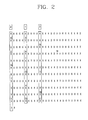
- Fig. 2 is a view illustrating one example of a table created by the table unit.
- X denotes each channel
- numbers over X denote priority or frequency ranking for selecting channels.
- columns of each channel represent frequency groups, and the uppermost numbers 1, 2 and 3 represent priority in which the frequency groups are selected.
- '8' is shown on the second row of the first column in which priority of the frequency group is '2'.
- priority or frequency ranking of the corresponding channel is '8'.
- the priority or frequency ranking of the channel of the fourth row of the first column is '2'
- of the sixth row is '14'
- of the eighth row is '7'
- of the eleventh row is '6'.
- the channel having the smallest number is the channel having the highest priority or frequency ranking
- the channel having the large number is the channel having the low priority or frequency ranking. Therefore, the channel whose priority or frequency ranking is '2' is the channel having the highest priority or frequency ranking, and the channel whose priority or frequency ranking is '14' is the channel having the lowest priority or frequency ranking. That is, the priority or frequency ranking of the frequency group of priority 2 is 2 ⁇ 6 ⁇ 7 ⁇ 8 ⁇ 14.
- the priority or frequency ranking is 1 ⁇ 3 ⁇ 4 ⁇ 9 ⁇ 12 ⁇ 13.
- Priority or frequency ranking of the third, seventh, tenth and eleventh channels of the eleventh column in which priority of frequency group is '3' is '15', '5', '10' and '11', respectively.
- the priority or frequency ranking becomes 5 ⁇ 10 ⁇ 11 ⁇ 15.
- channels are scanned according to priority or frequency ranking of the frequency group.
- the channel whose priority or frequency ranking of '2' is scanned first and availability of the scanned channel is confirmed. If the channel is available, the channel is occupied so that communication signals can be transmitted or received through the channel.
- the channel of priority '6' is scanned.
- the '6' channel is scanned for availability. If '6' channel is available, it is occupied so that communication signals can be transmitted or received through the channel.
- the channels are sequentially scanned; namely, channel corresponding to ranking '7', then if fully occupied then to ranking '8', then if still fully occupied, then to channel ranking '14'.
- channels of the frequency group of priority 2 are not available, then channels of the frequency group corresponding to the second highest priority are scanned using a similar methodology as discussed above.
- Fig. 3 is a view illustrating another example of the table created by the table unit.
- O denotes offset values of each channel recorded on the table unit
- F denotes frequencies in which the corresponding channels are selected.
- the radio frequency band allocated to the WCDMA system ranges from 2110MHz to 2170MHz.
- An interval between the frequency bands allocated to each channel is set 200KHz for reduce channel interferences.
- the channel frequencies are 2112.4MHz, 2112.6MHz, 2112.8MHz, ..., 2167.4MHz and 2167.6MHz which resulting in 277 possible channels.
- UTRA Universal Terrestrial Radio Access
- UARFCN Absolute Radio Frequency Channel Number
- the offset values represent offsets starting from UARFCN 10562. If the offset value is '5', the UARFCN is '10567' obtained by adding the offset value '5' to '10562'. If the offset value is '30', the UARFCN is '10592' obtained by adding '30' to '10562'. If the offset value is '80', the UARFCN is '10562+80', namely '10642, and the corresponding frequency is '10642/5', namely 2124.4MHz. In this example, the table unit utilizes the offset values, but alternatively may also use the UARFCN or frequencies.
- Values of the frequencies are updated until the values reach the upper value limit.
- the frequencies are used to decide priority of the channel scanning process.
- Priority of the groups is decided by selecting the channel having the highest frequency, namely the highest priority in each group, and comparing the selected channels.
- the channel having O of 105 has the highest frequency, 50.
- the channel having O of 75 has the highest frequency, 48.
- the channel having O of 85 has the highest frequency, 44.
- Group 1 When priority of the channels having the highest frequencies in each group is decided, Group 1 has the highest priority and Group 3 has the lowest priority. Accordingly, the priority is decided as Group 1 ⁇ Group 2 ⁇ Group 3.
- channels of the group having the high priority are scanned first.
- Group 1 has the highest priority, the channel having the highest frequency in Group 1 is scanned first. If the available channel exists, the channel is occupied and used for communication. However, if after all the channels having the highest frequency to the lowest frequency in Group 1 all have been scanned, the available channel does not exist, channels of the group having the second highest priority are scanned. The channels allocated to the system are scanned according to priority until the available channel is scanned.
- the channels can be rapidly efficiently scanned even if channel information is not stored, and the optimized frequencies can be scanned in each region and each mobile communication provider.
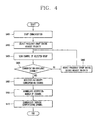
- Fig. 4 is a flowchart showing sequential steps of a method for scanning an intelligent WCDMA channel in accordance with the present invention.
- the mobile terminal starts communication (S400)
- the mobile terminal selects the frequency group having the highest priority by searching the data of the table unit (S410).
- the mobile terminal sequentially scans the channels of the selected frequency group according to priority (S420).
- the mobile terminal checks whether the communication-available channel exists (S430).
- the mobile terminal selects the frequency group having the second highest priority, and repeats the above procedure (S420 to S430) (S440). If the communication-available channel exists, the mobile terminal occupies the corresponding channel by registering the channel in the base station (S450). After occupying the channel, the mobile terminal accumulates the occupation number of the channel, stores the accumulated number as data (S460), and uses the communication service through the channel (S470).
- S450 the base station
- S460 stores the accumulated number as data
- S470 uses the communication service through the channel
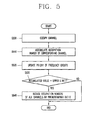
- Fig. 5 is a flowchart showing sequential steps of the method for setting priority of the channels.
- the mobile terminal control unit of the mobile terminal
- the mobile terminal accumulates the occupation number of the channel, and stores the accumulated number in the table unit as data (S510).
- the mobile terminal updates priority of each frequency group according to the occupation number and stores the priority in the table unit as data (S520).
- the mobile terminal decides whether the accumulated occupation number reaches an upper limit value (S530).
- the mobile terminal reduces the accumulated occupation numbers of the channels by a predetermined ratio, and updates the priority (S540).
- the apparatus for scanning the intelligent WCDMA channel and the method thereof rapidly efficiently scan and occupy the channel in consideration of priority of the frequency groups and the channels in each region or each mobile communication provider.
- the apparatus for scanning the intelligent WCDMA channel and the method thereof reduce load of the system and improve reliability of the service, by scanning and occupying the optimized channel by updating priority of the used channels.
- the apparatus for scanning the intelligent WCDMA channel and the method thereof may improve quality and speed of the communication service by rapidly scanning the channels.
- FIG. 6 a block diagram of a mobile communication device 600 of the present invention such as a mobile phone for performing the methods of the present invention.
- the mobile communication device 600 includes a processing unit 610 such as a microprocessor or digital signal processor, an RF module 635, a power management module 606, an antenna 640, a battery 655, a display 615, a keypad 620, a storage unit 630 such as flash memory, ROM or SRAM, a speaker 645 and a microphone 650.
- a user enters instructional information, such as a telephone number, for example, by pushing the buttons of a keypad 620 or by voice activation using the microphone 650.
- the processing unit 610 receives and processes the instructional information to perform the appropriate function, such as to dial the telephone number. Operational data may be retrieved from the storage unit 630 to perform the function. Furthermore, the processing unit 610 may display the instructional and operational information on the display 615 for the user's reference and convenience.
- the processing unit 610 issues instructional information to the RF module 635, to initiate communication, for example, transmit radio signals comprising voice communication data.
- the RF module 635 comprises a receiver and a transmitter to receive and transmit radio signals.
- the antenna 640 facilitates the transmission and reception of radio signals.
- the RF module 635 may forward and convert the signals to baseband frequency for processing by the processing unit 610.
- the processed signals would be transformed into audible or readable information outputted via the speaker 645, for example.
- the processing unit 610 is adapted to perform the methods as illustrated above in the discussions related to Figures 1 and 2. As an example, the processing unit 610 is adapted to selecting a frequency group wherein availability of the frequency group to receive or transmit signals is stored as an occupation number; sequentially scanning channels composing the frequency group according to the priority; deciding whether a channel that is available exists within the frequency group; performing communication through the channel when available. Other features, as described above in Figures 1 and 2, may be incorporated into the processing unit 610.
- the processing unit 610 stores the messages received from and messages transmitted to other users in the storage unit 630, receive a conditional request for message input by the user, process the conditional request to read message data corresponding to the conditional request from the storage unit, and output the message data to the display unit 615.
- the storage unit 630 is adapted to store message data of the messages both received and transmitted.
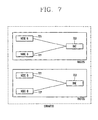
- FIG. 7 illustrates a block diagram of a UTRAN 700 according to the preferred embodiment of the present invention.
- the UTRAN 700 includes one or more radio network sub-systems (RNS) 725.
- Each RNS 725 includes a radio network controller (RNC) 723 and a plurality of Node-Bs (base stations) 721 managed by the RNC.
- the RNC 723 handles the assignment and management of radio resources and operates as an access point with respect to the core network. Furthermore, the RNC 723 is adapted to perform the methods of the present invention.
- the Node-Bs 721 receive information sent by the physical layer of the terminal through an uplink, and transmit data to the terminal through a downlink.
- the Node-Bs 721 operate as access points, or as a transmitter and receiver, of the UTRAN 700 for the terminal. It will be apparent to one skilled in the art that the mobile communication device 600 (of the Figure 6) may be readily implemented using, for example, the processing unit 610 (of the Figure 6) or other data or digital processing device, either alone or in combination with external support logic.
- the user of a mobile communication device may scan channels in a mobile communication system based on priority which determines eligibility of a channel to receive or to transmit a communication signal, as described above in Figures 1 and 2.
- the controller may selecting a frequency group wherein availability of the frequency group to receive or transmit signals is stored as an occupation number; sequentially scanning channels composing the frequency group according to the priority; deciding whether a channel that is available exists within the frequency group; and performing communication through the channel when available.
- the processing unit 610 of Figure 6
- other data or digital processing device either alone or in combination with external support logic.
- the present invention is described in the context of mobile communication, the present invention may also be used in any wireless communication systems using mobile devices, such as PDAs and laptop computers equipped with wireless communication capabilities. Moreover, the use of certain terms to describe the present invention should not limit the scope of the present invention to certain type of wireless communication system, such as UMTS. The present invention is also applicable to other wireless communication systems using different air interfaces and/or physical layers, for example, TDMA, CDMA, FDMA, WCDMA, etc.
- the preferred embodiments may be implemented as a method, apparatus or article of manufacture using standard programming and/or engineering techniques to produce software, firmware, hardware, or any combination thereof.
- article of manufacture refers to code or logic implemented in hardware logic (e.g., an integrated circuit chip, Field Programmable Gate Array (FPGA), Application Specific Integrated Circuit (ASIC), etc.) or a computer readable medium (e.g., magnetic storage medium (e.g., hard disk drives, floppy disks, tape, etc.), optical storage (CD-ROMs, optical disks, etc.), volatile and non-volatile memory devices (e.g., EEPROMs, ROMs, PROMs, RAMs, DRAMs, SRAMs, firmware, programmable logic, etc.).
- FPGA Field Programmable Gate Array
- ASIC Application Specific Integrated Circuit
- Code in the computer readable medium is accessed and executed by a processor.
- the code in which preferred embodiments are implemented may further be accessible through a transmission media or from a file server over a network.
- the article of manufacture in which the code is implemented may comprise a transmission media, such as a network transmission line, wireless transmission media, signals propagating through space, radio waves, infrared signals, etc.
- a transmission media such as a network transmission line, wireless transmission media, signals propagating through space, radio waves, infrared signals, etc.
Landscapes
- Engineering & Computer Science (AREA)
- Computer Networks & Wireless Communication (AREA)
- Signal Processing (AREA)
- Computer Security & Cryptography (AREA)
- Mobile Radio Communication Systems (AREA)
- Measurement And Recording Of Electrical Phenomena And Electrical Characteristics Of The Living Body (AREA)
- Television Systems (AREA)
Applications Claiming Priority (2)
| Application Number | Priority Date | Filing Date | Title |
|---|---|---|---|
| KR2003072668 | 2003-10-17 | ||
| KR20030072668A KR100585734B1 (ko) | 2003-10-17 | 2003-10-17 | 휴대단말기 및 그 채널 검색 방법 |
Publications (3)
| Publication Number | Publication Date |
|---|---|
| EP1524871A2 true EP1524871A2 (de) | 2005-04-20 |
| EP1524871A3 EP1524871A3 (de) | 2007-09-05 |
| EP1524871B1 EP1524871B1 (de) | 2009-05-20 |
Family
ID=34374295
Family Applications (1)
| Application Number | Title | Priority Date | Filing Date |
|---|---|---|---|
| EP20040024383 Expired - Lifetime EP1524871B1 (de) | 2003-10-17 | 2004-10-13 | Vorrichtung zum Scannen von WCDMA-Kanälen |
Country Status (7)
| Country | Link |
|---|---|
| US (1) | US20050143082A1 (de) |
| EP (1) | EP1524871B1 (de) |
| JP (1) | JP2005124213A (de) |
| KR (1) | KR100585734B1 (de) |
| CN (1) | CN1610423A (de) |
| AT (1) | ATE431998T1 (de) |
| DE (1) | DE602004021164D1 (de) |
Cited By (3)
| Publication number | Priority date | Publication date | Assignee | Title |
|---|---|---|---|---|
| EP1641293A1 (de) * | 2004-09-28 | 2006-03-29 | Nec Corporation | Zellsuchverfahren und Mobiles Kommunikationsendgerät |
| WO2010017012A1 (en) * | 2008-08-06 | 2010-02-11 | Interdigital Patent Holdings, Inc. | Procedures for operating in long term evolution idle mode |
| CN106488476A (zh) * | 2015-08-31 | 2017-03-08 | 展讯通信(上海)有限公司 | 多模终端功率扫描的方法及多模终端 |
Families Citing this family (18)
| Publication number | Priority date | Publication date | Assignee | Title |
|---|---|---|---|---|
| JP2006186449A (ja) * | 2004-12-27 | 2006-07-13 | Hitachi Ltd | 移動無線端末装置および無線通信システム |
| KR100774007B1 (ko) * | 2005-07-18 | 2007-11-08 | 삼성전자주식회사 | 무선채널 검색 방법, 무선 송수신 시스템 및 무선 송신장치 |
| US7965675B2 (en) * | 2005-08-22 | 2011-06-21 | Motorola Mobility, Inc. | System and method for detecting an unlicensed mobile alliance (UMA) service in GSM wireless communication networks |
| JP4797836B2 (ja) * | 2006-06-30 | 2011-10-19 | 株式会社ケンウッド | スキャニング受信機能を備えた無線通信機 |
| US7483700B2 (en) * | 2006-08-14 | 2009-01-27 | Motorola, Inc. | Method and apparatus for determining appropriate channels for communication |
| US7860500B2 (en) * | 2006-10-27 | 2010-12-28 | Motorola, Inc. | Method and apparatus for determining appropriate channels for communication |
| KR100911304B1 (ko) * | 2007-06-18 | 2009-08-11 | 엘지전자 주식회사 | 무선통신 시스템에서 우선순위를 갖는 무선베어러의 데이터전송 방법 |
| US8572256B2 (en) * | 2007-07-16 | 2013-10-29 | Qualcomm Incorporated | Method for supporting multiple diversified data applications with efficient use of network resources |
| JP2009071531A (ja) * | 2007-09-12 | 2009-04-02 | Ricoh Co Ltd | 通信装置および通信方法 |
| KR101119715B1 (ko) * | 2007-10-05 | 2012-03-23 | 엘지전자 주식회사 | 무선통신 시스템에서 셀 재선택 수행 방법 |
| KR100948430B1 (ko) * | 2008-01-07 | 2010-03-19 | 주식회사 케이티 | 이동통신망에서 무선 주파수 채널을 분산 검색하는 방법 및이를 수행하는 단말장치 |
| US20100281486A1 (en) * | 2009-05-04 | 2010-11-04 | HT mMobile Inc. | Enhanced scheduling, priority handling and multiplexing method and system |
| JP5881690B2 (ja) | 2010-06-22 | 2016-03-09 | トムソン ライセンシングThomson Licensing | マルチバンドダイナミック通信局のための方法及び装置 |
| CN103179636A (zh) * | 2011-12-21 | 2013-06-26 | 株式会社Ntt都科摩 | 一种移动互联网接入点、系统及其伙伴发现方法 |
| CN103888175B (zh) * | 2012-12-19 | 2015-11-18 | 钰宝科技股份有限公司 | 用于无线通信系统的快速连接方法 |
| US20150271721A1 (en) * | 2014-03-24 | 2015-09-24 | Qualcomm Incorporated | Method and apparatus for an improved acquisition mechanism |
| US10805870B1 (en) | 2019-03-26 | 2020-10-13 | Star Solutions International Inc. | Wireless communication management system and private electronic communication network |
| CN111511018B (zh) * | 2020-04-28 | 2022-04-19 | 国家广播电视总局广播电视科学研究院 | 基于信道分类结果进行现有WiFi网络定位的方法及系统 |
Family Cites Families (13)
| Publication number | Priority date | Publication date | Assignee | Title |
|---|---|---|---|---|
| US5896572A (en) * | 1994-10-31 | 1999-04-20 | Motorola, Inc. | Method of adaptive channel acquisition at a subscriber unit |
| JPH09130853A (ja) * | 1995-10-26 | 1997-05-16 | Uniden Corp | 通信方法,通信装置及びコードレス電話装置 |
| US5806002A (en) * | 1996-10-31 | 1998-09-08 | Motorola, Inc. | Method of scanning using resource analysis |
| JPH10322760A (ja) * | 1997-05-21 | 1998-12-04 | Toshiba Corp | セルラ無線システム |
| US6947408B1 (en) * | 1998-04-17 | 2005-09-20 | Telcordia Technologies, Inc. | Wireless internet access system and method |
| US6205334B1 (en) * | 1998-11-24 | 2001-03-20 | Ericsson Inc. | Accelerated scanning of cellular channels by cellular radiotelephones |
| US20020114295A1 (en) * | 2000-06-28 | 2002-08-22 | Shoji Takahiro | Base station apparatus and channel assigning method |
| US6810251B2 (en) * | 2001-03-08 | 2004-10-26 | Ericsson Inc. | Triggered hyperband scanning |
| US6963727B2 (en) * | 2001-07-26 | 2005-11-08 | Time Domain Corporation | Direct-path-signal detection apparatus and associated methods |
| JP4631233B2 (ja) * | 2001-08-22 | 2011-02-16 | 日本電気株式会社 | セルラ電話装置及びそれに用いるセルサーチ方法 |
| JP2005525725A (ja) * | 2002-01-21 | 2005-08-25 | シーメンス モービル コミュニケイションズ ソシエタ ペル アチオニ | タイムスロットシステムにおいて初期セルサーチを行う方法及び移動局 |
| US7010019B2 (en) * | 2002-09-18 | 2006-03-07 | Telefonaktiebolaget Lm Ericsson (Publ) | Assessment of delay estimation quality using interference estimates |
| US7295537B2 (en) * | 2003-02-24 | 2007-11-13 | Autocell Laboratories, Inc. | Method for self-adjusting power at a wireless station to reduce inter-channel interference |
-
2003
- 2003-10-17 KR KR20030072668A patent/KR100585734B1/ko not_active Expired - Fee Related
-
2004
- 2004-10-13 AT AT04024383T patent/ATE431998T1/de not_active IP Right Cessation
- 2004-10-13 DE DE200460021164 patent/DE602004021164D1/de not_active Expired - Lifetime
- 2004-10-13 EP EP20040024383 patent/EP1524871B1/de not_active Expired - Lifetime
- 2004-10-15 JP JP2004302321A patent/JP2005124213A/ja active Pending
- 2004-10-18 CN CNA2004100861454A patent/CN1610423A/zh active Pending
- 2004-10-19 US US10/968,578 patent/US20050143082A1/en not_active Abandoned
Cited By (9)
| Publication number | Priority date | Publication date | Assignee | Title |
|---|---|---|---|---|
| EP1641293A1 (de) * | 2004-09-28 | 2006-03-29 | Nec Corporation | Zellsuchverfahren und Mobiles Kommunikationsendgerät |
| US7599693B2 (en) | 2004-09-28 | 2009-10-06 | Nec Corporation | Cell search method and mobile communication terminal |
| WO2010017012A1 (en) * | 2008-08-06 | 2010-02-11 | Interdigital Patent Holdings, Inc. | Procedures for operating in long term evolution idle mode |
| CN102138354A (zh) * | 2008-08-06 | 2011-07-27 | 交互数字专利控股公司 | 用于在长期演进空闲模式下操作的过程 |
| US9042883B2 (en) | 2008-08-06 | 2015-05-26 | Interdigital Patent Holdings, Inc. | Procedures for operating in long term evolution idle mode |
| CN103634862B (zh) * | 2008-08-06 | 2016-07-06 | 交互数字专利控股公司 | 用于在lte wtru中执行小区重选的方法及lte wtru |
| US9585067B2 (en) | 2008-08-06 | 2017-02-28 | Interdigital Patent Holdings, Inc. | Procedures for operating in long term evolution idle mode |
| US10292074B2 (en) | 2008-08-06 | 2019-05-14 | Interdigital Patent Holdings, Inc. | Procedures for operating in long term evolution idle mode |
| CN106488476A (zh) * | 2015-08-31 | 2017-03-08 | 展讯通信(上海)有限公司 | 多模终端功率扫描的方法及多模终端 |
Also Published As
| Publication number | Publication date |
|---|---|
| KR100585734B1 (ko) | 2006-06-07 |
| CN1610423A (zh) | 2005-04-27 |
| ATE431998T1 (de) | 2009-06-15 |
| KR20050037216A (ko) | 2005-04-21 |
| JP2005124213A (ja) | 2005-05-12 |
| US20050143082A1 (en) | 2005-06-30 |
| DE602004021164D1 (de) | 2009-07-02 |
| EP1524871B1 (de) | 2009-05-20 |
| EP1524871A3 (de) | 2007-09-05 |
Similar Documents
| Publication | Publication Date | Title |
|---|---|---|
| EP1524871B1 (de) | Vorrichtung zum Scannen von WCDMA-Kanälen | |
| EP2036220A1 (de) | Kumulative nachbarzellenliste | |
| RU2004114266A (ru) | Переключение обслуживания сеанса многоадресной передачи | |
| US8457629B2 (en) | Apparatus and method for providing service status information based on access class restriction list in mobile communication system | |
| CN1083231C (zh) | 不用系统标识比较的蜂窝无线电话系统接入的方法和装置 | |
| US20060068823A1 (en) | Method of compressing control information in a wireless communication system | |
| US20110256871A1 (en) | Mobility Influenced by Radio Uplink Failure | |
| US20130107756A1 (en) | Method of Generating Access Point Scanning Order | |
| US20050078630A1 (en) | Dynamic allocation of timeslots in a communication system | |
| US20110080849A1 (en) | Apparatus and method for flexible equivalent public land mobile network management in portable terminal | |
| US20080064397A1 (en) | Apparatus and method for reselecting cell in portable terminal | |
| US7991395B2 (en) | Apparatus and method for scanning frequency in mobile terminal | |
| US12563579B2 (en) | Information processing method, device and readable storage medium | |
| CN101116366B (zh) | 用于促进移动节点对进行通信的网络部分的选择以实现所选通信业务的设备及相关方法 | |
| US20090154401A1 (en) | Methods and systems for initial ranging | |
| CN1649432A (zh) | 异步移动通信终端和异步移动通信系统及其方法 | |
| WO2007117792A2 (en) | Silent redial method in a wireless communication system | |
| KR100584444B1 (ko) | 멀티밴드 이동통신 단말기의 셀 선택방법 | |
| JP5505423B2 (ja) | コグニティブパイロットチャネル帯域幅を減少させる方法、基地局、およびユーザ設備 | |
| CN1220568A (zh) | 从同一覆盖地区内的无线通信系统中选择一个系统的方法 | |
| CN116569637B (zh) | 随机接入类型的选择方法、装置、设备及存储介质 | |
| CN101855925B (zh) | 移动通信方法、无线控制装置以及无线基站 | |
| KR20090005454A (ko) | 휴대 단말기 및 그의 통신 셀 선택 방법 | |
| RU2451426C2 (ru) | Сдвоенный приемник для мультимедийного широковещательного/многоадресного обслуживания "mbms" | |
| KR100712066B1 (ko) | Dmb 망을 이용한 데이터 전송 시스템 및 전송 데이터의오류 정정 방법 |
Legal Events
| Date | Code | Title | Description |
|---|---|---|---|
| PUAI | Public reference made under article 153(3) epc to a published international application that has entered the european phase |
Free format text: ORIGINAL CODE: 0009012 |
|
| 17P | Request for examination filed |
Effective date: 20041013 |
|
| AK | Designated contracting states |
Kind code of ref document: A2 Designated state(s): AT BE BG CH CY CZ DE DK EE ES FI FR GB GR HU IE IT LI LU MC NL PL PT RO SE SI SK TR |
|
| AX | Request for extension of the european patent |
Extension state: AL HR LT LV MK |
|
| RIN1 | Information on inventor provided before grant (corrected) |
Inventor name: YANG, MAN-SUK |
|
| PUAL | Search report despatched |
Free format text: ORIGINAL CODE: 0009013 |
|
| AK | Designated contracting states |
Kind code of ref document: A3 Designated state(s): AT BE BG CH CY CZ DE DK EE ES FI FR GB GR HU IE IT LI LU MC NL PL PT RO SE SI SK TR |
|
| AX | Request for extension of the european patent |
Extension state: AL HR LT LV MK |
|
| 17Q | First examination report despatched |
Effective date: 20080331 |
|
| AKX | Designation fees paid |
Designated state(s): AT BE BG CH CY CZ DE DK EE ES FI FR GB GR HU IE IT LI LU MC NL PL PT RO SE SI SK TR |
|
| GRAP | Despatch of communication of intention to grant a patent |
Free format text: ORIGINAL CODE: EPIDOSNIGR1 |
|
| GRAS | Grant fee paid |
Free format text: ORIGINAL CODE: EPIDOSNIGR3 |
|
| GRAA | (expected) grant |
Free format text: ORIGINAL CODE: 0009210 |
|
| RAP1 | Party data changed (applicant data changed or rights of an application transferred) |
Owner name: LG ELECTRONICS INC. |
|
| AK | Designated contracting states |
Kind code of ref document: B1 Designated state(s): AT BE BG CH CY CZ DE DK EE ES FI FR GB GR HU IE IT LI LU MC NL PL PT RO SE SI SK TR |
|
| REG | Reference to a national code |
Ref country code: GB Ref legal event code: FG4D |
|
| REG | Reference to a national code |
Ref country code: CH Ref legal event code: EP |
|
| REG | Reference to a national code |
Ref country code: IE Ref legal event code: FG4D |
|
| REF | Corresponds to: |
Ref document number: 602004021164 Country of ref document: DE Date of ref document: 20090702 Kind code of ref document: P |
|
| PG25 | Lapsed in a contracting state [announced via postgrant information from national office to epo] |
Ref country code: ES Free format text: LAPSE BECAUSE OF FAILURE TO SUBMIT A TRANSLATION OF THE DESCRIPTION OR TO PAY THE FEE WITHIN THE PRESCRIBED TIME-LIMIT Effective date: 20090831 Ref country code: FI Free format text: LAPSE BECAUSE OF FAILURE TO SUBMIT A TRANSLATION OF THE DESCRIPTION OR TO PAY THE FEE WITHIN THE PRESCRIBED TIME-LIMIT Effective date: 20090520 Ref country code: AT Free format text: LAPSE BECAUSE OF FAILURE TO SUBMIT A TRANSLATION OF THE DESCRIPTION OR TO PAY THE FEE WITHIN THE PRESCRIBED TIME-LIMIT Effective date: 20090520 Ref country code: PT Free format text: LAPSE BECAUSE OF FAILURE TO SUBMIT A TRANSLATION OF THE DESCRIPTION OR TO PAY THE FEE WITHIN THE PRESCRIBED TIME-LIMIT Effective date: 20090920 |
|
| PG25 | Lapsed in a contracting state [announced via postgrant information from national office to epo] |
Ref country code: SE Free format text: LAPSE BECAUSE OF FAILURE TO SUBMIT A TRANSLATION OF THE DESCRIPTION OR TO PAY THE FEE WITHIN THE PRESCRIBED TIME-LIMIT Effective date: 20090820 Ref country code: PL Free format text: LAPSE BECAUSE OF FAILURE TO SUBMIT A TRANSLATION OF THE DESCRIPTION OR TO PAY THE FEE WITHIN THE PRESCRIBED TIME-LIMIT Effective date: 20090520 Ref country code: SI Free format text: LAPSE BECAUSE OF FAILURE TO SUBMIT A TRANSLATION OF THE DESCRIPTION OR TO PAY THE FEE WITHIN THE PRESCRIBED TIME-LIMIT Effective date: 20090520 |
|
| PG25 | Lapsed in a contracting state [announced via postgrant information from national office to epo] |
Ref country code: EE Free format text: LAPSE BECAUSE OF FAILURE TO SUBMIT A TRANSLATION OF THE DESCRIPTION OR TO PAY THE FEE WITHIN THE PRESCRIBED TIME-LIMIT Effective date: 20090520 Ref country code: CZ Free format text: LAPSE BECAUSE OF FAILURE TO SUBMIT A TRANSLATION OF THE DESCRIPTION OR TO PAY THE FEE WITHIN THE PRESCRIBED TIME-LIMIT Effective date: 20090520 Ref country code: RO Free format text: LAPSE BECAUSE OF FAILURE TO SUBMIT A TRANSLATION OF THE DESCRIPTION OR TO PAY THE FEE WITHIN THE PRESCRIBED TIME-LIMIT Effective date: 20090520 Ref country code: DK Free format text: LAPSE BECAUSE OF FAILURE TO SUBMIT A TRANSLATION OF THE DESCRIPTION OR TO PAY THE FEE WITHIN THE PRESCRIBED TIME-LIMIT Effective date: 20090520 |
|
| PG25 | Lapsed in a contracting state [announced via postgrant information from national office to epo] |
Ref country code: SK Free format text: LAPSE BECAUSE OF FAILURE TO SUBMIT A TRANSLATION OF THE DESCRIPTION OR TO PAY THE FEE WITHIN THE PRESCRIBED TIME-LIMIT Effective date: 20090520 Ref country code: BE Free format text: LAPSE BECAUSE OF FAILURE TO SUBMIT A TRANSLATION OF THE DESCRIPTION OR TO PAY THE FEE WITHIN THE PRESCRIBED TIME-LIMIT Effective date: 20090520 |
|
| PLBE | No opposition filed within time limit |
Free format text: ORIGINAL CODE: 0009261 |
|
| STAA | Information on the status of an ep patent application or granted ep patent |
Free format text: STATUS: NO OPPOSITION FILED WITHIN TIME LIMIT |
|
| PG25 | Lapsed in a contracting state [announced via postgrant information from national office to epo] |
Ref country code: BG Free format text: LAPSE BECAUSE OF FAILURE TO SUBMIT A TRANSLATION OF THE DESCRIPTION OR TO PAY THE FEE WITHIN THE PRESCRIBED TIME-LIMIT Effective date: 20090820 |
|
| 26N | No opposition filed |
Effective date: 20100223 |
|
| PG25 | Lapsed in a contracting state [announced via postgrant information from national office to epo] |
Ref country code: MC Free format text: LAPSE BECAUSE OF NON-PAYMENT OF DUE FEES Effective date: 20091031 |
|
| REG | Reference to a national code |
Ref country code: CH Ref legal event code: PL |
|
| REG | Reference to a national code |
Ref country code: IE Ref legal event code: MM4A |
|
| PG25 | Lapsed in a contracting state [announced via postgrant information from national office to epo] |
Ref country code: CH Free format text: LAPSE BECAUSE OF NON-PAYMENT OF DUE FEES Effective date: 20091031 Ref country code: LI Free format text: LAPSE BECAUSE OF NON-PAYMENT OF DUE FEES Effective date: 20091031 Ref country code: IE Free format text: LAPSE BECAUSE OF NON-PAYMENT OF DUE FEES Effective date: 20091013 Ref country code: GR Free format text: LAPSE BECAUSE OF FAILURE TO SUBMIT A TRANSLATION OF THE DESCRIPTION OR TO PAY THE FEE WITHIN THE PRESCRIBED TIME-LIMIT Effective date: 20090821 |
|
| PG25 | Lapsed in a contracting state [announced via postgrant information from national office to epo] |
Ref country code: LU Free format text: LAPSE BECAUSE OF NON-PAYMENT OF DUE FEES Effective date: 20091013 |
|
| PG25 | Lapsed in a contracting state [announced via postgrant information from national office to epo] |
Ref country code: HU Free format text: LAPSE BECAUSE OF FAILURE TO SUBMIT A TRANSLATION OF THE DESCRIPTION OR TO PAY THE FEE WITHIN THE PRESCRIBED TIME-LIMIT Effective date: 20091121 |
|
| PG25 | Lapsed in a contracting state [announced via postgrant information from national office to epo] |
Ref country code: TR Free format text: LAPSE BECAUSE OF FAILURE TO SUBMIT A TRANSLATION OF THE DESCRIPTION OR TO PAY THE FEE WITHIN THE PRESCRIBED TIME-LIMIT Effective date: 20090520 |
|
| PG25 | Lapsed in a contracting state [announced via postgrant information from national office to epo] |
Ref country code: CY Free format text: LAPSE BECAUSE OF FAILURE TO SUBMIT A TRANSLATION OF THE DESCRIPTION OR TO PAY THE FEE WITHIN THE PRESCRIBED TIME-LIMIT Effective date: 20090520 |
|
| REG | Reference to a national code |
Ref country code: FR Ref legal event code: PLFP Year of fee payment: 12 |
|
| PGFP | Annual fee paid to national office [announced via postgrant information from national office to epo] |
Ref country code: GB Payment date: 20150911 Year of fee payment: 12 |
|
| PGFP | Annual fee paid to national office [announced via postgrant information from national office to epo] |
Ref country code: FR Payment date: 20150915 Year of fee payment: 12 |
|
| PGFP | Annual fee paid to national office [announced via postgrant information from national office to epo] |
Ref country code: DE Payment date: 20150911 Year of fee payment: 12 Ref country code: IT Payment date: 20151014 Year of fee payment: 12 |
|
| PGFP | Annual fee paid to national office [announced via postgrant information from national office to epo] |
Ref country code: NL Payment date: 20150911 Year of fee payment: 12 |
|
| REG | Reference to a national code |
Ref country code: DE Ref legal event code: R119 Ref document number: 602004021164 Country of ref document: DE |
|
| REG | Reference to a national code |
Ref country code: NL Ref legal event code: MM Effective date: 20161101 |
|
| GBPC | Gb: european patent ceased through non-payment of renewal fee |
Effective date: 20161013 |
|
| REG | Reference to a national code |
Ref country code: FR Ref legal event code: ST Effective date: 20170630 |
|
| PG25 | Lapsed in a contracting state [announced via postgrant information from national office to epo] |
Ref country code: FR Free format text: LAPSE BECAUSE OF NON-PAYMENT OF DUE FEES Effective date: 20161102 Ref country code: GB Free format text: LAPSE BECAUSE OF NON-PAYMENT OF DUE FEES Effective date: 20161013 Ref country code: DE Free format text: LAPSE BECAUSE OF NON-PAYMENT OF DUE FEES Effective date: 20170503 |
|
| PG25 | Lapsed in a contracting state [announced via postgrant information from national office to epo] |
Ref country code: NL Free format text: LAPSE BECAUSE OF NON-PAYMENT OF DUE FEES Effective date: 20161101 |
|
| PG25 | Lapsed in a contracting state [announced via postgrant information from national office to epo] |
Ref country code: IT Free format text: LAPSE BECAUSE OF NON-PAYMENT OF DUE FEES Effective date: 20161013 |