EP1523992A1 - Vaccine formulation against Gumboro disease - Google Patents
Vaccine formulation against Gumboro disease Download PDFInfo
- Publication number
- EP1523992A1 EP1523992A1 EP04021994A EP04021994A EP1523992A1 EP 1523992 A1 EP1523992 A1 EP 1523992A1 EP 04021994 A EP04021994 A EP 04021994A EP 04021994 A EP04021994 A EP 04021994A EP 1523992 A1 EP1523992 A1 EP 1523992A1
- Authority
- EP
- European Patent Office
- Prior art keywords
- vaccine
- plasmid
- virus
- gene
- promoter
- Prior art date
- Legal status (The legal status is an assumption and is not a legal conclusion. Google has not performed a legal analysis and makes no representation as to the accuracy of the status listed.)
- Withdrawn
Links
- 229960005486 vaccine Drugs 0.000 title claims abstract description 91
- 239000000203 mixture Substances 0.000 title claims description 20
- 238000009472 formulation Methods 0.000 title claims description 12
- 201000010099 disease Diseases 0.000 title claims description 6
- 208000037265 diseases, disorders, signs and symptoms Diseases 0.000 title claims description 6
- 241000271566 Aves Species 0.000 claims abstract description 24
- 239000013612 plasmid Substances 0.000 claims description 114
- 108090000623 proteins and genes Proteins 0.000 claims description 57
- 241000700605 Viruses Species 0.000 claims description 55
- 238000002255 vaccination Methods 0.000 claims description 27
- 241001465754 Metazoa Species 0.000 claims description 8
- 238000004519 manufacturing process Methods 0.000 claims description 8
- 101710081079 Minor spike protein H Proteins 0.000 claims description 7
- 108010008038 Synthetic Vaccines Proteins 0.000 claims description 6
- 229940124551 recombinant vaccine Drugs 0.000 claims description 6
- 229940031626 subunit vaccine Drugs 0.000 claims description 6
- 238000002360 preparation method Methods 0.000 claims description 5
- 230000007170 pathology Effects 0.000 claims description 4
- 210000004292 cytoskeleton Anatomy 0.000 claims description 2
- 241000714474 Rous sarcoma virus Species 0.000 claims 1
- 239000012634 fragment Substances 0.000 description 60
- 108091034117 Oligonucleotide Proteins 0.000 description 57
- 238000000034 method Methods 0.000 description 50
- 238000003757 reverse transcription PCR Methods 0.000 description 28
- 241000711450 Infectious bronchitis virus Species 0.000 description 24
- 238000006243 chemical reaction Methods 0.000 description 22
- 238000010276 construction Methods 0.000 description 20
- 238000000746 purification Methods 0.000 description 20
- JLCPHMBAVCMARE-UHFFFAOYSA-N [3-[[3-[[3-[[3-[[3-[[3-[[3-[[3-[[3-[[3-[[3-[[5-(2-amino-6-oxo-1H-purin-9-yl)-3-[[3-[[3-[[3-[[3-[[3-[[5-(2-amino-6-oxo-1H-purin-9-yl)-3-[[5-(2-amino-6-oxo-1H-purin-9-yl)-3-hydroxyoxolan-2-yl]methoxy-hydroxyphosphoryl]oxyoxolan-2-yl]methoxy-hydroxyphosphoryl]oxy-5-(5-methyl-2,4-dioxopyrimidin-1-yl)oxolan-2-yl]methoxy-hydroxyphosphoryl]oxy-5-(6-aminopurin-9-yl)oxolan-2-yl]methoxy-hydroxyphosphoryl]oxy-5-(6-aminopurin-9-yl)oxolan-2-yl]methoxy-hydroxyphosphoryl]oxy-5-(6-aminopurin-9-yl)oxolan-2-yl]methoxy-hydroxyphosphoryl]oxy-5-(6-aminopurin-9-yl)oxolan-2-yl]methoxy-hydroxyphosphoryl]oxyoxolan-2-yl]methoxy-hydroxyphosphoryl]oxy-5-(5-methyl-2,4-dioxopyrimidin-1-yl)oxolan-2-yl]methoxy-hydroxyphosphoryl]oxy-5-(4-amino-2-oxopyrimidin-1-yl)oxolan-2-yl]methoxy-hydroxyphosphoryl]oxy-5-(5-methyl-2,4-dioxopyrimidin-1-yl)oxolan-2-yl]methoxy-hydroxyphosphoryl]oxy-5-(5-methyl-2,4-dioxopyrimidin-1-yl)oxolan-2-yl]methoxy-hydroxyphosphoryl]oxy-5-(6-aminopurin-9-yl)oxolan-2-yl]methoxy-hydroxyphosphoryl]oxy-5-(6-aminopurin-9-yl)oxolan-2-yl]methoxy-hydroxyphosphoryl]oxy-5-(4-amino-2-oxopyrimidin-1-yl)oxolan-2-yl]methoxy-hydroxyphosphoryl]oxy-5-(4-amino-2-oxopyrimidin-1-yl)oxolan-2-yl]methoxy-hydroxyphosphoryl]oxy-5-(4-amino-2-oxopyrimidin-1-yl)oxolan-2-yl]methoxy-hydroxyphosphoryl]oxy-5-(6-aminopurin-9-yl)oxolan-2-yl]methoxy-hydroxyphosphoryl]oxy-5-(4-amino-2-oxopyrimidin-1-yl)oxolan-2-yl]methyl [5-(6-aminopurin-9-yl)-2-(hydroxymethyl)oxolan-3-yl] hydrogen phosphate Polymers Cc1cn(C2CC(OP(O)(=O)OCC3OC(CC3OP(O)(=O)OCC3OC(CC3O)n3cnc4c3nc(N)[nH]c4=O)n3cnc4c3nc(N)[nH]c4=O)C(COP(O)(=O)OC3CC(OC3COP(O)(=O)OC3CC(OC3COP(O)(=O)OC3CC(OC3COP(O)(=O)OC3CC(OC3COP(O)(=O)OC3CC(OC3COP(O)(=O)OC3CC(OC3COP(O)(=O)OC3CC(OC3COP(O)(=O)OC3CC(OC3COP(O)(=O)OC3CC(OC3COP(O)(=O)OC3CC(OC3COP(O)(=O)OC3CC(OC3COP(O)(=O)OC3CC(OC3COP(O)(=O)OC3CC(OC3COP(O)(=O)OC3CC(OC3COP(O)(=O)OC3CC(OC3COP(O)(=O)OC3CC(OC3COP(O)(=O)OC3CC(OC3CO)n3cnc4c(N)ncnc34)n3ccc(N)nc3=O)n3cnc4c(N)ncnc34)n3ccc(N)nc3=O)n3ccc(N)nc3=O)n3ccc(N)nc3=O)n3cnc4c(N)ncnc34)n3cnc4c(N)ncnc34)n3cc(C)c(=O)[nH]c3=O)n3cc(C)c(=O)[nH]c3=O)n3ccc(N)nc3=O)n3cc(C)c(=O)[nH]c3=O)n3cnc4c3nc(N)[nH]c4=O)n3cnc4c(N)ncnc34)n3cnc4c(N)ncnc34)n3cnc4c(N)ncnc34)n3cnc4c(N)ncnc34)O2)c(=O)[nH]c1=O JLCPHMBAVCMARE-UHFFFAOYSA-N 0.000 description 19
- 239000000047 product Substances 0.000 description 19
- 239000013598 vector Substances 0.000 description 19
- 241000711404 Avian avulavirus 1 Species 0.000 description 18
- 108091032973 (ribonucleotides)n+m Proteins 0.000 description 15
- 241000287828 Gallus gallus Species 0.000 description 14
- 238000003752 polymerase chain reaction Methods 0.000 description 14
- 241000712461 unidentified influenza virus Species 0.000 description 14
- 241000701063 Gallid alphaherpesvirus 1 Species 0.000 description 13
- 239000000427 antigen Substances 0.000 description 13
- 102000036639 antigens Human genes 0.000 description 13
- 108091007433 antigens Proteins 0.000 description 13
- 208000015181 infectious disease Diseases 0.000 description 13
- 108020004414 DNA Proteins 0.000 description 12
- 230000002458 infectious effect Effects 0.000 description 12
- 241000701047 Gallid alphaherpesvirus 2 Species 0.000 description 11
- 108090000288 Glycoproteins Proteins 0.000 description 11
- 102000003886 Glycoproteins Human genes 0.000 description 11
- 241000725585 Chicken anemia virus Species 0.000 description 10
- 230000004224 protection Effects 0.000 description 10
- 241001223089 Tremovirus A Species 0.000 description 9
- 210000004027 cell Anatomy 0.000 description 9
- 230000003612 virological effect Effects 0.000 description 9
- 206010035148 Plague Diseases 0.000 description 8
- 241000607479 Yersinia pestis Species 0.000 description 8
- 108700001237 Nucleic Acid-Based Vaccines Proteins 0.000 description 7
- 208000007502 anemia Diseases 0.000 description 7
- 201000002491 encephalomyelitis Diseases 0.000 description 7
- 239000007924 injection Substances 0.000 description 7
- 244000052769 pathogen Species 0.000 description 7
- 230000001717 pathogenic effect Effects 0.000 description 7
- 101710128560 Initiator protein NS1 Proteins 0.000 description 6
- 101710144127 Non-structural protein 1 Proteins 0.000 description 6
- 241000711902 Pneumovirus Species 0.000 description 6
- 102100029241 Influenza virus NS1A-binding protein Human genes 0.000 description 5
- 101150029683 gB gene Proteins 0.000 description 5
- HEDRZPFGACZZDS-UHFFFAOYSA-N Chloroform Chemical compound ClC(Cl)Cl HEDRZPFGACZZDS-UHFFFAOYSA-N 0.000 description 4
- 241000702626 Infectious bursal disease virus Species 0.000 description 4
- 108091028043 Nucleic acid sequence Proteins 0.000 description 4
- 206010044302 Tracheitis Diseases 0.000 description 4
- 238000001727 in vivo Methods 0.000 description 4
- 238000002347 injection Methods 0.000 description 4
- 201000009837 laryngotracheitis Diseases 0.000 description 4
- 239000000243 solution Substances 0.000 description 4
- 101500001532 Avian infectious bursal disease virus Capsid protein VP2 Proteins 0.000 description 3
- 101150034814 F gene Proteins 0.000 description 3
- 101150008820 HN gene Proteins 0.000 description 3
- 241000711955 Turkey rhinotracheitis virus Species 0.000 description 3
- 206010006451 bronchitis Diseases 0.000 description 3
- OVXZVDMCQPLHIY-QXGOIDDHSA-L calcium;4-[[(2r)-2,4-dihydroxy-3,3-dimethylbutanoyl]amino]butanoate Chemical compound [Ca+2].OCC(C)(C)[C@@H](O)C(=O)NCCCC([O-])=O.OCC(C)(C)[C@@H](O)C(=O)NCCCC([O-])=O OVXZVDMCQPLHIY-QXGOIDDHSA-L 0.000 description 3
- 230000001413 cellular effect Effects 0.000 description 3
- 229940031551 inactivated vaccine Drugs 0.000 description 3
- 238000007918 intramuscular administration Methods 0.000 description 3
- 239000002502 liposome Substances 0.000 description 3
- 108091033319 polynucleotide Proteins 0.000 description 3
- 102000040430 polynucleotide Human genes 0.000 description 3
- 239000002157 polynucleotide Substances 0.000 description 3
- 102000004169 proteins and genes Human genes 0.000 description 3
- 239000000725 suspension Substances 0.000 description 3
- 210000001519 tissue Anatomy 0.000 description 3
- 210000000689 upper leg Anatomy 0.000 description 3
- 241000713826 Avian leukosis virus Species 0.000 description 2
- 108091026890 Coding region Proteins 0.000 description 2
- KCXVZYZYPLLWCC-UHFFFAOYSA-N EDTA Chemical compound OC(=O)CN(CC(O)=O)CCN(CC(O)=O)CC(O)=O KCXVZYZYPLLWCC-UHFFFAOYSA-N 0.000 description 2
- 241000282414 Homo sapiens Species 0.000 description 2
- ISWSIDIOOBJBQZ-UHFFFAOYSA-N Phenol Chemical compound OC1=CC=CC=C1 ISWSIDIOOBJBQZ-UHFFFAOYSA-N 0.000 description 2
- 101150010882 S gene Proteins 0.000 description 2
- DBMJMQXJHONAFJ-UHFFFAOYSA-M Sodium laurylsulphate Chemical compound [Na+].CCCCCCCCCCCCOS([O-])(=O)=O DBMJMQXJHONAFJ-UHFFFAOYSA-M 0.000 description 2
- 101150024766 VP1 gene Proteins 0.000 description 2
- 239000000872 buffer Substances 0.000 description 2
- 125000002091 cationic group Chemical group 0.000 description 2
- 229940028617 conventional vaccine Drugs 0.000 description 2
- 230000000120 cytopathologic effect Effects 0.000 description 2
- 108700004025 env Genes Proteins 0.000 description 2
- 101150030339 env gene Proteins 0.000 description 2
- 238000000605 extraction Methods 0.000 description 2
- 230000014509 gene expression Effects 0.000 description 2
- 230000036039 immunity Effects 0.000 description 2
- 238000010369 molecular cloning Methods 0.000 description 2
- 229940031346 monovalent vaccine Drugs 0.000 description 2
- 210000004400 mucous membrane Anatomy 0.000 description 2
- 229940031348 multivalent vaccine Drugs 0.000 description 2
- 238000002663 nebulization Methods 0.000 description 2
- 102000039446 nucleic acids Human genes 0.000 description 2
- 108020004707 nucleic acids Proteins 0.000 description 2
- 150000007523 nucleic acids Chemical class 0.000 description 2
- 239000002245 particle Substances 0.000 description 2
- 239000008188 pellet Substances 0.000 description 2
- 108091008146 restriction endonucleases Proteins 0.000 description 2
- 238000010561 standard procedure Methods 0.000 description 2
- 229910021642 ultra pure water Inorganic materials 0.000 description 2
- 239000012498 ultrapure water Substances 0.000 description 2
- 239000003981 vehicle Substances 0.000 description 2
- XLYOFNOQVPJJNP-UHFFFAOYSA-N water Substances O XLYOFNOQVPJJNP-UHFFFAOYSA-N 0.000 description 2
- 229910001868 water Inorganic materials 0.000 description 2
- 102000040650 (ribonucleotides)n+m Human genes 0.000 description 1
- QKNYBSVHEMOAJP-UHFFFAOYSA-N 2-amino-2-(hydroxymethyl)propane-1,3-diol;hydron;chloride Chemical compound Cl.OCC(N)(CO)CO QKNYBSVHEMOAJP-UHFFFAOYSA-N 0.000 description 1
- NKDFYOWSKOHCCO-YPVLXUMRSA-N 20-hydroxyecdysone Chemical compound C1[C@@H](O)[C@@H](O)C[C@]2(C)[C@@H](CC[C@@]3([C@@H]([C@@](C)(O)[C@H](O)CCC(C)(O)C)CC[C@]33O)C)C3=CC(=O)[C@@H]21 NKDFYOWSKOHCCO-YPVLXUMRSA-N 0.000 description 1
- FWMNVWWHGCHHJJ-SKKKGAJSSA-N 4-amino-1-[(2r)-6-amino-2-[[(2r)-2-[[(2r)-2-[[(2r)-2-amino-3-phenylpropanoyl]amino]-3-phenylpropanoyl]amino]-4-methylpentanoyl]amino]hexanoyl]piperidine-4-carboxylic acid Chemical compound C([C@H](C(=O)N[C@H](CC(C)C)C(=O)N[C@H](CCCCN)C(=O)N1CCC(N)(CC1)C(O)=O)NC(=O)[C@H](N)CC=1C=CC=CC=1)C1=CC=CC=C1 FWMNVWWHGCHHJJ-SKKKGAJSSA-N 0.000 description 1
- 102000007469 Actins Human genes 0.000 description 1
- 108010085238 Actins Proteins 0.000 description 1
- 108090000565 Capsid Proteins Proteins 0.000 description 1
- 101710132601 Capsid protein Proteins 0.000 description 1
- 101710197658 Capsid protein VP1 Proteins 0.000 description 1
- 241000700199 Cavia porcellus Species 0.000 description 1
- 102100023321 Ceruloplasmin Human genes 0.000 description 1
- 108020004635 Complementary DNA Proteins 0.000 description 1
- 241000701022 Cytomegalovirus Species 0.000 description 1
- 102100036912 Desmin Human genes 0.000 description 1
- 108010044052 Desmin Proteins 0.000 description 1
- 108010067770 Endopeptidase K Proteins 0.000 description 1
- LFQSCWFLJHTTHZ-UHFFFAOYSA-N Ethanol Chemical compound CCO LFQSCWFLJHTTHZ-UHFFFAOYSA-N 0.000 description 1
- 101150082239 G gene Proteins 0.000 description 1
- 101150039660 HA gene Proteins 0.000 description 1
- 241000282412 Homo Species 0.000 description 1
- 101000958664 Homo sapiens Nucleus accumbens-associated protein 1 Proteins 0.000 description 1
- 101000631760 Homo sapiens Sodium channel protein type 1 subunit alpha Proteins 0.000 description 1
- 241000725303 Human immunodeficiency virus Species 0.000 description 1
- 208000002979 Influenza in Birds Diseases 0.000 description 1
- 241000124008 Mammalia Species 0.000 description 1
- 241001529936 Murinae Species 0.000 description 1
- 208000010359 Newcastle Disease Diseases 0.000 description 1
- 101710141454 Nucleoprotein Proteins 0.000 description 1
- 108010061100 Nucleoproteins Proteins 0.000 description 1
- 102000011931 Nucleoproteins Human genes 0.000 description 1
- 102100038141 Nucleus accumbens-associated protein 1 Human genes 0.000 description 1
- 206010037660 Pyrexia Diseases 0.000 description 1
- 101710118046 RNA-directed RNA polymerase Proteins 0.000 description 1
- 101150027674 S1 gene Proteins 0.000 description 1
- ZMZDMBWJUHKJPS-UHFFFAOYSA-M Thiocyanate anion Chemical compound [S-]C#N ZMZDMBWJUHKJPS-UHFFFAOYSA-M 0.000 description 1
- 108010046722 Thrombospondin 1 Proteins 0.000 description 1
- 102100036034 Thrombospondin-1 Human genes 0.000 description 1
- 239000007984 Tris EDTA buffer Substances 0.000 description 1
- 239000007983 Tris buffer Substances 0.000 description 1
- 101150093578 VP2 gene Proteins 0.000 description 1
- 108020005202 Viral DNA Proteins 0.000 description 1
- 108020000999 Viral RNA Proteins 0.000 description 1
- 101710108545 Viral protein 1 Proteins 0.000 description 1
- 210000000577 adipose tissue Anatomy 0.000 description 1
- 239000002671 adjuvant Substances 0.000 description 1
- 230000003321 amplification Effects 0.000 description 1
- 230000030741 antigen processing and presentation Effects 0.000 description 1
- 230000002238 attenuated effect Effects 0.000 description 1
- 206010064097 avian influenza Diseases 0.000 description 1
- 230000004888 barrier function Effects 0.000 description 1
- 210000000988 bone and bone Anatomy 0.000 description 1
- 238000010804 cDNA synthesis Methods 0.000 description 1
- AIYUHDOJVYHVIT-UHFFFAOYSA-M caesium chloride Chemical compound [Cl-].[Cs+] AIYUHDOJVYHVIT-UHFFFAOYSA-M 0.000 description 1
- YTRQFSDWAXHJCC-UHFFFAOYSA-N chloroform;phenol Chemical compound ClC(Cl)Cl.OC1=CC=CC=C1 YTRQFSDWAXHJCC-UHFFFAOYSA-N 0.000 description 1
- 238000010367 cloning Methods 0.000 description 1
- 239000002299 complementary DNA Substances 0.000 description 1
- 230000009089 cytolysis Effects 0.000 description 1
- 210000005045 desmin Anatomy 0.000 description 1
- 239000003651 drinking water Substances 0.000 description 1
- 235000020188 drinking water Nutrition 0.000 description 1
- 241001493065 dsRNA viruses Species 0.000 description 1
- 230000000694 effects Effects 0.000 description 1
- 229940082150 encore Drugs 0.000 description 1
- 108010078428 env Gene Products Proteins 0.000 description 1
- ZMMJGEGLRURXTF-UHFFFAOYSA-N ethidium bromide Chemical compound [Br-].C12=CC(N)=CC=C2C2=CC=C(N)C=C2[N+](CC)=C1C1=CC=CC=C1 ZMMJGEGLRURXTF-UHFFFAOYSA-N 0.000 description 1
- 229960005542 ethidium bromide Drugs 0.000 description 1
- 108700004026 gag Genes Proteins 0.000 description 1
- 101150098622 gag gene Proteins 0.000 description 1
- 238000001415 gene therapy Methods 0.000 description 1
- PCHJSUWPFVWCPO-UHFFFAOYSA-N gold Chemical compound [Au] PCHJSUWPFVWCPO-UHFFFAOYSA-N 0.000 description 1
- 239000010931 gold Substances 0.000 description 1
- 229910052737 gold Inorganic materials 0.000 description 1
- ZMZDMBWJUHKJPS-UHFFFAOYSA-N hydrogen thiocyanate Natural products SC#N ZMZDMBWJUHKJPS-UHFFFAOYSA-N 0.000 description 1
- 230000028993 immune response Effects 0.000 description 1
- 238000007912 intraperitoneal administration Methods 0.000 description 1
- 238000001990 intravenous administration Methods 0.000 description 1
- 238000002955 isolation Methods 0.000 description 1
- 239000007788 liquid Substances 0.000 description 1
- 238000012768 mass vaccination Methods 0.000 description 1
- 238000002156 mixing Methods 0.000 description 1
- 238000001823 molecular biology technique Methods 0.000 description 1
- 210000002200 mouth mucosa Anatomy 0.000 description 1
- 210000003205 muscle Anatomy 0.000 description 1
- 238000003199 nucleic acid amplification method Methods 0.000 description 1
- 230000037368 penetrate the skin Effects 0.000 description 1
- 101150059999 pro gene Proteins 0.000 description 1
- 230000008569 process Effects 0.000 description 1
- 230000001681 protective effect Effects 0.000 description 1
- 230000000241 respiratory effect Effects 0.000 description 1
- 230000004044 response Effects 0.000 description 1
- 238000010839 reverse transcription Methods 0.000 description 1
- 210000003491 skin Anatomy 0.000 description 1
- 239000007921 spray Substances 0.000 description 1
- 238000003860 storage Methods 0.000 description 1
- 239000006228 supernatant Substances 0.000 description 1
- 238000013518 transcription Methods 0.000 description 1
- 230000035897 transcription Effects 0.000 description 1
- 238000001890 transfection Methods 0.000 description 1
- LENZDBCJOHFCAS-UHFFFAOYSA-N tris Chemical compound OCC(N)(CO)CO LENZDBCJOHFCAS-UHFFFAOYSA-N 0.000 description 1
- 238000005199 ultracentrifugation Methods 0.000 description 1
Images














Classifications
-
- C—CHEMISTRY; METALLURGY
- C07—ORGANIC CHEMISTRY
- C07K—PEPTIDES
- C07K14/00—Peptides having more than 20 amino acids; Gastrins; Somatostatins; Melanotropins; Derivatives thereof
- C07K14/005—Peptides having more than 20 amino acids; Gastrins; Somatostatins; Melanotropins; Derivatives thereof from viruses
-
- A—HUMAN NECESSITIES
- A61—MEDICAL OR VETERINARY SCIENCE; HYGIENE
- A61K—PREPARATIONS FOR MEDICAL, DENTAL OR TOILETRY PURPOSES
- A61K39/00—Medicinal preparations containing antigens or antibodies
- A61K39/12—Viral antigens
-
- A—HUMAN NECESSITIES
- A61—MEDICAL OR VETERINARY SCIENCE; HYGIENE
- A61K—PREPARATIONS FOR MEDICAL, DENTAL OR TOILETRY PURPOSES
- A61K39/00—Medicinal preparations containing antigens or antibodies
- A61K39/12—Viral antigens
- A61K39/145—Orthomyxoviridae, e.g. influenza virus
-
- A—HUMAN NECESSITIES
- A61—MEDICAL OR VETERINARY SCIENCE; HYGIENE
- A61K—PREPARATIONS FOR MEDICAL, DENTAL OR TOILETRY PURPOSES
- A61K39/00—Medicinal preparations containing antigens or antibodies
- A61K39/12—Viral antigens
- A61K39/155—Paramyxoviridae, e.g. parainfluenza virus
-
- A—HUMAN NECESSITIES
- A61—MEDICAL OR VETERINARY SCIENCE; HYGIENE
- A61K—PREPARATIONS FOR MEDICAL, DENTAL OR TOILETRY PURPOSES
- A61K39/00—Medicinal preparations containing antigens or antibodies
- A61K39/12—Viral antigens
- A61K39/155—Paramyxoviridae, e.g. parainfluenza virus
- A61K39/17—Newcastle disease virus
-
- A—HUMAN NECESSITIES
- A61—MEDICAL OR VETERINARY SCIENCE; HYGIENE
- A61K—PREPARATIONS FOR MEDICAL, DENTAL OR TOILETRY PURPOSES
- A61K39/00—Medicinal preparations containing antigens or antibodies
- A61K39/12—Viral antigens
- A61K39/215—Coronaviridae, e.g. avian infectious bronchitis virus
-
- A—HUMAN NECESSITIES
- A61—MEDICAL OR VETERINARY SCIENCE; HYGIENE
- A61K—PREPARATIONS FOR MEDICAL, DENTAL OR TOILETRY PURPOSES
- A61K39/00—Medicinal preparations containing antigens or antibodies
- A61K39/12—Viral antigens
- A61K39/245—Herpetoviridae, e.g. herpes simplex virus
-
- A—HUMAN NECESSITIES
- A61—MEDICAL OR VETERINARY SCIENCE; HYGIENE
- A61K—PREPARATIONS FOR MEDICAL, DENTAL OR TOILETRY PURPOSES
- A61K39/00—Medicinal preparations containing antigens or antibodies
- A61K39/12—Viral antigens
- A61K39/245—Herpetoviridae, e.g. herpes simplex virus
- A61K39/255—Marek's disease virus
-
- A—HUMAN NECESSITIES
- A61—MEDICAL OR VETERINARY SCIENCE; HYGIENE
- A61K—PREPARATIONS FOR MEDICAL, DENTAL OR TOILETRY PURPOSES
- A61K39/00—Medicinal preparations containing antigens or antibodies
- A61K39/12—Viral antigens
- A61K39/295—Polyvalent viral antigens; Mixtures of viral and bacterial antigens
-
- A—HUMAN NECESSITIES
- A61—MEDICAL OR VETERINARY SCIENCE; HYGIENE
- A61P—SPECIFIC THERAPEUTIC ACTIVITY OF CHEMICAL COMPOUNDS OR MEDICINAL PREPARATIONS
- A61P31/00—Antiinfectives, i.e. antibiotics, antiseptics, chemotherapeutics
- A61P31/12—Antivirals
-
- A—HUMAN NECESSITIES
- A61—MEDICAL OR VETERINARY SCIENCE; HYGIENE
- A61P—SPECIFIC THERAPEUTIC ACTIVITY OF CHEMICAL COMPOUNDS OR MEDICINAL PREPARATIONS
- A61P31/00—Antiinfectives, i.e. antibiotics, antiseptics, chemotherapeutics
- A61P31/12—Antivirals
- A61P31/14—Antivirals for RNA viruses
-
- A—HUMAN NECESSITIES
- A61—MEDICAL OR VETERINARY SCIENCE; HYGIENE
- A61P—SPECIFIC THERAPEUTIC ACTIVITY OF CHEMICAL COMPOUNDS OR MEDICINAL PREPARATIONS
- A61P31/00—Antiinfectives, i.e. antibiotics, antiseptics, chemotherapeutics
- A61P31/12—Antivirals
- A61P31/20—Antivirals for DNA viruses
-
- C—CHEMISTRY; METALLURGY
- C12—BIOCHEMISTRY; BEER; SPIRITS; WINE; VINEGAR; MICROBIOLOGY; ENZYMOLOGY; MUTATION OR GENETIC ENGINEERING
- C12N—MICROORGANISMS OR ENZYMES; COMPOSITIONS THEREOF; PROPAGATING, PRESERVING, OR MAINTAINING MICROORGANISMS; MUTATION OR GENETIC ENGINEERING; CULTURE MEDIA
- C12N15/00—Mutation or genetic engineering; DNA or RNA concerning genetic engineering, vectors, e.g. plasmids, or their isolation, preparation or purification; Use of hosts therefor
- C12N15/09—Recombinant DNA-technology
- C12N15/11—DNA or RNA fragments; Modified forms thereof; Non-coding nucleic acids having a biological activity
-
- A—HUMAN NECESSITIES
- A61—MEDICAL OR VETERINARY SCIENCE; HYGIENE
- A61K—PREPARATIONS FOR MEDICAL, DENTAL OR TOILETRY PURPOSES
- A61K39/00—Medicinal preparations containing antigens or antibodies
- A61K2039/51—Medicinal preparations containing antigens or antibodies comprising whole cells, viruses or DNA/RNA
-
- A—HUMAN NECESSITIES
- A61—MEDICAL OR VETERINARY SCIENCE; HYGIENE
- A61K—PREPARATIONS FOR MEDICAL, DENTAL OR TOILETRY PURPOSES
- A61K39/00—Medicinal preparations containing antigens or antibodies
- A61K2039/51—Medicinal preparations containing antigens or antibodies comprising whole cells, viruses or DNA/RNA
- A61K2039/53—DNA (RNA) vaccination
-
- A—HUMAN NECESSITIES
- A61—MEDICAL OR VETERINARY SCIENCE; HYGIENE
- A61K—PREPARATIONS FOR MEDICAL, DENTAL OR TOILETRY PURPOSES
- A61K39/00—Medicinal preparations containing antigens or antibodies
- A61K2039/55—Medicinal preparations containing antigens or antibodies characterised by the host/recipient, e.g. newborn with maternal antibodies
- A61K2039/552—Veterinary vaccine
-
- A—HUMAN NECESSITIES
- A61—MEDICAL OR VETERINARY SCIENCE; HYGIENE
- A61K—PREPARATIONS FOR MEDICAL, DENTAL OR TOILETRY PURPOSES
- A61K39/00—Medicinal preparations containing antigens or antibodies
- A61K2039/70—Multivalent vaccine
-
- C—CHEMISTRY; METALLURGY
- C12—BIOCHEMISTRY; BEER; SPIRITS; WINE; VINEGAR; MICROBIOLOGY; ENZYMOLOGY; MUTATION OR GENETIC ENGINEERING
- C12N—MICROORGANISMS OR ENZYMES; COMPOSITIONS THEREOF; PROPAGATING, PRESERVING, OR MAINTAINING MICROORGANISMS; MUTATION OR GENETIC ENGINEERING; CULTURE MEDIA
- C12N2710/00—MICROORGANISMS OR ENZYMES; COMPOSITIONS THEREOF; PROPAGATING, PRESERVING, OR MAINTAINING MICROORGANISMS; MUTATION OR GENETIC ENGINEERING; CULTURE MEDIA dsDNA viruses
- C12N2710/00011—Details
- C12N2710/16011—Herpesviridae
- C12N2710/16034—Use of virus or viral component as vaccine, e.g. live-attenuated or inactivated virus, VLP, viral protein
-
- C—CHEMISTRY; METALLURGY
- C12—BIOCHEMISTRY; BEER; SPIRITS; WINE; VINEGAR; MICROBIOLOGY; ENZYMOLOGY; MUTATION OR GENETIC ENGINEERING
- C12N—MICROORGANISMS OR ENZYMES; COMPOSITIONS THEREOF; PROPAGATING, PRESERVING, OR MAINTAINING MICROORGANISMS; MUTATION OR GENETIC ENGINEERING; CULTURE MEDIA
- C12N2710/00—MICROORGANISMS OR ENZYMES; COMPOSITIONS THEREOF; PROPAGATING, PRESERVING, OR MAINTAINING MICROORGANISMS; MUTATION OR GENETIC ENGINEERING; CULTURE MEDIA dsDNA viruses
- C12N2710/00011—Details
- C12N2710/16011—Herpesviridae
- C12N2710/16311—Mardivirus, e.g. Gallid herpesvirus 2, Marek-like viruses, turkey HV
- C12N2710/16334—Use of virus or viral component as vaccine, e.g. live-attenuated or inactivated virus, VLP, viral protein
-
- C—CHEMISTRY; METALLURGY
- C12—BIOCHEMISTRY; BEER; SPIRITS; WINE; VINEGAR; MICROBIOLOGY; ENZYMOLOGY; MUTATION OR GENETIC ENGINEERING
- C12N—MICROORGANISMS OR ENZYMES; COMPOSITIONS THEREOF; PROPAGATING, PRESERVING, OR MAINTAINING MICROORGANISMS; MUTATION OR GENETIC ENGINEERING; CULTURE MEDIA
- C12N2720/00—MICROORGANISMS OR ENZYMES; COMPOSITIONS THEREOF; PROPAGATING, PRESERVING, OR MAINTAINING MICROORGANISMS; MUTATION OR GENETIC ENGINEERING; CULTURE MEDIA dsRNA viruses
- C12N2720/00011—Details
- C12N2720/10011—Birnaviridae
- C12N2720/10034—Use of virus or viral component as vaccine, e.g. live-attenuated or inactivated virus, VLP, viral protein
-
- C—CHEMISTRY; METALLURGY
- C12—BIOCHEMISTRY; BEER; SPIRITS; WINE; VINEGAR; MICROBIOLOGY; ENZYMOLOGY; MUTATION OR GENETIC ENGINEERING
- C12N—MICROORGANISMS OR ENZYMES; COMPOSITIONS THEREOF; PROPAGATING, PRESERVING, OR MAINTAINING MICROORGANISMS; MUTATION OR GENETIC ENGINEERING; CULTURE MEDIA
- C12N2750/00—MICROORGANISMS OR ENZYMES; COMPOSITIONS THEREOF; PROPAGATING, PRESERVING, OR MAINTAINING MICROORGANISMS; MUTATION OR GENETIC ENGINEERING; CULTURE MEDIA ssDNA viruses
- C12N2750/00011—Details
- C12N2750/10011—Circoviridae
- C12N2750/10034—Use of virus or viral component as vaccine, e.g. live-attenuated or inactivated virus, VLP, viral protein
-
- C—CHEMISTRY; METALLURGY
- C12—BIOCHEMISTRY; BEER; SPIRITS; WINE; VINEGAR; MICROBIOLOGY; ENZYMOLOGY; MUTATION OR GENETIC ENGINEERING
- C12N—MICROORGANISMS OR ENZYMES; COMPOSITIONS THEREOF; PROPAGATING, PRESERVING, OR MAINTAINING MICROORGANISMS; MUTATION OR GENETIC ENGINEERING; CULTURE MEDIA
- C12N2760/00—MICROORGANISMS OR ENZYMES; COMPOSITIONS THEREOF; PROPAGATING, PRESERVING, OR MAINTAINING MICROORGANISMS; MUTATION OR GENETIC ENGINEERING; CULTURE MEDIA ssRNA viruses negative-sense
- C12N2760/00011—Details
- C12N2760/16011—Orthomyxoviridae
- C12N2760/16111—Influenzavirus A, i.e. influenza A virus
- C12N2760/16134—Use of virus or viral component as vaccine, e.g. live-attenuated or inactivated virus, VLP, viral protein
-
- C—CHEMISTRY; METALLURGY
- C12—BIOCHEMISTRY; BEER; SPIRITS; WINE; VINEGAR; MICROBIOLOGY; ENZYMOLOGY; MUTATION OR GENETIC ENGINEERING
- C12N—MICROORGANISMS OR ENZYMES; COMPOSITIONS THEREOF; PROPAGATING, PRESERVING, OR MAINTAINING MICROORGANISMS; MUTATION OR GENETIC ENGINEERING; CULTURE MEDIA
- C12N2760/00—MICROORGANISMS OR ENZYMES; COMPOSITIONS THEREOF; PROPAGATING, PRESERVING, OR MAINTAINING MICROORGANISMS; MUTATION OR GENETIC ENGINEERING; CULTURE MEDIA ssRNA viruses negative-sense
- C12N2760/00011—Details
- C12N2760/18011—Paramyxoviridae
- C12N2760/18111—Avulavirus, e.g. Newcastle disease virus
- C12N2760/18134—Use of virus or viral component as vaccine, e.g. live-attenuated or inactivated virus, VLP, viral protein
-
- C—CHEMISTRY; METALLURGY
- C12—BIOCHEMISTRY; BEER; SPIRITS; WINE; VINEGAR; MICROBIOLOGY; ENZYMOLOGY; MUTATION OR GENETIC ENGINEERING
- C12N—MICROORGANISMS OR ENZYMES; COMPOSITIONS THEREOF; PROPAGATING, PRESERVING, OR MAINTAINING MICROORGANISMS; MUTATION OR GENETIC ENGINEERING; CULTURE MEDIA
- C12N2760/00—MICROORGANISMS OR ENZYMES; COMPOSITIONS THEREOF; PROPAGATING, PRESERVING, OR MAINTAINING MICROORGANISMS; MUTATION OR GENETIC ENGINEERING; CULTURE MEDIA ssRNA viruses negative-sense
- C12N2760/00011—Details
- C12N2760/18011—Paramyxoviridae
- C12N2760/18311—Metapneumovirus, e.g. avian pneumovirus
- C12N2760/18334—Use of virus or viral component as vaccine, e.g. live-attenuated or inactivated virus, VLP, viral protein
-
- C—CHEMISTRY; METALLURGY
- C12—BIOCHEMISTRY; BEER; SPIRITS; WINE; VINEGAR; MICROBIOLOGY; ENZYMOLOGY; MUTATION OR GENETIC ENGINEERING
- C12N—MICROORGANISMS OR ENZYMES; COMPOSITIONS THEREOF; PROPAGATING, PRESERVING, OR MAINTAINING MICROORGANISMS; MUTATION OR GENETIC ENGINEERING; CULTURE MEDIA
- C12N2770/00—MICROORGANISMS OR ENZYMES; COMPOSITIONS THEREOF; PROPAGATING, PRESERVING, OR MAINTAINING MICROORGANISMS; MUTATION OR GENETIC ENGINEERING; CULTURE MEDIA ssRNA viruses positive-sense
- C12N2770/00011—Details
- C12N2770/20011—Coronaviridae
- C12N2770/20034—Use of virus or viral component as vaccine, e.g. live-attenuated or inactivated virus, VLP, viral protein
-
- C—CHEMISTRY; METALLURGY
- C12—BIOCHEMISTRY; BEER; SPIRITS; WINE; VINEGAR; MICROBIOLOGY; ENZYMOLOGY; MUTATION OR GENETIC ENGINEERING
- C12N—MICROORGANISMS OR ENZYMES; COMPOSITIONS THEREOF; PROPAGATING, PRESERVING, OR MAINTAINING MICROORGANISMS; MUTATION OR GENETIC ENGINEERING; CULTURE MEDIA
- C12N2770/00—MICROORGANISMS OR ENZYMES; COMPOSITIONS THEREOF; PROPAGATING, PRESERVING, OR MAINTAINING MICROORGANISMS; MUTATION OR GENETIC ENGINEERING; CULTURE MEDIA ssRNA viruses positive-sense
- C12N2770/00011—Details
- C12N2770/22011—Dicistroviridae
- C12N2770/22034—Use of virus or viral component as vaccine, e.g. live-attenuated or inactivated virus, VLP, viral protein
-
- C—CHEMISTRY; METALLURGY
- C12—BIOCHEMISTRY; BEER; SPIRITS; WINE; VINEGAR; MICROBIOLOGY; ENZYMOLOGY; MUTATION OR GENETIC ENGINEERING
- C12N—MICROORGANISMS OR ENZYMES; COMPOSITIONS THEREOF; PROPAGATING, PRESERVING, OR MAINTAINING MICROORGANISMS; MUTATION OR GENETIC ENGINEERING; CULTURE MEDIA
- C12N2770/00—MICROORGANISMS OR ENZYMES; COMPOSITIONS THEREOF; PROPAGATING, PRESERVING, OR MAINTAINING MICROORGANISMS; MUTATION OR GENETIC ENGINEERING; CULTURE MEDIA ssRNA viruses positive-sense
- C12N2770/00011—Details
- C12N2770/32011—Picornaviridae
- C12N2770/32034—Use of virus or viral component as vaccine, e.g. live-attenuated or inactivated virus, VLP, viral protein
-
- C—CHEMISTRY; METALLURGY
- C12—BIOCHEMISTRY; BEER; SPIRITS; WINE; VINEGAR; MICROBIOLOGY; ENZYMOLOGY; MUTATION OR GENETIC ENGINEERING
- C12N—MICROORGANISMS OR ENZYMES; COMPOSITIONS THEREOF; PROPAGATING, PRESERVING, OR MAINTAINING MICROORGANISMS; MUTATION OR GENETIC ENGINEERING; CULTURE MEDIA
- C12N2770/00—MICROORGANISMS OR ENZYMES; COMPOSITIONS THEREOF; PROPAGATING, PRESERVING, OR MAINTAINING MICROORGANISMS; MUTATION OR GENETIC ENGINEERING; CULTURE MEDIA ssRNA viruses positive-sense
- C12N2770/00011—Details
- C12N2770/32011—Picornaviridae
- C12N2770/32411—Hepatovirus, i.e. hepatitis A virus
- C12N2770/32434—Use of virus or viral component as vaccine, e.g. live-attenuated or inactivated virus, VLP, viral protein
Definitions
- the present invention relates to a vaccine formulation allowing the vaccination of avian species, in particular chicken. It also relates to a method of vaccination corresponding.
- Vaccine combinations have been proposed in the past against a number of viruses responsible for pathologies in chicken.
- Patent Applications WO-A-90 11092, WO-A-93 19183, WO-A-94 21797 and WO-A-95 20660 have made use of the technique recently developed polynucleotide vaccines. We know that these vaccines use a plasmid capable of expressing in the host cells the antigen inserted into the plasmid. All the routes of administration have been proposed (intraperitoneal, intravenous, intramuscular, transcutaneous, intradermal, mucosal, etc.).
- Different means of vaccination can also be used, such as DNA deposited on the surface of gold particles and projected so as to penetrate the skin of the animal (Tang et al., Nature 356, 152-154, 1992) and the liquid jet injectors for transfection at a time in skin, muscle, fatty tissue and tissues mammals (Furth et al., Analytical Biochemistry, 205, 365-368, 1992).
- Polynucleotide vaccines can use as well bare DNA than DNA formulated for example within liposomes or cationic lipids.
- the invention therefore proposes to provide a formula for multivalent vaccine to ensure vaccination against a number of avian pathogenic viruses.
- Another object of the invention is to provide such vaccine formula combining different valences while having all the necessary criteria of compatibility and stability of the valences between them.
- Another object of the invention is to provide such vaccine formula allowing to associate different valences in the same vehicle.
- Another object of the invention is to provide such vaccine that is easy to implement and inexpensive.
- Another objective, still of the invention is to provide a vaccination method for gallinaceans that allows to obtain protection, including protection multivalent, with a high level of efficiency and long duration, good safety and absence of residues
- the subject of the present invention is therefore a formula of avian vaccine, comprising at least three valences of vaccine polynucleotide each comprising an integrating plasmid, to express it in vivo in the host cells, a gene of a valency of avian pathogen, these valences being chosen among the group consisting of Marek's disease virus (MDV), Newcastle disease virus (NDV), human immunodeficiency virus (NDV), Gumboro disease (IBDV), infectious bronchitis virus (IBV), infectious anemia virus (CAV), viral infectious laryngotracheitis (ILTV), encephalomyelitis (AEV or avian leukosis virus) ALV), pneumovirus virus, and avian influenza virus, the plasmids comprising, for each valence, one or more genes selected from the group consisting of gB and gD for Marek's disease virus, HN and F for the virus of the Newcastle disease, VP2 for the disease virus Gum
- valence in the present invention, we mean least one antigen providing protection against the pathogen considered, the valence being able to contain, as sub-valence, one or more natural or modified genes of a or several strains of the pathogen considered.
- pathogen gene is meant not only the complete gene, but also the nucleotide sequences different, including fragments, retaining the ability to induce a protective response.
- the notion of gene covers the nucleotide sequences equivalent to those described precisely in the examples, that is to say the sequences different but coding for the same protein. She covers also the nucleotide sequences of other strains of considered a pathogen, providing cross-protection or specific protection of the strain or group of strain. She still covers the nucleotide sequences that were modified to facilitate in vivo expression by the host animal but coding for the same protein.
- the vaccine formula according to the invention includes three valences selected from Marek, Gumboro, Anemia infectious and Newcastle. We can also add preferably the infectious bronchitis valence.
- Marek valence it is possible to the two genes coding for gB and gD in plasmids different or in a single plasmid. We prefer however, use only the gB gene.
- S gene For the infectious bronchitis valence, it is preferred to use the S gene. Possibly, but in a less preferred manner, can associate S and M in a single plasmid or in
- the gB gene For the infectious laryngotracheitis valence, use the gB gene alone. Possibly, but less preferred, the two genes gB and gD can be combined in different plasmids or in a single plasmid.
- HA For avian plague valence, it is preferred to use the gene HA. Possibly, but in a less preferred manner, one can use HA and NP associations or HA and N in different plasmids or in a single plasmid.
- the HA sequences of the same vaccine are combined with more than one strain of influenza virus, particularly different strains encountered in the field.
- NP provides cross-protection and we can therefore be satisfied of the sequence of a single strain of the virus.
- the vaccine formula according to the invention may be present under a dose volume of between 0.1 and 1 ml and in especially between 0.3 and 0.5 ml.
- the dose will generally be between 10 ng and 1 mg, preferably between 100 ng and 500 ⁇ g and preferentially between 0.1 ⁇ g and 50 ⁇ g per type of plasmid.
- bare plasmids will be used, simply placed in the vaccination vehicle which will generally be physiological water or the like.
- the vaccination vehicle which will generally be physiological water or the like.
- Each plasmid comprises a promoter capable of ensuring the expression of the gene inserted under its control in the host cells. It will generally be a eukaryotic promoter strong and in particular of an early promoter of the cytomegalovirus CMV-IE, of human or murine origin, or possibly of another origin such as rat, pig, Guinea pig.
- the promoter can be either of viral origin, either of cellular origin.
- promoter virus other than CMV-IE we may mention the early promoter or SV 40 virus late or Sarge virus LTR promoter from Rous. It can also be a promoter of the virus comes the gene, for example the gene-specific promoter.
- a cytoskeleton gene such as, for example, the desmin (Bolmont et al., Journal of Submicroscopic Cytology and Pathology, 1990, 22, 117-122; and ZHENLIN et al., Gene, 1989, 78, 243-254), or else the actin promoter.
- the combination of the different valences of the vaccine according to the invention may be preferably carried out by mixing polynucleotide plasmids expressing the antigen (s) of each valence, but one can also plan to do express antigens of several valences by the same plasmid.
- the subject of the invention is also vaccine formulas monovalent comprising one or more plasmids encoding a or more genes from one of the above viruses, the genes being those described above. Apart from their monovalent character, these formulas may have the characteristics stated higher in the choice of genes, their combinations, the composition of the plasmids, the volumes of dose, doses, etc.
- Monovalent vaccine formulas can also be used (i) for the preparation of a vaccine formula versatile as described above, (ii) individually against the pathology itself, (iii) associated with a vaccine of one other type (whole live or inactivated, recombinant, subunit) against another pathology, or (iv) as a reminder of a vaccine as described below.
- the present invention indeed still has as its object the use of one or more plasmids according to the invention for the production of an avian vaccine intended to vaccinate primo-vaccinated animals using a first conventional vaccine (monovalent or multi-valent), of the type of those of art prior art, chosen especially from the group consisting of vaccine whole live, whole inactivated vaccine, subunit vaccine, recombinant vaccine, this first vaccine presenting (i.e. containing or capable of expressing) the encoded antigen (s) by the plasmid (s) or antigen (s) providing protection cross.
- a first conventional vaccine monovalent or multi-valent
- this first vaccine presenting (i.e. containing or capable of expressing) the encoded antigen (s) by the plasmid (s) or antigen (s) providing protection cross.
- the polynucleotide vaccine has a powerful booster effect resulting in amplification of the immune response and the introduction of immunity from long duration.
- primary vaccination vaccines may be selected from commercial vaccines available from the various producers of veterinary vaccines.
- the invention also relates to a vaccination kit combining a vaccine formula according to the invention and a vaccine primary vaccination as described above. She has also a vaccine formula according to the invention accompanied by a notice indicating the use of this formula as a reminder a primary vaccination as described above.
- the present invention also relates to a method avian vaccination, including the administration of a effective vaccine formulation as described above.
- This method of vaccination includes the administration of one or several doses of the vaccine formula, these doses being administered successively in a short period of time and / or successively at times distant from each other.
- the vaccine formulations according to the invention may be administered as part of this method of vaccination, by the various routes of administration proposed in the art previous in the context of polynucleotide vaccination and using known administration techniques.
- the intramuscular ovo, intraocular, nebulization and drinking water are particularly advantageous.
- mucous membranes of the respiratory tree serve as a barrier to the entry of pathogens and are associated with tissues lymphoids that support local immunity.
- administration of a vaccine by contact with the mucous membranes, in particular oral mucosa, pharyngeal and bronchial region is of interest for mass vaccination.
- the mucosal part of a preferred mode of administration for the invention particularly using nebulization or spray or water of drink.
- Vaccine formulas and vaccination methods according to the invention may be applied in this context.
- the subject of the invention is also the method of vaccination consisting of a primary vaccination as described above and a booster with a vaccine formula according to the invention.
- an effective dose of conventional vaccine including inactivated, live, attenuated or recombinant, or a vaccine sub-unit to ensure primary vaccination, and after a period of preference of 2 to 6 weeks, we assure administration of the polyvalent or monovalent vaccine according to the invention.
- the invention also relates to the method of preparing the formulas of vaccine, namely the preparation of the valences ec their mixtures, as it appears from this description.
- Viruses are grown on the appropriate cell system until a cytopathic effect.
- the cellular systems to be used for each virus are well known to those skilled in the art. Briefly, virus-sensitive cells used, grown in Eagle's essential minimum medium (“MEM” medium) or a other appropriate medium, are inoculated with the viral strain studied using a multiplicity of infection of 1. The infected cells are then incubated at 37 ° C for the time necessary for the appearance of a cytopathic effect complete (on average 36 hours).
- MEM Eagle's essential minimum medium
- the supernatant and the lysed cells are harvested and the entire the viral suspension is centrifuged at 1000 g for 10 minutes at + 4 ° C. to eliminate cell debris.
- the viral particles are then harvested by ultracentrifugation at 400000 g for 1 hour at + 4 ° C.
- the pellet is taken again in a minimum volume of buffer (10 mM Tris, 1 mM EDTA).
- This Concentrated viral suspension is treated with proteinase K (100 ⁇ g / ml final) in presence of sodium dodecyl sulfate (SDS) (0.5% final) for 2 hours at 37 ° C.
- SDS sodium dodecyl sulfate
- the DNA is centrifuged at 10000 g for 15 minutes at + 4 ° C.
- the pellet of DNA is dried, then taken up in a minimum volume of sterile ultrapure water. He can then to be digested with restriction enzymes.
- RNA viruses have been purified according to techniques well known to humans of career. The genomic viral RNA of each virus was then isolated using the extraction technique "guanidium thiocyanate / phenol-chloroform" described by P. Chomczynski and N. Sacchi (Anal Biochem 1987. 162. 156-159).
- oligonucleotides having at their 5 'ends restriction sites to facilitate cloning of the amplified fragments
- the reverse transcription reaction (RT) and polymerase chain reaction (PCR) were performed according to standard techniques (Sambrook J. et al., 1989). Each RT-PCR reaction was made with a pair of specific amplimers and taking as template the extracted viral genomic RNA.
- the amplified complementary DNA was extracted with phenol / chloroform / alcoholisoamytique (25: 24: 1) before being digested with the restriction enzymes.
- Plasmid pVR1012 ( Figure No. 1) was obtained from Vical Inc. San Diego, CA, USA; Its construction has been described in J. Hartikka et al. (Human Gene Therapy, 1996. 7. 1205-1217).
- a PCR reaction was performed with Marek's disease virus (MDV) genomic DNA (RB1B strain) (L. Ross et al., J. Gen. Virol., 1989, 70, 1789-1804) prepared according to US Pat . the technique of Example 2, and with the following oligonucleotides: to isolate the gene coding for the glycoprotein gB of the MDV virus in the form of a PstI-BglII fragment.
- the 2613 bp PCR product was digested with Pst I and Bgl II to isolate a 2602 bp PstI-BglII fragment. This fragment was ligated with the vector pVR1012 (Example 6), previously digested with Pst I and Bgl II, to give the plasmid pAB045 (7455 bp) (FIG. No. 2).
- a PCR reaction was performed with genomic DNA of Marek's disease virus (MDV) (strain R818) (Ross L. et al., J. Gen. Virol., 1991, 72, 949-954) prepared according to US Pat. the technique of Example 2, and with the following oligonucleotides: to isolate the gene coding for the glycoprotein gD of the MDV virus in the form of a PstI-BglII fragment.
- the 1215 bp PCR product was digested with Pst I and Bgl II to isolate a 1199 bp PstI-BglII fragment. This fragment was ligated with the vector pVR1012 (Example 6), previously digested with Pst I and Bgl II, to give the plasmid pAB080 (6051 bp) (FIG. No. 3).
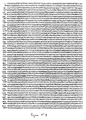
- RT-PCR reaction according to the technique of Example 5 was carried out with the genomic RNA of Newcastle disease virus (NDV) (Texas strain GB), prepared according to the technique of Example 3, and with the following oligonucleotides: to isolate the gene encoding the HN glycoprotein strain NDV strain Texas GB ( Figure No. 4 and SEQ ID No. 7) in the form of a NotI-BamHI fragment.
- NDV Newcastle disease virus
- the RT-PCR product of 1741 bp was digested with Not I and Bam HI to isolate a NotI-BamHI fragment of 1723 bp. This fragment was ligated with the vector pVR1012 (Example 6), previously digested with Not I and Bam HI, to give the plasmid pAB046 (6616 pbl ( Figure No. 5).
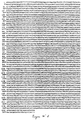
- RT-PCR reaction according to the technique of Example 5 was carried out with the genomic RNA of Newcastle disease virus (NDV) (Texas strain GB), prepared according to the technique of Example 3, and with the following oligonucleotides: to isolate the gene encoding the F glycoprotein strain NDV strain Texas GB ( Figure No. 6 and SEQ ID No. 10) in the form of a NotI-XbaI fragment.
- NDV Newcastle disease virus
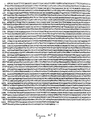
- Figure No. 6 and SEQ ID No. 10 After purification the 1684 bp RT-PCR product was digested with Not I and Xba I to isolate a 1669 bp NotI-XbaI fragment. This fragment was ligated with the vector pVR1012 (Example 6), previously digested with Not I and Xba I , to give the plasmid pAB047 (6578 bp) (FIG. No. 7).
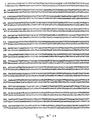
- An RT-PCR reaction according to the technique of Example 5 was carried out with the genomic RNA of the Gumboro disease virus (IBDV) (Faragher strain), prepared according to the technique of Example 3, and with the following oligonucleotides: to isolate the coding sequence for the VP2 protein of the faragher strain IBDV virus (FIG. No. 8 and SEQ ID No. 13) in the form of an EcoRV-NotI fragment.
- the 1384 bp RT-PCR product was digested with Eco RV and Not I to isolate a 1367 bp EcoRV-NotI fragment. This fragment was ligated with the vector pVR1012 (Example 6), previously digested with Eco RV and Not I , to give the plasmid pAB048 (6278 bp) (FIG. No. 9).
- An RT-PCR reaction according to the technique of Example 5 was carried out with the genomic RNA of chicken infectious bronchitis virus (IBV) (Massachusetts strain 41), prepared according to the technique of Example 3, and with the following oligonucleotides: to isolate the sequence encoding the S1 subunit of the glycoprotein S of IBV strain strain Massachusetts 41 ( Figure No. 10 and SEQ ID No. 16) as a SalI-BglII fragment. After purification, the 1635 bp RT-PCR product was digested with Sal I and Bgl II to isolate a 1622 bp SalI-BglII fragment. This fragment was ligated with the vector pVR1012 (Example 6), previously digested with Sal I and Bgl II, to give the plasmid pAB049 (6485 bp) (FIG. No. 11).
- IBV chicken infectious bronchitis virus
- An RT-PCR reaction according to the technique of Example 5 was carried out with the genomic RNA of the chicken infectious bronchitis virus (IBV) (Massachusetts strain 41), prepared according to the technique of Example 3, and with the following oligonucleotides: to isolate the gene encoding M virus glycoprotein of IBV strain Massachusetts 41 ( Figure No. 12 and SEQ ID No. 19) as a NotI-NotI fragment. After purification, the 710 bp RT-PCR product was digested with Not I to isolate a 686 bp NotI-NotI fragment.
- IBV chicken infectious bronchitis virus
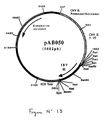
- This fragment was ligated with the vector pVR1012 (Example 6), previously digested with Not I, to give the plasmid pAB050 (5602 bp) which contains the IBV M gene in the correct orientation with respect to the promoter (FIG. 13).
- An RT-PCR reaction according to the technique of Example 5 was carried out with the genomic RNA of the chicken infectious bronchitis virus (IBV) (Massachusetts strain 41), prepared according to the technique of Example 3, and with the following otigonuctotides: to isolate the gene coding for the N protein of IBV strain strain Massachusetts 41 (FIG. No. 14 and SEQ ID No. 22) in the form of a PstI-BamHI fragment.
- the 1250 bp RT-PCR product was digested with Pst I and Bam HI to isolate a 1233 bp PstI-BamHI fragment. This fragment was ligated with the vector pVR1012 (Example 6), previously digested with Pst I and Bam HI , to give the plasmid pAB051 (6092 bp) (FIG. No. 15).
- a PCR reaction was performed with genomic DNA of chicken anemia virus (CAV) (Cuxhaven-1 strain) (B. Meehan et al., Arch Virol 1992. 124. 301-319), prepared according to the technique of Example 2, and with the following oligonucleotides: to isolate the gene coding for the VP1 capsid protein of CAV as a NotI-NotI fragment. After purification, the 1377 bp PCR product was digested with Not I to isolate a 1359 bp NotI-NotI fragment.
- CAV chicken anemia virus
- This fragment was ligated with the vector pVR1012 (Example 6), previously digested with NotI, to give the plasmid pAB054 (6274 bp) which contains the CAV VP1 gene in the correct orientation with respect to the promoter (FIG. No. 16).
- a PCR reaction was performed with genomic DNA of chicken anemia virus (CAV) (Cuxhaven-1 strain) (B. Meehan et al., Arch Virol 1992. 124. 301-319), prepared according to the technique of Example 2, and with the following oligonucleotides: to isolate the gene coding for the VP2 protein of CAV virus in the form of a NotI-BamHI fragment.
- CAV chicken anemia virus
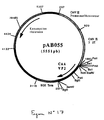
- the 674 bp PCR product was digested with Not I and Bam HI to isolate a NotI-BamHI fragment of 659 bp. This fragment was ligated with the vector pVR1012 (Example 6), previously digested with Not I and Bam HI, to give the plasmid pAB055 (5551 bp) (FIG. No. 17).
- a PCR reaction was performed with chicken infectious laryngotracheitis virus (ILTV) genomic DNA (strain SA-2) (K. Kongsuwan et al., Virology, 1991, 18, 404-410), prepared according to US Pat. technique of Example 2, and with the following oligonucleotides: to isolate the gene coding for the glycoprotein gB of the ILTV virus in the form of a NotI-NotI fragment.
- ILTV chicken infectious laryngotracheitis virus
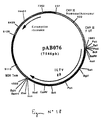
- the 1134 bp PCR product was digested with Sal I and Bgl II to isolate a 1122 bp SalI-BglII fragment. This fragment was ligated with the vector pVR1012 (Example 6), previously digested with Sal I and Bgl II, to give the plasmid pAB089 (5984 bp) ( Figure No. 19).
- An RT-PCR reaction according to the technique of Example 5 was carried out with the genomic RNA of the avian encephalomyelitis virus (AEV) (Type C) (E. Bieth et al., Nucleic Acids Res. 367), prepared according to the technique of Example 3, and with the following oligonucleotides: to isolate the sequence encoding the Env glycoprotein of AEV virus as an EcoRV-BamHI fragment. After purification, the 1836 bp RT-PCR product was digested with Eco RV and Bam HI to isolate an 1825 bp EcoRV-BamHI fragment. This fragment was ligated with the vector pVR1012 (Example 6), previously digested with EcoRV and BamHI, to give the plasmid pAB086 (6712 bp) (FIG. No. 20).
- AEV avian encephalomyelitis virus
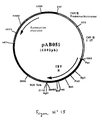
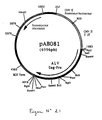
- An RT-PCR reaction according to the technique of Example 5 was carried out with the genomic RNA of the avian encephalomyelitis virus (AEV) (Type C) (E. Bieth et al., Nucleic Acids Res. 367), prepared according to the technique of Example 3, and with the following oligonucleotides: to isolate the sequence encoding the Gag and Pro proteins of the AEV virus as a SalI-XbaI fragment. After purification, the 2125 bp RT-PCR product was digested with Sal I and Xba I to isolate a 2111 bp SalI-Xbal fragment. This fragment was ligated with the vector pVR1012 (Example 6), previously digested with Sal I and Xba I, to give the plasmid pAB081 (6996 bp) (FIG. No. 21).
- AEV avian encephalomyelitis virus
- RT-PCR reaction according to the technique of Example 5 was carried out with turkey rhinotracheitis virus (TRV) genomic RNA (strain 2119) (K. Juhasz et al., J. Gen. Virol. 1994, 75, 2873-2880), prepared according to the technique of Example 3, and with the following oligonucleotides: to isolate the gene coding for the glycoprotein G of the TRV virus in the form of a PstI-BglII fragment. After purification, the 1265 bp RT-PCR product was digested with Pst I and Bgl II to isolate a 1249 bp PstI-BglII fragment. This fragment was ligated with the vector pVR1012 (Example 6), previously digested with Pst I and Bgl II, to give the plasmid pAB082 (6101 bp) (FIG. No. 22).
- TRV turkey rhinotracheitis virus
- Strain 2119 strain 2119
- RNA of the avian plague virus (AIV) (PostDNA strain H2N2) (J. Schfer et al., Virology, 1993. 194. 781 -788), prepared according to the technique of Example 3, and with the following oligonucleotides: to isolate the gene encoding the HA glycoprotein of avian influenza virus (strain H2N2) in the form of a PstI-BglII fragment.
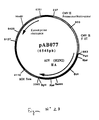
- strain H2N2 the 1709 bp RT-PCR product was digested with Pst I and Bgl II to isolate a 1693 bp PstI-BglII fragment. This fragment was ligated with the vector pVR1012 (Example 6), previously digested with Pst I and Bgl II, to give the plasmid pAB077 (6545 bp) (FIG. No. 23).
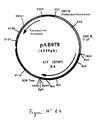
- RT-PCR reaction according to the technique of Example 5 was carried out with the genomic RNA of the avian plague virus (AIV) (H7N7 strain Leipzig) (C. Rohm et al., Virology, 1995, 209. 664). -670), prepared according to the technique of Example 3, and with the following oligonucleotides: to isolate the gene encoding the HA glycoprotein from avian influenza virus (H7N7 strain) as a PstI-BamHI fragment. After purification, the 1707 bp RT-PCR product was digested with Pst I and Bam HI to isolate a 1691 bp PstI-BamHI fragment. This fragment was ligated with the vector pVR1012 (Example 6), previously digested with Pst I and Bam HI, to give the plasmid pAB078 (6549 bp) (FIG. No. 24).
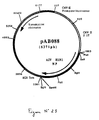
- RT-PCR reaction according to the technique of Example 5 was carried out with the genomic RNA of the avian influenza virus (AIV) (strain H1 N1 Bavaria) (M. Gammelin et al., Virology, 1989. 170. 71-80), prepared according to the technique of Example 3, and with the following oligonucleotides: to isolate the gene coding for the NP nucleoprotein of the avian influenza virus in the form of a SalI-BamHI fragment. After purification, the 1515 bp RT-PCR product was digested with Sal I and Bam HI to isolate a 1503 bp SalI-BamHI fragment. This fragment was ligated with the vector pVR1012 (Example 6), previously digested with Sal I and Bam HI, to give the plasmid pAB088 (6371 bp) (FIG. No. 25).
- AIV avian influenza virus
- strain H1 N1 Bavaria strain H1 N1 Bavari
- any technique may be used which makes it possible to obtain a suspension of purified plasmids predominantly in supercoiled form.
- these techniques are well known to those skilled in the art.
- the purified plasmids are resuspended so as to obtain solutions with high concentration (> 2 mg / ml) compatible with the storage.
- the plasmids are resuspended either in ultrapure water or in TE buffer (10 mM Tris-HCl, 1 mM EDTA, pH 8.0).
- the various plasmids necessary for the manufacture of an associated vaccine are mixed from their concentrated solutions (Example 16). Mixtures are carried out in such a way that the final concentration of each plasmid corresponds to the effective dose of each plasmid.
- Usable solutions to adjust the final concentration of the vaccine can be either a solution NAC1 at 0.9%, ie PBS buffer.
- compositions such as liposomes, cationic lipids, can also be used for the manufacture of vaccines.
- Example 30 Vaccination of chickens
- the chickens are vaccinated with doses of 10, 50 or 100 ⁇ g per plasmid. Injections can be done by needle intramuscularly. Injection sites are the keel bone (for chickens over 2 weeks old) and the thigh (for chickens 1 day old or older). In this case, the vaccine doses are administered in a volume of 0.1 to 0.3 ml.
- injections are also performed intramuscularly using a liquid-jet (needle-free) injection device that has been specifically designed for vaccination of chickens (eg AVIJET).
- the volume injected is 0.3 ml. Injection can be done at the keel or at the level of the thigh.
- injections can be made by needle intramuscular, keel or thigh, in a volume of 0.3 ml.
- the injection of plasmid vaccines can also be done in ovo. In this case, particular formulations as mentioned in Example 29 may be used.
- the volume injected into the 18-day-old embryonated egg is between 50 ⁇ l and 200 ⁇ l .
Landscapes
- Health & Medical Sciences (AREA)
- Life Sciences & Earth Sciences (AREA)
- Virology (AREA)
- Chemical & Material Sciences (AREA)
- General Health & Medical Sciences (AREA)
- Medicinal Chemistry (AREA)
- Pharmacology & Pharmacy (AREA)
- Veterinary Medicine (AREA)
- Public Health (AREA)
- Animal Behavior & Ethology (AREA)
- Microbiology (AREA)
- Epidemiology (AREA)
- Mycology (AREA)
- Immunology (AREA)
- Organic Chemistry (AREA)
- Pulmonology (AREA)
- Molecular Biology (AREA)
- Zoology (AREA)
- Genetics & Genomics (AREA)
- Engineering & Computer Science (AREA)
- Communicable Diseases (AREA)
- Biotechnology (AREA)
- Biomedical Technology (AREA)
- Biochemistry (AREA)
- Oncology (AREA)
- Chemical Kinetics & Catalysis (AREA)
- General Chemical & Material Sciences (AREA)
- Nuclear Medicine, Radiotherapy & Molecular Imaging (AREA)
- Biophysics (AREA)
- Gastroenterology & Hepatology (AREA)
- Proteomics, Peptides & Aminoacids (AREA)
- General Engineering & Computer Science (AREA)
- Bioinformatics & Cheminformatics (AREA)
- Wood Science & Technology (AREA)
- Physics & Mathematics (AREA)
- Plant Pathology (AREA)
- Medicines Containing Antibodies Or Antigens For Use As Internal Diagnostic Agents (AREA)
- Micro-Organisms Or Cultivation Processes Thereof (AREA)
- Medicines That Contain Protein Lipid Enzymes And Other Medicines (AREA)
- Peptides Or Proteins (AREA)
Abstract
La présente invention concerne des formules de vaccin aviaire contre la maladie de Gumboro.The present invention relates to avian vaccine formulas for Gumboro.
Description
La présente invention a trait à une formule de vaccin permettant la vaccination des espèces aviaires, en particulier poulet. Elle a également trait à une méthode de vaccination correspondante.The present invention relates to a vaccine formulation allowing the vaccination of avian species, in particular chicken. It also relates to a method of vaccination corresponding.
On a déjà proposé par le passé des associations de vaccins contre un certain nombre de virus responsables de pathologies chez le poulet.Vaccine combinations have been proposed in the past against a number of viruses responsible for pathologies in chicken.
Les associations développées jusqu'à présent étaient réalisées à partir de vaccins inactivés ou de vaccins vivants. Leur mise en oeuvre pose des problèmes de compatibilité entre valences et de stabilité. Il faut en effet assurer à la fois la compatibilité entre les différentes valences de vaccin, que ce soit au plan des différents antigènes utilisés ou au plan des formulations elles-mêmes, il se pose également le problème de la conservation de tels vaccins combinés et de leur innocuité notamment en présence d'adjuvant. Ces vaccins sont en général assez coûteux.The associations developed so far were made from inactivated vaccines or vaccines living. Their implementation raises problems of compatibility between valences and stability. It is indeed necessary ensure both the compatibility between the different valences of vaccine, whether in terms of different antigens used or in terms of the formulations themselves, it is also poses the problem of the conservation of such combined vaccines and their safety, particularly in the presence of adjuvant. These vaccines are usually quite expensive.
Les demandes de brevet WO-A-90 11092, WO-A-93 19183, WO-A-94 21797 et WO-A-95 20660 ont fait usage de la technique récemment développée des vaccins polynucléotidiques. On sait que ces vaccins utilisent un plasmide apte à exprimer dans les cellules de l'hôte l'antigène inséré dans le plasmide. Toutes les voies d'administration ont été proposées (intrapéritonéale, intraveineuse, intramusculaire, transcutanée, intradermique, mucosale, etc.). Différents moyens de vaccination peuvent également être utilisés, tels que ADN déposé à la surface de particules d'or et projeté de façon à pénétrer dans la peau de l'animal (Tang et al,. Nature 356, 152-154, 1992) et les injecteurs par jet liquide permettant de transfecter à la fois dans la peau, le muscle, les tissus graisseux et les tissus mammaires (Furth et al., Analytical Biochemistry, 205, 365-368, 1992).Patent Applications WO-A-90 11092, WO-A-93 19183, WO-A-94 21797 and WO-A-95 20660 have made use of the technique recently developed polynucleotide vaccines. We know that these vaccines use a plasmid capable of expressing in the host cells the antigen inserted into the plasmid. All the routes of administration have been proposed (intraperitoneal, intravenous, intramuscular, transcutaneous, intradermal, mucosal, etc.). Different means of vaccination can also be used, such as DNA deposited on the surface of gold particles and projected so as to penetrate the skin of the animal (Tang et al., Nature 356, 152-154, 1992) and the liquid jet injectors for transfection at a time in skin, muscle, fatty tissue and tissues mammals (Furth et al., Analytical Biochemistry, 205, 365-368, 1992).
Les vaccins polynucléotidiques peuvent utiliser aussi bien des ADN nus que des ADN formulés par exemple au sein de liposomes ou de lipides cationiques.Polynucleotide vaccines can use as well bare DNA than DNA formulated for example within liposomes or cationic lipids.
L'invention se propose donc de fournir une formule de vaccin multivalent permettant d'assurer une vaccination contre un certain nombre de virus pathogènes aviaires.The invention therefore proposes to provide a formula for multivalent vaccine to ensure vaccination against a number of avian pathogenic viruses.
Un autre objectif de l'invention est de fournir une telle formule de vaccin associant différentes valences tout en présentant tous les critères requis de compatibilité et de stabilité des valences entre elles.Another object of the invention is to provide such vaccine formula combining different valences while having all the necessary criteria of compatibility and stability of the valences between them.
Un autre objectif de l'invention est de fournir une telle formule de vaccin permettant d'associer différentes valences dans un même véhicule.Another object of the invention is to provide such vaccine formula allowing to associate different valences in the same vehicle.
Un autre objectif de l'invention est de fournir un tel vaccin qui soit de mise en oeuvre aisée et peu coûteuse.Another object of the invention is to provide such vaccine that is easy to implement and inexpensive.
Un autre objectif, encore de l'invention est de fournir une méthode de vaccination des gallinacés qui permette d'obtenir une protection, y compris une protection multivalente, avec un niveau élevé d'efficacité et de longue durée, ainsi qu'une bonne innocuité et une absence de résidusAnother objective, still of the invention is to provide a vaccination method for gallinaceans that allows to obtain protection, including protection multivalent, with a high level of efficiency and long duration, good safety and absence of residues
La présente invention a donc pour objet une formule de vaccin aviaire, comprenant au moins trois valences de vaccin polynucléotidique comprenant chacune un plasmide intégrant, de manière à l'exprimer in vivo dans les cellules hôtes, un gène d'une valence de pathogène aviaire, ces valences étant choisies parmi le groupe consistant en virus de la maladie de Marek (MDV), virus de la maladie de Newcastle (NDV), virus de la maladie de Gumboro (IBDV), virus de la bronchite infectieuse (IBV), virus de l'anémie infectieuse (CAV), virus de la laryngotrachéite infectieuse (ILTV), virus de l'encéphalomyélite (AEV ou encore virus de la leucose aviaire ALV), virus de la pneumovirose, et virus de la peste aviaire, les plasmides comprenant, pour chaque valence, un ou plusieurs des gènes choisis parmi le groupe consistant en gB et gD pour le virus de la maladie de Marek, HN et F pour le virus de la maladie de Newcastle, VP2 pour le virus de la maladie de Gumboro, S, M et N pour le virus de la bronchite infectieuse, C + NS1 pour le virus de l'anémie infectieuse, gB et gD pour le virus de la laryngotrachéite infectieuse, env et gag/pro pour le virus de l'encéphalomyélite, F et G pour le virus de la pneumovirose et HA, N et NP pour le virus de la peste aviaire.The subject of the present invention is therefore a formula of avian vaccine, comprising at least three valences of vaccine polynucleotide each comprising an integrating plasmid, to express it in vivo in the host cells, a gene of a valency of avian pathogen, these valences being chosen among the group consisting of Marek's disease virus (MDV), Newcastle disease virus (NDV), human immunodeficiency virus (NDV), Gumboro disease (IBDV), infectious bronchitis virus (IBV), infectious anemia virus (CAV), viral infectious laryngotracheitis (ILTV), encephalomyelitis (AEV or avian leukosis virus) ALV), pneumovirus virus, and avian influenza virus, the plasmids comprising, for each valence, one or more genes selected from the group consisting of gB and gD for Marek's disease virus, HN and F for the virus of the Newcastle disease, VP2 for the disease virus Gumboro, S, M and N for infectious bronchitis virus, C + NS1 for the infectious anemia virus, gB and gD for the infectious laryngotracheitis virus, env and gag / pro for the encephalomyelitis virus, F and G for the virus of the pneumovirosis and HA, N and NP for avian influenza virus.
Par valence, dans la présence invention, on entend au moins un antigène assurant une protection contre le virus du pathogène considéré, la valence pouvant contenir, à titre de sous-valence, un ou plusieurs gènes naturels ou modifiés d'une ou plusieurs souches du pathogène considéré.By valence, in the present invention, we mean least one antigen providing protection against the pathogen considered, the valence being able to contain, as sub-valence, one or more natural or modified genes of a or several strains of the pathogen considered.
Par gène d'agent pathogène, on entend non seulement le gène complet, mais aussi les séquences nucléotidiques différentes, y compris fragments, conservant la capacité à induire une réponse protectrice. La notion de gène recouvre les séquences nucléotidiques équivalentes à celles décrites précisément dans les exemples, c'est-à-dire les séquences différentes mais codant pour la même protéine. Elle recouvre aussi les séquences nucléotidiques d'autres souches du pathogène considéré, assurant une protection croisée ou une protection spécifique de souche ou de groupe de souche. Elle recouvre encore les séquences nucléotidiques qui ont été modifiées pour faciliter l'expression in vivo par l'animal hôte mais codant pour la même protéine.By pathogen gene is meant not only the complete gene, but also the nucleotide sequences different, including fragments, retaining the ability to induce a protective response. The notion of gene covers the nucleotide sequences equivalent to those described precisely in the examples, that is to say the sequences different but coding for the same protein. She covers also the nucleotide sequences of other strains of considered a pathogen, providing cross-protection or specific protection of the strain or group of strain. She still covers the nucleotide sequences that were modified to facilitate in vivo expression by the host animal but coding for the same protein.
De préférence, la formule de vaccin selon l'invention comprend trois valences choisies parmi Marek, Gumboro, Anémie infectieuse et Newcastle. On peut aussi y rajouter de préférence la valence bronchite infectieuse.Preferably, the vaccine formula according to the invention includes three valences selected from Marek, Gumboro, Anemia infectious and Newcastle. We can also add preferably the infectious bronchitis valence.
Sur cette base de 3, 4 ou 5 valences, on pourra ajouter une ou plusieurs des valences peste aviaire, laryngotrachéite, pneumovirose et encéphalomyélite. On this basis of 3, 4 or 5 valences, we can add one or more of the valences avian plague, laryngotracheitis, pneumovirus and encephalomyelitis.
La présente invention a également pour objet
les élèments 1 à 14 suivants :
En ce qui concerne la valence Marek, on peut mettre en oeuvre les deux gènes codant pour gB et gD, dans des plasmides différents ou dans un seul et même plasmide. On préfère toutefois n'utiliser que le gène gB.With regard to the Marek valence, it is possible to the two genes coding for gB and gD in plasmids different or in a single plasmid. We prefer however, use only the gB gene.
Pour la valence Newcastle, on utilise de préférence les deux gènes HN et F intégrés dans deux plasmides différents ou dans un seul et même plasmide.For the Newcastle valence, preference is given to two genes HN and F integrated in two different plasmids or in a single plasmid.
Pour la valence bronchite infectieuse, on préfère utiliser le gène S. Eventuellement, mais de façon moins préférée, on peut associer S et M dans un seul plasmide ou dans desFor the infectious bronchitis valence, it is preferred to use the S gene. Possibly, but in a less preferred manner, can associate S and M in a single plasmid or in
plasmides différents.different plasmids.
Pour la valence anémie infectieuse, on préfère associer les deux gènes C et NS1 dans le même plasmide.For valence infectious anemia, it is preferred to associate both C and NS1 genes in the same plasmid.
Pour la valence laryngotrachéite infectieuse, on préfère utiliser le gène gB seul. Eventuellement, mais de façon moins préférée, on peut associer les deux gènes gB et gD dans des plasmides différents ou dans un seul et même plasmide.For the infectious laryngotracheitis valence, use the gB gene alone. Possibly, but less preferred, the two genes gB and gD can be combined in different plasmids or in a single plasmid.
Pour la valence pneumovirose, on préfère utiliser les deux gènes F et G, dans un seul plasmide ou dans des plasmides différents.For the valence pneumovirosis, it is preferred to use both F and G genes, in a single plasmid or in plasmids different.
Pour la valence peste aviaire, on préfère utiliser le gène HA. Eventuellement, mais de façon moins préférée, on peut utiliser des associations HA et NP ou HA et N dans des plasmides différents ou dans un seul et même plasmide. De préférence, on associe dans le même vaccin les séquences HA de plus d'une souche de virus influenza, en particulier des différentes souches rencontrées sur le terrain. En revanche, NP assure une protection croisée et l'on pourra donc se contenter de la séquence d'une seule souche du virus.For avian plague valence, it is preferred to use the gene HA. Possibly, but in a less preferred manner, one can use HA and NP associations or HA and N in different plasmids or in a single plasmid. Of preferably, the HA sequences of the same vaccine are combined with more than one strain of influenza virus, particularly different strains encountered in the field. In contrast, NP provides cross-protection and we can therefore be satisfied of the sequence of a single strain of the virus.
Pour la valence encéphalomyélite, on préfère utiliser env.For valence encephalomyelitis, it is preferred to use approx.
La formule de vaccin selon l'invention pourra se présenter sous un volume de dose compris entre 0,1 et 1 ml et en particulier entre 0,3 et 0,5 ml.The vaccine formula according to the invention may be present under a dose volume of between 0.1 and 1 ml and in especially between 0.3 and 0.5 ml.
La dose sera généralement comprise entre 10 ng et 1 mg, de préférence entre 100 ng et 500 µg et préférentiellement entre 0,1 µg et 50 µg par type de plasmide.The dose will generally be between 10 ng and 1 mg, preferably between 100 ng and 500 μg and preferentially between 0.1 μg and 50 μg per type of plasmid.
On utilisera de préférence des plasmides nus, simplement placés dans le véhicule de vaccination qui sera en général de l'eau physiologique ou analogue. On peut bien entendu utiliser toutes les formes de vaccin polynucléotidique décrites dans l'art antérieur et notamment formulés dans des liposomes.Preferably bare plasmids will be used, simply placed in the vaccination vehicle which will generally be physiological water or the like. We can of course use all forms of polynucleotide vaccine described in the prior art and in particular formulated in liposomes.
Chaque plasmide comprend un promoteur apte à assurer l'expression du gène inséré sous sa dépendance dans les cellules hôtes. Il s'agira en général d'un promoteur eucaryote fort et en particulier d'un promoteur précoce du cytomégalovirus CMV-IE, d'origine humaine ou murine, ou encore éventuellement d'une autre origine telle que rat, cochon, cobaye.Each plasmid comprises a promoter capable of ensuring the expression of the gene inserted under its control in the host cells. It will generally be a eukaryotic promoter strong and in particular of an early promoter of the cytomegalovirus CMV-IE, of human or murine origin, or possibly of another origin such as rat, pig, Guinea pig.
De manière plus générale, le promoteur pourra être soit d'origine virale, soit d'origine cellulaire. Comme promoteur viral autre que CMV-IE, on peut citer le promoteur précoce ou tardif du virus SV 40 ou le promoteur LTR du virus du Sarcome de Rous. Il peut aussi s'agir d'un promoteur du virus dont provient le gène, par exemple le promoteur propre au gène.More generally, the promoter can be either of viral origin, either of cellular origin. As promoter virus other than CMV-IE, we may mention the early promoter or SV 40 virus late or Sarge virus LTR promoter from Rous. It can also be a promoter of the virus comes the gene, for example the gene-specific promoter.
Comme promoteur cellulaire, on peut citer le promoteur d'un gène du cytosquelette, tel que par exemple le promoteur de la desmine (Bolmont et al., Journal of Submicroscopic Cytology and Pathology, 1990, 22, 117-122 ; et ZHENLIN et al., Gene, 1989, 78, 243-254), ou encore le promoteur de l'actine.As a cellular promoter, mention may be made of the promoter a cytoskeleton gene, such as, for example, the desmin (Bolmont et al., Journal of Submicroscopic Cytology and Pathology, 1990, 22, 117-122; and ZHENLIN et al., Gene, 1989, 78, 243-254), or else the actin promoter.
Lorsque plusieurs gènes sont présents dans le même plasmide, ceux-ci peuvent être présentés dans la même unité de transcription ou dans deux unités différentes.When multiple genes are present in the same plasmid, these can be presented in the same unit of transcription or in two different units.
La combinaison des différentes valences du vaccin selon l'invention peut être effectuée, de préférence, par mélange de plasmides polynucléotidiques exprimant le ou les antigènes de chaque valence, mais on peut également prévoir de faire exprimer des antigènes de plusieurs valences par un même plasmide.The combination of the different valences of the vaccine according to the invention may be preferably carried out by mixing polynucleotide plasmids expressing the antigen (s) of each valence, but one can also plan to do express antigens of several valences by the same plasmid.
L'invention a encore pour objet des formules de vaccin monovalent comprenant un ou plusieurs plasmides codant pour un ou plusieurs gènes de l'un des virus ci-dessus, les gènes étant ceux décrits plus haut. En dehors de leur caractère monovalent, ces formules peuvent reprendre les caractéristiques énoncées plus haut en ce qui concerne le choix des gènes, leurs combinaisons, la composition des plasmides, les volumes de dose, les doses, etc.The subject of the invention is also vaccine formulas monovalent comprising one or more plasmids encoding a or more genes from one of the above viruses, the genes being those described above. Apart from their monovalent character, these formulas may have the characteristics stated higher in the choice of genes, their combinations, the composition of the plasmids, the volumes of dose, doses, etc.
Les formules de vaccin monovalent peuvent aussi être utilisées (i) pour la préparation d'une formule de vaccin polyvalent tel que décrit plus haut, (ii) à titre individuel contre la pathologie propre, (iii) associées à un vaccin d'un autre type (entier vivant ou inactivé, recombinant, sous-unité) contre une autre pathologie, ou (iv) comme rappel d'un vaccin comme décrit ci-après.Monovalent vaccine formulas can also be used (i) for the preparation of a vaccine formula versatile as described above, (ii) individually against the pathology itself, (iii) associated with a vaccine of one other type (whole live or inactivated, recombinant, subunit) against another pathology, or (iv) as a reminder of a vaccine as described below.
La présente invention a en effet encore pour objet l'utilisation d'un ou de plusieurs plasmides selon l'invention pour la fabrication d'un vaccin aviaire destiné à vacciner des animaux primo-vaccinés au moyen d'un premier vaccin classique (monovalent ou multi-valent), du type de ceux de l'art antérieur, choisi notamment dans le groupe consistant en vaccin entier vivant, vaccin entier inactivé, vaccin de sous-unité, vaccin recombinant, ce premier vaccin présentant (c'est-à-dire contenant ou pouvant exprimer) le ou les antigène(s) codé(s) par le ou les plasmides ou antigène(s) assurant une protection croisée.The present invention indeed still has as its object the use of one or more plasmids according to the invention for the production of an avian vaccine intended to vaccinate primo-vaccinated animals using a first conventional vaccine (monovalent or multi-valent), of the type of those of art prior art, chosen especially from the group consisting of vaccine whole live, whole inactivated vaccine, subunit vaccine, recombinant vaccine, this first vaccine presenting (i.e. containing or capable of expressing) the encoded antigen (s) by the plasmid (s) or antigen (s) providing protection cross.
De manière remarquable, le vaccin polynucléotidique a un effet de rappel puissant se traduisant par une amplification de la réponse immunitaire et l'instauration d'une immunité de longue durée.Remarkably, the polynucleotide vaccine has a powerful booster effect resulting in amplification of the immune response and the introduction of immunity from long duration.
De manière générale, les vaccins de primo-vaccination pourront être choisis parmi les vaccins commerciaux disponibles auprès des différents producteurs de vaccins vétérinaires.In general, primary vaccination vaccines may be selected from commercial vaccines available from the various producers of veterinary vaccines.
L'invention a aussi pour objet un kit de vaccination regroupant une formule de vaccin selon l'invention et un vaccin de primo-vaccination tel que décrit ci-dessus. Elle a aussi trait à une formule de vaccin selon l'invention accompagnée d'une notice indiquant l'usage de cette formule comme rappel d'une primo-vaccination telle que décrite ci-avant.The invention also relates to a vaccination kit combining a vaccine formula according to the invention and a vaccine primary vaccination as described above. She has also a vaccine formula according to the invention accompanied by a notice indicating the use of this formula as a reminder a primary vaccination as described above.
La présente invention a également pour objet une méthode de vaccination aviaire, comprenant l'administration d'une formule de vaccin efficace telle que décrit plus haut. Cette méthode de vaccination comprend l'administration d'une ou de plusieurs doses de formule de vaccin, ces doses pouvant être administrées successivement dans un court laps de temps et/ou successivement à des moments éloignés l'un de l'autre.The present invention also relates to a method avian vaccination, including the administration of a effective vaccine formulation as described above. This method of vaccination includes the administration of one or several doses of the vaccine formula, these doses being administered successively in a short period of time and / or successively at times distant from each other.
Les formules de vaccin selon l'invention pourront être administrées, dans le cadre de cette méthode de vaccination, par les différentes voies d'administration proposées dans l'art antérieur dans le cadre de la vaccination polynucléotidique et au moyen des techniques d'administration connues.The vaccine formulations according to the invention may be administered as part of this method of vaccination, by the various routes of administration proposed in the art previous in the context of polynucleotide vaccination and using known administration techniques.
On visera en particulier les voies intramusculaire, in ovo, intra-oculaire, la nébulisation et l'eau de boisson.In particular, the intramuscular ovo, intraocular, nebulization and drinking water.
L'efficacité de la présentation des antigènes au système immunitaire varie en fonction des tissus. En particulier, les muqueuses de l'arbre respiratoire servent de barrière à l'entrée des pathogènes et sont associées à des tissus lymphoides qui supportent une immunité locale. En outre, l'administration d'un vaccin par contact avec les muqueuses, en particulier muqueuse buccale, pharyngée et région bronchique présente un intérêt certain pour la vaccination de masse.The efficiency of antigen presentation to the system Immune varies depending on the tissues. In particular, mucous membranes of the respiratory tree serve as a barrier to the entry of pathogens and are associated with tissues lymphoids that support local immunity. In addition, administration of a vaccine by contact with the mucous membranes, in particular oral mucosa, pharyngeal and bronchial region is of interest for mass vaccination.
En conséquence, les voies d'administration mucosales font partie d'un mode d'administration préféré pour l'invention, utilisant notamment la nébulisation ou spray ou l'eau de boisson. Les formules de vaccin et méthodes de vaccination selon l'invention pourront être appliquées dans ce cadre.As a result, the mucosal part of a preferred mode of administration for the invention, particularly using nebulization or spray or water of drink. Vaccine formulas and vaccination methods according to the invention may be applied in this context.
L'invention a encore pour objet la méthode de vaccination consistant à faire une primo-vaccination telle que décrite ci-dessus et un rappel avec une formule de vaccin selon l'invention.The subject of the invention is also the method of vaccination consisting of a primary vaccination as described above and a booster with a vaccine formula according to the invention.
Dans une forme de mise en oeuvre préférée du procédé selon l'invention, on administre dans un premier temps, à l'animal, une dose efficace du vaccin de type classique, notamment inactivé, vivant, atténué ou recombinant, ou encore un vaccin de sous-unité de façon à assurer une primo-vaccination, et, après un délai de préférence de 2 à 6 semaines, on assure l'administration du vaccin polyvalent ou monovalent selon l'invention.In a preferred embodiment of the process according to the invention is first administered to the animal, an effective dose of conventional vaccine, including inactivated, live, attenuated or recombinant, or a vaccine sub-unit to ensure primary vaccination, and after a period of preference of 2 to 6 weeks, we assure administration of the polyvalent or monovalent vaccine according to the invention.
L'invention concerne aussi la méthode de préparation des formules de vaccin, à savoir la préparation des valences ec leurs mélanges, telle qu'elle ressort de cette description.The invention also relates to the method of preparing the formulas of vaccine, namely the preparation of the valences ec their mixtures, as it appears from this description.
L'invention va être maintenant décrite plus en détails à l'aide de modes de réalisation de l'invention pris en référence aux dessins annexés. The invention will now be described in more detail in using embodiments of the invention referred to in the accompanying drawings.
- Figure N° 1 :Figure N ° 1:
- Plasmide pVR1012Plasmid pVR1012
- Figure N° 2 :Figure N ° 2:
- Plasmide pAB045Plasmid pAB045
- Figure N° 3 :Figure N ° 3:
- Plasmide pAB080Plasmid pAB080
- Figure N° 4 :Figure N ° 4:
- Séquence du gène NDV HN souche Texas GBNDV HN gene sequence strain Texas GB
- Figure N° 5 :Figure N ° 5:
- Plasmide pAB046Plasmid pAB046
- Figure N° 6 :Figure N ° 6:
- Séquence du gène NDV F souche Texas GBSequence of the NDV F gene strain Texas GB
- Figure N° 7 :Figure N ° 7:
- Plasmide pAB047Plasmid pAB047
- Figure N° 8 :Figure N ° 8:
- Séquence du gène IBDV VP2 souche FaragherIBDV VP2 gene sequence Faragher strain
- Figure N° 9 :Figure N ° 9:
- Plasmide pAB048Plasmid pAB048
- Figure N° 10 :Figure N ° 10:
- Séquence du gène IBV S souche Massachusetts 41Sequence of the IBV S strain Massachusetts strain 41
- Figure N° 11 :Figure N ° 11:
- Plasmide pAB049Plasmid pAB049
- Figure N° 12 :Figure N ° 12:
- Séquence du gène IBV M souche Massachusetts 41Sequence of IBV M gene Massachusetts strain 41
- Figure N° 13 :Figure N ° 13:
- Plasmide pAB050Plasmid pAB050
- Figure N° 14 :Figure N ° 14:
- Séquence du gène IBV N souche Massachusetts 41Sequence of IBV N strain Massachusetts strain 41
- Figure N° 15 :Figure N ° 15:
- Plasmide pAB051Plasmid pAB051
- Figure N° 16 :Figure N ° 16:
- Plasmide pAB054Plasmid pAB054
- Figure N° 17 :Figure N ° 17:
- Plasmide pAB055Plasmid pAB055
- Figure N° 18 :Figure N ° 18:
- Plasmide pAB076Plasmid pAB076
- Figure N° 19 :Figure N ° 19:
- Plasmide pAB089Plasmid pAB089
- Figure N° 20 :Figure N ° 20:
- Plasmide pAB086Plasmid pAB086
- Figure N° 21 :Figure N ° 21:
- Plasmide pAB081Plasmid pAB081
- Figure N° 22 :Figure N ° 22:
- Plasmide pAB082Plasmid pAB082
- Figure N° 23 :Figure N ° 23:
- Plasmide pAB077Plasmid pAB077
- Figure N° 24 :Figure N ° 24:
- Plasmide pAB078Plasmid pAB078
- Figure N° 25 :Figure N ° 25:
- Plasmide pAB088Plasmid pAB088
- Figure N° 26 :Figure N ° 26:
- Plasmide pAB079Plasmid pAB079
- SEQ ID N° 1 :SEQ ID NO: 1:
- Oligonucléotide AB062Oligonucleotide AB062
- SEQ ID N° 2 :SEQ ID NO: 2
- Oligonucléotide AB063Oligonucleotide AB063
- SEQ ID N° 3 :SEQ ID NO: 3
- Oligonucléotide AB148Oligonucleotide AB148
- SEQ ID N° 4 :SEQ ID NO: 4
- Oligonucléotide AB149Oligonucleotide AB149
- SEQ ID N° 5 :SEQ ID NO: 5
- Oligonucléotide AB072Oligonucleotide AB072
- SEQ ID N° 6 :SEQ ID NO: 6
- Oligonucléotide AB073Oligonucleotide AB073
- SEQ ID N° 7 :SEQ ID NO: 7
- Séquence du gène NDV HN souche Texas GBNDV HN gene sequence strain Texas GB
- SEQ ID N° 8 :SEQ ID NO: 8
- Oligonucléotide AB091Oligonucleotide AB091
- SEQ ID N° 9 :SEQ ID NO: 9
- Oligonucléotide AB092Oligonucleotide AB092
- SEQ ID N° 10 :SEQ ID NO: 10:
- Séquence du gène NDV F souche Texas GBSequence of the NDV F gene strain Texas GB
- SEQ ID N° 11 :SEQ ID NO: 11:
- Oligonucléotide AB093Oligonucleotide AB093
- SEQ ID N° 12 :SEQ ID NO: 12:
- Oligonucléotide AB094Oligonucleotide AB094
- SEQ ID N° 13 :SEQ ID NO: 13:
- Séquence du "gène" IBDV VP2 souche FaragherSequence of IBDV VP2 gene "Faragher strain"
- SEQ ID N° 14 :SEQ ID NO: 14:
- Oligonucléotide AB095Oligonucleotide AB095
- SEQ ID N° 15 :SEQ ID NO: 15:
- Oligonucléotide AB096Oligonucleotide AB096
- SEQ ID N° 16 :SEQ ID No. 16:
- Séquence du gène IBV S souche Massachusetts 41Sequence of the IBV S strain Massachusetts strain 41
- SEQ ID N° 17 :SEQ ID NO: 17:
- Oligonucléotide AB097Oligonucleotide AB097
- SEQ ID N° 18 :SEQ ID NO: 18:
- Oligonucléotide AB098Oligonucleotide AB098
- SEQ ID N° 19 :SEQ ID NO: 19:
- Séquence du gène IBV M souche Massachusetts 41Sequence of IBV M gene Massachusetts strain 41
- SEQ ID N° 20 :SEQ ID NO: 20:
- Oligonucléotide AB099Oligonucleotide AB099
- SEQ ID N° 21 :SEQ ID NO: 21:
- Oligonucléotide AB100Oligonucleotide AB100
- SEQ ID N° 22 :SEQ ID NO: 22:
- Séquence du gène IBV N souche Massachusetts 41Sequence of IBV N strain Massachusetts strain 41
- SEQ ID N° 23 :SEQ ID NO: 23:
- Oligonucléotide CD064Oligonucleotide CD064
- SEQ ID N° 24 :SEQ ID NO: 24:
- Oligonucléotide CD065Oligonucleotide CD065
- SEQ ID N° 25 :SEQ ID NO: 25:
- Oligonucléotide CD066Oligonucleotide CD066
- SEQ ID N° 26 :SEQ ID NO: 26:
- Oligonucléotide AB105Oligonucleotide AB105
- SEQ ID N° 27 :SEQ ID NO: 27:
- Oligonucléotide AB140Oligonucleotide AB140
- SEQ ID N° 28 :SEQ ID NO: 28:
- Oligonucléotide AB141Oligonucleotide AB141
- SEQ ID N° 29 :SEQ ID NO: 29:
- Oligonucléotide AB164Oligonucleotide AB164
- SEQ ID N° 30 :SEQ ID NO: 30:
- Oligonucléotide AB165 Oligonucleotide AB165
- SEQ ID N° 31 :SEQ ID No. 31:
- Oligonucléotide AB160Oligonucleotide AB160
- SEQ ID N° 32 :SEQ ID NO: 32:
- Oligonucléotide AB161Oligonucleotide AB161
- SEQ ID N° 33 :SEQ ID NO: 33:
- Oligonucléotide AB150Oligonucleotide AB150
- SEQ ID N° 34 :SEQ ID NO: 34:
- Oligonucléotide AB151Oligonucleotide AB151
- SEQ ID N° 35 :SEQ ID NO: 35:
- Oligonucléotide AB152Oligonucleotide AB152
- SEQ ID N° 36 :SEQ ID NO: 36:
- Oligonucléotide AB153Oligonucleotide AB153
- SEQ ID N° 37 :SEQ ID NO: 37:
- Oligonucléotide AB142Oligonucleotide AB142
- SEQ ID N° 38 :SEQ ID NO: 38:
- Oligonucléotide AB143Oligonucleotide AB143
- SEQ ID N° 39 :SEQ ID NO: 39:
- Oligonucléotide AB144Oligonucleotide AB144
- SEQ ID N° 40 :SEQ ID NO: 40:
- Oligonucléotide AB145Oligonucleotide AB145
- SEQ ID N° 41 :SEQ ID NO: 41:
- Oligonucléotide AB156Oligonucleotide AB156
- SEQ ID N° 42 :SEQ ID NO: 42:
- Oligonucléotide AB158Oligonucleotide AB158
- SEO ID N° 43 :SEO ID No 43:
- Oligonucléotide AB146Oligonucleotide AB146
- SEQ ID N° 44 :SEQ ID NO: 44:
- Oligonucléotide AB147Oligonucleotide AB147
Les virus sont cultivés sur le système cellulaire approprié jusqu'à obtention d'un effet cytopathique. Les systèmes cellulaires à utiliser pour chaque virus sont bien connus de l'homme du métier. Brièvement, des cellules sensibles au virus utilisé, cultivées en milieu minimum essentiel de Eagle (milieu "MEM) ou un autre milieu approprié, sont inoculées avec la souche virale étudiée en utilisant une multiplicité d'infection de 1. Les cellules infectées sont alors incubées à 37°C pendant le temps nécessaire à l'apparition d'un effet cytopathique complet (en moyenne 36 heures).Viruses are grown on the appropriate cell system until a cytopathic effect. The cellular systems to be used for each virus are well known to those skilled in the art. Briefly, virus-sensitive cells used, grown in Eagle's essential minimum medium ("MEM" medium) or a other appropriate medium, are inoculated with the viral strain studied using a multiplicity of infection of 1. The infected cells are then incubated at 37 ° C for the time necessary for the appearance of a cytopathic effect complete (on average 36 hours).
Après culture, le surnageant et les cellules lysées sont récoltées et la totalité de la suspension virale est centrifugée à 1000 g pendant 10 minutes à + 4°C pour éliminer les débris cellulaires. Les particules virales sont alors récoltées par ultracentrifugation à 400000 g pendant 1 heure à + 4°C. Le culot est repris dans un volume minimum de tampon (Tris 10 mM, EDTA 1 mM). Cette suspension virale concentrée est traitée par la protéinase K (100 µg/ml final) en présence de sodium dodecyl sulfate (SDS) (0,5% final) pendant 2 heures à 37°C. L'ADN viral est ensuite extrait avec un mélange de phénol/chloroforme, puis précipité avec 2 volumes d'éthanol absolu. Après une nuit à - 20°C, l'ADN est centrifugé à 10000 g pendant 15 minutes à + 4°C. Le culot d'ADN est séché, puis repris dans un volume minimum d'eau ultrapure stérile. Il peut alors être digéré par des enzymes de restriction.After culture, the supernatant and the lysed cells are harvested and the entire the viral suspension is centrifuged at 1000 g for 10 minutes at + 4 ° C. to eliminate cell debris. The viral particles are then harvested by ultracentrifugation at 400000 g for 1 hour at + 4 ° C. The pellet is taken again in a minimum volume of buffer (10 mM Tris, 1 mM EDTA). This Concentrated viral suspension is treated with proteinase K (100 μg / ml final) in presence of sodium dodecyl sulfate (SDS) (0.5% final) for 2 hours at 37 ° C. The viral DNA is then extracted with a mixture of phenol / chloroform, then precipitated with 2 volumes of absolute ethanol. After one night at -20 ° C, the DNA is centrifuged at 10000 g for 15 minutes at + 4 ° C. The pellet of DNA is dried, then taken up in a minimum volume of sterile ultrapure water. He can then to be digested with restriction enzymes.
Les virus à ARN ont été purifiés selon les techniques bien connues de l'homme du métier. L'ARN viral génomique de chaque virus a été ensuite isolé en utilisant la technique d'extraction "thiocyanate de guanidium/phénol-chloroforme" décrite par P. Chomczynski et N. Sacchi (Anal. Biochem. 1987. 162. 156-159). RNA viruses have been purified according to techniques well known to humans of career. The genomic viral RNA of each virus was then isolated using the extraction technique "guanidium thiocyanate / phenol-chloroform" described by P. Chomczynski and N. Sacchi (Anal Biochem 1987. 162. 156-159).
Toutes les constructions de plasmides ont été réalisées en utilisant les techniques standards de biologie moléculaire décrites par J. Sambrook et al. (Molecular Cloning: A Laboratory Manual. 2nd Edition. Cold Spring Harbor Laboratory. Cold Spring Harbor. New York. 1989). Tous les fragments de restriction utilisés pour la présente invention ont été isolés en utilisant le kit "Genectean" (BIO101 Inc. La Jolla, CA).All plasmid constructs were made using the standard techniques of molecular biology described by J. Sambrook et al. (Molecular Cloning: A Laboratory Manual 2nd Edition Cold Spring Harbor Laboratory Cold Spring Harbor New York, 1989.....). All restriction fragments used for the present invention were isolated using the "Genectean" kit (BIO101 Inc. La Jolla, CA).
Des oligonucléotides spécifiques (comportant à leurs extrémités 5' des sites de restriction pour faciliter le clonage des fragments amplifiés) ont été synthétisés de telle façon qu'ils couvrent entièrement les régions codantes des gènes devant être amplifiés (voir exemples spécifiques). La réaction de transcription inverse (RT) et l'amplification en chaíne par polymérase (PCR) ont été effectuées selon les techniques standards (Sambrook J. et al. 1989). Chaque réaction de RT-PCR a été faite avec un couple d'amplimers spécifiques et en prenant comme matrice l'ARN génomique viral extrait. L'ADN complémentaire amplifié a été extrait au phénol/chloroforme/alcoolisoamytique (25:24:1) avant d'être digéré par les enzymes de restriction.Specific oligonucleotides (having at their 5 'ends restriction sites to facilitate cloning of the amplified fragments) were synthesized so that they completely cover the coding regions of the genes to be amplified (see specific examples). The reverse transcription reaction (RT) and polymerase chain reaction (PCR) were performed according to standard techniques (Sambrook J. et al., 1989). Each RT-PCR reaction was made with a pair of specific amplimers and taking as template the extracted viral genomic RNA. The amplified complementary DNA was extracted with phenol / chloroform / alcoholisoamytique (25: 24: 1) before being digested with the restriction enzymes.
Le plasmide pVR1012 (Figure N° 1) a été obtenu auprès de Vical Inc. San Diego, CA, USA; Sa construction a été décrite dans J. Hartikka et al. (Human Gene Therapy. 1996. 7. 1205-1217).Plasmid pVR1012 (Figure No. 1) was obtained from Vical Inc. San Diego, CA, USA; Its construction has been described in J. Hartikka et al. (Human Gene Therapy, 1996. 7. 1205-1217).
Une réaction de PCR a été réalisée avec l'ADN génomique du virus de la
maladie de Marek (MDV) (Souche RB1B) (L. Ross et al. J. Gen. Virol. 1989. 70.
1789-1804), préparé selon la technique de l'exemple 2, et avec les
oligonucléotides suivants:


Une réaction de PCR a été réalisée avec l'ADN génomique du virus de la
maladie de Marek (MDV) (Souche R818) (L. Ross et al. J. Gen. Virol. 1991. 72.
949-954), préparé selon la technique de l'exemple 2, et avec les
oligonucléotides suivants:


Une réaction de RT-PCR selon la technique de l'exemple 5 a été réalisée avec
l'ARN génomique du virus de la maladie de Newcastle (NDV) (Souche Texas
GB), préparé selon la technique de l'exemple 3, et avec les oligonucléotides
suivants:


Une réaction de RT-PCR selon la technique de l'exemple 5 a été réalisée avec
l'ARN génomique du virus de la maladie de Newcastle (NDV) (Souche Texas
GB), préparé selon la technique de l'exemple 3, et avec les oligonucléotides
suivants:


Une réaction de RT-PCR selon la technique de l'exemple 5 a été réalisée avec
l'ARN génomique du virus de la maladie de Gumboro (IBDV) (Souche Faragher),
préparé selon a technique de l'exemple 3, et avec les oligonucléotides suivants:


Une réaction de RT-PCR selon la technique de l'exemple 5 a été réalisée avec
l'ARN génomique du virus de la bronchite infectieuse du poulet (IBV) (Souche
Massachusetts 41), préparé selon a technique de l'exemple 3, et avec les
oligonucléotides suivants:


Une réaction de RT-PCR selon la technique de l'exemple 5 a été réalisée avec
l'ARN génomique du virus de la bronchite infectieuse du poulet (IBV) (Souche
Massachusetts 41), préparé selon la technique de l'exemple 3, et avec les
oligonucléotides suivants:


Une réaction de RT-PCR selon la technique de l'exemple 5 a été réalisée avec
l'ARN génomique du virus de la bronchite infectieuse du poulet (IBV) (Souche
Massachusetts 41), préparé selon la technique de l'exemple 3, et avec les
otigonuctéotides suivants:


Une réaction de PCR a été réalisée avec l'ADN génomique du virus de l'anémie
du poulet (CAV) (Souche Cuxhaven-1) (B. Meehan et al. Arch. Virol. 1992.
124. 301-319), préparé selon la technique de l'exemple 2, et avec les
oligonucléotides suivants:


Une réaction de PCR a été réalisée avec l'ADN génomique du virus de l'anémie
du poulet (CAV) (Souche Cuxhaven-1) (B. Meehan et al. Arch. Virol. 1992.
124. 301-319), préparé selon la technique de l'exemple 2, et avec les
oligonucléotides suivants:


Une réaction de PCR a été réalisée avec l'ADN génomique du virus de la
laryngotrachéite infectieuse du poulet (ILTV) (Souche SA-2) (K. Kongsuwan et
al. Virology. 1991. 184. 404-410), préparé selon la technique de l'exemple 2,
et avec les oligonucléotides suivants:


Une réaction de PCR a été réalisée avec l'ADN génomique du virus de la
laryngotrachéite infectieuse du poulet (ILTV) (Souche SA-2) (M. Johnson et al.
1994. N° d'accès séquence sur Genbank = L31965), préparé selon la
technique de l'exemple 2, et avec les oligonucléotides suivants:


Une réaction de RT-PCR selon la technique de l'exemple 5 a été réalisée avec
l'ARN génomique du virus de l'encéphalomyélite aviaire (AEV) (Type C) (E.
Bieth et al. Nucleic Acids Res. 1992. 20. 367), préparé selon la technique de
l'exemple 3, et avec les oligonucléotides suivants:


Une réaction de RT-PCR selon la technique de l'exemple 5 a été réalisée avec
l'ARN génomique du virus de l'encéphalomyélite aviaire (AEV) (Type C) (E.
Bieth et al. Nucleic Acids Res. 1992. 20. 367), préparé selon la technique de
l'exemple 3, et avec les oligonucléotides suivants:


Une réaction de RT-PCR selon la technique de l'exemple 5 a été réalisée avec
l'ARN génomique du virus de la rhinotrachéite de la dinde (TRV) (Souche 2119)
(K. Juhasz et al. J. Gen. Virol. 1994. 75. 2873-2880), préparé selon la
technique de l'exemple 3, et avec les oligonucléotides suivants:


Une réaction de RT-PCR selon la technique de l'exemple 5 a été réalisée avec
l'ARN génomique du virus de la peste aviaire (AIV) (Souche H2N2 Postdam) (J.
Schäfer et al. Virology. 1993. 194. 781-788), préparé selon la technique de
l'exemple 3, et avec les oligonucléotides suivants:


Une réaction de RT-PCR selon la technique de l'exemple 5 a été réalisée avec
l'ARN génomique du virus de la peste aviaire (AIV) (Souche H7N7 Leipzig) (C.
Rohm et al. Virology. 1995. 209. 664-670), préparé selon la technique de
l'exemple 3, et avec les oligonucléotides suivants:


Une réaction de RT-PCR selon la technique de l'exemple 5 a été réalisée avec
l'ARN génomique du virus de la grippe aviaire (AIV) (Souche H1 N1 Bavaria) (M.
Gammelin et al. Virology. 1989. 170. 71-80), préparé selon la technique de
l'exemple 3, et avec les oligonucléotides suivants:


Une réaction de RT-PCR selon la technique de l'exemple 5 a été réalisée avec
l'ARN génomique du virus de la peste aviaire (AIV) (Souche H7N1 Rostock) (J.
Mc Cauley 1990. N° d'accès séquence sur Genbank = X52226), préparé selon
la technique de l'exemple 3, et avec les oligonucléotides suivants:


Pour la préparation des plasmides destinés à la vaccination des animaux, on peut utiliser toute technique permettant d'obtenir une suspension de plasmides purifiés majoritairement sous forme superenroulée. Ces techniques sont bien connues de l'homme de l'art. On peut citer en particulier la technique de lyse alcaline suivie de deux ultracentrifugations successives sur gradient de chlorure de césium en présence de bromure d'éthidium telle que décrite dans J. Sambrook et al. (Molecular Cloning: A Laboratory Manual, 2nd Edition, Cold Spring Harbor Laboratory. Cold Spring Harbor. New York. 1989). On peut se référer également aux demandes de brevet PCT WO 95/21250 et PCT WO 96/02658 qui décrivent des méthodes pour produire à l'échelle industrielle des plasmides utilisables pour la vaccination. Pour les besoins de la fabrication des vaccins (voir exemple 17), les plasmides purifiés sont resuspendus de manière à obtenir des solutions à haute concentration ( > 2 mg/ml) compatibles avec le stockage. Pour ce faire, les plasmides sont resuspendus soit en eau ultrapure, soit en tampon TE (Tris-HCl 10 mM; EDTA 1 mM, pH 8,0). For the preparation of plasmids intended for the vaccination of animals, any technique may be used which makes it possible to obtain a suspension of purified plasmids predominantly in supercoiled form. These techniques are well known to those skilled in the art. In particular, mention may be made of the alkaline lysis technique followed by two successive ultracentrifugations on a cesium chloride gradient in the presence of ethidium bromide as described in J. Sambrook et al. (Molecular Cloning: A Laboratory Manual, 2nd Edition, Cold Spring Harbor Laboratory Cold Spring Harbor New York, 1989...). It is also possible to refer to PCT patent applications WO 95/21250 and PCT WO 96/02658 which describe methods for producing, on an industrial scale, plasmids that can be used for vaccination. For the purpose of manufacturing the vaccines (see Example 17), the purified plasmids are resuspended so as to obtain solutions with high concentration (> 2 mg / ml) compatible with the storage. For this purpose, the plasmids are resuspended either in ultrapure water or in TE buffer (10 mM Tris-HCl, 1 mM EDTA, pH 8.0).
Les divers plasmides nécessaires à la fabrication d'un vaccin associé sont mélangés à partir de leurs solutions concentrées (exemple 16). Les mélanges sont réalisés de telle manière que la concentration finale de chaque plasmide corresponde à la dose efficace de chaque plasmide. Les solutions utilisables pour ajuster la concentration finale du vaccin peuvent être soit une solution NACl à 0,9 %, soit du tampon PBS.The various plasmids necessary for the manufacture of an associated vaccine are mixed from their concentrated solutions (Example 16). Mixtures are carried out in such a way that the final concentration of each plasmid corresponds to the effective dose of each plasmid. Usable solutions to adjust the final concentration of the vaccine can be either a solution NAC1 at 0.9%, ie PBS buffer.
Des formulations particulières telles que les liposomes, les lipides cationiques, peuvent aussi être mises en oeuvre pour la fabrication des vaccins.Particular formulations such as liposomes, cationic lipids, can also be used for the manufacture of vaccines.
Les poulets sont vaccinés avec des doses de 10, 50 ou 100 µg par plasmide.
Les injections peuvent être réalisées à l'aiguille par voie intramusculaire. Les
sites d'injection sont le bréchet (pour les poulets de plus de 2 semaines) et la
cuisse (pour les poulets âgés d'1 jour et plus). Dans ce cas, les doses
vaccinales sont administrées sous un volume de 0,1 à 0,3 ml.The chickens are vaccinated with doses of 10, 50 or 100 μg per plasmid. Injections can be done by needle intramuscularly. Injection sites are the keel bone (for chickens over 2 weeks old) and the thigh (for
Chez le poulet adulte (âgé de plus de 20 semaines), les injections sont également réalisées par voie intramusculaire en utilisant un appareil d'injection à jet liquide (sans aiguille) qui a été spécifiquement conçu pour la vaccination des poulets (par exemple, appareil AVIJET). Dans ce cas, le volume injecté est de 0,3 ml. L'injection peut être effectuée au bréchet ou au niveau de la cuisse. De même, chez le poulet adulte, les injections peuvent être réalisées à l'aiguille par voie intramusculaire, au bréchet ou à la cuisse, sous un volume de 0,3 ml. L'injection des vaccins plasmidiques peut également se faire in ovo. Dans ce cas, des formulations particulières, telles que citées dans l'exemple 29 peuvent être utilisées. Le volume injecté dans l'oeuf embryonné de 18 jours est compris entre 50 µl et 200 µl.In adult chicken (over 20 weeks of age), injections are also performed intramuscularly using a liquid-jet (needle-free) injection device that has been specifically designed for vaccination of chickens (eg AVIJET). In this case, the volume injected is 0.3 ml. Injection can be done at the keel or at the level of the thigh. Similarly, in adult chickens, injections can be made by needle intramuscular, keel or thigh, in a volume of 0.3 ml. The injection of plasmid vaccines can also be done in ovo. In this case, particular formulations as mentioned in Example 29 may be used. The volume injected into the 18-day-old embryonated egg is between 50 μl and 200 μl .


Claims (9)
Applications Claiming Priority (3)
| Application Number | Priority Date | Filing Date | Title |
|---|---|---|---|
| FR9609339 | 1996-07-19 | ||
| FR9609339A FR2751225B1 (en) | 1996-07-19 | 1996-07-19 | AVIAN POLYNUCLEOTIDE VACCINE FORMULA |
| EP97934579A EP0914442B1 (en) | 1996-07-19 | 1997-07-16 | Avian polynucleotide vaccine formula |
Related Parent Applications (1)
| Application Number | Title | Priority Date | Filing Date |
|---|---|---|---|
| EP97934579A Division EP0914442B1 (en) | 1996-07-19 | 1997-07-16 | Avian polynucleotide vaccine formula |
Publications (1)
| Publication Number | Publication Date |
|---|---|
| EP1523992A1 true EP1523992A1 (en) | 2005-04-20 |
Family
ID=9494451
Family Applications (2)
| Application Number | Title | Priority Date | Filing Date |
|---|---|---|---|
| EP04021994A Withdrawn EP1523992A1 (en) | 1996-07-19 | 1997-07-16 | Vaccine formulation against Gumboro disease |
| EP97934579A Expired - Lifetime EP0914442B1 (en) | 1996-07-19 | 1997-07-16 | Avian polynucleotide vaccine formula |
Family Applications After (1)
| Application Number | Title | Priority Date | Filing Date |
|---|---|---|---|
| EP97934579A Expired - Lifetime EP0914442B1 (en) | 1996-07-19 | 1997-07-16 | Avian polynucleotide vaccine formula |
Country Status (19)
| Country | Link |
|---|---|
| US (3) | US6221362B1 (en) |
| EP (2) | EP1523992A1 (en) |
| JP (2) | JP2001503019A (en) |
| KR (1) | KR20000065258A (en) |
| CN (2) | CN1701788A (en) |
| AR (1) | AR013063A1 (en) |
| AU (1) | AU735184B2 (en) |
| BR (1) | BR9710495A (en) |
| CA (1) | CA2261343A1 (en) |
| CO (1) | CO4700304A1 (en) |
| DE (1) | DE69730839T2 (en) |
| ES (1) | ES2232876T3 (en) |
| FR (1) | FR2751225B1 (en) |
| HU (1) | HU224830B1 (en) |
| ID (1) | ID19475A (en) |
| MA (1) | MA24268A1 (en) |
| NZ (1) | NZ333779A (en) |
| TN (1) | TNSN97120A1 (en) |
| WO (1) | WO1998003659A1 (en) |
Families Citing this family (61)
| Publication number | Priority date | Publication date | Assignee | Title |
|---|---|---|---|---|
| FR2751225B1 (en) * | 1996-07-19 | 1998-11-27 | Rhone Merieux | AVIAN POLYNUCLEOTIDE VACCINE FORMULA |
| ZA978434B (en) * | 1996-09-27 | 1998-03-26 | Akzo Nobel Nv | Inactivated vaccines. |
| US6468984B1 (en) * | 1999-06-08 | 2002-10-22 | Innovo Biotechnologies Ltd. | DNA vaccine for protecting an avian against infectious bursal disease virus |
| WO2000077218A1 (en) * | 1999-06-10 | 2000-12-21 | Agricultural Research Council | Vaccine for newcastle disease virus |
| AR031405A1 (en) * | 2000-11-21 | 2003-09-24 | Wyeth Corp | METHODS AND VACCINES TO CONFERENCE PROTECTION IN OVO AGAINST TURKEY'S RHINOTRACHISIS |
| FR2823222B1 (en) | 2001-04-06 | 2004-02-06 | Merial Sas | VACCINE AGAINST NILE FEVER VIRUS |
| IL145397A0 (en) * | 2001-09-12 | 2002-06-30 | Yissum Res Dev Co | Compositions and methods for treatment of cancer |
| US7615209B2 (en) | 2001-09-12 | 2009-11-10 | Yissum Research Development Company Of The Hebrew University Of Jerusalem | Compositions of NDV and methods of use thereof for treatment of cancer |
| US7037506B2 (en) * | 2002-03-08 | 2006-05-02 | Schweltzer Chemical Corporation Ltd. | Vaccine accelerator factor (VAF) for improvement of vaccinations in poultry |
| US7029681B2 (en) * | 2002-03-08 | 2006-04-18 | Schweitzer Chemical Corporation | Multiple and multivalent DNA vaccines in ovo |
| AU2002253542B2 (en) * | 2002-04-12 | 2007-06-07 | Ilaria Capua | Purified subfragment encoding neuroaminidase, recombinant neuroaminidase and its use in zooprophylaxis |
| WO2004035821A1 (en) * | 2002-10-15 | 2004-04-29 | Wyeth | Assay methods for detection of a virus in an avian tissue sample |
| EP2390352A1 (en) | 2003-03-18 | 2011-11-30 | Quantum Genetics Ireland Limited | Systems and methods for improving protein and milk production of dairy herds |
| US7468273B2 (en) | 2003-05-01 | 2008-12-23 | Meial Limited | Canine GHRH gene, polypeptides and methods of use |
| EP1689858B1 (en) | 2003-11-13 | 2013-05-15 | University Of Georgia Research Foundation, Inc. | Methods of characterizing infectious bursal disease virus |
| EP1718770B1 (en) | 2004-02-19 | 2011-05-25 | The Governors of the University of Alberta | Leptin promoter polymorphisms and uses thereof |
| WO2006115843A2 (en) | 2005-04-25 | 2006-11-02 | Merial Limited | Nipah virus vaccines |
| US20080241184A1 (en) | 2005-08-25 | 2008-10-02 | Jules Maarten Minke | Canine influenza vaccines |
| DE102005040812A1 (en) * | 2005-08-27 | 2007-03-15 | Few Fahrzeugelektrikwerk Gmbh & Co. Kg | Electrical connection and method for its connection to the window of a motor vehicle |
| EP3147296A1 (en) | 2005-11-14 | 2017-03-29 | Merial, Inc. | Gene therapy for renal failure |
| US7771995B2 (en) | 2005-11-14 | 2010-08-10 | Merial Limited | Plasmid encoding human BMP-7 |
| US7862821B2 (en) | 2006-06-01 | 2011-01-04 | Merial Limited | Recombinant vaccine against bluetongue virus |
| AU2007352618B2 (en) | 2007-05-02 | 2013-07-18 | Boehringer Ingelheim Animal Health USA Inc. | DNA plasmids having improved expression and stability |
| US20080274137A1 (en) * | 2007-05-02 | 2008-11-06 | Jean Christophe Francis Audonnet | DNA plasmids having improved expression and stability |
| EP2298694A4 (en) * | 2008-06-03 | 2011-06-01 | Asahi Glass Co Ltd | PROCESS FOR PRODUCTION OF CORE / ENVELOPE PARTICLES, CORE / ENVELOPE PARTICLES, METHOD FOR PRODUCTION OF HOLLOW PARTICLES, COMPOSITION OF PAINTS AND ARTICLE |
| CN102271704A (en) | 2008-11-28 | 2011-12-07 | 梅里亚有限公司 | Recombinant bird flu vaccine and its application |
| KR101715418B1 (en) | 2009-04-03 | 2017-03-10 | 메리얼 인코포레이티드 | Newcastle disease virus vectored avian vaccines |
| KR20120101572A (en) | 2009-12-28 | 2012-09-13 | 메리얼 리미티드 | Recombinant ndv antigen and uses thereof |
| US20130197612A1 (en) | 2010-02-26 | 2013-08-01 | Jack W. Lasersohn | Electromagnetic Radiation Therapy |
| EP2944322B1 (en) | 2010-03-12 | 2018-01-17 | Merial, Inc | Bluetongue virus recombinant vaccines and uses thereof |
| EP4014989A1 (en) | 2010-08-31 | 2022-06-22 | Boehringer Ingelheim Animal Health USA Inc. | Newcastle disease virus vectored herpesvirus vaccines |
| WO2012090073A2 (en) | 2010-12-30 | 2012-07-05 | The Netherlands Cancer Institute | Methods and compositions for predicting chemotherapy sensitivity |
| WO2012138789A2 (en) | 2011-04-04 | 2012-10-11 | Netherlands Cancer Institute | Methods and compositions for predicting resistance to anticancer treatment |
| AU2012240240A1 (en) | 2011-04-04 | 2013-05-09 | Netherlands Cancer Institute | Methods and compositions for predicting resistance to anticancer treatment with protein kinase inhibitors |
| US9216213B2 (en) | 2011-04-20 | 2015-12-22 | Merial, Inc. | Adjuvanted rabies vaccine with improved viscosity profile |
| AP2013007180A0 (en) | 2011-04-25 | 2013-10-31 | Advanced Bioscience Lab Inc | Truncated HIV envelope proteins (ENV), methods andcompositions related thereto |
| ES2764079T3 (en) | 2011-05-27 | 2020-06-02 | Boehringer Ingelheim Animal Health Usa Inc | Genetic vaccines against Hendra virus and Nipah virus |
| EP2714077B1 (en) | 2011-06-01 | 2018-02-28 | Merial, Inc. | Needle-free administration of prrsv vaccines |
| CA2844927C (en) | 2011-08-12 | 2017-10-31 | Merial Limited | Vacuum-assisted preservation of biological products, in particular of vaccines |
| PT2785374T (en) * | 2011-11-30 | 2019-05-09 | Merial Ltd | Recombinant gallid herpesvirus 3 (mdv serotype 2) vectors expressing antigens of avian pathogens and uses thereof |
| WO2013093629A2 (en) | 2011-12-20 | 2013-06-27 | Netherlands Cancer Institute | Modular vaccines, methods and compositions related thereto |
| DK2814508T5 (en) | 2012-02-14 | 2017-06-12 | Merial Inc | ROTAVIRUS SUBSTANCES VACCINES AND PROCEDURES FOR PRODUCING AND USING THEREOF |
| EP3466443B1 (en) | 2012-02-14 | 2020-12-16 | Boehringer Ingelheim Animal Health USA Inc. | Recombinant poxviral vectors expressing both rabies and ox40 proteins, and vaccines made therefrom |
| WO2013138776A1 (en) | 2012-03-16 | 2013-09-19 | Merial Limited | Novel methods for providing long-term protective immunity against rabies in animals, based upon administration of replication-deficient flavivirus expressing rabies g |
| RU2656187C2 (en) | 2012-06-13 | 2018-05-31 | Мериал, Инк. | Reassortant btv and ahsv vaccines |
| CN102719567A (en) * | 2012-07-05 | 2012-10-10 | 广东温氏食品集团有限公司 | PCR (Polymerase Chain Reaction) detection primer and method for H120 strain of avian infectious bronchitis virus |
| HK1216006A1 (en) | 2013-03-12 | 2016-10-07 | Boehringer Ingelheim Animal Health USA Inc. | Reverse genetics schmallenberg virus vaccine compositions, and methods of use thereof |
| WO2015179417A1 (en) | 2014-05-19 | 2015-11-26 | Merial, Inc. | Method and device for conditional in ovo injection |
| IL241841B (en) * | 2014-09-30 | 2019-09-26 | Univ Free State | Production of polypeptides relevant to human and animal health using yarrowia lipolytica |
| WO2016073410A1 (en) | 2014-11-03 | 2016-05-12 | Merial, Inc. | Methods of using microneedle vaccine formulations to elicit in animals protective immunity against rabies virus |
| CN104881148B (en) * | 2015-05-15 | 2017-12-15 | 苏州达方电子有限公司 | Keyboard and its control method |
| US9981033B2 (en) | 2015-06-23 | 2018-05-29 | Merial Inc. | PRRSV minor protein-containing recombinant viral vectors and methods of making and use thereof |
| MA42653A (en) | 2015-08-20 | 2018-06-27 | Merial Inc | RECOMBINANT FCV VACCINES AND USES OF THEM |
| RS65084B1 (en) | 2015-09-29 | 2024-02-29 | Boehringer Ingelheim Animal Health Usa Inc | Canine parvovirus (cpv) virus-like particle (vlp) vaccines and uses thereof |
| CA3006078A1 (en) | 2015-11-23 | 2017-06-01 | Merial, Inc. | Fmdv and e2 fusion proteins and uses thereof |
| TWI760322B (en) | 2016-01-29 | 2022-04-11 | 美商百靈佳殷格翰動物保健美國有限公司 | Recombinant adenovirus vectored fmdv vaccines and uses thereof |
| CN107099513B (en) * | 2017-06-22 | 2020-07-14 | 北京邦卓生物科技有限公司 | Construction and application of HVT co-expressing NDV HN and IBDV VP2 genes |
| WO2019146716A1 (en) | 2018-01-26 | 2019-08-01 | 全国農業協同組合連合会 | Antigen-surface-coupled liposome vaccine for non-human animals |
| CN110777122A (en) * | 2019-10-21 | 2020-02-11 | 青岛易邦生物工程有限公司 | Recombinant Marek's disease virus I for expressing VP2 protein of IBDV (infectious bursal disease Virus) |
| CN115089700B (en) * | 2022-05-25 | 2025-07-25 | 永州中古生物技术有限公司 | Vaccine composition for resisting beta coronavirus and application thereof |
| CN116298278A (en) * | 2023-04-18 | 2023-06-23 | 浙江大学 | A kind of ELISA kit and application for the detection of infectious bronchitis virus neutralizing antibody |
Citations (6)
| Publication number | Priority date | Publication date | Assignee | Title |
|---|---|---|---|---|
| WO1990015140A1 (en) * | 1989-05-30 | 1990-12-13 | Commonwealth Scientific And Industrial Research Organisation | Production of ibdv vp2 in highly immunogenic form |
| WO1993003145A1 (en) * | 1991-07-26 | 1993-02-18 | Virogenetics Corporation | Infectious bursal disease virus recombinant poxvirus vaccine |
| WO1994010321A1 (en) * | 1992-11-02 | 1994-05-11 | Rhone Merieux | Turkey herpesvirus vector as a recombinant infectious bursal disease vaccine |
| WO1994024268A1 (en) * | 1993-04-14 | 1994-10-27 | Arthur Webster Pty. Ltd. | Recombinant avian adenovirus vector |
| WO1996021034A1 (en) * | 1994-12-30 | 1996-07-11 | Rhone Merieux | Avian recombinant live vaccine |
| EP0728842A2 (en) * | 1994-12-30 | 1996-08-28 | Rhone Merieux | Live recombinant avian vaccine based on an avianherpes virus, against Gumboro disease |
Family Cites Families (7)
| Publication number | Priority date | Publication date | Assignee | Title |
|---|---|---|---|---|
| IL108915A0 (en) * | 1993-03-18 | 1994-06-24 | Merck & Co Inc | Polynucleotide vaccine against influenza virus |
| EP1170368B1 (en) * | 1994-01-27 | 2010-07-28 | University Of Massachusetts Medical Center | Immunization by inoculation of dna transcription unit |
| JPH08116976A (en) * | 1994-10-20 | 1996-05-14 | Chemo Sero Therapeut Res Inst | Nucleic acid preparation for immunization and immunization method using the same |
| US5736524A (en) * | 1994-11-14 | 1998-04-07 | Merck & Co.,. Inc. | Polynucleotide tuberculosis vaccine |
| FR2751225B1 (en) * | 1996-07-19 | 1998-11-27 | Rhone Merieux | AVIAN POLYNUCLEOTIDE VACCINE FORMULA |
| US5916879A (en) | 1996-11-12 | 1999-06-29 | St. Jude Children's Research Hospital | DNA transcription unit vaccines that protect against avian influenza viruses and methods of use thereof |
| US6468984B1 (en) * | 1999-06-08 | 2002-10-22 | Innovo Biotechnologies Ltd. | DNA vaccine for protecting an avian against infectious bursal disease virus |
-
1996
- 1996-07-19 FR FR9609339A patent/FR2751225B1/en not_active Expired - Lifetime
-
1997
- 1997-07-11 AR ARP970103112A patent/AR013063A1/en unknown
- 1997-07-15 TN TNTNSN97120A patent/TNSN97120A1/en unknown
- 1997-07-16 CA CA002261343A patent/CA2261343A1/en not_active Abandoned
- 1997-07-16 BR BR9710495A patent/BR9710495A/en not_active Application Discontinuation
- 1997-07-16 CN CNA2005100669793A patent/CN1701788A/en active Pending
- 1997-07-16 MA MA24715A patent/MA24268A1/en unknown
- 1997-07-16 ID IDP972482A patent/ID19475A/en unknown
- 1997-07-16 DE DE69730839T patent/DE69730839T2/en not_active Expired - Lifetime
- 1997-07-16 ES ES97934579T patent/ES2232876T3/en not_active Expired - Lifetime
- 1997-07-16 EP EP04021994A patent/EP1523992A1/en not_active Withdrawn
- 1997-07-16 EP EP97934579A patent/EP0914442B1/en not_active Expired - Lifetime
- 1997-07-16 KR KR1019980710910A patent/KR20000065258A/en not_active Ceased
- 1997-07-16 HU HU9902790A patent/HU224830B1/en unknown
- 1997-07-16 CN CN97196561A patent/CN1225685A/en active Pending
- 1997-07-16 WO PCT/FR1997/001326 patent/WO1998003659A1/en not_active Ceased
- 1997-07-16 JP JP10506638A patent/JP2001503019A/en active Pending
- 1997-07-16 NZ NZ333779A patent/NZ333779A/en unknown
- 1997-07-16 AU AU37736/97A patent/AU735184B2/en not_active Expired
- 1997-07-18 CO CO97040980A patent/CO4700304A1/en unknown
-
1999
- 1999-01-15 US US09/232,479 patent/US6221362B1/en not_active Expired - Lifetime
-
2001
- 2001-02-16 US US09/784,990 patent/US6464984B2/en not_active Expired - Lifetime
-
2002
- 2002-08-28 US US10/229,412 patent/US20030124145A1/en not_active Abandoned
-
2008
- 2008-10-31 JP JP2008282541A patent/JP2009149608A/en active Pending
Patent Citations (6)
| Publication number | Priority date | Publication date | Assignee | Title |
|---|---|---|---|---|
| WO1990015140A1 (en) * | 1989-05-30 | 1990-12-13 | Commonwealth Scientific And Industrial Research Organisation | Production of ibdv vp2 in highly immunogenic form |
| WO1993003145A1 (en) * | 1991-07-26 | 1993-02-18 | Virogenetics Corporation | Infectious bursal disease virus recombinant poxvirus vaccine |
| WO1994010321A1 (en) * | 1992-11-02 | 1994-05-11 | Rhone Merieux | Turkey herpesvirus vector as a recombinant infectious bursal disease vaccine |
| WO1994024268A1 (en) * | 1993-04-14 | 1994-10-27 | Arthur Webster Pty. Ltd. | Recombinant avian adenovirus vector |
| WO1996021034A1 (en) * | 1994-12-30 | 1996-07-11 | Rhone Merieux | Avian recombinant live vaccine |
| EP0728842A2 (en) * | 1994-12-30 | 1996-08-28 | Rhone Merieux | Live recombinant avian vaccine based on an avianherpes virus, against Gumboro disease |
Non-Patent Citations (4)
| Title |
|---|
| ARCHIVES OF VIROLOGY, vol. 120, no. 3-4, 1991, pages 193 - 206, ISSN: 0304-8608 * |
| DATABASE BIOSIS [online] BIOSCIENCES INFORMATION SERVICE, PHILADELPHIA, PA, US; 1991, BAYLISS C D ET AL: "A RECOMBINANT FOWLPOX VIRUS THAT EXPRESSES THE VP2 ANTIGEN OF INFECTIOUS BURSAL DISEASE VIRUS INDUCES PROTECTION AGAINST MORTALITY CAUSED BY THE VIRUS", XP002318481, Database accession no. PREV199293065056 * |
| DATABASE BIOSIS [online] BIOSCIENCES INFORMATION SERVICE, PHILADELPHIA, PA, US; 1993, VAKHARIA VIKRAM N ET AL: "Infectious bursal disease virus structural proteins expressed in a baculovirus recombinant confer protection in chickens", XP002318482, Database accession no. PREV199396040476 * |
| JOURNAL OF GENERAL VIROLOGY, vol. 74, no. 6, 1993, pages 1201 - 1206, ISSN: 0022-1317 * |
Also Published As
| Publication number | Publication date |
|---|---|
| WO1998003659A1 (en) | 1998-01-29 |
| US6221362B1 (en) | 2001-04-24 |
| KR20000065258A (en) | 2000-11-06 |
| AR013063A1 (en) | 2000-12-13 |
| DE69730839T2 (en) | 2005-09-29 |
| MA24268A1 (en) | 1998-04-01 |
| HUP9902790A2 (en) | 1999-12-28 |
| AU3773697A (en) | 1998-02-10 |
| EP0914442A1 (en) | 1999-05-12 |
| CN1701788A (en) | 2005-11-30 |
| NZ333779A (en) | 2000-07-28 |
| HUP9902790A3 (en) | 2000-03-28 |
| HU224830B1 (en) | 2006-02-28 |
| FR2751225B1 (en) | 1998-11-27 |
| JP2001503019A (en) | 2001-03-06 |
| AU735184B2 (en) | 2001-07-05 |
| ID19475A (en) | 1998-07-16 |
| US20020037292A1 (en) | 2002-03-28 |
| CO4700304A1 (en) | 1998-12-29 |
| CN1225685A (en) | 1999-08-11 |
| BR9710495A (en) | 1999-08-17 |
| ES2232876T3 (en) | 2005-06-01 |
| FR2751225A1 (en) | 1998-01-23 |
| CA2261343A1 (en) | 1998-01-29 |
| EP0914442B1 (en) | 2004-09-22 |
| TNSN97120A1 (en) | 2005-03-15 |
| US20030124145A1 (en) | 2003-07-03 |
| JP2009149608A (en) | 2009-07-09 |
| US6464984B2 (en) | 2002-10-15 |
| DE69730839D1 (en) | 2004-10-28 |
Similar Documents
| Publication | Publication Date | Title |
|---|---|---|
| EP0914442B1 (en) | Avian polynucleotide vaccine formula | |
| EP0934416B1 (en) | Feline polynucleotide vaccine formula | |
| EP0954332B2 (en) | Polynucleotide vaccine formula for treating dog diseases, particularly respiratory and digestive diseases | |
| EP0936922B1 (en) | Polynucleotide vaccine formula for treating horse diseases | |
| EP0912743B1 (en) | Polynucleotide vaccine formula for treating porcine respiratory and reproductive diseases | |
| EP0912194B1 (en) | Polynucleotide vaccine formula, particularly for treating bovine respiratory disease | |
| WO1998003660A9 (en) | FELIN POLYNUCLEOTIDE VACCINE FORMULA | |
| EP1066055A1 (en) | Adjuvant-containing vaccines | |
| EP1490105B1 (en) | Multiple and multivalent dna vaccines in ovo | |
| AU2004210602B2 (en) | Avian polynucleotide vaccine formula | |
| AU777623B2 (en) | Avian polynucleotide vaccine formula | |
| AU2007202367A1 (en) | Avian polynucleotide vaccine formula | |
| NZ506427A (en) | A canidae vaccine comprising the rabies G gene under the control of the CMV-IE promoter |
Legal Events
| Date | Code | Title | Description |
|---|---|---|---|
| PUAI | Public reference made under article 153(3) epc to a published international application that has entered the european phase |
Free format text: ORIGINAL CODE: 0009012 |
|
| AC | Divisional application: reference to earlier application |
Ref document number: 0914442 Country of ref document: EP Kind code of ref document: P |
|
| AK | Designated contracting states |
Kind code of ref document: A1 Designated state(s): BE DE ES FR GB IE IT NL |
|
| 17P | Request for examination filed |
Effective date: 20050928 |
|
| AKX | Designation fees paid |
Designated state(s): BE DE ES FR GB IE IT NL |
|
| 17Q | First examination report despatched |
Effective date: 20070809 |
|
| RAP1 | Party data changed (applicant data changed or rights of an application transferred) |
Owner name: MERIAL |
|
| STAA | Information on the status of an ep patent application or granted ep patent |
Free format text: STATUS: THE APPLICATION IS DEEMED TO BE WITHDRAWN |
|
| 18D | Application deemed to be withdrawn |
Effective date: 20100309 |