EP1523178A2 - Vorrichtung und Verfahren zur Bildaufnahme und Rechnerprogramm für die Bildaufnahmevorrichtung. - Google Patents
Vorrichtung und Verfahren zur Bildaufnahme und Rechnerprogramm für die Bildaufnahmevorrichtung. Download PDFInfo
- Publication number
- EP1523178A2 EP1523178A2 EP04022432A EP04022432A EP1523178A2 EP 1523178 A2 EP1523178 A2 EP 1523178A2 EP 04022432 A EP04022432 A EP 04022432A EP 04022432 A EP04022432 A EP 04022432A EP 1523178 A2 EP1523178 A2 EP 1523178A2
- Authority
- EP
- European Patent Office
- Prior art keywords
- image
- recording
- information
- frame
- image information
- Prior art date
- Legal status (The legal status is an assumption and is not a legal conclusion. Google has not performed a legal analysis and makes no representation as to the accuracy of the status listed.)
- Withdrawn
Links
- 238000000034 method Methods 0.000 title claims description 58
- 238000004590 computer program Methods 0.000 title claims description 15
- 238000010295 mobile communication Methods 0.000 claims abstract description 52
- 238000001514 detection method Methods 0.000 claims description 8
- 230000004044 response Effects 0.000 claims description 7
- 238000007726 management method Methods 0.000 description 24
- 230000006835 compression Effects 0.000 description 11
- 238000007906 compression Methods 0.000 description 11
- 238000010586 diagram Methods 0.000 description 10
- 238000004891 communication Methods 0.000 description 7
- 230000006870 function Effects 0.000 description 6
- 230000005540 biological transmission Effects 0.000 description 5
- 230000000881 depressing effect Effects 0.000 description 5
- 230000005236 sound signal Effects 0.000 description 5
- 238000004321 preservation Methods 0.000 description 4
- 238000013523 data management Methods 0.000 description 3
- 230000008569 process Effects 0.000 description 3
- 230000001360 synchronised effect Effects 0.000 description 3
- 239000000470 constituent Substances 0.000 description 2
- 230000004048 modification Effects 0.000 description 2
- 238000012986 modification Methods 0.000 description 2
- 238000012384 transportation and delivery Methods 0.000 description 2
- 238000004364 calculation method Methods 0.000 description 1
- 230000000295 complement effect Effects 0.000 description 1
- 230000000694 effects Effects 0.000 description 1
- 230000001747 exhibiting effect Effects 0.000 description 1
- 229910044991 metal oxide Inorganic materials 0.000 description 1
- 150000004706 metal oxides Chemical class 0.000 description 1
- 230000008707 rearrangement Effects 0.000 description 1
- 239000004065 semiconductor Substances 0.000 description 1
Images




Classifications
-
- H—ELECTRICITY
- H04—ELECTRIC COMMUNICATION TECHNIQUE
- H04N—PICTORIAL COMMUNICATION, e.g. TELEVISION
- H04N5/00—Details of television systems
- H04N5/76—Television signal recording
- H04N5/765—Interface circuits between an apparatus for recording and another apparatus
- H04N5/77—Interface circuits between an apparatus for recording and another apparatus between a recording apparatus and a television camera
- H04N5/772—Interface circuits between an apparatus for recording and another apparatus between a recording apparatus and a television camera the recording apparatus and the television camera being placed in the same enclosure
-
- H—ELECTRICITY
- H04—ELECTRIC COMMUNICATION TECHNIQUE
- H04N—PICTORIAL COMMUNICATION, e.g. TELEVISION
- H04N5/00—Details of television systems
- H04N5/76—Television signal recording
- H04N5/907—Television signal recording using static stores, e.g. storage tubes or semiconductor memories
-
- H—ELECTRICITY
- H04—ELECTRIC COMMUNICATION TECHNIQUE
- H04N—PICTORIAL COMMUNICATION, e.g. TELEVISION
- H04N9/00—Details of colour television systems
- H04N9/79—Processing of colour television signals in connection with recording
- H04N9/80—Transformation of the television signal for recording, e.g. modulation, frequency changing; Inverse transformation for playback
- H04N9/804—Transformation of the television signal for recording, e.g. modulation, frequency changing; Inverse transformation for playback involving pulse code modulation of the colour picture signal components
- H04N9/8042—Transformation of the television signal for recording, e.g. modulation, frequency changing; Inverse transformation for playback involving pulse code modulation of the colour picture signal components involving data reduction
-
- H—ELECTRICITY
- H04—ELECTRIC COMMUNICATION TECHNIQUE
- H04N—PICTORIAL COMMUNICATION, e.g. TELEVISION
- H04N9/00—Details of colour television systems
- H04N9/79—Processing of colour television signals in connection with recording
- H04N9/80—Transformation of the television signal for recording, e.g. modulation, frequency changing; Inverse transformation for playback
- H04N9/804—Transformation of the television signal for recording, e.g. modulation, frequency changing; Inverse transformation for playback involving pulse code modulation of the colour picture signal components
- H04N9/806—Transformation of the television signal for recording, e.g. modulation, frequency changing; Inverse transformation for playback involving pulse code modulation of the colour picture signal components with processing of the sound signal
- H04N9/8063—Transformation of the television signal for recording, e.g. modulation, frequency changing; Inverse transformation for playback involving pulse code modulation of the colour picture signal components with processing of the sound signal using time division multiplex of the PCM audio and PCM video signals
Definitions
- the present invention relates to a technical field in which inputted image data is stored in a storage medium (storage device) such as a memory.
- the present invention also relates to a technical field in which information obtained by multiplexing image information and audio information is stored in a storage medium, for example.
- JP 2003-69476A an information delivery system in which information an event sponsor delivers by utilizing an external apparatus is received at a mobile information terminal borrowed in an event hall is proposed in JP 2003-69476A.
- the mobile information terminal stores the received information in a memory device (storage unit 13). Then, when an amount of stored image and audio information and the like has exceeded a predetermined storable capacity, the mobile information terminal successively erases the stored information from the oldest one. As a result, even when the mobile information terminal includes a memory device having a limited storage capacity, the mobile information terminal can store the newest information in the memory device.
- JP 2003-69476 A image information is stored in files in a storage unit 13 of the mobile information terminal (image information 1 ton) , as apparent from Fig. 1 of JP 2003-69476 A.
- a configuration of the storage unit 13 is set due to an apparatus configuration with which an image or the like which a user possessing this mobile information terminal desires to reproduce can be suitably selected by utilizing a selector 14.
- the mobile information terminal when an amount of stored information has exceeded a storable capacity of the storage unit 13, the mobile information terminal successively erases the stored old information in files from the oldest image information, and newly stores the newest image information file in place of the erased old information.
- image information of a desired scene was recorded in the automatically erased image information file, a user can no longer reproduce this scene.
- the individual image information files which the user can select for the reproduction are information which a third person recorded using an external apparatus in advance. Consequently, the user must select a desired image information file in which image information of a scene which he/she desires to reproduce is recorded (fixed) from the various image information files stored in the storage unit 13. As the case may be, it is also estimated that the image information file having the desired scene recorded therein is absent from the beginning.
- a concrete method related to what kind of apparatus the third person operates in what manner in order to fix (record) the individual image information files in a storage medium is not stated in JP 2003-69476 A.
- JP 2003-69476 A it is not concretely described in JP 2003-69476 A whether the individual image information files are image information files which are obtained by simply carrying out the photographing (random continuous photographing) for a given time period, or image information files for which the edition is suitably carried out by the third person so that a time period required for each of the resultant image information files falls within a predetermined time period.
- JP 2002-344649 A a technique in which in a system having a mobile telephone and a center connected to each other through a communication line, image data received from the mobile telephone is preserved in the center.
- the mobile telephone temporarily stores therein image data and audio data to be transmitted until completion of the transmission of the image data and the audio data to the center, and then erases the image data and the audio data after completion of the transmission.
- JP 2002-344649 A the image data temporarily stored in the mobile telephone is erased after being sent to the center, units, kinds or the like of erased image data are not described therein at all.
- the present invention has been made in the light of the above-mentioned circumstances, and it is, therefore, an object of the present invention to provide an apparatus and a method for recording an image, and a computer program for the image recording apparatus with which a user can surely and readily record desired image information of continuously inputted image information using a storage device having a limited storage capacity.
- an image recording apparatus includes image recording control means (control circuit 12, CPU 20) for recording image information in a storage device (16, 163), the recording image information being continuously inputted in a state of being divided in predetermined division units and represents at least a motion image characterized in that the image recording control means erases, based on the predetermined division units, oldest image information of the image information recorded in said storage device in the state of being divided in the predetermined division units whenever an amount of image information recorded in said storage device exceeds detecting a recording end instruction, and,successively records newly inputted image information in a recording position of the erased image information.
- image recording control means control circuit 12, CPU 20
- the image information divided in the predetermined division units is preferably image frame information based on a predetermined encoding procedure.
- the image frame information constituting one unit of the predetermined division units contains at least an Intra-coded (I) frame
- the image recording control means erases, as an object to be erased, the image frame information ranging from the frame information of the oldest first I frame to the frame information right before a next second I frame of a plurality of image frame information recorded as the image information divided in the predetermined division units in the storage device.
- the image recording control means changes a recording start position of the plurality of image frame information recorded in the storage device from a recording position of the first I frame to a recording position of the second I frame, and then overwrites the image frame information as the newly inputted image information in the recording position ranging from the recording position of the first I frame to the recording position of the second I frame to erase the object to be erased.
- the above-mentioned object can also be attained by an image recording method corresponding to the image recording apparatus including the above-mentioned constituent elements.
- the above-mentioned object can also be attained by a computer program with which the image recording apparatus including the above-mentioned constituent elements and themethod corresponding to the same are realizedby a computer, by and a computer readable storage medium having the computer program stored therein.
- image information means information (containing only a motion image) not containing audio information.
- motion image file data means information which is obtained by multiplexing audio information (audio data) and the above-mentioned image information (note that the motion image file data may be referred to as “multiplexed data").
- the mobile communication terminal (image recording apparatus) can carry out, with a shutter manipulation by a user as a trigger, sense a motion image with an image sensor (image pickup device, camera) 18 and parabolic reflection with a microphone 19, and start and end of recording of the data on the sensed motion image (image) and the data on the voice obtained through the parabolic reflection in a storage device (memory) 16.
- the mobile communication terminal endlessly and continuously records the image data and audio data in each data file until the mobile communication terminal detects a shutter manipulation for end of the recording.
- the mobile communication terminal when recording the image data and the audio data, stores the audio data, the image data, and management information (MI) in predetermined storage areas 161 to 163 (refer to Fig. 2) within the storage device 16 provided therein, respectively.
- Each of those storage areas 161 to 163 has a limited storage capacity.
- the management information (MI) is information used to manage a storage situation of the audio data and the image data stored in the respective storage areas 162 and 163.
- the mobile communication terminal In order to continue the above-mentioned endless recording, whenever an amount of image data which is successively recorded in the storage device 16 has exceeded a predetermined recordable capacity, the mobile communication terminal provides a state in which parts of the audio data and the image data stored in the respective storage areas 162 and 163 can be erased or overwritten by referring to the management information (MI) stored in the management information area 161.
- the mobile communication terminal carries out such an erasing or overwriting operation in frames as predetermined division units for the image data. Then, the mobile communication terminal stores the audio data and the image data to be newly stored in the storage areas 162 and 163 of the audio data and the image data the parts of which have been erasable or overwritable.
- the user carries out the shutter manipulation again at a time point when data on a desired scene can be recorded, to thereby allow the data on the desired scene to be surely fixed in the single data file. That is, the user can record data on the sensed desired scene together with data on the voice in the storage device 16 without being nervous about a recordable time period due to the limited storage capacity of the storage device provided in the mobile communication terminal.
- Fig. 1 is a block diagram exemplifying the configuration of the mobile communication terminal to which the present invention can be applied.
- the mobile communication terminal of the present invention includes a radio antenna 10, a radio circuit 11, a control circuit 12, a display device 13, a manipulation device 14, a read only memory (ROM) 15, a random access memory (RAM) as the storage device 16, a speaker 17, an image sensor 18, and a microphone 19.
- the radio circuit (radio communication unit) 11 demodulates an electric wave received at the antenna 10, and subjects a digital signal outputted from the control circuit 12 to phase-modulation.
- the radio circuit 11 has a function similar to that of a radio transmission/reception unit of a known radio communication terminal.
- the antenna 10 transmits/receives the electric wave which has been subjected to phase-modulation, and has a function similar to that of an antenna of the known radio communication terminal.
- a voice of the user is inputted to the microphone 19.
- the speaker 17 outputs a voice (sound) to the user.
- the control circuit 12 includes a central processing unit (CPU) 20 for managing the overall operation of the mobile communication terminal, and hardware (not shown) .
- the CPU 20 controls the overall operation of the mobile communication terminal by executing various software programs.
- the RAM 16 is used for a work in operation of the CPU 20.
- the RAM 16 is utilized as storage areas (refer to Fig. 2, and its details will be described later) for image data, audio data, and the like.
- the ROM 16 is a non-volatile memory (such as a flash memory) for example.
- An operation program of the CPU 20, various parameters, user data (such as e-mail documents and telephone numbers), and the like are stored in the ROM 16.
- the manipulation device 14 is manipulated by the user when the user selects the various functions, or manipulates various functions of the mobile communication terminal. Key pads or the like can be applied to the manipulation device 14.
- the image sensor 18 is an image pickup device utilizing a CCD, a complementary metal-oxide semiconductor (CMOS), and the like, and can sense an external image (motion image) .
- the image sensor 18 inputs image data representing the sensed image to the control circuit 12.
- the control circuit 12 instructs the display device 13 to display thereon the motion image based on the image data inputted thereto.
- control circuit 12 instructs the RAM 16 to store therein the image data corresponding to the image sensed with the image sensor 18, and audio data corresponding to a voice inputted through the microphone 19. Moreover, the control circuit 12 instructs the RAM 16 to store therein image data and audio data received from the external apparatus through the radio circuit 11.
- control circuit 12 instructs the display device 13 to display thereon the motion image based on the image data received from the external apparatus through the radio circuit 11. Also, the control circuit 12 instructs the speaker 17 to output the audio data received from the external apparatus through the radio circuit 11 in the form of a voice.
- FIG. 2 is a diagram conceptually showing an example of storage of data in the RAM 16 provided in the mobile communication terminal in this embodiment.
- the RAM 16 has a management information (MI) area 161, the audio storage area 162, the image storage area 163, and a motion image preservation area 164. Amounts of information storable in the audio storage area 162 and the image storage area 163 of the RAM 16 are limited owing to their predetermined storage capacities (their maximum storage capacities) .
- MI management information
- the audio storage area 162 is an area in which audio data is to be stored.
- the control circuit 12 instructs the RAM 16 to store therein the audio data with the audio data being divided for frames.
- the image storage area 163 is an area in which image data is to be stored.
- the control circuit 12 instructs the RAM 16 to store therein the image data with the image data being divided for frames.
- the management information area 161 is an area in which the management information MI is to be stored.
- the management information MI is information for management of the audio data stored in the audio storage area 162 and the image data stored in the image storage area 163.
- the management information MI contains the following information.
- the management information MI about the image data contains information such as:
- the management information MI about the audio data contains information such as:
- the start frame means an image frame which is firstly generated when the shutter manipulation is carried out once (refer to Step S2 in Fig. 5) . Then, in and after the image storage area 163 in the RAM 16 becomes full as the user continues the recording of the data on the motion image (refer to Steps S5 and S13 in Figs. 5 and 6), the start frame gradually shifts in a late time direction (refer to Steps S14 and S15 in Fig. 6)(its details will be described later with reference to Figs. 5 and 6) .
- the end frame means the newest image frame of the image frames which are successively generated during the sensing of a motion image.
- control circuit 12 multiplexes the audio data stored in the audio storage area 162 and the image data stored in the image storage area 163 based on the management information MI and in accordance with a predetermined procedure to thereby generate motion image file data (multiplexed data).
- the motion image preservation area 164 is an area in which the motion image file data is to be preserved.
- Fig. 3 is a diagram showing a format of the motion image file data which can be applied to the mobile communication terminal according to this embodiment.
- the motion image file data (multiplexed data) shown in Fig. 3 is constituted by at least:
- the header information contains control information which is used to adjust a speed during the reproduction so that an image and a voice are reproduced at the same pitch as that when the image data and the audio data were recorded.
- the header information contains reproduction time information representing a time period required to reproduce the audio data (a necessary time for the reproduction).
- control circuit 12 multiplexes the audio data stored in the audio storage area 162 and the image data stored in the image storage area 163 in accordance with a predetermined format such as an MPEG-4 (MP4) system or an Advanced Streaming Format (ASF).
- MP4 MPEG-4
- ASF Advanced Streaming Format
- the image data is stored in the image storage area 163 with the image data being encoded based on a predetermined encode method. That is, this reason is that since the image signal outputted for each frame from the image sensor 18, in a manner of speaking, can be regarded as a set of still images, when the individual still images are directly digitized to be stored in the image storage area 163, an amount of resultant information becomes too much.
- the method including encoding the image data there is an encode method including not only compressing information about frames but also using a property specific to the image data.
- the method including encoding the image data will hereinafter be described with reference to Fig. 4.
- Fig. 4 is a diagram explaining a method including encoding the image data which can be applied to the mobile communication terminal according to this embodiment.
- the encode method shown in Fig. 4 is based on a general property in which in a plurality of frames constituting the image data, a difference between the adjacent frames is small (a difference between a still image two by two is small).
- a compression processing which is nearly equal to that when still image data is compressed is executed for the start frame representing a first image (still image) when the photographing is started, the frame generated at a timing right after the user changes a scene over to another one during the photographing for example, and the like of the frames constituting the image data.
- Such a frame regarded as the still image data is referred to as an Intra-coded (I) frame.
- I Intra-coded
- a compression processing 202 is executed after a difference calculation processing 201 for calculating a difference between the noted frame and the frame right before the noted frame is executed.
- the calculated difference is referred to as a Predictive-coded (P) frame.
- This P frame contains only a portion of the difference between the noted frame and the frame right before the noted frame as the image information corresponding to the noted frame.
- a size of the P frame after completion of the compression processing becomes very small, not only information in its own frame (i.e., information in the P frame), but also information in the frame right before the noted frame are required during the reproduction of an image.
- a difference between the frames before and behind the noted frame of the frames constituting the image data is obtained to obtain an amount of information which is less than that in the P frame.
- the difference obtained through this compression processing is referred to as a Bidirectionally-predictive-coded (B) frame.
- B Bidirectionally-predictive-coded
- an amount of image data can be made less than that in the P frame, not only information in its own frame (i.e., the B frame), but also information in the frames before and behind the noted frame are required in reproducing the image.
- a rearrangement processing 203 for rearranging the frames is executed during the compression processing.
- a method including obtaining the difference between the frames before and behind the noted frame, and the compression method for the frames differ depending on the encode methods.
- the encode method include a Moving Picture Experts Group phase (MPEG) -2, MPEG-4 Video, and H. 263 (International Telecommunication Union-Telecommunication (ITUT) recommendation about IP telephones).
- MPEG Moving Picture Experts Group phase
- MPEG-4 Video MPEG-4 Video
- H. 263 International Telecommunication Union-Telecommunication (ITUT) recommendation about IP telephones
- the audio data is also encoded in accordance with any encode method in order to reduce an amount of data.
- the audio data in general, there is adopted a method in which audio data for a fixed time period is managed as one frame, and the audio data is compressed in frames.
- a length of one frame there is a method in which all the frames are made identical in length to one another, or there is a method in which a length of a frame differs each time.
- an average length of frames is about several tens of milliseconds.
- Examples of the encode method include an MPEG Audio Layer 3 (MP3), an Advanced Audio Coding (AAC), a Windows (R) Media Audio (WMA) , and an Advanced Multi Rate (AMR) CODEC.
- MP3 MPEG Audio Layer 3
- AAC Advanced Audio Coding
- WMA Windows
- AMR Advanced Multi Rate
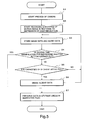
- Fig. 5 is a flow chart showing the processing operation luring the sensing of a motion image in the mobile communication terminal according to this embodiment.
- This flow chart represents a processing procedure for a software program executed by the CPU 20 in the control circuit 12 shown in Fig. 1.
- the user who intends to carry out the sensing (including the recording of the sensed motion image) using the image sensor 18 of the mobile communication terminal shown in Fig. 1 carries out a predetermined manipulation using the manipulation device 14 to select "a motion image sensing function".
- the CPU 20 of the control circuit 12 in response to detection of the selection manipulation, instructs the image sensor 18 to start the sensing.
- the CPU 20 generates digital image data from an image signal outputted from the image sensor 18, and instructs the display device 13 to display thereon an image (display of preview) based on the resultant digital image data (Step S1).
- the image displayed at this time represents an image which is currently sensed with the image sensor 18.
- the CPU 20 instructs the microphone 19 to output a voice based on the audio signal obtained through the parabolic reflection using the microphone 19 or the corresponding digital audio data.
- the user judges a timing at which the motion image in being sensed is started to be recorded from the preview display or the like in Step S1 for example, and then depresses a shutter button of the manipulation device 14 at a suitable timing.
- the CPU 20 in response to detection of the depressing manipulation, starts the encode (image compression processing) based on the above-mentioned predetermined data format (MPEG-4 or the like) for the above-mentioned digital image data which is successively generated at and after that detection timing (Step S2). In addition, at this time, the CPU 20 starts the encode based on the above-mentioned predetermined data format (AMR or the like) for the digital audio data based on the audio signal obtained through the parabolic reflection using the microphone 19.
- AMR above-mentioned predetermined data format
- the CPU 20 instructs the RAM 16 to store the image data in its image storage area 163.
- the CPU 20 instructs the RAM 16 to store the audio data in its audio storage area 162.
- the CPU 20 instructs the RAM 16 to store the management information MI representing the storage situation of the image data and the audio data in its management information area 161 (Step S3).
- Step S4 When the user judges to intend to end the recording of the image data and the voice data in being sensed using the mobile communication terminal, he/she depresses the shutter button again.
- the CPU 20 continues the operation for recording the image data and the audio data in Step S3 until the CPU 20 detects the second time manipulation for depressing the shutter button in Step S4 (in case where the result of the judgment in Step S4 is NO).
- the amounts of storable information in the audio storage area 162 and the image storage area 163 are limited due to the predetermined storage capacities (maximum storage capacities) of the audio storage area 162 and the image storage area 163, respectively. Then, the CPU 20 judges whether or not the amount of information of the image data stored in the image storage area 163 and the amount of information of the audio data stored in the audio storage area 162 have exceeded the respective predetermined storage capacities while the recording operation in Step S3 is continuously carried out (Step S5).
- Step S5 When the CPU 20 judges in Step S5 that the amount of information of the image data stored in the image storage area 163 and the amount of information of the audio data stored in the audio storage area 162 have exceeded the respective predetermined storage capacities (when the result of the judgment in Step S5 is YES, i.e., there is no idle capacity), the CPU 20 successively erases the image data stored in the image storage area 163 and the audio data stored in the audio storage area 162 from the oldest ones, respectively (Step S6) based on the management information MI stored in the management information area 161. Thereafter, the CPU 20 returns the operation back to the processing in Step S3.
- Step S3 the CPU 20 instructs the RAM 16 to store the image data and the audio data which are to be newly stored in the areas, of the image storage area 163 and the audio storage area 162, from which the oldest image data and the oldest audio data have been erased in Step S6, respectively.
- Step S6 a procedure for the data erase in Step S6 and a procedure for the subsequent data recording in Step S3 will be described later with reference to FIGS. 6 and 7.
- Step S4 when the second time manipulation for depressing the shutter button is detected in Step S4 (when the result of the judgment in Step S4 is YES), the CPU 20 sets the newest image frame data and the newest audio frame data recorded in the RAM 16 at the timing of the second time manipulation for depressing the shutter button in the respective end frames, and then stops the recording of any of the image frame data and any of the audio frame data in the RAM 16 at and after that timing (Step S7). That is, the image frame data and the audio frame data which have been continuously recorded in the RAM 16 in the endless manner until that time are fixed in the image storage area 163 and the audio storage area 162 of the RAM 16, respectively, at that timing.
- Step S7 the CPU 20 multiplexes the image data stored (fixed) in the image storage area 163 and the audio data stored (fixed) in the audio storage area 162 based on the management information MI stored in the management information area 161 in accordance with any one of the above-mentioned predetermined methods (e.g., the ASF and the like) (Step S7).
- Step 57 the CPU 20 preserves the multiplexed data (motion image file data) generated through the multiplexing process in the motion image preservation area 164.
- the CPU 20 in accordance with a predetermined manipulation by the user, can store the preserved motion image file data in a non-volatile memory card (not shown) detachably inserted into the mobile communication terminal, or can transmit the preserved motion image file data to an external apparatus through the radio circuit 11. Since at the present time, a general constitution can be adopted for such management of the data, its detailed description in this embodiment is omitted here for the sake of simplicity.
- Fig. 6 is a flow chart showing a procedure for managing the data stored in the storage areas within the RAM 16 in the mobile communication terminal according to this embodiment.
- Fig. 7 is a diagram explaining the procedure for managing the data stored in the storage areas within the RAM 16 in the mobile communication terminal according to this embodiment.
- numerical characters 0 to M, and 0 to N within respective frames designate frame numbers.
- Steps S10 to S12 of Fig. 6 in response to the detection of the manipulation for depressing the shutter button (of the manipulation device 14) by the user, the control circuit 12 encodes the image data and the audio data, and stores the encoded image data and the encoded audio data in the RAM 16. A series of operations are shown in Steps S10 to S12 of Fig. 6.
- the control circuit 12 converts the digital image data corresponding to the current sensed image (motion image ) obtained using the image sensor 18 into image frame data on the MPEG4 format, for example. Then, the control circuit 12 stores the image frame data on the MPEG4 format thus generated in the image storage area 163 (Step S10 in Fig. 6).
- Step S1 of Fig. 5 the control circuit 12 digitizes the image signals which are successively outputted from the image sensor 18 into digital image data. Then, in Step S10, the digital image data is converted into the frame data.
- the I frame is provided every lapse of a predetermined time period, and each of other frames is made the P frame.
- the I frame corresponds to encoded data which is obtained based on the digital still image data for the noted I frame.
- the I frame when the image is reproduced, the original still image can be reproduced from only the encoded data.
- the P frame is a frame which is generated through the forward prediction encoding.
- control circuit 12 converts the audio signal (the digital audio signal before encode) inputted through the microphone 19 during the preview display into audio frame data on the Advanced Multi Rate (AMR) CODEC format. Then, the control circuit 12 instructs the RAM 16 to store the resultant audio frame data on the AMR format in the audio storage area 162 (Step S11 in Fig. 6).
- AMR Advanced Multi Rate
- the control circuit 12 instructs the RAM 16 to store the management information MI representing the storage situation of the image frame data stored in the image storage area 163 and the audio frame data stored in the audio storage area 162 in the management information area 161 (Step S12 in Fig. 6).
- themanagementinformationMI contains the information such as pointers to respective frames, a kind representing the I frame or the P frame, the start frame position and the end frame position.
- the amounts of storable information in the audio storage area 162 and the image storage area 163 are limited due to the predetermined storage capacities (maximum storage capacities) of the audio storage area 162 and the image storage area 163, respectively.
- the encode processing in Steps S10 and S11, and the subsequent storage processing are continuously executed, then the audio storage area 162 and the image storage area 163 will overflow.
- Step S13 when the amounts of information stored in the image storage area 163 and the audio storage area 162 have exceeded the respective maximum storage capacities as respective thresholds (when the result of the judgment in Step S13 is YES) , the control circuit 12 executes the following processing in order to prevent occurrence of the overflow to continuously record data on the newest image and data on the newest voice. Such processing corresponds to the processing in Step S6 in Fig. 5.
- the control circuit 12 refers to the information which is contained in the management information MI stored in the management information area 161 and which represents the positions and the kinds of the image frame data and the audio frame data. Then, with respect to the image frame data, the control circuit 12 firstly moves the position of the start frame (first I frame) of the image storage area 163 to a position of a second I frame becoming a next I frame position (Step S14) . Next, the control circuit 12 sets the second I frame as a new start frame (Step S15) . Then, the control circuit 12 overwrites new frame data to frame data on the recording position from the position of the updated first I frame to the position of the second I frame to store the new frame data therein (Step S12) .
- the new frame data is overwritten to erase the frame data which has been stored until that time.
- the control circuit 12 also moves the position of the start frame of the audio frame data, in the audio storage area 162, having a time period for the recording synchronized with a time period for the recording of the image frame data.
- the control circuit 12 repeatedly executes such a series of processing in order to avoid the overflow.
- the start frame corresponds to the still image (frame) which is sensed with the image sensor 18 right after the manipulation of the shutter button by the user detected by the CPU 20 in Step S2 in Fig. 5.
- the end frame data (in a position B) moves in a direction indicated by an arrow in the figure through a process in which the image frame data is successively stored in the image storage area 163 in and after the detection of the manipulation of the shutter button in Step S2 (refer to Fig. 5).
- the control circuit 12 judges whether or not in this process, the pointer exhibiting the position B of the end frame data returns back to the left-hand end after reaching the right-hand end, and finally passes through a position A of the start frame currently set. This judgment corresponds to the judgment for presence or absence of the idle capacities in Step S5 (Step S13).
- the control circuit 12 sets a position (a position A2 in an example of Fig. 7) of the I frame which is located on the right-hand side of the position A and is nearest the position A as a position of a new start frame. Then, the control circuit 12 erases the frame data in the recording position from the position A to the position A2 (or set the frame data in the recording position from the position A to the position A2 in an overwritable state).
- control circuit 12 also moves a position of the start frame (from a position X to a position X2) of the audio frame data, in the audio storage area 162, having a time period for the recording synchronized with a time period for the sensing of the image frame data.
- control circuit 12 successively overwrites and stores new image frame data in an area from the position A to the position A2. Likewise, the control circuit 12 successively overwrites and stores new audio frame data in an area from the position X to the position X2 corresponding to (synchronized with) the position X and the position X2.
- the oldest image frame data at that time point is erased from the RAM 16 (or set in an erasable state) , and new frame data is overwritten to the area from which the oldest image frame data has been erased.
- Step S4 the image data on the image containing such a desired scene can be surely fixed (stored) to the storage device.
- the user can surely and readily record, in the storage device (the RAM 16) having the limited storage capacity, desired image information (and corresponding audio information) of image information (and audio information) which is continuously inputted.
- the endless image recording can be carried out within a range of the storage capacity (data size) which is previously limited owing to the specification and the like of the mobile communication terminal itself or of the storage device.
- the user can continuously record the image information (and the audio information) in one data file as an object without being nervous about a continuous possible recording time period due to the'storage capacity.
- the user who is continuously recording the image information (and the audio information) depresses the shutter button at a time point when a desired scene is recorded, to thereby allow the data on the desired scene to be surely fixed to the data file concerned. That is, according to the mobile communication terminal of this embodiment, the user can surely and readily record the image information (and the audio information) without failing to sense an image of a desired scene.
- the present invention is not intended to be limited to such an apparatus configuration, and hence can be applied to an apparatus configuration as well in which encoded image data and encoded audio data are suitably acquired from an external apparatus.
- the encoded image data and encoded audio data are supplied from the external apparatus via the radio communication line (the radio antenna 10 and the radio circuit 11) or a removable storage medium (not shown) attached to the mobile communication terminal .
- the above-mentioned embodiment has been described as an example in which the image recording apparatus according to the present invention is applied to the mobile communication terminal able to multiplex the image data and the audio data.
- the present invention is not intended to be limited to such an apparatus configuration. That is, the image recording apparatus according to the present invention can be widely applied to apparatuses as long as each of the apparatuses serves to encode at least image data into a plurality of kinds of frames to record the resultant frames.
- the present invention is not intended to be limited to such an apparatus configuration. That is, the present invention can be applied to an image recording apparatus for at least recording only a motion image (image data) containing no audio data.
- the above-mentioned embodiment is only a suitable embodiment of the present invention, and hence the various changes can be made without departing from the subj ect matter of the present invention.
- the description has been given with respect to the specific case where the data management is carried out within the RAM 16.
- the present invention is not intended to be limited to such a specific case.
- the present invention can be applied to a storage device or a storage unit as long as the storage device or the storage unit can store therein the image data (image frame data) and the audio data (audio frame data).
- the above-mentioned embodiment has been described using the compression processing based on the I frame and the P frame as the method including encoding the image data.
- the present invention is not intended to be limited to such a constitution.
- the compression processing using the B frame can also be carried out, and hence the image data can be compressed by utilizing any one of the various encode methods.
- the image recording apparatus according to the present invention is not limited to an apparatus with which radio communication with an external apparatus can be carried out, and hence can be widely applied to electronic instruments as long as each of the electronic instruments can manage the image data and the audio data.
- the present invention which has been described based on the above-mentioned embodiment as an example is implemented by supplying a computer program able to realize the function of the flow charts referred in the description of the embodiment to the above-mentioned mobile communication terminal; and writing the computer program to the CPU 20 of the mobile communication terminal to execute the computer program thus written.
- the computer program supplied to the mobile communication terminal has only to be stored in a readable and writable memory or a non-volatile storage device.
- the present invention is constituted by a code of such a computer program or a storage medium.
Landscapes
- Engineering & Computer Science (AREA)
- Multimedia (AREA)
- Signal Processing (AREA)
- Television Signal Processing For Recording (AREA)
Applications Claiming Priority (2)
| Application Number | Priority Date | Filing Date | Title |
|---|---|---|---|
| JP2003350403 | 2003-10-09 | ||
| JP2003350403A JP2005117447A (ja) | 2003-10-09 | 2003-10-09 | 動画記録装置、動画記録方法および動画記録プログラム |
Publications (2)
| Publication Number | Publication Date |
|---|---|
| EP1523178A2 true EP1523178A2 (de) | 2005-04-13 |
| EP1523178A3 EP1523178A3 (de) | 2008-06-25 |
Family
ID=34309250
Family Applications (1)
| Application Number | Title | Priority Date | Filing Date |
|---|---|---|---|
| EP04022432A Withdrawn EP1523178A3 (de) | 2003-10-09 | 2004-09-21 | Vorrichtung und Verfahren zur Bildaufnahme und Rechnerprogramm für die Bildaufnahmevorrichtung. |
Country Status (4)
| Country | Link |
|---|---|
| US (1) | US20050078196A1 (de) |
| EP (1) | EP1523178A3 (de) |
| JP (1) | JP2005117447A (de) |
| CN (1) | CN100345446C (de) |
Families Citing this family (15)
| Publication number | Priority date | Publication date | Assignee | Title |
|---|---|---|---|---|
| KR20080044066A (ko) * | 2006-11-15 | 2008-05-20 | 삼성전자주식회사 | 영상기기 및 그의 정지화상 추출방법 |
| WO2008126311A1 (ja) | 2007-03-30 | 2008-10-23 | Fujitsu Limited | 動画記録方法および情報処理装置 |
| US11914478B2 (en) | 2021-06-09 | 2024-02-27 | EMC IP Holding Company LLC | System and method for a specialized backup operation of file based backups based on a target backup storage system |
| US12007849B2 (en) | 2021-09-27 | 2024-06-11 | EMC IP Holding Company LLC | System and method for securing instant access of data in file based backups in a backup storage system using metadata files |
| US11853444B2 (en) | 2021-09-27 | 2023-12-26 | EMC IP Holding Company LLC | System and method for securing instant access of data in file based backups in a backup storage system using metadata files |
| US11940883B2 (en) | 2022-07-25 | 2024-03-26 | Dell Products L.P. | Generating a synthetic full backup |
| US12625987B2 (en) | 2022-07-25 | 2026-05-12 | Dell Products L.P. | Method and system for executing a secure file-level restore from a block-based backup |
| US12026059B2 (en) | 2022-07-25 | 2024-07-02 | Dell Products L.P. | Method and system for executing a secure data access from a block-based backup |
| US12386713B2 (en) | 2023-06-26 | 2025-08-12 | Dell Products L.P. | Managing use of a shared virtual disk for accessing data in file based backups by multiple virtual machines |
| US12271270B2 (en) | 2023-06-26 | 2025-04-08 | Dell Products L.P. | Enabling user-based instant access from file based backups |
| US12147384B1 (en) | 2023-06-26 | 2024-11-19 | Dell Products, L.P. | Managing virtual file systems that provide instant access based on a self-destruction criterion |
| US12306792B2 (en) | 2023-06-26 | 2025-05-20 | Dell Products L.P. | Managing access to file based backups based on storage units and workload use |
| US12399787B1 (en) | 2024-07-12 | 2025-08-26 | Dell Products L.P. | Detecting the most recent state of an active directory object and recovering using backups or production tombstones |
| US12399786B1 (en) | 2024-07-12 | 2025-08-26 | Dell Products L.P. | Active directory object observability for backup policy management in a production environment |
| US12488130B1 (en) | 2024-07-12 | 2025-12-02 | Dell Products L.P. | Active directory data protection by leveraging virtual machine backup with change notification-based active directory backup |
Family Cites Families (21)
| Publication number | Priority date | Publication date | Assignee | Title |
|---|---|---|---|---|
| JPH0486073A (ja) * | 1990-07-28 | 1992-03-18 | Sony Corp | 撮像装置 |
| JP3255995B2 (ja) * | 1992-10-23 | 2002-02-12 | 株式会社日立製作所 | テレビ電話装置 |
| JP3312074B2 (ja) * | 1994-01-24 | 2002-08-05 | シャープ株式会社 | 映像信号のディジタル記録及び再生装置 |
| JP2991980B2 (ja) * | 1996-11-07 | 1999-12-20 | 三菱電機株式会社 | 映像記録装置 |
| JPH11122401A (ja) * | 1997-10-17 | 1999-04-30 | Noritsu Koki Co Ltd | 音声コード付き写真作成装置 |
| WO2001037563A1 (en) * | 1999-11-18 | 2001-05-25 | Fujitsu Limited | Endless video recorder |
| US7340153B2 (en) * | 2000-01-11 | 2008-03-04 | Hitachi, Ltd. | Apparatus and method for recording and reproducing information |
| CN100517489C (zh) * | 2000-03-14 | 2009-07-22 | 松下电器产业株式会社 | 图像以及声音的重放装置及方法 |
| GB2360658B (en) * | 2000-03-20 | 2004-09-08 | Hewlett Packard Co | Camera with user identity data |
| FR2811186B1 (fr) * | 2000-07-03 | 2003-05-23 | Telediffusion De France Tdf | Procede et installation de videosurveillance a codage adaptatif pour la transmission et/ou le stockage de sequences video |
| US6731952B2 (en) * | 2000-07-27 | 2004-05-04 | Eastman Kodak Company | Mobile telephone system having a detachable camera / battery module |
| JP4467737B2 (ja) * | 2000-08-16 | 2010-05-26 | パイオニア株式会社 | 情報記録装置、情報記録方法及び記録制御プログラムが記録された情報記録媒体 |
| JP2002344649A (ja) * | 2001-05-16 | 2002-11-29 | Nec Software Kyushu Ltd | 携帯電話端末を利用した動画像撮影、画像保存及び画像復元のための方法、システム及びプログラム |
| JP2003069476A (ja) * | 2001-08-27 | 2003-03-07 | Victor Co Of Japan Ltd | 携帯情報端末装置 |
| JP3877577B2 (ja) * | 2001-11-21 | 2007-02-07 | 富士フイルムホールディングス株式会社 | カメラシステム、デジタルカメラ、及びデジタルカメラの制御方法 |
| US7650624B2 (en) * | 2002-10-01 | 2010-01-19 | Koplar Interactive Systems International, L.L.C. | Method and apparatus for modulating a video signal with data |
| US6989773B2 (en) * | 2004-02-13 | 2006-01-24 | Hewlett-Packard Development Company, L.P. | Media data encoding device |
| US7075460B2 (en) * | 2004-02-13 | 2006-07-11 | Hewlett-Packard Development Company, L.P. | Methods for scaling encoded data without requiring knowledge of the encoding scheme |
| ITRM20040198A1 (it) * | 2004-04-21 | 2004-07-21 | Stefano Ciccotti | Stazione integrata di registrazione e trasmissione di segnali audio e video. |
| US7619685B2 (en) * | 2005-10-11 | 2009-11-17 | Sony Ericsson Mobile Communications Ab | Optical recording apparatus for wireless equipment including infrared and color recording devices |
| US7382244B1 (en) * | 2007-10-04 | 2008-06-03 | Kd Secure | Video surveillance, storage, and alerting system having network management, hierarchical data storage, video tip processing, and vehicle plate analysis |
-
2003
- 2003-10-09 JP JP2003350403A patent/JP2005117447A/ja active Pending
-
2004
- 2004-09-21 EP EP04022432A patent/EP1523178A3/de not_active Withdrawn
- 2004-09-30 US US10/952,938 patent/US20050078196A1/en not_active Abandoned
- 2004-10-09 CN CNB2004100808132A patent/CN100345446C/zh not_active Expired - Fee Related
Also Published As
| Publication number | Publication date |
|---|---|
| JP2005117447A (ja) | 2005-04-28 |
| US20050078196A1 (en) | 2005-04-14 |
| CN1606344A (zh) | 2005-04-13 |
| EP1523178A3 (de) | 2008-06-25 |
| CN100345446C (zh) | 2007-10-24 |
Similar Documents
| Publication | Publication Date | Title |
|---|---|---|
| US20050078196A1 (en) | Apparatus and method for recording an image and computer program for the image recording apparatus | |
| US9124860B2 (en) | Storing a video summary as metadata | |
| US8432965B2 (en) | Efficient method for assembling key video snippets to form a video summary | |
| US7903151B2 (en) | Moving image recording apparatus with a stream recording function of a moving image | |
| US20090021592A1 (en) | Display control apparatus, display control method, and program therefor | |
| US20070192370A1 (en) | Multimedia content production method for portable device | |
| CN1819625A (zh) | 记录动态图像的动态图像记录装置 | |
| US6577805B1 (en) | Picture recording and reproducing apparatus and method | |
| KR100759313B1 (ko) | 화상기록장치 및 화상기록방법 | |
| EP1652187B1 (de) | Video-wiedergabeeinrichtung, wiedergabeverfahren und video-wiedergabeprogramm | |
| US7573510B2 (en) | Electronic camera apparatus with moving-image picking-up function and moving-image recording method for recording a movable image on a removable recording medium | |
| JP7172989B2 (ja) | 画像処理装置、画像処理方法、カメラ装置およびカメラシステム | |
| US20150195455A1 (en) | Image data recording apparatus capable of recording still and moving images simultaneously | |
| JPH10248046A (ja) | 電子撮像装置、電子カメラシステムおよび記憶媒体 | |
| US20040208481A1 (en) | Apparatus and method for image processing, and image processing system using the same and program | |
| JP4772742B2 (ja) | 画像再生装置、画像再生方法及びプログラム記録媒体 | |
| KR20050041641A (ko) | 동영상 편집이 가능한 이동통신단말기 및 그 방법 | |
| JP4787206B2 (ja) | 情報記録装置及び情報記録方法 | |
| KR20060092149A (ko) | 촬영 및 기록 장치와 촬영 및 기록 방법 | |
| JP2004228758A (ja) | ディジタル信号記録および再生装置 | |
| JP2009118195A (ja) | 撮像装置および方法 | |
| JP2008113111A (ja) | 記録装置 | |
| JP2012070212A (ja) | 画像処理装置、画像処理システム及び画像処理方法 | |
| JP2003153183A (ja) | データ記録再生装置 | |
| JP2003274350A (ja) | 駒関連情報記録可能なカメラ |
Legal Events
| Date | Code | Title | Description |
|---|---|---|---|
| PUAI | Public reference made under article 153(3) epc to a published international application that has entered the european phase |
Free format text: ORIGINAL CODE: 0009012 |
|
| AK | Designated contracting states |
Kind code of ref document: A2 Designated state(s): AT BE BG CH CY CZ DE DK EE ES FI FR GB GR HU IE IT LI LU MC NL PL PT RO SE SI SK TR |
|
| AX | Request for extension of the european patent |
Extension state: AL HR LT LV MK |
|
| PUAL | Search report despatched |
Free format text: ORIGINAL CODE: 0009013 |
|
| AK | Designated contracting states |
Kind code of ref document: A3 Designated state(s): AT BE BG CH CY CZ DE DK EE ES FI FR GB GR HU IE IT LI LU MC NL PL PT RO SE SI SK TR |
|
| AX | Request for extension of the european patent |
Extension state: AL HR LT LV MK |
|
| 17P | Request for examination filed |
Effective date: 20080812 |
|
| AKX | Designation fees paid |
Designated state(s): DE FR GB IT |
|
| 17Q | First examination report despatched |
Effective date: 20090211 |
|
| STAA | Information on the status of an ep patent application or granted ep patent |
Free format text: STATUS: THE APPLICATION HAS BEEN WITHDRAWN |
|
| 18W | Application withdrawn |
Effective date: 20090529 |