EP1522875B1 - Procédé pour suivre la position et la vitesse des contours d'un objet dans des images digitales d'échographie à deux ou trois dimensions. - Google Patents
Procédé pour suivre la position et la vitesse des contours d'un objet dans des images digitales d'échographie à deux ou trois dimensions. Download PDFInfo
- Publication number
- EP1522875B1 EP1522875B1 EP03425639A EP03425639A EP1522875B1 EP 1522875 B1 EP1522875 B1 EP 1522875B1 EP 03425639 A EP03425639 A EP 03425639A EP 03425639 A EP03425639 A EP 03425639A EP 1522875 B1 EP1522875 B1 EP 1522875B1
- Authority
- EP
- European Patent Office
- Prior art keywords
- sequence
- border
- image
- image frames
- line
- Prior art date
- Legal status (The legal status is an assumption and is not a legal conclusion. Google has not performed a legal analysis and makes no representation as to the accuracy of the status listed.)
- Expired - Lifetime
Links
Images




Classifications
-
- A—HUMAN NECESSITIES
- A61—MEDICAL OR VETERINARY SCIENCE; HYGIENE
- A61B—DIAGNOSIS; SURGERY; IDENTIFICATION
- A61B8/00—Diagnosis using ultrasonic, sonic or infrasonic waves
- A61B8/08—Clinical applications
- A61B8/0883—Clinical applications for diagnosis of the heart
-
- A—HUMAN NECESSITIES
- A61—MEDICAL OR VETERINARY SCIENCE; HYGIENE
- A61B—DIAGNOSIS; SURGERY; IDENTIFICATION
- A61B8/00—Diagnosis using ultrasonic, sonic or infrasonic waves
- A61B8/08—Clinical applications
-
- G—PHYSICS
- G01—MEASURING; TESTING
- G01S—RADIO DIRECTION-FINDING; RADIO NAVIGATION; DETERMINING DISTANCE OR VELOCITY BY USE OF RADIO WAVES; LOCATING OR PRESENCE-DETECTING BY USE OF THE REFLECTION OR RERADIATION OF RADIO WAVES; ANALOGOUS ARRANGEMENTS USING OTHER WAVES
- G01S15/00—Systems using the reflection or reradiation of acoustic waves, e.g. sonar systems
- G01S15/88—Sonar systems specially adapted for specific applications
- G01S15/89—Sonar systems specially adapted for specific applications for mapping or imaging
- G01S15/8906—Short-range imaging systems; Acoustic microscope systems using pulse-echo techniques
- G01S15/8979—Combined Doppler and pulse-echo imaging systems
- G01S15/8981—Discriminating between fixed and moving objects or between objects moving at different speeds, e.g. wall clutter filter
-
- G—PHYSICS
- G01—MEASURING; TESTING
- G01S—RADIO DIRECTION-FINDING; RADIO NAVIGATION; DETERMINING DISTANCE OR VELOCITY BY USE OF RADIO WAVES; LOCATING OR PRESENCE-DETECTING BY USE OF THE REFLECTION OR RERADIATION OF RADIO WAVES; ANALOGOUS ARRANGEMENTS USING OTHER WAVES
- G01S7/00—Details of systems according to groups G01S13/00, G01S15/00, G01S17/00
- G01S7/52—Details of systems according to groups G01S13/00, G01S15/00, G01S17/00 of systems according to group G01S15/00
- G01S7/52017—Details of systems according to groups G01S13/00, G01S15/00, G01S17/00 of systems according to group G01S15/00 particularly adapted to short-range imaging
- G01S7/52023—Details of receivers
- G01S7/52036—Details of receivers using analysis of echo signal for target characterisation
-
- G—PHYSICS
- G01—MEASURING; TESTING
- G01S—RADIO DIRECTION-FINDING; RADIO NAVIGATION; DETERMINING DISTANCE OR VELOCITY BY USE OF RADIO WAVES; LOCATING OR PRESENCE-DETECTING BY USE OF THE REFLECTION OR RERADIATION OF RADIO WAVES; ANALOGOUS ARRANGEMENTS USING OTHER WAVES
- G01S7/00—Details of systems according to groups G01S13/00, G01S15/00, G01S17/00
- G01S7/52—Details of systems according to groups G01S13/00, G01S15/00, G01S17/00 of systems according to group G01S15/00
- G01S7/52017—Details of systems according to groups G01S13/00, G01S15/00, G01S17/00 of systems according to group G01S15/00 particularly adapted to short-range imaging
- G01S7/52046—Techniques for image enhancement involving transmitter or receiver
-
- G—PHYSICS
- G01—MEASURING; TESTING
- G01S—RADIO DIRECTION-FINDING; RADIO NAVIGATION; DETERMINING DISTANCE OR VELOCITY BY USE OF RADIO WAVES; LOCATING OR PRESENCE-DETECTING BY USE OF THE REFLECTION OR RERADIATION OF RADIO WAVES; ANALOGOUS ARRANGEMENTS USING OTHER WAVES
- G01S7/00—Details of systems according to groups G01S13/00, G01S15/00, G01S17/00
- G01S7/52—Details of systems according to groups G01S13/00, G01S15/00, G01S17/00 of systems according to group G01S15/00
- G01S7/52017—Details of systems according to groups G01S13/00, G01S15/00, G01S17/00 of systems according to group G01S15/00 particularly adapted to short-range imaging
- G01S7/52053—Display arrangements
- G01S7/52057—Cathode ray tube displays
- G01S7/5206—Two-dimensional coordinated display of distance and direction; B-scan display
- G01S7/52063—Sector scan display
-
- G—PHYSICS
- G06—COMPUTING OR CALCULATING; COUNTING
- G06T—IMAGE DATA PROCESSING OR GENERATION, IN GENERAL
- G06T7/00—Image analysis
- G06T7/0002—Inspection of images, e.g. flaw detection
- G06T7/0012—Biomedical image inspection
-
- G—PHYSICS
- G06—COMPUTING OR CALCULATING; COUNTING
- G06T—IMAGE DATA PROCESSING OR GENERATION, IN GENERAL
- G06T7/00—Image analysis
- G06T7/10—Segmentation; Edge detection
- G06T7/12—Edge-based segmentation
-
- G—PHYSICS
- G06—COMPUTING OR CALCULATING; COUNTING
- G06T—IMAGE DATA PROCESSING OR GENERATION, IN GENERAL
- G06T7/00—Image analysis
- G06T7/20—Analysis of motion
- G06T7/246—Analysis of motion using feature-based methods, e.g. the tracking of corners or segments
- G06T7/251—Analysis of motion using feature-based methods, e.g. the tracking of corners or segments involving models
-
- A—HUMAN NECESSITIES
- A61—MEDICAL OR VETERINARY SCIENCE; HYGIENE
- A61B—DIAGNOSIS; SURGERY; IDENTIFICATION
- A61B8/00—Diagnosis using ultrasonic, sonic or infrasonic waves
- A61B8/08—Clinical applications
- A61B8/0891—Clinical applications for diagnosis of blood vessels
-
- A—HUMAN NECESSITIES
- A61—MEDICAL OR VETERINARY SCIENCE; HYGIENE
- A61B—DIAGNOSIS; SURGERY; IDENTIFICATION
- A61B8/00—Diagnosis using ultrasonic, sonic or infrasonic waves
- A61B8/48—Diagnostic techniques
- A61B8/485—Diagnostic techniques involving measuring strain or elastic properties
-
- A—HUMAN NECESSITIES
- A61—MEDICAL OR VETERINARY SCIENCE; HYGIENE
- A61B—DIAGNOSIS; SURGERY; IDENTIFICATION
- A61B8/00—Diagnosis using ultrasonic, sonic or infrasonic waves
- A61B8/48—Diagnostic techniques
- A61B8/486—Diagnostic techniques involving arbitrary m-mode
-
- G—PHYSICS
- G01—MEASURING; TESTING
- G01S—RADIO DIRECTION-FINDING; RADIO NAVIGATION; DETERMINING DISTANCE OR VELOCITY BY USE OF RADIO WAVES; LOCATING OR PRESENCE-DETECTING BY USE OF THE REFLECTION OR RERADIATION OF RADIO WAVES; ANALOGOUS ARRANGEMENTS USING OTHER WAVES
- G01S15/00—Systems using the reflection or reradiation of acoustic waves, e.g. sonar systems
- G01S15/88—Sonar systems specially adapted for specific applications
- G01S15/89—Sonar systems specially adapted for specific applications for mapping or imaging
- G01S15/8906—Short-range imaging systems; Acoustic microscope systems using pulse-echo techniques
- G01S15/8993—Three dimensional imaging systems
-
- G—PHYSICS
- G01—MEASURING; TESTING
- G01S—RADIO DIRECTION-FINDING; RADIO NAVIGATION; DETERMINING DISTANCE OR VELOCITY BY USE OF RADIO WAVES; LOCATING OR PRESENCE-DETECTING BY USE OF THE REFLECTION OR RERADIATION OF RADIO WAVES; ANALOGOUS ARRANGEMENTS USING OTHER WAVES
- G01S7/00—Details of systems according to groups G01S13/00, G01S15/00, G01S17/00
- G01S7/52—Details of systems according to groups G01S13/00, G01S15/00, G01S17/00 of systems according to group G01S15/00
- G01S7/52017—Details of systems according to groups G01S13/00, G01S15/00, G01S17/00 of systems according to group G01S15/00 particularly adapted to short-range imaging
- G01S7/52053—Display arrangements
- G01S7/52057—Cathode ray tube displays
- G01S7/52068—Stereoscopic displays; Three-dimensional displays; Pseudo 3D displays
- G01S7/52069—Grey-scale displays
-
- G—PHYSICS
- G06—COMPUTING OR CALCULATING; COUNTING
- G06T—IMAGE DATA PROCESSING OR GENERATION, IN GENERAL
- G06T2207/00—Indexing scheme for image analysis or image enhancement
- G06T2207/10—Image acquisition modality
- G06T2207/10016—Video; Image sequence
-
- G—PHYSICS
- G06—COMPUTING OR CALCULATING; COUNTING
- G06T—IMAGE DATA PROCESSING OR GENERATION, IN GENERAL
- G06T2207/00—Indexing scheme for image analysis or image enhancement
- G06T2207/10—Image acquisition modality
- G06T2207/10132—Ultrasound image
-
- G—PHYSICS
- G06—COMPUTING OR CALCULATING; COUNTING
- G06T—IMAGE DATA PROCESSING OR GENERATION, IN GENERAL
- G06T2207/00—Indexing scheme for image analysis or image enhancement
- G06T2207/30—Subject of image; Context of image processing
- G06T2207/30004—Biomedical image processing
- G06T2207/30048—Heart; Cardiac
Definitions
- the invention relates to a method of tracking position and velocity of objects' borders in two or three dimensional digital echographic images comprising the combination of features according to the preamble of claim 1.
- a typical example is given by echocardiography in the imaging of the left ventricle.
- the possibility of an automatic detection of the endocardial border would give objective measurement of the ventricular volume, in particular its extreme values (at proto-systole and tele-diastole) are commonly used for clinical diagnosis and the relative diagnostic indexed are calculated.
- the possibility to visualize the border velocities allows an easier assessment of the regional dynamical properties.
- borders are drawn manually by the operator over the physiologically relevant frames of a sequence of images.
- strain rate analysis method in ultrasonic diagnostic imaging is disclosed in WO 02/45587 .
- strain rate analysis is performed for ultrasonic images in which the spatial gradient of velocity is calculated in the direction of tissue motion.
- Strain rate is calculated for cardiac ultrasound images in the direction of motion which, for myocardial images, may be either in the plane of the myocardium or across the myocardium.
- Strain rate information is calculated for a sequence of images of a heart cycle and displayed for an automatically drawn border such as the endocardial border over the full heart cycle.
- the spatial gradient of velocity used for determining the strain and the displacements of the borders form one frame to a successive one in a sequence of frames uses so called Doppler Tissue Imaging, so called DTI.
- This technique allows to measure tissue velocity over all points in the ventricular wall.
- the measurement of velocity itself provides a direct information about the wall motion and helps to uncover abnormalities not immediately observable from the visualization in B-mode.
- the velocity contains information about either rigid body displacement, shear, and contraction/distension, the latter being immediately related to the myocardial activity.
- Post processing of the DTI velocity data allows the evaluation of additional quantities, namely strain-rate and strain, that are strictly related to the regional function. Segmental strain gives a direct evaluation of the degree of contractility of the myocardium during systole, as well as of its relaxation during ventricular filling.
- DTI suffers from a few drawbacks consisting in limitations of the technique.
- a Doppler signal requires additional processing with respect to the simple echo.
- Doppler tissue imaging suffers further of an intrinsic limitation due to the fact that only the component of velocity along a scanline can be measured. This limitation has several drawbacks.
- the Doppler velocity does not reflect the effective tissue kinematics. Only the component of strain and strain rate along the scanline can be evaluated correctly, giving a reduced view of the local deformation state. This limits the application of DTI to the anatomic sites that can be imagined aligned along a scanline. In echocardiography this corresponds essentially to the interventricular septum and to the lateral walls in apical view.
- Document W02003/071950 discloses a method according to the preamble of claim 1.
- An object of the present invention is to provide for a method of tracking position and velocity of objects' borders in two or three dimensional digital echographic images which overcomes the drawbacks of the known tracking methods in reducing the load actually needed for acquiring the usable ultrasound image data and for evaluating, i.e. elaborating the said ultrasound imaging data in order to track the displacement of a border of a moving tissue or a moving object in a sequence of consecutive ultrasound image frames.
- Another object of the present invention is to provide for a method which can lead to more reliable results in tracking the borders of a moving tissue or object on a sequence of consecutive ultrasound image frames.
- the present invention achieves the above mentioned aims with a method of tracking position and velocity of objects' borders in two or three dimensional digital echographic images comprising the combination of steps of the preamble of claim 1 with the steps of the characterizing part of claim 1.
- More precisely transmural cuts consist in defining a line which crosses the border line drawn and passing through one reference point.
- a physiologically appropriate direction can be chosen, which typically can be the orthogonal direction to the border line at the reference point.
- This operation is made for each image frame of the sequence of frames and for each reference point chosen.
- the pixels taken along each transmural line in each of the image frames of the sequence of image frames are placed in columns, each column corresponding to one frame of the sequence of images. In this way the evolution along a transmural cut, can be represented for all instants at once in a two-dimensional space time representation.
- the above disclosed procedure is a reduction of a two dimensional problem applied to a two dimensional image such as a B-mode ultrasound image to a one dimensional problem as a M-mode image.
- the tracking of the border. i.e. of the trace of pixels is carried out along the space-time image using a cross-correlation procedure of the pixel column in the space-time image corresponding to a first image frame with the pixel column in the space-time image corresponding to a successive image frame of the sequence of image frames.
- This technique can be applied to any kind of images in which the geometry of the border line drawn does not require any kind of special reference points to be tracked a priori such as pro example closed border lines as the border line of the cavity of a blood vessel in a cross-section image of the vessel.
- a preventive cycle must be carried out for optimally tracking the border-line of the object along the sequence of image frames.
- the general topology of the border line of the object imaged can be represented by tracking the motion of these few representative points prior to carry out the tracking of at least one or some of the reference points lying on the manually or automatically drawn border-line in each frame of the sequence of image frames.
- These representative points can be for example the starting and ending points of the border line when this is an open one.
- the representative reference points of the border of an imaged object can be also suggested by the physiology when the imaged object is a particular tissue or organ, such as for example the left ventricle.
- This few representative reference points is carried out in a identical way as the one disclosed above for the other reference points on the border-line drawn manually or automatically on the first frame by using the method of transmural cuts for constructing space-time images of each of the few representative reference points and determining the displacement of these points in each of the frames of the sequence of image frames by means of cross-correlation between each of the pixel columns with the successive pixel column corresponding to the pixels along the transmural cut across the same representative point in the different image frames of the sequence of image frames.
- the direction of the transmural cuts can be chosen as the orthogonal direction
- the position and the displacement of the other reference points on the border-lines at each image frame of the sequence of image frames are obtained by rescaling the originally drawn border-line in the first image frame in such a way to obtain in each image frame corresponding to a successive instant a topologically equivalent border line geometry with respect to the original border line. Typically this results in a translation of all points along the original border line.
- This preliminary rescaling allows to keep the representative reference points always in the proper position in all frames of the sequence of image frames by rearranging the other reference points so that the representative reference points maintains the same meaning relatively to the object in all frames of the sequence of image frames.
- the space-time representation along the transmural cuts can be built using a line for the transmural cut with a thickness larger than that of a single pixel and by extracting the average value across such a thickness.
- the above mentioned method can be further developed for carrying out a surface border tracking three dimensional imaging.
- the method according to the said development comprises the following steps:
- one or more further principal section planes can be defined along each of which further section planes the methods steps 1) to o) are carried out.
- two orthogonal principal section planes are chosen for carrying out the above mentioned method steps, the crossing line of the two principal section planes defining a preferred direction of the said planes.
- the said direction can be chosen as suggested by the topological or functional feature of the object imaged.
- this physiologically relevant direction can be chosen as the cut across a central vertical plane such as the ventricle axis.
- the method according to the present invention comprises the steps of defining bounds or limits for a distance range within which the share of the said secondary section planes is defined.
- a topological or physiological relevant direction is chosen, particularly the same direction defined for determining the principal section planes, along which direction bounds are determined for the ends of a distance range within which the share of secondary section planes at least transversal, particularly perpendicular to the said relevant direction is determined.
- this one is determined as a physiologically relevant line passing through the reliable points.
- the correct border is determined along a sequence of two dimensional or three dimensional ultrasound image data and the correct border for each image frame can be displayed overlaid on the displayed image frame as an highlighted line characterized by a color which is different from the grey-scale B-mode image displayed.
- a different evaluation of the velocity vector can be obtained by applying two dimensional-correlation techniques or a specific optical flow technique particularly developed for ultrasound image data of moving objects.
- the said velocity estimation method can be carried out in combination with the above disclosed method for tracking the border of the imaged moving object.
- the said method is an adaptation of known method so called OPTICAL FLOW methods, like a known method so called PIV method used in fluid dynamics.
- the border tracked can be drawn as a line as disclosed above and the velocity vectors of the border taken at certain number of points of the said border line are displayed as arrows having a different color as the border line and the direction of the velocity vector and a length corresponding to the modulus of the velocity vector in the image plane of the two dimensional image displayed.
- the original trace is followed in time by searching the maximum likelihood over its neighborhood in the following frames.
- the tracking technique for each single point is approached using a method based on transmural cuts that is similar to that introduced in the document PCT/IT02/00114 filed on 27.02.2002. Afterward the velocity on the tracked borders are estimated on the basis of the same maximum likelihood between two consecutive frames.
- the automatic tracking method disclosed here allows the tracking of a border on a sequence of two-dimensional or three-dimensional images, and the evaluation of the velocity vector field on such borders.
- the border could be tracked on the basis of the velocity vector only, however a tracking procedure is a result of the summation (time integration) of the estimated velocities and is prone to an error growth in presence of small incorrect estimates.
- This approach reduces the two- or three-dimensional tracking to a combination of one-dimensional tracking problems along the single topological relevant direction (typically the orthogonal to the border), that can be much better controlled and made accurate.
- the accurate tracking result is employed to improve the estimates of the velocity vector.
- the result of this procedure is the automatic definition of the borders displacement and velocity over all frames of a 'sequence of images, starting from the border traced on a single image.
- the found borders information will be used to evaluated some geometric properties, like volume, area, or sizes, of the organ.
- the border kinematics tilt + velocity
- the method steps according to the present invention are firstly describe with reference to a two dimensional case.
- a sequence of two dimensional B-mode image frames is acquired.
- the frames are acquired at predetermined time interval one form the other.
- the method according to the present invention comprises a first step which consist in tracing the border over one single frame by defining a border line.
- a border is traced, manually or by another manual or automatic procedure, over one arbitrary frame.
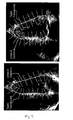
- Figure 1 illustrates an image of the left ventricle where the endocardial border points are traced from one side of the mitral annulus to the other side of the same mitral annulus.
- Figure 2 illustrates an example in which the border is a closed one where the Nth point connects to the first one.
- the method according to the invention provides for a second step of tracking the most representative reference point of the border line drawn in the first image frame.
- the general topology of the object border is reproduced on all the images by tracking the motion of a few representative points. These are commonly the starting and final points of the border when this is an open one. In specific cases additional reference points can be added to improve the first evaluation of the region about which the border must be sought.
- Figure 3 shows the reference points for a left ventricle (in long axis view) that are the starting and final points of the originally traced border.
- the physiology suggests to track the motion of these points in the direction instantaneously orthogonal to the mitral plane (that is defined by these points).
- the tracking along a specified direction is performed by using the method of transmural cuts as follow.
- a line crossing the wall, passing through the point, and directed along the physiologically appropriate direction is drawn; in the case shown in figure 3 the appropriate direction is orthogonal to the mitral plane.
- two orthogonal direction can be employed.
- the pixels taken along the chosen direction line(s) are placed in columns, each column corresponding to one frame of the sequence of images.
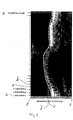
- the evolution along a line can be represented for all instants at once in a two dimensional space-time representation (sometime referred as M-mode representation) where one axis is the distance along the line and the other axis is the time.
- M-mode representation two dimensional space-time representation
- the space time representation can be built using a line for the transmural cut with a thickness larger than that of a single pixel and extracting the average value across such a thickness. The border tracking is then performed along the space-time image.
- the tracking procedure is a procedure for following a border along one direction in a two-dimensional image like that in figure 4 starting from a known position at one instant.
- the displacement from the known point yk to the point yk+1 can be estimated by evaluating the cross-correlation between the entire column at xk with the entire column at xk+1.
- the first estimate is improved by applying the same procedure recursively on increasingly reduced spatial width about the previously found border.
- This first estimate yi can be further improved.
- a subset of the image is extracted by taking a few points above and below the first estimate yi, and a new image whose center corresponds to the sequence yi is generated.
- a snake procedure like the one described in Blake A., Yuille A. Active Vision MIT press, 1992., is employed to follow, in the new image, the image brightness level that passes through the fixed point yk.
- the tracking technique is a unique procedure that is common to different steps of the method according to the present invention.
- the result of this preliminary tracking procedure is the position and displacement, at all instants, of the most representative reference points along the predefined direction, or the vector combination when two directions are employed.
- This preliminary rescaling procedure permits to keep the reference points always at the proper position in all the frames, and to rearrange the other points so that the reference maintains the same meaning in all the frames.
- the present step of tracking the most representative reference points such as the starting and ending point of a border line can be avoided when the specific geometry does not require or have any representative reference point to be tracked a priori.
- This step can be avoided is given by the closed geometry in figure 2 .
- the method according to the invention provides for a further step consisting in the tracking of all the other reference point on the border line drawn manually or automatically in the first step on a first two dimensional image frame of the sequence of image frames.
- the tracking along a specified direction is performed by using the method of transmural cuts as follow.
- a line crossing the wall, passing through the point, and directed along the physiologically appropriate direction is drawn, this operation is made for each instant/frame of the sequence of image frames because the points are not fixed in time but they have been previously rescaled at each instant accordingly with the instantaneous displacement of the reference points.
- the appropriate direction is taken at each instant as orthogonal to the rescaled border.
- the pixels taken along each transmural line are placed in columns, each column corresponding to one frame of the sequence of images. In this way the evolution along a transmural cut, that is not fixed in all frames time but is slightly modified accordingly to the rescaling, can be represented for all instants at once in a two-dimensional space time representation analogous to that shown in figure 4 .
- the space time representation can be built using a line for the transmural cut with a thickness larger than that of a single pixel and extracting the average value across such a thickness.
- the border tracking is then performed along the space-time image using the same technique employed in the step of tracking the representative reference points and disclosed above in a detailed manner.
- the result of this step is the position, at all instants, of all the points along the predefined direction, or the vector combination when two directions are employed.
- all the original points have been tracked in time, each one independently, and we have a new border tracked over all frames.
- the method according to the present invention can be provided in combination with a procedure for determining the instant border line velocity vector for each one of the reference pints defined on the border line as tracked on each two dimensional frame.
- the velocity vector can be known when two direction (three for three-dimensional imagin) are employed for displacing it.
- the complete velocity vector can be evaluated by selecting additional direction for the transmural cuts on the already displaced point and evaluating the velocity along the additional direction.
- the space time representation can be built using a line for the transmural cut with a thickness larger than that of a single pixel and extracting the average value across such a thickness.
- the complete velocity vector can be evaluated by a two-dimensional correlation technique or a specific optical flow technique adapted to the particular case of ultrasound imaging B-mode data.
- the two-dimensional result can then be improved by imposing its accordance with the previous estimate obtained for one component from the transmural cut approach. Results of the entire procedure are shown, for one frame, in figure 1 and 2 .
- a sequence of three-dimensional (3D) datasets is mathematically a four-dimensional (4D) information that is 3D in space and 1D in time.
- the images contain one organ/object or part of it, that changes its position and shape in time, of which organ it is desired to trace the border at all instants, the border now being a sequence of two-dimensional surfaces.
- the method according to the present invention provides to choose one principal section plane which cuts to the three-dimensional dataset, and to apply the entire two-dimensional technique disclosed above on such plane.
- the principal section plane of the 3D dataset is one plane, preferably along a physiologically relevant direction. Cutting the 3D datasets of the sequence of 3D datasets with this plane furnishes one sequence of 2D images.
- Figure 6 illustrates the cutting of a three-dimensional data set of ultrasound image data of the object 0 with two orthogonal principal section planes 1 and 2 oriented in the vertical direction.
- the above steps can be repeated with more than one or two principal section planes to improve the reliability of following steps in poor quality images.
- a further step is carried out consisting in defining secondary section planes to the three-dimensional dataset, and applying the two-dimensional technique on single frames substituting the time direction with one spatial direction.
- the previous step allows to define the bounds of the surface border. For this, one direction is chosen over the plane cut used in the previous step, preferably a physiologically relevant one (like the ventricle axis), and, for each instant, evaluate the upper and lower bounds along such direction of the border found in the previous step.
- the range between these limits, at each instant, is further divided in M internal points, and the 3D dataset is cut in correspondence of such M points, with M secondary section planes that are orthogonal to the chosen direction as indicated with 3, 4, 5 in figure 7 .
- M secondary section planes that are orthogonal to the chosen direction as indicated with 3, 4, 5 in figure 7 .
- a reliable border in one single frame is defined, commonly the same frame used when the borders are drawn manually during the previous step relative to the principal section planes.
- the border now contains one or more reliable points, at the intersection with the principal section plane or planes 1, 2 and that come from the border(s) determined in the previous step relative to the principal section planes as illustrated in fig. 8 and indicated by R1, R2, R3, R4.
- a first guess border is constructed as a physiological relevant one passing through these reliable points R1, R2, R3, R4.
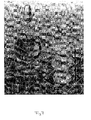
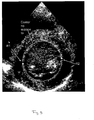
- An example of the said guess border on a secondary section plane is illustrated in the example of figure 9 .
- the two dimensional image on a secondary section plane is illustrated together with the two reliable points R1 and R2.
- the guess border passing through the said two reliable points R1 and R2 is given by given by a circle in the transversal images of the left ventricle.
- a new border is now detected by the same procedure used for a single transmural cut as disclosed in the previous chapter for the two dimensional case, this time however, substituting the time coordinate with the spatial coordinate along such first guess border as follows. Make a number of transmural cuts on the single image along the guess border, place the pixel found along each cut side by side in a new two-dimensional image and obtain a new image, like that in figure 4 , where the horizontal axis does not indicate the time coordinate but the spatial coordinate along the tentative border. As a result the correct border is tracked in one frame for each of the M sequences.
- the instantaneous velocity vector for a certain number of predefined points on the border surface can be calculated by using the same technique disclosed of the two dimensional case.
- the two dimensional technique disclosed above is used here by substituting the two dimensional estimate with a three-dimensional estimate of velocity.
- this is done by using a three-dimensional correlation or optical flow technique, in place of the two-dimensional one for evaluating the three-dimensional velocity vector.
Landscapes
- Engineering & Computer Science (AREA)
- Physics & Mathematics (AREA)
- Health & Medical Sciences (AREA)
- General Physics & Mathematics (AREA)
- Life Sciences & Earth Sciences (AREA)
- Remote Sensing (AREA)
- Radar, Positioning & Navigation (AREA)
- Computer Networks & Wireless Communication (AREA)
- General Health & Medical Sciences (AREA)
- Computer Vision & Pattern Recognition (AREA)
- Medical Informatics (AREA)
- Nuclear Medicine, Radiotherapy & Molecular Imaging (AREA)
- Theoretical Computer Science (AREA)
- Radiology & Medical Imaging (AREA)
- Biomedical Technology (AREA)
- Biophysics (AREA)
- Veterinary Medicine (AREA)
- Acoustics & Sound (AREA)
- Heart & Thoracic Surgery (AREA)
- Animal Behavior & Ethology (AREA)
- Surgery (AREA)
- Public Health (AREA)
- Pathology (AREA)
- Molecular Biology (AREA)
- Quality & Reliability (AREA)
- Multimedia (AREA)
- Cardiology (AREA)
- Ultra Sonic Daignosis Equipment (AREA)
- Image Analysis (AREA)
Claims (13)
- Procédé pour suivre la position et la vitesse de contours d'objets dans des images d'échographie à deux ou trois dimensions, comprenant les étapes suivantes:acquérir une séquence d'au moins deux trames d'image à ultrasons consécutives d'un tissu mobile ou d'un objet mobile, lesdites trames d'image à ultrasons sont séparées dans le temps par un certain intervalle de temps;définir automatiquement ou manuellement un certain nombre de points de référence d'un contour d'un tissu ou objet mobile au moins sur une première trame d'image de la séquence de trames d'image acquises;suivre automatiquement le contour du tissu ou objet mobile dans la au moins une autre trame suivante en déterminant la nouvelle position des points de référence du contour dans au moins une trame d'image suivante de la séquence de trames d'image en estimant la position desdits points de référence dans ladite au moins une trame d'image suivante de la séquence de trames d'image sur la base des données d'image à ultrasons de la séquence acquise des trames d'image;la séquence de trames d'image acquise est une séquence d'images à ultrasons consécutive de mode B, de l'échelle de gris;sur une première trame, une ligne de contour est tracée soit manuellement soit par un algorithme de détection de contour automatique, le contour étant défini par une trace de pixels de la trame d'image coïncidant avec ladite ligne de contour;la trace initiale de pixels coïncidant avec la ligne de contour tracée manuellement ou automatiquement est suivie dans le temps, c'est-à-dire dans la au moins une trame d'image suivante en recherchant la probabilité maximale de la trace de pixels dans la trame d'image suivante, avec la trace de pixels dans la première trame d'image ou trame d'image précédente dans le temps de la séquence de trames d'image en analysant les pixels d'image au voisinage de ladite trace de pixels;la poursuite de la ligne de contour est exécutée en définissant un certain nombre de points de référence sur la ligne de contour tracée manuellement ou automatiquement sur la première trame d'image et en utilisant le procédé des soi-disant coupes transmurales;lesdites coupes transmurales consistent en définissant pour chaque point de référence une ligne qui se croise avec la ligne de contour tracée sur une première trame d'image, et chacune des lignes passant à travers un point de référence; chaque ligne de coupe transmurale ayant une direction définie qui peut être d'une manière typique la direction orthogonale à la ligne de contour au point de référence;exécuter l'étape mentionnée ci-dessus de la définition de coupes transmurales pour chaque trame d'image de la séquence de trames et pour chaque point de référence sélectionné;les pixels pris le long de chaque ligne transmurale dans chacune des trames d'image de la séquence de trames d'image étant ensuite placés en colonne, chaque colonne correspondant à une trame de la séquence d'images, formant une représentation bidimensionnelle espace-temps de l'évolution de la position de chaque point de référence le long de la coupe transmurale correspondante;la poursuite de la ligne de contour, c'est-à-dire de la trace de pixels, est exécutée pour chaque point de référence défini sur ladite ligne de contour le long de l'image correspondante bidimensionnelle espace-temps en utilisant une procédure de corrélation croisée de la colonne de pixels dans l'image espace-temps correspondant à une première trame d'image avec la colonne de pixels dans l'image espace-temps correspondant à une trame d'image successive de la séquence de trames d'image;comprenant des étapes pour déterminer la vitesse instantanée de la ligne de contour sur chaque trame d'image de la séquence de trames d'image, moyennant quoi une première estimation de la vitesse instantanée est déterminée pour chaque point de référence sur la ligne de contour en divisant le vecteur de déplacement de chacun des points de référence d'une première trame d'image à une trame d'image suivante de la séquence de trames d'image par l'intervalle de temps qui s'est produit entre ladite première trame d'image et ladite trame d'image suivante,et ledit procédé est caractérisé en outre par les étapes dedéterminer les composantes du vecteur de vitesse sur chacune des trames d'image de la séquence de trames d'image pour chacun des points de référence sur la ligne de contour en sélectionnant une direction additionnelle pour les coupes transmurales sur le point déjà déplacé et en évaluant la vitesse dans la direction additionnelle en appliquant lesdites étapes de procédé des soi-disant coupes transmurales dans ladite direction additionnelle requise pour évaluer le vecteur de vitesse complet;l'évaluation de chacune de la ou des composante(s) du vecteur de vitesse dans chaque direction, le nombre total de composantes étant de deux pour l'imagerie à deux dimensions et de trois pour l'imagerie à trois dimensions;étant exécutée selon les étapes suivantes:aa) pour chaque point de référence, sur chaque trame d'image de la séquence de trames d'image, une coupe transmurale consistant en une ligne qui croise le point suivi et dirigée dans la direction dans laquelle la composante additionnelle de la vitesse est évaluée, orthogonale à la direction pour les autres composantes du vecteur de vitesse;bb) les pixels pris le long de chaque ligne de coupe transmurale dans chacune des trames d'image de la séquence de trames d'image sont placés en colonnes pour tous les instants immédiatement dans une représentation espace-temps bidimensionnelle;cc) l'évaluation de la composante de vitesse dans la direction sélectionnée est exécutée le long de l'image espace-temps en utilisant une procédure de corrélation croisée de la colonne de pixels dans l'image espace-temps, ladite vitesse étant fournie par le rapport du déplacement par colonne du maximum de corrélation et de l'intervalle de temps entre les trames correspondantes.
- Procédé selon la revendication 1, caractérisé en ce qu'il est appliqué à des lignes de contour fermées.
- Procédé selon l'une ou plusieurs des revendications précédentes en combinaison avec des objets imagés ayant au moins un ou plusieurs points de référence représentatifs, en particulier un point de début et un point de fin d'un contour qui ont une pertinence en tant que points de référence particuliers dans le mouvement exécuté par la ligne de contour de l'objet,
caractérisé en ce qu'avant l'exécution de la poursuite de tous les points de référence définis sur la ligne de contour tracée sur une première trame d'image de la séquence d'au moins deux trames d'image, un cycle de poursuite préventif seulement des points de référence représentatifs est exécuté selon le procédé selon l'une ou plusieurs des revendications 1 à 2. - Procédé selon la revendication 3, caractérisé en ce que la poursuite des points de référence représentatifs est exécutée en utilisant le procédé des coupes transmurales pour construire des images espace-temps de chacun des points de référence représentatifs et pour déterminer le déplacement de ces points dans chacune des trames de la séquence de trames d'image par une corrélation croisée entre chacune des colonnes de pixels avec la colonne de pixels successive correspondant aux pixels le long de la coupe transmurale sur le même point de référence représentatif dans les trames d'image différentes de la séquence de trames d'image.
- Procédé selon la revendication 3 ou 4, caractérisé en ce que après avoir déterminé le déplacement des points de référence représentatifs sur la ligne de contour de l'objet imagé dans quelques-unes ou toutes les trames de la séquence de trames d'image, la position et le déplacement des autres points de référence sur les lignes de contour à chaque trame d'image de la séquence de trames d'images sont obtenus en remettant à l'échelle la ligne de contour initiale tracée manuellement ou automatiquement dans la première trame d'image de manière à obtenir dans chaque trame d'image correspondant à un instant successif une géométrie de ligne de contour topologiquement équivalente par rapport à la ligne de contour initiale et pour maintenir les points de référence représentatifs toujours dans la position correcte dans toutes les trames de la séquence de trames d'image en réagençant les autres points de référence de telle sorte que les points de référence représentatifs conservent la même signification relativement à l'objet dans toutes les trames de la séquence de trames d'image.
- Procédé selon l'une ou plusieurs des revendications précédentes, caractérisé par les étapes suivantes:a) acquérir une séquence d'au moins deux trames d'image à ultrasons consécutives d'un tissu mobile ou d'un objet mobile, lesdites trames d'image à ultrasons sont séparées dans le temps par un certain intervalle de temps;b) suivre une ligne de contour sur une seule première trame soit manuellement soit à l'aide d'un algorithme de traçage de contour automatique;c) suivre les déplacements de position d'un ou de plusieurs points de référence représentatifs éventuellement présents sur toute la séquence de trames d'image consécutives;d) remettre à l'échelle la ligne de contour tracée sur la première trame d'image au moins pour quelques-unes ou pour chacune des trames d'image suivantes de la séquence de trames d'image selon la position correspondante suivie des points de référence représentatifs;e) définir un certain nombre d'autres points de référence distribués le long de la ligne de contour sur la première trame d'image et tombant sur ladite ligne de contour;f) suivre la position de chaque point indépendamment des autres le long de la séquence de trames d'images;g) la poursuite de la position des points de référence représentatifs et des autres points de référence étant exécutée parh) pour chaque point indépendamment et dans chacune des trames d'image de la séquence de trames d'image définissant une ligne de coupe transmurale consistant en une ligne qui croise la ligne de contour tracée et passant à travers ledit point de référence;i) les pixels pris le long de chaque ligne de coupe transmurale dans chacune des trames d'image de la séquence de trames d'image sont placés en colonnes, chaque colonne correspondant à une trame de la séquence d'images pour représenter l'évolution le long d'une ligne de coupe transmurale, pour tous les instants immédiatement dans une représentation espace-temps bidimensionnelle;j) la poursuite du contour, c'est-à-dire de la trace de pixels le long de chaque ligne de coupe transmurale est exécutée le long de l'image espace-temps en utilisant une procédure de corrélation croisée de la colonne de pixels dans l'image espace-temps correspondant à une première trame d'image, la colonne de pixels dans l'image espace-temps correspondant à une trame d'image successive de la séquence de trames d'image.
- Procédé selon l'une ou plusieurs des revendications précédentes, caractérisé en ce que, en combinaison d'images d'une qualité médiocre, c'est-à-dire avec un rapport de signal-à-bruit bas, la représentation espace-temps le long des coupes transmurales est formée en utilisant une ligne pour la coupe transmurale d'une épaisseur plus grande que celle d'un seul pixel et par extraction de la valeur moyenne sur une telle épaisseur.
- Procédé selon l'une ou plusieurs des revendications précédentes, caractérisé en ce qu'il est appliqué pour exécuter une poursuite de contour de surface dans l'imagerie tridimensionnelle, et comprenant les étapes suivantes:l) acquérir une séquence d'ensembles de données d'imagerie à ultrasons tridimensionnels, chaque ensemble de données tridimensionnel étant acquis avec un intervalle de temps prédéterminé de celui qui précède;m) définir au moins un plan de section principale de chaque ensemble de données tridimensionnel le long d'une direction sélectionnée pour obtenir une séquence de deux trames d'image dimensionnelles le long dudit plan de section;n) tracer une ligne de contour de l'objet imagé soit manuellement soit automatiquement sur les premiers deux trames d'image dimensionnelles de la séquence des deux trames d'image dimensionnelles prises le long dudit plan de section principal ou chacun desdits plans de section principaux;o) exécuter pour les étapes de poursuite c) à j) divulguées préalablement pour chaque séquence de trames d'image bidimensionnelles pour chaque plan de section principal correspondant;p) pour chaque ensemble de données tridimensionnelles de la séquence d'ensembles de données tridimensionnelles définissant un nombre pré-établi d'autres plans de section secondaires croisant le au moins un, de préférence tous les plans de section principaux, lesdits plans de section secondaires étant espacés les uns des autres le long d'une direction prédéterminée et divisant l'objet représenté par chaque ensemble de données tridimensionnelles de la séquence d'ensembles de données tridimensionnelles en tranches;q) pour chaque plan de section secondaire dans la séquence des ensembles de données tridimensionnelles formant la séquence correspondante des trames d'image bidimensionnelles relativement audit plan de section secondaire;r) pour chaque séquence de trames d'image bidimensionnelles relativement à chaque plan de section secondaire déterminant une ligne de contour de supposition dans une seule trame, en amenant la ligne de contour de supposition à passer sur les points d'intersection du plan de section secondaire correspondant, la ligne de contour étant tracée sur le plan de section principal ou des plans de section principaux;s) suivre ladite ligne de contour de supposition en détectant un nouveau contour en appliquant les étapes de procédé selon c) à j) ou e) à j) en substituant la coordonnée de temps dans lesdites étapes divulguées par la coordonnée spatiale le long de ladite ligne de contour de supposition ent) définir un certain nombre de coupes transmurales sur la trame d'image unique de la séquence de trames d'image correspondant à chaque plan de section secondaire le long de la ligne de contour de supposition;u) identifier les pixels le long desdites coupes transmurales et placer les pixels le long de toutes les coupes transmurales côte à côte pour former une image bidimensionnelle, où l'axe horizontal indique la coordonnée spatiale le long de la ligne de contour de supposition;v) exécuter la corrélation croisée entre chacune des colonnes de pixels consécutives dans ladite image bidimensionnelle et suivre ainsi la ligne de contour dans une trame pour chacune des séquences de trames d'image bidimensionnelles correspondant à chacun des plans de section secondaires.
- Procédé selon la revendication 8, caractérisé en ce qu'un ou plusieurs autres plans de section principaux peuvent être définis, le long de chacun des autres plans en section, les étapes de procédé 1) à o) sont exécutées.
- Procédé selon les revendications 8 ou 9, caractérisé en ce que deux plans de section principaux orthogonaux sont sélectionnés pour exécuter les étapes de procédé mentionnées ci-dessus, la ligne de croisement des deux plans de section principaux définissant une direction préférée desdits plans.
- Procédé selon l'une ou plusieurs des revendications précédentes 8 à 10, caractérisé en ce que pour mieux définir le groupe de plans de section secondaires coupant les plans de section principaux, les étapes suivantes sont exécutées: définir des liaisons ou des limites pour une plage de distances dans laquelle le groupe desdits plans de section secondaires doit être défini.
- Procédé selon la revendication 11, caractérisé en ce qu'une direction dans laquelle les plans de section secondaires sont distribués, est sélectionnée, qui est la même direction définie pour déterminer les plans de section principaux, le long de cette direction des liaisons sont déterminées pour les extrémités d'une plage de distances dans laquelle le groupe de plans de section secondaires est défini, et lesdits plans de section secondaires sont au moins transversaux, particulièrement perpendiculaires à ladite direction.
- Procédé selon l'une ou plusieurs des revendications précédentes, la ligne de contour correcte suivie est affichée en étant superposée à la trame d'image affichée correspondante comme une ligne soulignée, caractérisé par une couleur qui est différente de l'image de mode B à l'échelle de gris affichée.
Priority Applications (4)
| Application Number | Priority Date | Filing Date | Title |
|---|---|---|---|
| AT03425639T ATE550680T1 (de) | 2003-09-30 | 2003-09-30 | Methode zur positions- und geschwindigkeitsverfolgung eines objektrandes in zwei- oder dreidimensionalen digitalen echographischen bildern |
| EP03425639A EP1522875B1 (fr) | 2003-09-30 | 2003-09-30 | Procédé pour suivre la position et la vitesse des contours d'un objet dans des images digitales d'échographie à deux ou trois dimensions. |
| US10/956,797 US7343031B2 (en) | 2003-09-30 | 2004-09-30 | Method of tracking position and velocity of objects' borders in two or three dimensional digital images, particularly in echographic images |
| US12/015,264 US8098912B2 (en) | 2003-09-30 | 2008-01-16 | Method of tracking position and velocity of objects' borders in two or three dimensional digital images, particularly in echographic images |
Applications Claiming Priority (1)
| Application Number | Priority Date | Filing Date | Title |
|---|---|---|---|
| EP03425639A EP1522875B1 (fr) | 2003-09-30 | 2003-09-30 | Procédé pour suivre la position et la vitesse des contours d'un objet dans des images digitales d'échographie à deux ou trois dimensions. |
Publications (2)
| Publication Number | Publication Date |
|---|---|
| EP1522875A1 EP1522875A1 (fr) | 2005-04-13 |
| EP1522875B1 true EP1522875B1 (fr) | 2012-03-21 |
Family
ID=34307071
Family Applications (1)
| Application Number | Title | Priority Date | Filing Date |
|---|---|---|---|
| EP03425639A Expired - Lifetime EP1522875B1 (fr) | 2003-09-30 | 2003-09-30 | Procédé pour suivre la position et la vitesse des contours d'un objet dans des images digitales d'échographie à deux ou trois dimensions. |
Country Status (3)
| Country | Link |
|---|---|
| US (2) | US7343031B2 (fr) |
| EP (1) | EP1522875B1 (fr) |
| AT (1) | ATE550680T1 (fr) |
Families Citing this family (46)
| Publication number | Priority date | Publication date | Assignee | Title |
|---|---|---|---|---|
| US7766837B2 (en) * | 2002-02-27 | 2010-08-03 | Esaote S.P.A. | M-tracking for space-time image |
| US7714855B2 (en) * | 2004-05-17 | 2010-05-11 | Siemens Medical Solutions Usa, Inc. | Volume rendering processing distribution in a graphics processing unit |
| CN101141920B (zh) * | 2005-03-15 | 2011-12-14 | 株式会社东芝 | 超声波诊断装置及其控制方法 |
| US20060239527A1 (en) * | 2005-04-25 | 2006-10-26 | Sriram Krishnan | Three-dimensional cardiac border delineation in medical imaging |
| EP1876954A4 (fr) * | 2005-05-02 | 2009-12-16 | Agency Science Tech & Res | Procede et appareil d'enregistrement d'une image de la vertebre atlas |
| US7852335B2 (en) * | 2005-05-09 | 2010-12-14 | Siemens Medical Solutions Usa, Inc. | Volume rendering processing distribution in a graphics processing unit |
| EP1731102A1 (fr) | 2005-06-08 | 2006-12-13 | Esaote S.p.A. | Procédé pour mesurer et présenter des événements à variation temporelle |
| CA2618101A1 (fr) * | 2005-08-19 | 2007-02-22 | Visualsonics Inc. | Systemes et procedes de capture et d'affichage de la pression sanguine et de donnees par ultrasons |
| US20070071295A1 (en) * | 2005-09-27 | 2007-03-29 | Siemens Medical Solutions Usa, Inc. | Orientation-based assessment of cardiac synchrony in medical imaging |
| CN101273382A (zh) * | 2005-09-28 | 2008-09-24 | 皇家飞利浦电子股份有限公司 | 基准轮廓线传播和优化的方法 |
| EP1772825A1 (fr) * | 2005-10-06 | 2007-04-11 | Esaote S.p.A. | Méthode d'alignement des images d'une séquence d'images, en particulier des images diagnostiques d'ultrasons |
| US7831074B2 (en) * | 2005-10-12 | 2010-11-09 | Siemens Corporation | System and method for using a similarity function to perform appearance matching in image pairs |
| JP2009512486A (ja) * | 2005-10-20 | 2009-03-26 | コーニンクレッカ フィリップス エレクトロニクス エヌ ヴィ | 超音波撮像システム及び方法 |
| JP4984509B2 (ja) * | 2005-12-06 | 2012-07-25 | ソニー株式会社 | 測位情報処理装置、測位情報処理方法、プログラム |
| US20070196005A1 (en) * | 2006-02-23 | 2007-08-23 | White Christopher A | Feature Tracing Process for M-mode Images |
| US7803113B2 (en) * | 2006-06-14 | 2010-09-28 | Siemens Medical Solutions Usa, Inc. | Ultrasound imaging of rotation |
| EP1876567A1 (fr) * | 2006-07-04 | 2008-01-09 | Esaote S.p.A. | Procédé de détermination du comportement dépendent du temps des objets mobiles et non-rigides, particulièrement des tissus biologiques, des données d'imagerie ultrasonique échographiques |
| EP1892671A3 (fr) * | 2006-08-23 | 2009-07-29 | Medison Co., Ltd. | Système et procédé de détermination du volume d'un objet par traitement d'image |
| JP4751282B2 (ja) * | 2006-09-27 | 2011-08-17 | 株式会社日立製作所 | 超音波診断装置 |
| US20080095417A1 (en) * | 2006-10-23 | 2008-04-24 | Gianni Pedrizzetti | Method for registering images of a sequence of images, particularly ultrasound diagnostic images |
| US8540635B2 (en) * | 2007-07-12 | 2013-09-24 | Siemens Medical Solutions Usa, Inc. | Medical diagnostic imaging with hardware generated region of interest border |
| EP2026280B1 (fr) | 2007-07-23 | 2013-10-23 | Esaote S.p.A. | Procédé et dispositif correspondant pour des mesures quantitatives sur des séquences d'images, en particulier des images à ultrasons |
| KR20090095150A (ko) * | 2008-03-05 | 2009-09-09 | 주식회사 메디슨 | 초음파 영상을 처리하는 초음파 시스템 및 방법 |
| JP5075757B2 (ja) * | 2008-08-05 | 2012-11-21 | オリンパス株式会社 | 画像処理装置、画像処理プログラム、画像処理方法、および電子機器 |
| JP5523791B2 (ja) * | 2008-10-27 | 2014-06-18 | 株式会社東芝 | X線診断装置および画像処理装置 |
| US8199994B2 (en) * | 2009-03-13 | 2012-06-12 | International Business Machines Corporation | Automatic analysis of cardiac M-mode views |
| CN101926676B (zh) * | 2009-06-25 | 2012-07-25 | 谢耀钦 | 一种自动识别特征点的医用影像跟踪方法和装置 |
| KR101182999B1 (ko) * | 2009-11-25 | 2012-09-18 | 삼성메디슨 주식회사 | 초음파 영상 처리를 수행하는 초음파 시스템 및 방법 |
| CN102081697B (zh) * | 2009-11-27 | 2013-12-11 | 深圳迈瑞生物医疗电子股份有限公司 | 一种在超声成像空间中定义感兴趣容积的方法及其装置 |
| WO2011093193A1 (fr) * | 2010-01-29 | 2011-08-04 | 株式会社 日立メディコ | Dispositif de diagnostic ultrasonique et procédé l'utilisant pour suivre un point de mesure |
| WO2012090208A2 (fr) | 2010-12-29 | 2012-07-05 | Diacardio Ltd. | Evaluation automatique de fonction ventriculaire gauche |
| CN103473543B (zh) * | 2012-06-07 | 2016-10-05 | 富士通株式会社 | 用于提取图像中对象边界的装置、方法以及电子设备 |
| KR101382625B1 (ko) * | 2012-10-17 | 2014-04-10 | 고려대학교 산학협력단 | 대상체의 동적 변화 산출 장치 및 방법 |
| GB2507987A (en) * | 2012-11-15 | 2014-05-21 | Imp Innovations Ltd | Method of automatically processing an ultrasound image |
| ITAQ20130003A1 (it) | 2013-04-23 | 2014-10-24 | Amid S R L | Metodo e dispositivo per la valutazione della funzionalita' dinamica quantitativa dei muscoli scheletrici |
| US9360850B2 (en) * | 2013-11-25 | 2016-06-07 | Rutgers, The State University Of New Jersey | Modular monitor and control system for cell sorter stream |
| WO2015124388A1 (fr) * | 2014-02-19 | 2015-08-27 | Koninklijke Philips N.V. | Visualisation adaptative de mouvement en imagerie 4d médicale |
| US9684830B2 (en) * | 2014-11-14 | 2017-06-20 | Intel Corporation | Automatic target selection for multi-target object tracking |
| CN105748100B (zh) * | 2014-12-19 | 2019-04-16 | 深圳开立生物医疗科技股份有限公司 | 准静态超声弹性成像位移计算方法和装置 |
| GB201610269D0 (en) | 2016-06-13 | 2016-07-27 | Isis Innovation | Image-based diagnostic systems |
| DE102016117889B3 (de) * | 2016-09-22 | 2018-03-15 | Tomtec Imaging Systems Gmbh | Verfahren und Vorrichtung zur Korrektur von durch Tracking-Verfahren ermittelten dynamischen Modellen |
| CN108309354B (zh) * | 2017-01-16 | 2021-04-02 | 深圳迈瑞生物医疗电子股份有限公司 | 超声盆底检测引导方法和超声成像系统 |
| CN109745069A (zh) * | 2017-11-01 | 2019-05-14 | 通用电气公司 | 超声成像方法 |
| GB2569332B (en) | 2017-12-13 | 2021-06-09 | Univ Oxford Innovation Ltd | Method and apparatus for analysing images |
| GB2569333A (en) | 2017-12-13 | 2019-06-19 | Univ Oxford Innovation Ltd | Diagnostic modelling method and apparatus |
| JP7099901B2 (ja) * | 2018-08-06 | 2022-07-12 | 富士フイルムヘルスケア株式会社 | 超音波画像処理装置およびプログラム |
Family Cites Families (8)
| Publication number | Priority date | Publication date | Assignee | Title |
|---|---|---|---|---|
| US5622174A (en) * | 1992-10-02 | 1997-04-22 | Kabushiki Kaisha Toshiba | Ultrasonic diagnosis apparatus and image displaying system |
| NO943214D0 (no) * | 1994-08-30 | 1994-08-30 | Vingmed Sound As | Fremgangsmåte ved ultralydavbildning |
| JP3514553B2 (ja) * | 1995-06-30 | 2004-03-31 | フクダ電子株式会社 | 超音波診断装置 |
| EP1090372A2 (fr) * | 1998-03-30 | 2001-04-11 | Echovision, Inc. | Poste de travail d'echocardiographie |
| EP1122521A1 (fr) * | 2000-02-01 | 2001-08-08 | Setrix AG | Procedé et appareil de surveillance d'un instrument indicateur analogique |
| US6537221B2 (en) * | 2000-12-07 | 2003-03-25 | Koninklijke Philips Electronics, N.V. | Strain rate analysis in ultrasonic diagnostic images |
| US6638221B2 (en) * | 2001-09-21 | 2003-10-28 | Kabushiki Kaisha Toshiba | Ultrasound diagnostic apparatus, and image processing method |
| US7766837B2 (en) * | 2002-02-27 | 2010-08-03 | Esaote S.P.A. | M-tracking for space-time image |
-
2003
- 2003-09-30 AT AT03425639T patent/ATE550680T1/de active
- 2003-09-30 EP EP03425639A patent/EP1522875B1/fr not_active Expired - Lifetime
-
2004
- 2004-09-30 US US10/956,797 patent/US7343031B2/en not_active Expired - Lifetime
-
2008
- 2008-01-16 US US12/015,264 patent/US8098912B2/en not_active Expired - Fee Related
Also Published As
| Publication number | Publication date |
|---|---|
| ATE550680T1 (de) | 2012-04-15 |
| US20050074153A1 (en) | 2005-04-07 |
| US20080118109A1 (en) | 2008-05-22 |
| US8098912B2 (en) | 2012-01-17 |
| EP1522875A1 (fr) | 2005-04-13 |
| US7343031B2 (en) | 2008-03-11 |
Similar Documents
| Publication | Publication Date | Title |
|---|---|---|
| EP1522875B1 (fr) | Procédé pour suivre la position et la vitesse des contours d'un objet dans des images digitales d'échographie à deux ou trois dimensions. | |
| US11510651B2 (en) | Ultrasonic diagnosis of cardiac performance using heart model chamber segmentation with user control | |
| EP0880937B1 (fr) | Système d'imagerie ultrasonique pour le diagnostic à poursuite Doppler du mouvement du tissu | |
| US6994673B2 (en) | Method and apparatus for quantitative myocardial assessment | |
| US6503202B1 (en) | Medical diagnostic ultrasound system and method for flow analysis | |
| US8538103B2 (en) | Medical image processing device, medical image processing method, medical image diagnostic apparatus, operation method of medical image diagnostic apparatus, and medical image display method | |
| EP1579244B1 (fr) | Outil de segmentation permettant d'identifier des regions de flux dans un systeme d'imagerie | |
| JP4699724B2 (ja) | 周期的に動いている対象に対するボリュメトリック走査を得るための方法及び装置 | |
| US6980844B2 (en) | Method and apparatus for correcting a volumetric scan of an object moving at an uneven period | |
| US20070276245A1 (en) | System And Method For Automated Boundary Detection Of Body Structures | |
| US10398411B2 (en) | Automatic alignment of ultrasound volumes | |
| US20020072672A1 (en) | Analysis of cardiac performance using ultrasonic diagnostic images | |
| US20080095417A1 (en) | Method for registering images of a sequence of images, particularly ultrasound diagnostic images | |
| US20060004291A1 (en) | Methods and apparatus for visualization of quantitative data on a model | |
| US7907758B2 (en) | Method and system for maintaining consistent anatomic views in displayed image data | |
| CN111885965A (zh) | 用于三维中的剪切波成像的超声系统 | |
| EP3267896B1 (fr) | Diagnostic ultrasonore de performances cardiaques par une segmentation de chambre à un seul degré de liberté | |
| CN112826535B (zh) | 一种超声成像中自动定位血管的方法和装置及设备 | |
| EP1772825A1 (fr) | Méthode d'alignement des images d'une séquence d'images, en particulier des images diagnostiques d'ultrasons | |
| EP1876567A1 (fr) | Procédé de détermination du comportement dépendent du temps des objets mobiles et non-rigides, particulièrement des tissus biologiques, des données d'imagerie ultrasonique échographiques |
Legal Events
| Date | Code | Title | Description |
|---|---|---|---|
| PUAI | Public reference made under article 153(3) epc to a published international application that has entered the european phase |
Free format text: ORIGINAL CODE: 0009012 |
|
| 17P | Request for examination filed |
Effective date: 20040618 |
|
| AK | Designated contracting states |
Kind code of ref document: A1 Designated state(s): AT BE BG CH CY CZ DE DK EE ES FI FR GB GR HU IE IT LI LU MC NL PT RO SE SI SK TR |
|
| AX | Request for extension of the european patent |
Extension state: AL LT LV MK |
|
| RAP1 | Party data changed (applicant data changed or rights of an application transferred) |
Owner name: ESAOTE S.P.A. Owner name: AMID S.R.L. |
|
| AKX | Designation fees paid |
Designated state(s): AT BE BG CH CY CZ DE DK EE ES FI FR GB GR HU IE IT LI LU MC NL PT RO SE SI SK TR |
|
| RAP1 | Party data changed (applicant data changed or rights of an application transferred) |
Owner name: AMID S.R.L. Owner name: ESAOTE S.P.A. |
|
| RAP1 | Party data changed (applicant data changed or rights of an application transferred) |
Owner name: AMID S.R.L. Owner name: ESAOTE S.P.A. |
|
| 17Q | First examination report despatched |
Effective date: 20070420 |
|
| RAP1 | Party data changed (applicant data changed or rights of an application transferred) |
Owner name: AMID S.R.L. Owner name: ESAOTE S.P.A. Owner name: BRACCO IMAGING S.P.A |
|
| GRAP | Despatch of communication of intention to grant a patent |
Free format text: ORIGINAL CODE: EPIDOSNIGR1 |
|
| RTI1 | Title (correction) |
Free format text: A METHOD OF TRACKING POSITION AND VELOCITY OF OBJECT'S BORDERS IN TWO OR THREE DIMENSIONAL DIGITAL ECHOGRAPHIC IMAGES |
|
| GRAS | Grant fee paid |
Free format text: ORIGINAL CODE: EPIDOSNIGR3 |
|
| GRAA | (expected) grant |
Free format text: ORIGINAL CODE: 0009210 |
|
| AK | Designated contracting states |
Kind code of ref document: B1 Designated state(s): AT BE BG CH CY CZ DE DK EE ES FI FR GB GR HU IE IT LI LU MC NL PT RO SE SI SK TR |
|
| RAP1 | Party data changed (applicant data changed or rights of an application transferred) |
Owner name: BRACCO IMAGING S.P.A Owner name: ESAOTE S.P.A. |
|
| REG | Reference to a national code |
Ref country code: GB Ref legal event code: FG4D |
|
| REG | Reference to a national code |
Ref country code: CH Ref legal event code: EP |
|
| REG | Reference to a national code |
Ref country code: IE Ref legal event code: FG4D |
|
| REG | Reference to a national code |
Ref country code: AT Ref legal event code: REF Ref document number: 550680 Country of ref document: AT Kind code of ref document: T Effective date: 20120415 |
|
| REG | Reference to a national code |
Ref country code: DE Ref legal event code: R096 Ref document number: 60340325 Country of ref document: DE Effective date: 20120516 |
|
| REG | Reference to a national code |
Ref country code: NL Ref legal event code: VDEP Effective date: 20120321 |
|
| PG25 | Lapsed in a contracting state [announced via postgrant information from national office to epo] |
Ref country code: FI Free format text: LAPSE BECAUSE OF FAILURE TO SUBMIT A TRANSLATION OF THE DESCRIPTION OR TO PAY THE FEE WITHIN THE PRESCRIBED TIME-LIMIT Effective date: 20120321 Ref country code: GR Free format text: LAPSE BECAUSE OF FAILURE TO SUBMIT A TRANSLATION OF THE DESCRIPTION OR TO PAY THE FEE WITHIN THE PRESCRIBED TIME-LIMIT Effective date: 20120622 |
|
| REG | Reference to a national code |
Ref country code: AT Ref legal event code: MK05 Ref document number: 550680 Country of ref document: AT Kind code of ref document: T Effective date: 20120321 |
|
| PG25 | Lapsed in a contracting state [announced via postgrant information from national office to epo] |
Ref country code: CY Free format text: LAPSE BECAUSE OF FAILURE TO SUBMIT A TRANSLATION OF THE DESCRIPTION OR TO PAY THE FEE WITHIN THE PRESCRIBED TIME-LIMIT Effective date: 20120321 |
|
| PG25 | Lapsed in a contracting state [announced via postgrant information from national office to epo] |
Ref country code: CZ Free format text: LAPSE BECAUSE OF FAILURE TO SUBMIT A TRANSLATION OF THE DESCRIPTION OR TO PAY THE FEE WITHIN THE PRESCRIBED TIME-LIMIT Effective date: 20120321 Ref country code: EE Free format text: LAPSE BECAUSE OF FAILURE TO SUBMIT A TRANSLATION OF THE DESCRIPTION OR TO PAY THE FEE WITHIN THE PRESCRIBED TIME-LIMIT Effective date: 20120321 Ref country code: BE Free format text: LAPSE BECAUSE OF FAILURE TO SUBMIT A TRANSLATION OF THE DESCRIPTION OR TO PAY THE FEE WITHIN THE PRESCRIBED TIME-LIMIT Effective date: 20120321 Ref country code: SE Free format text: LAPSE BECAUSE OF FAILURE TO SUBMIT A TRANSLATION OF THE DESCRIPTION OR TO PAY THE FEE WITHIN THE PRESCRIBED TIME-LIMIT Effective date: 20120321 Ref country code: RO Free format text: LAPSE BECAUSE OF FAILURE TO SUBMIT A TRANSLATION OF THE DESCRIPTION OR TO PAY THE FEE WITHIN THE PRESCRIBED TIME-LIMIT Effective date: 20120321 Ref country code: SI Free format text: LAPSE BECAUSE OF FAILURE TO SUBMIT A TRANSLATION OF THE DESCRIPTION OR TO PAY THE FEE WITHIN THE PRESCRIBED TIME-LIMIT Effective date: 20120321 |
|
| PG25 | Lapsed in a contracting state [announced via postgrant information from national office to epo] |
Ref country code: PT Free format text: LAPSE BECAUSE OF FAILURE TO SUBMIT A TRANSLATION OF THE DESCRIPTION OR TO PAY THE FEE WITHIN THE PRESCRIBED TIME-LIMIT Effective date: 20120723 Ref country code: SK Free format text: LAPSE BECAUSE OF FAILURE TO SUBMIT A TRANSLATION OF THE DESCRIPTION OR TO PAY THE FEE WITHIN THE PRESCRIBED TIME-LIMIT Effective date: 20120321 |
|
| PLBE | No opposition filed within time limit |
Free format text: ORIGINAL CODE: 0009261 |
|
| STAA | Information on the status of an ep patent application or granted ep patent |
Free format text: STATUS: NO OPPOSITION FILED WITHIN TIME LIMIT |
|
| PG25 | Lapsed in a contracting state [announced via postgrant information from national office to epo] |
Ref country code: NL Free format text: LAPSE BECAUSE OF FAILURE TO SUBMIT A TRANSLATION OF THE DESCRIPTION OR TO PAY THE FEE WITHIN THE PRESCRIBED TIME-LIMIT Effective date: 20120321 Ref country code: AT Free format text: LAPSE BECAUSE OF FAILURE TO SUBMIT A TRANSLATION OF THE DESCRIPTION OR TO PAY THE FEE WITHIN THE PRESCRIBED TIME-LIMIT Effective date: 20120321 Ref country code: DK Free format text: LAPSE BECAUSE OF FAILURE TO SUBMIT A TRANSLATION OF THE DESCRIPTION OR TO PAY THE FEE WITHIN THE PRESCRIBED TIME-LIMIT Effective date: 20120321 |
|
| 26N | No opposition filed |
Effective date: 20130102 |
|
| REG | Reference to a national code |
Ref country code: DE Ref legal event code: R097 Ref document number: 60340325 Country of ref document: DE Effective date: 20130102 |
|
| PG25 | Lapsed in a contracting state [announced via postgrant information from national office to epo] |
Ref country code: ES Free format text: LAPSE BECAUSE OF FAILURE TO SUBMIT A TRANSLATION OF THE DESCRIPTION OR TO PAY THE FEE WITHIN THE PRESCRIBED TIME-LIMIT Effective date: 20120702 Ref country code: MC Free format text: LAPSE BECAUSE OF NON-PAYMENT OF DUE FEES Effective date: 20120930 |
|
| REG | Reference to a national code |
Ref country code: CH Ref legal event code: PL |
|
| REG | Reference to a national code |
Ref country code: IE Ref legal event code: MM4A |
|
| PG25 | Lapsed in a contracting state [announced via postgrant information from national office to epo] |
Ref country code: CH Free format text: LAPSE BECAUSE OF NON-PAYMENT OF DUE FEES Effective date: 20120930 Ref country code: BG Free format text: LAPSE BECAUSE OF FAILURE TO SUBMIT A TRANSLATION OF THE DESCRIPTION OR TO PAY THE FEE WITHIN THE PRESCRIBED TIME-LIMIT Effective date: 20120621 Ref country code: LI Free format text: LAPSE BECAUSE OF NON-PAYMENT OF DUE FEES Effective date: 20120930 Ref country code: IE Free format text: LAPSE BECAUSE OF NON-PAYMENT OF DUE FEES Effective date: 20120930 |
|
| PG25 | Lapsed in a contracting state [announced via postgrant information from national office to epo] |
Ref country code: TR Free format text: LAPSE BECAUSE OF FAILURE TO SUBMIT A TRANSLATION OF THE DESCRIPTION OR TO PAY THE FEE WITHIN THE PRESCRIBED TIME-LIMIT Effective date: 20120321 |
|
| PG25 | Lapsed in a contracting state [announced via postgrant information from national office to epo] |
Ref country code: LU Free format text: LAPSE BECAUSE OF NON-PAYMENT OF DUE FEES Effective date: 20120930 |
|
| PG25 | Lapsed in a contracting state [announced via postgrant information from national office to epo] |
Ref country code: HU Free format text: LAPSE BECAUSE OF FAILURE TO SUBMIT A TRANSLATION OF THE DESCRIPTION OR TO PAY THE FEE WITHIN THE PRESCRIBED TIME-LIMIT Effective date: 20030930 |
|
| REG | Reference to a national code |
Ref country code: FR Ref legal event code: PLFP Year of fee payment: 14 |
|
| REG | Reference to a national code |
Ref country code: FR Ref legal event code: PLFP Year of fee payment: 15 |
|
| REG | Reference to a national code |
Ref country code: FR Ref legal event code: PLFP Year of fee payment: 16 |
|
| PGFP | Annual fee paid to national office [announced via postgrant information from national office to epo] |
Ref country code: FR Payment date: 20210913 Year of fee payment: 19 |
|
| PGFP | Annual fee paid to national office [announced via postgrant information from national office to epo] |
Ref country code: GB Payment date: 20210920 Year of fee payment: 19 Ref country code: DE Payment date: 20210914 Year of fee payment: 19 |
|
| PGFP | Annual fee paid to national office [announced via postgrant information from national office to epo] |
Ref country code: IT Payment date: 20220906 Year of fee payment: 20 |
|
| REG | Reference to a national code |
Ref country code: DE Ref legal event code: R119 Ref document number: 60340325 Country of ref document: DE |
|
| GBPC | Gb: european patent ceased through non-payment of renewal fee |
Effective date: 20220930 |
|
| PG25 | Lapsed in a contracting state [announced via postgrant information from national office to epo] |
Ref country code: FR Free format text: LAPSE BECAUSE OF NON-PAYMENT OF DUE FEES Effective date: 20220930 Ref country code: DE Free format text: LAPSE BECAUSE OF NON-PAYMENT OF DUE FEES Effective date: 20230401 |
|
| PG25 | Lapsed in a contracting state [announced via postgrant information from national office to epo] |
Ref country code: GB Free format text: LAPSE BECAUSE OF NON-PAYMENT OF DUE FEES Effective date: 20220930 |