EP1521210B9 - Ähnlichkeitsberechnungsverfahren und einrichtung - Google Patents
Ähnlichkeitsberechnungsverfahren und einrichtung Download PDFInfo
- Publication number
- EP1521210B9 EP1521210B9 EP03736281A EP03736281A EP1521210B9 EP 1521210 B9 EP1521210 B9 EP 1521210B9 EP 03736281 A EP03736281 A EP 03736281A EP 03736281 A EP03736281 A EP 03736281A EP 1521210 B9 EP1521210 B9 EP 1521210B9
- Authority
- EP
- European Patent Office
- Prior art keywords
- vector
- vectors
- order
- distance calculation
- partial
- Prior art date
- Legal status (The legal status is an assumption and is not a legal conclusion. Google has not performed a legal analysis and makes no representation as to the accuracy of the status listed.)
- Expired - Lifetime
Links
Images









Classifications
-
- G—PHYSICS
- G06—COMPUTING OR CALCULATING; COUNTING
- G06F—ELECTRIC DIGITAL DATA PROCESSING
- G06F18/00—Pattern recognition
- G06F18/20—Analysing
- G06F18/21—Design or setup of recognition systems or techniques; Extraction of features in feature space; Blind source separation
- G06F18/213—Feature extraction, e.g. by transforming the feature space; Summarisation; Mappings, e.g. subspace methods
- G06F18/2131—Feature extraction, e.g. by transforming the feature space; Summarisation; Mappings, e.g. subspace methods based on a transform domain processing, e.g. wavelet transform
-
- G—PHYSICS
- G06—COMPUTING OR CALCULATING; COUNTING
- G06T—IMAGE DATA PROCESSING OR GENERATION, IN GENERAL
- G06T7/00—Image analysis
-
- G—PHYSICS
- G06—COMPUTING OR CALCULATING; COUNTING
- G06V—IMAGE OR VIDEO RECOGNITION OR UNDERSTANDING
- G06V20/00—Scenes; Scene-specific elements
- G06V20/40—Scenes; Scene-specific elements in video content
-
- G—PHYSICS
- G06—COMPUTING OR CALCULATING; COUNTING
- G06F—ELECTRIC DIGITAL DATA PROCESSING
- G06F17/00—Digital computing or data processing equipment or methods, specially adapted for specific functions
- G06F17/10—Complex mathematical operations
- G06F17/14—Fourier, Walsh or analogous domain transformations, e.g. Laplace, Hilbert, Karhunen-Loeve, transforms
-
- G—PHYSICS
- G06—COMPUTING OR CALCULATING; COUNTING
- G06F—ELECTRIC DIGITAL DATA PROCESSING
- G06F17/00—Digital computing or data processing equipment or methods, specially adapted for specific functions
- G06F17/10—Complex mathematical operations
- G06F17/15—Correlation function computation including computation of convolution operations
-
- G—PHYSICS
- G06—COMPUTING OR CALCULATING; COUNTING
- G06V—IMAGE OR VIDEO RECOGNITION OR UNDERSTANDING
- G06V10/00—Arrangements for image or video recognition or understanding
- G06V10/70—Arrangements for image or video recognition or understanding using pattern recognition or machine learning
- G06V10/77—Processing image or video features in feature spaces; using data integration or data reduction, e.g. principal component analysis [PCA] or independent component analysis [ICA] or self-organising maps [SOM]; Blind source separation
- G06V10/7715—Feature extraction, e.g. by transforming the feature space, e.g. multi-dimensional scaling [MDS]; Mappings, e.g. subspace methods
-
- H—ELECTRICITY
- H04—ELECTRIC COMMUNICATION TECHNIQUE
- H04N—PICTORIAL COMMUNICATION, e.g. TELEVISION
- H04N5/00—Details of television systems
- H04N5/76—Television signal recording
- H04N5/91—Television signal processing therefor
Definitions
- the present invention relates to a similarity calculation method, a similarity calculation apparatus, a program and a recording medium which perform pattern matching between two vectors at a high speed.
- the so-called full search in which similarities between input value and respective all candidiates are determined thereafter to determine data where the distance is the shortest is a technology which is most simple and has no detection leakage, and is frequently used in the case where data quantity is small.
- the portion similar to input image or input voice (sound) is retrieved from a large quantity of accumulated images or voices (sounds)
- the dimension of the feature vector per second is large and retrieval with respect to those feature vectors which have been accumulated by several ten to several hundred hours is conducted, there is the problem that retrieval time becomes vast when such simple full search is performed.
- McNames. J. discloses in his article "Rotated Partial Distance search for Faster Vector Quantization Encoding” a method of reducing the amount of computation required for vector quantization encoding.
- the partial distance search (PDS) is improved by a principal components rotation (PCR) of the codebook.
- the present invention has been proposed in view of such conventional actual circumstances, and its object is to provide a similarity calculation method and a similarity calculating apparatus which perform pattern matching between two vectors at a high speed while satisfying the above-described conditions, a program for allowing computer to execute the similarity calculation processing, and a computer readable recording medium where such program is recorded.
- a similarity calculation method according to the present invention is directed to a similarity calculation method as defined in claim 1.
- distance calculation between two vectors is conducted in a hierarchical manner, whereby in the case where integrated value of distances calculated up to a certain hierarchy is above a predetermined threshold value, it is only detected, without calculating actual distance, that the integrated value of distances is above the threshold value to thereby allow operation to be performed at a high speed.
- the predetermined transform operation is, e.g., transform for performing sequencing of order of respective components constituting input vector in accordance with magnitude of dispersion of the respective components, Discrete Cosine Transform, Discrete Fourier Transform, Walsh-Hadamard Transform or Karhunen-Lueve Transform.
- a similarity calculating apparatus is directed to a similarity calculating apparatus as defined in claim 11.
- Such similarity calculating apparatus performs distance calculation between two vectors in a hierarchical manner, whereby in the case where integrated value of distances calculated up to a certain hierarchy is above a predetermined threshold value, it is only detected, without calculating actual distance, that the integrated value of distances is the threshold value or larger to thereby allow operation to be conducted at a high speed.
- the predetermined transform operation is, e.g., transform for performing sequencing of order of respective components which constitute input vector in accordance with magnitude of dispersion of the respective components, Discrete Cosine Transform, Discrete Fourier Transform, Walsh-Hadamard Transform, or Karhunen-Lueve Transform.
- program according to the present invention serves to allow computer to execute the above-described similarity calculation processing
- recording medium according to the present invention is a computer readable recording medium where such program is recorded.
- the present invention is applied to a similarity vector detection method and an apparatus therefor which detect, at a high speed, vectors similar to input vector from plural registered vectors.
- f[1], f[2], ⁇ represent respective components of vector f.
- g[1], g[2], ⁇ represent respective components of vector g.
- t represents transposition and N represents dimension of vector.
- the similarity vector detecting apparatus 1 serves to input vector f and vector g to output square distance between the vectors (or -1), and is composed of a recording unit 10, a hierarchical distance calculating unit 11, and a threshold value judgment unit 12.
- step S1 the recording unit 10 ( FIG. 1 ) inputs in advance registered vector g.
- vector g is plural numbers and may become vast number in many cases.
- step S2 the recording unit 10 records inputted vector g.
- the apparatus since it is unnecessary to conduct special operation at the time of registration, the apparatus is simple and is suitable for processing on the real time basis.
- the recording unit 10 is, e.g., magnetic disc, optical disc or semiconductor memory, etc.
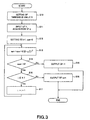
- the threshold value judgment unit 12 sets threshold value S of distance.
- the hierarchical distance calculating unit 11 inputs vector f, and acquires one vector g recorded at the recording unit 10.
- the hierarchical distance calculating unit 11 sets component number i serving as internal variable to 1, and sets integrated value sum of distance to 0.
- the threshold value judgment unit 12 discriminates whether or not integrated value sum is smaller than threshold value S. In the case where integrated value sum is smaller than threshold value S (Yes), processing proceeds to step S 16. In the case where integrated value sum is threshold value S or larger (No), the threshold value judgment unit 12 outputs -1 at step S15 to complete processing.
- -1 which is outputted is convenient numerical value indicating that distance between inputted vector f and acquired vector g is above threshold value S, and this vector g is nullified.
- the threshold value judgement unit 12 provides threshold value S and serves to truncate integrating operation at the hierarchical distance calculating unit 11 in the case where integrated value sum is above threshold value S at the middle hierarchy of integrating operation to thereby realize high speed processing.
- step S16 it is discriminated whether or not component number i is the number of dimensions N of vector f or vector g or smaller. In the case where the component number i is N or smaller (Yes), i is incremented at step S17 to return to step S13. On the other hand, in the case where the component number i is larger than N (No), the threshold value judgment unit 12 outputs integrated value sum at step S18 because integrating operation has been completed until the last component of vector f or vector g to complete processing. It is to be noted that integrated value sum at this time is square of distance between vectors.
- this processing corresponds to the processing to calculate precise distance only with respect to registered vectors in which distance from input vector indicated by ⁇ in the figure is within the range of super sphere having radius ⁇ S in connection with a large number of registered vectors indicated by black circle in FIG. 4 , and to nullify registered vectors without the range at the time point when integrated value of distances of every respective axes is above radius.
- threshold value S of distance is set, thereby making it possible to conduct retrieval equivalent to full search at a high speed.
- difference takes place in retrieval speed by this arrangement order. For example, in such cases that deviation exists in distribution of vectors within feature space as shown in FIG. 5 , retrieval speed greatly changes in dependency upon which of f[1] axis or f[2] axis is first integrated. In this example, employment of a method of first evaluating f[2] axis results in less extra integration to thereby realize high speed operation.
- square distance d 2 between two vetcors g and f is not changed by normal orthogonal transform matrix U as indicated by the following formula (6).
- the similarity vector detecting apparatus 2 serves to input vectors f and g to output distance between the vectors (or -1), and is composed of vector transform units 20, 21, a recording unit 22, a hierarchical distance calculating unit 23, and a threshold value judgment unit 24.
- the vector transform units 20, 21 serve to respectively implement similar transform operations to vectors g and f.
- the recording unit 22 is, e.g., magnetic disc, optical disc or semiconductor memory, etc.
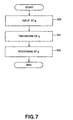
- step S20 the vector transform unit 20 ( FIG. 6 ) inputs registered vector g in advance.
- step S21 vector g is transformed as indicated by the above-described formula (5) to generate vector g'.
- step S22 the recording unit 10 records transformed vector g'.
- the threshold value judgment unit 24 sets threshold value S of distance.
- the vector transform unit 21 inputs vector f and the hierarchical distance calculating unit 23 acquires one vector g' recorded at the recording unit 22.
- the vector transform unit 21 transforms vector f as indicated by the above-described formula (4) to generate vector f'.
- the hierarchical distance calculating unit 23 sets component number i serving as internal variable to 1, and sets integrated value sum of distance to 0.
- the threshold value judgment unit 24 discriminates whether or not integrated value sum is smaller than threshold value S. In the case where integrated value sum is smaller than threshold value S (Yes), processing proceeds to step S37. In the case where integrated value sum is threshold value S or larger (No), the threshold value judgment unit 24 outputs -1 at step S36 to complete processing.
- step S37 it is discriminated whether or not the component number i is the number of dimensions N or smaller of vector f' and vector g'. In the case where the component number i is N or smaller (Yes), i is incremented at step S38 to return to step S34. On the other hand, in the case where the component number i is larger than N (No), the threshold value judgment unit 24 outputs integrated value sum at step S39 because integrating operation is completed up to the last component of vectors f' and g' to complete processing. It is to be noted that the integrated value sum at this time is square of distance between vectors.
- Sequential matrix is mentioned as the most simple orthogonal transform.
- order of vector component is caused to simply undergo sequencing.
- sequential matrix P of the eighth order is expressed in a form as indicated by the following formula (8).
- the orthogonal transform using this sequential matrix is effective in such cases that ways of spreading of respective vector components are different, and is high in speed since it is sufficient to perform sequencing so that multiplication/division and/or conditional branch are not necessary.
- Discrete Cosine Transform represented by the following formulas (10), (11), and Discrete Fourier Transform (DFT) represented by the following formulas (12), (13) are used as orthogonal transform to conduct integration in order from low frequency component, thereby making it possible to perform integration in order from component of high significance.
- DCT Discrete Cosine Transform
- DFT Discrete Fourier Transform
- D D 11 ⁇ ⁇ ⁇ ⁇ D 1 ⁇ N ⁇ ⁇ ⁇ ⁇ ⁇ D N ⁇ 1 ⁇ ⁇ ⁇ D NN
- F F 11 ⁇ ⁇ ⁇ ⁇ F 1 ⁇ N ⁇ ⁇ ⁇ ⁇ F N ⁇ 1 ⁇ ⁇ ⁇ ⁇ F N ⁇ 1 ⁇ ⁇ ⁇ F NN
- F mn ⁇ 1 N cos - 2 ⁇ ⁇ ⁇ n / 2 - 1 ⁇ m - 1 N n : even 1 N sin - 2 ⁇ ⁇ ⁇ n + 1 / 2 - N / 2 ⁇ m - 1 N n : odd
- the Walsh-Hadamard Transform is orthogonal transform where respective elements of transform matrix are constituted only by ⁇ 1, and is suitable for high speed transform because multiplication is not required at the time of transform.
- sequency is used as concept close to frequency and components are arranged in order from low sequency so that high speed of distance calculation can be realized with respect to vectors where correlation relationship between adjacent components is large similarly to the above-described Discrete Cosine Transform or Discrete Fourier Transform.
- the Walsh-Hadmard Transform matrix is constituted in accordance with codes of Fourier Transform matrix, or is constituted by recursive expansion operation of matrix.
- the Walsh-Hadamard Transform matrix W of the eighth order arranged in order of sequency is indicated by the following formula (14).
- KL transform Karhunen-Loeve Transform
- the KL transform matrix T is eigen matix in which dispersion matrix V of sample vectors is decomposed into eigen values, and is defined as indicated by the following formula (15) in the case where eigen value is assumed as ⁇ 1 , ⁇ ⁇ N .
- the KL transform is orthogonal transform matrix which completely removes correlation relationship between respective components, and dispersion of transformed vector components results in eigen value ⁇ i .
- the KL transform matrix T is constituted so that eigen values ⁇ i are arranged in order of magnitude to thereby integrate all components to remove overlapping information thereafter to have ability to perform integration of distances from the axis where dispersion is the largest.
- the KL transform in the above-described second embodiment corresponds to analysis method called main component analysis in the multivariate analysis field, and is an operation for extracting main component constituting vector.
- the main component of transformed vector g' obtained in the second embodiment is recorded as index vector g 1
- the remaining component is recorded as detail vector g 2 .
- distance calculation is first performed with reference to index vector g 1 to acquire detail vector g 2 only in the case where that result is smaller than threshold value S to further perform distance calculation, thereby making it possible to shorten data read-in time.
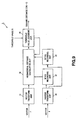
- the similarity vector detecting apparatus 3 serves to input vector f and vector g to output square distance between vectors (or -1), and is composed of vector transform units 30, 31, an index recording unit 32, a detail recording unit 33, a hierarchical distance calculating unit 34, and a threshold value judgment unit 35.
- the vector converting units 30, 31 serve to respectively implement transform operation similar to the above-described second embodiment to the vectors g and f.
- the index recording unit 32 and the detail recording unit 33 are, e.g., magnetic disc, optical disc or semiconductor memory, etc.
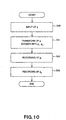
- the vector transform unit 30 ( FIG. 9 ) inputs registered vector g in advance.
- vector g is transformed as indicated by the above-described formula (5) to generate vector g'.
- the vector transform unit 30 divides it into index vector g 1 having a predetermined number M (1 ⁇ M ⁇ N) of components and detail vector g 2 having the remaining component in order from component having small component number, i.e., component having large dispersion or eigen value in the above-described transform operations or low frequency component.
- the index recording unit 32 records index vector g 1 .
- the detail recording unit 33 records detail vector g 2 .
- the threshold value judgment unit 35 sets threshold value S of distance.
- the vector transform unit 31 inputs vector f, and the hierarchical distance calculating unit 34 acquires one index vector g 1 recorded at the index recording unit 32.
- the vector transform unit 31 transforms vector f as indicated by the above-described formula (4) to generate vector f'. Further, the vector transform unit 31 divides it into index vector f 1 having a predetermined number M (1 ⁇ M ⁇ N) of components and detail vector f 2 having the remaining component in order from component having small component number.
- the hierarchical distance calculating unit 34 sets component number i serving as internal variable to 1 and sets integrated value sum of distance to 0.
- the threshold value judgment unit 35 discriminates whether or not integrated value sum is smaller than threshold value S. In the case where integrated value sum is smaller than threshold value S (Yes), processing proceeds to step S57. In the case where integrated value sum is threshold value S or larger (No), the threshold value judgment unit 35 outputs -1 at step S56 to complete processing.
- -1 which is outputted is convenient numerical value indicating that distance is above the threshold value so that it is nullified.
- step S57 it is discriminated whether or not component number i is the number of dimensions M of index vector f 1 and index vector g 1 or smaller. In the case where the component number i is M or smaller (Yes), i is incremented at step S58 to return to the step S54. On the other hand, in the case where component number i is larger than M (No), the hierarchical distance calculating unit 34 acquires one detail vector g 2 recorded at the detail recording unit 33.
- the hierarchical distance calculating unit 34 performs integrating operation as indicated by the above-described formula (16) between the i-th component f'[i] of vector f' and the i-th component g'[i] of vector g'.
- the threshold value judgment unit 35 discriminates whether or not integrated value sum is smaller than threshold value S. In the case where the integrated value sum is smaller than threshold value S (Yes), processing proceeds to step S63. In the case where integrated value sum is threshold value S or larger (No), the threshold value judgment unit 35 outputs -1 at step S62 to complete processing.
- step S63 it is discriminated whether or not the component number i is the number of dimensions N of vector f' or vector g' or smaller. In the case where the component number i is N or smaller (Yes), i is incremented at step S64 to return to the step S60. On the other hand, in the case where the component number i is larger than N (No), the threshold value judgment unit 35 outputs integrated value sum at step S65 since integration is completed until the last component of vector g' to complete processing. At this time, the integrated value sum results in square of distance between vectors.
- index vector is divided into two stages of index vector and detail vector
- index vector is further similarly divided into index vector of high order and detailed index vector so that three-stage configuration is provided.
- acoustic feature vector and/or image feature vector are extracted to use them as the above-described vectors f and g, thereby making it possible to retrieve, at a high speed, similar acoustic or video signal from registered acoustic signal or video signal by using the techniques of the above-described first to third embodiments in the case where acoustic signal or video signal is inputted.
- step S70 acoustic signals with respect to each time period T are acquired from acoustic signal within object time period.
- q index representing discrete frequency
- Q is the maximum discrete frequency.
- step S72 it is discriminated whether or not calculation within object time period is completed. In the case where such calculation is completed (Yes), processing proceeds to step S73. In the case where such calculation is not completed (No), processing returns to the step S70.
- a S 0 , ⁇ ⁇ ⁇ , S Q ⁇ 1
- acoustic feature vector a Since the acoustic signal is vast, there are many instances where such signal is recorded or is caused to undergo transmission after being compression-encoded. While it is possible to extract acoustic feature vector a by using the above-described technique after encoded acoustic signal is decoded into signal in the base band, extracting processing can be conducted efficiently and at a high speed if acoustic feature vector a can be extracted only by partial decoding.
- acoustic signal serving as original sound is divided into frames with respect to each time period T, as shown in FIG. 14 .
- orthogonal transform such as Modified Discrete Cosine Transform (MDCT), etc. is implemented to acoustic signal with respect to each frame, and the coefficients thereof are quantized and encoded.
- scale factors serving as normalization coefficient of magnitude are extracted with respect to each frequency band, and are separately encoded.
- step S80 encoded acoustic signal within the time period T in the object time period is acquired.
- step S81 scale factors with respect to each frame are partially decoded.
- step S82 it is discriminated whether or not decoding within the object time period is completed. In the case where such decoding is completed (Yes), processing proceeds to step S83. In the case where such decoding is not completed (No), processing returns to the step S80.
- step S83 maximum scale factors are detected with respect to each band from scale factors within the object time period.
- step S84 those scale factors are changed into vectors to generate acoustic feature vector a.
- step S90 image frame is acquired from video signal within the object time period T.
- time average image 100 is prepared on the basis of acquired all image frames.
- the prepared time average image 100 is divided into X ⁇ Y small blocks in breadth and width directions to prepare block average image 110 in which pixel values within respective blocks are averaged.
- step S93 these small blocks are arranged in order of R, G, B, e.g., from the left upper direction toward the right lower direction to generate one-dimensional image feature vector v.
- This image feature vector v is represented by, e.g., the following formula (18).
- v R 00 ⁇ R X - 1 , Y - 1 ⁇ G 00 ⁇ G X - 1 , Y - 1 ⁇ B 00 ⁇ B X - 1 , Y - 1
- time change of video signal is not so rapid in the ordinary state, it is also possible to obtain the same effects/advantages by employing an approach to select, as representative image, one frame within the object time period without preparing the time average image 100 to substitute it.
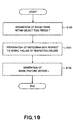
- step S100 image frame is acquired from video signal within object time period T.
- step S101 histogram with respect to signal values of respective colors, e.g., R, G, B is prepared from signal values of respective image frames.
- step S102 these colors are arranged in order of, e.g., R, G, B to generate one-dimensional image feature vector v.
- This image feature vector v is represented by the following formula (19).
- v R 0 ⁇ R N - 1 ⁇ G 0 ⁇ G N - 1 ⁇ B 0 ⁇ B N - 1
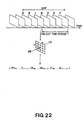
- step S110 encoded video signal of encoded group (Group of pictures: GOP) proximate to object time period T to be changed into vector is acquired to acquire intra-frame encoded picture (I picture) 120 within that GOP.
- GOP Group of pictures
- frame image is encoded with macro block MB (16 ⁇ 16 pixels, or 8 ⁇ 8 pixels) being as unit, and Discrete Cosine Transform (DCT) is used.
- DCT Discrete Cosine Transform
- step S111 these DC coefficients are acquired.
- these coefficients are arranged in order of, e.g., Y, Cb, Cr to generate one-dimensional image feature vector v.
- This image feature vector v is represented by, e.g., the following formula (20).
- v Y 00 ⁇ Y X - 1 , Y - 1 ⁇ Cb 00 ⁇ Cb X - 1 , Y - 1 ⁇ Cr 00 ⁇ Cr X - 1 , Y - 1
- hierarchical distance integrating operation is performed in detecting analogous (similar) vector on the basis of distance between vectors to truncate distance integrating operation at the time when integrated value of distances is above threshold value with respect to distance set in advance, thereby making it possible to detect similar vector at a high speed.
- distance calculation can be truncated at the early stage.
- detection time can be shortened to a large extent.
- acoustic feature vector and/or image feature vector is extracted in advance to register the vector thus extracted, whereby in the case where arbitrary acoustic signal or video signal is inputted, similar acoustic or video signals can be retrieved at a high speed while maintaining structural simplicity and/or retrieval accuracy similar to full search.
- the present invention has been explained in the above-described embodiments as the configuration of hardware, the present invention is not limited to such implementation, but arbitrary processing may be also realized by allowing CPU (Central Processing Unit) to execute computer program.
- CPU Central Processing Unit
- computer program may be provided in the state where it is recorded on recording medium, or may be provided by allowing it to undergo transmission through other transmission medium such as Internet.
Landscapes
- Engineering & Computer Science (AREA)
- Theoretical Computer Science (AREA)
- Physics & Mathematics (AREA)
- General Physics & Mathematics (AREA)
- Computer Vision & Pattern Recognition (AREA)
- Data Mining & Analysis (AREA)
- General Engineering & Computer Science (AREA)
- Evolutionary Computation (AREA)
- Artificial Intelligence (AREA)
- Multimedia (AREA)
- Mathematical Physics (AREA)
- Pure & Applied Mathematics (AREA)
- Software Systems (AREA)
- Databases & Information Systems (AREA)
- Mathematical Optimization (AREA)
- Computational Mathematics (AREA)
- Mathematical Analysis (AREA)
- Bioinformatics & Cheminformatics (AREA)
- Computing Systems (AREA)
- Evolutionary Biology (AREA)
- Bioinformatics & Computational Biology (AREA)
- Life Sciences & Earth Sciences (AREA)
- Health & Medical Sciences (AREA)
- General Health & Medical Sciences (AREA)
- Algebra (AREA)
- Medical Informatics (AREA)
- Signal Processing (AREA)
- Information Retrieval, Db Structures And Fs Structures Therefor (AREA)
- Image Analysis (AREA)
- Compression, Expansion, Code Conversion, And Decoders (AREA)
- Complex Calculations (AREA)
- Television Signal Processing For Recording (AREA)
Claims (13)
- Ähnlichkeitsberechnungsverfahren zum Bestimmen einer Ähnlichkeit zwischen zwei Merkmalsvektoren, einem registrierten Vektor (g) und einem Eingabevektor (f), die repräsentativ sind für ein akustisches Signal oder ein Videosignal, wobei jeder der zwei Merkmalsvektoren N entsprechende Komponenten aufweist, wobei N eine ganze Zahl größer als Null ist,
wobei das Verfahren folgende Schritte aufweist:einen Transformationsschritt (S41, S52), bei welchem ein vorbestimmter Transformationsvorgang (S41, S52) auf die zwei Merkmalsvektoren (f, g) angewandt wird,einen Unterteilungsschritt (S41, S52), bei welchem die zwei transformierten Merkmalsvektoren (f', g') komponentenweise in eine Mehrzahl von Teilvektoren (f1, f2, g1, g2) unterteilt werden,einen Aufzeichnungsschritt (S42, S43), bei welchem die Mehrzahl von Teilvektoren (g1, g2), die den transformierten registrierten Merkmalsvektor (g') bilden, aufgezeichnet werden,einen hierarchischen Distanzberechnungsschritt (S53, S54, S57, S58, S60, S63, S64), bei welchem die Distanz zwischen den zwei Merkmalsvektoren (f', g'), die beim Transformationsschritt (S41, S52) transformiert wurden, in einer vorbestimmten Ordnung berechnet wird, und zwar auf der Grundlage des vorbestimmten Transformationsvorgangs (S41, S52), wobei die Distanzberechnung zwischen den jeweiligen Komponenten, welche die Teilvektoren (f1, f2, g1, g2) bilden, in einer komponentenweisen hierarchischen Art in der Ordnung vom Teilvektor (f1, g1) der obersten Komponentenordnung durchgeführt wird,einen Schwellwertvergleichsschritt (S55, S61), bei welchem ein integrierter Wert von Distanzen, die inkrementweise für Komponenten (i) hierarchisch höherer Ordnung der zwei transformierten Merkmalsvektoren (f', g') berechnet wurden, mit einem vorab eingestellten Schwellwert (S) verglichen wird,einen Steuerschritt (S55, S56, S57, S58, S61, S62, S63, S64), bei welchem die Distanzberechnung gemäß einem Ergebnis des Schwellwertvergleichs beim Schwellwertvergleichsschritt (S55, S61) gesteuert wird, undeinen Ausgabeschritt (S65), bei welchem der integrierte Wert der berechneten Distanzen bis zu den letzten Komponenten (1) der zwei transformierten Merkmalsvektoren (f', g') als Ähnlichkeit ausgegeben wird,wobei beim Steuerschritt (S55, S56, S57, S58, S61, S62, S63, S64) die Steuerung derart durchgeführt wird, dass die Distanzberechnung in dem Fall beendet wird, bei welchem der integrierte Wert von Distanzen, die bis zu einer bestimmten Komponentenordnung berechnet wurden, größer ist als der oder gleich ist zu dem Schwellwert, sowie derart, dass die Distanzberechnung zwischen Komponenten nächst höherer Ordnung in dem Fall durchgeführt wird, bei welchem der integrierte Wert von Distanzen, die bis zu einer bestimmten Komponentenordnung berechnet wurden, niedriger ist als der Schwellwert, undwobei die Distanzberechnung derart ausgeführt wird, dass in einem ersten Schritt nur der Teilvektor (g1) der obersten Komponentenordnung der Mehrzahl von Teilvektoren (g1, g2), die beim Aufzeichnungsschritt aufgezeichnet wurden, wieder gewonnen wird, und die Distanzberechnung zwischen jeweiligen Komponenten, die die Teilvektoren (f1, g1) der obersten Komponentenordnung bilden, in einer komponentenweisen hierarchischen Art und Weise ausgeführt wird, undwobei nur in dem Fall, bei welchem der integrierte Wert der berechneten Distanzen zwischen allen Komponenten, die die Teilvektoren (f1, g1) der obersten Komponentenordnung bilden, unterhalb des Schwellwerts liegt, in einem zweiten Schritt der Teilvektor (g2) der nächst niedrigeren Komponentenordnung der Mehrzahl von Teilvektoren (g1, g2) des transformierten registrierten Merkmalsvektors (g'), die im Aufzeichnungsschritt (S42, S43) aufgezeichnet wurden, wieder gewonnen und die Distanzberechnung zwischen jeweiligen Komponenten, die Teilvektoren (f2, g2) der nächst niedrigeren Komponentenordnung bilden, ausgeführt wird. - Ähnlichkeitsberechnungsverfahren nach Anspruch 1,
wobei der vorbestimmte Transformationsvorgang (S41, S52) ein Transformationsvorgang ist, welcher ein Ordnen einer Ordnung jeweiliger Komponenten, welche die zwei Merkmalsvektoren (f, g) bilden, gemäß einer Stärke der Dispersion der jeweiligen Komponenten durchführt, und
wobei die Distanzberechnung zwischen den zwei Merkmalsvektoren (f', g'), die im Transformationsschritt (S41, S52) transformiert wurden, im hierarchischen Distanzberechnungsschritt (S53, S54, S57, S58, S60, S63, S64) in der Ordnung von Komponenten einer großen Dispersion ausgeführt wird. - Ähnlichkeitsberechnungsverfahren nach Anspruch 1,
wobei der vorbestimmte Transformationsvorgang (S41, S52) ein diskreter Cosinus-Transformationsvorgang oder ein diskreter Fourier-Transformationsvorgang ist und
wobei die Distanzberechnung zwischen den zwei Merkmalsvektoren (f', g'), die im Transformationsschritt (S41, S52) transformiert wurden, im hierarchischen Distanzberechnungsschritt (S53, S54, S57, S58, S60, S63, S64) ausgeführt wird in der Ordnung von einer Niedrigfrequenzkomponente. - Ähnlichkeitsberechnungsverfahren nach Anspruch 1,
wobei der vorbestimmte Transformationsvorgang (S41, S52) ein Walsh-Hadamard-Transformationsvorgang ist und
wobei die Distanzberechnung zwischen den zwei transformierten Merkmalsvektoren (f', g') im hierarchischen Distanzberechnungsschritt (S53, S54, S57, S58, S60, S63, S64) in einer Ordnung von einer Niedrigfrequenzkomponente ausgeführt wird. - Ähnlichkeitsberechnungsverfahren nach Anspruch 1,
wobei der vorbestimmte Transformationsvorgang (S41, S52) ein Karhunen-Loeve-Transformationsvorgang ist und
wobei die Distanzberechnung zwischen den zwei Merkmalsvektoren (f', g'), die im Transformationsschritt transformiert wurden, im hierarchischen Distanzberechnungsschritt (S53, S54, S57, S58, S60, S63, S64) in einer Ordnung von einer Komponente mit großem Eigenwert ausgeführt wird. - Ähnlichkeitsberechnungsverfahren nach Anspruch 1,
wobei der Merkmalsvektor (a) erhalten wird durch Extrahieren von Leistungsspektrumskoeffizienten (Sq) innerhalb einer vorbestimmten Zeitspanne eines akustischen Signals,
wobei die Leistungsspektrumskoeffizienten (Sq) die Komponenten des Merkmalsvektors (a) sind. - Ähnlichkeitsberechnungsverfahren nach Anspruch 1,
wobei der Merkmalsvektor (a) erhalten wird durch Extrahieren linearer Vorhersagekoeffizienten innerhalb einer vorbestimmten Zeitspanne eines akustischen Signals. - Ähnlichkeitsberechnungsverfahren nach Anspruch 1,
wobei der Merkmalsvektor (a) erhalten wird durch Extrahieren von Parametern, die Intensitäten von Frequenzkomponenten innerhalb jeweiliger Frames eines codierten akustischen Signals anzeigen,
wobei die Parameter Komponenten des Merkmalsvektors (a) sind. - Ähnlichkeitsberechnungsverfahren nach Anspruch 1,
wobei der Merkmalsvektor (v) erhalten wird durch Erfassen von Bildframes von einem Signalwert eines repräsentativen Bildes innerhalb jeweiliger vorbestimmter Zeitspannen eines Videosignals, durch Erzeugen eines gemittelten Bildes (100) der erfassten Bildframes innerhalb der jeweiligen vorbestimmten Zeitspannen und durch Erzeugen eines blockgemittelten Bildes (110) durch Unterteilen des gemittelten Bildes (100) in X x Y kleine Blöcke in Breiten- und Weitenrichtungen und Mitteln der Werte innerhalb jeweiliger kleiner Blöcke und Anordnen der kleinen Blöcke in einer Ordnung von R, G, B, wobei die Werte des blockgemittelten Bildes (110), die in der Ordnung von R, G, B angeordnet sind, die Komponenten des Merkmalsvektors (v) sind. - Ähnlichkeitsberechnungsverfahren nach Anspruch 1,
wobei der Merkmalsvektor (v) erhalten wird durch Erzeugen eines Histogramms in Bezug auf Signalwerte von Luminanz und/oder von Farbe eines Bildframes innerhalb einer vorbestimmten Zeitspanne eines Videosignals, wobei die Signalwerte von Luminanz und/oder Farbe die Komponenten des Merkmalsvektors (v) sind. - Ähnlichkeitsberechnungsvorrichtung,
welche ausgebildet ist zum Bestimmen einer Ähnlichkeit zwischen zwei Merkmalsvektoren, einem registrierten Vektor (g) und einem Eingabevektor (f), welche repräsentativ sind für ein akustisches Signal oder für ein Videosignal, mit:einer Transformationseinrichtung (30, 31), welche ausgebildet ist, einen vorbestimmten Transformationsvorgang in Bezug auf die zwei Merkmalsvektoren (f, g) anzuwenden,einer Unterteilungseinrichtung (30, 31), welche ausgebildet ist, in einer vorbestimmten Ordnung auf der Grundlage des vorbestimmten Transformationsvorgangs jeweilige Komponenten, die die zwei Merkmalsvektoren (f, g') bilden, die durch die Transformationseinrichtung (30, 31) transformiert wurden, zu entnehmen, um diese in eine Mehrzahl von Teilvektoren (f1, g1, f2, g2) zu unterteilen,Aufzeichnungseinrichtungen (32, 33), welche ausgebildet sind, die Mehrzahl von Teilvektoren (g1, g2), welche den transformierten registrierten Merkmalsvektor (g') bilden, aufzuzeichnen,einer hierarchischen Distanzberechnungseinrichtung (34), welche ausgebildet ist, eine Distanzberechnung zwischen den zwei Merkmalsvektoren (f', g'), die durch die Transformationseinrichtung (30, 31) transformiert wurden, in einer vorbestimmten Ordnung auszuführen, auf der Grundlage des vorbestimmten Transformationsvorgangs, wobei die Distanzberechnungseinrichtung (34) dazu ausgebildet ist, die Distanzberechnung zwischen jeweiligen Komponenten, welche Teilvektoren (f1, g1, f2, g2) bilden, in einer komponentenweisen hierarchischen Art und Weise in einer Ordnung vom Teilvektor (f1, g1) der obersten Komponentenordnung auszuführen, undeiner Schwellwertvergleichseinrichtung (35), welche ausgebildet ist, einen integrierten Wert von Distanzen, die inkrementweise für Komponenten hierarchisch höherer Ordnung der zwei transformierten Vektoren (f', g') durch die Distanzberechnungseinrichtung (34) berechnet wurden, mit einem vorab eingestellten Schwellwert (S) zu vergleichen,einer Steuereinrichtung, welche ausgebildet ist, die Distanzberechnung gemäß einem Ergebnis der Schwellwertvergleichseinrichtung (34) zu steuern, undeiner Ausgabeeinrichtung, welche ausgebildet ist, den integrierten Wert von Distanzen, die bis zu den letzten Komponenten der zwei transformierten Merkmalsvektoren (f', g') berechnet wurden, als Ähnlichkeit auszugeben,wobei die Steuereinrichtung so arbeitet, dass in dem Fall, bei welchem der integrierte Wert von Distanzen, die berechnet wurden bis zu einer bestimmten Komponentenordnung, oberhalb des Schwellwerts liegt, und zwar als Ergebnis des Vergleichs durch die Schwellwertvergleichseinrichtung (35), eine Steuerung ausgeführt wird, um die Distanzberechnung zu beenden, und dass in dem Fall, bei welchem der integrierte Wert von Distanzen, die bis zu einer bestimmten Komponentenordnung berechnet wurden, unterhalb des Schwellwerts liegt, die Distanzberechnung ausgeführt wird zwischen den Komponenten nächst höherer Ordnung, undwobei die hierarchische Distanzberechnungseinrichtung (34) so arbeitet, dass in einem ersten Schritt nur der Teilvektor (g1) der obersten Komponentenordnung der Mehrzahl von Teilvektoren (g1, g2), die in der Aufzeichnungseinrichtung aufgezeichnet wurden, wieder gewonnen und die Distanzberechnung zwischen jeweiligen Komponenten, die die Teilvektoren (f1, g1) der obersten Komponentenordnung bilden, in einer komponentenweisen hierarchischen Art und Weise ausgeführt wird, undwobei nur in dem Fall, bei welchem der integrierte Wert von berechneten Distanzen, die zwischen sämtlichen Komponenten berechnet wurden, die die Teilvektoren (f1, g1) der obersten Komponentenordnung bilden, unterhalb des Schwellwerts (S) liegt, in einem zweiten Schritt der Teilvektor (g2) der nächst niedrigeren Komponentenordnung der Mehrzahl von Teilvektoren (g1, g2) des transformierten registrierten Merkmalsvektors (g'), die in der Aufzeichnungseinrichtung (33) aufgezeichnet wurden, wieder gewonnen und die Distanzberechnung zwischen den jeweiligen Komponenten, die die Teilvektoren (f2, g2) einer niedrigeren Komponentenordnung bilden, ausgeführt wird. - Programm, um einem Computer zu ermöglichen, eine Ähnlichkeitsberechnungsverarbeitung auszuführen zum Bestimmen einer Ähnlichkeit zwischen zwei Merkmalsvektoren (f, g), einem registrierten Vektor (g) und einem Eingabevektor (f), welche repräsentativ sind für ein akustisches Signal oder ein Videosignal,
wobei das Programm aufweist:einen Transformationsschritt (S41, S52), bei welchem ein vorbestimmter Transformationsvorgang auf die zwei Merkmalsvektoren (f, g) angewandt wird,einen Unterteilungsschritt (S41, S52), bei welchem die zwei transformierten Merkmalsvektoren (f', g') komponentenweise in eine Mehrzahl von Teilvektoren (f1, f2, g1, g2) unterteilt werden,einen Aufzeichnungsschritt (S42, S43), bei welchem die Mehrzahl von Teilvektoren (g1, g2), die den transformierten registrierten Merkmalsvektor (g') bilden, aufgezeichnet werden,einen hierarchischen Distanzberechnungsschritt (S53, S54, S57, S58, S60, S63, S64), bei welchem die Distanz zwischen den zwei Merkmalsvektoren (f', g'), die beim Transformationsschritt (S41, S52) transformiert wurden, in einer vorbestimmten Ordnung berechnet wird, und zwar auf der Grundlage des vorbestimmten Transformationsvorgangs (S41, S52), wobei die Distanzberechnung zwischen den jeweiligen Komponenten, welche die Teilvektoren (f1, f2, g1, g2) bilden, in einer komponentenweisen hierarchischen Art in der Ordnung vom Teilvektor (f1, g1) der obersten Komponentenordnung durchgeführt wird,einen Schwellwertvergleichsschritt (S55, S61), bei welchem ein integrierter Wert von Distanzen, die inkrementweise für Komponenten (i) hierarchisch höherer Ordnung der zwei transformierten Merkmalsvektoren berechnet wurden, mit einem vorab eingestellten Schwellwert (S) verglichen wird,einen Steuerschritt (S55, S56, S57, S58, S61, S62, S63, S64), bei welchem die Distanzberechnung gemäß einem Ergebnis des Schwellwertvergleichs beim Schwellwertvergleichsschritt (S55, S61) gesteuert wird, undeinen Ausgabeschritt (S65), bei welchem der integrierte Wert der berechneten Distanzen bis zu den letzten Komponenten (i) der zwei transformierten Merkmalsvektoren (f', g') als Ähnlichkeit ausgegeben wird,wobei beim Steuerschritt (S55, S56, S57, S58, S61, S62, S63, S64) die Steuerung derart durchgeführt wird, dass die Distanzberechnung in dem Fall beendet wird, bei welchem der integrierte Wert von Distanzen, die bis zu einer bestimmten Komponentenordnung berechnet wurden, größer ist als der oder gleich ist zu dem Schwellwert, sowie derart, dass die Distanzberechnung zwischen Komponenten nächst höherer Ordnung in dem Fall durchgeführt wird, bei welchem der integrierte Wert von Distanzen, die bis zu einer bestimmten Komponentenordnung berechnet wurden, niedriger ist als der Schwellwert, undwobei die Distanzberechnung derart ausgeführt wird, dass in einem ersten Schritt nur der Teilvektor (g1) der obersten Komponentenordnung der Mehrzahl von Teilvektoren (g1, g2), die beim Aufzeichnungsschritt aufgezeichnet wurden, wieder gewonnen wird, und wobei die Distanzberechnung zwischen jeweiligen Komponenten, die die Teilvektoren (f1, g1) der obersten Komponentenordnung bilden, in einer komponentenweisen hierarchischen Art und Weise ausgeführt wird, undwobei nur in dem Fall, bei welchem der integrierte Wert der berechneten Distanzen zwischen allen Komponenten, die die Teilvektoren (f1, g1) der obersten Komponentenordnung bilden, unterhalb des Schwellwerts liegt, in einem zweiten Schritt der Teilvektor (g2) der nächst niedrigeren Komponentenordnung der Mehrzahl von Teilvektoren (g1, g2) des transformierten registrierten Merkmalsvektors (g'), die im Aufzeichnungsschritt (S42, S43) aufgezeichnet wurden, wieder gewonnen und die Distanzberechnung zwischen jeweiligen Komponenten, die Teilvektoren (f2, g2) der nächst niedrigeren Komponentenordnung bilden, ausgeführt wird. - Computerlesbares Medium, welches derart ausgebildet ist, dass ein Programm aufgezeichnet wird, welches einem Computer ermöglicht, eine Ähnlichkeitsberechnungsverarbeitung auszuführen, welche eine Ähnlichkeit bestimmt zwischen zwei Merkmalsvektoren (f, g), einem registrierten Vektor (g) und einem Eingabevektor (f), welche repräsentativ sind für ein akustisches Signal oder für ein Videosignal,
wobei das Programm aufweist:einen Transformationsschritt (S41, S52), bei welchem ein vorbestimmter Transformationsvorgang auf die zwei Merkmalsvektoren (f, g) angewandt wird,einen Unterteilungsschritt (S41), bei welchem die zwei transformierten Merkmalsvektoren (f, g') komponentenweise in eine Mehrzahl von Teilvektoren (f1, f2, g1, g2) unterteilt werden,einen Aufzeichnungsschritt (S42, S43), bei welchem die Mehrzahl von Teilvektoren (g1, g2), die den transformierten registrierten Merkmalsvektor (g') bilden, aufgezeichnet werden,einen hierarchischen Distanzberechnungsschritt (S53, S54, S57, S58, S60, S63, S64), bei welchem die Distanz zwischen den zwei Merkmalsvektoren (f, g'), die beim Transformationsschritt transformiert wurden, in einer vorbestimmten Ordnung berechnet wird, und zwar auf der Grundlage des vorbestimmten Transformationsvorgangs (S41, S52), wobei die Distanzberechnung zwischen den jeweiligen Komponenten, welche die Teilvektoren (f1, f2, g1, g2) bilden, in einer komponentenweisen hierarchischen Art in der Ordnung vom Teilvektor (f1, g1) der obersten Komponentenordnung durchgeführt wird,einen Schwellwertvergleichsschritt (S55, S61), bei welchem ein integrierter Wert von Distanzen, die inkrementweise für Komponenten (i) hierarchisch höherer Ordnung der zwei transformierten Merkmalsvektoren (f', g') berechnet wurden, mit einem vorab eingestellten Schwellwert (S) verglichen wird,einen Steuerschritt (S55, S56, S57, S58, S61, S62, S63, S64), bei welchem die Distanzberechnung gemäß einem Ergebnis des Schwellwertvergleichs beim Schwellwertvergleichsschritt (S55, S61) gesteuert wird, undeinen Ausgabeschritt (S65), bei welchem der integrierte Wert der berechneten Distanzen bis zu den letzten Komponenten (i) der zwei transformierten Merkmalsvektoren (f', g') als Ähnlichkeit ausgegeben wird,wobei beim Steuerschritt (S55, S56, S57, S58, S61, S62, S63, S64) die Steuerung derart durchgeführt wird, dass die Distanzberechnung in dem Fall beendet wird, bei welchem der integrierte Wert von Distanzen, die bis zu einer bestimmten Komponentenordnung berechnet wurden, größer ist als der oder gleich ist zu dem Schwellwert (S), sowie derart, dass die Distanzberechnung zwischen Komponenten nächst höherer Ordnung in dem Fall durchgeführt wird, bei welchem der integrierte Wert von Distanzen, die bis zu einer bestimmten Komponentenordnung berechnet wurden, niedriger ist als der Schwellwert, undwobei die Distanzberechnung derart ausgeführt wird, dass in einem ersten Schritt nur der Teilvektor (g1) der obersten Komponentenordnung der Mehrzahl von Teilvektoren (g1, g2), die beim Aufzeichnungsschritt aufgezeichnet wurden, wieder gewonnen wird, und wobei die Distanzberechnung zwischen jeweiligen Komponenten, die die Teilvektoren (f1, g1) der obersten Komponentenordnung bilden, in einer komponentenweisen hierarchischen Art und Weise ausgeführt wird, undwobei nur in dem Fall, bei welchem der integrierte Wert der berechneten Distanzen zwischen allen Komponenten, die die Teilvektoren (f1, g1) der obersten Komponentenordnung bilden, unterhalb des Schwellwerts (S) liegt, in einem zweiten Schritt der Teilvektor (g2) der nächst niedrigeren Komponentenordnung der Mehrzahl von Teilvektoren (g1, g2) des transformierten registrierten Merkmalsvektors (g'), die im Aufzeichnungsschritt (S42, S43) aufgezeichnet wurden, wieder gewonnen und die Distanzberechnung zwischen jeweiligen Komponenten, die Teilvektoren (f2, g2) der nächst niedrigeren Komponentenordnung bilden, ausgeführt wird.
Applications Claiming Priority (3)
| Application Number | Priority Date | Filing Date | Title |
|---|---|---|---|
| JP2002200481A JP4623920B2 (ja) | 2002-07-09 | 2002-07-09 | 類似度算出方法及び装置、並びにプログラム及び記録媒体 |
| JP2002200481 | 2002-07-09 | ||
| PCT/JP2003/008142 WO2004006185A1 (ja) | 2002-07-09 | 2003-06-26 | 類似度算出方法及び装置 |
Publications (4)
| Publication Number | Publication Date |
|---|---|
| EP1521210A1 EP1521210A1 (de) | 2005-04-06 |
| EP1521210A4 EP1521210A4 (de) | 2007-07-04 |
| EP1521210B1 EP1521210B1 (de) | 2009-11-18 |
| EP1521210B9 true EP1521210B9 (de) | 2010-09-15 |
Family
ID=30112514
Family Applications (1)
| Application Number | Title | Priority Date | Filing Date |
|---|---|---|---|
| EP03736281A Expired - Lifetime EP1521210B9 (de) | 2002-07-09 | 2003-06-26 | Ähnlichkeitsberechnungsverfahren und einrichtung |
Country Status (7)
| Country | Link |
|---|---|
| US (1) | US7260488B2 (de) |
| EP (1) | EP1521210B9 (de) |
| JP (1) | JP4623920B2 (de) |
| KR (1) | KR101021044B1 (de) |
| CN (1) | CN1324509C (de) |
| DE (1) | DE60330147D1 (de) |
| WO (1) | WO2004006185A1 (de) |
Families Citing this family (20)
| Publication number | Priority date | Publication date | Assignee | Title |
|---|---|---|---|---|
| US7539870B2 (en) * | 2004-02-10 | 2009-05-26 | Microsoft Corporation | Media watermarking by biasing randomized statistics |
| JP4220449B2 (ja) * | 2004-09-16 | 2009-02-04 | 株式会社東芝 | インデキシング装置、インデキシング方法およびインデキシングプログラム |
| JP2006101462A (ja) * | 2004-09-30 | 2006-04-13 | Sanyo Electric Co Ltd | 画像信号処理装置 |
| US7552303B2 (en) * | 2004-12-14 | 2009-06-23 | International Business Machines Corporation | Memory pacing |
| KR100687207B1 (ko) * | 2005-09-16 | 2007-02-26 | 주식회사 문화방송 | 이미지 전송 장치 및 이미지 수신 장치 |
| IL179582A0 (en) * | 2006-11-26 | 2007-05-15 | Algotec Systems Ltd | Comparison workflow automation by registration |
| US8738633B1 (en) | 2012-01-31 | 2014-05-27 | Google Inc. | Transformation invariant media matching |
| US20170206202A1 (en) * | 2014-07-23 | 2017-07-20 | Hewlett Packard Enterprise Development Lp | Proximity of data terms based on walsh-hadamard transforms |
| US9568591B2 (en) * | 2014-11-10 | 2017-02-14 | Peter Dan Morley | Method for search radar processing using random matrix theory |
| US9503747B2 (en) * | 2015-01-28 | 2016-11-22 | Intel Corporation | Threshold filtering of compressed domain data using steering vector |
| WO2017082875A1 (en) | 2015-11-10 | 2017-05-18 | Hewlett Packard Enterprise Development Lp | Data allocation based on secure information retrieval |
| US11080301B2 (en) | 2016-09-28 | 2021-08-03 | Hewlett Packard Enterprise Development Lp | Storage allocation based on secure data comparisons via multiple intermediaries |
| KR102359556B1 (ko) | 2016-11-11 | 2022-02-08 | 삼성전자주식회사 | 지문 영상을 이용한 사용자 인증 방법 및 사용자 인증을 위한 부호화 모델 생성 방법 |
| JP6922556B2 (ja) | 2017-08-29 | 2021-08-18 | 富士通株式会社 | 生成プログラム、生成方法、生成装置、及び剽窃検知プログラム |
| CN108960537B (zh) * | 2018-08-17 | 2020-10-13 | 安吉汽车物流股份有限公司 | 物流订单的预测方法及装置、可读介质 |
| CN112861260B (zh) * | 2021-02-01 | 2022-03-11 | 中国人民解放军国防科技大学 | 固体火箭发动机装药性能匹配方法、装置和设备 |
| JP7682525B2 (ja) * | 2021-07-06 | 2025-05-26 | 学校法人武蔵野大学 | コンテンツ類似計算システムおよびコンテンツ検索・推奨システム |
| CN114225361A (zh) * | 2021-12-09 | 2022-03-25 | 栾金源 | 一种网球测速方法 |
| US12380673B2 (en) * | 2023-02-01 | 2025-08-05 | Axalta Coating Systems Ip Co., Llc | Image-based matching of color and appearance of coatings containing effect pigments, using binary patterns derived from color model properties |
| US12380536B2 (en) * | 2023-02-01 | 2025-08-05 | Axalta Coating Systems Ip Co., Llc | Image-based matching of color and appearance of coatings containing effect pigments, using a cosine comparison methodology |
Family Cites Families (21)
| Publication number | Priority date | Publication date | Assignee | Title |
|---|---|---|---|---|
| JPS4934246A (de) * | 1972-07-28 | 1974-03-29 | ||
| JPS6227878A (ja) * | 1985-07-29 | 1987-02-05 | Ricoh Co Ltd | マツチング方法 |
| JPH0711819B2 (ja) * | 1986-06-20 | 1995-02-08 | 株式会社リコー | パターン認識方法 |
| JPS6339092A (ja) * | 1986-08-04 | 1988-02-19 | Ricoh Co Ltd | 辞書検索方式 |
| JPS6339093A (ja) * | 1986-08-04 | 1988-02-19 | Ricoh Co Ltd | 辞書検索方式 |
| JP2953706B2 (ja) * | 1989-04-15 | 1999-09-27 | 株式会社東芝 | パターン認識装置 |
| JPH0743598B2 (ja) * | 1992-06-25 | 1995-05-15 | 株式会社エイ・ティ・アール視聴覚機構研究所 | 音声認識方法 |
| JP2700440B2 (ja) * | 1994-04-19 | 1998-01-21 | エヌ・ティ・ティ・データ通信株式会社 | 物品識別システム |
| JP3224955B2 (ja) * | 1994-05-27 | 2001-11-05 | 株式会社東芝 | ベクトル量子化装置およびベクトル量子化方法 |
| TW293227B (de) * | 1994-11-24 | 1996-12-11 | Victor Company Of Japan | |
| KR0165497B1 (ko) * | 1995-01-20 | 1999-03-20 | 김광호 | 블럭화현상 제거를 위한 후처리장치 및 그 방법 |
| JPH1013832A (ja) * | 1996-06-25 | 1998-01-16 | Nippon Telegr & Teleph Corp <Ntt> | 動画像認識方法および動画像認識検索方法 |
| KR100247969B1 (ko) * | 1997-07-15 | 2000-03-15 | 윤종용 | 대용량패턴정합장치및방법 |
| US6253201B1 (en) * | 1998-06-23 | 2001-06-26 | Philips Electronics North America Corporation | Scalable solution for image retrieval |
| JP3252802B2 (ja) * | 1998-07-17 | 2002-02-04 | 日本電気株式会社 | 音声認識装置 |
| US6535617B1 (en) * | 2000-02-14 | 2003-03-18 | Digimarc Corporation | Removal of fixed pattern noise and other fixed patterns from media signals |
| JP2002008027A (ja) * | 2000-06-20 | 2002-01-11 | Ricoh Co Ltd | パターン認識方法、パターン認識装置およびパターン認識プログラムを記録した記録媒体 |
| JP3816309B2 (ja) | 2000-06-26 | 2006-08-30 | アマノ株式会社 | 駐車場管理装置 |
| JP2002191050A (ja) * | 2000-12-22 | 2002-07-05 | Fuji Xerox Co Ltd | 画像符号化装置および方法 |
| US6963667B2 (en) * | 2001-01-12 | 2005-11-08 | National Instruments Corporation | System and method for signal matching and characterization |
| US6807305B2 (en) * | 2001-01-12 | 2004-10-19 | National Instruments Corporation | System and method for image pattern matching using a unified signal transform |
-
2002
- 2002-07-09 JP JP2002200481A patent/JP4623920B2/ja not_active Expired - Fee Related
-
2003
- 2003-06-26 WO PCT/JP2003/008142 patent/WO2004006185A1/ja not_active Ceased
- 2003-06-26 DE DE60330147T patent/DE60330147D1/de not_active Expired - Lifetime
- 2003-06-26 US US10/489,012 patent/US7260488B2/en not_active Expired - Lifetime
- 2003-06-26 EP EP03736281A patent/EP1521210B9/de not_active Expired - Lifetime
- 2003-06-26 CN CNB038009765A patent/CN1324509C/zh not_active Expired - Fee Related
- 2003-06-26 KR KR1020047003337A patent/KR101021044B1/ko not_active Expired - Fee Related
Also Published As
| Publication number | Publication date |
|---|---|
| US7260488B2 (en) | 2007-08-21 |
| EP1521210A1 (de) | 2005-04-06 |
| WO2004006185A1 (ja) | 2004-01-15 |
| DE60330147D1 (de) | 2009-12-31 |
| EP1521210B1 (de) | 2009-11-18 |
| US20050033523A1 (en) | 2005-02-10 |
| KR20050016278A (ko) | 2005-02-21 |
| JP2004046370A (ja) | 2004-02-12 |
| CN1324509C (zh) | 2007-07-04 |
| JP4623920B2 (ja) | 2011-02-02 |
| KR101021044B1 (ko) | 2011-03-14 |
| CN1552042A (zh) | 2004-12-01 |
| EP1521210A4 (de) | 2007-07-04 |
Similar Documents
| Publication | Publication Date | Title |
|---|---|---|
| EP1521210B1 (de) | Ähnlichkeitsberechnungsverfahren und einrichtung | |
| JP3960151B2 (ja) | 類似時系列検出方法及び装置、並びにプログラム | |
| Puzicha et al. | Non-parametric similarity measures for unsupervised texture segmentation and image retrieval | |
| CA2364798C (en) | Image search system and image search method thereof | |
| US20020136454A1 (en) | Non-linear quantization and similarity matching methods for retrieving image data | |
| KR20060105556A (ko) | 화상비교 장치 및 방법, 화상검색 장치 및 방법 | |
| US20040233987A1 (en) | Method for segmenting 3D objects from compressed videos | |
| US20110274359A1 (en) | Time segment representative feature vector generation device | |
| CN101232571A (zh) | 一种人体图像匹配方法及视频分析检索系统 | |
| CN120050491A (zh) | 一种基于图模型和多尺度注意力机制的视频摘要方法 | |
| KR20010039811A (ko) | 디지털 영상 텍스쳐 분석 방법 | |
| CN120107867B (zh) | 一种基于主动学习技术的视频关键帧提取方法 | |
| US20070070365A1 (en) | Content-based image retrieval based on color difference and gradient information | |
| WO2002021333A1 (fr) | Dispositif de recherche d'images | |
| Kekre et al. | Content Based Image Retreival Using Fusion of Gabor Magnitude and Modified Block Truncation Coding | |
| Guru et al. | Histogram based split and merge framework for shot boundary detection | |
| CN117008869A (zh) | 浮点数处理方法、装置、计算机设备和存储介质 | |
| Chiang et al. | A hierarchical grid-based indexing method for content-based image retrieval | |
| KR20010001694A (ko) | 영상 압축이미지를 이용한 유사이미지 검색시스템 및 그 방법 | |
| Sivasangari et al. | Converting Degraded Images to High Resolution Images using Convolutional Neural Network | |
| CN121217150A (zh) | 基于分数延迟嵌入与可逆扭曲的时序数据压缩解析方法 | |
| Ksantini et al. | Image retrieval based on region separation and multiresolution analysis | |
| Ho et al. | An effective histogram-based approach to JPEG-100 forensics | |
| JP4697111B2 (ja) | 画像比較装置および方法、並びに、画像検索装置および方法 | |
| CN121505509A (zh) | 一种融合自监督深度学习的视频关键帧提取方法 |
Legal Events
| Date | Code | Title | Description |
|---|---|---|---|
| PUAI | Public reference made under article 153(3) epc to a published international application that has entered the european phase |
Free format text: ORIGINAL CODE: 0009012 |
|
| 17P | Request for examination filed |
Effective date: 20040305 |
|
| AK | Designated contracting states |
Kind code of ref document: A1 Designated state(s): AT BE BG CH CY CZ DE DK EE ES FI FR GB GR HU IE IT LI LU MC NL PT RO SE SI SK TR |
|
| AX | Request for extension of the european patent |
Extension state: AL LT LV MK |
|
| DAX | Request for extension of the european patent (deleted) | ||
| RBV | Designated contracting states (corrected) |
Designated state(s): AT BE BG DE FR GB |
|
| A4 | Supplementary search report drawn up and despatched |
Effective date: 20070601 |
|
| RIC1 | Information provided on ipc code assigned before grant |
Ipc: G06K 9/62 20060101AFI20070525BHEP |
|
| 17Q | First examination report despatched |
Effective date: 20070830 |
|
| GRAP | Despatch of communication of intention to grant a patent |
Free format text: ORIGINAL CODE: EPIDOSNIGR1 |
|
| GRAS | Grant fee paid |
Free format text: ORIGINAL CODE: EPIDOSNIGR3 |
|
| GRAA | (expected) grant |
Free format text: ORIGINAL CODE: 0009210 |
|
| RBV | Designated contracting states (corrected) |
Designated state(s): DE FR GB |
|
| AK | Designated contracting states |
Kind code of ref document: B1 Designated state(s): DE FR GB |
|
| REG | Reference to a national code |
Ref country code: GB Ref legal event code: FG4D |
|
| REF | Corresponds to: |
Ref document number: 60330147 Country of ref document: DE Date of ref document: 20091231 Kind code of ref document: P |
|
| PLBE | No opposition filed within time limit |
Free format text: ORIGINAL CODE: 0009261 |
|
| STAA | Information on the status of an ep patent application or granted ep patent |
Free format text: STATUS: NO OPPOSITION FILED WITHIN TIME LIMIT |
|
| 26N | No opposition filed |
Effective date: 20100819 |
|
| REG | Reference to a national code |
Ref country code: GB Ref legal event code: 746 Effective date: 20120702 |
|
| REG | Reference to a national code |
Ref country code: DE Ref legal event code: R084 Ref document number: 60330147 Country of ref document: DE Effective date: 20120614 |
|
| REG | Reference to a national code |
Ref country code: FR Ref legal event code: PLFP Year of fee payment: 14 |
|
| REG | Reference to a national code |
Ref country code: FR Ref legal event code: PLFP Year of fee payment: 15 |
|
| REG | Reference to a national code |
Ref country code: FR Ref legal event code: PLFP Year of fee payment: 16 |
|
| PGFP | Annual fee paid to national office [announced via postgrant information from national office to epo] |
Ref country code: FR Payment date: 20190619 Year of fee payment: 17 |
|
| PGFP | Annual fee paid to national office [announced via postgrant information from national office to epo] |
Ref country code: GB Payment date: 20190619 Year of fee payment: 17 |
|
| PGFP | Annual fee paid to national office [announced via postgrant information from national office to epo] |
Ref country code: DE Payment date: 20200618 Year of fee payment: 18 |
|
| GBPC | Gb: european patent ceased through non-payment of renewal fee |
Effective date: 20200626 |
|
| PG25 | Lapsed in a contracting state [announced via postgrant information from national office to epo] |
Ref country code: GB Free format text: LAPSE BECAUSE OF NON-PAYMENT OF DUE FEES Effective date: 20200626 Ref country code: FR Free format text: LAPSE BECAUSE OF NON-PAYMENT OF DUE FEES Effective date: 20200630 |
|
| REG | Reference to a national code |
Ref country code: DE Ref legal event code: R119 Ref document number: 60330147 Country of ref document: DE |
|
| PG25 | Lapsed in a contracting state [announced via postgrant information from national office to epo] |
Ref country code: DE Free format text: LAPSE BECAUSE OF NON-PAYMENT OF DUE FEES Effective date: 20220101 |